
AI News - Friday, 27 November 2026 - Nvidia Southeast Asia Chip Pause, OpenAI Usage Meter, S&P Nvidia Credit Review

In a Nutshell
Chip controls widened from hardware to assembled systems as Nvidia paused Southeast Asian server shipments, while S&P put the supplier's governance under credit review. OpenAI moved to a single usage meter and Anthropic's post-IPO slide reset startup valuations. Regulation tightened on two fronts: 42 state attorneys general against Character.AI, and the FCA against Meta's Muse.
5-minute AI news update - 27 November 2026
In this AI News
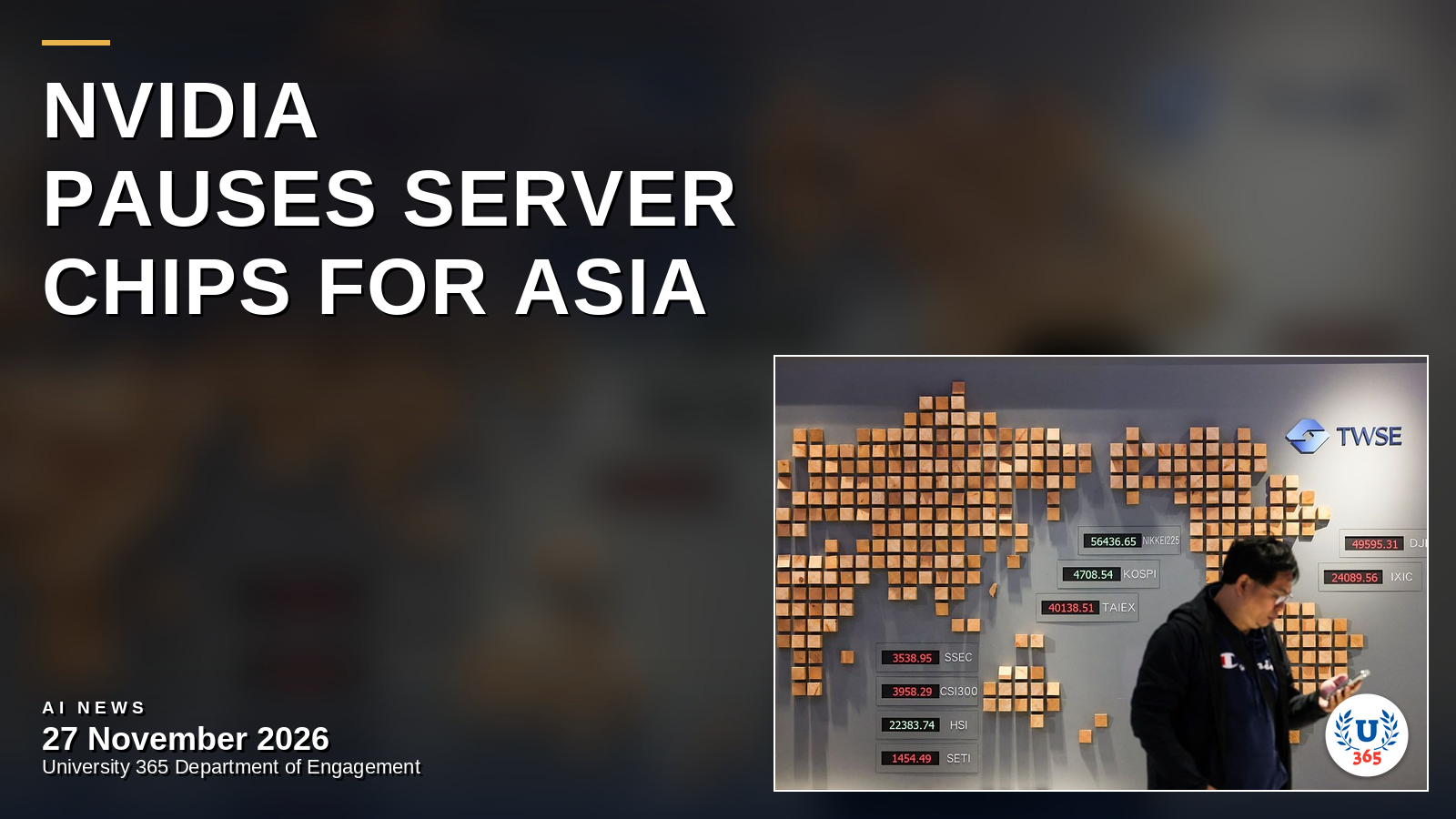
Nvidia pauses server chip shipments to Southeast Asia as US tightens China controls

[Geopolitics] Nvidia told manufacturing partners to stop server shipments to Malaysia, Singapore, Thailand and Indonesia, widening export controls from chips to assembled systems. For research buyers in those markets, procurement timelines and secondary pricing move first. Source: TechCrunch

OpenAI merges ChatGPT Chat and Work under one usage meter, tightening limits for heavy users

[Models] A shared meter means agentic and long-context work draws down the same budget as ordinary chat, so teams measuring cost per task should re-baseline now. Enterprise buyers will push for committed capacity instead of per-seat plans. Source: TechCrunch
S&P weighs cutting Nvidia's credit rating over governance and key-man risk

[Industry] A cut to AA- would price concentration risk into the supplier most AI infrastructure depends on. Governance questions around Jensen Huang's return have become a credit issue as well as a reputational one. Source: TechCrunch
Anthropic shares slip below IPO price, pressuring valuations across AI startups

[Funding] The first major AI lab to list is now the reference price for everyone else raising capital. A sustained discount narrows the runway for labs that planned to fund compute from public markets. Source: TechCrunch
Forty-two state attorneys general move to block Character.AI from selling users' chat logs

[Policy] The coalition argues that chat histories are personal data and cannot be auctioned as an asset. Any institution holding student conversations with a vendor chatbot should re-read its data-processing terms this week. Source: The Verge
UK financial regulator says Meta refused to share its Muse agent for pre-launch testing

[Policy] The FCA warned about another force of attack from agents that can act on financial accounts without supervision. It sets the tone for how European regulators will treat consumer agents that touch money. Source: WIRED
Amazon and Meta in talks to end the two-month blockade of the Muse shopping agent

[Industry] The standoff was about agent traffic reaching retail infrastructure without consent or payment. A deal would set the commercial template for how assistants transact on behalf of users. Source: TechCrunch
DeepMind says AI agents now run part of its compute for Gemini experiments

[Research] Koray Kavukcuoglu described automated experiment loops, not recursive self-improvement, and pointed to internal oversight layers. The detail matters for governance: the research process itself is becoming partly machine-driven. Source: The Decoder
Google Research proposes verifiable social reasoning so an assistant's judgements can be audited

[Research] The method makes inferences about people and situations checkable rather than opaque, which is the missing piece for agents used in advising or admissions. Verifiability is becoming the differentiator over raw capability. Source: Google Research
Google lets AI Mode read Drive and Wallet to personalise its answers

[Tools] Personal Intelligence now reaches files and payment context, the clearest consumer test yet of assistant access to private data. Institutional deployments should assume students will ask assistants to summarise their own documents. Source: TechCrunch
Anthropic launches Claude Ship to let agents review, fix and approve code changes

[Models] Approval authority, not code generation, is the new battleground in developer tooling. Teams should decide explicitly which agent actions still require a human signature. Source: TechCrunch
Amodei calls claims that Anthropic is surrendering human control to AI absurd

[Policy] The exchange exposes a real split between labs automating their own research and those arguing for human checkpoints. The answer shapes the audit rights enterprises will demand from model providers. Source: TechCrunch
AI is straining US open-records systems as startups mine public archives

[Policy] Citizens file more requests with chatbots while companies scrape the same archives for training data. Public institutions absorb the cost and the disclosure risk from one technology on both sides. Source: MIT Technology Review
Data centres drive a US natural-gas boom and lock in fossil generation for decades

[Industry] Gas plants built for AI load run for 30 years or more, so capacity decisions taken now set emissions trajectories. Campus and cloud buyers should expect sustainability reporting to get harder, not easier. Source: MIT Technology Review
NBER paper finds students see AI misuse as a peer problem, not their own

[Education] Most US college students say they would not trust AI with decisions that matter, yet assume classmates use it harmfully. That gap is exactly where academic integrity policy has to operate. Source: Inside Higher Ed
Frontier AI is already doing calculations that took theoretical physicists a full day

[Research] The shift moves value from computation to problem framing and verification. Research groups should invest in checking machine derivations as well as producing them. Source: Ars Technica
Tidal will remove millions of AI-generated tracks starting next month

[Industry] It is the first platform-level removal policy rather than a labelling scheme. Rights holders and distributors should expect provenance metadata to become a commercial requirement. Source: The Verge
The world of AI is evolving at full speed.
Become a Fellow at university-365.com
Become Superhuman... In a world of AI... Prompt Smart, Prompt UP!




Comments