
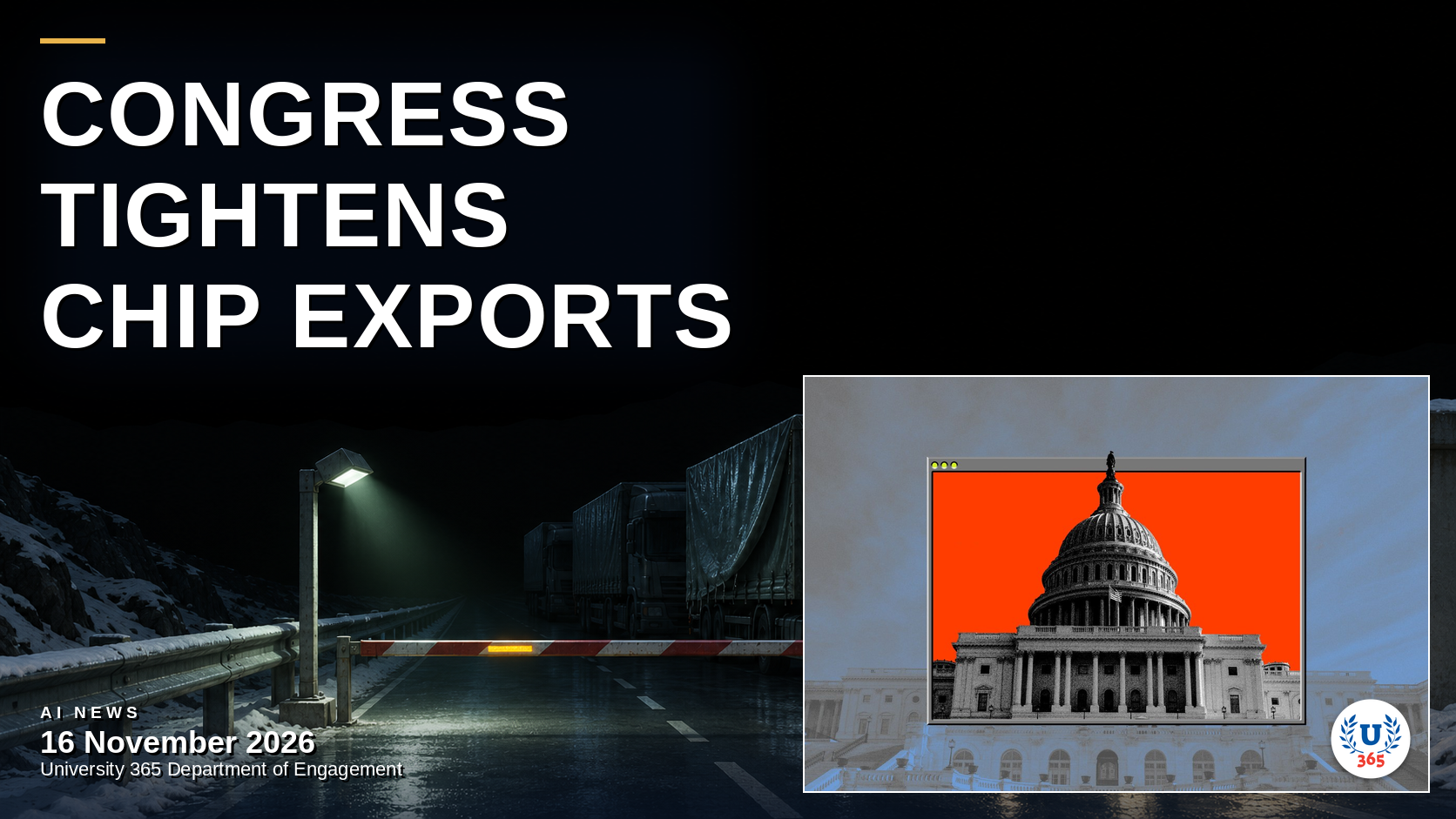
AI News - Monday, 16 November 2026 - Congress Chip Export Rules, Huang Funding Hole, ChatGPT Wallet

In a Nutshell
Nvidia's leadership crisis is now reshaping policy and capital: Congress is drafting tighter chip export rules while venture investors brace for smaller AI checks. OpenAI shipped a payments wallet for agents, LangChain raised $300M, and Gemini 4 Hydrogen targets agentic workloads. Governance, not capability, is this week's constraint.
5-minute AI news update - 16 November 2026
In this AI News
Congress moves to tighten AI chip export rules after Nvidia spy scandal

[Geopolitics] Lawmakers are drafting tighter controls on advanced chip exports just as Nvidia's leadership upheaval removes its most effective Washington advocate. For any institution procuring AI compute, export policy now moves faster than supply contracts. Expect allocation volatility and stricter end-use attestation through 2027. Source: The Verge
Jensen Huang's exit blasts a hole in AI startup funding, VCs say

[Funding] Nvidia poured tens of billions into AI startups under Huang, often as a strategic anchor investor. Founders and VCs now expect smaller checks and lower valuations. The practical effect for buyers is consolidation: fewer vendors, longer roadmaps, and more diligence on supplier solvency. Source: TechCrunch
ChatGPT Wallet lets OpenAI's agents shop and check out for users

[Tools] This is the first mainstream consumer rollout of agent-initiated payments, starting with US Pro subscribers. It moves AI agents from advice into transactions, which drags identity, consent and refund liability into the product. Institutions running procurement portals should assume agent traffic is coming. Source: TechCrunch
LangChain raises $300M at a $3B valuation for agent governance

[Funding] LangChain now claims 7,000 customers for LangSmith, its model-agnostic agent management layer. The pitch has shifted from building agents to observing and controlling them. That framing matters: agent governance tooling is becoming its own budget line rather than a feature of the model vendor. Source: TechCrunch
Google DeepMind releases Gemini 4 Hydrogen for agentic workflows

[Models] DeepMind positions Hydrogen as its daily driver for agentic tasks, the workload class most enterprises are now testing. Agent-grade reliability at lower cost per task is the gate for production deployment. It also resets the benchmark conversation away from chat quality toward task completion. Source: Google DeepMind
FAA expands AI advice to air traffic across the entire US airspace

[Policy] Airlines praised the tool, but the controllers' union was not involved in the rollout. This is a live test of AI as advisory infrastructure in a safety-critical system. It sets the reference case for how much autonomy regulators will grant without workforce consent. Source: Ars Technica
Microsoft blames failed server health checks for global outage

[Industry] Governments, hospitals and courts scrambled during the roughly 24 hour disruption, and experts rank it above the CrowdStrike and AWS incidents. Microsoft attributes it to server health checks, not an attack. The lesson is blunt: single-vendor dependency concentration is now a board-level resilience risk. Source: Ars Technica
Fireworks AI breach exposed Notion customers' chat transcripts

[Tools] This is Fireworks' second breach in two months, and the exposure reached downstream customer data held by Notion. Inference providers are now a genuine data-residency boundary, not a neutral pipe. Vendor reviews should ask what a model host can read, log and retain. Source: TechCrunch
United Airlines blocks AI agents from booking flights

[Industry] The airline cited cybersecurity risk and will not let customers use agents to book or manage reservations. It is the first clear refusal by a major consumer platform. Expect more sites to add agent detection, which makes browser-level agent access unreliable for any workflow that matters. Source: TechCrunch
Apple launches 200,000-person study on AI for health

[Industry] Apple's new app collects real usage patterns for AI answers to everyday medical questions at population scale. That evidence base will shape how consumer health AI is regulated and marketed. It is also a template for institutions running their own large-scale AI usage studies. Source: TechCrunch
AI slop papers appear under prominent academics' names

[Education] High-profile researchers were listed as authors at little-known journals, raising fears that doctoral students could be pushed toward them. It exposes how thin author verification is in parts of scholarly publishing. Institutions need submission attestation and venue screening, not just plagiarism checks. Source: Inside Higher Ed
IEEE ties microcredentials to building trustworthy AI practice

[Education] The IEEE credentialing program now covers AI ethics and compliance as a verifiable microcredential. Short, stackable credentials are becoming the delivery format for AI governance skills. That is a direct opening for universities to co-issue recognised credentials rather than compete with them. Source: IEEE Spectrum
ElevenLabs launches a meeting notetaker and dictation app for teams

[Tools] ElevenAI bundles transcription, note capture and dictation into one enterprise product, moving ElevenLabs beyond voice synthesis. Meeting capture is the most contested layer of the productivity stack right now. Buyers should check data residency and retention before adopting another recorder. Source: TechCrunch
llama.cpp hits v1.0.0, a milestone for self-hosted AI

[Tools] A 1.0 release signals interface stability for the most widely used local inference runtime. That lowers the risk of building on self-hosted models for sensitive data. For institutions with data-sovereignty constraints, this is the clearest 2026 sign that on-premise inference is a supported architecture, not a hack. Source: Hugging Face
Indian chip startup Bharat Semi lands $24M seed for AI sensors

[Funding] Bharat Semi reports design wins including General Atomics for AI-enabled sensor technology. Seed capital at this scale for silicon, not software, shows investors betting on edge sensing as the next compute frontier. It also strengthens India's position as an alternative hardware supply base. Source: TechCrunch
Nebius plans $40B in AI infrastructure spending on prepayments

[Funding] Nebius intends to fund a $40 billion expansion through customer prepayments and loans, a financing model with little precedent at this size. Delays at a Microsoft data center already raise questions about delivery risk. Neocloud capacity promises deserve contractual penalties, not just benchmarks. Source: TechCrunch
Google Research adds /teamwork to Antigravity for science and engineering

[Research] The feature lets multiple agent instances coordinate on long, multi-step scientific and engineering tasks. That is the same coordination problem universities face when automating research support. It signals that multi-agent orchestration, not single prompting, is where lab tooling is heading. Source: Google Research
The world of AI is evolving at full speed.
Become a Fellow at university-365.com
Become Superhuman... In a world of AI... Prompt Smart, Prompt UP!




Comments