
Claude Fable 5.1: Anthropic's Frontier Model for Long-Running Coding and Knowledge Work

Updated: Oct 8

Status: Active | Last tested: 2026-09-07 (Fable 5.1, released Sep 1, 2026) | Re-check: trigger-based (max 6 months)
Active: the tool is current and recommended.


In this Tool Review
Tool Snapshot
Claude Fable 5.1
"Next generation of intelligence for the hardest knowledge work and coding problems."
Category: Large Language Model
Provider:Anthropic
Version tested:Claude Fable 5.1 (released Sep 1, 2026)
Context window:1M tokens
License:Proprietary (closed-weights)
Platforms:Claude API, Amazon Bedrock, Google Cloud, Microsoft Foundry, Claude Platform on AWS
Primary use cases:
Long-running autonomous coding: multi-day sessions spanning entire codebases
Agentic workflows: browser operation, Slack integration, unattended managed agents
Deep research and scientific analysis: multi-step reasoning over complex documents
Enterprise knowledge work: complex deliverables with minimal oversight
Code review and debugging: root-cause analysis and vulnerability identification
Pricing summary: Paid (API) - $10/MTok input, $50/MTok output, $0.25/MTok cache reads (75% cut from Fable 5). Subscription: Pro $17-20/mo, Max from $100/mo, Team $30/seat/mo, Enterprise $20/seat/mo + API usage. Batch API 50% discount.
Official links:
LLM specifications:
Context Window: 1M tokens (roughly 555K words on current tokenizer)
Max Output: 128K tokens
Effort/Thinking Levels: Adaptive thinking always on; effort parameter: low, medium, high, xhigh, max
Parameters: Not publicly disclosed
Architecture: Not publicly disclosed (5th generation Claude model)
Available Platforms: Claude API, Amazon Bedrock, Google Cloud Vertex AI, Microsoft Foundry, Claude Platform on AWS
Model Variants: Fable 5.1 (generally available), Mythos 5.1 (trusted access only, reduced safeguards for cyber/bio research)
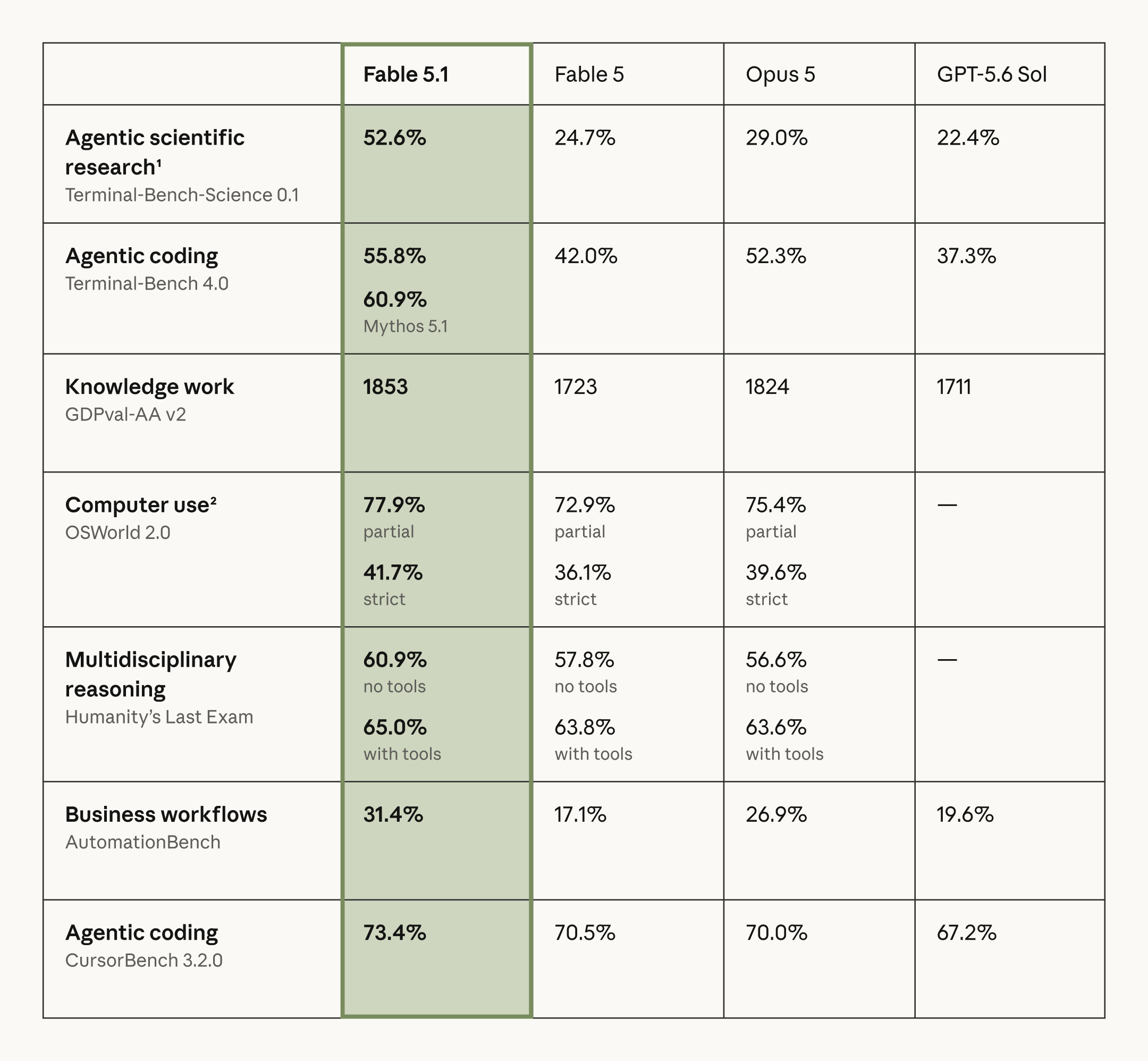
Benchmark Highlights: Terminal-Bench-Science 0.1: 52.6%, Terminal-Bench 4.0: 55.8%, Humanity's Last Exam: 60.9% (no tools) / 65.0% (with tools), CursorBench 3.2.0: 73.4%, Global MMLU: 94.0%, OSWorld 2.0: 41.7% strict
Speed/Latency: Slower than Opus 5 (comparative latency: Slower)
Modality: Text and images input, text output; vision for document analysis and self-evaluation
Knowledge Cutoff: June 2026
Comparison references: See arena.ai (LMSYS Chatbot Arena) for community ELO rankings and ollama.com/search for local deployment options
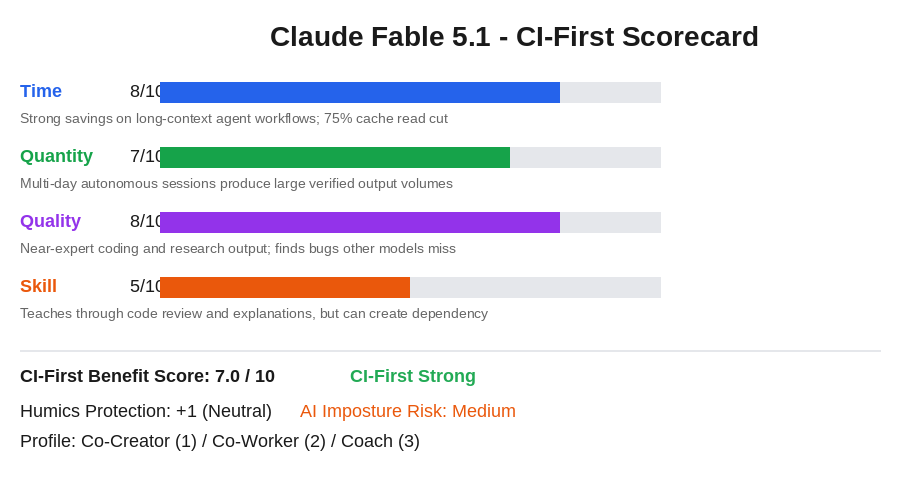
CI-First Benefit Score | 7.0 / 10 (CI-First Strong) |
Time / Quantity / Quality / Skill | 8 / 7 / 8 / 5 |
CI-First Profile | Co-Creator (1) / Co-Worker (2) / Professor, Coach and Tutor (3) |
Humics Protection | Humics-Neutral (+1) |
AI Imposture Risk | Medium |
User Sentiment | Mixed (G2: 4.6/5, 431 reviews; Trustpilot: 1.5/5; Product Hunt: 5.0/5, 1 review) |
Pricing | Paid - $10/MTok in, $50/MTok out, $0.25/MTok cache |
Platforms | API, AWS Bedrock, Google Cloud, Microsoft Foundry |
Context Window | 1M tokens |
Key terms in this dashboard (CI-First Benefit Score, CI-First Profile, Humics Protection Badge, AI Imposture Risk, User Sentiment) are defined in the Glossary at the end of this post.
The Problem
Building and maintaining complex software systems requires sustained reasoning across thousands of files, dependencies, and edge cases. Human engineers hit cognitive limits when a bug requires tracing through vendor libraries, matching core dumps, and understanding interactions across systems that took years to build. No single person holds the full context in their head, and the cost of missing a rare but critical failure can be enormous.
The same gap exists in knowledge work. Research projects, legal analysis, financial document review, and scientific investigation all require connecting details across hundreds of pages of material, holding multiple hypotheses in mind, and running long chains of reasoning without losing track. Traditional AI assistants help with individual steps but lose coherence over multi-hour sessions. They take shortcuts, fix symptoms instead of root causes, and require constant supervision that negates the time savings.
Enterprise teams face an additional constraint: data retention. Regulated industries cannot send sensitive data to a model that stores and reviews it. Until Fable 5.1, Anthropic's most capable models required 30-day data retention for safety monitoring, which locked out entire categories of enterprise customers.
The Outcome
Claude Fable 5.1 delivers three concrete outcomes for knowledge workers and developers. First, it sustains coherent work over hours and days: a coding agent can run unattended through a 200,000-token codebase, write its own tests, use vision to verify outputs against design goals, and recover from failures without human intervention. Anthropic's customer Millennium reported that Fable 5.1 found a one-in-a-million crash that their engineers and every other model had missed for four to five years.
Second, it reduces the cost of long-context work. The 75% cut in cache read pricing ($1.00 to $0.25 per million tokens) means that agents re-reading a cached prefix pay a quarter of what they did on Fable 5. Anthropic estimates 25% savings on typical workloads and up to 45% on highly agentic workloads where cache reads dominate the cost. A Fable-class model is now cheaper per cached token than Opus 5, despite having twice the fresh input price.
Third, it addresses enterprise privacy concerns through Enterprise Frontier Safeguards (EFS), which allows eligible customers to store data on their own infrastructure while maintaining safety guarantees. Until EFS is available, eligible customers can use Fable 5.1 with zero data retention.
Who Should Use Claude Fable 5.1
U365 Fellow categories:
Learner type | Difficulty | Typical ROI | Career path |
Students (Bachelor, Master) | Intermediate to Advanced | Learn advanced coding patterns through code review sessions; build complex prototypes for capstone projects | UIT Software Developer, AI Developer Specialist and Data Scientist |
Professionals (career upskilling) | Advanced | Offload multi-day debugging and codebase-wide refactoring to an autonomous agent; review completed work rather than supervise every step | UIT and UIB programs for working professionals in tech and business analysis roles |
Everyone (lifelong learners) | Intermediate | Access frontier-level reasoning for personal research projects, document analysis, and learning through guided dialogue | U365 continuous learning programs and UNOP-aligned skill development |
U365 Institutes Alignment
UIT (Technology, AI, Data Science)
Relevance. High
Why. Primary use case: coding, agentic workflows, AI research, data science. Students and professionals in UIT programs gain the most from Fable 5.1's long-running coding and analysis capabilities.
UIB (Business Management, Entrepreneurship)
Relevance. Medium
Why. Enterprise workflows: complex deliverables, deep research, document analysis. Business professionals benefit from long-context analysis of financial filings, contracts, and market reports.
UIC (Digital Communication, Marketing)
Relevance. Low to Medium
Why. Document-heavy work and content research. Communication professionals can use Fable 5.1 for analyzing large document sets and producing research-backed content, but it is not the primary tool for this institute.
UID (Digital Design, UX/UI)
Relevance. Low
Why. Vision capabilities help with design evaluation, but Fable 5.1 is not a design tool. UID students benefit more from specialized creative tools paired with Fable 5.1 for code implementation of designs.
Skill level required: Advanced for autonomous agent workflows; Intermediate for guided chat and analysis
Prerequisites: Programming knowledge for coding workflows; API familiarity for integration; Claude Code 2.1.250+ for Claude Code usage
Typical time to first result: 5 minutes for a chat query; 30 minutes for a Claude Code session; several hours for an autonomous agent task
Typical time to competence: 2 to 4 weeks of regular use to develop effective prompting and verification habits for long-running tasks
How Claude Fable 5.1 Works
Inputs: Text prompts, images, PDFs, documents with embedded charts and tables, code files, structured data. The model accepts up to 1M tokens of combined context.
Outputs: Text (up to 128K tokens per response), generated code, analysis reports, research summaries. Vision-based self-evaluation of coding outputs against design goals.
Underlying technology
- Model: 5th generation Claude model. Architecture and parameter count are not publicly disclosed. Classified as a frontier LLM with adaptive (always-on) thinking.
- Notable technical features: Adaptive thinking with effort levels (low, medium, high, xhigh, max); per-message effort control in beta; prompt caching with 75% cheaper cache reads; vision for document analysis and self-evaluation; computer use (browser and desktop operation); content provenance features; turn-scoped system messages in beta; readable progress updates between tool calls.
- Integrations: Claude API, Claude Code (terminal), Claude Cowork, Claude.ai web interface, Amazon Bedrock, Google Cloud Vertex AI, Microsoft Foundry, Claude Platform on AWS, Slack integration via Claude Tag (beta), Microsoft 365.
Benchmark performance
The following benchmark table shows Fable 5.1 compared to its predecessor Fable 5, Opus 5, and GPT-5.6 Sol across agentic coding, scientific research, knowledge work, computer use, and reasoning tasks. These are vendor-run launch evaluations, not independent post-release tests. The Terminal-Bench-Science result carries a standard error of approximately 3.5 to 4.5 points per model.
Key technical specifications
- Context window: 1M tokens at standard per-token pricing across the entire window. Roughly 555K words on the current tokenizer introduced with Claude Opus 4.7.
- Max output: 128K tokens per response.
- Thinking: Adaptive thinking is always on. Use the effort parameter (low, medium, high, xhigh, max) to control thinking depth. Per-message effort control is in beta, allowing mid-conversation effort changes without invalidating the prompt cache.
- Default effort: High in Claude Code; Medium in Claude Cowork and on Claude.ai.
- Available platforms: Claude API (model ID: claude-fable-5-1), Amazon Bedrock (anthropic.claude-fable-5-1), Google Cloud (claude-fable-5-1), Microsoft Foundry (claude-fable-5-1). Also available through Claude Platform on AWS.
- Model variants: Fable 5.1 (generally available with production safeguards) and Mythos 5.1 (same model with reduced safeguards for approved cybersecurity and life-sciences research, available through Project Glasswing to US organizations only).
See arena.ai (LMSYS Chatbot Arena) for independent community ELO rankings. As of the August 2026 leaderboard, Claude Fable 5 held the top position with a 100/100 composite quality index, and Fable 5.1 is expected to maintain or improve that standing.
Getting Started with Claude Fable 5.1
Required accounts: A Claude account (Free, Pro, Max, Team, or Enterprise). For API access, create a Claude Platform account at platform.claude.com. Fable 5.1 is available to Pro, Max, Team, and Enterprise users.
Installation
No installation is required for web access. Visit claude.ai and start a conversation. For developers:
- Claude Code: Install via npm (npm install -g @anthropic-ai/claude-code). Requires version 2.1.250 or later for Fable 5.1 support.
- API access: Use the model ID claude-fable-5-1 via the Claude API, or the corresponding model ID on AWS Bedrock, Google Cloud, or Microsoft Foundry.
First-time configuration
1. Create an account at claude.ai or platform.claude.com
2. Select Claude Fable 5.1 as your model (available on Pro plans and above)
3. For API use, set your model parameter to claude-fable-5-1
4. For Claude Code, upgrade to version 2.1.250+ and Fable 5.1 will be available as a model option
5. Configure effort level based on your task: Low or Medium for quick queries, High for complex coding, xhigh or max for multi-step autonomous work
First 15 minutes checklist
Open claude.ai and start a conversation with Fable 5.1 on a real coding or analysis problem you have
Ask it to review a piece of code or document and explain its reasoning
Verify the output: check the logic, run any code it produces, compare against your own knowledge
Try a longer task: paste a large document or codebase excerpt and ask for a structured analysis
Save or export the result to your LIPS Digital Second Brain for future reference
Result: After 15 minutes, you should have a verified output from Fable 5.1 on a real task, an understanding of how effort levels affect response depth and speed, and a sense of where the model excels versus where you need to verify carefully.
Real Workflows
Workflow 1: Autonomous Code Review and Bug Fixing
Learner type: Professional (UIT)
CI-First benefit tags: Time, Quality
Connects to: UIT Software Developer, U365 coding credentials
Time estimate: 2 to 4 hours including verification
What you do vs what the tool does:
Step | You do | The tool does |
1 | Identify the bug or code area to review and provide context | Reads the code, identifies potential issues, and explains its reasoning |
2 | Ask Fable 5.1 to review the code and identify root causes | Traces through the logic, checks edge cases, and proposes fixes |
3 | Review the proposed fix and decide whether to accept it | Writes the corrected code and explains what changed and why |
4 | Run the tests and verify the fix works | Can write its own tests to validate the fix (if using Claude Code) |
5 | Commit the fix and document the root cause for your team | Produces a summary of the issue and the fix for your commit message or documentation |
Sample prompt:
You are a senior code reviewer. Review the following code for bugs, performance issues, and security vulnerabilities. For each issue you find, explain the root cause, propose a fix, and rate the severity (critical, high, medium, low). Do not just describe symptoms: trace the problem to its source. [Paste your code here]
Verification checklist:
Multi-Model Check: Run the same code review through GPT-5.6 or Opus 5 and compare findings. If both models flag the same issue, confidence is higher.
External Source: Verify any security claims against OWASP guidelines or CVE databases. Run the proposed fix in a test environment.
Human Review: You must understand the fix before committing it. If you cannot explain why the fix works, do not ship it.
CI-First Test: Can you explain and defend the fix without Fable 5.1? If not, you are in the Skill Illusion. Study the root cause until you can explain it independently.
Workflow 2: Long-Context Document Research
Learner type: Student and Professional (UIT, UIB)
CI-First benefit tags: Time, Quantity, Quality
Connects to: UIT and UIB research programs, U365 research methods courses
Time estimate: 1 to 3 hours including verification
What you do vs what the tool does:
Step | You do | The tool does |
1 | Gather your source documents (PDFs, reports, papers) and upload them | Reads and parses all documents, including charts and tables in PDFs |
2 | Define your research question and the structure you want | Analyzes the documents and produces a structured research summary |
3 | Review the summary for accuracy and ask follow-up questions | Cites specific sections of the documents and connects findings across sources |
4 | Verify key claims against the original documents | Can re-read specific sections when you challenge a claim |
5 | Integrate verified findings into your research paper or report | Drafts sections in your specified format with citations to the source documents |
Sample prompt:
You are a research analyst. I have uploaded [N] documents about [topic]. Analyze them and produce a structured summary with the following sections: Key Findings, Areas of Consensus, Areas of Disagreement, Gaps in the Evidence, and Recommended Next Steps. For each finding, cite the specific document and page number. Do not infer conclusions that the documents do not support.
Verification checklist:
Multi-Model Check: Ask a different model (GPT-5.6, Gemini) to analyze the same documents and compare key findings.
External Source: Cross-reference critical claims against sources outside the uploaded documents (published literature, official statistics).
Human Review: Read the original document sections that Fable 5.1 cites. Confirm the citation is accurate and the interpretation is fair.
CI-First Test: Can you explain the research findings to a colleague without Fable 5.1? If not, you have not yet mastered the material.
Workflow 3: Multi-Day Autonomous Coding Project
Learner type: Professional (UIT)
CI-First benefit tags: Time, Quantity
Connects to: UIT Software Developer, U365 capstone and project-based courses
Time estimate: 1 to 3 days (unattended agent runs)
What you do vs what the tool does:
Step | You do | The tool does |
1 | Define the project scope, constraints, and success criteria in a detailed prompt | Plans the work, breaks it into phases, and identifies the tools it needs |
2 | Start the agent and let it run unattended | Researches the codebase, writes code, runs tests, and recovers from failures |
3 | Review progress updates when you check in (morning, evening) | Provides readable progress summaries between tool calls |
4 | Review the completed work against your original goals | Uses vision to check its outputs against the design or goals you specified |
5 | Accept, reject, or request changes. Integrate verified work into your project. | Makes requested changes and re-runs verification |
Sample prompt:
You are an autonomous coding agent. Build a [specific feature or application] in this codebase. Constraints: [list your constraints]. Success criteria: [list what done looks like]. Write tests for every component you build. Run the tests before declaring a phase complete. If a test fails, fix the root cause, not the symptom. Provide a progress summary after each phase. Do not take shortcuts that compromise code quality.
Verification checklist:
Multi-Model Check: Have a second model review the generated code independently. Compare its assessment with your own review.
External Source: Run all tests in a clean environment. Check dependencies and security with external tools (npm audit, pip audit, SAST scanners).
Human Review: Read every file the agent modified. You must understand the code before merging it. If a section is unclear, ask Fable 5.1 to explain it until you do.
CI-First Test: Can you maintain and debug this code without Fable 5.1? If not, you have offloaded a skill you need to develop. Use the generated code as a learning resource, not just a deliverable.
Strengths, Limits, and AI Imposture Risk
Strengths
The tool delivers clear CI-First benefits in these areas:
CI-First Benefit | Strength | Evidence |
Time | Massive savings on long-context agent work via 75% cache read price cut; estimated 25% reduction on typical workloads, 45% on highly agentic workloads | Anthropic's own pricing analysis based on August 2026 usage data; confirmed by Cognition (Devin) moving Opus 5 traffic to Fable 5.1 on launch day for cost savings |
Quantity | Sustains multi-day autonomous sessions producing large volumes of verified code and analysis | MongoDB report: Fable 5.1 built a complex prototype in three days with strong verification loops, running hours unattended |
Quality | Finds bugs and root causes that other models and human engineers miss; maintains readability over long multi-step tasks | Millennium: found a one-in-a-million crash that no engineer or model had explained in 4 to 5 years. Jane Street: state of the art on trading intuition, readable over long tasks. |
Skill | Can teach through code review explanations and research analysis, but requires active engagement from the user to build lasting capability | The model produces expert-level output, but the Skill benefit depends on whether the user studies the output or simply ships it |
Limits
The tool is weak or brittle in these areas:
High token consumption at High effort: Reddit users report Fable 5.1 burning through 5-hour Claude Code session limits in 15 to 20 minutes at the default High effort level.
Slower than Opus 5: Anthropic's own documentation classifies Fable 5.1 as Slower in comparative latency, making it less suitable for real-time interactive work.
Safeguard interventions: cybersecurity and biology queries are automatically routed to Opus models, which can disrupt workflows without warning. Fable 5.1 scored zero on some benchmark tasks where safeguards intervened.
Breaking changes for developers: forced tool use returns an error, earlier models cannot read Fable 5.1 thinking blocks, and editing earlier turns invalidates later thinking blocks. Migration requires code changes.
30-day data retention by default: enterprises in regulated industries need to qualify for EFS or zero data retention, which is not yet generally available.
Cost per fresh token is still high: at $10/$50 per million tokens, Fable 5.1 costs twice as much as Opus 5 ($5/$25) for non-cached workloads. The savings only materialize when cache reads dominate.
No open weights: the model is proprietary and cannot be self-hosted, limiting deployment flexibility compared to open-weight alternatives.
AI Imposture Risk
Time Illusion
Rating. Low
Evidence. The 75% cache read reduction delivers measurable, verifiable cost savings. Anthropic's estimates are based on actual usage data, not theoretical projections. The savings are real for cache-heavy workloads, though they do not apply to non-cached calls where Fable 5.1 is more expensive than Opus 5.
Quantity Illusion
Rating. Medium
Evidence. Fable 5.1 produces large volumes of code and analysis that look polished, and its ability to run unattended for hours increases the temptation to ship without review. The model writes its own tests, but those tests can share the model's blind spots. A user who delegates an entire project and accepts the output without verification is in the Quantity Illusion.
Skill Illusion
Rating. Medium
Evidence. Fable 5.1 can produce expert-level code for users who lack the skill to evaluate it. MongoDB's report of waking up to completed phases with visual walkthroughs illustrates the appeal, but a user who cannot maintain or debug the generated code has offloaded a skill, not built one. The model explains its reasoning when asked, but the user must actively study those explanations to gain real competence.
Overall Imposture Risk: Medium. Two traps are Medium with clear mitigations. The Time Illusion is Low because the cache pricing savings are concrete and measurable. The Quantity and Skill Illusions require disciplined verification and active learning to mitigate.
U365 Co-Intelligence Rating
CI-First Profile
Primary profile: Co-Creator and Thought Partner (level 1)
Secondary profile(s): Co-Worker and Assistant (level 2), Professor, Coach and Tutor (level 3)
CI-First Benefit Score
Time
Score (0-10). 8
Rationale. 75% cache read cut delivers verifiable savings on long-context work; estimated 25% on typical workloads, 45% on agentic workloads. Fresh token costs are high, but cache-heavy agent workflows see strong net time and cost savings.
Quantity
Score (0-10). 7
Rationale. Multi-day autonomous sessions produce large volumes of verified code and analysis. MongoDB and Ramp reports confirm sustained unattended output. Not a 9 because the high token consumption at High effort can limit session duration on subscription plans.
Quality
Score (0-10). 8
Rationale. Finds root causes that other models and human engineers miss (Millennium crash bug). Maintains readability over long tasks (Jane Street). Near-expert coding and research output. Not a 9 because benchmarks carry standard error and independent post-release evaluations are not yet available.
Skill
Score (0-10). 5
Rationale. Can teach through explanations and code review, but the model's ability to run unattended for days creates strong pressure toward over-delegation. The Skill benefit depends entirely on whether the user actively studies the output. Users who ship without understanding are in the Skill Illusion.
CI-First Benefit Score: 7.0 / 10 (CI-First Strong)
Humics Protection Badge
Dimension | Rating | Rationale |
Creativity | Neutral (0) | Fable 5.1 can spark creative problem-solving (IMC reported a novel solution along a completely different axis), but sustained use for autonomous code generation can replace the user's own creative engagement with problems. |
Critical Thinking | Neutral (0) | The model explains its reasoning and surfaces limitations when asked, which supports critical thinking. But its ability to run unattended for days can train users to accept output without questioning it, eroding the verification habit. |
Social Authenticity | Protects (+1) | Fable 5.1 produces readable, concise progress updates that are more effective than earlier Claude models for team communication. Red Hat noted it communicates more effectively with updates that are concise and easier to follow. |
Humics Protection Score: +1 / +3
Badge: Humics-Neutral
Superhuman Usage Guidance
When to invite this tool:
Long-running coding projects: codebase-wide refactoring, multi-day feature implementation, autonomous bug hunting
Deep research and document analysis: reasoning across hundreds of pages of material with vision-based PDF understanding
Code review: root-cause analysis, vulnerability identification, performance optimization
Enterprise knowledge work: complex deliverables that require minimal supervision and produce review-ready output
When to keep this tool out:
Tasks where you lack the expertise to verify the output: if you cannot evaluate the code or analysis, you are in the Skill Illusion
Real-time interactive work: Fable 5.1 is slower than Opus 5 and costs more per fresh token
Creative ideation where the Humic value is in your own thinking: use Fable 5.1 as a thought partner, not a replacement for your own ideas
Short, simple tasks: Opus 5 or Sonnet 5 are faster and cheaper for queries that do not require sustained reasoning
Cybersecurity or biology work that may trigger safeguard rerouting: use Mythos 5.1 through approved access programs instead
U365 method integration:
- LIPS + CARE: Fable 5.1's long-context analysis can process large volumes of information in the Collect phase. Its structured output feeds directly into the Action Plan phase. Use it to Review complex material and Execute research tasks with verification.
- ULM + EVA: Supports the Career domain through coding and analysis skill development. Use in the Explore phase for research and in the Visualize phase for structuring complex projects.
- UP-Context-Engineering: Fable 5.1's 1M token context window is ideal for UP-Context-Engineering prompting: feed your full personal and institutional context for personalized, context-aware responses.
- SL-OS: Integrates with Microsoft 365, Slack (Claude Tag beta), and operates browsers and desktop applications. Fits naturally into the SL-OS ecosystem.
- UNOP: The model's adaptive thinking and effort levels align with UNOP's spaced practice principle: use lower effort for initial exploration and higher effort for deep consolidation. The risk is that autonomous sessions bypass the active recall that drives retention.
Over-delegation warning:
Fable 5.1's ability to run unattended for days and produce expert-level output creates the highest over-delegation risk of any Claude model. The user who delegates an entire project, wakes up to a finished result, and ships it without understanding the code has not become Superhuman. They have become a Sub-human impostor: CI = HI + (AI x HI), and if HI drops to near zero because the user stopped engaging with the work, CI drops too. The model's own readability improvements (Jane Street, Red Hat) are designed to help you follow along. Use them. Read the progress updates. Study the code. Ask questions when you do not understand. If you cannot explain and defend the output without Fable 5.1, you have over-delegated.
What Users Say
Aggregate Rating Table
Platform | Rating | Number of reviews | Link |
G2 (Claude) | 4.6/5 | 431 reviews | |
Trustpilot (Claude.ai) | 1.5/5 | Multiple reviews | |
Product Hunt (Fable 5.1) | 5.0/5 | 1 review, 135 upvotes, 198 followers | |
Reddit sentiment | Mixed | Multiple threads on r/ClaudeAI and r/ClaudeCode | |
Arena.ai (Agent Arena) | Top ranked | Claude Fable 5 leads agent performance leaderboard | |
Futurepedia | No reviews found on Futurepedia for Claude Fable 5.1 specifically. | ||
FutureTools | No reviews found on FutureTools for Claude Fable 5.1 specifically. |
What Users Praise
On G2, users consistently praise Claude's context awareness, ease of use, and ability to streamline coding tasks. Enterprise customers (Jane Street, Cognition, MongoDB, Millennium, Red Hat, Ramp, Square) highlight Fable 5.1's ability to solve problems that other models cannot: finding rare bugs, sustaining coherent work over long sessions, producing readable progress updates, and generating novel research insights. The Product Hunt community gave it 5.0/5 with 135 upvotes on launch. Reddit users reported impressive autonomous capabilities, including one user who had Fable 5.1 build a complete Cities Skylines-style game.
What Users Complain About
The dominant complaint on Reddit is token consumption: Fable 5.1 at default High effort burns through Claude Code 5-hour session limits in 15 to 20 minutes, eating weekly allowances rapidly. Trustpilot reviews of Claude.ai (1.5/5) focus on billing practices (unexpected charges, account bans without notification, confusing API vs subscription billing) rather than model quality. Users also note that Fable 5.1 is more likely than Fable 5 to rewrite an entire file rather than make a targeted edit, which can produce larger diffs than necessary. Some users report that the safeguard rerouting (queries silently switching to Opus models) is disorienting when it happens mid-workflow.
Sentiment Summary
Overall sentiment: Mixed
Key themes:
Model capability is best-in-class for long-running coding and research (enterprise and developer consensus)
Token consumption at High effort is a major practical concern for subscription users (Reddit, r/ClaudeCode)
Billing and account management practices are the primary source of negative reviews (Trustpilot, not model quality)
Safeguard rerouting can disrupt workflows without warning (developer feedback)
The 75% cache read price cut is seen as a significant positive for API users with agent workloads (Cognition, developer community)
U365 Editorial Note
The sentiment split reveals an important CI-First insight. Enterprise and developer users who run Fable 5.1 through the API or Claude Code with disciplined effort management report strong satisfaction with model capability. The negative Trustpilot reviews target billing and account practices, not the model itself. The Reddit token consumption complaints align with the CI-First evaluation: Fable 5.1 scores high on Time and Quality because the model is genuinely capable, but the Skill Illusion risk (Medium) is visible in user behavior. Users who set effort to High and let the model run without understanding the output are in the trap the framework warns about. The CI-First recommendation: use Medium effort for most tasks, reserve High for complex work, and always verify. The model is a Co-Creator (level 1), not an autonomous replacement for your judgment.
Comparison and Alternatives
Alternative | Choose the alternative if... | Choose Fable 5.1 if... |
You need faster latency, lower per-token cost ($5/$25), and your tasks do not require sustained multi-hour reasoning. Opus 5 is the recommended default for most workloads per Anthropic's own documentation. | You need frontier-level capability for long-running agentic work, multi-day coding sessions, or problems where Opus 5 at higher effort still falls short. | |
You need a different provider ecosystem, lower cost per fresh token, or specific OpenAI platform features (Copilot, Azure OpenAI integration). | You need superior performance on agentic coding, scientific research, and long-running autonomous tasks. Fable 5.1 outperforms GPT-5.6 Sol on every reported benchmark. | |
You need fast, cost-effective AI for routine tasks ($2/$10 per million tokens). Sonnet 5 is the right choice for most everyday work. | You need sustained reasoning over 1M tokens, autonomous agent capabilities, or performance on the hardest coding and research problems. | |
You are invested in the Google Cloud ecosystem, need multimodal capabilities beyond text, or prefer open-weight options (Gemma). | You need the strongest available performance on agentic coding and long-running knowledge work, with 1M token context and prompt caching economics. | |
You need an open-weight model for self-hosting, prefer lower API costs, or work primarily in Chinese language contexts. | You need frontier-level performance for complex coding and research, with Anthropic's safety guarantees and enterprise support. |
Where Claude Fable 5.1 is clearly better
Fable 5.1 dominates in long-running autonomous agent work. The combination of 1M token context, adaptive thinking, 75% cheaper cache reads, and the ability to run unattended for days with readable progress updates is unmatched. On Terminal-Bench-Science 0.1, it scores 52.6% versus 22.4% for GPT-5.6 Sol. On AutomationBench, it scores 31.4% versus 17.1% for Fable 5 and 19.6% for GPT-5.6 Sol. Enterprise customer testimonials (Millennium finding a years-old crash, MongoDB building a prototype in three days, Ramp running a 38-hour unattended ML experiment) provide real-world evidence that the benchmark gains translate to actual work.
Where Claude Fable 5.1 is clearly worse
Fable 5.1 is worse than Opus 5 on cost per fresh token ($10/$50 vs $5/$25) and latency (Slower vs Moderate). For workloads that do not benefit from prompt caching, Opus 5 delivers similar or better value at half the price and faster speed. Anthropic's own documentation recommends starting with Opus 5 for most workloads and using Fable 5.1 only when Opus 5 at higher effort falls short. Fable 5.1 is also worse than open-weight models (GLM, Llama, Qwen) on deployment flexibility: it cannot be self-hosted, and the 30-day data retention requirement creates barriers for regulated industries until EFS is available. Finally, the high token consumption at default High effort makes it impractical for subscription users who need sustained interaction without hitting rate limits.
Verdict and Next Steps
Who should adopt it: Advanced developers and knowledge workers who need frontier-level performance on long-running coding and research tasks. UIT students and professionals in Software Development, AI, and Data Science. Enterprise teams with cache-heavy agent workloads.
When: Now, if you are already in the Anthropic ecosystem and need more capability than Opus 5 provides. If you are on Fable 5, migrate now: the cache read savings alone justify the upgrade.
For what: Multi-day autonomous coding, deep research and document analysis, code review and root-cause debugging, and complex enterprise workflows that require minimal supervision.
UP-Context-Engineering prompt pack:
Here are 3 reusable prompts tailored to the U365 prompting method. Copy them into Claude Fable 5.1 with your own context.
1. Context: I am working on [describe your project and tech stack], and I want the defects traced to their source before I fix them. Role: AI as an Analyst and Tester (Profile 4) reviewing the code I supply. I own the fixes and their scheduling; you find and explain. Profile: Act as an Analyst and Tester, tracing each problem to its source rather than describing symptoms. Task: review the code for bugs, performance issues and security vulnerabilities, and for each issue explain the root cause, propose a fix and rate the severity. Constraints: do not describe symptoms as if they were causes, run no code, and say when a finding depends on a runtime condition you cannot see. Output format: a numbered list of issues, each with severity, root cause and proposed fix. Memory: the review findings and the fixes I schedule belong in my own project record, because the conversation will not be re-read. UP-Context-Engineering verification: I reproduce each reported defect in my own copy before I schedule a fix, I check the severity ranking against my own risk view, and I can explain each accepted root cause without the tool. Data safety: this pack carries no personal data. I do not paste proprietary source, a production credential or customer data into it, and I keep the review record in my own store.
2. Context: I am researching [topic] for [purpose], I have uploaded [N] documents, and the summary has to keep every finding traceable. Role: AI as an Analyst and Tester (Profile 4) analysing the documents I upload. I own the conclusions and the citation trail. Profile: Act as an Analyst and Tester, analysing from the uploaded documents rather than from general knowledge. Task: analyse the documents and produce a structured summary with Key Findings, Areas of Consensus, Areas of Disagreement, Gaps in Evidence and Recommended Next Steps. Constraints: cite the specific document and page behind each finding, do not infer a conclusion the documents do not support, and mark a gap as a gap rather than filling it. Output format: a structured report with citations. Memory: the summary and its citation map belong in my own research record, because the documents will not travel with the conversation. UP-Context-Engineering verification: I check each headline finding against its document myself, I name the disagreement I find most consequential, and I can present the summary without the tool. Data safety: this pack carries no personal data. I do not paste an embargoed paper, a participant record or a client document into it, and I keep the summary in my own store.
3. Context: this codebase is [describe project] and I am building [specific feature] against defined success criteria. Role: AI as a Co-Worker and Assistant (Profile 2) implementing inside the boundaries I set. I own the architecture, the scope and the definition of done. Profile: Act as a Co-Worker and Assistant, implementing one phase at a time with its tests. Task: build [specific feature], write tests for every component, and run the tests before declaring a phase complete. Constraints: fix root causes rather than symptoms, provide a progress summary after each phase, stop and ask when the next step is genuinely my decision, and keep the change inside the stated scope. Output format: working code with tests and a progress summary per phase. Memory: the phase summaries, the test results and the decisions I took belong in my own repository and project record, because the code outlives the conversation. UP-Context-Engineering verification: I run the tests myself before accepting a phase, I read the diff rather than the summary, and I can explain the design of each accepted phase without the tool. Data safety: this pack carries no personal data. I do not paste a private repository, a production credential or customer data into it, and I keep the build record in my own store.
Related U365 content:
U365's Recommendations to Learn More
The following resources are curated to help you go deeper with Claude Fable 5.1. Each link was verified active as of 2026-09-07. We include official documentation, video tutorials, written analysis, and community resources. Individual creators are included when their content quality is substantial and current.
Official learning resources
Video tutorials and channels
Written tutorials and deep-dive articles
Resources on X
Dedicated X (Twitter) channels and posts with demos, benchmarks, and pedagogical video content about Claude Fable 5.1.
Dedicated X channels:
X posts with video content:


Community and social
We include individual creators and community experts when their content is substantial, current, and teaches something this post does not. Quality is our bar, not source type.
Glossary
CI-First Benefit Score
A 0 to 10 score that measures how much an AI tool delivers the 4 Key AI Benefits defined by University 365: Time (doing things faster), Quantity (producing more in the same time), Quality (producing better work), and Skill (learning what you did not know). The overall score is the arithmetic mean of the four dimensions. Scores of 0 to 2.0 are CI-First Negative, 2.1 to 4.0 are CI-First Neutral, 4.1 to 6.0 are CI-First Positive, 6.1 to 8.0 are CI-First Strong, and 8.1 to 10.0 are CI-First Transformative. The score answers one question: does this tool make Co-Intelligence more profitable than Human Intelligence alone?
CI-First Profile
A classification of the role AI plays in the Co-Intelligence relationship. University 365 defines 5 profiles: (level 1) Co-Creator and Thought Partner, (level 2) Co-Worker and Assistant, (level 3) Professor, Coach and Tutor, (level 4) Analyst and Tester, (level 5) Challenger and Devil's Advocate. Lower level numbers indicate higher AI autonomy in the collaboration. Attributing a profile to AI before giving it a task is a core CI-First discipline: it determines how the user should interact with the tool and what verification is needed.
Humics Protection Badge
A rating that assesses whether a tool protects, leaves neutral, or erodes three core human capabilities: Creativity, Critical Thinking, and Social Authenticity. Each dimension is scored +1 (Protects), 0 (Neutral), or -1 (Erodes). The sum produces a badge: +2 to +3 is Humics-Friendly (the tool strengthens the human), -1 to +1 is Humics-Neutral (mixed effects, requires active management), and -2 to -3 is Humics-Risky (sustained use causes cognitive atrophy). The badge warns users when a tool replaces human capability rather than augmenting it.
AI Imposture Risk
The threat that using an AI tool creates one of three usage illusions: Time Illusion (thinking you saved time when prompting and verification actually cost more), Quantity Illusion (producing high volume that looks good but does not hold up under inspection), and Skill Illusion (appearing competent while not developing the underlying skill). Each trap is rated Low, Medium, or High based on the tool's characteristics and evidence. The overall risk is Low when all traps are Low, Medium when one, two or three are Medium, and High when two or more are High. The Executive Safeguard applies: always assume you are working with the worst AI available.
User Sentiment
An aggregation of real user ratings and reviews from major platforms (G2, Trustpilot, Product Hunt, Reddit, App Store, Google Play, and others). University 365 collects actual ratings and review counts from each platform, identifies themes in what users praise and complain about, and connects crowd sentiment to the CI-First evaluation. This connection is the U365 value-add: when users love a tool but the Humics rating is Risky, or when users complain about something the CI-First framework also flagged, the editorial note explains the alignment or tension.
Sources
Anthropic. Claude Fable official page. https://www.anthropic.com/claude/fable
G2. Claude Reviews. https://www.g2.com/products/claude-2025-12-11/reviews
Trustpilot. Claude.ai reviews. https://www.trustpilot.com/review/claude.ai
Product Hunt. Claude Fable 5.1. https://www.producthunt.com/products/claude-fable-5-1
OpenLM.ai. Chatbot Arena leaderboard. https://openlm.ai/chatbot-arena
Arena.ai. Agent Arena leaderboard. https://arena.ai/leaderboard/agent/work
Reddit. r/ClaudeAI community. https://www.reddit.com/r/ClaudeAI




Comments