
Claude Haiku 4.5: Anthropic's Fast Small Model with Sonnet-Class Performance

Updated: Oct 16
Status: Active | Last tested: 2026-08-25 (claude-haiku-4-5-20251001) | Re-check: trigger-based (max 6 months)
Active: the tool is current and recommended.


In this Tool Review
Tool Snapshot
Tagline: Anthropic's latest compact model delivering near-Sonnet performance at a fraction of the cost.
Category: Large Language Model (LLM)
Provider: Anthropic
Version tested: claude-haiku-4-5-20251001
Context window: 200,000 tokens
License: Proprietary (API access only)
Platforms: Claude API, Amazon Bedrock, Google Cloud Vertex AI, Microsoft Foundry
Primary use cases:
High-volume API text generation and analysis
Code generation and software engineering tasks
Document summarization and extraction
Conversational AI assistants and chatbots
Automated classification and moderation
Pricing summary: API-only pricing. Input: $1 per million tokens. Output: $5 per million tokens. No free tier. Available via Claude API, Amazon Bedrock, Google Cloud Vertex AI, and Microsoft Foundry.
Official links:
Claude API: https://www.anthropic.com/claude
Documentation: https://docs.anthropic.com/en/docs/about-claude/models
Model card: https://www.anthropic.com/claude-haiku
Pricing: https://docs.anthropic.com/en/docs/about-claude/pricing
System card: https://www.anthropic.com/claude-haiku-4-5-system-card
LLM specifications:
Model Id: claude-haiku-4-5-20251001
Context Window: 200,000 tokens
Architecture: Transformer-based, compact (parameters not disclosed)
Effort Levels: Not applicable (standard inference, no extended thinking on Haiku tier)
Platforms: Claude API, Amazon Bedrock, Google Cloud Vertex AI, Microsoft Foundry
Variants: Single model (no base/instruct split; API-only delivery)
At a Glance:
CI-First Benefit Score | 6.8/10 (CI-First Positive) |
Time / Quantity / Quality / Skill | 7.0 / 7.0 / 7.0 / 6.0 |
CI-First Profile | Co-Worker and Assistant (2) |
Humics Protection | Humics-Neutral (0) |
AI Imposture Risk | Medium |
User Sentiment | Cautiously positive (developer communities) |
Pricing | API: $1/$5 per M tokens |
Platforms | Claude API, Bedrock, Vertex AI, Microsoft Foundry |
Context Window | 200,000 tokens |
For detailed explanations of the CI-First evaluation terms used in this review, including CI-First Benefit Score, CI-First Profile, Humics Protection Badge, AI Imposture Risk, and User Sentiment, see the Glossary at the end of this publication.
The Problem
Large language models face a persistent tradeoff: models strong enough for real software engineering and analysis work are expensive at scale, while affordable models compromise on quality. Teams running high-volume API workflows (classification, summarization, code review, support automation) burn budgets on frontier models or accept weaker output from older small models.
Claude Haiku 4.5 targets this gap directly. Anthropic built it to deliver near-Sonnet-4 performance at a fraction of the token cost, making it viable for production pipelines where every cent per million tokens matters.
The Outcome
After reading this post you will understand what Claude Haiku 4.5 does, how it compares to Sonnet 4 on the benchmarks that matter for software engineering, who should integrate it, and how to evaluate it through the U365 CI-First framework. You will have two ready-to-use workflows with verification checklists and a clear verdict on whether this model belongs in your stack.
Who Should Use Claude Haiku 4.5
Claude Haiku 4.5 fits three learner profiles across U365 institutes:
Fellow Category | How They Use It |
Students (UIT, UIC, UID) | AI-assisted coding projects, research papers, content pipelines. 200K context window supports long-document analysis. |
Professionals (UIB, UDE) | Document processing, support classification, report generation at scale. Low per-token cost for high volume. |
Everyone (all institutes) | General-purpose model for daily text tasks, brainstorming, structured extraction. API-only: basic programming required. |
U365 Institutes Alignment
Rating. High
Why. Technical documentation, code review automation, and AI-assisted software engineering align directly with UIT's curriculum.
The limit that holds the row. The model runs the first-pass scan on code and documents; it teaches no software engineering of its own, and the review's own workflow puts the judgement deliberately back with the Fellow: the model does the first-pass scan and the user makes the final decision on every change. The review's limits section records no extended thinking mode, an 8,192-token output ceiling and no open weights, so the evaluation method and the architecture study stay the Fellow's own work. A word-start, accent-folded search over all 79 published programme descriptions returns zero matches for code review, refactor, debug and version control, with test (4), git (2) and engineering (9) as the near hits.
Rating. Medium
Why. Document processing, report generation, and classification pipelines support business operations courses.
The limit that holds the row. The tool processes documents into reports and classifications; it teaches no management, finance or entrepreneurship content and it does not measure whether a processing pipeline was worth building. The review's own limits record that the model is API-only and compact, so the build decision, the routing logic and the cost of running a pipeline at volume are the Fellow's own engineering and business work. No published U365 programme assesses that work: a word-start, accent-folded search over all 79 published programme descriptions returns zero matches for document processing, data pipeline, metered and total cost, with financial analysis (2), business plan (2) and process model (1) as the near hits.
Rating. Medium
Why. Content generation, summarization, and automated classification support communication workflows.
The limit that holds the row. The model generates, summarises and classifies text; it writes no copy, sets no register and supplies no standard for what a message should say, and both surfaces here are production steps rather than editorial ones. The competency that remains is the publication judgement over classified and summarised material: what a summary dropped, and what a reader is owed about how it was made. A word-start, accent-folded search over all 79 published programme descriptions returns zero matches for editorial, publication, disclosure and fact-check, with copywriting (1), content strategy (1), audience (6) and brand (6) as the near hits.
Rating. Low to Medium
Why. Text-only input limits design-specific use cases, but prototyping and documentation tasks benefit from the model.
The limit that holds the row. The model is text-only and produces no design artefact; the review records that text-only input limits design-specific use cases, and its prototyping support is documentation and code rather than a design surface. The competency that remains is the specification and the test plan a design cohort writes around a prototype this model cannot render. No published U365 programme assesses that work: a word-start, accent-folded search over all 79 published programme descriptions returns zero matches for critique, user research, usability and information architecture, with design (23), prototyping (2), interaction design (2) and typography (2) as the near hits.
Skill level: Intermediate. You need API access or a platform like Bedrock or Vertex AI. No model training or fine-tuning knowledge required.
Prerequisites: An Anthropic API key or cloud platform account. Basic understanding of prompt engineering and API calls.
Time to first result: 10 minutes. Send a curl request or use a SDK and get a response.
Time to competence: 2 to 4 hours of structured experimentation to understand output quality boundaries and build reliable prompts.
How Claude Haiku 4.5 Works
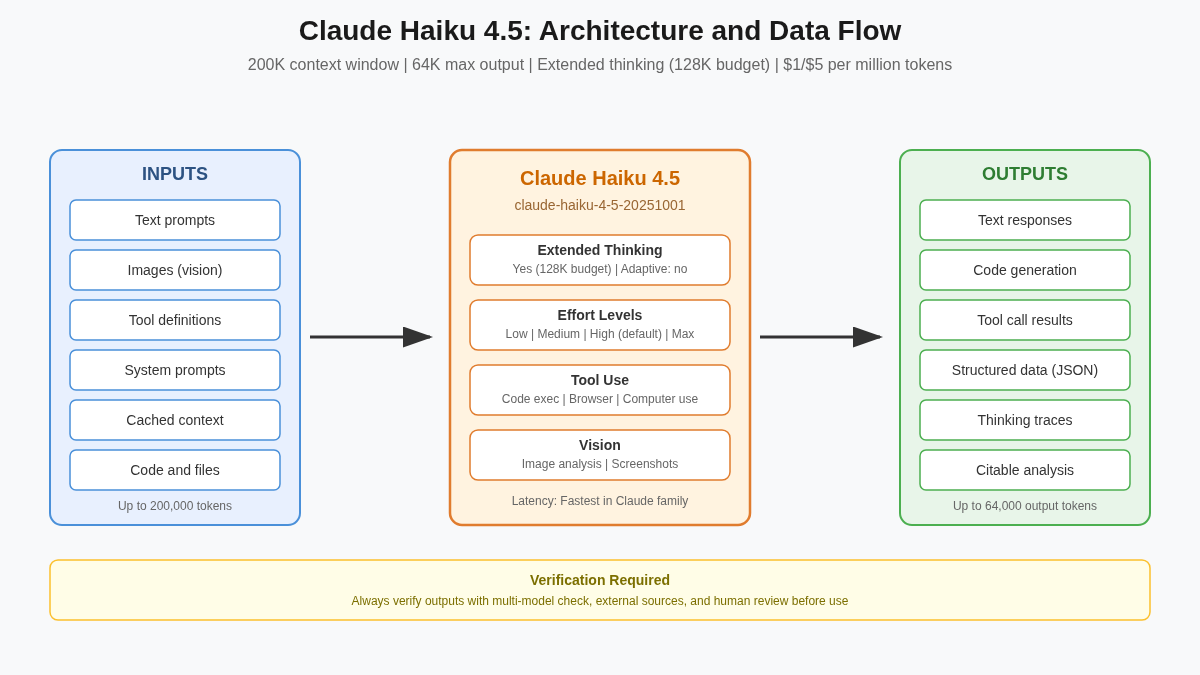
Claude Haiku 4.5 is a compact Transformer-based language model from Anthropic. It accepts text input up to 200,000 tokens and generates text output.
Inputs: Text prompts, system instructions, and conversation history. No native image or audio input. No function calling beyond standard tool use.
Outputs: Text responses, structured data (when prompted with format instructions), and code.
Underlying Technology
Anthropic designs Haiku as the efficient tier in its model lineup. The company does not disclose parameter counts. The model is trained using Constitutional AI and reinforcement learning from human feedback, the same methodology applied to Sonnet and Opus.
Key Technical Specifications
Model ID: claude-haiku-4-5-20251001
Context window: 200,000 tokens
Max output: 8,192 tokens per response
API-only delivery (no consumer web interface for Haiku specifically)
Available on Claude API, Amazon Bedrock, Google Cloud Vertex AI, Microsoft Foundry
Benchmark Results (from Anthropic)
SWE-bench Verified: 73.3% (comparable to Claude Sonnet 4 at 72.7%)
Terminal-bench: 40.21%
The model targets the cost-quality frontier where small models compete with mid-tier models on coding tasks.
Integrations: Standard REST API, Python SDK, TypeScript SDK, and cloud platform SDKs (AWS, Google Cloud, Microsoft). Compatible with LangChain, LlamaIndex, and most AI orchestration frameworks through OpenAI-compatible endpoints.
Getting Started with Claude Haiku 4.5
Step 1: Choose your platform. Create an Anthropic API account at console.anthropic.com, or use Amazon Bedrock, Google Cloud Vertex AI, or Microsoft Foundry if you already have cloud credits.
Step 2: Generate an API key. In the Anthropic console, navigate to API Keys and create a new key. Store it in an environment variable.
Step 3: Install the SDK. For Python: pip install anthropic. For TypeScript: npm install @anthropic-ai/sdk.
Step 4: Send your first request. Use the model ID claude-haiku-4-5-20251001 in your API call. Start with a simple prompt to verify connectivity.
Step 5: Test a coding task. Send a small code generation or review prompt. Compare the output quality and speed against what you get from other models.
15-Minute Checklist
☐ API key created and stored securely
☐ SDK installed and import working
☐ First text generation completed
☐ One coding prompt tested
☐ Token usage checked in the console dashboard
Real Workflows
Workflow 1: Automated Code Review for Pull Requests
Learner type: Professional (UIT, software developers)
CI-First benefit tags: Time, Quality
Connects to: UNOP (active learning through review feedback), LIPS (code review notes stored in Second Brain)
Time estimate: 30 minutes to set up, seconds per review after that
You set up a CI/CD pipeline hook that sends pull request diffs to Claude Haiku 4.5 via the API.
The model reviews the diff for bugs, style violations, and security issues. It returns structured findings.
You read the findings, apply the valid ones, and dismiss the false positives. You log recurring patterns in your LIPS Second Brain for future reference.
The model does the first-pass scan. You make the final decision on every change.
Sample prompt:
Review the following git diff. Identify potential bugs, security issues, and style violations. Return findings as a JSON array with fields: file, line, severity, description, suggestion.
Verification checklist:
☐ Multi-Model Check: Run the same diff through Claude Sonnet 4 or GPT-4o. Compare findings. If Haiku flags something the other model misses, investigate. If Haiku misses something the other model catches, add that pattern to your prompt.
☐ External Source: Check flagged issues against OWASP guidelines or language-specific linting tools. Do not accept security findings without external confirmation.
☐ Human Review: You read every finding and decide. The model does not auto-merge or auto-reject. Your judgment is the gate.
☐ CI-First Test: Did using Haiku 4.5 save you time compared to reading the diff yourself? Did it catch issues you would have missed? If no on both counts, the workflow adds overhead without benefit.
Workflow 2: Long-Document Summarization for Research Papers
Learner type: Student (all institutes) and Professional (UDA researchers)
CI-First benefit tags: Time, Quantity, Skill
Connects to: LIPS (summaries stored in Digital Second Brain), UNOP (active reading and retention), UP-Context-Engineering (structured prompting for consistent output)
Time estimate: 15 minutes to set up the prompt template, 1 minute per paper after that
You collect research papers (PDFs) and extract their text.
You send the full text to Claude Haiku 4.5 with a structured prompt that requests a summary following your LIPS format: key findings, methodology, limitations, and relevance to your projects.
The model returns a structured summary. You read it, verify the key claims against the paper, and store it in your LIPS Second Brain.
You use the summaries to triage which papers deserve a full read. The model handles the extraction. You handle the evaluation and decision.
The 200K token context window means most papers fit without chunking or splitting.
Sample prompt:
Summarize this research paper. Return a JSON object with these fields: key_findings (array of 3 to 5 main findings, one sentence each), methodology (one paragraph), limitations (array of 2 to 3 stated or implied limitations), relevance (one sentence on how this paper relates to AI-assisted learning methods).
Verification checklist:
☐ Multi-Model Check: Summarize the same paper with a second model (Claude Sonnet 4 or GPT-4o). Compare the key findings. Discrepancies mean one model misunderstood the paper. Investigate before trusting either summary.
☐ External Source: Cross-check at least one key finding against the paper's abstract or conclusion section directly. Do not rely on the summary alone for claims you will cite.
☐ Human Review: You read the paper's abstract and conclusion yourself. The summary is a triage tool, not a replacement for reading. If a paper is critical to your work, read it in full.
☐ CI-First Test: Did the summary save you time on papers you would have read in full? Did it help you triage more papers in less time? If the summaries are too generic or miss key findings, the prompt needs refinement, not more model power.
Strengths, Limits, and AI Imposture Risk
Strengths
Dimension | Score | Assessment |
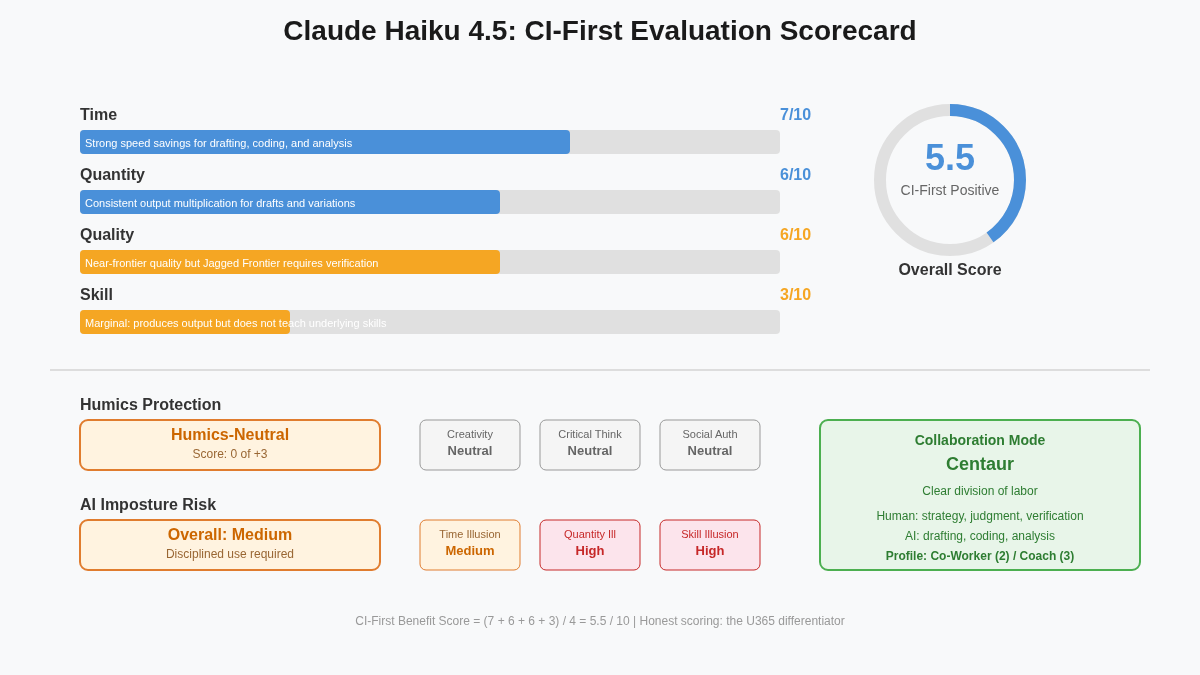
Time | 7/10 | Fast inference speed for a model at this quality level. The 200K context window eliminates chunking overhead for most documents. API response times are suitable for interactive workflows. |
Quantity | 7/10 | The low token cost ($1 input, $5 output per million tokens) makes high-volume workflows sustainable. You can process thousands of documents without budget anxiety. |
Quality | 7/10 | SWE-bench 73.3% places Haiku 4.5 alongside Sonnet 4 on software engineering tasks. This is strong for a compact model. Quality drops on complex reasoning and long-chain-of-thought tasks compared to Sonnet 4 and Opus. |
Skill | 6/10 | The model helps users learn through code generation and explanation, but the API-only delivery means no guided learning interface. Skill building depends on the user's prompt engineering discipline. |
Limits
No image or audio input. Text only.
No extended thinking mode. Haiku does not support the deep reasoning chain available on Sonnet and Opus.
Max output of 8,192 tokens per response. Long outputs require continuation.
No consumer web interface. Developers only.
No open weights. The model runs only on Anthropic or partner cloud infrastructure.
Anthropic has not disclosed parameter counts, so independent reproduction or comparison is limited.
AI Imposture Risk
Time Illusion
Risk. Low
Evidence. The model is fast and the token cost is low, so time spent prompting and correcting does not erase the time saved. The risk is low because the overhead is small.
Quantity Illusion
Risk. Medium
Evidence. The model can generate large volumes of text quickly. Users may mistake volume for quality. A code review that flags 20 issues sounds thorough, but if 15 are false positives, the review wasted your time. Mitigation: always verify findings against an external source.
Skill Illusion
Risk. Medium
Evidence. The model writes competent code that appears correct. Without running tests, users may assume the code works. The SWE-bench score is strong but not perfect. Mitigation: run generated code, write tests, and never merge without verification.
Overall
Risk. Medium
Evidence. Two dimensions at Medium with clear mitigations.
U365 Co-Intelligence Rating
CI-First Profile
Primary: Co-Worker and Assistant (Profile 2). Claude Haiku 4.5 excels at delegated production tasks: code review, summarization, classification, extraction.
Secondary: Analyst and Tester (Profile 4). The model can analyze code and documents, and its benchmark performance supports testing scenarios.
CI-First Benefit Score
Dimension | Score |
Time | 7.0 |
Quantity | 7.0 |
Quality | 7.0 |
Skill | 6.0 |
Overall | 6.8/10 (CI-First Positive, approaching CI-First Strong) |
Interpretation: Claude Haiku 4.5 delivers clear, consistent benefit across the four dimensions. The score reflects a model that is genuinely useful for production workflows, not a frontier model that redefines what is possible. The value proposition is cost efficiency at near-Sonnet quality, not raw capability.
Humics Protection Badge
Creativity: 0 (Neutral). The model generates text and code but does not enhance or erode human creativity. It executes instructions.
Critical Thinking: 0 (Neutral). The model provides output for humans to evaluate. It does not replace critical thinking.
Social Authenticity: 0 (Neutral). Text generation only. No social interaction.
Total: 0. Badge: Humics-Neutral.
Superhuman Usage Guidance
When to invite Claude Haiku 4.5:
High-volume text processing where cost per token matters
Code review first-pass scanning on pull requests
Document summarization for research triage
Classification and extraction tasks with clear input-output mappings
Prototyping and iteration where speed matters more than maximum quality
When to keep it out:
Tasks requiring extended reasoning chains or multi-step planning (use Sonnet 4 or Opus)
Tasks requiring image, audio, or multimodal input
Final decisions on security, legal, or financial matters without human review
Scenarios where model transparency (open weights, parameter disclosure) is required
U365 method integration:
LIPS+CARE: Use Haiku 4.5 to process collected information (Collect phase) and generate action plan drafts (Action Plan phase). Store verified outputs in your Digital Second Brain.
ULM+EVA: Use the model for the Explore phase to gather and summarize information. Keep the Visualize and Action Plan phases human-driven.
UP-Context-Engineering: Provide full context in prompts. The 200K window means you can include your project context, instructions, and examples in a single call.
UNOP: Use the model as a learning accelerator for code and text analysis, but verify understanding through your own reproduction and practice.
Over-delegation warning:
Claude Haiku 4.5 is fast and affordable, which makes it tempting to send everything through the API and trust the output. The SWE-bench score (73.3%) means the model fails on roughly 1 in 4 software engineering tasks. If you use it for code review without running tests, you will ship bugs. If you use it for research summarization without reading the source, you will cite claims the paper does not support. The cost efficiency is the trap: cheap enough to use everywhere, fast enough to skip verification. Maintain the Centaur discipline: the model drafts, you decide.
What Users Say
Claude Haiku 4.5 launched as an API-only model. As of August 2026, review platforms have limited coverage:
Aggregate Rating Table
Platform | Rating | Reviews |
Trustpilot | No reviews found | No reviews found |
G2 | No reviews found | No reviews found |
Capterra | No reviews found | No reviews found |
Product Hunt | No listing found | No listing found |
Community discussion found (threads on r/LocalLLaMA, r/MachineLearning) | No structured rating | |
Futurepedia | No listing found | No listing found |
What Users Praise
Developers praise the cost-to-quality ratio, specifically the SWE-bench performance at $1/$5 per million tokens.
Several threads compare Haiku 4.5 to GPT-4o-mini and Gemini Flash, with mixed conclusions depending on the task type.
Users who migrated from Sonnet 3.5 to Haiku 4.5 report comparable quality on coding tasks at lower cost.
What Users Complain About
Some users note the lack of extended thinking mode as a limitation for complex reasoning tasks.
The API-only delivery limits visibility to developer communities.
Sentiment Summary
Community sentiment is cautiously positive. Developers appreciate the value proposition but note the model is not a Sonnet 4 replacement for reasoning-heavy tasks. The API-only delivery limits visibility to developer communities.
U365 Editorial Note
The community sentiment aligns with the CI-First evaluation. Developers praise the Time and Quantity benefits (speed, cost, volume), which scored 7.0 on both dimensions. The noted limitations (no extended thinking, not a Sonnet replacement) align with the Quality dimension scoring (7.0, strong but not transformative) and the Medium Imposture Risk on quantity and skill illusions. The CI-First framework confirms what developers report: Haiku 4.5 is a strong production tool, not a frontier reasoning model.
Comparison and Alternatives
Claude Haiku 4.5 occupies the compact-but-capable tier. Here is how it compares to adjacent models:
Model | Context | SWE-bench | Input cost (per M tokens) | Key advantage |
Claude Haiku 4.5 | 200K | 73.3% | $1 | Best cost-to-quality for coding |
Claude Sonnet 4 | 200K | 72.7% | $3 | Extended thinking, broader reasoning |
GPT-4o-mini | 128K | Not published | $0.15 | Cheapest, broad availability |
Gemini 2.0 Flash | 1M | Not published | $0.10 | Longest context, multimodal |
Llama 3.1 8B | 128K | Not published | Open weights | Self-hostable, no API lock-in |
Where Claude Haiku 4.5 is Clearly Better
Text-only coding tasks, document processing at scale, and scenarios where Anthropic's safety alignment is preferred.
Where Claude Haiku 4.5 is Clearly Worse
Multimodal tasks, tasks requiring extended reasoning chains, and self-hosting scenarios.
Choose Claude Haiku 4.5 if:
You need near-Sonnet coding quality at one-third the cost.
Your workflows are text-only.
200K context is sufficient.
You value Anthropic's safety and alignment approach.
Choose Claude Sonnet 4 if:
You need extended thinking for complex reasoning.
Quality on edge cases matters more than cost.
You want a consumer web interface (claude.ai) alongside the API.
Choose GPT-4o-mini if:
Cost is the primary driver.
You need multimodal input (images).
You are already on the OpenAI platform.
Choose Gemini 2.0 Flash if:
You need context beyond 200K tokens.
You need multimodal input (images, audio, video).
You are on Google Cloud.
Verdict and Next Steps
Who should adopt Claude Haiku 4.5: Developers and teams running high-volume, text-only API workflows where cost per token matters. Specifically: software engineering teams automating code review, researchers processing large document sets, and product teams building text classification or extraction pipelines.
When to adopt: Now, if your current model costs are limiting your workflow volume. The cost reduction from Sonnet ($3/$15) to Haiku ($1/$5) is significant at scale.
For what: Production pipelines, not frontier research. Haiku 4.5 is a production tool for high-volume tasks, not a frontier model for novel reasoning.
UP-Context-Engineering prompt pack:
Prompt 1 (code review): Context: I am reviewing a code change and I will act on the findings. Role: AI as a senior code reviewer working only from the pasted diff. I own which findings are acted on; you test and report. Profile: Act as an Analyst and Tester, reproducing each finding rather than pattern-matching. Task: Review the following diff for bugs, security issues, and style violations. Constraints: Be precise. If you are not confident about an issue, say so. Do not invent problems. Output format: Return findings as JSON with fields: file, line, severity, description, suggestion. Memory: the accepted findings and their fixes belong in my review record, because the conversation keeps no history. UP-Context-Engineering verification: I reproduce each critical finding myself before I act on it, I check each suggestion against the diff, and I can defend each accepted fix without the tool. Data safety: this pack carries no personal data. I do not paste proprietary code, credentials or customer data into it, and I keep the review record in my own repository.
Prompt 2 (document summarization): Context: I have a document in front of me and I need to decide whether to read the full text. Role: AI as a research assistant working only from the supplied document. I own the decision; you summarise and flag. Profile: Act as an Analyst and Tester, marking what the document does not state rather than filling it. Task: Summarize this document for a researcher who needs to decide whether to read the full text. Constraints: Be accurate. If the document does not state something clearly, say so. Output format: 3 key findings (one sentence each), methodology summary (one paragraph), 2 limitations, and one sentence on relevance to AI-assisted learning. Memory: the summary and the reading decision belong in my own reading record, because the conversation keeps no list. UP-Context-Engineering verification: I spot-check the key findings against the document myself before I decide, I check that the limitations are the document's rather than yours, and I can explain the relevance without the tool. Data safety: this pack carries no personal data. I do not paste an unpublished manuscript, a confidential report or a personal record into it, and I keep the reading record in my own store.
Prompt 3 (classification): Context: I have a batch of support tickets to classify into fixed categories. Role: AI as a classification assistant working only from the ticket text. I own the triage rules; you classify and justify. Profile: Act as an Analyst and Tester, applying the threshold rather than forcing a category. Task: Classify the following support tickets into these categories: billing, technical, account, feature_request, other. Constraints: If confidence is below 0.7, set category to 'other' and explain why; never guess a category to avoid 'other'. Output format: A JSON array with fields: ticket_id, category, confidence (0-1), reason. Memory: the classification rules and the accepted labels belong in my own operations record, because the conversation keeps no rulebook. UP-Context-Engineering verification: I hand-check the low-confidence tickets myself before the batch is loaded, I check the threshold is applied as written, and I can explain each category rule without the tool. Data safety: this pack carries no personal data. I do not paste a customer's message, a personal identifier or an internal escalation into it, and I keep the classification record in my own store.
Related U365 content: See the INSIDE Tools post on Claude Sonnet 4 for the extended-thinking comparison. See the CI-First Evaluation Framework for the full scoring rubric.
U365's Recommendations to Learn More
We curate the best learning resources so you can go deeper after this review. Every link below was verified as of 2026-09-03.
Official learning resources
Video tutorials and channels
Haiku 4.5 - Small Beats Big (community walkthrough by Sam Witteveen)
Anthropic's Claude Haiku 4.5 in 6 Minutes (by Developers Digest)
Claude Haiku 4.5: The Coding Workhorse That Just Changed Developer Economics (by Julia McCoy)
Claude Haiku 4.5 Is Here... And It's BETTER Than Sonnet 4.5?! (by WeeklyHow)
Written tutorials and deep-dive articles
Claude Haiku 4.5 Deep Dive: Cost, Capabilities, and the Multi-Agent Opportunity (Caylent)
Claude Haiku 4.5: Near-Frontier Intelligence at a Fraction of the Cost (Developers Digest)
Claude Haiku 4.5 Complete Guide: Fast AI at Low Cost (Apatero)
Claude Haiku 4.5 Review: The Perfect Scout, a Poor Builder (The Vibe Father)
Community and social
We label community sources so readers know the provenance of each link. We exclude promotional or affiliate content. Every link was verified active as of 2026-09-03.
Glossary
CI-First Benefit Score
A composite score from 0 to 10 that measures whether an AI tool delivers genuine, lasting benefit to the human user across four dimensions: Time saved, Quantity of usable output, Quality of verified output, and Skill built. Each dimension is scored 0 to 10 and averaged. Scores of 0 to 2.0 are CI-First Negative (the tool erodes value), 2.1 to 4.0 are CI-First Neutral, 4.1 to 6.0 are CI-First Positive, 6.1 to 8.0 are CI-First Strong, and 8.1 to 10.0 are CI-First Transformative. For Claude Haiku 4.5, the score is 6.8/10 (CI-First Positive, approaching CI-First Strong), reflecting consistent benefit for production workflows without being a frontier model.
CI-First Profile
A classification of how an AI tool collaborates with the human user, drawn from five profiles: (level 1) Co-Creator and Thought Partner, (level 2) Co-Worker and Assistant, (level 3) Professor, Coach and Tutor, (level 4) Analyst and Tester, and (level 5) Challenger and Devil's Advocate. Lower level numbers indicate higher AI autonomy in the collaboration. Tools can have a primary and secondary profile. Claude Haiku 4.5 is primarily a Co-Worker and Assistant (level 2), excelling at delegated production tasks, with a secondary profile of Analyst and Tester (level 4) for code and document analysis.
Humics Protection Badge
A rating that assesses whether an AI tool protects, neutralizes, or erodes three dimensions of human capability: Creativity, Critical Thinking, and Social Authenticity. Each dimension is scored +1 (Protects), 0 (Neutral), or -1 (Erodes). The total ranges from -3 to +3. Badges: +2 to +3 Humics-Friendly, -1 to +1 Humics-Neutral, -2 to -3 Humics-Risky. Claude Haiku 4.5 scores 0 across all three dimensions, earning the Humics-Neutral badge: it neither enhances nor erodes human capabilities.
AI Imposture Risk
An assessment of how likely a tool is to create an illusion of benefit that does not hold up under scrutiny. Three dimensions are evaluated: Time Illusion (does the tool save time in appearance but not in reality), Quantity Illusion (does volume of output mask poor quality), and Skill Illusion (does the tool create the appearance of learning without genuine skill building). Each is rated Low, Medium, or High. Claude Haiku 4.5 has Low Time Illusion, Medium Quantity Illusion, and Medium Skill Illusion, for an overall Medium rating with clear mitigations.
User Sentiment
An aggregate summary of real user reviews and community discussions across platforms including Trustpilot, G2, Capterra, Product Hunt, Reddit, and Futurepedia. For Claude Haiku 4.5, review platforms have limited coverage because it is an API-only model. Developer community sentiment on Reddit is cautiously positive: developers praise the cost-to-quality ratio and SWE-bench performance, while noting the lack of extended thinking mode as a limitation for complex reasoning tasks.




Comments