
Claude Opus 5: Anthropic's Strongest Model for Coding, Agents, and Knowledge Work

Updated: Oct 8
Status: Active | Last tested: 2026-08-24 (Claude Opus 5) | Re-check: trigger-based (max 6 months)
Active: the tool is current and recommended.
Re-check triggers: Major model upgrade from Anthropic, pricing change, new competitor entering the frontier LLM category, or significant benchmark methodology update on arena.ai.


In this Tool Review
Tool Snapshot
Tagline: A thoughtful and proactive model that comes close to the frontier intelligence of Claude Fable 5 at half the price.
Category: Large Language Model (LLM), AI Coding Agent, Knowledge Work Assistant
Primary use cases:
Production-ready code generation for complex software engineering tasks
Long-running autonomous AI agents that orchestrate multi-tool workflows
Enterprise knowledge work: document analysis, spreadsheet processing, slide creation
Scientific research assistance: genomics, bioinformatics, organic chemistry
Legal document review and contract redlining
Pricing summary: Paid. API: $5 per million input tokens, $25 per million output tokens. Prompt caching saves up to 90%. Batch processing saves 50%. Consumer access via Claude Pro ($20/month), Claude Max (higher tier).
Official links:
LLM-specific fields:
Context window: 1,000,000 tokens (1M)
Available effort/thinking levels: low, medium, high, xhigh, max. Defaults to high on the Claude API and Claude Code. Adaptive thinking is always on.
Parameters: Not publicly disclosed by Anthropic.
Architecture: Hybrid reasoning model with adaptive thinking (always on). Specific architecture details not publicly disclosed.
Available platforms: Claude API (native), Amazon Bedrock, Google Cloud, Microsoft Foundry. Not available for local deployment (closed weights).
Model variants: Claude Opus 5, Claude Fable 5 (frontier), Claude Sonnet 5 (speed+intelligence), Claude Haiku 4.5 (fastest).
Comparison references: See ollama.com/search for local LLM alternatives and arena.ai (LMSYS Chatbot Arena) for independent benchmark rankings.
At a Glance
CI-First Benefit Score | 6.5 / 10 (CI-First Strong) |
Time / Quantity / Quality / Skill | 7 / 7 / 8 / 4 |
CI-First Profile | Co-Creator and Thought Partner (level 1) |
Humics Protection | Humics-Neutral (-1 / +3) |
AI Imposture Risk | Medium |
User Sentiment | Predominantly Positive (multiple active Reddit threads; no version-specific aggregate rating) |
Pricing | Paid. API: $5 per million input tokens, $25 per million output tokens; Claude Pro: $20/month; Claude Max: higher tier |
Platforms | Claude API, Amazon Bedrock, Google Cloud, Microsoft Foundry |
Context Window | 1,000,000 tokens (1M) |
For detailed explanations of the CI-First evaluation terms used in this review, including CI-First Benefit Score, CI-First Profile, Humics Protection Badge, AI Imposture Risk, and User Sentiment, see the Glossary at the end of this publication.
The Problem
Building production software, running complex research workflows, and managing enterprise knowledge work requires sustained focus over hours or days. A human working alone hits a ceiling: some tasks need more reasoning steps than a person can hold in working memory, some need cross-referencing across thousands of pages of documentation, and some need careful verification of intermediate results that a tired mind skips.
Existing LLMs help with fragments of this work. They draft a function, summarize a document, or answer a question. But when the task requires 50 steps of connected reasoning, maintaining context across a large codebase, or verifying one's own work before returning a result, most models break down. They lose the thread, hallucinate quietly, or produce output that looks complete but collapses on inspection. The user spends as much time checking and fixing the AI's work as they would have spent doing it themselves.
For U365 Fellows working on thesis projects, professionals building software, or researchers running multi-step analyses, this gap between promise and reliability is the core problem. You need a model that produces strong output and also checks its own work, maintains context over long sessions, and runs autonomously enough to handle multi-step tasks without constant supervision.
The Outcome
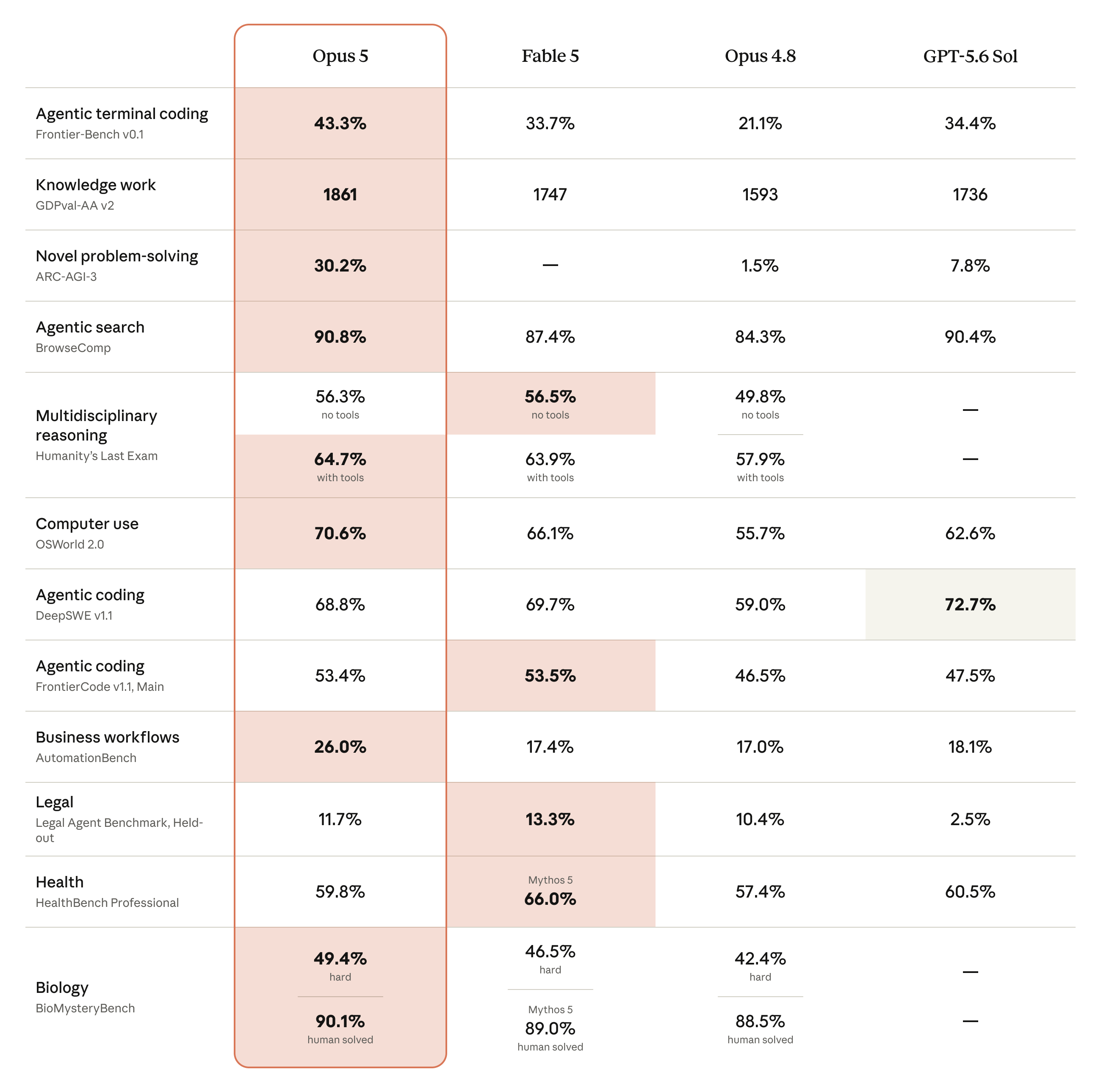
A Fellow or professional using Claude Opus 5 gets a model that plans carefully before writing, verifies its own work during execution, and sustains long-running tasks across hundreds of steps. On Frontier-Bench v0.1, a software engineering benchmark, Opus 5 more than doubles the performance of its predecessor Opus 4.8 at lower cost per task. On CursorBench 3.2, at max effort, it performs within 0.5% of the frontier Fable 5 model at half the cost.
For a U365 student writing a literature review, Opus 5 can process dozens of papers within its 1M token context window, extract key arguments, and synthesize them with citations you can verify. For a professional building an application, it writes production-ready code, catches its own mistakes, and manages long-running coding sessions. For a researcher, it reaches for the right statistical tests, cross-checks results by independent methods, and stays on track through long multi-step analyses.
The effort settings let you control the tradeoff: high effort for your most valuable tasks, lower effort for routine work where speed matters more. This makes Opus 5 practical for daily use rather than reserved for occasional heavy lifting.
Who Should Use Claude Opus 5
Learner categories:
Learner type | Difficulty | Typical ROI | Career path |
Students (Bachelor, Master) | Intermediate | Complex research synthesis, code project assistance, thesis drafting with large context | software engineering, UDA thesis work, research methods practice. No published U365 credential assesses research methods as a named component, and none is asserted. |
Professionals (career upskilling) | Intermediate to Advanced | Production code generation, enterprise workflow automation, multi-step agent workflows | |
Everyone (lifelong learners) | Intermediate | Deep learning on complex topics, daily reasoning partner, sustained research sessions | LIPS Collect phase, SL-OS daily learning, ULM Career domain |
U365 Institutes Alignment
UIT (Technology, AI, Data Science): High. Primary use case. Coding, agent workflows, technical research, API integration.
UIB (Business Management, Entrepreneurship): Medium. Enterprise workflows, document analysis, competitive intelligence, automation.
UIC (Digital Communication, Marketing): Medium. Content strategy research, long-context analysis, creative ideation partner.
UID (Digital Design, UX/UI): Medium. Design specification analysis, code generation for prototypes, research partner.
Skill level required: Intermediate. Understanding of prompt engineering and AI verification practices. The UP-Context-Engineering method provides the right framework.
Prerequisites: Basic understanding of LLM capabilities and limitations. API access requires an Anthropic account. Consumer access requires Claude Pro or Max subscription.
Typical time to first result: 5 minutes for a chat query. 15 minutes for a structured workflow with verification.
Typical time to competence: 10 to 20 hours of active use to learn effort level selection, context management, and verification patterns.
How Claude Opus 5 Works
Inputs: Text prompts, images, documents, code files, structured data. Accepts up to 1M tokens of context in a single request. Supports multimodal input (text and image).
Outputs: Text responses (up to 128k tokens per response, 300k on the Batches API), generated code, structured analysis, formatted documents, visual outputs.
Underlying technology:
Models: Claude Opus 5 (claude-opus-5) is Anthropic's strongest Opus model. Part of the Claude 5 family alongside Fable 5 (frontier), Sonnet 5 (speed+intelligence), and Haiku 4.5 (fastest).
Notable technical features: Adaptive thinking (always on) means the model reasons before answering. Effort settings (low, medium, high, xhigh, max) control reasoning depth and token cost. 1M token context window. Prompt caching for up to 90% cost savings. Batch processing for 50% savings.
Integrations: Claude API (native), Amazon Bedrock, Google Cloud, Microsoft Foundry. Claude Code CLI for terminal-based coding. Claude.ai web interface. MCP (Model Context Protocol) for tool use.
LLM-specific fields:
Context window size: 1,000,000 tokens (1M). Sufficient for entire codebases, dozens of research papers, or hours of conversation history.
Parameter count: Not publicly disclosed by Anthropic. The Claude family is closed-weights.
Architecture details: Hybrid reasoning model with adaptive thinking always enabled. The model reasons about its own problem-solving process before producing output. Specific architecture not publicly disclosed.
Available effort/thinking levels: Five levels: low, medium, high, xhigh, max. Defaults to high on the Claude API and Claude Code. Adaptive thinking means the model always reasons before answering.
Benchmark results (from Anthropic official announcements, July 2026):
Frontier-Bench v0.1: State-of-the-art. More than doubles Opus 4.8 performance at lower cost per task.
CursorBench 3.2: Within 0.5% of Fable 5 at max effort, at half the cost per task.
ARC-AGI 3: Score is three times as high as the next-best model on novel problem-solving.
Zapier AutomationBench: Pass rate approximately 1.5x the next-best model for the same cost per task. 100% pass rate at max effort.
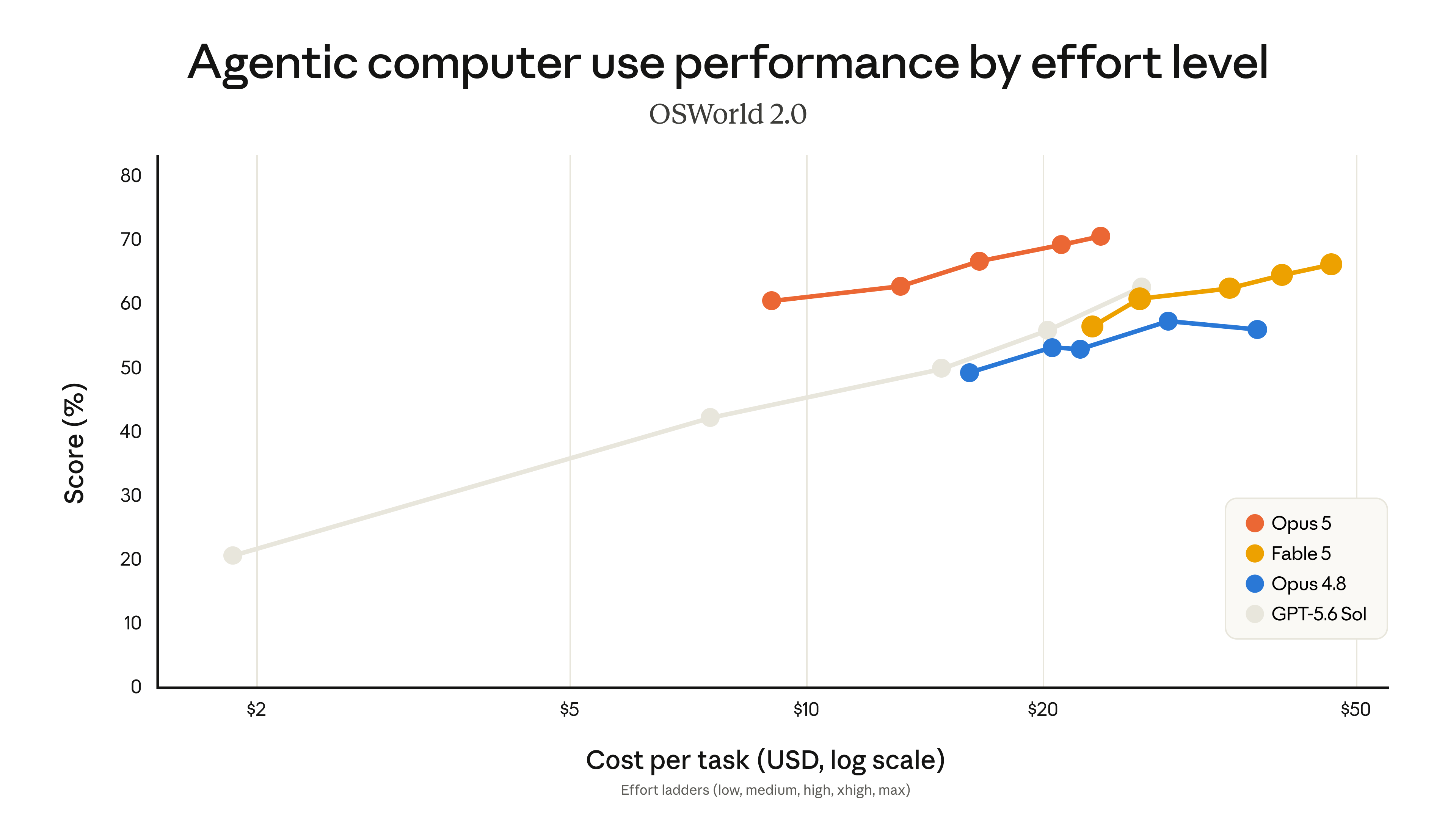
OSWorld 2.0 (computer use): Outperforms every other model at any given cost. Surpasses Fable 5 at just over a third of the cost.
Note: Benchmarks measure specific capabilities and do not capture real-world usefulness. Independent rankings are available on arena.ai (LMSYS Chatbot Arena).
Available platforms/APIs: Claude API, Amazon Bedrock, Google Cloud, Microsoft Foundry. Not available for local deployment.
Model variants: Claude Opus 5 (coding, agents, enterprise), Claude Fable 5 (frontier), Claude Sonnet 5 (speed + intelligence), Claude Haiku 4.5 (fastest). Claude Mythos 5 is a separate defensive cybersecurity model with invitation-only access.
Getting Started with Claude Opus 5
Required accounts: Free account at claude.ai for basic access. Claude Pro ($20/month) or Claude Max for Opus 5 access. API access requires an Anthropic account at console.anthropic.com with billing configured.
Installation: Web app at claude.ai. Claude Code CLI for terminal-based coding (npm install -g @anthropic-ai/claude-code). API access via curl, Python SDK, or TypeScript SDK. No desktop app required.
First-time configuration:
1. Go to https://claude.ai and sign up with email, Google, or Apple.
2. For consumer use: subscribe to Claude Pro or Max to access Opus 5.
3. For API use: go to https://console.anthropic.com, create an account, add billing, and generate an API key.
4. Set your effort level. Opus 5 defaults to high on the API. Adjust to low or medium for routine tasks to save tokens.
5. (Optional) Install Claude Code CLI for terminal-based coding workflows.
LLM-specific setup:
API key configuration: Generate an API key at console.anthropic.com. Set it as an environment variable: export ANTHROPIC_API_KEY=your-key. Use the claude-opus-5 model ID in API calls.
Model selection: Use claude-opus-5 for complex coding and enterprise work. Use claude-sonnet-5 for speed-sensitive tasks. Use claude-haiku-4-5 for high-volume, cost-sensitive work.
Context window settings: The full 1M token context is available by default. Use prompt caching to reduce costs on repeated context (up to 90% savings).
Effort level selection: Start with high (the default) for complex tasks. Use medium or low for simpler queries where speed matters more. Use xhigh or max only for your highest-value tasks where token cost is justified.
First 15 minutes checklist:
☐ Sign up at claude.ai or console.anthropic.com
☐ Ask Opus 5 a complex question related to your current work. Example: "Analyze the key arguments in this paper and identify three weaknesses in the methodology."
☐ Paste a code file and ask Opus 5 to review it for bugs and suggest improvements
☐ Adjust the effort level and observe how the response depth changes
☐ Verify one output against an independent source
Result: You have a working Opus 5 session with a feel for how effort levels affect output depth and cost.
Real Workflows
Workflow 1: Research Synthesis for a Literature Review
Learner type: Students (Bachelor, Master)
CI-First benefit tags: Time, Quality
Connects to: Research methods practice, UDA thesis and dissertation work. No published U365 credential assesses research methods as a named component, and none is asserted.
Time estimate: 30 minutes (query, verify, store)
What you do vs what the tool does:
Step | You do | The tool does |
1 | Frame your research question precisely and gather your source papers | (Nothing yet) |
2 | Upload the papers or paste key sections into Opus 5 with your research question | Reads the full context, synthesizes key arguments, identifies patterns across sources |
3 | Review the synthesis and check each claim against the original source | (Nothing, you verify) |
4 | Identify gaps or contradictions and ask follow-up questions | Searches deeper based on your follow-up within the same context |
5 | Write your own synthesis paragraph in your words and store sources in your LIPS Digital Second Brain | (Nothing, you execute) |
Sample prompt:
I am writing a literature review on [topic]. Here are [N] papers I have gathered. For each paper, extract: (1) the main thesis, (2) methodology, (3) key findings, (4) limitations. Then synthesize: what are the 3 main areas of agreement across these papers, and what are the 3 main points of disagreement? Cite each claim to the specific paper.
Verification checklist:
☐ Multi-Model Check: Run the same prompt through GPT or Gemini and compare which sources and arguments each model identifies. Investigate any divergence.
☐ External Source: Read the original paper sections Opus 5 cites. Confirm the claims match what the authors actually wrote.
☐ Human Review: Share your synthesis with your thesis advisor. Ask: "Are these the right arguments and the right gaps?"
☐ CI-First Test: Can you explain the synthesis and defend each claim without Opus 5? [Y/N]
Workflow 2: Production Code Review and Bug Fix
Learner type: Professionals (career upskilling)
CI-First benefit tags: Time, Quality, Skill
Time estimate: 45 minutes (review, fix, verify)
What you do vs what the tool does:
Step | You do | The tool does |
1 | Identify the code file or module with the bug or feature request | (Nothing yet) |
2 | Paste the code and the bug description into Opus 5 with max effort | Analyzes the code, identifies the root cause, proposes a fix, explains its reasoning |
3 | Review the proposed fix. Does it address the root cause or just the symptom? | (Nothing, you judge) |
4 | Apply the fix and run your test suite. Did the tests pass? | (Nothing, you verify) |
5 | Write a brief commit message explaining what was wrong and how you fixed it | (Nothing, you execute) |
Sample prompt:
Here is a [language] code file from my project. I am seeing [bug description] when [conditions]. Analyze the root cause (not just the symptom), propose a fix, and explain why this fix addresses the root cause. Also identify any related edge cases this fix might affect. Use max effort.
Verification checklist:
☐ Multi-Model Check: Ask GPT or a different Claude model to review the same code and compare root cause analysis.
☐ External Source: Run the test suite. Check the fix against the project's issue tracker and documentation.
☐ Human Review: Have a senior engineer review the fix. Ask: "Does this address the root cause or just the symptom? Are there edge cases?"
☐ CI-First Test: Can you explain the bug and the fix to a colleague without Opus 5? [Y/N]
Workflow 3: Daily Learning Session with Effort Control
Learner type: Everyone (lifelong learners)
CI-First benefit tags: Time, Skill
Connects to: LIPS Collect phase, SL-OS daily learning routine, ULM Career domain
Time estimate: 15 minutes
What you do vs what the tool does:
Step | You do | The tool does |
1 | Choose one concept from your day that you want to understand deeply | (Nothing yet) |
2 | Ask Opus 5 to explain it at medium effort with an example and a counterexample | Explains the concept, provides a concrete example, shows when it does not apply |
3 | Ask a follow-up: "What is the most common misconception about this concept?" | Identifies the misconception and explains why people get it wrong |
4 | Write a 3-sentence summary in your own words | (Nothing, you synthesize) |
5 | Store the summary in your LIPS Digital Second Brain under the relevant category | (Nothing, you execute) |
Sample prompt:
I am studying [concept] in [field]. Explain it in simple terms with one concrete example and one counterexample where the concept does not apply. Then tell me the most common misconception about this concept and why people make that mistake. Use medium effort.
Verification checklist:
☐ Multi-Model Check: Ask the same question in a different LLM and compare explanations.
☐ External Source: Look up the concept in a textbook or peer-reviewed source. Confirm the explanation matches.
☐ Human Review: Explain the concept to a peer or mentor. Can they follow your explanation?
☐ CI-First Test: Can you explain the concept and its misconception without Opus 5? [Y/N]
Strengths, Limits, and AI Imposture Risk
Strengths
The tool delivers clear CI-First benefits in these areas:
CI-First Benefit | Strength | Evidence |
Time | Sustained reasoning over long tasks saves hours of manual analysis and debugging | Opus 5 completes multi-step coding tasks in a single session where previous models failed entirely |
Quantity | Handles large context (1M tokens) enabling processing of entire codebases or dozens of papers in one pass | The 1M token context window lets users feed far more source material than most competitors |
Quality | Self-verification catches errors before returning results, producing more reliable output | On OSWorld 2.0, Opus 5 outperforms every other model at any given cost. It checks its own work during execution. |
Skill | Effort settings teach users to calibrate AI usage: high effort for hard problems, low for routine | Users learn to match tool capability to task difficulty, building judgment about when and how to use AI |
Limits
Closed weights: Opus 5 cannot be run locally. You depend on Anthropic's API and cloud providers for access. No offline use, no data residency control beyond cloud provider options.
Cost at scale: At $5/MTok input and $25/MTok output, heavy usage adds up quickly. Prompt caching and batch processing help, but the base cost is higher than competing models like Sonnet 5 or Haiku 4.5.
Jagged Frontier: Despite strong benchmark scores, Opus 5 still fails on tasks that seem easy. The model can produce a brilliant analysis of a complex paper and then hallucinate a basic citation. The Jagged Frontier means you must verify every output, not just the ones that seem hard.
Context window limits: 1M tokens is large but not infinite. Very large codebases or document collections may still exceed it. When input exceeds the window, the model silently truncates or loses earlier context.
Effort-cost tradeoff: Max effort produces the best results but at high token cost. Users may be tempted to always use max effort, but this wastes tokens on tasks where medium effort would suffice.
AI Imposture Risk
Time Illusion
Rating. Medium
Evidence. Opus 5 is fast for simple tasks but complex multi-step tasks require significant prompting, context loading, and verification. The 1M context window means loading large inputs takes time. High effort settings produce better answers but with longer wait times.
Quantity Illusion
Rating. Medium
Evidence. Opus 5 can produce large volumes of analysis, code, and documentation that looks polished. Most of it is good, but subtle errors in citations, code edge cases, and factual claims require spot-checking. The polished style can mask quality issues.
Skill Illusion
Rating. High
Evidence. Opus 5 produces expert-level code and analysis for users who lack the skill to evaluate it. A non-programmer can get production-ready code they cannot debug. A student can get a literature review they cannot defend. The model's self-verification reduces but does not eliminate this risk. Users believe they can do something because the tool does it for them.
Overall Imposture Risk: Medium. The Skill Illusion is the primary concern. Opus 5's broad capability and polished output create high over-delegation potential. Users who delegate coding, analysis, and writing without developing the underlying skills are on the path to AI Obesity.
U365 Co-Intelligence Rating
CI-First Profile
Primary profile: Co-Creator and Thought Partner (1). Opus 5's adaptive thinking and 1M context make it ideal for collaborative reasoning, strategic planning, and complex problem-solving where the human and AI build on each other's thinking.
Secondary profile(s): Co-Worker and Assistant (2) for code generation and document drafting. Professor, Coach and Tutor (3) for learning sessions. Analyst and Tester (4) for code review and data analysis. Challenger and Devil's Advocate (5) for stress-testing ideas and assumptions.
CI-First Benefit Score
Time
Score (0-10). 7
Rationale. Significant time savings on complex tasks. The 1M context window and self-verification reduce back-and-forth. But high effort settings have longer latency, and verification of output still takes time.
Quantity
Score (0-10). 7
Rationale. 1M token context enables processing far more source material than most competitors. Output up to 128k tokens (300k on Batches) produces substantial deliverables in a single pass.
Quality
Score (0-10). 8
Rationale. Opus 5 produces near-frontier quality that holds up under verification. Self-verification during execution is a real quality improvement, not surface polish. Top benchmarks across coding, agents, and knowledge work.
Skill
Score (0-10). 4
Rationale. The tool produces expert output but does not inherently teach the user. Effort settings build some judgment about AI usage, but the Skill Illusion risk is high. Users who delegate without learning gain little lasting capability.
CI-First Benefit Score: 6.5 / 10 (CI-First Strong)
Humics Protection Badge
Dimension | Rating | Rationale |
Creativity | Neutral (0) | Opus 5 can spark ideas and serve as a thought partner, but users who delegate ideation entirely lose creative practice. The tool supports creativity but does not protect it by default. |
Critical Thinking | Erodes (-1) | Opus 5's polished, confident output can discourage verification. Users who trust the model's self-verification without independent checking lose critical thinking muscle over time. |
Social Authenticity | Neutral (0) | Opus 5 drafts communication that users may adopt as their own, but this is a usage choice, not an inherent property of the tool. |
Humics Protection Score: -1 / +3
Badge: Humics-Neutral
Superhuman Usage Guidance
When to invite this tool:
Complex coding tasks where you can verify the output by running tests
Research synthesis across many sources where you can check claims against originals
Multi-step agent workflows where you define the task boundary and review each step
Learning sessions where you ask for explanations and then reproduce them yourself
When to keep this tool out:
Tasks where you cannot evaluate the output (if you cannot tell if the code or analysis is correct, you are in the Skill Illusion)
Creative ideation where your own original thinking is the primary value
Ethical judgment, interpersonal communication, or decisions requiring empathy
Tasks where using Opus 5 takes longer than doing it yourself (the Time Illusion)
U365 method integration:
LIPS + CARE: Opus 5 output feeds into the LIPS Collect phase. Use it to process information, then store verified results in your Digital Second Brain. The CARE cycle (Collect, Action Plan, Review, Execute) maps to: Opus 5 collects and processes, you action plan and review, you execute.
ULM + EVA: Supports the Career domain (code, analysis, knowledge work) and the Quality of Life domain (reducing time on complex tasks). In the EVA cycle, Opus 5 helps Explore and Visualize, but Action Plan remains human.
UP-Context-Engineering: Opus 5 responds well to UP-Context-Engineering prompting. Feed it your role, context, task, constraints, and output format. The 1M context window accepts rich personal context.
SL-OS: Integrates with Microsoft 365 workflows through API and Claude Code. Output can be stored in OneNote, SharePoint, or Teams. Does not have native Microsoft 365 integration but works alongside it.
UNOP: Supports active recall (ask, then verify) and multi-modal learning (text, code, images). The risk is cognitive atrophy from over-delegation, which UNOP's spaced repetition and active practice counteracts.
Over-delegation warning:
Opus 5's broad capability makes it the highest over-delegation risk in the Claude family. A user who delegates coding, analysis, and writing to Opus 5 without developing the underlying skills is on the path to AI Obesity. The CI-First formula is clear: if HI drops, CI-First drops. A user with HI=1 and Opus 5's AI=9 gets CI = 1 + (9 x 1) = 10, which is lower than a user with HI=5 and AI=2: CI = 5 + (2 x 5) = 15. The model's quality does not compensate for human skill erosion. Use Opus 5 as a Co-Creator and Coach, not as a replacement for your own thinking.
What Users Say
Aggregate Rating Table
Platform | Rating | Number of reviews | Link |
Trustpilot | No reviews found for Claude Opus 5 specifically (Anthropic is rated on Trustpilot but reviews cover the platform, not individual models) | N/A | trustpilot.com |
G2 | No reviews found for Claude Opus 5 specifically (G2 reviews cover Anthropic Claude as a product, not individual model versions) | N/A | g2.com |
Capterra | No reviews found for Claude Opus 5 specifically | N/A | capterra.com |
Product Hunt | Claude (the product) has been featured. Opus 5 was launched July 24, 2026 and is too recent for aggregated review data. | N/A | producthunt.com |
Reddit sentiment | Mixed to Positive | Multiple active threads | reddit.com/r/ClaudeAI |
Futurepedia | Listed as a top AI model | N/A | futurepedia.io |
FutureTools | Listed as a top LLM | N/A | futuretools.io |
What Users Praise
Early users from Anthropic's announcement emphasize Opus 5's self-verification, judgment, and efficiency. Scott Wu (CEO, Devin) notes it approaches Fable-level performance at half the cost. Sualeh Asif (Co-Founder, Cursor) says it delivers near Fable 5 intelligence at Opus speed and cost. Wade Foster (CEO, Zapier) reports it topped their AutomationBench with 100% pass rate. Alfredo Andere (CEO) describes it as behaving more like a careful scientist than any model they have tested, reaching for the right statistical tests and cross-checking results. Multiple users praise its ability to maintain quality at lower effort levels, producing similar performance with 26% fewer tokens on average compared to Opus 4.8.
What Users Complain About
Reddit discussions about Claude models (including the Opus tier) frequently mention: cost at scale, especially for heavy API users. The closed-weights model cannot be self-hosted, which frustrates developers who want data residency control. Users report that while Opus 5 is strong at coding and analysis, it can still hallucinate citations and factual details (the Jagged Frontier). Some users note that the 1M context window is valuable but loading it fully increases latency and cost. The model's tendency to be cautious can produce longer responses than necessary for simple tasks.
Sentiment Summary
Overall sentiment: Predominantly Positive
Key themes:
Self-verification and judgment are the most praised improvements over Opus 4.8
Cost-efficiency at lower effort levels is a real benefit for daily use
Coding and agent workflows are where Opus 5 shines compared to competitors
Closed weights and cost at scale remain the top concerns
The Jagged Frontier persists: brilliant on hard tasks, occasionally wrong on easy ones
U365 Editorial Note
User sentiment aligns with the CI-First evaluation on quality and time. Users praise the same capabilities the CI-First Benefit Score rewards: self-verification (Quality=8), efficiency at lower effort (Time=7), and large context processing (Quantity=7). However, user enthusiasm about Opus 5's coding and analysis capabilities aligns with the Skill Illusion risk flagged in Section 7. Users who praise the model for doing work they cannot do themselves are describing the exact trap the CI-First framework warns against. The Humics-Neutral badge reflects this tension: Opus 5 is a powerful tool that does not inherently protect human capability. The user who delegates everything to Opus 5 gets impressive output but loses HI. The CI-First formula is unforgiving: if HI drops, CI-First drops even with strong AI.
Comparison and Alternatives
Alternative | Choose the alternative if... | Choose Claude Opus 5 if... |
Claude Fable 5 | You need the absolute frontier of intelligence regardless of cost. Fable 5 is Anthropic's top model. | You want near-frontier intelligence at half the cost of Fable 5. |
Claude Sonnet 5 | You need a speed and intelligence balance for high-volume daily use. Sonnet 5 is 60% cheaper. | You need stronger reasoning, self-verification, and agent capabilities than Sonnet 5 provides. |
GPT-5.6 (OpenAI) | You are already in the OpenAI environment or need native Microsoft 365 integration. | You want stronger coding and agent benchmark performance. |
Gemini 3.1 (Google) | You need native Google Workspace integration or very long context at lower cost. | You want better self-verification and agent reliability. |
GLM-5.2 (Z.ai) | You want a strong open-weights model for local deployment or need lower API costs. | You want closed-weights reliability, self-verification, and the Anthropic safety framework. |
Local models via Ollama | You need full data residency, offline access, or zero per-token cost. | You want frontier-level intelligence without managing infrastructure. See ollama.com/search for local options. |
Where Claude Opus 5 is clearly better:
Opus 5 leads on agentic coding benchmarks (Frontier-Bench, CursorBench), computer use (OSWorld 2.0), and business automation (Zapier AutomationBench). Its self-verification during execution produces more reliable long-running output than competitors. The effort settings give cost control that most competitors do not offer at this quality level.
Where Claude Opus 5 is clearly worse:
Opus 5 is more expensive than Sonnet 5, Haiku 4.5, and most competitors. It cannot be run locally. It does not have native Google Workspace or Microsoft 365 integration. Users who need data residency, offline access, or the lowest possible cost should consider alternatives. The closed-weights model means you depend entirely on Anthropic and its cloud partners for access.
Verdict and Next Steps
Verdict
Who should adopt it: UIT students and professionals doing software engineering, research, or complex knowledge work. Users who can verify the output (run code, check citations, review analysis).
When: Now, if you have a Claude Pro or Max subscription or an Anthropic API account. Start with high effort on your most valuable task and adjust down for routine work.
For what: Complex coding, multi-step research, agent workflows, and any task where self-verification and long context produce real value.
UP-Context-Engineering prompt pack:
1. Code review prompt:
Context: I am a [role] working on [project type]. My expertise is [level]. I need a thorough code review. Role: AI as a code reviewer working only from the code I provide. I own which findings are acted on; you test and report. Profile: Act as an Analyst and Tester, reproducing each finding rather than pattern-matching. Task: Review the following code for bugs, security issues, and performance problems. Identify the root cause of any issue, not just the symptom. Constraints: Focus on [language/framework]. Prioritize issues by severity. Output format: List each issue with severity (critical, high, medium, low), location, description, and suggested fix. Effort: high. Memory: the accepted findings and their fixes belong in my repository record, because the conversation keeps no history. UP-Context-Engineering verification: I reproduce each critical finding myself before acting on it, I run the tests over each accepted fix, and I can defend each one without the tool. Data safety: this pack carries no personal data. I do not paste proprietary code, credentials or production data into it, and I keep the review record in my own repository.
2. Research synthesis prompt:
Context: I am writing a [type] on [topic]. I have gathered [N] sources. My thesis advisor expects [standard]. Role: AI as a research assistant working only from the provided sources. I own the argument; you synthesise and cite. Profile: Act as an Analyst and Tester, marking disagreement rather than averaging it away. Task: Synthesize these sources into a coherent argument. Constraints: Cite each claim to a specific source. Identify areas of agreement and disagreement. Do not introduce claims not supported by the sources. Output format: Structured summary with citations, followed by a gap analysis. Effort: high. Memory: the synthesis and its citation map belong in my thesis record and in my LIPS Digital Second Brain, because the conversation keeps no source list. UP-Context-Engineering verification: I check each cited claim against its source before the synthesis is used, I confirm the disagreement list is real rather than smoothed, and I can state each source's contribution without the tool. Data safety: this pack carries no personal data. I do not paste an unpublished draft, a supervisor's comments or a participant record into it, and I keep the synthesis in my own store.
3. Learning prompt:
Context: I am studying [concept] for [purpose]. I understand [prerequisite concepts]. I learn best by [learning style]. Role: AI as a study assistant working from my stated prerequisites. I own the learning; you explain and test. Profile: Act as a Professor, Coach and Tutor, teaching the habit rather than performing the task for me. Task: Explain [concept] with a concrete example and a counterexample. Then test my understanding with 3 questions. Constraints: Use simple language. Do not assume knowledge beyond my stated prerequisites. Output format: Explanation, example, counterexample, 3 test questions. Effort: medium. Memory: my worked answers and the corrected understanding belong in my own learning record, because the conversation keeps no study state. UP-Context-Engineering verification: I answer the three questions in my own words before I treat the topic as learned, I check each example against my prerequisites, and I can re-explain the concept a day later without the tool. Data safety: this pack carries no personal data. I do not paste licensed course material, an examination paper or another student's work into it, and I keep my answers in my own store.
Related U365 content:
U365's Recommendations to Learn More
These resources were curated to help you go deeper into Claude Opus 5. Each link was verified active as of 2026-09-03. We include official documentation, video tutorials, written guides, and community discussions.
Official learning resources
Claude Opus 5 overview: https://platform.claude.com/docs/en/models/opus-5/overview
What's new in Opus 5: https://platform.claude.com/docs/en/about-claude/models/whats-new-opus-5
Introducing Claude Opus 5: https://www.anthropic.com/research/claude-opus-5
Claude Opus 5 product page: https://www.anthropic.com/claude/opus
Video tutorials and channels
How to Prompt Claude Opus 5, Anthropic's Official Guide: https://www.youtube.com/watch?v=8Y6-xmq-x7E
Claude Opus 5 in 8 Minutes: https://www.youtube.com/watch?v=zClso50g9aM
How To Use Claude Opus 5 In Claude Code, The Ultimate Agentic AI Coding And Workflow Guide 2026: https://www.youtube.com/watch?v=wBO6XzMIklA
Anthropic Just Revealed How to Prompt Opus 5: https://www.youtube.com/watch?v=Z8CtXdQExek
Written tutorials and deep-dive articles
How to Switch to Claude Opus 5 in Cursor, Claude Code and the API: https://7minai.com/how-to-switch-to-claude-opus-5
Claude Opus 5: A Practical Developer Guide to Anthropic's New Model (community walkthrough by Ancilar Tech): https://medium.com/@ancilartech/claude-opus-5-a-practical-developer-guide-to-anthropics-new-model-d4bedb0061ed
How to Use the Claude Opus 5 API: https://apidog.com/blog/claude-opus-5-api
Claude Opus 5.0 Complete Guide: Model Specifications, API Notes, and Claude Code Operations: https://journal.qualiteg.com/claude-opus-5-claude-code-guide
Community and social
r/ClaudeAI community on Reddit: https://www.reddit.com/r/ClaudeAI
r/ClaudeCode community on Reddit: https://www.reddit.com/r/ClaudeCode
Claude Opus 5: What Shipped and What Users Reported by Jacopo Castellano: https://jacopocastellano.com/blog/claude-opus-5-what-reddit-found-first
We curate these resources for content quality, not source type. Individual creators and community experts are included when their tutorials teach something the post itself does not cover. We exclude only promotional or affiliate content.
Glossary
CI-First Benefit Score
A 0 to 10 assessment of the net benefit the tool creates across Time, Quantity, Quality, and Skill. Claude Opus 5 scores 6.5/10, or CI-First Strong, because it saves time and improves verified output while requiring deliberate practice to protect lasting skill.
CI-First Profile
The collaboration role that best describes how a tool should work with you. Claude Opus 5 is primarily a Co-Creator and Thought Partner (level 1), with secondary value as a Co-Worker, Coach, Analyst, and Challenger.
Humics Protection Badge
A rating of whether the tool protects human creativity, critical thinking, and social authenticity. Claude Opus 5 is Humics-Neutral at -1/+3: its benefits depend on independent verification and continued human practice.
AI Imposture Risk
The risk that polished AI output creates a false impression of time saved, useful quantity, or user skill. Claude Opus 5 has Medium overall risk, with Skill Illusion as the main concern when users cannot explain or verify delegated work.
User Sentiment
A synthesis of available ratings, reviews, and community discussion rather than a provider claim. Sentiment for Claude Opus 5 is predominantly positive, but version-specific aggregate ratings are not yet available.
Sources
Anthropic Claude Opus 5 announcement: https://www.anthropic.com/research/claude-opus-5
Claude Opus 5 documentation overview: https://platform.claude.com/docs/en/models/opus-5/overview
What's new in Opus 5: https://platform.claude.com/docs/en/about-claude/models/whats-new-opus-5
Claude Opus 5 product page: https://www.anthropic.com/claude/opus
Anthropic pricing: https://www.anthropic.com/pricing
Anthropic documentation: https://docs.anthropic.com
Claude API console: https://console.anthropic.com
How to Switch to Claude Opus 5: https://7minai.com/how-to-switch-to-claude-opus-5
Claude Opus 5: A Practical Developer Guide: https://medium.com/@ancilartech/claude-opus-5-a-practical-developer-guide-to-anthropics-new-model-d4bedb0061ed
How to Use the Claude Opus 5 API: https://apidog.com/blog/claude-opus-5-api
Claude Opus 5.0 Complete Guide: https://journal.qualiteg.com/claude-opus-5-claude-code-guide
Claude Opus 5: What Shipped and What Users Reported: https://jacopocastellano.com/blog/claude-opus-5-what-reddit-found-first
r/ClaudeAI: https://www.reddit.com/r/ClaudeAI
r/ClaudeCode: https://www.reddit.com/r/ClaudeCode
How to Prompt Claude Opus 5, Anthropic's Official Guide (YouTube): https://www.youtube.com/watch?v=8Y6-xmq-x7E
Claude Opus 5 in 8 Minutes (YouTube): https://www.youtube.com/watch?v=zClso50g9aM
How To Use Claude Opus 5 In Claude Code (YouTube): https://www.youtube.com/watch?v=wBO6XzMIklA
Anthropic Just Revealed How to Prompt Opus 5 (YouTube): https://www.youtube.com/watch?v=Z8CtXdQExek




Comments