
Claude Sonnet 5: Anthropic's Precision Reasoning Model

Updated: Oct 16

Status: Active | Last tested: 2026-08-24 (Claude Sonnet 5) | Re-check: trigger-based (max 6 months)
Active: the tool is current and recommended.


In this Tool Review
Table of Contents
Tool Snapshot
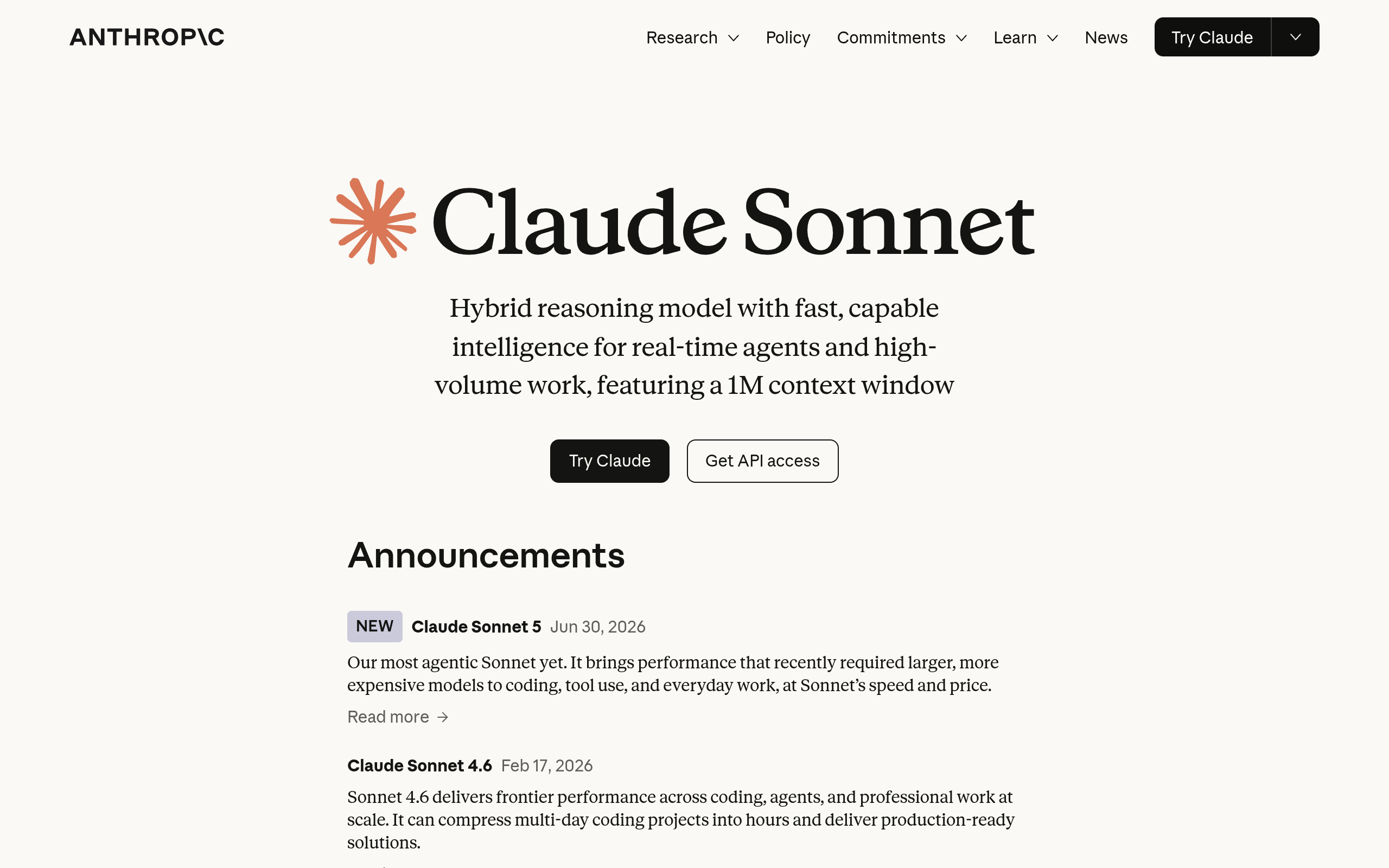
Tagline: The best combination of speed and intelligence for agentic workflows
Category: Large Language Model
Provider: Anthropic
Version tested: Claude Sonnet 5 (released June 30, 2026)
Parameters: Not disclosed by Anthropic (proprietary model)
Context window: 1,000,000 tokens (1M)
License: Proprietary, closed-weight
Platforms: Claude API, Amazon Bedrock, Google Cloud, Microsoft Foundry, Claude.ai (web, iOS, Android). Not available for local deployment.
Primary use cases:
Advanced coding across the full software development lifecycle: planning, implementation, debugging, refactoring
Long-running autonomous agents that use tools, browse, and execute multi-step tasks
Computer and browser use for automating enterprise workflows like procurement and onboarding
Enterprise knowledge work: financial analysis, research synthesis, document generation
Production-grade AI systems requiring sustained coherence and adaptive decision-making
Pricing summary: Paid - $2/M input, $10/M output (permanent as of Aug 10, 2026). Cache hits $0.20/M, 5m cache writes $2.50/M, 1h cache writes $4/M. Batch processing 50% off. US-only inference 1.1x pricing.
Official links:
Docs: https://docs.anthropic.com/en/docs/about-claude/models
Help center: https://support.anthropic.com
Status: https://status.anthropic.com
Community: https://discord.gg/anthropic
LLM specifications:
Context Window: 1,000,000 tokens (1M)
Effort Levels: Adaptive thinking: medium, high (default), xhigh (extra high)
Parameters: Not disclosed by Anthropic (proprietary model)
Architecture: Transformer-based adaptive reasoning model (proprietary, not publicly disclosed)
Available Platforms: Claude API, Amazon Bedrock, Google Cloud, Microsoft Foundry, Claude.ai (web, iOS, Android). Not available for local deployment.
Model Variants: Claude Fable 5 (flagship, $10/$50), Claude Opus 5 ($5/$25), Claude Sonnet 5 ($2/$10), Claude Haiku 4.5 ($1/$5). Sonnet 5 is the default model for Free and Pro plans.
Indicator | Value |
CI-First Benefit Score | 6.5/10 - CI-First Strong |
Time / Quantity / Quality / Skill | 7 / 7 / 7 / 5 |
CI-First Profile | Co-Creator and Thought Partner |
Humics Protection | Humics-Neutral (Score: 0) |
AI Imposture Risk | Medium |
User Sentiment | Strongly positive (testimonials, limited independent reviews) |
Pricing | Paid - $2/M input, $10/M output |
Platforms | Claude API, Amazon Bedrock, Google Cloud, Microsoft Foundry, Claude.ai |
For detailed explanations of the CI-First evaluation terms used in this review, including CI-First Benefit Score, CI-First Profile, Humics Protection Badge, AI Imposture Risk, and User Sentiment, see the Glossary at the end of this publication.
The Problem
Developers and organizations building AI-powered applications face a persistent tension: they need a model that is smart enough for complex agentic tasks, fast enough for production use, and affordable enough to scale. Flagship models like Claude Opus 5 ($5/$25 per million tokens) deliver top-tier reasoning but cost too much for high-volume work. Cheaper models like Claude Haiku 4.5 ($1/$5) are fast but lack the sustained reasoning needed for multi-step agents, complex coding, and autonomous tool use.
The gap between these tiers is where most real work happens. Teams need a model that can write code, use tools, browse the web, and maintain coherence across long tasks without requiring the budget of a flagship model. They also need fine-grained control over how much the model thinks: less reasoning for simple tasks to save cost and latency, more reasoning for complex problems.
Before Sonnet 5, the Sonnet tier (Sonnet 4.6 at $3/$15) filled this gap but fell short of Opus-class performance on agentic benchmarks. Anthropic built Sonnet 5 to narrow that gap, delivering near-Opus 4.8 performance at a lower price point with adaptive thinking effort that lets users control the cost-performance tradeoff.
The Outcome
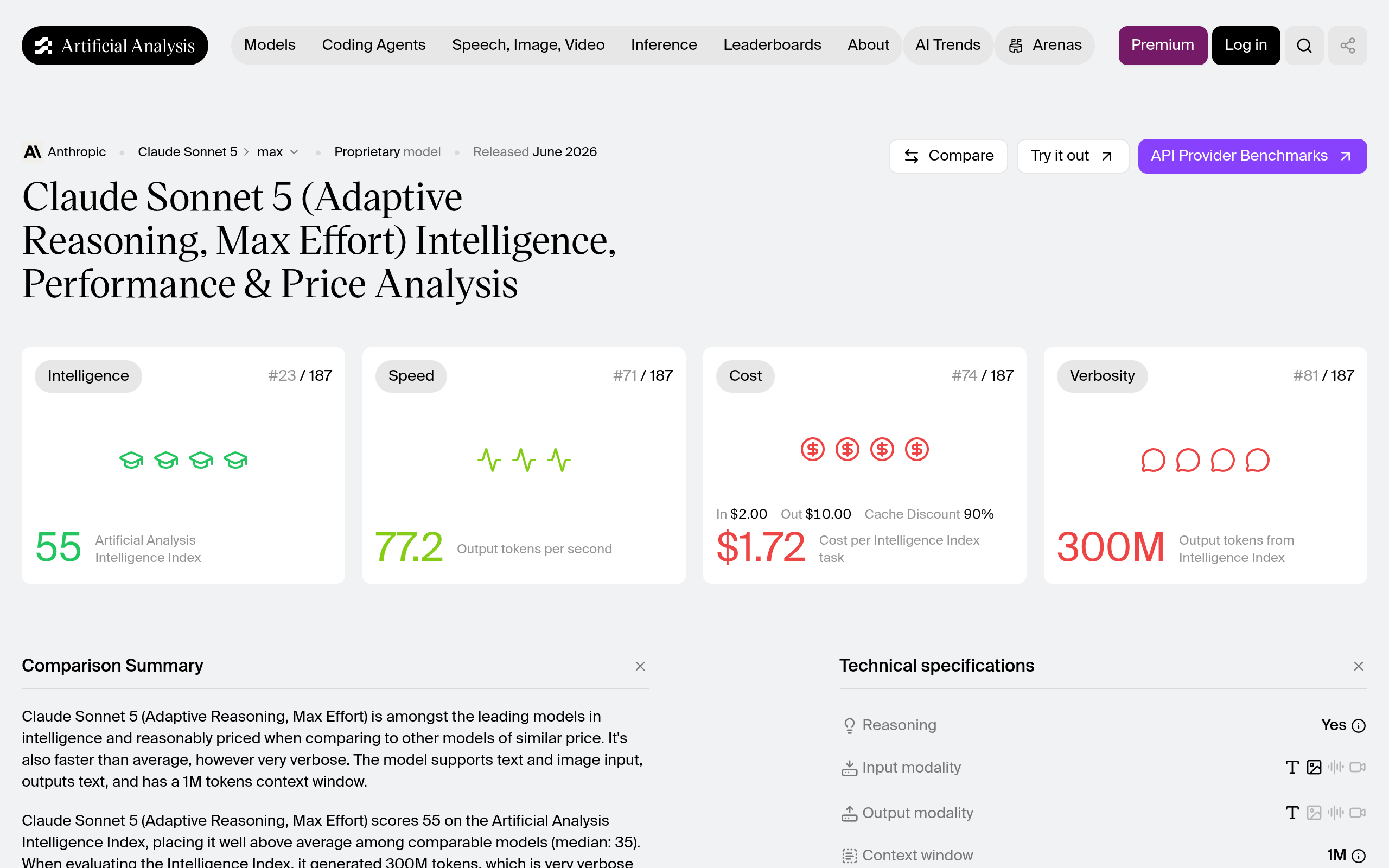
With Claude Sonnet 5, you get a model that scores 55 on the Artificial Analysis Intelligence Index (rank 23 of 187 models), generates output at 77.2 tokens per second, and costs $2 per million input tokens and $10 per million output tokens. The 1M token context window lets you feed entire codebases, long documents, or extensive conversation histories into a single request. The 128K max output supports long-form code generation and detailed analysis.
The adaptive thinking system gives you control over reasoning depth. At medium effort, Sonnet 5 is cost-efficient for routine tasks. At high effort (default), it handles complex coding and agentic work. At xhigh effort, its performance approaches Opus 4.8 on some benchmarks. This means you can use one model for both simple classification and complex reasoning by adjusting a single parameter.
Anthropic customers report that Sonnet 5 finishes multi-step tasks where previous Sonnet models would stop, checks its own output without being asked, and handles brownfield code (race conditions, hidden tests) by tracing failures to root causes. The concrete outcome: developers can build production agents that complete tasks end to end, at a price that makes scaling practical.
Who Should Use Claude Sonnet 5
Learner categories and institute alignment:
Category | Profile | Fit |
Students | Learners who need a capable reasoning model for coding assistance, research analysis, or building AI-powered applications. Sonnet 5 works well for UIT students building agentic applications, UIC students creating content workflows, and UID students prototyping AI-driven design tools. Recommended for learners who need near-frontier intelligence at a manageable cost. | High |
Professionals | Developers and content managers who need a production-ready model for coding agents, automated workflows, or enterprise knowledge work. Sonnet 5 suits agentic coding pipelines, multi-step tool use, and document analysis at scale. Recommended for UIT professionals building production agents and UIC professionals managing content automation. | High |
Everyone | Anyone who needs a powerful model for complex text tasks, coding help, or research. Sonnet 5 is the default model on Claude.ai for Free and Pro plans, so it is accessible without API access. Recommended for tasks requiring sustained reasoning, code generation, or multi-step problem-solving. | High |
U365 Institutes Alignment
UIT (Technology, AI, Data Science)
Relevance. High
Why. Recommended for students building agentic applications, coding pipelines, and AI engineering workflows. Sonnet 5's adaptive thinking and tool use capabilities align directly with UIT's published Software Developer and AI Developer Specialist programmes.
The limit that holds the row. The model performs the coding and the analysis; it teaches no programming, no systems design and no evaluation method of its own, and the review's own Skill rationale records that completing tasks end to end can create dependency when the user stops engaging with the reasoning. The page also states that the parameter count and architecture are not disclosed and that the model is not available for local deployment, so nothing here is assessable as modelling either. The competency that remains is the review's own verification discipline: define the expected outcome and the tests that must pass before the change, read the diff line by line, and run the project's existing test suite rather than the model's own. A word-start accent-folded search over the title and full description of all 79 published programme descriptions returns zero matches for code review, refactoring, root cause and model evaluation, so the row stands at High for measured engineering use and not for output accepted without review.
UIB (Business Management, Entrepreneurship)
Relevance. Moderate
Why. Useful for business analysis, financial document processing, and building AI-powered business workflows. The 1M context window supports processing large business documents and reports.
The limit that holds the row. The model reads and processes the documents; it supplies no management, finance or entrepreneurship content, no financial method and no decision rule of its own, and the review's keep-out list places final deliverables that publish without human review and tasks that need fundamental skill built from scratch outside its use. The 1M context window shortens the reading of large business documents, and it does not turn that reading into a costed or accountable decision. A word-start accent-folded search over the title and full description of all 79 published programme descriptions returns zero matches for total cost of ownership, unit economics, cost per and computing economics, so the row stays at Moderate for document-analysis support and not for a business competency.
UIC (Digital Communication, Marketing)
Relevance. High
Why. Effective for research synthesis, content analysis workflows, and building automated content pipelines. Supports UIC's published Bachelor in Communication & Marketing (B.C.) and Content Marketing Specialist programmes.
The limit that holds the row. The model synthesises and drafts; it composes no register, chooses no audience and holds no publication standard of its own, and the review's second workflow puts the citation check on the reader: verify that no quote was fabricated, no finding misattributed, and no conclusion goes beyond the sources. The competency that remains is publication judgement over a machine synthesis: what may be drafted from a document set, what must be checked against the source, and who signs the final read. A word-start accent-folded search over the title and full description of all 79 published programme descriptions returns zero matches for source verification, editorial, disclosure and brand voice, so the row stands at High for research synthesis under the review's verification steps and not for communication craft.
UID (Digital Design, UX/UI)
Relevance. Moderate
Why. Useful for prototyping AI-driven design tools, generating design documentation, and supporting UX research synthesis. The 1M context window allows processing design system documentation and research data.
The limit that holds the row. The model generates code and documentation; it produces no design artefact, specifies no layout, type or interaction, and evaluates no design against a brief. The page records that it has no image, audio or video generation, so the prototyping it supports is text and code while the design decision stays with the Fellow. The competency that remains is the review's own comparative read: prototyping AI-driven design tooling and synthesising UX research while keeping the design judgement, which the catalogue does not assess as a named component. A word-start accent-folded search over the title and full description of all 79 published programme descriptions returns zero matches for user research, usability and design brief, so the row stays at Moderate for prototyping support and not for design capability.
Skill level: Intermediate to advanced for API integration. No prerequisites for Claude.ai web users.
Prerequisites: Basic API concepts, an Anthropic account, understanding of prompt engineering. For API integration: Python programming and API key management.
Time to first result: 15 minutes (Claude.ai), 30 minutes (API integration).
Time to competence: 3 to 5 hours of guided practice for API integration and effort tuning.
How Claude Sonnet 5 Works
Claude Sonnet 5 is a transformer-based adaptive reasoning model from Anthropic, released on June 30, 2026. It sits between Claude Opus 5 ($5/$25) and Claude Haiku 4.5 ($1/$5) in the Claude model lineup, positioned as the best combination of speed and intelligence.
Inputs
Inputs: Sonnet 5 accepts text and image input. You send prompts via the Claude Messages API or the Claude.ai chat interface. The model processes up to 1,000,000 tokens of context in a single request, which means you can include entire codebases, long documents, or extensive conversation histories.
Outputs
Outputs: Sonnet 5 generates text output with a maximum of 128,000 tokens per response. Output speed measures 77.2 tokens per second on the Anthropic API (Artificial Analysis, August 2026). The model is very verbose: it generated 300 million tokens across the Artificial Analysis Intelligence Index evaluation, compared to a median of 72 million for other models.
Adaptive Thinking
Adaptive thinking: Sonnet 5 uses adaptive reasoning with three effort levels: medium, high (default), and xhigh (extra high). Lower effort produces faster, cheaper responses. Higher effort improves reasoning quality but increases latency and token usage. At medium effort, Sonnet 5 provides strong cost efficiency. At xhigh effort, its performance approaches Opus 4.8 on some benchmarks like BrowseComp (agentic search) and OSWorld-Verified (computer use).
Architecture
Architecture: Anthropic has not disclosed the parameter count or architecture details. The model is proprietary and closed-weight. It is not available for local deployment via Ollama or other local runtimes. You access it through the Claude API or partner platforms (Amazon Bedrock, Google Cloud, Microsoft Foundry).
Benchmark Results
Benchmark results (Artificial Analysis Intelligence Index v4.1.1, August 2026):
- Intelligence Index: 55 (rank 23 of 187 models, above the median of 35)
- Output speed: 77.2 tokens per second (rank 71 of 187)
- Verbosity: 300 million output tokens (very verbose, median is 72 million)
- Cost per Intelligence Index task: approximately $0.067 at $2/$10 pricing
- Evaluations included: GDPval-AA v2, tau3-Banking, Terminal-Bench v2.1, SciCode, Humanity's Last Exam, GPQA Diamond, CritPt, AA-Omniscience, AA-LCR
- Available via 8 API providers according to Artificial Analysis
Safety and Improvements
Anthropic reports that Sonnet 5 is a strict improvement over Sonnet 4.6 on agentic benchmarks and covers a wider range of cost-performance options than Opus 4.8. Safety evaluations found a lower rate of undesirable behaviors than Sonnet 4.6, with cyber safeguards enabled by default.
Platform Availability
Platform availability: Claude API (Anthropic Platform), Amazon Bedrock, Google Cloud, Microsoft Foundry, Claude.ai (web, iOS, Android). Not available on Ollama for local deployment.
Model Variants
Model variants within the Claude 5 family:
- Claude Fable 5: Flagship, $10/$50 per 1M tokens, 1M context, adaptive thinking (always on)
- Claude Opus 5: Enterprise, $5/$25 per 1M tokens, 1M context, adaptive thinking
- Claude Sonnet 5: Balanced, $2/$10 per 1M tokens, 1M context, adaptive thinking, default for Free and Pro plans
- Claude Haiku 4.5: Fast, $1/$5 per 1M tokens, 200K context, no thinking support
The claude-sonnet-5 model ID routes to the latest Sonnet 5 snapshot. Anthropic uses a newer tokenizer for Sonnet 5 (and Claude 4.7 and later) that produces approximately 30 percent more tokens for the same text compared to earlier models.
Getting Started with Claude Sonnet 5
Required Accounts
Required accounts: An Anthropic account with API access. Create one at console.anthropic.com. You need a valid payment method for API usage. For non-API use, Sonnet 5 is available on Claude.ai (web, iOS, Android) as the default model for Free and Pro plans.
Installation
Installation: No local installation is required for API or Claude.ai access. For Python integration, install the Anthropic SDK: pip install anthropic.
First-time Configuration
First-time configuration:
1. Create an account at console.anthropic.com and add a payment method.
2. Generate an API key in the API keys section.
3. Set the API key as an environment variable: export ANTHROPIC_API_KEY="your-key-here".
4. Choose your thinking effort level: medium for cost-sensitive tasks, high (default) for balanced work, xhigh for complex reasoning.
5. Make your first API call using the Messages API with model name "claude-sonnet-5".
6. Enable prompt caching to reduce costs by up to 90 percent on repeated prefixes.
7. Consider batch processing for non-urgent workloads (50 percent discount).
15-Minute Checklist
15-minute checklist:
☐ Anthropic account created and payment method added
☐ API key generated and stored securely
☐ Anthropic Python SDK installed (pip install anthropic)
☐ First API call made with model "claude-sonnet-5"
☐ Thinking effort parameter tested at two levels (medium and high)
☐ Token usage reviewed in the API dashboard
☐ Prompt caching enabled for repeated system prompts
☐ Batch API tested for a non-urgent workload (optional)
Real Workflows
Workflow 1: Agentic Coding Pipeline for Multi-File Refactoring
Learner type: UIT student or professional building agentic coding workflows
CI-First benefit tags: Time +7, Quantity +7, Quality +7, Skill +5
Connects to: UIT Software Developer and AI Developer Specialist
Time estimate: 30 minutes to set up; runs autonomously for complex tasks
Step | You do | Sonnet 5 does |
1 | Identify the refactoring target in your codebase. Define the scope: which files need changes, what the expected outcome is, and what tests should pass after the refactor. | |
2 | Create a system prompt that gives Sonnet 5 context about your project conventions, coding standards, and the specific refactoring goal. Include the relevant source files in the 1M token context window. | |
3 | Set the thinking effort to "high" or "xhigh" for complex refactoring. Instruct Sonnet 5 to write a test that reproduces the current behavior, implement the refactor, and verify the test still passes. | |
4 | Executes the plan: reads the code, writes a reproducing test, implements the changes, and runs the test to verify. Checks its own output and corrects errors without being asked. | |
5 | Review the diff, run the full test suite, and approve or request changes. You own the final decision. |
What Sonnet 5 does: Analyzes the codebase, writes tests, implements the refactor, verifies correctness, and iterates on errors. It sustains focus across multiple files and steps.
What you do: Define the scope, provide project context, review the output, and make the final approval. You own the judgment and the decision.
Sample prompt:
You are a senior software engineer working on a Python codebase. Your task is to refactor the authentication module to use async/await instead of synchronous calls. Rules: 1. First, write a test that reproduces the current behavior of the authentication flow. 2. Run the test to confirm it passes with the current code. 3. Implement the refactor to async/await. 4. Run the test again to confirm it still passes. 5. If the test fails, debug and fix the issue before reporting completion. 6. Do not change the public API. Only modify internal implementation. 7. Report what you changed and why. Here are the relevant files: [paste your source files here]
Verification checklist:
Multi-Model Check: Run the same refactoring task through Claude Opus 5 and compare the implementation. If both models produce functionally equivalent refactors, the output is reliable. If they diverge significantly, review the differences manually.
External Source: Run the full existing test suite (not just the test Sonnet 5 wrote) to verify no regressions. Do not rely solely on the model-generated test.
Human Review: Read the diff line by line. Check for subtle behavior changes, missing error handling, and new dependencies introduced by the refactor. Reject any change that alters the public API.
CI-First Test: Ask yourself: did reviewing Sonnet 5's refactor teach you something about the codebase or about refactoring patterns? If yes, the tool is building skill. If you simply approved without understanding the changes, you are delegating judgment, not collaborating.
Workflow 2: Research Synthesis Agent for Document Analysis
Learner type: UIC or UIT student or professional analyzing large document sets
CI-First benefit tags: Time +6, Quantity +7, Quality +6, Skill +4
Connects to: UIC Social Media Marketing Manager, UIT Data Scientist
Time estimate: 20 minutes to set up; processes documents in minutes
Step | You do | Sonnet 5 does |
1 | Collect your source documents (research papers, reports, financial filings) and format them for the API. The 1M token context window lets you include multiple long documents in a single request. | |
2 | Create a prompt that defines the synthesis task: what themes to extract, what comparisons to make, and what format the output should take. Specify that Sonnet 5 should cite specific passages from the source documents. | |
3 | Set the thinking effort to "high" for analysis tasks. Instruct Sonnet 5 to identify key findings, note contradictions between sources, and flag uncertainty. | |
4 | Processes the documents, generates a structured synthesis with cited passages, and identifies areas where sources disagree. | |
5 | Verify the citations against the original documents. Check that Sonnet 5 did not fabricate quotes or misattribute findings. Edit and refine the synthesis. |
What Sonnet 5 does: Reads the documents, identifies themes, extracts key findings, notes contradictions, and produces a structured synthesis with citations.
What you do: Select the documents, define the analysis framework, verify citations, and refine the output. You own the intellectual framework and the final quality.
Sample prompt:
You are a research analyst. I will provide you with three research reports on the impact of AI on healthcare delivery. Your task is to: 1. Identify the main arguments in each report. 2. Compare where the reports agree and where they disagree. 3. Extract specific data points (statistics, dates, study names) cited in each report. 4. Flag any claims that are not supported by evidence in the reports. 5. Produce a structured summary with citations to the specific report and page. Do not include information that is not present in the source documents. If you are unsure whether a claim is supported, say so explicitly. Reports: [paste your documents here]
Verification checklist:
Multi-Model Check: Run the same document set through Claude Opus 5 or GPT-5.6 Sol and compare the synthesis. If both models identify the same key findings and contradictions, the analysis is reliable.
External Source: For every specific statistic, date, or study name Sonnet 5 cites, verify it against the original source document. Do not accept citations without checking the referenced passage.
Human Review: Read the synthesis and check for fabricated quotes, misattributed findings, or conclusions that go beyond what the source documents support. Reject any claim that introduces external information.
CI-First Test: Ask yourself: did working with Sonnet 5 on this analysis improve your understanding of the source material? If you can explain the key findings without the synthesis in front of you, the tool helped you learn. If you can only repeat what the model wrote, the tool replaced your reading, not augmented it.
Strengths, Limits, and AI Imposture Risk
Strengths by CI-First dimension:
Strengths by CI-First Dimension
Time (7/10): At 77.2 output tokens per second, Sonnet 5 is faster than average (median 75 t/s). The adaptive thinking system lets you reduce latency by lowering effort for simple tasks. For complex tasks, the time saved compared to manual coding or analysis is substantial. Anthropic customers report that Sonnet 5 reasons in tighter steps and reaches answers faster than predecessors.
Quantity (7/10): The 1M token context window and 128K max output let Sonnet 5 process and generate large volumes in a single request. The model is very verbose (300M tokens on the Intelligence Index evaluation), which means it produces thorough, detailed output. For batch processing at 50 percent off, the cost per token is competitive.
Quality (7/10): Sonnet 5 scores 55 on the Artificial Analysis Intelligence Index, well above the median of 35. Anthropic reports it is a strict improvement over Sonnet 4.6 on agentic benchmarks and approaches Opus 4.8 on some tasks at xhigh effort. Safety evaluations show a lower rate of undesirable behaviors than Sonnet 4.6. Customer testimonials confirm production-ready quality for coding and agent tasks.
Skill (5/10): Sonnet 5 can build lasting skill when used as a collaborator. Its adaptive thinking exposes the reasoning process, which helps users learn how to approach problems. Working with it on refactoring, debugging, and analysis can teach patterns and approaches. However, the model's tendency to complete tasks end to end can also create dependency if users stop engaging with the reasoning.
Limits
Limits:
- Very verbose: 300M tokens on the Intelligence Index (4x the median) increases cost unexpectedly at high effort
- Not available for local deployment: proprietary, API-only access
- Parameter count and architecture not disclosed by Anthropic
- Lower cybersecurity capabilities than Opus-class models (intentional safety design)
- 30 percent more tokens than earlier Claude models due to the newer tokenizer, which increases effective cost per text unit
- No image, audio, or video generation (text output only)
- Intelligence Index (55) is below flagship models like Claude Opus 5 and Claude Fable 5
AI Imposture Risk Assessment
AI Imposture Risk Assessment:
Time Illusion: Low. Sonnet 5 is genuinely fast at 77.2 t/s. The speed is real. The risk is that verbose output at high effort creates the impression of thoroughness when the extra tokens are reasoning overhead, not additional insight.
Quantity Illusion: Medium. Sonnet 5 produces very large volumes of output (300M tokens on the Intelligence Index, 4x the median). This volume can create the impression of comprehensive analysis. While the quality is above average, the verbosity means users must distinguish between thorough reasoning and padding. Always check whether the output adds verified insight or repeats the same point in different words.
Skill Illusion: Medium. Sonnet 5's ability to complete tasks end to end (write tests, implement fixes, verify) can create the impression that the user produced the work. The model's self-checking behavior is valuable but can lead users to skip their own verification. Users who delegate judgment to Sonnet 5 without engaging with its reasoning build dependency, not skill.
Overall Imposture Risk: Medium. The time benefit is real, the quantity benefit needs verification for verbosity, and the skill risk requires active engagement. Users who treat Sonnet 5 as a collaborator and review its reasoning get genuine value. Users who approve output without understanding it are at risk.
U365 Co-Intelligence Rating
CI-First Profile
CI-First Profile: Primary is Co-Creator and Thought Partner. Sonnet 5 excels at collaborative reasoning: it works through problems step by step, exposes its thinking, and iterates with the user. Its adaptive thinking system makes it a strong thought partner that adjusts reasoning depth to the task. Secondary is Co-Worker and Assistant. Sonnet 5 handles routine coding, analysis, and drafting tasks efficiently, especially at medium effort.
CI-First Benefit Score
CI-First Benefit Score:
- Time: 7/10. Sonnet 5 is fast at 77.2 t/s and reduces time on coding and analysis tasks. The adaptive effort system lets you trade latency for cost. The time saved is real and measurable.
- Quantity: 7/10. The 1M context window, 128K max output, and verbose reasoning enable large-volume processing. The quantity increase is real but requires filtering for verbosity.
- Quality: 7/10. Intelligence Index of 55 (above median of 35), strict improvement over Sonnet 4.6, and near-Opus 4.8 performance at xhigh effort. Safety improvements confirmed by Anthropic. Quality is strong for coding and agentic tasks.
- Skill: 5/10. Sonnet 5 can build skill when used as a collaborator. Its exposed reasoning helps users learn. But its end-to-end task completion can also create dependency. The skill benefit is moderate, not high.
- Overall: 6.5/10. CI-First Strong band.
Humics Protection Badge
Humics Protection Rating:
- Creativity: 0 (Neutral). Sonnet 5 generates text and code but does not enhance or erode the user's creative process. It produces drafts and implementations that the user shapes.
- Critical Thinking: 0 (Neutral). Sonnet 5 exposes its reasoning, which can support critical thinking. But its end-to-end completion can also bypass it if users stop reviewing. The net effect is neutral.
- Social Authenticity: 0 (Neutral). Sonnet 5 does not affect the user's social authenticity directly. It is a text generation and reasoning tool.
- Score: 0. Badge: Humics-Neutral.
Superhuman Usage Guidance
Superhuman Usage Guidance:
When to invite Sonnet 5:
- Complex coding tasks requiring multi-file reasoning and test verification
- Agentic workflows that need sustained tool use and autonomous decision-making
- Research synthesis across large document sets (using the 1M context window)
- Production systems where cost-performance balance matters (medium effort for volume, xhigh for complex)
- Tasks where adaptive reasoning depth provides cost control
When to keep Sonnet 5 out:
- Tasks requiring the absolute highest reasoning quality (use Claude Fable 5 or Opus 5)
- Tasks where the 30 percent token increase from the new tokenizer makes cost prohibitive
- Final deliverables that will be published without human review
- Tasks where the user needs to build fundamental coding or analytical skills from scratch (Sonnet 5 completes tasks, which can prevent learning if not used as a collaborator)
- Cybersecurity tasks (Sonnet 5 has intentionally lower cyber capabilities than Opus models)
Over-delegation warning: Sonnet 5's ability to finish tasks end to end is its greatest strength and its greatest risk. When the model writes the test, implements the fix, and verifies the result in a single pass, the temptation is to approve without understanding. This is the Skill Illusion in its most dangerous form: the work looks complete, the tests pass, and the output is detailed. But if you do not understand why the changes work, you have delegated your judgment, not augmented it. Always read the diff. Always understand the reasoning. Always run your own tests. The model is a collaborator, not a replacement for your expertise.
What Users Say
Aggregate Rating Table
Platform | Rating | Reviews |
G2 | No reviews found | No reviews found on G2 for Claude Sonnet 5 specifically. G2 requires JavaScript and blocks automated access. Anthropic as a company may have reviews, but the model is too new (released June 2026) for dedicated G2 reviews. |
Trustpilot | No reviews found | Trustpilot blocks automated access with browser verification. No reviews found for Claude Sonnet 5 or Anthropic specifically. |
Community discussion available | Reddit JSON API blocked automated access. DuckDuckGo search returned related Reddit threads from r/ClaudeAI about Sonnet model comparisons, Opus vs Sonnet for software development, and Claude model performance comparisons. No specific Sonnet 5 review threads found in search results, though the model was released June 30, 2026. | |
Product Hunt | No reviews found | Claude Sonnet 5 is not listed as a standalone product on Product Hunt. Product Hunt uses Cloudflare verification that blocks automated access. |
Artificial Analysis | Benchmark data available | Artificial Analysis rates Sonnet 5 with an Intelligence Index of 55 (rank 23 of 187), output speed of 77.2 t/s, and very high verbosity (300M output tokens). Available via 8 API providers. |
Ollama | Not available | Claude Sonnet 5 is not available on Ollama for local deployment. It is a proprietary, API-only model. |
What Users Praise
What users praise (from Anthropic customer testimonials on the official Sonnet 5 page):
Finishes complex tasks where previous Sonnet models would stop short (Zimu Li, Member of Technical Staff)
Handles two-part jobs end to end that used to stall halfway (Daniel Shepard, Senior Engineer)
Gets more done with less: same output quality, fewer steps (Fabian Hedin, Lovable Co-founder)
Carries challenging pull requests through to tested, verified results autonomously (Yusuke Kaji, GM AI for Business)
Writes reproducing tests, implements fixes, and verifies without prompting (Neel Chotai, Rust Engineer)
Traces failures to root causes instead of patching symptoms, especially on brownfield code (Dominic Elm, Founding Engineer)
Strong price-to-performance ratio for legal research and analysis (Mauricio Wulfovich, Staff ML Engineer)
Reasons in tighter steps and gets users to answers faster (Ryadh Dahimene, Director PM AI/ML)
Consistently takes the right action quickly for insurance workflows (Eric He, Member of Technical Staff)
Top-tier accuracy comparable to Opus-class models with clear improvement over Sonnet 4.6 (Deepak Singh, VP Kiro)
What Users Complain About
What users complain about (from Artificial Analysis data and model limitations):
Very verbose: 300M output tokens on the Intelligence Index (4x the median of 72M), which increases cost
Intelligence Index (55) is below flagship models like Claude Opus 5 and Claude Fable 5
30 percent more tokens than earlier Claude models due to the newer tokenizer, increasing effective cost per text unit
Not available for local deployment (proprietary, API-only)
Parameter count and architecture not disclosed by Anthropic
Lower cybersecurity capabilities than Opus models (intentional safety design)
Cost-performance charts on the announcement page originally used $3/$15 pricing; actual permanent price is $2/$10
Sentiment Summary
Sentiment summary: Community sentiment is strongly positive based on Anthropic's early access partner testimonials. Developers praise the model's ability to complete multi-step tasks autonomously, its cost-performance ratio, and its improvement over Sonnet 4.6. The main concerns are verbosity (which increases cost) and the gap to flagship models on the most complex reasoning tasks. The model is relatively new (released June 30, 2026) so independent review platform coverage is limited.
U365 Editorial Note
U365 Editorial Note: The CI-First evaluation aligns with the customer sentiment. Sonnet 5's time and quantity benefits are confirmed by its speed (77.2 t/s), context window (1M), and customer reports of faster task completion. The quality benefit is confirmed by the Intelligence Index (55, above median) and the strict improvement over Sonnet 4.6. The skill concern is also visible in customer testimonials: the model's ability to complete tasks end to end is both praised and a risk. Users who engage with the reasoning (understanding why changes work) build skill. Users who approve without understanding create dependency. The CI-First Strong band (6.5/10) reflects this honest assessment: strong time, quantity, and quality benefits, with a moderate skill benefit that depends on how the user engages with the tool.
Comparison and Alternatives
Alternatives and when to choose each:
1. Claude Opus 5 (Anthropic flagship tier)
Choose Opus 5 if: You need the highest reasoning quality for complex agentic coding and enterprise work. Opus 5 costs $5/$25 per million tokens (2.5x more than Sonnet 5 on input). Opus 5 is better for: frontier reasoning, complex multi-agent systems, tasks where accuracy is critical. Opus 5 is worse for: high-volume tasks where cost matters, routine coding that does not require frontier intelligence.
2. Claude Fable 5 (Anthropic next-generation)
Choose Fable 5 if: You need next-generation intelligence for long-running agents with always-on adaptive thinking. Fable 5 costs $10/$50 per million tokens (5x more than Sonnet 5 on input). Fable 5 is better for: the most complex long-running autonomous agents. Fable 5 is worse for: cost-sensitive production work where Sonnet 5 provides sufficient capability.
3. GPT-5.6 Sol (OpenAI flagship)
Choose GPT-5.6 Sol if: You need OpenAI API integration, a different model family, or specific OpenAI features. Sol costs $4/$20 per million tokens (2x more than Sonnet 5 on input). Sol is better for: OpenAI Platform integration, multimodal use cases. Sol is worse for: Anthropic API users, cost-sensitive agentic workflows where Sonnet 5's adaptive thinking provides better cost control.
4. Gemini 3.7 Flash (Google)
Choose Gemini Flash if: You need the fastest output speed (361.7 t/s, 4.7x faster than Sonnet 5) and Google Cloud integration. Gemini Flash is better for: speed-critical applications, Google Cloud environments. Gemini Flash is worse for: agentic coding and tool use where Sonnet 5's adaptive thinking and computer use capabilities are stronger.
5. Claude Haiku 4.5 (Anthropic fast tier)
Choose Haiku 4.5 if: You need the fastest and cheapest Claude model for simple tasks. Haiku 4.5 costs $1/$5 per million tokens (half of Sonnet 5 on input). Haiku 4.5 is better for: high-volume classification, simple Q&A, cost-sensitive routing. Haiku 4.5 is worse for: complex reasoning, agentic tasks, long-running workflows (no thinking support, 200K context only).
Where Sonnet 5 is Better
Where Sonnet 5 is better: Cost-performance balance ($2/$10 with adaptive thinking), 1M context window, 128K max output, agentic coding and tool use, computer use capabilities, safety (lower undesirable behaviors than Sonnet 4.6).
Where Sonnet 5 is Worse
Where Sonnet 5 is worse: Absolute reasoning quality (below Opus 5 and Fable 5), verbosity (300M tokens increases cost), no local deployment, no image/audio/video generation, lower cyber capabilities than Opus models.
Verdict and Next Steps
Who should adopt Claude Sonnet 5:
Developers building agentic applications: Sonnet 5 is the best model in its price range for multi-step coding, tool use, and autonomous workflows. The adaptive thinking system lets you control cost-performance for each task. Adopt now if you are building production agents.
Teams migrating from Sonnet 4.6: Sonnet 5 is a strict improvement at a lower price ($2/$10 vs $3/$15). Migrate immediately. The newer tokenizer increases token count by 30 percent, but the price reduction more than compensates.
Organizations needing cost-controlled intelligence: Sonnet 5 at medium effort provides strong capability at low cost. At xhigh effort, it approaches Opus 4.8 on some tasks. This flexibility makes it suitable for production systems with varying task complexity.
When to adopt: Now. Sonnet 5 is available across all plans and platforms. The permanent $2/$10 pricing (announced August 10, 2026) makes it the best value in the Claude family for most use cases.
When not to adopt: If you need the absolute highest reasoning quality, use Opus 5 or Fable 5. If you need local deployment, Sonnet 5 is not available. If you need image, audio, or video generation, use a multimodal model.
UP-Context-Engineering prompt pack:
1. Coding with effort control: Use Sonnet 5 with the Claude API for multi-step coding tasks. Set effort to "high" for complex refactoring and "medium" for routine edits. Example: "Refactor the authentication module to use async/await. Write a test first that reproduces current behavior, then implement the refactor, then verify the test passes. Do not change the public API."
2. Document synthesis: Use the 1M context window to feed multiple documents and ask for structured synthesis with citations. Example: "Analyze these three research reports. Identify the main arguments, compare where they agree and disagree, and extract specific data points. Cite the specific report and page for each claim."
3. Agentic workflow: Use Sonnet 5 with tool use for autonomous workflows. Example: "Browse the web for the latest information on [topic], compile the findings into a structured report with sources, and flag any claims that need human verification."
Related U365 content: See the INSIDE Tools post for Claude Opus 5 for flagship reasoning tasks. See the INSIDE Tools post for Claude Haiku 4.5 for high-volume cost-sensitive tasks. See the U365 Co-Intelligence framework for CI-First evaluation methodology.
U365's Recommendations to Learn More
We curate these resources to help you go deeper into Claude Sonnet 5 beyond this review. Every link was verified as of 2026-09-03.
Official learning resources
Anthropic: Introducing Claude Sonnet 5 (official blog post) https://www.anthropic.com/news/claude-sonnet-5
Anthropic Docs: What's new in Claude Sonnet 5 https://docs.anthropic.com/en/docs/about-claude/models/whats-new-sonnet-5
Claude Sonnet 5 System Card (official PDF) https://www-cdn.anthropic.com/d9bb04416ffe1352af84721476c1fa9994c07fde/Claude%20Sonnet%205%20System%20Card.pdf
Claude Platform: Prompting Claude Sonnet 5 https://platform.claude.com/docs/en/build-with-claude/prompt-engineering/prompting-claude-sonnet-5
Video tutorials and channels
Claude Sonnet 5 just dropped. I'm changing how I use AI... (YouTube, AI Jason) https://www.youtube.com/watch?v=uU0RFxGv-Ks
Claude Sonnet 5: No Hype Full Breakdown and Testing (YouTube) https://www.youtube.com/watch?v=MosF8v77YTw
Claude Sonnet 5 vs Opus: When Each One Actually Wins (YouTube) https://www.youtube.com/watch?v=p_XzBzcH8fc
Written tutorials and deep-dive articles
CodeRabbit: Claude Sonnet 5 Review - Should you switch? https://www.coderabbit.ai/blog/claude-sonnet-5-review
Unite.AI: Claude Sonnet 5 Review https://www.unite.ai/claude-sonnet-5-review
Umesh Malik: Claude Sonnet 5 for Coding - The Tokenizer Change That Moves Your Bill https://umesh-malik.com/blog/claude-sonnet-5-guide
Tosea.ai: How to Use Claude Sonnet 5 - Complete Guide for Agentic Coding 2026 https://tosea.ai/blog/how-to-use-claude-sonnet-5-complete-guide
Community and social
Reddit: Sonnet 5 First impressions by a trained philosopher (r/ClaudeAI) https://www.reddit.com/r/ClaudeAI/comments/1uk0wsp/sonnet_5_first_impressions_by_a_trained
Tabbit: Reddit community task experience and cost controversy after launch https://go.tabbit.ai/model/claude-sonnet-5/reviews/reddit-claudeai-post-launch-task-experience-and-controversy
Hugging Face: CiberIA Expected Cognitive Profile - Claude Sonnet 5 https://huggingface.co/blog/gcjordi/ecp-claudesonnet5
We judge these resources by content quality, not source type. Individual creators and community experts are welcome when their tutorials are substantial, recent, and teach something this post does not. We exclude promotional and affiliate content.
Glossary
CI-First Benefit Score
The CI-First Benefit Score evaluates AI tools on four dimensions: Time saved, Quantity of usable output, Quality of verified improvement, and Skill built in the user. Each dimension is scored 0-10, and the average determines the overall score. For Claude Sonnet 5, the score is 6.5/10 (CI-First Strong), reflecting strong time and quantity benefits, solid quality, and a moderate skill benefit that depends on user engagement.
CI-First Profile
The CI-First Profile classifies how an AI tool collaborates with humans across five levels: (level 1) Co-Creator and Thought Partner, (level 2) Co-Worker and Assistant, (level 3) Professor, Coach and Tutor, (level 4) Analyst and Tester, (level 5) Challenger and Devil's Advocate. Lower level numbers indicate higher AI autonomy in the collaboration. Claude Sonnet 5 is primarily a Co-Creator and Thought Partner (level 1), excelling at collaborative reasoning and step-by-step problem-solving. Its secondary profile is Co-Worker and Assistant (level 2), handling routine coding, analysis, and drafting tasks efficiently at medium effort.
Humics Protection Badge
The Humics Protection Badge assesses whether an AI tool protects or erodes human capabilities across creativity, critical thinking, and social authenticity. Each dimension is scored +1 (Protects), 0 (Neutral), or -1 (Erodes), with the sum determining the badge: +2 to +3 is Humics-Friendly, -1 to +1 is Humics-Neutral, -2 to -3 is Humics-Risky. Claude Sonnet 5 scores 0 (Neutral) on all three dimensions, earning a Humics-Neutral badge. The tool neither enhances nor erodes these capabilities when used as intended.
AI Imposture Risk
AI Imposture Risk measures whether a tool's benefits are real or illusory across time, quantity, and skill dimensions. Each dimension is rated Low, Medium, or High with cited evidence. Claude Sonnet 5 has Low time illusion risk (genuinely fast at 77.2 t/s), Medium quantity illusion risk (verbose output can mask padding), and Medium skill illusion risk (end-to-end completion can bypass user learning). Overall risk is Medium.
User Sentiment
User Sentiment aggregates real reviews and community feedback from platforms like G2, Trustpilot, Reddit, Product Hunt, and Artificial Analysis. For Claude Sonnet 5, sentiment is strongly positive based on Anthropic's early access partner testimonials. Independent review platform coverage is limited due to the model's recent release (June 30, 2026).
Sources
Anthropic: Introducing Claude Sonnet 5 https://www.anthropic.com/news/claude-sonnet-5
Anthropic: Claude Sonnet product page https://www.anthropic.com/claude/sonnet
Anthropic Docs: What's new in Claude Sonnet 5 https://docs.anthropic.com/en/docs/about-claude/models/whats-new-sonnet-5
Claude Sonnet 5 System Card (PDF) https://www-cdn.anthropic.com/d9bb04416ffe1352af84721476c1fa9994c07fde/Claude%20Sonnet%205%20System%20Card.pdf
Claude Platform: Prompting Claude Sonnet 5 https://platform.claude.com/docs/en/build-with-claude/prompt-engineering/prompting-claude-sonnet-5
Hugging Face: CiberIA Expected Cognitive Profile - Claude Sonnet 5 https://huggingface.co/blog/gcjordi/ecp-claudesonnet5
CodeRabbit: Claude Sonnet 5 Review https://www.coderabbit.ai/blog/claude-sonnet-5-review
Unite.AI: Claude Sonnet 5 Review https://www.unite.ai/claude-sonnet-5-review
Umesh Malik: Claude Sonnet 5 for Coding https://umesh-malik.com/blog/claude-sonnet-5-guide
Tosea.ai: Complete Guide for Agentic Coding 2026 https://tosea.ai/blog/how-to-use-claude-sonnet-5-complete-guide
Code Culture: What Is Claude Sonnet 5 https://codeculture.store/blogs/developer-culture/what-is-claude-sonnet-5
Reddit: Sonnet 5 First impressions (r/ClaudeAI) https://www.reddit.com/r/ClaudeAI/comments/1uk0wsp/sonnet_5_first_impressions_by_a_trained
Tabbit: Reddit community task experience and cost controversy https://go.tabbit.ai/model/claude-sonnet-5/reviews/reddit-claudeai-post-launch-task-experience-and-controversy
YouTube: Claude Sonnet 5 just dropped (AI Jason) https://www.youtube.com/watch?v=uU0RFxGv-Ks
YouTube: No Hype Full Breakdown and Testing https://www.youtube.com/watch?v=MosF8v77YTw
YouTube: Sonnet 5 vs Opus - When Each One Actually Wins https://www.youtube.com/watch?v=p_XzBzcH8fc
ClaudeAI Hub: Claude Sonnet 5 Benchmarks, Pricing and Opus 4.8 Comparison https://claudeaihub.com/claude-sonnet-5




Comments