
Gemma 4: Google DeepMind's Apache 2.0 Open-Weight Frontier Models

Updated: Oct 16

Status: Active (updated) | Last tested: August 29, 2026 (version: Gemma 4, released April 2, 2026) | Re-check: new model version release, Arena leaderboard ranking change, license update, or significant community feedback on function-calling reliability.
Active (updated): the tool is current and recommended. This review was recently re-checked and the content was refreshed.


In this Tool Review
Tool Snapshot
Tagline: "Byte for byte, the most capable open models"
Category: Large Language Model (Open-Weight)
Provider: Google DeepMind
Version tested: Gemma 4 (released April 2, 2026)
Parameters: E2B (2.3B effective), E4B (4.5B effective), 12B Unified, 26B MoE (3.8B active), 31B Dense
Context window: 128K (E2B, E4B) / 256K (12B, 26B, 31B)
License: Apache 2.0 (OSI-approved, fully permissive)
Platforms: Local (Ollama, LM Studio, llama.cpp, vLLM), Cloud (Google AI Studio, Vertex AI, Hugging Face), Mobile (Android AICore, iOS), Browser (WebGPU)
Primary use cases:
Local coding assistance and code generation without API costs
On-device multimodal AI (text, image, video, audio) for mobile applications
Fine-tuning custom models for domain-specific tasks with full data sovereignty
Building agentic workflows with native function-calling and structured JSON output
Running frontier-level reasoning offline on consumer hardware
LLM specifications:
Context Window: 128K (E2B, E4B) / 256K (12B, 26B, 31B)
Effort/Thinking Levels: Configurable thinking modes (none, low, medium, high) on all models
Parameters: E2B: 2.3B effective (5.1B with embeddings), E4B: 4.5B effective (8B with embeddings), 12B: 11.95B, 26B MoE: 3.8B active / 25.2B total, 31B: 30.7B
Architecture: Grouped Query Attention (GQA), Mixture of Experts (26B), Per-Layer Embeddings (E2B/E4B), encoder-free unified (12B)
Available Platforms: Ollama, LM Studio, llama.cpp, vLLM, Hugging Face Transformers, MLX, Google AI Studio, Vertex AI, NVIDIA NIM, Docker, LiteRT-LM, Android AICore
Model Variants: Base and instruction-tuned (IT) for all sizes; QAT quantized variants (Q4_0, GGUF, compressed-tensors, mobile)
Benchmark Scores: Arena Elo 1452 (31B, #3 open), 1441 (26B MoE, #6 open); MMLU Pro 85.2%; GPQA Diamond 84.3%; AIME 2026 89.2%; LiveCodeBench 80.0%
Modality: Text + Image + Video (all models); Audio (E2B, E4B, 12B); 140+ languages
Multi-Token Prediction: All models include a dedicated draft model for speculative decoding
Speed: 26B MoE activates only 3.8B params per token for fast inference; E4B runs at 15+ tokens/sec on MacBook Pro M3
Pricing summary: Free (open-weight, Apache 2.0). Download from Hugging Face, Kaggle, or Ollama at no cost. Your only cost is hardware and electricity. Self-hosted cost: approximately $0.001-$0.005 per 1M tokens on a quantized consumer GPU. Hosted API via third parties: $0.15-$0.60 per 1M tokens. Google AI Studio offers free rate-limited access for testing.
Official links:
Documentation: https://ai.google.dev/gemma/docs/core
Download (Hugging Face): https://huggingface.co/collections/google/gemma-4
Download (Ollama): https://ollama.com/library/gemma4
Download (Kaggle): https://www.kaggle.com/models/google/gemma-4
Technical Report: https://arxiv.org/abs/2607.02770
Google AI Studio: https://aistudio.google.com/prompts/new_chat?model=gemma-4-31b-it
CI-First Benefit Score | 7.0 |
Time / Quantity / Quality / Skill | 7 / 8 / 7 / 6 |
CI-First Profile | (level 4) Analyst and Tester |
Humics Protection | Humics-Friendly (+2) |
AI Imposture Risk | Medium |
User Sentiment | Positive (early adopter enthusiasm, JSON bugs reported) |
Pricing | Free (Apache 2.0, self-hosted) |
Platforms | Local, Cloud, Mobile, Browser |
Model Sizes | 5 (E2B to 31B Dense) |
Arena Ranking |
For detailed explanations of the CI-First evaluation terms used in this review, including CI-First Benefit Score, CI-First Profile, Humics Protection Badge, AI Imposture Risk, and User Sentiment, see the Glossary at the end of this publication.
The Problem
Running frontier-level AI models has meant one of two things: paying per-token API fees to a cloud provider, or accepting that open-weight models cannot match the quality of proprietary systems. Both options create friction. API costs scale with usage and lock your data behind someone else's infrastructure. Open-weight models, while free to download, have historically lagged behind proprietary models on reasoning, coding, and agentic tasks.
Gemma 3 was a capable model family, but it shipped under a custom Gemma Terms of Use license that was source-available rather than truly open source. Enterprise legal teams frequently blocked deployments because the license was not OSI-approved. The model also lacked native function-calling support, had a smaller context window, and did not support audio input. For developers who wanted to build autonomous agents or run models offline on mobile devices, these were material gaps.
The problem is clear: how do you get frontier-level reasoning, multimodal understanding, agentic function-calling, and a permissive open-source license in a model you can actually run on your own hardware without paying API fees?
The Outcome
With Gemma 4, you get a family of five models ranging from 2.3 billion effective parameters (runs on a phone) to 31 billion parameters (ranks #3 among all open models on Arena AI). All ship under Apache 2.0, the most permissive OSI-approved license available. No MAU caps, no revenue limits, no acceptable use policy restrictions. Your legal team can approve it without a custom review.
You can run the 26B MoE model quantized on a single RTX 4090 or MacBook Pro with 16GB VRAM and get quality within 3% of the full 31B dense model, at roughly 3x the throughput. The 31B model handles multi-step reasoning, coding, and math at a level competitive with models 20x its size. The E2B and E4B edge models run offline on phones, Raspberry Pi, and NVIDIA Jetson Orin Nano with native audio, image, and video understanding.
For U365 Fellows, the outcome is concrete: you can build and deploy AI-powered applications, coding assistants, and agentic workflows on your own hardware without API costs, without data leaving your device, and without licensing restrictions. You can fine-tune any model for your specific domain and redistribute the results commercially.
Who Should Use Gemma 4
Learner type | Difficulty | Typical ROI | Career path |
Students (Bachelor, Master) | Intermediate | Free access to frontier-level models for coursework, research projects, and thesis work without API budgets | UIT (Technology, AI, Data Science), UIB (Business Management) |
Professionals (career upskilling) | Intermediate to Advanced | Deploy private AI assistants, coding copilots, and agentic workflows without vendor lock-in or per-token costs | All institutes, especially UIT and UIB |
Everyone (lifelong learners) | Beginner to Intermediate | Run AI models offline on personal devices for learning, experimentation, and skill-building | All institutes, especially UIC and UID for creative AI |
U365 Institutes Alignment
UIT (Technology, AI, Data Science)
Relevance. High
Why. Core tool for AI, data science, and software development. Students can self-host models, fine-tune for projects, and build agentic applications with function-calling.
The limit that holds the row. The family ships the weights; it teaches no programming, no data work and no evaluation design of its own, and the review's own Skill rationale says that using pre-trained models does not inherently build user skills while fine-tuning does. The review also records that function-calling JSON formatting bugs are reported and that edge models do not reliably support function-calling, so output that runs must still survive the Fellow's own tests. The competency that remains is the open-weights study path itself: inspecting the artefact, adapting it, and measuring the result rather than assuming it. A word-start accent-folded search over the title and full description of all 79 published programme descriptions returns zero matches for fine-tuning, quantization, function calling and model card, so the row stands at High for measured local engineering and not for treating model output as verified.
UIB (Business Management, Entrepreneurship)
Relevance. Medium
Why. Useful for building cost-effective AI products without API fees. Apache 2.0 license enables commercial deployment without legal overhead. Fine-tuning for business-specific tasks.
The limit that holds the row. Apache 2.0 removes the licence friction; the operating cost moves to hardware, and the review records the memory requirements the larger models carry, all 26B parameters loaded for the MoE model and 70GB of VRAM for the 31B unquantized. Removing API fees is not a business case until the Fellow measures the full cost and records the comparison, and the page notes there is no first-party API, so cloud deployment runs through third-party providers or self-hosting. A word-start accent-folded search over the title and full description of all 79 published programme descriptions returns zero matches for total cost of ownership, unit economics and procurement, so the row stays at Medium for cost-aware prototyping and not for a costed business decision.
UIC (Digital Communication, Marketing)
Relevance. Medium
Why. Multimodal capabilities (text, image, video, audio) support content analysis and generation. 140+ language support for global communication workflows.
The limit that holds the row. The model reads and generates across text, image, video and audio and covers a wide language range; it composes no campaign, chooses no register and holds no publication standard of its own, and the review's own keep-out list names tasks where the output cannot be verified. The competency that remains is publication judgement over machine output: deciding what may be generated, what must be checked against the source, and what is disclosed about how it was produced. A word-start accent-folded search over the title and full description of all 79 published programme descriptions returns zero matches for editorial, disclosure, brand voice and cross-cultural, so the row stays at Medium for content-analysis support and not for communication craft.
UID (Digital Design, UX/UI)
Relevance. Medium
Why. Image understanding and OCR capabilities useful for design analysis. Edge models enable on-device creative AI tools without cloud dependency.
The limit that holds the row. The model reads images and charts and can run on-device; it produces no design artefact, no layout, no type control and no export standard, and the review records that OCR and chart reading can hallucinate numbers, so every extracted value needs a human read against the original. The competency that remains is the review's own verification step for extracted design analysis, not a design decision the tool makes. A word-start accent-folded search over the title and full description of all 79 published programme descriptions returns zero matches for user research, usability and design brief, so the row stays at Medium for design-analysis support and not for design capability.
Skill level required: Intermediate. Basic command-line familiarity for local deployment (Ollama, LM Studio). Python knowledge for fine-tuning and API integration. No ML expertise needed for inference.
Prerequisites: A computer with at least 8GB RAM for the smallest models (E2B, E4B), or 16GB+ VRAM for the 26B MoE quantized, or 80GB VRAM for the 31B unquantized. Ollama or LM Studio installed for local deployment.
Typical time to first result: 5 minutes. Install Ollama, run "ollama pull gemma4:26b", and start chatting. For Google AI Studio, open the link and start prompting immediately.
Typical time to competence: 1-2 weeks for effective prompting and model selection. 4-6 weeks for fine-tuning and agentic workflow development.
How Gemma 4 Works
Inputs: Text prompts, images (variable resolution and aspect ratio), video, and audio (E2B, E4B, 12B models). System instructions (native system role support). Function definitions for tool-calling. Long documents up to 256K tokens (128K for edge models).
Outputs: Generated text, code, structured JSON (for function-calling), reasoning traces (thinking mode), and multimodal descriptions of visual input.
Underlying technology
Models used: Gemma 4 family (5 variants). Built from the same research and technology as Google Gemini 3. All models are decoder-only transformers with Grouped Query Attention (GQA).
Notable technical features:
Mixture of Experts (26B model): activates only 3.8B parameters per token for fast inference while maintaining 26B-level quality
Per-Layer Embeddings (E2B, E4B): each decoder layer gets its own small embedding table for parameter efficiency on edge devices
Encoder-free unified architecture (12B): replaces vision and audio encoders with direct linear projections, reducing parameter count
Multi-Token Prediction: all models include a dedicated draft model for speculative decoding, enabling faster inference with no quality loss
Quantization-Aware Training (QAT): models are trained with quantization simulation, so compressed versions retain near-full-precision quality
Native function-calling: built into the base model, not bolt on via prompt engineering. Supports structured JSON output and tool use
Configurable thinking modes: all models support reasoning traces that show intermediate steps (improves accuracy on ambiguous queries)
Native system prompt support: first Gemma generation with built-in system role for structured conversations
Integrations: Hugging Face Transformers, TRL, Transformers.js, Candle; Ollama; LM Studio; llama.cpp; vLLM; MLX (Apple Silicon); LiteRT-LM (edge); NVIDIA NIM and NeMo; SGLang; Unsloth; Google AI Studio; Vertex AI; Cloud Run; GKE; Docker; Keras; MaxText; Tunix. Day-one ecosystem support across the full AI toolchain.
Benchmark highlights
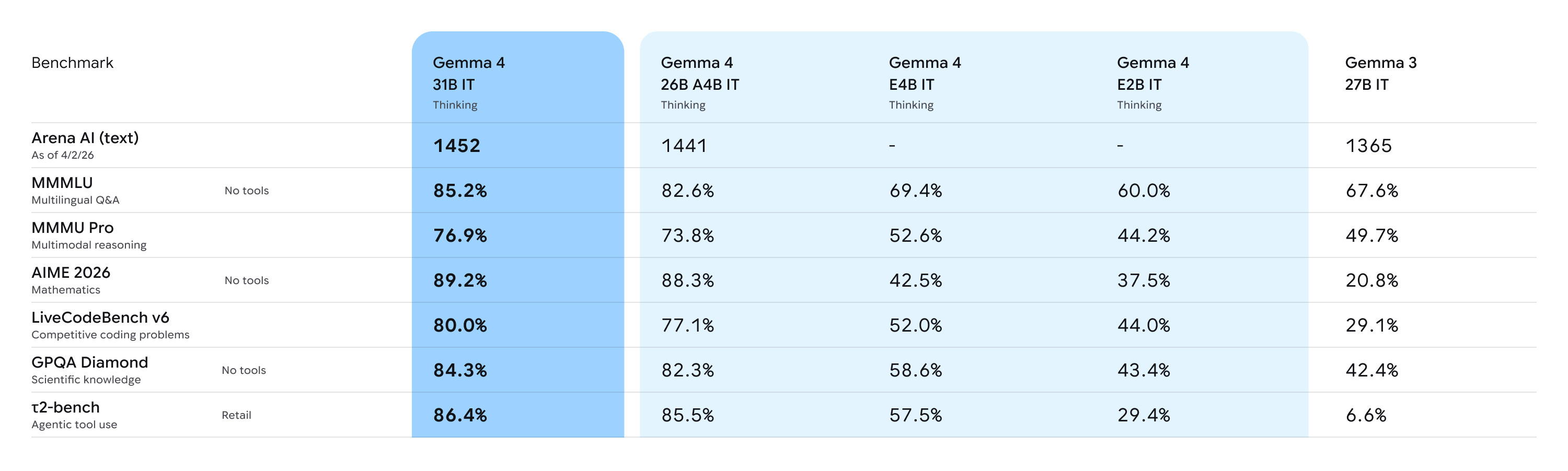
Gemma 4 represents a generational leap over Gemma 3. The 31B Dense model nearly doubled Gemma 3 27B on GPQA Diamond (84.3% vs 42.4%) and more than quadrupled AIME 2026 math scores (89.2% vs 20.8%). On Arena AI, the 31B model ranks #3 among all open models worldwide with an Elo of 1452, while the 26B MoE sits at #6 with 1441. Both outcompete models 20x their size.
Key benchmark scores (31B model):
Arena AI Elo: 1452 (#3 open model worldwide)
MMLU Pro: 85.2% (vs 67.6% for Gemma 3 27B)
GPQA Diamond: 84.3% (vs 42.4%)
AIME 2026: 89.2% (vs 20.8%)
LiveCodeBench: 80.0% (vs 29.1%)
MMMU Pro: 76.9% (vs 49.7%)
Getting Started with Gemma 4
Required accounts: None for local deployment. For cloud testing, a free Google account for Google AI Studio. For Hugging Face downloads, a free Hugging Face account (some models require accepting Google's terms).
Installation (local, recommended):
Install Ollama: curl -fsSL https://ollama.com/install.sh | sh (Linux/macOS) or download from ollama.com (Windows)
Pull a model: ollama pull gemma4:26b (26B MoE, recommended for 16GB+ VRAM) or ollama pull gemma4:4b (E4B, for 8GB machines)
Start chatting: ollama run gemma4:26b
Or use as API: ollama serve (exposes OpenAI-compatible endpoint at http://localhost:11434)
Installation (cloud, no setup):
First-time configuration:
Choose your model size based on available hardware (see memory requirements table in documentation)
For coding: use the 31B or 26B MoE model with a system prompt describing your coding standards
For agentic workflows: use the 31B or 26B model with function definitions in your prompt
For mobile/edge: use the E2B or E4B model via Google AI Edge Gallery app (Android) or LiteRT-LM
15-minute checklist
☐ Install Ollama and pull gemma4:26b (5 minutes)
☐ Run a coding prompt: ask it to review a function you wrote (2 minutes)
☐ Test function-calling: provide a JSON schema and ask it to return structured output (3 minutes)
☐ Test multimodal: paste an image URL and ask it to describe what it sees (2 minutes)
☐ Try thinking mode: ask a multi-step reasoning question and examine the reasoning trace (3 minutes)
Real Workflows
Workflow 1: Local Coding Copilot (UIT students and professionals)
CI-First benefit tags: Time (7), Quality (7), Skill (6)
U365 program connection: LIPS+CARE for code project management, UNOP for active learning during coding sessions.
You do | Gemma 4 does |
1. Set up context | Provide a system prompt with your coding standards and project structure |
2. Request code review | Paste a function and ask Gemma 4 to identify bugs, suggest improvements, and explain trade-offs |
3. Generate alternatives | Ask for 2-3 alternative implementations with different complexity trade-offs |
4. Test and verify | Run the generated code locally, write test cases, verify edge cases |
Sample prompt: Context: I am reviewing a Python function and the findings will drive changes. The function is provided and its context is stated. Role: AI as a code review assistant working from the provided function. I own which changes are made; you test and report. Profile: Act as an Analyst and Tester, reproducing each finding rather than pattern-matching. Task: review the function for bugs, performance issues and edge cases; then suggest 2 alternative implementations with different time/space complexity trade-offs and explain each change. Name the case each alternative is better for. Constraints: never claim a behaviour without the input that shows it; where an edge case depends on the caller, say so. Keep to the two alternatives. Output format: the findings, the two alternatives with their trade-offs, and the cases each suits. Memory: the accepted change belongs in my repository record, because the conversation keeps no history. UP-Context-Engineering verification: I reproduce each finding myself before changing anything, I run the tests over the accepted alternative, and I can explain the trade-off without the tool. Data safety: this pack carries no personal data. I do not paste proprietary code, credentials or production data into it, and I keep the review record in my own repository.
Verification checklist
Multi-Model: Compare output with Claude or GPT-5 on the same function. Check if both agree on the same bugs.
External Source: Run the generated code through pylint, mypy, and your test suite. Verify benchmark claims against official model card.
Human Review: Read every suggested change. Understand why it is better before applying it. Do not blindly accept AI-generated code.
CI-First Test: After using Gemma 4 for a week, can you still explain the code without the tool? If not, you are over-delegating.
Real Workflows (continued)
Workflow 2: Multimodal Document Analysis (UIC and UID students)
CI-First benefit tags: Time (7), Quantity (8), Quality (6)
U365 program connection: LIPS for organizing extracted information, CARE for processing document collections, UP-Context-Engineering for maintaining domain context.
You do | Gemma 4 does |
1. Provide documents | Feed images of slides, charts, infographics, or screenshots to Gemma 4 with a text prompt |
2. Request structured extraction | Ask Gemma 4 to extract key data points, summarize content, or answer specific questions about the visual material |
3. Cross-reference | Verify extracted data against the source document. Check for hallucinated numbers or misread charts. |
4. Organize results | Store verified extractions in your LIPS system under the appropriate project folder |
Sample prompt: Context: I am analysing a chart or image and its data will be extracted into a structured object. The image is provided and its source is stated. Role: AI as a data-extraction assistant working from the provided image. I own the resulting dataset; you extract and flag. Profile: Act as an Analyst and Tester, reading values from the image rather than inferring them. Task: extract all numerical data points into a JSON object, identify any trends, outliers or anomalies, and flag anything you are not confident about. Then name the data points a human should read off the original image. Constraints: extract only what the image shows; never interpolate a missing value. Where an axis or label is unreadable, mark the affected points rather than guessing. Output format: the JSON object, the trends and outliers, the flagged points, and the human-check list. Memory: the extracted dataset and its source image belong in my own analysis file, because the conversation keeps no record. UP-Context-Engineering verification: I read the flagged points off the original image myself before using the data, I check the JSON against the visible values, and I can explain each outlier without the tool. Data safety: this pack carries no personal data. I do not paste a confidential chart, a personal record or a licensed dataset into it, and I keep the extraction in my own store.
Verification checklist
Multi-Model: Run the same image through GPT-5 or Claude. Compare extracted numbers. Discrepancies mean one model is wrong.
External Source: Cross-check extracted data against the original document. Manually verify at least 3 data points.
Human Review: Gemma 4 excels at OCR and chart reading but can hallucinate numbers. Always verify critical data manually.
CI-First Test: Did you learn to read charts better by seeing how the model describes them, or did you stop reading charts yourself?
Strengths, Limits, and AI Imposture Risk
Strengths
Time | Local inference eliminates API latency. 26B MoE delivers 3x throughput of dense 31B. Multi-Token Prediction speeds up all models. |
Quantity | Five model sizes cover every hardware target from phone to server. 140+ languages. Multiple quantization options. Fine-tuning creates unlimited variants. |
Quality | 31B ranks #3 open model on Arena AI. 84.3% on GPQA Diamond (PhD-level reasoning). 89.2% on AIME 2026 (competition math). Near-frontier quality at 31B parameters. |
Skill | Open weights allow full inspection of model internals. Fine-tuning teaches model architecture and training. QAT provides hands-on quantization experience. |
Limits
Function-calling JSON formatting bugs reported by developers. Tool-use reliability is not yet at proprietary model levels. Community reports inconsistent JSON schema adherence.
E2B and E4B edge models do not reliably support function-calling. Agentic workflows require the 26B or 31B models.
26B MoE requires all 26B parameters loaded in memory despite only activating 3.8B. Memory footprint is closer to a dense 26B than a 4B model.
31B unquantized requires 70GB VRAM (single H100). Quantized versions fit on consumer GPUs but with quality reduction.
Arena AI leaderboard scores can be gamed and biased toward human style preference. Benchmark scores do not fully capture real-world usefulness.
No first-party API from Google. Cloud deployment requires third-party providers or self-hosting infrastructure.
Edge model performance on phones depends on AICore hardware support. Devices without AICore get slower CPU-based inference.
Context window (256K max) is smaller than competitors like Llama 4 Scout (10M tokens) for ultra-long context tasks.
AI Imposture Risk
Time Illusion
Level. Low
Evidence. Local inference is genuinely fast. No API round-trip delays. Setup time is minimal with Ollama.
Quantity Illusion
Level. Medium
Evidence. Five model sizes produce varying quality. Edge models are weaker and may produce lower-quality output that looks acceptable at scale.
Skill Illusion
Level. Medium
Evidence. Generates code that looks correct but may contain subtle errors. Function-calling JSON bugs can cause silent failures. Open weights help inspection but do not eliminate this risk.
Overall AI Imposture Risk: Medium. Two Medium risks with mitigations (open weights enable auditing, local deployment enables privacy, QAT maintains quality under compression).
U365 Co-Intelligence Rating
CI-First Profile
Primary: (level 4) Analyst and Tester. Gemma 4 excels at code analysis, benchmark evaluation, structured data extraction, and function-calling workflows where the AI tests and validates hypotheses against defined schemas.
Secondary: (level 2) Co-Worker and Assistant. For coding assistance, text generation, and multimodal document processing, Gemma 4 functions as a capable co-worker that handles heavy drafting while you retain final judgment.
CI-First Benefit Score
Time: 7
Rationale. Strong savings. Local inference eliminates API latency. 26B MoE activates only 3.8B params for fast generation. Setup is minimal with Ollama.
Quantity: 8
Rationale. Strong increase. Five model sizes, multiple quantization levels, fine-tuning capability, and 140+ languages enable massive output multiplication across diverse tasks.
Quality: 7
Rationale. Strong improvement. 31B ranks #3 open on Arena AI. GPQA Diamond 84.3% is near-frontier. Quality is consistent after verification, though edge models are weaker.
Skill: 6
Rationale. Moderate benefit. Open weights enable deep learning about model architecture and fine-tuning. But using pre-trained models does not inherently build user skills. Fine-tuning does.
Overall: 7.0
Rationale. CI-First Strong. The tool significantly amplifies the user. A core tool for the Superhuman workflow.
Humics Protection Badge
Score: +2 (Humics-Friendly)
Creativity: 0 (Neutral). Generates text and code but does not specifically protect or erode creative work. Fine-tuning enables creative domain adaptation.
Critical Thinking: +1 (Protects). Open weights allow full model inspection, auditing, and understanding of behavior. This transparency supports critical evaluation rather than black-box trust.
Social Authenticity: +1 (Protects). Local and offline execution keeps data private. No cloud dependency. Supports authentic human interaction by keeping AI on your device, not in a server farm.
Superhuman Usage Guidance
When to invite Gemma 4:
Coding assistance and code review (31B or 26B MoE)
Multimodal document analysis (image, video, chart understanding)
Building agentic workflows with function-calling (26B or 31B)
Fine-tuning for domain-specific tasks (any model size)
On-device AI for mobile applications (E2B or E4B)
Math reasoning and multi-step problem solving (thinking mode)
When to keep Gemma 4 out:
Ultra-long context tasks exceeding 256K tokens (use Llama 4 Scout with 10M context)
Tasks requiring guaranteed JSON schema compliance (proprietary models are more reliable for production function-calling)
Real-time applications where sub-100ms latency is critical (edge models help but may not meet strict latency targets)
Tasks where you cannot verify the output (high-stakes medical, legal, or financial decisions without human review)
U365 method integration: LIPS+CARE for managing model outputs in your knowledge system. ULM+EVA for planning AI-assisted learning goals. UP-Context-Engineering for providing domain context in prompts. SL-OS for integrating Gemma 4 into your daily operating system. UNOP for active learning during model interaction.
Over-delegation warning: Gemma 4 generates confident, fluent code and analysis that can contain subtle errors. Function-calling JSON bugs have been reported by the community. If you stop verifying outputs because they usually look correct, you are entering the Skill Illusion trap. The open weights give you the ability to audit the model, but auditing requires effort. A model you cannot inspect is a model you should trust less, not more. Always run Multi-Model verification on critical outputs.
What Users Say
Platform | Rating | Notes |
Hugging Face | Collection: 1,090+ likes | 2M+ downloads within weeks of release |
Mixed to positive | Praise for 26B MoE speed/quality ratio. JSON function-calling bugs reported. | |
X/Twitter | Very positive | "Drop everything and run ollama run gemma4" got 2,400+ likes. Google AI announcement: 1.7M views. |
Tom's Guide | Cautiously positive | Works in Airplane Mode but not a ChatGPT replacement for research or conversation memory. |
Independent reviews | 8.5-9.1 / 10 | Multiple reviewers scored 9.1/10. Praise for Apache 2.0, value, and features. |
Trustpilot | No reviews found | Gemma 4 is a model, not a product with a Trustpilot page. |
G2 / Capterra | No reviews found | Open-weight models are not listed on B2B review platforms. |
What users praise
Apache 2.0 license is the most cited positive. Developers call it a "genuine inflection point" for enterprise adoption.
26B MoE model is the community favorite: 97% of 31B quality at 3x throughput, fits on 16GB GPU.
Local inference speed: E4B delivers 15+ tokens/sec on MacBook Pro M3 for coding.
Multimodal capabilities work well: image understanding, OCR, and chart reading are reliable on the larger models.
Thinking mode improves accuracy on ambiguous queries with visible reasoning steps.
Fine-tuning ecosystem is mature: Hugging Face TRL, Unsloth, NVIDIA NeMo, and Keras all supported on day one.
What users complain about
Function-calling JSON formatting bugs: inconsistent JSON schema adherence, especially for complex nested schemas.
Edge models (E2B, E4B) do not reliably support function-calling. Agentic workflows need the larger models.
Mobile performance depends on AICore hardware. Without it, inference falls back to slower CPU paths.
No first-party API from Google. You must use third-party providers or self-host for cloud deployment.
Memory requirements for the 26B MoE are higher than expected: all 26B parameters must be loaded despite only 3.8B being active.
Arena AI scores are style-biased and can be gamed. Real-world usefulness does not always match leaderboard position.
U365 Editorial Note
The community enthusiasm for Gemma 4 is genuine and well-founded. The Apache 2.0 license alone resolves the primary barrier that blocked enterprise adoption of previous Gemma generations. The benchmark leap from Gemma 3 to Gemma 4 is the largest in the family's history, particularly on reasoning (GPQA Diamond nearly doubled) and math (AIME quadrupled). However, the JSON function-calling bugs reported by developers align with the CI-First Skill Illusion assessment: the model produces output that looks structurally correct but may fail in subtle ways. The CI-First evaluation scores this as Medium risk with mitigations. The open weights are the key mitigation: they enable auditing, fine-tuning, and community-driven bug fixes that closed models cannot offer. For U365 Fellows, the recommendation is to use the 26B MoE as a daily local coding and analysis assistant, always with Multi-Model verification on critical outputs.
Comparison and Alternatives
Alternative | Size / Architecture | Key difference | When to choose |
Llama 4 Scout | 109B total, 17B active, MoE | 10M context window. Llama license (700M MAU cap). | Choose Llama 4 Scout if you need ultra-long context (10M tokens). Choose Gemma 4 for permissive licensing and better intelligence-per-parameter at comparable active parameter counts. |
Qwen 3.5 27B | 27B dense, Apache 2.0 | 128K context. Strong multilingual. Arena Elo ~1403. | Choose Qwen 3.5 for multilingual tasks where 27B is sufficient. Choose Gemma 4 for higher Arena ranking (1452 vs 1403), multimodal input, and MoE speed option. |
DeepSeek V3.2 | ~37B active, MoE | 128K context. DeepSeek license. Arena Elo ~1425. | Choose DeepSeek for budget cloud inference. Choose Gemma 4 for local deployment, Apache 2.0 license, and edge model variants. |
GLM-5 / Kimi K2.5 | 100B+ parameters | Match or exceed Gemma 4 in raw Elo but require hundreds of billions of parameters. | Choose GLM-5 or Kimi if you have the compute budget for 100B+ models. Choose Gemma 4 for frontier quality at 31B parameters on consumer hardware. |
Claude / GPT-5 (proprietary) | Closed-weight, API only | Higher peak quality, reliable function-calling, no self-hosting. | Choose proprietary APIs for production reliability and guaranteed function-calling. Choose Gemma 4 for data sovereignty, zero per-token cost, and full model control. |
Gemma 4 is better than competitors in: intelligence-per-parameter (31B beats models 20x its size), licensing (Apache 2.0 with no MAU cap), edge deployment (E2B/E4B with native audio), and cost (free to self-host). It is worse in: ultra-long context (256K vs Llama 4's 10M), function-calling reliability (JSON bugs reported), and peak quality (proprietary models still lead on Arena).
Verdict and Next Steps
Who should adopt Gemma 4
Developers who want frontier-level AI without API costs or vendor lock-in
Teams that need data sovereignty (healthcare, finance, legal, government)
Students and researchers who need full model access for learning and experimentation
Mobile developers building on-device AI with multimodal capabilities
Enterprises that require Apache 2.0 compliance for legal approval
Anyone who wants to fine-tune and commercially deploy custom AI models
When to adopt
Adopt now if you have a computer with 16GB+ VRAM (for 26B MoE quantized) or 8GB+ RAM (for E4B edge model). The Apache 2.0 license means there is no reason to wait for legal review. Start with Ollama and the 26B MoE model for the best speed/quality balance. Use Google AI Studio for free cloud testing before committing to local deployment.
UP-Context-Engineering prompt pack
Prompt 1 (Code Review): Context: I am reviewing code and the findings will drive changes. The code is provided and the language is stated. Role: AI as a code reviewer working from the provided code. I own which findings are acted on; you test and report. Profile: Act as an Analyst and Tester, reproducing each finding rather than pattern-matching. Task: review the code for bugs, performance issues, security vulnerabilities and style violations; for each issue give the line number, the problem and a suggested fix. Then name the three issues to fix first and why. Constraints: never claim a fix without the test that proves it; where a finding depends on code outside the provided set, say so. One pass, ranked by severity. Output format: the findings with line numbers and fixes, then the fix order with reasons. Memory: the accepted findings and their tests belong in my repository record, because the conversation keeps no history. UP-Context-Engineering verification: I reproduce each critical finding myself before acting on it, I run the test suite after every change, and I can defend each accepted fix without the tool. Data safety: this pack carries no personal data. I do not paste proprietary code, credentials or production data into it, and I keep the review record in my own repository.
Prompt 2 (Multimodal Analysis): Context: I am analysing an image or document and the extraction will be used downstream. The file is provided and its type is stated. Role: AI as a multimodal analysis assistant working from the provided file. I own the conclusions; you extract and flag. Profile: Act as an Analyst and Tester, extracting what the file shows rather than inferring beyond it. Task: extract all text, identify the document type, summarise the key information, and list any numerical data as a JSON object. Then flag anything you are uncertain about and name what a human should verify in the original. Constraints: extract only what the file shows; never fill a gap from context. Where the text is unclear, mark it rather than reading through it. Output format: the extracted text, the document type, the summary, the JSON data, and the uncertainty list. Memory: the extraction and its source file belong in my own analysis record, because the conversation keeps no evidence. UP-Context-Engineering verification: I check the flagged items against the original file myself before using the extraction, I verify the JSON against the visible data, and I can explain the document's content without the tool. Data safety: this pack carries no personal data. I do not paste a confidential document, a personal record or licensed content into it, and I keep the extraction in my own store.
Prompt 3 (Agentic Planning): Context: I am planning a multi-step task and the plan will be executed. The task and the constraints are stated, and the plan must name its tools and outputs per step. Role: AI as a planning assistant producing one executable plan. I own the execution; you structure the steps. Profile: Act as an Analyst and Tester, making each step checkable rather than optimistic. Task: create a step-by-step plan for the stated task; for each step specify the action, the tool needed, the expected input and the expected output. Then name the step most likely to fail and how I will know. Constraints: no step without its input and output named; where a dependency between steps exists, state it. Do not compress two dependent steps into one. Output format: the numbered plan with inputs and outputs per step, the dependencies, and the likely-failing step with its check. Memory: the plan and its execution record belong in my own project file, because the conversation keeps no state. UP-Context-Engineering verification: I check each step's input exists before starting it, I record what actually happened against the plan, and I can explain why each step is ordered as it is without the tool. Data safety: this pack carries no personal data. I do not paste credentials, a client's plan or an unreleased system's details into it, and I keep the plan in my own store.
U365's Recommendations to Learn More
We have curated the best resources to go beyond this review: official documentation, video tutorials, written deep-dives, and community discussions. All links verified as of September 3, 2026.
Official learning resources
Google DeepMind (Gemma 4 model page): https://deepmind.google/models/gemma/gemma-4
Google AI for Developers (Gemma docs): https://ai.google.dev/gemma/docs/core
Google Blog (Gemma 4 announcement): https://blog.google/innovation-and-ai/technology/developers-tools/gemma-4
Hugging Face (Gemma 4 collection): https://huggingface.co/collections/google/gemma-4
Video tutorials and channels
Google Gemma 4 Tutorial - Run AI Locally for Free (Teacher's Tech): https://www.youtube.com/watch?v=7LEvSOiTWZk
Gemma 4 Is INCREDIBLE! Google's Open Model IS POWERFUL! (WorldofAI): https://www.youtube.com/watch?v=KW5SFt3rgKo
How to Run Gemma 4 on Your PC - Free Setup Tutorial (Kevin Stratvert): https://www.youtube.com/watch?v=rBy0i0cbbew
My M5 Max, Gemma 4, MLX LOCAL Stack (IndyDevDan): https://www.youtube.com/watch?v=00Y-p62sk0s
Written tutorials and deep-dive articles
Gemma 4 Review: Google's Apache 2.0 Open-Source AI (Digital Strategy AI): https://digitalstrategy-ai.com/2026/05/13/gemma-4-googles-open-source-llm/
Gemma 4: Google's Open-Weight Models - Sizes, Specs & Review (The AI Rankings): https://theairankings.com/google/gemma-4/
Community and social
Hugging Face (Gemma 4 31B discussions): https://huggingface.co/google/gemma-4-31b-it/discussions
Reddit r/LocalLLaMA (open-source LLM community): https://www.reddit.com/r/LocalLLaMA/
Our curation prioritizes content quality over source type. Individual creators and community experts are welcome when their tutorials are substantial, teach something this review does not, and match the current tool version.
Glossary
CI-First Benefit Score
The CI-First Benefit Score measures how much an AI tool delivers the 4 Key AI Benefits defined by University 365: Time, Quantity, Quality, and Skill. Each dimension is scored 0-10 and the overall score is the arithmetic mean. For Gemma 4, the overall score is 7.0 (CI-First Strong), meaning the tool significantly amplifies the user and is a core tool for the Superhuman workflow. The Time score of 7 reflects strong savings from local inference with no API latency. The Quantity score of 8 reflects the five model sizes covering every hardware target. The Quality score of 7 reflects the #3 Arena AI ranking. The Skill score of 6 reflects that open weights enable learning but using pre-trained models does not inherently build skills.
CI-First Profile
The CI-First Profile classifies the AI tool's collaborative role using 5 levels: (level 1) Co-Creator and Thought Partner, (level 2) Co-Worker and Assistant, (level 3) Professor, Coach and Tutor, (level 4) Analyst and Tester, (level 5) Challenger and Devil's Advocate. Lower level numbers indicate higher AI autonomy in the collaboration. Gemma 4 is classified as (level 4) Analyst and Tester as its primary profile, excelling at code analysis, benchmark evaluation, and structured data validation. Its secondary profile is (level 2) Co-Worker and Assistant for coding and text generation tasks.
Humics Protection Badge
The Humics Protection Badge evaluates whether the AI tool protects or erodes the 3 uniquely human capabilities: Creativity, Critical Thinking, and Social Authenticity. Each dimension is scored +1 (Protects), 0 (Neutral), or -1 (Erodes), with the sum producing a badge from Humics-Risky (-3 to -1) to Humics-Friendly (+2 to +3). Gemma 4 scores +2 (Humics-Friendly): open weights protect Critical Thinking by enabling model auditing, and local execution protects Social Authenticity by keeping data private. Creativity is Neutral (0) as the model generates content but does not specifically protect creative work.
AI Imposture Risk
The AI Imposture Risk assesses 3 illusion traps: Time Illusion (saving time when time is actually lost), Quantity Illusion (producing volume that is mediocre), and Skill Illusion (appearing skilled while heading toward error). Each is rated Low, Medium, or High. Gemma 4 has Low Time Illusion (local inference is genuinely fast), Medium Quantity Illusion (edge models produce varying quality), and Medium Skill Illusion (JSON function-calling bugs can cause silent failures). The overall risk is Medium, mitigated by open weights that enable auditing and community-driven bug fixes.
User Sentiment
User Sentiment aggregates real ratings and reviews from major platforms. For Gemma 4, the sentiment is Positive with early adopter enthusiasm: the Hugging Face collection received 1,090+ likes and crossed 2 million downloads within weeks. Independent reviewers scored it 8.5-9.1 out of 10. The community praised the Apache 2.0 license and the 26B MoE speed/quality ratio. Complaints focused on JSON function-calling bugs and edge model limitations. The positive sentiment aligns with the CI-First Strong rating, though the reported bugs support the Medium AI Imposture Risk assessment.




Comments