
Sovereign AI Race: Germany (2026)

Updated: 16 minutes ago

In this Report

This publication is part of the Sovereign AI Race series.
The Co-Intelligence-First (CI-First) approach is a genuine and unique University 365 concept: a proposal for imagining a better future where AI and Human Intelligence coexist productively, each amplifying the other rather than replacing it.


Sovereign AI Race: Germany (2026)
The Context
The five layers, and why Germany is Europe's funded middle
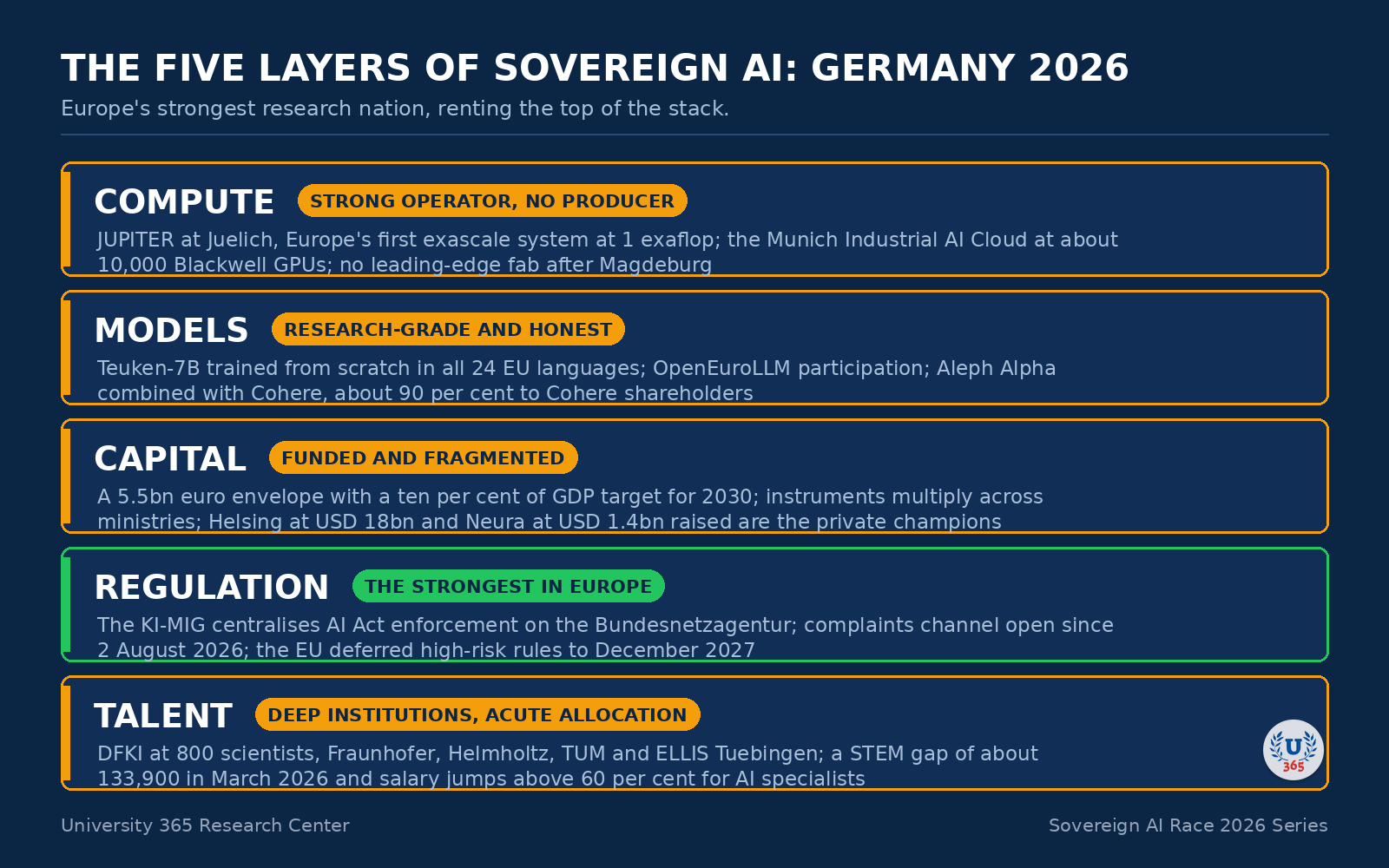
The five layers assessed. Europe's strongest research nation, renting the top of the stack. University 365 Research Center.
This is the eleventh report in a twenty-part series assessing how states attempt to control the production of artificial intelligence inside their own jurisdiction. The framework is fixed and applied identically to every country. Sovereign AI capacity separates into five layers, and a state can hold any one of them without holding the others.
Compute sovereignty is the physical layer: where the chips and data centres sit, and who may switch them off. Model sovereignty is who builds the models a country depends on, and in whose languages and domains those models are competent. Capital sovereignty is who funds the build-out and on what terms. Regulatory sovereignty is who writes the rules and whether they can be enforced. Talent and education sovereignty is who builds and runs the systems, and how the next generation is prepared.
The series treats three races as running at once: the compute race, the model race and the rules race. Germany is the case where the rules race has been run hardest and the compute race is the one that keeps being lost. It wrote the earliest national AI strategy, it hosts the first exascale supercomputer in Europe, it operates the largest concentration of public AI research institutions on the continent, and it has just become the largest member state to translate the European Union's AI Act into national enforcement machinery. Set against that, it has no leading-edge private chip fab after the cancellation of Intel's Magdeburg plant, its flagship sovereign model company was absorbed by a Canadian acquirer, and its federal funding arrives through a fragmented landscape of envelopes, sector funds and research grants whose total is less than what a single American laboratory spends on compute in a quarter.
The series places Germany in the "regulator and host" posture alongside the United Kingdom, Singapore, Spain, Italy, Portugal and Bahrain. The placement is a claim to be tested layer by layer, and this report tests it. Germany owns a genuine public compute layer, at research rather than frontier scale; a research-grade open model layer built for European languages; the deepest applied research institution network in Europe; and the regulatory machinery of the largest economy in the bloc. It rents, with increasing self-consciousness, the frontier layers where the model and the accelerator are decided, and the report asks the question Germany's own parliamentary debates now ask: whether a country that legislates and funds but does not fabricate can hold its position.
The vocabulary this report needs
Five terms recur, and they are defined here once.
JUPITER and the exascale line. The first supercomputer in Europe to reach one exaflop of double-precision performance, at Forschungszentrum Juelich, running on NVIDIA Grace-Hopper superchips. It reached that mark on 17 November 2025, ranked fifth on the TOP500 in June 2026, and powered more than 120 research projects. It is the clearest physical demonstration of German public compute capability and it is a research instrument, not a commercial AI factory.
KI-MIG. The German AI Market Surveillance and Innovation Promotion Act, in force since mid-2026, which designates the Bundesnetzagentur as the central market surveillance authority for the European AI Act with sectoral supervisors for financial services, medicines and motor vehicles. It is the instrument through which Germany enforces Europe's rules, and it is covered in detail in the regulation section.
Announced capacity versus operational capacity. The Industrial AI Cloud in Munich is announced at approximately 10,000 NVIDIA Blackwell accelerators and about half an exaflop of capacity; the data centre strategy targets a doubling of computing capacity to 5,000 megawatts by 2030; the EU gigafactory call contemplates seven sites of more than 100,000 processors each. This report labels each figure at its actual stage of delivery.
The sovereign wrapper. A recurring German construction in which a foreign model or cloud is delivered through a German or European entity with data held in Germany. The flagship instance is the SAP and OpenAI offering for the German public sector, launched as "OpenAI for Germany", which runs American models inside a German sovereign wrapper over Microsoft infrastructure. The construction is deliberate and the report describes what it does and does not change about dependency.
The Magdeburg gap. Intel's planned 30 billion euro fabrication plant in Magdeburg, first delayed in September 2024 and then cancelled, was to be Europe's leading-edge chip plant. Its cancellation left Germany with world-class chip consumers, a strong equipment and materials supply base, and no leading-edge domestic fabrication. The report uses the term for the specific hole in the compute layer that no policy since has filled.

Sovereign AI Race: Germany (2026)
The Question
Can a country fund, legislate and research its way to sovereignty without fabricating anything?
Germany has done everything a state can do about artificial intelligence except build the two things it does not have: a frontier model company of its own and a leading-edge chip fab. The report's question is whether everything else adds up to a defensible position or whether it is a very well-organised form of dependence.
The evidence on the positive side is substantial and this report documents all of it. Germany operates Europe's first exascale supercomputer, and it built it with national and European money at a public research centre. It has the deepest institutional research base on the continent, with the German Research Center for Artificial Intelligence, the Fraunhofer network, the Helmholtz centres, the Max Planck institutes and the Technical University of Munich's machine learning cluster, and it is a named partner in the European open-model consortium that is the continent's answer to model dependence. Its private capital has produced Europe's largest defence-technology company by fundraising and one of the world's most-used image generation labs. It has translated the European AI Act into national law with a single central authority, ahead of most member states. And its federal government has adopted the country's first national data centre strategy, aimed squarely at the compute layer.
The evidence on the other side is equally specific. Intel cancelled Magdeburg, and with it the plan for a leading-edge fab on German soil. Aleph Alpha, the Heidelberg company that was Germany's sovereign model champion and the emblem of the "AI Made in Germany" story, agreed in April 2026 to be absorbed by Cohere, a Canadian laboratory, with the German government set to become an anchor customer of the combined entity rather than an owner of a national champion. The federal money, when enumerated, comes to envelopes of a few billion euros spread across ministries, years and instruments, announced in ways that are hard to reconcile with each other, and the independent analysis published in July 2026 described the strategy frankly as funded but stuck. And the country's own parliament now debates sovereignty in the terms of escape from American technology rather than leadership of its own, with a cross-party commission examining how to break the dependence on the largest software vendors.
So the question this report asks is narrower than whether Germany can lead in artificial intelligence. It cannot, at the frontier, and its own documents concede as much. The question is whether a rich, well-governed, institutionally deep country can hold a sovereign position in the middle of the stack while buying the top of it, and what happens to that position as the top consolidates. Germany in late 2026 is the most instructive case in the series for that question, because no other country combines so much institutional capacity with so little frontier production.

Sovereign AI Race: Germany (2026)
The Contradiction
Europe's strongest research nation is buying its frontier one wrapper at a time

Berlin, across the Tiergarten. The country that legislates and funds but does not fabricate is now debating in its own parliament how to reduce its dependence on American technology providers. Photograph: Daniel Foster, CC BY-SA 2.0, via Wikimedia Commons.
Here is the paradox, stated as plainly as the evidence allows.
Germany's public compute achievement is real and measurable. JUPITER at Juelich reached one exaflop of double-precision performance in November 2025, the first in Europe, on NVIDIA silicon; it ranked fifth in the world on the TOP500 list in June 2026 and powers more than 120 research projects. The national data centre strategy adopted in March 2026 commits to doubling computing connection capacity to 5,000 megawatts by 2030 and quadrupling AI infrastructure, with data centres required to run on one hundred per cent renewable electricity from 2027. Deutsche Telekom and NVIDIA opened the Industrial AI Cloud in Munich, announced at one billion euros, with around ten thousand Blackwell accelerators and roughly half an exaflop, privately financed and marketed for industrial customers with data kept in Germany. On the numbers, Germany has spent the last two years building compute faster than at any time since the 1990s.
Now put the frontier beside it. Every one of those systems runs on NVIDIA accelerators, and the two that operate run on American-designed chips. The AI cloud is a partnership with an American company. The public-sector offering that the state and its flagship software company launched in September 2025, "OpenAI for Germany", delivers OpenAI's models to public administration through Microsoft's cloud inside a German sovereign wrapper, which is to say that the German state is a customer of the American frontier in order to obtain a German sovereign service. And the chip plant that would have changed the structural position, Intel's Magdeburg project, went from delay in September 2024 to cancellation in 2025, leaving the country that manufactures the machines that make chips without a plant that makes chips.
The second tension is in the model layer, and it is the sharpest single fact in the report. Aleph Alpha was the sovereign model company: German, funded with German capital, positioned explicitly as the European alternative to American and Chinese laboratories. In April 2026 it agreed to be acquired by Cohere, a Canadian company, with Cohere's shareholders taking roughly ninety per cent of the combined entity and German industry putting 500 million euros of structured financing behind the deal, and the German government arriving as an anchor customer. The transaction is defensible on its own terms: a transatlantic sovereign alternative with a real customer base may serve German users better than a small domestic laboratory, and the involved governments gave it their blessing. It is also the case that the flagship of German model sovereignty is now a division of a Canadian company, and the report records that without pretending the framing changes the ownership.
The third tension is what the money actually is. The federal AI envelope announced in July 2025 came to 5.5 billion euros with a stated goal of AI contributing ten per cent of GDP by 2030, a target this report labels as a claim. The federal commitments over the legislative period are described in the July 2026 analysis as roughly the same 5.5 billion euros; the research ministry's own budget is much larger but overwhelmingly committed to other research; a separate academic integration package was 31.6 million euros; and the public venture vehicles run at one billion euros of assets. These are not small sums in absolute terms and they are spread thinly across many instruments, which is precisely what the independent analysis meant by stuck: not a shortage of money but a shortage of anything for the money to converge on, because the country has decided not to build a frontier lab or a fab.
And the fourth tension is what Germany's own parliament says about all of this. The Bundestag runs cross-party work on ending dependence on American technology providers, described in the German press under the heading of a sovereignty operation, and the French and German governments have begun building a joint digital backbone precisely because the dependence is understood as a vulnerability. The country that has just written the enforcement machinery for Europe's AI Act is simultaneously debating how to escape the infrastructure on which its AI runs. Both facts are true, and the report's judgment is that Germany knows its position exactly and has chosen to manage rather than to close it.

Sovereign AI Race: Germany (2026)
The Current State
Compute: an exascale public layer, a private AI factory, and the fab that did not arrive
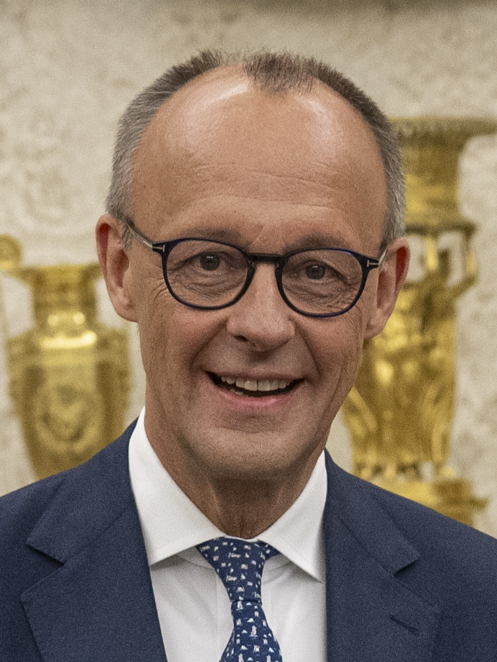
Friedrich Merz, Chancellor of Germany, as of 2026. His government's research ministry funds the AI programme and its cabinet adopted the first national data centre strategy in March 2026. Photograph: The White House, public domain, via Wikimedia Commons.
Germany's compute position is the most layered in the series, with a genuinely strong public base and a structural hole where the private frontier would be.
The public layer is first class. JUPITER at Forschungszentrum Juelich reached one exaflop of double-precision performance on 17 November 2025, making it the first exascale system in Europe; it is built on NVIDIA Grace-Hopper superchips with a modular design, ranked fifth on the June 2026 TOP500 list, powers more than 120 research projects, and set a world record for a full fifty-qubit quantum simulation in May 2026. Around it sits a national research computing landscape that the series has not encountered elsewhere at this scale: the Gauss Centre for Supercomputing sites, the Helmholtz and Fraunhofer institute networks, and the university clusters, all connected to the European high performance computing programmes.
The private compute layer moved decisively in the last year. Deutsche Telekom and NVIDIA announced a one billion euro Industrial AI Cloud in Munich on 4 November 2025, described as the world's first industrial AI cloud, with the company stating its purpose as sovereign infrastructure enabling organisations in Germany and Europe to develop, train and use AI for manufacturing applications on a secure and sovereign platform. Multiple reports place its activation in early 2026 with around ten thousand Blackwell accelerators and roughly half an exaflop, and the formal opening in July. The claim that it increases Germany's AI computing power by about fifty per cent is a claim, and this report labels it. Alongside it, Schwarz Digits, the technology arm of the retail group behind Lidl and Kaufland, has committed up to 5.6 billion euros by 2033 to a 240 megawatt AI data centre near Rostock, with the state of Mecklenburg-Vorpommern contributing up to 120 million euros, and a separate Brandenburg project of about 200 megawatts has been reported. Microsoft operates or is building a data centre cluster in North Rhine-Westphalia with around 520 megawatts of power available, and announced a multi-billion euro German investment described in the local coverage as its largest in the country in forty years. Google announced 5.5 billion euros across 2026 to 2029 including a new data centre in Dietzenbach. The figure collides with the federal AI envelope's identical 5.5 billion, and this report keeps them apart: one is private investment, the other is a budget line.
The hole is fabrication. Intel's 30 billion euro Magdeburg fab, first delayed in September 2024 and cancelled in 2025, was to be Europe's leading-edge plant; its loss leaves Germany with an outstanding equipment and materials base, outstanding chip consumers in automotive and industry, and no leading-edge fabrication. The national data centre strategy adopted on 18 March 2026, with 28 measures across energy, land use and technology, is the state's answer on the compute side, and its targets of doubling capacity to 5,000 megawatts and quadrupling AI infrastructure by 2030 are targets this report labels. At the European level, the Commission opened its gigafactory call on 30 July 2026: up to seven sites, each with more than 100,000 AI processors, up to 10 billion euros of public money and more than 30 billion expected overall, operational by mid-2028, with bids due on 12 November 2026 and selection in early 2027. Germany raised its own contribution to one billion euros in August 2026, a reported figure. Whether a German site is selected is an open question this report cannot answer; what is clear is that the compute Germany expects to gain at the frontier is now contingent on a European competition rather than on a national plant.
Capital: a 5.5 billion euro envelope, fragmented by design
Germany's capital position is the clearest case in the series of money that exists but does not converge, and the report enumerates it rather than summarising it.
The headline envelope is 5.5 billion euros for artificial intelligence, announced in July 2025, with the stated aim of AI contributing ten per cent of gross domestic product by 2030, a target labelled as a claim. Federal AI commitments over the legislative period are placed at roughly the same figure in the July 2026 analysis. The research ministry's 2025 budget is 22.38 billion euros, of which 18.7 billion is grants and allocations, but that is a whole research budget and not an AI line. A 31.6 million euro package was authorised in January 2026 to embed AI across the academic and research system, a reported figure. Germany raised its contribution to a European AI gigafactory to one billion euros in August 2026, reported. An earlier figure from the ministry described more than 1.6 billion euros of AI investment planned between 2025 and 2029, which appears to be a different line from the 5.5 billion envelope and which the report states as a conflict rather than resolving.
The public investment architecture is real and it is being reorganised. The DeepTech and Climate Fonds, founded in 2023 in Bonn, manages about one billion euros and invests up to tens of millions per company in early-growth deep technology; on 28 November 2025 it agreed with the High-Tech Gruenderfonds to form a new public-private investment platform as the federal government consolidates technology start-up financing. The German state has also begun acting as a customer for sovereign AI: SAP and OpenAI's public-sector offering made the state the flagship user, the government is set to become an anchor customer of the Cohere and Aleph Alpha combination, and Deutsche Telekom won a German sovereign AI cloud contract in May 2026, a reported result whose contracting authority the report names only as reported. The European Commission awarded a sovereign cloud tender worth up to 180 million euros over six years in April 2026 to four winners including Germany's STACKIT, a reported outcome.
The private layer has produced two genuine continental champions in the last eighteen months. Helsing, the Munich defence AI company, raised 1.8 billion dollars in July 2026 at an 18 billion dollar valuation, described by the wire services as Europe's largest ever defence technology round; it is Germany's largest AI-adjacent private champion and it is a defence company, not a language model laboratory. Neura Robotics, based in Metzingen, announced a Series C of up to 1.4 billion dollars in June 2026 led by Tether, for cognitive robotics and physical AI at industrial scale. Black Forest Labs, founded in Freiburg in 2024, raised a reported 300 million dollar Series B at a 3.25 billion dollar valuation with NVIDIA among the investors, and its image generation models are among the most widely used in the world. DeepL, the Cologne translation company, holds a reported two billion dollar valuation and announced a restructuring in 2026 reported to cut roughly a quarter of its staff, a figure this report labels as reported. The pattern is consistent: Germany's private AI successes are in tools, robotics and defence applications rather than in foundation models, and they are financially strong while sitting downstream of the frontier that others own.
Models: research-grade open weights and a departed champion

A Fraunhofer institute in Berlin. The Fraunhofer and Helmholtz networks, the German Research Center for Artificial Intelligence and the technical universities constitute the deepest applied AI research system in Europe, and they published Teuken-7B in all 24 European Union languages. Photograph: ao66, public domain, via Wikimedia Commons.
Germany's model layer is the most honest in the series about its scale, and its composition has changed decisively in the last year.
The research base is genuine. OpenGPT-X, funded by the economics ministry, released Teuken-7B in November 2024: seven billion parameters trained from scratch in all 24 official European Union languages and published openly, produced by a consortium and hosted by Fraunhofer and the Juelich centre among others. The European LLM leaderboard was built alongside it. Germany's research institutions are partners in OpenEuroLLM, the European open-source model consortium with more than twenty partners across the continent, which held its international workshop on open source sovereign foundation models in Cologne in May 2026. The Fraunhofer Institute for Intelligent Analysis and Information Systems leads the applied side; the German Research Center for Artificial Intelligence, with about 800 scientists, is the largest dedicated AI research institution in the world and signed a French-German AI centre with Inria in June 2026; and the ELLIS network's Tuebingen institute anchors foundational machine learning research with groups on safety, alignment, autoML and cooperative machine intelligence.
The commercial layer is where the change happened. Aleph Alpha, the Heidelberg company that carried the sovereign model flag, agreed in April 2026 to be combined with Cohere, the Canadian laboratory, in a transaction the companies describe as creating the first transatlantic sovereign AI solution and which TechCrunch described as being done with the blessing of the governments involved; Cohere shareholders take roughly ninety per cent of the resulting entity. Schwarz Group companies committed 500 million euros of structured financing, and the German government is set to become an anchor customer. A reported valuation of twenty billion dollars for the combined company could not be confirmed at the level this series requires and the report states it as reported. The consequence for the model layer is unambiguous: Germany's flagship sovereign model company is now part of a Canadian-headquartered group, and Germany's sovereign model strategy runs through a consortium, a research project and a transatlantic merger rather than a national champion.
Weights policy deserves the same honesty the series applies elsewhere. Germany has a strong open-weight research tradition through OpenGPT-X and its participation in the European consortium, and no national policy that mandates any weight posture; the commercial layer, where it exists, is proprietary and increasingly foreign-owned. The country that hosts the largest applied research network in Europe therefore publishes excellent open research models at the seven billion parameter scale and depends on imported models at the frontier, and the report states that as the position rather than as a criticism.
Regulation: the first mover, now enforcing

The structure built, and the block that never arrived. University 365 Research Center.
Germany's regulatory position is the strongest layer in the report, and the last year turned it from legislation into machinery.
The first instrument is national. The AI Market Surveillance and Innovation Promotion Act, the KI-MIG, was adopted by the Bundestag on 11 June 2026, approved by the Bundesrat in July, and promulgated on 22 July 2026 in the Federal Law Gazette, with one legal summary dating promulgation to 28 July; the report records both dates. Its central provision designates the Bundesnetzagentur as the competent market surveillance authority for the European AI Act, with BaFin, BfArM and the motor transport authority as sectoral supervisors, and the agency announced its central role on 29 July 2026. From 2 August 2026 an online complaints form allows any person to report violations. The design choice matters at the series level: Germany centralised enforcement in one agency with sectoral partners, rather than scattering it across ministries, and the innovation promotion half of the act's title signals the balancing the government intends.
The European layer was simplified while Germany was implementing it. The Commission published the Digital Omnibus on AI in November 2025 proposing among other things to defer the high risk compliance deadline from 2 August 2026 to 2 December 2027, the Council agreed its position in March 2026, and final approval came on 29 June 2026, with longer deadlines and less bureaucracy as the stated outcome. Germany's specific negotiating position on the omnibus could not be verified at the level this report requires, and it is not asserted; the KI-MIG's design is itself evidence of the German preference for a single enforcing authority.
Two further instruments matter for AI specifically. The Data Act became enforceable in phases and Germany's implementation act made the Bundesnetzagentur its responsible authority from 30 May 2026, with the access-by-design phase beginning on 12 September 2026, which matters for AI because training data access runs through that regime. And the cybersecurity layer hardened around AI: the NIS2 implementation took effect in Germany in December 2025, the Federal Office for Information Security published joint guidance with its French counterpart on zero trust design principles for language model systems, and the office is building security criteria for AI agents, with a catalogue for trustworthy AI systems in enterprise deployment drafted. The copyright layer is now litigated rather than legislated: the Hamburg higher regional court decided the Kneschke against LAION appeal in December 2025 on machine-readable text and data mining opt-outs, and further German rulings in 2026 addressed AI image transformation and, in reporting this report labels as needing primary confirmation, the use of copyrighted books in training. The GEMA proceedings against OpenAI were not verified in this research window and are not asserted.
Talent: a MINT gap, a paradox, and the institutions that do the training
Germany's talent position combines a well-documented shortage with a well-documented allocation problem, and the report states both.
The shortage numbers are current and they are smaller than the figures that shaped German coverage in 2023 and 2024. The MINT report for 2026 puts the STEM skills gap at around 133,900 people in March 2026, with demographic trends threatening a larger shortfall in the years ahead, and the spring report shows the STEM employment gap down by nearly sixteen per cent since March 2025. The autumn report before it observed that the information technology specialist shortage was hardly playing a role any more, which is a striking reversal of the environment in which the widely quoted 149,000 unfilled IT jobs figure was produced; this report does not use that older figure because the current equivalent was not verified, and says so. The countervailing picture is the paradox the German business press has begun describing: employers offering salary increases above sixty per cent for AI specialists while the employment agency counts hundreds of thousands of unemployed academics, a reported juxtaposition. The employment context is weak, with the number of employed residents down year on year and unemployment at its highest rate since the pandemic years, and the report labels the secondary sourcing.
The institutions doing the training are the country's strength and the series has documented nothing like them elsewhere. The Technical University of Munich's computation school holds chairs across artificial intelligence, including processor design, AI for scientific modelling and planning; the Munich Center for Machine Learning is a joint Munich and TUM centre; the ELLIS institute at Tuebingen runs research groups in safety, alignment, autoML and machine intelligence; the German Research Center for Artificial Intelligence employs around 800 scientists; and the Fraunhofer and Helmholtz networks connect applied research to industry at a scale no other country in this series matches. On immigration, Germany operates the skilled immigration framework with the opportunity card allowing qualified job seekers to enter to look for work, and the federal make-it-in-germany portal as the front door. Whether the 2024 framework has been tightened under the current government is a live political question this research could not verify, and the report does not assert an answer.
What changed since our March 2025 report on Germany
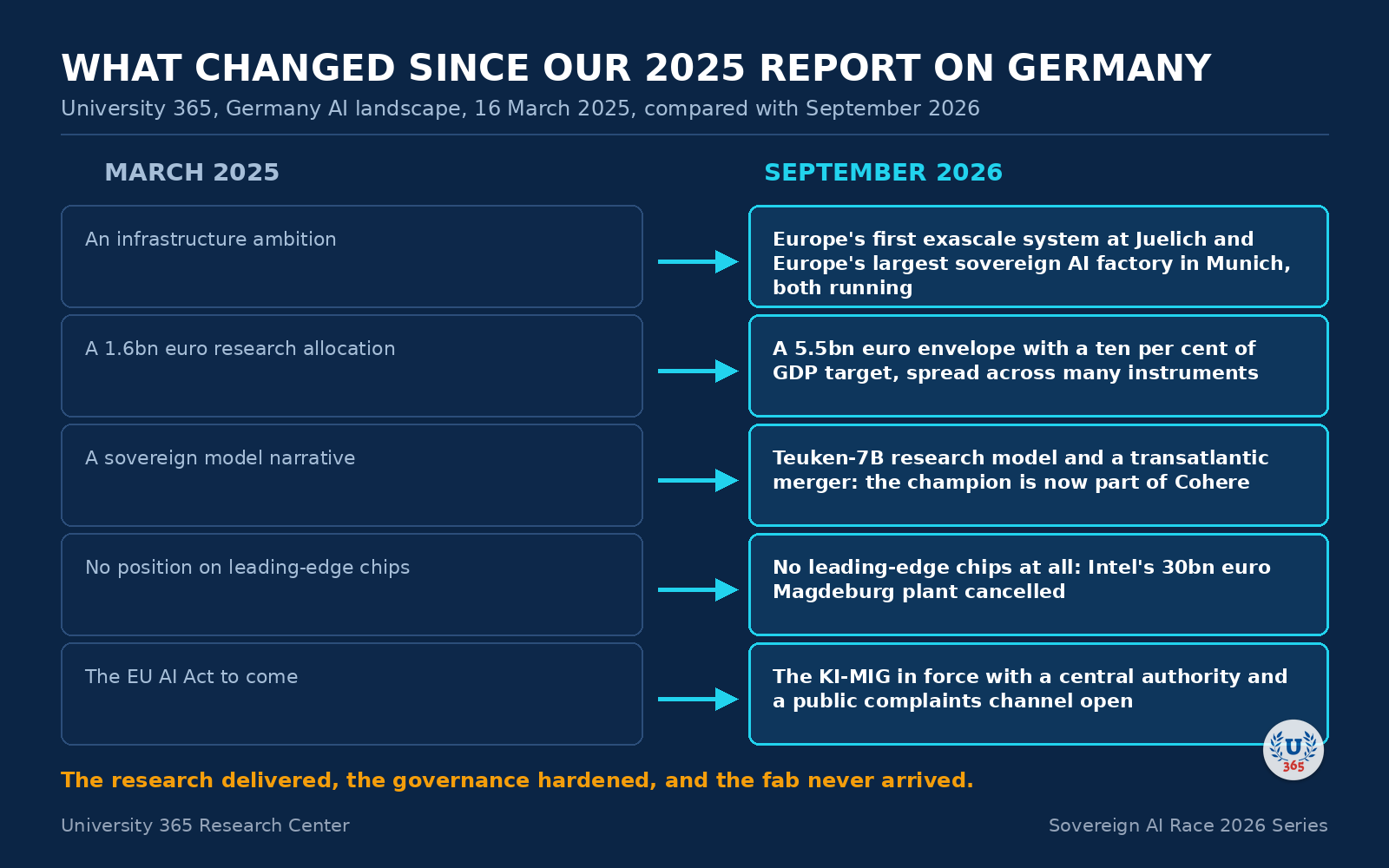
What changed since our March 2025 report on Germany. University 365 Research Center.

Read the earlier report: Germany's AI Landscape in March 2025: Running Toward Future Leadership. University 365 INSIDE, 16 March 2025.
University 365 published "Germany's AI Landscape in March 2025: Running Toward Future Leadership" on 16 March 2025. That report described a country with strong theoretical research that had become a power of practical implementation: it cited the German Research Center for Artificial Intelligence at 800 scientists, the Cyber Valley initiative with BMW, Porsche, IBM and Bosch, a federal AI research allocation of 1.6 billion euros over the parliamentary term, a generative AI market projected at 2.77 billion dollars for 2025 growing at more than forty per cent a year, eleven fields of action in the ministry's plan, the Manufacturing-X and Catena-X industrial data projects, and a competitive position resting on engineering excellence, research depth, industry integration and an ethical framework. It named digital infrastructure stagnation, talent competition and scale as the challenges, and it anticipated edge AI, sector-specific solutions, European collaboration and ethical leadership as the trends. Against that baseline, one year and six months of movement has produced a mixed ledger, and this report records both directions.
The research base it described has delivered at scale. The March 2025 report could point to the DFKI's 800 scientists and the Cyber Valley partnership. The position now includes the first exascale supercomputer in Europe, JUPITER at Juelich reaching one exaflop in November 2025 and ranking fifth in the world in June 2026, a national data centre strategy adopted in March 2026 targeting 5,000 megawatts and a quadrupling of AI infrastructure by 2030, and Europe's largest sovereign AI factory in Munich, announced at one billion euros with around ten thousand accelerators and opened by Deutsche Telekom and NVIDIA in 2026. The 2025 report described an infrastructure ambition; the position is an infrastructure programme with the first systems running.
The model layer it described as a national strength has changed ownership. The March 2025 report did not name Aleph Alpha by name in the passages summarised here, but the strategy it described, "AI Made in Germany" with a European model emphasising transparency and human oversight, ran through the Heidelberg company and its peers. The verified position is that Aleph Alpha agreed in April 2026 to be combined with Cohere, a Canadian laboratory, with approximately ninety per cent of the combined entity going to Cohere's shareholders and German industry financing the deal with 500 million euros. The 2025 report anticipated that Germany would lead in sector-specific solutions; the position is that its sovereign model layer is now transatlantic and research-grade, with Teuken-7B's seven billion parameters and the OpenEuroLLM consortium as the domestic benchmarks.
The budget figures moved in both directions and the fragmentation persisted. The March 2025 report cited a 1.6 billion euro AI research allocation over the parliamentary term. The position includes a 5.5 billion euro strategy envelope announced in July 2025 with a ten per cent of GDP target for AI by 2030, federal commitments over the legislative period placed at roughly the same 5.5 billion, a 31.6 million euro academic integration package, a one billion euro gigafactory contribution, and one billion euros of public venture assets. The 2025 report's implied single envelope has become a set of instruments, and the independent analysis of July 2026 described the strategy as funded but stuck, which is a judgment this report quotes and tests rather than adopts.
The chip position the 2025 report did not dwell on became the defining gap. The March 2025 report's challenge list named digital infrastructure generally. The verified position is that Intel's 30 billion euro Magdeburg fab, the only planned leading-edge plant, was cancelled, leaving Germany with no leading-edge fabrication, which is why this report frames the compute layer as an exascale public base with a private hole in it.
The regulatory position moved from framework to enforcement. The 2025 report described Germany's leadership in European AI initiatives and the coming AI Act as creating a harmonised environment. The position is that Germany adopted the KI-MIG in June 2026, designated the Bundesnetzagentur as the central market surveillance authority, opened a public complaints channel in August 2026, and saw the European high risk compliance deadline deferred from August 2026 to December 2027 through the Digital Omnibus. The 2025 report described a country that would implement European rules; the position is a country that has implemented them and now holds the enforcement machinery.
Two trends the 2025 report anticipated arrived differently. It expected edge AI and sector-specific solutions to define German strength, and the position supports the sector-specific half: the Industrial AI Cloud is explicitly for manufacturing, the robotics and defence champions are the private successes, and the automotive industry is running production agreements for AI driving systems. It expected ethical AI leadership; the position is that the ethical framework has become enforcement machinery with a central agency, which is a stronger and more specific thing than leadership by example.

Sovereign AI Race: Germany (2026)
Key Findings
1. Germany owns the strongest public compute layer in this series and has no leading-edge private fabrication. JUPITER at Juelich is Europe's first exascale supercomputer, one exaflop from November 2025, fifth in the world in June 2026, powering more than 120 research projects. Intel's 30 billion euro Magdeburg fab, the only planned leading-edge plant, was cancelled, and no policy since has filled that gap.
2. The sovereign AI factory is real, and it is a partnership with an American chip company. Deutsche Telekom and NVIDIA announced the one billion euro Industrial AI Cloud in Munich in November 2025, with around ten thousand Blackwell accelerators and roughly half an exaflop, privately financed and marketed for industry with data kept in Germany. The fifty per cent increase claim is the vendor's and the report labels it.
3. The national data centre strategy is the state's answer on the compute layer, and its targets are targets. Adopted on 18 March 2026 with 28 measures, it aims to double computing connection capacity to 5,000 megawatts and quadruple AI infrastructure by 2030, with one hundred per cent renewable electricity required from 2027. The 2030 targets are labelled as claims; the renewable requirement from 2027 is the concrete instrument.
4. The model champion left. Aleph Alpha agreed in April 2026 to be combined with Cohere, a Canadian laboratory, with roughly ninety per cent of the combined entity going to Cohere's shareholders, 500 million euros of German industrial financing behind it, and the German government arriving as an anchor customer. Germany's sovereign model layer is now a transatlantic company, a seven billion parameter open research model trained in all 24 EU languages, and a European consortium.
5. The regulatory layer turned from legislation into machinery in a single year. The KI-MIG was adopted on 11 June 2026, promulgation is dated 22 July in the gazette record and 28 July in one legal summary, the Bundesnetzagentur announced its central market surveillance role on 29 July, and a public complaints channel opened on 2 August. Germany centralised enforcement rather than scattering it.
6. Europe simplified its rules while Germany implemented them. The Digital Omnibus on AI, published in November 2025 and finally approved on 29 June 2026, deferred the high risk compliance deadline from 2 August 2026 to 2 December 2027. The deferral reduces the short-term regulatory load on German companies and delays the enforcement case load the new agency will face.
7. The money exists and it is fragmented. A 5.5 billion euro strategy envelope announced in July 2025 with a ten per cent of GDP target for 2030 that the report labels as a claim; federal commitments over the legislative period at roughly the same figure; a 31.6 million euro academic package; a one billion euro gigafactory contribution; one billion euros of public venture assets now being consolidated with the High-Tech Gruenderfonds. The independent analysis calls this funded but stuck, and the enumeration supports the description of fragmentation.
8. Germany's private AI champions are in tools, robotics and defence, not foundation models. Helsing raised 1.8 billion dollars at an 18 billion dollar valuation in July 2026, Europe's largest defence technology round; Neura Robotics announced up to 1.4 billion dollars in June 2026 for physical AI; Black Forest Labs raised a reported 300 million dollars at 3.25 billion for image generation; DeepL holds a reported two billion dollar valuation and is restructuring. The shape is consistent and it is downstream of the frontier.
9. The talent picture is a shortage and an allocation problem at once. A STEM gap of about 133,900 in March 2026, down nearly sixteen per cent year on year, against employers paying salary increases above sixty per cent for AI specialists while hundreds of thousands of academics are unemployed. This report does not use the old 149,000 IT vacancy figure because its current equivalent was not verified.
10. The German state now buys sovereign AI from its own champions and from American ones. SAP and OpenAI's offering for the public sector runs American models over Microsoft infrastructure in a German wrapper; the state is set to be an anchor customer of the Cohere and Aleph Alpha combination; Deutsche Telekom won a German sovereign AI cloud contract in May 2026 as reported; and the European Commission's 180 million euro sovereign cloud tender was reported to include STACKIT among four winners. The procurement pattern is coherent, and it is procurement of wrappers over rented capability.
11. The honest overall verdict: Germany has built the governing, funding and research layers of an AI sovereign and must rent the layers where the frontier is decided. The country knows this and its parliament is debating it. The report's assessment is that the position is defensible, expensive to maintain and exposed to consolidation at the top.

Sovereign AI Race: Germany (2026)
Deep Analysis
Why the Magdeburg gap defines the German position
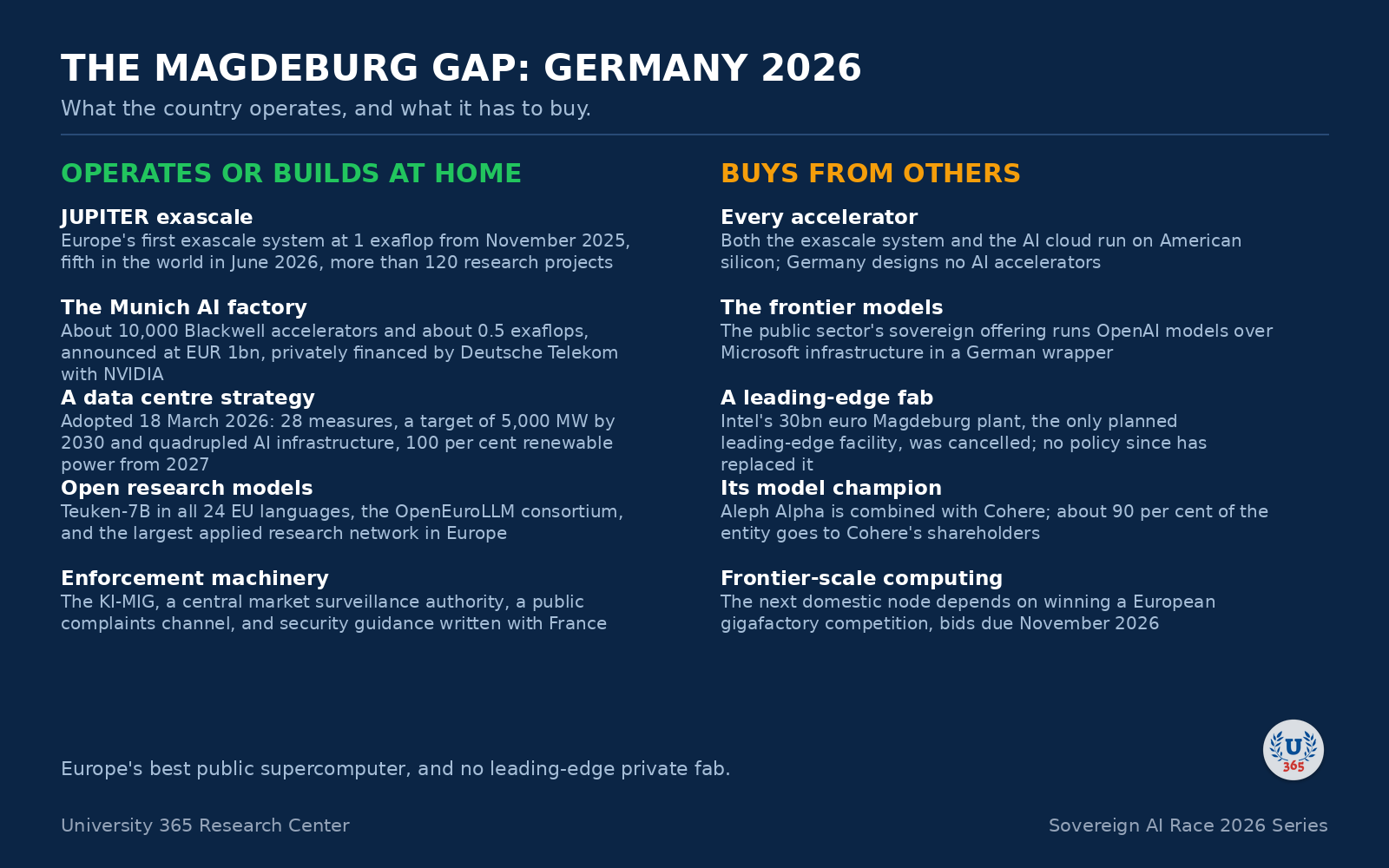
The Magdeburg gap, layer by layer. University 365 Research Center.
Every country in this series has one fact that explains its position faster than any framework, and for Germany it is the cancelled fab. Intel's Magdeburg plant was to be a 30 billion euro leading-edge fabrication facility, the anchor of Europe's semiconductor ambitions and the single project that would have changed Germany's relationship to the compute layer. It was delayed in September 2024 and cancelled in 2025, and the cancellation is not primarily about Germany: Intel's own condition drove it. What matters for this report is what the cancellation leaves standing. Germany has a first-class equipment and materials supply base, first-class chip consumers in its automotive and industrial companies, a first-class list of public research institutions, and no plant that makes leading-edge logic. The country that supplies the tools other countries use to build AI chips does not build AI chips.
The consequence runs through every other layer. Because there is no domestic leading-edge fab, every German sovereign compute programme, public or private, is ordered from abroad, which means the compute layer is a purchasing relationship rather than a production capability, however impressive the operating systems are. Because the accelerator layer is bought, the model layer is trained on foreign silicon, and Germany's open research models at seven billion parameters are sized to public research budgets rather than to the frontier. Because the frontier is imported, the sovereign offering the state buys is a wrapper: German jurisdiction, German operations, German customer relationship, and American models and American chips underneath. And because that structure is understood, the political layer has moved to dependence management, with a parliamentary commission on reducing reliance on American technology providers and a French-German digital backbone project whose stated purpose is exactly that.
The comparison the report can now make across the series is sharp. The UAE and Saudi Arabia buy the compute layer with hydrocarbon wealth and accept dependence in exchange for speed. Japan owns materials and equipment, is rebuilding logic fabrication through Rapidus on a 2027 schedule, and buys its national AI factory from NVIDIA. South Korea owns memory completely and buys its accelerators. The United States and China own the whole stack. Germany is the first country in the series that owns neither the fabrication nor the frontier and has built everything else, and the honest statement of its position is that its sovereignty is administrative, financial and scientific rather than industrial. That is a real thing to own; it is also the position most exposed to a supplier decision, which is why the country's own parliament is debating it.
The funding that does not converge

Dorothee Baer, Federal Minister for Research, Technology and Space of Germany, as of 2026. Her ministry carries the research side of the AI programme, including the 31.6 million euro package authorised in January 2026 to embed AI across the academic system. Photograph: Tobias Koch, CC BY-SA 3.0 de, via Wikimedia Commons.
Reading the German financial record in sequence produces a specific impression: a state that is willing to spend and unable to focus. The 5.5 billion euro envelope announced in July 2025 with a ten per cent of GDP target; federal commitments over the legislative period characterised as roughly the same figure; a research ministry budget of 22.38 billion euros whose AI share is not broken out; 31.6 million euros for academic integration; a one billion euro gigafactory contribution; a one billion euro venture fund being merged with another; and, running underneath, the ordinary research funding of the Fraunhofer, Helmholtz and university systems. Each instrument is defensible; the sum is a portfolio, and portfolios do not build fabs or frontier models.
The reason is partly structural and partly chosen. Structurally, Germany is a federal state where research and education sit largely with the Laender, so any national programme must work through sixteen governments with their own priorities, and the resulting instruments multiply. By choice, the country has decided not to pick a national champion in models, which the Aleph Alpha outcome suggests was a correct reading of the economics, and not to subsidise a frontier-scale model training programme, which it lacks the compute to fill. What remains is a strategy best described as funding the preconditions: research, data, infrastructure, adoption, regulation, training. The July 2026 analysis that called this funded but stuck is making the point that preconditions are not a destination, and the report's own judgment is more forgiving: for a country in Germany's position, funding the preconditions is the only serious option, and the question is whether the preconditions eventually attract the private frontier activity, or whether the country remains permanently one layer below it.
The comparison with the rest of the series is instructive. France funds a national champion with state capital and hosts Mistral. The United Kingdom hosts the European headquarters of the American frontier laboratories. India funds a mission with a disbursement problem. Germany funds preconditions at scale and has produced champions in defence, robotics and tools, which is to say that its money has worked where the market was adjacent to its industrial base and has not produced a frontier where none could be bought. On the evidence, the German allocation is a rational reading of comparative advantage and it is not a sovereignty strategy at the frontier, and the report says both.
The three races, measured in Germany
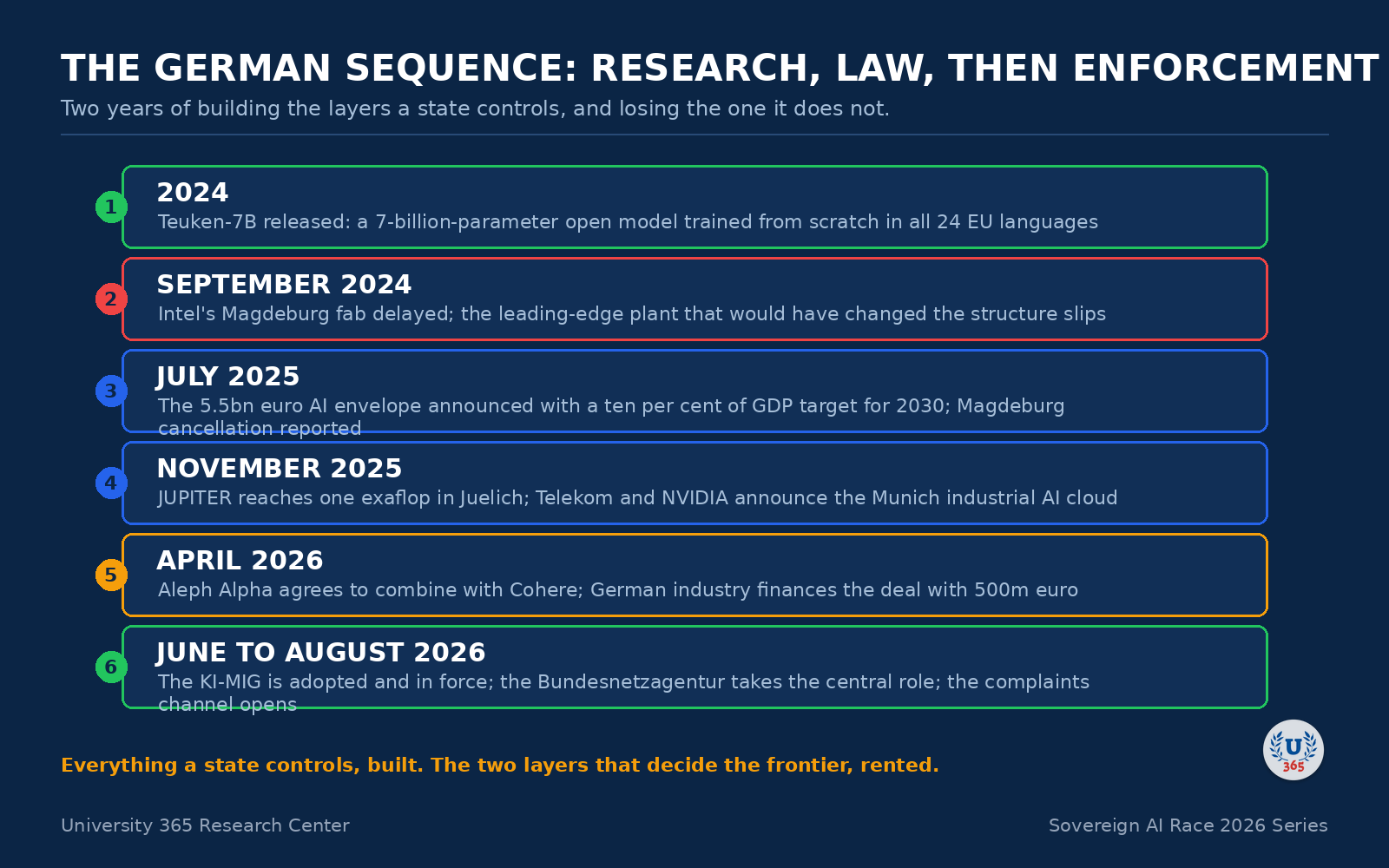
The German sequence: research, law, then enforcement. University 365 Research Center.
The series separates the compute race, the model race and the rules race. Germany's position inverts Singapore's and Japan's in an instructive way.
In the compute race, Germany is a strong operator and no producer. It has Europe's first exascale public system and the largest sovereign AI factory in Europe by announced capacity, and it has no leading-edge fab and buys every accelerator. Its compute sovereignty is the sovereignty of the tenant who operates the building well.
In the model race, Germany is a research publisher and a customer. Its open research model in 24 European languages is a genuine contribution to language coverage, its participation in the European consortium keeps it at the table for the continent's answer to model dependence, and its commercial champion was absorbed by a Canadian company. At the frontier it buys, through wrappers, from American laboratories.
In the rules race, Germany is the strongest national player in Europe. It was the first large member state to translate the AI Act into enforcement machinery with a central authority, its cybersecurity office writes international guidance on AI supply chain risk and agent security, and its courts are producing the continent's reference copyright rulings. When the European Union simplifies, it does so with German enforcement capacity already built.
The three tempos produce the report's cleanest summary of Germany. A country that enforces the rules everyone will eventually face, publishes the research everyone can use, operates the best public systems in Europe, and buys the top of the stack it governs. Whether that is a durable position depends on a question no one has answered: whether rules and research keep a country near the frontier, or merely make it a well-governed customer of the frontier.

Sovereign AI Race: Germany (2026)
Data and Evidence
Table 1: The five layers, assessed for Germany in September 2026
Layer | What Germany holds | What it does not hold | Assessment |
Compute | JUPITER at Juelich, Europe's first exascale system at 1 exaflop from 17 November 2025, fifth in the world in June 2026, more than 120 projects; the Industrial AI Cloud in Munich announced at EUR 1bn with about 10,000 Blackwell accelerators and about 0.5 exaflops; data centre strategy of 18 March 2026 targeting 5,000 MW and quadrupled AI infrastructure by 2030; Schwarz Digits committed up to EUR 5.6bn for a 240 MW site | A leading-edge fabrication plant after the Magdeburg cancellation; domestic accelerators; any frontier-scale training cluster not dependent on imported silicon | Strong operator, no producer, and the fab that did not arrive |
Models | Teuken-7B, seven billion parameters trained from scratch in all 24 EU official languages, released November 2024 and openly published; the OpenEuroLLM consortium with Fraunhofer, Juelich and Tuebingen participation and its Cologne workshop in May 2026; DFKI at around 800 scientists; the largest applied research network in Europe | A national frontier model; Aleph Alpha as a German-owned champion (combined with Cohere, roughly 90 per cent to Cohere shareholders); any national weights mandate | Research grade and honest about it |
Capital | The EUR 5.5bn AI envelope of July 2025 with a ten per cent of GDP target for 2030 (claim); federal commitments over the legislative period at roughly the same figure; a EUR 31.6m academic package; a EUR 1bn gigafactory contribution; DTCF at EUR 1bn AUM merging with HTGF; Helsing at USD 18bn valuation, Neura Robotics at USD 1.4bn raised, Black Forest Labs at USD 3.25bn, DeepL at USD 2bn | Convergence: the instruments multiply while no frontier lab or fab is funded to scale; a national champion the state owns | Funded and fragmented, by design and by federalism |
Regulation | KI-MIG adopted 11 June 2026, promulgated 22 July (gazette) with one summary at 28 July; Bundesnetzagentur as central market surveillance authority with BaFin, BfArM and KBA sectoral; complaints channel from 2 August 2026; the Data Act authority role from 30 May 2026; NIS2 in force; BSI guidance on language model security and AI agents; active copyright litigation | Speed: the EU deferred high risk compliance to 2 December 2027 via the Digital Omnibus; the agency's case load will build slowly; Germany's omnibus negotiating position not verified | The strongest national enforcement layer in Europe |
Talent and education | MINT gap of about 133,900 in March 2026, down nearly 16 per cent year on year; TUM chairs across AI including processor design; the Munich Center for Machine Learning; ELLIS Tuebingen; DFKI; the Fraunhofer and Helmholtz networks; the skilled immigration framework with the opportunity card | The AI specialists its employers bid for, as the salary-jump reports and the academic unemployment figures show; clarity on whether immigration rules have tightened | Deep institutions, acute allocation problem |
Table 2: The controlled metrics, series bible format
Metric | Germany position | Source and date |
Flagship compute commitment | JUPITER at Forschungszentrum Juelich: Europe's first exascale system at 1.0 exaflop FP64, on NVIDIA Grace-Hopper, ranked 5th in the June 2026 TOP500; the Industrial AI Cloud in Munich at about 10,000 Blackwell accelerators and about 0.5 exaflops, announced at EUR 1bn; the national data centre strategy of 18 March 2026 targeting 5,000 MW by 2030 | FZ Juelich, 17 November 2025; TOP500 June 2026; Reuters and TechCrunch, 4 November 2025; data centre strategy adoption reported March 2026 |
Capital committed | EUR 5.5bn AI envelope announced July 2025 with a stated ten per cent of GDP target for 2030; federal commitments over the legislative period at roughly the same figure per July 2026 analysis; EUR 31.6m academic integration package; EUR 1bn gigafactory contribution; DTCF at EUR 1bn AUM; more than EUR 1.6bn 2025-2029 line reported separately | MVPro and government communications, July 2025; theaiinsider analysis, 13 July 2026; hyperight, January 2026 |
Flagship national models | Teuken-7B (OpenGPT-X), 7bn parameters, all 24 EU languages, released November 2024; OpenEuroLLM participation (Fraunhofer IAIS, FZ Juelich, ELLIS Tuebingen); Aleph Alpha combined with Cohere (roughly 90 per cent Cohere shareholders) | Fraunhofer IIS, 26 November 2024; EC STEP page; Tech.eu and TechCrunch, April 2026 |
Anchor entities | Bundesnetzagentur (AI market surveillance and Data Act authority); the Federal Ministry of Research, Technology and Space; the Federal Ministry for Economic Affairs and Climate Action; Forschungszentrum Juelich and the Helmholtz network; Fraunhofer and DFKI; Deutsche Telekom and Schwarz Digits as the domestic infrastructure champions | Government and agency releases, 2024 to 2026 |
Chip dependency | Complete at both the accelerator and fabrication layers: every German AI system runs on NVIDIA or AMD silicon; the data centres are built by American hyperscalers, Telekom with NVIDIA, or Schwarz; no leading-edge fab after the Magdeburg cancellation. Counterpoint records 92 per cent of sovereign AI LLMs globally on NVIDIA | Vendor and government materials; Counterpoint Research, 5 August 2026 |
Regulatory instrument and status | KI-MIG, adopted 11 June 2026, promulgated 22 July 2026 (BGBl. 2026 I Nr. 223; one summary dates it 28 July), Bundesnetzagentur central authority announced 29 July 2026, complaints channel from 2 August 2026; Data Act authority role from 30 May 2026; the EU Digital Omnibus deferring high risk compliance to 2 December 2027, finally approved 29 June 2026 | Gesetze im Internet; Bundestag and Bundesnetzagentur, 2026; Council of the EU and Heuking, 2026 |
Talent anchors | TUM and its computation school; the Munich Center for Machine Learning; ELLIS Tuebingen; DFKI; the Fraunhofer and Helmholtz networks; the MINT report gap of about 133,900 for March 2026 | TUM; MCML; ELLIS; IW via arbeitgeber.de, 2026 |
Independent index standing | Oxford Insights Government AI Readiness Index 2025: 6th of 195 with 76.78 points, against the United States first at 88.36 and the median country at 40.19, from the publisher's own dataset. Stanford HAI AI Index 2026 published 13 April 2026; Germany-specific rows not verified in this research window and not asserted | Oxford Insights 2025 dataset; Stanford HAI AI Index 2026 |
Adoption | Bitkom's figures conflict and both are reported: 57 per cent of firms with 20 or more employees using AI against 36 per cent a year earlier in one 2026 survey, and 41 per cent using AI with 21 per cent holding a strategy in the 11 March 2026 digitalisation study of 604 companies. The report cites both with their survey names | heise online and Die Zeit, 2026; Bitkom digitalisation study, 11 March 2026 |
Distinguishing mechanism | A state that governs, funds and researches the middle of the stack while buying the top, having cancelled the fab that would have changed the structure | This report |
Core tension | Europe's strongest research nation operates the continent's first exascale system and hosts its largest sovereign AI factory on imported silicon, with no leading-edge fab and a model champion that is now part of a Canadian company | This report |
Table 3: Timeline, 2024 to 2026
Date | Event | Source |
29 March 2024 | Microsoft and OpenAI reported planning a USD 100bn data centre project including a supercomputer codenamed Stargate | Reuters |
June 2024 | The skilled immigration framework and the opportunity card enable qualified job seekers to enter Germany to look for work | Make it in Germany; Federal Foreign Office |
July 2024 | Germany announces the Huawei and ZTE 5G phase-out, critical components out of core networks by end-2026 | AFP via Times of Oman |
12 September 2024 | Intel's Magdeburg fab delay reported | igorslab |
24 September 2024 | EuroStack launched in the European Parliament | movetheneedle |
26 November 2024 | OpenGPT-X releases Teuken-7B: 7bn parameters, all 24 EU languages, open | Fraunhofer IIS; TU Dresden; FZ Juelich |
21 January 2025 | Stargate announced by OpenAI, Oracle, SoftBank and MGX | OpenAI |
16 March 2025 | University 365 publishes its Germany AI landscape report | University 365 INSIDE |
19 June 2025 | Telekom, Ionos and Schwarz Group submit competing expressions of interest for the EU AI gigafactory | Reuters |
July 2025 | Intel's Magdeburg cancellation widely reported; Germany announces the EUR 5.5bn AI envelope with the ten per cent of GDP target | mybusinessfuture; MVPro |
15 July 2025 | The EUR 5.5bn national AI strategy envelope announced | MVPro (Tier 3 summary of a Tier 1 event) |
24 September 2025 | SAP and OpenAI launch "OpenAI for Germany" on Microsoft Azure and Delos Cloud | OpenAI; SAP; DataCenterDynamics |
4 November 2025 | Deutsche Telekom and NVIDIA announce the EUR 1bn Industrial AI Cloud in Munich, live Q1 2026 | Reuters; TechCrunch; Deutsche Telekom |
11 November 2025 | Google announces EUR 5.5bn for Germany 2026-2029 including a new Dietzenbach data centre | Google Cloud press corner |
17 November 2025 | JUPITER at Juelich becomes Europe's first exascale supercomputer at 1 exaFLOP/s | FZ Juelich |
19 November 2025 | The Commission publishes the Digital Omnibus on AI, proposing to defer high risk compliance to 2 December 2027 | EPRS PE 782.651 |
28 November 2025 | DTCF and HTGF announce a new public-private investment platform | DTCF; HTGF |
30 November 2025 | Telekom and Schwarz Group reported to be building an AI data centre | Reuters |
6 December 2025 | NIS2 becomes binding German law | superkind.ai (Tier 3) |
10 December 2025 | OLG Hamburg decides the Kneschke against LAION appeal, case 5 U 104/24 | swisstrustlayer (Tier 3) |
January 2026 | BMBF authorises EUR 31.6m to embed AI across the academic and research system | hyperight (Tier 3) |
10 February 2026 | The Federal Government adopts the government draft of the KI-MIG | JD Supra |
11 March 2026 | Bitkom digitalisation study: 41 per cent of firms use AI, 21 per cent have a strategy | remote-native summary of Bitkom |
13 March 2026 | The Council of the EU agrees its position to streamline AI rules | Council press release 189/26 |
18 March 2026 | Germany adopts its first national Data Centre Strategy, 28 measures | Gleiss Lutz |
20 March 2026 | Bundestag first reading of the AI Regulation implementation law | Bundestag mediathek |
13 April 2026 | Bundestag passes the Data Act implementation law; Stanford HAI publishes the 2026 AI Index | Heuking; Stanford HAI |
24 April 2026 | Aleph Alpha to be acquired by Cohere; Schwarz commits EUR 500m structured financing | Tech.eu; BetaKit; Schwarz Digits |
30 April 2026 | VDE: Germany needs highly efficient data centres; around 2,000 data centres in the country | VDE |
10 May 2026 | JUPITER performs a world record full 50-qubit quantum simulation | FZ Juelich via ScienceDaily |
21 to 22 May 2026 | OpenEuroLLM international workshop on open source sovereign foundation models, Cologne | OpenEuroLLM |
27 May 2026 | Deutsche Telekom reported to win a German sovereign AI cloud contract | Telco Magazine |
30 May 2026 | The Bundesnetzagentur becomes Germany's Data Act authority | Bundesnetzagentur |
10 June 2026 | Neura Robotics announces a Series C of up to USD 1.4bn led by Tether | Business Wire; Bloomberg; Tech.eu |
11 June 2026 | The Bundestag adopts the AI Regulation implementation law | Bundestag mediathek; Bundesrat 375/26 |
18 June 2026 | DFKI and Inria establish the French-German Center on AI | DFKI; idw-online |
24 June 2026 | JUPITER ranks 5th on the TOP500, powering more than 120 projects | HPCwire |
29 June 2026 | The Council gives final approval to the Digital Omnibus on AI | Heuking |
10 July 2026 | The Bundesrat approves the KI-MIG | kineangst (Tier 3) |
13 July 2026 | Helsing raises USD 1.8bn at an USD 18bn valuation; the "funded but stuck" analysis published | Reuters; CNBC; Defense News; theaiinsider |
15 July 2026 | NVIDIA and Telekom formally open the Industrial AI Cloud in Munich (reported; conflicts with the February activation date) | presentofai (Tier 3) |
21 July 2026 | Microsoft and Mistral expand their partnership on frontier AI enterprises can control | Microsoft; heise |
22 July 2026 | The KI-MIG is promulgated in the Federal Law Gazette, BGBl. 2026 I Nr. 223 | Gesetze im Internet |
29 July 2026 | The Bundesnetzagentur announces its central role implementing the AI Regulation | Bundesnetzagentur |
30 July 2026 | The EU opens the AI gigafactories call: up to seven sites, bids due 12 November 2026 | European Commission; Euronews |
2 August 2026 | The AI Act Article 50 transparency and labelling obligations start applying | i6eal (Tier 3) |
August 2026 | Germany raises its gigafactory contribution to EUR 1bn; Schwarz Digits' up-to-EUR 5.6bn, 240 MW Rostock project reported | Beckmann (Tier 3) |
22 September 2026 | Mercedes-Benz signs a production agreement with Wayve for an AI Driver | inkl (Tier 3) |
September 2026 | Die Zeit reports the Bitkom study showing a majority of German firms using AI, 603 companies surveyed | Die Zeit |

Sovereign AI Race: Germany (2026)
Implications
For the countries still to come in this series
Germany is the case study for every country that will run the rules race well and lose the compute race, and the lesson is about the difference between the two. A state can build enforcement machinery, fund research, train people and legislate early, and it will still be a tenant of the frontier if it does not fabricate or train at scale. The copyable German parts are the enforcement design, one central authority with named sectoral partners, and the practice of buying sovereign services from champions who deliver German jurisdiction over foreign capability. The warning is the Magdeburg gap: the country that lost its only leading-edge fab discovered that no amount of research funding or regulation substitutes for a fabrication plant, and the strategic consequence is that its compute policy now depends on winning a European competition rather than on a national decision.
For the technology providers
Germany is the largest single market in Europe for AI infrastructure and the most demanding buyer in this series on jurisdiction and standards. Providers should expect three specific things. Procurement will increasingly require a German or European legal wrapper even when the underlying model or cloud is American, which is the market SAP, Telekom, Schwarz and the European sovereign cloud winners have entered. The renewable electricity requirement for data centres from 2027 is a real cost of entry and an advantage for operators who have already secured green supply. And the enforcement environment will be the most developed in Europe from 2026, with a central agency, a public complaints channel and sectoral supervisors, which means compliance design should start with German expectations because they will resemble the European ones. Providers selling into Germany should treat its public sector as a buyer of wrappers and its industry as a buyer of applications, and both as buyers who require the security posture to be documented.
For institutional and enterprise buyers
Germany is the easiest market in Europe to buy AI responsibly and the hardest in which to buy sovereign capability, and buyers should separate the two questions. On responsibility, the German framework is clear: enforcement machinery is in force, the security office publishes AI supply chain and agent guidance, and the Data Act's access-by-design phase makes data portability real from September 2026, so a compliant German deployment can be documented and defended. On sovereignty, what Germany offers is a strong public research base to partner with, excellent applied research institutions, champions in defence, robotics and tools, and a sovereign cloud market with real competition between Telekom, Schwarz's STACKIT, IONOS and the hyperscaler German regions. What it does not offer is a German accelerator or a German frontier model, so any claim of a fully sovereign German stack should be tested against the wrapper it actually is.
For University 365
Germany is the eleventh country in this series and the one whose education system most closely resembles what this institution does, because its strength is applied: the DFKI, the Fraunhofer network, Cyber Valley's industry partnerships and the technical universities all exist to move research into industry, and the country's private champions, in defence, robotics, imaging and translation, are downstream of that pipeline. The German dilemma is the one this institution understands from inside: a country can build the institutions that produce capability and still watch the frontier be decided elsewhere, because the frontier is decided by compute and capital at scales no university system commands. The German answer has been to fund the preconditions and to govern well, and the honest assessment for our own work is that this produces a strong middle and no top, which is a reasonable national choice and not a complete answer to the sovereignty question.

Sovereign AI Race: Germany (2026)
Education and Skills Impact
What the German case teaches about a country that trains well and still bids for talent
This series returns in every report to the gap between using AI and building it, because that gap is where the educational argument lives. Germany adds a third variant: a country whose education and research system produces the capability and whose labour market then pays a premium to import it.
The scale of the institutional base is the largest in the series. The German Research Center for Artificial Intelligence employs around 800 scientists across multiple sites; the Fraunhofer network operates more than seventy applied institutes of which the intelligent analysis institute leads the generative AI work; the Helmholtz centres host the national supercomputing infrastructure; the Technical University of Munich's computation school holds chairs spanning processor design, scientific modelling and planning; the Munich Center for Machine Learning is a joint university centre; and the ELLIS institute at Tuebingen runs foundational research groups on safety, alignment and machine intelligence. The country's research system also participates as a matter of policy in the European consortia, with Juelich, Fraunhofer and the Tuebingen institute named partners in the open model project and in the wider European efforts. On the raw strength of the institutions, nothing in this series matches Germany, and no country in this twenty has more capacity to teach AI well.
The labour data shows that this is not enough. The MINT report for 2026 puts the STEM skills gap at around 133,900 people in March 2026, down nearly sixteen per cent from the year before, with the country's own analysts stating that demographic trends threaten a major shortfall in the years ahead; the autumn report before it observed that the IT specialist shortage seemed to be hardly playing a role any more, a striking reversal that suggests the shortage has become specific rather than general. What remains is concentrated at the top: employers are reported to offer salary increases above sixty per cent for AI specialists while the employment agency counts hundreds of thousands of unemployed academics, which is the education system producing graduates whose specialisms do not match where the demand is. The country's answer on the supply side is immigration, with the skilled immigration framework and the opportunity card allowing qualified job seekers to enter and look for work, and the make-it-in-germany portal as the national front door; whether the current government has tightened those rules is a live question this research could not resolve.
The finding for this series sharpens into a distinctly European form. A curriculum teaches judgement, a labour market decides whether the judgement stays, and a country with excellent institutions and a weak frontier-facing industry will educate well and import what it cannot retain. Germany's answer has been to fund the preconditions, govern well and import the specialists, which is coherent and leaves the country permanently bidding for the people its universities help train. For an institution like ours, the German case is the strongest available argument that teaching and capability alone do not determine where the value lands, and that the industry which absorbs the graduates is as much an educational policy as the curriculum is.

Sovereign AI Race: Germany (2026)
The CI-First Perspective
Where the German capability is real, and where the country rents its frontier

The institutions that produce the capability, and the frontier that is decided elsewhere. University 365 Research Center.
The Co-Intelligence First framework asks whether an arrangement amplifies human capability or substitutes for it, and where the risk of AI Imposture sits. Applied to Germany, the verdict is that the capability is real at the layers the country chose, that the country is unusually candid about the layers it rents, and that the main CI-First risk is not deception but drift: a strong middle position gradually losing altitude as the frontier consolidates.
The capability is real at four layers. The public compute layer is the strongest in the series for a country that does not design chips: Europe's first exascale system, running more than 120 research projects, with a coherent strategy to double capacity and quadruple AI infrastructure by 2030 and a renewable electricity requirement that makes the build-out compatible with the country's climate commitments. The institutional layer is unmatched: the German Research Center for Artificial Intelligence, the Fraunhofer network, the Helmholtz centres and the engineering universities constitute the deepest applied AI research system in Europe, and they produce open models, guidance, standards and trained people that the whole continent uses. The governance layer is now the strongest national enforcement apparatus in Europe, with a central authority, sectoral supervisors, a public complaints channel and security guidance written with international partners. And the enterprise layer has produced genuine champions, in defence with Helsing, in physical AI with Neura Robotics, in imaging with Black Forest Labs and in translation with DeepL, all of which sit downstream of the frontier and are globally competitive in their categories.
The dependency the country rents is equally clear, and the report has documented it layer by layer: every accelerator comes from abroad, every frontier model is bought, the sovereign offering the state itself uses is an American model inside a German wrapper, and the fab that would have altered the structure was cancelled. Against a stricter reading, that combination would be the definition of AI imposture, a state presenting sovereignty while renting capability. What makes Germany a different case is that its own institutions say so. The parliamentary commission on dependence, the French-German digital backbone project, the independent analyses describing the strategy as funded but stuck and the candid statements from the digital ministry about frontier control all mean that Germany is not pretending. It is managing a position it names accurately, which is the opposite of the posture the CI-First framework exists to detect.
The amplification question for the German population is answered better than in most of this series: the country's research institutions exist to move knowledge into industry, its industrial base is the most AI-ready in Europe for manufacturing applications, its adoption is rising quickly from a low base with a majority of firms now using AI in some form, and its education system continues to produce the engineers on which the continental stack depends. The residual risk is structural rather than ethical. A country that governs well, researches well and buys the top of the stack is a good customer with excellent paperwork, and if the frontier consolidates into a smaller number of suppliers, the value of that position declines without anything going wrong inside Germany. The report's verdict is that Germany holds the strongest non-frontier position in this series, that it holds it honestly, and that its durability depends on a European compute settlement, the gigafactories, that has not yet been decided.

Sovereign AI Race: Germany (2026)
What This Means for You and Us
For a reader in a country with Germany's constraints
The German sequence is the one to copy if your strength is institutions and your gap is production. Fund the preconditions properly: research, data, standards, security guidance, adoption support and the training pipeline, because they compound and they attract the private activity they cannot replace. Pick one central enforcement authority rather than scattering responsibility, because a single competent regulator is what international partners and foreign investors can actually work with. Require jurisdiction and security in your procurement without pretending it changes ownership, and say publicly which layer you are renting, because a stated dependency is a manageable one. And watch the fabrication question early: a country that loses its only leading-edge plant discovers that no amount of good governance substitutes for it, and that the gap is noticed by its parliament long before it is closed.
For a reader watching the series
Eleven countries in, Germany completes the taxonomy's most common position. The series has examined the full-stack owners, the supply chokepoints, the capital sovereigns, the rule-makers, the constrained and the sanctioned. Germany adds the funded middle: the country with the best research, the clearest rules and no frontier, managing its position honestly while the top of the stack consolidates. The emerging finding of the series sharpens again. Sovereignty in this race is not a moral quality or a policy output; it is a portfolio of positions, and Germany's portfolio is deep at every layer except the two that determine what everyone else can buy. The next five years will show whether a portfolio like that is stable or whether it drifts toward pure customership.
For University 365
Germany is the eleventh country in this series and the one whose institutional landscape most resembles the sector we work in, with the crucial difference that Germany's institutions feed an industrial base and ours feed learners directly. The German lesson for us is that the quality of the system and the location of the value are separate questions: Germany trains the continent's experts, publishes the models in twenty-four languages, writes the guidance everyone adopts, and still buys its frontier from abroad. That is not a failure of education; it is a reminder that teaching judgement and controlling the systems are different achievements, and that an institution can do the first superbly while the second is decided elsewhere. Our own version of the same discipline is to keep our learners close to the systems they will govern, and to be honest with them about which layers are owned and which are rented.

Sovereign AI Race: Germany (2026)
The Road Ahead
Three observable things would change this assessment.
Whether a German site is selected in the European gigafactory competition. Bids are due on 12 November 2026 and selection is expected in early 2027, for up to seven sites of more than 100,000 processors each with a mid-2028 operational target. If Germany wins a site and it is delivered on schedule, the compute layer gains its first frontier-scale domestic node and the Magdeburg gap becomes less defining. If the selection goes elsewhere in Europe or the delivery slips, the country's compute dependence continues to run entirely through purchases and partnerships.
Whether the data centre strategy's targets convert into megawatts and silicon. The 5,000 megawatt target for 2030 and the quadrupling of AI infrastructure are claims until the builds happen. Watch whether the announced private projects, the Munich industrial cloud, the Rostock site, the North Rhine-Westphalia cluster and the Frankfurt and Berlin expansions, move from announcement to operation, and whether the renewable electricity requirement from 2027 changes their economics. A German compute layer that doubles on schedule is a materially different position from one that continues to announce.
Whether the KI-MIG's enforcement and the Digital Omnibus's deferral produce a compliance market or a quiet freeze. The central authority is operational and the complaints channel is open, while the high risk obligations were deferred to December 2027. The signal to watch is whether German companies and public bodies treat the framework as a design guide in the interval or wait it out, and whether the innovation promotion half of the law produces visible funded projects. Germany's regulatory sovereignty is now beyond doubt; what the next two years will show is whether it produces adoption or merely paperwork.

Sovereign AI Race: Germany (2026)
Sources and Methodology
Methodology
This report was researched from public sources in German and English with a preference for primary documents: the Federal Law Gazette record and statutory text of the KI-MIG, the Bundestag and Bundesrat records of its passage, the Bundesnetzagentur's own releases on its AI and Data Act roles, the Federal Ministry research communications, the Bundesnetzagentur and security office publications, the Forschungszentrum Juelich releases on JUPITER, the Fraunhofer and OpenGPT-X release materials, the European Commission, Council and Parliament documents on the AI Act and the Digital Omnibus, company announcements from Deutsche Telekom, NVIDIA, SAP, OpenAI, Cohere, Schwarz Digits, Neura Robotics and Google, the Oxford Insights index dataset for Germany's position, and the German and international press for everything else. Government targets, vendor benchmarks and funding envelopes are labelled as claims, and where sources conflict the conflict is stated rather than resolved: the KI-MIG promulgation date of 22 July against 28 July, the Industrial AI Cloud's activation in February against its formal opening in July 2026, the Intel Magdeburg cancellation reported in July 2025 against a later dating, and the two conflicting Bitkom adoption figures of 57 and 41 per cent, which the report attributes to their specific survey instruments.
The series tests itself over time, and this report carries the discipline furthest of any so far: the March 2025 University 365 report on Germany is treated as the baseline, its figures are quoted back, and the movement is recorded in both directions, including where its expected trends arrived differently. Three specific figures that moved are carried through the comparison: the research budget context, from a single 1.6 billion euro allocation to a 5.5 billion euro envelope spread across instruments; the compute layer, from no exascale system to Europe's first at Juelich and Europe's largest sovereign AI factory in Munich; and the model layer, where the flagship champion is now part of a Canadian group, which no version of the 2025 report anticipated.
Four limits should travel with this report. First, several load-bearing figures rest on secondary or specialist sources and are labelled: the data centre strategy's 5,000 megawatt target, the Schwarz Digits Rostock investment, the German gigafactory contribution, the Deutsche Telekom cloud contract and the European Commission sovereign cloud award. Second, the German-specific rows of the Stanford index and the DESI data were not verified in this research window and are not asserted. Third, the current Bitkom figure for unfilled IT positions was not located, which is why the report deliberately does not use the widely circulated 149,000 figure and says so. Fourth, the GEMA proceedings against OpenAI and Germany's specific negotiating position on the Digital Omnibus were not verified and are not stated.
Principal sources
Government, regulatory and official. The Federal Law Gazette record of the KI-MIG and its statutory text; the Bundestag records of the first reading on 20 March 2026 and the adoption on 11 June 2026, and the Bundesrat resolution; the Bundesnetzagentur releases of 30 May and 29 July 2026 and its AI governance and market surveillance pages; the European Commission's gigafactory call, its market surveillance guidance and the State of the Union speech; the Council press release of 13 March 2026 and the final approval of 29 June 2026 as recorded; the European Parliament's research service briefing on the omnibus; the Federal Office for Information Security's publications with the French agency; the Federal Employment Agency and Destatis-based employment figures as reported; the federal make-it-in-germany portal on the immigration framework.
Institutional and company disclosures. Forschungszentrum Juelich on JUPITER's exascale milestone, its technical configuration and the quantum simulation record; Fraunhofer on OpenGPT-X and Teuken-7B; the European Commission's partnership page on OpenEuroLLM; the German Research Center for Artificial Intelligence on the French-German centre; Deutsche Telekom's own statement of the Industrial AI Cloud's purpose; NVIDIA's materials on the Munich cloud, the Siemens partnership and Hannover Messe; SAP and OpenAI on the German public-sector offering; Cohere and Schwarz Digits on the Aleph Alpha combination; Reuters, CNBC, Bloomberg and the trade press for the private rounds; Google Cloud on the German investment; the Oxford Insights dataset for the index position.
Reporting. Reuters, Bloomberg, the Financial Times, CNBC and Defense News for the private and defence rounds; Handelsblatt and Reuters relays for German corporate developments; heise online, Die Zeit, DatencenterDynamics and the specialist infrastructure press; the legal analyses of the KI-MIG and the Data Act implementation from the firms that tracked them; and the German business and technology press named in the text where a claim depends on them.

Sovereign AI Race: Germany (2026)
About This Report
Sovereign AI Race: Germany (2026) is report eleven of twenty in the Sovereign AI Race series, followed by a comparative capstone. The series assesses how states attempt to control the production of artificial intelligence inside their jurisdiction, using one five-layer framework and one metric set applied identically to every country: compute, models, capital, regulation, and talent.
Each report in the series carries a "What Changed Since" treatment against the earlier University 365 report on the same country where one exists. Germany has a 2025 landscape report from this institution, "Germany's AI Landscape in March 2025: Running Toward Future Leadership", and this report is compared against it throughout The Current State.
Author: Hubert Graef, Dean of Research, University 365 Research Center.
Series: Sovereign AI Race, report 11 of 20, followed by the comparative capstone.
*Published by University 365 Research Center. CI-First is University 365's Co-Intelligence First framework, a method constant of the institution.*
Revision 2, 30 September 2026, 18:29 UTC. Published 29 September 2026.




Comments