
The Adoption Divide: Public Habits, Professional Deployment, and the Economics of AI (2026)

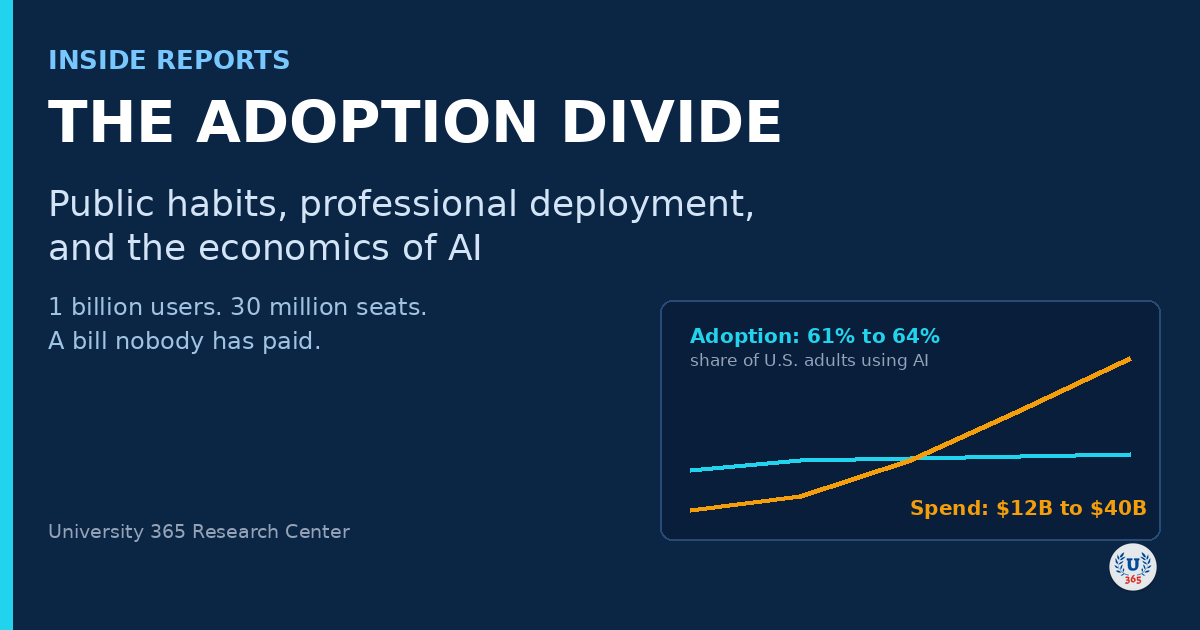
In this Report


The Adoption Divide: Public Habits, Professional Deployment, and the Economics of AI (2026)
The Context
Four markets wearing one word
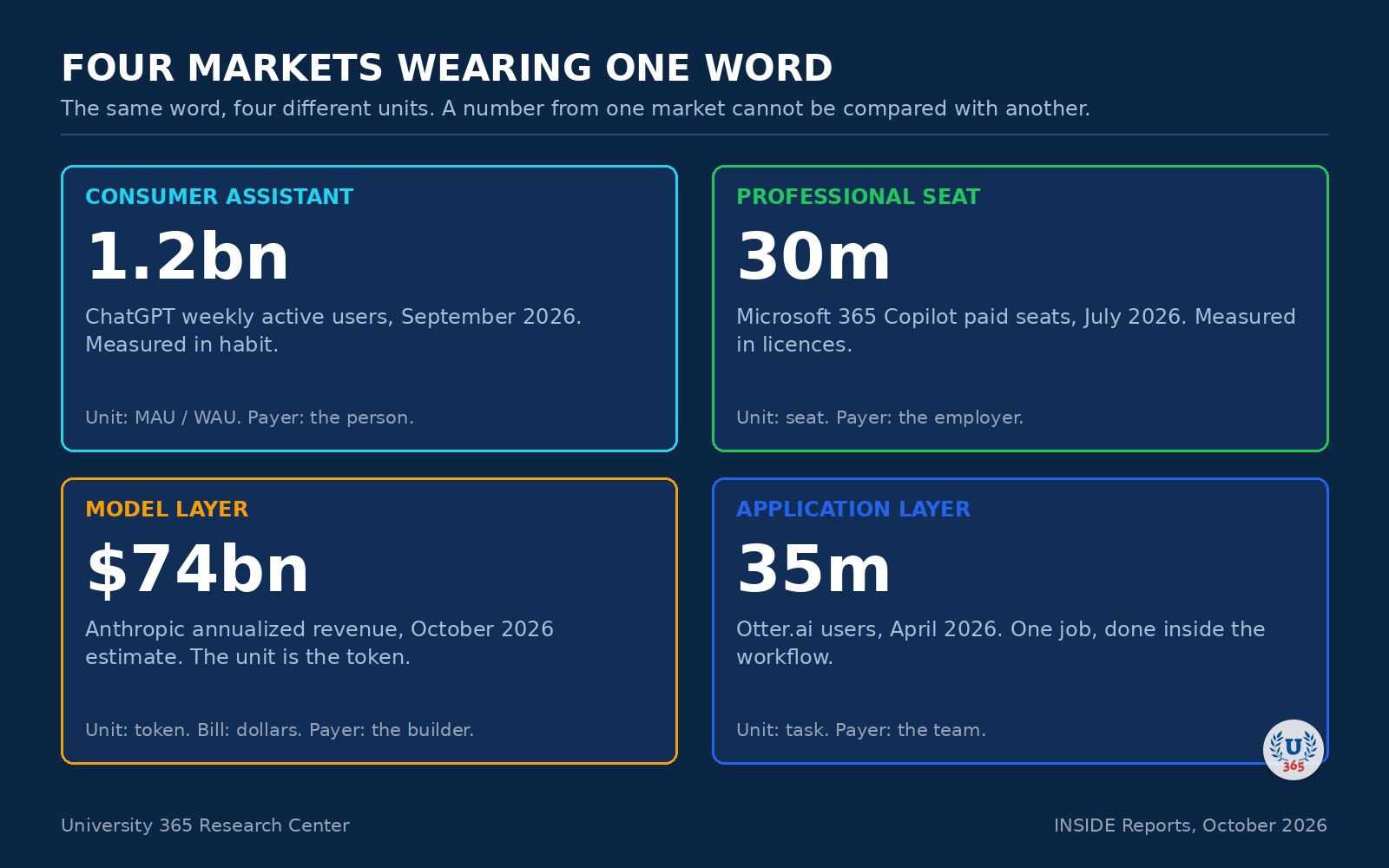
Four markets, four units. The same word describes a different market in each panel.
Source: OpenAI, Google, Microsoft, Otter.ai, Anthropic. See the Key Metrics table for dates and confidence.
The word "adoption" hides four different markets, and almost every disagreement about AI begins with someone comparing a number from one market with a number from another.
The first market is the consumer assistant: a general chatbot that a person opens on a phone or a browser, usually free, sometimes paid. ChatGPT, Gemini, Claude, Copilot and Perplexity all compete here. The numbers that describe this market are monthly active users (how many people open the product in a month) and weekly active users (how many open it in a week). They measure habit, not revenue.
The second market is the professional seat: a licence sold to a company for a named employee. Microsoft 365 Copilot, Google Workspace with Gemini, and the business tiers of ChatGPT and Claude are sold this way, typically between 20 and 40 dollars per user per month. The unit here is a seat, and a seat is a promise of use, not proof of it. A company can buy 10,000 seats and have 2,000 people open the product in a given week.
The third market is the model layer: access to the model itself through an API, the programming interface that lets a company build its own product on top of a lab's model. This is metered in tokens, the fragments of text a model reads and writes. A token is roughly three quarters of an English word. The model layer is where the largest enterprise budgets now sit, because a company that builds an AI feature into its own software pays per token, not per person.
The fourth market is the application layer: a dedicated tool that does one job, often with a model hidden inside it. A meeting assistant that records, transcribes and summarises a call, a writing assistant that checks grammar and tone, a coding environment that writes and reviews software: these are applications, not chatbots. They are where most non-technical employees actually meet AI at work.
A single sentence can therefore be true in one market and misleading in another. "One billion users" describes the consumer market. "Thirty million seats" describes the professional seat market, and only one vendor reports it at that scale. "Anthropic at $74 billion" describes the model layer, where revenue is counted per token and is concentrated among a few thousand large customers. This report keeps the four markets separate, and says which one it is measuring each time.
Chatbot, assistant, agent
Three words are used loosely in this debate, so this report fixes them.
A chatbot answers a question in a conversation. It produces text, images or code in response to a prompt. It has no independent access to the world beyond what the user gives it or what the product connects to.
An assistant is a chatbot with context and tools: it can read the user's calendar, search the web, open a document, or draft a message inside the software where the work already happens. Microsoft 365 Copilot and Google's Gemini inside Workspace are assistants in this sense. The distinction matters because assistants are sold per seat and are embedded in the place where work is already being done, which makes them easier to adopt and easier to ignore.
An agent is a system that is given a goal and permitted to take a sequence of actions toward it: browsing, filling forms, running code, calling other software, checking its own output. In 2026 agents moved from demonstration to deployment. The consumer version is a chatbot that books a trip or fills a shopping cart. The professional version is a coding agent that opens a repository, writes a patch, runs the tests and submits the change for review. Agents change the economics of AI because they consume many more tokens per task than a chat message, and because their failures are more expensive.
Inference is the act of running a trained model to produce an answer. Training is the expensive one-time process that builds the model; inference is the recurring cost of every question ever asked of it. In 2026 the industry's central economic fact is that inference has become the larger and faster-growing cost, because usage grows without limit while a trained model can be copied and served cheaply by anyone who can rent the same chips.
Open-weight models are models whose trained parameters are published, so that anyone can download, run, modify and host them. Closed models are accessible only through their owner's API or product. The distinction is not about quality, and it is not about ideology. It is about who controls the price and who carries the cost of serving. A company that runs an open-weight model on its own servers pays for chips and electricity; a company that calls a closed API pays per token. In 2026, Chinese labs became the most important suppliers of open-weight models, and that changed the price of the entire model layer.
Run-rate, and why every lab quotes one
Private AI companies report annualized revenue, often called a run rate: the most recent month's revenue multiplied by twelve. It is not audited annual revenue, and it is not profit. It is a snapshot that flatters fast-growing companies because it assumes the last month repeats for a year. When two labs quote run rates, the comparison is further complicated by accounting: Anthropic counts sales made through its cloud partners, while OpenAI does not. In October 2026, that difference alone was worth tens of billions of dollars in the headlines, and it is why this report gives the period and the source for every revenue figure it uses.
The five brands, and the five bets
The market is often described as a race between models. It is better understood as five different business bets, each with a different answer to the question "where does the money come from?"
OpenAI began as a consumer subscription business and is becoming an enterprise one. ChatGPT remains the largest consumer assistant, with 1.2 billion weekly users in September 2026. But by August 2026, OpenAI's finance chief told investors that enterprise revenue had overtaken consumer revenue, and the company was selling to more than two million businesses. Its bet is that the same model family can serve a free consumer, a paid professional, a developer and a large company, and that scale in consumer distribution funds the compute needed to serve all four.
Anthropic began as a research lab and became an enterprise supplier. Its Claude models are sold through an API and through Claude Code, a coding agent that reached a $2.5 billion annualized run rate in February 2026. Its bet is that the most valuable AI work is professional work, that professional work pays for reliability rather than novelty, and that a lab can be profitable at the top of the market before it is large in the consumer market.
Google is the only competitor that owns every layer: chips, data centres, models, a consumer assistant, a search engine with more than a billion users, and a cloud business that sells all of it. Gemini is both a product and a distribution channel. Its bet is that AI will be embedded in search, Android, Workspace and cloud, and that owning the distribution makes the model layer a feature rather than a separate business.
Microsoft sells AI inside software that companies already run. Microsoft 365 Copilot reached more than 30 million paid seats in July 2026, and Azure passed $100 billion in annual revenue. Its bet is that the enterprise buys outcomes inside familiar tools, that the seat is the right unit of sale, and that a close partnership with OpenAI plus a multi-model Azure gives it the best of both.
Perplexity is the specialist. It began as an answer engine with citations, added a browser called Comet, and pivoted toward an agent it calls Computer. It does not own a frontier model and does not own a cloud. Its bet is that the interface, not the model, is the durable asset, and that a small company can win a profitable slice of the search and research market while the giants fight over the whole.
Those five bets explain most of what follows. They also explain why the same market can look like a triumph from one seat and a bubble from another. The consumer market rewards distribution. The enterprise market rewards reliability and integration. The model layer rewards scale and price. The application layer rewards a specific workflow. No company is strong in all four, and the companies that look strongest in the headlines are often the ones carrying the heaviest infrastructure bill.
Why 2026 is the year the bill arrives
For three years, the AI industry could describe its spending as an investment in a future market. In 2026 the future arrived with an invoice. Worldwide spending on AI is forecast to reach $2.67 trillion in 2026, a 49.5 per cent increase in one year, according to Gartner. Nearly a trillion dollars of that is infrastructure: chips, servers, data centres and the power to run them. Infrastructure is paid for today and depreciated over five to ten years, while the revenue that justifies it arrives over the same period. If the revenue arrives more slowly than the depreciation schedule, the accounting problem becomes a financing problem, and then a survival problem.
That is the frame for this report. The question is not whether people use AI. They do, in numbers that would have seemed implausible in 2023. The question is whether the use is deep enough, professional enough and paid enough to carry the largest capital build in the history of computing. The evidence in the sections that follow says something more interesting than either the optimists or the sceptics usually allow: the adoption is real, the spending is real, and the two are not yet the same thing.

The Adoption Divide: Public Habits, Professional Deployment, and the Economics of AI (2026)
The Question
Who uses AI, and who pays for it?
This report asks three questions, and treats them as one.
The first is about the public. How many people actually use AI, how often, for what, and how many pay? The answer in 2026 is no longer a story of explosive growth. It is a story of a market that reached most of the people it is likely to reach and is now deepening inside that base. Two thirds of American adults have used AI. One in four uses it daily. More than half of the people who use it pay for at least one product. Those are the numbers of a mass market, not a niche. But the growth rate has collapsed, and the spending is concentrated in a small group of heavy users. The public question is therefore not "will everyone use AI?" It is "what happens when everyone who will use it already does?"

Illustration: the same tools, two different markets. Public habit on the left, professional deployment on the right.
The second is about professionals. How many companies have moved beyond a pilot, how many have put AI into a workflow that produces revenue or cuts a real cost, and how many can point to a financial result? Here the numbers are stranger. Large companies are deploying agents at a pace that would have seemed reckless a year earlier: 40 per cent of large organisations told McKinsey they are scaling AI agents in 2026, up from 27 per cent in 2025. Yet the share of companies that attribute at least 5 per cent of their earnings to AI has stayed flat at about 6 per cent, and the share that say AI has contributed to earnings at all is 37 per cent, essentially unchanged. Individual workers report that AI makes them more productive. Their employers report that the money has not shown up. Both can be true, and the gap between them is the most important measurement in this report.
The third is about money. Which companies are earning, which are burning, and what the difference implies for the next two years? The model layer has produced two extraordinary businesses in OpenAI and Anthropic, and both are growing faster than any enterprise software company in history. It has also produced a capital commitment that neither company can fund from its own revenue. Google and Microsoft can fund it from cloud and software profits. The smaller labs cannot. The question is not whether AI is profitable in aggregate. It is which layers of the stack capture the profit, and which layers absorb the cost.
The comparison this report makes
Most adoption studies look at one market. This one puts the public and the professional side by side, because the contrast explains both.
The public market is broad, shallow and increasingly paid. The professional market is narrow, deep and increasingly agentic. The public market is won by distribution: the assistant that is already on the phone, in the browser, or inside the search box. The professional market is won by integration: the assistant that sits inside the tools where work is already being done, and the model that a company can route work to without rebuilding its stack. The public market is measured in users. The professional market is measured in seats, tokens and completed tasks. A company can lead one and lose the other, and in 2026 several do.
The comparison also explains the economics. Consumer subscriptions are a high-margin, low-support business, but they are price-sensitive and easy to cancel. Enterprise seats are stickier and more expensive to serve, because they come with security reviews, procurement, integration and support. API revenue is the most scalable and the most exposed to price competition, because a token is a commodity and a company can switch models in an afternoon. The mix of those three revenue streams determines whether a lab can survive a price war. OpenAI's mix moved toward enterprise in 2026. Anthropic's started there. Google and Microsoft earn most of their AI money inside businesses that were profitable before AI existed. Perplexity has neither a cloud nor a frontier model, and must therefore win on product.
That is the shape of the question. The rest of this report answers it with dated evidence, and states where the evidence is weak.

The Adoption Divide: Public Habits, Professional Deployment, and the Economics of AI (2026)
The Contradiction
The widest adoption curve in history has stopped rising
In 2025, consumer AI was a $12 billion market. In 2026, Menlo Ventures estimates it reached $40 billion, more than three times larger in a single year. In the same period, the share of American adults who use AI rose from 61 per cent to 64 per cent. Three points. The market tripled because the people who already used AI went deeper and paid more, not because a new population arrived.
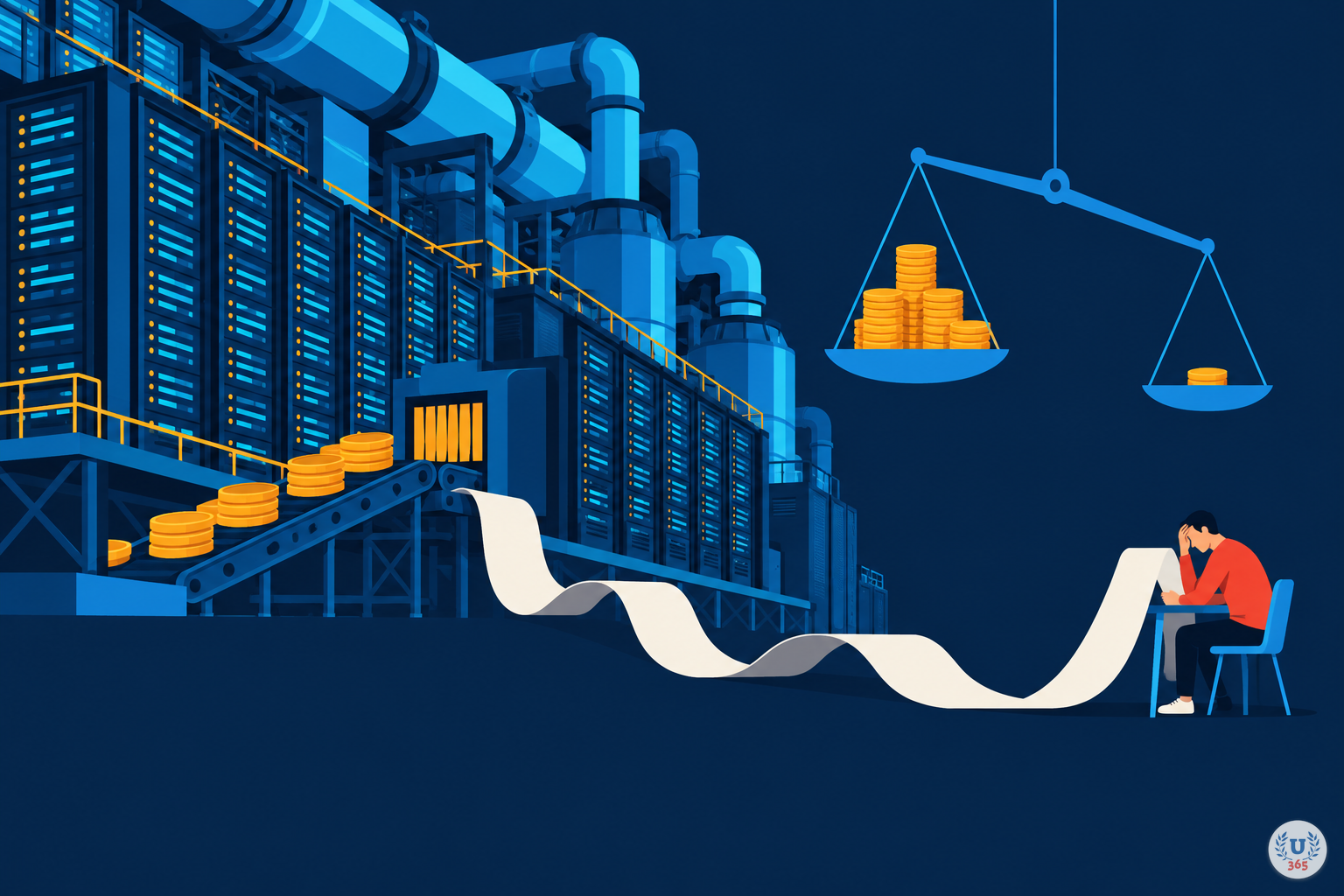
Illustration: the bill arrives. The infrastructure is paid for today; the revenue that justifies it arrives later.
That is the first half of the contradiction, and it is easy to miss because the headline numbers are so large. Two billion people now use AI worldwide, roughly a quarter of humanity, according to Menlo's estimate, but the user base grew only 11 per cent. Daily use among American AI users rose from 19 per cent to 25 per cent. Fifty-five per cent of AI users now pay for at least one product, equivalent to about 90 million Americans. Among those payers, the top 14 per cent account for 60 per cent of all spending. The market is not a pyramid with a broad base of small payments. It is a narrow spike of heavy users standing on a wide base of free users.
The professional market shows the same shape at a different scale. McKinsey's 2026 global survey found that 40 per cent of respondents from large organisations, those with more than $1 billion in revenue, report scaling AI agents, up from 27 per cent a year earlier. Among smaller organisations the share stayed flat at 22 per cent. Fifty-four per cent of large companies say they are scaling AI across the enterprise, against one third of smaller ones. Adoption is spreading fastest where capital, data and engineering talent already concentrate.
Then comes the number that does not fit the story. The share of companies that attribute at least 5 per cent of their earnings before interest and taxes to AI has stayed flat at about 6 per cent. The share that say AI has contributed to EBIT at all is 37 per cent, essentially unchanged from 2025. Eighty per cent of respondents say AI has improved their own productivity. Half say it helps them make better decisions. The individual experience is positive and widespread. The enterprise result is thin and stalled.
Put the two halves together. AI is being adopted by almost everyone who could adopt it, and it is producing a measurable financial result in a small minority of firms. The gap is not an adoption gap. It is an absorption gap: the distance between a tool that people use and a workflow that a company has rebuilt around it. McKinsey's own explanation is blunt. The high performers redesign workflows rather than inserting AI into existing ones, and they pursue growth or innovation alongside efficiency. Most companies have done the opposite: they bought seats, gave people a chatbot, and waited for the earnings to move.
Revenue without profit
The second contradiction lives in the income statement. By any historical standard, the two leading labs are growing at a rate that should make them hugely profitable. Anthropic told investors its revenue reached $16.8 billion in the third quarter of 2026, up about 46 per cent from the previous quarter, and that it was profitable on an adjusted basis for a second consecutive quarter. Its annualized revenue was reported at about $74 billion in October, up from about $65 billion in July. OpenAI told investors its annualized revenue was approaching $50 billion at the end of September, after entering the year at about $20 billion.
Those are extraordinary numbers. They are also not enough. OpenAI has told investors it expects to burn roughly $278 billion in cash between 2026 and 2030, and its internal projections imply a loss of about $14 billion in 2026 alone, roughly triple the prior year. Its compute commitments, the contracts it has signed for data centre capacity, were reported at $856 billion in a July presentation, up from about $600 billion in February. Anthropic's IPO prospectus, reported in September, describes sweeping costs alongside its growth. The company may be profitable on an adjusted basis and still be consuming capital at a rate that requires public markets to sustain it.
This is not a story about two badly run companies. It is a story about the structure of the industry. A lab must pay for training runs, inference, research staff and compute capacity years before the revenue from those investments arrives. The capacity is contracted in advance, often for five years, while the price of a token falls every quarter. If demand grows faster than expected, the lab needs more capacity and more capital. If demand grows slower than expected, the lab is left with contracted capacity and a depreciating asset. Both errors are expensive, and the industry has made both.
The infrastructure layer makes the arithmetic visible. Gartner estimates that AI providers will spend nearly $1 trillion on AI infrastructure in 2026 and another $6 trillion between 2027 and 2030. To earn a 12 per cent return on that capital, data centre owners would need cumulative revenue of about $8.5 trillion through 2030. Gartner's forecast for the revenue that can actually be attributed to AI data centres over the same period is no more than $3.6 trillion. The gap is not a rounding error. It is more than the annual GDP of every country except the United States and China. Gartner's conclusion is that more than $3.5 trillion of infrastructure spending could be exposed to impairment by 2030, and that more than 80 per cent of neocloud providers, the specialist AI cloud companies, are likely to cease independent operations.
The optimists have an answer, and it deserves to be stated fairly. The forecast may be too conservative, because it assumes current pricing and current demand. Prices can fall and demand can still grow faster, as they have for every previous general-purpose technology. The hyperscalers can absorb losses that would kill a startup, because cloud and software profits fund the build. The models may become good enough to automate work that is currently done by people, which would expand the market by orders of magnitude. All of that is possible. None of it is yet measured. The contradiction is that the industry is investing on the assumption that it will happen, while the adoption data shows a market that has already reached most of its current users.
Cheap intelligence, expensive infrastructure
The third contradiction comes from China, and it is the one that most directly threatens the business model of the Western labs.
In 2025 and 2026, Chinese labs released open-weight models that could be downloaded, run and modified by anyone: DeepSeek's reasoning models, Alibaba's Qwen family, Moonshot's Kimi, Zhipu's GLM, MiniMax's M series. They were not toys. On public benchmarks, the best of them competed with the previous generation of American frontier models, and they were free to use on your own hardware or extremely cheap through a Chinese API. A company that wanted a capable model for a customer support chatbot, a document summariser or a coding assistant could now get one without paying a Western lab.
The effect on price was immediate and measurable. The cost per million tokens for comparable capability fell by an order of magnitude in less than two years, and the fall was driven as much by Chinese competition as by engineering progress. Google cut the price of Gemini Flash in 2026. OpenAI cut prices and introduced cheaper tiers. Anthropic, whose business is concentrated in high-value coding and enterprise work, was less exposed to the cheapest segment but not immune: its own customers could route simple tasks to a cheaper model and keep the frontier model for the hard ones.
Here is the paradox. Falling prices are good for adoption and bad for the infrastructure that was financed on the assumption of high prices. If intelligence becomes a commodity, the value moves to the application layer, the distribution layer and the data, while the capital sunk into training and serving frontier models has to be recovered from a smaller margin. The Western labs are responding by moving up the stack: agents, enterprise workflows, coding, security, and proprietary data. That is a rational response. It is also an admission that the model alone is not a durable business.
The Chinese open-weight strategy is therefore not primarily a product strategy. It is a price strategy with geopolitical consequences. Every company that adopts a Chinese open-weight model reduces its dependence on an American API, and every government that hosts one gains a capability it can run inside its own borders. The United States has responded with export controls on chips and, in 2026, with restrictions on Chinese models in some government systems. The restrictions slow adoption at the top of the market. They do not change the price at the bottom, and the bottom is where most of the world's work is done.
The contradiction in one sentence
AI has achieved the widest and fastest adoption of any general-purpose technology in modern history, and the companies that supply it have not yet demonstrated that the adoption can pay for the infrastructure that makes it possible. The public uses AI more than it pays for it. Companies buy AI more than they absorb it. Labs sell AI more cheaply every quarter while committing to capacity at prices set when it was expensive. Each of those gaps is manageable on its own. Together they define the next two years.

The Adoption Divide: Public Habits, Professional Deployment, and the Economics of AI (2026)
The Current State
The consumer scoreboard, and why the numbers disagree
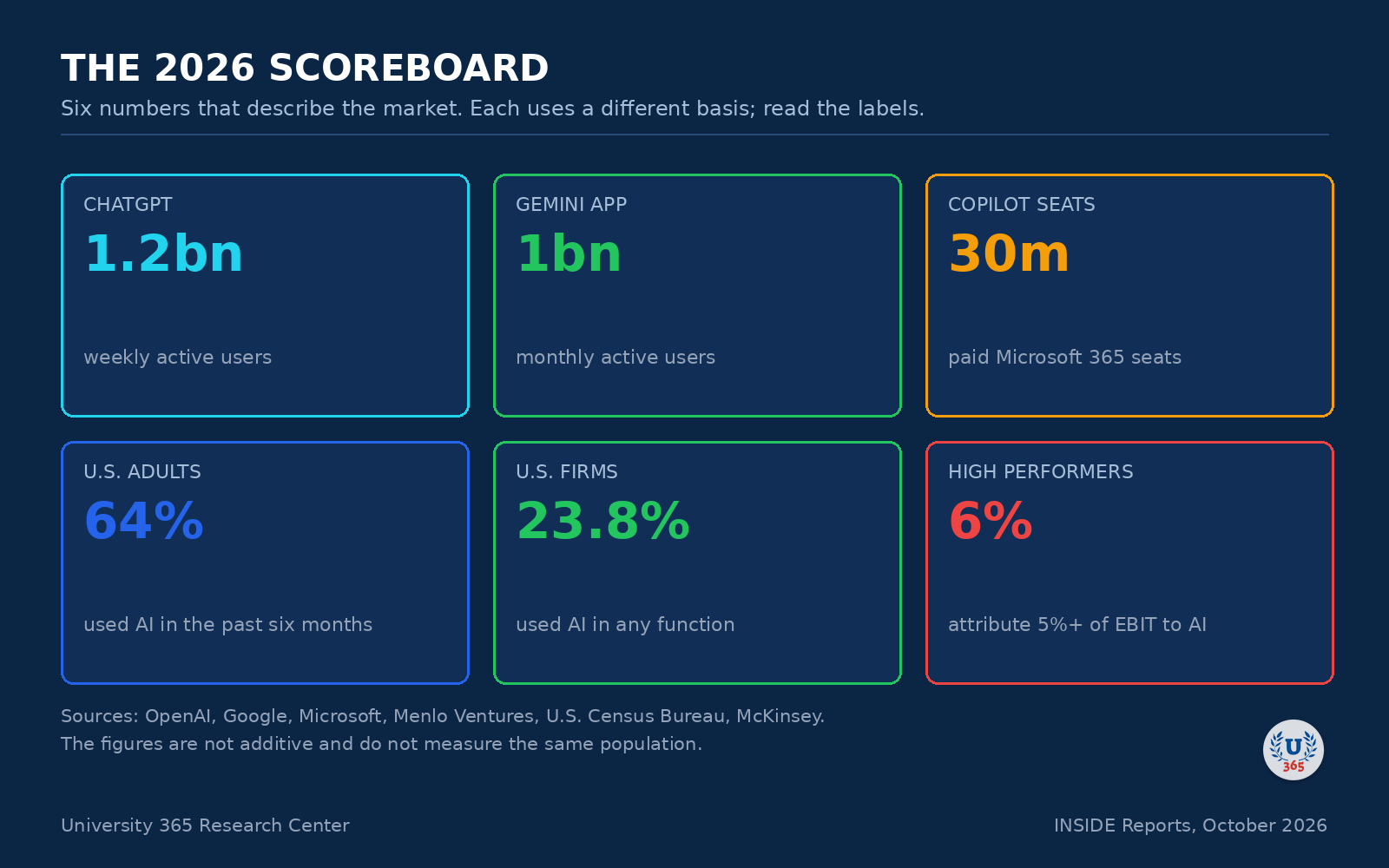
The 2026 scoreboard: six numbers from six different instruments.
Sources: OpenAI, Google, Microsoft, Menlo Ventures, U.S. Census Bureau, McKinsey.
The consumer market in October 2026 has one dominant fact and one misleading one. The dominant fact is scale: the leading assistants reach billions of people. The misleading fact is the ranking, because the ranking changes with the instrument used to measure it.
The company disclosures are the place to start, because they are the only numbers the companies themselves stand behind.
Assistant | Latest company or audited reach figure | As of | Basis |
ChatGPT | 1.2 billion weekly active users | 29 September 2026 | OpenAI disclosure at DevDay |
Gemini app | More than 1 billion monthly active users | 11 August 2026 | Google disclosure |
Google AI Mode | More than 1 billion monthly users | May 2026 | Google I/O |
Google AI Overviews | More than 2.5 billion monthly users | May 2026 | Google I/O |
Microsoft 365 Copilot | 30 million paid seats | 29 July 2026 | Microsoft earnings |
Microsoft Copilot family | 150 million monthly active users | October 2025 | Microsoft earnings, not updated since |
Claude | 245 million monthly users | May 2026 | Sensor Tower estimate, not an Anthropic disclosure |
Perplexity | More than 100 million monthly users across products | April 2026 | Company statement to the Financial Times |
Meta AI | 1 billion monthly users | May 2025 | Meta disclosure, not updated since |
Grok | 117 million monthly active users | 31 March 2026 | SpaceX IPO filing |
Read that table carefully and three things become clear.
First, the units are not the same. ChatGPT's 1.2 billion is weekly. Gemini's 1 billion is monthly. Copilot's 30 million is paid seats, not users. Claude's 245 million is a third-party estimate of "true audience" across app and web, while its app-only monthly users were estimated at 56 million. Meta's billion is 17 months old. Grok's 117 million comes from an audited IPO filing, which makes it the most reliable figure in the table and the least comparable to the others.
Second, the rankings depend on the method. Menlo Ventures surveyed 5,067 American adults in July 2026 and asked which assistants they use. It found ChatGPT at 60 per cent of AI users, Gemini at 58 per cent and Claude at 20 per cent. Sensor Tower's panel, which counts unique users across apps and web, put ChatGPT at 46.4 per cent of assistant users at the end of May, Gemini at 27.7 per cent and Claude at 10.3 per cent. The two datasets do not contradict each other so much as measure different things: one asks a person which tools they use, the other counts devices. The survey shows that Gemini is now within two points of ChatGPT in the minds of American users. The panel shows that ChatGPT still reaches roughly twice as many unique users. Both can be true, and a reader who sees only one number will misunderstand the market.
Third, the paid signal is different from the reach signal. ChatGPT had more than 50 million paying subscribers in February 2026, across consumer and business tiers. Claude has never disclosed a subscriber count, but 82 per cent of its users pay for at least one AI product, against 55 per cent of AI users overall, and its users are twice as likely to spend more than $100 a month. Perplexity's revenue is growing faster than its user base. The assistant with the most users is not the assistant with the most committed ones.
That is the consumer market in one sentence: ChatGPT owns reach, Gemini owns distribution, Claude owns willingness to pay, and the rest are fighting for a niche that is smaller than their valuations imply.
The professional scoreboard, and why every adoption rate is true
If the consumer numbers disagree because of units, the enterprise numbers disagree because of definitions. In October 2026, four credible sources published four different adoption rates for the same economy, and all four are defensible.
The United States Census Bureau's Business Trends and Outlook Survey, which samples employer businesses and is the closest thing to an official measure, found that 23.8 per cent of firms used AI in at least one business function in the two weeks to 4 October 2026. That was up from 17.3 per cent in November 2025, a rise of 6.5 points in eleven months under a revised question that asks about any business function rather than only production. The Census data also shows the concentration: 37 per cent of firms with 250 or more employees used AI, against fewer than 20 per cent of firms with four or fewer.
Ramp, a corporate card company, measures something different: whether a business paid an AI vendor in a given month. Its index reached 55.9 per cent of its panel in September 2026. That is not adoption in the Census sense. It is paid consumption, and Ramp's panel skews toward digitally active businesses, so it overstates the economy and understates free use.
McKinsey's global survey, fielded between May and June 2026 with 1,719 respondents in 97 countries, found that nearly nine in ten respondents report regular use of AI in at least one function, that 44 per cent say AI is scaling across the enterprise, and that 56 per cent use it in three or more functions. That sample is weighted toward large organisations: 36 per cent of respondents work for companies with more than $1 billion in revenue.
Eurostat's official measure for the European Union found 20.0 per cent of enterprises with 10 or more employees using AI in 2025, up from 13.5 per cent in 2024. Denmark reached 42 per cent; Romania 5.2 per cent.
Four rates: 23.8 per cent, 55.9 per cent, nearly 90 per cent and 20.0 per cent. The gap between the lowest and the highest is not a data error. It is the difference between counting all firms and counting large ones, between counting use and counting payment, and between asking a manager and asking a respondent who opted into a survey about AI. A report that quotes one number without its instrument is not informing the reader. It is choosing a conclusion.
The same applies to seats. Microsoft's 30 million paid Microsoft 365 Copilot seats is the cleanest enterprise metric in the market because it is a financial disclosure, not a survey. Google reported 8 million paid Gemini Enterprise seats across 2,800 companies in April 2026. OpenAI reported 2 million business customers in July. Anthropic reported more than 300,000 business customers, of which more than 1,000 spend more than $1 million a year. Those numbers are not comparable either: a seat is a person, a business customer is a company, and a $1 million account is a contract. But together they show that paid professional deployment has moved well beyond the pilot stage at the top of the market, while remaining rare at the bottom.
The agent layer is the fastest-moving part of the professional market and the least mature. McKinsey found that 40 per cent of large organisations are scaling AI agents, against 22 per cent of smaller ones, and roughly two in ten organisations overall. Gartner forecasts that spending on AI agents and assistants will reach $29.2 billion in 2026, up 77 per cent from $16.5 billion in 2025. Microsoft said that about 40 million agents were registered in its Agent 365 platform two months after launch. Those are large numbers, and they measure registrations and spending, not successful outcomes. Gartner also predicts that more than 40 per cent of agentic AI projects will be cancelled by the end of 2027, which is the most useful forecast in the category because it prices the failure rate into the growth rate.
The money, by company
The revenue picture in October 2026 is the strongest in the industry's short history and the most fragile.
OpenAI entered 2026 with an annualized revenue of about $20 billion and ended September at about $50 billion, according to people familiar with the numbers. Its audited 2025 revenue was $13.07 billion, up 253 per cent, on a gross margin of 42.6 per cent and an operating loss of $20.92 billion. The company told investors it expects to reach or exceed $70 billion in annualized revenue by the end of 2026, a target that requires the second half of the year to grow faster than the first. Its enterprise business crossed over consumer in August 2026 and is now the majority of revenue. Its valuation was $852 billion after a $122 billion round in March 2026, and it was in talks in September for a further $30 billion or more at a pre-money valuation of about $1.4 trillion.
Anthropic reported $16.8 billion of revenue in the third quarter of 2026, up about 46 per cent from the previous quarter. It told investors it was profitable on an adjusted operating basis for a second consecutive quarter, with an 85 per cent gross margin, positive free cash flow, and $1.70 of revenue for every $1 of compute, up from $0.63 in 2025. Its annualized revenue was reported at about $65 billion in July and about $74 billion in October. It filed confidentially for an IPO in June and was expected to list in November at a valuation of up to $2 trillion, against $965 billion in its May 2026 private round. Its contractual obligations were reported at $518 billion over ten years, about 80 per cent of them non-cancelable.
Google reported $119.8 billion of revenue in the second quarter of 2026, up 24 per cent, with Google Cloud at $24.8 billion, up 82 per cent. Its operating income was $40.77 billion. Its net income of $112.1 billion included a $98 billion equity gain, which is a reminder that Google is both an AI operator and an investor in the sector. Its 2026 capital expenditure was guided at $195 billion to $205 billion, and its purchase commitments reached $811 billion.
Microsoft reported $331.8 billion of revenue in its fiscal year 2026, up 18 per cent, with net income of $133.7 billion. Azure passed $100 billion in annual revenue. Its AI business reached a $37 billion annual run rate, up 123 per cent, and Microsoft 365 Copilot passed 30 million paid seats. Its lease commitments were $443.5 billion against $88.5 billion recorded, and its calendar 2026 capital expenditure was estimated at about $175 billion.
Perplexity reached a reported $750 million annualized revenue in August 2026, more than three times its January level, and was in talks for a valuation above $30 billion. Mistral reported more than $400 million in annualized revenue and raised €3 billion in September 2026 at a valuation above €21 billion. Cohere reported $240 million in annualized revenue in February 2026 and agreed a merger with Aleph Alpha in September. xAI reported $818 million of revenue in the first quarter of 2026 against a $2.47 billion operating loss, after a 2025 in which it lost $6.36 billion on $3.2 billion of revenue; it was absorbed into SpaceX in February 2026 at a $250 billion mark.
The pattern is not a simple story of winners and losers. It is a story of scale: the companies with cloud and software profits can fund the build, the two leading labs can fund it only with private capital and, soon, public markets, and the specialists must either find a profitable niche or be acquired. The next section turns those facts into findings.

The Adoption Divide: Public Habits, Professional Deployment, and the Economics of AI (2026)
Key Findings
1. Consumer adoption has stopped growing, and consumer spending has tripled
The most important consumer statistic of 2026 is not a user number. It is the difference between two rates. The share of American adults who use AI rose from 61 per cent to 64 per cent in a year, a three-point move that is within the range of survey noise. Over the same period, global consumer spending on AI rose from $12 billion to $40 billion, more than tripling. Menlo Ventures, which measured both, describes the year as one in which "adoption barely moved even as spending exploded."
The growth came from people who already used AI going deeper. Daily use rose from 19 per cent to 25 per cent of American adults. Fifty-five per cent of American AI users now pay for at least one AI product, roughly 90 million people. The typical payer spends $20 to $49 a month, and the top 14 per cent of payers, those spending $100 or more a month, account for 60 per cent of all consumer spending. The market is not a broad pyramid of small subscriptions. It is a narrow group of heavy users, each paying several subscriptions, supported by a much larger group that pays nothing.
That shape has a direct commercial consequence. A consumer AI business cannot grow by adding new users in the United States, because it already reaches most of the people who are willing to try it. It must either extract more from the users it has, expand internationally, or sell something else to the same person. The first path explains the price tiers and the agent subscriptions of 2026. The second explains the push into India, Brazil and Southeast Asia. The third explains why every consumer assistant is also selling a business plan.
2. The assistant market is a three-way race, and the ranking depends on how you measure it
Three companies now define the consumer assistant market, and each leads a different scoreboard.
Menlo's survey of American AI users found ChatGPT at 60 per cent, Gemini at 58 per cent and Claude at 20 per cent, with ChatGPT's lead over Gemini narrowing from nine points to two in a year. Gemini grew 22 points; Claude nearly tripled its reach from 7 per cent to 20 per cent. Sensor Tower's device panel, which counts unique app and web users rather than asking people which tools they use, put ChatGPT at 46.4 per cent of assistant users at the end of May, Gemini at 27.7 per cent and Claude at 10.3 per cent. The survey measures consideration and habit; the panel measures reach. Both are useful, and neither is the market share.
The deeper finding is that consumers do not choose one assistant. The average AI user now uses 3.0 general assistants, up from 2.2 a year earlier. They use ChatGPT for one task, Gemini because it is inside Android or Search, Claude because a colleague recommended it for writing or code, and Copilot because their employer bought it. Multi-homing is the norm, which means the market is not winner-takes-all in the way the app economy was. It is a market of default positions. The assistant that is already present at the moment of need wins the session, and the assistant that wins the session gradually becomes the habit.
That is why Google's distribution is worth more than its model scores, and why Microsoft's seat count is worth more than its consumer app traffic. It is also why OpenAI's consumer lead, while real, is more fragile than a billion weekly users suggests. Reach acquired through a superior product can be lost to a competitor that is simply closer to the user.
3. ChatGPT owns reach, Gemini owns distribution, Claude owns willingness to pay
The three leaders have three different kinds of strength, and confusing them is the most common error in the market commentary.
ChatGPT has the widest reach. OpenAI reported 1.2 billion weekly active users in September 2026, up from 900 million in February, and more than 50 million paying subscribers across consumer and business tiers. Its app had 1 billion monthly users in May 2026, the fastest app to that mark, and it retained 86 per cent of new users, the highest in the category. It is the default assistant for the American mainstream: 44 per cent of American adults say they ever use it, including 61 per cent of people aged 18 to 29.
Gemini has the best distribution. The app passed 1 billion monthly users in August 2026, up from 400 million a year earlier, and Google's AI Mode in Search passed 1 billion monthly users in May. AI Overviews reach 2.5 billion people a month, which is not the same as 2.5 billion people choosing Gemini, but it is an enormous surface on which Google can teach the habit. Gemini users now spend 100 minutes a month with the product, up from 14 minutes a year earlier, which is the clearest sign that distribution is converting into use.
Claude has the deepest monetisation per user. It reaches a smaller audience, estimated at 245 million monthly users across app and web and 56 million on the app alone, but 82 per cent of its users pay for at least one AI product, against 55 per cent of AI users overall. Its users are 1.5 times as likely to run agents and twice as likely to spend more than $100 a month. Its iOS paid conversion is 13 per cent, against 8 per cent for ChatGPT, and its mobile revenue per user is $2.76 against $1.74. Claude is not winning the consumer market. It is winning the part of the consumer market that behaves like a professional market.
Microsoft's position is different again. Its 30 million paid Microsoft 365 Copilot seats are an enterprise achievement, not a consumer one. Its consumer Copilot app was estimated at 38.5 million monthly users in July, a small fraction of ChatGPT or Gemini. Microsoft's bet is that the enterprise seat is the durable position, because it sits inside the tools where work is already being done and because the buyer is a company rather than a person.
4. Professional adoption is real at the top, thin at the bottom, and financial impact lags
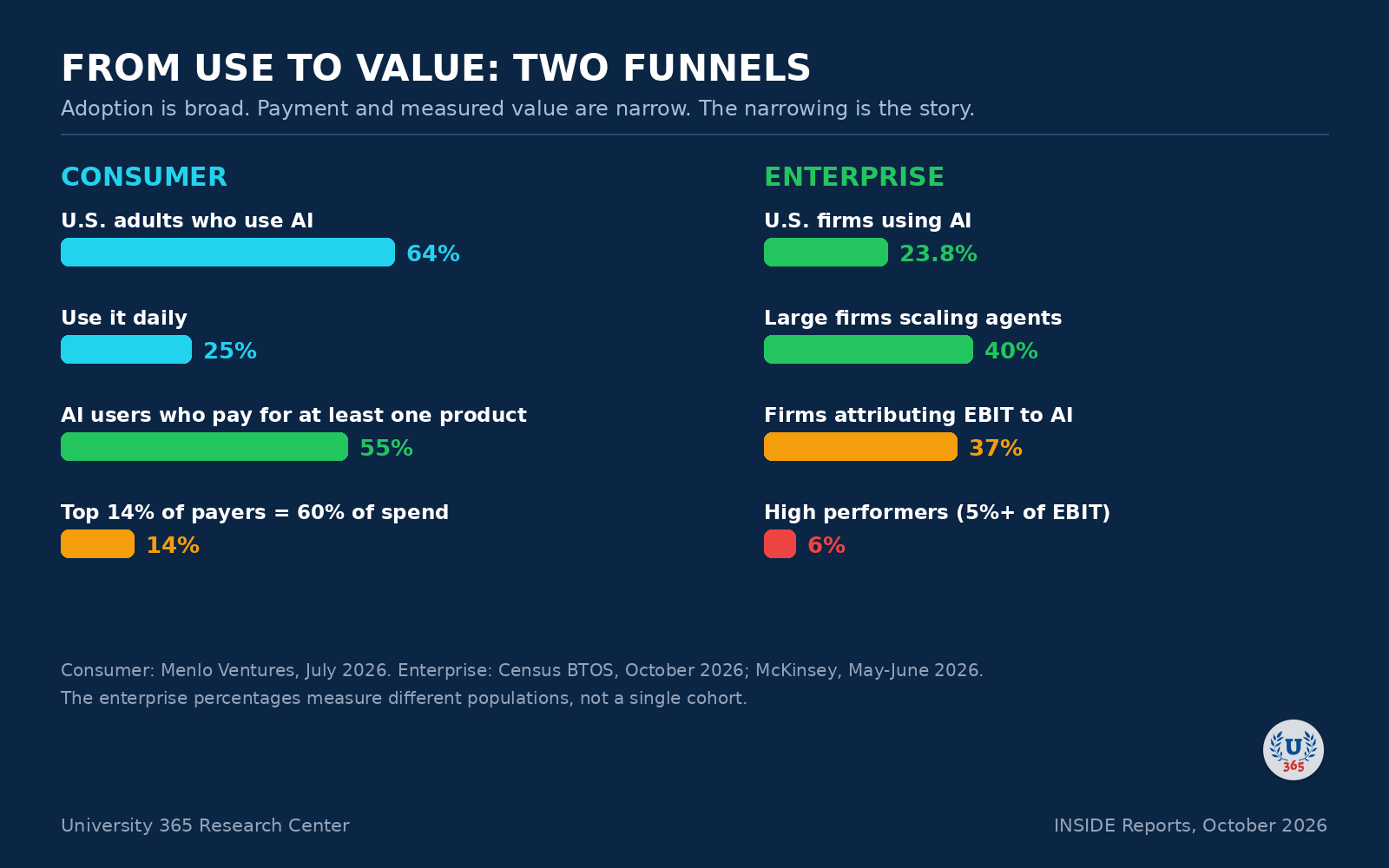
From use to value: adoption is broad, payment and measured value are narrow.
Sources: Menlo Ventures, July 2026; Census BTOS, October 2026; McKinsey, May-June 2026.
The enterprise market is not one market. It is a small number of large companies deploying deeply and a large number of small companies experimenting lightly.
The Census Bureau's October 2026 data shows 23.8 per cent of American firms using AI in any business function, up from 17.3 per cent in November 2025. But 37 per cent of firms with 250 or more employees use it, against fewer than 20 per cent of firms with four or fewer. McKinsey's survey shows the same concentration from the other direction: 54 per cent of companies with more than $1 billion in revenue say they are scaling AI across the enterprise, against one third of smaller companies, and 40 per cent of large organisations are scaling agents against 22 per cent of small ones.
The financial result is thinner than the deployment. Thirty-seven per cent of McKinsey's respondents say AI has contributed to earnings before interest and taxes, essentially unchanged from 2025. Only about 6 per cent qualify as high performers, meaning they attribute at least 5 per cent of earnings to AI and describe the impact as significant. That share has not moved in a year. Eighty per cent of respondents say AI has improved their own productivity, and half say it helps them make better decisions, so the individual experience is positive. The organisational result is not.
The pilot-to-production gap explains part of the difference. Menlo Ventures found that 47 per cent of committed AI deals reach production, against 25 per cent for traditional software, which is better than the popular narrative suggests. But the failure rate remains high in the aggregate: Gartner predicts that more than 40 per cent of agentic AI projects will be cancelled by the end of 2027. The pattern is not that AI fails. It is that AI succeeds at the task level and fails at the workflow level, because a task can be automated without changing the process around it, and the value only appears when the process changes.
5. The model market is an oligopoly with a rotating leader, and enterprises multi-source by default
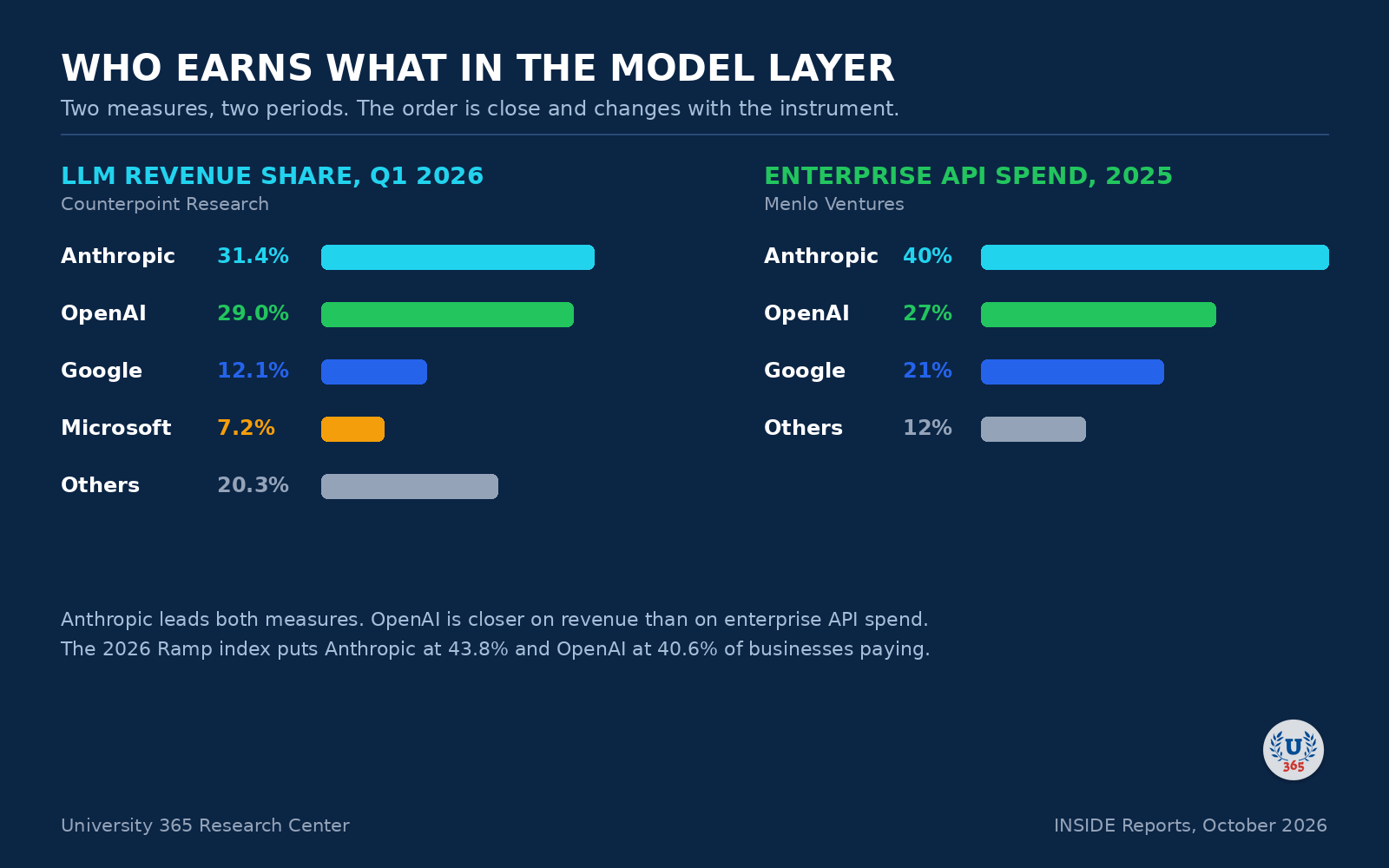
Who earns what in the model layer: two measures, two periods.
Sources: Counterpoint Research, Q1 2026; Menlo Ventures, December 2025.
At the model layer, three companies account for almost all of the enterprise market, and their order changes with the quarter and the metric.
Menlo Ventures put enterprise language model API spending in 2025 at Anthropic 40 per cent, OpenAI 27 per cent and Google 21 per cent. Counterpoint Research's revenue share for the first quarter of 2026 put Anthropic at 31.4 per cent, OpenAI at 29.0 per cent, Google at 12.1 per cent and Microsoft at 7.2 per cent. Ramp's transaction data for September 2026 showed Anthropic paid by 43.8 per cent of businesses and OpenAI by 40.6 per cent, a lead of 3.2 points that had narrowed from 4.4 points in July. The three leaders are close enough that a single product release can change the order.
The more important fact is that enterprises do not choose one supplier. A 2026 preprint on multi-model adoption, drawing on survey and transaction data, reports that 81 per cent of Global 2000 enterprises run three or more model families, and that OpenAI, Anthropic and Google together account for roughly 88 to 89 per cent of enterprise model usage and spending. Companies route different tasks to different models: a cheap model for classification, a frontier model for code, a domestic or open-weight model for regulated data. The model layer is therefore not a winner-takes-all market. It is an oligopoly in which the buyers deliberately keep several suppliers alive.
That structure has two consequences. It limits the pricing power of every lab, because a customer can move a workload to a rival in days. It also raises the cost of selling, because each lab must integrate with the same enterprise stack and pass the same security reviews. The labs that win are not necessarily the ones with the best model. They are the ones with the best distribution into the workflow, which is why coding became the first large market and why Anthropic's enterprise position is stronger than its consumer position.
6. Enterprise revenue is now the centre of gravity, even at OpenAI
The most consequential strategic shift of 2026 is that the consumer company became an enterprise company.
OpenAI entered the year with a revenue mix of roughly 60 per cent consumer and 40 per cent enterprise. By August 2026, its finance chief told investors that enterprise had overtaken consumer and was now the majority of revenue. Its enterprise run rate grew 107 per cent in the third quarter, faster than the consumer business, and it reported 2 million business customers. The company that built its brand on a free chatbot now earns most of its money from companies.
Anthropic was enterprise-heavy from the start. Roughly 80 per cent of its revenue is enterprise or API, according to third-party estimates, and its business customer count passed 300,000, with more than 1,000 accounts spending over $1 million a year. Google's Gemini Enterprise reached 8 million paid seats across 2,800 companies by April 2026, and Microsoft's Copilot reached 30 million seats. The professional market is where the revenue is, and every major lab has reorganised around it.
Coding is the tip of that market. Anthropic's Claude Code reached a $2.5 billion annualized run rate in February 2026, having doubled since January. Cursor, the independent coding environment, passed $4 billion in annualized revenue by June 2026, up from $3 billion in April, with $2.6 billion of that from enterprise contracts. Among consumers who use AI agents, OpenAI's Codex held 35 per cent share, Claude Code and Cowork 32 per cent, and Perplexity 24 per cent, according to Menlo. Coding won first because the output is testable: a code change either passes the tests or it does not. That makes it the one domain where AI's value can be measured without reorganising the whole company, which is exactly why it became the beachhead.
7. The economics do not close yet, and the gap is infrastructure, not demand
The revenue growth is real. The infrastructure bill is larger.
OpenAI's annualized revenue reached about $50 billion at the end of September 2026, against an audited 2025 revenue of $13.07 billion. It projects a cumulative negative free cash flow of about $278 billion between 2026 and 2030 and has announced compute deals worth about $1.4 trillion. Anthropic's annualized revenue reached about $74 billion in October, with an 85 per cent gross margin and positive free cash flow in the third quarter, but it carries $518 billion of contractual obligations over ten years, about 80 per cent of them non-cancelable. Both companies are growing faster than any enterprise software company in history and both need capital at a scale that only public markets or a handful of sovereign funds can provide.
The infrastructure layer is where the arithmetic becomes uncomfortable. The four largest hyperscalers guided $720 billion to $745 billion of capital expenditure in 2026, up about 77 per cent from $413 billion in 2025, and their combined capex is on track to exceed their operating cash flow by 2027. Gartner estimates that AI providers will spend nearly $1 trillion on infrastructure in 2026 and another $6 trillion between 2027 and 2030. To earn a 12 per cent return, data centre owners would need cumulative revenue of about $8.5 trillion through 2030; Gartner's forecast for the revenue attributable to AI data centres is no more than $3.6 trillion. That is why Gartner expects more than $3.5 trillion of infrastructure spending to be exposed to impairment and more than 80 per cent of neocloud providers to cease independent operations by 2030.
None of this means the sector is about to collapse. Alphabet, Microsoft, Amazon and Meta can fund the build from profitable businesses, and a lower price for intelligence expands the market. It means the marginal supplier, the pure-play lab or neocloud that has no other profit centre, is the one that must prove the economics first. The IPO window of late 2026 and 2027 is the test, and the first company through it will set the price for everyone else.
8. Dedicated tools are absorbing routine work faster than chatbots are transforming it
The least covered part of the adoption story is the one closest to daily work: the dedicated tool that does a single job.
Meeting assistants are the clearest case. Otter.ai reported 35 million users and 1 billion meetings processed by April 2026; its $100 million annual recurring revenue milestone dates from March 2025 and has not been updated, which is itself a signal that growth has slowed. Fireflies.ai reports 20 million users, 500,000 organisations and a presence in 75 per cent of the Fortune 500, without disclosing revenue. Granola raised $125 million at a $1.5 billion valuation in March 2026, up from $250 million ten months earlier, on revenue that had grown 2.5 times its full-year 2025 total by mid-March, though it has not disclosed an absolute figure. Fathom, with 400,000 monthly active users, was acquired by Superhuman in September 2026 rather than growing independently. Grand View Research puts the meeting-assistant market at $4.3 billion in 2026, with other houses ranging from $0.85 billion to $3.67 billion depending on whether bundled minutes are counted.
The pattern repeats in writing and coding. Grammarly's parent rebranded as Superhuman in October 2025 and now reports about $700 million of revenue, 40 million daily users, 50,000 organisations and 100 billion model calls a week, but it sells a four-product suite rather than a grammar checker. Jasper, the category's first breakout, is flat to down at an estimated $88 million to $90 million after peaking near $120 million, and Copy.ai sold to Fullcast in October 2025. Notion crossed $500 million of annualized revenue in September 2025 and was estimated at $865 million by July 2026, with more than half of that revenue coming from AI-enabled customers. In coding, Cursor reached $4 billion in annualized revenue by June 2026, and SpaceX agreed to buy its parent, Anysphere, for $60 billion in an all-stock deal that closed in August. GitHub Copilot reached 50 million users. Zoom folded its AI Companion into ZoomMate. The standalone tool is not disappearing, but it is being absorbed into the suite, because the buyer prefers one contract and one security review to ten.
That is the quiet lesson of 2026. The chatbot is the visible product, but the dedicated tool is where routine work is actually being removed. A meeting that used to produce a document now produces a summary, a list of decisions and a set of tasks without anyone typing. That is a real productivity gain, and it does not show up in a chatbot's user count. It shows up in the revenue of companies that most people in the AI debate have never heard of.

The Adoption Divide: Public Habits, Professional Deployment, and the Economics of AI (2026)
Deep Analysis
The consumer stack: habit at the top, payment in the middle
The consumer market looks like a race for users. It is better understood as a race for the moment of need.
A person opens an assistant when a task appears: a question, a draft, a photo, a decision. The assistant that is already present at that moment wins the session. That is why Google's distribution is so valuable. Gemini is inside Android, inside the search box, inside Workspace and inside the Chrome address bar. A user does not have to decide to use Gemini; the product appears where the question is already being typed. The Gemini app passed 1 billion monthly users in August 2026 not because it is the best-loved assistant, but because it is the most available one. Its usage per user rose from 14 minutes a month to 100 minutes, which means availability is turning into habit.
OpenAI's advantage is different. ChatGPT is the assistant people choose when they have decided to use an assistant. It has the strongest brand, the widest feature set and the highest retention: 86 per cent of new users in May 2026, against 73.7 per cent for Claude. Its 1.2 billion weekly users are not an accident of distribution. They are the result of three years of product iteration and a free tier that is good enough to keep.
The payment layer sits beneath both. Menlo's data shows that 55 per cent of American AI users pay for at least one product, but the spending is concentrated: the top 14 per cent of payers account for 60 per cent of spending, and the typical payer spends $20 to $49 a month. That is the profile of a utility bill, not a luxury purchase. People pay for AI the way they pay for storage or music: a small monthly amount, several subscriptions, and a constant willingness to cancel the one they use least.
The subscription economics follow from that. A consumer assistant with 100 million free users and 5 million payers has a revenue base of roughly $1 billion a year at $20 a month, before app-store fees and inference costs. That is a good business for a company with a cheap model. It is a difficult business for a company whose inference costs more than its subscription revenue, which is why the labs keep pushing users toward annual plans, higher tiers and agent features that consume more tokens and cost more.
The agent is the next attempt to raise the ceiling. Forty-one per cent of American AI users have tried an agent, 24 per cent use one regularly, and 32 per cent have let an agent act on their behalf without final approval, according to Menlo. Agent users are the best customers in the market: 92 per cent pay for AI, 63 per cent use it daily, and 21 per cent of regular agent users who pay spend $100 or more a month, against 5 per cent of paying non-agent users. The agent is how a $20 subscription becomes a $100 subscription. It is also how a consumer product becomes a consumer risk, because an agent with access to email, calendars, cloud storage and financial accounts can fail in ways a chatbot cannot. Menlo found that users have already granted agents access to email (36 per cent), browsers (33 per cent), messaging apps (31 per cent), cloud storage (29 per cent) and calendars (27 per cent). The permission graph is being built faster than the safety layer.
The enterprise stack: seats, tokens, and the multi-lab default
The professional market is not a bigger version of the consumer market. It is a different business with a different unit of sale.
The seat is the first unit. Microsoft sells Microsoft 365 Copilot at $30 per user per month on an annual commitment, bundled into a suite that companies already buy. That bundling is the reason Microsoft reached 30 million paid seats faster than any pure AI company: the buyer is not purchasing a new product, but adding a feature to an existing contract. Google follows the same logic with Gemini Enterprise, which reached 8 million paid seats across 2,800 companies by April 2026. The seat is sticky because it is embedded in the tools where work happens, and it is measurable because it appears in a procurement system.
The token is the second unit. A company that builds AI into its own product pays per token, and its usage can grow without a corresponding growth in seats. This is where the model layer lives, and it is where the largest enterprise budgets are moving. Anthropic's revenue is roughly 80 per cent enterprise and API, and its business customer count passed 300,000, with more than 1,000 accounts spending over $1 million a year. OpenAI's enterprise revenue overtook consumer in August 2026. The token business is more scalable than the seat business and more exposed to price competition, because a token is a commodity and a customer can switch models in an afternoon.
The agent is the third unit, and the least settled. McKinsey found that 40 per cent of large organisations are scaling agents, and Gartner expects spending on agents and assistants to reach $29.2 billion in 2026. Microsoft said about 40 million agents were registered in Agent 365 two months after launch. Those numbers describe a market that is being built, not one that has been proven. Gartner's forecast that more than 40 per cent of agentic projects will be cancelled by the end of 2027 is the necessary counterweight: the same research house that sizes the market is warning that most of the projects will not survive.
The multi-lab default is the most important structural fact in the enterprise stack. Companies do not standardise on one model. The 2026 preprint on multi-model adoption reports that 81 per cent of Global 2000 enterprises run three or more model families, and that the big three account for 88 to 89 per cent of usage and spending. A bank might use a frontier model for code, a cheaper model for customer support, a domestic open-weight model for regulated data, and an internal model for confidential documents. The routing layer, the gateway that decides which model handles which request, becomes a strategic piece of infrastructure. It also becomes a cost-control problem: the same preprint reports that 79 per cent of enterprises overran their AI budgets in the past year, with financially mature organisations overshooting by an average of 30.9 per cent, because token-based consumption is behaviour-driven and hard to forecast.
The dedicated tools sit inside this stack, and they are where most employees meet AI. A meeting assistant joins the call, transcribes it, summarises it and extracts tasks. A writing assistant checks tone and grammar inside the document. A coding assistant proposes a patch inside the editor. These tools are sold as applications, often on top of a model API, and their adoption is faster than the adoption of general chatbots at work because they remove a specific task rather than asking the employee to invent a use. Otter, Fireflies, Granola, Fathom, Superhuman and ZoomMate are all variations on that theme. The market is consolidating into suites because the buyer prefers one contract, which is why Fathom was acquired and why Grammarly became Superhuman. The standalone tool is not dying, but the independent standalone company is.
That is the professional market in one sentence: seats are the distribution, tokens are the revenue, agents are the growth, and the routing layer is the control point. The companies that own the distribution and the routing layer can survive a price war. The companies that own only a model cannot.
The economics: who earns, who burns, who pays
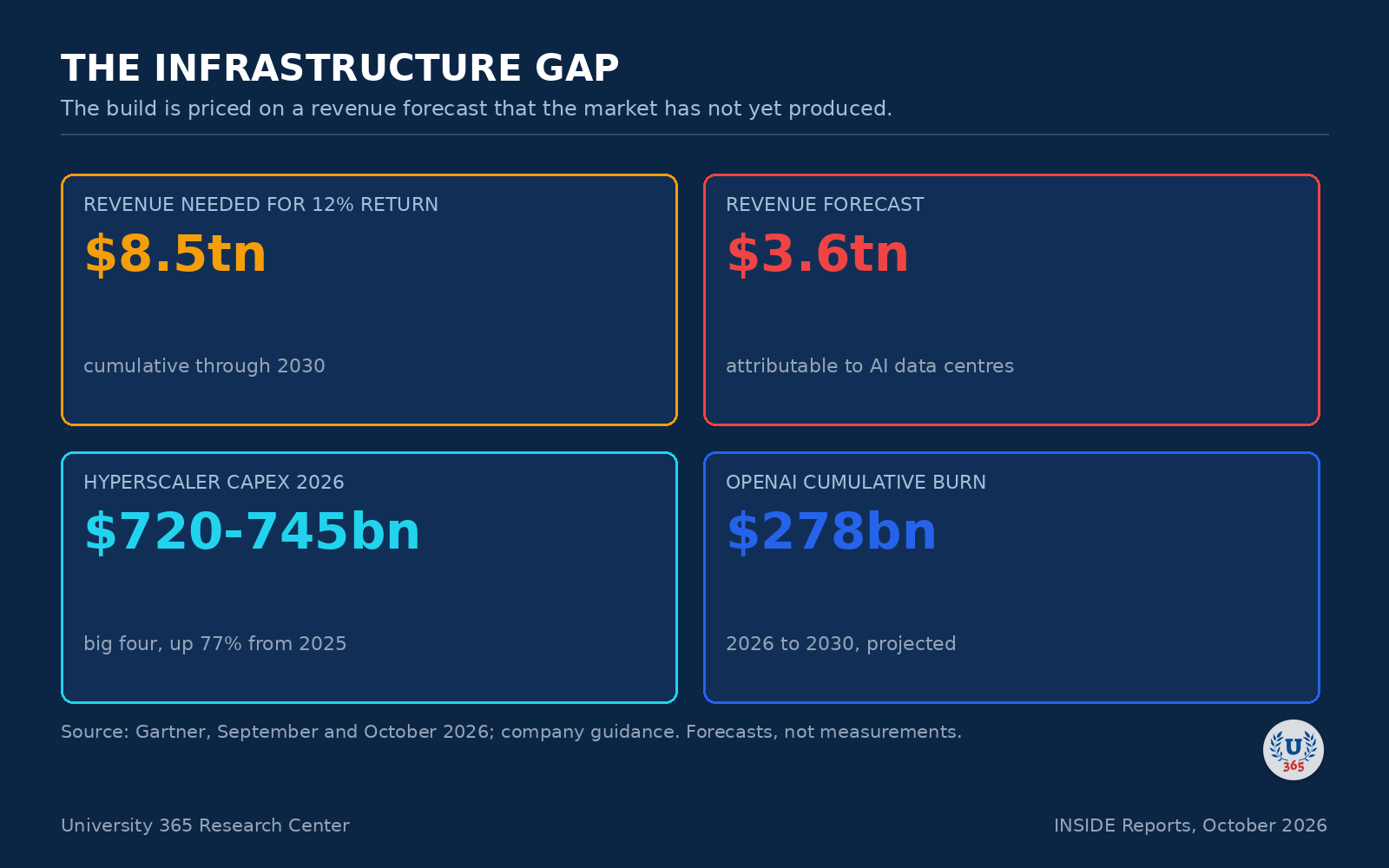
The infrastructure gap: the build is priced on revenue that has not arrived.
Sources: Gartner, September and October 2026; company guidance.
The financial statements of 2026 tell a story that the product announcements hide. The two leading labs have different unit economics, and the difference explains their different strategies.
Anthropic's third quarter of 2026 was, on its own adjusted metrics, a good quarter: $16.8 billion of revenue, an 85 per cent gross margin, an adjusted operating margin above 11 per cent, positive free cash flow, and $1.70 of revenue for every $1 of compute, up from $0.63 in 2025. That last number is the important one. It means Anthropic has become more efficient at turning compute into revenue, which is the only way a lab can survive a price war without a cloud business behind it. Its concentration in enterprise and coding helps: a coding agent that saves a company a senior engineer's time can charge a high price per token, and the customer is less sensitive to price than a consumer choosing between $20 subscriptions.
OpenAI's economics are different. Its audited 2025 accounts show $13.07 billion of revenue, a 42.6 per cent gross margin and a $20.92 billion operating loss. The lower margin reflects a consumer-heavy business, a large free tier, heavy research spending and the cost of serving hundreds of millions of weekly users. The company is moving toward enterprise, where the margin is better, but it is doing so while carrying the cost of the consumer business that built its brand. Its projected $278 billion of cumulative negative free cash flow through 2030 is the price of staying at the frontier in both markets at once.
The hyperscalers are in a different position. Alphabet, Microsoft, Amazon and Meta can fund AI from profits earned elsewhere. That does not make them immune to the economics; it makes them able to wait. Alphabet's capital expenditure was guided at $195 billion to $205 billion for 2026, Microsoft's at about $175 billion, Meta's at $130 billion to $145 billion. The four together guided $720 billion to $745 billion, up about 77 per cent from $413 billion in 2025. The pressure is already visible in free cash flow: Alphabet reported its first negative quarterly free cash flow, Amazon's trailing free cash flow was negative $7.6 billion, and Meta's quarterly free cash flow fell 91 per cent to $784 million. Microsoft's capital expenditure now exceeds its annual operating income.
The financing is migrating off the income statement. Alphabet raised $49.6 billion of equity and $20.3 billion of notes in a single quarter. SoftBank funded its final $10 billion OpenAI tranche with an $11.1 billion bond sale. Meta carries about $420 billion of off-balance-sheet AI obligations, according to reporting based on Nikkei and The Wall Street Journal. Microsoft's total lease commitments are $443.5 billion against $88.5 billion recorded. The industry is not running out of money. It is converting equity into debt and commitments, which extends the runway and raises the cost of a mistake.
Prices are falling at the same time. The Silicon Data expenditure index, which tracks what buyers actually pay per million tokens, fell to 97 cents on 31 August 2026, less than half its May peak of $2.07. OpenAI cut its cheap tier by 80 per cent in July. Anthropic cut Haiku by 90 per cent and Opus by 20 per cent. Google, by contrast, has scheduled a doubling of Gemini Flash introductory prices on 1 January 2027, which suggests that at least one provider has decided the era of loss-leading prices is over. The direction is not uniform, and that is the point: the price of a token is now a strategic variable, not a technological one.
Put the pieces together and the industry's problem is not demand. Demand is growing. The problem is duration: the capital is committed on five-to-fifteen-year schedules, the assets depreciate on five-to-ten-year schedules, and the revenue arrives quarter by quarter at a price that keeps falling. A company can survive that mismatch if it has a profitable business underneath. A company that has only the model cannot.
The China price: open weights and the commoditisation of intelligence
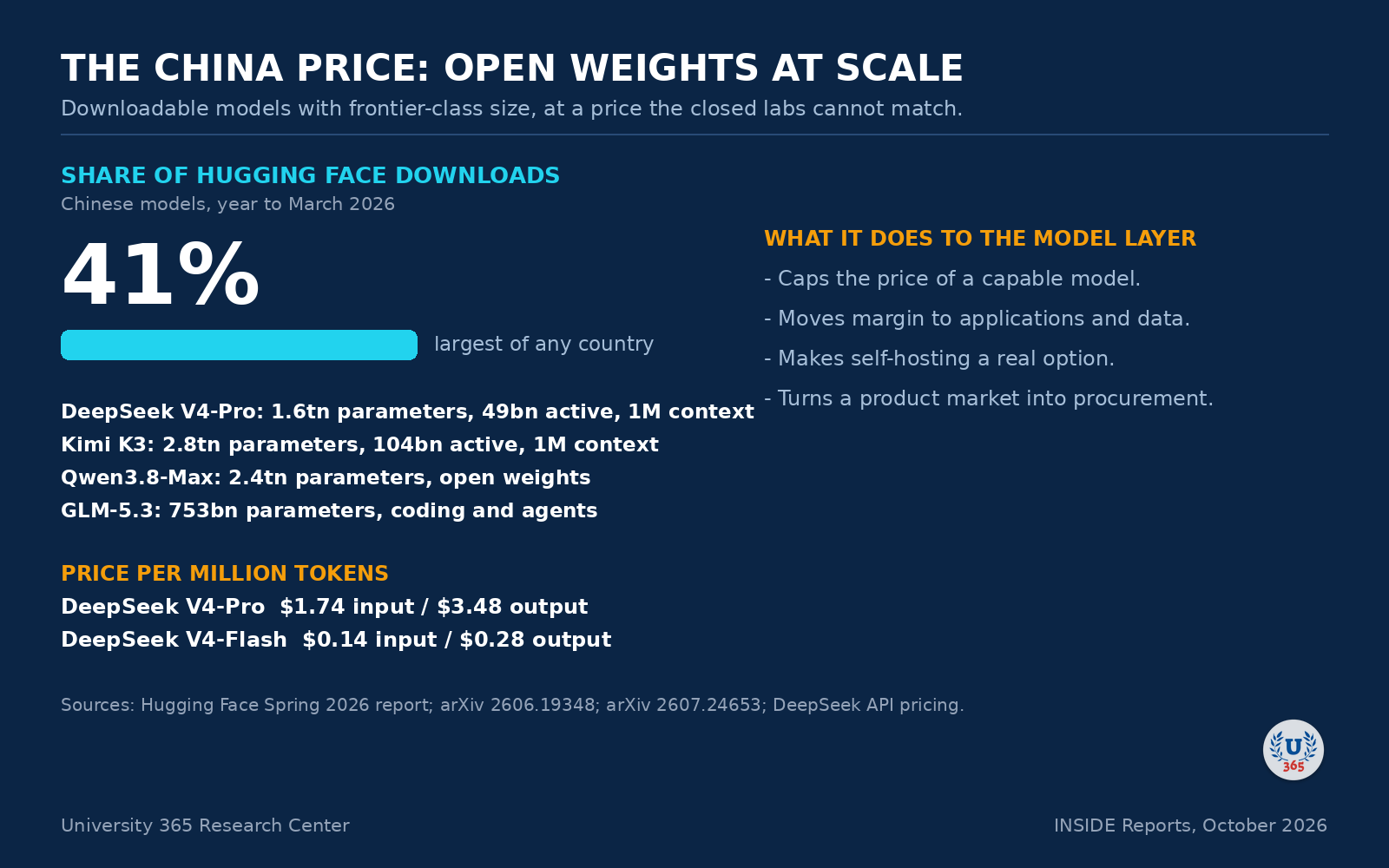
The China price: open weights at frontier scale, at a fraction of the closed-model cost.
Sources: Hugging Face Spring 2026 report; arXiv 2606.19348; arXiv 2607.24653; DeepSeek API pricing.
The most important competitive fact of 2026 is that the price of a capable model collapsed, and the collapse came from China.
The releases arrived in a sequence. DeepSeek published V4 on 24 April 2026: a 1.6 trillion parameter mixture-of-experts model with 49 billion active parameters, a 1 million token context window and open weights, alongside a smaller 284 billion parameter Flash version. Moonshot published the full Kimi K3 weights on 27 July 2026: 2.8 trillion parameters, 104 billion active, native vision and a 1 million token context. Alibaba published Qwen3.8-Max at 2.4 trillion parameters and Qwen3.8-27B under Apache 2.0 in August. Z.ai published GLM-5.3, a 753 billion parameter model built for coding and long-horizon agentic work, on 25 August. MiniMax shipped its M-series models on a similar cadence. Each release was downloadable, modifiable and hostable on the customer's own hardware.
The adoption followed the price. Hugging Face's Spring 2026 State of Open Source report found that Chinese-developed models accounted for 41 per cent of downloads on the platform over the past year, overtaking models from the United States. The download share is not revenue, and it is not usage in production, but it is the clearest available measure of where developers go when they want a model they can control. The same report found that independent developers had edged past industry contributors in share of downloads, which fits the pattern: the open-weight model is the tool of the builder who does not want to depend on a lab.
The price gap is stark. DeepSeek's V4-Pro API was listed at $1.74 per million input tokens and $3.48 per million output tokens, with the Flash version at $0.14 and $0.28. Those prices are an order of magnitude below the frontier closed models for comparable general tasks, and the gap widens for tasks that do not need frontier reasoning. A company that runs a customer support bot, a document classifier or a summariser can use a model at a fraction of the cost of a Western API, or run it on its own servers and pay only for compute. The economic effect is the same either way: the model layer becomes a commodity, and the margin moves to the application, the data and the distribution.
The strategic response from the Western labs has been to move up the stack. OpenAI and Anthropic are selling agents, coding, enterprise workflows, security and proprietary data, where the model is only one component of the value. Google is bundling Gemini into Search, Android and Workspace, where the model is a feature of a distribution business. Microsoft is bundling Copilot into Office, where the model is a feature of a seat. None of them can compete with free on the model alone, so they are competing on everything around it.
The politics complicate the economics. Beijing has considered restricting overseas access to its top models, according to Reuters reporting in July 2026, which would reduce the supply of Chinese open weights outside China. The United States has restricted Chinese models in some government systems and continues to control the export of advanced chips. Those interventions slow adoption at the top of the market. They do not change the price at the bottom, because an open-weight model that has been downloaded cannot be recalled. Once a model is on a company's servers, the supplier has no lever. That is the deepest strategic consequence of open weights: it turns a product market into a procurement market, and procurement markets reward price and control rather than brand.
The Chinese labs have therefore done something that no American lab can easily copy. They have made the model a commodity and captured the open-source developer base in the process. The American labs have responded by making the model a component of a larger product. Both strategies can work. They cannot both produce the same margins, and the market has not yet decided which one will pay for the infrastructure.

The Adoption Divide: Public Habits, Professional Deployment, and the Economics of AI (2026)
Data and Evidence
Key metrics, with dates and confidence
The table below collects the numbers this report relies on most. Each row states the value, the period, the source and a confidence rating. The rating follows a simple rule. High means an official statistic, an audited filing or a company disclosure in a financial release. Medium means a named survey or a research house with a published methodology. Low means a press report, a vendor estimate or a single source that could not be independently checked.
Metric | Value | Period | Source | Confidence |
U.S. adults who use AI | 64% | July 2026 | Menlo Ventures and Morning Consult, 5,067 adults | High |
U.S. AI users who use AI daily | 25% | July 2026 | Menlo Ventures and Morning Consult | High |
Global consumer AI spending | $40 billion | 2026 estimate | Menlo Ventures | Medium |
U.S. AI users paying for at least one AI product | 55% | July 2026 | Menlo Ventures and Morning Consult | Medium |
ChatGPT weekly active users | 1.2 billion | 29 September 2026 | OpenAI disclosure | High |
Gemini app monthly active users | More than 1 billion | 11 August 2026 | Google disclosure | High |
Microsoft 365 Copilot paid seats | 30 million | 29 July 2026 | Microsoft FY26 Q4 earnings | High |
U.S. firms using AI in any business function | 23.8% | 21 September to 4 October 2026 | U.S. Census Bureau BTOS | High |
Large organisations scaling AI agents | 40% | May to June 2026 | McKinsey global survey, 1,719 respondents | Medium |
Companies attributing at least 5% of EBIT to AI | About 6% | May to June 2026 | McKinsey global survey | Medium |
Anthropic annualized revenue | About $74 billion | October 2026 | SemiAnalysis estimate reported by Euronews | Low |
OpenAI annualized revenue | About $50 billion | End September 2026 | Financial Times, citing investors | Medium |
Worldwide AI spending | $2.67 trillion | 2026 forecast | Gartner, September 2026 | Medium |
Revenue needed to earn a 12% return on AI data centres through 2030 | About $8.5 trillion | Forecast | Gartner, October 2026 | Low |
Revenue forecast attributable to AI data centres through 2030 | No more than $3.6 trillion | Forecast | Gartner, October 2026 | Low |
Chinese models' share of Hugging Face downloads | 41% | Year to March 2026 | Hugging Face Spring 2026 report | Medium |
Two rows deserve a warning. The revenue forecasts in the Gartner rows are not measurements; they are projections that depend on assumptions about prices, demand and depreciation. They are included because they are the most explicit public statement of the gap between the infrastructure being built and the revenue that would justify it, not because they are precise. The Anthropic and OpenAI run-rates are also not audited revenue, and they are calculated differently, as the Context section explains.
The five brands compared
The comparison matrix below puts the five major brands side by side on the dimensions that determine survival. It is a reading of the evidence in this report, not a judgement about which product is best.
Brand | Consumer position | Professional position | Main revenue engine | Financial health | Strategic bet |
OpenAI | Widest reach: 1.2 billion weekly users, 50 million plus subscribers | Strong and growing: enterprise now the majority of revenue, 2 million business customers | Consumer subscriptions, enterprise seats, API, advertising | Growing fast, still loss-making; about $278 billion of projected cash burn through 2030 | Own the consumer default and the enterprise platform at the same time |
Anthropic | Smaller but deepest: 245 million estimated monthly users, 82% of users pay | Strongest enterprise API position: 40% share in 2025, 300,000 plus business customers | Enterprise API and coding agents | Best unit economics in the cohort: 85% gross margin and adjusted profit in Q3 2026 | Win the professional market and list before the window closes |
Best distribution: Gemini app above 1 billion, AI Mode above 1 billion, AI Overviews 2.5 billion | Strong through Workspace and Google Cloud: 8 million paid Gemini Enterprise seats | Search and cloud advertising, cloud infrastructure, subscriptions | Funded by a profitable core; capex guided at $195 billion to $205 billion for 2026 | Make the model a feature of distribution and sell the infrastructure | |
Microsoft | Modest consumer reach; Copilot app far behind ChatGPT and Gemini | Strongest seat business: 30 million paid M365 Copilot seats, 50 million GitHub Copilot users | Software subscriptions, Azure, Copilot seats | Funded by a profitable core; AI business at a $37 billion run rate | Sell AI inside the tools companies already run |
Perplexity | Niche but distinctive: more than 100 million monthly users across products | Growing enterprise search business; agent products | Subscriptions, enterprise search, commerce | Private, about $750 million annualized revenue, valuation above $30 billion in talks | Own the answer and research interface, not the model |
Meta and xAI sit outside the matrix because their AI strategies are not primarily revenue strategies. Meta uses AI to improve advertising and engagement across its apps, and its 1 billion Meta AI monthly users are a distribution statistic rather than a business. xAI was absorbed into SpaceX in February 2026 and reports through the SpaceX filing; its 2025 operating loss of $6.36 billion on $3.2 billion of revenue makes it the weakest economics in the sector.
2026 in dates
The year's key events, in the order that matters for adoption and economics.
Date | Event | Why it matters |
February 2026 | ChatGPT begins showing ads; xAI is absorbed into SpaceX | The consumer business admits that subscriptions alone will not pay for the model |
March 2026 | OpenAI closes a $122 billion round at $852 billion post-money; Granola raises $125 million at $1.5 billion | Private capital keeps funding the build while application-layer valuations rise |
24 April 2026 | DeepSeek releases V4 with open weights | A frontier-class model becomes downloadable and cheap |
May 2026 | Anthropic raises $65 billion at a $965 billion valuation; ChatGPT app reaches 1 billion monthly users | The two leading labs reach scale at the same time, on different business models |
July 2026 | Microsoft reports 30 million paid Copilot seats; Moonshot releases Kimi K3 weights | The seat business and the open-weight business both hit new highs |
August 2026 | Gemini app passes 1 billion monthly users; OpenAI says enterprise has overtaken consumer | Distribution and professional revenue become the two centre lines of the market |
September 2026 | Anthropic reports $16.8 billion of Q3 revenue; OpenAI's run-rate is reported at about $50 billion | Growth is confirmed, and so is the gap between the two business models |
October 2026 | Anthropic prepares a November IPO at up to $2 trillion; OpenAI seeks $30 billion at about $1.4 trillion | The private market hands the bill to the public market |
What the evidence does not show
A report that only lists what is known would overstate the certainty of its conclusions. Four things are not established by the evidence available in October 2026.
First, there is no reliable measure of how much AI work is actually done at work. The surveys measure access, seats and self-reported use. They do not measure completed tasks, hours saved or output quality. A company that buys 10,000 seats and a company that automates 10,000 tasks look the same in the seat data, and they are not the same.
Second, the revenue figures for the private labs are not audited. OpenAI's last audited accounts are for 2025. Anthropic's Q3 figures were disclosed to IPO investors, not filed publicly at the time of writing. The run-rates are directional, and the difference between the two companies' accounting methods is large enough to change the ranking.
Third, the consumer survey data is American. Menlo's 5,067 respondents are U.S. adults, and the 64 per cent adoption figure is a U.S. figure. The global user estimate of 2 billion is a modelled estimate, not a census. Adoption in India, Brazil, Indonesia and Africa is growing faster and is much less well measured. A report that treats the American plateau as a global plateau would miss the next billion users.
Fourth, the productivity evidence is self-reported. McKinsey's 80 per cent of respondents saying AI improved their productivity is a perception, not a measurement. The controlled studies that do exist are mixed, and several show that experienced workers can be slower with AI while believing they are faster. The gap between perceived and measured productivity is one of the most important open questions in the field, and this report does not resolve it.

The Adoption Divide: Public Habits, Professional Deployment, and the Economics of AI (2026)
Implications
For individuals
The individual lesson of 2026 is that access is no longer the advantage. Almost everyone has access. The advantage is the ability to turn access into a result.
The data supports that reading. Menlo found that 55 per cent of American AI users pay for at least one product, but the top 14 per cent of payers account for 60 per cent of spending. The heavy users are not paying more for the same output. They are using AI for more of their work, in more parts of their life, and they are getting more comfortable letting it act on their behalf. The average AI user now uses three assistants, which means the skill that matters is not loyalty to one tool but the ability to route a task to the right one.
For an individual, the practical implication is to stop measuring yourself by which tools you have tried and start measuring yourself by which tasks you have completed with them. A person who can take a messy request, break it into steps, give an AI the right context, check the output and finish the work is more valuable than a person who has twenty subscriptions and no workflow. That is a trainable skill, and it is not the same as prompt engineering. It is the skill of managing a junior colleague who is fast, confident and sometimes wrong.
For companies
The corporate lesson is harder. Buying seats is not adopting AI. The companies that report a financial result are the ones that changed the workflow, not the ones that added a chatbot to it.
McKinsey's high performers, about 6 per cent of respondents, share three behaviours: they pursue growth or innovation alongside efficiency, they redesign workflows rather than insert AI into existing ones, and they back the deployment with leadership and operational discipline. The other 94 per cent have mostly bought tools. That is why 80 per cent of individual workers report a productivity gain while only 37 per cent of companies report an earnings contribution. The gain is real at the task level and evaporates at the process level.
Three practical implications follow. First, measure tasks, not seats. A company should know how many hours a workflow consumed before and after AI, and it should be able to name the workflow. Second, control the token bill. The 2026 multi-model research found that 79 per cent of enterprises overran their AI budgets, with mature organisations overshooting by 30.9 per cent on average. Routing, caching and model selection are now finance functions as well as engineering functions. Third, avoid single-supplier dependence. The enterprises that are doing best run three or more model families and route work by task, which gives them bargaining power and a fallback when a model changes.
For governments and institutions
The public-policy lesson is that the adoption divide is also a firm-size divide. The Census data shows 37 per cent adoption among firms with 250 or more employees and fewer than 20 per cent among firms with four or fewer. McKinsey shows the same gap in scaling: 54 per cent of large companies against one third of small ones. The companies that most need productivity gains are the least able to capture them, because they lack the data, the engineering time and the procurement power.
That gap is the strongest argument for public action that is not about subsidies. Small firms need shared infrastructure, trusted intermediaries and plain-language guidance more than they need a grant. Public procurement can create a market for compliant, auditable AI. Skills programmes can teach verification and workflow design rather than tool names. Competition policy can keep the model layer contestable, which is the best protection against price increases once the subsidy era of cheap tokens ends.
There is also a sovereignty dimension. The open-weight models from China give governments and companies an option that does not depend on an American API. That option comes with security, data-residency and supply-chain questions that each jurisdiction must answer for itself. The choice is not between open and closed in the abstract. It is between dependence on a foreign supplier and the cost of building or hosting a domestic alternative. Most countries will end up with a mixture, and the mixture will be a political decision as much as a technical one.

The Adoption Divide: Public Habits, Professional Deployment, and the Economics of AI (2026)
Education and Skills Impact
What people need to learn
The skills that matter in 2026 are not the skills the AI industry talks about most.
The first is verification. An AI output is a draft, not an answer. The person who can check a claim, test a code change, compare a summary to the source and notice what is missing is the person who captures the value. The person who forwards the output is the person who creates the risk. This is not a technical skill in the narrow sense. It is the discipline of evidence, and it is teachable.
The second is task decomposition. An AI is good at a well-specified task and unreliable at a vague goal. The ability to break a piece of work into steps, define the output of each step and decide which steps a machine should do is the core professional skill of the decade. It is also the skill that separates a user who saves an hour from a user who spends an hour correcting the output.
The third is agent supervision. Thirty-two per cent of American AI users have already let an agent act on their behalf without final approval, according to Menlo. That is a remarkable transfer of trust for a technology that is three years old. The professional version of the same transfer is an agent with access to a code repository, a customer database or a payment system. The skill is not to avoid agents. It is to design the permissions, the checkpoints and the rollback before the agent acts.
The fourth is domain judgment. AI has made generic competence cheap. It has made specific, verified, accountable expertise more valuable, because the output still has to be judged by someone who knows what good looks like. A lawyer who can tell a plausible contract clause from a dangerous one, a doctor who can tell a plausible diagnosis from a missed one, an engineer who can tell a passing test from a hidden failure: those people are the bottleneck in every AI workflow, and their scarcity is rising.
How people learn
The evidence on learning with AI is more encouraging than the evidence on working with it, and more complicated.
Anthropic's Economic Index, which studies how Claude is used, found that about 49 per cent of jobs have seen at least a quarter of their tasks performed with the model. It also found that high-tenure users have a success rate about 4 percentage points higher than new users, after controlling for task, model, country and use case. That is a direct measure of a learning curve: people get better at using AI by using it, and the improvement is large enough to matter for wages and productivity.
The same research found that usage is broadening toward lower-wage tasks, and that augmentation, where the AI complements the user, is more common than automation. That is the good version of the story: AI as a tool that raises the productivity of the person using it, not a machine that replaces the task entirely. But the learning curve also has a distributional consequence. If effective use requires complementary skills and the opportunity to practise, the benefits accrue first to people who already have those skills and that opportunity. The Anthropic data shows exactly that: early adopters with high-skill tasks have more successful interactions, and later, less technical adopters have fewer. AI can widen the gap it was supposed to close.
That is why the assessment question matters. If an AI can pass the exam, the exam is testing recall and format, not competence. The institutions that adapt will assess the process: the quality of the question, the verification trail, the ability to defend a judgement, the handling of an ambiguous case. The institutions that do not adapt will certify people who can produce an answer and cannot defend it.
The skills gap
The gap is not between people who have AI and people who do not. It is between people who have learned to use it and people who have been given access to it.
Deloitte's 2026 survey found that worker access to sanctioned AI tools rose from fewer than 40 per cent to around 60 per cent in a year. That is a large increase in access. The same survey found that only 21 per cent of organisations report a mature governance model for agentic AI, and that 34 per cent say they are using AI to deeply transform the business. Access grew faster than governance, and governance grew faster than transformation. The result is a workforce with tools, a management layer without a method, and a small group of firms capturing most of the value.
The gap is widest in small firms and in roles that are not knowledge work by title but are knowledge work in practice: scheduling, customer service, compliance, bookkeeping, procurement. Those roles have the most repetitive tasks and the least access to engineering support. They are also the roles where a dedicated tool, a meeting assistant or a document workflow can produce a measurable saving without a data team. The application layer is where the gap can be closed fastest, which is why the consolidation of dedicated tools into suites matters beyond the vendors' valuations.
The U365 position
University 365's contribution to this problem is a method, not a tool.
The Co-Intelligence-First approach starts from a simple rule: invite AI into the work, but never compete with it, never overestimate it, and keep the human as the orchestrator. That rule is a direct answer to the adoption divide. The divide exists because most users have been given a powerful answer machine and no method for judging its answers. CI-First treats judgement as the outcome to be taught, not the tool as the outcome to be adopted.
The method is delivered through the University 365 Life Management framework and its EVA cycle, through the LIPS system and its CARE cycle, and through the UP-Context method for structuring the context a person gives to an AI. Each of those methods is a way of making the human's intent explicit before the machine acts. None of them depends on which model is leading the market, which is the point: the model changes every quarter, and the method has to survive the change.
That is the educational bet. A learner who knows how to define a goal, structure the context, verify the output and take responsibility for the decision is not threatened by a cheaper model or a better agent. A learner who only knows how to prompt is. The adoption divide will not be closed by giving more people more subscriptions. It will be closed by teaching more people what to do with the answer once they have it.

The Adoption Divide: Public Habits, Professional Deployment, and the Economics of AI (2026)
The CI-First Perspective
The Co-Intelligence-First (CI-First) approach is a genuine and unique University 365 concept: a proposal for imagining a better future where AI and Human Intelligence coexist productively, each amplifying the other rather than replacing it.
Illustration: the human as orchestrator. AI carries the material; the person sets the direction and checks the work.
The adoption divide described in this report is, at bottom, a capability divide. The tools are widely available, the spending is concentrated, and the difference between the people and companies that benefit and the ones that do not is not access. It is the ability to judge, verify and integrate what the machine produces.
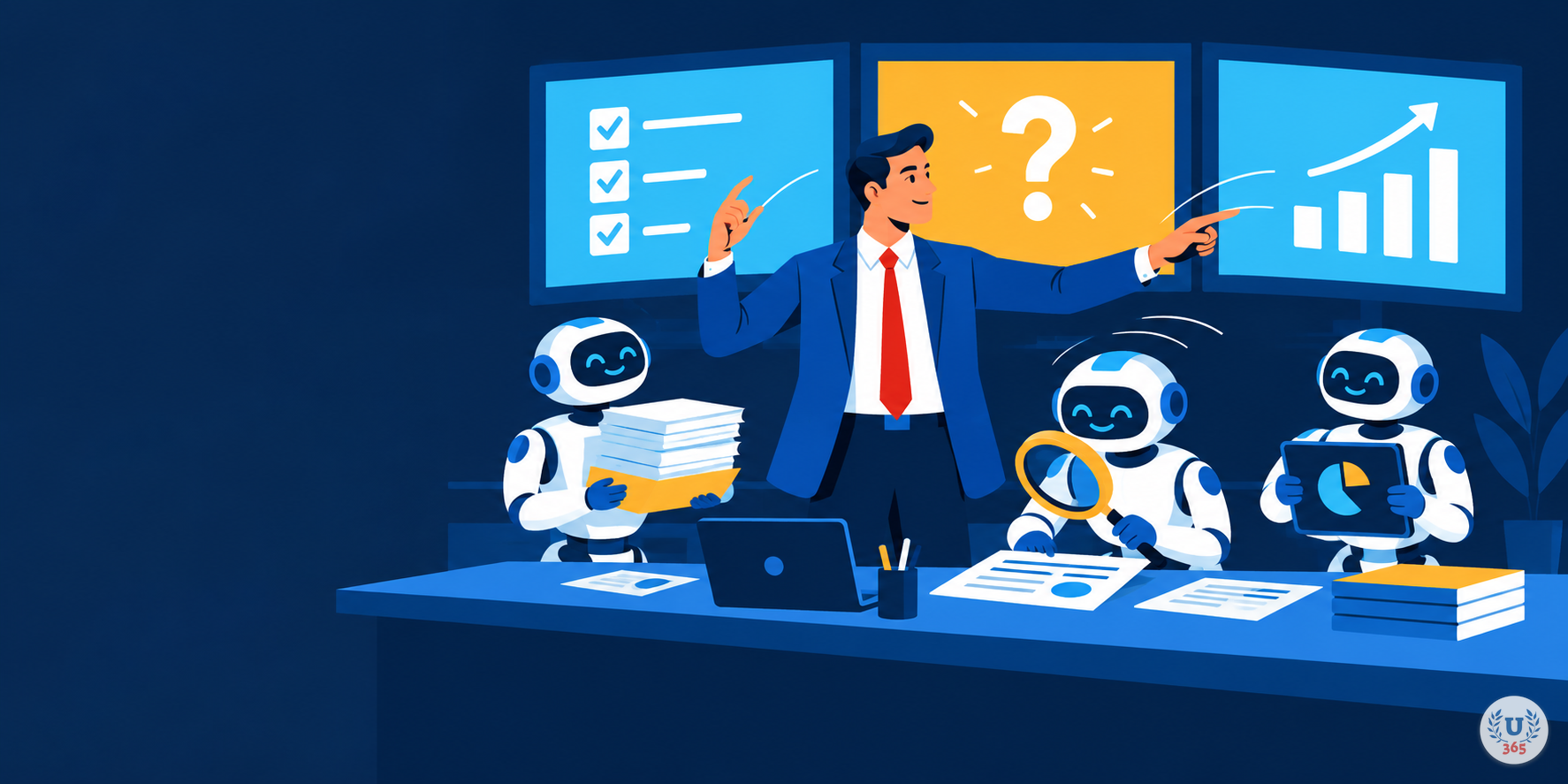
Illustration: the human as orchestrator. AI carries the material; the person sets the direction and checks the work.
CI-First amplifies human capability when the human stays in the orchestrating role. The evidence for amplification is strong at the individual level: 80 per cent of McKinsey's respondents report a productivity gain, 48 per cent of American AI users have earned money with AI, and the heavy users who pay for several tools are also the users who run agents and complete more work. The technology is genuinely extending what a motivated person can do.
The AI Imposture risk is equally clear, and it operates at three levels. At the individual level, the risk is the habit of accepting an answer because it is fluent. The 32 per cent of users who let an agent act without final approval are already living with that risk. At the organisational level, the risk is a seat count that looks like transformation and a workflow that has not changed. The gap between 80 per cent of workers reporting productivity gains and 6 per cent of firms reporting significant earnings impact is an imposture signal: the activity is real, the capability is not yet institutional. At the market level, the risk is a valuation that assumes the capability has arrived before the evidence does. The $8.5 trillion revenue requirement against a $3.6 trillion forecast is the financial version of the same gap.
The CI-First verdict is conditional. AI amplifies capability when three conditions hold: the human defines the goal, the human verifies the output, and the organisation redesigns the workflow around the new division of labour. When those conditions fail, AI degrades capability while appearing to enhance it: the work gets faster, the judgement gets weaker, and the error surfaces later, when it is more expensive.
That is also the resolution of the contradiction this report began with. Adoption without absorption is not a paradox of technology. It is what happens when distribution outruns judgement. The tools arrived faster than the methods for using them, the seats were sold faster than the workflows were redesigned, and the capital was committed faster than the revenue could justify it. CI-First does not reverse any of those trends. It sets the condition under which they become productive: the human remains the ruler, the AI remains the amplifier, and the measure of success is not how many people have access but how many can defend what they did with it.

The Adoption Divide: Public Habits, Professional Deployment, and the Economics of AI (2026)
What This Means for You and Us
For you
1. Audit your own stack before you add another tool.
The average AI user now uses three assistants, and 55 per cent of American users pay for at least one product. Most people cannot name what they pay for or which tool they used last week. The first practical step is a one-page audit: list every AI subscription, the task you use it for, and the last time you used it. Cancel anything you have not opened in two weeks. The money is not the main point. The attention is. A smaller stack that you know how to use beats a larger one that you do not.
Action: spend twenty minutes this week listing your AI subscriptions and the one task each one is for.
2. Build one verification habit for the task that matters most.
The difference between a useful AI user and a dangerous one is not the prompt. It is the check. Pick the task where an error would cost you most, whether that is a contract, a diagnosis, a code change or a financial model, and write down the three checks you will run on every AI output for that task. Make the checks specific: the source, the date, the calculation, the second opinion. Then run them every time, including when the answer looks obvious.
Action: write your three checks for your highest-risk task and keep them next to the tool.
3. Give an agent one narrow job before you give it your inbox.
Thirty-two per cent of AI users have let an agent act on their behalf without final approval. That is a large transfer of trust, and most of it is unnecessary. Start with a task that is narrow, reversible and easy to inspect: a recurring report, a calendar summary, a set of draft replies that you review before sending. Add permissions one at a time. The goal is not to use fewer agents. It is to know exactly what yours can do when you are not watching.
Action: give one agent a narrow, reversible task with a review step, and keep the approval for anything that leaves your account.
For us
1. Companies should measure tasks, not seats.
The gap between 80 per cent of workers reporting a productivity gain and 6 per cent of firms reporting a significant earnings impact is a measurement failure as much as a management failure. A company that buys seats and never measures the workflow cannot tell whether AI worked. Every deployment should start with a baseline: hours per task, error rate, cycle time. The AI P&L should be a task-level document, reviewed quarterly, not a seat count in a procurement system.
Response: require a task-level baseline and a quarterly review for every AI deployment above a defined spend threshold.
2. Universities should assess the process, not the answer.
If an AI can pass the exam, the exam is measuring the wrong thing. The institutions that adapt will grade the verification trail, the quality of the question, the defence of the judgement and the handling of an ambiguous case. That is harder to mark than a multiple-choice test, and it is the only assessment that survives the technology. Employers will learn to ask for the same evidence, because they are already learning that a certificate does not prove competence.
Response: add a process-based assessment to at least one core course in every programme, and require students to show how they checked an AI-assisted answer.
3. Governments should keep the model layer contestable and the small firm connected.
The adoption gap is also a firm-size gap: 37 per cent adoption among large firms against fewer than 20 per cent among the smallest. The most useful public actions are not subsidies for chips. They are procurement rules that require auditable AI, shared infrastructure that small firms can use, and competition policy that keeps several model suppliers alive. A market with three suppliers and open-weight alternatives is more contestable than a market with one, and contestability is the best protection against the price increases that will come when the subsidy era of cheap tokens ends.
Response: write auditability and portability into public AI procurement, and fund shared AI infrastructure for small firms rather than one-off grants.

The Adoption Divide: Public Habits, Professional Deployment, and the Economics of AI (2026)
The Road Ahead
The next twelve months
Three events will set the tone for 2027, and all three are scheduled within the next twelve months.
The first is Anthropic's IPO, expected in November 2026 at a valuation of up to $2 trillion. It is the first large pure-play AI lab to test the public market, and its price will become the reference for OpenAI's listing, which is expected in 2027. If the IPO prices well and trades up, the private market's marks will look vindicated and the capital will keep flowing. If it prices below the last private round or trades down, the repricing will be immediate and will affect every lab, every neocloud and every application company that raised at a 2026 valuation. The prospectus also puts a number on the thing the private market has been able to avoid: the cost of the compute commitments, and the date on which they come due.
The second is the agent reckoning. Gartner expects more than 40 per cent of agentic AI projects to be cancelled by the end of 2027. The cancellations will not mean that agents failed. They will mean that most companies deployed an agent without redesigning the workflow, measured the pilot on activity rather than outcome, and could not justify the token bill when the finance team reviewed it. The companies that survive the reckoning will be the ones that can show a completed task, a cost per task and a human checkpoint. The ones that do not will be the ones that bought a platform and waited.
The third is the price test. Google has scheduled a doubling of Gemini Flash introductory prices on 1 January 2027. If the market accepts it, the era of loss-leading token prices is over, and the labs will try to recover margin from the customers they won. If the market rejects it, the price war continues, and the infrastructure economics get worse. Either way, 2027 will be the year when the price of intelligence stops being a marketing decision and becomes a financial one.
The next two years
Beyond the scheduled events, four trends are likely to shape the market, and they are predictions rather than facts.
Consumer growth will come from outside the United States. The American market is close to saturation at 64 per cent of adults. The next billion users are in India, Brazil, Indonesia, Nigeria and Southeast Asia, where the assistant is often the first useful computer a person owns. The companies that win those users will not necessarily be the ones with the best model. They will be the ones with the cheapest distribution: a pre-installed app, a telecom bundle, a local-language product.
The application layer will consolidate. The standalone meeting assistant, the standalone writing tool and the standalone coding environment are all being absorbed into suites, because the buyer prefers one contract and one security review. The independent companies that survive will be the ones with a workflow that the suite cannot easily copy, or the ones that become the suite. Fathom's acquisition and Grammarly's transformation into Superhuman are early examples, not exceptions.
The model layer will settle into an oligopoly with a Chinese price floor. The three American labs will keep most of the enterprise spending, because they have the integrations, the security posture and the sales teams. The Chinese open-weight models will keep the price of the cheapest capable model low, which will cap the margin at the bottom and push the American labs further up the stack. The most likely outcome is not a winner-takes-all market. It is a tiered market: frontier models for high-value work, open-weight models for everything else, and a routing layer that decides which is which.
The infrastructure bill will be the story of 2028. The capital committed in 2026 will be delivered in 2027 and 2028, and the depreciation will begin. If revenue grows fast enough, the build looks prescient. If it does not, the write-downs will be concentrated in the neoclouds and the specialised AI data centre providers, not in the hyperscalers, which can absorb them. Gartner's forecast that more than 80 per cent of neocloud providers will cease independent operations by 2030 is the most specific warning in the sector, and it is the one to watch.
What would change this forecast
A report that predicts the future should say what would prove it wrong. Three things would.
A genuine productivity breakthrough at the workflow level, measured in audited company results rather than self-reports, would justify the infrastructure build faster than this report assumes. A model that can complete a multi-step professional task with minimal supervision, at a cost below the human equivalent, would expand the market by orders of magnitude. And a regulatory settlement that clarifies liability, data rights and cross-border use would reduce the cost of deployment for every company, which is currently one of the largest hidden costs in the enterprise stack.
None of those is impossible. None of them is yet measured. The honest position in October 2026 is that the adoption is real, the revenue is real, and the economics are not yet proven. The next two years will decide which of those facts matters most.

The Adoption Divide: Public Habits, Professional Deployment, and the Economics of AI (2026)
Sources and Methodology
Methodology
This report was researched between 12 and 19 October 2026 by the University 365 Research Center. It draws on more than 45 sources, prioritising primary documents: company earnings releases and calls, securities filings, official statistics, survey reports with published methodology, model cards and arXiv papers. Where a primary source was not available, the report uses reporting from established outlets and labels the figure as press-reported. Where only a vendor estimate or a statistical aggregator was available, the report labels it as an estimate and gives it a Low confidence rating in the Key Metrics table.
Three rules governed the use of numbers. First, every figure is dated and attributed to a specific period. Second, figures that measure different things are never presented as a single ranking without their basis. Third, where credible sources disagree, the report states the disagreement rather than averaging it away. The most important disagreements are noted in the Data and Evidence section: the gap between survey-based and panel-based measures of consumer reach, the gap between firm-based and respondent-based measures of enterprise adoption, and the gap between the two labs' revenue accounting methods.
The report does not contain interviews, and it does not rely on non-public information. It is an analysis of the public record as of 19 October 2026. The market moves quickly, and several figures in this report will be superseded within a quarter. Readers should check the current source before relying on any number for a decision.
Sources
1. Menlo Ventures, 2026: The State of Consumer AI, 16 September 2026. https://menlovc.com/perspective/2026-the-state-of-consumer-ai/
2. Menlo Ventures, 2025: The State of Generative AI in the Enterprise, 9 December 2025. https://menlovc.com/perspective/2025-the-state-of-generative-ai-in-the-enterprise/
3. McKinsey, The State of AI in 2026: On the road to ROI. https://www.mckinsey.com/capabilities/quantumblack/our-insights/the-state-of-ai
4. U.S. Census Bureau, Business Trends and Outlook Survey, AI supplement, period ending 4 October 2026. https://www.census.gov/hfp/btos/data
5. U.S. Census Bureau, Large Firms With at Least 20 Employees Biggest AI Users, 26 May 2026. https://www.census.gov/library/stories/2026/05/ai-use-businesses.html
6. Bonney and colleagues, The Microstructure of AI Diffusion: Evidence from Firms, Business Functions, and Worker Tasks, NBER Working Paper 35141, April 2026. https://www.nber.org/papers/w35141
7. Eurostat, Use of artificial intelligence in enterprises, 2025 data, published December 2025. https://ec.europa.eu/eurostat/statistics-explained/index.php?title=Use_of_artificial_intelligence_in_enterprises
8. Ramp, AI Index, September and October 2026. https://ramp.com/data/ai-index
9. Deloitte, The State of AI in the Enterprise 2026, 21 January 2026. https://www.deloitte.com/us/en/what-we-do/capabilities/applied-artificial-intelligence/content/state-of-ai-in-the-enterprise.html
10. Gartner, Gartner Forecasts Worldwide AI Spending to Grow 49.5% in 2026, 16 September 2026. https://www.gartner.com/en/newsroom/press-releases/2026-09-16-gartner-forecasts-worldwide-ai-spending-to-grow-49-point-5-percent-in-2026
11. Gartner, Gartner Says Over $3.5 Trillion of AI Infrastructure Spending Could Be Exposed to Impairment by the End of 2030, 14 October 2026. https://www.gartner.com/en/newsroom/press-releases/2026-10-14-gartner-says-over-us-dollars-three-and-a-half-trillion-of-artificial-intelligence-infrastructure-spending-could-be-exposed-to-impairment-by-the-end-of-2030
12. Microsoft, Microsoft Cloud and AI strength fuels fourth quarter results, 29 July 2026. https://news.microsoft.com/source/2026/07/29/microsoft-cloud-and-ai-strength-fuels-fourth-quarter-results-4/
13. Microsoft, Microsoft Fiscal Year 2026 Fourth Quarter Earnings Conference Call, 29 July 2026. https://www.microsoft.com/en-us/investor/events/fy-2026/earnings-fy-2026-q4
14. Microsoft, The next measure of AI momentum is work transformed, 30 July 2026. https://www.microsoft.com/en-us/copilot/blog/2026/07/30/the-next-measure-of-ai-momentum-is-work-transformed/
15. Alphabet, Alphabet Announces Second Quarter 2026 Results, 22 July 2026. https://s206.q4cdn.com/479360582/files/doc_financials/2026/q2/2026q2-alphabet-earnings-release.pdf
16. OpenAI, Accelerating the next phase of AI, 27 February 2026. https://openai.com/index/accelerating-the-next-phase-ai/
17. OpenAI, DevDay 2026 recap, 29 September 2026. https://openai.com/index/devday-2026-recap
18. The Verge, ChatGPT now has 1.2 billion weekly users, OpenAI says, 29 September 2026. https://www.theverge.com/ai-artificial-intelligence/1002265/chatgpt-now-has-1-2-billion-weekly-users-openai-says
19. Reuters, ChatGPT app hits 1 billion monthly active users in record time, 2 June 2026. https://www.reuters.com/technology/chatgpt-app-hits-1-billion-monthly-active-users-record-time-data-shows-2026-06-02
20. Google, Google's Gemini app hits 1 billion monthly active users, 11 August 2026. https://blog.google/innovation-and-ai/products/gemini-app/one-billion-monthly-users/
21. Google, Google I/O 2026: Welcome to the agentic Gemini era, 19 May 2026. https://blog.google/innovation-and-ai/sundar-pichai-io-2026
22. CNBC, OpenAI CFO Friar tells investors that enterprise business now bigger than consumer by revenue, 14 August 2026. https://www.cnbc.com/2026/08/14/openai-cfo-friar-tells-investors-that-enterprise-bigger-than-consumer.html
23. CNBC, Anthropic tells investors annualized revenue run rate climbed to $65 billion in July, 17 August 2026. https://www.cnbc.com/2026/08/17/anthropic-says-annualized-revenue-climbed-to-65-billion-in-july.html
24. TechCrunch, OpenAI's revenue is reportedly $20 billion less than previously projected, 8 October 2026. https://techcrunch.com/2026/10/08/openais-revenue-is-reportedly-20-billion-less-than-previously-projected/
25. Reuters, OpenAI forecasts cash burn near $280 billion by 2030, 18 September 2026. https://www.reuters.com/technology/openai-expects-burn-through-almost-280-billion-by-2030-ft-reports-2026-09-18/
26. Euronews, Anthropic revenue jumps 46% to $16.8bn as AI firm eyes record $2 trillion IPO valuation, 15 October 2026. https://www.euronews.com/2026/10/15/anthropic-revenue-jumps-46-to-168bn-as-ai-firm-eyes-record-2-trillion-ipo-valuation
27. Reuters, Anthropic's IPO prospectus shows sweeping AI vision, surging costs, 28 September 2026. https://www.cnbc.com/2026/09/28/anthropics-ipo-prospectus-shows-sweeping-ai-vision-surging-costs-reuters.html
28. Bloomberg, OpenAI Expects $70 Billion in Annualized Revenue by End of 2026, 9 October 2026. https://www.bloomberg.com/news/articles/2026-10-09/openai-expects-70-billion-in-annualized-revenue-by-end-of-2026
29. Counterpoint Research, Global LLM Adoption and Revenue Snapshot, Q1 2026. https://counterpointresearch.com/en/insights/Global-LLM-Adoption-and-Revenue-Snapshot
30. Costa, The Multi-Lab Enterprise: Governance, FinOps, and Telemetry Challenges of Multi-Model AI Adoption, arXiv 2609.31622, 31 July 2026. https://arxiv.org/abs/2609.31622
31. Anthropic, Anthropic Economic Index report: Learning curves, 24 March 2026. https://www.anthropic.com/research/economic-index-march-2026-report
32. Hugging Face, Spring 2026 State of Open Source report, reported by EqualOcean, 31 July 2026. https://equalocean.com/news/2026073122070-chinese-models-account-41-hugging-face-downloads-overtaking-us
33. DeepSeek, DeepSeek-V4: Towards Highly Efficient Million-Token Context Intelligence, arXiv 2606.19348. https://arxiv.org/html/2606.19348
34. Moonshot AI, Kimi K3: Open Frontier Intelligence, arXiv 2607.24653. https://arxiv.org/pdf/2607.24653
35. Z.ai, GLM-5.3: Frontier Coding with Emergent Cyber Capabilities, 14 August 2026. https://z.ai/blog/glm-5.3
36. Qwen Team, Qwen3.8-27B open weights under Apache 2.0, 14 August 2026. https://huggingface.co/Qwen/Qwen3.8-27B
37. DeepSeek, API pricing for V4-Flash and V4-Pro, 2026. https://deepseek.ai/pricing
38. Reuters, Beijing is looking at curbing overseas access to China's top AI models, 7 July 2026. https://www.reuters.com/world/beijing-is-looking-curbing-overseas-access-chinas-top-ai-models-sources-say-2026-07-07
39. Otter.ai, Otter.ai evolves from AI notetaker to create $100B enterprise conversational knowledge engine market, 28 April 2026. https://otter.ai/blog/otter-ai-evolves-from-ai-notetaker-to-create-100b-enterprise-conversational-knowledge-engine-market
40. TechCrunch, Granola raises $125M, hits $1.5B valuation as it expands from meeting notetaker to enterprise AI app, 25 March 2026. https://techcrunch.com/2026/03/25/granola-raises-125m-hits-1-5b-valuation-as-it-expands-from-meeting-notetaker-to-enterprise-ai-app
41. TechCrunch, Superhuman acquires YC-backed notetaker Fathom as productivity platforms push for agentic work, 14 September 2026. https://techcrunch.com/2026/09/14/superhuman-acquires-yc-backed-notetaker-fathom-as-productivity-platforms-push-for-agentic-work
42. Fireflies.ai, Fireflies launches AI Sales Suite, 21 July 2026. https://fireflies.ai/blog/fireflies-1-billion-valuation
43. Grand View Research, AI meeting assistant market report, March 2026. https://www.grandviewresearch.com/industry-analysis/ai-meeting-assistant-market-report
44. Dealroom, Cursor tops $4B annualized revenue, June 2026. https://dealroom.co/news/134107-cursor-tops-4b-annualized-revenue
45. Forbes, Anthropic Is Giving OpenAI A Run For Its Money, 17 February 2026. https://www.forbes.com/sites/the-prompt/2026/02/17/anthropic-is-cashing-in-on-claude-codes-success/
46. SpaceX, Form S-1, 2026. https://www.sec.gov/Archives/edgar/data/1181412/000162828026036936/spaceexplorationtechnologi.htm
47. Pew Research Center, Americans and AI 2026: Chatbots, Smart Devices and Views on Impact, 17 June 2026. https://www.pewresearch.org/internet/2026/06/17/americans-and-ai-2026-chatbots-smart-devices-and-views-on-impact
48. Sensor Tower, State of AI 2026, June 2026. https://sensortower.com/blog/state-of-ai-2026
49. Similarweb, Top AI Chatbots and Tools Websites Ranking, September 2026. https://www.similarweb.com/top-websites/ai-chatbots-and-tools/
50. Reuters, SpaceX acquires xAI in record-setting deal, 2 February 2026. https://www.reuters.com/business/musks-spacex-merge-with-xai-combined-valuation-125-trillion-bloomberg-news-2026-02-02
51. Grammarly, Announcing our company rebrand to Superhuman, 29 October 2025. https://www.grammarly.com/blog/company/announcing-company-rebrand-to-superhuman/
52. Dealroom, Grammarly CEO claims firm processes 100B LLM calls weekly and generates $700M revenue, March 2026. https://app.dealroom.co/news/feed/grammarly-ceo-claims-firm-processes-100b-llm-calls-weekly-generates-700m-revenue
53. PR Newswire, Jasper launches end-to-end GEO agent for enterprise marketers, 16 June 2026. https://www.prnewswire.com/news-releases/jasper-launches-end-to-end-geo-agent-for-enterprise-marketers-302800957.html
54. Dealroom, Copy.ai acquired by Fullcast, 15 October 2025. https://app.dealroom.co/news/note/copy-ai-acquired-by-fullcast
55. CNBC, SpaceX to acquire the AI coding startup Cursor for $60 billion, 16 June 2026. https://www.cnbc.com/2026/06/16/spacex-spcx-cursor-acquisition-ipo.html
56. CNBC, Notion launches AI agent as it crosses $500 million in annual revenue, 18 September 2025. https://www.cnbc.com/2025/09/18/notion-launches-ai-agent-as-it-crosses-500-million-in-annual-revenue.html
57. Sacra, Notion at $865M ARR growing 82% YoY, July 2026. https://sacra.com/research/notion-at-865m-year-growing-82-yoy

The Adoption Divide: Public Habits, Professional Deployment, and the Economics of AI (2026)
About This Report
This report was produced by University 365 as part of the INSIDE Reports series.
Author: Hubert Graef, Dean of Research, University 365 Research Center
Date: 19 October 2026
Report type: Isolated report, with a comparative dimension (public versus professional adoption, and lab versus lab)
Scope: Global, with a United States emphasis where the best data exists
This report is part of University 365's INSIDE publication platform, providing applied AI research and analysis for individuals, companies, and institutions.
This report is published on University 365's INSIDE platform. Explore more publications at university-365.com/inside. Learn about University 365's programs at university-365.com.
Revision 5, 19 October 2026, 15:40 UTC. Published 19 October 2026.




Comments