
The Agent Economy: Identity, Payments and Trust Between Machines


UIT, UIB, UIC, UID Cross-institute lecture
Series Cross-Institute Series
Duration 25 minutes
Delivering institutes: UIT (Institute of Technology); UIB (Institute of Business); UIC (Institute of Communication); UID (Institute of Design)

UNOP Sound (University 365 Neuroscience Oriented Pedagogy)
Take five minutes to prepare your brain. Play the isochronous tone track (40Hz gamma frequency) with your eyes closed. Gamma-frequency tones before a learning session raise attention and make the material easier to absorb.
[Audio player: UNOP Pre-Lecture Isochrone (40Hz, 5 minutes)]
In this Lecture


The Agent Economy: Identity, Payments and Trust Between Machines
Two Kinds of Money
On a Tuesday morning in November 2026, two payments happen within the same minute. Neither has a human at the keyboard.
The first is a research agent paying one cent for a market data query. It sends an HTTP request, receives a 402 Payment Required response with a price, signs a stablecoin transfer, and gets the answer. There is no account, no invoice, no card, no name. Settlement takes about a second, and the receipt is a transaction hash.
The second is a procurement agent buying a 240 euro replacement part for a factory line. It has a budget, a preferred supplier, and a purchase policy that says any order above 200 euros needs a second approval. It browses a supplier site, selects the part, and reaches checkout. From there the payment passes through a merchant, a payment processor, a card network, an issuing bank and a fraud model. Somewhere in that chain a question gets asked that nobody has answered in a rulebook: if the part arrives and it is the wrong one, who pays?
Both of these are called agent payments. They share almost nothing. One is a machine buying a machine service with a few cents and no identity beyond a wallet signature. The other is a machine acting for a company, spending company money, inside a legal and financial system built on the assumption that a person clicked the button.
This lecture maps the second kind, and the trust machinery that has appeared around it in 2026. You will see how an agent proves who it is, how it proves what it is allowed to do, how money actually moves, and where liability still falls when the agent gets it wrong. Four institutes contribute: UIT the protocol engineering, UIB the cost and control economics, UIC the disclosure and reputation questions, UID the consent surfaces a person actually reads. The subject belongs to all four because an agent transaction is simultaneously a technical event, a financial event, a communication event and a design event.

The Agent Economy: Identity, Payments and Trust Between Machines
The Trust Gap in One Transaction
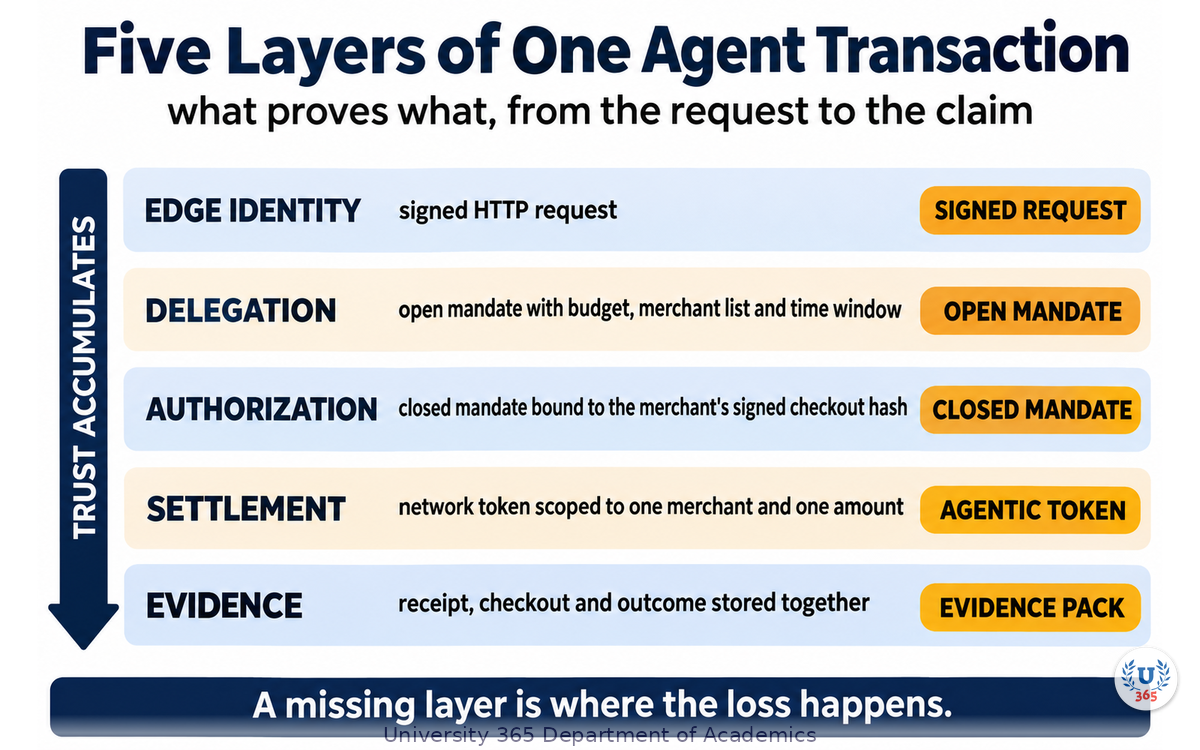
Strip away the branding and every agent payment answers five questions in order. Who is acting? For whom? Within what limits? With whose money? And what happens if the answer to any of the first four turns out to be false?
The old checkout answered all five implicitly. The cardholder was present, the card was theirs, the merchant saw a browser session and an IP address, the issuer scored the risk, and the chargeback rules assigned the loss after the fact. Every one of those signals assumed a person.
An agent breaks the assumption at each step. It is not a person, so "cardholder present" means nothing. It acts for a person, so the useful question becomes delegation, not authentication. It runs at machine speed, so a fraud model tuned for human hesitation sees nothing unusual. It can be copied, replayed, or redirected by text it reads on a web page, so a token that was valid at the start of a task may be attached to the wrong action by the end.
The gap is easiest to see in the receipt. After a normal card purchase, a merchant can show a session, a device, accepted terms and a delivery confirmation. After an agent purchase, all four artifacts still exist. None of them addresses the claim that matters: the cardholder authorised an agent, and the cardholder did not authorise this purchase. Both statements can be true at the same time. A person can give an agent a 5,000 euro monthly limit, and the agent can spend 4,000 euros on something the person never wanted. The payment is authenticated, inside its mandate, and still a loss.
That is why the industry spent 2026 building three separate layers instead of one. Identity proves which software is asking. Delegation proves what the operator and the user permitted it to do. Evidence proves what actually happened, in a form a merchant, a bank or a court can check. Payment rails carry the money. All four have to line up before an agent transaction is safer than a human one.

The Agent Economy: Identity, Payments and Trust Between Machines
Why Machines Need Their Own Identity
Enterprise identity was designed around employees. A person joins, gets an account, is placed in groups, and eventually leaves. The account has a lifecycle because the person does.
Agents have no such rhythm. They are created by developers in an afternoon, inherit whatever credential is nearest, call four software services, and are forgotten. Okta's 2026 report on agents at work found that only 34 percent of organisations apply the same security controls to AI agents that they apply to human workers. The same research notes that non-human identities now outnumber human employees by more than ten to one in the organisations surveyed, and that most of those identities sit on static, long-lived API keys.
A static key is the wrong primitive for an agent, for three reasons. First, it has no owner in the directory, so no one is accountable when it misbehaves. Second, it has no expiry, so a leak stays useful for years. Third, it carries no delegation context, so a downstream service cannot tell whether the agent is acting for a finance analyst or for nobody at all.
The fix is unglamorous and borrowed from existing standards. Register the agent as a first-class identity with a named human sponsor. Issue short-lived credentials instead of stored secrets. Carry two identities in every token: the human on whose behalf the agent acts, and the agent itself. Okta's Cross App Access pattern does this with a token exchange defined in RFC 8693, producing claims where the subject is the user and the actor is the agent. Microsoft's Entra Agent ID does it by making the agent a directory object created from an identity blueprint, authenticated with federated credentials rather than a client secret. Both approaches reached general availability in 2026, and Cross App Access was adopted as an authorization extension for the Model Context Protocol.
The dual claim matters more than the vendor. When a system logs both the human and the agent, an audit can answer the question that a service account never could: this action was taken by this software, on behalf of this person, at this time. Without that pair, an incident review ends at a shared key and a shrug.

The Agent Economy: Identity, Payments and Trust Between Machines
The Identity Stack: Credentials, Delegation, Attribution
There are three distinct jobs in agent identity, and vendors routinely blur them. Keep them apart and the market becomes readable.
The first job is recognising the caller at the network edge. A site or an API needs to know whether a request comes from a known agent before it decides what to serve. Web Bot Auth, published as an IETF draft and implemented by Cloudflare, does this with HTTP message signatures. The agent signs its request with an Ed25519 key, publishes the public key in a directory at a well-known path, and names that directory in a Signature-Agent header. The origin verifies the signature and knows which operator is behind the traffic. In September 2026 Cloudflare added a signed agents category to its bot directory, so customers can set policy for a named agent rather than guess from behaviour.
The second job is delegation inside an enterprise. When an agent calls a software service on behalf of an employee, the identity provider has to vouch for both parties. Cross App Access and Entra Agent ID handle this with token exchange and directory objects. The practical result is a token that is audience-bound to one service, expires in minutes, and names both the user and the agent. If the agent is compromised mid-task, the attacker inherits a credential that dies quickly and opens one door.
The third job is attribution across organisations. When an agent arrives at a merchant it does not have a prior relationship with, the merchant needs a portable signal: this agent belongs to this operator, acting for this customer, with this scope. Visa's Trusted Agent Protocol and Agent Directory, Mastercard's agent registration, and the Know Your Agent products from Skyfire, Socure, Shufti and Ant's ZOLOZ all attack this problem. Mastercard's September 2026 announcement extended Skyfire's KYA credentials into Agent Pay, so an issuer or merchant can recognise a verified agent at authorization time.

The Agent Economy: Identity, Payments and Trust Between Machines
Mandates: Turning Intent Into Evidence
The most useful idea to come out of 2025 and 2026 is that authorization should travel with the transaction as a signed object. Google's Agent Payments Protocol calls these objects mandates. A mandate is a verifiable credential that records what a user authorised an agent to do, and it is signed so that any party in the chain can check it without calling the user.
AP2 defines two mandate types and two states. A Checkout Mandate covers what is being bought, and it binds to a merchant-signed checkout so the price and line items cannot change after approval. A Payment Mandate covers how it is paid, and it references a hash of the same checkout. Both start open, when the user sets constraints such as a budget, a merchant list and a time window, and become closed when a specific cart is approved. In the human-present mode the user signs the closed mandate on a trusted surface. In the autonomous mode the user signs an open mandate in advance, and the agent closes it within those constraints.
Two details make the design stronger than a policy document. The binding is cryptographic: the payment mandate references the checkout hash, and the checkout carries the merchant's own signature, so neither side can alter the deal after approval. And the credentials use selective disclosure, so a merchant sees the fields it needs and not the rest of the user's financial life.
The protocol moved during 2026. AP2 v0.2 replaced the earlier cart mandate with the checkout mandate and versioned the schema identifiers. Google contributed AP2 to the FIDO Alliance alongside Mastercard's Verifiable Intent work, which puts the authorization model inside a standards body rather than a single vendor's repository. A companion specification, the Universal Commerce Protocol, handles discovery and catalog access; its August 2026 version is the one referenced in current implementation guides.

The Agent Economy: Identity, Payments and Trust Between Machines
The Protocol Map of 2026
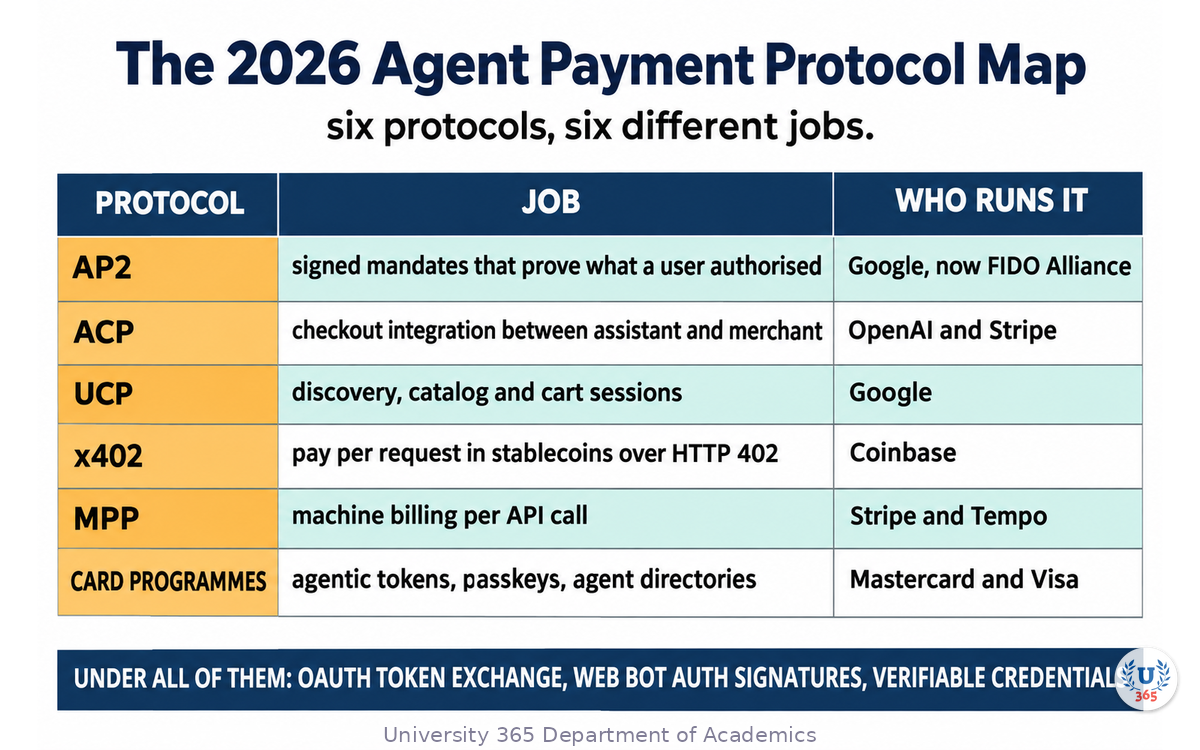
Six protocols matter, and they do different jobs. Confusing them is the most common analytical error in this field.
The Agent Payments Protocol, AP2, is an authorization layer. It does not move money. It produces signed mandates that a merchant, a credential provider and a payment processor can verify.
The Agentic Commerce Protocol, ACP, developed by OpenAI and Stripe, is a checkout integration layer. It defines how an assistant sends an order to a merchant's backend, how the merchant accepts or declines, and how a shared payment token is scoped. Its first mass deployment was Instant Checkout inside ChatGPT.
The Universal Commerce Protocol, UCP, from Google, is a discovery and catalog layer. It defines how an agent finds a merchant, reads a catalog, and manages a checkout session. It sits beside AP2 rather than competing with it.
x402 is a settlement layer for machine-to-machine micropayments. It revives the HTTP 402 status code: a server answers a request with a price, the client pays in stablecoins, and the request is retried with proof of payment. There is no account and no card.
The Machine Payments Protocol, announced by Stripe and Tempo in March 2026, is another machine settlement design for agents paying per API call.
The card networks contribute tokenization and authentication: Mastercard Agent Pay with agentic tokens and payment passkeys, Visa Intelligent Commerce with its agent directory and trusted agent protocol, and the EMVCo draft framework for card-based agentic payments published for comment in September 2026.

The Agent Economy: Identity, Payments and Trust Between Machines
The Consumer Checkout That Did Not Scale
The first big bet was that people would buy inside a chat window. OpenAI launched Instant Checkout in ChatGPT in late 2025, powered by the Agentic Commerce Protocol built with Stripe, starting with Etsy sellers and with more than a million Shopify merchants announced as coming.
Adoption did not follow the announcement. Forrester's 2026 research found US consumer use of Instant Checkout low and stagnant, and in March 2026 OpenAI shut the checkout feature down in favour of an apps strategy in which merchants keep their own checkout. The protocol continues for app-based purchases, and the same plumbing reappeared in other surfaces: Stripe and Microsoft announced Copilot Checkout in January 2026, and Google added an agent-specific cart and catalog access to UCP in March 2026. Stripe described a single line of code for merchants already on its payment stack.
The numbers that matter sit one level down. IDC projects that 70 percent of retailers will restrict agent-initiated transactions by 2027 because agent identity, liability and attribution standards are still incomplete. The same firm expects 60 percent of enterprises to adopt verifiable agent identity signals by 2029. Restriction first, adoption second: that is the shape of a market where the trust layer is the constraint, not the demand.
For a business, the practical reading is blunt. Consumer agent checkout is a distribution question you can revisit. Agent-initiated purchasing inside your own operations, and machine payment for services you consume, are already happening and need controls now.

The Agent Economy: Identity, Payments and Trust Between Machines
Machine-to-Machine Payments: x402 and the Micropayment Layer
The quiet growth story of 2026 is not shopping. It is software paying software for small things: a web search, a data lookup, a model call, a wallet check.
x402 is the clearest example. Coinbase launched it in May 2025, reviving HTTP 402 so that a server can quote a price and a client can pay in stablecoins within the same request cycle. By October 2026, Chainalysis counted more than 138 million x402 transactions on Base. A public tracker reported about 202.5 million cumulative payments and 43.1 million dollars of settlement volume as of 18 November 2026, with roughly 452,000 transactions on the previous day. Monthly active senders reached 43,100 in mid-October, up 152 percent in a month.
Read those numbers with care, and the shape becomes more useful than the totals. Chainalysis found that 87 percent of x402 payments were worth between one hundredth of a cent and ten cents, which is below the economic floor of a card transaction.
Then subtract the noise. A preprint analysing 136.7 million settlements classified 21.2 percent as fictitious and 63.8 percent as transfers inside linked wallet clusters. An independent tracker found that only 91 businesses cleared a reasonable organic threshold in October 2026, on 793,000 dollars of organic volume, while the top ten wallets held 76 percent of volume and the median wallet earned one cent in the month. Coinbase itself settled about 42 percent of volume.
The honest summary: x402 has proved that machines can pay per request at scale, and it has not yet proved that a broad market of independent buyers exists. Both facts matter. If you are building a service that agents might buy, the payment mechanism is ready and the demand is thin. If you are buying, the controls you need are spending caps, an approved provider list, and a record that links each payment to the result it bought.
The Agent Economy: Identity, Payments and Trust Between Machines
Card Networks: Tokens, Passkeys and Agent Directories
The card networks took the opposite route to the same problem. Instead of a new rail, they extended the existing one with agent-specific credentials and identity signals.
Mastercard announced Agent Pay on 29 April 2025. The first live agentic transaction ran on its network in the third quarter of 2025, with US Bank and Citibank cardholders enabled. A first transaction outside the United States followed in the UAE on 19 November 2025. Hong Kong went live on 27 March 2026, with an agent booking an airport ride using a tokenised credential confirmed by Mastercard Payment Passkeys. Singapore and Malaysia followed in April 2026. By 2 June 2026 every Mastercard issuer in Europe was enabled at network level, and a fully European production transaction ran with Worldline and ING. In October 2026 Mastercard opened early access to Agent Pay for Machines, a programme for high-frequency, low-value payments between agents and services, built on x402.
Visa ran a parallel programme. Visa Intelligent Commerce was live in the United States by 29 April 2026. On 2 July 2026 Visa announced live agentic transactions across Europe with more than 30 issuers and merchants including lastminute.com, Frasers, Cleverbridge and BrickDepot. Merchants recognise approved agents through the Visa Trusted Agent Protocol and the Agent Directory, which give a consistent identity signal that can be plugged into existing risk and policy systems. A business-payments pilot with BILL and Billtrust followed in October 2026.
Under both programmes sit three technical pieces. Network tokenization replaces the card number with a scoped token. Strong authentication confirms the human's intent, usually with a passkey. Registration and verification of the agent ties the software to an operator. The design keeps the card rails, the fraud models and the chargeback system, and adds an agent identity on top.
The Agent Economy: Identity, Payments and Trust Between Machines
Reading the Numbers Without Being Fooled
Agent commerce produces more misleading statistics per page than any topic in enterprise technology right now. Four habits will keep you honest.
First, separate transactions from buyers. A protocol can settle hundreds of millions of payments while a few dozen businesses earn real revenue. The 202.5 million cumulative x402 payments and the 91 organically earning businesses are both true, and only the second tells you whether a market exists.
Second, separate volume from value. Chainalysis found that 95 percent of transferred value on x402 sat in transactions of one dollar or more by early 2026, up from 49 percent in early 2025, while the transaction count was dominated by sub-cent payments. A rising count of tiny payments and a rising share of large ones describe two different user groups.
Third, ask who counted. Cloudflare's figure of more than 1,700 percent growth in daily agent requests in the year to 30 September 2026 comes from one network, and its definition of agent traffic rests on self-declared and signed identities. That is a large sample, not the whole web. Vendor announcements, alliance membership lists and pilot descriptions are marketing documents until an independent party measures them.
Fourth, treat "agent" as a claim, not a category. Nothing in x402 requires an agent, and a script can sign a Web Bot Auth request. When a report says agents did something, ask what evidence distinguished an agent from automation. In most datasets, the answer is a heuristic.
The Agent Economy: Identity, Payments and Trust Between Machines
Where Trust Actually Breaks: Five Failure Modes
Agent payment failures cluster into five patterns. Each has a control, and each control fails differently.
Impersonation. An attacker steals a token or forges an identity and presents it as a trusted agent. Short-lived, audience-bound tokens limit the damage. Signed requests and a directory check at the edge catch the crude cases. Nothing catches a stolen key that is used within its scope, which is why key custody and rotation still matter more than badges.
Scope creep. The agent stays inside its technical permissions and outside the user's intent. A five thousand euro limit does not mean five thousand euros of anything. The control is a mandate with constraints: merchant lists, categories, time windows and per-transaction caps. The failure mode is a mandate so broad that it is a blank cheque with a signature.
Instruction hijacking. The agent reads text that contains instructions, and those instructions redirect a valid credential to a new payee. This is prompt injection applied to money. The control is architectural: the payee and amount come from a signed mandate, never from text the model reads. If your agent can change the recipient because a web page told it to, no amount of identity verification saves you.
Replay and double spend. A valid payment instruction is submitted twice, or two agents act on the same instruction. The control is a nonce or an idempotency key bound to the mandate, plus a ledger that rejects duplicates. Retries are normal in agent systems, so this failure is common and cheap to prevent.
The dispute gap. The transaction succeeds, the outcome is wrong, and no rule says who pays. This is the largest unclosed problem in the field, and it deserves its own section.
The Agent Economy: Identity, Payments and Trust Between Machines
The Dispute Gap: Who Pays
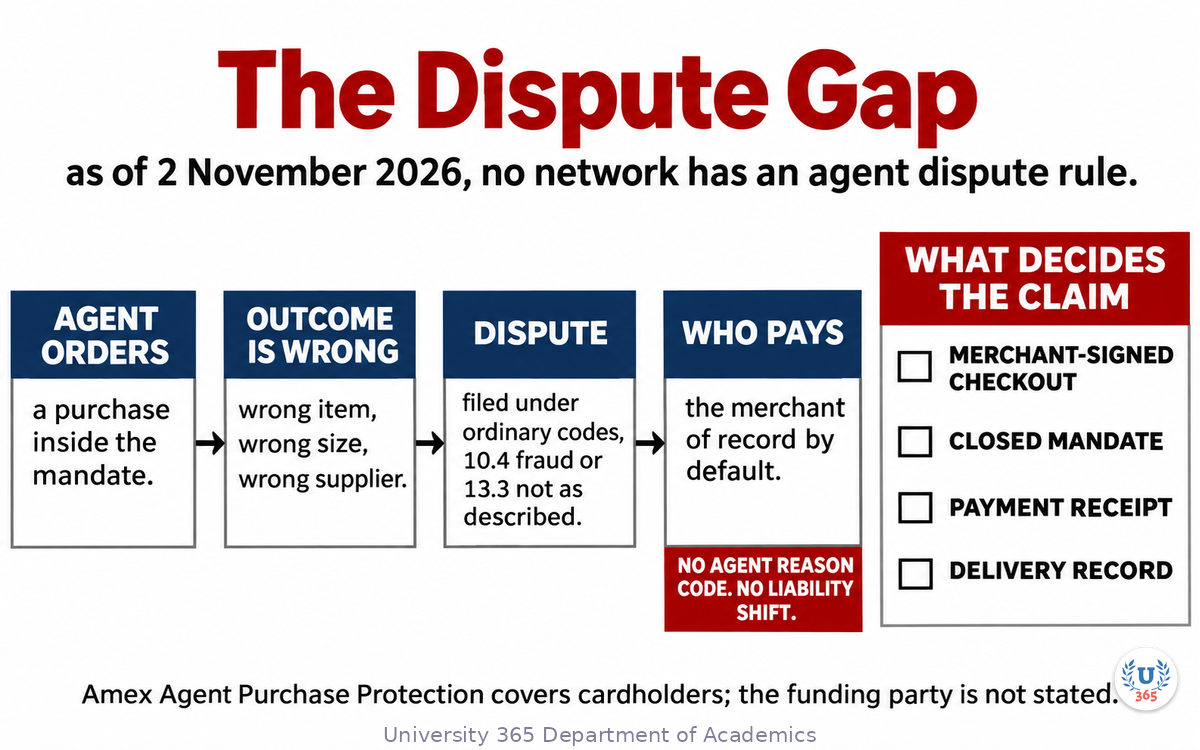
Here is the uncomfortable fact as of 2 November 2026: no card network has published a dispute condition or a liability shift for agent payments. Visa's Core Rules edition of 24 October 2026 defines an Agentic Transaction, and the term then appears in the dispute chapter only in the Compelling Evidence 3.0 rows, where an agent platform's login identifier counts as a matching element. Mastercard's merchant guidance states that standard fraud detection, chargeback rights and dispute resolution processes apply to agentic transactions. American Express announced Agent Purchase Protection for agent errors in April 2026 with its developer kit, covering wrong item, wrong size or wrong merchant for cardholders, and did not state who funds it.
The practical consequence is simple. An agent order is a card-not-present order with a more complicated paper trail, and the merchant of record carries a lost chargeback by default. OpenAI's commerce documentation says the same thing in plain words: the merchant accepted the payment, so the merchant handles refunds and chargebacks.
Now follow the money through a realistic case. A procurement agent buys a 240 euro part. The part is the wrong specification. The company disputes the charge. Under the current rules the issuer picks an ordinary reason code, most likely not as described, and the merchant has to answer with evidence. The evidence that would win is not a session log. It is the mandate: what the buyer's agent was authorised to purchase, what the merchant displayed, what the agent selected, and what the delivery confirmation said. A merchant that kept the agent's signed request, the checkout it served, and the login identity attached to the order has a case. A merchant that treated the agent as just another browser has nothing.
The reverse risk sits with the buyer. If the agent went outside its mandate, the buyer's own authorization record is the proof, and without it the buyer is arguing about intent with no document. This is why mandates are worth more than they cost. They are simultaneously a control and a litigation exhibit. Until a network publishes an agent-specific rule, design as if the merchant pays and the buyer must prove scope.
The Agent Economy: Identity, Payments and Trust Between Machines
A Worked Transaction, End to End
Take the 240 euro part and walk it through a well-built system.
At 09:12 the procurement agent wakes on a scheduled task. It has an agent identity registered in the company directory, sponsored by the operations manager, with a credential that expires in 15 minutes. At the edge of the supplier's site, its signed request identifies the operator and is checked against a directory. The supplier serves the catalog.
The agent finds the part and assembles a checkout. The merchant signs the checkout with its own key: 240 euros, one part number, delivery in five days. The agent presents that signed checkout against an open mandate the operations manager signed earlier: supplier approved, category approved, cap 500 euros per order, second approval required above 200 euros. The cap is breached, so the agent does not pay. It opens an approval request.
At 09:14 the operations manager receives a request on her phone showing the part, the price, the supplier and the agent's reasoning. She approves. Her approval closes the mandate: a signed credential bound to the merchant's signed checkout hash, valid for one payment and 10 minutes.
The agent sends the closed mandate with the payment. The credential provider verifies the mandate, checks the signature, checks the hash against the checkout, and issues a network token scoped to this merchant and this amount. The merchant verifies the checkout mandate, confirms the price it signed, and processes the payment with the agentic token. The issuer sees an authenticated agent transaction with a known operator and a passkey-confirmed human approval.
At 09:15 the merchant returns a receipt and an order confirmation. The agent stores four artifacts: the merchant-signed checkout, the closed mandate, the payment receipt and the order record. It links them to the task, the human approver and the spend.
Six days later the part arrives wrong. The company files a claim. The evidence pack is already assembled, because the transaction produced it. The supplier can see that the part number it shipped matches the part number it signed. The buyer can see that the part number was the one the agent selected inside the approved category. The dispute becomes a factual question about a catalog error, not an argument about whether a machine was allowed to buy anything.
Every component in that walkthrough existed in production in 2026. What most organisations lack is the discipline to chain them: an identity with an owner, a mandate with constraints, a token scoped to one merchant, a receipt that binds the lot, and a stored evidence pack. Each missing link turns a routine claim into a loss.
The Agent Economy: Identity, Payments and Trust Between Machines
The Economics of Agent Payments
On the selling side, the calculation is less comfortable. Card interchange on a 240 euro order is a few euros. If agent orders dispute at twice the rate of human orders, and each dispute costs a fee plus handling time, the margin can disappear. That is the arithmetic behind IDC's forecast that most retailers will restrict agent-initiated transactions by 2027: not hostility to agents, but an unpriced risk.
The micropayment layer has the opposite profile. A card transaction cannot economically carry a one cent charge, because fixed costs exceed the value. x402 can, which is why 87 percent of its payments sit below ten cents. The catch is that revenue at that price depends on enormous volume and near-zero fraud. The October 2026 data showed 91 businesses clearing a real revenue threshold, with the top ten wallets holding 76 percent of volume. Concentration is the norm in a young payment network, and it tells you where the durable businesses are: data, search and infrastructure, not consumer goods.
For a finance team, three lines belong in the model. Cost per agent transaction, including identity and evidence. Dispute rate by agent channel, tracked separately from human channels. And the cost of a blocked transaction, because a false decline on an agent order is invisible revenue loss that never reaches a dispute report.
The Agent Economy: Identity, Payments and Trust Between Machines
Design Rules for Agent-Facing Checkout
Most trust failures a user experiences are interface failures. The protocol worked, the money moved, and the person could not tell what they had authorised.
Show the mandate, not the summary. When an agent asks for approval, the screen should show what will be bought, from whom, at what price, within which limit, and for how long the approval lasts. A sentence generated by the model is not a substitute. The user signs a scope, and the scope has to be legible.
Make the approval auditable to the user. After the purchase, the person should be able to see the same artifacts the merchant holds: what was approved, when, by whom, and what arrived. This is the difference between a receipt and a claim.
Design the refusal states. Agents hit caps, expired mandates and blocked merchants. Each needs a clear message and a next action. A silent failure teaches users to raise limits until the control is meaningless.
Separate the agent's voice from the company's. When an agent communicates on behalf of a business, the disclosure has to be unambiguous, and it has to survive the agent's own summarisation. UIC's discipline applies here: the reader must know a machine acted, what it was allowed to do, and where to object.
Test with the person who will carry the loss. If the operations manager approving a purchase cannot explain the mandate in her own words after one look, the interface is not finished.
The Agent Economy: Identity, Payments and Trust Between Machines
Regulation: What Applies in November 2026
No law says "agent payments" yet. Several laws reach them anyway, and the compliance question is which one bites first.
The EU AI Act is the loudest. Its transparency obligations under Article 50 apply from 2 August 2026, with enforcement starting at national and EU level. Providers must tell people when they are interacting with an AI system and must mark synthetic content in a machine-readable form. Deployers must disclose emotion recognition, biometric categorisation, deepfakes, and certain public-interest text published without human review. Fines can reach 15 million euros or 3 percent of worldwide turnover. The high-risk obligations for Annex III systems apply from 2 December 2027 after the Digital Omnibus amendments, and systems already on the market before 2 August 2026 have until 2 December 2026 for the content-marking duty only.
Payment regulation sits underneath. Strong customer authentication under PSD2 already governs card payments in Europe, and the agentic token programmes are built to satisfy it through passkeys and explicit consumer consent. The revised payment services rules, eIDAS 2.0 digital identity wallets, the Digital Operational Resilience Act for financial entities and MiCA for stablecoin issuers each touch part of the chain. Data protection applies to every agent transaction that carries personal data, which is most of them.
Treat this section as orientation, not advice. Read the current text of any rule before you rely on it, because the 2026 amendment cycle moved several dates.
The Agent Economy: Identity, Payments and Trust Between Machines
Building the Trust Layer in 90 Days
You do not need a protocol rewrite to make agent payments safer this quarter. You need six steps in order.
Weeks 1 and 2: inventory and ownership. List every agent that can spend money or move data, including the ones built inside business units. For each, name a human sponsor, a purpose and a maximum exposure. An agent without a named owner should not hold a credential.
Weeks 3 and 4: identity. Register each agent in your directory, replace static keys with short-lived credentials, and require dual attribution in logs: the user and the agent. This is the step most organisations skip, and it is the one that makes every later control possible.
Weeks 5 and 6: mandates and caps. Write the authorization as an object, not a prompt: allowed merchants, categories, per-transaction and monthly caps, time windows, and the approval threshold. Enforce the caps in code, not in the system prompt.
Weeks 7 and 8: receipts. For every agent transaction, store the merchant checkout, the authorization, the payment receipt and the outcome, linked to the task and the approver. Test that you can reconstruct one transaction in under five minutes.
Weeks 9 and 10: the dispute path. Write down who responds to a wrong order, what evidence they will attach, and which reason code applies. Ask your processor and your card network what they require for an agent transaction today. Most will say the standard rules apply, which means your evidence is the only differentiator.
Weeks 11 and 12: drills and metrics. Run one tabletop exercise on a hijacked agent and one on a wrong purchase. Then report four numbers monthly: agent transactions, blocked transactions, dispute rate by agent channel, and median time to evidence.

The Agent Economy: Identity, Payments and Trust Between Machines
Feynman Summary: Explain It Like You Are 12
Imagine you give a robot a signed permission slip that says: buy one bicycle part from this shop, spend no more than 500, and ask me first if it costs more than 200. The robot goes to the shop, picks the part, and shows the shop the slip. The shop checks the signature and the amount, takes the money, and gives back a receipt. If the part is wrong, you show the slip and the receipt and say: this is what I allowed, this is what was bought.
Now imagine the robot has no slip, just a password written on its arm. Anyone who copies the password can pretend to be the robot. The shop cannot tell whether the robot is buying for you or for a thief. And if something goes wrong, nobody can prove what you actually allowed.
The identity says which robot it is. The mandate says what it may do. The payment token says which shop and how much. The receipt proves what happened. The card rules have not caught up with the last part, so for now the shop usually carries the loss, and the only defence either side has is a good record.

The Agent Economy: Identity, Payments and Trust Between Machines
Mindmap: The Complete Picture
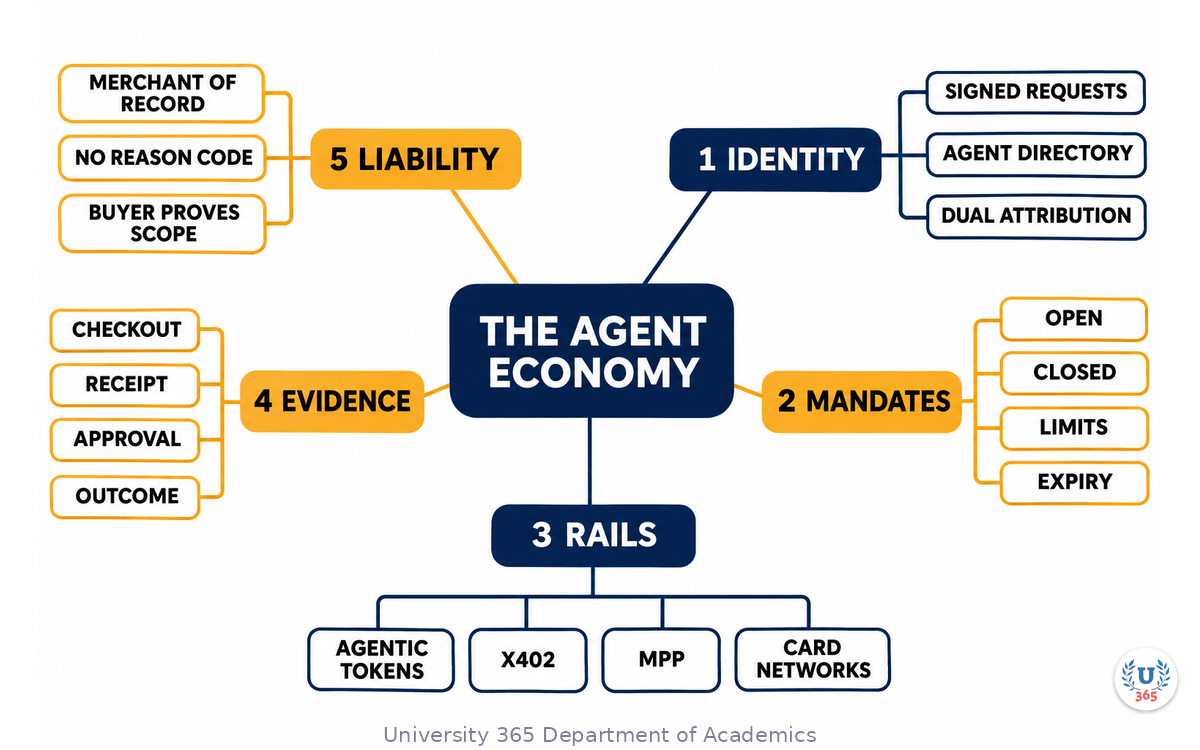
The mindmap condenses the lecture into five branches: identity, mandates, rails, evidence and liability, with the 2026 facts that anchor each one.
UNOP Sound (University 365 Neuroscience Oriented Pedagogy)
Take five minutes to consolidate your memory. Play the isochronous tone track (10Hz alpha frequency) with your eyes closed. Alpha-frequency tones after a learning session support consolidation, helping move what you just learned from short-term to long-term memory.
[Audio player: UNOP Post-Lecture Isochrone (10Hz, 5 minutes)]
The Agent Economy: Identity, Payments and Trust Between Machines
Practical Exercise: Map One Agent Transaction
Pick one agent in your organisation that spends money or moves data. If you have none, pick a purchase you made online in the last month and map it as if an agent had done it.
Produce a one-page table with these rows and fill each with a fact, not a description:
Agent identity. Which credential does it present, where is it registered, and who is the named sponsor?
Delegation. What did the user authorize, in what object, with which limits and expiry?
Counterparty check. How does the merchant or API know the agent is legitimate?
Payment scope. Which token or credential was used, and what was it scoped to?
Evidence. Which four artifacts exist after the transaction, and where are they stored?
Liability. If the outcome is wrong tomorrow, who carries the loss under today's rules, and what would you attach to the claim?
Then mark the weakest row. In most organisations it is row 2 or row 5. Fix that one this month: write the authorization as an object with limits, or start storing the receipt set. A single repaired row reduces real exposure more than a new vendor pilot.
Finish by writing the one question you cannot answer from your own records. That question is the gap your next quarter of work should close.

The Agent Economy: Identity, Payments and Trust Between Machines
Glossary
Term | Definition |
Agent identity | A registered, credentialed representation of an AI agent, with a named human or organisational sponsor |
Mandate | A signed, verifiable credential that records what a user authorised an agent to do, and within which limits |
Open mandate | A mandate that carries constraints such as budget, merchant list and time window, before a specific purchase exists |
Closed mandate | A mandate bound to one specific checkout by a cryptographic hash, valid for one payment |
Know Your Agent | The practice of verifying an agent, the operator behind it and its delegated authority at the moment of a transaction |
Web Bot Auth | An IETF draft that lets an agent sign its HTTP requests so an origin can verify which operator sent them |
HTTP 402 | The dormant Payment Required status code revived by x402 so a server can quote a price inside a request |
Agentic token | A network token issued for an agent transaction, scoped to a merchant and an amount |
Dual attribution | Logging both the human user and the agent as actors in every token and every action |
Merchant of record | The party that sells the goods, accepts the payment and carries refunds and chargebacks |
Liability shift | A card network rule that moves fraud loss from the merchant to the issuer when authentication conditions are met |
Evidence pack | The set of artifacts kept after a transaction: signed checkout, authorization, payment receipt and outcome |

The Agent Economy: Identity, Payments and Trust Between Machines
Quiz: TEST YOUR UNDERSTANDING
1. What does an AP2 mandate actually prove?
A) That the agent is fast
B) That a user authorised a specific scope of purchase, signed and bound to a checkout
C) That the merchant is honest
D) That the model was accurate
2. Why is a static API key the wrong credential for an agent?
A) It is slower than OAuth
B) It has no owner, no expiry and no delegation context
C) It cannot be logged
D) It costs more
3. As of November 2026, who carries the loss on a disputed agent card payment by default?
A) The agent platform
B) The model provider
C) The merchant of record, under ordinary card-not-present rules
D) The card network
4. What does the x402 protocol do?
A) It replaces card networks
B) It lets a client pay for a request in stablecoins after an HTTP 402 response
C) It signs agent identities
D) It stores mandates
5. Which control stops a prompt injection from redirecting a payment?
A) A larger context window
B) A better system prompt
C) Taking the payee and amount from a signed mandate, never from text the model reads
D) A faster fraud model
Answers: 1-B, 2-B, 3-C, 4-B, 5-C

Related Resources
U365 INSIDE Publications
External Resources
Related U365 Lectures (Coming Soon)
AI Agent Security: Prompt Injection, Tool Poisoning and Permissions (Technology AI Series)
AI and Liability: Who Answers When an Agent Acts (Cross-Institute Series)
Agentic Commerce: When AI Buys for Your Customers (Business AI Series)
The Agent Economy: Identity, Payments and Trust Between Machines
U.Copilot for This Lecture
You are my agent payments analyst. I need to map the trust path for one agent transaction and find the weakest link. Transaction: [what the agent buys or does] Agent: [platform, model, operator] Delegation: [who authorised it, what limits, in what object] Payment: [card token, stablecoin, invoice] Evidence kept: [what exists after the fact] Do five things: 1. Draw the five layers: identity, delegation, counterparty check, payment, evidence. 2. For each layer, name the artifact that proves it and mark it present or missing. 3. Name the most likely failure mode here and the control that prevents it. 4. State who carries the loss today if the outcome is wrong, and flag where you are uncertain. 5. Give me the three fixes to make this month, ranked by risk reduced per unit of effort. Ask one clarifying question if the delegation or the payment rail is ambiguous.
The Agent Economy: Identity, Payments and Trust Between Machines
Next Steps
List every agent that can spend money, with a named human sponsor and a maximum exposure.
Replace one static API key with a short-lived, audience-bound credential this week.
Write the authorization for your highest-risk agent as an object with merchant, category and amount limits.
Store the four evidence artifacts for every agent order and prove you can reconstruct one in five minutes.
Ask your payment processor what it requires today to defend an agent transaction in a dispute.

The Agent Economy: Identity, Payments and Trust Between Machines
IMPORTANT NOTICE
Copyright University 365, Inc. All rights reserved. This lecture is provided for educational purposes and does not constitute legal, financial or professional advice. For enrollment, visit university-365.com/tuition. For permissions or inquiries, contact uda@university-365.com.
Published by the Department of Academics, University 365.
Lecture delivered by the UIT, UIB, UIC, UID in collaboration.
Martin Swartz, Dean of Academics, UDA
Signed for the academic year 2026.




Comments