
The Three-Branch Start: Map the Chapter Before You Read It
In this Neuroscience Publication
You open the chapter at page one and start reading, because that is what reading looks like. Forty lines later the section has moved twice and you cannot say what it argues. Ninety seconds before the first sentence changes that: one centre in six words, three branches from the headings, three questions the chapter should answer. Then you read to answer them.


The Three-Branch Start: Map the Chapter Before You Read It
How to Do It
Take one chapter you have not read, one sheet of paper and one pen. The start takes 90 seconds: the point is a skeleton, not a summary.
Write the centre in six words (15 seconds). Write what the chapter is about in six words or fewer. Not the title: the question it answers. Circle it.
Read only the map of the chapter (25 seconds). Read the headings, the bold terms, the first sentence under each heading and the summary box. Skip the paragraphs: you are reading the shape.
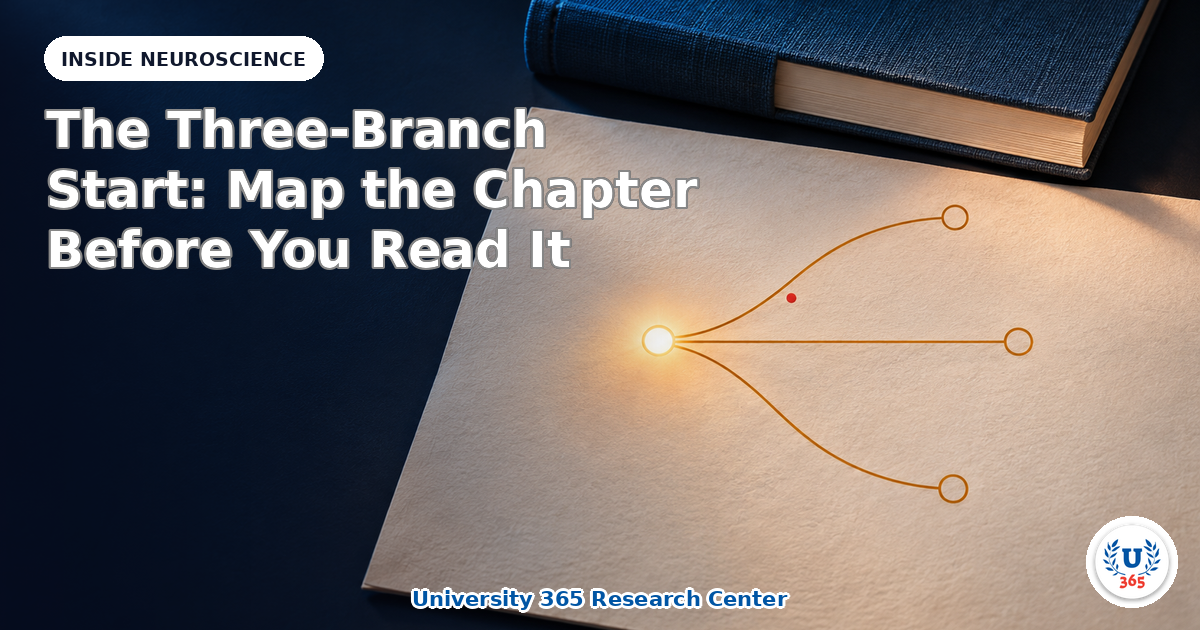
Draw three branches and no more (25 seconds). Group what you saw into three branches and draw them from the circle. If you find four or five groups, merge the smallest into a neighbour: three keeps the page readable.
Turn each branch into a question (20 seconds). Under each branch, write the question the chapter should answer, in the chapter's own words where you can. A branch without a question is a label.
Mark your one-word guess (5 seconds). Beside each question, write the answer you expect in one word. Being wrong is useful: the guess makes you notice the answer.
Read with the page beside you (the session). Read normally. When a question is answered, tick the branch and add the answer in three words. When something important lands outside the three, add it in the margin with a plus sign.
Close the loop in one minute (60 seconds). After the chapter, look at the page. Which question was answered, which guess was wrong, what did you not predict? Add one missing branch if it earned it, date the page and keep it as the first page of your notes.

The Three-Branch Start: Map the Chapter Before You Read It
The 5M2S Key Point
Ninety seconds of three questions before the first line beats a page of marker ink after it: you read to answer, and you see what the chapter skipped.

The Three-Branch Start: Map the Chapter Before You Read It
Origin
The practice has two parents. The first is PQRST: Preview, Question, Read, Summarize, Test. The UNOP library publishes it as Rule 04, Reading Rocket Fuel, a three-minute primer. This hack keeps Preview and Question, compresses them into 90 seconds and moves the rest into the reading itself.
The second is the Mind Mapping guide in the same library: define the central idea, add the branches, then the sub-branches it calls twigs. The guide maps a text you have read. This hack puts the first two steps in front of the reading and leaves the twigs until the chapter has answered the questions, because a twig written before the text is a guess dressed as a fact.
Ausubel called the idea an advance organizer: a short statement at a higher level of abstraction, given before the material so new content has something to attach to. His was written for the reader; this one by the reader.
Mind-Map Any Chapter runs the full map after a reading. Your First Memory Palace stores facts in places. Chunk It groups material before you memorise it. This hack decides what you are reading for.

The Three-Branch Start: Map the Chapter Before You Read It
Science-Backed
Three research families bear on this practice. None tested a 90-second pre-reading map of a course chapter, so read the numbers as support for the parts.
Trying to answer before you read improves later recall, even when the attempt fails. Richland, Kornell and Kao (2009) ran five experiments in which students read an essay about vision. Students were asked about embedded concepts before reading; the control got the same extra study time. In Experiment 1 participants answered 5 percent of the pretest correctly, and the items they failed still scored 75 percent on the final test against 56 percent, t(61) = 4.26, d = 1.1. Only items not retrieved on the pretest were analysed. Experiment 5 separated testing from attention: attempting to answer beat reading and memorising the same questions. A question you cannot answer yet is what makes the following reading do work.
Kornell, Hays and Bjork (2009) reached the same conclusion with materials built to guarantee failure: fictional trivia and weak word pairs. Six experiments compared an attempt plus the answer with reading both together. The unsuccessful attempt won, d = 0.94 in Experiment 4, and the benefit held beyond 24 hours in Experiment 5, d = 0.44. Their stipulation is explicit: feedback is critical. Here the feedback is the chapter, which is why each branch must become a question with an answer in the text.
A preview alone is a small lever. Luiten, Ames and Ackerson (1980) pooled 135 studies of advance organizers and found a small facilitative effect on learning and retention. Small is the honest word; those organizers were written by the experimenter.
Maps the learner constructs carry the larger effect. Nesbit and Adesope (2006) pooled 55 studies with 5,818 participants and 67 effect sizes. The weighted mean was 0.604 standard deviations, 95 percent confidence interval 0.550 to 0.658. Constructed maps averaged 0.819; studied maps averaged 0.373, with significant heterogeneity. The pattern is the argument for drawing the three branches yourself.
What the evidence does not show: no study assigns this exact protocol before a class chapter and measures the exam result. Richland's materials were short essays, Kornell's trivia and word pairs, Luiten's effect small and decades old, Nesbit's pool mixed classrooms. A preview can also inflate confidence, because three neat branches feel like knowledge before you read a word. The tick and the correction afterwards keep the page honest.

The Three-Branch Start: Map the Chapter Before You Read It
Sources
All sources below were opened and read on 9 November 2026.
UNOP library. University 365 library index. Holds Rule 04 and the Mind Mapping guide.
Luiten, Ames & Ackerson (1980). A meta-analysis of advance organizers on learning and retention. American Educational Research Journal, 17(2), 211-218. Read at ERIC EJ233231.
Richland, Kornell & Kao (2009). The pretesting effect: do unsuccessful retrieval attempts enhance learning? Journal of Experimental Psychology: Applied, 15(3), 243-257.
Kornell, Hays & Bjork (2009). Unsuccessful retrieval attempts enhance subsequent learning. Journal of Experimental Psychology: Learning, Memory, and Cognition, 35(4), 989-998.
Nesbit & Adesope (2006). Learning with concept and knowledge maps: a meta-analysis. Review of Educational Research, 76(3), 413-448.
UNOP guide. Mind Mapping. The 3-step guide. University 365 library, URC-Research/UNOP.
A U365 5M2S Microlearning 5 MINUTES TO SUCCESS UNOP Neuro-Hack |
Please Rate and Comment This Publication
How did you find this Publication? What has your experience been like using its content?
Let us know in the comments at the end of that Page!
If you enjoyed this publication, please rate it to help others discover it. Be sure to subscribe or, even better, become a U365 member for more valuable publications from University 365.
Do you have questions about that publication? Or perhaps you want to check your understanding of it. Why not try playing for a minute while improving your memory? For all these activities, consider asking U.Copilot, the University 365 AI agent trained to help you engage with knowledge and guide you toward success. U.Copilot is always available, even while you are reading a publication, at the bottom right corner of your screen. Alternatively, you can open a separate window with U.Copilot: www.u365.me/ucopilot.
Try these prompts in U.Copilot:
I just finished reading the publication "The Three-Branch Start: Map the Chapter Before You Read It", and I have some questions about it: Write your question.
I have just read the Publication "The Three-Branch Start: Map the Chapter Before You Read It", and I would like your help in verifying my understanding. Please ask me five questions to assess my comprehension, and provide an evaluation out of 10, along with some guided advice to improve my knowledge.
Or try your own prompts to learn and have fun...
Are you a U365 member? Suggest a topic you'd like to see as a Neuro-Hack,and we’ll add it for you! |
Save a crazy amount of time with our 5 MINUTES TO SUCCESS (5M2S) formula.
5M2S is University 365's Microlearning formula to help you gain knowledge in a flash. If you would like to make a suggestion for a particular topic that you would like to see as a Neuro-Hack, simply let us know as a member of U365 by providing the topic's details in the Human Chat located at the bottom left after you have logged in. Your request will be prioritized, and you will receive a notification as soon as it is added to our catalogue.
NOT A MEMBER YET?
DON'T FORGET TO RATE AND COMMENT ABOUT THAT PUBLICATION




Comments