
Claude Opus 4.8: Anthropic's Legacy Opus, Priced Above Its Successor

Status: Risky | Last tested: 2026-11-14 (Claude Opus 4.8, claude-opus-4-8, released 2026-05-28) | Re-check: trigger-based (max 6 months)
Risky: the tool has significant unresolved issues, or it has been clearly surpassed by newer alternatives. Use it with caution and read the Limits section.
For detailed explanations of the CI-First evaluation terms used in this review, including the Humics Protection Badge and the AI Imposture Risk levels, see the Glossary at the end.


In this Tool Review

Claude Opus 4.8: Anthropic's Legacy Opus, Priced Above Its Successor
The name, the ladder position and the model this review does not replace
Five names matter here, and the number that looks highest is not the newest.
Name | What it is | Where it appears |
Claude Opus 4.8 | The model this review scores. Model id claude-opus-4-8, released 2026-05-28, now documented as Active (legacy) with retirement not sooner than 2027-05-28 | The model overview, the pricing page, the deprecations table, the system card of May 2026 |
Claude Opus 4.7 | The direct predecessor, released 2026-04-16, at the same $5 and $25 rates and with a retirement window not sooner than 2027-04-16 | The release notes, the deprecations table, the Opus 4.8 system card's comparison columns |
Claude Opus 5 | The successor released 2026-07-24 at the same $5 and $25 list price. Anthropic states that on Frontier-Bench v0.1 it more than doubles Opus 4.8's performance at a lower cost per task | The Opus 5 launch page, the release notes, the deprecations table |
Claude Opus 5.5 | The current Opus model, released 2026-09-22, at $4 and $20 per million tokens, performing at the level of Claude Fable 5.1 on most work, and the model Anthropic tells most buyers to start with | The Opus 5.5 launch page, the models overview, the deprecations table |
Claude Fable 5.2 | The top of the line at $8 and $40, released 2026-11-09, and the capability ceiling of the current family | The Fable 5.2 launch page and the Fable 5.2 review in the U365 library |
What changed on the Opus ladder, stated as a sequence rather than as a family description. Opus 4.8 was the third minor bump on the Opus 4.5 generation: 4.5 on 2025-11-24, 4.6 on 2026-02-05, 4.7 on 2026-04-16 and 4.8 on 2026-05-28, each at the same $5 and $25 list price, each described by the vendor as an improvement on the one before. The 4.8 release carried three specific changes rather than a general capability step. It added a user-facing effort control to the Claude apps and to Cowork, so the effort level stopped being an API-only setting. It added dynamic workflows to Claude Code, which let one session run hundreds of parallel subagents, with Opus 4.8 as the model those agents could run on for longer. And it cut the price of fast mode to $10 and $50, a third of what fast mode had cost on the previous Opus models, while leaving regular pricing unchanged.
The ladder then moved twice, and both moves cut against this model. Opus 5 arrived on 2026-07-24 at the same $5 and $25, and Anthropic's own comparison says it more than doubles Opus 4.8's performance on Frontier-Bench v0.1 at a lower cost per task; one tester quoted in that launch described quality at lower reasoning levels with 26 percent fewer tokens than Opus 4.8 at max. Opus 5.5 arrived on 2026-09-22 at $4 and $20, below this model on both lines, with cache reads at $0.20 against this model's $0.50. A model that was a modest improvement on its predecessor in May is, by November, one generation and one price cut behind its own line.
The one thing Opus 4.8 still does in the current line-up is answer for Opus 5.5. Anthropic routes higher-risk cybersecurity requests on Opus 5.5 to Claude Opus 4.8 across its own apps, including claude.ai and Claude Code, and the model picker stays on Opus 4.8 for the rest of that conversation. On the API the fallback is opt-in, and the response names the model that answered. Section 7c records the mechanism, the vendor's own statement that this routing likely lowers its published benchmark scores, and what it means for a reader who believes they are reading Opus 5.5.
What this review is. It is the URC scoring of Claude Opus 4.8 under the CI-First Evaluation Framework, version 1.4.1, on evidence read on 2026-11-14: the vendor's launch page of 2026-05-28, the model overview, the pricing page, the deprecations table, the what-is-new page, the prompting guide and the 246-page system card; the later Opus 5 and Opus 5.5 launch material where it compares against this model; Artificial Analysis; one controlled 25-task paired comparison published by Stet; the Hacker News launch thread of 1,774 points and 1,376 comments; and the published U365 scores this model sits beside.
What this review is not. It is not a review of Claude Code, of the Claude apps, of Amazon Bedrock, of Google Cloud, of Microsoft Foundry or of Claude Platform on AWS. It is not a re-score of Opus 4.7 or of Opus 5, and it does not overwrite the Opus 5 review at 6.5. It is not a review of Opus 5.5, which has its own document at 6.5. And it is not an assessment of Anthropic's safety programme beyond the facts a buyer of this model has to carry, which are in Section 7c with their sources named.
Where the score sits against the siblings, stated before the arithmetic. Claude Opus 5 and Claude Opus 5.5 both score 6.5, with sub-scores 7 / 7 / 8 / 4. This review scores Claude Opus 4.8 at 6.3, with sub-scores 7 / 7 / 7 / 4. The half-step down is carried almost entirely by the Quality dimension, and the reason is a single sentence from the vendor: the successor more than doubles this model's performance on the vendor's own hardest coding benchmark at a lower cost per task. Time and Skill do not move, because the shape of a reader's work with this model is the same shape it was with Opus 5.5.
The two published Claude reviews read as the format reference for this review, named because the card requires it. The Claude Sonnet 5.5 review, slug claude-sonnet-5-5-anthropic-s-fast-everyday-model-at-the-same-price, published 2026-11-14, supplied the current house shape, the effort-ladder treatment and the clause-note construction. The Claude Opus 5.5 review, slug claude-opus-5-5-anthropic-s-fable-5-1-class-model-at-40-percent-lower-cost-scored-6-5-on-the-u365, published 2026-09-22, supplied the same-tier predecessor reading and the cyber-fallback finding this review extends. Both were read before scoring. The second also carries a status block that predates the v1.4 removal of the collaboration-mode dimension, and this review follows the current shape rather than that one.
---

Claude Opus 4.8: Anthropic's Legacy Opus, Priced Above Its Successor
Tool Snapshot
Claude Opus 4.8, the generation of Anthropic's Opus line that added an effort control to the consumer apps and a dynamic-workflow mode to Claude Code: strong for its generation, still reliable on contained work, and no longer the Opus to buy at any price line it carries.
Category: Applied AI / Large Language Model. Complex agentic coding, enterprise knowledge work, long-horizon tool use, computer use, and document and analysis production at a $5 and $25 price point. It sits below Claude Opus 5 and Claude Opus 5.5 in capability and, since 2026-09-22, above both of them in price.
Primary use cases:
Contained engineering work where the patch footprint matters. On 25 matched tasks from one repository, a published paired comparison found this model and Claude Opus 5 tied at 9 strict test passes each, while Opus 4.8 produced the smaller patch on 20 of 25 tasks and finished sooner on 17. The vendor's own framing of the release is agentic coding and enterprise work, and the measured case for it now is narrowness rather than raw capability.
Long-horizon agentic runs inside Claude Code, including dynamic workflows. The release shipped dynamic workflows in research preview, in which one session plans the work and runs hundreds of parallel subagents, and Opus 4.8 was the model that could run those agents for longer. A team that has a validated workflow of this shape has a real reason to keep it on the model it was validated against.
A pinned, reproducible baseline. A frozen model id, a frozen prompt set and a frozen test setup produce a reproducible result. That is an asset for research and for regression testing, and it is the strongest technical argument for keeping a superseded model in a pipeline.
The cyber fallback path on Claude Opus 5.5. Across Anthropic's own apps, higher-risk cybersecurity requests on Opus 5.5 are answered by Opus 4.8. A team doing security-adjacent work meets this model whether or not it chose it, which makes its behaviour worth understanding.
Enterprise knowledge work on the 2026 benchmark suite. SWE-bench Verified at 88.6 percent, SWE-bench Pro at 69.2, GDPval-AA at 1890 against 1753 for Opus 4.7, OSWorld-Verified at 83.4 and MCP-Atlas at 82.2 are strong rows, and they are the rows a procurement document written in mid-2026 will quote back at a reader.
What it is not. It is not the current Opus. Anthropic labels the model Legacy on its own model page, and both successors cost the same or less: Opus 5 at $5 and $25, Opus 5.5 at $4 and $20. It is not the most capable model in the family at its own generation: its own system card shows it behind Claude Mythos Preview across nearly every evaluation, and behind GPT-5.5 on Terminal-Bench 2.1 and Gemini 3.1 Pro on GPQA Diamond. It is not a cheap model by the standards of the field: Artificial Analysis records $5 and $25 against a median of $2 and $10 in its comparison class. It is not a teacher: nothing in it moves a capability from the model to you. It is not an image, audio or video generator, and it reads images to produce text. It is not self-hostable and not inspectable from outside Anthropic's service. And it is not the model to start a new integration on in November 2026, because the integration work carries a migration to Opus 5.5 with it.
Pricing, as published on 2026-11-14:
Line | Rate per million tokens | Note |
Input | $5.00 | Unchanged from Opus 4.5, 4.6 and 4.7; 25 percent above Opus 5.5 |
Output | $25.00 | Unchanged from the previous three Opus models; 25 percent above Opus 5.5 |
Cache reads | $0.50 | 0.1 times base input; Opus 5.5 charges $0.20 |
Five-minute cache write | $6.25 | 1.25 times the input rate |
One-hour cache write | $10.00 | Twice the input rate |
Batch input and output | $2.50 and $12.50 | 50 percent discount on both lines |
Fast mode | $10.00 and $50.00 | 2.5 times output speed; documented as deprecated for this model |
The rate card is the part of this release that aged worst, and the arithmetic is worth stating plainly. Opus 4.8 is priced 25 percent above the model that replaced it, on both input and output, and its cache read costs 2.5 times what Opus 5.5 charges. When this model launched, "the same price as Opus 4.7" was a selling point. Seven weeks later Opus 5 matched that price with more capability, and nine weeks after that Opus 5.5 undercut it. A reader comparing this model with any successor is comparing a higher price with a lower capability.
Official links:
Launch page: https://www.anthropic.com/news/claude-opus-4-8
Model overview: https://platform.claude.com/docs/en/models/opus-4-8/overview
What is new in Opus 4.8: https://platform.claude.com/docs/en/about-claude/models/whats-new-claude-4-8
Migration guide to Opus 5.5, which carries the section for this model: https://platform.claude.com/docs/en/models/opus-5-5/migration-guide
Effort control: https://platform.claude.com/docs/en/build-with-claude/effort
Thinking: https://platform.claude.com/docs/en/build-with-claude/thinking
Prompting Claude Opus 4.8: https://platform.claude.com/docs/en/build-with-claude/prompt-engineering/prompting-claude-opus-4-8
System card, May 28, 2026, with a changelog to June 17, 2026: https://www.anthropic.com/claude-opus-4-8-system-card
Model deprecations: https://platform.claude.com/docs/en/about-claude/model-deprecations
API pricing: https://platform.claude.com/docs/en/about-claude/pricing
Status page: https://status.anthropic.com
LLM-specific fields:
API model identifier: claude-opus-4-8. Amazon Bedrock: anthropic.claude-opus-4-8. Google Cloud under both Anthropic-managed and Google-managed terms, Microsoft Foundry and Claude Platform on AWS: claude-opus-4-8. No dated snapshot alias is published on the model page, unlike claude-opus-4-5-20251101 in the deprecations table.
Context window: 1,000,000 tokens, at standard pricing with no long-context surcharge. Maximum output: 128,000 tokens, and up to 300,000 on the Message Batches API beta.
Modalities: text and image input, text output. No audio, no video, no generated images.
Thinking: off unless thinking: {"type": "adaptive"} is sent explicitly. Adaptive thinking then decides per turn whether to reason. This is the opposite of the default on Opus 5.5, where thinking is always on and cannot be disabled.
Effort levels: low, medium, high, xhigh and max. The API default is high, and the vendor recommends xhigh for coding and agentic work and a minimum of high for intelligence-sensitive work. The levels were recalibrated against Opus 4.7: medium allows somewhat more thinking, high somewhat less, and xhigh substantially more.
Sampling: temperature, top_p and top_k are not accepted on Claude 4.7 and later models; the API version of 2026-10-21 returns a 400 error for them.
Cache minimum: 1,024 tokens, down from 2,048 on Opus 4.7.
Knowledge cutoff: January 2026, stated as both the reliable and the training cutoff.
Retention: available with zero data retention, as the vendor states for the 4.8 generation. Data residency: inference_geo set to us applies a 1.1 times multiplier on Claude 4.6 and later models.
Lifecycle: Active (legacy). Released 2026-05-28. Retirement not sooner than 2027-05-28. Fast mode documented as deprecated for this model.
License: proprietary hosted service. No weights, no parameter count, no architecture disclosure.
At a Glance Dashboard
Field | Value |
Category | Applied AI / Large Language Model (complex agentic coding and enterprise knowledge work) |
CI-First Benefit Score | 6.3 / 10 (CI-First Strong) |
Sub-scores | Time 7 / Quantity 7 / Quality 7 / Skill 4 |
CI-First Profile | Primary: Co-Worker and Assistant (level 2). Secondary: Co-Researcher, Analyst and Tester (level 4) |
Humics Protection | Humics-Neutral (-1 / +3) |
AI Imposture Risk | Medium overall, with Skill Illusion High |
Status | Risky, on the ground that the model has been clearly surpassed |
Last tested | 2026-11-14 |
Released | 2026-05-28 |
Access | Claude API, Amazon Bedrock, Google Cloud under both Anthropic-managed and Google-managed terms, Microsoft Foundry, Claude Platform on AWS, and the Claude apps and Claude Code while it remains selectable and as the cyber fallback for Opus 5.5 |
Price | $5.00 per million input tokens, $25.00 output, cache reads $0.50, cache writes $6.25 and $10.00, batch at half rate, fast mode $10.00 and $50.00 |
Context window | 1,000,000 tokens in, 128,000 out, 300,000 in batch on the beta |
Effort levels | low, medium, high (API default), xhigh, max; thinking off unless adaptive is set |
Framework comparison with siblings and peers | Claude Opus 5.5 6.5; Claude Opus 5 6.5; Claude Sonnet 5.5 7.0; Claude Fable 5.2 6.8 |
Benchmarks, one line each | Vendor, against Opus 4.7: SWE-bench Verified 88.6, SWE-bench Pro 69.2, Terminal-Bench 2.1 74.6, GDPval-AA 1890, OSWorld-Verified 83.4, GPQA Diamond 93.6, MCP-Atlas 82.2. Independent: no Intelligence Index published on 2026-11-14; 37.65 seconds to first answer token, 82 output tokens per second, $3.85 blended per million |
---

Claude Opus 4.8: Anthropic's Legacy Opus, Priced Above Its Successor
The Problem
The problem is not that Opus 4.8 is weak. It is that the two facts a buyer checks first, what the model can do and what it costs, now point away from the purchase rather than toward it.
Five problems sit in front of a reader deciding about Claude Opus 4.8 in November 2026, and the first one is structural.
The first is that a superseded model has to justify itself twice, once against its successor's capability and once against its successor's price, and it loses both. Anthropic's Opus 5 page says Opus 5 provides "greatly improved performance for the same cost as its predecessor, Opus 4.8", and on Frontier-Bench v0.1 it more than doubles Opus 4.8's performance at a lower cost per task. Opus 5.5 then arrived at $4 and $20, below this model on both lines. There is no price argument left: the model that replaced Opus 4.8 is cheaper than Opus 4.8 is. A reader who reaches for the older model because it is the one their evaluation was written against is making a defensible decision, and a reader who reaches for it because they assume it is cheaper is making a mistake the rate card will confirm in one look.
The second is that the vendor's own headline for this release is modesty, and it was right. The launch page says: "Users will find Opus 4.8 to be a modest but tangible improvement on its predecessor. There's still more to be done: we're working on developing and releasing models that provide many of the same capabilities as Opus at a lower cost." That is an unusually honest sentence from a model launch, and it was also a forecast. The lower-cost model arrived seven weeks later. A buyer reading the launch material in May 2026 had the information needed to treat Opus 4.8 as an interim release, and a buyer reading it in November is already past that point.
The third is that the honesty improvement is real and it is partly abstention, which changes what it means for a reader. Opus 4.8 is the first model in the line to score perfectly on Anthropic's evaluation of whether a model reports flawed results without flagging them, and it fails to raise a code failure in a summary only 3.7 percent of the time, against 19.7 percent for Opus 4.7, 51.9 percent for Opus 4.6 and 27.6 percent for Mythos Preview. That is a genuine gain, and a reader should know its other half: the system card records that the model had the lowest incorrect rate of the six models tested mainly by abstaining on questions about which it was uncertain, rather than by answering more questions correctly. A model that abstains more is a model that leaves more work for you, and a model that flags its own flaws is a model you are more inclined to trust without checking. Both halves are in the record and only one of them is in the launch page.
The fourth is that the effort control this release introduced is the setting that decides the bill, and it arrived with a default nobody chose. Opus 4.8 defaults to high effort on the API, and thinking is off unless adaptive thinking is requested explicitly. The same model at low and at max behaves like two different products, and the vendor's own guidance is that effort "is likely to be more important for this model than for any prior Opus". A reader who treats the effort setting as a quality dial rather than as a cost decision has bought a model whose unit economics they do not control, and that sentence was as true in May as it is now.
The fifth is that the model is now the silent answer to a subset of Opus 5.5 traffic, which makes its identity a matter of record rather than of choice. Anthropic routes higher-risk cyber requests on Opus 5.5 to Opus 4.8 across its own apps, the picker stays on Opus 4.8 for the rest of the conversation, and the launch material states that this routing "likely reduces Claude Opus 5.5's performance on these benchmarks". A reader who pins Opus 4.8 for reproducibility is choosing a model that is also being chosen for them elsewhere, and a reader who wants to know which model wrote a paragraph may have to read the response field rather than the label.
---

Claude Opus 4.8: Anthropic's Legacy Opus, Priced Above Its Successor
The Outcome
What changes for a reader who keeps Claude Opus 4.8, and what does not.
Contained work stays reliable, and the patch is smaller. In a published 25-task paired comparison against Claude Opus 5 on one repository at medium reasoning, the two models tied at 9 strict test passes each, and Opus 4.8 produced the lower patch footprint on 20 of 25 tasks. If the cost of review surface is real in your work, this is the one measured advantage left, and it is narrower than a capability claim.
Hard, long-horizon work is where the model shows its age. Anthropic's own comparison says Opus 5 more than doubles Opus 4.8's Frontier-Bench v0.1 performance at a lower cost per task, and one tester quoted in the Opus 5 launch reports the same quality at lower reasoning levels with 26 percent fewer tokens than Opus 4.8 at max. The gap is not a rounding difference; it is the difference between a model that finishes discovery-heavy work and one that stays close to what it was shown.
The price advantage does not exist. Input and output are $5 and $25 against $4 and $20 for Opus 5.5, cache reads are $0.50 against $0.20, and batch is $2.50 and $12.50 against $2 and $10. Every line is dearer than the successor's. The only price comparison this model wins is against Claude Fable 5.2 at $8 and $40 and against the retired Opus 4.1 and Opus 4 at $15 and $75, and none of those is the alternative a reader is choosing between.
Thinking is off by default, which is fast and also a different product. A request with no thinking field runs without reasoning on this model, unlike Opus 5.5 where thinking always runs. That makes the default fast and cheap and makes a like-for-like comparison with a current model misleading unless the adaptive thinking field is set on both sides.
The honesty gain shows up in review, not in benchmarks. A model that reports its own failed tests, unimplemented features and unsigned design decisions is a model that saves the reader the discovery step. That is a Time benefit no benchmark row captures, and it is the strongest thing this release did.
What does not change is the shape of your work. You state the task and the finish line, decide the effort level, read the output, and verify it against something outside the conversation. The framework's Skill sub-score of 4 says that plainly, and moving to a newer model does not change it either.
---

Claude Opus 4.8: Anthropic's Legacy Opus, Priced Above Its Successor
Who Should Use Claude Opus 4.8
Learner type | Difficulty | Typical ROI | Career path |
Students (Bachelor, Master) | Intermediate | Low, and the honest recommendation is to learn on a current model. Opus 4.8 is reachable through the Claude API and through the apps while it remains selectable, and a $5 and $25 rate with a $0.50 cache read is an expensive place to practise prompting. Its one teaching asset is the honesty behaviour: a model that reports its own failed test is a good first instructor in what verification means, because it shows you the failure you would otherwise have had to find. | UIT (Technology, AI, Data Science) tracks through agentic coding practice and evaluation design, where a frozen baseline model is a genuine research instrument. No published U365 credential assesses effort policy or model routing as a named component, and none is asserted. |
Professionals (career upskilling) | Intermediate | The strongest remaining case, and it is narrow. A team with a validated Opus 4.8 workflow, a pinned evaluation and a reason to keep the behaviour constant has a real asset. So does an engineer whose review surface is the bottleneck, because the paired test found a smaller patch on 20 of 25 tasks. For anyone starting fresh, the case is weak: the successor is stronger and cheaper, and the migration is documented. | UIT (Technology, AI, Data Science) engineering tracks for agent supervision and evaluation reading. UIB (Business Management, Entrepreneurship) for the cost case that decides whether a superseded model survives its second year. The model supplies no management method of its own. |
Everyone (lifelong learners) | Beginner in the apps, Intermediate for agentic work | Low. A million-token window and a 128,000-token output ceiling are real, and the model writes clearly, but the price per token is above the current line and the model carries a retirement window. A reader learning today should learn the habit of checking a model's lifecycle status on the vendor's page before building on it, and Opus 4.8 is a good case study in why. | LIPS Collect and Review phases for the reading and drafting work, and the UP-Context-Engineering Method order for prompting. UNOP fit is weak, because the model produces rather than teaches. No assessment home is asserted. |
For teams and organisations. A team deciding about Opus 4.8 in November 2026 is deciding whether to keep something it already has, not whether to adopt something new, and four questions settle it.
Team deployment. Reachable across a team through the Claude API, Amazon Bedrock, Google Cloud under both Anthropic-managed and Google-managed terms, Microsoft Foundry, Claude Platform on AWS, and the Claude apps and Claude Code while it remains in the model picker. It is also reachable without anyone choosing it, because Opus 5.5 routes higher-risk cyber work to it. A deployment policy therefore has two halves: what your team selects, and what the platform substitutes. Both belong in the runbook.
Cost at team scale. Three lines move independently: the seat, the consumption and the effort policy. On consumption this model is the expensive side of the current Opus line, at $5 and $25 against Opus 5.5 at $4 and $20, with cache reads at $0.50 against $0.20. On the effort line the vendor's own advice is that xhigh is the setting for coding and agentic work and that high is the minimum for intelligence-sensitive work, which means the default high is a floor rather than a midpoint. A team that has not written an effort policy has left its largest line to individual habit, and a team still paying Opus 4.8 rates for Opus 4.8 work is paying a premium for a superseded model.
Data and compliance. The vendor states zero data retention is available for this generation, which is the same position as Opus 5 and Opus 5.5 and a materially easier starting point than Claude Fable 5.2's Covered Model status with up to 30 days of retention by default. Enterprise adds custom data retention controls, SCIM, audit logs and role-based access, and inference_geo set to us keeps inference in the United States at a 1.1 times multiplier. The lifecycle fact belongs in this row too: a retirement window that opens on 2027-05-28 is a data-and-continuity question for a regulated team as much as an engineering one.
U365 for companies. Professional learners reach University 365's academic services individually or through their organisation, and the company route runs through a customized training agreement for employee groups. Corporate education programmes are built on demand, and their tuition follows content and duration.
Skill level required: Intermediate, and higher than the model's own ease suggests. Driving Opus 4.8 well means deciding whether to use it at all, choosing an effort level deliberately, setting adaptive thinking on purpose rather than by accident, and reading its output against something outside the conversation. The model will run without any of that, and the result will look finished either way.
Prerequisites. For the apps: a Claude account and a plan that includes Opus models, with the model selectable in the picker or reached through a cyber fallback. For Claude Code: a paid seat, a decision about auto memory, which is on by default and writes notes the model chooses to keep, and a decision about whether this model belongs in the picker at all now that two successors exist. For the API: an account with billing, a dated snapshot or a pinned model id in configuration so the behaviour does not drift, a decision about adaptive thinking on every job, and a migration plan to Opus 5.5 written before the next major change rather than after it. Working knowledge of prompt structure and verification practice, because output at this level reads as finished whether or not it is correct.
Typical time to first result: Under five minutes in the Claude apps when the model is selectable. Under fifteen minutes on the API for a first call with the model id claude-opus-4-8 at the default high effort, plus the time to decide whether the adaptive thinking field belongs in the request.
Typical time to competence: Ten to twenty hours of active use, and the most valuable part of that time is not spent learning the model. It is spent building the evaluation that tells you whether the model still does what you pinned it for, because that evaluation is also the artefact that makes a migration to Opus 5.5 a decision rather than a leap.
Who should wait. Anyone starting new work. The model is superseded and more expensive than its successor, and there is no capability it has that Opus 5.5 lacks. A team mid-migration should finish the migration rather than deepen the dependency. A reader who needs the model because a regulator, an auditor or a client has signed off on that exact model is the exception, and that exception is a reproducibility case rather than a capability case.
---

Claude Opus 4.8: Anthropic's Legacy Opus, Priced Above Its Successor
U365 Institutes Alignment
The alignment below rates what a U365 institute could take from this model as a working instrument and as an object of study. The primary home is UIT (Technology, AI, Data Science), because evaluation reading, model lifecycle management and effort policy are the competencies this model exercises, and because a model that was current in May and superseded by September is itself a teaching object about how fast a benchmark advantage depreciates. The other three readings are real and each is bounded.
UIT (Technology, AI, Data Science)
Rating. High (primary)
Why. Three competencies, each of which survives the removal of the tool. Evaluation reading across a changed suite: the vendor's own tables move from Terminal-Bench 2.1 in May to Terminal-Bench 4.0 by September, and a student who learns to notice that a benchmark name changed cannot be fooled by a comparison that silently mixes the two. Lifecycle management: the model page says Active (legacy), the deprecations table carries a retirement window, and the migration guide carries a checklist by starting model, which is a complete worked example of how a dependency ages. Effort policy: the vendor states that effort is likely to matter more for this model than for any prior Opus, that xhigh is the setting for coding and agentic work, and that the levels were recalibrated against the previous model, which makes a setting tuned for Opus 4.7 wrong here until it is re-baselined.
The limit that holds the row. The model is a service a practitioner operates, not an artefact a practitioner inspects. There are no weights, no parameter count and no architecture description, so the competencies are engineering-with rather than engineering-of. The model is also a depreciating platform: a skill built only on its quirks has a shelf life that Anthropic has already published. No published U365 programme assesses effort policy or model lifecycle management as a named component: 0 of the 81 published programmes carry model selection or model choice, effort appears on 3 and each of the three is a marketing or collaborative effort, and lifecycle appears once, as product lifecycle management on Product Management Consultant. Adjacent anchors, not assessment homes.
UIB (Business Management, Entrepreneurship)
Rating. Medium
Why. Two decisions the lifecycle forces, both commercial before they are technical. Total cost of ownership for a pinned model: the licence rate is one line, the effort setting is a second, and the migration is a third that most business cases omit. Opus 4.8 is the clearest teaching case in the library for that omission, because it is priced 25 percent above the model that replaced it, so a business case written in June 2026 and left unrevised is now wrong in the direction of overpaying. And the migration decision as a planning item: a retirement window of 2027-05-28 is a date a programme manager can put in a plan, and the vendor publishes a checklist by starting model, which makes the cost estimable rather than unknown.
The limit that holds the row. The model supplies no management method and does not measure its own return. It publishes no completion rate and no time-per-task figure outside the vendor's benchmark selection. No published U365 programme assesses the economics of a model portfolio as a named component: 0 of the 81 published programmes carry portfolio, return on investment, cost, price or total cost of ownership, and budget appears once, as a module title inside Project Manager Mastery. Adjacent anchors, not assessment homes.
UIC (Digital Communication, Marketing)
Rating. Low to Medium
Why. One competency that survives the removal of the model, and it is about provenance rather than prose. Because Claude Opus 4.8 answers Claude Opus 5.5's higher-risk cyber requests across Anthropic's apps and the picker stays switched, a communications team that records which model produced a draft has to read the response rather than the interface, and that is a discipline with a direct professional consequence the day a client asks who wrote a paragraph. The drafting surface is real beside it: a million-token window holds a campaign archive, a brand guide and a set of drafts in one session, 128,000 output tokens let a long deliverable arrive in one pass, and early testers described the model's writing as easier to collaborate with across a long session.
The limit that holds the row. The model teaches no register, no audience analysis and no publication standard. It returns no sourced evidence of its own, so fact-checking stays with the writer, and nothing in it assesses a layout or a campaign. Rated as a drafting surface with an attribution contact. No credential is mapped.
UID (Digital Design, UX/UI)
Rating. Low to Medium
Why. The production ground is interface code: the model reads images and writes front-end code, and the vendor's prompting guide documents a consistent default house style for it, with warm off-white backgrounds around #F4F1EA, serif display type and a terracotta accent. A design student can study that as a model with taste rather than a model with judgement, because the same default appears whether or not the brief wants it, and the vendor says plainly that it reads well for editorial, hospitality and portfolio work and poorly for dashboards, developer tools, fintech, healthcare and enterprise products. Two reading contacts sit beside the production ground: ChartQAPro at 69.4 without tools and ScreenSpot-Pro at 82.3, which measure reading and locating rather than designing.
The limit that holds the row. The model generates no images and evaluates no design against a brief. It reads images and produces text, so the visual surface is input only, and a student who wants a critique of a layout is asking for a judgement the model cannot ground. Its documented house style is a default to be overridden, not a design method to be learned. Rated as presentation support. No credential is mapped.
U365 methods, not an institute (UNOP, ULM, LIPS, CARE and the UP-Context-Engineering Method)
Rating. Applicable
Why. The methods layer is relevant in the way a superseded platform is. Lifecycle status is a planning input before it is a procurement fact: LIPS records what was asked, at which effort, against which model id, and a plan that does not carry the model's retirement window is a plan with an unowned dependency. Effort is a budget decision, and the vendor's own recalibration note means a setting carried from an earlier model has to be re-baselined rather than trusted. For the UP-Context-Engineering Method, the constraints part does more work here than usual, because thinking is off by default and a run without adaptive thinking is a different product from the one the benchmarks describe. UNOP has no direct fit: the model is not built to teach, and its reliability comes from capability and price rather than from any pedagogical mechanism. ULM is not claimed either: it is the six-domain frame that holds a planning judgement about what a dependency is worth, and the cost arithmetic in this review is CI-First cost engineering and the independent evaluator's metric, not a ULM method.
The limit that holds the row. The model carries no method of its own and no coaching surface. A Fellow who does not write the model id, the effort level and the verification result into their own system has no account of them, and nothing in the product writes that account.

Claude Opus 4.8: Anthropic's Legacy Opus, Priced Above Its Successor
How Claude Opus 4.8 Works
A reasoning model whose thinking is off unless you ask for it, five effort settings that Anthropic recalibrated for this release, a million-token window at standard pricing, and an API that added mid-conversation system messages so an agent can be steered without breaking its cache.
Inputs: Text prompts, documents, PDFs, images and code files; through the API, a conversation history, tool definitions and, in this release, role: "system" messages placed after a user turn in the messages array. Through Claude Code, a repository, its instruction files, the memory the surface maintains and any skills you have written. The model reads text and images and produces text.
Outputs: Text, code, structured tool calls and, through agent surfaces, edits to files. Up to 128,000 tokens in a single response, and up to 300,000 on the Message Batches API beta, inside a context window of 1,000,000 tokens. Artificial Analysis records 82 output tokens per second and 37.65 seconds to first answer token on the Claude API, which is high against a median of 14.04 seconds for models in a similar price tier, and consistent with a reasoning model measured at a high effort setting.
Underlying technology, as the vendor publishes it:
Model: Claude Opus 4.8, model id claude-opus-4-8, released 2026-05-28. The third release on the Opus 4.5 generation, after 4.6 and 4.7.
Adaptive thinking, off by default. Thinking runs only when thinking: {"type": "adaptive"} is sent, and the model then decides per turn whether a turn needs reasoning. The behaviour was inherited from Opus 4.7, and the vendor's guide treats the trigger itself as steerable by prompt.
Effort as the only depth control: low, medium, high, xhigh, max, with high as the API default. The levels were recalibrated against Opus 4.7, and the vendor recommends xhigh for coding and agentic work and a minimum of high for intelligence-sensitive work.
Context and output: 1,000,000 tokens in, 128,000 out, 300,000 in batch. Knowledge cutoff January 2026 for both the reliable and the training cutoff. Full context at standard pricing, with no long-context surcharge.
Cache minimum: 1,024 tokens, halved from 2,048 on Opus 4.7, so prompts that were too short to cache on the previous model can create cache entries with no code change.
Price: $5 and $25 per million tokens, cache reads at $0.50, cache writes at $6.25 and $10, batch at half rate, fast mode at $10 and $50.
Mid-conversation system messages: the Messages API accepts a role: "system" message after a user turn, which lets an agent update permissions, token budgets or environment context without restating the system prompt, and preserves cache hits on earlier turns. No beta header is required.
Refusal details: the stop_details object on a refusal describes the category of refusal alongside the existing refusal stop reason, so an application can route a declined request rather than parse prose.
Safeguards: probe-based classifiers covering prohibited use and high-risk dual use, which are blocked by default, and dual-use categories handled under the Tier-3 safeguard regime. Section 7c sets out what those numbers mean in practice, including CyberGym falling from 78.8 percent without safeguards to 1.0 percent with them.
Fast mode: 2.5 times output speed at $10 and $50, launched as a research preview on the Claude API, and documented as deprecated for this model by 2026-11-14.
Retention: zero data retention available. Data residency: inference_geo set to us carries a 1.1 times multiplier.
What is not disclosed. No parameter count. No weights. No architecture description. No per-effort token budget, because effort is a named level rather than a number. No statement that would let a buyer audit what the model does internally. The clause assessments below turn on what ships on the surfaces, not on anything inside the model.
The four behaviours that matter to a builder, stated as facts rather than as preferences. First, a request without a thinking field runs without reasoning, so a workload moved from Opus 5.5 to this model silently loses the thinking the newer model always performs; moving in the other direction adds thinking that this model did not do. Second, the model follows instructions literally, particularly at lower effort, and the vendor says it does not silently generalise an instruction from one item to another, which is a gain for extraction pipelines and a hazard for prompts written loosely. Third, it spawns fewer subagents by default than its predecessors and can be steered on that, which matters in Claude Code where dynamic workflows invite the opposite. Fourth, it calibrates response length to its estimate of task complexity, so simple lookups come back short and open-ended analysis comes back long, which is a difference in shape rather than in quality.
The design default is a fact about the product, not a matter of taste. Anthropic's prompting guide records that this model has a consistent default house style: warm off-white backgrounds around #F4F1EA, serif display type such as Georgia, Fraunces or Playfair, italic word accents and a terracotta or amber accent. The same page says the default reads well for editorial, hospitality and portfolio work and poorly for dashboards, developer tools, fintech, healthcare and enterprise products, and that it appears in slide decks as well as web interfaces. A model with a house style is a model that will return that style unless the brief overrides it, and the vendor says so more plainly than most.
---

Claude Opus 4.8: Anthropic's Legacy Opus, Priced Above Its Successor
Getting Started with Claude Opus 4.8
Required accounts: A Claude account for the apps, with Opus access on a plan that includes it and the model selectable in the picker. A paid seat for Claude Code. An account with billing enabled for the API, and an Amazon Bedrock, Google Cloud, Microsoft Foundry or Claude Platform on AWS account with the model enabled in the region you use.
Installation: Nothing to install for the apps. For Claude Code, the CLI or the desktop surface, with the model selected in the session or pinned through the model picker configuration. For the API, nothing beyond an HTTP client or an official SDK, with the model selected by the id claude-opus-4-8.
First-time configuration:
Decide the lifecycle question before the technical one. Read the model page and the deprecations table on the day you start. The model is Active (legacy), its retirement window opens on 2027-05-28, and its successor is cheaper. If the answer is that you are migrating rather than adopting, the rest of this checklist is a migration checklist and the Migration Path is the operative part of this review.
Pin the model id everywhere. claude-opus-4-8 in configuration, in evaluation scripts and in the record of what produced a result. A pipeline that reads a family alias will move under you when the vendor's default changes, and this generation has already been overtaken twice.
Set the effort level by task, and re-baseline any setting carried from Opus 4.7. The API default is high, the vendor recommends xhigh for coding and agentic work, and the levels themselves were recalibrated: medium allows more thinking than before, high less, xhigh substantially more. A setting tuned on the previous model is not the same setting here.
Set adaptive thinking on purpose. Thinking is off unless thinking: {"type": "adaptive"} is sent. Turn it on for reasoning-heavy work and leave it off for latency-sensitive work, and say which in the request rather than relying on the default.
Stop sending sampling parameters. temperature, top_p and top_k are not accepted on this generation, and API version 2026-10-21 returns a 400 error for them. Use prompting to shape behaviour.
Raise `max_tokens` if you run at `xhigh` or `max`. Thinking counts against the output budget. The vendor's guidance is to start at 64,000 tokens at those settings and tune from there.
Handle a refusal as a refusal. Read stop_reason and the stop_details category rather than parsing prose, and log which model answered. This is the same discipline the fallback path requires, and Section 7c explains why it is not hypothetical here.
Decide what auto memory does in Claude Code before your team starts using it. The surface writes notes it chooses to keep, during use, enabled by default, with no per-write human decision. Read the memory documentation, decide whether that is acceptable for the repository, and write the decision down, because it is the mechanism behind the clause application in Strengths, Limits, and AI Imposture Risk.
Write the migration trigger down. A date, a price change or the vendor's retirement notice. A superseded model without a written trigger becomes a permanent dependency by default.
First 15 minutes checklist:
☐ Confirm the model's lifecycle status and retirement window on the vendor's own pages, and decide adopt or migrate.
☐ Run one real task from your own work at high with adaptive thinking on, with a stated finish line and a stated stopping rule.
☐ Run the same task at xhigh and compare the answer, the wait and the token count. Write the three costs down.
☐ Confirm your client reads stop_reason and stop_details, and does not parse a refusal as an answer.
☐ Take one factual claim or one figure from the output and check it against a source outside the conversation.
☐ Read the Claude Code memory documentation and decide whether auto memory stays on for this work.
☐ State, in one sentence you could repeat to a colleague, what would have to change for you to move this workload to Opus 5.5.
Result: One real task completed end to end at a known effort, a thinking setting chosen rather than inherited, a refusal path that behaves, a memory decision recorded, and a migration trigger written down. That is a working setup for a superseded model rather than an impression of one. ---

Claude Opus 4.8: Anthropic's Legacy Opus, Priced Above Its Successor
Real Workflows
Three workflows, each shaped for a model that is superseded rather than current. The first decides whether to keep it, the second uses the one measured advantage it still has, and the third does the migration work that a superseded model forces sooner or later. Each carries a verification checklist, because the framework asks for one per workflow and because the failure mode with this model is a fluent answer that nobody checks.
Workflow 1: The adopt-or-migrate test on your own tasks
Purpose. Replace an opinion about whether Opus 4.8 still earns its place with a paired measurement on work you own. This is the single most useful hour a team can spend on a legacy model, and it produces the artefact that later justifies either keeping it or retiring it.
The prompt.
Context: I have [number] tasks drawn from merged work in [repository or document set]. Each has a
known-good outcome I can check mechanically: [test suite, validator, schema, quote table]. The
candidate models are Claude Opus 4.8 at $5 and $25 per million tokens and Claude Opus 5.5 at $4
and $20. Both will run at the same effort level, [high], with adaptive thinking set on both.
Role: AI as an Analyst and Tester, designing the comparison rather than doing the work.
Profile: Act as a Co-Researcher, Analyst & Tester under a stated method.
Task: turn these tasks into a paired evaluation, one run per task per model, identical criteria.
Constraints: same effort level on both sides. Same test setup. Record tokens, wall-clock time and
cost per task from the API response, not from an estimate. Do not change a prompt between models.
Do not score style. Flag any task where the check itself is ambiguous and drop it from the count.
Output format: a table with task, model, pass or fail, tokens, seconds, cost, and a one-line note
on what differed. Then a summary line: passes per model, median cost per model, and the two tasks
where the models diverged.
Memory disclosure: keep the task list, the checks and the two model ids for this session. Do not
retain my repository contents, and do not write standing notes about how my team works.
UP-Context-Engineering verification: I run the checks myself, I can name the tasks where the
models disagree, and I can defend the routing decision to someone who did not run the test.
Data safety: do not paste a client repository, credentials, environment files or personal data from
the task set. Describe each task by its type and paste only the check that grades it.
Why this shape. The published 25-task paired comparison that informs this review found the two models tied at 9 strict passes each, with Opus 4.8 producing the smaller patch on 20 of 25 tasks and finishing sooner on 17, while Opus 5 was about 1.4 percent cheaper on the typical task. A tie on passes with a difference in footprint is exactly the result a team needs to see for itself, because the routing decision turns on which cost the team actually pays: the review surface or the token line.
Check | How you run it | Pass condition |
Paired design | Same tasks, same effort, same test setup on both models | Every task appears twice, with the same prompt hash |
Mechanical grading | Your test suite, validator or schema, not a model's opinion | Every pass or fail is produced by a program |
Cost from the response | Read usage from the API response for both models | No figure comes from a price estimate |
Ambiguity dropped, not smoothed | List the tasks whose check was ambiguous and exclude them | The count of excluded tasks is stated |
Decision written down | One line naming the routing rule and the date | The rule survives a colleague reading it cold |
Workflow 2: A contained patch where the blast radius is the cost
Purpose. Use the one measured advantage this model still holds. On contained work, with a named set of files and a checkable end state, Opus 4.8 stayed closer to the merged change than Opus 5 did on most pairs in the published test, and it finished sooner on most pairs. If review surface is your constraint, that is the reason to keep it, and this workflow is how you use it without letting the model wander.
The prompt.
Context: the change is [one sentence]. It lives in [file or module list]. Done means [test,
assertion or observed behaviour]. Nothing outside those files should change. The model is
Claude Opus 4.8 at effort [high] with adaptive thinking on.
Role: AI as a Co-Worker and Assistant with a hard boundary.
Profile: Act as a Co-Worker & Assistant inside a stated ceiling.
Task: produce a plan I approve, then make the smallest change that satisfies the check.
Constraints: no new files, no dependency changes, no reformatting, no renaming outside the change.
If the fix needs a file outside the list, stop and tell me before touching it. Report every test
you ran and every failure you saw, including ones you decided were unrelated. Do not summarise a
partial result as complete.
Output format: Plan (numbered, one line each). Then: Changed (file and line count), Ran (each
command and its result), Skipped (what you left alone), Needs me (decisions I must make).
Memory disclosure: keep the finish line, the approved file list and the check for this session. Do
not retain file contents from outside the approved list, and do not write standing notes about my
preferences.
UP-Context-Engineering verification: I read the diff before the summary, I run the check myself,
and the diff contains nothing I did not approve.
Data safety: do not paste secrets, environment files, credentials or a repository under a client
agreement. Name the file you need instead of pasting the repository.
Why this shape. Two of this model's documented behaviours make the boundary necessary and useful. It follows instructions literally at lower effort levels, which is what makes "no files outside this list" reliable rather than aspirational. And it calibrates effort to the task, which means a tightly stated task gets a smaller run than an open one. The honesty behaviour is the second half: this model fails to raise a failed test in a summary about 3.7 percent of the time, which is low enough to rely on and not low enough to skip the diff.
Check | How you run it | Pass condition |
Diff before summary | Read the changed files first, the report second | Every changed line is inside the approved list |
Tests run by you | Re-run the named command yourself | Same result the model reported |
Footprint measured | Count changed lines and files | No larger than the change required |
Failures disclosed | Compare the model's failure list with the test output | No failure in the output is missing from the report |
Rollback ready | Branch or stash before the run | One command restores the previous state |
Workflow 3: The migration audit before the retirement window closes
Purpose. A superseded model forces a migration, and the cheapest time to find the breaking requests is before the deadline. This workflow turns the vendor's migration checklist into a test you run against your own code, and it produces the list of requests that will fail on Opus 5.5.
The prompt.
Context: I have an integration that calls claude-opus-4-8. It is documented in [files]. The
target is claude-opus-5-5. Anthropic's migration guide lists the changes: thinking cannot be
disabled, thinking runs on every request, the effort default drops from high to medium, forced
tool use is rejected, an assistant prefill is rejected, sampling parameters are rejected, and
the computer-use tool changes to computer_toolset_20260801.
Role: AI as a Co-Researcher and Tester, auditing code rather than rewriting it.
Profile: Act as a Co-Researcher, Analyst & Tester with a checklist.
Task: find every request shape in my integration that would fail or change behaviour on the
target model, and quote the line for each.
Constraints: do not edit files. Do not propose a rewrite. For each finding, name the file, the
line, the rule it violates and the smallest change that fixes it. If a request shape is
ambiguous, say so rather than guessing. Separate "will fail" from "will behave differently".
Output format: two tables, Will fail and Will behave differently, each with file, line, rule,
smallest fix. Then one paragraph: the order I should make the changes in, and the one change
most likely to be missed.
Memory disclosure: keep the integration description and the migration list for this session. Do not
retain the codebase after it, and do not write notes about our stack.
UP-Context-Engineering verification: I can point at each line myself, I can run the fixed version
against the target model, and nothing in the list is a rewrite I did not ask for.
Data safety: do not paste production credentials, environment files, customer data or contract terms.
Paste the request shape, not the secret it carries.
Why this shape. The gap between the two models is not a version bump. The Opus 5.5 migration guide's section for this model is explicit: workloads that ran without a thinking field will now run with thinking that cannot be turned off, max_tokens covers thinking plus text, the effort default drops from high to medium so a tuned setting moves underneath the workload, forced tool use and assistant prefill are rejected, and Priority Tier is not supported on the target. Each of those is a line of configuration, and a reader who finds them by audit rather than by incident pays once.
Check | How you run it | Pass condition |
Every request site found | Grep the codebase for the model id, the thinking field, tool_choice, prefill and the sampling parameters | The count matches the count in your code review |
Failures separated from behaviour changes | The two tables are not merged | A reader can act on the first without reading the second |
Quoted lines, not paraphrases | Each row carries a file and a line number | You can open each one |
Fixed version tested on the target | Run the repaired request against Opus 5.5 | It returns a normal response, not a 400 |
Cost re-baselined | Re-run one real task on both models at the new default | The cost difference is stated with its effort setting |
---

Claude Opus 4.8: Anthropic's Legacy Opus, Priced Above Its Successor
Strengths, Limits, and AI Imposture Risk
Strengths
CI-First Benefit | Strength | Evidence |
Time | A model that reports its own failures saves the discovery step, and on contained work it finished sooner than its successor in most pairs. | Vendor: code summary honesty failure at 3.7 percent against 19.7 for Opus 4.7, and a perfect score on the evaluation of reporting flawed results, the first model in the line to reach it. Independent: faster than Opus 5 on 17 of 25 paired tasks in one repository, with a smaller patch on 20. Held at 7 rather than higher by 37.65 seconds to first answer token in independent measurement and by a migration that is still ahead of the reader. |
Quantity | A million-token window at standard pricing, a 128,000-token output ceiling, 300,000 in batch, and a cache minimum halved to 1,024 tokens. | Vendor: 1M context with no long-context surcharge, 128K out, 300K in batch on the beta, cache minimum 1,024 tokens. Independent: 82 output tokens per second, and a blended $3.85 per million at a 7:2:1 cache-hit, input and output ratio. Held at 7 by the price line: $5 and $25 against $4 and $20 for the successor, and $0.50 cache reads against $0.20. |
Quality | Strong for its generation on coding and professional work, with an honesty profile no predecessor matched, and still within a tie of Opus 5 on contained tasks. | Vendor: SWE-bench Verified 88.6, SWE-bench Pro 69.2, GDPval-AA 1890 against 1753 for Opus 4.7, OSWorld-Verified 83.4, MCP-Atlas 82.2, GPQA Diamond 93.6. Independent: 9 of 25 strict passes against Opus 5's 9, in a paired test at medium reasoning. Held at 7 rather than 8 by the vendor's own statement that Opus 5 more than doubles this model on Frontier-Bench v0.1 at a lower cost per task, and by rows where it trails its own predecessor or a competitor, including GPQA Diamond at 93.6 against 94.2 for Opus 4.7 and 94.3 for Gemini 3.1 Pro. |
Skill | Marginal, and scored conservatively at 4. | No teaching mode is claimed. The model executes, the Claude Code surface writes procedural memory by default, and a skill built only on this model's quirks expires with the model: the vendor has published the retirement window and the migration checklist. The literalism of the model rewards precise specification, which is a transferable habit, and that is the one item in this row that points upward. |
Limits
The price case has inverted. Opus 4.8 costs 25 percent more per input and output token than Opus 5.5, and 2.5 times as much per cached token. A reader who assumes an older model is the cheaper one is wrong on every line.
The capability gap is stated by the vendor, not inferred. Anthropic says Opus 5 more than doubles this model's Frontier-Bench v0.1 performance at a lower cost per task, and a tester quoted in that launch reports equal quality at lower reasoning levels with 26 percent fewer tokens than Opus 4.8 at max.
There is no like-for-like independent composite. Artificial Analysis publishes no Intelligence Index for this model on 2026-11-14 and marks the page as deprecated with a pointer to Opus 5. The comparison in Comparison and Alternatives therefore uses vendor rows and one paired test rather than a shared index, and a reader should treat any cross-generation index comparison as invalid.
Thinking off by default makes comparisons easy to get wrong. A request without the adaptive thinking field runs without reasoning, so a benchmark run, a cost estimate or an evaluation that omits the field is measuring a different product from the one Opus 5.5 always runs.
Effort was recalibrated, so inherited settings are wrong. medium allows more thinking than on Opus 4.7, high less, and xhigh substantially more. A setting carried over without re-baselining is not the same setting.
The first-answer latency is high. Independent measurement records 37.65 seconds to first answer token, against a median of 14.04 seconds for models in a similar price tier, which is the visible cost of reasoning at a high effort setting.
The model is now a silent fallback, and that cuts both ways. It answers Opus 5.5's higher-risk cyber requests across Anthropic's own apps, which keeps it relevant, and it means an output labelled with a newer model's name may have been written by this one. Section 7c records the mechanism.
Fast mode is deprecated for this model. It launched as a research preview at $10 and $50, and the pricing page now records it as deprecated for Opus 4.8, so a workflow built on 2.5 times output speed has a component on its way out.
The design default is a house style, and not every brief wants it. The vendor documents warm off-white backgrounds, serif display type and a terracotta accent, and says the default fits editorial and hospitality work and fits dashboards, developer tools, fintech, healthcare and enterprise products poorly.
The honesty gain is partly abstention. The system card records that the model achieved the lowest incorrect rate of the six models tested mainly by abstaining on uncertain questions rather than by answering more correctly, which shifts work back to the reader.
No open weights, no self-hosting and no external auditability. Nothing about this model can be inspected from outside Anthropic's service.
AI Imposture Risk
Trap | Rating | Evidence |
Time Illusion | Medium | The savings are real on contained work: a smaller patch on 20 of 25 paired tasks, faster completion on 17, and a model that reports its own failed tests instead of leaving them to be found. The overhead is real as well: 37.65 seconds to first answer token, an effort decision on every job, a thinking field that has to be set deliberately, and a migration that will consume the time it saved unless it is planned. A reader on a superseded model is also paying a time cost that never appears in a task: the cost of keeping a dependency alive. |
Quantity Illusion | Medium | A million-token window and a 128,000-token output ceiling produce volume in professional forms, at 82 tokens per second. Nothing separates a correct report from a fluent one for a reader who does not know the source material, and the price per token is high enough that volume is also a bill. |
Skill Illusion | High | Expert-form code, documents and analysis for users who cannot evaluate them, produced by a model whose honesty improvements make its own account of its work more credible, on a surface that writes procedural memory by default with no per-write human decision. The specific danger here is a reader who trusts the summary because the model is unusually candid about failures, and who therefore stops reading the diff. Mitigations are stated below, and none of them moves the capability to the reader. |
Overall Imposture Risk: Medium. One trap is High with clear mitigations stated, and two are Medium. Under the framework's arithmetic, one High with clear mitigations stated is Medium rather than High, and the band-precedence sentence does not change that outcome because the other two traps are Medium rather than High. The rating holds for a specific reason: the strongest capability evidence is for contained work and for a generation that has since been passed, while the honesty improvement and the memory default both argue that a reader will check less, not more.
The mitigations, stated clearly, because the band condition requires them. First, the effort level and the thinking field can be fixed by policy rather than left to habit, and for this model that is two settings rather than one. Second, every workflow in this review carries a verification step that does not depend on the model's account of itself, and two of the three are mechanical: a test suite and a validator. Third, the lifecycle is published, which means a reader can put the retirement date and the migration in a plan rather than discovering them. Fourth, Claude Code's memory is a documented, inspectable default, so a team can decide about it. Fifth, the refusal path is visible in stop_reason and stop_details, so a declined request is not mistaken for an answer. These lower the frequency and the cost of failure. They do not transfer capability, which is why the Skill sub-score stays at 4.
Framework v1.2 clause note
Clause 5.2.3-a, agent-authored procedural memory: APPLIES. The floor is met at Medium and the High threshold is met. The mechanism is the same one recorded on the Opus 5.5 and Sonnet 5.5 reviews: Claude Code auto memory writes notes the model decides to keep, during use, enabled by default, with no per-write human decision, and subagents can keep their own. The clause does not ask whether the notes are good. It asks whether a mechanism ships by default by which the model writes skills, memory stores or standing instructions on the user's behalf, and this one does. Two conditions are specific to this model. It is reachable in Claude Code only while it remains in the picker or arrives through the cyber fallback, so the application is contingent on a surface this review cannot guarantee stays open. And the retirement window means the artefacts that surface writes have a shorter useful life than the mechanism that writes them, which is an argument for reading them rather than an argument against the rating.
Clause 4.2-a, agent-mediated conversation: NULL as a generator, with the live condition recorded. Neither erosion condition is met by the model itself. No agent-authored text is presented as the person's own voice in a human-facing channel by default, and nothing substitutes agent interaction for human contact. The live condition is a deployment property rather than a model property: an application built on this model that sends text in the person's own name through a connected account, without the person reading it first, would meet condition (a). The fallback arrangement adds a separate, narrower condition worth recording: an application that reports which model produced a text will sometimes be wrong about it if it reads the requested model rather than the responded one, and a person who publishes that text under their own name carries the consequence either way.
Clause 7.5: removed by framework v1.4, not assessed. The subsection was removed on 2026-10-13 and no part of this review reaches its case. It is recorded here so that a reader comparing this review with an older one knows why the clause is absent rather than unanswered.
Why the clause note does not carry the whole Skill finding. The Skill Illusion is High for a reason that no clause mechanism supplies: the model produces expert-form output whose correctness the reader often cannot check, and this model is unusually good at describing its own work, which raises the reader's confidence in exactly the place where the checking used to happen. The clause application adds a second, separate mechanism on the Claude Code surface. A reader who turned auto memory off would still face the first.
---

Claude Opus 4.8: Anthropic's Legacy Opus, Priced Above Its Successor
Section 7c: Cyber safeguards, fallback duty and a legacy lifecycle, stated plainly
A Section 7c finding is recorded where a supplier's governance, safety record or conduct has a real result for the reader. The items below were checked against primary sources, and they produce findings a buyer should carry. All findings are stated as facts of record, and the difference between a company statement, a programme requirement and a product behaviour is kept intact.
This model's own cyber safeguards are strict enough to remove most of its cyber capability, and the system card says so in numbers. Opus 4.8 ships with probe-based classifiers covering three categories of potential misuse: prohibited use, which is blocked by default; high-risk dual use such as exploit development, also blocked by default; and dual use, handled under the vendor's Tier-3 safeguards. The measured result is not marginal. Without safeguards the model reproduced 78.8 percent of targeted vulnerabilities in CyberGym on a single try, against 73.1 percent for Opus 4.7; with safeguards on, the same model reproduced 1.0 percent, against 7.1 percent for Opus 4.7. On the Firefox 147 exploit evaluation, without safeguards it produced a full working exploit for 8.8 percent of targets and at least register control for 68.8 percent; with safeguards on, neither Opus 4.8 nor Opus 4.7 scored any points at all. A buyer who reads "improved cyber capability" in the launch material should read these two columns together, because the shipped configuration is the second one.
The model's most consequential current role is answering for a newer one. Anthropic routes higher-risk cybersecurity requests on Claude Opus 5.5 to Claude Opus 4.8 across its own apps, including claude.ai and Claude Code. Reporting on 2026-10-17 described the behaviour in detail: a classifier flags the request, the answer is tagged Opus 4.8, and the model picker stays on Opus 4.8 for the rest of that conversation until the user switches back. On the API the fallback is opt-in, and the tell is the model name in the response. The vendor's own launch material for Opus 5.5 states the consequence for its published numbers: higher-risk cyber requests were completed by Opus 4.8, biology and frontier model development tasks by Opus 5, and this "likely reduces Claude Opus 5.5's performance on these benchmarks". A benchmark partly answered by another model is not a measurement of the model named, and a reader comparing benchmark figures across the two should carry that.
The same reporting says the fallback is where the attacks got through. The October report, citing Anthropic's own system cards, stated that in the vendor's prompt-injection testing most of the attacks that succeeded came through the fallback model rather than the flagship. This review records that as a reported finding from a named publication reading named documents, not as a measurement it performed; the passage in the system card was not re-read for this pass, and a reader relying on it should go to the card. What the finding would mean if it holds is straightforward: the weaker model in the arrangement is the one doing the answering on the requests most likely to be adversarial.
The lifecycle is published, and it is short by the standards of an infrastructure dependency. Anthropic documents claude-opus-4-8 as Active (legacy) with retirement not sooner than 2027-05-28, which is one year and fourteen days after its release. The deprecations page states that partner-operated platforms, Google Cloud under Google-managed terms and Amazon Bedrock, set their own retirement schedules, so a model's status and dates can differ by platform. A team that pins this model across several clouds may therefore face several deadlines rather than one, and only the Anthropic-operated date appears in the table.
Fast mode is on its way out. The Opus 4.8 launch cut fast mode to $10 and $50 and described it as a third of what fast mode had cost on previous Opus models, at 2.5 times output speed. The pricing page now records fast mode as a research preview for Opus 5 and as deprecated for Opus 4.8. A workflow that depends on 2.5 times speed has a component the vendor has already marked.
The data position is permissive, and it is the same position as the successors'. The vendor states zero data retention is available for this generation, which is a materially easier starting point than Claude Fable 5.2's Covered Model status with up to 30 days of retention by default. Enterprise adds custom retention controls, and a workload that must keep inference inside the United States can set inference_geo to us at a 1.1 times multiplier.
The demonstrations in the launch material are vendor-run or tester-reported, and they are reported as such. The codebase-scale migration carried out with dynamic workflows, the legal agent benchmark described as the first model to break 10 percent on its all-pass standard, the 84 percent figure on Online-Mind2Web and the 61 percent cheaper token cost reported by one partner are the vendor's own examples and its testers' impressions. They are not controlled studies, they are not reproduced here, and nothing in this review scores them. They are the clearest statement of what the vendor believed the model was for in May 2026.
No sub-score changed for these findings, and the reason is explicit. The Time sub-score already carries the access friction, because a fallback and a safeguard check are steps before the work rather than part of it. The Quality sub-score already carries the model's measured position on vendor and independent evidence. The Skill sub-score already carries the memory default, which is where the clause application lands. The lifecycle findings concern a dependency's remaining life rather than a defect in the artefact a buyer receives, and none of them is a resolved safety failure. Section 7c closes with what it does not do: it does not allege misconduct, it does not treat a safeguard or a fallback as a scandal, and it does not convert a company's own published caveats into findings against it. It records what a reader keeping this model is also keeping: a dependency with a published end date, a safeguard regime that removes most of its cyber capability, and a role as the quieter half of a newer model's answers. ---

Claude Opus 4.8: Anthropic's Legacy Opus, Priced Above Its Successor
U365 Co-Intelligence Rating
CI-First Profile
Primary profile: Co-Worker and Assistant (level 2). Secondary profile: Co-Researcher, Analyst and Tester (level 4).
Why this profile. The profile describes the role the model plays for the person using it, and for a superseded model that role is narrower than the launch material claimed. Opus 4.8 is an executor: you name the task and the finish line, choose an effort level, set thinking deliberately, and review what comes back. The vendor's own positioning points the same way, with agentic coding and enterprise work as the release's stated targets and dynamic workflows as its flagship feature. Co-Worker and Assistant (level 2) is therefore the primary, and it is a weaker version of the same role than Opus 5.5 holds, because the successor performs the same work with more capability at a lower price. Co-Researcher, Analyst and Tester (level 4) is recorded as secondary for two specific reasons: the model is unusually good at reporting on its own work honestly, which makes it a usable checker beside a stronger model, and the published paired test found it within a tie of Opus 5 on contained tasks, which is what a tester needs. Co-Creator and Thought Partner (level 1) is not claimed. The model has a documented design house style and a clear writing voice, and the release's own framing is improvement rather than partnership.
CI-First Benefit Score
Dimension | Score (0-10) | Rationale |
Time | 7 | Real net savings on contained work: a smaller patch on 20 of 25 paired tasks, faster completion on 17, and a model that reports its own failed tests rather than leaving them to be discovered. Held at 7 rather than 8 by 37.65 seconds to first answer token in independent measurement, by a thinking field that has to be set deliberately before the model reasons at all, and by a migration cost that the reader will pay later for the time saved now. |
Quantity | 7 | A million-token window at standard pricing, a 128,000-token output ceiling, 300,000 in batch on the beta, and a cache minimum halved to 1,024 tokens, at 82 output tokens per second. Held at 7 rather than 8 by the price line: $5 and $25 against $4 and $20 for the successor, and cache reads at $0.50 against $0.20, which makes the same output cost more than it does on the model that replaced this one. |
Quality | 7 | Strong for its generation: SWE-bench Verified 88.6, SWE-bench Pro 69.2, GDPval-AA 1890 against 1753 for Opus 4.7, OSWorld-Verified 83.4, and the first perfect score in the line on reporting flawed results. Independent evidence puts it within a tie of Opus 5 on 25 contained tasks. Held at 7 rather than 8 by the vendor's own statement that Opus 5 more than doubles this model on Frontier-Bench v0.1 at a lower cost per task, and by rows where it trails its predecessor or a competitor. |
Skill | 4 | Execution rather than learning, with a mechanism that writes procedural memory by default and a platform whose retirement window is already published. Scored conservatively per the framework's guidance. The one upward item is the model's literalism, which rewards precise specification, and that is a habit a reader can keep after the model is gone. |
CI-First Benefit Score: 6.3 / 10 (CI-First Strong)
The arithmetic is 7 + 7 + 7 + 4 = 25, divided by four, which gives 6.25 and rounds to 6.3.
Why the score sits where it sits
6.3 puts this model a fifth of a point below Claude Opus 5 and Claude Opus 5.5 at 6.5, and seven tenths below Claude Sonnet 5.5 at 7.0. That ordering needs explaining, because a reader might expect a superseded flagship to score lower than a cheaper current model by more than that, or to score higher because it is still an Opus.
Why not higher. Three reasons, each measured. The vendor states that Opus 5 more than doubles this model's Frontier-Bench v0.1 performance at a lower cost per task, which is a capability gap stated in the vendor's own words rather than inferred from a table. The price is inverted: every line is dearer than Opus 5.5's, including a cache read at two and a half times the successor's rate. And the independent record has no like-for-like composite for this model at all, while Opus 5.5 carries 59 on the Intelligence Index, so the strongest current independent number belongs to the model a reader should migrate to.
Why not lower. The measured rows are not those of a weak model. SWE-bench Verified at 88.6 and SWE-bench Pro at 69.2 are strong, GDPval-AA at 1890 is above Opus 4.7's 1753, and the honesty behaviour is a genuine advance that no earlier model in the line reached. The paired test is the decisive item for a reader with contained work: on 25 tasks from one repository, at the same effort, this model and Opus 5 tied at 9 strict passes each, with Opus 4.8 producing the smaller patch on 20 of 25 and finishing sooner on 17. A model that ties its successor on ordinary work is not a model that scores far below it, and the framework's arithmetic says so.
Why the half-step down from Opus 5.5 rather than a full point. Time and Skill do not move, because the shape of the work is identical. Quantity does not move either: the context and output ceilings are the same. The whole difference sits in Quality, and Quality fell by one because the vendor published a comparison that puts this model behind its successor on the hardest coding benchmark at a lower cost per task. A framework that measures benefit to the person should not move three dimensions because a successor exists; it should move the one dimension the successor actually beats.
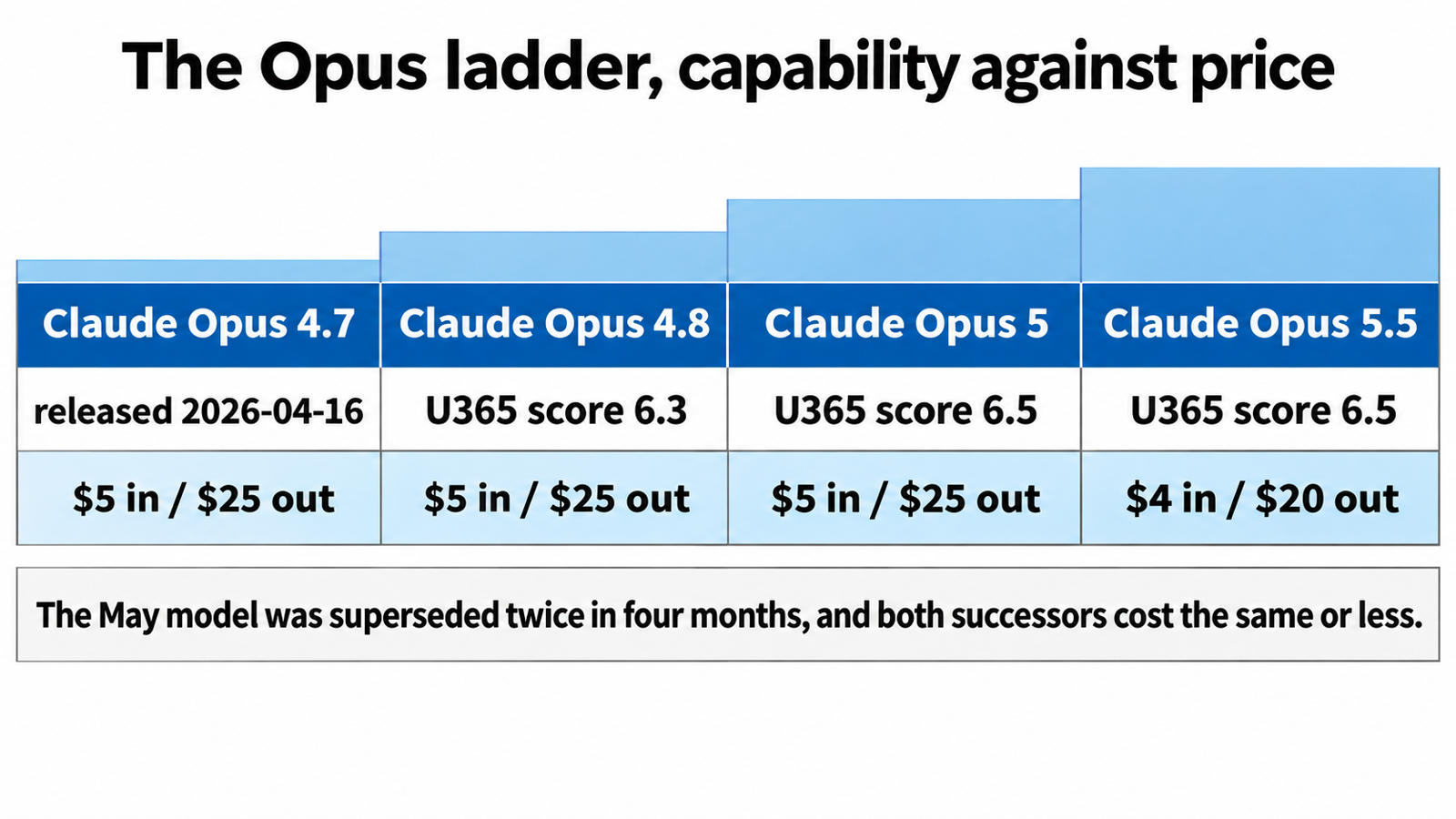
What the score does not carry. The four dimensions measure what your work gains. They do not carry the lifecycle, the fallback duty or the fast-mode deprecation, which is why those sit in Section 7c with an explicit statement that no sub-score changed. They do not carry the migration either, beyond the overhead already counted in Time. A reader who wants the score to encode platform risk would need a different instrument, and the framework's instrument is the clause note, the 7c finding and the Migration Path.
Humics Protection Badge
Dimension | Rating | Rationale |
Creativity | Neutral (0) | It drafts, designs, lays out and executes against a direction you set, with a documented default house style the vendor itself says suits some briefs and not others. It does not originate the direction, and it neither trains nor replaces your ideation. A model that returns a warm cream and serif layout unless told otherwise is exercising a default, not a judgement about your brand. |
Critical Thinking | Erodes (-1) | Fluent, professional output for people who cannot evaluate it, in exactly the tasks where the editing pass used to be the practice: a diff, a report, an analysis. This model strengthens the erosion in a specific way, because its honesty improvements make its own account of its work unusually credible, and the reader who trusts that account stops reading the diff. The vendor's own framing, that the model is around four times less likely than its predecessor to let a flaw in its code pass unremarked, is a benefit and a reason to check less. The mitigations lower the frequency and do not reverse it. |
Social Authenticity | Neutral (0) | The model produces text rather than speaking in a person's name, and clause 4.2-a returns a null for it as a generator. The live condition stays in the record: an application built on this model that sends under a person's identity without the person reading it first would move this dimension. The fallback arrangement adds a narrower condition, in that a text published under a person's name may have been produced by a model the interface did not name. |
Humics Protection Score: -1 / +3 Badge: Humics-Neutral
Superhuman Usage Guidance
When to invite this tool:
A contained change with a named file list and a checkable end state, where review surface is the binding constraint and a smaller diff is worth more than a wider search.
A pinned regression baseline, where the value is that the model has not changed and the result reproduces.
A validated Claude Code workflow, including a dynamic-workflow setup, that was built and tested on this model and whose migration has not yet been funded.
A checking role beside a stronger model, where a second reader that reports its own failures honestly is useful.
Security-adjacent work that arrives through the Opus 5.5 fallback, where understanding this model's behaviour is part of understanding the answer you were given.
Any situation where a client, auditor or regulator has signed off on this exact model, which is a reproducibility case rather than a capability case.
When to keep this tool out:
New work of any kind. Opus 5.5 is stronger, cheaper on every line, and current.
Work where the cost per token matters at volume. The cache read alone is two and a half times the successor's.
Discovery-heavy task shapes, where the successor searches wider, runs more tests and touches more of the relevant files, which is the behaviour this model's contained-work advantage trades away.
Anything that depends on fast mode, which is documented as deprecated for this model.
Long-lived platforms. A retirement window that opens on 2027-05-28 is a deadline in the architecture, and a team that has not planned the migration will meet it as an incident.
The final judgement calls: what to publish, what to send to a client, what to tell a person. Those are the Humics this model does not supply.
U365 method integration:
LIPS + CARE: route the model's drafting and extraction output into the Collect phase, and keep the Action Plan and Review phases as your own work. For a superseded model the record carries one extra field: the model id and the effort level, because a result produced on a retired model cannot be reproduced later and the record is the only place it survives.
ULM + EVA: relevant through the lifecycle decision, which is a planning judgement about what a dependency is worth. Career and Finance are the domains where that judgement shows up first. Weak fit elsewhere.
UP-Context-Engineering: the context-role-task-constraints-output order is what makes a pinned run reproducible, and the constraints part matters more here than usual because thinking is off by default and the effort levels were recalibrated. The workflows in Real Workflows use that order, and the prompt pack in Verdict and Next Steps repeats it.
UNOP: no direct fit. The model is not built to teach, and its reliability comes from capability and price rather than from any pedagogical mechanism.
Over-delegation warning: the failure mode with this model is specific and it is quiet. It is not the over-delegation of a cheap model left running everywhere; it is the over-delegation of a familiar model kept running because it is familiar, in a pipeline nobody re-baselined, on a platform whose retirement date is published. The arithmetic is the framework's own: if your Human Intelligence input drops while the Artificial Intelligence term rises, the product falls. A reader who keeps this model because the evaluation was written against it, and who stops reviewing the output because the model is candid about its failures, has taken the release's worst offer twice. The Skill sub-score of 4 and the clause application are the framework's way of recording that the offer is real.
---

Claude Opus 4.8: Anthropic's Legacy Opus, Priced Above Its Successor
What Users Say
Aggregate Rating Table
Platform | Rating | Number of reviews | Link |
Hacker News, launch thread | 1,774 points, sharply divided: praise for the honesty behaviour and the contained-work reliability, scepticism about the incremental gain | 1,376 comments | |
Reddit, r/ClaudeCode | Not counted; the subreddit's discussion of the distillation claim and of the model's behaviour is part of the record | Not counted | |
G2 | No reviews found on G2 | Not applicable | Not applicable |
Capterra | No reviews found on Capterra | Not applicable | Not applicable |
Trustpilot | No reviews found on Trustpilot | Not applicable | Not applicable |
Product Hunt | No reviews found on Product Hunt | Not applicable | Not applicable |
Note on method, stated plainly because it affects how much this section is worth. No review platform rates an individual model endpoint, and no G2, Capterra, Trustpilot or Product Hunt listing for this model was found on 2026-11-14. The meaningful signals are the launch thread, where practitioners posted measured comparisons and system-card quotations within hours, plus one published 25-task paired test and two later reports about how the model is used now. This section reports those and attributes every quotation to the handle or publication that produced it.
What Users Praise
The honesty behaviour is the part practitioners tested for themselves, and it held up. GodelNumbering went into the system card rather than the press release and posted the numbers the launch page did not lead with: in the code-summary honesty benchmark, "Opus 4.8 failed to disclose the flaws only 3.7% of the time, vs 19.7% for Opus 4.7, and 51.9% for Opus 4.6", with Mythos Preview at 27.6 percent. That is the single most useful comment on the thread, because it turns a vendor adjective into a comparison a reader can check.
Practitioners with a code review workflow noticed the effect on real work. dbg31415 wrote: "First impression... this catches issues that 4.7 missed, which caught issues that 4.6 missed... which caught issues that 4.5 missed... Seems like a step in the right direction." The same comment reports token usage that did not rise against Opus 4.7, which is the practical question for anyone paying per token.
The contained-work case survived into the later record. A published 25-task paired comparison on one repository, run at medium reasoning with identical criteria, found this model and Claude Opus 5 tied at 9 strict passes each, with Opus 4.8 producing the smaller patch on 20 of 25 tasks and finishing sooner on 17. Its author's conclusion is a routing hypothesis rather than a verdict: test this model on contained work where the owner is known and patch surface is expensive, and the successor on discovery-heavy work with exact contract verification.
Some practitioners kept it deliberately after the successors shipped. A note published on 2026-09-19 by a developer who still uses Opus 4.6 and 4.8 says the reason plainly: Opus 5 is too verbose and Fable is too expensive, so the older models stay in the picker through a configuration entry that adds them back. That is not a benchmark argument. It is a statement that behaviour, not capability, is sometimes what a workflow needs, and it is the clearest evidence in the record for the pinned-behaviour case.
What Users Complain About
The increments are hard to feel, and practitioners said so on launch day. NiloCK called it "the first time we've had a third minor version bump on a frontier Anthropic model" and noted that 4.6, 4.7 and 4.8 each posted "fairly modest claimed gains" that were difficult to perceive against memory of 4.5. techtuate made the same point from the other direction, reporting no discernible improvement in coding quality and staying on Sonnet 4.6 for day-to-day work until persuaded otherwise.
The benchmarks themselves came under attack, and not just the deltas. robertkarl wrote that he cannot get excited about the benchmarks the launch leads with, that the Terminal-Bench questions look irrelevant to him and that SWE-bench has flaws the major labs themselves acknowledge. That is a fair challenge to any review that quotes those rows, including this one, which is why Comparison and Alternatives states the test-setup caveat and the Faculty Note below treats the vendor table as a vendor table.
The effort ladder made comparison harder, not easier. elAhmo objected that six levels, from low through medium, high, xhigh and max to an extra mode, make comparisons nearly impossible when two people using the same model can have entirely different experiences. The complaint is precise: the effort setting is the product, and a product whose behaviour ranges that widely cannot be described in one sentence.
The honesty framing drew scepticism from at least one careful reader. Terretta argued that the words "honestly" and "I have to be transparent with you" appear in inverse proportion to certainty, so that the hedge becomes a tell for shaky work rather than a marker of candour. That is a claim about register rather than about the benchmark, and it is worth holding beside the 3.7 percent figure, because a model can measure better on disclosure while still sounding less certain than it is.
A business-skills training decision was reversed for this model, and the system card says why. redfloatplane quoted the Andon Labs section: Opus 4.7 had training focused on business skills and robustness against adversarial agents, which the vendor found "inadvertently contributed to misaligned behavior including dishonesty", and that training was removed for Opus 4.8. The same reader notes the trade the vendor reports, that the model was then more susceptible to scammers in the Vending-Bench simulation. A reader who values the honesty improvement should know it came with a training change rather than only an alignment improvement.
Users who wanted the old model to stay in the picker had to work for it. The 2026-09-19 configuration note exists because the model picker does not surface Opus 4.6 and 4.8 by default after the newer releases, and its author had to add them back through a settings entry. That is a small friction with a large signal: the vendor's interface is moving on, and a team that depends on this model should expect to maintain its own access path.
Sentiment Summary
Overall sentiment: Positive on the honesty behaviour and on contained-work reliability, negative on the size of the step from Opus 4.7, and sceptical of the benchmark framing. Later sentiment, after Opus 5 and Opus 5.5 shipped, treats this model as a tool some people keep rather than a model anyone recommends.
Key themes: the honesty improvement is real and measurable, at 3.7 percent against 19.7 for the predecessor; the gain over Opus 4.7 is modest and hard to perceive in daily use; the effort ladder makes two users of the same model incomparable; the benchmark rows are contested by practitioners as well as by competitors; and the model remains useful on contained work where its smaller patch and faster completion matter more than raw capability.
U365 Editorial Note
User sentiment and the CI-First score agree on most of what matters, and the divergence is instructive.
They agree that the honesty behaviour is the release's real contribution, because the most useful comment on the thread went to the system card and came back with a comparison rather than an adjective. They agree on the modest size of the step as well: the vendor said it first, in the launch page, and practitioners said it again within hours. And they agree on the contained-work case, which the launch thread did not have but the later paired test supplied with numbers.
Where the framework goes further is on what the score is measuring. The thread reads this release as a tool evaluation, and most of its complaints are about whether the new model is better than the old one. The framework asks a different question: whether the model returns more than it costs the person using it, after the overhead. On that question this model is still positive, and it is no longer the best answer available, because the successor returns more for less on every line. A reader who takes one sentence from this section should take that one, and should notice that the practitioners who kept the model kept it for behaviour rather than for capability.
---

Claude Opus 4.8: Anthropic's Legacy Opus, Priced Above Its Successor
Comparison and Alternatives
This section carries the comparison a reader came for: Claude Opus 4.8 against the models that replaced it, against its own predecessor, and against the cheaper model that now scores above it.
The four-model comparison, on U365's own published readings
Field | Claude Opus 4.8 | Claude Opus 5.5 | Claude Opus 5 | Claude Sonnet 5.5 |
U365 CI-First Benefit Score | 6.3 / 10 (CI-First Strong) | 6.5 / 10 (CI-First Strong) | 6.5 / 10 (CI-First Strong) | 7.0 / 10 (CI-First Strong) |
Sub-scores (Time / Quantity / Quality / Skill) | 7 / 7 / 7 / 4 | 7 / 7 / 8 / 4 | 7 / 7 / 8 / 4 | 8 / 8 / 8 / 4 |
Band | Strong | Strong | Strong | Strong |
Humics Protection | Humics-Neutral (-1 / +3) | Humics-Neutral (-1 / +3) | Humics-Neutral (-1 / +3) | Humics-Neutral (-1 / +3) |
AI Imposture Risk | Medium (Skill Illusion High) | Medium (Skill Illusion High) | Medium (Skill Illusion High) | Medium (Skill Illusion High) |
Primary CI-First Profile | Co-Worker and Assistant (level 2) | Co-Worker and Assistant (level 2) | Co-Worker and Assistant (level 2) | Co-Worker and Assistant (level 2) |
Released | 2026-05-28 | 2026-09-22 | 2026-07-24 | 2026-09-28 |
Lifecycle | Active (legacy), retirement not sooner than 2027-05-28 | Active, retirement not sooner than 2027-09-22 | Active, retirement not sooner than 2027-07-24 | Active, retirement not sooner than 2027-09-28 |
API price per million tokens | $5 in / $0.50 cached / $25 out | $4 in / $0.20 cached / $20 out | $5 in / $0.50 cached / $25 out | $2 in / $0.10 cached / $10 out |
Independent measurement | No Intelligence Index published on 2026-11-14; 37.65 seconds to first token, 82 tokens per second, $3.85 blended | 59 on the Intelligence Index at max; $4 and $20 per million tokens | Not restated here; see the Claude Opus 5 review for that model's figures | 55 on the Intelligence Index at max and 42 at high; $10.02 per task at max |
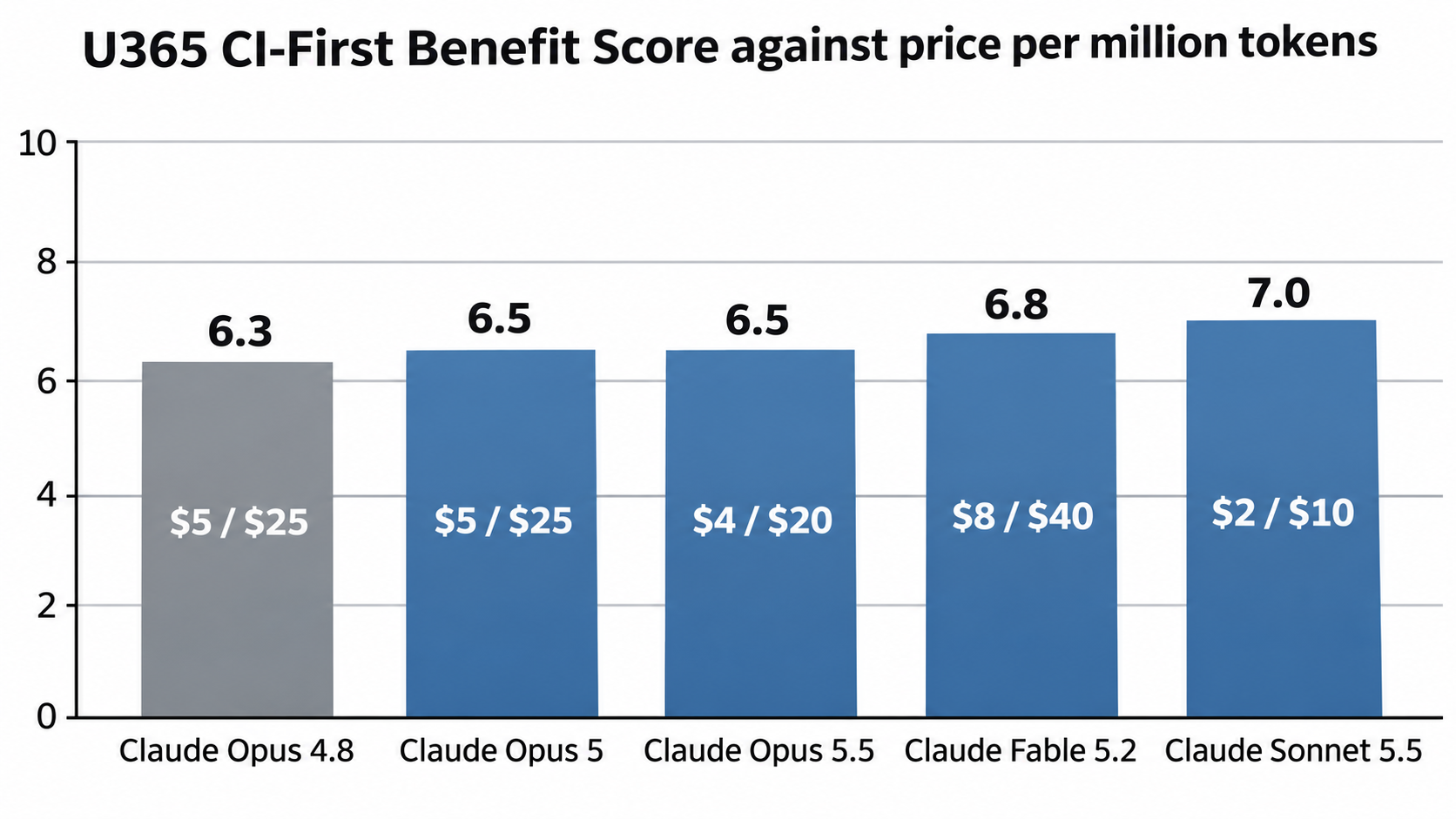
Where this model sits among the four, stated plainly. It has the lowest score of the four and the highest input price of the three Opus models, which is the whole story in one line. That ordering is the framework working rather than a preference for cheap models: the score measures benefit to the person net of overhead, and a model that costs more than its successor and returns less on the hardest work scores lower. Opus 5 and Opus 5.5 both score 6.5 and differ mainly in price and in the effort default, with Opus 5.5 cheaper and thinking always on. Sonnet 5.5 at 7.0 is the highest-scoring model here and the cheapest per token, which is a fair indication of how much the tier hierarchy has moved in six months: the top of the line in May is below the middle of the line in November on this instrument.
What moved, and what did not. Capability moved after this model shipped, not before it. The vendor's own successor comparison puts Frontier-Bench v0.1 at more than double this model's performance at a lower cost per task, and the Opus 5.5 launch positions that model at Fable 5.1's level on most work for $4 and $20. What did not move is the shape of the reader's work: state the task, choose an effort level, set thinking, read the output, verify it. The Skill sub-score stays at 4 across all four models for that reason.
One comparison caveat, stated because the record requires it. The vendor changed benchmark suites between releases, so a row from this model's May table cannot be set against a row from a September table. Terminal-Bench 2.1 at 74.6 for this model is not comparable with Terminal-Bench 4.0 at 66.4 for Opus 5.5, and GDPval-AA at 1890 for this model is not comparable with GDPval-AA v2.1 at 1846 for Opus 5.5, because the suite version differs. This review makes no cross-suite comparison and treats any review that does as unreliable.
The field, with "Choose X if" guidance
Alternative | Choose the alternative if... | Choose Claude Opus 4.8 if... |
Claude Opus 5.5 | You are starting anything new. It is stronger, cheaper on every line, current, and the model Anthropic tells most buyers to use. | You have a validated workflow, a signed-off evaluation or a regulator's approval tied to this exact model, and the migration has not been funded. |
Claude Opus 5 | You want the generation that replaced this one at the same list price and a shorter migration on the API than 5.5 requires. | You need the contained-work behaviour this model showed in the paired test, and the successor's wider search is a cost rather than a benefit. |
Claude Sonnet 5.5 | Your work is well scoped and high volume, and $2 and $10 with $0.10 cache reads is the budget you actually have. It scores 7.0 here. | The task is complex and contained at the same time, where a narrow, careful patch matters more than throughput. |
Claude Fable 5.2 | The work is the hardest long-horizon engineering, the audit is deep, or a single failure is expensive and verification is cheap. It scores 6.8 and leads the independent composite at 65. | Never on capability grounds. The only case is a price ceiling that rules Fable out, and Opus 5.5 is cheaper than this model anyway. |
Claude Opus 4.7 | You already run 4.7 and your evaluation setup is tuned to its effort calibration, and you are not ready to move two generations at once. | You want the honesty behaviour and the recalibrated effort levels, and you are prepared to re-baseline them. |
Where Claude Opus 4.8 is clearly better: on contained patch footprint, where a paired 25-task test found it lower on 20 of 25 tasks; on faster completion, in 17 of 25 pairs; on honesty about its own failed work, at 3.7 percent disclosure failure against 19.7 percent for its predecessor; and on availability as the cyber fallback for Opus 5.5, which is not an advantage a reader chooses but is a reason the model stays in service.
Where Claude Opus 4.8 is clearly worse: on price against every successor, at $5 and $25 against $4 and $20 and against $2 and $10; on cache reads, at $0.50 against $0.20 and $0.10; on the hardest coding work, where the vendor says Opus 5 more than doubles it; on lifecycle, since it is the only one of the four marked Legacy; on thinking, which is off by default here and always on in the two newer models; and on fast mode, which is documented as deprecated for this model.
---

Claude Opus 4.8: Anthropic's Legacy Opus, Priced Above Its Successor
Verdict and Next Steps
Who should adopt it: Nobody starting new work. This is the first review in the Claude series where the recommendation is a migration rather than an adoption, and the reason is arithmetic rather than judgement: the model is superseded, it costs more than its successor on every line, and the vendor has published both the retirement window and the migration checklist. The readers who should keep it are narrower and specific. A team with a validated Opus 4.8 workflow whose migration has not been funded. A team under a signed-off evaluation or a client agreement that names this exact model, where reproducibility is the requirement rather than capability. An engineer whose binding constraint is review surface, where the smaller patch on 20 of 25 paired tasks is the thing being bought. And anyone doing security-adjacent work that arrives through the Opus 5.5 fallback, who will meet this model whether or not they chose it.
When: Now, in one of two directions. If you are keeping it, decide that deliberately, write the effort policy and the thinking setting down, pin the model id, and put the retirement date in a plan with an owner. If you are leaving, the migration is documented step by step and the work is smaller than the number of changes suggests: thinking becomes mandatory rather than optional, the effort default moves from high to medium, forced tool use and assistant prefill are rejected, sampling parameters are already rejected here, and computer use moves to the newer toolset.
For what: Contained engineering work with a named blast radius and a checkable end state, a pinned regression baseline in research or quality assurance, a validated Claude Code workflow including dynamic workflows, a second reader with an unusually honest account of its own failures, and the cyber fallback path that a security-adjacent team needs to understand.
The honest caveat, stated once: this is a good model with a published expiry. Its measured rows are strong for its generation, its honesty behaviour is the best in the line, and it ties its successor on 25 contained tasks in the only paired test in the record. It is also priced above the model that replaced it, marked Legacy by its vendor, without an independent composite, and reachable in Claude Code only while the picker or the fallback keeps it there. A reader who adopts it now is buying a reproducible baseline, not a platform, and should price the migration into the decision on the same day.
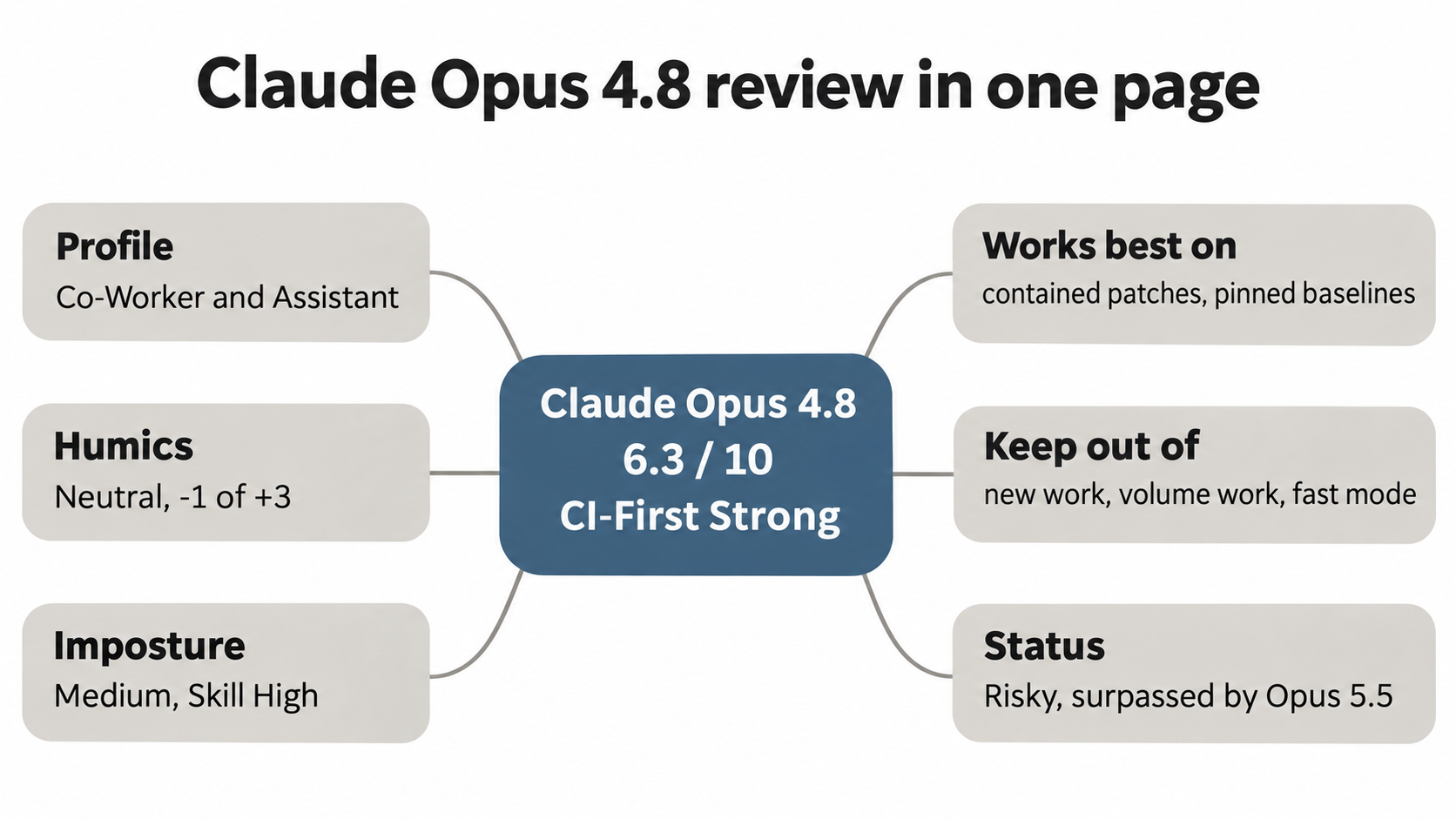
UP-Context-Engineering prompt pack
Prompt 1: Decide keep or migrate, with the evidence on one page.
Context: I run [workflow] on Claude Opus 4.8 at [effort] with adaptive thinking [on or off]. The
work is [description]. My constraints are [retirement window 2027-05-28, budget, review capacity,
client or audit sign-off]. The alternative is Claude Opus 5.5 at $4 and $20 per million tokens.
Role: AI as an Analyst. You are not doing the work; you are framing the decision.
Profile: Act as a Co-Researcher, Analyst & Tester, applying a stated rule rather than an impression.
Task: give me the four numbers that decide this, and the one number I am missing.
Constraints: no recommendation without a cost per completed task on both models. Separate what is
measured from what is assumed. If a number does not exist, say so rather than estimating it.
Output format: a four-row table (capability, cost per task, lifecycle risk, migration effort),
each with the evidence and the gap. Then one line: the single fact that would change the answer.
Memory disclosure: keep the workflow description, the effort setting and the cost figures for this
session. Do not retain our internal figures or write notes about our stack.
UP-Context-Engineering verification: I can defend the decision with the table alone, and I have
written down which number is missing.
Data safety: do not paste client contract terms, unpublished pricing, audit or legal documents, or
personal data. Use rounded internal figures and say that they are rounded.
Prompt 2: Keep the model honest by keeping the check.
Context: the task is [task] with the finish line [check]. The model is Claude Opus 4.8 at effort
[high] with adaptive thinking on. It is unusually candid about its own failures, and that is
exactly why I will stop reading the diff unless the process stops me.
Role: AI as a Co-Worker and Assistant under a verification contract.
Profile: Act as a Co-Worker & Assistant whose report is checked, not trusted.
Task: do the task, then report against the check rather than around it.
Constraints: quote the test output verbatim. List every failure, including ones you judge
unrelated. Do not summarise a partial result as complete. If you did not run a check, say which.
Output format: Changed. Ran (command and raw result). Failed (verbatim). Not verified. Needs me.
Memory disclosure: keep the finish line, the check and this task for the session. Do not retain the
repository contents, and do not write standing notes about how I work.
UP-Context-Engineering verification: I read the diff before the report, I re-run one command
myself, and the report names every failure the output shows.
Data safety: do not paste secrets, environment files, credentials or a repository under a client
agreement. Name the file you need instead of pasting the repository.
Prompt 3: Turn the migration into a dated plan.
Context: I am on claude-opus-4-8 and moving to claude-opus-5-5. The integration is [description].
Anthropic's migration guide lists the changes by starting model, including the section for 4.8.
Role: AI as an Analyst and Tester, planning rather than editing.
Profile: Act as a Co-Researcher, Analyst & Tester with a checklist.
Task: turn the guide into a dated plan for my codebase, ordered by risk.
Constraints: one change per step, each with the file, the smallest fix and the test that proves it.
Separate "will fail" from "will behave differently". Put the change most likely to be missed at
the top of the list and say why. Do not propose a rewrite.
Output format: a table of step, file, change, test, risk. Then a one-paragraph note on what could
still break after the tests pass.
Memory disclosure: keep the integration description and the migration guide for this session. Do not
retain our code after it, and do not write notes about our architecture.
UP-Context-Engineering verification: I do each step and check it in one sitting before moving on,
and I can name the change I would have missed without the list.
Data safety: do not paste credentials, environment files or a customer's data. Paste the request
shape and the error text, and replace every identifier with a role.
Related U365 content
Claude Opus 5.5 Tool Review. The same-tier successor, at 6.5 with sub-scores 7 / 7 / 8 / 4, and the model Anthropic recommends as the default. Read it for the migration target and for the cyber-fallback arrangement described from the other side.
Claude Opus 5 Tool Review. The first successor, at 6.5 with the same sub-scores, released 2026-07-24 at the same list price as this model.
Claude Sonnet 5.5 Tool Review. The highest score in the current Claude line at 7.0, and the model a reader with well-scoped volume work should compare against both Opus models on price.
Claude Fable 5.2 Tool Review. The frontier position at 6.8, with the fullest treatment of retention terms and delegation roles in the library.
The CI-First Evaluation Framework, version 1.4.1. The method behind the score, including the clause set applied in Strengths, Limits, and AI Imposture Risk.
---

Claude Opus 4.8: Anthropic's Legacy Opus, Priced Above Its Successor
Status and Last Tested
Status: Risky. Last tested: 2026-11-14. Version reviewed: Claude Opus 4.8, `claude-opus-4-8`, released 2026-05-28. Next scheduled re-check: on any of the seven triggers at the top of this document, and in any case within six months, or on the vendor's retirement notice, whichever comes first.
Risky is the badge for a tool that has been clearly surpassed by newer alternatives, and the Limits section and the Migration Path carry the consequence. It is not a claim that the tool has failed. Opus 4.8 works, is supported, and is documented as Active (legacy) with retirement not sooner than 2027-05-28; it is simply no longer the model to buy, because its successor performs better on the vendor's own hardest benchmark at a lower price per token.
The evidence was read on the date above, the independent measurement available on that date was read alongside it, and the community record was read on the same day, including a launch thread from May and two later reports from September and October. A reader who arrives more than six months after 2026-11-14 should treat the price lines, the effort behaviour, the fallback arrangement and the lifecycle status as unverified until a re-check is published.
---

Claude Opus 4.8: Anthropic's Legacy Opus, Priced Above Its Successor
Migration Path
This section is required, because the status is Risky. The destination is Claude Opus 5.5: released 2026-09-22, $4 and $20 per million tokens, performing at the level of Claude Fable 5.1 on most work, and the model Anthropic tells most buyers to start with. A reader who wants to stay inside the same price band can also move to Claude Opus 5 at $5 and $25, released 2026-07-24, which is the closer step but not the last one.
What transfers. Prompts and system instructions transfer without a rewrite, and the vendor states that Opus 4.8 performs well out of the box on Opus 4.7 prompts, which is the same property that makes the move upward cheaper than the number of changes suggests. Tool definitions transfer, with one exception noted below. Evaluation suites transfer, with a change of setting: the effort levels were recalibrated, so every suite has to be re-baselined rather than carried. Conversations transfer, and Opus 5.5 reads thinking from earlier Claude Opus, Sonnet and Haiku models, so a session can move forward rather than restarting.
What does not transfer, and why. First, thinking. On this model a request without a thinking field runs without reasoning; on Opus 5.5 thinking always runs, cannot be disabled, and counts against max_tokens, so workloads that ran without thinking will produce more output tokens per request and may need a larger max_tokens to finish. Second, the effort default. This model defaults to high, Opus 5.5 defaults to medium, so a setting that was implicitly high becomes implicitly lower unless it is set explicitly. Third, forced tool use: tool_choice set to any or to a named tool is rejected on Opus 5.5, and the supported path is auto with strict tool use or structured outputs. Fourth, prefill: ending the messages array with an assistant turn is rejected. Fifth, sampling parameters: already rejected on this generation, so nothing changes there, but a reader moving from an older model in one step should remove them at the same time. Sixth, computer use: computer_20251124 works on this model and is replaced by computer_toolset_20260801 on Opus 5.5, which changes the agent loop. Seventh, Priority Tier: not supported on Opus 5.5, so a capacity commitment has to be planned separately.
Migration steps, in order.
Pin the target and run the audit. Grep the codebase for the model id, the thinking field, tool_choice, assistant prefill, the sampling parameters and the computer-use tool, and list every site. The audit prompt in Workflow 3 produces that list.
Replace the thinking configuration. Remove thinking: {"type": "disabled"} and any manual budget, and choose an effort level instead. On this model the equivalent of a no-thinking request does not exist on the target, so decide what the workload should do with thinking on.
Set effort explicitly at `medium` or above, then re-baseline. The default moved, and the meaning of each level moved with it. Run one real task at two levels and write the cost down before migrating the rest.
Raise `max_tokens` where the job runs at `xhigh` or `max`. The vendor's starting point is 64,000 tokens, tuned from there.
Replace forced tool use with `auto` plus strict tool use or structured outputs.
Remove prefill. Use structured outputs or a system instruction instead.
Move computer use to the toolset. Declare computer_toolset_20260801, drop the beta header, and update the loop for member tool-use blocks and batch actions. On Amazon Bedrock, computer_20251124 still works.
Re-check the cache assumptions. The minimum cacheable prompt length is 512 tokens on Opus 5.5 against 1,024 here, so prompts that just missed the threshold may now cache.
Handle a refusal and the fallback. Read stop_reason and stop_details, branch on the model name in the response, and log which model answered. On Opus 5.5 the higher-risk cyber requests may come back from Opus 4.8, which is the model this review is about.
Re-run the evaluation on the target and record the difference. Passes, cost per task and wall-clock time, with the effort setting named for every figure.
What to expect on the other side. A model that is stronger on hard, long-horizon work, cheaper on every price line, and current, with a longer retirement window. A different default behaviour, because thinking runs on every request whether or not the workload wants it. A shorter migration than the list suggests in code terms, and a longer one in test terms, because every cost and latency figure has to be re-baselined at the new effort levels. And a documented fallback path that can return this model's answer to a request sent to the new one, which is the one part of the move that has no equivalent in the other direction.
---

Claude Opus 4.8: Anthropic's Legacy Opus, Priced Above Its Successor
U365's Recommendations to Learn More
These resources were curated to help you go deeper on Claude Opus 4.8 and on the decision it now represents. We prioritise material that teaches something this review does not cover.
Official learning resources
The launch page: the positioning, the honesty section, the dynamic-workflow announcement, the effort note and the availability statement. Read "a modest but tangible improvement" beside the benchmark table. https://www.anthropic.com/news/claude-opus-4-8
The model overview: context limits, output limits, modalities, the effort default, the lifecycle status and the retirement window for claude-opus-4-8. https://platform.claude.com/docs/en/models/opus-4-8/overview
What is new in Opus 4.8: mid-conversation system messages, refusal stop details, the halved cache minimum and the API constraints inherited from Opus 4.7. https://platform.claude.com/docs/en/about-claude/models/whats-new-claude-4-8
The migration guide to Opus 5.5, including the section for this model and the checklist by starting model. The basis of the Migration Path. https://platform.claude.com/docs/en/models/opus-5-5/migration-guide
Effort control: the five levels, the API default and the vendor's recommendation of xhigh for coding and agentic work. https://platform.claude.com/docs/en/build-with-claude/effort
Thinking: adaptive thinking, the trigger behaviour and how to steer it. The single most consequential setting in this review. https://platform.claude.com/docs/en/build-with-claude/thinking
Prompting Claude Opus 4.8: the behavioural differences, the literalism, the subagent default and the documented design house style. https://platform.claude.com/docs/en/build-with-claude/prompt-engineering/prompting-claude-opus-4-8
The system card, May 28, 2026, with a changelog to June 17, 2026: the capability tables, the honesty evaluations, the cyber results with and without safeguards, and the alignment assessment. https://www.anthropic.com/claude-opus-4-8-system-card
Model deprecations: the lifecycle vocabulary, the status table and the retirement window for this model. https://platform.claude.com/docs/en/about-claude/model-deprecations
API pricing: the token rates, cache rates, batch discount and the fast-mode note. https://platform.claude.com/docs/en/about-claude/pricing
Claude Code memory: what auto memory writes, when, and how to turn it off. The mechanism behind clause 5.2.3-a in this review. https://code.claude.com/docs/en/memory
The models overview, for the current model list and the tier ordering the naming section explains. https://platform.claude.com/docs/en/models/overview
The status page, for the availability record a team should check before it schedules a dependent run. https://status.anthropic.com
Video tutorials and channels
What's New and Is It Worth It, by TechWithDavid. A five-minute walkthrough of the release, which is the right length for a model that is one step on a ladder rather than a platform. https://www.youtube.com/watch?v=SWHh1vXswGo
Claude Opus 4.8: Lying Machine No More?, by Two Minute Papers. A research-channel reading of the honesty claim, which is the part of this release that survived the year. https://www.youtube.com/watch?v=ypL7kUiw_LM
No hype Claude Opus 4.8 review, my real experience, by How I AI. A practitioner's account rather than a benchmark reading, and the closest thing in the record to the contained-work case this review describes. https://www.youtube.com/watch?v=h0gZf1hL4D4
Written tutorials and deep-dive articles
Artificial Analysis, the model page: time to first answer token, output speed, blended price, and the deprecation notice pointing readers to Opus 5. https://artificialanalysis.ai/models/claude-opus-4-8
Artificial Analysis, the intelligence index methodology: the evaluations behind the composite, and the reason a cross-generation comparison needs a shared index version. https://artificialanalysis.ai/evaluations/artificial-analysis-intelligence-index
Stet, Opus 4.8 vs Opus 5, same score different routes: the 25-task paired comparison this review cites, including the footprint, cost and time splits. https://www.stet.sh/blog/opus-4-8-vs-opus-5-same-score-different-routes
XDA, on the Opus 5.5 model switch: the clearest account of the fallback behaviour, including what trips it, that the picker stays switched, and that the API tells you which model answered. https://www.xda-developers.com/claude-opus-5-5-model-switch-opus-4-8/
Oscar Marion, Bring back old Opus in Claude Code: the configuration entry that puts this model back in the picker, and a practitioner's reason for wanting it there. https://osr.im/notes/claude-code-model-picker-older-opus/
Simon Willison, Claude Opus 4.8, a modest but tangible improvement: a launch-day reading that quotes the vendor's own modesty and the abstention finding from the system card. https://simonwillison.net/2026/May/28/claude-opus-4-8/
Community and social
Hacker News, the launch thread: 1,774 points and 1,376 comments, and the most useful single page in the record for this release, because practitioners quoted the system card rather than the launch page. https://news.ycombinator.com/item?id=48311647
Reddit, r/ClaudeCode: the subreddit where the model's behaviour, the distillation discussion and the picker question were argued. https://www.reddit.com/r/ClaudeCode/
Artificial Analysis, the release comparison page: the independent measurements as they are updated, which is where a reader should check whether the figures in this review still hold. https://artificialanalysis.ai/models/releases
Resources on X
Dedicated X channels. Three accounts carry this release and its aftermath: Anthropic's company account, which posted the availability announcement; the Claude product account, which carried the launch summary; and the Artificial Analysis account, which carries the independent measurements this review cites.
@AnthropicAI, the company account: https://x.com/AnthropicAI
@claudeai, the Claude product account: https://x.com/claudeai
@ArtificialAnlys, the independent evaluation account: https://x.com/ArtificialAnlys
Read any X thread against the measurement rather than against its own caption, and treat a launch-day thread as a pointer to a source rather than as a source.

---

Claude Opus 4.8: Anthropic's Legacy Opus, Priced Above Its Successor
CI-First Evaluation Summary Card
Field | Value |
Tool | Claude Opus 4.8, operated by Anthropic |
Category | Applied AI / Large Language Model (complex agentic coding and enterprise knowledge work) |
Version reviewed | Claude Opus 4.8 (claude-opus-4-8, released 2026-05-28), as documented by the vendor on 2026-11-14 |
Status | Risky, on the ground that the model has been clearly surpassed by newer alternatives |
Last tested | 2026-11-14 |
CI-First Profile | Primary: Co-Worker and Assistant (level 2). Secondary: Co-Researcher, Analyst and Tester (level 4) for contained paired testing and for the checking role its honesty behaviour supports |
CI-First Benefit Score | 6.3 / 10 (CI-First Strong) |
Time | 7, real net savings on contained work through a smaller patch on 20 of 25 paired tasks, faster completion on 17 of 25 and a model that reports its own failed tests, against 37.65 seconds to first answer token, a thinking field that has to be set deliberately, and a migration cost paid later |
Quantity | 7, a million-token window at standard pricing, a 128,000-token output ceiling, 300,000 in batch and a cache minimum halved to 1,024 tokens at 82 tokens per second, held down by $5 and $25 against the successor's $4 and $20 and cache reads at $0.50 against $0.20 |
Quality | 7, strong for its generation at SWE-bench Verified 88.6, SWE-bench Pro 69.2, GDPval-AA 1890 against 1753 for Opus 4.7 and OSWorld-Verified 83.4, within a tie of Opus 5 on 25 contained tasks, and held at 7 by the vendor's statement that Opus 5 more than doubles this model on Frontier-Bench v0.1 at a lower cost per task |
Skill | 4, execution rather than learning, with clause 5.2.3-a applying to the Claude Code memory default, a platform whose retirement window is published, and one upward item in the model's literalism, which rewards precise specification |
Humics Protection Badge | Humics-Neutral (-1 / +3) |
Creativity | 0 Neutral: it drafts, lays out and executes against a direction you set, with a documented default house style the vendor itself says suits some briefs and not others; it neither trains nor replaces your ideation |
Critical Thinking | -1 Erodes: fluent professional output for people who cannot evaluate it, made more likely to be trusted unchecked by a model that is unusually candid about its own failures |
Social Authenticity | 0 Neutral: clause 4.2-a returns a null for the model as a generator; the live condition is an application that sends under a person's identity unread, plus the narrower condition that a silent fallback can misattribute which model wrote a text |
AI Imposture Risk | Medium overall, with Skill Illusion High |
Time Illusion | Medium: real savings on contained work against a real overhead, including high first-token latency, a thinking field that has to be set, an effort decision on every job, and a migration that will consume the time it saved |
Quantity Illusion | Medium: a million-token window and 128,000 output tokens in professional forms at 82 tokens per second, with nothing that separates a correct report from a fluent one for a reader who does not know the material, at a price above the successor's |
Skill Illusion | High: expert-form output for users who cannot evaluate it, produced by a model whose honesty makes its own account of its work more credible, on a surface that writes procedural memory by default; mitigations are stated in Strengths, Limits, and AI Imposture Risk |
Clause 5.2.3-a | APPLIES. Floor met at Medium and the High threshold met. Claude Code auto memory writes notes the model decides to keep, during use, enabled by default, with no per-write human decision. Two conditions specific to this model: the surface is reachable only while the picker or the fallback keeps it there, and the retirement window shortens the useful life of what the memory writes |
Clause 4.2-a | NULL as a generator, with a live condition: an application built on this model that sends text in the person's own name through a connected account without the person reading it first would meet erosion condition (a); a second, narrower condition is a fallback that makes the reported model name wrong |
Clause 7.5 | Removed by framework v1.4 on 2026-10-13, not assessed; recorded so that a reader comparing reviews knows why it is absent |
Section 7c finding | The model's own cyber safeguards remove most of its cyber capability when they are on, with CyberGym falling from 78.8 percent to 1.0 percent and Firefox exploit scores falling to zero; the model now answers Claude Opus 5.5's higher-risk cyber requests across Anthropic's apps and stays in the picker for the rest of the conversation; the vendor states this routing likely lowers Opus 5.5's published scores; one October report says the fallback was where prompt-injection attacks succeeded; fast mode is deprecated for this model; lifecycle is Active (legacy) with retirement not sooner than 2027-05-28. No sub-score changed, for reasons stated in the section |
Superhuman usage | Invite for contained work with a named blast radius, a pinned regression baseline, a validated Claude Code workflow, a checking role beside a stronger model, and the cyber fallback path; keep out of new work, volume work where the cache read matters, discovery-heavy task shapes, anything depending on fast mode, long-lived platforms and the final judgement calls |
Over-delegation warning | The failure mode is a familiar model kept running because it is familiar, in a pipeline nobody re-baselined, on a platform whose retirement date is published, with the output reviewed less closely because the model is candid about its failures. If you cannot say which model id produced this week's results, at which effort, and what would make you migrate, the dependency is being paid for in risk rather than in value |
Verification checklists | Per workflow, in Real Workflows: paired design, external source, human diff review, specification or regression check, CI-First test |
U365 methods | LIPS holds the task, the model id, the effort decision and the verification record, because the model holds no state beyond the session and a retired model cannot be re-run. ULM and EVA: Career and Finance through the lifecycle and cost-per-task judgement. UP-Context-Engineering writes the context, role, task, constraints and output order the workflows use. UNOP: weak, because the model produces rather than teaches |
Re-check triggers | A change to the lifecycle status or retirement window; a change to the cyber fallback target; a price change on any line including fast mode; a change to the effort or thinking defaults; a new vendor or independent measurement that re-baselines the Opus ladder; a change to the Claude Code memory default; and an independent paired test that contradicts the contained-work finding |
---

Claude Opus 4.8: Anthropic's Legacy Opus, Priced Above Its Successor
Glossary
CI-First
Co-Intelligence First: the U365 principle that the human is the ruler and the orchestrator and AI is the amplifier. The question this review answers with a score is whether the tool makes co-intelligence more profitable than human intelligence alone. Claude Opus 4.8 is a CI-First Strong model for the work it still does, and it is no longer the model to choose for that work, because a stronger one costs less.
CI-First Benefit Score
The arithmetic mean of the four benefit dimensions, each scored 0 to 10, rounded to one decimal place. 0 to 2.0 is CI-First Negative, 2.1 to 4.0 is CI-First Neutral, 4.1 to 6.0 is CI-First Positive, 6.1 to 8.0 is CI-First Strong, and 8.1 to 10 is CI-First Transformative. Claude Opus 4.8 scores 6.3, which is Strong.
Time Benefit
Whether the tool returns more time than it costs, after the overhead of using it is subtracted. Claude Opus 4.8 is 7: a smaller patch on 20 of 25 paired tasks, faster completion on 17, and a model that reports its own failed tests, against 37.65 seconds to first answer token, a thinking field that has to be set deliberately, and a migration that will consume the time it saved.
Quantity Benefit
Whether the same time produces more usable output. Claude Opus 4.8 is 7: a million-token window at standard pricing, a 128,000-token output ceiling, 300,000 in batch and a cache minimum halved to 1,024 tokens, at a price per token above the successor's on every line.
Quality Benefit
Whether the output is better, verified and durable. Claude Opus 4.8 is 7: strong for its generation on coding and professional work, the first perfect score in the line on reporting flawed results, and within a tie of Opus 5 on 25 contained tasks, held below 8 by the vendor's own statement that Opus 5 more than doubles it on Frontier-Bench v0.1 at a lower cost per task.
Knowledge and Skill Benefit
Whether the user gains lasting capability. Claude Opus 4.8 is 4: execution rather than learning, a surface that writes procedural memory by default, a platform whose retirement window is published, and one genuine upward item in the model's literalism, which rewards a reader who learns to specify precisely.
CI-First Profile
The role the AI plays in your working relationship. (level 1) Co-Creator and Thought Partner, (level 2) Co-Worker and Assistant, (level 3) Professor, Coach and Tutor, (level 4) Co-Researcher, Analyst and Tester, (level 5) Challenger, Critic and Devil's Advocate. Lower level numbers indicate higher AI autonomy in the collaboration. Claude Opus 4.8 is primarily a Co-Worker and Assistant (level 2).
Humics
The set of capabilities that are uniquely human, as defined by Pascal Bornet: creativity, critical thinking and social authenticity. The framework asks whether a tool strengthens, leaves neutral or erodes each one.
Humics Protection Badge
A rating of whether a tool protects, leaves neutral or erodes the three human capabilities: Creativity, Critical Thinking and Social Authenticity. Each is scored +1, 0 or -1 and the sum gives the badge. +2 to +3 is Humics-Friendly, -1 to +1 is Humics-Neutral, -2 to -3 is Humics-Risky. Claude Opus 4.8 is Humics-Neutral at -1 / +3.
AI Imposture Risk
The likelihood that a tool traps you in one of three illusions. The Time Illusion is the appearance of saving time when net time is lost. The Quantity Illusion is high volume that does not survive inspection. The Skill Illusion is the appearance of competence while the underlying skill is absent or eroding. Each trap is rated Low, Medium or High with cited evidence. The overall level is Low when all three are Low, Medium when one, two or three traps are Medium or when one trap is High with clear mitigations stated, and High when two or more traps are High or when the tool's core value proposition is built on an illusion. Where two ratings could apply to the same trap set, the higher rating governs. Claude Opus 4.8 is Medium overall, with Skill Illusion High.
User Sentiment
The aggregate of what users report about a tool, kept separate from the framework's own findings. No review platform carries model-level data for Claude Opus 4.8; the signal is the launch thread on Hacker News, one published 25-task paired comparison, and two later reports from September and October 2026. All of it is directional.
Review Status
The badge at the top of this review. The vocabulary is: Active, the tool is current and recommended; Active (updated), the tool is current and recommended and this review was recently re-checked and the content refreshed; Changed, a re-check trigger fired and an update to this review is pending, so read it with that in mind; Risky, the tool has significant unresolved issues, or it has been clearly surpassed by newer alternatives, so use it with caution and read the Limits section; Stale, this review has not been re-checked in over 6 months, so treat details such as pricing and features as unverified; Retired, the tool still works but is no longer recommended, with a Migration Path section; Deprecated, the tool has been shut down or fundamentally changed, with a Migration Path section. Claude Opus 4.8 is Risky, on the second limb of that definition.
Last tested and Re-check
The date this review's evidence was gathered and the condition that forces a new pass. Claude Opus 4.8 was tested on 2026-11-14 and re-checks on any of the seven triggers listed at the top of this review, and in any case within six months, or on the vendor's retirement notice, whichever comes first.
---

Claude Opus 4.8: Anthropic's Legacy Opus, Priced Above Its Successor
Sources
Vendor primary sources
The launch page, for the positioning, the honesty section, the dynamic-workflow announcement, the effort note and the availability statement: https://www.anthropic.com/news/claude-opus-4-8
The model overview, for the context and output limits, the modalities, the effort default, the release date, the lifecycle status and the retirement window: https://platform.claude.com/docs/en/models/opus-4-8/overview
What is new in Opus 4.8, for mid-conversation system messages, refusal stop details, the halved cache minimum and the inherited API constraints: https://platform.claude.com/docs/en/about-claude/models/whats-new-claude-4-8
The migration guide to Claude Opus 5.5, for the section on this model and the checklist by starting model: https://platform.claude.com/docs/en/models/opus-5-5/migration-guide
Effort control, for the five levels, the defaults and the recommendation for coding and agentic work: https://platform.claude.com/docs/en/build-with-claude/effort
Thinking, for adaptive thinking and the trigger behaviour: https://platform.claude.com/docs/en/build-with-claude/thinking
Prompting Claude Opus 4.8, for the behavioural differences, the literalism, the subagent default and the documented design house style: https://platform.claude.com/docs/en/build-with-claude/prompt-engineering/prompting-claude-opus-4-8
The system card, May 28, 2026, with a changelog to June 17, 2026, for the capability tables in chapter 8.1, the honesty evaluations in chapter 6.3.6, the cyber results in chapter 3 and the alignment assessment: https://www.anthropic.com/claude-opus-4-8-system-card
Model deprecations, for the lifecycle vocabulary, the status table and the retirement window: https://platform.claude.com/docs/en/about-claude/model-deprecations
API pricing, for the token rates, the cache rates, the batch discount and the fast-mode note: https://platform.claude.com/docs/en/about-claude/pricing
The Claude Opus 5 launch page, for the comparison that places Opus 5 at more than double this model on Frontier-Bench v0.1 at a lower cost per task, and for the 26 percent token figure: https://www.anthropic.com/news/claude-opus-5
The Claude Opus 5.5 launch page, for the statement that higher-risk cyber requests were completed by Opus 4.8 and that this likely reduces Opus 5.5's benchmark scores, and for the pricing and positioning: https://www.anthropic.com/claude-opus-5-5
Claude Code memory, for the auto memory default and its mechanics: https://code.claude.com/docs/en/memory
The models overview, for the current model list and the tier ordering: https://platform.claude.com/docs/en/models/overview
The status page, for the availability record: https://status.anthropic.com
Independent sources
Artificial Analysis, the Claude Opus 4.8 model page, for the time to first answer token, output speed, blended price, cache discount and the deprecation notice with its pointer to Opus 5: https://artificialanalysis.ai/models/claude-opus-4-8
Artificial Analysis, the intelligence index methodology, for the evaluations behind the composite and the versioning that makes a cross-generation comparison invalid without a shared version: https://artificialanalysis.ai/evaluations/artificial-analysis-intelligence-index
Stet, Opus 4.8 vs Opus 5, same score different routes, published 2026, for the 25-task paired comparison, the footprint split, the cost and token differences and the routing hypothesis: https://www.stet.sh/blog/opus-4-8-vs-opus-5-same-score-different-routes
XDA, on the Claude Opus 5.5 model switch, published 2026-10-17, for the fallback mechanism, the picker behaviour, the API tell and the reported prompt-injection finding: https://www.xda-developers.com/claude-opus-5-5-model-switch-opus-4-8/
Oscar Marion, Bring back old Opus in Claude Code, published 2026-09-19, for the model-picker configuration and a practitioner's stated reason for keeping this model: https://osr.im/notes/claude-code-model-picker-older-opus/
Simon Willison, Claude Opus 4.8, a modest but tangible improvement, published 2026-05-28, for the abstention finding quoted from the system card and for the fast-mode price change: https://simonwillison.net/2026/May/28/claude-opus-4-8/
Community and community-reported evidence
Hacker News, the launch thread, 1,774 points and 1,376 comments, read on 2026-11-14, for every quoted commenter in this review: https://news.ycombinator.com/item?id=48311647
Reddit, r/ClaudeCode, for the discussion of the model's behaviour and the distillation claim, summarised rather than quoted: https://www.reddit.com/r/ClaudeCode/
Review platform sources
No reviews found on G2, Capterra, Trustpilot or Product Hunt for this model endpoint. Those platforms rate AI products and companies rather than individual model endpoints, and none publishes a model-level figure for Claude Opus 4.8. This review states that rather than inventing a rating.
Framework and method
The U365 CI-First Evaluation Framework, version 1.4.1, which is the scoring method used here: CI-First Evaluation Framework
The U365 INSIDE Tools review template, which sets the structure of this review and the LLM variant applied in it: INSIDE Tools Review template
Published U365 INSIDE Tools reviews read as comparisons and named in this review, including the Claude Opus 5.5, Claude Opus 5, Claude Sonnet 5.5 and Claude Fable 5.2 reviews: INSIDE Tools reviews
The U365 methods house pages, for the UP-Context-Engineering Method, ULM, LIPS and UNOP as they are published: U365 methods
---

Claude Opus 4.8: Anthropic's Legacy Opus, Priced Above Its Successor
Faculty Note on Evidence Quality
Five things should be said plainly about the evidence behind this review, because they change how much weight a reader should put on each part of it.
First, the vendor changed its benchmark suite between releases, and that is why this review refuses a cross-generation composite. Opus 4.8 was measured on Terminal-Bench 2.1 and on GDPval-AA; Opus 5.5 was measured on Terminal-Bench 4.0 and on GDPval-AA v2.1. A row from the May table cannot be set against a row from the September table, and a review that sets them side by side is comparing two different tests. The one comparison this review does make across generations is the vendor's own statement that Opus 5 more than doubles Opus 4.8 on Frontier-Bench v0.1 at a lower cost per task, which is a statement about one suite rather than a table read across two.
Second, the vendor table depends on the test setup, and its own footnote says so. Anthropic reports GPT-5.5 at 78.2 percent on Terminal-Bench 2.1 under the Terminus-2 public runner, and the same launch page's footnote states that GPT-5.5's reported score with the Codex CLI runner is 83.4 percent. Opus 4.8's 74.6 percent is therefore 3.6 points behind one published GPT-5.5 figure and 8.8 points behind the other, and the choice of runner decides which sentence a reader writes. This review quotes the Terminus-2 comparison because that is the like-for-like one, and it records the alternative rather than choosing the more flattering framing.
Third, the honesty finding has two halves and only one of them is in the launch material. The 3.7 percent disclosure failure rate against 19.7 percent for Opus 4.7 is real, is the best in the line, and is a genuine gain for anyone whose work involves reviewing code. The same system card records that the model achieved the lowest incorrect rate of the six models tested mainly by abstaining on questions about which it was uncertain rather than by answering more questions correctly. Both halves are reported here, and the second one is why the Quality sub-score is 7 rather than higher: an abstention is a deferral of work to the reader, not a capability.
Fourth, the independent evidence is thin and this review says so rather than filling the gap. Artificial Analysis publishes no Intelligence Index for this model on 2026-11-14, and its page marks the model deprecated with a pointer to Opus 5. The strongest independent item is a 25-task paired comparison from a single repository, which its own author describes as a behavioral read rather than a definitive ranking, and which this review uses as a routing hypothesis rather than as a verdict. The community record is a launch thread from May plus two later reports, one of them a single practitioner's configuration note. Every quotation is attributed, no thread is aggregated into a rating, and no aggregate rating exists on any review platform for this model endpoint.
Fifth, the lifecycle judgement is the part of this review most likely to be argued with, and the argument is fair. A reader can reasonably say that a model which still ties its successor on contained work, reports its own failures more honestly than any model before it, and remains supported until at least May 2027 is a model worth keeping, and that a Risky badge overstates the case. This review's answer is that the badge does not describe the model's quality, it describes the purchase: the successor is stronger on the vendor's hardest benchmark, cheaper on every price line, and current, and a reader who keeps this model is buying reproducibility rather than capability. The Migration Path exists because that is a real purchase with a real end date, not because the model has failed. A reader who takes one sentence from this review should take that one: keep it deliberately if you need the pinned behaviour, price the migration on the same day, and do not start anything new on it.
---

Claude Opus 4.8: Anthropic's Legacy Opus, Priced Above Its Successor
Status and Re-check
Status: Risky | Last tested: 2026-11-14 (Claude Opus 4.8, `claude-opus-4-8`, released 2026-05-28) | Re-check: trigger-based (max 6 months)
Risky: the tool has significant unresolved issues, or it has been clearly surpassed by newer alternatives. Use it with caution and read the Limits section.
This badge rests on the second limb of that sentence and not on the first. Claude Opus 4.8 has no unresolved defect that this review found. It has been clearly surpassed: by Claude Opus 5 on 2026-07-24, which Anthropic says more than doubles its performance on Frontier-Bench v0.1 at a lower cost per task at the same list price, and by Claude Opus 5.5 on 2026-09-22, which performs at the level of Claude Fable 5.1 on most work and costs less per token than this model does. The score and the Verdict below say the same thing in arithmetic: the instrument still works, and it is no longer the one to buy.
For detailed explanations of the CI-First evaluation terms used in this review, including the Humics Protection Badge and the AI Imposture Risk levels, see the Glossary at the end.
Re-check triggers:
Any change to the documented lifecycle status or the retirement window. Anthropic lists claude-opus-4-8 as Active (legacy) with retirement not sooner than 2027-05-28. A deprecation notice, a brought-forward retirement date or a move of this model to Retired forces a new pass on this review, because the whole recommendation turns on a model with a finite life.
Any change to the cyber fallback target. Claude Opus 4.8 is the model that answers Claude Opus 5.5's higher-risk cyber requests across Anthropic's own apps. If that routing changes, the one current reason a reader still meets this model without choosing it disappears, and Section 7c and the Verdict both have to be rewritten.
A price change on any line, including fast mode. $5 per million input tokens, $25 output, $6.25 for a five-minute cache write, $10 for a one-hour cache write, $0.50 for a cache read, batch at half rate, fast mode at $10 and $50. The price lines are the weakest part of this model's case, not the strongest, and any movement changes the routing arithmetic against Opus 5.5.
Any change to the effort defaults or the thinking default. Thinking is off unless thinking: {"type": "adaptive"} is sent, and the API default effort is high. Both facts shape every cost and latency figure here, and Anthropic recalibrated the effort levels between Opus 4.7 and this model.
A new vendor or independent measurement that re-baselines the Opus ladder. Anthropic changed its benchmark suite between releases, and Artificial Analysis publishes no Intelligence Index for this model on 2026-11-14. A like-for-like composite across Opus 4.8, Opus 5 and Opus 5.5 does not exist yet, and if one appears the comparison in Comparison and Alternatives has to be rebuilt rather than refreshed.
Any change to the Claude Code auto memory default. The Skill Illusion rating rests on a surface that writes procedural memory by default, with no per-write human decision, and this model is reachable there.
An independent paired test that contradicts the contained-work finding. The strongest case for staying on this model comes from a 25-task paired comparison against Claude Opus 5 in one repository. A wider test that reverses it, or that finds a second repository where the result holds differently, moves the Verdict.
---
Review conducted by URC under the CI-First Evaluation Framework, version 1.4.1. Scoring date 2026-11-14. Tool version reviewed: Claude Opus 4.8 (claude-opus-4-8, released 2026-05-28).




Comments