
Gemini 3 Pro: Google's Benchmark-Leading Preview, Shut Down After Sixteen Weeks

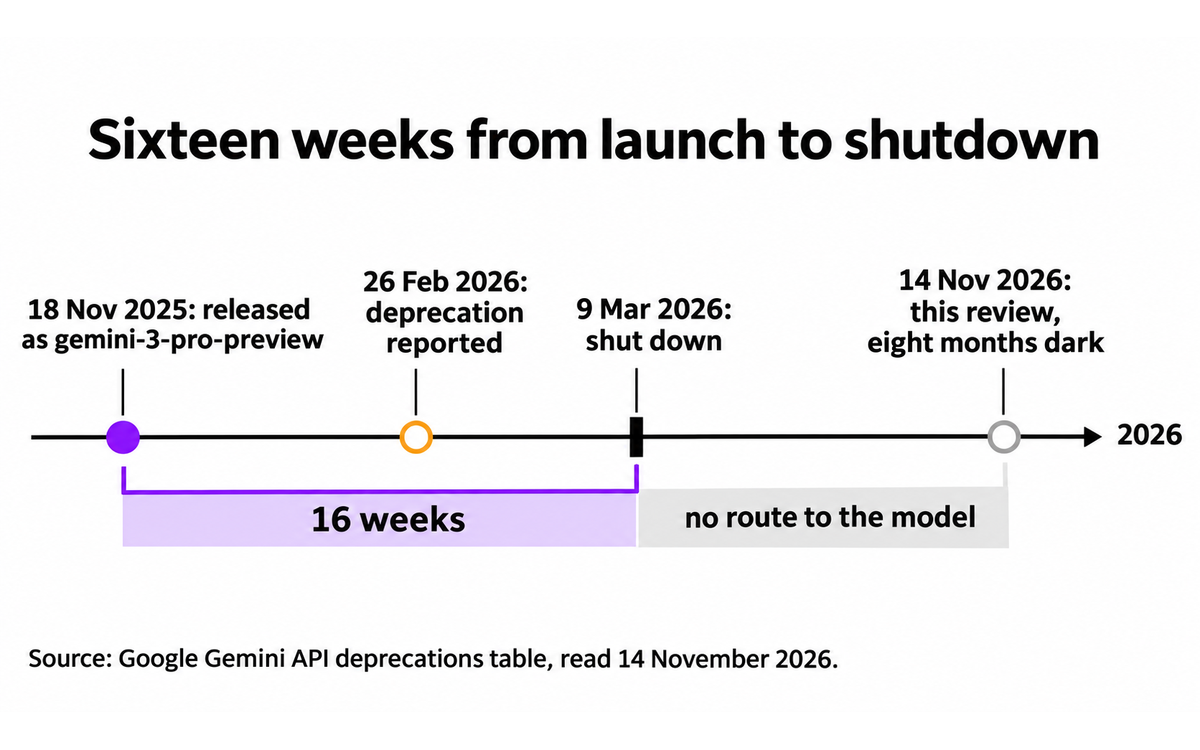
Status: Deprecated | Last tested: 2026-11-14 (Gemini 3 Pro, gemini-3-pro-preview, released 2025-11-18; shut down 2026-03-09) | Re-check: trigger-based, with a six-month outer limit for this record
Deprecated: the tool has been shut down or fundamentally changed. See the Migration Path section.
For detailed explanations of the CI-First evaluation terms used in this review, including the Humics Protection Badge and the AI Imposture Risk levels, see the Glossary at the end of this post.


In this Tool Review

Gemini 3 Pro: Google's Benchmark-Leading Preview, Shut Down After Sixteen Weeks
The identifier, the preview and the shutdown date, stated before the review begins
The model this review scores was sold under one identifier, and it no longer answers. Three facts decide how the rest of this document should be read.
Question | Answer | Where it comes from |
What was the model identifier? | gemini-3-pro-preview. There is no stable gemini-3-pro identifier in Google's model list or in its deprecation table: the text model shipped as a preview and stayed a preview until it was switched off | The Gemini API deprecations table, which lists gemini-3-pro-preview with a release date of 2025-11-18 and a shutdown date of 2026-03-09; the model page for gemini-3-pro-preview, which labels it Shut down |
When did it stop? | 2026-03-09, sixteen weeks after launch. It has been unavailable through the Gemini API for eight months as this review is written | The deprecations table, the model page callout and the archived pricing page |
What replaces it? | Two official surfaces name two different models: the deprecations table names gemini-3.1-pro-preview, and the model page callout instructs a migration to Gemini 4 Carbon. Both are live statements and they are not the same instruction | The deprecations table and the model page, both verified live on 2026-11-14 |
The identifier question matters because the request that produced this review named gemini-3-pro. Writing a family name where an identifier belongs is the defect this review exists to avoid, so the identifier is stated once, plainly: the reviewed model is gemini-3-pro-preview, it was a preview, and it was shut down. Any reader who has gemini-3-pro in a configuration file is holding a string that never resolved to a stable model and that now resolves to nothing.
The variants need the same care, because the Gemini 3 Pro name attached itself to more than one product.
Name | What it is | Status on 2026-11-14 |
gemini-3-pro-preview | The text and multimodal reasoning model this review scores | Shut down 2026-03-09 |
Gemini 3 Pro Image, first gemini-3-pro-image-preview, now gemini-3-pro-image and sold as Nano Banana Pro | A separate image generation and editing model, priced per image rather than per text token. It shares a name and not a lifecycle | Live, on the current pricing page, with text input and output priced at Gemini 3.1 Pro rates |
Deep Think | A setting on Gemini 3 Pro that spent more inference compute on a problem. It was a mode of the reviewed model, not a separate identifier, and it did not survive the shutdown | Gone with the model; the launch material describes it as an optional setting |
Gemini 3.1 Pro (gemini-3.1-pro-preview) | The successor built on Gemini 3 Pro, released 2026-02-19 and still served | Live, with no shutdown date announced |
The Gemini 3.1 Pro identifier carries its own preview suffix and has no announced shutdown date, which is the opposite situation: a model that is still on the price list eight months after release. A reader who assumes the two Pro identifiers share a fate will get this backwards.
This is a new review, not a re-score. U365's Tools library already carries Gemini 4 Carbon, Gemini 4 Hydrogen, Gemini 4 Argon, Gemini 3.8 Flash, Gemini 3.8 Live with Live Avatar, Gemini 3.7 Flash, Gemini 3.6 Flash, Gemini 3.6 Thinking, Gemini 3.5 Flash-Lite, Gemini 3.1 Pro, Gemini 2.5 Flash-Lite, Google AI Studio and Gemini Notebook. None of them is this model, none is edited here, and no sibling record is touched. The published Gemini 3.1 Pro review is used in this document as the record of what replaced Gemini 3 Pro, and the Gemini 4 reviews are used as the record of where the line has arrived.
What this review is not. It is not a review of the Gemini app, of Google AI Studio, of Google Antigravity, of Gemini CLI or of AI Mode in Search, although the model shipped inside all of them. It is not a review of Nano Banana Pro, which shares the name and none of the lifecycle. It is not a review of Gemini 3.1 Pro, which has its own review. And it is not a hands-on comparison with Gemini 4, because the model cannot be called: every comparison in this document is made from published measurement, not from a side-by-side run.
What a review of a shut-down model can do, and what it cannot. It can record what the model was, what it cost, what it measured and how it ended, so that a reader building a lineage, a lecture or a migration plan has one document that is right about the identifier and the dates. It cannot tell you how the model behaves today, because it does not behave at all. The scoring section states that boundary again where the numbers are given, and the Verdict does not recommend an adoption that is impossible.

Gemini 3 Pro: Google's Benchmark-Leading Preview, Shut Down After Sixteen Weeks
Tool Snapshot
Gemini 3 Pro was Google's first Gemini 3 reasoning model: a sparse mixture-of-experts transformer with native multimodal input, a one-million-token window, a 64K output ceiling and an optional Deep Think mode, sold as a preview from 2025-11-18 until it was shut down on 2026-03-09.
Category: Applied AI / Large Language Model, built for multimodal reasoning, agentic coding, long-context analysis and tool use. It was the top of the Gemini line at launch, above Gemini 2.5 Pro, and it was the base on which Gemini 3.1 Pro, Gemini 3 Flash and the rest of the Gemini 3 family were built.
Primary use cases, as the vendor described them and as the launch material demonstrated:
Multimodal analysis. Reading text, images, video, audio and PDFs in one window and reasoning across them, which is the capability the vendor led with: 81 percent on MMMU-Pro and 87.6 percent on Video-MMMU.
Agentic coding and tool use. Terminal-Bench 2.0 at 54.2 percent, SWE-bench Verified at 76.2 percent, and WebDev Arena at 1487 Elo, with the model shipped in Gemini CLI, Google Antigravity, Cursor, GitHub, JetBrains, Manus and Replit on launch day.
Hard reasoning. Humanity's Last Exam at 37.5 percent without tools, GPQA Diamond at 91.9 percent and MathArena Apex at 23.4 percent, with Deep Think taking the same rows to 41.0 percent and 93.8 percent.
Long-context work. A 1,048,576-token input window, which the vendor sold as the ability to hold entire code repositories and document sets in one prompt.
Vibe coding and interface generation. The launch post names it directly: richer, more interactive web UI from a prompt, and a WebDev Arena score of 1487 Elo at release.
What it was not. It was not a stable model: the identifier carried -preview for its entire life. It was not free: the model had no free tier on the paid API, although readers in the launch thread reported using it in AI Studio on a free tier with daily quotas. It was not open weights, not self-hostable and not auditable from outside Google's service. It was not a computer-use model: the model page lists computer use as not supported. It was not an image generator: that was a sibling product with a confusingly similar name. It was not a model for a long output: 65,536 tokens was the ceiling, with no long-decode path to a million tokens. And it was not durable: sixteen weeks after launch it was switched off, and the replacement instruction changed between two of Google's own pages.
Pricing, as published on the pricing page whose last update reads 2025-12-18, in the Wayback Machine capture dated 2026-01-09:
Line | Prompt up to 200,000 tokens | Prompt above 200,000 tokens |
Input | $2.00 per million tokens | $4.00 per million tokens |
Output, thinking tokens included | $12.00 per million tokens | $18.00 per million tokens |
Context caching | $0.20 per million tokens | $0.40 per million tokens |
Cache storage | $4.50 per million tokens per hour | $4.50 per million tokens per hour |
Batch | 50 percent reduction | 50 percent reduction |
Free tier | Not available | Not available |
The price sentence needs two halves. The first is that Gemini 3 Pro was 60 percent more on input than Gemini 2.5 Pro and 20 percent more on output, which a commenter on the launch thread posted twenty-one minutes after the thread opened, with the comparison to Gemini 2.5 Pro and Gemini 1.5 Pro beside it: $2 and $12 against $1.25 and $10. The second is that the tier boundary at 200,000 tokens doubled every rate, so the one-million-token window that was the product's headline was also the point at which the bill doubled. A reader who priced a long-context job on the $2 rate priced the small half of it.
Official links:
Gemini API deprecations: https://aistudio.google.com/docs/deprecations
Model page, Gemini 3 Pro preview: https://aistudio.google.com/docs/models/gemini-3-pro-preview
All models: https://aistudio.google.com/docs/models
Launch post, 2025-11-18 (requested at blog.google/products/gemini/gemini-3/ and served at this address): https://blog.google/products-and-platforms/products/gemini/gemini-3/
Pricing, archived copy of the page last updated 2025-12-18: https://web.archive.org/web/20260109190909/https://ai.google.dev/gemini-api/docs/pricing
Model card, November 2025, last updated May 2026: https://storage.googleapis.com/deepmind-media/Model-Cards/Gemini-3-Pro-Model-Card.pdf
Evaluation methodology and results, November 2025: https://storage.googleapis.com/deepmind-media/gemini/gemini_3_pro_model_evaluation.pdf
Gemini 3.1 Pro model page, the successor: https://aistudio.google.com/docs/models/gemini-3.1-pro-preview
LLM-specific fields:
API model identifier: gemini-3-pro-preview. Preview only; no stable identifier was published and none exists in the model list.
Context window: 1,048,576 input tokens. Output limit 65,536 tokens, with no long-decode or background output path. The window was one input budget rather than a shared budget across input, thinking and output.
Modalities: text, image, video, audio and PDF input; text output only. No image, audio or video generation.
Thinking: supported, with Deep Think as an optional higher-compute setting. Deep Think was not a separate model identifier.
Capabilities: function calling, structured outputs, grounding with Google Search, URL context, code execution, file search and context caching. Not supported: computer use, image generation, audio generation, Live API and grounding with Google Maps.
Consumption options: Batch supported at a 50 percent reduction. Flex inference and Priority inference not supported.
Architecture: sparse mixture-of-experts transformer with native multimodal support for text, vision and audio, trained on Google TPUs with JAX and ML Pathways. No parameter count is published.
Knowledge cutoff: January 2025, per the model card.
License and hosting: proprietary hosted service. Not open weights and not self-hostable.
Distribution at launch: the Gemini app, Google Cloud and Vertex AI, Google AI Studio, the Gemini API, AI Mode and Google Antigravity, with third-party access through Cursor, GitHub, JetBrains, Manus and Replit.
At a Glance Dashboard
Field | Value |
Category | Applied AI / Large Language Model (multimodal reasoning, agentic coding and long-context analysis) |
CI-First Benefit Score | 5.0 / 10 (CI-First Positive, scored on the model's window of availability and not an adoption recommendation) |
Sub-scores | Time 5 / Quantity 6 / Quality 6 / Skill 3 |
CI-First Profile | Primary: Co-Researcher, Analyst and Tester (level 4). Secondary: Co-Worker and Assistant (level 2), Professor, Coach and Tutor (level 3) |
Humics Protection | Humics-Neutral (-1 / +3) |
AI Imposture Risk | Medium overall, with Skill Illusion High |
Status | Deprecated (shut down 2026-03-09) |
Last tested | 2026-11-14 |
Pricing, last published | $2.00 input and $12.00 output per million tokens up to 200,000 tokens; $4.00 and $18.00 above it; no free tier |
Platforms, historical | Gemini API, Google AI Studio, Vertex AI, Gemini app, AI Mode, Google Antigravity, Gemini CLI, Cursor, GitHub, JetBrains, Manus, Replit |
User sentiment | Positive on multimodal reasoning and launch-day coding results; critical of the preview status, the tier boundary and the short notice before shutdown |

Gemini 3 Pro: Google's Benchmark-Leading Preview, Shut Down After Sixteen Weeks
The Problem
The problem Gemini 3 Pro was built for is the one that follows a model that can already answer: the work that does not fit in a single modality or a single file. A contract set with scanned annexes, a codebase with a stack trace, a lecture that has to become a slide deck and a dataset, a video that has to be summarised against a written brief. The expensive part of that work is not the sentence. It is holding several kinds of evidence in one place long enough to see what contradicts what.
Gemini 2.5 Pro could do a version of this and lost the thread in predictable places. The vendor's own framing for Gemini 3 was that it significantly outperforms 2.5 Pro on every major benchmark, and the rows it chose to lead with were the multimodal and reasoning ones rather than the coding ones. That choice is a description of the problem: read many kinds of input, reason across them, and return an answer that survives a reader who checks it.
There was a second problem, and it is specific to the moment. By late 2025 the frontier had become a price ladder. A team could pay for a reasoning model, or pay less for a fast one and accept a lower ceiling, and the routing decision between them was being made by habit. Gemini 3 Pro arrived at $2 and $12 per million tokens with a one-million-token window and a 200,000-token price boundary, and it arrived as a preview. That combination created the question this review has to answer in retrospect: what does a team do with a model that is the best available on the day it launches and is not committed to exist?
The third problem is the one U365 cares about most, and the shutdown made it sharper. A model that can read a video, a paper and a spreadsheet in one pass produces an answer that looks like expertise. The reader who asked cannot easily tell whether the model reconciled the sources or averaged them. The framework calls that the Skill Illusion, and the Gemini 3 Pro release is an unusually clean case of it: the model was genuinely strong on the benchmarks, it was genuinely fluent in its output, and it was withdrawn before most of the people who adopted it had built the verification habit that would have told them which of its answers to trust.

Gemini 3 Pro: Google's Benchmark-Leading Preview, Shut Down After Sixteen Weeks
The Outcome
Gemini 3 Pro moved the Gemini line from competitive to leading on reasoning and multimodal rows, and it left behind a lifecycle lesson that outlasts every benchmark in its launch post.
The measured movement at launch was large and it was concentrated in the rows the vendor chose. LMArena at 1501 Elo, first at the time. Humanity's Last Exam at 37.5 percent without tools, against a 2.5 Pro result the vendor did not lead with. GPQA Diamond at 91.9 percent. MathArena Apex at 23.4 percent, which the launch post called a state of the art. MMMU-Pro at 81 percent and Video-MMMU at 87.6 percent on the multimodal side. SimpleQA Verified at 72.1 percent, which the vendor presented as progress on factual accuracy. On the coding side, Terminal-Bench 2.0 at 54.2 percent, SWE-bench Verified at 76.2 percent and WebDev Arena at 1487 Elo. ARC-AGI-2 at 31.1 percent, which a reader on the model-card thread read as first place, and which the vendor took to 45.1 percent in Deep Think.
The independent record is thinner than the vendor's, and the shape of that thinness is itself the finding. LMArena is a preference vote and it placed the model first on release. The model card thread on Hacker News, 280 points and 335 comments, read the numbers as a resounding win and made one reservation that held up: that coding looked similar to other state-of-the-art models rather than ahead of them. Artificial Analysis, the evaluator this series uses for a cross-vendor composite, now reports no intelligence index, no time per task and no cost per task for the model, because there is no publicly available API to run. Eight months after shutdown, the only independent measurements that survive are the ones taken while it was live, and they are a preference vote and a set of launch-window comparisons rather than a maintained series.
The practical outcome for a U365 Fellow in November 2026 is therefore not a capability at all. It is a boundary in a lineage. The model that Gemini 3.1 Pro was built on, that Gemini 3 Flash was built under, and that the Gemini 4 generation replaced, is documented here so that a reader comparing the versions in a lecture can see what each one actually contributed and when it stopped contributing. The comparison that matters for a buying decision is in the Comparison and Alternatives section, and it does not include this model as a live option.
Where the outcome was smaller than the launch suggested. The 1M context claim was contested within seven weeks: a Hacker News post in January 2026 reported that the Gemini web app exposed about 32,000 tokens of it, not a million. That is one user's measurement on one surface and it is not reproduced here as fact, but it is the kind of report that a preview model attracts and a stable model has to answer. The coding results were strong and not ahead: the same model-card thread noted that coding looked similar to other state-of-the-art models, and the vendor's own launch table put Terminal-Bench 2.0 at 54.2 percent, a good number and not a gap. And the model's knowledge stopped in January 2025, which by the time of its shutdown was fourteen months before the questions people were asking it.
What the release did not change, and what the shutdown proved. It did not make a non-expert able to evaluate expert output. It did not remove the need to verify a citation, a number or a claim about a video. And it did not give a buyer any commitment that the model would exist in a year, or in four months. The CI-First score below measures what the model did for a reader while it existed. The Status line measures what a reader can do with it now, which is nothing, and the Migration Path names the two routes Google's own pages offer.

Gemini 3 Pro: Google's Benchmark-Leading Preview, Shut Down After Sixteen Weeks
Who Should Use Gemini 3 Pro
Nobody can use it, and that sentence has to come before the table. The model was shut down on 2026-03-09, and no new account, no existing API key and no subscription route reaches it. What follows rates the model against the reader types the framework uses, on the window in which it was available, because a reader comparing lineage versions needs the comparison and a lecture that links seven versions needs each one described honestly. Where the rating changes because the model is gone, the row says so.
Learner type | Difficulty | Typical ROI | Career path |
Students (Bachelor, Master) | Advanced | The best multimodal reasoning available for sixteen weeks at $2 and $12 per million tokens, with no free tier on the paid API and a 200,000-token boundary that doubled the rate on the long jobs a thesis creates. In its window the case was real: a student could put a reading set, a video and a dataset in one prompt and get a structured comparison. The case is now historical, because the model is not reachable and the successor is a different model at the same nominal rate. | UIT (Technology, AI, Data Science) for multimodal analysis and evaluation practice. UIB (Business Management, Entrepreneurship) for document and market research with a citation per cell. No published U365 credential assesses multimodal source reconciliation as a named component, and none is asserted. |
Professionals (career upskilling) | Advanced | The strongest Gemini reasoning model at launch, priced above Gemini 2.5 Pro and below the frontier Claude and OpenAI tiers of the day, and withdrawn on sixteen weeks of notice. The professional case in its window was dense multimodal work: a repository plus its issue tracker, a contract set with exhibits, a recorded lecture plus its slides. The professional case now is the migration, not the model. | UIT (Technology, AI, Data Science) tracks for architecture, debugging and evaluation design. UIB (Business Management, Entrepreneurship) for financial and market analysis where the deliverable is checked. |
Everyone (lifelong learners) | Intermediate | A capable app and AI Mode model for Google's consumer surfaces during its window, and a poor long-term bet: it was a preview for its entire life, its context claim was contested within seven weeks, and it was switched off four months after launch. The gain for a lifelong learner was depth on one question, and the judgement about which answer to trust stayed with the reader. | LIPS Collect and Review phases for the reading work, and the UP-Context-Engineering Method order for prompting. No assessment home is asserted. |
For teams and organisations. Gemini 3 Pro was sold to companies through Vertex AI and the Gemini API, and a team reading this review after the shutdown has four questions rather than four benefits.
Team deployment. There is nothing to deploy. The Gemini API endpoint is shut down, and a team that standardised on gemini-3-pro-preview had to move in March 2026. The historical deployment surface was broad, which is why the shutdown mattered: Vertex AI, AI Studio, the Gemini app, AI Mode, Antigravity, Gemini CLI and third-party surfaces including Cursor, GitHub, JetBrains, Manus and Replit all carried the model, so a single identifier could sit in a dozen configurations inside one organisation.
Cost at team scale. The published rate was $2.00 and $12.00 per million tokens up to 200,000 tokens and double that above it, with a 50 percent batch reduction and cache reads at $0.20 or $0.40. The line that mattered at team scale was the tier boundary, because a long-context workflow crosses 200,000 tokens quietly and every token after the boundary is billed at twice the rate.
Data and compliance. The model was a paid-only service with no free tier on the API, and Google's paid-service terms state that prompts and responses are not used to improve its products and are processed under the Data Processing Addendum. The preview status cut the other way: a preview model can be withdrawn on short notice, and this one was, which is a procurement fact before it is a technical one.
U365 for companies. Professional learners reach University 365's academic services individually or through their organisation, and the company route runs through a customized training agreement for employee groups. Corporate education programmes are built on demand, and their tuition follows content and duration.
Skill level required: Advanced. In its window the model was easy to start and hard to supervise: stating a finish line, choosing whether Deep Think was worth its compute, keeping a long input under the price boundary, reading a multimodal answer against its sources, and knowing which parts of the output you could check yourself. None of that was required to get an answer, and all of it was required to rely on one.
Prerequisites. In its window: a Google Cloud project on the paid tier or an AI Studio account for the browser route, a budget that accounted for the 200,000-token boundary, and a verification habit. A reader today needs none of that and needs one thing instead: the identifier, the shutdown date and the name of the model that replaced it, which are in the first table of this review.
Typical time to first result: under five minutes in AI Studio with the identifier gemini-3-pro-preview, or one API call on the paid tier. Fifteen to forty minutes for a first real multimodal task, because that is how long a one-million-token input takes to upload, process and answer.
Typical time to competence: twenty to forty hours of active use. Two habits carried most of the value: putting the sources and the question in one prompt rather than several, and checking one claim per answer against a source outside the conversation.
Who should wait: everyone, permanently. This is the one review in the series where the answer to "who should wait" is the whole population, and the answer to "who should adopt" is nobody. The Migration Path section names what to adopt instead.

Gemini 3 Pro: Google's Benchmark-Leading Preview, Shut Down After Sixteen Weeks
U365 Institutes Alignment
The alignment below rates what a U365 institute could take from this model as a working instrument and as an object of study. The primary home is UIT (Technology, AI, Data Science), because multimodal analysis, evaluation design and model lifecycle management are the competencies this release exercises, and because a preview model that topped the benchmarks and was withdrawn in sixteen weeks is itself a teaching object about procurement and verification. The other three readings are real and each is bounded.
One limit holds the section as a whole and is stated here rather than repeated in every row. gemini-3-pro-preview was shut down on 2026-03-09 and no route reaches it today, not even a preview with a shutdown date, so every rating below describes what the instrument was worth in its sixteen-week window, and none of them is an availability statement or a current recommendation. A Fellow who wants to run the packs in this review runs them on a live model, and the pack set names which. The replacement the deprecations table names, gemini-3.1-pro-preview, is itself a preview identifier with no announced shutdown date, and the sixteen-week life of the model this section rates is the case that shows what a Fellow accepts when a workflow is built on one.
UIT (Technology, AI, Data Science)
Rating. High (primary)
Why. Four engineering competencies, each of which survives the removal of the tool. Multimodal source reconciliation: putting a document, a chart, a video and a dataset in one window and stating which source supports which claim, which is the work the vendor's MMMU-Pro and Video-MMMU rows measure in the abstract. Evaluation design: reading a vendor table that mixes benchmark versions and settings, and noticing that the same model is first on a preference vote and unmeasurable on a maintained composite eight months later. Lifecycle engineering: treating a model identifier as a dependency with a version, a notice period and a replacement route, which is the lesson of the sixteen-week life. Cost engineering: computing cost per finished task across a 200,000-token boundary that doubles the rate, which is arithmetic a cohort can do on the published numbers. The published programme set already teaches Python, software development, cloud engineering and AI agents; this model was a working object on which those skills were exercised, and its shutdown is a case study they can be exercised against.
The limit that holds the row. The model is a service a practitioner operated, not an artefact a practitioner inspects. There are no weights and no parameter count, and the architecture is described only as a sparse mixture-of-experts transformer. The catalogue's AI-agent instruction is concentrated in the n8n certificate series and the Superhuman certifications rather than spread across the degree paths: 4 of the 81 published programmes carry agent, two of them n8n certificates (Automate your Work with n8n, and AI Agents and Workflows Automation with n8n) and two of them Superhuman certifications (Superhuman@Work, and Superhuman Expert with AI), with a fifth carrier being a NOVEC corporate acculturation module rather than an academic programme. 0 of the 20 degree programmes carry agent, agentic or prompt, and 0 of the 81 published programmes carry multimodal or reconciliation, so no published programme assesses model lifecycle management or multimodal source reconciliation as a named component. Adjacent anchors, not assessment homes.
UIB (Business Management, Entrepreneurship)
Rating. Medium
Why. Two decisions the release forces that are commercial before they are technical. Vendor risk: a preview identifier that topped the benchmarks and was withdrawn on sixteen weeks of notice is the clearest procurement case in the Gemini line, and a business that had built a workflow on it learned in March 2026 what a supply commitment is worth. Cost per output: the published rate doubled above 200,000 tokens, the batch option halved it, and cache reads at $0.20 rewarded a stable prompt prefix, so a business case built on the headline rate rather than on a measured token mix was wrong in both directions. Dense document synthesis was a genuine working instrument in its window, and the vendor's SimpleQA Verified result at 72.1 percent is the number a due-diligence workflow has to test on its own questions.
The limit that holds the row. The model supplies no management method and does not measure its own return. It published no completion rate and no cost per task, and the independent evaluator that would have supplied one no longer reports a measurement. 0 of the 81 published programmes carry portfolio, return on investment, cost or price in title or description, so no published programme assesses the economics of a model portfolio as a named component. Adjacent anchors, not assessment homes.
UIC (Digital Communication, Marketing)
Rating. Low to Medium
Why. One competency that matters and is easy to miss: dating a claim and naming what it was measured against. This release is a clean worked example. "Tops the LMArena leaderboard" was true on 2025-11-18 with 1501 Elo, and a reader quoting it in November 2026 is quoting a rank that three later Gemini releases have moved. The same discipline applies to "state of the art on MathArena Apex at 23.4 percent": true when published, and a number no current buyer should carry without the date. The writing surface was real as well, and the multimodal input let a communication team put a recorded event, its slides and its transcript in one prompt and ask for a consistent account.
The limit that holds the row. The model taught no register, no audience analysis and no publication standard. It returned no sourced evidence of its own, so fact-checking stayed with the writer, and its knowledge stopped in January 2025. No campaign or content-strategy competency appears in it. Rated as evaluation contact with a writing surface. No credential is mapped.
UID (Digital Design, UX/UI)
Rating. Low to Medium
Why. The clearest design contact in the release was interface generation: WebDev Arena at 1487 Elo on launch, a preference vote on generated interfaces rather than a capability test, and demonstrations of interactive UI produced from a prompt rather than a specification. The model read images, video and PDFs, which is what a design brief, a mood board and a drawing set are made of, and a designer could produce variants fast enough that comparison became the work. The judgement about which variant matters stayed with the designer, because the model supplied no criterion of its own.
The limit that holds the row. The model performed no design judgement and evaluated no design against a brief. It generated no images at all, so the visual surface was input plus front-end code rather than visual authorship, and its output ceiling of 65,536 tokens bounded how much of an application it could return in one pass. No layout, interaction or motion competency is assessed by it. No credential is mapped.
U365 methods, not an institute (UNOP, ULM, LIPS, CARE and the UP-Context-Engineering Method)
Rating. Applicable
Why. The methods layer fits the way a long-context reasoning model is used. The decision about what to put in the window and what to leave out is a planning decision before it is a prompt, and the UP-Context-Engineering Method's context-role-task-constraints-output order is what makes a multimodal run reproducible. For LIPS and CARE, the record of what a run was asked to do, what it returned and what the Fellow checked belongs in the Fellow's own system, because the model held no state between calls and kept nothing on the user's behalf. UNOP has no direct fit: the model was not built to teach, and its gains came from reasoning depth rather than from any pedagogical mechanism.
The limit that holds the row. The model carried no method of its own and no coaching surface. A Fellow who did not keep the reasoning about sources, context and verification in their own system has no account of it, and nothing in the product wrote that account for them.

Gemini 3 Pro: Google's Benchmark-Leading Preview, Shut Down After Sixteen Weeks
How Gemini 3 Pro Works
A sparse mixture-of-experts transformer with native multimodal input, sold as the top of the Gemini line, with a one-million-token input window, a 64K output ceiling and an optional Deep Think setting that spent more inference compute before answering.
Inputs: text, images, video, audio and PDFs. Through the API, a conversation history plus tool definitions and, where used, Google Search grounding, URL context, file search and code execution. Through the app, Antigravity, Gemini CLI and third-party surfaces, a repository, its instruction files and whatever context the surface assembled. The model read five modalities and produced text.
Outputs: text, code, structured tool calls and, through agent surfaces, edits to files. Up to 65,536 tokens in one response, inside a context window of 1,048,576 input tokens. There was no long-decode path: a job that needed more than 64K of output had to be split, and the vendor did not offer the background continuation that its later models added.
Underlying technology, as the vendor publishes it:
Model: Gemini 3 Pro, identifier gemini-3-pro-preview. A sparse mixture-of-experts transformer with native multimodal support for text, vision and audio, trained on Google TPUs with JAX and ML Pathways.
Position in the family: the first Gemini 3 model and the base of the family. The model card names Gemini 3 Pro Image, Gemini 3 Flash, Gemini 3.1 Pro, Gemini 3.1 Flash Image, Gemini 3.1 Flash-Lite, Gemini 3.1 Flash Live and Gemini 3.5 Flash as models built on Gemini 3 Pro, and states that it is not a modification or a fine-tune of a prior model.
The mechanism the vendor names: reasoning at inference, with Deep Think as an optional higher-compute setting. The model card describes reinforcement learning on multi-step reasoning, problem-solving and theorem-proving data, and the launch material presents Deep Think as the setting that pushes the hardest rows further: Humanity's Last Exam from 37.5 to 41.0 percent, GPQA Diamond from 91.9 to 93.8 percent, and ARC-AGI-2 to 45.1 percent with code execution.
Context: 1,048,576 input tokens and 65,536 output tokens, as two separate limits rather than one shared budget. The vendor sold the window as the ability to hold entire repositories and document sets in a single prompt.
Multimodality: text, image, video, audio and PDF in; text out. Native rather than bolted on, which is the vendor's claim and is consistent with the MMMU-Pro and Video-MMMU results it published.
Tooling: function calling, structured outputs, Google Search grounding, URL context, code execution and file search, with context caching and the Batch API. Computer use, image generation, audio generation, the Live API and Maps grounding were not supported on this model.
Safety stack, as the vendor describes it: dataset filtering, conditional pre-training, supervised fine-tuning, reinforcement learning from human and critic feedback, safety policies, and product-level filtering. The model card records jailbreak vulnerability as the main residual risk, improved against Gemini 2.5 Pro and still an open research problem, and possible degradation in multi-turn conversations.
Distribution: the Gemini app, Google Cloud and Vertex AI, Google AI Studio, the Gemini API, AI Mode and Google Antigravity, with third-party access through Cursor, GitHub, JetBrains, Manus and Replit.
What is not disclosed. No parameter count. No weights. No architecture description beyond "sparse mixture of experts". No training-set size. No regional availability statement in the launch post, the model page or the model card. And no commitment to a stable identifier, which is the omission that decided the model's commercial fate.
How the economics actually worked. Two rates, split at 200,000 prompt tokens: $2.00 and $12.00 below the line, $4.00 and $18.00 above it, with thinking tokens billed as output. Context caching was priced at $0.20 and $0.40 per million tokens with storage at $4.50 per million tokens per hour, the Batch API halved the rate, and there was no free tier on the paid API. The consequence is the one a buyer had to internalise: the one-million-token window was not priced at one rate. A 300,000-token document set was billed at the upper rate on every token, so the headline window and the headline price described different jobs.
What it was bad at natively. Output length: 65,536 tokens, with no continuation path, which is a hard ceiling for a long build or a book-length draft. Computer use: not supported, so any task that needed to click through a screen was out of scope. Freshness: the knowledge cutoff was January 2025, and by its shutdown that was fourteen months of the world it did not know. Latency: the model card names occasional slowness and timeout issues as known limitations, and the review has no independent latency measurement to set against that, which is stated again in the Faculty Note. And any task whose correctness the person asking could not evaluate, which is a limit of the arrangement rather than of the model.

Gemini 3 Pro: Google's Benchmark-Leading Preview, Shut Down After Sixteen Weeks
Getting Started with Gemini 3 Pro
This section is written in the past tense on purpose. A reader cannot start with this model on 2026-11-14, and a getting-started section that pretended otherwise would be the kind of document that gets a shutdown wrong. What follows is the setup that applied in its window, kept because the same steps on the successor are nearly identical and because a reader migrating an old configuration needs to know what the old one required.
Required accounts, in the window: a Google Cloud project on the paid tier of the Gemini API for programmatic access, and a Google AI Studio account for the browser route. The Gemini app, AI Mode and Antigravity were reachable through Google's consumer and enterprise plans. There was no free tier for the model on the paid API, and no trial quota.
Installation: nothing to install for AI Studio in a browser. For the API, nothing beyond an HTTP client or one of the official SDKs, with the model selected by the identifier gemini-3-pro-preview. Gemini CLI and Antigravity carried the model as a selectable option on the day of launch.
First-time configuration, as it applied:
Set the budget at the upper rate, not the headline one. Every token above a 200,000-token prompt is billed at $4.00 input and $18.00 output. A pilot approved at $2 and $12 is a pilot that will surprise its owner the first time a repository goes in whole.
Choose whether Deep Think is worth its compute before the run, not after. It was an optional setting that spent more inference on a problem and moved the hardest rows by a few points: 37.5 to 41.0 on Humanity's Last Exam, 91.9 to 93.8 on GPQA Diamond.
Keep the output request under 65,536 tokens. There was no background continuation, so a long deliverable had to be planned as several calls with a state file rather than one prompt.
Remove any parameter the model ignores, and do not rely on sampling controls it does not expose. The thinking setting was the control surface.
Put the sources in one prompt rather than several. The reason to use the model was the single window, and a workflow that chunked a document set into twenty calls paid the price of the window and got none of its benefit.
Record the identifier and the date in the project. A preview string is a dependency with an expiry, and the sixteen-week life of this one is the argument for writing the date down.
First 15 minutes checklist, as it applied:
Run one real multimodal task from your own work in a single message, with a stated finish line.
Confirm which setting you are on, then run the same task with Deep Think on and off and compare the answer, the wait and the token count.
Take one factual claim from the answer and verify it against a source outside the conversation.
Write down the input and output tokens the run used, and compute cost per finished task at the upper rate if the prompt crossed 200,000 tokens.
Confirm which surface the run used, and whether that surface is a paid service under Google's data terms.
Result, in the window: one real task completed end to end, a deliberate setting, one verified claim and a known cost per finished task at the rate actually paid. That was a working setup rather than an impression. A reader doing this today on a current model should expect the same steps and a different identifier.

Gemini 3 Pro: Google's Benchmark-Leading Preview, Shut Down After Sixteen Weeks
Real Workflows
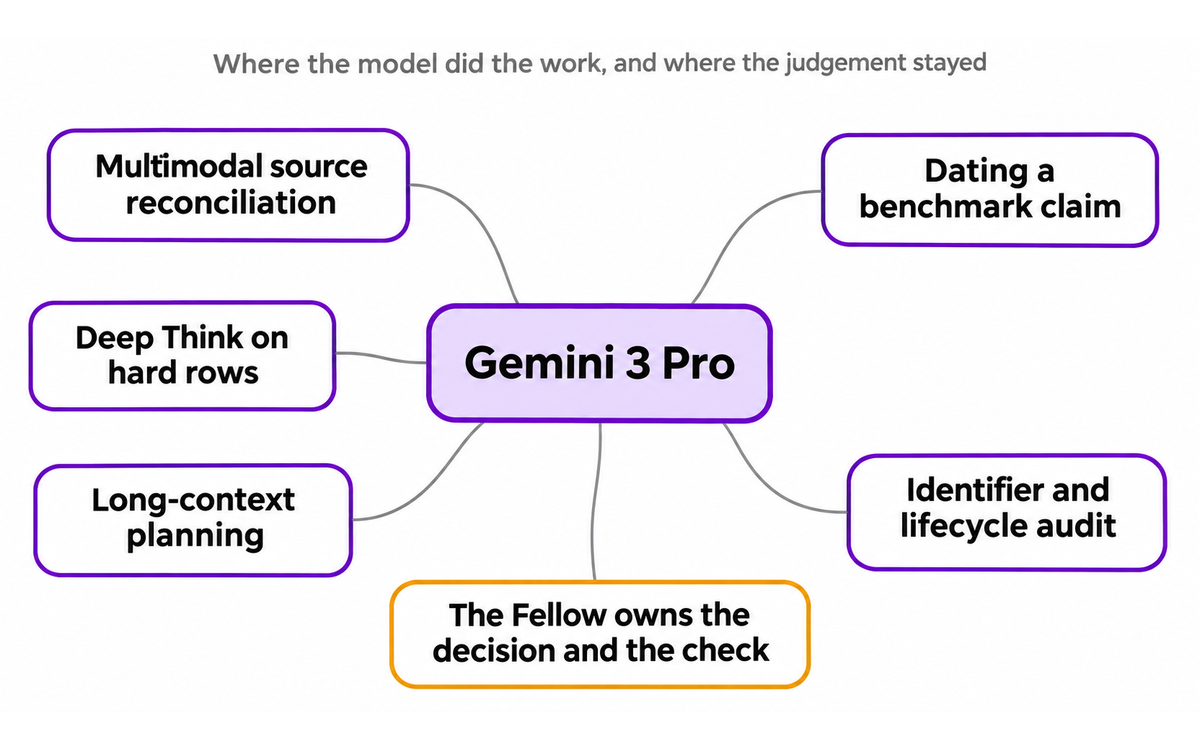
Three workflows, each chosen because it is either what the model was genuinely good at or what its life teaches. The first is the multimodal synthesis the model was built for and remains the shape of the work on any current model. The second is the discipline of reading a launch claim against a later measurement, which this release makes unavoidable. The third is the migration the shutdown forced, which is the only workflow a reader can still run on this model's behalf.
Each prompt follows the UP-Context-Engineering Method order and carries the five house elements: Role, Profile, Memory, a first-person verification close and a data-safety line.
Workflow 1: Reconcile a multimodal source set into one defensible account
When to use it: a question has to be answered from several kinds of evidence at once, the sources contradict one another, and someone else will check the result. On Gemini 3 Pro in its window this was the flagship workflow. On a current Gemini model the same prompt is the right starting point, and the verification discipline is unchanged.
Learner type: Professional, advanced student. CI-First benefit tags: Time, Quantity, Quality. Connects to: UIT (Technology, AI, Data Science). Time estimate: 90 minutes including checks.
What you do vs what the tool does:
Step | You do | The tool does |
1 | Name the decision the account informs and the fields you need | Reads the documents, images, video and data in one window |
2 | Set the citation rule and the "not stated" rule, and state which source outranks which | Extracts each field and attaches the source it came from |
3 | Choose the three claims you will check by hand before the run | Produces the account, and flags the places where the sources disagree |
4 | Open the cited page or timestamp for every claim you will act on | (Nothing. You verify.) |
5 | Read the disagreement list before the summary | (Nothing. You decide.) |
Sample prompt:
Context: The sources are [paths or uploads] and they are the only evidence allowed. The decision they inform is [decision]. The set is [n] documents, [n] images, [n] minutes of video and [n] data files. The fields I need are [fields]. Where two sources disagree, say so and name both. Where a field is absent, write "not stated" rather than inferring it. I am running [thinking setting]. I am [role] working on [project], and the reader of the output will check every number against its source. The model for this run is [live Gemini model]; the model this review rates, gemini-3-pro-preview, was shut down on 2026-03-09.
Role: AI as a Co-Researcher, Analyst and Tester (Profile 4). You extract and reconcile. I define the fields, the ranking of sources and the decision.
Profile: Act as a Co-Researcher, Analyst & Tester. Every value carries its source, and two sources are never averaged.
Task: Extract each field I named, attach the source of each value, and list the places where the sources disagree. Do not write the decision.
Constraints: No claim without a source. No number without a page, a timestamp or a cell. Do not average two sources. Keep the account under [n] words.
Output format: A table with one row per field: value, source, confidence, disagreement note. Then a short list of what the set does not answer.
Memory: The last run on this set produced [what it got wrong]. Do not repeat it.
UP-Context-Engineering verification: I will open the source for every row I act on and confirm the value is there before I use it; if I cannot defend a row without reopening this session, I will mark it unverified and leave it out.
Data safety: These sources are [public / internal / client-confidential]. I will use only [the approved surface] and will not upload material that [constraint].
What the model did well here: breadth and reconciliation. It read five modalities in one window, and its published MMMU-Pro result at 81 percent and Video-MMMU at 87.6 percent are the vendor's measurement of exactly this capability. SimpleQA Verified at 72.1 percent is the number that says how often a factual claim in the output would survive a check, and it is the reason the checklist below puts a source open in front of every row.
Verification checklist for Reconcile a multimodal source set:
Multi-Model Check: re-extract two rows with a second model and compare. A disagreement is a row to check by hand.
External Source: open the cited page, timestamp or cell for every row you will act on. A citation that resolves to the wrong page is worse than no citation.
Human Review: have the person who owns the decision read the table and the disagreement list together, not the table alone.
CI-First Test: can you defend each row without reopening the model session? If a row depends on the transcript, it is not evidence yet.
Workflow 2: Date a launch claim against the measurement that followed
When to use it: you are reading a benchmark table, a vendor post or a competitor's comparison, and the number is going to influence a purchase, a lecture or a policy. This workflow exists because Gemini 3 Pro is a textbook case: first on LMArena at 1501 Elo in November 2025, unmeasurable on the maintained composite by November 2026, and quoted in between as if neither date mattered.
Learner type: Professional, analyst, advanced student. CI-First benefit tags: Quality, Skill. Connects to: UIC (Digital Communication, Marketing) and UIB (Business Management, Entrepreneurship). Time estimate: 45 minutes per claim.
What you do vs what the tool does:
Step | You do | The tool does |
1 | Write down the claim exactly as published, with its date and surface | Reads the page and the table it came from |
2 | Name the setting, the benchmark version and the comparison base | Extracts each figure with the row and column it sits in |
3 | Look for the later measurement that either confirms or contradicts it | Finds the successor's published rows and the evaluator's current page |
4 | Decide whether the claim is current, historical or wrong | (Nothing. You decide.) |
5 | Write the sentence you will use, with the date attached | (Nothing. You verify.) |
Sample prompt:
Context: The claim is "[verbatim claim]" published on [date] at [surface]. The benchmark is [name and version]. The question is whether this claim is current, historical or wrong on [today's date]. Use only these sources: [URLs]. Where a source is a vendor table, say who ran the comparison and at what setting. I am preparing [lecture / memo / review] for [audience], who will check the date and the source. The model for this run is [live Gemini model]; the model this review rates was shut down on 2026-03-09.
Role: AI as a Challenger, Critic and Devil's Advocate (Profile 5). You test the claim. I decide what to write.
Profile: Act as a Challenger, Critic & Devil's Advocate. You state the comparison base before the number.
Task: Date the claim, name what it was measured against, and give me the sentence I should use with the date inside it.
Constraints: No number without its date, its setting and its comparison base. If the later measurement does not exist, say "not measured" rather than inferring.
Output format: Three lines. The claim as published. The current state of the measurement. The sentence I should use, with the date in it.
Memory: The last version of this claim was [what changed]. Note what moved.
UP-Context-Engineering verification: I will open each source and confirm the figure and the date myself before I publish; anything I cannot confirm I will mark unverified rather than repeat it.
Data safety: The sources are public. Nothing internal is pasted into this prompt.
What the model did well here: not the point. The workflow is the check on the model's own marketing, and Gemini 3 Pro is the case. Its launch table was accurate on 2025-11-18 and is not a description of November 2026. A reader who runs this workflow on the next launch will get the same benefit the framework is trying to protect: a dated sentence instead of a floating number.
Verification checklist for Date a launch claim:
Multi-Model Check: ask a second model the same question and see whether it dates the claim or repeats it.
External Source: open the vendor table and the independent leaderboard yourself, on the day you write, and record both dates.
Human Review: show the dated sentence to someone who will use it and ask what they think it means today.
CI-First Test: can you state the claim, its date and its current status in one breath? If not, you are carrying a number you cannot defend.
Workflow 3: Audit and migrate a model dependency before it is withdrawn
When to use it: a workflow, a product or a course depends on a specific model identifier, and the identifier is a preview, a deprecated name or a model whose vendor has announced a change. This is the workflow the Gemini 3 Pro shutdown forces, and the one a reader can run today on any stack.
Learner type: Professional, architect, advanced student. CI-First benefit tags: Time, Quality, Skill. Connects to: UIT (Technology, AI, Data Science). Time estimate: 2 to 4 hours for a small stack.
What you do vs what the tool does:
Step | You do | The tool does |
1 | Inventory every place a model identifier appears: code, config, prompts, notebooks, course material | Reads the repository and the documents you supply |
2 | Separate stable identifiers from preview, alias and deprecated names | Classifies each identifier against the vendor's deprecation table |
3 | Name the replacement route and the evidence for it | Finds the vendor's stated replacement and any conflicting statement on another page |
4 | Decide the migration order and what has to be re-tested | Drafts the migration plan and the test list |
5 | Run the tests on the replacement and read the diffs yourself | (Nothing. You verify.) |
Sample prompt:
Context: The repository is [path] and the course material is [paths]. The identifiers in use are [list]. The vendor's deprecation table is [URL] and the model page for each identifier is [URLs]. The question is which identifiers are committed, which are previews and which are already shut down, and what each one migrates to. I own [system] and I will be accountable for the migration date. The model for this run is [live Gemini model].
Role: AI as a Co-Worker and Assistant (Profile 2) for the inventory, and as a Co-Researcher, Analyst and Tester (Profile 4) for the classification.
Profile: Act as a Co-Researcher, Analyst & Tester for the classification, and a Co-Worker & Assistant for the inventory.
Task: Inventory every identifier, classify each one against the vendor's table, name the stated replacement for each, and list the tests to re-run.
Constraints: Quote the vendor's replacement instruction verbatim and name the page it came from. Where two pages disagree, report both and do not choose for me.
Output format: A table: identifier, where it appears, lifecycle status, stated replacement, source, test to re-run. Then a migration order.
Memory: The last migration broke [what broke]. Check for the same pattern.
UP-Context-Engineering verification: I will open each vendor page and confirm the status and the replacement myself, and I will run the tests on the replacement rather than trusting the plan, before I schedule anything.
Data safety: The repository is [internal / client]. I will not paste secrets, keys or personal data into the prompt.
What the model did well here: again, not the point. The workflow is the response to its disappearance, and the specific defect it catches is the one this review found in Google's own pages: the deprecations table names gemini-3.1-pro-preview as the replacement, the model page names Gemini 4 Carbon, and a migration plan that follows one page without reading the other may land on a model that is itself a preview.
Verification checklist for Audit and migrate a model dependency:
Multi-Model Check: have a second model classify the identifiers and compare. A disagreement is an identifier to check by hand.
External Source: open the vendor's deprecation table and the model page for each identifier, and record the date you read them.
Human Review: the person who owns the system signs the migration order and the date.
CI-First Test: can you explain, without the transcript, why each identifier moved and what changed in the output? If not, the migration is a swap rather than an engineering change.

Gemini 3 Pro: Google's Benchmark-Leading Preview, Shut Down After Sixteen Weeks
Strengths, Limits, and AI Imposture Risk
Strengths
Time
Strength. Real savings on multimodal work that would otherwise need several passes, in a window that lasted sixteen weeks.
Evidence. One prompt could carry a document set, a video and a dataset together, which replaces the sequence of calls a text-only model needed, and the 64K output ceiling was enough for an analysis rather than a book. Held at 5 rather than higher because no independent latency measurement survives: the evaluator that would have supplied one reports nothing for this model, the model card names occasional slowness and timeout issues, and thinking tokens were billed as output on every run.
Quantity
Strength. A genuine multiplier on how much evidence one pass can hold.
Evidence. 1,048,576 input tokens in one window, five input modalities, and a Batch API at half the rate for work that could wait. Held at 6 because the output ceiling was 65,536 tokens with no continuation path, Flex and Priority were not offered, and the one-million-token window doubled the rate above 200,000 tokens, so the volume was real and the bill for it was tiered.
Quality
Strength. The strongest reasoning and multimodal results in the Gemini line on the day it launched, and first on the preference leaderboard that most readers watch.
Evidence. LMArena at 1501 Elo, Humanity's Last Exam at 37.5 percent without tools, GPQA Diamond at 91.9 percent, MathArena Apex at 23.4 percent, MMMU-Pro at 81 percent, Video-MMMU at 87.6 percent, SimpleQA Verified at 72.1 percent, Terminal-Bench 2.0 at 54.2 percent, SWE-bench Verified at 76.2 percent and WebDev Arena at 1487 Elo, with Deep Think taking the hardest rows further. Held at 6 rather than 8 by the evidence basis: almost all of it is the vendor's own table, the independent record is a preference vote and launch-window comparisons, the maintained composite reports nothing for this model now, and the model card records hallucination as a known limitation.
Skill
Strength. Marginal, and honestly marginal.
Evidence. No teaching mode is claimed. The model was used for analysis and delegation rather than learning, there are no open weights and no inspectable artefact, and the framework's clause 5.2.3-a returns a null with a boundary rather than a mechanism that transfers capability. The verification behaviour a good operator developed around it is a habit to observe and is not instruction. Scored conservatively.
Limits
It is gone, and that is the first limit rather than a footnote. gemini-3-pro-preview was shut down on 2026-03-09, sixteen weeks after release, and no route in this review reaches it. Everything below is about the model as it was.
The output ceiling was 65,536 tokens with no continuation path. A long build, a book-length draft or a full application could not be returned in one response, and the later Gemini models added the background execution this one lacked.
Computer use was not supported. Any task that needed to click, type or navigate a screen was outside the model, and the app surfaces around it did that work rather than the model.
The knowledge cutoff was January 2025. By the shutdown it was fourteen months stale, and by this review twenty-two.
Hallucination is a documented limitation in the vendor's own model card, and the only independent factuality signal is SimpleQA Verified at 72.1 percent, a vendor-published row.
The context claim was contested. A Hacker News post on 2026-01-08 reported that the Gemini web app exposed about 32,000 tokens rather than the advertised million. That is one user's measurement on one surface and it is not reproduced here as fact, but it is a claim a buyer should have tested rather than assumed.
The price doubled above 200,000 tokens, and the one-million-token window was the product. The two facts were in the same pricing table and only one of them was in the launch post.
The identifier was a preview for its entire life. No stable gemini-3-pro was ever published, and a team that wrote the preview string into a production configuration carried a dependency with an expiry date that nobody had written down.
The deprecation notice was short. A Hacker News post on 2026-03-03 said the deprecation was announced on 2026-02-26, eleven days before the 2026-03-09 shutdown, against a published preview policy of at least two weeks, which would have been 2026-03-12. The arithmetic is the poster's and the announcement date comes from their reading of the changelog; the shutdown date is Google's own.
There was no external auditability. No weights, no parameter count, no architecture description beyond a family name, and no way to inspect what the service did with a prompt.
The safety evidence is a boundary rather than a clearance. The model card records that the cyber evaluation met an alert threshold: 11 of 12 hard challenges on the v1 set and 0 of 13 end-to-end on v2. No critical capability level was reached, and the alert is the part a security buyer should read.
AI Imposture Risk
Time Illusion
Rating. Medium
Evidence. The model did not sell speed, and the thinking-token billing meant a long run cost both time and money. The trap is the unmeasured middle: no independent latency figure survives, the vendor records occasional slowness and timeouts, and a reader who remembers the model as fast has a memory rather than a measurement. That is a medium risk rather than a low one because there is nothing today to check the memory against.
Quantity Illusion
Rating. Medium
Evidence. The product was volume: a million-token window, five modalities and a Batch discount. The failure mode is that a large input feels like a thorough answer. The specific evidence in this release is the gap between the advertised window and the 32,000-token report on the web app, plus a 65,536-token output ceiling that bounded what the volume could become. The report is one user's test and is treated as a dispute rather than a finding, which is why the trap is Medium and not High.
Skill Illusion
Rating. High
Evidence. Expert-looking multimodal analysis produced for readers who could not evaluate the reconciliation behind it, at a depth that made checking feel disproportionate: LMArena first place, GPQA Diamond at 91.9 percent, MMMU-Pro at 81 percent. The model's best behaviour was genuinely strong, and that is exactly the shape that convinces a reader they can now do the analysis the model did. The mitigations are real and they do not move the capability to the reader: a stated citation rule, a source opened for every row acted on, and the framework's CI-First Test. The shutdown adds a second-order version of the same trap: a reader who remembers the scores and not the shutdown will recommend a model that no longer exists.
Overall Imposture Risk: Medium. One trap is High with identifiable mitigations, and two are Medium. Under the framework's arithmetic, one High with clear mitigations stated is Medium rather than High. The rating holds at Medium for a specific reason: the model's documented strengths argue upward, its documented limitations and its disappearance argue downward, and the two effects are of the same size.
Framework v1.2 clause note
Clause 5.2.3-a, agent-authored procedural memory: NULL, recorded with its boundary. The model held no state between API calls and wrote nothing by itself. The Gemini app's saved information was user-visible and user-editable. Antigravity, which launched alongside the model, operated from rulebooks the user authored, and the model card describes no memory store written by the model. No documented mechanism shipped by default by which this model wrote skills, memory stores or standing instructions on the user's behalf, so the clause returns a null rather than applying. The live condition is now closed with the model: any successor that ships an agent writing memory by default re-opens the clause, and that is a question for the successor's own review.
Clause 4.2-a, agent-mediated conversation: NULL for the model as a generator. Neither erosion condition was met. No agent-authored text was presented as the person's own voice in a human-facing channel by default, and nothing substituted agent interaction for human contact. The live condition to watch on any deployment built around the successor: an agent that sends text in the person's own name through a connected account without the person reading it first would meet condition (a).
Clause 7.5, team-level rooms: NULL, recorded for completeness. The subsection was superseded and removed from the framework on 2026-10-13, and nothing in this model's surfaces reaches its case.
Recorded together: the clause questions above return nulls with boundaries and live conditions rather than mechanisms, and the boundary is the part that matters. The reason the Skill Illusion still rates High is not a clause mechanism; it is the plain fact that the model produced finished multimodal analysis on tasks whose correctness the person asking often could not check, at a depth that made checking feel disproportionate, for sixteen weeks, and then stopped.

Gemini 3 Pro: Google's Benchmark-Leading Preview, Shut Down After Sixteen Weeks
Section 7c: the shutdown, the two replacement routes and the notice period, stated plainly
A Section 7c finding is recorded where a supplier's governance, lifecycle or conduct has a real result for the reader. The items below were checked against primary sources, and they produce findings a buyer should carry. All findings are stated as facts of record, and the difference between a company statement, a published policy and a user's report is kept intact.
The model was withdrawn on 2026-03-09, and two of Google's own pages name two different replacements. The Gemini API deprecations table lists gemini-3-pro-preview under Deprecated models with a release date of 2025-11-18, a shutdown date of 2026-03-09 and a recommended replacement of gemini-3.1-pro-preview. The model page for the same identifier carries a callout that reads: deprecated and was shut down on March 9, 2026, migrate to Gemini 4 Carbon to avoid service disruption. Both pages were live on 2026-11-14. The finding is not that one of them is wrong; it is that a reader following the first page lands on a preview model with no announced shutdown date, and a reader following the second lands on a frontier model released eight months later. A migration plan must read both and choose deliberately, and the choice depends on whether the workload needs the cheapest continuity or the strongest current model.
The deprecation notice was shorter than the policy published at the time. A Hacker News post on 2026-03-03 states that Google's preview policy gives at least two weeks between deprecation and shutdown, that the Gemini 3 Pro Preview deprecation was announced on 2026-02-26, and that the March 9 shutdown was therefore eleven days later, where two weeks would have been March 12. The poster's arithmetic is correct on its own dates, and the announcement date is the poster's, not restated here as a Google statement. It is reported as an allegation with its arithmetic attached, not as a finding against the company. What a buyer should carry is the general point, which is not in dispute: a preview identifier is a supply arrangement with less notice than a stable one, and this one moved from flagship to withdrawn in sixteen weeks.
The model reached an alert threshold on cyber capability and no critical capability level. The model card records that on key cyber skills benchmarks, v1 hard challenges, 11 of 12 were solved, and on v2 challenges 0 of 13 were solved end to end, and that the alert threshold was met. It records that no critical capability level was reached in CBRN, cyber, harmful manipulation, machine learning R&D or the exploratory misalignment track, and that Deep Think produced results consistent with the original assessment. It also names jailbreak vulnerability as the main residual risk, improved against Gemini 2.5 Pro and still an open research problem, and possible degradation in multi-turn conversations. That is a boundary rather than a clearance, and it is the sentence a security buyer should carry.
The data position was the paid-service position, and it disappears with the model. The model had no free tier on the paid API, and Google's paid-service terms state that prompts and responses are not used to improve its products and are processed under the Data Processing Addendum. That was a clean position while the model existed. What a team inherits is the migration: every replacement is a new data decision, and the successor's terms and tiers are not automatically the same as the withdrawn model's.
The context claim and the shutdown are the same story told twice. The vendor sold a one-million-token window, a January 2026 report measured about 32,000 tokens on one consumer surface, and the model was withdrawn seven weeks after that report. This review does not resolve the discrepancy, and it does not need to: the point for a reader is that a context number is a claim about a surface, a setting and a prompt shape, and it should be measured on your own workload before it is put in a procurement document.
No sub-score changed for these findings, and the reason is explicit. The Time and Quantity sub-scores already carry the output ceiling, the tier boundary and the absent independent latency measurement; the Quality sub-score already carries the vendor-only evidence basis; and the Imposture assessment already carries the fluency and report-quality risk. The items above are about lifecycle, notice, replacement routing, published thresholds and a contested claim rather than about a defect in the artefact a buyer received while the model existed. Section 7c closes with what it does not do: it does not allege misconduct, it does not treat a short notice period as a scandal, and it does not convert a company's own published caveats into findings against it. It records what a reader inheriting this model's workflows is also inheriting: an identifier with an expiry, two official replacement routes, and a safety position that was a boundary rather than a clearance.

Gemini 3 Pro: Google's Benchmark-Leading Preview, Shut Down After Sixteen Weeks
U365 Co-Intelligence Rating
CI-First Profile
Primary profile: Co-Researcher, Analyst and Tester (level 4). Secondary profiles: Co-Worker and Assistant (level 2), Professor, Coach and Tutor (level 3).
Why this profile and not Co-Worker and Assistant as primary. The profile describes the role the model actually played, and Gemini 3 Pro's defining behaviour was not carrying out a bounded task. It read several kinds of evidence at once, reasoned across them, and returned an analysis with its own view of what the sources said. That is the analyst and tester relationship, and it is what the vendor's own material sold: Humanity's Last Exam, GPQA Diamond, MMMU-Pro, Video-MMMU and Deep Think are analyst rows, not assistant rows. Co-Worker and Assistant remains a real secondary role, because the model shipped in the Gemini app, Gemini CLI and Antigravity and most of its calls were ordinary requests. Professor, Coach and Tutor is reachable at level 3 because the model explained its reasoning on request and a setting the user chose produced visible reasoning effort rather than a fixed answer. Naming the analyst role as primary is also the honest description of the cost: an analyst that reads a million tokens before answering is not an assistant, and the shutdown is the most expensive difference of all.
CI-First Benefit Score
Time
Score (0-10). 5
Rationale. Real savings on multimodal work that would otherwise need several passes, in a window of sixteen weeks. One prompt carried a document set, a video and a dataset, and the 64K ceiling was enough for an analysis. Held at 5 by the missing measurement: no independent latency figure survives, the model card names occasional slowness and timeouts, thinking tokens were billed as output, and the model cannot be timed today because it does not answer.
Quantity
Score (0-10). 6
Rationale. A genuine multiplier on how much evidence one pass could hold: 1,048,576 input tokens, five modalities, and a Batch API at half the rate. Held at 6 because the output ceiling was 65,536 tokens with no continuation path, Flex and Priority were not offered, and the one-million-token window doubled the rate above 200,000 tokens.
Quality
Score (0-10). 6
Rationale. The strongest reasoning and multimodal results in the Gemini line at launch: LMArena at 1501 Elo, Humanity's Last Exam at 37.5 percent, GPQA Diamond at 91.9 percent, MMMU-Pro at 81 percent, Video-MMMU at 87.6 percent, SimpleQA Verified at 72.1 percent, Terminal-Bench 2.0 at 54.2 percent and SWE-bench Verified at 76.2 percent. Held at 6 rather than 8 by the evidence basis: almost all of it is the vendor's table, the maintained independent composite reports nothing for the model now, hallucination is a documented limitation, and the context claim was contested in January 2026.
Skill
Score (0-10). 3
Rationale. Analysis and delegation rather than teaching in the common case, with no teaching mechanism and no open weights, scored conservatively per the framework's guidance. The clause note records nulls with boundaries rather than eroding mechanisms, and the conservative score reflects what the product did for the reader's own capability rather than anything the model did wrong.
CI-First Benefit Score: 5.0 / 10 (CI-First Positive)
Why the score sits where it sits
5.0 with sub-scores 5 / 6 / 6 / 3 describes the model in the sixteen weeks it was sold, and it is labelled Positive because that is the band the arithmetic produces. It is not an adoption recommendation: the model was shut down on 2026-03-09, the Status is Deprecated, and the Migration Path names the routes that exist. A reader who needs one sentence should take this one: the score says the model was worth using while it existed, and the status says it does not exist.
Why not higher. Three reasons, each measured. The evidence basis is the vendor's own table: the independent record is a preference vote at launch, a model-card thread that called the coding results similar to other state-of-the-art models rather than ahead, and an evaluator that now reports no intelligence index, no time and no cost for the model at all. The output ceiling was 65,536 tokens with no continuation path, which is a real bound on the work a reader could finish in one pass. And the price doubled above 200,000 tokens, so the headline window and the headline rate described different jobs.
Why not lower. The quality in its window was not marginal. First on LMArena at 1501 Elo, 37.5 percent on Humanity's Last Exam without tools, 91.9 percent on GPQA Diamond, 81 percent on MMMU-Pro, 87.6 percent on Video-MMMU, 54.2 percent on Terminal-Bench 2.0 and 76.2 percent on SWE-bench Verified are the numbers of a model that moved the line, and the successor built on it and the generation that replaced it both inherited from it. A review that scored the model as if it had been mediocre because it was withdrawn would confuse a lifecycle with a capability.
Why 5.0 and not a higher band, stated as arithmetic. Time 5, Quantity 6, Quality 6 and Skill 3 average to 5.0, which is inside CI-First Positive. The score is held below Strong because the framework scores the honest user's net benefit and the honest user of a preview model carries a dependency risk that the four benefit dimensions do not price. That risk is carried by the Status, the Section 7c finding and the Migration Path, and a reader who wants the score to encode it would need a different instrument.
What the score does not carry. The four dimensions measure what the reader's work gained while the model existed. They do not carry the preview status, the sixteen-week life, the two conflicting replacement routes or the notice period, which is why those sit in Section 7c and in the Migration Path with an explicit statement that no sub-score changed. They do not carry the clause questions either, which return nulls with boundaries. And they do not carry the fact that the score is now historical, which the Status line, the At a Glance row and this paragraph all state in the same words.
Humics Protection Badge
Dimension | Rating | Rationale |
Creativity | Neutral (0) | It produced analysis, code and interface variants on request, and the launch demonstrations include interactive UI generated from a prompt. It did not originate the direction, and it neither trained nor replaced the user's ideation. A model that produces more variants leaves the judgement about which one matters with the reader, and this one generated no images at all. |
Critical Thinking | Erodes (-1) | Long, confident, finished-looking multimodal analysis whose correctness was expensive to check, on work where the person asking often could not evaluate it. The failure mode was not an obvious error; it was a reconciled account that had averaged two sources, a citation that resolved to the wrong page, and a one-million-token claim that one user measured at about 32,000. The mitigations lower the frequency and do not reverse the direction: the citation rule, the source check and the CI-First Test are the reader's work, not the model's. |
Social Authenticity | Neutral (0) | The model produced text rather than speaking in a person's name, and clause 4.2-a returns a null for it as a generator. The live condition stays in the record for any deployment built on a successor: an agent that sends under a person's identity without the person reading it first moves this dimension. |
Humics Protection Score: -1 / +3 Badge: Humics-Neutral
Superhuman Usage Guidance
When to invite this tool, written for the window in which it existed:
A multimodal reconciliation: a document set, a video, a chart and a dataset that have to become one account.
A hard reasoning row where the answer is checkable and the sources are yours: a proof step, a benchmark analysis, a scientific question with a known answer.
An interface or front-end first draft from a prompt, where WebDev Arena at 1487 Elo is the evidence and the brief is written down.
A long-context read of a repository or a contract set, provided the prompt stays under the 200,000-token boundary or the budget is set at the upper rate.
The analyst slot in a routing policy, for one pass over material too large to read, with a person checking the result.
When to keep this tool out, written for now:
Everything. It is shut down. There is no prompt, no project and no budget for which this identifier is the right choice in November 2026.
Any workflow that still names gemini-3-pro-preview in a configuration, a notebook or a course handout, until the identifier is replaced.
Any plan that assumes the successor's price, context or safety position is the same as this model's. It is a different model with a different lifecycle.
Any decision that rests on a launch claim from November 2025 without its date attached.
The final judgement calls: what to publish, what to send to a client, what to tell a person. Those are the Humics this model did not supply, and no successor supplies them either.
U365 method integration:
LIPS + CARE: the model's analysis belonged in the Collect and Review phases, with the Action Plan and the record of what was checked kept as the Fellow's own work. The model could produce the collection and the first reconciliation; it could not own the decision about what the collection means.
ULM + EVA: the decision about which model a workflow depends on belongs in the Career and Finance domain and in Quality of Life planning, and a preview identifier is exactly the kind of dependency that decision has to price. Cost per completed task is CI-First cost engineering and the independent evaluator's metric, not a ULM method.
UP-Context-Engineering Method: it responded well to explicit context, a stated role, a task, constraints and a named output format, and the output-format part mattered because the model was fluent and a named format is what keeps an answer checkable. The three workflow packs above use that order, and each carries its own verification close.
UNOP: no direct fit. The model was not built to teach, and its reliability gains came from reasoning depth rather than from any pedagogical mechanism.
Over-delegation warning: the failure mode with this model was that fluency looked like reconciliation. A one-million-token window that returns a confident account invites the reader to accept the account as the verification, and the next task goes to the model because the last one looked thorough. The framework's arithmetic is the point: if your Human Intelligence input drops while the Artificial Intelligence term rises, the product falls. The shutdown adds a second warning that no other review in this series can make: a model that can disappear in sixteen weeks is a model you should never have stopped checking, because the check is the only part of the workflow that survives it.

Gemini 3 Pro: Google's Benchmark-Leading Preview, Shut Down After Sixteen Weeks
What Users Say
Aggregate Rating Table
Platform | Rating | Number of reviews | Link |
LMArena | First at 1501 Elo on release, a preference vote rather than a capability test | Not a review count | |
Hacker News, launch thread | 1,735 points, 1,056 comments on the day of release | Not a rating platform | |
Hacker News, model card thread | 280 points, 335 comments, opened before the official launch and reading a leaked PDF | Not a rating platform | |
Hacker News, deprecation thread | A text post arguing the notice period broke Google's published preview policy, with one reply | Not a rating platform | |
Artificial Analysis | No intelligence index, no time per task and no cost per task reported for this model; price $2.00 input and $12.00 output, cache discount 90 percent | Independent benchmark, not a user rating | |
G2 | No listing for the model | Not applicable | Not applicable |
Capterra | No listing for the model | Not applicable | Not applicable |
Trustpilot | No listing for the model | Not applicable | Not applicable |
Product Hunt | No product listing found for the model | Not applicable | Not applicable |
Note on method, stated plainly because it affects how much this section is worth. No review platform rates an individual language model. No G2, Capterra or Trustpilot listing for this model exists, and none is reproduced here. The meaningful signals for a preview model that lived for sixteen weeks are a preference leaderboard, two large launch-week threads, one deprecation post and an independent evaluator that has stopped measuring it. That is what this section reports, and no quotation or count is attributed to a platform whose content was not read.
What Users Praise
Three themes dominate, and the first is the one that decided the launch.
It was the strongest model on the day, and the benchmark table was the reason. The model card thread read the numbers as a resounding win, with one commenter noting that 31.1 percent on ARC-AGI-2 put the model in first place, and the launch thread treated the multimodal rows as the real story rather than the coding ones. A reader who wanted a model that could hold a video, a paper and a chart at once had a concrete reason to try it, and the reason was measured rather than demonstrated.
Multimodal breadth was the second theme, and it changed what a prompt could contain. MMMU-Pro at 81 percent and Video-MMMU at 87.6 percent are vendor numbers, and the practitioners who tried the model on their own material described the same experience: fewer calls, less chunking, and a question that could be asked about the whole set rather than a summary of it.
The third theme was the price of entry, and it was a mixed praise. $2.00 and $12.00 per million tokens was more than Gemini 2.5 Pro and less than the frontier Claude and OpenAI tiers of the day, and a commenter on the launch thread put that comparison in the thread twenty-one minutes after it opened. Readers who wanted frontier reasoning at a mid price got it, and readers who wanted it free on the API did not: several readers in the first hour of the launch thread reported quota-exceeded messages from the free tier.
What Users Complain About
Four complaints recur, and the first is about the launch rather than the model.
The release itself was messy. The model card was published early, taken down and read from the Wayback Machine before the official announcement, and the launch thread's first hour is a sequence of readers reporting that the model appeared in AI Studio before the quota was enabled. One commenter summarised it as Google not preparing well to release Gemini 3. That is a launch-day impression and it did not survive the week, but it is the first thing readers wrote.
The preview status was the second, and it aged into the largest complaint. The identifier was gemini-3-pro-preview for its entire life, which meant no commitment, no long-term price and no notice guarantee that a stable model would carry. A reader who asked in November 2025 whether to build on it was asking the right question, and the answer arrived on 2026-03-09.
The context claim is the third. A Hacker News post on 2026-01-08 titled its finding plainly: about 32,000 tokens in the Gemini web app, not 1M. It drew no discussion, and it is one user's measurement on one surface, so this review reports it as a dispute rather than a result. It is still the complaint that a buyer should have tested, because the window was the product.
The fourth is the notice period. A Hacker News post on 2026-03-03 argued that the deprecation was announced on 2026-02-26 and the model was shut down on 2026-03-09, eleven days later, against a published preview policy of at least two weeks. The only reply was a joke about February. The post is small and the arithmetic is checkable, and the fact it describes is the one every reader of this review now knows: a preview model can leave on shorter notice than the policy suggests.
Sentiment Summary
Overall sentiment: Positive on multimodal reasoning, long-context input and launch-day benchmark leadership; critical of the messy release, the preview status, the contested context claim and the short notice before shutdown.
Key themes: the strongest model on the day, a preview that never became a product, a million-token window that one reader could not reproduce, and a withdrawal that arrived before most adopters had built a verification habit.
U365 Editorial Note
The model's own record argues in two directions at once, and a reader should hold both. On the positive side, first on LMArena at 1501 Elo, 37.5 percent on Humanity's Last Exam without tools, 91.9 percent on GPQA Diamond, 81 percent on MMMU-Pro, 87.6 percent on Video-MMMU, 54.2 percent on Terminal-Bench 2.0 and 76.2 percent on SWE-bench Verified are the behaviours of a model that moved the line, and the successor and the Gemini 4 generation both inherited from it. On the negative side, a preview identifier, a 65,536-token output ceiling, a price that doubled above 200,000 tokens, a context claim contested within seven weeks and a shutdown after sixteen are the mechanisms by which a strong model becomes a procurement lesson. The Framework rates AI Imposture Risk Medium overall with Skill Illusion High, Time Illusion Medium and Quantity Illusion Medium, and that rating is the editorial position: Gemini 3 Pro was a tool to analyse with in its window, provided the person using it kept a check they owned, and it is now a model to study rather than to use. A reader who wants a lower rating is asking for a different model, not a different review.

Gemini 3 Pro: Google's Benchmark-Leading Preview, Shut Down After Sixteen Weeks
Comparison and Alternatives
Model | Position | Independent evidence | Price, input and output per million | Choose it if |
Gemini 3 Pro (gemini-3-pro-preview) | The model this review scores: the first Gemini 3 model, shut down 2026-03-09 | No current independent index; LMArena first at 1501 Elo on release; vendor rows at 37.5 HLE, 91.9 GPQA Diamond, 81 MMMU-Pro, 54.2 Terminal-Bench 2.0 | $2.00 and $12.00 up to 200,000 tokens; $4.00 and $18.00 above; no free tier | Nothing. It is shut down |
Gemini 3.1 Pro (gemini-3.1-pro-preview) | The successor built on Gemini 3 Pro, and the replacement the deprecations table names | Reviewed by U365 at 5.0 / 10; still served with no shutdown date announced | $2.00 and $12.00 up to 200,000 tokens; $4.00 and $18.00 above, per the archived and current pricing pages | You need the cheapest continuity from a Gemini 3 Pro workflow and you accept a preview identifier |
Gemini 4 Carbon (gemini-4-carbon) | The replacement the model page names, and the deepest Gemini 4 model | 60 on the independent composite at High; reviewed by U365 at 6.0 / 10 with 6 / 7 / 8 / 3 | $2.00 and $10.00 through 2026-11-30, then $4.00 and $20.00; no free tier | You want the strongest current Gemini reasoning model and the strongest multimodal review, at a price that doubles in December |
Gemini 4 Hydrogen (gemini-4-hydrogen) | The fast Gemini 4 member and the Flash replacement | 54 at xhigh on the independent composite; reviewed by U365 at 6.3 / 10 with 8 / 7 / 7 / 3 | $1.50 and $7.50 flat, with a free tier | You want speed and volume with a free route for public material, and you will verify what matters |
Gemini 4 Argon (gemini-4-argon) | The first Gemini 4 model and the efficient frontier member | 50 on the independent composite; reviewed by U365 at 6.3 / 10 with 7 / 7 / 8 / 3 | $2.00 and $10.00 through 2026-11-30, then $4.00 and $20.00 | You want Gemini 4 quality on day-to-day work at a lower cost per finished task |
Gemini 3.8 Flash (gemini-3-8-flash) | The previous-generation Flash model, still served | 31 on the current independent composite; reviewed by U365 at 7.0 / 10 | Check the current pricing page | You need a served Gemini 3 model with a high CI-First score and a lower bill than the Gemini 4 pair |
The comparison that matters most is not in the table. Gemini 3 Pro cannot be bought, so the only real decision is which of the three live routes replaces it. The deprecations table points at Gemini 3.1 Pro, which is the cheapest continuity and carries a preview identifier of its own. The model page points at Gemini 4 Carbon, which is the strongest current Gemini reasoning model and the most expensive of the three after December. And Hydrogen is the route that most workflows actually want, because a replaced Gemini 3 Pro workflow was usually a multimodal read at volume rather than a frontier research pass, and Hydrogen is the model with a free tier and a flat price.
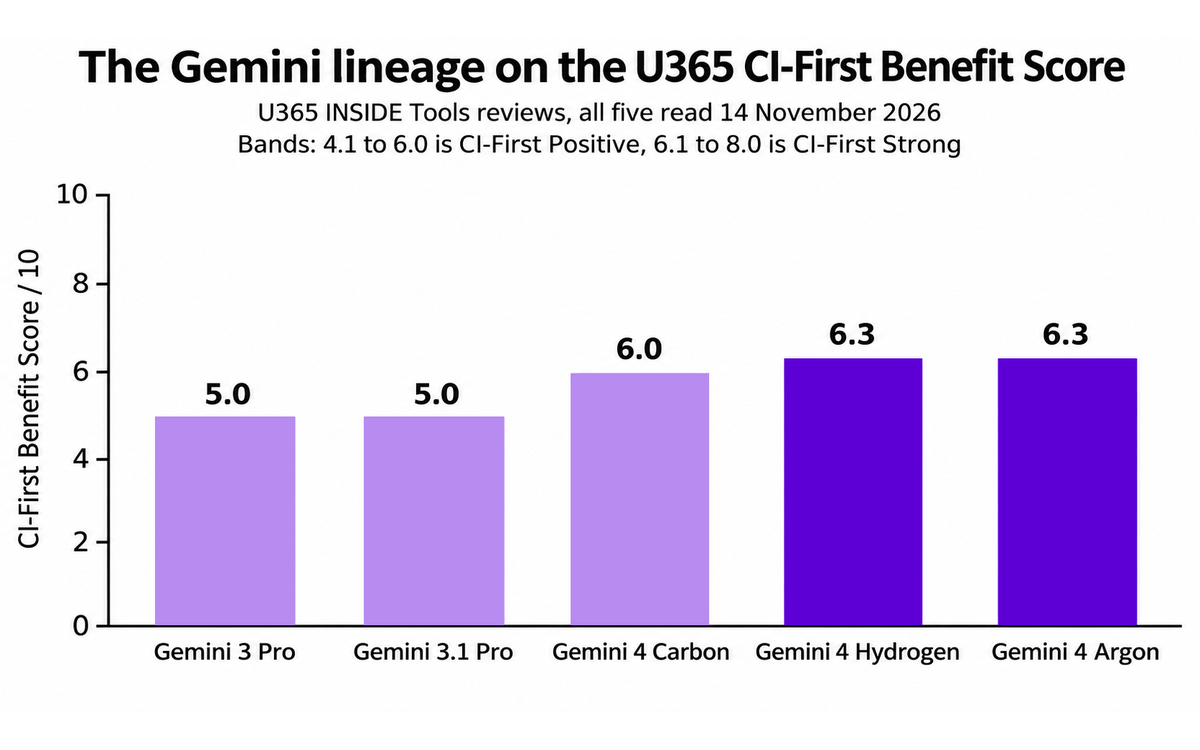
Choose Gemini 3.1 Pro if the migration has to be a like-for-like swap, the budget is fixed at the $2 and $12 rate up to 200,000 tokens, and you can live with a preview identifier for the second time. Choose Gemini 4 Carbon if the work is the hard analysis the original model was bought for and the budget can absorb $4 and $20 after December. Choose Hydrogen if the work is volume, if a free route matters for public material, or if the workflow never needed the top of the range. Do not choose Gemini 3 Pro, and do not leave gemini-3-pro-preview in a configuration because the successor shares a family name.

Gemini 3 Pro: Google's Benchmark-Leading Preview, Shut Down After Sixteen Weeks
Verdict and Next Steps
Verdict: Gemini 3 Pro was the strongest reasoning and multimodal model Google had shipped, and it is the clearest case in this series that a capability score is not a supply commitment.
At 5.0 / 10, CI-First Positive, with sub-scores 5 / 6 / 6 / 3, it describes sixteen weeks in which the model was worth using and a present in which it cannot be used at all. The band is Positive and the Status is Deprecated, and both sentences are true: the score measures what the model did for a reader while it existed, and the status measures what a reader can do with it now. A reader who takes the 5.0 as a recommendation has read half the document.
Adopt it if: you are building a lineage, a lecture or a migration plan and you need the identifier, the price, the benchmark window and the shutdown date in one place with their sources. That is the only adoption this review recommends.
Do not adopt it as: a model to call, a line in a configuration, a price to quote in a budget, or a benchmark result to repeat without its date. The identifier resolves to nothing, the price is historical, and the launch claims are eighteen months old at the time of writing.
The three things to do in the first week, for a reader who finds this model in a stack:
Inventory every occurrence of gemini-3-pro-preview, in code, config, prompts, notebooks, course material and documentation. A preview identifier does not fail loudly when it is withdrawn; the call simply stops working, and the place it was written is the place to look.
Choose between the two official replacement routes deliberately. The deprecations table names gemini-3.1-pro-preview and the model page names Gemini 4 Carbon. Read both, decide on cost and capability, and write the reason down.
Re-run your tests on the replacement and read the diffs yourself. A model swap changes the output, and the verification checklist in Workflow 3 is the one to use.
UP-Context prompt packs: the three packs are in Real Workflows, one per workflow, each in the UP-Context-Engineering order and each carrying its own verification close.
What would change this verdict. A published independent measurement of Gemini 3 Pro that contradicts the vendor table would move Quality, in either direction. A confirmed route that still serves the identifier would move the Status and make the Migration Path advisory rather than necessary. And a successor that publishes a stable identifier with a dated deprecation policy would change the lifecycle finding that carries most of this review's weight.

Gemini 3 Pro: Google's Benchmark-Leading Preview, Shut Down After Sixteen Weeks
Status and Last Tested
Status: Deprecated | Last tested: 2026-11-14 | Version tested: Gemini 3 Pro (gemini-3-pro-preview, released 2025-11-18, shut down 2026-03-09)
Deprecated: the tool has been shut down or fundamentally changed. See the Migration Path section.
Gemini 3 Pro was released on 2025-11-18 as a preview, and the Gemini API shut it down on 2026-03-09. This review was written on 2026-11-14, eight months after the shutdown, against the deprecations table, the model page for the identifier, the archived pricing page whose last update was 2025-12-18, the model card (November 2025, last updated May 2026), the published evaluation methodology, the launch post, the Artificial Analysis model page, two launch-week Hacker News threads and one deprecation thread. The scores are set on that evidence and on the framework's application rules. The re-check is trigger-based with a six-month outer limit, and the first trigger is any change to the migration route, because the two official pages currently disagree.

Gemini 3 Pro: Google's Benchmark-Leading Preview, Shut Down After Sixteen Weeks
Migration Path
Required, because the model is Deprecated. Recommended replacement: Gemini 3.1 Pro (gemini-3.1-pro-preview) for continuity, or Gemini 4 Carbon (gemini-4-carbon) where the work needs the strongest current model. The third option, Gemini 4 Hydrogen, is the right default for a workflow that used the original model as a volume multimodal reader.
What transfers. Prompts written in the UP-Context-Engineering order transfer without a rewrite, because the order is a method rather than a model feature. The five input modalities transfer: every live replacement accepts text, image, video, audio and PDF. The citation rule, the not-stated rule and the verification checklists transfer, and they are the part of the workflow that mattered. Context caching and the Batch API transfer in some form to all three replacements, with different rates and availability.
What does not transfer. The identifier does not transfer: gemini-3-pro-preview is not an alias and there is no automatic routing to a successor. The output ceiling does not transfer as a constant: Carbon and Hydrogen both offer long decode up to a million tokens, so a workflow that split a long deliverable because of the 65,536-token limit can be simplified. The price does not transfer: the $2 and $12 up to 200,000 tokens was a Gemini 3 Pro rate, and each replacement has its own tiers, with Carbon and Argon doubling on 2026-12-01 and Hydrogen flat at $1.50 and $7.50 with a free tier. The safety position does not transfer: each model has its own model card and its own threshold determinations.
Migration steps, in order:
Read both official pages. The deprecations table names gemini-3.1-pro-preview and the model page names Gemini 4 Carbon. Write down which one you are following and why.
Pick by workload, not by family name. A volume multimodal reader goes to Hydrogen. A hard analysis or a long build goes to Carbon. A like-for-like swap with the smallest change in behaviour goes to Gemini 3.1 Pro, with the preview caveat accepted.
Change the identifier in one place per environment and re-run the test set. Record the output diff, not just pass or fail.
Re-price the workflow at the replacement's rates and at the rate that applies after 2026-12-01 where relevant.
Delete the old identifier from documentation and course material, and note the shutdown date where the old model is described, so that a reader in a year does not repeat the search this review had to do.
Re-check the replacement's own lifecycle. Gemini 3.1 Pro is a preview with no announced shutdown date, which is better than a shutdown date and is not the same as a commitment.

Gemini 3 Pro: Google's Benchmark-Leading Preview, Shut Down After Sixteen Weeks
U365's Recommendations to Learn More
Start with the deprecations table, then the model page
Read the deprecations table first, because it is the only page that states the release date, the shutdown date and a recommended replacement in one row. Then read the model page for gemini-3-pro-preview, which carries the capability grid, the token limits and a callout that names a different replacement. The two pages together are the whole lesson of this review, and reading only one of them is how a migration plan ends up on the wrong model.
Then read the model card, including the parts that are not flattering
The model card is where the limits live: the January 2025 knowledge cutoff, the architecture described as a sparse mixture of experts with no parameter count, the known limitations around hallucination, slowness and timeout issues, and the Frontier Safety table that records an alert threshold on cyber and no critical capability level. The card was updated in May 2026, after the shutdown, which makes it the most current official description of a model that no longer answers.
Then read the evaluation methodology
The published evaluation document states what the vendor ran, on which identifier, at which settings, and which competitor numbers were taken from provider reports. It is the document that lets a reader see that the launch table mixed benchmark versions and settings, and it is the reason this review cites the vendor rows with their conditions attached.
Video tutorials and channels
Google published one launch film with the model on 18 November 2025, and it is vendor material rather than an independent test. It is embedded because it is the only moving record of what the launch claimed on the day, and because a reader checking a dated claim should see the claim as it was made.
Read it as a primary source with a date on it, not as evidence that the model performed. The independent numbers in this review come from LMArena and Artificial Analysis, not from the film.
Third-party walkthroughs of the preview exist on the same channel's recommendation surface and in the Hacker News threads cited under Sources. None of them is a controlled test, and this review cites none of them as one.
Google, "A new era of intelligence with Gemini 3", published 18 November 2025: https://www.youtube.com/watch?v=98DcoXwGX6I
Google DeepMind, the research channel that carried the model's framing: https://www.youtube.com/@GoogleDeepMind
Resources on X
The Google AI account and the Google DeepMind account carried the launch material and the research framing, and the launch-week replies on those posts are the fastest read on what practitioners found in the first days. The model card thread on Hacker News is the better archive, because it is threaded and searchable.
Dedicated X channels:
Google, the company account that carried the launch thread: https://x.com/Google
Google DeepMind, the research account whose posts carried the model card and the evaluation framing: https://x.com/GoogleDeepMind
Google AI Developers, the account that announced the preview identifier and, later, the deprecation: https://x.com/googleaidevs
U365 courses and programmes that build the surrounding skill
UIT (Technology, AI, Data Science): the engineering track where multimodal analysis, evaluation design and model lifecycle management belong.
UIB (Business Management, Entrepreneurship): the commercial track where a rate card, a tier boundary and a vendor dependency are analysed.
UIC (Digital Communication, Marketing): the track where a launch claim is dated before it is repeated.
The one habit to carry
Write the date next to the number. Every claim in this review that once read as a strength now reads as history, and the only reason the document is useful is that each number carries the date and the surface it came from. A reader who carries one habit out of the Gemini 3 Pro story should carry that one, because it is the habit that turns a benchmark table into a decision and a shutdown into a lesson.

Gemini 3 Pro: Google's Benchmark-Leading Preview, Shut Down After Sixteen Weeks
CI-First Evaluation Summary Card
Field | Value |
Tool | Gemini 3 Pro (gemini-3-pro-preview), Google LLC |
Category | Applied AI / Large Language Model (multimodal reasoning, agentic coding and long-context analysis) |
CI-First Benefit Score | 5.0 / 10, CI-First Positive, scored on the model's window of availability and not an adoption recommendation |
Sub-scores | Time 5 / Quantity 6 / Quality 6 / Skill 3 |
CI-First Profile | Primary: Co-Researcher, Analyst and Tester (level 4). Secondary: Co-Worker and Assistant (level 2), Professor, Coach and Tutor (level 3) |
Humics Protection | Humics-Neutral (-1 / +3). Creativity 0, Critical Thinking -1, Social Authenticity 0 |
AI Imposture Risk | Medium overall. Time Medium, Quantity Medium, Skill Illusion High |
Framework v1.2 clauses | 5.2.3-a null with boundary, 4.2-a null with live condition, 7.5 null (removed) |
Status | Deprecated (shut down 2026-03-09) |
Last tested | 2026-11-14 |
Version tested | Gemini 3 Pro, gemini-3-pro-preview, released 2025-11-18, shut down 2026-03-09 |
Pricing | $2.00 input and $12.00 output per million tokens up to 200,000 tokens; $4.00 and $18.00 above; no free tier |
Primary institute | UIT (Technology, AI, Data Science) |
Review status | Deprecated: the tool has been shut down or fundamentally changed. See the Migration Path section |

Gemini 3 Pro: Google's Benchmark-Leading Preview, Shut Down After Sixteen Weeks
Glossary
CI-First Benefit Score
The arithmetic mean of the four benefit dimensions, each scored 0 to 10, rounded to one decimal place. 0 to 2.0 is CI-First Negative, 2.1 to 4.0 is CI-First Neutral, 4.1 to 6.0 is CI-First Positive, 6.1 to 8.0 is CI-First Strong, and 8.1 to 10 is CI-First Transformative. Gemini 3 Pro scores 5.0, which is Positive.
Time Benefit
Whether the tool returns more time than it costs, after the overhead of using it is subtracted. Gemini 3 Pro is 5: one prompt could carry a document set, a video and a dataset, and the 64K ceiling was enough for an analysis, against a missing independent latency measurement and a model card that records occasional slowness and timeout issues.
Quantity Benefit
Whether the tool increases the volume of usable work a person can produce in a given time. Gemini 3 Pro is 6: 1,048,576 input tokens, five modalities and a Batch API at half the rate, against a 65,536-token output ceiling with no continuation path and a rate that doubled above 200,000 tokens.
Quality Benefit
Whether the tool helps the user produce better work than they could alone, judged after verification rather than on surface polish. Gemini 3 Pro is 6: LMArena first at 1501 Elo, 37.5 percent on Humanity's Last Exam, 91.9 percent on GPQA Diamond, 81 percent on MMMU-Pro and 87.6 percent on Video-MMMU, against a vendor-only evidence basis, a documented hallucination limitation and a maintained independent composite that reports nothing for the model.
Knowledge and Skill Benefit
Whether the tool helps the user learn what they did not know and do what they did not know how to do. Gemini 3 Pro is 3, scored conservatively: it analysed and delegated rather than taught, it had no teaching mode, there were no open weights, and the clause note records nulls with boundaries rather than a mechanism that transfers capability.
Humics Protection Badge
The sum of three ratings, each +1, 0 or -1, across Creativity, Critical Thinking and Social Authenticity. +2 to +3 is Humics-Friendly, -1 to +1 is Humics-Neutral and -2 to -3 is Humics-Risky. Gemini 3 Pro scores -1, which is Humics-Neutral: it neither strengthens nor systematically destroys the three capabilities, and it required the reader to keep the critical habit that fluency discourages.
AI Imposture Risk
The likelihood that the tool traps its user in one of three illusions: the Time Illusion, where the overhead exceeds the saving; the Quantity Illusion, where volume passes for quality; and the Skill Illusion, where the user believes they can do what the tool did. Each trap is rated Low, Medium or High. Gemini 3 Pro is Medium overall, with Skill Illusion High, Quantity Illusion Medium and Time Illusion Medium.
User Sentiment
The aggregate of what users and independent platform measurements report about a tool, kept separate from the framework's own scores. Gemini 3 Pro's record reads Positive on multimodal reasoning, long context and launch-day benchmark leadership, and critical of the messy release, the preview status, the contested context claim and the short notice before shutdown.
CI-First Profile
The role the AI plays in the working relationship: Co-Creator and Thought Partner (1), Co-Worker and Assistant (2), Professor, Coach and Tutor (3), Co-Researcher, Analyst and Tester (4), or Challenger, Critic and Devil's Advocate (5). Gemini 3 Pro is primarily Co-Researcher, Analyst and Tester, with Co-Worker and Assistant and Professor, Coach and Tutor as secondary roles.
Review Status
The badge on this review states how much confidence to place in it. The vocabulary: Active means the tool is current and recommended. Active (updated) means it is current and recommended and was recently re-checked and refreshed. Changed means a re-check trigger fired and an update is pending, so read it with that in mind. Risky means the tool has significant unresolved issues or has been clearly surpassed by newer alternatives, so use it with caution and read the Limits section. Stale means the review has not been re-checked in over six months, so treat pricing and features as unverified. Retired means the tool still works but is no longer recommended, and Deprecated means it has been shut down or fundamentally changed. This review is Deprecated.
Last tested and Re-check
The date on which the review's evidence was last read against the vendor's own surfaces, and the condition under which it will be read again. This review was last tested on 2026-11-14 and is re-checked on a trigger list with a six-month outer limit, because a shut-down model's record still changes when a replacement route changes.

Gemini 3 Pro: Google's Benchmark-Leading Preview, Shut Down After Sixteen Weeks
Sources
Vendor primary sources:
Google, Gemini API deprecations: https://aistudio.google.com/docs/deprecations
Google, model page for gemini-3-pro-preview: https://aistudio.google.com/docs/models/gemini-3-pro-preview
Google, all models: https://aistudio.google.com/docs/models
Google, Gemini 3 launch post, 2025-11-18 (served at this address after a redirect from blog.google/products/gemini/gemini-3/): https://blog.google/products-and-platforms/products/gemini/gemini-3/
Google, Gemini API pricing, archived copy of the page whose last update was 2025-12-18: https://web.archive.org/web/20260109190909/https://ai.google.dev/gemini-api/docs/pricing
Google DeepMind, Gemini 3 Pro model card, November 2025, last updated May 2026: https://storage.googleapis.com/deepmind-media/Model-Cards/Gemini-3-Pro-Model-Card.pdf
Google DeepMind, Gemini 3 Pro evaluation approach, methodology and results, November 2025: https://storage.googleapis.com/deepmind-media/gemini/gemini_3_pro_model_evaluation.pdf
Google, model page for the successor gemini-3.1-pro-preview: https://aistudio.google.com/docs/models/gemini-3.1-pro-preview
Independent measurement and reporting:
Artificial Analysis, Gemini 3 Pro Preview model page: https://artificialanalysis.ai/models/gemini-3-pro-preview
Artificial Analysis, Gemini 4 Carbon model page, used for the current-generation comparison: https://artificialanalysis.ai/models/gemini-4-carbon
LMArena, text leaderboard: https://lmarena.ai
Community record:
Hacker News, "Gemini 3", 2025-11-18, 1,735 points and 1,056 comments: https://news.ycombinator.com/item?id=45967211
Hacker News, "Gemini 3 Pro Model Card [pdf]", 2025-11-18, 280 points and 335 comments: https://news.ycombinator.com/item?id=45963670
Hacker News, "Google violates its 14-day deprecation policy for Gemini 3 Pro Preview", 2026-03-03: https://news.ycombinator.com/item?id=47235969
Hacker News, "Testing Gemini 3 Pro's Actual Context Window in Web App: ~32K tokens, not 1M", 2026-01-08: https://news.ycombinator.com/item?id=46542755
U365 reference reviews used for the current-generation comparison:
Gemini 4 Carbon: https://www.university-365.com/post/gemini-4-carbon-google-s-strongest-model-is-not-its-best-buy
Gemini 4 Hydrogen: https://www.university-365.com/post/gemini-4-hydrogen-the-fast-gemini-4-model-that-replaces-the-flash-tier
Gemini 4 Argon: https://www.university-365.com/post/gemini-4-argon-google-s-return-to-the-frontier-on-a-price-that-doubles
Gemini 3.1 Pro: https://www.university-365.com/post/gemini-3-1-pro-google-deepmind-s-flagship-pro-tier-model-for-advanced-intelligence-and-agentic-work

Gemini 3 Pro: Google's Benchmark-Leading Preview, Shut Down After Sixteen Weeks
Faculty Note on Evidence Quality
What this review rests on, stated plainly. Google's own surfaces: the deprecations table, the model page, the all-models list, the launch post, the archived pricing page and two DeepMind PDFs (the model card and the evaluation methodology). One independent evaluator, Artificial Analysis, which reports pricing and context for the model and explicitly reports no intelligence index, no time per task and no cost per task. One preference leaderboard, LMArena, which placed the model first at release. And three Hacker News threads, used for the community record and for two specific claims that are attributed to their posters.
Where the evidence is strong. Dates, identifiers, prices, token limits, modalities, capabilities and the safety table come from primary vendor documents and are unambiguous. The shutdown date appears in two places that agree. The 2025-11-18 release date appears in the deprecations table and in the launch-day threads. The pricing is read from a Wayback Machine capture dated 2026-01-09 whose own last-update line reads 2025-12-18, and the tier structure at 200,000 tokens is stated there in full.
Where the evidence is weak, and why the score is set where it is. Almost every capability number in this review is the vendor's. The independent composite that this series relies on for cross-vendor comparison reports nothing for this model: no intelligence index, no time per task and no cost per task, because there is no public API to run. LMArena is a preference vote on release, not a capability test. The coding results were read on the model-card thread as similar to other state-of-the-art models rather than ahead, which is a reader's judgement and not a measurement. That is why Quality is 6 and not 8, and it is why the review states its evidence basis rather than presenting the launch table as settled.
Two claims are treated as claims rather than findings. The first is the January 2026 report that the web app exposed about 32,000 tokens of the advertised million: one user, one surface, no reproduction, reported here as a dispute and used only to rate Quantity Illusion Medium rather than High. The second is the March 2026 argument that the deprecation notice broke Google's two-week preview policy: the arithmetic is correct on the dates the poster gives, and the announcement date is the poster's reading of the changelog rather than a Google page cited here, so it is reported with its attribution and not as a finding against the company.
What would change the assessment. A surviving independent measurement of Gemini 3 Pro would move Quality, in either direction. A confirmed route that still serves the identifier would move the Status and soften the Migration Path. A vendor statement resolving the two replacement routes into one would remove the Section 7c finding that currently carries the most weight for a reader with a migration to run. And any change to the successor's lifecycle would change the advice in the Migration Path, which is why that is the first re-check trigger.
One boundary this note repeats because the review depends on it. Gemini 3 Pro cannot be called, so no part of this document rests on a fresh run of the model. The scoring is a reading of published evidence about a model in its window, and every number in it carries the date and the surface it came from.

Gemini 3 Pro: Google's Benchmark-Leading Preview, Shut Down After Sixteen Weeks
Status and Re-check
Status: Deprecated | Last tested: 2026-11-14 (Gemini 3 Pro, gemini-3-pro-preview, released 2025-11-18; shut down 2026-03-09) | Re-check: trigger-based, with a six-month outer limit for this record
Deprecated: the tool has been shut down or fundamentally changed. See the Migration Path section.
Re-check triggers: (1) any change to the replacement route named by the deprecations table or the model page; (2) any change to Gemini 3.1 Pro's preview status or shutdown date; (3) any change to Gemini 4 pricing, tiers or availability that affects the Migration Path; (4) a published independent measurement of Gemini 3 Pro that contradicts the vendor table; (5) the six-month outer limit, which falls on 2027-05-14.




Comments