
GPT-5 Pro: OpenAI's Retired Reasoning Tier Costs $15 and $120


Status: Retired | Last tested: 2026-11-14 (GPT-5 Pro, model id `gpt-5-pro`, snapshot `gpt-5-pro-2025-10-06`, deprecated by OpenAI with a shutdown date of 2026-12-11) | Re-check: none scheduled, the model is retired from recommendation
Retired: the tool still works but is no longer recommended. See the Migration Path section.
For detailed explanations of the CI-First evaluation terms used in this review, including the Humics Protection Badge and the AI Imposture Risk levels, see the Glossary at the end of this post.


In this Tool Review

GPT-5 Pro: OpenAI's Retired Reasoning Tier Costs $15 and $120
The name, the Pro tier and the model this review is the last of
Three things get confused in the GPT-5 line, and this review has to separate them before it scores anything: the difference between GPT-5 and GPT-5 Pro, the difference between a Pro tier and a bigger model, and the difference between a model that is old and a model that is ending.
Name | What it is | Where it appears |
GPT-5 Pro | The model this review scores. API id gpt-5-pro, snapshot gpt-5-pro-2025-10-06, sold in ChatGPT to Pro subscribers from 2025-08-07 and in the API from 2025-10-06 | The OpenAI model page, the deprecation table, the pricing page, OpenRouter as openai/gpt-5-pro |
GPT-5 | The base model the Pro tier extends. API id gpt-5, released 2025-08-07 at $1.25 and $10, and it shuts down on the same day as the Pro model | The launch post, the model catalog, the deprecation table |
GPT-5.5 Pro | The nearest equivalent to this model in the current line. API id gpt-5.5-pro, released 2026-04-23, at $30 and $180 for short-context requests and $60 and $270 above 272,000 input tokens | The GPT-5.5 launch post, the pricing page, the Artificial Analysis model page |
GPT-6.1 Sol | The vendor's own named replacement, in pro reasoning mode rather than as a separate model id. $2 and $10 at standard rates, 1,050,000 tokens of context | The deprecation table, the model page, the reasoning guide |
The Pro tier is a compute decision, not a size class. OpenAI's model page says GPT-5 Pro "uses more compute to think harder and provide consistently better answers", and the system card mapping that the launch day reporting reproduced places it where o3 Pro used to sit: the thinking model of the family, labelled Pro in ChatGPT, and described as using parallel test time compute. That is a statement about how much work the model is allowed to do before it answers, not about a parameter count. The vendor publishes no parameter count for either model, so no reader can check the claim that way.
The ID is confirmed, and there is no deprecated alias to carry. gpt-5-pro is the id on the model page, and gpt-5-pro-2025-10-06 is the snapshot the page lists as the default and marks Deprecated. The hypothesis in the request that produced this review was correct. The naming trap in this family is elsewhere: GPT-5.6 and the GPT-6 line reuse the word Pro for a reasoning mode (reasoning.mode: pro) that a standard model id can be run in, so a reader who searches for "GPT-5 Pro" in 2026 finds two different things, a retired model and a parameter.
This is the last review in the GPT-5 line, and the model is already past its successor's successor. GPT-5.5 arrived on 2026-04-23 with GPT-5.5 Pro beside it. GPT-5.6 followed in the summer of 2026, the GPT-6 line arrived in September, and GPT-6.1 in October. This review is therefore not a comparison between a current model and its predecessor. It is a record of what the top of the OpenAI line was in late 2025, an audit of what the Pro premium bought, and a migration note for anyone whose pipeline still calls the id.
What this review is. It is the URC scoring of GPT-5 Pro under the CI-First Evaluation Framework, version 1.4.1, on evidence read on 2026-11-14: the vendor's model page, deprecation table, pricing page and reasoning guide; the two launch posts of 2025-08-07; the Hacker News launch thread and the two threads that carried the mathematics claim and the practitioner verdict; the OpenRouter model listing; the Artificial Analysis catalogue, which no longer carries this model; and the published U365 scores of the models it is compared against.
What this review is not. It is not a review of GPT-5, of GPT-5.5, of GPT-5.5 Pro or of GPT-6.1 Sol, each of which has its own document or is named only as a migration target. It is not a review of ChatGPT as a product, of the Pro subscription, or of the consumer plan structure, all of which have changed since this model launched and none of which this review scores. It is not a re-score of an earlier URC review, because no earlier URC review of this model exists: it is one of the lineage versions in the November 2026 Model Recruitment lecture that had no Tools Review until now.
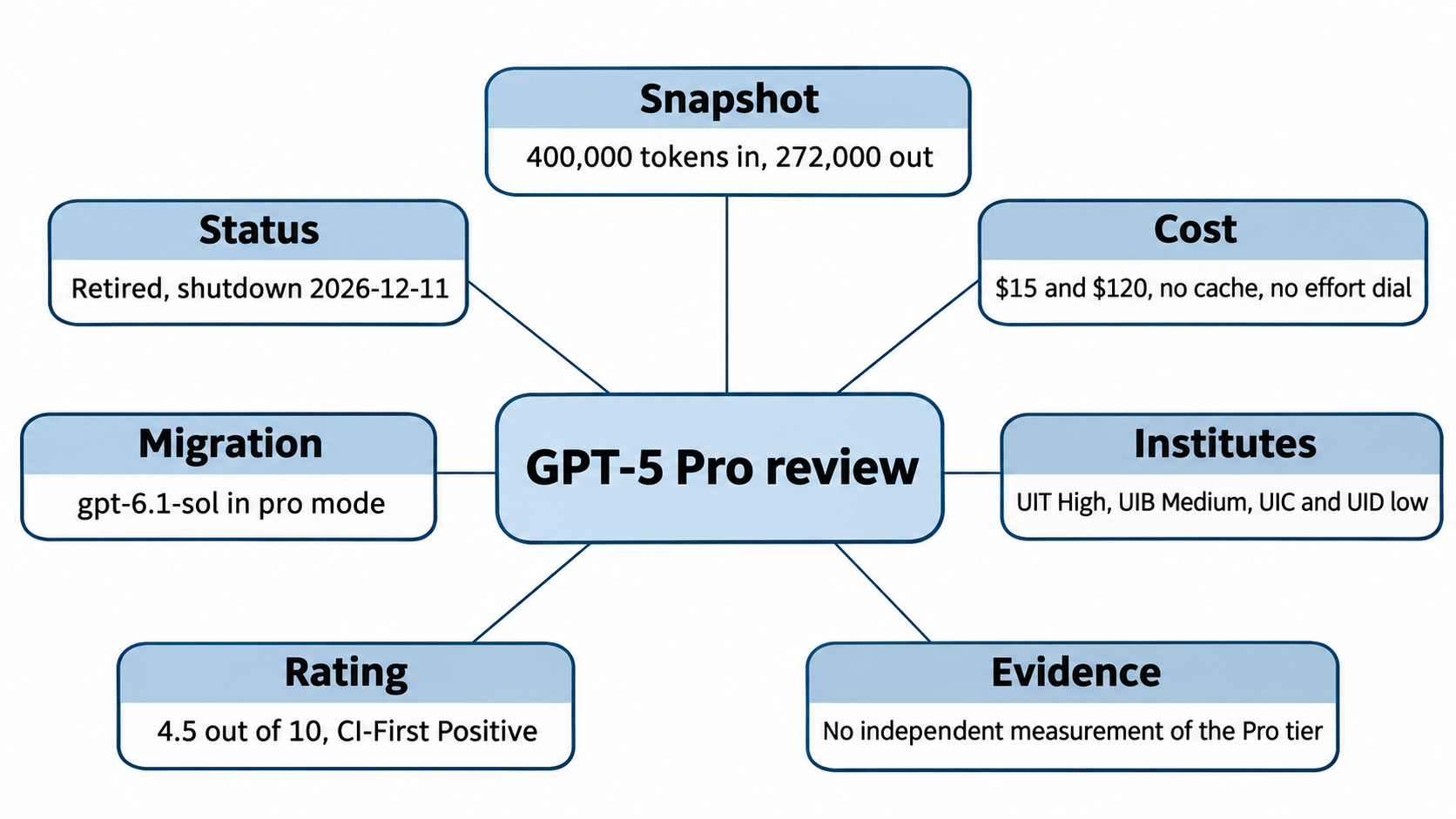
The score is 4.5, the band is CI-First Positive, and the recommendation is not to use it. Those three statements are consistent and a reader needs all three. The CI-First Benefit Score measures what the tool delivers against doing the work with human intelligence alone, and on the class of hard problem this model was built for it still delivers a real gain over an unaided person. The band says the gain is real and moderate. The recommendation is about alternatives, and on 2026-11-14 there is no workload for which this model is the best available choice, because a cheaper, current, better-documented model with a 2026 knowledge cutoff exists on the same API and the model itself has 27 days left.

GPT-5 Pro: OpenAI's Retired Reasoning Tier Costs $15 and $120
Tool Snapshot
GPT-5 Pro, the reasoning tier OpenAI sold as "more compute to think harder": a 400,000-token model that spends minutes on a request, charges twelve times the base rate for every token it reads, offers no cache and no effort dial, and shuts down on 2026-12-11.
Category: Applied AI / Large Language Model. Hard analytical reasoning, mathematics, scientific and technical problem solving, and long-form analysis where the answer matters more than the wait. It sits above GPT-5 in compute and price, and below every model OpenAI has released since April 2026 in measured capability.
Primary use cases, as the model was sold:
Hard problems with a checkable answer. Mathematics, proofs, quantitative analysis and technical derivations where a wrong answer can be caught by a checker, a second derivation or a domain expert. The vendor's own framing is "tough problems", and the model page tells a builder to expect several minutes per request.
Long documents that need one careful pass. 400,000 tokens of context and up to 272,000 tokens of output, with text and image input, at a price that assumes a small number of requests rather than a volume.
Work that a person would otherwise hand to a specialist. The Pro tier was priced for the call you make once a day, not for the loop you run all day, and the arithmetic in the U365 Co-Intelligence Rating shows why.
Vision input on a document set. Scanned pages, charts and figures can be read as input, with text out.
What it is not. It is not a fast model: the vendor labels its speed Slowest, and the model page says requests "may take several minutes to finish". It is not a tunable model: reasoning.effort is fixed at high and no other value is accepted. It is not a cached model: the pricing table carries no cached-input rate for this id, so every input token is billed at $15 on every call. It is not a current model: its knowledge cutoff is 2024-09-30, which is 25.5 months before this review, and OpenAI has announced its shutdown. And it is not a model with a published independent score: the evaluator URC normally cites has no page for it.
Pricing, as published on 2026-11-14:
Line | Rate per million tokens | Note |
Input | $15.00 | Twelve times the GPT-5 input rate of $1.25 |
Output | $120.00 | Twelve times the GPT-5 output rate of $10.00 |
Cached input | none published | The pricing table carries a dash, so no cache discount applies |
Cache writes | none published | No cache, therefore no write rate |
Batch input and output | $7.50 and $60.00 | 50 percent discount, asynchronous only |
Long context | no separate line | The page publishes no long-context surcharge for this id |
The rate card is the finding here, not a footnote to it. Every other model in the GPT-5 line carries a cached-input rate: GPT-5 at $0.125, GPT-5.5 at $0.50, GPT-6.1 Sol at $0.10. GPT-5 Pro has none. A repeated-context workload, which is the normal shape of an analytical session, pays full price for the same document on every turn. That single missing line is worth more than most of the benchmark discussion around this model.
Official links:
Model page: https://platform.openai.com/docs/models/gpt-5-pro
Deprecation table: https://platform.openai.com/docs/deprecations
Reasoning guide, including reasoning.mode: pro: https://platform.openai.com/docs/guides/reasoning
Launch post, GPT-5 in ChatGPT: https://openai.com/index/introducing-gpt-5/
Launch post, GPT-5 for developers: https://openai.com/index/introducing-gpt-5-for-developers/
Background mode: https://platform.openai.com/docs/guides/background
OpenRouter listing: https://openrouter.ai/openai/gpt-5-pro
Status page: https://status.openai.com
LLM-specific fields:
API model identifier: gpt-5-pro. Default snapshot: gpt-5-pro-2025-10-06, marked Deprecated on the model page.
Context window: 400,000 tokens. Maximum output: 272,000 tokens.
Modalities: text and image input, text output. Audio and video not supported.
Reasoning control: reasoning.effort "defaults to (and only supports) high", in the vendor's wording. There is no lower setting and no higher setting.
Endpoint: the Responses API only. The model page states that this is to support multi-turn model interaction before the response, and the developer guide recommends background mode to avoid timeouts.
Tools and features: function calling and structured outputs supported. Code interpreter not supported. Fine-tuning and predicted outputs not supported.
Knowledge cutoff: 2024-09-30.
Rate limits: not supported on the Free tier; 5,000 requests and 450,000 tokens per minute on the Build tier, higher on paid tiers, and a batch queue limit of 1,350,000 tokens.
Lifecycle: Deprecated at the vendor, Retired in this review, shutdown 2026-12-11, notice 2026-06-11.
License: proprietary hosted service. No weights, no parameter count, no architecture disclosure.
At a Glance Dashboard
Field | Value |
Category | Applied AI / Large Language Model (frontier reasoning tier, retired) |
CI-First Benefit Score | 4.5 / 10 (CI-First Positive) |
Sub-scores | Time 5 / Quantity 4 / Quality 6 / Skill 3 |
CI-First Profile | Primary: Co-Researcher, Analyst and Tester (level 4). Secondary: Co-Creator and Thought Partner (level 1) on derivations, Co-Worker and Assistant (level 2) on long-form analysis |
Humics Protection | Humics-Neutral (-1 / +3) |
AI Imposture Risk | Medium overall, with Skill Illusion High |
Status | Retired |
Last tested | 2026-11-14 |
Released | 2025-08-07 in ChatGPT, 2025-10-06 in the API |
Shutdown | 2026-12-11 |
Access | OpenAI Responses API, gpt-5-pro; OpenRouter as openai/gpt-5-pro |
Price | $15.00 per million input tokens, $120.00 per million output, no cached-input rate, batch at $7.50 and $60.00 |
Context window | 400,000 tokens in, 272,000 tokens out |
Effort levels | high only |
Framework comparison with siblings and peers | GPT-6.1 Sol 6.3 (CI-First Strong); GPT-6.1 Terra 6.0 (CI-First Positive); GPT-6 Astra 7.0 (CI-First Strong); Claude Opus 5.5 6.5 (CI-First Strong); Gemini 4 Argon 6.3 (CI-First Strong) |
Benchmarks, one line each | Vendor: none published for the Pro tier at launch, and none on the model page. Independent: no Artificial Analysis page for this model as of 2026-11-14; the successor GPT-5.5 Pro is listed with the intelligence index and cost per task recorded as not available |

GPT-5 Pro: OpenAI's Retired Reasoning Tier Costs $15 and $120
The Problem
The problem is not that GPT-5 Pro is weak. It is that the premium bought a compute setting rather than a capability promise, nobody outside the vendor measured what the setting delivered, and the model now costs twelve times the base rate in the last month of its life.
Five problems sit in front of a reader who finds this model in a pipeline, a lecture or an archive, and only the first is about capability.
The first is that the Pro premium was sold as more compute and never as a measured result. OpenAI's model page states the mechanism plainly: the model "uses more compute to think harder and provide consistently better answers". Launch-day coverage, working from the system card's own mapping, described the tier as using parallel test time compute. Neither statement comes with a multiplier, a token count, a latency figure or a benchmark row. On the day of the launch, a reader on the main Hacker News thread wrote the sentence that still describes the situation: "They also announced gpt-5-pro but I haven't seen benchmarks on that yet." That reader was correct on 2025-08-07, and the model page on 2026-11-14 still carries no Pro-specific benchmark table.
The second is that the independent measurement never arrived either. URC cites Artificial Analysis for effort-graded scores and cost per task, and for this model there is nothing to cite. Five candidate URLs for a GPT-5 Pro model page return 404. The catalogue's model index runs from GPT-5 through GPT-5.6 to the GPT-6 line, with Pro entries for GPT-5.4 and GPT-5.5, and no GPT-5 Pro. The successor's page is present and records the intelligence index, the time per task and the cost per task as not available, with the note "No publicly available API". The Pro tier as a class is therefore unmeasured on the surface a reader would normally use to check it, and this model is the oldest and least measured of the set.
The third is that the effort dial, which is the only cost control a buyer has, is missing. Every other reasoning model in the line lets a builder trade cost against depth: GPT-6.1 Sol accepts low, medium, high, xhigh and max, with medium as the default, and even the current Pro tier, GPT-5.5 Pro, accepts medium, high (its default) and xhigh. GPT-5 Pro accepts high and nothing else. A workload cannot be run at a cheaper setting for an easy turn and a deeper setting for a hard one, and it cannot be benchmarked at a matched setting against anything. The vendor's later design separates the two ideas cleanly, with reasoning.mode selecting standard or pro execution and reasoning.effort controlling depth within the mode. GPT-5 Pro predates that separation and hard-codes one point in the space.
The fourth is that the model's world is 25.5 months old. The knowledge cutoff is 2024-09-30. A reasoning model with a stale world model is a specific hazard, because the quality of the reasoning is high enough that the reader stops checking the premises. It will reason carefully and correctly from a fact that stopped being true in 2025, and the fluency of the derivation is what makes the stale premise hard to see. The current models on the same API carry later cutoffs: 2025-12-01 on GPT-5.5 Pro, 2026-04-30 on GPT-6.1 Sol and 2026-05-18 on GPT-6 Luna.
The fifth is that the headline claim made for this model is the clearest available illustration of the Skill Illusion. On 2025-08-20 an OpenAI researcher posted that GPT-5 Pro had proved a new and interesting result in mathematics. The thread that followed did the work a reader should do: one commenter noted that a human had already produced and published a better solution to the same problem, another noted that the paper in question was an arXiv preprint whose first author appeared to be an undergraduate, and a third asked whether any mathematician had called the result new or whether the description came from an OpenAI employee. The claim may still be defensible on its own terms. What the episode shows is the shape of the risk: a vendor-affiliated claim, a fluent artefact, and a reader with no way to price either.
One problem is not a problem. The price is not a scandal. $15 and $120 is what a compute-heavy tier cost in 2025, and the vendor published it. The problem is the combination: a premium rate, no cache, no effort control and no independent measurement, held against a base model that does the same work for a twelfth of the rate on the turns where depth is not needed.

GPT-5 Pro: OpenAI's Retired Reasoning Tier Costs $15 and $120
The Outcome
What changes for a reader who moves off this model, and what does not.
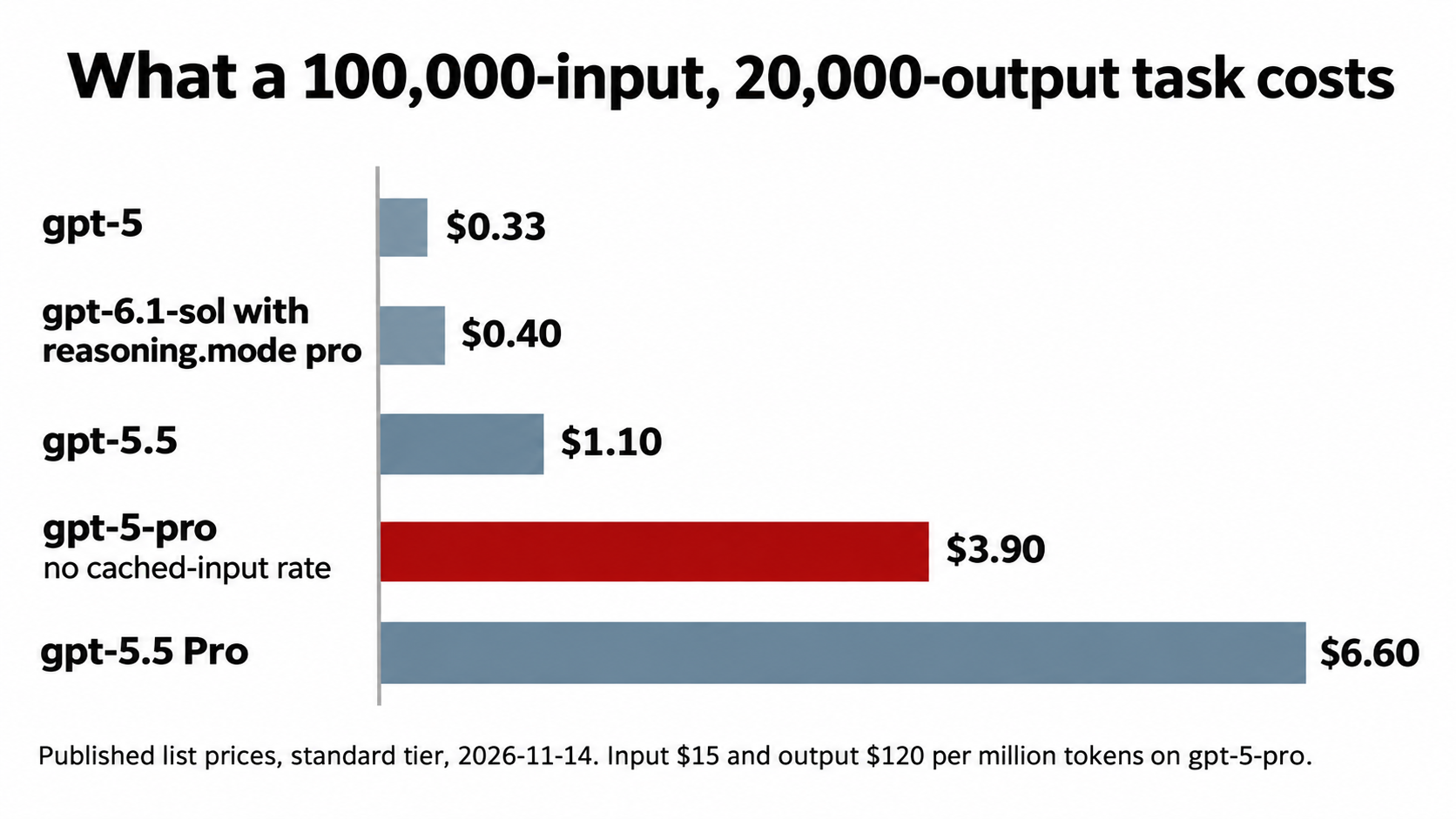
The token line falls by roughly nine tenths on the same work. An analytical call of 100,000 input tokens and 20,000 output tokens costs $3.90 on gpt-5-pro and $0.40 on gpt-6.1-sol at standard rates. The vendor names that model, in pro reasoning mode, as the replacement. The arithmetic is in the U365 Co-Intelligence Rating and the migration steps are in the Migration Path.
You gain a control you never had. GPT-5 Pro accepts one effort setting. The replacement separates the two decisions: reasoning.mode selects standard or pro execution, and reasoning.effort selects depth within the mode, with low, medium, high, xhigh and max available and medium as the default. A team can now run the cheap setting on the easy turns and the expensive one on the hard turns, which is the single largest saving available and it was impossible on this model.
Caching becomes available. GPT-5 Pro carries no cached-input rate. GPT-6.1 Sol bills cached input at $0.10 against $2.00 uncached, so a repeated document costs a twentieth of its first read rather than full price on every turn.
The world model moves forward by 19 months. The cutoff goes from 2024-09-30 to 2026-04-30. For an analytical workflow, that is the difference between a model that knows the regulatory framework you are asking about and one that reasons confidently about a version of it that has been replaced.
One ceiling falls, and a reader has to plan for it. GPT-5 Pro returns up to 272,000 output tokens. GPT-6.1 Sol returns up to 128,000, inside a 1,050,000-token context with a 922,000-token maximum input. A workflow that relies on a single 200,000-token answer cannot move without being split. That is the one migration cost that is real, and it is the reason the Migration Path is written as steps rather than as advice.
The Pro premium does not disappear. GPT-5.5 Pro still exists at $30 and $180 for short-context requests, twice this model's input rate and one and a half times its output rate, and it is still the model to choose when the answer has to be the best the vendor can produce rather than the cheapest that clears the bar. What disappears is the specific position GPT-5 Pro occupied: the top of the line at a rate below today's top of the line, with no cache and no measurement.
What does not change is the shape of your work. You still have to state the problem precisely, supply the material, and check the answer against something outside the conversation. The framework's Skill sub-score of 3 says that plainly: the model does the thinking and teaches you little about it, and the second half of that sentence is the part a reader keeps after the model is switched off.

GPT-5 Pro: OpenAI's Retired Reasoning Tier Costs $15 and $120
Who Should Use GPT-5 Pro
The question the house asks of every tool has an unusual answer here. A model 27 days from shutdown has no adoption audience left, so the table below answers the honest version of the question: who still has a reason to open this model, and what that reason is worth.
Learner type | Difficulty | Typical ROI | Career path |
Students (Bachelor, Master) | Intermediate | Negative as a choice, positive as an object of study. At $15 and $120 with no cache, the same question costs a student nine to ten times what it costs on a current model, and the answer cannot be relied on for anything after 2024. As a study object it is unusually good: a compute premium with no published benchmark, a launch claim that a mathematics thread took apart, and a deprecation notice that names its own replacement parameter. That is a case study in how to read a model release. | UIT (Technology, AI, Data Science) tracks through the reasoning-mode mechanics and the lifecycle reading. UIB (Business Management, Entrepreneurship) for the cost-per-call arithmetic. No published U365 credential assesses model selection or deprecation handling as a named component, and none is asserted. |
Professionals (career upskilling) | Intermediate | The migration case, and it is the strongest case in this review. A professional whose pipeline still calls gpt-5-pro saves about 90 percent of the token line by moving to the vendor's named replacement, gains caching and effort control, and removes a shutdown dependency that lands on 2026-12-11. The work is a day of engineering and a re-run of the evaluation set. | UIT (Technology, AI, Data Science) engineering tracks for the migration itself, and UIB for the vendor-management lesson: a retired model id is a procurement event as much as a technical one. The model supplies no method of its own. |
Everyone (lifelong learners) | Beginner | Not a model to pick up. A reader with no pipeline to migrate has nothing to gain: the current mid-tier model is cheaper on every line, faster, current to April 2026, and available on the same API with a documented effort ladder. The one thing worth reading here is the pricing table, because a rate card without a cached-input line is the clearest single signal that a model was built for a different era of use. | LIPS Collect and Review phases for the reading, and the UP-Context-Engineering Method order for prompting if a reader does experiment. UNOP fit is weak, because the model produces rather than teaches. No assessment home is asserted. |
For teams and organisations. A team still running this model is making a procurement decision on a deadline rather than a capability decision, and four questions decide it.
Team deployment. Access is the Responses API on the first-party platform, or a gateway such as OpenRouter, with gpt-5-pro as the id and background mode for long requests. The model is not on the Free tier's rate limits, does not support fine-tuning or predicted outputs, and does not support the code interpreter, so a team that relies on hosted code execution has to move that work elsewhere before the model moves. Nothing about the deployment is team-specific: there is no seat, no admin console and no workspace control attached to this id.
Cost at team scale. Three lines decide the bill and two of them are closed. The rate is $15 and $120, twelve times the base model on both lines. The cache line does not exist, so a repeated 50,000-token document is billed at full rate on every call. The only discount available is Batch, at $7.50 and $60, which requires a workload that can wait 24 hours. A thousand calls of 100,000 input and 20,000 output tokens cost $3,900 on this model and $400 on the named replacement. A team that has not measured its own token counts cannot see which of those numbers it is paying.
Data and compliance. The vendor's API terms apply, with business data excluded from training by default on the API surface. This review did not verify a zero-data-retention arrangement for a model at end of life, and that is the honest position: a compliance file should cite the deprecation notice and the replacement model's terms, not a retention promise attached to an id that stops answering in December 2026.
U365 for companies. Professional learners reach University 365's academic services individually or through their organisation, and the company route runs through a customized training agreement for employee groups. Corporate education programmes are built on demand, and their tuition follows content and duration.
Skill level required: Intermediate to Advanced. Getting a real result from this model means stating a problem precisely enough that a wrong answer is detectable, supplying the material in a form the model can use, and checking a long derivation against an independent method. The model will answer without any of that, and the answer will read as complete either way.
Prerequisites. For the API: an account with billing, a pinned snapshot, background mode configured for long requests, and a written decision about what the pipeline does on 2026-12-11. For a reader studying the model rather than using it: the pricing page, the deprecation table and the reasoning guide open in three tabs, because the three together describe the tier and none of them describes it alone.
Typical time to first result: Under fifteen minutes on the API for a first call at gpt-5-pro, plus the wait for the answer itself, which the vendor describes as several minutes and which is the reason background mode exists.
Typical time to competence: Two to four hours for the mechanics, most of it spent learning that there is no effort setting to tune and that the cache does not apply. A day to a week for the migration itself, depending on whether the pipeline has an evaluation set to re-run.
Who should wait. Nobody should wait for this model; the useful waiting is on the other side, where a team schedules the migration before the shutdown rather than after it. Anyone who needs the deepest available reasoning should read the GPT-5.5 Pro and GPT-6 reviews in the library. Anyone who needs a current, cheap, well-documented reasoning model should read the GPT-6.1 Sol review, which scores 6.3 and is the model the vendor tells you to use instead.

GPT-5 Pro: OpenAI's Retired Reasoning Tier Costs $15 and $120
U365 Institutes Alignment
The alignment below rates what a U365 institute could take from this model as a working instrument and as an object of study, and it is a historical record before it is anything else. OpenAI marks gpt-5-pro Deprecated with a shutdown date of 2026-12-11, 27 days after this review, so nothing here is a live recruitment recommendation. What it records is what the model taught while it was the top of the vendor's line, and how it should be cited in the November 2026 Model Recruitment lecture: as a lineage entry whose every claim can be checked against a dated document. The primary home is UIT (Technology, AI, Data Science), because reasoning-model mechanics, evaluation reading and lifecycle engineering are the competencies this model exercises, and because a retired model is a better teaching object for all three than a current one: the questions about it have answers, and the answers are published. The other three readings are real and each is bounded.
UIT (Technology, AI, Data Science)
Rating. High (primary)
Why. Three competencies, each of which survives the removal of the tool. The first is reasoning-model mechanics: what reasoning.mode: pro does, why pro mode "aggregates the model work performed to produce the final answer" and bills it at standard rates, and why a fixed high effort setting removes the cost control that a variable one provides. That is a concrete, checkable lesson from the vendor's own documentation. The second is the cost of a compute premium: $15 and $120 against $1.25 and $10, no cache on one side and a $0.125 cache on the other, and a per-call calculation a student can do in a spreadsheet. The third is lifecycle engineering: a deprecation notice with a date, a snapshot to pin, a replacement parameter to adopt, and an output ceiling that falls from 272,000 tokens to 128,000 in the move. That is what production engineering with a vendor model actually involves, and it is rarely taught.
The limit that holds the row. The model is a service a practitioner operates, not an artefact a practitioner inspects. There are no weights, no parameter count and no architecture description, so the competencies are engineering-with rather than engineering-of. The reasoning tokens are not visible through the API, which means a student can measure their cost but not their content. No published U365 programme assesses reasoning-mode policy or deprecation handling as a named component, and the absence is measured rather than assumed: over the 81 published programmes as the catalogue stood on 2026-11-14, searched word-start and accent-folded across title and description, reasoning returns 0, deprecat 0, token 0 and model selection 0, while lifecycle returns 1 and it is "product lifecycle management" in Product Management Consultant, and effort returns 3 and all three are "marketing efforts" or "collaborative efforts". The controls in the same run are what make the zeros evidence: agent returns 5 carriers and prompt 6. Adjacent anchors, not assessment homes.
UIB (Business Management, Entrepreneurship)
Rating. Medium
Why. The release is a procurement case with a clean timeline. A premium tier launched at twelve times the base rate on the strength of a compute claim, with no Pro-specific benchmark published at launch and none on the model page a year later, then received a notice date of 2026-06-11 and a shutdown date of 2026-12-11. A cohort can read those three documents in an hour and answer a question every organisation faces: what would have made this purchase defensible, and what evidence would have caught the gap earlier. The answer involves the difference between a rate card and a cost per completed task, which is the arithmetic in the U365 Co-Intelligence Rating.
The limit that holds the row. The model supplies no management method, publishes no completion rate and no tokens-per-task figure, and cannot be used to measure its own return because its reasoning tokens are billed but not shown. No published U365 programme assesses vendor lifecycle management or the economics of a model portfolio as a named component, and the count names its matcher and its object: over the same 81 published programmes on the same date, portfolio returns 0, return on investment 0, pric 0, cost 0, procurement 0 and benchmark 0, against agent at 5 carriers and prompt at 6 in the same run. Adjacent anchors, not assessment homes.
UIC (Digital Communication, Marketing)
Rating. Low to Medium
Why. Two items hold, and both are bounded. The stronger is reading a vendor claim as a communication act: the launch claim about proving new mathematics, the thread that found a prior human solution, and the vendor's framing of a compute setting as "consistently better answers" are three examples of the same skill, which is telling a measured claim from a framing claim. The second is long-form analytical drafting: 272,000 output tokens is more than any other model in this review's comparison set will return in one response, so a communications team that has to turn a dense source into a structured brief can use it, on a fact base that stops in September 2024.
The limit that holds the row. A 2024-09-30 knowledge cutoff makes this model a liability for anything about a current market, a current platform or a current regulation, and a communications team works almost entirely in that territory. The model teaches no register, no audience analysis and no publication standard, and it returns no sources of its own. Rated as a reading and analysis surface, not a drafting default. No credential is mapped.
UID (Digital Design, UX/UI)
Rating. Low
Why. One narrow item holds. The model accepts image input and can read a chart, a scanned page or a figure and reason about what it shows, which is useful when a design team has to extract numbers from a visual source. That is a reading capability, and it is the only design-adjacent surface here.
The limit that holds the row. The model generates no images, evaluates no layout against a brief and holds no design method. A student who wants a critique of a visual system is asking for a judgement the model cannot ground, and one that a 2024 cutoff makes less reliable rather than more. Rated as document reading for a design workflow. No credential is mapped.
U365 methods, not an institute (UNOP, ULM, LIPS, CARE and the UP-Context-Engineering Method)
Rating. Applicable
Why. The methods layer is relevant in the way a retiring premium model is: as a planning and record-keeping problem. Effort and mode are planning decisions before they are settings decisions, and a model that offers one fixed setting forces the planner to decide at the level of the whole workflow rather than the turn. The UP-Context-Engineering Method's context-role-task-constraints-output order is what makes a comparison reproducible when the point of the exercise is to run the same task on two models and compare the bill. For LIPS and CARE, the record of what was asked, what it cost and what was verified belongs in the Collect and Review phases, because the model holds no state on your behalf and will hold nothing at all after December. UNOP has no direct fit: the model is not built to teach, it claims no teaching mode, and its Skill sub-score of 3 records that a user learns little by working with it. ULM is named by the label because the row covers the methods layer as a whole, and no ULM domain work is claimed for this model: ULM is University 365 Life Management, the six-domain frame with the EVA engine (Body and Health, Spirit and Mind, Character and Emotions, Social and Love Relationships, Career and Finance, Quality of Life), and cost per completed task is CI-First cost engineering and the independent evaluator's metric rather than a ULM method.
The limit that holds the row. The model carries no method of its own and no coaching surface. A Fellow who does not write the cost and the verification result into their own system has no account of them, and nothing in the product writes that account.

GPT-5 Pro: OpenAI's Retired Reasoning Tier Costs $15 and $120
How GPT-5 Pro Works
A reasoning model with one fixed effort setting, a 400,000-token window, a 272,000-token output ceiling, a Responses-only endpoint, and a rate card that charges twelve times the base model for every token it reads.
Inputs: Text prompts, documents and images through the Responses API, with a conversation history where the request is multi-turn. The model page notes that the Responses API is required because the model supports multi-turn interaction before it responds. No audio and no video.
Outputs: Text, up to 272,000 tokens in a single response inside a 400,000-token context window. Reasoning tokens are produced in addition to the visible answer, are not visible through the API, occupy space in the context window and are billed as output tokens. Function calling and structured outputs are supported, so the response can be constrained by a schema rather than parsed from prose.
Underlying technology, as the vendor publishes it:
Model: GPT-5 Pro, API id gpt-5-pro, default snapshot gpt-5-pro-2025-10-06. Announced on 2025-08-07 in ChatGPT for Pro subscribers, and made available in the API on 2025-10-06.
The mechanism: "GPT-5 Pro uses more compute to think harder and provide consistently better answers". Launch-day reporting, working from the system card's model mapping, described the tier as using parallel test time compute and placed it where o3 Pro had been.
Effort: reasoning.effort defaults to and only supports high. The model page is explicit about the constraint.
Context and output: 400,000 tokens in, 272,000 tokens out. Knowledge cutoff 2024-09-30.
Endpoint: Responses only. Background mode is recommended because requests can take several minutes.
Tools: function calling and structured outputs supported; code interpreter not supported.
Price: $15.00 and $120.00 per million tokens, no cached-input rate, batch at $7.50 and $60.00.
Rate limits: not supported on the Free tier; 5,000 requests and 450,000 tokens per minute on the Build tier.
Lifecycle: Deprecated at the vendor, shutdown 2026-12-11, notice 2026-06-11, replacement gpt-6.1-sol with reasoning.mode: pro.
What "more compute" means in the vendor's current documentation, stated plainly. GPT-5.6 and the GPT-6 line expose the idea as a parameter. The reasoning guide says: "standard is the default. Set reasoning.mode to pro for difficult tasks that need more model work and can tolerate higher latency and token usage." It then describes the billing: "Pro mode aggregates the model work performed to produce the final answer and bills those tokens at the selected model's standard token rates. Pro mode performs more model work than standard mode, increasing token usage and cost. Existing Pro model IDs keep their current behavior and pricing." That last sentence is the one that matters for this review: the old Pro model ids keep their own pricing, which is why gpt-5-pro still costs $15 and $120 while the model you would migrate to charges $2 and $10 and reaches the same mode.
What is not disclosed. No parameter count. No weights. No architecture description. No tokens-per-task figure for the Pro tier, no latency distribution, and no per-effort token budget, because there is no per-effort variation to measure. No explanation of how much additional compute "more" is. A buyer cannot audit what the premium buys, and that is a property of the product rather than a gap in this review.
Two consequences a builder has to plan around. First, the fixed effort setting means the only lever is max_output_tokens, which caps everything the model generates including reasoning tokens, so a hard problem can exhaust the cap before producing an answer and the failure looks like an empty or truncated response rather than an error. Second, the missing cache means the same long document is billed at full rate on every turn of a session, so the cost of an analytical conversation grows with the number of turns multiplied by the size of the material, not with the size of the question.

GPT-5 Pro: OpenAI's Retired Reasoning Tier Costs $15 and $120
Getting Started with GPT-5 Pro
For a model in its last month, getting started means getting the access right for the time that remains and getting the exit right before the date. The steps below are ordered that way.
Required accounts: An OpenAI API account with billing enabled and access to gpt-5-pro, or a gateway account that serves the id, such as OpenRouter. Nothing else is required: there is no app, no seat and no workspace control attached to this model.
Installation: Nothing to install. An HTTP client or an official SDK, the model id gpt-5-pro, and a decision about background mode.
First-time configuration:
Pin the snapshot, not the alias. Send gpt-5-pro-2025-10-06, which is the snapshot the model page lists as the default and marks Deprecated. Pinning it means the behaviour you test is the behaviour you get, for the 27 days that remain.
Configure background mode before the first hard request. The model page says some requests may take several minutes and recommends background mode to avoid timeouts. A synchronous client with a 60-second timeout will fail on exactly the problems the model is worth using for.
Set `max_output_tokens` deliberately. This is the only control you have over how much the model spends, because effort is fixed. Reasoning tokens count against the cap, so a hard problem can consume the budget before the answer is produced.
Budget the call before you make it. At $15 and $120 with no cache, a 100,000-token input and a 20,000-token output costs $3.90 before retries. Multiply your expected token counts by the rates in the Tool Snapshot and decide whether the question is worth that, in writing, once.
Stop sending the same document repeatedly. Without a cache, each turn that carries the material is billed again at full rate. If the workflow needs a conversation over a long document, that is an argument for migrating rather than for tuning.
Write the migration note on day one. Name the replacement id (gpt-6.1-sol), the parameter (reasoning.mode: pro), the effort setting the workload will run at, and the date by which the switch happens. A pipeline without that note becomes an incident on 2026-12-11.
Check the tools you depend on. Code interpreter is not supported on this model. Function calling and structured outputs are. If the pipeline assumed hosted code execution, that part of it has to move before the model does.
Put the first task on a question with a checkable end state. A derivation you can verify by a second method, a number you can recompute, a quotation you can find in the source. This model's strength is depth on hard problems, and depth is cheap to check only when the check exists before the run.
First 15 minutes checklist:
☐ One real question from your own work, run with the snapshot pinned, background mode on and a stated max_output_tokens.
☐ The same question run on gpt-6.1-sol with reasoning.mode: pro and effort: medium, with both token counts and both bills written down.
☐ One factual premise in the answer checked against a 2026 source, because the model's world stops in September 2024.
☐ A note in the repository that names the shutdown date and the replacement parameter.
☐ A decision, in one sentence, about whether the workflow continues on a current model or retires with this one.

GPT-5 Pro: OpenAI's Retired Reasoning Tier Costs $15 and $120
Real Workflows
Three workflows, each with a prompt you can copy and a verification checklist you should not skip. The first two are what the model was built for. The third is what a reader should do with it now.
Every prompt below follows the UP-Context-Engineering Method order: context, role, task, constraints, output. Replace the bracketed material with your own.
Workflow 1: A quantitative answer over a document set
What you give it. Two to six source documents that fit inside 400,000 tokens, a question whose answer is a number or a short set of numbers, and the arithmetic you expect to see. The model reads text and images, so scanned tables are acceptable input.
The prompt:
Context: you are reading [N] documents: [names, dates, one line each on what they are]. The
question concerns [period] and the figures are reported on [basis, audited or constant
currency]. Done means every figure in the answer can be traced to a page I can open.
Role: AI as a Co-Researcher, Analyst & Tester (Profile 4) on a reconciliation a reader will
check line by line.
Profile: Act as a Co-Researcher, Analyst & Tester, reporting what the documents say rather
than what the figure usually is.
Task: answer the question below from these documents only, showing the arithmetic for each
figure and naming the document and the page or table each input comes from.
Question: [the question, as one sentence]
Constraints: no outside knowledge. If a figure is not in the documents, say so rather than
estimating. If two documents disagree, report both and say which you would use and why. Do
not round unless the rounding is stated. Mark every input you could not find.
Output format: the short answer, then a table of column, value, source and page, then the
inputs you could not find.
Memory: keep the documents and the question for this session. Do not retain the material
after it and do not write a summary of the set.
UP-Context-Engineering verification: I recompute every figure from the page it names, I
confirm each page exists and says what the table claims, and I can state the answer without
the transcript.
Data safety: do not paste unpublished client accounts, personal records or material under an
agreement. Use public filings, or redact the identifying lines and say what you removed.
What it returns. A structured answer with a table, typically within two to five minutes, in a response that can run to several thousand tokens. The table is the useful part; the prose around it is where a wrong premise hides.
Verification checklist:
☐ Recompute every figure in the table from the source page it names, by hand or in a spreadsheet.
☐ Confirm each cited page exists and says what the table claims. A page number that resolves to a different table is the commonest failure.
☐ Check the date of every document against the model's 2024-09-30 cutoff: a document the model cannot have seen in training is fine as input, but a fact it supplies from memory about that document's context is not.
☐ Read the "could not find" list and confirm it is complete against your own list of the inputs the question needs.
☐ Compare the answer against a second run with the documents in a different order. A figure that changes with the order was not read from the document.
Workflow 2: A derivation you can check by a second method
What you give it. A problem statement, the definitions it depends on, and the method you want checked or the result you want derived. Mathematics, a statistical argument, a technical specification or a pricing model all fit.
The prompt:
Context: [the problem, the definitions, and any result already established]. The audience is
[a reader who will check the algebra]. Done means a second method confirms the result.
Role: AI as a Co-Researcher, Analyst & Tester (Profile 4) on a derivation that has to survive
an independent check.
Profile: Act as a Co-Researcher, Analyst & Tester on the derivation, and as a Challenger,
Critic & Devil's Advocate on your own result.
Task: produce the derivation, then a second and independent check of the final result by a
different method: a limiting case, a numerical substitution, a dimensional argument, or a
named theorem whose conditions are stated.
Constraints: state every assumption before you use it. If a step relies on a theorem, name
it and confirm its conditions hold. If you cannot complete the derivation, say where it
fails rather than completing it by assertion. Your knowledge stops on 2024-09-30, so any
result you recall from memory must be checked against the statement I gave you.
Output format: the derivation in numbered steps, the independent check, and the assumption
list with the step each one enters.
Memory: keep the problem and the assumptions for this session. Do not retain my notes and do
not write a standing record of my method.
UP-Context-Engineering verification: I run the independent check myself with my own numbers,
I test one limiting case you did not mention, and I can defend each step without the tool.
Data safety: do not paste examination content, unpublished research, a client specification
or anything under an agreement. Use a published problem or a de-identified statement.
What it returns. A numbered derivation with an independent check. The check is the feature: a derivation alone is unfalsifiable to a non-expert, while a limiting case or a numerical substitution can be tested.
Verification checklist:
☐ Take the independent check and run it yourself, with your own numbers. Do not accept a check you did not perform.
☐ Confirm each named theorem's conditions against a reference, because a correct theorem applied outside its conditions is the failure mode that reads best.
☐ Test one limiting case the model did not mention. If the result does not survive it, the derivation has a step that is doing more work than it claims.
☐ Check the assumption list against the problem statement: an assumption added silently is the commonest way a wrong answer becomes a clean one.
☐ Ask a second model, on a current id, the same question and compare the two results rather than the two explanations.
Workflow 3: The migration audit, which is the workflow this review recommends
What you give it. One task from your own workload, run twice: once on gpt-5-pro as it runs today, and once on gpt-6.1-sol with reasoning.mode: pro and effort: medium. The output is a decision document, not an answer.
The prompt (run it on both models, unchanged):
Context: this is a migration audit. The same prompt is being sent to two models and the
answers will be compared against each other and against a human baseline. The task is [the
real task], the constraints are [the real constraints], and the output specification is [the
real output specification], each copied verbatim from my workload.
Role: AI as a Co-Worker & Assistant (Profile 2). You answer as you normally would; I record
the run and make the decision.
Profile: Act as a Co-Worker & Assistant on the task itself, and do not narrate your process.
Task: complete the task exactly as specified, in one response, without asking me to narrow it.
Constraints: no commentary on the exercise and no description of your reasoning process. Do
not shorten the output to fit a summary. If the task cannot be completed in one response,
say what you would need rather than returning a partial result as complete.
Output format: exactly the output specification in the task above, then one line naming
anything you could not do.
Memory: you hold no state between calls, so this response is the whole record. I keep the
token counts, the elapsed time and the bill in my migration file.
UP-Context-Engineering verification: I run the identical prompt on both models, I write down
both bills from the published rates and the reported token counts, and an assessor who does
not know which model produced which answer applies the acceptance test.
Data safety: do not paste production credentials, customer data or a client deliverable. Run
the audit on a task you are cleared to run twice, and de-identify it first.
What you record. For each run: the model id and snapshot, reasoning.effort and reasoning.mode as sent, input tokens, output tokens including reasoning tokens from output_tokens_details, elapsed time, the bill computed from the published rates, and a pass or fail against your own acceptance test.
Verification checklist:
☐ The prompt is byte-identical between the two runs. A prompt edited between runs measures the edit.
☐ Both bills are computed from published rates and reported token counts, not from an estimate.
☐ The acceptance test was written before either run and is applied by someone who does not know which model produced which answer.
☐ The 272,000-token output ceiling on the old model and the 128,000-token ceiling on the new one are both checked against the longest output the workload needs.
☐ The decision is written down with a date, an owner and a rollback plan.

GPT-5 Pro: OpenAI's Retired Reasoning Tier Costs $15 and $120
Strengths, Limits, and AI Imposture Risk
Strengths
It was the deepest reasoning surface OpenAI sold, and depth still shows on the right problem. A 400,000-token window, a 272,000-token output ceiling and a fixed high effort setting produce answers that hold up on problems where the intermediate steps can be checked. The vendor's "more compute to think harder" is a real mechanism even where the size of the effect was never published.
The output ceiling is larger than any current model in this comparison set will return. 272,000 tokens in one response against 128,000 on GPT-6.1 Sol and on GPT-5.5 Pro. For a single long derivation or a full document reconstruction, that is a genuine capability the newer models do not match.
Structured output and function calling are supported. The model can be constrained by a schema, which makes it usable inside an application rather than only in a chat, and it means the answer can be validated mechanically rather than read.
Background mode makes long requests tractable. The vendor documents the wait honestly and provides the mechanism to handle it. A pipeline can run a hard request asynchronously and collect the result, which is the correct design for a model that takes minutes.
The documentation is unusually clear about the constraints. The model page states the fixed effort, the single endpoint, the missing code interpreter, the context and output ceilings and the knowledge cutoff in one place. A reader does not have to infer any of them, which is more than can be said for most of the tier.
Limits
It is 27 days from shutdown. The notice date was 2026-06-11 and the shutdown date is 2026-12-11. Nothing in this review can extend that, and a workload that depends on the id has a dated failure ahead of it.
It has no cached-input rate. Every other model in the line carries one. For analytical work, which is a conversation over the same material, that is the single most expensive omission in the product.
It cannot be tuned. reasoning.effort accepts high only. There is no cheap setting for an easy turn, no deeper setting for a hard one, and no way to match a competitor's setting in a comparison.
Its world stops on 2024-09-30. For a model whose value is careful reasoning, a stale premise is more dangerous than a stale fact in a summary, because the reasoning around it is sound.
It is unmeasured independently. No Artificial Analysis page exists, the successor's Pro page records the index and the cost per task as not available, and the vendor published no Pro-specific benchmark at launch. A buyer is asked to pay twelve times the base rate on a mechanism rather than on a result.
It cannot run code. Code interpreter is not supported, so a workflow that needs computation has to supply the computation as a tool and verify what comes back.
AI Imposture Risk
Trap | Rating | Evidence |
Time Illusion | Medium | The wait is visible and the vendor says so: "some requests may take several minutes to finish", which is why background mode is recommended. The illusion is not that the model is fast, it is that a long answer to a hard question feels like progress. At $15 and $120 with no cache, a session that iterates over the same document pays full rate on every turn, so the time saved on the answer can be spent on the bill. Moderate rather than High because the wait is honest and the setting cannot be mistaken for a quick one. |
Quantity Illusion | Medium | The model returns long, structured, confident answers, up to 272,000 tokens, and the length is the surface that hides a weak premise. Function calling and structured outputs mitigate it where a schema exists. It is not High because the model is not a volume product: one call, one answer, and the cost per call discourages the spray of drafts that makes this trap dangerous elsewhere. |
Skill Illusion | High | A user without the domain skill receives a derivation that reads as expert work and cannot tell a correct application of a theorem from one outside its conditions. The launch episode is the illustration: a vendor-affiliated claim that the model had proved new mathematics, met by a thread that found a prior human solution and asked whether any mathematician had called the result new. The model also writes no memory and teaches nothing durable, so the competence stays with the tool. High is the house reading for every OpenAI reasoning model in this library, and nothing about this one argues for a lower rating. |
Overall: Medium. One trap is High (Skill) and two are Medium, which meets the framework's Medium condition of one High trap with clear mitigations stated. Two High traps would make it High, and Quantity does not reach that level for a model priced per call rather than per seat.
Mitigations that hold the overall rating at Medium. The verification checklists in Real Workflows are not decoration: each one puts the decisive check outside the conversation. The strongest mitigation is structural, and it is the one this review recommends: move the work to a current model whose answers can be checked against a documented effort ladder, and use this model only as a study object.
Framework v1.2 clause note
Clause 5.2.3-a, agent-authored procedural memory: null. GPT-5 Pro writes no skills, no memory store and no standing instructions on the user's behalf. It is a stateless model endpoint: the request carries the context and the response carries the answer. The clause's floor does not apply, and the Skill Illusion High rating above rests on the difficulty of checking a derivation, not on the clause.
Clause 4.2-a, agent-mediated conversation: null. The model presents no agent-authored text as a person's own voice in a human-facing channel, and it does not substitute agent interaction for human contact. It generates text in response to a request from the person who made it. Neither erosion condition is met.
Clause 7.5: removed by framework v1.4 on 2026-10-13, not assessed. No collaboration mode is recorded for this model, and the CMS field is legacy.

GPT-5 Pro: OpenAI's Retired Reasoning Tier Costs $15 and $120
Section 7c: The shutdown notice, the pro-mode replacement and the measurement gap, stated plainly
This section exists because three facts about this model decide more for a buyer than any benchmark, and all three come from the vendor's own documents.
The lifecycle, verbatim from the deprecation table. gpt-5-pro, gpt-5-pro-2025-10-06: Deprecated, shutdown date 2026-12-11, notice date 2026-06-11, recommended replacement "gpt-6.1-sol (reasoning.mode: pro) in the Responses API". The same table carries gpt-5 and gpt-5-2025-08-07 on the same shutdown date with the same replacement, gpt-5-mini to gpt-6.1-terra, gpt-5-nano to gpt-6-luna, and gpt-5.1 on 2027-04-01 to gpt-6-sol. A reader who is still running the GPT-5 line should read that table as a schedule, not as a notice about one model.
The notice period is six months, and the model has 27 days of it left. Six months is a reasonable window for a migration and a short one for an organisation with an evaluation process. The date is the vendor's, it is published, and it has been published since June 2026.
The replacement is a parameter, and that is the interesting part. GPT-5 Pro is a model id whose entire proposition was "more compute". The current line reaches the same proposition by setting reasoning.mode to pro on a standard model, and the reasoning guide explains what that does: pro mode "aggregates the model work performed to produce the final answer and bills those tokens at the selected model's standard token rates", performs more model work than standard mode, and increases token usage and cost while leaving reasoning.effort independent. The practical consequence is a pricing change that no benchmark table would show: the same pro behaviour on gpt-6.1-sol is billed at $2.00 and $10.00 per million tokens rather than $15.00 and $120.00, with cached input at $0.10 and a documented effort ladder, and the vendor states that "existing Pro model IDs keep their current behavior and pricing", which is why the old id still costs what it did.
The measurement gap is the third fact and it is a gap, not a scandal. GPT-5 Pro launched with no Pro-specific benchmark table, and the launch-day thread noticed: "They also announced gpt-5-pro but I haven't seen benchmarks on that yet." Artificial Analysis, the evaluator this library cites for effort-graded scores and cost per task, publishes no page for gpt-5-pro: five candidate URLs return 404 and the model index runs from GPT-5 to the GPT-6 line with Pro entries for GPT-5.4 and GPT-5.5 but none for this model. Its page for GPT-5.5 Pro exists and records the intelligence index, the time per task and the cost per task as not available, with the note "No publicly available API". The Pro tier, as a class, is unmeasured on that surface.
No score changes because of this section, and the reason is methodological. The CI-First Benefit Score measures benefit against unaided human work, and the absence of an independent measurement does not make the model worse at the work; it makes the claim about the work unverifiable, which the Quality sub-score already carries at 6 rather than higher. The lifecycle facts do not enter the score either: a shutdown date is a recommendation input, and it is handled in Comparison and Alternatives, in the Verdict, and in the Migration Path, where the recommendation lives.
What this section does not do. It does not allege that the model performed worse than the vendor said, and it does not treat the retirement as misconduct: a model released in August 2025 and retired in December 2026 has had a normal life for this market. It does not score the Pro subscription or the ChatGPT product, which have their own terms and their own changes. And it does not assert a ChatGPT-side retirement date, because the notice it quotes covers the API and this review did not read a consumer-side notice.

GPT-5 Pro: OpenAI's Retired Reasoning Tier Costs $15 and $120
U365 Co-Intelligence Rating
CI-First Profile
Primary: Co-Researcher, Analyst and Tester (level 4). The model's whole proposition is finding what the user missed on a problem too hard to solve by hand: a derivation, a quantitative reconciliation, a technical argument. The framework assigns this profile where the tool's primary value is analysis and where the evaluation should therefore test transparent methodology and verifiable results. GPT-5 Pro fails part of that test, because its reasoning tokens are billed as output and not visible through the API, and the profile assignment is what makes that failure legible rather than incidental.
Secondary: Co-Creator and Thought Partner (level 1) on derivations and framing. A worked derivation is a dialogue: the model proposes a step, the user tests it, and the next step depends on the result. That is profile 1 behaviour, and it is where the model is at its best with an expert user.
Secondary: Co-Worker and Assistant (level 2) on long-form analysis. Turning a document set into a structured brief is execution work, and the 272,000-token output ceiling makes the model unusually capable at producing the whole artefact in one pass.
This is a deliberate divergence from the OpenAI siblings in this library, and the reason is the tier rather than the vendor. GPT-6.1 Sol, GPT-6.1 Terra and GPT-6 Sol are all classified with Co-Worker and Assistant as primary, because their proposition is execution at a price. GPT-5 Pro's proposition is depth at a premium, with one fixed setting and a minutes-long wait. A model that costs $3.90 for a single analytical call and cannot be run cheaply is not the model a reader reaches for to draft a document.
CI-First Benefit Score
Dimension | Score | Rationale |
Time | 5 | Moderate net savings on the class of problem the model was built for, and a loss on ordinary work. A hard derivation that would take an analyst half a day can arrive in minutes and save hours; an easy question waits minutes and costs $3.90 for an answer a cheaper model gives in seconds. The fixed high effort setting means the wait cannot be shortened, and the missing cache means an iterative session pays full rate on every turn. Net positive on hard, checkable problems; net negative as a default. |
Quantity | 4 | Marginal increase in usable output. The model returns one long answer per call at a rate that discourages a second and a third, so it does not multiply how much usable work a person produces in a day. It raises the ceiling on a single artefact, with a 272,000-token output limit, rather than the volume of artefacts. A user who needs five variants of a document will not get them here. |
Quality | 6 | Moderate improvement, verified. On problems with a checkable end state the answers hold up, and the depth is real: the model was the top reasoning tier the vendor sold in late 2025, and 272,000 output tokens allows a complete derivation rather than a sketch. Held below 7 by three things: no independent measurement of the Pro tier exists, the vendor published no Pro-specific benchmark at launch, and a 2024-09-30 knowledge cutoff means a correct derivation can rest on a stale premise. |
Skill | 3 | Marginal skill benefit. The user picks up vocabulary and some structure from reading a derivation, and nothing in the product teaches. The reasoning is not visible, the effort cannot be varied so the trade-off cannot be learned, and there is no memory or coaching surface. The user who could not check the answer before using the model cannot check it after. |
CI-First Benefit Score = (5 + 4 + 6 + 3) / 4 = 4.5. Label: CI-First Positive (4.1 to 6.0). The tool delivers a clear net benefit against unaided work for the class of problem it was built for, and the band says so. The recommendation is a separate matter and it is in the Verdict.
Why the score sits where it sits
The score is above the neutral band because the model does something a person cannot do alone. A correct derivation of a hard result, or a reconciliation of six documents that finds the figure nobody could locate, is a real gain over human work without the tool. The framework measures that gain against the reader's own baseline, not against the best available model, and on that measure the answer is yes.
The score is not higher because every dimension is capped by the same three facts. Quality cannot rise above 6 while the tier has no independent measurement and the world model stops in 2024. Time cannot rise above 5 while the wait is minutes and uncontrollable and the cache is absent. Quantity cannot rise above 4 while a single call costs $3.90. Skill cannot rise above 3 while the model thinks privately at one fixed depth.
The score is not lower because the price and the shutdown date are not scored. The framework scores benefit to the user, not the commercial terms, and a model that is about to be withdrawn is not thereby worse at the work. What the price and the date change is the recommendation, and the recommendation is where a reader should look for the answer to "should I use this". The distinction matters: a reader who reads 4.5 as an endorsement has read the wrong number, and a reader who reads it as a rejection has read the wrong number in the other direction.
Humics Protection Badge
Humics dimension | Rating | Reasoning |
Creativity | 0 | Neutral. The model can propose a line of attack on a problem and can reframe a question, which sparks a user's own thinking. It can also substitute for the user's ideation when the user asks it to solve rather than to explore. The two effects balance, and the model has no creative surface of its own: it generates text, not images, and it does not iterate on a design. |
Critical Thinking | -1 | Erodes. This is the dimension a Pro reasoning model touches hardest. A confident, long, structured derivation invites acceptance, the reasoning behind it is not visible, and the tier carries no independent measurement a user could use to calibrate trust. The launch episode, in which a vendor claim about a mathematical result met a thread that found a prior human solution, is exactly the pattern: the artefact was fluent, the claim was checkable, and the checking was done by readers rather than by the system. Sustained use without a verification habit trains a user to accept the shape of an argument. |
Social Authenticity | 0 | Neutral. The tool does not draft a person's messages, imitate a voice or mediate a conversation. It produces analysis, and a reader who pastes its prose into a client email has made an editorial choice rather than used a feature. |
Humics Protection Score = 0 + (-1) + 0 = -1. Badge: Humics-Neutral. The model neither consistently protects nor consistently erodes the three capabilities. The one erosion is real and it sits in the dimension that matters most for an analytical tool.
Superhuman Usage Guidance
When to invite the model. On a problem with a checkable end state where you already own the check: a derivation you can verify by a second method, a reconciliation you can recompute, a document set whose figures you can trace. And on one specific task with a deadline: the migration audit in Workflow 3, where the model is the incumbent being measured rather than the tool being relied on.
When to keep it out. Any question whose answer depends on facts after September 2024. Any workflow that iterates over the same long document, because the missing cache makes the cost grow with every turn. Any task where the user cannot evaluate the answer, which is the Skill Illusion trap in its purest form. Any new build, because a model with a published shutdown date is a dependency with an expiry. And any task where a cheaper current model would do, which after April 2026 is most tasks.
U365 method integration. The method layer applies in three places. In LIPS, the model's output belongs in the Collect phase as material to be reviewed, never in the Review phase as a conclusion. In the UP-Context-Engineering Method, the context-role-task-constraints-output order is what makes a run reproducible, and reproducibility is the only way to compare two models on the same task. In CARE, the Review step is where the cost and the verification result are written down, because the model will not write them and the bill will not explain itself.
Over-delegation warning. Over-delegation with this model looks like a reader who stops deriving. The model returns a clean, numbered argument, the reader forwards it, and within a few months the reader has lost the habit of checking a step, which is the one habit that made the model safe to use. The CI-First arithmetic is unforgiving here: the capability of the tool has not changed, but HI has fallen, so CI-First falls with it. A user who cannot reconstruct the argument without the model has not been amplified. They have been replaced at the task while keeping the title.

GPT-5 Pro: OpenAI's Retired Reasoning Tier Costs $15 and $120
What Users Say
Aggregate Rating Table
Source | Reading on 2026-11-14 | What it covers |
Artificial Analysis | No model page. Five candidate URLs return 404, and the catalogue's index carries Pro entries for GPT-5.4 and GPT-5.5 but none for GPT-5 Pro | The evaluator this library normally cites for effort-graded scores and cost per task has no reading for this model |
OpenRouter | Listed as openai/gpt-5-pro with a creation timestamp of 2025-10-06, a 400,000-token context, $15 and $120 per million tokens, batch at $7.50 and $60, and web search at $0.01 per call | A live listing with the vendor's rates. The public model endpoint publishes no usage or share figure |
Hacker News, launch thread (2025-08-07) | 2,063 points and 2,482 comments on the GPT-5 launch, with the Pro tier discussed inside it | The largest single body of contemporaneous reader reaction, and the place the missing benchmarks were first noted |
Hacker News, mathematics claim (2025-08-20) | 256 points and 150 comments on a vendor researcher's claim that GPT-5 Pro had proved a new mathematical result | The most detailed public scrutiny of a single capability claim about this model |
Hacker News, practitioner note (2025-09-08) | A short thread linking a practitioner's conclusion that the model is suited to hard problems | One expert's qualitative judgement, with no measurement attached |
Reddit, G2, Capterra, Trustpilot | Not applicable | The review platforms rate products and vendors, not API model ids. No aggregate rating exists there for this model, and none is reported |
What the sources have in common. None of them contains a measured capability figure for the Pro tier. The largest discussion is about a launch, not about a model; the most detailed scrutiny is about one claim; the practitioner note is a judgement. A reader looking for the number that would justify a twelvefold premium will not find it in the public record, and the absence is consistent across every source checked.
What Users Praise
Depth on problems that resist a quick answer. The practitioner note of 2025-09-08 makes the case in one line: the model is suited to solving hard problems. That is the whole of the qualitative case, and it is consistent with the vendor's mechanism.
A single answer that covers the ground. Readers who used the tier for derivations and long analyses reported that the answer arrived complete rather than as a sketch, which is what a 272,000-token output ceiling buys.
A visible improvement over the base model on the hardest rows. The launch thread's early readers expected the Pro tier to matter most where the base model failed, and the vendor's own positioning put it above the standard model for exactly those tasks, even without a benchmark table to prove it.
What Users Complain About
No benchmarks for the tier, from the first day. "They also announced gpt-5-pro but I haven't seen benchmarks on that yet" is the sentence that dates the problem to launch day. It was not answered by a published table then and it is not answered now.
Availability confusion at launch. "Where is GPT5 pro???" appeared in the launch thread from a reader who could not find the tier, and the answer was that it was a ChatGPT feature for Pro subscribers rather than an API model until October 2025. The confusion is a product of naming a compute tier with the same word used for a subscription.
A capability claim that did not survive contact with the thread. The mathematics claim drew the response that a human had already published a better solution, and the question of whether any mathematician had described the result as new or only an OpenAI employee had. Whatever the merits of the underlying result, the claim travelled further than its evidence.
A price that assumes a small number of calls. Readers who tried to use the tier as a working model rather than an occasional one hit the arithmetic: twelve times the base rate with no cache is a rate for a few hard calls a day, not for a workflow.
Sentiment Summary
The public record on GPT-5 Pro is thin for a model at the top of its line, and its shape is a launch reaction followed by quiet. Readers were interested, sceptical about the missing benchmarks, briefly excited by a mathematics claim, and then moved on to the next release. There is no body of user reviews, no aggregate rating and no independent measurement to aggregate. The sentiment that exists is about a moment in the line rather than about a tool in use, and a reader should treat it that way.
U365 Editorial Note
This review reports no user rating for GPT-5 Pro because no platform publishes one for an API model id, and the evaluator that would normally supply an independent reading has no page for the model. What exists is a vendor page, a deprecation table, two launch posts, and a set of forum threads. The threads are quoted where they carry a fact or a checkable judgement, and they are not treated as a measurement. The absence of a rating is itself the finding: a premium tier that was never independently measured leaves a buyer with the vendor's mechanism statement and nothing else, and that is a thin basis for a twelvefold rate.

GPT-5 Pro: OpenAI's Retired Reasoning Tier Costs $15 and $120
Comparison and Alternatives
The four models that matter for a reader leaving this one
Model | API id | Price per million tokens | Context and output | Status | Choose it if |
GPT-5 Pro (this review) | gpt-5-pro | $15.00 and $120.00, no cache | 400,000 in, 272,000 out | Retired, shutdown 2026-12-11 | You need a single answer longer than 128,000 tokens in the next 27 days and nothing else will produce it |
GPT-5 | gpt-5 | $1.25 and $10.00, cache $0.125 | 400,000 in, 128,000 out | Deprecated, shutdown 2026-12-11 | Never as a new choice: it dies on the same day and the replacement is cheaper |
GPT-5.5 | gpt-5.5 | $5.00 and $30.00 short context, $10.00 and $45.00 long, cache $0.50 | 1,050,000 in | Active | You want the successor tier at a fifth of this model's rate with a newer world model |
GPT-5.5 Pro | gpt-5.5-pro | $30.00 and $180.00 short context, $60.00 and $270.00 long, no cache | 1,050,000 in, 128,000 out | Active | You want the deepest answer OpenAI sells and the bill is secondary |
GPT-6.1 Sol | gpt-6.1-sol | $2.00 and $10.00, cache $0.10, plus reasoning.mode: pro | 1,050,000 in, 922,000 max input, 128,000 out | Active | You are migrating, because the vendor names it as the replacement |
U365's own published readings, for a reader who wants the library's view rather than the rate card. GPT-6.1 Sol scores 6.3 (CI-First Strong). GPT-6.1 Terra scores 6.0 (CI-First Positive). GPT-6 Astra scores 7.0 (CI-First Strong). Claude Opus 5.5 scores 6.5 (CI-First Strong), Claude Sonnet 5.5 scores 7.0 (CI-First Strong) and Claude Fable 5.2 scores 6.8 (CI-First Strong). Gemini 4 Argon scores 6.3 (CI-First Strong). Those are the library's scores on its own method, published on their own dates, and they are not re-scored here.
The field, with "Choose X if" guidance
Choose GPT-6.1 Sol if you are migrating off this model. It is the vendor's own named replacement, it reaches pro-mode behaviour through a parameter rather than a separate id, it costs $2 and $10 against $15 and $120, it caches at $0.10, and it carries a 2026-04-30 knowledge cutoff inside a 1,050,000-token context. The one thing it does not do is return 272,000 tokens in a single answer.
Choose GPT-5.5 Pro if the answer has to be the deepest OpenAI produces and the price is not the constraint. At $30 and $180 it is the current top of the same tier, and it is the model this one became. It has no cached-input rate either, which is a property of the tier rather than of this model.
Choose GPT-5.5 if you want a current model at a modest price for general analytical work. $5 and $30 short context, $10 and $45 above 272,000 input tokens, and caching at $0.50. It is three to four times cheaper than this model per token on the same task, and its successor tier carries a 2025-12-01 cutoff rather than this model's 2024-09-30 one.
Choose GPT-6 Astra if you need the frontier. $10 and $50, and the highest intelligence reading in the vendor's line on the independent index (57). It is cheaper per token than GPT-5 Pro on both lines, which is the sentence that best summarises how far the market moved in fifteen months.
Choose Claude Sonnet 5.5 or Opus 5.5 if you are not committed to the vendor. Both score in the same band as the current OpenAI mid-tier on this library's method, and the routing advice in their reviews is about effort settings rather than about a Pro premium. A reader leaving a retired model should compare tiers, not just vendors.

GPT-5 Pro: OpenAI's Retired Reasoning Tier Costs $15 and $120
Verdict and Next Steps
No. No workload should still choose GPT-5 Pro over GPT-5.5 or GPT-5.5 Pro, and the answer is the same against the vendor's own named replacement. The model has 27 days left, no cache, no effort setting, no independent measurement and a 2024 knowledge cutoff, and it charges three to four times the token rate of the current standard model in the line, GPT-5.5 at $5 and $30, and seven and a half to twelve times the rate of the model the vendor tells you to migrate to.
The case for keeping it is one capability, and it is narrow. A single response of up to 272,000 tokens is larger than anything the current line returns, which is 128,000 on both GPT-6.1 Sol and GPT-5.5 Pro. If a workload depends on producing a 200,000-token artefact in one call, that workload has 27 days to find another shape, because the capability does not transfer. Every other argument for the model is an argument for the tier, and the tier has moved on.
The score and the verdict are not in conflict, and a reader should hold both. 4.5 out of 10 is CI-First Positive: the model delivers a real gain over unaided work on the problems it was built for, and that remains true until it stops answering. The verdict is about alternatives, and on 2026-11-14 every alternative that matters is cheaper, current and better documented.
Next steps:
Inventory every call to `gpt-5-pro` and `gpt-5-pro-2025-10-06`. Include the ones in notebooks, test fixtures and evaluation scripts, which are the ones that fail silently in December.
Run the migration audit in Workflow 3 on one real task. Record tokens including reasoning tokens, elapsed time, both bills and a pass or fail against an acceptance test written before either run.
Split any workload that depends on the 272,000-token output ceiling. The replacement returns 128,000. A single long artefact becomes two or three planned sections.
Adopt `reasoning.mode: pro` with a named effort setting rather than porting a fixed high effort. The two decisions are independent, and the default is medium.
Set the cutover date before 2026-12-11, with a rollback plan that does not depend on this model still answering.
Update the record. The CMS status for this tool and the library's link to it should say Retired, and the Model Recruitment lecture should present it as a lineage entry rather than a current recommendation.
UP-Context-Engineering prompt pack
Five prompts, copy-ready, in the house order. Replace the bracketed material.
1. The migration scoping prompt.
Context: our pipeline calls gpt-5-pro for [task]. The vendor has announced its shutdown on
2026-12-11 and names gpt-6.1-sol with reasoning.mode pro as the replacement.
Role: AI as a Co-Worker & Assistant (Profile 2). You produce the inventory; I own the cutover.
Profile: Act as a Co-Worker & Assistant on the inventory, and as a Challenger, Critic &
Devil's Advocate on the plan.
Task: list every place the model id appears in the workflow, including configuration, tests,
fixtures and evaluation sets, and rank them by the risk of a silent failure on the shutdown
date.
Constraints: do not propose a model change yet. Do not assume any call is unused. Name the
file you would change first and say why. If a location is ambiguous, mark it rather than
guessing.
Output format: a table of location, failure mode and risk rank. Then the ordered cutover
list. Then what only I can decide.
Memory: keep the inventory for this session. Do not retain repository contents and do not
write notes about our systems.
UP-Context-Engineering verification: I open every location before I trust the list, and I
can state the cutover order and the rollback without the tool.
Data safety: do not paste secrets, environment files, credentials or a repository under a
client agreement. Describe the location by its role and paste the one line that carries the
id.
2. The parity test prompt.
Context: we are moving [task] from gpt-5-pro to gpt-6.1-sol with reasoning.mode pro at effort
[level]. The acceptance test is [test], written before either run.
Role: AI as a Challenger, Critic & Devil's Advocate (Profile 5) against both outputs.
Profile: Act as a Challenger, Critic & Devil's Advocate, judging the output rather than the
model.
Task: given the two outputs below, score each against the acceptance test and name the first
step at which they diverge in substance.
Constraints: judge the output, not the model. If both fail, say so. If the divergence is
stylistic, say that instead of calling it substantive. Do not infer which model produced
which output.
Output format: two scores, the divergence point, and a recommendation to ship, retest or
abandon.
Memory: keep the two outputs and the test for this session only. Do not retain either output
and do not write notes about our evaluation set.
UP-Context-Engineering verification: I apply the acceptance test myself before reading your
verdict, and I can state the divergence without the transcript.
Data safety: do not paste a client deliverable, personal data or material under an
agreement. Replace the real artefact with a de-identified one and say what you replaced.
3. The cost reconciliation prompt.
Context: these are the token counts and elapsed times from two runs of the same task: [run A]
and [run B]. The published rates are [rates], including the cache line and the long-context
threshold where one applies.
Role: AI as a Co-Researcher, Analyst & Tester (Profile 4) preparing a figure for a budget
owner.
Profile: Act as a Co-Researcher, Analyst & Tester, showing the arithmetic rather than the
conclusion.
Task: compute the bill for each run, the ratio between them, and the monthly figure at [N]
calls per month.
Constraints: use only the rates and counts above. Show the arithmetic. Keep reasoning tokens
separate from visible output tokens. Label every projection as a projection. Say which
single assumption, if wrong, changes the recommendation.
Output format: a table of run, input tokens, cached tokens, output tokens and bill. Then the
monthly figure. Then one sentence on what the ratio does not tell us.
Memory: keep the counts and the rates for this session. Do not retain our volumes and do not
write notes about our pricing.
UP-Context-Engineering verification: I reproduce every figure from the counts and rates I
supplied, and I can state the monthly number and its assumption without the tool.
Data safety: do not paste supplier invoices, payroll, unpublished rates or client commercial
terms. Use rounded internal figures and say that they are rounded.
4. The stale-premise check prompt.
Context: this answer was produced by a model whose knowledge cutoff is 2024-09-30. It is
going to [reader and use]. The premises I care about are [the claims].
Role: AI as a Challenger, Critic & Devil's Advocate (Profile 5) against the answer.
Profile: Act as a Challenger, Critic & Devil's Advocate, testing premises rather than
improving the prose.
Task: list every factual premise in the answer that could have changed since the cutoff, then
check each one against a current source.
Constraints: a premise is only cleared if a source published after 2024-09-30 confirms it.
Quote the premise. Cite the source with its date. Do not rewrite the answer.
Output format: a table of premise, source, date and verdict. Then the premises that could not
be cleared, ranked by what they change in the conclusion.
Memory: keep the answer and the sources for this session. Do not retain either after it.
UP-Context-Engineering verification: I open every source myself and I can say which premise
would have changed my decision if it had failed.
Data safety: do not paste unpublished client material, embargoed results or personal data.
Cite public sources and describe the private one.
5. The retirement record prompt.
Context: we are retiring gpt-5-pro on 2026-12-11 in favour of gpt-6.1-sol with
reasoning.mode pro at effort [level]. The migration audit is at [location].
Role: AI as a Co-Worker & Assistant (Profile 2) writing the record for whoever inherits this
system.
Profile: Act as a Co-Worker & Assistant on the record, and as a Professor, Coach & Tutor on
what the next engineer needs to know.
Task: write the record: what the model did, why it was retired, what replaced it, what changed
in the output contract, and what would have to be true to revisit the decision.
Constraints: no blame and no marketing. Dates, ids and parameters only. Name the output
ceiling that changed and the effort setting that did not exist before. Do not invent a date
or a figure.
Output format: one page, in the order given, with a short header naming the ids and the dates.
Memory: keep the facts of this migration for this session. Do not retain system details and
do not write a standing note about our infrastructure.
UP-Context-Engineering verification: I check every date and id against the deprecation table
myself, and a new engineer can act on this record without asking me a question.
Data safety: do not paste credentials, internal hostnames, customer names or anyone's
performance record. Describe the system by its function.
Related U365 content
GPT-6.1 Sol, the vendor's named replacement: https://www.university-365.com/post/gpt-6-1-sol-openai-s-near-astra-model-at-a-fifth-of-the-price
GPT-6.1 Terra, the tier below it: https://www.university-365.com/post/gpt-6-1-terra-openai-s-half-price-mid-tier-model-built-for-screens-and-volume
GPT-6 Astra, the frontier: https://www.university-365.com/post/gpt-6-astra-openai-s-frontier-model-for-computer-use-coding-and-science
GPT-5.5, the model released five months after this one and the first to succeed it: https://www.university-365.com/post/gpt-5-5-openai-s-superseded-flagship-still-costs-5-and-30
GPT-5.5 Pro, the Pro tier that replaced this one before the Pro behaviour became a parameter: https://www.university-365.com/post/gpt-5-5-pro-openai-s-april-2026-premium-tier-priced-against-its-own-successor
OpenAI Dots, for readers interested in what the vendor moved on to: https://www.university-365.com/post/openai-dots-always-on-agents-with-their-own-cloud-computer-and-memories-you-cannot-read
The lecture this review was commissioned for: https://www.university-365.com/post/recruiting-your-model-november-2026-seven-questions-before-your-first-prompt

GPT-5 Pro: OpenAI's Retired Reasoning Tier Costs $15 and $120
Status and Last Tested
Status: Retired | Last tested: 2026-11-14 (GPT-5 Pro, model id `gpt-5-pro`, snapshot `gpt-5-pro-2025-10-06`) | Re-check: none scheduled
Retired: the tool still works but is no longer recommended. See the Migration Path section.
What "last tested" means on this review. 2026-11-14 is the date the evidence was read: the model page, the deprecation table, the pricing page and the reasoning guide, together with the independent and community sources named in What Users Say. versionTested in the record is GPT-5 Pro (gpt-5-pro, snapshot gpt-5-pro-2025-10-06, released in ChatGPT 2025-08-07 and in the API 2025-10-06, deprecated with a shutdown date of 2026-12-11).
The lifecycle in four dates. Announced in ChatGPT on 2025-08-07 for Pro subscribers. Made available in the API on 2025-10-06 with the snapshot gpt-5-pro-2025-10-06. Deprecation notice published 2026-06-11. Shutdown 2026-12-11.
What a reader should do with the status. Treat any output produced by this model after 2026-12-11 as unavailable, because the model no longer accepts requests through the standard API on that date. Treat any benchmark, price or capability statement in this review as dated to 2026-11-14 and as historical rather than current. And read the Migration Path below before the shutdown, not after it.

GPT-5 Pro: OpenAI's Retired Reasoning Tier Costs $15 and $120
Migration Path
Replacement named by the vendor: gpt-6.1-sol with reasoning.mode: pro in the Responses API, from the deprecation table's own replacement column. reasoning.mode and reasoning.effort are independent, standard is the default mode, and reasoning.effort accepts low, medium (the default), high, xhigh and max.
What transfers:
The pro behaviour, through a parameter rather than an id. Pro mode "aggregates the model work performed to produce the final answer and bills those tokens at the selected model's standard token rates", and it "performs more model work than standard mode". The thing the premium bought is still available; it is now a setting.
Function calling and structured outputs. Both are supported on the replacement, so a schema-constrained call ports directly.
Text and image input. Both are supported, with the same output modality.
The reasoning-token billing model. Reasoning tokens are still billed as output tokens, so a cost model built on output_tokens_details still works.
Batch processing. The replacement supports the Batch endpoint, and the discount structure is documented on its model page.
What does not transfer:
The 272,000-token output ceiling. The replacement returns up to 128,000 tokens. Any artefact that relied on a single response beyond that has to be split into planned sections.
The 400,000-token context. The replacement is larger, at 1,050,000 tokens with a 922,000-token maximum input, so this is a gain rather than a loss, but a prompt sized for 400,000 tokens should be re-checked against the new long-context pricing above 272,000 input tokens.
The fixed high effort. There is no equivalent setting, and that is the point. A ported call has to choose a mode and an effort, and the default is medium.
The Responses-only constraint. The replacement supports both Chat Completions and Responses. A pipeline can stay on Responses, which is the recommended path for tool calling.
The rate. $15 and $120 becomes $2 and $10 at standard rates, with cached input at $0.10. A budget built on the old rate is wrong in the safe direction, but a cost model that does not include the long-context surcharge above 272,000 input tokens is wrong in the other.
The code interpreter gap. The replacement supports code interpreter among its tools, so a workflow that had to supply computation externally can move that work inside.
Migration steps, in order:
Pin the destination before you move. Call gpt-6.1-sol with reasoning: {"mode": "pro", "effort": "medium"} and record the response shape. Confirm the tools you depend on are in the supported list rather than assumed.
Measure the parity on one real task. The audit in Workflow 3 gives you tokens, elapsed time, both bills and a pass or fail. Do not migrate on the strength of a rate card.
Split the long outputs. Identify every call whose expected output exceeds 128,000 tokens and rewrite it as two or three planned requests with a stated join step.
Re-price the workflow. Compute the monthly bill at the new rates with the cache line included, and compare it against what you pay today. The ratio on a 100,000-input, 20,000-output call is 9.75 to 1 in the replacement's favour.
Move the clock forward on your facts. Any prompt that supplies a document from 2026 is fine as input. Any question that relies on the model's own knowledge should be re-asked, because the cutoff moves from 2024-09-30 to 2026-04-30.
Write the cutover and the rollback. A date before 2026-12-11, an owner, and a rollback that does not require the retired id. A rollback plan that depends on a model that has stopped answering is not a plan.
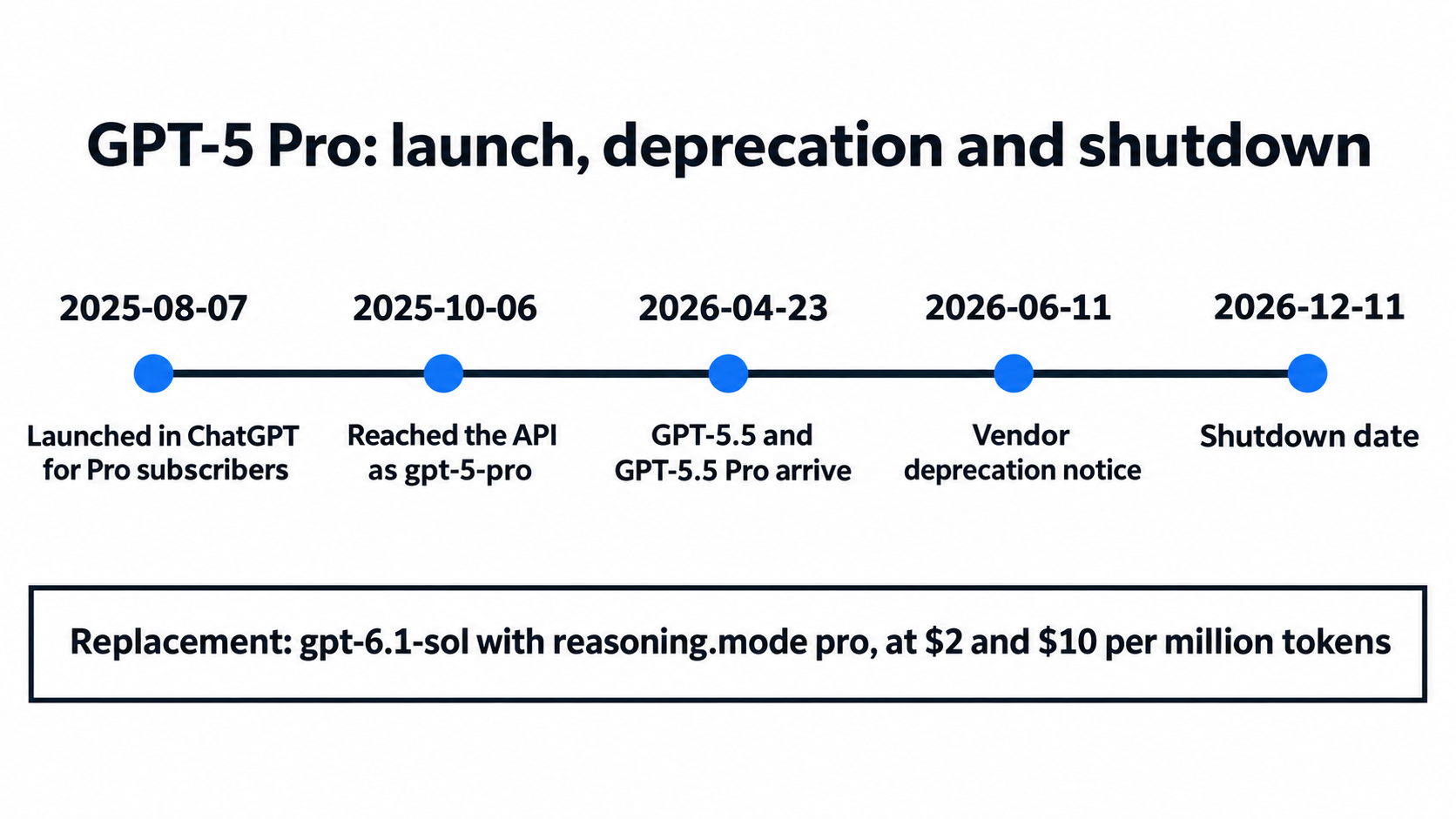

GPT-5 Pro: OpenAI's Retired Reasoning Tier Costs $15 and $120
U365's Recommendations to Learn More
Official learning resources
The model page, which is short and states the constraints plainly: https://platform.openai.com/docs/models/gpt-5-pro
The deprecation table, which is the document a reader should check before depending on any OpenAI id: https://platform.openai.com/docs/deprecations
The reasoning guide, which is where reasoning.mode and reasoning.effort are defined and where the billing of pro mode is explained: https://platform.openai.com/docs/guides/reasoning
The pricing page, including the batch and flex tables that carry the legacy rows: https://platform.openai.com/docs/pricing
Background mode, which is required reading for any model that takes minutes: https://platform.openai.com/docs/guides/background
The two launch posts, for the record of what was claimed on the day: https://openai.com/index/introducing-gpt-5/ and https://openai.com/index/introducing-gpt-5-for-developers/
Video tutorials and channels
OpenAI's official channel, which carries the launch presentations and the developer sessions: https://www.youtube.com/@OpenAI
The GPT-5 launch presentation, the OpenAI launch event that introduced the Pro tier for Pro subscribers and demonstrated it live. The embed above is the official upload and was checked against the platform on 2026-11-14: https://www.youtube.com/watch?v=0Uu_VJeVVfo
Written tutorials and deep-dive articles
Simon Willison's launch-day analysis, which is the clearest contemporaneous account of what the tier was and where it sat: https://simonwillison.net/2025/Aug/7/gpt-5/
OpenAI's developer documentation for prompt caching, which explains the discount this model does not have: https://platform.openai.com/docs/guides/prompt-caching
OpenAI's guide to reasoning best practices, for the effort vocabulary the current line uses: https://platform.openai.com/docs/guides/reasoning-best-practices
Community and social
The Hacker News launch thread, 2,063 points and 2,482 comments: https://news.ycombinator.com/item?id=44826997
The thread on the mathematics claim, 256 points and 150 comments: https://news.ycombinator.com/item?id=44965577
The practitioner note on hard problems: https://news.ycombinator.com/item?id=45164857
The announcement that the model had reached the API: https://news.ycombinator.com/item?id=45494021
Resources on X
The mathematics claim as posted by an OpenAI researcher, which the Hacker News thread above discusses: https://x.com/SebastienBubeck/status/1958198661139009862
The practitioner's note on the hard problems this model was good at: https://x.com/karpathy/status/1964020416139448359
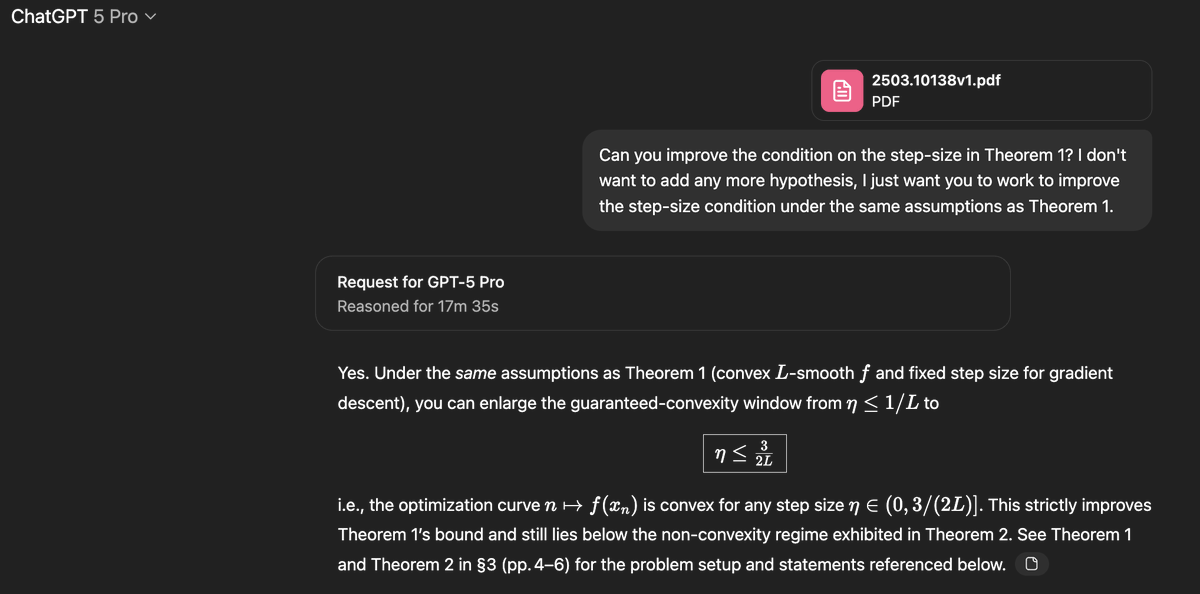
Dedicated X channels
OpenAI, the vendor's own account, where the launch and the retirement notices are announced: https://x.com/OpenAI
Sebastien Bubeck, the OpenAI researcher whose post opened the mathematics claim discussed in this review: https://x.com/SebastienBubeck
Andrej Karpathy, whose practitioner note on hard problems is quoted in What Users Say: https://x.com/karpathy

GPT-5 Pro: OpenAI's Retired Reasoning Tier Costs $15 and $120
CI-First Evaluation Summary Card
Field | Value |
Tool | GPT-5 Pro |
Vendor | OpenAI |
Model ID | gpt-5-pro, snapshot gpt-5-pro-2025-10-06 |
Category | Applied AI / Large Language Model (frontier reasoning tier, retired) |
Framework version | CI-First Evaluation Framework v1.4.1 |
Review date | 2026-11-14 |
CI-First Benefit Score | 4.5 / 10 |
Band | CI-First Positive (4.1 to 6.0) |
Sub-scores | Time 5, Quantity 4, Quality 6, Skill 3 |
CI-First Profile | Primary Co-Researcher, Analyst and Tester (level 4). Secondary Co-Creator and Thought Partner (level 1), Co-Worker and Assistant (level 2) |
Humics Protection Score | -1 |
Humics Badge | Humics-Neutral |
Humics components | Creativity 0, Critical Thinking -1, Social Authenticity 0 |
AI Imposture Risk | Medium overall |
Trap ratings | Time Medium, Quantity Medium, Skill Illusion High |
Status | Retired |
Lifecycle | Deprecated at the vendor, shutdown 2026-12-11, notice 2026-06-11 |
Released | 2025-08-07 in ChatGPT, 2025-10-06 in the API |
Price | $15.00 input, $120.00 output per million tokens, no cached-input rate, batch $7.50 and $60.00 |
Context and output | 400,000 tokens in, 272,000 tokens out |
Effort control | reasoning.effort: high only |
Endpoint | Responses API only, background mode recommended |
Knowledge cutoff | 2024-09-30 |
Replacement named by the vendor | gpt-6.1-sol with reasoning.mode: pro |
U365 recommendations | Do not adopt. Migrate before 2026-12-11. The Pro behaviour survives as a parameter on a cheaper current model. |

GPT-5 Pro: OpenAI's Retired Reasoning Tier Costs $15 and $120
Glossary
CI-First
The U365 principle that artificial intelligence should be deployed so that the combination of the human and the machine (CI) outperforms human intelligence alone (HI) on the work that matters, without eroding the human capability that produced the result.
CI-First Benefit Score
A 0 to 10 score, the arithmetic mean of four dimensions (Time, Quantity, Quality, Knowledge and Skill), rounded to one decimal place. It measures net benefit against doing the work with human intelligence alone.
Time Benefit
How much net time the tool saves, after the time spent prompting, reading, verifying and correcting. The framework requires the overhead to be subtracted, not ignored.
Quantity Benefit
How much the tool increases the volume of usable, verified output a person can produce in a given time. Volume that does not survive verification is the Quantity Illusion, not a benefit.
Quality Benefit
Whether the tool helps the user produce better work than they could alone, and whether that improvement survives verification. Surface polish is not quality.
Knowledge and Skill Benefit
Whether the tool builds lasting capability in the user, or substitutes for it while creating the appearance of competence. Scored conservatively, because it is the dimension most vulnerable to illusion.
CI-First Profile
The role the AI plays in the working relationship, one of five: Co-Creator and Thought Partner (1), Co-Worker and Assistant (2), Professor, Coach and Tutor (3), Co-Researcher, Analyst and Tester (4), Challenger, Critic and Devil's Advocate (5).
Humics
The three human capabilities the framework protects: Creativity, Critical Thinking and Social Authenticity, from Pascal Bornet's Humics framework.
Humics Protection Badge
The sum of the three Humics ratings, each +1, 0 or -1. A score of +2 to +3 is Humics-Friendly, -1 to +1 is Humics-Neutral, and -2 to -3 is Humics-Risky.
AI Imposture Risk
The likelihood that a user is trapped in one of three illusions: the Time Illusion (the appearance of speed with no net saving), the Quantity Illusion (volume that looks finished and does not hold up) and the Skill Illusion (the appearance of competence the user does not have). Rated Low, Medium or High per trap, with the overall level derived from the set.
User Sentiment
What users actually report on review platforms and in public discussion, reported with its source and its limits. Where no aggregate rating exists, this review says so rather than substituting a proxy.
Review Status
The lifecycle badge on a U365 Tools Review. The vocabulary is fixed:
Active: the tool is current and recommended.
Active (updated): the tool is current and recommended. This review was recently re-checked and the content was refreshed.
Changed: a re-check trigger fired and an update to this review is pending, so read it with that in mind.
Risky: the tool has significant unresolved issues, or it has been clearly surpassed by newer alternatives. Use it with caution and read the Limits section.
Stale: this review has not been re-checked in over 6 months, so treat details such as pricing and features as unverified.
Retired: the tool still works but is no longer recommended. See the Migration Path section.
Deprecated: the tool has been shut down or fundamentally changed. See the Migration Path section.
Last tested and Re-check
The date on which the evidence behind a review was read, and the rule that determines when the review is looked at again. Re-checks are trigger-based, with a maximum interval of six months.

GPT-5 Pro: OpenAI's Retired Reasoning Tier Costs $15 and $120
Sources
Vendor primary sources
Model page, GPT-5 Pro: https://platform.openai.com/docs/models/gpt-5-pro. Read on 2026-11-14
Deprecation table: https://platform.openai.com/docs/deprecations. Read on 2026-11-14
Pricing, standard, batch and flex tables: https://platform.openai.com/docs/pricing. Read on 2026-11-14
Reasoning guide, including reasoning.mode and pro-mode billing: https://platform.openai.com/docs/guides/reasoning. Read on 2026-11-14
Model page, GPT-6.1 Sol, the named replacement: https://platform.openai.com/docs/models/gpt-6.1-sol. Read on 2026-11-14
Launch post, Introducing GPT-5 (2025-08-07): https://openai.com/index/introducing-gpt-5/. Read on 2026-11-14
Launch post, Introducing GPT-5 for developers (2025-08-07): https://openai.com/index/introducing-gpt-5-for-developers/. Read on 2026-11-14
Launch post, Introducing GPT-5.5 (2026-04-23, API 2026-04-24): https://openai.com/index/introducing-gpt-5-5/. Read on 2026-11-14
ChatGPT plans and pricing: https://chatgpt.com/pricing/. Read on 2026-11-14
Background mode: https://platform.openai.com/docs/guides/background. Read on 2026-11-14
Independent sources
Artificial Analysis, model index: https://artificialanalysis.ai/models. Read on 2026-11-14. Pro entries exist for GPT-5.4 and GPT-5.5; no entry for GPT-5 Pro
Artificial Analysis, GPT-5.5 Pro: https://artificialanalysis.ai/models/gpt-5-5-pro. Read on 2026-11-14. Page exists; intelligence index, time per task and cost per task recorded as not available
OpenRouter, model listing: https://openrouter.ai/openai/gpt-5-pro. Read on 2026-11-14. openai/gpt-5-pro, created 2025-10-06, 400,000 context, $15 and $120, batch $7.50 and $60
Simon Willison, GPT-5 launch analysis: https://simonwillison.net/2025/Aug/7/gpt-5/. Read on 2026-11-14. Contemporaneous account of the tier position, the $200/month ChatGPT Pro placement and parallel test time compute
Community and community-reported evidence
Hacker News, GPT-5 launch thread: https://news.ycombinator.com/item?id=44826997. Read on 2026-11-14. 2,063 points, 2,482 comments, 2025-08-07
Hacker News, mathematics claim thread: https://news.ycombinator.com/item?id=44965577. Read on 2026-11-14. 256 points, 150 comments, 2025-08-20
Hacker News, practitioner note: https://news.ycombinator.com/item?id=45164857. Read on 2026-11-14. 2025-09-08
Hacker News, API availability: https://news.ycombinator.com/item?id=45494021. Read on 2026-11-14. 2025-10-06
Review platform sources
No aggregate rating is reported. G2, Capterra, Trustpilot and the consumer review platforms rate products and vendors rather than API model ids, and none carries a rating for gpt-5-pro that this review could verify. The Artificial Analysis entry that would normally stand in for a platform rating does not exist for this model.
Framework and method
The scoring method is the U365 CI-First Evaluation Framework, version 1.4.1, and the structural blueprint is the U365 INSIDE Tools Post Template, LLM variant.
Claude Sonnet 5.5 and Claude Haiku 5.5 are the two newest same-house reviews in the library, and they are the format precedent this document follows.

GPT-5 Pro: OpenAI's Retired Reasoning Tier Costs $15 and $120
Faculty Note on Evidence Quality
The evidence base for this review is narrower than for any other model in the library, and the narrowness is the finding. Three gaps are worth naming for a reader deciding how much weight to put on any number here.
The vendor published no Pro-specific performance table. The model page describes the mechanism ("more compute to think harder and provide consistently better answers") and states the constraints. It does not carry a benchmark row for this id, and the launch materials did not either. A reader on the launch thread noticed on the day: "They also announced gpt-5-pro but I haven't seen benchmarks on that yet."
No independent measurement exists on the surface this library cites. Artificial Analysis has no page for gpt-5-pro: five candidate URLs return 404, and the catalogue's index carries the GPT-5 line up to GPT-5.6 and the GPT-6 line, with Pro entries for GPT-5.4 and GPT-5.5 and none for this model. The successor's page exists and reports the intelligence index, the time per task and the cost per task as not available. The Pro tier is therefore unmeasured as a class, which is a fact about the tier and not a comment on this model's quality.
The one capability claim that travelled furthest did not survive its thread intact. The 2025-08-20 claim that GPT-5 Pro had proved a new and interesting mathematical result drew three responses that matter: a commenter noted that a human had already come up with and published a better solution to the same problem, another identified the paper as an arXiv preprint whose first author appeared to be an undergraduate, and a third asked whether any mathematician had called the result new or whether the description came from an OpenAI employee. The claim may be defensible on its own terms and this review does not adjudicate the mathematics. It does record that the claim was made by an interested party, checked in public, and never independently confirmed.
Where the numbers in this review come from. All prices are the vendor's published rates on 2026-11-14, read from the model page and the pricing page, and cross-checked against OpenRouter's listing for the same id. The per-call figures in the U365 Co-Intelligence Rating are arithmetic on those rates with stated token counts, not measured bills. The 27-day window is the difference between 2026-11-14 and the published shutdown date of 2026-12-11. The 25.5-month cutoff age is the difference between 2024-09-30 and the review date. Every one of those figures can be recomputed by a reader from the sources listed above.
What would change the assessment. Three things, and none is likely. A published independent measurement of the Pro tier would let a reader replace the Quality rationale with a reading; the score could move by a point either way. A moved shutdown date would change the urgency but not the recommendation. And a documented price cut on this id would be a commercial signal worth recording, though it would not close a 9.75 to 1 gap against the named replacement.
What this review does not claim. It does not claim that GPT-5 Pro was a bad model in 2025. It was the top of the vendor's line, it was priced as such, and it did work that the base model could not. It claims that a premium justified by a mechanism rather than by a measurement is a premium a buyer cannot audit, and that a model 27 days from shutdown with no cache, no effort setting and a 2024 cutoff has no workload left for which it is the right choice.

GPT-5 Pro: OpenAI's Retired Reasoning Tier Costs $15 and $120
Status and Re-check
Status: Retired | Last tested: 2026-11-14 (GPT-5 Pro, model id `gpt-5-pro`, snapshot `gpt-5-pro-2025-10-06`, deprecated by OpenAI with a shutdown date of 2026-12-11) | Re-check: none scheduled, the model is retired from recommendation
Retired: the tool still works but is no longer recommended. See the Migration Path section.
For detailed explanations of the CI-First evaluation terms used in this review, including the Humics Protection Badge and the AI Imposture Risk levels, see the Glossary at the end of this post.
Two vocabularies describe the same fact, and the date matters more than either word. OpenAI's lifecycle page calls this model Deprecated, which in the vendor's own definition means the retirement has been announced and the model still answers requests until its shutdown date. This review carries the badge Retired, because that is the U365 word for a tool that still works and is no longer recommended. The two statements are not in conflict: gpt-5-pro answers requests today and stops answering them on 2026-12-11, which is 27 days after the date of this review.
Re-check triggers, none of which can restore the recommendation:
Any change to the shutdown date. OpenAI published 2026-12-11 as the shutdown date with a notice date of 2026-06-11. A moved date is the one event that changes how much time a reader has, and nothing else in this review changes with it.
Any change to the replacement line. The vendor names gpt-6.1-sol with reasoning.mode: pro in the Responses API as the replacement. If that parameter changes, or the replacement model changes, the Migration Path has to be rewritten rather than refreshed.
A price change on any line. $15 per million input tokens, $120 per million output, batch at $7.50 and $60, and no cached-input rate at all. A price move on a model 27 days from shutdown would be a commercial signal worth recording, and it is unlikely.
Any published independent measurement of the Pro tier. As of 2026-11-14 Artificial Analysis publishes no page for gpt-5-pro, and its page for GPT-5.5 Pro records the intelligence index and the cost per task as not available. A measurement that appears later would let a reader replace the arithmetic in the U365 Co-Intelligence Rating with a reading.
A published ChatGPT-side retirement notice. The deprecation notice at the time of this review covers the API. The consumer surface has its own release notes, and this review did not read a ChatGPT retirement date. If one is published, it belongs beside the API date.
Review conducted by URC under the CI-First Evaluation Framework, version 1.4.1. Scoring date 2026-11-14. Tool version reviewed: GPT-5 Pro (`gpt-5-pro`, snapshot `gpt-5-pro-2025-10-06`, deprecated with a shutdown date of 2026-12-11).




Comments