
GPT-5.5 Pro: OpenAI's April 2026 Premium Tier, Priced Against Its Own Successor

Status: Retired | Last tested: 2026-11-14 (GPT-5.5 Pro, gpt-5.5-pro, released 2026-04-23) | Re-check: trigger-based (max 6 months)
Retired: the tool still works but is no longer recommended. See the Migration Path section.
For detailed explanations of the CI-First evaluation terms used in this review, including the Humics Protection Badge and the AI Imposture Risk levels, see the Glossary below.


In this Tool Review

GPT-5.5 Pro: OpenAI's April 2026 Premium Tier, Priced Against Its Own Successor
The Pro tier that was a model of its own, the two constructions that replaced it, and what this review is
Four names matter here, and two of them are not model names at all.
Name | What it is | Where it appears |
GPT-5.5 Pro | The model this review scores. Model id gpt-5.5-pro, dated snapshot gpt-5.5-pro-2026-04-23, announced 2026-04-23 and available on the API from 2026-04-24 | The launch page, the model page, the deprecations page (absent), the ChatGPT plan pages (legacy models) |
GPT-5.5 | The base model released the same day, also a separate model id, at $5 and $30 per million tokens with cached input at $0.50 | The launch page, the model page's quick comparison, the ChatGPT and Codex rollout |
GPT-5.6 Sol Pro | Not a model id. GPT-5.6 Sol running with reasoning.mode set to pro, billed at that model's own rates of $4 and $20, released 2026-07-09 | Provider catalogues and the ChatGPT plan list, which names it as a plan feature |
GPT-6.1 Sol Pro | Not a model id either. GPT-6.1 Sol, released 2026-09-29, running with reasoning.mode set to pro, billed at $2 and $10 with cache reads at $0.10 | Provider catalogues; OpenAI's own deprecations page recommends gpt-6.1-sol with reasoning.mode: pro as the replacement for the older gpt-5-pro |
The model id is confirmed, and it is a distinct model rather than a parameter on the base one. The hypothesis on the card was gpt-5.5-pro, and the vendor's documentation confirms it: a dedicated model page, a dated snapshot, its own price table and its own endpoint matrix. That is the opposite of the arrangement that replaced it. From GPT-5.6 onward, "Pro" stopped being a model and became a value of reasoning.mode on the base model, a mode that OpenAI bills at the base model's own token rates while spending more tokens per request. So this review scores the last construction of its kind that the vendor documents, and a reader comparing "Pro" today is comparing a different billing shape rather than a newer version of the same product.
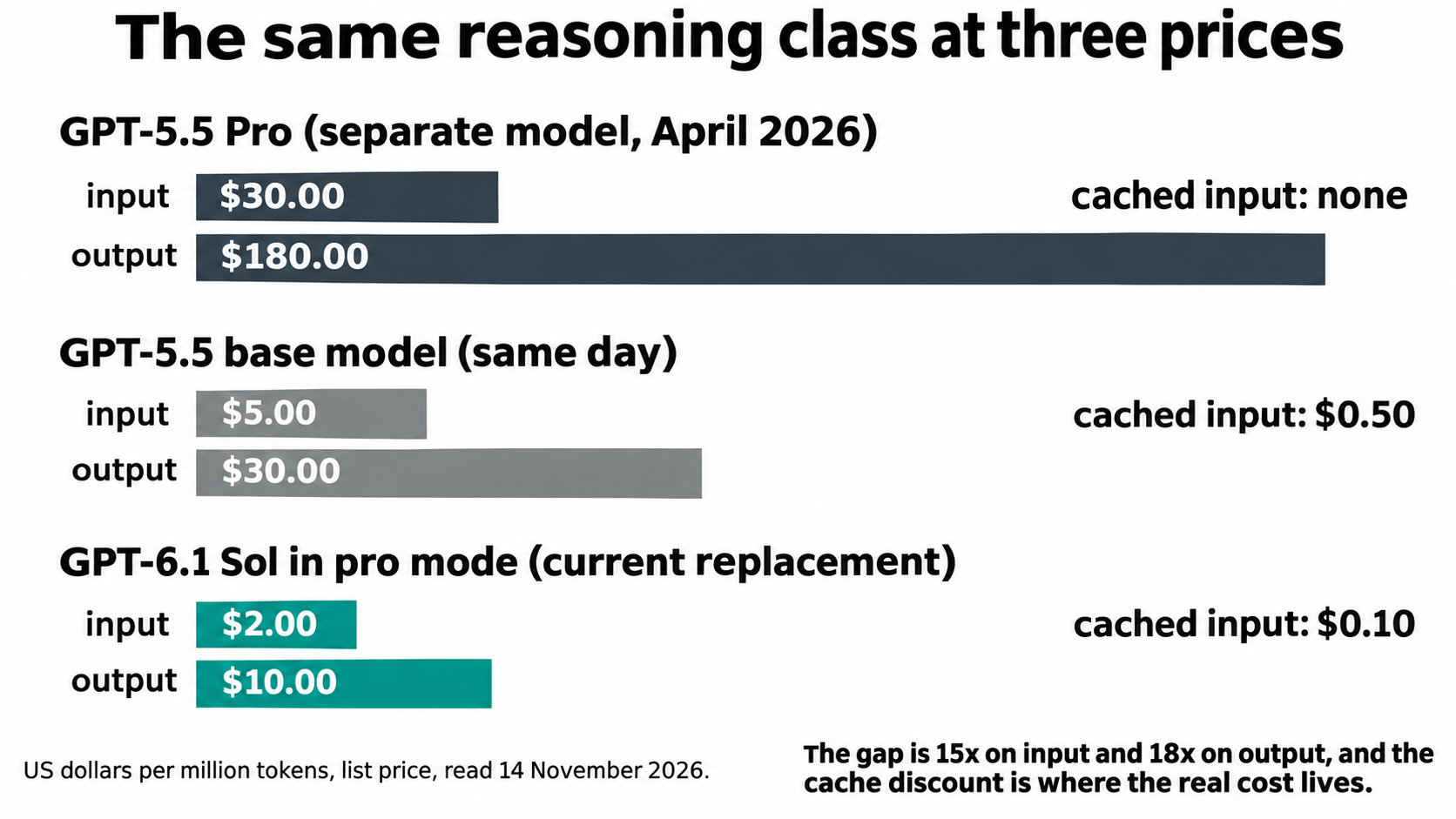
The distinction is not administrative, because the price is attached to the construction. GPT-5.5 Pro costs six times the base model on both lines, and it offers no cached input discount at all. The successor construction costs the base model's own rates and adds work in tokens. At $30 against $2 and $180 against $10, the same reasoning-class capability now costs a fifteenth to an eighteenth of the per-token price, with a cache read at $0.10 where this model charges the full $30 for every repeated input token. A reader who finds this review through the U365 Model Recruitment lecture is looking at a legacy line item, and the useful question is not whether it was good in April but what it costs now and what replaces it.
What this review is. It is the URC scoring of GPT-5.5 Pro under the CI-First Evaluation Framework, version 1.4.1, on evidence read on 2026-11-14: the vendor's launch page, model page in both its rendered and markdown forms, API pricing page, deprecations page, business and personal plan pages, and the Preparedness Framework statements on the launch page; independent measurement and catalogue data from Artificial Analysis, BenchLeader, meo and the Epoch AI Benchmarking Hub figures BenchLeader republishes; the Hacker News launch thread of 1,580 points and 1,010 comments and the API release thread of 256 points and 159 comments; and the published U365 scores of the OpenAI models this one is compared against.
What this review is not. It is not a review of base GPT-5.5, which is reviewed separately in this library. It is not a review of GPT-5.5 in ChatGPT or in Codex: those are different surfaces with different limits, and the Codex context window for GPT-5.5 is 400,000 tokens rather than the 1,050,000 the API documents. It is not a review of GPT-5.6 Sol, GPT-6 Sol, GPT-6.1 Sol, GPT-6 Astra or GPT-6.1 Terra, each of which has its own document in the library. It is not a re-score of GPT-5.4 Pro, whose price was identical and whose score does not exist in the library either. And it is not an assessment of OpenAI's safety programme beyond the facts a buyer of this endpoint has to carry, which Section 7c states with their sources named.
The score sits in the middle of the band and the badge does not. 4.5 is CI-First Positive, which is a real recommendation for a narrow use, and Retired, which says no new work should start on it. Those two statements are consistent: the framework measures what the tool does for the person using it, and the badge measures whether U365 would recommend it today. A model can do solid work and still be the wrong purchase, and this one is the clearest case in the OpenAI line so far.
GPT-5.5 Pro: OpenAI's April 2026 Premium Tier, Priced Against Its Own Successor
Tool Snapshot
GPT-5.5 Pro, OpenAI's April 2026 premium reasoning tier: a separate model at six times the base price, measured by its own vendor as better only on the hardest mathematics and on browsing, and now priced at fifteen to eighteen times the successor that performs the same job as a setting.
Category: Applied AI / Large Language Model. Hard-problem reasoning, research-grade analysis over long evidence sets, and document work where accuracy matters more than latency. It sat above GPT-5.5 in price and below nothing in the line at launch; today it sits outside the flagship range entirely.
Primary use cases:
Stress-testing a technical argument or a manuscript. The vendor's own description of early testers is the clearest statement of what the tier is for: critiquing manuscripts over multiple passes, stress-testing technical arguments, proposing analyses, and working with code, notes and PDF context. The launch page reports one researcher using it to analyze a gene-expression dataset of 62 samples and nearly 28,000 genes into a research report he said would have taken his team months.
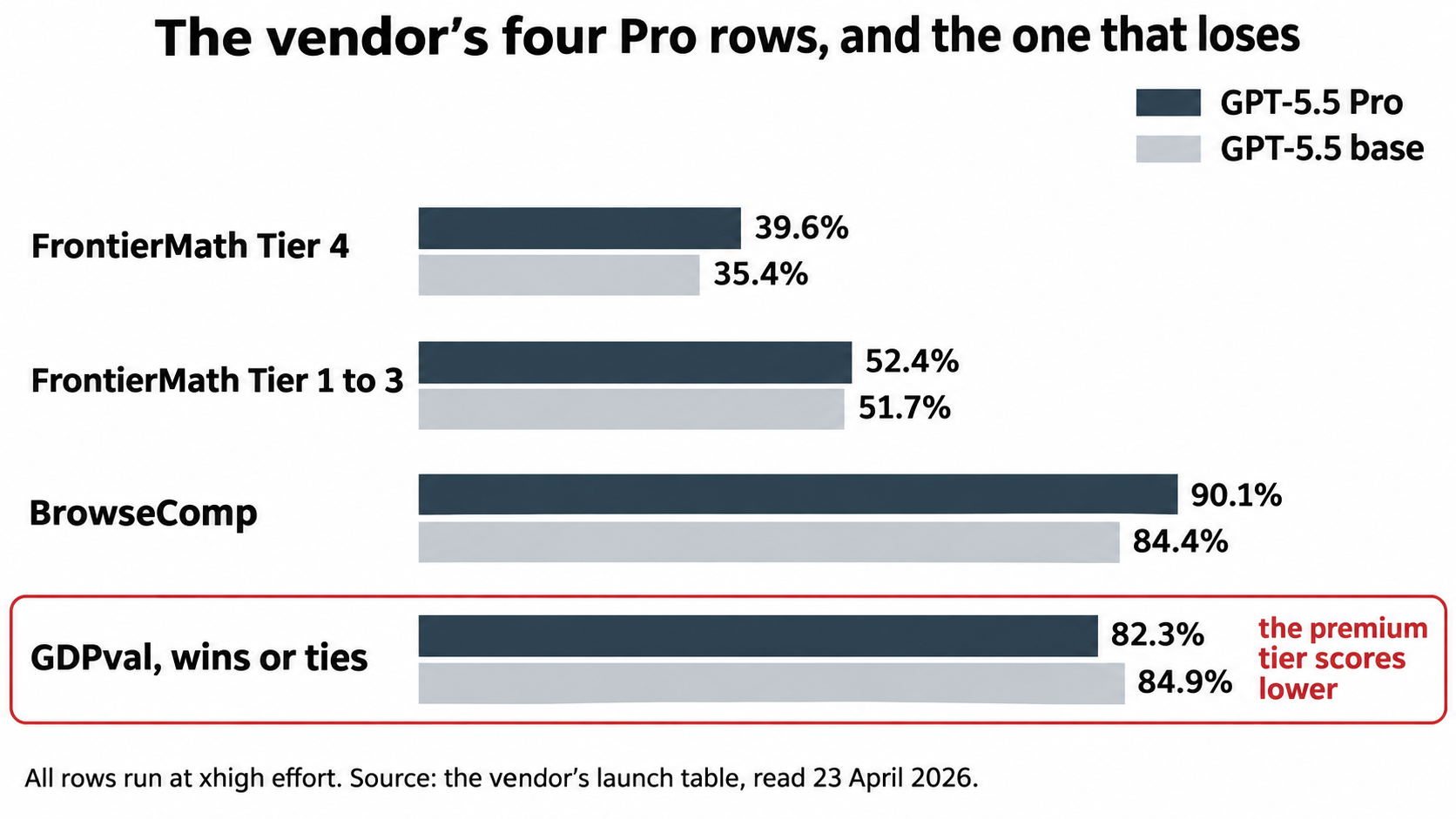
Hard mathematics with a checkable answer. The vendor reports 52.4 percent on FrontierMath Tier 1 to 3 and 39.6 percent on Tier 4, against 35.4 and 27.1 for the base model and 22.9 for Claude Opus 4.7 on Tier 4. These are the strongest rows in the Pro column and the only ones where the tier opens real distance.
Long-context research over a document set. A 1,050,000-token context with a 128,000-token output ceiling and text plus image input, used on the Responses API with file search and image generation as hosted tools.
A second opinion on a decision that has a rubric. The tier's measured strength on BrowseComp, at 90.1 percent against 84.4 for the base model, is a browsing-and-synthesis result, and it maps onto due-diligence work where the answer has to be assembled from many sources.
Reproducing a run that was pinned to the dated snapshot. gpt-5.5-pro-2026-04-23 is a lockable version. That is the one operational reason to keep a live integration.
What it is not. It is not the general-purpose upgrade over GPT-5.5 that its price implies: the vendor's own GDPval row puts the Pro tier at 82.3 percent against 84.9 for the base model, so on general knowledge work the premium tier scored lower than the model it was sold beside. It is not an agent platform: the endpoint matrix lists no computer use, no apply patch, no skills and no tool search, and the launch page's computer-use story belongs to GPT-5.5 in Codex. It is not a streaming service: streaming is documented as not supported, and requests that take minutes are meant to be run in background mode. It is not available on Chat Completions. It is not cheap in any dimension: no cached input discount, a 10 percent uplift on regional processing endpoints, and $23.04 for a single response that uses the full 128,000-token output ceiling. And it is not current: two generations of successor have shipped since, and the Pro label itself became a request parameter rather than a model.
Model facts, as published:
Field | Value |
Model id | gpt-5.5-pro |
Dated snapshot | gpt-5.5-pro-2026-04-23 |
Announced | 2026-04-23, with the API release on 2026-04-24 |
Context window | 1,050,000 tokens |
Maximum output | 128,000 tokens, reasoning tokens included |
Input modalities | Text and image |
Output modalities | Text |
Knowledge cutoff | 2025-12-01 |
Reasoning | Reasoning token support; effort accepts medium, high (default) and xhigh |
Endpoints | Responses and Batch only. Chat Completions, Live, Realtime, Assistants, Fine-tuning and Embeddings are not supported |
Streaming | Not supported |
Tools on the Responses API | Web search, file search, image generation, code interpreter, hosted shell, MCP |
Tools absent | Computer use, apply patch, skills, tool search |
Snapshot alias | The bare id and the dated snapshot both resolve to gpt-5.5-pro-2026-04-23 |
Licence | Proprietary hosted service. No weights, no parameter count, no architecture disclosure |
Pricing, as published:
Line | Rate per million tokens | Note |
Input | $30.00 | Six times the base model's $5.00 |
Output | $180.00 | Six times the base model's $30.00 |
Cached input | No discount | The vendor states this explicitly on the model page |
Batch API | Served, at the batch rate on the pricing page | The model page lists the Batch endpoint as supported without a separate line in the table read on 2026-11-14 |
Regional processing | 10 percent uplift | Data residency endpoints |
Base model for comparison | $5.00 input, $0.50 cached, $30.00 output | GPT-5.5, released the same day |
What the price buys, in three numbers. One million input tokens costs $30, so a full 1,050,000-token context costs $31.50 before a single output token. One hundred and twenty-eight thousand output tokens, the ceiling of a single response, costs $23.04. And a repeated prompt pays full price every time, because there is no cache rate: the same million-token context sent ten times in one working session costs $300 in input alone, where the successor charges $0.10 per million for the cached part. Those three numbers explain most of this review's verdict before any benchmark is quoted.
Tools available on the Responses API. Web search, file search, image generation, code interpreter, hosted shell and MCP. The absences are as informative as the presences: computer use, apply patch, skills and tool search are all documented as unsupported for this model, which means the tier is a reasoning endpoint with retrieval and a sandbox rather than the operating-a-computer product the launch page describes for the base model.
Rate limits, by usage tier:
Tier | RPM | TPM | Batch queue limit |
Free | Not supported | Not supported | Not supported |
Build | 500 | 200,000 | 1,000,000 |
Launch | 1,000 | 1,000,000 | 20,000,000 |
Grow | 2,000 | 4,000,000 | 1,500,000,000 |
Benchmarks, vendor and independent, kept apart. The vendor's launch table gives GPT-5.5 Pro a figure in exactly four rows, all run at xhigh effort:
Evaluation | GPT-5.5 Pro | GPT-5.5 | GPT-5.4 Pro | Claude Opus 4.7 | Gemini 3.1 Pro |
FrontierMath Tier 4 | 39.6% | 35.4% | 38.0% | 22.9% | 16.7% |
FrontierMath Tier 1 to 3 | 52.4% | 51.7% | 50.0% | 43.8% | 36.9% |
BrowseComp | 90.1% | 84.4% | 89.3% | 79.3% | 85.9% |
GDPval, wins or ties | 82.3% | 84.9% | 82.0% | 80.3% | 67.3% |
Three rows lead the base model and one trails it. Independent measurement is thinner than for any model this review has scored: Artificial Analysis publishes a page with no intelligence index, no cost per task, no speed and no benchmarked providers, and BenchLeader publishes results from independent publishers without ranking the model. The figures that do exist are given in U365 Co-Intelligence Rating and in the Faculty Note, with their sources and their version caveats.
At a Glance Dashboard
Field | Value |
Category | Applied AI / Large Language Model (hard-problem reasoning, research analysis and long-context document work) |
CI-First Benefit Score | 4.5 / 10 (CI-First Positive) |
Sub-scores | Time 5 / Quantity 4 / Quality 6 / Skill 3 |
CI-First Profile | Primary: Co-Researcher, Analyst and Tester (level 4). Secondary: Challenger, Critic and Devil's Advocate (level 5), Co-Worker and Assistant (level 2) |
Humics Protection | Humics-Neutral (-1 / +3) |
AI Imposture Risk | Medium overall, with Skill Illusion High |
Status | Retired |
Last tested | 2026-11-14 |
Released | 2026-04-23, API 2026-04-24 |
Access | Responses API and Batch API. ChatGPT legacy models list on Plus and Pro. No current ChatGPT model row, no Codex access for this tier |
Price | $30.00 per million input tokens, $180.00 per million output, no cached input discount, 10 percent regional uplift |
Context window | 1,050,000 tokens in, 128,000 tokens out |
Effort levels | medium, high (default), xhigh |
Framework comparison with siblings and peers | GPT-6 Astra 7.0 (CI-First Strong); GPT-6.1 Sol 6.3 (CI-First Strong); GPT-6 Sol 6.0 (CI-First Positive); GPT-6.1 Terra 6.0 (CI-First Positive); GPT-5.6 Sol 6.0 (CI-First Positive); GPT-6 Luna 4.8 (CI-First Positive). Base GPT-5.5 is reviewed separately in this library. |
Benchmarks, one line each | Vendor, at xhigh: 39.6 percent on FrontierMath Tier 4, 52.4 on Tier 1 to 3, 90.1 on BrowseComp, 82.3 on GDPval. Independent: no Artificial Analysis intelligence index and no benchmarked provider; BenchLeader carries Epoch, ARC Prize and SimpleBench results without ranking the model; 18 to 30 output tokens per second, first answer token at 6.05 seconds in a chat-shaped estimate and 68 seconds on the measured OpenAI route |

GPT-5.5 Pro: OpenAI's April 2026 Premium Tier, Priced Against Its Own Successor
The Problem
The premium was attached to a product line rather than to a setting, and the buyer's problem is that the bill, the access list and the benchmark table all point in different directions.
Five problems sit in front of a reader deciding about GPT-5.5 Pro, and the first three are about money rather than capability.
The first is that the tier charged six times the base price and then removed the one discount that makes repeated context affordable. There is no cached input rate on this model. The vendor states it without qualification on the model page, and the quick comparison table on the same page puts the base model's cached input at $0.50 against a dash for the Pro tier. For a workload built on a long, stable context, which is exactly the workload a 1,050,000-token window invites, that is the difference between a fixed cost and a tax on every turn. A fellow who runs the same 200,000-token evidence set through eight passes pays $48 in input on this model and $0.16 for the cached portion on the successor. The six times headline understates what repeated context costs here; the cache is where the real gap lives.
The second is that the vendor's own table does not show the Pro tier winning. Exactly four rows of the vendor's table carry a Pro figure. Three lead the base model: FrontierMath Tier 4 at 39.6 against 35.4, Tier 1 to 3 at 52.4 against 51.7, and BrowseComp at 90.1 against 84.4. One trails it: GDPval, the evaluation built from 44 occupations and the closest thing in the table to ordinary professional output, where the Pro tier scores 82.3 against the base model's 84.9. A premium tier that loses the general-work row to the model beneath it, while winning two mathematics rows by four and a half and eight points and a browsing row by six, is not a general upgrade. It is a specialist, sold as a ceiling.
The third is that the price is not the only cost of running it. The model is served on the Responses API and the Batch API only. Chat Completions is not supported, streaming is not supported, and requests are expected to take several minutes, which the documentation addresses by pointing a developer at background mode. A team that wants this tier has to build polling and completion handling before it gets an answer, and it has to do that on an endpoint that does not accept the request shape its other models accept. That is engineering time on top of the token bill, and it is the kind of overhead the framework subtracts rather than ignores.
The fourth is that the independent record is close to empty, and the one figure the catalogues do publish invites the wrong conclusion. Artificial Analysis has a model page for GPT-5.5 Pro and no measurement on it: no intelligence index, no cost per task, no output speed, and, on its providers page, "Total 0 providers" with the statement that the model is not currently available through any API provider it benchmarks. BenchLeader carries independent results from Epoch, ARC Prize and SimpleBench and does not rank the model, because its index needs at least five independent results across two categories. The catalogue figures that do exist, 18 to 30 output tokens per second and a first answer token at 68 seconds on the measured OpenAI route, describe a slow endpoint, and a slow endpoint at $180 per million output tokens is expensive twice.
The fifth is that the successor construction changed what "Pro" means, and most buyers have not noticed. From GPT-5.6 onward the vendor sells pro reasoning as reasoning.mode on a base model. GPT-6.1 Sol at $2 and $10 with cache reads at $0.10, run in pro mode, is the current way to buy the same class of work, and OpenAI itself points gpt-5-pro customers at exactly that combination on its deprecations page. A reader comparing this review with a review of a current model is not comparing two prices for one thing. They are comparing a separate SKU that was retired from the flagship table with a parameter on a model fifteen times cheaper per input token.

GPT-5.5 Pro: OpenAI's April 2026 Premium Tier, Priced Against Its Own Successor
The Outcome
What changes for a reader who adopts this model, and what does not.
Hard reasoning gets a real ceiling, and the ceiling is narrow. On the vendor's four measured rows the tier opens distance on Tier 4 mathematics, from 35.4 to 39.6 percent, and on browsing synthesis, from 84.4 to 90.1. Those are the two places where the extra compute converts into answers a cheaper model does not reach. Nothing else in the vendor's table supports a claim beyond that.
General knowledge work does not improve, and by the vendor's own number it regresses. GDPval at 82.3 against the base model's 84.9 is the single most useful line in the launch table, because it tells a fellow that paying six times more for a deck, a memo or a spreadsheet summary is paying for a lower measured score.
The bill becomes a planning object rather than a footnote. BenchLeader's estimates from list price and measured speed put a chat-shaped reply at $0.066, a 30-page report summary at $0.468, a code edit at $0.450, a structured extraction at $0.096 and an agentic coding session at $2.52. Those are estimates, and they are unusually reliable for this model because there is no cache discount to model and no reasoning-token multiplier to guess: the list price is the price. A team can budget from them directly.
The working rhythm slows to minutes. Requests take several minutes by the vendor's own description, streaming is unavailable, and background mode is the documented way to avoid timeouts. A fellow who is used to a reply in ten seconds is now designing a task queue. That is a change in how the work is organised, not just in how long one call takes.
Reproducibility improves, for as long as the snapshot lives. gpt-5.5-pro-2026-04-23 is a pinned artefact with its own model page, and a run recorded against it can be repeated while it is served. That is a genuine advantage over the successor construction, where pro mode is a request parameter on a model whose page lists no dated snapshot. It is the one column in which this model is better than what replaced it.
What does not change is the shape of your work. You still frame the question, supply the evidence, choose the effort, read the answer and verify it against something outside the conversation. The framework's Skill sub-score of 3 says that plainly: this tier is built to produce the answer a fellow would otherwise have had to construct, and it teaches nothing about how the answer was reached.

GPT-5.5 Pro: OpenAI's April 2026 Premium Tier, Priced Against Its Own Successor
Who Should Use GPT-5.5 Pro
Learner type | Difficulty | Typical ROI | Career path |
Students (Bachelor, Master) | Advanced, and the cost is prohibitive | Almost none, and that is the honest answer. At $30 and $180 per million tokens with no cache discount, one serious session costs more than a year of a mid-tier subscription. The tier is reachable through a ChatGPT plan's legacy models list rather than through a student budget. What a student can take from it is an object of study: the vendor's own Pro column is the best available lesson in how a premium tier is priced and why it stopped being a product. | UIT (Technology, AI, Data Science) for the benchmark-reading and pricing lesson. No published U365 credential assesses model economics or tier construction as a named component, and none is asserted. |
Professionals (career upskilling) | Advanced | Narrow and real. A researcher, analyst or engineer with a hard problem that has a checkable answer, and a budget that can absorb a few dollars per attempt, gets a second opinion that is measurably better than the base model on mathematics and browsing. The same professional running documents, decks or routine analysis should not use it: the vendor's GDPval row says the base model scores higher for a sixth of the price. | UIT (Technology, AI, Data Science) for the reasoning and evaluation work, and UIB (Business Management, Entrepreneurship) for the cost-per-completed-task analysis that decides whether a premium tier survives. |
Everyone (lifelong learners) | Not appropriate | None. The tier is slow, expensive, API-shaped and documented for hard problems. A general learner is better served by a current mid-tier model at a small fraction of the cost, and by the discipline of checking output rather than by a more expensive answer. | No fit. LIPS holds the record of what was asked and verified, and UNOP does not apply because the model produces rather than teaches. No assessment home is asserted. |
For teams and organisations. A team deciding whether to keep a Pro-tier line item starts with four questions.
Team deployment. The endpoint is Responses and Batch only, with no streaming and no Chat Completions, so a team has to build background polling and a completion path before the tier is usable in production. The tools list is a retrieval and sandbox set: web search, file search, image generation, code interpreter, hosted shell and MCP, with no computer use, no apply patch, no skills and no tool search. Rate limits are lower than the current models at every tier, from 500 requests per minute on Build against 5,000 on GPT-6.1 Sol, and the Free tier is not supported at all.
Cost at team scale. Three lines move independently and only one of them is negotiable. The token line is $30 and $180 with no cache discount, so repeated context is billed at full rate every time. The seat line is separate: ChatGPT Business standard seats are $20 per month billed annually and premium seats $100, and Enterprise is quoted. The third line is the engineering time the endpoint imposes, which no rate card shows. A team that budgets from the token price alone will understate the second month.
Data and compliance. The vendor's business plans state that content is not used to train models by default, and Enterprise adds custom retention policies, SCIM, audit logs and data residency in ten regions. On this model, regional processing endpoints carry a 10 percent uplift, which is the documented price of keeping inference in a named geography. The knowledge cutoff is 2025-12-01, so a compliance workflow that depends on recent regulation needs retrieval rather than the model's own knowledge.
U365 for companies. Professional learners reach University 365's academic services individually or through their organisation, and the company route runs through a customized training agreement for employee groups. Corporate education programmes are built on demand, and their tuition follows content and duration.
Skill level required: Advanced. Driving this tier means framing a problem precisely enough that a multi-minute run is worth starting, choosing between three effort levels with different cost profiles, arranging evidence so the model can retrieve it, and checking the answer against a method that does not depend on the model. Without that, the tier produces a long, confident document that costs several dollars and cannot be audited.
Prerequisites. A ChatGPT plan that lists the model under legacy models, or an API account with billing and access to the Responses API. A decision about background mode, because a synchronous request may exceed a client timeout. A verification method for the class of problem being attempted, chosen before the first run. And a budget line, because the tier cannot be trialled casually: five attempts at a long-context problem can cost more than a month of a mid-tier subscription.
Typical time to first result: Two to ten minutes on the API for a first response, depending on effort and on whether the run is a single question or a multi-document analysis. Under a minute to start on the ChatGPT legacy list, where the surface handles the wait. The measured route data puts the first answer token at 68 seconds on OpenAI's own endpoint, before the reasoning and the answer are generated.
Typical time to competence: Five to ten hours, and most of it is not about the model. Three skills carry the value: problem selection, because the tier only pays on problems with a checkable answer; evidence arrangement, because a 1.05 million-token window is only useful if the right material is in it and the retrieval path is set up; and verification design, because a research-grade answer is the hardest kind to check and the easiest to accept.
Who should wait. Anyone starting new work. The successor construction at $2 and $10 with cache reads at $0.10 does the same class of job, and a fellow who wants the hardest problems solved should be comparing GPT-6 Astra, which leads the U365 library at 7.0, rather than a superseded April tier. The exception is a team that already has a pinned gpt-5.5-pro-2026-04-23 run in a regulated or published study and needs the same weights to finish it.

GPT-5.5 Pro: OpenAI's April 2026 Premium Tier, Priced Against Its Own Successor
U365 Institutes Alignment
The alignment below rates what a U365 institute could take from this model as a working instrument and as an object of study. The primary home is UIT (Technology, AI, Data Science), because hard-problem reasoning, evaluation reading and the economics of a model tier are the competencies this release exercises, and because the vendor's own Pro column is an unusually clean teaching object about what a benchmark table does and does not say. The other three readings are real and each is bounded. Read the rows as an academic assessment, not as a recruitment recommendation: the review badges this tier Retired, the endpoint is Responses and Batch only with no streaming, no computer use and no cached input discount, and gpt-6.1-sol with reasoning.mode set to pro does the same class of work at $2 and $10 with cache reads at $0.10. What a fellow gains from the rows below is a hard-problem instrument and a worked case in how a capability premium migrates from a product to a setting. What it costs them is $30 and $180 per million tokens with every repeated input token billed in full.
UIT (Technology, AI, Data Science)
Rating. High (primary)
Why. Three competencies, each of which survives the removal of the tool. Hard-problem reasoning: choose a problem with a checkable answer, run it at high and then at xhigh, and compare the answer, the wait and the bill. The vendor's four Pro rows are the material, and the comparison between 39.6 and 35.4 percent on Tier 4 mathematics is exactly the kind of small gap a student has to learn to interpret rather than to celebrate. Two-axis reasoning control: this model exposes effort only, while the successor generation exposes mode and effort as separate axes, and teaching the difference between "think harder" and "do more work" is a lesson in reading an API rather than in using a product. Evaluation reading: the Pro column fills exactly four cells, and one of them is below the base model, which is the cleanest available exercise in asking what a table left out.
The limit that holds the row. The tier is a service a practitioner operates, not an artefact a practitioner inspects: no weights, no parameter count, no architecture description, so the competencies are engineering-with rather than engineering-of. The access shape bounds the teaching as much as the price does: no streaming, no Chat Completions, no computer use, no tool search, and a request that can take several minutes, so a class cannot watch an argument form and cannot rehearse the agentic workflows the successor supports. No published U365 programme assesses model economics or tier construction as a named component, and the absence is measured rather than assumed: 0 of the 81 published programmes name pricing, cost, portfolio, model selection, procurement or a benchmark in title or description; the word tier appears in 62 of the 81 and all 62 sit in the library-subscription line that reads gold or platinium, which is a different object; 2 carry economic inside a course unit, one in the Associate of Business Administration and one in Financial Analysis Specialist, and neither is a model-economics component; and AI-agent instruction sits in 5 programmes, none of them a degree programme. Adjacent anchors, not assessment homes.
UIB (Business Management, Entrepreneurship)
Rating. Medium
Why. Two commercial decisions this release makes teachable. The first is cost per completed task on a tier with no cache discount: a business case built on $30 and $180 per million tokens without modelling repeated context will be wrong by an order of magnitude, and the vendor's own quick comparison table gives the class the numbers to prove it. The second is the life cycle of a premium SKU. A separate, six-times-priced model was replaced within three months by a request parameter on a base model fifteen times cheaper per input token, and OpenAI's deprecations page now recommends that parameter combination as the replacement for its older Pro model. That is a case study in how a capability premium migrates from a product to a setting, and it is more useful to a cohort than any single benchmark row.
The limit that holds the row. The model publishes no completion rate, no time per task and no return of its own, and the independent record is thin enough that a business case cannot rest on it. The lesson is about pricing and product construction, not about a business outcome the model delivers. No published U365 programme assesses the economics of a model portfolio as a named component, and the count names its matcher and its object: 0 of the 81 published programmes carry portfolio, return on investment, cost or pricing in title or description, the single roi hit is a content-marketing unit, and the single budget hit is a line in a project-management syllabus. Adjacent anchors, not assessment homes.
UIC (Digital Communication, Marketing)
Rating. Low to Medium
Why. One genuine competence and one that does not survive the price. The genuine one is synthesis: a 1,050,000-token window holds a campaign archive, a set of source documents and a brief, and the model's 128,000-token output ceiling means a long structured argument can arrive in one pass. The measured strength on browsing synthesis at 90.1 percent supports that as a retrieval-and-assembly competence rather than a writing one. The second is reading a benchmark claim correctly: the launch page leads with base-model numbers, and the Pro column is four cells wide, which is a communication lesson about what a vendor chooses to show.
The limit that holds the row. At $180 per million output tokens, with no cache to soften repeated context, a communications team cannot use this for drafting at volume, and the model teaches no register, no audience analysis and no publication standard. It returns no sourced evidence of its own, so fact-checking stays with the writer. Rated as a synthesis surface with a reading contact. No credential is mapped.
UID (Digital Design, UX/UI)
Rating. Low
Why. A reading contact, and the ground under it is narrower than it looks. The model accepts images and returns text, so a design student can put a screenshot, a chart or a sketch in front of it and get a description, a comparison, or a list of what a reader would misread; that is real work on a design artefact and it is the whole of the fit. Image generation is a hosted tool on the endpoint rather than a capability of this tier: the picture is produced by a separate image model, the same tool is available on models that cost a fifteenth as much, and nothing in this tier's reasoning or its price adds to it.
The limit that holds the row. The model's own output is text, it designs nothing, it evaluates nothing against a brief, and it has no computer use, no apply patch and no skills, so it cannot open a design tool, inspect a live interface or iterate on a layout. No design production ground is established on which a band above Low could rest: the review carries no measured design or chart result of its own, and at $180 per million output tokens with no streaming a variant comparison is not a workflow a cohort can run. Rated as a text reasoning endpoint that happens to accept an image. No credential is mapped.
U365 methods, not an institute (UNOP, ULM, LIPS, CARE and the UP-Context-Engineering Method)
Rating. Applicable
Why. The methods layer is relevant in the way a slow, expensive, high-ceiling instrument is. Problem selection is the first planning decision: the tier only repays its cost on questions with a checkable answer, and writing down the check before the run is the discipline that keeps the spend honest. Evidence arrangement is the second, because a million-token window is a retrieval design problem rather than a prompt trick, and the UP-Context-Engineering Method's context-role-task-constraints-output order is what makes a multi-minute run reproducible. For LIPS and CARE, the record of which snapshot was called, at which effort, over which evidence set, and what the verification returned belongs in the Collect and Review phases, because the model holds no state and the endpoint has no stream to reconstruct from. ULM is the six-domain frame that holds the decision this tier forces, which is whether the work is worth buying at all; the cost per completed task that answers it is CI-First cost engineering rather than a ULM method, and Career and Finance are the domains where a premium that does not repay its price shows up first. UNOP has no direct fit: the tier is not built to teach, it claims no teaching mode, and its gains come from compute rather than from any pedagogical mechanism.
The limit that holds the row. The model carries no method of its own and no coaching surface. A Fellow who does not write the run parameters and the verification result into their own system has no account of them, and nothing in the product writes that account.

GPT-5.5 Pro: OpenAI's April 2026 Premium Tier, Priced Against Its Own Successor
How GPT-5.5 Pro Works
A separate reasoning model at the top of the April 2026 line: one effort dial with three positions, reasoning tokens billed as output tokens, a million-token window, and an endpoint that returns one answer after several minutes rather than a stream.
Inputs: Text prompts, documents, images and PDF content; through the Responses API, a conversation history, tool definitions and the results the hosted tools return. Through file search, a vector store of uploaded files. Through web search, retrieved pages. Through MCP, tools you connect. The model reads text and images and produces text.
Outputs: Text and structured output, with function calling. Up to 128,000 tokens in a single response, reasoning tokens included. No streaming, so the answer arrives when it is finished. No image, audio or video output.
Underlying technology, as the vendor publishes it:
Model: GPT-5.5 Pro, model id gpt-5.5-pro, dated snapshot gpt-5.5-pro-2026-04-23, announced 2026-04-23 and available on the API from 2026-04-24.
Reasoning: reasoning token support, with reasoning.effort accepting medium, high (the default) and xhigh. Reasoning tokens are billed as output and count against the 128,000-token ceiling.
Context and output: 1,050,000 tokens in, 128,000 out, knowledge cutoff 2025-12-01.
Price: $30 per million input tokens and $180 per million output, with no cached input discount and a 10 percent uplift on regional processing endpoints.
Endpoints: Responses and Batch only. Chat Completions, Live, Realtime, Assistants, Fine-tuning, Embeddings, image generation and every audio endpoint are not supported.
Tools: web search, file search, image generation, code interpreter, hosted shell and MCP. Computer use, apply patch, skills and tool search are not supported.
Latency: the vendor states that some requests take several minutes and recommends background mode to avoid timeouts. BenchLeader records 18 to 30 output tokens per second and a first answer token at 68 seconds on the measured OpenAI route.
Rate limits: 500 requests and 200,000 tokens per minute on Build, 1,000 and 1,000,000 on Launch, 2,000 and 4,000,000 on Grow. The Free tier is not supported.
What is not disclosed. No parameter count. No weights. No architecture description. No statement of how much extra compute the tier spends relative to the base model, beyond the phrase that it "uses more compute to think harder". No published multiplier that would let a buyer predict a bill from a prompt. Those absences matter more here than on a base model, because the entire premium rests on an undisclosed quantity of compute.
The construction the vendor replaced it with, stated here because it is the only honest context for this tier. GPT-5.6 and GPT-6 models expose reasoning.mode, with standard as the default and pro as the higher setting, and effort as a separate control inside that mode. The vendor bills pro mode's extra work at the selected model's standard token rates, which means the premium shows up as tokens rather than as a rate. GPT-6.1 Sol, released 2026-09-29 at $2 and $10 with cache reads at $0.10, is the current way to buy that combination. OpenAI's own deprecations page points customers of the older gpt-5-pro at gpt-6.1-sol with reasoning.mode: pro, which is the vendor stating the replacement path in its own documentation.
What the effort dial actually controls. Three positions, not five. high is the default, medium reduces the work and the bill, and xhigh raises both. Because there is no low and no max, the tier has a narrower operating range than either its own base model or the models that replaced it: a fellow cannot ask for a fast, cheap pass on this endpoint, and cannot ask for more work than xhigh. That is a design choice consistent with a tier sold for hard problems, and it is also a reason the tier is a poor fit for the mixed workload most people actually have.
Two behaviour facts that change how a run is built. First, reasoning tokens are invisible in the response but paid for at the output rate, so a run that spends 30,000 reasoning tokens and returns 2,000 answer tokens costs 32,000 tokens at $180 per million, which is $5.76, of which the visible answer accounts for $0.36. Second, those reasoning tokens count against the 128,000-token output ceiling, so a run that thinks too long can return an incomplete result after the work has been billed. Both facts point to the same practice: leave headroom in the output ceiling and budget from measured tokens rather than from the visible answer.
The delegation roles. This tier is not an executor inside an agent loop in the way the base models are, because streaming, computer use and tool search are absent. It is a consultant: one question in, one long answer out, after minutes. That shapes the workflow more than any benchmark row. A fellow builds a queue of hard questions and reads the answers later, rather than steering a run in real time.

GPT-5.5 Pro: OpenAI's April 2026 Premium Tier, Priced Against Its Own Successor
Getting Started with GPT-5.5 Pro
Required accounts: An OpenAI API account with billing and access to the Responses API, or a ChatGPT plan that lists the model under legacy models. A vector store if file search is part of the workflow. A place to keep the run record, because the endpoint will not give you a stream to reconstruct from.
Installation: Nothing to install beyond an HTTP client or an official SDK that can call the Responses API. The model is selected by the id gpt-5.5-pro or by the dated snapshot gpt-5.5-pro-2026-04-23. Clients that only speak Chat Completions cannot call this model.
First-time configuration:
Pin the snapshot before the first real run. Send gpt-5.5-pro-2026-04-23 rather than the alias, and write the id into your run record. The alias is what will move if the vendor changes anything, and a published or regulated study needs the dated artefact.
Budget from the output line, not the input line. Input is $30 per million and output is $180, which means a 1,050,000-token context costs $31.50 once, while 128,000 output tokens cost $23.04 in a single response. Reasoning tokens are billed at the output rate and are not visible in the request, so a bill can exceed the estimate by a multiple before any answer appears.
Do not plan on a cache. There is no cached input discount on this model, so a repeated 200,000-token evidence set costs $6 every time it is sent. Either shorten the context between runs, or accept the cost, or run the comparison on a model that caches.
Set the effort before the run, and write down why. medium, high (the default) and xhigh. Run the same task at high and xhigh once, record the answer, the wall clock and the token counts, and choose from evidence rather than from the label.
Build the background path first. Streaming is not supported and a request may take several minutes. Submit in background mode, poll for completion, and set a client timeout that accounts for reasoning time rather than only for generation time.
Leave headroom in max_output_tokens. Reasoning and answer share the 128,000-token ceiling, and a capped run returns incomplete after the tokens are billed. A long analysis needs room for both.
Put the evidence where the endpoint can retrieve it. File search over a vector store, web search for current material, MCP for connected tools. There is no computer use and no tool search, so the model cannot go looking for a tool it was not given.
Decide whether the successor is the better build before you write the integration. GPT-6.1 Sol at $2 and $10 with cache reads at $0.10 and pro mode as a request parameter does the same class of work, supports streaming and computer use, and is cheaper by a factor of fifteen on input. Starting a new integration on this model needs a reason beyond capability.
First 15 minutes checklist:
☐ One hard question from your own work, run at high, with the answer checked against a method you chose before the run.
☐ The same question at xhigh, with the wall clock and the token counts written down beside the first.
☐ A confirmation that your client handles a background submission and a completion poll without timing out.
☐ One deliberate test of the output ceiling, to see what an incomplete result looks like on this model.
☐ A cost line for the session, computed from tokens rather than from the number of calls.
☐ One sentence you could repeat to a colleague naming which of your problems this tier actually solves and which it does not.
Result: One hard question answered and checked, a measured cost for two effort settings, a background path that behaves, and a written decision about whether the tier belongs in the workflow at all. That last item is the one most setups skip and the one this review's verdict turns on.

GPT-5.5 Pro: OpenAI's April 2026 Premium Tier, Priced Against Its Own Successor
Real Workflows
Workflow 1: Stress-testing a research argument before it is submitted
Learner type: Professional (career upskilling). Researcher, doctoral candidate or analyst preparing a paper, a grant application or a technical memo. CI-First benefit tags: Quality, Skill. Connects to: UIT (Technology, AI, Data Science) research methods, and UIB for the reviewer's-eye view of an argument. Time estimate: One to three hours, most of it spent reading the critique and deciding which objections to accept.
What you do vs what the tool does:
Step | You do | The tool does |
1 | State the claim, the audience and the standard of proof, and list the three objections you already know about. | (Nothing yet) |
2 | Supply the draft, the key evidence and any reviewer comments already received. | (Nothing yet) |
3 | Ask for objections ranked by whether they are fatal, fixable or cosmetic, at high effort. | Reads the draft and the evidence and returns a structured critique after several minutes. |
4 | Decide which objections you accept, and write the response to each. | (Nothing. This is your judgement.) |
5 | Check every factual objection against the source it names. | (Nothing. You verify.) |
6 | Rewrite the argument where you accepted an objection, and record what changed. | (Nothing. You own the revision.) |
Sample prompt (UP-Context-Engineering method: context, task, constraints, output format):
Context: the attached draft argues [claim] for [audience]. The standard of proof is [standard].
The evidence is [list, with the source for each item]. Reviewers have already raised [objections].
I am running this at effort [high or xhigh] because [reason].
Role: AI as a Challenger, Critic and Devil's Advocate. I hold the decision about what to change.
Profile: Act as a Challenger, Critic & Devil's Advocate: a hostile but fair reviewer, not an editor and not as a co-author.
Task: find the objections that would stop this argument being accepted, and rank them.
Constraints: do not rewrite the draft. Do not praise. Do not raise an objection that the draft
already answers, unless the answer is inadequate, and say why. Separate what the evidence shows
from what the argument infers. Name the source for every factual objection. If you cannot find
a basis for an objection, do not raise it.
Output format: a table with objection, whether it is fatal, fixable or cosmetic, the evidence it
rests on, and the smallest change that would answer it. Then a section headed What the argument
gets right, limited to three lines.
Memory: this model keeps no memory between runs. The draft, the objections and the revision live in my own LIPS record, because the endpoint holds no state and there is no stream to reconstruct from.
UP-Context-Engineering verification: I read every objection against the evidence myself, I accept
or reject each one explicitly, and I can defend the revision without the tool open.
Data safety: this pack is [classification]. Unpublished results stay out of any prompt that
leaves the institution's approved processing path, and the run record stays in the matter file.
Cost note: This is the workflow the tier was built for, and it is also where the bill is easiest to lose control of. A 30,000-token draft plus evidence at xhigh can spend tens of thousands of reasoning tokens, all billed at $180 per million: 50,000 input tokens cost $1.50, and 20,000 output and reasoning tokens cost $3.60, so one pass is around $5.10. Three passes with revisions are around $15, and there is no cache discount to reduce the repeated draft. BenchLeader's estimate for summarising a 30-page report, $0.468, is a floor that excludes reasoning tokens and should not be used to budget this workflow.
Verification checklist:
☐ Multi-Model Check: run the same draft through GPT-6.1 Sol in pro mode and compare the fatal objections each found. A difference in what was noticed is worth more than a difference in prose.
☐ External Source: check every factual objection against the source it names, and reject any objection whose source you cannot open.
☐ Human Review: give the two most serious objections to a colleague who knows the field and see whether they agree they are serious.
☐ Report-to-Specification Check: confirm the critique addressed your claim and your standard of proof, not a nearby argument it found easier.
☐ CI-First Test: can you state each accepted objection and your answer to it without the tool? If not, you have not yet decided, you have deferred.
Workflow 2: A hard problem with a checkable answer
Learner type: Professional. Engineer, quantitative analyst or graduate researcher working on a problem where a wrong answer is detectable. CI-First benefit tags: Quality, Time. Connects to: UIT (Technology, AI, Data Science) mathematics and engineering tracks. Time estimate: Thirty minutes to two hours, including the second-method verification that makes the answer usable.
What you do vs what the tool does:
Step | You do | The tool does |
1 | Write the problem, the known constraints and the form the answer must take. | (Nothing yet) |
2 | Name the independent check that will decide whether the answer is right, before the run. | (Nothing yet) |
3 | Run at high, and at xhigh only if the first answer fails the check. | Works the problem and returns a derivation or a result with reasoning tokens billed as output. |
4 | Apply the independent check: a numerical substitution, a second derivation, a unit analysis, a test. | (Nothing. You verify.) |
5 | Ask it to attack its own answer and name the step it is least sure of. | Returns the weakest step, which is where a human check should start. |
6 | Record the check beside the answer, so the record shows both. | (Nothing. You own the record.) |
Sample prompt (UP-Context-Engineering method):
Context: the problem is [statement]. The known constraints are [list]. The answer must be in the
form [form]. My independent check is [check], and I will run it myself. Effort is [high or xhigh].
Role: AI as a Co-Researcher and Analyst. I hold the decision about whether the answer is accepted.
Profile: Act as a careful analyst, showing the steps rather than only the result.
Task: solve the problem and show the derivation at a level a competent reader can follow.
Constraints: state every assumption you make and mark it as an assumption. Do not present an
estimate as a result. If the problem is underdetermined, say so and name what is missing rather
than choosing a convenient interpretation. Do not use a tool you have not been given.
Output format: Assumptions, Derivation, Result, Weakest step, and What would falsify this answer.
Memory: this model keeps no memory between runs. The problem, the check I chose and the derivation are recorded in my own project record, because nothing is retained on the endpoint.
UP-Context-Engineering verification: I run [check] myself, and I can reproduce the derivation
without the tool.
Data safety: this pack carries no personal data. Client material stays in the approved path and
the run record stays with the project.
Cost note: Effort is the only dial and the output line is the cost. A derivation that returns 4,000 answer tokens costs $0.72 in answer alone, and the reasoning behind it can be several times that: a run that spends 25,000 reasoning tokens and returns 4,000 answer tokens costs $5.22. Running the same problem at high and then at xhigh doubles the spend, so the second run should be reserved for a problem that failed the check. Where the problem is routine, the base model at $5 and $30, or a current mid-tier model, is a fraction of this and often sufficient.
Verification checklist:
☐ Multi-Model Check: put the same problem to a second model and compare the assumptions each made rather than the answers alone.
☐ External Source: apply the independent check you named before the run. An answer that passes a check you chose afterwards has not been checked.
☐ Human Review: for anything that will be published or built on, have a person who knows the domain read the derivation.
☐ Assumption Audit: list the assumptions the model marked, and confirm each one is true of your problem rather than of a textbook version of it.
☐ CI-First Test: can you reproduce the derivation and explain the weakest step? If not, the answer is borrowed rather than owned.
Workflow 3: A due-diligence synthesis over a document set
Learner type: Professional. Analyst, consultant or programme lead assembling a decision from many sources. CI-First benefit tags: Quality, Quantity. Connects to: UIB (Business Management, Entrepreneurship) and UIC (Digital Communication, Marketing). Time estimate: Two to four hours for a first synthesis over twenty to forty documents, plus the verification that decides whether it can be used.
What you do vs what the tool does:
Step | You do | The tool does |
1 | Define the decision, the rubric and the fields every row must carry. | (Nothing yet) |
2 | Upload the source set to a vector store and confirm retrieval returns the right passages. | Reads the passages it retrieves and the prompt in one window. |
3 | Ask for one row per entity against the rubric, with the source for every field. | Returns a structured table after several minutes at high. |
4 | Check a sample of rows against the source documents, including the rows that look most confident. | (Nothing. You verify.) |
5 | Ask for the entities the set cannot support a view on, and treat silence as a finding to test. | Returns an explicit gap list on request. |
6 | Write the recommendation yourself, citing the rows you verified. | (Nothing. The recommendation is yours.) |
Sample prompt (UP-Context-Engineering method):
Context: the decision is [decision]. The source set is [number] documents in the attached vector
store, covering [period]. The rubric is [criteria]. Done means every field in the table carries a
document and a page, and no field is filled from general knowledge.
Role: AI as a Co-Researcher, Analyst and Tester. I hold the recommendation.
Profile: Act as an evidence-bound analyst, separating what the documents say from what you infer.
Task: produce one row per entity against the rubric.
Constraints: use only the documents provided. If a field is not in the set, write Not in set
rather than inferring it. Do not reconcile figures that disagree; report the disagreement. Name
the document and page for every field. Do not add entities the set does not cover.
Output format: a table with entity, one column per rubric field, and a source column. Then a
section headed What the set cannot support, and a section headed Where the sources disagree.
Memory: this model keeps no memory between runs. The rubric, the source set and the verified rows belong in the matter record, not in the tool, which retains nothing between calls.
UP-Context-Engineering verification: I check a sample of rows against the documents, I read the
gap list as a finding, and I can defend the recommendation without the tool.
Data safety: this pack is [classification]. Personal data is minimised, and the table stays in the
matter file rather than in the conversation.
Cost note: The retrieval design determines the bill. If file search returns a tight set of passages, a twenty-document review fits inside 100,000 input tokens, which costs $3.00, and a 6,000-token output table costs $1.08. If the whole set is pasted into every request instead, the input cost repeats in full on every turn because there is no cache discount, and a five-turn session on a 300,000-token set costs $45 before any output. Build the retrieval first, and keep the repeated context small.
Verification checklist:
☐ Multi-Model Check: run the same rubric on a second model and compare the rows where the two disagree. Those rows are where a human check belongs.
☐ External Source: check a sample of rows, including the most confident ones, against the documents and pages the table names.
☐ Human Review: a person who knows the entities reads the completed table before it informs a decision.
☐ Coverage Check: confirm the entities the set covers match the entities the decision needs, and read the gap list as evidence rather than as an apology.
☐ CI-First Test: can you defend the recommendation from the rows you verified, without the model's summary? If not, the synthesis is doing your thinking.

GPT-5.5 Pro: OpenAI's April 2026 Premium Tier, Priced Against Its Own Successor
Strengths, Limits, and AI Imposture Risk
Strengths
CI-First Benefit | Strength | Evidence |
Time | Real savings on one class of work: a hard problem that a person would take days to attempt comes back in minutes, once, with a derivation attached. | Vendor: requests finish in several minutes rather than seconds, which is the point of the tier. Independent: 18 to 30 output tokens per second, first answer token at 68 seconds on the measured OpenAI route, and BenchLeader's estimate of 3.8 minutes for an agentic coding session. |
Quantity | One comprehensive artefact per run, at a length that would take a person a day to draft. | A 1,050,000-token input window, a 128,000-token output ceiling, and BenchLeader's estimates of $0.468 for a 30-page report summary and $2.52 for an agentic coding session, both floors before reasoning tokens. |
Quality | The strongest hard-reasoning rows in the vendor's table, and one of the few places where the tier beats the base model by a margin that matters. | Vendor at xhigh: FrontierMath Tier 4 at 39.6 percent against 35.4 for GPT-5.5, 38.0 for GPT-5.4 Pro and 22.9 for Claude Opus 4.7; BrowseComp at 90.1 against 84.4. Independent catalogue results include FrontierMath Tier 4 at 78.0 percent and Tier 1 to 3 at 87.7 percent on the Epoch Benchmarking Hub's v2 versions, SimpleBench at 76.9 percent and ARC-AGI-2 at 84.6 percent, none of which is comparable to the vendor's own runs. |
Skill | Marginal, and scored low at 3. | No teaching mode. The tier answers the problem rather than showing a method the user can reuse, reasoning tokens are invisible in the response, and there is no stream to watch the argument form. The one exception is deliberate: a critique workflow that names the weakest step does transfer judgement, which is why the Skill score is 3 rather than 1. |
Limits
The vendor's own general-work row favours the cheaper model. GDPval at 82.3 percent for the Pro tier against 84.9 for base GPT-5.5. On the evaluation closest to ordinary professional output, the premium tier scored lower.
There is no cached input discount. The model page states it plainly, and the quick comparison table shows a dash where the base model shows $0.50. A repeated 200,000-token context costs $6 every time, against two cents for the cached portion on the successor.
The tier is priced at fifteen to eighteen times the construction that replaced it. $30 and $180 against $2 and $10 for GPT-6.1 Sol in pro mode, with cache reads at $0.10. The per-token premium is not a quality statement, because no measurement compares the two directly.
The endpoint is narrow. Responses and Batch only, no Chat Completions, no streaming, and several minutes per request with background mode as the documented workaround. A team builds around the model before it gets value from it.
The tool set excludes the agent surfaces the product line is sold on. No computer use, no apply patch, no skills, no tool search. The launch page's computer-use story belongs to GPT-5.5 in Codex, not to this model.
The effort dial has three positions and no floor. medium, high and xhigh, with no low for a cheap pass and no max for the hardest one. A mixed workload cannot be routed within this model.
Reasoning tokens are billed as output and are invisible. They count against the 128,000-token ceiling as well, so a run can cost several dollars and return an incomplete result. BenchLeader's task-cost estimates explicitly exclude reasoning tokens and are therefore floors.
The independent record is close to empty. No Artificial Analysis intelligence index, no cost per task, no speed, and zero benchmarked providers. BenchLeader does not rank the model because it lacks five independent results across two categories.
The consumer placement is legacy. ChatGPT's plan comparison lists GPT-5.5 Pro only under legacy models, while the Pro plan names GPT-6 Astra as its Pro reasoning model.
The knowledge cutoff is old for a current-year question. 2025-12-01, against 2026 cutoffs on the models that replaced it, so a compliance or current-events workflow needs retrieval rather than recall.
No weights, no parameter count, no architecture and no stated compute multiplier. Nothing about the tier's premium can be inspected from outside.
AI Imposture Risk
Trap | Rating | Evidence |
Time Illusion | Medium | The saving is real on the intended class: a hard problem answered in minutes that a person would take days to attempt. It is negative on everything else. The overhead is minutes per call, background polling, no streaming, and a queue the user has to design. A fellow who points this tier at ordinary work waits longer to receive work they still have to check. |
Quantity Illusion | Low | The price prevents it. At $30 and $180 there is no volume: one long answer per run, and the output ceiling caps even that. The residual risk is length mistaken for coverage, which the 128,000-token ceiling and the "comprehensive report" style encourage, but a reader who cannot afford ten runs does not mistake ten for a hundred. |
Skill Illusion | High | A research-grade answer to a problem the user chose precisely because they could not solve it, delivered by a tier whose price signals competence, with the reasoning invisible and the output long enough that a reader cannot audit it line by line. The vendor's own description of early testers, critiquing manuscripts and stress-testing arguments, describes exactly the workflow in which the human stops forming the objection themselves. Mitigations are stated below and none of them moves the capability to the reader. |
Overall Imposture Risk: Medium. One trap is High with clear mitigations stated, and the other two are Medium and Low. Under the framework's arithmetic, one High with clear mitigations stated is Medium rather than High, and the band-precedence sentence does not change the outcome because no second trap is High.
The mitigations, stated clearly, because the band condition requires them. First, the workflow can require the model to name its weakest step, which gives the human a starting point for verification rather than a finished artefact. Second, every workflow in this review carries a check chosen before the run, and two of them are mechanical: a second derivation and a source-and-page audit. Third, the dated snapshot makes a rerun reproducible, so a contested answer can be regenerated rather than argued about. Fourth, the price itself is a mitigation of a kind: a run that costs five dollars is a run a person thinks about before starting. Fifth, the successor construction at $2 and $10 makes the comparison cheap, so a reader can put the same problem to a cheaper model and see whether the premium bought anything. These lower the frequency and the cost of failure. They do not transfer capability, which is why the Skill sub-score is 3.
Framework v1.2 clause note
Clause 5.2.3-a, agent-authored procedural memory: NULL as a generator, with the live condition recorded. The API model writes nothing: no memory store, no skills file, no standing instruction, and no state beyond the request. The live condition is the consumer surface rather than the model. ChatGPT's plans list expanded memory on every paid tier and maximum memory on Pro, and a memory that writes notes the model chooses to keep is the kind of mechanism this clause exists to catch when it writes procedure rather than facts. If that surface begins writing procedural notes or standing instructions on this model by default, the clause would apply and the Skill Illusion floor would move to no lower than Medium, which this review already assigns on other grounds. Recorded, not applied.
Clause 4.2-a, agent-mediated conversation: NULL as a generator, with the live condition recorded. The model returns text, and no agent-authored text is presented as a person's own voice in a human-facing channel by default. The live condition is a deployment property: an application built on this endpoint that sends the model's text under a person's name without the person reading it first would meet erosion condition (a). The tier's price and its use as an unattended analysis service make that arrangement less likely than on a cheap high-volume model, which is a reason to record the null rather than to dismiss the clause.
Clause 7.5: removed by framework v1.4, not assessed. The subsection was removed on 2026-10-13 and no part of this review reaches its case. It is recorded so that a reader comparing this review with an older one knows why the clause is absent rather than unanswered.
Why the clause note does not carry the whole Skill finding. The Skill Illusion is High for a reason no clause mechanism supplies: the tier is bought to answer questions the buyer cannot answer, and its output is long, confident and unauditable at the margin. The clause nulls say that the vendor is not also writing the user's procedures in the background. They do not say the user is learning anything.

GPT-5.5 Pro: OpenAI's April 2026 Premium Tier, Priced Against Its Own Successor
Section 7c: Safety classification, cyber access and the terms of the Pro endpoint, stated plainly
A Section 7c finding is recorded where a supplier's governance, safety record or conduct has a real result for the reader. The items below were checked against primary sources, and they produce findings a buyer should carry. The difference between a company statement, a programme requirement and a product behaviour is kept intact.
Two capability areas are classified High under the vendor's Preparedness Framework, and one of them gates access to the product. The launch page states that the biological and chemical capabilities and the cybersecurity capabilities of GPT-5.5 are treated as High, that the model did not reach the Critical cybersecurity level, and that its cyber capability is a step up from GPT-5.4. It also states that the release used stricter classifiers for potential cyber risk, and that some users may find them annoying initially as they are tuned. That is the vendor describing, in its own words, a filter that will interrupt legitimate work at the margin. A fellow whose research touches security, exploit analysis or vulnerability triage should expect it, and should not read a refusal as a capability limit.
The permissive configuration is a verified programme, not a purchase. Access to the less restricted cyber capability runs through Trusted Access for Cyber, which the vendor describes as starting with Codex for verified users meeting certain trust signals, with an application route for defenders. Organisations responsible for critical infrastructure can apply for cyber-permissive models such as GPT-5.4-Cyber under stricter security requirements. None of that is available on this endpoint as a setting. A reader who needs it is buying a different product with a different onboarding, and the application route is the public one at chatgpt.com/cyber.
The API launch was gated, and it arrived a day later with additional safeguards. The April 23 announcement says API deployments require different safeguards and that the vendor was working with partners and customers on the safety and security requirements for serving the model at scale. The April 24 update states that GPT-5.5 and GPT-5.5 Pro are now available in the API and that the system card has been updated to describe the additional safeguards that apply. The practical consequence for a buyer is that the endpoint being reviewed is the post-update one, and that the vendor's own documentation treats the API surface as carrying controls the consumer surface did not.
The terms of the Pro endpoint are more restrictive than the tier's price suggests, and the restrictions are in the model's own documentation rather than in a blog post. Responses and Batch only, with Chat Completions, Live, Realtime, Assistants, Fine-tuning and Embeddings all listed as unsupported. No streaming. No computer use, no apply patch, no skills and no tool search. No cached input discount. A 10 percent uplift on regional processing endpoints. Rate limits that start at 500 requests and 200,000 tokens per minute on the Build tier, against 5,000 and 1,000,000 for GPT-6.1 Sol. A team adopting this model is adopting all of that at once, and the price is the least surprising item on the list.
The vendor still serves the model, and the independent surface no longer lists it. OpenAI's deprecations page had no entry for gpt-5.5-pro or its dated snapshot on 2026-11-14, and the model page is live with prices and rate limits. At the same time, Artificial Analysis reports zero providers benchmarked for the model and states that it is not currently available through any API provider it benchmarks, ChatGPT lists it only under legacy models, and the current API pricing table's flagship rows do not include it. Those facts do not contradict each other: the vendor's own endpoint is not a third-party provider, and a legacy placement in a consumer product is not a retirement. They do mean that a team building on this model has no independent uptime or latency record to rely on.
No sub-score changed for these findings, and the reason is explicit. The Time sub-score already carries the access friction, because background polling and a several-minute wait are steps before the work rather than part of it. The Quality sub-score already carries the measured position on vendor and catalogue evidence, including the absence of an independent index. The Skill sub-score already carries the invisible reasoning and the critique-versus-answer distinction. The items above concern safeguard routing, programme access and endpoint terms rather than a defect in the artefact a buyer receives, and none of them is a resolved safety failure. Section 7c closes with what it does not do: it does not allege misconduct, it does not treat a safeguard or a verification programme as a scandal, and it does not convert a company's own published caveats into findings against it. It records what a reader adopting this model is also adopting: a classifier that can interrupt security-adjacent work, a permissive path that runs through an application rather than a payment, and an endpoint whose documented limits are stricter than its price implies.

GPT-5.5 Pro: OpenAI's April 2026 Premium Tier, Priced Against Its Own Successor
U365 Co-Intelligence Rating
CI-First Profile
Primary profile: Co-Researcher, Analyst and Tester (level 4). Secondary profiles: Challenger, Critic and Devil's Advocate (level 5), Co-Worker and Assistant (level 2).
Why this profile. The vendor's own account of how the tier is used decides it. Early testers used GPT-5.5 Pro "less like a one-shot answer engine and more like a research partner: critiquing manuscripts over multiple passes, stress-testing technical arguments, proposing analyses, and working with code, notes, and PDF context." That is a researcher and a tester, and it is a critic as well, which is why level 5 is the first secondary. It is not a level 1 co-creator: it does not originate a direction, and the one genuinely generative example in the launch material, a proof about Ramsey numbers, was produced by an internal version of the model with a custom evaluation setup rather than by this endpoint. It is not a level 3 professor: it answers, and the reasoning that would teach the method is billed as invisible tokens. Level 2 stays reachable as the second secondary because the same endpoint will draft a structured document or a table when asked, and that is ordinary assistant work.
CI-First Benefit Score
Dimension | Score (0-10) | Rationale |
Time | 5 | Real savings on the intended class and a loss on most others. A hard problem that would take a person days returns in minutes, which is the strongest time case any model in this library can make. Against that: several minutes per request, no streaming, background mode as the documented pattern, 18 to 30 output tokens per second, a first answer token at 68 seconds on the measured route, and a queue the user has to build. Net of the overhead, the score lands mid-scale rather than high. |
Quantity | 4 | One artefact per run at a length a person could not draft in the same time, and a hard ceiling on how many runs anyone can afford. A 1,050,000-token window and a 128,000-token output ceiling are generous; $30 and $180 with no cache discount are not. BenchLeader's estimate of $2.52 for an agentic session and $0.468 for a 30-page summary are floors that exclude reasoning tokens. Volume is the one thing this tier cannot buy. |
Quality | 6 | A measurement cap rather than a measured failure. The vendor's four Pro rows lead the base model on three, including FrontierMath Tier 4 at 39.6 against 35.4 and BrowseComp at 90.1 against 84.4, and trail it on GDPval at 82.3 against 84.9. The independent record is a page with no index and no providers, a catalogue that declines to rank the model, aggregator figures on benchmark versions that cannot be compared with the vendor's, and one third-party benchmark that places it fourth of 83. Six is the score for strong but thinly verified work, and it is held there rather than raised by the one row that contradicts the tier's own proposition. |
Skill | 3 | Execution with the method hidden. No teaching mode, reasoning tokens invisible, no stream to watch an argument form, and a price that discourages the repeated attempts through which a person would learn. The critique workflow is the exception and it is a real one, because naming the weakest step transfers judgement; it is not enough to lift the dimension above 3. |
CI-First Benefit Score: 4.5 / 10 (CI-First Positive)
Why the score sits where it sits
4.5 places GPT-5.5 Pro above GPT-6 Luna at 4.8 only in the sense of being below it, and well below GPT-6.1 Sol at 6.3 and GPT-6 Astra at 7.0. That ordering is the framework working rather than a dislike of expensive models, and it needs explaining.
Why not higher. Three reasons, each measured. The tier is dominated on price by two generations of successor: $30 and $180 against $2 and $10 with cache reads at $0.10, which is a fifteenth to an eighteenth of the per-token cost for the same class of work. Its own general-work row is worse than the cheaper base model, at 82.3 against 84.9 on GDPval. And the evidence that would justify a higher Quality score does not exist: no independent intelligence index, no benchmarked provider, no ranked position, and catalogue figures that cannot be set against the vendor's because the benchmark versions differ.
Why not lower. The tier does something real. FrontierMath Tier 4 at 39.6 percent is the best figure in the vendor's table, and the distance over Claude Opus 4.7 at 22.9 is not a rounding difference. BrowseComp at 90.1 leads every column. The catalogue record, thin as it is, includes a fourth-place finish of 83 models on one independent benchmark, an Epoch Capabilities Index of 162.7 at rank 14, and a FrontierMath Tier 4 result of 78.0 percent on Epoch's v2 version. A model that leads its own vendor's hardest rows and places in the top fifth on two independent composites is not a bad instrument. It is an expensive one that has been replaced.
Where the score differs from the badge, and why that is not a contradiction. The score answers what the tool does for a person who uses it. The badge answers whether U365 would recommend it today. A pinned snapshot that reproduces a published study is worth something even when the price is indefensible, and the framework measures that worth rather than the price. Retired is the recommendation; 4.5 is the measurement.
What the score does not carry. The four dimensions do measure the price, because cost is the overhead the framework subtracts, but they do not carry the endpoint's engineering cost separately, the absence of an independent uptime record, or the legacy placement in the consumer product. Those sit in the Limits and in Section 7c with an explicit statement that no sub-score changed. A reader who wants the score to encode product life cycle would need a different instrument, and the framework's instrument is the badge and the migration section.
Humics Protection Badge
Dimension | Rating | Rationale |
Creativity | Neutral (0) | It critiques, proposes analyses and stress-tests arguments, and in a research setting that can strengthen a programme's creative work by finding the objection nobody raised. It originates nothing in the common case: the direction, the claim and the standard of proof are the human's, and the one generative result in the launch material came from an internal evaluation setup rather than this endpoint. Neutral, with the critique use acknowledged. |
Critical Thinking | Erodes (-1) | The tier answers exactly the questions a fellow should learn to reason through, in a form that is long, confident and hard to audit, with the reasoning invisible. The vendor's own framing, a research partner that critiques manuscripts and stress-tests arguments, describes a workflow in which the human progressively stops forming the objection first. The mitigations reduce the frequency and do not reverse the direction. |
Social Authenticity | Neutral (0) | The model produces text rather than speaking in a person's name, and clause 4.2-a returns a null for it as a generator. The live condition stays in the record: an application that sends this model's analysis under a person's name without the person reading it would move the dimension, and the tier's use as an unattended analysis service is the arrangement to watch. |
Humics Protection Score: -1 / +3 Badge: Humics-Neutral
Superhuman Usage Guidance
When to invite this tool:
A hard problem with a checkable answer, where the check is chosen before the run: a derivation, a proof attempt, a quantitative estimate.
A manuscript, grant application or technical memo that needs a hostile reviewer before a real one sees it.
A due-diligence synthesis over a document set where every field must carry a source, and the gap list is part of the deliverable.
Finishing or reproducing a study that was pinned to gpt-5.5-pro-2026-04-23, where the artefact matters more than the price.
A second opinion on a decision that already has a rubric, used once rather than in a loop.
When to keep this tool out:
Any new integration. GPT-6.1 Sol in pro mode costs a fifteenth to an eighteenth per token, supports streaming and computer use, and caches at $0.10.
Documents, decks, spreadsheets and routine analysis, where the vendor's own GDPval row says the base model scores higher for a sixth of the price.
Any workflow that depends on repeated context, because there is no cached input discount and the same million tokens are billed at $30 every time.
Interactive work of any kind: no streaming, several minutes per request, and a background poll instead of a live answer.
Agentic work that needs a computer, a patch, a skill or a tool search, none of which this endpoint supports.
Security-adjacent research that needs the permissive configuration, which is a programme application rather than a purchase.
Any budget-sensitive cohort or team, because five hard-problem attempts cost more than a month of a mid-tier subscription.
U365 method integration:
LIPS + CARE: the run record is the deliverable that survives. Write the snapshot id, the effort setting, the evidence set and the verification result into the Collect phase, and keep the Action Plan and Review phases as your own work. There is no stream and no state to reconstruct from afterwards.
ULM + EVA: the six-domain frame holds the decision this tier forces, which is whether the work is worth buying at all; the cost per completed task that answers it is CI-First cost engineering and the independent evaluator's metric, not a ULM method. Career and Finance are the domains where a premium that does not repay its price shows up first.
UP-Context-Engineering: it responds to explicit context, a stated role, a task, constraints and a named output format, and the constraints part matters here because a run that is not bounded by an evidence set and an output ceiling will spend minutes and dollars on a nearby question. The workflows in Real Workflows use that order.
UNOP: no fit. The tier is not built to teach, and its reliability comes from compute rather than from any pedagogical mechanism.
Over-delegation warning: the failure mode with this tier is expensive and quiet. A fellow buys the expensive model for a hard question, receives a long answer that reads like a review, and stops forming objections because the answer cost five dollars and arrived with a derivation. The arithmetic is the framework's own: if the Human Intelligence input falls while the Artificial Intelligence term rises, the product falls. A premium price makes that more likely rather than less, because the cost creates a bias toward accepting what was paid for. The Skill sub-score of 3 and the Critical Thinking rating of -1 are the framework's record that the tier's strongest claim, that it answers what you could not, is also its cost to you.

GPT-5.5 Pro: OpenAI's April 2026 Premium Tier, Priced Against Its Own Successor
What Users Say
Aggregate Rating Table
Platform | Rating | Number of reviews | Link |
Hacker News, launch thread | 1,580 points, positive on base GPT-5.5, almost silent on the Pro tier | 1,010 comments | |
Hacker News, API release thread | 256 points, mostly about price and access rather than capability | 159 comments | |
G2 | No reviews found on G2 | Not applicable | Not applicable |
Capterra | No reviews found on Capterra | Not applicable | Not applicable |
Trustpilot | No reviews found on Trustpilot | Not applicable | Not applicable |
Product Hunt | No reviews found on Product Hunt | Not applicable | Not applicable |
Note on method, stated plainly because it affects how much this section is worth. No review platform rates an individual model endpoint, and no G2, Capterra, Trustpilot or Product Hunt listing for this model was found on 2026-11-14. The meaningful signal is the two Hacker News threads, and the Pro-specific signal inside them is thin. The first substantive question about the Pro tier on the API thread was whether anyone used pro models at all. That silence is a finding, and this section reports it rather than filling it with comments about the base model. Where a quotation below is about GPT-5.5 and not the Pro tier, it says so.
What Users Praise
A practitioner who compared the Pro tier with a frontier competitor came down on its side. In an Ask HN post asking why benchmarks compare a frontier model with GPT-5.5 at xhigh rather than with Pro, behnamoh wrote that "GPT 5.5 Pro has existed for a while and consistently delivers better results than Opus 4.8 Max", and added the cost in the same breath: both take a long time to respond, against xhigh, which "often returns in a couple of minutes". That is the tier's case and its price stated by a user in one paragraph.
The base model's coding gains impressed practitioners on checkable tasks. Sembiance ran the same reverse-engineering task through three models and reported that GPT-5.5 in Codex "was shockingly good", reaching 90 percent on the first attempt in about a fourth of the time and getting to completion with fewer follow-ups, where one competitor failed outright. That is about GPT-5.5 and not the Pro tier, and it is included because it is the most specific positive report in the launch thread.
Readers noticed the efficiency work behind the model. minimaxir singled out the disclosure that Codex had analysed production traffic to write partitioning heuristics, increasing token generation speeds by over 20 percent, and argued that this kind of work deserves more measurement than a benchmark suite gives it. theptip added the fair qualification that what a customer needs to reproduce is the result on their own problem, which makes this an engineering result rather than a scientific one.
Some readers came to the tier hoping it was not a weakened product. benjx88 wrote that the release note was unusually technical and added: "I hope GPT 5.5 Pro is not cutting corners and neuter from the start, you got the compute for it not to be." That is a fair statement of what a buyer of a premium tier is paying for, and it is a hope rather than a measurement.
What Users Complain About
The Pro tier's use case was the first question, not a settled fact. pants2 asked on the API release thread: "Is anyone here actually using pro models through the API? I'd be very curious what the use-case is." bogtog answered the pricing question rather than the use-case one, noting surprise that Pro variants were rarely discussed even though their rates "aren't drastically larger than old Opus", which people did use. A tier whose first-day thread cannot name its own use case has a positioning problem, and this one did.
The price drew more comment than the capability. redsaber reported that the model was unavailable on one paid coding plan and concluded that "the era of subsidized AI is over". sunaookami looked at a reseller multiplier and wrote that "with a 7.5x multiplier and even that is a promo", the pricing was hard to defend. These are reactions to distribution and markup rather than to the model, and they describe the environment a fellow would be buying into.
The documented knowledge cutoff did not match what the model said about itself. czk reported that the API page lists the knowledge cutoff as 2025-12-01 while the model, when prompted, stated June 2024, and posted the text. Other readers correctly pointed out that a model's self-report is a system-prompt artefact rather than disclosure, and bakugo suggested probing with version-specific questions instead. The exchange is a useful reminder that a documented cutoff is a vendor claim and a self-report is not evidence, and neither is a substitute for retrieval.
Behaviour on ordinary coding work drew complaints, and they were about the base model. wincy described asking for a transactional update with a rollback and receiving a placeholder structure instead, and noted that a competitor does not do that. XCSme argued that the last two or three generations "didn't really improve much, just changed stuff around and making different tradeoffs". Both are about GPT-5.5, not the Pro tier, and they are included because the launch thread carries almost nothing else specific about behaviour.
The Pro column in the benchmark table was noticed for being nearly empty. No commenter on either thread quoted a Pro figure other than the FrontierMath rows, and the vendor's own table fills exactly four cells in the Pro column. Readers who wanted to know what the premium bought had almost nothing to read, which is the same finding this review reaches from the other direction.
Sentiment Summary
Overall sentiment: Positive on base GPT-5.5's coding step, sceptical about the pricing, and almost silent on the Pro tier specifically. The dominant reaction to the launch was to the base model and the rate card, not to the premium tier.
Key themes: the base model is a real improvement on agentic coding; the price of the whole family rose and the subsidised era is over; the Pro tier's use case is unclear to practitioners; the documented knowledge cutoff and the model's self-report disagree; and the Pro column of the benchmark table is nearly empty.
U365 Editorial Note
The community record and the CI-First score agree on the main point and diverge on where the value sits.
They agree that the base model is the release's real subject. The most specific positive reports are about coding in Codex, and the most specific complaints are about behaviour on ordinary engineering tasks, and both are about GPT-5.5 rather than the tier this review scores. They agree on the price as well: the threads treat the rate card as the headline, and a forum that asks what a Pro tier is for on the day it ships is reporting a positioning failure rather than a capability one.
Where the framework goes further is on the two things a first-day thread could not see. The first is that the tier's construction was temporary: within three months the vendor was selling pro reasoning as a request parameter on a model fifteen times cheaper per input token, and the price of the tier became a historical artefact rather than a market position. The second is that the vendor's own table, read carefully, never showed the Pro tier as a general upgrade. The community did not have the GDPval row in front of it as a comparison against the base model, and this review does. A tier that loses the general-work row to the model beneath it, and is then replaced by a setting, is the clearest case in this library of a premium that was priced on a name rather than on a measurement.

GPT-5.5 Pro: OpenAI's April 2026 Premium Tier, Priced Against Its Own Successor
Comparison and Alternatives
This section carries the comparison a reader came for: GPT-5.5 Pro against the construction that replaced it, against the generation in between, against the base model released beside it, and against the model that leads the U365 library today.
The five-model comparison, on published evidence
Field | GPT-5.5 Pro | GPT-6.1 Sol in pro mode | GPT-5.6 Sol in pro mode | GPT-5.5 | GPT-6 Astra |
U365 CI-First Benefit Score | 4.5 / 10 (CI-First Positive) | 6.3 / 10 (CI-First Strong) | 6.0 / 10 (CI-First Positive) | 6.0 / 10 (CI-First Positive) | 7.0 / 10 (CI-First Strong) |
Status in the library | Retired | Active | Active | Risky | Active |
Price per million tokens | $30 in / $180 out, no cache discount | $2 in / $0.10 cached / $10 out, long prompts above 272K repriced at 2x input and cache and 1.5x output | $4 in / $0.40 cached / $20 out | $5 in / $0.50 cached / $30 out | $10 in / $1.00 cached / $50 out |
Construction | A separate model id with a dated snapshot | A mode on a base model, reasoning.mode: pro | A mode on a base model | A separate model id | A separate model id |
Effort control | medium, high (default), xhigh | low, medium (default), high, xhigh, max, plus the mode | Mode plus effort | Five effort levels | Effort levels plus tool use |
Endpoints | Responses and Batch only, no streaming | Chat Completions, Responses and Batch, streaming supported | Responses class | Chat Completions, Responses, Batch | Responses, Chat Completions, Batch |
Context and output | 1,050,000 in, 128,000 out | 1,050,000 in, 922,000 max input, 128,000 out | 1,050,000 in, 128,000 out | 1,050,000 in, 128,000 out, 400,000 in Codex | 1,050,000 in, 128,000 out |
Knowledge cutoff | 2025-12-01 | 2026-04-30 | Not restated here | 2025-12-01 | Not restated here |
Computer use | Not supported | Supported | Supported | Through Codex | Supported |
Released | 2026-04-23 | 2026-09-29 | 2026-07-09 | 2026-04-23 | Not restated here |
Where this model sits among the five, stated plainly. It has the lowest U365 score of the four that have been scored, the highest per-token price by a factor of three against the nearest alternative and fifteen against the cheapest, and the narrowest endpoint. It also has two things none of the others has: a dated snapshot on a separate model id, which makes a published run reproducible, and a price that is simply the list price, because there is no cache and no mode multiplier to model. Those two advantages are real and they are the whole of the case.
What the premium bought in April and what it buys now. In April 2026 the tier bought a measurable edge on the hardest mathematics rows and on browsing, for six times the base price. By November the same class of work is available as a setting on a model at a fifteenth of the input price and an eighteenth of the output price, with caching, streaming and computer use included. The capability did not disappear; the price attached to it did. That is the movement this comparison records.
One comparison caveat, stated because the record requires it. There is no measurement that puts GPT-5.5 Pro and GPT-6.1 Sol in pro mode against each other on the same benchmark with the same evaluation setup. The vendor's Pro column covers only the April models, the independent catalogues have no index for either construction on a common scale, and the successor's own published figures are for its standard mode. Any claim that the newer construction is more capable would be unsupported. The claim this review makes is narrower and fully supported: the newer construction costs a fifteenth to an eighteenth per token, and no published measurement shows the older one doing anything a buyer cannot get for that price.
The field, with "Choose X if" guidance
Alternative | Choose the alternative if... | Choose GPT-5.5 Pro if... |
GPT-6.1 Sol in pro mode | You are building anything new. It costs $2 and $10 with cache reads at $0.10, supports streaming and computer use, offers five effort levels plus the pro mode, and has a 2026-04-30 knowledge cutoff. This is the replacement the vendor's own deprecations page names for the older Pro model. | Almost never. The only case is a run pinned to the older snapshot that has to be finished on the same artefact. |
GPT-5.6 Sol in pro mode | You want the intermediate generation, at $4 and $20 with cache reads at $0.40, and your integration already targets that family. | Never on price: the 5.6 construction is seven and a half times cheaper on input and nine times on output, with caching. |
Base GPT-5.5 | Your work is documents, decks, spreadsheets or ordinary analysis. The vendor's own GDPval row puts the base model at 84.9 against 82.3 for the Pro tier, and it costs a sixth as much on both lines. | The problem is hard mathematics or multi-source browsing synthesis, and you have a check for the answer. |
GPT-6 Astra | You want the library's highest score at 7.0, a $10 and $50 rate card, and the model the ChatGPT Pro plan names as its Pro reasoning model. It is three times cheaper than this tier and leads it on every comparison the library can make. | You need a dated snapshot on a separately named model, which Astra does not offer. |
GPT-6.1 Terra | Your work is volume: screens, structured extraction, high-throughput reading, at $1 and $5. | Never: the tier is the opposite purchase in every dimension. |
Where GPT-5.5 Pro is clearly better: on reproducibility of a published run, because gpt-5.5-pro-2026-04-23 is a lockable artefact and the successor's pro mode is a parameter on a model whose page lists no dated snapshot; and on simplicity of the bill, because there is no cache to model and no mode multiplier to estimate, so the list price is the price.
Where GPT-5.5 Pro is clearly worse: on price against every alternative in the table, by a factor of three to fifteen on input and three and a half to eighteen on output; on caching, where it offers none and every alternative does; on endpoints, where it is the only one in the table without streaming or Chat Completions; on agent surfaces, where it is the only one without computer use; on the general-work row of its own vendor's table; and on every U365 score that exists.

GPT-5.5 Pro: OpenAI's April 2026 Premium Tier, Priced Against Its Own Successor
Verdict and Next Steps
Who should adopt it: a team or researcher finishing a study that was pinned to gpt-5.5-pro-2026-04-23, or reproducing a published result that names that snapshot. Nobody starting new work. The tier's measurable edge on hard mathematics and browsing synthesis is real, and it is available on a model that costs a fifteenth to an eighteenth per token, supports streaming and computer use, and caches at $0.10 per million tokens.
When: only after a migration review has concluded that the pinned snapshot cannot be replaced, and never as the default for a hard problem. The order of operations for everyone else is the reverse of the one this tier invites: choose the problem, choose the check, then choose the cheapest model that passes the check. That order puts GPT-6.1 Sol in standard mode first, its pro mode second for a problem that needs more work, and GPT-6 Astra only when the answer has to be the best available rather than adequate.
For what: a hostile review of a manuscript before submission; a hard derivation with an independent check; a due-diligence synthesis where every field carries a source; and the reproduction of a run that already exists. Those four uses are worth the price in the narrow case where the answer matters more than the bill. Nothing else in the tier's range is.
The honest caveat, stated once: this is a capable model with a defensible April price that became indefensible by July, and the review's low score is a price judgement rather than a capability one. On the four rows its vendor measured, it leads the base model on three and trails it on the general-work one; on the independent record it is barely measured at all. A fellow who needs this class of reasoning should buy it as a setting on a current model, keep the dated snapshot only where a published study requires it, and treat the premium tier as a closed chapter rather than a ceiling to save up for.
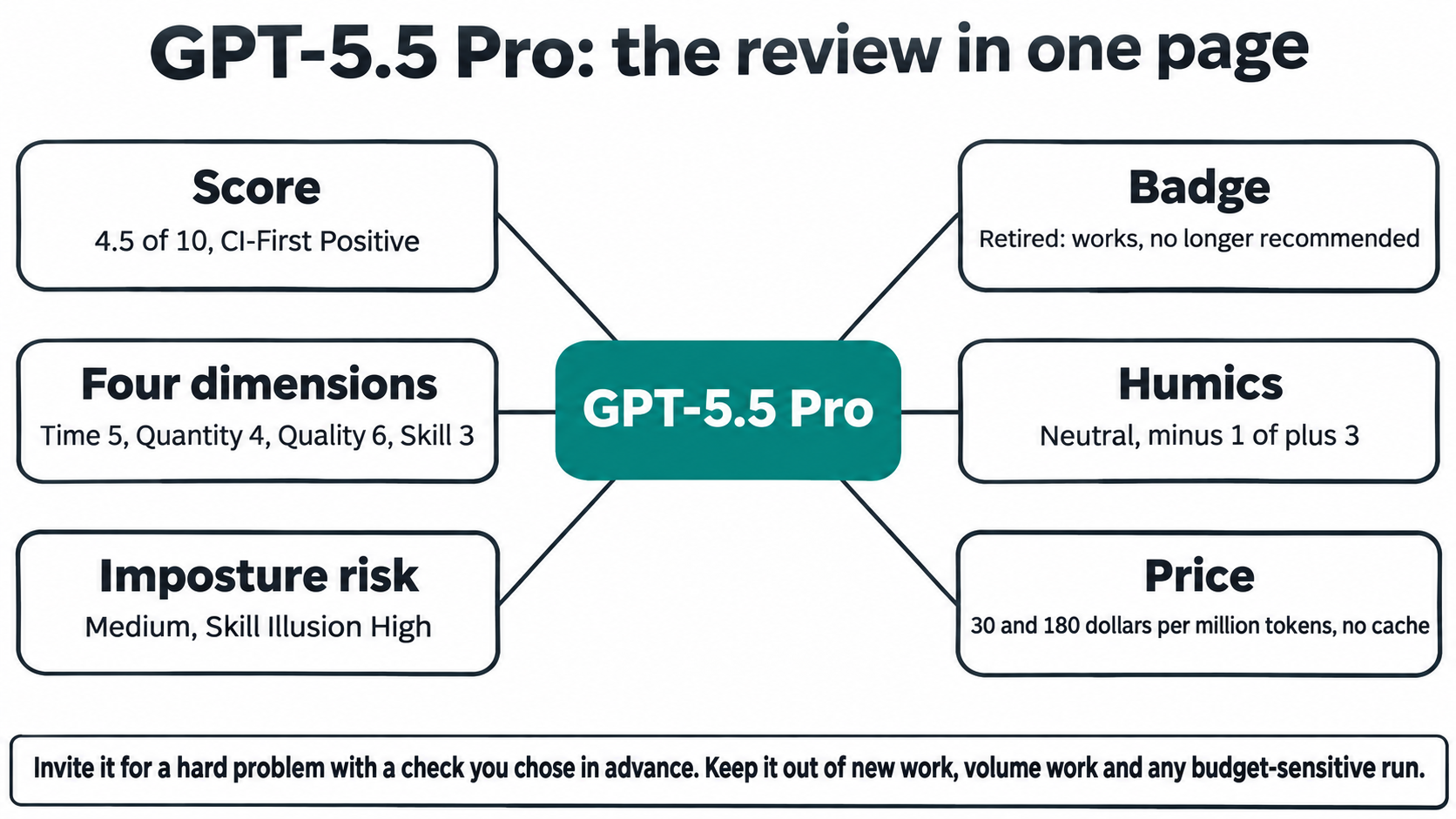
UP-Context-Engineering prompt pack
Prompt 1: Decide whether this problem deserves the premium tier at all.
Context: I have [number] hard problems this week: [list, one line each]. For each one, the
independent check I can run afterwards is [check]. My budget is [amount] and my deadline is [date].
I have access to [models and plans].
Role: AI as a routing analyst.
Profile: Act as a Co-Researcher, Analyst & Tester, applying a stated rule rather than an impression.
Task: for each problem, name the cheapest model and setting that would pass its check, say whether
gpt-5.5-pro is ever the answer, and name the one problem that would justify the most expensive option.
Constraints: one recommendation per problem. Assume a current model in standard mode first, its pro
mode second, and gpt-5.5-pro only where a dated snapshot gpt-5.5-pro-2026-04-23 is required. Do not
recommend a premium run for a problem a cheaper model would pass identically. Treat the premium tier
as having no cache discount at $30 input and $180 output per million tokens, and remember that the
endpoint is Responses and Batch only with no streaming, so a run blocks for minutes and cannot be
watched.
Output format: a table with problem, check, recommended model and setting, reason, and estimated
cost. Then one line naming the problem I should drop entirely.
Memory disclosure: this model keeps no memory between runs and no account of my earlier sessions.
The context in this prompt is the whole of what it knows, and the consumer apps' memory is not part
of this API surface.
UP-Context-Engineering verification: I chose each check before the run, I can reproduce every cost
from the token counts, and I can defend each routing decision without the model.
Data safety: do not paste client data, unpublished manuscripts, student or patient records,
credentials or third-party material under NDA. Use the business or enterprise terms, and note that
regional processing carries a 10 percent uplift.
Prompt 2: Price the workflow before you approve it.
Context: the workflow is [description]. It runs [n] times a month and carries [reviews and
exceptions] of human time per run. The candidate tier is gpt-5.5-pro at $30 input and $180 output per
million tokens with no cached input discount; the alternative is gpt-6.1-sol in pro mode at $2 and $10
with cache reads at $0.10. One run is about [input tokens] in and [output tokens] out, reasoning
included.
Role: AI as a cost analyst building the case with me.
Profile: Act as a Co-Worker & Assistant, and show the arithmetic rather than a verdict.
Task: build the cost per completed task for both tiers, then name the conditions under which the
premium tier is the right purchase and the conditions under which it is not.
Constraints: use list prices and mark every assumption as an assumption. Do not model a cache on the
premium tier, because it has none. Carry the review and exception-handling time as a cost line, and
carry the engineering time that the missing streaming and the background polling impose. If the case
depends on a number I have not given you, ask for it rather than estimating it.
Output format: Assumptions. Cost per completed task, both tiers. Break-even conditions. The three
numbers that would change the decision. One paragraph I could put in front of a finance reviewer.
Memory disclosure: nothing persists between runs. The figures above are the only facts it holds, and
it will not remember them next month.
UP-Context-Engineering verification: I can reproduce every line of the arithmetic from list prices,
and I have named the review time myself rather than accepting an estimate.
Data safety: do not paste supplier contracts, payroll, customer records or unpublished pricing. The
business plans do not train on content by default, and regional processing costs 10 percent more.
Prompt 3: Turn one premium run into a method you keep.
Context: I used [model and snapshot] on [problem] at [effort]. The result was [outcome]. My check
was [check]. The part I had to correct was [correction]. The run cost [amount], against [amount] for
the same job on [cheaper model].
Role: AI as a coach, not as a generator.
Profile: Act as a Professor, Coach & Tutor, and do not write the analysis again.
Task: write the reusable procedure I should follow next time, in my words, and name the point at
which a cheaper model would have been enough.
Constraints: no more than ten steps. Every step must be something I did, not something the model
did. Name the decision points where I had to judge, the check that caught the error, and the setting
I would change. Do not include settings that will change with the next release.
Output format: When to use this. Steps. Decision points. Checks. Where a cheaper model suffices. One
sentence on what this cost me.
Memory disclosure: this run will not be remembered. The procedure has to live in my own system or it
is lost.
UP-Context-Engineering verification: I can run this procedure without the model, and I can teach it
to a colleague in ten minutes.
Data safety: keep the problem statement general enough that no client, student or unpublished result
can be identified from it.
Related U365 content
GPT-6.1 Sol Tool Review. The replacement construction, at 6.3 with a CI-First Strong band and a $2 and $10 rate card. Read it beside this review to see what a fifteenth of the price buys today.
GPT-5.6 Sol Tool Review. The intermediate generation at $4 and $20, and the release that turned pro reasoning into a request parameter.
GPT-6 Astra Tool Review. The library's highest score at 7.0, and the model the ChatGPT Pro plan names as its Pro reasoning model.
GPT-6.1 Terra Tool Review. The volume tier at $1 and $5, for the work this model should never be pointed at.
The CI-First Evaluation Framework, version 1.4.1. The method behind the score, including the clause set applied in Strengths, Limits, and AI Imposture Risk and the status vocabulary used in Status and Last Tested.

GPT-5.5 Pro: OpenAI's April 2026 Premium Tier, Priced Against Its Own Successor
Status and Last Tested
Status: Retired. Last tested: 2026-11-14. Version reviewed: GPT-5.5 Pro, gpt-5.5-pro, dated snapshot gpt-5.5-pro-2026-04-23, announced 2026-04-23 and available on the API from 2026-04-24. Next scheduled re-check: on any of the seven triggers at the top of this document, and in any case within six months.
Retired is the badge for a tool that still works and is no longer recommended, and both halves of that sentence are load-bearing here. The model is still served: OpenAI's deprecations page carried no notice for it or for its snapshot on 2026-11-14, and its model page is live with prices, endpoints and rate limits. It is also no longer the right purchase for any new work, because two generations of successor offer the same class of capability at a fifteenth to an eighteenth of the per-token price with caching included, and because the Pro label itself moved from a model id to a request parameter.
A reader who arrives more than six months after 2026-11-14 should treat the price lines, the endpoint matrix and the ChatGPT placement as unverified until a re-check is published. The migration in the next section is written to be usable without a re-check, because the successor's rate card is the one fact this review would expect to hold.

GPT-5.5 Pro: OpenAI's April 2026 Premium Tier, Priced Against Its Own Successor
Migration Path
Migration Path is required for a Retired tool, and this one is unusually well documented because the vendor's own deprecations page names the destination. The replacement for the older gpt-5-pro is gpt-6.1-sol with reasoning.mode: pro in the Responses API. For a team on gpt-5.5-pro, the same destination applies, for the reasons in Section 12.
What transfers. Prompts and system instructions transfer without change in substance, and the context window stays at 1,050,000 tokens with the same 128,000-token output ceiling. Structured outputs transfer, and so does function calling. The hosted tool set transfers and expands: web search, file search, image generation, code interpreter, hosted shell and MCP are all available on both models, and the destination adds computer use, apply patch, skills and tool search. Image input and text output are unchanged. An evaluation suite transfers, with one change of setting: the effort ladder widens from three positions to five and gains a mode axis, so a suite that swept medium, high and xhigh should now fix a mode and sweep the effort levels inside it.
What does not transfer, and why. The model identifier changes, and with it the snapshot guarantee: gpt-5.5-pro-2026-04-23 is a dated artefact, while gpt-6.1-sol publishes no dated snapshot on its model page. The price changes by a factor of fifteen on input and eighteen on output, which is the point of the migration rather than an obstacle to it. Caching appears where there was none, at $0.10 per million cached input tokens against a previous absence of any discount. Prompts longer than 272,000 input tokens are repriced on the destination at twice the input and cache rates and one and a half times the output rate for the whole request, which is a cost cliff that did not exist on the old tier and that a team must test for. The knowledge cutoff moves forward from 2025-12-01 to 2026-04-30. Streaming becomes available, so a client built around background polling can be simplified rather than merely ported. And Chat Completions becomes available as well, which means a client that was forced onto Responses can now choose.
Migration steps, in order.
Pin the current state before touching anything. Record the model id, the snapshot, the effort setting and the prompt for every production call on gpt-5.5-pro, so the comparison after migration has a baseline.
Rebuild the call on gpt-6.1-sol with reasoning.mode: "pro" and reasoning.effort set explicitly. The destination defaults to medium effort in standard mode, and a run that intends pro mode must say so. Confirm the request shape on the Responses API before changing the client's timeout, because the destination streams and the old one did not.
Measure the token multiplier on your own tasks. Pro mode spends more work per request and OpenAI publishes no multiplier: the cost appears as tokens at $2 and $10. Run three representative tasks at standard medium, standard high and pro medium, and record input tokens, reasoning tokens and answer tokens for each.
Test the long-prompt cliff. Any prompt above 272,000 input tokens is repriced for the whole request at 2x input and cache and 1.5x output on the destination. A workflow that relied on a 300,000-token context being merely expensive is now subject to a different rate, and the test is one call, not an analysis.
Turn on caching where the context repeats. This is the migration's largest saving and the one most easily left on the table: a stable evidence set cached at $0.10 per million costs a three-hundredth of what the old tier charged for the same repeated tokens.
Re-run the evaluation suite at the mode and effort you intend to use in production. The old suite was measured at xhigh on a tier with three positions. The new suite needs a stated mode and a stated effort, or the comparison is between two different products.
Re-point the run record and the verification. LIPS entries should name the new model id and the mode, and any check that depended on a dated snapshot needs an explicit note that the destination does not offer one. Where reproducibility is a publication requirement, keep the old artefact in the record and mark the new runs as a different instrument.
Retire the old key only after the comparison is complete. Keep both paths live for one reporting cycle, so a regression is attributable rather than argued about.
What to expect on the other side. A cheaper bill by an order of magnitude, a faster answer because streaming returns, a wider tool set, and one loss that has to be managed: the dated snapshot. The capability is at least as good on every row the vendor publishes for the successor, and no published measurement shows it to be worse. The work that changes is the client, not the prompting.

GPT-5.5 Pro: OpenAI's April 2026 Premium Tier, Priced Against Its Own Successor
U365's Recommendations to Learn More
These resources were curated to help you go deeper on GPT-5.5 Pro. We prioritise material that teaches something this review does not cover.
Official learning resources
The model page: the price table, the endpoint matrix, the tools list, the rate limits and the sentence that says there is no cached input discount. The single most important page for a buyer. https://developers.openai.com/api/docs/models/gpt-5.5-pro
The markdown version of the same page, which renders the endpoint and tools tables in full where the site's tables can be hard to read. https://developers.openai.com/api/docs/models/gpt-5.5-pro.md
The launch page: the benchmark table with the four-cell Pro column, the Preparedness Framework statements and the April 24 API update note. Read the Pro column before the prose. https://openai.com/index/introducing-gpt-5-5/
API pricing: the current flagship rates, which do not include this model, and the batch, fast and regional terms that sit under them. https://developers.openai.com/api/docs/pricing
Deprecations: the three lifecycle states, the current notice table, and the recommended replacement path for the older Pro models. This is the page that names the migration target. https://developers.openai.com/api/docs/deprecations
The reasoning guide, for how effort and, on later models, mode are meant to be used. The distinction between them is the subject of Section 6. https://developers.openai.com/api/docs/guides/reasoning
Background mode, for the pattern a multi-minute request requires. https://developers.openai.com/api/docs/guides/background
The GPT-6.1 Sol model page, for the destination this review recommends and its own price, endpoint and tool tables. https://developers.openai.com/api/docs/models/gpt-6.1-sol
The Preparedness Framework, for the classification that puts biological, chemical and cyber capability at High. https://cdn.openai.com/pdf/18a02b5d-6b67-4cec-ab64-68cdfbddebcd/preparedness-framework-v2.pdf
The GPT-5.5 system card, for the safeguard design that the safety section of this review records. https://deploymentsafety.openai.com/gpt-5-5
Trusted Access for Cyber, for the application route a security researcher needs. https://chatgpt.com/cyber
The plans page, where this model now appears only under legacy models. https://chatgpt.com/pricing/
Video tutorials and channels
We Tested $200 GPT-5.5 Pro on PhD Level Math, by Easy Riders. The closest thing in the record to a test of the one row where this tier opens real distance, framed around the consumer plan rather than the API rate. https://www.youtube.com/watch?v=r4p5wGG_DgI
I Tested GPT 5.5 Pro vs. GPT 5.5: Here's What You Need to Know, by The Nerdy Novelist. A side-by-side on the comparison the vendor's own table only half makes. https://www.youtube.com/watch?v=1r7LeAh_0mM
I Tested GPT-5.5 Medium/High/xHigh Reasoning Levels: CLEAR Difference, by AI Coding Daily. The three settings this endpoint exposes, tested against each other, which is the cost decision a buyer has to make. https://www.youtube.com/watch?v=_NNni_fT3ps
OpenAI GPT-5.5 Full Review: Real Upgrade or Expensive Agent Hype?, by Fluid Coding & AI. A sceptical review of the release as a whole, useful as a contrast with the launch page's own framing. https://www.youtube.com/watch?v=ZKdhrVoUUKM
Written tutorials and deep-dive articles
Artificial Analysis, the model page: a page with no intelligence index, no cost per task, no speed and no benchmarked providers. Read it as a record of what independent measurement does not exist. https://artificialanalysis.ai/models/gpt-5-5-pro
Artificial Analysis, the providers page: "Total 0 providers", and the explicit statement that the model is not currently available through any API provider it benchmarks. https://artificialanalysis.ai/models/gpt-5-5-pro/providers
BenchLeader, the model page: independent results from Epoch, ARC Prize and SimpleBench, cost estimates for five task shapes, and the reason the model is not ranked. https://www.benchleader.com/models/gpt-5-5-pro
The Epoch AI Benchmarking Hub, for the FrontierMath v2 and ECI figures BenchLeader republishes and for the version differences the Faculty Note explains. https://epoch.ai/eci
meo, the model page: one third-party benchmark that does place the model, at rank 4 of 83 with $0.3197 per correct answer and 56 seconds per item. https://meoadvisors.com/learn/models/openai/gpt-5.5-pro
SiliconANGLE's launch report, for the positioning as the technology press read it on the day, including the FrontierMath Tier 4 comparison with Claude Opus 4.7. https://siliconangle.com/2026/04/23/openai-releases-gpt-5-5-advanced-math-coding-capabilities
AI/TLDR's model page, for a plain specification sheet assembled from the vendor's own pages, including the streaming and fine-tuning exclusions. https://ai-tldr.dev/models/gpt-5-5-pro/
Community and social
Hacker News, the launch thread: 1,580 points and 1,010 comments, the largest single record of practitioner reaction, and the place where the Pro tier is almost never discussed. https://news.ycombinator.com/item?id=47879092
Hacker News, the API release thread: 256 points and 159 comments, including the first-day question about what a pro model is for and the pricing reaction that followed. https://news.ycombinator.com/item?id=47894000
Hacker News, the Ask HN thread comparing frontier models with GPT-5.5 Pro rather than xhigh, which is the clearest user statement of the tier's case and its latency cost. https://news.ycombinator.com/item?id=48496661
Resources on X
Dedicated X channels. Three accounts carry this release: OpenAI's company account, which posted the launch; the OpenAI Developers account, which carried the API availability; and the Artificial Analysis account, which publishes the independent measurements this review cites, including the absence of any for this model.
@OpenAI, the company account: https://x.com/OpenAI
@OpenAIDevs, the developer account: https://x.com/OpenAIDevs
@ArtificialAnlys, the independent evaluation account: https://x.com/ArtificialAnlys
Read any post against the measurement rather than against its own caption, and treat a launch-day thread as a pointer to a source rather than as a source.


GPT-5.5 Pro: OpenAI's April 2026 Premium Tier, Priced Against Its Own Successor
CI-First Evaluation Summary Card
Field | Value |
Tool | GPT-5.5 Pro, operated by OpenAI |
Category | Applied AI / Large Language Model (hard-problem reasoning, research analysis and long-context document work) |
Version reviewed | GPT-5.5 Pro (gpt-5.5-pro, dated snapshot gpt-5.5-pro-2026-04-23, announced 2026-04-23, API 2026-04-24), as documented by the vendor on 2026-11-14 |
Status | Retired |
Last tested | 2026-11-14 |
CI-First Profile | Primary: Co-Researcher, Analyst and Tester (level 4). Secondary: Challenger, Critic and Devil's Advocate (level 5) for manuscript and argument critique, Co-Worker and Assistant (level 2) for structured document work |
CI-First Benefit Score | 4.5 / 10 (CI-First Positive) |
Time | 5, a real saving on hard problems that would take a person days, against several minutes per request, no streaming, background polling, 18 to 30 output tokens per second and a first answer token at 68 seconds on the measured route |
Quantity | 4, one comprehensive artefact per run through a 1,050,000-token window and a 128,000-token output ceiling, with volume ruled out by $30 and $180 per million tokens and no cache discount |
Quality | 6, a measurement cap rather than a measured failure: the vendor's four Pro rows lead the base model on FrontierMath Tier 4 at 39.6 against 35.4, Tier 1 to 3 at 52.4 against 51.7 and BrowseComp at 90.1 against 84.4, and trail it on GDPval at 82.3 against 84.9, while the independent record carries no intelligence index and no benchmarked provider |
Skill | 3, execution with the method hidden: no teaching mode, reasoning tokens invisible, no stream to watch an argument form, and a price that discourages the repeated attempts through which a person would learn |
Humics Protection Badge | Humics-Neutral (-1 / +3) |
Creativity | 0 Neutral: it critiques, proposes analyses and stress-tests arguments, which can strengthen a research programme's creative work, but it originates nothing in the common case and the one generative example in the launch material came from an internal evaluation setup rather than this endpoint |
Critical Thinking | -1 Erodes: it answers exactly the questions a fellow should learn to reason through, in a long, confident form with invisible reasoning, in a workflow where the human progressively stops forming the objection first |
Social Authenticity | 0 Neutral: clause 4.2-a returns a null for the model as a generator; the live condition is an application that sends this model's analysis under a person's name unread |
AI Imposture Risk | Medium overall, with Skill Illusion High |
Time Illusion | Medium: real savings on the intended class, negative on everything else, against minutes per call, background polling, no streaming and a queue the user has to design |
Quantity Illusion | Low: the price prevents volume, one long answer per run, and the residual risk is length mistaken for coverage rather than volume that disappears under inspection |
Skill Illusion | High: a research-grade answer to a problem the user chose because they could not solve it, from a tier whose price signals competence, with the reasoning invisible and the output too long to audit line by line; mitigations are stated in Strengths, Limits, and AI Imposture Risk |
Clause 5.2.3-a | NULL as a generator, with a live condition: the API model writes no memory, skill or standing instruction, and the consumer surface's memory would apply the clause only if it began writing procedure by default |
Clause 4.2-a | NULL as a generator, with a live condition: an application that sends this model's text in a person's own name without the person reading it first would meet erosion condition (a) |
Clause 7.5 | Removed by framework v1.4 on 2026-10-13, not assessed; recorded so that a reader comparing reviews knows why it is absent |
Section 7c finding | Biological, chemical and cyber capability classified High under the Preparedness Framework with stricter cyber classifiers; permissive cyber access runs through Trusted Access for Cyber rather than a purchase; the API launch was gated and arrived a day later with additional safeguards; the Pro endpoint is Responses and Batch only with no streaming, no computer use and no cached input discount; the vendor still serves the model while Artificial Analysis benchmarks zero providers for it. No sub-score changed, for reasons stated in the section |
Superhuman usage | Invite for a manuscript or argument critique, a hard problem with a check chosen in advance, a due-diligence synthesis with a source per field, and the reproduction of a pinned run; keep out of new integrations, documents and routine analysis, repeated-context work, interactive work, agentic computer work, permissive cyber work and any budget-sensitive setting |
Over-delegation warning | The failure mode is a fellow who pays five dollars for an answer, receives a long review with a derivation attached, and stops forming objections because the answer was expensive. If you cannot say why that problem needed this tier, what you checked, and what you would do differently at a fifteenth of the price, the premium bought a feeling rather than a result |
Verification checklists | Per workflow, in Real Workflows: multi-model check, external source or independent check, human review, assumption or coverage audit, CI-First test |
U365 methods | LIPS holds the snapshot, the effort setting, the evidence set and the verification record, because the endpoint has no stream and no state to reconstruct from. ULM is the six-domain frame that holds the decision about whether the work is worth buying; the cost per completed task that answers it is CI-First cost engineering, in Career and Finance. UP-Context-Engineering writes the context, role, task, constraints and output order the workflows use. UNOP: no fit, because the tier answers rather than teaches |
Re-check triggers | A deprecation notice for the model or its snapshot; any change to the two price lines or to the absence of a cache discount; a first published independent intelligence score; any change to the reasoning controls; any change to the endpoint or tool matrix; any change to the ChatGPT placement; and a price change on the successor construction |

GPT-5.5 Pro: OpenAI's April 2026 Premium Tier, Priced Against Its Own Successor
Glossary
CI-First
Co-Intelligence First: the U365 principle that the human is the ruler and the orchestrator and AI is the amplifier. The question this review answers with a score is whether the tool makes co-intelligence more profitable than human intelligence alone. GPT-5.5 Pro is a CI-First Positive instrument for one narrow class of work: it amplifies a researcher on a problem with a checkable answer, at a price and on an endpoint that rule out daily use.
CI-First Benefit Score
The arithmetic mean of the four benefit dimensions, each scored 0 to 10, rounded to one decimal place. 0 to 2.0 is CI-First Negative, 2.1 to 4.0 is CI-First Neutral, 4.1 to 6.0 is CI-First Positive, 6.1 to 8.0 is CI-First Strong, and 8.1 to 10 is CI-First Transformative. GPT-5.5 Pro scores 4.5, which is Positive.
Time Benefit
Whether the tool returns more time than it costs, after the overhead of using it is subtracted. GPT-5.5 Pro is 5: a hard problem answered in minutes that a person would take days to attempt, against several minutes per request, no streaming, background polling and a first answer token at 68 seconds on the measured route.
Quantity Benefit
Whether the same time produces more usable output. GPT-5.5 Pro is 4: one comprehensive artefact per run through a 1,050,000-token window and a 128,000-token ceiling, with volume ruled out by the price and by the absence of a cache discount.
Quality Benefit
Whether the output is better, verified and durable. GPT-5.5 Pro is 6: the strongest hard-reasoning rows in the vendor's table, a general-work row that trails the cheaper base model, and an independent record with no intelligence index and no benchmarked provider. The score is a measurement cap, not a measured failure.
Knowledge and Skill Benefit
Whether the user gains lasting capability. GPT-5.5 Pro is 3: execution with the method hidden, no teaching mode, invisible reasoning, and a price that discourages the repeated attempts through which a person would learn.
CI-First Profile
The role the AI plays in your working relationship. (level 1) Co-Creator and Thought Partner, (level 2) Co-Worker and Assistant, (level 3) Professor, Coach and Tutor, (level 4) Co-Researcher, Analyst and Tester, (level 5) Challenger, Critic and Devil's Advocate. Lower level numbers indicate higher AI autonomy in the collaboration. GPT-5.5 Pro is primarily a Co-Researcher, Analyst and Tester (level 4), with level 5 as a secondary for critique work.
Humics
The set of capabilities that are uniquely human, as defined by Pascal Bornet: creativity, critical thinking and social authenticity. The framework asks whether a tool strengthens, leaves neutral or erodes each one.
Humics Protection Badge
A rating of whether a tool protects, leaves neutral or erodes the three human capabilities: Creativity, Critical Thinking and Social Authenticity. Each is scored +1, 0 or -1 and the sum gives the badge. +2 to +3 is Humics-Friendly, -1 to +1 is Humics-Neutral, -2 to -3 is Humics-Risky. GPT-5.5 Pro is Humics-Neutral at -1 / +3.
AI Imposture Risk
The likelihood that a tool traps you in one of three illusions. The Time Illusion is the appearance of saving time when net time is lost. The Quantity Illusion is high volume that does not survive inspection. The Skill Illusion is the appearance of competence while the underlying skill is absent or eroding. Each trap is rated Low, Medium or High with cited evidence. The overall level is Low when all three are Low, Medium when one, two or three traps are Medium or when one trap is High with clear mitigations stated, and High when two or more traps are High or when the tool's core value proposition is built on an illusion. GPT-5.5 Pro is Medium overall, with Skill Illusion High.
Reasoning effort
The setting that decides how much work a reasoning model does before it answers. On GPT-5.5 Pro it accepts medium, high (the default) and xhigh, and the reasoning tokens it produces are billed at the output rate and count against the maximum output tokens. Later OpenAI models separate reasoning mode (standard or pro) from reasoning effort, which makes the earlier single dial a useful lesson in how a capability premium can migrate from a product to a parameter.
Cost per completed task
The total token cost of finishing one real task, rather than the price of one million tokens. On GPT-5.5 Pro it is computed from input tokens at $30, output and reasoning tokens at $180, with no cache discount to model. It is the only honest way to compare a premium tier with a cheaper construction, because a cheaper model that needs more tokens can cost more per task, and an expensive model that answers in one run can cost less than a cheap one that needs five.
User Sentiment
The aggregate of what users report about a tool, kept separate from the framework's own findings. No review platform carries model-level data for GPT-5.5 Pro. The signal is the Hacker News launch thread and API release thread, both directional, both from the first days of availability, and both notably quiet on the Pro tier specifically.
Review Status
The badge at the top of this review. The vocabulary is: Active, the tool is current and recommended; Active (updated), recently re-checked and refreshed; Changed, a re-check trigger has fired and an update is pending; Risky, the tool has significant unresolved issues or has been clearly surpassed, so use it with caution; Stale, not re-checked in over six months, so pricing and features are unverified; Retired, the tool still works but is no longer recommended; Deprecated, the tool has been shut down or fundamentally changed.
Last tested and Re-check
The date this review's evidence was gathered and the condition that forces a new pass. GPT-5.5 Pro was tested on 2026-11-14 and re-checks on any of the seven triggers listed at the top of this document, and in any case within six months.

GPT-5.5 Pro: OpenAI's April 2026 Premium Tier, Priced Against Its Own Successor
Sources
Vendor primary sources
The launch page, for the positioning, the benchmark table with the Pro column, the Preparedness Framework statements, the pricing announcement and the April 24 API update: https://openai.com/index/introducing-gpt-5-5/
The model page, for the model id, the snapshot, the context and output limits, the effort levels, the price table, the no-cache statement, the regional uplift, the endpoint matrix, the tools list and the rate limits: https://developers.openai.com/api/docs/models/gpt-5.5-pro
The markdown form of the model page, which renders the endpoint and tools tables in full: https://developers.openai.com/api/docs/models/gpt-5.5-pro.md
The API pricing page, for the current flagship rates and for the batch, fast, ultrafast and regional terms: https://developers.openai.com/api/docs/pricing
The deprecations page, for the three lifecycle states, the notice table, and the recommended replacement of gpt-5-pro with gpt-6.1-sol in pro mode: https://developers.openai.com/api/docs/deprecations
The reasoning guide, for effort and, on later models, the mode setting: https://developers.openai.com/api/docs/guides/reasoning
Background mode, for the pattern a multi-minute request requires: https://developers.openai.com/api/docs/guides/background
The GPT-6.1 Sol model page, for the destination's price table, endpoint matrix and tool list: https://developers.openai.com/api/docs/models/gpt-6.1-sol
The GPT-5.5 system card, for the safeguards described in the April 24 update: https://deploymentsafety.openai.com/gpt-5-5
The Preparedness Framework, for the classification that places biological, chemical and cyber capability at High: https://cdn.openai.com/pdf/18a02b5d-6b67-4cec-ab64-68cdfbddebcd/preparedness-framework-v2.pdf
Trusted Access for Cyber, for the application route and the verified-access conditions: https://chatgpt.com/cyber
The personal plans page, for the current model list that places GPT-5.5 Pro under legacy models and names GPT-6 Astra as the Pro plan's reasoning model: https://chatgpt.com/pricing/
The business pricing page, for the seat prices and the no-training-by-default statement: https://openai.com/api/pricing/
Independent and industry sources
Artificial Analysis, the GPT-5.5 Pro model page, for the absence of an intelligence index, cost per task, output speed and verbosity reading: https://artificialanalysis.ai/models/gpt-5-5-pro
Artificial Analysis, the providers page, for "Total 0 providers" and the statement that the model is not currently available through any API provider it benchmarks: https://artificialanalysis.ai/models/gpt-5-5-pro/providers
BenchLeader, the GPT-5.5 Pro page, for the independent results from Epoch, ARC Prize and SimpleBench, the effort-level speed and first-answer figures, the five task-cost estimates and the explanation of why the model is unranked, data as of 2026-11-14: https://www.benchleader.com/models/gpt-5-5-pro
Epoch AI Benchmarking Hub, for the FrontierMath v2 and Epoch Capabilities Index figures that BenchLeader republishes: https://epoch.ai/eci
meo, the GPT-5.5 Pro page, for one independent placement at rank 4 of 83, $0.3197 per correct answer and 56 seconds per item, read as of 2026-11-04: https://meoadvisors.com/learn/models/openai/gpt-5.5-pro
SiliconANGLE, the launch report, for the positioning and the FrontierMath Tier 4 comparison as the technology press reported it: https://siliconangle.com/2026/04/23/openai-releases-gpt-5-5-advanced-math-coding-capabilities
AI/TLDR, the GPT-5.5 Pro page, for a plain specification sheet assembled from the vendor's own pages: https://ai-tldr.dev/models/gpt-5-5-pro/
Community and community-reported evidence
Hacker News, the launch thread, 1,580 points and 1,010 comments, read on 2026-11-14, for every quoted commenter in this review: https://news.ycombinator.com/item?id=47879092
Hacker News, the API release thread, 256 points and 159 comments, read on 2026-11-14, for the first-day use-case question and the pricing reaction: https://news.ycombinator.com/item?id=47894000
Hacker News, the Ask HN thread comparing frontier models with GPT-5.5 Pro rather than xhigh, for the clearest user statement of the tier's case: https://news.ycombinator.com/item?id=48496661
Review platform sources
No reviews found on G2, Capterra, Trustpilot or Product Hunt for this model endpoint. Those platforms rate AI products and companies rather than individual model endpoints, and none publishes a model-level figure for GPT-5.5 Pro. This review states that rather than inventing a rating.
Framework and method
The U365 CI-First Evaluation Framework, version 1.4.1, which is the scoring method used here: CI-First Evaluation Framework
The U365 INSIDE Tools review template, which sets the structure of this post and the tool-type variants applied in it: INSIDE Tools Review template
Published U365 INSIDE Tools reviews, read as comparisons and named in this post, including the GPT-6.1 Sol, GPT-5.6 Sol, GPT-6 Astra and GPT-6.1 Terra reviews: INSIDE Tools reviews
The U365 methods house pages, for the UP-Context-Engineering Method, ULM, LIPS and UNOP as they are published: U365 methods

GPT-5.5 Pro: OpenAI's April 2026 Premium Tier, Priced Against Its Own Successor
Faculty Note on Evidence Quality
Six things should be said plainly about the evidence behind this review, because they change how much weight a reader should put on each part of it.
First, the vendor's Pro column is four cells wide, and one of those cells contradicts the tier. The launch table gives GPT-5.5 Pro a figure in exactly four rows: FrontierMath Tier 4, FrontierMath Tier 1 to 3, BrowseComp and GDPval. Three lead the base model. The fourth, GDPval at 82.3 against 84.9, puts the premium tier below the cheaper model on the evaluation built from 44 occupations. That is the most consequential number in the release and it is easy to miss, because the launch prose discusses the base model and the Pro column is a row a reader has to go looking for.
Second, there is almost no independent intelligence measurement, and the absence is documented rather than inferred. Artificial Analysis publishes a model page with no index, no cost per task, no speed and no verbosity reading, and its providers page states that no API providers are currently available for the model it benchmarks. BenchLeader carries results from independent publishers and does not rank the model, because its index requires at least five independent results across two categories. Any sentence in this review that sounds like an independent verdict rests on aggregator-sourced figures or on one third-party benchmark, and it is labelled that way.
Third, two sets of FrontierMath numbers are live and they are not comparable. The vendor reports 52.4 percent on Tier 1 to 3 and 39.6 percent on Tier 4 for this model. The Epoch Benchmarking Hub figures that BenchLeader republishes show 87.7 and 78.0 percent on what are labelled v2 versions of the same benchmarks. Those are different task sets and different scoring, and setting them side by side would produce a fake comparison. Both are in this review, each in its own place, and neither is used to support a score.
Fourth, the cost estimates are floors, not invoices. BenchLeader's estimates are built from list price, measured speed and assumed token counts, and it states that reasoning tokens are not modelled. On a reasoning model billed at $180 per million output tokens, unmodelled reasoning tokens can be most of the bill, and a run that spends 30,000 reasoning tokens and returns 2,000 answer tokens costs $5.76 of which the visible answer is $0.36. Every cost figure in this review is either a list-price arithmetic result that a reader can reproduce or an estimate labelled as a floor.
Fifth, the community record is a first-days signal from practitioners, and for the Pro tier specifically it is close to silent. The launch thread is large and specific about base GPT-5.5's coding gains. It contains almost nothing about the Pro tier, and the API thread's first substantive comment asks what a pro model is even for. This review attributes every quotation to its handle, states where a quotation is about the base model rather than the tier, does not aggregate the threads into a rating, and treats the silence as evidence about positioning rather than as evidence about capability.
Sixth, this review scores a construction that no longer exists as a product. The Pro label moved from a separately named model to a value of reasoning.mode within three months, and the price attached to it moved by a factor of fifteen on input and eighteen on output. That means a reader comparing this review with a review of a current "Pro" is comparing two billing shapes rather than two versions of one thing, and it means the score is a judgment about an artefact whose moment has passed. The framework's answer is not to inflate the score for a historical instrument: it is to score what the tool does, badge it Retired, and put the migration in writing. A reader who takes one sentence from this review should take that one.

GPT-5.5 Pro: OpenAI's April 2026 Premium Tier, Priced Against Its Own Successor
Status and Re-check
Status: Retired | Last tested: 2026-11-14 | Re-check: trigger-based (max 6 months)
Retired: the tool still works but is no longer recommended. See the Migration Path section.
For detailed explanations of the CI-First evaluation terms used in this review, including the Humics Protection Badge and the AI Imposture Risk levels, see the Glossary at the end of this post.
Re-check triggers:
A deprecation notice for gpt-5.5-pro or for its dated snapshot gpt-5.5-pro-2026-04-23. OpenAI's deprecations page carried no entry for either on 2026-11-14, so the model is still served. A notice would move this review from Retired to Deprecated, and would make the migration in the Migration Path section urgent rather than prudent.
Any change to the two price lines. $30 per million input tokens and $180 per million output, with no cached input discount and a 10 percent uplift on regional processing endpoints. The absence of a cache discount is the fact this review's cost arithmetic rests on, and one line change would rewrite it.
A published independent intelligence score. Artificial Analysis lists the model with no measured index, no cost per task, no speed and zero benchmarked providers. BenchLeader states plainly that the model is not ranked because it needs at least five independent results across two categories. A first full independent score would change the Quality rationale.
Any change to the reasoning controls. reasoning.effort accepts medium, high (the default) and xhigh only, and reasoning tokens count against the output ceiling. A widened or narrowed effort set changes both the cost and the reliability case.
Any change to the endpoint or tool matrix. The model is served on the Responses API and the Batch API only, with no streaming, no Chat Completions, no computer use, no apply patch, no skills and no tool search. An added endpoint or tool changes what a fellow can build on it.
Any change to the ChatGPT placement. At launch the tier was offered to ChatGPT Pro, Business and Enterprise users. On 2026-11-14 the personal plans list GPT-5.5 Pro only under legacy models, and the Pro plan names GPT-6 Astra as its Pro reasoning model.
A price change on the successor construction. GPT-6.1 Sol with reasoning.mode set to pro carries $2 and $10 per million tokens with cache reads at $0.10. The 15 times input and 18 times output gap against this model is the core of the migration advice, and a change on either side moves it.
GPT-5.5 Pro scored 4.5 out of 10 under the CI-First Evaluation Framework, version 1.4.1, which is CI-First Positive, with a Humics-Neutral badge at -1 and a Medium AI Imposture Risk carrying a High Skill Illusion. The badge is Retired because two generations of successor sell the same class of reasoning at a fifteenth to an eighteenth of the per-token price with caching included, and because the Pro label moved from a separately named model to a request parameter. The model remains documented and served by its vendor on 2026-11-14, and this review will be re-checked on a deprecation notice, a price change on either side of the migration, the first published independent intelligence score, or any change to the reasoning controls, the endpoint and tool matrix, or the consumer placement.
Review conducted by URC under the CI-First Evaluation Framework, version 1.4.1. Scoring date 2026-11-14. Tool version reviewed: GPT-5.5 Pro (gpt-5.5-pro, dated snapshot gpt-5.5-pro-2026-04-23, announced 2026-04-23).




Comments