
Recruiting Your AI Model, November 2026: Important questions before the first session prompt


UIT, UIB, UIC, UID Cross-institute lecture
Series Model Recruitment
Duration 35 to 40 minutes
Delivering institutes: UIT (Institute of Technology); UIB (Institute of Business); UIC (Institute of Communication); UID (Institute of Design)

UNOP Sound (University 365 Neuroscience Oriented Pedagogy)
Take five minutes to prepare your brain. Play the isochronous tone track (40Hz gamma frequency) with your eyes closed. Gamma-frequency tones before a learning session raise attention and make the material easier to absorb.
[Audio player: UNOP Pre-Lecture Isochrone (40Hz, 5 minutes)]
In this Lecture


Recruiting Your AI Model, November 2026: Important questions before the first session prompt
Before You Choose: CI-First and the Recruitment Order
This edition is dated November 2026 on purpose. U365 replaces it every month with a new edition that carries the latest models, prices, tools and advice. Use this edition for decisions made this month. If you are reading it later, check the current edition before you recruit, because the bench will have moved.
CI-First makes you AI-Native. The protocol is simple: always invite AI to the table, as often as possible, across the five AI Profile missions.
Co-Creator and Thought Partner
Co-Worker and Assistant
Professor, Coach and Tutor
Co-Researcher, Analyst and Tester
Challenger, Critic and Devil's Advocate
But an invitation is not a hire. Before you write the first session prompt in an AI chat tool or even for an AI Agent, you must recruit a model that fits the mission, the role you give it, the expertise you expect, and the difficulty of the task. UP-Context-Engineering method puts that recruitment prerequisite before everything else. The prompt is the job description. The model is the hire.
This order matters because the same request produces different results from different bands. A Co-Worker task such as formatting a weekly report does not need a frontier reasoning model. A Co-Researcher task such as reconciling five sources does not belong on the cheapest high-volume model. A Challenger task such as attacking a board decision needs a model that can hold the whole argument and disagree with it.
To help you choose, CI-First suggests, as a metaphor, comparing the model's intelligence or cognitive skills to the equivalent academic degree it would hold if it were a human. That is the AI starting band in the table.
AI Profile mission | AI starting band | Effort | What the brief could carry |
Co-Creator and Thought Partner | Master | High | taste, constraints, examples of work you admire |
Co-Worker and Assistant | Bachelor | Medium | the task, the format, the tools allowed |
Professor, Coach and Tutor | Bachelor to Master | Medium to high | the learner's level, the outcome, the patience required |
Co-Researcher, Analyst and Tester | Master | High | sources, method, what counts as proof |
Challenger, Critic and Devil's Advocate | Master to PhD | High | the decision to attack, the evidence standard |
The bands are a starting point. Your test cases decide the final hire. The rest of this lecture gives you the seven questions that take you from a task to a tested choice in about five minutes.

Recruiting Your AI Model, November 2026: Important questions before the first session prompt
The Seven Questions
Ask the questions in this order. Each answer removes candidates, so the list gets shorter and the decision gets easier.
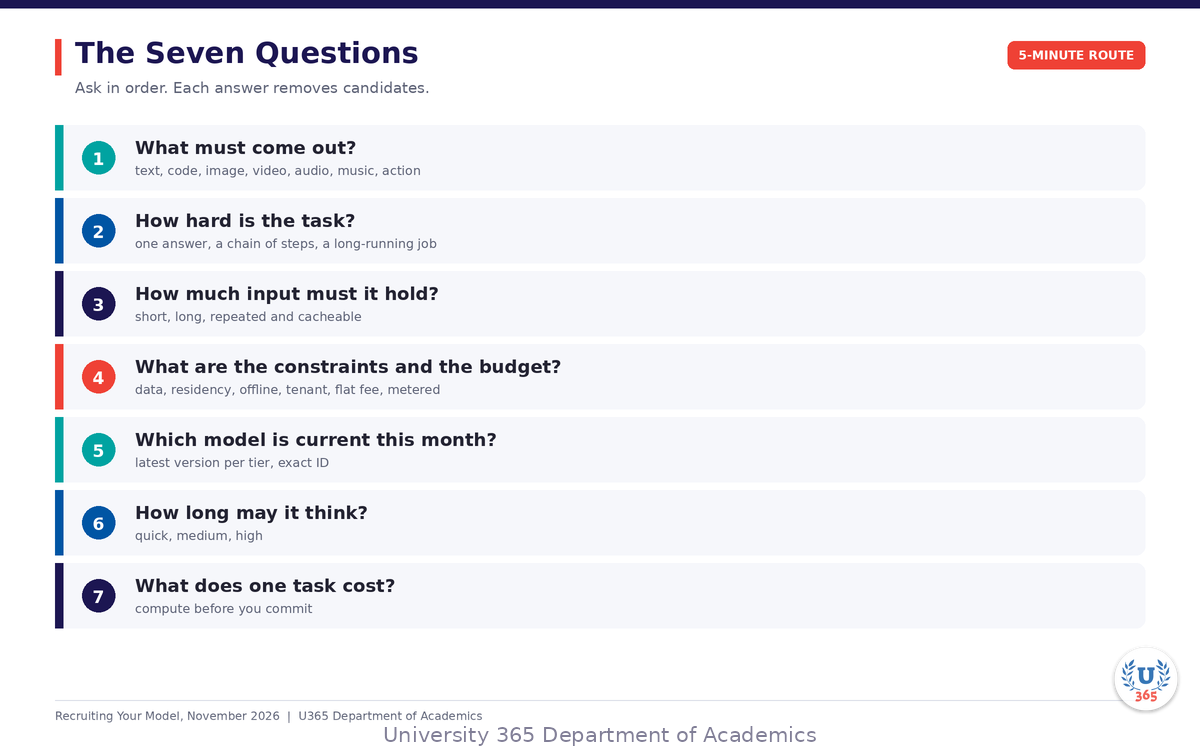
Question | What you are deciding | Typical answers |
1. What must come out? | the bench: text, image, video, voice, music, action | text, code, image, video, audio, music, tool action |
2. How hard is the task? | the band | one answer, a chain of steps, a long-running job |
3. How much input must it hold? | context and caching | short, long, repeated |
4. What are the constraints and the budget shape? | the route | data rules, residency, offline, tenant, flat fee, metered |
5. Which model is current this month? | the shortlist | the latest version per tier, exact ID |
6. How long may it think? | effort | quick, medium, high |
7. What does one task cost? | the final hire | cost per completed task |
The five-minute route: answer questions 1 to 4 in writing (two minutes), take the shortlist from question 5 (one minute), pick the effort in question 6 (one minute), and compute the cost in question 7 (one minute). If you only have five minutes, stop after question 5 and run the task on the middle candidate. You will still be better placed than the fellow who picked by brand.

Recruiting Your AI Model, November 2026: Important questions before the first session prompt
Questions 1 to 4: Output, Difficulty, Input, Constraints
Question 1: What must come out?
Write one sentence. Not "use AI for the report". Write: "Turn the 32-page supplier contract into a one-page summary of obligations, deadlines and termination rights, for a non-lawyer manager."
If the output is... | Go to |
text, code, a table or a document | the text bench in this lecture |
an image, a video, a voice track, a transcript or a music track | the modality benches, then come back to questions 6 and 7 |
an action in a tool, a browser or a desktop | the text bench, then add the autonomy check in question 4 |
One session, one output type. A model asked to write the strategy, design the slide and narrate the video will do three jobs badly. Split the work and recruit for each part.
Question 2: How hard is the task?
If the task is... | AI model with equivalent level |
one answer: classify, extract, rewrite, translate | Associate or Bachelor |
a chain of steps: compare, reconcile, propose | Master |
a long-running job: research, draft, test, revise | Master or PhD, with tools and a review point |
A one-answer task rarely justifies the most expensive model. A long-running job rarely succeeds on the cheapest one.
Question 3: How much input must it hold?
If the input is... | Check |
under a few pages | no special requirement |
a long document or several documents | the context window on the exact model page |
the same large input used many times | the cached input price and the cache lifetime |
Context windows differ inside a family. Anthropic lists 1M tokens on its current models, Google lists 1M on the Gemini 4 line, and OpenAI varies by variant. A long input can also cross a provider's surcharge threshold. Read that line before you paste the file.
Question 4: What are the constraints and the budget shape?
Constraint | What it decides |
Data may not leave the organisation | enterprise tenant, private cloud or local open weights |
The provider may not train on the data | paid API or enterprise terms, not a free consumer tier |
Offline or poor network | local open weights |
Approved providers only | the route, before the model |
Flat subscription | quota, speed and model access, not token price |
Metered API | cost per task, computed before you commit |
Fixed infrastructure | the largest model your hardware can hold |
If you use Copilot, you are not choosing a model. You are using a door into whichever models your Microsoft 365 tenant has enabled. The model list is a tenant decision, not a personal one.
Write your four answers down. They are the input to question 5.

Recruiting Your AI Model, November 2026: Important questions before the first session prompt
Question 5: The Current Bench
The menu is easier to read when you group models by the kind of work they can hold. U365 uses an academic scale for that grouping. It describes the model, never the fellow. You are the recruiter. The model is the candidate. The ladder is not a comment on your own education, seniority or intelligence.
Band | What the model can hold | Typical job |
Associate | narrow tasks, high volume, short answers | extraction, classification, routing, first drafts |
Bachelor | general professional work | drafting, summarising, standard analysis |
Master | multi-step work, code, judgement, long documents | engineering, research synthesis, complex drafting |
PhD | frontier reasoning, long-horizon work, high stakes | hard analysis, architecture, adversarial review |
Specialist | one domain, restricted scope | legal, life sciences, security |
Three rules keep the ladder honest:
The band predicts the kind of work, not the quality of a specific answer. Only your own test cases tell you whether this model, with this brief, produces a good result.
The brief can raise performance more than a band step. A Bachelor-band model with a precise role, a full context file and three worked examples often beats a PhD-band model given a one-line request.
Effort is not seniority. The same model at higher effort is the same graduate working a longer shift, not a better degree.
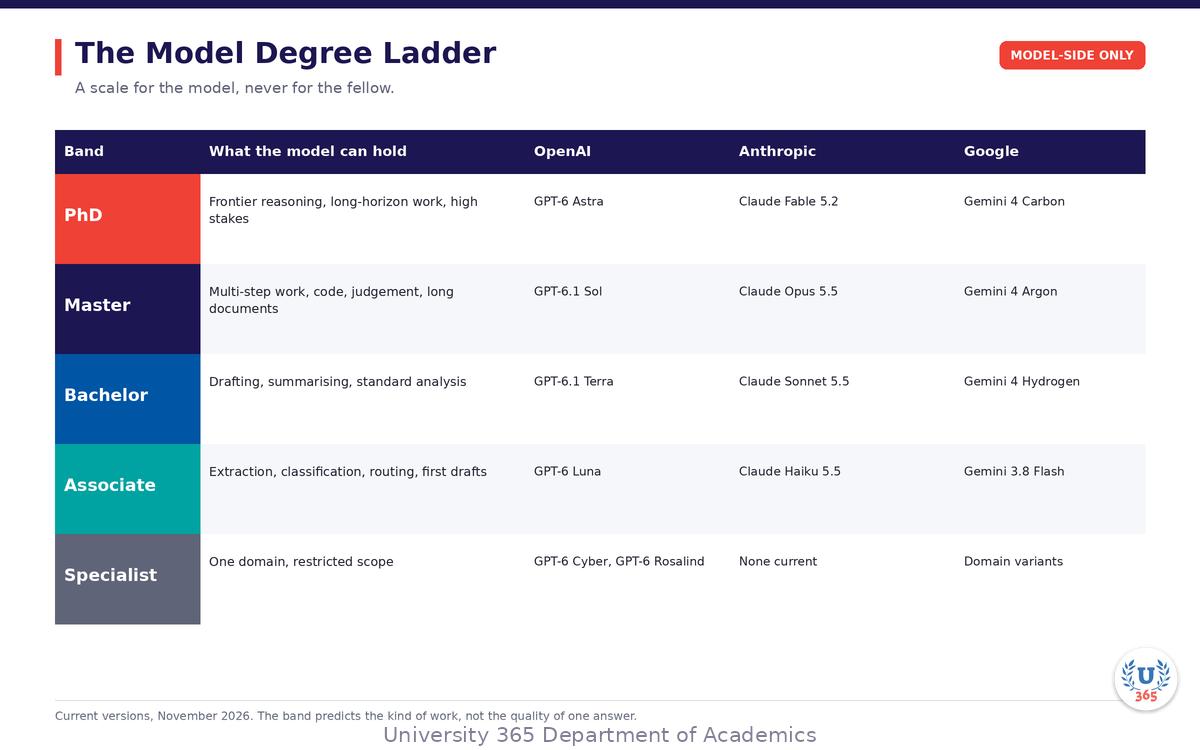
The November 2026 bench
Only the latest publicly available version in each tier is listed. Previous versions are not part of this table.
Confidentiality comes before capability. A model that cannot legally receive your data is not a candidate. Consumer chat tiers and business or API tiers do not follow the same rules. The table after this bench records the default, the control and the contractual condition for each lab. Read it before you paste a client document into any model.
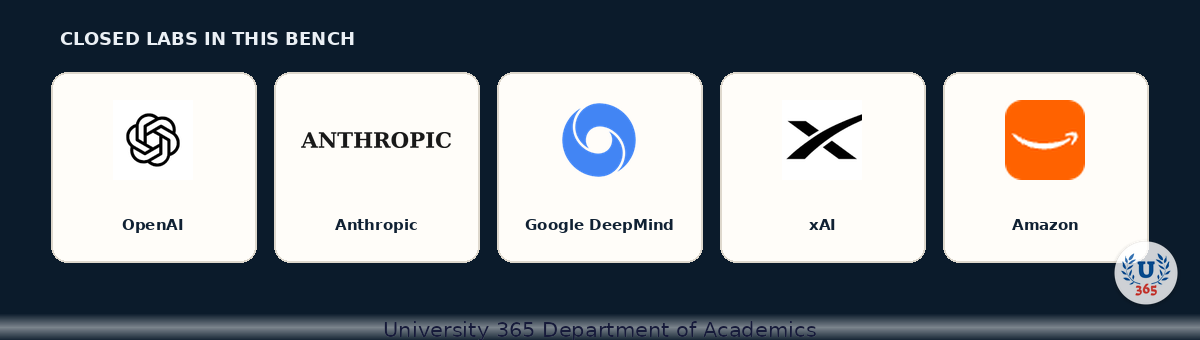
The panel. The closed list is OpenAI, Anthropic, Google DeepMind, xAI and Amazon. The open list is Meta, Mistral AI, DeepSeek, Alibaba Qwen, Moonshot AI Kimi, Zhipu AI, MiniMax and OpenAI's open-weight line. Only a current, publicly available model that fits a band enters the table. Open-weight models are compared with their closed equivalents in Open Weights: The Full Comparison later in this post, because they are bought and priced differently. The panel is rechecked on every edition date, monthly; the next check is the second week of December 2026.
Band | OpenAI | Anthropic | |
Associate | Gemini 3.8 Flash, free tiers | ||
Bachelor | |||
Master | |||
PhD | |||
Specialist | GPT-6 Cyber, GPT-6 Rosalind | none current (Mythos 5.2 is legacy) | domain variants |
New entrants. xAI and Amazon join with one current model each. Neither publishes a full four-band line, so they are not forced into the matrix.
Lab | Model | Band | Input $ per 1M | Cache read $ per 1M | Output $ per 1M | Context | Strongest at |
xAI | Grok 4.7 | Master | 2.00 | 0.50 | 6.00 | 500K | live search, agentic work and current X data |
Amazon | Nova 2 Lite | Associate | 0.30 | n/a | 2.50 | 1M | low-cost multimodal documents and video on Bedrock |
The version rule: read the current row, do not complete the pattern. OpenAI's current catalog pairs GPT-6.1 Sol and GPT-6.1 Terra with GPT-6 Luna. There is no GPT-6.1 Luna in the catalog on 14 November 2026, and the model page itself recommends "GPT-6 Luna" for cost-sensitive work beside GPT-6.1 Sol. A new version does not automatically arrive in every tier. If you write gpt-6.1-luna into a brief, you will get a model-not-found error.
The exact-ID rule. Family names are not model IDs. Write gpt-6.1-sol, not "GPT Sol". Write claude-sonnet-5-5, not "Sonnet". Write gemini-4-carbon, not "Gemini 4". The exact string is what the API accepts and what your budget line must carry.
Version lineage
A model is easier to trust when you can see what it replaced. The table shows the current model in each tier and the two releases it replaced. A date is shown where the vendor publishes one. An asterisk marks the nearest equivalent where the previous generation did not use the same tier name. Where the catalog holds only one predecessor, the cell says so; we do not invent a second.
Lab | Tier | Current model (since) | Replaced 1 | Replaced 2 |
OpenAI | Associate | GPT-6 Luna (22 Sep 2026) | GPT-5.6 Luna (9 Jul 2026) | GPT-5.5* (24 Apr 2026) |
OpenAI | Bachelor | GPT-6.1 Terra (26 Oct 2026) | GPT-5.6 Terra (9 Jul 2026) | GPT-5.5* (24 Apr 2026) |
OpenAI | Master | GPT-6.1 Sol (29 Sep 2026) | GPT-6 Sol (22 Sep 2026) | GPT-5.6 Sol (9 Jul 2026) |
OpenAI | PhD | GPT-6 Astra (3 Sep 2026) | GPT-5.5 Pro* (24 Apr 2026) | |
Anthropic | Associate | Claude Haiku 5.5 (7 Oct 2026) | none in catalog | |
Anthropic | Bachelor | Claude Sonnet 5.5 (28 Sep 2026) | ||
Anthropic | Master | Claude Opus 5.5 (22 Sep 2026) | ||
Anthropic | PhD | Claude Fable 5.2 (9 Nov 2026) | ||
Associate | Gemini 3.8 Flash (2 Sep 2026) | Gemini 3.6 Flash (21 Jul 2026) | ||
Bachelor | Gemini 4 Hydrogen (12 Nov 2026) | Gemini 3.8 Flash (2 Sep 2026) | Gemini 3.6 Flash (21 Jul 2026) | |
Master | Gemini 4 Argon (13 Oct 2026) | Gemini 3.1 Pro* (19 Feb 2026) | ||
PhD | Gemini 4 Carbon (10 Nov 2026) | Gemini 3.1 Pro* (19 Feb 2026) | ||
xAI | Master | Grok 4.7 (21 Sep 2026) | Grok 4.6 (date n.p.) | Grok 4.5 (date n.p.) |
Amazon | Associate | Nova 2 Lite (2 Dec 2025) | Nova Lite (3 Dec 2024) | none in catalog |
Current release dates are verified from the vendor changelogs on 14 November 2026. Predecessor dates are recorded in the monthly ledger where published. The lineage is context, not a shortlist: only the current row is a candidate.
The full comparison
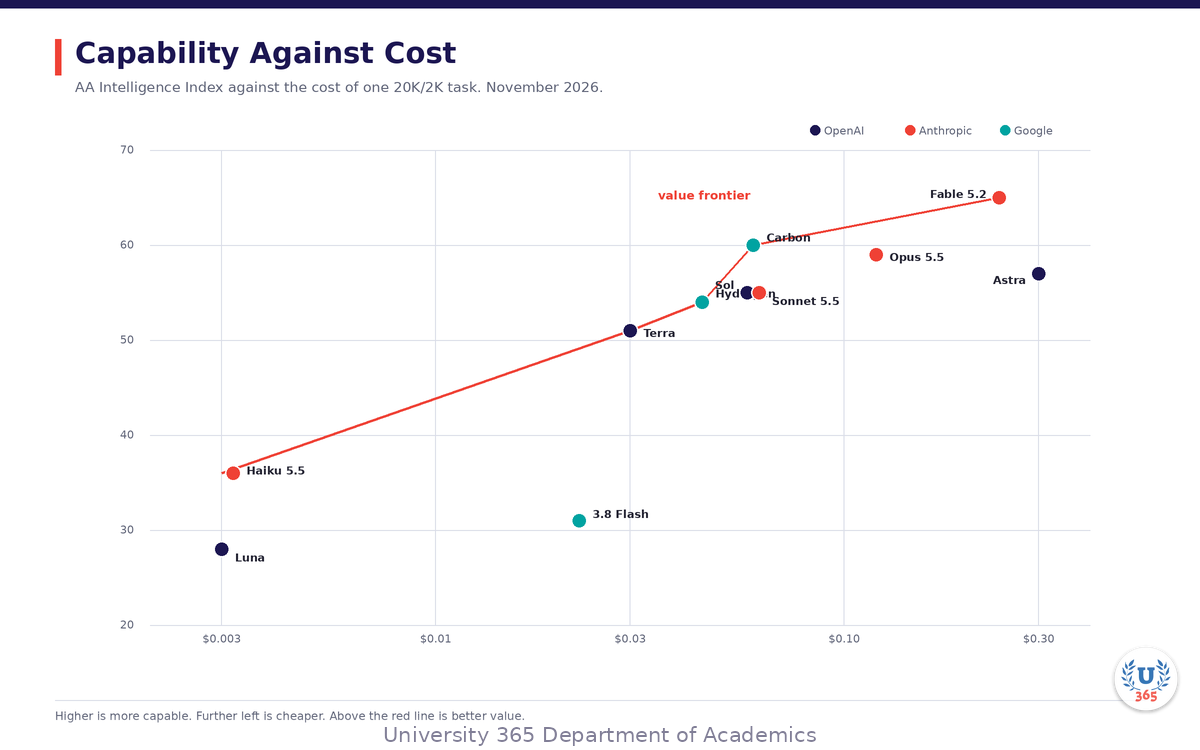
One table, every current model, the price you pay, and the independent score. The index is Artificial Analysis Intelligence Index v5.0.1, which combines nine evaluations including AA-Omniscience, Terminal-Bench 4.0, FrontierCode and HLE-Diamond. The score shown is the best the model reaches across its effort levels.
Band | Model | Input $ per 1M | Cache read $ per 1M | Output $ per 1M | AA Index (best) | Context | Strongest at |
PhD | 10.00 | 1.00 | 50.00 | 57 | 1M | hardest reasoning and long-horizon work | |
PhD | 8.00 | 0.20 | 40.00 | 65 | 1M | demanding reasoning and agentic work | |
PhD | 2.00 | 0.10 | 10.00 | 60 | 1M | software engineering, science, security | |
Master | 2.00 | 0.10 | 10.00 | 55 | 1M | complex coding and professional work | |
Master | 4.00 | 0.20 | 20.00 | 59 | 1M | long-running agentic coding | |
Master | 2.00 | 0.10 | 10.00 | 50 | 1M | efficient frontier reasoning | |
Master | xAI Grok 4.7 | 2.00 | 0.50 | 6.00 | 46 | 500K | live search, agentic work and current X data |
Bachelor | 1.00 | 0.05 | 5.00 | 51 | 1M | visual reasoning and computer use | |
Bachelor | 2.00 | 0.10 | 10.00 | 55 | 1M | speed and intelligence balance | |
Bachelor | 1.50 | 0.075 | 7.50 | 54 | 1M | everyday coding and agent workflows | |
Associate | 0.10 | 0.01 | 0.50 | 28 | 1M | high-volume extraction and routing | |
Associate | 0.10 | 0.01 | 0.50 | 36 | 1M | latency-sensitive volume | |
Associate | 0.75 | 0.075 | 3.75 | 31 | 1M | long-horizon software engineering | |
Associate | Amazon Nova 2 Lite | 0.30 | n/a | 2.50 | n/a | 1M | low-cost multimodal documents and video on Bedrock |
Scores and prices were verified on 14 November 2026. The index is a comparative measure, not a guarantee on your task. A model one band lower can win on your cases, which is why the three-case test still decides the hire.
Open weights. Open-weight models are compared with their closed equivalents in their own section below. The short version: they compete at the Associate and Bachelor bands, not yet at the frontier, and the provider route matters as much as the model.
Figures verified 14 November 2026. Sources: the OpenAI pricing and models pages, the Anthropic models overview, the Google Gemini API models and pricing pages. Every row is recorded in the monthly ledger with its source and date.

Recruiting Your AI Model, November 2026: Important questions before the first session prompt
Question 6: The Effort Dial
Every current frontier family exposes a thinking control under a different name. Anthropic uses adaptive thinking, always on for Fable 5.2 and Opus 5.5, with a documented default effort per model. Google exposes a thinking level. OpenAI exposes a reasoning effort setting. The labels differ, the idea does not: how long may the model deliberate before it answers?
If the task is... | Use | Why |
extraction, classification, routing, a first draft you will edit | quick or medium | deliberation adds cost without changing the answer |
comparison, planning, code with dependencies | medium | some reasoning, bounded time |
hard analysis, architecture, adversarial review | high | the model must hold several findings and check itself |
Use the lowest effort that passes your test. Raise it only when the task needs planning, verification or a chain of dependent steps.
The cost consequence is direct. On a metered API, deliberation is billed. The Gemini 4 price page states that output price includes thinking tokens. Treat thinking as output spend, and check the same line on any other model you hire.

Recruiting Your AI Model, November 2026: Important questions before the first session prompt
Question 7: Cost per Task
Token prices are not costs. A cost is what you pay to finish one task.
cost per task = (input tokens / 1,000,000 x input price) + ((output tokens + thinking tokens) / 1,000,000 x output price)
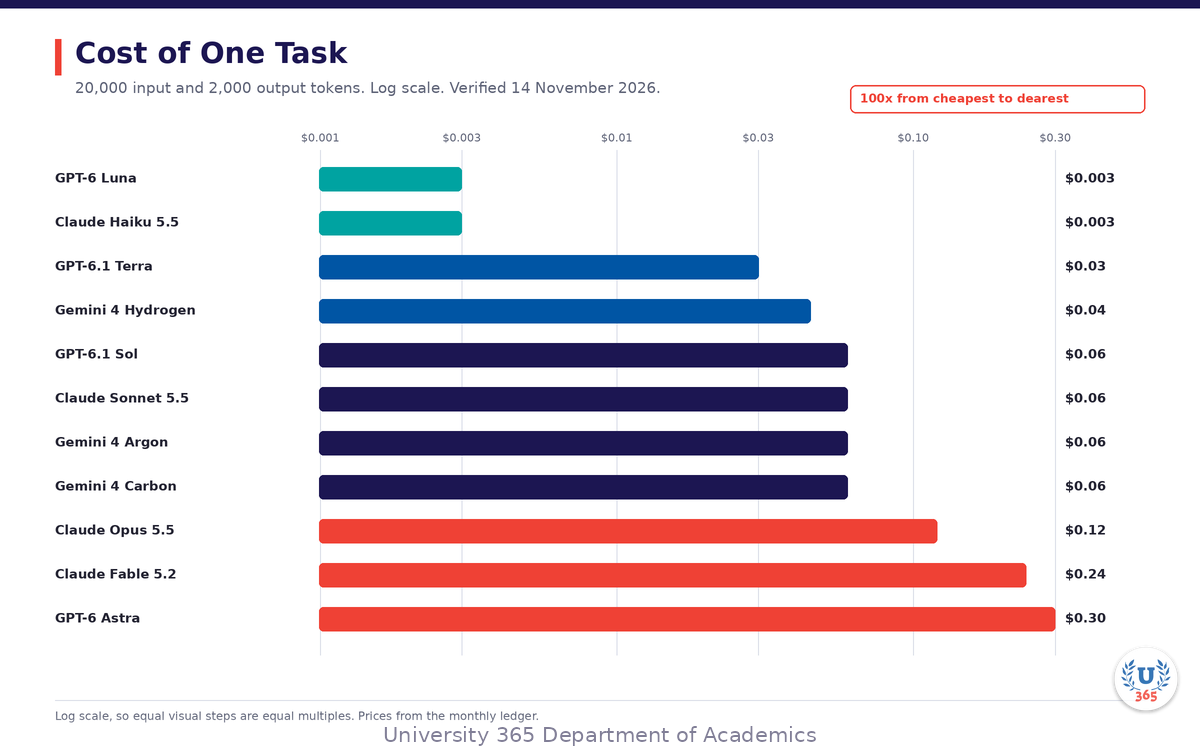
Take a modest task: 20,000 input tokens (a brief, a context file and three examples) and 2,000 output tokens.
Model | Input $ per 1M | Cache read $ per 1M | Output $ per 1M | Cost of one task |
GPT-6 Luna | 0.10 | 0.01 | 0.50 | $0.003 |
Claude Haiku 5.5 | 0.10 | 0.01 | 0.50 | $0.003 |
Amazon Nova 2 Lite | 0.30 | n/a | 2.50 | $0.011 |
GPT-6.1 Terra | 1.00 | 0.05 | 5.00 | $0.03 |
Gemini 4 Hydrogen | 1.50 | 0.075 | 7.50 | $0.045 |
GPT-6.1 Sol | 2.00 | 0.10 | 10.00 | $0.06 |
Claude Sonnet 5.5 | 2.00 | 0.10 | 10.00 | $0.06 |
Gemini 4 Argon | 2.00 | 0.10 | 10.00 | $0.06 |
Gemini 4 Carbon | 2.00 | 0.10 | 10.00 | $0.06 |
xAI Grok 4.7 | 2.00 | 0.50 | 6.00 | $0.052 |
Claude Opus 5.5 | 4.00 | 0.20 | 20.00 | $0.12 |
Claude Fable 5.2 | 8.00 | 0.20 | 40.00 | $0.24 |
GPT-6 Astra | 10.00 | 1.00 | 50.00 | $0.30 |
Cache read is the repeat price. A cached prompt is billed at a lower input rate on every reuse. OpenAI charges no cache write fee. Anthropic charges a 5-minute write at 1.25 times input and a 1-hour write at 2 times input. Google uses implicit caching and also charges a storage fee per hour. The column uses the standard paid tier; Gemini 4 Carbon and Argon are $0.10 through 30 November 2026 and $0.20 from 1 December.
The same task costs one hundred times more at the top of the board than at the bottom. The expensive model is not a rip-off; it is a different hire for a different job. The mistake is hiring it for work a cheaper band can hold.
Scale the task and the gap stays. At 200,000 input and 20,000 output tokens, GPT-6 Luna costs $0.03, GPT-6.1 Sol costs $0.60 and GPT-6 Astra costs $3.00 for one task. Run 2,200 tasks a month, which is a hundred a working day, and the same workflow costs $6.60 on Luna, $132 on Sol and $660 on Astra.
Now add the flat-rate route. If you already pay for a chat subscription, the marginal cost of a session is zero and the comparison changes. Your constraint becomes quota, speed and model access, not dollars. This is why question 4 comes before question 7.
One warning about this month. Gemini 4 Carbon and Argon are $2 input and $10 output per 1M tokens through 30 November 2026, then $4 and $20 from 1 December. A budget built on November prices is wrong in December. The monthly edition exists to catch exactly this.
Recruiting Your AI Model, November 2026: Important questions before the first session prompt
The Price of Access: Subscriptions, Providers and Local
A token price is only one of three ways to pay. Before you compare models, know which meter you are on.
What a subscription actually buys
A flat plan does not sell tokens. It sells access to a set of models under message and time limits. None of the three major consumer plans publishes a token allowance, so do not convert the monthly fee into a token budget. Compare a plan on four things: which models it includes, the usage window, the data terms, and the tools it unlocks.
Plan | Price per month | Models included | Published token allowance | Best for |
ChatGPT Free | $0 | GPT-6 Luna, limited tools | None; message limits | trying the tool |
ChatGPT Go | $8 | GPT-6 Luna, more messages and uploads | None; message limits | longer everyday chats |
ChatGPT Plus | $20 | GPT-6 Luna, GPT-6 Sol, GPT-6 Astra, expanded limits | None; message limits | advanced work |
ChatGPT Pro | from $100 | all models expanded, Astra reasoning, three usage tiers | None; usage tiers | research and coding |
Claude Free | $0 | Haiku, Sonnet | None; 5-hour and weekly limits | trying the tool |
Claude Pro | $20 ($17 annual) | Haiku, Sonnet, Opus, Fable with usage credits | None; 5-hour and weekly limits | everyday work |
Claude Max | $100 | 5x Pro usage, Fable up to half the weekly limit | None; 5-hour and weekly limits | all-day work |
Claude Ultra | $200 | 10x Pro weekly usage, no 5-hour limit, Fable | None; weekly limit | longest tasks |
Google AI Plus | $4.99 | 2x Free usage | None; usage multiplier | light use |
Google AI Pro | $19.99 | 4x Free usage, Gemini 4 Argon | None; usage multiplier | everyday work |
Google AI Ultra | $99.99 or $199.99 | 5x or 20x Pro usage, Gemini 4 Carbon | None; usage multiplier | heavy research |
Prices exclude tax and were verified on 14 November 2026. A subscription is a good deal when you use the included tools every day. It is a bad deal when you need a specific API model, a governed tenant, or a predictable cost per task.
Open weights: three ways to buy the same model
The same open-weight model can be bought from the lab, from a provider, or run yourself. The price gap is large, and the provider is not always more expensive.
Model | Lab direct | Ollama Cloud | OpenRouter | One task |
DeepSeek V4.1 Flash | $0.30 input and $1.20 output peak; $0.15 and $0.60 off-peak | $0.30 and $1.20 | $0.04 and $0.50 | $0.0018 |
Kimi K3.1 Pro | platform list | $2.00 and $10.00 | $2.00 and $10.00 | $0.06 |
Qwen3.8 Max | Alibaba Cloud list | not listed | $2.00 and $6.00 | $0.052 |
Mistral Large 4 | platform list | $0.70 and $2.10 | $0.70 and $2.10 | $0.0182 |
gpt-oss-120b | open weights, no lab API | $0.15 and $0.60 | $0.15 and $0.60 | $0.0042 |
Cache read follows the route: DeepSeek $0.006 peak and $0.003 off-peak, Kimi $0.20, gpt-oss-120b $0.075, Qwen3.8 Max $0.0375 on OpenRouter. Ollama Cloud does not publish a cache price, and Mistral does not publish one on the route shown.
Prices are per 1M tokens and were verified on 14 November 2026. Lab-direct prices vary by region and contract, so check the console before you budget. The one-task column uses 20,000 input and 2,000 output tokens, the same basis as the table above. Ollama Cloud sells pay-as-you-go access plus plans: Pro at $20 a month includes $60 of usage credits, Max at $100 includes $300, and local running is unlimited.
The practical rule: compare the provider price for the exact model ID you need, not the lab's headline. DeepSeek V4.1 Flash is cheaper through OpenRouter than direct at peak, while Kimi K3.1 Pro costs the same on both providers.
When local wins
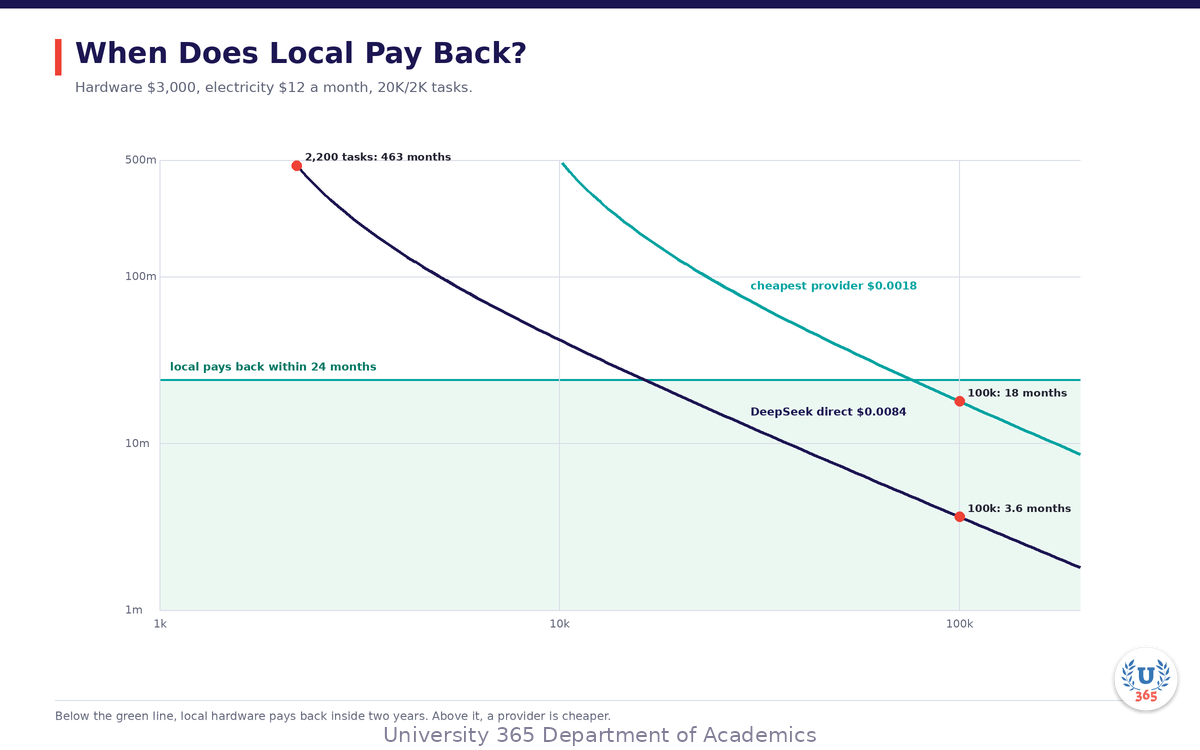
Local is a data decision first and a cost decision second. If the data cannot leave your organisation, local wins regardless of volume. If the data can leave, compute the break-even before you buy hardware.
break-even tasks = hardware cost / (API cost per task - local cost per task)
Assume a 0.5 kW machine running four hours a day at $0.20 per kWh. Electricity is about $12 a month. The hardware budget depends on the model size you need.
Tier | Memory | What runs | Typical budget |
Small | 16 GB unified memory or VRAM | 7B to 14B models, quantised | $800 to $1,500 |
Mid | 32 GB to 64 GB | 27B to 35B models, 70B heavily quantised | $2,000 to $4,500 |
Large | 96 GB to 192 GB | 120B quantised, 70B at higher precision | $6,000 to $15,000 |
Budgets are a November 2026 guide, not a quote. Check current retail and your electricity price.
Two worked examples at 20,000 input and 2,000 output tokens:
2,200 tasks a month, $0.0084 per task on DeepSeek V4.1 Flash direct. The API bill is $18.48 a month. A $3,000 machine with $12 of electricity saves $6.48 a month, so the payback is about 463 months. Local is not worth it.
100,000 tasks a month. The same API bill is $840 a month. The same machine saves $828 a month, so the payback is about 3.6 months. Local wins.
At the cheapest provider rate of $0.0018 per task, 100,000 tasks cost $180 a month and the payback stretches to about 18 months. The threshold is real: below roughly 100,000 tasks a month, a provider is cheaper. Above it, or when the data cannot leave, local becomes the rational choice.
Recruiting Your AI Model, November 2026: Important questions before the first session prompt
Confidentiality: What Protects Your Prompts
A model that cannot legally receive your data is not a candidate, whatever its score. The rules split in two: consumer chat tiers and business or API tiers. The first often trains on your prompts unless you change a setting. The second usually does not train on them by default, and carries a contract that says so.
The table records the default, the control and the condition that actually protects you. It is a procurement check, not legal advice. Policies change; re-read them before a client engagement.
Lab and product | Used to train by default? | What you can do | What actually protects you |
OpenAI ChatGPT Free, Plus, Pro | Yes | Turn off Improve the model for everyone in Settings > Data controls, or choose Do not train on my content in the Privacy Portal | The opt-out stops new conversations; feedback can still train |
OpenAI API, Business, Enterprise | No | Opt in only | Enterprise privacy commitment; API data is retained up to 30 days for abuse, with zero data retention for eligible endpoints |
Anthropic Claude Free, Pro, Max | Only if Help improve Claude is on | Turn it off in Privacy Settings | The opt-out covers previous and new chats; Incognito chats are excluded |
Anthropic API and Commercial | No | Contractual | Commercial Terms B: Anthropic may not train models on Customer Content |
Google Gemini Apps Free, Pro, Ultra | Yes when Keep Activity is on | Turn Keep Activity off, or use a temporary chat | No paid-tier contractual exemption; Google still retains temporary chats for service and safety |
Google Workspace and Vertex AI | No for the Workspace service | Admin controls and a Workspace domain | Workspace Privacy Hub and Cloud DPA; use the Work account, not a personal one |
xAI Grok consumer | Yes | Turn off Improve the model in Settings > Data controls, or use Private Chat | The opt-out covers new chats; unauthenticated users in some regions cannot opt out |
xAI API and Enterprise | No | Contractual | Enterprise FAQ: no training on business data; 30-day retention |
Amazon Nova on Bedrock | No | Contractual | Bedrock FAQ: content is not used to improve the base models and is not shared with model providers |
The Google nuance. A common working assumption is that only a Workspace domain protects a Gemini user. The current notice is narrower and more useful: a consumer on a free or paid Gemini plan can turn Keep Activity off and stop future chats from being used to improve the models, and a temporary chat is not used for training. What the consumer tiers do not give you is a contract. Workspace and Vertex do.
Sources: OpenAI data controls and Enterprise privacy; Anthropic Privacy Center and Commercial Terms; Gemini Apps Privacy Hub and Workspace Privacy Hub; xAI Consumer FAQ and Enterprise FAQ; Amazon Bedrock FAQ. Read on 14 November 2026.

Recruiting Your AI Model, November 2026: Important questions before the first session prompt
Open Weights: The Full Comparison
Open weights are not a cheaper copy of the closed frontier. They are a separate tier with their own bands, prices and trade-offs. The table places each current open-weight model beside the closed model it most closely matches, using the same band and the same independent index. Bands are starting points; test on your cases.
Band | Open-weight model | Lab | Equivalent closed model | Input $ per 1M | Output $ per 1M | Best route | AA Index | Strongest at |
Associate to Bachelor | Kimi K3.1 Pro | Moonshot AI | Claude Sonnet 5.5 | 2.00 | 10.00 | Kimi API, Ollama Cloud, OpenRouter | 46 | long-context agentic work |
Associate | GLM-5.3 | Zhipu AI | Claude Haiku 5.5 | 1.40 | 4.40 | Z.ai API, Ollama Cloud, OpenRouter | 32 | coding and tool use |
Associate | DeepSeek V4.1 Flash | DeepSeek | GPT-6 Luna | 0.30 | 1.20 | DeepSeek API, Ollama Cloud, OpenRouter | n/a | high-volume reasoning with 1M context |
Associate | Mistral Large 4 | Mistral AI | Claude Haiku 5.5 | 0.70 | 2.10 | Mistral API, Ollama Cloud, OpenRouter | 26 | European and sovereign deployments |
Associate (entry) | Qwen3.8 27B | Alibaba | GPT-6 Luna | 0.50 | 3.00 | Alibaba Cloud, OpenRouter | 20 | local single-GPU tests, 256k context |
Associate (entry) | MiniMax M3 | MiniMax | GPT-6 Luna | 0.30 | 1.20 | MiniMax API, Ollama Cloud, OpenRouter | 19 | multimodal agent experiments |
Below Associate | gpt-oss-120b | OpenAI open weights | none | 0.15 | 0.60 | Local, Ollama Cloud, OpenRouter | 4 | offline experiments, 131k context |
Cache read on the open routes. Where the route publishes a cache price: Kimi K3.1 Pro $0.20, GLM-5.3 $0.079, DeepSeek V4.1 Flash $0.006 peak and $0.003 off-peak, Qwen3.8 27B $0.0375, MiniMax M3 $0.06, gpt-oss-120b $0.075. Mistral Large 4 publishes none on the route shown.
Three findings from this table matter more than the rows.
Open weights lag the closed frontier by roughly one to two bands. The best open model in November, Kimi K3.1 Pro at 46, sits between the closed Associate and Bachelor scores. The open Associate tier is real and useful. The open Master and PhD tiers are not yet competitive with the closed Master and PhD models.
Size decides whether you can run it yourself. Kimi K3.1 Pro is 2.8T total parameters with 104B active. DeepSeek V4.1 Flash is 552B with 16B active. Those are provider models, not laptop models. The small open models that fit a single machine sit at the entry of the ladder, and the local break-even in the previous section assumes exactly that class.
Qwen3.8 Max is proprietary, so it is not in this table. Qwen3.8 27B is the open Qwen model. DeepSeek V4.1 Flash has no published AA Intelligence Index in the source checked, so its score is n/a rather than an estimate.
Prices are per 1M tokens and were verified on 14 November 2026. The route column names the lab API and the two providers used in this edition. Compare the exact model ID on the provider before you commit.

Recruiting Your AI Model, November 2026: Important questions before the first session prompt
The Modality Benches
When the output is not text, the text ladder stops applying. Choose the bench first, then the model, then the price per accepted output.
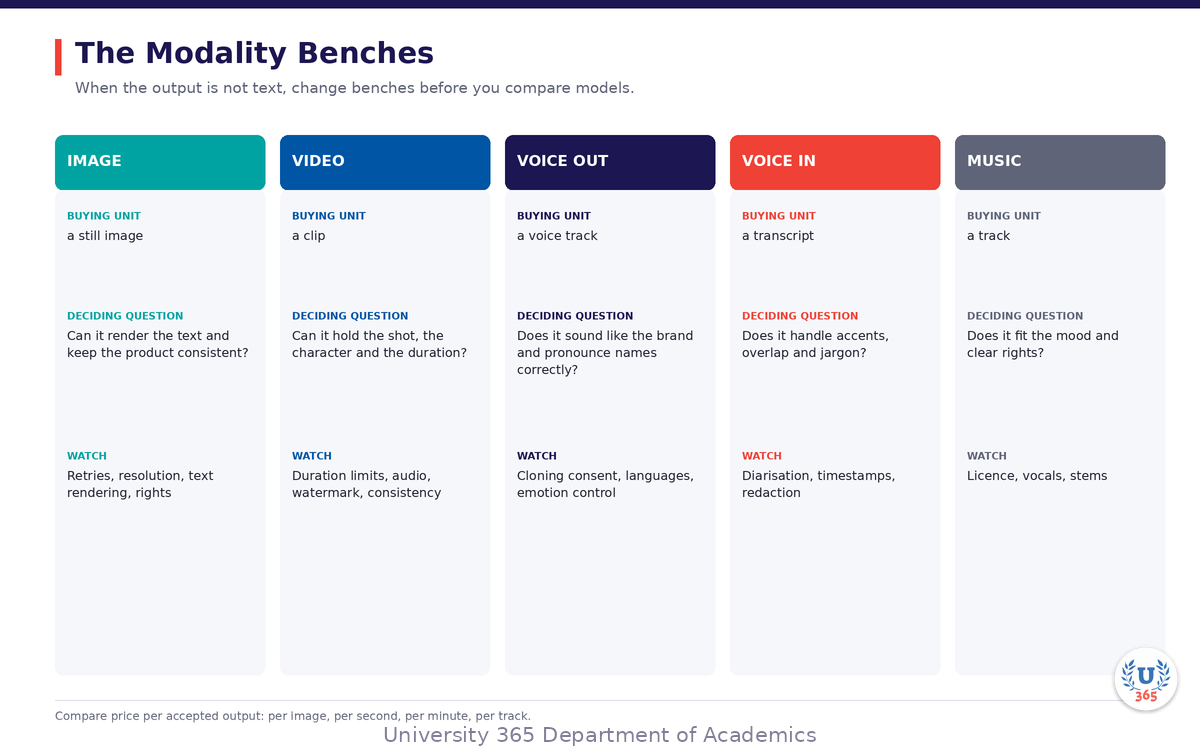
Bench | What you are buying | The question that decides | Unit to compare | Watch |
Image | a still image | can it render the text and keep the product consistent | per accepted image | retries, resolution, text rendering, rights |
Video | a clip | can it hold the shot, the character and the duration | per second or per clip | duration limits, audio, watermark, consistency |
Text to speech | a voice track | does it sound like the brand and pronounce names correctly | per 1,000 characters or per minute | cloning consent, languages, emotion control |
Speech to text | a transcript | does it handle accents, overlap and jargon | per minute | diarisation, timestamps, redaction |
Music | a track | does it fit the mood and clear rights | per track or per minute | licence, vocals, stems |
Ask four questions before you generate:
What is the accepted output? A usable image, not a generated one. A usable minute, not a rendered one. Price the retries, because they dominate the bill.
What must stay consistent? The same product, face, voice or brand across outputs. Consistency features matter more than raw quality when you produce a series.
What rights come with it? Commercial use, indemnity, watermarking and voice consent. Read the licence before the first generation, not after the campaign.
Where does the input go? The same data constraints from question 4 apply to images, audio and video. A face, a voice or an unreleased product is sensitive data.
The monthly ledger carries a separate modality panel: OpenAI, Google, Black Forest Labs, Midjourney, Ideogram and Recraft for image; OpenAI Sora, Google Veo, Runway, Luma, Kling and MiniMax for video; ElevenLabs, OpenAI, Google, Cartesia and MiniMax for speech out; OpenAI, Deepgram, AssemblyAI and Gladia for speech in; Suno, Udio, Google and ElevenLabs for music. The lecture prints the top three per bench by task fit, with the verified price per unit.
UNOP Sound (University 365 Neuroscience Oriented Pedagogy)
Take five minutes to consolidate your memory. Play the isochronous tone track (10Hz alpha frequency) with your eyes closed. Alpha-frequency tones after a learning session support consolidation, helping move what you just learned from short-term to long-term memory.
[Audio player: UNOP Post-Lecture Isochrone (10Hz, 5 minutes)]

Recruiting Your AI Model, November 2026: Important questions before the first session prompt
Practical Exercise: The 20-Minute Recruitment Sheet
Do this with a task you will actually run this week. Twenty minutes, no more.
Worked example. A fellow needs to turn a 32-page supplier contract into a one-page summary for a manager.
Question | Answer |
1. Output | text, one page, with a table of obligations and dates |
2. Difficulty | a chain of steps: read, cross-reference, summarise |
3. Input | 32 pages, read once |
4. Constraints | confidential supplier terms; approved API only; metered budget |
5. Shortlist | GPT-6.1 Sol, Claude Sonnet 5.5, Gemini 4 Argon |
6. Effort | medium, then high if the cross-references fail |
7. Cost | about $0.06 per task at 20,000 input and 2,000 output |
The fellow tests three real contracts, including one with an unusual termination clause. If Sonnet 5.5 passes all three at standard effort, it is the hire. The PhD band is unnecessary.
Your sheet.
Question | Your answer |
1. Output | |
2. Difficulty | |
3. Input | |
4. Constraints and budget | |
5. Shortlist (three exact IDs) | |
6. Effort | |
7. Cost per task |
Test before you commit. Take three real cases, including one hard case and one that failed before. Run the three candidates with the same prompt and the same context. Score each output pass or fail against your own definition of good. Choose the cheapest model that passes all three. Record the date, the model ID, the effort, the route and the cost per task.

Recruiting Your AI Model, November 2026: Important questions before the first session prompt
The Moving Parts and Seven Traps
The board moves every month. These are the changes that matter for a November decision.
Gemini 4 introductory pricing ends on 30 November 2026. Carbon and Argon are $2 input and $10 output per million tokens through that date, then $4 and $20.
There is no GPT-6.1 Luna. The 6.1 generation lists Sol and Terra. Luna is still GPT-6 Luna. The family exists, the variant does not.
Claude Mythos is a legacy track. The current lineup is Fable 5.2, Opus 5.5, Sonnet 5.5 and Haiku 5.5.
Deprecated rows are still visible. A price table can show a model with a deprecation flag. Do not build on a row marked deprecated.
Seven traps
The variant that does not exist. Family names are not model IDs. Check the exact ID on the provider page before you write it into a brief or a budget.
The promotional price that expires. A price with an end date is a temporary fact. Put the end date in the same cell, not in a footnote.
The stale leaderboard. A public benchmark measures questions someone else wrote. Your task is the only test that decides your hire.
The free tier that trains on your data. Free access often carries different data terms from paid access. Check before you paste anything confidential.
The context surcharge. Long inputs can trigger a higher rate above a threshold. The price per token you memorised may not be the price you pay for a 300-page file.
The thinking bill. Deliberation is billed as output on metered APIs. A high effort setting can multiply the output line without changing the model.
The subscription you already pay for. Sunk cost is not marginal cost. If a flat plan already covers the task, the API price is irrelevant and the real question is whether the plan includes the model you need.

Recruiting Your AI Model, November 2026: Important questions before the first session prompt
Feynman Summary: Explain It Like You Are 12
Imagine you need to hire someone for a job.
Some workers are just starting out. They are fast and cheap, and they are great at simple jobs like sorting papers or copying a date onto a form. Some have finished a general education. They can write a letter, summarise a book and handle a normal day of work. Some have a master's degree. They can plan a project, check their own work and handle a tricky problem with several steps. A few are researchers. They are slow and expensive, and you hire them when the problem is genuinely hard and the answer matters a lot.
Your prompt is the job description. If you write a clear description and give the worker the right files, a normal graduate can do a very good job. If you write one vague sentence, even the researcher will guess.
You also decide how long the worker may think before answering, and where the worker sits: your own office, a rented office, or a room you are not allowed to enter with certain papers. And you pay either a monthly salary, a fee for each job, or the cost of the desk and electricity.
That is the whole decision. Pick the worker who can do the job, write a clear description, let them think long enough, and put them somewhere the papers are allowed to go. The degree belongs to the worker you hire. It says nothing about you.
Now make the last step explicit. Hiring a worker and hiring a model are the same decision in two forms. You would not ask a PhD you have just hired to make copies or bring you a cup of coffee, and you would not ask the associate intern to finish the comprehensive analysis and research study for the next strategic product line by Friday. The mismatch wastes the expensive worker and fails the important job.
The same is true of an AI model. Recruiting the model is the first act of every Co-Intelligence session, and it is mandatory. Choose the band and the model before you type the first prompt, not after the answer disappoints you. The prompt is the job description, the model is the hire, and the work begins only when the two match.

Recruiting Your AI Model, November 2026: Important questions before the first session prompt
Mindmap: The Complete Picture
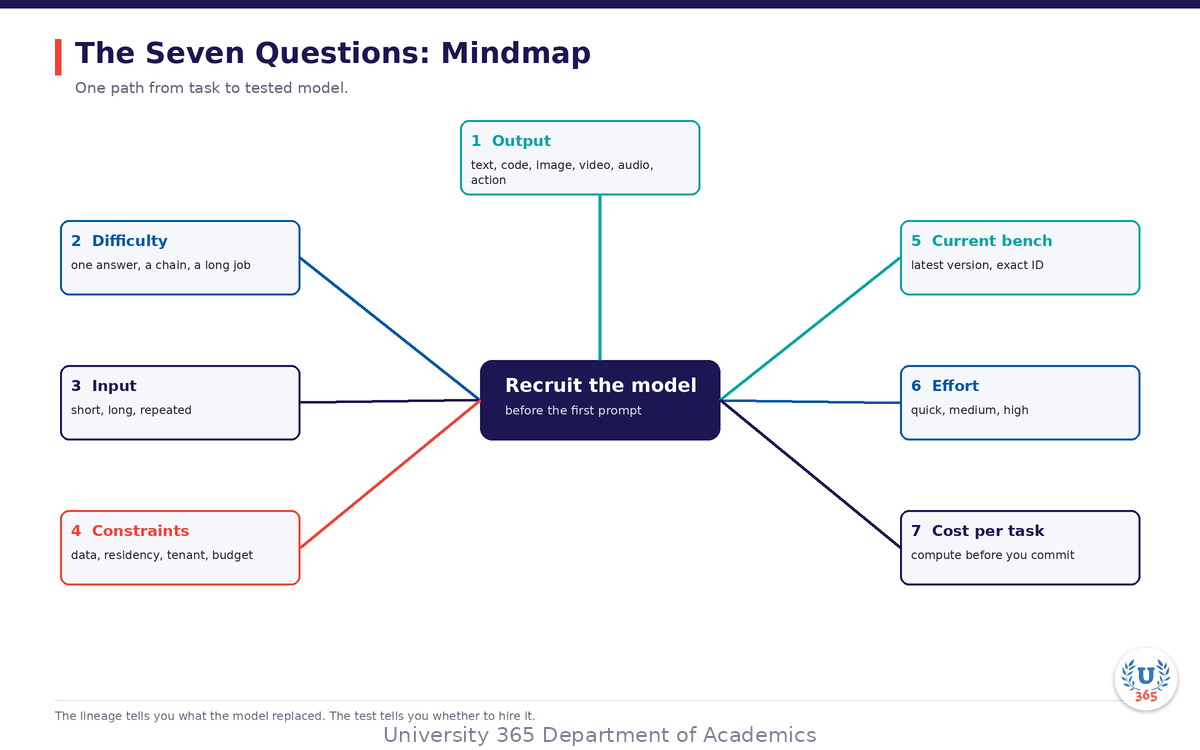
The mindmap places the seven questions in sequence, with the Model Degree Ladder, the two dials, the modality benches and the cost formula as branches. Use it as a one-page reminder before a session.

Recruiting Your AI Model, November 2026: Important questions before the first session prompt
Glossary
Term | Definition |
Model family | A named line from one lab, such as GPT-6 or Gemini 4 |
Variant | A member of a family with its own size, price and speed, such as Luna or Astra |
Model ID | The exact string the API accepts, such as gpt-6.1-sol |
Band | The U365 scale for the kind of work a model can hold. It describes the model, never the user. |
Reasoning effort | The setting that controls how long a model may deliberate |
Thinking tokens | Deliberation tokens billed as output on a metered API |
Context window | The maximum amount of text a model can hold in one session |
Long-context surcharge | A higher rate applied above a provider's context threshold |
Metered API | Access billed per token |
Flat subscription | Access billed monthly, with quotas instead of per-token charges |
Aggregator | A service that resells access to several labs through one key |
Open weights | A model whose parameters you can download and run yourself |
Legacy model | A model still reachable but no longer the current recommendation |
Deprecated model | A model scheduled for removal, often still visible in price tables |

Recruiting Your AI Model, November 2026: Important questions before the first session prompt
Quiz: TEST YOUR UNDERSTANDING
1. Who does the Model Degree Ladder describe?
A) The fellow's own education level.
B) The model, as a comparison for the human recruiter.
C) The lab's engineers.
D) The size of the company using AI.
2. Which Luna model is current in the OpenAI catalog on 14 November 2026?
A) GPT-6.1 Luna
B) GPT-6.2 Luna
C) GPT-6 Luna
D) GPT-7 Luna
3. A task needs 20,000 input tokens and 2,000 output tokens. Which statement is true?
A) Every model on the board costs about the same.
B) The same task can cost one hundred times more at the top of the board.
C) Output price does not matter at this size.
D) Thinking tokens are free.
4. Gemini 4 Carbon and Argon prices change on 1 December 2026. What changes?
A) Input doubles from $2 to $4 and output from $10 to $20 per million tokens.
B) They become free.
C) Only the context window changes.
D) Nothing, the price is fixed for a year.
5. What is the first question in the recruitment path?
A) Which lab do I trust most?
B) What must come out of the session?
C) Which model is ranked highest?
D) Which model did I use last time?
Answers: 1-B, 2-C, 3-B, 4-A, 5-B

Related Resources
U365 INSIDE Publications
Evaluating AI Systems: Building Evals for Models You Did Not Train, the measurement arm for the three-case test in this lecture.
Reasoning Models in Practice: Test-Time Compute and When It Pays, AI Foundations, published 14 November 2026.
AI Cost Governance: Budgeting Tokens, Seats and Agents, Business AI Series, published 14 November 2026.
Inference Economics: Tokens, Latency and the Cost of an Agent, AI Economics, published 14 November 2026.
External Resources
OpenAI API pricing: the price table used for every OpenAI row in this edition.
OpenAI models: the current catalog, used to check that GPT-6.1 Luna does not exist.
Anthropic models overview: the current lineup, context windows and effort defaults.
Gemini API pricing: the Gemini 4 prices and the 1 December change.
Artificial Analysis: independent speed and cost comparisons when you need a second view.
Related U365 Lectures (Coming Soon)
Recruiting Your Model, December 2026: the same seven questions, refreshed bench and the 1 December prices.

Recruiting Your AI Model, November 2026: Important questions before the first session prompt
U.Copilot for This Lecture
USER-PERSONA I am a U365 Fellow working on a real task and I need to recruit the right model before I write my first session prompt. FULL-CONTEXT My task: [one sentence]. Output required: [text, code, image, audio, video, action]. Input material and size: [documents, pages, approximate tokens]. Constraints: [data sensitivity, residency, offline, tenant, approved providers]. Budget shape: [flat subscription, metered API, fixed infrastructure]. Current shortlist: [model IDs from provider pages]. AI-PROFILE-ROLE-EXPERTISE Act as a model selection adviser who knows the current LLM price lists, context windows, effort controls and access routes. You do not rank models by reputation. You rank them by fitness for my task and cost per completed task. USER-FINAL-GOAL A defensible hiring decision: one model, one effort setting, one route, and a cost per task I can explain to my manager. AI-EXACT-TASK 1. Ask me the seven questions in order and wait for my answers. 2. Match my answers to the Model Degree Ladder and name the band. 3. Shortlist three current models by exact ID, one per band position. 4. Set the effort and the route. 5. Compute the cost of one task with my token estimate. 6. Give me a three-case test plan and a pass or fail definition. 7. Recommend one model and state the condition under which I should upgrade. AUDIENCE Me, a Fellow with limited time and a real deadline. I will act on the answer today. EXPECTED-FORMAT A short table for the seven answers, a three-row shortlist table, the cost arithmetic shown line by line, and a final recommendation in two sentences. No preamble. EXAMPLES A good answer names gpt-6.1-sol, not "GPT Sol". A good answer shows 20,000 input tokens at $2.00 per million as $0.04. A bad answer recommends the most expensive model without a test.

Recruiting Your AI Model, November 2026: Important questions before the first session prompt
Next Steps
Take one task you will run this week and complete the seven-question sheet.
Write the exact model ID, effort setting and route in your working notes.
Record the cost per task before you start, and the actual cost after you finish.
Re-run the same three test cases when the next edition changes the bench.
Read Evaluating AI Systems before you scale the workflow beyond one person.

Recruiting Your AI Model, November 2026: Important questions before the first session prompt
IMPORTANT NOTICE
Copyright University 365, Inc. All rights reserved. This lecture is provided for educational purposes and does not constitute legal, financial or professional advice. Prices and model availability were verified on 14 November 2026 and change without notice. For enrollment, visit university-365.com/tuition. For permissions or inquiries, contact uda@university-365.com.
Published by the Department of Academics, University 365.
Lecture delivered by the UIT, UIB, UIC, UID in collaboration.
Martin Swartz, Dean of Academics, UDA
Signed for the academic year 2026.




Comments