
Claude Sonnet 5.5: Anthropic's Fast Everyday Model at the Same Price

Status: Active | Last tested: 2026-11-14 (Claude Sonnet 5.5, `claude-sonnet-5-5`, released 2026-09-28) | Re-check: trigger-based (max 6 months)
Active: the tool is current and recommended.
For detailed explanations of the CI-First evaluation terms used in this review, including the Humics Protection Badge and the AI Imposture Risk levels, see the Glossary at the end of this post.


In this Tool Review

Claude Sonnet 5.5: Anthropic's Fast Everyday Model at the Same Price
The name, the tier position and the model this review does not replace
Four names matter here, and the number that looks newest belongs to three different models.
Name | What it is | Where it appears |
Claude Sonnet 5.5 | The model this review scores. Model id claude-sonnet-5-5, released 2026-09-28, generally available | The Anthropic launch page, the model overview, the pricing page, Amazon Bedrock, Google Cloud and Microsoft Foundry listings |
Claude Sonnet 5 | The direct predecessor, model id claude-sonnet-5, released in June 2026, at the same $2 and $10 rates. It stays in the line-up and is the model that higher-risk cyber requests fall back to | The model overview, the pricing page, the system card's safeguards section |
Claude Opus 5.5 | The tier above, $4 and $20 per million tokens, released 2026-09-22, and the model Anthropic tells most buyers to start with | The model overview, the pricing page, the vendor's routing advice |
Claude Fable 5.2 | The top of the line at $8 and $40, released 2026-11-09, and absent from the Sonnet 5.5 comparison table | The Fable launch page and the Fable review in the U365 library |
Sonnet 5.5 is a new model rather than a refresh, and the distinction is not administrative. It carries its own model id, its own system card, a different set of accepted request shapes, and a measured capability that is not reachable by changing a setting on Sonnet 5. The published U365 review of Claude Sonnet 5 remains the record for that model at 6.5, with sub-scores 7 / 7 / 7 / 5. This review does not overwrite it, and a reader who wants the predecessor should read that document rather than this one.
The tier is ordered by price, not by number, and the vendor's own routing advice says so. Sonnet 5.5, Opus 5.5 and Haiku 5.5 all carry the 5.5 generation number. Within that family, Opus costs twice what Sonnet costs per token and Fable costs four times, and Anthropic's models overview tells a reader who is unsure to start with Opus 5.5 for most workloads. Sonnet 5.5 is therefore not the top of the line and does not claim to be. It is the model the vendor positions for well-scoped everyday work, and the whole question this review has to answer is what that position is worth when the tier above it is twice the price and, on the vendor's own charts, sometimes the better buy.
What this review is. It is the URC scoring of Claude Sonnet 5.5 under the CI-First Evaluation Framework, version 1.4.1, on evidence read on 2026-11-14: the vendor's launch page, model overview, pricing page, what-is-new page and system card; the independent measurement published by Artificial Analysis across five effort settings; the Hacker News launch thread and the subreddit launch thread; and the published U365 scores of the models this one is compared against.
What this review is not. It is not a review of Claude Code, of the Claude apps, of Amazon Bedrock, of Google Cloud, of Microsoft Foundry or of Claude Platform on AWS. Those surfaces appear where a scored fact depends on them, and the clause note says exactly where. It is not a review of Claude Opus 5.5, Claude Fable 5.2 or Claude Haiku 5.5, each of which has its own document or is being scored separately. It is not a re-score of Claude Sonnet 5. And it is not an assessment of Anthropic's safety programme beyond the facts a buyer of this model has to carry, which are stated in Section 7c with their sources named.
The score moved up by 0.5 against the sibling, and the movement is not uniform. Claude Sonnet 5 published at 6.5 with sub-scores 7 / 7 / 7 / 5. Claude Sonnet 5.5 scores 7.0 with sub-scores 8 / 8 / 8 / 4. Time, Quantity and Quality each gain one, and Skill falls by one. The capability gain is real and measured on both vendor and independent evidence. The skill loss is equally real: this model now completes agentic coding work that its predecessor failed outright, which is precisely the work a user no longer has to learn by doing it, and the Claude Code surface writes procedural memory by default. The U365 Co-Intelligence Rating sets out the arithmetic.

Claude Sonnet 5.5: Anthropic's Fast Everyday Model at the Same Price
Tool Snapshot
Claude Sonnet 5.5, the model Anthropic sells as the best combination of speed and intelligence: a fifth of the frontier price, measured level with the tier above it on knowledge work, and fast enough at its default settings to be the everyday instrument the price implies.
Category: Applied AI / Large Language Model. Everyday agentic coding, knowledge work, document, slide and spreadsheet production, visual understanding, and high-volume application work. It sits below Claude Opus 5.5 and Claude Fable 5.2 in price and, on most rows, in measured capability.
Primary use cases:
Well-scoped agentic coding with a checkable end state. Bug fixes, test repair, refactors and small feature work inside a named repository, where the vendor reports 70.6 percent on Terminal-Bench 4.0 against 10.3 percent for Sonnet 5, and 55.5 percent on CursorBench 4.0 against 34.1 percent.
Documents, slides and spreadsheets that a person would otherwise build by hand. The vendor's own demonstration is a 10-slide operating review built from a public company's quarterly materials and a slide template, which two experts judged ready to send as is. That is the clearest statement of what the model is for.
High-volume application work where the answer is validated by a schema rather than by a person. Parsing free text into structured JSON, classification, extraction and routing, at $2 and $10 per million tokens with cache reads at $0.10.
First-pass analysis over long documents. One million tokens of context and 128,000 tokens of output, with text and image input, against an independent reading of 42 on the Intelligence Index at the default high effort and 55 at max.
Fast iteration on design and front-end work. The vendor describes "a sharp eye for design" and early testers reported that it adds polish to user interfaces and follows slide templates closely, which is a claim about presentation rather than about architectural judgement.
What it is not. It is not the most capable model in the family: Anthropic states plainly that Opus 5.5 remains clearly stronger at complex, open-ended work requiring sustained judgement, and the system card says the model is not at the capability frontier. It is not a cheap model by the standards of the open-weight field: at $2 and $10 it is priced at the median of its comparison class, and readers on the launch thread compared it unfavourably with cheaper models on speed and cost per token. It is not a teaching product: nothing in it moves a capability from the model to you. It is not an image, audio or video generator, and it reads images to produce text. It is not self-hostable and not inspectable from outside Anthropic's service. And it is not the model to reach for when a single wrong answer is expensive and hard to check, because its whole proposition is that the answer arrives fast and looks finished.
Pricing, as published on 2026-11-14:
Line | Rate per million tokens | Note |
Input | $2.00 | Unchanged from Claude Sonnet 5 |
Output | $10.00 | Unchanged from Claude Sonnet 5 |
Cache reads | $0.10 | Halved from $0.20 on Claude Sonnet 5 |
Five-minute cache write | $2.50 | 1.25 times the input rate |
One-hour cache write | $4.00 | Twice the input rate |
Batch input and output | $1.00 and $5.00 | 50 percent discount on both lines |
The rate card is not where the saving lives, with one exception. Input and output are unchanged against the predecessor, the cache write rates are unchanged, and the only line that moved is the cache read, halved to $0.10. Anthropic's "up to 30 percent less per task" claim therefore rests on token efficiency rather than on price: the model is said to need far fewer tokens for the same work, and independent measurement records an output volume at the default high effort that is below the median of its comparison class. That distinction matters to anyone building a budget, because a rate card that has not moved cannot deliver a saving to a workload whose token count has not fallen.
Official links:
Launch page: https://www.anthropic.com/claude-sonnet-5-5
Model overview: https://platform.claude.com/docs/en/models/sonnet-5-5/overview
What is new in Sonnet 5.5: https://platform.claude.com/docs/en/models/sonnet-5-5/whats-new-sonnet-5-5
Migration guide: https://platform.claude.com/docs/en/models/sonnet-5-5/migration-guide
Effort control: https://platform.claude.com/docs/en/build-with-claude/effort
Thinking and adaptive thinking: https://platform.claude.com/docs/en/build-with-claude/thinking
Preserved thinking: https://platform.claude.com/docs/en/build-with-claude/preserved-thinking
Prompting Claude Sonnet 5.5: https://platform.claude.com/docs/en/build-with-claude/prompt-engineering/prompting-claude-sonnet-5-5
System card: https://www.anthropic.com/document/claude-sonnet-5-5-system-card
API pricing: https://platform.claude.com/docs/en/about-claude/pricing
Consumer and team pricing: https://claude.com/pricing
Claude Code memory: https://code.claude.com/docs/en/memory
Status page: https://status.anthropic.com
LLM-specific fields:
API model identifier: claude-sonnet-5-5. Bedrock: anthropic.claude-sonnet-5-5. Google Cloud, Microsoft Foundry and Claude Platform on AWS: claude-sonnet-5-5.
Context window: 1,000,000 tokens. Maximum output: 128,000 tokens, and up to 300,000 tokens on the Message Batches API with the output-300k-2026-03-24 beta header.
Modalities: text and image input, text output. No audio, no video, no generated images.
Thinking: adaptive and on by default. The lowest setting is between_tools, which turns off up-front thinking and is accepted at low, medium and high effort only. Sending thinking: {"type": "disabled"} returns a 400 error that names between_tools.
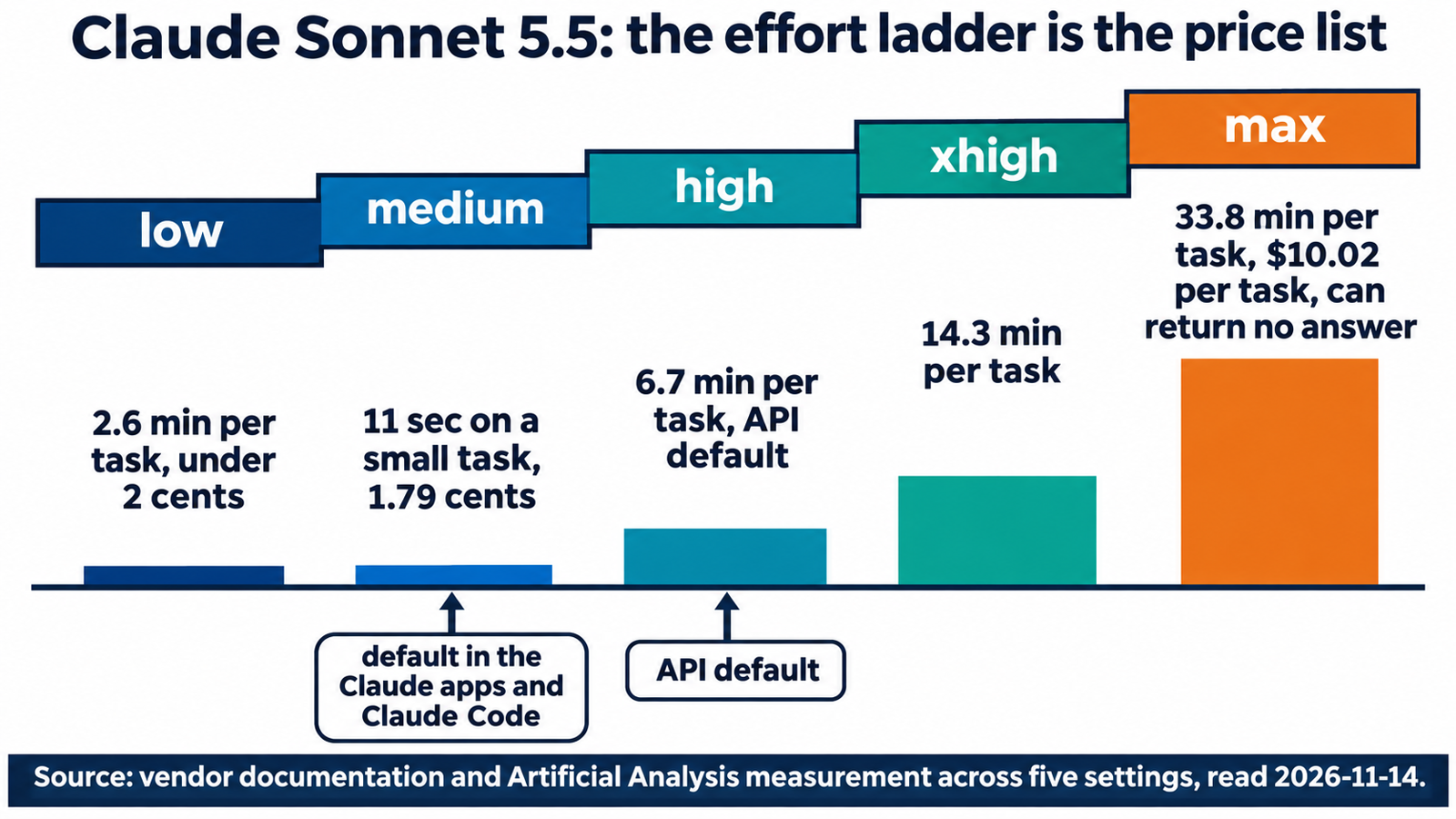
Effort levels: low, medium, high, xhigh and max. The Claude API default is high; the default in the Claude apps and Claude Code is medium.
Sampling: temperature, top_p and top_k return a 400 error on this model.
Tokenizer: the same as Claude Sonnet 5, so the same text produces the same token count. The pricing page notes that Claude 4.7 and later models use a newer tokenizer that produces about 30 percent more tokens for the same text than 4.6 and earlier.
Knowledge cutoff: June 2026, stated as both the reliable cutoff and the training cutoff.
Cache minimum: 512 tokens, the minimum cacheable prompt length.
Retention: available with zero data retention, as the vendor states for Opus 5.5 and Sonnet 5.
Availability: Claude apps on Free, Pro, Max and Ultra, Claude Code, the Claude API, Amazon Bedrock, Google Cloud under both Anthropic-managed and Google-managed terms, Microsoft Foundry and Claude Platform on AWS.
Lifecycle: Active, with retirement not sooner than 2027-09-28.
License: proprietary hosted service. No weights, no parameter count, no architecture disclosure.
At a Glance Dashboard
Field | Value |
Category | Applied AI / Large Language Model (everyday agentic coding, knowledge work and document production) |
CI-First Benefit Score | 7.0 / 10 (CI-First Strong) |
Sub-scores | Time 8 / Quantity 8 / Quality 8 / Skill 4 |
CI-First Profile | Primary: Co-Worker and Assistant (level 2). Secondary: Co-Creator and Thought Partner (level 1), Co-Researcher, Analyst and Tester (level 4) |
Humics Protection | Humics-Neutral (-1 / +3) |
AI Imposture Risk | Medium overall, with Skill Illusion High |
Status | Active |
Last tested | 2026-11-14 |
Released | 2026-09-28 |
Access | Claude apps, Claude Code, Claude API, Amazon Bedrock, Google Cloud, Microsoft Foundry, Claude Platform on AWS |
Price | $2.00 per million input tokens, $10.00 per million output, cache reads $0.10, cache writes $2.50 and $4.00, batch at half rate |
Context window | 1,000,000 tokens in, 128,000 tokens out, 300,000 in batch with the beta header |
Effort levels | low, medium, high (API default), xhigh, max; medium in the apps and Claude Code |
Framework comparison with siblings and peers | Claude Sonnet 5 6.5 (CI-First Strong); Claude Opus 5.5 6.5 (CI-First Strong); Claude Fable 5.2 6.8 (CI-First Strong); GPT-6 Astra 7.0 (CI-First Strong); Gemini 4 Argon 6.3 (CI-First Strong) |
Benchmarks, one line each | Vendor: 70.6 percent on Terminal-Bench 4.0, 52.1 percent on FrontierCode 1.1 at xhigh, 55.5 percent on CursorBench 4.0, 1844 on GDPval-AA v2.1, 1811 on AA-Briefcase v1.1, 64.5 percent on Humanity's Last Exam with tools, 80.1 percent on OSWorld 2.1. Independent: Intelligence Index 55 at max and 42 at high, $10.02 per task at max, 6.7 minutes per task at high |

Claude Sonnet 5.5: Anthropic's Fast Everyday Model at the Same Price
The Problem
The model is better than its price suggests, and the buyer's problem is not capability but position: at the top of its own effort ladder it is dominated by the tier above it, and at the bottom it is the best value in the Claude line.
Five problems sit in front of a reader deciding about Claude Sonnet 5.5, and only the first is about the model.
The first is that the tier has to justify itself against the tier above, and on the vendor's own charts it does not always do so. Anthropic publishes a cost-per-task chart with each benchmark, and readers on the launch thread read it immediately. wkcheng asked why anyone would run Sonnet 5.5 at xhigh when Opus 5.5 at high returns a higher score at a similar or lower cost. usaar333 put the same reading more precisely: at high and above there is largely no point to Sonnet 5.5, because Opus at low gives similar performance for similar money, while at medium and below Sonnet 5.5 is the cheaper option at a performance below Opus at its lowest setting. datadrivenangel compressed it into one line: "Opus 5.5 on Low seems smarter, cheaper, and faster than sonnet on medium, so what's the point of sonnet?" The answer exists, and it is narrower than the launch page implies: the tier's case is at medium and below, on work that is well scoped enough for a cheaper model to finish, and it is a cost case rather than a capability case.
The second is that effort is now the price list, and the top setting can fail outright. One practitioner, simonw, ran the same small SVG task at all five settings and published the token counts. At low and medium the model answered in about ten seconds, used no thinking tokens and cost under two cents. At high it took 17 seconds and 2.34 cents. At xhigh it took 41 seconds and 5.74 cents. At max it burned through 128,000 thinking tokens over 15 minutes 40 seconds, cost $1.28, and never produced the answer. The same model, on the same prompt, ranged across two orders of magnitude in cost and from a ten-second answer to no answer at all. A buyer who treats the effort setting as a quality dial rather than a cost decision has bought a model whose unit economics and reliability it does not control.
The third is that the headline benchmark carries a fallback confound. The vendor reports 70.6 percent on Terminal-Bench 4.0 for Sonnet 5.5 against 66.4 percent for Opus 5.5, and that row is the most quoted number in the launch. Two readers on the thread checked the two system cards and found the comparison is not clean. abejora reported that 10 percent of Opus 5.5's trials on that benchmark were answered by a fallback model because of safeguards, against 1.5 percent for Sonnet 5.5, and radlad reproduced the Opus 5.5 system card sentence behind the count: flagged requests were answered by a fallback model under the default server-side fallback policy, 2.5 percent of requests, affecting 10 percent of trials. A benchmark a model partly did not sit is not a measurement of that model. The gap is real enough to be interesting and too confounded to be a headline.
The fourth is that the quality is high enough to remove the editing pass. Anthropic's clearest demonstration is a 10-slide operating review, built from a public company's quarterly earnings materials and call transcripts plus a slide template, which two experts judged ready to send as is. That is a genuine productivity claim and it is also the exact shape of the Critical Thinking problem: the step where a person used to notice what the deck got wrong is the step the model is now good enough to skip. The same thread contains the other side of it, from taurath, who reported that codebases across a company have taken a dive in quality, with "nonsensical and unreadable multi-line comments wherever devs are letting the models run free."
The fifth is that the access regime changed with this release, and the change is technical and procedural. Sonnet 5.5 is the first Sonnet model to ship with cyber safeguards and fallbacks like those on Opus 5.5, because its cyber capability is comparable to Opus 5's. Higher-risk cyber requests visibly fall back to Sonnet 5. The Cyber Verification Program, which exists to let legitimate security work through, is described on the launch page as something cyberdefenders "will soon be able to apply" to, for tiered access on this model, which is a forward statement rather than a current entitlement. Readers on the thread who pay for the top consumer plan and hold program membership reported being blocked on authorized work anyway. A reader planning security-adjacent work has to test the fallback path before building on this model, not after.

Claude Sonnet 5.5: Anthropic's Fast Everyday Model at the Same Price
The Outcome
What changes for a reader who adopts this model, and what does not.
Agentic coding becomes usable at the Sonnet price. Terminal-Bench 4.0 rises from 10.3 percent on Sonnet 5 to 70.6 percent, CursorBench 4.0 from 34.1 to 55.5, and the vendor reports that at high effort on FrontierCode the model scores 10 points above Sonnet 5 at the same setting for about one fifteenth of the cost per task. A model that failed most agentic coding tasks now finishes most of them, and that is a change in what the tier can be asked to do rather than an improvement in how fast it types.
Knowledge work reaches level with the tier above. GDPval-AA v2.1 scores 1844 against 1846 for Opus 5.5 and 1449 for Sonnet 5; AA-Briefcase v1.1 scores 1811 against 1822 and 1359. Those are small gaps on the two evaluations that come closest to ordinary professional output, and they are the strongest argument for the model.
The rate card did not fall; the cost per task did. Input and output are unchanged at $2 and $10, cache writes are unchanged, and only the cache read halved to $0.10. Anthropic's "up to 30 percent less per task" is a claim about tokens per task, and independent measurement records 54.7 million output tokens at the default high effort against a median of 77.3 million for its comparison class, which is consistent with the claim.
Speed is a setting as much as a property. The vendor states outputs are generated 30 percent faster than Sonnet 5 and calls this its fastest Sonnet. Independent measurement records 6.7 minutes per Intelligence Index task at high, 14.3 at xhigh and 33.8 at max, with time to first answer token of 10.38 seconds at high and 272.39 seconds at max. The model is fast where most work happens and slow where the effort ladder is pushed to the top.
The effort ladder is the product, and the bottom half is where the value sits. Anthropic reports that at low or medium effort the model beats Sonnet 5's best score on several benchmarks for about a tenth of the cost per task. That is the sentence a budget owner should read twice, because it makes the default medium in the apps the correct setting for most work and max an exception.
Access is more permissive than the frontier model's. Sonnet 5.5 is available with zero data retention, as the vendor states for Opus 5.5 and Sonnet 5, where Claude Fable 5.2 is a Covered Model requiring up to 30 days of retention by default. A regulated team that could not use Fable can use this model.
What does not change is the shape of your work. You still state the task and the finish line, choose an effort level, read the output and verify it against something outside the conversation. The framework's Skill sub-score of 4 says that plainly: the model does more of the work and teaches you less about it, and the second half of that sentence is why the score did not rise further.

Claude Sonnet 5.5: Anthropic's Fast Everyday Model at the Same Price
Who Should Use Claude Sonnet 5.5
Learner type | Difficulty | Typical ROI | Career path |
Students (Bachelor, Master) | Intermediate | Reachable on the Free plan and included in Pro at $17 per month billed annually, which makes it the first model in the 5.5 family a student can use without a usage-credit decision. Strong for a well-scoped coding exercise with a test suite, for turning a reading list into a structured summary, and for a slide deck that has to look finished. The Skill Illusion is the live risk: a document that reads as expert work is hard for a student to evaluate, and the model is cheapest exactly when the student stops checking. | UIT (Technology, AI, Data Science) tracks through agentic coding practice and evaluation design. UIB (Business Management, Entrepreneurship) for the cost-per-task arithmetic behind a model choice. No published U365 credential assesses effort policy or model routing as a named component, and none is asserted. |
Professionals (career upskilling) | Intermediate | The clearest case in the release: engineers fixing bugs and running bounded agentic tasks on a real repository, analysts producing documents and decks from a source set, and teams that need a competent model at every seat rather than a frontier model for a few. The gain is on throughput and on the long tail of well-scoped work, and the bill scales with the effort policy rather than with the seat. | UIT (Technology, AI, Data Science) engineering tracks for agent supervision, and UIB for the cost case that decides whether a workflow survives its second month. The model supplies no management method of its own. |
Everyone (lifelong learners) | Beginner in the apps, Intermediate for agentic work | A million-token window, a 128,000-token output ceiling and a $2 and $10 rate make it the model a non-specialist can leave switched on. It writes clearly, follows a template and produces a usable first draft of a plan, a report or a slide deck. It is not the model for a decision the reader cannot check, and the app's default medium effort is the right starting point. | LIPS Collect and Review phases for the reading and drafting work, and the UP-Context-Engineering Method order for prompting. UNOP fit is weak, because the model produces rather than teaches. No assessment home is asserted. |
For teams and organisations. The model is sold to companies as well as to individuals, and a team deciding on it starts with four questions.
Team deployment. Reachable across a team through Team standard and premium seats, Enterprise, Claude Code, the Claude API, Amazon Bedrock, Google Cloud under both Anthropic-managed and Google-managed terms, Microsoft Foundry and Claude Platform on AWS. Claude Code is included in every paid plan and shares the plan's usage limit, so terminal work and chat draw on one pool. Anthropic's own advice routes the hardest work to Opus 5.5 and Fable 5.2 and leaves this model for well-scoped work at every seat, which is a deployment policy before it is a purchasing decision.
Cost at team scale. Three lines move independently: the seat, the consumption and the effort policy. Enterprise bills $20 per seat per month plus usage at API rates and is billed annually; Team standard seats are documented as giving more usage than Pro and premium seats five times more than standard. On the consumption line, $2 and $10 per million tokens sits under Opus at $4 and $20 and Fable at $8 and $40, and cache reads at $0.10 are the cheapest in the Claude line. On top of that sits the effort setting, which independent measurement takes from 6.7 minutes per task at high to 33.8 minutes and $10.02 at max. A team with no effort policy has left its largest line to individual habit.
Data and compliance. The vendor states that Sonnet 5.5 is available with zero data retention, which is the same position as Opus 5.5 and Sonnet 5 and a materially easier starting point than Claude Fable 5.2's Covered Model status with up to 30 days of retention by default. Enterprise adds custom data retention controls, SCIM, audit logs and role-based access, and the consumer plans list model training as opt-out. A workload that has to keep inference inside the United States can set inference_geo to us at a 1.1 times multiplier. The preserved-thinking change is the one to read before a team switches accounts mid-session: thinking blocks are bound to the account that produced them, so a conversation moved between accounts does not carry its reasoning.
U365 for companies. Professional learners reach University 365's academic services individually or through their organisation, and the company route runs through a customized training agreement for employee groups. Corporate education programmes are built on demand, and their tuition follows content and duration.
Skill level required: Intermediate. Driving this model well means scoping the task before the prompt, choosing an effort level deliberately, and reading the output against something outside the conversation. The model will run without any of that, and the result will look finished either way.
Prerequisites. For the apps: a Claude account, with Sonnet included on the Free plan, Pro at $17 per month billed annually or $20 monthly, Max at $100 and Ultra at $200. For Claude Code: a paid seat and a decision about auto memory, which is on by default and writes notes the model chooses to keep. For the API: an account with billing, a decision about the effort level each job runs at, and a decision about whether the workload can use the between_tools setting or needs adaptive thinking at xhigh and max. Working knowledge of prompt structure and verification practice, because output at this level reads as finished whether or not it is correct.
Typical time to first result: Under five minutes in the Claude apps on any plan that includes Sonnet. Under fifteen minutes on the API for a first call with the model id claude-sonnet-5-5 at the default high effort.
Typical time to competence: Ten to twenty hours of active use. Three skills carry most of the value: scoping, because this model is at its best on work small enough to check; effort selection, because the same task ranges from ten seconds to fifteen minutes and from two cents to $1.28; and verification design, because the documents it produces are the ones a reader is most tempted to send unchanged.
Who should wait. Readers whose work is complex, open-ended and judgement-heavy, because the vendor itself says Opus 5.5 is clearly stronger there and the price difference is $2 against $4 per million tokens rather than an order of magnitude. Anyone doing security research that needs the permissive configuration, until the verification programme covers this model. Anyone who needs a frontier reasoning ceiling, which is Fable 5.2. And anyone who cannot yet check a fluent document against its sources, because this is the model that will hand them one.

Claude Sonnet 5.5: Anthropic's Fast Everyday Model at the Same Price
U365 Institutes Alignment
The alignment below rates what a U365 institute could take from this model as a working instrument and as an object of study. The primary home is UIT (Technology, AI, Data Science), because agentic coding, effort policy and evaluation reading are the competencies this model exercises, and because a $2 model that scores level with a $4 model on knowledge work while losing on the hardest reasoning rows is itself a teaching object about what a benchmark measures. The other three readings are real and each is bounded.
UIT (Technology, AI, Data Science)
Rating. High (primary)
Why. Three competencies, each of which survives the removal of the tool. Agentic coding on a bounded task: state the finish line, name the tests, bound the paths, read the report before the diff. The vendor's own rows make this a real exercise rather than a toy one, at 70.6 percent on Terminal-Bench 4.0 and 55.5 on CursorBench 4.0, and the caveat about fallbacks in "The Problem" is part of the lesson because reading a benchmark honestly is the skill. Effort policy: knowing that the same task costs two cents at medium and $1.28 at max, that the API default is high while the apps default to medium, and that the choice belongs to the task. Evaluation reading: holding the vendor's 70.6 against a confounded comparison, and holding its 1844 on GDPval-AA against an independent composite of 55 at max, is a habit that outlives every model in the table.
The limit that holds the row. The model is a service a practitioner operates, not an artefact a practitioner inspects. There are no weights, no parameter count and no architecture description, so the competencies are engineering-with rather than engineering-of. The catalogue's AI-agent instruction is concentrated in the n8n certificate series and the Superhuman certifications rather than spread across the degree paths: 0 of the 20 degree programmes carry agent, agentic or prompt in title or description. No published programme assesses effort policy or model routing as a named component. Adjacent anchors, not assessment homes.
UIB (Business Management, Entrepreneurship)
Rating. Medium
Why. Two decisions the release forces that are commercial before they are technical. Model selection with a published price and a hidden cost curve: the rate card says $2 and $10 against Opus at $4 and $20, and the independent measurement says the top effort setting costs $10.02 per task, so a business case built on the rate card alone is a case built on the wrong number. That gap is a live exercise a cohort can run on published figures. And routing: a team that keeps one model for everything will either overpay for routine work or under-deliver on hard work, and the vendor's own chart shows the crossover point. A workflow that models the token line and not the review line will approve a process that loses money in its second month.
The limit that holds the row. The model supplies no management method and does not measure its own return. It publishes no completion rate and no time-per-task figure outside the vendor's benchmark selection. No published U365 programme assesses the economics of a model portfolio as a named component: 0 of the 81 published programmes carry portfolio, return on investment, cost or price in title or description. Adjacent anchors, not assessment homes.
UIC (Digital Communication, Marketing)
Rating. Low to Medium
Why. One competency that matters and is easy to miss: reading a benchmark claim as a communication act. The launch page leads with 70.6 on Terminal-Bench 4.0 under a fallback caveat, and its "ready to send as is" line is a claim about a vendor's own test rather than a published measurement; telling a measured claim from a framing claim is the whole of the skill. The writing surface is real as well: a million-token window holds a campaign archive, a brand guide and a set of drafts in one session, and 128,000 output tokens let a long deliverable arrive in one pass.
The limit that holds the row. The model teaches no register, no audience analysis and no publication standard. It returns no sourced evidence of its own, so fact-checking stays with the writer, and nothing in it assesses a layout or a campaign. Rated as a drafting surface with a reading contact. No credential is mapped.
UID (Digital Design, UX/UI)
Rating. Low to Medium
Why. The production use is interface code: the model reads images and writes code, and early testers reported that it adds polish to user interfaces, so a design student can produce variants fast enough that comparison becomes the work. Two reading contacts sit beside it. Chart recognition, at 61.6 percent on Chartography without tools against 15.6 for Sonnet 5, is the measured one. Slide-template fidelity is the second: the operating-review demonstration follows a supplied template closely enough that two experts judged the draft ready, and a design student can study it as presentational work.
The limit that holds the row. The model generates no images and evaluates no design against a brief. It reads images and produces text, so the visual surface is input only, and a student who wants a critique of a layout is asking for a judgement the model cannot ground. Rated as interface-code production and presentation support. No credential is mapped.
U365 methods, not an institute (UNOP, ULM, LIPS, CARE and the UP-Context-Engineering Method)
Rating. Applicable
Why. The methods layer is relevant in the way a fast, cheap model is. Effort is a planning decision before it is a settings decision, and the UP-Context-Engineering Method's context-role-task-constraints-output order is what makes a run reproducible when the same prompt can be run at five settings. The constraints part matters more here than usual, because a documented early stop and a 128,000-token thinking ceiling mean a run can spend its budget and return nothing. For LIPS and CARE, the record of what was asked, at which effort, and what was verified belongs in the Collect and Review phases, because the model holds no state on your behalf beyond the session. UNOP has no direct fit: the model is not built to teach, it claims no teaching mode, and its gains come from finishing well-scoped work rather than from any pedagogical mechanism.
The limit that holds the row. The model carries no method of its own and no coaching surface. A Fellow who does not write the effort decision and the verification result into their own system has no account of them, and nothing in the product writes that account.

Claude Sonnet 5.5: Anthropic's Fast Everyday Model at the Same Price
How Claude Sonnet 5.5 Works
A reasoning model with adaptive thinking on by default, five effort settings that decide how much it thinks, a million-token window, and a price low enough that the effort setting rather than the seat count becomes the budget decision.
Inputs: Text prompts, documents and images; through the API, a conversation history, tool definitions and, where used, preserved thinking blocks from a model that this one can read. Through Claude Code, a repository, its instruction files, the memory the surface maintains and any rulebook you have written. The model reads text and images and produces text.
Outputs: Text, code, structured tool calls and, through agent surfaces, edits to files. Up to 128,000 tokens in a single response, and up to 300,000 on the Message Batches API with the output-300k-2026-03-24 beta header, inside a context window of 1,000,000 tokens. Independent measurement records 141 output tokens per second and a time to first answer token of 10.38 seconds at high and 4.50 at medium.
Underlying technology, as the vendor publishes it:
Model: Claude Sonnet 5.5, model id claude-sonnet-5-5, released 2026-09-28. The second model in the 5.5 family, after Opus 5.5.
Adaptive thinking, on by default, with effort as the control. low, medium, high, xhigh and max; the API default is high and the default in the apps and Claude Code is medium.
between_tools as the lowest thinking setting, which turns off up-front thinking rather than thinking altogether. It is accepted at low, medium and high; at xhigh and max the request returns a 400 error, and manual thinking budgets return a 400 error everywhere.
Context and output: 1,000,000 tokens in, 128,000 out, 300,000 in batch. Knowledge cutoff June 2026 for both the reliable and the training cutoff.
Tokenizer: unchanged from Claude Sonnet 5, so the same text produces the same token count. This is the reason the price per task can fall while the price per token does not.
Price: $2 and $10 per million tokens, cache reads at $0.10, cache writes at $2.50 and $4.00, batch at half rate.
Speed: the vendor states outputs are generated 30 percent faster than Sonnet 5. Independent measurement records 6.7 minutes per task at high and 33.8 at max.
Safeguards: cyber blocking classifiers similar to those on Opus 5, with blocks falling back to Claude Sonnet 5; frontier-model-development safeguards on a narrow set of capabilities, also falling back to Sonnet 5; chemical and biological classifiers with no fallback; distillation classifiers with no fallback.
Retention: available with zero data retention.
Preserved thinking: thinking blocks are tied to the model and to the conversation. Sonnet 5.5 reads blocks from Sonnet 5, Opus 4.8, Haiku 4.5 and earlier models, and from Haiku 5.5 on the Claude API and Google Cloud; it does not read blocks from Opus 5, Opus 5.5 or any Fable or Mythos model.
What is not disclosed. No parameter count. No weights. No architecture description. No per-effort token budget, because effort is a named level rather than a number and manual budgets are rejected. No statement that would let a buyer audit what the model does internally. The clause assessments below turn on what ships on the surfaces, not on anything inside the model.
The five breaking changes, stated as facts a builder has to handle. First, thinking: {"type": "disabled"} returns a 400 error; the replacement is between_tools, at high effort or below. Second, forced tool use is not supported: tool_choice set to any or to a named tool returns a 400 error, and the supported path is auto with strict tool use or structured outputs. Third, thinking blocks are tied to the model and to the conversation prefix, and a request that replays a block after an edit to the system prompt, the tools or an earlier message returns a 400 error on accounts created on or after 2026-08-31 unless thinking.block_binding.prefix_mismatch_behavior is set to drop_block under the thinking-binding-controls-2026-08-01 beta header. Fourth, computer_20251124 returns an error on the Claude API; the supported tool is computer_toolset_20260801, and Bedrock still accepts the older tool with a beta header. Fifth, an advisor pairing has rules: a Sonnet 5.5 executor rejects Opus 4.8, Opus 4.7, Sonnet 5 and Haiku 5.5 as advisors, and accepts Fable 5.2, Opus 5.5, Opus 5, the Mythos models or itself.
Two behaviour changes that matter more than they look. Text between tool calls now comes back inside thinking blocks rather than as visible text, so an interface that streams that text to its users goes quiet between tool calls unless it sets thinking.display or uses between_tools. And with between_tools in force, effort cannot change mid-conversation: a per-message effort that differs from the level in effect returns a 400 error, so a conversation that needs to vary effort per turn has to use adaptive thinking.
The delegation roles. Sonnet 5.5 can act as an executor that consults a larger advisor, and as a subagent inside a larger orchestration. The vendor's advice is that it complements Opus 5.5 at lower effort settings, where it costs less per task, and that at higher settings it performs comparably at a similar cost. One practitioner on the launch thread, xgb84j, named the practical reason a team keeps it at all: subagents in Claude Code inherit the thinking level, so using a cheaper model for a subagent is one of the few ways to vary capability inside one session. The advisor role is real and its advice arrives encrypted, which means a client cannot read what the advisor said and can only observe the result.

Claude Sonnet 5.5: Anthropic's Fast Everyday Model at the Same Price
Getting Started with Claude Sonnet 5.5
Required accounts: A Claude account for the apps, with Sonnet included on Free, Pro, Max and Ultra. A paid seat for Claude Code. An account with billing enabled for the API, and an Amazon Bedrock, Google Cloud, Microsoft Foundry or Claude Platform on AWS account with the model enabled in the region you use.
Installation: Nothing to install for the apps. For Claude Code, the CLI or the desktop surface, with the model selected in the session. For the API, nothing beyond an HTTP client or an official SDK, with the model selected by the id claude-sonnet-5-5.
First-time configuration:
Choose the effort level by task, before the first prompt. Five positions, with high as the API default and medium in the apps. Independent measurement puts the same task at 2.6 minutes at low, 6.7 at high and 33.8 at max, and one practitioner measured the same small task at 10 seconds and under two cents at low against 15 minutes 40 seconds and $1.28 at max, with no answer at all at the top setting.
Replace every `disabled` thinking setting with `between_tools`, and check the effort it runs at. The old setting returns a 400 error. between_tools is accepted at high effort or below; if the job runs at xhigh or max, omit the thinking field or send adaptive.
Drop forced tool use from your code. tool_choice of any or of a named tool returns a 400 error. Keep auto and add strict: true, or move the schema to structured outputs, and say in the prompt when the tool applies.
Keep conversations append-only if you replay thinking blocks. A replayed block after an edit to earlier history can return an error on a new account. If your application has to edit history, set prefix_mismatch_behavior to drop_block under the beta header, or strip the block the error names and every later thinking block, then retry once.
Move computer use to the toolset. computer_20251124 is rejected on the Claude API; use computer_toolset_20260801 and update the agent loop for member tool-use blocks and batch actions.
Handle a fallback as a fallback. A blocked cyber request is answered by Claude Sonnet 5, and a blocked frontier-development request also falls back to Sonnet 5. Branch on stop_reason, log which model answered, and never present a fallback answer as Sonnet 5.5's.
Decide what auto memory does in Claude Code before your team starts using it. The surface writes notes it chooses to keep, during use, enabled by default, with no per-write human decision. Read the memory documentation, decide whether that is acceptable for the repository, and write the decision down, because it is the mechanism behind the clause application in Strengths, Limits, and AI Imposture Risk.
Put the first task on a surface where you already own the check. A test suite, a validator, a schema, a quote table. The model's strongest measured rows are agentic coding and document production, and both are cheap to check when the check exists before the run.
First 15 minutes checklist:
☐ Run one real task from your own work at medium, with a stated finish line and a stated stopping rule.
☐ Run the same task at high and at max, and compare the answer, the wait and the token count. Write the three costs down.
☐ Confirm your client handles a fallback answer and does not present Sonnet 5's output as Sonnet 5.5's.
☐ Take one factual claim or one figure from the output and check it against a source outside the conversation.
☐ Read the Claude Code memory documentation and decide whether auto memory stays on for this work.
☐ State, in one sentence you could repeat to a colleague, which task you would move to this model and which you would leave on Opus 5.5.
Result: One real task completed end to end, an effort level chosen with its cost known, a fallback path that behaves, and a memory decision recorded. That is a working setup rather than an impression.

Claude Sonnet 5.5: Anthropic's Fast Everyday Model at the Same Price
Real Workflows
Workflow 1: A bounded bug fix in a repository with a test suite
Learner type: Professional (career upskilling). Developer, technical lead or platform engineer. CI-First benefit tags: Time, Quantity, Quality. Connects to: UIT (Technology, AI, Data Science) engineering tracks. Time estimate: Twenty to sixty minutes for a bounded fix plus the review time you would have spent anyway.
What you do vs what the tool does:
Step | You do | The tool does |
1 | Write the failing test or name the existing one, and state what done means. | (Nothing yet) |
2 | Put the rulebook, the failing test and the scope in the working directory the agent reads. | Reads the repository, plans the change and runs the test it has been given. |
3 | Choose the effort level before the run starts, and decide what the agent may not touch. | Works through the fix at that effort, batching tool calls where it can. |
4 | Read the report before the diff. | Returns what it changed, what it found and what it needs from you. |
5 | Run the full suite and the linter yourself. | (Nothing. You verify.) |
6 | Read the diff. If it is too large to read, the task was too large. | (Nothing. You decide.) |
Sample prompt (UP-Context-Engineering method: context, task, constraints, output format):
Context: this repository is [project]. The defect is [the behaviour]. The failing test is
[test name or command]. Done means that test passes and no other test changes state.
I am running this at effort [level] and I chose it because [reason].
Role: AI as a Co-Worker and Assistant for the fix. I hold the decision to merge.
Profile: Act as a Co-Worker and Assistant, keeping the change bounded and evidenced.
Task: make the failing test pass without changing behaviour outside the defect.
Constraints: one module at a time. Do not edit [protected paths]. Do not add dependencies.
Do not refactor code the defect does not touch. If you cannot finish, say what remains rather
than reporting the change as complete.
Output format: a short table with file, change, and the evidence you used. Then three headings:
Blocked on me, Changed, Found. State plainly anything you did not verify, and list anything in
the request you skipped.
Memory: the change table and the evidence I accepted belong in my repository record. If the
surface writes its own notes, treat them as the tool's working state and not as the record.
UP-Context-Engineering verification: I read the report before the diff, I run the suite myself,
and I can defend every change without the tool.
Data safety: this pack carries no personal data. I do not paste credentials, customer data or an
unreleased repository into it, and I keep the change record in version control.
Cost note: A bounded fix at high is the setting this model is priced for. At $2 per million input tokens and $10 per million output, with cache reads at $0.10, a repository context that is re-read across turns is affordable in a way it is not on Opus at $4 and $20 or Fable at $8 and $40. The trap is the top setting: independent measurement puts max at $10.02 per Intelligence Index task against 6.7 minutes at high, and one measured attempt on a small task spent 128,000 thinking tokens, cost $1.28 and returned nothing. Set high as the ceiling for a fix you can check with a test.
Verification checklist:
☐ Multi-Model Check: run the same defect on Opus 5.5 at low and compare what each found. The launch thread's most consistent finding is that Opus at its lowest setting is competitive at high effort, and the comparison tells you which model your task actually needed.
☐ External Source: run the project's own test suite, linter and static analysis. Do not accept the model's statement that the test passes.
☐ Human Review: read the diff. If it is too large to read, the task was too large.
☐ Report-to-Specification Check: compare the report against the request line by line, because a run can complete half the specification and describe the half it did.
☐ CI-First Test: can you explain and defend the change without the model? If not, it is not ready.
Workflow 2: An operating review deck from a document set and a template
Learner type: Professional. Analyst, communications lead or manager producing a recurring deck. CI-First benefit tags: Time, Quantity, Quality. Connects to: UIC (Digital Communication, Marketing) and UIB (Business Management, Entrepreneurship). Time estimate: One to two hours for a first draft of ten slides, plus the review you would have spent on a junior colleague's draft.
What you do vs what the tool does:
Step | You do | The tool does |
1 | State the audience, the decision the deck supports and the number of slides. | (Nothing yet) |
2 | Supply the source documents and the template, and name the figures that must appear. | (Nothing yet) |
3 | Choose high effort, not max, and say which sections matter most. | Reads the set in one window and produces the deck structure with the figures placed. |
4 | Check every figure against the source document yourself. | (Nothing. You verify.) |
5 | Ask it to name what the set does not contain, and treat silence as a finding to test. | Returns an explicit gap list on request. |
6 | Rewrite the argument in your own words, keeping the layout. | (Nothing. This is the step that is yours.) |
Sample prompt (UP-Context-Engineering method):
Context: the attached set is [description, number of documents, period]. The deck is for [audience]
and supports [decision]. The template is [template name]. Done means every figure on every slide
can be traced to a document, and the deck is no longer than [n] slides.
Role: AI as a Co-Worker and Assistant on a first draft. I hold the argument and the sign-off.
Profile: Act as a Co-Worker and Assistant, separating what the documents say from what you infer.
Task: produce the first draft of the deck, slide by slide.
Constraints: cite document and page for every figure. Do not reconcile figures that disagree;
report the disagreement. Do not fill a gap with a plausible value. Do not add slides beyond the
template's structure. Keep every headline to one sentence.
Output format: a table with slide number, headline, three bullets, and the source for each figure.
Then a section headed What the set does not contain, and a section headed Where the sources disagree.
Memory: the deck, the figure table and the review notes belong in the matter file, not in the conversation record.
UP-Context-Engineering verification: I check every figure against the source, I rewrite the argument
in my own words, and I can present the deck without the tool open.
Data safety: this pack is [classification]. I have removed personal data and credentials, and the
figure table stays in the matter file rather than in the conversation.
Cost note: The saving here is not the rate, which is $2 and $10 against Opus at $4 and $20, but the number of passes. A deck that used to take three rounds with a colleague can arrive in one pass because the vendor's own demonstration had two experts judge a comparable draft ready to send. That is also the risk: a draft that is ready to send removes the round in which someone notices the argument is wrong. Budget the review time you saved as review time, not as time saved.
Verification checklist:
☐ Multi-Model Check: run the same source set on a second model and compare the section on where the sources disagree. A difference in what each model noticed is more informative than a difference in prose.
☐ External Source: open the source documents and check every figure, date and quotation in the figure table.
☐ Human Review: read the deck as the audience would, then ask a colleague who did not build it what the deck is arguing.
☐ Specification Check: confirm the deck addresses the decision you named rather than a nearby question the model found easier.
☐ CI-First Test: can you defend the argument in the meeting without the tool? If not, the draft is not finished.
Workflow 3: Structured extraction inside an application
Learner type: Professional. Product engineer or operations lead running a production pipeline. CI-First benefit tags: Time, Quantity. Connects to: UIT (Technology, AI, Data Science) engineering tracks and UIB for the cost case. Time estimate: Half a day to build the schema and the validator, then minutes per batch of records.
What you do vs what the tool does:
Step | You do | The tool does |
1 | Write the target schema and the validator that decides whether an output is acceptable. | (Nothing yet) |
2 | Build a labelled sample of 50 to 100 records and measure the model on it before the pipeline goes live. | Returns structured output for each record at the effort you set. |
3 | Set medium effort and tool_choice: auto, and put the schema in structured outputs. | Parses free text, classifies it and fills the fields. |
4 | Route low-confidence records to a person and count them. | (Nothing. You decide the threshold.) |
5 | Re-run the labelled sample after any model or prompt change. | (Nothing. This is your regression test.) |
Sample prompt (UP-Context-Engineering method):
Context: the input is [record type] from [source]. The output feeds [downstream system]. A wrong
field has [consequence]. Done means the record validates against the schema and every field that
cannot be filled is null rather than guessed.
Role: AI as a Co-Worker performing extraction, with no authority to infer beyond the text.
Profile: Act as a careful extractor, not as an analyst.
Task: fill the schema for each record provided.
Constraints: use only text present in the record. If a field is absent, return null. Do not
normalise units unless the schema says to. Do not merge two records. Flag any record where two
fields would carry contradictory values.
Output format: JSON matching the supplied schema, plus a confidence field of high, medium or low
and a one-line reason for any field marked low.
Memory: the schema, the validator and the labelled sample belong in version control, not in the prompt history.
UP-Context-Engineering verification: I read the validator's verdict as the acceptance test, I spot-check
every low-confidence record by hand, and I re-run the labelled sample before any prompt change ships.
Data safety: this pack carries [classification]. Personal data is minimised at extraction, and the
raw records are not retained in the prompt history longer than the batch requires.
Cost note: This is the workload the price is built for. At $2 and $10 with cache reads at $0.10, a schema and a system prompt cached across a batch cost a fraction of the same request on Opus or Fable, and batch processing halves both lines again. The independent cost figure of $10.02 per Intelligence Index task at max is the wrong number for this workflow and a reminder that cost per task belongs to a setting: an extraction job run at medium is a different purchase from an agent run at max.
Verification checklist:
☐ Multi-Model Check: run the labelled sample on a second model and compare per-field error rates, not overall accuracy.
☐ External Source: the schema validator, plus a hand-checked sample of low-confidence records.
☐ Human Review: a person reviews every record the pipeline flags, and the flag rate is reported, not hidden.
☐ Regression Check: the labelled sample is a fixed test set that runs on every prompt or model change.
☐ CI-First Test: can you explain what the pipeline does with a record it cannot parse? If not, the failure path is unowned.

Claude Sonnet 5.5: Anthropic's Fast Everyday Model at the Same Price
Strengths, Limits, and AI Imposture Risk
Strengths
CI-First Benefit | Strength | Evidence |
Time | The largest capability jump in this tier, on work that previously had to be done by hand, at settings that answer in seconds. | Vendor: Terminal-Bench 4.0 at 70.6 percent against 10.3 for Sonnet 5, CursorBench 4.0 at 55.5 against 34.1, and outputs generated 30 percent faster than the predecessor. Independent: 6.7 minutes per task at high and a time to first answer token of 10.38 seconds, with one practitioner measuring 10 to 17 seconds on a small task at low to high. |
Quantity | More finished units of work per day, at a price that makes running several in parallel rational. | A 1,000,000-token context, a 128,000-token output ceiling, 300,000 in batch, cache reads at $0.10, batch at half rate, and the vendor's own claim that at low or medium effort the model beats Sonnet 5's best score on several benchmarks for about a tenth of the cost per task. |
Quality | Level with the tier above on the two evaluations closest to ordinary professional output, and far ahead of its predecessor on agentic coding. | Vendor: GDPval-AA v2.1 at 1844 against Opus 5.5 at 1846 and Sonnet 5 at 1449; AA-Briefcase v1.1 at 1811 against 1822 and 1359; OSWorld 2.1 at 80.1 against 57.0; Chartography at 61.6 against 15.6. Independent: Intelligence Index 55 at max and 42 at high. Held at 8 rather than higher by the rows where it trails Opus on hard reasoning, and by the vendor's own statement that Opus remains clearly stronger at complex, open-ended work. |
Skill | Marginal, and scored conservatively at 4. | No teaching mode is claimed. The model now completes agentic work its predecessor failed, which is work a user no longer learns by doing, and the Claude Code surface writes procedural memory by default. The framework's clause 5.2.3-a applies rather than returning a null, and the sub-score falls from 5 on the sibling review. |
Limits
At the top of its own effort ladder the tier is dominated by the tier above. On the vendor's cost-per-task charts, readers found that Opus 5.5 at low returns similar or better results at similar or lower cost than Sonnet 5.5 at high and above. The counter-case is real and narrower than the launch page implies: at medium and below, Sonnet 5.5 is roughly a third cheaper and still beats Sonnet 5's best.
The maximum setting can spend the budget and return nothing. One measured run on a small task used 128,000 thinking tokens over 15 minutes 40 seconds, cost $1.28, and failed to produce the answer, where the same task at medium took 11 seconds and 1.79 cents.
The headline benchmark carries a fallback confound. The 70.6 against 66.4 on Terminal-Bench is not a clean comparison: 10 percent of Opus 5.5's trials were answered by a fallback model against 1.5 percent for Sonnet 5.5, according to two readers who checked both system cards.
The vendor's own footnote reports that `max` effort can score lower than `xhigh`. On FrontierCode 1.1 the model scores 52.1 percent at xhigh and 46.2 at max, because at the top setting it more often ran a code-review skill that split the work across subagents, and in two cases that led to a timeout or to edits beyond the task's scope. More effort is not monotonically more capable.
The rate card did not fall. Input and output are unchanged against Sonnet 5, cache writes are unchanged, and only the cache read halved. The saving is a token-efficiency claim, and it is measured on the vendor's own tasks.
The quality is high enough to remove the editing pass. The vendor's operating-review demonstration was judged ready to send as is by two experts. A draft that needs no edit is a draft that no longer teaches the person who would have edited it.
The launch thread records quality complaints as well as praise. One practitioner reported codebases across a company taking a dive in quality, with "nonsensical and unreadable multi-line comments wherever devs are letting the models run free."
Cyber safeguards can interrupt legitimate security work. The first Sonnet model with Opus-class cyber safeguards falls back to Sonnet 5 on higher-risk requests, and readers holding the top consumer plan and program membership reported being blocked on authorized work. Section 7c records the mechanism.
The advisor arrangement is opaque by design. Every advisor that Sonnet 5.5 accepts returns its advice encrypted, so a client cannot read what the advisor said. An arrangement that cannot be inspected is an arrangement that cannot be audited from the logs.
No open weights, no self-hosting and no external auditability. Nothing about this model can be inspected from outside Anthropic's service.
AI Imposture Risk
Trap | Rating | Evidence |
Time Illusion | Medium | The savings are real at the settings most people use: 10 to 17 seconds on a small task, 6.7 minutes per benchmark task at high, and an agentic coding score that turned a failed task type into a usable one. The overhead is real as well: an effort decision on every job, five settings whose cost ranges by a factor of ten, a top setting that can spend 15 minutes and return nothing, and documents that must be read against their sources before they can be sent. |
Quantity Illusion | Medium | The volume is the offer: 128,000 tokens of output, a million-token window, and documents that look finished. Independent measurement records 335 million output tokens at max against a median of 77.3 million, and ranks the model last of 79 on verbosity at that setting. Nothing separates a correct deck from a polished wrong one for a reader who does not know the source material, and the vendor's own demonstration celebrates a draft that needed no edits. |
Skill Illusion | High | Expert-form code, documents and decks for users who cannot evaluate them, produced by a model whose selling point is that it finishes the well-scoped task without you, on a surface that writes procedural memory by default with no per-write human decision. The capability is close enough to the tier above that a failure reads as a plausible near-miss. Mitigations are stated below and they are specific, and none of them moves the capability to the reader. |
Overall Imposture Risk: Medium. One trap is High with clear mitigations stated, and two are Medium. Under the framework's arithmetic, one High with clear mitigations stated is Medium rather than High, and the band-precedence sentence does not change that outcome because the other two traps are Medium rather than High. The rating holds for a specific reason: the quality evidence argues downward, because the model is level with the tier above on knowledge work and completes agentic tasks its predecessor failed, while the effort ladder, the verbosity at the top setting and the memory default argue upward at the same time.
The mitigations, stated clearly, because the band condition requires them. First, the effort level can be fixed by policy rather than left to habit: a team that sets high as the ceiling for checkable work and reserves max for an exception removes most of the time and cost risk in one decision. Second, every workflow in this review carries a verification step that does not depend on the model's account of itself, and two of the three are mechanical: a test suite and a schema validator. Third, the effort setting is priced and observable, so a reader can see what a run cost before deciding whether the answer justified it. Fourth, Claude Code's memory is a documented, inspectable default, which means a team can decide about it. Fifth, the fallback path is visible in stop_reason, so a refusal cannot be mistaken for an answer. These lower the frequency and the cost of failure. They do not transfer capability, which is why the Skill sub-score stays at 4.
Framework v1.2 clause note
Clause 5.2.3-a, agent-authored procedural memory: APPLIES. The floor is met at Medium and the High threshold is met. The mechanism is specific: Claude Code auto memory writes notes the model decides to keep, during use, enabled by default, with no per-write human decision, and subagents can keep their own. The clause does not ask whether the notes are good. It asks whether a mechanism ships by default by which the model writes skills, memory stores or standing instructions on the user's behalf, and this one does. The review records the application rather than a null, cites the surface that triggers it, and carries the consequence into the Skill sub-score, which falls from 5 on Sonnet 5 to 4 here. The live condition to watch is any change to that default in either direction: a move to opt-in would re-open the clause, and a move to broader automatic writing would deepen the application.
Clause 4.2-a, agent-mediated conversation: NULL as a generator, with the live condition recorded. Neither erosion condition is met by the model itself. No agent-authored text is presented as the person's own voice in a human-facing channel by default, and nothing substitutes agent interaction for human contact. The live condition is a deployment property rather than a model property: an application built on this model that sends text in the person's own name through a connected account, without the person reading it first, would meet condition (a). The model's position as a cheap executor behind an application makes that arrangement easier to build, which is why the condition is recorded rather than dismissed.
Clause 7.5: removed by framework v1.4, not assessed. The subsection was removed on 2026-10-13 and no part of this review reaches its case. It is recorded here so that a reader comparing this review with an older one knows why the clause is absent rather than unanswered.
Why the clause note does not carry the whole Skill finding. The Skill Illusion is High for a reason that no clause mechanism supplies: the model produces expert-form output on tasks whose correctness the reader often cannot check, and it has crossed the threshold where a user would once have done the work themselves. The clause application adds a second, separate mechanism on the Claude Code surface. A reader who turned auto memory off would still face the first.

Claude Sonnet 5.5: Anthropic's Fast Everyday Model at the Same Price
Section 7c: Cyber safeguards, fallback routing and the verification programme, stated plainly
A Section 7c finding is recorded where a supplier's governance, safety record or conduct has a real result for the reader. The items below were checked against primary sources, and they produce findings a buyer should carry. All findings are stated as facts of record, and the difference between a company statement, a programme requirement and a product behaviour is kept intact.
This is the first Sonnet model to ship with Opus-class cyber safeguards, and the safeguard is a routing rule rather than a refusal. Anthropic's launch page states that because Sonnet 5.5's cybersecurity capabilities are comparable to Opus 5's, it is the first Sonnet model to launch with cyber safeguards and fallbacks like those on its most capable models, and that higher-risk cybersecurity tasks "will visibly fall back to Sonnet 5". The system card states the mechanism precisely: for cyber misuse, similar blocking classifiers to those on Opus 5 are deployed, and blocks on those classifiers fall back to Claude Sonnet 5. The same document states that the fallback behaviour applies to Anthropic's first-party products and to developers who opt in to such fallbacks on the API, and that traffic on other platforms and providers may behave differently. A pipeline that checks only the status code will treat a fallback as a success and attribute Sonnet 5's answer to Sonnet 5.5.
Two other safeguard families behave differently, and the difference matters to a developer. The chemical and biological classifiers have no fallback model, and neither do the distillation classifiers that block attempts to extract a model's hidden reasoning. The frontier-development safeguards on a narrow set of capabilities, such as kernel development on certain machine-learning accelerators, do fall back to Sonnet 5. A single request path therefore has three possible outcomes: answered by Sonnet 5.5, answered by Sonnet 5, or blocked outright. Only the third is obvious.
The verification programme that exists for legitimate security work is described in the future tense for this model. The launch page says that "soon, cyberdefenders will be able to apply" to the expanded Cyber Verification Program for tiered access to more advanced capabilities on Sonnet 5.5, Opus 5.5 and the Mythos models. That is a forward statement, not a current entitlement. Readers on the launch thread who described themselves as holding the $200 consumer plan and program membership reported being blocked on authorized bounty work and on ordinary defensive tasks, including one who described a write-ahead log review being forced down to Opus 4.8. Those are individual accounts rather than a measured rate, and they are the only evidence in the record about how the safeguards behave on real security-adjacent work. A team that needs this capability should test its own workload against the fallback before building on it.
The data position is more permissive than the frontier model's. Anthropic states that Sonnet 5.5 is available with zero data retention, as with Opus 5.5 and Sonnet 5. That is a materially easier starting point than Claude Fable 5.2, which is a Covered Model requiring up to 30 days of retention and human safety review by default. A regulated team that could not put Fable in a zero-retention path can put this model there on standard terms. Enterprise adds custom data retention controls, and a workload that must keep inference in the United States can set inference_geo to us at a 1.1 times multiplier.
Preserved thinking is expanded, and it ties the reasoning to the account. The vendor states that Sonnet 5.5 expands preserved thinking so that the model's thinking cannot be decoupled from the account that created it, and that most developers will not notice a change. The practical consequence is stated in the documentation: a conversation that moves between accounts, including an account switch mid-session in Claude Code, does not carry its thinking blocks with it. A team that shares repositories across accounts should read that before it standardises on the surface.
The demonstrations in the launch material are vendor-run, and they are reported as vendor-run. The operating review built from a public company's quarterly materials, the claim that the model is the first Sonnet to beat Pokémon Red from screenshots alone, and the design-polish reports from early testers are the vendor's own tests and its testers' impressions. They are not reproducible measurements, they are not benchmark rows, and nothing in this review scores them. They are the clearest statement of what the vendor believes the model is for, and a reader should read them as intent rather than as evidence.
No sub-score changed for these findings, and the reason is explicit. The Time sub-score already carries the access friction, because a fallback and a safeguard check are steps before the work rather than part of it. The Quality sub-score already carries the model's measured position on vendor and independent evidence. The Skill sub-score already carries the memory default, which is where the clause application lands. The items above concern access structure, safeguard routing and supplier disclosure rather than a defect in the artefact a buyer receives, and none of them is a resolved safety failure. Section 7c closes with what it does not do: it does not allege misconduct, it does not treat a safeguard or a verification programme as a scandal, and it does not convert a company's own published caveats into findings against it. It records what a reader adopting this model is also adopting: a routing rule that can change which model answered, and a programme that does not yet cover the model it was announced for.

Claude Sonnet 5.5: Anthropic's Fast Everyday Model at the Same Price
U365 Co-Intelligence Rating
CI-First Profile
Primary profile: Co-Worker and Assistant (level 2). Secondary profiles: Co-Creator and Thought Partner (level 1), Co-Researcher, Analyst and Tester (level 4).
Why this profile. The vendor's own positioning does the reasoning for the scoring. Anthropic sells Sonnet 5.5 as a faster, lower-cost complement to Opus 5.5, strongest at well-scoped everyday tasks, fixing bugs and creating polished documents, slides and spreadsheets, and it tells most buyers to start with Opus 5.5 for complex work. That is an execution framing: name the task, hand it over, review what returns. Co-Worker and Assistant (level 2) is the role the model plays for the person using it. Co-Creator and Thought Partner (level 1) stays reachable as a secondary because the vendor reports that the model writes more clearly than the previous generation and early testers described it as a better collaboration partner, and because a long design or writing conversation in a million-token window is a real use. Co-Researcher, Analyst and Tester (level 4) is recorded as secondary because first-pass document analysis and the gap-finding work are genuine uses, and because the model is cheap enough to run as a checker beside a stronger one. The primary stays at level 2 because the price, the effort ladder and the document demonstrations all point the same way.
CI-First Benefit Score
Dimension | Score (0-10) | Rationale |
Time | 8 | The strongest time case in this tier. Terminal-Bench at 70.6 percent against 10.3 for the predecessor, CursorBench at 55.5 against 34.1, outputs generated 30 percent faster, and independent measurement of 6.7 minutes per task at high with a 10.38-second time to first answer token. Held at 8 rather than 9 by the top of the effort ladder: 33.8 minutes per task at max, a 272-second wait for the first token, and one measured run that spent 15 minutes 40 seconds and returned nothing. |
Quantity | 8 | A genuine multiplier on everyday work. A million-token window, a 128,000-token output ceiling, 300,000 in batch, cache reads at $0.10, batch at half rate, and a vendor claim that at low or medium effort the model beats Sonnet 5's best score on several benchmarks for about a tenth of the cost per task. That last claim is what makes running several jobs in parallel rational rather than extravagant. |
Quality | 8 | Level with the tier above on the two evaluations closest to ordinary professional output, at 1844 against 1846 on GDPval-AA and 1811 against 1822 on AA-Briefcase, and far ahead of its predecessor on agentic coding at 70.6 against 10.3. Held at 8 rather than 9 by the rows where it trails Opus: FrontierCode at 52.1 at xhigh against 54.4, CursorBench at 55.5 against 57.8, Humanity's Last Exam at 64.5 against 67.7, and by the vendor's own statement that Opus remains clearly stronger at complex, open-ended work. |
Skill | 4 | Execution rather than learning in the common case, with a mechanism that writes procedural memory by default. Scored conservatively per the framework's guidance and adjusted downward from the sibling review's 5 because clause 5.2.3-a now applies and because the model completes work a user would previously have learned by doing. The score reflects what the product does for your own capability rather than anything the model does wrong. |
CI-First Benefit Score: 7.0 / 10 (CI-First Strong)
Why the score sits where it sits
7.0 with sub-scores 8 / 8 / 8 / 4 puts this model level with the highest scores this review can compare against, Claude Fable 5.1 and GPT-6 Astra at 7.0, and above Claude Fable 5.2 at 6.8 and Claude Opus 5.5 at 6.5. That ordering is the framework working rather than a preference for cheap models, and it needs explaining.
Why not higher. Three reasons, each measured. The model is behind the tier above on the rows that measure hard reasoning and sustained judgement: FrontierCode at 52.1 at xhigh against 54.4, Humanity's Last Exam at 64.5 against 67.7, CursorBench at 55.5 against 57.8, and the vendor itself says Opus 5.5 remains clearly stronger at complex, open-ended work. The top of its own effort ladder is a trap rather than a ceiling: max scores lower than xhigh on FrontierCode, and one measured run spent the entire thinking budget and returned nothing. And the Skill sub-score is 4, because the model does more of the work and teaches less about it, with a memory mechanism that writes on the user's behalf by default.
Why not lower. The capability jump is real and measured on both sides. Terminal-Bench rises from 10.3 to 70.6 percent, which changes what the tier can be asked to do; GDPval-AA reaches 1844 against Opus's 1846 and Sonnet 5's 1449, which is level with the tier above on real-world work; and the independent composite places the model at 55 at max, 13th of the 80 models the page ranks. The price is $2 and $10 with cache reads at $0.10 and zero data retention available, which makes it the first model in this family that a whole team can use at every seat. And the vendor's own chart shows the case the launch page does not lead with: at low or medium effort the model beats Sonnet 5's best score on several benchmarks for about a tenth of the cost per task, which is a better recommendation than most of the headline rows.
Why the score moved up by 0.5 against Claude Sonnet 5. The sibling review published 6.5 with sub-scores 7 / 7 / 7 / 5. This review publishes 7.0 with 8 / 8 / 8 / 4. Time, Quantity and Quality each gain one, and Skill falls by one. Three facts explain it. First, the agentic coding jump is not an incremental improvement: a model that failed nine of ten Terminal-Bench tasks now passes seven of ten, and that changes the time and quantity a user gets from it. Second, the knowledge-work evaluations put it level with a model that costs twice as much, which is a quality gain against the user's own baseline rather than against the frontier. Third, the Skill score falls because clause 5.2.3-a now applies through the Claude Code memory default, and because the work the model now completes is work the user no longer practises. Capability rose and the benefit to your own skill fell by one point, and the arithmetic is the framework working rather than the model regressing.
What the score does not carry. The four dimensions measure what your work gains. They do not carry the fallback confound in the headline benchmark, the cyber access rules or the verification programme's coverage, which is why those sit in Section 7c with an explicit statement that no sub-score changed. They do not carry the effort defaults either, beyond the overhead already counted in Time. A reader who wants the score to encode access policy would need a different instrument, and the framework's instrument is the clause note and the 7c finding.
Humics Protection Badge
Dimension | Rating | Rationale |
Creativity | Neutral (0) | It drafts, designs, lays out and executes against a direction you set, and the vendor credits it with a sharp eye for design and template fidelity. It does not originate the direction, and it neither trains nor replaces your ideation. A model that produces a polished deck on request leaves the judgement about which deck matters with you, and the strongest creative claims in the launch are vendor demonstrations rather than measured behaviour. |
Critical Thinking | Erodes (-1) | Fluent, near-frontier output for people who cannot evaluate it, in exactly the tasks where the editing pass used to be the practice: a document, a deck, a report, a bug fix. The vendor's own demonstration celebrates a draft two experts judged ready to send as is, which is the erosion condition stated as a benefit. The launch thread's quality complaints, about codebases filling with unreadable comments wherever developers let the models run free, describe the same direction from the other side. The mitigations lower the frequency and do not reverse it. |
Social Authenticity | Neutral (0) | The model produces text rather than speaking in a person's name, and clause 4.2-a returns a null for it as a generator. The live condition stays in the record: an application built on this model that sends under a person's identity without the person reading it first would move this dimension, and the model's price and position as a cheap executor behind an application make that arrangement easier to build. |
Humics Protection Score: -1 / +3 Badge: Humics-Neutral
Superhuman Usage Guidance
When to invite this tool:
Well-scoped engineering work with a checkable end state: a bug fix, a test repair, a refactor, a small feature, where a test suite decides whether the answer is right.
Documents, decks and spreadsheets that have to look finished and can be checked against a source set by someone who knows the material.
High-volume application work where a schema validator, not a person, decides whether the output is acceptable.
A first pass over a document set larger than a reading week, with the gap list treated as the deliverable.
Parallel sessions at medium effort, where the price makes several attempts rational and the default keeps each one fast.
A cheaper executor in front of a stronger advisor, subject to the advisor pairing rules in How Claude Sonnet 5.5 Works.
When to keep this tool out:
Complex, open-ended work that needs sustained judgement. Opus 5.5 is twice the price per token and the vendor says it is clearly stronger there.
Work where the answer cannot be checked by someone who did not do it. The whole proposition is that the output looks finished.
Security research that needs the permissive cyber configuration, until the verification programme covers this model and the fallback path is understood.
Any plan that assumes max is the setting to use because the model is cheap. At max it is neither cheap nor reliable.
The final judgement calls: what to publish, what to send to a client, what to tell a person. Those are the Humics this model does not supply.
Any workflow where nobody owns the records the pipeline could not parse.
U365 method integration:
LIPS + CARE: route the model's drafting and extraction output into the Collect phase, and keep the Action Plan and Review phases as your own work. The effort decision and the verification result belong in the record, because the model holds no state beyond the session and the surface's own memory is written for the model's use rather than for your reflection.
ULM + EVA: relevant through the cost-per-completed-task framing and the effort decision, which is a planning judgement about what a task deserves. Career and Finance are the domains where that judgement shows up first. Weak fit elsewhere.
UP-Context-Engineering: it responds to explicit context, a stated role, a task, constraints and a named output format, and the constraints part matters here because a documented early stop and a hard thinking ceiling mean a run can spend its budget and return nothing. The workflows in Real Workflows use that order, and the prompt pack in Verdict and Next Steps repeats it.
UNOP: no direct fit. The model is not built to teach, and its reliability comes from capability and price rather than from any pedagogical mechanism.
Over-delegation warning: the failure mode with this model is quieter than with a frontier model, and that makes it more likely. Nothing about a $2 model feels like over-delegation. It is the model you leave on, the one you run four of in parallel, the one whose deck you send because it followed the template. The arithmetic is the framework's own: if your Human Intelligence input drops while the Artificial Intelligence term rises, the product falls. A reader who moves the everyday work to this model because it is cheap enough to use everywhere, and stops reading the output as closely as they read a colleague's, has taken the release's worst offer. The Skill sub-score of 4 and the clause 5.2.3-a application are the framework's way of recording that the offer is real.

Claude Sonnet 5.5: Anthropic's Fast Everyday Model at the Same Price
What Users Say
Aggregate Rating Table
Platform | Rating | Number of reviews | Link |
Hacker News, launch thread | 884 points, positive on the capability jump and sharply divided on the tier's reason to exist | 613 comments | |
Reddit, r/ClaudeAI, launch thread | 2,209 points, largely positive on value, with the cost-per-task question in the comments | 332 comments | |
G2 | No reviews found on G2 | Not applicable | Not applicable |
Capterra | No reviews found on Capterra | Not applicable | Not applicable |
Trustpilot | No reviews found on Trustpilot | Not applicable | Not applicable |
Product Hunt | No reviews found on Product Hunt | Not applicable | Not applicable |
Note on method, stated plainly because it affects how much this section is worth. No review platform rates an individual model endpoint, and no G2, Capterra, Trustpilot or Product Hunt listing for this model was found on 2026-11-14. The meaningful signals are the launch thread, where practitioners posted measured comparisons within hours, and the subreddit launch thread, which is a summary rather than a quotable record. This section reports those and attributes every quotation to the handle that posted it.
What Users Praise
The benchmark jump landed, and the first comment on the thread was the comparison. ramish94 wrote that on agentic coding the model "basically stacks up nearly 1:1 with Opus 5.5", listing Terminal-Bench at 70.6 against 66.4, FrontierCode at 52.1 at xhigh against 54.4, and CursorBench at 55.5 against 57.8, and concluded that Anthropic has had a breakthrough "with not just performance but also cost with the 5.5 family". That is the vendor's own table, read correctly, and it is the strongest thing a first-day reader could say.
The one-shot quality impressed practitioners on tasks that used to fail. thefourthchime reported that it does "very well at one shotting a PacMan clone, pretty much perfect", placed second only to Opus 5.5 in a public bake-off, and noted that "up until very recently, all models struggled with this." That is a specific, checkable claim with a public leaderboard behind it.
The application case is the one practitioners describe without prompting. randerson wrote that he uses Opus for coding and Sonnet "in my actual application, because it is far cheaper at scale", parsing free-text input into structured JSON where the task "doesn't need advanced reasoning, just a good enough understanding". That is the tier's best case stated by a user rather than by the vendor.
The speed at the default settings is noticeable. The same thread contains simonw's measurement of a small task answering in 10 seconds at low and 17 seconds at high, which is the practical shape of the model for everyday work.
What Users Complain About
The tier's reason to exist is the dominant complaint, and the numbers are on the vendor's own chart. wkcheng asked why anyone would use Sonnet 5.5 at xhigh when Opus 5.5 at high gives a higher score at similar or lower cost. usaar333 agreed for high and above, and added that at medium and below the model is cheaper but below Opus at its lowest thinking setting. datadrivenangel put it in one line: "Opus 5.5 on Low seems smarter, cheaper, and faster than sonnet on medium, so what's the point of sonnet?" ricardobeat gave the counter-argument in the same thread: at low and medium effort it is a third cheaper, and at high it is a step above Opus at low. The split is genuine, and it is the split this review's routing advice resolves.
The top effort setting burns the budget. simonw measured the same small task at 15 minutes 40 seconds and $1.28 at max, with 128,000 thinking tokens spent and no answer returned, against 11 seconds and 1.79 cents at medium. That is the clearest single data point in the record about what the top of the effort ladder can cost.
Security safeguards interrupted legitimate work. johnmlussier wrote that he pays $200 a month and is part of the Cyber Verification Program but "can't use Opus 5.5 or Sonnet 5.5 for any authorized bounty work" and is immediately flagged. film42 described a write-ahead log review on Opus 5.5 being flagged and forced to Opus 4.8, after which he moved to another provider. to11mtm described a flagged conversation being reset mid-project, which killed his usage quota. These are individual accounts rather than a measured rate, and they describe the behaviour Section 7c records as a routing rule.
The price is not low enough for the bottom of the market. onlyrealcuzzo argued that a 30 percent speed gain and a 30 percent cost gain over Sonnet 5 are not enough, that Sonnet 5 was "arguably the most cost ineffective model ever released at the time of a release", and that Anthropic remains a Fable and Opus company while workloads move to cheaper models. _fw made the same point as a buying rule: give me the frontier, or give me the cheapest form of good enough.
The launch charts omit the frontier model, and readers noticed. pookieinc asked whether Fable is out the door because every benchmark chart shows Opus, Sonnet and OpenAI models and no Fable. radial_symmetry answered that Fable is no longer on the price-performance pareto frontier and that an updated Fable will probably follow. That is a reading of the marketing rather than of the model, and it is correct as a reading of the marketing.
Quality regressions appear in the codebase, not in the benchmark. taurath reported that after 5.0 he needs a long evaluation period before deploying with enthusiasm, and that codebases across his company have taken a dive in quality, with "nonsensical and unreadable multi-line comments wherever devs are letting the models run free".
Sentiment Summary
Overall sentiment: Positive on capability and price, divided on whether the tier needs to exist, and negative on the top effort setting and on the cyber safeguards among the users who hit them.
Key themes: the model is a large and real jump over Sonnet 5 and close to Opus 5.5 on several benchmarks; the case for it is strongest at medium and below and weakest at xhigh and max; the maximum setting can spend the budget and return nothing; the cyber safeguards route work to Sonnet 5 and the verification programme did not yet cover the model at launch; and the rate card did not fall, so the saving depends on token efficiency.
U365 Editorial Note
User sentiment and the CI-First score agree on most of what matters, and the divergence is instructive.
They agree that the capability is real: the first substantive comment on the thread is a correct reading of the vendor's table, and the public bake-off result is a checkable second. They agree on the tier question as well, at least on the shape of it, because the same thread contains both the complaint and its answer. What the thread does not do is separate the two purchases the model offers. At medium it is the cheapest competent model in the Claude line and the right default for well-scoped work. At max it is an expensive model that can fail, and the people who complained loudest about cost were often running it at the top of the ladder or comparing it with Opus at the bottom of Opus's.
Where the framework goes further is on what the price does to the person using it. A model this cheap is a model you leave on, run in parallel and stop checking, and the vendor's own demonstration celebrates a draft that needed no edits. The Skill sub-score of 4 and the Skill Illusion of High are the framework's answer to that: the work improves, the habit of checking it does not, and nothing in the product supplies the habit.

Claude Sonnet 5.5: Anthropic's Fast Everyday Model at the Same Price
Comparison and Alternatives
This section carries the comparison a reader came for: Claude Sonnet 5.5 against the tier above it, against the model it replaces, and against the frontier model the launch charts leave out.
The four-model comparison, on U365's own published readings
Field | Claude Sonnet 5.5 | Claude Opus 5.5 | Claude Sonnet 5 | Claude Fable 5.2 |
U365 CI-First Benefit Score | 7.0 / 10 (CI-First Strong) | 6.5 / 10 (CI-First Strong) | 6.5 / 10 (CI-First Strong) | 6.8 / 10 (CI-First Strong) |
Sub-scores (Time / Quantity / Quality / Skill) | 8 / 8 / 8 / 4 | 7 / 7 / 8 / 4 | 7 / 7 / 7 / 5 | 8 / 7 / 8 / 4 |
Band | Strong | Strong | Strong | Strong |
Humics Protection | Humics-Neutral (-1 / +3) | Humics-Neutral (-1 / +3) | Humics-Neutral (0 / +3) | Humics-Neutral (-1 / +3) |
AI Imposture Risk | Medium (Skill Illusion High) | Medium (Skill Illusion High) | Medium | Medium (Skill Illusion High) |
Primary CI-First Profile | Co-Worker and Assistant (level 2) | Co-Worker and Assistant (level 2) | Co-Creator and Thought Partner (level 1) | Co-Worker and Assistant (level 2) |
Released | 2026-09-28 | 2026-09-22 | June 2026 | 2026-11-09 |
API price per million tokens | $2 in / $0.10 cached / $10 out | $4 in / $0.20 cached / $20 out | $2 in / $0.20 cached / $10 out | $8 in / $0.20 cached / $40 out |
Independent measurement | 55 on the Intelligence Index at max and 42 at high; $10.02 per task at max and 6.7 minutes per task at high | Not restated here; see the Claude Opus 5.5 review for that model's figures | Not restated here; see the Claude Sonnet 5 review for that model's figures | Not restated here; see the Claude Fable 5.2 review for that model's figures |
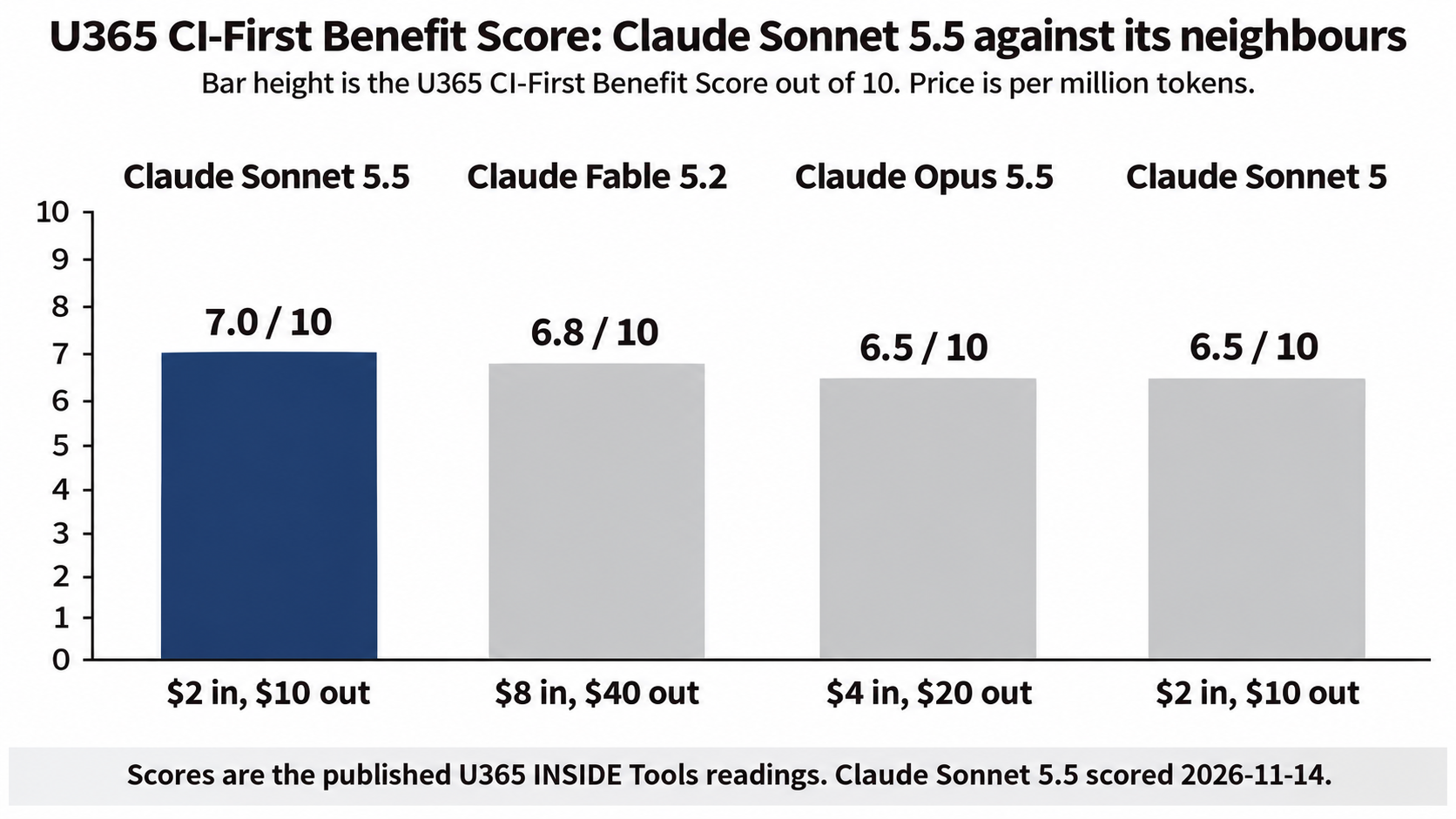
Where this model sits among the four, stated plainly. It has the highest U365 score and a measured capability close to the tier above, and those two facts are not in conflict. The framework measures benefit to the person net of overhead, and a model that is level with the tier above on knowledge work, faster at its defaults, and half the price on both lines delivers more net benefit to more people than the tier above does. Opus 5.5 remains the better instrument for complex, open-ended judgement, and the score says so through the Quality dimension at 8 for both and through the vendor's own advice. Fable 5.2 is the capability ceiling and carries the costs that go with it: a Covered Model retention term, a 45-minute run at max, and a price four times this one. Sonnet 5 holds the same 6.5 it always did, and the movement between the two Sonnet reviews is the subject of this comparison.
What moved, and what did not. Capability moved on almost every row: Terminal-Bench from 10.3 to 70.6 percent, CursorBench from 34.1 to 55.5, GDPval-AA from 1449 to 1844, AA-Briefcase from 1359 to 1811, OSWorld from 57.0 to 80.1, Chartography from 15.6 to 61.6. Price moved on one line only: the cache read halved to $0.10, while input and output stayed at $2 and $10. What did not move is the shape of the reader's work: state the task, choose an effort level, read the output, verify it. The Skill sub-score fell by one, from 5 to 4, because the model now completes the work a user would previously have learned by doing and because the Claude Code surface writes memory by default.
One comparison caveat, stated because the record requires it. The vendor's 70.6 against Opus's 66.4 on Terminal-Bench is not a clean capability comparison, because 10 percent of Opus's trials were answered by a fallback model against 1.5 percent for Sonnet 5.5, according to two readers who checked both system cards. On the evaluations where both models sat the same test without that confound, Opus leads on FrontierCode, CursorBench, Humanity's Last Exam, OSWorld and Chartography. This review scores Quality 8 for both models for that reason, and the routing advice follows the vendor's own: Opus for the hard, open-ended work, Sonnet for the well-scoped work.
The field, with "Choose X if" guidance
Alternative | Choose the alternative if... | Choose Claude Sonnet 5.5 if... |
Claude Opus 5.5 | The work is complex, open-ended and judgement-heavy, or you want the vendor's own recommended default at $4 and $20. It leads this model on every hard reasoning row where both were tested. | The task is well scoped and checkable, you want to run several in parallel, or the budget has to cover every seat rather than a few. |
Claude Sonnet 5 | You already have a working integration, you need the older disabled thinking setting or forced tool use, or you want the model that is the fallback target anyway. | You are building now and want the capability jump, the halved cache read and the current request shapes. |
Claude Fable 5.2 | The work is the hardest long-horizon engineering, the audit is deep, or a single failure is expensive and verification is cheap. It scores 6.8 and leads the independent composite at 65. | You want level-with-Opus knowledge work at a fifth of Fable's price, zero data retention, and runs measured in seconds rather than minutes. |
Claude Haiku 5.5 | The work is classification, extraction or routing at volume, and latency matters more than judgement. It starts at $0.10 and $0.50 per million tokens up to 100,000 prompts. | The task needs a model that can read a document set or finish a small code change, which Haiku is not positioned for. |
GPT-6 Astra | You want the other 7.0 in the library, a primary profile at level 1, and work that is creative and exploratory rather than routine. | Your work is documents, decks, bounded code and volume, and you want the lower price per task. |
Where Claude Sonnet 5.5 is clearly better: on price per token against Opus and Fable, at $2 and $10 against $4 and $20 and $8 and $40; on cache reads at $0.10, the cheapest in the Claude line; on speed at the default settings, at 6.7 minutes per benchmark task at high; on agentic coding against its own predecessor, at 70.6 against 10.3; and on data position, where zero data retention is available and Fable's Covered Model status is not.
Where Claude Sonnet 5.5 is clearly worse: on sustained judgement and hard reasoning, where Opus leads on FrontierCode, CursorBench, Humanity's Last Exam and Chartography; on the frontier ceiling, where Fable is the only model in the family that leads the independent composite; on the top of its own effort ladder, where max costs $10.02 per task and can return nothing; and on the cheapest high-volume work, where Haiku 5.5 starts an order of magnitude lower.

Claude Sonnet 5.5: Anthropic's Fast Everyday Model at the Same Price
Verdict and Next Steps
Who should adopt it: Teams and individuals whose work is well scoped, frequent and checkable, and who need a competent model at every seat rather than a frontier model for a few. The three strongest cases: engineering teams fixing bugs and running bounded agentic tasks where a test suite decides the answer; analysts and managers producing documents, decks and spreadsheets that a person who knows the material can check; and teams running volume work where a schema validator, not a person, accepts the output.
When: Now, with three conditions. First, set the effort policy before the first team member uses it, because the same task ranges from seconds and cents at medium to $1.28 and 15 minutes at max, and the API default is high while the apps default to medium. Second, decide where the model sits against Opus 5.5, because the vendor's own charts show Opus at low competing with this model at high and above. Third, decide about Claude Code auto memory on the day you enable the surface, because it writes notes by default and that is the fact behind the clause application.
For what: Bounded agentic coding with a checkable end state, documents, decks and spreadsheets built from a source set, structured extraction at volume, first-pass analysis over long documents, and any workflow where the cost of a near-miss is low and the cost of checking is lower.
The honest caveat, stated once: this is the best-value model Anthropic has released and the highest-scoring model in the Claude line on the framework's own arithmetic. It is also a model whose top effort setting can fail, whose headline benchmark carries a fallback confound, and whose capability is close enough to the tier above that a reader will pay for it in attention rather than in dollars. Adoption advice: take it for the everyday work, keep Opus 5.5 for the hard and open-ended work, cap the effort setting at high unless you have a reason, and put the verification step in place on the same day.
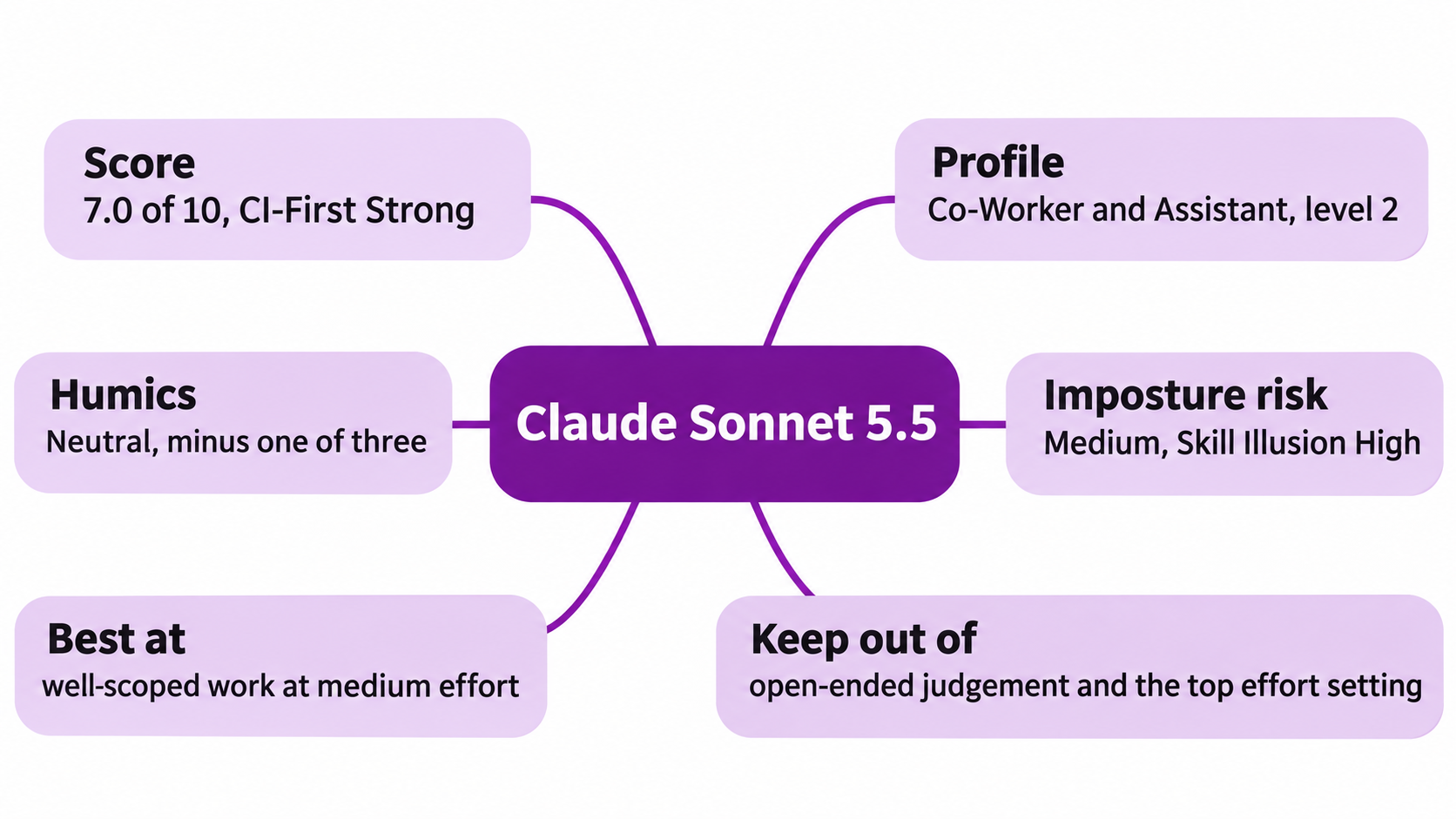
UP-Context-Engineering prompt pack
Prompt 1: Route this week's work across three models.
Context: I have [number] tasks this week. They are [list, one line each]. My constraints are
[budget, deadline, review capacity]. The models available to me are Claude Sonnet 5.5 at
$2 and $10 per million tokens, Opus 5.5 at $4 and $20, and Fable 5.2 at $8 and $40.
Role: AI as an Analyst. You are not doing the tasks; you are routing them.
Profile: Act as a Co-Researcher, Analyst & Tester, applying a stated rule rather than an
impression.
Task: assign each task to a model, an effort level and a verification step.
Constraints: one recommendation per task. Use the rule that the hardest and least checkable
task goes to the most capable model, and everything well scoped goes down a tier. Do not
recommend the top effort setting for more than [n] tasks.
Output format: a table with task, model, effort, reason, verification step, and estimated cost.
Then one line naming the task you would drop entirely.
Memory disclosure: keep this week's task list and my constraints for this session. Do not
retain my budget figures or my team's work plan.
UP-Context-Engineering verification: I can defend each routing decision from the cost and the
checkability of the task, and I can name the task I dropped and why.
Data safety: do not paste client names, unannounced projects or anyone's performance record.
Describe a task by its type, not by the person it belongs to.
Prompt 2: Bound a well-scoped run before it starts.
Context: the work is [task] in [repository or document set]. Done means [check]. The last
attempt failed because [reason]. I am running at effort [medium or high].
Role: AI as a Co-Worker and Assistant under a stated ceiling.
Profile: Act as a Co-Worker & Assistant, keeping the run inside the ceiling.
Task: produce a plan I approve before you execute, then execute it.
Constraints: no more than [n] steps, no edits outside [paths], no dependency changes. Stop and
report if you cannot finish inside the ceiling. Do not report a partial result as complete, and
list what you skipped.
Output format: Plan (numbered), then after execution: Changed, Found, Skipped, Blocked on me.
State plainly anything you did not verify.
Memory disclosure: keep the finish line, the allowed paths and the check for this session. Do
not retain file contents from outside [paths].
UP-Context-Engineering verification: I approve the plan, I run [check] myself, and I can defend
every change without the tool.
Data safety: do not paste secrets, environment files, credentials or a repository under a client
agreement. Name the file you need instead of pasting the repository.
Prompt 3: Turn one run into a skill you keep.
Context: I used Claude Sonnet 5.5 on [task] at [effort] and the result was [outcome]. The
verification I ran was [check]. What I had to correct was [correction].
Role: AI as a Coach. You are helping me extract the reusable part.
Profile: Act as a Professor, Coach & Tutor, not as a generator. Do not write the artefact again.
Task: write the reusable procedure I should follow next time, in my words.
Constraints: no more than 10 steps. Every step must be something I did, not something the model
did. Name the decision points where I had to judge, and the check that caught the error. Do not
include settings that will change with the next release.
Output format: When to use this. Steps. Decision points. Checks. What I would delegate next time
and what I would keep.
Memory disclosure: keep this run's outcome and the correction for this session only. Do not
retain the artefact or write a standing note about how I work.
UP-Context-Engineering verification: I can run this procedure without the model, and I can teach
it to a colleague in ten minutes.
Data safety: do not paste the artefact if it carries client material, unpublished results or
personal data. Describe the correction without reproducing the document.
Related U365 content
Claude Sonnet 5 Tool Review. The direct predecessor, at 6.5 with sub-scores 7 / 7 / 7 / 5. Read it beside this review to see what a point release bought.
Claude Opus 5.5 Tool Review. The tier above, at 6.5 with sub-scores 7 / 7 / 8 / 4, and the model Anthropic recommends as the default. Read it for the hard, open-ended case.
Claude Fable 5.2 Tool Review. The frontier position at 6.8, with the fullest treatment of retention terms and delegation roles in the library.
GPT-6 Astra Tool Review. The other 7.0 in the library, with a primary profile at level 1 and a Skill sub-score of 5.
The CI-First Evaluation Framework, version 1.4.1. The method behind the score, including the clause set applied in Strengths, Limits, and AI Imposture Risk.

Claude Sonnet 5.5: Anthropic's Fast Everyday Model at the Same Price
Status and Last Tested
Status: Active. Last tested: 2026-11-14. Version reviewed: Claude Sonnet 5.5, `claude-sonnet-5-5`, released 2026-09-28. Next scheduled re-check: on any of the seven triggers at the top of this document, and in any case within six months.
Active is the badge for a tool that is current and recommended for the uses this review names. It is not a claim that the tool is right for every use, and the Superhuman Usage Guidance in the U365 Co-Intelligence Rating lists the uses where it is not. The evidence was read on the date above, the independent measurement was published against the five effort settings of this model, and the community record was read on the same day. A reader who arrives more than six months after 2026-11-14 should treat the price lines, the effort behaviour and the safeguard routing as unverified until a re-check is published.

Claude Sonnet 5.5: Anthropic's Fast Everyday Model at the Same Price
Migration Path
Not applicable for an Active tool. A Migration Path is required where a tool is Retired, Deprecated or Risky, and this one is none of those. The notes below are for a reader moving an existing Claude Sonnet 5 integration to Sonnet 5.5, which is a version migration inside a supported product rather than an exit.
What transfers. Prompts and system instructions transfer without change, and the tokenizer is unchanged, so token counts and cost estimates carry over exactly. Evaluation suites transfer, with one change of setting: effort replaces any thinking budget the suite swept, and the suite should now be run at medium and high rather than at a single default. Stored thinking blocks from Sonnet 5 are readable by Sonnet 5.5, so a conversation can move forward without losing its reasoning.
What does not transfer, and why. Five breaking changes, each documented by Anthropic. First, thinking: {"type": "disabled"} returns a 400 error; the replacement is between_tools, accepted at high effort or below. Second, forced tool use is not supported: tool_choice set to any or to a named tool returns a 400 error. Third, thinking blocks are bound to the model and to the conversation prefix, and a replayed block after an edit to earlier history returns an error on accounts created on or after 2026-08-31 unless the block binding is set to drop the block. Fourth, computer_20251124 is rejected on the Claude API and the supported tool is computer_toolset_20260801. Fifth, advisor pairings change: Opus 4.8, Opus 4.7, Sonnet 5 and Haiku 5.5 cannot advise a Sonnet 5.5 executor, and the advisors that can return their advice encrypted.
Migration steps, in order. Replace disabled with between_tools and confirm the job runs at high effort or below, or switch to adaptive thinking if it runs at xhigh or max. Replace tool_choice of any and tool with auto plus strict tool use, or move the schema to structured outputs. Keep conversations append-only, and set prefix_mismatch_behavior to drop_block under the beta header if your application edits history. Move computer use to the toolset. Re-pair advisors. Branch on stop_reason so a fallback is handled rather than parsed as this model's answer. Re-run the evaluation at the effort level you intend to use in production, because the launch figures were measured at high effort settings and the default is high on the API and medium in the apps.
What to expect on the other side. A model that is much stronger on agentic coding and knowledge work at the same price per token, faster at the same settings, cheaper per task on token efficiency, and no more of a teacher than the model it replaces. The migration is small in code and real in behaviour, because the settings that used to turn thinking off and force a tool no longer exist.

Claude Sonnet 5.5: Anthropic's Fast Everyday Model at the Same Price
U365's Recommendations to Learn More
These resources were curated to help you go deeper on Claude Sonnet 5.5. We prioritise material that teaches something this review does not cover.
Official learning resources
The launch page: the positioning, the benchmark table, the price, the safeguards and the sentence that tells most buyers to start with Opus 5.5. Read that sentence as carefully as the table. https://www.anthropic.com/claude-sonnet-5-5
The model overview: context limits, output limits, modalities, effort defaults and the model id for claude-sonnet-5-5. https://platform.claude.com/docs/en/models/sonnet-5-5/overview
What is new in Sonnet 5.5: the five breaking changes, the behaviour change in text between tool calls, and the advisor pairing rules. The basis of the Migration Path notes. https://platform.claude.com/docs/en/models/sonnet-5-5/whats-new-sonnet-5-5
The migration guide: step-by-step instructions from Sonnet 5, including the before and after for forced tool use. https://platform.claude.com/docs/en/models/sonnet-5-5/migration-guide
Effort control: the five levels, the defaults and what each level changes. The single most consequential setting in this review. https://platform.claude.com/docs/en/build-with-claude/effort
Thinking and preserved thinking: how adaptive thinking works, what between_tools does, and how blocks bind to a model and a conversation. https://platform.claude.com/docs/en/build-with-claude/thinking and https://platform.claude.com/docs/en/build-with-claude/preserved-thinking
Prompting Claude Sonnet 5.5: the behavioural differences and prompting patterns the vendor publishes for this model. https://platform.claude.com/docs/en/build-with-claude/prompt-engineering/prompting-claude-sonnet-5-5
The system card: the safeguard design, the fallback statement, the RSP determinations and the capability tables. https://www.anthropic.com/document/claude-sonnet-5-5-system-card
API pricing: the token rates, cache rates and batch discount. https://platform.claude.com/docs/en/about-claude/pricing
Consumer plans: what each plan includes and how the usage limits work. https://claude.com/pricing
Claude Code memory: what auto memory writes, when, and how to turn it off. The mechanism behind clause 5.2.3-a in this review. https://code.claude.com/docs/en/memory
The model overview index, for the current model list and the tier ordering that the naming section explains. https://platform.claude.com/docs/en/models/overview
The status page, for the availability record a team should check before it schedules a dependent run. https://status.anthropic.com
Video tutorials and channels
How to use Opus 5.5 and Sonnet 5.5, by the official Claude channel. The shortest route to seeing which of the two models the vendor itself reaches for on a given task. https://www.youtube.com/watch?v=iFHsEHP437U
I Tested Sonnet 5.5 vs Opus 5.5. What You Need to Know, by Nate Herk. A side-by-side on the question this review spends a section on, from someone using both for automation work. https://www.youtube.com/watch?v=7eo-11K2e3c
Claude Sonnet 5.5 Is INSANE, by Bijan Bowen. A first-look walkthrough that covers the capability jump and the price argument, and reads the vendor's numbers rather than testing them. https://www.youtube.com/watch?v=ENWVpqtOdRI
Written tutorials and deep-dive articles
Artificial Analysis, the model page: the Intelligence Index at five effort settings, cost and time per task, and the verbosity reading this review cites. https://artificialanalysis.ai/models/claude-sonnet-5-5
Artificial Analysis, the intelligence index methodology: the nine evaluations behind the composite, so a reader can see which of them resemble their own work. https://artificialanalysis.ai/evaluations/artificial-analysis-intelligence-index
The Hacker News launch thread: 884 points and 613 comments of practitioner reports, including the tier question, the effort measurements and the safeguard complaints quoted in What Users Say. https://news.ycombinator.com/item?id=49881850
The r/ClaudeAI launch thread: the community summary of the release and the reaction to the price and the tier. https://www.reddit.com/r/ClaudeAI/comments/1wslxzs/introducing_claude_sonnet_55_the_second_model_in/
The public bake-off that thefourthchime cited, where a one-shot game build is compared across models and the leaderboard is public: https://jonclegg.github.io/pacman-bakeoff/
The Opus 5.5 system card, which carries the fallback sentence behind the Terminal-Bench caveat in this review. https://www.anthropic.com/document/claude-opus-5-5-system-card
Community and social
Hacker News, the launch thread: the most useful single page in the record, because practitioners posted measured comparisons rather than impressions on the first day. https://news.ycombinator.com/item?id=49881850
Reddit, r/ClaudeAI: the launch thread and the surrounding discussion, where the price and tier arguments are concentrated. https://www.reddit.com/r/ClaudeAI/comments/1wslxzs/introducing_claude_sonnet_55_the_second_model_in/
Artificial Analysis, the release comparison page: the independent measurements as they are updated, which is where a reader should check whether the figures in this review still hold. https://artificialanalysis.ai/models/releases
Resources on X
Dedicated X channels. Three accounts carry this release: Anthropic's company account, which posted the availability announcement; the Claude product account, which carried the launch summary; and the Artificial Analysis account, which carries the independent measurements this review cites.
@AnthropicAI, the company account: https://x.com/AnthropicAI
@claudeai, the Claude product account: https://x.com/claudeai
@ArtificialAnlys, the independent evaluation account: https://x.com/ArtificialAnlys
Read any post against the measurement rather than against its own caption, and treat a launch-day thread as a pointer to a source rather than as a source.


Claude Sonnet 5.5: Anthropic's Fast Everyday Model at the Same Price
CI-First Evaluation Summary Card
Field | Value |
Tool | Claude Sonnet 5.5, operated by Anthropic |
Category | Applied AI / Large Language Model (everyday agentic coding, knowledge work and document production) |
Version reviewed | Claude Sonnet 5.5 (claude-sonnet-5-5, released 2026-09-28), as documented by the vendor on 2026-11-14 |
Status | Active |
Last tested | 2026-11-14 |
CI-First Profile | Primary: Co-Worker and Assistant (level 2). Secondary: Co-Creator and Thought Partner (level 1) for long design and writing conversations, Co-Researcher, Analyst and Tester (level 4) for first-pass document and gap work |
CI-First Benefit Score | 7.0 / 10 (CI-First Strong) |
Time | 8, strong net savings at the default settings through an agentic coding jump from 10.3 to 70.6 percent on Terminal-Bench, outputs 30 percent faster and 6.7 minutes per task at high, against real overhead: an effort decision on every job, 33.8 minutes per task at max, and one measured run that spent 15 minutes and returned nothing |
Quantity | 8, more finished units of work per day through a million-token window, a 128,000-token output ceiling, 300,000 in batch, cache reads at $0.10 and the vendor's claim that low or medium effort beats Sonnet 5's best at about a tenth of the cost per task |
Quality | 8, level with Opus 5.5 on GDPval-AA at 1844 against 1846 and AA-Briefcase at 1811 against 1822, and far ahead of Sonnet 5 on agentic coding at 70.6 against 10.3; held at 8 by FrontierCode at 52.1 against 54.4, Humanity's Last Exam at 64.5 against 67.7, and the vendor's statement that Opus remains clearly stronger at complex open-ended work |
Skill | 4, execution rather than learning, with clause 5.2.3-a applying to the Claude Code memory default; down one point from the sibling review and scored conservatively |
Humics Protection Badge | Humics-Neutral (-1 / +3) |
Creativity | 0 Neutral: it drafts, lays out and executes against a direction you set, with design polish and template fidelity claimed by the vendor; it neither trains nor replaces your ideation |
Critical Thinking | -1 Erodes: fluent, near-frontier output for people who cannot evaluate it, in exactly the tasks where the editing pass used to be the practice, with the vendor celebrating a draft judged ready to send as is |
Social Authenticity | 0 Neutral: clause 4.2-a returns a null for the model as a generator; the live condition is an application that sends under a person's identity unread |
AI Imposture Risk | Medium overall, with Skill Illusion High |
Time Illusion | Medium: real savings at the defaults against a real overhead, including an effort decision on every job, a top setting that can spend the budget and return nothing, and documents that must be read against their sources |
Quantity Illusion | Medium: high-volume fluent output in professional forms, with 335 million output tokens at max against a median of 77.3 million, and nothing that separates a finished deck from a correct one for a reader who does not know the material |
Skill Illusion | High: expert-form output for users who cannot evaluate it, produced by a model whose selling point is finishing the well-scoped task, on a surface that writes procedural memory by default; mitigations are stated in Strengths, Limits, and AI Imposture Risk |
Clause 5.2.3-a | APPLIES. Floor met at Medium and the High threshold met. Claude Code auto memory writes notes the model decides to keep, during use, enabled by default, with no per-write human decision. Live condition: any change to that default in either direction re-opens the assessment |
Clause 4.2-a | NULL as a generator, with a live condition: an application built on this model that sends text in the person's own name through a connected account without the person reading it first would meet erosion condition (a) |
Clause 7.5 | Removed by framework v1.4 on 2026-10-13, not assessed; recorded so that a reader comparing reviews knows why it is absent |
Section 7c finding | First Sonnet model with Opus-class cyber safeguards and fallbacks; higher-risk cyber requests and frontier-development requests fall back to Claude Sonnet 5, while chemical, biological and distillation classifiers block with no fallback; the Cyber Verification Program is described in the future tense for this model at launch; zero data retention is available, unlike Claude Fable 5.2's Covered Model status; preserved thinking is tied to the account. No sub-score changed, for reasons stated in the section |
Superhuman usage | Invite for bounded agentic coding, documents and decks from a source set, structured extraction at volume, first-pass analysis and parallel sessions at medium; keep out of complex open-ended judgement, uncheckable work, permissive cyber work, the final judgement calls and any plan that assumes max is affordable |
Over-delegation warning | The failure mode is a person who leaves a $2 model on everywhere, runs four in parallel and stops reading the output as closely as they read a colleague's, because nothing about a cheap model feels like over-delegation. If you cannot say which tasks ran at which effort, what you verified this week, and what the surface wrote into memory, the price is being paid in attention rather than in dollars |
Verification checklists | Per workflow, in Real Workflows: multi-model check, external source, human review, specification or regression check, CI-First test |
U365 methods | LIPS holds the task, the effort decision and the verification record, because the model holds no state beyond the session. ULM and EVA: Career and Finance through cost per completed task and the effort judgement. UP-Context-Engineering writes the context, role, task, constraints and output order the workflows use. UNOP: weak, because the model produces rather than teaches |
Re-check triggers | Any change to the effort defaults; a price change on any line; any change to the cyber safeguards, the fallback target or the programme's coverage; any change to the thinking controls; a new independent index revision or a controlled head-to-head at matched effort; any change to the Claude Code memory defaults; and a tier change that removes the reason for this model |

Claude Sonnet 5.5: Anthropic's Fast Everyday Model at the Same Price
Glossary
CI-First
Co-Intelligence First: the U365 principle that the human is the ruler and the orchestrator and AI is the amplifier. The question this review answers with a score is whether the tool makes co-intelligence more profitable than human intelligence alone. Claude Sonnet 5.5 is a CI-First Strong model: it amplifies you across the common work at a price that allows daily use, and it requires you to supply the scoping and verification discipline the price assumes.
CI-First Benefit Score
The arithmetic mean of the four benefit dimensions, each scored 0 to 10, rounded to one decimal place. 0 to 2.0 is CI-First Negative, 2.1 to 4.0 is CI-First Neutral, 4.1 to 6.0 is CI-First Positive, 6.1 to 8.0 is CI-First Strong, and 8.1 to 10 is CI-First Transformative. Claude Sonnet 5.5 scores 7.0, which is Strong.
Time Benefit
Whether the tool returns more time than it costs, after the overhead of using it is subtracted. Claude Sonnet 5.5 is 8: a large agentic coding jump, outputs 30 percent faster and 6.7 minutes per task at the default high effort, against an effort decision on every job, 33.8 minutes per task at max and a top setting that can return nothing.
Quantity Benefit
Whether the same time produces more usable output. Claude Sonnet 5.5 is 8: a million-token window, a 128,000-token output ceiling, 300,000 in batch, cache reads at $0.10 and a price low enough that parallel sessions are rational, with the vendor reporting that low or medium effort beats its predecessor's best at about a tenth of the cost per task.
Quality Benefit
Whether the output is better, verified and durable. Claude Sonnet 5.5 is 8: level with Opus 5.5 on GDPval-AA and AA-Briefcase, far ahead of Sonnet 5 on agentic coding, and held below 9 by the hard reasoning rows where Opus leads and by the vendor's own statement that Opus remains clearly stronger at complex, open-ended work.
Knowledge and Skill Benefit
Whether the user gains lasting capability. Claude Sonnet 5.5 is 4: execution rather than learning, a surface that writes procedural memory by default, and a model that now completes work the user would previously have learned by doing, so the framework scores it conservatively and one point below its predecessor.
CI-First Profile
The role the AI plays in your working relationship. (level 1) Co-Creator and Thought Partner, (level 2) Co-Worker and Assistant, (level 3) Professor, Coach and Tutor, (level 4) Co-Researcher, Analyst and Tester, (level 5) Challenger, Critic and Devil's Advocate. Lower level numbers indicate higher AI autonomy in the collaboration. Claude Sonnet 5.5 is primarily a Co-Worker and Assistant (level 2).
Humics
The set of capabilities that are uniquely human, as defined by Pascal Bornet: creativity, critical thinking and social authenticity. The framework asks whether a tool strengthens, leaves neutral or erodes each one.
Humics Protection Badge
A rating of whether a tool protects, leaves neutral or erodes the three human capabilities: Creativity, Critical Thinking and Social Authenticity. Each is scored +1, 0 or -1 and the sum gives the badge. +2 to +3 is Humics-Friendly, -1 to +1 is Humics-Neutral, -2 to -3 is Humics-Risky. Claude Sonnet 5.5 is Humics-Neutral at -1 / +3.
AI Imposture Risk
The likelihood that a tool traps you in one of three illusions. The Time Illusion is the appearance of saving time when net time is lost. The Quantity Illusion is high volume that does not survive inspection. The Skill Illusion is the appearance of competence while the underlying skill is absent or eroding. Each trap is rated Low, Medium or High with cited evidence. The overall level is Low when all three are Low, Medium when one, two or three traps are Medium or when one trap is High with clear mitigations stated, and High when two or more traps are High or when the tool's core value proposition is built on an illusion. Claude Sonnet 5.5 is Medium overall, with Skill Illusion High.
User Sentiment
The aggregate of what users report about a tool, kept separate from the framework's own findings. No review platform carries model-level data for Claude Sonnet 5.5; the signal is the launch thread on Hacker News and the subreddit launch thread, both directional and both from the first days of availability.
Review Status
The badge at the top of this review. The vocabulary is: Active, the tool is current and recommended; Active (updated), recently re-checked and refreshed; Changed, a re-check trigger has fired and an update is pending; Risky, the tool has significant unresolved issues or has been clearly surpassed, so use it with caution; Stale, not re-checked in over six months, so pricing and features are unverified; Retired, the tool still works but is no longer recommended; Deprecated, the tool has been shut down or fundamentally changed.
Last tested and Re-check
The date this review's evidence was gathered and the condition that forces a new pass. Claude Sonnet 5.5 was tested on 2026-11-14 and re-checks on any of the seven triggers listed at the top of this document, and in any case within six months.

Claude Sonnet 5.5: Anthropic's Fast Everyday Model at the Same Price
Sources
Vendor primary sources
The launch page, for the positioning, the benchmark table, the price, the safeguard statement and the availability list: https://www.anthropic.com/claude-sonnet-5-5
The model overview, for the context and output limits, the modalities, the effort defaults, the model ids and the release date: https://platform.claude.com/docs/en/models/sonnet-5-5/overview
What is new in Sonnet 5.5, for the five breaking changes, the text-between-tool-calls behaviour and the advisor pairing rules: https://platform.claude.com/docs/en/models/sonnet-5-5/whats-new-sonnet-5-5
The migration guide, for the step-by-step move from Sonnet 5: https://platform.claude.com/docs/en/models/sonnet-5-5/migration-guide
Effort control, for the five levels and the API default: https://platform.claude.com/docs/en/build-with-claude/effort
Thinking and preserved thinking, for adaptive thinking, between_tools, the block binding and the beta header: https://platform.claude.com/docs/en/build-with-claude/thinking and https://platform.claude.com/docs/en/build-with-claude/preserved-thinking
Prompting Claude Sonnet 5.5, for the model-specific prompting patterns: https://platform.claude.com/docs/en/build-with-claude/prompt-engineering/prompting-claude-sonnet-5-5
The system card, for the safeguard design, the fallback statement, the RSP determinations and the capability tables: https://www.anthropic.com/document/claude-sonnet-5-5-system-card
API pricing, for the token rates, cache rates and batch discount: https://platform.claude.com/docs/en/about-claude/pricing
Consumer, team and enterprise pricing, for the plan prices and usage limits: https://claude.com/pricing
Claude Code memory, for the auto memory default and its mechanics: https://code.claude.com/docs/en/memory
The models overview, for the current model list and the tier ordering: https://platform.claude.com/docs/en/models/overview
The status page, for the availability record: https://status.anthropic.com
Independent sources
Artificial Analysis, the Claude Sonnet 5.5 model page, for the Intelligence Index at five effort settings, cost and time per task, time to first token, output speed and verbosity: https://artificialanalysis.ai/models/claude-sonnet-5-5
Artificial Analysis, the intelligence index methodology, for the nine evaluations behind the composite: https://artificialanalysis.ai/evaluations/artificial-analysis-intelligence-index
Community and community-reported evidence
Hacker News, the launch thread, 884 points and 613 comments, read on 2026-11-14, for every quoted commenter in this review: https://news.ycombinator.com/item?id=49881850
Reddit, r/ClaudeAI, the launch thread, 2,209 points and 332 comments, read on 2026-11-14 and summarised rather than quoted: https://www.reddit.com/r/ClaudeAI/comments/1wslxzs/introducing_claude_sonnet_55_the_second_model_in/
The public bake-off cited by one commenter, for the one-shot game comparison: https://jonclegg.github.io/pacman-bakeoff/
Review platform sources
No reviews found on G2, Capterra, Trustpilot or Product Hunt for this model endpoint. Those platforms rate AI products and companies rather than individual model endpoints, and none publishes a model-level figure for Claude Sonnet 5.5. This review states that rather than inventing a rating.
Framework and method
The U365 CI-First Evaluation Framework, version 1.4.1, which is the scoring method used here: CI-First Evaluation Framework
The U365 INSIDE Tools review template, which sets the structure of this post and the tool-type variants applied in it: INSIDE Tools Review template
Published U365 INSIDE Tools reviews, read as comparisons and named in this post, including the Claude Sonnet 5, Claude Opus 5.5, Claude Fable 5.2 and GPT-6 Astra reviews: INSIDE Tools reviews
The U365 methods house pages, for the UP-Context-Engineering Method, ULM, LIPS and UNOP as they are published: U365 methods

Claude Sonnet 5.5: Anthropic's Fast Everyday Model at the Same Price
Faculty Note on Evidence Quality
Five things should be said plainly about the evidence behind this review, because they change how much weight a reader should put on each part of it.
First, the vendor's headline comparison is not a clean capability comparison, and the record shows why. Anthropic reports 70.6 percent on Terminal-Bench 4.0 for Sonnet 5.5 against 66.4 for Opus 5.5, and its footnote states that the Opus figure is reported at xhigh effort, which the vendor calls that model's highest score. Two readers on the launch thread then checked both system cards: 10 percent of Opus's trials were answered by a fallback model against 1.5 percent for Sonnet 5.5, and the Opus 5.5 system card itself states that the benchmark was run with safeguards enabled and that flagged requests were answered by a fallback model under the default server-side fallback policy, 2.5 percent of requests, affecting 10 percent of trials. A benchmark partly answered by another model is not a measurement of the model named. On the rows where both models sat the same test without that confound, Opus leads. Both facts are in this review, and the score reflects the second rather than the first.
Second, the vendor's own footnotes carry two caveats that no headline row shows. Sonnet 5.5 scores lower at max effort than at xhigh on FrontierCode, 46.2 against 52.1, and the vendor explains why: at the top setting the model more often ran a code-review skill that split the work across subagents, and in two cases that led to a timeout or to edits beyond the task's scope. And the GDPval-AA and AA-Briefcase figures the vendor quotes were run by Artificial Analysis on a pre-release deployment that the vendor says carried a bug affecting structured-output requests, which the vendor expects to understate its performance and says has since been fixed. A reader who wants the cleanest available number should treat both figures as provisional until an independent re-run is published.
Third, the cost figures are per benchmark task and per effort setting, and the spread is larger than the price gap between models. Independent measurement records $10.02 per Intelligence Index task at max and 6.7 minutes per task at high, and one practitioner measured the same small task at under two cents at low and $1.28 at max, where it returned nothing. The gap between the top and the bottom of one model's effort ladder is larger than the gap between this model and Opus 5.5 on the rate card. Every cost sentence in this review carries the effort setting, because a cost without a setting is not a number a reader can use.
Fourth, the community record is a first-days signal from practitioners, and it is used as one. The launch thread carries measured comparisons, including a correct reading of the vendor's table, a public bake-off result and a five-setting token measurement, and it carries single-participant impressions about tier position and safeguard frustration. This review attributes every quotation to its handle, does not aggregate the thread into a rating, and does not treat a repeated impression as a measurement. No aggregate rating exists on any review platform for this model endpoint, and the absence is stated in What Users Say rather than filled.
Fifth, the tier question is the part of this review most likely to be argued with, and the argument is fair. A reader can reasonably say that a model this close to Opus on knowledge work, at half the price, makes the flagship redundant for most work. That is the reading this review's score supports. The counter-reading is equally fair and is already in the record: at high and above, Opus at low returns similar results for similar money, and at the very top of the ladder Sonnet 5.5 costs $10.02 per task and can fail. The framework's answer is the routing advice rather than a verdict on either model: Sonnet 5.5 at medium and below for well-scoped work, Opus 5.5 for the hard and open-ended work, Fable 5.2 only when the frontier ceiling is the thing being bought. A reader who takes one sentence from this review should take that one.

Claude Sonnet 5.5: Anthropic's Fast Everyday Model at the Same Price
Status and Re-check
Status: Active | Last tested: 2026-11-14 (Claude Sonnet 5.5, `claude-sonnet-5-5`, released 2026-09-28) | Re-check: trigger-based (max 6 months)
Active: the tool is current and recommended.
For detailed explanations of the CI-First evaluation terms used in this review, including the Humics Protection Badge and the AI Imposture Risk levels, see the Glossary at the end of this post.
Re-check triggers:
Any change to the effort defaults. The Claude API defaults to high, and the Claude apps and Claude Code default to medium. Independent measurement puts the same model between 26 and 55 on a composite index across five settings, and records 6.7 minutes per task at high against 33.8 at max, so a change to either default, or to what a named level does, moves every cost figure in this review.
A price change on any line. $2 per million input tokens, $10 per million output, $2.50 for a five-minute cache write, $4 for a one-hour cache write, $0.10 for a cache read, batch at half rate. The cache read is the line that moved against Claude Sonnet 5, halved from $0.20, and it is the line a repeated-context workload depends on.
Any change to the cyber safeguards, the fallback target, or the programme's coverage. Higher-risk cyber requests fall back to Claude Sonnet 5, the fallback applies to first-party products and to API developers who opt in, and the launch page says cyberdefenders "will soon be able to apply" to the expanded Cyber Verification Program. A change to any of those three moves the access finding in "Cyber safeguards, fallback routing and the verification programme".
Any change to the thinking controls. between_tools replaces disabled as the way to turn off up-front thinking, it is accepted at low, medium and high only, tool_choice of any or tool returns an error, and a replayed thinking block after an edit to earlier history can return an error on accounts created on or after 2026-08-31. The migration notes in Getting Started depend on all four.
A new independent index revision, or a controlled head-to-head at matched effort. The vendor's headline Terminal-Bench comparison carries a fallback confound that two readers on the launch thread measured from the two system cards, and no independent re-run with fallbacks removed has been published as of 2026-11-14.
Any change to the Claude Code auto memory default. The Skill Illusion rating rests on a surface that writes procedural memory by default, with no per-write human decision.
A tier change that removes the reason for this model. If Opus 5.5 falls in price, or a Sonnet 6 lands with the same effort ladder, the routing advice in Verdict and Next Steps has to be rewritten rather than refreshed.
Review conducted by URC under the CI-First Evaluation Framework, version 1.4.1. Scoring date 2026-11-14. Tool version reviewed: Claude Sonnet 5.5 (`claude-sonnet-5-5`, released 2026-09-28).




Comments