
Claude Sonnet 4.6: Anthropic's Legacy Sonnet Is Now the Most Expensive One

Status: Risky | Last tested: 2026-11-14 (Claude Sonnet 4.6, claude-sonnet-4-6, released 2026-02-17) | Re-check: trigger-based (max 6 months)
Risky: the tool has significant unresolved issues, or it has been clearly surpassed by newer alternatives. Use it with caution and read the Limits section.
For detailed explanations of the CI-First evaluation terms used in this review, including the Humics Protection Badge and the AI Imposture Risk levels, see the Glossary at the end of this post.


In this Tool Review

Claude Sonnet 4.6: Anthropic's Legacy Sonnet Is Now the Most Expensive One
The name, the tier position and the model this review does not replace
Four names matter here, and the number that looks oldest is the one this review scores.
Name | What it is | Where it appears |
Claude Sonnet 4.6 | The model this review scores. Model id claude-sonnet-4-6, released 2026-02-17, still available, documented as Active (legacy) | The model overview comparison table, the model page, the deprecations page, the Anthropic API, Amazon Bedrock, Google Cloud, Microsoft Foundry and Claude Platform on AWS |
Claude Sonnet 4.5 | The direct predecessor, model id claude-sonnet-4-5-20250929. Deprecated on 2026-09-30 and scheduled for retirement on 2026-11-30, with claude-sonnet-5-5 named as the replacement | The model deprecations page, the retirement notice |
Claude Sonnet 5 | The first successor, model id claude-sonnet-5, released June 2026 at $2 and $10. It carries the published U365 score of 6.5 | The models overview, the Artificial Analysis model pages, the U365 Claude Sonnet 5 review |
Claude Sonnet 5.5 | The current Sonnet model, model id claude-sonnet-5-5, released 2026-09-28 at the same $2 and $10, with a cache read at $0.10. It carries the published U365 score of 7.0 | The models overview, the vendor's migration guide, the U365 Claude Sonnet 5.5 review |
Sonnet 4.6 is a legacy model, and Anthropic's own definition of that word is the finding. The deprecations page defines the states: Active means fully supported and recommended for use; Legacy means the model will no longer receive updates and might be deprecated in the future; Deprecated means still functional but no longer recommended, with a retirement date and a named replacement; Retired means requests fail. Sonnet 4.6 appears as Active (legacy), with retirement not sooner than 2027-02-17. It is not deprecated and it is not retired. It is a model that works, that will not be improved, and that the vendor has already replaced twice.
The two successors did not arrive at the same price, and the direction of the price move is the part a reader has to hold on to. Sonnet 4.6 launched at $3 and $15 per million tokens, the same rate as Sonnet 4.5. Sonnet 5 arrived in June 2026 at $2 and $10. Sonnet 5.5 arrived on 2026-09-28 at $2 and $10 with the cache read halved to $0.10. So the older model is now the more expensive one on every line, by 50 percent on input, output and both cache writes, and by three times on a cache read. That is unusual in a hardware market and ordinary in a model market: the successor is cheaper because it is more token-efficient and because the vendor is buying share at the tier.
The predecessor is being switched off while this model stays on the list. Sonnet 4.5 was deprecated on 2026-09-30 and retires on 2026-11-30, sixteen days after the date of this review, with claude-sonnet-5-5 named as the recommended replacement. Sonnet 4.6 has a floor of 2027-02-17. A team still running 4.5 has a fortnight; a team running 4.6 has at least three months and probably more. That difference is the only sense in which "staying on 4.6" is a plan rather than a postponement.
What this review is. It is the URC scoring of Claude Sonnet 4.6 under the CI-First Evaluation Framework, version 1.4.1, on evidence read on 2026-11-14: the vendor's launch page, model page, effort documentation, pricing, deprecation policy and 1M context announcement; the independent measurement published by Artificial Analysis in February 2026 and the pages as they stand today; the Hacker News launch thread and the 1M context general-availability thread; a public issue tracker record of a reported quality regression; and the published U365 scores of the models this one is compared against.
What this review is not. It is not a review of Claude Code, the Claude apps, Amazon Bedrock, Google Cloud, Microsoft Foundry or Claude Platform on AWS. Those surfaces appear where a scored fact depends on them. It is not a re-score of Claude Sonnet 4.5, which has no U365 review, or of Claude Sonnet 5 or Sonnet 5.5, each of which has its own document. It is not a history of the model's eight months on the market. And it is not an assessment of Anthropic's safety programme beyond the facts a buyer of this model has to carry, which are stated in Section 7c with their sources named.
The format this review follows. Three published Claude reviews set the structure and depth: claude-sonnet-5-5-anthropic-s-fast-everyday-model-at-the-same-price, the newest house shape, published on 2026-11-14; claude-opus-5-5-anthropic-s-fable-5-1-class-model-at-40-percent-lower-cost-scored-6-5-on-the-u365; and claude-sonnet-5-anthropic-s-precision-reasoning-model. The section order, the At a Glance table, the clause note and the Faculty Note follow those documents rather than a shorter template.
Why a superseded model gets a full review at all. Because the U365 Model Recruitment lecture links every model in the Claude lineage to its INSIDE review, and because the question a reader actually asks about an older model is not "how good was it" but "is there any reason left to run it". A review that only scored the launch would answer the first question and leave the second, which is the one that costs money.

Claude Sonnet 4.6: Anthropic's Legacy Sonnet Is Now the Most Expensive One
Tool Snapshot
Claude Sonnet 4.6, the model that first put Opus-class agentic work at a Sonnet price: a million-token window, 128,000 output tokens, and a capability that sat two index points under the frontier in February 2026, now two releases behind and 50 percent more expensive per token than the model that replaced it.
Category: Applied AI / Large Language Model. Agentic coding, computer use, long-context document work, professional document and spreadsheet production, and visual understanding. It sits below Claude Sonnet 5 and Claude Sonnet 5.5 in the current line-up on capability and, on every price line, above them.
At a Glance
Field | Value |
CI-First Benefit Score | 6.0 / 10 (CI-First Positive) |
Sub-scores | Time 7 / Quantity 7 / Quality 6 / Skill 4 |
CI-First Profile | Primary: Co-Worker and Assistant (level 2). Secondary: Co-Researcher, Analyst and Tester (level 4), Co-Creator and Thought Partner (level 1) |
Humics Protection | Humics-Neutral (-1 / +3): Creativity 0, Critical Thinking -1, Social Authenticity 0 |
AI Imposture Risk | Medium overall, with Skill Illusion High |
User sentiment | Positive at launch on capability and autonomy, negative on token burn; the record since is thinner and includes a documented quality-regression complaint and two error-rate incidents |
Price | $3 input / $15 output per million tokens; cache write $3.75 (5m) and $6 (1h); cache read $0.30; batch at half rate |
Context and output | 1,000,000 tokens in, 128,000 out, 300,000 in batch beta; 600 images or PDF pages at the full window |
Platforms | Claude API, Amazon Bedrock, Google Cloud (Anthropic managed and Google managed), Microsoft Foundry, Claude Platform on AWS |
Lifecycle | Active (legacy); retirement not sooner than 2027-02-17 |
Released | 2026-02-17 |
Knowledge cutoff | Reliable August 2025; training data January 2026 |
Replaces | Claude Sonnet 4.5, which retires on 2026-11-30 |
Replaced by | Claude Sonnet 5 (June 2026) and Claude Sonnet 5.5 (2026-09-28) |
Official links
Resource | URL |
Announcement | |
Model page | |
System card | |
Pricing | |
Effort control | |
Deprecations and lifecycle | |
Migration guide to the successor | |
Status page |

Claude Sonnet 4.6: Anthropic's Legacy Sonnet Is Now the Most Expensive One
The Problem
The problem this model solved in February 2026 was a price problem, not a capability problem. Agentic coding worked, but it worked at Opus prices. Sonnet 4.5 could not hold a long task together, and the vendor's own preference data says so indirectly: early testers rated the new model less prone to overengineering and laziness, better at instruction following, with fewer false claims of success and more consistent follow-through on multi-step tasks. Opus 4.6 could hold the thread and cost $5 and $25 per million tokens. A team that wanted a competent model at every seat, rather than a frontier model for a few people, had no good answer. Sonnet 4.6 was the answer: a 1M token window, 128,000 output tokens, a large jump in autonomous run length, and the same $3 and $15 as the model it replaced.
The problem it poses now is the inverse, and it is the reason this review exists. A reader arriving in November 2026 has three Sonnet models to choose from on the same API. The oldest is the most expensive. It has not been updated since February. Its knowledge cutoff is ten months older than the current model's. It has one fewer effort setting. It has no dated snapshot to pin to. And its replacement is cheaper on every line. None of that makes it unusable; all of it makes it a decision that has to be argued rather than assumed.
The specific decision a reader faces. Not "is Sonnet 4.6 good", which was answered in February, but one of three questions:
Migration. An integration built on claude-sonnet-4-6 in 2026 now runs a legacy model at a premium. What breaks if it moves, and what does it cost to leave it where it is?
Reproducibility. A team that needs a fixed model for a regression suite wants the model that does not change under it. A legacy model is frozen by definition, which is the one property that argues for keeping it.
A late arrival. A reader who has inherited a codebase, a prompt library or an evaluation set built on 4.6 needs to know what it is worth today before deciding whether to rebuild.
What the model was not built to do, stated plainly, because it bounds every workflow in Real Workflows. It generates text, not images. It reads images and documents but does not produce visual artefacts. It has no weights, no self-hosting path and no external auditability. Its computer use is a tool surface, not a product. And its effort ladder stops at max without the xhigh setting that both successors carry, so a workflow tuned to xhigh has no equivalent here.

Claude Sonnet 4.6: Anthropic's Legacy Sonnet Is Now the Most Expensive One
The Outcome
At launch, the outcome was measured and large: a Sonnet model that behaved like an Opus model on agentic work at two thirds of the Opus price. The independent record from February 2026 is specific. Artificial Analysis scored Sonnet 4.6 at 51 on its Intelligence Index of the time, eight points above Sonnet 4.5 at 43 and two points below Opus 4.6 at 53, and described it as the strongest model it had tested for agentic use cases, leading on GDPval-AA at 1633 against Opus 4.6 at 1606 and on Terminal-Bench at 53 percent against 46. The vendor's own preference data pointed the same way: early testers preferred it to Sonnet 4.5 about 70 percent of the time and to Opus 4.5 about 59 percent of the time.
The costs of that outcome were measured in the same pass and they were not small. Sonnet 4.6 used 74 million output tokens to run the Intelligence Index, against 25 million for Sonnet 4.5 and 58 million for Opus 4.6, and cost $2,088 to run the suite against $733 for Sonnet 4.5 and $2,486 for Opus 4.6. So the model was 3 times as verbose as its predecessor and, on a full evaluation run, only 16 percent cheaper than the tier above it despite a 40 percent lower rate card. The rate card is not the bill.
Eight months later, the outcome has to be stated in two tenses. In the present tense: a model that completes agentic tasks, holds a million tokens, produces finished documents and costs 50 percent more per token than the model the vendor now recommends. In the comparative tense: a model that no current revision of the independent index measures, so its distance from Sonnet 5 and Sonnet 5.5 cannot be quoted as a number from one table. That is not a rhetorical hedge. Artificial Analysis marks the model page as deprecated, continues benchmarking only the default 10,000-token workload, and reports no index figure; the current index revision carries figures for Sonnet 5.5 at 55 (max), Opus 5.5 at 59 and Fable 5.2 at 65, and no figure for Sonnet 4.6 or Sonnet 5.
What follows for the reader. The capability that was bought in February is still in the model. What has changed is the price of it, the freshness of its knowledge, the number of settings it offers, and the vendor's commitment to keep it. Those four changes are what take a model from 6.5 (the published score of Sonnet 5, the next model in the line) down to 6.0 here, and the arithmetic is set out in the U365 Co-Intelligence Rating rather than asserted.

Claude Sonnet 4.6: Anthropic's Legacy Sonnet Is Now the Most Expensive One
Who Should Use Claude Sonnet 4.6
Learner type | Difficulty | Typical ROI | Career path |
Students (Bachelor, Master) | Intermediate | Reachable through Claude Code and the Claude apps where the model is still selectable, and through the API at $3 and $15. A defensible student choice only for a course that deliberately pins a model: a reproducibility exercise, a benchmark-reading assignment, or a comparison between two generations. For ordinary coursework the successor is cheaper and better, and a student paying per token should not be paying the legacy premium. | UIT (Technology, AI, Data Science) tracks through agentic coding practice and evaluation design, where a frozen baseline is a teaching object. No published U365 credential assesses model routing or effort policy as a named component, and none is asserted. |
Professionals (career upskilling) | Intermediate | The case is narrow and real: an integration already built on claude-sonnet-4-6 with an evaluation suite that must stay comparable across years, or a workflow whose prompt library and guardrails were tuned to this model's behaviour and whose owner can measure the cost of retuning. For new work, the successor at $2 and $10 dominates on every line. | |
Everyone (lifelong learners) | Beginner in the apps, Intermediate for agentic work | A million-token window and a 128,000-token output ceiling are still generous, and the model writes clearly and follows a template. But a learner who wants to learn on a budget should learn on the current model, because the habits transfer and the price difference does not. | LIPS Collect and Review phases for reading and drafting, and the UP-Context-Engineering Method order for prompting. UNOP fit is weak, because the model produces rather than teaches. No assessment home is asserted. |
For teams and organisations. The model is still purchasable by a company, and a team deciding on it starts with four questions.
Team deployment. Reachable through the Claude API, Amazon Bedrock on the bedrock-runtime endpoint, Google Cloud under both Anthropic-managed and Google-managed terms, Microsoft Foundry, and Claude Platform on AWS. It is a legacy model on those platforms, which means a deployment is possible but the vendor is not adding capability to it. Anthropic's current guidance routes new work to Opus 5.5, Fable 5.2, Sonnet 5.5 and Haiku 5.5, and does not include this model among the latest four. A deployment plan that ignores that is a plan with an expiry date.
Cost at team scale. Three lines move independently: the seat, the consumption and the effort policy. On consumption this model is the expensive option: $3 and $15 against $2 and $10 for Sonnet 5.5, $3.75 against $2.50 for a five-minute cache write, and $0.30 against $0.10 for a cache read. On effort, the API default is high and the ceiling is max, with no xhigh; a workload that would run at xhigh on a successor has to choose between high and max here, which is either less capability or more tokens. And on tokens per task, independent measurement of the launch configuration recorded three times the output of Sonnet 4.5, so the rate-card premium understates the bill.
Data and compliance. Anthropic states zero data retention availability for Sonnet 5, Opus 5.5 and Sonnet 5.5 on their pages; this review did not find an equivalent statement for Sonnet 4.6 on the pages it read, so a regulated buyer should confirm the retention position for this model with the vendor rather than infer it from the successor's page. The model was deployed under the vendor's ASL-3 standard at launch, which is a deployment standard rather than a data term. Enterprise arrangements, custom retention controls and regional inference settings are account-level terms that do not change with the model id.
U365 for companies. Professional learners reach University 365's academic services individually or through their organisation, and the company route runs through a customized training agreement for employee groups. Corporate education programmes are built on demand, and their tuition follows content and duration.
Skill level required: Intermediate. Driving this model well means scoping the task before the prompt, choosing an effort level deliberately, and reading the output against something outside the conversation. Those are the same three skills the successors require, which is the good news: what a team learns on 4.6 transfers.
Prerequisites. For the apps: a Claude account and a surface where the model is still selectable. For Claude Code: a paid seat, a model selection that names claude-sonnet-4-6, and a decision about auto memory, which is on by default in local sessions and writes notes the model chooses to keep. For the API: an account with billing, an API version chosen deliberately because the current one has removed the sampling parameters this model used to accept, and a decision about the effort level each job runs at. Working knowledge of prompt structure and verification practice, because output at this level reads as finished whether or not it is correct.
Typical time to first result: Under five minutes in the Claude apps on a plan that still exposes the model. Under fifteen minutes on the API for a first call with the model id claude-sonnet-4-6 at the default high effort.
Typical time to competence: Ten to twenty hours of active use. The three skills are scoping, effort selection and verification design. A reader who already has them from another Claude model needs a day, because the only new facts are the four-level ladder and the price.
Who should wait. Anyone starting new work, because the successor is cheaper on every line and stronger on both vendor and independent evidence. Anyone whose workload depends on xhigh. Anyone whose work depends on knowledge after August 2025 without retrieval. Anyone who needs a dated snapshot rather than a dateless id. And anyone who cannot yet check a fluent document against its sources, because the price premium buys no additional verification.

Claude Sonnet 4.6: Anthropic's Legacy Sonnet Is Now the Most Expensive One
U365 Institutes Alignment
The alignment below rates what a U365 institute could take from this model as a working instrument and as an object of study. It is a legacy model, two generations behind the current Sonnet, and nothing in this section recommends it for new work: a Fellow should use it now to hold a frozen baseline, to read an integration already built on it, and to study a published deprecation calendar at first hand, and should use the current Sonnet for anything new. The primary home is UIT (Technology, AI, Data Science), because agentic coding, effort policy, lifecycle management and evaluation design are the competencies this model exercises, and because a model that is deliberately frozen is the cleanest teaching object a benchmark-reading course can have. The other three readings are real and each is bounded.
UIT (Technology, AI, Data Science)
Rating. High (primary)
Why. Four competencies, each of which survives the removal of the tool. Agentic coding on a bounded task: state the finish line, name the tests, bound the paths, and read the report before the diff. The launch record makes this a real exercise, with an independent agentic profile that led the field in February 2026 and a vendor footnote that the Terminal-Bench figure was measured with thinking off, which is itself a lesson in reading a benchmark. Effort policy: four levels, an API default of high, no xhigh, and a cost per task that independent measurement puts at three times the predecessor's token count, so the setting is a budget decision before it is a quality decision. Lifecycle management: a model that moved from release to legacy in eight months, with a published retirement floor and a 60-day notice commitment, is the rare case where a student can study a real deprecation calendar instead of a hypothetical one. Evaluation design: a frozen model is the fixed point against which a moving model can be measured, and building that comparison is the exercise.
The limit that holds the row. The model is a service a practitioner operates, not an artefact a practitioner inspects. There are no weights, no parameter count and no architecture description, so the competencies are engineering-with rather than engineering-of. The catalogue's AI-agent instruction is concentrated in the n8n certificate series and the Superhuman certifications rather than spread across the degree paths: 0 of the 20 degree programmes carry agent, agentic or prompt in title or description. No published U365 programme assesses effort policy, model lifecycle or evaluation design as a named component. Adjacent anchors, not assessment homes.
UIB (Business Management, Entrepreneurship)
Rating. Medium
Why. Two decisions the release forces that are commercial before they are technical. The first is the difference between a rate card and a bill: $3 and $15 against the predecessor's identical rate, and three times the output tokens on the same evaluation, which triples the output line on an unchanged price list and is the single most useful arithmetic a business cohort can do on published figures. The second is dependency management: a workflow built on a model with a retirement floor has a planning horizon, and the cost of retuning prompts, guardrails and evaluations belongs in the year-one budget rather than in the year the model stops answering.
The limit that holds the row. The model supplies no management method and does not measure its own return. It publishes no completion rate and no time-per-task figure outside the vendor's benchmark selection. No published U365 programme assesses the economics of a model portfolio as a named component: 0 of the 81 published programmes carry portfolio, return on investment, cost or price in title or description. Adjacent anchors, not assessment homes.
UIC (Digital Communication, Marketing)
Rating. Low to Medium
Why. One competency that matters and is easy to miss: reading a vendor claim as a communication act. The launch record offers a preference percentage from early testers, a report that visual outputs were more polished, and a slide deck that two experts judged ready to send, and none of the three is a benchmark; telling a measured claim from a framing claim is the whole of the skill, and it is one a communication Fellow can practise on a live launch page. The writing surface is real as well: a million-token window holds a campaign archive, a brand guide and a set of drafts in one session, and 128,000 output tokens let a long deliverable arrive in a single pass.
The limit that holds the row. The model teaches no register, no audience analysis and no publication standard. It returns no sourced evidence of its own, so fact-checking stays with the writer, and nothing in it assesses a layout or a campaign: 0 of the 81 published programmes carry editorial, publication standard, audience analysis or register in title or description. Rated as a drafting surface with a reading contact. No credential is mapped.
UID (Digital Design, UX/UI)
Rating. Low to Medium
Why. The production use is interface code: the model reads images and writes code, and the first workflow in this review is a bounded change to a repository that a design student can run against a component, so variants arrive fast enough that comparison becomes the work. Early testers also reported that its visual outputs were more polished, with better layouts and animations, which is a production report rather than a measurement. Two reading contacts sit beside it: template fidelity, because a model that follows a supplied layout closely enough to cut iteration rounds is presentational work a student can study, and image description, because the model reads a screen and reports what it sees.
The limit that holds the row. The model generates no images and evaluates no design against a brief. It reads images and produces text and code, so the visual judgement stays with the student, and a critique of a layout is a judgement the model cannot ground: 0 of the 81 published programmes carry critique, usability, information architecture, user research or design brief in title or description. Rated as interface-code production and presentation support. No credential is mapped.
U365 methods, not an institute (UNOP, ULM, LIPS, CARE and the UP-Context-Engineering Method)
Rating. Applicable
Why. Three decisions this model forces are method decisions before they are settings. Effort is a planning decision, and the UP-Context-Engineering Method's context, role, task, constraints and output order is what makes a run reproducible when the same prompt can be run at four settings. LIPS with CARE holds the record of what was asked, at which effort, against which model id and API version, and what was verified, because the model keeps nothing between sessions. ULM is the six-domain frame in which a Fellow decides whether the work is worth automating at all, in Career and Finance and in Quality of Life; ULM carries no cost method, and cost per completed task is CI-First cost engineering and the independent evaluator's metric, never a ULM method. UNOP has no direct fit: the model is not built to teach, it claims no teaching mode, and its Skill sub-score of 4 records that a user learns less by working with it.
The limit that holds the row. The model carries no method of its own and no coaching surface. A Fellow who does not write the effort decision, the API version and the verification result into their own system has no account of them, and nothing in the product writes that account.

Claude Sonnet 4.6: Anthropic's Legacy Sonnet Is Now the Most Expensive One
How Claude Sonnet 4.6 Works
A reasoning model with adaptive thinking, a four-position effort ladder, a million-token window that became generally available a month after launch, and a price that has been above its successors since June 2026.
Inputs: Text prompts, documents and images; through the API, a conversation history and tool definitions. Through Claude Code, a repository, its instruction files, the memory the surface maintains and any rulebook you have written. The model reads text and images and produces text.
Outputs: Text, code, structured tool calls and, through agent surfaces, edits to files. Up to 128,000 tokens in a single response on the Claude API, and up to 300,000 on the Message Batches API with the extended output beta, inside a context window of 1,000,000 tokens. Independent measurement of the non-reasoning configuration records 44.9 output tokens per second and a time to first answer token of 0.95 seconds.
Underlying technology, as the vendor publishes it:
Model: Claude Sonnet 4.6, model id claude-sonnet-4-6, released 2026-02-17, documented as Active (legacy) with retirement not sooner than 2027-02-17.
Thinking: adaptive, with extended thinking documented as deprecated on this model. Effort is the control: low, medium, high and max, with the API default at high.
No xhigh. The vendor's effort documentation lists the models that accept the extended setting, and this model is not on that list. It is on the list for max.
Context and output: 1,000,000 tokens in, 128,000 out, 300,000 in batch beta. The window was in beta at launch with a long-context premium above 200,000 tokens, and became generally available at standard pricing on 2026-03-13 with media limits of 600 images or PDF pages.
Knowledge: reliable cutoff August 2025, training data cutoff January 2026. Both are ten months older than the current Sonnet's June 2026 cutoff.
Price: $3 and $15 per million tokens, cache writes at $3.75 and $6.00, cache read at $0.30, batch at half rate.
Safeguards: deployed under the vendor's ASL-3 standard, with prompt-injection resistance described as a major improvement over Sonnet 4.5 and similar to Opus 4.6.
Platforms: Claude API, Amazon Bedrock on bedrock-runtime, Google Cloud under both management models, Microsoft Foundry, Claude Platform on AWS.
A platform discrepancy a team should know about before it plans. The Anthropic model page documents a maximum output of 128,000 tokens. The Amazon Bedrock model card for the same model documents 64,000. Both were read on 2026-11-14. The same card states that reasoning is off by default on that endpoint, while Anthropic documents adaptive thinking for the model, and that manual extended thinking with a token budget is deprecated. A team that sizes a single-pass deliverable at 100,000 tokens on the assumption that the 128K ceiling travels to Bedrock is making an assumption the platform's own documentation does not support, and a team that assumes thinking is on by default on Bedrock is making a second one.
The breaking changes, stated as facts a builder has to handle. First, extended thinking with a token budget is documented as deprecated on this model; adaptive thinking with effort is the supported path. Second, temperature, top_p and top_k were removed in API version 2026-10-21 and return a 400 error, so an integration that pins determinism through sampling parameters has to pin an older API version or lose them. Third, a higher effort level is not monotonically more capable on every task, and with no xhigh the choice between high and max is a real quality decision rather than a dial. Fourth, the model id is dateless: the vendor documents claude-sonnet-4-6 and no dated snapshot, so what you pin is a name the vendor controls, not an immutable build.
What is not disclosed. No parameter count. No weights. No architecture description. No per-effort token budget, because effort is a named level rather than a number. No statement that would let a buyer audit what the model does internally. The clause assessments in Strengths, Limits, and AI Imposture Risk turn on what ships on the surfaces, not on anything inside the model.
What the effort ladder actually decides. Each level trades tokens for thoroughness: low for subagents and simple tasks, medium for everyday work, high as the API default, max for the hardest reasoning. The vendor's documentation describes effort as "a behavioral signal, not a strict token budget", which matters for a legacy model: the same prompt at the same level can consume different token counts on different tasks, and the only way to know the bill is to measure it on your own work.

Claude Sonnet 4.6: Anthropic's Legacy Sonnet Is Now the Most Expensive One
Getting Started with Claude Sonnet 4.6
Required accounts: A Claude account for the apps, on a plan where the model is still selectable. A paid seat for Claude Code. An account with billing enabled for the API, and an Amazon Bedrock, Google Cloud, Microsoft Foundry or Claude Platform on AWS account with the model enabled in the region you use.
Installation: Nothing to install for the apps. For Claude Code, the CLI or the desktop surface, with the model selected in the session. For the API, nothing beyond an HTTP client or an official SDK, with the model selected by the id claude-sonnet-4-6.
First-time configuration:
Decide whether this model should be in the build at all. The honest first step on a legacy model. If the answer is yes, write down why in one sentence, because the reason determines every setting below. The three reasons that survive are a reproducibility baseline, an integration whose retuning cost exceeds the price premium, and a pinned dependency whose behaviour has to stay constant through an audit.
Choose the API version deliberately. Version 2026-10-21 removed temperature, top_p and top_k and returns a 400 error when they are sent. An integration that relies on them has to stay on an earlier version, and that decision belongs in writing rather than in a lockfile.
Set the effort level by task. Four positions, with high as the API default. Independent measurement of the launch configuration recorded 74 million output tokens for a full index run, three times the predecessor, so the setting is where the budget is decided. low for subagents and extraction, medium for everyday drafting, high for agentic coding and document analysis, max for the rare task that justifies it.
Size the context you actually need. The full 1M window is available at standard pricing since 2026-03-13, with a media limit of 600 images or PDF pages. A run that uses 900,000 tokens is billed at the same per-token rate as a short one, which makes the window cheap in rate terms and expensive in absolute terms: 900,000 input tokens at $3 is $2.70 before a single output token.
Decide about auto memory on the day you enable Claude Code. Auto memory is on by default in local sessions, writes notes the model decides to keep, and is the mechanism behind the clause application in Strengths, Limits, and AI Imposture Risk. It can be turned off per project with autoMemoryEnabled, or globally with CLAUDE_CODE_DISABLE_AUTO_MEMORY=1.
Write the comparison before you need it. If the reason for staying is reproducibility, record the current model's output on your own suite now, beside Sonnet 5.5's output on the same suite. A baseline that is not recorded on the day it is frozen cannot be recovered later, because the model is the baseline.
What a call costs, computed rather than estimated. For a 20,000-token input with a 3,000-token output, Sonnet 4.6 bills $0.06 for the input and $0.045 for the output, $0.105 per call. Sonnet 5.5 on the same traffic bills $0.04 and $0.03, $0.07 per call. With the 20,000-token context cached and read back, the cache line is $0.006 on 4.6 against $0.002 on 5.5. The gap is 50 percent on generation and three times on cache reads, and it widens on workloads that read a long context repeatedly, which is exactly the workload the 1M window was bought for.
If you are moving from Sonnet 4.5: the price is unchanged, the effort ladder replaces the thinking budget, the window grows from 200,000 to 1,000,000 tokens, and the output ceiling doubles from 64,000 to 128,000 on the Claude API. The migration is small in code and real in behaviour, because a budget in tokens is not the same control as a named effort level.

Claude Sonnet 4.6: Anthropic's Legacy Sonnet Is Now the Most Expensive One
Real Workflows
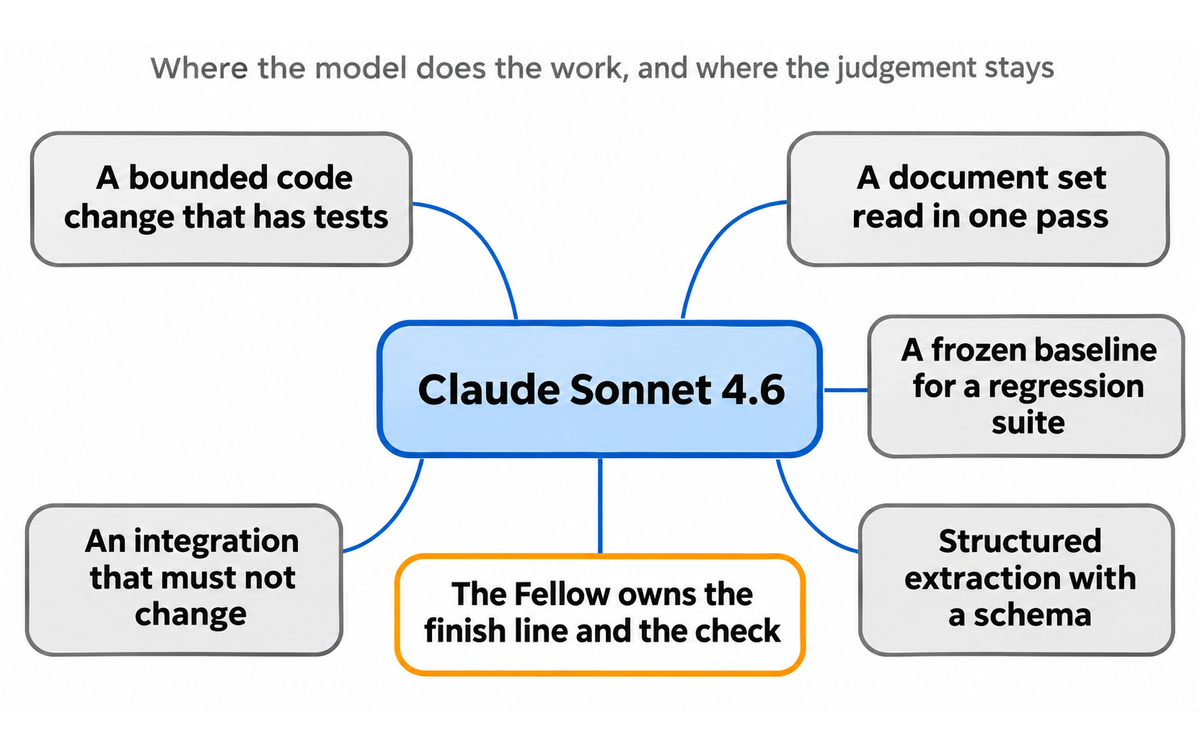
Three workflows, each chosen because it is a defensible use of this model in November 2026 rather than a use that a successor does better.
Workflow 1: Bounded agentic coding on a repository that has tests
What it is. A bug fix, a test repair, a small refactor or a feature with a defined finish line, run through Claude Code or the API with tools, at high effort, where a test suite decides whether the answer is right.
Why this model. The autonomous run length is the capability that made the release: early testers reported it running up to three or four times longer than Sonnet 4.5 without intervention, and an independent composite put its agentic rows at the top of the field in February 2026. If the workflow is already built on this model, the capability is not the problem; the price is.
UP-Context prompt:
Context: the work is [bug or feature] in [repository]. Done means [test command] passes and
[acceptance check] holds. The last attempt failed because [reason]. The model is
claude-sonnet-4-6 at effort high.
Role: AI as a Co-Worker & Assistant under a stated ceiling.
Profile: Act as a Co-Worker & Assistant, keeping the run inside the ceiling.
Task: produce a plan I approve before you execute, then execute it.
Constraints: no more than [n] steps, no edits outside [paths], no dependency changes, no
sampling parameters in the request. Stop and report if you cannot finish inside the ceiling.
Do not report a partial result as complete, and list what you skipped.
Output format: Plan (numbered), then after execution: Changed, Found, Skipped, Blocked on me.
State plainly anything you did not verify.
Memory disclosure: keep the finish line, the allowed paths and the check for this session.
Do not retain file contents from outside [paths] and do not write standing notes about my
preferences.
UP-Context-Engineering verification: I approve the plan, I run [test command] myself, and I can
defend every change without the tool.
Data safety: do not paste secrets, environment files, credentials, customer records or a
repository under a client agreement. Name the file you need instead of pasting the repository.
Verification checklist:
VERIFICATION CHECKLIST for bounded agentic coding:
[x] Multi-Model Check: run the same failing test against Sonnet 5.5 on the same diff and
    compare the diagnosis, not the prose.
[x] External Source: the test suite and the compiler, both run by me, not by the model.
[x] Human Review: I read the diff before the report, and the report before the merge.
[x] CI-First Test: can I explain the fix and defend it without the tool? Y/N
Workflow 2: A document set larger than a reading week
What it is. A contract set, a tender pack, a research corpus or a set of financial statements read in one pass at the full window, with a gap list as the deliverable rather than a summary.
Why this model. A million tokens is the whole point, and this model has it at standard pricing with media limits of 600 images or PDF pages. The successor has the same window at a lower rate, so the reason to use 4.6 here is not capability but continuity: a document workflow whose extraction schema and prompts were tuned to this model's output shape.
UP-Context prompt:
Context: I have [n] documents, [total tokens], in [folder]. The question is [question]. I need
the gaps as much as the answers: what the set does not say, and where two documents disagree.
Role: AI as a Co-Researcher & Analyst.
Profile: Act as a Co-Researcher, Analyst & Tester, showing the evidence behind each finding.
Task: produce a finding table with a citation to document and page for every row, then a gap
list, then a contradiction list.
Constraints: no finding without a page reference. If a document exceeds the page limit, say
which pages were not read rather than summarising the whole file. Do not infer a number that is
not printed. Do not present a gap as a finding.
Output format: Findings (claim | document | page | confidence), Gaps, Contradictions, Not read.
Memory disclosure: keep the question and the document set for this session. Do not retain the
documents after it, and do not produce a summary of my source material beyond the output.
UP-Context-Engineering verification: I open every page cited in the top five findings myself,
and I can defend each finding from the document without the tool.
Data safety: do not paste unpublished manuscripts, client-confidential reports, personal data
or anything under an agreement. Say which pages you were not given.
Verification checklist:
VERIFICATION CHECKLIST for long-context document review:
[x] Multi-Model Check: put the contradiction list to Sonnet 5.5 and keep only contradictions
    both models find.
[x] External Source: open every cited page in the source document; a citation is not evidence
    until it is opened.
[x] Human Review: a second reader who knows the material reviews the gap list, not the summary.
[x] CI-First Test: can I defend each finding from the document without the tool? Y/N
Workflow 3: A frozen baseline for a regression suite
What it is. The one workflow where a legacy model is the better instrument. A prompt library, an extraction schema or a classifier is fixed; the suite is run against claude-sonnet-4-6 monthly to detect changes in what the pipeline does, and against claude-sonnet-5-5 to decide whether to move. The 4.6 run is the control, and the control has to stop moving for the comparison to mean anything.
Why this model. Legacy means no updates, which is exactly what a control needs. A current model behind a stable name can change under you, and a dated snapshot is not offered here. The trade is explicit: you accept a stale knowledge cutoff and a higher price in exchange for a fixed reference point that a moving model can be measured against.
UP-Context prompt:
Context: I maintain a regression suite of [n] cases for [pipeline]. The suite runs monthly on
claude-sonnet-4-6 as the frozen control and on claude-sonnet-5-5 as the candidate. The last run
diverged on [n] cases, in [categories].
Role: AI as a Tester, not as a generator.
Profile: Act as a Co-Researcher, Analyst & Tester, applying the same rubric to both runs.
Task: classify every divergence as expected model difference, pipeline defect, or rubric
ambiguity, and tell me which category dominates.
Constraints: do not rewrite the cases. Do not treat a difference in length as a difference in
correctness. Quote the case id for every claim. Record the model id and the API version beside
every run.
Output format: Divergence table (case | 4.6 output | 5.5 output | category | confidence), then
one paragraph on what the suite is actually measuring.
Memory disclosure: keep the suite and the rubric for this session. Do not retain case outputs
after the session, and do not write a standing note about how my team works.
UP-Context-Engineering verification: I can state what the control is for in one sentence, and
the suite would fail loudly if the control run changed.
Data safety: do not paste client data, production rows, credentials or examination content.
Use a public or de-identified suite and replace names with roles.
Verification checklist:
VERIFICATION CHECKLIST for a frozen baseline:
[x] Multi-Model Check: the suite itself is run on both models; the comparison is the product.
[x] External Source: the case labels are human-authored and stored outside the model.
[x] Human Review: a second engineer reviews every case whose category changed month on month.
[x] CI-First Test: can I explain what the control proves without the tool? Y/N
Claude Sonnet 4.6: Anthropic's Legacy Sonnet Is Now the Most Expensive One
Strengths, Limits, and AI Imposture Risk
Strengths
CI-First Benefit | Strength | Evidence |
Time | Agentic work that previously needed the Opus tier, at a Sonnet rate, with autonomous runs several times longer than the predecessor's. | Vendor: early testers preferred it to Sonnet 4.5 about 70 percent of the time and to Opus 4.5 about 59 percent of the time, and reported 3 to 4 times longer autonomous runs. Independent: 51 on the Intelligence Index of February 2026, 8 points above Sonnet 4.5, with the strongest agentic rows the evaluator had measured. Held at 7 rather than 8 by the token cost of getting there. |
Quantity | A million-token window and a 128,000-token output ceiling that make a whole document set or a long deliverable a single job. | 1,000,000 tokens in, 128,000 out, 300,000 in batch beta, 600 images or PDF pages, standard pricing across the full window since 2026-03-13, batch at half rate. |
Quality | Level with the frontier of its release week on real-world office work and ahead of it on two agentic evaluations. | Independent: GDPval-AA 1633 against Opus 4.6 at 1606 and Terminal-Bench 53 percent against 46 percent. Vendor: SWE-bench Verified averaged over 10 trials, with a prompt modification reaching 80.2 percent; OSWorld-Verified gains across the Sonnet line. Held at 6 by the age of the evidence, the knowledge cutoff and the platform output discrepancy. |
Skill | Marginal, and scored conservatively at 4. | No teaching mode is claimed. The model completes agentic work a user would previously have learned by doing, and the Claude Code surface writes procedural memory by default in local sessions. Clause 5.2.3-a applies rather than returning a null. |
Limits
It is the most expensive Sonnet model on the list. $3 and $15 against $2 and $10, with cache writes 50 percent higher and cache reads three times higher. There is no line on which this model is cheaper than its successor.
It is more expensive per task than its rate card suggests. Three times the output tokens of Sonnet 4.5 on the same evaluation, and only 16 percent cheaper than Opus 4.6 to run the full suite despite a 40 percent lower rate card.
Its knowledge cutoff is ten months older than the current Sonnet's. Reliable cutoff August 2025, training data January 2026, against June 2026 for Sonnet 5.5. Any workflow that depends on facts after August 2025 needs retrieval, and the model will not tell you that it needs it.
It has one fewer effort setting. No xhigh. A workflow tuned to xhigh on a successor has to choose between high and max here, which is either less capability or a larger bill.
The model is frozen and the ID is dateless. Legacy means no updates, which is good for a control and bad for a product. There is no dated snapshot to pin to, so behaviour is stable by policy rather than by build.
The retirement floor is 2027-02-17, and the vendor's own commitment is 60 days of notice. That is a planning horizon, not a guarantee of service.
A reported quality regression is on the public record. A user filed a quantified complaint in the Claude Code issue tracker in April 2026, tracking repeated instructions and corrections across 50 sessions, with a baseline of about 25 events a week rising to about 480 in the weeks of 16 and 23 March and falling back to 65 in the week of 30 March. It is one person's self-tracked data, not a measurement, and the issue was closed. It is recorded here because a buyer of a legacy model should know that the quality question was raised in public.
Two error-rate incidents were reported on the vendor's status page. One in April 2026 and one in June 2026 that named Opus 4.8, Opus 4.7, Opus 4.6 and Sonnet 4.6 together. Availability is a product property, and this model's record includes both.
The platform output ceiling is disputed between vendor pages. Anthropic documents 128,000 tokens; the Amazon Bedrock model card documents 64,000 for the same model.
No open weights, no self-hosting and no external auditability. Nothing about this model can be inspected from outside Anthropic's service.
AI Imposture Risk
Trap | Rating | Evidence |
Time Illusion | Medium | The savings are real on the work the model was built for: agentic coding that used to need the Opus tier, runs three to four times longer than the predecessor's, a million-token window that removes a chunking pass. The overhead is real as well: an effort decision on every job, a default of high that is not the cheapest setting, a token burn three times the predecessor's on the same evaluation, and documents that must be read against their sources before they can be sent. |
Quantity Illusion | Medium | The volume is the offer: 128,000 tokens of output, a million-token window, 600 images or pages, documents that look finished. Independent measurement recorded 74 million output tokens to run the index, 64 percent of it in a single evaluation, which is volume produced whether or not it is volume read. Nothing separates a correct deck from a polished wrong one for a reader who does not know the source material. |
Skill Illusion | High | Expert-form code, documents and decks for users who cannot evaluate them, produced by a model whose selling point is finishing the well-scoped task, on a surface that writes procedural memory by default in local sessions with no per-write human decision. The capability is high enough that a failure reads as a plausible near-miss. Mitigations are stated below and they are specific, and none of them moves the capability to the reader. |
Overall Imposture Risk: Medium. One trap is High with clear mitigations stated, and two are Medium. Under the framework's arithmetic, one High with clear mitigations stated is Medium rather than High, and the band-precedence sentence does not change the outcome because the other two traps are Medium rather than High. The rating holds for a specific reason: the quality evidence argues downward, because the model is no longer measured on the current index and its knowledge cutoff is ten months old, while the verbosity, the effort default and the memory default argue upward at the same time.
The mitigations, stated clearly, because the band condition requires them. First, the effort level can be fixed by policy rather than left to habit: high as the ceiling for checkable work and max as an exception removes most of the token risk in one decision. Second, every workflow in this review carries a verification step that does not depend on the model's account of itself, and two of the three are mechanical: a test suite and a page citation. Third, the price is published and observable, so a reader can see what a run cost before deciding whether the answer justified it. Fourth, Claude Code's memory is a documented, inspectable default with a documented off switch, which means a team can decide about it. Fifth, the model is frozen, so a failure mode found once can be expected to recur rather than to be silently fixed, which makes it easier to test for. These lower the frequency and the cost of failure. They do not transfer capability, which is why the Skill sub-score stays at 4.
Framework v1.2 clause note
Clause 5.2.3-a, agent-authored procedural memory: APPLIES. The floor is met at Medium and the High threshold is met. The mechanism is specific: Claude Code auto memory is on by default in local sessions, writes notes the model decides to keep based on whether the information would be useful in a future conversation, and subagents can keep their own. The clause does not ask whether the notes are good. It asks whether a mechanism ships by default by which the model writes skills, memory stores or standing instructions on the user's behalf, and this one does. The review records the application rather than a null, cites the surface that triggers it, and carries the consequence into the Skill sub-score. The live condition to watch is any change to that default in either direction.
Clause 4.2-a, agent-mediated conversation: NULL as a generator, with the live condition recorded. Neither erosion condition is met by the model itself. No agent-authored text is presented as the person's own voice in a human-facing channel by default, and nothing substitutes agent interaction for human contact. The live condition is a deployment property rather than a model property: an application built on this model that sends text in the person's own name through a connected account, without the person reading it first, would meet condition (a).
Clause 7.5: removed by framework v1.4, not assessed. The subsection was removed on 2026-10-13 and no part of this review reaches its case. It is recorded here so that a reader comparing this review with an older one knows why the clause is absent rather than unanswered.
Why the clause note does not carry the whole Skill finding. The Skill Illusion is High for a reason that no clause mechanism supplies: the model produces expert-form output on tasks whose correctness the reader often cannot check, and it has crossed the threshold where a user would once have done the work themselves. The clause application adds a second, separate mechanism on the Claude Code surface. A reader who turned auto memory off would still face the first.

Claude Sonnet 4.6: Anthropic's Legacy Sonnet Is Now the Most Expensive One
Section 7c: Lifecycle, the retirement calendar and what the deprecation policy guarantees, stated plainly
A Section 7c finding is recorded where a supplier's governance, record or conduct has a real result for the reader. The items below were checked against primary sources, and they produce findings a buyer should carry. All findings are stated as facts of record, and the difference between a company statement, a policy commitment and a product behaviour is kept intact.
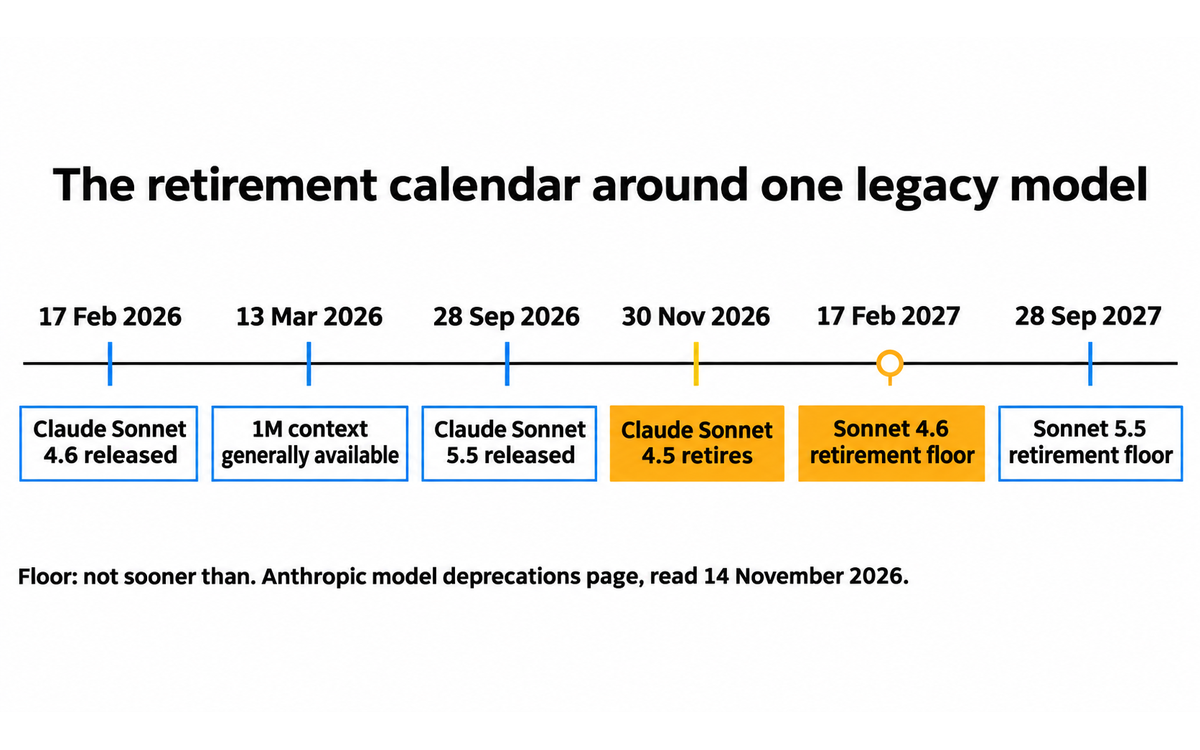
Anthropic defines legacy in a way that matters to a buyer, and the definition is short. The deprecations page states that Active means the model is fully supported and recommended for use, and that Legacy means the model "will no longer receive updates and might be deprecated in the future". Sonnet 4.6 carries the combined label Active (legacy). So the model is supported today, will not be improved, and may be deprecated later. A team that reads "Active" and stops there has read half the label.
The retirement floor is a year from release, and the notice commitment is 60 days. The model page states retirement not sooner than 2027-02-17, one year after release. The deprecations page states that Anthropic notifies customers with active deployments at least 60 days before the retirement of a publicly released model. The same page states that partner-operated platforms, including Amazon Bedrock and Google Cloud's Google-managed service, set their own retirement schedules, so a date that holds on the Claude API is not automatically the date on the platform you use. Amazon's model card for this model states the platform's own position in three lines: an EOL date no sooner than 2027-02-17, a legacy period of at least six months, and a model lifecycle of Active.
The predecessor is the worked example, and it is happening now. Sonnet 4.5 was deprecated on 2026-09-30 and retires on 2026-11-30, with claude-sonnet-5-5 named as the recommended replacement. That is 14 months after release and 16 days after the date of this review. It gives a reader a real calendar to reason with: the previous Sonnet model received roughly 14 months of availability and about two months of notice before the end, and this model's floor gives it at least 12 months before a similar clock could start.
The economics of this model changed once already, without a version change. The 1M context window launched in beta with a long-context premium: two readers on the launch thread measured 2x input and 1.5x output pricing above 200,000 tokens, and one recorded the Claude Code menu of the day offering Sonnet 4.6 with 1M context at $6 and $22.50 per million tokens as extra usage. On 2026-03-13 Anthropic made the window generally available "at standard pricing for both models, with no long-context premium", and expanded media limits to 600 images or PDF pages. A legacy model's bill can therefore move under a fixed model id, which is one reason a frozen model is not the same thing as a frozen cost.
The API itself moves under the model. Version 2026-10-21 removed temperature, top_p and top_k and returns a 400 error when they are sent. The deprecations page states that earlier API versions return the parameter when it is set to a non-default value on Claude 4.7 and later models, which is the only part of the change that is version-conditional; the removal itself is a property of the API version, not of the model. An integration that pins the model but not the API version is not pinned in the way its owner thinks.
Anthropic publishes the downside of its own policy, which is worth crediting. The deprecations page states that retiring models has costs: users who value specific models must migrate, researchers lose access to models for ongoing comparative studies, and retirement introduces safety and model-welfare risks. It also states a commitment to long-term preservation of model weights and links its deprecation commitments. A vendor that names the cost of its own policy is easier to plan against than one that does not, and this review records the statement rather than treating the policy as a scandal.
No sub-score changed for these findings, and the reason is explicit. The Time and Quantity sub-scores already carry the cost of the workflow, and the Quality sub-score already carries the age of the evidence and the knowledge cutoff. The Skill sub-score already carries the memory default, which is where the clause application lands. The items above concern the calendar, the price history and the API version rather than a defect in the artefact a buyer receives today, and none of them is a resolved failure. Section 7c closes with what it does not do: it does not allege misconduct, it does not treat a published deprecation policy as a broken promise, and it does not convert a vendor's own caveat into a finding against it. It records what a reader adopting this model is also adopting: a published calendar, a platform-specific retirement schedule, and a model id that is stable while the API around it is not.

Claude Sonnet 4.6: Anthropic's Legacy Sonnet Is Now the Most Expensive One
U365 Co-Intelligence Rating
CI-First Profile
Primary profile: Co-Worker and Assistant (level 2). Secondary profiles: Co-Researcher, Analyst and Tester (level 4), Co-Creator and Thought Partner (level 1).
Why this profile. The vendor's positioning does the reasoning. Anthropic sold Sonnet 4.6 as a model that executes: coding, computer use, agent planning, knowledge work and design, with the Free and Pro plans defaulting to it, and with early testers preferring it to the frontier model of five weeks earlier on coding. That is an execution framing: name the task, hand it over, review what returns. Co-Worker and Assistant (level 2) is the role the model plays for the person using it. Co-Researcher, Analyst and Tester (level 4) is recorded as secondary because the 1M window and the document work are genuine analysis uses, and because a frozen model is a natural tester beside a moving one. Co-Creator and Thought Partner (level 1) stays reachable as a secondary because early testers described better design sensibility and fewer iteration rounds, and because a long design or writing conversation in a million-token window is a real use. The primary stays at level 2 because the price, the effort ladder and the launch demonstrations all point the same way.
CI-First Benefit Score
Dimension | Score (0-10) | Rationale |
Time | 7 | Strong net savings on the work the model was built for. Autonomous runs three to four times longer than Sonnet 4.5's, a million-token window that removes a chunking pass, and an independent agentic profile that led the field in February 2026. Held at 7 rather than 8 by the cost of the same work: three times the predecessor's output tokens on the index run, a default effort of high, and a non-reasoning path measured at 44.9 tokens per second, which the evaluator places at the lower end of its price tier. |
Quantity | 7 | A genuine multiplier. 1,000,000 tokens in, 128,000 out, 300,000 in batch beta, 600 images or PDF pages, standard pricing across the full window, batch at half rate. Held at 7 rather than 8 because the usable-volume multiplier is paid for in reading: 74 million output tokens to run one evaluation suite is volume a person has to check. |
Quality | 6 | Clear quality gains that survive verification, at the level of the frontier of its release week: GDPval-AA 1633 against Opus 4.6 at 1606, Terminal-Bench 53 percent against 46 percent, SWE-bench Verified averaged over ten trials with a prompt modification reaching 80.2 percent. Held at 6 by three facts: the independent evidence is eight months old and no current revision measures the model, the reliable knowledge cutoff is August 2025, and the output ceiling differs between the vendor's page and the Bedrock model card. |
Skill | 4 | Execution rather than learning in the common case, with a mechanism that writes procedural memory by default. Scored conservatively per the framework's guidance and level with the successor reviews, because clause 5.2.3-a applies through the Claude Code memory default. The score reflects what the product does for your own capability rather than anything the model does wrong. |
CI-First Benefit Score: 6.0 / 10 (CI-First Positive)
Why the score sits where it sits
6.0 with sub-scores 7 / 7 / 6 / 4 puts this model below every Claude model the library has scored: Sonnet 5.5 at 7.0, Haiku 5.5 at 6.8, Opus 5.5 at 6.5 and Sonnet 5 at 6.5. That ordering is the framework working rather than a preference for new models, and it needs explaining.
Why not higher. Three reasons, each measured. First, the Quality dimension is scored on verified, durable evidence, and the evidence here is eight months old, on an index revision that no longer exists, for a model the evaluator has stopped measuring; a strong result that cannot be re-measured is a weaker quality claim than the same result measured last month. Second, the model carries a ten-month knowledge gap against the current Sonnet, which is a quality limit in the common case rather than in a corner. Third, the Skill sub-score is 4, because the model does the work for you and the surface writes memory about you.
Why not lower. The capability is real and was measured on both sides in its release week: 8 index points above its predecessor, level with the frontier on real-world office work, ahead of it on two agentic evaluations. The window, the output ceiling and the batch limit are still generous, and the platform coverage is the widest in the family. A reader with a working integration gets a competent model at a premium, not a broken one. Positive is the band for a tool that delivers clear net benefit and is worth adopting with disciplined usage, and that is what this is.
Why the score is 0.5 below Claude Sonnet 5, the next model in the line. The Sonnet 5 review published 6.5 with sub-scores 7 / 7 / 7 / 5. This review publishes 6.0 with 7 / 7 / 6 / 4. Two dimensions differ, and both differences are about the framework rather than about a head-to-head benchmark. Quality falls by one because Sonnet 5 was scored on current evidence with a June 2026 cutoff while this model is scored on eight-month-old evidence with an August 2025 cutoff. Skill falls by one because Sonnet 5 was reviewed in August 2026, before clause 5.2.3-a was applied to the Claude Code memory default; the same surface applies to both models, so a like-for-like comparison would require a re-score of Sonnet 5 rather than a different score here. A reader who wants the capability comparison should read the two reviews side by side and treat the one-point Skill difference as a framework change rather than a model regression.
What the score does not carry. The four dimensions measure what your work gains. They do not carry the retirement calendar, the API version change or the platform output discrepancy, which is why those sit in Section 7c with an explicit statement that no sub-score changed. They do not carry the price premium either, beyond the overhead already counted in Time and Quantity. A reader who wants the score to encode procurement policy would need a different instrument, and the framework's instrument is the clause note and the 7c finding.
Humics Protection Badge
Dimension | Rating | Rationale |
Creativity | Neutral (0) | It drafts, designs, lays out and executes against a direction you set, and early testers credited it with better layouts, animations and design sensibility. It does not originate the direction, and it neither trains nor replaces your ideation. A model that produces a polished deck on request leaves the judgement about which deck matters with you. |
Critical Thinking | Erodes (-1) | Fluent, near-frontier output for people who cannot evaluate it, in exactly the tasks where the editing pass used to be the practice: a document, a deck, a report, a bug fix. The public record supplies the other side of the same coin, with a user tracking repeated instructions and corrections rising from about 25 a week to about 480, and two error-rate incidents in which the model returned failures rather than answers. The mitigations lower the frequency and do not reverse the direction. |
Social Authenticity | Neutral (0) | The model produces text rather than speaking in a person's name, and clause 4.2-a returns a null for it as a generator. The live condition stays in the record: an application built on this model that sends under a person's identity without the person reading it first would move this dimension. |
Humics Protection Score: -1 / +3 Badge: Humics-Neutral
Superhuman Usage Guidance
When to invite this tool:
A frozen regression baseline where the model is the control and a current model is the candidate.
An existing integration whose prompts, guardrails and evaluation set were tuned to this model and whose owner has measured the retuning cost.
Bounded agentic coding on a repository with a test suite, where the tests, not the model, decide the answer.
A long document set read in one pass at the full window, with page-level citation as the deliverable.
An audit or reproducibility requirement where a model that does not change under you is worth a price premium.
Work whose knowledge needs stop before August 2025, where the stale cutoff costs nothing.
When to keep this tool out:
Any new build. Sonnet 5.5 is cheaper on every line and stronger on both vendor and independent evidence.
Any workflow tuned to xhigh, which this model does not offer.
Any work that depends on facts after August 2025 without retrieval.
Any deliverable that needs more than 64,000 output tokens on Amazon Bedrock.
Long-running production where a retirement date inside the planning horizon is a real risk.
The final judgement calls: what to publish, what to send to a client, what to tell a person. Those are the Humics this model does not supply.
U365 method integration:
LIPS + CARE: route the model's drafting and extraction output into the Collect phase, and keep the Action Plan and Review phases as your own work. The model id, the effort level and the verification result belong in the record, because on a legacy model the version is part of the evidence.
ULM + EVA: the six-domain frame in which a Fellow decides whether the work is worth automating at all, and the effort decision is a planning judgement about what a task deserves. Career and Finance and Quality of Life are the domains where that judgement shows up first. ULM carries no cost method: cost per completed task is CI-First cost engineering and the independent evaluator's metric. Weak fit elsewhere.
UP-Context-Engineering: it responds to explicit context, a stated role, a task, constraints and a named output format, and the constraints part matters here because the model has no xhigh and its top setting is a budget decision. The workflows in Real Workflows use that order, and the prompt pack in Verdict and Next Steps repeats it.
UNOP: no direct fit. The model is not built to teach, and its reliability comes from capability and price rather than from any pedagogical mechanism.
Over-delegation warning: the failure mode with this model is quieter than with a frontier model, and the price makes it more likely rather than less. A model that costs more than its successor feels like a considered choice, so a team that keeps it may also stop questioning it. The arithmetic is the framework's own: if your Human Intelligence input drops while the Artificial Intelligence term rises, the product falls. A reader who leaves this model on the everyday work because it is already integrated, and stops reading the output as closely as they read a colleague's, has taken the model's worst offer. The Skill sub-score of 4 and the clause 5.2.3-a application are the framework's way of recording that the offer is real.

Claude Sonnet 4.6: Anthropic's Legacy Sonnet Is Now the Most Expensive One
What Users Say
Aggregate Rating Table
Platform | Rating | Number of reviews | Link |
Hacker News, launch thread | 1,346 points, positive on autonomy and the Opus-class behaviour, sharply divided on token burn | 1,226 comments | |
Hacker News, 1M context general availability | 1,220 points, positive on the pricing change and the media limit, anxious about plan consumption | 519 comments | |
Hacker News, error-rate incident, April 2026 | 62 points, reporting the incident rather than reviewing the model | 88 comments | |
Hacker News, error rates across four models, June 2026 | 34 points, the same, naming Opus 4.8, Opus 4.7, Opus 4.6 and Sonnet 4.6 | 38 comments | |
Reddit, r/ClaudeAI and r/ClaudeCode | Threads exist for this model, including a launch-day thread on the model becoming the Claude Code default. No figure in this review is attributed to a page whose content could not be read | Not counted | |
G2 | No reviews found on G2 | Not applicable | Not applicable |
Capterra | No reviews found on Capterra | Not applicable | Not applicable |
Trustpilot | No reviews found on Trustpilot | Not applicable | Not applicable |
Product Hunt | No reviews found on Product Hunt | Not applicable | Not applicable |
Note on method, stated plainly because it affects how much this section is worth. No review platform rates an individual model endpoint, and no G2, Capterra, Trustpilot or Product Hunt listing for this model was found on 2026-11-14. The launch thread is the densest record and it is eight months old; the 1M context thread is five months old and speaks to the window rather than to the model. Every quotation below is attributed to the handle that posted it. No number in this review is attributed to a page whose content could not be read.
What Users Praise
The first substantive report said the model had changed class. nichochar, running a coding agent with its own test setup, wrote that "Sonnet 4.6 feels like a fundamentally different model than Sonnet 4.5, it is much closer to the Opus series in terms of agentic behavior and autonomy", and measured the difference in run length rather than in prose: in zero-shot app building, "Sonnet 4.6 ran up to 3-4x longer than Sonnet 4.5 without intervention, producing functional apps on par in terms of quality to the Opus series." That is the release's central claim, stated by a user with a test setup and a test.
The autonomy landed as a change in what the tier could be asked to do. The same report is the clearest statement of it: a model that runs three to four times longer without intervention changes the size of task a person is willing to delegate, which is a different benefit from answering faster.
The pricing change in March was received as the real release. On the 1M context thread, dimitri-vs picked out the two sentences that mattered: "Standard pricing now applies across the full 1M window for both models, with no long-context premium. Media limits expand to 600 images or PDF pages." vessenes described the practical result: "a full three or four hour parallel coding session with subagents is now generally fitting into a single master session." That is the workflow the window was bought for, reported by someone running it.
The window is useful even at the speeds people complained about. nikcub enabled it through an environment variable and wrote: "Definitely not the fastest model - but the breathing space of 1M context is great for browser use."
The model was preferred to the frontier model of the previous release by a margin the vendor published, and users repeated it. The vendor's 59 percent preference figure over Opus 4.5 was the most quoted number of the launch day, and nerdsniper gave the practical version: "In terms of performance, 4.6 seems better. I'm willing to pay the tokens for that" while noting that keeping 4.5 for frugal users made sense.
What Users Complain About
Token burn was the complaint from day one, and it was measured rather than felt. Topfi wrote that in their evaluations they could "rather reliably reproduce an increase in output token amount of roughly 15-45% compared to 4.5", concentrated in task-inference and task-evaluation benchmarks. data-ottawa described the downstream effect in Claude Code: "4.6 high uses a lot of tokens for even small tasks, and if you have a large codebase it will fill almost all context then compact often." manmal made the plan-level version of the same point, that Anthropic's plans carry a smaller token budget than the competitor's at the same price.
The 1M window launched with a premium, and the premium was the story before it was removed. minimaxir measured it on launch day: "using the beta 1M context window incurs a 2x input cost and 1.5x output cost when going over >200K tokens." mfiguiere recorded the Claude Code menu of the same day: "Sonnet 4.6 with 1M context, billed as extra usage, $6/$22.50 per Mtok." The removal on 2026-03-13 is the answer, and it took a month.
Nobody had tested the long context on the first day, and one reader said so. stopachka asked: "Has anyone tested how good the 1M context window is? i.e given an actual document, 1M tokens long. Can you ask it some question that relies on attending to 2 different parts of the context, and getting a good response?" That question is still the right one to ask of any 1M claim, and this review's answer is that no vendor-independent long-context evaluation of this model was found.
The benchmark numbers were doubted while they were being quoted. sxg wrote, within hours of the launch: "How can you determine whether it's as good as Opus 4.5 within minutes of release? The quantitative metrics don't seem to mean much anymore." That is the correct posture, and it is why this review treats the launch figures as dated evidence rather than as a current measurement.
The pricing change created a plan-level anxiety that outlasted it. On the 1M thread, zmmmmm wrote that the window had appeared "without changing anything", and that "it's actually slightly disturbing because this IS a behavior change... we really need to pin down behaviour for how things are deployed." johnwheeler reported the cost of the new window directly: "I just blew through $200 last night in a few hours on 1M context." pixelpoet reported the opposite side, with usage burning faster and responses taking close to an hour on a Max plan. A window that arrives by default is a cost change that arrives by default.
A quality regression was reported in public, with numbers, and the numbers are one person's. A Claude Code issue filed on 2026-04-12 and titled "Quantified evidence: Sonnet 4.6 quality regression since March 9" tracked repeated instructions and corrections across 50 sessions over 60 days. The reported baseline was about 25 events a week, rising to 221 in the week of 9 March, 484 in the week of 16 March and 479 in the week of 23 March, falling to 65 in the week of 30 March and rising again to 294 in the week of 6 April. The issue was closed. It is a self-tracked record by one user, not a measurement, and it is reported here as a record rather than as a finding. The dates overlap the 1M context general availability on 2026-03-13; no causal link is established by the record and none is claimed here.
Two error-rate incidents are on the vendor's status page and in the community record. One on 2026-04-08 and one on 2026-06-22 that named Opus 4.8, Opus 4.7, Opus 4.6 and Sonnet 4.6 together. They are availability facts rather than quality findings, and a team planning a dependent run should read them as such.
Sentiment Summary
Overall sentiment: Positive at launch on capability, autonomy and the long window; negative on token burn and, after March, on what the window did to plan consumption. The later record is thinner and includes a documented quality complaint and two availability incidents.
Key themes: the model behaved like an Opus model on agentic work at a Sonnet rate; it used materially more tokens than its predecessor to do so; the 1M window arrived with a premium and lost it a month later, which changed the economics without changing the model; the long-context quality of the window was never independently evaluated; and the plan-level cost of using it was the complaint that outlasted the launch.
U365 Editorial Note
User sentiment and the CI-First score agree on most of what matters, and the divergence is instructive.
They agree that the capability was real: the most substantive report on the launch thread measured it in run length and app quality, and the independent composite put the model at the top of the agentic field in its release week. They agree on the cost as well, from opposite directions: the vendor's own evaluation run used three times the predecessor's output tokens, and the practitioners who measured it reproduced a 15 to 45 percent increase on their own benchmarks.
What the thread could not say, because it did not know it yet, is that the price would be undercut twice within eight months. A reader in February 2026 was comparing this model with Opus 4.6 at $5 and $25 and concluding that three quarters of the capability at three fifths of the price was a good trade. A reader in November 2026 is comparing it with Sonnet 5.5 at $2 and $10 and concluding the opposite. Both readers are right about their own moment, which is why this review states the date of every figure it quotes.
Where the framework goes further is on what the window does to the person using it. A million tokens and a 128,000-token output ceiling make a document set a single job, and a single job is a job nobody breaks into sections and reads in order. The Skill sub-score of 4 and the Skill Illusion of High are the framework's answer to that: the work improves, the habit of reading it in parts does not, and nothing in the product supplies the habit.

Claude Sonnet 4.6: Anthropic's Legacy Sonnet Is Now the Most Expensive One
Comparison and Alternatives
This section carries the comparison a reader came for: Claude Sonnet 4.6 against its two successors, against the tier above it, and against the small model at the bottom of the same family.
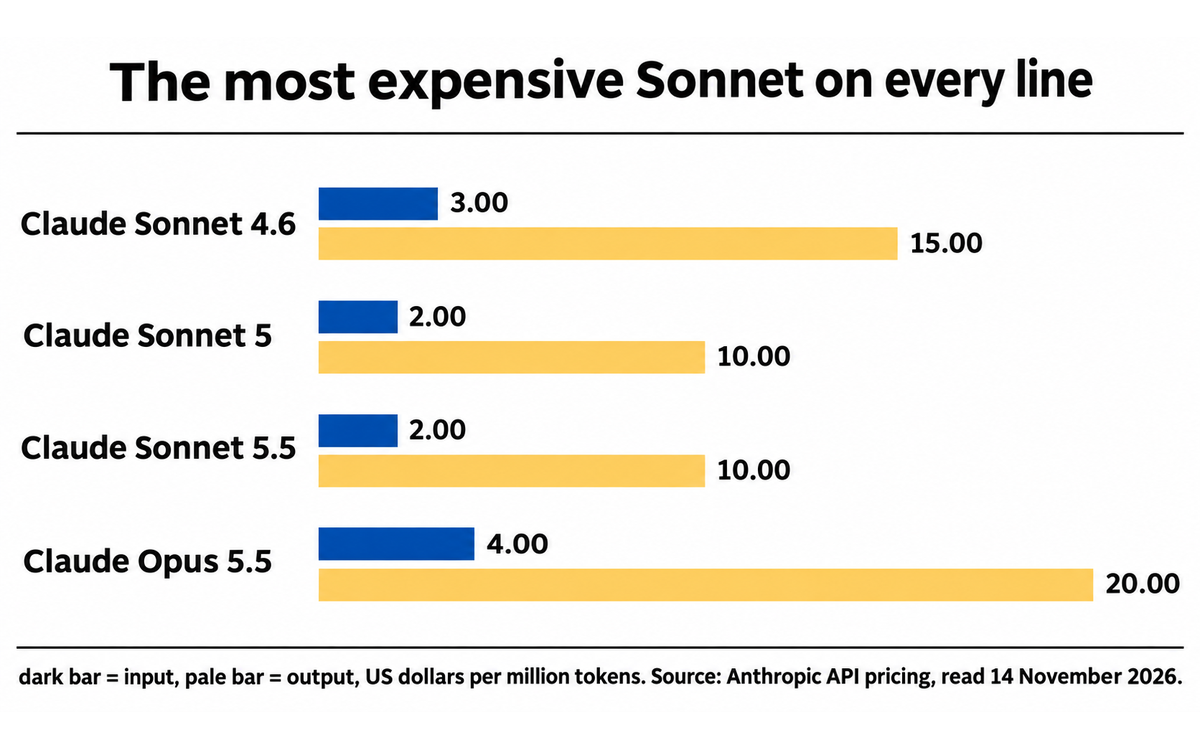
The five-model comparison, on U365's own published readings
Field | Claude Sonnet 4.6 | Claude Sonnet 5.5 | Claude Sonnet 5 | Claude Opus 5.5 | Claude Haiku 5.5 |
U365 CI-First Benefit Score | 6.0 / 10 (CI-First Positive) | 7.0 / 10 (CI-First Strong) | 6.5 / 10 (CI-First Strong) | 6.5 / 10 (CI-First Strong) | 6.8 / 10 (CI-First Strong) |
Sub-scores (Time / Quantity / Quality / Skill) | 7 / 7 / 6 / 4 | 8 / 8 / 8 / 4 | 7 / 7 / 7 / 5 | 7 / 7 / 8 / 4 | 8 / 7 / 7 / 5 |
Band | Positive | Strong | Strong | Strong | Strong |
Humics Protection | Humics-Neutral (-1 / +3) | Humics-Neutral (-1 / +3) | Humics-Neutral (0 / +3) | Humics-Neutral (-1 / +3) | Humics-Neutral (0 / +3) |
AI Imposture Risk | Medium (Skill Illusion High) | Medium (Skill Illusion High) | Medium | Medium (Skill Illusion High) | Medium |
Primary CI-First Profile | Co-Worker and Assistant (level 2) | Co-Worker and Assistant (level 2) | Co-Creator and Thought Partner (level 1) | Co-Worker and Assistant (level 2) | Co-Worker and Assistant (level 2) |
Released | 2026-02-17 | 2026-09-28 | June 2026 | 2026-09-22 | Not verified here |
Lifecycle | Active (legacy), retirement not sooner than 2027-02-17 | Active | Superseded, and not on the vendor's latest four | Active | Active |
API price per million tokens | $3 in / $0.30 cached / $15 out | $2 in / $0.10 cached / $10 out | $2 in / $0.20 cached / $10 out | $4 in / $0.20 cached / $20 out | From $0.10 in / from $0.50 out |
Independent measurement | 51 on the February 2026 index revision; no figure on the current revision | 55 at max on the current index | No figure on the current index | 59 on the current index, highest configuration | 36 on the current index |
Where this model sits among the five, stated plainly. It has the lowest score in the family and it is the only one in the Positive band rather than Strong. That is not a verdict on its capability, which was frontier-adjacent in February 2026. It is a verdict on four things that have changed since: the price is 50 percent higher on generation and three times higher on cache reads than the current model; the knowledge cutoff is ten months older; the effort ladder is one setting shorter; and the model is documented as legacy, with a retirement floor that is closer than any other model in the table. The framework measures net benefit to the person today, and today the same money buys a better model from the same vendor.
What moved, and what did not. Capability moved twice: Sonnet 5 in June, then Sonnet 5.5 in September, with the second generation reaching 55 at max on the current index against this model's 51 on an index revision that no longer exists. Price moved twice in the same direction: $3 and $15 to $2 and $10 in June, then a cache read halved to $0.10 in September. What did not move is the shape of the reader's work: state the task, choose an effort level, read the output, verify it. The Skill sub-score fell by one across the family when clause 5.2.3-a was applied to the Claude Code memory default, which is a framework change rather than a model regression.
One comparison caveat, stated because the record requires it. The 51 and the 55 are not on the same index revision and cannot be subtracted. The current revision incorporates nine evaluations, the February revision incorporated ten, and the evaluator's own pages warn that scores read from different pages of the same site are not guaranteed to be comparable. This review therefore states the within-revision comparison, where 51 sat 2 points under Opus 4.6 at 53 and 8 points over Sonnet 4.5 at 43, and the lifecycle comparison, where two later releases arrived at a lower price. It does not quote a cross-version gap, because a cross-version gap is not a measurement.
The field, with "Choose X if" guidance
Alternative | Choose the alternative if... | Choose Claude Sonnet 4.6 if... |
Claude Sonnet 5.5 | You are building now, or you want the vendor's current Sonnet at $2 and $10 with a cache read at $0.10, a June 2026 cutoff, five effort settings and a 7.0 score. It dominates this model on every published line. | You need a frozen baseline that will not change under your evaluation suite, and you have decided the price premium is the cost of that. |
Claude Sonnet 5 | You want a cheaper Sonnet than this one with a later knowledge cutoff and the same window, and you accept that it is also off the vendor's latest four. It scored 6.5. | Your integration is already tuned to 4.6's output shape and the retuning cost exceeds the difference between $3/$15 and $2/$10. |
Claude Opus 5.5 | The work is complex, open-ended and judgement-heavy, or you want the vendor's own recommended default at $4 and $20. It scored 6.5 with a Quality of 8. | The work is well scoped, checkable, and already running on this model at a volume where the retuning cost is the larger number. |
Claude Haiku 5.5 | The work is classification, extraction or routing at volume, and latency matters more than judgement. It starts at $0.10 and $0.50 and scored 6.8. | The task needs a model that can read a document set or finish a small code change, which Haiku is not positioned for. |
GPT-6.1 Sol | You want a non-Anthropic alternative at a comparable tier. It scored 6.3 with sub-scores 7 / 7 / 8 / 3 and a stronger Quality row. | You need the specific agentic behaviour of the Claude line, or an existing Claude integration, and the migration cost is the deciding factor. |
Where Claude Sonnet 4.6 is clearly better: on continuity, because an existing integration keeps working without a retuning pass; on frozen behaviour, because a legacy model does not change under a regression suite; on platform breadth, because the same model id is available on five surfaces; and on price against Opus 5.5, at $3 and $15 against $4 and $20, which is the one comparison where it is the cheaper option.
Where Claude Sonnet 4.6 is clearly worse: on price against both successors, where it is 50 percent higher on generation and three times higher on cache reads; on freshness, where its reliable cutoff is August 2025 against June 2026; on the effort ladder, where it has no xhigh; on lifecycle, where it is the only model in the table documented as legacy; and on independent measurement, where the current index has no figure for it while every other current model in the table has one.

Claude Sonnet 4.6: Anthropic's Legacy Sonnet Is Now the Most Expensive One
Verdict and Next Steps
Who should adopt it: Almost nobody starting today, and a specific set of teams already on it. The three that survive are a team that needs a frozen baseline for a regression suite, a team whose prompts and guardrails were tuned to this model and whose measured retuning cost exceeds the price premium, and a team with an audit or reproducibility requirement that a changing model would break.
When: If the answer is yes, now, with three conditions. First, write the reason down, because it determines every setting and it is the test of whether the migration should happen next quarter instead. Second, record the baseline output on your own suite on the day you decide, because a frozen model's value is the record you keep beside it. Third, plan the exit: the retirement floor is 2027-02-17, the vendor gives at least 60 days of notice, and a migration that starts in the notice window is a migration under pressure.
For what: Bounded agentic coding with a checkable end state, long document sets read in one pass with page-level citation, a regression baseline for a moving model, and work whose knowledge needs stop before August 2025.
The honest caveat, stated once: this is a capable model at a price its own successors have undercut twice. Staying on it is defensible for reproducibility and for the cost of retuning an integration, and it is not defensible on price, on capability, on freshness or on lifecycle. A reader who takes one sentence from this review should take that one.
UP-Context-Engineering prompt pack
Prompt 1: Decide whether to migrate this integration.
Context: my integration runs on claude-sonnet-4-6. It handles [workload], about [volume] calls a
month, with an evaluation suite of [n] cases. Sonnet 5.5 costs $2 and $10 against $3 and $15, has
a June 2026 cutoff against August 2025, and adds xhigh. My retuning estimate is [hours].
Role: AI as a Co-Researcher, Analyst & Tester. You are not doing the migration; you are pricing
the decision.
Profile: Act as a Co-Researcher, Analyst & Tester, applying a stated rule rather than an
impression.
Task: compare the cost of staying for 12 months with the cost of migrating now, including the
retuning hours, the risk of a retirement inside the window, and the value of a frozen baseline.
Constraints: one recommendation. If the honest answer is "stay for 6 months and migrate with a
recorded baseline", say that instead of a binary. Name what you cannot price.
Output format: a table with option, one-year cost, one-year risk, and reversibility, then one
paragraph and one line naming the decision I should make.
Memory disclosure: keep the workload, the volumes and the retuning estimate for this session.
Do not retain my organisation's commercial data and do not write notes about our systems.
UP-Context-Engineering verification: I can reproduce the cost comparison from the rates and
volumes I supplied, and I can defend the decision without the tool.
Data safety: do not paste supplier contracts, unpublished pricing, client terms or production
data. Use rounded internal figures and say that they are rounded.
Prompt 2: Build the frozen baseline before you need it.
Context: I am freezing claude-sonnet-4-6 as the control for a regression suite. The candidate is
claude-sonnet-5-5. The suite is [n] cases covering [categories]. I have [storage] for outputs.
Role: AI as a Tester. You are designing the control, not producing the answers.
Profile: Act as a Co-Researcher, Analyst & Tester, with the rubric written before the run.
Task: write the run protocol: what is stored per case, what counts as a difference, what counts
as a failure, and how the two models are compared without the comparison drifting.
Constraints: the rubric must be human-authored and stored outside the model. Do not compare
length or style. Every case needs a label a second engineer can audit. Record the model id, the
effort level and the API version beside every run.
Output format: Protocol (numbered), Storage schema, Difference taxonomy, and one paragraph on
what the control can and cannot prove.
Memory disclosure: keep the suite description and the rubric for this session. Do not retain
case content and do not write a standing note about my team's process.
UP-Context-Engineering verification: I run both models myself, I store the outputs beside their
model ids, and I can state what the control proves without the tool.
Data safety: do not paste client code, production data, credentials or examination content. Use
a public suite or a de-identified extract.
Prompt 3: Extract what this model taught your team before you leave it.
Context: we are migrating off claude-sonnet-4-6. Over [months] we built prompts, guardrails and
an evaluation set around it. What worked was [list]. What failed was [list].
Role: AI as a Professor, Coach & Tutor. You are helping us keep the reusable part.
Profile: Act as a Professor, Coach & Tutor, not as a generator. Do not write the new prompts.
Task: write the migration checklist for our own team, in our words.
Constraints: no more than 12 steps. Every step must be something we do, not something the model
does. Name the settings that change, the behaviour that changes, and the check that catches it.
Output format: What transfers. What does not. Steps. Checks. What we would do differently on the
next model.
Memory disclosure: keep this run's lists and the correction for this session only. Do not retain
the artefacts and do not write a standing note about how we work.
UP-Context-Engineering verification: I can hand this document to a new team member and they
can run the migration without asking me, and I can defend every step.
Data safety: do not paste the artefacts if they carry client material, unpublished results or
personal data. Describe the correction without reproducing the document.
Related U365 content
Claude Sonnet 5 Tool Review.
The first successor, at 6.5 with sub-scores 7 / 7 / 7 / 5. Read it beside this review to see what one generation bought in capability and price.Claude Sonnet 5.5 Tool Review.
The current Sonnet at 7.0 with sub-scores 8 / 8 / 8 / 4, and the vendor's recommended replacement for this model's predecessor. Read it as the destination of the migration path.Claude Opus 5.5 Tool Review. The tier above at 6.5 with sub-scores 7 / 7 / 8 / 4, and the model Anthropic recommends as the default for most work.
Claude Haiku 5.5 Tool Review. The bottom of the family at 6.8, for the volume work this model is too expensive for.
The CI-First Evaluation Framework, version 1.4.1. The method behind the score, including the clause set applied in Strengths, Limits, and AI Imposture Risk.

Claude Sonnet 4.6: Anthropic's Legacy Sonnet Is Now the Most Expensive One
Status and Last Tested
Status: Risky. Last tested: 2026-11-14. Version reviewed: Claude Sonnet 4.6, `claude-sonnet-4-6`, released 2026-02-17. Lifecycle as documented by the vendor: Active (legacy), retirement not sooner than 2027-02-17. Next scheduled re-check: on any of the eight triggers at the top of this document, and in any case within six months.
Risky is the badge for a tool that has been clearly surpassed by newer alternatives, and this one has been surpassed twice at a lower price. It is not a claim that the model is broken: it still answers, it still writes code, and its window is still a million tokens. It is a claim that the money and the attention now buy more elsewhere. The evidence was read on the date above, the independent measurement quoted is the one published against this model in February 2026, and the community record runs from the launch thread to the incidents in June 2026. A reader who arrives more than six months after 2026-11-14 should treat the price lines, the lifecycle status and the platform limits as unverified until a re-check is published.

Claude Sonnet 4.6: Anthropic's Legacy Sonnet Is Now the Most Expensive One
Migration Path
The migration is from `claude-sonnet-4-6` to `claude-sonnet-5-5`, and the vendor recommends it. Sonnet 5.5 is named as the recommended replacement for Claude Sonnet 4.5 on the deprecations page, and the successor's migration guide is written to cover a move from Sonnet 4.6 among others. A team that prefers to skip a generation can move to Sonnet 5 instead, which shares the $2 and $10 rate, but Sonnet 5 is not one of the vendor's latest four models either, so the two-step move is a detour rather than a shortcut.
What transfers. Prompts and system instructions transfer without change. The context window stays at 1,000,000 tokens and the output ceiling at 128,000, with 300,000 in batch beta. Text and image input and text output are unchanged. Adaptive thinking and the effort mechanism are the same design, and four of this model's four effort levels (low, medium, high, max) exist on the successor, which adds xhigh. Platform coverage is the same five surfaces. The evaluation suite transfers, with one change of setting: run it at the effort level you intend to use in production rather than at a single default.
What does not transfer, and why. The migration guide for Sonnet 5.5 states that a request which works on the new model "sets an effort level and leaves out five settings that return a 400 error: thinking budgets, sampling parameters, assistant prefill, forced tool choice, and thinking: {"type": "disabled"}". Each of the five is a real change for an integration built on 4.6, which supported extended thinking with a budget and accepted the sampling parameters until API version 2026-10-21. Three further differences matter to a reader rather than to a compiler: the price falls from $3 and $15 to $2 and $10 with the cache read from $0.30 to $0.10; the reliable knowledge cutoff moves from August 2025 to June 2026; and a fifth effort level appears above high.
Migration steps, in order.
Freeze the baseline first. Run your suite on claude-sonnet-4-6 and store the outputs, the model id and the API version. A baseline recorded after the migration is not a baseline.
Choose the API version. If your integration sends temperature, top_p or top_k, it has to stay on a version before 2026-10-21 or lose them. Decide, and write the decision down.
Replace the thinking budget with an effort level. A job that set a budget_tokens value has to be mapped to low, medium, high, max or the successor's xhigh, and the mapping should be measured on your own tasks rather than guessed.
Remove assistant prefill and forced tool choice. Both return a 400 error on the successor. The supported path for structured output is auto tool choice with strict tool use or structured outputs.
Re-run the suite on `claude-sonnet-5-5` at the production effort level and classify every difference as expected model gain, pipeline defect or rubric ambiguity. The third category is the one that usually dominates the first week.
Re-price the workload. At $2 and $10 with a cache read at $0.10, a workload whose cost was modelled on 4.6 will come in lower, and a workload modelled on tokens per task may come in lower still or higher depending on verbosity. Measure the new figure rather than scaling the old one.
Decide what happens to the 4.6 path. Keeping it as a control is the defensible option in Workflow 3. Keeping it as a production path is a decision with a 2027-02-17 floor under it.
Branch on `stop_reason` so a fallback or a refusal is handled rather than parsed as the model's answer.
The three cases for staying, tested one at a time.
Price: fails. There is no line on which 4.6 is cheaper. $3 against $2, $15 against $10, $3.75 against $2.50 for a five-minute cache write, $6 against $4 for an hour, $0.30 against $0.10 for a cache read. A price argument for staying on this model cannot be made from the vendor's own price list.
Pinned behaviour: partly holds. Legacy means no updates, so the behaviour is frozen by policy. But the model id is dateless, there is no dated snapshot to pin to, and the vendor's own definition says a legacy model "might be deprecated in the future". A frozen behaviour with a 12-month floor is a weaker guarantee than a weight file on your own disk, and it is a stronger one than a current model behind a stable name that can be updated under you.
Evaluation reproducibility: holds, and it is the reason this review says Risky rather than Retired. A model that does not change is the correct control for measuring a model that does. The vendor's deprecation page states that researchers lose access to models for ongoing comparative studies and that it has committed to long-term preservation of weights as a mitigation. A team that treats 4.6 as the fixed point in a two-model comparison is using the model for the one thing a legacy model is better at than a current one.
What to expect on the other side. A model that is cheaper on every line, stronger on both vendor and independent evidence, ten months fresher in its knowledge, one setting richer in its effort ladder, and no more of a teacher than the model it replaces. The migration is small in code and real in settings, because the thinking budget and the sampling parameters that this model accepted no longer exist on the other side.

Claude Sonnet 4.6: Anthropic's Legacy Sonnet Is Now the Most Expensive One
U365's Recommendations to Learn More
These resources were curated to help you go deeper on Claude Sonnet 4.6. We prioritise material that teaches something this review does not cover.
Official learning resources
The launch page: the positioning, the computer-use section, the preference data, the pricing and the availability list. Read the footnotes as carefully as the body, because the benchmark conditions live there. https://www.anthropic.com/news/claude-sonnet-4-6
The model page: context and output limits, modalities, effort default, the platform model ids and the lifecycle line. https://platform.claude.com/docs/en/models/sonnet-4-6/overview
The 1M context announcement: the removal of the long-context premium, the media limit of 600 images or PDF pages, and the date the window became generally available. https://claude.com/blog/1m-context-ga
Effort control: the levels, the defaults, and which models accept max and xhigh. This model accepts max and not xhigh. https://platform.claude.com/docs/en/build-with-claude/effort
The deprecations page: the definitions of Active, Legacy, Deprecated and Retired, the 60-day notice commitment, and the retirement calendar that includes the predecessor's 2026-11-30 date. https://platform.claude.com/docs/en/about-claude/model-deprecations
The migration guide to Sonnet 5.5: the five settings that return a 400 error and the step-by-step move from this model. https://platform.claude.com/docs/en/models/sonnet-5-5/migration-guide
The system card: the capability and safety evaluations, the ASL-3 deployment decision, and the benchmark conditions behind the launch table. https://www.anthropic.com/claude-sonnet-4-6-system-card
The deprecation commitments: what the vendor says it will preserve and why, which is the document to read before building a long-lived baseline on any hosted model. https://www.anthropic.com/research/deprecation-commitments
API pricing: the token rates, cache rates and batch discount. https://platform.claude.com/docs/en/about-claude/pricing
Claude Code memory: what auto memory writes, when, and how to turn it off. The mechanism behind clause 5.2.3-a in this review. https://code.claude.com/docs/en/memory
The models overview: the current four models and the comparison table where this model appears marked Legacy. https://platform.claude.com/docs/en/models/overview
The status page, for the availability record a team should check before it schedules a dependent run. https://status.anthropic.com
Video tutorials and channels
Three independent walkthroughs of this release, none of them a vendor video. Read each against the vendor documentation rather than in place of it, because a launch-week explainer repeats the vendor's framing and a hands-on test measures one person's workload.
Developers Digest, Claude Sonnet 4.6 in 7 Minutes, a compact launch explainer that covers the computer-use and agentic claims and the pricing: https://www.youtube.com/watch?v=EUzc_Wcm6kk
Chase AI, Claude Sonnet 4.6 Is Here (and Better Than Opus?), which works through the benchmark table and the question a buyer of this model actually asks: https://www.youtube.com/watch?v=EQ7nk9KgvrY
BridgeMind, Vibe Coding With Claude Sonnet 4.6, a long build session rather than a benchmark summary, useful for seeing the model's coding behaviour at length: https://www.youtube.com/watch?v=8X4G14JDwyM
Written tutorials and deep-dive articles
Artificial Analysis, the model page as it stands: the deprecation notice, the reduced benchmarking scope, and the price and speed readings that remain. https://artificialanalysis.ai/models/claude-sonnet-4-6
Artificial Analysis, the launch analysis: the 51 on the index of February 2026, the 8-point jump over Sonnet 4.5, the token-usage finding and the $2,088 cost to run the suite. The single most useful document in the record for this model. https://artificialanalysis.ai/articles/sonnet-4-6-everything-you-need-to-know
Artificial Analysis, the current Sonnet page: the five effort levels, 55 at max, and the cost and time per task that replace the 4.6 figures in any comparison. https://artificialanalysis.ai/models/claude-sonnet-5-5
Artificial Analysis, the intelligence index methodology: the nine evaluations behind the current composite, so a reader can see why a 51 from February and a 55 from November are not subtractable. https://artificialanalysis.ai/evaluations/artificial-analysis-intelligence-index
Community and social
Hacker News, the launch thread: 1,346 points and 1,226 comments, including the measured report from nichochar, the token measurements from Topfi and the 1M pricing measurement from minimaxir that are quoted in What Users Say. https://news.ycombinator.com/item?id=47050488
Hacker News, the 1M context thread: 1,220 points and 519 comments on the pricing change, the media limit and what the window did to plan consumption. https://news.ycombinator.com/item?id=47367129
The Claude Code issue tracker, the quantified regression report: one user's 60-day record across 50 sessions, closed after discussion. Read it as a record, not as a measurement. https://github.com/anthropics/claude-code/issues/46935
Reddit, r/ClaudeAI: the community hub where the launch and the comparisons were discussed. No figure in this review is attributed to a page whose content could not be read. https://www.reddit.com/r/ClaudeAI/
Resources on X
Dedicated X channels. Three accounts carry this release: Anthropic's company account, the Claude product account and the Artificial Analysis account.
@AnthropicAI, the company account: https://x.com/AnthropicAI
@claudeai, the Claude product account: https://x.com/claudeai
@ArtificialAnlys, the independent evaluation account: https://x.com/ArtificialAnlys
Read any post against the measurement rather than against its own caption, and treat a launch-day thread as a pointer to a source rather than as a source.


Claude Sonnet 4.6: Anthropic's Legacy Sonnet Is Now the Most Expensive One
CI-First Evaluation Summary Card
Field | Value |
Tool | Claude Sonnet 4.6, operated by Anthropic |
Category | Applied AI / Large Language Model (agentic coding, computer use, long-context knowledge work) |
Version reviewed | Claude Sonnet 4.6 (claude-sonnet-4-6, released 2026-02-17), as documented by the vendor on 2026-11-14 |
Status | Risky |
Last tested | 2026-11-14 |
CI-First Profile | Primary: Co-Worker and Assistant (level 2). Secondary: Co-Researcher, Analyst and Tester (level 4) for long document work and frozen-baseline testing, Co-Creator and Thought Partner (level 1) for long design and writing conversations |
CI-First Benefit Score | 6.0 / 10 (CI-First Positive) |
Time | 7, strong net savings on agentic coding and long-document work, with autonomous runs three to four times longer than the predecessor's and a million-token window that removes a chunking pass, held at 7 by three times the predecessor's output tokens on the same evaluation, a high API default and a non-reasoning path measured at 44.9 tokens per second |
Quantity | 7, a genuine multiplier with 1,000,000 tokens in, 128,000 out, 300,000 in batch beta, 600 images or PDF pages and standard pricing across the full window, held at 7 because 74 million output tokens to run one evaluation suite is volume a person has to check |
Quality | 6, clear gains that survive verification at the level of the frontier of its release week (GDPval-AA 1633 against Opus 4.6 at 1606, Terminal-Bench 53 against 46), held at 6 by eight-month-old evidence that no current index revision repeats, a reliable cutoff of August 2025 and a platform output ceiling that differs between vendor pages |
Skill | 4, execution rather than learning, with clause 5.2.3-a applying to the Claude Code memory default; scored conservatively and level with the successor reviews |
Humics Protection Badge | Humics-Neutral (-1 / +3) |
Creativity | 0 Neutral: it drafts, lays out and executes against a direction you set, with design polish claimed by early testers; it neither trains nor replaces your ideation |
Critical Thinking | -1 Erodes: fluent, near-frontier output for people who cannot evaluate it, in exactly the tasks where the editing pass used to be the practice, with a public record of repeated instructions and corrections and two error-rate incidents |
Social Authenticity | 0 Neutral: clause 4.2-a returns a null for the model as a generator; the live condition is an application that sends under a person's identity unread |
AI Imposture Risk | Medium overall, with Skill Illusion High |
Time Illusion | Medium: real savings on the work the model was built for, against a real overhead of an effort decision on every job, a token burn three times the predecessor's, and documents that must be read against their sources |
Quantity Illusion | Medium: high-volume fluent output in professional forms, with 74 million output tokens on one evaluation run and nothing that separates a finished deck from a correct one for a reader who does not know the material |
Skill Illusion | High: expert-form output for users who cannot evaluate it, produced by a model whose selling point is finishing the well-scoped task, on a surface that writes procedural memory by default in local sessions; mitigations are stated in Strengths, Limits, and AI Imposture Risk |
Clause 5.2.3-a | APPLIES. Floor met at Medium and the High threshold met. Claude Code auto memory is on by default in local sessions and writes notes the model decides to keep, with no per-write human decision. Live condition: any change to that default in either direction re-opens the assessment |
Clause 4.2-a | NULL as a generator, with a live condition: an application built on this model that sends text in the person's own name through a connected account without the person reading it first would meet erosion condition (a) |
Clause 7.5 | Removed by framework v1.4 on 2026-10-13, not assessed; recorded so that a reader comparing reviews knows why it is absent |
Section 7c finding | Active (legacy) with retirement not sooner than 2027-02-17 and a 60-day notice commitment; the predecessor Sonnet 4.5 is deprecated since 2026-09-30 and retires 2026-11-30; the 1M window's long-context premium was removed on 2026-03-13 without a version change; API version 2026-10-21 removed the sampling parameters this model accepted. No sub-score changed, for reasons stated in the section |
Superhuman usage | Invite for a frozen regression baseline, an existing integration whose retuning cost is measured, bounded agentic coding with a test suite, and long document sets with page-level citation; keep out of new builds, xhigh-shaped workflows, post-August-2025 knowledge without retrieval, deliverables above 64,000 tokens on Bedrock, and the final judgement calls |
Over-delegation warning | The failure mode is a team that keeps a legacy model because it is already integrated, then stops reading its output as closely as a colleague's, because a model that costs more feels like a considered choice. If you cannot say why this model rather than its successor, what you verified this week, and what the surface wrote into memory, the premium is being paid in attention as well as in dollars |
Verification checklists | Per workflow, in Real Workflows: multi-model check, external source, human review, specification or regression check, CI-First test |
U365 methods | LIPS holds the task, the model id, the effort decision and the verification record, because a legacy model's version is part of the evidence. ULM and EVA: the six-domain frame in which a Fellow decides whether the work is worth automating at all, in Career and Finance and in Quality of Life; ULM carries no cost method, and cost per completed task is CI-First cost engineering and the independent evaluator's metric. UP-Context-Engineering writes the context, role, task, constraints and output order the workflows use. UNOP: weak, because the model produces rather than teaches |
Re-check triggers | A change to the lifecycle status or retirement date; a price change on any line; a change to the 1M context terms; a change to the effort ladder or defaults; a change to the thinking controls or sampling parameters; a new independent measurement on a current index revision; a change to the Claude Code memory default; and a successor change that removes the reproducibility case |

Claude Sonnet 4.6: Anthropic's Legacy Sonnet Is Now the Most Expensive One
Glossary
CI-First
Co-Intelligence First: the U365 principle that the human is the ruler and the orchestrator and AI is the amplifier. The question this review answers with a score is whether the tool makes co-intelligence more profitable than human intelligence alone. Claude Sonnet 4.6 is a CI-First Positive model: it delivers clear net benefit, and it requires you to supply the scoping and verification discipline the price assumes.
CI-First Benefit Score
The arithmetic mean of the four benefit dimensions, each scored 0 to 10, rounded to one decimal place. 0 to 2.0 is CI-First Negative, 2.1 to 4.0 is CI-First Neutral, 4.1 to 6.0 is CI-First Positive, 6.1 to 8.0 is CI-First Strong, and 8.1 to 10 is CI-First Transformative. Claude Sonnet 4.6 scores 6.0, which is Positive.
Time Benefit
Whether the tool returns more time than it costs, after the overhead of using it is subtracted. Claude Sonnet 4.6 is 7: autonomous runs three to four times longer than its predecessor's, a million-token window that removes a chunking pass, against three times the predecessor's output tokens on the same evaluation, a high API default and a slow non-reasoning path.
Quantity Benefit
Whether the same time produces more usable output. Claude Sonnet 4.6 is 7: a million-token window, a 128,000-token output ceiling, 300,000 in batch, 600 images or PDF pages and standard pricing across the full window, held at 7 because the volume produced is volume a person has to read.
Quality Benefit
Whether the output is better, verified and durable. Claude Sonnet 4.6 is 6: level with the frontier of its release week on real-world office work at 1633 against 1606 on GDPval-AA and ahead on Terminal-Bench at 53 percent against 46, held at 6 by eight-month-old evidence, a reliable cutoff of August 2025 and a platform output ceiling that differs between vendor pages.
Knowledge and Skill Benefit
Whether the user gains lasting capability. Claude Sonnet 4.6 is 4: execution rather than learning, a surface that writes procedural memory by default, and a model that completes work the user would previously have learned by doing, so the framework scores it conservatively.
CI-First Profile
The role the AI plays in your working relationship. (level 1) Co-Creator and Thought Partner, (level 2) Co-Worker and Assistant, (level 3) Professor, Coach and Tutor, (level 4) Co-Researcher, Analyst and Tester, (level 5) Challenger, Critic and Devil's Advocate. Lower level numbers indicate higher AI autonomy in the collaboration. Claude Sonnet 4.6 is primarily a Co-Worker and Assistant (level 2).
Humics
The set of capabilities that are uniquely human, as defined by Pascal Bornet: creativity, critical thinking and social authenticity. The framework asks whether a tool strengthens, leaves neutral or erodes each one.
Humics Protection Badge
A rating of whether a tool protects, leaves neutral or erodes the three human capabilities: Creativity, Critical Thinking and Social Authenticity. Each is scored +1, 0 or -1 and the sum gives the badge. +2 to +3 is Humics-Friendly, -1 to +1 is Humics-Neutral, -2 to -3 is Humics-Risky. Claude Sonnet 4.6 is Humics-Neutral at -1 / +3.
AI Imposture Risk
The likelihood that a tool traps you in one of three illusions. The Time Illusion is the appearance of saving time when net time is lost. The Quantity Illusion is high volume that does not survive inspection. The Skill Illusion is the appearance of competence while the underlying skill is absent or eroding. Each trap is rated Low, Medium or High with cited evidence. The overall level is Low when all three are Low, Medium when one, two or three traps are Medium or when one trap is High with clear mitigations stated, and High when two or more traps are High or when the tool's core value proposition is built on an illusion. Claude Sonnet 4.6 is Medium overall, with Skill Illusion High.
User Sentiment
The aggregate of what users report about a tool, kept separate from the framework's own findings. No review platform carries model-level data for Claude Sonnet 4.6; the signal is the Hacker News launch thread, the 1M context thread and the incident threads, all directional and all from 2026.
Review Status
Review Status records the current standing of the tool at the time of the last test. Active: the tool is current and recommended. Active (updated): recently re-checked and the content was refreshed. Changed: a re-check trigger fired and an update is pending, so read the review with that in mind. Risky: the tool has significant unresolved issues, or it has been clearly surpassed by newer alternatives. Use it with caution and read the Limits section. Retired: the tool still works but is no longer recommended. Deprecated: the tool has been shut down or fundamentally changed. Retired and Deprecated posts include a Migration Path section.
Last tested and Re-check
The date this review's evidence was gathered and the condition that forces a new pass. Claude Sonnet 4.6 was tested on 2026-11-14 and re-checks on any of the eight triggers listed at the top of this document, and in any case within six months.

Claude Sonnet 4.6: Anthropic's Legacy Sonnet Is Now the Most Expensive One
Sources
Vendor primary sources
The launch announcement, for the positioning, the computer-use section, the preference data, the pricing and the availability list, and for the footnotes on Terminal-Bench 2.0, SWE-bench Verified, OSWorld-Verified, Humanity's Last Exam, BrowseComp, ARC-AGI-2 and MMMU-Pro: https://www.anthropic.com/news/claude-sonnet-4-6
The model page, for the context and output limits, the modalities, the effort default, the model ids on every platform, the release date and the retirement floor: https://platform.claude.com/docs/en/models/sonnet-4-6/overview
The 1M context announcement, for the removal of the long-context premium, the standard pricing across the full window, the 600-image and PDF-page limit and the 2026-03-13 date: https://claude.com/blog/1m-context-ga
Effort control, for the levels, the defaults and the list of models that accept max and xhigh: https://platform.claude.com/docs/en/build-with-claude/effort
The model deprecations page, for the definitions of Active, Legacy, Deprecated and Retired, the 60-day notice commitment, the Sonnet 4.5 retirement on 2026-11-30, the platform-specific retirement schedules, the sampling-parameter removal in API version 2026-10-21 and the vendor's own statement of the policy's downsides: https://platform.claude.com/docs/en/about-claude/model-deprecations
The Sonnet 5.5 migration guide, for the five settings that return a 400 error on the successor and the migration checklist: https://platform.claude.com/docs/en/models/sonnet-5-5/migration-guide
The system card, for the capability and safety evaluations and the ASL-3 deployment decision: https://www.anthropic.com/claude-sonnet-4-6-system-card
The deprecation commitments, for what the vendor says it will preserve and why: https://www.anthropic.com/research/deprecation-commitments
API pricing, for the token rates, cache rates and batch discount: https://platform.claude.com/docs/en/about-claude/pricing
Claude Code memory, for the auto memory default in local sessions and the off switches: https://code.claude.com/docs/en/memory
The models overview, for the current four models and the comparison table that marks this one Legacy: https://platform.claude.com/docs/en/models/overview
The status page, for the availability record: https://status.anthropic.com
Independent sources
Artificial Analysis, the Claude Sonnet 4.6 model page, for the deprecation notice, the reduced benchmarking scope, the price readings and the speed and latency figures for the non-reasoning configuration: https://artificialanalysis.ai/models/claude-sonnet-4-6
Artificial Analysis, the launch analysis, for the 51 on the index of February 2026, the 8-point jump over Sonnet 4.5, the 2-point gap to Opus 4.6, the agentic rows, the 74 million output tokens and the $2,088 cost to run the suite: https://artificialanalysis.ai/articles/sonnet-4-6-everything-you-need-to-know
Artificial Analysis, the Claude Sonnet 5.5 model page, for the current index figures at five effort settings, the cost and time per task and the current comparison class: https://artificialanalysis.ai/models/claude-sonnet-5-5
Artificial Analysis, the Claude Sonnet 5 model page, for the speed, price and the notice that a newer release exists: https://artificialanalysis.ai/models/claude-sonnet-5
Artificial Analysis, the intelligence index methodology, for the evaluations behind the composite and the reason scores from different revisions are not comparable: https://artificialanalysis.ai/evaluations/artificial-analysis-intelligence-index
Community and community-reported evidence
Hacker News, the launch thread, 1,346 points and 1,226 comments, read on 2026-11-14, for the quotations from nichochar, Topfi, nerdsniper, data-ottawa, nikcub, minimaxir, mfiguiere, stopachka, sxg and manmal: https://news.ycombinator.com/item?id=47050488
Hacker News, the 1M context general availability thread, 1,220 points and 519 comments, read on 2026-11-14, for the quotations from dimitri-vs, vessenes, zmmmmm, johnwheeler and pixelpoet: https://news.ycombinator.com/item?id=47367129
Hacker News, the error-rate incident of 2026-04-08, 62 points and 88 comments, read on 2026-11-14: https://news.ycombinator.com/item?id=47686187
Hacker News, the error rates across four models of 2026-06-22, 34 points and 38 comments, read on 2026-11-14: https://news.ycombinator.com/item?id=48624153
The Claude Code issue tracker, the quantified regression report filed 2026-04-12 and closed, read on 2026-11-14 and reported as one user's self-tracked record: https://github.com/anthropics/claude-code/issues/46935
Reddit, r/ClaudeAI, the community hub for this model: https://www.reddit.com/r/ClaudeAI/
Review platform sources
No reviews found on G2, Capterra, Trustpilot or Product Hunt for this model endpoint. Those platforms rate AI products and companies rather than individual model endpoints, and none publishes a model-level figure for Claude Sonnet 4.6. This review states that rather than inventing a rating.
Framework and method
The U365 CI-First Evaluation Framework, version 1.4.1, which is the scoring method used here: CI-First Evaluation Framework
The U365 INSIDE Tools review template, which sets the structure of this post and the tool-type variants applied in it: INSIDE Tools Review template
Published U365 INSIDE Tools reviews, read as comparisons and named in this post, including the Claude Sonnet 5, Claude Sonnet 5.5, Claude Opus 5.5 and Claude Haiku 5.5 reviews: INSIDE Tools reviews
The U365 methods house pages, for the UP-Context-Engineering Method, ULM, LIPS and UNOP as they are published: U365 methods

Claude Sonnet 4.6: Anthropic's Legacy Sonnet Is Now the Most Expensive One
Faculty Note on Evidence Quality
Five things should be said plainly about the evidence behind this review, because they change how much weight a reader should put on each part of it.
First, the independent evidence is eight months old and the index it was measured on no longer exists in the same form. Artificial Analysis reported 51 for this model in February 2026, against 53 for Opus 4.6 and 43 for Sonnet 4.5. That comparison is valid because all three numbers come from one revision. The current revision carries 55 for Sonnet 5.5 at max, 59 for Opus 5.5 and 65 for Fable 5.2, and no published figure on the current revision for this model or for Sonnet 5, because the evaluator now benchmarks both less often than the current models. A reader who subtracts 51 from 55 is subtracting two different tests. This review does not do that, and it says why rather than quoting a gap it cannot support.
Second, the vendor's benchmark rows carry conditions that no headline shows. The launch footnote states that the Terminal-Bench 2.0 figure for this model was measured "with thinking turned off", which is a legitimate configuration and a surprising one for the row a reader will quote as an agentic coding score. The same footnotes state that SWE-bench Verified was averaged over 10 trials with a prompt modification reaching 80.2 percent, that Humanity's Last Exam and BrowseComp used tool sets with context compaction and different thinking settings, and that OSWorld numbers from Sonnet 4.5 onward use OSWorld-Verified rather than the original benchmark, so a comparison with an earlier Sonnet crosses two benchmark versions. The MMMU-Pro implementation also changed, with a removed prompt prefix and a different grading method. None of that is misconduct; all of it means a vendor row is a measurement of a stated configuration, not a property of the model.
Third, the cost figures are the part of this review most likely to be misread, and they carry their settings. The 74 million output tokens and the $2,088 suite cost were measured at max effort in adaptive thinking mode, which is the most expensive configuration. The 15 to 45 percent output-token increase that one practitioner reproduced was measured on their own task-inference and task-evaluation prompts, not on the index. The 1M window's 2x input and 1.5x output premium above 200,000 tokens was real from February to March 2026 and is gone. Every cost sentence in this review names the setting or the date, because a cost without a setting is not a number a reader can use.
Fourth, the community record is dense at the launch and thin afterward, and it is used as such. The launch thread carries a measured report on run lengths, a token measurement and a pricing measurement, all of which this review quotes with attribution. The 1M context thread carries the pricing change and its effect on plans. The records after March are a status-page incident, a second incident, and one user's self-tracked regression report, which is a record of a complaint rather than a measurement of a population. The Reddit threads exist and were not read, so nothing in this review is quoted from them, and no number in this review is attributed to a page whose content could not be read. No aggregate rating exists on any review platform for this model endpoint, and the absence is stated in What Users Say rather than filled.
Fifth, the lifecycle argument is the part of this review most likely to be argued with, and the argument is fair. A reader can reasonably say that a legacy model is the right instrument for a regression suite, that Anthropic's deprecation calendar is published and unusually generous, and that a frozen model which still answers is worth more than a slightly cheaper one that moves under your evaluation. This review agrees with all three and scores them: that is why the model is Risky and not Retired, why Migration Path says the reproducibility case holds, and why the Quality sub-score is 6 rather than lower. The counter-reading is equally fair and is in the record: the model is 50 percent more expensive on generation and three times more expensive on cache reads, its knowledge cutoff is ten months older, it has one fewer effort setting, and the vendor has replaced it twice. The framework's answer is the two-track arrangement rather than a verdict on either side: keep 4.6 where you need a fixed control, run 5.5 where you need work done, and date every figure you quote. A reader who takes one sentence from this review should take that one.
Review conducted by URC under the CI-First Evaluation Framework, version 1.4.1. Scoring date 2026-11-14. Tool version reviewed: Claude Sonnet 4.6 (`claude-sonnet-4-6`, released 2026-02-17).

Claude Sonnet 4.6: Anthropic's Legacy Sonnet Is Now the Most Expensive One
Status and Re-check
Status: Risky | Last tested: 2026-11-14 (Claude Sonnet 4.6, claude-sonnet-4-6, released 2026-02-17) | Re-check: trigger-based (max 6 months)
Risky: the tool has significant unresolved issues, or it has been clearly surpassed by newer alternatives. Use it with caution and read the Limits section.
For detailed explanations of the CI-First evaluation terms used in this review, including the Humics Protection Badge and the AI Imposture Risk levels, see the Glossary at the end of this post.
Re-check triggers:
Any change to the lifecycle status or the retirement date. Anthropic documents this model as Active (legacy) with retirement not sooner than 2027-02-17, and commits to at least 60 days of notice before a retirement. A move to Deprecated, a firm retirement date, or a withdrawal of the one-year floor moves every recommendation in this review.
A price change on any line. $3 per million input tokens, $15 per million output, $3.75 for a five-minute cache write, $6 for a one-hour cache write, $0.30 for a cache read, batch at half rate. Every one of those lines is 50 percent above, or in the cache read's case three times, the rate of the model that supersedes it, and a vendor correction in either direction changes the comparison in Section 12.
Any change to the 1M context terms. The window launched in beta in February 2026 with a long-context premium above 200,000 tokens, and the vendor removed the premium on 2026-03-13 when it made the window generally available at standard pricing, with media limits of 600 images or PDF pages. A return of premium pricing, a change to the media limit, or a withdrawal of the window changes what a long-document workflow costs.
Any change to the effort ladder or the defaults. Four levels (low, medium, high, max), no xhigh, API default high. A fifth level, a different default, or a change to what a named level does changes the cost and the time figures in How Claude Sonnet 4.6 Works and in Real Workflows.
Any change to the thinking controls or the sampling parameters. Extended thinking is documented as deprecated on this model in favour of adaptive thinking, and temperature, top_p and top_k were removed from API version 2026-10-21 and return a 400 error. A pinned integration that still sends them is one API version away from breaking.
A new independent measurement on a current index revision. The last published independent composite for this model is 51 on the index revision live in February 2026. The current revision does not carry a figure for this model at all, so the measured gap to Sonnet 5 and Sonnet 5.5 cannot be quoted from one table today. A re-measurement on the current revision would settle that.
Any change to the Claude Code auto memory default. The Skill Illusion rating rests on a surface that writes procedural memory by default in local sessions, with no per-write human decision.
A successor change that removes the one remaining case for staying. The case that survives is a frozen model used as an evaluation baseline. If Sonnet 5.5 changes price, changes behaviour, or acquires a firm retirement date of its own, the two-model baseline arrangement in Migration Path has to be rewritten rather than refreshed.




Comments