
Claude Opus 5.5: Anthropic's Fable 5.1-Class Model at 40 Percent Lower Cost, Scored 6.5 on the U365 CI-First Review

Status: Active | Last tested: 2026-09-23 (Claude Opus 5.5, claude-opus-5-5) | Re-check: trigger-based (max 6 months)
Active: the tool is current and recommended.

Tool Snapshot
Category: Applied AI / Large Language Model (agentic coding and knowledge work)
Provider: Anthropic
Model tested: Claude Opus 5.5 (claude-opus-5-5), released 2026-09-22
Family: First model in the Claude 5.5 family. Claude Sonnet 5.5 and Claude Haiku 5.5 are announced for the coming weeks with no dates or prices.
Context window: 1,000,000 tokens in, 128,000 tokens out (300,000 on the Message Batches API with a beta header), with no long-context surcharge
Effort levels: low, medium (default), high, xhigh, max. Adaptive thinking is always on and cannot be disabled.
License: Proprietary hosted service. Not open weights, not self-hostable.
Tagline: "It performs at the level of Claude Fable 5.1 on most work and costs 40% less to run than Opus 5." (Anthropic, launch page, 2026-09-22.)
Primary use cases:
Carry a multi-step change through a large repository until the tests pass, without step-by-step supervision.
Audit and repair a large codebase, where the work is finding and fixing many small defects across many files.
Produce a research report, financial model, or client document that holds up under review, with the model naming what it could not confirm.
Run a long agentic task that calls tools and operates a computer interface, where cost per completed task matters more than price per token.
Draft, restructure, and pressure-test long documents inside a 1M-token context window.
Review a diff or a merge request before a person reads it.
Pricing summary: Paid. API list price is $4 per million input tokens and $20 per million output tokens, 20 percent below Claude Opus 5. Cache reads are $0.20 per million, 60 percent below Opus 5. Cache writes are $5 per million for a five-minute cache and $8 for one hour. Batch processing is half price at $2 and $10. Fast mode, a research preview available only on the Claude API, is $8 and $40 with up to 2.5x output speed. Consumer access is Claude Free, Pro at $20 per month, Max 5x at $100 per month, and Max 20x at $200 per month, with Team and seat-based Enterprise plans above those. US data residency adds a 1.1x multiplier. Web search costs $10 per 1,000 searches plus tokens. Prices captured 2026-09-22 and 2026-09-23 from the Anthropic launch page and the Claude Platform pricing documentation.
Official links:
Launch page: https://www.anthropic.com/claude-opus-5-5
System Card: https://www.anthropic.com/claude-opus-5-5-system-card
Model documentation overview: https://platform.claude.com/docs/en/models/overview
What is new in Opus 5.5: https://platform.claude.com/docs/en/models/opus-5-5/whats-new-opus-5-5
Migration guide: https://platform.claude.com/docs/en/models/opus-5-5/migration-guide
Pricing: https://platform.claude.com/docs/en/about-claude/pricing
Preserved thinking: https://platform.claude.com/docs/en/build-with-claude/preserved-thinking
Claude Code documentation: https://github.com/anthropics/claude-code
Claude Code memory documentation: https://code.claude.com/docs/en/memory
Status page: https://status.anthropic.com
At a Glance:
Field | Value |
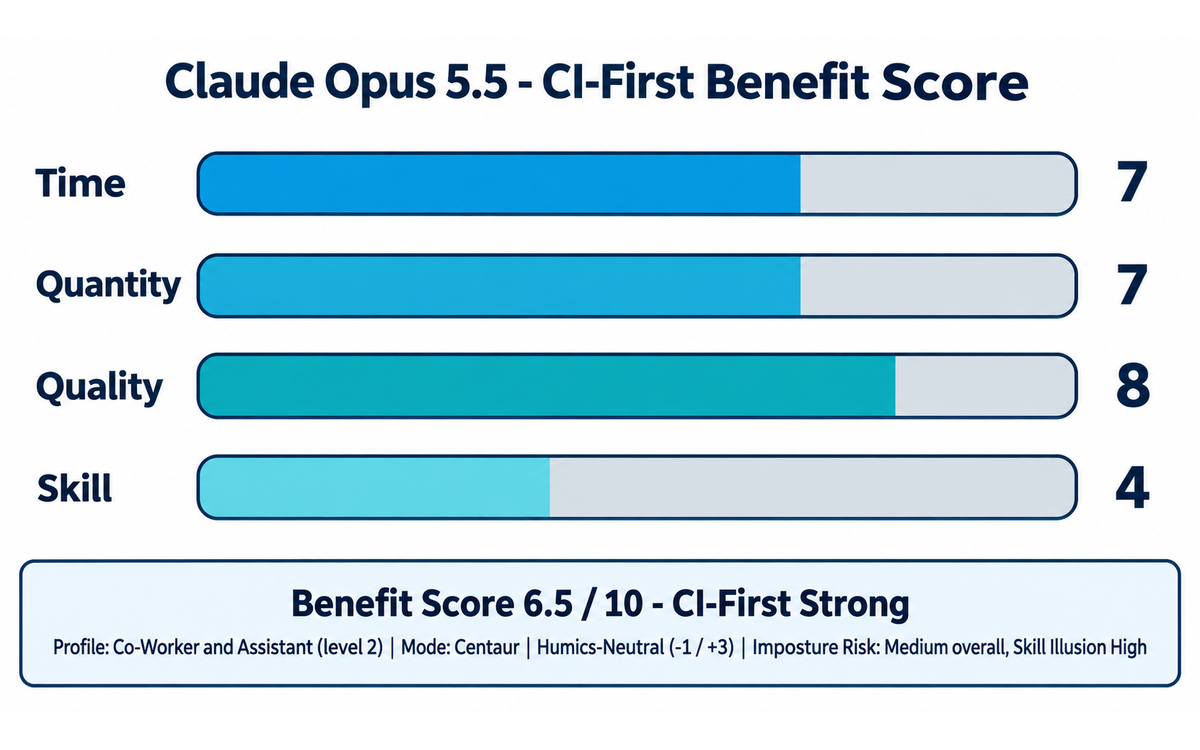
CI-First Benefit Score | 6.5 / 10 (CI-First Strong) |
Sub-scores | Time 7 / Quantity 7 / Quality 8 / Skill 4 |
CI-First Profile | Primary: Co-Worker and Assistant (level 2). Secondary: Analyst and Tester (level 4), Coach and Tutor (level 3), Co-Creator and Thought Partner (level 1) |
Collaboration Mode | Centaur |
Humics Protection | Humics-Neutral (-1 / +3) |
AI Imposture Risk | Medium overall, with Skill Illusion High |
Status | Active |
Last tested | 2026-09-23 |
Released | 2026-09-22 |
Access | Claude apps, Claude Code, Claude Cowork, the Claude API, Amazon Bedrock, Google Cloud, Microsoft Foundry |
Price | $4 per million input tokens, $20 per million output, $0.20 cache read |
Context window | 1,000,000 tokens in, 128,000 tokens out |
For detailed explanations of the CI-First evaluation terms used in this review, including the Humics Protection Badge and the AI Imposture Risk levels, see the Glossary at the end of this post.
Re-check triggers
Major release. Claude Sonnet 5.5 or Claude Haiku 5.5 ships with the same improvements, or a Claude 6 family is announced. Anthropic states both are coming "in the coming weeks" with no date.
Price change. The published $4 per million input and $20 per million output rates move, or the $0.20 cache-read rate changes. Cache reads are the largest single line in agentic work and were cut 60 percent in this release.
Effort default change. The default effort is medium. If Anthropic raises it back to high, the published 40 percent cost claim and this review's Time sub-score both need re-measuring.
Breaking-change change. The migration guide currently lists four request patterns that return HTTP 400. If forced tool use returns, or thinking can be disabled again, the developer guidance in this review changes.
Safeguard routing change. Most cybersecurity requests are currently routed to Opus 4.8, and biology or frontier-model-development requests to Opus 5, when classifiers fire. A change in routing changes what a benchmark score describes.
Independent re-measurement. Any new like-for-like comparison of Opus 5.5 against GPT-6 Sol run in one evaluation setup on cost per completed task. The two launches were the same day and no controlled head-to-head exists yet.

The Problem
The cost of a frontier model stopped being the main cost of using one. What you pay now is supervision. A long task has to be broken into pieces you can check, restarted when the model loses the goal, and re-explained when a session ends. Every restart spends the context you paid to load. Every partial change is something a person has to read before it can be trusted.
Three specific failures were making that worse before this release.
The first is the long task that does not finish. A model that plans, edits four files, explains what it would do next, and stops has handed the work back to you. The planning was cheap. The stopping was expensive.
The second is the report you cannot act on. When a model finishes a two-hour run and returns a wall of prose, the reader has to reconstruct what changed and what is waiting on a decision. Anthropic's own early testers said Opus 5 was hard to follow, and the company names unclear writing as the most common complaint it received about that model.
The third is cost per completed task, which is not the same number as price per token. A cheap model that needs more turns, more retries, or more of your reading time is not cheap. Vendors now compete on this number rather than on raw price, and OpenAI shipped GPT-6 Sol and GPT-6 Luna on the same day as Opus 5.5 with exactly that argument.
There is a fourth problem that this release does not solve, and it belongs in the same paragraph. The more capable a model is at long autonomous work, the easier it becomes to accept its output without understanding it. That is a property of the tool's success, not its failure, and this review scores it as the High trap.
The Outcome
What changes for a reader who adopts this model:
Long multi-step work runs to a stated finish line. Anthropic's usage guidance is to name what "done" looks like and to name the stops you want, then leave it alone. An early tester reportedly completed a 680,000-line code migration in under a day, and another audited and repaired a 200,000-line codebase in under three hours where Opus 5 reportedly took more than twenty hours and 2.5 times the tokens. Those are vendor-selected examples, not controlled studies, and they are the vendor's own claims.
The cost per completed task falls without the price per token doing all the work. Artificial Analysis measured Opus 5.5 at roughly the same cost per task as Opus 5 despite generating about 1.6 times as many output tokens at maximum effort, because the token prices fell and four of the five effort levels sit on its cost-versus-intelligence frontier.
Output arrives faster. Anthropic reports output generation more than 30 percent faster than Opus 5, and its effort default dropped from high to medium, which shortens the wait before the first useful sentence on the common case.
The writing is easier to check. Anthropic made clearer reporting a release goal and says the model puts the important information first and follows your writing instructions more closely. Independent testing of that claim is thin, and what exists is mixed. See the What Users Say section.
Independent evaluation puts the model first on a public composite. Artificial Analysis measured 58 on its Intelligence Index at maximum effort, five points clear of Claude Fable 5.1 and GPT-6 Astra at 53 each.
The honest counterweight, stated once and then carried through the rest of this review:
The 40 percent saving is measured at default settings, and the default changed. Opus 5 defaulted to high effort; Opus 5.5 defaults to medium. Part of the saving is a settings change rather than an efficiency gain. On a chat workload with no caching, the price cut alone is worth exactly 20 percent.
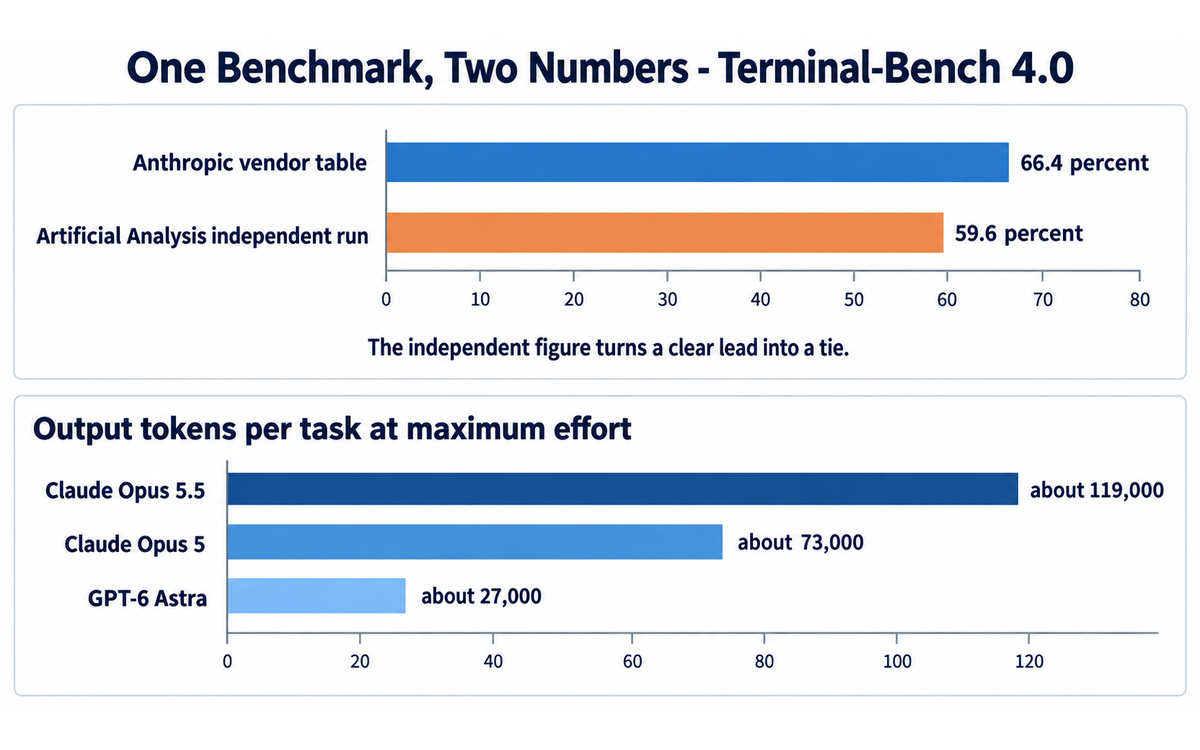
At maximum effort the model is the most token-hungry frontier model Artificial Analysis has measured, at around 119,000 output tokens per task against 73,000 for Opus 5, 78,000 for Fable 5.1, and 27,000 for GPT-6 Astra. Lower unit prices keep the bill level. They do not make it smaller at that setting.
Independent code analysis found the code shorter and less severe but denser in one category. Sonar measured 27.5 percent less code, 40 percent fewer output tokens, blocker-level reliability findings down 41 percent and blocker security findings down 53 percent, against bug density per line up 12 percent and concurrency findings up 44 percent.
Four request patterns that worked on Opus 5 now return HTTP 400. Migration is real work.
Who Should Use Claude Opus 5.5
Learner type | Difficulty | Typical ROI | Career path |
Students (Bachelor, Master) | Intermediate | Usable through Claude Pro at $20 per month. Strong for studying from long documents, structuring a thesis argument, and getting an explanation you can then reproduce yourself. The Skill Illusion is the live risk: a literature summary you cannot defend is not a skill. | UIT (Technology, AI, Data Science) tracks, with a UIT credential anchor in AI Developer Specialist or Data Scientist. |
Professionals (career upskilling) | Intermediate to Advanced | The strongest case is long agentic coding: migrations, audits, review passes, and test repair, at a lower cost per completed task than the previous flagship. Also strong for research synthesis and document production where you can verify the sources. | UIT (Technology, AI, Data Science) engineering tracks, and UIB (Business Management, Entrepreneurship) for AI-assisted analysis and cost modelling. |
Everyone (lifelong learners) | Beginner for chat use, Advanced for agent use | Clearer explanations and a 1M-token window make it a good reading and reasoning partner. The agentic surfaces that the release is built around need a technical user to supervise them. | The SL-OS daily learning routine, and the LIPS Collect and Review phases. |
Skill level required: Intermediate for chat and document work. Advanced for the agentic use the release is built around, because supervising a long run means naming a finish line, setting stops, and reading what came back.
Prerequisites: A Claude account, and a Pro, Max, Team, or Enterprise plan for regular use of Opus tier models. For the API, an Anthropic account and a payment method. Working knowledge of prompt structure and of verification practice. An understanding of what you can and cannot check in the output is the prerequisite people skip, and it is the one that decides whether the tool helps them.
Typical time to first result: Under five minutes in a chat session. Under fifteen minutes in Claude Code for a scoped change with a stated finish line.
Typical time to competence: Ten to twenty hours of active use to learn effort selection, when to hand over a whole task, when to stop it, and how to read its report. Learning that a lower effort level often matches a higher one on your own tasks is part of that.
U365 Institutes Alignment
Institute | Relevance | Why |
High (primary) | The clearest fit in the U365 curriculum, and a broader one than the previous Claude review recorded. Opus 5.5 is positioned for long agentic coding: it carries a multi-step change through a large repository, audits and repairs a codebase, reviews a diff before a person reads it, and reports what it needs. That maps to four existing UIT strands: agentic software delivery and supervision, code review and defect triage, applied model and evidence evaluation, and cost and reliability engineering for AI-dependent systems. | |
Medium | Confirmed at Medium rather than downgraded. This tool produces the artefacts a UIB programme assesses: an evidenced analysis, a financial model, a client document, and the cost-per-completed-task case for an AI-dependent product. The limit is real: it does not build management, leadership, or entrepreneurship judgement, and the model's own plain-language report is not evidence. | |
Low to Medium | It drafts and restructures long-form content and follows writing instructions more closely than its predecessor, which supports coursework in content production at volume. It returns no sourced evidence, so fact-checking stays with the Fellow, and it cannot be assessed on campaign judgement, audience analysis, or brand voice. A coursework use, not a credential anchor. | |
Low to Medium | It reads images and produces interface code, and Anthropic's own prompting guidance covers design directions, so it supports a UX or front-end coursework use. It generates no images and no video, so it does not touch visual production, and it originates no design judgement or user-research finding. A coursework use, not a credential anchor. |
Tool to Skill to Credential Pathways
Five pathways, anchored to programmes verified as published in the university-365.com catalogue on 2026-09-23. Four are UIT and one is UIB. There is deliberately no UIC or UID pathway.
Stating a finish line and named stops for a long autonomous run, splitting work into independently checkable units, and reading the report before the code. Lead to the AI Developer Specialist diploma, 18 days, which stacks into the Bachelor of Science in IT and then the Master of Science in IT.
Reading a diff and a defect report critically, and distinguishing an aggregate quality claim from a per-line measurement. Lead to the Software Developer diploma, 60 days, which stacks into the Bachelor of Science in IT.
Comparing a vendor benchmark table against an independently measured one, naming what each measures, and deciding what would settle the difference. Lead to the Data Scientist diploma, 60 days, which stacks into the Master of Science in IT.
Measuring cost per completed task rather than price per token, including effort selection, cache share, and the review time the output consumes. Lead to the Cloud Computing Specialist diploma, 30 days, which stacks into the Bachelor of Science in IT.
Building the build-versus-buy and effort-versus-quality case for an AI-assisted workflow, and stating the flip conditions in an evidenced recommendation. Lead to the AI Business Specialist diploma, 18 days, which stacks into the Bachelor of Business Administration and then the Master of Business Administration.
Adjacent anchors where a Fellow's existing pathway needs a neighbouring programme rather than a replacement, all verified live on 2026-09-23: Tech Leader for supervision and review standards; Python Data Scientist and Full-Stack Web Developer for the evaluation and integration competencies; Digital Transformation Strategist and Business Analysis Professional for the UIB analysis competency.
Access level, stated plainly: there are 3 academic access levels for Fellows. DISCOVERY Fellows can enrol in Basic-level programmes only. INSIDER Fellows can enrol in Basic and Foundation programmes. SUPERHUMAN Fellows can enrol in everything, and they are the only Fellows who can enrol in a university degree programme. Because two of the five pathways above stack into a Master of Science in IT and one stacks into a Master of Business Administration, the degree outcome in those pathways is open to SUPERHUMAN Fellows only. No access level is stated for an individual programme here, because the catalogue does not expose one.
Condition on the pathways: they apply only when the Fellow can state the finish line and the stops they set, explain what they read to verify the result and why they chose that evidence, name the defect classes their review would miss, and reproduce the reasoning without the tool open. Shipping a change the model produced is not evidence of the Fellow's skill.
How Claude Opus 5.5 Works
Inputs: Text prompts, documents, images, PDFs, code files, and structured API requests. Through the API, a conversation history plus tool definitions. Through Claude Code, a repository, its instruction files, and any skills you have written.
Outputs: Text, code, structured tool calls, and edits to files in Claude Code. Up to 128,000 tokens per response, or 300,000 on the Batches API. The model returns thinking blocks alongside the answer, and in this release those blocks are bound to the model that produced them and to the conversation.
Underlying Technology
Model: Claude Opus 5.5, API identifier claude-opus-5-5. First model in the Claude 5.5 family.
Adaptive thinking, always on. Thinking cannot be disabled. The output_config.effort parameter sets depth across five levels: low, medium (default), high, xhigh, max. A request that sets thinking: disabled or a manual thinking budget returns HTTP 400.
Preserved thinking. An anti-distillation measure introduced with Claude Fable 5.1 and applied to Opus 5.5 for API accounts created on or after 2026-08-31. Pipelines that replay edited history can receive HTTP 400.
Safeguards matched to capability. Anthropic rates Opus 5.5 as comparable to Claude Mythos 5.1 in biology and cybersecurity, so it ships with Fable 5.1-class safeguards. Most cybersecurity requests are routed transparently to Opus 4.8; biology and frontier-model-development requests go to Opus 5.
Watermarking. Text is watermarked to comply with the EU AI Act, as with Fable 5.1.
Memory: none at the model level. The model holds no state between API calls. The Claude Code surface above it writes auto memory on your behalf, which is what raises the Skill Illusion rating in this review.
Integrations: Claude API, Amazon Bedrock, Google Cloud, Microsoft Foundry, Claude apps and desktop, Claude Code, Claude Cowork, and connectors including Microsoft 365 and Outlook for paid plans.
Benchmark results, Anthropic-published, all at adaptive thinking and maximum effort unless noted:
Benchmark | What it measures | Opus 5.5 | Fable 5.1 | Opus 5 | GPT-6 Astra |
Terminal-Bench 4.0 | Agentic terminal coding | 66.4% | 55.8% | 52.3% | 57.9% |
FrontierCode v1.1 | Merge-ready code changes | 54.4% | 50.3% | 48.0% | 53.3% |
CursorBench 4.0 | Ambiguous multi-file coding | 57.8% | 51.8% | 46.6% | not reported |
GDPval-AA v2.1 | Real-world work across 44 occupations, Elo | 1,846 | 1,735 | 1,708 | 1,542 |
AutomationBench | Business workflow automation | 40.0% | 31.4% | 26.9% | 41.4% |
Humanity's Last Exam | Multidisciplinary reasoning, with tools | 67.7% | 65.6% | 63.6% | 57.2% |
Terminal-Bench-Science 0.1 | Agentic scientific research | 58.7% | 52.6% | 29.0% | 64.6% |
OSWorld 2.0 | Computer use, partial credit | 81.8% | 80.7% | 74.0% | not reported |
Read the method before the numbers, in four steps.
First, this is the vendor's own table. Competitor figures in it are the competitor's published numbers, not a shared run. Anthropic states this.
Second, the error bars cover part of the gap. Terminal-Bench 4.0 carries a standard error of about 2.6 points for Opus 5.5, and Terminal-Bench-Science about 3.5 to 5 points per model.
Third, when a safeguard intervenes, a fallback model completes the task, so some rows describe a production system rather than Opus 5.5 alone. Anthropic states this reduces Opus 5.5's scores on the affected benchmarks.
Fourth, Anthropic adds a caveat most vendors do not: it says that at these levels of capability, benchmark margins have become a less reliable guide to real-world differences, and its own use suggests the gap to Fable 5.1 is narrower than the table shows.
Independent benchmark results:
Source | Method | Result |
Artificial Analysis | Intelligence Index v4.3.2, maximum effort | 58, first of the models compared, against 53 for Fable 5.1 and GPT-6 Astra and 51 for Opus 5. Leads six of ten sub-evaluations. Trails on CritPt, AA-LCR, and GDP.pdf. |
Artificial Analysis | Intelligence Index, default medium effort | 51.2, against 47.5 for GPT-6 Sol at maximum effort. |
Artificial Analysis | Terminal-Bench 4.0, its own run | 59.6 percent, level with GPT-6 Astra's top score and 11 points above Opus 5. Anthropic reports 66.4 percent for the same benchmark. |
Artificial Analysis | Output tokens per task at maximum effort | About 119,000, against 73,000 for Opus 5, 78,000 for Fable 5.1, and 27,000 for GPT-6 Astra. |
Artificial Analysis | AA-Briefcase v1.1, multi-hour professional office work, Elo | 1,822, 143 points above Fable 5.1. The first time an Anthropic model has overtaken GPT-5.6 Sol on presentation quality in that evaluation. |
Sonar | Java benchmark, 4,444 tasks, pre-release build | 27.5 percent fewer lines of code, 40 percent fewer output tokens, functional pass rate 87.68 percent against 88.6 percent for Opus 5, blocker reliability findings down 41 percent, blocker security findings down 53 percent, bug density up 12 percent, concurrency findings up 44 percent, comment density down from 10.5 percent to 3.1 percent. |
CodeRabbit, reported through a third-party cost analysis | Code review comparison against its production mix | Caught 11 bugs the human production reviewer missed and missed 9 that the reviewer caught. A lower-effort Standard configuration beat the higher-effort Max configuration on the broad test. Token use measured 49 to 60 percent above CodeRabbit's production mix, not against Opus 5. |
Available platforms: Claude apps (web, desktop, mobile), Claude Code, Claude Cowork, Claude Platform API, Amazon Bedrock, Claude Platform on AWS, Google Cloud, and Microsoft Foundry. Not open weights, and not available for local deployment.
Getting Started
Required accounts: A Claude account for the apps. A paid plan (Pro at $20 per month, or Max) for regular Opus-tier use, since the Free tier does not include Opus. An Anthropic account with billing for the API and console. No account is required to read the documentation.
Installation: The apps run in the browser and as desktop and mobile applications. Claude Code is a terminal tool installed separately. Nothing to install for API access beyond an HTTP client or one of the official SDKs.
First-time configuration
In the apps, open the model picker and select Opus 5.5. In Claude Code, use /model.
Note that thinking cannot be turned off. If your saved instructions tell the model to think step by step, remove those lines. The model already thinks before every reply, and Anthropic reports that removing a think-carefully instruction started replies sooner with no clear quality drop in its own testing.
Set the effort level deliberately, and record what you chose. The default is medium. Anthropic's own early testers reported that low or medium effort matched or beat Opus 5 at high effort.
In Claude Code, add a short rule to your instruction file about when to stop and ask and when to keep going, and keep permission prompts on for destructive commands.
For API users, read the migration guide before pointing existing code at claude-opus-5-5. Four request patterns now return HTTP 400, and one change fails silently. Text the model writes between tool calls now arrives inside thinking blocks that are empty at the default display setting, so a progress interface that streamed that text goes quiet without an error.
Select content blocks by type, never by position. A safeguard refusal returns HTTP 200 with stop_reason: "refusal", so error handling that watches status codes alone will miss it.
First 15 minutes checklist
Give the model one real task from your own work in a single message, with a stated finish line and a stated stopping rule.
Confirm you know which effort level you are on, and change it once to see the difference in the answer and the wait.
Remove any think-carefully or think-step-by-step line from your saved instructions.
Read the model's closing report and answer only the part that is waiting on you.
Take one factual claim from the answer and verify it yourself against a source outside the conversation.
Result: One real task completed end to end, a deliberate effort setting, a saved instruction file without redundant thinking lines, and one verified claim. That is a working configuration rather than an impression.
Real Workflows
Each workflow below is a real U365 use pattern, with the finish line you write, the stops you set, and the evidence you check. The verification checklist at the end of each one is the part the CI-First framework treats as non-negotiable.
Workflow 1: A long codebase audit with a finish line and named stops
Learner type: Professional (career upskilling). Developer or technical lead. CI-First benefit tags: Time, Quality. Connects to: the UIT engineering tracks and the AI Developer Specialist diploma. Time estimate: Two to four hours of supervised work for a first audit, most of it the model's runtime.
Step | You do | The tool does |
1 | Write the finish line: what done means, and what you will accept as evidence. Write the stops: when it must ask you. | Nothing yet |
2 | Split the work so each unit is independently checkable, one service or one module at a time. | Nothing yet |
3 | Run it, and read the report before reading the code. | Works through the codebase in a long run, edits files, runs the project's own tests, and reports what it changed and what it wants from you. |
4 | Take the findings table and check the evidence behind each one, not the claim. | Returns a per-unit table with its evidence at your request. |
5 | Run the project's test suite and static analysis yourself on the result. | Nothing. You verify. |
6 | Read the diff. If it is too large to read, the task was too large. | Nothing. You decide. |
Sample prompt (UP-Context method: context, role, task, constraints, output format):
Context: this repository holds [N] services that share a retry helper. The linked issue describes a bug where the retry count is not honoured after a timeout. Role: AI as Co-Worker and Assistant (Profile 2). You execute and report. I hold the finish line, the permissions, the verification, and the decision to ship. Task: audit every service for the same bug and fix the ones that have it. Constraints: one service at a time. Do not change behaviour outside the retry path. Do not add dependencies. Stop and ask me only if a test fails for a reason you cannot explain, or before deleting anything. Output format: one table with service, affected yes or no, the evidence you used, and the files you changed. Then a separate short list of what you need from me. Verification: I run the test suite and static analysis myself. If the diff is too large to read, we split the task.
Verification checklist:
Multi-Model Check: run the same audit scope on a second model and compare which services each one flags. Disagreement is the finding worth chasing, not the agreement.
External Source: run the project's own tests and static analysis yourself. A passing test the model reports is a claim until you run it.
Human Review: a second engineer reads the diff. Independent code analysis found concurrency findings rose 44 percent per line in this release, and threading defects are exactly the class that a reading review misses.
CI-First Test: can you explain what each edited line does and why it was necessary, without the model? If not, the audit produced changes you do not own.
Workflow 2: A research brief where the model must mark what it could not confirm
Learner type: Student or professional. Analyst, researcher, or communications lead. CI-First benefit tags: Time, Quantity, Quality. Connects to: UIT and UIB research and analysis work, and the LIPS Review phase. Time estimate: 60 to 90 minutes including verification, for a brief you would otherwise spend half a day on.
Step | You do | The tool does |
1 | Assemble the source material and attach it. State which sources are authoritative. | Nothing yet |
2 | State the reader, the length, and the decision the brief has to support. | Nothing yet |
3 | Read the brief, then read the list of unconfirmed items first. | Drafts the brief, citing the sources you supplied, and names what it could not confirm. |
4 | Open every source it cited and check the claim against the source. | Nothing, you verify |
5 | Rewrite the sentences that are yours to write: the judgement, the recommendation, the tone. | Nothing, you decide |
6 | Store the brief and the source list in LIPS under the project, with the prompt you used. | Nothing |
Sample prompt:
Context: I am producing a [length] brief on [topic] for [reader]. The attached files are the only sources to use, and they are the version I will cite. My expertise in this area is [level]. Role: AI as Analyst and Tester (Profile 4). You analyse the sources and mark what does not hold up. I decide what the brief says and what ships. Task: produce the brief and support every factual claim with a citation to a passage in one attachment. Constraints: do not use information from outside the attachments. Mark every claim you cannot support under a separate heading. Do not state a number or a quotation you cannot locate in an attachment. Separate what the sources state from what you infer. Output format: the brief, then a heading "Unconfirmed" listing anything you could not support and what would settle it, then the source list with the passage you relied on for each. Verification: I open every cited passage and confirm it says what the brief says it says. If the Unconfirmed list is empty, I treat that as a finding about the review and check a sample myself.
Verification checklist:
Multi-Model Check: give the same attachments and prompt to a second model and compare the unconfirmed lists. The longer list is usually the more honest one.
External Source: open every cited source and confirm it says what the brief says it says. An internal quality bar reported by Anthropic rejected any invented number or quotation in 16 of 18 reports. That is the vendor's own test, and yours is the one that counts.
Human Review: the person who owns the decision reads the brief's recommendation, not the summary.
CI-First Test: can you defend every number in the brief without the model in the room?
Workflow 3: Learn one concept properly, with the model as the tutor
Learner type: Everyone. This is the workflow that builds capability instead of spending it. CI-First benefit tags: Skill. Connects to: UNOP active-recall practice, the LIPS Review phase, and the SL-OS daily learning routine. Time estimate: 30 to 45 minutes, once per concept.
Step | You do | The tool does |
1 | Pick one concept you actually need, not a demo topic. | Nothing yet |
2 | Ask for the explanation, one worked example, and one case where the idea breaks. | Explains, gives the example and the boundary case. |
3 | Close the conversation and reproduce the argument from memory, on paper. | Nothing. This is the part that works. |
4 | Reopen it and ask it to find the errors in your reproduction, not to confirm them. | Compares your reproduction against the concept and names the gaps. |
5 | Ask what you would need to read to check the explanation against a primary source. | Returns the reading list, which you then actually read. |
6 | Write your own two-sentence summary and store it in LIPS. | Nothing |
Sample prompt:
Context: I am studying [concept] for [purpose]. I already understand [prerequisites]. This is a learning task, and the point is what I can do afterwards. Role: AI as Coach and Tutor (Profile 3). You teach and then test me. I reproduce the concept without you, and I decide when I have understood it. Task: teach me the concept, then test me on it. Constraints: one worked example and one boundary case where the standard explanation fails. Do not summarise the whole field. Do not praise the answer I give you. Do not offer to write the summary for me, because the summary is the exercise. Output format: explanation, example, boundary case, then three questions asked one at a time, and after each answer tell me what I got wrong and what I left out. Then stop and wait. Verification: I close the conversation and reproduce the argument from memory before I reopen it, then ask you to find the errors rather than confirm them. I read one primary source, and I explain the concept to a person who knows it.
Verification checklist:
Multi-Model Check: ask a second model the same questions and compare where the explanations differ. The difference is usually the part that matters.
External Source: read one primary source for the concept before you accept the explanation.
Human Review: explain the concept to a person who knows it. If you cannot, you have a summary, not an understanding.
CI-First Test: can you teach it without the model open? Under the framework's mitigation for the Skill Illusion, this is the whole check.
Strengths, Limits, and AI Imposture Risk
Strengths
CI-First Benefit | Strength | Evidence |
Time | Long multi-step work runs to a stated finish line instead of stopping to ask, and the effort default dropped a level, which shortens the wait on the common case. | Anthropic reports output more than 30 percent faster than Opus 5. GitHub's own testing, reported by Anthropic, found Opus 5.5 solving more terminal tasks than Opus 5 in fewer than half the steps. Independent measurement puts the default medium setting at 51.2 on the Artificial Analysis index against 47.5 for GPT-6 Sol at maximum effort. |
Quantity | The constraint on output is your own review capacity, not the context window or the session limit. Four of the five effort levels sit on the independent cost-versus-intelligence frontier, so more work fits into the same budget. | 1M-token context and 128,000-token output, unchanged from Opus 5, with 300,000 available on the Batches API. Subscription usage limits increased, and Anthropic states the lower prices stretch a five-hour session about 25 percent further. |
Quality | The output holds up better under inspection than its predecessor's, and there is more independent evidence for this model than there was for Opus 5. | Artificial Analysis ranks it first on its Intelligence Index at 58, five points clear of the field, and AA-Briefcase marked the first time an Anthropic model overtook GPT-5.6 Sol on presentation quality. Sonar measured 27.5 percent less code for the same tasks with blocker-level reliability findings down 41 percent and blocker security findings down 53 percent, and 19 percent fewer bugs in absolute terms. |
Skill | Marginal. The tool does not teach, and the surfaces it ships through now write memory on your behalf. | Anthropic's own guidance is about supervision, not learning: name the finish line, name the stops, read the report. Claude Code's auto memory writes notes Claude decides to keep, by default, without a per-write human decision. Scored conservatively at 4, with framework clause 5.2.3-a applied in the trap table below. |
Limits
The 40 percent saving is measured at default settings, and part of it is a settings change. Opus 5 defaulted to high effort; Opus 5.5 defaults to medium. A third-party reconstruction of the cost math found the price cut alone is worth exactly 20 percent on a workload with no caching, 32.7 percent on an agentic day where 95 percent of context is cache reads, and that reaching 40 percent on that day requires the model to finish the work with about 89 percent of Opus 5's tokens. Quote a range, not a single number.
At maximum effort it is the most token-hungry frontier model measured. Artificial Analysis recorded about 119,000 output tokens per task at maximum effort against 27,000 for GPT-6 Astra. Lower prices per token keep the cost per task level with Opus 5 at that setting. They do not make it lower.
Independent code analysis found the code denser in one category even as it got shorter. Sonar measured bug density up 12 percent per line and concurrency findings up 44 percent, including locks acquired without a finally block and counters incremented on volatile fields. Those are the defects a reading review misses and static analysis catches.
Comment density fell. Comment lines dropped from 10.5 percent to 3.1 percent of the code Sonar measured. Less inline context survives for whoever maintains the result.
Anthropic's benchmark table was not produced in one shared evaluation setup. Competitor figures in it are the competitors' own published numbers. On Terminal-Bench 4.0, Artificial Analysis measured Opus 5.5 at 59.6 percent where Anthropic reports 66.4 percent, and the independent figure only ties GPT-6 Astra.
The model loses two of the vendor's own rows. GPT-6 Astra leads AutomationBench (41.4 percent against 40.0 percent) and Terminal-Bench-Science (64.6 percent against 58.7 percent). The vendor attributes the first partly to fallback models being counted as failures, and the same interventions will hit customers running those workflows.
Four breaking changes and one silent one. Requests that disable thinking, force tool use, replay an edited thinking block, or use the older computer-use tool return HTTP 400. Text between tool calls now appears inside thinking blocks that are empty by default, so a progress interface stops updating with no error. Migration is work, not a version bump.
No thinking-off mode. Pipelines that ran Opus 5 without thinking to save tokens lose that option entirely.
Safeguard routing means the benchmark may not describe what you get. Cyber requests go to Opus 4.8 and biology or frontier-model-development requests go to Opus 5, transparently, when classifiers fire. The vendor states this likely lowers the published scores; it also means the model answering you is sometimes a different model.
The vendor states that the model often suspects it is being evaluated, which limits how well pre-release tests predict real-world behaviour, and that reliably detecting every failure before deployment remains unsolved. That is Anthropic's own caveat in its own release material.
No published parameter count, architecture, or weights, and no self-hosting. The model cannot be run locally, and it cannot be audited outside the vendor's own testing.
The writing-improvement claim is the least independently tested claim in the release. One review found the prose more readable but still burying the point. Anthropic's evidence is early testers, not a controlled study.
No platform rates an individual Claude model. Every aggregate rating found covers the Claude product or Anthropic the company, not Opus 5.5.
AI Imposture Risk
Time Illusion: Medium. The speed and efficiency claims are partly reproducible and partly a settings change. The independently measured 30 percent output-speed gain and the independent cost-per-task figure are real. Against them: at maximum effort the model consumes more of your reading time per task than any frontier model measured, around 119,000 output tokens where GPT-6 Astra uses about 27,000; the model runs longer on its own, which shifts supervision from step-by-step to post-hoc, and post-hoc review of a three-hour run is not cheaper than reviewing six smaller steps; and a new migration surface was introduced in the same release. The trap is the comparison the marketing invites: the 40 percent figure compares a new default against a deprecated one, so some of the saving is a setting you could have changed on the previous model.
Quantity Illusion: Medium. The output is shorter per task for the same result, which is the opposite of the usual pattern and reduces the trap rather than worsening it. The risk moves rather than disappears: a long autonomous run that reports success in plain language is easy to accept, and the plain language is the model's own account of its own work. One independent reviewer's summary shows why that matters. CodeRabbit caught 11 bugs its human production reviewer missed while missing 9 that the reviewer caught. Different defects slip past different reviewers, so volume reviewed by the same agent that produced it is volume reviewed once.
Skill Illusion: High. Three things push it up. First, the capability itself: the model produces expert-looking code, analysis, and documents for people who cannot evaluate them, and it is now positioned for work that runs for hours without supervision. Second, and decisive under the framework, clause 5.2.3-a applies. Claude Code, the primary agent surface for this model, writes procedural memory on the user's behalf. Its documentation describes auto memory as notes Claude writes itself based on your corrections and preferences, loaded into every session, written in the background, enabled by default, with subagents able to keep their own. The framework sets a floor of Medium for any tool that writes procedural memory for the user, and raises it to High where the agent can revise that memory during use without a per-write human decision, or where the user has no routine practice of reading what was written. Both conditions are met here. Third, the vendor's own guidance rewards delegation of the whole task: hand over the work, name the finish line, read the report at the end. That is the exact shape of the trap. What would lower it: a user who reads what the tool saved about them, reproduces the result themselves, and keeps a lower-effort habit for learning tasks.
Overall AI Imposture Risk: Medium. Two traps sit at Medium and one at High. Under framework Section 5.3, a single High with clear mitigations is Medium overall. The mitigations that make this liveable rather than disqualifying are specific: the work is checkable, the diffs are real, the tests run, the model reports what it needs from you, and the effort dial is yours. The tool is not transparent by design; it is verifiable by design, and verification is a habit you either have or do not.
Clause check against the CI-First Framework v1.2 pedagogical clauses, recorded explicitly:
5.2.3-a, agent-authored procedural memory: APPLIES. This is a positive finding, not a null. Claude Code's auto memory writes notes the model decides to keep into a per-repository memory directory, loaded at the start of every session, written in the background, enabled by default, with subagents able to maintain their own. This triggers the no-lower-than-Medium floor and, because writes happen during use without a per-write human decision and most users do not audit what was saved, the High threshold. It is the first positive application of this clause in the U365 Tools series.
4.2-a, agent-mediated conversation: does not apply to the model as a generator. Opus 5.5 produces text you then send or do not send, so it does not by itself mediate a human-facing conversation, and agent-to-agent coordination inside Claude Code is not erosion. The condition to watch is a deployment in which an agent sends text in your name through a connected account and you do not read it before it leaves. That is a property of the connector you attach, not of the model.
7.5, team-level rooms: does not apply to the model endpoint. It does apply to the delivery surface. Claude Code coordinates subagents inside one execution, and its interface shows several agents in one view with the human. Where several agents share one channel or view with you, the clause requires Centaur with a written task boundary per member and per-member review, and Cyborg is unavailable.
U365 Co-Intelligence Rating
CI-First Profile
Primary: Co-Worker and Assistant (level 2). The release positions the model for work you hand over and review: carry the change through the repository, run the tests, report what you need from me. You direct, you set the finish line, and you read the result.
Secondary: Analyst and Tester (level 4), where the model audits a codebase or reviews a diff and you interpret the findings. Coach and Tutor (level 3) fits deliberate learning use, which is available but not the default. Co-Creator and Thought Partner (level 1) fits ideation and document co-authoring.
This differs from the published Claude Opus 5 review, which recorded level 1 as the primary profile. The change follows the release itself: Anthropic's own usage guidance for Opus 5.5 is to hand over the whole task and let it run, which is delegation with review rather than co-creation. Stated here so the divergence is deliberate rather than accidental.
Collaboration Mode
Recommended mode: Centaur. The task splits cleanly. The model executes long work, edits files, runs tests, and reports. You hold the finish line, the permissions, the verification, and the final judgement. Framework Section 7.2 assigns Centaur whenever Imposture Risk is Medium or High, exactly because Centaur is safer, and this tool is Medium overall with a High trap.
Alternative mode: Cyborg, permitted for one agent in a live session, with a stopping criterion written down before the session starts and a verification pause after each iteration. That case is narrow.
Not available: Cyborg where several agents share one channel or view with you. Framework clause 7.5 removes Cyborg for any room with more than one agent, because several agents in one iteration loop remove the stopping criterion Cyborg requires. Claude Code's subagent coordination and agent map put the user in exactly that position, so multi-agent work is Centaur, with a written task boundary per member and per-member review of the output.
Mode rationale for the reader: this model accumulates context from your repository and your instructions, which pulls toward Cyborg, and it produces complete, plausible artefacts that you must judge to be useful, which requires the clean boundary Centaur provides.
CI-First Benefit Score
Dimension | Score (0-10) | Rationale |
Time | 7 | Real and now independently supported gains on long agentic work: fewer turns and steps for the same task, output more than 30 percent faster, and an effort default that dropped one level. Docked because the common chat case gains little over its predecessor, because maximum effort raises reading load well above the previous model, and because the 40 percent headline compares a new default against an old one. |
Quantity | 7 | The 1M-token window and 128,000-token output are unchanged, so the ceiling did not move. What moved is the budget: lower prices, and subscription limits that stretch about 25 percent further. That is a marginal-to-moderate volume increase, and verified usable volume is what counts. |
Quality | 8 | The strongest dimension, and better evidenced than it was for Opus 5: first place on an independent intelligence index with a five-point margin, an independent code analysis showing fewer blocker-level defects and 19 percent fewer bugs in absolute terms for 27.5 percent less code, and presentation quality that independent evaluation measured ahead of GPT-5.6 Sol. Held at 8 rather than raised higher because the same independent analysis found bug density per line up 12 percent with concurrency findings up 44 percent, and because the vendor's own rows show the model losing to GPT-6 Astra on two evaluations. |
Skill | 4 | Marginal, scored conservatively. The tool does not teach, and clause 5.2.3-a now applies at the High level because the agent surface writes memory on the user's behalf. Nothing in this release builds durable human capability by itself; the capability comes from the reading, reproducing, and checking the user does around it. |
Calculation: (7 + 7 + 8 + 4) / 4 = 26 / 4 = 6.5.
CI-First Benefit Score: 6.5 / 10 (CI-First Strong).
The score is unchanged from the published Claude Opus 5 review (6.5, sub-scores 7 / 7 / 8 / 4) at every dimension. That is a result, not an oversight. The CI-First framework measures benefit to the human, net of overhead, on the common case. Opus 5.5 is a genuine improvement on quality-per-dollar and on long-run reliability, and it does not change what the human has to do: state a finish line, supervise, verify, and decide. A model refresh that lowers the price and raises the reliability moves the cost line, not the human's capability. The Skill dimension is where that shows, and it stays at 4.
Humics Protection Badge
Dimension | Rating | Rationale |
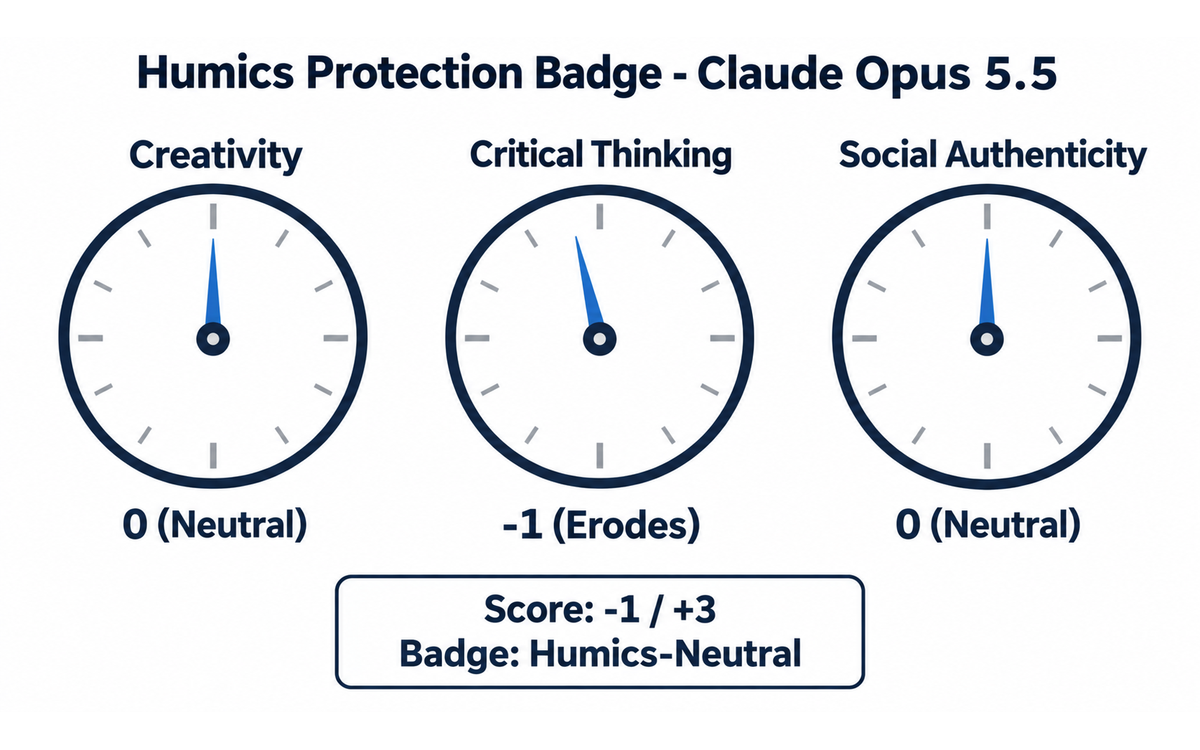
Creativity | Neutral (0) | It is a strong thinking partner and it follows design instructions more closely than its predecessor, including instructions about what to avoid. It originates nothing you did not ask for, and users who delegate ideation entirely stop practising it. The two sides balance. |
Critical Thinking | Erodes (-1) | The polished, confident output rewards acceptance, and the model's own plain-language account of its work reads like verification without being it. Long autonomous runs widen the gap between doing the work and understanding it. The counterweight is real: everything it produces is a file, a diff, or a claim you can check. Neutral would require that the tool push you toward checking. It does not push. |
Social Authenticity | Neutral (0) | The model drafts communication you may adopt as your own, which is a usage choice rather than an inherent property. Clause 4.2-a does not apply to generation. The condition to watch is a connected deployment that sends text in your name unread. |
Humics Protection Score: -1 / +3 Badge: Humics-Neutral
Superhuman Usage Guidance
When to invite this tool:
A long, checkable task with a written finish line: a migration, an audit, a test repair, a review pass.
Research and document work where the sources are supplies you can check and the claims are verifiable.
A first pass over material too large to read: it can compress volume, and you decide what survives.
A structured thinking partner for a problem you have already framed, in a live session, where you can iterate.
A tutor for a concept you intend to reproduce yourself afterwards.
When to keep this tool out:
Any decision you cannot evaluate. If you cannot tell whether the output is right, you are in the Skill Illusion and the tool will not tell you.
Final judgement, ethical calls, and communication that must carry your own voice.
Anything you would have to send or ship without reading.
Arithmetic and date reasoning inside a long chain, where you cannot check the middle steps and the failure is silent.
A task you would learn from by doing it yourself, when learning is the point of the task.
Anything where an unread autonomous run has permission to act outside a repository you can restore. Keep permission prompts on for destructive commands.
U365 method integration:
LIPS and CARE: Use Opus 5.5 in the Collect and Review phases and keep Execute yours. When it produces a verdict, store the prompt, the effort level, and the evidence you checked alongside the result in the LIPS entry, because the configuration is part of the finding. Record anything the model wrote to its own memory in the System section of your LIPS structure, so the second brain's state is not something an agent changed without you reading it. Three LIPS fields are load-bearing for this tool and must not be left empty: the finish line as you wrote it, the verification evidence, and the record of what the agent wrote to memory.
ULM and EVA: Touches Career and Quality of Life through engineering, analysis, and document work. It does not touch Body, Spirit, Character, or Social. In the EVA cycle it supports Explore and Visualize, and the Action Plan remains yours, because acting on an unverified plan is the trap this tool creates most easily.
UP-Context: The model responds well to the method. Give the context, the role, the task, the constraints, and the output format, and add two things this release rewards: a stated finish line and a stated stopping rule. Remove the instruction to think step by step, because thinking is always on and the instruction costs you latency.
SL-OS: No native integration with Outlook, To Do, OneNote, Teams, OneDrive, or SharePoint at the model level. Claude for Microsoft 365 and Outlook connectors exist for paid plans, and any deployment with mail, messaging, or Teams write access requires a read-before-send gate. The practical path without a connector is server-side and manual on the evidence side: produce the artefact, store it in OneNote or SharePoint yourself, and record the finish line, the pinned model version, the effort level, and the verification evidence where the next review will find it. Never store API keys, tokens, or secret-bearing prompt content in LIPS or in a SharePoint list.
UNOP: Partly aligned. A long explanatory answer is passive consumption, so the pedagogy has to be built on top: reproduce from memory, then ask the model to find the gaps, then read one primary source. With that structure, it supports active recall. Without it, it is a very good lecture you will not remember. Position it in coursework as an execution engine with a mandatory evidence obligation, not as an answer service, and where a Fellow uses it as a tutor, the session must end in the Fellow's own reproduction, which is the assessed artefact.
Over-delegation warning: The over-delegation pattern for this model is specific and it looks like success. You name a finish line, hand over a task that used to take a week, and receive a completed change with a clear report. Nothing in that sequence required you to understand the code, hold the design in your head, or form the judgement that the result was acceptable. Do it twice and the reading gets lighter; do it for a quarter and the review becomes a formality. Two things make this sharper than with previous models. First, the runs are longer, so the gap between doing and understanding is larger per task. Second, and worse, the agent surface writes memory on your behalf, so the tool accumulates a documented working preference you did not author and may never have read. The harm is not that the model is wrong. Its quality is well evidenced. The harm is that your ability to tell whether it is wrong decays while the output improves, and the framework's own arithmetic is unforgiving here: CI = HI + (AI x HI), so a falling HI drags the result down even when AI rises. The Superhuman in this relationship is the person who still reads the diff, still runs the test, and still knows what done means independently of the report that says it is done.
What Users Say
Aggregate Rating Table
Platform | Signal | Link |
Hacker News | Launch thread 1,284 points, 852 comments, captured 2026-09-23 | |
Hacker News | Artificial Analysis results thread, 246 points, 76 comments | |
Reddit r/ClaudeCode | Launch discussion thread on the Claude 5.5 family. Reddit returns HTTP 403 to automated retrieval, so the thread was read through search indexing rather than fetched. | |
Reddit r/ClaudeAI | User report on Opus 5.5 in Claude Code, including its share of a five-hour session limit. Same retrieval limitation. | |
G2 | No model-level rating for Opus 5.5. G2 rates the Claude product, and its pages return HTTP 403 to automated retrieval. | |
Trustpilot | No model-level rating. Anthropic is rated as a company, not per model. | |
Product Hunt | Claude, the product, is listed at 5.0 from about 1,000 ratings. Opus 5.5 has no separate listing. | |
Apple App Store | The Claude app is rated 4.7 from about 249,000 ratings. This is the consumer product across all models. | |
Artificial Analysis | Independent composite: 58 on the Intelligence Index at maximum effort, an Elo of 1,822 on AA-Briefcase v1.1 |
Note on method, stated plainly because it affects how much this section is worth. No review platform rates an individual Claude model. Every aggregate score found covers the Claude product or Anthropic the company, and third-party aggregators report figures that disagree with each other. Reproducing any single one of those numbers as a rating for Opus 5.5 would be fabrication, and G2 and Trustpilot return HTTP 403 to automated retrieval anyway. The meaningful signals for a model released the previous day are the developer discussion, the independent benchmark platforms, and the review sites that ran the model themselves. Those are what this section reports. Three of the sources cited in this review refuse automated retrieval, and their content was reached through search indexing and through secondary reporting that quoted them directly. Nothing in this review states a number that came from a page it could not read.
What Users Praise
Three themes dominate the discussion of this release.
The first is speed and cost on real work, and it is the theme developers reproduce themselves. The published claim is that Opus 5.5 performs at the level of Claude Fable 5.1 for most tasks at 40 percent lower cost than Opus 5, and users testing it on their own workloads broadly agree that the cost per task fell. One widely read report described the model re-researching a page, rebuilding it, comparing it against eleven other pages for contradictions, and editing everything, using about 35 percent of one five-hour session limit. Subscription users note that the same plan now goes further, which Anthropic attributes to both a higher session limit and a lower price.
The second is the writing, including the specific complaint it answers. Claude models had attracted a nickname for a formulaic and overwrought house style, and this release is the first where Anthropic names that complaint and claims to have fixed it. Early reactions are unusually positive for a writing-style claim, with users reporting shorter and more direct answers and a preference for this model as a daily driver. The Limits section of this review flags that this claim rests on the least independent evidence of anything in the release, and one reviewer found the prose readable but still burying the point.
The third is the way it reports its own work. Users who supervise long runs value that it says what it did and what it needs, because it makes the review step shorter. Independent reviews of the model as a code reviewer found it catching defects the human reviewer missed, which is the kind of claim developers take seriously.
What Users Complain About
Four complaints recur.
The first is the effort and token dial. Independent measurement found that at maximum effort the model generates around 119,000 output tokens per task, roughly four times what GPT-6 Astra uses, and that at that setting its cost per task is level with Opus 5 rather than lower. Users who push the setting up for hard problems report that the bill does not fall the way the headline suggests. Others find the opposite and report that low or medium effort is enough, which is exactly the disagreement the vendor's own early testers described.
The second is the migration surface. Four request patterns that worked on Opus 5 return HTTP 400, and one change fails silently by moving text between tool calls into thinking blocks that are empty by default, so progress interfaces go quiet without an error. Developers who maintain agent pipelines describe this as more work than a version bump, and the silent failure as the worse of the two.
The third is the safety routing. Cyber, biology, and frontier-model-development requests are transparently routed to older models when classifiers fire. Users doing legitimate security work report hitting that routing, and the vendor's answer for most of them is a verification programme rather than an exception.
The fourth is the one that predates this release and survives it. The previous Opus model drew sustained criticism for turning small requests into large rewrites and for burying simple answers in unnecessary detail. Many of those threads are about Opus 5, not 5.5, and should be read that way. The pattern to watch is whether the new default effort and the clearer writing hold up on smaller tasks over weeks rather than in a first week of favourable first impressions.
A fifth objection comes from the benchmark community rather than from users: comparing a new default effort level against a deprecated default flatters the new model, and the vendor's own table contains rows where a competitor leads. Users repeat both points, and they are correct on both.
Sentiment Summary
Overall sentiment: Predominantly positive, with the price and the speed universally accepted and the efficiency claim contested on detail rather than direction.
Key themes:
Cost per completed task fell, and the independent evidence supports that more than it supports the specific 40 percent figure.
The clearer writing is the most noticed change and the least independently tested claim.
Longer autonomous runs are an improvement in capability and a new supervision problem at the same time.
The breaking changes are the most common practical complaint, and the silent one is the most disliked.
Independent composite evaluation puts the model first, and independent same-benchmark measurement is narrower than the vendor's table.
Effort level, not the model, is the largest single variable in the bill.
U365 Editorial Note
User sentiment and the CI-First evaluation agree, and the agreement is specific rather than general.
Users praise cost per completed task and the clarity of the report, which the framework scores as the Time dimension's real gain and as the Quantity dimension's budget improvement. Users attack the effort dial and the token count at maximum effort, which is exactly why the framework docks Time to 7: the 40 percent headline compares a new default against an old one, so part of the saving is a setting. Users who say low or medium is enough are reporting the same mechanism from the other side, and they are the reason the Time score is 7 rather than lower. Users who complain that the model still buries the point line up with the framework's decision to hold Quality at 8 rather than lift it: the strongest independent evidence supports a smaller improvement than the vendor's table shows.
Where the two diverge is the part worth stating plainly. Developers evaluate this model as a component and mostly need it to be cheap, reliable, and fast, and by that standard it is a good release. A U365 reader arrives with a different question: does this make me more capable? The measured answer is no. Every dimension in the CI-First Benefit Score is unchanged from the previous Opus model, and the Skill dimension stays at 4 while the framework's new clause raises a structural warning about the surfaces the model ships through. The honest summary is that Opus 5.5 makes a capable person faster and does not make a less capable person more capable, and the second half of that sentence is the one this review exists to say.
Comparison and Alternatives
Alternative | Choose the alternative if | Choose Claude Opus 5.5 if |
GPT-6 Sol (https://openai.com) | Raw price is the constraint and repeated complex work at $2 per million input and $10 per million output is what you need. Half of Opus 5.5's uncached input price, released the same day. | You want the better measured result on the vendor-neutral composite and on cost per completed task, and you accept the higher list price for it. Do not treat the two as a controlled comparison: no run of both in one evaluation setup exists yet. |
GPT-6 Astra (https://openai.com) | Maximum capability at any price is what the task needs, at $10 and $50 per million. It leads the two rows Opus 5.5 loses, business workflow automation and agentic scientific research. | You want near-frontier capability at 60 percent less, on most of the evaluations both companies published. |
Claude Fable 5.1 (https://www.anthropic.com) | You need the model Anthropic still recommends for the most demanding long-horizon reasoning, and you are willing to pay $10 and $50 per million for it. | You need capability that independent evaluation places above Fable 5.1 at 40 percent of its list price. |
Claude Sonnet 5 (https://www.anthropic.com) | The work is high volume and well scoped, and the lower tier is enough. Anthropic has kept Sonnet as the cheap workhorse. | The task is long, multi-step, or ambiguous, which is where the Opus tier earns its price. |
Gemini 3.8 Flash (https://ai.google.dev) | Throughput dominates and $0.75 per million input at introductory pricing fits the budget. Note that the rate doubles on 2027-01-01. | The work needs the top of the quality range, not the top of the volume range. |
Claude Opus 5 (https://www.anthropic.com) | Nothing recommends it now for new work. Anthropic has moved it to the legacy list and Opus 5.5 costs less. | You are staying deliberately on a pinned version until a migration window opens. Plan it. |
A smaller or open-weights model, for example Kimi K3 (https://openrouter.ai/moonshotai/kimi-k3) | Data cannot leave your infrastructure, or you need an auditable artefact. Opus 5.5 cannot be self-hosted or audited, and it is 200 times to 660 times the price of a small open model per token. | The task genuinely needs frontier capability, and the cost per completed task is lower than the cheap model's retries. |
Where Claude Opus 5.5 is clearly better: on capability per dollar at the top end. Independent evaluation places it first on a public composite with a five-point margin, first on a professional knowledge-work benchmark where no Anthropic model had led on presentation quality before, and ahead of its predecessor on quality while costing 20 to 60 percent less per token. Independent code analysis found 19 percent fewer bugs in absolute terms and 40 percent fewer blocker-level findings for 27.5 percent less code. For long agentic work, the step count is the number that matters, and the reported reduction is substantial.
Where Claude Opus 5.5 is clearly worse: on price per token against the cheaper tier, where GPT-6 Sol costs exactly half on uncached input; on token efficiency at maximum effort, where it is the most token-hungry frontier model measured; on concurrency defects per line, which rose 44 percent in independent analysis; on open auditability, since there are no weights and no self-hosting; and on stability for existing pipelines, because four request patterns now fail with HTTP 400 and one fails silently. It also loses two of the vendor's own published rows to GPT-6 Astra. If a claim will be relied on without your own verification, this is not the component to rely on.
Verdict and Next Steps
Who should adopt it: Teams and individuals doing long, checkable work: engineering, code review, migrations, research synthesis, and document production, where the output is an artefact you can verify. Also anyone already on a paid Claude plan, because the same plan now goes further and there is no migration cost in the apps.
When: Now, with one exception. In the apps and in Claude Code this is a straight improvement, and the effort dial is the main thing to set deliberately. If you call the API from production code, read the migration guide first and budget for four breaking changes plus one silent one. If your pipelines depend on disabling thinking or on forced tool use, plan the change rather than discovering it.
For what: Long autonomous work with a stated finish line, checkable analysis and documents built from sources you control, a first pass over more material than you could read, and a tutor whose explanations you then reproduce.
The honest caveat, stated once: the price is proven, the capability is well evidenced by independent measurement, and the 40 percent saving is a settings-adjusted claim that holds somewhere between 20 and 51.6 percent depending on your cache share and your effort level. The CI-First score does not move from the previous Opus model, because the framework measures what the human gains, and what the human has to do here is unchanged: state the finish line, supervise, verify, decide. The tool is not designed to make verification unnecessary. It is designed to make the work worth verifying.
UP-Context Prompt Packs
Written in the UP-Context order: context, role, task, constraints, output format. Each pack adds a finish line or a stopping rule and a verification close, which is what this model needs.
Prompt Pack 1: A long autonomous run with a written finish line and named stops
Context: [repository or project] and [the outcome I need]. The relevant code lives in [paths]. Done means [the tests pass / every endpoint is migrated / the report is written]. Role: AI as Co-Worker and Assistant (Profile 2). You execute the work and report. I hold the finish line, the permissions, the verification, and the decision to ship. Task: complete the work above. Constraints: do not change behaviour outside [scope]. Do not add dependencies. Before any destructive command, stop and ask me, and keep permission prompts on. Stop and ask me only where a decision is genuinely mine, and do not ask me to confirm steps that are not decisions. Do not rely on any note you wrote to your own memory unless I have read it, and tell me in your report what you wrote there. Output format: keep the checklist in TASKS.md and tick it as you go. End with four headings: Done, Evidence, Blocked on me, Found. Under Evidence give the command or test output that would let me check each item, not your description of it. Verification: I read the report before I read the diff, and I run the test suite and static analysis myself on the result. If the diff is too large to read, the task was too large and we split it. I check the evidence behind each finding rather than the finding itself. Can I defend every item in that report without you in the room? If not, the work is not done.
Prompt Pack 2: A research brief built only from sources I supplied
Context: I am producing [artefact] on [topic] for [reader]. The attached files are the only sources to use, and they are the version I will cite. My expertise in this area is [level]. Role: AI as Analyst and Tester (Profile 4). You analyse the sources and mark what does not hold up. I decide what the brief says and what ships. Task: produce the brief and support every factual claim with a citation to a passage in one attachment. Constraints: no information from outside the attachments. Do not state a number, a date, or a quotation you cannot locate in an attachment. Separate what the sources state from what you infer. Do not smooth over disagreements between the sources; name them. Output format: the brief, then a heading "Unconfirmed" listing every claim you could not support and what would settle it, then the source list with the passage you relied on for each. Verification: I open every cited passage and confirm it says what the brief says it says. I do not ship a number whose source I have not opened. If the Unconfirmed list is empty, I treat that as a finding about the review rather than about the sources, and I check a sample myself.
Prompt Pack 3: A learning session that ends in my own reproduction
Context: I am studying [concept] for [purpose]. I already understand [prerequisites]. I learn best by [preference]. This is a learning task, and the point is what I can do afterwards. Role: AI as Coach and Tutor (Profile 3). You teach and then test me. I reproduce the concept without you, and I decide when I have understood it. Task: teach me the concept, then test me on it. Constraints: one worked example and one boundary case where the standard explanation fails. Do not summarise the field. Do not praise my answers. Do not tell me the reasoning behind your own internal steps, which I cannot check. Do not offer to write the summary for me, because the summary is the exercise. Output format: explanation, example, boundary case, then three questions asked one at a time. After each of my answers, tell me what was wrong, what was missing, and what I should read to check it. Then stop and wait. Verification: I close the conversation and reproduce the argument from memory before I reopen it, then ask you to find the errors in my reproduction rather than to confirm it. I read one primary source before I accept the explanation, and I explain the concept to a person who knows it. I write my own two-sentence summary and store it in LIPS. If I cannot teach it with you closed, I have a summary and not an understanding, and the Skill Illusion applies to me.
U.Copilot guardrails for Opus 5.5 recommendations
State the score beside the risk. 6.5/10 CI-First Strong with Medium overall AI Imposture Risk and a High Skill Illusion. Do not present the benefit without the risk, and do not publish Medium overall without the High trap.
Never quote the 40 percent saving as a single number. It is measured against the previous model's default effort, and the default changed. The measured range is 20 percent on a no-cache workload, 32.7 percent on an agentic day at 95 percent cache reads, and 40 percent only if the model finishes with about 89 percent of the previous model's tokens.
Never present the vendor benchmark table as a controlled comparison. Competitor rows are the competitors' own published numbers, and independent measurement of Terminal-Bench 4.0 came in at 59.6 percent where the vendor reports 66.4 percent.
Never quote the code analysis in one direction only. Fewer blocker findings and fewer bugs in absolute terms came with bug density per line up 12 percent and concurrency findings up 44 percent.
Never describe the release as a migration-free upgrade for API users. Four request patterns return HTTP 400 and one fails silently.
State the memory finding explicitly. Clause 5.2.3-a applies at High because the agent surface writes procedural memory during use with no per-write human decision. Any Fellow using the agent surface should read what was written.
Never describe the model's own report as verification. It is the model's account of its own work. Verification is the test the Fellow runs, the diff the Fellow reads, and the source the Fellow opens.
Tool-choice framing when a Fellow asks which model to use for a long, checkable task:
Long agentic work where the result will be verified and cost per completed task matters: Opus 5.5 is a strong fit at the medium effort default. Set the effort level deliberately rather than leaving it.
Raw price is the binding constraint and the work is well scoped: a cheaper frontier tier, and accept the difference in measured quality on the tasks where it matters.
Maximum capability at any price, on business workflow automation or agentic scientific research: a competitor led two published rows in the vendor's own table. Choose on the task, not on the composite score.
The output must be auditable outside a vendor, or must run on U365 infrastructure: an open-weight model. Accept the accuracy and maintenance trade, and re-measure on your own task.
The task is the learning: no model as the producer. Use the model as Coach and Tutor (Profile 3) with a reproduction requirement, which is the only mode in this release that builds capability.
The Fellow cannot evaluate the output and cannot arrange a review: no delegation. Split the task until the Fellow can check each piece.
Related U365 content
INSIDE Tools Review: Claude Opus 5 (superseded by this review, scored 6.5)
INSIDE Tools Review: Claude Code (agentic coding surface, scored 6.8)
INSIDE Tools Review: Claude Fable 5.1 (frontier tier, scored 7.0)
UIT programme page, for the engineering and evaluation pathways
UIB programme page, for the cost and business analysis pathway
U365's Recommendations to Learn More
These resources were curated to help you go deeper on Claude Opus 5.5. Every link and every video below was resolved on 2026-09-23. We prioritise material that teaches something this review does not cover.
Official learning resources
Claude Opus 5.5 launch page: the vendor's own performance, safety, and pricing claims, with the benchmark table and its footnotes. https://www.anthropic.com/claude-opus-5-5
Claude Opus 5.5 System Card: the alignment and safety evaluation, including the automated behavioural audit and the Responsible Scaling Policy assessments. https://www.anthropic.com/claude-opus-5-5-system-card
What is new in Claude Opus 5.5: the developer-facing change list, including effort levels and preserved thinking. https://platform.claude.com/docs/en/models/opus-5-5/whats-new-opus-5-5
Migrating to Claude Opus 5.5: the four breaking changes and their replacements. Read this before pointing existing code at the model. https://platform.claude.com/docs/en/models/opus-5-5/migration-guide
Claude Platform pricing: the token rates, cache rates, batch and fast mode prices. https://platform.claude.com/docs/en/about-claude/pricing
Claude Code memory documentation: how instruction files and auto memory carry knowledge across sessions, which is the basis of this review's Skill Illusion rating. https://code.claude.com/docs/en/memory
Understanding Claude usage and length limits: the session and weekly limit structure for paid plans. https://support.claude.com/en/articles/11049741-what-is-the-max-plan
Video tutorials and channels
Claude Opus 5.5 Is INSANE, Hands-On With the BEST Model Yet, by Bijan Bowen. https://www.youtube.com/watch?v=ux6Lafw7en0
Anthropic Just Dropped Claude Opus 5.5 (Full Breakdown), by Brock Mesarich. https://www.youtube.com/watch?v=fc7l-dut1GM
Anthropic's Opus 5.5 Is Here, Is The Higher Reasoning Effort Worth It, by CodeRabbit. https://www.youtube.com/watch?v=IsRRQ7wxzuY
Claude Opus 5.5: Stronger Coding Than Opus 5 for Less, by Eric Tech. https://www.youtube.com/watch?v=wjKOlntfka8
Claude Opus 5.5 Just Killed Fable 5.1, by Duncan Rogoff. https://www.youtube.com/watch?v=kVmVXz3YCNA
Opus 5.5, Anthropic Finally Listened, by Prompt Engineering. https://www.youtube.com/watch?v=04qy4OWteio
I reviewed Opus 5.5 and GPT-6 Sol live, and the results surprised me, by How I AI. https://www.youtube.com/watch?v=LMT-bknLmNo
GPT-6 Sol vs Opus 5.5: Benchmarks Are Missing the Point, by Eric Michaud. https://www.youtube.com/watch?v=gJ--dZa6-tA
Claude Opus 5.5 Is INSANE - Hands-On With the BEST Model Yet! by Bijan Bowen (Published Sep 22, 2026)
Written tutorials and deep-dive articles
Artificial Analysis, Claude Opus 5.5 intelligence, performance and price analysis: the independent composite score, per-task token counts, and the cost-versus-intelligence frontier. https://artificialanalysis.ai/models/claude-opus-5-5
Claude Opus 5.5, an evaluation review and metrics benchmarks (Sonar, via Security Boulevard): the independent Java benchmark covering code volume, pass rate, bug and vulnerability density. https://securityboulevard.com/2026/09/claude-opus-5-5-an-evaluation-review-and-metrics-benchmarks/
Claude Opus 5.5 review: what the 40 percent saving covers, and what breaks when you switch (Roo's Newsletter): a third-party reconstruction of the cost math and a pre-flight check of the breaking changes. https://roo.beehiiv.com/p/claude-opus-5-5-review
Claude Opus 5.5 specs, benchmarks, pricing and how it stacks up against GPT-6 Astra, Fable 5.1 and every frontier model (Kingy AI): full spec sheet and a price comparison across vendors. https://kingy.ai/blog/claude-opus-5-5-specs-benchmarks-pricing-comparison
Anthropic releases Claude Opus 5.5, beating Fable 5.1 on key agentic benchmarks (VentureBeat): the release read as a cost-per-completed-task argument, with the same-day OpenAI launches. https://venturebeat.com/technology/anthropic-releases-claude-opus-5-5-beating-fable-5-1-on-key-agentic-benchmarks-at-60-cheaper-api-price
Claude Opus 5.5 matches Fable 5.1 at lower cost and promises less Claudish writing (The Decoder): the writing claim, the effort-default change, and the independent index result. https://the-decoder.com/claude-opus-5-5-matches-fable-5-1-at-40-percent-lower-cost-as-anthropic-promises-to-fix-claudish-writing/
Claude Opus 5.5: Features, Pricing, Benchmarks, Review (Coursiv): a clearly labelled reading of the launch numbers, including what is not independently confirmed. https://coursiv.io/blog/claude-opus-5-5
Community and social
Hacker News launch thread: 1,284 points and 852 comments, including developer reports on the effort dial and the breaking changes. https://news.ycombinator.com/item?id=49803892
Hacker News discussion of the Artificial Analysis results: per-setting intelligence, performance, and price analysis. https://news.ycombinator.com/item?id=49804316
r/ClaudeCode launch discussion: user reports from the agent surface this model is positioned for, read via search indexing. https://www.reddit.com/r/ClaudeCode/
r/ClaudeAI: the largest general Claude community, where the effort-dial and writing-style arguments play out. https://www.reddit.com/r/ClaudeAI/
Anthropic status page: check this before concluding the model is behaving badly. Independent reporting noted a rise in errors on Claude models the day before this release. https://status.anthropic.com
Resources on X
Dedicated X channels:
@AnthropicAI: the official account, carrying the launch post and safety announcements. https://x.com/AnthropicAI
@ClaudeDevs: the developer-facing account, carrying the Claude Code session-limit and pricing changes. https://x.com/ClaudeDevs
@ArtificialAnlys: the independent evaluation account, carrying the Intelligence Index result and the token-efficiency caveat. https://x.com/ArtificialAnlys
X posts with video content:
Artificial Analysis thread on the top Intelligence Index result, the 20 percent price cut, and the larger cache discount, published 2026-09-22. https://x.com/ArtificialAnlys/status/2102438210798514391
ClaudeDevs post on Claude Code session limits increasing 20 percent and the plans going about 25 percent further, published 2026-09-22. https://x.com/ClaudeDevs/status/2102438800836489554
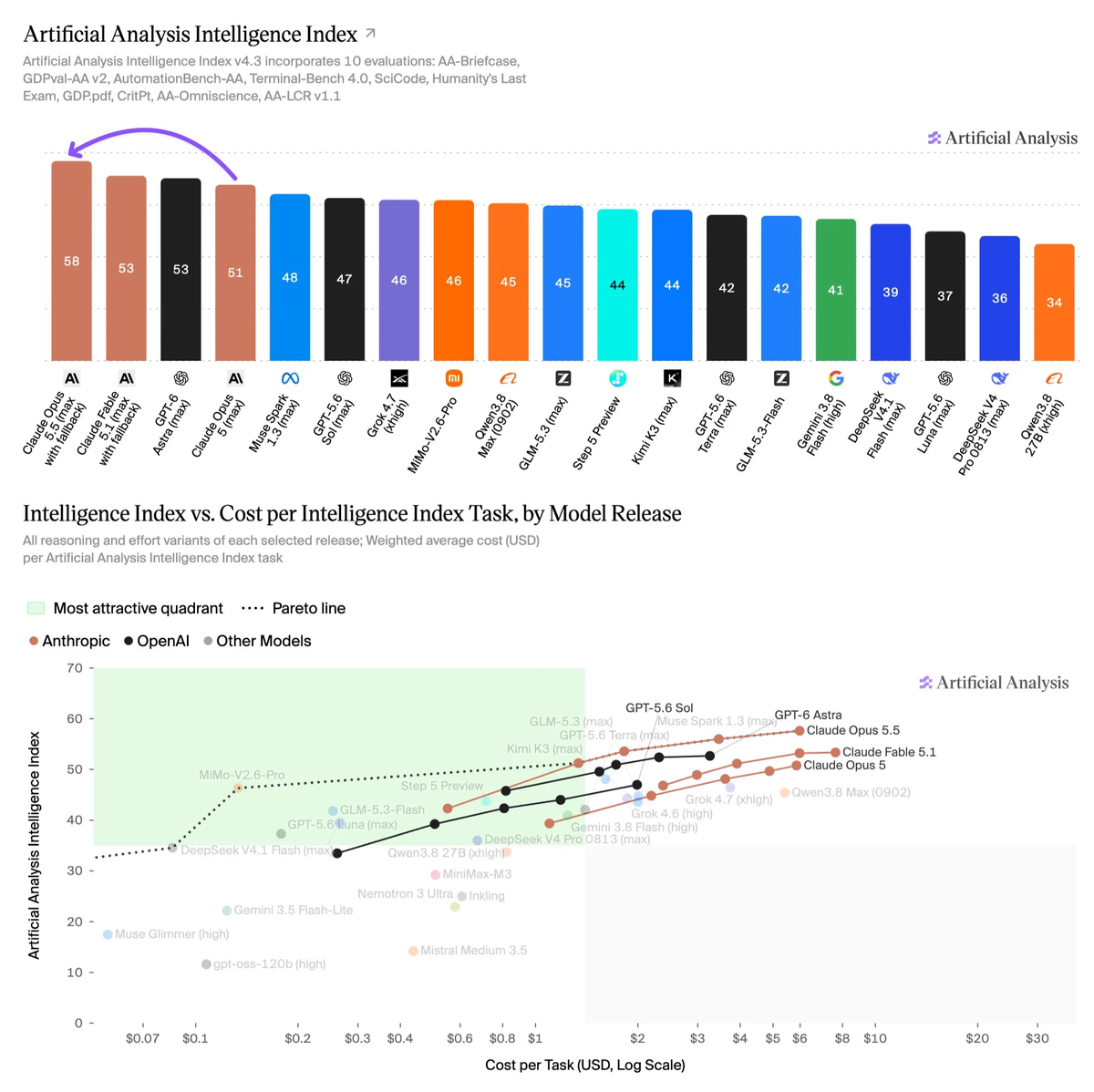
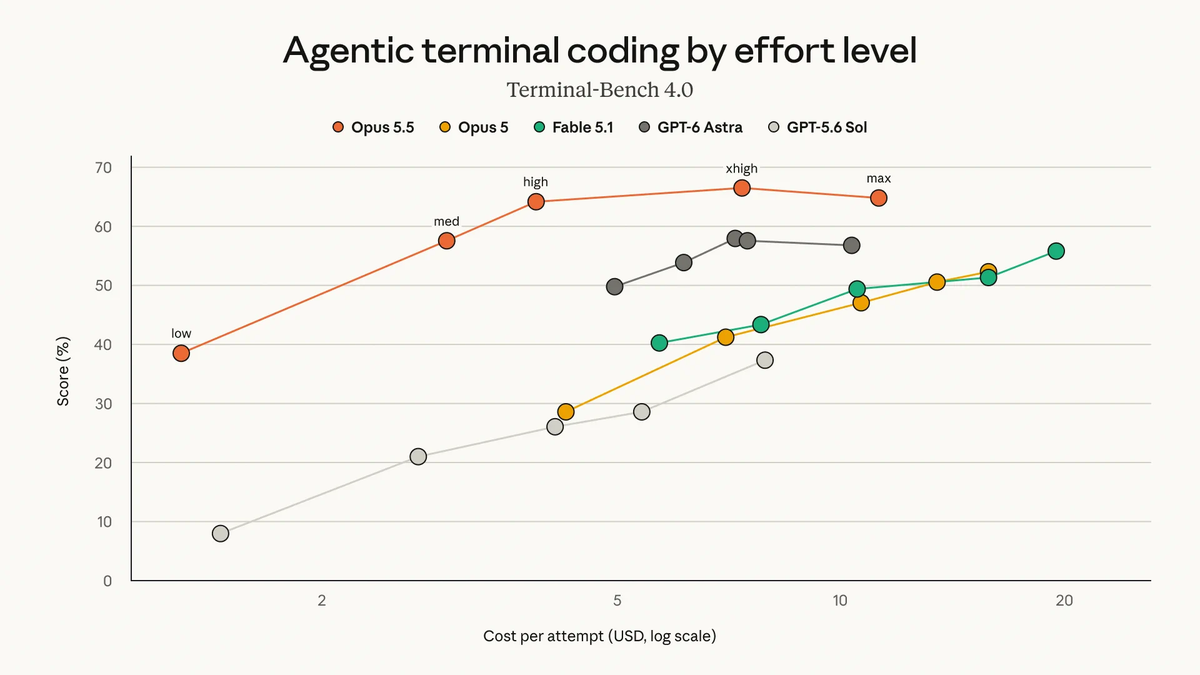
We curate resources by content quality, not source type. Individual creators and community experts are welcome and often produce the best tutorials. We label community sources so readers know the provenance, and we exclude promotional and affiliate content. The quality bar is substantial material that teaches something this post does not, from creators who visibly use the tool seriously.
Glossary
CI-First Benefit Score
The average of four dimensions, each scored 0 to 10: Time, Quantity, Quality, and Knowledge and Skill. It answers whether using the tool makes Co-Intelligence more profitable than Human Intelligence alone. Bands: 0 to 2.0 CI-First Negative, 2.1 to 4.0 CI-First Neutral, 4.1 to 6.0 CI-First Positive, 6.1 to 8.0 CI-First Strong, 8.1 to 10.0 CI-First Transformative. The score accounts for the overhead of prompting and verification, not just the benefit the tool produces. Claude Opus 5.5 scores 6.5.
CI-First Profile
The role the AI plays in your working relationship. (level 1) Co-Creator and Thought Partner, (level 2) Co-Worker and Assistant, (level 3) Coach and Tutor, (level 4) Analyst and Tester, (level 5) Challenger and Devil's Advocate. Lower level numbers indicate higher AI autonomy. Assigning a profile before giving the AI a task is a core CI-First discipline. Claude Opus 5.5 is primarily a Co-Worker and Assistant (level 2).
Humics Protection Badge
A rating of whether a tool protects, leaves neutral, or erodes three human capabilities: Creativity, Critical Thinking, and Social Authenticity. Each is scored +1, 0, or -1, and the sum gives the badge. +2 to +3 is Humics-Friendly, -1 to +1 is Humics-Neutral, -2 to -3 is Humics-Risky. It measures whether the tool strengthens the human or contributes to AI Obesity. Claude Opus 5.5 is Humics-Neutral at -1 / +3, with Creativity 0, Critical Thinking -1, and Social Authenticity 0.
AI Imposture Risk
The likelihood that a tool traps you in one of three illusions. The Time Illusion is the appearance of saving time when net time is lost. The Quantity Illusion is high volume that looks good but does not survive inspection. The Skill Illusion is the appearance of competence in you while the underlying skill is absent or eroding. Each trap is rated Low, Medium, or High with cited evidence, and the overall level is Low when all three are Low, High when two or more are High. Claude Opus 5.5 is Medium overall, with Time Medium, Quantity Medium, and Skill Illusion High.
User Sentiment
The aggregated public opinion from review platforms, community forums, and repository activity. It is reported separately from the CI-First score because crowd sentiment can contradict a rigorous evaluation. Where the two agree, the finding is stronger. Where they diverge, the divergence is worth explaining.
Review Status
Review Status records the current standing of the tool at the time of the last test. Active: the tool is current and recommended. Active (updated): recently re-checked and the content was refreshed. Changed: a re-check trigger fired and an update is pending, so read the review with that in mind. Risky: the tool has significant unresolved issues, or it has been clearly surpassed by newer alternatives. Use it with caution and read the Limits section. Retired: the tool still works but is no longer recommended. Deprecated: the tool has been shut down or fundamentally changed. Retired and Deprecated posts include a Migration Path section.
Sources
Anthropic, Introducing Claude Opus 5.5, 2026-09-22: https://www.anthropic.com/claude-opus-5-5
Anthropic, Claude Opus 5.5 System Card: https://www.anthropic.com/claude-opus-5-5-system-card
Claude Platform documentation, models overview: https://platform.claude.com/docs/en/models/overview
Claude Platform documentation, what is new in Claude Opus 5.5: https://platform.claude.com/docs/en/models/opus-5-5/whats-new-opus-5-5
Claude Platform documentation, migrating to Claude Opus 5.5: https://platform.claude.com/docs/en/models/opus-5-5/migration-guide
Claude Platform documentation, pricing: https://platform.claude.com/docs/en/about-claude/pricing
Claude Platform documentation, preserved thinking: https://platform.claude.com/docs/en/build-with-claude/preserved-thinking
Anthropic Help Center, the preserved-thinking change: https://support.claude.com/en/articles/16761192
Anthropic Help Center, real-time cyber safeguards on Claude Opus and Sonnet: https://support.claude.com/en/articles/14604842-real-time-cyber-safeguards-on-claude-opus-and-sonnet
Anthropic Help Center, what is the Max plan: https://support.claude.com/en/articles/11049741-what-is-the-max-plan
Anthropic, Life Sciences Verification Program: https://www.anthropic.com/news/life-sciences-verification-program
Anthropic, threat intelligence report, September 2026: https://www.anthropic.com/threat-intelligence-report-september-2026
Anthropic, Claude text watermarking and the EU AI Act: https://www.anthropic.com/news/claude-text-watermark
Claude Code documentation, how Claude remembers your project, covering instruction files and auto memory: https://code.claude.com/docs/en/memory
Claude Code documentation, custom subagents, covering subagent memory: https://code.claude.com/docs/en/sub-agents
Anthropic Help Center, plans and pricing page: https://claude.com/pricing
Artificial Analysis, Claude Opus 5.5 intelligence, performance and price analysis: https://artificialanalysis.ai/models/claude-opus-5-5
OfficeChai, Claude Opus 5.5 jumps to top spot on the Artificial Analysis Intelligence Index, with per-evaluation detail and the per-task token counts: https://officechai.com/ai/claude-opus-5-5-creates-5-point-lead-over-gpt-6-astra-jumps-to-top-spot-on-artificial-analysis-intelligence-index
Sonar, Claude Opus 5.5, an evaluation review and metrics benchmarks, published via Security Boulevard on 2026-09-22: https://securityboulevard.com/2026/09/claude-opus-5-5-an-evaluation-review-and-metrics-benchmarks/
Roo's Newsletter, Claude Opus 5.5 review, a third-party reconstruction of the cost math and the breaking changes: https://roo.beehiiv.com/p/claude-opus-5-5-review
Kingy AI, Claude Opus 5.5 specs, benchmarks, pricing and comparison, including where the model does not lead: https://kingy.ai/blog/claude-opus-5-5-specs-benchmarks-pricing-comparison
VentureBeat, Anthropic releases Claude Opus 5.5, including the same-day GPT-6 Sol and GPT-6 Luna launches and a full list-price table: https://venturebeat.com/technology/anthropic-releases-claude-opus-5-5-beating-fable-5-1-on-key-agentic-benchmarks-at-60-cheaper-api-price
The Decoder, Claude Opus 5.5 matches Fable 5.1 at lower cost and promises less Claudish writing: https://the-decoder.com/claude-opus-5-5-matches-fable-5-1-at-40-percent-lower-cost-as-anthropic-promises-to-fix-claudish-writing/
Coursiv, Claude Opus 5.5 features, pricing, benchmarks, a labelled reading of the launch numbers: https://coursiv.io/blog/claude-opus-5-5
The Verge, Anthropic launches Claude Opus 5.5 with stricter safeguards for cybersecurity: https://www.theverge.com/ai-artificial-intelligence/998868/anthropic-claude-opus-5-5-cybersecurity
Hacker News, Claude Opus 5.5 launch thread, 1,284 points and 852 comments as of 2026-09-23: https://news.ycombinator.com/item?id=49803892
Hacker News, Artificial Analysis results discussion, 246 points and 76 comments: https://news.ycombinator.com/item?id=49804316
Hacker News, Claude Opus 5.5 for code review, more catches, different misses: https://news.ycombinator.com/item?id=49804509
Reddit r/ClaudeCode, launch discussion thread on the Claude 5.5 family, read via search indexing (Reddit returns HTTP 403 to automated retrieval): https://www.reddit.com/r/ClaudeCode/
Reddit r/ClaudeAI, user report on Opus 5.5 in Claude Code and its share of a five-hour session limit, read via search indexing: https://www.reddit.com/r/ClaudeAI/
Artificial Analysis thread on X on the top Intelligence Index result: https://x.com/ArtificialAnlys/status/2102438210798514391
ClaudeDevs post on X on the Claude Code session-limit change: https://x.com/ClaudeDevs/status/2102438800836489554
Anthropic status page: https://status.anthropic.com
Internal sources held in the U365 INSIDE working library and not published: the CI-First Evaluation Framework v1.2, covering sections 3 (benefit rubric), 4 (Humics, including clause 4.2-a), 5 (Imposture risk, including clause 5.2.3-a), 6 (profiles), 7 (collaboration modes, including clause 7.5), and 9 (scoring procedure and principles); and the INSIDE Tools Post Template, including the LLM variant. Browse the published U365 Tools Reviews index for the reviews that apply them.
Published INSIDE Tools Reviews used as internal comparisons: Claude Opus 5, Claude Code (rescored 6.8 on 2026-09-18), Claude Fable 5.1 (7.0), and Jev AI (5.5). Browse all reviews at https://www.university-365.com/tools.
Faculty Note on Evidence Quality
Three claims from this release did not survive checking against primary sources, and the difference matters for anyone deciding what to build on.
First, the 40 percent saving. It is measured at default settings, and the default changed in this release: Opus 5 defaulted to high effort, Opus 5.5 defaults to medium. Anthropic states the figure combines lower prices with fewer tokens per task. A third-party reconstruction from the price sheet and from independently measured token counts found the price change alone is worth exactly 20 percent on a workload with no cache, 32.7 percent on an agentic day where 95 percent of the context comes from cache reads, and 40 percent only if the model finishes with about 89 percent of Opus 5's tokens. One measured workload landed at 40.0 percent or 51.6 percent depending on whether the recorded reasoning tokens are billed on top of output. The company's own early testers, including Factory, Rogo, and Deloitte, told it that low or medium effort matched or beat Opus 5 at high effort, which is why the comparison is defensible. It is still a settings-adjusted number. Quote a range.
Second, the benchmark table. It is the vendor's table, and the competitor columns are the competitors' own published numbers. Anthropic states this, and it also volunteers that benchmark margins have become a less reliable guide at this level and that its own use puts the gap to Fable 5.1 below what the table shows. The independent measurement of the same benchmark came in lower: Artificial Analysis measured 59.6 percent on Terminal-Bench 4.0 where Anthropic reports 66.4 percent, which turns a clear lead over GPT-6 Astra into a tie. Two rows in the vendor's own table go the other way, with GPT-6 Astra ahead on business workflow automation and agentic scientific research, and the vendor attributes the first partly to safeguard fallbacks being counted as failures. When a vendor says its own table overstates its margin, believe it.
Third, the writing improvement, which is the claim ordinary users will notice most. The evidence is early testers reported by the company, plus a house-style complaint the company set out to fix. One independent review found the prose more readable and still burying the point. There is no controlled study and no independent writing evaluation. A reader choosing this model for its writing is choosing it on a plausible claim with weaker evidence behind it than the coding numbers, and should read a few long answers before deciding.
All three cases teach the same lesson, which is the one this review is built on. When a vendor's headline sentence and the vendor's own footnotes say different things, read the footnotes, and say so when they differ. Anthropic is unusual among frontier vendors in publishing the footnotes. That makes the footnotes the useful part.




Comments