
Jev AI (TypeSafe AI): Typed Decisions, Not Text. A 5.5/10 CI-First Positive Decision Model Reviewed

Status: Active | Last tested: 2026-09-22 (Jev 1.13, jev-1.13.0) | Re-check: trigger-based (max 6 months)
Active: the tool is current and recommended.
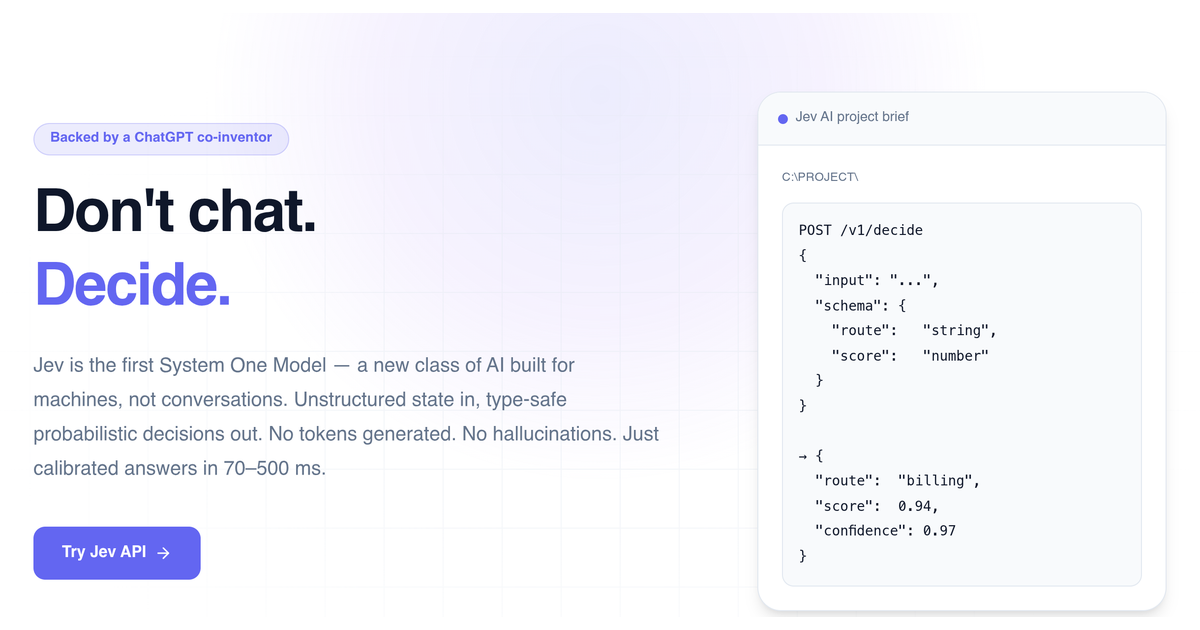

Tool Snapshot
Category: Applied AI / Decision Model (System One)
Provider: TypeSafe AI
Model tested: Jev 1.13 (jev-1.13.0), launched 2026-09-15, general availability 2026-09-20
License: Proprietary hosted service. The official client SDKs are MIT.
Platforms: First-party API and console (Python and JavaScript SDKs), plus Vercel AI Gateway, OpenRouter, Netlify AI Gateway, Cloudflare Workers AI, AI/ML API and LiteLLM pass-through
Input modalities: Text only. A string, a JSON object, or an array of text values. No image, audio or video input.
Interface: Developer API and console playground. No chat interface.
Tagline: "Don't chat. Decide." (TypeSafe, product site)
Primary use cases:
Classify and route an item against a fixed set of options you define, with a probability per option
Score any input against an ordered rubric you write, and return the weighted score plus the distribution
Answer a yes/no question about a block of state and return the probability that the answer is yes
Gate an automated action on a confidence threshold, escalating the uncertain cases to a human or a larger model
Verify or guardrail the output of another AI system before that output is acted on
Map a decision over a large dataset row by row, where per-row cost makes a frontier model impractical
Official links:
Website: https://typesafe.ai
Product site: https://jevai.net
Documentation: https://docs.typesafe.ai
Quick start: https://docs.typesafe.ai/introduction/quickstart
Models and pricing: https://docs.typesafe.ai/models
Documented failure modes: https://docs.typesafe.ai/model-jaggedness/jev-1.13
Workflow evaluations: https://evals.typesafe.ai
Console and API keys: https://console.typesafe.ai
Python SDK: https://github.com/typesafe-ai/typesafe-sdk-python
JavaScript SDK: https://github.com/typesafe-ai/typesafe-sdk-js
Pricing summary: Paid by usage, no seat fee. $0.042 per million input tokens ($42 per billion). Output tokens are free. Every new account starts with $5 of credit, about 119 million input tokens at the published rate. Rate limits 250,000 tokens per second and 1,200 requests per minute. No free tier beyond the starting credit, no published service-level agreement, no enterprise plan. Pricing captured 2026-09-22 from TypeSafe's models documentation.
Model specifications:
Current model ID: jev-1.13.0. Aliases jev-latest (SDK default) and jev-preview currently resolve to it.
Endpoint: POST https://api.typesafe.ai/v1/systemone, Bearer API key.
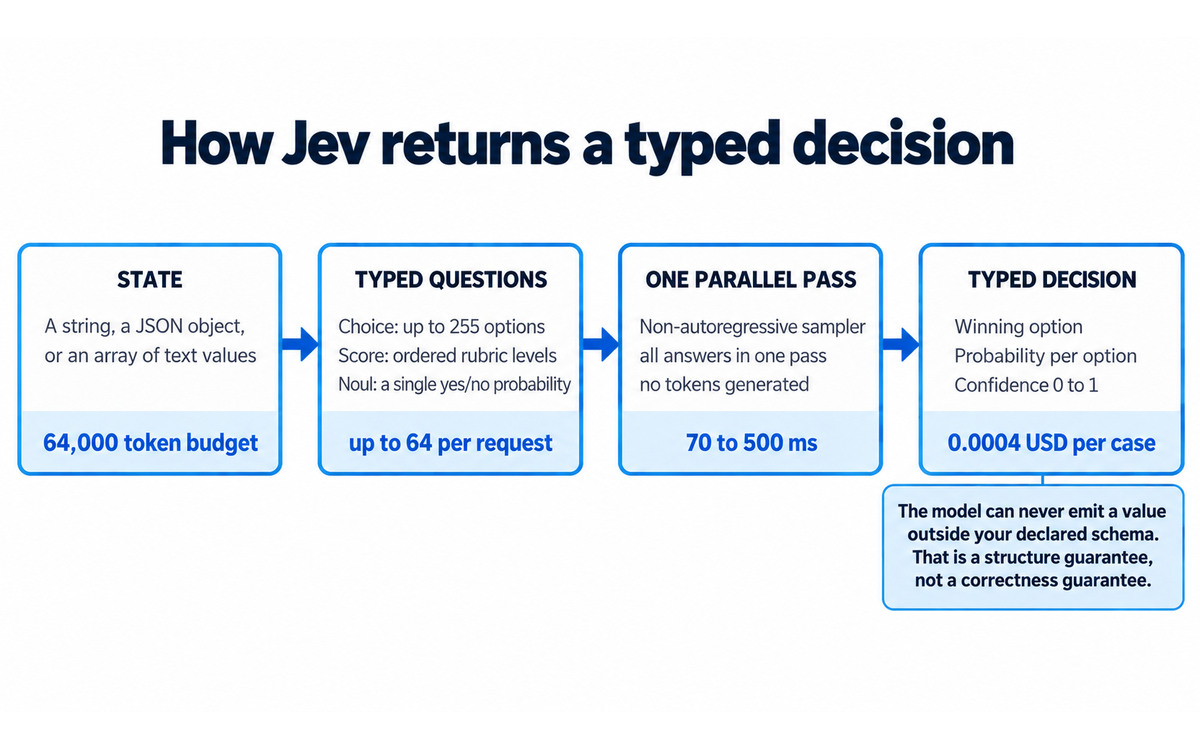
Question types: Choice, Score and Noul, mixable in one request, up to 64 questions per request.
Choice cardinality: up to 255 labelled options. Higher-cardinality choices are resolved in two stages.
Context budget: 64,000 tokens per request, 32,000 tokens for state plus the longest single question.
Output: typed values, a probability distribution for Choice and Score, and a confidence value from 0 to 1 on Choice and Score. Noul returns one probability between 0 and 1.
Architecture: not publicly disclosed. TypeSafe describes a hardware-aware parallel sampler and a training method it calls Reinforcement Learning for Calibrated Decisions (RLCD).
Parameters, weights, training corpus, model card: not disclosed.
Rate limits: 250,000 tokens per second, 1,200 requests per minute.
At a Glance:
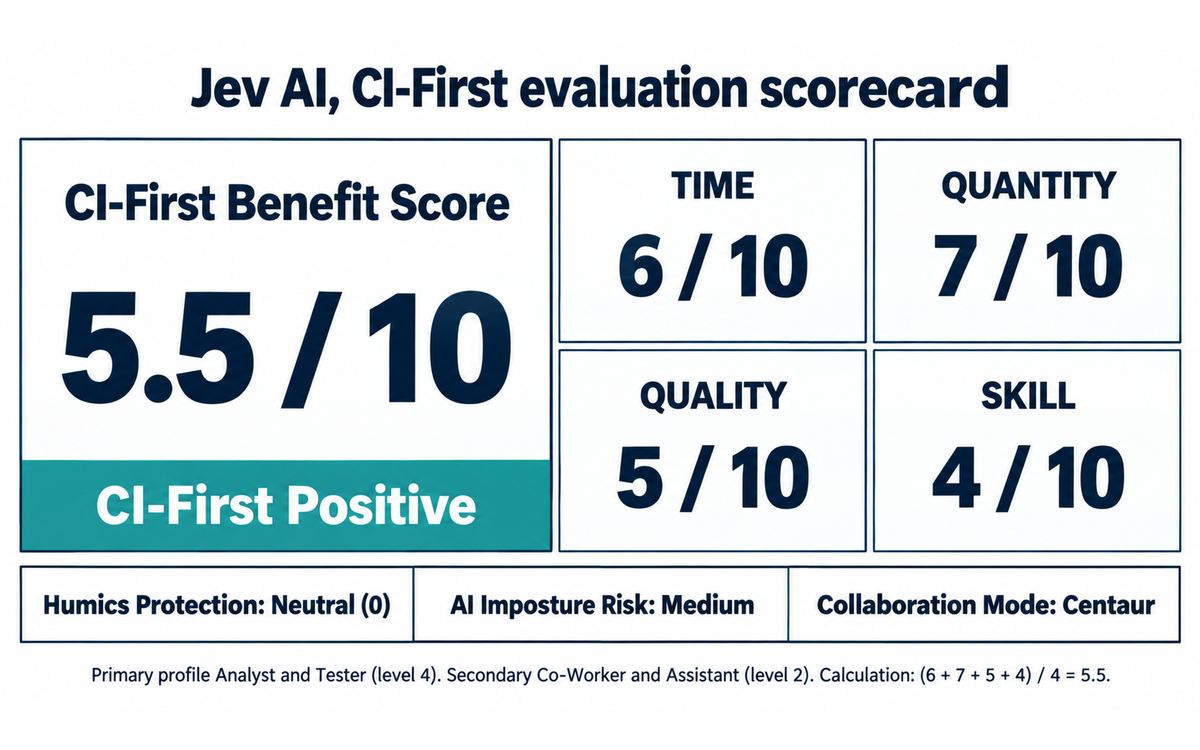
CI-First Benefit Score | 5.5 / 10 (CI-First Positive) |
Time / Quantity / Quality / Skill | 6 / 7 / 5 / 4 |
CI-First Profile | Primary: Analyst and Tester (level 4). Secondary: Co-Worker and Assistant (level 2) |
Collaboration Mode | Centaur |
Humics Protection | Humics-Neutral (0) |
AI Imposture Risk | Medium (Time Medium, Quantity Medium, Skill Medium) |
User Sentiment | Positive on interface, speed and price; contested on accuracy and calibration |
Pricing | $0.042 per million input tokens, output free, $5 starting credit |
Access | General availability since 2026-09-20, no waitlist |
Status | Active. Last tested 2026-09-22 (Jev 1.13, jev-1.13.0) |
For detailed explanations of the CI-First evaluation terms used in this review, including CI-First Benefit Score, CI-First Profile, Humics Protection Badge, AI Imposture Risk, User Sentiment and Review Status, see the Glossary at the end of this publication.

The Problem
You want software to make a judgment. Is this support message angry? Which of these twelve buttons continues the checkout? Does this claim hold up? The condition is not a calculation, so ordinary code cannot express it.
Until now you had three options, and each one costs you something. You can hand-write rules, which break on the first case you did not anticipate. You can train a classifier, which needs labelled data and a training pipeline before you learn whether the idea works. Or you can call a language model with the answer format specified in the prompt, then parse the reply, validate it, and retry when the model answers in prose anyway, refuses, or returns a shape your code cannot read. That last path works, and it is where most teams end up. It also bills you for tokens your code never reads, and it makes a one-word decision take seconds because the model has to write its way to the word.
There is a narrower version of the problem that is worse. You already have a model producing something, and you need a check before that something is acted on. A wrong tool call, a released change, a fabricated citation. Writing that check as another generative call puts you back in the same position: the verification step is as slow and as expensive as the thing it verifies.
TypeSafe's argument is that the bottleneck was never intelligence in the abstract. It was that a model which answers in prose is an awkward component to build on. Jev is their attempt to remove the prose.
The Outcome
A concrete set of outcomes you can expect:
You declare the answer shape up front, and the model cannot return anything outside it. There is no JSON to repair and no retry-with-a-sterner-prompt loop, because there is no string to parse in the first place
You get a probability distribution over your own options instead of a single confident label, so you can route the uncertain cases somewhere else instead of guessing on them
You ask every question you have about one record in a single request. TypeSafe measures 13 batched questions as 12.2 times cheaper and 10 times faster than asking them one at a time, with identical answers
You put a decision inside a real-time loop. Vendor latency is 70 to 500 milliseconds. An independent test returned 777 judgments across 37 documents in under 0.7 seconds for about a quarter of a cent
You run the same decision over a large table, where a per-case cost near $0.0004 changes what is affordable
The honest counterweight: none of this tells you whether the judgment is right. Two independent reviews of the launch reached the same conclusion from different directions. The speed and the cost are reproducible. The accuracy is not yet established on anyone's data but the vendor's, and the tool ships no rationale for the decision it made, so the only way to know your thresholds are sound is to build a labelled set and measure it yourself.
Who Should Use Jev AI
Learner type | Difficulty | Typical ROI | Career path |
Students (Bachelor, Master) | Advanced | Study material for how a decision layer differs from a chat model. Only usable directly if you already write code and call APIs | UIT (Technology, AI, Data Science) tracks |
Professionals (career upskilling) | Advanced | High-volume classification, routing, scoring and guardrails at a fraction of generative-model cost, inside existing pipelines | UIT tracks, and UIB (Business Management, Entrepreneurship) for cost modelling of AI products |
Everyone (lifelong learners) | Not applicable in practice | Jev has no chat interface and no written output. There is no path to a first result without code | Not applicable |
Skill level required: Advanced. You need to write code that calls an HTTP API or one of the two SDKs, define a schema, and handle a probability. There is no consumer interface, no prompt box, and no text output.
Prerequisites: Python 3.10 or later, or Node.js 20 or later, or the ability to send an HTTP POST request. Working knowledge of classification, thresholds and evaluation on labelled data. The evaluation prerequisite is the one people skip, and it is the one that decides whether the tool helps them.
Typical time to first result: Under 15 minutes. Sign up, take the $5 credit, install an SDK, and send one request with a Noul question.
Typical time to competence: Two to five days. The API is small. The work is in decomposing a decision into narrow atomic questions, then measuring your own thresholds against labelled cases. TypeSafe states plainly that no customer fine-tuning exists, so behaviour is shaped entirely through the state, the instructions and the criteria.
U365 Institutes Alignment
Fev maps to the U365 curriculum through system composition, evaluation and cost engineering. The table below is the alignment assessment; the credential pathways underneath it name the programmes a Fellow can actually enrol in, verified live on university-365.com on 2026-09-22.
Institute | Relevance | Why |
UIT (Technology, AI, Data Science) | High (primary) | The clearest fit. Jev is a decision primitive for AI systems: classification, routing, rubric scoring and guardrails, with a probability and a confidence value on every answer. It maps to four UIT strands: AI system composition, applied model evaluation and threshold calibration, inference cost and latency engineering, and AI system reliability and guardrail design. It is also the strongest available teaching case for the difference between a schema guarantee and a correctness guarantee. |
UIB (Business Management, Entrepreneurship) | Low to Medium | One narrow but real competency: building an evidence-based case for where a cheap decision layer replaces an expensive generative call, and who owns an automated decision and what evidence supports it. Jev is not a business tool and does not map to management, leadership, finance or entrepreneurship coursework beyond that single analytical and governance exercise. |
UIC (Digital Communication, Marketing) | Low | Jev returns no text, so it cannot draft, edit or voice anything. It can classify or score content at volume as a back-end support utility behind a content operation, but it produces no communication artefact a UIC Fellow could be assessed on. |
UID (Digital Design, UX/UI) | Low | Text input only, and no image or interface understanding. Its only design-adjacent role is instrumenting a decision inside a product flow. That is implementation support, not design education. |
Teaching case worth singling out: Jev's "zero hallucinations" claim is structural. The model cannot emit a value outside the declared schema, and that says nothing about whether the value is correct. A wrong option chosen from your own list is still wrong, and it arrives with a confidence value attached that makes it look authoritative. A UIT Fellow who can state that boundary precisely, and prove it with a labelled set, has learned something that transfers to every model they evaluate afterwards.
Relevance table image
Tool to Skill to Credential Pathways
Five pathways, anchored to programmes verified as published in the university-365.com catalogue on 2026-09-22. Four are UIT and one is UIB. There is deliberately no UIC or UID pathway, because a tool rated Low must not be presented as a skill pathway in that institute.
Confidence-gated decision engineering: specify a judgment as a typed schema with an enumerated answer space, and gate an action on a confidence threshold you measured. Anchors to the AI Developer Specialist diploma, stacking into the Bachelor of Science in IT and then the Master of Science in IT. Institute: UIT
Applied model evaluation and threshold calibration: decompose a judgment into atomic questions, hand-label real cases, and build a reliability table of confidence band against realised accuracy. Anchors to the Data Scientist diploma, stacking into the Master of Science in IT. Institute: UIT
Inference cost and performance engineering: run a judgment over a large set row by row at controlled cost, and compare measured cost per decision against the displaced generative call. Anchors to the Python Data Scientist diploma, stacking into the Master of Science in IT. Institute: UIT
AI guardrail and pipeline reliability design: place a typed verification step in front of another system's proposed action, and keep a working fallback when the decision service is unavailable. Anchors to the Full-Stack Web Developer diploma, stacking into the Bachelor of Science in IT. Institute: UIT
AI economics and automated-decision governance for business: build the build-versus-buy case for an automated decision layer, covering labelling cost, decision cost at volume, displaced spend and the risk cost of a wrong decision at your threshold. Anchors to the AI Business Specialist diploma, stacking into the Bachelor of Business Administration and then the Master of Business Administration. Institute: UIB
Verified programme pages and access levels:
AI Developer Specialist (18 days): https://www.university-365.com/challenge-page/ai-developer-specialist-diploma
Data Scientist (60 days): https://www.university-365.com/challenge-page/data-scientist-diploma
Python Data Scientist (60 days): https://www.university-365.com/challenge-page/python-data-scientist-diploma
Full-Stack Web Developer (60 days): https://www.university-365.com/challenge-page/full-stack-developer-diploma
AI Business Specialist (18 days): https://www.university-365.com/challenge-page/ai-business-specialist-diploma
Bachelor of Science in IT (B.Sc.): https://www.university-365.com/challenge-page/bachelor-of-science-in-it-b-sc
Master of Science in IT (M.Sc.): https://www.university-365.com/challenge-page/master-of-science-in-it-m-sc-1
Bachelor of Business Administration (B.B.A.): https://www.university-365.com/challenge-page/bachelor-business-administration
Master of Business Administration (M.B.A.): https://www.university-365.com/challenge-page/master-business-administration
Access level, stated plainly: DISCOVERY Fellows can enrol in Basic-level programmes only and cannot reach any of the five pathways as written. INSIDER Fellows can enrol in Basic and Foundation programmes, which covers the certificate and diploma anchors. SUPERHUMAN Fellows can enrol in everything and are the only Fellows who can enrol in a university degree programme. Two of the five pathways stack into a Master of Science in IT and one stacks into a Master of Business Administration, so the degree outcome in those chains is open to SUPERHUMAN Fellows only.
Condition on the pathways: they apply only when the Fellow can state why the answer space is complete, explain why the threshold is that number, describe what a wrong action at that threshold costs, and reproduce the reliability table without the tool. Shipping a pipeline that calls Jev is not evidence of the Fellow's skill. The assessment artefact has to include the human's criteria, the human's labels, the measured calibration result and the rejected alternatives.
How Jev AI Works
Inputs: a block of state, which may be a string, a JSON object or an array of text values. A set of typed questions. A model name.
Outputs: one answer per question, returned in a single response. Choice returns the winning option, a probability for every option and a confidence value. Score returns a numeric score, the rubric legend, the distribution across levels and a confidence value. Noul returns a single probability between 0 and 1. A usage object reports input and output token counts.
Underlying Technology
Model: Jev 1.13, API id jev-1.13.0. TypeSafe's first public System One model.
Sampling: non-autoregressive. All outputs for a request are produced in one parallel pass rather than token by token. This is the source of the latency and cost profile, and of the claim that adding questions barely changes response time.
Training: Reinforcement Learning for Calibrated Decisions (RLCD). TypeSafe positions it against RLHF, which optimises for responses human raters prefer, and against RLVR, which optimises for programmatically verifiable rewards. RLCD optimises the emitted probabilities for honesty.
Type safety: the answer space is enumerated in the request, so the model cannot emit an undeclared option, a malformed object or a type error.
Calibration: Choice and Score outputs carry a confidence value. TypeSafe's confidence documentation tells developers to measure thresholds on their own data and raise the threshold as the cost of a wrong action increases.
Memory: none. Jev writes no skills, no memory store and no standing instructions. Each request takes a state and returns a decision. Nothing persists between calls.
Interpretability: no rationale. The model returns a value and a probability, not an explanation of why. For debugging and for audit in a regulated process that is a real gap, and TypeSafe's own documentation does not present it as anything else.
Benchmark highlights (TypeSafe-published, four workflows: security incidents, agent-trace observability, invoice processing, customer service):
Model | Agreement with reference | Cost per case | Latency |
Jev (TypeSafe) | 67.8% | $0.0004 | 0.4s |
GPT-5.6 Terra | 67.9% | $0.0304 | 10.1s |
Claude Opus 5 | 73.1% | $0.1761 | 37.8s |
GPT-5.6 Sol | 74.1% | $0.0836 | 23.3s |
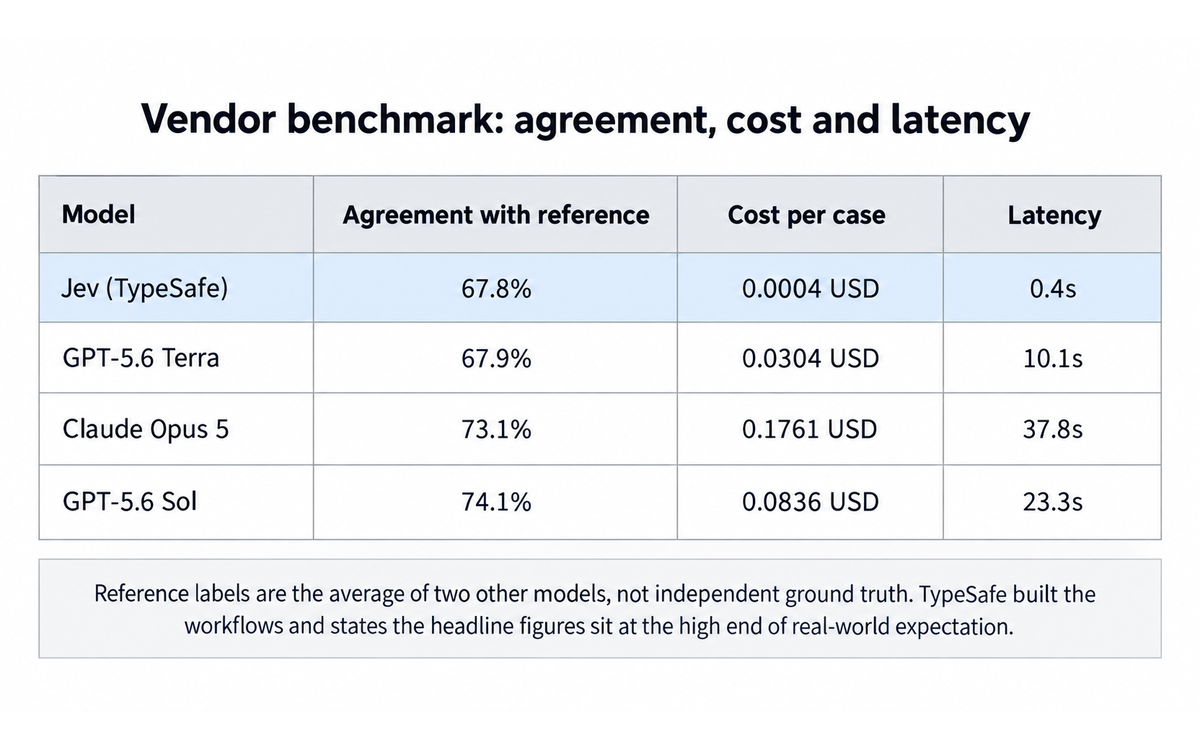
Read the method before the numbers. The reference labels are the average of GPT-6 Astra and Claude Fable 5.1, not independently established ground truth. TypeSafe wrote the workflows, acknowledges possible harness bias, and states that the published speed figures were generally run from West Coast laptops near its own service. The company also states that the headline 193.6x speed and 444.6x cost figures sit at the high end of what to expect in the real world.
The per-workflow spread matters more than the average. Jev reaches 76.0% agreement in the customer-service workflow and 61.8% in invoice processing. A model judged on one average hides which decisions it does well.
Reliability rows from the same vendor evaluation: structured-output error rate 0% for Jev by construction, against 0.58% for the OpenAI models tested, 5.73% for Claude Opus 5 and 45.5% for Claude Haiku 4.5. Tool-call error rate 0% for Jev, against 17.0% for GPT-5.6 Sol at the worst end.
Available platforms: first-party API and console, plus an official System One Adapter that exposes the same question-and-answer interface over conventional LLM APIs for comparison. Also reachable through Vercel AI Gateway (typesafe-ai/jev), OpenRouter, Netlify AI Gateway, Cloudflare Workers AI, AI/ML API and LiteLLM pass-through.
Getting Started
Required accounts: a TypeSafe account at https://console.typesafe.ai. No waitlist since 2026-09-20. Every new account starts with $5 of credit, about 119 million input tokens at the published rate. No credit card is required to start.
Installation
None for the console playground. For code, install one SDK: pip install typesafe-sdk (Python 3.10 or later) or npm install @typesafe-ai/sdk (Node.js 20 or later). Both read TYPESAFE_API_KEY from the environment and default to jev-latest.
First-time Configuration
1. Create an account at https://console.typesafe.ai and confirm the $5 starting credit.
2. Create an API key in the console under settings and keys.
3. Export it as TYPESAFE_API_KEY in your environment. Never store it in a document, a notebook or a shared list.
4. Install the SDK for your runtime.
5. Pin the model version. Use jev-1.13.0 rather than jev-latest as soon as your thresholds matter, because the alias can resolve to a new model without warning.
6. Open the playground once and run a Noul question against a real record from your own work before you write any integration code.
First 15 Minutes Checklist
☐ Send one Noul question about a real message from your own work and read the probability
☐ Add a Choice and a Score to the same request and confirm all three answers come back in one call with their distributions
☐ Check the returned model field in the response so you know which version answered
☐ Raise the request to ten questions against the same state and confirm the latency barely moves
☐ Read the confidence on each answer and decide what threshold you would act on. Write the number down
Result: a working API key, one real decision answered with probabilities, direct evidence that batching costs almost nothing in time, and a first written threshold to test against labelled cases later.
Real Workflows
These workflows show how U365 Fellows use a decision layer in practice. Each one is a real pattern with a measurable threshold, a labelled set and a human escalation path, because those three things are what make an automated decision defensible.
Workflow 1: A confidence-gated review step in front of an agent's tool call
Learner type: Professional (career upskilling). Developer or technical operator.
CI-First benefit tags: Time, Quality.
Connects to: the UIT AI engineering track and the Full-Stack Web Developer diploma. U365 internal tooling and agent operations.
Time estimate: 45 minutes for the first gated decision, including writing the criteria and testing the threshold.
What you do vs what the tool does:
Step | You do | The tool does |
1 | Write the four risk classes and what each one means | Nothing yet |
2 | Assemble the tool call, its arguments and the context as the state | Nothing yet |
3 | Send one Choice question over the four classes | Returns the class, the distribution and a confidence |
4 | Set the threshold. Above it the call proceeds, below it a human sees the call | Nothing, you own the policy |
5 | Log every low-confidence case and read the log weekly | Nothing, you own the review |
6 | Re-check the threshold against labelled cases whenever you change it | Nothing, you own the evaluation |
Sample prompt (question definition, per the UP-Context method: context, task, constraints, output format):
Context: the state is an agent's proposed tool call, its arguments, and the surrounding task description. Task: classify the risk posture of the call. Constraints: use only the four classes given, keep the criteria conditional rather than descriptive, and do not infer intent that the state does not support. Output format: one Choice answer with the distribution and the confidence.
Python shape of the call:
from typesafe_sdk import TypeSafeClient, Choice client = TypeSafeClient() # reads TYPESAFE_API_KEY, defaults to jev-latest answer = client.system_one(state, {"risk": Choice("The risk posture of this tool call", {"readonly": "Reads data or state and changes nothing", "destructive": "Deletes, truncates or irreversibly changes a running workload or its data", "privileged": "Escalates privilege, grants access or weakens a security control", "exfiltration": "Moves data toward a destination outside the trust boundary"})}) risk = answer.answers["risk"] if risk.choice != "readonly" and risk.confidence < YOUR_MEASURED_THRESHOLD: route_to_human(state)
Verification checklist:
☐ Multi-Model Check: run the same 30 cases through the official System One Adapter backed by a generative model and compare both the labels and the confidences
☐ External Source: hand-label every case yourself before the first run. The labels are the ground truth, not the model's answers. If you cannot label a case with confidence, it belongs in the ambiguous bucket and needs its own threshold
☐ Human Review: a second engineer reads the criteria map and the threshold rationale before it goes on a live path
☐ CI-First Test: can you state, for a specific call, why the class you expect is correct and the others are wrong, without running the model? If not, your criteria are not yet written
Workflow 2: Score a document set against a rubric you own, at a controlled cost
Learner type: Professional. Analyst, researcher or operations lead.
CI-First benefit tags: Time, Quantity.
Connects to: the UIT data and evaluation pipelines, the Python Data Scientist diploma, UIB cost modelling for AI-dependent products, and the LIPS Collect phase.
Time estimate: 30 minutes to set up the schema and a 20-document sample check, then unattended.
What you do vs what the tool does:
Step | You do | The tool does |
1 | Write the rubric as ordered levels and say what each level means | Nothing yet |
2 | Fix the instruction text so it is identical across documents | Nothing yet |
3 | Send the batch and read the score plus the distribution per document | Returns scores, distributions and confidences |
4 | Hand-check 20 outputs against the documents themselves | Nothing, you verify |
5 | Record the realised cost per document and compare it with your estimate | Nothing, you measure |
6 | Keep arithmetic, counts and date comparisons in code | Nothing. Do not delegate these, they are documented weak points |
Sample criteria text, which is the whole configuration:
"How well does this document meet each requirement" with four ordered levels: the requirement is not addressed anywhere; the requirement is mentioned but no evidence is given; the requirement is addressed with specific evidence; the requirement is addressed, evidenced and independently verifiable.
Keep the arithmetic out. If the score must feed a formula, compute the formula in your own code from the returned levels.
Verification checklist:
☐ Multi-Model Check: score ten documents on a second provider with the same rubric and compare the levels, not just the final numbers
☐ External Source: read ten documents and score them yourself before you look at the model's answers. Comparing the model against your own reading is the only check that means anything here
☐ Human Review: the person who owns the process signs off on the rubric wording and on the sampled outputs
☐ CI-First Test: can you score one document by hand from the rubric and get the same level the model returned?
Workflow 3: Decompose a decision into atomic questions and measure your own thresholds
Learner type: Student or professional. This is the workflow that builds the skill rather than spending it.
CI-First benefit tags: Skill.
Connects to: the UIT AI engineering track, the Data Scientist diploma, UNOP active-recall practice and the LIPS Review phase.
Time estimate: Two to three hours, once.
What you do vs what the tool does:
Step | You do | The tool does |
1 | Take one decision you actually need to automate, not a demo | Nothing yet |
2 | Break it into three to six atomic yes/no or ordered questions | Nothing yet |
3 | Hand-label 60 real cases, deliberately mixed: obvious, ambiguous, adversarial | Nothing yet |
4 | Run all cases and record the answer and the confidence for each | Returns one answer and one confidence per case |
5 | Build the reliability table: confidence band against realised accuracy | Nothing, you compute it |
6 | Choose the lowest threshold that clears your accuracy bar, and write it down with the date | Nothing, you decide |
7 | Re-run the set when the model version or your data changes | Nothing. The alias can move under you |
Sample question set over one record:
Four narrow questions over one state in one call: whether the customer asks for a refund of a completed charge (Noul); which of the four handling teams should own the case (Choice); how frustrated the customer appears on your ordered scale (Score); and whether the case needs a human decision before any action is taken (Noul). Then combine the four answers with your own logic, so that when priorities change you edit a coefficient instead of rewriting a question.
Verification checklist:
☐ Multi-Model Check: run the identical labelled set through the System One Adapter on a generative model and compare both accuracy and calibration error
☐ External Source: the labels are yours, written before the run. Do not use the model's own answers as a reference, because that measures self-agreement rather than accuracy
☐ Human Review: have someone who knows the decision read your criteria text and challenge the wording of any question that sounds like a description rather than a condition
☐ CI-First Test: can you explain why your threshold is that number, and what the cost of a wrong action at that threshold is? If not, you have not calibrated
Strengths, Limits, AI Imposture Risk
Strengths
CI-First Benefit | Strength | Evidence |
Time | Inference is genuinely fast and, unusually, needs no prompt engineering. Batching is nearly free in latency. | Vendor latency 70 to 500ms. Independent client-side measurement on a 60-case set: p50 421.6ms, p95 542.0ms. An independent test returned 777 judgments across 37 documents in under 0.7 seconds. TypeSafe measures 13 batched questions as 12.2x cheaper and 10x faster than separate calls. |
Quantity | The per-decision cost is low enough to run a judgment over every row of a large dataset, and several questions share one state payload. | Vendor cost per case $0.0004. At $0.042 per million input tokens, one million decisions is roughly $400 on the vendor's own estimate. Output tokens are free. |
Quality | A whole failure class disappears. There is no malformed output to parse, no retry loop, and every answer carries a probability you can route on. | Structured-output and tool-call error rates of 0% by construction, against 0.58% to 45.5% for the generative models in the same vendor table. Independent 60-case test: every incorrect answer came with confidence below 1.000, which is the shape a routable score must have. |
Skill | Marginal. The tool rewards a real discipline if you practise it: decomposing a judgment into atomic questions and measuring your own thresholds. | TypeSafe's documentation requires the decomposition and states that no customer fine-tuning exists, so the criteria text is the configuration. The skill is real, but it is the developer's skill in doing the work, not the tool's contribution, and the common case is delegation without a labelled set. |
Limits
Type safety is not factual correctness. TypeSafe's "zero hallucinations" means the model cannot return a value outside the schema. It can still choose the wrong allowed option at high confidence. The company's own FAQ concedes Jev can make mistakes, and the founder agreed on Hacker News that type safety is not factual correctness. A wrong option chosen from your own list is still wrong, and it arrives with a confidence value attached.
No calibration evidence has been published by the vendor. As of 2026-09-22 TypeSafe's public documentation contains no calibration curve and no expected calibration error figure, despite calibration being the load-bearing claim in the product. The threshold guidance is a comment in a code example. Independent measurement exists and is encouraging but narrow: one 60-case run found an expected calibration error of 0.0712 at 91.7% accuracy, with 40 of 60 answers at exactly 1.000 confidence.
Accuracy trails the strongest models, and varies sharply by workflow. 67.8% agreement on TypeSafe's own four-workflow benchmark against 74.1% for GPT-5.6 Sol and 73.1% for Claude Opus 5. Invoice processing reaches only 61.8%. An independent 60-case agent-risk test found 100% on clear cases and 71.4% on ambiguous ones, so the ambiguous case is where your threshold has to do its work.
Nine documented failure modes, published by the vendor. Jev 1.13 is literal in its reading, weak at numeric precision, weak at counting, weak at date and time comparison, weak with multiple levels of indirection, degrades when irrelevant context sits in the state, does not treat adversarial input as hostile by default, breaks under contradictory criteria, and cannot generate text. TypeSafe's own remedy for the arithmetic case is to keep the arithmetic in code.
No explanation of any decision. The API returns a value and a probability, not a rationale. For debugging, and for any process that must show its reasoning to an auditor or a regulator, this is a structural gap rather than a missing feature.
Early-access operating history and no service-level agreement. TypeSafe lists no seat fee, free allowance, service-level agreement or enterprise plan. Parameters, architecture, weights and training data are undisclosed. Every published accuracy figure in the launch material is vendor-run against model-generated reference labels.
No text output at all. When the workflow has to write the reply, you still need a generative model or a template. Jev replaces the decision step, not the writing step. Two vendors now sit on your critical path, and a Jev outage breaks the workflow unless you keep a working LLM-only fallback.
The version alias can move under you. jev-latest and jev-preview currently resolve to jev-1.13.0. If your thresholds are tuned, pin the version and log the model field the API returns.
AI Imposture Risk
Time Illusion: Medium. The inference time is real and independently reproduced, and there is no prompt engineering to pay for. The illusion is in the comparison the marketing invites. The published 193.6x and 444.6x figures come from vendor-authored workflows measured from laptops near the service, and TypeSafe states they sit at the high end of expected real-world gains. More importantly, the multiplier measures the call, not the task. The work that decides whether the tool pays off is building a labelled set, choosing thresholds and instrumenting escalation, and none of that appears in the number. The vendor itself says the right comparison is against the cheapest system that can make an acceptably accurate decision at an acceptable risk level, which is a different and more expensive question than 193 times faster.
Quantity Illusion: Medium. At $0.0004 per decision you can run a judgment over a million rows, and the output arrives typed, distributed and carrying a confidence value. That presentation looks more authoritative than the underlying accuracy supports. A wrong-but-valid option is still wrong, and the model returns one with a confidence attached either way. On the vendor's own numbers, roughly one case in three disagrees with the reference in the aggregate, and nearly two in five in invoice processing. Volume without a labelled holdout set is volume you cannot defend. Disciplined sampling catches this at moderate effort, which is why this is Medium and not High.
Skill Illusion: Medium. A team can add a decision layer in an afternoon and come away believing it now has an AI classification capability. No training, no features, no model card, just a criteria map and a threshold. That is a documented capability the team did not build, and the artefact outlives the session: it ships, it runs unattended, and it is reused. Against that, the tool requires code to use at all, and TypeSafe's documentation pushes developers toward atomic questions, labelled evaluation and keeping computation in code. Those are genuine skill gates, but they only work if the developer walks through them. The common case is that nobody builds the labelled set.
Clause check against the CI-First Framework v1.2 pedagogical clauses, recorded explicitly:
5.2.3-a (agent-authored procedural memory): does not apply. Jev writes no skills, no memory store and no standing instructions, and it holds no state between calls. No Skill Illusion floor is triggered. Community projects such as an MCP server for Jev can place Jev tools inside an agent platform, but any memory written in that pattern belongs to the host platform, not to Jev.
4.2-a (agent-mediated conversation): does not apply. Jev generates no text and therefore cannot mediate a human-facing conversation. Social Authenticity is unchanged by this clause, and it is scored Neutral on its own merits.
7.5 (team-level rooms): does not apply. Jev is a single model endpoint. Questions inside one request are evaluated in parallel by one model, not by several agents sharing a channel with the human, so there is no room and no per-agent attribution to make.
Overall AI Imposture Risk: Medium. All three traps sit at Medium. No trap is High, so the framework does not call this High, but this is not the Low profile where Cyborg mode becomes available. The tool requires disciplined use: your own labels, your own thresholds, your own escalation path.
U365 Co-Intelligence Rating
CI-First Profile
Primary Profile: Analyst and Tester (level 4). The product's own flagship use cases are judgment and verification: score against a rubric, gate an action, guardrail another model's output. You interpret the distribution and you decide.
Secondary Profile: Co-Worker and Assistant (level 2). Inside a pipeline Jev is doing execution work that you direct: classify this, route that, at a cost and latency that let it run unattended.
The two profiles are worth keeping separate, because they imply different disciplines. As an Analyst it should be measured against ground truth. As a Co-Worker it should be monitored and escalated from.
Collaboration Mode
Recommended mode: Centaur. The task splits cleanly and by construction. Jev judges and returns a probability. Your code holds the thresholds, the permissions, the side effects and the escalation path. The division of labour is the architecture, not a preference. Cyborg mode is not appropriate here: with all three Imposture traps at Medium, the framework's condition for Cyborg is not met, and there is no iterative loop to be inside in the first place, because Jev returns one decision per question and cannot be conversed with.
CI-First Benefit Score
Dimension | Score | Rationale |
Time | 6 | Strong savings inside the intended workload, where the call replaces a multi-second generative call with no prompt engineering. Docked because the net figure depends on work the tool does not do for you: writing the criteria, labelling a set, and tuning thresholds. Those hours do not appear in the 193x claim. |
Quantity | 7 | The strongest dimension and the least contested. At $0.0004 per case with free output and near-free batching, the volume ceiling is high enough that your own review capacity becomes the limit. Docked from higher because verified usable volume is lower than raw volume. |
Quality | 5 | Moderate. One failure class is genuinely eliminated, which is a real and durable quality gain, and confidence gives you a routing signal. Against that: 67.8% agreement against the strongest models at 74.1%, 61.8% on invoice processing, and no published calibration evidence from the vendor. |
Skill | 4 | Marginal, scored conservatively per the framework. The decomposition and threshold discipline are real skills, but they are the developer's own work rather than something the tool teaches, and the common case is a decision layer shipped without a labelled set. |
Overall | 5.5 | (6 + 7 + 5 + 4) / 4 = 5.5. CI-First Positive. A fast, cheap decision layer that must be evaluated on your own labelled data, with real academic value in the evaluation discipline it forces. |
Humics Protection Badge
Creativity: 0 (Neutral). It judges within an answer space you supply. It neither sparks your ideation nor replaces it, because it cannot produce an idea in the first place.
Critical Thinking: 0 (Neutral). Balanced. On one side, the design forces the developer to confront uncertainty: a distribution, a confidence value, and a documented instruction to measure thresholds on your own data. On the other side, the "zero hallucinations" framing invites over-trust, the model gives no rationale to interrogate, and no vendor calibration evidence has been published. The two forces cancel.
Social Authenticity: 0 (Neutral). It produces no text, so it cannot replace your voice in a human-facing channel. Clause 4.2-a does not apply.
Score: 0. Humics-Neutral. One deployment condition applies to the Critical Thinking rating, and it is part of the rating rather than a footnote: the Neutral rating holds only where the decision outcome is sample-reviewed by a human. A decision consumed by code and never read by a person removes the confrontation with uncertainty that the rating depends on, and the rating would not hold.
Superhuman Usage Guidance
When to invite this tool: a repeated judgment you can state in one sentence, where the answer space is known in advance; a confidence gate in front of an action that a generative model proposed; classification, routing and rubric scoring at a volume where a generative call is too slow or too expensive; a pre-filter that decides which requests are worth an expensive model call at all; and a verification pass over claims or code, where the output is a probability you then act on.
When to keep this tool out: any decision you cannot label and measure, because without labels you cannot set a threshold and you are shipping an unmeasured judgment; anything that requires an explanation; arithmetic, counting, date ordering and multi-hop reasoning, which are the vendor's own documented failure modes with the recommended remedy of keeping them in code; anything that needs to write a sentence; any irreversible action taken without a fallback; and treating it as a security boundary, because adversarial input is not treated as hostile by default.
U365 method integration:
LIPS + CARE: use Jev in the Review phase rather than the Execute phase. Its output is a judgment to be reviewed and stored, not an action to be taken. If you use it to score or classify collected material, store the criteria text and the threshold alongside the result in your LIPS entry, because the configuration is the decision. In the System section of LIPS, record the pinned model version and the date of the last calibration run.
ULM + EVA: touches the Career domain through engineering and analytical capability. It does not touch Body, Spirit, Character, Social or Quality of Life. In the EVA cycle it fits Explore, where you screen options against criteria at volume, and it does not substitute for Visualize or the Action Plan.
UP-Context: Jev takes the state directly and needs no prompt engineering, which is unusual. The UP-Context discipline moves from the prompt to the schema: state what the context is, state the task as one narrow question, set the constraints that exclude the cases you do not want judged, and fix the output format in the criteria.
U.Copilot: should route a Fellow to Jev only when the Fellow can hand-label cases and state what a correct answer looks like. Route away when the Fellow needs a written answer, needs an explanation, needs arithmetic or counting, cannot write the API call, or wants to treat the tool as a security boundary. Present the trade rather than a default: a frontier generative model where peak accuracy and a written answer both matter, Jev where the task is throughput-bound and code owns the decision, and a plain trained classifier where a stable task already has labelled data.
SL-OS: no direct Microsoft 365 integration exists. The practical path is server-side: a script or a flow calls Jev and writes the decision back into the system that needs it, with the criteria, the threshold, the pinned model version and the verification result recorded in OneNote or a SharePoint list. Store the labelled case set where the Fellow will find it at the next calibration, and raise escalations through the relevant Teams channel so a low-confidence case reaches a human. It complements the SL-OS stack as a decision service rather than a workspace tool.
UNOP: partly aligned. Decomposition into atomic questions and the reliability table are active-recall practice, and the confidence bands are a form of immediate feedback. It does not provide spaced repetition or retention scheduling, so the learning practice has to be built around it. One documented conflict: a decision consumed by code and never examined produces no learning, and UNOP cannot be satisfied by a judgment the learner never inspects.
Over-delegation warning: the pattern here is quiet and specific. You move a judgment out of the code and into a model call, the call returns a confident-looking typed answer, and nobody writes down what a correct answer looks like. From that point the team has a decision process it cannot audit, cannot explain and cannot defend when it is wrong, and it will still act on it automatically for the high-confidence cases. The specific harm is not that Jev is inaccurate. On the evidence it is around the level of a mid-tier frontier model at a fraction of the cost. The harm is that the threshold you are routing on was guessed rather than measured, so the escalation path that makes the tool safe does not exist. If HI drops because the team stopped deciding and stopped measuring, CI-First drops even though the tool did not change. The Superhuman here is the one who labels 60 real cases before setting the number.
What Users Say
Aggregate Rating Table
Platform | Signal | Link |
Product Hunt | Launched 2026-09-21, 18 followers, 12 comments on the launch thread | |
Hacker News | 1,947 points, 511 comments on the launch thread, captured 2026-09-22 | |
G2 | No reviews found on G2 | |
Capterra | No reviews found on Capterra | |
Trustpilot | No reviews found on Trustpilot | |
App Store / Google Play | No app exists | Not applicable |
GitHub (Python SDK) | 190 stars, 23 forks, 3 open issues, last push 2026-09-21, MIT | |
GitHub (JavaScript SDK) | 215 stars, 22 forks, 13 open issues, last push 2026-09-15, MIT |
Note on method: this is a September 2026 launch of a developer API, so it does not accumulate enterprise SaaS reviews the way a paid product does. Reporting a G2 or Trustpilot score for it would be fabrication. The meaningful public signals are the developer discussion, the two SDK repositories, and the independent write-ups cited in the Sources section. The community project directory listed 19 reviewed repositories built on Jev by 2026-09-21, with the leading ones between 147 and 244 stars.
What Users Praise
The speed and the price are what developers reproduce and quote, and they hold up. One independent test returned 777 judgments across 37 documents in under 0.7 seconds for about a quarter of a cent, and a 60-case measurement recorded p50 latency of 421.6ms, inside the advertised band. The strongest praise is aimed at the shape of the interface rather than the model: typed answers with a distribution, no parsing, no retry loop and no prompt engineering. Developers also credit the batching economics, since ten questions over one state cost roughly the latency of one. The most cited practical result is the confidence behaviour: in the 60-case independent run, every incorrect answer came back with confidence below 1.000, which is what makes an escalation path possible. Two further patterns recur: routing cheap decisions to Jev and reserving the expensive model for the hard cases, and using Jev as a verification layer over another model's output.
What Users Complain About
Three complaints recur. First, the "zero hallucinations" claim. Reviewers across several independent write-ups converge on the same objection: it is a schema guarantee, not a correctness guarantee, and the launch coverage did not make that distinction. A wrong option chosen from your own list is still wrong. Second, the evidence. The headline 193.6x and 444.6x figures are vendor-run on vendor-authored workflows measured from laptops near the service, the reference labels are the average of two other models rather than ground truth, and as of 2026-09-22 no calibration curve or expected calibration error figure appears in TypeSafe's public documentation despite calibration being the central claim. Third, the missing rationale. The API returns a number, not a reason, which developers flagged as a real obstacle to debugging and to use in any process that has to justify its decisions. A fourth, sharper objection came from a developer who had built a non-autoregressive decision model a year earlier and argued the launch framing overstates how new the approach is. The honest counter to the speed claims also came from the community: a generative model can be told to answer with a short label, which shrinks the gap, and the comparison in the launch material is not like-for-like because it carries the whole tool schema in the prompt.
Sentiment Summary
Overall sentiment: predominantly positive on the interface, the speed and the price. Contested on the accuracy and calibration claims, and clear-eyed about the missing rationale.
Key themes:
The typed-output interface and the absence of parsing and retries are the most valued changes
Speed and cost are the claims that reproduce independently; accuracy is the claim that does not, yet
"Zero hallucinations" is widely read as narrower than it sounds, and TypeSafe agrees
Calibration is the load-bearing claim and the least evidenced
The absence of an explanation is accepted for automation and rejected for audit
The decision-primitive pattern is considered worth adopting even by reviewers who doubt the model
U365 Editorial Note
The user sentiment and the CI-First evaluation agree, and the agreement is specific. Users praise the interface shape and the speed, which the framework scores as the Time and Quantity strengths. Users attack "zero hallucinations" and the unproven calibration, which is exactly where the framework scores Quality down at 5 and rates the Quantity Illusion Medium: a typed answer with a distribution looks more authoritative than its accuracy supports. The community's strongest technical result, that every incorrect answer carried a confidence below 1.000, is also the strongest argument for the framework's Critical Thinking rating of Neutral rather than negative: the tool gives you a routable signal, and it is your job to measure the threshold. Where the two diverge is worth stating plainly. Developers rate Jev highly as a component and do not require it to be a frontier reasoner, while a U365 reader arrives with a different question: does this make me more capable? On this evidence the tool makes a well-built system cheaper and faster, and it does not make the person using it more capable unless they do the labelling work themselves, which is why Skill is scored 4 and not higher.
Comparison and Alternatives
Alternative | Choose the alternative if... | Choose Jev AI if... |
GPT-5.6 Sol (frontier generative model) | Peak accuracy on a low-volume task is what matters, and a 5 to 6 point accuracy edge justifies roughly 200 times the per-case cost and about 50 times the latency | The task is throughput-bound and you need a typed answer with a probability rather than prose you must constrain |
Claude Opus 5 (frontier generative model) | You need an explanation with the decision, or the workflow also has to write the result | The decision and the writing are separate steps and you only need the decision to be cheap |
A trained classifier or reranker | The task is stable, you have labelled data, and you want the cheapest, most auditable component available | The labels change often, the criteria live in text rather than in a training set, and you want to ship this week |
The official System One Adapter on an existing LLM | You want the same question-and-answer interface without adding a second vendor, and you are willing to pay the slower, pricier call. This is the cleanest way to benchmark the choice | You have compared both on your own labelled set and Jev wins on accuracy at your threshold |
A hand-written rules engine | The judgment is genuinely deterministic and arithmetic, where Jev is documented as weak and the vendor's advice is to keep it in code | The condition needs common-sense judgment that rules cannot express without an unmanageable exception list |
A local open-weight decision model, such as an encoder-based classifier on your own hardware | Data cannot leave your infrastructure, you need latency below 70ms, or you want a fully open artefact. An independent developer published a 421M-parameter decision model in this class | You want the accuracy of a frontier-trained model without operating any inference infrastructure |
Where Jev AI is clearly better: on the cost per unit of repeated decision work, and on the interface. At $0.042 per million input tokens with free output and near-free batching, a decision that costs $0.0004 against $0.03 to $0.18 for the frontier models in the same vendor table is a different kind of number, not a better one. The interface is the more durable advantage: no parsing, no schema validation, no retry loop, and a probability attached to every answer. That removes an entire layer of code, and removing code is where reliability actually comes from.
Where Jev AI is clearly worse: on accuracy at the top end, on explainability, and on evidence. It trails GPT-5.6 Sol and Claude Opus 5 by 5 to 6 points on the vendor's own aggregate and falls to 61.8% on invoice processing. It cannot explain a decision, which rules it out of any audited process. And its central claim, calibration, has no published curve from the vendor. It also cannot touch the vendor's own documented weak spots: arithmetic, counting, date ordering, multi-hop reasoning and adversarial input. If a claim will be relied upon without your own verification, this is the wrong component.
Verdict and Next Steps
Jev AI earns a CI-First Benefit Score of 5.5 (CI-First Positive) with a Humics-Neutral protection badge, Medium AI Imposture Risk and Centaur as the collaboration mode. It is the first generally available product that treats a judgment as a typed component of a system rather than a sentence you parse, and it is fast and cheap enough that a decision layer becomes affordable where it previously was not. It is not a reasoning tool and it is not a writing tool, and its central claim, calibration, has no published evidence from the vendor.
Who should adopt it: developers and technical teams with a repeated, narrow judgment to automate, who are willing to label a set of real cases and pick a threshold from the measurement. If you cannot label the cases, do not adopt it yet.
When: now is a good moment, but not as a production dependency. General availability opened on 2026-09-20 with $5 of starting credit, so a bounded pilot costs nothing but your time. Run it in shadow mode beside your current approach for one cycle before you route anything on it.
For what: high-volume classification, routing, rubric scoring and confidence gates in front of actions, where the answer space is known in advance and the output feeds code rather than a reader.
The honest caveat, stated once: the price is proven, the speed is proven, and the accuracy is not. Treat Jev as a fast, cheap decision layer you must evaluate yourself, and treat the phrase "zero hallucinations" as a statement about the shape of the answer, not about whether the answer is right.
UP-Context Prompt Pack
These are written for the schema rather than for a chat box, which is how Jev is configured. Each one follows the UP-Context Method (context, role, task, constraints, output format) and closes with a verification step.
Prompt 1: A confidence-gated decision in front of an action.
Context: I am adding a review step in front of an action that another AI system proposed. The state is the proposed action, its arguments and the surrounding task description. Our classes are readonly, destructive, privileged and exfiltration. Role: AI as Analyst and Tester (Profile 4). You judge and return a probability. I own the threshold, the permissions, the side effects and the escalation path. Task: classify the risk posture of this proposed action as one of the four classes, and return the distribution across all four with the confidence value. Constraints: use only the four classes, write each class as a condition rather than a description, send only the state the decision needs, never place credentials, tokens or secrets in the state, do not ask for an explanation of the decision because the model does not produce one, pin the model version rather than using the moving alias, and log the model version and the threshold applied with every decision. Output format: one Choice answer with the winning class, the probability per class and the confidence value, written to a log line that also carries the pinned model version and the applied threshold. UP-Context verification: hand-label thirty real cases before the first run and treat my labels, not the model's answers, as ground truth. Re-check the threshold against those labels whenever I change it and record the date. Keep a working fallback path, because a decision-service outage is an outage in my workflow. If I cannot say what a wrong action at this threshold costs, I have not calibrated and must not put the threshold on a live path.
Prompt 2: Decomposing a judgment into atomic questions.
Context: I have one decision I actually need to automate, not a demonstration. The input is a record with the fields I have listed, and I want one call per record rather than one call per question. Role: AI as Co-Worker and Assistant (Profile 2) for execution, with me as Analyst and Tester (Profile 4) for the judgment. I define the questions and the thresholds; you answer them. Task: answer the following narrow questions over this single record in one request: whether a refund of a completed charge is requested (Noul), which of the four handling teams should own the case (Choice over four options), how frustrated the subject appears on the ordered scale I supplied (Score), and whether a human must decide before any action is taken (Noul). Constraints: use only the options and scale levels I supplied, keep each question to a single condition, do not send arithmetic, counting or date comparisons to the model because those stay in my code, do not send context the question does not need because irrelevant material in the state degrades the answer, and do not ask for a written explanation. Output format: four answers in one response, each with its distribution and confidence value, plus the usage object so I can record the realised cost. UP-Context verification: I combine the four answers with my own logic in code, so that changing a business priority edits a coefficient rather than rewriting a question. I hand-check twenty outputs against the source records and keep all arithmetic in my own code. Can I explain, without the tool, why each question is the right decomposition of the decision? If not, the decomposition is not finished.
Prompt 3: Calibrating a threshold before trusting it.
Context: I am calibrating a confidence threshold and I need to know whether the confidence value my decision layer returns is worth routing on. The vendor publishes no calibration curve, so the only evidence available is the evidence I build. Role: AI as Analyst and Tester (Profile 4), with me owning the evaluation design. You answer the cases; I decide what accuracy is acceptable and what a wrong action costs. Task: run the sixty real cases I have already labelled and return, for each case, the answer and its confidence value so I can build a reliability table of confidence band against realised accuracy. Constraints: the labels are mine and were written before any run, do not use the model's own answers as a reference because that measures self-agreement rather than accuracy, keep every arithmetic comparison in my own code, and deliberately mix obvious, ambiguous and adversarial cases rather than selecting easy ones. Output format: one answer and one confidence value per case, in the order I supplied the cases, so I can join them to my labels without ambiguity. UP-Context verification: I build the reliability table myself and choose the lowest threshold that clears my accuracy bar, then write the number down with the date it was measured. I re-run the whole set whenever the model version changes or my data changes, and I treat the ambiguous cases as the ones that matter, because that is where the threshold has to do its work. If the table shows a confidence level that does not correspond to better accuracy, I do not route on confidence at all, and I say so in my notes.
U.Copilot guardrails for Jev recommendations:
State the score beside the risk. 5.5/10 CI-First Positive with Medium AI Imposture Risk. Do not present the benefit without the risk
Never repeat "zero hallucinations" without its boundary. It means the model cannot emit a value outside the declared schema, and it is not a correctness guarantee
Never quote the 193.6x speed and 444.6x cost figures without their provenance: vendor-run on vendor-authored workflows, against reference labels that are the average of two other models, measured from laptops near the vendor's service, and stated by the vendor to sit at the high end of real-world expectation
State that the calibration claim has no published vendor evidence as of 2026-09-22, and that independent measurement exists on one 60-case set. That is a reason to measure your own, not a reason to assume
Never present Jev as a replacement for a generative model. It replaces the decision step, not the writing step, so require a working fallback
Require a measured threshold. If a Fellow cannot state what a wrong action costs at the threshold they chose, the workflow fails the CI-First test and does not ship
Never describe a decision layer as the Fellow's acquired skill. Skill evidence is the Fellow's criteria, labels, reliability table and defence of the threshold
Flag the silent-decision risk. A decision consumed by code and never read by a human is the specific harm this tool enables at scale, so require a sampled human review wherever the outcome reaches a person
Related U365 content: INSIDE Tools Review: n8n (workflow automation, scored 6.5); INSIDE Tools Review: Claude Code (agentic coding, scored 6.8); INSIDE Tools Review: DeepSeek V4.1 Flash (long-context workhorse, scored 6.3); INSIDE Tools Review: Open WebUI (self-hosted AI platform, scored 6.0).
U365's Recommendations to Learn More
We curated the resources below to help you go beyond this review, with a focus on evaluation discipline and the cost-versus-accuracy trade. Every link was verified active as of 2026-09-22. We prioritise content that teaches something this post does not cover.
Official learning resources
TypeSafe documentation: concepts, the System One model family, pricing, context budget and rate limits
TypeSafe quick start: the shortest path from an API key to a first typed answer
Models, pricing and limits: the reference page for jev-1.13.0, the aliases and the published token rates
Jev 1.13 jaggedness documentation: the vendor's own list of nine documented failure modes, essential reading before you design a schema
TypeSafe workflow evaluations: the published evaluation harness, workflows and results behind the benchmark table in this review
Console and API keys: account, credits and key management
Python SDK: MIT client, with the Choice, Score and Noul primitives
JavaScript SDK: MIT client for Node.js 20 or later
Video tutorials and channels
An ex-OpenAI researcher just deleted language from the LLM, by Fireship: the fastest orientation on why this approach drew attention, 1.18 million views at the time of capture on 2026-09-22
I tried TypeSafe's System One Model: Jev, by Joe Maddalone: a hands-on walkthrough of the interface, the typed answers and the confidence values
When will Jev save you money vs an LLM, by M37: a practical cost comparison test against a generative model, which is the number that decides adoption
Fireship channel: short technical explainers on model architecture and tooling
Joe Maddalone channel: hands-on developer reviews of new AI tooling
M37 channel: cost and performance testing of models in real workflows
An ex-OpenAI researcher just deleted language from the LLM by Fireship (Published Sep 21, 2026, 5:27)
I tried TypeSafe's System One Model: Jev by Joe Maddalone (Published Sep 18, 2026, 7:48)
When will Jev save you money vs an LLM? Testing TypeSafe AI's discriminative language model by M37 (Published Sep 16, 2026, 11:07)
Written tutorials and deep-dive articles
DataCamp, System One models and Jev explained: the clearest written reproduction of the vendor benchmark table and the structured-output error rates
TrueFoundry, what System One models actually are: background on the company, the founders and where the architecture sits in the market
Flavio Copes, deep dive with practical limits: a developer-oriented walkthrough that names the cases where the approach breaks down
Every, independent hands-on test: 777 judgments across 37 documents in under 0.7 seconds, with the cost measured
Independent 60-case agent tool-call benchmark: the calibration and latency measurement cited throughout this review, including the finding that every incorrect answer carried confidence below 1.000
Kingy AI, benchmark method critique: a careful reading of how the reference labels were produced and what they can support
Startuphub, launch analysis: notes on harness bias and the vendor-authored workflow design
Community and social
Hacker News launch thread: 1,947 points and 511 comments, including the founder's own answers on what type safety does and does not guarantee
Product Hunt launch: the launch thread and early adopter comments
Independent benchmark harness and raw results: an MIT-licensed harness you can rerun against your own cases
LiteLLM pass-through for the System One API: the route to try Jev beside your existing model gateway
Vercel AI Gateway listing: typesafe-ai/jev, for teams already routing through a gateway
Resources on X
Dedicated X channels:
X posts with video content:
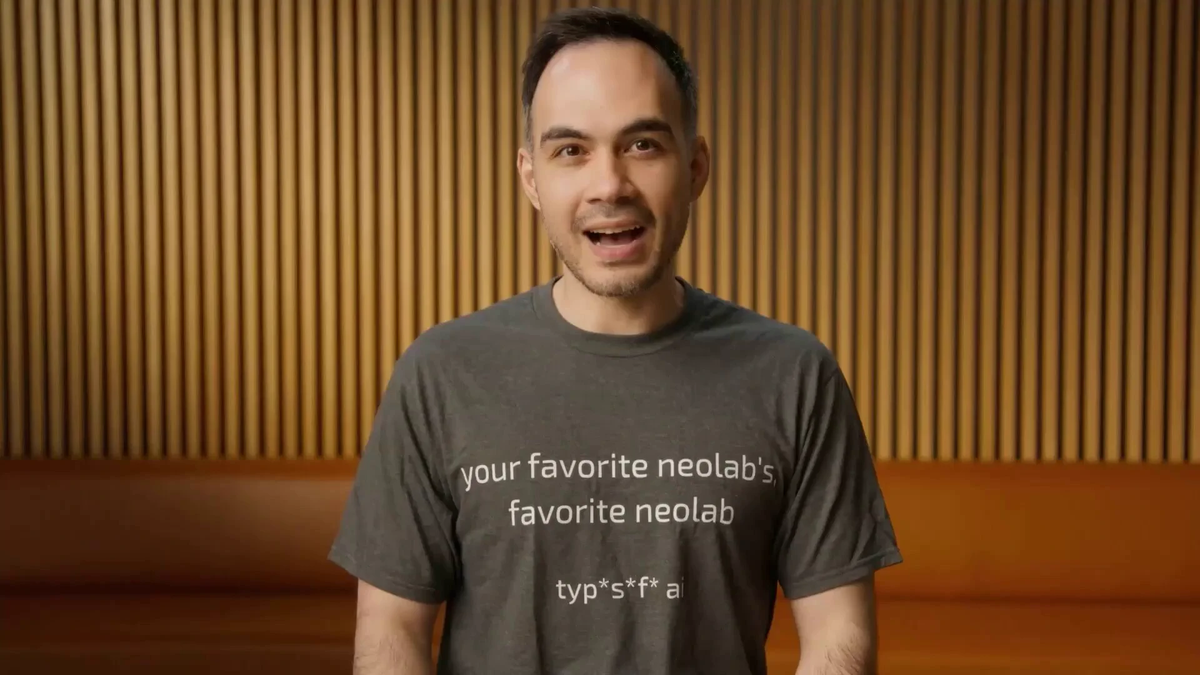

We curate resources by content quality, not source type. Individual creators and community experts are welcome when their content is substantial, teaches something this post does not, and still matches the current model version.
Glossary
CI-First Benefit Score
The CI-First Benefit Score rates how much a tool genuinely amplifies human capability rather than creating the illusion of productivity. It combines four dimensions: Time (net time saved after accounting for setup, prompting and verification), Quantity (usable output volume increase, verified not just surface volume), Quality (durable quality improvement, not surface polish) and Skill (genuine lasting capability built, not dependency created). Each dimension is scored 0 to 10 and the overall score is their average. The interpretation bands are: 0 to 2.0 CI-First Negative, 2.1 to 4.0 CI-First Neutral, 4.1 to 6.0 CI-First Positive, 6.1 to 8.0 CI-First Strong, 8.1 to 10.0 CI-First Transformative. Jev AI scores 5.5, CI-First Positive.
CI-First Profile
The CI-First Profile classifies how a tool collaborates with its user on a five-level scale of AI autonomy. (level 1) Co-Creator and Thought Partner: the tool creates original work alongside the user. (level 2) Co-Worker and Assistant: the tool executes tasks on behalf of the user with oversight. (level 3) Coach and Tutor: the tool teaches and guides the user. (level 4) Analyst and Tester: the tool evaluates and tests the user's work. (level 5) Challenger and Devil's Advocate: the tool pushes back on the user's assumptions. Lower level numbers indicate higher AI autonomy. Jev AI is Analyst and Tester (level 4) primary, Co-Worker and Assistant (level 2) secondary.
Humics Protection Badge
The Humics Protection Badge evaluates whether a tool protects or erodes the qualities that make us human: Creativity, Critical Thinking and Social Authenticity. Each dimension is scored +1 (protects), 0 (neutral) or -1 (erodes), and the sum ranges from -3 to +3. A score of +2 to +3 earns the Humics-Friendly badge, -1 to +1 earns Humics-Neutral, and -2 to -3 earns Humics-Risky. Jev AI scores 0, Humics-Neutral, with all three dimensions neutral, and its Critical Thinking rating holds only where the decision outcome is sample-reviewed by a human.
AI Imposture Risk
AI Imposture Risk assesses whether a tool creates the illusion of productivity, capability or understanding without delivering real value. It evaluates three dimensions: Time Illusion (does the tool seem fast but actually slow you down with setup, labelling and corrections), Quantity Illusion (does the tool produce high volume that does not survive inspection) and Skill Illusion (does the tool create the appearance of competence in the user while the underlying skill is absent or eroding). Each dimension is rated Low, Medium or High. The overall risk is Low if all three are Low, Medium if one or two are Medium, and High if two or more are High. Jev AI rates Time Medium, Quantity Medium and Skill Medium, for an overall Medium.
User Sentiment
User Sentiment aggregates what real users say about a tool across review platforms, community forums and repository activity, and reports it separately from the CI-First score because crowd sentiment can contradict a rigorous evaluation. Where the two agree the finding is stronger, and where they diverge the divergence is worth explaining. For Jev AI, sentiment is predominantly positive on the typed interface, the speed and the price, contested on the accuracy and the calibration evidence, and clear-eyed about the absence of any rationale for a decision.
Review Status
Review Status records the current standing of the tool at the time of the last test. Active: the tool is current and recommended. Active (updated): recently re-checked and the content was refreshed. Changed: a re-check trigger fired and an update is pending, so read the review with that in mind. Risky: the tool has significant unresolved issues, or it has been clearly surpassed by newer alternatives. Use it with caution and read the Limits section. Retired: the tool still works but is no longer recommended. Deprecated: the tool has been shut down or fundamentally changed. Retired and Deprecated posts include a Migration Path section. Jev AI is Active, last tested 2026-09-22 on Jev 1.13 (jev-1.13.0).
Sources
TypeSafe AI, introduction and System One concepts: https://docs.typesafe.ai
TypeSafe AI, quick start: https://docs.typesafe.ai/introduction/quickstart
TypeSafe AI, models, pricing, context budget and rate limits: https://docs.typesafe.ai/models
TypeSafe AI, Jev 1.13 jaggedness and the nine documented failure modes: https://docs.typesafe.ai/model-jaggedness/jev-1.13
TypeSafe AI, workflow evaluations: https://evals.typesafe.ai
TypeSafe AI, launch post, Introducing System One Models and Jev: https://typesafe.ai/blog/introducing-system-one-models-and-jev
TypeSafe AI, company homepage and headline claims: https://typesafe.ai
TypeSafe AI, product site: https://jevai.net
TypeSafe AI, console and API keys: https://console.typesafe.ai
TypeSafe Python SDK, MIT, star and issue counts: https://github.com/typesafe-ai/typesafe-sdk-python
TypeSafe JavaScript and TypeScript SDK, MIT, star and issue counts: https://github.com/typesafe-ai/typesafe-sdk-js
Hacker News launch thread, 1,947 points and 511 comments as of 2026-09-22: https://news.ycombinator.com/item?id=49717558
Product Hunt, Jev launch, 2026-09-21: https://www.producthunt.com/products/jev-2
Launch post on X by Diogo Almeida, 2026-09-15: https://x.com/CompleteSkeptic/status/2099925682726002904
Developer overview on X, 2026-09-19: https://x.com/copenzafan/status/2101346414802665899
TypeSafe AI on X: https://x.com/typesafeai
DataCamp, Jev explained, vendor benchmark table and structured-output error rates: https://www.datacamp.com/blog/system-one-models-jev
TrueFoundry, what System One models actually are, funding and founder background: https://www.truefoundry.com/blog/typesafe-ai-jev
Flavio Copes, deep dive with practical limits: https://flaviocopes.com/jev
Kingy AI, Jev review, benchmark method critique: https://kingy.ai/blog/typesafe-jev-review-the-ai-model-that-doesnt-generate-text/
Every, independent hands-on test, 777 judgments in under 0.7 seconds: https://every.to/also-true-for-humans/mini-vibe-check-typesafe-s-jev-judged-everything-i-ve-written-in-0-7-seconds
Independent 60-case agent tool-call benchmark, calibration results and latency: https://dev.to/webofmike/i-benchmarked-jev-on-agent-tool-call-risk-calibration-held-49i3
Independent write-up on the decision boundary and the nine failure modes: https://dev.to/miruky/jev-does-not-replace-the-llm-it-changes-who-owns-the-decision-3n6
RedHub AI, documented failure modes: https://blog.redhub.ai/jev-ai-limits
Powerdrill, Jev 1.13 failure modes and remedies: https://powerdrill.ai/blog/jev-typesafe-ai
Startuphub, launch analysis, reference labels and benchmark bias: https://startuphub.ai/ai-news/artificial-intelligence/2026/typesafe-jev-model-kills-chat
Tom's Hardware, launch coverage: https://www.tomshardware.com/tech-industry/artificial-intelligence/typesafe-ais-jev-offers-an-alternative-to-llms-that-claims-to-be-193x-faster-and-445x-cheaper-system-one-type-model-is-bespoke-for-probabilistic-decision-making
TechSpot, launch coverage and the third-party chess and Doom demonstrations: https://techspot.com/article/3172-meet-jev
LavX News, launch coverage and the waitlist period: https://news.lavx.hu/article/typesafe-ai-launches-system-one-models-claims-100x-speed-gains-over-frontier-llms
Refix, how to read the published pricing and benchmark claims: https://www.refix.ai/news/jev-pricing-latency-benchmarks/
AI Tools Ratings, vendor claim versus evidence audit: https://aitoolsratings.com/reviews/typesafe-jev/
DiscoverAI, production-readiness assessment: https://discoverai.tools/articles/typesafe-ai-jev-review-2026
Build Fast With AI, review including an independent 108-claim evaluation: https://blog.buildfastwithai.com/jev-ai-review
Spice AI, what TypeSafe Jev is, including the general-availability date: https://spice.ai/learn/typesafe-jev
Vercel AI Gateway model listing, typesafe-ai/jev: https://vercel.com/ai-gateway/models/jev
LiteLLM pass-through documentation for the TypeSafe System One API: https://docs.litellm.ai/docs/pass_through/typesafe
Independent benchmark harness and raw results, MIT: https://github.com/themsquared/jev-benchmark
LLM Reference, model aliases and context details: https://www.llmreference.com/model/jev
Fireship video on YouTube, 2026-09-21: https://www.youtube.com/watch?v=TbkUKCm3CHQ
Joe Maddalone video on YouTube, 2026-09-18: https://www.youtube.com/watch?v=CcmqPS6q9Gw
M37 video on YouTube, 2026-09-16: https://www.youtube.com/watch?v=9n2jrYGrodY
University 365, UIT institute page: https://university-365.com/uit
University 365, UIB institute page: https://university-365.com/uib
University 365, UIC institute page: https://university-365.com/uic
University 365, UID institute page: https://university-365.com/uid
University 365, AI Developer Specialist diploma: https://www.university-365.com/challenge-page/ai-developer-specialist-diploma
University 365, Data Scientist diploma: https://www.university-365.com/challenge-page/data-scientist-diploma
University 365, Python Data Scientist diploma: https://www.university-365.com/challenge-page/python-data-scientist-diploma
University 365, Full-Stack Web Developer diploma: https://www.university-365.com/challenge-page/full-stack-developer-diploma
University 365, AI Business Specialist diploma: https://www.university-365.com/challenge-page/ai-business-specialist-diploma
University 365, Bachelor of Science in IT (B.Sc.): https://www.university-365.com/challenge-page/bachelor-of-science-in-it-b-sc
University 365, Master of Science in IT (M.Sc.): https://www.university-365.com/challenge-page/master-of-science-in-it-m-sc-1
University 365, Bachelor of Business Administration (B.B.A.): https://www.university-365.com/challenge-page/bachelor-business-administration
University 365, Master of Business Administration (M.B.A.): https://www.university-365.com/challenge-page/master-business-administration




Comments