
Discover the CI-First Approach

In this Publication
The technology world agreed on a phrase: AI-First. Put artificial intelligence at the center of everything, let it lead, and results will follow. University 365 studied the same technology and reached a different conclusion. What should come first is not the machine. It is the working partnership between a human and a machine, with the human in command. University 365 calls that partnership Co-Intelligence-First, or CI-First: Human Intelligence as the ruler and orchestrator, Artificial Intelligence as the multiplier, written as CI = HI + (AI × HI). It is the approach the whole university is built on.
This publication is the entry point. It defines CI-First, gives you the equation behind it, the four benefits you can measure, the five pillars that make it practical, and the standard we call Superhuman. It closes with a first move you can apply this week, and with the library of CI-First publications on INSIDE.
It is written for anyone who works with AI and intends to stay in charge of it: professionals, managers, founders, Fellows, and anyone who will have to sign the work that AI helps produce.


Discover the CI-First Approach
What CI-First Is
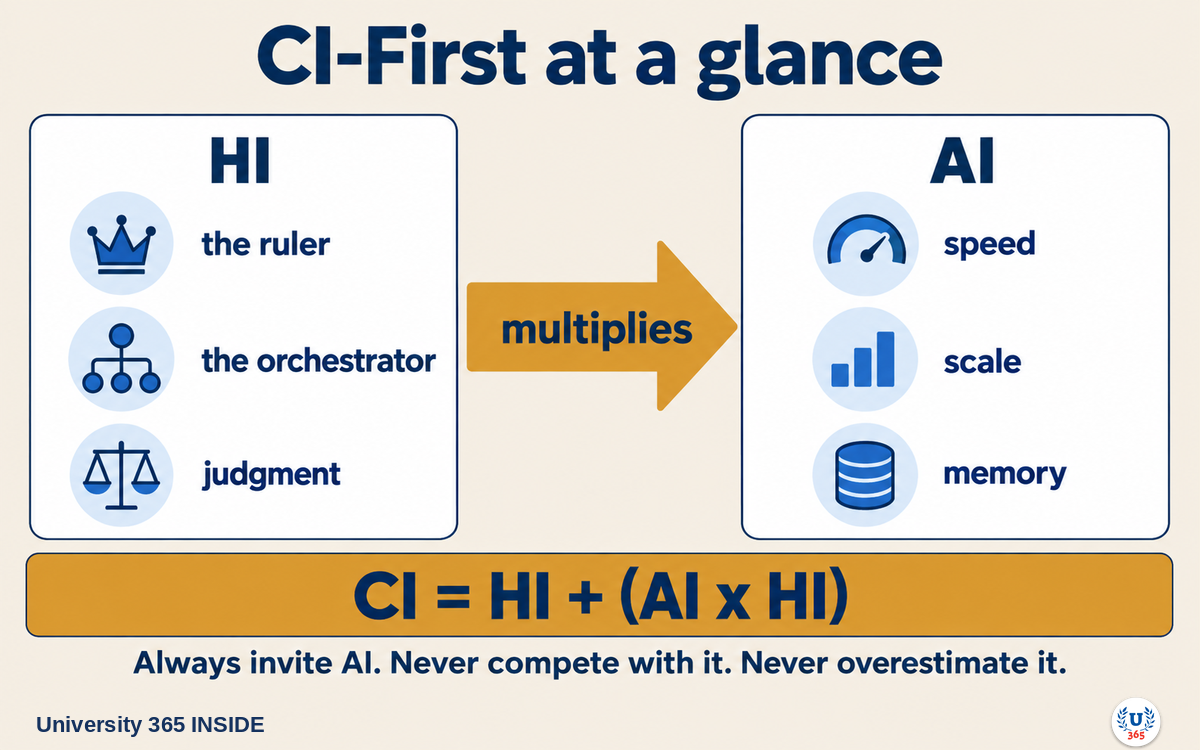
CI-First holds one invitation and one discipline. The invitation: bring AI into almost everything you think, decide, and produce. The discipline: Human Intelligence stays the ruler and the orchestrator, and Artificial Intelligence works as the amplifier.
University 365 states the doctrine in a single instruction: always invite AI, but never compete with it and never overestimate it. Hire it like a smart and skilled collaborator while you remain in the boss's seat. Work that way and you become the chief executive of your own AI workforce, with your future secured by a deliberate and well-managed Co-Intelligence.
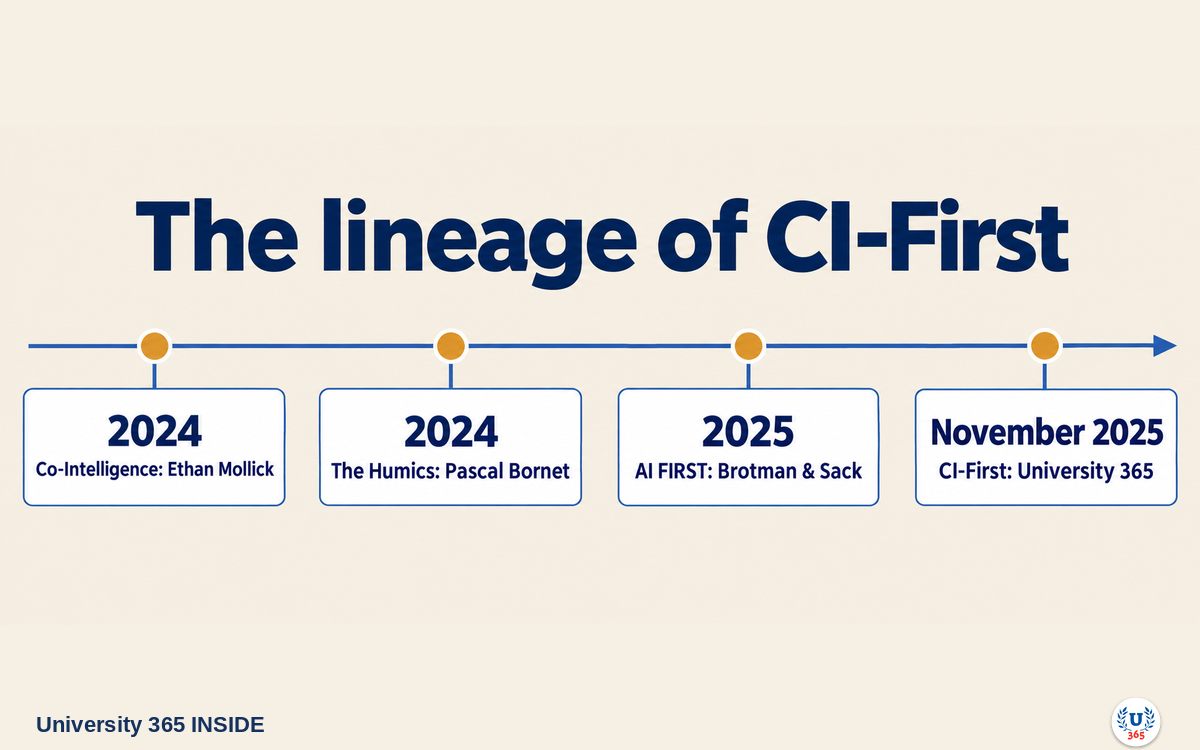
The origin of the term and the starting idea is Ethan Mollick's Co-Intelligence (2024): Human Intelligence and Artificial Intelligence working together, with the human in control. The AI-First posture comes from Adam Brotman and Andy Sack and their book AI FIRST: The Playbook for a Future-Proof Business and Brand, published in 2025, which invited leaders to see AI as the steam engine for the mind. University 365's version is deliberately more demanding. It adds the seat: who rules, who orchestrates, who signs. AI-First tells you to invite AI into everything. CI-First answers the question AI-First leaves open. University 365 invented CI-First in November 2025 and built the doctrine on these foundations.
The mission of the university carries the same idea: University 365 exists to make people truly Superhuman, and irreplaceable in the age of AI, through an AI-native Co-Intelligence-First approach.
It Concerns Everyone
CI-First is not a method for one profession, one industry, or one level of seniority. It concerns everyone who thinks with AI, at every scale of life and work.
Every kind of individual. Students and professors, employees and managers, entrepreneurs and freelancers, lifelong learners, and every person who wants to keep thinking for themselves.
Every kind of organization. Companies of every size, schools and universities, non-profit organizations, states and administrations, and whole countries, as each decides how to work with AI and who remains accountable for it.
The doctrine does not change with the size of the actor. Only the scale of the workforce being orchestrated changes: an individual directs their own AI collaborators, a company directs thousands, and a state directs more still. The rule is identical at every scale: Human Intelligence stays the ruler and the orchestrator, and Artificial Intelligence works as the multiplier.

Discover the CI-First Approach
Why AI-First Alone Is Not Enough
AI-First got three things right. It treats AI as structural: our working methods were designed for a world in which thinking was slow and expensive, and that world has ended. It prefers experimentation over certainty, which is correct in a market nobody can fully forecast. And it takes job design seriously, because most AI programs fail on the human side, not the technical one.
What AI-First does not settle is the part people feel in the second year, when the first confident error reaches a customer. Who is accountable for the final judgment when a machine produced the draft? How is the human capacity to judge maintained across years of delegation? How do you tell productive AI use apart from expensive theater?
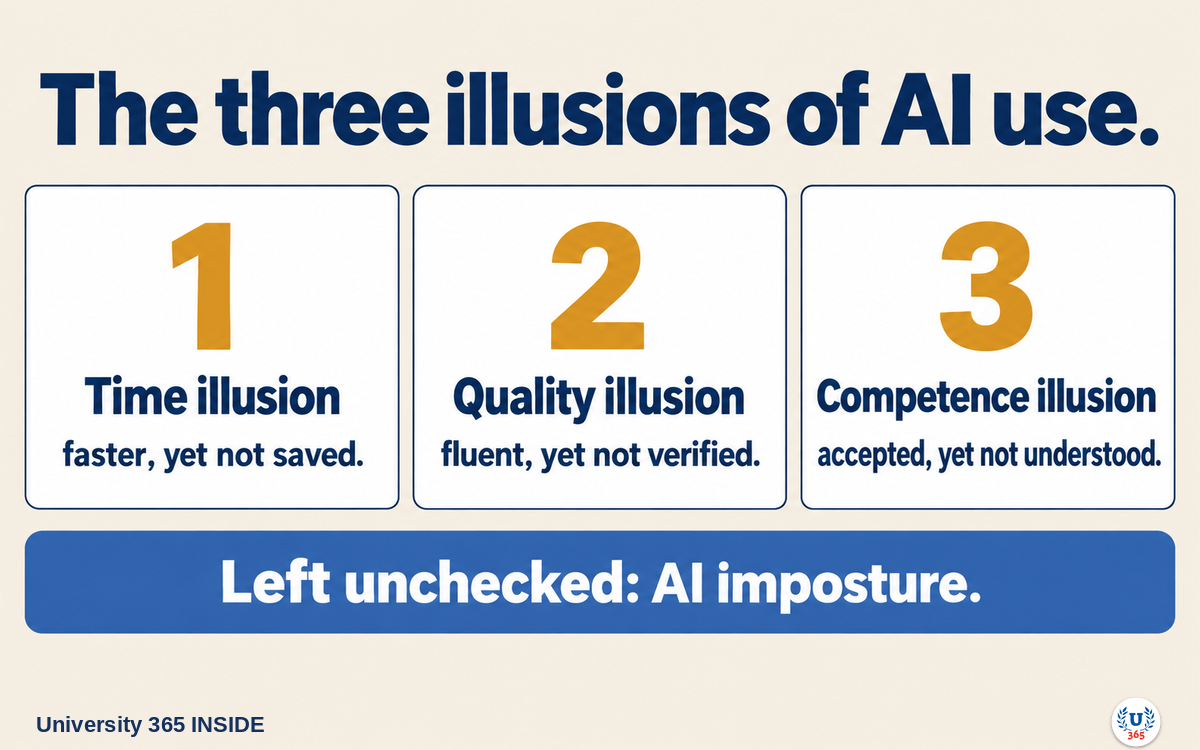
Three illusions make those questions urgent, because they decide whether an AI program compounds or quietly costs you:
The illusion of saved time. Working with AI takes time in itself: prompting, supplying context, reading, verifying. The time is recovered only when the result is better, or more, or genuinely new.
The illusion of quality. A fluent answer is not a verified one. Machine output is inconsistent, so trust without control is a bet, and the losses arrive late.
The illusion of competence. Accepting an answer you cannot evaluate moves you toward error without warning you. This is the most expensive of the three, because it feels like progress.
When the illusions win, the outcome has a name. University 365 calls it AI imposture: presenting results that your own intelligence no longer produced or understood. Our Research Center examined the converging evidence in The Cognitive Surrender Crisis: Why Education Must Become CI-First. In August 2026, an MIT committee reported that its students reach for AI at the first hint of struggle, and named the phenomenon cognitive surrender. The pattern is not confined to campuses. It appears in boardrooms, in consulting deliverables, and in any workplace where reading and deciding have been quietly handed over.
The difference, stated plainly:
AI-First | CI-First | |
Starting point | AI first, human second. | Human and machine in deliberate Co-Intelligence. |
Working assumption | AI transforms work mechanically. | The profitability of AI use must be measured. |
Main risk | Over-delegation, cognitive atrophy, the three illusions. | Managed: the Humics protected, the orchestrator seat kept, the Winner Effect guided. |
Invitation | Adopt AI. | Direct your AI. |
Direction | Follow a trend. | Build a discipline. |

Discover the CI-First Approach
The Equation Behind the Method
University 365 expresses Co-Intelligence as an equation:
CI = HI + (AI × HI)
Read the terms plainly. HI is Human Intelligence: the biological capacity for critical thinking, original intent, decision-making, sensitivity, and ethical judgment. AI is the digital multiplier of processing speed and data synthesis. CI is Co-Intelligence, whose quality depends on how well the human masters the machine.
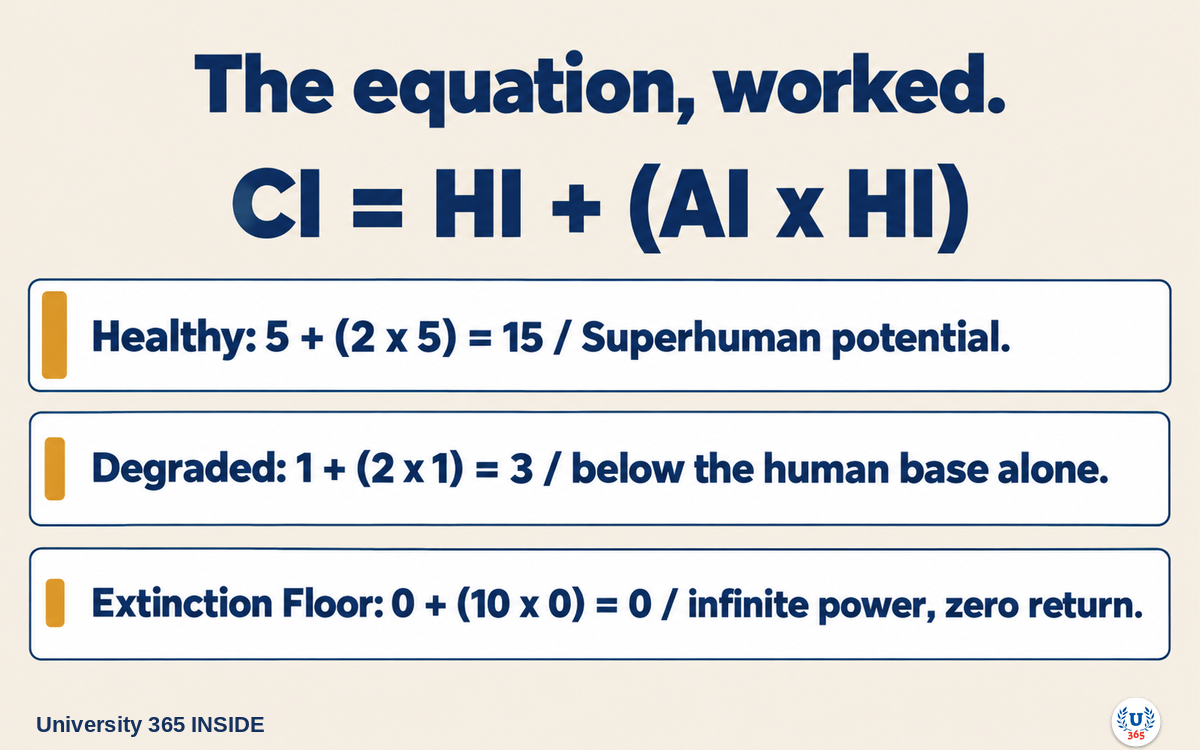
Then the arithmetic makes the argument. A person with HI of 5 working with an AI of 2 produces CI = 5 + (2 × 5) = 15: above five, so a human working with AI in a healthy way reaches a Superhuman level of output. Now suppose the same person delegates the thinking along with the typing. Human Intelligence follows a biological rule: use it or lose it. If HI falls to 1 while the same AI of 2 remains, then CI = 1 + (2 × 1) = 3: less than the human produced alone. Push it to the limit. If HI approaches zero, the equation hits what University 365 calls the Extinction Floor: CI = 0 + (10 × 0) = 0. Even an AI ten times more powerful returns nothing when multiplied by a zero human.
Two conclusions follow, and they guide everything else. Raising only the AI cannot lift you above your own human base. And every investment in your judgment, your context, and your ability to explain a decision without the tool is amplified by everything the machine brings.

Discover the CI-First Approach
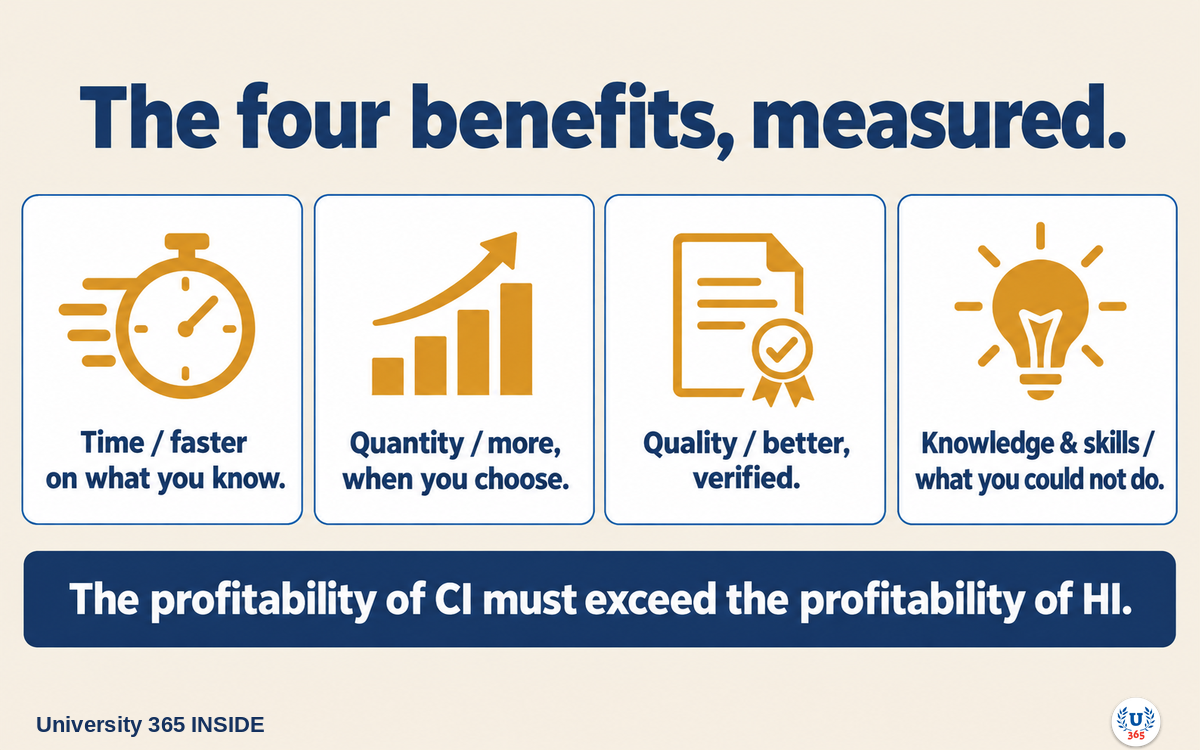
The Four Benefits You Can Measure
CI-First is not a philosophy to admire. It is a claim you can check, because its benefits are measurable.
Time. Do what you already knew how to do, but faster. Count honestly, and include the time the AI itself consumes: prompts, context, reading, verification.
Quantity. Produce more in the same period, when you choose to reinvest the time you gained.
Quality. Do the same work better, with verification attached to a named person.
Knowledge and skills. Learn what you did not know and do what you could not do. This is the most valuable benefit and the riskiest, because controlling quality in a domain you do not command demands more checks, more comparison and, when the stakes justify it, outside expertise.
Together the four benefits define the rule that keeps an AI habit honest: the profitability of working with Co-Intelligence must exceed the profitability of working with Human Intelligence alone. When it does not, the AI use is not justified, whatever the subscription dashboard reports.
How the Method Is Evaluated
Most AI reviews list what a tool can do. The U365 CI-First Review asks the question that decides whether a tool belongs in your work: what does it do to you? Every tool we evaluate passes through one framework built on the CI-First doctrine, designed to answer what no product page will: does the tool make you Superhuman or Sub-human? It measures the benefit the tool actually returns to its user, then tests what it protects or erodes in the person using it, and how likely it is to trap that person in the three AI illusions. One verdict, comparable across every tool.
The CI-First Benefit Score. Four benefits are measured separately: Time (net time saved after prompting, reading, and verifying), Quantity (more usable output, not just more output), Quality (verified improvement, not surface polish), and Knowledge and Skill (what you learn and can keep doing). Each is scored from 0 to 10, and the four average into one score with five bands: CI-First Negative (0-2): the tool likely leaves you less effective; CI-First Neutral (2.1-4): it only breaks even; CI-First Positive (4.1-6): a clear net benefit worth disciplined adoption; CI-First Strong (6.1-8): a core tool for the Superhuman workflow; CI-First Transformative (8.1-10): rare, it changes what you can achieve.
The Humics Protection Rating. The framework also checks what the tool does to the three capabilities that stay human: creativity, critical thinking, and social authenticity. Each is rated protects, neutral, or erodes, and the three combine into one badge: Humics-Friendly, Humics-Neutral, or Humics-Risky. A Humics-Risky badge warns that sustained use weakens the human even when the tool performs well.
AI Imposture Risk. Three traps are rated Low, Medium, or High: the Time Illusion (you feel faster, while the time spent prompting, reading, and verifying can cancel the gain), the Quantity Illusion (more output, none of it verified), and the Skill Illusion (expert-looking results in a skill you have not actually acquired). The overall level tells you how disciplined the use has to be.
Built for the agent era. Agents can now write your notes, your skills, and your messages, and the framework names the two places where that changes the verdict. A tool that writes your skills or your memory on your behalf cannot be rated low on the Skill Illusion: a documented capability you did not write is not a capability you own. And using agents inside a conversation is not treated as a loss of authenticity; presenting agent-written text as your own voice, or replacing human contact with it, is.

Discover the CI-First Approach
The Five Pillars of CI-First
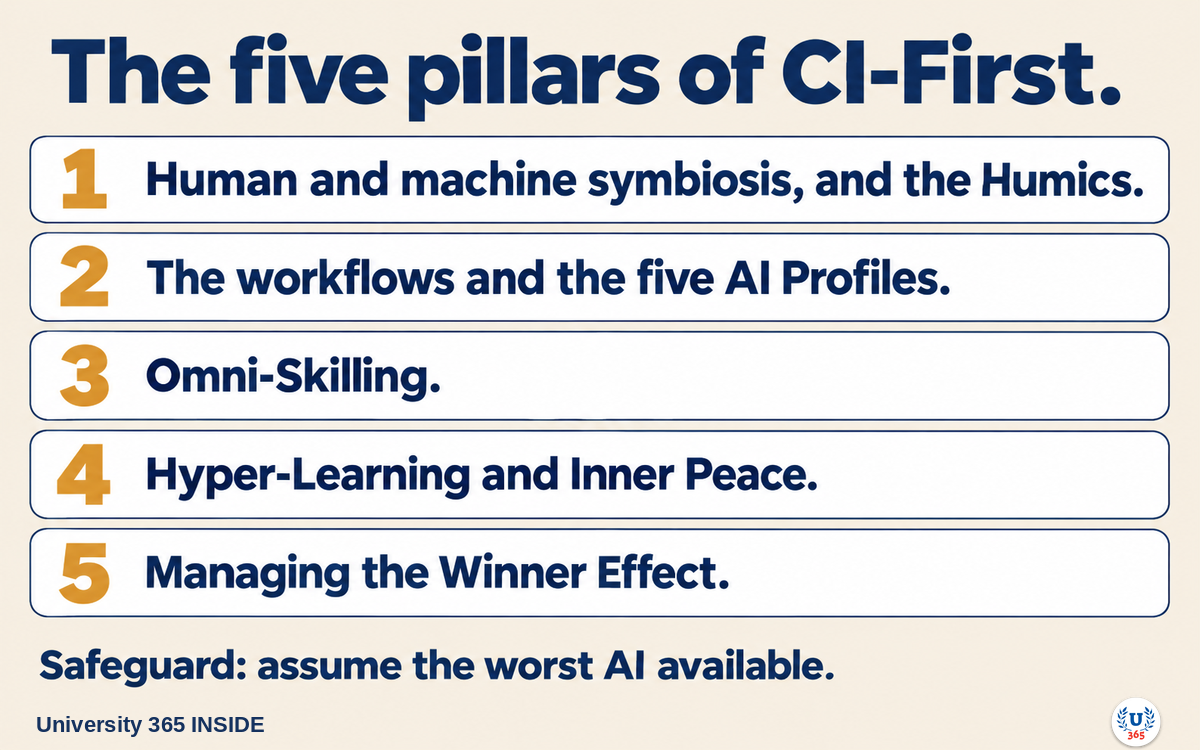
Five pillars make the approach practical, and keep it honest over time.
Pillar 1: The Human and Machine Symbiosis, and the Humics
Each side of the partnership has documented strengths and weaknesses. Human Intelligence is strong at contextual understanding, ethical reasoning, empathy, genuine creativity, and physical-world intuition; it is limited by memory, processing speed, fatigue, and bias. Artificial Intelligence is strong at speed, memory at scale, data synthesis, and pattern recognition; its weaknesses are equally real: the jagged frontier where it fails at easy tasks, hallucinations, no genuine understanding, and no capacity to originate emotional resonance. Pascal Bornet, in Irreplaceable, named the human core: the Humics, the uniquely human capacities, particularly creativity, critical thinking, and social authenticity. CI-First strengthens the Humics first, because they defend the person against AI Obesity, the atrophy that follows over-delegation, and they defend the output against the machine's weaknesses while AI's memory and speed carry what human biology cannot.
Pillar 2: The Workflows, and the Five AI Profiles
CI-First runs on workflows, and the first instrument is attribution. Before the work begins, decide which profile the AI is playing: Co-Creator and Thought Partner; Co-Worker and Assistant; Professor, Coach and Tutor; Analyst and Tester; or Challenger and Devil's Advocate. A strategy memo benefits from a challenger, a migration from an analyst, a junior colleague from a coach. The second instrument is the executive safeguard that sits above every profile: always assume you are working with the worst AI available. That assumption installs verification as a normal step rather than an insult, and it keeps the orchestrator seat where it belongs, with you.
Pillar 3: Omni-Skilling
Through AI, a person gains access to knowledge domains and technical abilities they do not biologically possess: a marketer writes working code, a biologist designs professional graphics. By mastering orchestration, a person transcends their original academic or professional background and becomes an adaptable problem-solver across disciplines. What remains scarce is judgment: knowing whether the dashboard measures the right thing, the script satisfies the regulator, the page converts the right reader. Judgment is what the other pillars protect.
Pillar 4: Hyper-Learning and Inner Peace
AI evolves at a speed that makes learning a permanent condition rather than a course you finish. CI-First therefore requires a Hyper-Learning mindset: continuous iteration, testing prompts, evaluating models, refining context files, and treating failure as data. Effective iteration also requires a quiet ego, a quiet mind, and a quiet body. An agitated, ego-driven person cannot run an AI workforce, and inner peace is what allows a person to unlearn quickly and judge without bias.
Pillar 5: Managing the Winner Effect
When a person suddenly commands the power of an AI workforce, the brain rewards the success with a surge of dopamine and testosterone: the Winner Effect. The momentum is powerful and, unmanaged, it can turn into hubris, lost empathy, and decisions that fail their own ethics. CI-First trains the balance between personal power and social responsibility, so that amplified capability stays governed by clear judgment.

Discover the CI-First Approach
The Superhuman Standard
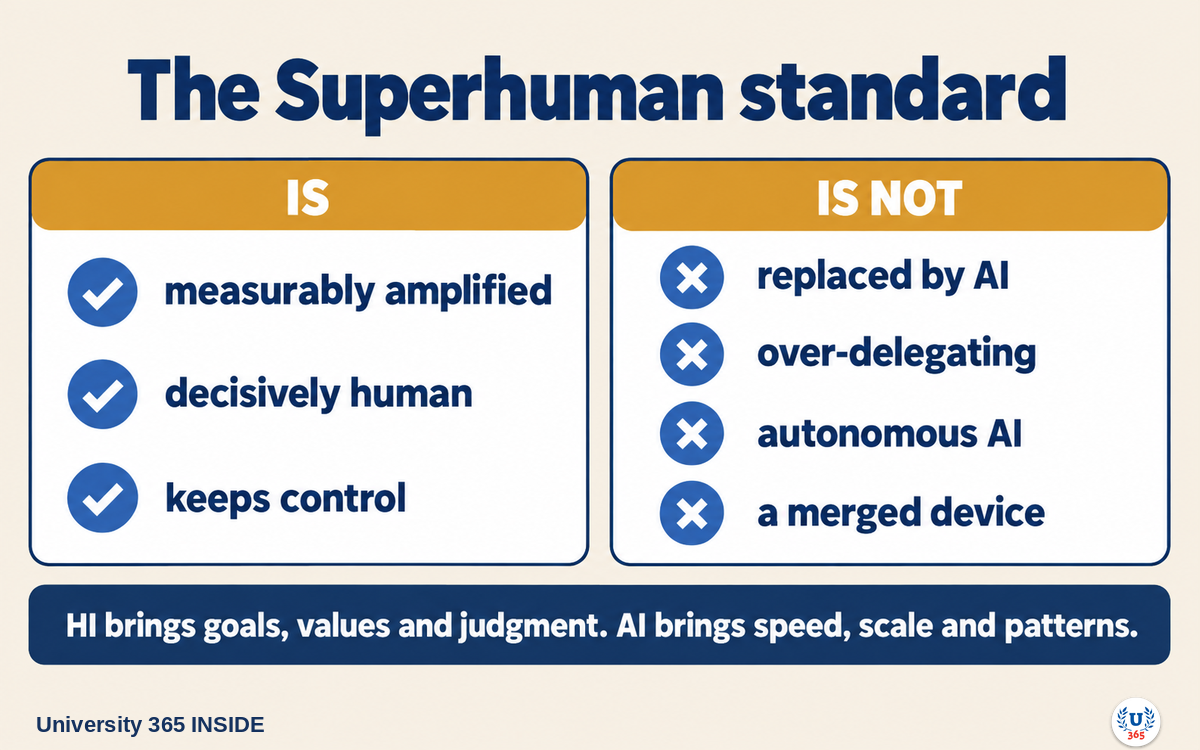
Superhuman is the promise of University 365, so it deserves a definition you can test. A Superhuman is a person whose cognitive, creative, ethical, and strategic capacities are measurably amplified by sustained Co-Intelligence, while remaining decisively human and always keeping control where machines fail. Note the word measurably: it turns a promise into management.
An AI-Native Superhuman is not a human replaced by AI; not a human over-delegating thought and tasks; not an AI acting autonomously; not a device merged with a human body. An AI-Native Superhuman is a human-in-the-loop system, a collaboration whose roles are deliberately designed by the human, and a person with real superpowers thanks to AI.
The power comes from how the work is divided, not from using AI at all. Human Intelligence contributes the goals, values, context, creativity, judgment, sensitivity, and empathy. Artificial Intelligence contributes speed, pattern recognition, scale, iteration, and automation. Neither half is optional, and nothing merges: unlike transhumanist visions that trade control for capability, superhumanism as University 365 teaches it respects human biological nature and keeps the human seat intact.
Complete Control, by Design
Being AI-native is about how work is organised: how you decide, draft, check and finish, with AI inside each step rather than beside it. In practice, that means AI in the tools where the work already happens, on your real context, at the moment the decision is taken.
Co-Intelligence-First treats human control as a design principle rather than a promise. You set the goal, the context and the limits, and you keep the final call. The machine brings speed, scale and memory. AI-native with complete control means you can see what the AI did, verify it, and stop it. CI-First keeps the human in the orchestrator's seat by design, and grows people as much as machines.

Discover the CI-First Approach
How University 365 Teaches It
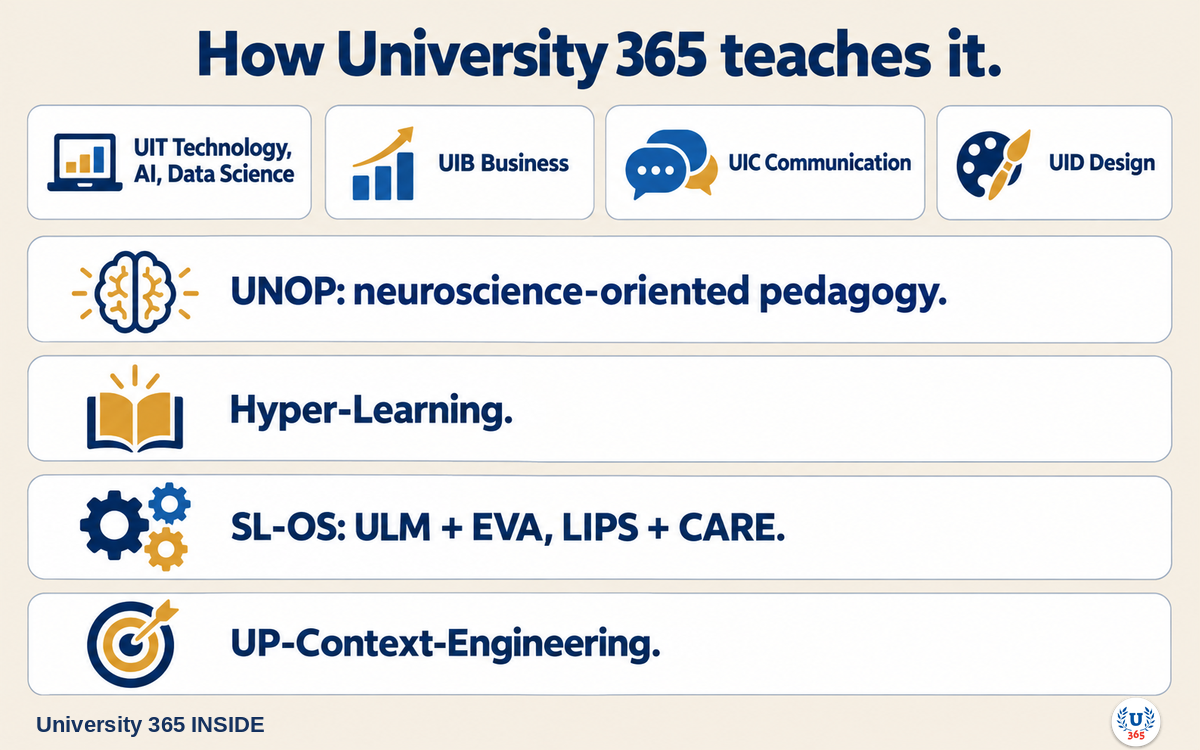
CI-First is not one course inside the university. It is the way the university is built. Four institutes deliver it: UIT (Technology, AI, Data Science), UIB (Business Management, Entrepreneurship), UIC (Digital Communication, Marketing), and UID (Digital Design, UX/UI). Fellows meet the same doctrine in every program: run your own AI workforce instead of competing with it.
The teaching stack combines four engines. UNOP™, the neuroscience-oriented pedagogy of the university, trains attention, retention, and the learning habits that keep the human base growing. The Hyper-Learning practices make iteration a routine rather than an event. SL-OS™ (Successful Life Operating System) brings the life-management systems together: ULM™ (University 365 Life Management) with its EVA engine, and LIPS™ (Life-Interests-Projects-System), the digital second brain, with its CARE cycle. And the UP-Context-Engineering Method structures the way a Fellow talks to AI, layer by layer, so that context is designed rather than improvised.
The outcome is the claim University 365 makes without hedging: a university producing truly AI-Native, CI-First, irreplaceable talents, in the sense Pascal Bornet gives that word.
What a Fellow Learns
At University 365, CI-First is not a course you take once. It is the method every Fellow practices from the first course, whichever institute you join: Technology (UIT), Business (UIB), Communication (UIC) or Design (UID). Each discipline is taught with AI at its core, so you learn to invite AI into your work, verify what it returns, and keep the final judgment in your own hands. Along the way you build a hyper-learning mindset and grow into Omni-Skilling: working at a high level across domains you were never trained in. That is what the four institutes deliver: graduates who control AI instead of competing with it.
One method, four fields. UIT (Technology), UIB (Business), UIC (Communication) and UID (Design) each teach the same CI-First method, practiced inside the coursework rather than added on the side.
Control, not competition. Always invite AI, never compete with it and never overestimate it: the Fellow stays in the boss and supervisor's seat, the CEO of their own AI workforce.
Omni-Skilling. By orchestrating AI deliberately, a Fellow works beyond their original training (a marketer writing complex code, a biologist designing high-level graphics) at a professional standard.
The hyper-learning mindset. AI moves fast, so Fellows learn continuous iteration: test, evaluate the output, refine, treat failure as data and relearn quickly.
Delivered through the institutes. Courses and lectures across all four institutes lead to micro-credentials, specialized diplomas and degrees, so the CI-First habit carries into any career.

Discover the CI-First Approach
Your First Move This Week
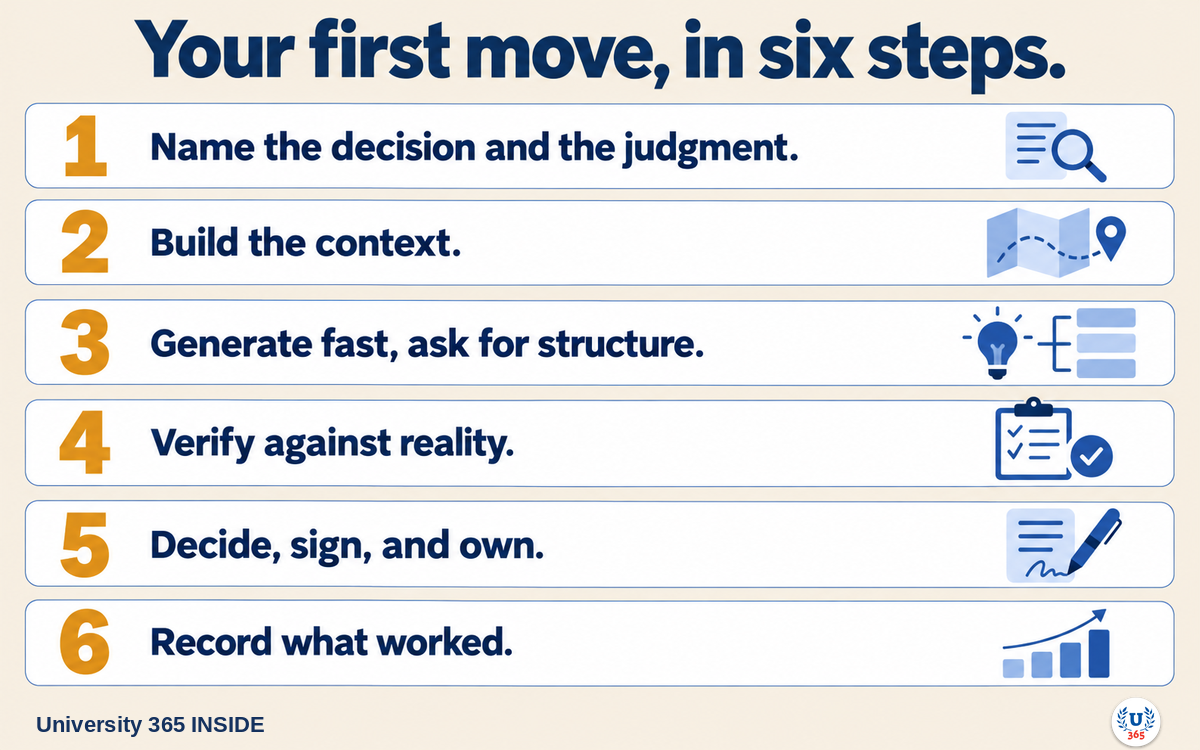
Discovery becomes adoption on the first real task you choose. Six moves, drawn from The CI-First Workflow, take you through it:
Name the decision and the judgment. Before any tool opens, write what someone will do differently after reading the output, and which part carries your name. That core is yours. The machine may draft it, challenge it, or format it; it does not own it.
Build the context before you ask. Most quality gaps are context gaps. Supply who you are, the situation, what output you need, and what good looks like.
Generate fast, and ask for structure. Variants, comparisons, and a draft plus its own critique are easier to verify than fluent prose.
Verify against reality, not against the model. The model cannot confirm the model. Check facts against sources outside it, and check your own understanding by explaining the recommendation without the tool.
Decide, sign, and own the output. The output leaves your hands with your name on it. Refuse the draft you cannot stand behind.
Record what worked. Keep the prompt, the context file, and the list of claims the machine got wrong in your domain. The record compounds, and no competitor can copy it.

Discover the CI-First Approach
The CI-First Library on INSIDE
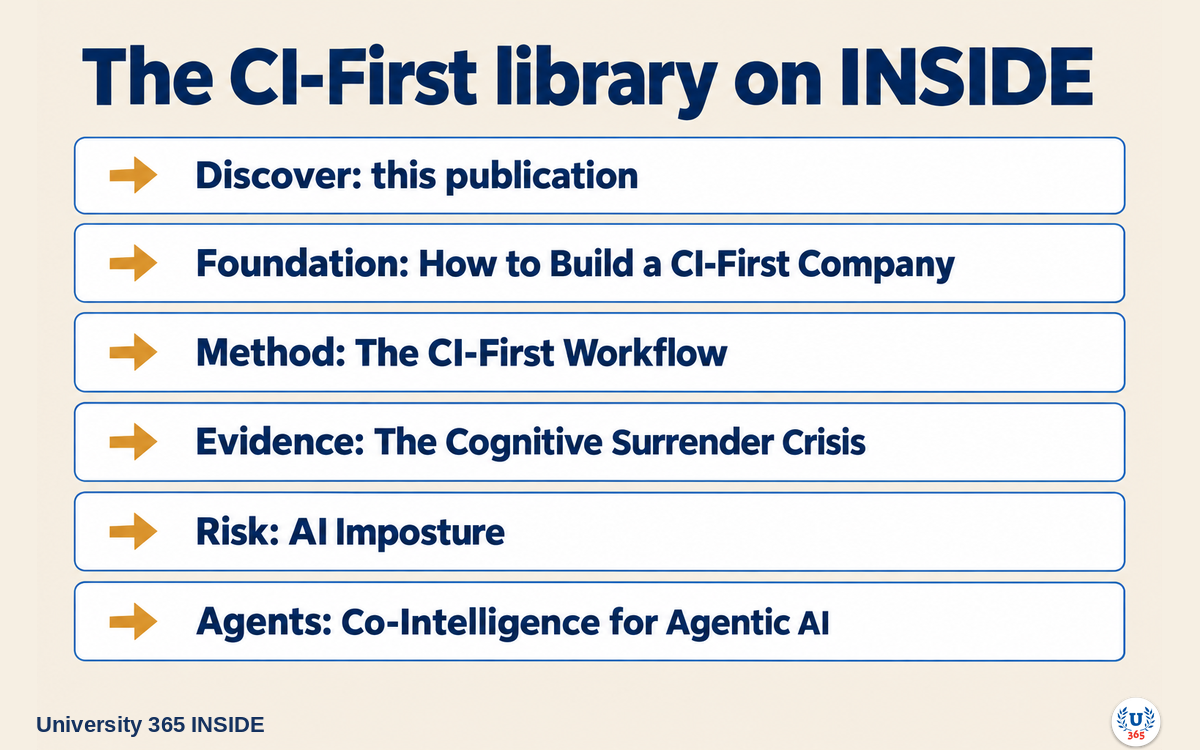
CI-First is documented in depth across INSIDE. Each publication below takes the doctrine further:

How to Build a CI-First Company: the doctrine applied at company scale, with the first ninety days and a scorecard a board can read.

The CI-First Workflow: Applied to Any Field: the working method, stage by stage, shown inside technology, business, communication, and design.

The Cognitive Surrender Crisis: Why Education Must Become CI-First: the research: why education, and every thinking profession, must become CI-First before reading and deciding are quietly handed over.

The Co-Intelligence-First approach also applies to Agentic AI: why the doctrine matters more, not less, as AI agents begin to act on their own.

AI Imposture: The Hidden Risks of Over-Reliance on Technology: the failure mode in full: how over-reliance erodes the human base, and how the equation catches it.
The same lens runs through the INSIDE Tools Review series, which scores every tool on its contribution to Co-Intelligence, its effect on human skills, and the risk of AI imposture. No other tool directory checks what a tool does to the person using it. Browse the reviews at university-365.com/tools.

Discover the CI-First Approach
Sources and Notes
Primary references: Ethan Mollick, Co-Intelligence: Living and Working with AI (the origin of the term and the starting idea of the approach). Pascal Bornet, Irreplaceable: The Art of Standing Out in the Age of Artificial Intelligence (the Humics). Adam Brotman and Andy Sack, AI FIRST: The Playbook for a Future-Proof Business and Brand (the AI-First reference). The University 365 UP-Context Profile, the canon behind the CI-First doctrine, the equation, the four benefits, the five pillars, and the Superhuman definition.
Related INSIDE publications: How to Build a CI-First Company; The CI-First Workflow: Applied to Any Field; The Cognitive Surrender Crisis; The Co-Intelligence-First approach also applies to Agentic AI; AI Imposture; and the Book Essential on Co-Intelligence: Living and Working with AI, by Ethan Mollick.

Discover the CI-First Approach
Adopt CI-First
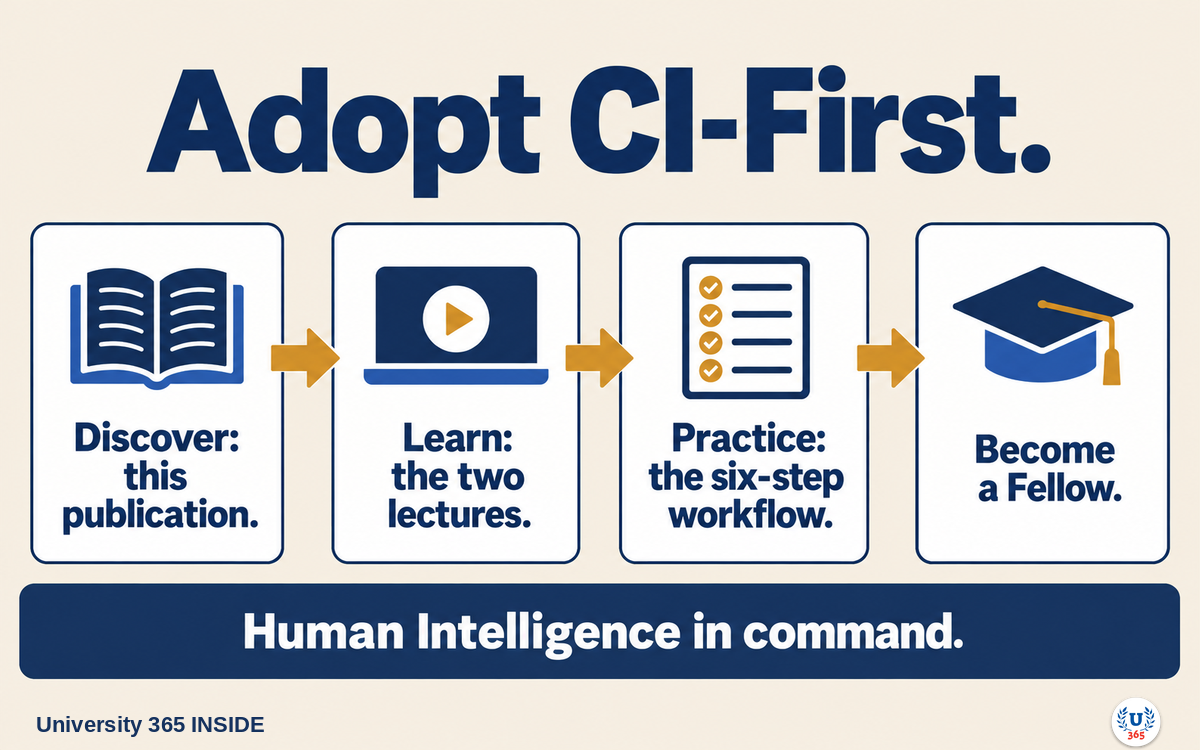
Reading about the approach is the easy half. CI-First becomes yours in the first week you run it on real work, verify its outputs, and explain your decisions without the tool at your side.
That is what University 365 teaches, program by program, with the Co-Intelligence-First approach at the center of every one of them. Become Superhuman. Stay irreplaceable in every field. Become a Fellow, learn to stay the one in command, and make the method yours.




Comments