
How to Build a CI-First Company


UIT, UIB, UIC, UID Cross-institute lecture
Series CI-First Series | Level Basic (Free)
Duration 25 to 35 minutes | Access Free
Delivering institutes: UIT (Institute of Technology); UIB (Institute of Business); UIC (Institute of Communication); UID (Institute of Design)

UNOP Sound (University 365 Neuroscience Oriented Pedagogy)
Take five minutes to prepare your brain. Play the isochronous tone track (40Hz gamma frequency) with your eyes closed. Gamma-frequency tones before a learning session raise attention and make the material easier to absorb.
[Audio player: UNOP Pre-Lecture Isochrone (40Hz, 5 minutes)]
In this Lecture

The Hook: Two Companies, One Budget, Two Outcomes
Two companies in one industry decide, on the same Monday, to become serious about artificial intelligence.
The first buys adoption: the same assistants your company probably uses, a training day, and a target that every team uses AI every week. For a quarter the dashboards look excellent. Then the quiet costs arrive. A market summary cites a regulation that does not exist. A rejection note is signed by a manager who never read the applications. Two strong analysts leave, because their work became forwarding machine output to a human who signed it without reading it. The company did not lose money on subscriptions. It lost the ability to tell good work from plausible work.
The second company, with the same budget and tools, builds something else first. It writes down who decides what, what may be delegated, how output is verified, and what counts as improvement, then adopts the same assistants inside those rules. A year later it is faster, and its people are sharper than before, not duller. Nothing about its tools is unusual. Its doctrine is.
This lecture is about that doctrine. University 365 calls it CI-First, short for Co-Intelligence First, and we hold that it is stronger than an AI-First approach on its own. By the end you will be able to state the doctrine precisely, explain the equation behind it, apply its five pillars at company scale, recognize the three traps that quietly consume AI budgets, and run the first ninety days of a build with a scorecard a board can read.
This masterclass is longer than a standard lecture. It is written for founders, executives, managers, and anyone who will have to sign the work AI helps produce.
What a Doctrine Is, and Why a Company Needs One
A doctrine is a small set of durable principles that decides how work is done when the tools change. It is not a strategy, which chooses where to compete, nor a tool policy, which lists what is allowed. It sits under both and answers four questions:
Who decides? Which decisions stay with named humans, and which can be delegated to a machine under supervision.
What may be delegated? Which parts of the work can leave the human's hands, and which carry the human's signature.
How is output verified? What must be checked, against what, before anything ships.
What counts as improvement? Which movements are progress, and which are activity.
Write those four answers down once and everything simplifies. A new model arrives: does it change an answer? A team wants a tool: same question. A competitor announces an AI transformation: doctrine, or tool list?
Without a doctrine, adoption becomes local experiments with no shared rules: one team verifies everything and ships slowly, another ships confident errors, a third keeps a tool the security team has never seen. The average looks fine; the variance is the problem.
Tools change every quarter. A doctrine is what survives the tool cycle. This is why University 365 recommends building the doctrine first and buying into it afterwards, and it is why we recommend CI-First as that doctrine.
AI-First, Stated Fairly
CI-First is not a rejection of AI-First: University 365's approach is inspired by it. The honest starting point is what AI-First says.
The reference work is "AI FIRST: The Playbook for a Future-Proof Business and Brand" by Adam Brotman and Andy Sack, published in 2025 by Harvard Business Review Press. Brotman was the chief digital officer at Starbucks and Sack a long-time technology founder and adviser. Their book invites leaders to see AI like the steam engine for the mind, to orient strategy, marketing, operations, and organizational design around it, to redesign jobs, to embrace experimentation, and to compete for early wins in a world where almost anyone can build engaging brand work quickly and cheaply.
Read fairly, AI-First gets three things right. It treats AI as structural rather than as a feature: processes were designed for a world where thinking was slow and expensive, and that world has ended. It pushes experimentation over certainty, correct in a market nobody can forecast. And it takes job design seriously, because most AI programs fail on the human side.
Where AI-First stops is a boundary of the thesis, not a flaw in the book. It measures adoption, speed, and market position. It does not state who remains accountable for the final judgment when a machine produces the draft, how the human capacity to judge is maintained across years of delegation, or how a company tells productive AI use apart from expensive theater. Those are the questions a company discovers it must answer in the second year, when the first confident error reaches a customer.
An honest comparison sounds like this: AI-First tells you to invite AI into everything, and leaves the seat of the ruler, the orchestrator, and the accountable decision-maker unaddressed. U365's position is that the seat is the whole game.
The U365 Position: CI-First
CI-First starts from a term defined by Ethan Mollick in his 2024 book "Co-Intelligence: Living and Working with AI": Co-Intelligence is Human Intelligence and Artificial Intelligence working together, with the human in control.
University 365's version is deliberately more demanding. It invites you to always bring AI into your reflection and work, and adds the discipline that makes the invitation safe: Human Intelligence is the ruler and the orchestrator. Do not compete with AI and do not overestimate it. Hire it like a smart collaborator while you remain in the boss's seat, and you become the chief executive of your own AI workforce.
Two sentences from the university's canon carry the comparison. The mission: University 365 exists to make people truly Superhuman, and irreplaceable in the age of AI, through an AI-native Co-Intelligence First approach. The recommendation: better than AI First, University 365 recommends CI First.
At company scale the doctrine asks for one thing beyond the invitation. The invitation is the same one AI-First extends: almost every task gets an AI collaborator. The addition is the seat. A CI-First company states, in writing, who rules and who orchestrates: which human owns each output, what that human must be able to explain without the tool, and where the machine's work ends and the signature begins. The company does not merge people with machines; it designs the division of labor deliberately, because the power comes from that division, not from using AI at all.
Superhuman, in this doctrine, has a testable definition: a person whose cognitive, creative, ethical, and strategic capacities are measurably amplified by sustained Co-Intelligence, while remaining decisively human and always keeping control where machines fail. Note the word measurably. It is what turns a philosophy into management.
The Equation as a Management Instrument
University 365 expresses Co-Intelligence as an equation:
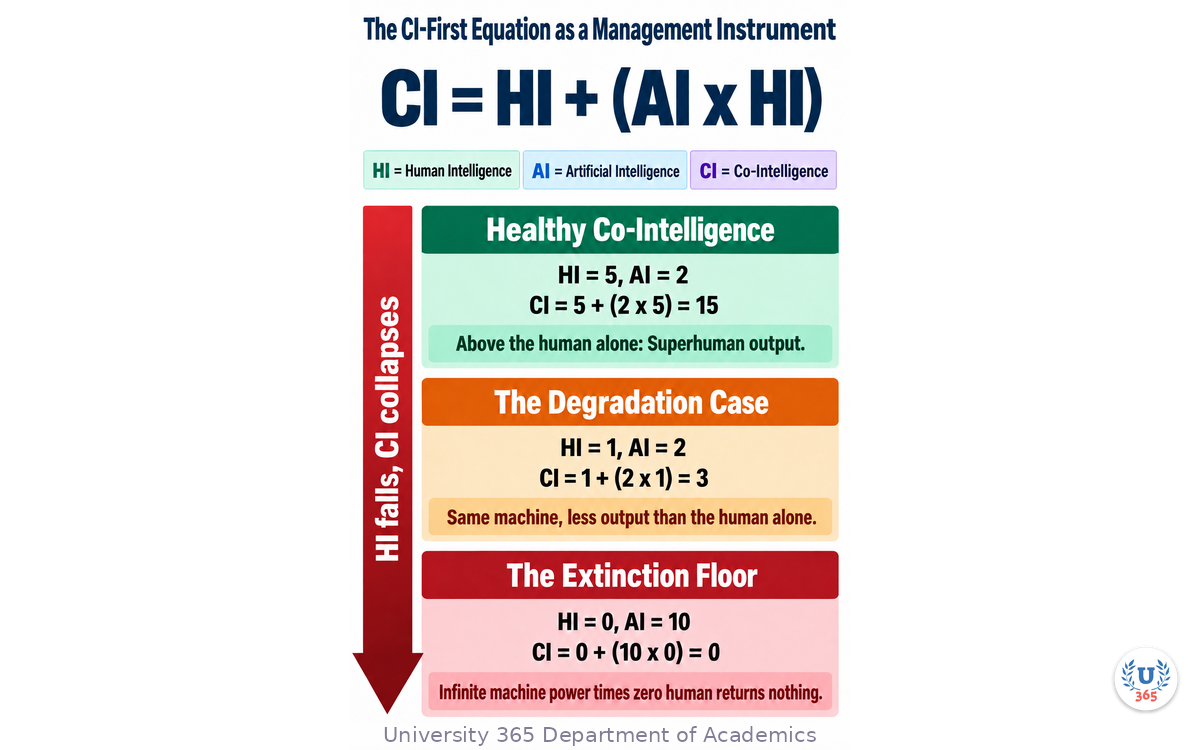
CI = HI + (AI × HI)
Read the terms plainly. HI is Human Intelligence: the biological capacity for critical thinking, original intent, decision-making, sensitivity, and ethical judgment. AI is the digital multiplier of processing speed and data synthesis. CI is Co-Intelligence, whose quality depends on how well the human masters the machine.
The canon works the arithmetic with illustrative values, and the arithmetic is the management lesson. A person with HI of 5 working with an AI of 2 produces CI = 5 + (2 × 5) = 15: above five, so a human working with AI in a healthy way reaches a Superhuman level of output. The human stays the pilot, the conductor, the orchestrator.
Now the case that matters to a company. Suppose the human stops exercising HI, delegating the typing and the thinking, the reading, the analyzing, the deciding. Human intelligence follows a biological rule: use it or lose it. If HI falls to 1 while the same AI of 2 remains, then CI = 1 + (2 × 1) = 3: the same machine, the same subscription, and less output than the human produced alone. The canon draws the conclusion without softening it: the Superhuman became a Sub-human impostor, because of AI. The machine did not fail. The human multiplier fell.
Push it to the limit. If HI approaches zero, because the human delegates everything without control and without knowing how to give context or to judge, the equation hits what the canon calls the Extinction Floor. Even with an AI of 10, ten times more powerful than before, CI = 0 + (10 × 0) = 0. Infinite machine power multiplied by a zero human returns nothing. In a world of total imposture, the result of infinite AI remains negligible or zero.
Company management flows from three readings of the equation.
A company that only raises AI cannot rise above its own HI. Model quality, tool count, and seats purchased set the multiplier; the base is your people. Raise the multiplier and leave the base untouched, and the ceiling is fixed by the base. Let delegation erode the base, and the number moves backwards while every dashboard in the building improves.
Every raise of HI is amplified by AI, so human development is a productivity investment. A workshop that sharpens judgment, a rotation that widens context, a review culture that makes people explain their reasoning: in CI terms these raise the base that everything multiplies. They belong in the AI-program business case.
The Floor is a governance risk. A team that delegates reading, analysis, and deciding without control sits at zero times whatever, and the failure is invisible until it is expensive. The counterweight is a written division of labor, with verification attached to a named human.
One discipline makes the equation operational: before work begins, attribute to the AI the profile it is playing and to a human the judgment being exercised. That is the first instrument of the next pillar.
Pillar 1: The HI/AI Symbiosis and the Humics
The first pillar: a human who wants to be amplified must understand both intelligences precisely, then protect the human side of the ledger.
Each side has documented strengths and weaknesses, and the canon states them.
Biological Human Intelligence is strong at contextual understanding, ethical reasoning, empathy, genuine creativity, and physical-world intuition. It is limited by memory capacity, processing speed, cognitive fatigue, and its own biases.
Machine Artificial Intelligence is strong at computational speed, memory at scale, data synthesis, and pattern recognition. Its weaknesses are equally real: the Jagged Frontier, where it performs brilliantly on hard tasks and fails on easy ones; hallucinations; no genuine understanding, because inference follows probability rather than intent; and no capacity to originate true emotional resonance.
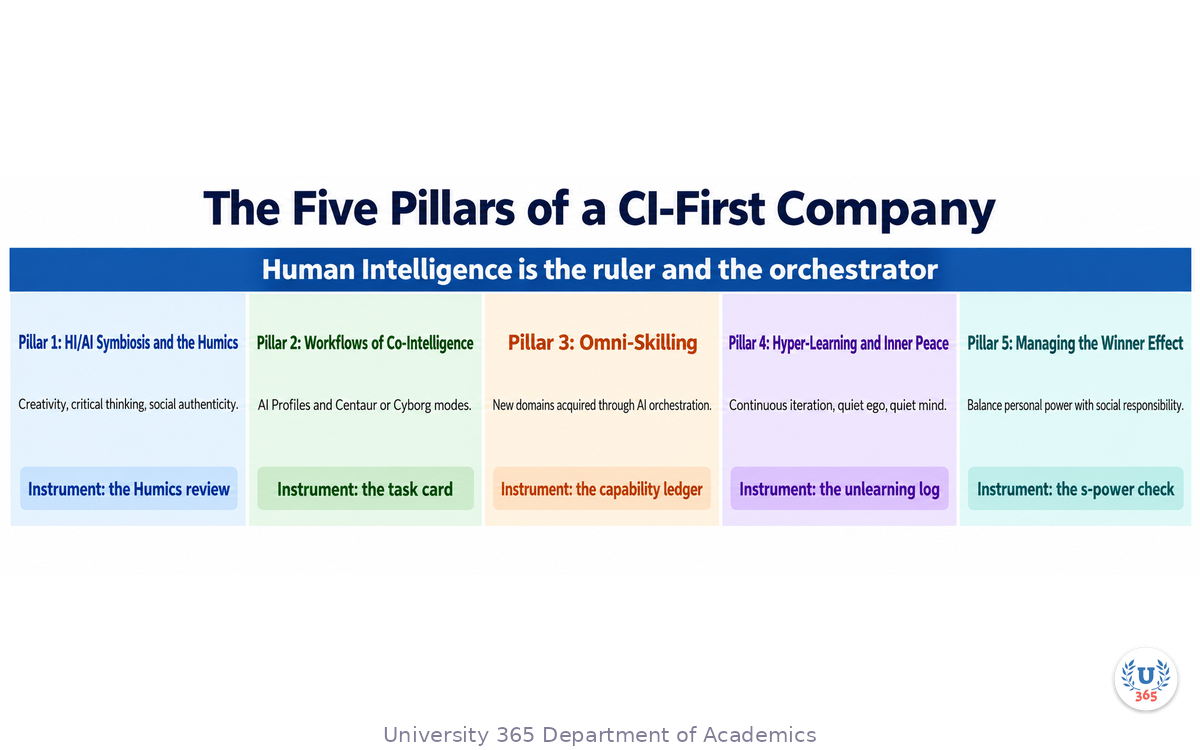
The doctrine defends where AI is weak, using the abilities AI cannot supply. Pascal Bornet, author of "Irreplaceable: The Art of Standing Out in the Age of Artificial Intelligence," coined a term for them: the Humics, the set of uniquely human capabilities, particularly creativity, critical thinking, and social authenticity, that enable humans to create value, adapt, and collaborate in an age of artificial intelligence. They are the foundation from which skills and competencies develop, and by definition they belong to HI alone.
Anchoring in the Humics does two jobs: it defends the person against AI Obesity, the atrophy that follows over-delegation, and it defends the output against the machine's weaknesses while AI's memory and speed carry the load human biology cannot.
For a team, that makes creativity, critical thinking, and social authenticity capabilities you hire for, train, and review like any other, and delegation a design decision per task.
One concrete instrument: the Humics review. At the end of a delivered piece of work, the owner answers three questions in two sentences: where did we originate something, where did we apply judgment the machine could not, and where did a human relationship carry part of the result? A team that keeps this habit for a quarter can show its human capacity is intact. A team that cannot answer is delegating more than it knows.
Pillar 2: The Workflows of Co-Intelligence
The second pillar is execution: how a human and a machine share a task. University 365 teaches two instruments, and both should be in use on the same day.
The first instrument is the AI Profile, attributed before the work begins. The canon names five: AI as Co-Creator and Thought Partner, Co-Worker and Assistant, Coach and Tutor, Analyst and Tester, and Challenger and Devil's Advocate. Attribution forces the human to decide what kind of collaborator the task needs: a strategy memo benefits from a Challenger, a migration from an Analyst and Tester, a junior colleague from a Coach. Without it, every assistant drifts into the same agreeable voice, which is the voice that hides errors.
The second instrument is the collaboration mode. In Centaur mode the division of labor is clear: the human handles strategy, empathy and final judgment, and delegates heavy data processing and drafting to the machine. In Cyborg mode the process is deeply intertwined: human and machine iterate in real time, prompting and refining rapidly. Both are legitimate, and the choice depends on the task. A brand voice document belongs in Cyborg mode; a quarterly board pack belongs in Centaur mode.
One instruction sits above both modes and is non-negotiable: the Executive Safeguard. Regardless of the workflow, the human remains the chief executive of the AI, and because Cyborg mode carries the highest risk of over-delegation, U365 enforces a strict mental model: always assume you are working with the worst AI available. That assumption forces hyper-vigilance, independent verification of every output, and a refusal to surrender the orchestrator seat. It is not pessimism; it installs the checking habit before the work exists.
What this means for a team: shared vocabulary for how AI is used on a given task, chosen deliberately, and a standing assumption of machine unreliability that makes verification a normal step rather than an insult.
One concrete instrument: the task card. Before any AI-assisted task that will leave the team, the owner writes four lines: the profile attributed to the AI, the mode, the human who signs, and the verification that human will run. Ninety seconds removes the class of failure where nobody knows whether a document was checked.
Pillar 3: Omni-Skilling
The third pillar is the payoff, and the reason companies find CI-First ambitious rather than merely prudent.
The canon states the goal directly: the ultimate purpose of CI First is not personal productivity, it is Omni-Skilling. Through AI, a person gains access to knowledge domains, technical abilities, and specialized skills they do not biologically possess. A marketer writes complex code. A biologist designs high-level graphics. By mastering orchestration, a person transcends their own background and becomes an adaptable problem-solver able to execute at a high level across disciplines.
For a company, Omni-Skilling changes hiring and internal mobility. If a finance analyst can produce a working dashboard, a support lead a compliant script, a designer a landing page, the constraint on what a small team attempts is no longer its hired skills. What remains constrained is judgment: who can tell whether the dashboard measures the right thing, the script satisfies the regulator, the page converts the right user. Judgment is the scarce resource, and the other pillars protect it.
The canon insists on an honest caveat. The fourth benefit, knowledge and skill, carries the highest risk, because controlling the quality of an AI response in a domain you do not command is harder. More time must go to checks, to comparing models, and, where the stakes justify it, to external experts. Acquiring a new domain and adopting it are two different acts.
One concrete instrument, and the one a company feels first: a capability ledger. For each team, list the competencies it is expected to hold, and mark each quarter which were acquired through Omni-Skilling and who can now sign work in them. The ledger converts a slogan into a workforce fact and shows where the judgment supply is thin.
Pillar 4: Hyper-Learning and Inner Peace
The fourth pillar keeps the other three from degrading over time. The canon opens with the constraint: to wield a superintelligence, the human orchestrator must operate from a baseline of psychological stability and relentless curiosity. AI evolves at unprecedented speed, so CI-First requires a Hyper-Learning mindset.
The canon assigns two components.
Continuous iteration: expect to test new prompts, evaluate models, analyze outputs, and refine the approach, permanently. A company that treats AI competence as a course it completed has already fallen behind.
Inner peace: effective iteration requires a quiet ego, a quiet mind, and a quiet body. The reasoning is managerial. An agitated, ego-driven human cannot manage an AI workforce, and inner peace is what allows a person to accept failure as data, to unlearn outdated approaches quickly, and to judge without bias. The inverse is easy to recognize: a leader whose ego is invested in the last answer cannot accept that the tool was wrong, and a team under deadline pressure stops verifying first.
For a team, this means an environment where admitting a machine-assisted error is normal, retracting a draft is cheap, and experimentation is paced deliberately rather than by anxiety.
One concrete instrument: the unlearning log, a standing page where each team records in one line what it stopped doing and why. Retired prompts, retired metrics, retired workflows. A team that can show what it abandoned is genuinely iterating; a team that only adds is accumulating habits it cannot defend.
Pillar 5: Managing the Winner Effect
The fifth pillar protects the leader who succeeds. The canon describes the mechanism: when a human suddenly acquires the Omni-Skilling power of an AI workforce, the brain experiences a surge in agency and success. This triggers the Winner Effect, a spike in dopamine and testosterone that increases confidence, risk-taking, and momentum. Unmanaged, it leads to hubris, a loss of empathy, hallucination blindness, and unethical decision-making.
Hallucination blindness is the item to underline for a company, and it is not a model failure but a human one: the state in which a person has become so fluent with machine output, and so rewarded for speed, that they stop seeing its defects. It is the natural consequence of unbroken success with a tool that is usually right.
The doctrine's answer is balance, taught rather than left to character. CI First integrates with the U365 neuroscience-oriented pedagogy to train leaders to hold personal power, p-power, against social responsibility, s-power, so that amplified capabilities stay governed by ethical clarity, institutional alignment, and global responsibility.
The consequence for a team is uncomfortable: the most dangerous person is often the most capable one, and checks written for the cautious do not catch the confident. Verification rules and decision rights must bind the fast operator as tightly as anyone else, and visibly so.
One concrete instrument: the s-power check on decisions above a defined size. The decision owner states the risk to other people, inside or outside the company, and names a person with the standing to disagree. Minutes of effort make the second voice structural instead of optional.
The Three Imposture Traps at Company Scale
The canon names three illusions that make AI programs look successful. Each is a trap a company can measure its way out of, and each is why the doctrine insists on an economic test.
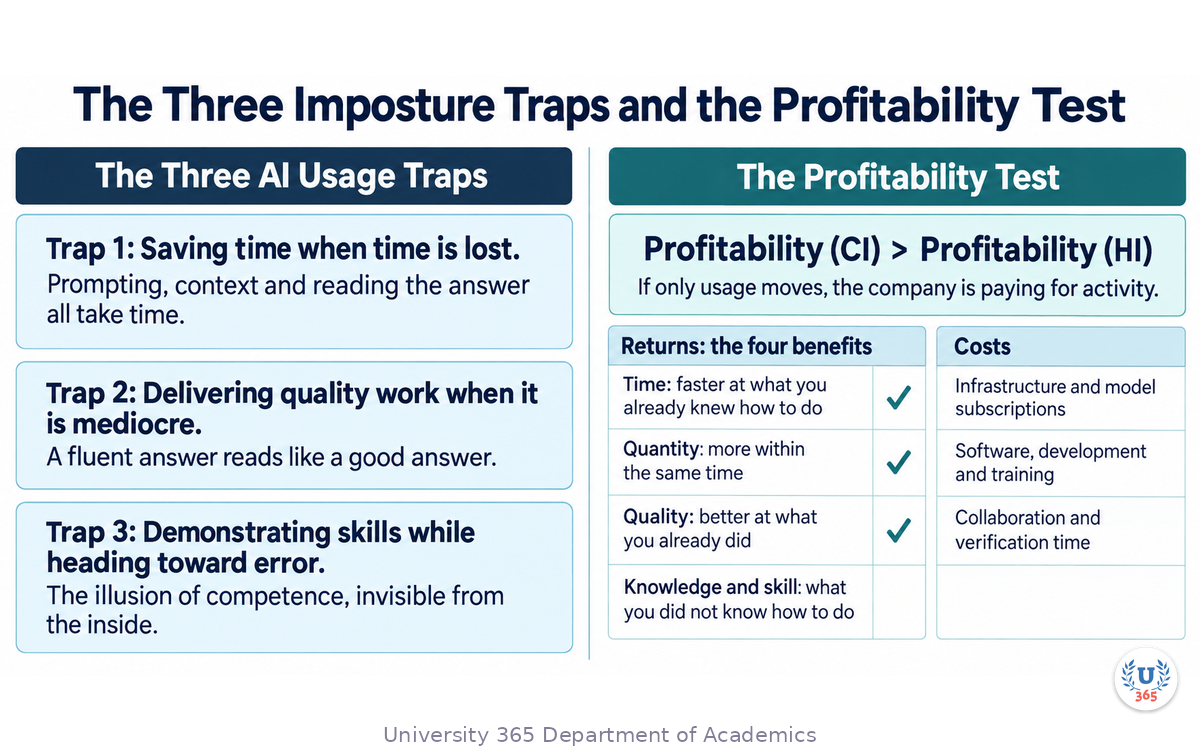
The first illusion: saving time when time is lost. Working with AI takes time in itself: to write the prompt, to give the context, and above all to read and analyze whether the response is relevant. Machine output is inconsistent, so it cannot be trusted without control, and control takes time. Working alone also takes time, and the temptation is to believe AI, being faster, saves it. The canon is precise: Co-Intelligence is worth its cost only if the result is of better quality, of greater quantity, or out of reach for the human alone for lack of knowledge. Otherwise the saved time is a feeling.
The second illusion: delivering quality work when it is mediocre. A fluent answer reads like a good answer, so retaining one without inspecting it ships something poor, improvable, or false. The canon's remedy is to always verify. At company scale this is why a program needs a verification duty attached to named humans; without it, mediocrity enters at the top and exits as a signed deliverable.
The third illusion: demonstrating skills while heading toward error, without knowing it. The deepest of the three, because it is invisible from the inside. A person who has produced a hundred fluent outputs feels more competent than at the start, and the feeling is real; the question is whether the competence is. The canon describes the failure as imposture: the illusion of knowledge and competence AI provides when a person over-relies on machine accuracy and over-delegates research, analysis and thinking without deep control.
In a company the three traps compound: the first buys speed nobody measured, the second converts it into unverified output, and the third removes the person's own alarm system while confidence rises. That is why the doctrine attaches a single economic test.
The canon's test is:
Profitability (CI) > Profitability (HI)
Profitability is the ratio between what the AI program costs and what it returns. Costs: infrastructure, model subscriptions, AI software, custom development, training, and the time invested in the tools. Returns: the four key benefits, all measurable, which is what makes the ratio controllable rather than felt.
Time benefit. AI lets people do what they already knew how to do, faster, with the cost of collaboration included.
Quantity benefit. AI lets people do more within the same time, when the time saved is reinvested in more tasks.
Quality benefit. AI lets people do what they already did, better. Combined with the first two, this is the productive efficiency of Co-Intelligence.
Knowledge and skill benefit. AI lets people learn what they did not know and do what they did not know how to do. This carries the highest uncertainty, because verifying an answer in a domain you do not command is harder, so more checking time, multiple models and outside experts belong in this line.
Hold the four in tension and treat Co-Intelligence as the best compromise among them for the objective at hand. Faster is not better; more is not verified; and a skill acquired without verification is a liability wearing a competency's name.
At company scale the test becomes a quarterly review with four questions: did the time gain survive the cost of collaboration, did the volume produce usable output, did quality rise against a pre-program baseline, did anyone acquire a capability they did not have? If three of the four move, the program works. If only usage moves, the company is paying for activity.
The Playbook
Everything above is doctrine. This is the build, six components in order.
1. Governance: what AI may decide, and what stays human
Write a decision rights document: specific, not long. Each class of work gets one of three levels.
AI may draft, and a named human approves before the work leaves the team. The default for anything a customer, a regulator, an employee, or an investor will read.
AI may execute under defined supervision, with sampling and a rollback path. Repetitive internal operations: classifications, routing, first-pass summaries, code covered by tests.
AI may not decide. Hiring, firing, and performance ratings; anything determining access to money, opportunity, or care; legal commitments; safety-critical calls; and the final wording of any communication on behalf of the company. A machine may prepare each; a human decides, and signs.
Two more entries belong in it: an inventory of what data may leave the company's boundary, decided in advance so it is not re-decided under deadline; and a disclosure position: where the audience expects human authorship (regulated disclosures, journalism, academic work, contractual deliverables) the method is disclosed, and elsewhere quality is the answer.
Review it quarterly. Models change faster than rules.
2. The worst-AI mental model, installed as a habit
Adopt the Executive Safeguard as a company default: assume you are working with the worst AI available. The first output is a draft from an unreliable colleague, not a finding from a system. A claim that matters is checked the same day it is generated. Whoever delegates a task remains responsible for what it produces, and the model is cheap and permanent: training on tool features goes stale in months, while an assumption of unreliability survives every model release.
3. Verification as a standing duty
Verification is a job with hours attached, not a good intention. It belongs to the human who signs, and the signer is named on the work.
Checks escalate with consequence. Low: a read for sense. Medium: the three claims that would matter most if wrong, checked against external sources. High: an adversarial pass by someone uninvested in the draft, plus a second method for the central claim.
The model never verifies the model: a second machine output is a lead, not a confirmation. Where a fact will influence a decision or appear publicly, someone opens the source.
Samples are drawn, not requested: for supervised execution in operations, sample output on a schedule against a written criterion and record what the sample found. Sampling is what makes supervision real.
4. The Humics development program
If the equation says the base multiplies everything, the program that raises it is core spending. Build it around the three Humics, and treat each as trainable.
Creativity: a recurring brief that requires original intent, with the machine available and the direction set by people.
Critical thinking: structured disagreement as a meeting habit. Assign a colleague to argue the opposite case, and reward whoever finds the flaw first.
Social authenticity: decide by policy which conversations with customers, colleagues and partners stay human, and train for them, because a machine can produce a message but cannot originate trust.
Record progress the way you record engineering progress: what changed in the team's capability this quarter, and the evidence for it.
5. Competency and credentialing
Omni-Skilling creates a supply of new capabilities and a new problem: nobody can tell who genuinely holds them. Install two layers.
Internal competency records: for each role, list the competencies it requires and mark, per person, which are held, in progress, or acquired with AI assistance. A competency acquired through Omni-Skilling is real work resting on a machine; the record should say so, and the person should be able to explain the work unaided.
External credentials: where a capability will be sold, promised to a client, or used in a regulated context, pair it with a verifiable credential, internal with a real assessment or accredited external. University 365's stackable Micro-Credentials for your Career exist for this inside its programs, and the principle generalizes: a claim of skill should survive an examination by someone other than the claimant.
6. The CEO-of-the-AI-workforce seat
The canon ends its invitation with a line describing a role, not a slogan: become the CEO of your AI workforce, master the Humics, achieve Omni-Skilling. The seat exists at two levels.
For every individual: each person is the executive of their own AI workforce, choosing which profiles to convene, in which mode, and signing what goes out. That belongs in role expectations, onboarding and reviews.
For the company: one accountable executive owns the doctrine, the decision rights document, the verification duty, the Humics program and the profitability review. Not necessarily a new hire or a chief AI officer on day one: a named owner with the standing to say no, which is the power that matters when adoption pressure meets a rule.
The First 90 Days
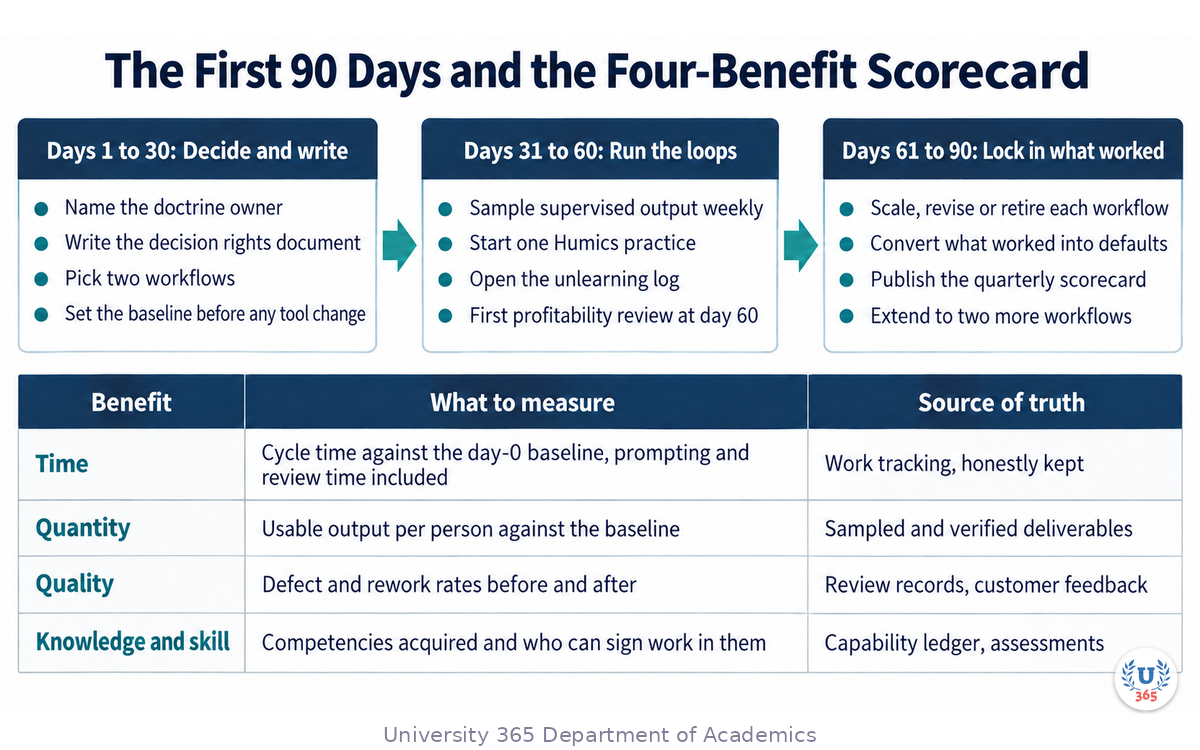
A doctrine that does not fit inside a quarter does not get adopted. This is the first ninety days, with a scorecard that measures the four benefits instead of counting tool usage.
Days 1 to 30: decide and write
Name the doctrine owner: one executive with the standing to refuse.
Write the decision rights document in the three levels this lecture describes and publish it internally. It will be imperfect; publish it anyway, because a written rule beats an unwritten perfect one.
Pick two workflows to instrument, not ten: one producing a customer-facing deliverable, one repetitive internal process with a measurable cost.
Set the baseline before any tooling change: cycle time, volume, defect rate, and the competencies involved. A baseline assembled after adoption measures nothing.
Run the attribution habit on both workflows: every AI-assisted task gets a card with the profile, mode, signer and verification.
Days 31 to 60: run the loops
Run both workflows under the worst-AI assumption, sampling the supervised output weekly.
Start the Humics program with one practice per Humic, not a curriculum: a recurring creative brief, a structured disagreement habit, a protected human surface.
Open the unlearning log and the claims list: every error the models made in your domain, so you know where to look first next time.
Train the verification ladder on one real deliverable.
Hold the first profitability review at day 60 against the baseline. Expect the time line to disappoint: collaboration costs are real.
Days 61 to 90: lock in what worked
Decide the fate of each workflow: scale, revise, or retire. Retiring one is a legitimate result, recorded as one.
Convert what worked into defaults: the decision rights document, the task card template, the onboarding material.
Publish the quarterly scorecard against the four benefits, with numbers and sources. A usage chart is not a scorecard; the test is profitability, not adoption.
Extend to two more workflows, chosen by the same logic as the first two.
Schedule the quarterly review permanently, and record what the company unlearned alongside what it added.
The 90-day scorecard
Benefit | What to measure | Source of truth |
Time | Cycle time on the two workflows against the day-0 baseline, prompting and review time included | Work tracking, honestly kept |
Quantity | Usable output per person against the baseline; usable means it survived verification | Sampled and verified deliverables |
Quality | Defect and rework rates before and after, plus the claims list trend | Review records, customer feedback |
Knowledge and skill | Competencies acquired, who can sign work in them, and the evidence | Capability ledger, assessments |
Read the scorecard the way the doctrine reads the equation. If time and quantity improve while quality and skill stagnate, the company bought speed and is heading for the second and third traps. If quality and skill improve while time and quantity stagnate, it is learning well and paying too much for it. The doctrine asks for the best compromise among the four, and the scorecard is where that compromise becomes visible.
Transition and Continuity
This masterclass is the doctrine. It has two companions, and they answer different questions.
The workflow. "The CI-First Workflow: Applied to Any Field" takes one real task through six stages: name what you own before you prompt, build the context, generate in parallel, verify against reality, decide and sign, then record and reuse. If this lecture tells you what to believe and how to organize, that lecture tells you how a single piece of work moves through a company that believes it. Run both: the doctrine without the workflow is a poster, and the workflow without the doctrine is a habit that erodes under pressure.
The doctrine it answers. "Building an AI-First Company Culture" teaches the AI-First approach fairly, and this lecture is its counterpart. Where that lecture builds the habits, this one states the operating philosophy, including the seat AI-First leaves empty.
A sequencing suggestion from the university that teaches both: read the AI-First lecture to understand the doctrine most companies are adopting and why it attracts; read the workflow lecture for the discipline of one task; then use this masterclass to build the rules the other two operate inside.
Both companion lectures are published on INSIDE and linked under Related Resources.
Feynman Summary: Explain It Like You Are 12
Imagine you and a very fast robot are doing your homework together. The robot has read almost everything and writes quickly. It also makes things up sometimes, very confidently.
Your teacher does not grade the robot. She grades you. So the smart way to work is not to let the robot do everything and put your name on it. The smart way is to decide which parts you are responsible for, let the robot do the fast parts, and check the important facts yourself before you hand anything in.
Here is the thing to remember. The robot multiplies what you already are. If you are getting better at thinking, the robot makes you much more powerful. If you stop thinking and copy what it says, you get worse, and the robot cannot fix that, because zero times anything is still zero.
A company is a lot of people doing this at the same time. If everyone copies the robot, the company gets faster at being wrong. If everyone stays in charge and checks the important things, the company gets faster at being right, and the people keep getting smarter.
The tools will change every year. The rule does not.
Mindmap: The Complete Picture
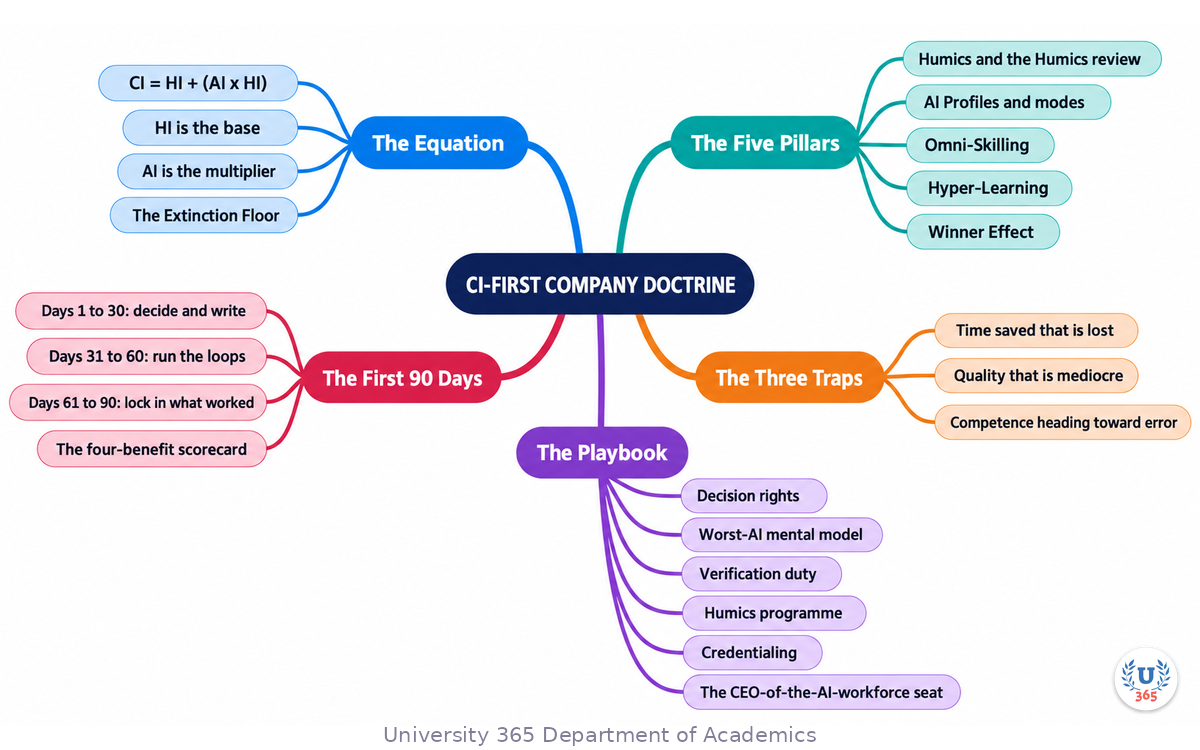
The mindmap gathers this masterclass into one view: the equation and its readings, the five pillars with one instrument each, the three traps beside the profitability test, the six playbook components, and the 90-day sequence with its scorecard.
UNOP Sound (University 365 Neuroscience Oriented Pedagogy)
Take five minutes to consolidate your memory. Play the isochronous tone track (10Hz alpha frequency) with your eyes closed. Alpha-frequency tones after a learning session support consolidation, helping move what you just learned from short-term to long-term memory.
[Audio player: UNOP Post-Lecture Isochrone (10Hz, 5 minutes)]
Practical Exercise: The Company Readiness Audit
This takes about an hour for one person, or one workshop for a leadership team. Work on your real company, and write the answers down: the record becomes the first page of your doctrine.
Part 1: The equation (15 minutes)
Write your company's HI in one sentence: the judgments your people exercise that no tool makes for you.
Write your AI multiplier in one sentence: what your tools do today, at the quality you get.
Find one place where HI is falling, because reading, analysis or deciding was delegated without control. Name the workflow and the role.
Part 2: The pillars (25 minutes)
For each of the five pillars, write one sentence of current state: where profiles are attributed before work begins, where Centaur and Cyborg modes exist by accident, what competency someone acquired last quarter, what the company unlearned, and where confidence outran verification.
Choose the two pillars with the weakest answers. Those are your first two builds, and they beat a plan that touches all five at once.
Part 3: The traps and the test (20 minutes)
For each of the three traps, find one live example, or state honestly that you cannot find one and say how you looked.
Assemble the profitability view at the coarsest level that is still true: what the program costs per quarter, collaboration and verification time included, and what moved in the four benefits. Where quality and knowledge cannot be cited from a source, write "unknown" rather than a guess.
What to look for
Three findings appear in most first audits. The cost side of the profitability view is larger than anyone assumed, because collaboration and verification time is usually unbooked. The knowledge and skill benefit is the least measured of the four, so the company cannot yet tell whether its people are getting stronger or weaker. And at least one pillar already works in an undocumented way, invented locally by one team: a practice to standardize rather than a gap to fill.
Applied CI-First connection
The audit itself was AI-assisted and obeyed the doctrine: you set the questions, the tool gathered and structured, and you verified what goes into a decision. If a number in the profitability view came from the machine without a source, replace it or mark it unknown. That act is the doctrine in miniature.
Glossary
Term | Definition |
CI-First (Co-Intelligence First) | The University 365 doctrine: always invite AI, and keep Human Intelligence as the ruler and orchestrator. |
Co-Intelligence (CI) | Human Intelligence and Artificial Intelligence working together, with the human in control; named by Ethan Mollick in 2024. |
Human Intelligence (HI) | The biological capacity for critical thinking, original intent, decision-making, sensitivity, and ethical judgment. |
Artificial Intelligence (AI) | The digital multiplier of processing speed and data synthesis. |
CI = HI + (AI x HI) | The doctrine's equation: the human contribution stands alone, and AI multiplies it without replacing it. |
Extinction Floor | The state in which HI approaches zero, so that even very powerful AI returns a Co-Intelligence near zero. |
Superhuman | A person whose cognitive, creative, ethical, and strategic capacities are measurably amplified by Co-Intelligence, while remaining decisively human. |
Humics | Pascal Bornet's term for the uniquely human capabilities, particularly creativity, critical thinking, and social authenticity, which AI cannot supply. |
AI Obesity | Cognitive atrophy that follows over-delegation of thinking to AI. |
AI Profile | One of five roles an AI may take on a task: Co-Creator and Thought Partner, Co-Worker and Assistant, Coach and Tutor, Analyst and Tester, Challenger and Devil's Advocate. |
Centaur mode | Clear division of labor: the human handles strategy, empathy and final judgment, and delegates processing and drafting to AI. |
Cyborg mode | A deeply intertwined process of continuous co-creation, in which human and machine iterate rapidly in real time. |
Executive Safeguard | The standing mental model: always assume you are working with the worst AI available. |
Omni-Skilling | Acquiring, through orchestration of AI, knowledge domains and skills a person does not biologically possess. |
Hyper-Learning | The permanent posture of testing prompts, evaluating models, and refining the approach, without an end date. |
Inner peace (Quiet Ego, Quiet Mind, Quiet Body) | The baseline of psychological stability the canon requires for effective iteration and unbiased judgment. |
Winner Effect | The neurochemical surge in confidence and risk-taking that follows amplified success; unmanaged, it leads to hubris and hallucination blindness. |
p-power / s-power | Personal power balanced against social responsibility, the balance the doctrine trains in leaders. |
Profitability (CI) > Profitability (HI) | The canon's economic test: AI use is justified when its return beats what the work returned without it. |
The four benefits | Time, Quantity, Quality, and Knowledge and Skill: the measurable returns of Co-Intelligence. |
AI usage illusions | The three imposture traps: saved time that is lost, quality that is mediocre, and competence heading toward error unnoticed. |
5M2S | 5 Minutes to Success, University 365's microlearning format. |
Quiz: TEST YOUR UNDERSTANDING
1. In the equation CI = HI + (AI x HI), what happens when HI falls but AI stays the same or grows?
A) CI stays stable because AI is the multiplier
B) CI falls, because the human base multiplies everything, and can reach the Extinction Floor
C) CI rises, because faster tools compensate
D) CI is unaffected; the equation measures tools, not people
2. What does the canon say a company that only raises AI can achieve?
A) It can exceed its own HI indefinitely
B) It cannot rise above its own HI, and eroding HI moves the result backwards
C) It becomes Superhuman if it buys enough tools
D) It reaches the Extinction Floor only if it buys too few tools
3. Which of these is one of the three AI usage illusions?
A) The illusion that AI is expensive
B) The illusion of saving time when time is lost
C) The illusion that humans are faster than machines
D) The illusion that models improve over time
4. What is the Executive Safeguard?
A) A security policy for company data
B) The rule that a second AI model verifies the first
C) Always assume you are working with the worst AI available
D) A committee that approves AI purchases
5. Which four benefits make up the profitability test?
A) Speed, cost, scale, and brand
B) Time, Quantity, Quality, and Knowledge and Skill
C) Adoption, satisfaction, retention, and revenue
D) Accuracy, latency, uptime, and security
Answers: 1-B, 2-B, 3-B, 4-C, 5-B
Related Resources
U365 INSIDE Publications
Lecture: The CI-First Workflow: Applied to Any Field: the six-stage workflow for one real task.
Lecture: Building an AI-First Company Culture: the AI-First doctrine stated fairly, and the culture work that surrounds it.
Book Essential: Co-Intelligence by Ethan Mollick: the source of the Co-Intelligence term and the Centaur model.
Book Essential: Irreplaceable by Pascal Bornet: the source of the Humics.
Lecture: The ROI of AI: Measuring What Matters: how to instrument the four benefits in practice.
Lecture: Ethics and AI: A Practical Framework for Every Field: the governance questions this doctrine inherits.
External Resources
AI FIRST: The Playbook for a Future-Proof Business and Brand, Adam Brotman and Andy Sack, Harvard Business Review Press, 2025: the AI-First doctrine this lecture answers.
One Useful Thing, Ethan Mollick: ongoing writing on working with AI, from the researcher who named Co-Intelligence: oneusefulthing.org
Pascal Bornet, who coined the Humics: published work on human capability in the age of AI: pascalbornet.com
Stanford AI Index Report: annual, source-linked measurement of AI progress and adoption: aiindex.stanford.edu
Microsoft WorkLab: AI at work is here. Now comes the hard part: research on how organizations actually adopt AI assistance: microsoft.com
Deloitte: Tech Trends: annual analysis of enterprise technology adoption, including the pilot-to-production gap: deloitte.com
Related U365 Lectures
The CI-First Workflow: Applied to Any Field (UIT, UIB, UIC, UID, Cross-Institute Series)
Building an AI-First Company Culture (UIB, Leadership Series)
The AI Product Launch: From Code to Market (UIT, UIB, UIC, UID, Cross-Institute Series)
U.Copilot for This Lecture
Discuss this lecture with U.Copilot, your AI chat companion trained on this content.
Copy and paste the following prompt into the U.Copilot chat on university-365.com:
You are U.Copilot for Lectures, an AI chat companion specially trained on University 365 lecture content. You are helping a Fellow who just completed the masterclass "How to Build a CI-First Company", the flagship doctrine lecture of the CI-First Series at University 365. Your role is to help the Fellow apply the CI-First doctrine inside their own organization. You can: - Explain the equation CI = HI + (AI x HI) with the canon's own worked values, and show what each reading means at company scale - Help the Fellow write the decision rights document: what AI may draft, what AI may execute under supervision, and what stays human - Work through the five pillars for their team, one at a time, with the concrete instrument for each - Audit their organization for the three AI usage illusions, and build the profitability view: the four benefits against the real costs, including collaboration and verification time - Design the Humics development program, the competency and credentialing layer, and the CEO-of-the-AI-workforce role at both the individual and the company level - Build the 90-day plan with its four-benefit scorecard, and challenge any metric that measures usage instead of profitability Always maintain U365's CI-First approach: Human Intelligence is the ruler and the orchestrator, AI is the amplifier, and the named human owns every output. Never present an unverified figure, model capability, or vendor claim as fact. Distinguish clearly between doctrine, measurement, and illustration. Use the UP-Context Method: provide context-rich, role-aware responses that account for the Fellow's company size, sector, and stage of adoption.
Next Steps
Name the doctrine owner this week. One executive with the standing to refuse, before any tool decision.
Write the decision rights document, in the three levels, and publish it internally even while it is imperfect.
Set a baseline on two workflows before you change anything, so the four benefits have something to move against.
Run the Company Readiness Audit from the Practical Exercise with your leadership team, and keep the written answers as the first page of your doctrine.
Schedule the quarterly profitability review with the four benefits and their sources, and retire anything the scorecard cannot defend.
The tools will keep changing, quarterly and faster. The doctrine is what survives them: invite AI everywhere, keep the human in the ruler's seat, raise the base as deliberately as the multiplier, and test every claim of improvement against the four benefits. Build the company that way and the machine stays what the doctrine says it is: the amplifier of work your people are proud to sign.
IMPORTANT NOTICE
This lecture is published by University 365 as part of its INSIDE Publications Hub. The content is free to read for all visitors. Lectures in this series may be part of a structured academic program leading to a Micro-Credential for your Career (MCC). To enroll in an academic program, visit university-365.com/tuition.
This content is for educational purposes. AI tools, model capabilities and platform policies develop quickly. Verify current specifications, vendor terms and any regulatory requirement against the primary sources linked above before relying on any governance or workflow in production.
Copyright University 365, Inc. All rights reserved. This content is protected under University 365's copyright policies. For permissions or inquiries, contact uda@university-365.com.
Published by the Department of Academics, University 365.
Lecture delivered by the UIT, UIB, UIC, UID in collaboration.
Martin Swartz, Dean of Academics, UDA
Signed for the academic year 2026.




Comments