
AI for Personal Branding: Design, Content, and Strategy



UIC, UID Cross-institute lecture
Series Cross-Institute Series | Level Basic (Free)
Duration 15 to 20 minutes | Access Free
Delivering institutes: UIC (Institute of Communication); UID (Institute of Design)

UNOP Sound (University 365 Neuroscience Oriented Pedagogy)
Take five minutes to prepare your brain. Play the isochronous tone track (40Hz gamma frequency) with your eyes closed. Gamma-frequency tones before a learning session raise attention and make the material easier to absorb.
[Audio player: UNOP Pre-Lecture Isochrone (40Hz, 5 minutes)]
In this Lecture

The Hook: The Profile That Says Everything and Nothing
Two consultants, same field, same quality of work. Both ask an AI assistant to write their professional profile.
The first gets back a confident paragraph about being a "passionate, results-driven professional with a proven track record of delivering value." It matches the voice of ten thousand other profiles. It is grammatically perfect and completely invisible. Six months later, her inbound inquiries are still near zero.
The second spends twenty minutes before writing anything: she lists the three things she wants to be called for, and one thing she refuses to be called for. She picks a visual identity: two colours, one typeface, one layout for a post image. She sets a content rhythm she can hold: one substantive post a week. Then she uses AI the way it is good at: turning her notes into drafts, her drafts into variants, her variants into a schedule. Her profile says less than the first one. People remember it.
Personal branding is not self-promotion at scale. It is the deliberate narrowing of what you are known for, executed with consistent design and consistent publishing. AI makes that cheaper at every stage, and it also makes inconsistency faster: a dozen generated posts with no visual system and no voice pattern read as noise.
This lecture crosses two institutes because the discipline does: design owns what the system looks like, communication owns what it says and where it lands. You need both halves, and you can run both yourself if you sequence them.
Step 1: Decide What You Want to Be Known For
Before a single post, answer one question in writing: what do you want to be called for by the people who matter?
Choose three themes. Not one: one theme makes you a one-topic account, and the moment the market moves you have nothing. Not ten: ten themes make you indistinguishable. Three themes, each defensible from your actual work, gives you range with identity.
Choose the one thing you refuse. This is the most useful constraint in the whole exercise. "I will not be the account that posts motivational quotes." "I will not chase every trend." "I will not post about client work without permission." The refusal keeps a brand coherent at month six, when the easy content temptation arrives.
Name the audience concretely. Not "professionals," but "heads of marketing at mid-sized SaaS companies preparing a first AI rollout." A concrete audience changes every downstream decision: what an example looks like, which platforms matter, what level to write at.
Write the promise. One sentence, in your own words, that a stranger could repeat after reading your profile once. If you cannot write it, the themes are not decided yet.
Where AI helps here, and where it must not. An effective use: ask a model to interview you Socratic-style on your experience, then cluster your raw answers into candidate themes. A forbidden use: asking a model to pick your positioning. Positioning is an ownership decision about your professional identity; the machine can organise your material, but the choice carries your name.
Step 2: Build the Visual System First
Visual consistency does more work than visual sophistication. A modest system applied everywhere reads as professional; a beautiful design applied inconsistently reads as a hobby.
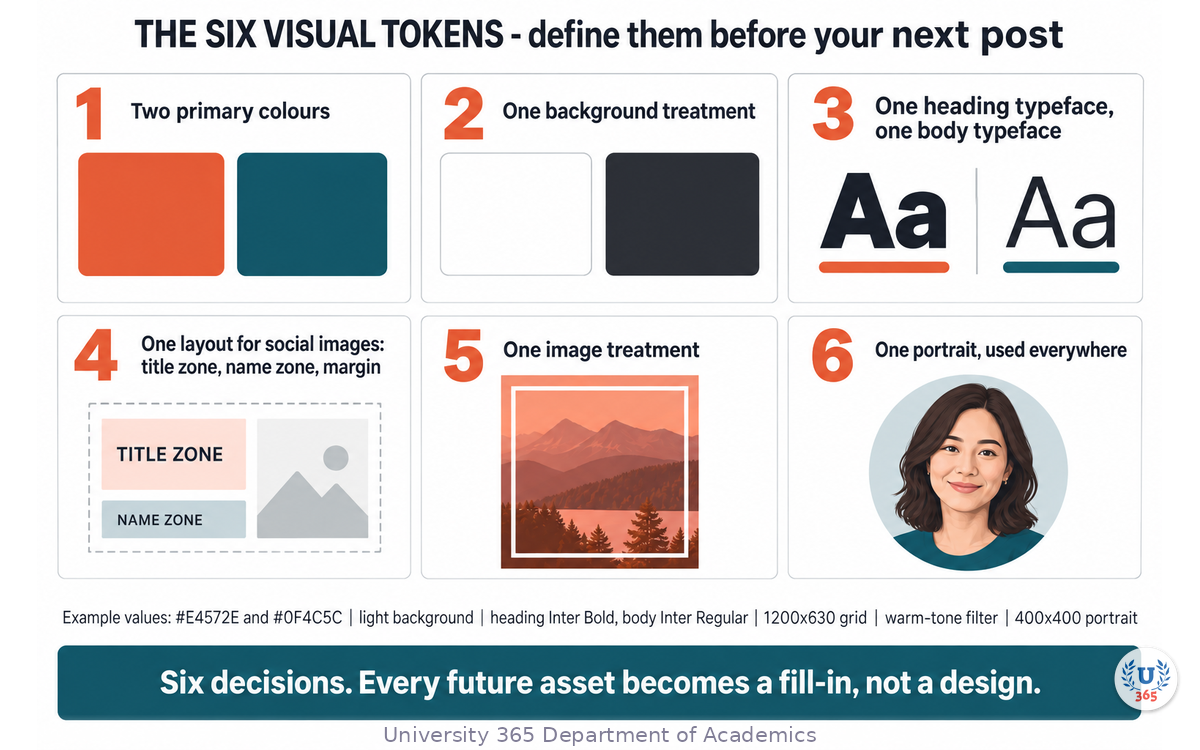
Define six tokens before your next post. These are the decisions that make everything after this step a template rather than a design task:
Two primary colours, with their exact values.
One background treatment: usually light or dark, chosen once.
One typeface for headings, one for body, at two defined sizes.
One layout for social images: where the title sits, where your name sits, how much margin.
One image treatment: the filter, crop ratio, or illustration style every image receives.
One profile portrait, used everywhere, at the required size on each platform.
Then build the template once. A blank post image with the layout, the colours and the placement already in place. From that point, every new visual is a fill-in, not a design.
Where AI helps. Image models generate backgrounds, textures and concept art in your palette. They can also generate variants you would never think of for a layout. Use them against the system: generate ten covers within the same grid and pick the best, rather than generating ten unrelated images.
Where it must not. Do not let a model choose your palette or your typeface. Those two decisions carry the brand's taste, which is the part a client is buying when they hire a designer, and the part a professional is expressing about themselves. AI executes a system; it does not own one.
Accessibility is part of the system, not a review at the end. Check the contrast of text against its background, keep the smallest text legible at the size the platform displays, and make alt text part of the template process. A brand that fails on a phone in bright sunlight is failing at its job.
Step 3: Design the Content Engine
A content engine is a set of repeating formats, each with a stable shape and a renewable source. The shape is what makes publishing sustainable; the source is what makes it substantive.
Choose three to five formats. Each format is a template with a defined structure, so producing an instance is a fill-in. Examples:
The worked example: a real situation, what you did, what happened, what it cost.
The teardown: one artifact (a page, a campaign, a system) analysed against a standard.
The three-lesson note: a project or reading distilled into three transferable lessons.
The answer: a question you were actually asked, answered properly for a wider audience.
The position: a short, specific argument about how your field should work.
Define the source for each format. The worked example draws on recent project notes. The answer draws on your inbox. The position draws on an opinion you already hold out loud. When a format's source dries up, the format is finished: replace it rather than forcing it.
Build a capture habit. Notes from meetings, messages to colleagues, half-thoughts: a single note file where raw material accumulates. The engine turns captured material into published posts; it cannot invent substance that was never captured.
Where AI helps, specifically. Turning notes into a first draft. Expanding one instance into three variants for different platforms. Generating the metadata: titles, alt text, descriptions, tags. Building the calendar: the sequence of formats across a month. Repurposing: a written post into an outline for a discussion, a slide, or a short video script.
Where it must not. Deciding what you think. The position format in particular: the argument has to be yours, or the posts collapse into generic commentary and the audience notices within weeks.
Step 4: Write in a Voice That Is Actually Yours
Voice is the pattern a reader can recognize without seeing your name. It is built from a small number of measurable choices.
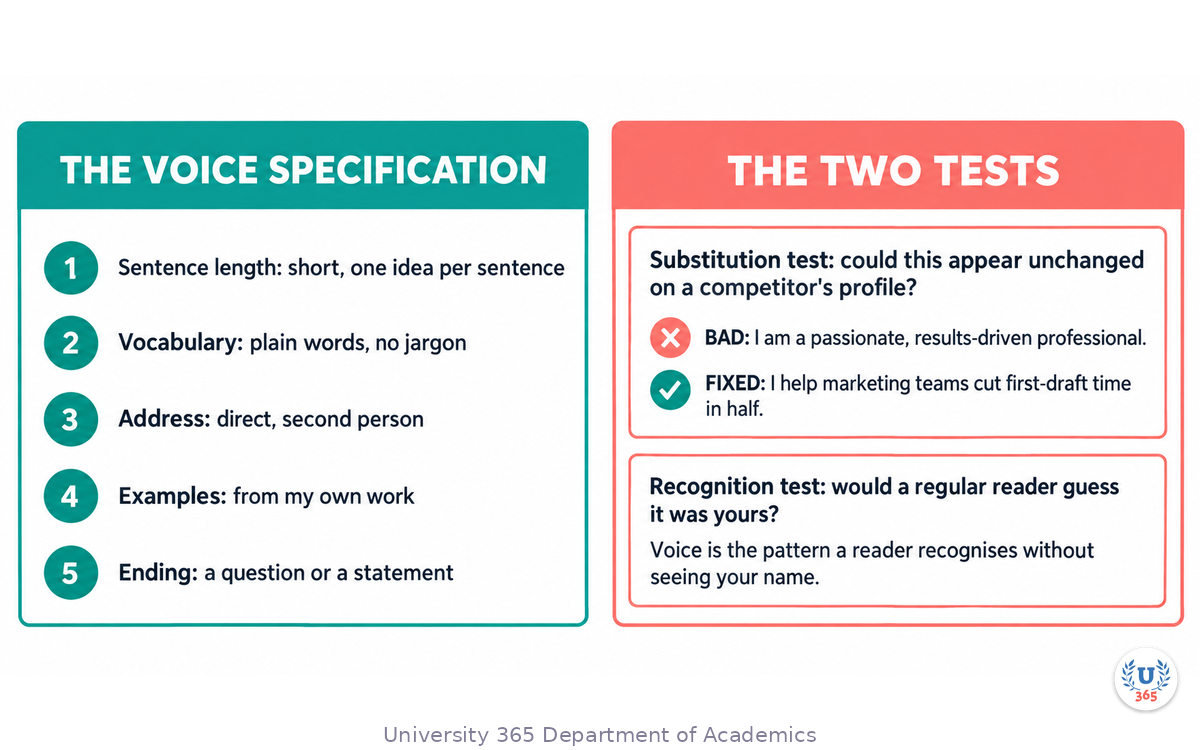
Codify your voice in your own words. Five lines: my sentences are long or short; my vocabulary is plain or technical; I address the reader directly or impersonally; I use examples from my own work or from public sources; I end with a question, a call, or a statement. That page is the specification.
Then train the machine on the specification, not the other way around. A model can produce text that matches a written voice specification closely when the specification exists. It cannot discover your voice from three prompts; it will produce a plausible average of everyone, which is exactly what a personal brand cannot afford.
Two tests for every drafted post. The substitution test: could this sentence appear, unchanged, on a competitor's profile? If yes, it is generic and it goes. The recognition test: would a regular reader, shown the post with the name removed, guess it was yours? If not, one element of the voice specification is not being honoured.
The honesty rules. Everything attributed to you must be true. Experiences are real or they are absent; numbers come from a source; quotations are exact or paraphrased with attribution; other people's words are not presented as your own and, for the writing itself, disclose AI assistance when the platform or the audience's trust requires it. Those rules are not optional, and they are the first thing a model will strain if you let it: it generates confident, well-formed content without regard for what actually happened to you.
Step 5: Publish on a Rhythm You Can Keep
The most common failure in personal branding is not low quality. It is stopping.
Pick a rhythm with slack in it. One substantial post a week beats five posts for a month and silence after. Batch production: write three posts in one sitting, schedule them, and let the engine carry the gaps.
Publish where your named audience already is. Two channels done properly beat five channels done sporadically. Owning one channel fully (a newsletter, a personal site) usually deserves a place, because platform reach is rented.
Use the machine for the repetitive last mile. Scheduling, cross-posting variants, alt text, descriptions, thumbnails, the calendar. This is high-volume, low-risk work: exactly what automation is for.
Keep one human checkpoint. A final read of every post before it publishes, against the two tests from the previous step. The checkpoint takes two minutes per post and it is where the brand is actually protected.
Do not manufacture the crisis. Some weeks there is no post. A quiet week and a strong return is better than a weak post that dilutes everything the system has built.
Step 6: Measure Reach, Track Trust
Two families of numbers matter, and they are not the same family.
Reach numbers are the vanity layer: impressions, followers, likes. They are easy to move and easy to fake, and they are the numbers every dashboard shows first. Watch them, but do not optimise for them.
Trust numbers are the ones that compound: replies and questions from the named audience; direct messages that reference a specific post; inbound inquiries that mention what you wrote; mentions by others in your field; returning readers. These move slowly and predict the outcomes a personal brand is built for.
A monthly review, four questions. Which post produced the most conversations, and why? Which format was hardest to sustain, and should it be replaced? Which theme is getting the most response from the named audience, and should it get more weight? Did the voice hold, measured by the recognition test on a sample?
Iterate one thing per month. A brand that changes weekly is not a brand. One adjustment per month, based on evidence, compounds faster than constant reinvention.
Where Design Ends and Communication Begins
The two halves of this lecture meet at three points, and the handover is where most personal brands break.
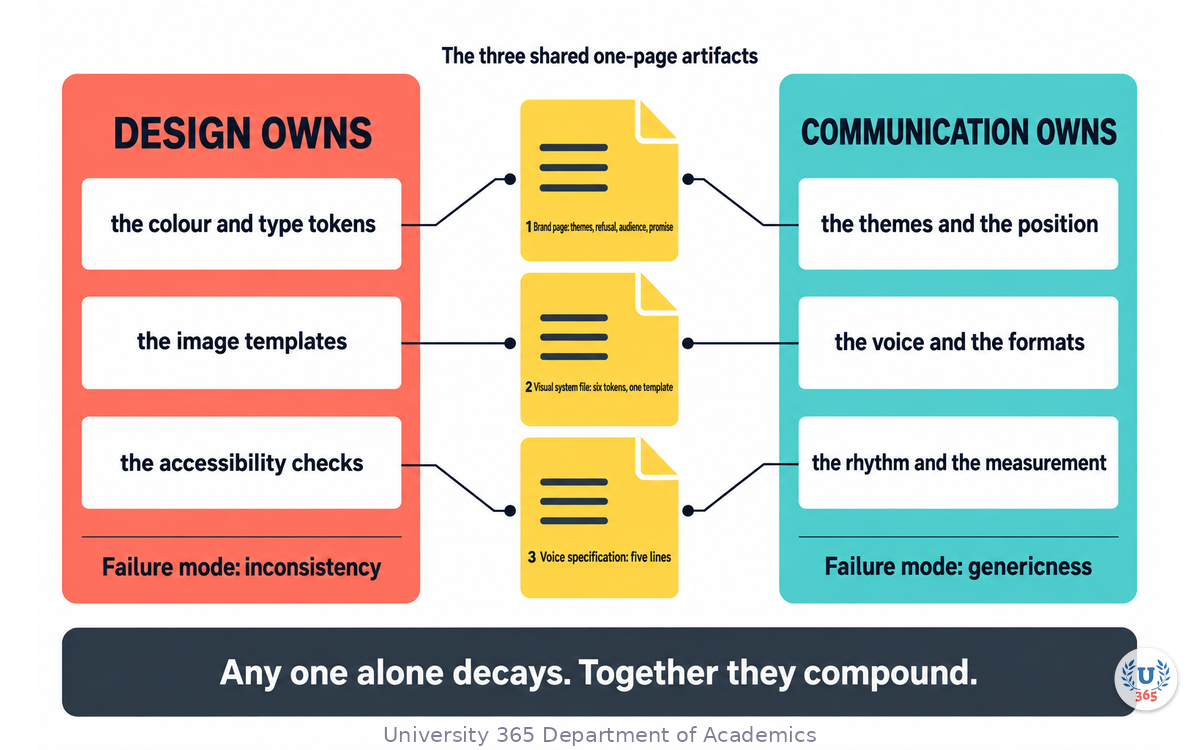
Design owns: the tokens, the templates, the image treatment, the accessibility checks, and the consistency of the visual layer across every surface. Its failure mode is inconsistency: right ideas, unrecognisable execution.
Communication owns: the themes, the voice specification, the formats, the publishing rhythm, the measurement of trust. Its failure mode is genericness: consistent execution of nothing in particular.
The shared artifacts are the brand page (themes, refusal, audience, promise), the visual system file (the six tokens and the templates), and the voice specification. Each is one page. Together they are the entire operating system of a personal brand, and any one of the three can be handed to a collaborator without a meeting.
When design and communication are coordinated, the effect is cumulative: the visual system makes the posts recognisable, the voice makes them yours, and the themes make them worth following. Any one alone decays. Together they compound.
Feynman Summary: Explain It Like You Are 12
Imagine you want people at a big school to know you as the person who fixes bicycles.
If you shout about yourself every day, people stop listening. If you say nothing, nobody knows. Instead, you make three decisions. You pick what you want to be known for (fixing bikes, and also teaching kids to ride). You pick one look for your posters (same colours, same big title, every time). And you post one real story every week: the bike you fixed, the mistake you made, the trick you learned.
Soon, when a bike breaks, people think of you first. You did not get better at bikes by posting. You made the fact that you are good at bikes visible.
The AI robot helps you write the stories, make the posters, and remember to post. But it does not decide what you are known for. That part is you.
Mindmap: The Complete Picture
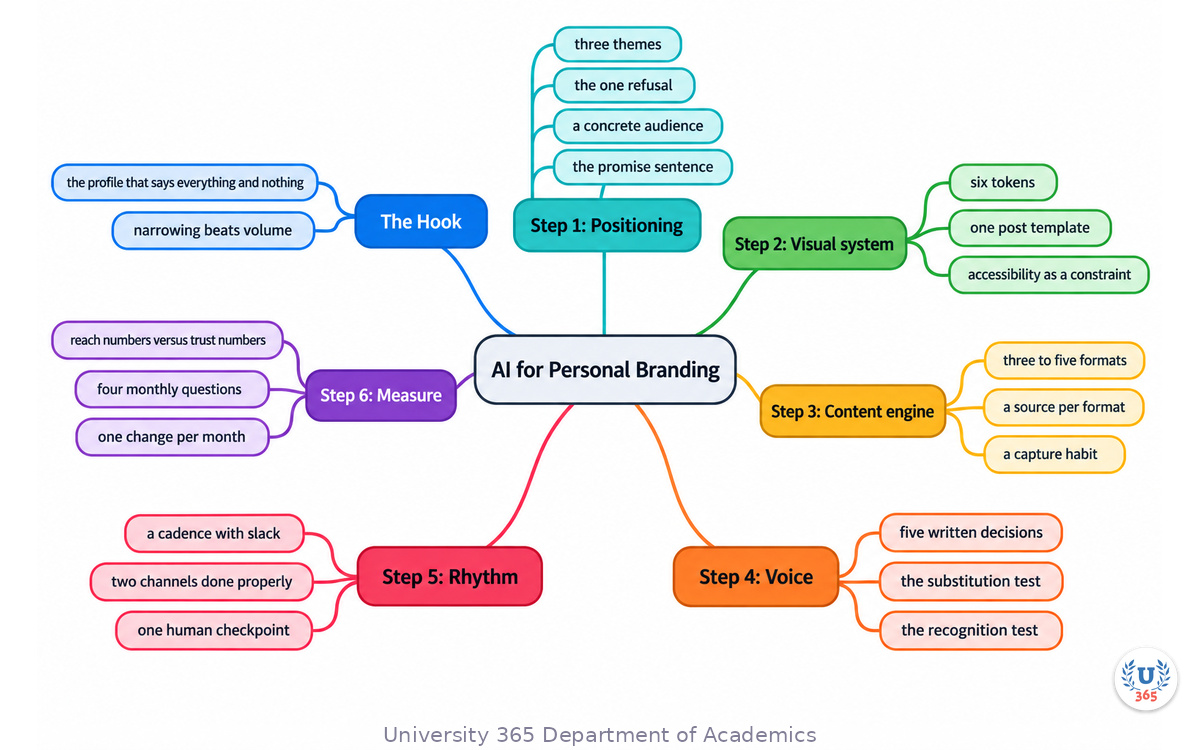
The mindmap gathers the lecture into one view: the six stages, the three shared artifacts at the centre, the visual system on the design side and the voice and rhythm on the communication side.
UNOP Sound (University 365 Neuroscience Oriented Pedagogy)
Take five minutes to consolidate your memory. Play the isochronous tone track (10Hz alpha frequency) with your eyes closed. Alpha-frequency tones after a learning session support consolidation, helping move what you just learned from short-term to long-term memory.
[Audio player: UNOP Post-Lecture Isochrone (10Hz, 5 minutes)]
Practical Exercise: Build Your Own System in One Sitting
Set aside ninety minutes. Produce three pages. This is one sitting, not a project.
Part 1: Positioning (20 minutes)
Write your three themes, each defensible from your real work.
Write the one thing you refuse to become.
Name your audience concretely: role, sector, situation.
Write the promise: one sentence a stranger could repeat after one visit.
Part 2: System (40 minutes)
Choose the six tokens: colours, background, typefaces, image layout, image treatment, portrait.
Build one template: a blank post image with the layout in place.
Write the five-line voice specification.
Choose three formats and name the source for each.
Set the rhythm: what publishes when, with slack.
Part 3: Trial (30 minutes)
Produce one post end to end with the system: a real experience, the template, the voice specification, the machine for the draft.
Run both tests: the substitution test and the recognition test on the finished post.
Schedule it. Note, honestly, how long the whole loop took.
What to look for
The first post takes the longest and teaches the most. Most people discover that the visual template removes two-thirds of the friction, and that the hardest part was the positioning in Part 1. If the positioning took longer than the design, that is normal and correct: the design was executing a decision you had already made.
Applied CI-First connection
You chose the themes, the refusal and the voice: ownership decisions about your own name. The machine carried the drafts, variants, metadata and scheduling: volume work. The profile belongs to the person willing to sign it.
Glossary
Term | Definition |
Personal branding | The deliberate narrowing of what you are known for, executed with consistent design and publishing. |
Positioning | The decision about which themes you own, which you refuse, and for whom. |
Visual tokens | The fixed design decisions (colours, typefaces, layouts) that make every asset recognisable as yours. |
Content engine | A set of repeating formats, each with a stable shape and a renewable source. |
Format | A post template with a defined structure, such as the worked example or the teardown. |
Voice specification | A written page describing the measurable choices that make your writing recognisable. |
Substitution test | Could this sentence appear unchanged on a competitor's profile? If yes, it is generic. |
Recognition test | Would a regular reader guess the author with the name removed? If not, the voice is off. |
Trust numbers | Metrics that predict real outcomes: replies, inbound inquiries, returning readers. |
Reach numbers | Exposure metrics such as impressions and follower counts; easy to move, slow to compound. |
Accessibility (visual) | Making every asset readable for its audience, including contrast, size and alt text. |
Owned channel | A surface you control directly, such as a newsletter or personal site, unlike rented platform reach. |
5M2S | 5 Minutes to Success, University 365's microlearning format. |
Quiz: TEST YOUR UNDERSTANDING
1. What is the recommended number of positioning themes, and why?
A) One, so the account is focused
B) Three: range with identity, without becoming indistinguishable
C) Ten, to cover every interest
D) As many as the AI can generate
2. Which two decisions must NOT be delegated to a model?
A) Scheduling and alt text
B) Titles and descriptions
C) The palette and the typeface, and the positioning itself
D) Drafting and variant generation
3. What is the substitution test?
A) Replacing AI drafts with human ones
B) Checking whether a sentence could appear unchanged on a competitor's profile
C) Checking the reading level of a post
D) Substituting images for text
4. What distinguishes trust numbers from reach numbers?
A) Trust numbers are shown first on dashboards
B) Trust numbers are easy to fake
C) Trust numbers predict real outcomes and move slowly; reach numbers are exposure metrics
D) There is no difference
5. What are the three shared one-page artifacts of the system?
A) The logo, the website and the business card
B) The brand page, the visual system file and the voice specification
C) The calendar, the dashboard and the archive
D) The portfolio, the resume and the testimonial page
Answers: 1-B, 2-C, 3-B, 4-C, 5-B
Related Resources
U365 INSIDE Publications
Lecture: Brand Voice in the AI Era: training AI on brand guidelines and detecting voice drift
Lecture: AI for Social Media Strategy: campaign structure, scheduling and measurement
Lecture: Generative Brand Identity: building a complete visual identity system
Lecture: AI in Web Design: From Wireframe to Deployed Site: turning the visual system into a home
External Resources
Sprout Social: Personal branding guide: practical positioning and platform guidance: sproutsocial.com
Seth Godin's Blog: a working example of a consistent voice and publishing rhythm: seths.blog
Stanford AI Index Report: source-linked measurement of AI capability and adoption: aiindex.stanford.edu
Related U365 Lectures
Lecture 1: The CI-First Workflow: Applied to Any Field (UIT, UIB, UIC, UID, Cross-Institute Series)
Lecture 4: The AI Product Launch: From Code to Market (UIT, UIB, UIC, UID, Cross-Institute Series)
Lecture 5: Ethics and AI: A Practical Framework for Every Field (UIT, UIB, UIC, UID, Cross-Institute Series)
U.Copilot for This Lecture
Discuss this lecture with U.Copilot, your AI chat companion trained on this content.
Copy and paste the following prompt into the U.Copilot chat on university-365.com:
You are U.Copilot for Lectures, an AI chat companion specially trained on University 365 lecture content. You are helping a Fellow who just completed the cross-institute lecture "AI for Personal Branding: Design, Content, and Strategy". Your role is to help the Fellow build their personal brand system. You can: - Interview them Socratic-style and cluster their experience into candidate themes - Help them write the promise sentence and name their audience concretely - Help define the six visual tokens and build one post template - Turn their captured notes into format-shaped drafts in their own voice specification - Build a publishing calendar they can sustain - Define the trust measurements and the monthly review Always maintain U365's CI-First approach: the positioning, the themes and the voice belong to the human, and AI accelerates drafting, variants, metadata and scheduling. Never present an unverified statistic, experience or quotation as fact. Use the UP-Context Method: provide context-rich, role-aware responses that account for the Fellow's field, seniority and platform.
Next Steps
Write the three pages this week: positioning, visual system, voice specification.
Build the post template before your next post, and use it.
Produce one post end to end and run both tests before scheduling it.
Set the rhythm with slack and batch three posts in one sitting.
Start the monthly review with the four questions and change one thing.
The machine can write a thousand sentences for you, and none of them will tell anyone who you are. The system does that. Build the system first, then let the machine keep it running.
IMPORTANT NOTICE
This lecture is published by University 365 as part of its INSIDE Publications Hub. The content is free to read for all visitors. Lectures in this series may be part of a structured academic program leading to a Micro-Credential for your Career (MCC). To enroll in an academic program, visit university-365.com/tuition.
This content is for educational purposes. Platform features, image models and disclosure requirements develop quickly. Verify current specifications and platform rules against the primary sources linked above before relying on any practice in your professional context.
Copyright University 365, Inc. All rights reserved. This content is protected under University 365's copyright policies. For permissions or inquiries, contact uda@university-365.com.
Published by the Department of Academics, University 365.
Lecture delivered by the UIC, UID in collaboration.
Martin Swartz, Dean of Academics, UDA
Signed for the academic year 2026.




Comments