
Synthetic Media and Provenance: C2PA, Watermarks and Trust


UIC University 365 Institute of Communication
Series Media Studies
Duration 25 minutes
Digital Communication, Marketing, Branding, Content Strategy, Media Studies

UNOP Sound (University 365 Neuroscience Oriented Pedagogy)
Take five minutes to prepare your brain. Play the isochronous tone track (40Hz gamma frequency) with your eyes closed. Gamma-frequency tones before a learning session raise attention and make the material easier to absorb.
[Audio player: UNOP Pre-Lecture Isochrone (40Hz, 5 minutes)]
In this Lecture


Synthetic Media and Provenance: C2PA, Watermarks and Trust
The Campaign That Looked Fake by Lunchtime
Consider a campaign that runs exactly as designed. A beauty brand shoots three product stills and generates two more with an image model, then retouches all five in a studio. The files leave the studio carrying Content Credentials: a signed record that names the generator, lists the editing steps and identifies the signer. The brand discloses the AI work in the caption. On paper, this is the compliant campaign.
By the next afternoon the credentials are gone. A retailer pulls the images from the brand site, resizes them for a product grid and re-uploads them. A magazine takes a screenshot for a trend piece. A creator reposts the screenshot on three platforms. Each of those steps re-encodes the file, and the signed record does not survive the trip. A fact-checker emails the brand and asks for proof that the two models do not exist. The brand owns the originals, a shared drive and a campaign brief. It cannot show a stranger that the files it holds are the files it published.
This lecture is about that gap. The tooling for provenance is real and improving: C2PA Content Credentials, invisible watermarks, perceptual fingerprints and, since 2026, a European legal duty to mark synthetic output. The hard part is not creation. The hard part is delivery. A signal that exists at the moment of creation has to survive editing, platform upload, screenshot, repost and recompression before it can help a reader, and most signals do not.
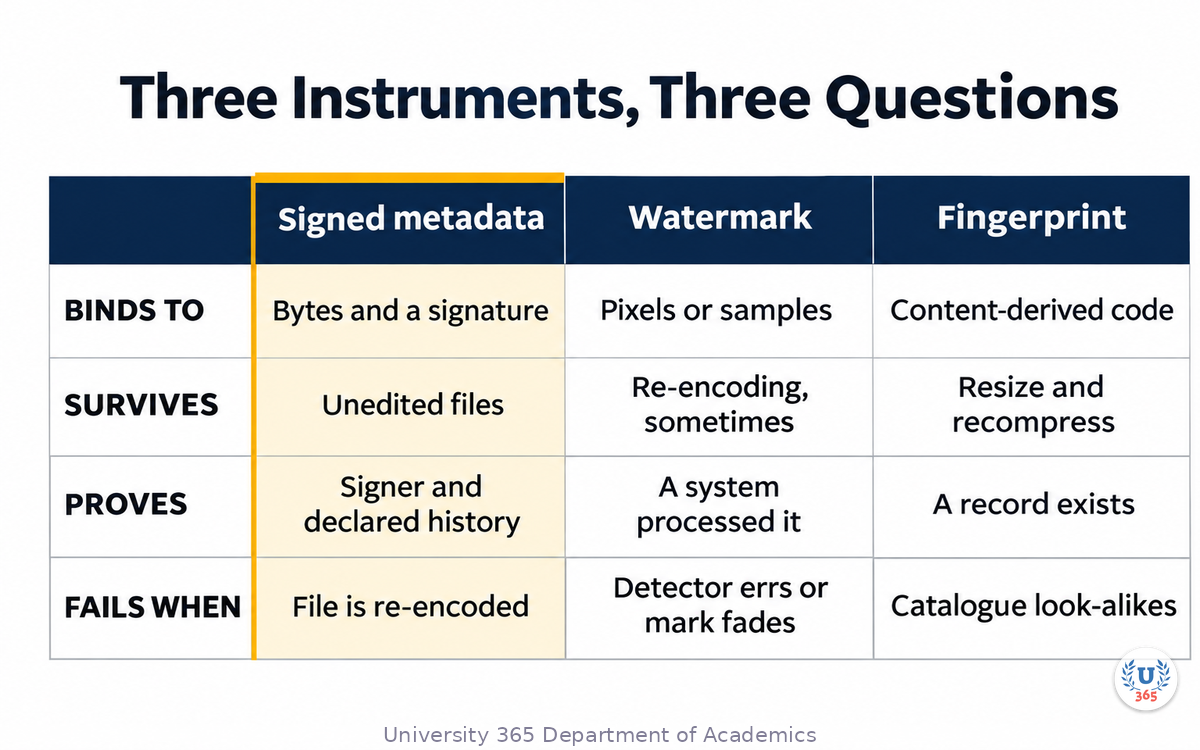
Three instruments answer three different questions, and confusing them is the most common mistake in this field:
Signed metadata answers: are these the bytes that this signer signed, and what does the record say happened?
A watermark answers: did a specific generator, or a specific licensee, embed a signal in this content?
A fingerprint answers: have I seen this content before, and is there a record attached to it?
The reader's question is a fourth one: should I believe what I am looking at? No single instrument answers it. This lecture teaches what each one can carry, how each one fails, what European law now requires of the team that publishes the content, and a checklist you can run across one campaign this quarter.

Synthetic Media and Provenance: C2PA, Watermarks and Trust
What a Content Credential Proves
A Content Credential is a signed record attached to a file. The technical name is a C2PA manifest. The coalition behind it, the Coalition for Content Provenance and Authenticity, publishes the specification; version 2.4 appeared on 21 April 2026, after 2.3 in January 2026 and 2.2 in May 2025. The specification is open, and a conformance program tests whether products create, read and validate credentials in the same way.
The structure is easier to hold in your head as four parts.
The claim. A statement of what the manifest is about: the asset, the format and the signer's identity claim.
The assertions. The statements that make up the history. A typical set records the tool that produced the asset, the actions performed (captured, converted, cropped, color adjusted, composited), the ingredients that went into it, and the assertions the creator chose to add, such as a training and data mining preference or a note that the content is synthetic.
The hard binding. A cryptographic hash of the asset as it stood when the manifest was created. This is the part that makes tampering visible. Change one byte of the signed payload and the hash no longer matches, so a validator reports the credential as invalid.
The signature and trust. The manifest is signed, usually with a certificate that chains to a certificate authority, and validators compare the signer against a trust list. A valid signature proves that a key signed this manifest. The trust list decides whether that key belongs to someone the validator is willing to name.
Everything else in the standard supports those four parts: how assertions are serialized, how manifests nest when a file is edited repeatedly, how an ingredient's own manifest is carried forward, how a validator should report a credential that is present but untrusted, and how soft bindings allow a manifest to be recovered after re-encoding.
The important discipline is to read a validation result precisely. A credential marked valid says: these bytes match a manifest that was signed by a key on the trust list, and the recorded history is internally consistent. It does not say that the scene happened, that the people exist, that the caption is accurate, or that the publisher is honest. A camera can sign a staged photograph. A studio can sign an image generated from a prompt and label it as a capture if it configures the tool badly or lies. The signature protects the record, and the record is only as good as the person who made it.
This distinction is why provenance and authenticity are separate goals. Provenance gives you a history with a responsible party attached. Authenticity is a judgment about truth, and it remains a human judgment.

Synthetic Media and Provenance: C2PA, Watermarks and Trust
Where Manifests Disappear
A signed manifest lives inside the file, in a metadata box. Most image pipelines were written before that box existed. When a platform re-encodes an upload to save bandwidth, resize it for several viewports or transcode it to a cheaper codec, unrecognized metadata is usually discarded. The behavior is not hostile. It is the default of encoders that drop ancillary data they do not understand.
The measured result is severe. The AFIP metadata stripping study, first published in January 2025 and updated in July 2026, uploaded signed images to six platforms and downloaded the copies those platforms served. C2PA manifests were fully stripped in five of the six cases. Facebook preserved something in about 40 percent of cases, and only for images uploaded through creator-designated flows; consumer re-shares stripped the credentials.
A separate test published in October 2026 reached a bleaker result across a wider set. Narqo posted three test images to eleven platforms and messengers and read the served copies. None of the eleven kept Content Credentials. Three of the eleven displayed an AI label somewhere in the interface: X, Facebook and Pinterest. Instagram and Threads kept the simpler IPTC "made with AI" label inside the file but showed viewers nothing. Every platform re-saved the image; Telegram compressed a 374 KB test file to 126 KB.
Academic measurement points the same way. A 2026 dataset paper on GPT-image-2 images collected from X found that the platform's CDN strips all embedded metadata on upload, leaving a bare JPEG with no EXIF, XMP or C2PA markers, while a platform-side "Made with AI" badge appeared on 53.7 percent of the uncertain posts the authors checked. The paper treats the stripping as a negative result for credential-based attribution on social platforms.
Three lessons follow.
First, conformance is a producer property. Survival is a delivery property, and nobody certifies delivery. A product can pass every conformance test and still put an image in front of readers with no credential attached, because the last step in the chain removed it.
Second, the absence of a credential is not evidence of anything. It can mean the content was never signed, or that the sign was stripped, or that the platform cached a copy from before signing. Any policy that treats "no credential" as "suspicious" will generate a large number of false alarms on legitimate content.
Third, the highest-value verification happens close to the source. A newsroom that receives a file directly from a photographer can validate the credential and record the result. A reader who receives a screenshot cannot. The further the file travels from the signer, the weaker the evidence, and the more the verification depends on the verifier's own records.
For a communication team, this argues for keeping the signed original under your control, publishing a first-party record that anyone can consult, and treating every downstream copy as unverified by default.

Synthetic Media and Provenance: C2PA, Watermarks and Trust
Watermarks: The Second Layer and Its Limits
A watermark is a signal embedded in the content itself. The generator modifies pixels, audio samples or token choices according to a key, and a detector that holds the key can read the signal back. Because the signal lives in the content rather than in a metadata box, it can survive operations that destroy a manifest.
Google's SynthID is the largest deployment. The SynthID-Image paper published in October 2025 describes a system that had already watermarked more than ten billion images and video frames, and it documents the design constraints of running a detector at internet scale: fidelity, robustness, false positive control and resistance to removal. Google exposes a SynthID Detector portal, and Gemini will check an uploaded image, video or audio clip for the watermark when you ask it to.
The open tooling has grown in parallel. C2PA maintains a list of soft binding methods that a validator may use to recover a manifest after re-encoding; at a snapshot taken in September 2026 the list held 53 entries, 44 watermarks and 9 fingerprints. Open models include TrustMark, PixelSeal, AudioSeal and Video Seal. Each has a different trade-off between payload size, visual fidelity, speed and robustness.
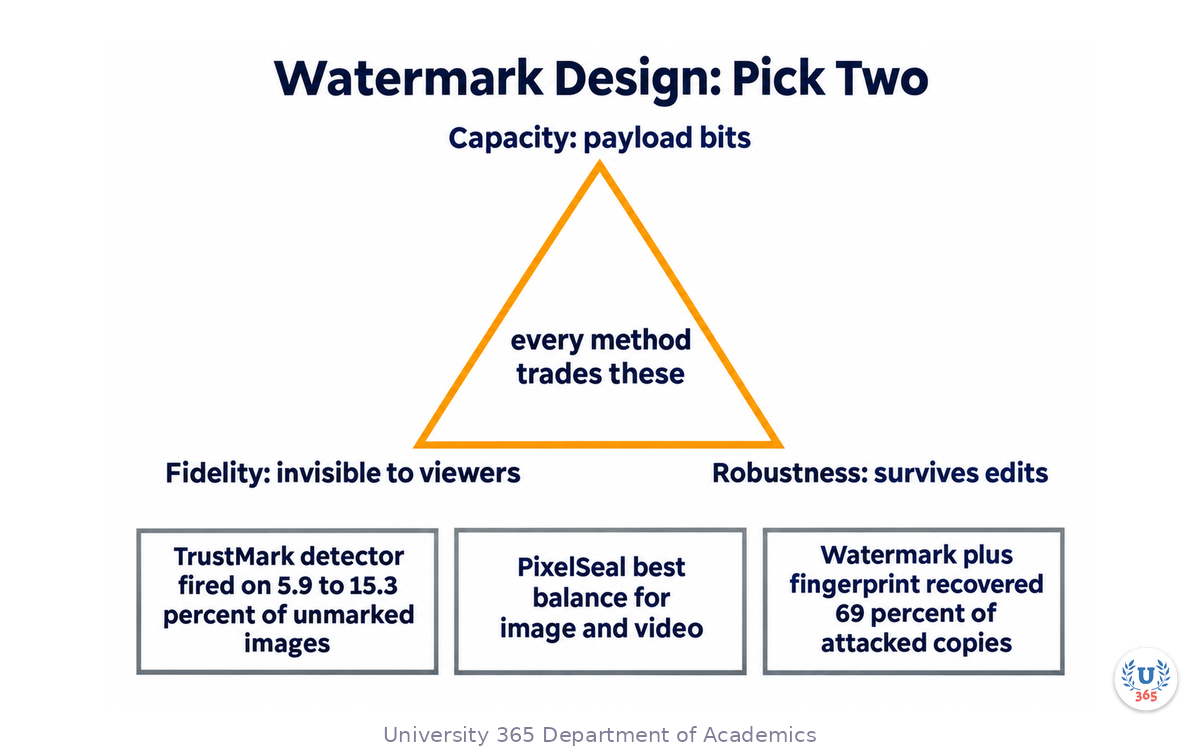
The trade-offs are the part most teams skip. A benchmark published in October 2026 evaluated 25 image, 7 audio and 7 video watermark configurations from 12 methods, with false-match rates calibrated on held-out negatives. Four findings matter for practice.
A detector can fire on unmarked content. The error-correcting detector of every TrustMark variant tested fired on 5.9 to 15.3 percent of unmarked images. A verifier that accepts any positive signal without checking the expected payload will report false provenance at a rate that makes the signal useless in a dispute.
Robustness is method-specific. PixelSeal gave the best balance for image and video watermarks and AudioSeal for audio in that benchmark. No single method won everywhere.
Transformation changes the signal. Embedding a watermark moved the ISCC code of 62 percent of images past its match threshold, which means the watermark and the fingerprint can disagree about whether two files are the same content. Platform-dependent color conversion changed watermark bits between x86 and ARM hosts in the same test. A detector that works on your laptop may not work on the platform's server.
Coverage is partial. Even when the benchmark combined watermarks and fingerprints, the union of successes covered 69 percent of attacked image copies. A third of the copies carried no recoverable signal from either family.
Watermarking text is harder than watermarking pixels. The European Commission's own summary of the Article 50 marking duty notes that robust text marking remains an open technical issue, and the Code of Practice allows a single marking layer for free-form text rather than the two layers expected for images, audio and video. If your campaign includes long AI-generated copy, do not assume a watermark is available.
The practical rule: a watermark is evidence that a specific system processed the content, not evidence about what the content depicts, and a negative result from one detector is weak evidence that no watermark exists.

Synthetic Media and Provenance: C2PA, Watermarks and Trust
Fingerprints and the Recovery Path
A fingerprint is computed from the content. A perceptual hash reduces an image to a short code that stays similar when the image is resized, recompressed or lightly edited. A registry maps that code to a record: the original file, its manifest, the campaign, the client, the license.
The fingerprint is the recovery path for a stripped manifest. C2PA calls this a soft binding: the credential is gone, but the content still matches a record, and the record can be looked up. The AFIP study found that perceptual hashes survived platform upload in 93.6 to 98.9 percent of cases across the six platforms it tested, against zero percent for the manifest on five of them. That gap is the argument for running both.
Fingerprints have their own failure modes, and they are different from a watermark's.
False matches cluster in catalogues. The October 2026 benchmark found that near-copies in a product catalogue dominated false matches for fingerprint matching. Beauty, fashion and consumer goods are exactly the categories where many images look alike, so a threshold tuned on news photography will misfire on your product grid.
Detection rates depend on the transformation. Fingerprint detectors trained on non-commercial data detected up to 75.5 percent of transformed images at a pair-level false-match rate of one in ten million; DINOv2, the best permissively licensed method in that benchmark, reached 65.0 percent. Those are good numbers for a registry lookup and not good enough to settle a dispute alone.
A fingerprint identifies content, not authorship. It tells you that this file matches a record you or someone else registered. It does not tell you who created the original, whether the record is accurate, or whether the person who registered it had the right to.
For a communication team, the useful pattern is a campaign registry. Register every approved asset at the moment it is approved, store the fingerprint next to the manifest hash and the signed original, and use the registry for three jobs: matching reposts back to your campaign, supporting takedown requests with a verifiable record, and answering a journalist's question with a lookup rather than an assurance.
The registry only works if it is maintained. A fingerprint registered after a crisis is worth little; the value comes from the record existing before anyone asks.

Synthetic Media and Provenance: C2PA, Watermarks and Trust
When the Signature Lies
Nothing in the previous sections matters if the signature itself can be bypassed, and in 2026 two independent lines of research showed that it can.
The first is a formal security analysis of C2PA versions 2.2 to 2.4, published in 2026 by Golaszewski and co-authors. The paper reports three findings. Conforming validators are not required to check certificate revocation, so an adversary holding a compromised key can keep signing after the key should have been distrusted. Timestamps can be replaced because the cryptographic binding around them is inadequate. And the conformance program has gaps that allow conforming validators to return contradictory results on the same asset. The authors note that version 2.3 and the Pixel 10 implementation incorporated some of their suggestions, and that version 2.4 did not address the concerns they raised.
The second is a demonstration published in October 2026 by security researcher David Buchanan. The specification permits a signer to declare byte ranges excluded from the signature calculation. Buchanan showed that a signer can exclude an entire file, produce a valid timestamp over an empty string, and then alter the image afterwards without invalidating the signature or the timestamp as current tools check them. A complete fix is complex because the exclusion feature exists for legitimate format reasons.
Neither finding means that Content Credentials are useless. They mean that a valid credential is a narrower claim than most people assume. It says: at the time of signing, a key on the trust list signed a manifest whose hash matched these bytes. It does not say that the key was uncompromised, that the timestamp is honest, that the validator you used checks revocation, or that the signer is the party you think.
Three operational consequences follow.
Check revocation, and record that you did. If your validator does not check revocation by default, the credential status you report is incomplete. Ask the vendor, test with a revoked certificate, and log the result.
Log the validator and its version. When two validators disagree, the disagreement is the finding. A dispute file that records the tool, version, date and result is more useful than a screenshot of a green check.
Do not present a green check as a truth verdict. The interface convention of a verified badge invites readers to conclude that the content is true. Your copy should say what was verified: the file matches a signed record from this signer, and the edits listed are those the signer declared.
The broader lesson is that provenance systems are security systems, and security systems are attacked. A team that adopts provenance without a threat model will overstate what it has.

Synthetic Media and Provenance: C2PA, Watermarks and Trust
Detection Is a Probability
Most teams meet this field through a detector: upload an image, receive a percentage, decide whether to publish. That workflow is where most reputational damage happens, in both directions.
Detection models are classifiers trained to separate generated from captured content. They perform well on the distribution they were trained on and degrade when the generator changes, when the image is compressed, when it is cropped, or when it passes through an image-to-image model that rewrites the pixels. The 2026 watermark benchmark is a useful reminder that even a purpose-built signal reader can fire on 5.9 to 15.3 percent of unmarked images. A general detector without a calibrated false-positive rate is weaker evidence than that.
A workable policy separates three verdicts:
Evidence of synthetic origin. A watermark from a known generator reads correctly, or a manifest declares a generative action, or a detector with a calibrated threshold reports a positive result. Record which of the three.
Evidence of manipulation. A manifest is present but invalid, or the hash does not match, or the recorded action history contradicts the published caption. This is often more actionable than a synthetic-origin verdict because it concerns a file you can trace.
No evidence either way. This is the majority outcome, and it must be stated as such. Absence of a mark is not evidence of authenticity.
Three rules keep the workflow honest. Use two independent methods before you make a public claim, because the failure modes of a watermark, a fingerprint and a classifier are not correlated. Record the tool, version, threshold and date in the same file as the asset. And route every consequential decision to a human who can weigh context, because a percentage is not a finding.
The asymmetry matters for communication work. Calling a real photograph synthetic is a reputational attack on its subject. Accepting a synthetic video as real is a failure of verification. Both errors come from treating a detector score as a verdict, and the second is more likely when the team is under time pressure and the first is more likely when the team is under political pressure.

Synthetic Media and Provenance: C2PA, Watermarks and Trust
What the Law Now Requires
Europe has converted part of this technical debate into a legal duty, and the dates are the reason this lecture is scheduled now.
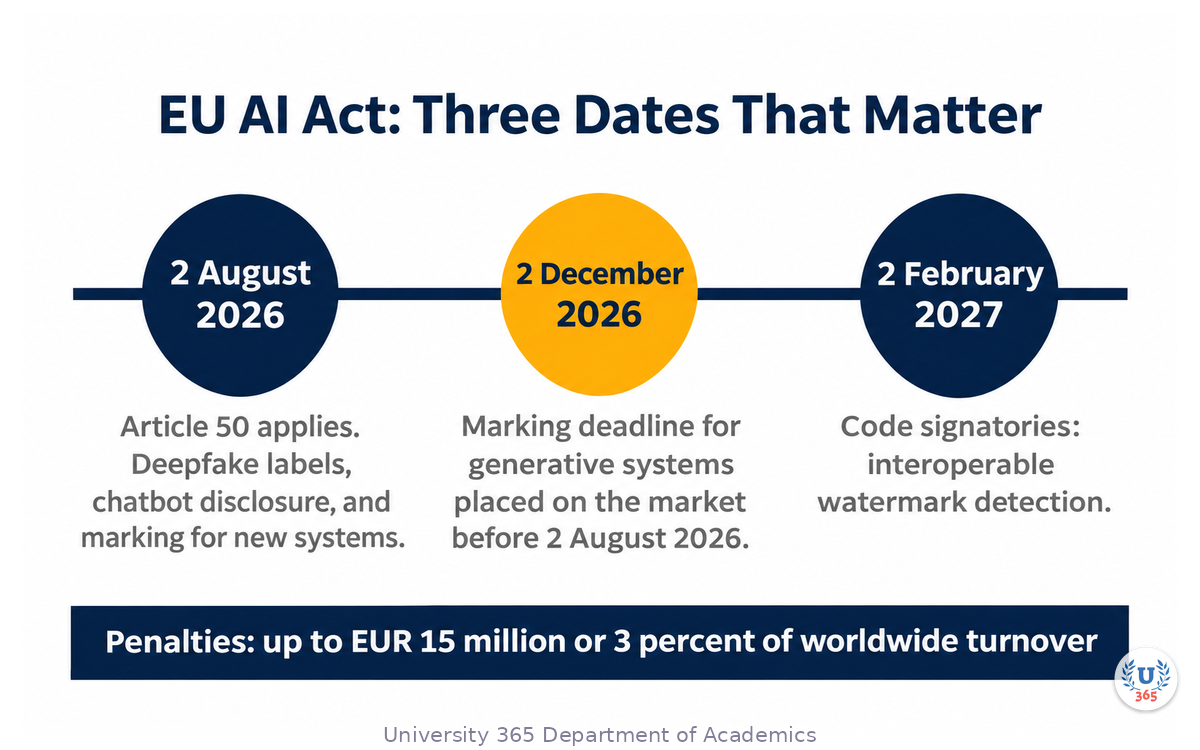
Article 50 of the EU AI Act, Regulation (EU) 2024/1689, sets four transparency duties. Article 50(1) requires providers of systems that interact directly with people to make clear that the user is dealing with an AI system. Article 50(2) requires providers of systems that generate synthetic audio, image, video or text to mark the output in a machine-readable format that is detectable as artificially generated. Article 50(3) requires notice when emotion recognition or biometric categorization is used. Article 50(4) requires deployers to disclose deepfakes and AI-generated text published on matters of public interest, with carve-outs for evidently artistic or satirical work and for text that has undergone human editorial review with an accountable publisher.
The obligations have applied since 2 August 2026. The Digital Omnibus on AI, Regulation (EU) 2026/1744, published in the Official Journal on 24 July 2026 and in force on 27 July 2026, added a transitional rule for one of them. A provider whose generative system was placed on the market before 2 August 2026 has until 2 December 2026 to comply with the Article 50(2) marking duty. Systems placed on the market on or after 2 August 2026 have no transition. Article 111(4) of the amended regulation carries that four-month window, and nothing else in Article 50 was deferred.
Two further dates shape the technical choice. The Code of Practice on Transparency of AI-Generated Content, published on 10 June 2026, asks providers in its first section to combine two marking layers, digitally signed and timestamped metadata plus an imperceptible watermark, with a single layer accepted for free-form text and for AI embedded in closed physical products. It also requires detection to be available, through a public specification, downloadable software or a cloud service, with free access for regulators, researchers, media, fact-checkers and civil society. Signatories commit to interoperability of watermark detection by 2 February 2027. The Commission and the AI Board have confirmed the code as an adequate voluntary route to demonstrating compliance; adherence is voluntary and the obligations are not.
Penalties sit in the Act's general tier: up to EUR 15 million or 3 percent of worldwide annual turnover, whichever is higher. The Omnibus also adds two Article 5 prohibitions from 2 December 2026, covering systems that generate non-consensual intimate depictions and child sexual abuse material, at the higher penalty tier of EUR 35 million or 7 percent.
For a communication team, the first question is role. You are a deployer under Article 50(4) when you publish synthetic content. You are a provider under Article 50(2) if you place a generative system on the market under your own name, including a branded image generator or a voice tool you license and resell. If you fine-tune a model and distribute it, you are likely a provider. Most teams are deployers most of the time and providers for one or two tools, and the marking duty attaches to the provider role.
Synthetic Media and Provenance: C2PA, Watermarks and Trust
A Provenance Checklist for One Campaign
This is the working part. Run it on one live campaign, not on a policy document, and you will find the gaps in a week.
1. Classify every asset. For each file, record one of three states: captured, generated, or edited with generative tools. Do this before the creative review, not after, because the classification decides the disclosure line.
2. Write the disclosure line per channel. The same asset needs different treatment on a product page, a paid social placement and a press image. Article 50(4) applies to deepfakes and to AI text on matters of public interest, and the platform label is a separate layer. Decide the sentence, the placement and the language for each channel, and get legal review once rather than per post.
3. Capture the credential at source. Configure the generator to attach Content Credentials, and keep the setting on for exports as well as the share dialog. For photography, use a capture tool that signs, and record the device and the signer identity.
4. Keep the signed original immutable. Publish derivatives, archive originals. Give the archive a retention period longer than the campaign, because disputes arrive after the campaign ends. Store the manifest hash next to the file.
5. Add a watermark when you generate. Choose a method with a public detector, record the payload and the detector version, and test the round trip through your own publishing pipeline before you rely on it.
6. Register the fingerprint. Put every approved asset into the campaign registry with its perceptual hash, the manifest hash and the approval date. This is the record you will use to match reposts and support takedowns.
7. Publish a first-party provenance page. One page per campaign, listing the assets, their status, the signer, the manifest hash and the disclosure used. It survives every platform's re-encoding because it is a page, not a metadata box.
8. Verify on intake. When your team receives an asset from an agency, a partner or a creator, run validation, check revocation, record the tool and version, and store the result. Do this for inbound assets with the same discipline you apply to outbound ones.
9. Brief the social team on the delivery gap. The people who post are the people who need to know that a screenshot removes the credential and that a platform re-encode may remove the watermark. Give them a one-page card with the three instruments and the four verdicts.
10. Write the incident playbook. Name the person who answers a deepfake call, the verification steps, the holding statement, the escalation to legal and the takedown route per platform. Test it once with a tabletop exercise.
Assign an owner to each step and a date. The December deadline is a forcing function for the provider side, but the deployer duties have been live since August, and the campaign in the hook fails on step 4 and step 7, not on step 5.
Synthetic Media and Provenance: C2PA, Watermarks and Trust
The Trust Question You Cannot Outsource
The three instruments are not competing standards. They are a division of labor, and each one is honest only about its own question.
Signed metadata gives you a verifiable record with a named signer, and it dies when the file is re-encoded. Watermarks give you a signal that can survive re-encoding, and they are probabilistic, method-specific and sometimes unavailable. Fingerprints give you a way back to a record, and they depend on someone having registered the content before the dispute began.
Together they raise the cost of deception. A forger who wants to pass synthetic content as a capture now has to defeat a signature, a watermark, a fingerprint lookup and a human review, and each one is a different skill. That is a real gain. It is not a solution, and the 2026 security findings show why: a system that can be bypassed by a byte-range exclusion or a missing revocation check does not deliver certainty, it delivers evidence.
So the honest position for a communication team is narrower than the marketing around provenance suggests. You can prove that a file matches a record you signed. You can show what you declared about how it was made. You can make a platform label more likely and a takedown faster. You cannot prove that a scene happened, and you cannot make a reader trust you by attaching a badge.
What you can do is decide, before the campaign ships, which claims you are willing to defend and which evidence you will hold. That decision is editorial, and it belongs to the team that publishes, not to the tool vendor. The teams that handle a synthetic media incident well are the ones that already knew which files they had signed, where the originals were, and who was allowed to say what.
The deadline in December is a useful date to finish the inventory. The work that protects you is the record you keep afterwards.

Synthetic Media and Provenance: C2PA, Watermarks and Trust
Feynman Summary: Explain It Like You Are 12
Imagine you draw a picture and you want people to know you drew it. You write your name on the back of the paper. If someone photocopies the paper, your name does not come along, because the photocopier only copies the front.
A Content Credential is the name on the back. It is a signed note that says who made the file and what was done to it. It is very hard to fake, and it is very easy to lose, because almost every website that shows a picture makes its own copy and throws away everything except the front.
A watermark is a pattern hidden in the drawing itself, like a tiny mark you made with a special pen that only your friend can see. If someone photocopies the paper, the mark is still there, because it is part of the drawing. But the mark can fade if the copy is bad, and sometimes your friend thinks they see the mark when it is not there.
A fingerprint is a way of recognising the drawing by what it looks like. If you have a list of drawings you already know, you can match a copy to the list, even if the name on the back is gone. But two drawings can look almost the same, so the match is a guess with a score, not a fact.
The law in Europe now says that if you make a picture with AI, you have to put a machine-readable mark on it so people can tell. That rule started in August 2026, and for tools that were already on sale before then, the last date is December 2026.
The important thing to remember: a name on the back proves who signed the paper. It does not prove that what you drew is true.

Synthetic Media and Provenance: C2PA, Watermarks and Trust
Mindmap: The Complete Picture
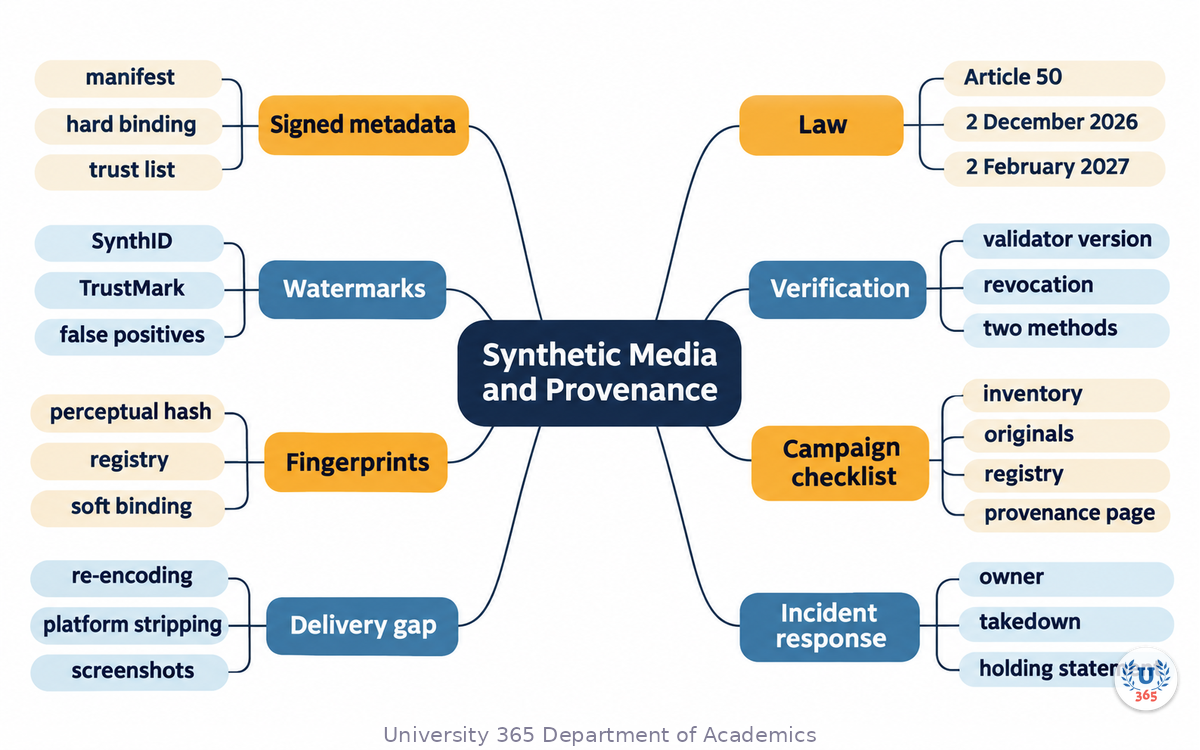
Read the mindmap from the centre outward. The left branches cover what you can attach to a file: signed metadata, watermarks, fingerprints. The right branches cover what breaks each one: re-encoding, detector error, false matches. The lower branches carry the legal duties and the ten checklist steps.
UNOP Sound (University 365 Neuroscience Oriented Pedagogy)
Take five minutes to consolidate your memory. Play the isochronous tone track (10Hz alpha frequency) with your eyes closed. Alpha-frequency tones after a learning session support consolidation, helping move what you just learned from short-term to long-term memory.
[Audio player: UNOP Post-Lecture Isochrone (10Hz, 5 minutes)]
Synthetic Media and Provenance: C2PA, Watermarks and Trust
Practical Exercise: Run the Provenance Checklist on One Live Campaign
Choose one campaign that is currently running or about to launch. You need two hours and access to the original files.
Step 1. Build the asset inventory. List every image, video and audio file in the campaign. For each one, mark captured, generated or edited. Note the tool and the model version. Fifteen minutes.
Step 2. Check the credentials. Take the original file and run it through a validator, for example the Content Credentials verification tool from Adobe or the C2PA command line tool. Record the validation state, the signer, the actions listed and the manifest hash. If no credential is present, record that, and note whether the absence is expected.
Step 3. Test the delivery path. Publish one test asset through your normal pipeline, then download the copy a reader would receive. Check whether the manifest survived, whether the watermark reads, and whether any platform label appears. This is the step most teams have never run, and it usually produces the most uncomfortable finding.
Step 4. Check inbound assets. Take three assets you received from a partner or agency this quarter. Run the same validation. Note how many carry a credential and how many were stripped in transit.
Step 5. Write the one-page record. For each asset: status, signer, manifest hash, watermark method, fingerprint, disclosure line, channel, owner. This page is the evidence file you will reach for in a dispute.
Step 6. Close the two biggest gaps. Rank the findings by the damage they would cause in an incident. Fix the top two this month. Typical winners are the immutable original store and the first-party provenance page, because both are cheap and both survive platform re-encoding.
Bring the one-page record to your next campaign review. It is the artifact that turns a policy into practice, and it takes less time than the first meeting about the policy.

Synthetic Media and Provenance: C2PA, Watermarks and Trust
Glossary
Term | Definition |
C2PA | Coalition for Content Provenance and Authenticity, the industry coalition that publishes the Content Credentials technical specification |
Content Credential | The signed C2PA manifest attached to an asset, recording who made it, how, and what changed |
Manifest | The structured record inside a Content Credential: claim, assertions and signature |
Hard binding | A cryptographic hash that ties the manifest to the exact bytes of the asset |
Soft binding | A watermark or fingerprint that lets a verifier find the manifest again after the file has been re-encoded |
Watermark | A signal embedded in pixels, samples or token choices that carries a payload readable by a detector |
Fingerprint | A content-derived identifier, such as a perceptual hash, matched against a registry |
Provenance | The recorded history of an asset's origin and edits |
Deepfake | Synthetic or manipulated audio, image or video that depicts real people, places or events |
Validation state | The result a validator returns, describing the signature and the trust chain, not the truth of the content |
Trust list | The set of certificates and signers a validator is willing to accept |
Article 50 | The transparency article of the EU AI Act, covering chatbot disclosure, machine-readable marking and deepfake labelling |

Synthetic Media and Provenance: C2PA, Watermarks and Trust
Quiz: TEST YOUR UNDERSTANDING
1. What does a valid Content Credential prove?
A) That the depicted event happened
B) That the bytes match a manifest signed by a trusted key, with the declared history
C) That the image was generated by AI
D) That the publisher is trustworthy
2. Which layer is most likely to survive a platform re-encode?
A) The C2PA manifest
B) The EXIF block
C) An invisible watermark
D) The IPTC creator field
3. Why do platforms strip manifests?
A) Only to hide AI use
B) Re-encoding pipelines drop metadata they do not recognise, and privacy rules remove location data
C) A legal requirement in the AI Act
D) To reduce signature size
4. A generative system was placed on the EU market before 2 August 2026. What is its Article 50(2) marking deadline?
A) 2 August 2026
B) 2 December 2026
C) 2 February 2027
D) 2 December 2027
5. A detector reports a 92 percent probability of AI generation. What is the correct action?
A) Publish that the image is fake
B) Treat it as one probabilistic signal, check provenance and a second method, and record the tool and threshold
C) Ignore every detector
D) Ask the model to explain itself
Answers: 1-B, 2-C, 3-B, 4-B, 5-B

Related Resources
U365 INSIDE Publications
External Resources
Related U365 Lectures (Coming Soon)
Deepfake Crisis Communication: The First 24 Hours (Media Studies Series)
Voice Clones and Audio Provenance: Marking Speech (Media Studies Series)
AI Disclosure Labels: Design, Placement and Measurement (Media Studies Series)
Synthetic Media and Provenance: C2PA, Watermarks and Trust
U.Copilot for This Lecture
You are a provenance analyst working with a communication team. Use the lecture "Synthetic Media and Provenance: C2PA, Watermarks and Trust" as your method. TASK Audit one campaign for provenance readiness and return a decision table. INPUTS I WILL GIVE YOU 1. The asset list, with each file marked captured, generated or edited. 2. The channels where each asset will run. 3. The tools used to create and edit the assets. 4. Any validation results already collected. WHAT TO RETURN 1. A table with one row per asset and these columns: asset, status, credential present (yes, no, unknown), signer, watermark method, fingerprint registered (yes, no), disclosure line, channel, owner, gap. 2. The three highest-risk gaps, ranked by the damage they would cause if the asset were challenged in public. 3. The exact disclosure sentence for each channel, in the language of that channel. 4. A verification note that states which tool and version should be used, whether revocation is checked, and what the result does and does not prove. 5. The two fixes to complete this month, with the owner and the evidence that would show the fix worked. CONSTRAINTS Do not treat the absence of a credential as evidence of manipulation. Do not describe a detector score as a verdict. State uncertainty explicitly, and mark any row where you are inferring rather than reading a record.
Synthetic Media and Provenance: C2PA, Watermarks and Trust
Next Steps
Inventory the assets of one live campaign and mark each one captured, generated or edited.
Run the original files through a validator and record the signer, the actions and the manifest hash.
Test one asset through your real publishing pipeline and download the copy a reader receives.
Confirm whether your validator checks certificate revocation, and log the tool version.
Register the approved assets in a campaign registry with a perceptual hash and the manifest hash.
Draft the disclosure line per channel and send it for legal review once.
Publish a first-party provenance page for the campaign.
Write the deepfake incident playbook and name the person who answers the call.
Brief the social team on the delivery gap with a one-page card.
Diarize the 2 December 2026 provider deadline and the 2 February 2027 interoperability date if you supply a generative tool.

Synthetic Media and Provenance: C2PA, Watermarks and Trust
IMPORTANT NOTICE
Copyright University 365, Inc. All rights reserved. This lecture is provided for educational purposes and does not constitute legal, financial or professional advice. For enrollment, visit university-365.com/tuition. For permissions or inquiries, contact uda@university-365.com.
Published by the Department of Academics, University 365.
Lecture delivered by the University 365 Institute of Communication (UIC).
Lea Loringam, Dean of Communication, UIC
Signed for the academic year 2026.




Comments