
Generative Engine Optimization: Winning the AI Answer


UIC University 365 Institute of Communication
Series Marketing
Duration 25 minutes
Digital Communication, Marketing, Branding, Content Strategy, Media Studies

UNOP Sound (University 365 Neuroscience Oriented Pedagogy)
Take five minutes to prepare your brain. Play the isochronous tone track (40Hz gamma frequency) with your eyes closed. Gamma-frequency tones before a learning session raise attention and make the material easier to absorb.
[Audio player: UNOP Pre-Lecture Isochrone (40Hz, 5 minutes)]
In this Lecture


Generative Engine Optimization: Winning the AI Answer
Your Buyer Asked an AI, Not a Search Box
For twenty years, the deal was simple: a person typed a query, a search engine returned ten links, and the brand that ranked highest received the visit. Marketing built a discipline around that deal. Keyword research found demand, pages competed for position, and analytics counted the clicks that followed.
That deal is being renegotiated. In 2026, SparkToro and Similarweb measured that 68 percent of Google searches in the United States end without a click to the open web. Per thousand searches, roughly 680 produce no visit, 213 go to an organic result, 88 go to a Google property and 19 go to a paid ad. When an AI Overview appears, the click rate falls further. Brands that used to compete for position now compete for a citation inside an answer they do not control.
Generative engine optimization, or GEO, is the discipline of winning that citation. It is not search engine optimization with a new name. It changes the unit of work from the page to the answer, the signal from links and keywords to evidence and entities, and the metric from rank and clicks to share of model and citation quality. This lecture teaches the method, the measurement and a 30-day pilot you can run with a small team.

Generative Engine Optimization: Winning the AI Answer
What Changed: From Ranking to Being Cited
A search engine returns a list. A generative engine writes an answer. The difference sounds small until you look at the economics of attention.
A list sends the user away. An answer keeps the user in place and cites a few sources as support. The sources that appear receive attention without a visit; the sources that are omitted receive nothing. The result is a new kind of invisibility: a brand can rank in the top ten and still be absent from the answer the buyer reads.
Three data points frame the shift.
First, zero-click behavior is the majority, not the exception. SparkToro's 2026 analysis, built on Similarweb panel data, puts the zero-click share at 68 percent in early 2026, up from 60 percent in 2024. The panel excludes searches inside the Google app, so the real figure is likely higher.
Second, the presence of an AI summary depresses clicks even when the brand is visible. Ahrefs reported in February 2026 that AI Overviews reduce the click-through rate of the first organic result by around 60 percent. Pew found that users clicked a traditional result in 8 percent of cases when an AI summary appeared, against 15 percent when it did not.
Third, citations still create value. Seer Interactive measured that brands cited in AI Overviews earn 35 percent more organic clicks and 91 percent more paid clicks than uncited competitors. Semrush's AI search study reports that AI-driven traffic converts at roughly 4.4 times the rate of traditional organic traffic. The visit is rarer and more qualified.
The strategic conclusion: visibility in the answer is becoming the first condition of being considered. Revenue still comes from the visit, the demo, the store, but the answer decides who gets the chance.

Generative Engine Optimization: Winning the AI Answer
How a Generative Engine Builds an Answer
To optimize for an answer, you need a working model of how it is produced. The details differ by engine, but the sequence is consistent.
1. Query understanding. The engine interprets the prompt, which is often longer and more conversational than a search query. ChatGPT prompts average around 60 words, against 3.4 words for a classic Google query, according to Similarweb's analysis. A longer prompt carries context, constraints and intent, and the engine expands it into sub-questions.
2. Retrieval. The engine fetches candidate sources: a web index, a licensed corpus, a shopping feed, a map, a knowledge graph. Retrieval is where most visibility is won or lost. If your content is not retrievable, nothing downstream matters.
3. Grounding and synthesis. The engine reads the candidates, extracts claims and composes an answer. It prefers sources that are easy to quote, specific, internally consistent and corroborated by other sources.
4. Citation. The engine attaches a small number of citations. The choice is not a ranking of pages; it is a judgment about which source supports which sentence. A page can rank first and lose the citation to a more extractable competitor.
5. Personalization and memory. Some engines use location, history or user memory. The same prompt can produce different citations for different users. Measurement must account for this variance.
Two consequences follow. First, the technical gate is crawlability: if the engine's crawler cannot fetch and render the page, the content does not exist for retrieval. Second, the editorial gate is extractability: a page that buries the answer under a story cannot be quoted cleanly, so the engine prefers a page that states it plainly.

Generative Engine Optimization: Winning the AI Answer
The Unit of Optimization Is the Answer
SEO optimizes a page for a query. GEO optimizes an answer for a prompt set. That shift changes the work.
Start with the prompt set, not the keyword list. Write thirty to fifty prompts a real buyer would type into ChatGPT, Perplexity, Gemini or Copilot. Group them by intent: definition, comparison, shortlist, pricing, problem-solving, risk. Use the customer's vocabulary, including the messy phrasing people actually use.
For each prompt, record the answer the engine gives today: the brands named, the sources cited, the claims made, the sentiment, and the omissions. This baseline is your market share of the answer, and it is the number you will move.
Then choose the answer you want to win. A useful target is a prompt where your brand is absent or misdescribed but the intent is commercial and the evidence exists. Do not start with the prompt where you are already winning; start where the gap costs revenue.
Finally, decide what asset wins that answer. Sometimes it is a page on your site. Sometimes it is a third-party source the engine trusts: a review site, a directory, a trade publication, a community thread. GEO is not always a content production task. It is often a corroboration task.

Generative Engine Optimization: Winning the AI Answer
Writing Answer-Ready Content
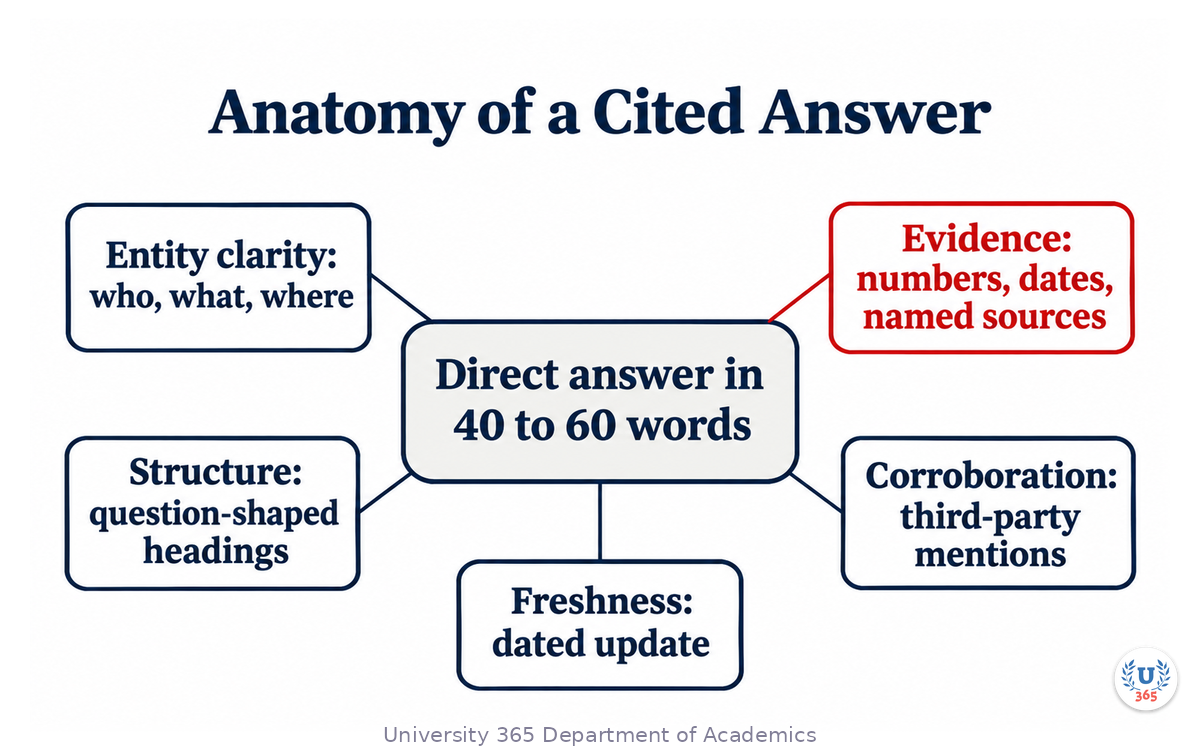
An answer-ready page has five properties. Each is testable.
1. A direct answer in the first 40 to 60 words
State the answer before the context. If the prompt asks "what is the best CRM for a ten-person sales team", the page should say which one and why, in two or three sentences, before the history of CRM. Engines extract the early, unambiguous statement.
This does not mean dumbing down. It means front-loading. The nuance can follow in the body, where a human reader will find it and an engine can retrieve it for a follow-up question.
2. Evidence with numbers, dates and named sources
Generative engines prefer claims they can verify. A statement such as "teams report faster onboarding" is weak. "In a 2026 survey of 240 sales teams, median onboarding fell from 31 days to 19" is strong: it names the population, the year and the measure.
The Princeton and IIT Delhi GEO study, published in 2024, found that adding statistics and quotations to content produced 30 to 40 percent higher visibility in generative answers. The mechanism is simple: specific, attributable claims are easier to ground.
3. Question-shaped structure
Use the questions buyers ask as headings. Each section answers one question completely, with its own evidence and its own direct answer. This structure helps retrieval (each chunk is self-contained) and helps the reader (who is scanning for their question).
Avoid headings that are clever but empty: "The real story", "What nobody tells you". They carry no retrievable meaning. Use "How much does it cost", "Who is it for", "How does it compare with X".
4. Entity clarity
Name the entities precisely and consistently: the company, the product, the category, the geography, the audience. Use the same name everywhere, and connect it to a canonical profile. Engines build an entity graph; ambiguity dilutes it.
If your product has three names across the site, the press and the app store, the engine sees three weak entities instead of one strong one. Fix the naming before you write another page.
5. Freshness and maintenance
Add a visible "last updated" date and keep the facts current. Engines weigh recency for time-sensitive questions: pricing, regulation, product availability. A page that was accurate in 2024 is a liability in 2026, and the engine can tell.
Maintain a quarterly review for the pages that win commercial prompts. Update the numbers, the dates and the examples, and keep the URL stable.

Generative Engine Optimization: Winning the AI Answer
Entities, Corroboration and Reputation
An engine does not trust a single source. It looks for agreement across sources. That makes third-party corroboration a first-class GEO asset.
Directories and profiles. Claim and complete the profiles that engines use: industry directories, review platforms, professional registries, map listings. Inconsistent hours, categories or descriptions weaken the entity.
Reviews. Reviews are quotable evidence. A page of your own claims is marketing; a review platform with dated, specific reviews is corroboration. Encourage reviews that name the use case and the outcome.
Press and analyst mentions. A trade publication that describes your category position gives the engine a source it can cite. The mention does not need a link to help; the sentence matters more than the hyperlink.
Community evidence. Forum threads, professional communities and Q&A sites are heavily retrieved for comparison prompts. Participate honestly, with named expertise, rather than seeding synthetic praise. Engines and users both punish obvious manipulation.
Consistency across sources. The same founding year, category, pricing model and customer profile should appear everywhere. Contradictions create doubt, and doubt pushes the engine to a competitor with a cleaner record.
The practical test: ask an engine "who is [your brand] and what is it known for?" If the answer is thin, wrong or borrowed from a competitor's framing, the entity work is unfinished.

Generative Engine Optimization: Winning the AI Answer
Technical Visibility
Before content, make the page reachable. Generative engines use their own crawlers and fetchers. OpenAI's search fetches with OAI-SearchBot, Perplexity with PerplexityBot, Anthropic with its own crawlers. Training crawlers such as GPTBot and Google-Extended are separate from search and grounding crawlers, and blocking one does not necessarily block the other. Decide each policy deliberately with legal and security.
Then check five technical conditions:
Server-rendered content. If the answer only exists after client-side JavaScript, some fetchers will see an empty page. Test with the crawler user agent, not your browser.
Clean HTML structure. Headings, lists and tables in semantic HTML are easier to extract than nested divs styled as text.
Structured data. Organization, Product, FAQ and Article schema help engines identify entities and facts. Use schema that matches the visible content; mismatches are a trust problem.
A clear robots and llms.txt policy. An llms.txt file is not a standard with universal adoption, but it is a cheap way to state what is available. Do not rely on it as a substitute for crawlable HTML.
Fast, stable pages. Retrieval has a budget. Slow pages are skipped or truncated.
Measure crawl access monthly with a log analysis or a crawler test. Indexing delays mean a new page can take days or weeks to appear in answers; plan launches accordingly.

Generative Engine Optimization: Winning the AI Answer
The Four Answer Types
Not every answer is won the same way. Classify the prompt before you produce the asset.
Definition answers. "What is generative engine optimization?" The engine wants a clear, attributed definition and a short explanation. The winning asset is a glossary or explainer with a direct definition in the first sentence, the boundaries of the concept, and one example. These answers are low-intent but high-value: they establish the entity and feed later comparisons.
Comparison answers. "HubSpot or Pipedrive for a ten-person team?" The engine wants criteria, a recommendation and evidence. The winning asset is a comparison with named alternatives, a table of criteria, and a clear statement of who each option suits. Neutrality helps: a page that admits where a competitor wins is more quotable than a page that claims everything.
Recommendation answers. "What is the best CRM for a small sales team?" The engine wants a shortlist with reasons. The winning asset is a buying guide with a direct recommendation, the evidence behind it, and the conditions under which the recommendation changes. Third-party reviews and analyst mentions carry weight here.
Transactional answers. "How much does X cost?" "Does X integrate with Y?" The engine wants a precise fact. The winning asset is a pricing or specification page with the number in the first sentence, the date, and the conditions. These pages are dull to write and disproportionately valuable, because the answer is easy to extract and the intent is close to purchase.
Write the classification next to each prompt in your set. It tells the writer what to produce and tells the measurement what success looks like.
Generative Engine Optimization: Winning the AI Answer
Content Formats That Get Cited
Some formats are easier to quote than others. Six formats earn citations disproportionately.
1. The direct-answer block. Two to four sentences at the top of a section, stating the answer with the key number or condition. The rest of the section explains it. This format is the single highest-value change on an existing page.
2. The comparison table. Rows for options, columns for criteria, cells for facts. Engines extract tables cleanly, and humans scan them. Keep the table small enough to read: five options and six criteria is usually the limit.
3. The step list. Numbered steps with one action each, in the order a person would do them. Add the time and the prerequisite to each step. Step lists win how-to prompts because they are self-contained.
4. Original data. A survey, a benchmark, an internal dataset with a described method. Original numbers are scarce, and scarcity earns citations. Publish the method and the date, and make the data easy to quote.
5. The definition and the boundary. "X is ... It is not ..." The boundary matters: engines use it to disambiguate. A definition that only says what something is invites confusion with adjacent concepts.
6. The FAQ block. Real questions with short, complete answers. Each answer should stand alone, because the engine may quote one without the rest. Avoid duplicating the whole page in the FAQ.
Two formats underperform: the long narrative essay with the answer buried in paragraph nine, and the landing page that promises value without stating a fact. Both can rank and still lose the citation.
Generative Engine Optimization: Winning the AI Answer
What Not to Do
GEO attracts the same shortcuts as SEO, with worse consequences, because the engine can read the whole page and compare it with other sources.
Do not publish machine-written filler at scale. A hundred thin pages do not create authority; they create a quality problem and a credibility risk. The engines are improving at detecting it, and the humans who cite you are not fooled.
Do not fabricate evidence. Invented statistics, fake case studies and synthetic reviews are easy to publish and hard to recover from. One fabricated number can invalidate a brand's entire evidence base when a journalist checks it.
Do not stuff prompts and keywords. Repeating "best CRM for small teams" forty times does not help an engine ground a claim. It makes the page harder to read and easier to classify as low quality.
Do not block the crawlers you need. A blanket block of AI crawlers protects nothing if it also removes you from the answers your buyers read. Separate training policy from search and grounding policy, and decide each with legal.
Do not optimize only for the demo. A prompt run in your office with a clean session is not the same as a buyer's prompt with location, history and memory. Measure across engines and sessions, and accept variance as part of the instrument.
Do not treat the answer as a one-time win. Engines update, competitors publish, and your evidence ages. A citation is a maintained position, not a trophy.
Measuring Share of Model
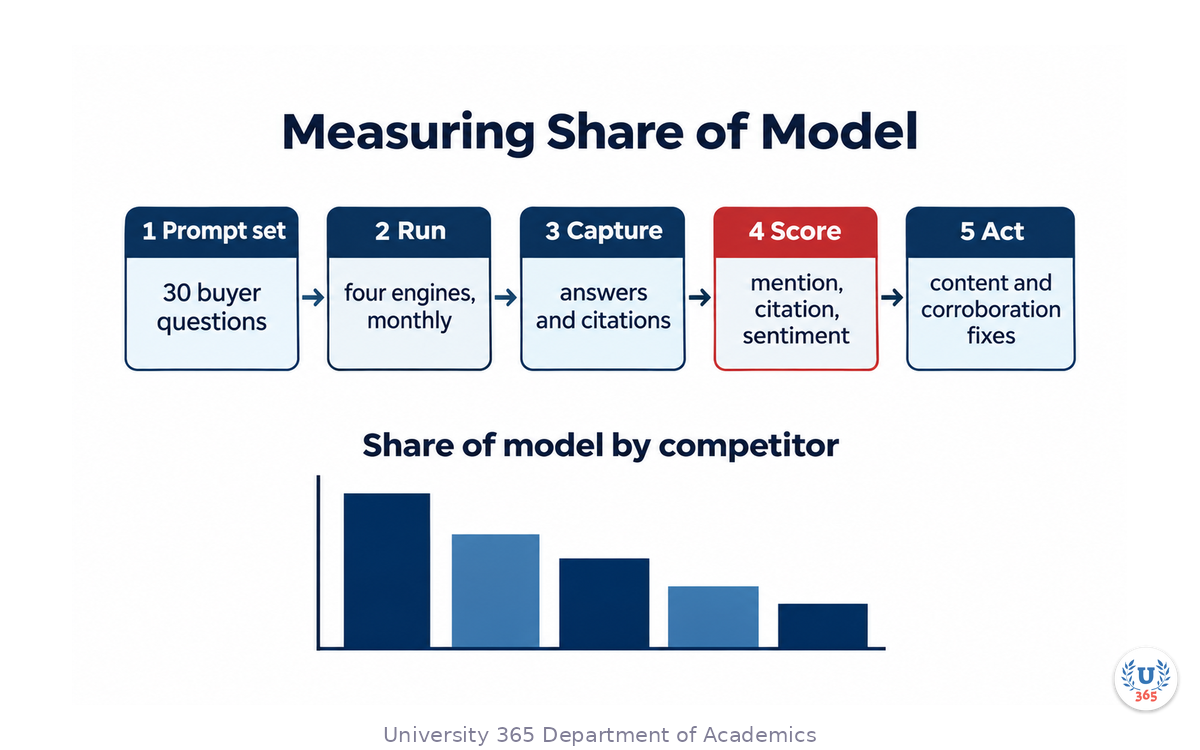
If you cannot measure the answer, you cannot manage GEO. Build a small measurement system with five steps.
1. The prompt set. Thirty to fifty prompts, grouped by intent, written in customer language, reviewed quarterly. Keep a frozen core of twenty so month-to-month comparison is valid.
2. The run. Query four engines monthly: ChatGPT, Perplexity, Gemini and Copilot. Use a clean session, the same geography, and no personalization where the tool allows it. Record the date, the engine, the model and the prompt.
3. Capture. Save the answer text and the citations. Note the brands mentioned, the position of the first mention, the sources cited, the claims made about you, and the sentiment.
4. Score. Compute four numbers: mention rate (share of prompts where you appear), citation rate (share where your domain is cited), share of model (your mentions divided by all brand mentions in your category), and sentiment (positive, neutral, negative). Add a quality flag for factual errors about your brand.
5. Act. For each gap, decide the fix: a new answer-ready page, a refreshed page, a third-party profile, a review campaign, a correction request, or a technical fix. Assign an owner and a date.
Report the four numbers monthly, next to organic traffic and branded search. The combination tells a coherent story: citations lead to branded search, branded search leads to direct visits, direct visits convert. Conductor's 2026 study found an 18 percent lift in branded search volume in the week after an AI mention, rising to 31 percent for high-intent queries. The visit is delayed, not always lost.
Generative Engine Optimization: Winning the AI Answer
GEO and SEO: Budget, Team and Cadence
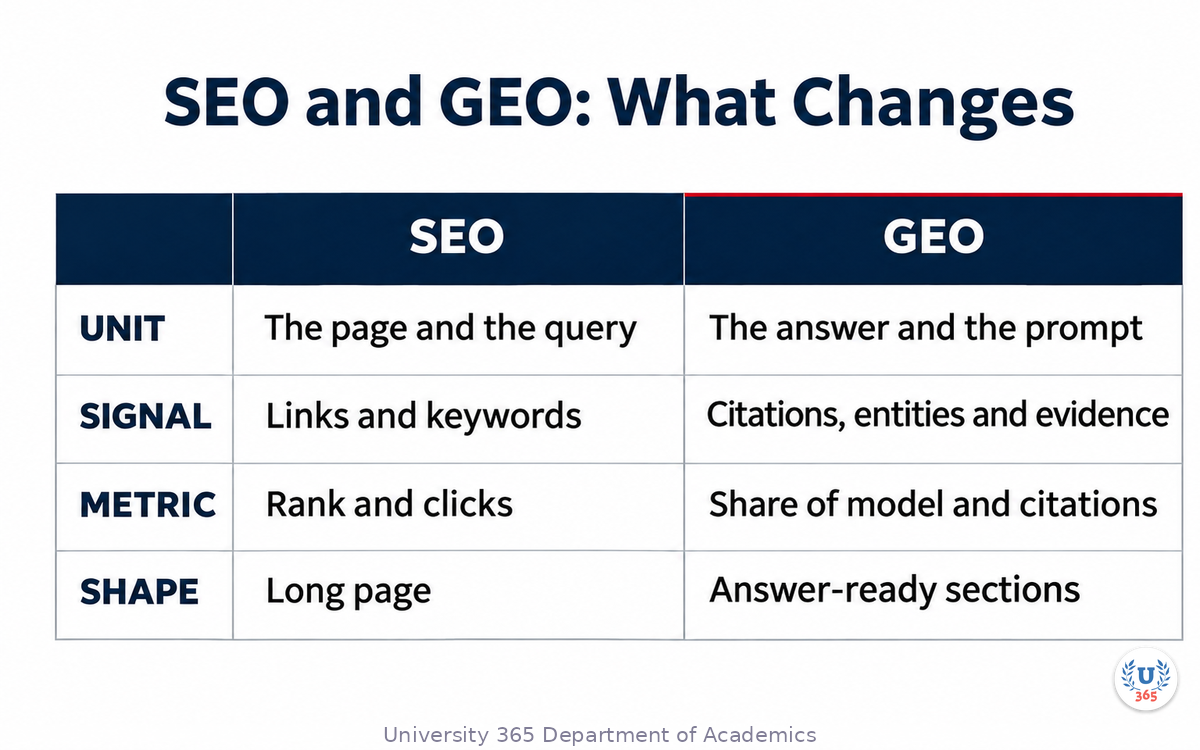
GEO does not replace SEO. It adds a layer, and the layer shares most of the technical foundation.
Keep the SEO fundamentals: crawlability, site speed, clean structure, internal links, authoritative backlinks. They still matter for retrieval, and they matter for the human who visits after the answer.
Add four GEO activities: the prompt set and monthly measurement, answer-ready content production, entity and profile consistency, and third-party corroboration. These are new work, not a rebranding of keyword research.
On budget, start small. A pilot with one analyst, one writer and a part-time technical resource can run the prompt set, produce four answer-ready assets and fix the entity profiles in a month. Measure before you scale. The failure mode is a large content programme optimized for an imagined algorithm instead of measured answers.
On team, the owner should sit in content or marketing, with support from SEO, PR and legal. The PR link matters because corroboration often comes from earned media, not from the website. The legal link matters because claims about competitors and regulated categories need review.
On cadence, run the prompt set monthly, refresh the core assets quarterly, and audit entities twice a year. Publish the share-of-model number in the same dashboard as traffic. When the two move together, the programme has a business case.
Generative Engine Optimization: Winning the AI Answer
A Worked Example: The B2B Software Buyer
A mid-sized software company sells a project management tool to operations teams of fifty to five hundred people. The team runs a baseline of forty prompts across four engines.
The baseline is uncomfortable. The brand appears in 11 of 40 answers, is cited in 4, and is described incorrectly in 3: one engine calls it an enterprise suite, another places it in a category the company left two years ago. Two competitors appear in 31 and 27 answers respectively.
The team classifies the prompts. Twelve are definitional, fourteen comparative, eight recommendation, six transactional. The largest gap is in comparative prompts: the brand is absent from ten of fourteen, and the engines cite review sites where the profile is stale.
The work splits into four tracks.
Entity repair. The canonical description is rewritten and applied to the website, the two main review platforms, the professional directory and the partner page. The founding year, the category and the deployment model are made identical everywhere.
Comparison assets. Three pages are rebuilt with a direct answer, a six-criterion table, a section on who each alternative suits, and dated pricing facts. The pages name competitors honestly, including where they win.
Corroboration. The team asks fifteen customers for reviews that name the team size and the outcome. It briefs one trade publication on the category shift. It updates the analyst profile with current deployment numbers.
Measurement. The prompt set runs on the first of every month, with a frozen core of twenty prompts. The dashboard reports mention rate, citation rate, share of model and sentiment, plus a factual-error count for the brand.
Ninety days later, the brand appears in 23 of 40 answers, is cited in 12, and the factual errors are down to one. Share of model moved from 14 percent to 27 percent. Organic clicks are flat, but branded search is up 19 percent and demo requests from organic are up 12 percent. The answer moved first; the visit followed.
The lesson is not that every brand can double its share in a quarter. It is that the work is specific: fix the entity, publish comparison evidence, earn corroboration, measure monthly. None of it requires a new algorithm.
Generative Engine Optimization: Winning the AI Answer
The GEO Operating Dashboard
A dashboard that survives a management review has six panels.
Visibility. Mention rate and citation rate across the prompt set, by engine and by intent group. Trend over six months.
Share of model. Your mentions divided by all category mentions, with the top three competitors. This is the panel the leadership team will ask about.
Sentiment and accuracy. Positive, neutral, negative, and the count of factual errors about the brand. Accuracy is a leading indicator: a wrong fact in an answer is a sales problem before it is a marketing problem.
Source mix. Which domains the engines cite for your category: your site, review platforms, press, communities, competitors. The mix tells you where to invest next.
Business linkage. Branded search volume, direct traffic, organic demo or lead volume, and conversion rate. These are the outcomes that justify the programme.
Operations. Assets published, assets refreshed, profiles fixed, reviews collected, crawl issues open. The work log that explains the movement.
Review the dashboard monthly with content, SEO, PR and sales. Assign one action per gap, with an owner and a date. A dashboard without actions becomes wallpaper.
Generative Engine Optimization: Winning the AI Answer
Legal and Reputational Boundaries
GEO touches claims, competitors and regulated categories. Four rules keep the programme out of trouble.
Claims must be substantiated. Every number, comparison and superiority claim needs evidence you can show a regulator or a journalist. Keep the source and the date beside the claim in your content brief.
Competitor comparisons must be accurate and fair. Name the criteria, state the date, and acknowledge where the competitor wins. Misleading comparative advertising is regulated in many markets, and engines increasingly quote the caveat as well as the claim.
Reviews must be genuine. Soliciting reviews is legitimate; incentivising positive reviews, filtering negative ones or writing them yourself is not. The platforms detect it, and the reputational cost is larger than the ranking gain.
Regulated categories need review. Health, finance, legal and employment claims carry additional rules. The GEO writer is not the compliance officer; route the asset through the same review as any other marketing claim.
Add one reputational rule: check what the engine says about you before a crisis, not during one. The answer is part of your public record, and it can be wrong for months without anyone noticing.
Generative Engine Optimization: Winning the AI Answer
A 30-Day GEO Pilot
Days 1 to 5: Baseline. Build the thirty-prompt set. Run it on four engines. Capture the answers, citations, mentions and sentiment. Identify the ten prompts with commercial intent and the largest gap.
Days 6 to 10: Entity audit. Check the company profile on the platforms engines use: website, review sites, directories, map listings, professional registries. Fix names, categories, descriptions, hours and links. Record the canonical description.
Days 11 to 20: Produce four answer-ready assets. Choose four prompts where you can win with evidence. Write a direct answer, the supporting evidence, the question-shaped sections and the entity-clear framing. Add dates and sources. Publish and request indexing.
Days 21 to 25: Corroborate. Refresh two third-party profiles, brief one trade publication or community, and ask five customers for specific reviews. Do not fabricate. The goal is agreement across independent sources.
Days 26 to 30: Measure and decide. Re-run the thirty prompts. Compare mention rate, citation rate, share of model and sentiment against the baseline. Write a one-page result with the next four assets and the budget for the next month.
Success in thirty days is not domination. It is a measured movement on four prompts, a clean entity record and a repeatable process. That is enough to justify the next quarter.
Generative Engine Optimization: Winning the AI Answer
Beyond Text: Voice, Images and Shopping Answers
The same shift is happening outside the text answer, and the mechanics change with the medium.
Voice assistants. A voice answer is even more compressed: one recommendation, one reason, no list. The winning asset is a short, unambiguous statement of what you are and who you are for, backed by the same entity consistency. If your name is hard to pronounce or your category is unclear, the voice answer will default to a competitor with a simpler identity.
Image and video answers. Engines increasingly return images, diagrams and short videos with the answer. Optimize the asset as well as the page: descriptive file names, alt text that states the fact, captions that carry the claim, and a transcript for spoken content. A video that answers the prompt in the first fifteen seconds is more retrievable than a webinar that answers it in minute forty.
Shopping and product answers. For product prompts, the engine reads feeds, reviews and merchant data. The same principles apply with higher stakes: exact product names, structured attributes, current price and availability, and reviews that mention the use case. A missing attribute is an omitted answer.
Local answers. For local intent, the map listing is the answer surface. Hours, categories, service area and recent reviews determine whether the engine recommends you. Treat the listing as a primary page, not an afterthought.
Conversational follow-ups. A single prompt rarely ends the conversation. The buyer asks a follow-up: "and how does it compare with X?", "what does it cost at our size?". The brand that survives the second and third turn wins the consideration. Build content for the follow-up questions as well as the first prompt.
The common thread: every surface rewards the same three properties. A clear entity, a specific claim with evidence, and consistency across independent sources. The medium changes the format, not the discipline.
Generative Engine Optimization: Winning the AI Answer
The Measurement Limits You Must State
GEO measurement has three known limits. State them in the dashboard, or the numbers will be over-read.
Attribution is incomplete. A buyer who reads an AI answer and then searches your brand is counted as branded search or direct traffic. The AI answer is invisible in the analytics. Self-reported attribution ("how did you hear about us?") helps, but only if the form offers the option. Add "AI assistant" to the source list and accept that most people will still choose a familiar category.
Sessions are not comparable. An AI-referred visit often arrives with more context and higher intent than a cold organic visit. Comparing conversion rates without controlling for intent flatters or penalizes the channel. Segment by landing page and by query intent before drawing conclusions.
The instrument has variance. Answers change with the model version, the time of day, the location and the user's history. A single run is an anecdote. Run the frozen core monthly, report the range, and treat a movement of a few percentage points as noise until it persists for two cycles.
The honest position: share of model is a leading indicator, branded search is a lagging indicator, and revenue is the outcome. Report all three, and do not claim causation from a single month of movement.
Generative Engine Optimization: Winning the AI Answer
The GEO Content Brief
Writers produce better answer-ready content when the brief states the answer, not the topic. Use five lines.
Prompt to win. The exact buyer question, in the buyer's words. One prompt per asset, or one tight cluster.
The answer. Two to four sentences that answer the prompt, including the key number or condition. This is the first draft of the page's opening block.
The evidence. Three to five sourced facts: statistic, date, population, source. If the evidence does not exist, the brief is not ready; commission the research or choose another prompt.
The entities. The canonical names of the brand, product, category and competitors, spelled exactly as they appear in the entity record. Note the boundary: what this product is not.
The follow-ups. Three questions the buyer will ask next, each with a one-paragraph answer. These become the H2 sections and the FAQ.
Add the answer type (definition, comparison, recommendation, transactional), the owner, the publish date and the review date. A writer with these nine fields can produce a page that an engine can quote and a human can trust.
The brief is also the quality gate. If the writer cannot fill the answer and evidence lines, the asset will be another page that ranks and never gets cited.
Generative Engine Optimization: Winning the AI Answer
Cadence: The Minimum Viable GEO Calendar
A small team can run GEO with four recurring events.
Monthly: the prompt run. Thirty prompts, four engines, three hours. Capture, score and publish the dashboard. Choose one gap to fix.
Monthly: the content review. One existing commercial page rebuilt with a direct answer, current evidence and question-shaped sections. One page is enough; consistency beats volume.
Quarterly: the entity audit. Check every profile, directory, review platform and partner page against the canonical description. Fix drift.
Quarterly: the evidence refresh. Update the numbers, dates and examples on the pages that win commercial prompts. Remove claims that can no longer be substantiated.
Between those events, respond to what the measurement shows. A factual error in an answer is a same-week fix. A competitor's new comparison page is a next-cycle response. The calendar keeps the programme from becoming a one-off project, and the one-page dashboard keeps it honest.

Generative Engine Optimization: Winning the AI Answer
Feynman Summary: Explain It Like You Are 12
Imagine you ask a very well-read friend, "which bike should I buy for riding to school?" Your friend does not hand you a list of bike shops. They answer: "the blue one from that shop, because it is light, it has a warranty, and two of our neighbours ride it."
Now imagine you own a bike shop. To be the answer, you need three things. Your shop has to be easy for your friend to find. Your website has to say clearly which bike is best for riding to school, with a real reason. And other people your friend trusts have to say the same thing.
That is generative engine optimization. Be findable, be clear, be backed by others. The list is gone. The answer is the shelf.

Generative Engine Optimization: Winning the AI Answer
Mindmap: The Complete Picture
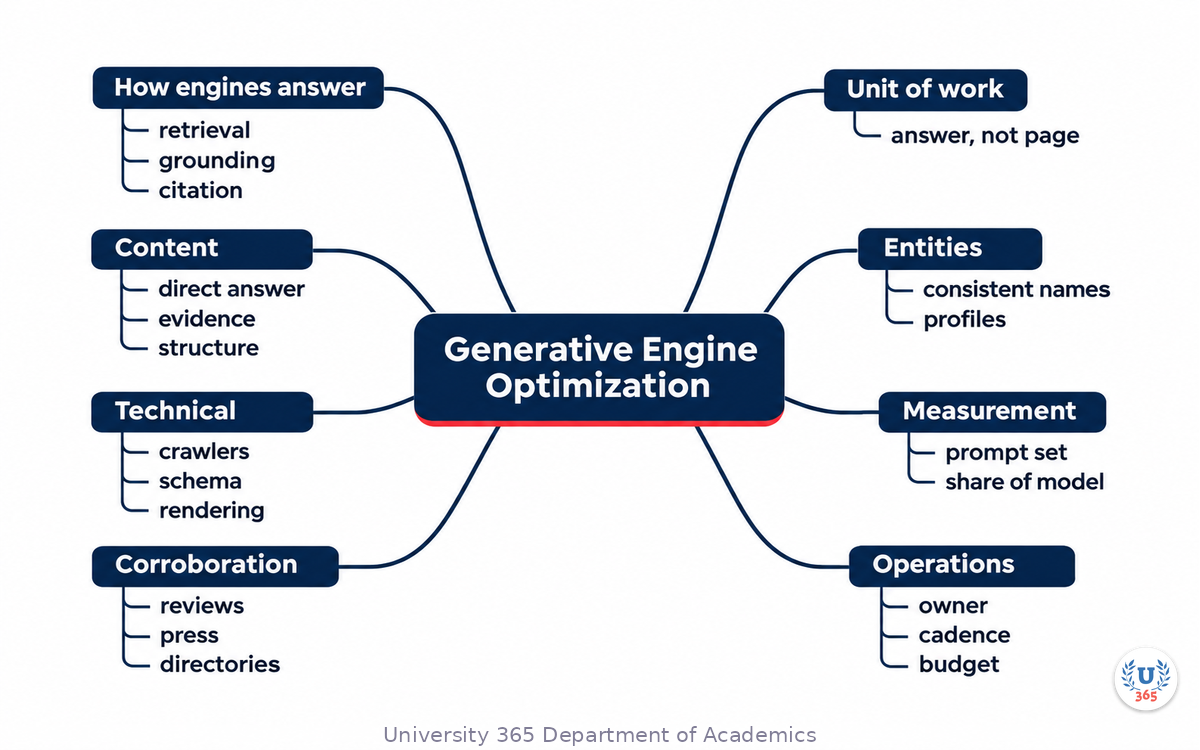
The mindmap shows the whole system: how engines build answers, the answer-ready content method, entity and corroboration work, technical visibility, share-of-model measurement, and the 30-day pilot.
UNOP Sound (University 365 Neuroscience Oriented Pedagogy)
Take five minutes to consolidate your memory. Play the isochronous tone track (10Hz alpha frequency) with your eyes closed. Alpha-frequency tones after a learning session support consolidation, helping move what you just learned from short-term to long-term memory.
[Audio player: UNOP Post-Lecture Isochrone (10Hz, 5 minutes)]
Generative Engine Optimization: Winning the AI Answer
Practical Exercise: Run the Thirty-Prompt Baseline
Choose one product or service you know well. Complete five steps and keep the artefacts.
Write thirty prompts. Ten definition or problem prompts, ten comparison prompts, five pricing prompts, five risk or compliance prompts. Use the customer's words.
Run four engines. Record the date, engine and prompt. Save the answers and citations.
Score the baseline. Mention rate, citation rate, share of model and sentiment, plus one factual error you found about the brand.
Pick four targets. Commercial intent, current gap, evidence available. Write the asset that would win each one.
Fix the entity record. Write the canonical one-paragraph description and list every place it should appear unchanged.
If you complete the five steps, you have a baseline, a target list and an entity standard. That is a GEO programme ready to start.

Generative Engine Optimization: Winning the AI Answer
Glossary
Term | Definition |
Generative engine | An AI system that answers a prompt by retrieving sources and composing a cited response |
GEO | Generative engine optimization: the work of earning visibility and citation inside AI-generated answers |
Zero-click search | A search that is answered on the results page without a visit to an open web source |
Share of model | A brand's mentions divided by all category brand mentions across a defined prompt set |
Citation rate | The share of answers in the prompt set that cite your domain or a source you control |
Prompt set | The fixed, versioned list of buyer questions used to measure visibility across engines |
Grounding | The process of tying each claim in an answer to retrieved source material |
Entity | The named thing a search or answer system recognises: a company, product, person or place |
Corroboration | Independent sources that repeat or support the same claim about an entity |
Answer-ready content | Content structured so an engine can extract a direct, evidenced answer without reading the whole page |
Retrieval | The step in which the engine fetches candidate sources for a prompt |
Sentiment | The tone of an answer's treatment of a brand: positive, neutral or negative |

Generative Engine Optimization: Winning the AI Answer
Quiz: TEST YOUR UNDERSTANDING
1. What is the unit of optimization in GEO?
A) The page
B) The answer to a prompt
C) The keyword
D) The backlink
2. Which signal most directly determines whether content can be cited at all?
A) Brand colours
B) Crawlability and retrieval
C) Ad spend
D) Domain age
3. What belongs in the first 40 to 60 words of an answer-ready section?
A) The company history
B) A direct answer with the key fact or condition
C) A list of keywords
D) A customer testimonial
4. Which metric divides your brand mentions by all category mentions?
A) Citation rate
B) Share of model
C) Click-through rate
D) Sentiment
5. Why does third-party corroboration matter in GEO?
A) It replaces the need for a website
B) Engines look for agreement across independent sources before citing a claim
C) It guarantees a top ranking
D) It removes the need for evidence
Answers: 1-B, 2-B, 3-B, 4-B, 5-B

Related Resources
U365 INSIDE Publications
External Resources
Related U365 Lectures (Coming Soon)
AI Search and Brand Visibility: Measuring Share of Model (Marketing)
Reputation Defense in the Synthetic Media Era (Marketing)
Owned Media in the AI Era: Newsletters, Communities and Direct Channels (Marketing)
Generative Engine Optimization: Winning the AI Answer
U.Copilot for This Lecture
You are my generative engine optimization coach. I am building a baseline for one brand. Brand: [name and one-sentence description] Category: [the category buyers compare you in] Main competitors: [three names] Buyer: [who buys and what they are trying to do] Do five things: 1. Write 30 buyer prompts in the customer's voice: ten definition or problem, ten comparison, five pricing, five risk or compliance. Label the intent of each. 2. For each group, state what a winning answer would contain and which asset type would win it: definition page, comparison table, step list, original data, or FAQ. 3. Design the baseline measurement: engines, cadence, the fields to capture, and the four scores (mention rate, citation rate, share of model, sentiment). 4. Audit my entity description: rewrite it as one canonical paragraph of 40 to 60 words that I can use everywhere. 5. Propose the first four assets and the third-party corroboration I need, with an owner and a date for each. Ask me one clarifying question before you start if the category or buyer is ambiguous.
Generative Engine Optimization: Winning the AI Answer
Next Steps
Write the thirty-prompt set this week and run the first baseline on four engines.
Fix the canonical entity description everywhere it appears, starting with the review platforms.
Rebuild one commercial page with a direct answer in the first 40 to 60 words.
Collect five specific customer reviews that name the use case and the outcome.
Put share of model on the same monthly dashboard as organic traffic and branded search.

Generative Engine Optimization: Winning the AI Answer
IMPORTANT NOTICE
Copyright University 365, Inc. All rights reserved. This lecture is provided for educational purposes and does not constitute legal, financial or professional advice. For enrollment, visit university-365.com/tuition. For permissions or inquiries, contact uda@university-365.com.
Published by the Department of Academics, University 365.
Lecture delivered by the University 365 Institute of Communication (UIC).
Lea Loringam, Dean of Communication, UIC
Signed for the academic year 2026.




Comments