
The AI Product Launch: From Code to Market



UIT, UIB, UIC, UID Cross-institute lecture
Series Cross-Institute Series | Level Basic (Free)
Duration 15 to 20 minutes | Access Free
Delivering institutes: UIT (Institute of Technology); UIB (Institute of Business); UIC (Institute of Communication); UID (Institute of Design)

UNOP Sound (University 365 Neuroscience Oriented Pedagogy)
Take five minutes to prepare your brain. Play the isochronous tone track (40Hz gamma frequency) with your eyes closed. Gamma-frequency tones before a learning session raise attention and make the material easier to absorb.
[Audio player: UNOP Pre-Lecture Isochrone (40Hz, 5 minutes)]
In this Lecture

The Hook: The Launch Where Everything Was Ready Except the Market
A small team ships a product in eight weeks. The engineering is clean. The landing page loads in under a second, the onboarding flow has been tested on six devices, and the launch post is scheduled for Tuesday at nine.
By Thursday, four hundred people have visited and twenty have signed up. Eleven of the twenty never return. The team meets to work out what went wrong and finds, in the first hour, that nobody had answered a simple question: which problem, for which person, is this product the fastest answer to?
The code was finished. The launch was not. The launch is not a day. It is the set of decisions that connect what was built to the person who needs it, and those decisions are made by different disciplines in sequence: the product must be real (technology), the value must be defined (business), the story must be told (communication), and the surface must be usable (design).
This lecture is a launch plan in four disciplines. It is written for a small team, and every stage ends with something you can show, not something you feel.
Step 1: Decide What You Are Actually Launching
The most expensive confusion in a launch is between the product and the thing you are launching this month. They are rarely the same.
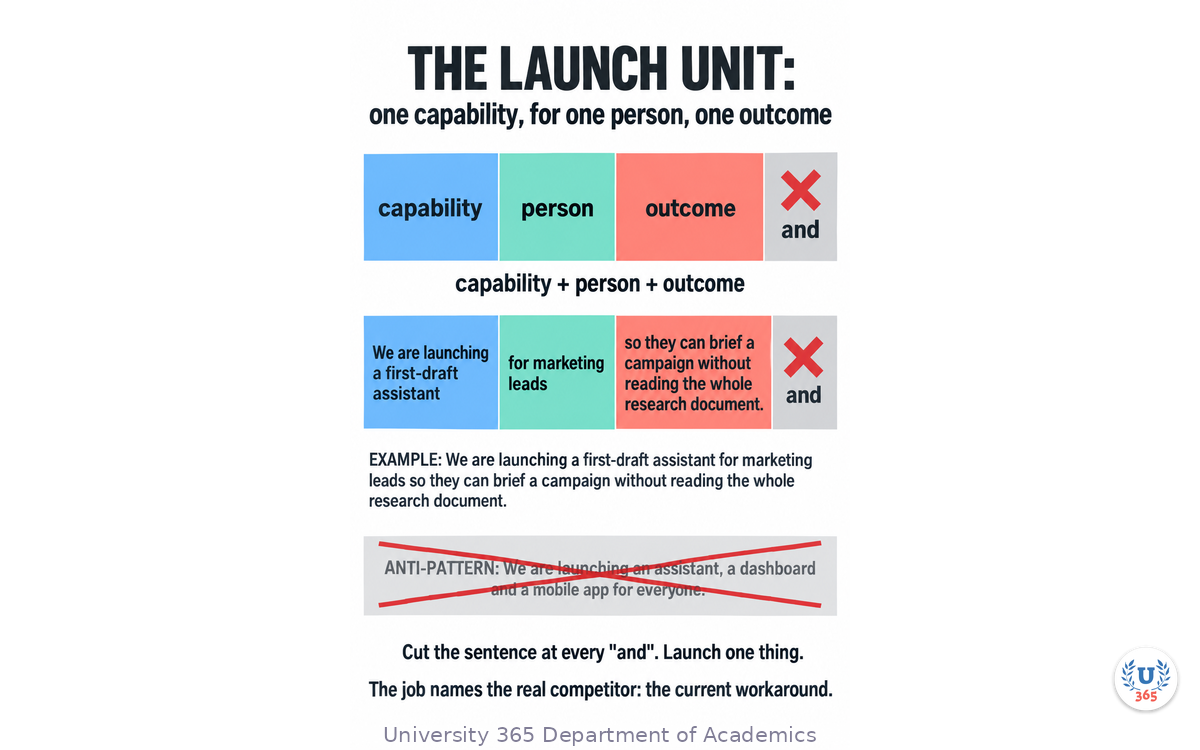
Define the launch unit. One sentence: "We are launching [a specific capability] for [a specific person] so they can [a specific outcome]." If the sentence contains "and", cut it in half and pick one.
Name the job it does. Not the features: the job. A person does not want a summarisation tool; they want to walk into the Monday meeting without having read the whole document and still say something useful. The job names the competitor, which is usually not another product but the current workaround: a spreadsheet, a habit, or nothing.
Write the smallest honest promise. The promise must be true on day one. "Cuts your first draft time in half" is testable and specific. "Transforms your workflow" is neither, and it sets up a disappointment you will spend three months explaining away.
Choose the metric for the first ninety days. One number that tells you whether the bet was right: sign-ups is a vanity number at this stage; the number that matters is usually retention-shaped, such as the share of new users who complete the core action twice.
Where AI helps, and where it must not. An effective use: ask a model to attack your launch sentence from the perspective of a sceptical buyer, and to list the three counterarguments you would face in a demo. A forbidden use: letting the model choose the positioning. The choice of which problem you solve for whom is an ownership decision about your product and your name.
Step 2: Build It for the First Real User
A launch-stage product is built for one identifiable person, not for a market. The market arrives later if the first person is real.
Name the first user. A name, a role, and their current workaround. If nobody in the team can name them, the product has no first user and the launch is theatre.
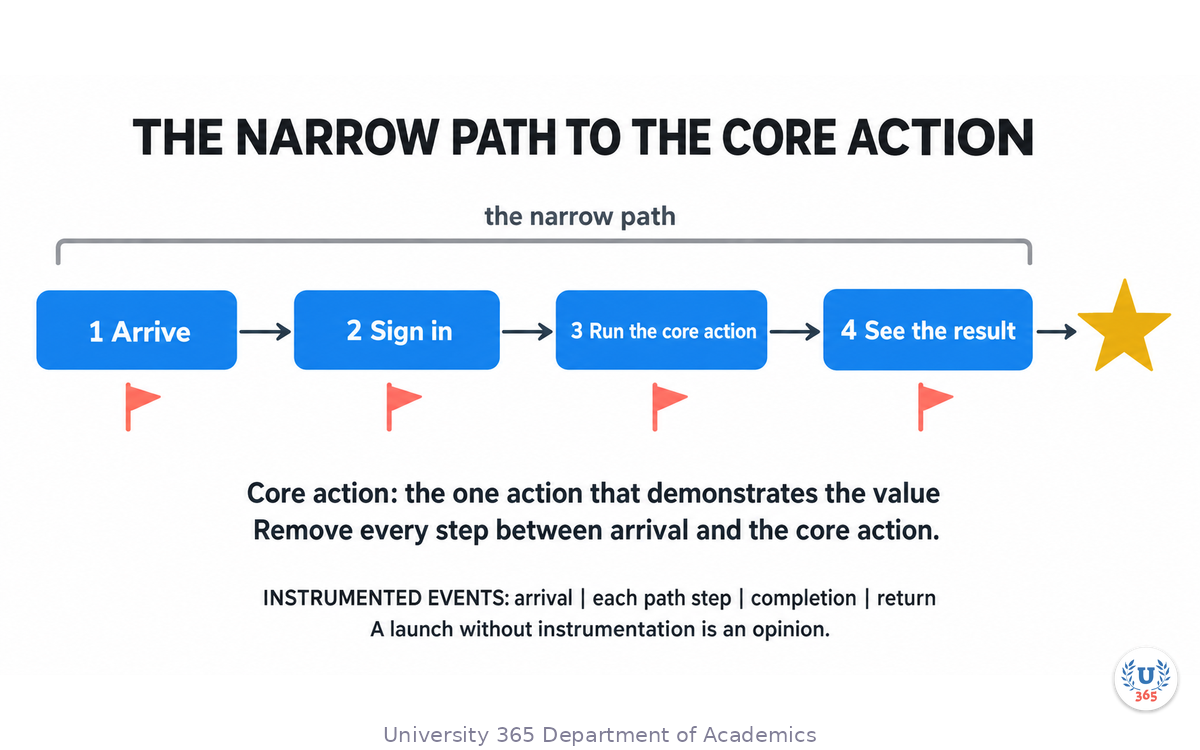
Build the narrow path to the core action. Identify the one action that demonstrates the value from Step 1: the first summary, the first reconciliation, the first exported asset. Then remove every step between arrival and that action. For a launch-stage product, this path typically has three or four steps, and every one of them gets tested on a device the user actually holds.
Instrument the path before you invite anyone. Which events fire, where they are stored, and what the dashboard shows. A launch without instrumentation is an opinion. The minimum viable instrumentation is: arrival, each step of the core path, completion, and return.
Set a failure budget explicitly. Decide, in advance, what the team will do when the path breaks under real traffic: who gets paged, what gets rolled back, what users are told. A written failure plan changes the tone of a launch week from panic to procedure.
The technology decision that matters at this stage is not architecture elegance: it is the reliability of the narrow path plus observability. A launch-stage stack should be boring on purpose, because every novel component is a novel failure mode on the day you cannot afford one.
Step 3: Make It Usable and Findable
Design's part of a launch is not decoration. It is the removal of friction along the path you just built, and the construction of the surfaces the market will actually meet.
Test at the real size on real screens. The onboarding tested on a large desktop display fails on the phone where sixty percent of arrivals happen. Check the smallest font, the smallest tap target, and the longest label at the size a real person sees.
Check contrast and legibility once, at system level. Pick text and background pairs from a fixed set and hold them everywhere, rather than fixing contrast page by page. A launch-stage product with six background tones across four screens is already unmaintainable.
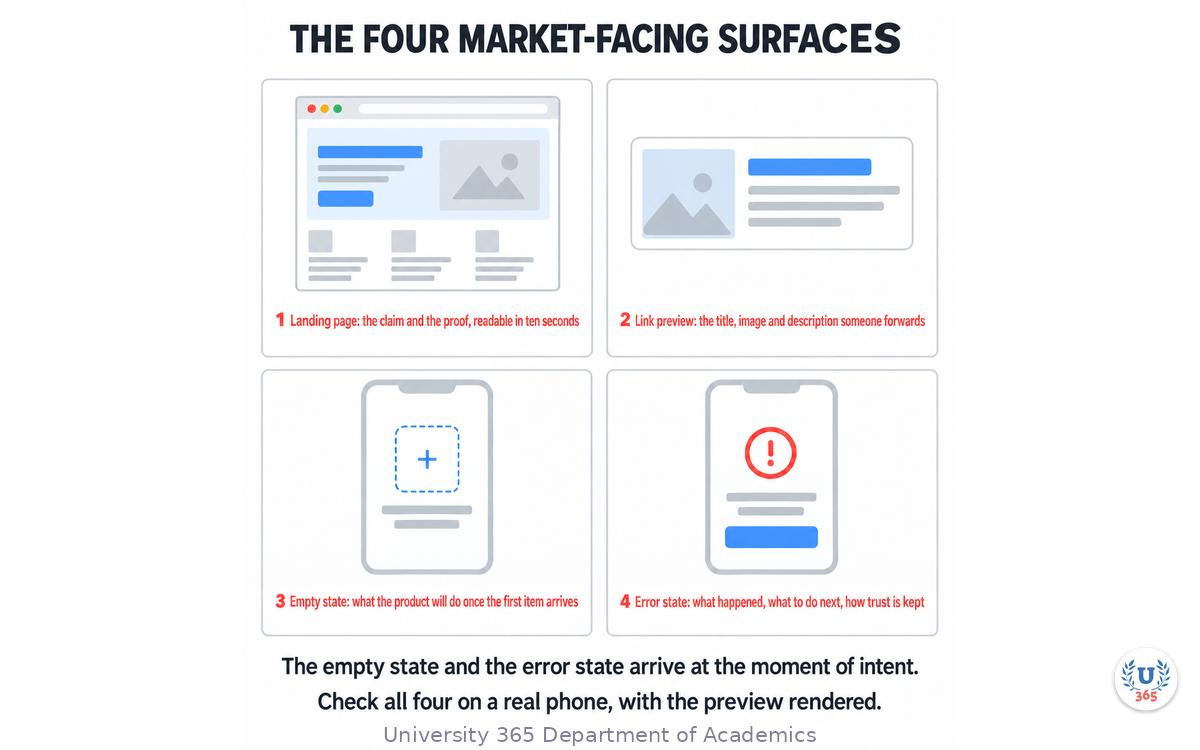
Write the interface's words as carefully as the launch post. The button label, the empty state, the error message, the confirmation screen: for a launch-stage product these four texts carry more persuasion than the marketing page, because they arrive at the moment of intent. An empty state that says "No data. Add data." wastes the moment; an empty state that says what the product will do once the first item arrives converts.
Make the product findable. The landing page, the page title and description, the share preview, and the page it renders when a link is opened. Those four surfaces are what the market sees when someone forwards your link. Check them on a real phone, with the link preview rendered, before the launch day.
One asset system, three sizes. Decide the visual tokens once (two colours, one typeface, a fixed layout for share images) and produce every launch asset from that system: the share card, the announcement image, the first tutorial frame. Consistency across the surfaces does more for perceived quality than any single beautiful screen.
Step 4: Say It Clearly, Once
Communication's part of the launch is one message, repeated in the formats each room requires, all of it traceable to the same claim.
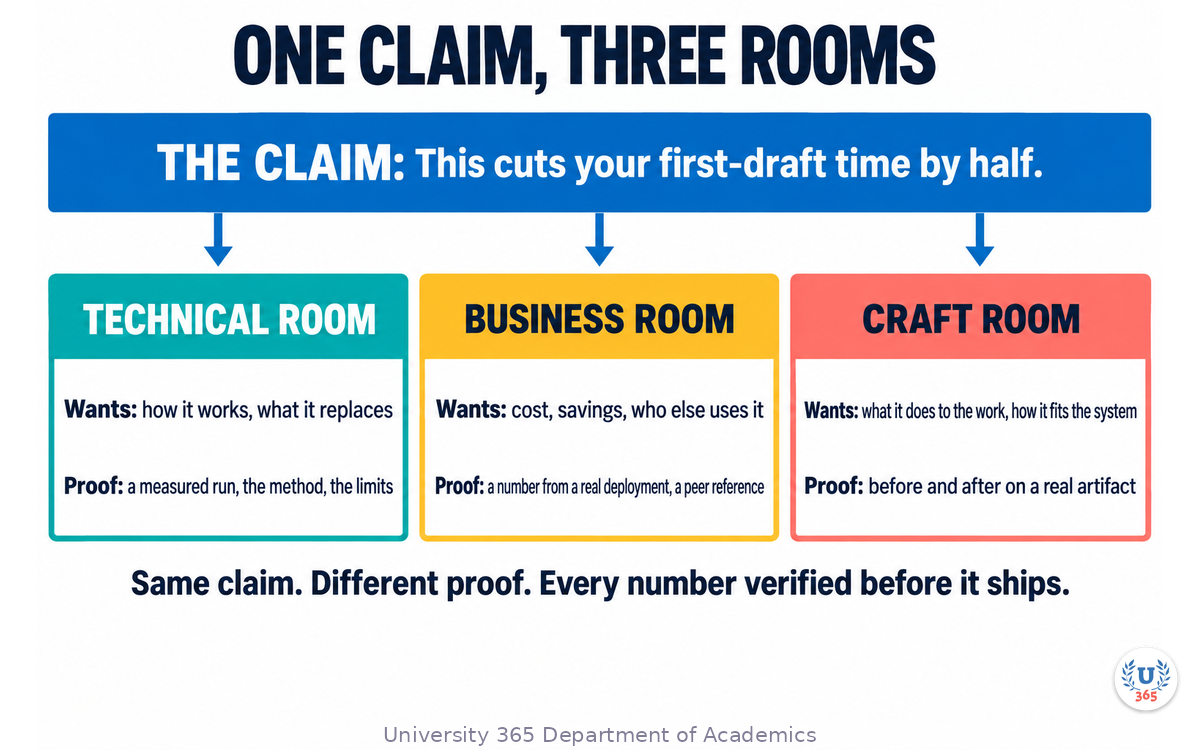
Write the message as a claim plus a proof. The claim is the promise from Step 1. The proof is what a sceptical reader can verify: a demonstration, a number from a real run, a named user's quote (with permission), or a short recording of the product doing the thing. Claims without proofs are the reason most launch posts get skimmed.
Write three versions, one per room. The technical audience wants how it works and what it replaces. The business audience wants what it costs, what it saves, and who else is using it. The craft audience (design, content) wants what it does to the work and how it fits the existing system. Same claim, different proof.
Prepare the follow-up before the launch. The hardest launch message to write is the one after a quiet week. Draft, in advance, the four posts that follow: the first user story, the comparison post ("what this replaces"), the objection post, and the update post. Having them drafted turns a quiet launch from a crisis into a sequence.
Disclose how it was made, when trust depends on it. If the product is AI-native, this is a feature you can explain plainly: what the model does, what it does not decide, what stays with the user. An audience that understands the boundary trusts the product faster than one protected from the mechanism.
Where AI helps. Drafts from your notes, variants per room, the share preview text, the follow-up sequence, translations, and the FAQ built from the questions you are actually asked. Where it must not. The claim itself must be true. Every number, every comparison, and every user quote is verified against the source before the launch goes out, because a single inflated claim is the fastest way to lose the technical audience permanently.
Step 5: Launch to a Room You Can Hear From
A launch is not a broadcast. It is the moment you invite the first cohort and the start of a listening period, and its design should reflect that.
Choose a room, not a megaphone. The first cohort should be small enough to talk to and large enough to produce signal: typically thirty to a few hundred people who match the first user precisely. A launch to strangers optimises for impressions; a launch to a named cohort optimises for learning.
Open a channel and staff it. Wherever the cohort gathers: a discussion thread, a form, a chat. Someone must read it every day of launch week, and the read must produce a triaged list, not a warm feeling.
Prepare the launch day like an operation. Who publishes where and when, in what order; who monitors the instrumented path; who answers the audience; who can call the rollback. Written down, with names. The launch day is not the day for decisions, it is the day for executing the ones you already made.
Launch the smallest honest version, loudly. Everything in the previous four steps exists so this moment can be honest: the promise is true, the narrow path works, the surfaces are usable, the message is clear. Announce with conviction, because a hedged launch signals the team does not believe its own proof.
Step 6: Read the Signals and Iterate in Public
The ninety days after the launch decide whether the product finds its market. Three habits make them productive.
Read the path, not the mood. The instrumented funnel from Step 2 tells you where people stop: arrival without signup is a message problem; signup without completion is a product problem; completion without return is a value problem. Each has a different owner and a different fix. Discussing the mood instead of the funnel burns the window.
Fix the largest drop first, one per two weeks. Not the most interesting drop, the largest. One change every two weeks, measured against the funnel, compounding across a quarter.
Iterate in public. Publish the fixes: what changed, why, based on what. An audience that watches a product improve has a reason to return, and a founder who reports the numbers honestly accumulates the credibility that makes the next launch larger. This is the point where the disciplines of this lecture converge: technology ships the fix, business reads the number, communication tells the story, design makes the change visible on the surface.
Know when to stop. If the return number has not moved after three honest iterations of the largest drop, the problem is usually the job, not the execution: the launch sentence from Step 1 described a job that the first hundred users do not actually have. Going back to Step 1 with real data is a legitimate and healthy move, and it is much cheaper at ninety days than at nine months.
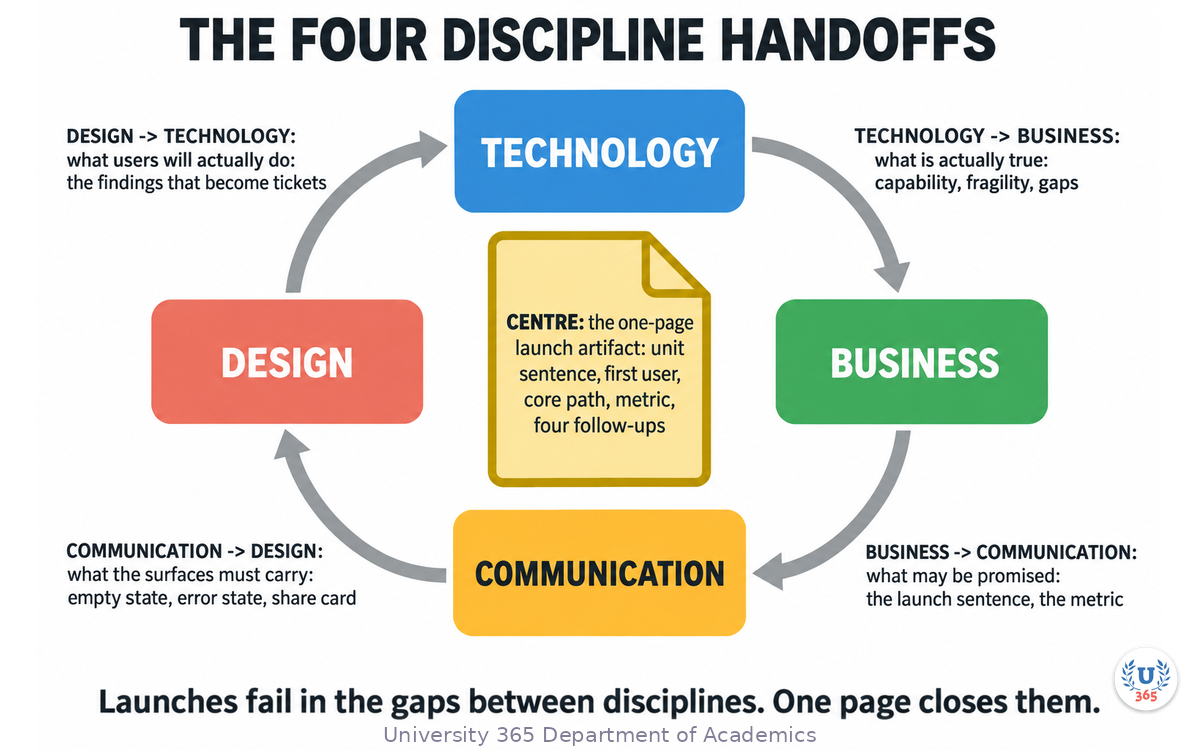
The Four Handoffs Where Launches Break
Each discipline of this lecture ends in a handoff, and the handoffs are where the failures live.
Technology to business: what is actually true. The engineering team reports what works, what is fragile, and what was not built. The business team hears only the first item unless the conversation is structured: a shared checklist of capability, fragility and gaps, signed off by both, prevents a promise built on a feature that is not there.
Business to communication: what may be promised. The launch sentence and the metric are the constraints on every public claim. A communications team that has not seen them writes plausible copy with a promise the product cannot keep.
Communication to design: what the surfaces must carry. The message determines which surfaces matter and what each must say: the empty state that must convert, the error state that must keep trust, the share card that must carry the claim at thumbnail size.
Design to technology: what the user will actually do. Usability findings change the path: a confusing step becomes a redesigned screen becomes a ticket. Handoff quality here determines whether the first ninety days are spent fixing the path or improving on it.
The shared artifact across all four is one page: the launch unit sentence, the first user, the core path, the metric, and the four follow-up posts. One page, owned by one named person, visible to all four disciplines. Launches fail in the gaps between disciplines, and one page is the smallest structure that closes the gaps.
Feynman Summary: Explain It Like You Are 12
You built a robot that helps kids find their lost school projects. It works perfectly in your room. But if you just open your window and shout "my robot is ready", nothing happens.
So you do it in an order. First you decide exactly who it is for: the kids who lose their projects every week. Then you make sure the robot works for one of those kids, for real. Then you make it easy to use and easy to find. Then you tell people one clear thing it does, with proof. Then you invite five kids who actually lose things, and you listen to what they say. Then you fix the biggest problem and tell everyone what you fixed.
The robot was never the hard part. Connecting it to the people who need it is the hard part, and it is a plan, not a day.
Mindmap: The Complete Picture
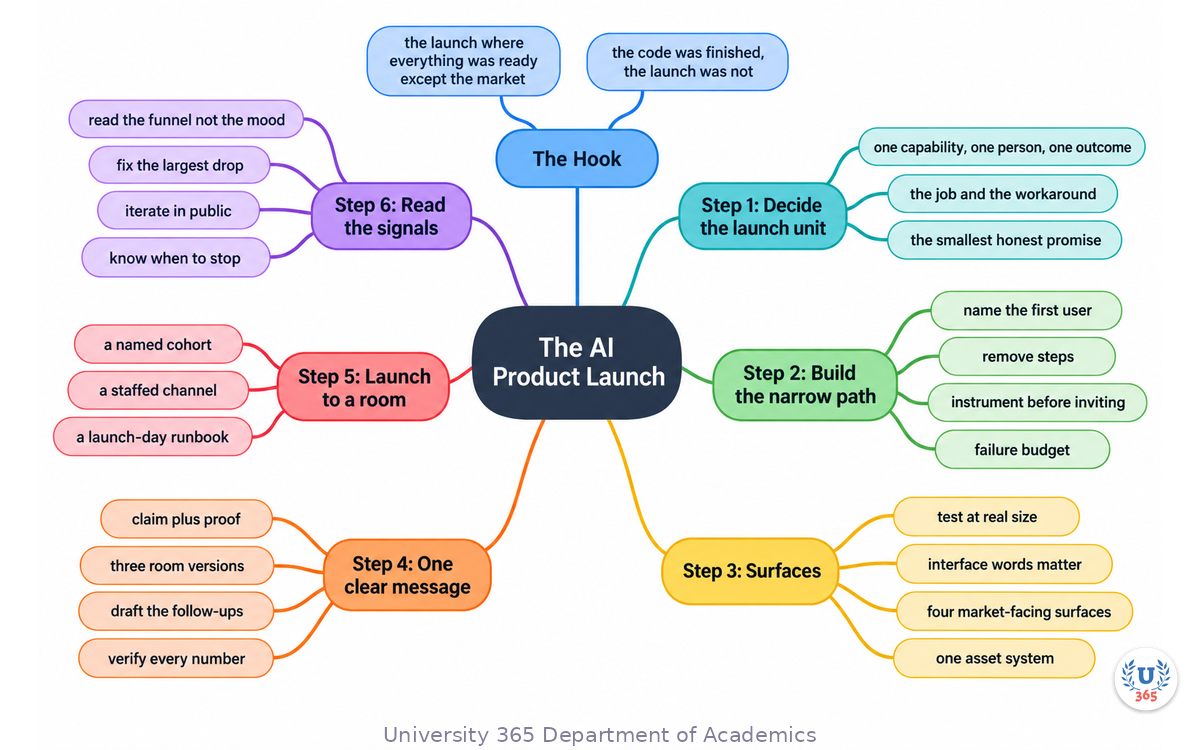
The mindmap gathers the lecture into one view: the six stages, the four discipline handoffs around the one-page artifact, and the ninety-day loop that reads the funnel and fixes the largest drop.
UNOP Sound (University 365 Neuroscience Oriented Pedagogy)
Take five minutes to consolidate your memory. Play the isochronous tone track (10Hz alpha frequency) with your eyes closed. Alpha-frequency tones after a learning session support consolidation, helping move what you just learned from short-term to long-term memory.
[Audio player: UNOP Post-Lecture Isochrone (10Hz, 5 minutes)]
Practical Exercise: Plan a Launch in Four Sprints
Pick a real product or feature you are close to. If you have none, pick one you use and plan the launch it should have had.
Part 1: Define (60 minutes)
Write the launch unit sentence: capability, person, outcome. Cut every "and".
Name the job, and the current workaround it replaces.
Write the smallest honest promise, testable on day one.
Choose the one metric for the first ninety days.
Run the sceptic pass: have a model argue against your launch sentence as a hostile buyer, and write down the three strongest counterarguments.
Part 2: Build the narrow path (75 minutes)
Name the first user concretely: name, role, workaround.
Map the core path from arrival to the core action, step by step.
List the instrumentation: the events, where they are stored, what the dashboard shows.
Write the failure plan: pager, rollback, user message, with names.
Part 3: Surfaces and message (75 minutes)
List the four market-facing surfaces (landing page, link preview, empty state, error state) and write, for each, the one thing it must communicate.
Write the claim plus proof for your launch message.
Write the three room versions: technical, business, craft.
Draft the four follow-up posts.
Part 4: Launch and read (60 minutes)
Choose the first cohort: size, where they gather, who staffs the channel.
Write the launch-day runbook: who publishes where and when, who monitors, who answers, who can roll back.
Define the three funnel questions and the owner of each: message, product, value.
Set the iteration schedule: one largest-drop fix every two weeks for ninety days.
What to look for
Two findings appear in almost every first plan. The launch unit sentence is hardest and most valuable; teams discover they were launching three things at once. And the four follow-up posts, drafted in advance, are the difference between a quiet launch week and a collapsed one.
Applied CI-First connection
You chose the launch unit, the promise and the cohort: consequential judgment calls that carry the team's name. The machine carried the drafting, the variants, the FAQ and the translations. Every claim that leaves the building is verified by a human against its source, and every number reported to the audience is real.
Glossary
Term | Definition |
Launch unit | The single capability, for a single person, delivering a single outcome, that this launch ships. |
Job (to be done) | The underlying task a user is trying to accomplish, which names the real competitor: the current workaround. |
Smallest honest promise | A testable claim that is already true on day one. |
Core path | The shortest route from arrival to the action that demonstrates the product's value. |
Instrumentation | The events recorded along the core path and the dashboard that displays them. |
Failure budget | The written plan for what happens when the path breaks: pager, rollback, user message. |
Market-facing surfaces | The landing page, link preview, empty state and error state: what the market sees before and during first use. |
Claim plus proof | The launch message structure: the promise, plus something a sceptical reader can verify. |
First cohort | The small, precisely matched group invited at launch, sized to produce signal and to be listened to. |
Funnel reading | Interpreting drops by position: message problem, product problem, or value problem. |
Iterating in public | Publishing what changed and why, turning the audience into a reason to return. |
Handoff | The point where one discipline passes its output to the next, and where launches most often break. |
5M2S | 5 Minutes to Success, University 365's microlearning format. |
Quiz: TEST YOUR UNDERSTANDING
1. What is the "launch unit"?
A) The number of features shipped
B) One capability, for one person, delivering one outcome
C) The marketing budget
D) The engineering sprint length
2. Why is the "smallest honest promise" testable on day one?
A) Because marketing requires short sentences
B) Because a claim that is already true cannot be walked back, and it sets up no disappointment
C) Because legal review requires it
D) Because it is faster to write
3. What are the four market-facing surfaces named in Step 3?
A) Landing page, link preview, empty state, error state
B) Logo, banner, footer, sidebar
C) Email, SMS, push, in-app
D) Blog, podcast, video, newsletter
4. In Step 6, what does a signup-without-completion drop indicate?
A) A message problem
B) A value problem
C) A product problem
D) A pricing problem
5. Where do launches most often break, according to this lecture?
A) In the code
B) In the budget
C) In the handoffs between disciplines, which one page closes
D) In the advertising platform
Answers: 1-B, 2-B, 3-A, 4-C, 5-C
Related Resources
U365 INSIDE Publications
Lecture: The CI-First Workflow: Applied to Any Field: the workflow that runs underneath this launch plan
Lecture: AI in Web Design: From Wireframe to Deployed Site: the surfaces stage in depth
Lecture: The AI Press Release: Automating PR: announcing with the message discipline of Step 4
Lecture: The ROI of AI: Measuring What Matters: measuring the ninety-day loop
External Resources
Mind the Product: product management resources: discovery, delivery and launch practice: mindtheproduct.com
Reforge: growth essays: retention and iteration frameworks for the ninety days after launch: reforge.com
SVPG (Silicon Valley Product Group): product operating model essays, including launches to a real cohort: svpg.com
Deloitte: Tech Trends: adoption patterns for enterprise launches: deloitte.com
Related U365 Lectures
Lecture 1: The CI-First Workflow: Applied to Any Field (UIT, UIB, UIC, UID, Cross-Institute Series)
Lecture 3: AI for Personal Branding: Design, Content, and Strategy (UIC, UID, Cross-Institute Series)
Lecture 5: Ethics and AI: A Practical Framework for Every Field (UIT, UIB, UIC, UID, Cross-Institute Series)
U.Copilot for This Lecture
Discuss this lecture with U.Copilot, your AI chat companion trained on this content.
Copy and paste the following prompt into the U.Copilot chat on university-365.com:
You are U.Copilot for Lectures, an AI chat companion specially trained on University 365 lecture content. You are helping a Fellow who just completed the cross-institute lecture "The AI Product Launch: From Code to Market". Your role is to help the Fellow plan their launch. You can: - Sharpen the launch unit sentence and cut every "and" - Name the job and the workaround the product replaces - Map the core path and list the instrumentation events - Write the claim plus proof and the three room versions - Draft the four follow-up posts before the launch day - Build the funnel reading checklist with the owner of each drop Always maintain U365's CI-First approach: the launch unit, the promise and the cohort are ownership decisions made by named humans, and AI accelerates drafting, variants, FAQ and translation. Never present an unverified statistic, comparison or user quote as fact. Use the UP-Context Method: provide context-rich, role-aware responses that account for the Fellow's product, audience and stage.
Next Steps
Write the launch unit sentence today, and delete every "and".
Name the first user and their workaround, and confirm the team agrees.
Map and instrument the core path before anyone is invited.
Draft the four follow-up posts before the launch day.
Book the ninety days: one largest-drop fix every two weeks, measured against the funnel.
The code was never the launch. Ship it for one real person, say one true thing, invite a room you can hear, and read the funnel for ninety days. That sequence is the whole difference between a launch and an event.
IMPORTANT NOTICE
This lecture is published by University 365 as part of its INSIDE Publications Hub. The content is free to read for all visitors. Lectures in this series may be part of a structured academic program leading to a Micro-Credential for your Career (MCC). To enroll in an academic program, visit university-365.com/tuition.
This content is for educational purposes. Product, platform and analytics tooling develop quickly. Verify current specifications and vendor terms against the primary sources linked above before relying on any launch plan in production.
Copyright University 365, Inc. All rights reserved. This content is protected under University 365's copyright policies. For permissions or inquiries, contact uda@university-365.com.
Published by the Department of Academics, University 365.
Lecture delivered by the UIT, UIB, UIC, UID in collaboration.
Martin Swartz, Dean of Academics, UDA
Signed for the academic year 2026.




Comments