
The AI Press Release: Automating PR



UIC University 365 Institute of Communication
Series Content Strategy | Level Basic (Free)
Duration 15 to 20 minutes | Access Free
Digital Communication, Marketing, Branding, Content Strategy, Media Studies

UNOP Sound (University 365 Neuroscience Oriented Pedagogy)
Take five minutes to prepare your brain. Play the isochronous tone track (40Hz gamma frequency) with your eyes closed. Gamma-frequency tones before a learning session raise attention and make the material easier to absorb.
[Audio player: UNOP Pre-Lecture Isochrone (40Hz, 5 minutes)]
In this Lecture

The Hook: The Announcement Nobody Read
You sent the release on a Tuesday morning, to a list of 180 addresses, with the headline "Company X Announces Strategic Enhancement to Its Platform Offering". Forty-two people opened it. Nobody wrote about it. A competitor announced something smaller two weeks later and got three articles, because their headline said what changed, who it affects and by how much.
Nothing about the second announcement was more important. It was more legible, and it was pitched to eleven specific people who cover that topic instead of blasted at 180 who do not.
Automation does not fix a bad announcement. What it does fix is the cost of producing the ten assets a good announcement needs, the research on who actually covers your subject, and the follow-up that most small teams never do.
This lecture shows the pipeline: what to generate, what to write yourself, what to check before sending, and where the legal and ethical lines sit. You will finish with a repeatable PR workflow that produces a better release for less effort, and a clear list of things you must never automate.
Step 1: What a Press Release Is Actually For
A press release has one job: give a journalist everything they need to write a story without asking you a question. It is a source document, not an advertisement.
What it is not. It is not a channel to your customers. It is not a place to celebrate your own adjectives. It is not a substitute for a relationship with a reporter. A release sent to someone who has never heard from you competes with 200 others in the same inbox that morning.
Three audiences, three different reads.
Audience | What they scan for | What makes them stop |
Journalist | What changed, who is affected, is it verifiable, is it new | A specific, checkable number in the first sentence |
Analyst or investor | Market implication, scale, timing | Category context and a named comparison |
Customer reading it later | What it means for them | Plain language and a clear next step |
The test before you write. Can you complete this sentence with a specific fact? "This matters because ___ , and here is the number that proves it." If you cannot, you have an internal announcement, not a press release. Internal announcements are useful. They are just not this document.
The newsworthiness question. Journalists filter on novelty, impact, proximity, prominence, conflict and human interest. A release that answers none of the six is a release that gets deleted. Ask which one or two your announcement satisfies, and write the headline around that answer.
Step 2: The Anatomy of a Release That Gets Used
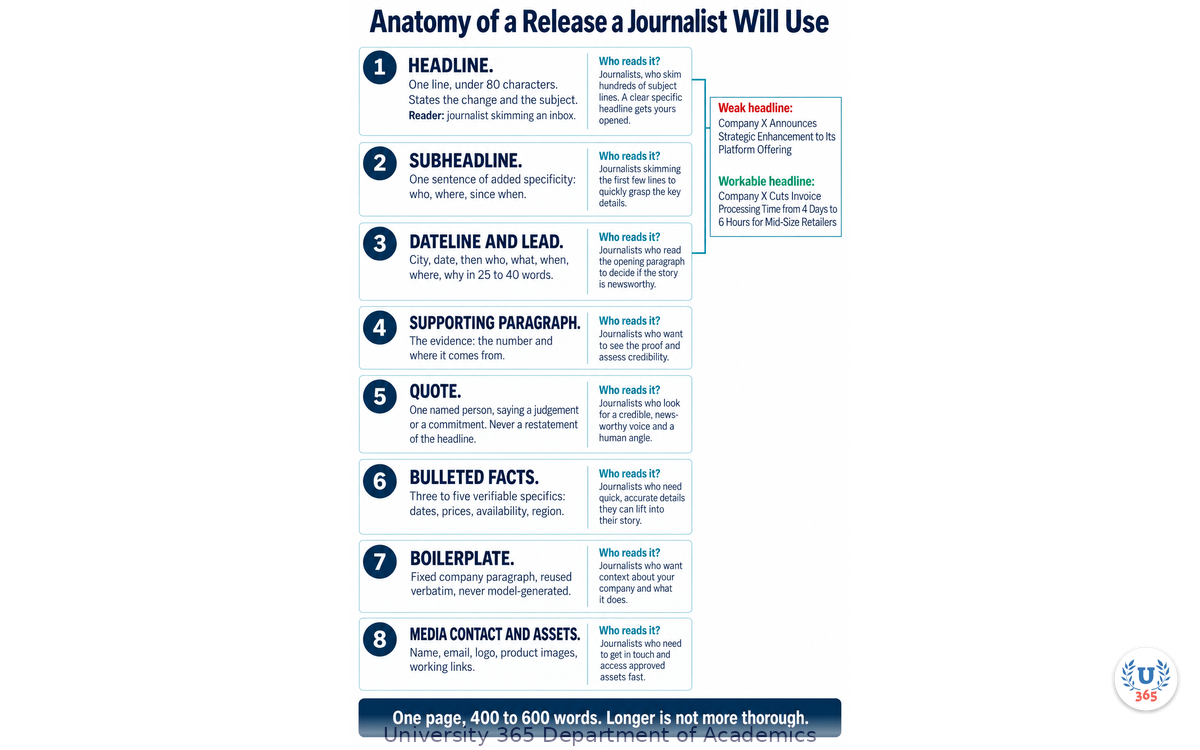
The headline. One line, under about 80 characters, stating the change and the subject. No adjectives you cannot defend. No "revolutionary", no "industry-leading", no "game-changing".
Compare:
Weak: "Company X Announces Strategic Enhancement to Its Platform Offering"
Workable: "Company X Cuts Invoice Processing Time from 4 Days to 6 Hours for Mid-Size Retailers"
The second gives a journalist a number, a comparison and a defined audience in one line.
The subheadline. One sentence of additional specificity: who is affected, where, or since when.
The dateline and lead paragraph. City, date, then the whole story in 25 to 40 words. Who, what, when, where, why. A reader who stops here should still have the story.
The supporting paragraph. The evidence: the number, the source of the number, the scale, the availability date.
The quote. One quote from a person who can be named, saying something a person would actually say. A quote that restates the headline adds nothing and is the fastest way to signal a machine-written release. Real quotes contain a judgement, a reason or a commitment.
The bulleted facts. Three to five short lines of verifiable specifics. Product names, dates, prices, availability, region.
The boilerplate. A fixed paragraph about the company, identical in every release. This is the one block you should reuse verbatim, and the one block that should never be model-generated: factual claims about the company must come from a source you control.
The media contact. Name, email, phone where applicable.
The assets. Logo, product images, and any data appendix. Attach them or link them with working URLs. A journalist who has to email you for the logo will often not bother.
Length. One page, or 400 to 600 words. Longer is not more thorough. It is less likely to be read.
Step 3: What You Can and Cannot Automate
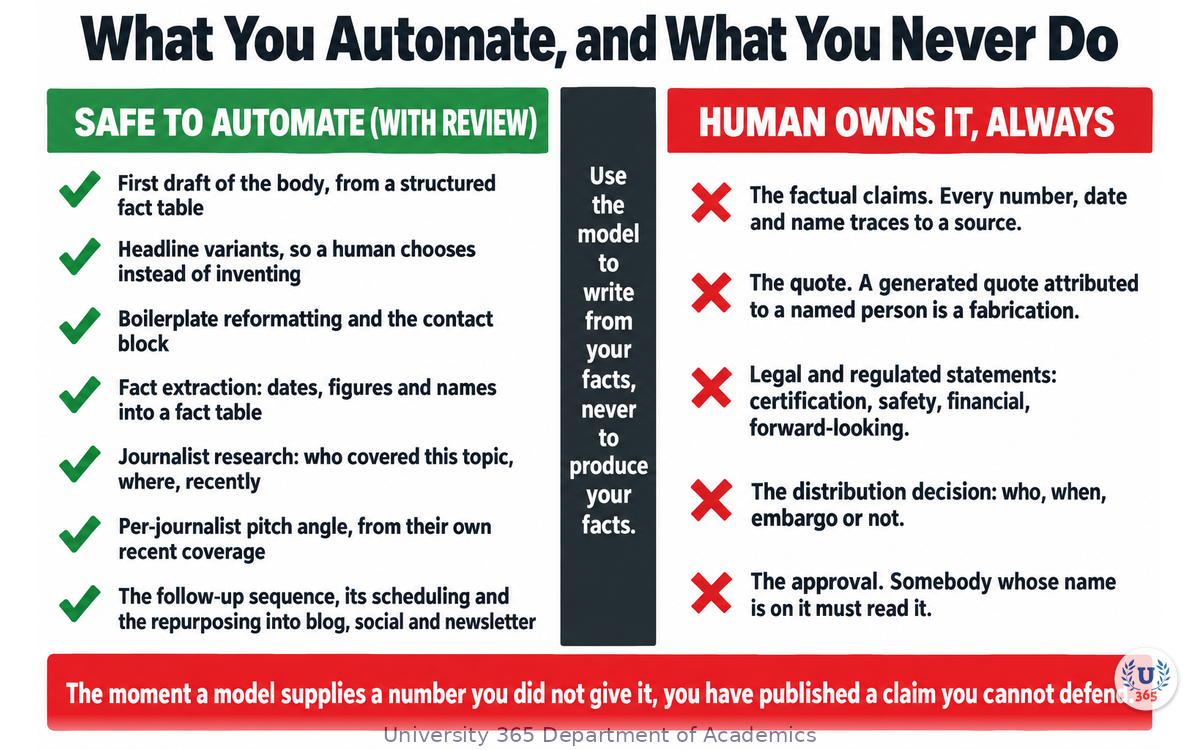
Safe to automate, with review.
The first draft of the body, from a structured brief containing the real facts
Headline variants, so a human chooses rather than invents
The boilerplate reformatting and the contact block
Fact extraction: pulling dates, figures and names out of an internal document into a fact table
The journalist research: who has covered this topic, in which outlet, recently
The per-journalist pitch angle, from their own recent coverage
The follow-up sequence and its scheduling
Repurposing the release into a blog post, a social thread, a newsletter section
Not safe to automate without a human owning it.
The factual claims themselves. Every number, date and name must trace to a source you can point at.
The quote. A generated quote attributed to a named person is a fabrication risk and, in a professional context, a reputational one.
The legal statements: regulatory status, certification, safety, financial results, forward-looking claims.
The distribution decision: who receives it, when, and under embargo or not.
The approval. Somebody whose name is on it must read it, and that somebody is a person.
The rule that keeps this honest. Use the model to write from your facts, never to produce your facts. The moment a model supplies a number you did not give it, you have published a claim you cannot defend.
Step 4: The Release Pipeline
Six stages, each with a clear owner and a clear output.
Stage | Input | Output | Human role |
1. Fact table | Internal source documents | Structured list: claim, value, source, verifier, as-of date | Owner verifies every row |
2. Draft | Fact table plus angle | Release body, three headline options | Editor rewrites the lead |
3. Journalist list | Topic and geography | 10 to 25 named people with outlet and recent coverage | Comms lead confirms fit |
4. Assets | Product and brand files | Images, logo, data appendix, working links | Designer or comms approves |
5. Pitch | Release plus each journalist's coverage | One personalised email per journalist | Comms lead sends it |
6. Follow-up and measure | Sent log plus coverage | Coverage log, reply log, one-page retrospective | Comms lead reads it |
The fact table is the most valuable artifact. Build it first, as a table with four columns: claim, value, source, verified by. Every sentence in the release that contains a number must trace to a row. When a reviewer asks "where does 40 percent come from?", the answer is a row, not a memory.
The briefing prompt that produces a usable first draft. Give the model the facts and the constraint, nothing more:
Write a press release body in 450 words maximum using ONLY the facts in the table below. Structure: lead paragraph (who, what, when, where, why, in 35 words), supporting evidence, one quote placeholder marked [QUOTE: <person> to supply], three bulleted verifiable facts, boilerplate retained verbatim. Rules: no adjectives you cannot verify from the table; no "revolutionary", "leading" or "world-class"; every figure must match the table exactly; mark any sentence that needs a fact you were not given as [NEEDS FACT]. <fact table>
The [NEEDS FACT] marker is the important part. It turns a silent invention into a visible gap.
The journalist research done properly. For each target, record what they wrote recently, in which outlet, and the angle that connects your announcement to their beat. A list of 25 names with a real recent article each beats a list of 180 addresses with none. Volume is not distribution; fit is.
Approval. Two names on the approval, always: the fact owner and the person who will answer the phone if a journalist calls. Embargo terms, if you use them, are agreed in writing before sending.
Step 5: Turning One Release Into a Campaign
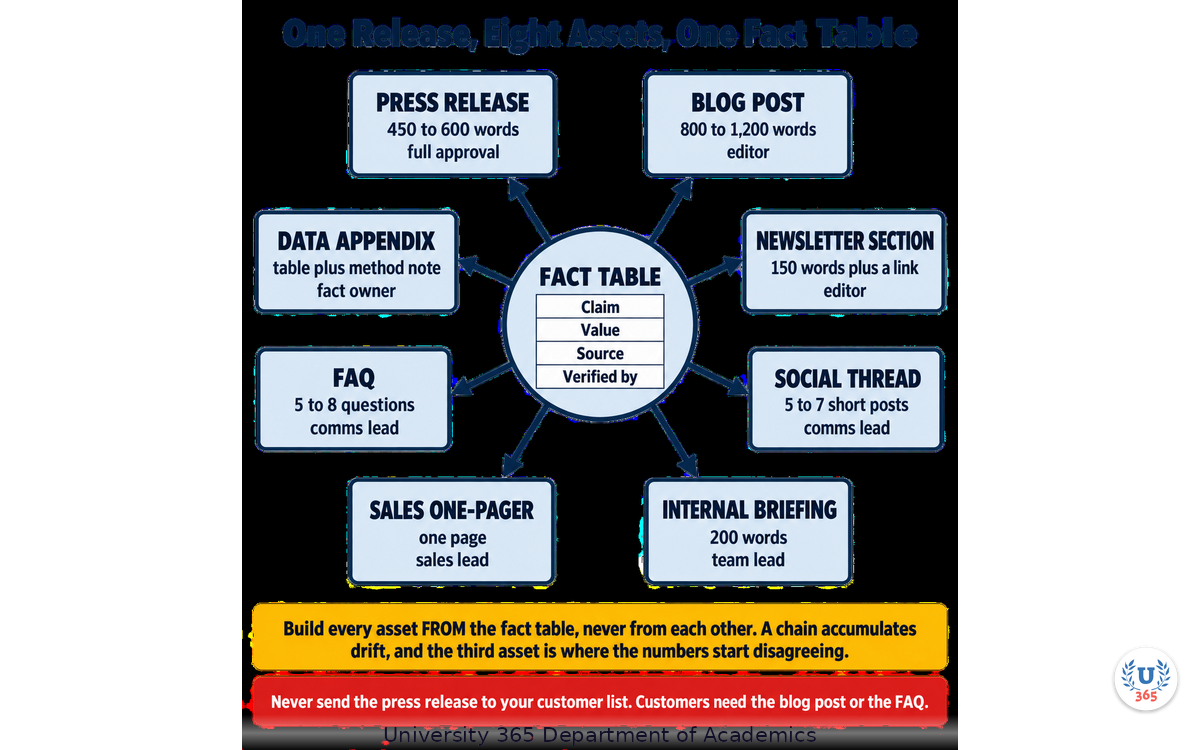
A release is one artifact. The same fact table and the same approved facts support a set of assets you can generate once and adapt.
The asset set that costs almost nothing extra:
Asset | Length | Source | Review level |
Press release | 450 to 600 words | Fact table | Full approval |
Blog post | 800 to 1,200 words | Release, expanded with examples | Editor |
Newsletter section | 150 words plus one link | Release lead | Editor |
Social thread | 5 to 7 short posts | Release bullets | Comms lead |
Internal briefing | 200 words | Release plus messaging notes | Team lead |
Sales one-pager | One page | Release bullets plus objection handling | Sales lead |
FAQ | 5 to 8 questions | Anticipated press and customer questions | Comms lead |
Data appendix | Table plus method note | Fact table | Fact owner |
Consistency is the whole point. All eight assets must state the same numbers, the same dates and the same product names. Build them from the fact table, not from each other in a chain: a chain accumulates drift, and the third asset in the chain is where the numbers start disagreeing.
The one thing you must not do. Do not send the release to customers as an announcement. Customers need the blog post or the FAQ, in their language, explaining what changes for them. Sending a press release to a customer list is the most common way a good announcement arrives looking like a template.
Step 6: Personalising the Pitch Without Faking It
A pitch has two failure modes: too generic, and dishonestly specific.
Generic. "Hi, I thought you might be interested in our latest news." This is deleted in under a second.
Dishonestly specific. "I loved your piece on supply chains last month" when you did not read it, or when the piece does not exist. Journalists check. Getting caught costs you the relationship and any future pitch.
The structure that works, in four sentences.
The fact, in their terms: one sentence with the number and the change.
Why it connects to their beat: one sentence naming the specific angle, referring to their actual recent coverage by topic.
What you can provide: an interview, data, images, an exclusive angle, or access to the people involved.
The exit: one line saying you will not follow up again if they are not interested.
Automate the research, write the judgement. The model can assemble, for each target, their outlet, their recent topics and the two or three angles that connect. You then choose the angle and write the one sentence that shows you read the work. That sentence is the part that cannot be generated without becoming a fabrication.
Follow-up discipline. One follow-up, 48 to 72 hours later, with something new in it: an added data point, an interview offer, a correction. A second chase with nothing new is spam, and the model will happily generate ten of them if you let it.
The measurement that matters. Track per-journalist outcomes: pitched, replied, wrote, and the angle used. Over a few quarters this becomes the most valuable asset in the whole pipeline, because it tells you which angles and which people work for your subject. Coverage volume without that breakdown tells you nothing you can act on.
Step 7: The Rules You Cannot Automate Away
1. Never fabricate a quote, a statistic or a source. A generated quote attributed to a named person is a fabrication, even when it sounds like something they would say. If the person has not said it, it does not exist. Same for a statistic with no origin and a "study" with no authors.
2. Disclose the use of AI where it affects the claim. If a data analysis was performed with model assistance, the method note should say so. Disclosure does not weaken the announcement; a discovery that you hid it does.
3. Respect embargoes and distribution terms exactly. An embargo is an agreement with a time and a set of recipients. Sending early, sending wide, or letting the model "improve" the list by adding people is a breach, and it is one that costs you access for years.
4. Do not name a client, partner or customer without written permission. Contracts often require consent for publicity. A model assembling a press release from a fact table will happily include a client name that appears in an internal document. Check every proper noun against a permission you can point to.
5. Do not make forward-looking or regulated claims without the responsible function. Financial projections, medical or safety claims, environmental claims, and anything a regulator supervises needs legal or compliance review before it leaves the building. This is not optional and it is not automatable.
6. Do not let generated volume replace relationships. Ten pitches to people who have never heard from you perform worse than two pitches to people who have. Automation multiplies an existing relationship; it does not create one.
7. Keep the correction path open. If a release contains an error, you need a named person who can issue a correction within hours. Decide who that is before you publish, and put it in the release checklist.
Feynman Summary: Explain It Like You Are 12
Imagine your club has big news: you finally got a proper football pitch.
You could tell everyone in one long message, and most people would forget it by dinner. Or you could do what real clubs do. You write a short page that says exactly what happened, where the pitch is, when you can play on it, and how much it cost. You check every one of those facts twice. Then you find five people who write about local sports, and you send each of them one short note: here is the news, here is why it matters for the teams you write about, and here is who you can call to ask questions.
You do not make up a quote from the coach. You ask the coach. You do not send it to five hundred people who do not care. You do not say it is "the most modern pitch in the region" unless you can prove it.
The computer can write your first draft from the facts you give it, and help you find the five writers. Your job is to make sure every fact is true and every sentence sounds like a person wrote it. That is the whole thing.
Mindmap: The Complete Picture
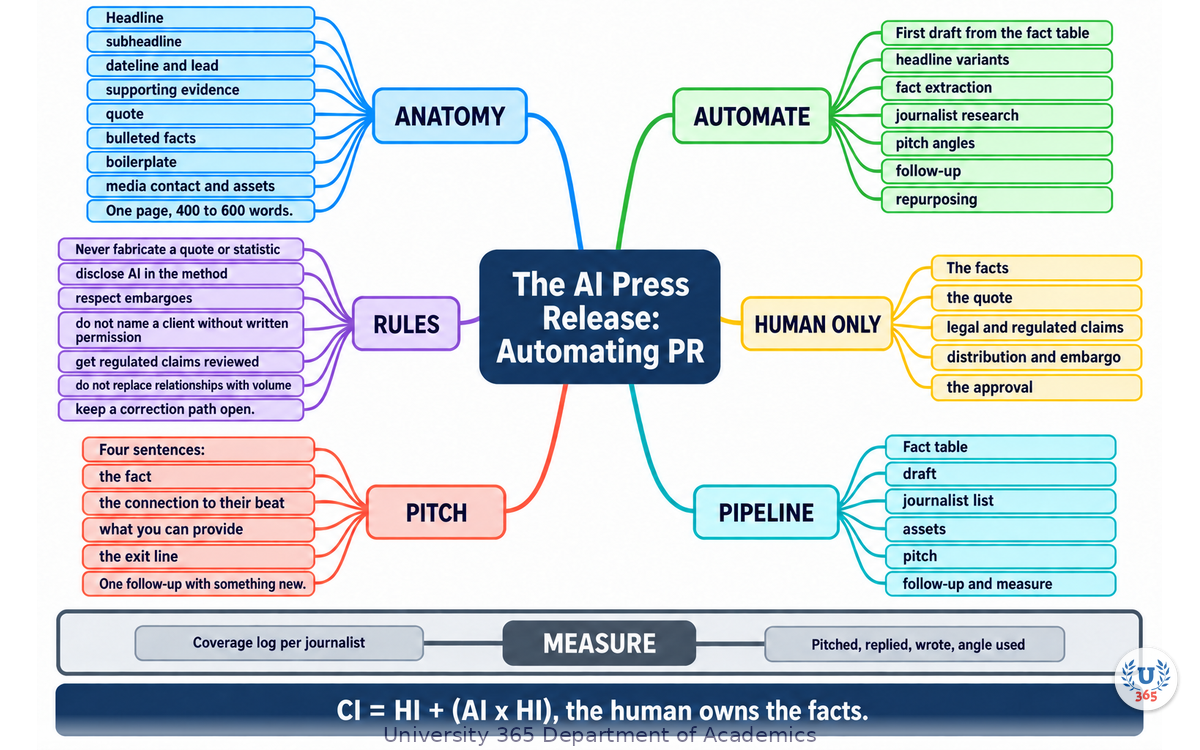
The mindmap shows the release anatomy from headline to assets, the safe-to-automate and human-only lists, the six pipeline stages with their owners, the eight-asset campaign set, the four-sentence pitch structure, and the seven rules that cannot be automated with the owner of each.
UNOP Sound (University 365 Neuroscience Oriented Pedagogy)
Take five minutes to consolidate your memory. Play the isochronous tone track (10Hz alpha frequency) with your eyes closed. Alpha-frequency tones after a learning session support consolidation, helping move what you just learned from short-term to long-term memory.
[Audio player: UNOP Post-Lecture Isochrone (10Hz, 5 minutes)]
Practical Exercise: Draft, Target and Pitch One Release
Exercise: One Real Announcement, End to End
Pick a real, small, verifiable announcement. A new service, a new hire, a partnership, a milestone. Something you could actually publish this month.
Build the fact table first. Four columns: claim, value, source, verified by. Fill it in before you write anything. If a claim has no source, delete it or go find one.
Ask the model for a draft using the briefing prompt from Step 4 and the fact table only. Do not give it any facts it does not need.
Find every `[NEEDS FACT]` marker it produced. For each one, either supply the fact from a source or delete the sentence.
Write the headline yourself from the three options it generated, then rewrite the lead paragraph in your own words.
Get the quote from the person, in writing, with their approval of the exact wording.
Build the journalist list: 10 to 25 named people who cover your subject, with one recent article each and the angle that connects.
Write four sentences for each of three journalists, using the structure from Step 6. Do not send them yet.
Reformat the same facts into three other assets: a blog post, a newsletter section and an FAQ.
Check consistency: are the numbers, dates and product names identical across all four assets?
Run the rule checklist from Step 7, item by item, and record who approved what.
What to Observe
How many facts did the draft need that were not in your table? That number is your fact-gathering gap.
Did the generated headline or your rewritten one survive? Which one stated the change more plainly?
How long did the journalist research take compared with writing the release?
Which of the seven rules came closest to being broken by the draft, and why?
If you sent it, did any reply reference the specific angle you chose? That is the only test of the pitch sentence.
Applied AI Connection
You built the fact table, chose the journalists, wrote the lead and obtained the quote. The model drafted the body, extracted facts, and assembled the research. That is the CI-First pattern: CI = HI + (AI x HI). The human supplies the facts and the judgement, and the machine removes the production cost that used to make a good announcement unaffordable for a small team.
Glossary
Term | Definition |
**Press release** | A source document giving a journalist everything needed to write a story without asking a follow-up question. |
**Fact table** | A four-column record of claim, value, source and verifier, from which every figure in a communication must trace. |
**Boilerplate** | The fixed paragraph about a company reused in every release, which must not be model-generated because it states company facts. |
**Embargo** | A written agreement to publish no earlier than a stated time, binding on the recipients it was given to. |
**Dateline** | The city and date at the start of a release, establishing where and when the announcement originates. |
**Newsworthiness** | The quality a journalist filters on: novelty, impact, proximity, prominence, conflict or human interest. |
**Pitch** | A short personalised email connecting one announcement to one journalist's specific beat and recent coverage. |
**Forward-looking statement** | A claim about future performance or outcomes, which carries regulated status and requires compliance review. |
**Correction path** | The named person and process for issuing a correction if a published release contains an error. |
**Coverage log** | A per-journalist record of pitched, replied, wrote and angle used, the pipeline's most valuable long-term asset. |
**CI-First** | Co-Intelligence First: the U365 principle that the human is the orchestrator and the AI is the amplifier. CI = HI + (AI x HI). |
**UP-Context Method** | University 365 Prompting-Context Method: a structured approach to prompting with explicit context blocks for consistent output. |
Quiz: TEST YOUR UNDERSTANDING
1. What is the primary purpose of a press release?
A) To advertise to customers
B) To give a journalist everything needed to write a story without asking a follow-up question
C) To rank in search engines
D) To replace a media relationship
2. Which element must never be model-generated without a human supplying it?
A) The formatting of the contact block
B) The quote, because a generated quote attributed to a named person is a fabrication
C) The headline variants
D) The bulleted fact formatting
3. Why build all campaign assets from the fact table rather than from each other?
A) It is faster
B) A chain accumulates drift, and later assets start disagreeing on the numbers
C) The model cannot read a chain
D) Platforms require a single source
4. What makes a pitch sentence dishonest?
A) Being shorter than three lines
B) Referring to a piece of coverage you did not actually read, or that does not exist
C) Offering an interview
D) Naming the announcement's date
5. Which category of claim requires review by the responsible function before release?
A) Product names
B) The dateline
C) Forward-looking or regulated claims such as projections, safety or environmental statements
D) The boilerplate address
Answers: 1-B, 2-B, 3-B, 4-B, 5-C
Related Resources
U365 INSIDE Publications
Lecture: AI Content Generation: Beyond ChatGPT: The multi-tool content pipeline this PR workflow plugs into
Lecture: Crisis Communication in the AI Age: What to do when an announcement becomes a crisis
Lecture: Sentiment Analysis for Brand Monitoring: Measuring whether the announcement landed
External Resources
PR Newswire and Business Wire: Paid distribution services with disclosure requirements
Muck Rack: Journalist research with recent coverage by beat
Google Alerts: Free monitoring of coverage on your announcement
AP Stylebook: The reference most newsrooms expect you to follow
Your own CRM or media list: The relationship record that no tool replaces
Related U365 Lectures (Coming Soon)
Lecture 1: AI Content Generation: Beyond ChatGPT (UIC, Content Strategy Series)
Lecture 5: AI Video Production on a Budget (UIC, Media Studies Series)
Lecture 9: Podcast Production with AI: From Script to Published (UIC, Media Studies Series)
U.Copilot for This Lecture
Discuss this lecture with U.Copilot, your AI chat companion trained on this content.
Copy and paste the following prompt into the U.Copilot chat on university-365.com:
You are U.Copilot for Lectures, an AI chat companion specially trained on University 365 lecture content. You are helping a Fellow who just completed the lecture "The AI Press Release: Automating PR" from the Content Strategy Series at the U365 Institute of Communication (UIC). Your role is to help the Fellow run an honest automated PR pipeline. You can: - Help them build a fact table with a source and a verifier for every claim - Review a generated draft for invented numbers, unverifiable adjectives and missing facts - Coach them on writing a lead paragraph and a headline a journalist would actually open - Help them research journalists by beat and construct the four-sentence pitch - Walk through the seven rules and flag which one their draft comes closest to breaking - Turn one approved fact set into the eight-asset campaign while checking consistency Always maintain U365's CI-First approach: the human supplies the facts and owns the judgement, and the machine removes production cost. Never generate a quote, a statistic or a source the Fellow has not supplied. Use the UP-Context Method: provide context-rich, role-aware responses that account for the Fellow's communications experience and goals.
Next Steps
Now that you can run a press release as a pipeline instead of an event, here is what to do next:
Build a fact table for your next announcement before you write a word of it
Start a coverage log: per journalist, pitched, replied, wrote, angle used
Cut your media list to the ten people who actually cover your subject and research each one properly
Fix your boilerplate once, from a source you control, and reuse it verbatim
Name the person who can issue a correction, and put them in the release checklist
Explore the Content Strategy Series tag on INSIDE for more publication workflows built on the CI-First approach
The second announcement got three articles because eleven people who cover that topic recognised it as theirs. That is the whole difference, and it is reproducible.
IMPORTANT NOTICE
This lecture is published by University 365 as part of its INSIDE Publications Hub. The content is free to read for all visitors. Lectures in this series may be part of a structured academic program leading to a Micro-Credential for your Career (MCC). To enroll in an academic program, visit university-365.com/tuition.
This content is for educational purposes. It does not constitute legal advice. Regulatory, financial and forward-looking disclosure requirements vary by jurisdiction. Verify the governing rules with qualified counsel before publishing.
Copyright University 365, Inc. All rights reserved. This content is protected under University 365's copyright policies. For permissions or inquiries, contact uda@university-365.com.
Published by the Department of Academics, University 365.
Lecture delivered by the University 365 Institute of Communication (UIC).
Lea Loringam, Dean of Communication, UIC
Signed for the academic year 2026.




Comments