
Crisis Communication in the AI Age


UIC University 365 Institute of Communication
Series Branding | Level Basic (Free)
Duration 15 to 20 minutes | Access Free
Digital Communication, Marketing, Branding, Content Strategy, Media Studies

UNOP Sound (University 365 Neuroscience Oriented Pedagogy)
Take five minutes to prepare your brain. Play the isochronous tone track (40Hz gamma frequency) with your eyes closed. Gamma-frequency tones before a learning session raise attention and make the material easier to absorb.
[Audio player: UNOP Pre-Lecture Isochrone (40Hz, 5 minutes)]
In this Lecture

The Hook: The Video That Never Happened
At 23:40 on a Sunday, a ninety-second video appears on three platforms at once. Your chief executive is on camera, in a room you recognize, saying something you know they never said. The audio is plausible. The lip movement is close. The account that posted it has existed for six days.
By 23:47 it has a thousand views. By 00:10 a journalist has emailed your press address. Your communications lead sees it at 00:25. Your legal counsel is asleep. Your chief executive is on a flight.
Nothing about this scenario is exotic anymore, and nothing about it is solved by writing a better statement. It is solved by decisions you made weeks earlier: who can speak, what is pre-approved, how you verify that the video is synthetic, and where you publish the correction.
This lecture gives you the system. Not the wording of a crisis statement, but the structure that makes a good statement possible within minutes instead of days.
Step 1: What Changed When Media Became Synthetic
Traditional crisis communication assumed three things: that the facts would become clear over hours, that the accusation would be a written claim, and that a careful statement would arrive while the story was still forming.
All three assumptions are now unreliable.
Media can be fabricated at near-zero cost. Video and audio that imitate a real person are within reach of anyone with a consumer subscription and a few minutes. You can no longer treat a recording as evidence of what happened.
Amplification is algorithmic. Platforms reward engagement, and outrage produces engagement. Content that provokes a reaction travels further than content that corrects one.
The correction arrives after the belief. Readers form a first impression in the minutes when a claim is spreading. A rebuttal published the next day changes less than most communicators assume.
An honest note on the numbers
Practitioner writing on this topic is full of precise figures: misinformation spreads six times faster, ninety-one percent of people do not verify, the window is fifteen minutes, deepfakes reach millions in two hours. Most of those numbers trace back to vendor blogs and consultancy newsletters rather than to published measurement, and you should treat them as claims, not evidence. Do not put them in your crisis plan as facts.
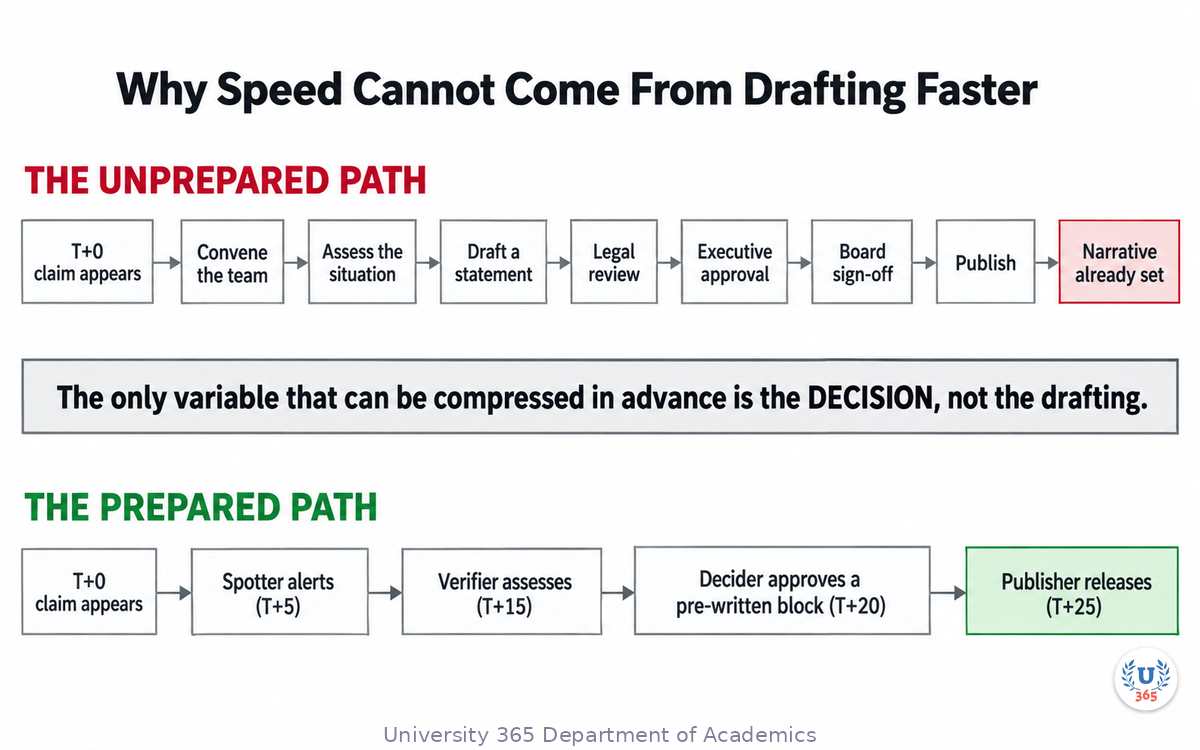
What you can rely on is the structural claim, which needs no statistic: the response window is now shorter than a legal review cycle. Whatever that window is in minutes, your organization cannot convene a committee, draft a statement, obtain legal sign-off, and publish inside it. That single observation is the reason everything in the rest of this lecture exists.
What this means for your plan
If speed cannot come from drafting faster, and it cannot come from skipping legal review, it has to come from preparation: decisions made in advance, statements written in advance, verification methods prepared in advance, and publishing channels ready to switch on. Crisis preparation is no longer a document. It is infrastructure.
Step 2: The Decision Chain You Build Before the Crisis
Every minute of delay in a crisis is usually caused by one question: who is allowed to say this? Answer it in advance and the delay collapses.
Name five roles, and name a backup for each. A role without a named backup is a role that does not function on a Sunday night.
Role | Responsibility | Time budget |
Spotter | Monitors for spikes, synthetic media, and coordinated posting, and raises the alert | continuous |
Verifier | Assesses whether the material is authentic, how far it has spread, and who is behind it | 10 to 15 minutes |
Decider | Chooses the response level and approves the wording | 5 minutes |
Approver | Legal or board sign-off for the prepared response blocks | 10 minutes, or not needed if the block is pre-approved |
Publisher | Releases on the owned channels and contacts the named journalists | 5 minutes |
Three rules make the chain work:
Pre-approve the low tiers. Legal signs off once, in advance, on a set of response blocks for standard situations: a fabricated recording, a coordinated disinformation campaign, a product safety claim, a data incident. Then the crisis response is activation, not drafting. Legal reviews the escalation tiers that carry new claims, not the acknowledgment tier.
Give the Decider pre-authorised autonomy. The bottleneck is almost never a process. It is a person waiting for permission. Write down, in advance, which statements the communications lead may publish without a further call, and which require the chief executive. A short, explicit list is worth more than a wide approval matrix.
Practise the chain. Run a drill in which the on-call spotter receives a fabricated video and the chain runs to a published holding statement. Time it. The first drill always reveals that two of the five roles were unreachable, that nobody has the login to one channel, and that the pre-approved statement does not fit the scenario being drilled. Better to discover that on a Tuesday afternoon than at 23:40 on a Sunday.
The OODA loop as a working frame
The decision structure many crisis teams use comes from Colonel John Boyd's OODA loop: Observe, Orient, Decide, Act. It fits this problem because the relevant competition is speed of comprehension, not volume of messaging. If you can observe sooner, orient on better criteria, decide with pre-authorised authority, and act through channels you control, you complete the loop faster than the narrative against you develops. The rest of this lecture maps onto those four stages.
Step 3: Detection and Triage: Is This a Trend or a Threat?
You cannot respond to what you do not see, and you cannot respond appropriately to what you have not classified.
What to monitor
Watch more than your brand name. Synthetic attacks rarely open with the brand name.
Executive names, including common misspellings.
Product and service names, and the terms your industry uses for them.
Your domain, your logos, and your facilities, in images and video.
Common misspellings, slang, and hashtag variants of your brand.
Mentions of your organization inside AI assistants and answer engines. These summarize your reputation from whatever they can retrieve, and a bad summary persists long after the original post is gone.
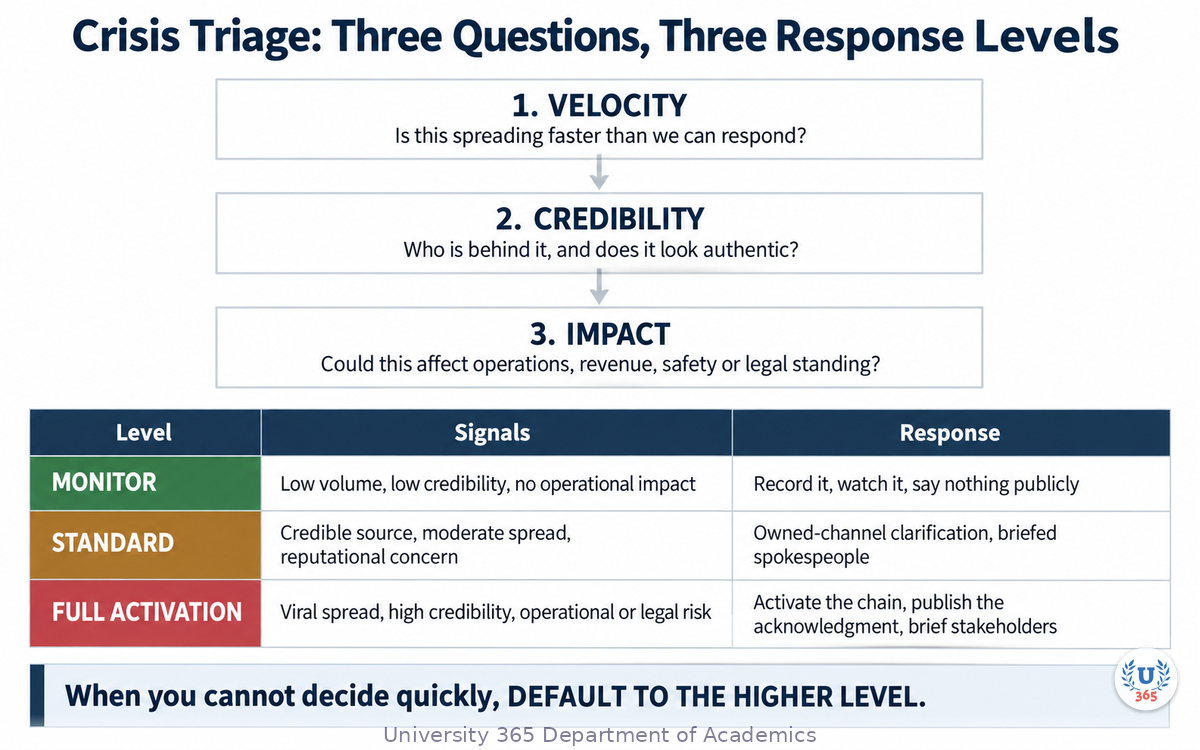
The three triage questions
Ask them in this order and stop at the first honest answer.
Velocity: is this spreading faster than we can respond? A post with two hundred views and one repost is not a crisis, whatever it says. The same post on a coordinated set of accounts, climbing across platforms within the hour, is.
Credibility: who is behind it, and does it look authentic? An obviously altered image from an anonymous account and a plausible synthetic video from a persistent disinformation account are different problems. Both may need a response; they need different responses.
Impact: could this affect operations, revenue, safety, or legal standing? A false claim about your pricing is a communications problem. A false claim that your product caused harm, or that your partner has been dropped, can move contracts and regulators, and it needs the full chain.
Three levels, three responses
Level | Signals | Response |
Monitor | Low volume, low credibility, no operational impact | Record it, watch it, no public statement |
Standard | Credible source, moderate spread, reputational concern | Owned-channel clarification, briefed spokespeople, prepared media line |
Full activation | Viral spread, high credibility, operational, financial, or legal risk | Activate the chain, publish the acknowledgment, brief stakeholders, open the dedicated page |
Default to the higher level when you cannot decide quickly. Over-preparing costs one afternoon. Under-responding costs the reputation you spent a decade on.
Step 4: Verify Before You Deny
Here is the operational shift that catches most organizations. Five years ago, a recording of your chief executive saying something was presumed real and you responded to the statement. Now a recording is presumed authentic by viewers and may still be fabricated. If your first response is a denial that turns out to be wrong, you have converted a communications problem into a credibility collapse.
So verification comes before the wording. And verification of synthetic media is now a technical process, not a matter of watching the video again.
What to check on the material itself
The frame and the source. When was the account created, what else has it posted, and does the distribution pattern look organic?
The audio track. Listen for room tone that does not match the video, abrupt level shifts mid-sentence, and sibilance that sounds synthesized.
The mouth region at slow speed. Frame-step through the moments where the speaker hits plosive sounds. Mismatch between lip closure and the sound is the most common visible artifact.
The compression history. Re-encoded media often carries inconsistent artifact patterns where a face has been composited.
The lighting direction. A composited face can carry a light direction that does not match the room.
Treat any single sign as a lead, not a conclusion. You need corroboration before you publicly call something synthetic.
The stronger tool: provenance
The durable answer is not detection after the fact. It is provenance before it: cryptographically signed evidence of how a piece of media was produced and edited.
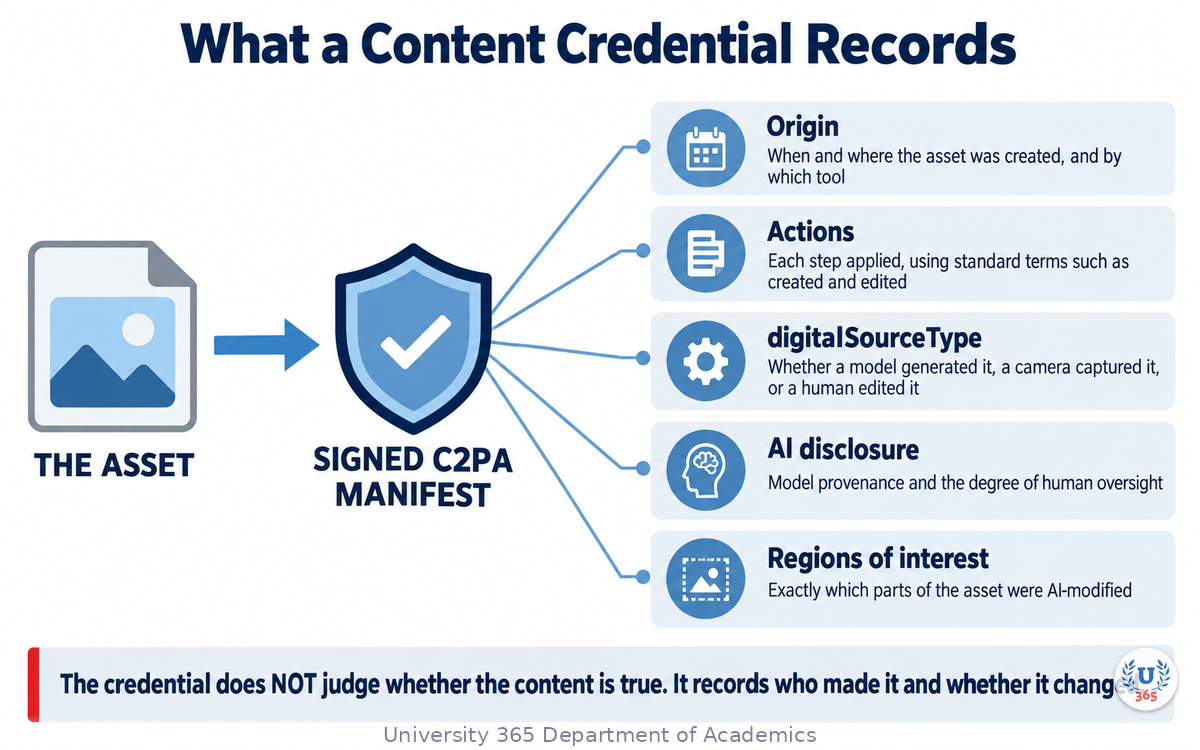
C2PA, the Coalition for Content Provenance and Authenticity, publishes the open specification for this, called Content Credentials. A Content Credential is a signed, tamper-evident manifest attached to an asset that records assertions about its history: how it was created, what edits were applied, and how AI was involved. The specification includes a digitalSourceType field drawn from the IPTC vocabulary that declares whether an asset was generated by a model, captured by a device, or edited by a human, plus an AI disclosure assertion that records model provenance and the degree of human oversight. Regions of interest let a manifest mark exactly which part of an asset was AI-modified. Trusted timestamps keep a credential verifiable after the signing certificate expires, and soft bindings such as invisible watermarks let a credential be rediscovered even if it has been stripped from the file.
What that buys you in a crisis is a defensible statement. Instead of arguing that a video is fake, you can show the signed provenance chain for what your organization actually published, and note that the circulating file carries no such chain. The standard does not judge whether content is true. It records who made it and whether it has been altered since.
The practical preparation is unglamorous and takes an afternoon:
Publish your official media with credentials attached, using tools that preserve them.
Keep a signed, timestamped library of authentic recordings of your executives, filmed in defined settings, for comparison.
Make sure the people who run your website and social channels know which export settings preserve credentials, because a careless re-export can strip them.
Say plainly, on your own site, that your official media carries credentials and what that means. The audience has to know the signal exists before it can use it.
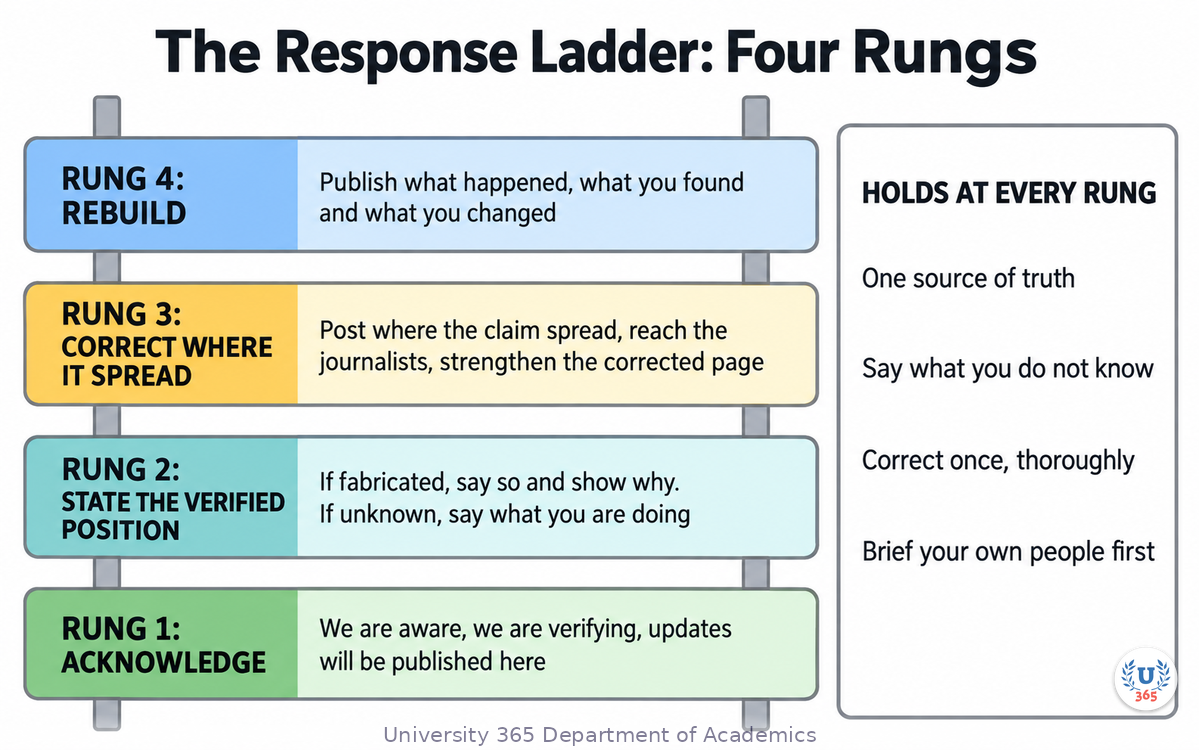
Step 5: The Response Ladder
Response is not one statement. It is a ladder, and each rung buys the time to climb to the next.
Rung 1: Acknowledge, fast, on your own channel
Within your pre-authorised authority, publish a short acknowledgment: we are aware of the material circulating, we are verifying it, updates will be published here. This rung makes no factual claim beyond your own awareness, so it cannot be wrong, and it moves the story to a channel you control.
Do not write these from scratch at the moment. Have the block approved and parameterized in advance, with the blanks limited to a link and a time.
Rung 2: State the verified position
When verification is complete, publish what you know. If the material is fabricated, say so and show why. If it is authentic but misrepresented, say that. If you do not know yet, say what you are doing to find out. The credibility cost of an honest "we do not know yet, and here is the process" is far lower than the cost of a claim you later withdraw.
Rung 3: Correct the record where the claim spread
A correction published only on your own site reaches the people who already trust you. Post the correction on the platforms where the claim spread, reach the journalists who covered it with the verified position, and correct the AI assistants and answer engines by making the corrected page the strongest available source on the topic.
Rung 4: Rebuild
Containment is not recovery. After the acute phase, publish what happened, what you found, and what you changed. Organizations that explain their own crisis openly end it faster than organizations that go silent and hope the news cycle moves on.
The four rules that hold across every rung
One source of truth. A single page you control carries the current position, and everything else points to it. Different spokespeople saying slightly different things is how a manageable incident becomes a credibility story.
Say what you do not know. Naming the gaps is a sign of control, not weakness.
Correct once, thoroughly. Repeated rebuttal amplifies the claim. State it, evidence it, move on.
Brief your own people first. Employees learn from the news. Give them the verified position before they need it.
Step 6: Truth Architecture: The Assets You Build in Advance
The difference between a fast response and a slow one is almost entirely the assets that already existed. Build five.
1. The response blocks. A set of short, parameterized statements for the situations you can anticipate: a fabricated recording, a coordinated disinformation campaign, a product safety claim, a data incident, an executive misconduct allegation, a service outage. Each approved by legal once. Each written so that the only blanks are a link, a time, and a name.
2. The dedicated page. A page on your own domain, reachable in one click from every statement, that carries the current position, the timeline, the evidence, and the questions you have received. It can be unpublished and activated when needed. The point is that it is on your domain, in your design, and permanent, unlike a post on someone else's platform.
3. The verified media library. Signed, timestamped recordings of your executives and facilities, made in defined settings, with known camera and microphone metadata. In a synthetic-media crisis these are your reference material, and you cannot produce them retroactively.
4. The named journalist list. Two or three journalists who cover your sector and will take a call. Earned coverage is still the most credible channel, and it takes years to build and one hour to lose.
5. The internal brief. A template that tells employees what happened, what to say, what not to say, and where to send journalists. Published to staff at the same time as, or before, the public statement.
The preparation checklist
Five roles named, with backups, and reachable at any hour.
Response blocks drafted, legal-approved, and stored where the publisher can reach them without a meeting.
Dedicated page built, with the activation procedure written and tested.
Verified media library recorded and signed.
Monitoring in place for executive names, product names, misspellings, and AI-assistant summaries.
A drill run in the last quarter, with the elapsed time recorded.
AI assistance used to red-team the response before it goes out: feed a hostile critic persona the draft and see which sentence breaks.
Step 7: After the Storm: Measuring and Learning
The acute phase ends. The work of learning begins, and it is measurable.
Time to first acknowledgment. From the moment the claim appeared, how long until your own channel carried a statement? This is the number your preparation exists to reduce, and the only one worth quoting to your board.
Time to a verified position. How long until you could state what was true? If this number is high, the problem is verification capability, not drafting speed.
Sentiment recovery curve. Track the ratio of negative to neutral and positive mentions over the following thirty days. The shape matters more than the level: a curve that flattens within a week indicates the correction took hold.
Reach of the correction relative to the claim. Compare the impressions of the false claim with the impressions of your correction. Most organizations discover the correction reached a fraction of the audience, which is an argument for paid amplification of corrections and for making the dedicated page the top result for the relevant queries.
Whether the loop closed. Did the next summary an AI assistant produces about your organization reflect the corrected position? If not, the corrected page is not yet the strongest available source, and that is a content problem you can fix.
Then write it down, in one page, and change exactly one thing in the plan before the next quarter. A crisis plan that grows ten new rules after every event is a plan nobody will use.
Feynman Summary: Explain It Like You Are 12
Imagine someone makes a fake video of your school principal saying something mean, and by the morning half the school believes it.
If the principal waits two days to say anything, everyone has already decided. So the plan has to exist before the video does: who notices first, who checks whether the video is real, who is allowed to say something, and where it gets said.
You also need proof ready. If the school keeps signed, dated recordings of the principal, you can show that the video does not match reality and where it came from.
The fastest response is the one you already wrote before anything happened. That is the whole idea: do the deciding on a calm Tuesday so you are not deciding at midnight.
Mindmap: The Complete Picture
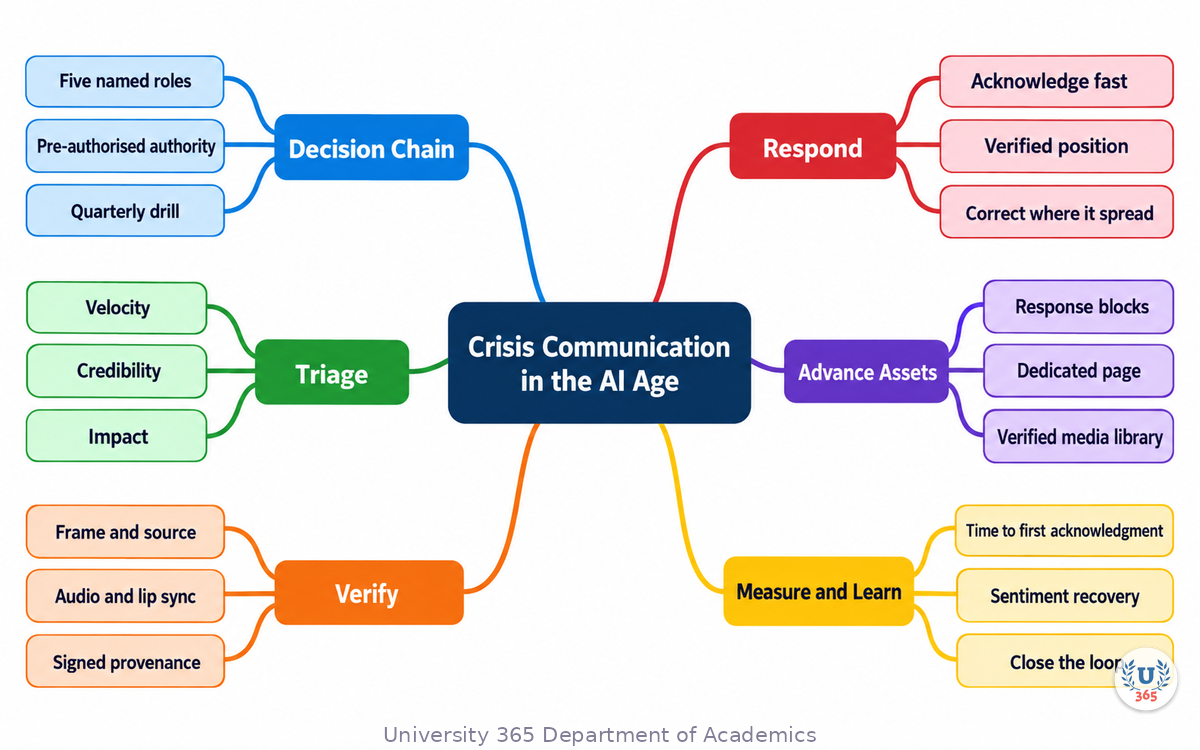
The mindmap gathers the lecture into one view: the decision chain at the centre, verification and the response ladder around it, the advance assets that make speed possible below, and the measurement loop that feeds the next plan.
UNOP Sound (University 365 Neuroscience Oriented Pedagogy)
Take five minutes to consolidate your memory. Play the isochronous tone track (10Hz alpha frequency) with your eyes closed. Alpha-frequency tones after a learning session support consolidation, helping move what you just learned from short-term to long-term memory.
[Audio player: UNOP Post-Lecture Isochrone (10Hz, 5 minutes)]
Practical Exercise: Run a 60-Minute Crisis Drill
Run this drill with the people who would actually be involved. Sixty minutes, a timer, and honest timing of each stage.
Part 1: Build (20 minutes)
Name the five roles and a backup for each. Write the names, not the job titles.
Write down which statements the communications lead may publish without a further call.
Draft one response block: a fabricated video of your chief executive. Make the only blanks a link and a time.
Decide where your dedicated page would live and who can activate it.
Part 2: Run (25 minutes)
Start the timer. The spotter receives a scenario: a ninety-second video on three platforms, forty minutes old, from a six-day-old account, with one journalist email received.
Run the triage questions out loud: velocity, credibility, impact. Agree a level.
Have the verifier list the specific checks they would run, and the evidence they would need.
Have the decider approve or reject the drafted block, and note how long that took.
Have the publisher write the acknowledgment message and identify where it would be published.
Stop the timer at the moment the acknowledgment would be live. Record the total.
Part 3: Learn (15 minutes)
Identify the longest stage. Fix that one stage, not all of them.
Ask an AI assistant to play a hostile critic and attack your drafted acknowledgment. Note which sentence fails.
Change one sentence accordingly, and record the change in the plan.
What to look for
Three failures appear in almost every first drill. The verifier turns out to have no method beyond watching the video again. The decider turns out to be the chief executive, who is not reachable. The publisher turns out not to have the credentials for one of the channels. Each of those is a fifteen-minute fix, and each of them costs hours in a real event.
Applied CI-First connection
You set the roles, the authority, and the positions taken. AI accelerated the monitoring, the red-team review of your wording, and the drafting of parameterized blocks. That is the division the whole method rests on: the judgment that carries reputational weight stays with a human who is accountable for it, and the machine carries the volume.
Glossary
Term | Definition |
Synthetic media | Audio, image, or video produced or altered by a model, including fabricated recordings of real people. |
Deepfake | Synthetic media that imitates a specific real person's appearance or voice. |
Disinformation | False information spread deliberately to deceive. Distinct from misinformation, which spreads without intent. |
Provenance | Facts about the history of a piece of media: who created it, how, and what was changed. |
C2PA | The Coalition for Content Provenance and Authenticity, which publishes the open technical standard for Content Credentials. |
Content Credential | A cryptographically signed, tamper-evident manifest attached to an asset that records assertions about its origin and edits. |
digitalSourceType | The field in a Content Credential that declares whether an asset was generated by a model, captured by a device, or edited by a human. |
Soft binding | A watermark or fingerprint that lets a Content Credential be rediscovered after it has been stripped from a file. |
Trusted timestamp | A signed time record that keeps a Content Credential verifiable after the signing certificate expires. |
Holding statement | A short public acknowledgment that states what you know and commits to further updates, without making unverified claims. |
Response block | A pre-approved, parameterized crisis statement for one anticipated scenario, requiring only a link and a time to publish. |
Decision chain | The named roles and pre-authorised authorities that let an organization decide and publish inside the response window. |
OODA loop | Observe, Orient, Decide, Act: Colonel John Boyd's decision cycle, used as a frame for crisis response speed. |
Triage | Classifying an incident by velocity, credibility, and impact to select the right response level. |
Dedicated page | A page on your own domain that carries the single current position and evidence during an incident. |
Time to first acknowledgment | The elapsed time between a claim appearing and your organization publishing its own statement. |
Scaled content abuse | Producing content at scale primarily to manipulate search or platform ranking, which violates platform policies. |
CI-First (Co-Intelligence First) | The University 365 approach in which human intelligence is the orchestrator and AI is the amplifier. |
Quiz: TEST YOUR UNDERSTANDING
1. Why does advance preparation matter more than faster drafting in an AI-age crisis?
A) Because legal review is no longer required
B) Because the response window is shorter than a normal drafting and approval cycle
C) Because platforms delete false content within minutes
D) Because audiences no longer read written statements
2. What is the correct order of the three triage questions?
A) Impact, credibility, velocity
B) Velocity, credibility, impact
C) Credibility, impact, velocity
D) Velocity, impact, credibility
3. What does a Content Credential record?
A) Whether a claim is factually true
B) The provenance of an asset: how it was created, what was edited, and how AI was involved
C) The identity of the person who first shared the asset
D) The number of views an asset received
4. Why must a holding statement avoid factual claims about the incident?
A) Because legal review forbids stating facts
B) Because it exists to move the story to your own channel without making a claim you may have to withdraw
C) Because statements must contain statistics
D) Because platforms require neutral wording
5. Which number should you report to your board after a crisis?
A) Total mentions during the incident
B) Time to first acknowledgment, measured from when the claim appeared
C) Number of journalists who covered the story
D) Number of rebuttal posts published
Answers: 1-B, 2-B, 3-B, 4-B, 5-B
Related Resources
U365 INSIDE Publications
Lecture: Brand Voice in the AI Era: Training AI on brand guidelines and detecting voice drift
Lecture: AI for Social Media Strategy: Social listening, sentiment tracking, and campaign measurement
Lecture: The AI Press Release: Automating PR: Media relations workflows with AI assistance
External Resources
C2PA: Verifying Media Content Sources: the open standard for Content Credentials: c2pa.org
C2PA Content Credentials Explainer: how manifests, assertions, and verification work: spec.c2pa.org/specifications/specifications/2.4/explainer/Explainer.html
Use of Content Credentials to Identify Synthetic and Non-Synthetic Content (C2PA): labeling AI-generated and AI-modified media, including the digitalSourceType field and the AI disclosure assertion: c2pa.org/a-new-implementation-guide-for-content-credentials
Search Quality Rater Guidelines (Google): the public definition of E-E-A-T, in which trust is the most important element: static.googleusercontent.com/media/guidelines.raterhub.com
Creating helpful, reliable, people-first content (Google Search Central): the Who, How, and Why framework, including disclosure of AI-assisted production: developers.google.com/search/docs/fundamentals/creating-helpful-content
Related U365 Lectures
Lecture 7: The AI Press Release: Automating PR (UIC, Content Strategy Series)
Lecture 2: Brand Voice in the AI Era (UIC, Branding Series)
U.Copilot for This Lecture
Discuss this lecture with U.Copilot, your AI chat companion trained on this content.
Copy and paste the following prompt into the U.Copilot chat on university-365.com:
You are U.Copilot for Lectures, an AI chat companion specially trained on University 365 lecture content. You are helping a Fellow who just completed the lecture "Crisis Communication in the AI Age" from the Branding series at the U365 Institute of Communication (UIC). Your role is to help the Fellow build and test a crisis plan. You can: - Help name the five roles in a decision chain and define who may speak under what authority - Walk through triage on a scenario using velocity, credibility, and impact - Explain the verification checks for suspected synthetic media - Explain what a Content Credential records and how provenance supports a correction - Draft a parameterized holding statement from an approved response block - Red-team a drafted statement by acting as a hostile critic - Design the measurement of time to first acknowledgment and sentiment recovery Always maintain U365's CI-First approach: the accountable human owns every claim made publicly, and AI accelerates monitoring, drafting, and review. Distinguish verified facts from practitioner claims, and never present an unverified statistic as evidence. Use the UP-Context Method: provide context-rich, role-aware responses that account for the Fellow's organization, sector, and regulatory environment.
Next Steps
Now that you understand the system, here is what to do next:
Run the sixty-minute drill with the real people, and record the elapsed time to a published acknowledgment.
Draft and get legal approval for the five response blocks you can anticipate.
Record the verified media library of your executives now, before you need it.
Fix the longest stage found in the drill, and change nothing else this quarter.
Build the dedicated page template and test its activation procedure.
You cannot prevent a fabricated video. You can decide, in advance, who speaks, what they are allowed to say, how you prove what is real, and where the correction lives. Organizations that make those decisions calmly are not luckier than the ones that do not. They simply started earlier.
IMPORTANT NOTICE
This lecture is published by University 365 as part of its INSIDE Publications Hub. The content is free to read for all visitors. Lectures in this series may be part of a structured academic program leading to a Micro-Credential for your Career (MCC). To enroll in an academic program, visit university-365.com/tuition.
This content is for educational purposes. Synthetic media tooling, platform policy, and provenance standards develop quickly. Verify current specifications and platform rules against the primary sources linked above, and take jurisdiction-specific legal advice before relying on any response procedure.
Copyright University 365, Inc. All rights reserved. This content is protected under University 365's copyright policies. For permissions or inquiries, contact uda@university-365.com.
Published by the Department of Academics, University 365.
Lecture delivered by the University 365 Institute of Communication (UIC).
Lea Loringam, Dean of Communication, UIC
Signed for the academic year 2026.




Comments