
Building an AI-First Company Culture

Updated: 2 days ago


UIB University 365 Institute of Business
Series Leadership Series
Duration 25 minutes
Business Management, Digital Entrepreneurship, Innovation, Finance, Leadership

UNOP Sound (University 365 Neuroscience Oriented Pedagogy)
Take five minutes to prepare your brain. Play the isochronous tone track (40Hz gamma frequency) with your eyes closed. Gamma-frequency tones before a learning session raise attention and make the material easier to absorb.
[Audio player: UNOP Pre-Lecture Isochrone (40Hz, 5 minutes)]
In this Lecture
This lecture explains the AI-First doctrine, a real and widely adopted approach to organizational AI adoption. University 365 teaches it so that you can recognise it in the field and judge it for yourself. We do not recommend stopping there.
University 365's own doctrine is CI-First (Co-Intelligence First): always invite AI, and stay in the orchestrator's seat. We consider CI-First stronger, safer and more durable than a mere AI-First, and we encourage you to study and apply it.
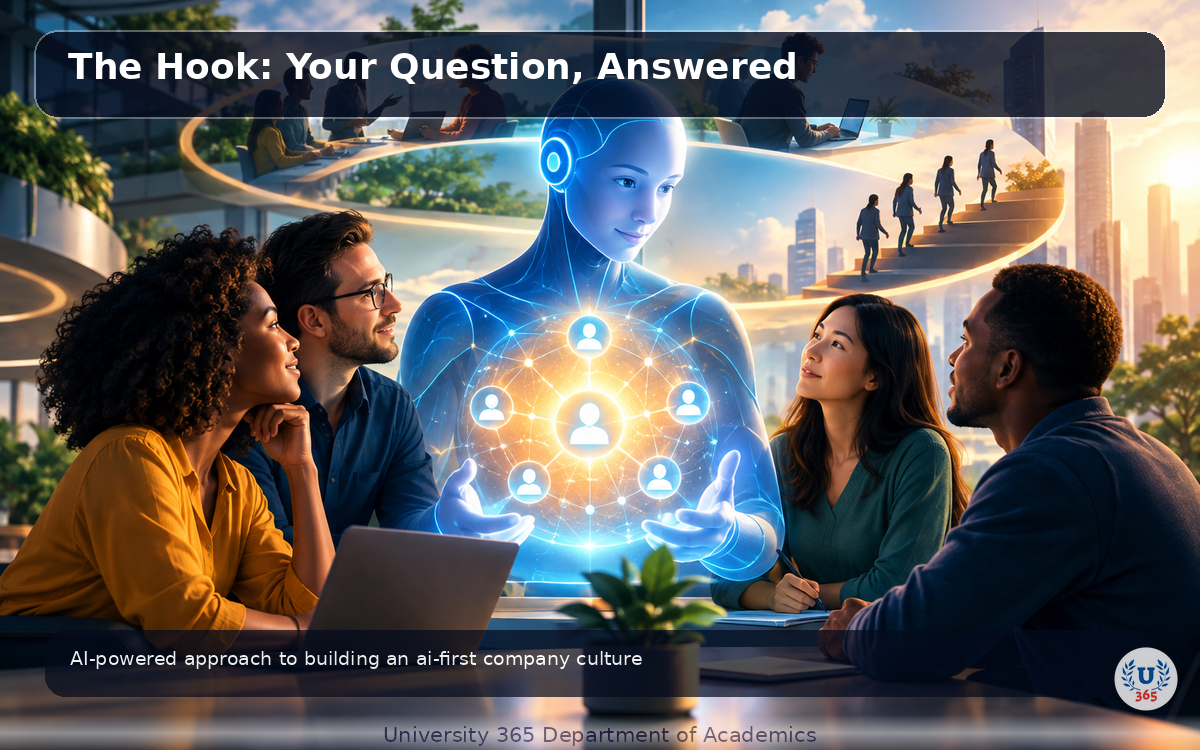
The Hook: Your Question, Answered
You bought AI tools for your company. You trained your team. Three months later, adoption is 15%. The tools sit unused. Your employees are skeptical, your managers are confused, and your AI investment is producing zero return. What went wrong?
In this lecture, you will learn how to use AI to tackle this challenge in 15 minutes. The AI handles the data processing and pattern recognition. You handle the judgment and decisions. This is the CI-First approach: human intelligence orchestrates, AI amplifies.

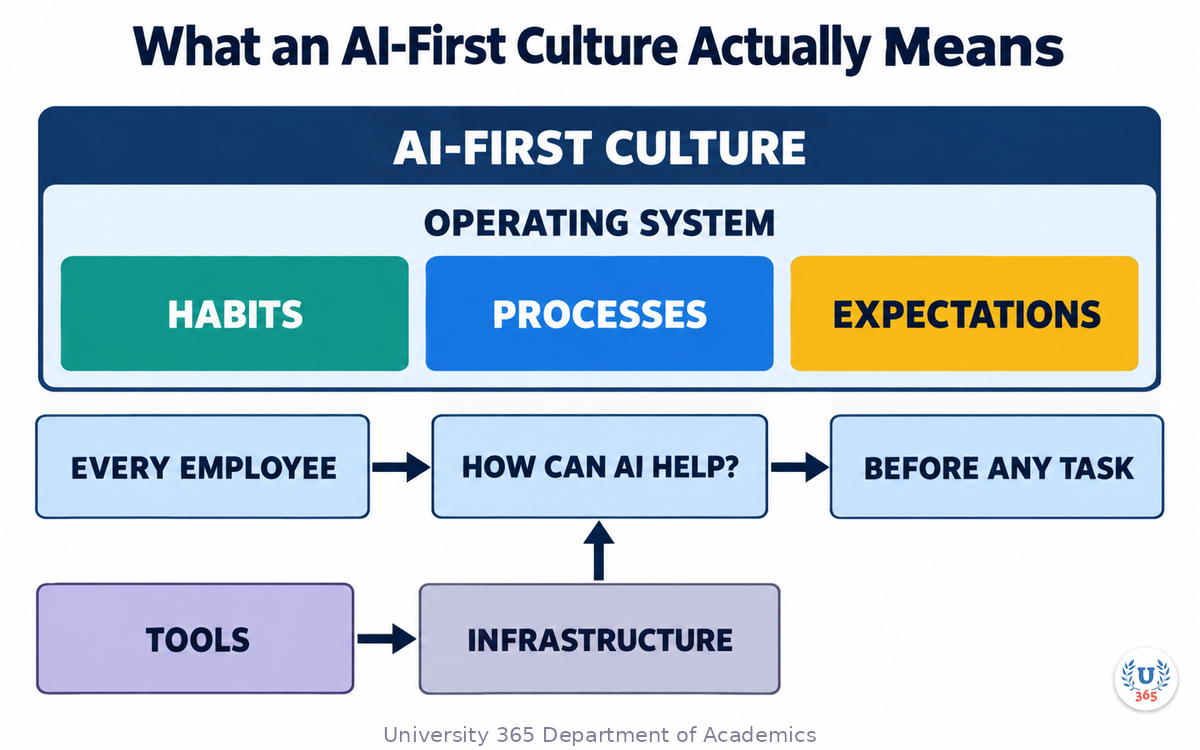
What an AI-First Culture Actually Means
An AI-first culture is not about buying AI tools. It is about building habits, processes, and expectations where every employee asks 'how can AI help with this?' before starting any task. The tools are the infrastructure. The culture is the operating system.
Step 1: Assess Cultural Readiness
Before deploying AI tools, assess your organization's readiness. Do employees trust leadership? Is there a history of successful technology adoption? Are employees worried about job security? AI adoption fails when culture is ignored.
Step 2: Design the Team Structure
AI-first organizations need new roles: AI champions in each department, a central AI enablement team, and clear governance. You do not need a Chief AI Officer on day one. You need people who understand both the work and the AI tools.
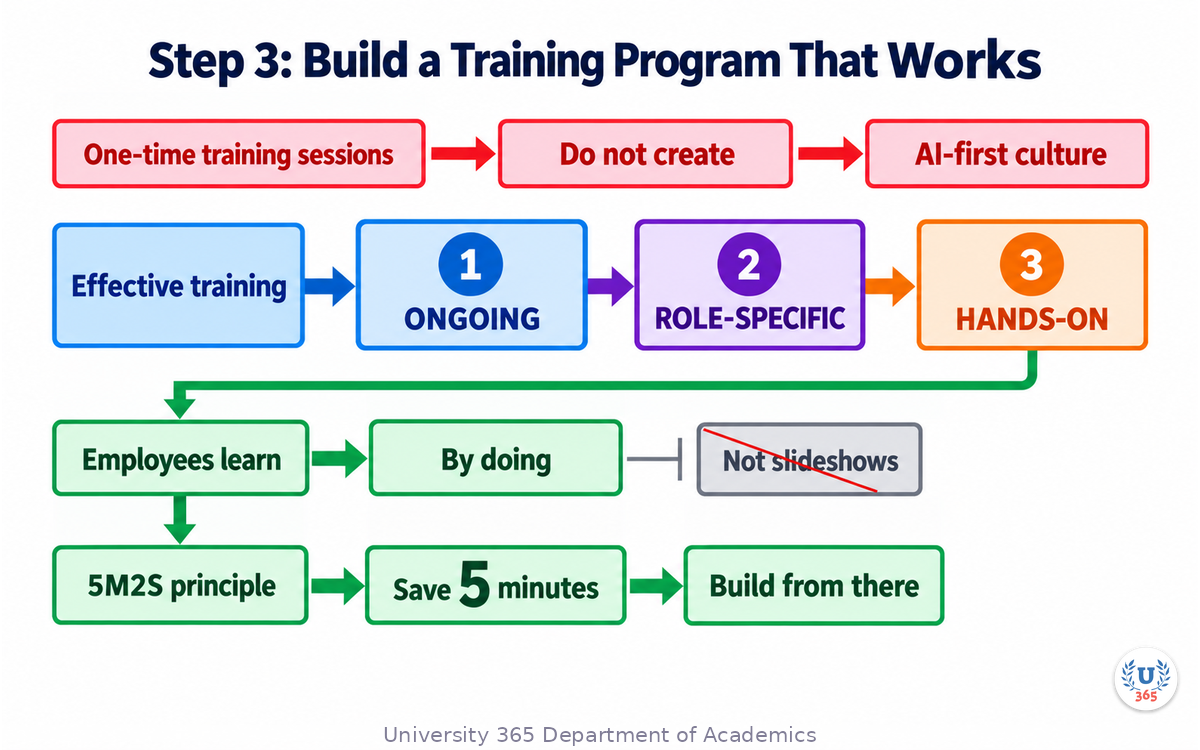
Step 3: Build a Training Program That Works
One-time training sessions do not create an AI-first culture. Effective training is ongoing, role-specific, and hands-on. Employees learn by doing, not by watching slideshows. The 5M2S principle applies: start with tasks that save 5 minutes and build from there.
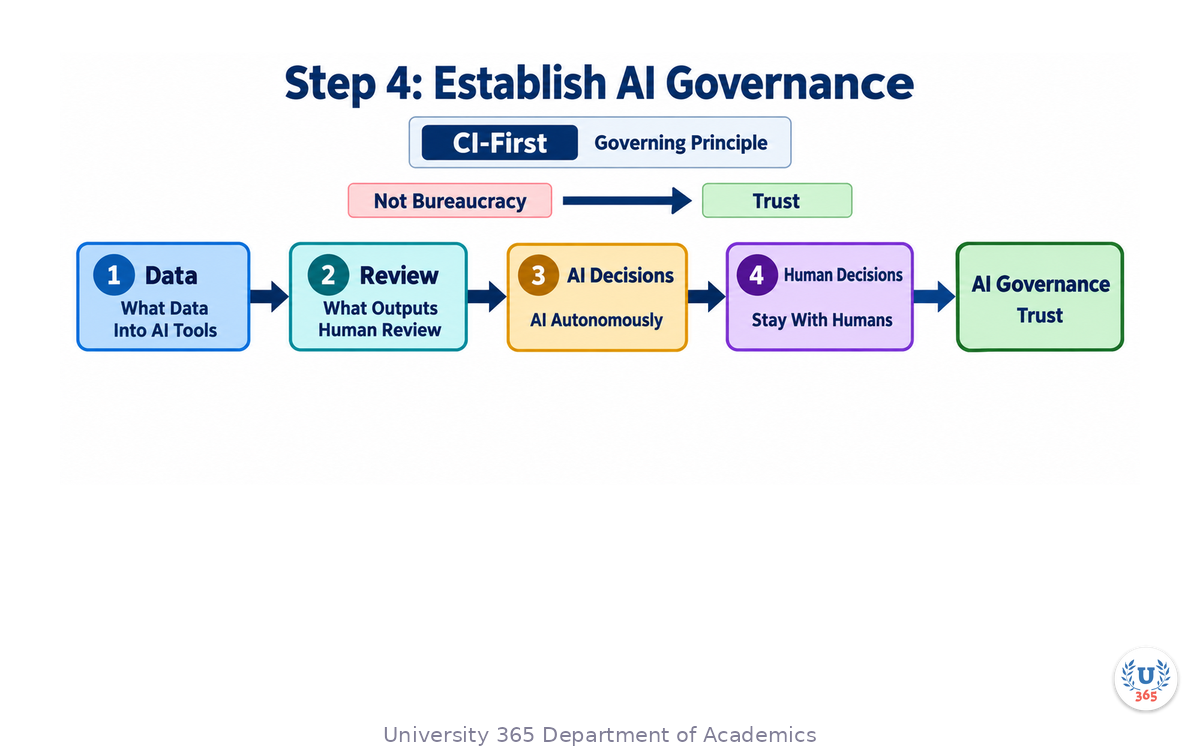
Step 4: Establish AI Governance
AI governance is not bureaucracy. It is trust. Employees need clear rules: what data can go into AI tools, what outputs need human review, what decisions AI can make autonomously, and what must stay with humans. CI-First is the governing principle.
Step 5: Measure and Sustain Adoption
Adoption is not a one-time metric. It is a continuous process. Measure: how many employees use AI tools weekly, how much time is saved, what errors are prevented, and where resistance persists. Celebrate wins and address barriers.
What an AI-First Culture Actually Means
An AI-first culture is not a company where everyone uses AI. It is a company where the default first question about any task is how the work should be divided between a person and a machine, and where the answer is written down rather than assumed.
The three signals of a culture that has actually changed
The first is that people describe their work in terms of the decisions they make rather than the tasks they perform. A culture that has changed talks about what it is accountable for. A culture that has not still talks about what it does.
The second is that a failed AI experiment is reported in the normal update rather than hidden. The third is that somebody can name, without looking it up, the two pages of rules that govern what may and may not go into a model.
The three signals of a culture that only looks changed
Licences bought and half used. A pilot that everyone praised and nobody continued. A dashboard that shows adoption rates and no outcomes. Each of these is activity, and activity is what a culture produces when it is doing AI because it believes it should.
Why the culture question comes before the tooling question
Tooling is reversible in a week. Culture is not, and a culture that has learned to hide failures will hide them about the AI programme too. That is why a company that cannot answer the six questions in the readiness assessment should not deploy, whatever the tool can do.
The U365 framing
University 365 teaches AI-First as a real and widely adopted doctrine, and teaches CI-First as its own, stronger position: invite AI, and stay in the orchestrator's seat. AI-First asks whether AI can be used here. CI-First asks who is accountable for the answer, and that question is what turns adoption into culture.
The practical difference is a sentence. AI-First says the team should use AI. CI-First says the team owns the outcome and AI is how it gets there. The second sentence changes behaviour, because it keeps the accountability where it belongs.
People describe decisions, not tasks
A failed experiment appears in the normal update
Two pages of rules that everyone can name
Adoption is measured by outcomes, not by logins
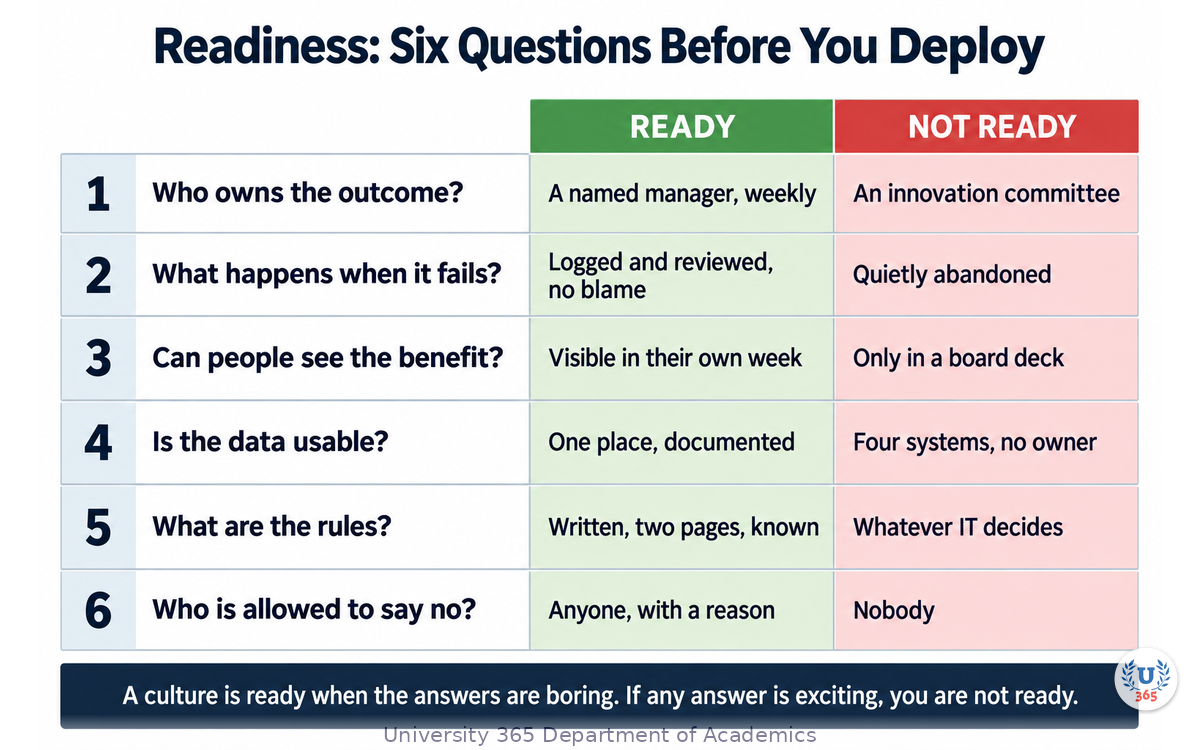
Step 1: Read the Culture Before You Change It
Every organisation has an existing relationship with new tools, and it was set long before you arrived. Reading it takes two weeks and saves a year.
Find out what happened to the last initiative
Ask about the previous system rollout, the last process change, the last reorganisation. How it was received and what happened to the people who championed it will tell you more about your odds than any survey. If the last initiative was quietly abandoned, your programme will be treated as the next one unless you name the difference explicitly.
Map the informal veto
In every organisation there is a person whose scepticism stops things, and it is rarely the person with the title. Find them, ask what went wrong last time, and design the programme so it answers their objection. An ignored sceptic becomes a quiet veto, and a quiet veto is what kills an initiative at month three.
Measure the trust in data
Ask three people to find the same customer number. If they come back with three answers, no AI programme will produce a trusted output, because the input is not trusted. Fix that before you buy anything.
Check whether the managers have time
Culture change consumes middle-management hours, and middle managers are usually the most over-committed group in the company. If the programme needs twenty percent of a manager's week and nobody has reallocated it, the programme will be supported in public and ignored in practice.
Look for the existing pockets
Almost every company already has two or three people quietly using AI well. They exist before the programme and they are your evidence that the change is possible, and your first champions. Find them in week one, because a formal programme that ignores the informal practice insults the people who got there first.
What to read | How to read it | What it tells you |
The last initiative | Ask the people who lived it | Whether you inherit scepticism |
The informal veto | Ask who says no, not who has the title | The objection you must answer |
Trust in the data | Ask three people for one number | Whether outputs can be trusted |
Manager capacity | Ask what gets removed from their week | Whether support is real |
Existing pockets | Look for quiet good practice | Your first champions and evidence |
Step 2: Design the Team Structure You Can Actually Sustain
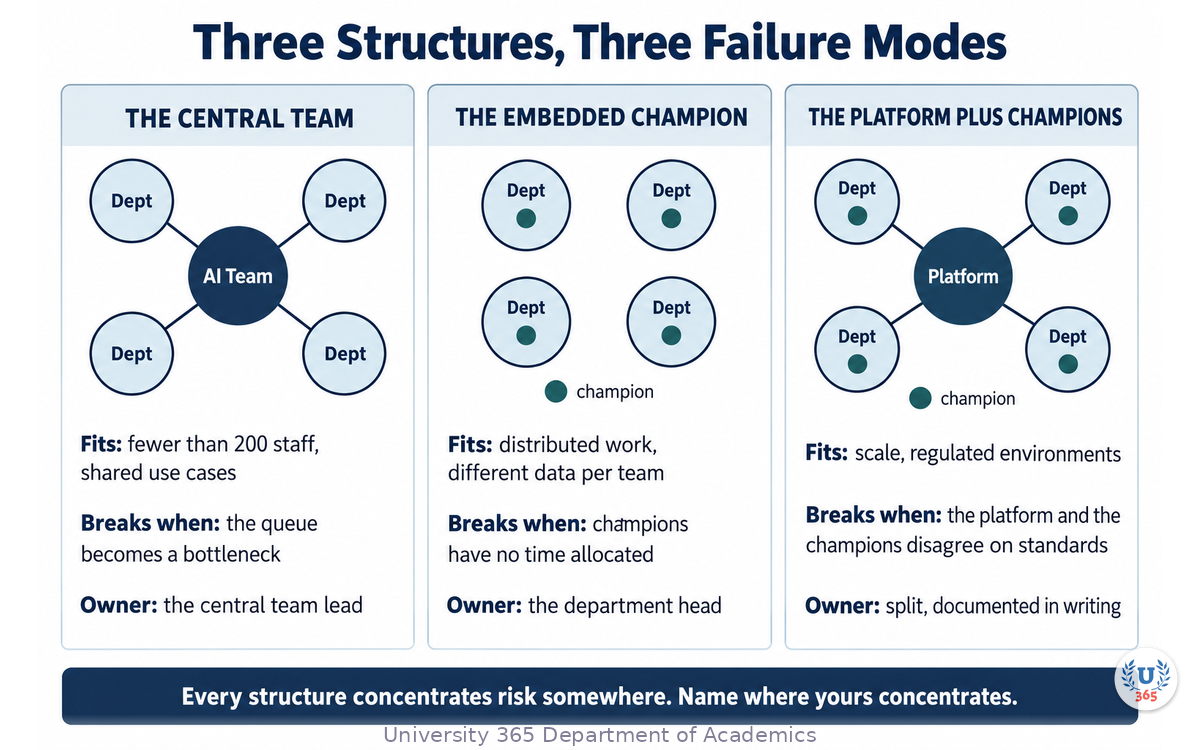
There are three workable structures and no fourth. Each concentrates risk in a different place, and choosing one means choosing the failure you will manage.
The central team
One group builds and runs AI capability for the whole company. It works well below about two hundred staff, where the use cases overlap and duplication would be wasteful. It breaks when the central queue becomes a bottleneck: departments wait three weeks for a small change and start building their own in secret.
The embedded champion
Each department has someone who owns AI for that team, reporting to the department head. It works when the teams do genuinely different work on genuinely different data. It breaks the moment the champion has no allocated time, because champion becomes a word in a job description rather than a job.
The platform plus champions
A small platform team sets the standards, the guardrails and the shared tooling, and department champions build on top of it. This is the structure that scales into regulated environments, and it breaks on one thing: the platform team and the champions disagreeing about standards after both have started building.
The failure you are choosing
Central team: bottleneck. Embedded champions: drift, with five departments solving the same problem five ways. Platform plus champions: a standards conflict that is invisible until the second integration. Name yours in writing before you start, so it can be watched for rather than discovered.
Where the accountability sits
The structure decides who builds. It must not decide who is accountable for the outcome, because that is the operating manager in every case. A structure where the AI team owns the outcome produces a company that cannot tell you whether the last two years of AI spend worked.
Structure | Fits | Breaks when |
Central team | Under 200 staff, shared use cases | The queue becomes a bottleneck |
Embedded champion | Distributed work, different data per team | Champions have no allocated time |
Platform plus champions | Scale, regulated environments | Standards drift between the two layers |
Step 3: Build an Enablement Programme That Sticks
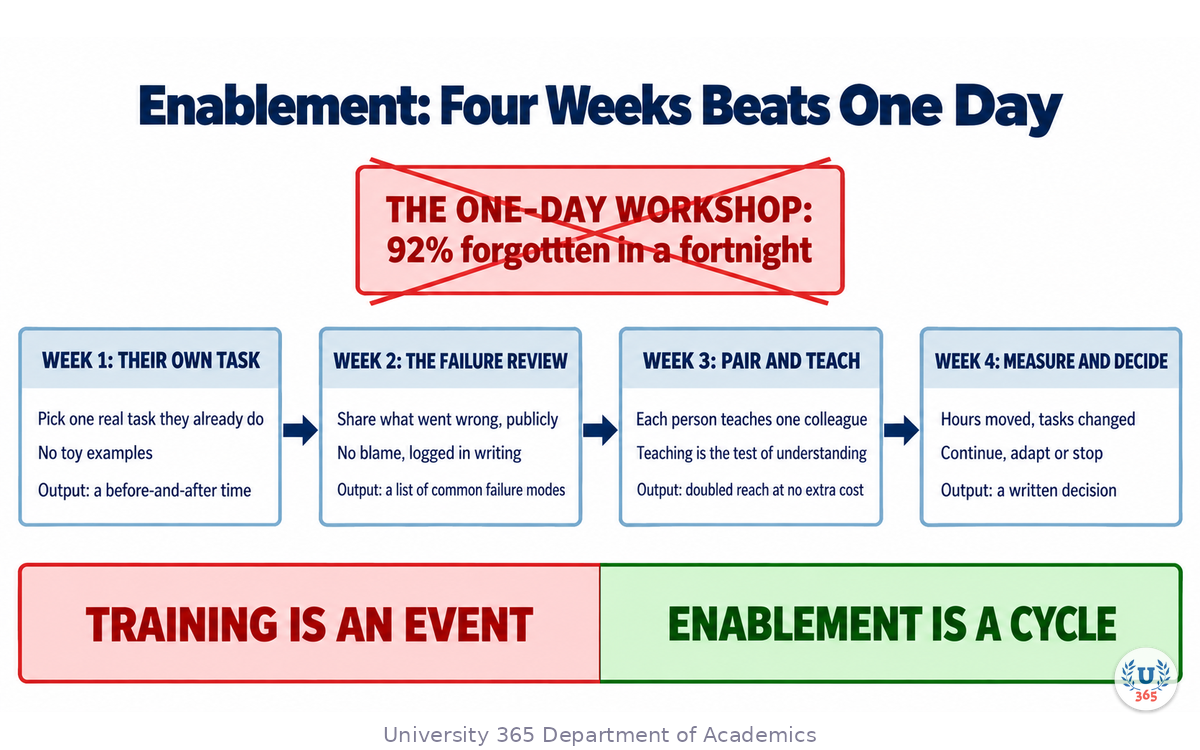
One-day workshops do not change how a company works. They produce enthusiasm, a certificate and no change in behaviour, because the workshop is an event and behaviour is a habit.
Start with a task the person already does
Every participant picks one real task from their own week and applies the method to it during the programme. No toy examples, no shared case study. The output of week one is a before-and-after figure on a task they will do again on Monday.
Run a failure review in week two, in public
This is the step almost every programme skips and the one that decides whether the culture changes. Each participant brings something that went wrong, and it is logged without blame. A culture that cannot discuss a model's failure mode openly will have the same failure silently at month six, with a customer involved.
Have each person teach one colleague in week three
Teaching is the only reliable test of understanding, and it doubles the reach of the programme at no extra cost. It also produces the informal network that keeps the practice alive after the formal programme ends, which is what an embedded champion structure depends on.
Measure and decide in week four
Hours moved, tasks changed, and a written decision: continue, adapt or stop. A programme that ends without a written decision ends by fading, and fading is indistinguishable from failure three months later.
What replaces the workshop
A short reference, two pages at most, that covers the rules, the two or three approved tools and the escalation path. Reference material that is longer than two pages will not be read, and material nobody reads does not govern behaviour.
Week | Activity | Output |
1 | Apply it to their own real task | A before-and-after figure |
2 | Public failure review, no blame | A shared list of failure modes |
3 | Each person teaches a colleague | Doubled reach, informal network |
4 | Measure and decide | A written continue, adapt or stop |
Step 4: Governance People Will Actually Follow
Governance has a bad reputation because it usually arrives as a policy document nobody reads. Governance that works is short, specific and visibly enforced.
Two pages, three questions
What may go into a model. What must be checked by a person before it leaves the team. Who to ask when the answer is unclear. If your policy cannot answer those three in two pages, it will be interpreted differently in every department and your governance will be a rumour.
Name the categories, not the files
Lists of approved tools go stale in weeks. Categories are durable: public information, internal information, personal data, regulated data. Say what may be done with each category, and let the tool list be maintained separately.
Make the human check specific
"A human must review AI output" is not a rule, because nobody knows what reviewing means. "Any figure that leaves the team is recomputed by a person" is a rule. "Any customer-facing text is read by the account owner before it is sent" is a rule. Specificity is what makes governance enforceable.
Give everyone a way to say no
If the only people who may refuse are senior, the rule will be broken quietly by everyone else. Give every person the right to decline to use a tool on a task, with a reason recorded. This is the control that turns a policy into a practice, because it makes the boundary visible from below.
Enforce it visibly once
One public example of the rule being applied, including to someone senior, does more than a year of reminders. Conversely, the first time the rule is waived for a senior person, the policy stops existing for everyone.
Review it quarterly and shorten it
Policies grow. Every quarter, cut anything that no longer applies. A two-page policy that is reviewed is followed; a ten-page policy that is not is archived and ignored.
Two pages, answering three questions
Data categories, not a list of approved tools
Checks written as specific actions
Everyone may decline, with a recorded reason
One visible enforcement, including a senior person
Step 5: Measure Adoption Without Measuring Logins
Most AI adoption dashboards measure activity. Activity is the easiest thing to count and the least informative, because a hundred logins tell you nothing about whether the work changed.
Count tasks that changed shape
The useful number is how many tasks have moved from one division of labour to another and stayed there. In the first quarter of a programme, a dozen tasks that changed and held is a strong result. A thousand logins is not a result at all.
Count decisions that got faster
Ask the managers which decisions take fewer days than they did a quarter ago and why. This is a conversation rather than a metric, and it is the one that reveals whether the change is real, because a manager who cannot name a decision that got faster has not experienced a change.
Count the failures that were reported
A rising number of reported failures in the first two quarters is a healthy signal. It means the reporting channel works. A programme with zero reported failures is not a programme with no failures; it is a programme with no reporting.
Count the people who stopped using it
Abandonment is the most informative number nobody tracks. Find out why people stopped, because the reasons are the same reasons the next cohort will stop. A single conversation with three abandoners will tell you more than any satisfaction survey.
Do not measure what you cannot act on
Every metric on the dashboard needs a decision attached to it. If a number moves and nobody would do anything differently, it belongs in a report, not on a dashboard, and it is consuming attention that the task-change figure needs.
Measure | What it actually tells you |
Tasks that changed shape and held | Whether the division of labour moved |
Decisions that got faster, named by managers | Whether the change reached the work |
Failures reported | Whether the reporting channel is alive |
People who stopped | The reasons the next cohort will stop |
Logins and licences | Almost nothing |
Culture Change Mechanics: What Actually Moves People
Culture is what people do when nobody is watching, and it changes through three mechanisms: what leaders visibly do, what gets rewarded, and what gets talked about. A programme that ignores all three will produce compliance and nothing else.
What leaders visibly do
If the executive team talks about AI and never uses it in a meeting, the message lands precisely as written: this is for other people. One senior person demonstrating a task they changed, with the time it saved, is worth more than a quarterly address. The demonstration must be specific, and it must include something that did not work.
What gets rewarded
Reward systems are the strongest lever and the most often left untouched. If promotions still go to the people who produce the most output by hand, the culture is telling everyone that AI is optional. If a team is recognised for reporting a failure that saved a client relationship, the reporting channel stays open.
What gets talked about
The stories a company tells about itself are its culture. A programme that only tells success stories teaches people that failure is unmentionable, which is the opposite of what a tool with visible failure modes requires. The failure log should be as visible as the wins.
Why mandate-first programmes stall
A mandate produces compliance, and compliance produces activity without change. People run the tool, produce output they do not trust, and revert the moment the mandate is relaxed. The programmes that last start with volunteers, produce a visible result, and then use that result to make the change normal rather than compulsory.
The slow part is the middle
Senior sponsorship is quick and front-line enthusiasm is quick. The slow part is middle management, because that is where the working week is already over-committed and where the programme's demands compete with the quarter's targets. Budget the middle managers' time explicitly, or the programme will be supported in public and ignored in practice.
Mechanism | What it looks like when it works | What it looks like when it does not |
Visible leadership | A senior person demonstrates a task they changed | A quarterly address about transformation |
Reward | A failure report is recognised | Promotions still go to manual output |
Conversation | The failure log is as visible as the wins | Only success stories are shared |
The CI-First Difference in Culture Work
The distinction between AI-First and CI-First matters most at the culture level, because that is where the difference in behaviour shows up first.
AI-First as a culture
AI-First asks whether AI can be used here. Its strengths are real: it is structural rather than tool-by-tool, it favours experimentation over certainty, and it redesigns job content rather than adding a tool to an unchanged job. A company that adopts it seriously will move faster than one that does not.
Where AI-First stops short
Its scope is adoption. It tells you that AI should be present in the work, and it is largely silent on who carries the consequence when the output is wrong. In practice that silence is filled by the tool, because the tool is the thing that produced the answer. A culture that has delegated its judgement to a system will not notice until the system is wrong about something that matters.
The CI-First culture
CI-First, the position University 365 teaches, keeps the person in the orchestrator's seat. Concretely that means three things in a culture: the accountable person is named before the work starts, the verification step is part of the process rather than a personal virtue, and a person may always decline to use a tool on a task and give a reason.
What it changes in the day-to-day
Under AI-First, a question is whether the task can be automated. Under CI-First, the first question is who owns the outcome, and only then how the work is divided. That order matters, because it means the accountability never moves to a system that cannot hold it.
The sentence to use with teams
The most useful framing for staff is a single sentence: you are accountable for the result, the tool is a means, and you are allowed to say no. It is short enough to remember and specific enough to change behaviour. Culture work is mostly about giving people sentences they can actually use.
AI-First asks whether AI can be used here
CI-First asks who owns the outcome, then how the work is divided
Name the accountable person before the work starts
Make verification a process step, not a virtue
Everyone may decline a tool on a task, with a reason
The First Ninety Days
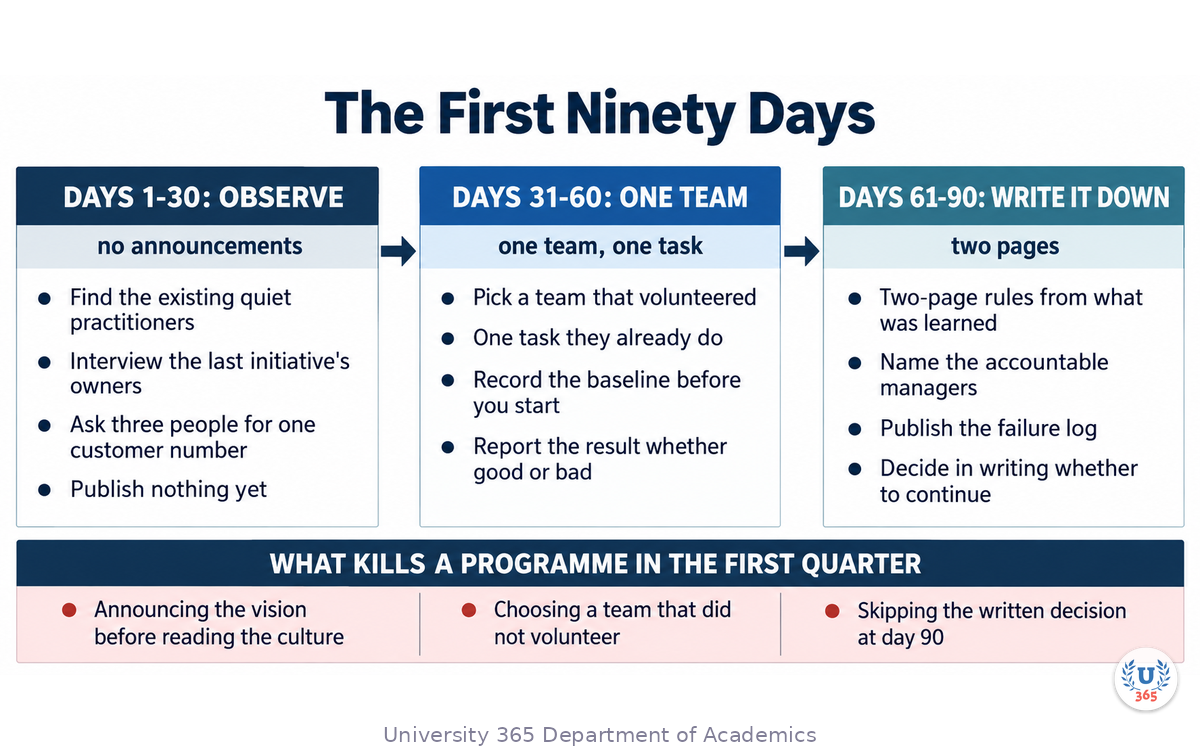
A culture programme that announces a vision in week one and asks for patience in week twelve has already lost the room. The sequence below front-loads observation and keeps the promises small and kept.
Days 1 to 30: observe, announce nothing
Find the people already using AI well and talk to them first. Interview whoever owned the last failed initiative. Ask three people to find the same customer number and compare the answers. Publish nothing. The purpose of the first month is to avoid making a promise you cannot keep, and you cannot keep one until you know what the last one cost.
Days 31 to 60: one team, one task, baseline recorded
Pick a team that volunteered rather than a team that was chosen, and give it one task it already does. Record the baseline before anything changes, using the same four measurements taught in the ROI method: cycle time, error rate, task hours, and the decision cycle. Then report the result whether it is good or bad. A first result that is reported honestly, including its shortcomings, sets the tone for every result after it.
Days 61 to 90: write it down and decide
Turn what was learned into two pages of rules, name the accountable managers, publish the failure log, and write a decision about whether to continue. A programme that reaches day ninety without a written decision continues by default and fades by month six.
The three ways this fails
Announcing the vision before reading the culture. Choosing a team that did not volunteer, which guarantees the result is attributed to the programme rather than to the team. Skipping the written decision, which leaves the programme alive but unfunded and unowned.
What you have at day ninety
One team with a measured change, two pages of rules derived from real experience, a visible failure log, and a decision in writing. That is a small, honest foundation, and it is what a culture programme looks like when it is built to last rather than to launch.
Phase | Days | Output |
Observe | 1 to 30 | Evidence about the existing culture, nothing published |
One team, one task | 31 to 60 | A measured before-and-after, reported honestly |
Write and decide | 61 to 90 | Two pages of rules, named owners, a written decision |
Ninety days is enough to change one team and not enough to change a company. What it can do is produce the evidence and the rules that make the company-level change a decision rather than a hope.
Trust, Verification and the Cost of Not Checking
Every culture of AI use settles on an implicit answer to one question: how much checking is enough. If that answer is never made explicit, it settles at the level of whatever is convenient, and convenient usually means too little.
The two failure cultures
The first is the culture that checks everything. Nothing is used without a full manual review, so the time saved is spent on verification and the benefit disappears. The second is the culture that checks nothing, which works until the first serious error and then produces a collapse in trust that takes a year to rebuild.
Where the line belongs
The line should follow consequence, not tool. A low-consequence draft reviewed by its author is fine. A number that reaches a customer or a regulator must be recomputed by something other than a language model. A decision that commits money must have a named human owner. Write the line by consequence and it will be clear to everyone; write it by tool and it will be wrong within a month.
Why the first error matters more than its size
The organisational effect of an AI error is almost never proportional to its magnitude. A small error in a visible place teaches people that the output cannot be trusted, and they respond by reverting to manual work in private, which is the worst outcome because it is invisible. A culture that has agreed the verification rules in advance absorbs the error because the process already anticipated it.
The verification rules that survive contact with a busy week
Three rules cover most of it. Anything numeric is recomputed by a deterministic tool. Anything that leaves the team is read by its owner. Anything irreversible has a second person. Each rule takes seconds to apply and each one closes a class of failure that a culture cannot recover from quietly.
How to talk about it with a team
Frame verification as the thing that protects the person using the tool, not as a control imposed on them. A salesperson whose proposal contains a fabricated figure loses the account, not the model. Making that explicit aligns the individual's interest with the company's, and alignment is what makes a rule survive a busy week.
Consequence | Minimum check | Who owns it |
Internal draft, low stakes | The author reads it | The author |
Anything numeric that leaves the team | Recomputed outside the model | The author |
Anything customer-facing | Read by the account owner | The account owner |
Anything irreversible | A second person reviews | The named decision owner |
The Manager in the Room: Where Culture Is Actually Built
Culture is built in the weekly rhythm of middle management: what gets asked about, what gets time, and what gets forgiven.
The three questions a manager should ask every week
Which task changed shape this week and by how much. What went wrong and what did we learn. Who needs help. Asked in that order, every week, the three questions do the work that no programme can do, because they make the change visible at the point where work actually happens.
Time is the manager's real instrument
A manager who says the change matters and does not reallocate an hour a week has told the team the truth, which is that it does not matter. The reallocation is the statement. Everything else is commentary.
How to handle the person who will not engage
Some people will not adopt, and the response decides the culture as much as anything else. Start with the workload question: an over-committed person is not resisting, they are saturated. If the workload is genuinely fine and the resistance is genuine, allow it with a stated reason, and keep the door open. Cultures that punish non-adoption get compliance and lose the honest signal that would have told them why.
What a manager should never do
Never present a model's output as a decision without saying so. Never ask a team to use a tool the manager does not use. Never reward a result produced without verification, however good it looks, because the reward teaches the shortcut to everyone watching.
The one-hour audit
Once a month, spend an hour looking at three pieces of work the team produced with AI and ask the author to walk through how it was verified. Not to catch anyone, but to discover where the process is thin. The findings go into the failure log, and the failure log is what keeps the rules honest.
Which task changed, and by how much
What went wrong, and what was learned
Who needs help this week
Reallocate the hour; the reallocation is the message
Audit three pieces of work a month, without blame
Keeping the Culture After the Programme Ends
The programme ends, the sponsor moves on, and the organisation drifts back to how it was. Three practices prevent the drift, and all three are cheap.
A standing fifteen minutes
Add the change to an existing meeting rather than creating a new one. Fifteen minutes in the weekly team meeting, covering the three manager questions, keeps the practice alive at almost no cost. A separate AI meeting will be attended for two months and then cancelled.
A visible failure log
Keep one page, updated as things happen, that records what went wrong and what changed as a result. It is the single artefact that distinguishes a learning culture from a compliance culture, and it is the first thing to disappear when attention moves elsewhere.
A rule that is reviewed and shortened
The two-page rule set grows, and its growth is the drift. Review it quarterly and cut anything that no longer applies. A rule set nobody has read in a year is not governing anything.
The new-joiner test
The clearest indicator of whether a culture survived is what a new joiner learns in their first week without being told. If they discover the rules from a colleague and hear about a failure in a normal conversation, the culture is real. If they are given a policy document and a login, it is not.
Measuring survival
Track three things a year out: the number of tasks whose division of labour changed and stayed changed, the number of failures logged, and the number of people who can name the rules without looking them up. Three numbers, one year, and you know whether the culture work was real.
Practice | Cadence | What it prevents |
Fifteen minutes in an existing meeting | Weekly | The practice fading after the launch |
Visible failure log | Continuous | A culture of unmentionable failure |
Rule review and shortening | Quarterly | A policy nobody reads |
New-joiner observation | Per hire | A culture that exists only on paper |
A culture that survives a change of sponsor, a busy quarter and a new joiner is a culture. Everything before that is a programme, and programmes end.
Feynman Summary: Explain It Like You Are 12
Imagine you have a problem to solve at work. It usually takes a long time and a lot of effort. Now imagine you have a super-smart robot friend who can do the boring parts in seconds.
That is what AI does for building an ai-first company culture. The robot reads all the information, finds the patterns, and shows you the results. You look at what the robot found and decide what to do.
The robot does not make the final decision. You do. The robot just does the hard work of gathering and organizing information so you can focus on thinking and deciding.
That is the CI-First way: you are the boss, the AI is your helper. Together, you get better results faster.
Mindmap: The Complete Picture
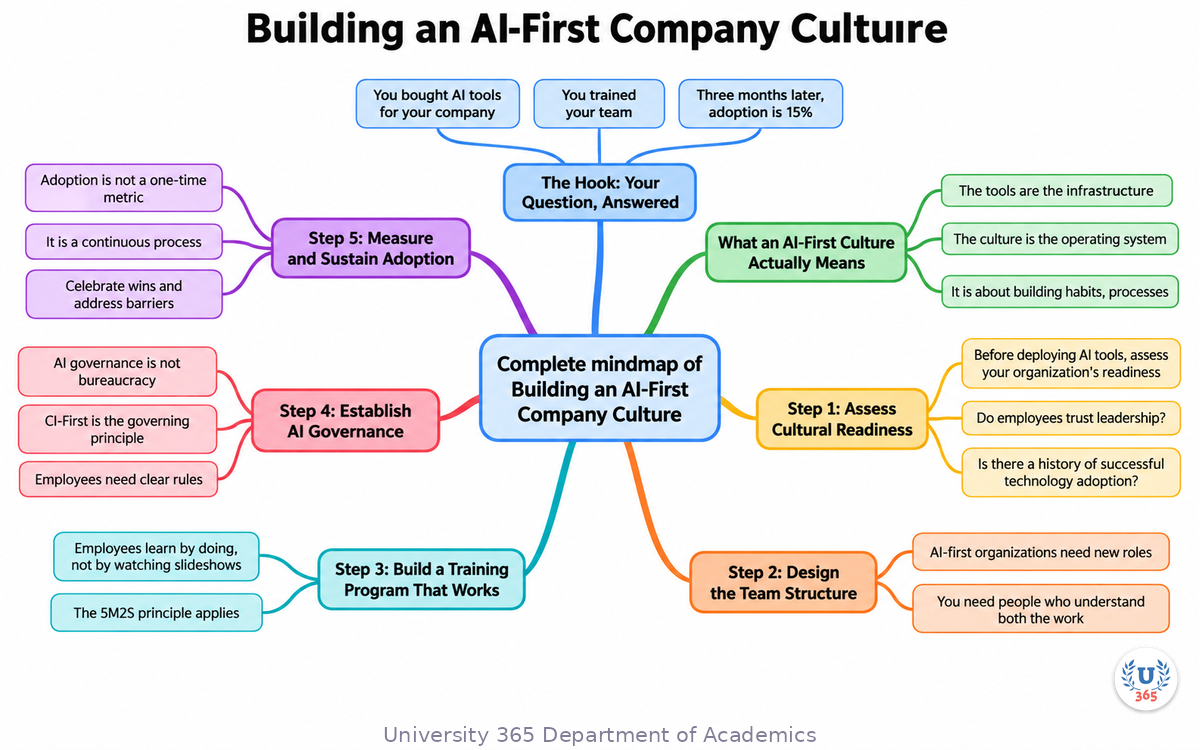
The mindmap shows the complete workflow: defining your objective leads to gathering and preparing data, which feeds into AI analysis and processing, which produces insights and recommendations, which you validate with human judgment before taking action. The CI-First principle wraps the entire process: you start with human-defined goals and end with human-validated decisions.
UNOP Sound (University 365 Neuroscience Oriented Pedagogy)
Take five minutes to consolidate your memory. Play the isochronous tone track (10Hz alpha frequency) with your eyes closed. Alpha-frequency tones after a learning session support consolidation, helping move what you just learned from short-term to long-term memory.
[Audio player: UNOP Post-Lecture Isochrone (10Hz, 5 minutes)]
Practical Exercise: Apply What You Learned
Exercise: 15-Minute Application Sprint
Identify a real scenario: Think of a situation in your work or business where this topic applies.
Define your objective: What specific outcome do you want to achieve in 15 minutes?
Use an AI tool: Open ChatGPT, Claude, or Gemini and apply the framework from this lecture.
Analyze the output: Did AI produce useful results? What needs verification? What needs human judgment?
Make a decision: Based on AI output plus your judgment, what action will you take?
What to Look For
Did AI produce specific, actionable output or generic statements? Generic output means your prompt needs more context.
Did AI invent any data or make unsupported claims? Always verify critical facts against primary sources.
What would you do differently from what AI suggested? The gap between AI output and your judgment is where your value lies.
The CI-First formula is CI = HI + (AI x HI). Your intelligence is the foundation. AI multiplies it. But the final decision is yours.
Applied AI Connection
This exercise demonstrates the CI-First workflow in practice. You defined the objective (human intelligence). AI processed and analyzed (AI amplification). You validated and decided (human intelligence). The speed gain from AI lets you iterate faster and explore more options than you could manually.
Glossary
Term | Definition |
AI-First Culture | An organizational culture where employees instinctively consider AI as a tool for every task, supported by training, governance, and leadership. |
AI Champion | A team member designated to promote AI adoption within their department, provide peer support, and share best practices. |
Cultural Readiness | The degree to which an organization's trust, openness, and past technology adoption success support new AI tool deployment. |
AI Governance | Policies and procedures that define what AI can and cannot do, what data is acceptable, and what requires human review. |
Adoption Rate | The percentage of employees who actively use AI tools in their daily work, measured weekly or monthly. |
Change Management | The structured approach to transitioning individuals and teams from current practices to new AI-enabled workflows. |
AI Enablement Team | A central team responsible for AI tool selection, training, governance, and cross-departmental support. |
CI-First | Co-Intelligence First: the U365 principle that human intelligence orchestrates and AI amplifies. |
5M2S | 5 Minutes to Success: the U365 principle of starting with small time-saving AI tasks and building from there. |
UNOP | University 365 Neuroscience-Oriented Pedagogy: the pedagogical framework behind all U365 lectures. |
Shadow AI | Employees using AI tools without official approval or governance, creating security and compliance risks. |
Time Savings | The measurable reduction in task completion time when AI tools are used, a key metric for AI ROI. |
Quiz: TEST YOUR UNDERSTANDING
1. What is the most common reason AI tool adoption fails in companies?
A) Cultural resistance and lack of change management, not the tools themselves
B) The AI tools are always broken
C) AI is too expensive
D) Employees do not have computers
2. What is an AI champion?
A) A team member who promotes AI adoption within their department and provides peer support
B) A senior executive who buys AI tools
C) An AI tool that competes with others
D) A type of AI model
3. Why is one-time training insufficient for AI adoption?
A) Because effective training is ongoing, role-specific, and hands-on, not a one-time slideshow
B) Because employees forget everything after one session
C) Because AI changes every week
D) Because training is too expensive to repeat
4. What is the purpose of AI governance?
A) To define clear rules on data usage, human review requirements, and AI decision boundaries
B) To prevent employees from using AI entirely
C) To replace all human decision-making with AI
D) To comply with international trade laws
5. In an AI-first culture, what should every employee ask before starting a task?
A) 'How can AI help with this?' before starting any task
B) 'Can I avoid using AI?'
C) 'Will AI replace me?'
D) 'Is AI allowed?'
Answers: 1-B, 2-B, 3-B, 4-B, 5-B
Related Resources
U365 INSIDE Publications
Book Essential: Co-Intelligence by Ethan Mollick: The Centaur model and human-AI collaboration
Lecture 1: AI for Market Research: First lecture in the Business AI Series
External Resources
Harvard Business Review: AI in Business: How AI is transforming business operations: hbr.org
McKinsey: The State of AI: Annual report on AI adoption: mckinsey.com
Stanford AI Index: Annual report on AI progress and adoption: aiindex.stanford.edu
Related U365 Lectures (Coming Soon)
Other lectures in the Leadership Series at UIB
Cross-institute lectures on AI applications
U.Copilot for This Lecture
Discuss this lecture with U.Copilot, your AI chat companion trained on this content.
Copy and paste the following prompt into the U.Copilot chat on university-365.com:
You are U.Copilot for Lectures, an AI chat companion specially trained on University 365 lecture content. You are helping a Fellow who just completed the lecture "Building an AI-First Company Culture" from the Leadership Series at the U365 Institute of Business (UIB). Your role is to help the Fellow deepen their understanding of this topic. You can: - Clarify any concept from the lecture - Provide additional examples and practical applications - Explain how to use specific AI tools for these tasks - Discuss how to verify AI outputs and apply human judgment - Help the Fellow apply the CI-First approach to their own work - Suggest follow-up learning based on the Fellow's industry and interests Always maintain U365's CI-First approach: encourage the Fellow to think critically, verify AI outputs, and maintain human judgment as the orchestrator of AI tools. Use the UP-Context-Engineering Method: provide context-rich, role-aware responses that account for the Fellow's learning level and goals.
Next Steps
Now that you have completed this lecture, here is what to do next:
Try the practical exercise above to apply what you learned to a real scenario
Experiment with different AI tools to see which works best for your specific use case
Explore other lectures in the Leadership Series at UIB
Apply the CI-First approach to your daily work: ask "how can AI help?" before starting any task
Join a UIB program if you want structured learning in business management and digital entrepreneurship: visit university-365.com/tuition
The companies that succeed in the AI age are not the ones with the most AI tools. They are the ones whose people know how to direct AI effectively and apply judgment to its outputs. This lecture gave you the framework. Now practice it.
AI-First starts the culture. CI-First makes it last. If you want the doctrine University 365 teaches and applies, read The CI-First Workflow: Applied to Any Field. The doctrine itself, and how to build a company on it, is in the masterclass How to Build a CI-First Company.
IMPORTANT NOTICE
This lecture is published by University 365 as part of its INSIDE Publications Hub. The content is free to read for all visitors. Lectures in this series may be part of a structured academic program leading to a Micro-Credential for your Career (MCC). To enroll in an academic program, visit university-365.com/tuition.
This content is for educational purposes. While we strive for accuracy, AI is a fast-moving field. Verify current tool capabilities and market data against primary sources for professional applications.
Copyright University 365, Inc. All rights reserved. This content is protected under University 365's copyright policies. For permissions or inquiries, contact uda@university-365.com.
Published by the Department of Academics, University 365.
Lecture delivered by the University 365 Institute of Business (UIB).
Denise Cromwell, Dean of Business, UIB
Signed for the academic year 2026.




Comments