
The Cognitive Surrender Crisis: Why Education Must Become CI-First

In This Report
The Context
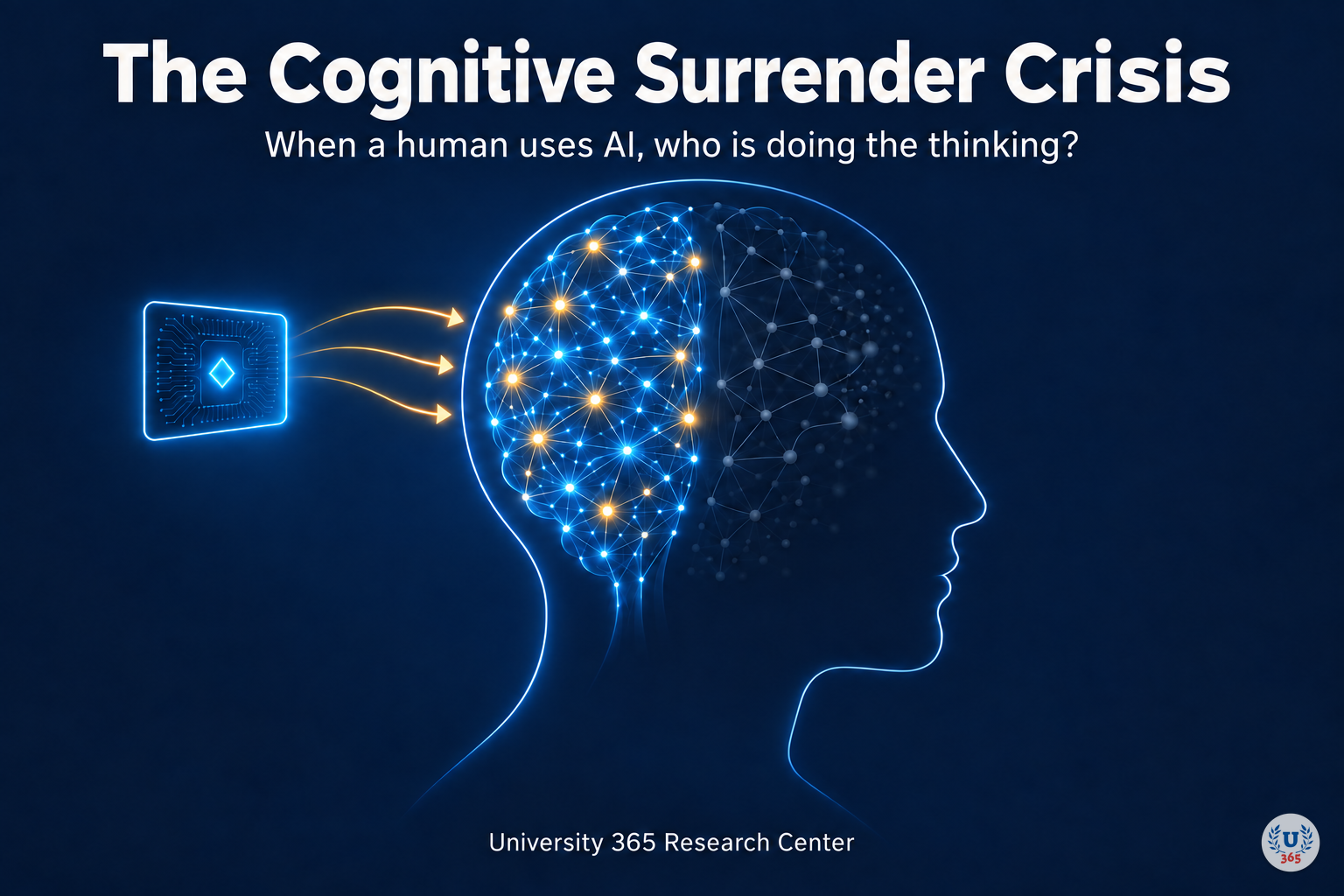
For several years I have defended what may initially sound like a paradox. I believe Artificial Intelligence should become omnipresent in education. And I believe that allowing Artificial Intelligence to replace the intellectual effort of the learner could become one of the greatest educational mistakes in human history. Those two propositions are not contradictory. They define the problem.
The debate has too often been reduced to a primitive binary choice: AI or no AI. Should students use ChatGPT? Should schools ban it? Should governments restrict it? I believe all of these questions are secondary. The fundamental question is the one this report answers: when a human being uses Artificial Intelligence, who is doing the thinking?
Three terms must be separated before anything else in this report makes sense, because almost every institutional policy in the world currently confuses them.
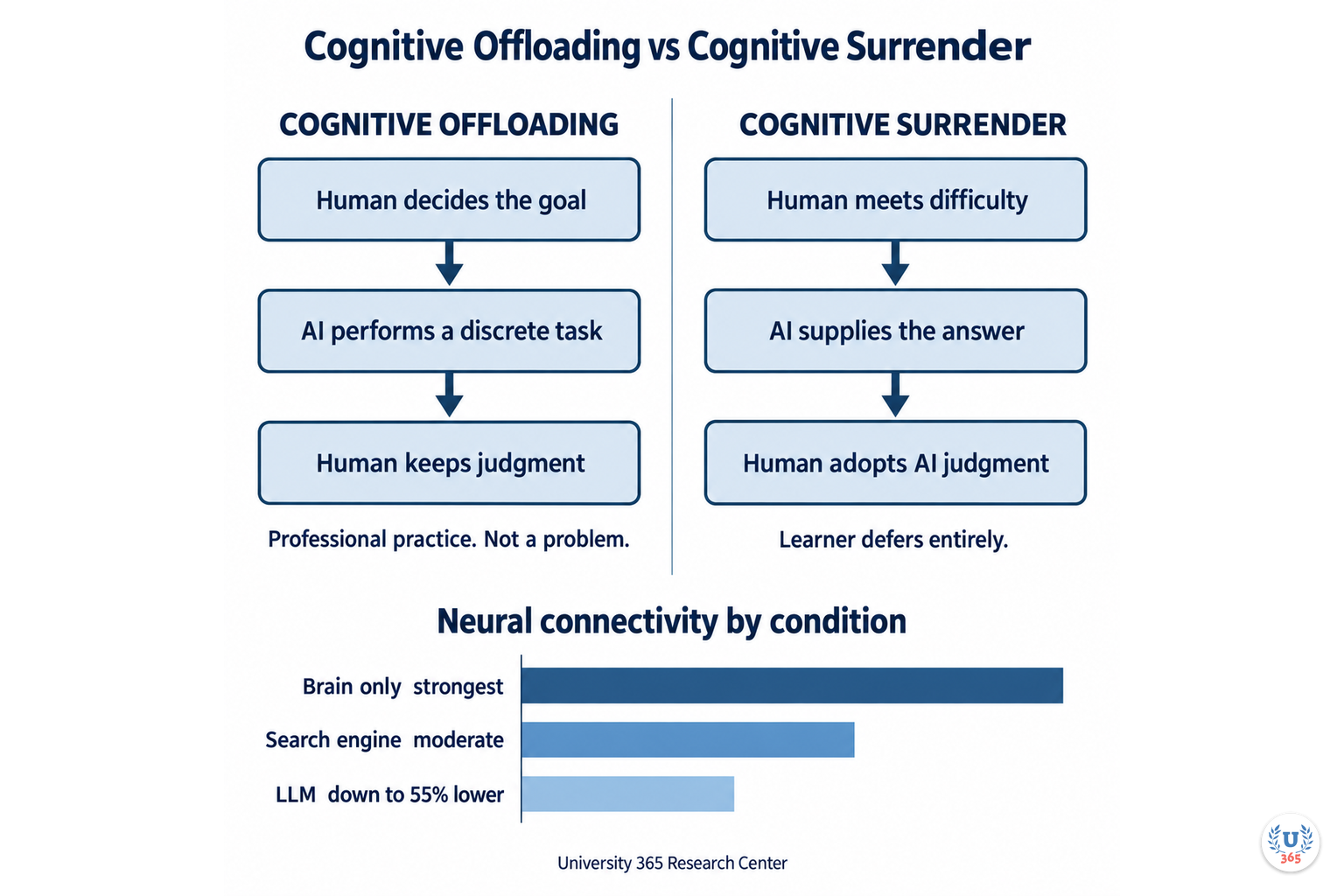
Cognitive offloading is strategic. A person hands a discrete task to an external tool and keeps the judgment that gives the task meaning. You use a calculator for arithmetic and keep the reasoning about which calculation to run. You use a search engine to locate a statute and keep the legal analysis. Offloading is what competent professionals do, and it is not a problem.
Cognitive surrender is different. The Wharton School researchers Steven Shaw and Gideon Nave defined it in January 2026 as a deeper abdication of critical evaluation, in which the user relinquishes cognitive control and adopts the AI's judgment as their own. The person does not merely accept help with a task. The person hands over the authority to decide what is true.
Cognitive debt is the accumulated result. In June 2025, Nataliya Kosmyna and colleagues at the MIT Media Lab, working with Wellesley College, recorded brain activity while 54 participants wrote essays under three conditions: with ChatGPT, with a search engine, or with no tools at all. Brain connectivity scaled down with the level of external support. The researchers described the long-term accumulation as cognitive debt.
The MIT report that made this vocabulary public appeared on 13 August 2026. The Ad Hoc Committee on AI Use in Teaching, Learning, and Research Training spent five months gathering evidence across the Institute, from undergraduates and graduate students to faculty in every school, librarians, and the Teaching and Learning Lab. Its opening sentence is blunt: this report is a call to action.
The committee described getting the right answer from a chatbot as creating an illusion of learning, and it described what happens next in its own words: it can also trigger cognitive surrender, where students fall back on AI at the first hint of struggle. The committee also recorded why. As AI-enabled technologies become more capable, it will be possible, and tempting, to offload more thinking tasks to them, and students said the temptation was greatest when they feared they would miss a deadline.
That single observation reframes the entire problem.
The controversal behaviour of students towards AI is mostly not triggered by laziness. It is triggered by pressure. A student under deadline pressure makes a rational short-term decision, and that decision removes the struggle through which competence is built. The pressure is an institutional design choice, not a natural force.
MIT's report is not an argument against Artificial Intelligence, and it should not be read as one. The same document states that the potential of these technologies to augment work across campus is immense, and it recommends that AI should augment and enhance curiosity, creativity, and learning, not automate them. That sentence is the design brief behind everything this report proposes.
One more element belongs in this section, because it is the reason this subject is larger than schooling. When a person works through a hard problem unaided, the effort produces two things: a private answer for that person, and a thin public deposit that enters the shared stock of human knowledge. That shared stock is what makes the next person's work possible, and it is what AI systems are trained on. In 2026, Daron Acemoglu, Yu Kong and Asuman Ozdaglar published a formal model of what happens when machine answers substitute for the private signal without replenishing the public one. They call the result knowledge collapse, and the mechanism is described in the Deep Analysis section of this report.

The Question
Can education survive a tool that thinks for you?
Every technology that has ever changed education posed some version of that question. Writing was said to destroy memory. Printed books were said to destroy memorized recitation. Calculators were said to destroy arithmetic. Search engines were said to destroy research. In each case something was lost, something larger was gained, and the institution adapted over a generation.
There are two reasons to be careful about that comforting pattern.
The first is speed. MIT's committee makes the point directly: generative AI reached more than a billion users in less than four years, faster than society has been able to observe and analyze its effects, let alone adapt. Writing and print moved slower than the institutions that had to absorb them. A student who enters primary school in 2027 and leaves university in 2039 will have lived their entire intellectual formation inside a tool that was never stable for two consecutive years.
The second is that the previous technologies did not do the thinking. They stored, retrieved, transported or calculated. This tool drafts, summarizes, reasons, argues, codes and explains. When the machine can produce the output, the question stops being whether the output is good and becomes whether producing the output is still the point.
There is a third difference, and it is the one the 2026 evidence makes impossible to ignore. The earlier technologies did not have to be governed. This one does, and the governance decides which of two completely opposite outcomes you get. The OECD's Digital Education Outlook 2026, published in January 2026 and drawing on classroom data from 14 member countries, states the finding plainly: general-purpose generative AI tools can raise the quality of student work, but that advantage disappears and sometimes reverses when the tool is removed for assessment, while tools designed with pedagogical intent show sustained improvement. The OECD names the mechanism as metacognitive laziness and disengagement.
So the question is not whether a tool that thinks for you can be tolerated. It is whether an institution can tell the difference between a tool that is being used and a tool that is being obeyed, and whether anyone has designed the difference on purpose.
Until roughly the middle of 2025, the public position of most universities and most ministries could be summarized as integrate first, evaluate later. Adoption was treated as progressive and hesitation was treated as nostalgia. UNESCO had already warned in its global guidance that publishing a new textbook required more authorizations than deploying a generative AI tool in a classroom, and that a survey of more than 450 schools and universities found fewer than one in ten with an institutional policy on generative AI.
Then the evidence arrived, and it did not arrive in the shape people expected. It did not say that AI is bad. It said that the same tool produces opposite results depending on how the human relationship with it is designed, and that the default design, which is to say no design at all, lands on the bad side.
The Contradiction
Better homework. Worse learning.
Both measured, both real, in the same students at the same time.
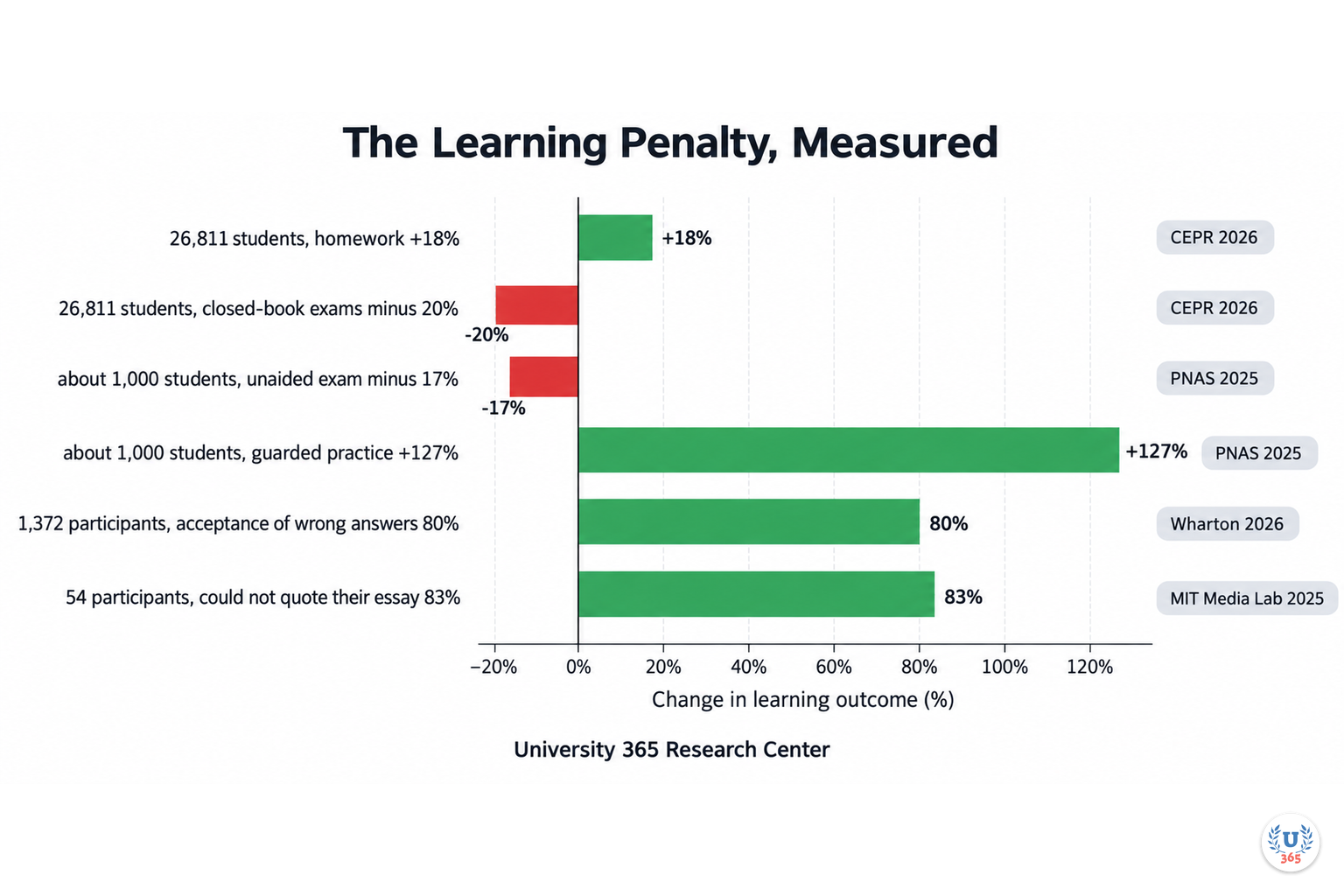
The largest natural experiment to date is a study of 26,811 students in grades 7 to 12 in a Chinese county, tracked over 30 months across nine subjects, published as CEPR Discussion Paper 21577 under the title The Generative AI Learning Penalty. The design exploits staggered adoption of generative AI, and during the study window self-reported student AI use rose from near zero to roughly 80 percent.
The results separate into two columns.
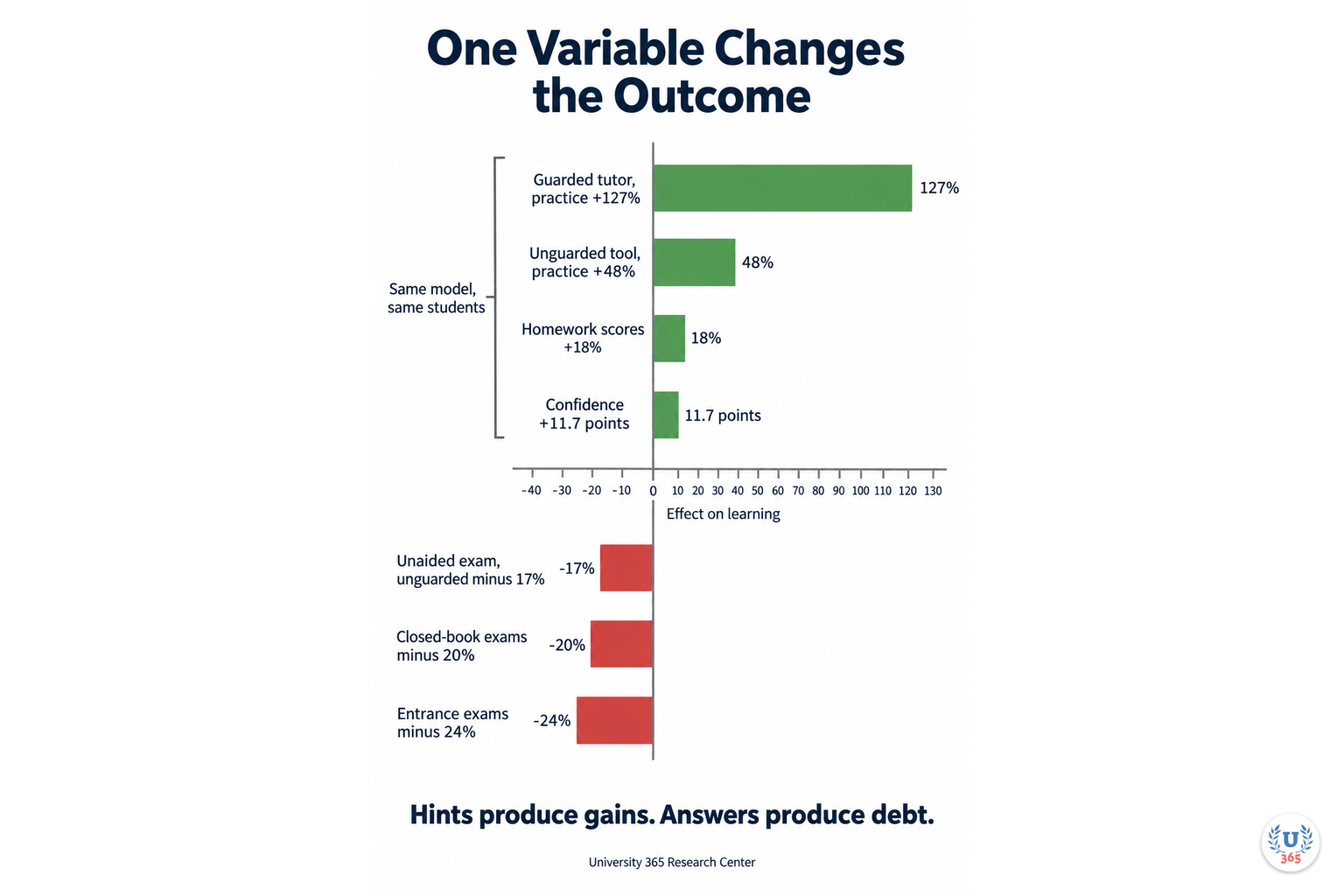
In the first column, AI adoption raised homework scores by 18 percent and cut homework completion time by 30 percent, from 64 minutes to 45 minutes. In the second column, closed-book monthly exam scores fell by 20 percent within six months. High-stakes entrance examination scores fell by 18 percent and 24 percent, with the full penalty emerging only after about two years. The losses were largest in social science subjects, then STEM, then languages, and they were larger for junior students, high-achieving students, and boys.
The authors then identified the mechanism, and this is the most operationally important finding in the entire literature. Roughly 80 percent of AI users behaved in a way consistent with homework outsourcing: exceptionally short completion times paired with exceptionally high homework scores. Those students carried almost the entire learning loss. The minority of AI users who kept homework completion times in line with non-users experienced only small losses.
The damage was not caused by access to AI. It was caused by a usage pattern, and usage patterns can be designed.
A randomized controlled trial reaches the same conclusion with a cleaner instrument. Hamsa Bastani and colleagues, publishing in the Proceedings of the National Academy of Sciences, ran a pre-registered cluster randomized trial in a Turkish high school with roughly 1,000 students across about 50 classrooms in grades 9 to 11, covering four 90-minute mathematics sessions. There were three arms: a control group with standard materials, an arm called GPT Base with an interface essentially identical to ChatGPT, and an arm called GPT Tutor which used the same underlying model but was given the worked solutions and the common student errors, and was instructed to give incremental hints and never the full answer.
During assisted practice, GPT Base students scored 48 percent above control and GPT Tutor students scored 127 percent above control. Then the AI was removed and the students sat an unaided exam. GPT Base students scored 17 percent below the students who had never touched the tool. GPT Tutor students showed no significant difference from control: the harm was eliminated, and the visible gain during practice was the largest of the three arms.
The technology was constant across the two AI arms. The pedagogy was the variable.
Two more results widen the picture.
Gregory Kestin and Kelly Miller, reporting in Scientific Reports, ran a crossover randomized controlled trial in Harvard's largest physics course with 194 students. Students who learned through a purpose-built AI tutor, engineered with the same pedagogical best practices as the classroom, achieved median learning gains more than double those of students in an in-class active learning session, with an effect size estimated between 0.73 and 1.3 standard deviations, and they reported higher engagement and motivation.
The Programme for International Student Assessment, whose 2025 results were released in September 2026, adds the scale. Across OECD countries, 46 percent of 15-year-olds use AI chatbots at least weekly to help them learn. That single number ends the debate about whether the technology is present. The same data then splits the outcome by purpose: students who use AI for specific schoolwork tasks such as summarizing texts, drafting, or preliminary research attain lower science scores than students who do not use it, by around 20 points on average, which is roughly equivalent to one year of schooling. Weekly users of AI for general purposes perform about the same as non-users, and students who regularly use AI for general purposes and who have opportunities at school to develop AI literacy skills tend to score slightly higher.
The pattern is consistent from a Turkish high school to a Chinese county to a Harvard lecture hall to 15-year-olds in dozens of countries. Use is now universal, the outcome is designed rather than given, and the design that produces learning loss is the default.
Now add the neural evidence, with its limits stated honestly. In the MIT Media Lab EEG study, the brain-only group showed the strongest and most widely distributed connectivity, search engine users sat in the middle, and ChatGPT users showed the weakest, with reporting indicating connectivity reductions of up to 55 percent relative to the brain-only group. In a fourth session, participants who had used AI and were then asked to write unaided showed reduced alpha and beta connectivity, consistent with under-engagement, while participants who had written unaided first and then used AI showed higher memory recall and activation patterns closer to the search engine group. Eighty-three percent of the AI group could not quote a sentence from the essay they had just written, and self-reported ownership of the work was lowest in the AI group and highest in the brain-only group.
The study is a preprint of 54 participants measuring a proxy for cognitive engagement, and it has attracted published methodological criticism. It is suggestive, not decisive. But the ordering it found is the ordering that the Chinese panel data, the Turkish trial, the Harvard trial, the OECD review and the PISA results all found, each by a different route. And the most consequential detail in it may be the sequencing effect: writing unaided first and then using AI produced better recall than using AI first. That single line of evidence is the empirical ancestor of this report's proposal.
The Current State
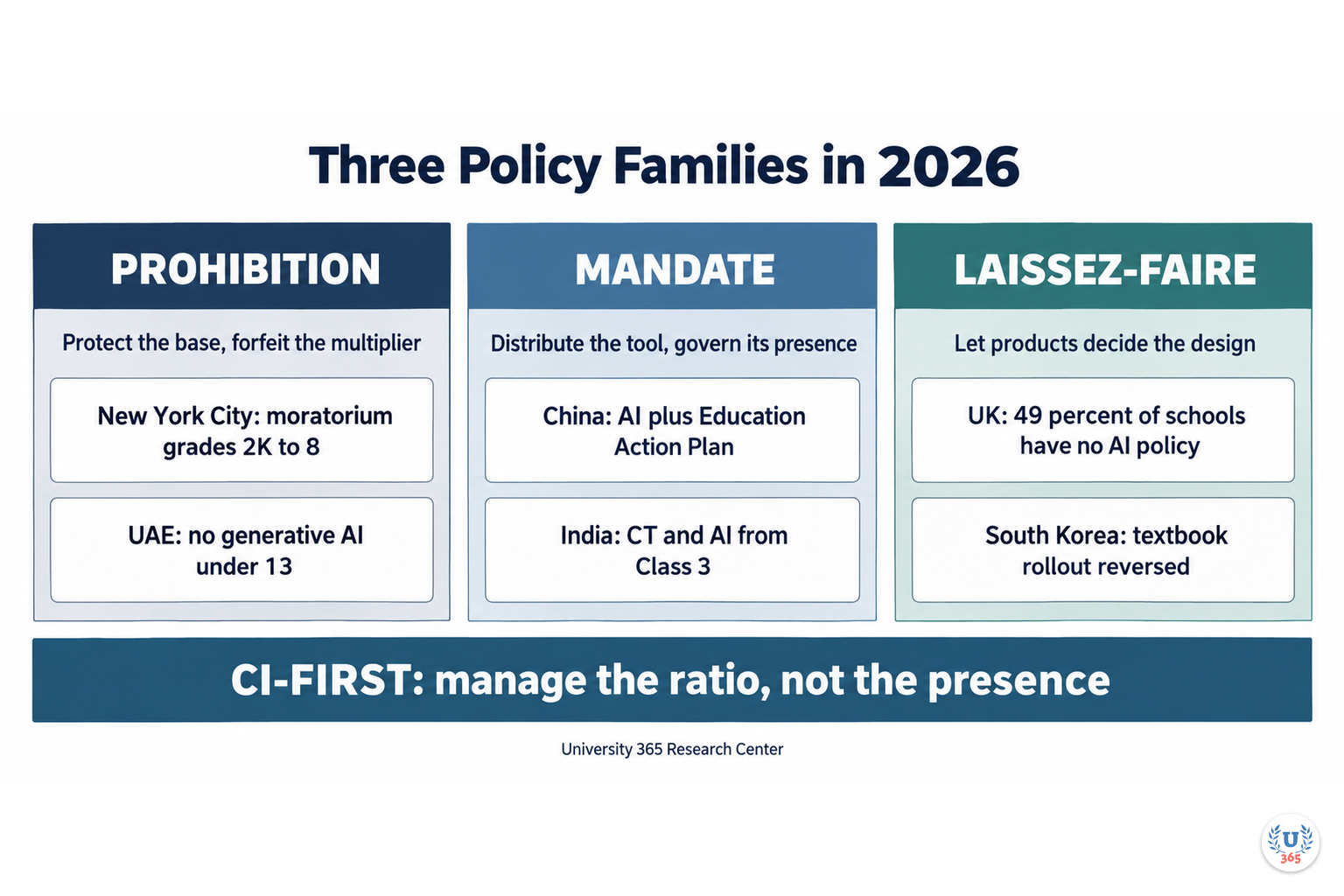
Policy in 2026 split into three families. Each answers the cognitive surrender problem differently, and each carries a different failure mode.
Prohibition
The first family is prohibition, and New York City provided the clearest example.
On 2 September 2026, Mayor Zohran Mamdani and Schools Chancellor Kamar Samuels announced the most expansive student-facing AI policy in the United States. It imposes a one-year moratorium on student-facing generative AI for grades 2K through 8, effective for the 2026-2027 school year, affecting nearly 600,000 students, or about two-thirds of the system's enrolment. Companion chatbots are prohibited across all grades. About 40 educational tools were halted. Teachers remain permitted to use AI for instructional planning and operational tasks that comply with city safety standards. Screen time caps were introduced by grade band: 30 minutes a day for grades 3 to 5 and 45 minutes for grades 6 to 8.
The policy is not a ban on AI literacy. All high school students receive two 45-minute AI literacy modules per year covering what AI is and is not, bias, risk, ethics, and impacts on careers and future skills. Five limited pilots were approved for a maximum of 50,000 high school students, about 5 percent of the student body, with per-tool time limits, required supervision by a trained educator, and a stated commitment to keeping students as the primary thinker in the classroom. Exemptions were carved out for assistive technology, multilingual learners, and career readiness programmes.
Mayor Mamdani's justification is a direct statement of the prohibition thesis. Children need teachers and human connection in order to learn and grow, he said. They need to develop skills alongside their peers, build relationships with educators, and wrestle with tough problems on their own. The tech industry, he said, wants the public to believe that AI-powered early education is inevitable and necessary. The city does not see it that way.
New York's record is worth noting for anyone who treats prohibition as a permanent answer. The city had already banned ChatGPT in schools in early 2023 and reversed that decision within months. The current moratorium is explicitly temporary and is accompanied by a Technology in Schools Coalition tasked with producing evidence and recommendations for the following school year. Prohibition here is a controlled experiment, not a policy.
Obligation
The second family is mandate.
China's Ministry of Education issued guidance on strengthening AI education in primary and secondary schools in November 2024, targeting basically universal AI education by 2030. In 2025 it published three guides for generative AI in schools, including an explicit prohibition on copying AI-generated content as answers to homework or examinations and requirements to avoid entering sensitive data into AI tools. In April 2026 five central departments led by the Ministry of Education released the Artificial Intelligence plus Education Action Plan, aiming at a comprehensive AI literacy system spanning all levels of schooling and lifelong learning, with the Ministry's own framing that AI is to serve education rather than define it.
India moved faster on curriculum. In October 2025 the Department of School Education and Literacy committed to making Computational Thinking and AI a mandatory curriculum component for Classes 3 to 8 from the 2026-27 session, expanding to Classes 9 and 10 in 2027-28, with AI remaining an elective specialisation in Classes 11 and 12. The Union Education Minister launched the CBSE Computational Thinking and AI curriculum for Classes III to VIII on 1 April 2026. The design deliberately sequences computational thinking first and AI later, on the argument that computational thinking is the intellectual backbone required to understand AI rather than a parallel subject. CBSE also runs SOAR, a 15-hour module family for Classes 6 to 12, and the NISHTHA teacher capacity building programme.
The United Arab Emirates combined mandate with age restriction and, notably, with a cognitive safeguard. The Ministry of Education's 2026 manual on the Safe and Responsible Use of AI in Classrooms prohibits generative AI tools for students under 13 or below Year 7, bans AI use in formal examinations, requires disclosure and teacher approval for any AI-assisted work, and requires students to demonstrate genuine understanding: if a student cannot explain why an AI-assisted answer is correct, the use is a violation. In September 2026 the UAE Cabinet approved an AI curriculum for all public and private schools together with a commitment to train 22,000 teachers and educators to use AI in teaching, assessment, curriculum analysis and lesson planning, and the Ministry has adopted a unified subject titled Artificial Intelligence and Technology. Abu Dhabi's Department of Education and Knowledge runs a structured AI literacy progression across more than 170 private schools, from screen-free early years to AI solution design by Grade 12, with an AI Growth Test administered twice a year from Grade 4, and a policy that names cognitive agency as one of six explicit safeguards. The Ministry of Education has also deployed NOVA, an AI initiative for institutional transformation in education governance.
France chose the incremental route with explicit thresholds. Its national framework for AI in education sets the terms directly: from the first level, pupils are made aware of the basic knowledge of AI without directly manipulating generative tools; supervised pedagogical classroom use by pupils is authorized from the fourth year of lower secondary school; and lycée students may use generative AI autonomously within a framework explicitly defined by the teacher. The Pix learning pathways on AI became mandatory for pupils in the equivalent of grades 8 and 10 and the first year of vocational certificates, reaching more than 1.5 million pupils each year. In June 2026 the Prime Minister announced one hour per week of AI teaching for the first year of upper secondary school from the 2027 school year, integrated into the digital sciences and technology course.
Japan refused both prohibition and mandate, and it did so deliberately. MEXT published version 2.0 of its Guideline for the Use of Generative AI in Elementary and Secondary Education in March 2026, and it states that rigid policies which uniformly prohibit or mandate AI use are undesirable, favouring school-by-school judgement under board leadership with explicit requirements on information security, personal data, copyright, fairness, transparency and accountability. In April 2026 the Cabinet approved a bill giving digital textbooks formal status as teaching materials.
Russia took the education route without the prohibition route. A national AI lesson programme was developed by Skolkovo Technopark with Avito, with materials for grades 1 to 11 available free of charge to any school in any region, and AI content entering computer science at advanced level from September 2026. One of the programme's own academic voices, Sergey Kosaretsky of Moscow State Pedagogical University, framed the logic clearly: if a child is already opening a neural network to write an essay or solve a physics problem, it is more logical to teach the child to do it meaningfully than to forbid it altogether, because recognising an error in an AI answer is a skill that will eventually be needed at school, at university and at work.
The European Union governs through literacy and risk rather than through bans. Article 4 of the AI Act requires providers and deployers of AI systems to take measures to support the development of AI literacy among their staff and others dealing with those systems, and education and vocational training are listed in Annex III as a high-risk category. The Commission's 2026 guidance emphasises responsible adoption, legal and ethical understanding, critical judgement and privacy. The AI Skills Academy began operations on 1 May 2026.
Laissez-faire
The United Kingdom illustrates the third family, which is laissez-faire, and it illustrates it through a regulator doing its job while the system around it does not. Ofqual has held the line that AI may not be used as the sole marker of regulated assessments, and the Department for Education committed to safety standards and efficacy assessments for AI tools used in schools. But a National Education Union survey of 9,408 teachers published on 2 April 2026 found that 49 percent of teachers reported their school had no policy at all on AI, either for staff or students, and 66 percent had no policy specific to student use. Those figures had not materially changed from the previous year. Adoption is running ahead of governance by a wide margin.
The same split appears inside higher education. The Higher Education Policy Institute and Kortext published their Student Generative AI Survey 2026 based on 1,054 full-time UK undergraduates surveyed in December 2025. Ninety-five percent of students use AI in at least one way and 94 percent use generative AI to help with assessed work. Only 36 percent feel encouraged by their institution to do so, and only 38 percent say they are provided with AI tools. Two student statements, printed side by side in the report, capture the entire policy vacuum. One student said that AI tools allowed them to summarize dense readings, generate drafts and outlines, and focus on critical analysis and deeper understanding. Another said, in five words: I'm not using my brain at all.
Both students were in the same system, under the same institutional guidance, and the system did not distinguish between them. That is what laissez-faire means in practice.
South Korea deserves its own paragraph because it is the most instructive case of the year. It initially pursued one of the fastest AI digital textbook rollouts in the world, approving 76 AI digital textbooks for use in 2025 across mathematics, English, informatics and Korean for special education, and investing roughly 1.409 trillion won. Then the policy reversed. Mandatory adoption became a voluntary trial, and in August 2025 an amendment to the Elementary and Secondary Education Act narrowed the legal definition of a textbook to printed books and e-books, excluding learning support software using intelligent information technology. This removed the legal and financial foundation for treating AI learning software as an official textbook. Reporting indicates that six in ten students never opened the AI materials. In July 2026 South Korea's amended AI Basic Act took effect, including mandatory labelling of generative AI outputs, making Korea the second country after the European Union with a framework AI law.
Sweden went the other way entirely on screens. It cut back on classroom devices, allocated more than 2 billion kronor in grants for printed textbooks and teacher guides, ended the requirement for digital tools in pre-school, and moved toward phone-free schools, under the slogan from screen to binder. The government's stated reason was falling reading and mathematics results and a commissioned review by neuroscientists and paediatric experts concluding that heavy reliance on digital devices could impair attention and concentration.
Is there a winner?
Put the three families side by side and a pattern emerges that no single policy debate in 2026 acknowledged.
Prohibition protects a window of childhood but cannot survive the labour market that follows it. It is honest about the risk and silent about the exit.
Mandate distributes the tool and governs its presence, not the ratio between human and machine effort inside the student's head. China's own homework guidance is the most explicit attempt in the world to regulate that ratio, and it is a one-line prohibition inside a 2030 expansion plan.
Laissez-faire delegates the design of cognition to product roadmaps that are optimized for engagement, answer delivery and retention. It is not neutral. It is a decision to let someone else decide.
And New York, China, the UAE, France and Japan independently converged on the same structural insight without using the same words for it.
Age thresholds, staged autonomy, compulsory AI literacy with real guardrails, and a preference for supervised tool use before autonomous use. The convergence is visible in the policy record even though no government has said out loud what it amounts to: first build a human mind capable of exercising judgement, then teach that mind to command powerful machines.
Key Findings
Finding one.
Cognitive surrender is measurable, it is distinct from offloading, and it is not caused by laziness. Wharton's experiments isolate a shift in epistemic deference, not merely effort saving. Across 1,372 participants, people accepted correct AI answers 93 percent of the time and incorrect AI answers 80 percent of the time, and access to AI raised participants' confidence in their own answers by roughly 11.7 percentage points. Participants did not merely get worse when the AI was wrong. They got worse and felt better about it. The authors also found that people who trust AI more surrender more readily, while people who enjoy thinking and have stronger reasoning ability are better protected.
Finding two.
The same technology produces opposite outcomes depending on design, and the design variable is guardrails. The Turkish trial is the cleanest demonstration available: an unguarded interface produced a 17 percent exam penalty, and a guarded interface using the same model eliminated it while producing the largest practice gains of any arm. The technology was constant.
Finding three.
The damage is concentrated in a usage pattern, not in a population. In the Chinese panel data, roughly 80 percent of AI users showed behaviour consistent with homework outsourcing and absorbed almost the entire learning loss, while AI users who kept normal completion times lost little. This means the problem is addressable by redesign rather than by exclusion, which is the single most hopeful result in the evidence base.
Finding four.
Sequencing matters more than access. In the MIT EEG study, participants who wrote unaided first and then used AI showed higher recall and activation patterns closer to the search engine group, while participants who used AI first and then wrote unaided showed under-engagement, and 83 percent of the AI group could not quote a sentence from the essay they had just written. Human first, machine second is not a stylistic preference. It is the ordering the neural data supports.
Finding five.
AI literacy mandates are not the same thing as cognitive protection, and the meta-analytic evidence shows exactly where the gap sits. A systematic review and meta-analysis of 57 studies and 97 effect estimates found a large positive average effect of generative AI on university students' learning outcomes, with a combined effect size of 0.804, and large gains in language skills, academic achievement and affective-motivational status. The effect on metacognition was 0.078 and was not statistically significant. The capability that AI improves most reliably is not the capability that protects a learner from surrender.
Finding six.
Institutional governance is failing faster than institutional adoption is succeeding. Nearly half of surveyed UK schools have no AI policy at all, and 66 percent have none specific to student use. Fewer than one in ten institutions in UNESCO's global survey had policy or formal guidance. The laissez-faire family is not a considered position. In most institutions it is the absence of one, and the same gap appears in commercial products, which are optimized for satisfaction rather than for learning.
Finding seven.
The public knowledge commons is already thinning, which makes this a collective problem as much as an educational one. A peer-reviewed study from University College London, the University of Cambridge, LMU Munich and the Complexity Science Hub Vienna found that posting activity on Stack Overflow fell by about 25 percent relative to comparable platforms within six months of ChatGPT's release, with declines across users of all experience levels and the largest declines in the most widely used programming languages. Human problem-solving that used to be deposited in public was moved into private conversations and never deposited at all.
Deep Analysis
Offloading, surrender, and why effort is the only variable that matters
The distinction between offloading and surrender is not academic hair-splitting. It determines whether a policy is coherent.
Offloading is what a professional does. A surgeon offloads instrument counts. An accountant offloads depreciation schedules. A researcher offloads literature retrieval. In each case the human retains the judgement that gives the offloaded work meaning, and the offloading frees capacity for that judgement.
Surrender is what happens when the judgement itself is handed over. Wharton's data shows that surrender does not require the machine to be right. Participants adopted wrong answers at a rate of 80 percent and their confidence rose. What changed was not the workload but the architecture of the decision: the metacognitive signal that would ordinarily route a response toward deliberation was suppressed, not overridden.
This explains an otherwise puzzling 2026 result. If AI were merely a labour-saving tool, we should see uniform improvements in productivity with learning untouched. Instead we see large visible gains during assisted work and significant losses when the assistance is removed. The student is not saving time on the same task. The student is performing a different task, one in which the learning component has been removed and only the output component remains.
The OECD frames this as metacognitive laziness and disengagement. A more operational framing is available: when the machine supplies the answer, the human loses the iteration during which the answer becomes usable knowledge.
The Harvard trial supplies the counterexample that proves design is decisive. When the tutor was engineered with the same pedagogical best practices as the classroom, students learned more than twice as much in less time and reported higher engagement. When the tutor gave answers, students performed worse than those who never used it. Both results came from generative AI. Only one was designed.
Why banning is not the answer and why doing nothing is worse
Prohibition and laissez-faire are mirror images of the same error. Both treat AI as an environment to be managed. AI is not an environment. It is a partner whose contribution is decided by the human, and that contribution can be designed.
Prohibition has a real virtue that deserves acknowledgement. In early childhood, the foundations that AI can substitute for are the foundations that cannot be recovered later. The UAE's age threshold of 13, Abu Dhabi's screen-free early years, France's rule that primary pupils learn about AI without manipulating generative tools, and New York's 2K through 8 moratorium are all defensible on the same grounds: protect the window in which the human capabilities are built. That is not nostalgia. It is sequencing.
But prohibition has a shelf life. The student protected until age 14 enters a labour market in which the World Economic Forum reports that AI and information processing technologies are expected to transform business for 86 percent of employers by 2030, that 39 percent of skills requirements are likely to change over 2025 to 2030, and that entry-level roles in the highest AI-exposure quartile exhibit nearly twice the rate of net skills change compared with non-entry-level roles. The same research finds that only 16 percent of organizations have fully redesigned roles, processes and operating models to integrate AI effectively, and that employers increasingly report that degree programmes alone are no longer sufficient indicators of workplace readiness. A student who has been protected from AI and not trained to govern it arrives at that market with an intact mind and no method.
Doing nothing fails differently, and the 2026 evidence is unusually clear about how. Students already have the technology. Teachers already use it. Parents and workers use it. AI is embedded inside search engines, productivity software, operating systems, smartphones and learning platforms. PISA 2025 shows that 46 percent of 15-year-olds across OECD countries already use AI chatbots at least weekly to help them learn, and that the students making the greatest use of AI tend to come from advantaged backgrounds, which means unmanaged adoption is widening an AI divide rather than closing a learning gap.
The educational system therefore faces a dangerous asymmetry. AI adoption moves at consumer-software speed. Pedagogy moves at institutional speed. If universities do nothing, students will still build habits. If governments provide no doctrine, commercial products will provide one implicitly. A normal commercial assistant is rewarded when it answers quickly, and convenience almost always pushes toward cognitive offloading.
Each question sounds individually reasonable. Why struggle for twenty minutes when a model answers in two seconds? Why read thirty pages when the model can summarize them? Why formulate an argument when the model can generate five? Why learn to program when the model writes the code? Why memorize anything when an AI remembers everything? Why learn another language if simultaneous translation becomes perfect?
Collectively they lead somewhere alarming. If every cognitive friction is removed, what develops the cognition? Learning requires retrieval. It requires confusion. It requires failed attempts. It requires reflection. It requires building internal models. It requires the uncomfortable interval between not knowing and knowing. Education that optimizes only for producing the correct answer may destroy the process that once produced a capable person.
The collective dimension: a tragedy of the cognitive commons
There is a larger mechanism that no school policy in 2026 addresses, and it is the reason this report treats the subject as more than an education problem.
In 2026, Daron Acemoglu, Yu Kong and Asuman Ozdaglar published a model of how agentic AI can erode humanity's shared knowledge base. The mechanism runs through an externality. When a person works through a hard problem unaided, the effort produces both a private answer for that person and a thin public signal that enters the shared stock of knowledge. That shared stock is what makes the next person's work possible, and it is what AI systems are trained on, because they learn from it.
Substitute AI for the private signal without replenishing the public one and you get a feedback loop. The machine answers the immediate question. Human effort loses its private return. Effort falls. The public signal thins. The shared stock degrades. The degraded stock makes the machine's own answers less reliable. The system consumes the resource that made it valuable.
The collapse is conditional, not inevitable. It is triggered only when human effort is sufficiently elastic, meaning that people withdraw effort sharply once AI satisfies the immediate need. Where professional norms, intrinsic curiosity or institutional obligation keep effort in place, the public signal keeps flowing and the catastrophic equilibrium is not reached. A critical appraisal published on arXiv in 2026 makes this explicit, states that the model identifies a credible risk whose remedy is stronger aggregation of validated human knowledge rather than a guaranteed catastrophe, and warns against both the viral misreadings and the reflexive dismissals of it.
That conditionality is the reason this report exists. Effort elasticity is the parameter that determines whether the AI era produces augmentation or collapse, and it is not set by the model. It is set by institutions. It is set by what a school rewards, what an examination can detect, and what a profession normatively expects. Education is the only institution with both the mandate and the reach to hold that parameter down.
The measured decline in public knowledge sharing on Stack Overflow is what a thinning commons looks like in real time. The interactions that used to produce public deposits were not hostile to knowledge. They were the process through which knowledge became public. When they move into private conversations, the deposit stops, and no one notices until the stock is thinner.
There is also a counter-argument that deserves an honest hearing, because a report that only presents one side is not a report. The optimistic reading of the same history is that writing, print and the internet each produced comparable warnings of cognitive decline, and each time something was lost while something larger was gained. The difference now is not that the warnings are louder. It is that the current technology substitutes for the reasoning process itself rather than for its storage or its transport, that adoption has been faster than any previous technology, and that the effect is now measured rather than predicted. A reader who wants to discount this report's conclusion should discount it on that basis, and not by assuming the historical pattern repeats automatically.
Data and Evidence
The table below presents the quantitative backbone of this report. Every metric carries its source and a confidence rating. The rating is High for peer-reviewed research and official government or institutional data, Medium for established institutional analysis with a named methodology, and Low for single-source or self-reported data.
Unguarded exam penalty after GPT-4 practice | 17% below control | Bastani et al., PNAS | 2025 | High |
Practice gain, unguarded interface | +48% vs control | Bastani et al., PNAS | 2025 | High |
Practice gain, guarded tutor | +127% vs control | Bastani et al., PNAS | 2025 | High |
Homework score change after AI adoption | +18% | CEPR DP21577 | 2026 | High |
Homework completion time change | minus 30%, 64 to 45 minutes | CEPR DP21577 | 2026 | High |
Closed-book monthly exam change within 6 months | minus 20% | CEPR DP21577 | 2026 | High |
High-stakes entrance exam change | minus 18% and minus 24% | CEPR DP21577 | 2026 | High |
Share of AI users showing homework-outsourcing pattern | about 80% | CEPR DP21577 | 2026 | High |
Acceptance of incorrect AI answers | 80% | Shaw and Nave, Wharton | Jan 2026 | High |
Confidence increase when AI is available | plus 11.7 percentage points | Shaw and Nave, Wharton | Jan 2026 | High |
Neural connectivity, LLM group vs brain-only | down up to 55% | Kosmyna et al., arXiv | 2025 | Medium |
AI writers unable to quote their own essay | 83% | Kosmyna et al., arXiv | 2025 | Medium |
Combined effect of GenAI on university learning outcomes | g = 0.804 across 57 studies | Systematic review and meta-analysis | 2025 | High |
Effect of GenAI on metacognition | g = 0.078, not significant | Systematic review and meta-analysis | 2025 | High |
Students using AI chatbots weekly or more, OECD average | 46% | OECD PISA 2025 | Sep 2026 | High |
Science score gap, specific-task AI users vs non-users | about 20 points lower | OECD PISA 2025 | Sep 2026 | High |
Undergraduates using generative AI for assessed work, UK | 94% | HEPI and Kortext | Mar 2026 | Medium |
Students including AI text directly in assessed work, UK | 12% | HEPI and Kortext | Mar 2026 | Medium |
UK schools with no AI policy at all | 49% | NEU survey, n = 9,408 | Apr 2026 | Medium |
Fall in Stack Overflow posting activity after ChatGPT release | about 25% within 6 months | del Rio-Chanona et al., PNAS Nexus | 2024 | High |
Students affected by the New York City moratorium | nearly 600,000 | NYC Mayor's Office | Sep 2026 | High |
India mandatory Computational Thinking and AI curriculum | Classes 3 to 8 from 2026-27 | PIB, Government of India | Apr 2026 | High |
South Korea AI digital textbook spend | about 1.409 trillion won | Korean Ministry of Education and audit reporting | 2026 | Medium |
Skills requirements expected to change by 2030 | 39% | WEF Future of Jobs | 2025 | Medium |
Employers expecting AI and information processing to transform business by 2030 | 86% | WEF Future of Jobs | 2025 | Medium |
Timeline of key events.
Nov 2022 | ChatGPT released; public engagement with generative AI begins |
Jun 2023 | MIT Media Lab EEG preprint on cognitive debt published on arXiv |
2023 | UNESCO publishes its first global guidance on generative AI in education, setting an age threshold of 13 |
Nov 2024 | China's Ministry of Education issues guidance on strengthening AI education in primary and secondary schools, targeting universal AI education by 2030 |
Jun 2025 | Bastani et al. publish the Turkish mathematics trial in PNAS |
Oct 2025 | India commits to making Computational Thinking and AI mandatory for Classes 3 to 8 from 2026-27 |
Jan 2026 | OECD Digital Education Outlook 2026 reports that the advantage of general-purpose GenAI disappears or reverses when the tool is removed for assessment |
Jan 2026 | Shaw and Nave publish the Wharton cognitive surrender paper |
Mar 2026 | MEXT publishes version 2.0 of Japan's generative AI guidelines for schools |
Apr 2026 | India launches the CBSE Computational Thinking and AI curriculum for Classes III to VIII |
Apr 2026 | China releases the AI plus Education Action Plan, aiming at a comprehensive AI literacy system |
Apr 2026 | NEU survey of 9,408 UK teachers finds 49 percent of schools have no AI policy at all |
Apr 2026 | Japan's Cabinet approves a bill giving digital textbooks formal status as teaching materials |
Jun 2026 | France announces one hour per week of AI teaching for the first year of upper secondary school from 2027 |
Jul 2026 | South Korea's amended AI Basic Act takes effect, including mandatory labelling of generative AI outputs |
Aug 2026 | MIT's Ad Hoc Committee publishes its final report and names cognitive surrender |
Sep 2026 | PISA 2025 results show 46 percent of 15-year-olds across OECD countries use AI chatbots weekly to help them learn |
Sep 2026 | New York City announces a one-year moratorium on student-facing generative AI for grades 2K to 8 |
Sep 2026 | The UAE Cabinet approves an AI curriculum for all public and private schools |
Implications
For individuals, the practical implication is that the choice is not whether to use AI. It is whether to keep the thinking on your side of the table, and that choice is made per task, not once. The Chinese panel data shows that the difference between the 80 percent who lost learning and the minority who did not was not access or attitude. It was how long they spent and whether the machine supplied the answer or the hint. Wharton's data shows that your own confidence is no longer a reliable signal, because confidence rose while accuracy fell. If you cannot feel the difference between understanding something and having been told something, you need an external check, and the check is whether you can reconstruct the reasoning unaided.
For companies, the entry-level pipeline is the exposure. The World Economic Forum reports that entry-level roles in the highest AI-exposure quartile show nearly twice the rate of net skills change compared with non-entry-level roles, and that only 16 percent of organizations have fully redesigned roles, processes and operating models to integrate AI effectively. The same research names cognitive atrophy as a material risk, warning that short-term efficiency gains may come at the expense of long-term capability building, and finds that leaders across industries identify critical thinking and problem solving as the differentiators they cannot find. Every firm that replaces its junior analysts with model output is consuming a training pipeline it will need in five years and has not replaced.
For governments and institutions, the implication is that the ratio inside a learner's head is now a governable quantity and nobody is governing it. Age thresholds, data protection rules, assessment integrity, vendor approval and teacher training all address the presence of AI. None of them addresses whether the student did the thinking. The gap is visible in the policy record itself: the UAE names cognitive agency as a safeguard and measures AI literacy twice a year, which is more than any other jurisdiction has done, and even the UAE does not yet measure whether the student's own reasoning was engaged. That gap is the entire policy opportunity of the next three years, and it is a measurable gap: completion time against score, unaided performance against assisted performance, and the ability to explain an answer without looking at it.
Education and Skills Impact
Three things change at once, and they change in different directions.
What has to be learned is now split across two tracks. The first track is AI capability: prompting, evaluation, orchestration, verification, and the discipline of knowing what a model cannot do. The second track is what Pascal Bornet, in his book Irreplaceable, calls the Humics: genuine creativity, critical thinking and social authenticity. Those are the capabilities no model can originate, and they are the capabilities the current generation of students is being given the fewest opportunities to practise. The evidence for that claim is not rhetorical. The meta-analysis of 57 studies found that generative AI produces a large positive average effect on learning outcomes of 0.804, and a statistically insignificant effect of 0.078 on metacognition. The tool improves performance and does not improve the capacity that governs performance.
How people learn has to be redesigned around sequencing and around friction that is deliberately preserved. The MIT EEG result is the clearest available design instruction: human effort first, machine contribution second. The Turkish trial supplies the mechanism at scale, with guarded hints producing a 127 percent practice gain and zero exam penalty, while answer delivery produced a 48 percent practice gain and a 17 percent exam penalty. Learning science has described the reason for decades under the heading of desirable difficulties: retrieval practice, spaced repetition and unresolved struggle are not obstacles to learning, they are the process. Education-specific tools built on those principles outperform generic chatbots consistently, and the OECD's 2026 review states the same conclusion from 14 countries of classroom data.
Assessment has to change, and this is where institutions have moved least. If unaided performance is the only instrument that still detects learning loss, and unaided assessment points are becoming rarer, then institutions are blinding themselves. The UK parliamentary evidence on this point is direct: a curriculum and assessment review should explicitly ask whether current programmes of study and assessment instruments develop and detect the metacognitive and meta-emotional capacities most at risk from AI use, and the UK review did not. A student who produces an extraordinary paper with AI but cannot discuss its reasoning orally has demonstrated production, not learning. A student who builds software with AI but cannot explain its architecture has demonstrated orchestration at best, and imitation at worst. A student who uses AI to analyse a business case but cannot challenge the AI's assumptions has surrendered executive control.
The skills gap is real, and it is not where most people think. It is not a shortage of AI users. The UK survey found 94 percent of undergraduates already using generative AI for assessed work. The gap is a shortage of people who can be trusted with an answer they did not produce. The World Economic Forum's 2026 research on entry-level work reaches the same conclusion from the employer side: demand is shifting toward applied and human-centric skills such as critical thinking, problem solving and the ability to work effectively with AI agents, and employers report that the challenge is not whether people understand AI but whether they can apply it in context and use it to get work done.
This is the ground on which University 365's position rests. CI-First is not an AI policy. It is a decision about which variable gets managed. Instead of asking whether AI should be present, CI-First asks what the human contributes and what the machine contributes on each task, and it treats Human Intelligence as the ruler of the arrangement rather than as one input among several. Our pedagogy is built on that decision: UNOP, the University 365 Neuroscience-Oriented Pedagogy, as the foundation for how memory, attention and skill are actually formed; 5M2S and the micro-credentials system for how capability is accumulated in small verified units; and the ULM, EVA, LIPS and CARE systems for how learning is organized and sustained over a life rather than a term.
The CI-First Perspective
The Co-Intelligence-First (CI-First) approach is a genuine and unique University 365 concept: a proposal for imagining a better future where AI and Human Intelligence coexist productively, each amplifying the other rather than replacing it.
I want to be precise about why CI-First is not a slogan or a middle position between prohibition and laissez-faire. It is built on an equation that any reader can check against their own experience.
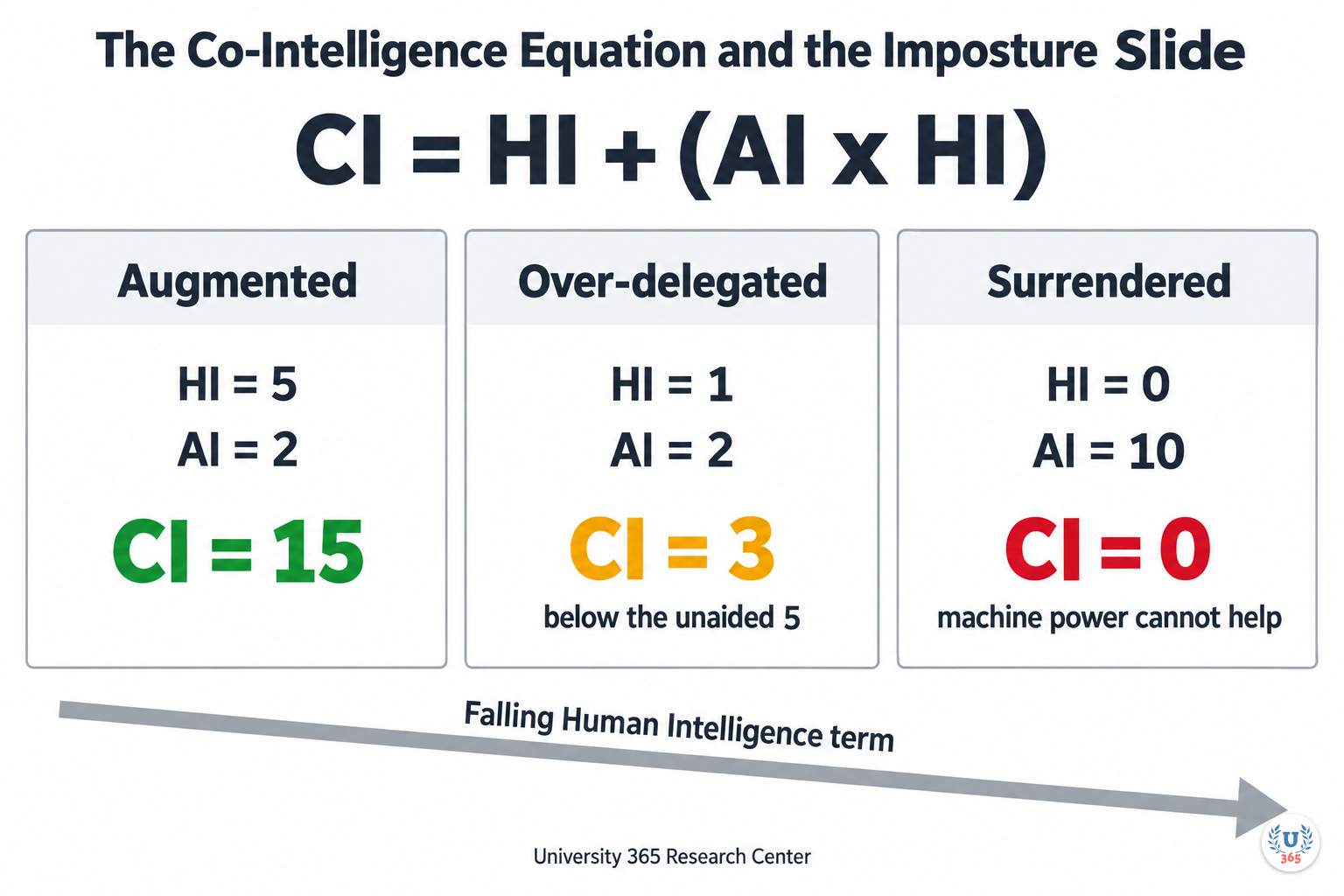
CI = HI + (AI multiplied by HI)
Human Intelligence is the base. Artificial Intelligence is a multiplier. Co-Intelligence is the result. Take a person with a Human Intelligence value of 5 and a tool with an Artificial Intelligence value of 2. The arithmetic is 5 plus 2 times 5, which equals 15. That is augmentation. The human is amplified and remains the pilot.
Now take the same tool and a person who has over-delegated, whose Human Intelligence value has fallen to 1 because the capacities that were never exercised have atrophied. The arithmetic is 1 plus 2 times 1, which equals 3. The result is well below what that person could have achieved with no AI at all, when their Human Intelligence alone was worth 5. The tool did not change. The human did. That is AI Imposture: the appearance of augmented capability combined with a real decline in it.
Extend it. Assume Human Intelligence approaches zero, which is what total surrender looks like, and let the Artificial Intelligence value rise to 10. The arithmetic is 0 plus 10 times 0, which equals 0. Infinite machine power multiplied by a zero human base produces zero.
The CI-First equation is a conceptual model, indeed, not a scientific law. But read the 2026 evidence through this model and findings that initially appear contradictory become coherent.
The 80 percent of Chinese students who outsourced their homework did not have a technology problem. They had an HI-base problem, and it was created by a design in which the machine supplied the private signal and the student supplied nothing. The exam penalty of 20 percent is the drop in the HI term showing up on an instrument that could still measure it.
The Turkish trial's guarded tutor did not have better technology than the unguarded one. It had the same model with one design change: hints instead of answers. That change kept the HI term in place during practice, which is why the practice gain was larger and the exam penalty disappeared. The guardrail was not a limitation on AI. It was the device that kept the multiplier working on a non-zero base.
The MIT EEG sequencing result is the CI formula expressed in neural data. Write unaided first, and the HI term is engaged before the multiplier arrives, so recall is higher and the activation pattern resembles the search engine group. Let AI go first, and the multiplier is applied to an HI term that has not yet been engaged, so connectivity drops and the participant cannot quote their own essay. In other words, the MIT sequencing result is consistent with the central intuition of the CI model: engage Human Intelligence before introducing the AI multiplier.
This is why CI-First can absorb the evidence instead of arguing with it, and why the three policy families cannot.
Prohibition is honest about the HI term and gives up the multiplier. It protects the base and forfeits the amplification, and it cannot survive contact with a labour market that will demand the amplification.
Laissez-faire keeps the multiplier and lets the base erode. It is the arithmetic of 1 plus 2 times 1, applied at national scale, and it produces a generation that looks productive and cannot perform unaided.
AI literacy mandates are better than both, and they still miss. Teaching a student what a model is, how it hallucinates and how to prompt it does nothing to keep the HI term in the equation. The meta-analytic effect on metacognition, 0.078 and not significant, is the important evidence for that concern. You can be a sophisticated AI user and a surrendered thinker at the same time. Wharton's most analytically inclined participants were the most protected, not because they knew more about AI but because they liked thinking. That is a disposition, and dispositions can be trained, but only by requiring the effort to happen.
CI-First manages the ratio directly. It says: always invite AI, never compete with AI, and never overestimate AI. Hire it like a skilled collaborator while staying in the boss and supervisor's seat. Attribute a role to the AI before you use it, whether as co-creator and thought partner, co-worker and assistant, coach and tutor, analyst and tester, or challenger and devil's advocate. Decide whether the task calls for a Centaur division of labour, where the human keeps strategy, empathy and final judgement while the machine handles heavy data work, or a Cyborg interleaving, where human and machine iterate rapidly together. And in either mode, adopt the executive safeguard: always assume you are working with the worst AI available, verify everything, and never surrender the orchestrator seat.
The two elements of that method which the 2026 evidence independently validates are the two that most institutions have not adopted. Human effort first, which is sequencing. And a declared, inspectable division of labour, which is the difference between a hint and an answer.
There is one more reason I hold this position, and it is larger than education.
The knowledge collapse model is conditional on effort elasticity. If effort responds sharply to the availability of a machine answer, the shared stock of human knowledge thins and everyone, including the machines, gets worse. The collapse does not require malice or stupidity. It requires only that nobody manages the ratio. Schools are where the ratio is formed, and professions are where it is normatively enforced. Break the formation and no later intervention will hold.
So the argument is not that AI is dangerous. It is that a ratio is unmanaged. The catastrophe I fear is not Artificial Intelligence becoming too strong. It is Human Intelligence becoming unnecessarily weak, in a world where the multiplier has never been larger and where nobody, at any level, is measuring the base. AI would not even need to defeat humanity. Humanity would have voluntarily surrendered some of the faculties required to remain intellectually sovereign. That outcome is cheap to prevent now and impossible to reverse later, because the only thing that rebuilds a human base is effort, and effort is exactly what the environment has spent a decade making optional.
What This Means for You and Us
For You
First. Write or think before you prompt. The MIT sequencing result is the most actionable finding in the entire 2026 literature. Participants who worked unaided first and then used AI showed stronger recall and better activation patterns than those who used AI first.
Action: before you open any AI tool on a task that matters, spend five minutes writing your own position, your own outline, or your own attempt at the answer. Then bring the AI in. Compare what it produces against what you produced, and pay attention to where you disagree.
Second. Ask for hints, not answers, whenever the goal is to learn something. The Turkish trial showed that the same model produces a 127 percent practice gain with hints and a 17 percent exam penalty with answers. The guardrail is the whole difference.
Action: add one instruction to your prompts whenever you are learning rather than producing. Give me the next step or the hint, do not give me the final answer, and make me explain the reasoning back to you before you confirm it.
Third. Audit your own base quarterly, unaided. You cannot feel the difference between understanding and having been told, because confidence rises while accuracy falls. The only reliable instrument is performance without the tool.
Action: once a quarter, take one skill that matters to you and do a real unaided test of it. Solve a problem, write a page, reconstruct an argument, close the laptop and explain it out loud to someone. If the unaided performance has fallen, you know what to work on next.
For Us
First. Make the human-to-machine ratio an assessed outcome, not an aspiration. Every 2026 policy family governs the presence of AI. None measures whether the student did the thinking.
Response: institutions should define and assess a small set of ratio indicators, starting with completion time against score, unaided performance against assisted performance, and the ability to explain an answer without looking at it. A course that cannot produce these three numbers cannot tell whether its AI integration is helping or harming.
Second. Require that educational AI sometimes refuses to do the student's thinking. A commercial assistant is rewarded when it answers quickly. A pedagogical system should sometimes do the opposite, and the questions it should ask are known: what do you think first, show me your reasoning, which assumption are you making, what evidence supports that, can you find the mistake, give me your first draft before I help, explain the concept back to me, now solve a similar problem without me. The best educational AI may occasionally feel less helpful because it refuses to steal the cognitive work that creates learning. The evidence supports the design: a two-year randomized trial of an AI tutor configured to coach rather than give answers, run in 18 Tennessee middle schools and published as a National Bureau of Economic Research working paper in August 2026, found real but modest gains of about 0.06 to 0.08 standard deviations per school year, and concluded that engagement rather than access is the binding constraint. Ninety-six percent of students messaged the tutor at least once, but the median student messaged it on only a third of the days they practised, and only 14.5 percent of messages contained a mathematical question or a step of reasoning. Placing a sophisticated tutor beside a student does not create learning. The interaction has to be designed, and the design has to earn the student's engagement.
Response: anyone procuring or building educational AI should write the refusal behaviour into the specification. The system must withhold the answer by default on learning tasks, require the student's own attempt first, ask for reasoning back, and refuse to complete an assessment artefact outright.
Third. Treat the cognitive commons as shared infrastructure that education is responsible for. The 25 percent decline in public knowledge sharing on Stack Overflow shows how quickly a commons can thin when private answers replace public deposits.
Response: make contribution a graduation requirement. Every graduating student should leave behind verified work that other people can learn from, whether teaching artefacts, worked solutions, corrected datasets or annotated sources. Not because the internet needs more content, but because the act of producing public knowledge is the strongest available protection against private surrender.
Fourth. Adopt CI-First as an operating doctrine rather than a philosophy. The four questions to ask of every educational activity are: what must the human know, what must the human be able to do independently, what can AI productively augment, and what evidence will demonstrate that augmentation has not become substitution.
Response: classify every activity into one of four categories and say so explicitly in the syllabus. HI-only, where the human does the work alone. HI-before-AI, where the learner attempts first and augments second. AI-with-HI, where the learner collaborates actively with the system. And AI-delegated with HI supervision, where automation is appropriate because foundational mastery has already been established and can be demonstrated.
The Road Ahead
Three predictions, labelled as predictions.
First, expect a convergence of the mandate and prohibition families, and expect it to happen faster than either side currently admits. The UAE already runs a mandatory AI curriculum from Kindergarten to Grade 12 alongside a prohibition on generative AI for under-13s. France already runs mandatory AI pathways alongside a rule that primary pupils learn about AI without touching generated content. New York is running a moratorium alongside AI literacy modules and five supervised pilots. Japan already refuses both extremes in writing. The synthesis is a sequenced curriculum: human foundations first, guided tool use next, autonomous AI use last, with assessment at every stage and an explicit statement of which category each activity belongs to. I expect several national frameworks to adopt this shape by 2028.
Second, expect the assessment problem to become the binding constraint, and expect the first serious instrument to be a ratio indicator rather than a policy. Every policy in 2026 addresses what students may use, and almost none addresses what can still be measured. When unaided performance is the only instrument that detects learning loss and the number of genuinely unaided assessment points keeps falling, institutions are gradually blinding themselves. The UK's parliamentary evidence already names this and observes that the curriculum and assessment review did not address it. I expect this to become the central question of 2027, with a hybrid model emerging: more unaided assessment for diagnosis, more AI-integrated assessment for execution, and much clearer rules about which is which.
Third, expect the first hard evidence on effort elasticity to arrive, and expect it to be uncomfortable. The knowledge collapse model's pivotal parameter has not been measured. When it is, in professions where effort is bound to licensure and apprenticeship, the difference between fields that hold the ratio and fields that do not will become visible in hiring data, error rates and innovation output. Law, medicine, accounting and software engineering will be the first domains where the result is measurable, because they keep records of outcomes and employ large numbers of juniors.
One further development is worth stating as a prediction even though it is a research question rather than a forecast. The meta-analytic evidence identifies precisely where AI fails to help: metacognition, measured at 0.078 with no statistical significance. The first institution or vendor to build and validate an intervention that produces a real, measured metacognitive gain will have produced the single most valuable educational artefact of the decade, because it will have addressed the one capability that all the other gains depend on.
What will not happen on its own is the thing that matters most. No market will reward a nineteen-year-old for thinking unaided. No product roadmap will optimize for a lower HI term. The incentive gradient runs entirely the other way, and it runs through every institution at once. That is not a reason for despair. It is a reason for someone to take responsibility for the ratio, and the first institutions to do it will hold a durable advantage, because they will be the only ones producing people who can be trusted with an answer they did not generate.
The same technology that can encourage cognitive surrender can produce a renaissance of learning. A child can have a patient tutor at any hour. A student can explore physics through dialogue. A language learner can practise endlessly. A programmer can build what previously required a team. A researcher can interrogate knowledge across disciplines. A person with disabilities can gain forms of assistance that were previously unavailable. A learner anywhere in the world can reach explanations that used to be reserved for elite institutions.
UNESCO recognises both sides of this in its guidance, calling for a human-centred approach rather than technological determinism. That is precisely the opportunity. We can create the most capable generation in human history, but only if we understand that capability belongs to the human-AI system, not to the AI alone.
The MIT report should not be read as the beginning of a campaign against Artificial Intelligence. I read it differently. I see it as one of the clearest signals yet that the first naive phase of AI adoption is ending. Phase one was fascination. Phase two was uncontrolled adoption. Phase three must be orchestration.
Do not ban AI from humanity. Do not surrender humanity to AI. Teach humans to command it. Teach them to challenge it. Teach them to learn with it. Teach them to think without it. Teach them to know the difference.
Never allow Artificial Intelligence to become an excuse for abandoning Human Intelligence.
The future should not be AI First. The future should not be Human-Only. The future must be Co-Intelligence First.
Alick Mouriesse
Founder and President, University 365, The Applied AI University
Inventor of the CI-First (Co-Intelligence First) approach
21 September 2026
Sources and Methodology
This report was researched between 19 and 21 September 2026 using primary research papers, official government and institutional publications, and regulatory documents, retrieved through web search and direct extraction of source documents. Source quality was classified into three tiers. Fourteen Tier 1 sources were consulted, comprising peer-reviewed papers and official government or institutional publications, together with eleven Tier 2 sources, comprising established institutional analyses with named methodology such as the OECD, the World Economic Forum and UK parliamentary evidence. Trade press was used only for contextual signals and never as the sole source for a factual claim.
Where research is preliminary or disputed, this report says so. The MIT Media Lab EEG study is a preprint of 54 participants that measures a proxy for cognitive engagement and has attracted published methodological criticism. It is presented as suggestive rather than decisive, and it is presented alongside five independent lines of evidence that point the same way. The knowledge collapse model is presented with its conditionality intact: its catastrophic equilibrium requires high effort elasticity, and that parameter has not been measured. The counter-argument that earlier technologies produced comparable warnings is stated in the Deep Analysis section rather than omitted. Policy decisions announced in 2026 are cited to the issuing government, regulator or institution.
Sources.
1. MIT Ad Hoc Committee on AI Use in Teaching, Learning, and Research Training. Report of MIT's Ad Hoc Committee on AI Use in Teaching, Learning, and Research Training, 13 August 2026. https://aiandeducation.mit.edu/report/
2. MIT Office of the President. AI and education: a watershed moment for MIT, 25 August 2026. https://president.mit.edu/writing-speeches/ai-and-education-watershed-moment-mit
3. Shaw, S. D. and Nave, G., The Wharton School. Thinking Fast, Slow, and Artificial: How AI is Reshaping Human Reasoning and the Rise of Cognitive Surrender, 11 January 2026. https://papers.ssrn.com/sol3/papers.cfm?abstract_id=6097646
4. Wharton Executive Education. Thinking Fast, Slow, Artificially: AI and Your Brain, May 2026. https://executiveeducation.wharton.upenn.edu/thought-leadership/wharton-at-work/2026/05/thinking-fast-slow-and-artificially
5. Kosmyna, N., Hauptmann, E., Yuan, Y. T., Situ, J., Liao, X.-H., Beresnitzky, A. V., Braunstein, I. and Maes, P., MIT Media Lab. Your Brain on ChatGPT: Accumulation of Cognitive Debt when Using an AI Assistant for Essay Writing Task, arXiv 2506.08872. https://arxiv.org/abs/2506.08872
6. Wu, Y. and co-authors. The Generative AI Learning Penalty: Evidence from Chinese Secondary Education, CEPR Discussion Paper 21577. https://cepr.org/publications/dp21577
7. Bastani, H., Bastani, O., Sungu, A., Ge, H., Kabakci, O. and Mariman, R. Generative AI without guardrails can harm learning: Evidence from high school mathematics, PNAS, 2025. https://www.pnas.org/doi/10.1073/pnas.2422633122
8. Kestin, G. and Miller, K. AI tutoring outperforms in-class active learning: an RCT introducing a novel research-based design in an authentic educational setting, Scientific Reports. https://www.nature.com/articles/s41598-025-97652-6
9. OECD. OECD Digital Education Outlook 2026: Exploring Effective Uses of Generative AI in Education, 19 January 2026. https://www.oecd.org/en/publications/oecd-digital-education-outlook-2026_062a7394-en.html
10. OECD. PISA 2025 Results, Volume I, September 2026. https://www.oecd.org/en/publications/2026/09/pisa-2025-results-volume-i_5265bfb1.html
11. City of New York, Office of the Mayor. Mayor Mamdani and Chancellor Samuels Put Students First with Nation's Broadest Generative AI Moratorium in Schools, 2 September 2026. https://www.nyc.gov/mayors-office/news/2026/09/mayor-mamdani-and-chancellor-samuels-put-students-first-with-nat
12. Reuters. Mamdani imposes one-year ban on AI for most NYC students, 2 September 2026. https://www.reuters.com/technology/mamdani-imposes-one-year-ban-ai-most-nyc-students-2026-09-02/
13. Center for Security and Emerging Technology, Georgetown University. Notice of the Office of the Ministry of Education on Strengthening Artificial Intelligence Education in Primary and Secondary Schools, translation, July 2026. https://cset.georgetown.edu/publication/china-primary-secondary-ai-education-notice
14. Center for Security and Emerging Technology, Georgetown University. AI plus Education Action Plan, translation, July 2026. https://cset.georgetown.edu/publication/china-ai-plus-education-action-plan
15. Press Information Bureau, Government of India. Union Education Minister launches CBSE's new curriculum on Computational Thinking and AI for Classes III to VIII, 1 April 2026. https://www.pib.gov.in/PressReleasePage.aspx?PRID=2247963
16. Education Middle East. UAE issues new AI guidelines for schools, use for under-13 students, February 2026. https://educationmiddleeast.com/news/policy-and-regulations/uae-issues-new-ai-guidelines-for-schools-use-for-under-13-students/
17. Abu Dhabi Department of Education and Knowledge. ADEK Advances AI Literacy Initiative across 170+ Private Schools, Developing Capabilities from KG to Grade 12. https://www.adek.gov.ae/Media-Centre/News/ADEK-Advances-AI-Literacy-Initiative-across-170-Private-Schools
18. Ministere de l'Education nationale, France. Cadre d'usage de l'IA en education. https://www.education.gouv.fr/cadre-d-usage-de-l-ia-en-education-450647
19. MEXT, Japan. Guideline for the Use of Generative AI in Elementary and Secondary Education, Version 2.0, March 2026. https://www.mext.go.jp/zyoukatsu/ai/moral-ai/assets/pdf/20260324.pdf
20. Higher Education Policy Institute and Kortext. Student Generative AI Survey 2026, 12 March 2026. https://www.hepi.ac.uk/reports/student-generative-ai-survey-2026
21. UK Parliament, Education Committee. Written evidence AIE0181, including the National Education Union survey of 9,408 teachers, April 2026. https://committees.parliament.uk/writtenevidence/165185/html
22. Ofqual, United Kingdom. Ofqual's approach to regulating the use of artificial intelligence in the qualifications sector. https://www.gov.uk/government/publications/ofquals-approach-to-regulating-the-use-of-artificial-intelligence-in-the-qualifications-sector
23. UNESCO. Guidance for generative AI in education and research. https://www.unesco.org/en/articles/guidance-generative-ai-education-and-research
24. del Rio-Chanona, R. M., Laurentsyeva, N. and Wachs, J. Large language models reduce public knowledge sharing on online Q and A platforms, PNAS Nexus. https://doi.org/10.1093/pnasnexus/pgae400
25. Acemoglu, D., Kong, Y. and Ozdaglar, A., with critical appraisal on arXiv. The tragedy of the cognitive commons: collective intelligence beyond AI-induced knowledge collapse. https://arxiv.org/html/2607.13272v2
26. Rismanchian, S. and colleagues. Generative AI Reduced Study Time on Math Problems and the Knowledge That Follows, arXiv preprint 2605.21629. https://arxiv.org/pdf/2605.21629
27. Ministry of Education, Republic of Korea. AI Digital Textbooks for 2025. https://english.moe.go.kr/boardCnts/viewRenewal.do?boardID=265&boardSeq=102075
28. Ministry of Science and ICT, Republic of Korea. AI Basic Act and Enforcement Decree revisions, 2026. https://www.msit.go.kr/eng/bbs/view.do?bbsSeqNo=42&mId=4&mPid=2&nttSeqNo=1264
29. Oreopoulos, P. and Low, N. One Click Away: AI Tutoring with Khanmigo in a Two-Year School Experiment, NBER Working Paper 35620, August 2026. https://www.nber.org/papers/w35620
30. World Economic Forum. Artificial Intelligence and the Future of Entry-Level Work, 2026. https://reports.weforum.org/docs/WEF_Artificial_Intelligence_and_the_Future_of_Entry_Level_Work_2026.pdf
31. World Economic Forum. Future of Jobs Report 2025. https://www.weforum.org/publications/the-future-of-jobs-report-2025/
32. BBC News. Back to books: Sweden's schools cutting back on digital learning, 15 April 2026. https://www.bbc.com/news/articles/cly0vk77vdko
33. FutureEd. Legislative Tracker: 2026 State AI in Education Bills. https://www.future-ed.org/legislative-tracker-2026-state-ai-in-education-bills/
34. Springer Nature. Multinational machine learning investigation of whether generative AI interactions augment or substitute cognitive skills and study efficiency in global higher education, 2026. https://link.springer.com/article/10.1007/s44163-026-02082-6
35. Elsevier. Effect of generative artificial intelligence on university students learning outcomes: A systematic review and meta-analysis, Educational Research Review. https://www.sciencedirect.com/science/article/abs/pii/S1747938X25000740
About This Report
This report was produced by University 365 as part of the INSIDE Reports series.
Author: Alick Mouriesse, Founder and President of University 365
Department: UDA, University 365 Department of Academics
Date: 21 September 2026
Report type: Isolated
Scope: Global, education policy and cognitive science
This report is part of University 365's INSIDE publication platform, providing applied AI research and analysis for individuals, companies, and institutions.
This report is published on University 365's INSIDE platform.
Explore more publications at university-365.com/inside.
Learn about University 365's programs at university-365.com.




Comments