
Claude Haiku 5.5: Anthropic's Fastest Small Model Has a 100,000-Token Price Cliff


Status: Active | Last tested: 2026-11-14 (Claude Haiku 5.5, claude-haiku-5-5, released 2026-10-07) | Re-check: trigger-based (max 6 months)
Active: the tool is current and recommended.
For detailed explanations of the CI-First evaluation terms used in this review, including the CI-First Benefit Score, the CI-First Profile, the Humics Protection Badge and the AI Imposture Risk levels, see the Glossary at the end of this post.


In this Tool Review

Claude Haiku 5.5: Anthropic's Fastest Small Model Has a 100,000-Token Price Cliff
The name, the two prices and the effort ladder, stated before the review begins
Three facts sit in front of this release, and each one changes how the other two should be read. The model id is one fixed string with no date suffix and no separate alias. The price is two prices, split at a prompt length most agent work crosses. The intelligence is a ladder of five settings whose default sits in the middle.
Fact | What it is | Where it appears |
Claude Haiku 5.5 | The model this review scores. Model id claude-haiku-5-5, released 2026-10-07, generally available. The id is a pinned snapshot with no date suffix and no separate alias, which is a change from Claude Haiku 4.5 and its claude-haiku-4-5-20251001 snapshot. | Anthropic launch page, Claude Platform models overview, the Haiku 5.5 overview and the migration guide |
Claude Haiku 4.5 | The direct predecessor and the only earlier Haiku-class model still in the catalogue. Model ids claude-haiku-4-5 (alias) and claude-haiku-4-5-20251001 (pinned snapshot), released 2025-10-15, now marked Legacy, 200,000-token context, 64,000-token output, $1 and $5 per million tokens. | Haiku 4.5 overview, models overview, model deprecations |
Claude Haiku 3.5 and Claude Haiku 3 | Earlier small-tier models, both retired on the Claude API. They precede Haiku 4.5 in the line but are not available for new work. | Migration guide, model deprecations |
There is no Claude Haiku 5 and no Claude Haiku 4.6 in the lineup or in the U365 catalogue. The November 2026 ledger's statement that Haiku 4.5 is the only predecessor in the catalogue is confirmed for the models a buyer can choose today, with the correction that two retired Haiku models precede it historically.
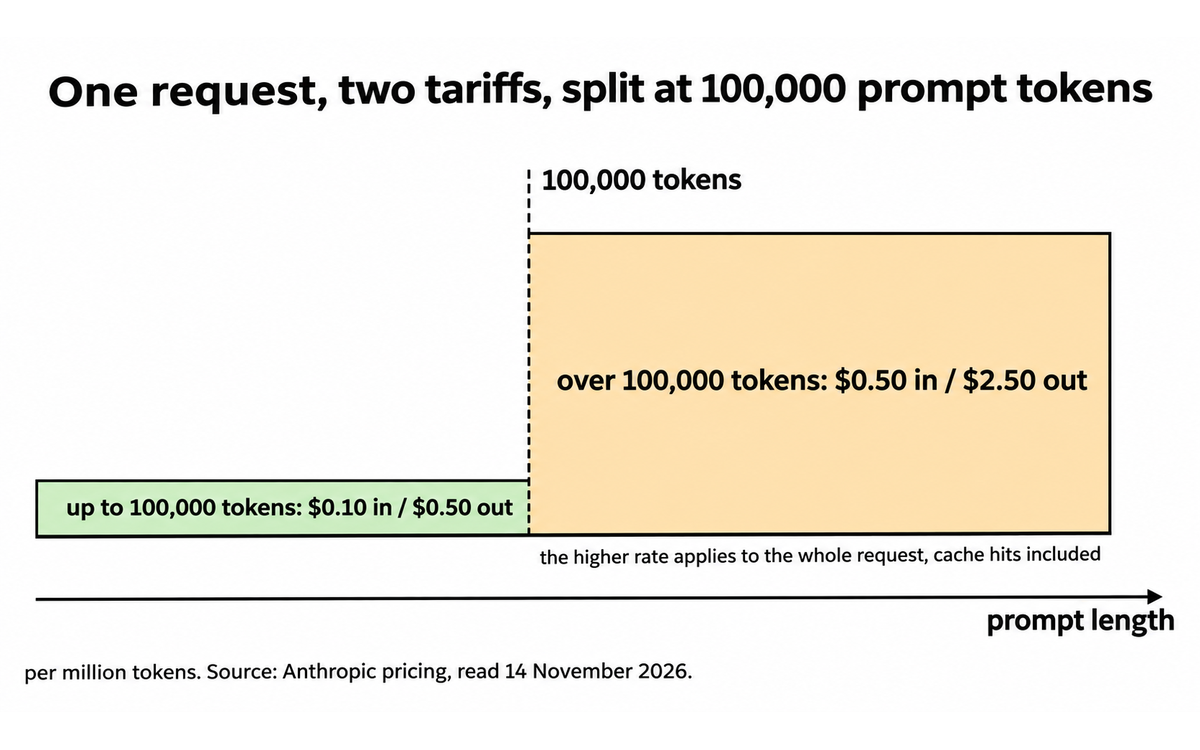
The price is two prices, and the split is a whole-request cliff.
Price per million tokens | Prompts up to 100,000 tokens | Prompts over 100,000 tokens | Claude Haiku 4.5, all prompt lengths |
Input | $0.10 | $0.50 | $1.00 |
Output | $0.50 | $2.50 | $5.00 |
5-minute cache write | $0.125 | $0.625 | $1.25 |
1-hour cache write | $0.20 | $1.00 | $2.00 |
Cache read | $0.01 | $0.05 | $0.10 |
Batch input and output | $0.05 and $0.25 | $0.25 and $1.25 | 50 percent off the standard rate |
Anthropic states the rule plainly on the pricing page: a request whose prompt is over 100,000 tokens pays the higher prices, a request's prompt length counts all of its input tokens including cache reads and cache writes, and each request is priced on its own, so a request over the threshold pays the higher prices even when part of its prompt is a cache hit. That is not a marginal rate on the excess. It is a different tariff for the whole request.
Two further conditions attach to the number. Claude Haiku 5.5 uses the same tokenizer as Claude 4.7 and later models, so the same text produces approximately 30 percent more tokens than on Haiku 4.5, and the migration guide says to recount prompts, max_tokens and cost estimates rather than reuse Haiku 4.5 counts. Large images also cost more: the model uses the high-resolution image tier, and a 2,000 by 1,500 pixel image costs about 2.5 times as many visual tokens as on Haiku 4.5.
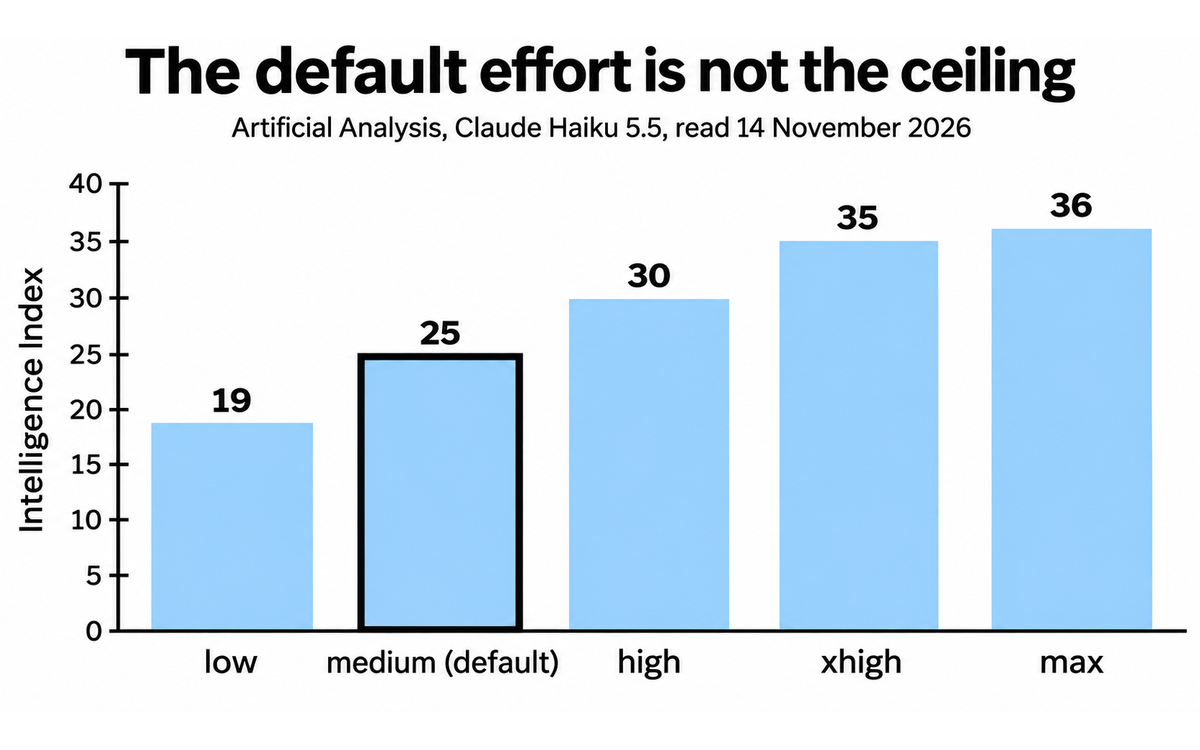
The intelligence is a ladder, and the default is not its top.
Effort | What it is for, in Anthropic's words | Default on this model |
low | The cheapest and fastest level; chat, short tool tasks and simple high-volume requests. In long agent prompts the model is more likely to skip a search, stop early or skip a check. | No |
medium | Balanced; the vendor says start here for most work, including agentic coding. | Yes |
high | Knowledge work, longer agent tasks and strict instruction following. | No |
xhigh | Work where a quality gain on your own evals justifies the cost. | No |
max | The highest capability with no constraint on token spending. | No |
Adaptive thinking is on by default, and thinking tokens count toward max_tokens, which can reach 128,000. Manual extended thinking is gone: a request that sends budget_tokens returns a 400 error. Thinking can be switched off at low, medium or high; at xhigh and max that request also returns a 400 error.
What this review is. It is the U365 scoring of Claude Haiku 5.5 under the CI-First Evaluation Framework version 1.4.1, on evidence read on 2026-11-14: the vendor's launch page, model overview, pricing page, effort documentation, what's-new page, migration guide, prompting guide and system card link; the independent measurement and release note published by Artificial Analysis; the Hacker News launch thread of 2026-10-07 and a set of later comments; one independent practitioner review by Simon Willison; and the published U365 scores of the models this one is compared against.
What this review is not. It is not a review of the Claude apps, of Claude Code, of Amazon Bedrock, of Google Cloud, of Microsoft Foundry or of Claude Platform on AWS. Those surfaces appear where a scored fact depends on them. It is not a re-score of Claude Haiku 4.5, although it records the movement against that review and explains it. It is not a test of the model on U365's own workloads, and no benchmark below was run by U365. And it is not an assessment of Anthropic's safety programme beyond the facts a buyer of this model has to carry, which are stated in Section 7c with their sources named.
The headline that travels furthest is the one with the narrowest condition. Anthropic says Haiku 5.5 costs around 75 percent less to run than Haiku 4.5 on average, and its own footnote puts the discount at 90 percent for requests up to 100,000 tokens and 50 percent for requests over that line. Both statements are true. They describe two different products, and the reader who carries "90 percent cheaper" into a 150,000-token agent prompt will meet the 50 percent number on the bill.

Claude Haiku 5.5: Anthropic's Fastest Small Model Has a 100,000-Token Price Cliff
Tool Snapshot
Claude Haiku 5.5 is Anthropic's small, fast, low-cost model, sold on volume and latency rather than on frontier capability, and priced with a cliff at 100,000 prompt tokens that changes the economics of long prompts.
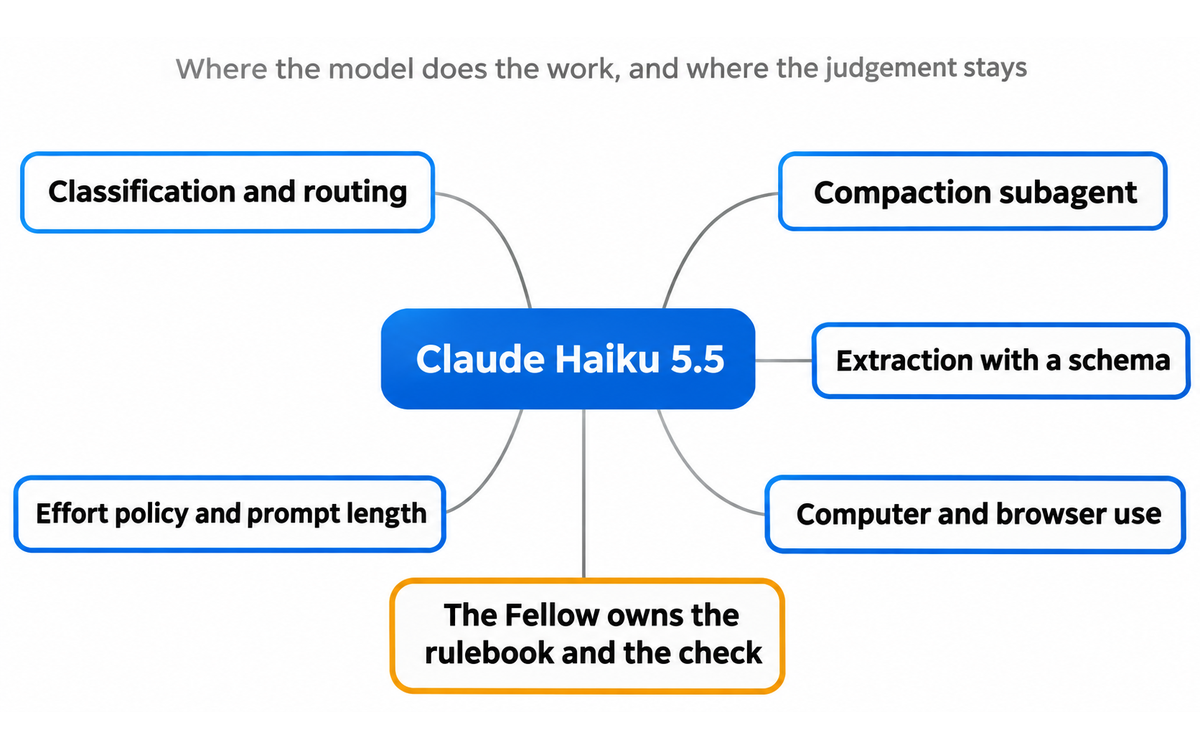
Category: Applied AI / Large Language Model. Small and fast tier, built for high-volume, latency-sensitive delegated work: classification, routing, extraction, summarisation and compaction, subagent tasks, and computer or browser use where the model has to act rather than converse.
Primary use cases:
High-volume classification, routing and extraction. The vendor names these first, and the price is set for them: $0.10 per million input tokens and $0.50 per million output tokens for prompts up to 100,000 tokens, with batch at half those rates.
Subagent work inside a larger run. Anthropic positions the model as the sidekick that pairs with Opus 5.5 and Sonnet 5.5 on coding work, and Cognition reports a FrontierCode score of 66.2 for its Devin Fusion product with Haiku 5.5 as the sidekick and Opus 5.5 as the lead.
Summarisation and compaction. Long agent transcripts have to be compressed to keep a run inside its context. The 1,000,000-token window and the $0.50 output rate make that a cheap operation, up to the point where the prompt crosses 100,000 tokens.
Computer use and browser use. The model supports the computer_toolset_20260801 toolset and the browser use tool, which Haiku 4.5 did not support at all.
Speed-sensitive interactive work. Live support, lookup and routing surfaces, where the vendor says the model is its fastest to date at standard speed, and where independent measurement puts output generation at 252 tokens per second.
What it is not. It is not a frontier reasoning model: on independent measurement at maximum effort it trails Claude Sonnet 5.5 by a wide margin and sits near the middle of the models Artificial Analysis measures at the same effort. It is not a long-prompt bargain: over 100,000 tokens it costs five times its own short-prompt rate, and Simon Willison's reading of OpenAI's prices puts GPT-6 Luna at $0.20 and $0.75 after its own increase at 272,000 tokens, which makes Luna cheaper than Haiku 5.5 for long prompts. It is not a conversational product: the pages reviewed describe the API and the cloud platforms, not a consumer app tier, and the API is the surface. It is not open weights, not self-hostable and not inspectable from outside Anthropic's service. It is not a teaching product: nothing in it moves a capability from the model to you.
Official links:
Anthropic launch page: https://www.anthropic.com/news/claude-haiku-5-5
Model overview: https://platform.claude.com/docs/en/models/haiku-5-5/overview
Pricing: https://platform.claude.com/docs/en/about-claude/pricing
What's new in Claude Haiku 5.5: https://platform.claude.com/docs/en/models/haiku-5-5/whats-new-haiku-5-5
Migration guide: https://platform.claude.com/docs/en/models/haiku-5-5/migration-guide
Prompting guide: https://platform.claude.com/docs/en/build-with-claude/prompt-engineering/prompting-claude-haiku-5-5
Effort documentation: https://platform.claude.com/docs/en/build-with-claude/effort
System card: https://www.anthropic.com/claude-haiku-5-5-system-card
LLM specifications:
Model id: claude-haiku-5-5 on the Claude API, Claude Platform on AWS, Claude Models on Google Cloud under both management models, and Microsoft Foundry; anthropic.claude-haiku-5-5 on Amazon Bedrock.
Context window: 1,000,000 tokens.
Max output: 128,000 tokens on the synchronous Messages API, and up to 300,000 tokens on the Message Batches API with the output-300k-2026-03-24 beta header.
Input and output: text and image input, text output, multilingual, vision and tool use.
Thinking: adaptive, on by default, steered by the effort parameter; manual budget_tokens is rejected.
Effort levels: low, medium (default), high, xhigh, max.
Knowledge cutoff: June 2026, stated as both the reliable cutoff and the training data cutoff.
Licence: proprietary hosted service. No weights, no parameter count and no architecture disclosure.
Retirement commitment: not sooner than 2027-10-07 on Anthropic-operated platforms. Partner platforms set their own dates.
Priority Tier: not supported on Claude Haiku 5.5, which a team on a Haiku 4.5 Priority Tier commitment has to plan around separately.
At a Glance Dashboard
Field | Value |
Category | Applied AI / Large Language Model (small, fast, high-volume tier) |
CI-First Benefit Score | 6.8 / 10 (CI-First Strong) |
Sub-scores | Time 8 / Quantity 7 / Quality 7 / Skill 5 |
CI-First Profile | Primary: Co-Worker and Assistant (level 2). Secondary: Co-Researcher, Analyst and Tester (level 4) |
Humics Protection | Humics-Neutral (0 / +3) |
AI Imposture Risk | Medium overall, with Skill Illusion High |
Status | Active |
Last tested | 2026-11-14 |
Released | 2026-10-07 |
Access | Claude API, Amazon Bedrock, Claude Models on Google Cloud under both Anthropic-managed and Google-managed terms, Microsoft Foundry, Claude Platform on AWS |
Price | $0.10 input and $0.50 output per million tokens for prompts up to 100,000 tokens; $0.50 and $2.50 over 100,000 tokens; cache reads $0.01 and $0.05; batch at half the standard rate |
Context window | 1,000,000 tokens in, 128,000 tokens out on the synchronous API |
Effort levels | low, medium (API default), high, xhigh, max |
Framework comparison with siblings and peers | Claude Haiku 4.5 6.8 (CI-First Strong); Claude Opus 5.5 6.5 (CI-First Strong); Claude Fable 5.2 6.8 (CI-First Strong); GPT-6 Luna 4.8 (CI-First Positive); Gemini 3.8 Flash 7.0 (CI-First Strong), all as published by U365 |
Benchmarks, one line each | Vendor: GDPval-AA v2.1 1620, AA-Briefcase 1578, OSWorld 2.1 offline 72.4 percent, Humanity's Last Exam 45.9 percent without tools and 57.4 percent with tools, Terminal-Bench 4.0 39.2 percent, FrontierCode 1.1 46.4 percent, Chartography 46.4 percent. Independent: Intelligence Index 36 at maximum effort and 25 at the default medium effort, $0.41 per task at maximum effort before the long-prompt step-up, 252 tokens per second output speed |
For the arithmetic behind every row in this table, see U365 Co-Intelligence Rating.

Claude Haiku 5.5: Anthropic's Fastest Small Model Has a 100,000-Token Price Cliff
The Problem
A small model used to be the compromise you made when the budget was fixed. Claude Haiku 5.5 is the first Haiku where the compromise is mostly gone on the tasks the tier is sold for, and that changes the decision rather than simplifying it.
The first problem is that the price is a schedule, not a number. $0.10 per million input tokens is a tenth of what Haiku 4.5 charged, and the model is better on every benchmark the vendor published. But the same page prices a request over 100,000 prompt tokens at $0.50 and $2.50, and the pricing documentation says the higher tariff applies to the whole request, including its cache hits. A team that adopts on the headline and then feeds a 200,000-token repository into a summarisation pass has bought a different product at five times the rate it budgeted for. The 100,000-token line is also low enough that agent work crosses it in ordinary operation: one commenter on the launch thread called it "an absurdly low cutoff" and noted that it is only applicable to Haiku and not to Sonnet or Opus.
The second problem is that the token count moved with the price. The model uses the newer tokenizer, so the same text produces approximately 30 percent more tokens than on Haiku 4.5. Simon Willison measured around 1.25 times as many tokens on his own long prompt. Either way, the 10 times list-price cut is not a 10 times cut in the cost of a piece of work. One practitioner's classification workload on the launch thread makes the point with numbers: 11,893,643 input tokens and 240,451 output tokens on Haiku 5.5 against 7,903,468 and 177,602 on GPT-6 Luna, for $0.42 against $0.31 at synchronous rates. The cheaper model by list price was the more expensive model on that job.
The third problem is that speed is a setting, not a property. Anthropic calls this its fastest model to date at standard speed, and independent measurement records 252 tokens per second of output. The same measurement records 176.72 seconds to the first answer token at maximum effort, and 14.9 minutes per benchmark task against a 7.5-minute median. At the default medium effort those numbers are 10.53 seconds and 4.0 minutes. A team that reads "fastest" and leaves the effort setting at its default has a fast model. A team that raises effort to reach the intelligence headline has a slow one, at the same price per token.
The fourth problem is that cheap output at volume is exactly the condition under which nobody verifies. The model is sold for classification, routing, extraction, summarisation and subagent work, which are the tasks where a person reads a sample rather than every result. Artificial Analysis finds a lower hallucination rate than named peers and a greater willingness to say it does not know, which helps. It also records the model as very verbose: 298 million output tokens on its Intelligence Index run at maximum effort, against a 107 million median. Volume, speed and a low price are a combination that rewards shipping unread output, and the framework calls that the Quantity Illusion.
There is a fifth problem, and it is the one the score reflects least directly. The model is positioned as a sidekick to a larger model, not as a partner to a person. A sidekick's output is read by another model before it reaches a human, and the skill that a person would have built by doing the task themselves is never exercised. The capability gain is real. The skill transfer is not, and no feature in the product supplies it.

Claude Haiku 5.5: Anthropic's Fastest Small Model Has a 100,000-Token Price Cliff
The Outcome
What changes for a reader who adopts this model, and what does not.
A large volume of routine cognitive work becomes affordable, and the measured step up from its predecessor is real. GDPval-AA v2.1 rises from 735 on Haiku 4.5 to 1620, AA-Briefcase from 614 to 1578, OSWorld 2.1 offline from 15.7 to 72.4 percent, Humanity's Last Exam from 10.2 to 45.9 percent without tools and 18.7 to 57.4 percent with tools, Terminal-Bench 4.0 from 0.0 to 39.2 percent, and Chartography from 6.4 to 46.4 percent, all on the vendor's own table. Those are not marginal movements, and they are the reason the tier is worth reconsidering.
The independent measurement agrees on class and disagrees on position within it. Artificial Analysis places Haiku 5.5 at 36 on the Intelligence Index at maximum effort, above its own median of 24 for comparable models, ahead of GPT-6 Luna at 38 in the October article's reading and behind Claude Sonnet 5.5 at 55 on the current model page. On its private AA-Briefcase evaluation the model reaches 1578 Elo, ahead of Kimi K3 and GLM-5.3 and comparable to Muse Spark 1.3 at maximum effort. The class claim holds. The "near Sonnet" reading does not.
The cost of a completed task falls far less than the cost of a token. At maximum effort Artificial Analysis records $0.41 per benchmark task before the long-prompt step-up, which its own release note says is not yet reflected in that figure. The same measurement puts the model at 14.9 minutes per task, against 7.5 minutes for comparable models. A cheaper token that takes twice as long to produce a task is not twice as cheap to run.
Long prompts get worse, not better, with this release. A 1,000,000-token window is genuinely useful for reading a repository or a document set in one pass. At 100,001 tokens the request moves to a tariff five times the short-prompt rate, on the whole request. Above that line GPT-6 Luna is the cheaper model, per Simon Willison's reading of OpenAI's pricing, and Luna's own increase arrives only at 272,000 tokens. The window is real. The bargain is not.
New capability arrives with new failure modes. The model supports browser use, a newer computer-use toolset, adaptive thinking and a 128,000-token output ceiling. It also rejects temperature, top_p and top_k, rejects assistant prefill, rejects budget_tokens, and returns a new stop_reason: "refusal" that Haiku 4.5 never returned and that has no server-side fallback. A migration from Haiku 4.5 is a code change with ten documented steps, not a model id swap.
The learning story does not improve. No teaching mode is claimed, the API is the surface, and the vendor's own examples are classification, routing, extraction, compaction and subagent work. A reader who wants to learn from this model can do it, by asking for explanations and checking them. Nothing in the product is built to make that happen, and the price makes delegation easier than practice.

Claude Haiku 5.5: Anthropic's Fastest Small Model Has a 100,000-Token Price Cliff
Who Should Use Claude Haiku 5.5
Claude Haiku 5.5 fits three learner categories, and the fit depends on whether the work can be checked without reading every output.
Learner type | Difficulty | Typical ROI | Career path |
Students (Bachelor, Master) | Intermediate | Reachable through the Claude API with an account and billing, or through a cloud account the institution already holds. Strong for a document set read in one window, for a first-pass literature extraction, and for a coding exercise where the answer can be checked against tests. The Skill Illusion is the live risk: the output reads as finished work in a subject where a student cannot always tell a near-miss from a correct answer, and the low price encourages sending the whole assignment rather than the part that needs help. | UIT (Technology, AI, Data Science) tracks through code review and extraction pipelines, UIC (Digital Communication, Marketing) through summarisation and classification work, and UID (Digital Design, UX/UI) through reading and describing an image rather than producing one. |
Professionals (career upskilling) | Intermediate | The clearest case in this release: high-volume classification, routing, extraction, compaction and subagent work where the cost per completed unit decides whether the workflow exists at all. The model is fast at the effort levels the vendor recommends for this work, and the list price at short prompts is a tenth of its predecessor. The bill is decided by prompt length and effort policy, not by the seat. | UIT for pipeline design and evaluation, UIB (Business Management, Entrepreneurship) for the cost-per-completed-task arithmetic that decides whether the workflow survives its second month. The model supplies no management method of its own. |
Everyone (lifelong learners) | Beginner at the API, Intermediate for pipelines | A cheap way to summarise, extract and classify your own material, provided you check what matters. The 1,000,000-token window holds a long report; the 128,000-token output ceiling holds a long answer. It is not a chat product in this review: the surfaces it ships on are the API and the cloud platforms, and no consumer app tier is part of this review. | LIPS Collect and Review phases for the material you keep, CARE for the loop from collection to action, and UP-Context-Engineering for the prompt structure. UNOP fit is weak, because the model produces rather than teaches. No assessment home is asserted. |
For teams and organisations. The model is sold to companies as well as to individuals, and a team deciding on it starts with four questions.
Team deployment. Reachable across a team through the Claude API, Amazon Bedrock, Claude Models on Google Cloud under both Anthropic-managed and Google-managed terms, Microsoft Foundry, and Claude Platform on AWS. The model id is the same string on every one of those surfaces apart from the Bedrock prefix, which removes a class of migration error. Claude Haiku 5.5 does not support Priority Tier, so a team that holds a Priority Tier commitment on Haiku 4.5 has to plan capacity separately rather than carry the commitment across.
Cost at team scale. Three lines move independently: the 100,000-token line, the effort setting, and the tokenizer. A request over 100,000 prompt tokens is billed at five times the short-prompt rate on the whole request, including its cache hits, so prompt hygiene becomes a budget control rather than a style preference. The effort policy is the second line: at maximum effort the average benchmark task costs $0.41 and takes 14.9 minutes under independent measurement, against 4.0 minutes at the default medium effort. Batch at half rate and cache reads at a tenth of input are the two discounts that make volume work, and the minimum cacheable prompt drops to 512 tokens on this model, which makes caching usable on short system prompts.
Data and compliance. The model pages reviewed state no special retention regime for Claude Haiku 5.5, unlike the Covered Model status attached to Claude Fable 5.2. That absence is not a confirmation of zero retention, and a team has to read the data terms of the platform it buys through. Three operational conditions are documented and matter to a compliance owner: thinking blocks work only in the account that produced them, so a shared conversation store that replays a conversation through another account loses the reasoning; the model returns stop_reason: "refusal" with no server-side fallback, so a pipeline that checks only the status code will treat a refusal as a success; and the model rejects temperature, top_p, top_k and assistant prefill, which removes sampling controls some regulated pipelines rely on for reproducibility.
U365 for companies. Professional learners reach University 365's academic services individually or through their organisation, and the company route runs through a customized training agreement for employee groups. Corporate education programmes are built on demand, and their tuition follows content and duration.
Skill level required: Intermediate. You need an API account or a cloud account, a way to read a JSON response, and a verification step you actually run. No model training or fine-tuning knowledge is required.
Prerequisites. For the API: an account with billing, a decision about the effort level each job runs at, and a decision about prompt length, because the 100,000-token line changes the price by five times. For a cloud route: the equivalent Bedrock, Google Cloud, Foundry or Claude Platform on AWS account and its model id. For migration from Haiku 4.5: the ten changes in Getting Started, of which the thinking configuration and the removal of sampling parameters are the two that break code. Working knowledge of prompt structure and verification practice, because output at this level reads as finished whether or not it is correct.
Typical time to first result: Under fifteen minutes on the API for a first call with the model id claude-haiku-5-5, using an SDK and a stored key.
Typical time to competence: Eight to twenty hours of active use. Three skills carry most of the value: effort selection, because quality, latency and cost all ride on a five-position setting whose default is not its ceiling; prompt-length control, because the 100,000-token line is the largest single lever on the bill; and verification design, because the model's output is most convincing exactly where it is hardest to check.
Who should wait. Readers whose work runs on long prompts over 100,000 tokens, because GPT-6 Luna is cheaper above that line and the gap widens as the prompt grows. Readers who need frontier reasoning on hard problems, because Sonnet 5.5 and Opus 5.5 remain the right tier and the vendor says so on its own launch page. Readers whose pipelines depend on temperature, top_p, prefill or Priority Tier, because those are removed or unsupported here. And readers who cannot yet verify the work they would delegate, because a cheap model is the wrong place to learn that discipline.

Claude Haiku 5.5: Anthropic's Fastest Small Model Has a 100,000-Token Price Cliff
U365 Institutes Alignment
The alignment below rates what a U365 institute could take from this model as a working instrument and as an object of study. The primary home is UIT (Technology, AI, Data Science), because classification, extraction, routing and subagent design are the competencies this model exercises, and because a cheap fast model with a hard price cliff is itself a teaching object about unit economics. The other three readings are real and each is bounded.
UIT (Technology, AI, Data Science)
Rating. High (primary)
Why. Four engineering competencies sit in the model's own documentation: pipeline design for classification and extraction, subagent delegation inside a larger run, effort policy as a cost and quality control, and prompt-length accounting against the 100,000-token line. Each is a skill a UIT Fellow can practise on a real system with a checkable output.
The limit that holds the row. The model executes a pipeline; it does not design one, and it cannot tell you whether the pipeline was worth building. The vendor's own table shows it behind Sonnet 5.5 on Terminal-Bench 4.0 and FrontierCode, so the architectural judgement, the evaluation design and the decision about which model handles each step stay with the Fellow. The catalogue's AI-agent instruction is concentrated in the n8n certificate series and the Superhuman certifications rather than spread across the degree paths, and no published programme assesses pipeline or delegation design as a named component. Adjacent anchors, not assessment homes.
UIB (Business Management, Entrepreneurship)
Rating. Medium
Why. The cost arithmetic is the business lesson. A model priced per token, with a threshold that multiplies the rate by five and a tokenizer that inflates the count by around 30 percent, turns a procurement decision into a modelling exercise. A UIB Fellow can build the cost per completed task for a real workflow and compare it with a human baseline.
The limit that holds the row. The model supplies no management, finance or entrepreneurship content, and it does not measure whether a workflow should exist. The tariff is the object of study; the business judgement is the Fellow's.
UIC (Digital Communication, Marketing)
Rating. Low to Medium
Why. Summarisation, classification and routing are production steps in a content operation: sorting an inbox, tagging a corpus, compressing a long thread, drafting a first extraction from a brief. The model does those at a cost that makes them routine.
The limit that holds the row. It writes no editorial standard and sets no register. The judgement that remains is editorial: what a summary dropped, what a classification hid, and what a reader is owed about how the material was produced. A communication Fellow who cannot make that judgement will ship the model's framing as their own.
UID (Digital Design, UX/UI)
Rating. Low
Why. The model reads images, which Haiku 4.5 could not do well and earlier Haiku models could not do at all, so it can describe a screen, compare a design against a specification and extract text from a mock-up. For a design cohort that is a documentation and review aid.
The limit that holds the row. It produces no design artefact. A reader who wants an interface built needs a design surface or a coding agent, not this model. The competency that remains is specification and critique: writing the test a design has to pass, and judging the result the model describes.
U365 methods, not an institute (UNOP, ULM, LIPS, CARE and the UP-Context-Engineering Method)
Rating. Applicable
Why. Three decisions this model forces are method decisions before they are settings. The effort level and the prompt-length ceiling are context-contract decisions taken before the first prompt. The UP-Context-Engineering Method's context, role, task, constraints and output-format order is what makes a classification or extraction run reproducible. LIPS with CARE holds the rulebook, the gold set and the acceptance decision, because the model keeps nothing between calls. ULM is the frame in which a Fellow decides whether the work is worth automating at all, in Career and Finance and in Quality of Life; the model carries no cost method of its own and no view of the six domains. UNOP has no direct fit: the model is not built to teach, and its Skill sub-score is 5 with no teaching mode claimed.
The limit that holds the row. The model carries no method of its own and no coaching surface. A Fellow who does not keep the rulebook, the run record and the verification decision in their own system has no account of any of it, and nothing in the product writes that account for them.

Claude Haiku 5.5: Anthropic's Fastest Small Model Has a 100,000-Token Price Cliff
How Claude Haiku 5.5 Works
Claude Haiku 5.5 is a proprietary language model from Anthropic's small tier. It accepts text and images and returns text. Anthropic does not disclose its parameter count or its architecture, and the model is available only as a hosted service on Anthropic's platform and the named clouds.
Inputs: text prompts, system instructions, images, tool definitions and conversation history, up to 1,000,000 tokens. Images use the high-resolution tier, which downscales above 2,576 pixels on the long edge or 4,784 visual tokens.
Outputs: text, structured output through the structured outputs feature, tool calls, and thinking blocks. Thinking is on by default and is returned as an empty thinking field with a signature unless you ask for a summary with thinking: {"type": "adaptive", "display": "summarized"}.
Underlying technology. Anthropic describes the model as built for high-volume, latency-sensitive work and as its first Haiku-class model with adjustable effort and adaptive thinking. The alignment section of the launch page states major improvements across almost all of Anthropic's alignment evaluations relative to Haiku 4.5, far fewer instances of misaligned behaviour, and a lower willingness to cooperate with misuse. The system card is the vendor's record of those evaluations.
Key technical specifications:
Specification | Value |
Model id | claude-haiku-5-5; anthropic.claude-haiku-5-5 on Amazon Bedrock |
Context window | 1,000,000 tokens |
Max output | 128,000 tokens on the synchronous API; 300,000 on the Message Batches API with the output-300k-2026-03-24 beta header |
Thinking | Adaptive, on by default; budget_tokens rejected with a 400 error; can be disabled at low, medium and high only |
Effort | low, medium (default), high, xhigh, max |
Modalities | Text and image input, text output |
Knowledge cutoff | June 2026 reliable and training data |
Tokenizer | The Claude 4.7 and later tokenizer, approximately 30 percent more tokens for the same text than Haiku 4.5 |
Cache | Minimum cacheable prompt 512 tokens, down from 4,096 on Haiku 4.5 |
Tools | Tool use, structured outputs, web search and code execution as server tools, computer use through computer_toolset_20260801, and browser use |
Licence | Proprietary hosted service, no weights |
Retirement | Not sooner than 2027-10-07 on Anthropic-operated platforms |
Vendor benchmark table. Anthropic's launch page compares Claude Haiku 5.5 with Haiku 4.5, GPT-6 Luna and Sonnet 5.5. The table does not state the effort level used for the Haiku 5.5 column, which matters because the model's independent score moves by more than ten points across the effort ladder.
Benchmark | Haiku 5.5 | Haiku 4.5 | GPT-6 Luna | Sonnet 5.5 |
GDPval-AA v2.1 | 1620 | 735 | 1437 | 1840 |
AA-Briefcase v1.1 | 1578 | 614 | 1336 | 1824 |
OSWorld 2.1, offline subset | 72.4 percent | 15.7 percent | 48.9 percent | 83.9 percent |
Humanity's Last Exam, no tools | 45.9 percent | 10.2 percent | not reported | 56.9 percent |
Humanity's Last Exam, with tools | 57.4 percent | 18.7 percent | not reported | 64.5 percent |
Terminal-Bench 4.0 | 39.2 percent | 0.0 percent | 16.4 percent | 70.6 percent |
FrontierCode 1.1, Main | 46.4 percent | not reported | 42.4 percent | 52.1 percent at xhigh |
Chartography, no tools | 46.4 percent | 6.4 percent | 29.1 percent | 61.6 percent |
Independent measurement. Artificial Analysis measures the model at five effort settings. Its model page reports the following, read on 2026-11-14.
Effort | Intelligence Index | Time to first answer token | Time per benchmark task | Output tokens on the index run |
max | 36 | 176.72 seconds | 14.9 minutes | 298 million |
xhigh | 35 | 59.04 seconds | 9.8 minutes | 151 million |
high | 30 | 21.85 seconds | 6.6 minutes | 89.8 million |
medium | 25 | 10.53 seconds | 4.0 minutes | 52.7 million |
low | 19 | 5.81 seconds | 2.2 minutes | 29.9 million |
Output speed is 252 tokens per second at maximum effort, and the blended price is $0.077 per million tokens on Artificial Analysis' 7:2:1 cache-hit, input and output weighting. The same measurement puts the model at 36 on the index against a median of 24 for comparable models, and behind Claude Sonnet 5.5 at 55 on the current model page.
Integrations. The Messages API, the Python and TypeScript SDKs, the AWS, Google Cloud and Azure SDK paths, tool use, structured outputs, prompt caching, the Message Batches API, computer use through the computer_toolset_20260801 toolset and browser use. The model is also reachable through Claude Code and through third-party agent runtimes that read the Anthropic model listing; the U365 review of Claude Code covers that surface separately.
Safety classifiers. The model runs safety classifiers that can decline a request and return stop_reason: "refusal" with a category of cyber, frontier_llm, bio or general_harms. There is no server-side fallback, and retrying the same request usually returns another refusal. Haiku 4.5 does not return these refusals, so the behaviour is new in this tier. Section 7c records what that means for a buyer.

Claude Haiku 5.5: Anthropic's Fastest Small Model Has a 100,000-Token Price Cliff
Getting Started with Claude Haiku 5.5
The first call takes minutes. A migration from Haiku 4.5 takes an afternoon, because the model removes several request shapes that Haiku 4.5 accepted.
The ten changes a migration needs, in the order the vendor's checklist gives them:
1. Replace the model id with claude-haiku-5-5, or anthropic.claude-haiku-5-5 on Amazon Bedrock. There is no dated snapshot and no alias.
2. Recount prompts, max_tokens and cost estimates. The tokenizer produces approximately 30 percent more tokens for the same text, and large images cost about 2.5 times the visual tokens.
3. Replace thinking: {"type": "enabled", "budget_tokens": N} with adaptive thinking. The old shape returns a 400 error.
4. Select content blocks by type rather than by position, because a response can start with a thinking block.
5. Remove temperature, top_p and top_k. The model rejects them.
6. End messages with a user turn. Assistant prefill returns a 400 error on this model.
7. Replace computer_20250124 with computer_toolset_20260801, or computer_20251124 on Amazon Bedrock.
8. Replay stored thinking blocks only through the account that produced them, or through an account linked to it.
9. Keep conversations append-only if you send thinking blocks back, because a thinking block stays valid only while the system prompt, the tools and every earlier message are unchanged.
10. Handle stop_reason: "refusal" in the client, because there is no server-side fallback.
Fifteen-minute checklist:
☐ API key created, stored in an environment variable, and not pasted into a prompt
☐ SDK updated to a version that knows the model, or the raw HTTP call built with the anthropic-version header
☐ First request sent with effort set explicitly to medium and a max_tokens large enough to hold thinking plus the answer
☐ Response parsed by block type, not by block position
☐ One classification or extraction prompt tested with a known correct answer
☐ Token count read from the usage field and compared with the same text counted on Haiku 4.5
☐ One request repeated to confirm the prompt cache reads at $0.01 per million tokens
☐ A refusal path tested with a benign but sensitive prompt, and the client handling stop_reason: "refusal"
Set the effort policy before the spend. The model defaults to medium, and the vendor's guidance is to start there for most work, use low for chat, short tool tasks and simple high-volume requests, and reserve xhigh and max for work where a measured gain justifies the cost. A working policy:
Work | Effort | Reason |
Classification, routing, tagging | low | The task is short and the answer is checkable against a rule set; this is the cheapest and fastest level and the documented failure mode, a skipped search or an early stop, is not present in a single-turn classification. |
Extraction with a fixed schema | medium | Structured output and tool use benefit from thinking, and the vendor reports that tool calls can be skipped with thinking off. |
Summarisation and compaction | medium | The default balances the cost of a long input against the quality of the summary; check the output against the source on a sample. |
Subagent inside a coding run | medium with an explicit instruction to verify its own change | The vendor reports that at low and medium the model sometimes reports a code change as done without running a check, and that a verification instruction improves both checking and performance at the cost of more tokens. |
Hard analysis you will publish | high or above, or a larger model | This is the setting where the model still trails the Sonnet tier, and the cost per task rises with the effort. |
Control the prompt length, because the price is a cliff. Keep routine work under 100,000 prompt tokens, count the prompt including cached content, and split a long document set into passes rather than sending 200,000 tokens in one request. A 200,000-token request at $0.50 per million input tokens costs the same as five 40,000-token requests at $0.10 and returns one answer rather than five, which is sometimes what you want and sometimes a fivefold overpayment. Put the stable part of a prompt first and cache it; the 512-token minimum makes that practical on short system prompts.

Claude Haiku 5.5: Anthropic's Fastest Small Model Has a 100,000-Token Price Cliff
Real Workflows
Workflow 1: A classification and routing pass with an abstention rule
Learner type: Professional (UIB, operations and support), student (UIT, data work).
CI-First benefit tags: Time, Quantity.
Connects to: LIPS (the rulebook and the labels live in your Second Brain, not in the chat), CARE (Collect the items, Action Plan the routing rule, Review the sample, Execute the batch).
Time estimate: 45 minutes to write the rulebook and the gold set, then minutes per batch.
You write the categories, the boundary rules and the abstention condition before you send anything. You build a gold set of 30 to 50 items labelled by hand. You run the batch at low effort with structured output. You compare the batch against the gold set, read every item the model marked other, and correct the rulebook rather than the individual outputs. You keep the rulebook and the gold set, because they are the part of the system that improves.
Sample UP-Context prompt pack:
Context: I am recruiting a model for a support-triage classification batch that runs every week, and I am testing the cost and the error rate before I hire it. Role: AI as a classification engine working only from the message text I paste. I own the queue rules; you classify and declare. Profile: Act as a Co-Worker & Assistant that applies my rule and marks the items the rule does not settle rather than forcing a category. Task: Classify these 60 messages into billing, technical, account, feature_request or other, and give me the cost arithmetic for the batch on the rate card I supply. Constraints: Run at medium effort. Set other when the rule is unclear and say which rule was unclear. Never invent a category. Count the tokens you were sent and say whether the request passed 100,000 prompt tokens, because above that line the whole request is billed at five times the short-prompt rate, including its cache hits. Output format: A JSON array with fields message_id, category, rule_id, confidence and reason, then a second block with input tokens, output tokens, effort level and the cost per 100 completed items. Memory: the rulebook, the gold set and the cost per completed item belong in my own procurement record, because the conversation keeps no rate card. UP-Context-Engineering verification: I score the batch against 40 hand-labelled messages, rebuild the cost arithmetic myself, and hire the model only if it passes on the batch where my rule was ambiguous. Data safety: I paste no customer name, contact detail, order number or payment data; I use a de-identified extract and keep the output in my own store.
Verification checklist:
☐ Multi-Model Check: Run the gold set through a second model, a larger Claude or a different provider, and compare the labels. Where the two disagree, the rule is ambiguous; fix the rule, not the label.
☐ External Source: Score the batch against the hand-labelled gold set and report accuracy per category, not overall. A model that is 95 percent right and always wrong on billing is not ready.
☐ Human Review: A person reads every other item and a sample of the confident ones before the routing goes live.
☐ CI-First Test: Can you explain, without the model, why each category exists and where its boundary is? If not, the model is doing the judgement and you are carrying the risk.
Workflow 2: A compaction subagent inside a long agent run
Learner type: Professional and advanced student (UIT, software and research engineering).
CI-First benefit tags: Time, Quantity.
Connects to: LIPS (the run record and the decisions that must survive compaction), UP-Context-Engineering (the compaction prompt is a context contract, not a request to summarise).
Time estimate: 2 hours to build and test the compaction step, then automatic.
You give the model a transcript, a list of decisions already taken, and a list of open questions. You ask for a compact state that preserves every decision, every open question, every file path and every failed attempt, and that marks what it dropped. You cap the prompt below 100,000 tokens by compacting in stages rather than sending the whole transcript. You keep the previous state until the new one has been checked.
Sample UP-Context prompt pack:
Context: I am recruiting a model for the compaction step inside a long agent run, and I am testing it on a run that already failed once. Role: AI as a compaction subagent whose output another agent will act on. I own the decision about what may be dropped; you compress and declare. Profile: Act as a Co-Worker & Assistant with a strict reporting duty. Task: Produce the run state from this transcript, in a form the next turn can use without the transcript. Constraints: Run at medium effort. Preserve every decision, every open question, every file path, and every command that failed and why. Do not summarise an unresolved question into a resolved one. Keep the request below 100,000 prompt tokens by compacting in stages, and say when you had to drop material to stay there. A refusal is a result, so return the stop_reason and its category rather than an empty block. Output format: A markdown block with sections Decisions, Open questions, Files touched, Failed attempts, Dropped material, then a line with the input and output token counts. Memory: the state is written to my run record with the effort level, because the conversation keeps no history. UP-Context-Engineering verification: I diff the new state against the previous one, check that every open question is still open, and hire the model only if it passes on the run that failed before. Data safety: I paste no credential, no customer record and no unpublished third-party material; the transcript is my own run.
Verification checklist:
☐ Multi-Model Check: Compact the same transcript with a larger model and compare the open-question lists. A missing open question is the failure that costs a day.
☐ External Source: Check the file paths and commands against the repository and the shell history, not against the summary.
☐ Human Review: The person who owns the run reads the new state before the next turn uses it.
☐ CI-First Test: Could you reconstruct why each decision was taken from the compacted state alone? If not, the compaction dropped the reasoning and kept the conclusions.
Workflow 3: A first-pass extraction over a document set larger than a reading week
Learner type: Student (all institutes) and professional researcher.
CI-First benefit tags: Quality, Skill.
Connects to: UP-Context-Engineering (the extraction schema is the context), UNOP (active recall and spaced review of what the extraction surfaces), LIPS (the extracted records live in the Second Brain).
Time estimate: 1 hour to define the schema and test it on three documents, then 15 to 30 minutes per 20 documents.
You define the fields you need and the answer each field may take, including a not stated value. You test on three documents you have read yourself, then run the batch. You read every document whose extraction contains a claim you will cite. You keep the extraction and the source page, because a claim without a page is not usable.
Sample UP-Context prompt pack:
Context: I am recruiting a model for a first-pass extraction over a document set larger than I can read in a week, and I am testing it before I hire it. Role: AI as a research assistant working only from the text I supply. I own every claim I publish; you extract and cite. Profile: Act as a Co-Researcher, Analyst & Tester that marks absence rather than filling it. Task: Extract the fields below from each document, then compress what you extracted into a 200-word briefing with a list of what you dropped. Constraints: Run at medium effort. If a field is not stated, write not stated. Quote the sentence that supports each value, with its section heading. Do not infer a number from a chart. Add no framing or recommendation of your own. Say whether the request passed 100,000 prompt tokens. Output format: A JSON array with fields document_id, field, value, quote, section, then a Briefing section, then a Dropped material list, then the token count. Memory: the extraction, the dropped list and my reading decisions belong in my own reading record, because the conversation keeps no list. UP-Context-Engineering verification: I open every quote in its source, read the documents that carry the argument in full, and hire the model only if it passes on the document where my schema was ambiguous. Data safety: I paste no unpublished manuscript, no client-confidential report and no personal data; I use material I am allowed to process.
Verification checklist:
☐ Multi-Model Check: Re-extract three documents with a larger model and compare the fields. A field that changes between models is a field your schema has not defined.
☐ External Source: Open the quoted sentence in the source for every value you will use.
☐ Human Review: A second reader checks the extraction on the documents that carry the argument.
☐ CI-First Test: Can you state, from the document rather than the extraction, what it found and what it did not? If not, you have a summary habit rather than a reading practice.

Claude Haiku 5.5: Anthropic's Fastest Small Model Has a 100,000-Token Price Cliff
Strengths, Limits, and AI Imposture Risk
Strengths
Time
Strength. The fastest output in its class on independent measurement, at the effort settings the vendor recommends for its own target work.
Evidence. Artificial Analysis records 252 tokens per second of output at maximum effort, 10.53 seconds to the first answer token at the default medium effort and 5.81 seconds at low. The vendor calls it its fastest model to date at standard speed. The time saving is largest exactly where the model is sold: short prompts, many calls, a checkable answer. Held at 8 rather than higher because the same measurement records 176.72 seconds to the first answer token at max, and because the effort choice is new work the user did not have to do with Haiku 4.5.
Quantity
Strength. A tenth of the predecessor's list price at short prompts, a 1,000,000-token window, a 128,000-token output ceiling and batch at half rate.
Evidence. $0.10 and $0.50 per million tokens up to 100,000 prompt tokens, against $1 and $5 on Haiku 4.5, with cache hits at $0.01. The window holds roughly 555,000 words on the current tokenizer. Held at 7 because the sticker discount is not the cost of a completed task: the tokenizer adds approximately 30 percent to the token count for the same text, the whole request moves to five times the rate above 100,000 prompt tokens, and one practitioner's classification workload on the launch thread came out 35 percent more expensive on Haiku 5.5 than on GPT-6 Luna at the same task.
Quality
Strength. The largest measured step up from a Haiku model on the benchmarks the vendor publishes, on agentic knowledge work and computer use as well as on coding.
Evidence. Vendor: GDPval-AA v2.1 at 1620 against 735 for Haiku 4.5, AA-Briefcase at 1578 against 614, OSWorld 2.1 offline at 72.4 percent against 15.7, Humanity's Last Exam at 45.9 percent without tools and 57.4 with tools against 10.2 and 18.7, Terminal-Bench 4.0 at 39.2 percent against 0.0. Independent: 36 on the Intelligence Index at maximum effort against a median of 24 for comparable models, 33 percent on Terminal-Bench 4.0, and 1578 Elo on AA-Briefcase. Held at 7 rather than higher by the rows where it trails: 55 for Sonnet 5.5 on the same index page, 70.6 percent for Sonnet 5.5 on Terminal-Bench 4.0 in the vendor's own table, and an AA-Omniscience accuracy of 36 percent against 55 percent for Gemini 3.8 Flash.
Skill
Strength. Marginal, and scored conservatively at 5.
Evidence. No teaching mode is claimed. The model is positioned as a subagent and an automation engine, the vendor's own use cases are classification, routing, extraction, summarisation and compaction, and the price removes the friction that used to make a person think before delegating. The capability to explain is real and the 1,000,000-token window makes it a usable tutor for a long document, which is why the score is 5 rather than 4. Nothing in the product moves a capability from the model to the reader, which is why it is not 6.
Limits
The 100,000-token cliff is the largest single fact about the price, and it is not visible in the headline. A request over the line pays $0.50 and $2.50 for the whole request, including cache hits, against $0.10 and $0.50 below it.
The tokenizer adds approximately 30 percent to the token count for the same text, and the migration guide says to recount prompts rather than reuse Haiku 4.5 counts. Large images add about 2.5 times the visual tokens.
Above 100,000 prompt tokens the model is no longer the cheap option. Simon Willison's reading of OpenAI's prices puts GPT-6 Luna at $0.20 and $0.75 after its own increase at 272,000 tokens, well below Haiku 5.5 at long prompts.
Maximum effort is slow and verbose. Independent measurement puts it at 14.9 minutes and 298 million output tokens per benchmark task, against 7.5 minutes and 107 million for comparable models.
The model is very willing to talk. Artificial Analysis calls it very verbose, and the vendor's own prompting guide has a section on keeping reasoning out of user-facing text at low effort.
At low and medium effort the model sometimes reports a code change as done without running a check, and in long agent prompts at low it can stop early and hand the task back. Anthropic documents both and supplies prompt text for each.
The model rejects temperature, top_p, top_k and assistant prefill, and manual budget_tokens returns a 400 error. Pipelines that depend on those controls have to be rebuilt.
Safety classifiers can decline a request with no server-side fallback, and Haiku 4.5 did not do this. Section 7c records the consequence.
Priority Tier is not supported, so a team holding that commitment on Haiku 4.5 cannot carry it across.
No open weights, no self-hosting, no parameter disclosure and no external auditability. Nothing about the model can be inspected from outside Anthropic's service.
AI Imposture Risk
Time Illusion
Rating. Medium
Evidence. The savings are real at the effort levels the vendor recommends: 252 tokens per second, 10.53 seconds to first answer at medium, and a price that makes a batch of thousands of calls practical. The overhead is real as well. The user now chooses among five effort settings, a request over 100,000 prompt tokens costs five times what the same work cost below it, and the model's output has to be read before it can be trusted. At max the same model takes 176.72 seconds to its first answer token and 14.9 minutes per benchmark task, which is slower than the work it replaces for most short jobs. A run that finishes faster and then needs a full review has moved the time rather than removed it.
Quantity Illusion
Rating. Medium
Evidence. The volume is the product: a 1,000,000-token window, 128,000 tokens of output, batch at half rate and a price that makes sending everything the default. Artificial Analysis records 298 million output tokens on its index run at maximum effort, against a 107 million median, so the model produces more text per task than its peers. The reason this is Medium rather than High is the evidence on the other side: the same evaluator records a 40 percent hallucination rate against 55 percent for Gemini 3.8 Flash and 77 percent for GPT-6 Luna, and notes a greater willingness to admit that it does not know. In the tasks the model is sold for, classification and extraction, the output is checkable against a rule or a source. The illusion bites when a reader treats a large batch of plausible summaries as a large batch of verified ones.
Skill Illusion
Rating. High
Evidence. The model produces expert-form work at a price and a speed that remove the last reason to hesitate: a code review, a data analysis, a literature extraction or a customer answer that reads as finished, for a user who often cannot tell a near-miss from a correct answer. The Plotly benchmark on the launch thread is the shape of the risk in one line: the model handled the straightforward data analytics questions correctly and fell short on those requiring deeper statistical analysis, which is exactly the subset a non-specialist cannot identify. The subagent framing makes it worse, because the output is consumed by another model rather than read by a person. The capability is real, and the gap between the model's capability and the user's ability to check it is the widest of any trap here.
Overall Imposture Risk: Medium. One trap is High with clear mitigations stated, and two are Medium. Under the framework's arithmetic, one High with clear mitigations stated is Medium rather than High, and the band-precedence sentence does not change that outcome because the other two traps are Medium. The rating holds at Medium for a specific reason: the quality evidence argues downward, because the model is genuinely far better than its predecessor and its hallucination rate is lower than its peers, and the price, the verbosity and the subagent framing argue upward at the same time.
The mitigations, stated clearly, because the band condition requires them. First, the effort level is explicit and priced, so a reader can see what a run cost before deciding whether the answer justified it, and the vendor's own guidance maps effort to task type. Second, every workflow in this review carries a check that does not depend on the model's account of itself: a gold set, a diff against the previous state, a quote checked in the source. Third, the model's abstention behaviour can be used rather than fought: a not stated value and an other category with a confidence threshold give the output somewhere to go when the model does not know. Fourth, the verbosity is visible in the usage field, so a reader can see the token count and compare it with the work produced. Fifth, the refusal path is documented in stop_reason, so a refusal cannot be mistaken for an answer. These lower the frequency and the cost of failure. They do not transfer capability, which is why the Skill sub-score stays at 5.
Framework v1.2 clause note
Clause 5.2.3-a, agent-authored procedural memory: NULL for the model, with the live condition recorded. The reviewed artefact is a stateless API. It writes no skills, no memory store and no standing instructions, and it keeps no state between calls beyond what the caller sends. The clause attaches at the deployment level: an agent built on this model that writes its own skills or memory would meet the floor, and a reader who runs the model inside an agent runtime with automatic memory, including Claude Code's auto memory, inherits that mechanism from the runtime rather than from this model. The live condition is therefore any change to the runtime default or to the deployment's memory design, not to the model card.
Clause 4.2-a, agent-mediated conversation: NULL. Neither erosion condition is met by the model. No agent-authored text is presented as the person's own voice in a human-facing channel by default, and nothing substitutes agent interaction for human contact. The live condition is a deployment property: a support or sales agent built on this model that sends text in the person's own name, without the person reading it first, would meet condition (a). The low price makes that deployment more likely, which is why the condition is recorded rather than dismissed.
Clause 7.5: removed by framework v1.4, not assessed. The subsection was removed on 2026-10-13 and no part of this review reaches its case. It is recorded here so that a reader comparing this review with an older one knows why the clause is absent rather than unanswered.
Why the clause note does not carry the whole Skill finding. The Skill Illusion is High for a reason that no clause mechanism supplies: the model produces expert-form output on tasks whose correctness the reader often cannot check, at a capability level where the failure mode is a plausible near-miss rather than an obvious error. The clause nulls remove one mechanism from the picture. They do not lower the trap.

Claude Haiku 5.5: Anthropic's Fastest Small Model Has a 100,000-Token Price Cliff
Section 7c: Refusals, safeguards and an over-refusal still being fixed, stated plainly
A Section 7c finding is recorded where a supplier's governance, safety record or conduct has a real result for the reader. The items below were checked against primary sources, and they produce findings a buyer should carry. All findings are stated as facts of record, and the difference between a company statement, an evaluation result and a product behaviour is kept intact.
The model runs safety classifiers that Haiku 4.5 did not run, and a refusal is a new failure mode in this tier. Claude Haiku 5.5 can decline a request and return stop_reason: "refusal", with stop_details.category naming cyber, frontier_llm, bio or general_harms. Anthropic states that there is no server-side fallback, and its prompting guide says that sending the same request again usually returns another refusal. Haiku 4.5 does not return these refusals at all. A team migrating a working pipeline is therefore changing more than a model id; it is adding a failure path that did not exist, and a client that checks only the HTTP status will record a refusal as a successful call with an empty answer.
Benign work can trigger the cyber category. Anthropic's own guidance says the cyber classifier can block legitimate security work, that finding vulnerabilities in source code is allowed while high-risk dual-use work is not, and that an organisation blocked on legitimate security work can apply to the Cyber Verification Program. The biology category works the same way, with the Life Sciences Verification Program as the route. The launch page adds the comparative position: the cybersecurity safeguards are more restrictive than Haiku 4.5's, somewhat less restrictive than those on other recent models, and they permit a wider range of defensive tasks than Sonnet 5.5's while still blocking penetration testing.
There is an open over-refusal issue, and it is in the independent record. Artificial Analysis reports AutomationBench-AA at 35 percent for Haiku 5.5 against 53 to 60 percent for GPT-6 Luna, Gemini 3.8 Flash and GLM-5.3 Flash, and states that a safety refusal issue during pre-release testing caused the model to over-refuse, that Anthropic is working on a resolution, and that the evaluation will be re-run with the fix. That is the clearest kind of finding a buyer can carry: a measured result that is depressed by a behaviour the vendor has acknowledged, with a re-run promised and not yet published. It also means the Quality sub-score rests partly on a number that may rise, and a reader should know which number that is.
What a buyer carries. Plan a fallback model, because there is no server-side fallback and a retry is not a strategy. Handle stop_reason explicitly and log the category, so a refusal can be told apart from an empty answer. Test the classifier on your own workload before a migration, because the categories are behavioural and the vendor's examples do not cover every legitimate task. And read the safeguard position as a condition of use rather than as a defect: a security team that needs penetration testing has a program to apply to, and a team that does not need it is unaffected.
No sub-score changed for these findings, and the reason is explicit. The Quality sub-score already counts refusals as failures in the measured rows, including the AutomationBench result that Artificial Analysis expects to rise. The Time sub-score already carries the operational handling, because a refusal path is a step before the work rather than part of it. The governance items above concern access to capability and the handling of a declined request, not a defect in the answer the model gives when it answers. Section 7c closes with what it does not do: it does not allege misconduct, it does not treat a safety classifier as a scandal, and it does not convert a vendor's published caveat into a finding against the vendor. It records what a reader adopting this model is also adopting: a refusal regime, a verification program route for two categories, and an open over-refusal issue with a re-run pending.

Claude Haiku 5.5: Anthropic's Fastest Small Model Has a 100,000-Token Price Cliff
U365 Co-Intelligence Rating
CI-First Profile
Primary profile: Co-Worker and Assistant (level 2). Secondary profile: Co-Researcher, Analyst and Tester (level 4).
Why this profile. The vendor's own positioning does the reasoning. Claude Haiku 5.5 is sold as a subagent, a classifier, a router, an extractor and a compaction step: work is handed over, an output comes back, a person or another model checks it. That is Co-Worker and Assistant (level 2). Co-Researcher, Analyst and Tester (level 4) is recorded as secondary because the model's strongest measured results are first-pass analytical work, OSWorld computer use at 72.4 percent and AA-Briefcase at 1578 Elo, and because a reader who uses it to check a document set or a data question is using it as an analyst rather than as an assistant. Co-Creator and Thought Partner (level 1) is not recorded: the release has no design conversation, no brainstorming surface and no preserved thinking across a shared session of the kind that would make it a partner, and the vendor does not position it that way.
CI-First Benefit Score
Time
Score (0-10). 8
Rationale. The strongest dimension. Output speed is 252 tokens per second on independent measurement, time to first answer is 5.81 seconds at low and 10.53 at the default medium, and the vendor calls it its fastest model to date at standard speed. A classification batch that took an afternoon takes minutes at $0.10 per million input tokens. Held below 9 because the maximum effort setting takes 176.72 seconds to the first answer token and 14.9 minutes per benchmark task, and because every request now carries an effort decision and a prompt-length check that the predecessor did not require.
Quantity
Score (0-10). 7
Rationale. A tenth of the predecessor's list price at short prompts, a 1,000,000-token window against 200,000, 128,000 output tokens against 64,000, and batch at half rate. A user can process several times more material in the same time and budget. Held at 7 because the cost per completed task does not fall as far as the list price: the tokenizer adds approximately 30 percent to the count, the whole request moves to five times the rate above 100,000 prompt tokens, the model is very verbose, and the one public workload comparison on the launch thread found GPT-6 Luna cheaper at the same classification job.
Quality
Score (0-10). 7
Rationale. A large, measured improvement on every row the vendor publishes, confirmed in direction by independent measurement: Intelligence Index 36 at maximum effort against a median of 24, Terminal-Bench 4.0 at 33 percent against 0.0 for its predecessor, AA-Briefcase at 1578 Elo. Held at 7 because it is still a small model: 55 for Claude Sonnet 5.5 on the same index page, 70.6 percent for Sonnet 5.5 on Terminal-Bench in the vendor's own table, an AA-Omniscience accuracy of 36 percent against 55 percent for Gemini 3.8 Flash, and an AutomationBench result that the evaluator says is depressed by over-refusal and will be re-run.
Skill
Score (0-10). 5
Rationale. The model explains well and the 1,000,000-token window makes it a usable tutor for a long document, which is a real moderate benefit. The common use does not teach: the vendor's own examples are classification, routing, extraction, compaction and subagent work, and the price makes delegation easier than practice. No teaching mode is claimed, and the release is explicitly positioned as a sidekick to a larger model. Scored conservatively at 5 rather than 6 for the reason the framework gives: the Skill dimension is the hardest to verify and the easiest to over-credit, and a fast small model at $0.10 per million tokens is where that risk is highest.
Why the score sits where it sits. The four dimensions average to (8 + 7 + 7 + 5) / 4 = 6.75, which rounds to 6.8 and places the model in the CI-First Strong band (6.1 to 8.0). That is the same published score as Claude Haiku 4.5 and Claude Fable 5.2, and the composition is what differs. Against Haiku 4.5, published at 6.8 with sub-scores 7 / 7 / 7 / 6, Time rises by one and Skill falls by one: the new model is measurably faster and more capable, and it is also more clearly built for delegation, with no teaching surface and a price that removes the reason to hesitate. A score that does not move can still describe a different tool, and this one does. The movement is stated rather than smoothed, because a reader comparing the two reviews needs to know which dimension changed and why.
Humics Protection Badge
Creativity
0 (Neutral). The model generates text, code and extractions on request. It does not spark a person's ideas and it does not replace their ideation by default. A reader who uses it to draft options can use the options as a starting point, and a reader who uses it to avoid thinking has chosen that. The model does not move the capability either way.
Critical Thinking
0 (Neutral). The evidence points both ways. The model's lower hallucination rate than its named peers and its greater willingness to admit ignorance protect critical thinking, because an answer that says not stated invites a check. The volume, the speed and the price erode it, because output that costs a fraction of a cent and arrives in seconds is easy to accept. The net is neutral in the common case, and the badge would move to erodes in a deployment where nobody reads the output. That is a deployment property, and the over-delegation warning below states it.
Social Authenticity
0 (Neutral). There is no social surface in the model itself. It writes what it is asked to write, and it does not present agent-authored text as a person's voice. A support agent built on it that sends text in the person's name without review would meet clause 4.2-a condition (a), and that is a property of the deployment rather than of the model.
Total: 0 + 0 + 0 = 0. Badge: Humics-Neutral. The badge is unchanged from Haiku 4.5, and the reason is that the model's effect on the three capabilities runs through how it is deployed rather than through what it does. This is not a tool that makes a person stronger, and it is not one that makes them weaker by itself.
Superhuman Usage Guidance
When to invite Claude Haiku 5.5:
Classification, routing, tagging and extraction at volume, where the answer can be checked against a rule, a schema or a hand-labelled sample.
Compaction and summarisation inside a longer run, where the output feeds another step and a person can diff the state before and after.
A subagent for a narrowly scoped task inside a larger agent, with the larger model holding the plan and the reader holding the finish line.
Computer use and browser use on short, well-specified tasks, where the model's speed matters more than its depth.
A cheap first pass over a document set, used to decide what to read in full rather than to replace the reading.
Explanation and tutoring on material you supply, at medium or above, with your own recall practice after it.
When to keep it out:
Any request you expect to exceed 100,000 prompt tokens, unless you have priced the fivefold rate and decided it is still worth it. Use GPT-6 Luna for long prompts or split the work.
Hard reasoning you will publish without an independent check. The model trails the Sonnet tier by a wide margin on the vendor's own agentic rows.
Work where a plausible near-miss is worse than an obvious error, and you cannot inspect every output.
Pipelines that depend on temperature, top_p, top_k or prefill for reproducibility. Those controls are gone.
Security work that the cyber classifier may read as dual use, unless you have tested it or hold a verification program status.
Anywhere a refusal has no fallback path and no operator watching.
Communication that must carry your own voice. The model can draft it; you have to write the version that goes out.
U365 method integration:
LIPS + CARE: Use Haiku 5.5 in the Collect and Action Plan phases, to classify what arrives and to draft the next action, and keep the rulebook, the labels and the decisions in your Second Brain. Do not let the compaction step become the record; the record is the part you can read without the model.
ULM + EVA: Use it in the Explore phase to survey material and in the Visualize phase to structure options. Keep the Action Plan and the review of it human, because the model does not know what you want from your life and cannot weigh the six domains.
UP-Context-Engineering: The model responds to structured context and to an explicit output schema. Put the context, role, profile, task, constraints, output format and verification rule in the prompt, as the three prompt packs in this review do. The 1,000,000-token window is an invitation to paste too much; the 100,000-token line is the reason not to.
UNOP: Use it to generate practice questions and to explain a concept you then recall without it. The model does not space your repetitions or test your retention; those are yours.
Over-delegation warning. Claude Haiku 5.5 is cheap enough to send everything through, fast enough to make that feel free, and good enough that the output usually looks right. That combination is the over-delegation pattern. A reader who routes every classification, summary and extraction through it, and reads only the exceptions, gradually stops being able to tell a good summary from a plausible one. The bill stays small and the capability leaves quietly. In the CI-First formula, HI drops while AI stays the same, and CI falls with it even though the tool has not changed. The defence is specific: keep a hand-labelled gold set, read a sample rather than the exceptions, write the rule before you send the batch, and do one version of the task yourself each month so you can tell whether the model is still better than you at it.

Claude Haiku 5.5: Anthropic's Fastest Small Model Has a 100,000-Token Price Cliff
What Users Say
Claude Haiku 5.5 launched on 2026-10-07 to a large developer discussion and to a set of vendor-published customer quotes. No model-level aggregate rating is used in this review, so the evidence below is the developer record and the vendor's own quotes, kept apart.
Source | What it shows | Volume |
Hacker News launch thread | The main developer discussion of the release, with agreement on the price step and disagreement on real-world cost against GPT-6 Luna | 1,049 points and 489 comments on 2026-10-07 |
Anthropic customer quotes | Asana, HubSpot, AlphaSense, Box, Rogo and Cognition, published by the vendor on the launch page | Six companies, vendor-selected |
Community benchmark, Plotly | DataAnalyticsBench run on the model, published by the author in the launch thread | 40 data analytics questions, $0.38 per run |
Community cost comparison, launch thread | A classification workload counted on both models, with token counts and cost | One workload, 11.9 million input tokens |
What Users Praise
The price and the step up from Haiku 4.5 are the two things almost everyone agrees on. wyrdcurt wrote that Haiku 4.5 had been too expensive for its performance for months and that the new model "actually looks worth using in some scenarios". brabel called it "one of the cheapest available, cheaper than Qwen while being superior in the price range".
The speed holds up in use. The Plotly benchmark reported it as the fastest model on its exam at default speeds, and jtwaleson, benchmarking an AI code review agent, wrote that it "just blows it out of the water" against Gemini 3.8 Flash, at "more than 10x cheaper, 2x faster" and finding "3x as many real issues".
The data analysis result is concrete. Plotly reports the model 9 times cheaper than Haiku 4.5 and two letter grades better, at $0.38 to answer 40 in-depth questions against $15 for Opus 5.5 and $20 for a frontier peer.
Cognition's published quote is the clearest vendor-side statement of the intended role: with Haiku 5.5 as the sidekick and Opus 5.5 as the lead, its Devin Fusion product holds a FrontierCode score of 66.2 while cutting cost and latency.
Several developers describe it as the model that finally makes a Haiku-class tier competitive with GPT-6 Luna at short prompts, which is the vendor's own claim and is confirmed on price.
What Users Complain About
The 100,000-token line is the most cited objection. minimaxir called it "an absurdly low cutoff", noted that it applies only to Haiku, and said that agent work crosses it quickly. simonw wrote that GPT-6 Luna is cheaper for anything after 100,000 tokens, even after Luna's own increase.
The real cost is contested. Farmadupe's classification workload came out cheaper on GPT-6 Luna because of more efficient tokenization and fewer output tokens, which undercuts the simple "10 times cheaper" reading in exactly the workload the model is sold for.
The maximum effort setting is slow. The independent measurement of 176.72 seconds to the first answer token matches the practitioner reports of five-minute waits for a single graphic, and one commenter summarised the trade as paying in latency for the intelligence headline.
It is not a design or front-end model. jjcm, who ran image-to-HTML tests, reported that the model was not good enough for a complex interface and delegated the job to Opus 5.5, while noting that it was very fast and best used for small subagent tasks.
d1l reported a worse experience than the benchmark story: prompt leakage and a slower response than Haiku 4.5 on simple latency-sensitive tasks. That is a single report and it is recorded as one.
Factual knowledge is lower than the peers. Artificial Analysis puts AA-Omniscience accuracy at 36 percent against 55 percent for Gemini 3.8 Flash and 44 percent for GPT-6 Luna, and notes that part of the gap is a greater willingness to admit not knowing, which is the better failure mode but still a lower ceiling.
Sentiment Summary
Developer sentiment is positive on price and capability and split on cost in practice. The model is clearly better than its predecessor and clearly cheap at short prompts; the argument starts above 100,000 tokens and in workloads where tokenization and verbosity decide the bill. No one in the record disputes the benchmark step-up. Several people dispute the conclusion that it is the cheapest way to do a given job.
U365 Editorial Note
The community record matches the CI-First scoring, including the parts that do not flatter the model. The praise concentrates on Time and Quantity, which scored 8 and 7: speed, price and volume are what users notice. The complaints concentrate on the same two dimensions at their boundary: the 100,000-token cliff and the real cost per completed task are why Quantity is 7 rather than 8 or 9. The Quality score of 7 matches the measured position, better than every earlier Haiku and behind the Sonnet tier, and the Skill score of 5 matches a record in which nobody describes learning anything from the model. The Skill Illusion rating of High is the one place where the community record is thinner than the framework's: users report that the output looks right, not that they were misled by it, and the trap is a forward-looking judgement rather than a measured harm.

Claude Haiku 5.5: Anthropic's Fastest Small Model Has a 100,000-Token Price Cliff
Comparison and Alternatives
Claude Haiku 5.5 sits at the bottom of the Claude line on price and capability, and at the top of it on speed. The comparison below uses the vendor's prices and the current independent index page, and it states the U365 score where one is published.
Model | Context | Price per million tokens, input and output | Independent Intelligence Index | U365 CI-First score | Key advantage |
Claude Haiku 5.5 | 1M | $0.10 and $0.50 up to 100,000 prompt tokens; $0.50 and $2.50 over | 36 at max, 25 at the default medium | 6.8 (CI-First Strong) | Cheapest Claude at short prompts, fastest output in its class, browser and computer use |
Claude Haiku 4.5 | 200K | $1 and $5 | Not used in this review | 6.8 (CI-First Strong) | Legacy, no effort setting, no browser use, 64K output; migrate unless a pipeline depends on it |
Claude Sonnet 5.5 | 1M | $2 and $10 | 55 at max | Not scored in this review | The better default for most production work, at 20 times the short-prompt input price of Haiku 5.5 |
Claude Opus 5.5 | 1M | $4 and $20 | 59 at max | 6.5 (CI-First Strong) | Long-running agentic coding and knowledge work, with a price to match |
Claude Fable 5.2 | 1M | $8 and $40 | 65 at max | 6.8 (CI-First Strong) | Frontier capability, with a retention regime attached |
GPT-6 Luna | Not re-read | $0.10 and $0.50, rising to $0.20 and $0.75 at 272,000 tokens | 38 in the October release article, on the earlier index version | 4.8 (CI-First Positive) | The long-prompt alternative: cheaper than Haiku 5.5 above 100,000 tokens |
Two notes on the table, because the numbers are not on one scale. The Intelligence Index column is from the current Artificial Analysis model page for Haiku 5.5, which reports a different index version from the one in its October release article; the GPT-6 Luna figure comes from that article and is not comparable with the 36 and 25 beside it. The U365 scores are the published scores of record and are not affected by the index change.
Where Claude Haiku 5.5 is Clearly Better
Short prompts, high volume, checkable answers and latency-sensitive tasks. It is the cheapest Claude per token by a factor of 20 against Sonnet 5.5 on input at short prompts, it has the largest context window in the Haiku line, and it supports browser and computer use that Haiku 4.5 does not. For a classification pipeline, an extraction step or a compaction subagent, it is the obvious first choice in the family.
Where Claude Haiku 5.5 is Clearly Worse
Long prompts, hard reasoning, factual recall and work that needs sampling controls. Above 100,000 prompt tokens GPT-6 Luna is cheaper. On hard agentic work Sonnet 5.5, Opus 5.5 and Fable 5.2 are ahead, and the vendor says so. On factual knowledge it is behind Gemini 3.8 Flash and GPT-6 Luna. And it rejects the sampling parameters and prefill that some production pipelines use to make output reproducible.
Choose Claude Haiku 5.5 if:
Your prompts fit under 100,000 tokens and your work is classification, routing, extraction, summarisation or compaction.
You need an inexpensive subagent under a larger model, with a checkable finish line.
You want browser use or computer use at the lowest price in the Claude line.
You will set an effort policy and read a sample of the output.
Choose Claude Haiku 4.5 if:
You have a validated pipeline that depends on temperature, top_p, prefill or Priority Tier, and the migration cost outweighs the price cut. The model is Legacy and has a retirement commitment that has already passed its first date, so this is a short reprieve rather than a plan.
Choose Claude Sonnet 5.5 if:
The work is production-grade and a 20 times higher input price is still cheaper than a wrong answer.
You need the model to hold a long agentic task rather than a single step.
Choose Claude Opus 5.5 if:
The work is long-running agentic coding or knowledge work where the plan matters as much as the step.
You need the tier the vendor itself recommends for demanding engineering.
Choose Claude Fable 5.2 if:
You need the frontier model and can carry its retention regime and its price.
Choose GPT-6 Luna if:
Your prompts are long, above 100,000 tokens, where Luna is cheaper than Haiku 5.5.
You already run on OpenAI's platform and want the same short-prompt price.

Claude Haiku 5.5: Anthropic's Fastest Small Model Has a 100,000-Token Price Cliff
Verdict and Next Steps
Claude Haiku 5.5 is the first Haiku that is cheap enough and good enough to be the default engine for routine work, and it is the first one whose price depends on a decision the buyer makes on every request.
Who should adopt it: Teams and individual practitioners running high-volume, short-prompt, checkable work: classification, routing, tagging, extraction, summarisation, compaction, and subagent tasks under a larger model. Also anyone who needs browser use or computer use at the lowest price in the Claude line.
When to adopt: Now, for new builds. For an existing Haiku 4.5 pipeline, after a migration audit, because four request shapes that worked on Haiku 4.5 now return a 400 error and a refusal path that did not exist has to be handled.
For what: The tasks where the answer can be checked against a rule, a schema or a source, at a prompt length under 100,000 tokens, at an effort level chosen on purpose. That is a large share of the work institutions actually run, and it is where this model is a clear improvement on its predecessor at a tenth of the list price.
Not for: Long prompts above 100,000 tokens, hard reasoning you will publish, factual recall where a wrong answer is expensive, pipelines that depend on sampling parameters or prefill for reproducibility, and any workflow where nobody reads the output.
UP-Context prompt pack:
Prompt 1 (migration audit):
Context: I have a working pipeline on Claude Haiku 4.5 and I am deciding whether to move it to Claude Haiku 5.5. Role: AI as a migration auditor working from the code and the vendor's migration guide. I own the go or no-go decision; you enumerate what breaks. Profile: Act as a Co-Worker and Assistant with a checking duty, listing every failure you find rather than reassuring me. Task: Read the pipeline summary below against the ten documented changes and produce a migration risk list. Constraints: Name each change that applies, what breaks if it is not made, and how I would test it. If a change does not apply, say so. Do not estimate a cost you cannot derive from the prices I give you. Output format: A table with columns change, applies yes or no, what breaks, test, effort. Memory: the risk list goes into my migration record, because this conversation keeps no history. UP-Context-Engineering verification: I run each test myself before I change production, and I can explain each break without the tool. Data safety: this pack carries no personal data. I do not paste API keys, customer data or proprietary source code into it.
Prompt 2 (cost per completed task):
Context: I am comparing two models for a classification job and the list price is misleading me. Role: AI as an analyst working from the token counts and prices I supply. I own the procurement decision. Profile: Act as a Co-Researcher, Analyst and Tester, showing the arithmetic rather than a conclusion. Task: Compute the cost per 1,000 classified items for each model, including input, output, cache reads and batch discount, and show which assumption drives the difference. Constraints: Use only the numbers I supply. State every assumption. If a price tier applies only above a prompt length, show both cases. Output format: A table plus a short list of the three assumptions that would change the answer. Memory: the model and its assumptions go into my procurement record. UP-Context-Engineering verification: I recompute the winning figure by hand before I commit, and I can defend the assumption list without the tool. Data safety: this pack carries no personal data. I do not paste supplier contracts or internal rates into it.
Prompt 3 (challenge the decision):
Context: I am about to standardise on Claude Haiku 5.5 for a high-volume workflow, and I want the decision tested before I commit. Role: AI as a challenger with no stake in the answer. Profile: Act as a Challenger, Critic and Devil's Advocate, arguing against the decision rather than summarising it. Task: Give me the five strongest reasons this decision is wrong, ranked, each with the evidence that would settle it. Constraints: Attack the plan, not me. Do not invent a risk that the vendor's documentation contradicts. Name the condition under which the decision is right as well. Output format: Five numbered arguments, then one paragraph on what would change your mind. Memory: the challenge and my response go into my decision record. UP-Context-Engineering verification: I answer each argument in writing before I sign, and I can defend the final decision without the tool. Data safety: this pack carries no personal data. I do not paste commercially sensitive volumes or margins into it.
Related U365 content:
The INSIDE Tools review of Claude Haiku 4.5, the predecessor this one replaces: https://www.university-365.com/post/claude-haiku-4-5-anthropic-s-fast-small-model-with-sonnet-class-performance
The INSIDE Tools review of Claude Sonnet 5, for the tier above: https://www.university-365.com/post/claude-sonnet-5-anthropic-s-precision-reasoning-model
The INSIDE Tools review of Claude Opus 5.5, the current daily driver in the family: https://www.university-365.com/post/claude-opus-5-5-anthropic-s-fable-5-1-class-model-at-40-percent-lower-cost-scored-6-5-on-the-u365
The INSIDE Tools review of Claude Fable 5.2, the frontier model in the same release cycle: https://www.university-365.com/post/claude-fable-5-2-the-model-anthropic-built-to-be-delegated-to-rather-than-conversed-with
The INSIDE Tools review of Claude Code, the coding agent that runs this model as a subagent: https://www.university-365.com/post/claude-code-anthropic-s-agentic-coding-tool-that-lives-in-your-terminal

Claude Haiku 5.5: Anthropic's Fastest Small Model Has a 100,000-Token Price Cliff
Status and Last Tested
Status: Active.
Last tested: 2026-11-14.
Version reviewed: Claude Haiku 5.5, claude-haiku-5-5, released 2026-10-07.
Next scheduled re-check: on any of the eight triggers listed at the end of this review, and in any case within six months.
Active is the badge for a tool that is current and recommended for the uses this review names. It is not a claim that the tool is right for every use, and the Superhuman Usage Guidance in the U365 Co-Intelligence Rating lists the uses where it is not. The evidence was read on the date above: the vendor's launch page, model overview, pricing page, effort documentation, what's-new page, migration guide, prompting guide and system card link; the independent measurement and release note published by Artificial Analysis; the Hacker News launch thread and a set of later comments; and one independent practitioner review. A reader who arrives more than six months after 2026-11-14 should treat the price lines, the 100,000-token threshold and the refusal behaviour as unverified until a re-check is published.

Claude Haiku 5.5: Anthropic's Fastest Small Model Has a 100,000-Token Price Cliff
Migration Path
Not applicable as a retirement path. Claude Haiku 5.5 is Active, and no replacement is recommended away from it.
The notes below are for a reader moving an existing Claude Haiku 4.5 integration to 5.5, which is a version migration inside a supported product rather than an exit. The ten steps are in Getting Started; what follows is what to expect from them.
What transfers. Prompts and system instructions transfer without change for the most part. The model accepts the same Messages API shape, the same tool definitions and the same structured output requests. An evaluation suite transfers, but the effort level replaces the thinking budget as the control a suite should sweep, and the token counts have to be recomputed because the tokenizer produces approximately 30 percent more tokens for the same text.
What does not transfer, and why. Four breaking changes, each documented by Anthropic. First, budget_tokens returns a 400 error, so manual extended thinking has to become adaptive thinking with an effort level. Second, temperature, top_p and top_k are rejected, so a pipeline that relies on sampling controls for reproducibility has to be rebuilt around prompting and structured outputs. Third, assistant prefill returns a 400 error, so a request that ends on an assistant turn has to end on a user turn. Fourth, computer_20250124 returns an error and the supported tool is computer_toolset_20260801, or computer_20251124 on Amazon Bedrock. Two behaviour changes sit beside them: thinking blocks from earlier turns stay in context and count as input tokens, so multi-turn conversations carry more input than the tokenizer change alone explains; and safety classifiers can now return stop_reason: "refusal", which Haiku 4.5 never did.
What to expect on the other side. A model that is faster at the effort settings the vendor recommends, cheaper per token at short prompts, much stronger on every benchmark the vendor publishes, slower and more expensive at maximum effort, worse value above 100,000 prompt tokens, and weaker as a teacher. A migration that stops at the model id will run and will produce plausible output. A migration that also reworks prompt length, effort policy, refusal handling and the gold set will produce a system that can be trusted.

Claude Haiku 5.5: Anthropic's Fastest Small Model Has a 100,000-Token Price Cliff
U365's Recommendations to Learn More
These resources were curated to help you go deeper on Claude Haiku 5.5. We prioritise material that teaches something this review does not cover.
Official learning resources
The launch page: the positioning, the benchmark table, the price table and the customer quotes. Read the footnote that splits the discount into 90 percent below 100,000 tokens and 50 percent above it, because that sentence is the price: https://www.anthropic.com/news/claude-haiku-5-5
The model overview: context, output limit, effort levels and the model id for claude-haiku-5-5: https://platform.claude.com/docs/en/models/haiku-5-5/overview
What's new: the summary of changes from Haiku 4.5, including the four breaking changes and the tokenizer change: https://platform.claude.com/docs/en/models/haiku-5-5/whats-new-haiku-5-5
The migration guide: the ten steps, the token recount, the thinking configuration and the prefix rules: https://platform.claude.com/docs/en/models/haiku-5-5/migration-guide
The prompting guide: how effort controls thinking, how to keep search accurate, how to stop early stopping and how to keep reasoning out of user-facing text: https://platform.claude.com/docs/en/build-with-claude/prompt-engineering/prompting-claude-haiku-5-5
The effort documentation: the five levels and which models support which: https://platform.claude.com/docs/en/build-with-claude/effort
The pricing page: both tariffs, the long-context rule that prices each request on its own, and the cache multipliers: https://platform.claude.com/docs/en/about-claude/pricing
The system card: Anthropic's evaluation record for this model: https://www.anthropic.com/claude-haiku-5-5-system-card
Model deprecations: the lifecycle status of the Haiku line, including the Legacy status of Haiku 4.5: https://platform.claude.com/docs/en/about-claude/model-deprecations
Independent sources
Artificial Analysis, model page: the Intelligence Index at five effort settings, time to first answer, time per task, output speed and blended price: https://artificialanalysis.ai/models/claude-haiku-5-5
Artificial Analysis, release note: the class comparison, the Terminal-Bench reading, the AA-Omniscience accuracy and hallucination figures, and the note that tiered pricing is not yet reflected in its cost figures: https://artificialanalysis.ai/articles/claude-haiku-5-5
Simon Willison, Claude Haiku 5.5: an independent practitioner test with the five-effort pelican comparison, the token measurement, and the comparison with GPT-6 Luna above 100,000 tokens: https://simonwillison.net/2026/Oct/7/claude-haiku-5-5/
Community and community-reported evidence
Hacker News, the launch thread, 1,049 points and 489 comments, read on 2026-11-14, for every quoted commenter in this review: https://news.ycombinator.com/item?id=49996437
Anthropic's YouTube channel, for any walkthrough the vendor publishes for this model: https://www.youtube.com/@anthropic-ai
Review platform sources
No model-level rating is used in this review. G2, Capterra, Trustpilot and Product Hunt rate AI products and companies rather than individual model snapshots, and this review states that rather than inventing a rating.
Framework and method
The U365 CI-First Evaluation Framework, version 1.4.1, which is the scoring method used here.
The U365 INSIDE Tools review template, which sets the structure of this post and the LLM variant applied in it.
Published U365 INSIDE Tools reviews of Claude Haiku 4.5, Claude Sonnet 5, Claude Opus 5.5, Claude Fable 5.2 and Claude Code, read as comparisons and linked in Verdict and Next Steps.
The U365 methods house pages, for UP-Context, ULM, LIPS, CARE and UNOP as they are published.
Video tutorials and channels
Two independent walkthroughs, one a hands-on test and one a launch explainer. Neither is a vendor video, and neither replaces the vendor documentation read for this review.
Bijan Bowen runs the model through browser use, C++ and Blender generation, a first-person game and a RuneScape replica, and reports where a cheap small model holds and where it does not.
Brock Mesarich, AI for Non Techies, a launch-week explainer that compares Haiku 5.5 with Haiku 4.5, GPT-6 Luna and Sonnet 5.5 on price and score: https://www.youtube.com/watch?v=PjCL8nsBsMc
AI Explained and the wider Claude review channel list, for the model family this one sits in: https://www.youtube.com/@anthropic-ai
Resources on X
The launch thread and the independent measurements that followed it are the fastest public record of what this model did in its first week.
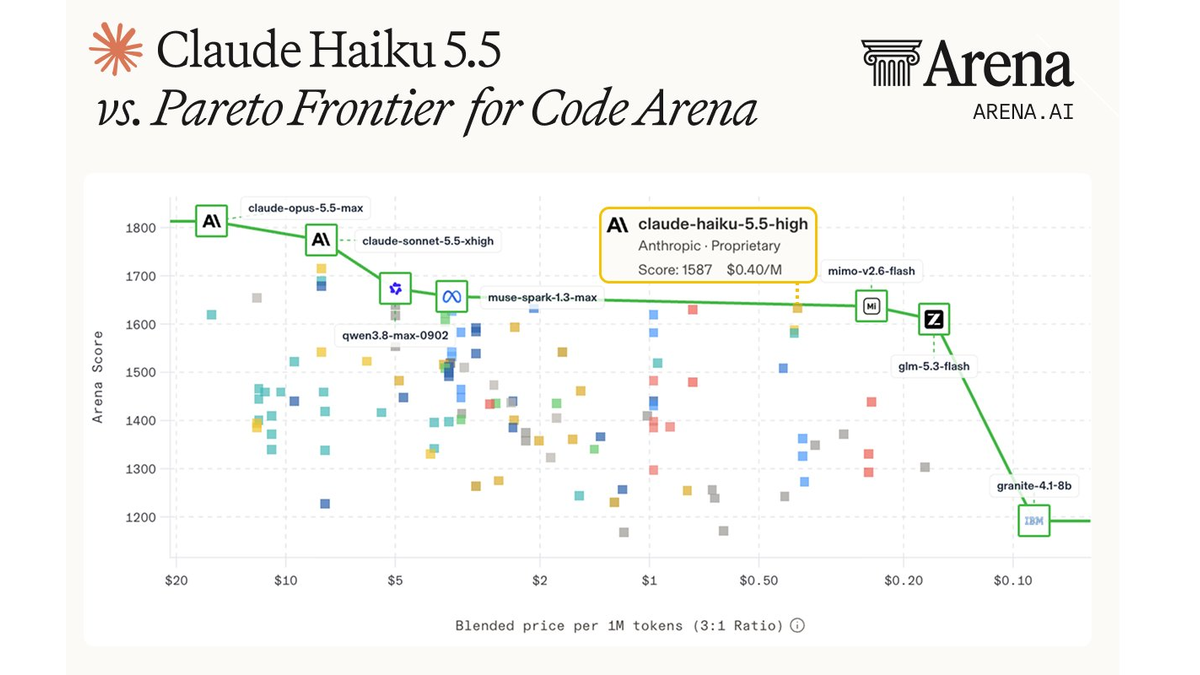
Dedicated X channels:
Anthropic, the company account that carried the launch: https://x.com/AnthropicAI
Claude, the product account whose thread carried the price, the effort ladder and the safety note: https://x.com/claudeai
Arena.ai, which publishes independent arena results for each model release: https://x.com/arena

Claude Haiku 5.5: Anthropic's Fastest Small Model Has a 100,000-Token Price Cliff
CI-First Evaluation Summary Card
Field | Value |
Tool | Claude Haiku 5.5 (Anthropic), model id claude-haiku-5-5 |
Primary use case | High-volume, latency-sensitive delegated work: classification, routing, extraction, summarisation, compaction and subagent tasks |
CI-First Profile | Primary: Co-Worker and Assistant (level 2). Secondary: Co-Researcher, Analyst and Tester (level 4) |
CI-First Benefit Score | 6.8 / 10 (CI-First Strong) |
Time | 8 / 10. Output speed 252 tokens per second, first answer at 5.81 seconds at low and 10.53 at the default medium, at $0.10 per million input tokens below 100,000 prompt tokens. Held below 9 by 176.72 seconds to first answer and 14.9 minutes per task at max, and by the new effort and prompt-length decisions. |
Quantity | 7 / 10. A tenth of the predecessor's list price at short prompts, a 1,000,000-token window, 128,000 output tokens and batch at half rate. Held at 7 by the approximately 30 percent tokenizer increase, the fivefold rate above 100,000 prompt tokens on the whole request, the model's verbosity, and a public workload where GPT-6 Luna came out cheaper. |
Quality | 7 / 10. Every vendor benchmark up sharply on Haiku 4.5, confirmed in direction by independent measurement: Intelligence Index 36 at max against a median of 24, Terminal-Bench 4.0 at 33 percent, AA-Briefcase at 1578 Elo. Held at 7 by Sonnet 5.5 at 55, 70.6 percent on Terminal-Bench in the vendor's own table, 36 percent AA-Omniscience accuracy and an AutomationBench result awaiting a re-run after over-refusal. |
Skill | 5 / 10. Real explanation capability and a window that makes it a usable tutor, against a release positioned for delegation, no teaching mode, and a price that removes the friction before delegating. Scored conservatively. |
Humics Badge | Humics-Neutral (0 / +3) |
Creativity | 0 (Neutral). Generates on request, neither sparks nor replaces ideation by default. |
Critical Thinking | 0 (Neutral). Lower hallucination and greater willingness to abstain protect it; volume, speed and price erode it. Net neutral in the common case. |
Social Authenticity | 0 (Neutral). No social surface in the model; erosion would be a deployment property under clause 4.2-a condition (a). |
AI Imposture Risk | Medium overall, with Skill Illusion High |
Time Illusion | Medium. Real speed at low and medium; 176.72 seconds to first answer and 14.9 minutes per task at max; a new effort decision and a new prompt-length threshold to manage. |
Quantity Illusion | Medium. Very verbose (298 million output tokens on the index run against a 107 million median) and cheap enough to ship unread, but a lower hallucination rate than named peers and checkable outputs in the target tasks. |
Skill Illusion | High. Expert-form output for users who cannot evaluate it, at a price and speed that remove hesitation, in a release built to hand work to a larger model rather than to a person. Mitigations are stated and they are specific; none of them moves the capability to the reader. |
Superhuman usage, invite when | Classification, routing, tagging, extraction and compaction at volume; subagent work under a larger model; browser and computer use on short specified tasks; a cheap first pass over a document set; explanation and tutoring on material you supply. |
Superhuman usage, keep out when | Prompts above 100,000 tokens; hard reasoning you will publish unchecked; factual recall where a wrong answer is expensive; pipelines that depend on sampling parameters or prefill; security work the cyber classifier may read as dual use; any refusal without a fallback or an operator. |
U365 methods | LIPS + CARE for the record and the loop, ULM + EVA for the Explore and Visualize phases only, UP-Context-Engineering for the prompt structure, UNOP for practice you then recall without the model. |
Over-delegation warning | Cheap, fast and usually right is the pattern that ends verification. Keep a hand-labelled gold set, read a sample rather than the exceptions, write the rule before the batch, and do one version of the task yourself each month. |
Verification checklist | Per workflow: a gold set or a state diff or a page-checked quote; a second model on the same input; a human read on anything published; and the CI-First test, that you can defend the output without the tool. |
Framework clauses | 5.2.3-a null for the model, live condition at deployment level. 4.2-a null, live condition at deployment level. 7.5 removed by v1.4. |
Status | Active |
Last tested | 2026-11-14 |
Framework version | 1.4.1 |

Claude Haiku 5.5: Anthropic's Fastest Small Model Has a 100,000-Token Price Cliff
Glossary
CI-First
Co-Intelligence-First: the U365 approach in which a human invites AI into reflection and work while remaining the ruler and orchestrator of it. The formula is CI = HI + (AI x HI), so the quality of the result depends on the human intelligence in the equation as much as on the model.
CI-First Benefit Score
A composite score from 0 to 10 that measures whether an AI tool delivers genuine, lasting benefit to the human user across four dimensions: Time saved, Quantity of usable output, Quality of verified output, and Skill built. Each dimension is scored 0 to 10 and averaged. Scores of 0 to 2.0 are CI-First Negative, 2.1 to 4.0 are CI-First Neutral, 4.1 to 6.0 are CI-First Positive, 6.1 to 8.0 are CI-First Strong, and 8.1 to 10.0 are CI-First Transformative. For Claude Haiku 5.5, the score is 6.8/10 (CI-First Strong), reflecting a fast, cheap and capable small model whose benefit is real at short prompts and limited by its skill transfer and its long-prompt pricing.
Time Benefit
The net time saved compared with doing the work with human intelligence alone, after subtracting the time spent prompting, configuring, reading, verifying and correcting the model's output.
Quantity Benefit
The increase in usable output the user can produce in a given time, scored on the volume that survives verification rather than the volume the model generates.
Quality Benefit
The improvement in the quality of the user's work relative to their own baseline, not relative to an expert, and only where the improvement survives verification.
Knowledge and Skill Benefit
Whether the tool helps the user learn what they did not know and do what they did not know how to do, building lasting capability rather than substituting for it.
CI-First Profile
A classification of how an AI tool collaborates with the human user, drawn from five profiles: (level 1) Co-Creator and Thought Partner, (level 2) Co-Worker and Assistant, (level 3) Professor, Coach and Tutor, (level 4) Co-Researcher, Analyst and Tester, and (level 5) Challenger, Critic and Devil's Advocate. A tool can have a primary and a secondary profile. Claude Haiku 5.5 is primarily a Co-Worker and Assistant (level 2) and secondarily a Co-Researcher, Analyst and Tester (level 4).
Humics
The set of uniquely human capabilities named by Pascal Bornet: creativity, critical thinking and social authenticity. Humics are the capabilities that AI can support but not supply.
Humics Protection Badge
A rating that assesses whether an AI tool protects, leaves neutral, or erodes the three Humics. Each dimension is scored +1 (Protects), 0 (Neutral) or -1 (Erodes), and the total ranges from -3 to +3. Badges: +2 to +3 Humics-Friendly, -1 to +1 Humics-Neutral, -2 to -3 Humics-Risky. Claude Haiku 5.5 scores 0 on all three dimensions, earning the Humics-Neutral badge: it neither strengthens nor erodes the three capabilities by itself, and its effect runs through how it is deployed.
AI Imposture Risk
An assessment of how likely a tool is to create an illusion of benefit that does not hold up under scrutiny. Three traps are rated. The Time Illusion is the appearance of saving time when the overhead consumes the saving. The Quantity Illusion is the appearance of delivering volume when the volume is mediocre or unverified. The Skill Illusion is the appearance of competence without the underlying capability. Each is rated Low, Medium or High, and the overall rating is Medium when one, two or three traps are Medium, or when one trap is High with clear mitigations stated; High when two or more traps are High. Claude Haiku 5.5 has Medium Time Illusion, Medium Quantity Illusion and High Skill Illusion, for an overall Medium rating with clear mitigations stated.
User Sentiment
An aggregate summary of real user reviews and community discussion. For Claude Haiku 5.5 the usable record is the Hacker News launch thread and the vendor-published customer quotes, because the general review platforms rate Anthropic as a company rather than this model snapshot. Developer sentiment is positive on price and capability and split on cost in practice above 100,000 tokens.
Review Status
Review Status records the current standing of the tool at the time of the last test. Active: the tool is current and recommended. Active (updated): recently re-checked and the content was refreshed. Changed: a re-check trigger fired and an update is pending, so read the review with that in mind. Risky: the tool has significant unresolved issues, or it has been clearly surpassed by newer alternatives. Use it with caution and read the Limits section. Retired: the tool still works but is no longer recommended. Deprecated: the tool has been shut down or fundamentally changed. Retired and Deprecated posts include a Migration Path section.
Last tested and Re-check
The date on which the evidence behind the review was read, and the conditions that require a new review. Claude Haiku 5.5 was last tested on 2026-11-14, and the re-check is trigger-based with a maximum of six months. The triggers are listed at the end of this post.

Claude Haiku 5.5: Anthropic's Fastest Small Model Has a 100,000-Token Price Cliff
Sources
Official Anthropic sources, read on 2026-11-14
Introducing Claude Haiku 5.5, launch page, 2026-10-07: https://www.anthropic.com/news/claude-haiku-5-5
Claude Haiku 5.5 model overview: https://platform.claude.com/docs/en/models/haiku-5-5/overview
Claude models overview: https://platform.claude.com/docs/en/models/overview
Pricing, including long context pricing: https://platform.claude.com/docs/en/about-claude/pricing
What's new in Claude Haiku 5.5: https://platform.claude.com/docs/en/models/haiku-5-5/whats-new-haiku-5-5
Claude Haiku 5.5 migration guide: https://platform.claude.com/docs/en/models/haiku-5-5/migration-guide
Prompting Claude Haiku 5.5: https://platform.claude.com/docs/en/build-with-claude/prompt-engineering/prompting-claude-haiku-5-5
Set the effort level: https://platform.claude.com/docs/en/build-with-claude/effort
Claude Haiku 5.5 system card: https://www.anthropic.com/claude-haiku-5-5-system-card
Claude Haiku 4.5 model overview: https://platform.claude.com/docs/en/models/haiku-4-5/overview
Model deprecations: https://platform.claude.com/docs/en/about-claude/model-deprecations
Refusals and fallback: https://platform.claude.com/docs/en/build-with-claude/refusals-and-fallback
Independent sources
Artificial Analysis, Claude Haiku 5.5 model page: https://artificialanalysis.ai/models/claude-haiku-5-5
Artificial Analysis, "Anthropic has released Claude Haiku 5.5, scoring 43 on the Artificial Analysis Intelligence Index": https://artificialanalysis.ai/articles/claude-haiku-5-5
Simon Willison, "Claude Haiku 5.5", 2026-10-07: https://simonwillison.net/2026/Oct/7/claude-haiku-5-5/
Community sources
Hacker News, Claude Haiku 5.5 launch thread, 1,049 points and 489 comments on 2026-10-07: https://news.ycombinator.com/item?id=49996437
U365 sources
U365 Tools register, read 2026-11-14, for the published CI-First scores of Claude Haiku 4.5, Claude Opus 5.5, Claude Fable 5.2, GPT-6 Luna and Gemini 3.8 Flash.
The U365 CI-First Evaluation Framework, version 1.4.1.
The U365 INSIDE Tools review template, LLM variant.
Published U365 INSIDE Tools reviews of Claude Haiku 4.5, Claude Sonnet 5, Claude Opus 5.5, Claude Fable 5.2 and Claude Code.

Claude Haiku 5.5: Anthropic's Fastest Small Model Has a 100,000-Token Price Cliff
Faculty Note on Evidence Quality
Six things should be said plainly about the evidence behind this review, because they change how much weight a reader should put on each part of it.
First, the vendor's benchmark table and the independent measurement agree on direction and not on scale, and both are reported. Anthropic's table shows the model far ahead of Haiku 4.5 on every row it prints, and Artificial Analysis confirms the class jump while placing the model at 36 on its Intelligence Index at maximum effort, behind Sonnet 5.5 at 55 and only moderately ahead of a median of 24. The vendor's table also does not state which effort level produced the Haiku 5.5 column, and that omission matters more than usual here: the independent score moves from 19 at low to 36 at max. A reader who compares the vendor's rows with another model's rows should assume a high effort setting until Anthropic says otherwise, and this review treats the table as the vendor's own reading rather than as a controlled comparison.
Second, the independent evaluator's own pages are not on one scale, and this review does not compare across them. The October release article states 43 on the Intelligence Index at maximum effort and 38 at high; the model page read on 2026-11-14 states 36 at maximum effort, 35 at xhigh and 30 at high. The same shift appears in the peer figures, with Sonnet 5.5 at 56 in the article and 55 on the page. The most likely explanation is a new index version, and Artificial Analysis' later article on Meta's Muse Ember, dated 2026-11-09, refers to "Intelligence Index v5" and describes Ember's 36 as matching Haiku 5.5 at maximum effort, which is consistent with the model page. The two readings are therefore kept apart: this review scores on the current page, cites the article only for facts that do not depend on the index (Terminal-Bench 4.0 at 33 percent, AA-Briefcase at 1578 Elo, the AA-Omniscience and hallucination figures, the AutomationBench result and the over-refusal note), and makes the version change a re-check trigger. A reader who sees 43 quoted elsewhere is not looking at a different model, only at a different scale.
Third, the independent cost figures do not include the price cliff. Artificial Analysis states in its release note that its site does not yet reflect tiered pricing, so provisional cost figures for Haiku 5.5 exclude the step up above 100,000 tokens. The $0.41 per benchmark task at maximum effort, and the $0.077 blended price, are therefore floor figures for a workload that stays under the threshold. Any cost per task above 100,000 prompt tokens is higher by a factor the evaluator has not yet published, and this review states that rather than deriving a number it cannot source.
Fourth, the token measurement is two measurements and both are reported. Anthropic says the same text produces approximately 30 percent more tokens than on Haiku 4.5. Simon Willison measured around 1.25 times as many tokens on his own long prompt, and the difference is workload shape rather than a contradiction. Either way the direction is the same: a list-price cut of 10 times is not a 10 times cut in the cost of a piece of work, and the migration guide's instruction to recount prompts is the operative one.
Fifth, the community record is a first-days signal from practitioners, and it is used as one. The launch thread carries measured comparisons, including the Plotly benchmark and a classification workload with token counts, and it carries single-participant impressions, including one report of prompt leakage and a slower response than Haiku 4.5. This review attributes every quotation to its handle, does not aggregate the thread into a rating, and does not treat a repeated impression as a measurement. The one practitioner workload that compares Haiku 5.5 with GPT-6 Luna is one workload, not a benchmark, and it is cited as one.
Sixth, the skill finding is the part of this review most likely to be argued with, and the argument is fair. A reader can reasonably say that a model which explains a concept on demand, at a price this low, teaches more than a more expensive model did. That is true, and it is why the Skill sub-score is 5 rather than 4. The framework asks a narrower question: whether the capability moved to the person. The model's own documentation, its use cases and its positioning all point the other way, toward work handed over and output checked, so the score reflects the common case rather than the best one. The two answers are not in conflict.
One adverse finding is stated as prominently as the favourable ones. The 100,000-token threshold is a fivefold price increase on the whole request, and above it this model stops being the cheap option against GPT-6 Luna. That sits in The Problem, in the Limits, in the Comparison and in the re-check triggers rather than in a footnote, because a reader who buys on the headline and runs an agent is exactly the reader it hurts. The model is the best Haiku Anthropic has released, the cheapest Claude at short prompts, and the first Haiku with a price that depends on how you write the prompt. All three sentences belong in the same review.
Review conducted by URC under the CI-First Evaluation Framework, version 1.4.1. Scoring date 2026-11-14. Tool version reviewed: Claude Haiku 5.5 (claude-haiku-5-5, released 2026-10-07).

Claude Haiku 5.5: Anthropic's Fastest Small Model Has a 100,000-Token Price Cliff
Status and Re-check
Status: Active | Last tested: 2026-11-14 (Claude Haiku 5.5, claude-haiku-5-5, released 2026-10-07) | Re-check: trigger-based (max 6 months)
Active: the tool is current and recommended.
For detailed explanations of the CI-First evaluation terms used in this review, including the Humics Protection Badge and the AI Imposture Risk levels, see the Glossary at the end of this post.
Re-check triggers:
Any change to the 100,000-token threshold or to the two tariff lines. The review is built on $0.10 and $0.50 per million tokens up to 100,000 prompt tokens, $0.50 and $2.50 over, and cache reads at $0.01 and $0.05. A change to the threshold, the rates or the whole-request rule moves the price analysis, the Quantity sub-score and the comparison with GPT-6 Luna.
A price change on any other line, including batch, cache writes, or the 1.1 times multiplier for US-only inference on Claude Platform on AWS and Microsoft Foundry. Each one changes the cost arithmetic in Real Workflows and the team-scale advice.
A tokenizer change, in either direction. The approximately 30 percent token increase and the 2.5 times image token cost are load-bearing in the Quantity score and in the migration steps. A new tokenizer that removes the increase, or one that deepens it, is a re-score rather than a refresh.
A new index revision, or a re-run that includes tiered pricing and the AutomationBench fix. The independent figures in this review were read on one model page on one day, and the evaluator has said that its cost coverage above 100,000 tokens and its AutomationBench result are both pending. When either lands, the Quality and Quantity rationales have to be re-read.
Any change to the refusal categories, the addition of a server-side fallback, or a published fix for the over-refusal issue. A refusal path with no fallback is a deployment condition, and a fix changes what a buyer has to build. It also changes the Quality rationale, because the AutomationBench score is expected to rise.
Any change to thinking and sampling controls: a return of budget_tokens, acceptance of temperature, top_p or prefill, or a change to the effort ladder. Each changes the migration steps and, for sampling controls, the reproducibility advice.
A new model in the Haiku line, a Haiku 6, or a retirement notice for Haiku 4.5 or for this model. A successor reopens the lineage table and the comparison; a retirement notice for Haiku 4.5 makes the migration urgent rather than optional.
A published incident in a high-volume or subagent deployment at the scale this model is sold for. The vendor positions it as a sidekick and a classifier, and the risks that matter in that role, a confident wrong classification and an unread summary, are exactly the ones a benchmark cannot test.




Comments