
DeepBrain AI (Interactive Avatar and AI Human): real-time conversational avatars on the AI Studios platform

Updated: 12 hours ago
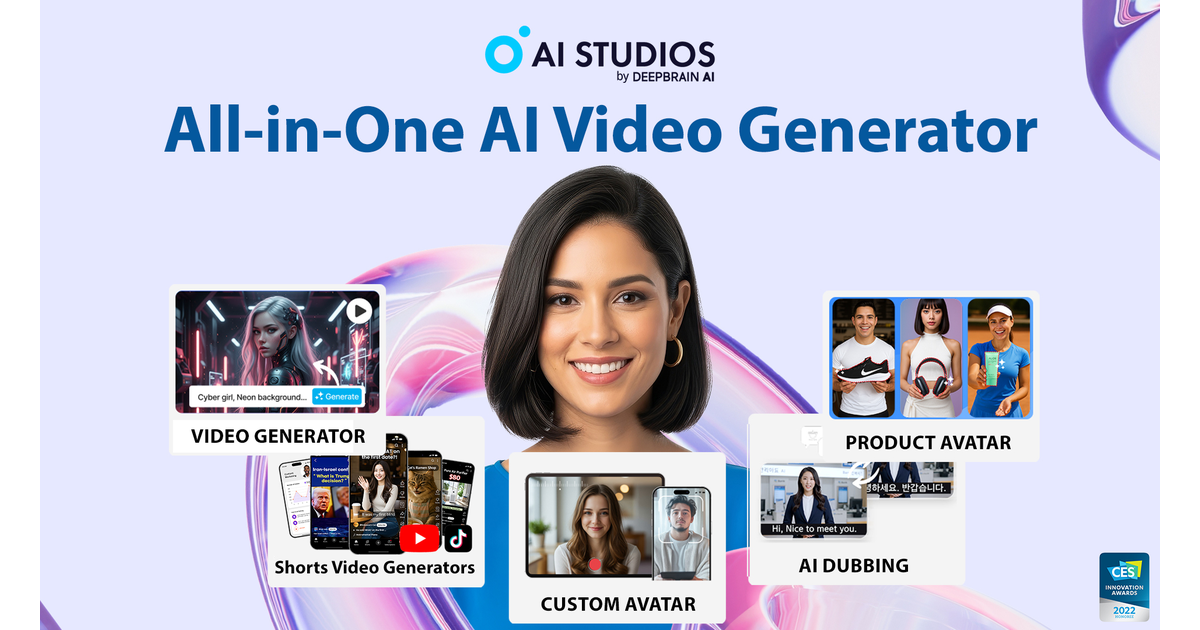
Status: Active | Last tested: 2026-09-25 (Interactive Avatar and AI Human surfaces, as documented on the vendor's sites and help centre in September 2026, including the April 2026 real-time avatar agent release) | Re-check: trigger-based (max 6 months)
Active: the tool is current and recommended.
For detailed explanations of the CI-First evaluation terms used in this review, including the Humics Protection Badge and the AI Imposture Risk levels, see the Glossary at the end of this post.


In this Tool Review
The DeepBrain AI naming, stated before the review begins
DeepBrain AI is the avatar vendor reviewed here, and its conversational surface is sold under the names Interactive Avatar and AI Human. Copilot 3D is a Microsoft Copilot Labs product that turns a photograph into a 3D model. The two are unrelated: no DeepBrain product carries the name Copilot, no page of the vendor's own sites uses the word, and nothing in this review describes Microsoft's product. The distinction between this vendor's own names belongs at the top, because the vendor has renamed the conversational surface more than once and because two of those names describe the same technology at different levels.
Name | What it actually is | Relationship to this review |
Interactive Avatar | The vendor's current name for the real-time conversational avatar surface: a photorealistic avatar that listens, reasons and answers in a live session, embedded on a website, in an app, or on a kiosk. Priced on its own plan | The review subject |
AI Human | The vendor's older name for the same real-time conversational technology, still live in the help centre and in the SDK documentation. The help centre files Interactive Avatar and AI Human as two collections under a single "Conversational Avatars" heading | The same technology under its earlier name |
AI Studios | The vendor's flagship platform: text-to-video, avatar library, dubbing and translation, the course builder and the editor. Interactive Avatar is reached from inside it and billed separately from it | The surrounding platform context |
Copilot 3D | A Microsoft Copilot Labs product that turns a single photograph into a 3D model. It is not a DeepBrain product and the two are unrelated | A different company's product, not reviewed here |
3D Avatars | A custom production service: a designed 3D character, not limited to footage-based training, usable in the video editor and as a conversational avatar. Sold through a plan agreed with the vendor's team | A distinct avatar type available to the conversational surface, not a separate review subject |
AI Kiosk | The hardware deployment of AI Human in a physical location, with the AI Retailer, AI Banker and AI Tutor roles as its named uses | A deployment channel for the review subject |
AI Detector | The vendor's deepfake detection product, used by the Korean National Police Agency among others | A separate product by the same vendor, referenced here only where it bears on provenance |
Dream Avatar / Rememory | An earlier service line commemorating a deceased person with their appearance and voice, listed in the vendor's privacy policy as a separate processing activity | Not reviewed here. It explains why the policy has an entry that the current products do not share |
Three consequences follow.
First, the review subject is the interactive conversational avatar surface, under whichever of its two names the vendor uses on a given page, with AI Studios as the platform that surrounds it. Copilot is not part of it. What the surface adds is the 3D avatar production option available to it.
Second, the vendor's own help centre has not fully migrated. The AI Human articles carry the older name and the older architecture, including a chatbot-dialog-library answer model, while the Interactive Avatar articles carry the newer large language model pricing table. A reader following the older articles will build a different product from the one the pricing page describes. Both are current, and the difference is recorded in Section 4.
Third, the naming spread is not confined to product names. The same vendor publishes different avatar counts, different language counts, different response times and different prices across its own surfaces in the same month. Those spreads are handled as findings in Section 7 and the Faculty Note rather than as errors to be tidied away, because each figure carries the surface it appears on.
Tool Snapshot
DeepBrain AI Interactive Avatar and AI Human (DeepBrain AI Inc.)
Tagline: "Interactive Avatars and Conversational AI Agent That Converts Visitors into Customers 24/7" and "One Conversational AI Agent. Every Customer. Every Channel. 24/7." (aistudios.com and deepbrain.io homepages, read 2026-09-25.)
Category: Agent platform applied to customer-facing conversation, delivered as a photorealistic or 3D speaking avatar. The product is a real-time pipeline: speech is captured, a language model produces an answer, a text-to-speech voice is synthesised, and an animated avatar renders the answer with synchronised lips and expressions. It sits on top of a video generation platform, AI Studios, that shares the avatar library, the voice library and the account.
Primary use cases:
A customer service or sales agent embedded on a website, in a mobile application, or on a physical kiosk, answering inbound questions in a live session.
An AI Tutor or AI Banker or AI Retailer role, where the avatar holds a service conversation in a named business function.
An employee training and rehearsal environment, where staff practise conversations against a simulated customer.
Presenter video production from a script, where the same avatar appears in pre-rendered video rather than in a live session.
The two tool-type variants that apply:
This review applies the Video and Creative Tool variant and the Agent Platform variant together, because the conversational avatar is a rendered audiovisual output and a reasoning agent in one surface. Where the platform is used only for scripted video, the Video and Creative variant applies alone.
Output formats:
Live interaction: streamed audio and rendered avatar animation, delivered to web, iOS, Android, Unity and C# clients through the AI Human software development kit, and to kiosk hardware.
Video output: 720p on the free plan, 1080p on the Personal plan, 4K on the Team plan. Interactive avatar sessions are documented at 1080p with no watermark.
Scripted assets: MP4 video, exported audio files, SRT subtitle files, chroma-key export.
Rendering time:
The vendor publishes several figures, and they are not the same measurement.
Figure | Surface it appears on |
"Create Your Own Live Avatar in Just 5 Minutes" | deepbrain.io homepage |
"The whole process takes about 5 minutes" | Help centre article on creating a custom avatar |
"Avatar creation typically takes between 5 to 40 minutes" | The same help centre article, in its processing note |
"about a month" for a bespoke Custom AI Human, including the recording session, the deep-learning period and model production | Help centre article on Custom AI Human |
The five-minute figure describes a webcam or smartphone recording turned into a video avatar. The one-month figure describes a bespoke studio production of a full conversational AI Human. Both are accurate for what they measure, and a reader comparing the two without the labels will conclude the product is five times faster than it is for the deployment case they actually have.
Recording input the vendor asks for:
The figure below is also published inconsistently. The marketing pages say a two-minute video, the avatar creation page says three minutes of footage, and the help centre's recording guidance says to speak naturally for at least two minutes and asks for at least three minutes for smooth creation, with anything under thirty seconds producing less fluid movement. The Interactive Avatar recording guidelines add a constraint the video case does not carry: minimise movement in both the idle state and the speaking state, look directly at the camera, avoid hand and body gestures, and keep the body and hands as still as possible while speaking.
Pipeline type: Real-time hybrid. Speech recognition plus a selectable large language model plus text-to-speech plus avatar animation for the conversational surface, and text-to-video synthesis for the scripted surface.
Agent architecture: Single conversational agent per session, deployed per channel. The vendor's term is an AI video agent or an interactive AI avatar agent. There is no documented multi-agent orchestration inside the product, and the orchestration question is one of deployment (one avatar per channel, several channels) rather than several agents inside one room.
Supported agent types: One avatar agent bound to a knowledge base and a model choice, with the roles named by use case rather than by configuration: AI Retailer, AI Banker, AI Tutor, frontline service and sales.
Memory system:
This is the clause 5.2.3-a surface, and the answer is documented at the level of a billing boundary rather than a memory design. The help centre states that conversation usage "starts when the conversation begins", is billed on "accumulated conversation time", and "stops immediately when the session ends". What carries forward is a knowledge base, which the deployer uploads as PDFs, presentations and other company documents, and which the vendor describes as training the AI on the organisation's own material. That knowledge base is authored by the deployer, not by the agent. No page of the vendor's documentation describes an agent-written memory store that persists a record of a given end user across sessions, and no page describes an agent that revises the deployer's standing instructions during use. The assessment is set out in full in Section 8 under the clause note.
Skills and plugins: Not applicable in the agent-platform sense. The product does not expose a skills store, a plugin registry or agent-authored procedural artefacts. Extension happens through the software development kit, a webhook, and chatbot or language model connections.
Integrations:
Language models: the vendor is model-agnostic. Its own pricing table names GPT-5 Nano, GPT-5.4 Mini, Claude 4.5 Haiku, GPT-5.4, Claude 4.6 Sonnet and Claude 4.6 Opus by tier, and its pages state that a customer can connect OpenAI, Claude, Gemini or an in-house model.
Knowledge: uploaded documents, described as absorbed so the avatar speaks with the precision of an experienced employee.
Chatbot platforms: IBM Watson Assistant and Google Dialogflow, documented in the help centre, with webhook connection over a REST interface or a WebSocket.
Channels: website embed through a code snippet, WhatsApp, iOS, Android, kiosk hardware, digital signage, tablets.
Back office: the vendor states secure links to customer relationship management and ticketing systems carry the conversation through to backend operations. No named connector inventory is published.
Development platforms: Android, iOS, Web, Unity and C#. The help centre states that 3D assets can be provided for either Unity or Unreal at the customer's preference, and that 2D and 3D avatars can run in a metaverse environment.
Pricing model:
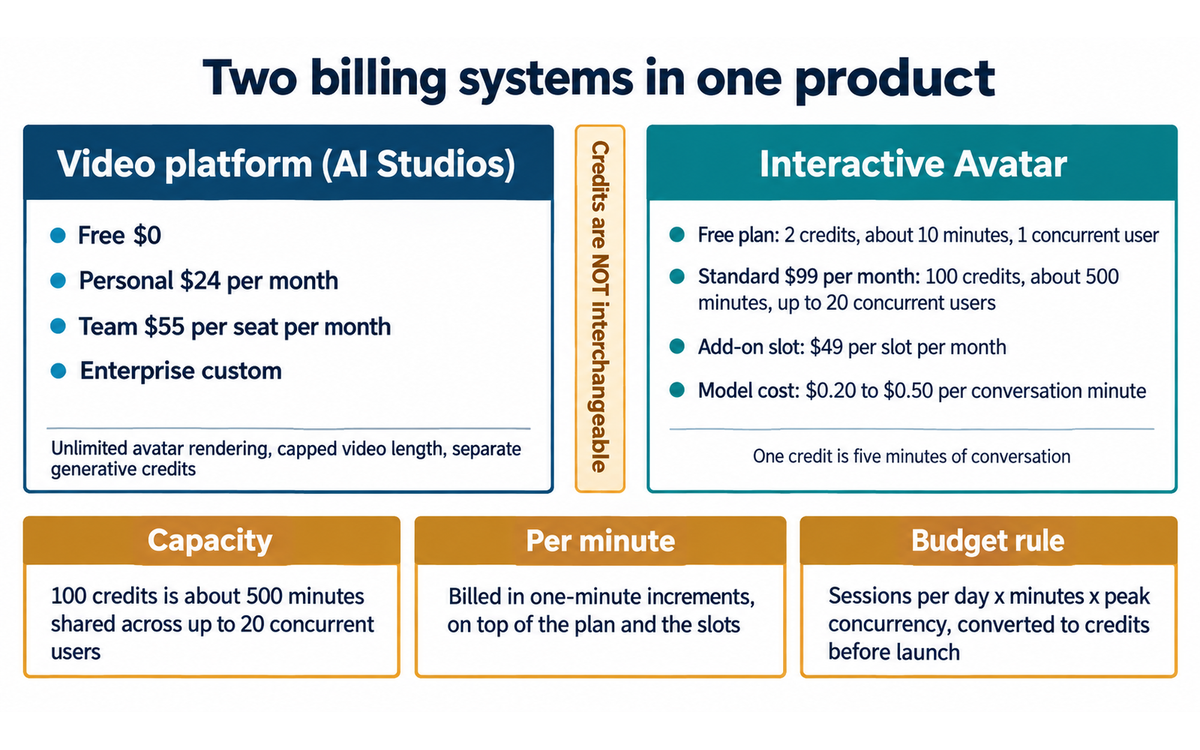
Two billing systems in one product, which is the single most important commercial fact in this review.
System | What it bills | Documented figures |
Video platform (AI Studios) | Plan subscription with unlimited avatar rendering, capped per-video duration, separate generative credit allowance | Free $0, Personal $24 per month, Team $55 per seat per month, Enterprise custom |
Interactive Avatar | Slot-based creation plus time-based conversation, plus per-minute model cost | Free $0 with 2 credits (about 10 minutes, 1 concurrent user), Standard $99 per month with 100 credits (about 500 minutes, up to 20 concurrent users), Enterprise custom. Add-on slots $49 per slot per month. Model cost from $0.20 per minute on the default tier to $0.50 per minute on the premium tier |
The two systems do not share credits. A reader who buys the Personal video plan has not bought interactive avatar minutes, and the pricing page carries interactive avatars as a feature line on the video plan while the help centre prices it on a separate plan table.
Notable limits:
100 credits on the Standard interactive plan is about 500 minutes shared across up to 20 concurrent users.
Billing is in one-minute increments.
Avatar creation and conversation usage are billed separately, and the slot is consumed only on successful creation.
Custom avatar slots are a maintained allowance, so a slot is held for as long as the avatar exists.
Free plan interactive use is capped at one concurrent user and about ten minutes.
The recording guidelines for a conversational avatar require nearly motionless delivery, which is a production constraint rather than a preference.
Compliance posture the vendor publishes: ISO 27001 and ISO 42001, SOC 2 Type II, GDPR, SCORM export, SAML single sign-on on Enterprise, and an enterprise HIPAA deployment statement on a third-party trust page. Data region options of European Union, United States and Asia-Pacific are stated on a third-party trust page rather than on the vendor's own policy page.
Official links:
Vendor site: https://deepbrain.io/
Platform site: https://aistudios.com/
Pricing: https://aistudios.com/pricing
3D avatars: https://aistudios.com/features/3d-avatars
Help centre, conversational avatars: https://help.aistudios.com/en/collections/3780444-conversational-avatars
Interactive avatar pricing article: https://help.aistudios.com/en/articles/14683575-how-does-interactive-avatar-pricing-work
Interactive avatar creation article: https://help.aistudios.com/en/articles/14683530-how-to-create-an-interactive-avatar
AI Human SDK documentation: https://docs.aistudios.com/aihuman/web-sdk
Terms of Use: https://deepbrain.io/terms-of-use
Privacy policy: https://deepbrain.io/privacy-policy
The Problem
An institution that teaches, recruits, sells or supports people runs the same conversation hundreds of times. The same admission question. The same fee question. The same "is this programme for me" question. The same onboarding walkthrough. The work is repetitive in content and personal in stakes, and it is bound to a calendar: staff answer during their hours, in their language, and in their capacity.
Three specific problems follow for a U365 reader.
The first is coverage. A prospective Fellow in a time zone that does not overlap the team's working day gets an answer tomorrow, or never. Support capacity is a hiring decision, and hiring is slow and expensive. A text chatbot answers the coverage problem and fails the trust problem: many people will not act on an answer from a box they cannot see, and the vendor's own market argument is exactly this, drawing a line from text chatbots and voice systems to "customer experiences that more closely match the tone, responsiveness, and visual presence of a trained human agent".
The second is production. Video that carries a person is the most expensive content an institution makes. Camera, lighting, wardrobe, retakes, editing, and then translation on top of all of it. The result is a small number of polished videos and a large number of unrecorded explanations.
The third is language. U365 serves Fellows across several languages. Dubbing and lip-synchronised translation are the standard answer, and they are sold by several vendors. The harder case is live conversation in the Fellow's own language, which text tools handle badly and which a text-only translation layer handles worse.
DeepBrain AI addresses all three from one account: an avatar that produces scripted video in more than a hundred languages, and an avatar that holds a live conversation in more than a hundred languages, with the deployer's own documents as the knowledge base and a choice of language model behind it.
The Outcome
What you get, stated concretely.
You upload a two-minute recording of yourself, or of a colleague, or you choose one of the vendor's stock or generated avatars, or you commission a bespoke 3D character. You upload the documents that describe your programme, your policies and your service. You pick a language model from a tiered list whose price you can see before you deploy. You place the avatar on a page, in an application, or on a kiosk. The avatar then answers questions in a live session, in a real voice, with a face that moves, for as long as the session and the credits last.
On the video side, the same account produces scripted presenter video from text, a presentation, a URL or a product listing, with dubbing and lip-synchronised translation into the vendor's stated language set.
Three outcomes are concrete enough to hold.
Coverage becomes a configuration rather than a rota. The avatar does not have hours. What it has is a credit allowance and a concurrency ceiling, and those are the two numbers that determine whether coverage is real.
Presentation stops being a production bottleneck. A programme update becomes a script and a render. The vendor's own marketing for this is the removal of camera, studio and crew, and that claim holds for the video surface.
Language stops being a separate production line. Translation and dubbing sit in the same workspace as the original.
What does not change, and a reader should fix this at the start: the avatar answers from what you gave it and from a general model. It does not know what it does not know. Every workflow below carries a verification checklist for that reason, and Section 7c sets out what the vendor's own contract says about what happens to the conversation while it is happening.
Who Should Use DeepBrain AI
U365 Fellow and staff categories, with what each would actually do.
Admissions and recruitment staff. A conversational avatar on an enquiry page or in a programme micro-site, answering the recurring questions from the same document set the team already maintains. This is the strongest fit in the platform.
Communications and content staff. Scripted presenter video with dubbing, produced without a studio. The largest volume of work and the fastest return.
L&D and programme design staff. Rehearsal environments where staff practise a difficult conversation, and the course builder with its quiz and SCORM export for internal training.
Faculty producing asynchronous material. Explanatory video at scale, where the person on screen matters less than the explanation being consistent.
Product and platform staff. The software development kit is a real integration surface, with documented clients for web, Android, iOS, Unity and C#, and a webhook path to a customer's own system. This is the only path to controlling where the conversation data goes, and it is the path an institution with a data-protection obligation should take.
Not a good fit for the individual Fellow working alone. The interactive surface is priced on a business plan with a concurrency ceiling and a per-minute model cost designed for a deployment, not for one person talking to an avatar. The video surface is affordable individually and is a different product.
Where the profile sits. Primary profile is level 2, AI as Co-Worker and Assistant: the avatar executes an interaction the institution has already designed. Secondary profile is level 1, AI as Co-Creator and Thought Partner, on the scripted side, where the script assistant turns an idea into a draft in the workspace.
U365 Institutes Alignment
Each institute is rated once, and the ratings below are the single source for this review. Every row carries the reason and the limit that holds it.
Institute | Rating | Why | The limit that holds the row |
UIT (Technology, AI, Data Science) | High (primary) | Three competences the Fellow is assessed on. An integration written against the documented AI Human SDK, with its clients for Web, Android, iOS, Unity and C#, its avatar view component, its speech and gesture controls and its documented state management. A real-time service architecture decision defended before launch: model tier against a published per-minute price, latency budget, credit allowance and concurrency ceiling. A boundary test for a retrieval-and-speak system, designed around the questions the uploaded documents do not answer | The published integration path is the older AI Human SDK, whose own documented language list is four named languages against a platform claim of more than 150, and the API for the current conversational surface has no reference documentation, no version, no rate limit and no rate card. The latency budget is taught on the vendor's own two conflicting figures, under one second on one page and under two seconds on another, with no independent measurement of either, so the exercise teaches evidence discipline more than engineering |
UIC (Digital Communication, Marketing) | High | Three competences the Fellow is assessed on. Script and persona specification for a synthetic presenter, including what the script must not claim. Verification of a localised script against the institutional record before render, which the review names as the step that decides whether the output is usable. The disclosure decision on synthetic media, which Section 7c of the review establishes is the deploying institution's to make because the product ships no attribution requirement | The tool produces a competent asset for a Fellow who could not have specified one, and the review's own Humics table records Creativity 0 on the ground that it renders what a writer wrote. No published U365 programme assesses synthetic-media disclosure practice, so the third competence is taught by U365 method material rather than assessed by a programme |
UID (Digital Design, UX/UI) | Medium | Real design surfaces at the specification end. Briefing a designed 3D character rather than a footage-based one, placing a gesture at a position in a script, choosing a framing treatment from the documented options, removing a background so the subject sits in a composed frame, and judging the rendered composite against the brief | The 3D character is a commissioned production path agreed with the vendor's team, so the artefact is delivered rather than made. The conversational surface gives a designer little to control, and the model produces the wording, so the design judgement comes from the curriculum and not from the tool |
UIB (Business Management, Entrepreneurship) | Medium | One competence, and it is costable. Total cost of ownership of a metered real-time service, built from the review's own arithmetic: two billing systems that do not share credits, a slot-based creation cost, a per-minute model cost across four tiers, and a concurrency ceiling, converted into a service budget. The learning outcome is a costed recommendation with the rejected alternatives recorded | The product teaches no management, finance, leadership or entrepreneurship content of its own, and the relevance is confined to the cost and budgeting competence. The vendor's own surfaces do not reconcile the video plan's credits with the interactive plan's credits on any single page, so the arithmetic is a claim to test against the Fellow's own baseline |
The four ratings are UIT at High (primary), UIC at High, UID at Medium and UIB at Medium. Each row carries its reason, and each row carries the limit that holds it where it is. No institute is rated on what the tool generates.
UID and UIB both carry a row whose connection is real and narrow, and both are published rather than omitted so the judgement is visible to the reader instead of implied by silence. No institute on this table is rated High on the API surface, and no institute is rated High on the avatar library, the dubbing volume or the plan arithmetic.
The review's first workflow requires a test set of twenty real questions, ten the documents cannot answer and five that invite a guess, and then requires the reader to watch the ten. That is the exercise to run in the UIT row, because it is fifteen minutes of work, no vendor surface can run it for you, and it teaches the competence the whole review turns on: knowing what your own document set does and does not hold.
In the UIC row the teaching case is the disclosure. The review's getting-started sequence ends with writing the sentence the page or the kiosk carries, and Section 7c establishes that the vendor's contract leaves that decision to the deployer. It is worth naming as the exercise rather than as a step, because it is the one item in the deployment that has no technical fallback.
Credential chains for this tool
A U365 Fellow using this tool builds the competencies below. Each is assessed by a published U365 programme, named with the part of its curriculum that carries the chain.
Tool skill | U365 competency | Credential (verified published programme) | Institute | Stacks into |
Writing an integration against a documented real-time SDK: the client for the target platform, the avatar view component, the speech and gesture controls, state handling, and a webhook or back-end connection | Applied AI systems integration and client development | Software Developer (60 days, diploma), verified published 2026-09-25. Its published programme covers programming fundamentals, web and software creation and database management | UIT (Technology, AI, Data Science) | Bachelor of Science in IT (B.Sc.), then Master of Science in IT (M.Sc.) |
Choosing a model tier against a published per-minute price, setting the latency budget, and stating the credit allowance and the concurrency ceiling the service will run inside | Real-time service architecture, capacity planning and deployment decisions | Cloud Computing Specialist (30 days, diploma), verified published 2026-09-25. Its published programme covers cloud services, platforms, the advantages and pitfalls of a cloud-based paradigm, and the certifications that matter in the field | UIT (Technology, AI, Data Science) | Bachelor of Science in IT (B.Sc.), then Master of Science in IT (M.Sc.) |
Writing the presenter script and the persona, including what the script must not claim, and verifying a localised script against the institutional record before it is rendered | Scripted production specification, localisation review and disclosure judgement | Video Production Specialist (60 days, diploma), verified published 2026-09-25. Its published programme covers narrative architecture, editing methodologies and dialogue refinement. The disclosure element is carried by U365 method material rather than by this programme, and the gap is recorded in 2f | UIC (Digital Communication, Marketing) | Associate in Communication & Marketing (A.C.) 1/2 and 2/2, then Bachelor in Communication & Marketing (B.C.), then Master in Communication & Marketing (M.C.) 1/2 and 2/2 |
Specifying an avatar's framing, gesture and look, and judging the rendered composite against the brief | Character and motion specification, and visual judgement of a rendered result | 2D Animation Expert (30 days, diploma), verified published 2026-09-25. Its published programme covers the foundational principles of animation, character conception and dynamic motion. The chain rests on the character and motion components, not on the editing tools | UID (Digital Design, UX/UI) | Associate in Design (A.D.) 1/2 and 2/2, then Bachelor in Design (B.D.), then Master in Design (M.D.) 1/2 and 2/2 |
Counting sessions and minutes rather than plans, converting them into the cost of running the service at a chosen concurrency, and defending the tier against the number | Technology investment appraisal and total cost of ownership | Financial Analysis Specialist (30 days, diploma), verified published 2026-09-25. Its published programme covers the dissection of financial statements, economic statistics and analytical evaluation, and forming advisories on investment | UIB (Business Management, Entrepreneurship) | Associate of Business Administration (A.B.A.) 1/2 and 2/2, then Bachelor of Business Administration (B.B.A.), then Master of Business Administration (M.B.A.) 1/2 and 2/2 |
Deciding what a deployed synthetic presenter must disclose, and holding that decision through a change of employment, a lapsed consent or a withdrawn likeness | Synthetic-media disclosure and likeness consent practice | Confirm with academic team. No published U365 diploma assesses disclosure practice for synthetic media or likeness consent. The nearest verified programme is Video Production Specialist for the production context, and it publishes no disclosure outcome. Recorded as a curriculum gap in 2f | None asserted, because no credential is attached |
The transferable discipline across the five chains is one habit, and the review's own Section 7 states it: separating what a system looks like it can do from what it has been shown to do. The 96.5 per cent figure measures how the avatar looks, and no third party has measured whether its answers are right.
All five credential chains stack into a degree programme. University 365 degree programmes carry a single Expert level and are open to SUPERHUMAN Fellows only, so the degree outcome in every chain below is a SUPERHUMAN pathway.
The chains apply only when the Fellow can state what the deployment has to do and why, describe the persona and the script boundaries without the tool open, explain what each localised version changed and which of those changes was theirs, reproduce the boundary test result independently, and say what the deployment cannot answer. Submitting a generated video or a configured avatar is not evidence of the Fellow's skill.
The assessment artefact must include the written script and persona brief, the test set with the questions the documents cannot answer, the verified localisation with the source it was checked against, the disclosure sentence as published, the cost arithmetic in the Fellow's own numbers, and one sentence on what the Fellow would specify differently next time.
U365 publishes no programme that assesses disclosure practice for synthetic media or likeness consent, and one of the six competencies above therefore has no assessment home. It is recorded here as a curriculum gap rather than filled with a plausible programme name.
Two candidates for a future micro-credential, both teachable without any product and both supported by this review's own analysis:
Synthetic-media disclosure and likeness consent, covering what a deployed avatar must state, how a consent is scoped by duration, territory and purpose, and what happens when a consent lapses or is withdrawn. The review's Section 7c is the worked case: the vendor's own creator promotion terms require documented consent and a proof-on-demand capability, while the product terms require only that the user be solely responsible.
Real-time service capacity planning, covering the conversion of sessions, minutes and peak concurrency into a plan allowance, and the difference between a model-tier cost and a platform allowance. The review's own arithmetic is the worked example.
Neither is a current programme, and neither may be presented as one. Metered AI services produce cost and disclosure competencies faster than the catalogue produces programmes to assess them.
How DeepBrain AI Works
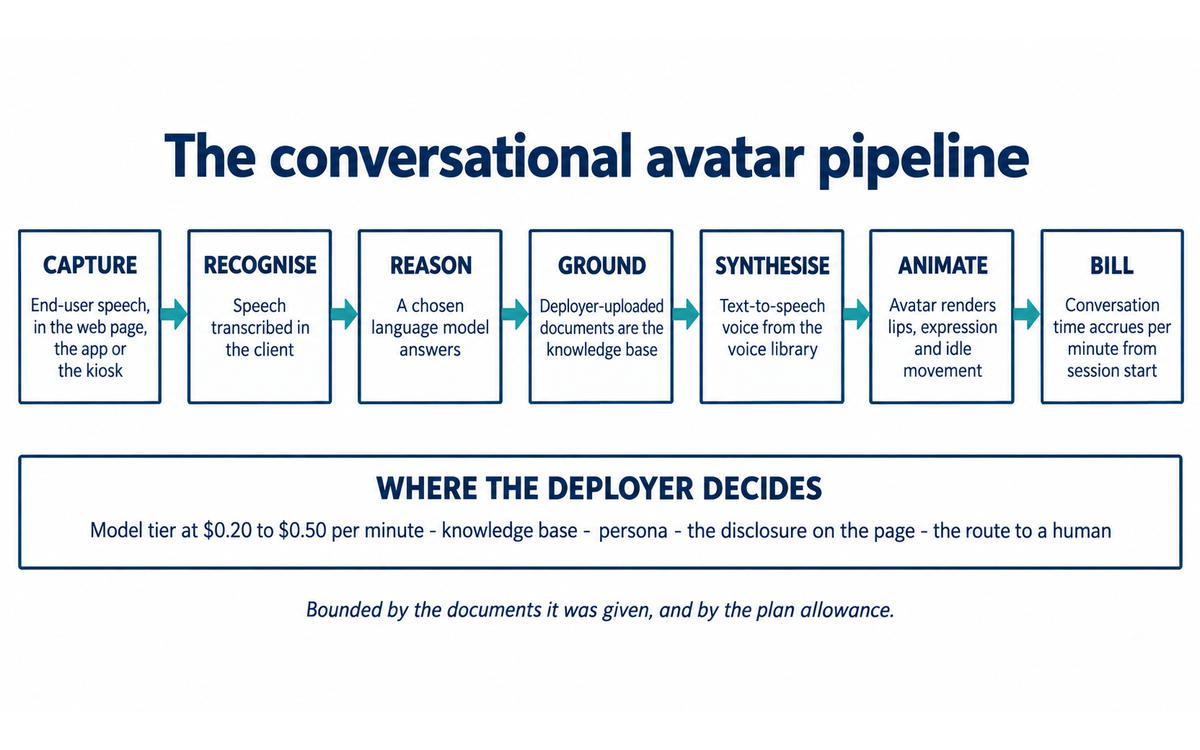
The conversational pipeline, step by step
Capture. The end user's speech is captured in the client: a web page with the embedded snippet, a mobile application using the SDK, a kiosk with its own hardware, or a signage screen.
Recognise and route. The speech is transcribed and passed to the model chosen for that deployment. The vendor's pricing tier names the models it offers at each price.
Reason. The model produces the answer. If the deployment is connected to a chatbot platform, IBM Watson Assistant or Google Dialogflow supplies the dialog and the avatar speaks it. The older AI Human capability article states plainly that "AI Human delivers input text message out of the chatbot dialog library" and "should be able to answer the questions that are saved in the interfaced chatbot". That is a retrieval-and-speak model.
Ground. The uploaded company documents are the knowledge base. The vendor describes the avatar as "absorbs uploaded manuals, policy guides, and compliance materials so the avatar agent speaks with the precision of an experienced employee, no retraining required".
Synthesise. A text-to-speech voice is generated from the same voice library the video platform uses.
Animate. The avatar renders the answer with synchronised lips, facial expression and body movement. The vendor's SDK documentation describes an idle state with blinking and nodding between answers, and state management handled automatically once initialised.
Bill. Conversation time accrues from the start of the session, in one-minute increments, and stops when the session ends.
What the avatar is built from
The help centre separates four avatar types, and they behave differently in conversation.
Custom avatars are created from your own footage, capturing the real voice and expressions. This is the type that puts a named person's face on the conversational surface.
Photo avatars come from a single image, have less motion, and are described as suited to stylised or fictional looks.
Studio avatars are filmed with real actors in a professional environment, with high-resolution output and precise lip sync. The help centre states over 125 pre-made avatars in this class, while the marketing pages claim more than 2,000 ready-to-use avatars and more than 40 to 155 stock avatars depending on plan. Those are different counts of different things, and the 2,000 figure is the broad library rather than the studio set.
AI-generated avatars are synthetic and not based on a real person, ready immediately.
A separate 3D avatars service produces a designed character through a plan agreed with the vendor's team, with a dedicated customer success manager and regular updates during development. The help centre states that 3D assets can be supplied for Unity or Unreal at the customer's choice, and that both 2D and 3D avatars can run in a metaverse environment. Access to a custom avatar is limited to authorised accounts and is not published to other users.
The latency question, and why the vendor's own two answers differ
This is the most important technical number for a conversational avatar, and the vendor publishes two different ones.
Figure | Surface it appears on |
"Natural Response Time < 1 Sec" | deepbrain.io solutions page, under the heading "Conversational Avatar" |
"response times under 2 seconds" | aistudios.com custom language model feature page |
"a low-latency generative AI engine keeps conversation close to real time with natural lip-sync" | the April 2026 real-time avatar agent release, repeated in the distribution copies |
Two figures and one qualitative claim, published in the same period. A reader modelling whether a kiosk conversation feels natural is choosing between a sub-second figure and a sub-two-second figure that nobody outside the vendor has measured. A separate help centre article titled "Latency" exists and states that the topic is covered, without publishing a number.
The release announcement adds a second claim with a real consequence: the system "runs avatar inference directly on the device, so listening, reasoning, and response stay close to real time even when networks are unstable. Local inference also reduces cloud dependency and keeps sensitive interaction data inside the device." That sentence is the strongest data-residency statement in the vendor's public material, and it appears in a press release rather than in the privacy policy or the security documentation. A reader making an adoption decision should treat it as a vendor claim to be confirmed in the contract, not as a published architecture commitment.
The video pipeline
The same account produces scripted video. Input is text, a presentation file, a URL or a product listing. The platform assembles a scene with an avatar, a voice, a template, stock assets and generated imagery, and exports at the plan's resolution. Gesture cue points let a writer place a gesture at a position in the script. Multi-avatar scenes allow several avatars in one script. Background removal and framing options control how the avatar appears. Generative video and image models are included on a separate credit allowance with its own monthly cap, and the vendor's plan table names Veo, Sora and further models as available.
The API and SDK surfaces, stated honestly
There are two integration paths and they are at different levels of maturity.
The AI Human software development kit is documented publicly at the vendor's developer documentation site, with a Web SDK introduction and clients for Android, iOS, Unity and C#. The SDK's core component renders the avatar as a view that can be positioned inside an application, with controls for speech, gestures, size, position, speaking speed, and pause, resume and stop. The documented language support at SDK level is Korean, English, Japanese, Chinese "and more", which is narrower than the 150-plus languages claimed for the platform as a whole.
The Interactive Avatar API is the path that matters most and it is not published. The help centre article on it describes the architecture in general terms, saying it "allows applications to embed real-time conversational avatars directly into their services", supports real-time streaming interaction, delivers output through voice and animation, and enables continuous conversation sessions. It then states: "DeepBrain AI provides interactive avatar capabilities and is expanding its API support for real-time integration. API features and availability may vary depending on development progress and product updates. For the latest information, refer to official documentation." There is no reference documentation, no version, no rate limit, no authentication model and no rate card published for it. A U365 reader planning a build should read that sentence as the current state of the product rather than as boilerplate.
Architecture summary
Layer | What the vendor documents |
Front end | Web embed, Android, iOS, Unity, C#, kiosk hardware, signage |
Speech in | Captured and transcribed in the client |
Reasoning | Selectable large language model, tiered by price and capability; optionally a third-party chatbot platform |
Grounding | Deployer-uploaded documents; the vendor describes the avatar as trained on them with no retraining required |
Speech out | Text-to-speech from the platform's voice library |
Rendering | Avatar animation with lip sync, expression and idle-state movement; 2D or 3D assets; on-device inference claimed |
Back office | Secure links to customer relationship management and ticketing systems, described without a connector inventory |
Extension | Software development kit, webhook over REST or WebSocket, chatbot platform connections |
The pipeline in one view
What the two billing systems cost
Getting Started with DeepBrain AI
A fifteen-minute path to a working first result on the video surface, and a longer one for the conversational surface.
The video surface, first result in about fifteen minutes
Create an account at https://deepbrain.io/ and take the free plan. No payment details are requested for it.
Start from a template rather than a blank project. The platform ships thousands, and one that matches your format removes the layout work from the first session.
Pick a stock avatar. Choose one of the ready-made avatars, not a custom one, for the first attempt. This avoids the recording step and the processing wait.
Write a script of a hundred to two hundred words into the script box, or paste a slide outline. Use the script assistant if you want a first draft, and then edit it yourself.
Set the voice and the language. Listen before you render.
Render and watch the whole thing. Watch for lip sync on unfamiliar words, for expression that does not match the sentence, and for gesture placement.
Export and check the resolution against your plan.
The conversational surface, and the setup it actually needs
Choose a deployment channel first. Website embed, application, or kiosk. The channel determines the client and the hosting. Decide before anything else.
Decide the avatar. A stock or generated avatar needs no recording and no slot. A custom avatar needs a recording, a slot, and the stillness discipline described below. A 3D avatar needs a plan agreed with the vendor's team.
Record to the conversational guidelines, not the video guidelines. This is the step that catches people. For a conversational avatar the vendor asks for a nearly motionless idle state (do not speak, look directly at the camera, avoid gestures, only breathing and blinking), a nearly motionless speaking state (speak naturally on one topic, keep the body and hands still, avoid head movement and large gestures), upper-body framing, and a consistent visual throughout. The vendor's own framing is that the difference between the idle state and the speaking state should be in the speech, not the body.
Let the avatar activate. Only successfully activated avatars can be used for real-time conversation. Avatar creation typically takes five to forty minutes on the documented range.
Upload the knowledge base. The documents that describe your programmes, policies and service. The quality of the answer is bounded by what is in here.
Choose a model tier deliberately. Default at $0.20 per minute, Standard at $0.30, Advanced at $0.40, Premium at $0.50. Pick the cheapest tier that passes your own test set, and treat the difference as a cost decision rather than a quality decision until you have measured it.
Connect the back end if you have one. A chatbot platform, a webhook to your own system, or a customer relationship management link.
Budget the conversation time before you launch. Write down the expected number of sessions, the average session length, and the peak concurrent users, then convert to credits. This is the step that prevents a surprise, because the Standard plan's 100 credits is about 500 minutes shared across up to 20 concurrent users.
Write the disclosure you will carry. Decide in advance how the page or the kiosk tells the person that they are talking to an agent, and how they reach a human. See Section 7c for why this is a decision for you and not for the vendor.
The two setup mistakes that cost the most
Buying the wrong plan. Interactive avatar minutes are not the video plan's video credits. A reader who buys Personal for the scripted video and then wants the conversational surface buys a second plan.
Recording to the wrong guidelines. A recording made for a presenter video, with natural gestures and head movement, produces a poorer conversational avatar than a still one. The two products want opposite performances.
Real Workflows
Three workflows, each with a verification checklist. The checklists are the framework's requirement, not a courtesy.
Workflow 1: An admissions enquiry avatar on a programme page
Who: Admissions and communications staff, working together.
Time: About four hours of setup, then minutes per update. The setup is the documents, the model tier choice, the page embed and the test set. Updates are script or document changes.
What you do:
Collect the twenty questions the admissions inbox actually receives, from the inbox, not from imagination. Rank them by frequency.
Assemble the knowledge base documents: programme structure, entry requirements, fees, dates, language requirements, visa and support questions. Check every figure against the source system rather than against an older brochure.
Build a test set: the twenty questions, plus ten that the documents do not answer, plus five that invite a guess.
Deploy with the cheapest model tier, then run the test set. Watch the ten unanswerable questions specifically. A good deployment says it does not know. A bad one invents a fee.
Escalate the tier only if the test set fails on question types where the answer is present in the documents and the model is failing to use them.
Put the disclosure and the route to a human on the page, next to the avatar.
Turn on conversation logging in your own back end if your channel allows it, through the webhook, and review a sample weekly.
What you get: Coverage outside working hours and in every supported language, from a document set the admissions team already owns.
What you do not get: Admissions decisions. The avatar answers from the documents. It does not weigh an applicant.
VERIFICATION CHECKLIST for Workflow 1:
[ ] Multi-Model Check: run the same twenty questions through a second model tier and compare
    the answers; the divergence tells you whether the tier is the variable or the documents are
[ ] External Source: check every fee, date and entry requirement the avatar states against the
    source system of record, not against the knowledge base document
[ ] Human Review: an admissions staff member reads a sample of real conversations weekly and
    flags anything that would have been answered differently by a person
[ ] CI-First Test: can the admissions team name which questions the avatar cannot answer, without
    looking at the logs? If not, the deployment is not understood well enough to run
UP-Context prompt pack 1 for this workflow: The knowledge-base boundary test, run before launch.
Context: We are deploying a conversational avatar on [page, application or kiosk] to answer
questions about [programmes, policies, service]. The knowledge base is [name the documents and
where they live]. The person the service replaces answers about [n] questions a week. A correct
answer is one that is in those documents and stays in them.

Role: AI as Co-Worker and Assistant (Profile 2) for the run, and Analyst and Tester (Profile 4)
for the reading. I decide what the deployment may say, and I own the disclosure.

Task: From the documents I gave you, build three sets of questions: the twenty the service will
actually receive, ten that these documents cannot answer, and five that invite a guess about a
fee, a date or an entry requirement. Then answer all thirty-five as the deployed avatar would.

Constraints: Answer only from the documents. Do not fill a gap with a general model answer. Where
a document does not cover the question, say so rather than answering. Do not summarise the
documents; quote the passage you answered from. State plainly which questions you could not
answer and why.

Output format: one table with the question, the set it belongs to, the answer given, and the
document passage relied on. Then a heading "Answered outside the documents", listing every case
where you supplied something the documents do not contain. Then a heading "Where a person would
have answered differently".

UP-Context verification: I read the ten unanswerable questions first and check that the avatar
declined rather than invented, I check every fee, date and entry requirement against the source
system of record rather than against the knowledge base, and I confirm the disclosure sentence is
on the page next to the avatar. I keep the thirty-five questions as a re-run set, so that a
document change is followed by a re-test. If I cannot name which questions the deployment cannot
answer without reading the logs, I do not launch it.
Workflow 2: A dubbing and translation pass on existing institutional video
Who: Communications and engagement staff.
Time: Under an hour for a short existing video, most of it in the review rather than the processing.
What you do:
Upload the existing video file.
Choose the target languages and generate the dubbed versions with lip sync.
Review the translated script in the proofreading editor before rendering. This is the step that decides whether the output is usable. The vendor ships the editor for exactly this reason.
Render and watch the output in each target language with a speaker of that language if you have one, or against the transcript if you do not.
Check names, place names, programme names and any figure. Machine translation of a proper noun is where the failures are.
What you get: Several language versions of one video without a second production, and lip sync that keeps the speaker's mouth consistent with the new audio.
What you do not get: A guarantee that the translation is correct. The vendor provides the check, not the correction.
VERIFICATION CHECKLIST for Workflow 2:
[ ] Multi-Model Check: run the transcript through a second translation source and diff it against
    the dubbed script; investigate every proper noun and every figure
[ ] External Source: verify every programme name, fee and date in the target language against the
    institutional record
[ ] Human Review: a speaker of the target language watches the full output before publication
[ ] CI-First Test: could you defend the wording of a sentence in the target language to a native
    speaker without referring to the source video? If not, it is not ready
UP-Context prompt pack 2 for this workflow: The localisation pass, with the script review before the render.
Context: We are producing [the video or the page] in [name the target languages] from an existing
asset. The source script is [where it lives]. The institutional record for names, fees, dates and
programme titles is [where it lives]. A usable version is one a speaker of that language would
read without knowing it was translated.

Role: AI as Co-Worker and Assistant (Profile 2) for the translation pass, and Analyst and Tester
(Profile 4) for the verification. I approve the script, I check the proper nouns, and I decide
whether the version is published.

Task: Produce the draft in [language], then list every element you could not translate with
confidence: names, places, programme titles, figures, units, and anything idiomatic.

Constraints: Do not localise a proper noun by guessing; list it and ask. Do not smooth a sentence
into something the source does not say. Do not change a figure to make a sentence work. Mark
every element you are unsure of rather than resolving it silently.

Output format: the draft in two columns beside the source sentence, then a table of the
uncertain elements with your proposal and your reason. Then a heading "What this version does not
carry", naming anything lost between the languages.

UP-Context verification: I check every programme name, fee and date against the institutional
record before rendering, a speaker of the language reads the full output before publication, and
I record the version, the reviewer and the date. A machine translation that nobody with the
language has read is not a published version. If I cannot defend a sentence to a native speaker
without reopening the source video, it does not ship.
Workflow 3: A rehearsal environment for a difficult conversation
Who: L&D staff and any team that runs high-stakes conversations: admissions interviews, fee conversations, complaint handling, partner negotiation.
Time: Several hours to build, and this is a build rather than a launch. The scenario, the persona, the refusal conditions and the review session.
What you do:
Write the scenario: who the avatar is, what they want, what they know and what they will not accept.
Build the knowledge base from the material the simulated person would have: the fee schedule, the policy, the offer letter, the complaint history.
Set the model tier higher for the rehearsal than for a public deployment. This is the one use case where the difference between a default and an advanced model is worth measuring, because a weak rehearsal partner teaches a weak habit.
Run the rehearsal with one staff member, then review the transcript together.
Rotate personas so a person does not rehearse against the same response pattern.
Record what the rehearsal revealed about the process, not only about the person.
What you get: Repetition without a colleague's time, and a transcript to review.
What you do not get: An assessment. The avatar plays a role. Whether the person handled it well is a human judgement, and no page of the vendor's documentation claims otherwise.
VERIFICATION CHECKLIST for Workflow 3:
[ ] Multi-Model Check: run the same scenario against two tiers and compare how the persona holds
    its position; a persona that caves easily under a cheap tier is teaching the wrong lesson
[ ] External Source: the factual content of the persona (fees, policies) must match the real
    record, or the rehearsal teaches a wrong fact as well as a wrong habit
[ ] Human Review: a manager or coach reads the transcript and gives the feedback, not the avatar
[ ] CI-First Test: can the trainee name what they would do differently and why? If the answer is
    only "the avatar said it went well", nothing was learned
UP-Context prompt pack 3 for this workflow: The rehearsal environment, with the persona held to its brief.
Context: We are building a rehearsal for [the conversation: admission interview, fee
conversation, complaint handling, partner negotiation]. The person rehearsing is [role]. What
they must practise is [name the two or three hard moments]. The material the simulated person
would have is [fee schedule, policy, offer letter, complaint history].

Role: AI as Co-Worker and Assistant (Profile 2) for the simulation, and Coach and Tutor (Profile
3) is not assigned to you, because the coaching judgement is mine and my manager's. You play the
person and you stay in role.

Task: Hold the conversation as the persona you have been given. Do not resolve it for the trainee.
Do not offer coaching inside the session. When the session ends, report what the persona actually
said and what the trainee did not establish.

Constraints: The persona's facts must match the real record, so a rehearsal never teaches a wrong
fee or a wrong policy. Do not soften the persona's position to make the session comfortable; a
partner who concedes under pressure is teaching the wrong lesson. Do not evaluate the trainee. If
a fact is missing from the material, stop and ask rather than improvising it.

Output format: the transcript, then a heading "What the persona conceded and why", then a heading
"What the trainee never established", then one line naming any fact the persona used that is not
in the material you were given.

UP-Context verification: a manager or coach reads the transcript and gives the feedback, not the
avatar; I rotate personas so nobody rehearses against one response pattern; I re-run the same
scenario against a higher model tier when the decision matters, because a persona that folds
easily under a cheap tier teaches a weak habit; and I record what the rehearsal revealed about
the process rather than about the person. If the trainee can only say that the avatar said it
went well, nothing was learned.
Strengths, Limits, and AI Imposture Risk
Strengths
Real-time conversational avatar and scripted video in one account. The two surfaces share an avatar library, a voice library and a knowledge base. Few competitors cover both, and the coverage means a deployment can produce the explanatory video and the live conversation from the same material.
Model-agnostic design with visible model pricing. The help centre publishes a four-tier price per minute with named example models. A reader can see the cost consequence of a quality decision before making it, which is uncommon and useful.
A genuine integration path. The AI Human SDK is publicly documented with clients for Android, iOS, Web, Unity and C#, and has a documented webhook path over REST or WebSocket. This is the only route by which an institution with a data-protection obligation can control where a conversation goes.
A real avatar range with a real 3D path. From a synthetic character with no likeness risk, through a photo avatar, through a custom avatar from your own footage, to a commissioned 3D character with Unity or Unreal assets. The range means the likeness decision is available for each deployment rather than being forced.
Kiosk and multi-channel reach. Documented deployments in retail, banking, public services and media, with the AI Kiosk deployment path and an on-device inference claim for unstable networks.
Strong published compliance posture for an enterprise sale. ISO 27001, ISO 42001, SOC 2 Type II, GDPR, SAML single sign-on and SCORM export are named on the vendor's surfaces, and an enterprise HIPAA deployment statement appears on a third-party trust page.
The vendor's consent discipline is documented in its own interview. The chief executive has stated publicly that the company holds portrait-rights contracts with around 200 models, obtains consent for modelling and usage, and made the terms strict for individuals creating their own avatars, including a provision that misuse of another person's likeness is the user's liability. The vendor also built a deepfake detector, has an agreement with the Korean National Police Agency for its use, and the custom avatar flow is documented to alert and refuse when a public figure's image is uploaded. That is a supplier that has at least thought about the problem.
Limits
Two billing systems that do not share credits. The video plan and the interactive avatar plan are priced separately and consume separately. The pricing page lists interactive avatars as a feature of the video plan table while the help centre prices them on their own table. A reader who does not read both will budget wrong.
The Standard interactive plan's allowance is small for a public deployment. One hundred credits, described as about 500 minutes, shared across up to 20 concurrent users, is 25 minutes per user per month at full concurrency. That is a pilot, not a front door.
A per-minute model cost on top of the plan. Between $0.20 and $0.50 per conversation minute, billed in one-minute increments, on top of the plan and the slots. The cost is predictable, and it is a variable cost that scales with success rather than with seats.
The Interactive Avatar API is not published. The help centre describes its purpose and states that features and availability vary with development progress. No reference documentation, version, rate limit, authentication model or rate card is public. A build plan that depends on it is a plan with an unverified dependency.
No independent measurement of latency or fidelity exists. The vendor publishes sub-second on one surface and under two seconds on another, and no third party has measured either. The 96.5 per cent similarity figure is the vendor's own pixel comparison against source footage and is not an outside finding.
The conversational recording guidelines constrain the person who records. Nearly motionless idle and speaking states, front-facing, upper body, consistent visual. A presenter who gestures naturally produces a worse conversational avatar, and the constraint lands on the human rather than on the system.
The product names have not migrated cleanly. The AI Human articles describe a chatbot-dialog-library answer model while the Interactive Avatar articles describe selectable language models. A reader can build the older product from the current documentation.
Review sentiment is split and part of it is old. A high score over a large sample on one platform and a low score over a smaller sample on another, with the second sample almost entirely more than twelve months old. Section 9 sets out the numbers.
The knowledge base is bounded by the documents. The vendor advertises that the avatar "speaks with the precision of an experienced employee, no retraining required". Nothing in the material explains what the avatar does when the answer is not in the documents, and that is the failure mode a deployment must test for.
Quality consistency and creative control, per the Video and Creative variant
Quality is consistent for scripted output once the recording follows the guidelines, and variable across avatar types: a studio avatar and a custom avatar behave differently from a photo avatar, which has less motion by design. Creative control is real and granular on the video side (script, gesture cue points, framing, background, multi-avatar scenes, voice) and narrow on the conversational side, where the deployer controls the knowledge base, the model tier and the persona, and the model produces the wording.
AI Imposture Risk
Trap | Rating | Evidence |
Time Illusion | Medium | The video surface saves real time and the vendor's own recording guidance is honest about the processing range (five to forty minutes for a custom avatar, about a month for a bespoke AI Human). The illusion is in the conversational surface: a reader who budgets the five-minute figure from the homepage for a deployment that needs a bespoke avatar has budgeted a different project. The setup for a conversational deployment is documents, a test set, a model-tier decision, a disclosure and a back end, and none of that appears in any time figure the vendor publishes |
Quantity Illusion | Medium | The platform produces video volume without limit on paid plans, and the conversational surface has a hard ceiling at 500 minutes shared across 20 users on the standard plan. A reader who sees "24/7" and "every channel" and "unlimited" on the marketing pages and then meets a 100-credit allowance has been given two true statements that do not describe the same deployment. The vendor states the allowance clearly in the help centre, which is where a careful reader finds it |
Skill Illusion | High | Three cited reasons. First, the clause 5.2.3-a floor does not bind this product, because no page of the documentation describes the agent writing procedural memory on the deployer's behalf, and the memory is a deployer-authored knowledge base rather than an agent-authored store. The High rating here rests on the illusion of a capability rather than on memory. Second, the product's central claim is that a deployment "speaks with the precision of an experienced employee, no retraining required", and it supports that claim with the 96.5 per cent similarity figure measured on how the avatar looks rather than on whether it is right. A reader who accepts a visual fidelity figure as a competence figure has replaced a judgement about content quality with a judgement about appearance. Third, the deliverable is a face and a voice, which is the strongest available signal of competence. A person judging an answer from a face that is looking at them and speaking in a confident voice has less distance from the output than a person reading text, and the vendor built the product to close that distance deliberately |
Overall AI Imposture Risk: Medium. One trap is High with clear mitigations, and a second High trap is not present. Time and Quantity are both Medium and both are mitigable by reading the help centre before the marketing page. Skill is High and its mitigation is procedural rather than technical: test the deployment against questions the documents do not answer, and never accept visual fidelity as evidence of content accuracy. Because Imposture Risk is Medium, the Collaboration Mode is Centaur under the framework's own rule at Section 7.2.
Strengths and limits in one sentence
A capable real-time avatar and video platform whose genuine engineering strengths sit next to a pricing structure split across two plans, an unpublished API, and a marketing layer that leads with a five-minute figure and a 96.5 per cent number, neither of which answers the question a deployer actually has.
Section 7c: Likeness consent, who owns the risk, and what the contract says about a face that talks, stated plainly
This section has a real finding, drawn from the vendor's own current documents read against each other. It is a contract-terms and data-flow finding, not an allegation against the company, and no score in this review changed because of it.
The finding, stated first
DeepBrain AI's Terms of Use put the entire legal risk of a custom avatar on the person who uploads it, and the product's own deployment path gives that person a face and a voice that speaks in a live session. The two facts are each documented. Read together they put a U365 deployment in the position of being the consent authority for a synthetic person who talks to the public.
The Terms of Use, section 2, under the heading "Photo Avatar, Custom Avatar Content", states:
> "User Responsibility: You are solely responsible for the content (photos or videos) you upload to create your avatar. You must ensure that you have the necessary rights and permissions to use the content you upload. Copyright and Sensitive Issues: DeepBrain AI does not take any responsibility for any copyright infringements or other sensitive issues that may arise from the use of your uploaded content. You understand that unauthorized use of copyrighted material, or the creation of avatars using content without proper permissions, may result in legal consequences. Legal Implications: You acknowledge that misuse of the Photo Avatar and Custom Avatar features, including but not limited to uploading unauthorized or inappropriate content, can lead to civil or criminal penalties. It is your responsibility to use these features in compliance with applicable laws and regulations. Indemnification: You agree to indemnify and hold harmless DeepBrain AI, its affiliates, and partners from any claims, damages, or liabilities arising from your use of the Photo Avatar and Custom Avatar features."
The operative words are "solely responsible", "does not take any responsibility" and "indemnify and hold harmless". The vendor's liability for a likeness it helped synthesise is contractually excluded, and the user carries the indemnity.
Why the exclusion matters more here than for a text tool
For a writing assistant, an indemnity clause is boilerplate risk allocation. For this product the clause sits underneath a different kind of exposure, and the vendor's own materials show that it knows this.
The custom avatar flow is documented to check for a public figure. The vendor's launch material for the custom avatar feature states that "When a famous person's image is uploaded, an alert window pops up, and the synthesis process does not proceed, preventing the creation of custom avatars with unauthorized identities." That is a deliberate control, and it addresses one category of misuse.
The category it does not address is the ordinary one, and it is the one U365 would meet. A staff member records a video and consents. Their employment ends. The avatar still holds a slot, still appears in videos, and can still be deployed in a live conversation on a page. The Terms of Use allocate the risk of that situation to the institution, and they say nothing about a consent that lapses, a scope that expires, or a revocation that must be honoured. The only consent discipline the vendor documents is the one it applies to its own 200 contracted models, and the chief executive has described it in an interview: portrait-rights contracts, consent for modelling and usage, strict terms for individuals creating their own avatars. Those are the vendor's arrangements with its models. They are not a feature you get.
What the vendor's own adjacent document requires of a creator
DeepBrain AI publishes a second document that governs creators submitting content to its promotion programme, and it states the requirement more explicitly than the Terms of Use do. The creator promotion terms require that a creator using a custom avatar or a voice clone:
> "Personally owns the rights to the likeness, voice, or identity used, or Has clear, documented consent from the individual being represented"
and it prohibits:
> "Content that uses unauthorized voice clones, avatars, or likenesses" and "Deepfake content impersonating real people (public figures, private individuals, or minors) without consent"
and it adds that the vendor "reserves the right to request proof of ownership or consent at any time. If such proof cannot be provided, the submission may be disqualified."
So the vendor's own programme terms require documented consent and a proof-on-demand capability, while the Terms of Use governing the product itself require only that the user be "solely responsible". A reader who adopts the product and not the promotion programme is held to the weaker standard. The stronger standard is the one worth copying voluntarily: keep the written consent, scope it by duration, territory and purpose, and include a revocation process, because the contract puts the consequence on you and the programme terms show what adequate looks like.
The data-flow question, and where the policy stops
The same class of question applies to the conversation, and here the vendor's own documents do not close the gap.
The privacy policy lists the AI Human service as a processing activity, and the personal information it records for that service is: "Name, Company name, email address, phone number", under the purpose "Responding to service inquiries", retained "for 90 days from the inquiry posting date." That is the data of the person enquiring about the product. It is not the data of the end user who talks to a deployed avatar, and the policy records no processing category for that second person's voice, face, or conversation transcript.
The policy does address the model side, in a general provision:
> "We use third-party service providers, including artificial intelligence providers, to deliver certain features of the Services. These providers may process user data such as text, images, audio, and video for the purpose of generating and delivering outputs. Processing may occur within the selected service region and may include temporary storage and system-level logging necessary for service operation. The current list of AI service providers is maintained and updated in our sub-processor list: here"
Three things follow from that sentence, each of them a decision a deploying institution has to make rather than a defect.
Text, images, audio and video may be processed by third-party AI providers. The vendor's pricing table names GPT-5 Nano, GPT-5.4 Mini, Claude 4.5 Haiku, GPT-5.4, Claude 4.6 Sonnet and Claude 4.6 Opus as available tiers. A conversation with the avatar is routed through a model provider named on the pricing page and not named on the privacy policy. The policy points to "our sub-processor list: here", and that list is hosted on a third-party trust portal rather than on the vendor's own domain, so a reader must leave the policy to see who processes the conversation.
"Temporary storage and system-level logging necessary for service operation" is the vendor's description of retention for that data. No duration is stated in the policy, and no separate retention row exists for conversation content.
The same vendor publishes a much stronger data-residency claim in a press release. The April 2026 real-time avatar agent announcement states that AI Studios "runs avatar inference directly on the device, so listening, reasoning, and response stay close to real time even when networks are unstable. Local inference also reduces cloud dependency and keeps sensitive interaction data inside the device." A device-local claim and a third-party-model-provider claim are both in circulation from the same vendor in the same year, and they describe different architectures. Which one applies to your deployment is a question for the contract.
The practical consequence for a U365 reader: the privacy policy covers the account holder, not the person who talks to the avatar. If U365 deploys a conversational avatar to prospective Fellows, the notice and the lawful basis for that conversation are U365's to produce, and the model-provider chain behind it must be confirmed in writing before the deployment goes live.
Clause 4.2-a, argued rather than assumed
The framework's clause 4.2-a governs agent-mediated conversation. It returns a null "when the surface is a disclosed business agent", and it applies "when agent-authored text is presented as the person's own voice, or agent interaction substitutes for human contact."
Outcome: 4.2-a APPLIES, in the deployed-custom-avatar configuration, and returns a null in the stock-avatar configuration.
The argument, run against the clause text rather than against the feel of the product:
The first limb, "presented as the person's own voice", does not apply. The avatar is a disclosure question, not a forgery question: nothing in the product presents agent-authored text as a real person's own message. The avatar generates an answer to an end user's question, and the likeness is a separate choice.
The second limb, "agent interaction substitutes for human contact", does apply when the deployment closes a channel that a person used to hold. A custom avatar in a named employee's likeness, answering an enquiry that would previously have reached that employee or their team, is one agent interaction replacing a human contact. The person on the other side sees a human face, hears a human voice, and receives an answer produced by a model. Whether they know it is an agent is decided entirely by what the deployer puts on the page, because the product does not require attribution. The Terms of Use do not carry an attribution requirement, and the vendor's prohibited-use list forbids impersonating a real person without consent without requiring a disclosure when consent exists.
The clause's own escape hatch is disclosure, and disclosure is a deployer action here. A stock or AI-generated avatar that the page labels as an assistant returns the null, because the surface is then a disclosed business agent. A custom avatar in a real colleague's face answering without that label is the case the clause reaches.
What follows for a U365 deployment, stated as a requirement rather than an aspiration. Deploy the avatar with a visible statement that it is an AI agent, place the route to a human next to it, and do not present the avatar as available on the person's behalf. Do this because the clause reaches the undeclared case, because the vendor's contract leaves the choice to you, and because Article 50(4) of the EU AI Act places the disclosure duty on the deployer rather than on the tool vendor, with the test being whether the audience could believe the presenter is real and intent to deceive irrelevant. U365 serves international audiences. The disclosure is not a courtesy.
Clause 5.2.3-a, and the clause 7.5 null
5.2.3-a (agent-authored procedural memory): DOES NOT APPLY.
The clause sets a Skill Illusion floor of no lower than Medium for any tool that writes procedural memory on the user's behalf. Two conditions have to be met for it to bind, and neither is met here.
The product writes no procedural memory for the deployer. Skills, standing instructions and agent-authored artefacts are absent from the platform: there is no skills store, no plugin registry, and no documented agent-authored note that persists into later sessions.
The knowledge base that does persist is deployer-authored. It is a set of uploaded documents that the vendor describes as training the AI on the organisation's own material. The human writes it and the human is responsible for it, which is the opposite of the clause's concern. Nothing in the vendor's documentation describes the avatar editing that corpus during a conversation.
Skill Illusion is nonetheless rated High in Section 7, and the reason is recorded there: it is not the clause, it is the product's own competence-by-appearance design and the 96.5 per cent fidelity number offered as a precision claim. A clause null is a finding about the clause, not a clearance of the risk.
7.5 (team-level rooms): NULL.
The clause applies to a shared channel where more than one agent acts, which requires Centaur. This product runs one conversational agent per session, per channel. Several channels and several avatars is a deployment pattern rather than a room: no two avatars act in one conversation, and there is no channel where the human and more than one agent work the same problem. The clause does not reach it.
What this section does and does not do
It does not allege that DeepBrain AI has misused anyone's likeness. The company's own chief executive has described portrait-rights contracts with around 200 models, a consent-based process for individuals creating their own avatars, and a deepfake detector used in cooperation with the Korean National Police Agency. The vendor that makes synthetic humans also built the detector, and that is a deliberate response to the risk its own product creates.
It does not advise against adopting the product. The stock and AI-generated avatar path carries no likeness exposure at all, and it is a real deployment option rather than a fallback.
It does not change any score in this review, and the reason is that the CI-First framework measures benefit to the human and the three Humics rather than supplier conduct or contract allocation. A reader who sees an unchanged score next to a contract finding should know the finding was weighed and the framework has no dimension for it. The Humics Social Authenticity rating of -1 in Section 8 is driven by the dubbing and likeness surface, which is a benefit-and-harm judgement the framework does measure, and it is not a conversion of this section into a score.
What it does: it states the contract position verbatim, names the two documents that ask different things of the same user, names the data-path that the policy leaves open, and puts the disclosure decision in front of the reader as the reader's decision, which is where the vendor's own contract leaves it.
U365 Co-Intelligence Rating
CI-First Profile
Primary: Level 2, AI as Co-Worker and Assistant. The avatar executes an interaction the institution has designed, from a knowledge base the institution supplied, against a model tier the institution chose. The human directs and reviews.
Secondary: Level 1, AI as Co-Creator and Thought Partner, on the scripted side, where the script assistant turns an outline into a draft in the workspace and the writer iterates.
Collaboration Mode
Centaur. Derived from the framework's own rule at Section 7.2: Imposture Risk of Medium or High means Centaur, because Centaur mode is safer. This review rates overall Imposture Risk at Medium, with Skill Illusion High. The mode is therefore Centaur, not Cyborg, and the reason is structural rather than a matter of taste.
Centaur is also the operationally correct mode here for a reason independent of the risk rating. The division of labour in a conversational avatar deployment is unusually clean: the human writes the knowledge base, sets the persona, chooses the model tier, writes the disclosure and reviews a sample of conversations, and the agent conducts the conversation. There is nothing in the workflow that benefits from rapid human-machine iteration inside a live customer session, and there is a strong argument against it, because a human editing the avatar's behaviour mid-conversation is a supervision failure rather than co-creation.
CI-First Benefit Score
Dimension | Score | Reasoning |
Time | 6 | Real gains in the common case, and the overhead is real. Scripted video that would take a studio day is produced in an hour. An established deployment answers coverage questions without staff time. Against that: the custom avatar recording has a five-to-forty-minute processing range and a bespoke conversational AI Human takes about a month, the conversational deployment needs a knowledge base, a test set, a model-tier decision and a disclosure before it produces anything, and the recording guidance asks for a performance that is harder to give than a natural one. The vendor's own headline five-minute figure describes the video avatar, not the deployment a reader is planning |
Quantity | 6 | The output volume is genuinely large and the platform does not restrict it on the video side. The conversational side restricts it hard, and honestly: 100 credits is about 500 minutes shared across up to 20 concurrent users. A reader gains a lot of content quantity and a bounded amount of conversation quantity, and the vendor states both clearly in the help centre |
Quality | 5 | Capped on the absence of independent measurement rather than on measured weakness. No third party has published a latency figure or a fidelity figure. The vendor publishes sub-second on one surface and under two seconds on another, and the 96.5 per cent similarity number is the vendor's own pixel comparison rather than an outside finding. The review-platform evidence is split in the way Section 9 describes, and the split is between the video platform and the conversational surface rather than within either. The output that can be checked by the deployer (does the avatar answer from the document set, does it decline the questions it cannot answer) is checkable, and the answer is that the product is bounded by the documents it was given, which is a usable and predictable property |
Skill | 5 | Conservative, as the framework directs. The reader does develop real capability on the video side: scriptwriting that works with a synthetic presenter, gesture placement, translation review, and the discipline of checking a dubbed script before rendering. On the conversational side the capability gained is deployment design rather than product skill: writing a knowledge base, choosing a model tier against a cost curve, writing a disclosure, and testing a system against questions it should fail. That is genuine. Against it, the product's core deliverable is a face and a voice, the vendor advertises "the precision of an experienced employee, no retraining required", and the strongest evidence the vendor offers for that precision is a measure of how the avatar looks. A reader who takes the visual number as the competence number has gained a belief rather than a skill |
CI-First Benefit Score = (6 + 6 + 5 + 5) / 4 = 5.5 / 10
Band: CI-First Positive (4.1 to 6.0). A real recommendation with disciplined use, and not a higher band, because the Time and Quantity gains are bounded by a plan allowance and the Quality and Skill scores are capped by the absence of any independent measurement of the numbers the product is sold on.
Humics Protection Rating
Humics dimension | Score | Reasoning |
Creativity | 0 | Neutral. The platform does not replace the user's creative work and it does not spark it. It renders what a writer wrote. Gesture cue points and multi-avatar scenes are craft controls inside a produced scene, not creative generation, and the script assistant is a drafting aid of the kind every platform now ships. A user who writes more scripted video does not become a more creative writer |
Critical Thinking | 0 | Neutral, with a caveat that belongs in the rating. The product raises no obvious critical-thinking harm for the deployer, and the video surface is a rendering tool. The caveat is on the receiving side: a person judging an answer delivered by a face that is looking at them is judging under conditions the vendor engineered for trust, and the vendor's core claim is a similarity measure for exactly that face. The reason this is 0 and not -1 is that the clause 4.2-a analysis in Section 7c gives the deployer a specific, actionable counter, which is to disclose. A tool that offers its own mitigation holds the neutral |
Social Authenticity | -1 | The dubbing, cloning and custom-avatar surfaces are where this lands. A voice clone and a face that speaks in a named person's likeness are the most direct available substitution for authentic presence, and this review's own clause analysis reaches the deployed custom avatar case under 4.2-a. The stock and AI-generated avatar path avoids the harm entirely, which is why the rating is -1 rather than -2: a real deployment option carries no exposure. The vendor also built the deepfake detector and refuses public-figure likeness in the custom flow, which is a documented harm reduction rather than a disclaimer |
Humics Protection Score = 0 + 0 + (-1) = -1
Badge: Humics-Neutral. The score sits at the top of the neutral band. A reader who deploys only stock or AI-generated avatars, and who discloses the agent on the page, is operating at a neutral position; the -1 comes from the surfaces that put a real person's face and voice on a model. This is the second review in the series where the badge rests on a likeness surface rather than on the tool's reasoning, and the two cases are not the same: here the harm is avoidable at no cost, because the substitute avatar type is included in every plan.
The condition attached to the Critical Thinking value. The 0 holds where the deployment discloses the agent and carries a route to a human. A deployed custom avatar without that disclosure is not operating at the position this review records, and the value should be read against the clause 4.2-a outcome in Section 7c.
Framework v1.2 clause note
All three v1.2 clauses were assessed and each outcome is stated. A null is a finding, not an omission.
5.2.3-a, agent-authored procedural memory: DOES NOT APPLY. The clause sets a Skill Illusion floor of no lower than Medium for a tool that writes procedural memory on the user's behalf. This product writes none: there is no skills store, no plugin registry, no agent-authored standing instruction, and no documented agent-authored artefact that persists into a later session. The one thing that does persist is the knowledge base, and it is written by the deployer, not by the agent, which is the opposite of the clause's concern. Skill Illusion is rated High in this review anyway, and the reason is recorded in Section 7: it comes from the product's competence-by-appearance design and from the vendor offering a visual fidelity figure as a precision claim. A null on the clause is a finding about the clause, not a clearance of the risk.
4.2-a, agent-mediated conversation: APPLIES in the deployed-custom-avatar configuration, and returns a NULL in the stock or AI-generated avatar configuration. The clause returns a null where the surface is a disclosed business agent, and applies where agent interaction substitutes for human contact. A stock or generated avatar that the page labels as an assistant is a disclosed business agent and returns the null. A custom avatar in a named colleague's likeness, answering an enquiry that would previously have reached that colleague or their team without any statement on the page that the respondent is an agent, is one agent interaction replacing a human contact, and the clause reaches it. The product ships no attribution requirement, so the outcome is decided by what the deployer puts on the page. Section 7c carries the full argument and the resulting disclosure requirement.
7.5, team-level rooms: NULL. The clause applies to a shared channel where more than one agent acts, which requires Centaur. This product runs one conversational agent per session and per channel. Several channels and several avatars is a deployment pattern rather than a room: no two agents act in one conversation, and there is no channel in which the human and more than one agent work the same problem. The clause does not reach it.
Superhuman Usage Guidance
When to invite the tool.
Scripted presenter video, where the volume of content is the constraint and the person on screen is a presenter rather than a subject.
Rehearsal environments, where repetition is what the trainee needs and a colleague's time is what they cannot get.
Coverage outside working hours or outside the team's languages, where the alternative is no answer.
Dubbing and lip-synchronised translation of existing institutional video, with a native-speaker review before publication.
Kiosk or front-desk information delivery for a fixed, documented question set.
When to keep the tool out.
Any conversation where the answer carries a legal, financial or admissions consequence, without a route to a human on the same page.
Any likeness of a colleague on the public conversational surface without a written, scoped consent and a disclosure.
Any knowledge base the team does not already own and maintain. A conversational avatar is a mirror held up to a document set, and an unmaintained document set becomes an unmaintained answer.
Any deployment that needs the Interactive Avatar API as a hard dependency, until that API is published with reference documentation.
U365 method integration.
CI-First. The verification checklists in Section 6 are the CI-First discipline applied to this product. The one that matters most is the question set the documents cannot answer: a deployment that is never tested on what it does not know is a deployment whose failure mode is invisible until a person acts on a wrong answer.
UP-Context. The knowledge base is where institutional context lives, and the discipline is the same one U365 applies to its own retrieval: the documents the avatar answers from must be the documents the institution currently holds, not an earlier version of them.
CARE. The disclosure and the route to a human are the CARE obligation in this deployment. A person meeting a face that answers them is owed the information that it is an agent.
EVA. The 3D avatar and the dubbing surface are the evaluation surfaces: judge whether the avatar is convincing enough for the task and whether the content is right, and treat those as two separate judgements, because the vendor's own headline figure measures the first.
Over-delegation warning.
The specific failure mode for this product is a deployment that works and therefore stops being watched. The avatar answers the easy questions correctly, the team stops reading transcripts, and the one answer that is wrong is discovered by a person who acted on it. The second failure mode is the reverse: an institution deploys a custom avatar in a colleague's likeness, discloses it, and then treats the disclosure as permanent while the person's relationship with the institution changes. Both are supervision failures rather than product failures, and both are answered by the same two habits: read a sample of real conversations every week, and keep the consent current.
U.Copilot integration, assessed
Not recommended at this time, and the reason is specific rather than general. U.Copilot is a U365 method for structured human-AI collaboration with a defined context and review discipline, and this product's conversational surface writes no procedural memory for the user, keeps no cross-session record of the person on the other side, and exposes no skill or instruction surface a U.Copilot practice could hook into. What could be integrated is the video surface as a production tool inside a U.Copilot workflow, which is a use of the tool rather than an integration with it. Revisit if the Interactive Avatar API is published with a state model that a U365 context layer could address.
Route a Fellow to the tool when they
Need scripted presenter video at volume without a studio, camera or crew, from a script they have written and will defend.
Need a documented, maintained language version of an existing institutional video, with a lip-synchronised result and a proofreading step they will actually perform.
Need coverage outside working hours for a bounded, documented question set, where the alternative is no answer at all.
Need repetition for a rehearsal, where a colleague's time is the constraint and a transcript is the artefact.
Can write the knowledge base, choose the model tier against a cost curve, and staff a weekly read of a conversation sample.
Route a Fellow away from the tool when they
Cannot name which questions the deployment is unable to answer. That is the Skill Illusion mechanism this product carries at High, and it is the one condition of use.
Need an admissions, legal or financial decision. The avatar answers from the documents and does not weigh a person.
Need the Interactive Avatar API as a hard dependency before it is published with reference documentation.
Intend to put a colleague's face and voice on a public conversational surface without a scoped written consent and a visible disclosure.
Cannot staff the review. An avatar answers the easy questions correctly, the team stops reading transcripts, and the one wrong answer is discovered by a person who acted on it.
A U.Copilot prompt example for Fellows
I am a U365 Fellow in UIC (Digital Communication, Marketing). I want to design a disclosed
conversational avatar deployment for [the service], and a scripted video pass from the same
material. Include:

1. The CI-First Profile and the Collaboration Mode, with Centaur as the mode and the reason
   stated, including why mid-conversation human editing is a supervision failure
2. The knowledge base: which documents, who owns each one, and when it was last checked against
   the source system of record
3. The test set: the real questions, the questions the documents cannot answer, and the ones
   that invite a guess
4. The model tier decision with the per-minute price and the latency claim attached, and what I
   will do because no independent measurement of that latency exists
5. The capacity arithmetic: sessions, minutes, peak concurrency, credits, and the point at which
   the plan stops fitting
6. The disclosure sentence for the page or the kiosk, and the route to a human that sits beside it
7. The script and persona boundaries: what the presenter may claim and what it may never claim
8. A first-session exercise on the video surface, on my own material, that takes under an hour
9. The record I keep in LIPS under CARE, including the consent position for any likeness used
U.Copilot guardrails
State the score beside the risk. 5.5/10, CI-First Positive, with Medium AI Imposture Risk, and name Skill Illusion High rather than the overall Medium alone.
Never present visual fidelity as competence. The 96.5 per cent similarity figure is the vendor's own pixel comparison against source footage. It measures how the avatar looks and it says nothing about whether the answer is right.
Never quote one response time as the response time. The vendor publishes under one second on one surface and under two seconds on another, and no third party has measured either. Both figures carry their surface.
Never present the plan price as the cost of the service. The video plan's credits and the interactive plan's credits are different units, and the per-minute model cost is billed on top of the plan and the slots.
Never describe a generated video or a commissioned 3D avatar as the Fellow's acquired skill. Skill evidence is the script, the persona brief, the localisation check, the disclosure and the test result.
Never present the likeness surfaces without the consent position. The vendor's contract places the whole risk on the uploader and indemnifies the vendor. The vendor's own creator terms show what adequate consent looks like, and they govern a programme rather than the product.
Never let an unpublished API into a build plan as a dependency.
Never print an internal note in the article. No statement about U365's own access, credentials or tooling, and no description of the method by which the review reached its sources.
Tool-choice framing
Present the trade rather than a default:
Scripted video at volume, with a person on screen who is a presenter rather than a subject: this platform is a strong fit, and the avatar library and templates are why.
A live conversation with the public, on a bounded and documented question set: this platform is a fit where the team will write the test set and read a sample weekly.
A live conversation as the front door to admissions or to a decision: a text channel with a documented escalation path is the better fit, because the face adds trust that the content has not earned.
Voice and language work with no avatar requirement: a dedicated voice platform is the better fit, and the avatar layer can be bought separately or not at all.
One vendor, one account, one knowledge base behind both the video and the conversation: this platform is the fit, and the two billing systems are the price of it.
No ability to name what the deployment cannot answer: no conversational avatar is appropriate.
SL-OS integration, assessed
Limited but not zero. SL-OS concerns the operational layer that carries U365 service to Fellows, and the one place this product reaches it is the service channel: a disclosed conversational avatar answering documented programme questions outside working hours, with a webhook into the case record. That is an operational decision for the department that owns the channel, not a standard integration with SL-OS, and it should not proceed without the disclosure and the consent position settled first. The integration is a channel configuration rather than a platform hook, and no page of the vendor's documentation describes a mapping to a U365 operational structure.
The LIPS record to keep for every deployment
For every substantive deployment, store under the relevant LIPS Project, or under Career and Finance for skill development, one record containing:
The service the deployment answers for, the channel, and who owns the page or the kiosk
The knowledge base as a list, with the owner of each document and the date it was last checked against the source system of record
The test set, in full, including the questions the documents cannot answer and the questions that invite a guess
The model tier chosen, the per-minute price at the time, and the reason the tier was chosen
The CI-First Profile and the Collaboration Mode for the session
The capacity arithmetic: sessions, minutes, peak concurrency, credits, and the point at which the plan stops fitting
The disclosure sentence exactly as published, and the route to a human that sits beside it. This is the field most likely to be dropped and the one the clause 4.2-a outcome turns on.
The consent record for any likeness used: whose it is, the scope by duration, territory and purpose, and the date it was read back. A consent that lapses is a deployment that has stopped being authorised.
Run evidence kept as output rather than as a claim: the test-set result, the sample of real conversations read, and the failures found
The human's own explanation of what the deployment can and cannot answer
The cost and effort record, including the monthly plan, the slots and the per-minute model cost actually incurred
CARE cycle
Collect: save the knowledge base list, the test set, the tier decision, the capacity arithmetic, the disclosure as published, the consent record, and the sample of conversations read.
Action Plan: before launch, write the question set the deployment may answer, the questions it must decline, the tier and its cost, the peak concurrency, the disclosure sentence, the escalation route and the review cadence.
Review: re-run the test set whenever a knowledge document changes, read a sample of real conversations weekly, read the disclosure on the live page as a reader sees it, and check the consent position on any likeness on every review.
Execute: accept the deployment with the disclosure live, the review cadence staffed, the consent current and the learning outcome written by the Fellow. Withdraw the avatar rather than leave a disclosure standing after the consent behind it has lapsed.
ULM and EVA
Career and Finance is the primary domain. The transferable competencies are the capacity arithmetic, the tier decision against a cost curve, and the disclosure judgement, and all three outlive the product.
Quality of Life is conditional. It improves where the deployment removes a repetitive answer the team already knew how to give. It does not improve where it adds a weekly transcript review nobody has been assigned, which is the failure mode the review names as over-delegation.
Social and Love Relationships is the domain the likeness surfaces touch. A deployed avatar in a named person's likeness is the substitution this review's Social Authenticity -1 records, and a Fellow's own decision to be represented that way is a Social and Love Relationships question as much as a professional one.
It is not recommended for Body and Health, Spirit and Mind, or Character and Emotions as a practice surface. It is a service and production instrument, and nothing in the release addresses those domains.
Within EVA:
Explore: find what the uploaded document set actually contains, by asking it the questions it cannot answer.
Visualize: map the deployment, the tier, the cost, the peak concurrency, the disclosure and the escalation path on one page.
Action Plan: decide what the deployment may answer, what it must decline, who reads the transcripts, and when the avatar comes down.
A working cadence
UIC Fellows running a production workflow: two sessions a week of 45 to 90 minutes, each closing with a written script, a verified localisation and a recorded labelling decision.
UIC Fellows running a deployed conversation: one weekly read of a real conversation sample, one monthly re-run of the test set, and one quarterly read of the live disclosure as a reader sees it.
UIT Fellows building an integration: two to three sessions a week of 45 to 90 minutes, each closing with working code and a written note on what the tier choice cost.
UID Fellows: on demand for character, framing and motion specification work, closing with the brief and the judgement of the rendered composite.
UIB Fellows: one costed deployment case, then a monthly review of the plan, the slots, the model cost and the accepted risk.
All Fellows: a monthly check that every avatar and every consent still belongs on the page it is on.
Microsoft 365 integration
No native Microsoft 365 integration is documented for this product as a platform hook, so the record is a manual discipline:
Keep the knowledge base list, the test set and the disclosure text in the SharePoint folder for the service, not in the tool alone, so the deployment survives a change of owner.
Keep the consent record and the review minutes in the same folder as the deployment record.
Deliver the monthly review to the Teams channel that owns the service, with the sample size and the failures found.
Keep the cost record where the next plan decision will see it.
Never store a credential, an API key or an unredacted transcript carrying personal data in LIPS. A vendor's masking claim is not a reason to place a secret or a person's conversation into a shared record.
Fit statement
A conditional fit, and the condition is the disclosure. The platform is the service channel; the knowledge base, the test set, the tier decision, the consent and the disclosure are the institution's. Where the review records a real limit is where the institution must hold the line: the avatar answers from what it was given, it does not know what it does not know, and its contract places the likeness risk on the deployer while shipping no attribution requirement. Adopted with a written disclosure, a staffed review and a current consent, it returns coverage the team did not have. Adopted as a face on a page, it puts a synthetic person in front of the public with nobody accountable for what it says.
What Users Say
Review platform evidence
Platform | What it shows |
G2 | A 4.3 out of 5 score over more than 400 reviews, reported by a third-party review write-up and consistent with the vendor's own claim of a 2025 Best AI Software Product placement on G2. The praise clusters on the interface, the library of support material and the in-product guidance. No reviews found on G2 specific to the Interactive Avatar surface |
Trustpilot | 2.8 out of 5 over 228 reviews, with 43 per cent at five stars and 26 per cent at one star. Six reviews in the last twelve months. The distribution is bimodal rather than centred, which indicates two different experiences rather than a general mediocrity, and the one-star cluster is the more recent one |
Gartner Peer Insights | 3.7 out of 5 over 7 ratings, with 57 per cent at three stars. The named theme in the reviews is setup friction: "The user needs to input a lot of things and it could be better if the intuitiveness is higher." A separate 2025 review rates the product 3 out of 5 and names the processing time as high and the avatar-creation camera and cropping as improvable |
Product Hunt | Reviews exist and are positive in tone, clustered on realistic avatars, language range, templates and the absence of a camera requirement. The recurring criticism is support responsiveness rather than output quality: one reviewer reports slow, ineffective support |
Capterra and GetApp | No reviews found on Capterra for the platform under this name. GetApp carries the product; no independent rating was retrievable |
The discussion that exists is about real-time avatar economics generally rather than about this product. The relevant thread on building an interactive avatar for a website is on a competitor's forum, and its substance is a cost model for real-time speech and model tokens rather than a review of any vendor. No substantial DeepBrain-specific thread was found |
What the numbers actually say, and what they do not
Two things are worth separating.
First, the platform and the conversational surface are not the same review subject, and the platform carries nearly all of the review volume. Every review quoted above is about AI Studios as a video tool. The Interactive Avatar is priced on a separate plan, has been released for enterprise customers as a real-time product in 2026, and carries no independent review base of its own. A reader should treat the high platform score as evidence about the video product and not as evidence about the conversational one.
Second, the Trustpilot spread is the finding rather than a number to average. A 43 per cent five-star share and a 26 per cent one-star share over one sample means two distinct experiences, and the recent sample is tiny. The pattern a careful reader will notice in the qualitative content is the same one the Gartner reviews name: the output satisfies, and the setup and the support are where the complaints land. That is consistent with a capable product whose commercial and support experience is uneven.
U365 editorial note
Two observations for a U365 reader.
A product's review score measures the product a reviewer used. In this case, hundreds of reviews measure a video tool and none measure the conversational avatar, which is the surface this review scores. This review therefore leans on the vendor's own documentation for the conversational facts, states the vendor's numbers with the surface each one appears on, and caps the Quality sub-score on the absence of an independent measurement rather than on the review scores. That is the honest position, and it is a weaker evidentiary base than a review that had a measured benchmark to cite.
The second observation is about the split itself. Bimodal sentiment with a recent down-shift and a named setup-friction theme is a pattern the framework reads as a Time Illusion risk rather than a quality risk. It is what a tool looks like when the result is good and the path to it is longer than the marketing implies.
Comparison and Alternatives
Five alternatives, each with the case for choosing it and the case against.
Tool | Choose it if | Do not choose it if |
Synthesia | You want a mature enterprise video platform with the deepest independent review base in this category (Trustpilot carries a 3.9 over more than two thousand reviews) and a strong compliance posture, and you do not need a live conversational avatar | You need the live conversation. Synthesia's strength is scripted video, and its review volume is evidence about that product |
HeyGen | You want the strongest real-time conversational avatar available to a small team, with a self-service interactive avatar product and a community that has documented its cost model in public | You need enterprise-scale concurrency with a published per-user allowance. The interactive avatar cost model is the thing its own community discusses most, and it is a per-minute cost problem for both vendors |
D-ID | You want expressive real-time visual agents and you are buying from a vendor whose positioning is the conversational agent rather than the video studio | You want scripted video production and a course builder in the same account. D-ID's lane is the agent |
Synthesia and Colossyan for learning content | You are buying for L&D specifically and want the training-first feature set and its assessments | You want the same avatar to hold a live conversation |
ElevenLabs plus a video or avatar vendor | Your need is voice: dubbing, cloning and multilingual speech, with the conversational and video layers bought separately | You want one vendor, one contract and one knowledge base behind both the video and the conversation |
A text chatbot on your own site | Your questions are simple, your volume is low, and your budget is zero. This is the honest baseline | Your users need to see and hear the answer, which is the whole reason this category exists and the vendor's own market argument |
The narrow comparison that matters most for U365. The real alternative to this product is not another avatar vendor. It is the current process: a staff member answering an email, or a text chatbot, or a recorded video. Against the first, the interactive avatar wins on coverage and loses on judgement, and the question is whether the questions you receive need judgement. Against the second, it wins on trust and loses on cost, and the question is whether your volume justifies a per-minute model cost. Against the third, it wins on freshness and loses on nothing that matters, because a scripted video and a conversational avatar are the same account here.
Verdict and Next Steps
Verdict
DeepBrain AI's interactive avatar and its AI Human surface are a capable real-time conversational avatar product, and the AI Studios platform around them is a capable video product. The engineering is real: a genuine SDK with documented clients, a model-agnostic design with the model price per minute published, a 3D avatar production path, a kiosk deployment route and a published compliance posture including ISO 42001 alongside ISO 27001.
The score is 5.5 and the band is CI-First Positive, and the two reasons it is not higher are both about evidence and money rather than about capability. Nobody outside the vendor has measured the latency or the fidelity, and the vendor's own two published response-time figures disagree. And the conversational surface is priced on a plan whose allowance is a pilot rather than a front door: 100 credits is about 500 minutes, shared across up to 20 concurrent users, with a model cost of 20 to 50 cents per minute on top.
The finding that should shape a U365 decision is in Section 7c. The vendor's contract makes the deploying institution solely responsible for the likeness it uploads and indemnifies the vendor against it, while the product ships no attribution requirement, and the privacy policy records no processing category for the conversation of the person talking to the avatar. On a product whose whole purpose is a face that answers, those are the two questions an institution has to answer for itself before it deploys, and the answer to both is within U365's control.
Recommended posture: adopt for scripted video and for bounded, disclosed, documented conversational deployments. Do not adopt the custom avatar in a colleague's likeness for a public conversational surface without a scoped written consent and a visible agent disclosure. Do not build a hard dependency on the Interactive Avatar API until it is published.
Next Steps
Start on the video surface this week. Free plan, one template, one stock avatar, one hundred words. The point of the first session is to see the lip sync and the expression on words you chose, not to produce a deliverable.
Write the test set before the deployment, not after. Twenty real questions from the inbox, ten the documents cannot answer, five that invite a guess. Run it against the cheapest model tier and watch the ten.
Do the arithmetic on the conversational plan before you commit. Sessions per day, average minutes per session, peak concurrent users. Convert to credits at one credit per five minutes. If the number exceeds 100 credits per month, you are in Enterprise territory and the price is a conversation with the vendor.
Decide the avatar type deliberately. Stock or AI-generated for any public conversational surface where no likeness is needed. Custom only with a written, scoped consent. 3D only when the brand requirement justifies a bespoke production plan.
Write the disclosure. One sentence on the page and at the kiosk, plus the route to a human. The vendor's contract leaves this to you, clause 4.2-a reaches the case where you omit it, and your audience includes people covered by a disclosure duty that falls on the deployer.
Status and Last Tested
Status: Active
Active: the tool is current and recommended.
Last tested: 2026-09-25 (Interactive Avatar and AI Human surfaces, as documented on the vendor's sites and help centre in September 2026, including the April 2026 real-time avatar agent release)
Re-check: trigger-based (max 6 months). The triggers are listed under Status and Re-check at the top of this review. The two that should fire first are the interactive avatar plan allowances and a change to the likeness and consent clauses.
Version note. The Terms of Use carry their own version line, "AI Studios Version 4.0.0", last updated 24 July 2025. The privacy policy carries an update line of 7 March 2025. The conversational product names have moved more than once, from AI Human to Interactive Avatar, and the help centre still carries both.
Migration Path
Not applicable. DeepBrain AI's interactive avatar surface is Active and recommended. No Migration Path section is required, and none is included.
U365's Recommendations to Learn More
First-party learning resources
The interactive avatar pricing article, and read it before the marketing pages. It is the single document that explains the two billing systems, the slot model, the credit ratio, the concurrency ceiling and the per-minute model cost in one place: https://help.aistudios.com/en/articles/14683575-how-does-interactive-avatar-pricing-work
The interactive avatar creation article, and specifically the recording guidelines. The idle-state and speaking-state rules are the difference between a conversational avatar that works and one that stutters, and no marketing page states them: https://help.aistudios.com/en/articles/14683530-how-to-create-an-interactive-avatar
The AI Human SDK introduction. The public integration documentation, with the view component, the idle state, the speech and gesture controls, and the SDK-level language list: https://docs.aistudios.com/aihuman/web-sdk
The conversational avatars collection, read as a whole. It contains both name generations, and reading it end to end is how you find out that the AI Human articles describe a chatbot-dialog model while the Interactive Avatar articles describe selectable language models: https://help.aistudios.com/en/collections/3780444-conversational-avatars
The custom AI Human article, for the honest production timeline. About a month including the studio session, the deep-learning period and model production, which is the figure that matters for a bespoke conversational deployment and which no plan page carries: https://help.aistudios.com/en/articles/6844636-custom-ai-human
The avatar types article, for the four types and what each can do. It is where the studio-avatar count (over 125) appears, against the library claim of over 2,000 elsewhere: https://help.aistudios.com/en/articles/10348432-what-are-ai-avatars-and-what-types-are-available-in-ai-studios
The 3D avatars page, for what the bespoke path actually involves: https://aistudios.com/features/3d-avatars
The Terms of Use, and specifically section 2 on Photo Avatar and Custom Avatar Content, section 3 on payment and refunds, and section 5 on prohibited use. Section 2 is the clause set out in Section 7c of this review: https://deepbrain.io/terms-of-use
The privacy policy, read next to the Terms of Use. The AI Human row, the additional provisions for AI services, the sub-processor pointer and the children-under-13 prohibition all sit in the same document: https://deepbrain.io/privacy-policy
The creator promotion terms, for the consent standard the vendor applies to a programme rather than to the product. The documented-consent and proof-on-demand requirements are stricter than the product terms, and they are worth copying voluntarily: https://aistudios.com/terms-creator-promotion
The kiosk deployment material, if the channel is a physical location: https://help.aistudios.com/en/articles/6844621-ai-kiosk
Dedicated DeepBrain AI channels
Vendor site: https://deepbrain.io/
Platform and product pages: https://aistudios.com/
Help centre: https://help.aistudios.com/
Developer documentation: https://docs.aistudios.com/
Vendor blog: https://deepbrain.io/blog
Video: the AI Kiosk in operation
The vendor's own kiosk demonstration shows the deployment surface that this review's Workflow 1 and Workflow 3 are built around.
A second kiosk demonstration, on the digital engagement framing:
Video: the platform in a working session
An independent walkthrough of the platform by a third-party creator, useful because it shows the editor and the rendering path without the vendor's framing:
Independent testing
An independent first test of the platform's avatars, published by a third-party channel rather than by the vendor. It is the closest thing to an outside evaluation of the avatar output that this review found:
Resources on X: DeepBrain AI
Dedicated X channels.
The vendor's own account at https://x.com/DeepBrainAI, which announces a change to the pricing model, the licence over your content or the model line before it reaches a documentation page.
The practitioner and analyst accounts that publish comparative work on real-time avatars, and the competitor accounts named in the comparison section, so that any capability claim can be checked against a measurement rather than against a marketing page.
Both handles resolve. Treat the vendor's own channel as a promotional source: it is the fastest way to learn that a release happened and the slowest way to learn whether it works.
The vendor also maintains a forum and a blog reachable from https://deepbrain.io/, and the G2 product page at https://www.g2.com/products/deepbrain-ai-studios/reviews carries the review volume discussed in What Users Say.
More U365 material on this tool
The INSIDE Tools Review series for the other real-time and avatar tools scored with the same framework, so the comparison in Section 10 can be read against equivalent scoring rather than against marketing pages.
The CI-First Evaluation Framework, for the five AI Profiles, the Humics Protection dimensions and the AI Imposture Risk traps used throughout this review.
The UP-Context profile, for the programme, language and channel facts that a conversational deployment would need to be grounded in before a knowledge base is built.
U365 method material on CARE, for the disclosure and human-route obligations a service deployment carries.
Glossary
Active
The review status meaning the tool is current and recommended. See Review Status below.
AI Imposture Risk
The framework's assessment of three specific illusions a tool can create: Time Illusion, Quantity Illusion and Skill Illusion. Each is rated Low, Medium or High, and the overall level follows from the combination.
AI Human
The vendor's earlier and still-current name for the real-time conversational avatar technology, used in the help centre and the SDK documentation. The current product name for the same surface is Interactive Avatar.
AI Studios
The vendor's flagship platform: text-to-video generation, the avatar library, dubbing and translation, the course builder and the editor. The interactive avatar is reached from inside it and billed separately from it.
Centaur mode
A Collaboration Mode in which the human and the AI divide the work clearly: the human handles strategy, judgement and final review, and the AI handles the processing and drafting. The framework assigns Centaur whenever Imposture Risk is Medium or High, because Centaur is the safer mode.
CI-First
U365's Co-Intelligence-First method. On first mention in this review it is written CI-First, and CI-First Benefit Score names the four-dimension score at the heart of the framework.
CI-First Benefit Score
The average of four dimensions, each scored from 0 to 10: Time, Quantity, Quality and Knowledge and Skill. The bands are Negative (0 to 2.0), Neutral (2.1 to 4.0), Positive (4.1 to 6.0), Strong (6.1 to 8.0) and Transformative (8.1 to 10.0).
Collaboration Mode
The framework's classification of how the human and the tool should work together. The two modes are Centaur and Cyborg. Centaur means a clear division of labour, and it is the required mode when Imposture Risk is Medium or High. Cyborg means rapid intertwined iteration and is reserved for Low-risk tools.
Concurrency
The number of end users who can hold a conversation with the avatar at the same time. On the vendor's Standard interactive avatar plan the stated ceiling is up to 20 users, drawn from the same credit pool.
Credit
The unit of conversation consumption on the interactive avatar plan. One credit is five minutes of conversation, so 100 credits is about 500 minutes. Credits on the video plan are a different unit and are not interchangeable.
Custom avatar
An avatar created from footage the user records. It captures the real voice and expressions of the person recorded, which is why it is the type that raises the likeness question addressed in Section 7c.
Cyborg mode
A Collaboration Mode in which the human and the AI iterate rapidly with no clear boundary between their contributions. The framework reserves it for tools whose Imposture Risk is Low, because it carries the highest over-delegation risk.
3D avatar
A designed character, not limited to footage-based training, produced through a plan agreed with the vendor's team. It can appear in the video editor and as a conversational avatar, and assets can be supplied for Unity or Unreal.
Frame-rate-free idle state
The avatar's behaviour between answers: blinking, nodding and subtle movement, managed automatically once the session is initialised. It is what makes a rendered avatar read as present rather than paused.
Humics
The three human capacities the framework protects: Creativity, Critical Thinking and Social Authenticity. Each is scored plus one, zero or minus one.
Humics Protection Badge
The sum of the three Humics dimensions. Plus two to plus three is Humics-Friendly, minus one to plus one is Humics-Neutral, and minus two to minus three is Humics-Risky.
Interactive Avatar
The vendor's current name for the real-time conversational avatar surface, and the subject of this review.
Knowledge base
The set of documents a deployer uploads so the avatar answers from the organisation's own material. It is deployer-authored and is the reason clause 5.2.3-a does not apply to this product.
Latency
The delay between an end user finishing a question and the avatar beginning its answer. It is the number that determines whether a conversational deployment feels natural, and it is the number for which this review found two different vendor figures and no independent measurement.
Likeness right
The right of a person to control the use of their own image or voice. The vendor's Terms of Use place the responsibility for securing it on the user who uploads the content, and indemnify the vendor against claims arising from its use.
Model tier
The choice of language model behind the conversation, priced per minute on the vendor's help centre from the default tier at $0.20 per minute to the premium tier at $0.50 per minute.
Review Status
This review uses a small status vocabulary. Active means the tool is current and recommended. Risky means the tool has significant unresolved issues, or it has been clearly surpassed by newer alternatives, and should be used with caution. Retired and Deprecated mean the tool is no longer a current recommendation, and a Migration Path section is included in those cases and in the Risky case.
Skill Illusion
The illusion of demonstrating a skill when in fact the user is heading toward error without knowing it. It is rated High in this review, on the product's competence-by-appearance design rather than on any memory mechanism.
Slot
The unit that governs how many custom avatars an account can create and maintain. Slots are consumed only on successful avatar creation, and additional slots are an add-on at $49 per slot per month.
Superhuman Usage Guidance
The part of the framework that tells a reader when to invite a tool, when to keep it out, and how to use it without over-delegating.
Time Illusion
The illusion of saving time when the tool actually adds work, usually through setup, correction or review overhead.
CI-First Profile
The role the AI plays in the working relationship, named on one of five levels. This review records Primary Level 2, AI as Co-Worker and Assistant, because the avatar executes an interaction the institution has designed from a knowledge base it supplied; and Secondary Level 1, AI as Co-Creator and Thought Partner, on the scripted video side, where the script assistant turns an outline into a draft.
User Sentiment
The aggregated public opinion on the tool from review platforms, community forums and repository activity, reported with its sample size and its date. Where a platform publishes no retrievable aggregate, the absence is reported as an absence rather than as a zero.
Sources
All sources were read on 25 September 2026 unless a different date is stated.
Vendor product pages
Vendor help centre and documentation
https://help.aistudios.com/en/collections/3780444-conversational-avatars
https://help.aistudios.com/en/articles/14683575-how-does-interactive-avatar-pricing-work
https://help.aistudios.com/en/articles/14683530-how-to-create-an-interactive-avatar
https://help.aistudios.com/en/articles/14683602-what-is-deepbrain-interactive-avatar-api
https://help.aistudios.com/en/articles/6844618-tool-platform
https://help.aistudios.com/en/articles/6844636-custom-ai-human
https://help.aistudios.com/en/articles/9402480-how-do-i-create-a-custom-avatar
Vendor legal pages
https://deepbrain.io/terms-of-use (AI Studios Version 4.0.0, last updated 24 July 2025)
https://deepbrain.io/privacy-policy (updated 7 March 2025)
Vendor and distribution releases
Real-time AI avatar agents launch, 28 April 2026, distributed via GlobeNewswire and carried by multiple outlets: https://deepbrain.io/blog
Interactive AI video agents announcement, 24 March 2026: https://deepbrain.io/blog
Custom avatar creation feature announcement, 17 June 2024: https://aistudios.com/features/create-avatar
Deepfake detection and public-figure alert control, stated in the custom avatar launch material: https://aistudios.com/features/create-avatar
Chief executive interview on portrait rights, model consent and deepfake detection, reached through the vendor's blog index: https://deepbrain.io/blog
Independent review platforms and directories
Independent analyses and third-party reporting
https://avatartester.xyz/guides/how-to-choose-a-real-time-ai-avatar-for-customer-support
https://www.microsoft.com/en/customers/story/1657407824531643938-deepbrain-ai-azure-unitedstates
https://lifewood.com/blogs/what-are-ai-avatars (Article 50(4) of the EU AI Act, in force 2 August 2026, and the deployer disclosure duty)
Embedded video
Every embedded video in this review is a live video, named with its title and channel in the recommendations section below.
CI-First Evaluation Summary Card
Field | Result |
Tool | DeepBrain AI Interactive Avatar and AI Human (vendor: DeepBrain AI Inc.) |
Category | Applied AI / real-time conversational avatar agent plus AI video platform |
CI-First Benefit Score | 5.5 / 10 |
Band | CI-First Positive |
Time | 6 |
Quantity | 6 |
Quality | 5 |
Skill | 5 |
Humics Protection | -1, Humics-Neutral |
Creativity | 0 |
Critical Thinking | 0 |
Social Authenticity | -1 |
AI Imposture Risk | Medium (Time Medium, Quantity Medium, Skill Illusion High, no second High trap) |
CI-First Profile | Primary Level 2, AI as Co-Worker and Assistant. Secondary Level 1, AI as Co-Creator and Thought Partner |
Collaboration Mode | Centaur (derived from the framework's rule that Medium or High Imposture Risk requires Centaur) |
Status | Active |
Last tested | 2026-09-25 |
Framework | CI-First Evaluation Framework v1.2 |
Clause 5.2.3-a | Does not apply. No agent-authored procedural memory; the knowledge base is deployer-authored |
Clause 4.2-a | Applies in the deployed-custom-avatar configuration; null in the stock or AI-generated avatar configuration |
Clause 7.5 | Null. One conversational agent per session and per channel, not a shared room with more than one agent |
Section 7c | Contract-terms and data-flow finding: likeness risk allocated solely to the deploying user with vendor indemnity, an attribution requirement absent from the product, a stricter consent standard in the vendor's separate creator programme, and no processing category in the privacy policy for the conversation of the person talking to the avatar. No score changed |
Faculty Note on Evidence Quality
This note records where the evidence is strong, where it is weak, and where the vendor's own surfaces disagree with each other. It is written for a reader who intends to check the review rather than accept it.
Where the evidence is strong.
The commercial facts are documented in the vendor's own help centre and are unusually clear for a product of this kind: the slot model with its consumption rule, the credit ratio at one credit per five minutes, the per-plan concurrency, the per-minute model pricing across four tiers with named example models, and the statement that avatar creation and conversation usage are billed separately. A reader can build an accurate budget from those documents alone.
The legal position is equally documented. The Terms of Use and the privacy policy are both current, both public, and both quoted verbatim in Section 7c where the wording changes what a reader should decide.
The integration surface is documented for one of the two paths. The AI Human SDK has public documentation naming its clients, its component model, its state management and its controls.
Where the evidence is weak.
There is no independent measurement of the two numbers this product is sold on. No third party has published a latency figure for the conversational surface, and the vendor's own two published figures differ: under one second on its solutions page and under two seconds on its custom language model page. No third party has published a fidelity figure, and the 96.5 per cent similarity number is the vendor's own pixel comparison of synthesised output against source footage, which measures how the avatar looks rather than whether its answers are right.
The review-platform evidence covers the wrong surface. More than four hundred reviews on one platform and two hundred and twenty-eight on another measure the video platform. Neither measures the conversational avatar, which is the subject of this review. That is not a criticism of the reviews, and it does mean the review base cannot be transferred to the conversational case.
The Interactive Avatar API is described by purpose and then explicitly hedged: "API features and availability may vary depending on development progress and product updates." There is no reference documentation to check against.
Where the vendor's own surfaces disagree.
Five spreads were found in the same period, and each is named with the surface it appears on rather than averaged into a single figure.
Avatar counts. More than 2,000 ready-to-use avatars on the homepages; over 125 studio avatars filmed with real actors in the help centre; plan tables listing 40, 100 and 155 stock avatars across tiers. These are counts of different sets, and the 2,000 figure is the broad library rather than the studio set.
Language counts. More than 150 text-to-speech languages on the homepages; over 150 languages in the avatar documentation; more than 150 languages in the release material; but the SDK documentation names Korean, English, Japanese and Chinese "and more". A SDK-level list of four named languages and a platform claim of more than 150 are different claims, and the narrower one is the one a developer integrates against.
Response time. Under one second on the solutions page and under two seconds on the custom language model page, with a qualitative "close to real time" in the release material and no figure in the help centre article that is titled Latency.
Recording length. Two minutes on the marketing pages, at least two minutes and preferably three in the help centre, and three minutes of footage on the avatar creation page. The help centre adds that anything under thirty seconds impairs movement quality.
Setup time. Five minutes on the homepage, "about 5 minutes" and "5 to 40 minutes" in the same help centre article, and about a month for a bespoke Custom AI Human. Each is accurate for what it measures, and only the labels tell them apart.
A sixth spread is commercial rather than technical and is worth naming separately. The pricing page presents interactive avatars as a feature line on the video plan table, while the help centre prices interactive avatars on a separate plan with its own credits. The video plan's credits and the interactive plan's credits are different units. A reader who reads one page and not the other will mis-budget the deployment, and the vendor's own surfaces do not reconcile the two on any single page.
On the comparison checks this review is required to make.
Two head-to-head or headline figures were examined for their base. The 96.5 per cent similarity figure is the vendor's own measurement, described as a pixel-level comparison against source footage; it is a vendor-measured figure with no published method and no independent replication, and it is used in the vendor's material to support a claim about conversational precision that it does not measure. The 5,000-plus enterprise deployment claim and the 100-plus enterprise AI agent deployment figure appear in release material without an independent audit, and are treated here as vendor claims rather than as measured adoption.
On the likeness and data findings.
Section 7c rests on direct quotation from two current vendor documents and one current programme terms page. The finding is that the three documents ask different things of the same user. That is a contract observation, not an allegation, and the vendor's own published conduct on consent and on deepfake detection is recorded in Section 7 and Section 7c so a reader has both halves.
Editorial note on method. Every figure in this review carries the surface it came from. Where the vendor published two figures for one thing, both are given with their surfaces and the spread is reported as the finding rather than averaged away. Every embedded video carried in the recommendations below is a live video, with its title and channel named beside it. Where no independent evidence exists for a claim, this review says so and caps the relevant sub-score on that absence rather than substituting a vendor figure for a measurement. Where a review platform publishes no retrievable aggregate, the absence is reported as an absence.
Review conducted by URC under the CI-First Evaluation Framework, version 1.2. Scoring date 2026-09-25. Tool reviewed: DeepBrain AI Interactive Avatar and AI Human, as documented on the vendor's sites, help centre and legal pages in September 2026, including the April 2026 real-time avatar agent release. Framework version applied: 1.2. Framework clauses checked: 5.2.3-a does not apply, because the product writes no agent-authored procedural memory and the only persistent store is a deployer-authored knowledge base; 4.2-a applies in the deployed-custom-avatar configuration, because an agent conversation in a named person's likeness substitutes for human contact and the product carries no attribution requirement, and returns a null in the stock or AI-generated avatar configuration; 7.5 returns a null, because the product runs one conversational agent per session rather than a shared room with more than one agent.
UNOP is University 365 Neuroscience-Oriented Pedagogy. This section records where the tool supports the pedagogy and where it works against it, because a review that ignored the pedagogy would let a Fellow adopt a contradiction.
Supports.
Retrieval practice. The verification closes above require the Fellow to reproduce the test result, the localisation check and the capacity arithmetic without the tool, which is the retrieval step UNOP depends on.
Explanation as the evidence of understanding. Every assessment artefact named in section 2e is the Fellow's own written account, not the artefact the tool produced.
Reduced load on mechanical work: translation of an approved script and the rendering of a presenter video are the two places the tool removes work that was never the learning.
The boundary test, which is the pedagogy applied to a retrieval system: a Fellow who asks a system what it does not know is practising the habit UNOP exists to build.
Conflicts.
The product's core claim is competence by appearance. A face that is looking at the person and speaking in a confident voice closes the distance between an answer and a judgement, and the vendor's own headline figure measures that distance rather than the answer.
The positioning is coverage-first. A Fellow who follows the marketing framing deploys before writing the test set, which inverts the order the pedagogy requires.
Volume rises faster than reading capacity. A dubbing pass produces several language versions in under an hour, and nobody with the language may read any of them.
The likeness surfaces substitute a synthetic presence for a human one, which is the substitution the review's Social Authenticity value records, and which no pedagogy can mitigate once the deployment is public.
Adopt the tool for production, for coverage outside working hours, and for rehearsal, and hold four things as the Fellow's own: the test set, the localisation check, the capacity arithmetic and the disclosure. The one UNOP habit this release makes more valuable than before is asking a system what it cannot answer, and name that exercise rather than describe the product.




Comments