
Doubao Seed 2.0 Pro: ByteDance's 256K agent model, priced in renminbi and already scheduled for retirement

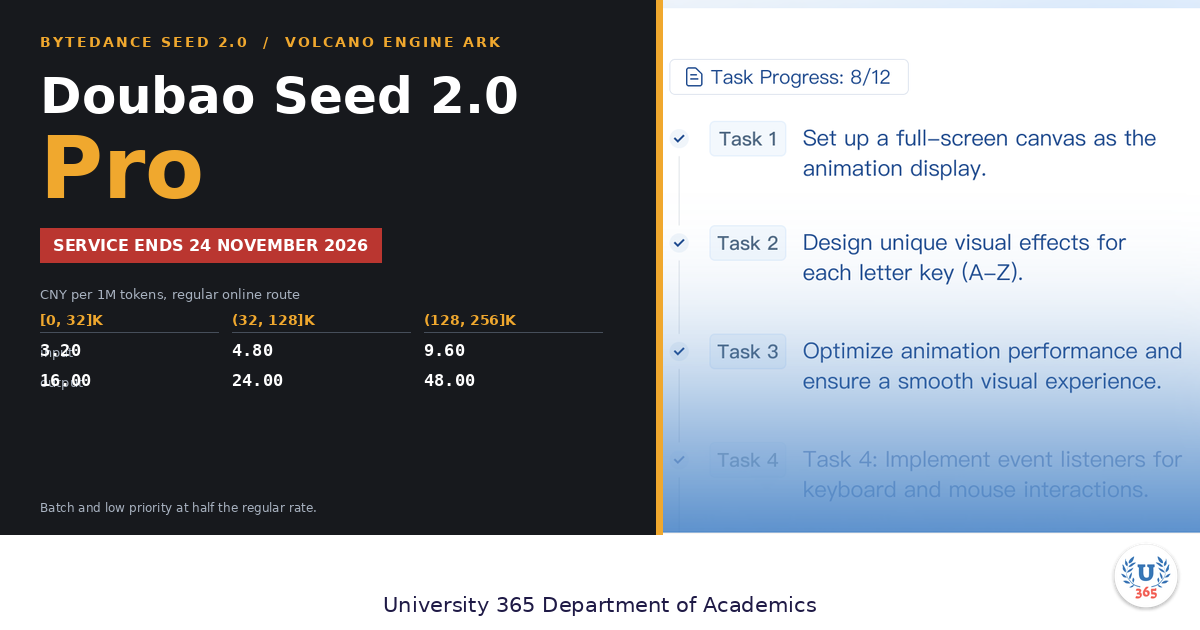
Status: Retired | Last tested: 2026-11-19 (Doubao Seed 2.0 Pro, doubao-seed-2-0-pro-260215, released 2026-02-14) | Re-check: trigger-based, service end 2026-11-24
Retired: the tool still works but is no longer recommended. See the Migration Path section.
For detailed explanations of the CI-First evaluation terms used in this review, including the Humics Protection Badge and the AI Imposture Risk levels, see the Glossary at the end of this post.


In this Tool Review

Doubao Seed 2.0 Pro
The id that answers, the name that bills, and the seven models that are not this one
Doubao Seed 2.0 Pro is a hosted model, so the identity that matters is the id a request carries. Four strings circulate for this product, and they do not do the same job.
Name | What it is | Where it appears |
Doubao Seed 2.0 Pro | The product name this review scores. The flagship of the Seed 2.0 general-purpose family, served on Volcano Engine (火山方舟, Ark) | The vendor's release announcement, the model list and the Seed 2.0 page |
doubao-seed-2-0-pro-260215 | The callable Model ID on Volcano Engine. A 256K context window, a 224K maximum input, a 128K maximum answer with a 4K default, and a 128K maximum thinking chain. It carries the vendor's retirement notice | The model list, the deprecation notice, and the platform's own samples |
doubao-seed-2.0-pro | The billing and family name on the price sheet. It is not a Model ID in the model list, and no platform sample passes it | The model price sheet, on one row with three input-length bands |
ByteDance/Seed-2.0-pro | The reseller listing name. Three third-party hosts list the model under it, with their own prices and their own terms | DeepInfra, Requesty and Liquid Inference listings |
Seven models sit beside it in the family, and this review scores one of them. Doubao Seed 2.1 Pro is a different tier with its own review and its own million-token window. Doubao Seed 2.1 Lite is the model the vendor names as this snapshot's replacement. Doubao Seed 2.1 Turbo is the low-cost member of the 2.1 generation. Doubao Seed 2.0 Lite and Doubao Seed 2.0 Mini are the smaller 2.0 tiers, with 256K windows and materially lower prices. Doubao Seed 2.0 Code Preview is a separate code model. Doubao Seed Evolving is a rolling model that changes under a stable id. None of their numbers is carried into this review, and every comparison below names the model it is against.
A seventh string is a route, not a tier. One tracker records seed-2-0-pro-260328 against an international documentation set. This review scores the Volcano Engine id in the table above, states no number from another route, and does not treat a snapshot token from a different surface as a second version of the same deployment.
This is a new review, not a re-score. No earlier review of Doubao Seed 2.0 Pro exists. The 2.1 Pro review is the nearest published reading of the family and the structural sibling, not a baseline for this model's scores.
The snapshot token is not a release date, but the release date is published this time. ByteDance's own Seed 2.0 launch post is dated 2026-02-14, and the platform's release announcement lists doubao-seed-2-0-pro-260215 as newly released in its February 2026 table. This review uses 2026-02-14 as the release date and the 260215 token as the snapshot id. The two agree, which is not always the case in this family.
What this review is not. It is not a review of Doubao Seed 2.1 Pro, 2.1 Lite, 2.1 Turbo, 2.0 Lite, 2.0 Mini, 2.0 Code Preview or Seed Evolving. It is not a review of the Doubao consumer app, of TRAE, of Seedance video generation or of Seedream image generation. It is not a review of Volcano Engine as a platform, although account, region, payment and lifecycle questions appear where they decide whether a reader can use the model at all. And it is not a recommendation to build on a model whose service ends on 2026-11-24.

Doubao Seed 2.0 Pro
Tool Snapshot
Doubao Seed 2.0 Pro is ByteDance's 256K-context, image-reading flagship of the Seed 2.0 generation, priced at CNY 3.20 per million input tokens and CNY 16.00 per million output tokens for prompts up to 32K, with the whole request repriced at every input-length band above that, benchmarked only by its maker, and scheduled to stop serving on 2026-11-24.
Category: Applied AI / Hosted large language model, built for long-document reading, multimodal understanding, agentic tool use and long-chain reasoning. It is a closed-weight model on a Chinese cloud platform, reached through an API key and a model id.
Primary use cases:
Whole-document reading in one call. A 224K-token maximum input holds a contract set, a 150-page evidence pack or a codebase slice without chunking, and a 128K maximum answer means the response can be a deliverable rather than a note. The 256K window is shared with the answer and with the thinking chain, so the usable input depends on what the request asks the model to produce.
Image and document understanding in the same request. The model list records multimodal understanding and visual grounding, so a scanned page, a chart, a table image or a screenshot can travel with the text rather than through a separate extraction step. Audio input is not priced and not listed for this model.
Agentic tool use and structured output. The model list records tool calling, structured output and GUI task handling. The platform exposes the Responses API, the Chat API, the Messages API and a Batch API, which is the surface a workflow builder needs before it writes a schema.
Long-chain reasoning with a visible trace. Deep thinking is a listed capability and is on by default at medium, with a 128K maximum thinking chain. The platform accepts seven reasoning_effort values and maps several of them onto the same effective level.
Volume work at the low tier. At CNY 3.20 input and CNY 16.00 output for prompts up to 32K, extraction, classification and short drafting are priced in the range that makes per-item processing affordable, and batch and low-priority routes halve both rates.
What it is not. It is not a current model: new purchases closed on 2026-09-24 and service ends on 2026-11-24. It is not open weights, not self-hostable and not inspectable from outside the vendor's service, and no parameter count or architecture description is published. It is not sold on a global rate card: the documentation is in Chinese and the prices are in renminbi. It is not an audio or video generator, and audio input is not listed for this model. It is not a teaching product, and nothing in it is built to move a capability from the model to the person.
Pricing, as published on 2026-11-19 (vendor currency, renminbi, per million tokens):
Line | Input length [0, 32]K | Input length (32, 128]K | Input length (128, 256]K |
Input, non-audio | CNY 3.20 | CNY 4.80 | CNY 9.60 |
Cached input, non-audio | CNY 0.64 | CNY 0.96 | CNY 1.92 |
Cache storage | CNY 0.017 per million tokens per hour | Same | Same |
Output, thinking tokens included | CNY 16.00 | CNY 24.00 | CNY 48.00 |
Audio input | Not priced | Not priced | Not priced |
Batch inference | CNY 1.60 input, CNY 0.64 cached, CNY 8.00 output | CNY 2.40, CNY 0.96, CNY 12.00 | CNY 4.80, CNY 1.92, CNY 24.00 |
Low-priority online inference | CNY 1.60 input, CNY 0.64 cached, CNY 8.00 output | CNY 2.40, CNY 0.96, CNY 12.00 | CNY 4.80, CNY 1.92, CNY 24.00 |
Low-latency online inference | CNY 9.60 input, CNY 1.92 cached, CNY 48.00 output | CNY 14.40, CNY 2.88, CNY 72.00 | CNY 28.80, CNY 5.76, CNY 144.00 |
Currency note | The vendor quotes renminbi only. Dollar figures below are conversions at a named rate and date, not the vendor's list price |
The price argument needs one paragraph of arithmetic, because the ladder is the product. Every rate is set by the length of the request's input, and the band applies to the whole request rather than to the tokens above the boundary. A 30K prompt pays CNY 3.20 per million input tokens; a 40K prompt pays CNY 4.80 on every input token; a 200K prompt pays CNY 9.60 on every input token, which is three times the headline rate. The output line follows the same ladder, from CNY 16.00 to CNY 24.00 to CNY 48.00. Output is exactly five times the input rate in every band, so a balanced request of one million input tokens and one million output tokens costs CNY 19.20, CNY 28.80 or CNY 57.60 depending on the band, and output is 83.3 per cent of each total. Cached input is one fifth of the input rate in every band, so a repeated preamble saves 80 per cent of its line and nothing on the rest. Batch and low priority are exactly half the regular rate on all three lines. Low latency is exactly three times the regular rate. At the exchange rate read on 2026-11-19, 6.680778 renminbi to the dollar, the three balanced totals are about US$2.87, US$4.31 and US$8.62. The edition row for this model publishes US$0.48 input, US$0.096 cached and US$2.3998 output, a conversion at about 6.67; at the rate used here the same base-band rates are US$0.479, US$0.0958 and US$2.395, and the difference is the exchange rate rather than the price.
Official links:
Model price sheet, with the three bands and the four routes: https://www.volcengine.com/docs/82379/1099320
Model list, with the id, the four limits and the capability labels: https://docs.volcengine.com/docs/ark/model-list
Model deprecation notice, with the EOM and EOS dates and the replacement model: https://docs.volcengine.com/docs/ark/model-deprecation-notice
Release announcement, where the id is listed as newly released in February 2026: https://www.volcengine.com/docs/82379/1159178
ByteDance Seed, Seed 2.0 official launch, dated 2026-02-14: https://seed.bytedance.com/en/blog/seed-2-0-official-launch
ByteDance Seed, Seed 2.0 model page and benchmark table: https://research.doubao.com/en/seed2
Deep thinking guide, with the reasoning_effort values and the default mapping: https://docs.volcengine.com/docs/ark/deep-thinking
Text generation guide: https://docs.volcengine.com/docs/ark/text-generation
Reseller listing used as an independent catalogue record: https://deepinfra.com/ByteDance/Seed-2.0-pro
Model-specific fields:
API model id: doubao-seed-2-0-pro-260215 on Volcano Engine. The billing name on the price sheet is doubao-seed-2.0-pro. A reseller listing uses ByteDance/Seed-2.0-pro.
Parameters: not disclosed. Architecture: not disclosed. Training-data statement: a vendor paragraph about usage-scenario data, quoted in Section 7c of this review.
Context window: 256K tokens. Maximum input: 224K. Maximum answer: 128K with a 4K default. Maximum thinking chain: 128K. The four maxima are published separately and do not sum to the window.
Input modalities: text and images. Output modality: text only. Audio input is not listed and not priced for this model.
Reasoning control: deep thinking is on by default. reasoning_effort on the Chat API and reasoning.effort on the Responses API accept none, minimal, low, medium, high, xhigh and max. The default for this model is medium; minimal turns thinking off, none maps to minimal, and xhigh and max map to high. The practical ladder is therefore off, low, medium and high.
Capabilities: deep thinking, text generation, multimodal understanding, visual grounding, GUI task handling, tool calling and structured output.
API surfaces: Responses API, Chat API, Messages API and Batch API. Prompt caching is supported, with prefix cache and session cache.
Rate limits: 30,000 maximum requests per minute and 5,000,000 maximum tokens per minute, published as non-rigid and affected by platform load and call pattern.
Licence: proprietary. The model is hosted only, with no weights and no download. Use is governed by Volcano Engine's platform terms, which this review does not reproduce.
Availability: Volcano Engine in mainland China, with the documentation and the price sheet in Chinese and renminbi. The model also appears on reseller listings with their own prices and terms.
Lifecycle: End of Model (no new purchases) 2026-09-24 at 10:00 UTC+8. End of Service 2026-11-24 at 14:00 UTC+8. Replacement named in the notice: doubao-seed-2-1-lite-260915.
At a Glance Dashboard
Field | Value |
Category | Applied AI / Hosted large language model (text and image input, text output, China-hosted) |
CI-First Benefit Score | 4.8 / 10 (CI-First Positive) |
Sub-scores | Time 6 / Quantity 6 / Quality 4 / Skill 3 |
CI-First Profile | Primary: Co-Worker and Assistant (level 2). Secondary: Co-Researcher, Analyst and Tester (level 4) |
Humics Protection | Humics-Neutral (-1 / +3) |
AI Imposture Risk | Medium overall, with Time Medium, Quantity Medium and Skill Medium |
Status | Retired |
Last tested | 2026-11-19 |
Pricing | CNY 3.20 input, CNY 16.00 output, CNY 0.64 cached per million tokens up to 32K; CNY 4.80 and CNY 24.00 to 128K; CNY 9.60 and CNY 48.00 to 256K; batch and low priority at half, low latency at three times |
Platforms | Volcano Engine (火山方舟, Ark) in mainland China, plus reseller listings |
User sentiment | Thin and launch-shaped: no review-platform listing, a public record of launch coverage, catalogue entries and reseller pages, and no independent benchmark |

Doubao Seed 2.0 Pro
The Problem
A team that needs a capable model for long documents and agent work has three options today, and the one that fits the budget is the one with the shortest life.
The first is a Western frontier model. It writes well, reads images, holds a long context and is available on every major cloud. It also prices like a frontier model, and it carries a procurement path that a university can complete. The problem is the bill at volume: a document pipeline that processes a thousand files a day is a line item that has to be defended every quarter, and the per-token price is where the defence fails first.
The second is a small model. It is cheap, it is fast, and it has become genuinely good at short tasks. It also carries a context window that is an order of magnitude smaller than the document set, and often no image input at all. The workaround is a retrieval pipeline: chunk the documents, embed them, retrieve the top passages, stitch them back together, and hope the answer was in the retrieved slice. That pipeline is a second product with its own failures, and the failures are quiet, because a missing passage looks exactly like a model that had nothing to say.
The third is a China-hosted model. It is the option a team reaches for when the price per token is the binding constraint and the workload is document-heavy, multilingual or image-heavy. ByteDance sells exactly that case: Doubao Seed 2.0 Pro reads a 224K-token input, reads images in the same request, and lists at CNY 3.20 per million input tokens for prompts up to 32K, which the vendor presents as roughly one tenth of the frontier price for the same token. The vendor's launch material makes the comparison directly, positioning the Pro model against GPT 5.2 and Gemini 3 Pro and claiming comparable performance at about an order of magnitude lower token price.
The problem it does not solve is the one that decides the project after the price. A China-hosted model is a procurement decision before it is a technical one: account eligibility, contracting entity, data location, payment currency and a documentation set in Chinese. And this particular model adds a third problem that no benchmark table shows: its service ends on 2026-11-24, five days after this review's scoring date, and new purchases closed on 2026-09-24. A team that builds on it is not buying a model, it is buying a migration.
There is a fourth problem, and it is evidentiary. The vendor publishes a broad benchmark table, and no independent evaluator has run this model at a published setting. Artificial Analysis lists Doubao Seed Code and does not list Doubao Seed 2.0 Pro on 2026-11-19. A buyer who needs an outside number before adopting has none, and a buyer who does not need one is trusting a table produced by the party selling the service.
The problem, in one sentence: Doubao Seed 2.0 Pro makes a long, multimodal document workflow cheap enough to run at volume, and the window to run it on the vendor's own platform is closing while the only quality evidence is the vendor's own table.

Doubao Seed 2.0 Pro
The Outcome
If Seed 2.0 Pro works as its evidence says, four things change for a U365 team, and the lifecycle bounds all four.
The first is the unit of work. The unit stops being a prompt and becomes a source set. A 224K-token maximum input holds a 150-page evidence pack, a term of meeting notes or a workbook extract, and an image of a scanned page can travel in the same request. The vendor's own framing is built on that unit: it reports that the largest share of requests to its general-purpose models is knowledge-intensive content from unstructured sources, such as complex charts and documents, and it tuned this generation for what it calls heavy reading and deep thinking. A team that has been chunking documents can stop chunking them, and the saving is more than tokens: it is the retrieval pipeline that no longer has to be built and maintained.
The second is the cost per answer. At CNY 3.20 per million input tokens and CNY 16.00 per million output tokens for prompts up to 32K, a 20K-input, 2K-output request costs about CNY 0.10, roughly US$0.015. The same request at the top band costs about CNY 0.29, because a 200K input reprices the whole request at CNY 9.60 and CNY 48.00. The useful comparison is not against a frontier model's headline rate but against the work the answer replaces: one analyst hour is worth thousands of these requests at the low band. The vendor's claim is that token pricing is about one order of magnitude lower than the models it benchmarks against, and the published renminbi rates support the direction of that claim at the low band and much less of it at the top band.
The third is a multimodal reading surface that does not need a second product. Text, images, charts and screenshots enter the same request, and the model list records visual grounding and GUI task handling alongside ordinary text generation. For a university, the practical shape is a reading assistant that can take a scanned page, a table image and a paragraph of instructions together, which is exactly the shape of the material a programme actually holds.
The fourth is a procurement boundary that a team has to settle before anything else. The service is on Volcano Engine, the documentation is in Chinese, the prices are in renminbi, and the model is not available on a European or American cloud. A team inside mainland China can contract for it directly; a team outside has to settle account eligibility, contracting entity, data location and payment before it settles a prompt. The reseller listings change the route but not the underlying question, because a reseller's terms are the reseller's.
What does not change is the verification burden, and the lifecycle raises it. The model returns a fluent, structured answer whether or not it is right, and the only published benchmark table is the vendor's. A team that adopts the low price without a check has bought volume, not quality. And a team that builds a workflow on this snapshot has to plan the move to Doubao Seed 2.1 Lite before 2026-11-24, which means the build is a build plus a migration from the first day. The outcome this review argues for is narrow and honest: a cheap, capable reading instrument for a bounded project that ends before the service does, or a migration exercise that treats 2.1 Lite as the real target and this model as the reference point.

Doubao Seed 2.0 Pro
Who Should Use Doubao Seed 2.0 Pro
Learner type | Difficulty | Typical ROI | Career path |
Students (Bachelor, Master) | Intermediate | A long-context model for a literature set, a thesis corpus or a scanned source pack, where the gain is that the whole set fits in one call and the risk is that a fluent summary of a paper the student has not read looks like understanding. The 224K input is the teaching-relevant feature and the Skill Illusion is the teaching-relevant danger: a student who can produce a comparison table without reading the sources has learned to produce tables. The service ends on 2026-11-24, so a coursework plan that depends on this snapshot is a plan with an expiry date. Access required a Volcano Engine account while the snapshot was on sale, which is a real step for a student outside China, and the snapshot can no longer be purchased. | |
Professionals (career upskilling) | Intermediate | The strongest case: contract sets, filing sets, codebase slices and reporting packs read whole, with a 128K answer ceiling and image input in the same request. The limits are evidential and organisational rather than technical. There is no independent measurement to calibrate trust against, and the vendor ends the service on 2026-11-24, so the professional's own check and own migration plan are the only safeguards. | |
Everyone (lifelong learners) | Beginner to Intermediate | A capable assistant for long documents, scanned pages and multilingual reading, reached through an API rather than a consumer subscription. The gain is a first pass over material that would otherwise go unread; the cost is an account, a credit balance, a habit of checking and a migration before the service ends. It is the wrong tool for a one-line question, because thinking is on by default. | LIPS Collect and Review phases for the reading work, and the UP-Context-Engineering Method order for prompting. No assessment home is asserted. |
For teams and organisations. The model is an API product on a Chinese cloud platform with a published end date, and a team deciding on it starts with four questions.
Team deployment. One model id, one key, one endpoint shape, and two decisions the team must write down: which snapshot is pinned, and when the migration happens. The snapshot is doubao-seed-2-0-pro-260215, new purchases closed on 2026-09-24, and service ends on 2026-11-24, so a deployment plan that does not name a migration date is a plan to be surprised. The platform exposes regular, batch, low-priority and low-latency routes, and the team's job is to assign each workload to a route rather than leave it to habit.
Cost at team scale. Four lines move independently: the input band, the output rate, the thinking setting and the route. Input is CNY 3.20, CNY 4.80 or CNY 9.60 per million tokens depending on the length of the request, and the band applies to the whole request rather than to the tokens above the boundary. Output is five times the input rate in every band and carries the thinking tokens. Cached input is one fifth of input, batch and low priority are half of regular, and low latency is three times regular. A team that budgets from the CNY 3.20 headline and then sends 100K-token documents is budgeting at less than half the real rate.
Data and compliance. The service is hosted on Volcano Engine under the platform's terms, the documentation is published in Chinese, and the prices are in renminbi. A team outside mainland China has to settle account eligibility, contracting entity, data location and payment before it settles anything about the model. The vendor states that it analysed how its general-purpose models are invoked and that the usage-scenario distribution came from its Volcano Ark Collaboration Incentive Program, with the relevant users having signed authorization agreements; a procurement reader should ask for the platform's current data-processing terms rather than rely on a launch paragraph. A legal, tax or financial analysis produced by the model remains a draft that a qualified person reviews.
U365 for companies. Professional learners reach University 365's academic services individually or through their organisation, and the company route runs through a customized training agreement for employee groups. Corporate education programmes are built on demand, and their tuition follows content and duration. A team that wants its engineers to learn context engineering and model-lifecycle management can use this review as a case study: the model is the cheap part, and the migration habit is the deliverable.
Skill level required: Intermediate. The model is easy to call and the hard part is scope: deciding what belongs in a 224K-token input, writing the instruction that keeps the answer inside the job, choosing whether thinking is worth its tokens, and knowing which part of the output you can check yourself. None of that is needed to get an answer, and all of it is needed to rely on one.
Prerequisites. A Volcano Engine (火山方舟, Ark) account with the model activated, an API key, and a decision about the snapshot id the code pins. Working knowledge of prompt structure and of verification practice, because the output reads as finished whether or not it is correct. A Chinese-reading colleague or a translation step if the team does not work in Chinese, because the documentation set is published in Chinese. And a migration target agreed before the first production call, because the service has an end date.
Typical time to first result: Under thirty minutes for a first successful call, most of it account setup rather than code. The call itself needs four decisions: the snapshot id, the thinking setting, the maximum answer length and the input band the request will land in.
Typical time to competence: Ten to twenty hours of active use. Two habits carry most of the value: assigning each workload to a band and a route before sending it, and pairing every long-context answer with a check you already own. A third habit is specific to this model: read the deprecation notice before the first build, not after the first failure.
Who should wait. Anyone starting a new project, because the service ends on 2026-11-24 and the vendor's replacement is a different model. Anyone whose work is short requests, because thinking is on by default and the 4K answer default is easy to hit. Anyone whose procurement cannot contract with a Chinese cloud platform, because the model is not available on another one. Anyone who needs an independently measured quality claim before adopting, because none is published. And anyone who needs audio input, image generation or video generation, because this model produces text and reads images, and nothing else.

Doubao Seed 2.0 Pro
U365 Institutes Alignment
The alignment below rates what a U365 institute could take from this model as a working instrument and as an object of study. The primary home is UIT (Technology, AI, Data Science), because the product's distinctive surface is context engineering at 224K tokens with images in the same request, and because its retirement is itself a production-engineering lesson. The other three readings are real and each is bounded.
UIT (Technology, AI, Data Science)
Rating. High (primary)
Why. Five engineering competencies, each of which survives the removal of the tool. Context engineering: a 224K input is not a prompt, it is a selection problem, and deciding what to include, what to cite and what to leave out is the discipline the window makes visible. Multimodal document handling: scanned pages, charts and tables enter the same request as text, and the engineering question is how to bound what the model is allowed to infer from an image. Structured output and tool calling: the model list records both, and using them well means writing a schema, bounding the tool set and checking the returned structure rather than reading it. Cost engineering: three input bands, four routes and a cache rate at one fifth of input is arithmetic a cohort can practise on live numbers. Lifecycle engineering: a published End of Model date, a published End of Service date and a named replacement make this the clearest real case a cohort will meet of why a model id is a dependency with an expiry date.
The limit that holds the row. The model is a service a practitioner operates, not an artefact a practitioner inspects. There are no weights, no architecture description and no parameter count, so the competencies are engineering-with rather than engineering-of. The documentation set is in Chinese, which adds a reading burden for a cohort working in English. No U365 credential is mapped here.
UIB (Business Management, Entrepreneurship)
Rating. Medium
Why. Three decisions the product forces that are commercial before they are technical. Procurement of a China-hosted service: account eligibility, contracting entity, data location, payment currency and the terms that govern all four are business decisions. Cost modelling across bands and routes: CNY 3.20 against CNY 9.60 on input, CNY 16.00 against CNY 48.00 on output, half price on batch and low priority, three times on low latency, which together decide whether a long-document workflow is affordable at volume. And vendor lifecycle risk: a model that the vendor retires after roughly nine months is a business continuity question, and the published replacement is a different tier with a different price. A business case built on the regular rate alone, or on the assumption that the model stays, is a case with two errors.
The limit that holds the row. The model supplies no management method and measures no return of its own. It publishes no completion rate and no time-per-task figure, so a business case has to be built and tested by the unit. No U365 credential is mapped here.
UIC (Digital Communication, Marketing)
Rating. Low to Medium
Why. Two competencies that matter and are easy to miss. Reading a vendor claim against the document that supports it: this model is a worked example, because a 256K window, a benchmark table and a three-band price are all true and none of them is an independent quality claim, and a communication practitioner who can separate the two is doing the job the profession claims. And a long-context drafting surface: a model that holds a brand guide, a set of past campaigns and a brief in one window is the shape of a drafting task rather than a chat, and image input lets a layout or a screenshot travel with the brief.
The limit that holds the row. The model teaches no register, no audience analysis and no publication standard. It returns no sourced evidence of its own by default, so fact-checking stays with the writer, and no campaign or content-strategy competency appears in it. Rated as evaluation contact with a writing surface. No credential is mapped.
UID (Digital Design, UX/UI)
Rating. Low to Medium
Why. The design contact is input-side and interface-side rather than visual authorship. The model reads images and documents alongside text, the model list records visual grounding, and the platform documents GUI task handling, so a designer can use it to read a screen set, compare states or turn a described interaction into structured output. Studying how a model reads a layout is useful preparation for judging what a design system has to make explicit.
The limit that holds the row. The model generates no images and evaluates no design against a brief. It produces text and structured data, so the visual surface is input plus specification rather than visual authoring. No layout, interaction or motion competency is assessed by it. No credential is mapped here.
U365 methods, not an institute (UNOP, ULM, LIPS, CARE and the UP-Context-Engineering Method)
Rating. Applicable
Why. The methods layer is relevant in the way a large window is: scope is a planning decision before it is a prompt decision, and the UP-Context-Engineering Method's eight layers are what keep a 224K request inside the job it was given. USER-PERSONA and FULL-CONTEXT decide what goes into the window; AI-PROFILE-ROLE-EXPERTISE and AI-EXACT-TASK decide the role and the task; AUDIENCE and EXPECTED-FORMAT-AND-CONSTRAINTS decide what comes out and how far it may go; USER-FINAL-GOAL and EXAMPLES are the optional layers that keep a long task anchored. The verification habit is LIPS Review and CARE in practice. The batch and low-priority routes are a planning discipline as well, because work that can wait should be planned to wait. UNOP has no direct fit: the model is not built to teach, and its gains come from capacity and disciplined execution rather than from a pedagogical mechanism.
The limit that holds the row. The model carries no method of its own and no coaching surface. A Fellow who does not record what was asked, which snapshot answered, at what thinking setting and on which documents has no account of the run, and nothing in the product writes that account for them. The lifecycle adds one more record the method should require: the date the dependency ends.

Doubao Seed 2.0 Pro
How Doubao Seed 2.0 Pro Works
Inputs. Text, and images or documents through the multimodal understanding surface, submitted through the platform's Responses API, Chat API or Messages API. The published limits are 256K tokens of context, a 224K maximum input, a 128K maximum answer with a 4K default, and a separate 128K maximum thinking chain. The four numbers are published separately and they do not sum to the window: a request cannot carry a 224K input, a 128K answer and a 128K thinking chain at once, so the caller has to budget the window across the three. The 4K default answer length is the setting most likely to truncate a first attempt, and the thinking chain consumes part of the same budget before the answer begins.
Reasoning. Deep thinking is a listed capability and is enabled by default on a call. The platform documents two ways to turn it off: thinking.type=disabled on the Chat API and reasoning.effort=minimal on the Responses API. reasoning_effort accepts seven values, none, minimal, low, medium, high, xhigh and max, and the default for this model is medium. The mapping is not one to one: minimal turns thinking off, none maps to minimal, and xhigh and max map to high, so the effective ladder has four rungs rather than seven. Thinking tokens are billed at the output rate, and the thinking chain has its own 128K ceiling. A reader who sends an extraction task without setting this is paying a reasoning rate for work that may not need reasoning.
Capabilities beyond text generation. The model list records four that change what a workflow can look like: multimodal understanding, visual grounding, tool calling, structured output and GUI task handling. Structured output is the one to use when a downstream system reads the answer, because a schema turns a prose response into a record. Visual grounding and GUI handling are the two to read the platform guides for before planning, because they change the failure modes rather than the price.
What it does not expose. No parameter count, no architecture description, no weights, no self-hosting route and no published training-data corpus appear in the vendor's documentation. The model holds no state between calls: memory, retrieval and the record of what was asked belong to the application that wraps it, not to the model. A prompt cache can hold a prefix, and that is a billing surface rather than a memory.
Rate limits. The model list publishes 30,000 maximum requests per minute and 5,000,000 maximum tokens per minute, and labels them non-rigid, affected by platform load and by call pattern. A team planning a large batch should read those two numbers before promising a throughput figure to anyone.
Where it runs. Volcano Engine (火山方舟, Ark) in mainland China. The documentation is published in Chinese, the price sheet is in renminbi, and the model ids are Volcano Engine model ids. That is the deployment context a reader should carry into any planning conversation, because it decides contracting, data location and payment before it decides anything about prompts. Reseller listings also offer the model under the name ByteDance/Seed-2.0-pro, with their own prices, their own uptime and their own continuity.
How it ends. The platform's deprecation notice places this snapshot in a batch that started reducing quotas on 2026-09-22, stopped new purchases on 2026-09-24 at 10:00 UTC+8, and ends service on 2026-11-24 at 14:00 UTC+8. The notice names doubao-seed-2-1-lite-260915 as the replacement and states that, unless the customer migrates, the platform will switch the traffic to the replacement model or shut the endpoint down. The notice also states that a model version generally lives three to six months. This one lived about nine months from release to End of Service.

Doubao Seed 2.0 Pro
Getting Started with Doubao Seed 2.0 Pro
A fifteen-minute checklist, in the order the platform requires. The first step is not technical, and it decides whether the other eight are worth doing.
Read the deprecation notice before creating the account. The service ends on 2026-11-24 at 14:00 UTC+8 and new purchases closed on 2026-09-24. If the project outlives that date, start on doubao-seed-2-1-lite-260915 instead, and use this review as the reference for what changed.
Create the account and activate the model. A Volcano Engine account with Ark (火山方舟) activated and this model enabled, if the account is still permitted to use it. The console is where the model is enabled and where the price sheet's routes are selected.
Create an API key and store it outside the code. The key belongs in a secret store, not in a notebook and not in a repository.
Pin the snapshot id in the request. Use doubao-seed-2-0-pro-260215. Do not send doubao-seed-2.0-pro: that is the billing name on the price sheet, not a Model ID in the model list. Pinning the snapshot is what makes the capacity and the end date of the deployment a decision rather than a coincidence.
Set the answer ceiling before the first long call. The default answer length is 4K. A 128K ceiling is available and the request has to ask for what it needs, inside a 256K window that also carries the input and the thinking chain.
Decide the thinking setting per task. Leave it on for analysis and planning. Turn it off for extraction, classification and reformatting, using thinking.type=disabled or reasoning.effort=minimal depending on the API surface. Write the decision down, because the default is medium rather than off.
Choose the band and the route before the call, not after the bill. A request under 32K input pays the base band; a request over 32K pays the middle band on every token; a request over 128K pays the top band on every token. Batch and low priority halve the rate for work that can wait, and low latency triples it for work that cannot.
Send one small call that proves the wiring. A short prompt with a known answer, checking the returned model id and the token usage fields, before any long document is sent.
Send one real document and measure it. Take the usage numbers from the response rather than estimating them, and multiply by the band and the route actually used. That number, not the list price, is the unit cost of the workflow.
Write the log line. Snapshot id, thinking setting, band, route, token counts, the document set and the end-of-service date. The model keeps no record, so the record is yours.
What to do when the first long call fails. Four causes cover most of it. A model id that is the family name returns an error rather than an answer, so check the id first. An answer that stops early is usually the 4K default ceiling rather than the window. A request that is rejected for length is usually the 224K input maximum or the shared window rather than the 256K context figure, because the answer and the thinking chain come out of the same budget. And a bill that looks wrong is usually a request that crossed a band, or thinking left on, or a route other than the one assumed.

Doubao Seed 2.0 Pro
Real Workflows
Three workflows, each chosen because the model's published capacity and a check the reader already owns sit in the same place. Each sample prompt uses the UP-Context-Engineering Method's eight layers in method order, with the constraints and the data limits inside EXPECTED-FORMAT-AND-CONSTRAINTS. Each workflow also assumes the migration date, because a workflow that cannot survive 2026-11-24 is a prototype rather than a process.
Workflow 1: Reduce a 150-page evidence pack to a brief you can defend
When to use it. A committee pack, a supplier dossier or a regulatory consultation with a fixed set of documents and a decision that has to be minuted. The 224K input is the reason the workflow exists: the whole pack goes in, and the retrieval pipeline does not have to be built.
The prompt, layer by layer.
USER-PERSONA: "You are a research analyst preparing a decision brief for a university committee. You cite the document and the page for every claim."
FULL-CONTEXT: the pack itself, in document order, each document prefixed with its file name and page count, plus the committee's question and the decision it has to take.
AI-PROFILE-ROLE-EXPERTISE: "Act as a Co-Researcher and Analyst. Your expertise is evidence synthesis, not advocacy."
AI-EXACT-TASK: "Produce a brief with four parts: what the pack establishes, what it leaves open, where two documents disagree, and the three questions the committee should ask before deciding."
AUDIENCE: "The committee, which has read the summary but not the pack."
EXPECTED-FORMAT-AND-CONSTRAINTS: "900 to 1,200 words. Every claim carries a document name and page. Mark any inference with the word inference. If the pack does not answer a question, say so rather than filling the gap. Do not use material outside the pack."
EXAMPLES: one short paragraph showing the citation form.
What it saves. The first pass over 150 pages, which is the part of the work that is reading rather than judgement.
Verification checklist.
Open the document. Every cited page exists and carries the sentence the brief attributes to it.
Check the disagreement row. The two documents really do say different things, and the difference is quoted rather than summarised.
Check the open questions. Each one is genuinely unanswered in the pack rather than answered somewhere the model did not read.
Check the inferences. Every paragraph the model marked as inference is one you would defend, and every paragraph it did not mark is sourced.
Workflow 2: Extract structured records from a scanned document set
When to use it. A batch of invoices, certificates, application forms or supplier declarations that arrive as scans or photographs, where the downstream system needs a fixed record rather than a description. Image input is what makes the workflow possible without a separate extraction product.
The prompt, layer by layer.
USER-PERSONA: "You are a records officer extracting fields from scanned documents into a fixed schema."
FULL-CONTEXT: one image per request, plus the schema and the field definitions, plus two examples of a correct record and one of a record that must be rejected.
AI-PROFILE-ROLE-EXPERTISE: "Act as a Co-Worker and Assistant. Precision matters more than completeness."
AI-EXACT-TASK: "Return one JSON object per document with the fields in the schema. If a field is illegible, return null and add the field name to a missing array. If the document is not the type declared, return rejected with the reason."
AUDIENCE: "The downstream records system, not a human reader."
EXPECTED-FORMAT-AND-CONSTRAINTS: "JSON only, no prose around it. Do not infer a value from context. Do not normalise a date or a name unless the schema says to. The schema is closed: no extra fields."
EXAMPLES: the two accepted records and the rejected one.
What it saves. The manual keying pass, and the second pass that catches the keying errors.
Verification checklist.
Validate the JSON. It parses, it matches the schema, and no extra field appears.
Spot-check the nulls. Ten documents with a null field are genuinely illegible rather than skipped.
Check the rejections. Every rejected document is the wrong type, and no accepted document should have been rejected.
Compare against a human sample. Twenty documents keyed by hand agree with the model's records, field by field.
Workflow 3: Turn a screen set and a specification into a test plan
When to use it. A product team has screenshots of an interface, a written specification and a release to test, and needs a plan that names what to check. The model reads images and text together, and the model list records visual grounding and GUI task handling, which is the capability the workflow leans on.
The prompt, layer by layer.
USER-PERSONA: "You are a QA lead writing a test plan for a web application release."
FULL-CONTEXT: the screenshots in a fixed order with their state names, the specification text, and the list of changes in this release.
AI-PROFILE-ROLE-EXPERTISE: "Act as a Co-Researcher and Tester. Your job is to find what could break, not to confirm that it works."
AI-EXACT-TASK: "Produce a test plan with one row per check: the screen, the state, the action, the expected result, and the risk if it fails. Add a short list of states the screenshots do not show but the specification implies."
AUDIENCE: "The QA team and the release manager."
EXPECTED-FORMAT-AND-CONSTRAINTS: "A table with five columns. No more than 40 rows. Every row names a screen from the supplied set or is marked as a gap. Do not invent a screen that is not in the set."
EXAMPLES: two rows in the required form.
What it saves. The first draft of the test plan, which is the part that is enumeration rather than judgement.
Verification checklist.
Check every row against a screenshot. The screen and state exist, and the expected result is consistent with the specification.
Check the gaps list. Each implied state is genuinely absent from the set rather than missed.
Check the risk column. The high-risk rows are the ones a release manager would name, not the easiest ones to test.
Run the plan on a staging build. The first ten rows pass or fail as written, which is the test of the plan rather than of the model.

Doubao Seed 2.0 Pro
Strengths, Limits, and AI Imposture Risk
Strengths
CI-First Benefit | Strength | Evidence |
Time | A real saving on long-document work, and a smaller one than the window suggests. | A 224K input removes the chunking and retrieval step for a 150-page pack, and a 128K answer ceiling allows a deliverable rather than a note. Held at 6 because thinking is on by default at medium, there is no published latency measurement, the 4K answer default truncates a first attempt, and a person still reads the brief and checks the citations. |
Quantity | A genuine multiplier at the low band, weakened by the ladder at the top. | CNY 3.20 input and CNY 16.00 output per million tokens up to 32K, with batch and low priority at half and cached input at one fifth of input. The multiplier is real for extraction and short drafting. Held at 6 because a request over 32K pays CNY 4.80 on every input token and one over 128K pays CNY 9.60, which is three times the headline rate, and because new purchases closed on 2026-09-24. |
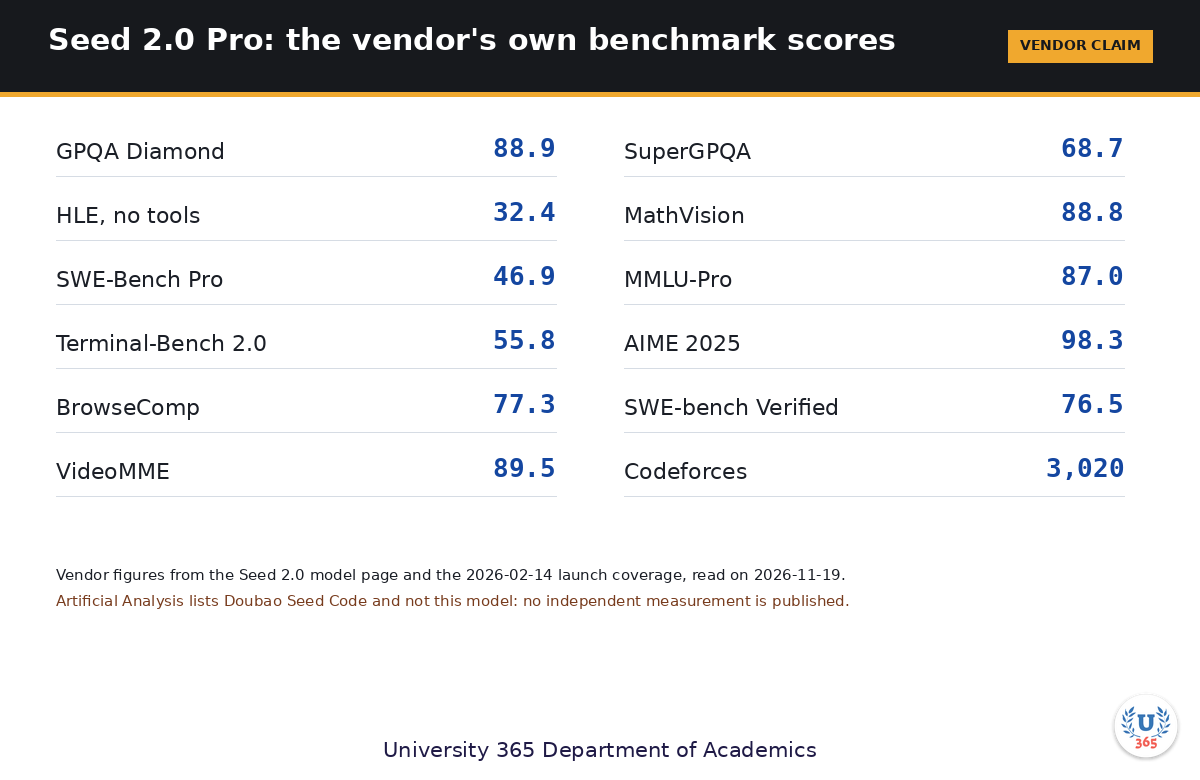
Quality | A broad vendor benchmark table, and no independent run. | The vendor's Seed 2.0 page reports GPQA Diamond 88.9, HLE 32.4, SWE-Bench Pro 46.9, Terminal-Bench 2.0 55.8, BrowseComp 77.3 and VideoMME 89.5 for the Pro snapshot, and its launch material is reproduced by several trackers with AIME 2025 98.3, Codeforces 3,020, SWE-bench Verified 76.5 and MMLU-Pro 87.0. Held at 4 because every one of those numbers is the vendor's, Artificial Analysis lists Doubao Seed Code and not this model, and the vendor's own table shows weaker rows, including HLE 32.4 and SWE-Bench Pro 46.9. |
Skill | Real for the engineer who runs the platform, thin for the user who only prompts it. | The platform documents four API surfaces, a reasoning control with a published mapping, structured output, tool calling and a three-band price sheet, and those are transferable engineering capabilities. Held at 3 because the common user only prompts it, the model teaches nothing while answering, the documentation is in Chinese, and the discipline that makes the output safe is the user's work rather than the tool's. |
Limits
The service ends on 2026-11-24. New purchases closed on 2026-09-24 at 10:00 UTC+8, and the platform ends service on 2026-11-24 at 14:00 UTC+8. The vendor's replacement is doubao-seed-2-1-lite-260915, a different model at a different price.
No independent measurement. Artificial Analysis lists Doubao Seed Code and does not list Doubao Seed 2.0 Pro on 2026-11-19. The benchmark table is the vendor's, and several trackers reproduce it rather than test it.
The price ladder reprices the whole request. A prompt over 32K pays CNY 4.80 per million input tokens on every input token, rather than on the tokens above the boundary alone, and a prompt over 128K pays CNY 9.60. The difference between the headline rate and the rate a long document actually pays is a factor of three.
The published maxima do not sum to the window. 224K input, 128K answer and 128K thinking chain are each published, and 256K is the shared window. A long input leaves less room for a long answer, and thinking consumes the same budget.
The default answer is 4K. A first call that produces a truncated answer usually hit the default rather than the ceiling, and the request has to ask for the length it needs.
Thinking is on by default at medium. Seven accepted reasoning_effort values map onto four effective levels, and a caller who passes xhigh or max gets high. The mapping is documented, and a bill that looks wrong is often this setting.
No parameters, architecture or training corpus. The vendor publishes none of the three, so a reader cannot assess the model's design or its data provenance from outside.
Documentation and billing are Chinese and renminbi only. A team outside mainland China has to settle account eligibility, contracting entity, data location and payment before it can use the model.
Structured output support varies by snapshot. The platform's capability table lists structured output for this snapshot and not for the code preview sibling, and a reseller catalogue records structured output as absent for the international snapshot. A workflow that depends on a schema should confirm the capability on the route it uses.
The reseller route is a different contract. Reseller listings offer the model on 2026-11-19, with their own prices and their own continuity after the Volcano Engine service ends. Their availability is not the vendor's promise.
AI Imposture Risk
Trap | Rating | Evidence |
Time Illusion | Medium | The saving is real on a long document: the whole pack goes in, and the retrieval step disappears. The illusion is in what the saving covers. Thinking is on by default at medium, the answer default is 4K, the published maxima have to be budgeted across one window, and no latency figure is published. A person still reads the brief, checks the citations and decides. The net saving is real for a team that already has a check and smaller for a team that does not. |
Quantity Illusion | Medium | The base rate invites volume: CNY 3.20 input and CNY 16.00 output, batch and low priority at half, cached input at one fifth. The output is fluent, structured and plausible, which is what makes an unverified pipeline dangerous. The ladder is the specific trap: a team that budgets from the headline rate and then sends 100K-token documents pays 1.5 times its budget on input and output at the middle band, and three times at the top band. A labelled sample and a band audit catch it at moderate effort, which is why this is Medium rather than High. |
Skill Illusion | Medium | A team can wire an OpenAI-compatible endpoint in an afternoon and come away believing it has a multimodal document capability. The rig that makes the model useful, the schema, the band budget, the exception path, the labelled sample and the migration plan, is the actual skill, and the model supplies none of it. Against that: the platform documents the reasoning mapping, the API surfaces and the capability labels, and the vendor publishes a broad benchmark table. Those are real learning surfaces, and they only work for a team that uses them. The retirement makes the illusion sharper: a capability built on this snapshot does not transfer to the replacement without work. |
Overall AI Imposture Risk: Medium. Three traps are Medium, which is the Medium band under the framework's arithmetic, and no trap is High. The band-precedence sentence does not change the outcome: where two ratings could apply to the same trap set, the higher rating governs, and no second rating competes for this set. The rating holds at Medium for a specific reason: the model is genuinely cheap at the low band and genuinely capable at reading a long document, so the time and volume it offers are real, and the failure that matters is an answer that looks like the others and a bill that arrives at a band the team did not plan. The checks a reader can own, a twenty-item labelled sample, a band audit and a page-level citation check, are cheap enough to run at the model's own scale.
Framework v1.2 clause note
Clause 5.2.3-a, agent-authored procedural memory, with a Skill Illusion floor of no lower than Medium, returns a null for this model. Seed 2.0 Pro holds no state between calls and writes nothing. It has no mechanism for creating or revising skills, memory stores or standing instructions, and the weights are not published at all. The floor is therefore not triggered by the model. The live condition is specific: a wrapper that lets the model rewrite its own tools, prompts or standing instructions between sessions, without a per-write human decision, would meet the condition, and the floor would apply to the wrapper rather than to the endpoint.
Clause 4.2-a, agent-mediated conversation, returns a null with a live condition. The model can write in a person's voice when asked, and that is a composition capability rather than an erosion by itself. The dimension is about the human's own communicative capability. Condition (a) is met when model-written text is presented as the person's own voice in a human-facing channel without that person reading it, and an agent that uses this model to answer a colleague in the owner's name, unread, crosses it. Condition (b) is met when the person substitutes the model for human contact. The model supplies neither condition on its own.
Recorded together: both clauses return nulls with boundaries and live conditions rather than mechanisms. The reason Skill Illusion sits at Medium is not a clause mechanism. It is the plain fact that a cheap, fluent, image-reading model with a broad vendor benchmark table invites a team to treat it as a documents analyst, while the only quality evidence is the vendor's own and the service ends in five days.

Doubao Seed 2.0 Pro
Section 7c: A capable model five days from the end of its service, priced on a ladder that triples at the top, and measured only by its maker
A Section 7c finding is recorded where a supplier's governance, lifecycle, commercial terms or measurement record has a real result for the reader. The items below were checked against primary sources on 2026-11-19, and they produce findings a buyer should carry. Every finding is stated as a fact of record, and the difference between a vendor statement, an independent measurement and a documentation defect is kept intact. No sub-score changed for any of them, and the paragraph after the findings says why.
The model is in a published retirement batch, and the dates are exact. Volcano Engine's deprecation notice places doubao-seed-2-0-pro-260215 in a batch whose notice started on 2026-09-22 at 10:00 UTC+8, whose End of Model date, when new purchases stop, was 2026-09-24 at 10:00 UTC+8, and whose End of Service date is 2026-11-24 at 14:00 UTC+8. The notice names doubao-seed-2-1-lite-260915 as the suggested replacement and states that, for a customer who does not migrate, the platform will switch the traffic to the replacement or shut the endpoint down. The same page states that a model version generally lives three to six months and that this notice is issued by SMS, in-platform message and platform announcement. The model was released on 2026-02-14, so the End of Service arrives about nine months later. The finding for a buyer is not that a vendor retires models, which is normal. It is that the retirement was already in progress before this review was written, that new purchases had been closed for eight weeks, and that a reader who finds this review through a model catalogue may find it after the service has ended.
The price ladder reprices the whole request at each boundary, and the top band is three times the headline. The price sheet states that the doubao-seed-2.0-pro series uses segmented billing, in which the input and output length of each request decides the token price, and its own worked example is explicit: a request with a 200K input and a 14K output falls in the input-length band (128, 256], so all of the tokens it produces are billed at the band's rates rather than at a blended rate. Read from the rendered table on 2026-11-19, the regular online rates are CNY 3.20, CNY 4.80 and CNY 9.60 per million input tokens for [0, 32]K, (32, 128]K and (128, 256]K, and CNY 16.00, CNY 24.00 and CNY 48.00 per million output tokens for the same bands. The consequence is arithmetic a reader can check: a 200K-input request pays three times the base input rate on every input token, and a 150-page document is exactly the kind of request the window invites. Batch inference and low-priority online inference are each exactly half the regular rate on all three lines, low-latency online inference is exactly three times, and cached input is one fifth of the input rate in every band. The headline rate and the rate a long document pays are different numbers, and the difference is the single most useful cost fact in this review.
The benchmark record is the vendor's, and the independent evaluator that covers ByteDance covers a different model. The Seed 2.0 page, read on 2026-11-19, publishes a table in which the Pro snapshot scores GPQA Diamond 88.9, SuperGPQA 68.7, HLE without tools 32.4, BeyondAIME 86.5, CL-Bench 20.8, MultiChallenge 68.3, WideSearch 74.7, BrowseComp 77.3, SkillsBench 42.3, GDPval 54.4, SWE Multilingual 71.7, SWE-Bench Pro 46.9, Terminal Bench 2.0 55.8, MathVision 88.8, MMMU Pro 78.2, VideoMMMU 86.9, VideoReasonBench 77.8 and VideoMME 89.5, alongside competitor columns. The launch coverage adds AIME 2025 98.3, Codeforces 3,020, SWE-bench Verified 76.5 and MMLU-Pro 87.0, and three trackers reproduce those figures with the same February 2026 date. Artificial Analysis, read on 2026-11-19, carries 1,043 model names and the only Doubao entry is Doubao Seed Code, with no Doubao Seed 2.0 Pro row. Nothing in the vendor table is false, and the finding is that the only published numbers come from the party selling the service, that the table's strongest rows sit beside weaker ones, and that the vendor's own table names some competitor settings and leaves others unnamed.
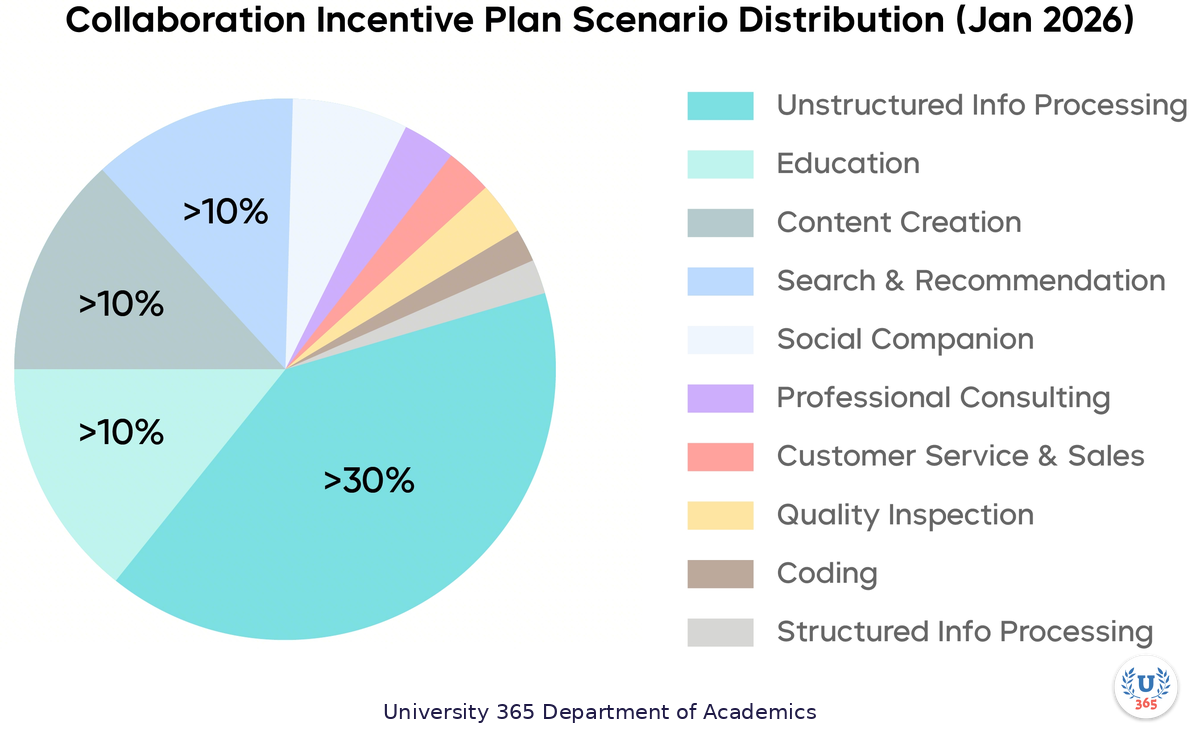
The vendor states how service usage data entered the tuning, and the statement is a vendor statement. The Seed 2.0 launch post says the distribution of Seed general-purpose model MaaS service usage scenarios in mainland China was analysed, that the data came from the "Volcano Ark Collaboration Incentive Program", and that the relevant users had signed authorization agreements. That is a disclosure a buyer should read in full and a procurement team should test against the platform's current terms. It is not an independent audit of what data was used, and this review neither treats the paragraph as a clean data position nor converts it into an allegation. The test for the section is the one this series applies throughout: the paragraph is about the world and belongs in the review, while the platform's actual contract is the document a buyer has to read.
The four published maxima do not fit inside the window, and a planner has to budget them. The model list publishes a 256K context window, a 224K maximum input, a 128K maximum answer with a 4K default, and a 128K maximum thinking chain. A request that carries a 224K input cannot also carry a 128K answer and a 128K thinking chain inside a 256K window. The numbers are each true as a cap, and the arithmetic a reader needs is that the three share one budget. The practical consequence is that the largest document and the longest answer are alternatives rather than a combination, and that thinking on by default spends part of the budget before the answer starts.
What the section does not do. It does not change any sub-score, because the four dimensions measure what the reader's work gains per unit of cost while the service runs, and the lifecycle is carried by the status badge, the limits and the Migration Path instead. It does not score Doubao Seed 2.1 Lite, which is the replacement and not this product. It does not treat the vendor's benchmark table as false, and it does not treat it as independent. And it does not convert a published retirement date into a claim about the model's quality: a retiring model can be good, and this one is cheap and capable at reading a long document, which is exactly why an unplanned dependency on it is a risk rather than a bargain.

Doubao Seed 2.0 Pro
U365 Co-Intelligence Rating
CI-First Profile
Primary profile: Co-Worker and Assistant (level 2). Secondary profile: Co-Researcher, Analyst and Tester (level 4).
Why this profile and not Co-Creator. The product's own framing decides it. ByteDance sells Seed 2.0 Pro for complex reasoning and long-chain task execution, with the work directed by a person who supplies the document set and reviews the answer. That is delegation, not dialogue, and Co-Worker and Assistant is the role the model actually plays. Analyst and Tester is recorded as secondary because the model reads a source set, states assumptions and produces a structured record, and because the vendor's benchmark table is strongest on analysis-shaped tasks. Professor, Coach and Tutor is not recorded: the model teaches nothing while it answers, and the platform documentation teaches the operator rather than the model teaching the user. Challenger, Critic and Devil's Advocate is not recorded either: the model answers the question it is given, and it does not argue against the premise.
CI-First Benefit Score
Dimension | Score (0-10) | Rationale |
Time | 6 | Moderate savings in the 25 to 50 per cent band. A 224K input removes the chunking and retrieval step for a long document set, and a 128K answer ceiling allows a deliverable rather than a note. Held at 6 because thinking is on by default at medium, no latency figure is published, the 4K answer default truncates a first attempt, and a person still reads the brief and checks the citations. |
Quantity | 6 | Moderate, with a real multiplier at the low band. CNY 3.20 input and CNY 16.00 output per million tokens up to 32K, batch and low priority at half, cached input at one fifth. Held at 6 because a request over 32K pays CNY 4.80 on every input token and one over 128K pays CNY 9.60, which is three times the headline, and because new purchases closed on 2026-09-24. |
Quality | 4 | The measured-absence position. The vendor publishes a broad table and the numbers are internally consistent, with GPQA Diamond 88.9, HLE 32.4, SWE-Bench Pro 46.9, Terminal-Bench 2.0 55.8, BrowseComp 77.3 and VideoMME 89.5. Held at 4 because there is no independent run at a published setting, Artificial Analysis covers Doubao Seed Code and not this model, and the vendor's own weaker rows are the analyst's core work. |
Skill | 3 | Marginal, scored conservatively per the framework. The platform documents four API surfaces, the reasoning mapping and the price sheet, and those are real engineering capabilities for the person who runs it. Held at 3 because the common user only prompts it, the model teaches nothing while answering, the documentation is in Chinese, and the discipline that makes the output safe is the user's work. |
CI-First Benefit Score: 4.8 / 10 (CI-First Positive)
Why the score sits where it sits
4.8 with sub-scores 6 / 6 / 4 / 3 is a cheap, long-context, image-reading model with a broad vendor benchmark table, no independent measurement, a price ladder that triples at the top, and five days of service left on the day it is scored. Every part of that sentence is measured.
Why not higher. Three reasons, each measured. There is no independent capability evidence: the only table is the vendor's, and the independent evaluator that covers ByteDance covers a different model. The cost advantage is band-dependent: a 200K request pays three times the base input rate, so the headline that makes the model attractive is not the rate a long document pays. And the model cannot be newly purchased, which means the benefit a reader can actually capture is bounded by a service that ends on 2026-11-24.
Why not lower. The model does real work at a real price. A 224K input holds a 150-page pack, image input removes a separate extraction product, the platform publishes four API surfaces and a documented reasoning mapping, and the base-band rate of CNY 3.20 per million input tokens is roughly one tenth of a Western frontier model's price. A Neutral band would misdescribe a model that works, and the Retired badge already carries the adoption warning.
Why 4.8 and not a higher band, stated as arithmetic. Time 6, Quantity 6, Quality 4 and Skill 3 average to 19 divided by 4, which is 4.75, rounded to 4.8. That sits in the upper half of the CI-First Positive band, which runs from 4.1 to 6.0. The composition is the finding: the two dimensions that measure throughput and cost carry the score, Quality is held down by the absence of independent measurement rather than by a measured weakness, and Skill holds it down because a model that answers does not teach.
The band is not an adoption recommendation, and the badge is the reason. A Retired model can score Positive on benefit and still be the wrong thing to build on. The score answers what the model offers per unit of cost; the badge answers whether a reader should start. On this review the two answers differ, and a reader who takes only the number has taken half the finding.
What the score does not carry. The four dimensions do not carry the End of Model date, the End of Service date, the replacement model, the three-band ladder, the shared window, the Chinese documentation, the renminbi billing or the vendor-only benchmark record. Those sit in Section 7c, in the limits and in the Migration Path, and no sub-score moved for any of them.
Humics Protection Badge
Dimension | Rating | Rationale |
Creativity | Neutral (0) | It can write, restructure and generate variants, and it cannot originate a direction the prompt did not contain. For a user with an idea it is a fast executor; for a user without one it produces a fluent average of what the prompt implied. It neither sparks ideation nor replaces it, and the zero is a non-application more than a balance. |
Critical Thinking | Erodes (-1) | The product is built for output at volume and at a price that discourages checking, and its answers are fluent whether or not they are right. On the protective side, the thinking trace can be read, the reasoning mapping is documented, the model reads a supplied source set and the vendor publishes its weaker rows as well as its stronger ones. On the eroding side, the only benchmark table is the vendor's, the price ladder makes the headline look simpler than the bill, the 4K default produces a truncated answer that reads like a short one, and the consumer surfaces hide the trace. The erosion lands on the person who reads the answer, not on the engineer who read the price sheet. |
Social Authenticity | Neutral (0) | The model can write in a person's voice, and that is composition rather than erosion by itself. Clause 4.2-a returns a null for the model. The live condition stays in the record: an agent that sends model-written messages in a person's name without that person reading them crosses condition (a), and the model would be the author of the text even though the agent sent it. |
Humics Protection Score: -1 / +3
Badge: Humics-Neutral
Superhuman Usage Guidance
When to invite this tool:
A long document set that fits inside 224K tokens and a decision that has to be taken before 2026-11-24, where the alternative is a retrieval pipeline you would have to build for a shorter-lived project.
Image-heavy reading: scanned pages, charts, tables and screenshots that would otherwise need a separate extraction product.
High-volume extraction or classification at the base band, where the prompt stays under 32K and a labelled sample exists.
A migration rehearsal: use this model to characterise the workload, then move it to Doubao Seed 2.1 Lite before the service ends.
A teaching case for context engineering and lifecycle management, where the point is the discipline rather than the deployment.
A batch or low-priority job with no deadline, where the half-price route matches the work.
When to keep this tool out:
Any new production workflow that will still run after 2026-11-24.
Any claim that must be backed by an independent benchmark, because none is published for this model.
Any workflow that depends on audio input, image generation or video generation, which this model does not provide.
Any procurement that cannot contract with a Chinese cloud platform, because the model is not on another one.
Any budget built on the CNY 3.20 headline without a band audit, because a 150-page document pays the middle or top band on every token.
Any request that needs a 224K input and a 128K answer at the same time, because the maxima share one 256K window.
Decisions about a person's credit, employment, housing, insurance, education, healthcare or legal rights, where a general model should not be the decision-maker at all.

Doubao Seed 2.0 Pro
What Users Say
Aggregate Rating Table
Surface | What it reports | Read on |
G2 | No listing for this model | 2026-11-19 |
Capterra | No listing for this model | 2026-11-19 |
Trustpilot | No listing for this model | 2026-11-19 |
Product Hunt | No listing for this model | 2026-11-19 |
LMSYS Chatbot Arena | The vendor states that Seed ranks 6th on the Text Arena overall leaderboard and 3rd on the Vision Arena leaderboard as of 2026-02-16. The claim is about Seed as an entity, not about this snapshot alone | Vendor announcement, 2026-02-14, figure dated 2026-02-16 |
Reseller catalogue, DeepInfra | A live listing at US$0.50 input, US$3.00 output and US$0.10 cached per million tokens, a 256,000-token context and multimodal input | 2026-11-19 |
Tracker, Developers Digest | US$0.50 input and US$3.00 output for prompts up to 128,000 tokens, US$1.00 and US$6.00 above that, a 256K context, a 128K maximum output, image input and no audio input | 2026-10-30, as recorded by the tracker |
What the public record contains
The public record for this model is launch-shaped. ByteDance published a launch post on 2026-02-14 and a Seed 2.0 model page with a benchmark table. TechNode covered the release on the same day, reporting that the Pro variant is benchmarked against GPT 5.2 and Gemini 3 Pro, that it is designed for long-chain reasoning and agent-based tasks, that the vendor claims leading results across multimodal, math and coding benchmarks, and that token pricing is about one order of magnitude lower. The Decoder covered the same launch and described the multimodal upgrade as the largest change in the generation. Several catalogues and price trackers recorded the model within weeks, and reseller listings carry it today.
What is missing from it, and why that matters more here than usual
There is no user-review corpus. A China-hosted API model with a nine-month life does not accumulate G2 or Trustpilot reviews, and the absence is a fact about the product's market rather than a gap in this review. There is also no independent capability measurement: the trackers reproduce the vendor's numbers, and Artificial Analysis covers Doubao Seed Code rather than this model. A reader who wants a user's opinion of the model's reliability on their own workload will not find one in public, and a reader who wants an independent benchmark will not find one either. What exists is the vendor's table, the launch coverage, the catalogue entries and the reseller prices, and this review uses each for what it is.
Sentiment Summary
The sentiment that can be read from the public record is about price and positioning rather than about daily use. Launch coverage repeats the vendor's comparison to Western frontier models and its claim of an order of magnitude lower price. Tracker pages repeat the benchmark figures without testing them. The reseller listings compete on price and route rather than on measured reliability. The public record contains no completion rate, time-per-task figure or failure rate on real work, and this review does not invent one.
U365 Editorial Note
The honest reading of the public record is that this model has a strong vendor table, a very low base price and no outside verification. That combination is exactly where a reviewer should slow down: the table is broad enough to be persuasive, the price is low enough to discourage checking, and the service ends soon enough that a mistake has a short window to be discovered. A U365 reader should treat the vendor's numbers as claims to be tested on their own workload, not as a capability they have acquired, and should treat the retirement date as the first fact of any plan.

Doubao Seed 2.0 Pro
Comparison and Alternatives
The comparison below uses published prices read on 2026-11-19 and the ratings in this review. The alternatives are the models a buyer of this one would actually consider, and each paragraph names the case in which it is the better choice.
Model | Vendor | Context | Input, per million tokens | Output, per million tokens | Status on 2026-11-19 | Independent measurement |
Doubao Seed 2.0 Pro | ByteDance | 256K | CNY 3.20 up to 32K, CNY 4.80 to 128K, CNY 9.60 to 256K | CNY 16.00, CNY 24.00, CNY 48.00 | Retired, service ends 2026-11-24 | None published |
Doubao Seed 2.1 Lite | ByteDance | 1,024K | CNY 0.80 | CNY 2.70 | Active, named as the replacement | None published |
Doubao Seed 2.1 Pro | ByteDance | 1,024K | CNY 6.00 | CNY 30.00 | Active | None published |
Doubao Seed 2.0 Lite | ByteDance | 256K | CNY 0.60 up to 32K, CNY 0.90 to 128K, CNY 1.80 to 256K | CNY 3.60, CNY 5.40, CNY 10.80 | Active, later snapshot | None published |
Choose Doubao Seed 2.1 Lite if you were about to choose this model. It is the vendor's own replacement, it carries a 1,024K input band at a single rate of CNY 0.80 input and CNY 2.70 output, and it costs roughly a quarter of this model's base input rate and a sixth of its base output rate. The trade is a different model with different behaviour, and the migration is not a model-id swap: The Migration Path section lists what moves and what does not.
Choose Doubao Seed 2.1 Pro if the work needs the family's strongest reasoning and a long context. It lists at CNY 6.00 input and CNY 30.00 output with a single band to 1,024K, which is simpler to budget than this model's ladder and about twice the base-band price. It is the model this review's own sibling scores, and a reader who needs the flagship rather than the retiring mid-tier should read that review before deciding.
Choose Doubao Seed 2.0 Lite if the workload is high-volume and the documents are shorter. At CNY 0.60 input and CNY 3.60 output for prompts up to 32K, it is about a fifth of this model's base rate, and its later snapshot is an LTS model on the platform's list. It gives up the Pro tier's capability, which is the point: a classification job does not need the flagship.
Choose DeepSeek V4.1 Flash if an open-weight model and an independent measurement matter more than a Chinese cloud contract. It publishes weights, it has been examined once by an independent evaluator on a 43-question data-analysis exam where it scored 36 at US$0.46 per run, and its own U365 review carries the price and the caveats: https://www.university-365.com/post/deepseek-v4-1-flash-native-vision-and-890-byte-kv-cache-at-low-api-cost The trade is a different supplier, a different licence and a different deployment path, and a reader who needs to keep the model inside their own infrastructure should start there rather than here.

Doubao Seed 2.0 Pro
Verdict and Next Steps
Verdict. Doubao Seed 2.0 Pro is a capable, cheap, long-context, image-reading model with a broad vendor benchmark table, no independent measurement, a three-band price ladder that triples at the top, and a published end of service on 2026-11-24. It scores 4.8 / 10, CI-First Positive, and it is Retired. The two statements are consistent: the model offers real benefit per unit of cost while it runs, and a reader should not start new work on it.
What to do this week, in order.
If you already run the model, open the deprecation notice today. Confirm the End of Service date, the replacement model and the auto-switch behaviour for your endpoints, and put the date in the same calendar as the release.
Inventory the calls that depend on the snapshot. Count them by band, by route and by thinking setting, because the migration changes the price basis as well as the model.
Re-run one representative workflow on Doubao Seed 2.1 Lite. Compare the output on the same document set, and measure the token counts rather than estimating them.
Rebuild the cost model on the new band. A single 1,024K band at CNY 0.80 input and CNY 2.70 output is simpler than three bands, and the comparison to your current bill is the business case.
Retire the snapshot explicitly rather than letting the platform switch it. An automatic switch changes the model under a running workflow, and the notice states that only the thinking parameter is carried automatically in such a switch.
Keep the check you built. The labelled sample, the schema validation and the citation check are the part of the workflow that transfers to any model, and they are the part worth the effort.
A UP-Context prompt pack for the migration decision
Use the eight layers in method order. The pack is deliberately short, because the decision is a decision rather than a document.
USER-PERSONA: "You are an engineering lead preparing a migration decision for a university's document workflow."
FULL-CONTEXT: the current call inventory (model id, band, route, thinking setting, monthly tokens), the deprecation notice dates, the replacement model's published limits, and the two candidate models with their prices.
AI-PROFILE-ROLE-EXPERTISE: "Act as a Co-Researcher and Analyst with expertise in platform migration and cost modelling."
USER-FINAL-GOAL: "A decision the leadership team can take in one meeting."
AI-EXACT-TASK: "Produce a migration brief with four parts: what breaks on 2026-11-24, what moves unchanged, what has to be rebuilt, and the cost of the two candidate models at our own token volumes."
AUDIENCE: "The leadership team, which will not read the deprecation notice itself."
EXPECTED-FORMAT-AND-CONSTRAINTS: "800 words maximum. Every cost figure is derived from the supplied inventory and the published rates. Mark every assumption. Do not recommend a model that is not in the supplied list. State the migration date explicitly."
EXAMPLES: one short paragraph showing the cost comparison form.
Related U365 content
The CI-First doctrine, which this review applies: https://www.university-365.com/post/discover-the-ci-first-approach
The Doubao Seed 2.1 Pro review, the family's current flagship and this model's nearest sibling: https://www.university-365.com/post/doubao-seed-2-1-pro-bytedance-s-million-token-model-priced-in-renminbi-and-measured-by-nobody-yet

Doubao Seed 2.0 Pro
Status and Last Tested
Status: Retired Last tested: 2026-11-19 Version tested: Doubao Seed 2.0 Pro (doubao-seed-2-0-pro-260215, released 2026-02-14) Re-check: trigger-based, with the service end on 2026-11-24 as the first trigger
Retired: the tool still works but is no longer recommended. See the Migration Path section.
The badge records a published lifecycle fact rather than a judgement of the model. ByteDance closed new purchases of this snapshot on 2026-09-24 at 10:00 UTC+8 and ends the service on 2026-11-24 at 14:00 UTC+8, and its deprecation notice names doubao-seed-2-1-lite-260915 as the replacement. On the scoring date the model still answers, the price sheet still lists it and the documentation still describes it, which is why the review is published rather than withheld. A reader who arrives after 2026-11-24 should treat the model as Deprecated on the Volcano Engine route and read the Migration Path for what to use instead.
The date in Last tested is the date the vendor's own surfaces were read: the price sheet, the model list, the deprecation notice, the release announcement, the Seed 2.0 page and the reseller listings. No claim in this review rests on a figure that was not on one of those surfaces on that date. The re-check triggers are listed at the top of the post, and the first one is a date rather than an event.

Doubao Seed 2.0 Pro
Migration Path
The replacement is Doubao Seed 2.1 Lite (doubao-seed-2-1-lite-260915), named by the vendor in the deprecation notice. It is available on the same platform, and its price sheet row is a single input band [0, 1,024]K at CNY 0.80 per million input tokens, CNY 0.16 cached and CNY 2.70 output. A reader who wants the family's strongest model instead should consider Doubao Seed 2.1 Pro at CNY 6.00 input and CNY 30.00 output on a single 1,024K band, and should read that model's own review.
What transfers unchanged.
The request shape: the platform's Chat API, Responses API and Messages API carry the same message structure, and the OpenAI-compatible surface means most client code moves without a rewrite.
The prompt pack: the eight UP-Context-Engineering layers are model-independent, and a pack written for one model is a pack for the next one.
The schema and the validation: a closed JSON schema and its validator are the part of the workflow that catches a model change, and they move as they are.
The images and the document set: multimodal input is a capability of the family rather than of this snapshot, and the same material can be sent to the replacement.
The check you built: a labelled sample, a citation check and a schema validator are the transferable assets, and they are worth more than the prompt.
What does not transfer.
The model id. doubao-seed-2-0-pro-260215 is not an alias for the replacement, and a call that keeps the old id after 2026-11-24 reaches a stopped endpoint.
The price basis. Three bands at CNY 3.20, 4.80 and 9.60 become one band at CNY 0.80, and the batch, low-priority and low-latency ratios have to be re-read on the replacement's row rather than assumed.
The context and answer limits. This model publishes 256K context, 224K input, 128K answer and 128K thinking chain; the replacement publishes a 1,024K band and its own maxima, and a request written to the old limits has to be re-budgeted.
The behaviour. A different model answers differently on the same pack, and the labelled sample has to be re-run rather than trusted.
The thinking default. The replacement's default and its reasoning_effort mapping are its own, and a caller who relied on medium should check what the replacement does with the same value.
Migration steps.
Read the deprecation notice and record the two dates. End of Model was 2026-09-24; End of Service is 2026-11-24 at 14:00 UTC+8. The notice states that an unmigrated endpoint is switched to the replacement or shut down.
Inventory the calls by model id, band, route and thinking setting. The inventory is the input to both the cost model and the test plan.
Read the replacement's price row and limits from the price sheet and the model list. Do not carry this model's bands or maxima across.
Run the same document set on the replacement and compare against your labelled sample. Record the answer length, the token counts and the failures.
Change the model id explicitly and remove the old one from the code. An automatic switch is the fallback, not the plan, and the notice states that only the thinking parameter is carried automatically.
Re-baseline the cost and the check. A single band makes the bill simpler to predict, and the check has to be re-run on the new model before the old one stops.
What this section does not do. It does not score the replacement, which has its own review and its own evidence. It does not promise that the replacement behaves like this model on any particular workload. And it does not treat the automatic switch as a migration: an endpoint that changes model under a running workflow is an incident waiting for a date.

Doubao Seed 2.0 Pro
U365's Recommendations to Learn More
Start with the deprecation notice, not the model page
The first document to read is the one that says when the service ends: https://docs.volcengine.com/docs/ark/model-deprecation-notice. It carries the batch dates, the replacement model and the statement that an unmigrated endpoint is switched or shut down. A reader who reads it first saves the rest of the list for the right reason.
Then read the price sheet for its bands, not its headline
The price sheet is at https://www.volcengine.com/docs/82379/1099320, and the useful part is the condition column. Read the three input-length bands, the worked example in the batch section, and the cache-storage line. A reader who takes only the CNY 3.20 headline has taken the one number that applies least often to a long document.
Then the release announcement, for what the vendor says the model is for
The February 2026 release table at https://www.volcengine.com/docs/82379/1159178 describes the snapshot as a flagship general-purpose model for complex reasoning and long-chain task execution in the agent era. The Seed 2.0 launch post at https://seed.bytedance.com/en/blog/seed-2-0-official-launch is dated 2026-02-14 and carries the vendor's own framing, including its use of the Volcano Ark Collaboration Incentive Program data.
Then the benchmark table, read as a vendor claim
The Seed 2.0 model page at https://research.doubao.com/en/seed2 carries the table quoted in Section 7c of this review. Read the weaker rows as carefully as the stronger ones, and read the competitor columns for the settings they were run at, which the page does not publish. An independent catalogue is at https://artificialanalysis.ai/leaderboards/models, and on 2026-11-19 it lists Doubao Seed Code and not this model.
Watch a working run before you deploy
Each video below resolves, verified on 2026-11-19:
https://www.youtube.com/watch?v=ht5lRRX1vFU, "Doubao 2.0 Changes Everything: Why Silicon Valley Is Suddenly Nervous", Aivolve.
https://www.youtube.com/watch?v=xeoaqWRBNv0, "Doubao 2.0 Is China's Most Dangerous AI Yet (Silicon Valley Panics)", AI Revolution.
https://www.youtube.com/watch?v=FE-Sn6S9QH4, "ByteDance Has Launched DouBao 2.0 To Rival Deepseeks New Model", GadInsider.
https://www.youtube.com/watch?v=bFcPQu2T0co, "ByteDance Launched Doubao 2.0: DESTROYED OpenAI ChatGPT and Google Gemini", MaxonShire.
https://www.youtube.com/watch?v=9j3yIYz5lZk, a Chinese-language tutorial on running Seed 2.0 Pro through coding tools, 搞机零距离.
The videos are launch coverage rather than independent benchmarks, and a reader should watch them for the shape of the product rather than for a measurement.
Resources on X
Dedicated X channels

DouBao on X: https://x.com/doubao_AI
Caixin Global, whose release coverage is quoted in the What Users Say section: https://x.com/caixin
The release coverage post used in this review is https://x.com/caixin/status/2022811592396509635, verified on 2026-11-19.
U365 courses and programmes that build the surrounding skill
The competencies this model exercises are taught across the U365 institutes rather than by the vendor: context engineering and evaluation design at UIT (Technology, AI, Data Science), procurement and vendor-lifecycle reading at UIB (Business Management, Entrepreneurship), and the communication reading of a vendor claim at UIC (Digital Communication, Marketing). A reader who wants the method rather than the model should start with the UP-Context-Engineering Method and the LIPS Review habit.
The one habit to carry
Read the lifecycle before the benchmark. This model is the clearest case in the library: a capable, cheap, well-documented model whose service ends five days after the review that scores it. A team that checks the End of Service date before it checks the benchmark table avoids the most expensive mistake in this review, and a team that checks the band before it checks the headline avoids the second.

Doubao Seed 2.0 Pro
CI-First Evaluation Summary Card
Field | Value |
Tool | Doubao Seed 2.0 Pro (doubao-seed-2-0-pro-260215), ByteDance |
Category | Applied AI / Hosted large language model (text and image input, text output, China-hosted) |
CI-First Benefit Score | 4.8 / 10, CI-First Positive |
Sub-scores | Time 6 / Quantity 6 / Quality 4 / Skill 3 |
CI-First Profile | Primary: Co-Worker and Assistant (level 2). Secondary: Co-Researcher, Analyst and Tester (level 4) |
Humics Protection | Humics-Neutral (-1 / +3). Creativity 0, Critical Thinking -1, Social Authenticity 0 |
AI Imposture Risk | Medium overall. Time Medium, Quantity Medium, Skill Medium |
Framework v1.2 clauses | 5.2.3-a null with a live condition, 4.2-a null with a live condition |
Status | Retired |
Last tested | 2026-11-19 |
Version tested | Doubao Seed 2.0 Pro (doubao-seed-2-0-pro-260215, released 2026-02-14) |
Pricing | CNY 3.20 input, CNY 16.00 output, CNY 0.64 cached per million tokens up to 32K; CNY 4.80 and CNY 24.00 to 128K; CNY 9.60 and CNY 48.00 to 256K; batch and low priority at half, low latency at three times |
Primary institute | UIT (Technology, AI, Data Science) |
Review status | Retired: the tool still works but is no longer recommended |

Doubao Seed 2.0 Pro
Glossary
CI-First Benefit Score
The arithmetic mean of the four benefit dimensions, each scored 0 to 10, rounded to one decimal place. 0 to 2.0 is CI-First Negative, 2.1 to 4.0 is CI-First Neutral, 4.1 to 6.0 is CI-First Positive, 6.1 to 8.0 is CI-First Strong, and 8.1 to 10 is CI-First Transformative. Doubao Seed 2.0 Pro scores 4.8, which is Positive.
Time Benefit
Whether the tool returns more time than it costs, after the overhead of using it is subtracted. Doubao Seed 2.0 Pro is 6: a 224K input removes the chunking and retrieval step for a long document set and a 128K answer ceiling allows a deliverable, while thinking is on by default at medium, no latency figure is published, the 4K answer default truncates a first attempt, and a person still reads the brief and checks the citations.
Quantity Benefit
Whether the tool increases the volume of usable work a person can produce in a given time. Doubao Seed 2.0 Pro is 6: CNY 3.20 input and CNY 16.00 output per million tokens up to 32K, batch and low priority at half, cached input at one fifth, held at 6 because a request over 32K pays CNY 4.80 on every input token and one over 128K pays CNY 9.60, three times the headline, and because new purchases closed on 2026-09-24.
Quality Benefit
Whether the tool helps the user produce better work than they could alone, judged after verification rather than on surface polish. Doubao Seed 2.0 Pro is 4: the vendor publishes a broad table with GPQA Diamond 88.9, HLE 32.4, SWE-Bench Pro 46.9, Terminal-Bench 2.0 55.8, BrowseComp 77.3 and VideoMME 89.5, and no independent evaluator has run this model at a published setting, since Artificial Analysis covers Doubao Seed Code and not this model.
Knowledge and Skill Benefit
Whether the tool helps the user learn what they did not know and do what they did not know how to do. Doubao Seed 2.0 Pro is 3, scored conservatively: the platform documentation teaches four API surfaces, a reasoning mapping and a three-band price sheet to the engineer who runs it, and the common user only prompts it, receives an answer and learns nothing the model did not already know.
Humics Protection Badge
The sum of three ratings, each +1, 0 or -1, across Creativity, Critical Thinking and Social Authenticity. +2 to +3 is Humics-Friendly, -1 to +1 is Humics-Neutral and -2 to -3 is Humics-Risky. Doubao Seed 2.0 Pro scores -1, which is Humics-Neutral: it executes creative directions without originating them, it erodes critical thinking because a fluent answer at a low headline price discourages checking and the only benchmark table is the vendor's, and it can write in a person's voice without that being erosion by itself.
AI Imposture Risk
The likelihood that the tool traps its user in one of three illusions: the Time Illusion, where the overhead exceeds the saving; the Quantity Illusion, where volume passes for quality; and the Skill Illusion, where the user believes they can do what the tool did. Each trap is rated Low, Medium or High. Doubao Seed 2.0 Pro is Medium overall, with all three traps Medium, and no trap High.
CI-First Profile
The role the AI plays in the working relationship: Co-Creator and Thought Partner (1), Co-Worker and Assistant (2), Professor, Coach and Tutor (3), Co-Researcher, Analyst and Tester (4), or Challenger, Critic and Devil's Advocate (5). Doubao Seed 2.0 Pro is primarily Co-Worker and Assistant, with Co-Researcher, Analyst and Tester as a secondary role, because the product is sold for long-chain execution and its strongest vendor evidence is analysis-shaped.
User Sentiment
The direction of independent and practitioner reaction to the tool, read from what testers and users actually reported rather than from a rating average, because no review platform rates an individual hosted model. For Doubao Seed 2.0 Pro the record is launch-shaped and vendor-weighted: no listing exists on G2, Capterra, Trustpilot or Product Hunt, the vendor states a sixth place on the Text Arena and a third on the Vision Arena as of 2026-02-16, reseller and tracker catalogues carry the price and the 256K window, and no completion rate, time-per-task figure or failure rate on real work is published anywhere in it.
Review Status
The badge on this review states how much confidence to place in it. The vocabulary: Active means the tool is current and recommended. Active (updated) means it is current and recommended and was recently re-checked and refreshed. Changed means a re-check trigger fired and an update is pending, so read it with that in mind. Risky means the tool has significant unresolved issues or has been clearly surpassed by newer alternatives, so use it with caution and read the Limits section. Stale means the review has not been re-checked in over six months, so treat pricing and features as unverified. Retired means the tool still works but is no longer recommended, and Deprecated means it has been shut down or fundamentally changed. This review is Retired: the vendor closed new purchases on 2026-09-24 and ends the service on 2026-11-24.
Last tested and Re-check
The date on which the review's evidence was last read against the vendor's own surfaces, and the condition under which it will be read again. This review was last tested on 2026-11-19 and is re-checked on a trigger list whose first entry is the published End of Service date, 2026-11-24, because a model with a fixed end date moves faster than any calendar interval can track.

Doubao Seed 2.0 Pro
Sources
Vendor primary sources:
Volcano Engine, model price sheet, with the three input-length bands, the cache-storage line, the batch, low-priority and low-latency tables, and the worked segmented-billing example: https://www.volcengine.com/docs/82379/1099320
Volcano Engine, model list, with the callable id, the four limits, the capability labels, the API surfaces and the rate limits: https://docs.volcengine.com/docs/ark/model-list
Volcano Engine, model deprecation notice, with the batch dates, the End of Model and End of Service dates, the replacement model and the three-to-six-month lifecycle statement: https://docs.volcengine.com/docs/ark/model-deprecation-notice
Volcano Engine, release announcement, February 2026 table listing doubao-seed-2-0-pro-260215 as newly released: https://www.volcengine.com/docs/82379/1159178
Volcano Engine, deep thinking guide, with the seven reasoning_effort values, the medium default for this model and the mapping rules: https://docs.volcengine.com/docs/ark/deep-thinking
Volcano Engine, text generation guide: https://docs.volcengine.com/docs/ark/text-generation
ByteDance Seed, Seed 2.0 official launch, dated 2026-02-14, including the Volcano Ark Collaboration Incentive Program paragraph and the LMSYS statement: https://seed.bytedance.com/en/blog/seed-2-0-official-launch
ByteDance Seed, Seed 2.0 model page, with the benchmark table used in Section 7c: https://research.doubao.com/en/seed2
Independent measurement and reporting:
Artificial Analysis, model leaderboard, 1,043 model names read on 2026-11-19, with Doubao Seed Code listed and Doubao Seed 2.0 Pro absent: https://artificialanalysis.ai/leaderboards/models
TechNode, "ByteDance Releases Doubao-Seed-2.0, Positions Pro Model Against GPT 5.2 and Gemini 3 Pro", 2026-02-14: https://technode.com/2026/02/14/bytedance-releases-doubao-seed-2-0-positions-pro-model-against-gpt-5-2-and-gemini-3-pro
The Decoder, "Bytedance's Seed2.0 adds even more price pressure on Western AI models": https://the-decoder.com/bytedances-seed2-0-adds-even-more-price-pressure-on-western-ai-models
Developers Digest, Seed 2.0 Pro pricing and specs, with the 128K maximum output, image input and no audio input, recorded 2026-10-30: https://www.developersdigest.tech/models/seed-2-0-pro
TokenLab, Doubao-Seed-2.0-Pro price tiers, with the three official bands: https://tokenlab.sh/en/models/doubao/doubao-seed-2.0-pro
DeepInfra, ByteDance/Seed-2.0-pro listing, US$0.50 input, US$3.00 output, US$0.10 cached, 256,000-token context: https://deepinfra.com/ByteDance/Seed-2.0-pro
evals.report, Doubao Seed 2.0 Pro benchmark record, six vendor-reported benchmarks dated 2026-02-14: https://evals.report/models/bytedance-doubao-seed-2-0-pro
HokAI, Seed 2.0 Pro model page, vendor-reported benchmarks dated 2026-02-14: https://hokai.io/hub/models/seed-2.0-pro
Community and launch coverage:
Aivolve, "Doubao 2.0 Changes Everything: Why Silicon Valley Is Suddenly Nervous": https://www.youtube.com/watch?v=ht5lRRX1vFU
AI Revolution, "Doubao 2.0 Is China's Most Dangerous AI Yet (Silicon Valley Panics)": https://www.youtube.com/watch?v=xeoaqWRBNv0
GadInsider, "ByteDance Has Launched DouBao 2.0 To Rival Deepseeks New Model": https://www.youtube.com/watch?v=FE-Sn6S9QH4
MaxonShire, "ByteDance Launched Doubao 2.0: DESTROYED OpenAI ChatGPT and Google Gemini": https://www.youtube.com/watch?v=bFcPQu2T0co
搞机零距离, Chinese-language tutorial on running Seed 2.0 Pro through coding tools: https://www.youtube.com/watch?v=9j3yIYz5lZk
Caixin Global on X, release coverage, 2026-02: https://x.com/caixin/status/2022811592396509635
DouBao on X: https://x.com/doubao_AI
U365 internal reference:
U365 CI-First Evaluation Framework v1.4.1 (University 365 research methodology), read alongside the published doctrine at https://www.university-365.com/post/discover-the-ci-first-approach
U365 INSIDE Tools Review of Doubao Seed 2.1 Pro, the family's current flagship, published at 5.0 / 10 CI-First Positive: https://www.university-365.com/post/doubao-seed-2-1-pro-bytedance-s-million-token-model-priced-in-renminbi-and-measured-by-nobody-yet
U365 INSIDE Tools Review of DeepSeek V4.1 Flash, the open-weight model used as an alternative in the Comparison and Alternatives section: https://www.university-365.com/post/deepseek-v4-1-flash-native-vision-and-890-byte-kv-cache-at-low-api-cost

Doubao Seed 2.0 Pro
Faculty Note on Evidence Quality
What this review rests on, in order of weight. First, the vendor's own primary documents: the price sheet with the three bands and four routes, the model list with the id, the limits and the capability labels, the deprecation notice with the two dates and the replacement, the deep-thinking guide with the reasoning mapping, the release announcement and the Seed 2.0 launch post with the vendor's framing, and the Seed 2.0 model page with the benchmark table. Second, catalogue and tracker records that reproduce the vendor's prices and benchmark figures with their own dates, used to confirm that the numbers have not drifted between surfaces. Third, the Artificial Analysis leaderboard, used to establish an absence rather than a score: it lists Doubao Seed Code and does not list Doubao Seed 2.0 Pro on 2026-11-19. Fourth, launch coverage and reseller listings, used for the reception and the route rather than for a capability number.
Where the vendor's numbers and the independent numbers meet, and where they part. They meet on the price at the base band: the reseller's US$0.50 input is close to the CNY 3.20 rate converted at the 2026-11-19 exchange rate, while its US$3.00 output sits above the converted CNY 16.00, which is a reseller margin rather than a vendor rate. They meet on the model identity: the callable id, the 256K window, the 128K maximum answer and the image input appear on the vendor's pages and on two independent catalogues. They part on quality: every benchmark figure in this review is the vendor's or a reproduction of it, and the one independent evaluator that covers ByteDance covers a different model. They also part on the long-context price: the reseller's tier structure is its own, and a reader comparing a reseller's flat-looking rate to the vendor's three bands is comparing two contracts.
The documentation conflicts and gaps, and there are five. The published maxima do not sum to the window: 224K input, 128K answer and 128K thinking chain on a 256K context, which is a set of caps rather than a budget. The default answer is 4K while the ceiling is 128K, so the same model produces a truncated answer or a deliverable depending on a parameter. Structured output is listed for this snapshot on the platform's capability table and recorded as absent for the international snapshot by one catalogue. The international snapshot id recorded by one tracker is not the Volcano Engine id this review scores. And the vendor publishes no parameter count, no architecture description and no training corpus. This review states each as a documentation fact, uses the platform's own table and price sheet where they are the more careful record, and does not convert an absent figure into a favourable one.
What is measured and what is inferred. The three bands, the four routes, the cache rate, the two lifecycle dates, the replacement model, the four limits, the rate limits, the seven reasoning_effort values, the medium default and the mapping are read from vendor primary sources and dated. The benchmark figures are the vendor's, reproduced by named trackers, and labelled as vendor figures wherever they appear. The absence of an Artificial Analysis entry was measured on the leaderboard on 2026-11-19 and is dated. The judgement that this model is the right instrument for a bounded long-document project that ends before the service does is an interpretation of those facts against the work the model is sold for, and it is the interpretation this review defends. The claim that a reader will over-delegate is an inference from the framework's model of human behaviour, supported by the price, the fluency and the absence of independent measurement, and it is labelled as an inference wherever it appears.
One finding cuts against the model and should be said as plainly as the rest. The vendor's own table puts HLE without tools at 32.4 and SWE-Bench Pro at 46.9, which are the rows closest to the hard reasoning and engineering work a professional buyer cares about, and they sit beside a GPQA Diamond of 88.9 that reads much stronger. A reader who takes the headline row as the model's level is reading the best row rather than the table. The same table names some competitor settings, such as GPT-5.4 High and Gemini 3.1 Pro High, and leaves others unnamed, so a comparison against a named model is a comparison against a partly unknown configuration.
One finding cuts in the model's favour and should be said as plainly. At the base band the model is genuinely cheap for what it reads: CNY 3.20 per million input tokens and CNY 16.00 per million output tokens, with image input in the same request, a 224K input, a 128K answer ceiling and a documented reasoning control. A team with a bounded document project and a labelled sample can get real work out of it before 2026-11-24 at a price that makes the check affordable, and the platform's batch and low-priority routes halve the rate for work that can wait.
What this review does not do. It does not score Doubao Seed 2.1 Pro, 2.1 Lite, 2.1 Turbo, 2.0 Lite, 2.0 Mini, 2.0 Code Preview or Seed Evolving, which are separate products with their own prices. It does not score the Doubao consumer app, TRAE, Seedance or Seedream. It does not treat the vendor's benchmark table as an independent measurement, and it does not convert a vendor comparison into a capability claim. It does not score the replacement named in the deprecation notice, and it does not promise that a migration preserves behaviour. A reader who needs a capability figure for their own workload has to build the twenty-item sample, and the Verdict and Next Steps section says how.
Attribution and scoring date. This review was scored by Hubert Graef, Dean of Research at University 365 Research Center, on 2026-11-19, against the CI-First Evaluation Framework v1.4.1. The evidence was read on that date, and the review is re-checked on the trigger list at the top of the post.

Doubao Seed 2.0 Pro
Status and Re-check
Status: Retired | Last tested: 2026-11-19 (Doubao Seed 2.0 Pro, doubao-seed-2-0-pro-260215, released 2026-02-14) | Re-check: trigger-based, service end 2026-11-24
Retired: the tool still works but is no longer recommended. See the Migration Path section.
The badge is not a judgement of the model's capability. ByteDance closed new purchases of this snapshot on 2026-09-24 at 10:00 UTC+8 and ends the service on 2026-11-24 at 14:00 UTC+8, and the vendor's own migration notice names Doubao Seed 2.1 Lite as the replacement. A team that reads this review on the day it publishes has four days of service left on the Volcano Engine route, and a team that already runs the model has a migration to plan. The CI-First Benefit Score of 4.8 describes what the model offers per unit of cost while it runs. It is not an adoption recommendation, and the Migration Path section states what to move to.
For detailed explanations of the CI-First evaluation terms used in this review, including the Humics Protection Badge and the AI Imposture Risk levels, see the Glossary at the end of this post.
Re-check triggers:
The service end date. Volcano Engine's deprecation notice gives 2026-11-24 at 14:00 UTC+8 as End of Service for doubao-seed-2-0-pro-260215. If the date moves, the badge and the Migration Path both change, and this review is re-read on the day it moves.
A new snapshot id, or a change to the replacement model named in the notice. The notice names doubao-seed-2-1-lite-260915. A different replacement, or a new snapshot of the replacement, changes the Migration Path section.
A change to any of the three input-length bands, or to the batch, low-priority or low-latency ratio. Quantity rests on the ladder in the Tool Snapshot, and a band change moves every cost figure in this review.
The first independent evaluation of this model at a published setting. Artificial Analysis lists Doubao Seed Code and does not list Doubao Seed 2.0 Pro on 2026-11-19. An independent run is the trigger that would move Quality.
A change to the thinking default or to the reasoning_effort mapping. Thinking is on by default at medium, and the mapping decides what a caller who passes minimal, none, xhigh or max actually gets.
A change to the context window, the maximum input, the maximum answer or the maximum thinking chain. The four numbers are published separately and they do not sum to the window, so a change to one changes what a request can carry.
A change to the international or third-party routes. A tracker records an international snapshot and reseller listings offer the model on 2026-11-19. Their continuity after the Volcano Engine service ends is their own, and a reader on one of those routes is reading a different contract.
A published change to the platform terms, or to the vendor's statement about how service usage data entered training. Section 7c quotes the vendor's announcement on that point, and the quotation is dated.




Comments