
Nova Pro: Amazon's 300K-context multimodal model, still on the rate card after its published end-of-life date

Status: Risky | Last tested: 2026-11-20 (Nova Pro, amazon.nova-pro-v1:0, released 2024-12-05) | Re-check: trigger-based (max 6 months)
Risky: the tool has significant unresolved issues, or it has been clearly surpassed by newer alternatives. Use it with caution and read the Limits section.
For detailed explanations of the CI-First evaluation terms used in this review, including the Humics Protection Badge and the AI Imposture Risk levels, see the Glossary at the end of this post.


In this Tool Review
The name, the generation and the two dates: what this review scores and what it does not
Six names belong to this family, and three of them are easy to confuse.
Name | What it is | Where it appears |
Nova Pro | The model this review scores, the mid-tier multimodal member of the first Nova generation | The Bedrock model card, the Nova pricing page, the launch note |
amazon.nova-pro-v1:0 | The model id a Bedrock call uses, and the identity of record here | The model card's programmatic-access table |
us.amazon.nova-pro-v1:0, eu.amazon.nova-pro-v1:0, apac.amazon.nova-pro-v1:0 | Geo cross-Region inference ids for the same model, with no Global equivalent | The model card's programmatic-access table |
Nova Premier | The flagship of the same first generation, a different model with its own price, its own evidence and its own review | The Nova pricing page and its own model card |
Nova 2 Pro | A different model in the next generation, sold as a preview, with a 1M-token window and a different id | Its own model card and its own INSIDE review |
Nova 2 Lite | A different model in the next generation, generally available, cheaper and larger-windowed than this one | Its own model card and its own INSIDE review |
This is a new review, not a re-score. No U365 Tools record carried an Amazon Nova row of this generation before this one, no live Tools post covered it, and no local review document existed for it. The two Nova records in the Tools collection on 2026-11-20 are Nova 2 Lite and Nova 2 Pro, and neither is scored, inherited or folded into this document. Nova Premier is a separate commission and is not scored here.
Two dates are published for one launch, and they differ by two days. The AWS announcement of the Nova generation is dated 2024-12-03, the first day of re:Invent 2024, and Artificial Analysis carries 2024-12-03 as the release date. The Bedrock model card of record states a model launch date of 2024-12-05. Both are vendor surfaces and both are current on 2026-11-20. This review treats 2024-12-05 as the launch date of record, because the model card is the document that also carries the lifecycle dates, and states the announcement date wherever the distinction matters.
What this review is not. It is not a review of Amazon Bedrock as a platform, of Nova Premier, of Nova 2 Lite or of Nova 2 Pro, each of which is a different model with its own price and its own evidence. It is not a review of Amazon Nova Act, which is an agent product rather than a model, or of Nova Canvas and Nova Reel, which generate images and video. It is not a review of the AWS console, of Bedrock Agents as a service, or of any application built on the model. Those surfaces appear where the framework's clauses reach them, and no more.
The status is Risky and the score is 4.0, and the two statements answer different questions. The score measures what a reader's work gains per unit of cost while the model serves, which is a real but narrow gain on document, image and video extraction. The badge measures whether U365 recommends the model now, and it does not: Amazon sells a cheaper, larger-windowed, more current model in the same family, and this one is nearly two years old with a knowledge cutoff in October 2024.
Tool Snapshot
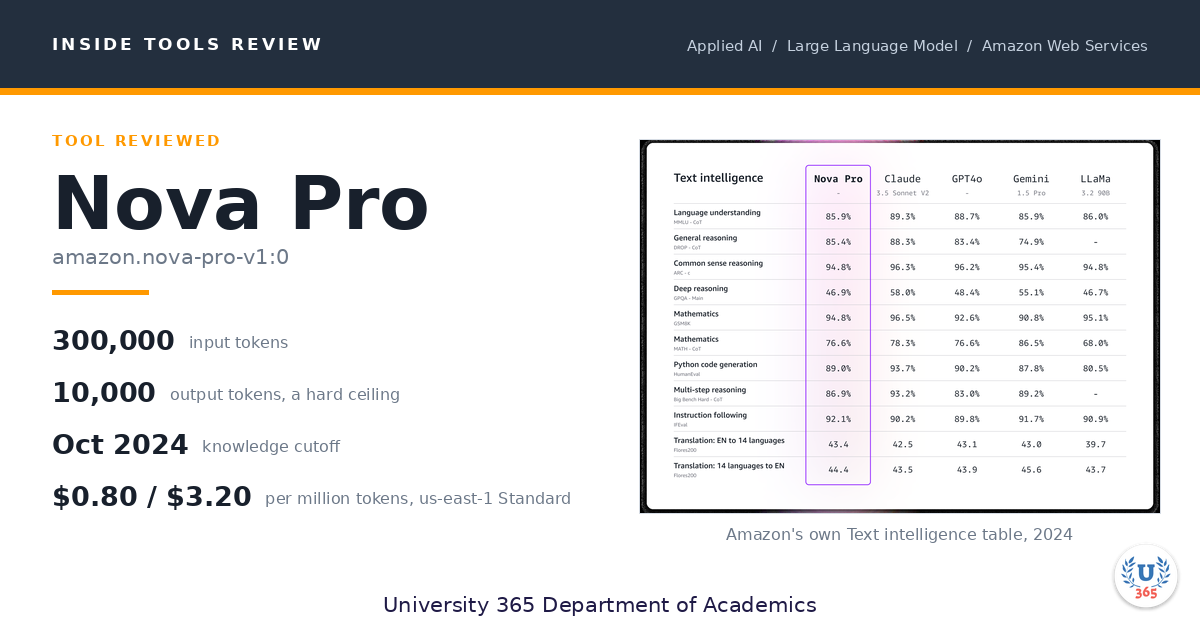
Nova Pro, Amazon's 300,000-token multimodal workhorse from the first Nova generation: strong on document, chart, video and interface extraction for its generation, mid-field on knowledge and reasoning, capped at 10,000 output tokens, and sold at $0.80 and $3.20 per million tokens after its own published end-of-life date.
Primary use cases:
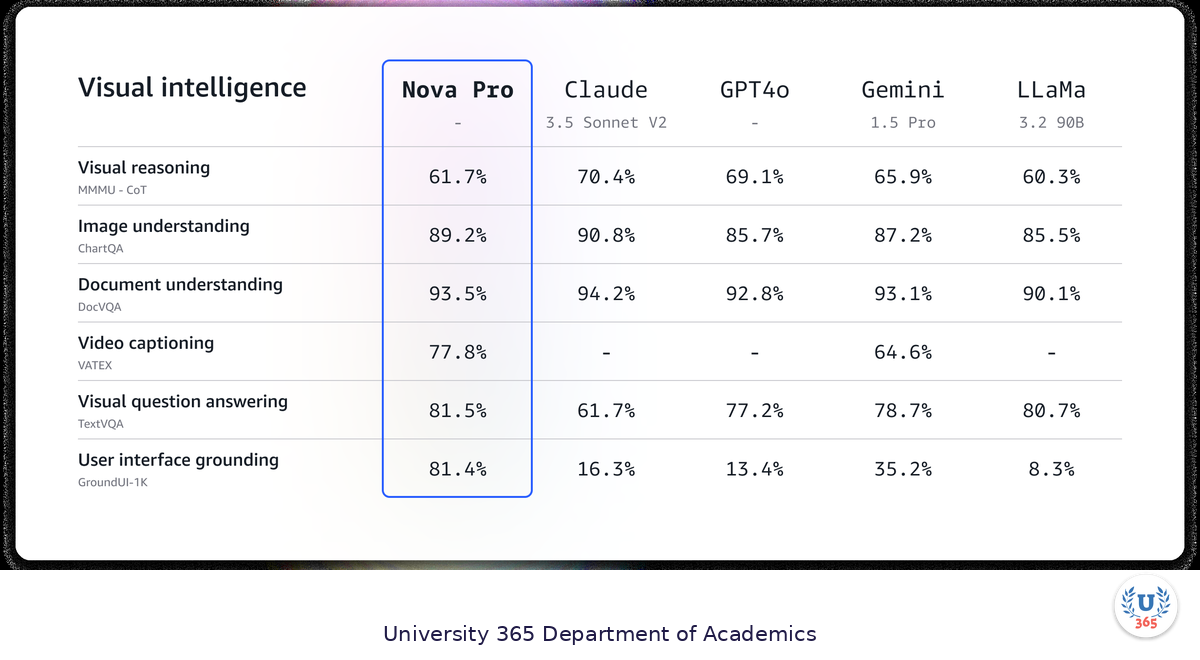
Document and form extraction at volume. DocVQA at 93.5 and ChartQA at 89.2 on the vendor's launch table are the model's strongest text-adjacent rows, and a 300,000-token window holds a large document set in one call. The check is the page, and the workflow below is built around it.
Interface and screen understanding. GroundUI-1K at 81.4 point accuracy against 16.3 for Claude 3.5 Sonnet V2 and 13.4 for GPT-4o in the vendor's launch table is the widest margin in the release, and it is the capability that makes a screenshot a usable input for an interface audit.
Video understanding without audio. The model accepts video and, in the vendor's own words at launch, does not process audio in a video. A recorded session therefore has to be paired with a transcript rather than read on its own, and VATEX captioning at 77.8 is the measured capability behind it.
High-volume classification and routing. A non-reasoning model at 129 output tokens per second, measured independently, with Batch and Flex at half the Standard rate, is a cheap classifier when the prompt is short and the categories are supplied.
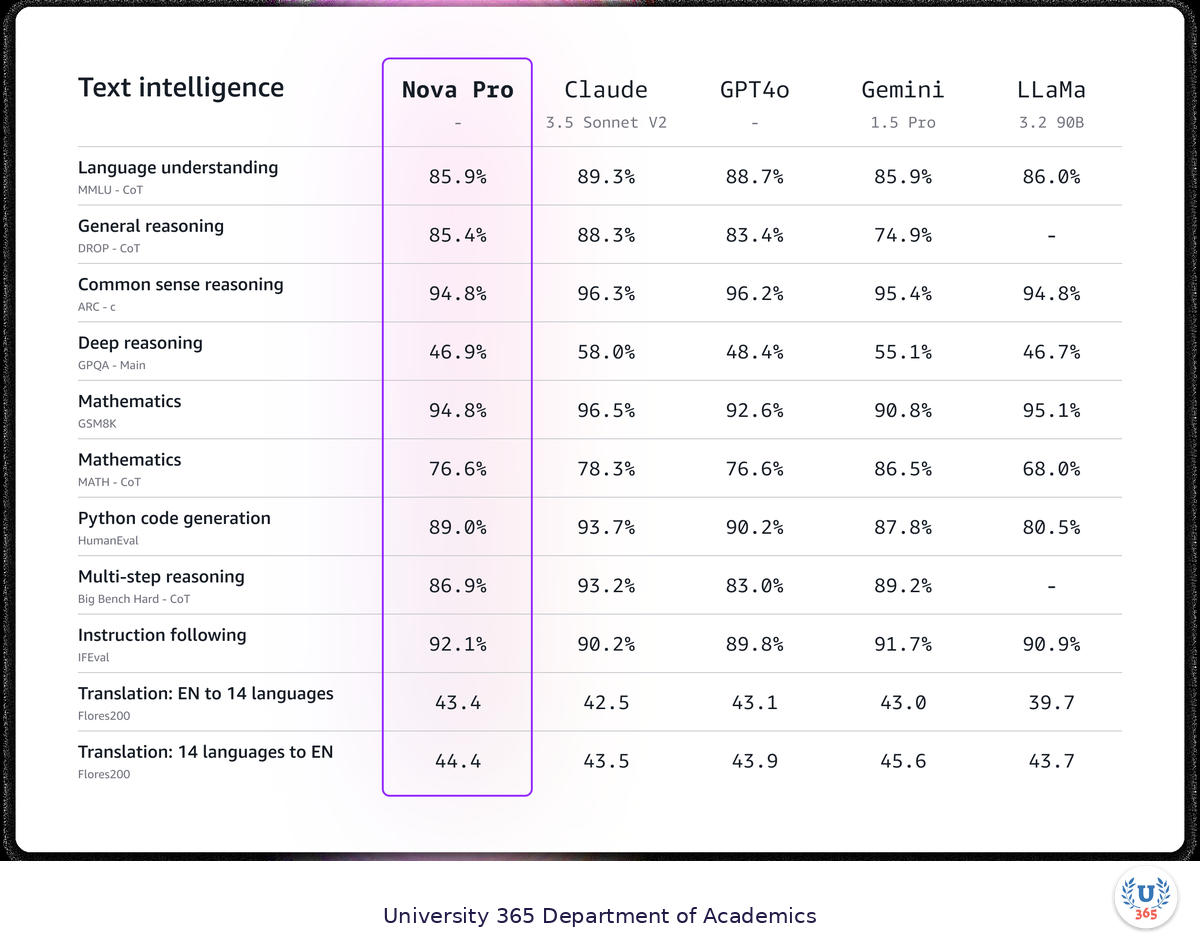
Translation on a supplied text. The vendor reports 43.4 spBleu from English into 14 languages and 44.4 back into English on Flores200, which is competitive with the 2024 comparators and is the only multilingual row in the release.
What it is not. It is not a reasoning model: there is no thinking level, no effort control and no reasoning trace, which is the single clearest difference from the Nova 2 generation. It is not a 1M-token model; the window is 300,000 tokens and the answer is capped at 10,000. It is not an audio model: audio input is marked not supported, speech is not supported, and video arrives without its soundtrack. It is not a generation model: image, video and embedding output are all marked not supported. It is not open weights, not self-hostable and not inspectable from outside Bedrock. It does not publish a parameter count or an architecture description.
Pricing, as published in the us-east-1 offer file read on 2026-11-20 (publication date 2026-11-11):
Line | Rate |
Standard input, any modality | $0.80 per million tokens |
Standard output, text | $3.20 per million tokens |
Cache read | $0.20 per million tokens |
Cache write | $0.00 per million tokens |
Batch input and output | $0.40 and $1.60 per million tokens |
Flex input and output | $0.40 and $1.60 per million tokens |
Priority input and output | $1.40 and $5.60 per million tokens |
Cache read, Priority and Flex | $0.35 and $0.10 per million tokens |
Latency optimized input and output | $1.00 and $4.00 per million tokens |
Custom model, input and output | $0.80 and $3.20 per million tokens, the same as the base model |
Customization training | $8.00 per million training tokens |
Customization storage | $1.95 per model per month |
Provisioned throughput, no commitment | $60.50 per hour per model unit |
Provisioned throughput, 1 month | $55.00 per hour per model unit |
Provisioned throughput, 6 months | $30.25 per hour per model unit |
Free tier | None |
Three sentences of arithmetic, because the tier structure is the price. Priority is 1.75 times Standard and Batch and Flex are half, so the same job can cost 3.5 times more on Priority than on Batch. A cache read at $0.20 is 75 percent below the input rate and the cache write is free, but the cache covers at most 20,000 tokens, so the saving applies to a fixed prefix and not to a 300,000-token document set. Nova 2 Lite on the same in-region basis is $0.33 and $2.75, which makes this model 2.4 times its successor on input and 1.16 times on output while offering a third of the window.
Official links:
Bedrock model card of record: https://docs.aws.amazon.com/bedrock/latest/userguide/model-card-amazon-nova-pro.html
Launch announcement, 2024-12-03: https://aws.amazon.com/about-aws/whats-new/2024/12/amazon-nova-foundation-models-bedrock
AWS News Blog launch post with the benchmark tables: https://aws.amazon.com/blogs/aws/introducing-amazon-nova-frontier-intelligence-and-industry-leading-price-performance/
The Nova family technical report and model card: https://cdn.amazon.science/96/7d/0d3e59514abf8fdcfafcdc574300/nova-tech-report-20250317-0810.pdf
Amazon Nova pricing page: https://aws.amazon.com/nova/pricing/
Amazon Bedrock pricing page: https://aws.amazon.com/bedrock/pricing/
Bedrock us-east-1 offer file: https://pricing.us-east-1.amazonaws.com/offers/v1.0/aws/AmazonBedrock/current/us-east-1/index.json
Model lifecycle, legacy policy: https://docs.aws.amazon.com/bedrock/latest/userguide/model-lifecycle-legacy.html
Bedrock FAQs, including the training-data answer: https://aws.amazon.com/bedrock/faqs/
Bedrock endpoints and quotas: https://docs.aws.amazon.com/general/latest/gr/bedrock.html
Nova user guide: https://docs.aws.amazon.com/nova/latest/userguide/what-is-nova.html
End-user licence page linked from the model card: https://aws.amazon.com/legal/bedrock/third-party-models/
LLM-specific fields:
API model identifier: amazon.nova-pro-v1:0. Geo inference ids are us.amazon.nova-pro-v1:0, eu.amazon.nova-pro-v1:0 and apac.amazon.nova-pro-v1:0. No Global inference id exists for this model.
Context window: 300,000 input tokens, stated on the model card.
Maximum output: 10,000 tokens, stated on the model card.
Knowledge cutoff: October 2024, stated on the model card.
Reasoning control: none. The model card carries no reasoning or effort field, and Artificial Analysis lists the model as non-reasoning.
Modalities: text, image and video input; text output only. Audio, speech, embedding, image output and video output are all marked not supported.
APIs and endpoints: bedrock-runtime with Invoke, Converse and response streaming. The Responses API, Chat Completions and bedrock-mantle are marked not supported.
Bedrock features supported: Guardrails, Agents, Flows, prompt management, model evaluation, intelligent prompt routing, implicit prompt caching and explicit prompt caching.
Bedrock features not supported: structured outputs, token counting, prompt optimization, Knowledge Bases, abuse detection and watermarking.
Prompt caching: explicit checkpoints of at least 1,000 tokens, at most 4 per request, a 5-minute time to live, in the system and messages fields, with a Nova-wide maximum of 20,000 cached tokens.
Service tiers: Standard, Priority and Flex supported; Reserved marked not supported.
Regional availability: in-region in us-east-1 and us-gov-west-1; Geo cross-Region across the US, EU and APAC geographies; Global cross-Region not supported.
Customization: text and vision fine-tuning, and the model serves as a teacher for distillation into Nova Micro and Nova Lite custom variants.
Languages: the launch note states understanding and generation in more than 200 languages, with a named strong set of 15.
Licence: proprietary hosted service under AWS terms. The model card links an end-user licence page. No open weights and no self-hosting.
Parameters and architecture: not disclosed.
At a Glance Dashboard
Field | Value |
Category | Applied AI / Large Language Model (multimodal document, image and video analysis on Amazon Bedrock) |
CI-First Benefit Score | 4.0 / 10 (CI-First Neutral) |
Sub-scores | Time 4 / Quantity 5 / Quality 4 / Skill 3 |
CI-First Profile | Primary: Co-Worker and Assistant (level 2). Secondary: Co-Researcher, Analyst and Tester (level 4), Professor, Coach and Tutor (level 3) |
Humics Protection | Humics-Neutral (-1 / +3) |
AI Imposture Risk | Medium overall, with Skill Illusion High |
Status | Risky |
Last tested | 2026-11-20 |
Pricing | $0.80 and $3.20 per million tokens on us-east-1 Standard; cache read $0.20 and cache write $0.00 with a 20,000-token caching ceiling; Batch and Flex at half; Priority at 1.75 times; no free tier |
Platforms | Amazon Bedrock only, in-region in us-east-1 and us-gov-west-1 and through Geo cross-Region inference in the US, EU and APAC |
User sentiment | No review platform rates an individual foundation model; the independent record is a deprecated benchmark page with a measured speed and an estimated capability index |
The Problem
The problem Nova Pro was built for was real in December 2024. An enterprise on AWS had documents, charts, screenshots and recorded video, and it needed one service that read all of them inside its own cloud contract, at a price a procurement team could defend. The alternative was a frontier model from a third party, reached outside the AWS boundary, priced at several times the rate, and integrated by hand.
The second half of the problem was the shape of the work. Document extraction, chart reading, interface grounding and video captioning are not chat tasks. They arrive as a file and a question, they need the answer to point at a place in the file, and they repeat a thousand times. A model that reads a screenshot accurately and costs $0.80 per million input tokens is an operational instrument in a way that a more intelligent model at five times the price is not.
Nova Pro answered both halves for its generation, and the vendor's launch table says where. Interface grounding at 81.4 against 16.3 and 13.4 for the two 2024 frontier comparators, TextVQA at 81.5 against 61.7 for Claude 3.5 Sonnet V2, video captioning at 77.8 against 64.6 for Gemini 1.5 Pro, DocVQA at 93.5 and ChartQA at 89.2. Those are extraction competencies, and they were competitive or leading at launch.
The problem a reader faces in November 2026 is a different one, and it is the problem this review is written for. The model has not moved since launch, while the family around it has. Amazon now sells Nova 2 Lite, a generally available model with a 1M-token window, a 64,000-token output ceiling, a knowledge cutoff of October 2025, reasoning that can be switched on, and a Standard price of $0.33 and $2.75, which is cheaper on both legs than the model this review scores. Nova 2 Pro, sold as a preview, carries a 1M-token window at $1.25 and $10.00 on its global route.
There is a third part of the problem, and U365 cares about it most. Nova Pro's answer is capped at 10,000 tokens and its world stops in October 2024, but its prose does not announce either limit. A reader who puts a 200-page contract set in front of it receives a fluent, well-formatted extraction, and nothing in the shape of that answer says which parts were read and which parts were inferred from a 2024 model of the world. The failure mode is not an obvious error. It is a clean table with one cell filled from stale general knowledge rather than from the document.
The Outcome
Nova Pro remains a usable extraction instrument at a defensible price, and it is no longer a model U365 would recommend for new work: its own successor is cheaper, larger-windowed, more current and generally available, and the launch evidence that flatters it is a comparison set from December 2024.
The strongest measured capability is interface and media extraction, and that part holds up on the vendor's own numbers. GroundUI-1K at 81.4 point accuracy, TextVQA at 81.5, DocVQA at 93.5, ChartQA at 89.2 and VATEX at 77.8 describe a model that reads a screen, a form, a chart or a video frame and returns a structured description. For a team that already runs Bedrock and needs that specific capability at $0.80 per million input tokens, the instrument still works.
The knowledge and reasoning position does not hold up, and two surfaces say so in different ways. On the vendor's own 2024 table, GPQA Main is 46.9 against 58.0 for Claude 3.5 Sonnet V2, MMMU is 61.7 against 70.4, MMLU is 85.9 against 89.3, and MATH is 76.6 against 78.3 and 86.5. Two years later, Artificial Analysis publishes an Intelligence Index estimate of 7 for this model against a median of 16 for comparable non-reasoning models, and states in its own summary that Nova Pro is among the least intelligent models on that index. The index is an estimate on a deprecated page, so it is a directional reading rather than a measurement, and it points the same way as the vendor's own 2024 table.
The ceiling is the practical limit that decides most workflows. A 300,000-token input with a 10,000-token output is a 30 to 1 ratio, and a document set large enough to need the window produces more findings than 10,000 tokens can hold. A reader who plans a 200-page review on this model will either truncate the answer or split the job, and splitting the job is what the large window was supposed to avoid.
The price is no longer an argument in its favour. At $0.80 and $3.20, Nova Pro sits above its own generally available successor at $0.33 and $2.75, and above the cheaper Mistral and Llama options on the same platform. The cache rate is real, at $0.20 with a free write, but the 20,000-token ceiling means it discounts a standing instruction and not the document set.
For U365 Fellows, the outcome is a negative recommendation with a narrow exception. A learner or professional who has inherited a Bedrock pipeline built on amazon.nova-pro-v1:0 should keep it running while it serves, and should not build anything new on it. The exception is a pure extraction task with a checkable answer, where the price and the measured visual accuracy still make it rational, provided a person opens the source and reads the cell.
What the release does not change. The 2024 benchmark table does not become a 2026 measurement because it is still published. The lifecycle field saying Active does not extend the end-of-life date that has already passed. And no amount of fluency in the answer moves a knowledge cutoff of October 2024.
Who Should Use Nova Pro
Learner type | Difficulty | Typical ROI | Career path |
Students (Bachelor, Master) | Intermediate | A usable object of study and a poor default tool. The 2024 benchmark table is a clean teaching case: it shows a model leading on interface grounding and trailing on deep reasoning in the same release, and it shows a comparison set that was already six months old when the model shipped. Where a student can reach Bedrock through an institution, the exercise worth running is the one the table does not measure: put a 300-page reading set in the window, ask for a decision table with page references, and check whether the 10,000-token ceiling truncates the answer. | UIT (Technology, AI, Data Science) tracks through evaluation design, multimodal document processing and cost engineering. UIB (Business Management, Entrepreneurship) for the lifecycle and procurement reading of a rate card. No published U365 credential assesses multimodal extraction as a named component, and none is asserted. |
Professionals (career upskilling) | Intermediate | The narrow case is real and the general case is not. A team already on Bedrock with a document, chart or screen extraction pipeline gets a fast, cheap, accurate-for-its-generation reader at $0.80 per million input tokens, with Guardrails and private connectivity around it. A professional choosing a model for new work should choose a current one: the successor in the same family is cheaper, has three times the window, six times the output ceiling and a knowledge cutoff twelve months later. | |
Everyone (lifelong learners) | Intermediate | Not the right first model, and not reachable without an AWS account. The durable gain, if it is met at all, is a habit rather than a capability: naming where in the source a claim sits, and noticing when an answer's confidence is a property of its prose rather than of its evidence. | LIPS Collect and Review phases for the reading work, and the UP-Context-Engineering Method order for prompting. No assessment home is asserted. |
For teams and organisations. The model is bought by an organisation rather than by a person, and a team deciding on it starts with four questions.
Team deployment. The only route is Amazon Bedrock. In-region access exists in us-east-1 and us-gov-west-1, Geo cross-Region inference covers the US, EU and APAC geographies, and Global cross-Region inference is not supported, which matters because a team that has standardised on global routing for the newer models cannot route this one the same way. The model supports Guardrails, Agents, Flows, prompt management, model evaluation and intelligent prompt routing, and does not support structured outputs or Knowledge Bases.
Cost at team scale. Four lines move independently: the tier (Priority at 1.75 times Standard, Batch and Flex at half), the cache (free to write, $0.20 to read, capped at 20,000 tokens), provisioned throughput at $60.50 per hour with no commitment, $55.00 on a one-month term and $30.25 on a six-month term per model unit, and fine-tuning at $8.00 per million training tokens plus $1.95 per model per month of storage. A team that has not decided a tier policy has left the largest multiplier to individual habit.
Data and compliance. AWS states in the Bedrock FAQ that it will not use inputs to or outputs from Bedrock to train Amazon Nova, Amazon Titan or any third-party model, that customer content is not shared with model providers, and that content is encrypted in transit and at rest. Bedrock is described as in scope for SOC, ISO, HIPAA eligibility, GDPR and CSA STAR Level 2. That is the ordinary Bedrock position and it remains a genuine advantage for a regulated team.
U365 for companies. Professional learners reach University 365's academic services individually or through their organisation, and the company route runs through a customized training agreement for employee groups. Corporate education programmes are built on demand, and their tuition follows content and duration.
Skill level required: Intermediate. Calling the model is a two-line SDK call. Supervising it is the work: deciding what goes into a 300,000-token window, forcing a page reference into every cell of an answer that cannot exceed 10,000 tokens, and knowing that anything the document does not state may be filled from a world that ended in October 2024.
Prerequisites. An AWS account with Bedrock enabled and model access granted for amazon.nova-pro-v1:0 in the Region you will call. A route decision, because in-region and Geo cross-Region are different endpoints and Global does not exist here. A client timeout and a token budget that reflect the 10,000-token ceiling, because the ceiling is enforced at the API and a truncated answer reads like a complete one. A working knowledge of the UP-Context-Engineering Method's FULL-CONTEXT and EXPECTED-FORMAT-AND-CONSTRAINTS layers. And, for any task where the answer leaves your team, a check you already own.
Typical time to first result: Under fifteen minutes once access exists: enable the model in the Bedrock console, send a short Converse call, confirm the id resolves in the Region you chose, then send a 100,000-token input whose answer you already know to see how the route behaves.
Typical time to competence: Ten to twenty hours of active use. Two habits carry most of the value: requiring a source location for every extracted value, and running the same input through a current model to see where the two disagree.
Who should wait. Everyone who is choosing a model for new work, because the successor is cheaper and larger in every dimension that matters. Anyone whose task needs more than 10,000 tokens of output, which rules out long reviews and multi-document syntheses. Anyone whose question depends on the world after October 2024. Anyone on a global cross-Region routing standard. And any team that needs structured outputs, token counting or Knowledge Bases, none of which this model supports.
U365 Institutes Alignment
The alignment below rates what a U365 institute could take from this model as a working instrument and as an object of study. The primary home is UIT (Technology, AI, Data Science), because the model's usable strengths are multimodal extraction, interface grounding and cost engineering on a tiered rate card. The other three readings are real and each is bounded.
UIT (Technology, AI, Data Science)
Rating. High (primary)
Why. Four engineering competencies, each of which survives the removal of the tool. Multimodal extraction engineering: DocVQA at 93.5, ChartQA at 89.2 and TextVQA at 81.5 are extraction results, and turning a document into a table whose cells are checkable is a design discipline rather than a prompt trick. Interface grounding: GroundUI-1K at 81.4 is the widest margin in the release, and a practitioner who can turn a screenshot into a located interface element is building a capability that survives the model. Evaluation reading: the same release reports IFEval at 92.1 and GPQA at 46.9, and teaching a cohort to read both rows as one honest picture of a model is the skill the vendor table is designed to make easy to skip. Cost engineering: five tiers, a free cache write, a 20,000-token cache ceiling and three provisioned-throughput terms are arithmetic a cohort can practise on live numbers. The published programme set already teaches cloud engineering, Python and data work, and this model is a working object on which those skills are exercised.
The limit that holds the row. The model is a service a practitioner operates, not an artefact a practitioner inspects. There are no weights, no architecture and no parameter count, so the competencies are engineering-with rather than engineering-of. No published programme assesses multimodal extraction or cost-per-finished-task as a named component. Adjacent anchors, not assessment homes.
UIB (Business Management, Entrepreneurship)
Rating. Low to Medium
Why. One decision the release forces that is commercial before it is technical: what a lifecycle date means for a budget. A model whose published end-of-life floor has passed, whose vendor still lists it as Active, and whose cheaper successor carries a later date is a procurement exercise in reading the primary surface rather than the summary. The second commercial reading is the tier structure: a 1.75 times Priority premium, a 50 percent Batch discount and a 20,000-token cache ceiling are a cost model a business student can build and defend.
The limit that holds the row. The model supplies no management method and measures no return of its own. It publishes no completion rate, no cost per task and no time per task, so a business case has to be built by the unit. The extraction capability is an input to commercial analysis, not an analysis method. No published programme assesses model-portfolio economics as a named component. Adjacent anchors, not assessment homes.
UIC (Digital Communication, Marketing)
Rating. Medium
Why. Two competencies that matter to the profession. Media extraction: a video is an accepted input, VATEX captioning is 77.8, and the model does not process the soundtrack, so a recorded interview or a webinar becomes a usable visual source only when it is paired with a transcript. That pairing discipline is the competency, and it is the one most often skipped. And multilingual reach: 43.4 spBleu from English into 14 languages and 44.4 back, on a launch note that claims more than 200 languages, is enough to draft and not enough to publish without a native read.
The limit that holds the row. The model teaches no register, no audience analysis and no publication standard, and it produces no image or video of its own. It returns no source by default, so fact-checking stays with the writer, and a translation that reads fluently is the specific artefact this profession is least equipped to audit. Rated as a media-analysis and translation surface. No credential is mapped.
UID (Digital Design, UX/UI)
Rating. Medium
Why. The design contact is the strongest single row in the release. GroundUI-1K at 81.4 point accuracy against 16.3 for Claude 3.5 Sonnet V2, 13.4 for GPT-4o and 35.2 for Gemini 1.5 Pro means a designer can put a UI screenshot in front of the model and get a located, structured description of what is on it. That is a research input for an interface audit, and it is the one capability here that a designer would miss if the model were withdrawn.
The limit that holds the row. The model produces no image, no layout and no prototype: image and video output are marked not supported. It evaluates no design against a brief and holds no design method, and its visual reasoning row, MMMU at 61.7, trails the 2024 frontier comparators. No layout, interaction or motion competency is assessed by it. No credential is mapped.
U365 methods, not an institute (UNOP, ULM, LIPS, CARE and the UP-Context-Engineering Method)
Rating. Applicable
Why. The methods layer fits in the way a large-window extraction model fits: FULL-CONTEXT is the product's input, and EXPECTED-FORMAT-AND-CONSTRAINTS is the only thing that keeps a 10,000-token answer inside the job. The record of what a run was asked to do, which documents went in, which route carried it and what came back belongs in the Fellow's own LIPS system, because the model holds no state between calls and writes nothing down. CARE's Review phase is where an extracted cell is checked against its page. UNOP has no direct fit: the model is not built to teach, and its gains come from extraction rather than from any pedagogical mechanism.
The limit that holds the row. The model carries no method of its own and no coaching surface, and its knowledge cutoff is fixed at October 2024. A Fellow who does not keep the reasoning about route, tier and source citation in their own system has no account of it, and nothing in the product writes that account for them.
How Nova Pro Works
A hosted multimodal understanding model in the first Nova generation, sold only through Amazon Bedrock, with a 300,000-token input window, a 10,000-token output ceiling, text, image and video input, text output, no reasoning control and a knowledge cutoff of October 2024.
Inputs: Text, images and video. The model card marks audio, speech and embedding input as not supported, and the launch note states that the model does not process audio in a video. A recording therefore arrives as pictures and whatever transcript you supply alongside it. Images and video are billed at the same input rate as text, which is unusual in a way that matters: a video-heavy prompt is not surcharged on the input leg.
What happens inside: The vendor publishes no architecture, no parameter count and no training-data description. What it does document is the surface. There is no reasoning control: no thinking level, no effort setting, no reasoning trace. The model answers directly, which is why it is fast and why it cannot be asked to think longer about a hard case. The technical report describes the family as aligned through supervised fine-tuning and reinforcement learning from human feedback with an RAI-specific reward model, with runtime input and output moderation models as a first and last line of defence.
Outputs: Text only, capped at 10,000 tokens. Structured output is not a platform feature for this model: the model card marks structured outputs as not supported, so a JSON-shaped answer is a prompt-level hope rather than an API guarantee. Token counting is also marked not supported, which means the 10,000-token ceiling cannot be estimated through the API before a call.
Long context: The technical report measures a text needle-in-a-haystack recall curve up to 300,000 tokens for Nova Pro, and reports SQuALITY at 19.8 ROUGE-L with a spread of 8.7 and LVBench at 41.6 with a spread of 2.5. Those two rows are the honest picture of long context here: retrieval across depth is measured, and summarisation of a long literary text is not strong.
Built-in tools and platform features: Guardrails, Agents, Flows, prompt management, model evaluation and intelligent prompt routing are supported. Prompt caching is supported in both implicit and explicit forms, with checkpoints of at least 1,000 tokens, at most four per request, a five-minute time to live, and a Nova-wide ceiling of 20,000 cached tokens. Knowledge Bases, structured outputs, token counting and prompt optimization are marked not supported.
Deployment: Amazon Bedrock only, on bedrock-runtime, through Invoke, Converse and response streaming. In-region in us-east-1 and us-gov-west-1, Geo cross-Region across the US, EU and APAC geographies, and no Global route. The Responses API, Chat Completions and bedrock-mantle are not supported, which means a team that has moved its other models onto the newer API surface must keep a separate client path for this one.
Customization: Text and vision fine-tuning are available, at $8.00 per million training tokens and $1.95 per model per month of storage, and the launch note states that Nova Pro serves as a teacher model for distilling custom variants of Nova Micro and Lite. That pair of facts is the most interesting thing about the model's commercial position: it is still useful as a distiller even where it is no longer the model you would call.
Guardrails and safety: The technical report places the family against Amazon's responsible-AI framework and names its third-party red teams: Deloitte for biological risk, Nemesys Insights for radiological and nuclear risk, the Gomes Group at Carnegie Mellon for chemistry, and ActiveFence for content and security red teaming, with more than 9,700 adversarial prompts across 20 categories. It also describes invisible watermarking and C2PA metadata for generated image and video content, which applies to Nova Canvas and Nova Reel rather than to this text-output model. Those are the vendor's statements about its own family, made against its own framework.
What is not documented. No parameter count, no architecture, no training-data description, no output above 10,000 tokens, no reasoning control, no structured output, no token counting and no independent capability measurement. Six of those seven absences are normal for a proprietary hosted model. The output ceiling and the absent independent measurement are not, because both decide what a reader can plan.
Getting Started with Nova Pro
A fifteen-minute checklist for a first real call.
Confirm the Region and the route before the model. In-region access exists in us-east-1 and us-gov-west-1. Elsewhere you need the Geo id, us.amazon.nova-pro-v1:0, eu.amazon.nova-pro-v1:0 or apac.amazon.nova-pro-v1:0. There is no Global id, so a global-routing configuration will fail on this model and the error will not say why.
Confirm the model id. Send a minimal Converse call with amazon.nova-pro-v1:0. A validation error naming the model means model access has not been granted in that account and Region.
Write the rate base into the project notes. Standard is $0.80 and $3.20 per million tokens in us-east-1. Batch and Flex are half, Priority is 1.75 times, and a cache read is $0.20 with a free write. Every cost comparison you read will quote one of these and name none of them.
Set the output ceiling deliberately. The API caps the answer at 10,000 tokens. Decide the budget per call and check the stop reason, because a truncated answer does not look truncated.
Test the cache before you plan around it. Put a standing instruction in the system field, repeat the call, and confirm the cache read appears. The ceiling is 20,000 tokens, so a 200,000-token document set is not a cacheable prefix.
Send one 100,000-token input with a known answer. Long-context fit and long-context recall are different claims, and the only way to know which one you bought is to send material whose correct answer you already hold.
Ask for a location in every cell. A page, a timestamp, a bounding box, a slide number. The model's extraction accuracy is real, and the location is what makes it checkable.
Name the check before the first production call. A page you can open, a screenshot you can compare, a transcript line you can read. The check is the deliverable's acceptance criterion, not an afterthought.
Real Workflows
Three workflows, each chosen because a measured extraction strength and a check the reader already owns sit in the same place. Each sample prompt uses the UP-Context-Engineering Method's eight layers in method order, with the constraints and the data limits inside EXPECTED-FORMAT-AND-CONSTRAINTS.
Workflow 1: Turn a 300-page tender pack into a decision table with page references
When to use it: a data room, a tender pack or a regulatory set has to become a table a committee can read, and every cell has to be traceable to a page. This is the workflow the 300,000-token window exists for, and the 10,000-token ceiling is the constraint that shapes it.
This sample prompt uses the UP-Context-Engineering Method and the CI-First doctrine. Read the method at https://www.university-365.com/post/the-up-method-university-365-prompting-the-new-gold-standard-for-prompt-engineering, the doctrine at https://www.university-365.com/post/discover-the-ci-first-approach, learn both in a U365 online program at https://university-365.com/programs, and request a U.Coach for orientation at https://university-365.com/ucoach.
USER-PERSONA: My UP-Context-Engineering USER-PERSONA file is the file for this layer, attached. It is my psychographic file concatenated with the six ULM life-domain files. The parts that matter here: I chair the committee that will decide on this set, I answer for every cell, and I do not accept a summary I cannot trace to a page. If the file is not attached, ask for it before you start.
FULL-CONTEXT: The FULL-CONTEXT set for this task, added and not merged: BUSINESS-PERSONA for [the organisation], PROJECT-DESCRIPTION for [the decision this set informs], the document set at [location, page count, file list], the decision table's column definitions [columns], the questions the committee must answer [questions], and the version date of each document. The set is the only authority and the page is the only proof. If the file list or the column definitions are missing, name it and stop.
AI-PROFILE-ROLE-EXPERTISE: Act as a Co-Researcher, Analyst & Tester, in the role of a document analyst preparing a decision table for a committee, with expertise in contract structures, clause comparison and citation discipline.
USER-FINAL-GOAL: The committee reads one table, every cell carries a page reference, and I can defend any cell by opening the page in front of them.
AI-EXACT-TASK: Produce the decision table, one row per item and one cell per column, with a page reference in every cell, then a list of the questions the set does not answer.
AUDIENCE: Me, the committee, and a reviewer who will open three cells at random. The reviewer has not read your reasoning and will not accept a summary as evidence.
EXPECTED-FORMAT-AND-CONSTRAINTS: Format: (1) the table, (2) the unanswered questions, (3) what you could not locate. Constraints: every cell cites document and page; no cell may combine two documents without saying so; quote the operative phrase where a cell turns on wording; do not infer a fact the set does not state, write "not stated" instead; your answer is capped at 10,000 tokens, so if the table will not fit, say which rows you left out before you start rather than truncating silently; your knowledge cutoff is October 2024, so do not supplement the set from memory and mark anything you recognised rather than read; write no preamble. Data limits: the set is cleared for this model at the level I state in the FULL-CONTEXT set; no personal data outside the set leaves my control.
EXAMPLES: The committee's last decision table is the format example, attached, and one page-cited extract is the citation example.
Before you use the output, run the check yourself: open three cells at random, find the quoted phrase on the page, and confirm the "not stated" rows are genuinely absent from the set. The decision is yours, per CI-First.
What the model does well here: reading a document page and returning the value that is on it. DocVQA at 93.5 and ChartQA at 89.2 are the vendor's own numbers, measured against 2024 comparators, and document extraction is the task class those benchmarks describe. The 300,000-token window means the set does not have to be chunked. The caveat is arithmetic: a table with a page reference in every cell is token-hungry, and 10,000 output tokens holds a few dozen rows at most. A 300-page set will not fit into one answer, so the workflow is a scoped extract rather than a full review.
VERIFICATION CHECKLIST for the tender decision table:
☐ Multi-Model Check: run the same set through a current long-context model (Claude Sonnet 5.5 or Gemini 3.5 Flash) and compare the cells that disagree, not the prose.
☐ External Source: open three cells at random and find the quoted phrase on the cited page.
☐ Human Review: a committee member who knows the set reads the "not stated" rows and confirms they are genuinely absent.
☐ CI-First Test: can you defend any cell by opening the page without the transcript? If not, the table is not yours yet.
Workflow 2: Audit twenty application screens from screenshots
When to use it: a design or accessibility review has a folder of screenshots and a checklist, and every finding has to name the screen and the element. This is the workflow the model's strongest measured row supports.
This sample prompt uses the UP-Context-Engineering Method and the CI-First doctrine. Read the method at https://www.university-365.com/post/the-up-method-university-365-prompting-the-new-gold-standard-for-prompt-engineering, the doctrine at https://www.university-365.com/post/discover-the-ci-first-approach, learn both in a U365 online program at https://university-365.com/programs, and request a U.Coach for orientation at https://university-365.com/ucoach.
USER-PERSONA: My UP-Context-Engineering USER-PERSONA file is the file for this layer, attached. The parts that matter here: I sign the audit, I answer for every finding, and I will not ship a finding I cannot see on the screen myself. If the file is not attached, ask for it before you start.
FULL-CONTEXT: The FULL-CONTEXT set for this task, added and not merged: BUSINESS-PERSONA for [the organisation], PROJECT-DESCRIPTION for [the audit], the screenshot set [count, naming convention, screen resolution], the checklist [the criteria and their definitions], the product's navigation map [screens and states], and the previous audit's findings [document]. The screenshots are the only authority for what is on screen. If the checklist or the naming convention is missing, name it and stop.
AI-PROFILE-ROLE-EXPERTISE: Act as a Co-Researcher, Analyst & Tester, in the role of an interface auditor, with expertise in layout inspection, control identification, accessibility heuristics and evidence capture.
USER-FINAL-GOAL: A findings table where every row names the screen, the element and the criterion, and I can confirm each row by opening one screenshot.
AI-EXACT-TASK: Produce the findings table, one row per finding, with the screen name, the element described by position and label, the criterion, and the severity, then a list of the screens you could not read.
AUDIENCE: Me, the designers who will fix it, and a client who will open one screenshot to check one row.
EXPECTED-FORMAT-AND-CONSTRAINTS: Format: (1) the findings table, (2) the screens that could not be read or were ambiguous, (3) the criteria with no findings. Constraints: describe each element by its visible label and its position, never by a guessed component name; if a label is illegible, write illegible rather than guessing; do not report a finding the screenshot does not show; do not propose a redesign, the finding is the deliverable; your answer is capped at 10,000 tokens, so group findings per screen rather than repeating the criterion text; your knowledge cutoff is October 2024, so judge against the checklist I supplied and not against a design trend you remember. Data limits: the screenshots are cleared for this model at the level I state; no customer data visible on a screen leaves my control.
EXAMPLES: The previous audit is the format example, attached, and one row with its screenshot crop is the evidence example.
Before you use the output, run the check yourself: open the screenshot for three findings, confirm the element is where the model says it is, and check that no finding depends on a label the model could not read. The decision is yours, per CI-First.
What the model does well here: locating an interface element and describing it. GroundUI-1K at 81.4 point accuracy is the widest margin in the release, and point accuracy is exactly the "where is it" question an audit asks. Screen understanding is also the one place where a 2024 model can still hold its own against a current one on a narrow task. The caveat: 81.4 means roughly one element in five misses, and a finding built on a missed element is a false finding in a document that carries your signature.
VERIFICATION CHECKLIST for the screen audit:
☐ Multi-Model Check: run five screens through a current multimodal model and compare the element descriptions.
☐ External Source: open the screenshot for three findings and confirm the element and its label.
☐ Human Review: a designer reads the findings table against the screens before the client sees it.
☐ CI-First Test: can you confirm every row without the model's description? If not, the audit is not ready.
Workflow 3: Build a timestamped brief from a recorded session and its slides
When to use it: a webinar, a hearing or a client call arrives as a video plus a deck, and the brief has to carry timestamps a reader can check. This workflow uses the video input and the fact that the soundtrack is not processed.
This sample prompt uses the UP-Context-Engineering Method and the CI-First doctrine. Read the method at https://www.university-365.com/post/the-up-method-university-365-prompting-the-new-gold-standard-for-prompt-engineering, the doctrine at https://www.university-365.com/post/discover-the-ci-first-approach, learn both in a U365 online program at https://university-365.com/programs, and request a U.Coach for orientation at https://university-365.com/ucoach.
USER-PERSONA: My UP-Context-Engineering USER-PERSONA file is the file for this layer, attached. The parts that matter here: I publish this brief under my name and I answer for every quotation. If the file is not attached, ask for it before you start.
FULL-CONTEXT: The FULL-CONTEXT set for this task, added and not merged: BUSINESS-PERSONA for [the organisation], PROJECT-DESCRIPTION for [the brief], the recording [file, duration, languages], the transcript [file, with timestamps, source, and its own accuracy caveat], the deck [file], the brief's required sections [sections], and the publication standard [standard]. The transcript is the only authority for what was said and the video is the only authority for what was shown. If the transcript or the required sections are missing, name it and stop.
AI-PROFILE-ROLE-EXPERTISE: Act as a Co-Researcher, Analyst & Tester, in the role of a briefing analyst, with expertise in separating speech from slides, matching a spoken claim to a slide, and citing a timestamp.
USER-FINAL-GOAL: A brief whose every claim carries a timestamp from the transcript or a slide number from the deck, which I can publish after checking three of them myself.
AI-EXACT-TASK: Produce the brief in the required sections, with a timestamp for every claim taken from speech and a slide number for every claim taken from the deck, then a list of places where the transcript and the video disagree.
AUDIENCE: Me, the publisher, and a reader who will check one timestamp. The reader has not watched the recording.
EXPECTED-FORMAT-AND-CONSTRAINTS: Format: (1) the brief, (2) transcript and video disagreements, (3) passages that were inaudible or ambiguous in the transcript. Constraints: you do not process audio, so take every quotation from the transcript I supplied and never from the pictures; every visual claim carries a slide number or a frame time; do not paraphrase a number, quote it; mark a gap in the transcript as a gap rather than filling it; your answer is capped at 10,000 tokens, so prioritise the sections I listed in that order and say what you dropped; your knowledge cutoff is October 2024, so do not add context the recording does not contain. Data limits: the recording is cleared for this model at the level I state; no personal data outside the recording leaves my control.
EXAMPLES: The last published brief is the format example, attached, and one timestamped quotation is the citation example.
Before you use the output, run the check yourself: play three timestamps and read along, confirm one number matches what was said, and check one slide claim against the deck. The decision is yours, per CI-First.
What the model does well here: reading what is on screen and describing it in sequence. VATEX captioning at 77.8 against 64.6 for Gemini 1.5 Pro, and LVBench at 41.6, describe a model that can follow a visual narrative. The caveat is structural: the model does not process audio in a video, so the transcript carries every quotation and its accuracy is the brief's accuracy. A brief built here is a slide-anchored summary of a transcript you already trust, not a transcription.
VERIFICATION CHECKLIST for the recorded-session brief:
☐ Multi-Model Check: run the transcript through a second model and compare the quotations that carry numbers.
☐ External Source: play three timestamps and read along, and check one slide claim against the deck.
☐ Human Review: the person who chaired the session reads the brief for meaning as well as for accuracy.
☐ CI-First Test: can you defend every quotation by playing the timestamp? If not, the brief is not ready.
Strengths, Limits, and AI Imposture Risk
Strengths
CI-First Benefit | Strength | Evidence |
Time | Real savings on extraction, and almost none on composition. | Document, chart and interface extraction in a single call at 129 output tokens per second, measured independently, with a 300,000-token window that removes the chunk-and-stitch step; Guardrails and private connectivity already in place for an AWS team; prompt caching that makes a repeated instruction set cheap. Held at 4 because the savings are confined to one task class: a model whose world stops in October 2024 costs time on anything that depends on the world, and a 10,000-token answer is itself reading work. |
Quantity | A genuine multiplier on extraction-heavy volume, capped by the output ceiling. | One window for a 300-page set, Batch and Flex at half the Standard rate, one input rate across text, image and video, and fine-tuning for a custom variant. Held at 5 because the output ceiling decides usable volume: 10,000 tokens holds a few dozen table rows at most, so a larger set produces more calls rather than more answer. |
Quality | Strong on extraction, mid-field on knowledge, dated overall. | DocVQA 93.5, ChartQA 89.2, TextVQA 81.5, GroundUI-1K 81.4, VATEX 77.8 and IFEval 92.1 on the vendor's launch table; against that, GPQA Main 46.9 against 58.0 for Claude 3.5 Sonnet V2, MMMU 61.7 against 70.4, MMLU 85.9 against 89.3, and a knowledge cutoff of October 2024. The independent page publishes an estimated Intelligence Index of 7 against a median of 16. Held at 4 by the vintage and by the single-source evidence base. |
Skill | Marginal, and honestly marginal. | No reasoning trace, no teaching mode, no citation by default and no open weights. The one genuine capability-transfer mechanism is on the platform rather than in the reader: Nova Pro serves as a teacher model for distilling custom Nova Micro and Lite variants, which moves capability into a smaller model rather than into a person. Scored conservatively. |
Limits
The published end-of-life floor has passed. The model card states an end-of-life date no sooner than 2025-12-05 with a legacy period of at least six months, and the model is still Active on 2026-11-20. A reader cannot tell from any vendor surface when it will stop serving.
It is surpassed inside its own family. Nova 2 Lite is generally available at $0.33 and $2.75 with a 1M-token window, a 64,000-token output ceiling, a knowledge cutoff of October 2025 and reasoning that can be switched on.
The output ceiling is 10,000 tokens. A 30 to 1 input-to-output ratio is the wrong shape for a document review, and a truncated answer does not announce itself.
The knowledge cutoff is October 2024. Anything the document does not state may be filled from a world that has moved on by two years, and the prose does not distinguish the two.
There is no reasoning control. No thinking level, no effort setting, no trace. A hard case cannot be given more compute.
No structured outputs and no token counting. A JSON-shaped answer is a prompt-level hope, and the 10,000-token ceiling cannot be estimated through the API before a call.
The prompt cache covers 20,000 tokens. A free write and a 75 percent read discount are real, and they apply to a standing instruction rather than to a 300,000-token document set.
Audio is not processed, including the soundtrack of a video. A recording arrives as pictures, and every quotation depends on a transcript you supplied.
Global cross-Region inference is not supported. A team that has standardised on global routing must keep a separate path for this model.
The independent capability evidence is an estimate on a deprecated page. Artificial Analysis marks the model deprecated, continues only the default 10,000-token workload, and publishes its Intelligence Index for this model as an estimate with the measurement to follow.
The vendor's comparison set is from December 2024. Claude 3.5 Sonnet V2, GPT-4o, Gemini 1.5 Pro and Llama 3.2 90B are the comparators, and the technical report footnotes which of those numbers were measured by Amazon and which were taken from benchmark papers and leaderboards.
No open weights, no self-hosting and no external auditability. Nothing about this model can be inspected from outside the Bedrock service.
AI Imposture Risk
Trap | Rating | Evidence |
Time Illusion | Medium | The mechanical saving is real and measured: 129 output tokens per second, a 300,000-token window, one input rate and a cheap cache. The overhead is also real: the answer is capped at 10,000 tokens and must be read as a whole, every extracted value needs a page check, and anything the model states about the world after October 2024 has to be verified independently. On extraction the net is positive; on general work the verification exceeds the saving. |
Quantity Illusion | Medium | The product invites volume. A 300,000-token window, Batch and Flex at half price and a table with a plausible cell in every row make it easy to produce more output than anyone will read. The 10,000-token ceiling limits each answer rather than the number of answers, so a team can generate a hundred uniform extracts that are uniformly unchecked. |
Skill Illusion | High | Fluent, well-formed extractions, translations and screen descriptions produced for readers who cannot evaluate them, on a model whose vendor table is two years old and whose independent reading is an estimate. The specific mechanism is the knowledge cutoff: the model answers about the world with the confidence of a 2026 model and the information of a 2024 one, and nothing in the answer signals which. A translation at 43.4 spBleu reads smoothly whether or not it is right, and a screen audit built on one missed element out of five carries a signature. Mitigations exist and are cited: the source document is the authority, every cell carries a page, every finding names an element, and the three checklists above are checkable by a person. Those mitigations lower the frequency of failure; they do not move the capability to the reader. |
Overall Imposture Risk: Medium. One trap is High with clear mitigations stated, and two are Medium. Under the framework's arithmetic, one High with clear mitigations stated is Medium rather than High. The band-precedence sentence does not change the outcome: the High band would require two or more traps at High, or a core value proposition built on an illusion, and neither condition is met.
Framework v1.2 clause note
Clause 5.2.3-a, agent-authored procedural memory: NULL, recorded with its boundary. The model holds no state between calls, writes no skills, no memory store and no standing instruction, and no Bedrock surface attached to it documents a mechanism by which it authors procedural memory on the user's behalf. The boundary is the agentic surface: a deployment that lets an agent built on this model write and revise the user's instruction files, memory or skills would meet the clause, and the supported Agents and Flows features make that arrangement easy to build. The clause is a property of the deployment in that case, not of the model.
Clause 4.2-a, agent-mediated conversation: NULL for the model as a generator. Neither erosion condition is met. No agent-authored text is presented as the person's own voice in a human-facing channel by default, and nothing substitutes agent interaction for human contact. The live condition to watch on any deployment: an agent that sends text in the person's own name through a connected account without the person reading it first would meet condition (a). That is a property of a deployment built around this model rather than a property of the model.
Recorded together: the two clause questions return nulls with boundaries and live conditions rather than mechanisms, and the boundary is the part that matters. The reason Skill Illusion still rates High is not a clause mechanism. It is the plain fact that a model with a two-year-old world model produces finished-looking extractions and translations for readers who cannot tell a 2024 fact from a 2026 one.
Section 7c: An end-of-life date that has passed, a cache rate the market row did not carry, and two price lines the model card does not describe
A Section 7c finding is recorded where a supplier's governance, safety record or commercial terms have a real result for the reader. The items below were checked against primary sources on 2026-11-20, and they produce findings a buyer should carry. All findings are stated as facts of record, and the difference between a company statement, a published evaluation and a policy term is kept intact.
The published end-of-life date has passed, and the model is still Active. The Bedrock model card of record states a model launch date of 2024-12-05, an end-of-life date no sooner than 2025-12-05, a legacy period of at least six months, and a model EOL date of no sooner than 12/4/2025. The lifecycle field on the same card reads Active on 2026-11-20, eleven months after that date. Under the legacy lifecycle policy, a model stays on Bedrock for at least twelve months from launch and stays in the Legacy state for at least six months before its end-of-life date, and new customers cannot use a Legacy model. The finding is not that Amazon is doing anything wrong: the field says "no sooner than", which is a floor rather than a schedule. The finding is that the only lifecycle date the vendor publishes for this model has already been exceeded, so a buyer planning a two-year dependency on it has no forward date to plan against. Nova 2 Lite's card, by contrast, carries "Nova EOL date: N/A" with an end-of-life floor of 2026-12-02, which shows that the two cards are not written to one template even inside one family.
The rate card publishes a cache rate, and the cache has a ceiling that decides whether it matters. The us-east-1 offer file published on 2026-11-11 carries a cache read SKU at $0.20 per million tokens, which is 75 percent below the $0.80 input rate, and a cache write SKU at $0.00, which is free. The model card footnote states that Nova models support a maximum of 20,000 tokens for prompt caching, with checkpoints of at least 1,000 tokens, at most four per request and a five-minute time to live. Twenty thousand tokens is 6.7 percent of the 300,000-token window. So the cache is a real discount on a standing instruction or a fixed policy block, and not a discount on the document set that the window exists to hold. A reader who budgets a cached document set has budgeted a discount the service does not offer.
Two price lines exist that the model's own documentation does not describe. The model card's service-tier table marks Reserved as not supported, while the same offer file carries three Provisioned Throughput commitments for this model at $60.50 per hour with no commitment, $55.00 per hour on a one-month term and $30.25 per hour on a six-month term per model unit. Separately, the offer file carries two SKUs under the model attribute "Nova Pro Latency Optimized" at $1.00 and $4.00 per million tokens, while the Bedrock FAQ's latency-optimized inference answer names Claude 3.5 Haiku and the Llama 3.1 405B and 70B models, in us-east-2 through cross-Region inference, and does not name a Nova model. Whether Reserved and Provisioned Throughput are the same purchasing mechanism is not stated on either page, and whether the latency-optimized SKUs are orderable for this model is not stated either. Both are questions a procurement team should ask rather than assume. This review records them as two price lines without a matching product description, and draws no further conclusion.
The reach is both narrower and wider than a one-Region reading suggests. The model card's regional table marks in-region access in us-east-1 and us-gov-west-1, Geo cross-Region access across the US, EU and APAC geographies with the ids us., eu. and apac.amazon.nova-pro-v1:0, and no Global cross-Region support at all. A reader who assumes "us-east-1 only" understates the model by most of three geographies. A reader who assumes it routes like the newer Nova models overstates it, because there is no Global id. Both errors are available from the same page if it is skimmed.
The evidence base is a 2024 vendor table and a deprecated independent page, and the vendor table is not one measurement. The launch benchmark tables compare Nova Pro against Claude 3.5 Sonnet V2, GPT-4o, Gemini 1.5 Pro and Llama 3.2 90B, all of them late-2024 models. The technical report's own table footnotes mark which competitor numbers Amazon measured itself and which were taken from the benchmark papers and leaderboards, which means the table is a mixture rather than a single controlled run. On the other side, Artificial Analysis carries a Nova Pro page on 2026-11-20 that states the model is deprecated, that only the default 10,000-token workload continues to be benchmarked, and that its Intelligence Index figure for this model is an estimate. A buyer therefore has a two-year-old vendor table and an estimated independent index, and no current measured capability score from any third party.
No sub-score changed for these findings, and the reason is explicit. The Time and Quantity sub-scores already carry the output ceiling, the cache ceiling and the extraction-only shape of the savings. The Quality sub-score already carries the vintage, the October 2024 cutoff and the single-source evidence base. The Imposture assessment already carries the fluency risk that a confident answer about a 2024 world hands to a reader who delegates. These items are about a lifecycle date, a cache ceiling, two undocumented price lines, a route map and an evidence base. Section 7c closes with what it does not do: it does not allege misconduct, it does not treat a lapsed floor as a retirement notice, and it does not convert a vendor's own published limitation into a finding against it. It records what a reader adopting this model is also adopting: a dependency with no forward date, a discount with a ceiling, and two price lines that need a question asked before they are bought.
U365 Co-Intelligence Rating
CI-First Profile
Primary profile: Co-Worker and Assistant (level 2). Secondary profiles: Co-Researcher, Analyst and Tester (level 4), Professor, Coach and Tutor (level 3).
Why this profile and not Co-Creator. The product's shape does the reasoning. Nova Pro is sold as a multimodal understanding model for document, image and video analysis and for agentic workflows that call APIs, which is a delegation framing: state the outcome, hand over the file, review what returns. Co-Worker and Assistant is the role the model actually plays. Analyst and Tester is recorded as secondary because a document set, a chart and a screen are the inputs where the model measures best and where the reader interprets rather than authors. Professor, Coach and Tutor remains reachable at level 3 because the model explains what it finds and the multilingual surface makes it usable in a second language, and it is the weakest of the three readings because there is no reasoning trace to learn from and no citation by default.
CI-First Benefit Score
Dimension | Score (0-10) | Rationale |
Time | 4 | Marginal net savings, concentrated in one task class. Document, chart and interface extraction in a single call at 129 output tokens per second with a 300,000-token window is a real saving; a knowledge cutoff of October 2024, a 10,000-token answer to read and a page check on every cell are the overhead. Held at 4 because the framework's moderate band requires savings that are consistent across common use cases, and these are not. |
Quantity | 5 | A moderate multiplier on extraction volume: one window for a 300-page set, Batch and Flex at half the Standard rate, one input rate across text, image and video, and fine-tuning for a custom variant. Held at 5 because the 10,000-token ceiling converts a larger set into more calls rather than more answer, and because the 20,000-token cache ceiling leaves the repeated document set at full price. |
Quality | 4 | Marginal improvement in 2026, strong in its own generation on extraction. DocVQA 93.5, ChartQA 89.2, TextVQA 81.5, GroundUI-1K 81.4 and IFEval 92.1 are real strengths on the vendor's table; GPQA Main 46.9, MMMU 61.7 and MMLU 85.9 trail the 2024 comparators, the cutoff is October 2024, and the only independent reading is an estimated index of 7 against a median of 16. Held at 4 by the vintage and by the absence of a measured independent capability score. |
Skill | 3 | Delegation and extraction rather than learning in the common case: no reasoning trace, no teaching mode, no citation by default and no open weights, scored conservatively per the framework's guidance. The clause note records nulls with boundaries rather than an eroding mechanism. The distillation route transfers capability into a smaller model rather than into a person, so it does not lift this dimension. |
Why the score sits where it sits
4.0 with sub-scores 4 / 5 / 4 / 3 is the arithmetic of a competent, dated instrument: it does one job well, it does the general job worse than a model that costs less, and it teaches nothing.
Why not higher. Three reasons, each measured. The model is surpassed inside its own family on every axis a buyer compares: Nova 2 Lite is cheaper on both legs at $0.33 and $2.75, carries a 1M-token window against 300,000, a 64,000-token output ceiling against 10,000, a knowledge cutoff of October 2025 against October 2024, and a reasoning control this model does not have. The independent capability reading is an estimate of 7 against a median of 16, on a page its own publisher marks deprecated. And the practical ceiling, 10,000 output tokens against a 300,000-token input, is the wrong shape for the document work the window exists to enable.
Why not lower. The extraction competencies are real and they are still measured on a current page. DocVQA at 93.5, ChartQA at 89.2, TextVQA at 81.5 and GroundUI-1K at 81.4 describe a model that reads a form, a chart or a screen accurately enough to be an operational instrument, and interface grounding at 81.4 against 16.3 and 13.4 for the two 2024 frontier comparators is the widest margin in the release. At $0.80 per million input tokens with a free cache write and a $0.20 read, a team that already runs Bedrock gets that capability for very little, inside its own contract and under its own Guardrails.
Why 4.0 and not a band above, stated as arithmetic. Time 4, Quantity 5, Quality 4 and Skill 3 average to 4.0 exactly, which is the top of the CI-First Neutral band and one tenth below CI-First Positive. That single tenth is the honest position rather than a rounding accident: the model breaks even for a reader who has extraction work and loses for a reader who does not.
What the score does not carry. The four dimensions measure what the reader's work gains per unit of cost while the model serves. They do not carry the lifecycle date, which is why the badge is Risky while the band is Neutral, and they do not carry the two undocumented price lines or the route map, which sit in Section 7c with an explicit statement that no sub-score changed. A reader who wants the score to encode procurement risk would need a different instrument, and the framework's instrument for that is the badge, the clause note and the 7c finding.
Humics Protection Badge
Dimension | Rating | Rationale |
Creativity | Neutral (0) | It extracts, describes and translates on request and originates no direction. It neither trains nor replaces the user's ideation: a decision table leaves the judgement about what the table means with the reader, and a screen audit leaves the redesign with the designer. |
Critical Thinking | Erodes (-1) | A model with a knowledge cutoff of October 2024 answers questions about the world in fluent 2026 prose, and nothing in the answer separates what it read from what it remembers. The reader who stops checking because the extraction is usually right is losing the habit on the one task class where the model is weakest. The mitigations lower the frequency and do not reverse the direction: a page-reference rule catches a wrong cell only if someone opens the page. |
Social Authenticity | Neutral (0) | The model produces text, tables and descriptions rather than speaking in a person's name, and clause 4.2-a returns a null for it as a generator. The multilingual surface is the place to watch: a 43.4 spBleu translation published without a native read is the reader's voice, not the model's. |
Humics Protection Score: -1 / +3 Badge: Humics-Neutral
Superhuman Usage Guidance
When to invite this tool:
Document, chart and form extraction where the source page is the proof and every cell can carry a page reference.
Interface and screen audits where a located element is the finding and a person confirms it.
Video analysis where the question is about what was on screen, with a transcript supplied for anything that was said.
High-volume classification and routing at Batch or Flex rates, where the categories are supplied and the answer is short.
A legacy Bedrock pipeline that already calls amazon.nova-pro-v1:0, where the migration cost exceeds the benefit of moving today.
When to keep this tool out:
Any new build. The successor is cheaper and larger in every dimension that matters.
Any task whose answer exceeds 10,000 tokens: a long review, a multi-document synthesis, a full transcript.
Any question that depends on the world after October 2024, unless the source is supplied and cited.
Any workflow that needs structured output, token counting or Knowledge Bases, none of which this model supports.
Any translation that will be published, unless a native reader checks it.
The final judgement calls: what to publish, what to send to a client, what to tell a person. Those are the Humics this model does not supply.
U365 method integration:
LIPS + CARE: route the extraction output into the Collect phase and keep the Action Plan and Review phases as your own work. A table of extracted cells is a collected artefact, not a decision, and the Review phase is where the page is opened.
ULM + EVA: the decision about which work is worth automating belongs in the Career and Quality of Life domains, and ULM is the six-domain frame that holds it. Cost per completed task is CI-First cost engineering, not a ULM method. Weak fit elsewhere.
UP-Context-Engineering: the eight layers are the control surface this model needs. FULL-CONTEXT is the input, EXPECTED-FORMAT-AND-CONSTRAINTS is what keeps a 10,000-token answer inside the job, and the EXPLICIT knowledge-cutoff constraint is what keeps a 2024 world model out of a 2026 document. The three workflow samples above use the eight layers.
UNOP: no direct fit. The model is not built to teach, and its gains come from extraction rather than from any pedagogical mechanism.
Over-delegation warning: the failure mode here is quieter than with a frontier model, and therefore more likely. A dated model that extracts a table accurately teaches the reader to trust it on the next document, and the next document is the one where a cell is filled from memory rather than from the page. The framework's arithmetic is the point: if your Human Intelligence input drops while the Artificial Intelligence term rises, the product falls. A reader who moves a document set to Nova Pro because it holds 300,000 tokens, and changes nothing about how much of the table a qualified person opens, has taken the release's worst offer. The page check is not overhead on this workflow. It is the workflow.
What Users Say
Aggregate Rating Table
Source | Reading | What it is | Link |
Artificial Analysis | Page marked deprecated; Intelligence Index 7, published as an estimate; 129 output tokens per second and 1.11 seconds to first token, measured | Independent benchmark house | |
Vals AI | No model page; the direct model URL returns 404 and the model list carries no Amazon Nova entry | Independent benchmark house | |
G2 | No listing for a foundation model | Review platform | Not applicable |
Capterra | No listing for a foundation model | Review platform | Not applicable |
Trustpilot | No listing for a foundation model | Review platform | Not applicable |
Amazon Bedrock us-east-1 offer file | 23 SKUs under the model attribute "Nova Pro", plus 2 under "Nova Pro Latency Optimized" | Vendor price list, not a rating | |
Amazon Nova technical report | Vendor benchmark tables, safety framework and named third-party red teams | Vendor statement, not a rating |
Note on method, stated plainly because it affects how much this section is worth. No review platform rates an individual language model, and none has a listing for this one. Practitioner discussion of Nova Pro exists in forums and on AWS re:Post, and this review does not summarise threads it did not read, so no quotation and no count is attributed to any of them. What exists is a deprecated independent benchmark page with a measured speed and an estimated capability index, the vendor's own evaluation, and the price list. That is what this section reports.
What Users Praise
There is no independent user corpus to summarise, so the praise that can be reported is the praise the product's own record supports, and three themes in it are specific enough to be useful.
The screen and document reading is the capability people notice. GroundUI-1K at 81.4 and TextVQA at 81.5 against 61.7 for Claude 3.5 Sonnet V2 are the kind of numbers that show up in a workflow as "it found the button" and "it read the invoice". Of everything in this release, that is the part a user would miss.
The speed and the price are the commercial argument, and both are measurable. 129 output tokens per second measured independently, a 1.11-second time to first token, and $0.80 per million input tokens with a free cache write is a combination that makes high-volume extraction feel cheap. The Artificial Analysis page says so in its own words: among the least intelligent models on its index, and well priced against other non-reasoning models of similar price.
The compliance position is the reason an enterprise chooses it. Inputs and outputs are not used to train Amazon Nova, Titan or third-party models, content is encrypted in transit and at rest, Guardrails and private connectivity exist, and Bedrock is described as in scope for SOC, ISO, HIPAA eligibility, GDPR and CSA STAR Level 2. For a regulated team, that is worth more than a benchmark row.
What Users Complain About
No user complaint corpus exists either, and the complaints a reader will actually meet are about the product's documentation rather than about its behaviour.
The lifecycle page gives no usable date. A model that has passed its published end-of-life floor and is still Active leaves a team with no planning horizon. That is the complaint a procurement officer raises first, and it is the one the vendor's own surfaces cannot answer.
The 10,000-token ceiling is invisible until it bites. An answer that stops at the ceiling reads like an answer that finished. Teams discover the limit when a table ends mid-row, not when they read the specification.
The price discussion in the market is confused by tiers and routes. Standard, Batch, Flex, Priority, latency optimized and three provisioned-throughput terms are published on one offer file, one of them is marked not supported on the model card, and the model has no Global route while the newer Nova models do. A reader comparing pages will find figures that do not reconcile, and none of the pages say which base they are quoting.
Sentiment Summary
Overall sentiment: Unformed. No independent user corpus exists for this model on 2026-11-20, and the only independent page is deprecated.
Key themes: accurate screen and document extraction for its generation, fast and cheap per token, a compliance position enterprises value, a 10,000-token output ceiling, a knowledge cutoff of October 2024, and a lifecycle date that has already passed.
U365 Editorial Note
The public record for this model is a vendor record plus one deprecated independent page, and a reader should treat it as that. On the positive side, DocVQA at 93.5, ChartQA at 89.2, TextVQA at 81.5 and GroundUI-1K at 81.4 describe a genuine extraction instrument, 129 output tokens per second is measured rather than claimed, and $0.80 and $3.20 with a free cache write is a defensible price for bulk work. On the negative side, the capability evidence is two years old, the independent reading is an estimate of 7 against a median of 16, the knowledge cutoff is October 2024, the answer is capped at 10,000 tokens, and the published end-of-life floor has passed. The Framework rates AI Imposture Risk Medium overall with Skill Illusion High, and that rating is the editorial position: Nova Pro is an instrument to extract from documents and screens with, provided a qualified person opens the source, and it is not a model to build new work on in November 2026.
Comparison and Alternatives
Model | Position | Vendor and U365 evidence | Price, input and output per million | Choose it if |
Nova Pro | The model this review scores: mid-tier multimodal extraction from the first Nova generation | DocVQA 93.5, ChartQA 89.2, TextVQA 81.5, GroundUI-1K 81.4, IFEval 92.1, GPQA Main 46.9; independent index estimated at 7 against a median of 16; U365 4.0 / 10, CI-First Neutral | $0.80 and $3.20 Standard; cache read $0.20 and cache write $0.00 with a 20,000-token ceiling; Batch and Flex half; Priority 1.75 times; no Global route | You have an existing Bedrock pipeline on this id, the work is extraction with a checkable answer, and a person opens the source |
Nova 2 Lite | The generally available successor and the migration target | 1M-token window, 64,000-token output, knowledge cutoff October 2025, reasoning off by default with low, medium and high effort; U365 5.8 / 10, CI-First Positive | $0.33 and $2.75 in-region; $0.30 and $2.50 on the global route | You are choosing a model for new extraction work on AWS. It is cheaper on both legs and larger on every axis |
Nova 2 Pro | The capability upgrade in the same family, sold as a preview | 1M-token window and three thinking levels, with the preview route and its own commissioning; U365 5.3 / 10, CI-First Positive | $1.375 and $11.00 in-region; $1.25 and $10.00 global | You need more reasoning than Nova 2 Lite offers and can live with a preview route |
Mistral Large 3 | A third-party model on the same platform | U365 7.0 / 10, CI-First Strong, reviewed separately | $0.50 and $1.50 | You want a stronger measured position than any first-generation Nova at a lower price on both legs |
Llama 4 Scout 17B | A cheaper open-weight option on Bedrock | U365 5.5 / 10, CI-First Positive | $0.17 and $0.66 | Cost dominates, the task is bounded, and you want open weights behind the endpoint |
The comparison in one paragraph. Nova Pro is 2.4 times Nova 2 Lite on input and 1.16 times on output, with a third of the window, a sixth of the output ceiling, a year-older knowledge cutoff and no reasoning control, so the family comparison is not close. Against the third-party models on the same platform it is also priced badly: Mistral Large 3 is $0.50 and $1.50 and Llama 4 Scout is $0.17 and $0.66, both below Nova Pro on both legs, and U365's own reviews read them at 7.0 and 5.5 against 4.0 here. The only case where Nova Pro wins is the one where nothing has to change: a pipeline already built on this id, where the migration cost is real and the model still answers.
Verdict and Next Steps
Verdict: Nova Pro is a competent 2024 extraction instrument that U365 does not recommend for new work in November 2026: its own generally available successor is cheaper on both legs, three times larger in window, six times larger in output and a year more current, and the lifecycle date Amazon publishes for this model has already passed.
At 4.0 / 10, CI-First Neutral, with sub-scores 4 / 5 / 4 / 3, the model breaks even for a reader who has extraction work and loses for everyone else. The badge is Risky because the framework's status vocabulary is about recommendation rather than about the vendor's lifecycle field, and "clearly surpassed by newer alternatives" is the exact condition this model meets.
Adopt it if you already run a Bedrock pipeline on amazon.nova-pro-v1:0, your work is document, chart or screen extraction whose answer a person checks against the source, and the cost of changing the endpoint exceeds the cost of staying. Do not adopt it as a model for new work, a reasoning model, a long-output model, a long-context model on the strength of the 300,000-token window alone, a translation engine without a native read, or a dependency you plan on for more than a year.
The three things to do in the first week:
Write the rate base and the ceiling into the project notes. $0.80 and $3.20 Standard, $0.40 and $1.60 on Batch and Flex, $1.40 and $5.60 on Priority, a $0.20 cache read with a free write capped at 20,000 tokens, and a 10,000-token answer. Every cost estimate you read will quote one of these and name none of them.
Send one 100,000-token input with a known answer. Long-context fit and long-context recall are different claims, and the only way to know which one you bought is to send material whose correct answer you already hold.
Put the migration on a date. Nova 2 Lite is the target, the change is an id plus a client path, and the model you are on has no forward date. A migration with no date is a migration that happens when the endpoint stops answering, which is the worst week to run it.
UP-Context prompt packs: the three samples are in Real Workflows, one per workflow, each in the UP-Context-Engineering Method's eight layers and each followed by the check the reader runs before using the output.
What would change this verdict. A published retirement date would move the badge to Retired and make the Migration Path the primary content. A measured independent capability score that contradicted the vendor's 2024 table would reopen the Quality dimension. A price cut below Nova 2 Lite would make the legacy case stronger without making the new-work case. And a raise of the 10,000-token output ceiling would change what the window is worth. The re-check triggers at the top of this review name each one.
Status and Last Tested
Risky: the tool has significant unresolved issues, or it has been clearly surpassed by newer alternatives. Use it with caution and read the Limits section.
The model was announced on 2024-12-03 and this review was written on 2026-11-20 against the Bedrock model card, the launch announcement and news-blog post with its benchmark tables, the Nova 1 technical report and model card, the us-east-1 offer file published 2026-11-11, the Nova and Bedrock pricing pages, the legacy model-lifecycle policy, the Bedrock FAQs, the endpoints and quotas reference, and the Artificial Analysis model page. The scores are set on that evidence and on the framework's application rules. The re-check is trigger-based with a six-month outer limit.
What Risky means here, and what a reader arriving later should treat as unverified. Risky does not mean the model fails at its job. It means U365 does not recommend it for new work while a cheaper, larger and more current model exists in the same family, and that the vendor publishes no forward lifecycle date for it. A reader arriving more than six months after this review should treat four things as unverified until they are re-read: whether the model still serves at all, the Standard rate, the 10,000-token output ceiling, and the feature list, since structured outputs and Knowledge Bases are the two capabilities whose arrival would change the verdict most. Everything the vendor published at launch and nothing since is dated by definition, and this review labels it as such wherever it appears.
Migration Path
Required for a Risky tool, and written as a migration rather than a notice. Nova Pro is still on sale, so this is not a withdrawal plan. It is the plan for a team that should move before the endpoint decides for them.
The target: Nova 2 Lite, amazon.nova-2-lite-v1:0. It is generally available, it is cheaper on both legs at $0.33 and $2.75 in-region, and it is larger in every dimension that constrains this model: 1M input tokens against 300,000, 64,000 output tokens against 10,000, a knowledge cutoff of October 2025 against October 2024, and reasoning that can be switched on with low, medium or high effort. U365's own review reads it at 5.8 / 10, CI-First Positive.
The alternative target: Nova 2 Pro, amazon.nova-2-pro-preview-20251202-v1:0. Choose it when the work needs more reasoning than Nova 2 Lite supplies. It carries a 1M-token window at $1.375 and $11.00 in-region and $1.25 and $10.00 on its global route, and it is still a preview, so it carries its own access route and its own reasons not to be a production dependency.
What transfers:
The request shape. Both targets accept the same Converse and Invoke calls with text, image and video input and text output, so the message array, the media blocks and the tool definitions carry over.
The platform position. Guardrails, Agents, Flows, prompt management, model evaluation, intelligent prompt routing and prompt caching all exist on the target, and the data-handling answer is the same Bedrock position.
The prompt structure. The eight UP-Context layers, the page-reference rule and the verification checklists in this review are model-agnostic and should move unchanged.
What does not transfer, and has to be rewritten:
The model id and the route. Nova 2 Lite has a Global cross-Region id where Nova Pro has none, so a routing decision must be made again rather than copied.
The output budget. The ceiling rises from 10,000 to 64,000 tokens, which means prompts written to fit the smaller ceiling should be rewritten rather than left to produce shorter answers than the model can now give.
The knowledge assumption. A cutoff of October 2024 becomes October 2025. Any prompt that says "do not rely on your memory after October 2024" must be re-dated, and any workflow that was built around a two-year gap should be re-examined rather than re-dated, because the gap has changed shape.
The reasoning decision. Nova 2 Lite ships with reasoning off by default. A team moving from a model with no reasoning control has to decide, per workflow, whether to turn it on and at what effort, because that decision did not exist before.
The cache arithmetic. The 20,000-token Nova-wide caching ceiling applies to both models, so a cache plan built on Nova Pro carries over; a cache plan built on the document set does not exist on either.
The steps:
Freeze the current prompt set and record one output per workflow as the baseline, with the page references intact.
Enable amazon.nova-2-lite-v1:0 in the same account and Region, and run the baseline set at reasoning off.
Compare cell by cell on the extraction workflows, not prose against prose, and record where the new model is worse. A newer model is not better on every row, and the extraction rows are the ones this migration is about.
Decide the reasoning setting per workflow and record it in the prompt pack, because a default that nobody chose is a cost decision nobody made.
Rewrite the output budgets and the cutoff constraint, then re-run the verification checklists in this review against the new model.
Switch the endpoint, keep the old id in configuration for one release cycle, and delete it once the new baseline passes.
What to do if the model stops serving before you finish. The work is an endpoint change rather than a rewrite, and the three workflows in this review are written to be model-agnostic for that reason. A team that has done step 1 has the only artefact that makes the switch a morning's work.
U365's Recommendations to Learn More
Start with the technical report and its footnotes
Read the Amazon Nova technical report before any secondary coverage, and read its footnotes before its tables. It states the benchmark set, the prompting method for each benchmark, the comparison models, and which competitor numbers Amazon measured itself and which were taken from the benchmark papers and leaderboards. That footnote is the difference between reading a controlled comparison and reading a collage, and it is the single most useful paragraph in the release for a reader learning to read vendor evidence.
Then read the two pages that decide whether you can buy it
The model card states the context, the output ceiling, the cutoff, the modalities, the API surface, the prompt-caching ceiling, the service tiers and the regional map on one page, and it is the page that carries the lifecycle dates. The offer file states every rate, including the cache read and the three provisioned-throughput terms, and it is the only place where the tier structure is visible as arithmetic. Read both before you build a budget.
The safety section names its assessors
The responsible-AI section of the technical report names the framework, the risk dimensions, and the third-party red teams: Deloitte for biological risk, Nemesys Insights for radiological and nuclear risk, the Gomes Group at Carnegie Mellon for chemistry, and ActiveFence for content and security red teaming with more than 9,700 adversarial prompts across 20 categories. It also describes watermarking and C2PA metadata for generated media, which applies to the image and video models rather than to this text model. A supplier that names who tested it has done the reader a service, and the limit is that a red-team finding is not a capability measurement.
Resources on X


Dedicated X channels: the AWS account at https://x.com/awscloud carries launch material, pricing changes and service notices for the whole platform, and the Amazon Science account at https://x.com/AmazonScience carries the research and technical-report framing. No dedicated channel for this model was found, which is consistent with its position as a two-year-old model in a family that has moved on.
U365 courses and programmes that build the surrounding skill
UIT (Technology, AI, Data Science): the engineering track where multimodal extraction, evaluation design and cost-per-finished-task arithmetic belong.
UIB (Business Management, Entrepreneurship): the commercial track where a lifecycle date, a tiered rate card and a build-versus-migrate decision are analysed.
UIC (Digital Communication, Marketing): the media track where a recorded source becomes a published brief, and where a machine translation is checked before it ships.
UID (Digital Design, UX/UI): the design track where screen understanding becomes an interface audit rather than a screenshot description.
The one habit to carry
Ask what the model could not have known. A 10,000-token answer to a 300-page question, produced by a model whose world stopped in October 2024, is a document with two invisible boundaries, and the boundaries are where the errors live. Naming the cutoff in the prompt and the page in the answer is the whole discipline. The model can hold the set; only the reader can tell which parts of the answer came from it.
CI-First Evaluation Summary Card
Field | Value |
Tool | Nova Pro (amazon.nova-pro-v1:0), Amazon Web Services |
Category | Applied AI / Large Language Model (multimodal document, image and video analysis on Amazon Bedrock) |
CI-First Benefit Score | 4.0 / 10, CI-First Neutral |
Sub-scores | Time 4 / Quantity 5 / Quality 4 / Skill 3 |
CI-First Profile | Primary: Co-Worker and Assistant (level 2). Secondary: Co-Researcher, Analyst and Tester (level 4), Professor, Coach and Tutor (level 3) |
Humics Protection | Humics-Neutral (-1 / +3). Creativity 0, Critical Thinking -1, Social Authenticity 0 |
AI Imposture Risk | Medium overall. Time Medium, Quantity Medium, Skill Illusion High |
Framework v1.2 clauses | 5.2.3-a null with boundary, 4.2-a null with live condition |
Status | Risky |
Last tested | 2026-11-20 |
Version tested | Nova Pro (amazon.nova-pro-v1:0, released 2024-12-05) |
Pricing | $0.80 per million input tokens and $3.20 per million output tokens on us-east-1 Standard; cache read $0.20 and cache write $0.00 with a 20,000-token ceiling; Batch and Flex $0.40 and $1.60; Priority $1.40 and $5.60; no Global route; no free tier |
Context and output | 300,000 input tokens, 10,000 output tokens, knowledge cutoff October 2024 |
Primary institute | UIT (Technology, AI, Data Science) |
Review status | Risky: the tool has significant unresolved issues, or it has been clearly surpassed by newer alternatives. Use it with caution and read the Limits section |
Glossary
CI-First Benefit Score
The arithmetic mean of the four benefit dimensions, each scored 0 to 10, rounded to one decimal place. 0 to 2.0 is CI-First Negative, 2.1 to 4.0 is CI-First Neutral, 4.1 to 6.0 is CI-First Positive, 6.1 to 8.0 is CI-First Strong, and 8.1 to 10 is CI-First Transformative. Nova Pro scores 4.0, which is Neutral.
Time Benefit
Whether the tool returns more time than it costs, after the overhead of using it is subtracted. Nova Pro is 4: a 300,000-token window, 129 output tokens per second measured independently and a cheap cache make extraction fast, while a knowledge cutoff of October 2024, a 10,000-token answer to read and a page check on every cell hold the saving to one task class.
Quantity Benefit
Whether the tool increases the volume of usable work a person can produce in a given time. Nova Pro is 5: one window for a 300-page set, Batch and Flex at half the Standard rate, one input rate across text, image and video and fine-tuning for a custom variant, against a 10,000-token output ceiling that turns a larger set into more calls rather than more answer.
Quality Benefit
Whether the tool helps the user produce better work than they could alone, judged after verification rather than on surface polish. Nova Pro is 4: DocVQA 93.5, ChartQA 89.2, TextVQA 81.5 and GroundUI-1K 81.4 are real extraction strengths, while GPQA Main 46.9, MMMU 61.7 and a knowledge cutoff of October 2024 are the counterweight, and the only independent reading is an estimated index of 7 against a median of 16.
Knowledge and Skill Benefit
Whether the tool helps the user learn what they did not know and do what they did not know how to do. Nova Pro is 3, scored conservatively: it extracts and translates rather than teaching, it has no reasoning trace, no citation by default and no open weights, and the clause note records nulls with boundaries rather than a mechanism that transfers capability.
Humics Protection Badge
The sum of three ratings, each +1, 0 or -1, across Creativity, Critical Thinking and Social Authenticity. +2 to +3 is Humics-Friendly, -1 to +1 is Humics-Neutral and -2 to -3 is Humics-Risky. Nova Pro scores -1, which is Humics-Neutral: it neither strengthens nor systematically destroys the three capabilities, and it requires the reader to keep the critical habit that a confident answer about a 2024 world discourages.
AI Imposture Risk
The likelihood that the tool traps its user in one of three illusions: the Time Illusion, where the overhead exceeds the saving; the Quantity Illusion, where volume passes for quality; and the Skill Illusion, where the user believes they can do what the tool did. Each trap is rated Low, Medium or High. Nova Pro is Medium overall, with Skill Illusion High and the other two Medium.
CI-First Profile
The role the AI plays in the working relationship: Co-Creator and Thought Partner (1), Co-Worker and Assistant (2), Professor, Coach and Tutor (3), Co-Researcher, Analyst and Tester (4), or Challenger, Critic and Devil's Advocate (5). Nova Pro is primarily Co-Worker and Assistant, with Analyst and Tester and Professor, Coach and Tutor as secondary roles.
User Sentiment
The direction of independent and practitioner reaction to the tool, read from what testers and users actually reported rather than from a rating average. For Nova Pro the record is thin: Artificial Analysis marks its page deprecated and publishes an estimated index of 7 plus measured speed; Vals AI has no model page; G2, Capterra and Trustpilot have no listing. No forum thread was read, so no quotation or count is attributed to one.
Review Status
The badge on this review states how much confidence to place in it. The vocabulary: Active means the tool is current and recommended. Active (updated) means it is current and recommended and was recently re-checked and refreshed. Changed means a re-check trigger fired and an update is pending, so read it with that in mind. Risky means the tool has significant unresolved issues or has been clearly surpassed by newer alternatives, so use it with caution and read the Limits section. Stale means the review has not been re-checked in over six months, so treat pricing and features as unverified. Retired means the tool still works but is no longer recommended, and Deprecated means it has been shut down or fundamentally changed. This review is Risky, because the model is still on sale and still works, and its own family sells a cheaper, larger and more current model.
Last tested and Re-check
The date on which the review's evidence was last read against the vendor's own surfaces, and the condition under which it will be read again. This review was last tested on 2026-11-20 and is re-checked on a trigger list with a six-month outer limit, because a model with a lapsed lifecycle date can stop serving on a notice rather than on a calendar.
Sources
Vendor primary sources:
Amazon Web Services, Bedrock model card, Nova Pro: https://docs.aws.amazon.com/bedrock/latest/userguide/model-card-amazon-nova-pro.html
Amazon Web Services, "Announcing Amazon Nova foundation models available today in Amazon Bedrock", 2024-12-03: https://aws.amazon.com/about-aws/whats-new/2024/12/amazon-nova-foundation-models-bedrock
Amazon Web Services, "Introducing Amazon Nova foundation models: Frontier intelligence and industry leading price performance", AWS News Blog, updated 2025-04-23 with the launch benchmark tables: https://aws.amazon.com/blogs/aws/introducing-amazon-nova-frontier-intelligence-and-industry-leading-price-performance/
Amazon AGI, "The Amazon Nova family of models: Technical report and model card", PDF dated 2025-03-17: https://cdn.amazon.science/96/7d/0d3e59514abf8fdcfafcdc574300/nova-tech-report-20250317-0810.pdf
Amazon Web Services, Amazon Nova pricing: https://aws.amazon.com/nova/pricing/
Amazon Web Services, Amazon Bedrock pricing: https://aws.amazon.com/bedrock/pricing/
Amazon Web Services, Amazon Bedrock price list, us-east-1 offer file, publication date 2026-11-11: https://pricing.us-east-1.amazonaws.com/offers/v1.0/aws/AmazonBedrock/current/us-east-1/index.json
Amazon Web Services, "Model lifecycle (Legacy)": https://docs.aws.amazon.com/bedrock/latest/userguide/model-lifecycle-legacy.html
Amazon Web Services, Amazon Bedrock FAQs: https://aws.amazon.com/bedrock/faqs/
Amazon Web Services, "Amazon Bedrock endpoints and quotas": https://docs.aws.amazon.com/general/latest/gr/bedrock.html
Amazon Web Services, "What is Amazon Nova?", Nova user guide: https://docs.aws.amazon.com/nova/latest/userguide/what-is-nova.html
Amazon Web Services, end-user licence page linked from the model card: https://aws.amazon.com/legal/bedrock/third-party-models/
Vendor benchmark tables read as images, transcribed on 2026-11-20:
Nova Pro text intelligence: https://d2908q01vomqb2.cloudfront.net/da4b9237bacccdf19c0760cab7aec4a8359010b0/2025/04/23/Nova-Pro-text-intelligence.png
Nova Pro visual intelligence: https://d2908q01vomqb2.cloudfront.net/da4b9237bacccdf19c0760cab7aec4a8359010b0/2025/04/23/Nova-Pro-visual-intelligence.png
Nova Pro agentic workflows: https://d2908q01vomqb2.cloudfront.net/da4b9237bacccdf19c0760cab7aec4a8359010b0/2025/04/23/Nova-Pro-agentic-workflows.png
Independent measurement:
Artificial Analysis, Nova Pro model page, marked deprecated, read 2026-11-20: https://artificialanalysis.ai/models/nova-pro
Vals AI, checked 2026-11-20, no page for this model: https://www.vals.ai/
U365 internal reference:
U365 CI-First Evaluation Framework v1.4.1 (URC methodology): https://www.university-365.com/post/discover-the-ci-first-approach
Faculty Note on Evidence Quality
What this review rests on, in order of weight. First, the vendor's own primary documents: the Bedrock model card, the launch announcement, the news-blog post with its benchmark tables, the Nova 1 technical report and model card, the us-east-1 offer file published 2026-11-11, the legacy lifecycle policy, the Bedrock FAQs and the endpoints reference. Second, one independent benchmark page, which is marked deprecated and whose capability figure is published as an estimate. Third, three vendor benchmark tables that were published as images and were transcribed for this review. There is no fourth category, because no current independent capability measurement and no review-platform corpus exist for this model.
What is measured and what is inferred. The price figures are published rates read from the offer file, and they are the strongest evidence in the document because they are the only claims a third party can verify without running the model. The speed figures, 129 output tokens per second and 1.11 seconds to first token, are independent measurements by Artificial Analysis against the first-party API. Every capability figure in the vendor tables is the vendor's own measurement of its own model against a comparison set the vendor chose, and the technical report's footnotes mark which competitor figures were third-party reported rather than re-run. The claim that the model is a good extraction instrument in 2026 is an interpretation of the vendor's 2024 rows against the work the model is sold for, and it is the interpretation this review defends. The claim that a reader will over-delegate is an inference from the framework's model of human behaviour, supported by the fluency of the output and by the invisible knowledge cutoff rather than by a controlled study, and it is labelled as an inference wherever it appears.
The index-version problem, stated because it decides how much the independent row is worth. Artificial Analysis publishes an Intelligence Index for this model of 7 against a median of 16, and marks the model deprecated with only the default 10,000-token workload continuing. The index the page now reports is version 4.3.2, which incorporates ten evaluations including Terminal-Bench 4.0, GDPval and AA-Omniscience, several of which postdate this model and were designed for reasoning and agentic systems. Comparing a 2024 non-reasoning model on that composite against 2026 models is not a like-for-like measurement, and the page itself labels the figure an estimate. This review therefore uses the index as a directional reading and does not convert it into a Quality score on its own, which is why Quality rests on the vendor's extraction rows first and the index second.
The vendor table is a collage, and the report says so. The technical report's table 5 marks competitor figures with (M) where Amazon measured them and takes the rest from the benchmark papers and leaderboards, and it notes that the Amazon models do not rely on in-context examples where some competitors do. That is more disclosure than most launch tables carry, and it still means the comparison is assembled rather than controlled. The comparison set is also two years old: Claude 3.5 Sonnet V2, GPT-4o, Gemini 1.5 Pro and Llama 3.2 90B. A reader who takes "state-of-the-art" from that table is reading a 2024 sentence in a 2026 document.
The most arguable score dimension is Quality. Four could be defended as three, on the ground that the vendor's extraction rows are two years old and the only independent reading puts the model in the bottom quartile. It could also be defended as five, on the ground that DocVQA at 93.5 and GroundUI-1K at 81.4 are measured capabilities that a reader without any model does not have. Four is where this review lands because the extraction numbers are real and the vintage is real, and the framework asks for the common case rather than the best one.
Three findings cut in the vendor's favour and should be said as plainly as the rest. The interface-grounding margin, 81.4 against 16.3 and 13.4 for the two 2024 frontier comparators, is the widest in the release and describes a capability that was genuinely ahead. The data position is unusually clear for a hosted model: AWS states that inputs and outputs are not used to train Amazon Nova, Titan or third-party models, and Bedrock's compliance list is published rather than implied. And the technical report names its third-party red teams by organisation and by risk domain, which is the kind of disclosure a procurement team can actually use.
What this review does not do. It does not score Nova Premier, Nova 2 Lite or Nova 2 Pro, each of which is a different model with its own evidence and its own review. It does not score Amazon Bedrock as a platform, or Nova Act, Nova Canvas and Nova Reel as products. It does not treat a lapsed end-of-life floor as a retirement notice, and it does not treat a two-year-old benchmark table as a current measurement. It reads the lifecycle date as a floor that has been exceeded and the vendor table as a 2024 document, and it scores the instrument that remains.
Review attribution and scoring date. This review was written under the CI-First Evaluation Framework v1.4.1, scored on 2026-11-20 against the primary sources listed above. Where a figure is the vendor's own, it is attributed to the vendor; where it is independent, it is attributed to the evaluator; where it is an estimate, it is called an estimate.
Status and Re-check
Risky: the tool has significant unresolved issues, or it has been clearly surpassed by newer alternatives. Use it with caution and read the Limits section.
For detailed explanations of the CI-First evaluation terms used in this review, including the Humics Protection Badge and the AI Imposture Risk levels, see the Glossary at the end of this post.
Re-check triggers:
A published end-of-life date that is still ahead of the reader. The Bedrock model card of record states an end-of-life date no sooner than 2025-12-05 and a legacy period of at least six months, and the model is still Active on 2026-11-20. That date has passed. The day Amazon publishes a dated retirement notice, this review becomes a migration document and the badge moves to Retired. The Migration Path section already carries the migration.
Any change to the Standard rate. The us-east-1 Standard rate is $0.80 per million input tokens and $3.20 per million output tokens, with cache reads at $0.20, cache writes at zero, Batch and Flex at half and Priority at 1.75 times. A rate move changes every cost figure here.
A change to the prompt-cache ceiling. Explicit and implicit caching are supported, the cache write is free, and the cache read is 75 percent below the input rate. The ceiling is the constraint: the model card footnote states that Nova models support a maximum of 20,000 tokens for prompt caching, which is 6.7 percent of the 300,000-token window.
A published maximum output above 10,000 tokens. The 10K ceiling is the single hardest planning limit in this review, and it is unchanged since launch. A higher ceiling would change how a long document job is planned.
The first independent capability measurement. Artificial Analysis lists the model, marks the page deprecated, publishes measured speed and an estimated Intelligence Index. The first measured independent capability score is the most important event for this review, because everything else on the capability side is the vendor's own 2024 table.
A change to the region and route map. In-region access exists in us-east-1 and us-gov-west-1, Geo cross-Region inference covers the US, EU and APAC geographies, and Global cross-Region inference is not supported. A new route, or the removal of a Geo route, changes both reach and price for a reader outside the United States.
A change to the feature surface. The model card supports Invoke, Converse and streaming, Guardrails, Agents, Flows, prompt management, model evaluation, intelligent prompt routing and prompt caching, and marks structured outputs, token counting, Knowledge Bases and the Responses API as not supported. A new capability in that second list reopens the integration question.
A safety document that moves the third-party red-team findings. The Nova 1 technical report names Deloitte for biological risk, Nemesys Insights for radiological and nuclear risk, the Gomes Group at Carnegie Mellon for chemistry, and ActiveFence for content and security red teaming. A later report that changes those findings reopens the supplier-conduct supplier-governance finding.




Comments