
Ministral 3 8B: Mistral's edge vision model with a 256,000-token window


Status: Active | Last tested: 2026-11-19 (Ministral 3 8B, ministral-8b-2512, released 2025-12-02) | Re-check: trigger-based (max 6 months)
Active: the tool is current and recommended.
For detailed explanations of the CI-First evaluation terms used in this review, including the Humics Protection Badge and the AI Imposture Risk levels, see the Glossary at the end of this post.


In this Tool Review

Ministral 3 8B
The middle size of a three-size family, a reasoning table that belongs to another checkpoint, and a capability record with one real measurement
Mistral released the Mistral 3 generation on 2025-12-02. It contains a sparse mixture flagship, Mistral Large 3, and the Ministral 3 family in three dense sizes: 3B, 8B and 14B. Each Ministral size ships as three checkpoints, a base model, an instruct model post-trained in FP8, and a reasoning model post-trained in BF16, and each of the nine reads images under Apache 2.0. This review scores one of them: the 8B Instruct checkpoint, served as ministral-8b-2512 and published as mistralai/Ministral-3-8B-Instruct-2512.
Four things need settling before any number in this review means anything, because each one changes what a reader is comparing.
The family shares a name and does not share a product. The table below is the one to keep open while reading the vendor's benchmark tables, because the tables are grouped by variant rather than by size.
Name | What it is | Context | Where it appears |
Ministral 3 8B Instruct | The model this review scores. 8.4 billion language parameters and a 0.4 billion parameter vision encoder, 34 layers, FP8 weights, non-reasoning, native function calling and structured output. Released 2025-12-02 | 256,000 tokens | The API id ministral-8b-2512, the instruct checkpoint on Hugging Face, and the instruct table on the model card |
Ministral 3 8B Reasoning | A separate BF16 checkpoint post-trained for mathematics, science and code. It answers with a reasoning trace, and it is not the checkpoint the API id serves | 128,000 tokens, as the technical paper states | Its own repository, and the reasoning table on the model card |
Ministral 3 8B Base | The pretrained checkpoint the other two are post-trained from. It is a starting point for fine-tuning, not a chat model | 256,000 tokens | Its own repository, and the base-model tables in the technical paper |
Ministral 3 14B and 3B | The other two sizes, each with its own base, instruct and reasoning checkpoints. They are separate reviews with their own documents, and no figure or price in this review transfers to either | 256,000 tokens, 128,000 for the reasoning checkpoints | Their own model pages, and the family table on every card |
Ministral 8B (24.1) | The previous generation, released 2024-10-09 and deprecated on 2025-12-02, with this model named as its replacement. It is a different architecture with a 128,000-token window and no vision | 128,000 tokens | Its own documentation page, marked Deprecated |
Mistral Small 4 and Mistral Large 4 | Different families from the same vendor, with their own U365 reviews. Neither is this model, and neither price line is comparable | 256,000 tokens and 1 million tokens | Their own documentation pages and posts |
The reasoning numbers belong to the reasoning checkpoint. The model card publishes two benchmark tables. The reasoning table reports AIME25 at 0.787, AIME24 at 0.860, GPQA Diamond at 0.668 and LiveCodeBench at 0.616 for "Ministral 3 8B", and those rows are the reasoning checkpoint's. The instruct table reports Arena Hard at 0.509, WildBench at 66.8, MATH at 0.876 and MM MTBench at 8.08, and those are the instruct checkpoint's. The independent evaluator records the served model as non-reasoning, which agrees with the checkpoint this review scores. A reader who reads the reasoning row as the API's capability has read a different product, and the difference is not small: the 8B reasoning model scores 0.787 on AIME25 while the instruct model publishes no AIME row at all.
The independent record is broad, partial and split three ways. The largest evaluator lists the model with a price, a time to first answer token of 1.96 seconds, an output speed of 88 tokens per second, and a set of individual evaluation results: AIME25 at 31.7 percent, GPQA Diamond at 47.1 percent, MMMU-Pro at 46 percent, LiveCodeBench at 30.3 percent, AA-LCR at 25.7 percent, IFBench at 29.1 percent, SciCode at 20.7 percent and Humanity's Last Exam at 4.3 percent. It publishes no composite Intelligence Index, no time per index task and no cost per index task, and several of the nine evaluations the current index names carry no value for this model. The coverage aggregator records 0 of 831 benchmark rows and calls the model unranked. The task-based battery does have a composite score, and it is a good one: 88.7 of 100, a rank band of 19 to 86 of 227, and 4 to 21 of 69 in its 4B to 9B size class, measured on 2026-10-26. A community benchmark aggregator adds 59.3 of 100 average quality across seven submitted runs, with code generation at 40.0. The three independent sources describe different things: a strong general task battery, low hard-reasoning rows from the largest evaluator, and a middling community record. This review scores Quality on that mix rather than on the vendor's strongest row.
The licence is stated twice and not in the same terms. The Hugging Face card says Apache 2.0 and describes it as a licence "allowing usage and modification for both commercial and non-commercial purposes". The documentation page carries an APACHE 2.0 badge next to a GA status. The vendor's pricing page FAQ says something narrower: "Open-weight models (e.g., Mistral 7B) are Apache 2.0 licensed for research/individual use; while commercial deployments require a Mistral license with separate terms for derivatives and production use." Both sentences are on the vendor's own surfaces on 2026-11-19. A licence file and an FAQ cannot both govern a commercial deployment, and this review does not resolve the conflict. It records it, and Section 7c states what a team should do about it before it ships a product.
This is a new review, not a re-score. No earlier review of Ministral 3 8B exists, and none exists for any Ministral model or for the 2512 release code. Three Mistral-family reviews exist and belong to other models: Mistral Large 4 at 6.0, Mistral Small 4 at 5.0 and Mistral Large 3 at 7.0, each with its own post. Nothing here inherits a score, a band or a price from any of them.
The name and the identity. The product name is Ministral 3 8B. The pinned API id is ministral-8b-2512, the documentation page also carries the alias ministral-8b-latest, and the page's slug is ministral-3-8b-25-12. The suffix is a release code rather than a version number: 25.12 means December 2025, the same way mistral-small-2603 carries March 2026. The page also references ministral-8b-24-1, which is the deprecated 2024 model and not an alias for this one. The release date is 2025-12-02 on the documentation page, the launch post and the model card, and the Hugging Face repository itself was created on 2025-10-31 and last modified on 2026-07-15.
What this review is not. It is not a review of the 8B Reasoning checkpoint, whose numbers appear in this document only to separate them from the instruct model's. It is not a review of the 14B or the 3B, which have their own documents. It is not a review of Mistral Large 3 or 4, of Mistral Small 4, of Le Chat, of Mistral AI Studio or of the OCR service. And it is not a review of a frontier model: the 8B is sold as an edge model, and it is scored for that role rather than against a flagship it was never priced to match.

Ministral 3 8B
Tool Snapshot
Ministral 3 8B, Mistral's middle edge model: 8.4 billion language parameters and a 0.4 billion parameter vision encoder, a 256,000-token window, text and image input, native function calling, Apache 2.0 weights, a $0.15 input and $0.15 output rate, and no independent Intelligence Index score.
Category: Applied AI / Small open-weight language model with vision. It is built for edge and local deployment, document and image understanding, extraction and classification, multilingual chat and agentic tool use.
Primary use cases:
Reading documents and images on hardware a team owns. The instruct checkpoint is FP8, about 10.4 GB on disk, and the card states that it fits in 12GB of VRAM in FP8. The vision encoder reads page images, scans, forms, charts and photographs and returns text, so a team that cannot send a document to a hosted API can still extract from it.
High-volume extraction and classification at a low output rate. $0.15 per million output tokens is 46 percent below the independent evaluator's median for comparable models, and a 90 percent cache discount applies to a reused prefix. A pipeline that sends the same schema and instructions with every document pays $0.015 per million tokens on that prefix.
Long-document work inside a 256,000-token window. The documentation, the configuration file and the independent evaluator agree on 262,144 positions, which the evaluator converts to about 384 A4 pages at 12-point Arial.
A daily-driver assistant in a constrained environment. Eleven languages are tagged on the weights, the card states support for dozens, and the vendor's recommended settings are a system prompt, a temperature below 0.1 and a short tool list.
A study object for distillation and post-training. The technical paper describes the family's derivation from a 24B parent model by pruning and logit distillation, and the base, instruct and reasoning checkpoints are all downloadable, which lets a cohort compare three post-training paths from one starting point.
What it is not. It is not a reasoning model as served: the API id resolves to the non-reasoning instruct checkpoint, and reasoning is a separate BF16 release with a shorter 128,000-token window. It is not a frontier model on any measured axis: the largest evaluator publishes no composite index for it, its individual evaluations put AIME25 at 31.7 percent and GPQA Diamond at 47.1 percent, and the only independent task battery places it in a rank band of 4 to 21 of 69 in its class rather than at the top. It is not a multimodal output model: it reads images and returns text, and it generates no image, audio or video. It is not a 12GB deployment at the advertised window, because the KV cache costs 136 KiB per token and the weights already take 10.4 GB. It is not the deprecated Ministral 8B, and it does not inherit that model's 128,000-token window or its pricing. And it is not a model whose commercial terms a procurement team can settle from one vendor page, because two of them disagree.
Pricing and deployment, as published on 2026-11-19:
Deployment shape | What it costs | Notes |
Mistral API, standard | $0.15 per million input tokens, $0.15 per million output tokens | The documentation pricing page, and the model page's own price card |
Mistral API, cached input | $0.015 per million cached input tokens | A 90 percent discount on a reused prefix |
Mistral API, batch | 50 percent below the standard rate | The vendor's pricing FAQ states the batch discount |
Amazon Bedrock | Listed as a provider by the launch post and by the independent evaluator | No rate is published on the Mistral page, so this review quotes none |
Self-host, FP8 instruct | The hardware, its power and the engineer who serves it. No per-token fee and no licence fee on the Apache 2.0 reading | 10.4 GB of weights in three shards, which is about 9.7 GiB |
Self-host, Q4 GGUF | The hardware. About 6.0 GB at Q4_K_M in the task battery's run | The build the community measures, on Ollama, LM Studio and llama.cpp |
Free tier | No free tier is published for this model | The API is metered, and the vendor's free plan is a chat product rather than an API allowance |
Official links:
Model page, ministral-3-8b-25-12: https://docs.mistral.ai/models/ministral-3-8b-25-12
Launch announcement for the family: https://mistral.ai/news/mistral-3
Technical paper: https://arxiv.org/abs/2601.08584
API pricing, including the cached input line: https://docs.mistral.ai/inference/pricing
Vendor pricing page and its FAQ: https://mistral.ai/pricing
Instruct weights, FP8: https://huggingface.co/mistralai/Ministral-3-8B-Instruct-2512
Configuration file: https://huggingface.co/mistralai/Ministral-3-8B-Instruct-2512/blob/main/config.json
Reasoning weights, BF16: https://huggingface.co/mistralai/Ministral-3-8B-Reasoning-2512
Base weights, BF16: https://huggingface.co/mistralai/Ministral-3-8B-Base-2512
Model collection: https://huggingface.co/collections/mistralai/ministral-3
Deprecated predecessor, Ministral 8B (24.1): https://docs.mistral.ai/models/ministral-8b-24-1
Apache 2.0 licence text: https://www.apache.org/licenses/LICENSE-2.0.txt
Model-specific fields:
API model identifier: ministral-8b-2512, with the alias ministral-8b-latest. Status GA. Release code 25.12. Documentation slug ministral-3-8b-25-12.
Release date: 2025-12-02. The Hugging Face repository was created 2025-10-31 and last modified 2026-07-15.
Licence: Apache 2.0 on the weights, as the card and the documentation badge state. The pricing page FAQ carries a narrower commercial sentence, recorded in the naming section and in Section 7c of this review.
Parameters: 8.4 billion language parameters plus a 0.4 billion parameter vision encoder, 8.8 billion in total. Hugging Face reports the repository as 9B parameters, which is the same figure rounded to the storage class.
Architecture: Mistral3ForConditionalGeneration, a decoder-only dense transformer with 34 layers, a 4,096 hidden size, 32 attention heads, 8 key-value heads, a head dimension of 128, a 14,336 feed-forward dimension, RMSNorm at epsilon 1e-5, untied input and output embeddings, a 131,072-token vocabulary, RoPE with theta 1,000,000, and a YaRN scaling factor of 16 from an original 16,384 positions.
Vision: a 24-layer Pixtral encoder with a 1,024 hidden size, 16 attention heads, a head dimension of 64, a 1,540-pixel maximum image size, a patch size of 14 and a spatial merge of 2, followed by a patch-merge projector. The encoder is copied from Mistral Small 3.1 Base and frozen, and the projection into the language model is trained for each model.
Context window: 262,144 positions in max_position_embeddings, published as 256,000 tokens. The reasoning checkpoint is published at 128,000.
Maximum output: not published. No ceiling appears on the model page, the model card, the configuration or the technical paper, and this review publishes none. The sequence window is shared between input and output.
Modalities: text and image input, text output. No audio, video or file input on the model card, and no image generation.
Reasoning control: none on this checkpoint. The independent evaluator records the served model as non-reasoning, and the vendor publishes reasoning as a separate BF16 checkpoint rather than as an effort parameter.
Tool calling: native function calling in the OpenAI format through the mistral tool parser, with --enable-auto-tool-choice required on vLLM. Structured outputs and JSON output are listed on the model page as first-class features.
Other API features: chat completions, conversations, document QnA, prefix completion and batch.
Serving: vLLM 0.12.0 or later with mistral_common 1.8.6 or later and the mistral tokenizer, config and load formats, or transformers with Mistral3ForConditionalGeneration and mistral-common. The checkpoint ships FP8 weights, so a transformers run needs the FP8 path or a dequantized load.
Sampling: the card recommends a temperature below 0.1 for daily-driver and production use, and higher temperatures only for creative work.
Languages: eleven tags on the weights (English, French, Spanish, German, Italian, Portuguese, Dutch, Chinese, Japanese, Korean, Arabic) and support for dozens stated in the card.
Knowledge cutoff: not published on the card, the model page or the paper. The chat template's default system prompt contains a line stating that the knowledge base was last updated on 2023-10-01, which this review records as template text rather than as a card statement.
Fine-tuning: the vendor sells custom model training, and Hugging Face lists 16 fine-tunes, 13 adapters and 43 quantized builds of this checkpoint on 2026-11-19.
At a Glance Dashboard
Field | Value |
Category | Applied AI / Small open-weight language model with vision |
CI-First Benefit Score | 5.3 / 10 (CI-First Positive) |
Sub-scores | Time 6 / Quantity 5 / Quality 5 / Skill 5 |
Primary AI Profile | Co-Worker and Assistant (level 2) |
Humics Badge | Humics-Neutral (-1 / +3) |
AI Imposture Risk | Medium overall (Time Medium, Quantity Medium, Skill Illusion High) |
Price | $0.15 input, $0.015 cached input and $0.15 output per million tokens; batch at 50 percent off; no free API tier published |
Independent index | No composite Intelligence Index value at Artificial Analysis on 2026-11-19; individual results only, including MMMU-Pro 46 percent and GPQA Diamond 47.1 percent |
Independent task battery | 88.7 of 100, 95 percent interval 85.2 to 92.1, rank band 19 to 86 of 227, 4 to 21 of 69 in the 4B to 9B class, tested 2026-10-26 |
Independent speed | 88 output tokens per second and 1.96 seconds to the first answer token on Mistral's API; 11.0 tokens per second on one stream at Q4_K_M in the task battery |
Context window | 262,144 positions, published as 256,000 tokens; the reasoning checkpoint is 128,000 |
Status | Active |
Primary institute | UIT (Technology, AI, Data Science) |

Ministral 3 8B
The Problem
A team that has to read documents has three unsatisfying options at the small end. It can send them to a hosted flagship, which costs several times the rate of a small model, puts the material outside its own estate and turns a data question into a contract question. It can use a 3B model, which is cheap enough to run anywhere and struggles with a dense page, a chart or a schema that has to be followed exactly. Or it can keep a person reading, which is the option most teams actually take and the one that does not scale past the volume they already have.
The gap in the middle is a model small enough to run on a card a team already owns, large enough to read an image and return structured text, open enough to inspect, and licensed so that a company can put it in a product without a quarter of legal review. That gap is what the Ministral 3 family is sold into, and the 8B is its middle member: 8.4 billion language parameters with a 0.4 billion parameter vision encoder, a 256,000-token window, Apache 2.0 on the weights as the card states it, and a symmetric $0.15 rate that makes the output line as cheap as the input line.
The second problem is the one the price creates. At $0.15 per million output tokens, and $0.015 on a cached prefix, the cost of asking a model to read a page is small and the cost of checking the answer does not move. The model returns fluent, structured, plausible text on work whose correctness the person asking often cannot evaluate: an extracted invoice total, a table read from a scan, a summary of a clause, a description of a chart. The cheaper the model, the stronger the temptation to ship its output unverified, and an 8B model that reads images is exactly the shape that makes a person feel the reading has been done for them.
The third problem is evidence. The vendor publishes a strong benchmark table, two post-training paths and a technical paper, and the independent record is thin in a specific way: one task-based battery with a real score, one community aggregator with a middling score, one coverage aggregator with zero rows, and one large evaluator that measures individual evaluations and publishes no composite index. A reader who treats the vendor table as a verdict has no independent counterweight. A reader who treats the absent index as a verdict has ignored the one battery that did run. Neither error is corrected by a launch post, and correcting both is what this review spends its Quality sub-score on.
The fourth problem is a licence question that should not exist. Apache 2.0 is a permissive licence, and the model card says so in plain words. The vendor's pricing page FAQ says that open-weight models are licensed for research and individual use and that commercial deployments require a Mistral licence with separate terms. A buyer who reads only the card ships; a buyer who reads only the FAQ negotiates. The correct move is neither, and Section 7c states it.

Ministral 3 8B
The Outcome
Ministral 3 8B gives a reader an image-reading, 256,000-token, Apache 2.0 model that runs on a small card and costs $0.15 per million tokens on both lines, with one independent task battery behind it and no independent intelligence score at all.
The deployment position is the reason to read this review. An 8.8 billion parameter model with a vision encoder is small enough to serve from a single card, and the vendor publishes the path: an FP8 instruct checkpoint, a vLLM recipe with the tokenizer, config and load formats spelled out, a transformers path, and GGUF builds that the community runs on laptop-class hardware. The task battery measured 6.0 GB at Q4_K_M and 7.2 GB of estimated memory, and the community runs it between 6.4 and 15.9 GB depending on card and quantisation. That is a model a lab, a mid-sized company or a single developer can actually run, which is not true of the mixture models above it in the same vendor's line.
The price position is narrow but real. The output line is genuinely low at $0.15 per million tokens, the cached input line at $0.015 rewards a reused prefix, and batch processing halves both. The input line is not low: $0.15 is 7 percent above the independent evaluator's median of $0.14 for comparable models, and the 14B sibling charges $0.20 for more parameters, so the 8B's input line is a discount inside its own family and a premium against its class.
The quality position is where the review turns. The vendor's instruct table places the 8B at or near Qwen3-VL-8B-Instruct on three of four rows: Arena Hard 0.509 against 0.528, WildBench 66.8 against 66.3, MM MTBench 8.08 against 8.00, and behind on MATH at 0.876 against 0.946. The independent task battery places it at 88.7 of 100 with a rank band of 4 to 21 of 69 in its size class, which is a good result. The community aggregator places it at 59.3 of 100 across seven runs, with code generation at 40.0. The largest evaluator has no index value, and the coverage aggregator has no rows. So the honest summary is a model that measures well on one battery, middling on another, and unmeasured by the instrument most readers use to compare models.
Where the outcome is smaller than the announcement. The vendor's launch says "best-in-class text and vision capabilities" and the card repeats it. The independent record does not confirm the vision claim: Artificial Analysis records MMMU-Pro at 46 percent, which is a moderate result for the size and not a best-in-class one. The card's 12GB memory statement is true of a short context and not of the 256,000-token window it advertises beside it. The reasoning table belongs to a checkpoint the API does not serve. The maximum output is unpublished. And the licence is stated twice in different terms. None of these is a defect in the artefact a buyer receives, and each one changes what the buyer can plan for.
For U365 Fellows, the outcome is a model that changes what a small budget can read, not what a person can conclude. A Fellow can put a hundred scanned pages through it on a workstation and get structured text back for a few dollars, and can ask a question across a pack that would otherwise have to be split. The judgement about whether an extracted figure is right, whether a description matches the image and whether a summary is faithful stays with the person. An 8B model at temperature 0.1 is a fast reader with a limited mind, and the reader still supplies the conclusion.
What the release does not change. It does not give the model an independent intelligence score, it does not publish an output ceiling, it does not make the reasoning checkpoint and the API model the same product, and it does not reconcile the two licence statements. Those facts sit in the limits section, in the imposture table, in Section 7c and in the clause note, and no price row moves them.

Ministral 3 8B
Who Should Use Ministral 3 8B
Learner type | Difficulty | Typical ROI | Career path |
Students (Bachelor, Master) | Intermediate | A strong study object at a price a student can pay. The checkpoint is 10.4 GB at FP8 and about 6 GB at Q4, the configuration is readable, three post-trained paths ship from one base model, and the technical paper describes the pruning and distillation recipe. A student can serve it, quantize it, compare the instruct and reasoning checkpoints, and measure both on their own task set. The case against is capability: no independent intelligence score exists, and the instruct model trails its nearest competitor on mathematics by seven points on the vendor's own table. | |
Professionals (career upskilling) | Intermediate | A real case for an engineer who needs image and document reading on owned hardware, a cheap extraction endpoint, or an assistant that works in eleven languages. The Apache 2.0 weights on the card mean the work can ship, subject to the licence question in Section 7c of this review. The measured limits are the reason to keep it on bounded tasks: no index score, a code-generation score of 40.0 on the community aggregator, and a cache bill that ends the 256,000-token window on any card a person owns. | |
Everyone (lifelong learners) | Beginner to Intermediate | A good first local vision model, because the download is small, the licence on the card is permissive and the failure modes are visible when you open the image beside the answer. A reader who wants a general assistant should still use a hosted product: there is no chat app, no account and no onboarding here. The gain is for people who want to understand what a vision model does by running one on their own documents. | LIPS Collect and Review phases for the record of what was asked and what was accepted, and the UP-Context-Engineering Method's order for the prompt that bounds the model. No assessment home is asserted. |
For teams and organisations. The model is cheap to serve and expensive to size, and a team deciding on it starts with four questions.
Team deployment. The unit of deployment is a served endpoint or a GPU, not a seat. vLLM 0.12.0 or later with the mistral tokenizer, config and load formats and --tool-call-parser mistral, or transformers with Mistral3ForConditionalGeneration, gives an OpenAI-compatible endpoint an existing application can call. The FP8 checkpoint fits a 12GB card at a short context and a 24GB card at a moderate one, and the Q4 builds run on smaller cards, so a team can start on hardware it already owns.
Cost at team scale. The line that moves is tokens rather than seats. $0.15 per million input tokens, $0.015 on a cached prefix and $0.15 per million output tokens is a bill a team can estimate from its document count, and batch processing halves it. A self-hosted deployment replaces that bill with a card, its power and the engineer who serves it, so the crossover depends on volume and on whether the data can leave the estate.
Data and compliance. Self-hosting keeps prompts, documents, images and outputs inside the estate, and Apache 2.0 on the card adds no field-of-use restriction on top. The licence FAQ sentence is the one item a procurement team has to settle in writing, because a commercial deployment is exactly what it discusses. The model card also fixes intended uses, and no third-party safety evaluation is published for these weights.
U365 for companies. Professional learners reach University 365's academic services individually or through their organisation, and the company route runs through a customized training agreement for employee groups. Corporate education programmes are built on demand, and their tuition follows content and duration.
Skill level required: Intermediate. Downloading a checkpoint is easy and the licence is not a negotiation on the card. Serving it correctly is the work: applying the chat template, enabling the tool parser, sizing the KV cache against the context the task needs, preprocessing images to the aspect ratio the vendor recommends, and reading a benchmark table whose rows belong to different checkpoints.
Prerequisites. A card with enough memory for the precision and context you plan, or an API route. vLLM 0.12.0 or later with mistral_common 1.8.6 or later, or transformers with the FP8 path. The chat template applied through the tokenizer, because the system prompt, the image tokens and the tool catalogue are rendered by the template. A tool schema and a confirmation rule if the model will take actions. And a decision about whether images and outputs are logged, because a vision pipeline that keeps every page image keeps the documents too.
Typical time to first result: Under an hour on a card that fits the FP8 checkpoint at a short context, most of it the download and the serving command. Ten minutes on the API, if you have a key. The first result is a description of an image or an extracted record, which is the right first test: it shows whether the model is reading the image or reading the prompt.
Typical time to competence: Fifteen to twenty-five hours of active use. Four habits carry most of the value: preprocess images to the shape the encoder expects, choose the context you can afford rather than the maximum, use the schema and the tool parser rather than hand-built prompts, and score the output against a labelled sample rather than reading it for plausibility.
Who should wait. Anyone whose task needs a measured capability guarantee before adoption, because no independent intelligence score exists. Anyone who needs a 256,000-token window on a single 12GB card, because the cache costs 34 GiB at that window. Anyone who needs a reasoning model through the API, because the reasoning checkpoint is a separate download with a shorter window. Anyone who needs image, audio or video generation. And anyone whose legal team cannot accept a licence stated two ways until the vendor answers in writing.

Ministral 3 8B
U365 Institutes Alignment
The alignment below rates what a U365 institute could take from this model as a working instrument and as an object of study. The primary home is UIT (Technology, AI, Data Science), because the release is an engineering artefact before it is anything else: a readable 34-layer config, an FP8 checkpoint, a vision encoder described in a paper, three post-trained checkpoints from one base, and a serving recipe with the parser names a practitioner needs. The other readings are real and each is bounded.
UIT (Technology, AI, Data Science)
Rating. High (primary)
Why. Five engineering competencies, each of which survives the removal of the tool. Local inference and memory planning: a 10.4 GB FP8 checkpoint, a 34-layer config and a KV cache of 136 KiB per token is a concrete lesson in why a model that fits in 12GB at 4K does not fit at 256K. Quantisation: 43 quantized builds exist, the community runs Q4_K_M at 6.0 GB, and the precision trade is measurable on the same task set. Vision engineering: a frozen 410M parameter Pixtral encoder, a 1,540-pixel input, a patch size of 14 and a spatial merge of 2 are a worked example of what an image costs in tokens. Tool calling: the mistral parser, --enable-auto-tool-choice and a JSON schema are the interface lesson an agent engineer needs. Evaluation literacy: a vendor table with near-parity rows beside a battery at 88.7 and an absent index is exactly the disagreement a graduate should learn to read.
The limit that holds the row. The training data, the pruning masks and the training code are not released, so a student can study the recipe and cannot reproduce the distillation. The reasoning checkpoint is a separate download with a different context, so the family is not one teaching object. No published programme assesses local-model serving or KV-cache planning as a named component. Adjacent anchors, not assessment homes.
UIB (Business Management, Entrepreneurship)
Rating. Medium
Why. Three decisions the release forces that are commercial before they are technical. The first is build against buy: a card that fits the FP8 checkpoint, against $0.15 per million tokens on both lines and $0.015 on a cached prefix. The second is licence risk, and here the release is ambiguous rather than clear: Apache 2.0 on the card, a narrower sentence on the pricing page, and a procurement conversation that a team can price in weeks. The third is the cost per finished document, which is the number a business case needs and which no vendor publishes; a team has to measure acceptance rate and cost per accepted record on its own files.
The limit that holds the row. The model supplies no management method and does not measure its own return. It publishes no acceptance rate, no cost per finished document and no utilisation figure, so the case still has to be assembled from the buyer's own records. No published programme assesses the economics of local inference as a named component. Adjacent anchors, not assessment homes.
UIC (Digital Communication, Marketing)
Rating. Low to Medium
Why. Two competencies, one of them direct. The direct one is multilingual drafting and image reading at a price that allows volume: eleven tagged languages, a 256,000-token window that holds a long brief, a chart or a page image read into text, and JSON output through a schema that turns a messy source into a table. The second is the communication lesson in the release itself: the launch says "best-in-class text and vision", the vendor's instruct table shows near-parity on three rows and a seven-point gap on mathematics, and a practitioner who can present all three without flattening the difference is doing the job the profession claims. The band is Low to Medium because the surface is real and the model carries no communication mechanic of its own: no register, no audience analysis and no publication standard are taught. There is no image generation, no campaign surface and no publishing tool here.
The limit that holds the row. The model writes in a competent but plain register, produces no assets, teaches no audience analysis and no publication standard. It reads an image and cannot judge a layout. Rated as an extraction and drafting instrument plus a case study in reading a benchmark. No credential is mapped.
UID (Digital Design, UX/UI)
Rating. Low to Medium
Why. A narrow but genuine contact. The model reads images, so a designer can describe a reference, extract text from a mock-up, read a dense chart, turn a wireframe description into first-pass front-end markup, or generate alt text at volume. The vision encoder is the strongest capability in the release on the vendor's own framing, and the cost of iterating on a reading is small. That is what makes it a design support tool rather than a demonstration.
The limit that holds the row. It makes no visual judgement, produces no image, layout or motion, and cannot evaluate a design against a brief. The vendor recommends an aspect ratio close to 1:1 and cropping unusually wide images, which is a real constraint on a wide mock-up or a long screenshot. Rated as text and image-reading support for design work. No credential is mapped.
U365 methods, not an institute (UNOP, ULM, LIPS, CARE and the UP-Context-Engineering Method)
Rating. Applicable
Why. The methods layer matters in the way a local vision model always does: the model holds no record, so the human has to hold it. LIPS and CARE describe the discipline directly, because the brief, the files in scope, the pages the model read and the outcome a person accepted belong in the Fellow's own system rather than in a runtime log. The UP-Context-Engineering Method's eight layers, from USER-PERSONA and FULL-CONTEXT through AI-EXACT-TASK to EXPECTED-FORMAT-AND-CONSTRAINTS, are what turn "read this invoice" into a task whose output can be checked, and the constraint layer is where the schema, the image ratio and the confirmation rule belong. ULM is relevant to the purchase rather than to the run: a card and its power are a recurring cost in the Career and Finance domain, and the decision to own one belongs in the six-domain plan. UNOP has no direct fit, because the model is not built to teach and its gains come from execution.
The limit that holds the row. The model carries no method of its own, no memory between calls and no coaching surface. A Fellow who does not keep the prompt, the page image and the accepted outcome in their own system has no account of the work, and nothing in the product writes that account for them.

Ministral 3 8B
How Ministral 3 8B Works
A dense decoder-only model with 8.4 billion language parameters and a 0.4 billion parameter Pixtral vision encoder, reading text and images and returning text, served from one small card at FP8 or from the API, with a 256,000-token window that costs 34 GiB of cache at its full length.
Inputs: Text prompts, images, documents rendered as page images, a conversation history, tool definitions and a system prompt. Through the API, a stored conversation through the conversations endpoint and batch files through the batch endpoint. The vision encoder accepts page images, charts, forms and photographs, at a maximum image size of 1,540 pixels, and the vendor recommends an aspect ratio close to 1:1 with unusually wide or narrow images cropped before sending.
Outputs: Text, code, JSON, structured tool calls and document answers. There is no published maximum output figure. The 262,144-position window is the ceiling a reader can plan against, and it is shared between input and output, so the practical limit on a long generation is whatever the input leaves. No image, audio or video output.
Architecture, as the configuration file publishes it:
Property | Value |
Architecture | Mistral3ForConditionalGeneration, decoder-only dense transformer with a vision tower |
Language parameters | 8.4 billion, all active per token |
Vision parameters | 0.4 billion, frozen Pixtral encoder copied from Mistral Small 3.1 Base |
Layers | 34 |
Hidden size | 4,096 |
Attention | 32 heads, 8 key-value heads, head dimension 128, grouped-query attention |
Feed-forward | 14,336 intermediate size, SiLU activation |
Normalization | RMSNorm, epsilon 1e-5 |
Embeddings | Input and output embeddings untied, 131,072-token vocabulary |
Position encoding | RoPE theta 1,000,000, YaRN factor 16 from an original 16,384 positions, Llama 4 scaling beta 0.1 |
Sequence length | 262,144 in max_position_embeddings, published as 256,000 tokens |
Precision | FP8 E4M3 weights with a tensor activation scheme, lm_head, vision tower and projector kept out of the quantisation |
Vision encoder | 24 layers, 1,024 hidden size, 16 heads, head dimension 64, image size 1,540, patch size 14, spatial merge 2, patch-merge projector |
Licence | Apache 2.0 on the card and the documentation badge, with the pricing page FAQ recorded in Section 7c |
The memory arithmetic is the purchase, and the vendor's 12GB sentence leaves it out. The three weight shards total 10,420,654,824 bytes, which is about 9.7 GiB in the FP8 checkpoint. The KV cache is set by the layer count, the key-value head count and the head dimension: 2 tensors for keys and values, 34 layers, 8 key-value heads and 128 dimensions per head give 69,632 elements per token, which is 136 KiB per token at two bytes per element. At the full 262,144-token window that is 34 GiB of cache. So a full-window FP8 deployment is about 44 GiB before activations, and the card's statement that the model fits in 12GB of VRAM is true only at a short context.
Configuration | Weights | KV cache | Total before overhead |
FP8, 4,096 tokens | About 9.7 GiB | About 0.53 GiB | About 10.2 GiB |
FP8, 16,384 tokens | About 9.7 GiB | About 2.1 GiB | About 11.8 GiB |
FP8, 32,768 tokens | About 9.7 GiB | About 4.3 GiB | About 14.0 GiB |
FP8, 131,072 tokens | About 9.7 GiB | About 17 GiB | About 26.7 GiB |
FP8, 262,144 tokens | About 9.7 GiB | About 34 GiB | About 43.7 GiB |
Q4_K_M, 16,384 tokens | About 5.6 GiB | About 2.1 GiB | About 7.7 GiB |
A practitioner report is consistent with the arithmetic and harsher than the card. One tester ran the Ollama Q4_K_M build on a 12GB RTX 3060 and could not run it at a 4K context, and on a 16GB RTX 5060 Ti the same build ran at 4K context using about 16 GB. The difference between 7.7 GiB of arithmetic and 16 GB of reported use is the runtime's own allocation, the vision encoder and the server overhead, and it is the gap a reader discovers after buying the card.
The vision path is a frozen encoder with a trained projector, and the aspect ratio is part of the interface. The encoder is the Pixtral architecture at 410 million parameters, copied from Mistral Small 3.1 Base and kept frozen. The projection into the language model is retrained for each Ministral model, so the checkpoint is a language model with a vision adapter rather than a jointly trained multimodal model. Images are tiled at 1,540 pixels with 14-pixel patches and merged 2 by 2, which is why a wide or tall image loses detail when it is forced into the encoder: the vendor's own instruction is to crop to near-square before sending. A reader who skips that step gets a fluent description of a downscaled image rather than an error.
Reasoning is a different checkpoint, not a setting. The instruct checkpoint returns an answer with no reasoning trace, and the independent evaluator records the served model as non-reasoning. The reasoning path is a BF16 checkpoint post-trained for mathematics, science and code, published at a 128,000-token context, evaluated with pass@16 except LiveCodeBench at pass@5, and recommended at temperature 1 with its traces kept in context. A caller who wants reasoning selects a different model, pays for a different download and accepts half the window.
Tool calling and structured output are first-class on the served model. The model page lists structured outputs, function calling, document QnA, prefix completion, chat completions and batch, and the vLLM recipe names the mistral tool parser with --enable-auto-tool-choice. The chat template renders the system prompt, the image tokens and the tool catalogue, and the model card recommends keeping the tool set small, which is the difference between a parser that works and a model that calls the wrong function confidently.
The vendor's serving recipe, as published:
vllm serve mistralai/Ministral-3-8B-Instruct-2512 \
  --tokenizer_mode mistral --config_format mistral --load_format mistral \
  --enable-auto-tool-choice --tool-call-parser mistral
The card notes that --max-model-len defaults to 262,144, which reserves memory for the full window whether or not the workload uses it. A reader serving on a small card should set it to the context the card can hold, and the arithmetic above says what that is.
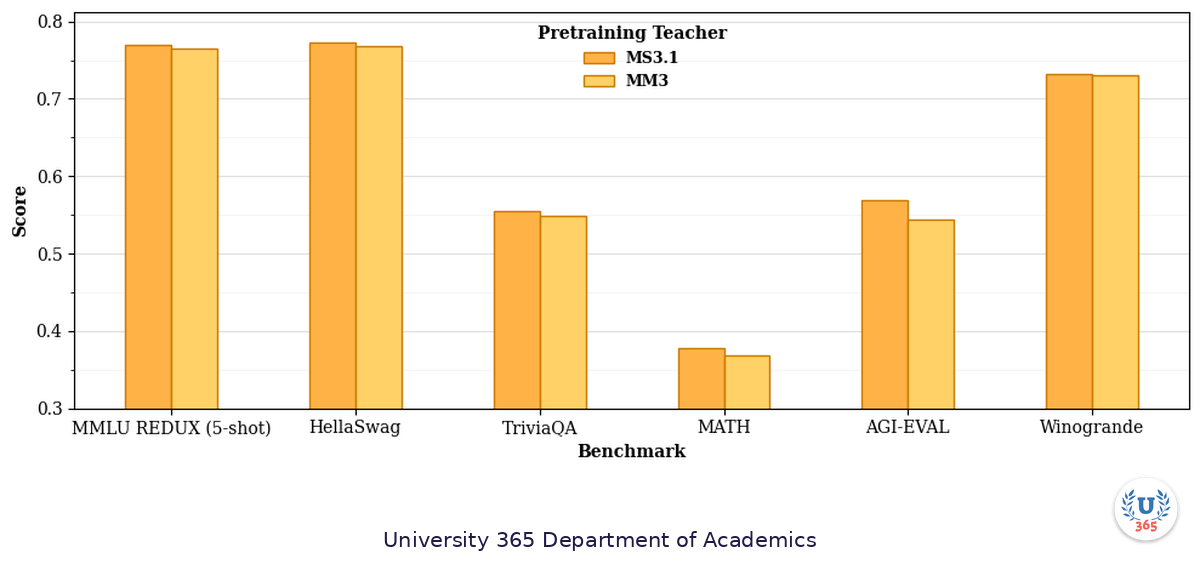
How the family was built, as the technical paper states. Ministral 3 is derived by cascade distillation. The vendor pruned the 24B Mistral Small 3.1 into the 14B child, continued pretraining with logit distillation from the parent as teacher, extended the context, and repeated the process down to the 8B and 3B. The family was trained for between one and three trillion tokens, against the 36 trillion the paper attributes to Qwen3 and the 15 trillion to Llama 3, and the post-training path runs supervised fine-tuning with logit distillation from Mistral Medium 3 as teacher, an online direct preference optimisation stage, and reinforcement learning. The 8B and 14B improved on alignment benchmarks after the preference stage; the paper states the 3B did not improve significantly on public benchmarks at that stage and was selected on internal human evaluation. That is a specific, published account of what the money bought, and it is more than most small-model releases disclose.
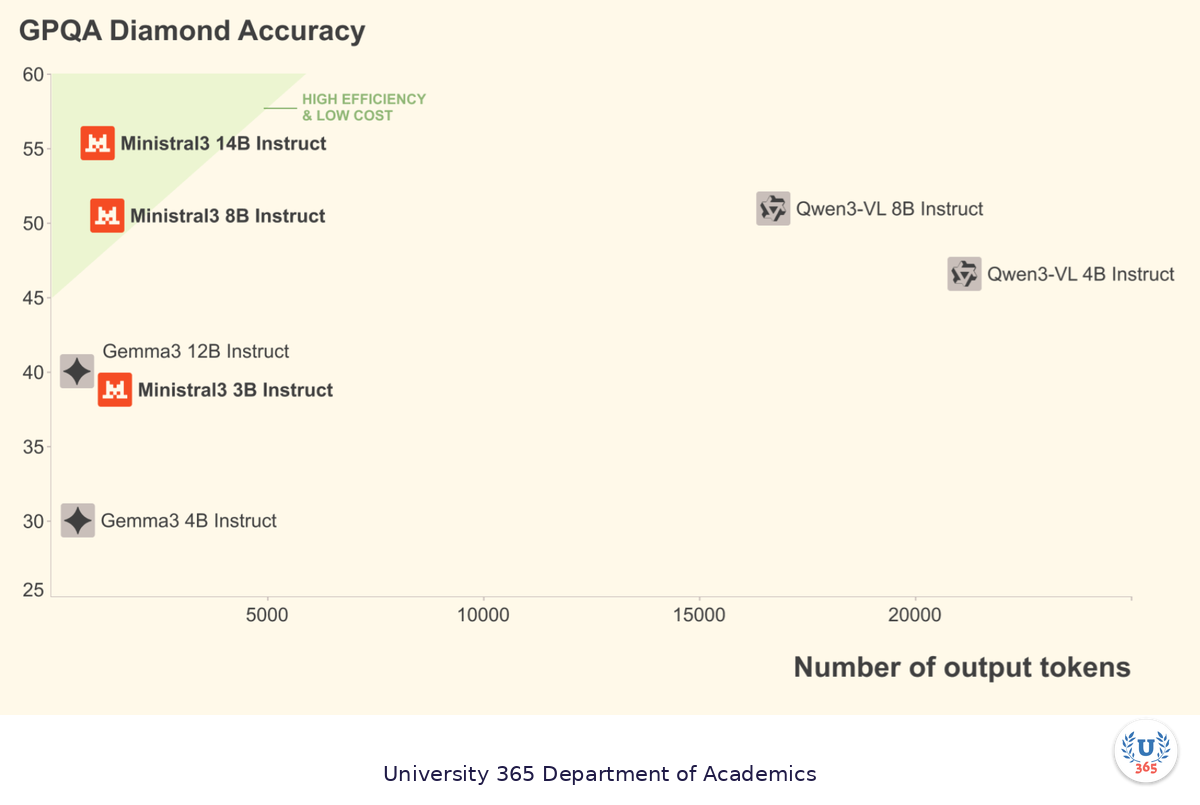
The figure is the paper's own plot, not a U365 measurement. It places the Mistral 3 instruct models at the low-token end of the GPQA Diamond comparison, which is the efficiency claim the launch makes, and it reports the 8B instruct model at about 51 percent, well below the 66.8 percent the same paper reports for the 8B reasoning checkpoint.
What the tokenizer ships with. The default system prompt in SYSTEM_PROMPT.txt identifies the model, states that its knowledge base was last updated on 2023-10-01, tells it not to browse, tells it that it can read images but not audio or video, and instructs it to use tools when a request needs current data. The 2023 date is template text carried in the file rather than a statement on the model card, and this review does not convert it into a knowledge cutoff. A deployment that keeps the default prompt is also inheriting a Le Chat persona line, which is worth replacing with the system prompt for the actual environment, as the card itself recommends.
What it does not do. It does not generate images, audio or video. It does not browse the web by itself: a search tool belongs to the scaffold. It does not hold state between calls, and any memory is the caller's. It does not report its own confidence, so a validator has to come from the caller. It does not publish a maximum output, a knowledge cutoff or a training-data mix. It does not serve 256,000 tokens on a 12GB card. And it does not enforce its own safety: there is no companion guard model named for this release, and no third-party safety evaluation is published for these weights.

Ministral 3 8B
Getting Started with Ministral 3 8B
A fifteen-minute path from nothing to a first graded reading, on a card you control or an endpoint you already have.
Read the family table before you download. Decide whether you need the instruct checkpoint, the reasoning checkpoint or the base model. The API id serves the instruct checkpoint; the reasoning checkpoint is a separate 128,000-token release; the base model is a starting point for fine-tuning and a poor chat model.
Pick the precision from your card, not from the parameter count. About 10.4 GB at FP8, about 6 GB at Q4_K_M. Add the cache arithmetic: 136 KiB per token, which is 0.53 GiB at 4K and 2.1 GiB at 16K. A 12GB card runs FP8 at a short context; a 24GB card runs FP8 at 16K to 32K.
Serve it with a documented path. vLLM 0.12.0 or later with mistral_common 1.8.6, the mistral tokenizer, config and load formats, and --tool-call-parser mistral if you need tools. Set --max-model-len to the context you can afford. The transformers path uses Mistral3ForConditionalGeneration and needs the FP8 support.
Render every prompt through the chat template. Apply it with the tokenizer and replace the default system prompt with your own environment, tool rules and refusal policy. The template also renders the image tokens, so a hand-built prompt breaks vision first.
Preprocess images to the shape the encoder expects. Crop or pad to an aspect ratio close to 1:1, keep the long edge at or below 1,540 pixels, and do not send a full-page screenshot with the text at four points and expect a faithful read.
Send three test requests, not one. A text-only question, an image question with a known answer, and a tool call with one schema. The first shows the language quality, the second shows whether vision is wired correctly, and the third shows whether the parser is.
Measure the two numbers that matter on your hardware. Output tokens per second and seconds to the first token, at the context length you will actually use. The hosted route records 88 tokens per second and 1.96 seconds to first token; the task battery records 11.0 tokens per second at Q4_K_M on one stream, and community runs sit between 6.4 and 14.2.
Score 20 real pages before you trust it. Take 20 documents or images from the work you have in mind, score each output against a person's read, and record the acceptance rate, the time per accepted record and the cost. That number is the only one that compares with another model for your work.
Decide the logging policy before the first production request. A vision pipeline that keeps page images keeps the documents, and the same applies to extracted text. Say where the images and the outputs go and how long they stay.
If you need reasoning, choose the other checkpoint deliberately. The reasoning checkpoint has a shorter window, a different sampling recommendation and its own download. Comparing an API answer to the reasoning table is comparing two products.

Ministral 3 8B
Real Workflows
Three workflows, each with a prompt pack in the UP-Context-Engineering Method's eight layers and a verification checklist in the framework's four tiers. The first is the workload a small vision model is best at, the second is the workload its long window makes possible, and the third is the measurement that keeps the first two honest.
Workflow 1: Extract a fixed set of fields from scanned invoices
When to use it: the documents are scans or photographs, the schema is fixed, a person can check a row against the page in seconds, and the volume is high enough that a hosted bill matters. This is the workload the 8B's price and vision encoder are built for.
This sample prompt uses the UP-Context-Engineering Method and the CI-First doctrine. Read the method at https://www.university-365.com/post/the-up-method-university-365-prompting-the-new-gold-standard-for-prompt-engineering, the doctrine at https://www.university-365.com/post/discover-the-ci-first-approach, learn both in a U365 online program at https://www.university-365.com/programs, and request a U.Coach for orientation at https://www.university-365.com/ucoach.
USER-PERSONA: My UP-Context-Engineering USER-PERSONA file is the file for this layer, attached. It is my psychographic file concatenated with the six ULM life-domain files. The parts that matter here: I operate the pipeline and I sign off every record it writes, and I will not approve a parser I cannot test. If the file is not attached, ask for it before you start.
FULL-CONTEXT: The FULL-CONTEXT set for this task, added and not merged: the JSON schema for the record, the document types in scope, the fields that are mandatory, the fields that may be null, the currency and date conventions, the volume, and the routing rule for a record that fails validation. The schema is the only authority for the shape. If a mandatory field or the routing rule is missing, name it and stop.
AI-PROFILE-ROLE-EXPERTISE: Act as a Co-Worker & Assistant, in the role of an extraction service, with expertise in reading a scanned page and in refusing rather than guessing.
USER-FINAL-GOAL: Every page returns either a record that validates against the schema or a refusal that names the field that could not be read, and a person can check either against the page in seconds.
AI-EXACT-TASK: Read the page image, return one JSON record that matches the schema, or refuse and name the field that could not be read.
AUDIENCE: The application, and the operator who reads the rejections. The application rejects an invalid record, so a refusal is cheaper than a guess.
EXPECTED-FORMAT-AND-CONSTRAINTS: Format: one JSON object that validates against the schema, with no prose around it. Constraints: never invent a value for a mandatory field; use null only where the schema permits it; keep the currency as printed and do not convert it; copy dates in the printed convention and state the convention in the field; never add a field the schema does not define; if two readings are possible, return the refusal and name both. Data limits: the page image and the record stay inside the service boundary; no supplier name is echoed into a log; a hosted route is used only if the licence and data review permit it.
EXAMPLES: The two accepted records, one refusal and the schema are the examples, attached.
Before you use the output, open the page for a random sample of records and confirm the totals and the dates, and read every refusal for the field it names. The pipeline decision is yours, per CI-First.
What the model does well here: a low output rate, a documented vision path and a schema-bound interface. The task battery measured 88.7 of 100 overall with 68.8 on its hardest questions, and the model card lists structured outputs and document QnA as first-class features. At $0.15 per million output tokens and $0.015 on the cached prefix, the variable cost of a page is small enough that the check, not the call, is the expensive step.
VERIFICATION CHECKLIST for Extract a fixed set of fields from scanned invoices:
Multi-Model Check: run 100 pages through a second model or a second quantisation and compare the fields that differ. A quantisation that changes a total is a change to the product.
External Source: open the page for every record the pipeline flags, and for a random sample of the rest. A record you did not open is a guess with a schema.
Human Review: an operator reads the first day's refusals and a daily sample of accepted records. The refusals are where a silent guess would hide.
CI-First Test: can you explain why a field has the value it has, from the page and the schema, without rerunning the model? If not, the record is the model's, not the pipeline's.
Workflow 2: Answer a question across a long document pack that cannot leave the estate
When to use it: the source documents are confidential, the question needs an answer across several of them rather than a keyword search, and a person will read the answer before it is used. The 256,000-token window holds a substantial pack in one request, and a local deployment keeps the material inside the boundary.
This sample prompt uses the UP-Context-Engineering Method and the CI-First doctrine. Read the method at https://www.university-365.com/post/the-up-method-university-365-prompting-the-new-gold-standard-for-prompt-engineering, the doctrine at https://www.university-365.com/post/discover-the-ci-first-approach, learn both in a U365 online program at https://www.university-365.com/programs, and request a U.Coach for orientation at https://www.university-365.com/ucoach.
USER-PERSONA: My UP-Context-Engineering USER-PERSONA file is the file for this layer, attached. It is my psychographic file concatenated with the six ULM life-domain files. The parts that matter here: I sign the answer, and I will not sign one I cannot trace to a page. If the file is not attached, ask for it before you start.
FULL-CONTEXT: The FULL-CONTEXT set for this task, added and not merged: the documents in scope with their page or clause markers, the question, the decisions already taken, and the vocabulary the organisation uses. The documents are the only source. If a document is missing or a page is unreadable, name it and stop.
AI-PROFILE-ROLE-EXPERTISE: Act as a Co-Researcher, Analyst & Tester, in the role of a document analyst, with expertise in reading a long pack, separating what a document says from what it implies, and citing the page for every claim.
USER-FINAL-GOAL: One answer to the question, each claim tied to a document and a page, the counter-evidence named, and a list of what the pack does not settle.
AI-EXACT-TASK: Read the pack, answer the question, cite the page for each claim, and list the gaps rather than filling them.
AUDIENCE: Me, and the colleague who will act on the answer. Neither of us will reopen the pack to check a claim we cannot locate.
EXPECTED-FORMAT-AND-CONSTRAINTS: Format: a short answer, then a claims table with claim, document, page and confidence, then the counter-evidence, then the gaps. Constraints: never state a claim without a page; never merge two documents into one citation; never treat a summary line as the source; if the pack contradicts itself, present both readings and say which document governs; keep the whole request inside the context you have configured and say if it was truncated. Data limits: the documents stay on the local endpoint; nothing is sent to a hosted provider; no customer name is repeated outside the answer.
EXAMPLES: The two accepted answers in the shared drive are the examples, attached, and the claims table is the format example.
Before you use the output, open two of the cited pages at random and confirm the claim is on the page, and read the gaps list before you act on the answer. The signature is yours, per CI-First.
What the model does well here: a long window and a low marginal cost per call. The 262,144-position window holds a pack that would otherwise need a retrieval layer, and a local FP8 deployment keeps the material inside the estate. The vendor's own long-context claims are not independently measured for this checkpoint, so the page check is not optional: it is the only evidence that the window was used rather than merely allocated.
VERIFICATION CHECKLIST for Answer a question across a long document pack that cannot leave the estate:
Multi-Model Check: run the same pack and question through a second model, local or hosted, and compare the claims that changed. A claim only one model makes needs a page before it is used.
External Source: open the cited page for a sample of claims. A citation you did not open is a formatting choice, not evidence.
Human Review: read the gaps list and the counter-evidence before the answer. The gaps are where an incomplete pack turns into a confident paragraph.
CI-First Test: can you defend each claim from the pack, without rerunning the model? If not, the answer is the model's, not yours.
Workflow 3: Compare the instruct checkpoint with the reasoning checkpoint on your own task set
When to use it: you are about to choose between the two post-trained checkpoints, or between this model and a larger one, and the decision will be made on your own work rather than on a vendor table. The two checkpoints share a base and not a behaviour, and the price of finding out is a download and an afternoon.
This sample prompt uses the UP-Context-Engineering Method and the CI-First doctrine. Read the method at https://www.university-365.com/post/the-up-method-university-365-prompting-the-new-gold-standard-for-prompt-engineering, the doctrine at https://www.university-365.com/post/discover-the-ci-first-approach, learn both in a U365 online program at https://www.university-365.com/programs, and request a U.Coach for orientation at https://www.university-365.com/ucoach.
USER-PERSONA: My UP-Context-Engineering USER-PERSONA file is the file for this layer, attached. It is my psychographic file concatenated with the six ULM life-domain files. The parts that matter here: I approve the model choice, and I will not approve one from a vendor row. If the file is not attached, ask for it before you start.
FULL-CONTEXT: The FULL-CONTEXT set for this task, added and not merged: the two checkpoints, the hardware and its memory, the context length you will run, the 20 to 50 tasks drawn from your own work, the scoring rule, the baseline model and its scores, and the price of the hosted route. The task set and the scoring rule are the only authority for a result. If the baseline or the scoring rule is missing, name it and stop.
AI-PROFILE-ROLE-EXPERTISE: Act as a Co-Researcher, Analyst & Tester, in the role of a benchmark designer, with expertise in holding a task set fixed across configurations and in reporting a null or negative result as loudly as a gain.
USER-FINAL-GOAL: One table that compares the two checkpoints on the same tasks, with the acceptance rate, the time per accepted task, the memory used and the cost per accepted task.
AI-EXACT-TASK: Serve each checkpoint, run the same task set, score the outputs with the stated rule, and record the memory and the time per task for each configuration.
AUDIENCE: Me, and the person who signs the purchase. We read the table and the failure notes, not every log line.
EXPECTED-FORMAT-AND-CONSTRAINTS: Format: a table with one row per checkpoint, the acceptance rate, the time per accepted task, the peak memory and the cost per accepted task, then a list of the failure modes seen in the sample. Constraints: never change the task set between rows; never report a vendor score as a result; never compare a Q4 run with an FP8 run without saying so; if a checkpoint fails to load at the context you intended, record it rather than silently shortening the context; hold the scoring rule fixed. Data limits: the task set stays inside the estate; no task, output or image leaves the boundary.
EXAMPLES: One completed comparison table from a previous model is the example, attached, and the scoring rule is the format example.
Before you use the output, re-score ten outputs by hand, confirm the memory figure from the runtime rather than from the download size, and read the failure list before the table. The choice is yours, per CI-First.
What the model does well here: it is cheap enough to measure honestly. A comparison on a local card costs electricity, a hosted run at $0.15 per million tokens costs cents, and the task battery's 88.7 gives an outside number to compare your own acceptance rate against. The two checkpoints ship from one base, so the comparison isolates post-training rather than architecture.
VERIFICATION CHECKLIST for Compare the instruct checkpoint with the reasoning checkpoint on your own task set:
Multi-Model Check: include a third model as a control, ideally a larger one. A gap that appears on your tasks and not on the vendor's table is the finding.
External Source: read peak memory from the runtime and throughput from your own logs. The download size is not the memory figure and the hosted tokens per second is not your card's.
Human Review: re-score ten outputs by hand against the rule. A scoring rule that nobody checked is a spreadsheet with opinions.
CI-First Test: can you explain, from the table, why you chose one checkpoint? If the answer depends on a row you did not measure, the choice is the vendor's, not yours.

Ministral 3 8B
Strengths, Limits, and AI Imposture Risk
Strengths
CI-First Benefit | Strength | Evidence |
Time | A fast hosted route and a cheap output line, with no licence negotiation on the card. | 1.96 seconds to the first answer token and 88 output tokens per second on Mistral's API, $0.15 per million output tokens with a 90 percent cache discount on a reused prefix, batch at 50 percent off, and a checkpoint that serves on one card. Held at 6 by an input rate above the class median, 11.0 tokens per second at Q4_K_M on one stream, and a serving setup that takes an afternoon. |
Quantity | A 256,000-token window and image input at a low marginal cost per call. | 262,144 positions in the configuration, a 131,072-token vocabulary, text and image input, eleven tagged languages and structured output through a schema. Held at 5 because the full window costs 34 GiB of cache, the maximum output is unpublished, the output is text only, and the window is documented rather than measured. |
Quality | A good independent task-battery result and vendor parity with the nearest competitor on three of four instruct rows. | Independent: 88.7 of 100, 95 percent interval 85.2 to 92.1, rank band 19 to 86 of 227, 4 to 21 of 69 in the 4B to 9B class, 68.8 on the hardest questions. Vendor instruct rows: Arena Hard 0.509, WildBench 66.8, MATH 0.876, MM MTBench 8.08 against Qwen3-VL-8B-Instruct at 0.528, 66.3, 0.946 and 8.00. Held at 5 because no composite index exists, the evaluator's individual rows are low on hard reasoning (AIME25 31.7, GPQA Diamond 47.1, MMMU-Pro 46, LiveCodeBench 30.3, AA-LCR 25.7), a community aggregator records 59.3 with code generation at 40.0, and the MATH row is seven points behind the competitor. |
Skill | A genuinely inspectable model family on hardware a learner can own. | Apache 2.0 on the card, a readable 34-layer configuration, a technical paper describing the cascade-distillation recipe and the post-training stages, base, instruct and reasoning checkpoints, 43 quantized builds, 13 adapters, 16 fine-tunes, a vLLM recipe and a transformers path. Held at 5 because the training data and code are closed, the model teaches nothing by itself, and the common reader meets an API. |
Limits
No independent composite score, and low hard-reasoning rows. Artificial Analysis publishes individual results (AIME25 31.7 percent, GPQA Diamond 47.1 percent, MMMU-Pro 46 percent, LiveCodeBench 30.3 percent, AA-LCR 25.7 percent) and no Intelligence Index value, and the coverage aggregator records 0 of 831 rows.
The independent record disagrees with itself. One task battery places the model in a rank band of 4 to 21 of 69; a community aggregator places its quality at 59.3 of 100 with code generation at 40.0. Both are published, and neither is a composite.
The 12GB memory claim assumes a short context. The FP8 weights alone are 10.4 GB and the cache is 136 KiB per token, so the advertised 256,000-token window needs about 44 GiB before activations.
The reasoning table belongs to another checkpoint. AIME25 0.787 and GPQA Diamond 0.668 are the reasoning checkpoint's rows, at a 128,000-token window. The API serves the instruct model.
The maximum output is unpublished. No ceiling appears on the card, the model page or the paper, and the window is shared between input and output.
The independent vision result is moderate. MMMU-Pro 46 percent is a real measurement and not a best-in-class one, and it is the only independent image-understanding figure in the release.
The input rate is the weak price line. $0.15 is 7 percent above the evaluator's median of $0.14 for comparable models, and the 14B sibling charges $0.20 for more parameters, so the 8B is cheaper than its larger sibling and dearer than its class.
Vision is constrained by the aspect ratio. The vendor recommends a ratio close to 1:1 and cropping wide images, and the encoder tiles at 1,540 pixels with 14-pixel patches.
The licence is stated two ways. Apache 2.0 on the card and the badge, a narrower commercial sentence in the pricing FAQ.
No state, no memory and no verifier. Persistence, tool confirmation, schema validation and logging are the scaffold's work.
No first-party chat product for the weights. There is no account, no interface and no onboarding on the checkpoint. Everything a person sees is supplied by the tool around the model.
AI Imposture Risk
Trap | Rating | Evidence |
Time Illusion | Medium | The saving is real: 1.96 seconds to the first answer token, 88 output tokens per second, $0.15 per million output tokens, a 90 percent cache discount and a batch discount. The overhead is equally real: a 10.4 GB download, a serving setup with a tokenizer mode, a config format, a load format and a tool parser, image preprocessing for every page, and a cache that ends the advertised window on a small card. A reader who equates a small model and a low output rate with a saved afternoon has counted the download and not the deployment. |
Quantity Illusion | Medium | The product returns fluent descriptions, extracted records and document answers at a volume a person cannot read line by line, and a 256,000-token window makes every request look more complete than it is. The failure mode is volume that parses cleanly and is wrong at a rate nobody measured: the vendor's vision rows are the least independently checked in the release, and one practitioner test found clear errors in an image description and a mathematics question where a competing 8B answered correctly. The counterweight is concrete: open the page, score a labelled sample, crop the image to the ratio the encoder expects. That is why the trap is Medium rather than High. |
Skill Illusion | High | The model reads an image and returns a structured answer, and reading an image feels like a capability a person has acquired whether or not the reading is right. The vendor's launch claims "best-in-class text and vision capabilities" and a benchmark table that reads as parity with Qwen3-VL-8B-Instruct, while the independent index publishes no score, the coverage aggregator has no row, and the two independent records that do exist disagree by a wide margin. Apache 2.0 weights make the model feel inspectable when very few readers can inspect an 8.8 billion parameter checkpoint. Mitigations exist and are cited: a second model, a labelled sample, an opened page, a schema, an aspect-ratio rule. They lower the frequency of failure without moving the capability to the reader. |
Overall Imposture Risk: Medium. One trap is High with identifiable mitigations and two are Medium, which is the v1.3 Section 5.3 Medium row: "One, two or three traps are Medium, or one trap is High with clear mitigations stated." The band-precedence sentence does not change the outcome, because the Medium band names this exact trap set and no second rating competes with it. The rating would move to High if a second trap became High, for example in a deployment that ran image readings into a downstream decision without a person opening the source.
Framework v1.2 clause note
Clause 5.2.3-a, agent-authored procedural memory: NULL, recorded with its boundary. A clause note in this review names the version that introduced the two clauses, v1.2, and the framework of record is the CI-First Evaluation Framework v1.4.1, which retains both; the version in the heading is the clause's origin, not a stale framework. Ministral 3 8B holds no memory store and writes nothing by itself: every request is independent unless the caller resends context, fine-tuning produces a checkpoint the user trains and serves, and the chat template's system prompt is text the deployer supplies rather than a store the model revises. No documented mechanism ships by default by which ministral-8b-2512 writes skills, memory stores or standing instructions on the user's behalf, so the clause returns a null rather than applying. The live condition is specific: a scaffold that lets the model write or revise the workspace's skills, rules or procedural memory by default, or a deployment in which the model's own description of an image becomes the standing record without a per-write human decision, re-opens this clause at no lower than Medium, and at High where the user has no routine practice of reading what was written. That condition is the eighth re-check trigger.
Clause 4.2-a, agent-mediated conversation: NULL for the model and for its shipped surface. Neither erosion condition is met. The model returns text to the caller, no agent-authored text is presented as a person's own voice in a human-facing channel by default, and nothing in the product substitutes agent interaction for human contact. The live condition to watch on any deployment: a scaffold that lets the model draft replies, send messages or publish under a person's identity without that person reading the result first meets condition (a), and a workflow in which a person deals with the agent instead of with colleagues meets condition (b). Both are properties of a deployment built around this model rather than properties of the model.
Clause 7.5 is not assessed. It was removed from the framework in v1.4, and this review derives no mode, writes no mode line and records no mode value. The two clauses above are the only pedagogical clauses that apply under v1.4.1.

Ministral 3 8B
Section 7c: A licence two vendor pages describe differently, a memory claim that assumes a short context, and one independent score where three surfaces should carry one
A Section 7c finding is recorded where a supplier's governance, safety record, documentation or commercial terms have a real result for the reader. The items below were checked against primary sources, and they produce findings a buyer should carry. All findings are stated as facts of record, and the difference between a company statement, a published measurement and a third-party data error is kept intact.
The licence is stated twice, in different terms, on the same vendor's surfaces. The Hugging Face model card says: "Apache 2.0 License: Open-source license allowing usage and modification for both commercial and non-commercial purposes." The documentation page carries an APACHE 2.0 badge beside a GA status. The pricing page's FAQ says: "Open-weight models (e.g., Mistral 7B) are Apache 2.0 licensed for research/individual use; while commercial deployments require a Mistral license with separate terms for derivatives and production use." The two statements cannot both govern a commercial deployment of these weights, and this review does not resolve which one a court or a procurement team would apply. What it can say is what a buyer should do: treat the licence file shipped with the weights as the operative text, get the commercial question answered in writing by the vendor before a product ships, and do not cite the card alone in a legal review. The finding is not that the model is restricted. It is that the vendor's own two surfaces disagree, and a disagreement is a cost even when the answer turns out to be permissive.
The 12GB memory statement is true at a short context and not at the window advertised beside it. The card states that Ministral 3 8B "can even be deployed locally, capable of fitting in 12GB of VRAM in FP8, and less if further quantized". The FP8 weights are 10,420,654,824 bytes, about 9.7 GiB, and the KV cache is 136 KiB per token: 0.53 GiB at 4,096 tokens, 4.3 GiB at 32,768 and 34 GiB at 262,144. A 12GB card therefore holds the weights and a few thousand tokens, not the window the model is sold on. A practitioner report matches: one tester could not run the Q4_K_M build at a 4K context on a 12GB card, and on a 16GB card the same build used about 16 GB at 4K. The finding is arithmetic a reader can do before buying, and the vendor does not do it on the card.
The independent record is broad, partial and split three ways. Artificial Analysis publishes a price, a 1.96-second time to first answer token, an 88-token-per-second output speed and individual evaluation results for the served model: AIME25 31.7 percent, GPQA Diamond 47.1 percent, MMMU-Pro 46 percent, LiveCodeBench 30.3 percent, AA-LCR 25.7 percent, IFBench 29.1 percent, SciCode 20.7 percent and Humanity's Last Exam 4.3 percent. It publishes no composite Intelligence Index, no time per index task and no cost per index task, and several of the nine evaluations the current index names carry no value for this model. BenchLM records 0 of 831 benchmark rows, calls the overall score "coming soon" and leaves the model unranked. OpenWeights Bench publishes a real battery: 88.7 of 100, a 95 percent interval of 85.2 to 92.1, a rank band of 19 to 86 of 227, 4 to 21 of 69 in its 4B to 9B class, and 68.8 on the hardest questions, measured on 2026-10-26 at Q4_K_M on a Ryzen AI Max+ 395. A community aggregator adds 59.3 of 100 across seven runs, with code generation at 40.0 and agent workflow at 66.9. The finding is the split rather than the absence: a strong general battery, low hard-reasoning rows from the largest evaluator, and a middling community record, with no composite to reconcile them.
The benchmark tables on the card describe two checkpoints, and the API serves one of them. The reasoning table reports AIME25 0.787, AIME24 0.860, GPQA Diamond 0.668 and LiveCodeBench 0.616 for "Ministral 3 8B". The instruct table reports Arena Hard 0.509, WildBench 66.8, MATH 0.876 and MM MTBench 8.08. The technical paper states that the reasoning models carry 128,000-token contexts while the base and instruct models carry 256,000, and the independent evaluator records the served model as non-reasoning. A reader who compares an API answer to the reasoning table is comparing two products that share a name, and a buyer who procures "Ministral 3 8B" without naming the checkpoint may receive the one they did not benchmark.
One third-party record carries a context figure the vendor does not publish. BenchLM lists a 128K context window for this model, against 262,144 positions in the vendor's configuration file and 256,000 tokens in the documentation and in the independent evaluator's record. The vendor's own vLLM default of 262,144 supports the larger figure. The finding is a data-quality note for anyone comparing context windows across aggregator pages, not a product defect.
Two findings cut in the vendor's favour and should be said as plainly as the rest. The technical paper publishes the derivation of the family in specific terms: pruning from a 24B parent, logit distillation, a supervised stage distilled from Mistral Medium 3, an online preference stage, reinforcement learning, and the honest note that the 3B did not improve significantly on public benchmarks at the preference stage and was selected on internal human evaluation. That is a more useful disclosure than a launch post usually carries. And the packaging is unusually complete: 43 quantized builds, 13 adapters and 16 fine-tunes on Hugging Face, a vLLM recipe with the tokenizer, config and load formats named, a transformers path, and GGUF builds that the community runs on consumer cards.
No sub-score changed for these findings, and the reason is explicit. The Quality sub-score already carries the absent index, the 88.7 battery and the 59.3 community record. The Time sub-score already carries the input rate, the cache discount and the latency. The Quantity sub-score already carries the 256,000-token ceiling and the cache cost. The Skill sub-score already carries the Apache 2.0 card and the closed training pipeline. The Imposture section already carries the vision-trust risk. The items above are a licence-surface conflict, a memory calculation, a coverage ratio, a checkpoint ambiguity and a third-party data error. None of them is a defect in the artefact a buyer receives, and none is a resolved failure that the four dimensions do not already price. Section 7c closes with what it does not do: it does not allege misconduct, it does not treat a marketing sentence as a false claim, and it does not convert an FAQ line into a licence restriction.

Ministral 3 8B
U365 Co-Intelligence Rating
CI-First Profile
Primary profile: Co-Worker and Assistant (level 2). Secondary profile: Co-Researcher, Analyst and Tester (level 4).
Why this profile and not Co-Creator. Mistral's positioning does the reasoning. The launch sells the family for edge deployment, document and image understanding, multilingual chat and agentic tool use, and the role the model plays is the one the scaffold gives it: read this page, extract this record, answer this question, call this tool. Co-Worker and Assistant is that role. Co-Researcher, Analyst and Tester is recorded as secondary because the image and document surfaces are where the model adds reading on material a person then interprets, and because document QnA and a 256,000-token window are analytical instruments. Professor, Coach and Tutor is not recorded: the model returns an answer rather than a correction, and nothing in the release is built to move a capability from the model to the person. Challenger, Critic and Devil's Advocate is not recorded either: the model will argue if it is asked to, and no part of the release is built for the role.
CI-First Benefit Score
Dimension | Score (0-10) | Rationale |
Time | 6 | Moderate net saving. 1.96 seconds to a first answer token and 88 output tokens per second on Mistral's API, $0.15 per million output tokens, a 90 percent cache discount and a 50 percent batch discount. Apache 2.0 on the card and a one-card deployment remove the two delays that dominate an adoption decision. Held at 6 by an input rate above the class median, 11.0 tokens per second on one stream at Q4_K_M, image preprocessing on every page, and a serving setup with four named flags. |
Quantity | 5 | A real multiplier at the moderate band. A 262,144-position window, image input, a 131,072-token vocabulary, eleven tagged languages and structured output through a schema. Held at 5 because the full window costs 34 GiB of cache, the maximum output is unpublished, the output is text only, and the window is documented rather than measured on a task. |
Quality | 5 | Moderate, and the dimension that carries the unverifiability. The independent task battery reports 88.7 of 100 with a rank band of 4 to 21 of 69 in class and 68.8 on hard questions, and the vendor's instruct rows sit at or near Qwen3-VL-8B-Instruct on three of four. Held at 5 because no composite index exists, the evaluator's individual rows are low on hard reasoning (AIME25 31.7, GPQA Diamond 47.1, MMMU-Pro 46, LiveCodeBench 30.3, AA-LCR 25.7), the coverage aggregator has 0 of 831 rows, a community aggregator reports 59.3 with code at 40.0, and the MATH row is seven points behind the direct competitor. |
Skill | 5 | Moderate and deliberately conservative. A readable configuration, a technical paper that describes the cascade-distillation and post-training recipe, three downloadable checkpoints, 43 quantized builds, 13 adapters, 16 fine-tunes, a vLLM recipe and a transformers path are a real learning path, and the bar is one small card. Held at 5 because the training data and code are closed, the model teaches no method of its own, and the common reader meets an API rather than a checkpoint. |
CI-First Benefit Score: 5.3 / 10 (CI-First Positive)
Why the score sits where it sits
5.3 with sub-scores 6 / 5 / 5 / 5 is a small, open, image-reading instrument with a fast hosted route and an unverified mind, and every part of that sentence is documented.
Why not higher. The independent record does not carry the Quality dimension above moderate. The largest evaluator publishes no composite index, and its individual rows are low on hard reasoning: AIME25 31.7 percent, GPQA Diamond 47.1 percent, MMMU-Pro 46 percent, LiveCodeBench 30.3 percent and AA-LCR 25.7 percent. The coverage aggregator has no rows, the one battery that ran places the model in a wide rank band, and the community record puts quality at 59.3 with code at 40.0. The vendor's own instruct table shows a seven-point gap to Qwen3-VL-8B-Instruct on mathematics. The 256,000-token window costs 34 GiB of cache, so the quantity claim is real at the API and expensive at the edge. And the input rate is above the class median, which weakens the volume argument on a read-heavy workload.
Why not lower. Three reasons, each measured. The independent task battery is a good result: 88.7 of 100, 68.8 on the hardest questions, 4 to 21 of 69 in its size class. The price is genuinely low on the output line, at $0.15 against a class median of $0.28, with a 90 percent cache discount and a batch discount. And the artefact is usable: it reads images, holds a 256,000-token window, calls tools in a standard format, serves through a documented vLLM path, ships three post-trained checkpoints from one base, and carries Apache 2.0 on the card. A model a reader can download, serve and measure for the price of the electricity, with one published battery behind it, is a positive tool in the framework's terms even when the composite is missing.
Why 5.3 and not a higher band, stated as arithmetic. Time 6, Quantity 5, Quality 5 and Skill 5 average to 21 divided by 4, which is 5.25, rounded to 5.3. That is CI-First Positive, the 4.1 to 6.0 band, and the label is derived from the score. It sits above U365's published reading for Mistral Small 4 at 5.0 and below Mistral Large 3 at 7.0, and it is not comparable with the Ministral 3 14B, which is a separate review with its own document. The composition is the finding: the throughput dimension carries the score, and the three dimensions that measure reach, quality and learning hold it in the middle of the band.
What the score does not carry. The four dimensions measure what the reader's work gains. They do not carry the licence-surface conflict, the memory arithmetic, the coverage ratio, the checkpoint ambiguity or the third-party context error, which is why those sit in Section 7c with an explicit statement that no sub-score changed. They do not carry the clause questions either, which return nulls with boundaries. A reader who wants the score to encode legal certainty would need a different instrument, and the framework's instrument for that is the 7c finding and the procurement step.
Humics Protection Badge
Dimension | Rating | Rationale |
Creativity | Neutral (0) | The model reads an image, drafts, rewrites, summarises and extracts on request. It originates no direction: a designer who receives a description of a reference still makes the design, and a writer who receives ten openings still chooses one. The vision surface supports a creative workflow without substituting for one. |
Critical Thinking | Erodes (-1) | The product is built to read on the reader's behalf, and an image description or an extracted table reads as evidence of a page that was understood. The failure mode is not an obvious error: it is a fluent description with one wrong detail, a table with one wrong total, a date in the wrong convention. The price removes the friction that used to force a sample check, the launch claims best-in-class vision beside an independent MMMU-Pro result of 46 percent, and a reader who cannot open the page has no way to tell a good row from a plausible one. Mitigations exist (a schema, a labelled sample, a second model, an opened page) and they lower the frequency without reversing the direction. |
Social Authenticity | Neutral (0) | The model returns text and structured data rather than speaking in a person's name, and clause 4.2-a returns a null for it as a generator. The live condition stays in the record: a deployment that lets an agent send under a person's identity without the person reading it first moves this dimension, and the function-calling and conversations surfaces make that arrangement easy to build. |
Humics Protection Score: -1 / +3 Badge: Humics-Neutral
Superhuman Usage Guidance
When to invite this tool:
Document and image reading on material that cannot leave the estate, where a hosted model is not an option.
Extraction and classification at volume, where the schema is fixed and a person can check a row against the page in seconds.
Long-document work inside a window that a retrieval layer would otherwise have to assemble, at the API rather than on a small card.
Multilingual drafting and summarising across the eleven tagged languages.
First-pass alt text, image captions or description at a volume a person could not write alone.
A study object for distillation and post-training, with the caveat that the data and the code are closed.
A tool-calling backend behind an OpenAI-compatible client, served on one card with the mistral parser.
When to keep this tool out:
Any decision that needs an independent capability guarantee before adoption, because no composite index exists and the independent records disagree.
Any workload that needs the 256,000-token window on a single 12GB card, because the cache costs 34 GiB at that length.
Any task that needs a reasoning model through the API, because the reasoning checkpoint is a separate download with a shorter window.
Any workflow that reads far more than it writes at scale, where the input rate is above the class median and the 14B charges only $0.20 for more parameters.
Any image work on very wide or very tall sources without cropping, because the encoder tiles at 1,540 pixels and the vendor recommends a near-square ratio.
Any output that will be acted on without a person opening the source image, because a fluent reading is the failure this model produces most convincingly.
Any procurement that cannot wait for the licence question to be answered in writing.
U365 method integration:
LIPS + CARE: keep the brief, the images in scope, the schema and the outcome a person accepted in the Collect phase, and put the acceptance decision in the Action Plan and Review phases. The model can read the page; it cannot own the judgement about whether the reading was right.
ULM + EVA: a GPU and its power are a recurring cost in the Career and Finance domain, and the decision to own one belongs in the six-domain plan rather than in a purchase at the moment a model appears. The EVA cycle is the right place to decide which workflow justifies the card.
UP-Context-Engineering: the eight layers are the control surface this model needs, because a stated AI-EXACT-TASK, a bounded FULL-CONTEXT and an EXPECTED-FORMAT-AND-CONSTRAINTS carrying the schema, the image ratio and the confirmation rule are what make an image reading checkable. The three workflow samples above use the eight layers.
UNOP: no direct fit. The model is not built to teach, and its gains come from execution rather than from any pedagogical mechanism.
Over-delegation warning: the failure mode with this product is that a description of an image reads like a proof that the image was understood. The model shows a page, returns a table, and a reader who skims the output concludes that the document was checked. The evidence says something narrower: one battery at 88.7, one community record at 59.3, low hard-reasoning rows and a 46 percent MMMU-Pro result from the largest evaluator, and no composite index. A reader who lets this model grade its own extraction, or who treats a fluent description as a verification step, has taken the product's worst offer. The defence is cheap and it is the same defence the framework asks for everywhere: a schema, a labelled sample, a second model and a person who opens the page.

Ministral 3 8B
What Users Say
Aggregate Rating Table
Platform | Rating | Number of reviews | Link |
Artificial Analysis | No composite Intelligence Index; individual results AIME25 31.7, GPQA Diamond 47.1, MMMU-Pro 46, LiveCodeBench 30.3, AA-LCR 25.7, IFBench 29.1, SciCode 20.7, Humanity's Last Exam 4.3; 88 output tokens per second and 1.96 seconds to the first answer token on Mistral's API; $0.15 input and $0.15 output per million tokens, $0.0555 blended; providers Amazon Bedrock and Mistral | Independent benchmark house, partial evaluation coverage | |
OpenWeights Bench | 88.7 of 100, 95 percent interval 85.2 to 92.1, rank band 19 to 86 of 227, 4 to 21 of 69 in the 4B to 9B class, hard questions 68.8; Q4_K_M, 6.0 GB, 11.0 tokens per second on one stream; tested 2026-10-26 | Independent task battery with 44 public items and a private remainder | |
llm-bench.io | 59.3 of 100 average quality across 7 community runs (P5 54.5, P95 65.6); agent workflow 66.9, code generation 40.0, role play 70.7, research 59.6; peak 14.2 tokens per second | Community-submitted runs on 3 GPUs, LLM-judged | |
BenchLM | No score, unranked; 0 of 831 benchmark rows covered; context listed as 128K | Aggregator with no covered benchmark for this model | |
Hugging Face, instruct repository | 90,025 downloads in the last month and 242 likes; created 2025-10-31, last modified 2026-07-15; 43 quantized builds, 13 adapters and 16 fine-tunes derived from it | Repository engagement, not a rating platform | |
Reddit, r/LocalLLaMA | The launch thread of 2025-12-02 announced the nine checkpoints and linked the Unsloth GGUF builds; the thread is locked and the rendering available on 2026-11-19 carries no vote count | Practitioner discussion, not a rating platform | |
Reddit, r/SillyTavernAI | 16 points and 12 comments on a thread asking who had tested the 8B and 14B, with the poster noting "almost no talk about it's recent release here or on other sub's recently" | Practitioner discussion, not a rating platform | |
Reddit, r/ollama | The launch-week thread describes the family as "one of the most polished edge-deployable models right now, especially if you care about multimodal inputs and huge context", and the same poster says "I would still stay on qwen and llama because they are already configured" | Practitioner discussion, not a rating platform | |
G2 | No listing for the model | Not applicable | Not applicable |
Capterra | No listing for the model | Not applicable | Not applicable |
Trustpilot | No listing for the model | Not applicable | Not applicable |
Note on method, stated plainly because it affects how much this section is worth. No review platform rates an individual open-weight model. No G2, Capterra or Trustpilot listing for mistralai/Ministral-3-8B-Instruct-2512 exists, and none is reproduced here. The meaningful signals for a released checkpoint are the independent evaluator's page, the task-based battery, the community runs, the repository's download and like counts, and the practitioner threads. That is what this section reports, and where a claim comes from a commenter rather than from a measurement, the commenter is named. The largest single theme in the discussion is not the benchmark table. It is memory, and the second is how little discussion the release generated relative to its siblings.
What Users Praise
Three themes recur, and the first is that the model runs where a person can afford to run it.
The size is real, and it carries vision. The task battery ran the Q4_K_M build at 6.0 GB with an estimated 7.2 GB of memory on a Ryzen AI Max+ 395, and community runs sit between 6.4 and 15.9 GB depending on card and context. The 14B sibling has 212,056 downloads and needs considerably more memory, and the 8B is the size a laptop-class machine can hold. The card's own framing, an edge model for local setups, is the part of the release the community record supports.
The vision and the window are the features people name. The ollama thread's summary is representative: "one of the most polished edge-deployable models right now, especially if you care about multimodal inputs and huge context". A 256,000-token window in an 8B checkpoint is unusual, and the image input is a genuine step beyond the text-only models in the same class.
The packaging is usable rather than demonstrative. A vLLM command with the tokenizer, config and load formats named, a transformers path, a paper that describes the distillation recipe, 43 quantized builds, 13 adapters and 16 fine-tunes is a documentation set a practitioner can work from. The 90,025 downloads and 242 likes on the instruct repository describe a release people tried rather than only read about.
What Users Complain About
Three complaints recur, and the first is memory.
The 12GB claim does not survive contact with a real context. One practitioner ran the Ollama Q4_K_M build on a 12GB RTX 3060 and could not run it at a 4K context; on a 16GB RTX 5060 Ti the same build ran at 4K and used about 16 GB. The memory arithmetic in this review explains the gap: the FP8 weights are 9.7 GiB on their own, the cache is 136 KiB per token, and the runtime adds its own allocation. The complaint is not that the arithmetic is wrong. It is that the number a person sees before downloading is the weight file, and the number that decides whether the model runs is the weights plus the cache plus the runtime.
The vision reading is not always right, and the errors are plausible. A practitioner test published on 2025-12-03 compared the 8B instruct model with Qwen3-VL-8B: the Japanese-language description of an anime illustration contained clear errors where the competing model was correct, and a mathematics question answered by the 8B was wrong where Qwen3-VL answered correctly. Neither failure produced an error message, which is the pattern that matters: a wrong description reads exactly like a right one.
The release generated little discussion, and the silence is itself a signal. The r/SillyTavernAI thread asking who had tested the 8B and 14B notes that there was "almost no talk about it's recent release here or on other sub's recently", and the r/LocalLLaMA launch thread is locked. The repository counts are healthy, and the practitioner comparison material is thinner than for a model of this size from a larger vendor. A reader should treat the community record as small rather than as negative.
Code generation is the weak row in the community record. 40.0 of 100 on code generation in the llm-bench aggregate, against 66.9 for agent workflow and 70.7 for role play. That is a community-judged figure rather than a benchmark, and it agrees with the vendor's own positioning: this is an edge model for reading and conversation, not a coding specialist.
Sentiment Summary
Overall sentiment: positive on local deployment, image input and the size of the window; critical of the memory arithmetic that a 12GB claim hides; and cautious about capability, with one good independent battery, one middling community record and no composite index to settle the difference.
Key themes: an 8.8 billion parameter dense model with a 0.4 billion parameter vision encoder under Apache 2.0 on the card; a 256,000-token window that costs 34 GiB of cache at full length; a 10.4 GB FP8 checkpoint against a 12GB memory claim; an independent battery at 88.7 with no index score; and a $0.15 input and $0.15 output rate with a 90 percent cache discount.
U365 Editorial Note
The model's record argues in two directions, and a reader should hold both. On the positive side, Mistral released an image-reading 8B checkpoint under Apache 2.0 with a 256,000-token window, native function calling, structured output, eleven tagged languages, a documented vLLM path and a technical paper that describes how the family was distilled from a 24B parent. It runs on a card a person owns, it costs $0.15 per million output tokens with a 90 percent cache discount, and one independent battery places it in a rank band of 4 to 21 of 69 in its class. On the negative side, the largest evaluator publishes no composite index for it, its individual rows are low on hard reasoning (AIME25 31.7 percent, GPQA Diamond 47.1 percent) and its MMMU-Pro result is 46 percent, the coverage aggregator has no row, the community record puts quality at 59.3 with code at 40.0, the 12GB memory claim assumes a context far shorter than the advertised window, the reasoning table belongs to a checkpoint the API does not serve, and the licence is stated two ways on the vendor's own pages. The Framework rates AI Imposture Risk Medium overall with Skill Illusion High, and that rating is the editorial position: Ministral 3 8B is a good small reading instrument and a partly measured one, and the difference is a matter of coverage rather than taste. A reader who wants a higher rating is asking for a composite index and a stronger multimodal row, and no price change or packaging change would produce either.

Ministral 3 8B
Comparison and Alternatives
Model or product | Position | Independent evidence | Commercial shape | Choose it if |
Ministral 3 8B | Mistral's middle edge model: 8.4B language parameters plus a 0.4B vision encoder, 256,000-token window, FP8 instruct checkpoint | One battery at 88.7 of 100, rank band 4 to 21 of 69 in class; no composite index, and low independent hard-reasoning rows; community quality 59.3 across 7 runs | Apache 2.0 on the card; $0.15 input, $0.015 cached input, $0.15 output per million tokens; batch at 50 percent off | You want a private, image-reading model on a small card, the tasks are bounded, and a person checks the reading |
Ministral 3 14B | The largest of the family, 13.5B language parameters plus the same 0.4B vision encoder, same 256,000-token window | No independent index for the 14B either; the task battery publishes a head-to-head against this model; it is a separate model with its own review and no figure is borrowed here | $0.20 input, $0.02 cached input, $0.20 output per million tokens | You need more capability than the 8B offers and the memory bill of a 14B model is acceptable |
Ministral 3 3B | The smallest of the family, for laptops and embedded devices | A separate model at a third of the size; no figure is borrowed here | $0.10 input, $0.01 cached input, $0.10 output per million tokens | The footprint is the binding constraint and the task is simple extraction or drafting |
Ministral 3 8B Reasoning | A separate BF16 checkpoint post-trained for mathematics, science and code, at a 128,000-token window | Vendor table only: AIME25 0.787, AIME24 0.860, GPQA Diamond 0.668, LiveCodeBench 0.616, all on the vendor's own evaluation setup | The same API family and price, but a separate download; the API id serves the instruct model | Your task needs a reasoning trace and you can accept half the window |
Qwen3-VL-8B-Instruct | The direct competitor the vendor chose for its own instruct table, with vision and a comparable size | Vendor-run comparison only: Arena Hard 0.528, WildBench 66.3, MATH 0.946, MM MTBench 8.00 against this model's 0.509, 66.8, 0.876 and 8.08 | A different vendor, licence and price, read on the day | You want the stronger mathematics row on the same vendor-run table and you accept a different licence and provider |
Mistral Small 4 | A different and larger Mistral family, reviewed separately by U365 at 5.0 | U365's own published reading, with its own evidence | $0.15 input, $0.015 cached input, $0.60 output per million tokens | You need more general capability and your workload is read-heavy rather than write-heavy |
A hosted frontier model | The default alternative for a reader who does not need local weights or an image-reading small model | The index and price of the specific model you choose, read on the day | A token meter and a vendor relationship, with no hardware and no cache arithmetic | Your task needs top-quartile quality and your data can leave the estate |
The comparison that matters most is not the benchmark row, it is the context bill. The 8B and the 14B share a window on paper and not in memory: the 8B's FP8 weights are 9.7 GiB and its cache is 136 KiB per token, so a full window is about 44 GiB; the 14B is roughly 40 percent larger before its cache. A buyer comparing the two on the vendor's benchmark rows alone is comparing the cheaper axis.
On U365's own published readings, this model lands above Mistral Small 4 and below Mistral Large 3. Mistral Small 4 is 5.0, Mistral Large 3 is 7.0, and Ministral 3 8B is 5.3. The gaps are not a verdict on capability in the abstract: they are the framework charging each model for its measured quality position, its memory bill, its licence clarity and its price lines. The 14B has its own review and its own document, and no figure from it is used here.
Choose Ministral 3 8B if you want an image-reading model on hardware you own, the tasks are bounded, the schema or the sample check is in place, and you have measured the cache against the context you need. Choose the 14B if you need more capability and can carry the memory. Choose the 3B if the footprint is the binding constraint. Choose the 8B Reasoning checkpoint if your task needs a reasoning trace and half the window is enough. Choose Qwen3-VL-8B-Instruct if the vendor's own mathematics row is what your work depends on and a different licence and provider are acceptable. Choose Mistral Small 4 if you need a larger general model and a read-heavy price shape. Choose a hosted frontier model if quality matters more than locality and your data can leave.

Ministral 3 8B
Verdict and Next Steps
Verdict: Ministral 3 8B is an image-reading 8B model with a 256,000-token window, Apache 2.0 on its card, a $0.15 input and output rate and one good independent task battery behind it, which makes it a useful small instrument and an unmeasured one.
At 5.3 / 10, CI-First Positive, with sub-scores 6 / 5 / 5 / 5, it is a model with a clear job: give a reader a vision-capable model that runs on a small card, holds a long pack, calls tools in a standard format and costs $0.15 per million output tokens. It does that job well enough to be worth the download. The three facts that hold the score in the middle of the band are the ones a buyer has to act on: no independent intelligence score, a 256,000-token window that costs 34 GiB of cache at full length, and a licence stated two ways on the vendor's own pages.
Adopt it if the tasks are bounded, the checks are in place, the images are cropped to the ratio the encoder expects, and you have measured the cache against the context you need. Do not adopt it as a measured top-quartile model, a reasoning model through the API, a 12GB full-window deployment, an image generator, an autonomous coder, or a model whose reading can stand in for a person opening the page. It is none of those, and the price does not change that.
The three things to do in the first week:
Do the memory arithmetic before you buy anything. Decide the precision and the context, then compute the cache: 136 KiB per token, about 0.53 GiB at 4K, 2.1 GiB at 16K and 34 GiB at 256K. Add the weights, about 9.7 GiB at FP8 or 5.6 GiB at Q4. That calculation decides the purchase more than any benchmark row.
Score 20 of your own pages. Take 20 documents or images from the work you have in mind, run them through the checkpoint you intend to use, and score each output against a person's read. Record the acceptance rate, the time per accepted record and the cost. That table is the only comparison with another model that means anything for your work.
Settle the licence question and the verification layer before the first production call. Get the commercial sentence answered in writing, apply the schema or the sample check, and decide whether page images and extracted text are logged. The model does not enforce any of them, and one practitioner test found a fluent description that was wrong.
UP-Context prompt packs: the three samples are in Real Workflows, one per workflow, each in the UP-Context-Engineering Method's eight layers and each followed by the check the reader runs before using the output.
What would change this verdict. An Intelligence Index score appearing at the independent evaluator, a second independent multimodal measurement, a licence clarification, a price change, a successor or a deprecation, a published memory figure for the 8B, a change to the vision recipe or a reasoning checkpoint with the same window. The re-check triggers at the top of this review name each one.

Ministral 3 8B
Status and Last Tested
Status: Active | Last tested: 2026-11-19 | Version tested: Ministral 3 8B (ministral-8b-2512, released 2025-12-02)
Active: the tool is current and recommended.
The badge is Active for two specific reasons. The first is currency: Ministral 3 is Mistral's current edge generation, released on 2025-12-02 as the named replacement for the deprecated Ministral 8B (24.1), and no successor exists on 2026-11-19. The second is that the model does a real job at a price a reader can pay, with Apache 2.0 on the card and one independent battery behind it. The model is not the strongest in its class on any independent measure, and the review says so in the Quality sub-score and in Section 7c of this review. Active does not mean best in class; it means current and recommended for the work the review describes.
The review was written against the model page, the model card, the configuration file, the generation configuration, the technical paper, the launch post, the API pricing page, the vendor pricing page and its FAQ, the deprecated predecessor's page, the independent evaluator's page, one task-based battery, one community benchmark aggregator, one coverage aggregator, the Hugging Face model API, and the practitioner threads named in What Users Say. The scores are set on that evidence and on the framework's application rules. The re-check is trigger-based with a six-month outer limit, and the first trigger is the independent index, because the Quality sub-score turns on a number that does not yet exist and can appear.

Ministral 3 8B
Migration Path
Not applicable for an Active model, with the notes a reader still needs.
Ministral 3 8B is not retired, deprecated or risky, so no migration is required. Three notes belong here anyway, because a reader arriving later will want them.
If a Ministral 4 or a larger sibling arrives, the transfer is small. The serving stack carries over: vLLM with the mistral tokenizer, config and load formats, the mistral tool parser, and an OpenAI-compatible client that needs a new model name rather than a new design. The chat template and the image preprocessing are the parts to re-check, because a change to the image token layout or the aspect-ratio rule breaks the vision path first.
If a reader outgrows the 8B, the family offers the 14B and the wider market offers stronger small models. The 14B adds parameters and a higher price on both lines, and Qwen3-VL-8B-Instruct is the competitor Mistral itself chose, with a stronger mathematics row on the vendor's own table. The migration is a memory decision first and a quality decision second.
If a reader is on the deprecated Ministral 8B (24.1), the migration is real and the vendor names the replacement. The old model was deprecated on 2025-12-02, and the documentation page for it points to Ministral 3 8B. The API id changes, the vision capability is new, the window doubles from 128,000 to 256,000, and the price lines change with it. A pipeline built on the old id will not read images and should not assume the new model's output shape is identical.
What does not migrate. There is no vendor-managed state to move, because the model holds none. There is no fine-tune to carry unless the reader made one, and a fine-tune is tied to the base checkpoint it was trained from. There is no 256,000-token configuration to move a long-document pipeline onto a 12GB card. And there is no lock-in to unwind on the card's reading: Apache 2.0 on the weights means the weights and the derivatives are the reader's, subject to the licence question in Section 7c of this review.
Migration steps, if one becomes necessary:
Serve the target model beside the current one and replay the same 20-page set through both.
Compare the acceptance rate, the time per accepted record and the peak memory, not the vendor rows.
Move the schema, the image preprocessing and the logging policy across unchanged, and re-check the tool parser and the chat template for the target.
Retire the 8B endpoint only after the target passes the same acceptance threshold on a held-out sample.

Ministral 3 8B
U365's Recommendations to Learn More
Start with the configuration file, then the card
Read config.json before the benchmark table, because it settles the questions the card leaves open. It carries 34 layers, a 4,096 hidden size, 32 attention heads, 8 key-value heads, a 14,336 feed-forward dimension, a 131,072-token vocabulary, max_position_embeddings 262,144, a RoPE theta of 1,000,000 with a YaRN factor of 16 from 16,384 original positions, and an FP8 quantisation block that leaves the vision tower and the language-model head in higher precision. Those lines decide the memory arithmetic, the cache cost and the difference between the card's 12GB sentence and a deployment at the full window. The card is the right second read, because it carries the licence, the languages, the sampling recommendation and the two benchmark tables.
Then read the technical paper, because the distillation is the product
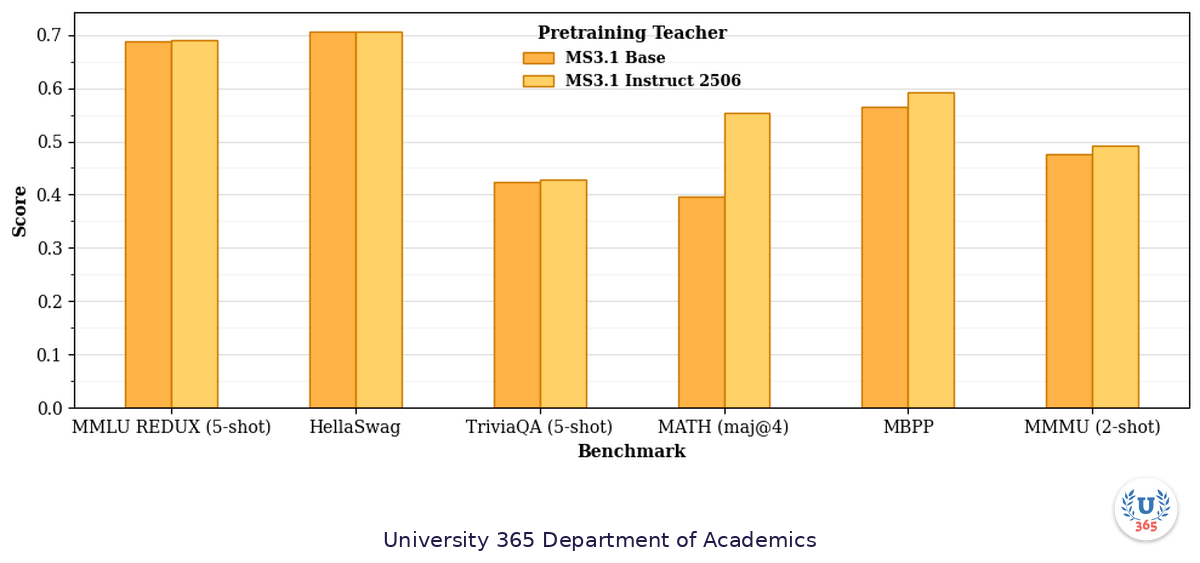
The Ministral 3 paper is the document that explains why an 8B model trained on one to three trillion tokens competes with models trained on thirty-six. It describes the cascade: pruning the 24B Mistral Small 3.1 into the 14B child, logit distillation from the parent as teacher, context extension, repetition down to the 8B and 3B, a supervised stage distilled from Mistral Medium 3, an online preference stage and reinforcement learning, on a frozen 410 million parameter Pixtral encoder. It also states plainly that the 3B did not improve significantly on public benchmarks at the preference stage and was selected on internal human evaluation. A reader who skips the paper will read the benchmark tables as one family result, which they are not.
Then read the serving recipe for the engine you will use, because the parsers and the image path are the interface
The vLLM section of the model card is short and it carries the settings that decide whether the model works in an application: the mistral tokenizer, config and load formats, --enable-auto-tool-choice and --tool-call-parser mistral, and a --max-model-len default of 262,144 that reserves memory for a window most cards cannot hold. The transformers path needs Mistral3ForConditionalGeneration and mistral-common, and the FP8 checkpoint needs the FP8 path. The image section carries the aspect-ratio recommendation, which is the setting most likely to be skipped and the one that decides whether the vision reading is faithful.
Then read the evaluation pages, all of them
Read the vendor's two benchmark tables, the independent evaluator's page and the task battery together, because the disagreement between them is the most useful thing in the release. The vendor table names its tasks and its test setup and shows near-parity on three instruct rows. The evaluator publishes a latency, a speed and a price, and no intelligence score. The battery publishes a real score on stored rows. A reader who can hold all four without averaging them is equipped to judge the next small-model release without this review.
Resources on X
Dedicated X channels: Mistral publishes its model material from its corporate account, @MistralAI, which the launch post itself links. The technical material for this model lives on the documentation page, the Hugging Face card and the paper rather than on X.

Mistral on X: https://x.com/MistralAI
Launch announcement, which links the account and the paper: https://mistral.ai/news/mistral-3
Model page: https://docs.mistral.ai/models/ministral-3-8b-25-12
Technical paper: https://arxiv.org/abs/2601.08584
Video walkthroughs:
Ministral 3: Inside Mistral AI's New Efficient Model Family, PaperLens: https://www.youtube.com/watch?v=Jeh98Z_c0mg
Ministral-3: ¿La mejor IA para PC? Test 8B y 14B con RTX 5060 Ti 16GB + i9 13900KF, Jomar Dev - Tech: https://www.youtube.com/watch?v=bF3HOc3uXiU
The first is a family overview that covers the cascade-distillation recipe. The second is a local test of the 8B and 14B instruct checkpoints on a 16GB card. Neither is a U365 test, and neither is used as evidence for a score.
U365 courses and programmes that build the surrounding skill
UIT (Technology, AI, Data Science): the engineering track where local serving, quantisation, KV-cache planning, vision preprocessing, tool calling and evaluation belong.
UIB (Business Management, Entrepreneurship): the commercial track where a card purchase against a token rate is analysed as unit economics, and where a licence question is priced as a cost.
UIC (Digital Communication, Marketing): the communication track where a benchmark table and an independent battery are read against each other rather than averaged.
UID (Digital Design, UX/UI): the design track where an image-reading model is used for alt text, mock-up extraction and reference description without being trusted as a design judge.
The one habit to carry
Read the configuration file before the card, and compute the cache before the download. The two mistakes this release punishes are the same mistake in different clothes: believing that a 256,000-token window is a 256,000-token deployment on a 12GB card, and believing that a fluent description of an image is a verified reading of it. A reader who checks both before spending a GPU-hour will never be surprised by a 34 GiB cache or by a confident sentence about a page that was never opened.

Ministral 3 8B
CI-First Evaluation Summary Card
Field | Value |
Tool | Ministral 3 8B (ministral-8b-2512), Mistral AI |
Category | Applied AI / Small open-weight language model with vision |
CI-First Benefit Score | 5.3 / 10, CI-First Positive |
Sub-scores | Time 6 / Quantity 5 / Quality 5 / Skill 5 |
CI-First Profile | Primary: Co-Worker and Assistant (level 2). Secondary: Co-Researcher, Analyst and Tester (level 4) |
Humics Protection | Humics-Neutral (-1 / +3). Creativity 0, Critical Thinking -1, Social Authenticity 0 |
AI Imposture Risk | Medium overall. Time Medium, Quantity Medium, Skill Illusion High |
Framework v1.2 clauses | 5.2.3-a null with boundary, 4.2-a null with live condition |
Status | Active |
Last tested | 2026-11-19 |
Version tested | Ministral 3 8B, released 2025-12-02 |
Pricing | $0.15 input, $0.015 cached input and $0.15 output per million tokens; batch at 50 percent off; self-host at about 10.4 GB FP8 or about 6.0 GB at Q4_K_M |
Independent position | No composite Intelligence Index at Artificial Analysis, with individual rows AIME25 31.7, GPQA Diamond 47.1, MMMU-Pro 46, LiveCodeBench 30.3, AA-LCR 25.7, IFBench 29.1, SciCode 20.7 and Humanity's Last Exam 4.3; 88.7 of 100 on the task battery, rank band 19 to 86 of 227 and 4 to 21 of 69 in class; 59.3 of 100 on the community aggregator; 0 of 831 rows on the coverage aggregator |
Independent speed | 88 output tokens per second and 1.96 seconds to the first answer token on Mistral's API; 11.0 tokens per second on one stream at Q4_K_M |
Primary institute | UIT (Technology, AI, Data Science) |
Review status | Active: the tool is current and recommended |

Ministral 3 8B
Glossary
CI-First Benefit Score
The arithmetic mean of the four benefit dimensions, each scored 0 to 10, rounded to one decimal place. 0 to 2.0 is CI-First Negative, 2.1 to 4.0 is CI-First Neutral, 4.1 to 6.0 is CI-First Positive, 6.1 to 8.0 is CI-First Strong, and 8.1 to 10 is CI-First Transformative. Ministral 3 8B scores 5.3, which is Positive. The framework itself is explained at https://www.university-365.com/post/the-ci-first-evaluation-framework-how-u365-scores-an-ai-tool-and-what-the-versions-mean
Time Benefit
Whether the tool returns more time than it costs, after the overhead of using it is subtracted. Ministral 3 8B is 6: 1.96 seconds to a first answer token and 88 output tokens per second, $0.15 per million output tokens, a 90 percent cache discount, a 50 percent batch discount, and Apache 2.0 on the card, against an input rate above the class median, 11.0 tokens per second on one stream locally, image preprocessing on every page, and a serving setup with four named flags.
Quantity Benefit
Whether the tool increases the volume of usable work a person can produce in a given time. Ministral 3 8B is 5: a 262,144-position window, image input, a 131,072-token vocabulary and structured output through a schema, against a 34 GiB cache at the full window, an unpublished maximum output and a text-only output modality.
Quality Benefit
Whether the tool helps the user produce better work than they could alone, judged after verification rather than on surface polish. Ministral 3 8B is 5: the independent task battery reports 88.7 of 100 with 68.8 on the hardest questions, and the vendor's instruct rows sit at or near Qwen3-VL-8B-Instruct on three of four, while no composite index exists, the evaluator's individual rows are low on hard reasoning (AIME25 31.7, GPQA Diamond 47.1, MMMU-Pro 46, LiveCodeBench 30.3, AA-LCR 25.7), the coverage aggregator has 0 of 831 rows, a community aggregator reports 59.3 with code at 40.0, and the MATH row is seven points behind the competitor.
Knowledge and Skill Benefit
Whether the tool helps the user learn what they did not know and do what they did not know how to do. Ministral 3 8B is 5, scored conservatively: a readable configuration, a technical paper describing the cascade-distillation and post-training recipe, three downloadable checkpoints, 43 quantized builds, 13 adapters, 16 fine-tunes and a documented vLLM path make it a real learning object on a small card, while the training data and code are closed and the model teaches no method of its own.
Humics Protection Badge
The sum of three ratings, each +1, 0 or -1, across Creativity, Critical Thinking and Social Authenticity. +2 to +3 is Humics-Friendly, -1 to +1 is Humics-Neutral and -2 to -3 is Humics-Risky. Ministral 3 8B scores -1, which is Humics-Neutral: it neither strengthens nor systematically destroys the three capabilities, and its fluent image reading invites the checking habit that the same fluency discourages.
AI Imposture Risk
The likelihood that the tool traps its user in one of three illusions: the Time Illusion, where the overhead exceeds the saving; the Quantity Illusion, where volume passes for quality; and the Skill Illusion, where the user believes they can do what the tool did. Each trap is rated Low, Medium or High. Ministral 3 8B is Medium overall, with Time Medium, Quantity Medium and Skill Illusion High.
CI-First Profile
The role the AI plays in the working relationship: Co-Creator and Thought Partner (1), Co-Worker and Assistant (2), Professor, Coach and Tutor (3), Co-Researcher, Analyst and Tester (4), or Challenger, Critic and Devil's Advocate (5). Ministral 3 8B is primarily Co-Worker and Assistant, with Co-Researcher, Analyst and Tester as the secondary role.
User Sentiment
The direction of independent and practitioner reaction to the tool, read from what testers and users actually reported rather than from a rating average, because no review platform rates an individual open-weight model. For Ministral 3 8B the record is thin and positive where it exists: no G2, Capterra or Trustpilot listing exists, the one task battery places the model in a rank band of 4 to 21 of 69 in its class, the community aggregator records 59.3 of 100 across seven runs, the instruct repository carries 90,025 downloads and 242 likes in the last month, and the practitioner threads praise the size, the image input and the 256,000-token window while criticising the memory arithmetic and the occasional wrong image reading. The largest theme in the discussion is how little of it there is relative to the model's siblings.
Review Status
The badge on this review states how much confidence to place in it. The vocabulary: Active means the tool is current and recommended. Active (updated) means it is current and recommended and was recently re-checked and refreshed. Changed means a re-check trigger fired and an update is pending, so read it with that in mind. Risky means the tool has significant unresolved issues or has been clearly surpassed by newer alternatives, so use it with caution and read the Limits section. Stale means the review has not been re-checked in over six months, so treat pricing and features as unverified. Retired means the tool still works but is no longer recommended, and Deprecated means it has been shut down or fundamentally changed. This review is Active.
Last tested and Re-check
The date on which the review's evidence was last read against the vendor's own surfaces, and the condition under which it will be read again. This review was last tested on 2026-11-19 and is re-checked on a trigger list with a six-month outer limit, because an independent index, a licence page and a price line can move faster than a calendar interval can track.

Ministral 3 8B
Sources
Vendor primary sources:
Mistral AI, Ministral 3 8B model page: https://docs.mistral.ai/models/ministral-3-8b-25-12
Mistral AI, "Introducing Mistral 3", 2025-12-02: https://mistral.ai/news/mistral-3
Mistral AI, "Ministral 3" technical paper, arXiv 2601.08584, submitted 2026-01-13: https://arxiv.org/abs/2601.08584
Mistral AI, API pricing: https://docs.mistral.ai/inference/pricing
Mistral AI, pricing page and FAQ: https://mistral.ai/pricing
Mistral AI, Ministral 3 8B Instruct model card: https://huggingface.co/mistralai/Ministral-3-8B-Instruct-2512
Ministral 3 8B configuration file: https://huggingface.co/mistralai/Ministral-3-8B-Instruct-2512/blob/main/config.json
Ministral 3 8B generation configuration: https://huggingface.co/mistralai/Ministral-3-8B-Instruct-2512/blob/main/generation_config.json
Ministral 3 8B default system prompt: https://huggingface.co/mistralai/Ministral-3-8B-Instruct-2512/blob/main/SYSTEM_PROMPT.txt
Ministral 3 model collection: https://huggingface.co/collections/mistralai/ministral-3
Apache 2.0 licence text: https://www.apache.org/licenses/LICENSE-2.0.txt
Sibling models and the predecessor, for the disambiguation and the comparisons:
Ministral 3 8B Reasoning: https://huggingface.co/mistralai/Ministral-3-8B-Reasoning-2512
Ministral 3 8B Base: https://huggingface.co/mistralai/Ministral-3-8B-Base-2512
Ministral 3 14B Instruct: https://huggingface.co/mistralai/Ministral-3-14B-Instruct-2512
Ministral 3 3B Instruct: https://huggingface.co/mistralai/Ministral-3-3B-Instruct-2512
Ministral 8B (24.1), deprecated predecessor: https://docs.mistral.ai/models/ministral-8b-24-1
Mistral Small 3.1, the 24B parent model: https://mistral.ai/news/mistral-small-3-1
Independent measurement:
Artificial Analysis, Ministral 3 8B model page: https://artificialanalysis.ai/models/ministral-3-8b
OpenWeights Bench, Ministral 3 8B Instruct 2512: https://openweightsbench.com/models/ministral-3-8b-instruct-2512
llm-bench.io, ministral-3-8b-instruct-2512: https://llm-bench.io/models/ministral-3-8b-instruct-2512
BenchLM, Ministral 3 8B: https://benchlm.ai/models/ministral-3-8b
Hugging Face model API, repository metadata read on 2026-11-19: https://huggingface.co/api/models/mistralai/Ministral-3-8B-Instruct-2512
Practitioner analysis and community:
Reddit r/LocalLLaMA, "Ministral-3 has been released", 2025-12-02: https://www.reddit.com/r/LocalLLaMA/comments/1pcb50r/ministral3_has_been_released
Reddit r/LocalLLaMA, "Mistral 3 llama.cpp benchmarks": https://www.reddit.com/r/LocalLLaMA/comments/1plxdeg/mistral_3_llamacpp_benchmarks/
Reddit r/SillyTavernAI, "Ministral 3 8B and 14b Anyone tested it on ST?", 16 points and 12 comments: https://www.reddit.com/r/SillyTavernAI/comments/1phtve9/ministral_3_8b_and_14b_anyone_tested_it_on_st
Reddit r/ollama, "Ministral 3: A New Family of Edge Deployment Models": https://www.reddit.com/r/ollama/comments/1pd9chp/ministral_3_a_new_family_of_edge_deployment_models
Catapp-Art3D, "Ministral-3 2512 を使ってみた話", 2025-12-03, the practitioner test that reports the 12GB memory failure and the vision comparison: https://note.com/catap_art3d/n/n0757936b6330
LM Studio, Ministral 3 model listings: https://lmstudio.ai/models/ministral
U365 framework reference:
U365 CI-First Evaluation Framework v1.4.1 (University 365 research methodology), explained at https://www.university-365.com/post/the-ci-first-evaluation-framework-how-u365-scores-an-ai-tool-and-what-the-versions-mean

Ministral 3 8B
Faculty Note on Evidence Quality
What this review rests on, in order of weight. First, Mistral's own primary documents: the model page, the model card, the configuration file, the generation configuration, the default system prompt, the technical paper, the launch post, the API pricing page and the vendor pricing page with its FAQ. Second, one independent task battery that publishes its method, its run identifier and its stored rows: OpenWeights Bench, whose page carries the 88.7 of 100, the 85.2 to 92.1 interval, the rank band of 19 to 86 of 227, the 4 to 21 of 69 size-class band, the 68.8 on hard questions, the Q4_K_M quantisation, the 6.0 GB file and the tested date. Third, one independent evaluator that publishes a price, a latency, a speed and individual evaluation results but no composite score for this model: Artificial Analysis, with 88 output tokens per second, 1.96 seconds to the first answer token, $0.15 on both token lines, $0.0555 blended, AIME25 at 31.7 percent, GPQA Diamond at 47.1 percent, MMMU-Pro at 46 percent, LiveCodeBench at 30.3 percent, AA-LCR at 25.7 percent, IFBench at 29.1 percent, SciCode at 20.7 percent and Humanity's Last Exam at 4.3 percent. Fourth, one community benchmark aggregator whose seven runs are LLM-judged rather than executed under a fixed set of scripts: llm-bench.io, at 59.3 of 100 with a 54.5 to 65.6 spread, code generation at 40.0 and agent workflow at 66.9. Fifth, the repository metadata, which is a measured count rather than a claim: 90,025 downloads in the last month, 242 likes, 43 quantized builds, 13 adapters and 16 fine-tunes. Sixth, the practitioner threads and the Japanese-language test, used for specific observations and for sentiment, never for a capability claim.
Where the vendor's numbers and the independent numbers part, and why the review does not reconcile them. Mistral publishes two benchmark tables, each against comparison models it chose and each run on its own evaluation setup. The independent battery uses a different item set and a different scoring rule, and places the model in a wide rank band. The community aggregator uses an LLM judge and reports a lower quality figure. There is no common method across the three, so a reconciliation would be an invention. The review therefore states the vendor rows as vendor rows, the battery as an independent measurement, the community record as a community record, and the absent index as an absence. The Quality sub-score of 5 is the consequence: a good independent battery beside a missing composite and a lower community record is a moderate position, and it is not the same as an unknown one.
What is measured and what is inferred. The parameter counts, the layer and attention configuration, the vocabulary, the context ceiling, the vision encoder geometry, the cache arithmetic, the licence text, the token rates, the download and like counts, the benchmark rows and the battery results are measured or published by named parties and reported with their settings. The cache table in this review is arithmetic from the configuration, not a benchmark: 34 layers times 8 key-value heads times 128 dimensions times 2 tensors is 69,632 elements per token, and 136 KiB per token at two bytes gives 34 GiB at 262,144 tokens. The claim that the 8B is a good fit for bounded local work under a permissive licence is an interpretation of those measurements against the work the model is sold for, and it is the interpretation this review defends. The claim that a reader will over-trust a fluent image description is an inference from the framework's model of human behaviour and from the practitioner reports, and it is labelled as an inference wherever it appears.
Three choices a reader can check. The review scores Quality on the mix of one battery, one community record and an absent composite rather than on the vendor table, because the framework asks for the position a skeptical expert would accept. It scores Skill at 5 rather than higher, although the release is unusually well packaged, because the common reader meets an API and the training data and code are closed. And it keeps the licence question open rather than resolving it, because two vendor surfaces disagree and a review is not a legal opinion.
Three findings cut in the vendor's favour and should be said as plainly as the rest. Mistral published a technical paper that describes the cascade-distillation recipe, the teacher models and the preference stage, including the honest note that the 3B did not improve significantly at that stage and was chosen on internal human evaluation. Mistral shipped three post-trained checkpoints from one base plus 43 quantized builds, 13 adapters and 16 fine-tunes, which is the difference between a checkpoint and a family a reader can work with. And the output rate at $0.15 per million tokens, with a 90 percent cache discount and a 50 percent batch discount, is genuinely low against the class, which is what makes the model usable at document volume.
What this review does not do. It does not score the 14B, the 3B or the reasoning checkpoint, which have their own commissions or their own checkpoints. It does not convert the vendor tables into an independent composite, or the one battery into a verdict on the family. It does not treat the pricing FAQ sentence as a licence restriction, or the card's Apache 2.0 statement as a legal clearance. It does not estimate a maximum output, a knowledge cutoff, a multimodal benchmark it did not read, or a vision accuracy figure beyond the one MMMU-Pro result it quotes. And it does not convert a permissive licence into a recommendation: a model that can be shipped is not the same as a model that should be, and the Quality and Skill sub-scores are where that distinction is priced.
This review was written under the CI-First Evaluation Framework v1.4.1, with scoring completed on 2026-11-19.

Ministral 3 8B
Status and Re-check
Status: Active | Last tested: 2026-11-19 (Ministral 3 8B, ministral-8b-2512, released 2025-12-02) | Re-check: trigger-based (max 6 months)
Active: the tool is current and recommended.
For detailed explanations of the CI-First evaluation terms used in this review, including the Humics Protection Badge and the AI Imposture Risk levels, see the Glossary at the end of this post.
Re-check triggers:
A published Intelligence Index score for this model. On 2026-11-19 the independent evaluator carries a page for Ministral 3 8B with a price, a latency, an output speed and a set of individual evaluation results, and no Intelligence Index value. A number appearing there, on the current index version, moves the Quality sub-score and the whole assessment.
A second independent multimodal measurement, or a moved MMMU-Pro figure. Artificial Analysis records MMMU-Pro at 46 percent for the served model, which is the only independent image-understanding result in this review. A re-run, a second evaluator or a moved figure changes what the "best-in-class text and vision" claim is worth.
A change to the licence surfaces. The Hugging Face card and the documentation badge say Apache 2.0 with commercial use permitted. The pricing page's FAQ carries a narrower sentence about commercial deployments. A clarification, a correction or a new licence file re-opens the commercial reading.
A price change. The API rate is $0.15 per million input tokens, $0.015 per million cached input tokens and $0.15 per million output tokens, with batch processing at 50 percent off. A move on any of the three lines, or the withdrawal of the batch discount, changes the Time sub-score.
A successor or a lifecycle change. Ministral 3 8B replaced the deprecated Ministral 8B (24.1) on 2025-12-02. A Ministral 4, a new size, or a deprecation notice for this checkpoint moves the comparison and the Migration Path.
A memory figure for the 8B that states its context. The model card says the model fits in 12GB of VRAM in FP8. The weights are 10.4 GB and the KV cache is 136 KiB per token, so the claim holds only at a short context. A published weights table, or a quantized build that changes the floor, changes what a reader can attempt.
A change to the vision recipe or the reasoning checkpoint. The vendor recommends an image aspect ratio close to 1:1, and the vision encoder works from 1,540-pixel images with a patch size of 14 and a spatial merge of 2. A new preprocessing recipe, or a reasoning checkpoint whose context matches the instruct model's 256,000 tokens, changes two sections.
An agent scaffold that writes skills, rules or procedural memory by default. The clause note records a null with a boundary. That boundary is the condition which would end it, and it is the eighth trigger.




Comments