
Double-Entry Bookkeeping


In this Interest


Double-Entry Bookkeeping
Snapshot
Double-entry bookkeeping is a rule about writing things down: every transaction is entered twice, in two different accounts, once as a debit and once as a credit.
The rule was printed in Venice in 1494 and still governs every published balance sheet and income statement, including the statements whose structure changes in 2027.
By the end you will be able to read a page of a ledger, explain why the two columns must agree, and name four things the method cannot show.
This brief runs about eleven minutes.

Double-Entry Bookkeeping
Why Now
Two dates are moving at once, and both touch the same ledger. IFRS 18, which sets the structure of the income statement, applies to annual reporting periods beginning on or after 1 January 2027. It classifies income and expenses as operating, investing or financing, requires defined subtotals including operating profit, and requires a company to explain any performance measure of its own used in public communications (IFRS 18, paragraphs 49, 69 and 117).
The second date is 15 December 2026. From then, ISA 240 (Revised) applies to audits of periods beginning on or after it, and paragraph 48 requires the auditor to design and perform procedures to test the appropriateness of journal entries recorded in the general ledger. One standard rewrites the statement; the other tightens the examination of the entries behind it.
The fraud numbers keep the second date urgent. The Association of Certified Fraud Examiners puts the losses in its 2024 study at 3.1 billion dollars, estimates that organisations lose 5 percent of revenue to fraud each year, and reports a typical case running about 12 months before detection, with 43 percent found through a tip.
What has not changed is the entry rule. A debit still needs a credit.
Double-Entry Bookkeeping
The Explainer
Three books and one rule
Luca Pacioli printed the treatise in Venice in November 1494, as Book 9, Tract 11 of a larger work on mathematics. It was written in Italian for merchants rather than in Latin for scholars, and its aim is modest: the minimum number of rules a businessman needs to keep his books in good order.
The system needed three books. The memorandum, or day book, records every transaction in the order it happens. The journal puts those entries into double-entry form. The ledger carries them to individual accounts, one page per account, so each balance can be read at a glance. A small business, he notes, may keep only the last two.
The rule that makes the system is one sentence: write the transaction twice, once by the debit and once by the credit. Pacioli's phrasing, as his translator renders it, is that whenever there is a debit entry there is also a credit entry. The words carry their direction. Debito meant owed to this entity; credito meant owed by this entity to another. A debit is what the business holds or is owed; a credit is a claim against it.
He gives a practical reason for preferring the Venetian form over the others he knew: using this system enables one businessman to understand the accounts of any other. That is a claim about a shared language, and it is the claim that survived. Printing fixed the form and spread it; the method itself was older.
One transaction, two entries
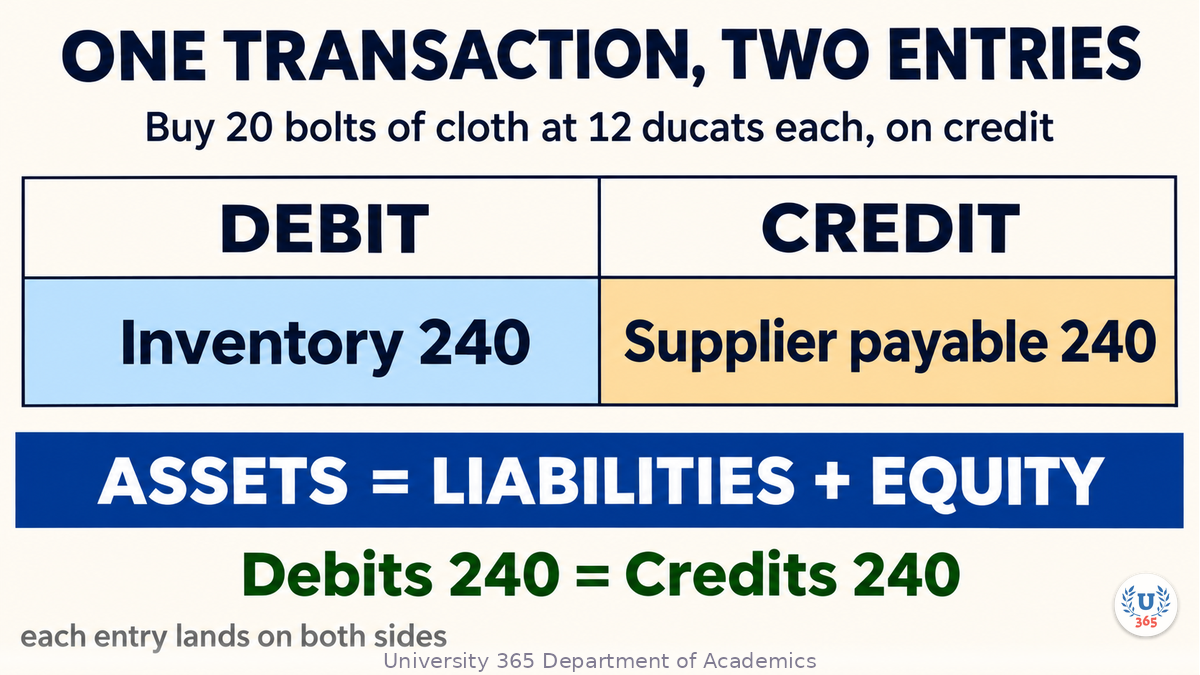
Take a shop that buys 20 bolts of cloth at 12 ducats each on credit. The shop holds cloth worth 240 ducats and owes its supplier 240. In the journal: debit cloth 240, credit supplier 240. Nothing has been gained and nothing lost. One asset has arrived, and one claim has arrived with it.
When the shop pays: debit supplier 240, credit cash 240. The claim is extinguished and the cash is gone. Each line names an account and a direction, and the two lines name different accounts. The convention is that a debit increases what the business owns or spends, and a credit increases what it owes, what the owners hold, or what it earns.
The arithmetic that results is a property of the bookkeeping, not a theory about the world. Every entry adds the same amount to both sides, so total debit balances and total credit balances are equal, provided each transaction was written twice.
That is why the method is called double entry, and why a single-sided entry is a defect rather than a shortcut. Record only that cash left the bank, without recording where it went, and the record the ledger exists to keep complete is broken.
Why the equality catches errors, and what it misses
The test is the trial balance: list every account balance on its proper side and add each column. If the totals disagree, an entry went in on one side only, or twice on one side, or a figure was copied wrongly into one side. The disagreement localises the fault, which is the practical value. The ledger tells you that something is wrong before it tells you what.
It cannot tell you that a transaction was classified badly, because a wrong classification still produces two equal entries. Treat a repair as a capital cost that belongs in expenses and both columns agree; the profit is simply wrong. It cannot tell you that a transaction was left out, because an omission removes both legs at once. The equality proves the bookkeeping is complete, not that the accounting is right.
Pacioli understood the difference between a rule and its enforcement. He tells the merchant to number the pages of every book, because without numbering a person could remove a page from entries sharing a date and the fraud would go undetected. He also describes registering the books with a commercial officer, so that in a later dispute they might serve as evidence in court. Both are controls outside the arithmetic.
The equation behind the page
Every balance sheet is the same ledger sorted into three groups. The International Accounting Standards Board defines an asset as a present economic resource controlled by the entity as a result of past events, a liability as a present obligation to transfer an economic resource as a result of past events, and equity as the residual interest in the assets after deducting all liabilities (Conceptual Framework, paragraphs 4.3, 4.26 and 4.63). The American board puts the relation in five words: equity is assets minus liabilities (FASB Concepts Statement No. 8, Chapter 4, paragraph E5).
The income statement is the same ledger read across a period. Income is an increase in assets or a decrease in liabilities that increases equity, other than a contribution from the owners; an expense is the mirror (paragraph 4.68). Profit is therefore defined, not observed: the net change in the residual that the entries produce. A sale raises an asset and raises income, and the income closes into equity.
It is also why cash and profit differ. Accrual accounting records the effects of a transaction in the period in which they occur, even when the cash moves in another period (paragraph 1.17). A sale on 60-day terms is income today and cash later.
The edges of the method
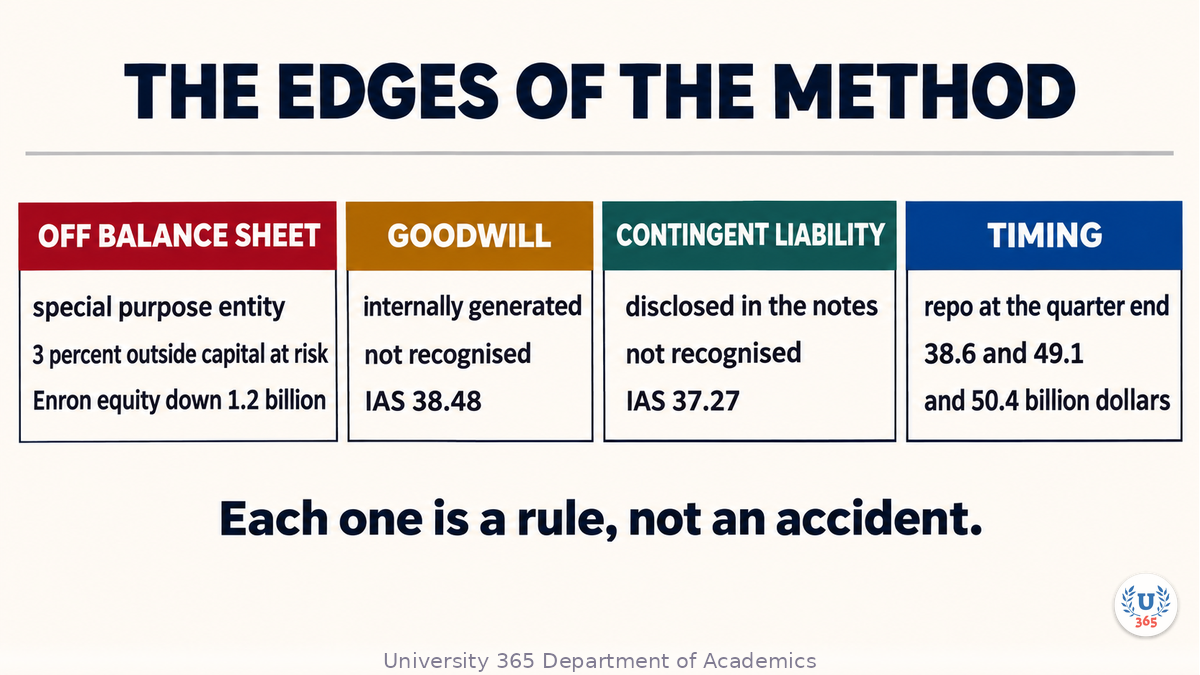
Four things test the edge, and each is a rule rather than an accident. The first is what sits outside the group. A company may leave a special purpose entity off its balance sheet if an independent owner holds a substantive equity investment of at least 3 percent of the entity's assets, at risk throughout, and controls it (Powers Report, 2002). Enron failed that condition, and the result was a restatement for 1997 to 2001 and a 1.2 billion dollar reduction of equity.
The second is goodwill. Goodwill bought in an acquisition can be recognised; goodwill the business generates itself cannot, because its cost cannot be separated from the cost of building the business (IAS 38, paragraphs 48 and 63). A brand a company builds is often its most valuable asset, and it is absent by design.
The third is the contingent liability, disclosed in the notes rather than recognised, unless the possibility of an outflow is remote (IAS 37, paragraphs 27 and 28). A lawsuit, a guarantee, a tax dispute: you learn of it in a note, not in the totals.
The fourth is timing. A lease used to sit outside the balance sheet; since 1 January 2019 the lessee recognises a right-of-use asset and a lease liability at the start of the lease (IFRS 16, paragraph 22). Where a rule still leaves a choice, the position at a date can be managed. Lehman ran 38.6 billion dollars, then 49.1 billion, then 50.38 billion of repo transactions at three consecutive quarter ends, which reduced its reported net balance sheet at those dates by about those amounts (Examiner's Report, 2010).
Double-Entry Bookkeeping
The Feynman Summary
A business writes down what it does. Double entry says: write each thing twice, in two different accounts, and make one side a debit and the other a credit.
Because each transaction lands on both sides with the same amount, the two sides of the ledger stay equal. Add up everything the business holds and spends, add up everything it owes, what its owners hold and what it earns, and the totals match. That is not a fact about money, it is a fact about the writing. If the totals differ, someone wrote one side only.
The equality is a check on completeness, not on judgement. A payment put in the wrong category still balances. A transaction left out entirely still balances. The accounts can be perfect double entry and still misleading, which is why the rules about what counts as an asset, a liability or a cost carry as much weight as the arithmetic.
And the method says nothing about the world outside its pages. A promise, a lawsuit, a brand the company built, the timing of a transaction at the year end: each either enters the ledger on terms set by a standard, or stays in the notes. Reading accounts means reading the totals and the notes.
Double-Entry Bookkeeping
The Evidence
The primary record is a printed book. The Summa of 1494 survives in copies, and its accounting treatise can be read in English translation. It states the entry rule, the three books, the numbering of pages and the registration of the books, so the method's own manual is available.
The historical claim around it is weaker than the text. Pacioli did not claim invention. The translator's notes and the Library of Congress guide place the practice earlier, in the 13th and 14th centuries, with Pacioli codifying a system already about 200 years old. Whoever invented it is unknown. The evidence establishes that the form was printed and spread in 1494, not that it began there.
The strongest evidence for the rule is that two independent standard setters still define the elements the same way. The IASB defines equity as the residual interest after deducting liabilities. The FASB states that equity is assets minus liabilities, and that assets and liabilities have definitional primacy because every other element derives from them. Two boards, different jurisdictions, the same structure, five centuries later.
The failure cases are evidence about the edges. The Powers Report gives the conditions for keeping a special purpose entity off the balance sheet, and names their failure as the cause of Enron's restatement. The Lehman examiner gives quarter-end repo volumes of 38.6, 49.1 and 50.38 billion dollars, and states that a reported ratio of net assets to equity would have been 18.0 times rather than 16.3 times without them. Both are adversarial documents, and their figures come from the firms' records.
What the evidence does not show is how often the method prevents anything. No controlled comparison exists between firms with double-entry books and firms without, and the fraud statistics are estimates drawn from detected cases. Ledgers survive by accident, so the record is uneven. The arithmetic is certain; the benefit is argued.
Double-Entry Bookkeeping
The Counter-Case
The largest claim made for the method is not that it records accurately but that it changed history. Werner Sombart argued that double entry reduced profit to an abstraction, a definite sum in a capital account rather than a merchant's subsistence, and that this abstraction first made the concept of capital possible. On that account the ledger is a cause of capitalism, not a consequence of it.
B. S. Yamey spent several papers testing the claim and did not find the practice it requires. He looked for regular balancing, because accounts balanced only at the end of a life cannot have guided decisions year by year. He found balances struck when the books were full, when the merchant stopped trading, and when the owner died. If the merchant did not close and read his books, the abstraction cannot have done the work attributed to it.
A second objection is that businesses grew without the method. Single-entry records and correspondence carried trade for centuries, and many small firms still keep records that would not pass a trial balance. The method is a control, and control has a cost a one-person business may reasonably decline.
What would settle it is a sample of ledgers with dated, repeated balances, matched against decisions traced to them: a price set, a line dropped, a partner bought out on the strength of the figures. Until then the honest position is narrower. Double entry made large organisations auditable, and auditability is a precondition for the modern firm rather than a cause of the economic order.

Double-Entry Bookkeeping
What It Means for You
This sits in Career and Finance, and in Quality of Life to the extent that a household balance is the same three groups. You meet the method as an employee whose work becomes an entry, as an investor reading a report, as a borrower signing a covenant, and as a taxpayer whose income is defined by these rules. The method behind this class of brief, including the test applied to the applied AI question, is on the Interests method page.
Read the notes with the totals Recognition is a decision. A lease, a lawsuit or a brand can be valuable and absent from the balance sheet, and the note admits the omission.
Trace one number to its entries Pick the profit figure and find the entries that produce it. That trail teaches you more than the summary page does.
Ask which period When a result improves sharply at a year end, ask what moved across that date. The entry rule is indifferent to the calendar; the reporting date is not.
The Applied AI Connection
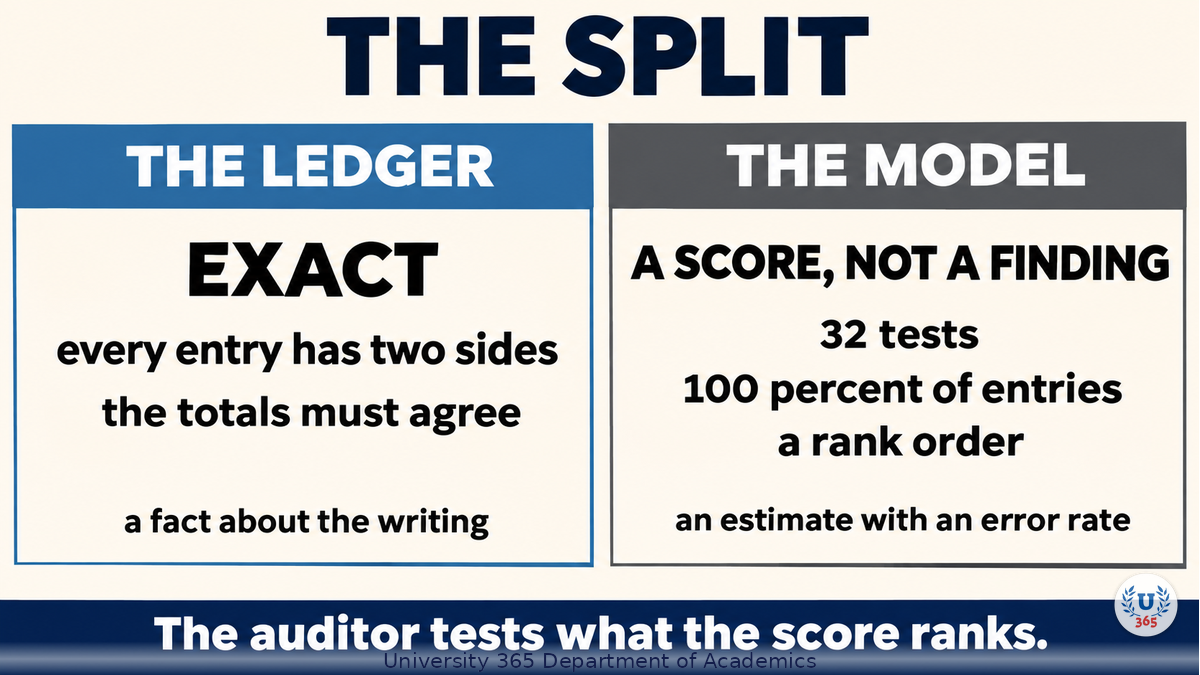
Journal entry testing is where the ledger meets a model. ISA 240 (Revised), effective for audits of financial statements for periods beginning on or after 15 December 2026, requires the auditor to test the appropriateness of journal entries recorded in the general ledger. The traditional approach draws a sample. MindBridge's general ledger analytics applies machine learning, statistical and rule-based tests and scores every entry, 100 percent of transactions, with 32 tests running at once over up to 500 million records. The task that changes is selection: instead of drawing a sample, the auditor works down a ranked list.
The split is the same split as the rest of this brief. The ledger supplies exact, paired facts: every entry has a counterpart, so the useful features are relational, the account pair, the reversal, the user who rarely posts, the entry dated to a closed period. The model supplies a score, an estimate with an error rate and not a finding. It cannot say that an entry is wrong; it can only say that this one looks less like the others. So when a finance team says the ledger was reviewed by AI, ask whether the system ranked or concluded, and what happens to the entries it ranks low. A tool tuned to miss nothing produces a long list of false positives; one tuned to keep the list short leaves the interesting entries at the bottom.
Double-Entry Bookkeeping
The Five-Minute Version
Double entry means one transaction, two entries, one debit and one credit, in two different accounts. Pacioli printed the rule in Venice in 1494, in a merchant's manual inside a work on mathematics: write it twice, and one businessman can read another's books.
Because every transaction adds the same amount to both sides, total debits equal total credits. That equality is the trial balance, and it catches one-sided errors: a missing leg, a doubled leg, a figure copied wrongly. It does not catch a wrong classification, an omission, or two errors that cancel.
The balance sheet is the same ledger sorted into assets, liabilities and equity, with equity defined as what remains after liabilities. The income statement is the change in that residual over a period, because income and expenses are defined as increases and decreases in assets and liabilities.
Four things sit at the edge. Special purpose entities kept outside the group by a 3 percent outside-capital test, which Enron failed at a cost of a 1.2 billion dollar equity reduction. Goodwill the business generates itself, which is not recognised. Contingent liabilities, disclosed rather than recognised. And timing, where Lehman moved between 38.6 and 50.38 billion dollars of repo transactions at three quarter ends.
The arithmetic is exact and the judgement is not. A wrong classification balances. An omission balances. That is why the standards about recognition carry as much weight as the entry rule, and why the notes are part of the accounts.

Double-Entry Bookkeeping
Sources
All sources below were opened and read on 15 November 2026.
The 1494 manual Luca Pacioli, Particularis de Computis et Scripturis, Book 9, Tract 11 of the Summa, Venice, November 1494, Cripps English translation
The earlier practice Library of Congress, History of Accounting: Early History to 17th Century
The elements, international IFRS Foundation, Conceptual Framework for Financial Reporting, 2018
The elements, American FASB, Concepts Statement No. 8, Chapter 4, Elements of Financial Statements, December 2021
The income statement, 2027 IFRS 18, Presentation and Disclosure in Financial Statements, EU Annex, Regulation 2026/837
Contingent liabilities AASB 137, Provisions, Contingent Liabilities and Contingent Assets, adoption of IAS 37
Goodwill and intangibles AASB 138, Intangible Assets, adoption of IAS 38
Fraud, 2024 ACFE, Occupational Fraud 2024: A Report to the Nations, press release, 20 March 2024
Enron, the inside account Report of Investigation by the Special Investigative Committee of the Board of Directors of Enron Corp, 1 February 2002
Lehman, the examiner Report of Anton R. Valukas, Examiner, Lehman Brothers Holdings Inc, Volume 3, 11 March 2010
Auditing the journal IAASB, ISA 240 (Revised), The Auditor's Responsibilities Relating to Fraud, paragraphs 16 and 48
Scoring the journal MindBridge, MindBridge for Journal Entry Testing, 2022
The claim about capitalism Ryan, Historical Note: Did double-entry bookkeeping contribute to economic development?




Comments