
How the Supermarket Was Invented

In this Interest


How the Supermarket Was Invented
Snapshot
A supermarket is a shop you walk through yourself: you take the goods from the shelf and pay once, at the end. It was assembled in two steps, self-service in Memphis in 1916 and the larger store with a car park in Queens in 1930.
The format fixed a cost structure that still governs what your shop stocks: a net margin near 2 percent, where volume and turnover decide what stays.
By the end you will be able to say why the aisle is a one-way path, why the price sits on the shelf, and why dropping a line is an arithmetic decision.
This brief runs about twelve minutes.

How the Supermarket Was Invented
Why Now
Two dates make this current. In June 2026 the US Department of Agriculture put American food spending for 2025 at 2.51 trillion dollars, of which 1.10 trillion was spent on food eaten at home. Food away from home took 56.3 percent of the total, against 52.6 percent in 1997, so the supermarket channel handles a minority of the food dollar, and a shrinking one.
The second date is 10 December 2024, when a federal court in Oregon stopped the largest supermarket merger in American history. Kroger had agreed to buy Albertsons for about 24.6 billion dollars in October 2022, and the companies argued that they needed the scale to compete with Walmart, Amazon and Costco. The court accepted that the merger would lessen competition in local markets, and gave little weight to the promised price cuts, which it found neither merger specific nor verifiable.
What has not changed is the room you walk through: open shelves, a one-way route, and a single payment at the end.
How the Supermarket Was Invented
The Explainer
The cost of a clerk
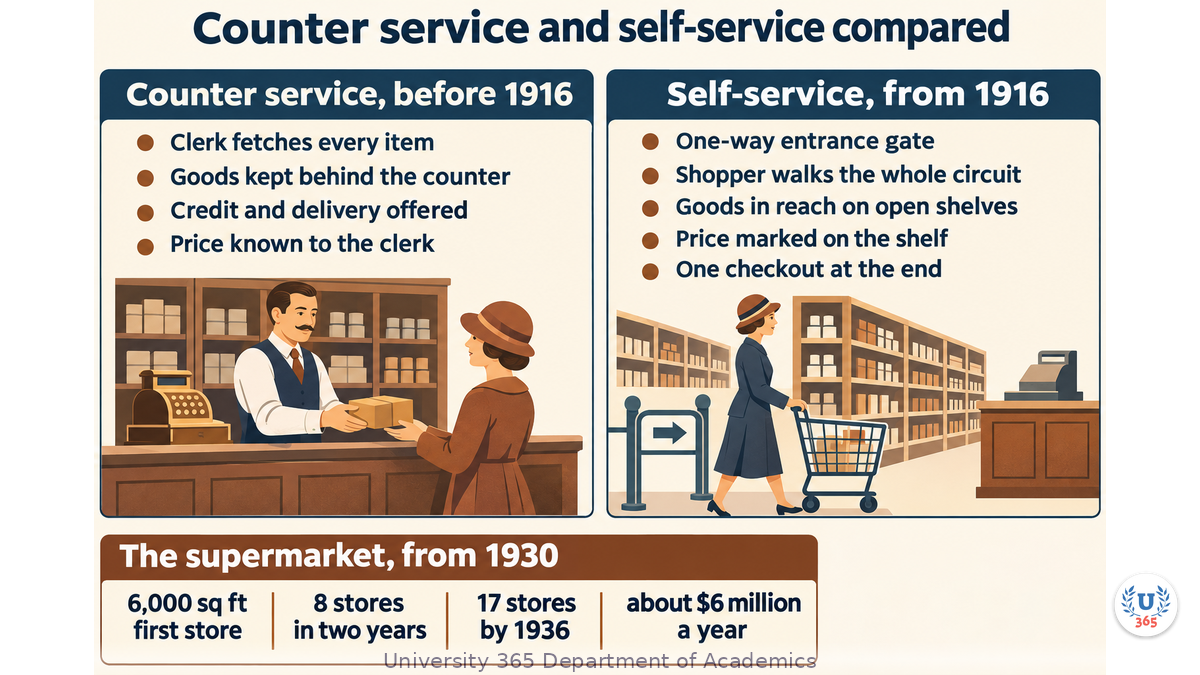
Before 1916 a grocery was a counter with assistants behind it. You gave your order, an assistant collected the goods, and the shop carried the cost of that labour along with credit and delivery. The Great Atlantic and Pacific Tea Company had already attacked two of those costs. Its Economy Store, opened in Jersey City in 1912, dropped premiums, credit and delivery and sold a plain range at sharp prices.
Clarence Saunders attacked the third. His patent for a self serving store, filed on 21 October 1916 and granted on 9 October 1917, states the object in the language of cost: to dispense with the employment of many clerks and to relieve the store of a large proportion of the usual incidental expenses or overhead charges. The drawings show how. A turnstile at the entrance opens one way, the cabinets are arranged so that the customer must walk a circuit past the whole assortment, the goods sit within reach, and a checking and paying station waits at the exit. Saunders opened the first Piggly Wiggly at 79 Jefferson Street in Memphis on 6 September 1916, with baskets, open shelves and no clerk to fetch anything.
The labour moved rather than vanished. The shopper now walks the aisles, finds the item, carries it and queues at the till, and none of that time appears on the retailer's payroll. That transfer is central to the format, and it explains why self-service needed a shopper with spare time and a shop with enough variety to make the walk worth taking.
What the shelf had to carry
Self-service only works when a shopper can choose without asking. That requires goods in packages rather than in bulk, a price fixed to the shelf rather than held in an assistant's memory, and a layout in which the same category sits in the same place every week. The pack becomes the unit of sale and the unit of information at the same time.
It also moved the decision about what to stock. In a counter shop the assistant knows what sells because he fetches it. In a self-service shop the record is what the till captures, and the shelf has to be planned from that record. The patent even provides a raised gallery along the cabinets for a floor walker, the forerunner of the aisle manager who resets your local store on a Monday morning.
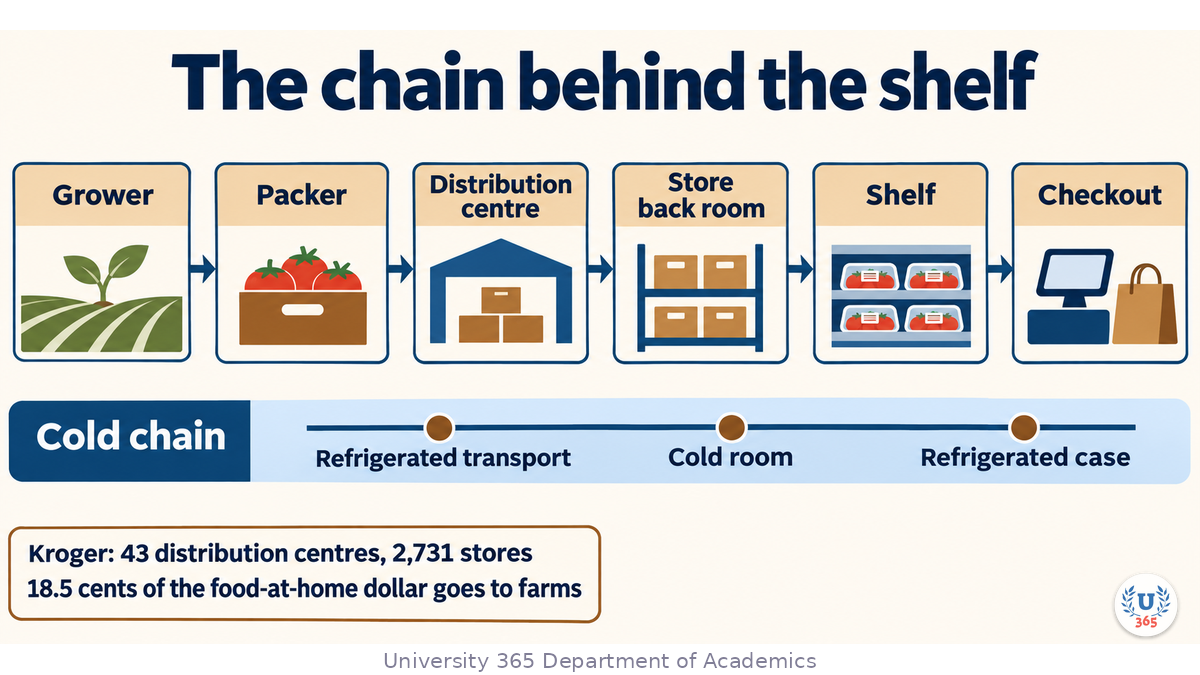
The chains built the functions a shelf of that size needs. A&P set up the Atlantic Commission Company in 1925 to move fresh fruit and vegetables, and established a national meat department in 1926. Both moved work that had belonged to the wholesaler or the butcher into the retailer, because a shop buying for hundreds of stores buys differently from one buying for a single store.
The garage with a car park
The second step was size. On 4 August 1930 Michael Cullen, then 46, opened King Kullen in a leased garage in Queens. Cullen had started as a clerk at the Atlantic and Pacific Tea Company in 1902 and had managed 94 Kroger stores in Illinois. His proposal to Kroger had been rejected by a subordinate, and he left to build it himself.
The first store occupied 6,000 square feet and stocked about 1,000 items, hardware and car accessories included. A parking lot let it draw customers from as far as 30 miles, and the company history records that it averaged 20 times the volume of its average competitor. Within two years there were eight stores. By the time Cullen died in 1936 there were 17, with combined sales of about 6 million dollars a year, or roughly 350,000 dollars a store.
This is the retail geography in one line. The store stopped paying for passing trade and started paying for parking and for a catchment. Rent per square foot fell, the fixed costs of building, refrigeration and checkouts spread across more revenue, and the mark-up could fall because the volume rose. The Smithsonian's five criteria for a modern supermarket name the combination: separate departments, self-service, discount pricing, chain marketing and volume dealing.
The established chains converted. A&P opened its first supermarket in Braddock, Pennsylvania, in 1937. In 1938 supermarkets were 5 percent of its stores and 23 percent of its business, and by 1939 it operated 1,110 supermarkets. Same company, same buying power, two formats, and the new one took nearly a quarter of the trade on a twentieth of the stores.
The arithmetic of a thin margin
The numbers the format fixed are simple. Kroger, the largest American grocer, reported 147.1 billion dollars of sales in fiscal 2024 at a gross margin of 22.3 percent, with net earnings of 2.67 billion dollars, or 1.8 percent of sales. The Food Industry Association puts the average net profit of food retailers at 2.1 percent in 2025. One trillion dollars of supermarket sales spread across 45,575 stores is about 22 million dollars a store, and 2.1 percent of that is roughly 460,000 dollars.
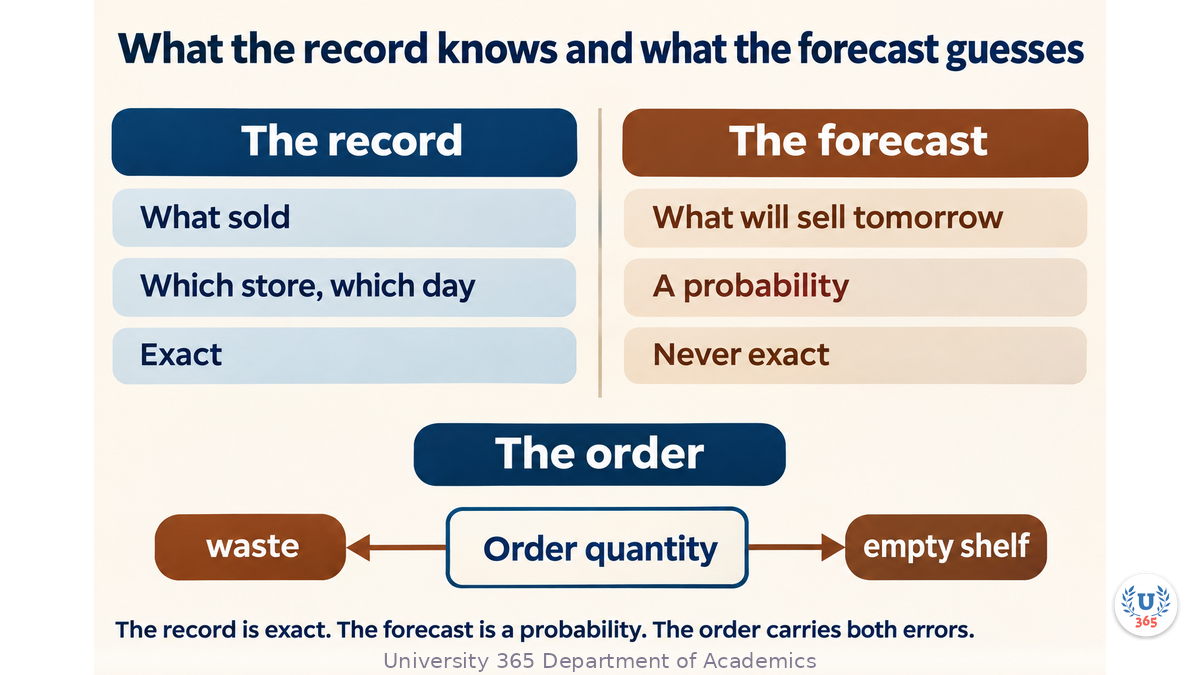
Two losses matter more than any other line at that margin. Shrink is stock that spoils or disappears before it sells. An empty shelf is a sale lost to another shop. Both follow from the order, and the order is a forecast about tomorrow made from a record of yesterday.
The other consequence is that the retailer owns more of the chain. Kroger runs 43 distribution centres for 2,731 stores and 33 food production plants, and its supermarkets stock more than 12,000 private label items on average. At a 2 percent net margin, scale is the only way to spread the cost of a distribution network over enough cases to make it affordable.
Of a dollar spent on domestically produced food in 2024, wholesale and retail trade together took 20.1 cents, and farms took 18.5 cents of each dollar spent on food eaten at home. The shop keeps a defined share, and it earns that share by moving goods rather than by holding them.
How the Supermarket Was Invented
The Feynman Summary
A shop used to be a counter with people behind it. You said what you wanted, someone fetched it, and the shop paid for that work. In 1916 Clarence Saunders moved the fetching to the customer and arranged the shop so that the customer has to walk past everything on the way to the till. The saving was real, and it came out of someone else's time.
The format only pays if enough people walk through it. So the store grew, moved to where a car could reach it, and added departments that need refrigeration and staff. A bigger store carries more fixed cost, and it has to sell more per square foot to carry it.
The arithmetic at the end is thin. Two cents of profit on the dollar means the shop cannot afford to throw much away or to leave a shelf empty for long. That is why the order matters, and why the shop now uses a forecast to decide how much to put on the shelf tomorrow.
How the Supermarket Was Invented
The Evidence
The motive for self-service is documented by the person who did it. Saunders's patent does not describe a shopper's convenience; it describes a saving in wages and overhead, and it requires the customer to review the entire assortment on the way through. That is a primary document, filed before the first store had proved the idea.
The second record is King Kullen's. One company history gives the first store 6,000 square feet, about 1,000 items, a parking lot, customers from 30 miles away and an average volume 20 times that of its average competitor. The company's own page gives eight stores within two years and 17 stores with about 6 million dollars of annual sales by 1936. Neither source is neutral, and both fit the arithmetic of a format that trades margin for volume.
The cleanest comparison sits inside one company. A&P was the largest grocer in the United States, with a peak of about 15,700 stores in 1930, and it came late to the new format. Its first supermarket opened in Braddock in 1937. One year later supermarkets were 5 percent of its stores and 23 percent of its business, and by 1939 it ran 1,110 supermarkets. Same buyer, same warehouses, and the new format produced nearly a quarter of the sales from a twentieth of the stores.
The margin record is consistent across sources. Kroger's 2024 filing reports a gross margin of 22.3 percent and net earnings of 1.8 percent of sales. The Food Industry Association reports an average net profit of 2.1 percent for food retailers in 2025, 45,575 supermarkets and one trillion dollars of supermarket sales. One is audited accounts, the other a trade survey, and they agree.
The limits are real. None of this is a controlled experiment: there is no counterfactual world in which the same shoppers faced the same prices without the format. Company histories are published by the companies or by reference works that rely on them, and they select the numbers that suit them. The 2.1 percent is an average across the members of a trade association, not a law of retail.
How the Supermarket Was Invented
The Counter-Case
The strongest alternative explanation is that the supermarket grew out of car ownership and home refrigeration rather than out of the aisle. In 1940 the census found that 44 percent of American households had a mechanical refrigerator. Before that, a week of fresh food had nowhere to keep. Without storage or a car, self-service was a worse experience than a delivery round.
A second objection is that part of the efficiency is a transfer. The shopper's time is unpaid, so some of the gain is a cost moved off the retailer's books and onto the household. The gain is then real for the firm without being a gain for the economy.
A third is that scale has not reliably produced lower prices. The 2024 merger case is the most recent test of that claim, and the court treated the promised price investment as neither specific to the merger nor verifiable, then stopped the deal on the ground that it would lessen competition in local markets.
What would settle it is a market without the car. Reardon and Hopkins record the format spreading from the early 1990s across developing countries after retail investment was liberalised, in cities where car ownership and home storage sat far below American levels. If the format travels without the car and the refrigerator, then the aisle itself explains more of the change than the counter-case allows.

How the Supermarket Was Invented
What It Means for You
This sits in Career and Finance and in Quality of Life, because the shop is a cost structure you pay for every week. The choices a store makes, which lines it keeps, how deep the fresh section runs, how often it marks down, are made on the arithmetic above. You can read them as decisions rather than as taste. The method behind this class of brief, including the test applied to the applied AI question, is set out on the Interests method page.
Compare on unit price, not pack price The shelf label carries both, and the pack is a selling unit while the unit price is the only figure that compares two sizes honestly.
Read an empty shelf as an ordering decision A gap in a fresh section usually means the forecast or the delivery failed, not that the item is unpopular.
Watch what disappears A delisted line is a turnover decision, so a product you liked vanishing is information about the shop's margin rather than about your taste.
The Applied AI Connection
The order book is where the two losses of a thin-margin shop meet. Afresh, one of the two systems evaluated in a 2022 Pacific Coast Food Waste Commitment case study, forecasts demand for fresh items store by store and day by day, then turns the forecast into a suggested order for the produce department. Across pilots covering more than 1,300 stores at two large chains, food waste fell by an average of 14.8 percent per store, and the labour spent on ordering, managing shrink and restocking was up to 20 percent more efficient.
The split is what matters. The record is exact: what sold, in which store, on which day, at what price. The forecast is not: it is a probability with an error bar, and the order that follows pays for both kinds of mistake, waste on one side and an empty shelf on the other. So when a retailer says a model improved the shop, ask which side it moved and what it does when it is wrong. A forecast tuned to never miss a sale over-orders and throws food away; one tuned to never waste a case leaves gaps. The fresh section is where the forecast is hardest, so availability there says more about a retailer's systems than about its goodwill.
How the Supermarket Was Invented
The Five-Minute Version
In 1916 Clarence Saunders patented a shop the customer walks through alone. The patent says the point is to dispense with many clerks and cut the store's overhead, and it arranges the cabinets so the customer must pass the whole assortment before reaching the till.
In 1930 Michael Cullen added size and a car park. His first King Kullen occupied 6,000 square feet in a leased garage in Queens, drew customers from 30 miles away and averaged 20 times the volume of its average competitor.
The proof that the format rather than the chain did the work sits in A&P. In 1938, one year after its first supermarket, the new format was 5 percent of its stores and 23 percent of its business.
The consequence is the arithmetic that still governs the shop. Kroger's gross margin was 22.3 percent in 2024 and its net earnings 1.8 percent of sales; the trade average net profit was 2.1 percent in 2025. At that margin a shop lives on volume, on how fast the shelf refills and on how little it throws away, so the order matters most.
The caveat is that the car, the refrigerator and the shopper's unpaid time did part of the work, and that scale has not reliably delivered lower prices, as the blocked 2024 merger showed. A forecast can cut fresh waste by about 15 percent in the pilots run for a West Coast food waste programme, and it can also over-order if it is tuned to never miss a sale.

How the Supermarket Was Invented
Sources
All sources below were opened and read on 8 November 2026.
The patent for self-service US patent 1,242,872, Self-Serving Store, filed 21 October 1916, granted 9 October 1917
The shopping cart US patent 2,196,914, Folding basket carriage for self-service stores
The first self-service store Piggly Wiggly, Our History
The first supermarket King Kullen, Our History
King Kullen in numbers International Directory of Company Histories, King Kullen
A&P, the largest chain International Directory of Company Histories, A&P
A&P timeline Supermarket News, 150 Years of A&P: A Timeline, 8 December 2008
Food spending, 2025 USDA ERS, Total U.S. food spending reached $2.51 trillion in 2025, 11 June 2026
The food dollar USDA ERS, Ag and Food Statistics: Food Prices and Spending
Store numbers and ownership USDA ERS, Chain and independent grocery stores, 2005 to 2015 (2017)
Trade averages FMI, Food Industry Facts
Kroger, results The Kroger Co., fourth quarter and full year 2024 results, 6 March 2025
Kroger, store and supply base The Kroger Co., 2025 Responsible Business Report
The 2024 merger ruling FTC v. Kroger and Albertsons, Opinion and Order (D. Ore. 10 December 2024)
The format outside the United States Reardon and Hopkins, The Supermarket Revolution in Developing Countries (2006)
Price discrimination law 15 U.S. Code section 13, Robinson-Patman Act
Forecasting and food waste Pacific Coast Food Waste Commitment, Using Artificial Intelligence to Reduce Food Waste in Grocery Retail (Fall 2022)
Household refrigeration in 1940 Bailey and Collins, Did Improvements in Household Technology Cause the Baby Boom?, NBER Working Paper 14641 (2009)




Comments