
ElevenLabs: voice cloning, dubbing and voice agents scored 6.5 on the U365 CI-First Review, the second Humics-Risky badge in the series

Status: Active | Last tested: 2026-09-25 (ElevenLabs, as documented at elevenlabs.io in September 2026) | Re-check: trigger-based (max 6 months)
Active: the tool is current and recommended.
What Active means here. Active means current and recommended for the reader this review describes: recorded speech production, multilingual dubbing, and a bounded voice agent, with a written boundary on when synthetic delivery is appropriate and a named reviewer for anything that reaches another person. It does not mean the platform is verified. No independent measurement of clone fidelity or dubbing accuracy exists, the vendor publishes five different language counts across its own surfaces, and the consumer review record sits at 3.1 on Trustpilot against 4.5 on G2. A reader who needs a measured guarantee of indistinguishability, a single authoritative language list, or a contract that indemnifies the user should treat those as not currently available and act accordingly.
For detailed explanations of the CI-First evaluation terms used in this review, including the Humics Protection Badge and the AI Imposture Risk levels, see the Glossary at the end of this post.


In this Tool Review
Status and Re-check
Status: Active | Last tested: 2026-09-25 (ElevenLabs, as documented at elevenlabs.io in September 2026) | Re-check: trigger-based (max 6 months)
Active: the tool is current and recommended.
What Active means here. Active means current and recommended for the reader this review describes: recorded speech production, multilingual dubbing, and a bounded voice agent, with a written boundary on when synthetic delivery is appropriate and a named reviewer for anything that reaches another person. It does not mean the platform is verified. No independent measurement of clone fidelity or dubbing accuracy exists, the vendor publishes five different language counts across its own surfaces, and the consumer review record sits at 3.1 on Trustpilot against 4.5 on G2. A reader who needs a measured guarantee of indistinguishability, a single authoritative language list, or a contract that indemnifies the user should treat those as not currently available and act accordingly.
Re-check triggers:
Publication of an independent measurement of clone fidelity or dubbing quality. The one public blind-preference board measures synthetic voice preference, not whether a clone is indistinguishable from the person it copies, and no third party had published a clone-fidelity or dubbing-accuracy measurement at the time of writing. Both of those claims currently rest on vendor wording. A repeatable measurement would move the Quality sub-score.
A change to the voice cloning consent path. The Terms permit uploading "the voice you are authorized to share with us", while the product documentation states that you may only clone your own voice and that consent from the other person is not enough. If the gap closes in either direction, the Skill Illusion and Social Authenticity reasoning should be re-run.
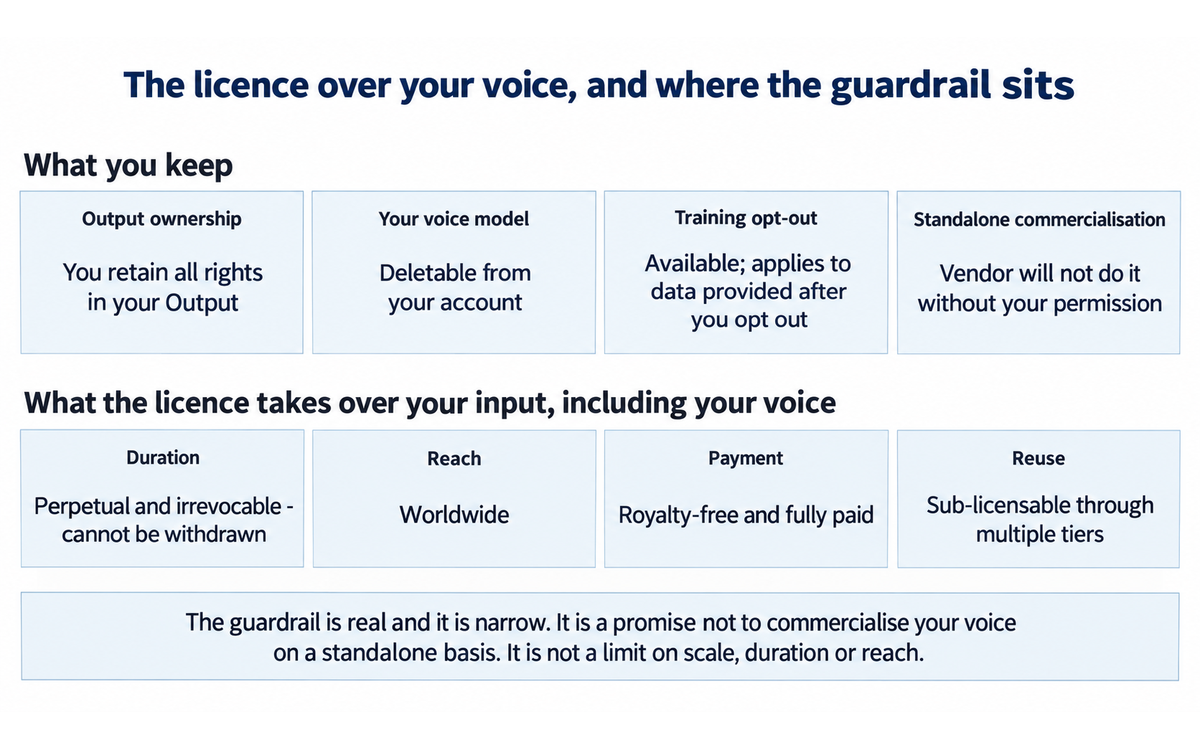
A change to the licence you grant over your own voice. The terms currently take a perpetual, irrevocable, worldwide, royalty-free, sub-licensable licence over your voice and other indicia of your persona, with a single written guardrail against standalone commercialisation. Any narrowing or widening of that clause changes the adoption calculus in Section 7c.
A labelling or provenance requirement for recorded output. The platform's own safety principle states that you should know when audio is AI-generated, and its use policy requires disclosure for conversational agent deployments. No equivalent obligation is documented for a recorded clip that an individual creator publishes. If that changes, the Critical Thinking rating should be revisited.
A pricing change to the credit model, or to credit forfeiture on cancellation. Credits are charged per generation attempt rather than per usable clip, and unused subscription credits are forfeited on cancellation or downgrade. Either rule moving would change the Time sub-score.
A first independent reliability measurement. The independent monitor that tracks the service logs incidents rather than uptime, and one third-party scoring site published a reliability dimension as not measured rather than as a low figure. A controlled measurement would move Quality.
A material change to the model line. The reviewed generation is Eleven v3 for expressive speech, with Flash and Turbo variants for speed. A successor generation would change the Arena position this review cites.
Tool Snapshot
Field | Value |
Category | Applied AI / AI voice generation and voice agent platform |
CI-First Benefit Score | 6.5 / 10 (CI-First Strong) |
Sub-scores | Time 8 / Quantity 8 / Quality 6 / Skill 4 |
CI-First Profile | Primary: Co-Worker and Assistant (level 2). Secondary: Analyst and Tester (level 4) and Coach and Tutor (level 3), both narrow |
Collaboration Mode | Centaur. Cyborg is defensible only for a short text-to-speech session where you iterate on a voice and stop each time you like the result |
Humics Protection | Humics-Risky (-2 / +3): Creativity 0, Critical Thinking -1, Social Authenticity -1 |
AI Imposture Risk | Medium overall, with Skill Illusion High |
Status | Active, with the conditions stated at the badge |
Last tested | 2026-09-25 (ElevenLabs, as documented at elevenlabs.io in September 2026) |
Access | Web application, iOS and Android applications, a reader application, REST API and software development kits, a hosted Model Context Protocol server, and telephony, web and mobile deployment for voice agents |
Price | Freemium with a standing free tier. Starter $6, Creator $22, Pro $99, Scale $299, Business $990 per month, Enterprise custom. Prices read from the pricing page on 2026-09-25 |
Output formats | MP3 and WAV, with 44.1 kHz PCM output through the API on Pro and above |
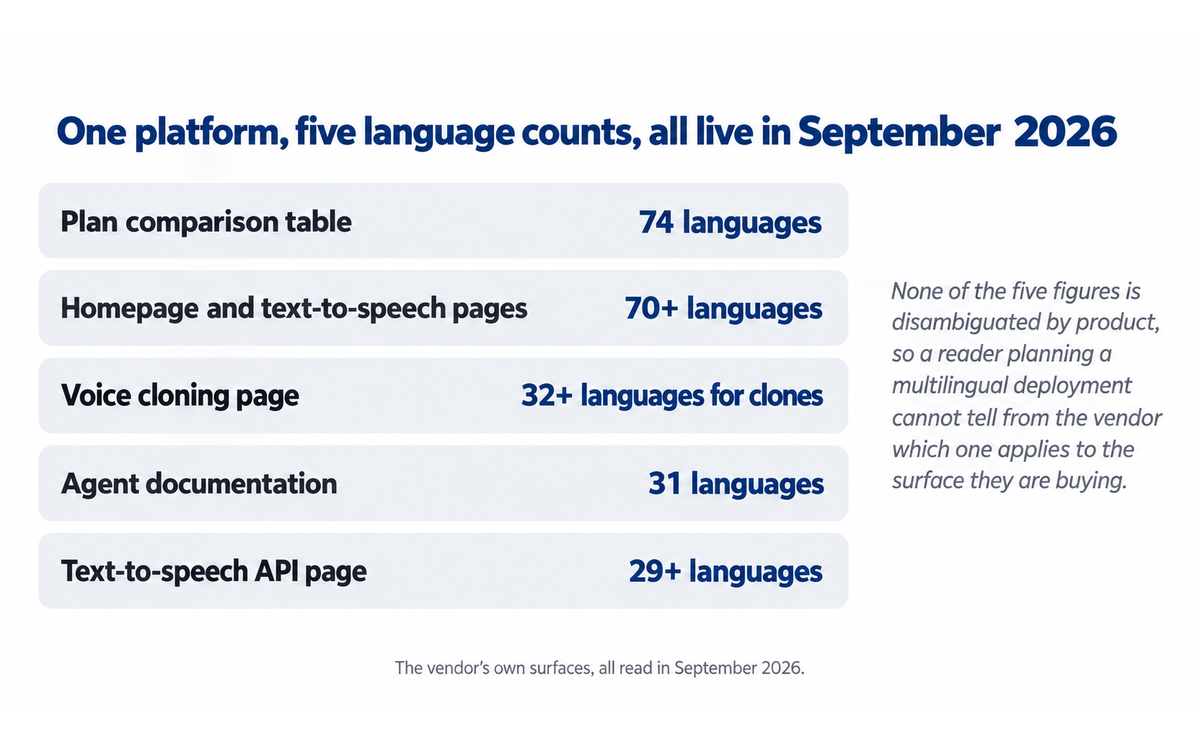
Language coverage | Five different figures on the vendor's own surfaces in the same month, from 29+ to 74. See the Faculty Note |
Independent fidelity measurement | None published for clone fidelity or dubbing accuracy at the time of writing |
ElevenLabs
Tagline: "Bringing technology to life" (headline on elevenlabs.io, read 2026-09-25), presented as "the leading AI voice generator" alongside "ElevenCreative for content creation" and "ElevenAgents for customer experience".
Category: AI voice generation and voice agent platform. A cloud service that converts text to speech, clones a voice from uploaded or recorded samples, dubs media into other languages, isolates or converts voices in existing audio, generates music and sound effects, and runs live conversational voice agents over telephony, web and mobile.
Primary use cases:
Turning a written script into narration for a video, podcast, course module or audiobook.
Creating a digital replica of your own voice so a written script can be delivered in that voice without recording it again.
Dubbing an existing recording into other languages while keeping the speaker's voice.
Producing character or advertisement voices that are not tied to any real person.
Running a voice agent that answers calls, qualifies requests or handles support dialogues.
Pricing summary: Freemium with a standing free tier rather than a timed trial. Free: $0, 10,000 credits per month, no commercial licence. Starter: $6 per month, 30,000 credits, commercial licence and Instant Voice Cloning. Creator: $22 per month (listed at $11 for the first month), 121,000 credits, Professional Voice Cloning. Pro: $99 per month, 600,000 credits, 44.1 kHz PCM output through the API. Scale: $299 per month, 1,800,000 credits, 3 seats. Business: $990 per month, 6,000,000 credits, 10 seats. Enterprise: custom. Prices read from the pricing page on 2026-09-25.
Official links:
Website: https://elevenlabs.io/
Pricing: https://elevenlabs.io/pricing
Documentation: https://elevenlabs.io/docs
Safety: https://elevenlabs.io/safety
Prohibited Use Policy: https://elevenlabs.io/use-policy
Terms of Service: https://elevenlabs.io/terms-of-use and https://elevenlabs.io/terms-of-use-eu for the European Economic Area, Switzerland and the United Kingdom
Privacy Policy: https://elevenlabs.io/privacy-policy
Voice Library Addendum: https://elevenlabs.io/vla
Status: https://status.elevenlabs.io/
Community: https://discord.gg/elevenlabs
Video and creative tool fields:
Pipeline type: text to speech, speech to speech, voice cloning, automatic dubbing, voice isolation, music and sound-effect generation, image and video generation.
Output formats: MP3 and WAV, with 44.1 kHz PCM output through the API on Pro and above, and 128 kbps or 192 kbps audio depending on tier.
Language coverage: stated as 74 languages in the plan comparison table, 70+ languages on the homepage and text-to-speech pages, 32+ languages for cloned voices, 31 languages in the agent documentation and 29+ languages on the text-to-speech API page. Five different figures appear on the vendor's own surfaces on the same day. See the Faculty Note.
Rendering time: seconds for short text. The vendor's own documentation sets Professional Voice Clone training at roughly 3 hours for English and roughly 6 hours for multilingual, "but it can take up to 24 hours" depending on the queue.
Agent platform fields:
Agent architecture: one agent per conversation, with a visual workflow builder that routes a single conversation between labelled subagent nodes. The configuration is exposed as JSON under conversation_config.workflow, with nodes and edges keyed by identifier, and can be pulled and pushed from a command line interface or updated through software development kits.
Supported agent types: voice agents, with configurable system prompts, conversation flow control for turn-taking and interruptions, and a choice of language model or a customer-supplied model.
Memory system: a knowledge base of documents attached to an agent, drawn on either as full context in the system prompt or through retrieval-augmented generation when the document is indexed. Documents can be created from files, URLs or text, up to 20 MB per file, and a single document can be attached to multiple agents.
Skills and extensions: tools and integrations for agent actions, a hosted Model Context Protocol server for creating and updating agents from an external client, and a command line interface for version-controlled agent deployment.
Retention control: the agent documentation exposes a privacy page for setting retention policies for conversations and audio.
Alternative comparison context: the vendor states on its text-to-speech API page that its models are "Independently rated the leading Text to Speech models". The independent board it is referring to places its best expressive model, Eleven v3, eleventh on the leaderboard it publishes. See What Users Say and the Faculty Note.
The Problem
Recorded speech is expensive in a way that written text is not. If you want a voice on a video, a course module, a podcast or an audiobook, you have three traditional options, and all three cost you something you cannot get back. You record it yourself, which means every mistake costs a retake, every script revision costs another session, and a single mispronounced word means repeating a paragraph. You hire a voice actor, which means money, scheduling and a revision loop. Or you leave the audio out, which means your written work reaches fewer people than it could.
The cost rises sharply the moment you need more than one language. A recording that works in English does not work in French, and a dubbed version made the traditional way means a second actor, a second studio and a timing problem, because what takes eight seconds to say in one language may take eleven in another.
There is a second problem, and it is the one that makes this category different from every other AI tool in this series. A tool that writes text can be wrong in ways you can spot by reading. A tool that produces a voice can be wrong in ways only your ear catches, and it can be right in a way that raises a question no other category raises: if the audio is synthetic and sounds exactly like a person, who is speaking? If it sounds like you and it was never you, what does that do to a message that was supposed to carry your voice?
For a learner or a professional in the middle of this, the practical problem is narrower and more urgent. You need audio to publish work that is otherwise complete. You do not have a studio, a budget for one, or the time to learn audio production before a deadline. And you cannot tell from the marketing pages how far the free tier will actually take you, what happens to your voice once you upload it, or whether the cheap cloning path and the accurate cloning path have the same rules.
The Outcome
A professional or a learner who adopts this platform gets finished audio without a recording session. A script that would have taken an afternoon to record, with retakes, becomes a file in minutes, and the same script can be re-rendered after an edit rather than re-recorded. That is the plain Time outcome, and it is real.
The larger outcome is reach. One recorded piece of work can be published in dozens of languages with the original speaker's voice, which changes what a single creator or a single department can put into the world. For a lecturer, that is the difference between a course that serves students in one language and one that serves them in several. For a professional, it is the difference between a product demonstration that only works for the home market and one that works across markets.
The third outcome is the one this review treats most carefully, and it is where the value and the risk are the same mechanism. If you clone your voice, you acquire a durable asset that speaks in your name. It keeps working while you sleep, in languages you do not speak, and it does not need to be re-recorded when the script changes. It is also a synthetic version of you, and everything you publish with it is a message delivered in a voice that is not yours. The honest outcome, stated plainly: you gain a production capability that used to require a studio, and you take on a standing obligation to decide when synthetic delivery is appropriate and when your own voice is the point.
A learner who works at it also gains something smaller and more durable. Writing for speech is a different craft from writing for a page, pronunciation and pacing become things you control deliberately, and a person who has iterated on synthetic delivery for a term is better at preparing a script than one who has not. That benefit is available, it is not automatic, and the Skill sub-score in Section 8 explains why it is scored conservatively.
Who Should Use ElevenLabs
U365 Fellow categories:
Learner type | Difficulty | Typical ROI | Career path |
Students (Bachelor, Master) | Beginner | Audio for presentations, portfolio pieces and recorded coursework without a studio. Practice in writing for speech rather than for a page. | |
Professionals (career upskilling) | Intermediate to Advanced for the agent and API paths, Beginner for recorded speech | Course narration, product and training audio, multilingual versions of existing material, and a first voice agent for a support or intake process. | |
Everyone (lifelong learners) | Beginner | Personal audio: converting written notes into something you can listen to, dubbing your own recordings for family and community, and building a listening habit around your own material. | LIPS Collect and Review phases, SL-OS audio intake |
Researchers and writers | Beginner to Intermediate | Turning a written study or report into audio, and testing how an argument lands when it is spoken rather than read. | URC (Research) dissemination work; UDA academic publication and teaching materials |
The institute ratings themselves are in the U365 Institutes Alignment table below, which is the academic owner's record rather than a duplicate of this list.
U365 Institutes Alignment
The institute table above answers relevance. This section records what each institute would actually do with the platform, and where the fit is weakest, because a tool that is relevant to four institutes is not equally useful to four institutes.
Institute | Relevance | What the institute would do with it | The limit that holds the row |
UIT (Technology, AI, Data Science) | High (primary) | Integration practice on a real API: streaming text-to-speech interfaces, model variants selectable by the trade-off you want, the agent workflow stored as a configuration graph you can keep in version control, and a hosted Model Context Protocol server that lets an external client create and update agents | The platform builds no programming or machine-learning competency of its own, and the language model inside an agent is selectable and may be the customer's own, so the agent's reasoning is not a property of ElevenLabs |
UIB (Business Management, Entrepreneurship) | Medium | Two genuine competencies. Technology purchase and cost appraisal: the per-attempt credit model, the credit forfeiture rule on cancellation, and the comparison of generated voice against a contracted voice actor all sit on a cost curve a Fellow can compute. Accountable governance of a synthetic-voice process: who authorises what a clone may say, and who reviews each piece before it reaches another person | The tool teaches no management, finance or entrepreneurship content of its own, and the contract questions it raises are legal literacy applied to a purchase rather than a business discipline. The appraisal exercise is assessable as a cost model rather than as a decision a Fellow can defend against a published programme outcome. |
UIC (Digital Communication, Marketing) | High | Advertisement and social formats, character voices, dubbing a campaign into several languages, and the direct question of whether synthetic voice belongs in a message whose point is authentic human presence. A Fellow here should be able to state a rule for when synthetic delivery is appropriate and defend it | The platform supplies the voice and not the campaign judgement. The competency is built by writing the rule and holding to it, not by using the product |
UID (Digital Design, UX/UI) | Medium | Voice selection, pacing and emotion control are design decisions, and an interaction designer working on a voice interface will meet this platform directly | The platform produces no design artefact, evaluates no design against a brief, and builds no design competency. This row sits above the equivalent row on other tool reviews in this series because here the Fellow makes a design decision a listener hears, rather than observing a tool protect a surface someone else designed. No credential chain is mapped, and the rating is a coursework observation. |
UNOP (University 365 Neuroscience-Oriented Pedagogy) alignment. Moderate and conditional. Audio of your own written material supports multi-modal repetition and spaced review, which the method favours, and listening to a lecture while walking is a real study pattern. The conditional part is that listening is a passive channel: if audio replaces your own active recall rather than supplementing it, the neuroplasticity principle the method relies on is working against you. Generate audio from material you have already studied, not as a substitute for studying it.
The one limit that holds across all four rows. The platform publishes no independent measurement of clone fidelity or dubbing accuracy, and its own surfaces disagree about how many languages it speaks. Every rating in the table above is a judgement about what the tool enables, not a claim about a measured result, and the Quality sub-score of 6 records that distinction.
How ElevenLabs Works
Inputs: Text you type or paste, with optional controls for stability, similarity, style and speaker boost. Audio files or direct recordings of your own voice for cloning. Media files for dubbing, voice isolation or voice conversion. Documents, URLs or raw text for an agent knowledge base. System prompts, workflow definitions and tool configurations for agents.
Outputs: Audio files for download in MP3 or WAV, with 44.1 kHz PCM output available through the API on Pro and above. Dubbed audio alongside an original track. Music and sound effects. Spoken replies from a live agent in a web widget, a mobile application or a telephony call, with transcripts, analytics and evaluation results available to the operator.
Underlying technology:
Models: the vendor publishes a family rather than one model. Eleven v3 is the expressive model, with Flash and Turbo variants offered for speed and a Multilingual model for cross-language work. The vendor describes the model choice as a trade-off between consistency, latency and emotional control. Instant Voice Cloning is documented as not training a model at all: it uses knowledge from training data to make an educated guess about the voice, which is why a very unusual voice or accent performs better under Professional Voice Cloning, which does train a dedicated model on the sample set.
Agent architecture: four components working together, a speech-to-text model for recognition, a language model of your choice, text-to-speech for the reply, and the conversation layer that manages turn-taking and interruptions.
Notable technical features: streaming text-to-speech interfaces, retrieval-augmented generation over an agent knowledge base, a visual workflow builder with conditional routing between labelled subagent nodes, an audio classifier the vendor has released publicly for detecting its own output, and support for the C2PA content provenance standard.
Integrations: a web application, mobile applications, a reader application, an API and software development kits over streaming connections, a hosted Model Context Protocol server, a command line interface for agents, and telephony, web and mobile deployment for voice agents.
How the pipeline runs, step by step:
You supply text and optionally select or design a voice.
The model renders audio, drawing on the voice's model or, for an instant clone, on prior knowledge of similar voices.
For dubbing, the original recording is transcribed, translated and re-voiced, with the speaker's voice preserved where the voice is available to the platform.
For a voice agent, speech recognition converts the caller's speech to text, the language model decides the reply and any tool calls, and text-to-speech returns the reply as audio inside the latency budget of a live conversation.
For a cloned voice, the sample set is submitted, the voice is verified in the case of a Professional Voice Clone, and the model is trained and queued before it becomes selectable.
What the platform does not publicly disclose. The parameter counts, training data composition and architecture of the voice models are not published. The language model used inside an agent is selectable and may be the customer's own, so the agent's reasoning capability is not a property of ElevenLabs alone. Where a capability is not documented, this review says so rather than inferring it.
Getting Started with ElevenLabs
Required accounts: A free account at https://elevenlabs.io. No payment method is needed for the free tier, which is a standing tier rather than a trial, capped at 10,000 credits per month and carrying no commercial licence. Commercial use begins at Starter, $6 per month.
Installation: Web application at https://elevenlabs.io/app. Mobile applications for iOS and Android. A reader application for listening to documents and books. Nothing to install for the basic path. Software development kits are available for the API path.
First-time configuration:
Create an account at https://elevenlabs.io and confirm the free tier is visible on the subscription page.
Decide the commercial question before you generate anything. If the output will be sold, published commercially, or used in client work, the free tier does not license it, and Starter is the floor.
Open the voices section and listen to several library voices before designing or cloning one. Choosing a voice you can direct is most of the quality decision.
Check the data-use setting. The privacy policy documents an opt-out from having your content used for training, reachable from the Data use menu in the Terms and Privacy section of your account, and the opt-out applies to data provided after you submit it.
If you intend to clone your voice, read the section on cloning below before uploading a sample, because the two cloning paths have different requirements, different tiers and different verification rules.
The two cloning paths, before you commit to either:
Instant Voice Cloning. Available from Starter at $6 per month. Created from a short sample, described by the vendor as working from a 10-second recording. It does not train a custom model. It is the cheap path, and the documentation does not describe a verification step for it.
Professional Voice Cloning. Available from Creator at $22 per month and above. Trains a dedicated model on a large sample set, which the documentation recommends at one hour minimum and as close as possible to three. The documentation states that all Professional Voice Clones require a verification process to confirm the voice belongs to you, and that you cannot change the accent or tone of a clone after it is created. Training takes roughly 3 hours for English and roughly 6 hours for multilingual, and can take up to 24 hours depending on the queue.
First 15 minutes checklist:
☐ Convert one paragraph of your own writing to speech on a library voice and download the file.
☐ Regenerate the same paragraph with a second voice and compare them by ear, not by description.
☐ Write down one word or name in your script that you expect the model to mispronounce, then check it. Note what a regeneration costs you in credits.
☐ Open the terms and the prohibited use policy and find the clause that governs the licence you grant over your own voice. You will meet it again in Section 7c.
☐ If you plan to clone, record 30 seconds of clean speech in a quiet room and confirm the file sounds like the voice you want to reproduce.
Result: After 15 minutes you should have a downloaded audio file in a voice you chose, a first-hand sense of what a regeneration costs, and the one legal clause that most changes how you would use this platform. That is a usable first result and an informed starting position.
Real Workflows
Three workflows, each with the division of labour stated, a ready prompt, and a verification checklist. The checklists operationalize the Executive Safeguard: assume you are working with the worst AI available.
Workflow 1: Turn a written study module into narrated audio you can review on the move
Learner type: Students and everyone (lifelong learners). CI-First benefit tags: Time, Quantity. Quality is conditional on your review. Skill is marginal. Connects to: UDA (Academics) module revision; UIC (Digital Communication, Marketing) media production; UNOP study routines. Time estimate: 20 minutes for a 1,500-word module including verification.
What you do vs what the tool does:
Step | You do | The tool does |
1 | Write or supply the script, and mark how each term of art should be pronounced | Renders the text as audio |
2 | Choose a voice and set the delivery controls | Applies the voice controls to the rendering |
3 | Listen to the whole file at least once before publishing | Produces the file in MP3 or WAV |
4 | Correct the script where the delivery exposed an awkward sentence | Re-renders the corrected passage, at credit cost |
5 | Decide whether this audio supplements or replaces your own active recall | Nothing |
Sample prompt (UP-Context method, used as a script-writing constraint rather than a generation prompt):
Role: you are writing a script that will be read aloud. Context: this is a 1,500-word module on [topic] for a first-year cohort, and the reader will listen while walking, not while reading. Task: rewrite the material below for the ear, with one idea per sentence, spelled-out numbers, and no parenthetical asides. Constraints: keep every term of art and every definition exactly as written, state each term's pronunciation in a note, and do not add claims the original does not contain. Output format: the script, then a separate list of pronunciation notes and any sentence you had to restructure.
Verification checklist:
☐ Multi-Model Check: run the same script through a second voice or provider and compare which passages sound wrong in both.
☐ External Source: read the script against the original written module and confirm no claim changed meaning in the rewrite.
☐ Human Review: another person listens to the first two minutes and says whether they can follow it without the text.
☐ CI-First Test: can you explain and defend every term in the audio without the platform? [Y/N]
Workflow 2: Clone your own voice and govern when it speaks for you
Learner type: Professionals, researchers and creators. CI-First benefit tags: Time, Quantity strongly. Quality conditional. Skill marginal and declining. Connects to: UDE (Engagement) content pipelines; UDA teaching and publication; URC dissemination. Time estimate: Two to four hours of setup to record and verify a Professional Voice Clone, plus a documented review step you keep.
What you do vs what the tool does:
Step | You do | The tool does |
1 | Write the boundary first: which content may use the synthetic voice, which may not, in one page you keep | Nothing |
2 | Record the sample set in a quiet room on consistent equipment, in one consistent tone | Provides the recording interface and sample scripts |
3 | Complete the voice verification step | Verifies that the voice belongs to you and trains a dedicated model |
4 | Approve each piece of audio before it is published anywhere | Renders it in your voice from text |
5 | Publish with a disclosure of your own rule | Nothing: no labelling is imposed on a recorded clip by the platform |
6 | Review the boundary page on a schedule | Nothing: nothing in the product will prompt you |
Sample prompt:
Role: you are my publication gate for synthetic voice. Context: this text will be published in my cloned voice on [channel], and my documented boundary is that [state the boundary]. Task: read the text below and tell me if it breaches that boundary. Constraints: answer only yes or no, then name the specific sentence or claim that triggered the answer, then say which of my stated exceptions covers it if any. Output format: verdict, trigger, exception, and nothing else. If you are unsure, say unsure.
Verification checklist:
☐ Multi-Model Check: use a different model than the one inside the platform for the gate above, and compare verdicts.
☐ External Source: check the platform's prohibited use policy and the terms clause on the licence over your voice before your first publication, not after.
☐ Human Review: someone other than you listens to the first piece published in the clone and says whether they would have known.
☐ CI-First Test: can you state, in one sentence and without the platform, when you will use your own voice instead? [Y/N]
Workflow 3: Build a first voice agent for a bounded intake task
Learner type: Professionals and researchers. CI-First benefit tags: Time and Quantity for the operator, Quality conditional, Skill moderate if you build the evaluation set yourself. Connects to: UIT (Technology, AI, Data Science) integration practice; UIB (Business Management, Entrepreneurship) service design; UDO (Operations) intake processes. Time estimate: Half a day for a working agent on one task, plus the time to write the test cases, which is the part most teams skip.
What you do vs what the tool does:
Step | You do | The tool does |
1 | Write the task boundary: what the agent may answer, what it must hand to a human, and the disclosure it opens with | Provides the system prompt field and the workflow builder |
2 | Attach the knowledge base documents and set each document's usage mode | Indexes documents and retrieves the relevant passages per turn |
3 | Write ten test conversations, including three the agent should refuse or escalate | Runs the conversations and returns transcripts |
4 | Set the retention policy for conversations and audio | Stores and, on your setting, deletes them |
5 | Read the transcripts and mark where the agent answered outside its boundary | Provides evaluation and analytics over the runs |
6 | Decide the escalation path and who owns it | Nothing: escalation is a process you design |
Sample prompt (system prompt, UP-Context structure):
Role: you are the intake assistant for [service]. Context: callers may ask about [list], and they may ask about anything else. Task: answer only from the attached knowledge base and only within the listed topics. Constraints: open every conversation by stating that you are an AI assistant; never give a price, a legal position or a medical opinion; if a caller asks something outside the list, or expresses distress or urgency, say you are transferring them and stop; never invent a policy. Output format: spoken replies only, no summaries. If the knowledge base does not cover the question, say so.
Verification checklist:
☐ Multi-Model Check: run the same ten test conversations against a second language model behind the same prompt and compare where behaviour diverges.
☐ External Source: open every knowledge base document and confirm it says what the agent says it says, and check the retention setting against your own data policy.
☐ Human Review: the owner of the intake process reads all ten transcripts and signs off on the escalation path.
☐ CI-First Test: can you handle a caller yourself, without the agent, when the agent is switched off? [Y/N]
Strengths, Limits, and AI Imposture Risk
Strengths
CI-First Benefit | Strength | Evidence |
Time | Finished audio without a recording session, and revisions that re-render rather than re-record | A script that took an afternoon to record becomes a file in minutes, and a one-word edit costs one regeneration rather than one session |
Quantity | One recorded piece of work reaches many languages with the original speaker's voice, and one voice model serves unlimited script iterations | The dubbing pipeline and the clone together turn one source recording into a multilingual library, which is the platform's genuine structural advantage |
Quality | The expressive model is measurably good, ranked eleventh of the field on the one public blind-preference board, and the cloning path that trains a dedicated model on a substantial sample is the mechanism behind that quality | Artificial Analysis Speech Arena, read 2026-09-25: Eleven v3 at Elo 1,172, rank 11 of the published table, from 4,114 samples |
Skill | Real but small: you learn to write for the ear, control pronunciation, and direct delivery | The delivery controls and the re-render loop teach pacing and emphasis, and that knowledge transfers to how you prepare any spoken material |
Limits
Instant Voice Cloning is the wrong tool for a distinctive voice, and the platform says so. The documentation states that an instant clone does not train a model and relies on prior knowledge to make an educated guess, and that the biggest limitation appears when the voice or accent is unusual enough that the training data contained nothing similar. Many buyers will meet this after paying, because the cheap cloning path ships at $6 and the accurate one starts at $22.
Credits are charged per generation attempt, not per usable clip. A regeneration to fix one word costs the same as the first take. Every mispronunciation you fix is a second charge, and the credit allowance is the figure that governs the monthly bill.
Unused subscription credits are forfeited when you cancel or downgrade. The vendor's own help centre states that cancellation takes effect at the end of the current billing cycle and that unused credits on the account are lost. A subscriber who cancels expecting to keep a paid-for balance loses it.
The licence you grant over your own voice is broader than most buyers assume. It is perpetual, irrevocable, worldwide, royalty-free and sub-licensable. The one written guardrail is narrow, and Section 7c quotes both.
The user carries the indemnification, not the vendor. The terms require you to indemnify ElevenLabs against claims arising from your use and your content. For a creator publishing a personal clip that is abstract. For an agency putting synthetic voice into client deliverables it is a line to price before signing.
No independent measurement of clone fidelity or dubbing accuracy exists. The one public board measures which synthetic voice listeners prefer, not whether a clone is indistinguishable from the person it copies.
Language coverage is published as five different numbers on the vendor's own surfaces in the same month. The plan table says 74, the homepage says 70+, the cloning page says 32+ for clones, the agent documentation says 31, and the API page says 29+. A reader planning multilingual deployment cannot tell from the vendor which figure applies to which product.
The quality of the output is not the same as the quality of the decision to use it. Nothing in the product tells you whether a synthetic-voice publication is appropriate in your context, and the platform's own provenance principle stops at detection rather than at labelling a published clip.
AI Imposture Risk
Trap | Rating | Evidence |
Time Illusion | Medium | The core rendering is genuinely fast and the savings are real for a first take. The illusion is in the revision loop: credits are charged per attempt, so a script with five mispronunciations is six renders, and dubbing is billed at a rate that makes a long recording expensive to iterate. Professional Voice Cloning is not fast at all: the vendor documents roughly 3 hours for English, roughly 6 for multilingual, and up to 24 hours depending on the queue. The honest position is that first-draft time savings are large and the path from first draft to publishable audio is longer than the interface suggests |
Quantity Illusion | Medium | The platform makes it trivially easy to produce many variants, and that is the risk. A listener cannot audit the difference between a rendering that is right and one that is slightly wrong in emphasis, and the free tier's lack of a commercial licence is the only hard gate in the path. The specific mechanism: a cloned voice that is 95 per cent convincing on most sentences is wrong in a way that a reader of text would catch and a listener usually will not |
Skill Illusion | High | Two mechanisms, both documented. First, Instant Voice Cloning does not build a model of you and is described by the vendor as making an educated guess, so a user who believes they hold a faithful replica of their voice holds an artefact the documentation describes as approximate, and no verification step is documented for that path. Second, a user who publishes in a clone and cannot tell a good take from a bad one has delegated the judgement that quality requires and retains only the output. A reader who can hear the difference has the skill. One who ships the first take does not, and the platform will not tell them which they are |
Overall AI Imposture Risk: Medium, with Skill Illusion High. Two traps are Medium and one is High, which the framework places at Medium overall because the Time and Quantity traps carry mitigations the user controls, while the Skill trap is the one the product's own design creates and does not resolve.
Framework v1.2 clause note
Three clauses of the CI-First framework, version 1.2, are checked against this tool, and one of them applies.
Clause 5.2.3-a, agent-authored procedural memory. This clause applies. It sets a floor of no lower than Medium on Skill Illusion for any tool that writes procedural memory on the user's behalf, and it requires High where the memory can be revised during use without a per-write human decision. ElevenLabs writes durable, account-level artefacts that govern later behaviour and that the user did not author: a Professional Voice Clone model trained on your samples, an agent knowledge base of documents the agent draws on every turn, an agent system prompt and workflow graph that determine what the agent will say, and conversation history that the platform may retain under a retention policy you set once. The clone is the clearest case. The documentation states that you cannot change the accent or tone of a clone after it is created, and that improving it means changing the samples and training again, so the artefact is durable and its later behaviour is not editable sentence by sentence. The floor is met and exceeded: Skill Illusion is recorded as High above, on the two mechanisms cited there, which are independent of this clause. This clause is the reason a reader should not expect a lower Skill Illusion rating for the platform even where the underlying voice quality is excellent.
Clause 4.2-a, agent-mediated conversation. This clause returns a null. The clause governs channel composition in agent-mediated human conversation: it states that a shared room in which named agents and their owner coordinate is neutral by itself, and that erosion requires either agent-authored text presented as the person's own voice in a human-facing channel, or the substitution of agent interaction for human contact. That is a rule about text another agent writes and sends in a conversational channel on a person's behalf. ElevenLabs' conversational surface is a platform on which a business deploys a voice agent to answer its own users, with the use policy requiring that those users be told they are talking to AI. That is disclosure, not misattribution, so the clause's trigger condition is not met and it has nothing to score here. The Social Authenticity rating in Section 8 is reached from the dubbing and cloning surface instead, which the clause does not reach. The clause is not declined on the grounds that voice is not conversation. It is declined on the grounds that the mechanism it names, agent-authored text presented as a person's own words to another human, is not what this surface does.
Clause 7.5, team-level rooms. This clause returns a null. It applies when several named agents share a channel with the human, and it requires a written task boundary per agent and Centaur as the default, with Cyborg unavailable where more than one agent works in one iteration loop. ElevenLabs' agent architecture is a workflow graph that routes a single agent conversation between labelled subagent nodes: one agent handles one call, and the node transition hands the conversation from one labelled behaviour to another inside the same execution. That is a centralised router, not several agents sharing a channel, and no configuration makes two named agents converse with each other in a room the human observes. The clause has no field to score. The Collaboration Mode for this tool is reached from the framework's own risk rule instead, and it is stated in Section 8.
Section 7c: Voice cloning consent, the licence over your voice, and who indemnifies whom, stated plainly
Voice cloning is the mechanism this product is best known for, and it is the part of it that no other tool in this series resembles. It is covered here with its own heading because a reader who adopts it is also accepting a permission model and a contract, and both are more specific than the marketing surfaces imply.
This section states what is documented. It is not an allegation of wrongdoing, it is not a legal finding, and it does not change any score. It closes by saying what it does not do.
The consent rule is stated in two places, and the two places differ.
The product documentation is unambiguous, in the answer to a frequently asked question:
"Can I create a Professional Voice Clone of someone else's voice? No. You can only create a Professional Voice Clone of your own voice. Even with their consent, you cannot clone someone else's voice. All Professional Voice Clones require a verification process to confirm that the voice belongs to you. If someone wants to share their voice with you, they can create and verify a Professional Voice Clone on their own account, then share it with you privately using a sharing link."
The terms of service use a wider formulation. On creating a user voice model:
"To create a User Voice Model through our Services, you may be asked to upload audio recordings of your voice or the voice you are authorized to share with us as Input to our Services"
The difference is material to a reader. The documentation says you may only clone your own voice and that consent is not enough. The contract says you may upload a voice you are authorised to share. A voice actor who has given written consent would satisfy the contract and fail the documentation. A professional deciding whether to build a workflow that depends on a third party's voice needs to know that the two surfaces answer differently, and that the documentation attaches verification to the Professional path only, with no verification step documented for Instant Voice Cloning.
The rule the use policy actually enforces is consent, and it is written broadly. Under the heading on impersonation, the prohibition is on using output "to intentionally replicate the voice of another person" without "consent or legal right", including to take unauthorised action on behalf of that individual. The same policy forbids evading the verification mechanisms, naming the voice challenge directly, and forbids unauthorised robocalling, meaning automated or pre-recorded voice messages placed without direct human intervention. For conversational deployments the policy is stricter than the platform defaults: organisations using the services, explicitly including the agent product, "must clearly and prominently disclose to their users they are interacting with AI rather than a human".
What you keep, and what you give.
On ownership, the terms are clear and generous: "Except as expressly set forth herein, as between you and ElevenLabs, you retain all rights in and to your Output."
The licence attached to using the service is where a reader should slow down. The operative text, on your input, including your voice:
"Notwithstanding the foregoing, we will not commercialize your voice on a standalone basis without your permission to do so. Such license shall be: perpetual and irrevocable (which means this license cannot be withdrawn), nonexclusive (which means you can license your Input to others), royalty-free and fully paid (which means there are no monetary fees for this license), worldwide (which means it's valid anywhere in the world), and sub-licensable, through multiple tiers (which means we can make it available to others)."
The same passage states the scope: the licence allows ElevenLabs to "reproduce, modify, publish, create derivative works from, distribute, publicly or otherwise perform, and use your voice, and other indicia of your persona that may be contained therein, to provide and improve the Services, and to develop new services and products."
Read the two sentences together and the position is specific. The guardrail is real and it is narrow: it is a promise not to commercialise your voice on a standalone basis without permission. It is not a limit on scale, duration or reach within the stated scope, and the licence is expressly not withdrawable. For a reader cloning their own voice, that is the term to understand before uploading samples, not after.
The terms also document the deletion and opt-out paths, which is where a careful reader should look for balance: user voice models created from your recordings can be deleted through your account, personal data can be deleted on request, and there is an opt-out from having your content used for training, reachable from the Data use menu in the account settings, which applies to data provided after the opt-out is submitted. The privacy policy states that training practices are designed to disassociate or fully remove data that could reasonably identify you, and that voice data may constitute biometric data and is treated accordingly where the law defines it that way. The policy also states plainly that ElevenLabs "does not undertake to review all Content and expressly disclaims any duty or obligation to monitor or review content", while reserving the right to moderate all input and output for integrity, security and fraud-prevention purposes.
The indemnity runs from you to the vendor, and the platform gives itself discretion over your content.
"To the fullest extent permitted by applicable law, you will indemnify, defend (at our option), and hold harmless ElevenLabs and our officers, directors, partners, licensors, employees and agents from and against any losses, liabilities, claims, demands, damages, expenses or costs (\"Claims\") arising out of or related to: (a) your access to or use of the Services; (b) the Content or Feedback; (c) your violation of these Terms"
The terms also permit ElevenLabs to "take any action with respect to the Content that is necessary or appropriate, in ElevenLabs' sole discretion, to ensure compliance with applicable law and these Terms". For a creator shipping client work that contains synthetic voice, the indemnity is the term that changes the risk profile, and it applies the same way whether the account is free or paid.
One asymmetry worth naming. The platform's safety page states its provenance principle plainly: "We believe that you should know if audio is AI-generated", supported by a public audio classifier, support for the C2PA standard and membership of the Content Authenticity Initiative. Its use policy requires disclosure for agent deployments. No labelling or marking obligation is documented for a recorded clip that an individual publishes, and no default watermark is documented on the download path. The obligation to tell a listener that a voice is synthetic therefore rests on the publisher, which in the common case is you.
No score changed, and here is why. The framework measures benefit to the human and the three Humics. Supplier contract terms, permission models and provenance policy are outside its dimensions, so nothing in this section moves a sub-score and nothing in it was discounted from a score. The section is included because a reader who adopts this class of tool is adopting the vendor's contract along with the product, and because the consent gap above is the kind of finding a reader would otherwise meet only after uploading their voice. The Social Authenticity rating in Section 8 rests on the synthetic-delivery mechanism and is argued there on its own terms.
What this section does not do. It does not assert that ElevenLabs has violated any obligation, and it makes no allegation against the company. It does not advise against using the platform, which would substitute the reviewer's judgement for the reader's. It does not characterise the licence as improper: a broad licence in exchange for a capable service is a legitimate commercial arrangement, and the deletion and opt-out paths are real. It states the operative text, names the difference between the two consent surfaces, and puts the decision in front of you. What you do with it is your decision, and it turns on whether the voice you upload is your own, whether the work is delivered to a client, and whether your jurisdiction imposes a labelling duty the platform does not.
U365 Co-Intelligence Rating
CI-First Profile
Primary profile: Co-Worker and Assistant (level 2).
Secondary profile(s): Analyst and Tester (level 4), narrowly, for the reader who runs the agent evaluation surface, writes the test conversations and reads the transcripts to find where the agent answered outside its boundary. Coach and Tutor (level 3), narrowly, for the reader who uses the delivery controls and the re-render loop to learn how pacing and emphasis change what a sentence do.
Why level 2 and not level 1. Level 1 would mean the human and the tool build on each other's thinking. ElevenLabs does not work that way: you supply text or a specification, it produces audio or a conversation, and you accept, reject or regenerate. That is delegation with review, which the framework places at level 2. The same reasoning placed Klarent, Claude Opus 5.5, MiMo-V2.6-Pro and Rabbit OS3 at level 2, and it is recorded here so the series reads consistently.
What does not fit. Challenger and Devil's Advocate (level 5) does not apply: nothing in the platform argues against your script, your voice choice or your decision to publish. The nearest thing it does is render a passage badly enough that you notice the sentence does not work when spoken, which is a production prompt rather than a challenge.
Collaboration Mode
Recommended mode: Centaur.
Alternative mode: None recommended for the cloning and publishing path. Cyborg is defensible for a short text-to-speech session where you are iterating on a voice or a delivery and stopping each time you like the result.
Mode rationale: The framework's own rule leads: Imposture Risk is Medium with Skill Illusion High, and Section 7.2 assigns Centaur when risk is Medium or High, because Centaur is safer. The independent ground is specific to this tool and it is a property of the artefact, not of the interface. Cyborg requires a stopping criterion the human applies inside a fast iteration loop, across a single continuous piece of work. A clone is trained once and then used repeatedly, in sessions the trainer does not attend, and the documentation states that the accent and tone cannot be changed after creation. There is no loop to stop in the sense Cyborg needs. The division of labour that makes the boundary real is procedural: decide before training what the clone may say and what it may never say, keep the boundary in a document you own, listen to every piece before it is published, and use your own voice for anything whose value depends on your presence. You own the judgement about when synthetic delivery is appropriate. The platform owns rendering.
CI-First Benefit Score
Dimension | Score (0-10) | Rationale |
Time | 8 | Strong savings, and they are structural rather than claimed. A script becomes audio in minutes, an edit re-renders instead of triggering a session, and dubbing replaces a second studio and a second actor. The score is 8 rather than higher because the overhead is real and documented: regeneration is charged per attempt, a Professional Voice Clone is a 3 to 6 hour queue on a one to three hour sample set, and the review step that makes the output publishable is work the tool does not do for you. First-draft time savings are large. Time to published audio is materially longer than the interface suggests |
Quantity | 8 | Strong increase in usable output per hour of human work, and it is the platform's clearest advantage. One source recording becomes a multilingual library with the original speaker's voice; one voice model serves unlimited script iterations; one 15-minute recording session produces a cloned asset that renders text for as long as the subscription is active. Held below 9 because the framework scores verified usable quantity, and the marginal unit here is not free: each render is a charge, each language version is a review your own ear has to pass, and the licence you accept over that voice is permanent. The quantity is real and it is the strongest of the four dimensions |
Quality | 6 | Moderate and measurable where measurement exists. The expressive model sits at rank 11 of the field on the one public blind-preference board, at Elo 1,172 from 4,114 samples, which is a strong result rather than the leading position the vendor's own API page implies when it says its models are independently rated the leading ones. The score is capped at 6 for two reasons and both are about measurement, not about audible quality. No independent measurement of clone fidelity or dubbing accuracy exists. And the platform publishes five different language counts across its own surfaces in the same month, which means a reader cannot audit the coverage claim from the vendor. A quality figure without a published methodology is not a quality benefit, and URC scores the absence of measurement rather than treating it as evidence of weakness |
Skill | 4 | Marginal, and scored conservatively because the framework directs it. There is a real learning surface: writing for the ear, controlling pronunciation, pacing and emphasis deliberately, and learning what a good take sounds like. The learning is genuine but the product's purpose is to remove the requirement, and the judgement that matters most, hearing the difference between a correct rendering and a plausible wrong one, is the part the platform will not teach you and cannot be delegated without losing it. A reader gains vocabulary and production habit and does not gain the ear the vocabulary describes |
CI-First Benefit Score: (8 + 8 + 6 + 4) / 4 = 6.5 / 10 (CI-First Strong)
Why this score is not higher, and why it is not lower
6.5 is CI-First Strong. The band label matters and it should be read with the same weight as the sub-scores: this is a recommendation for the reader it fits, not a caution.
The score is not higher because the two dimensions that carry weight in the common case are capped by measurement and by skill substitution, not by any doubt that the output sounds good. Quality sits at 6 because nobody independent has measured whether one of these clones is indistinguishable from the person, and because the vendor's own surfaces disagree about how many languages the product speaks. Skill sits at 4 because the platform replaces the production skill and only incidentally teaches it, and 4 is URC's judgement rather than a clause floor, since clause 5.2.3-a sets a floor at Medium and this rating exceeds it on its own reasoning. A score that reads as a claim about reliability the evidence does not support would be inconsistent with the treatment of the rest of this series, where a sibling model lost a Quality point for having 14 of 482 benchmark slots covered.
The score is not lower because the fundamentals are unusually solid. Time and Quantity at 8 are strong on evidence that is not promotional: the language coverage is the dubbing pipeline actually working, the time savings are a rendering that does not require a studio, and the Quality sub-score rests on the only public blind comparison of synthetic voices that exists. The vendor publishes its own limits, including that Instant Voice Cloning does not train a model and is a guess rather than a replica. That candour in the documentation is a genuine credit and it is why the Skill rating rests on documented mechanisms rather than on suspicion.
Humics Protection Badge
Dimension | Rating | Rationale |
Creativity | 0 | Neutral. The platform can spark creative decisions, because choosing and directing a voice, and hearing your own writing read back, regularly exposes a sentence that does not work. It can also replace the creative decision entirely, because a generated voice means you never make a performance choice at all, and selecting from a library is not authoring. The two effects balance, so the rating is neutral rather than protecting |
Critical Thinking | -1 | Erodes, and the mechanism is specific. Spoken output is harder to audit than written output: a listener cannot scan a rendering for the exact word that sounds wrong, and the fluent delivery of a synthetic voice encourages acceptance because it sounds finished. The platform supports verification in one respect, providing an audio classifier for its own output, and it does this by making an auditor's job possible rather than by prompting the user to take it. No labelling or marking obligation is documented for a recorded clip, so the question of whether a listener should be told is left to the publisher. Sustained use with no review habit trains you to accept audio you have not checked |
Social Authenticity | -1 | Erodes, and this judgement was made deliberately against the mechanism rather than against the category. The erosion is not in using a synthetic voice as a tool. Dubbing and cloning replace your own voice with synthetic delivery: the output reaches other people as your voice and is generated by a model trained on you, so the person on the receiving end experiences a performance you did not give. The licence and the publication rules in Section 7c make that a durable arrangement rather than a single act. The counter-case is recorded rather than dismissed: using the platform to script, rehearse or prototype your own spoken content, and then delivering it yourself, protects the Humic, because the tool improves what you say rather than replacing how you sound saying it. The rating is -1 because the common use of this platform is the first pattern, not the second |
Humics Protection Score: 0 + (-1) + (-1) = -2 Badge: Humics-Risky
This is the second Humics-Risky badge in the series, after Rabbit OS3, and the reason is the same in kind: the tool's core value proposition is to stand in for something the human does. A reader should read the badge as an instruction rather than as a rejection. It requires an active mitigation strategy, and the mitigation is nameable: use the platform for preparation and for work where synthetic delivery is appropriate, keep your own voice for anything whose point is that it is yours, and listen to every piece before it goes out.
Superhuman Usage Guidance
When to invite this tool:
Narration, training audio, product and course materials, and any recorded speech where the point is the content rather than the speaker's presence.
Multilingual versions of material you already have, where a second recording session is the thing standing between you and publishing.
Character, advertising and non-personal voices, where the question of whose voice it is does not arise.
Drafting and rehearsing your own spoken content: render a script, hear where it drags, rewrite it, then deliver it yourself.
A bounded voice agent for one intake or support task, with ten written test conversations before it faces a real caller.
When to keep this tool out:
Any communication whose value depends on your genuine presence: a condolence, an apology, a personal message, a performance, a piece where the listener's trust in you is the content.
Anything where a listener might reasonably believe a human spoke who did not, unless the platform's disclosure path applies and you are willing to use it.
The final quality decision on audio you cannot evaluate by ear. If you cannot hear the difference between a good take and a plausible wrong one, you are in the Skill Illusion and should have someone else review it.
Any deployment that puts a voice agent in front of a caller without a written escalation path and a named owner, because the platform will not design one for you.
Client work where the indemnity runs to you and the synthetic voice is the deliverable, without reading the terms first.
U365 method integration:
LIPS + CARE: the decision record belongs in LIPS, not in the platform. Put your boundary document, the list of what may use the clone and what may not, and your review log in your LIPS under Projects. The platform holds the audio; LIPS holds the rule that governs it. In the CARE cycle, the platform supports Collect and Execute, and it should never be allowed to make the Review decision on your behalf.
ULM + EVA: mainly Career and Social. Career because a production capability that removes a studio is a professional asset, and Social because the authenticity question is a social one and belongs in deliberate reflection rather than in a default. Character is touched in one specific way: keeping your own standard for when your own voice is required, when the platform will happily supply one for you either way. Weak fit for Body, Spirit and Quality of Life.
UP-Context: the method improves this tool more than most, because the highest-value use is not generation at all. Use UP-Context to write the boundary document and the publication gate prompt, which are the artefacts that keep the clone inside the limits you set.
SL-OS: audio is an intake channel that the SL-OS stack does not otherwise supply. Route rendered learning audio into your review routines rather than treating listening as study, and keep the boundary document and the review log in OneNote or SharePoint where your other standards live, not inside the vendor's account.
UNOP: moderate and conditional alignment. Audio supports multi-modal repetition and spaced review, and listening is a second channel for material you have already worked through. It does not support active recall on its own, so generate audio from material you have studied rather than as a substitute for studying it.
Over-delegation warning: the failure mode with this tool is not a bad voice. It is a silent transfer of authorship. You start by rendering a script you wrote, then you let the platform pick the voice, then you stop listening closely because it is usually fine, and then you have a body of published work that carries your voice and contains no moment where you decided what it sounded like. In the CI-First formula, CI = HI + (AI x HI): if your judgement about your own voice drops toward zero, the product gets more capable without making you more effective, and the multiplier falls. The specific symptom to watch for is that you cannot name a recent piece where you chose your own voice over the clone, or a take you rejected. If neither has happened in a month, the tool has your signature and you are no longer signing anything.
What Users Say
Aggregate Rating Table
Platform | Rating | Number of reviews | Link |
G2 | 4.5 / 5 | roughly 1,140 reviews | |
Trustpilot | 3.1 / 5 | 1,041 reviews, about 36 per cent of them one star | |
Product Hunt | 4.6 / 5 | 28 reviews | |
Capterra | about 4.75 / 5 | approximately 17 reviews | |
App Store | The iOS app is listed by Apple as ElevenLabs: AI Generator, with a separate ElevenReader app for reading books aloud. Both listings are reported at platform level through search indexing rather than read directly, and Apple serves a page for any application identifier, so the identifier itself is not treated as verified | not stated on the listing page as read here | |
Google Play | Not individually verified in this pass | not verified | |
Reddit and community forums | Mixed, and reported at platform level here rather than quoted thread by thread | no thread URL cited, see the note below | |
FutureTools | No reviews found on FutureTools at the time of writing | 0 |
Note on sourcing in this table. The G2, Trustpilot, Product Hunt and Capterra figures and counts are reported through a third-party audit that reconciled the platforms against the public blind-preference leaderboard on 11 July 2026, and the figures were re-read for this review in September 2026. Both G2 and Trustpilot build their content in the browser rather than in the page source, so their review pages refuse an automated read, and the numbers above are reported at platform level rather than reproduced from a page this review could open directly. No figure in this table comes from a page that could not be read at all. The Reddit row is deliberately a platform root rather than a thread URL for the same reason: community sentiment is reached through search indexing, and this review will not cite a specific thread it did not read.
What Users Praise
The praise clusters tightly around one thing, and it is real: the voice quality. The recurring formulation across platforms is that the output sounds professional, and reviewers most often arrive at that verdict by comparing the platform with the previous generation of synthetic speech, meaning the older cloud text-to-speech engines and the earlier generations of competitor products. Developers and business buyers on G2 rate it 4.5 across roughly 1,140 reviews with almost nothing at one or two stars, and the themes they name are the integration experience and the output, with the API repeatedly described as clean and well documented. A Product Hunt reviewer called the voice quality "exceptionally professional and high-end", and another described the API as "clean and well documented, which made integrating it into our workflow pretty painless". Product Hunt sits at 4.6 from a small sample of 28. The pattern is a platform whose core capability satisfies the people who buy it for a technical purpose.
What Users Complain About
The complaints are not about the voice, they are about the commercial mechanics, and they are specific enough to function as a buying checklist. The dominant theme on Trustpilot, which sits at 3.1 across 1,041 reviews with about a third at one star, is billing. The single most repeated complaint is that unused credits are wiped when a plan is cancelled or downgraded, including a rollover balance the subscriber has already paid for, and the vendor's own help centre documents that behaviour rather than disputing it. The second theme is credit consumption: credits are spent per generation attempt, so fixing one mispronounced word costs a second charge, and reviewers describe the allowance disappearing faster than the finished minutes they received. The third is support, and the split there is instructive rather than contradictory: a five-star review in July 2026 praised the customer service while a one-star review the same month reported no human to talk to. A fourth theme is a paywall that reviewers describe as arriving early and hard, with large parts of the interface gated from a non-subscribing account. Reviewing the whole record, a reader should read the two platforms as measuring different things rather than as disagreeing: the technical cohort buys for the output and renews, and the consumer cohort arrives after a billing event.
Sentiment Summary
Overall sentiment: Mixed to predominantly positive, and it depends entirely on which platform you read. It is not possible to state one number honestly.
Key themes:
Voice quality is the strongest and most consistently praised element across every platform.
On G2, 4.5 from roughly 1,140 reviews, with the technical and business cohort rating output quality and integration.
On Trustpilot, 3.1 from 1,041 reviews, driven overwhelmingly by credit forfeiture on cancellation and per-attempt credit consumption.
Support quality is reported in both directions within the same month, which reads as triage by dispute type rather than one standard.
No reviewer cohort reports a reliability or uptime measurement, and no platform carries a controlled test of whether a clone is indistinguishable from the person it copies.
U365 Editorial Note
The user sentiment and the CI-First evaluation agree far more than they diverge, and the places where they diverge matter. Users and this review both put the platform's real strength in the output, and both treat the production mechanics as the friction. The Trustpilot record is the crowd delivering the same verdict this review reaches from the contract: the value is real and the commercial terms are the part to understand before you commit, which is why Section 7c quotes them and why the Time sub-score is 8 rather than higher. The divergence is on the Humics side, and it is a genuine one. Users do not report that their own communication capability is eroding, and they would not be expected to: erosion of Social Authenticity is invisible from inside a workflow that is working well, and it shows up in a body of published work rather than in a support ticket. The crowd tells you the tool is good at what it does. This review's contribution is the question the crowd is not positioned to ask, which is whether what it does well is the thing you want done.
Comparison and Alternatives
Alternative | "Choose [Alternative] if..." | "Choose ElevenLabs if..." |
Speechify (Simba 3.2), https://speechify.com/ | You want the highest blind-preference quality on the public leaderboard: Simba 3.2 leads at Elo 1,232 against Eleven v3 at 1,172, read 2026-09-25 | You want the deeper tooling around the voice: cloning, dubbing, sound effects, an agent platform and an API, rather than a reading and narration product |
Cartesia (Sonic 3.5), https://cartesia.ai/ | You are building a real-time voice agent and care most about the latency and consistency measured under production conditions, where independent benchmark tables place Cartesia ahead of the ElevenLabs Turbo and Flash models on median time to first audio | You need the whole media pipeline rather than a text-to-speech engine, including dubbing, music, sound effects and voice design |
Google Gemini 3.1 Flash TTS, https://deepmind.google/ | You want a leading blind-preference voice inside a cloud platform you already use, at a published per-character rate | You want a voice asset you own as a product feature: a clone of a specific person, a saved voice library, and a workflow you control |
OpenAI text-to-speech, https://platform.openai.com/docs/guides/text-to-speech | You want a lower-cost per-character option and generic voices are sufficient for the task | The voice itself is the point: your own voice, a specific accent, a character, or a language set you need covered |
Murf AI, https://murf.ai/ | You need studio narration for a team with a simple workflow and do not need self-serve voice cloning | You need cloning, dubbing or a conversational agent, which Murf does not offer in the same form |
Where ElevenLabs is clearly better. The platform's advantage is depth rather than peak voice quality, and the honest reading of the evidence says so. On the one public blind-preference board its best expressive model sits at rank 11 of the field, behind Speechify, Alibaba, VUI Labs, Google, StepFun, Cartesia, Inworld, Smallest.ai, a research-preview model and MiniMax. What no competitor in that top group matches is the combination: text to speech, instant and professional cloning, dubbing, voice isolation, music, sound effects, a reader application and a deployable voice agent platform, behind one API and one account. If your requirement is one recording transformed into many languages in the speaker's own voice, this platform is the most complete answer available, and the dubbing pipeline is the part competitors most often lack.
Where ElevenLabs is clearly worse. Three places, all evidenced. Blind-preference quality places eleventh rather than first, and if voice quality alone is the decision, a competitor wins on the public measurement. Production latency is not its strongest axis: an independent benchmark of streaming text-to-speech APIs places the Turbo and Flash models behind both Cartesia and the benchmark leader on median time to first audio, which matters for a live agent and does not matter for recorded narration. And the consumer terms are harsher than the technical quality suggests: credits are charged per attempt and forfeited on cancellation, the licence over your voice is perpetual and irrevocable, and the indemnity runs from you to the vendor. A reader whose priority is a clean contract should compare before buying.
Verdict and Next Steps
Who should adopt it: anyone whose work needs recorded speech at volume, in several languages, or in a specific person's voice, and who is willing to keep the review step the platform does not provide. The strongest fits are a professional producing training or product audio, a researcher or lecturer publishing material in more than one language, a creator who needs narration that survives script revisions, and a team building a bounded voice agent for one intake or support task.
When: before a content cycle you already have planned, not as an experiment. The value here is realised on work you were going to produce anyway, and the setup cost, particularly a Professional Voice Clone, is only worth paying if you expect to render repeatedly. If you are cloning, decide your boundary before you record, because the boundary is what makes the clone safe to use and it is much harder to write after you have started publishing.
For what: recorded speech production where the content is the point, and multilingual dubbing of material you already have. Not for communication whose value is your genuine presence, and not as a substitute for your own delivery where your delivery is the message.
UP-Context prompt pack: Three reusable prompts, structured in the UP-Context Method order of context, role, task, constraints and output format, and each closing with a verification step. Copy them into the platform or into the model you use alongside it. The audience-persona line is not optional here: for spoken delivery, who is listening and in what state of attention is the constraint the whole script answers to.
Prompt pack 1: The boundary document and the publication gate
Context: I am about to publish [piece] on [channel] in a synthetic voice. My USER-PERSONA file says [the parts of my profile that bear on tone and authority]. My AUDIENCE-PERSONA file says the listener is [who they are, what they already know, where they will hear this, and whether they will hear it once or repeatedly]. My written boundary for the synthetic voice is: it may cover [list]; it may never cover [list]; where the value of the message is my own presence, I use my own voice.
Role: AI as Co-Worker and Assistant (Profile 2). You read and judge against my stated boundary. I wrote the boundary, I own the exceptions, and I decide what publishes.
Task: read the text below against the boundary and tell me whether publishing it in the synthetic voice breaches it.
Constraints: answer only yes, no or unsure. Then name the exact sentence or claim that produced the answer. Then name the exception that covers it, if one does. Do not rewrite the text and do not soften the verdict to be helpful. If the text touches a topic my boundary does not mention, say that the boundary is silent rather than treating silence as permission.
Output format: verdict, triggering sentence, exception, and one line reading either "boundary silent" or "boundary covers this".
UP-Context verification: I keep a dated log of every verdict, including the ones where I published anyway and why. Every sixth month I read the log and the boundary together and decide whether the boundary still says what I mean. If I cannot state, without the tool, which of my published pieces used my own voice and which used the clone, the boundary is not doing its work and I rewrite it before publishing anything else.
Prompt pack 2: Write for the ear
Context: this is [word count] words on [topic] for [audience], and it will be listened to once, not read. My USER-PERSONA file says [how I speak about this subject]. My AUDIENCE-PERSONA file says the listener is [who, where, and in what state of attention: walking, commuting, working, or studying]. The terms of art that must survive unchanged are [list], and my preferred pronunciations are [list].
Role: AI as Co-Worker and Assistant (Profile 2) for the rewrite, and Analyst and Tester (Profile 4) for the pronunciation list. I make every claim in the piece and I decide what is publishable.
Task: rewrite the material so it works when heard once, at the pace of someone walking.
Constraints: keep every term of art and every definition exactly as written. One idea per sentence. Spell out numerals and abbreviations. No asides in parentheses. No forward references to a section the listener has not heard. Add nothing the original does not claim, and remove nothing it does claim.
Output format: the rewritten script, then a pronunciation note per term, then a list of every sentence you had to restructure and the reason.
UP-Context verification: I listen to the whole rendering once before anything is published, and I mark every place where my attention slipped, because that is where the script failed rather than where the listener failed. I re-read the script against the original and confirm no claim changed meaning. If I cannot hear the difference between a correct rendering and a plausible wrong one in a passage that matters, I have someone else listen before it goes out.
Prompt pack 3: The bounded voice agent and its ten test conversations
Context: the agent will handle [task] for [audience] over [channel]. My AUDIENCE-PERSONA file says the caller is [who they are, what they usually want, and what they are usually anxious about]. The knowledge base documents are [list], and they are the only permitted source. The process owner is [name and role], and the escalation path on my own web or telephony surface is [where a human takes over].
Role: AI as Analyst and Tester (Profile 4) for the test design, and Co-Worker and Assistant (Profile 2) for the system prompt. I define the scope, I own the escalation path, and I read the transcripts myself.
Task: produce the system prompt and the escalation rules, then ten test conversations the agent must pass before it faces a real caller.
Constraints: the agent opens every conversation by disclosing that it is an AI assistant. It answers only from the attached knowledge base and only inside the listed topics. It never gives a price, a legal position or a medical opinion. It stops and transfers on anything outside its topics and on any expression of distress or urgency. It never invents a policy. At least three of the ten test conversations must be ones it has to refuse or escalate.
Output format: the system prompt, the escalation rules with the named owner, then the ten conversations as caller turns with the expected agent behaviour and the pass condition for each.
UP-Context verification: I run all ten myself and read every transcript, and I mark each one where the agent answered outside its boundary. I keep the transcripts in my own store rather than only in the vendor's account, and I set the retention policy deliberately rather than accepting the default. I confirm I can handle a caller myself, without the agent, before the agent is switched on. If the agent cannot be switched off without stopping the service, it is not ready to face a caller.
Related U365 content: the U365 Tools Reviews index at https://www.university-365.com/tools, and the CI-First Evaluation Framework's worked scorings, which this review follows. The academic alignment for this tool, including the tool-to-skill-to-credential chain and the institute mapping, is in the Tool to Skill to Credential section and the U365 Institutes Alignment section of this review.
Guidance on U.Copilot and SL-OS content for this tool
U.Copilot. U.Copilot is the front door to the U365 tool library. For this tool, the useful requests are the ones that produce the artefacts the platform will not produce for you: ask U.Copilot to draft your synthetic-voice boundary document and your publication gate, to design the review step that names who listens to a piece before it is published, to design the agent escalation path and the ten test conversations, and to place the boundary document and the review log in your LIPS Digital Second Brain rather than inside the vendor's account. Example request: "Design a CI-First workflow for publishing audio with ElevenLabs. My clone covers [scope] and may never cover [exclusions]. Include a publication gate, a named reviewer, a monthly honesty check listing pieces where I used my own voice instead, and a rule for what my voice agent must escalate. Connect the boundary document to my LIPS under [category], and tell me which parts I must do myself."
SL-OS. The genuine integration points are audio intake and the decision record, not the vendor's interface. Rendered learning audio becomes an SL-OS review input, which is a listening channel the Microsoft-centred stack does not otherwise supply. The boundary document, the list of what the clone may and may not say, and the review log belong in OneNote or SharePoint, where your other standards live, so that the rule governing your voice survives a vendor account change. Microsoft 365 itself is not where the platform's integration sits for recorded speech: the audio is downloaded and imported. For the agent path the integration is real, because an agent can be deployed on your own web or telephony surface and its transcripts and evaluation results are available to your operation.
Status and Last Tested
Re-check: trigger-based, maximum six months. The triggers are listed at the top of this review, and the first three, an independent measurement of clone fidelity, a change to the cloning consent path, and a change to the licence over your voice, would each change the score rather than only the wording.
What Active means here. Active means current and recommended for the reader this review describes: recorded speech production, multilingual dubbing, and a bounded voice agent, with a written boundary on when synthetic delivery is appropriate and a named reviewer for anything that reaches another person. It does not mean the platform is verified. No independent measurement of clone fidelity or dubbing accuracy exists, the vendor publishes five different language counts across its own surfaces, and the consumer review record sits at 3.1 on Trustpilot against 4.5 on G2. A reader who needs a measured guarantee of indistinguishability, a single authoritative language list, or a contract that indemnifies the user should treat those as not currently available and act accordingly.
Version reviewed: ElevenLabs, as documented at elevenlabs.io in September 2026.
Tool to Skill to Credential
Mastering this tool builds a skill, the skill maps to a U365 competency, and the competency is what a credential recognises. The table below names the competencies this platform exercises and, for each one, the nearest published U365 programme and what that programme does not publish. It states plainly what the academic record shows: no published U365 credential assesses any of these five competencies. That is a statement about what the tool does rather than a defect in the catalogue, because the platform removes the production requirement instead of teaching production. The competencies are the ones a reader builds by resisting that removal deliberately, which is why the Skill sub-score is 4.
Tool skill | U365 competency | Credential | Institute |
Writing a script for the ear, with one idea per sentence, spelled-out numerals and no parenthetical asides | Written communication adapted to the delivery channel, which is a core transferable competency | Content Marketing Specialist (30 days) and Social Media Marketing Manager (30 days), both published, assess written communication adapted to a channel: content writing and copywriting for social. Neither publishes a spoken-delivery outcome, so writing for the ear is not asserted as credential-recognised. Confirm with academic team. | UIC (Digital Communication, Marketing) |
Directing delivery deliberately, using stability, similarity, style and pacing controls rather than accepting the first take | Production craft and critical listening: hearing the difference between a correct take and a plausible wrong one | Confirm with academic team. No published U365 credential assesses production craft in audio. The nearest published production-craft programme is Video Production Specialist (60 days), whose published modules are video editing, colour grading and one dialogue-editing module, and it publishes no audio-production outcome. | |
Writing and enforcing a boundary for synthetic voice, including what may never be generated and who reviews each piece | Ethical judgement applied to media, and the professional discipline of stating limits before using a capability | Confirm with academic team. No published U365 programme assesses synthetic-media governance. The nearest published anchors are Business Analysis Professional (60 days), which publishes requirements articulation, business process modelling and benefits realisation, and Entrepreneur (25 days), which publishes a Business Law module. Neither publishes a synthetic-media governance or boundary-authorisation outcome. | |
Building a voice agent with a bounded scope, an opening disclosure and a written escalation path, and testing it before it faces a caller | Service design, requirements specification and evaluation discipline | Create Custom Chatbots with n8n (2 days, certificate) and AI Agents and Workflows Automation with n8n (2 days, certificate), both published, cover building a bounded conversational agent against your own documents and prompts. Neither publishes an escalation-path or evaluation-set outcome, so the testing discipline is not asserted as credential-recognised. AI Developer Specialist (18 days) publishes large language model application building and responsible AI. Confirm with academic team. | UIT (Technology, AI, Data Science) |
Reading a contract for the licence it takes over your own likeness and the indemnity it places on you, and pricing that into a client deliverable | Commercial and legal literacy applied to a technology purchase decision | Confirm with academic team. Entrepreneur (25 days) publishes a Business Law module and Financial Analysis Specialist (30 days) publishes financial statement analysis and financial modelling. Neither publishes a technology-purchase contract-literacy outcome, so reading the licence and the indemnity is not asserted as credential-recognised. | UIB (Business Management, Entrepreneurship) |
Access level, stated plainly. University 365 has three academic access levels: DISCOVERY, INSIDER and SUPERHUMAN. Specialized diplomas and certificates carry Basic, Foundation and Expert levels: DISCOVERY Fellows can enrol in Basic-level programmes only, INSIDER Fellows in Basic and Foundation programmes, and SUPERHUMAN Fellows in all of them. University degree programmes carry a single Expert level and are open to SUPERHUMAN Fellows only. No degree chain is asserted against any row in the table above, and no claim is made that completing any programme listed there awards credit toward a degree or toward a named micro-credential. The catalogue does not expose credit transfer or a per-programme access level, and this review asserts neither.
Skill level and the honest note. The competencies above are real and they are not the competencies most users will develop, which is why the Skill sub-score is 4. The platform is designed to remove the production requirement, and the skills listed here are the ones a reader builds by resisting that removal deliberately: writing for the ear, listening critically, setting limits, and reading the contract. A reader who uses the platform the way the interface invites will produce good audio and gain none of them.
A curriculum gap, recorded rather than filled. No U365 credential recognises production craft in audio. A live read of the published catalogue on 2026-09-25 found 79 published programmes and no coverage of recording, mixing, delivery direction, pronunciation, dubbing craft, sound design or critical listening; the nearest production-craft programme is Video Production Specialist, whose modules are video and not audio. A second competency this platform exercises has no assessment home either: synthetic-media governance, covering the boundary document, the authorisation of what a synthetic voice may say, the disclosure decision, and the review step that stands between a model and another person. Both are recorded as gaps rather than filled with a plausible programme name. Two candidates for a future programme are consistent with the competencies above and with the review's own recommendation: production craft and critical listening in audio, which is teachable independently of any vendor and serves every reader who produces spoken material; and synthetic-media governance, which no competing tool directory addresses. Neither is a current programme and neither is presented as one.
Designing CI-First workflows for this tool with U.Copilot
U.Copilot is the front door to the U365 tool library, available at https://www.university-365.com/ucopilot. Use it before you generate anything, because with this class of tool the specification work is the part that determines whether the output is usable and whether it is appropriate.
What to ask U.Copilot to do: write your synthetic-voice boundary document and name the exceptions; design a publication gate that returns yes or no with the triggering sentence; design the review step for anything a clone produces, naming who listens and what they check; design the voice agent's scope, its opening disclosure and its escalation path; produce the ten test conversations the agent must pass before it meets a caller; and set a monthly honesty check that lists the pieces where you used your own voice rather than the clone, because that list is the evidence that you are still making the decision.
U.Copilot prompt example:
Design a CI-First workflow for publishing audio with ElevenLabs. My Professional Voice Clone covers [scope] and may never cover [exclusions]. Include a boundary document in the UP-Context method with an explicit exclusions line; a publication gate that returns yes or no, names the triggering sentence and cites the exception; a review step naming who listens and what they check before anything is published; a voice agent scope with an opening AI disclosure and a written escalation path, plus ten test conversations including three that must be refused or escalated; and a monthly check listing the pieces where I chose my own voice instead. Connect the boundary document and the review log to my LIPS Digital Second Brain under [category], and tell me which parts of this workflow I must do myself.
Fitting this tool's audio into the SL-OS stack
LIPS Digital Second Brain: the boundary document, the definition of what the clone may and may not say, the pronunciation list for your own terms of art, and the review log belong in your LIPS under your Projects category, not inside the vendor's account alone. The platform holds the audio; LIPS holds the rule that governs it. That distinction is the difference between owning your voice policy and renting it.
ULM routines: primarily Career and Social. Career, because a production capability that removes a studio is a professional asset and the case for it is time returned to work you would rather do. Social, because the authenticity question is a social question and belongs in deliberate reflection rather than in a default. Character is touched in one specific way: maintaining your own standard for when your own voice is required, when the platform will supply one either way. Weak fit for Body, Spirit and Quality of Life, and nothing in the product bears on them.
My Successful Life: put the review of published synthetic-voice work on a monthly cadence alongside your other reviews, and treat the first published piece in a new context as an event that produces a task for a person. The trigger to watch is the piece you did not listen to all the way through. If your routines have no place for that review, it will not happen.
Microsoft 365: for recorded speech the integration is manual and honest about it, because the workflow is render, download, and import. Take the audio into OneNote, SharePoint or a Teams channel as a file, and keep the boundary document in the same place rather than in the vendor's interface. For the agent path the integration is genuine: an agent can be deployed on your own web or telephony surface, its transcripts and evaluation results are available to your operation, and its knowledge base can be kept in your own document store and attached. The practical pattern for a Microsoft-centred team is to keep the knowledge base documents in SharePoint as the source of truth and attach them to the agent, so the agent's answers change when your policy changes rather than when someone remembers to upload a new copy.
Learn More at U365
Related micro-course: None currently available for this tool.
Faculty commentary: Hubert Graef, Dean of Research (URC). The finding I would put in front of a reader is that this platform is excellent at the thing it does and that the thing it does is not the thing most buyers think they are buying. They think they are buying a faster way to produce audio. They are also buying a permanent, sub-licensable licence over their own voice, an indemnity obligation that runs from them to the vendor, and a synthetic stand-in that will speak in their name for as long as they keep paying, in languages they do not speak, on surfaces they will not always check. None of that is improper. It is a commercial arrangement, and the vendor's own documentation is unusually candid about the technical limits, including the statement that an instant clone is an educated guess rather than a replica. A reader who understands that the platform gives them a voice rather than lending them one will use it well. A reader who treats it as a microphone with a faster cable has bought a subscription to their own replacement.
How-To Hub content: None currently available for this tool. The candidate article is the first-15-minutes exercise in Section 5, particularly the step that sends the reader into the terms to find the clause governing their own voice, because that is the fastest way to learn what the purchase actually contains.
Further reading: the tool reviews named in the Related U365 content list above, and the U365 Tools Reviews index at https://www.university-365.com/tools.
Migration Path
Not applicable. ElevenLabs is Active and recommended, and no Migration Path is required. This heading is included so the section inventory is complete, and it states plainly that no migration plan is built here, because a migration plan exists only for a tool that is Retired, Deprecated or Risky. A reader who wants to reduce dependence on the platform rather than leave it has a smaller decision available, and it belongs in Section 11 rather than here: keep the boundary document and the review log in your own store, keep the knowledge base documents under your own control, and prefer your own voice for anything whose value is your presence. The three re-check triggers at the top of this review are the conditions under which this section would stop being empty.
U365's Recommendations to Learn More
Official learning resources
ElevenLabs documentation home, for the product guides and the API reference: https://elevenlabs.io/docs
Voice cloning documentation, for the difference between Instant and Professional cloning and the recording guidance: https://elevenlabs.io/docs/product-guides/voices/voice-cloning
Professional Voice Cloning guide, for the sample recommendation, the verification step and the fine-tuning queue times: https://elevenlabs.io/docs/eleven-creative/voices/voice-cloning/professional-voice-cloning
Agent documentation, for the architecture, the workflow builder and the knowledge base: https://elevenlabs.io/docs/eleven-agents/overview
Help centre, for the credit rollover and billing rules: https://help.elevenlabs.io/
Safety and provenance, including the audio classifier: https://elevenlabs.io/safety and https://elevenlabs.io/ai-speech-classifier
The policy set a reader should actually open before cloning: https://elevenlabs.io/use-policy, https://elevenlabs.io/terms-of-use and https://elevenlabs.io/privacy-policy
Video tutorials and channels
Two independent walkthroughs are embedded below, each resolved before it was included. They are third-party tutorials rather than vendor material, and the documentation pages above remain the reference for any setting, because the documentation is versioned and a recorded video is not. The vendor's own channel at https://www.youtube.com/@elevenlabs is the primary source for product announcements.
Written tutorials and deep-dive articles
Prefer the vendor's own documentation over third-party tutorials for anything about settings, because independent write-ups are frequently written against an earlier generation of the models and describe controls that have moved. For the commercial questions, which third parties cover better than the vendor, the useful pattern is to read a review that separates the review platforms rather than averaging them, because the G2 and Trustpilot cohorts are not rating the same experience.
Community and social
Vendor Discord, for the developer community and the fastest route to an answer on the API: https://discord.gg/elevenlabs
Community forum: https://www.reddit.com/r/ElevenLabs/
Status page, for the live service state: https://status.elevenlabs.io/
Independent incident monitoring, which logs incidents rather than uptime: https://statusgator.com/services/elevenlabs
Resources on X
Dedicated X channels. For independent measurement of voice models, the account to follow is Artificial Analysis at https://x.com/ArtificialAnlys, because its blind-preference board is the only public comparison of synthetic voices this review could verify, and it publishes the sample counts behind each position. For this platform specifically, the account to watch first is the vendor's own, at https://x.com/elevenlabs, because a change to the cloning consent path, to the licence over your voice, to the credit rules or to the model line would be announced there before it reached a documentation page. A reader following the category rather than one vendor should also follow the model providers that lead the public board, so that a claim about being the leading voice can always be checked against the measurement rather than against a marketing page.
Glossary
CI-First Benefit Score
The average of four dimensions, each scored 0 to 10: Time, Quantity, Quality, and Knowledge and Skill. It answers whether using the tool makes Co-Intelligence more profitable than Human Intelligence alone. Bands: 0 to 2.0 CI-First Negative, 2.1 to 4.0 CI-First Neutral, 4.1 to 6.0 CI-First Positive, 6.1 to 8.0 CI-First Strong, 8.1 to 10.0 CI-First Transformative. The score accounts for the overhead of prompting, supervising and verifying, not just the benefit the tool produces. ElevenLabs scores 6.5.
CI-First Profile
The role the AI plays in your working relationship. (level 1) Co-Creator and Thought Partner, (level 2) Co-Worker and Assistant, (level 3) Coach and Tutor, (level 4) Analyst and Tester, (level 5) Challenger and Devil's Advocate. Lower level numbers indicate higher AI autonomy. Assigning a profile before giving the AI a task is a core CI-First discipline. ElevenLabs is primarily a Co-Worker and Assistant (level 2), with Analyst and Tester (level 4) and Coach and Tutor (level 3) as narrow secondaries.
Collaboration Mode
How the work is divided between you and the AI. Centaur is a clear division of labour: you hold the judgement and the AI holds the production, and you review before anything is used. Cyborg is continuous rapid iteration inside one piece of work, with no clear boundary about who did what, and it requires a stopping criterion you apply yourself. ElevenLabs is Centaur, because the Imposture Risk is Medium and because a clone is trained once and then used in sessions you do not attend, so there is no iteration loop to stop inside.
Humics Protection Badge
A rating of whether a tool protects, leaves neutral, or erodes three human capabilities: Creativity, Critical Thinking, and Social Authenticity. Each is scored +1, 0, or -1, and the sum gives the badge. +2 to +3 is Humics-Friendly, -1 to +1 is Humics-Neutral, -2 to -3 is Humics-Risky. It measures whether the tool strengthens the human or contributes to AI Obesity. ElevenLabs is Humics-Risky at -2 / +3: Creativity neutral, Critical Thinking eroded, Social Authenticity eroded.
AI Imposture Risk
The likelihood that a tool traps you in one of three illusions. The Time Illusion is the appearance of saving time when net time is lost. The Quantity Illusion is high volume that looks good but does not survive inspection. The Skill Illusion is the appearance of competence in you while the underlying skill is absent or eroding. Each trap is rated Low, Medium, or High with cited evidence, and the overall level is Low when all three are Low, High when two or more are High. ElevenLabs is Medium overall, with Skill Illusion High, Time Illusion Medium and Quantity Illusion Medium.
Voice Cloning and Synthetic Delivery
A distinction this review relies on and which the platform's own interfaces blur. Instant Voice Cloning creates no model of you and, in the vendor's own words, relies on prior knowledge to make an educated guess, so it is an approximation rather than a replica, and no verification step is documented for that path. Professional Voice Cloning trains a dedicated model on a large sample set and requires verification that the voice belongs to you, and the vendor states that its accent and tone cannot be changed after creation. Synthetic delivery means that a piece of communication reaches another person in a voice generated by a model rather than performed by you, which is the mechanism behind this review's Social Authenticity rating.
User Sentiment
The aggregated public opinion from review platforms, community forums, and repository activity. It is reported separately from the CI-First score because crowd sentiment can contradict a rigorous evaluation. Where the two agree, the finding is stronger. Where they diverge, the divergence is worth explaining. For ElevenLabs the two platforms carrying real volume answer differently on purpose: 4.5 on G2 across roughly 1,140 reviews from a technical and business cohort, and 3.1 on Trustpilot across 1,041 reviews driven by billing disputes. Averaging them would erase the reason they differ, so this review does not.
Review Status
Review Status records the current standing of the tool at the time of the last test. Active: the tool is current and recommended. Active (updated): recently re-checked and the content was refreshed. Changed: a re-check trigger fired and an update is pending, so read the review with that in mind. Risky: the tool has significant unresolved issues, or it has been clearly surpassed by newer alternatives. Use it with caution and read the Limits section. Stale: this review has not been re-checked in over 6 months, so treat details such as pricing and features as unverified. Retired: the tool still works but is no longer recommended. Deprecated: the tool has been shut down or fundamentally changed. Retired and Deprecated posts include a Migration Path section. ElevenLabs is Active, with the conditions stated at the status badge.
Sources
Vendor primary sources
ElevenLabs, homepage, for the product structure across ElevenCreative, ElevenAgents and ElevenAPI, the safety principles, and the claims that its text-to-speech models are independently rated the leading ones: https://elevenlabs.io/
ElevenLabs, pricing page, for every plan, price and credit allowance in this review, and for the language figure of 74 in the plan comparison table: https://elevenlabs.io/pricing
ElevenLabs, terms of service (non-EEA), last updated 31 March 2026, for output ownership, the licence over your voice including the perpetual and irrevocable wording and the standalone-commercialisation guardrail, the voice model creation clause referring to "the voice you are authorized to share with us", the deletion and training opt-out paths, the user indemnity, and the sole-discretion moderation clause: https://elevenlabs.io/terms-of-use
ElevenLabs, terms of service (EEA, Switzerland and UK), last updated 31 March 2026, read in parallel and identical on the clauses cited here: https://elevenlabs.io/terms-of-use-eu
ElevenLabs, privacy policy, updated 20 May 2026, for the processor statement, the training practices and desegregation of identifying data, the statement that voice data may constitute biometric data, the disclaimer of any duty to monitor content with the reservation of a right to moderate, and the training opt-out: https://elevenlabs.io/privacy-policy
ElevenLabs, prohibited use policy, last updated 17 August 2026, for the impersonation clause requiring consent or legal right, the prohibition on evading voice verification, the prohibition on unauthorised robocalling, and the requirement that agent deployments disclose that the user is interacting with AI: https://elevenlabs.io/use-policy
ElevenLabs, safety page, for the four safeguard categories, the red-teaming statement, the customer vetting, the blocking of celebrity cloning, the requirement of technological verification for Professional Voice Cloning, the audio classifier and the C2PA and Content Authenticity Initiative commitments: https://elevenlabs.io/safety
ElevenLabs, voice cloning product page, for the Instant and Professional paths, the 10-second sample claim for Instant cloning, the 32+ language figure for clones, and the "virtually indistinguishable from the original voice" wording: https://elevenlabs.io/voice-cloning
ElevenLabs, voice cloning product guide, for the statement that Instant cloning does not train a model and makes an educated guess, the PVC training estimates of roughly 3 hours for English and roughly 6 for multilingual, and the recording guidance: https://elevenlabs.io/docs/product-guides/voices/voice-cloning
ElevenLabs, Professional Voice Cloning guide, for the verification step, the sample recommendation of one hour minimum and closer to three, the fine-tuning estimate of 3 to 6 hours with up to 24 hours, the statement that accent and tone cannot be changed after creation, and the answer that you may only clone your own voice and that consent from another person is not sufficient: https://elevenlabs.io/docs/eleven-creative/voices/voice-cloning/professional-voice-cloning
ElevenLabs, Voice Library Addendum, last updated 6 March 2026, for the sharing options, the notice period mechanics, the financial rewards terms and the disclaimer that earnings figures are illustrative: https://elevenlabs.io/vla
ElevenLabs, agent documentation overview, for the four-component architecture and the platform capabilities: https://elevenlabs.io/docs/eleven-agents/overview
ElevenLabs, agent workflow documentation, for the workflow graph stored as configuration and the subagent node model: https://elevenlabs.io/docs/eleven-agents/customization/agent-workflows
ElevenLabs, agent knowledge base documentation, for the full-context and retrieval modes, the 20 MB file limit, the shared document behaviour and the document sources: https://elevenlabs.io/docs/eleven-agents/customization/knowledge-base
ElevenLabs, agent privacy documentation, for the retention policies for conversations and audio: https://elevenlabs.io/docs/eleven-agents/customization/privacy
ElevenLabs, help centre, credit rollover article, for the statement that cancelling or downgrading takes effect at the end of the billing cycle and unused credits are lost: https://help.elevenlabs.io/hc/en-us/articles/27561768104081-How-does-credit-rollover-work
Independent sources
Artificial Analysis, Text to Speech Speech Arena leaderboard, read 2026-09-25, for the ranking by blind human preference, with Eleven v3 at Elo 1,172 in the eleventh position from 4,114 samples against a field led by Speechify Simba 3.2 at 1,232: https://artificialanalysis.ai/text-to-speech/leaderboard/selected-voice
Gradium, independent comparison of text-to-speech APIs, May 2026, citing the Coval production benchmark with eleven models measured on median time to first audio, for the finding that ElevenLabs Turbo v2.5 and Flash v2.5 sit third and fourth behind Cartesia Sonic-3 and the leader, with ElevenLabs Multilingual v2 eighth: https://gradium.ai/content/best-tts-api-2026
Vouch, independent trust audit of ElevenLabs published and last updated 11 July 2026, for the reconciliation of the G2 and Trustpilot figures and counts, the plan and credit table, the credit forfeiture behaviour, the per-operation credit rates including 330 credits a minute for speech to text and 13,500 a minute for automatic dubbing, the per-character API rates, the licence and indemnification reading, the Speech Arena position, and the statement that its reliability dimension is not measured: https://vouchaitools.com/tools/voice-generators/elevenlabs
StatusGator incident monitoring for ElevenLabs, for the logged incident history, read September 2026: https://statusgator.com/services/elevenlabs
Consumer Reports, review of voice cloning applications and its report on cloning from publicly available audio, for the independent finding that for four of six tested products a clone could be created from public audio with no mechanism to establish the speaker's consent: https://www.consumerreports.org/electronics/identity-theft/voice-cloning-apps-let-criminals-easily-steal-your-voice-a6024784872/
Community and community-reported evidence
G2 reviews, for the 4.5 average across roughly 1,140 reviews, reported at platform level because the pages build their content in the browser rather than in the page source: https://www.g2.com/products/elevenlabs/reviews
Trustpilot reviews, for the 3.1 average across 1,041 reviews and the billing themes behind it, reported at platform level for the same reason: https://www.trustpilot.com/review/elevenlabs.io
Product Hunt reviews, for the 4.6 average from 28 reviews and the quotation about the API being clean and well documented, reached through search indexing: https://www.producthunt.com/products/elevenlabs/reviews
Capterra reviews, for the approximately 4.75 average from a small sample of approximately 17 reviews: https://www.capterra.com/p/251102/ElevenLabs/
Reddit community for ElevenLabs, linked at platform root rather than to a specific thread, because no thread was read directly and this review does not cite a thread it could not read: https://www.reddit.com/r/ElevenLabs/
Discord community, for developer discussion: https://discord.gg/elevenlabs
CI-First Evaluation Summary Card
Tool | ElevenLabs |
Vendor | ElevenLabs |
Category | Applied AI / AI voice generation and voice agent platform |
Version reviewed | ElevenLabs, as documented at elevenlabs.io in September 2026 |
Framework applied | CI-First Evaluation Framework v1.2 |
Time | 8 / 10 (Strong) |
Quantity | 8 / 10 (Strong) |
Quality | 6 / 10 (Moderate, capped by the absence of independent measurement) |
Skill | 4 / 10 (Marginal, scored conservatively) |
CI-First Benefit Score | 6.5 / 10 |
Band | CI-First Strong (6.1 to 8.0) |
Humics | Creativity 0, Critical Thinking -1, Social Authenticity -1 |
Humics Badge | Humics-Risky (-2 / +3) |
Imposture Risk | Time Medium, Quantity Medium, Skill High |
Imposture Level | Medium overall |
CI-First Profile | Primary Co-Worker and Assistant (level 2); secondary Analyst and Tester (level 4), Coach and Tutor (level 3) |
Collaboration Mode | Centaur, required. Cyborg not appropriate |
Clause 5.2.3-a | Applies. Skill Illusion High, above the clause's floor |
Clause 4.2-a | Null. A disclosed business voice agent is not misattribution |
Clause 7.5 | Null. One conversation routed between subagent nodes in a single execution |
Status | Active |
Last tested | 2026-09-25 |
Re-check | Trigger-based, maximum 6 months |
Independent measurement | None published for clone fidelity or dubbing accuracy |
Faculty Note on Evidence Quality
This note records where the evidence behind this review is weaker than it looks, and it is written so a reader can discount the right parts.
Vendor claims contradicted by another vendor surface. Five, and all five are in this review's own Section 1 or Section 7c.
Language coverage. The plan comparison table states 74 languages. The homepage and the text-to-speech pages state 70+. The voice cloning page states 32+ languages for generated clones. The agent documentation states 31 languages. The text-to-speech API page states 29+. Five figures, all live in September 2026, none disambiguated by product. A reader planning a multilingual deployment cannot determine from the vendor which figure applies to the surface they are buying.
Who may be cloned. The product documentation states that you can only create a Professional Voice Clone of your own voice, and that even with their consent you cannot clone someone else's voice. The terms of service permit uploading "the voice you are authorized to share with us". The documentation is narrower than the contract, and the difference decides whether a workflow built on a third party's written consent is inside the rules.
Whether voice cloning is verified. The safety page states that the platform requires "technological verification for access to our Professional Voice Cloning tool", and the documentation confirms a verification step for that path. No verification step is documented for Instant Voice Cloning, which is the path that ships from $6 and creates the clone from a short sample. The safety claim is true of one path and silent about the other, and the cheaper path is the one a casual user meets first.
Training time for a Professional Voice Clone. The product guide states roughly 3 hours for English and roughly 6 hours for multilingual. The frequently-asked-questions section of the same documentation states that the process "will usually take between 3-6, but it can take up to 24 hours". The two answers on one documentation set differ in both the range and the ceiling.
Leading position. The text-to-speech API page states that the models are "Independently rated the leading Text to Speech models". The independent board it is referring to places the best expressive model eleventh of the published field, at Elo 1,172 from 4,114 samples, behind ten other models. Eleventh of a large field is a strong result and the sentence is not literally false, but it is written as a claim of first place and it is not one. The same board compares each provider's own native voices, so its ranking is not a statement about how faithful a clone of you would be, which is the claim a reader of a voice cloning page is most likely to carry away from it.
Figures with no published methodology. Several, and they should be read as positioning rather than as measurement. The claim that a Professional Voice Clone is "virtually indistinguishable from the original voice" carries no test, no sample and no definition of indistinguishable. The "10,000+ voices from the library" figure on the homepage and the "5k+ voices across 31 languages" figure in the agent documentation are two different counts of what sounds like the same library. The Business plan advertises "low-latency TTS as low as 5c/minute" with no stated model, text or audio conditions behind the number. The credit-to-time conversions a reader will do in their head, such as 10,000 credits to roughly ten minutes of speech, assume one credit per character, which the platform only charges on the standard models: the Flash and Turbo models charge half that, speech to text charges 330 credits a minute, and automatic dubbing charges 13,500 credits a minute. A single credits-to-minutes conversion is therefore wrong for every operation except the one it was calculated for.
Benchmarks set against a weaker comparison base, or against a promotional price. Two, and both concern the way a number is framed rather than whether it is real. First, the "leading" claim described above is a position claim measured on a board where the platform is eleventh; the measurement is legitimate and the framing is not the measurement. Second, on price, the Creator plan is presented on the pricing page as "$22 First month 50% off" with "$11 per month" displayed as the figure the card leads with. A review that quotes the $11 without the $22 recurring rate would be quoting a promotional month as the price, and this review uses the recurring rate everywhere. A reader comparing ElevenLabs against a competitor on a promotional figure is not comparing like with like.
What is missing entirely, and how it was handled. No independent measurement of clone fidelity or dubbing accuracy exists, on any platform this review could find. The one public board measures which synthetic voice listeners prefer, which is a quality signal and not a fidelity measurement. No independent reliability or uptime measurement exists: the one monitor that tracks the service logs incidents rather than uptime, and the one third-party audit that scored the platform published its reliability dimension as not measured rather than as a low figure, which is the correct treatment and the same one this review applies. For clone fidelity specifically the evidence is a vendor adjective, and a quality claim without a measurement is not a quality benefit, so the Quality sub-score was capped at 6 for that absence and the absence is stated next to the score. 6.5 is CI-First Strong, a real recommendation, and the low Quality sub-score and the recommending band should be read in the same breath.
What is unusually good, and it belongs in the same note. The vendor's own documentation is candid where it could have been promotional. It states that Instant Voice Cloning does not train a model and makes an educated guess, names the case where that fails, states that a clone's accent and tone cannot be changed after creation, states that Professional Voice Clones do not support singing, and states plainly in its privacy policy that it does not review all content and disclaims any duty to do so while reserving the right to moderate. A vendor that publishes the limits of its own cheapest feature is a better source than one that does not, and it is why the Skill Illusion rating here rests on documented mechanisms rather than on suspicion.
One further asymmetry, stated as a reader risk rather than as a defect. The platform's safety page states the principle that you should know when audio is AI-generated, and its use policy requires agent deployments to disclose. No labelling or marking obligation is documented for a recorded clip an individual publishes, and no default watermark is documented on the download path. A reader who assumes the platform marks its output, because the safety page argues for provenance, is assuming something the vendor does not claim.




Comments