
Emergent: the agentic application builder that turns a description into a deployed app, and the project memory it writes on your behalf

Status: Active | Last tested: 2026-09-25 (Emergent 2.0, as documented at emergent.sh in September 2026) | Re-check: trigger-based (max 6 months)
Active: the tool is current and recommended.
What Active means here. Active means current and recommended for the reader this review describes: an internal tool, a functional prototype or the scaffolding layer of a software project, with a per-project credit budget set before the first generation and a named reviewer who can read the exported code before anything user-facing ships. It does not mean the platform is verified. No independent measurement of generated-application quality exists, the vendor's own surfaces disagree on the integration count, the retention figures and the security certification, and the price ladder jumps by a factor of ten with nothing published between the two paid tiers. A reader who needs a benchmark, a published credit unit price or a certified answer should treat those as not currently available and act accordingly.
For detailed explanations of the CI-First evaluation terms used in this review, including the Humics Protection Badge and the AI Imposture Risk levels, see the Glossary at the end of this post.


In this Tool Review
Status and Re-check
Status: Active | Last tested: 2026-09-25 (Emergent 2.0, as documented at emergent.sh in September 2026) | Re-check: trigger-based (max 6 months)
Active: the tool is current and recommended.
What Active means here. Active means current and recommended for the reader this review describes: an internal tool, a functional prototype or the scaffolding layer of a software project, with a per-project credit budget set before the first generation and a named reviewer who can read the exported code before anything user-facing ships. It does not mean the platform is verified. No independent measurement of generated-application quality exists, the vendor's own surfaces disagree on the integration count, the retention figures and the security certification, and the price ladder jumps by a factor of ten with nothing published between the two paid tiers. A reader who needs a benchmark, a published credit unit price or a certified answer should treat those as not currently available and act accordingly.
For detailed explanations of the CI-First evaluation terms used in this review, including the Humics Protection Badge and the AI Imposture Risk levels, see the Glossary at the end of this post.
Re-check triggers:
A first independent measurement of generated-app quality. No third party had published a repeatable measurement of how far an app built on Emergent gets before a human must take over in a real codebase. Every directory that carries a score for the product carries it with a thin review base, and the strongest published assessment in this category is a single editorial test. Until a repeatable measurement exists, the Quality sub-score rests on vendor claims, on the vendor's own testing agents, and on the aggregate of what users report. If a benchmark, a completion study or a named enterprise result appears, the Quality reasoning should be re-run against it.
A published credit rate card. Today the platform sells credits, and no page states what one credit buys. A build, a deployment, a hosting month and a debugging loop are all denominated in credits whose unit price is not published. If a rate card appears, the Time and Quantity reasoning should be re-run against it.
A restructure of the price ladder. The published individual ladder is Free, Standard at twenty dollars a month, then Pro at two hundred, a tenfold step with nothing in between. A tier between them, or a change to credit expiry, changes the adoption calculus in Section 7 and Section 11.
A change to the code-ownership or training position. The enterprise FAQ states that all generated code syncs to your GitHub repository and that you own it completely, and the terms state that the vendor makes no claim to ownership of applications you develop. Any narrowing of that position, or any change to the training and service-improvement text in the terms, changes the adoption calculus in Section 7c.
Publication of an independent security assessment, or a correction to the certification claims. The enterprise FAQ states SOC 2 Type I, the data processing agreement states SOC 2 Type II, and the marketing pages display a SOC 2 badge without a type. A published report, or an aligned claim set, would settle the question.
A change to the memory architecture. The documented context system is the reason clause 5.2.3-a of framework v1.2 applies to this tool rather than returning a null. If the agent stops maintaining project knowledge across sessions, or if a per-write approval step is added to memory, the Skill Illusion reasoning should be revisited.
Any regulatory or contractual finding about the vendor. The company operates from the United States and India, is venture-funded through a Series C, and processes prompt and code data through named model providers. A material change in its corporate structure, its sub-processor list or its contracts would move the analysis in Section 7c.
The Emergent naming and scope, stated before the review begins
A reader who searches for Emergent meets more than one product, and a reader who lands on the vendor's site meets the same product under eight different names. The distinction belongs at the top.
Name | What it actually is | Relationship to this review |
Emergent | The product reviewed here: an agentic AI platform that turns a natural-language description into a full-stack web or mobile application, including database, authentication, payments and deployment | The subject of this review |
Emergent Labs Inc. | The vendor, registered in the United States with an operating presence in Bangalore, India | The contracting party under the terms of service |
Agione Technologies Private Limited | The entity named in the legal information block on the vendor's own company page alongside the Bangalore address | The Indian operating entity. Not a separate product |
Wingman | A second assistant from the same vendor that works over WhatsApp and iMessage rather than in the platform, and holds notes you ask it to remember | A surface of the same vendor's services, reached through the same account |
The eight builder landing pages | AI Website Builder, AI App Builder, AI Web App Builder, AI Dashboard Builder, AI CRM Builder, AI SaaS Builder, AI Schedule Builder and AI Agent Builder | One product with eight entry pages, one per app category. There is no separate product behind each name |
Emergent 2.0 | The current release line, launched on Product Hunt, adding a security review agent, a scalability agent and a design agent | The same product, one generation on |
Emergent as an MCP | The platform presented as a Model Context Protocol server, so another agent can drive it | A surface of the same product |
Emergent Memory | An unrelated knowledge-graph platform published under an emergent-company organisation on GitHub, with a Go backend, PostgreSQL and pgvector | Not this product |
Emergence | An unrelated agent memory platform documented under docs.emergence.ai, which organises agent memories into containers it calls Context Packs | Not this product |
Emergent BioSolutions, Emergent AI (research tools) | Unrelated companies and projects that share the beginning of the name | Not this product |
Three consequences follow.
First, the eight landing pages are a search strategy rather than a product range. Each one describes the same generator against a different job, and the comparison table on the AI App Builder page contrasts prompt-driven building against manual development and against drag-and-drop low-code tools. A reader who arrives through the AI CRM Builder page and a reader who arrives through the AI App Builder page are using the same product with the same credit balance.
Second, Wingman is not the app builder. It is a separate assistant that the same vendor operates over two consumer messaging networks. It holds your phone number, what you send it, and the notes you ask it to remember, and the privacy notice states that messages from an unlinked phone number stay received and stored even where the vendor does not reply to them. That is a real surface with a real data flow, and it is treated as such in Section 7c rather than folded into the app builder.
Third, the two other projects called Emergent and Emergence are named here only so that a reader does not attribute their documentation to this vendor. Nothing in this review rests on either of them.
Tool Snapshot
Emergent.sh (Emergent Labs Inc.)
Tagline: "Build production-ready apps through conversation. Chat with AI agents that design, code, and deploy your application from start to finish." (emergent.sh, read 2026-09-25.)
Category: Agent platform for application generation. A cloud service in which a multi-agent system plans, writes, tests and deploys a full-stack application from a natural-language description, and then continues to host it. The vendor's own term is an agentic vibe coding platform.
Primary use cases:
Turning a described internal tool into a working web application, such as a dashboard, a CRM, an inventory tracker or a scheduling system.
Building a customer-facing web application or marketing site from a description, a screenshot, a product requirements document or a voice note.
Building a cross-platform mobile application through Expo and React Native, with export-ready builds for the two app stores.
Publishing an application to a public address without running a server, on the vendor's own hosting.
Handing the resulting codebase to an engineering team through a GitHub repository and continuing development outside the platform.
How you interact with it: a chat interface in the browser, plus voice input. You describe what you want, the agent asks clarifying questions where it needs to, and it works through planning, generation, testing and preview. Two advanced controls sit alongside the prompt box: a model selector and a per-project credit budget.
What it produces:
Output | Detail as published by the vendor |
Frontend | React or Next.js |
Backend | Node.js or FastAPI |
Database | MongoDB |
Mobile | Expo and React Native, deployed through EAS, with no Mac or Xcode required |
Authentication | Email, one-time password and social logins, with user roles and permissions |
Payments | Stripe and Razorpay built in |
Hosting | Managed by the platform, on the platform's own domain or on a connected custom domain |
Integrations | The enterprise page states 100 or more integrations and MCP connections. The support article set and the editorial assessments of the product describe 70 or more native integrations, which is a second figure for the same thing |
Deployment targets: hosted on the vendor's platform by default, exportable to GitHub, and deployable into your own cloud on the enterprise plan through a virtual private cloud setup. The enterprise plan additionally offers self-hosted database support.
Model behind it: the platform is model-agnostic and exposes a selector. Published assessments of the product name Claude Sonnet as the default with Claude extended and an OpenAI model available on higher tiers, and a later hands-on assessment names Claude Opus, an OpenAI model and a Google model as the set in play. The vendor's own sub-processor list names Anthropic, Google through Gemini and Vertex, and other providers as the model suppliers. The Pro tier adds a one-million-token context window, a mode the vendor calls ultra thinking, and editing of the system prompt.
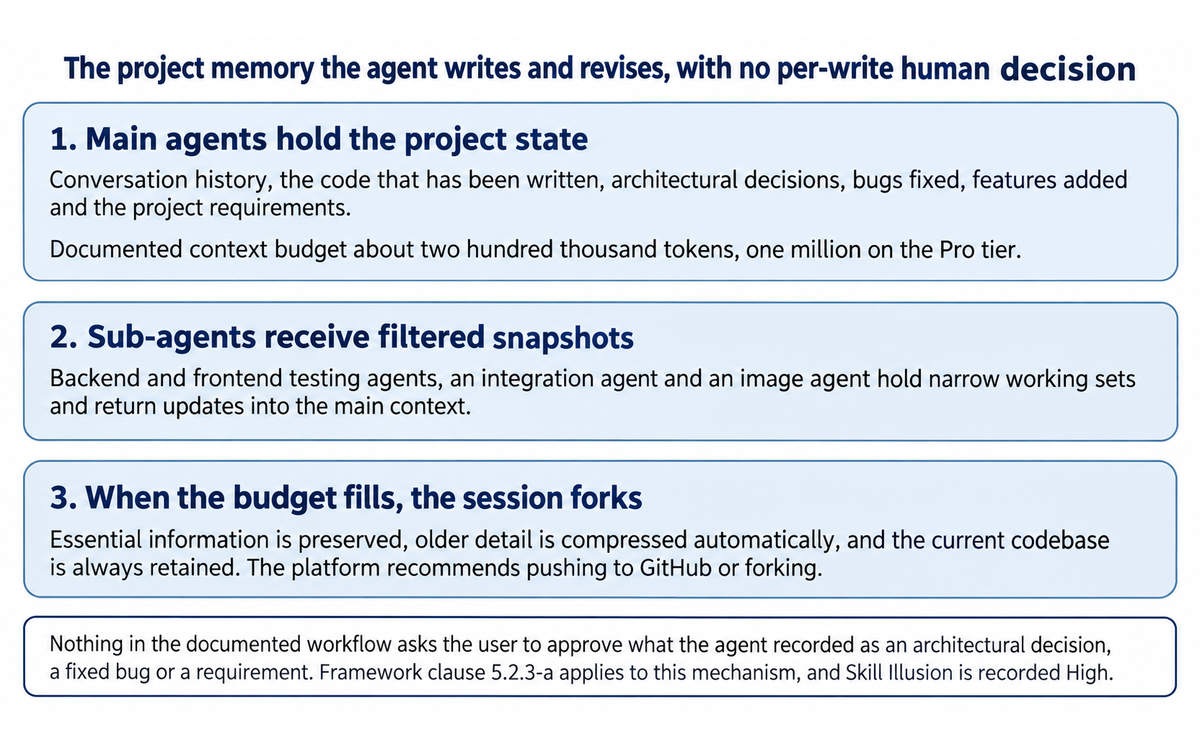
Memory and project context: a documented three-part architecture. Main agents carry the conversation history, the code that has been written, architectural decisions, bugs fixed and the project requirements, under a context budget the documentation states is about two hundred thousand tokens. Sub-agents receive filtered snapshots of the main agent's memory and return updates that become part of the main context. When context fills, the platform forks the session and compresses older detail while keeping the current codebase. This is the surface that makes framework clause 5.2.3-a apply.
Pricing at a glance, as published:
Plan | Published price | Published credits | Notable inclusions |
Free | Zero | 10 free monthly credits | Core platform features, web and mobile building, model access |
Standard | Twenty dollars a month, seventeen on annual billing | 100 credits a month | Private project hosting, GitHub integration, fork tasks, extra credits purchasable |
Pro | Two hundred dollars a month, one hundred and sixty-seven on annual billing | 750 monthly credits | One-million-token context window, ultra thinking, system prompt editing, custom agents, high-performance computing, priority support |
Business | Custom, by demo | Not published | Role-based access control, single sign-on, shared team workspaces, real-time co-editing |
Enterprise | Custom, by demo | Not published | User-level credit limits, audit logs, self-hosted database support, priority service level agreement, user groups, deployment into your own cloud, credit usage reporting |
Status: Active. Commercially current, actively released, and recommended with the conditions set out in Sections 7 and 11.
The Problem
For most of the last three decades there has been a queue. You have an idea for a piece of software, and the idea is not large enough to justify a development team and not small enough to build in a spreadsheet. So it sits in a list. The queue is long because the supply of people who can turn a description into a working, deployed, authenticated, data-backed application is much smaller than the supply of people who can describe one.
Three partial answers have been tried, and each one leaves the same gap.
Hiring or contracting. This works, and it costs what it costs. A bespoke internal tool is quoted against weeks of work, and the result is a codebase you own and a maintenance obligation you inherit. The published case history on the vendor's own launch material describes a car dealer that centralised sales, workshop service and fleet management in one portal for a fraction of the six-figure quote it had been given by traditional software suppliers. The number is the vendor's own and unverified, and the shape of the problem is real regardless: the queue exists because the quote is larger than the idea.
Drag-and-drop site and app builders. These remove the developer, and they replace the developer with a ceiling. You get what the builder's component library permits, the integrations it has pre-built, and the data model its backend can express. When your requirement is outside the library you have no path forward except to rebuild somewhere else. The vendor's own comparison table makes this argument directly, and it is a fair characterisation of the class.
Earlier prompt-to-app generators. These produce a front end and a file tree. They usually stop at the point where the interesting work begins: no database, no authentication, no deployment, no testing, and a codebase that drifts as you ask for changes. The output looks like an application and behaves like a mockup.
The gap all three leave is the same, and it is not the code. It is the whole path from a description to something another human can open and use, including the parts nobody enjoys: the schema, the login, the payment flow, the deploy, and the test that tells you the change you just asked for did not break the flow you asked for last week.
There is a second, less discussed problem. The people with the ideas are usually the least able to judge the artefact. A product manager who can describe a customer portal precisely has no independent means of telling whether the generated code is safe to put in front of customers, whether the authentication is implemented properly, or whether the payment integration will double-charge on a retry. Prompt-to-app systems convert a description into something that looks finished, and the person holding it may not be able to tell finished from plausible. Any review of this class of tool has to hold that tension rather than resolve it, because the tool's value and its characteristic failure come from the same property.
The Outcome
Emergent is the most complete attempt so far at closing the whole path. The differentiator is not the code generation, which several competitors now do, and it is not the chat interface, which is now standard. It is that the platform owns the parts after the code: a database provisioned for the project, authentication configured, payments wired, hosting on the platform's own infrastructure, a deployment address, and a set of agents whose job is to test what was built and to look for security and scalability problems. The enterprise page states the position plainly: the platform includes authentication, database, payments, hosting and mobile out of the box, and there is no infrastructure to configure and no services to wire.
What that produces in practice, on the evidence available:
A working application rather than a prototype. A reviewer on Product Hunt described building a business assessment tool that needed a database, PDF report generation and an authenticated admin area, and reported that it went live after the automated testing step. The same reviewer noted, honestly, that he had not realised there was a monthly cost to keep the app live.
A description-to-app loop measured in minutes to hours, not weeks. The onboarding is the least frictional step in the whole category: no card for the free tier, one prompt box, and a planning pass before generation. An editorial test of the product describes a simple app moving from description to generation to deployment inside minutes.
Code that leaves with you. The whole project syncs to a GitHub repository you control, with automatic commit messages, branches, pull requests and a recovery path. The terms state that the vendor makes no claim to ownership of applications you develop. This is the single most important property of the product for institutional adoption, and Section 7c examines the contract text behind it.
Native mobile from the same workflow. Expo and React Native output with export-ready builds for Android and iOS, with no Mac and no Xcode. Few competitors in this class offer mobile at all, and several that claim it produce a wrapped web view rather than a native build.
Hosting and post-deployment revenue for the vendor. The company has said that a large part of its recurring revenue comes from the subscription users pay to keep an app deployed, followed by returning for enhancements. That is the commercial mechanism that makes the managed-hosting promise durable rather than a launch offer, and it is also the mechanism that makes the credit and subscription economics the central question for a buyer.
What it does not yet produce, stated as plainly as the rest:
No independent measurement of how far an unaided build gets. There is no benchmark, no completion study and no third-party engineering assessment of a generated application at the standard used by a professional team. What exists is a set of editorial hands-on assessments of varying depth, and vendor demonstrations on prepared scenarios.
A public user record that is genuinely split. The aggregate public rating sits low while the small-sample ratings sit high. Section 9 reports both without resolving them, because the split itself is the finding: the same product produces delight when a build runs cleanly and anger when a build stalls in a credit-consuming debugging loop.
A pricing model whose cost you cannot predict before you start. Credits are consumed by the agent's own retries. You can set a per-project credit budget, which is a real control, and you cannot know in advance how many retries your requirement will take.
Design as a byproduct. Multiple independent assessments of the product place its visual quality below the category leader for interface polish. The vendor has added a design agent, and the published assessments that predate it are unanimous that this was a real weakness.
A ceiling at the context limit. Once a project outgrows the context budget, the platform forks the session and compresses older detail. That is a documented and reasonable mechanism, and it means the largest projects are managed by summarising their own history, which is the point at which a real engineering team would take the codebase over.
Who Should Use Emergent
A U365 Fellow or staff member turning an internal requirement into an internal tool. This is the clearest fit in the whole product. If you can describe the fields, the users and the approval steps of a tracker, a booking flow or a dashboard, you can have a working internal tool on a real database in an afternoon, with a login and a shareable address. The honest boundary is that you should build internal tools this way rather than customer-facing ones until you have somebody who can read the generated code.
A programme lead prototyping before committing resources. The strongest documented pattern in the product is the prototype that replaces a requirements document. Build the thing you were going to write a specification for, put it in front of five users, and learn something in a week. The platform is unusually good at this because the prototype is functional rather than clickable, so the feedback is about the workflow rather than about the mockup.
A founder or small team validating a product idea. The vendor markets directly to this reader, and the fit is real: the whole stack plus hosting plus a deployment address is the exact set of things a pre-seed team cannot afford to build by hand. The caution is the price ladder. Twenty dollars a month will carry a first prototype, two hundred is the next step, and there is nothing in between, so a project that outgrows Standard jumps by a factor of ten.
A non-technical builder with an idea and no engineer. The product is designed for exactly this reader and serves them well up to the point where judgement is required. Read Section 7 before you decide that the point is far away.
An agency or consultant delivering client applications. The vendor markets to IT agencies on the same argument, and the multi-project workflow with GitHub branches per feature holds up. The professional caution is scope: an agency that hands a client an application it cannot maintain has moved the problem rather than solved it. Build in the export path from day one, and keep the repository as the deliverable rather than the platform's preview.
A software engineer who wants to skip the scaffolding. The fastest honest use of the product for a developer is to generate the boring 80 per cent and take the repository. The generated stack is conventional React, Node or FastAPI, and MongoDB, so it is readable on arrival rather than exotic.
Poor fit: a regulated, safety-critical or compliance-bound application. An editorial assessment of the product flags it as risky for regulated finance, compliance and healthcare workflows, and the terms carry a liability position that a regulated adopter must read before signing anything. Section 7c sets out the relevant clauses. A U365 use case that touches learner records in a way that engages data protection law, or that makes an automated decision about a person, is not a use case for a prompt-driven generator without a named engineer on the other side of the review.
Poor fit: pixel-perfect brand work. If the interface is the product, this is the wrong tool in this class. The published assessments agree that visual polish trails the leader, and the vendor's own answer to that is a design agent rather than a claim of parity.
Poor fit: a team that wants to work locally. The platform is cloud-only. There is no local development environment and no desktop application. A team whose workflow is a local repository and a container will find the platform's preview loop in the way rather than helpful.
U365 Institutes Alignment
The table below states, for each University 365 institute, the competency a Fellow would actually connect to this platform, and the limit that holds the row where it is. The rating is about fit for a course or a lab, not about product quality, and no row asserts a competency the tool performs for the Fellow.
Institute | Alignment | What a Fellow would actually connect | The limit that holds the row where it is |
UIT (Technology, AI, Data Science) | High (primary) | Reading and reviewing generated full-stack code. The export is conventional React or Next.js, Node.js or FastAPI and MongoDB, so a Fellow can pull the repository, diff it, run a code review against a written specification, and run the security review the adoption condition requires. The cohort lab is a small internal tool built from a schema description, then reviewed against the repository rather than the preview. | The platform supplies the code, so it builds no programming and no security competency of its own, and the review records that it hands a confident artefact to a person who cannot evaluate it. The competency in play is the reviewer's, and it exists only where somebody who can read the code is in the loop. |
UIB (Business Management, Entrepreneurship) | High | Two competencies the tool cannot take over. Writing a requirement as a specification a generator can implement, then confirming the implementation against it. Setting a per-project cost budget and reading cost per iteration in currency rather than in credits. The cohort lab is a venture validation in which the prototype is the tested artefact and the cost per iteration is reported beside it. | The tool teaches no management, finance or entrepreneurship content, and it validates nothing. The judgement in play is the Fellow's, and the cost half rests on the Fellow's own costing because no vendor page publishes a credit unit price. |
UIC (Digital Communication, Marketing) | Medium | Judging a generated campaign page and measuring it: deciding what the page must carry, whether a real form captures the right thing, and how completion compares against a hand-built page. The cohort lab is a campaign microsite shipped with a real form and a real data capture, measured rather than admired. | The platform composes the page and sets its visual register, so no composition and no writing-craft competency is built and none is claimed. The assessed part is the decision and the measurement, and the review's own Section 7 records visual craft as the weakest part of the output. |
UID (Digital Design, UX/UI) | Medium, coursework observation only | Making a flow testable quickly: generating two competing flows for one task and putting both in front of users, so that usability feedback lands on a working artefact rather than on a static mockup. |
No institute is rated as having no relevance for this tool. That is unusual in this series and it is a finding rather than a courtesy. The platform produces a working interface, a database, a login and a deployed address, so an IT cohort can review it, a business cohort can test a venture idea with it, a communication cohort can ship a page with it, and a design cohort can put a flow in front of users with it. The statement is made explicitly here because the opposite one is the more common finding in this series: on Jason AI, UID carried no relevance at all, and that absence was recorded.
The limit that holds across all four rows is the same one, and it is the review's own decisive finding. In every row, the tool produces the artefact and the Fellow keeps the judgement. Where the judgement is not exercised, the row describes a build rather than a competency, and The rating is not given for work the tool does on the Fellow's behalf. That is why three rows carry a limit and one row carries no credential chain at all.
UNOP carries no alignment for this tool. Part 1, ruling P8, states why.
Where U365 method names are used anywhere in the published page, they are named exactly as the institution names them and no expansion is invented for any of them. CARE is named as CARE, CI-First as CI-First, UP-Context as UP-Context and SL-OS as SL-OS.
Where a U365 method name is used anywhere in this review, it is named exactly as the institution names it and no expansion is invented for any of them. CARE is named as CARE, CI-First as CI-First, UP-Context as UP-Context and SL-OS as SL-OS.
How Emergent Works
The architecture, in the vendor's own terms
Emergent describes itself as the world's first truly agentic vibe coding platform, and the claim that matters is the architecture underneath: a multi-agent system in which agents specialise rather than a single model answering a single prompt. The launch material describes the intent as emulating how a real, high-quality engineering team ships. The product has since added named agents for security review, scalability and design.
Published documentation describes the structure in three parts.
Main agents. Three main agents are documented, and the naming is a source of mild confusion because the page that describes them is headed with a different set of names in the body. The substantive content is that the default agent is built for stable full-stack development with thorough testing, a second agent is tuned for long-running focused sessions, and a third is built for difficult architectural problems and hard bugs. A fourth main agent covers mobile development through Expo and React Native, and a fifth configuration, called Pro Mode, is the custom agent builder. The context budget for the main agents is documented at about two hundred thousand tokens, with a one-million-token window on the Pro tier.
Sub-agents. Sub-agents receive a filtered snapshot of the main agent's memory so they can work with a narrow focus. The documented set includes a backend testing agent and a frontend testing agent, which receive structured summaries and hold only testing criteria and conditions; an integration agent, which holds third-party service details, configuration, authentication flows and integration patterns; and an image sub-agent, which tracks image requirements, generation parameters, style preferences, sizing rules and usage patterns. Updates flow back from the sub-agent into the main context, which the documentation describes as full synchronisation so the project remains aligned.
The context system. This is the part of the architecture that matters most for how the tool behaves, and the part that matters most for this review's clause assessment. Context in Emergent is documented as the conversation memory and the project knowledge the agent maintains: the conversation history, the code that has been written, the architectural decisions made, the bugs fixed, the features added and the project requirements. The full conversation history is retained until space runs low; when memory is compressed, only the essential information is preserved, and the current codebase is always retained. When a session approaches the limit, the platform shows a warning, and the recommended actions are to push the project to GitHub or to fork the session. Forking preserves essential information and compresses older detail.
Two properties of that design deserve to be read carefully by anyone considering the tool for institutional work. The memory is agent-authored and durable: the agent decides what constitutes an architectural decision, a fixed bug or a requirement, writes it into the session's persistent context, and reuses it in later turns of work. And the memory is project-scoped rather than document-scoped: an incorrect summarised decision, carried forward through a compression event, will be treated as fact by every later agent working on that project. The documentation's own remedies, push to GitHub and fork, are both about reducing what depends on the platform's memory rather than about correcting it.
The model layer
The platform is model-agnostic and exposes a selector next to the prompt box. Published independent assessments of the product name Claude Sonnet as the default across the free and Standard tiers, with Claude extended and an OpenAI model on the Pro tier, and a later assessment names Claude Opus, an OpenAI model and a Google model. The vendor's own sub-processor list names Anthropic for app generation and assistants, Google through Gemini and Vertex, and identifies further model providers in its privacy notice as Anthropic, OpenAI, Google and others listed in its register. The Pro tier adds a one-million-token context window, a mode the vendor calls ultra thinking, and editing of the system prompt. The documented position is that you do not need your own API keys and do not manage rate limits, and the platform also offers one-click integration of a language model into the app you are building.
What the agent actually produces, and where it stops
Working from the vendor's documentation and from independent hands-on assessments of the product, the sequence is the following.
You describe the application, in text, by voice, with an image reference, with a product requirements document attached as a file, or by pointing at an existing repository. The agent asks clarifying questions where the description leaves a gap.
The agent plans the application. Architecture, data model, screens and flows are decided and surfaced before generation.
The agent generates the front end, and then the back end, database schema, authentication, roles and permissions, and any workflow automation you described with triggers, conditions and actions.
Testing agents run against the built application, which is the step most of this category skips and the step the vendor treats as the product's core claim.
You preview the result in the platform, and iterate through the chat.
You deploy, to a private project address on the platform or to a connected custom domain, and the platform manages hosting, performance and infrastructure.
You can push the whole project to GitHub, with automatic commit messages, branches, pull requests, and a recovery path that lets you pull a saved version back into a new session.
Where it stops is best stated as the four places hands-on assessments and the public user record converge:
The design ceiling. The generated interface is functional and not distinctive. The vendor's answer is the design agent; the published assessments that predate it are unanimous that design polish trails the leader in this class.
The regression surface. One change can break another. A hands-on assessment states it directly: complex apps hit context limits, and fixing one bug can break another. This is the characteristic failure of the whole class, and it is the mechanism behind the public complaint about credit burn, because the retries that follow a regression are charged to you.
The context ceiling. Once a project outgrows the context budget, the session forks and older detail is compressed. The platform's own documentation points you at GitHub at that moment, which is the honest signal that the platform is telling you when to leave.
The judgement boundary. Nothing in the product tells you whether the authentication implementation is correct or whether the payment retry logic is safe. The platform's security review agent is a real feature and it is not a substitute for a person who can read the code. That boundary is where this review's Skill Illusion reasoning sits, and Section 7 states it without softening.
The credit system, as documented
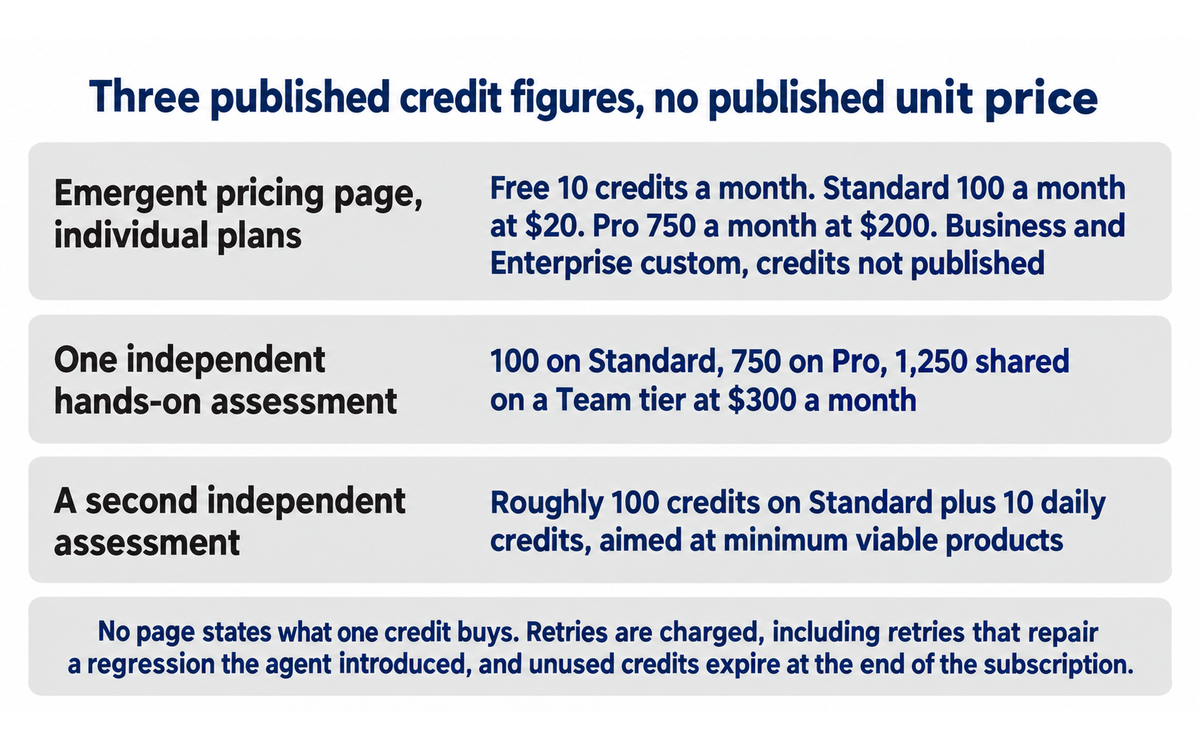
Credits are the unit of consumption. Published figures across the vendor's own surfaces and across independent assessments of the product are consistent on the free tier, at ten monthly credits, and on the monthly prices. They diverge on the credit counts. The pricing page states one hundred credits a month on Standard and seven hundred and fifty on Pro. An independent hands-on assessment states one hundred on Standard, seven hundred and fifty on Pro, and one thousand two hundred and fifty shared on a Team tier at three hundred dollars. A second assessment describes a Standard tier with around one hundred credits aimed at minimum viable products plus ten daily credits. And the support article set describes additional credits being purchasable as needed, which is the part of the model that matters most, because it means the published monthly allowance is not a ceiling.
Three documented facts about the credit model change how a reader should plan:
Deployment and hosting are denominated in credits or subscriptions. A published hands-on assessment of the product describes deployment consuming fifty credits a month, which it prices at about ten dollars, and frames that as the cost of hosting the app plus managing API keys. A Product Hunt review of the product reports the same surprise from the other direction: the reviewer did not realise there was a monthly cost to keep an app live. Two independent accounts of the same undocumented step is the finding.
Unused credits expire. The terms state that any unused credits expire at the end of the subscription and that no partial refunds are provided for unused portions of a billing period.
Retries are charged. Nothing in the terms exempts a failed generation, a bug the agent introduced, or a debugging loop from consuming credits. This is the single most consistent complaint in the public record, and Section 9 quotes it rather than paraphrasing it.
Getting Started with Emergent
A first session that produces something real, in about an hour.
Before you start. Write down three things in a text file: the one workflow the tool must support end to end, the fields each record needs, and the two users who will touch it. The quality of a generated application tracks the clarity of the description more closely than it tracks anything else about the tool, and this is the step that most first-time builders skip.
Step 1. Create the account and read the plan terms before you build (5 minutes). Sign in with a Google account, an email address, a phone number or single sign-on. The free tier needs no card. While you are here, note two things on the pricing page that are easy to miss: credits are monthly and expire, and extra credits can be purchased, so your practical ceiling is your own budget rather than the plan allowance.
Step 2. Write the prompt as a specification, not as an idea (10 minutes). Paste the workflow, the fields and the users from your notes. State the technology where you care about it. State what the application must not do, because that is the instruction the testing agents use. If you have a screenshot of a system you like, attach it. If you have written a requirements document, attach that instead. A voice description works too and is faster than typing.
Step 3. Set the credit budget before you generate (2 minutes). Open the advanced controls next to the prompt box and set a per-project credit budget. Independent assessments of the product identify this as the single most useful control in the interface, and it is the only mechanism that makes your spend predictable in advance.
Step 4. Choose the agent and the model deliberately (2 minutes). The default agent is the right choice for a standard full-stack build. The long-running variant is for a session you expect to last. The mobile agent is required for a mobile target and is not available on the free tier. On the model selector, the default is a strong coding model; the extended-context option on the higher tier is worth switching to only when your project is large.
Step 5. Let the first build run without intervening (10 to 30 minutes). The most common way to waste credits is to interrupt a build to add requirements. Read the plan the agent produces, and hold your additions until the first pass finishes and you can preview it.
Step 6. Preview, then test the one flow you wrote down (10 minutes). Open the preview and walk the exact workflow from your notes. Try the login. Try the failure case. The agent's own testing agents have already run their checks, which is a real benefit and not the same thing as your check.
Step 7. Connect GitHub before you ask for a second feature (5 minutes). Connect the account from the profile menu, create or choose a repository, and push. Do this before the second round of changes rather than after it, because the recovery path for a broken regression is the last good commit and not the platform's history.
Step 8. Make one change and watch what it costs (5 minutes). Ask for a small change, note the credit consumption, and compare it against your budget. This single measurement tells you more about whether the tool is viable for your requirement than any published pricing figure.
Step 9. Deploy, and read what deployment costs (5 minutes). Publish to the platform's address or connect your own domain. Note the recurring cost. Two independent assessments of the product report that this step carries a recurring charge a first-time buyer does not expect, so it belongs in your budget before it appears on a bill.
Step 10. Get the code out once, on day one (10 minutes). Pull the repository to your own machine, install it, and see whether it runs. If it does, you have a genuine exit path and the platform is a convenience rather than a dependency. If it does not, you have learned that before you built anything that matters.
A first-session verification checklist.
VERIFICATION CHECKLIST for "First build on Emergent":
[ ] Scope test: can you state the one workflow the app must support end to end? [Y/N]
[ ] Credit test: did you set a per-project credit budget before generating? [Y/N]
[ ] Preview test: did you walk the full workflow in the preview, not just the landing screen? [Y/N]
[ ] Auth test: did you create a user, log out, and log back in? [Y/N]
[ ] Data test: did you create, edit and delete a record, and did the change persist? [Y/N]
[ ] Recovery test: is the project pushed to a GitHub repository you control? [Y/N]
[ ] Exit test: does the repository run outside the platform? [Y/N]
[ ] Cost test: do you know your cost per iteration, and your monthly hosting cost, in currency rather than credits? [Y/N]
Real Workflows
Three workflows, each one a job U365 actually has. Each carries the prompt pattern to use and a verification checklist to run before you trust the result.
Workflow 1: A U365 internal tracker, built and deployed in one afternoon
The job. A programme office needs to track something it currently tracks in a spreadsheet: applications, placements, partner contacts, equipment, whatever the current pain is. The spreadsheet has two users, an approval step and a weekly report nobody enjoys producing.
The prompt pattern. Write it as a specification. This is the shape that works:
Build an internal tool for [process name].
Users: [role A] creates a record. [role B] approves or rejects it.
Record fields: [list each field and its type].
Workflow: a new record is created with status Pending. [role B] sees a queue
of Pending records and can approve or reject with a note. Approved records
are read-only.
Views: a list view with filters by status and by date, and one summary count
by status on the landing screen.
Authentication: email and password, role-based. No public signup. Invite
[role B] manually.
Must not: allow a record to be edited after approval; expose the list to
unauthenticated visitors.
The UP-Context step. Put the institutional context in the same prompt. State that the tool is for a U365 internal process, name the department that owns it, and describe the review step the department uses. The agent will not know what an approval step means in your institution unless you say so, and the difference between a tracker that matches your process and one that matches a generic process is entirely in this paragraph.
What the agent will produce unaided. A working application on a real database with a real login, a list view, a form and a status field. Published hands-on assessments of the product agree that this class of build is the product's strongest case, and it is the case the vendor's own marketing leads with.
Where you take over. The permission model. Nothing in the generated output tells you whether role B can be reached by a crafted request. Read the access rules in the exported code before you put two different roles in front of it, and if you cannot read them, ask somebody who can.
VERIFICATION CHECKLIST for "Internal tracker on Emergent":
[ ] Field test: does every field in your specification exist, with the right type? [Y/N]
[ ] Workflow test: did you create, approve and reject a record, and did the status change correctly? [Y/N]
[ ] Lock test: did you try to edit an approved record, and was it refused? [Y/N]
[ ] Role test: did you log in as each role and confirm what each can and cannot see? [Y/N]
[ ] Invite test: can a stranger create an account without an invitation? [Y/N]
[ ] Report test: does the summary count match the list view exactly? [Y/N]
[ ] Repository test: is the current version pushed to GitHub with a readable commit message? [Y/N]
[ ] Handover test: could a colleague with no platform access understand this application from the repository alone? [Y/N]
Workflow 2: A functional prototype for programme validation
The job. You want to test a programme design before you commit a term to it. The deliverable is not a document, it is something five people can use for a week so that the feedback is about the workflow rather than about the slides.
The prompt pattern.
Build a prototype of [programme name] for a one-week trial with five users.
The core loop: a participant [does the main action]; the system [responds];
the participant sees [result]. Include a simple progress view so a
participant can see how far they are.
Do not build: reports, exports, administration screens, notifications.
Data: keep it simple, five users, no real personal data.
Label the tool clearly as a prototype on every screen.
The UP-Context step. Ask for the labelling explicitly. A prototype that looks like a finished product invites a different conversation than one that announces itself as a draft, and the difference matters when the people testing it are Fellows who may otherwise treat a rough workflow as a delivered service. Add one instruction that the tool must not collect personal data during the trial, which also removes an entire data protection question from a seven-day experiment.
Where you take over. Reading the results, which is the whole point. The tool builds the instrument and the instrument does not interpret anything.
VERIFICATION CHECKLIST for "Programme prototype on Emergent":
[ ] Loop test: can one participant complete the full core loop unaided? [Y/N]
[ ] Label test: does every screen say this is a prototype? [Y/N]
[ ] Data test: is real personal data excluded, and can you show that? [Y/N]
[ ] Device test: did you try it on a phone, not only on your laptop? [Y/N]
[ ] Cost test: did the build stay inside the credit budget you set? [Y/N]
[ ] Feedback test: do you have a written record of what each tester said, separate from what the tool did? [Y/N]
Workflow 3: A U365 learner-facing microsite, with the engineering review left in the loop
The job. A landing page and a short application form for a specific thing: a cohort, an event, an intake. It captures data, and something has to happen to that data.
The prompt pattern.
Build a single-page site for [thing] with one form that collects
[name, email, country, and one free-text answer].
On submit: store the record, send a confirmation email to the applicant,
and send a notification to [internal address].
Accessibility: keyboard navigable, labelled form fields, readable contrast.
Performance: this must load quickly on a phone on a slow connection.
Must not: collect anything not listed above; store data anywhere other than
the provisioned database.
The UP-Context step. Name the audience precisely, the language you want the copy written in, and the tone, and state which institutional name appears on the page. A generated microsite for a U365 audience that has been given no institutional context will invent a voice, and the voice is the part that will need the most rewriting.
Where you take over. Two places, and neither is optional. First, the form submission path: test it with a real submission and confirm the record arrives, the email sends and the notification reaches a human. Second, the data position: a page that collects personal data from learners is a data protection decision, not a build decision, and the platform's default hosting setting makes the application reachable by anyone unless you restrict it, which the vendor's own privacy notice states. Decide the access question before you publish, not after.
VERIFICATION CHECKLIST for "Learner-facing microsite on Emergent":
[ ] Submit test: did a real submission reach the database? [Y/N]
[ ] Email test: did the applicant's confirmation arrive, and did it avoid the spam folder? [Y/N]
[ ] Notify test: did the internal notification reach a named human? [Y/N]
[ ] Access test: is the application restricted as you decided, or intentionally public? [Y/N]
[ ] Data test: does the form collect only what you listed, and is there a stated retention position? [Y/N]
[ ] Accessibility test: did you complete the form using only the keyboard? [Y/N]
[ ] Copy test: has a human read the page for voice, accuracy and institutional naming? [Y/N]
[ ] Engineering test: has somebody who can read the code approved the submission handling? [Y/N]
Strengths, Limits, and AI Imposture Risk
Strengths
1. The path from description to a deployed application is complete. This is the product's defining strength and it is not shared by most of the field. Front end, back end, database, authentication, payments, hosting and a deployment address are provisioned from one conversation. Independent hands-on assessments of the product converge on this point, and it is why an editorial test describes the product as one of the more capable tools in the class.
2. The agent tests what it built. A backend testing agent and a frontend testing agent run against the output as part of the build. In a category where output that looks finished is the norm, an automated check before delivery is a genuine quality floor, and the vendor has extended it with agents for security review, scalability and design.
3. The code leaves with you, and the contract says so in writing. The whole project syncs to a GitHub repository you control, with commits, branches and pull requests, and both the terms and the enterprise FAQ state the ownership position in plain language. For an institution, this is the property that makes the tool adoptable at all, because a U365 internal tool whose code cannot leave is not a tool, it is a dependency.
4. Native mobile from the same workflow. Expo and React Native output, with export-ready builds for both stores and no Mac or Xcode required. Few competitors in this class offer mobile at all, and the ones that do frequently produce a wrapped web view.
5. A per-project credit budget you can set before you start. This is the single most useful control in the interface for a careful user, and independent assessments identify it as such. It is the only mechanism that makes the spend predictable in advance, and it converts an open-ended risk into a bounded one.
6. The platform tells you when to leave. The context documentation is unusually honest: when a project outgrows the session, the platform points you at GitHub or at forking the session. A vendor that documents the exit path is a vendor whose lock-in claim survives contact with the documentation.
Limits
1. Your cost is variable and unpredictable in advance. Everything the agent does is charged, including the retries that follow a regression the agent introduced. The monthly credit allowance expires, extra credits are purchasable, and no page states what one credit buys. The credit budget control bounds the damage rather than eliminating the uncertainty.
2. No independent measurement of generated-app quality exists. There is no benchmark, no completion study and no third-party engineering assessment of how far an unaided build gets before a human must take over. This is not a claim that the output is weak. It is a statement that nobody outside the vendor has measured it, and a reader deciding on the basis of the vendor's own testing agents is deciding on the basis of the party with an interest in the answer.
3. The public user record is genuinely split, and the low half is about money. Section 9 sets out the numbers. The pattern is consistent across independent assessments: when a build runs cleanly, users are delighted; when it stalls, the credits are gone and the refund position in the terms is that payments are non-refundable. Any adoption decision has to price that risk rather than average it away.
4. Regressions, and the context ceiling. Complex applications reach the context limit, and fixing one problem can create another. Both are documented by the vendor and reported by independent hands-on assessments. The platform's response, summarising and forking, is reasonable and it means the largest projects are managed by compressing their own history.
5. Design is a byproduct. Independent assessments place the visual quality below the leader in this class. The vendor has responded with a design agent, and the assessments that predate it are consistent enough to be treated as a real limitation for any use where the interface is the product.
6. The price ladder has a cliff. Twenty dollars a month, then two hundred, with nothing published between them. A project that outgrows the Standard allowance either buys extra credits at an unstated unit price, or jumps a factor of ten.
7. Cloud only. No local development environment, no desktop application. A team whose workflow is a local repository will find the preview loop is where they work, not where they check their work.
8. A default exposure setting worth understanding before you publish. The vendor's privacy notice states that an application you deploy is reachable by anyone on the internet under the vendor's domain unless you restrict access yourself. That is a default, it is disclosed, and it puts the access decision entirely on you.
AI Imposture Risk
Overall: Medium, with Skill Illusion High.
Trap | Rating | Cited evidence |
Time Illusion | Medium | The first build is genuinely fast and multiple independent hands-on assessments agree on this, which is the part that is not an illusion. The illusion is in the tail: the loop of describe, generate, preview and correct is billed in credits, and the credit meter hides elapsed human time. Two independent assessments describe builds that stalled in a debugging cycle, which is time spent on the tool's own mistakes. The net time saving on the common case is real and smaller than the first session suggests. |
Quantity Illusion | Medium | The system produces a great deal that looks finished: a full interface, a schema, a login, a payment flow, a deployed address. Volume is genuinely high and the inspection cost scales with it, because each artefact has to be judged separately. The evidence for this trap is the split public record itself, in which delighted reviews and reviews reporting lost work describe the same product at the same release. The quantity is real; the assumption that a higher quantity of finished-looking surfaces means more finished software is the illusion. |
Skill Illusion | High | This is the product's defining risk and it does not rest on a single review. The tool's whole proposition is that a person who cannot write software can produce software, and the artefact that person receives is indistinguishable at a glance from one a competent team produced. Nothing in the product tells the user whether the authentication is implemented correctly or whether a payment retry can double-charge. Three independent grounds support the High rating. First, the vendor's own marketing addresses exactly this reader and promises production-ready output, which sets the expectation that judgement is no longer required. Second, the platform's testing and security agents provide a positive signal that a non-expert will reasonably read as a verdict, and which is not a substitute for a person who can read the code. Third, the persistent project memory described in Section 4 carries the agent's own conclusions about architecture and requirements forward as accepted fact, in a form the user is not shown and does not review, so the illusion is reinforced on every later turn rather than only at delivery. Framework clause 5.2.3-a applies to this tool for that reason, and the clause sets the Skill Illusion floor at no lower than Medium, at High where the memory is revised during use without a per-write human decision, which is what the documented architecture does. |
Who this risk lands on. The Skill Illusion here is not uniform. An engineer using the product to skip scaffolding is at low risk, because they can read what arrives. A U365 staff member building an internal tool used by colleagues is at moderate risk, because the blast radius is internal and the failure is visible. A person building something learner-facing, customer-facing or payment-handling without an engineer in the loop is at high risk, and the product does not tell them so. That reader is the reason this section exists.
Superhuman Usage Guidance
When to invite. When the requirement is describable, the users are known, and the cost of a wrong first version is low. Internal tools, prototypes, validation instruments, data collection pages that a human reviews before publication, and the boring 80 per cent of a developer's scaffolding. Invite it when you have a person available who can read the exported code before anything reaches a user.
When to keep out. Payment-handling applications without an engineer in the loop. Anything making or supporting an automated decision about a person. Anything in a regulated or safety-critical workflow, which an independent assessment of the product flags as a risky use directly. Anything where the interface is the product. And any build where nobody will read the generated code, because that is the condition under which the Skill Illusion stops being a risk and becomes the operating model.
U365 method integration. The natural pairing is CARE applied to the loop the platform runs: what the agent produces is collected, then planned, then reviewed, and only then executed into anything a learner or a client sees. CI-First enters at the definition of the human role: this tool is a Co-Worker and Assistant, not a Co-Creator, because you state the requirement and review the output rather than think alongside it. UP-Context enters at the prompt, because the difference between a generated tool that fits a U365 process and one that fits a generic process is the institutional context you write into the description. Where a U365 method acronym is used here it is named as the institution names it, without an invented expansion.
Over-delegation warning. The over-delegation pattern with this specific tool is distinctive and worth naming exactly. It is not that you stop writing code. It is that you stop being able to tell whether the code is correct, and you accept the platform's own positive signals, its passing tests, its security agent, its deployed preview, as evidence that it is. Once that happens, your Human Intelligence has dropped, and the CI-First benefit drops with it, even though the tool has not changed at all. The specific marker to watch for is a sentence you are about to say: this is finished. If you cannot state what would have to be true for that sentence to be false, and check it, you have delegated the judgement rather than the work. The Superhuman who delegates the work keeps the judgement. The Sub-human who delegates the judgement loses both.
Section 7c: Code ownership, model training and the contract behind the promise, stated plainly
The vendor makes a clear promise about your code, and it makes the promise in more than one place. This section quotes the operative text verbatim, sets the promise against the vendor's other two documents, and states what the combination means for an institution.
The promise, quoted from the vendor's own surfaces
The terms of service, section 7.2:
"To be explicitly clear, while Emergent owns all rights to the platform and brand elements described above, this ownership is entirely separate from and does not extend to: Code generated using our Services Applications built with our tools Custom configurations and implementations Modified or derivative works created from generated code Your own code commits and changes You retain all ownership rights to code created using our Services, subject to any third-party open source licenses that may apply to components used."
The terms of service, section 7.3:
"You may freely: Use generated code commercially Modify and adapt generated code Distribute generated code in any form Sell applications built using our platform Open source your implementations Emergent places no restrictions on your use of generated code and makes no claim to ownership of applications you develop."
The enterprise page, in answer to the question of how code ownership works:
"All code generated by Emergent syncs directly to your GitHub repository. You own it completely. Export it, deploy it elsewhere, or continue building on it with your engineering team."
Read on its own, that is a strong and unusually clear position, and it is the reason this product is adoptable for institutional work at all.
What you do grant over your content, quoted from the terms
The licence you grant is narrower than the ownership position and worth reading next to it. Terms section 3.5:
"You grant Emergent a non-exclusive, worldwide, royalty-free license to access, use, process, copy, distribute, perform, export, and display your Content, only as reasonably necessary: To provide and maintain the Services To address service or technical issues To comply with legal obligations As otherwise permitted by these Terms This license does not grant us the right to sell your Content or otherwise distribute it outside our Services."
That clause is reasonable and it is bounded by its own purpose test. The clause that follows it in a different document is where the reader should stop and read twice.
The finding: two of the vendor's own documents describe the same data differently
The privacy notice, section 4, states the position a reader will remember:
"No. We do not use your prompts, your code or anything else you put on the Platform to train general purpose AI models without your permission. They may use what you send only to produce the reply you asked for."
The same notice then narrows that statement to general purpose models and describes a second, permitted use:
"We do use your data to improve the Platform itself. We look at prompts and output on a limited and controlled basis to check the quality and safety of what our AI Agents produce, and we use anonymised, aggregated or hashed data, which no longer identifies anyone, for any lawful purpose including product development."
The data processing agreement, which governs Business and Enterprise customers, then sets out a third position. Clause 11.1:
"The Customer acknowledges and agrees that Emergent may collect, use and disclose Service Data for its own business purposes, such as but not limited to: ... to provide, improve, develop, optimise and maintain the Services; ... training or tuning proprietary machine-learning models used to deliver the Services"
Clause 11.2:
"For the avoidance of doubt, Service Data is not "Customer Personal Data" and the obligations set out in this DPA do not apply to Emergent's Processing of Service Data. Emergent may retain Service Data for as long as it has a legitimate business need, may disclose Service Data to its Affiliates and Sub-processors for the purposes set out in this Clause, and may create, commercialise, and publish..."
Clause 11.3:
"The Customer acknowledges that no royalty, fee, or other remuneration is due for Emergent's Processing of Service Data under this Section, and the Customer has no right to opt out of such Processing so long as it remains a customer of the Services."
Read the three documents together and the position resolves into something a buyer can act on. Your code is yours; the promise in the enterprise FAQ and the terms is real and specific. Your raw prompt data is not used to train general purpose models without your permission. And separately from both, the derived data about how the Services are used, which the agreement defines as not being your personal data, may be used for the vendor's own business purposes including training or tuning proprietary models used to deliver the Services, may be commercialised, and carries no opt out for as long as you remain a customer.
This is a contract-terms finding rather than a scandal, and it should be read as one. The distinction between raw customer data and derived service data is standard in the industry, the promise about code ownership is genuine, and there is no suggestion here of anything the vendor has hidden. What the section establishes is narrower and more useful: a reader who takes the enterprise FAQ and the privacy notice as the whole position, and never opens the data processing agreement, has an incomplete picture of what the institution agreed to, and the missing part is opt-out-free and commercially usable.
The contrast within the vendor's own privacy notice is the sharpest single point. Clause 12.1 of the data processing agreement states the customer-data position in the strongest terms available:
"Emergent shall not use Customer Personal Data for the purpose of training, retraining, fine-tuning or otherwise developing any artificial intelligence or machine learning model and shall by written contract prohibit each Sub-processor which provides artificial intelligence models from doing so."
That is a better protection than many vendors in this category offer, and it sits in the same agreement as clause 11.1, which permits training or tuning of models used to deliver the Services from data the same agreement has carved out of the definition of customer personal data. Both clauses are true. They answer different questions, and a reader has to hold both.
Three further findings from the contract and the data-flow documents
Finding one: a deployment default that puts the access decision on you. The privacy notice states it plainly:
"Please also note that an application you deploy is reachable by anyone on the internet under our domain unless you restrict access yourself."
An application you built for internal use is public when it is published, unless you change the setting. The notice discloses this, so this is not a hidden default. It is recorded here because the same notice tells you that the third-party services the agent connects to your application at your request, such as payments or email, become your processors rather than the vendor's, which means the compliance obligation travels with the application and not with the platform.
Finding two: the vendor's sub-processor list is broad, and includes agent tools. The published list names cloud infrastructure, payments and analytics providers, and it also names the model suppliers: Anthropic for app generation and assistants, Google through Gemini and Vertex, and further model providers in the privacy notice's own register, described as "Anthropic, OpenAI, Google, and others listed in our register". Three entries are worth a reader's attention because they are agent capabilities rather than plumbing: a cloud browser automation provider, a web scraping provider, and an integration broker that holds OAuth tokens for connected accounts such as mail, messaging and calendar. Two of those are tools the agent uses on your behalf; the third holds the credentials for every account you connect. That is a coherent design for an autonomous builder and it is a wider data flow than a reader who assumed a code generator would infer from the marketing pages.
Finding three: three different retention and certification figures across the vendor's own surfaces. These are spreads rather than contradictions, and each figure is named with the surface it appears on.
Item | Figure | Surface |
Deletion of content after account closure | within 90 days | Terms of service, section 3.3 |
Deletion or irreversible anonymisation of personal data | within 45 days, with backups cleared within a further 90 days | Privacy notice |
Security certification | SOC 2 Type I and ISO 27001 | Enterprise page, answer to the certification question |
Security certification | ISO 27001 and SOC 2 Type II | Data processing agreement, Annex 2, which states that it constitutes Annex II to the Standard Contractual Clauses |
Security certification | a SOC 2 badge with no type stated, and an ISO 27001 badge | Marketing page footers |
The certification spread is the one an institutional buyer should resolve directly with the vendor, because a Type I report and a Type II report answer different questions: one is a point-in-time design assessment and the other covers the operating effectiveness of controls over a period. The vendor is certified under a recognised regime either way. The point is that the vendor's own documents do not agree with each other about which, and a procurement file should carry the answer from the vendor rather than from a web page.
No score changed, and why
No score in this review changed because of anything in this section. The CI-First Benefit Score measures benefit to the human net of overhead, and the Humics Protection Badge measures effect on three human capabilities. Neither is a supplier-conduct or contracting dimension, and this framework has no such dimension by design. Recording a discount here would silently convert a methodology that measures benefit into one that measures something else, and a reader who saw a score move next to a contract finding would reasonably conclude that the framework had priced contract terms, which it has not. The findings in this section belong in the adoption decision, in the negotiation, and in the procurement file. They do not belong in the arithmetic.
What this section does not do
It does not assert that the vendor has done anything wrong, and it does not suggest that any clause here is unusual for the industry. It does not resolve the certification spread, because resolving it requires the vendor's own report and not a web page. It does not advise against using the product, which would substitute a judgement for the reader's own. It quotes the vendor's documents against each other, names each figure with the surface it appears on, states the decision each finding puts in front of a reader, and stops there. The decision is a negotiation position and an engineering review obligation, and both are the reader's to make.
U365 Co-Intelligence Rating
CI-First Profile
Primary profile: Co-Worker and Assistant (level 2).
Secondary profile(s): Analyst and Tester (level 4), because the platform's testing, security, scalability and design agents surface problems you did not ask about, and the context system carries a written record of decisions you would otherwise have had to hold yourself.
Why level 2 and not level 1. Level 1 would mean the human and the tool build on each other's thinking, which is the pattern for an ideation partner. Emergent's design point runs the other way: you state the requirement, an agent team plans, generates, tests and deploys it, and you review the outcome. That is delegation with review, which the framework places at level 2. The same reasoning placed Klarent, Rabbit OS3 and the recent model reviews at level 2, and it is recorded here so the series reads consistently.
Why level 4 rather than a null. The framework's test for Analyst and Tester is that the tool's primary value includes finding what the user missed. Three parts of this product meet that test: the testing agents run checks the user did not write; the security review agent looks for classes of problem the user may not know to look for; and the context system makes the agent surface architectural decisions and prior fixes as part of the working state, which is analysis a non-technical builder could not perform alone. The 45-degree case is that all three are agent conclusions the user must judge rather than answers the user can take, which is exactly why this is a secondary profile and not a claim that the platform thinks for you.
What does not fit. Challenger and Devil's Advocate (level 5) does not apply. Nothing in the product argues against your requirement, your scope or your decision to build. The nearest thing it does is ask a clarifying question, which is scoping rather than challenge. Coach and Tutor (level 3) does not apply either: the platform makes the generated code visible, which a motivated learner can study, and teaching is not a designed behaviour of the product.
Collaboration Mode
Recommended mode: Centaur.
Alternative mode: None recommended. Cyborg is not available here.
Mode rationale. Two independent grounds, and both belong on the record. Framework Section 7.2 assigns Centaur whenever the Imposture Risk is Medium or High, which it is here, because the overall risk is Medium with Skill Illusion High. The second ground is specific to this tool. Cyborg mode requires a tight interaction loop in which the human applies a stopping criterion inside the iteration, and Emergent's loop is deliberately asynchronous: the agent plans, generates and tests across minutes, and the human's decision point is at the review of the result rather than inside the loop. The controls that make the Centaur boundary real are therefore procedural rather than interactive. Write the requirement as a specification before the first build. Set the per-project credit budget. Read the plan the agent produces. Walk the workflow in the preview rather than the landing screen. Push to GitHub before a second round of changes. Get a person who can read the code to review anything user-facing. The division of labour is the whole point: you own the requirement and the acceptance, the platform owns the construction.
Humics Protection Rating
Dimension | Rating | Rationale |
Creativity | 0 | Neutral. The tool can carry an idea further than its author could alone, which is a genuine creative extension, and it also answers the question of how something should work before the author has formed an opinion. Two independent assessments of the product report that generic interface patterns are the norm in the output, which is the neutral reading rather than an erosion: the user's idea survives, the user's craft does not develop. |
Critical Thinking | -1 | Erodes. The positive signals the product emits, a planning pass, passing tests, a security agent, a deployed preview, a clean interface, are all read as verification by a user who is not equipped to verify. The public record shows the consequence directly: users discover after the fact that credits were consumed by the agent repairing its own work. The erosion mechanism is that the tool supplies confidence in place of evidence, and confidence is what a reviewer is supposed to withhold. |
Social Authenticity | 0 | Neutral. The builder surface is not a communication channel, and nothing in it composes text for the user to send as their own voice to another human. The one adjacent surface, a second assistant from the same vendor that works over consumer messaging, is a disclosed assistant operating on the user's own account rather than a system writing in the user's voice. The clause note below records why this returns a null and where the boundary sits. |
Humics Protection Score: 0 + (-1) + 0 = -1 Badge: Humics-Neutral (neutral on two dimensions, one eroded, no protection gained)
AI Imposture Risk summary
Overall: Medium, with Skill Illusion High. The full table with cited evidence is in Section 7.
Framework v1.2 clause note
Three clauses from framework v1.2 were assessed against this tool. One applies, two return a null, and each outcome is recorded with its reasoning, because a null is a finding and a null reached without checking is worthless. This is the fourth review in the series where clause 5.2.3-a applies rather than returning a null, and the first where the mechanism is a general-purpose application builder rather than a coding agent or a model platform.
Clause 5.2.3-a, agent-authored procedural memory: APPLIES, and this is the surface the clause was written for. The clause sets a Skill Illusion floor for any tool that creates or revises the user's skills, memory stores or standing instructions on the user's behalf, at no lower than Medium, and at High where the agent can revise that memory during use without a per-write human decision. Emergent maintains agent-authored project memory as a documented core feature. The vendor's own documentation describes context as the conversation memory and the project knowledge the agent maintains, including "the code that's been written, architectural decisions made, bugs fixed, features added, and your project requirements", and describes a memory architecture in which main agents hold that state, sub-agents receive filtered snapshots of it, and sub-agent output returns into the main context. When the context budget fills, the platform compresses older detail, preserving "only the essential information", and carries the result forward into a forked session. Two of the clause's own conditions are met exactly. The artefact is durable, because it survives the task and is reused in later sessions of the same project. And the revisions happen during use with no per-write human decision: nothing in the documented workflow asks the user to approve what the agent has recorded as an architectural decision, a fixed bug or a requirement, and the compression step that discards detail is automatic. The clause's third condition, whether the user has a routine practice of reading what was written, is met in the negative: the memory is the agent's working state rather than a document the platform presents for review. Skill Illusion is therefore recorded High for this tool, and the High rating in Section 7 rests on this mechanism in addition to the two user-facing grounds given there. Recorded plainly, the operative consequence for a U365 reader is that a project can accumulate a written, agent-authored understanding of itself that no human has read and that every later turn of work treats as settled.
Clause 4.2-a, agent-mediated conversation: NULL. The clause concerns agent-authored text presented as a person's own voice in a human-facing channel, or the substitution of agent interaction for human contact. Neither condition is met on the builder surface, which composes no human-facing message on the user's behalf. The same vendor's second assistant, which works over WhatsApp and iMessage, is the nearest candidate and it was checked rather than assumed. What the available documentation establishes is a disclosed assistant that the user messages and that holds notes the user asked it to remember, with the user's phone number stored after linking and messages from an unlinked number stored even where no reply is sent. It does not establish that the assistant posts to other people in the user's own voice, which is what condition (a) requires, and there is no evidence of condition (b). The Social Authenticity rating of zero is therefore not a concession to the presence of an agent: it is the clause returning a null and the dimension being unaffected. The boundary is named here so a future reviewer can see what was checked: the clause would flip to applying if the messaging assistant were documented as composing outbound messages attributed to the user.
Clause 7.5, team-level rooms: NULL. The clause governs a shared channel in which more than one agent acts alongside the human, and requires Centaur for such a room. Emergent's multi-agent structure is a single-execution orchestrator: a main agent dispatches sub-agents for testing, integration and image work, they return results into the main context, and no second agent acts on a shared channel with the human. The custom agents available on the higher tier are user-configured agents, and they run per project rather than as persistent members of a channel the human shares. The enterprise features that sound closest to the clause, shared team workspaces and real-time co-editing, are human-to-human collaboration surfaces. The clause returns a null, and the Centaur recommendation in this review rests on the Imposture Risk rule and on the tool's own asynchronous loop, not on this clause.
What Users Say
The public record for this product is unusually split, and the split is the finding. The same product, at the same release, produces delighted reviews and angry reviews, and the two clusters are separated by whether a build ran cleanly. Reported honestly, that is what a careful reader needs: not an average, but both halves and what separates them.
Review platform data
Platform | Figure | Sample | Read on |
Trustpilot (emergent.sh) | 2.9 out of 5, with 39 per cent at five stars, 5 per cent at four, 2 per cent at three, 6 per cent at two and 48 per cent at one | 625 reviews, 594 of them in the last twelve months | 2026-09-25 |
Trustpilot (app.emergent.sh) | 2.0 out of 5, on an unclaimed profile | 29 reviews | 2026-09-25 |
Trustpilot (emergent.sh), earlier reading | 2.7 out of 5 | 500 or more reviews | cited in independent assessments published earlier in 2026 |
Trustpilot (emergent.sh), another reading | 3.0 out of 5 | around 595 reviews | cited in an independent assessment published in 2026 |
G2 | approximately 4.3 out of 5 | a small sample, reported as six reviews by one aggregator | the figure is the platform-level figure, reported through search indexing |
Product Hunt | 4.6 out of 5 | 14 reviews, 2,100 followers | 2026-09-25. One aggregator reports 4.7 out of 5 from 100 or more reviews, and a third reports a 5.00 average from the same 14 reviews. Three figures for one page |
Capterra | No platform-level figure available | Unknown | 2026-09-25 |
GetApp | No platform-level figure available | Unknown | 2026-09-25 |
Tekpon | No reviews found on Tekpon | None | 2026-09-25 |
Sonary | 5 out of 5 | 1 user review | 2026-09-25 |
Mixed, with credit complaints dominating the threads surfaced | not counted | community discussion, reported at platform level |
The Trustpilot spread is itself a finding. Four different readings of the same profile, at 2.7, 2.9, 3.0 and 2.0 for the companion domain, over roughly the same period, is a profile moving under a fast-growing review base rather than a stable measure. The direction of travel is downward as volume rises, and the distribution is the reason: nearly half the reviews are at one star and just under two fifths are at five, with almost nothing in between. A bimodal distribution is what a product with a sharp success condition looks like, and independent assessments of the product reach the same conclusion, that the split is not about whether the tool works but about what happens when a build goes wrong.
One directory publishes a score whose own quoted reviews describe a different product. A tool index publishes a consensus figure above nine out of ten across a large claimed verified review base. The review text it quotes underneath describes a research knowledge-graph product with citation accuracy, interactive knowledge graphs and hallucination-free sourcing, which is a different category of product entirely, and the quoted reviewers refer to a topic-mapping tool rather than an application builder. The score is not used anywhere in this review because the evidence behind it does not resolve to this product. It is recorded because a reader will meet it, and because a directory that scores a product with review content belonging to something else is a directory whose figures cannot be treated as a user record.
What the positive reviews say
The praise is specific and consistent, and it is worth quoting rather than paraphrasing because the specificity is what makes it credible.
On the output quality. One reviewer quoted in an independent assessment states that "the frontend and backend it generates are genuinely premium quality". The same assessment summarises the product as one whose "multi-agent approach produces full-stack code that even critics call premium quality".
On an actual build. A Product Hunt reviewer describes building a complex business assessment tool that required a database for storing information, PDF report generation, and backend login and admin functions, and reports that the automated testing before deployment was the step that gave him confidence, that publishing was clean, and that the application went live. He also states, in the same review, that he did not initially realise there was a monthly cost to keep the app live, and that he judged the fee reasonable for the value.
On support. An independent assessment reports that support comes up repeatedly on the positive side, with replies within hours and problems resolved quickly, including one account of a goodwill credit bonus.
On speed and empowerment. The recurring theme in the aggregations is that people with no coding background describe building real products, booking flows, payment integrations and operational systems in a fraction of the usual time, and that output quality tracks the clarity of the requirements.
What the negative reviews say
The one-star cluster is about money and reliability, in that order, and the complaints are specific.
Credit burn during debugging is the single most consistent complaint across platforms. An independent assessment states it directly: iterative fix cycles drain credits even when the AI introduces its own regressions, so a user can pay to repair a problem the platform created.
The refund position produces the hardest reviews. One review quoted in an independent assessment states: "When I asked for a refund they refused, saying the credits were already used." Another, also quoted, states plainly that the reviewer considers the platform a scam and that his money was lost. That second review is an allegation by a customer, not a finding by this review, and it is recorded as such. The underlying contractual fact is not in dispute and is in the terms: payments are non-refundable unless the vendor determines otherwise, refunds are considered for billing errors, duplicate charges and other circumstances at the vendor's sole discretion, and unused credits expire at the end of the subscription.
Monthly credits expire. Reported across assessments as a source of frustration, and confirmed by the terms.
Reliability on complex builds. One detailed Product Hunt reviewer, quoted in an aggregation, reported losing application code across two accounts and a prolonged support issue while trying to recover the project. That is one account, and it is the most serious class of complaint in the record: not a slow build or a wasted credit, but lost work.
There is no middle tier. The gap between twenty dollars and two hundred dollars a month is named as a problem in several independent assessments.
Design quality. Multiple assessments place the visual output below the category leader for interface polish.
The U365 editorial note
Two things follow for a U365 reader, and neither is that the tool is good or bad.
First, the split tracks a condition you can control. The reviews that read as delighted describe clear requirements and a build that ran; the reviews that read as angry describe an iteration loop that spent money without producing a result. The practical consequence is that the credit budget control, a written specification and a decision to stop and export rather than iterate indefinitely are not good practice here, they are the difference between the two halves of this review corpus.
Second, the strongest evidence in this section is other people's builds on their own requirements, not measurements of the product against a standard. Nobody has published a benchmark, a completion rate or an engineering assessment of a generated application. The user record is real, it is large, and it is a record of experience rather than of quality, which is why Section 7 caps the Quality sub-score for unverifiability rather than for measured weakness.
Comparison and Alternatives
Four alternatives, each with the condition under which it is the better choice. All four are in the same category and all four carry a public user record of their own, which is included because a buyer comparing this class of tool is also comparing four different billing models.
Tool | What it is good at | Where it falls short against Emergent | Public record, for context |
Lovable | Interface polish and accessibility for non-coders. Independent assessments consistently place its visual output above this category's average, and it is the tool to choose when the look of the thing matters | Less emphasis on production testing, no native mobile build, and a narrower managed-infrastructure story | A Trustpilot profile with a markedly higher average than the rest of this class |
Bolt.new | Speed to a first working front end, and a low-friction start inside the browser | Narrower on back end, deployment and mobile, and a pricing model that users report as unforgiving | A Trustpilot profile among the lowest in the category |
Replit Agent | The broadest platform of the four: a real development environment, infrastructure depth, hosting and collaboration in one place | Less focused on the agentic, describe-and-deliver workflow, and the environment is visible, which is a benefit for a developer and a barrier for a non-technical builder | A Trustpilot profile in the same low range as this product |
v0 | Component and interface generation of high quality, and a strong fit for a developer building the front end of an application they will finish by hand | Not a full-stack generator. It produces the interface layer rather than the database, authentication, payments and deployment | A developer-facing tool, so the consumer review pattern above does not apply in the same way |
Base44 | A comparable describe-and-deliver product with an all-in-one positioning and a fast start | A narrower integration story than the 100-plus integrations claimed on this vendor's enterprise page, and comparable credit-model complaints | A Trustpilot profile close to this product's |
Choose Emergent if you want the whole path closed: a database, a login, payments, hosting and a deployed address, on web and native mobile, from one conversation, with the code exportable to a repository you control and a contract that says so in writing. Choose it when the requirement is describable, the users are known, and somebody who can read the exported code is available before anything user-facing goes live.
Choose Lovable if the interface is the product. If your requirement is a marketing site, a portfolio or a brand-facing experience, the design ceiling this review reports is the thing that will cost you time, and Lovable's advantage there is the reason independent assessments reach for it first when visual polish is the criterion.
Choose Bolt.new if you want the fastest possible first screen and you intend to take the code somewhere else to finish it. It is the closest to a pure prototyping instrument in this set.
Choose Replit Agent if you are a developer or you have one, and you want an environment as well as a generator. The visible workspace, the infrastructure depth and the hosting model are the reasons to pay for the extra complexity.
Choose v0 if you are building the front end by hand and want generated components rather than a generated application. This is not a lesser version of the same decision, it is a different job.
Choose Base44 if you want the same overall shape as Emergent with a different balance of integrations and a comparable commercial model, and you want to compare two quotes before committing.
A note on the public records in that table. Every figure in that column was read from the same platform on the same day, and it is included to make one point only: in this category the public rating tracks the billing model as much as it tracks the product. The vendor with the highest average polish also has the highest average rating, the tool with the most disruptive pricing model has the lowest, and this product sits in the middle with a bimodal distribution driven by credit consumption during debugging. A buyer choosing between these tools on rating alone is choosing between four billing experiences rather than four products, which is why the pricing and exit-path sections of this review carry more decision weight than its Section 9.
Verdict and Next Steps
Verdict: adopt it for internal tools and prototypes, with a named reviewer, and do not let it build anything learner-facing, customer-facing or payment-handling until somebody who can read the code has approved it.
The score is 5.5 out of 10, in the CI-First Positive band, and the honest reading of that number is that this is a genuinely useful tool that a careful user gets a great deal from and a careless user gets burned by. The band label matters as much as the number: CI-First Positive is a real recommendation with disciplined use, not a warning and not a ringing endorsement.
Three findings carry the decision.
First, the completeness is real and it is the reason to use it. Nothing else in this class closes the whole path from a description to a deployed, authenticated, data-backed application with the code exportable to a repository you own. For an institution whose constraint is engineering time rather than software needs, that is a large and genuine gain, and it is why a programme office can have a working tracker on the same day it describes one.
Second, the Skill Illusion is High and the framework's clause 5.2.3-a applies. The agent maintains durable project memory on your behalf, revises it during use without a per-write decision from you, and carries it forward through automatic compression. The practical consequence is that the tool's confidence and its accumulated assumptions are both invisible to the person best positioned to be misled by them, which is the person who cannot read the code. This is not a reason to refuse the tool. It is the reason the adoption decision has a condition attached, and the condition is a named human who reads the exported code before anything reaches a user.
Third, your cost is variable in a way the published prices do not tell you. Credits are consumed by retries, including retries that repair the agent's own regressions, the monthly allowance expires, extra credits are purchasable at an unpublished unit rate, and two independent assessments report a recurring hosting charge that first-time buyers did not expect. Budget above the sticker price and measure your cost per iteration in currency rather than in credits.
What to do in the next thirty days, in order.
Build one internal tool, nothing else, with a written specification and a credit budget set before generation. Pick something a colleague needs and would otherwise wait for. Publish it internally. This is the single best test of whether the tool fits your work, and it costs one credit allowance.
Measure two numbers and write them down. Your cost per iteration in currency, and your monthly hosting cost. Those two figures, not the pricing page, determine whether this is a twenty dollar tool or a two hundred dollar tool for you.
Take the repository out on day one and run it outside the platform. If it runs, you have an exit path and the platform is a convenience. If it does not, you have learned that before you built anything you depend on.
Name the reviewer before the second build, not after the first incident. One person who can read React, Node or FastAPI, whose job is to look at anything user-facing before it is published. An agency, a contractor, an internal engineer, or a U365 colleague with the skill. This is the whole mitigation for the Skill Illusion finding and it costs an hour per application.
Do not start a learner-facing or payment-handling build until step 4 is staffed. The platform will build it, and the platform will make it look finished, and nothing in it will tell you whether it is safe.
Put the contract findings in the procurement file. Section 7c sets out the ownership position, which is strong, the licence you grant, which is bounded, and the service-data clause, which permits derived data to be commercialised with no opt out for as long as you remain a customer. Those are questions for a negotiation if your use is at scale, and they take ten minutes to read.
UP-Context prompt pack
UP-Context prompt pack: three reusable prompts, structured in the UP-Context order, each with a role line, a context block naming the files in play, constraints, an output format and a verification close. The text inside each block is copied verbatim into the platform.
Prompt pack 1: The requirement as a specification, and the boundary you enforce
Context: I am building an internal tool for University 365, for [department] and the process
of [process name]. My USER-PERSONA file says [the parts of my profile that bear on how I
specify work]. My AUDIENCE-PERSONA file says the users are [role A] and [role B], and what
each may and may not do is: [the two permission statements]. The institutional terms that
must appear correctly are [list]. The record fields are [each field and its type].

Role: AI as Co-Worker and Assistant (Profile 2). You build from my specification. I wrote
the requirement, I own the acceptance, and I name the reviewer who reads the exported code.

Task: build the application from the specification below, and confirm the negative
instruction explicitly rather than assuming it.

Constraints: build only what the specification lists. The application must not be
reachable without authentication, and you must confirm that it cannot be. It must not
permit a record to be edited after approval. Do not invent names, programmes, methods,
policies or fields. State where the access setting is and what it is set to, and state
plainly anything in my specification that is ambiguous rather than choosing for me.

Output format: the deployed address, then the access statement, then a list of every route
with its authentication requirement and every field each role can read and write, then the
ambiguities you resolved by choice.

UP-Context verification: I set a credit budget before the first generation and I record
what it cost in currency, not in credits. I walk the workflow in the preview rather than the
landing screen, and I test each role and each negative instruction myself. I export the
repository before requesting a second round of changes, and the exported code goes to a
named reviewer before anything user-facing is published. This platform maintains a project
memory it revises during use, and that memory is not a document I have reviewed, so I
treat every recorded decision as unchecked until I have read it in the repository.
Prompt pack 2: The security review request, and the reviewer's artefact
Context: the application at [address] is internal, and it will be reachable by [users]. My
AUDIENCE-PERSONA file says the data it holds is [data types], and the consequence of a wrong
access decision is [what happens]. The repository at [repository] is the version under
review. The reviewer is [name and role], and they can read [the languages and frameworks].

Role: AI as Analyst and Tester (Profile 4). You produce the review request and the matrix.
I own the decision to publish, and the reviewer owns the technical verdict.

Task: produce the artefact the reviewer needs, which is a matrix rather than a summary, and
the three questions the matrix must answer.

Constraints: list every route, the authentication requirement on each, and every field each
role can read and write. State where the access setting lives and what it is set to. Do not
assert that the application is secure and do not describe your own testing agents as a
verdict, because they are a signal and not a review. Where the matrix and the code disagree,
say so rather than resolving it.

Output format: the matrix, then the three questions, then the list of anything you could not
determine from the artefacts available.

UP-Context verification: I hand the matrix and the repository to the named reviewer, and I
record the verdict in LIPS under the project rather than in the platform. I run the review
before the second build rather than after the first incident. If the reviewer cannot read
the code or is not available, the application does not reach a user, and I record that as
the reason rather than proceeding.
Prompt pack 3: Cost measurement, and the exit path
Context: the project is [project name] for [department]. My USER-PERSONA file says [how I
report cost]. The published prices are Free, Standard at twenty dollars a month and Pro at
two hundred, and no page states what one credit buys. Two independent assessments report a
recurring hosting charge that first-time buyers did not expect. The repository is at
[repository].

Role: AI as Analyst and Tester (Profile 4) for the measurement, and Co-Worker and Assistant
(Profile 2) for the exit test. I own the budget and the adoption decision.

Task: produce the measurement plan and the exit test, then report what the first build
actually cost.

Constraints: report cost per iteration in currency, and separate the cost of a first working
version from the cost of revisions, including revisits that repair something the agent
changed. Report the monthly hosting cost separately from the credit spend, because they are
two lines on the same bill. Do not convert credits to currency using an assumed unit price,
and do not present the entry price as the ongoing price.

Output format: the cost per iteration in currency, the monthly hosting cost, the number of
iterations and what each one changed, then the exit test result recorded as one of three
outcomes: the repository runs outside the platform, it runs with named fixes, or it does not
run.

UP-Context verification: I take the repository out on day one and run it outside the
platform, because an exit path that has been proved is a convenience and an exit path that
has been assumed is a dependency. I write the two figures into the LIPS project record, not
into the platform's dashboard alone, and I re-read them before a second build. If the cost
per iteration or the hosting charge is unknown at the end of the first build, the measurement
has not been made and the second build does not start.
Before you open the platform, write these three things in a text file. The one workflow the tool must support end to end. Every field each record needs, with its type. The two roles that will touch it, and what each may and may not do. If you cannot write those three things, the tool will invent them for you, and you will not be able to tell whether the invention is good.
U365 method context for this tool
The U365 method pairing is CARE applied to the loop the platform runs. What the agent produces is collected, then planned, then reviewed, and only then executed into anything a learner or a client sees. CI-First enters at the definition of the human role, which for this tool is Co-Worker and Assistant, and the human owns the requirement and the acceptance.
Tool to Skill to Credential
The source document carries no credential table and asserts no credential claim anywhere. Its full text was read and confirms that: the only occurrence of the word credential in the document refers to OAuth credentials held by a vendor sub-processor, and it is unrelated.
No published U365 credential assesses the full competency a Fellow keeps when this tool is used, and the chain therefore has one honest shape rather than a promotional one. The table names, for each competency the Fellow retains, the published programme whose own published outcomes cover that competency, and the limit that keeps the anchor honest. Where nothing published covers the competency, the row says so and no credential is asserted. No composition chain is charted in any institute, because the platform composes the page, and no UID chain is charted, because the interface is the generator's and not the Fellow's.
Six rows. Each credential cell names a published programme and states the limit that keeps the anchor honest. Rows 2, 4 and 6 name more than one programme because the competency is reached from two published outcomes.
Tool competency the Fellow keeps | U365 competency | Credential, verified | Institute | Stacks into |
Reading generated full-stack code against a written specification before anything user-facing ships | Software engineering review of code a generator produced | Full-Stack Web Developer, 60 days, 252 steps, PUBLISHED. Its published programme covers HTML, CSS, JavaScript, Git, ECMAScript 6+, React.js, Node.js, SQL and NoSQL, REST APIs and DevOps Foundations. Also Software Developer, 60 days, 252 steps, PUBLISHED, whose published programme covers databases, HTML, CSS, JavaScript, Python, Java, C#, SQL and web security. Limit: both assess building software, so the review skill is practised against generated code rather than examined as its own outcome | UIT (Technology, AI, Data Science) | Bachelor of Science in IT (B.Sc.), then Master of Science in IT (M.Sc.). Expert level, SUPERHUMAN only |
Running the security review of a generated application before it reaches a user | Application and infrastructure security review | IT Security Specialist, 60 days, 252 steps, PUBLISHED. Its published programme covers IT and cybersecurity doctrine, hands-on network protection, cryptography and cybercrime investigation and mitigation. Limit: the programme frames security around networks and IT estate, so a web-application review of generated code is practised against that frame rather than examined as its own outcome | UIT (Technology, AI, Data Science) | Bachelor of Science in IT (B.Sc.), then Master of Science in IT (M.Sc.). Expert level, SUPERHUMAN only |
Writing the requirement as a specification a generator can implement, then confirming the result against it | Requirements specification, business analysis and product definition | Business Analysis Professional, 60 days, 252 steps, PUBLISHED. Its published programme covers Business Analysis Foundations, Agile Requirements, Business Benefits Realization, Business Process Modeling and communication skills. Also Product Management Consultant, 35 days, 124 steps, PUBLISHED, whose published programme covers technical product management, building a product strategy and a roadmap, and customer development. Limit: both assess an internal or product change programme, so the requirement for a generated application is practised inside that frame rather than examined as its own outcome | UIB (Business Management, Entrepreneurship) | Bachelor of Business Administration (B.B.A.), then Master of Business Administration (M.B.A.). Expert level, SUPERHUMAN only |
Setting a per-project cost budget before a build and reading cost per iteration in currency | Cost modelling and forecasting applied to a technology purchase | Financial Analysis Specialist, 30 days, 124 steps, PUBLISHED. Its published programme covers corporate financial statements, financial modelling and forecasting financial statements, and analytical evaluation. Limit: the programme assesses financial-statement work, so the variable-cost model of a software subscription is practised against that frame rather than examined, and no vendor page publishes a credit unit price for the Fellow to cost against | UIB (Business Management, Entrepreneurship) | Bachelor of Business Administration (B.B.A.), then Master of Business Administration (M.B.A.). Expert level, SUPERHUMAN only |
Validating a venture idea with a working prototype rather than a document | Venture validation and business model testing | Entrepreneur, 25 days, 104 steps, PUBLISHED. Its published programme covers foundations, finding and testing your idea, creating a business plan, business law, raising capital and income tax. Limit: the programme assesses founding a venture, so the validation instrument is built inside that work rather than examined as a standalone competency | UIB (Business Management, Entrepreneurship) | Bachelor of Business Administration (B.B.A.), then Master of Business Administration (M.B.A.). Expert level, SUPERHUMAN only |
Measuring a campaign page by its completion rather than by its appearance | Marketing measurement and content performance | Content Marketing Specialist, 30 days, 124 steps, PUBLISHED. Its published programme covers content marketing ROI, content strategy, producing and promoting, live video, SEO and content writing. Also Social Media Marketing Manager, 30 days, 124 steps, PUBLISHED, whose published programme covers social media strategy and optimization, copywriting for social media, and creating and measuring content. Limit: the anchor is the measurement outcome only. Both programmes assess the Fellow's own content, so the machine-generated page is practised rather than examined, and no writing-craft claim is made for either programme | UIC (Digital Communication, Marketing) | Bachelor in Communication & Marketing (B.C.), then Master in Communication & Marketing (M.C.). Expert level, SUPERHUMAN only |
No UID credential chain is charted. Emergent produces an interface, and it is the generator's rather than the Fellow's, so the artefact under assessment is not a design the Fellow authored. Creating a chain for a tool that does not build the institute's disciplinary competency would inflate the academic claim and mislead a Fellow about where the skill is assessed. UID carries a Medium relevance rating as a coursework observation, and the institute table above says exactly that.
No composition or writing-craft chain is charted in any institute. The platform composes the page, and a claim that using it builds writing craft would contradict the review's own Skill dimension and its clause 4.2-a finding. The UIC row in Part 3 names the measurement competency and states that the anchor is that outcome only.
University 365 has three academic access levels: DISCOVERY, INSIDER and SUPERHUMAN.
Professional certificates, which are the Micro-Credentials for your Career, and specialised diplomas carry Basic, Foundation and Expert levels. DISCOVERY Fellows can enrol in Basic-level programmes only. INSIDER Fellows can enrol in Basic and Foundation programmes. SUPERHUMAN Fellows can enrol in all of them.
University degree programmes carry a single Expert level and are open to SUPERHUMAN Fellows only.
No credit transfer is asserted, and no per-programme access level is asserted. The catalogue read does not expose a per-programme access level, nor does it expose credit transfer, so the rule publishes here, with the degree outcome in the stacks column open to SUPERHUMAN Fellows alone. A DISCOVERY or INSIDER Fellow reaches the specialised diplomas and certificates, and a degree pathway requires an upgrade.
No micro-credential component title is asserted anywhere in this review. Four component titles that appeared in earlier working material were never published in the catalogue and are not claimed here. Every anchor above is a programme title a Fellow can find and enrol in.
Two competencies this platform exercises have no assessment home in the published catalogue. They are recorded as gaps rather than filled with a plausible programme name.
Supervising an agent that maintains its own project memory. No published programme assesses the review of agent-authored procedural memory: reading what the agent recorded as settled, disagreeing with it, and deciding what it is permitted to carry forward. The review's clause 5.2.3-a finding is the mechanism, and the closest published homes are the responsible-AI and large-language-model modules inside AI Developer Specialist, 18 days, 72 steps, which address responsible use of models rather than the review of an agent's memory. No credential is asserted for this competency, and that programme is not presented as an assessment home.
Software review practice for a non-engineer. No published programme assesses the specific discipline the adoption condition depends on: a person who does not build software reading an exported repository, checking a generated access matrix against it, and stating what must be true for a build to be safe. The nearest published homes are the two engineering programmes named in Part 3, both of which assess building. No credential is asserted for this competency.
Neither gap is a current programme and neither is presented as one. They are named so the curriculum conversation starts from the evidence rather than from a placeholder, and so that no reader is told a credential exists where none does.
U.Copilot context for this tool
This tool is a candidate for a U.Copilot workflow in one narrow configuration: as the generator a U365 method owner uses to stand up a small working surface for their own process, with the exported repository as the handover artefact rather than the platform as the deliverable. It is not a candidate as the decision layer. U.Copilot and the U365 methods are the institution's own, and any use of this tool inside a method must keep the method's own review step intact rather than delegating it to the platform's testing and security agents.
SL-OS context for this tool
For SL-OS, the relevant property is the export path. A U365 internal surface built on this platform is only usable inside SL-OS if the repository leaves the platform and runs in the institution's own environment, and the enterprise tier's offer to deploy applications into your own cloud through a virtual private cloud setup is the surface to price if that is the requirement. The default hosted model, with the platform managing hosting and the vendor's own privacy notice stating that a deployed application is reachable by anyone unless you restrict it, is a decision SL-OS ownership should make explicitly rather than by default.
Status and Last Tested
Status: Active | Last tested: 2026-09-25 | Re-check: trigger-based, maximum six months
Active: the tool is current and recommended.
This review rests on the vendor's own product pages, pricing page, enterprise page, documentation set, terms of service, privacy notice, data processing agreement and sub-processor list, read on 2026-09-25, together with independent published assessments of the product, public review platform data, the vendor's funding announcements and trade coverage of them, and the vendor's own community and video channels. The re-check triggers at the top of this review list the seven events that would require the reasoning to be re-run.
Status badge conditions
The recommendation is Active with three conditions attached, and they are conditions on the use rather than on the tool. First, a named person who can read the exported code reviews anything user-facing before publication. Second, a per-project credit budget is set before the first generation, and the cost per iteration is measured in currency. Third, the project is pushed to a repository the institution controls before a second round of changes is requested.
Migration Path
Not applicable. Emergent is Active, so no migration path is required. The heading is included for consistency with the review format and it states plainly that there is nothing to migrate from and no replacement to migrate to.
For completeness, the exit path that exists and that a U365 reader should treat as part of the adoption rather than as a contingency: the whole project syncs to a GitHub repository you control, with commits, branches and pull requests, and the terms state that the vendor makes no claim to ownership of applications you develop. The exported stack is conventional, being React or Next.js, Node.js or FastAPI, and MongoDB, so a codebase moves to another host without a rewrite. The two things that do not travel automatically are the managed hosting subscription, which is charged to keep an application deployed on the platform, and the credit balance, which expires at the end of a subscription and is not refundable. A reader planning an exit should therefore make it early and test it, which is the seventh item in the verification checklist for a first build.
U365's Recommendations to Learn More
Official learning resources
The product site, for the positioning and the eight builder entry pages: https://emergent.sh/
The pricing page, which is the surface to read for the plan ladder and the credit allowances, and the surface to compare against the terms for what happens to unused credits: https://emergent.sh/pricing
The enterprise page, which carries the code-ownership answer, the technology stack, the security certifications, the 100-plus integrations claim and the deployment options including running in your own cloud: https://emergent.sh/enterprise
The AI App Builder page, for the mobile story specifically, covering the Android, iOS and progressive web targets and the export-ready builds for the two app stores: https://emergent.sh/ai-app-builder
The documentation home, which is the starting point for the whole help set: https://help.emergent.sh/
The context limits page, which is the single most important document in the set for anyone assessing this tool, because it describes the memory architecture, the context budget and the forking and compression behaviour: https://help.emergent.sh/context-limits
The GitHub integration guide, which documents the push, pull, branch, pull request and recovery workflows end to end and is the document that makes the export claim checkable: https://help.emergent.sh/github-integration
The terms of service, and specifically section 3.4 and 3.5 on the licence you grant over your content, section 4.5 and 4.6 on refunds and credit expiry, section 6 on data usage and training, and section 7.2 and 7.3 on ownership of generated code: https://app.emergent.sh/terms-of-service
The privacy notice, read next to the data processing agreement rather than instead of it, and specifically section 4 on model training and platform improvement, the deployment reachability statement in the introduction, and the retention figures: https://app.emergent.sh/privacy-policy
The data processing agreement, and specifically clause 11 on service data, clause 12 on the prohibition against training models on customer personal data, and Annex 2 for the certification claims: https://app.emergent.sh/dpa
The sub-processor list, which names the model providers, the integration broker, and the agent tools including the browser automation and scraping providers: https://app.emergent.sh/subprocessors
The company information page, which names the two operating presences and the Indian entity: https://emergent.sh/info
The Series C announcement, which carries the vendor's own funding timeline and its user and application counts: https://emergent.sh/news/emergent-now-a-unicorn-at-1-5-billion-valuation
The community page, which points at the vendor's own Discord server and is where the credit model is most discussed by users: https://emergent.sh/community
Dedicated Emergent channels
Vendor accounts and independent channels worth following, so that a reader tracking this product sees a change before it reaches a documentation page.
Emergent on X, the vendor's company account, which carries product announcements, release notes and the funding announcements: https://x.com/emergentlabs
Emergent on YouTube, which carries product walkthroughs and tutorials: https://www.youtube.com/@emergentlabs
Emergent on LinkedIn, which carries case studies and hiring material and is where an enterprise customer reference is most likely to appear first: https://www.linkedin.com/company/emergentlabs
The product's page on Product Hunt, which is where each release line has launched and where the review cluster with the highest average for this product sits: https://www.producthunt.com/products/emergent-2
The independent editorial assessments of the product, which are the closest thing to hands-on evaluation available and which disagree with each other on some figures, so reading two of them is worth the time: https://hackceleration.com/labs/review/emergent and https://www.banani.co/blog/emergent-ai-review
The public review profiles, read as a distribution rather than as an average: https://www.trustpilot.com/review/emergent.sh
Video
Both videos below were confirmed as live on 2026-09-25, before this list was written.
A full walkthrough of a first build, including the model selector, the per-project budget control in the advanced settings, and the deployment step, which is the fastest way to see what the interface actually asks of you before you spend a credit.
Watch both for what the product looks like and how a build is steered in the interface, not for how it behaves on your requirement. They are demonstrations on someone else's prompt, and no reliability claim in this review rests on either.
One image for reference
The vendor's product imagery is hosted on its own asset domain and is the most stable reference for what the current interface looks like, since the marketing pages are rebuilt on each release:
The landing-page hero animation: https://cdn.prod.website-files.com/6a0edf12ef1a8562ed56d806/6a7c24562841940b82b4d065_landing-hero-e-light.gif
The vendor's logo asset, for anyone assembling a reference or a comparison table: https://assets.emergent.sh/assets/emergent-logo-new-black.svg
Community and social
The Discord community linked from the vendor's own community page, which is where credit-model complaints and build questions are most concentrated: https://emergent.sh/community
The vendor's integration directory, which is the place to check whether a specific system you need is already supported before you build a workaround: https://emergent.sh/integrations
The case studies index, which is the vendor's own customer narratives and should be read as vendor material rather than as independent evidence: https://emergent.sh/case-studies
The tutorials index, which carries step-by-step build guides: https://emergent.sh/tutorial
One honest note. No independent benchmark, completion study or third-party engineering assessment of a generated application was found, and no academic or analyst assessment of the product's output quality was found either. The material in that list is the best available, and the strongest of it is a vendor demonstration or a third-party editorial assessment rather than a measurement.
Resources on X
The vendor's own product, pricing, documentation and legal pages are the primary sources, and each is listed in the Sources section with the specific section that carries the operative text. For independent material, the review platform profiles and the community threads named in What Users Say are the surfaces where sentiment appears before it is summarised anywhere.
Dedicated X channels
The account to add first is the vendor's own at https://x.com/emergentlabs, because a change to the pricing model, the licence over your content or the model line would be announced there before it reached a documentation page. For this category the accounts worth following alongside it are the practitioner and analyst accounts that publish comparative work, and the competitor accounts named in the comparison section, so that any capability claim in this review can be checked against a measurement rather than against a marketing page.
Glossary
CI-First Benefit Score
The average of four dimensions, each scored 0 to 10: Time, Quantity, Quality, and Knowledge and Skill. It answers whether using the tool makes Co-Intelligence more profitable than Human Intelligence alone. Bands: 0 to 2.0 CI-First Negative, 2.1 to 4.0 CI-First Neutral, 4.1 to 6.0 CI-First Positive, 6.1 to 8.0 CI-First Strong, 8.1 to 10.0 CI-First Transformative. The score accounts for the overhead of prompting, supervising and verifying, not just the benefit the tool produces. Emergent scores 5.5.
CI-First Profile
The role the AI plays in your working relationship. (level 1) Co-Creator and Thought Partner, (level 2) Co-Worker and Assistant, (level 3) Coach and Tutor, (level 4) Analyst and Tester, (level 5) Challenger and Devil's Advocate. Lower level numbers indicate higher AI autonomy. Assigning a profile before giving the AI a task is a core CI-First discipline. Emergent is primarily a Co-Worker and Assistant (level 2), with Analyst and Tester (level 4) as a substantial secondary.
Humics Protection Badge
A rating of whether a tool protects, leaves neutral, or erodes three human capabilities: Creativity, Critical Thinking, and Social Authenticity. Each is scored +1, 0, or -1, and the sum gives the badge. +2 to +3 is Humics-Friendly, -1 to +1 is Humics-Neutral, -2 to -3 is Humics-Risky. It measures whether the tool strengthens the human or contributes to AI Obesity. Emergent is Humics-Neutral at -1 / +3: Creativity neutral, Critical Thinking eroded, Social Authenticity neutral.
AI Imposture Risk
The likelihood that a tool traps you in one of three illusions. The Time Illusion is the appearance of saving time when net time is lost. The Quantity Illusion is high volume that looks good but does not survive inspection. The Skill Illusion is the appearance of competence in you while the underlying skill is absent or eroding. Each trap is rated Low, Medium, or High with cited evidence. Emergent is Medium overall, with Skill Illusion High, Time Illusion Medium and Quantity Illusion Medium.
Collaboration Mode
The working relationship that keeps the human in the decision seat. Centaur mode keeps a clear division of labour: the human owns the requirement and the acceptance, the AI owns the execution, and the two hand work across a boundary. Cyborg mode interleaves human and AI inside one fast iteration loop, and it requires a stopping criterion the human applies inside that loop. Framework Section 7.2 assigns Centaur whenever the Imposture Risk is Medium or High. Emergent is Centaur, and Cyborg is not available for it, because the build loop runs across minutes and the human's decision point is at the review of the result rather than inside the iteration.
Agent-authored procedural memory
Standing instructions, skills or memory stores that an AI system writes on a user's behalf and then reuses in later sessions, as distinct from text the human authored. It is a Skill Illusion vector in its own right under framework clause 5.2.3-a, because the user holds a documented capability they did not write, and the artefact outlives the task that produced it. Clause 5.2.3-a sets Skill Illusion at no lower than Medium for any tool that writes such memory, and at High where the agent can revise it during use with no per-write human decision. Emergent applies, and the Skill Illusion is recorded High.
User Sentiment
The aggregated public opinion from review platforms, community forums and repository activity. It is reported separately from the CI-First score because crowd sentiment can contradict a rigorous evaluation. Where the two agree, the finding is stronger. Where they diverge, the divergence is worth explaining. For Emergent the sentiment is split rather than thin: a large public corpus at a low average with a bimodal distribution, and a small-sample corpus at a high average, separated by whether a build ran cleanly.
Review Status
Review Status records the current standing of the tool at the time of the last test. Active: the tool is current and recommended. Active (updated): recently re-checked and the content was refreshed. Changed: a re-check trigger fired and an update is pending, so read the review with that in mind. Risky: the tool has significant unresolved issues, or it has been clearly surpassed by newer alternatives. Use it with caution and read the Limits section. Stale: this review has not been re-checked in over 6 months, so treat details such as pricing and features as unverified. Retired: the tool still works but is no longer recommended. Deprecated: the tool has been shut down or fundamentally changed. Retired and Deprecated posts include a Migration Path section. Emergent is Active, with the conditions stated at the status badge.
Sources
Vendor primary sources
Emergent Labs Inc., product site, for the positioning, the tagline, the sign-in options and the eight builder entry pages: https://emergent.sh/
Emergent Labs Inc., pricing page, for the four published individual plans, the monthly and annual prices, the credit allowances, the included features per tier and the enterprise feature list: https://emergent.sh/pricing
Emergent Labs Inc., enterprise page, for the code-ownership answer, the technology stack, the mobile answer, the security certifications, the integration count, the deployment options and the comparison against development tools: https://emergent.sh/enterprise
Emergent Labs Inc., AI App Builder page, for the Android, iOS and progressive web targets, the build categories, the capability descriptions and the FAQ answers on export, flexibility, security and hosting: https://emergent.sh/ai-app-builder
Emergent Labs Inc., company information page, for the two operating addresses and the Agione Technologies entity: https://emergent.sh/info
Emergent Labs Inc., Series C announcement, for the funding timeline by round, the total raised, the application count, the valuation and the investor list: https://emergent.sh/news/emergent-now-a-unicorn-at-1-5-billion-valuation
Emergent Labs Inc., community page, for the Discord community link: https://emergent.sh/community
Emergent Labs Inc., product documentation, documentation home, for the platform description and the documentation structure: https://help.emergent.sh/
Emergent Labs Inc., product documentation, context limits, for the context definition, the main agent types and their memory behaviour, the sub-agent context handling, the token budget, the compression behaviour and the forking mechanism: https://help.emergent.sh/context-limits
Emergent Labs Inc., product documentation, GitHub integration, for the five documented workflows covering save, pull, team collaboration, branch management and backup, and for the automatic commit messages: https://help.emergent.sh/github-integration
Emergent Labs Inc., terms of service, last updated 15 July 2026, for section 3.3 on account deletion and the 90-day content deletion, section 3.4 and 3.5 on content ownership and the licence granted, section 4.2 on non-refundable payments, section 4.5 on refunds, section 4.6 on cancellation and credit expiry, section 6 on training and service improvement, section 7.1 to 7.3 on ownership, section 10 on the warranty disclaimer, section 11 on the liability exclusions, section 12 on indemnification, section 13.1 on governing law and section 15.2 on the feedback licence: https://app.emergent.sh/terms-of-service
Emergent Labs Inc., privacy notice, last updated 14 August 2026, for the data category table, the Wingman description and the unlinked-number storage statement, the referral data, the deployment reachability statement, section 3 on purposes and retention including the 45-day identifiable retention, section 4 on model training, the sub-processor table naming the model providers and the integration broker, section 8 on the certification statements, section 9 on international transfers, the deletion and backup retention figures and the children statement: https://app.emergent.sh/privacy-policy
Emergent Labs Inc., data processing agreement, last updated 15 August 2026, for the definitions of Customer Personal Data, Prompt Data and Service Data, clause 1.2 on roles, clause 2.5 on transfer restrictions, clause 5.3 on the annual audit and the certification commitment, clause 8 on sub-processing and the objection window, clause 9 on international transfers, clause 11 on service data including 11.1, 11.2 and 11.3, clause 12 on the training prohibition, clause 13 on third-party services provisioned into customer applications, clause 14 on termination and deletion, clause 15 on liability, clause 16 on indemnity and Annex 2 on the technical and organisational measures: https://app.emergent.sh/dpa
Emergent Labs Inc., sub-processor list, for the named sub-processors, their purposes and their processing locations, including the model providers, the integration broker, the cloud browser automation provider and the web scraping provider: https://app.emergent.sh/subprocessors
Independent assessments and third-party reporting
TechCrunch, on the Series C, the valuation, the run-rate revenue, the paying customer count and the founding team: https://techcrunch.com/2026/07/15/indian-ai-coding-startup-emergent-becomes-a-unicorn-just-over-a-year-after-launch/
SiliconANGLE, on the Series C, the application count, the share of users without coding experience and the vendor's own development-cost saving estimate: https://siliconangle.com/2026/07/15/emergent-emerges-latest-ai-unicorn-raising-130m-funding/
Hack'celeration Labs, an editorial hands-on assessment scoring the product 3.4 out of 5, for the credit economics, the agent roster, the cloud-only limitation, the design ceiling, the context-limit observation that fixing one bug can break another, the risk framing for regulated workflows and the quoted Trustpilot and Capterra reviews: https://hackceleration.com/labs/review/emergent
VegaReview, an editorial assessment, for the vendor growth figures, the comparison against three alternatives, the ownership statement and the review platform table: https://vegareview.com/blog/emergent-sh-review
Superapp, an editorial assessment, for the credit-burn pattern, the three-tier pricing table, the reviewer quotation on generated code quality and the review platform reading: https://www.superappp.com/blog/emergent-app-builder-review-2026-pricing-reviews-native-gap
Banani, an editorial assessment that built an application to review the product, for the model list, the technology stack, the model selector, the per-project budget control and the review platform reading: https://www.banani.co/blog/emergent-ai-review
Hypertools, a product assessment, for the model tiers by plan, the API-key position and the context-window guidance: https://hypertools.so/tool/emergent
Developers Digest, on the credit consumption of a demonstration build: https://www.developersdigest.tech/blog/emergent-labs
Dual7, an assessment aggregating platform ratings, for the Product Hunt and Trustpilot readings and the quoted Product Hunt reviews including the lost-code account: https://www.dual7.ai/blog/emergent-ai-reviews/
eesel, an assessment, for the credit-consumption complaint pattern and the reliability framing: https://www.eesel.ai/blog/emergent-ai-reviews
Sonary, a product directory, for the founding-team description, the plan details including the daily credit allowance and the single user review: https://sonary.com/b/emergent-sh/emergent-sh+ai-tools
Techreviewer, a product directory, for the aggregation of platform ratings: https://techreviewer.co/products/emergent
FutureFounder, a product index, for the consensus positioning against the category and the reviewer trends it aggregates: https://futurefounder.ai/tools/emergent Sonary, Techreviewer and FutureFounder are aggregators that restate platform figures rather than commission tests, and are cited for the aggregation only.
Product Hunt, the product page, for the launch rank, the follower count, the review count and the tagged review themes: https://www.producthunt.com/products/emergent-2
Hunted Space, a Product Hunt launch archive, for the launch date, the upvote and comment counts and the day rank: https://hunted.space/product/emergent-2/launches/emergent-2
Trustpilot, the two public profiles for this vendor, for the review counts, the star distribution and the individual reviews quoted in Section 9: https://www.trustpilot.com/review/emergent.sh and https://www.trustpilot.com/review/app.emergent.sh The comparison rating figures quoted in Section 10 were read from the Trustpilot category listing that appears on the vendor's own profile page, on 2026-09-25, and are reported as read. Both embedded videos were verified as live on 2026-09-25.
A note on which sources were read directly
The vendor's pages, documentation, terms, privacy notice, data processing agreement, sub-processor list, funding announcement and the independent editorial assessments listed above were read directly. Two review platforms and one software directory publish their content in the browser rather than in the page source, so the figures attributed to them in Section 9 are their platform-level figures, named with the platform they come from. No rating, review count, price or benchmark in this review was estimated.
CI-First Evaluation Summary Card
Field | Result |
Tool | Emergent.sh (Emergent Labs Inc.) |
Category | Agent platform for application generation |
CI-First Benefit Score | 5.5 / 10, CI-First Positive |
Time | 6 |
Quantity | 6 |
Quality | 5 |
Knowledge and Skill | 5 |
Humics Protection | Humics-Neutral, -1 (Creativity 0, Critical Thinking -1, Social Authenticity 0) |
AI Imposture Risk | Medium overall, with Skill Illusion High, Time Illusion Medium, Quantity Illusion Medium |
CI-First Profile | Primary Co-Worker and Assistant (level 2), secondary Analyst and Tester (level 4) |
Collaboration Mode | Centaur |
Framework v1.2 clauses | 5.2.3-a applies (Skill Illusion High), 4.2-a null, 7.5 null |
Status | Active, with three conditions on the use |
Best fit | Internal tools, functional prototypes, validation instruments, and the scaffolding layer of a software project, with a named reviewer who can read the exported code |
Poor fit | Regulated or safety-critical workflows, payment handling without an engineer in the loop, and any build where the interface is the product |
Decisive finding | The completeness is real and the code leaves with you, and the tool maintains agent-authored project memory that is revised during use without a per-write human decision, which is why the Skill Illusion is High and the adoption carries a condition rather than a caveat |
Last tested | 2026-09-25 |
Faculty Note on Evidence Quality
The pattern in this release is worth stating before the list. This is a vendor whose product documentation and whose legal documents are noticeably more careful than its marketing pages, and whose own surfaces disagree with each other on several figures a buyer would reasonably expect to be single-valued.
First, the integration count appears at two different numbers. The enterprise page states "100+ integrations and MCP connections". Independent assessments and the support material describe 70 or more native integrations. Both may be true of different things, since MCP connections are not native integrations, and no page distinguishes them.
Second, three published figures for the credit allowances on the paid tiers, and no published unit price for a credit. The pricing page states 100 credits a month on Standard and 750 on Pro. One independent assessment states 100 on Standard, 750 on Pro and 1,250 shared on a Team tier at 300 dollars a month. Another describes a Standard tier with around 100 credits plus 10 daily credits. The vendor allows extra credits to be purchased as needed, and no page states what a credit costs or what one credit buys. A buyer therefore cannot compute a cost per build from any published source, which is the reason Section 11 asks for the cost to be measured rather than read.
Third, the security certification is stated three ways across the vendor's own surfaces. The enterprise page states SOC 2 Type I. The data processing agreement Annex 2 states SOC 2 Type II and ISO 27001, in a document that constitutes Annex II to the Standard Contractual Clauses. The marketing page footers display a SOC 2 badge with no type. A point-in-time design assessment and a report on operating effectiveness across a period answer different procurement questions, so a buyer should obtain the answer from the vendor rather than from a page.
Fourth, the retention figures differ between the two documents that carry them, and they measure different things. The terms state that content stored on the vendor's servers is deleted within 90 days of account deletion. The privacy notice states that personal data is deleted or irreversibly anonymised within 45 days, with backups cleared within a further 90 days. A third figure appears in the purposes table, where usage, prompt and technical data are kept in identifiable form for 45 days for reliability, fault-finding and quality and safety checks. These are three different retention statements for three different data categories rather than a contradiction, and no single page states the set together.
Fifth, and this is the finding that matters most for a reader, the training position resolves across two documents rather than within one. The privacy notice answers the question a reader will ask, in one sentence, with a clear negative about training general purpose models without permission. The data processing agreement then addresses different data, which it defines as service data rather than customer personal data, and permits it to be used for the vendor's own business purposes including "training or tuning proprietary machine-learning models used to deliver the Services", to be commercialised and published, with no right to opt out while the customer remains a customer. The privacy notice also discloses a middle position, that prompts and output are reviewed on a limited and controlled basis for quality and safety. All three statements are true and none of them is the whole position. A reader who wants to know what an institution has agreed to has to read both documents, and Section 7c is where the operative text is quoted.
Sixth, the vendor's headline performance claims are not measurements. The enterprise page states that teams move "from prompt to working prototype in hours", the product pages state "minutes to hours", and the app builder page's comparison table places time to launch at "minutes to hours" against months for manual development. The comparison table's other rows apply the same pattern, placing the product at "highly flexible" for customisation and "built to scale" for scalability, against a low-code column marked "often limited", with no definitions and no methodology. The vendor's own testing agents are a genuine feature and they are not a measurement of application quality, which nobody outside the vendor has published for this product.
Seventh, the headline user and revenue figures are company figures. Twelve million applications, more than ten million users across 190 countries, more than 200,000 paying customers, 120 million dollars in annual run-rate revenue, and an estimate that users save around 83,000 dollars in development costs. Every one of those is the vendor's own, reported through the vendor's own announcement and through trade coverage of it. Trade coverage states the caution explicitly, and it applies here: they are specific enough to be informative and they are not audited numbers.
Where the marketing and the documentation disagree, believe the documentation. The context limits page is the best example and the best evidence that this vendor documents its own limitations: it states the token budget, states that very complex or long-running projects may reach the limit, and points the reader at GitHub or at forking rather than claiming that context is unlimited. The pricing pages do not mention that hosting carries a recurring charge; two independent assessments report the surprise from the buyer's side. Read the documentation first.
What this note does not do. It does not treat a spread as a deception, and in each case above the most likely explanation is that different teams maintain different surfaces and that the documents are measuring different things. It does not change any score, because the framework measures benefit to the human and the spreads here are about publishing discipline rather than about what the tool does. And it does not resolve the certification or credit questions, because both require the vendor's own answer.




Comments