
How a Wound Heals

In this Interest


How a Wound Heals
Snapshot
A wound is a break in the skin, and healing is the process that closes it. The body does this in four overlapping stages, each run by a different set of cells, and what it produces is a repair rather than a restoration.
In England, 3.8 million patients had a wound managed by the National Health Service in 2017/2018, and 30 per cent of those wounds did not heal within the year (Guest et al., 2020).
By the end you will be able to name the four stages, say which cell runs each one, explain why a scar is not skin, and judge when a wound needs its cause found rather than a new dressing.
This brief runs about twelve minutes.

How a Wound Heals
Why Now
On 19 June 2025 the National Institute for Health and Care Excellence published HTG751, a late-stage assessment of topical antimicrobial dressings for locally infected leg ulcers. It is the first national guidance in England on that question, and it replaces the earlier evaluation HTE27.
Read the recommendations and the conclusion is unusual. NICE says there is not enough evidence to determine whether price differences between antimicrobial agents are justified (recommendation 1.1). If a dressing is needed and more than one is clinically appropriate, the clinician should choose the least expensive option (1.4). Trusts should still stock a range, so that a suitable product exists for everyone (1.2).
What changed is that the question now has a formal answer in England, and the answer is that the evidence cannot separate the products. What did not change is the biology: the four stages, the cell schedule and the ceiling on scar strength are where the reviews left them.
How a Wound Heals
The Explainer
The First Minutes: Stopping the Leak
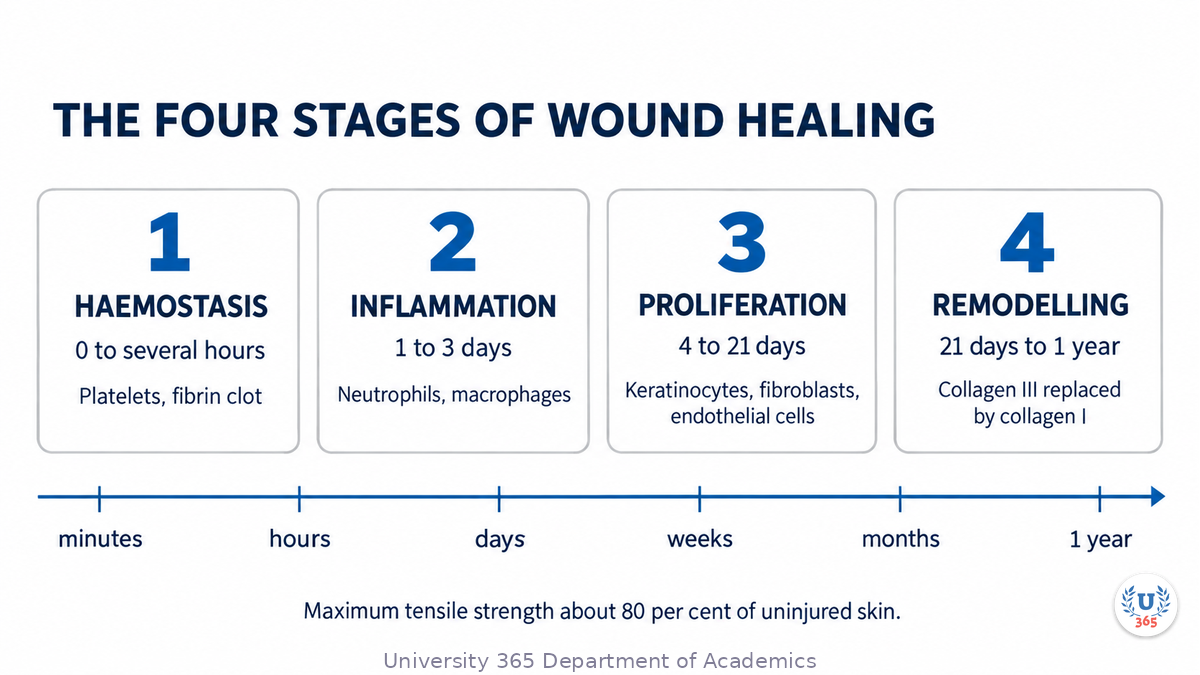
Haemostasis begins at the moment of injury and lasts from minutes to several hours. Collagen exposed by the break starts the clotting cascade, platelets aggregate, and the vessel narrows. Landén and colleagues put the vasoconstriction at 5 to 10 minutes, after which the vessels dilate and leukocytes begin to move into the wound (Cell Mol Life Sci, 2016).
The clot is not waste to be cleared later. It fills the gap, gives migrating cells a surface to move along, and its platelets release the growth factors that recruit the next cells. Platelet-derived growth factor and transforming growth factor beta are the two named in every review of the sequence.
The structure underneath is a fibrin network with platelets and trapped blood cells inside it. Landén describes the result as a provisional matrix, and the word provisional is the useful part: everything deposited in the first hours is meant to be replaced. Platelet degranulation also activates the complement cascade, which both attracts inflammatory cells and kills bacteria, so the first stage already does defensive work as well as mechanical work.
Days One to Three: The Clearing Stage
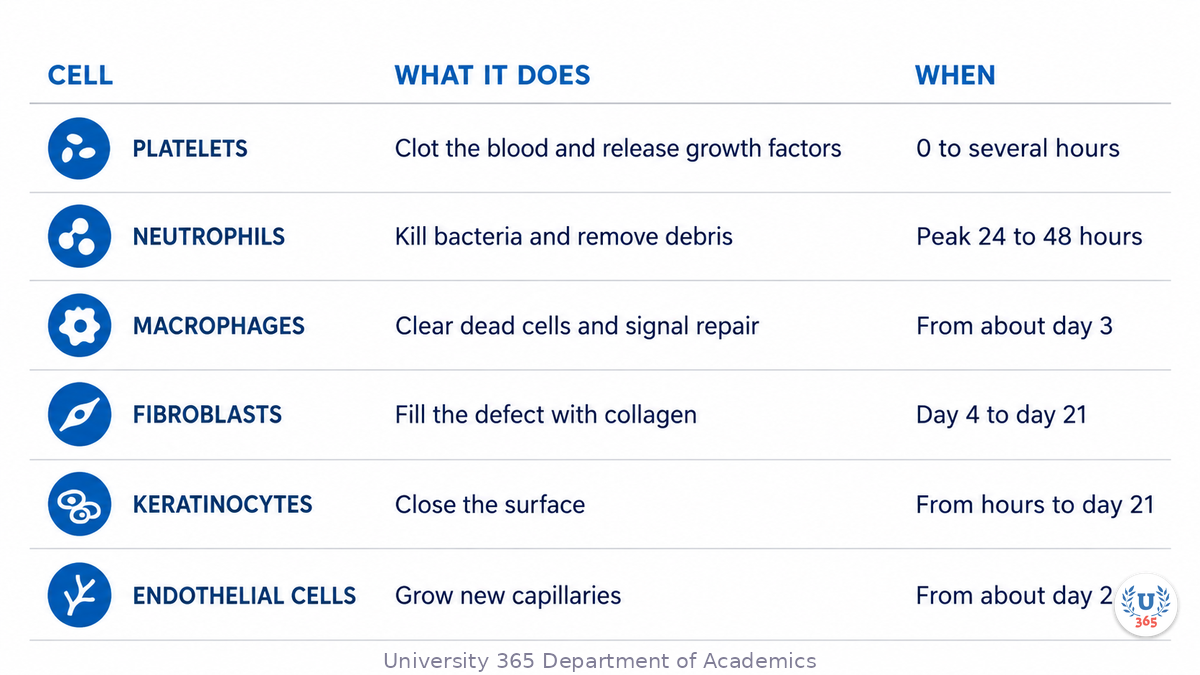
Inflammation overlaps haemostasis rather than following it. Neutrophils arrive first, peak at 24 to 48 hours, and usually clear within two to five days if the wound is not infected (Marshall et al., 2018; Landén et al., 2016). Their work is phagocytosis: bacteria, debris, dead cells.
Monocytes arrive at about day three and become macrophages. The macrophage ends the clearing stage and starts the repair: it removes spent neutrophils, releases growth factors, and signals fibroblasts and endothelial cells. Landén's review calls the transition from inflammation to proliferation the critical step, because a wound that stays inflamed does not move on.
One detail is worth carrying. Mice without neutrophils and without macrophages (PU.1 null) healed as quickly as normal mice and with less fibrosis (Marshall et al., 2018, citing Martin and colleagues). The clearing stage is useful, not indispensable, which matters when you read claims about boosting it or suppressing it.
What triggers the stage is not the damage itself but the molecules released by it. Landén groups them into damage associated molecular patterns, which are host molecules spilled by injured and dying cells, and pathogen associated molecular patterns, which are bacterial components the body does not make. Receptors on resident skin cells and on arriving leukocytes recognise both and switch on the inflammatory programme, which is why a clean wound and a contaminated one start the same way.
The stage has to end, and the macrophage is what ends it. Early in repair the macrophage is pro inflammatory: it kills bacteria and produces signalling molecules that keep cells arriving. Later, signals including interleukin 4 and interleukin 10 move it to a reparative state that releases growth factors and suppresses inflammation (Landén et al., 2016). In a wound that will not heal, the sequence stalls before that switch completes (Frykberg and Banks, 2015).
Weeks One to Three: Building the Tissue
Proliferation covers the surface, restores the blood supply and fills the defect. Keratinocytes at the wound edge begin to migrate within hours to a day, and proliferate from about day two or three (Landén et al., 2016). New capillaries grow from existing vessels from about day two (Marshall et al., 2018). Fibroblasts arrive and deposit collagen, at first type III, which is quick to lay down and weaker.
The reviews do not draw the boundaries in the same place. Landén gives proliferation as 4 to 21 days; Marshall gives 2 to 10 days, with remodelling starting at about three weeks. Both describe one sequence, and the dates stay approximate because the stages run at the same time.
The tissue built in this stage has a name and a composition. Granulation tissue is fibroblasts, immune cells, new vessels and loose collagen, and it is what fills a wound that has to close from the base rather than from the edges. The keratinocytes that cover it come from two sources: the basal layer at the wound edge, and stem cells in nearby hair follicles and sweat glands (Landén et al., 2016).
Contraction is the part a patient notices. Fibroblasts differentiate into myofibroblasts from about one to two weeks after injury, express smooth muscle actin, and pull the wound edges together at up to 0.75 millimetres a day (Marshall et al., 2018). Once epithelialisation is complete, normal myofibroblasts die by apoptosis, which is why an ordinary scar stops contracting.
Months: Remodelling and the Ceiling on Scar
Remodelling starts when the wound has closed and runs for months. Landén gives 21 days to a year; Frykberg gives one to two years or longer. Type III collagen is replaced by type I, the fibres organise, and the scar flattens and pales as capillaries regress.
Strength returns slowly and never completely. Marshall gives 20 per cent of normal tensile strength at three weeks and 70 to 80 per cent at six weeks; Landén gives a maximum of about 80 per cent. No review gives 100 per cent, because a scar has collagen but no hair follicles and no sweat glands.
That is the honest definition of healing: closure with a repair. The barrier works, and the structure is not the one you started with.
Why Some Wounds Stall
A chronic wound is one that does not move through the sequence in an orderly time. Frykberg and Banks give the practical test: when a wound has not achieved sufficient healing after four weeks of standard care, reassess the underlying pathology (Adv Wound Care, 2015). The scale is large: chronic lower extremity ulcers affect an estimated 2.4 to 4.5 million people in the United States, and their care has been reported at 2 to 3 per cent of healthcare budgets in developed countries.
These wounds tend to stall in inflammation. The shared features are excessive inflammatory cytokines, proteases and reactive oxygen species, senescent cells, persistent infection and dysfunctional stem cells (Frykberg and Banks, 2015).
The common types fail for different reasons, and that is why one dressing cannot serve all of them. A venous leg ulcer, an arterial ulcer, a diabetic foot ulcer and a pressure ulcer are all chronic wounds, but the underlying problem differs: sustained venous pressure, reduced arterial supply, neuropathy with load bearing pressure, or unrelieved pressure over a bony prominence (Frykberg and Banks, 2015). Frykberg gives the averages for chronic leg and foot ulcers as 12 to 13 months of duration and recurrence in 60 to 70 per cent of patients.
Infection is the largest single brake. A meta-analysis of nine studies covering 185 chronic wounds found biofilm in 78.2 per cent of them (Malone et al., J Wound Care, 2017). Biofilm is a community of bacteria inside a matrix that shields them from antibiotics and from immune cells, which is why a course of tablets often fails to clear a wound that looks infected.
The clinical numbers are blunt. In the English cohort, 89 per cent of acute wounds healed within the study year against 49 per cent of chronic wounds, and chronic wounds healed at 59 per cent when there was no evidence of infection against 45 per cent when infection was definite or suspected (Guest et al., BMJ Open, 2020).
How a Wound Heals
The Feynman Summary
A wound is a hole in the skin, and the body fills it in four moves. First it stops the bleeding: the vessels squeeze shut for a few minutes, platelets clump, and a clot fills the gap. The clot matters because cells can crawl along it.
Second, for a few days, it clears the site. White cells arrive to eat bacteria and dirt, and then a second kind of white cell, the macrophage, takes over and calls in the cells that rebuild tissue.
Third, for a few weeks, it builds. Skin cells crawl across the surface from the edges, new blood vessels grow into the gap, and cells called fibroblasts fill the space with a soft collagen. Specialised fibroblasts then pull the edges together.
Fourth, for months, it tidies. The soft collagen is replaced by a stronger kind, the fibres line up, and the redness fades.
What you get at the end is a repair, not a copy. The skin is closed and strong enough for daily use, at about 80 per cent of its original strength, but it has no hairs and no sweat glands. And if the cause of the wound is still present, pressure, poor circulation, diabetes or infection, the process stops at the second move and stays there.
How a Wound Heals
The Evidence
The mechanism is not in dispute. The four stage description appears in every review cited here, and the timings agree closely: a neutrophil peak at 24 to 48 hours (Marshall), neutrophils gone within two to five days and monocytes arriving at day three (Landén), myofibroblasts from one to two weeks (Marshall), type III collagen replaced by type I (both). These are consensus descriptions assembled from decades of histology and animal work, not the result of one trial.
The clinical evidence is weaker exactly where most money is spent. The Cochrane review of dressings for surgical wounds healing by primary intention pooled 29 randomised trials and 11 comparisons and found no clear evidence that any dressing reduced surgical site infection, compared with another dressing or with leaving the wound uncovered (Dumville et al., 2016). For chronic wounds, NICE reached a similar position in 2025: not enough evidence to justify price differences between antimicrobial agents.
The economics are the strongest quantified part. Guest and colleagues modelled the English National Health Service from a random sample of 3,000 patient records and estimated 3.8 million patients with a wound in 2017/2018, 7 per cent of adults, at a cost of £8.3 billion. Of that, £5.6 billion went on unhealed wounds and 81 per cent was spent in the community. Prevalence rose 71 per cent and cost rose 48 per cent in real terms against 2012/2013.
What the evidence does not show is which intervention changes the time to closure. Almost no trial in this literature is powered on time to healing, most dressing trials are small and at unclear or high risk of bias, and the healing rates in the English cohort come from clinician entries in a primary care database, not from a wound registry.
How a Wound Heals
The Counter-Case
The strongest competing reading is that the stage model describes one route rather than a requirement, and that clinical gains come from removing what blocks repair rather than from assisting it. The mouse result is the clearest case: animals without neutrophils and macrophages healed as fast, with less scarring (Marshall et al., 2018). If the clearing stage can be skipped without slowing closure, then inflammation is a response to contamination rather than a necessary step in the timetable.
The dressing evidence points the same way. If no dressing reduces infection in surgical wounds, and NICE cannot separate antimicrobial agents on price, then the useful action sits in perfusion, pressure relief, compression, glucose control and debridement, the tenets Frykberg lists before any advanced product. The biology is fixed; the conditions are what vary.
What would settle it: a trial powered on time to complete closure, in a multicentre population, comparing a device against standard care with the underlying cause treated in both arms. Until one exists, both readings fit the same data, and the second costs less.

How a Wound Heals
What It Means for You
Body and Health is the ULM domain this touches, because the practical gain is a sense of timing. A wound that is red, sore and swollen on day two is behaving normally. A wound that is the same size at four weeks is not, and the useful question has changed from which dressing to buy to what is holding it back.
At home the NHS guidance is plain: wash your hands, rinse the wound with tap or bottled water, pat it dry, cover it, and change the dressing when it soils (NHS, reviewed 2 April 2026). Escalate if a cut is longer than about 5 centimetres, if there is soil, pus or body fluid in it, if redness and pain are increasing, or if you have a temperature.
In a clinic, ask for the measurement rather than the description. Wound area over time is the signal that separates a wound that is closing from one that is stalling, and it is the number that makes the four week rule usable.
This brief follows the pattern described in the Interests method page, which explains how a subject like this becomes a brief you can use.
Time the stages Expect a small cut to be closed within one to two weeks, and expect the scar to keep changing for months, because remodelling runs far longer than the visible wound.
Apply the four week rule If a wound has not measurably reduced after four weeks of ordinary care, ask for the cause to be reassessed rather than for a stronger dressing.
Question antimicrobial dressings Use them when infection is present, and do not pay a premium without evidence: NICE could not justify a price difference in 2025.
Treat the conditions Pressure relief, compression, blood sugar and smoking matter more to closure than the brand on the packet, and chronic wounds healed in 38 per cent of smokers against 55 per cent of non-smokers in the English cohort.
The Applied AI Connection
Image based machine learning is now used to measure wounds, and it changes one task in this sequence: tracking area over time. A 2026 scoping review of clinical validation studies found 11 studies across eight countries, with intraclass correlation coefficients of 0.825 to 0.998 for wound measurement reliability and a reduction in manual area overestimation of 13.4 to 25.2 per cent (Wartakusumah et al., Diabetes Research and Clinical Practice, 2026). A photograph processed by a segmentation model returns a repeatable area, where a ruler and a paper trace return an estimate that varies with the person holding them.
The same review is honest about the limits. Specificity ranged from 20 to 96.8 per cent across the included studies, sample sizes were small, and current systems cannot assess depth, so they cannot see what lies under the surface. If a clinic offers image based measurement, ask whether the model was validated at more than one site and whether the trend is being read rather than a single number. If it was not, keep the four week comparison and treat the photograph as a record.
How a Wound Heals
The Five-Minute Version
The sequence. Haemostasis from minutes to hours, inflammation from one to three days, proliferation from four to twenty-one days, remodelling from twenty-one days to a year. The stages overlap.
The cells. Platelets clot and signal, neutrophils clear and peak at 24 to 48 hours, macrophages arrive around day three and start repair, fibroblasts fill with collagen, myofibroblasts contract at up to 0.75 millimetres a day, keratinocytes close the surface, endothelial cells rebuild vessels.
The ceiling. A scar reaches about 80 per cent of normal tensile strength and carries no hair follicles and no sweat glands. Healing is repair, not regeneration.
The stall. Chronic wounds stall in inflammation. Biofilm was present in 78.2 per cent of chronic wounds in a nine study meta-analysis, and 49 per cent of chronic wounds healed within the year in the English cohort, against 89 per cent of acute wounds.
The cost. 3.8 million patients, £8.3 billion a year, 81 per cent of it in the community, and a 71 per cent rise in prevalence over five years.
The test. Four weeks without measurable progress means reassess the cause, not the dressing.
If you remember one number, remember four weeks, the point at which a wound that is not closing needs a cause found. If you remember one judgement, remember that the dressing is the part of wound care with the weakest evidence, and the conditions around the wound are the part with the strongest.

How a Wound Heals
Sources
Every source below was opened and read on 20 October 2026. Where a publisher blocks automated reading, the link goes to an open bibliographic record for the same document.
Landén, Li and Ståhle, Cell Mol Life Sci 73(20), 3861 (2016). pmc.ncbi.nlm.nih.gov
Marshall et al., Adv Wound Care 7(2), 29 (2018). pmc.ncbi.nlm.nih.gov
Frykberg and Banks, Adv Wound Care 4(9), 560 (2015). pmc.ncbi.nlm.nih.gov
Guest, Fuller and Vowden, BMJ Open 10, e045253 (2020), open record. pubmed.ncbi.nlm.nih.gov
NICE, Topical antimicrobial dressings for locally infected leg ulcers, HTG751 (19 June 2025). nice.org.uk
Dumville et al., Cochrane Database Syst Rev 12, CD003091 (2016). cochrane.org
NHS, Cuts and grazes (reviewed 2 April 2026). nhs.uk
WHO, Global guidelines for the prevention of surgical site infection, second edition (1 December 2018). who.int
Malone et al., J Wound Care 26(1), 20 (2017), open record. pubmed.ncbi.nlm.nih.gov
Wartakusumah et al., Diabetes Res Clin Pract 239, 113485 (2026), open record. pubmed.ncbi.nlm.nih.gov




Comments