
Humva: AI avatar video from one photograph, with the operator's trading status unresolved

Updated: 13 hours ago
Status: Risky | Last tested: 2026-09-25 (Humva, as documented at www.humva.com in September 2026) | Re-check: event-driven, on any trigger below
Risky: the tool has significant unresolved issues, or it has been clearly surpassed by newer alternatives. Use it with caution and read the Limits section.
What Risky means here. Risky means the product's capability is separately scored and genuinely worth having, and that the counterparty is unresolved. Humva removes the production cost from short informational video at a price a solo producer can carry, and the strongest independent usability assessment in existence says it is the easiest service in its category. It does not mean the product is safe to buy today. The operator's continued trading is unresolved while the product is still on sale, the vendor publishes no readable terms of service and no readable privacy policy, no registered legal entity appears on any surface, and the custom-avatar path turns one photograph of a person into a speaking likeness with no documented consent step. A reader who needs a contract, a data position or a counterparty should treat those as unavailable and act accordingly. Section 7c is where those findings sit.
Version reviewed: Humva, as documented at www.humva.com in September 2026.
For detailed explanations of the CI-First evaluation terms used in this review, including the Humics Protection Badge and the AI Imposture Risk levels, see the Glossary at the end of this post.


In this Tool Review
Status and Re-check
Status: Risky | Last tested: 2026-09-25 | Re-check: event-driven, on any trigger below
Risky: the tool has significant unresolved issues, or it has been clearly surpassed by newer alternatives. Use it with caution and read the Limits section.
For detailed explanations of the CI-First evaluation terms used in this review, including the Humics Protection Badge and the AI Imposture Risk levels, see the Glossary at the end of this post.
Re-check triggers:
A statement from the operator about whether the service continues. A customer reviewing on Trustpilot on 2025-12-30 reported that "I got an email from Humva saying that they were closing business and only refunding people paid through to January 6, 2026." The same person added on 2026-01-03 that "HUMVA returned $18 to my bank." No vendor statement on the service's status could be found on any Humva surface at the time of writing, and the public pricing page still offers paid plans. The next authoritative signal is a vendor statement, not a directory listing.
A readable terms of service and privacy policy. Neither document is readable on the public site. If either becomes readable, the likeness consent position in Section 7c should be re-read against the new text, because the current assessment rests on the vendor's own FAQ and on the public record rather than on contract text.
A published resolution figure for the paid tiers. The only resolution number on any Humva surface is the Enterprise row's "Customizable 4K-HDR professional avatar". Free, Standard and Unlimited publish no resolution at all, and third-party sources disagree with each other. Re-check when the vendor publishes a figure per tier.
A published render time. No render time is published anywhere on the vendor's surfaces. The homepage says video is created "in minutes" and says nothing about how many. If a published render time or an independent speed measurement appears, the Time sub-score should be re-run.
A change to the point and credit arithmetic. The point system is the pricing model. Any change to the points-to-minutes ratio, to the custom avatar count per tier, or to the concurrent generation limits changes the Quantity reasoning directly.
A first independent measurement of lip-sync or output quality. No third party has published a repeatable measurement of Humva's lip-sync accuracy, facial fidelity or output sharpness. The Quality sub-score rests on the absence of measurement plus a small review corpus, and it moves if measurement arrives.
A resumed or replaced review base. The Trustpilot profile is unclaimed and carries three reviews. One substantive review moves the displayed average, which makes the current figure unstable in a way that a larger corpus would not be.
The Humva naming and the two domains, stated before the review begins
A reader searching for Humva meets two domains, two spellings and a parked page, plus at least one unrelated product with a similar name. The distinction belongs at the top.
Name | What it actually is | Relationship to this review |
Humva | The product reviewed here: a browser-based AI avatar video generator that turns a script or an idea into a talking-head video using a stock avatar or one built from an uploaded photograph | The subject of this review |
humva.com | The domain the product is branded on. Today it serves a domain-parking page rather than the product | The apex domain, and the reason a direct visit can mislead |
www.humva.com | The host that serves the product, the pricing page, the avatar pages and the affiliate programme | The surface this review reads |
humva.ai | A second spelling used in directory listings and by at least one site-safety scanner that reviewed it under that spelling | A same-brand spelling with separate listings. Treat directory records under this spelling as about the same operator |
NewRender AI Inc | The company named as the developer in a third-party tool profile | The vendor behind the product, per a third-party attribution rather than a vendor page |
Huma | An unrelated health and therapeutics company, and separately an unrelated human resources product | Not related. Both appear in search results for the same name stem |
Two practical consequences follow. First, a link that fails for a reader may be the apex domain rather than a dead product, so check which host the link uses before concluding anything about the vendor. Second, price and feature figures quoted from directory pages may describe any of three states of this product: the free tier at launch in January 2025, the three-tier structure that followed, or the state a directory captured before the operator's December 2025 notice. Every figure in this review is labelled with the surface it came from for that reason.
Tool Snapshot
Field | Detail |
Product | Humva, an AI avatar video generator |
What it does | Turns a written script, or a one-line idea through the Humva agent, into a talking-head video in which a chosen avatar delivers the text with lip-sync, gestures and an optional B-roll sequence |
Vendor | NewRender AI Inc, per a third-party tool profile. The vendor publishes no company registration, address or jurisdiction on any Humva surface |
Product status | Unresolved. A customer reported on 2025-12-30 that the operator emailed users it was closing business and refunding only those paid through 2026-01-06. The pricing page still sells plans, and at least one tool directory lists the product as no longer available |
Category | AI avatar video generation, in the same buyer category as HeyGen, Synthesia, Jogg AI and D-ID |
Primary use case | Producing a presenter-led video without a camera, a studio, an actor or an editing package: explainers, product introductions, social media content, internal training, testimonials |
Avatar library | The vendor says "thousands of options" in two places on the homepage and in the footer of the individual avatar pages. A reviewer that tested the tool reports more than 250 avatars. No avatar count is published on the pricing page |
Custom avatar creation | Offered. The vendor's FAQ states: "Creating a customized avatar with Humva is simple! You don't need to record a video, just upload one picture, and boom, your personalized avatar is ready to use in your videos." A third-party profile records model choices of about twenty realistic and about twenty animated styles |
Custom avatar limits per tier | Free: 2 custom avatars. Standard: 5. Unlimited: unlimited. These are the pricing page's own figures |
Languages | The homepage says "30+ language supported", in the hero area and again in the FAQ. A third-party review page states 130+ languages with voice cloning, a figure the vendor does not publish anywhere that could be found |
Voice | Stock voices per avatar, plus upload of your own voice, per third-party profiles of the workflow. No voice count is published by the vendor |
Output formats | MP4. One third-party guide states the free tier exports in 720p MP4 and paid tiers unlock 1080p plus transparent-background output. The vendor publishes no format or resolution line for Free, Standard or Unlimited |
Resolution | The only resolution figure on a Humva surface is the Enterprise row's "Customizable 4K-HDR professional avatar". Third-party sources variously report a 1080p ceiling with 4K in development, and 1080p output as standard with higher resolutions planned |
Render time | Not published. The homepage claims a full video in minutes; no figure, no range and no measured speed exists on any vendor surface read for this review, and no third party has published a speed measurement |
Pipeline type | Managed cloud rendering inside the vendor's web application. Text to speech to lip-synced avatar animation to optional B-roll assembly to export. No local rendering, no model weights, no self-hosting path |
Creative control | Script, avatar choice, background, gesture style and voice. No timeline, no shot-level control, no camera or lighting control, and no documented way to direct individual gestures against a specific line of script |
Integrations | A web plugin that builds product highlight videos from a site, per a third-party profile. Enterprise row lists "API Support" |
API | Listed as an Enterprise feature on the pricing page. No public API documentation could be found, and the API path on the product host serves the application shell rather than documentation |
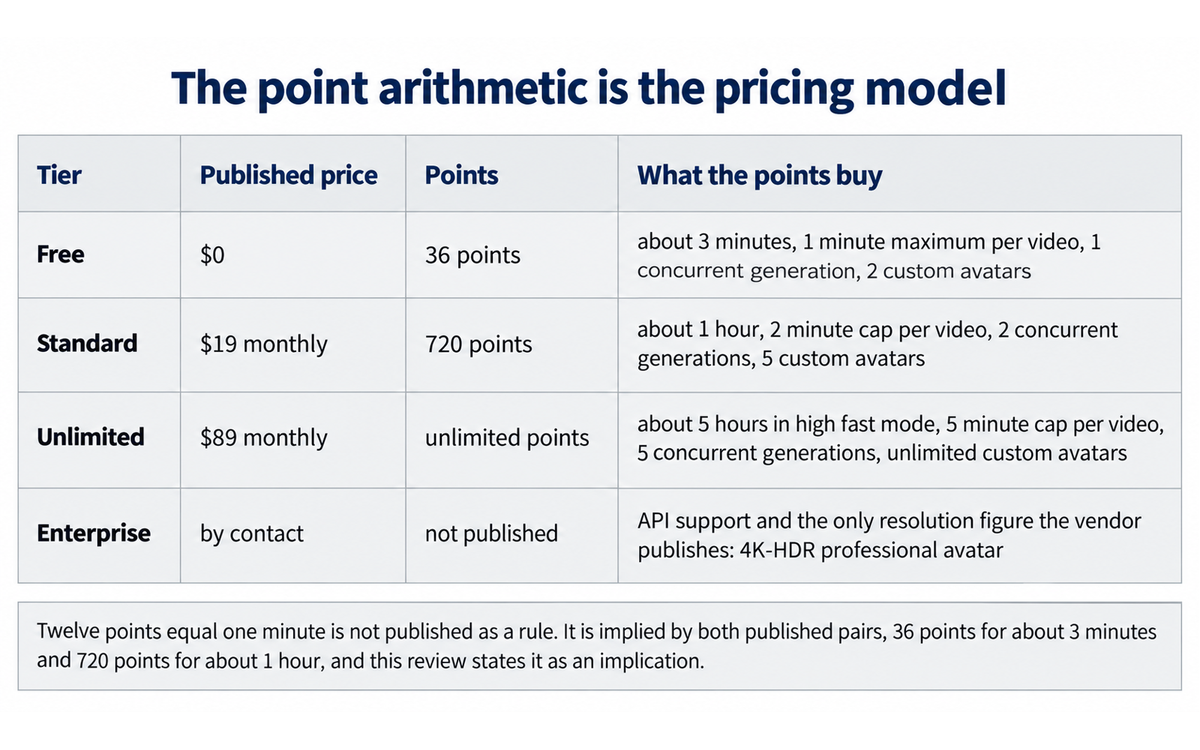
Free tier | Yes. 36 points, described as about 3 minutes of video, 1 minute maximum per video, normal speed, 1 concurrent generation, 2 custom avatars |
Paid tiers | Standard at $19 per month (720 points monthly, about 1 hour of video, 5 custom avatars, 2 minutes maximum per video, fast speed, 2 concurrent). Unlimited at $89 per month (unlimited points monthly, described also as unlimited with 5 hours in high fast mode, unlimited custom avatars, 5 minutes maximum per video, high fast speed, 5 concurrent). Enterprise by contact, adding API support, maximum video duration, enhanced concurrency, customizable 4K-HDR professional avatars and enterprise security and privacy |
Point value | 12 points per minute of video, implied by both published pairs: 36 points for about 3 minutes on Free, and 720 points for about 1 hour on Standard |
Watermark | The pricing page carries a "Watermark remove" line in every tier column with no value shown for any tier. A reviewer that tested the free tier reports a watermark present on free plan output |
Enterprise contact | support@humva.com |
Public channels | X at humva_official, a Discord server, and a YouTube channel at humva_official |
Affiliate programme | 40 per cent commission, described by the vendor as above the 30 per cent other avatar products offer |
Community | The homepage claims "10000+ community members" |
Reviews and ratings | Trustpilot: unclaimed profile, TrustScore 3 out of 5 across 3 reviews. Product Hunt: 3.8 out of 5 across 11 reviews, 910 followers, first place on Product of the Day at launch on 2025-01-19 with 543 upvotes. The product has no listing on G2, Capterra or GetApp |
Independent expert assessment | Jakob Nielsen published a usability review in 2025 describing Humva as "currently the easiest service for creating avatar videos with AI", with "less flexibility than other services like HeyGen", and noting in his roundup that "usability comes from the lack of features" and that the avatar's movements "aren't fully natural" while the voice is "of medium quality" |
Independent measurement | None. There is no benchmark, no accuracy figure, no latency measurement and no completion-rate study from any independent party |
Vendor measurement | None. The vendor publishes no accuracy, latency, uptime or quality figure on any surface read for this review |
Data position | Not readable. Neither a terms of service document nor a privacy policy is readable on the public site, and the vendor's FAQ describes custom avatar creation as a one-photo upload without stating a consent requirement or a likeness-rights position |
The Problem
Producing a presenter-led video has always cost more than the information in it is worth. The script takes an hour. Booking a room, setting lights, framing a shot, recording three takes of every paragraph, then cutting the bad moments out takes a day or more. If the presenter is not the person who knows the content, the cost rises again. If the video has to be updated every quarter, the whole cost recurs. Most people who need one explainer video, one product walkthrough or one training module never make it at all, because the cost of the first attempt is higher than the perceived value of the result.
The alternatives each fail in a specific way. Slide decks with voice-over cost less and look worse, and the audience stops watching. Stock footage with captions loses the presenter entirely, which matters when the video is meant to carry a person's authority. Hiring an actor means the face on the video has no relationship to the expertise. Recording yourself solves the authenticity question and answers it with a different set of costs: the camera, the discomfort, the retakes, and the fact that you cannot easily update the video next quarter without the same process again.
The third path is the one this category addresses. Generate the presenter instead. Write the script, choose an avatar, and let a service produce the face, the voice, the lip-sync and the timing. Humva is the low-friction end of that path: one photo for a custom avatar, a library of ready-made presenters, no editing package, and a price that starts at nothing.
The problem Humva claims to solve is real, and it is not the same problem the enterprise avatar platforms solve. HeyGen and Synthesia sell production control and brand governance to teams that have a video function. Humva sells the absence of a video function. That difference is the whole product, and it is also the whole risk, because a tool that removes the production craft also removes the person who could tell whether the output was usable.
The Outcome
If you adopt Humva and use it as intended, you get a talking-head video in which a person who does not exist, or a likeness of you, delivers your script with a synchronised mouth, some gesture, and background footage assembled under it. You get that without a camera, without a microphone, without an editing package, and at a cost measured in points rather than in days.
The measurable part of the outcome is small and specific. Twelve points equal one minute of video on the vendor's own arithmetic, so the free tier buys about three minutes of finished output and the $19 tier buys about an hour a month. Five custom avatars are included at Standard and unlimited at $89. Two to five generations can run at the same time depending on tier. That is the capacity side, and the vendor publishes it.
What the vendor does not publish is what the output is worth. There is no render time, no resolution for the tiers a normal buyer would choose, no lip-sync accuracy figure, and no independent measurement of any of it. So the honest statement of the outcome is this: you will get a video quickly, you will be the first person to see whether it is usable, and the vendor has published no way for you to predict that in advance.
There is a second outcome that belongs here and not only in the Limits section. The operator's continued trading is unresolved. A customer reported receiving a closure notice in December 2025 and a refund in January 2026, a directory lists the product as no longer available, and the apex domain no longer serves the product. Alongside that, the product host still serves a live pricing page selling three plans, an affiliate programme still soliciting partners, and the Enterprise row still inviting contact. A reader arriving today meets a product that is on sale and an operator that may not still be trading, and both of those statements are true at the same time.
Who Should Use Humva
Use this section as a filter. Humva is built for one specific kind of producer, and it fails the others for structural reasons rather than for lack of polish.
Fits well
The solo creator who cannot or will not be on camera. The vendor's own framing is a tool for micro YouTubers, and that is accurate. If your content is informational and your face is not part of the offer, a stock avatar delivers the same information with one evening of work instead of one day.
The specialist producing internal training content. A compliance module that has to be refreshed every quarter is the strongest case in this category, because the cost of the update falls to editing a script rather than repeating a recording session.
Small marketing teams with no video function. A product introduction, a feature announcement or a short social video can be produced without buying production capability or hiring for it.
Educators assembling short concept videos. The point arithmetic is generous enough to produce a sequence of short pieces rather than one long one, and short pieces suit the format the tool renders best.
Anyone who needs a version of themselves speaking a language they do not speak. The language claim is 30 or more on the vendor's own surface, and if it delivers, that is a capability a person cannot otherwise reach in an afternoon.
Fits badly
Anyone whose credibility depends on the person actually being there. A testimonial delivered by a stock avatar is a claim that the customer said something they did not say, and audiences increasingly recognise the format. Use the custom avatar path or do not use the tool for this.
Teams needing brand governance, approval workflow or a published data position. This class of buyer needs contract text, a consent regime for likeness use, and a service commitment. Humva publishes none of the three in readable form.
Anyone who needs shot-level creative control. There is no timeline and no way to direct a specific gesture to a specific line. If the video is a creative work rather than an information delivery, this is the wrong category entirely.
Institutions procuring a service to run for years. A service being purchased today from an operator whose trading status is unresolved needs a fallback plan and written exit terms before anything else is evaluated.
Anywhere the video carries a regulated claim. A synthetic presenter stating a compliance, medical, financial or legal position creates a record that no one can attribute and no one can cross-examine. The absence of any consent or disclosure documentation makes this worse rather than better.
U365 Institutes Alignment
Institute | Rating | Why | The limit that holds the row |
UIC (Digital Communication, Marketing) | High (primary) | Humva sits in the middle of what an applied communication programme works on, and the Fellowship it exercises is judgement rather than production. A Fellow using it has to specify the artefact before anything is rendered: who watches, what they do afterwards, and what the script must not claim. Then the Fellow has to judge the rendered presenter against that brief with no measurement to help, because the vendor publishes no render time, no resolution for the tiers a normal buyer would choose and no quality figure of any kind. Then the Fellow has to make the disclosure decision, which the review's Section 7c establishes is the deploying party's to make because the product ships no attribution requirement. All three of those remain when the tool is removed, and that is the test applied here | The tool builds none of them. The review scores Creativity at 0 on the ground that writing the script is where the creative work sits and the tool does not touch it, and it scores Critical Thinking at -1 because a synthetic presenter does not read what it says, so the read-before-publish step has to be supplied by the human. The tool works against the competency it demands. No published U365 programme assesses synthetic-media disclosure practice or audience-specific script specification. No UIC credential chain is mapped on this tool, and the mapping table below states the verified reason |
UID (Digital Design, UX/UI) | Medium | The relevance is visual judgement of a delivered moving image, not design authorship. The product returns one finished composite in which the avatar's look, staging, gesture repertoire and voice arrive as a package, and a Fellow can read that composite for framing, staging and the relationship between gesture and line. The transferable competency is evaluation: stating what the composite communicates against what was asked for, and naming the point at which a library-driven format stops carrying the intent | Nothing in the UID competency set is exercised as a design act. The review's own Section 4 records that there is no timeline, no keyframe, no camera control and no way to attach a specific action to a specific line, and the strongest independent assessment in existence says the buyer "take[s] the full package the way it comes". A Fellow makes no compositional decision, produces no editable artefact and defends no design against a brief. The rating is a rating of study interest for a design cohort, not of design relevance, and this review states that rather than letting the row read as a design claim |
UIB (Business Management, Entrepreneurship) | Medium | Two business competencies are genuinely exercised. The first is capacity and cost arithmetic against a published price: twelve points to a minute, 36 points free, 720 points at $19, unlimited at $89, with one to five concurrent generations, so a Fellow can convert a plan into the cost of running a defined output volume and defend the tier against the number. The second is vendor appraisal, and this tool is a strong worked case because the review's Section 7c documents an unresolved trading status on a product still on sale, no readable terms of service and no readable privacy policy, and no published legal entity. Deciding what has to be answered in writing before money or a photograph of a person changes hands is a management decision, and the Fellow makes it by reading the published record | The tool teaches no management, finance, entrepreneurship or leadership content of its own, and it produces nothing a business cohort could be assessed on. A verified term search over all 79 published programme descriptions returned zero matches for procurement, vendor management, counterparty, total cost of ownership, unit economics, business model and product launch, so the vendor-appraisal competence has no published assessment home. The row stands at Medium rather than higher because both competencies are exercised by reasoning about a published record rather than by operating anything |
UIT (Technology, AI, Data Science) | Low | The reason is correct as drafted and this review keeps it: the tool has no API documentation, no model access and no configuration surface an engineering cohort could work with, and it is a suitable example of a managed AI product in a digital transformation discussion and nothing more. Low is confirmed, with the academic reading added: the product is a managed pipeline whose speech synthesis, lip-sync model, resolution path and render time are all unpublished, which makes it a worked case in what an opaque managed service withholds from a buyer | The engineering path has nothing to open and nothing to measure. There is no SDK, no documented API, no model access and no configuration surface, and the review records no independent measurement of the product from any source. A technology cohort cannot build, instrument or evaluate anything on this product, and no published U365 programme assesses managed-service claim auditing. The limit is stated rather than the row inflated, because a Low rating with a real teaching use is a more useful finding than a Low rating with none |
The sentence that holds across all four rows. No institute in the U365 system should adopt Humva as a production tool, and the Risky status is the reason. The teaching value is in the reading: a product that removes a craft, publishes nothing that lets a user check the output, and asks for a photograph of a person with no consent regime and no readable contract. The primary institute is UIC, and it is primary because the judgement it demands is closest to what an applied communication programme assesses.
The sentence that holds across all four rows. No institute in the U365 system should adopt Humva as a production tool, and the Risky status is the reason. The teaching value is in the reading: a product that removes a craft, publishes nothing that lets a user check the output, and asks for a photograph of a person with no consent regime and no readable contract. The primary institute is UIC, and it is primary because the judgement it demands is closest to what an applied communication programme assesses.
Tool to Skill to Credential
No published U365 credential assesses any competency this tool's use demands. That is the finding, and it is not a defect in the catalogue. It is a statement about the product: it performs the work rather than teaching it, and U365 credentials assess what a Fellow can do rather than what a product can do for them. The Skill sub-score of 4 records the same thing from the scoring side, and the review's own Skill rationale says it plainly, recording one genuine narrow gain in script economy and no other.
The table therefore does two things in each row. It names the nearest published programme a Fellow could enrol in, and it states what that programme does not publish. An adjacent anchor is useful to a Fellow who wants the neighbouring skill. It is not a credential claim.
Tool skill | U365 competency | Credential | Institute |
Specifying the artefact before it is rendered: who watches, what they do afterwards, and what the script must not claim, then judging the rendered presenter against that brief | Scripted production specification and output judgement for a defined audience and a defined action | No published U365 programme assesses script specification for a presenter, and none assesses the judgement of a delivered video against a brief. A verified term search over all 79 published programme descriptions returned zero matches for presenter, scriptwriting, brief and media studies. The nearest published anchors and what each does not publish: Video Production Specialist (60 days, published, modules include The Art of Video Editing, Creative Techniques, History of Film and Video Editing, Premiere Pro Essential Training, Final Cut Pro Essential Training and Video Dialogue Editing) teaches editing craft and post-production in named applications rather than specification and appraisal of a rendered presenter; Content Marketing Specialist (30 days, published, modules include Content Marketing ROI, Content Strategy, Producing and Promoting Live Video, SEO Content Writing and Link Building) comes nearest on the planning side and publishes no video appraisal outcome. Adjacent anchors, not assessment homes. | UIC (Digital Communication, Marketing) |
Reading a delivered moving image for framing, staging and the relationship between gesture and line, and naming the point where a library-driven format stops carrying the intent | Visual evaluation of a delivered moving image against a brief | No published U365 programme assesses the evaluation of a supplied video composite. The nearest published anchors and what each does not publish: 2D Animation Expert (30 days, published, modules include Walk Cycles Basics, Character and Attitude, Story and Character Development, Manage Gesture and Storyboarding) teaches the production of character motion across a set of original animations rather than the appraisal of a rendered avatar; Motion Graphics and VFX Expert (60 days, published) and After Effect Expert (30 days, published) teach motion design in named applications; Graphic Design Professional (30 days, published, modules include Ideas, Concepts and Form, Layout and Composition, Typography and Think Design) teaches compositional authorship rather than composite appraisal; UX Designer Expert (25 days, published, modules include Analyzing User Data, Creating Personas, Ideation, Scenarios and Storyboards) publishes storyboarding as a design step. Adjacent anchors, not assessment homes. | UID (Digital Design, UX/UI) |
Converting a published tier model into the cost of a defined output volume, and deciding what must be answered in writing before money or a photograph of a person changes hands | Capacity and cost arithmetic, and vendor appraisal for a metered AI service | No published U365 programme assesses vendor appraisal, and this is a verified gap rather than an assumption. A term search over all 79 published programme descriptions returned zero matches for procurement, vendor management, counterparty, total cost of ownership, unit economics, business model and product launch. The nearest published anchors and what each does not publish: Financial Analysis Specialist (30 days, published, modules include Corporate Financial Statement, Financial Modeling, Forecasting Financial Statements, and Data and Economic Modeling with Stata) teaches the analysis of a company's own statements rather than the appraisal of a supplier; Entrepreneur (25 days, published, modules include Foundations, Finding and Testing Your Idea, Creating a Business Plan, Business Law, Raising Capital and Income Taxe) publishes legal foundations for establishing a venture rather than supplier-contract diligence; Business Analysis Professional (60 days, published, modules include Business Analysis Foundations, Agile Requirements, Business Benefits Realization and Business Process Modeling) publishes requirements articulation and process modelling. This is curriculum gap 3, recorded below. | UIB (Business Management, Entrepreneurship) |
Deciding what a deployed synthetic presenter must disclose, and holding that decision when the likeness is of a person who has not agreed in writing | Synthetic-media disclosure, likeness consent and the ethics of a system-generated representation of a person | No published U365 programme assesses disclosure practice for synthetic media or likeness consent. This is the clearest gap in the review. A term search over all 79 published programme descriptions returned zero matches for synthetic, synthetic media, deepfake, likeness, consent, disclosure, attribution, avatar and responsible disclosure practice. The nearest published anchors that carry an ethics module and what each does not publish: AI Creator Professional (30 days, published, modules include Opportunities, Issues, and Ethics and the six generative-image tools) publishes the moral questions of generative image work and no disclosure or consent outcome; AI Developer Specialist (18 days, published, modules include Introduction to Responsible AI Algorithm Design) publishes responsible algorithm design at a developer level; Master of Science in IT, M.Sc. 2/2 (224 days, published) publishes Digital Tech Ethics and Social Responsibility; Master in Communication & Marketing, M.C. 2/2 (224 days, published) publishes Ethics and Corporate Responsibility in Marketing. None publishes a consent, likeness or attribution outcome. This is curriculum gap 1, recorded below. | |
Reviewing a localised version of a script before it is published, including whether the mouth movement matches the target language and whether the avatar and setting suit the target market | Localisation review, spoken-word accessibility and cross-market register | No published U365 programme assesses translation, localisation, captions or accessibility. This gap is the striking one, because the review's own Workflow 3 is built on this surface. A term search over all 79 published programme descriptions returned zero matches for translation, translate, multilingual, subtitle, subtitles, caption, captions, accessibility, localisation, localization, dubbing and cultural register. The nearest published anchors and what each does not publish: Social Media Marketing Manager (30 days, published, modules include Social Media: Strategy and Optimization, Copywriting for Social Media, Content Creation Strategy, TikTok and Instagram Reels, and Stories: Creative Strategies) assesses social content creation and measurement rather than localised review; Marketing Manager (18 days, published, modules include Leading a Marketing Team, Marketing Communications Strategies and Write a Marketing Plan) publishes communications strategy at team level. This is curriculum gap 2, recorded below. | UIC (Digital Communication, Marketing), and no credential mapped |
No credential chain is mapped for UIC, UID, UIB or UIT on this tool. A chain asserts that using the tool builds a competency, and this tool builds none of the competencies its use demands. Every competency in the table above is supplied by the Fellow: the specification, the appraisal, the vendor decision and the disclosure decision. The tool supplies the render. Attaching a published programme to any of those rows would tell a Fellow that the skill is assessed where it is not.
What the review does assert, and it is a useful statement for a Fellow. The competencies in the table are teachable without the product, the review's own Workflows are ready-made exercises for four of them, and a Fellow who wants the neighbouring capability should take a published programme and treat Humva as the case to read. That is the route this section recommends, and it names programmes rather than leaving the reader with a warning.
Three curriculum gaps this review records
Three competencies this review exercises have no assessment home in the published catalogue. They are recorded as gaps rather than filled with a plausible programme name. None of the three is a current programme, none has a micro-credential, and none is presented as one.
Synthetic-media disclosure and likeness consent. No published programme covers what a deployed synthetic presenter must disclose, consent and revocation for a likeness, or the obligations that attach to a photograph turned into a speaking representation of a person. This is the larger gap of the three. It is not a gap about this vendor. It is what the likeness surface of every avatar product in this category looks like, and the review's Section 7c is the worked case.
Localisation review and spoken-word accessibility. No published programme covers verifying a localised spoken-word artefact, whether mouth movement matches the target language's phonetics, or the captioned and accessible equivalent that a synthetic presenter does not replace. The review's Workflow 3 supplies the lesson, including its own instruction to identify a named native reviewer before generation rather than after.
Vendor and counterparty appraisal for a metered AI service. No published programme covers reading a supplier's published record, converting a subscription into cost and capacity, and deciding what has to be answered in writing before commitment. The review's Section 7c, its capacity arithmetic and its Migration Path are the worked case together.
University 365 has three academic access levels, DISCOVERY, INSIDER and SUPERHUMAN.
Specialized diplomas and certificates carry Basic, Foundation and Expert levels. DISCOVERY Fellows can enrol in Basic-level programmes only. INSIDER Fellows can enrol in Basic and Foundation programmes. SUPERHUMAN Fellows can enrol in all of them.
University degree programmes carry a single Expert level and are open to SUPERHUMAN Fellows only.
No degree chain is asserted for any row. Every anchor above is a diploma, and no claim is made that completing one awards credit toward a degree or toward any named micro-credential. The catalogue read does not expose credit transfer or a per-programme access level, and neither is asserted.
No micro-credential component title is asserted anywhere in this document. The UIT reconciliation of 2026-09-22 established that four component titles carried by earlier alignment deliverables were internal working names that never reached the catalogue. None of them is used here, and every anchor above is a programme a Fellow can find and enrol in.
No access level is asserted for any individual programme. The catalogue read does not expose one, so the rule is published and the per-programme level is not.
How Humva Works
Humva is a managed pipeline with a thin authoring layer on top. You supply four things and the service produces one.
What you supply
Text. Either a finished script, or a one-line idea that the Humva agent expands into a script and a sequence of scenes. The homepage describes the agent path as: "Give Humva your idea in a sentence or a full script, and get a complete AI-generated video." The maximum length the agent path will assemble is stated on the homepage as three minutes.
An avatar. Either a public avatar from the library, filtered by topic, gender or age, or a custom avatar created by uploading one photograph. The vendor's FAQ describes the custom path as a one-photo upload with no recorded video.
A voice. A voice that belongs to the chosen avatar, or your own uploaded voice, per third-party descriptions of the workflow. The vendor publishes no voice list, no voice count and no indication of which voices pair with which languages.
Optional creative direction. Background choice, gesture style from a named set that third-party descriptions list as cheer, excited, surprise, casual, greet and confuse, and an emotion setting tied to the script.
What the service does
The pipeline runs server-side and produces a rendered video file. In sequence: the script is segmented, converted to speech in the chosen voice and language, the avatar is animated to the speech with lip-sync and gesture, background footage is generated or applied, the segments are assembled into a single timeline, and the result is exported. The vendor describes the automatic assembly as auto-editing and the background footage as B-roll, and states on the homepage that the agent path will "Generate multiple clips and let humva do auto editing."
What you receive
A video file, plus the option to keep the same avatar across a set of videos. One third-party reviewer that tested the product specifically records that keeping the same avatar across scenes worked well for character identity and that the cartoon avatar styles animated expressively with strong lip-sync, while image sharpness was better on paid plans than on the free plan. That observation is a third party's, not the vendor's, and it is the most specific quality statement about the output that exists anywhere.
What the vendor does not disclose
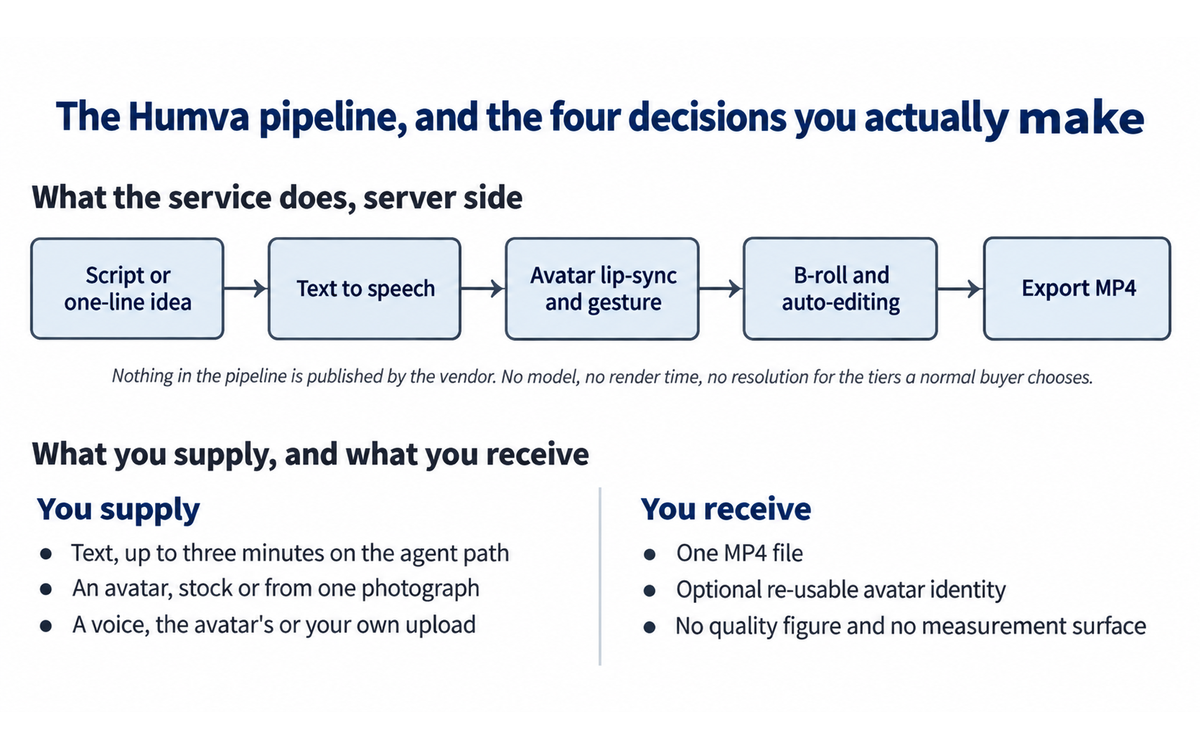
The pipeline is entirely opaque on the points that would let a buyer predict output quality. There is no statement of which speech synthesis system is used, no statement of which lip-sync model animates the avatar, no published resolution path by tier, no render time, and no quality or accuracy figure of any kind. The Enterprise row names "Customizable 4K-HDR professional avatar" and nothing else in the product publishes a resolution at all. For a buyer making a capacity decision this is workable, because the point arithmetic is published and consistent. For a buyer making a quality decision it is not, because the only quality statements available come from parties other than the vendor, and they disagree with each other.
The pipeline's one structural limitation
Everything is generated from the avatar outward. The avatar's appearance, staging and gesture repertoire are fixed properties of the chosen avatar, and the script drives which of the fixed gestures fires. There is no timeline, no keyframe, no camera control and no way to attach a specific action to a specific line. The consequence is that the format's ceiling is set by the library, not by your intent, and the strongest independent usability assessment of the product says exactly that: "usability comes from the lack of features: each avatar has a given look, stage set, and voice, so you have to take the full package the way it comes."
Getting Started with Humva
This is a start that could be completed in a quarter of an hour. It is written as a sequence so that the decisions that matter are made before anything is generated, because the decisions that matter are the ones a first-time user skips.
The fifteen minute path
Decide the purpose before you open the tool. Write one sentence stating who watches this video and what they do afterwards. A synthetic presenter works for information delivery and fails for credibility transfer, so the purpose determines whether the tool is suitable at all.
Write the script yourself and bring it in. Do not let the agent write the factual content. The agent is useful for structure and pacing. Every factual claim in the script is a claim you will be publishing in a voice that sounds authoritative and a face that does not exist, and you are the only one who can check it.
Check the point arithmetic against the script length. Twelve points equal one minute. A three minute script consumes the entire free month. The Standard tier's 720 points buy about an hour, so long-form work is cheaper per minute at Standard than at Free, and the free tier is best used as three separate one-minute tests rather than one three-minute video.
Create your custom avatar early if you intend to use one. Upload one photograph, well lit, facing the camera, with no other face in frame. This is the step where the outcome is least predictable, and it is the step where a third-party reviewer that tested the product reports the quality dropping relative to public avatars. Test the custom avatar with a short script before committing a long one.
Test with the shortest useful script. One minute, one avatar, one voice, one background. Watch the lip-sync on a consonant-heavy sentence, watch the hands, and watch whether the gesture fires where you intended. Do this on the free tier before paying anything.
Check the watermark on your own output. The pricing page carries a "Watermark remove" line in every tier column with no value shown for any tier, and a reviewer that tested the product reports a watermark present on free plan output. Confirm it on your own file rather than from a table.
Verify the resolution on the file you actually receive. Only the Enterprise row publishes a resolution. Third-party sources disagree about what the normal tiers produce. Open the exported file's properties and record what you got.
Read the terms before you upload a photograph of another person. This is the step this review recommends most strongly, and Section 7c explains why. A photograph of a colleague, a customer or a student used to build an avatar is a use of that person's likeness, and the tool publishes no consent step and no likeness position.
Record what you produced and what you paid in points. With no published render time and no published quality figure, your own log is the only performance record that will exist for this tool.
What to check before you pay
Whether the service is still trading. See Section 7c. Ask support@humva.com directly, in writing, and keep the reply.
Whether an avatar created from a photograph can be deleted, and what happens to it if the account lapses.
Which of the three paid plans the Enterprise row's 4K professional avatar is available on, since the row implies a tier no public price covers.
Real Workflows
Three workflows follow, each with the prompt material you would paste and a verification checklist. The checklists exist because the tool produces a plausible artefact with no published way to judge it, and the person who judges it will be you.
Workflow 1: The product explainer that would otherwise not get made
When to use it. You need a sixty to ninety second introduction to a product, a service or a concept, and the alternative is a slide deck nobody watches.
Why it fits. Short, informational, faceless. This is the format the tool renders best, and it is the format where the absence of production craft costs the least.
Inputs.
AUDIENCE: [one sentence naming who watches this] DURATION: 60 to 90 seconds SCRIPT: [written by you, one idea per paragraph] AVATAR: public avatar, filtered by topic and age, chosen for register not for realism VOICE: the avatar's default voice BACKGROUND: plain studio setting, matching the topic GESTURES: default. Do not attempt explicit gesture direction on a first run.
Steps. Write the script at roughly 150 words per minute. Create the video at one minute. Watch it once end to end without pausing. Then watch it once more with the sound off.
Verification checklist.
VERIFICATION CHECKLIST for "Product explainer with Humva": [ ] Script accuracy: every factual claim and every number is checked against a primary source by you, not by the tool [ ] Lip-sync: watch three consonant-heavy sentences. A visible offset on plosives is the format's most common defect [ ] Hands and gestures: confirm no gesture fires against the wrong sentence and no hand enters a frame edge awkwardly [ ] Sound-off pass: the video must still make sense to a viewer with the sound off, because most of your audience will watch it that way [ ] On-screen text: any claim that matters is also on screen. Do not let the avatar's voice carry a number alone [ ] Resolution and watermark: confirm on your own exported file, not from the pricing table [ ] Disclosure decision: decide in writing whether this video needs to state that the presenter is synthetic, and record the decision [ ] CI-First test: can you explain and defend every claim in the video without the tool? [Y/N]
Workflow 2: The quarterly internal training module that has to be refreshed
When to use it. A compliance, onboarding or process module that is broadly stable and has to be updated every quarter as a policy or a screen changes.
Why it fits. The update cost collapses to editing a script, and this is the strongest justification in the entire category. A module recorded by a person costs a recording session per revision. A module delivered by the same avatar costs an edit.
Inputs.
AUDIENCE: [internal, named group] DURATION: three to five minutes, split into separate one to two minute units SCRIPT: your existing module text, revised AVATAR: one custom avatar, held constant across every unit and every revision VOICE: the custom avatar's paired voice, held constant BACKGROUND: one setting, held constant CONSISTENCY RULE: never change the avatar between revisions. The avatar is the module's identity
Steps. Generate each unit separately rather than as one long video, because the free tier caps a single video at one minute and the Standard tier at two, and because a unit that needs revising can then be regenerated on its own. Keep the avatar fixed. Log the points consumed per unit so the next revision can be budgeted.
Verification checklist.
VERIFICATION CHECKLIST for "Quarterly training module with Humva": [ ] Content currency: the script reflects the current policy, and the change that triggered this revision is named in the log [ ] Avatar consistency: the same custom avatar appears in every unit and matches the previous release [ ] Voice consistency: no voice has silently changed between the previous release and this one [ ] Unit independence: each unit makes sense watched alone, because units get skipped [ ] Points budget: total points consumed is recorded against the tier allowance [ ] Accessibility: a text or captioned equivalent exists, because a synthetic presenter does not replace an accessible format [ ] Retention risk: an annual or semi-annual confirmation that the module is still watched, not just still published [ ] CI-First test: does a learner finish this module able to do the thing the module teaches, and can you demonstrate that? [Y/N]
Workflow 3: The multilingual version you could not otherwise produce
When to use it. You have a script that works in one language and you need a version in a language neither you nor anyone on your team speaks.
Why it fits. This is a genuine capability expansion rather than a convenience. A person cannot produce a competent speaker in a language they do not know, and the vendor claims 30 or more languages.
Inputs.
BASE SCRIPT: [the version that already tested well in your own language] TARGET LANGUAGE: [one language per run] AVATAR: a public avatar whose default voice exists in the target language, if one does REVIEW: a named native speaker, identified before you generate anything
Steps. Generate the version. Send it to the named native speaker before it is published anywhere. Ask specifically whether the mouth movement matches the target language's phonetics, because this is the defect that is hardest for a non-speaker to detect and the one most often reported by users of this category.
Verification checklist.
VERIFICATION CHECKLIST for "Multilingual version with Humva": [ ] Named native reviewer identified before generation, not after [ ] Translation quality: the native reviewer reads the script text, not only the video [ ] Phonetic match: the native reviewer watches with the sound on and reports whether mouth movement matches the language [ ] Cultural register: the avatar and setting suit the target market, not only the source market [ ] Idiom check: nothing has been translated literally into a claim the target audience reads differently [ ] Regional variant: the target language's specific variant is confirmed, not assumed [ ] Publication decision: nothing publishes in the target language without the named reviewer's sign-off on the file [ ] CI-First test: would the native reviewer have produced this sentence this way themselves? [Y/N]
Section 6b: When Not to Use Humva at all
Some work should stay with a person regardless of how good the tool is.
A testimonial or a customer reference. A stock avatar saying a customer's words is a fabricated quotation with a face on it. If the customer cannot appear, use their written words with their name and a clear format, not a synthetic likeness.
A regulated claim, an apology, a crisis statement or anything with legal exposure. A synthetic speaker removes the person who can be held to the statement. The absence of any published consent or disclosure regime makes this worse.
A video whose value is the presenter's presence. Keynote content, a founder's message, a teaching relationship built on a person. The tool removes the thing that made the video worth watching.
Anything where you would be the reviewer and you are not a video professional. The tool gives you no measurement and no vocabulary for judging the output. If you cannot say what is wrong with a lip-sync artefact, you cannot approve the video.
Strengths, Limits, and AI Imposture Risk
What Humva does well
The friction is genuinely low, and an independent expert said so. The usability researcher Jakob Nielsen reviewed the product in 2025 and described it as "currently the easiest service for creating avatar videos with AI". He also gave the mechanism, which is that "usability comes from the lack of features". The absence of a timeline is the product, not a defect in the product.
The custom avatar path is one photograph. The vendor's FAQ states it plainly: "You don't need to record a video, just upload one picture". Every competing platform in this category asks for more: recorded footage, a consent recording, a longer calibration. The lower bar is a real advantage for an individual and a real hazard for an institution, and Section 7c takes the hazard seriously.
The pricing is published, tiered and arithmetically consistent. Three tiers, a free tier, a points model where 12 points equal a minute, custom avatar counts per tier, video length caps per tier, speed grades per tier and concurrency per tier. A small operation can budget this in a spreadsheet in ten minutes, which is more than can be said for most enterprise avatar platforms, several of which publish no list price at all.
The agent path reduces the blank page. A one-line idea becomes a script and a scene sequence. That is not the same as a good script, and it is the difference between producing something and producing nothing.
Avatar consistency is the format's real win. One avatar held across a set of videos gives a small brand a recognisable presenter without hiring one. A reviewer that tested the product reports this specifically: keeping the same avatar across scenes worked well for maintaining character identity.
Limits
No render time is published, and no third party has measured one. The homepage claims a full video in minutes and states no number. A negative reviewer describes "the render times are ridiculous". A directory that rates the product gives its speed claim no figure either. You cannot plan a production schedule against an unpublished number, and you cannot tell whether the claim holds.
No resolution is published for any tier a normal buyer would choose. Free, Standard and Unlimited carry no resolution line at all. Only the Enterprise row names one, at "Customizable 4K-HDR professional avatar". Third-party sources contradict one another: one states a 1080p ceiling with 4K in development, another states 1080p output as standard with higher resolutions planned, one guide states that free exports are 720p with 1080p and transparent background available on paid tiers. No vendor surface confirms or denies any of these.
No quality, accuracy or reliability figure exists, from any source. This is the finding that caps the Quality sub-score, and it is an absence rather than a measured weakness. There is no lip-sync accuracy measurement, no facial-fidelity measurement, no completion-rate study, and no uptime figure. The product is sold on the human-ness of its human-like output and publishes nothing that lets you check it.
The custom avatar quality is reported as the weakest surface. Product Hunt reviewers, summarised on that platform, report that "quality drops with custom avatars or uploaded voices", and the same platform's reviewer feedback asks for better language support, gender options and stronger non-English facial matching. The feature the product leads with is the feature users complain about most.
The language claim has no published detail behind it. The homepage says 30 or more languages in two places. A third-party review page states 130 or more languages with voice cloning, which the vendor does not claim anywhere that could be found. No vendor surface lists the languages, states which voices exist in which language, or states whether mouth movement is retargeted per language rather than only the audio being replaced.
The vendor does not publish who it is. No registered entity name, address or jurisdiction appears on any Humva surface read for this review. The developer attribution used in this review comes from a third-party tool profile naming NewRender AI Inc. For an institution this is a procurement blocker independent of the product's quality.
The operator's continued trading is unresolved. A Trustpilot reviewer reported on 2025-12-30 that the operator emailed users it was closing business and refunding only those paid through 2026-01-06, and updated on 2026-01-03 that $18 had been returned. A tool directory lists the product as no longer available. The apex domain no longer serves the product. Meanwhile the product host still sells three plans, the affiliate programme still solicits partners, and support still invites contact. See Section 7c.
No contract text is readable. Neither a terms of service document nor a privacy policy is readable on the public site. A vendor that asks you to upload a photograph of a person, and in the vendor's own description turns it into a speaking avatar within minutes, should have a readable likeness and consent position. This vendor does not, on any surface this review could reach.
No user review base of any size. Three reviews on one platform and eleven on another, with the first platform unclaimed and the vendor not having invited reviews there at all. The displayed average on the smaller platform moves with a single new review.
No API documentation. The API is listed as an Enterprise feature and no public documentation exists. Any automation plan is a conversation with support, not an integration.
AI Imposture Risk
Trap | Rating | Evidence |
Time Illusion | Medium | The product is sold on speed and publishes no speed. The homepage claims a full video in minutes with no number, no render time per tier and no resolution-dependent timing. A negative reviewer describes render times as "ridiculous", which is the opposite claim from a reviewer, not a measurement from either side. Net time saved is very likely positive for a producer who would otherwise book a studio, and it is unverified for anyone planning against a schedule. No independent speed measurement exists. Medium, because the direction is plausible and the size is unknown |
Quantity Illusion | Medium | The points model makes volume cheap and explicit: 36 points free, 720 points at $19, unlimited at $89, with 1 to 5 concurrent generations. That is real capacity. The illusion is that volume is the same as output. Product Hunt reviewers report uneven quality, with some saying quality drops with custom avatars or uploaded voices, and a directory's own cons list records poor avatar quality, lip-sync issues and slow performance. Producing twenty videos nobody watches is a quantity outcome that looks like a benefit. Medium, not High, because the tier caps and the concurrency limits physically bound what you can produce per month |
Skill Illusion | High | This is the product's core promise and its core hazard. The sell is "no camera, no acting skills", which describes the removal of a craft rather than the acquisition of one. A user with no video production experience produces an artefact that looks like a produced video, and the tool provides no measurement, no quality figure and no feedback that would let that user tell a good output from a poor one. Two independent usability observations land on the same point: the expert reviewer notes the avatar's movements "aren't fully natural" and the voice is "of medium quality", and the platform's own review summary records complaints about poor lip sync and weak voice choices. Those are precisely the defects a non-professional will not detect. The user gains the appearance of a video capability and acquires none of the judgment that a video capability consists of |
Overall AI Imposture Risk: Medium
The overall level is Medium because one trap is High and the other two are Medium. The trap that matters for adoption is Skill Illusion, and it is High for a specific and structural reason: the product is marketed on the removal of the skill that would be needed to check its output. There is no measurement anywhere in this product, from the vendor or from any third party, that substitutes for that judgment.
Why the Quality sub-score is not higher
Quality scores 4, and the driver is measured absence rather than measured weakness. There is no independent measurement of lip-sync accuracy, no independent measurement of output sharpness, no completion-rate study, no uptime figure, and no render time. The vendor publishes no accuracy or quality figure of any kind. The quality statements that exist are the vendor's own marketing claim of human-like output, one expert usability review from 2025 that found the movements not fully natural and the voice of medium quality, one third-party tester reporting strong lip-sync on cartoon avatars and sharper image output on paid plans, and a review corpus of fourteen reviews across two platforms reporting uneven quality with the custom avatar path reported as the weakest. The sub-score reflects what can be verified, not what the product might be capable of on a good day.
Why this review's overall verdict treats the operator's status as decisive
Because it is. A positive CI-First band and a Risky status are not in conflict. The score measures what the tool does for a user net of overhead, and it answers that on the tool's merits: 5.0, a real recommendation with disciplined use. The status records a separate and more urgent fact, which is that the operator's continued trading is unresolved while the product remains on sale. Both statements are true, and a reader who acts on one without the other has not read the review.
Section 7c: Likeness consent, the operator's status, and who the vendor is, stated plainly
This section carries findings that a reader adopting Humva has to decide on, and it is deliberately separate from the scoring. It covers three related matters: what the product does with a photograph of a person, whether the operator is still trading, and the fact that the vendor does not publish who it is. The findings come from the vendor's own published material and from the public record. Where an allegation is reported rather than a finding established, the text says so.
1. A one-photo likeness pipeline with no published consent regime
The operative text is the vendor's own FAQ answer, and it is the entire documented description of the custom avatar process:
"Creating a customized avatar with Humva is simple! You don't need to record a video, just upload one picture, and boom, your personalized avatar is ready to use in your videos."
That is the whole process as the vendor publishes it. There is no consent step described, no verification that the person in the photograph has agreed, no statement of what the uploaded photograph is used for beyond the avatar, and no statement of whether a likeness created this way can be deleted. Against that, a third-party profile of the workflow states that the custom path offers about twenty realistic and about twenty animated avatar models to apply to the uploaded photograph, and a third-party review article states that the platform additionally supports creating a digital twin from recorded voice and video samples and generating video of the user speaking any script in any language. The vendor publishes none of that.
Two facts make this a finding rather than a boilerplate concern. First, the barrier is one photograph, which is the lowest possible bar for creating a synthetic likeness of a person. Second, the same feature is sold to a buyer whose stated use case is presenting someone else's message: product introductions, testimonials, festive greetings, sales pitches. A user who uploads a photograph of a colleague, a customer, a student or a partner has created a synthetic likeness of a real person, and the product as documented asks nothing before it does so.
No vendor document was readable that states a consent requirement, a likeness-rights position, a retention period, a deletion right or a use restriction. That is the finding: not that the vendor has a harmful position, but that the vendor publishes no position at all on the highest-risk input the product accepts.
2. The operator's trading status is unresolved, and the product is still on sale
The public record contains one customer account of a closure notice, and the review reports it as an account rather than as an established fact, because the reviewer is the only source and the vendor has published nothing either way.
The reviewer's own words, dated 2025-12-30:
"Today is December 30, 2025. I got an email from Humva saying that they were closing business and only refunding people paid through to January 6, 2026."
The same reviewer's update, dated 2026-01-03:
"HUMVA returned $18 to my bank."
The same reviewer's earlier account of the billing problem, which is the reason the closure notice matters to them:
"I have been billed for a Premium membership since June. On the 20th of June, 2025, I was sent an email from Humva about my account expiring, so I figured it would just end. But, it didn't! I was billed the same amount every month. I tried several times to contact for cancellation but I never got through to them."
Three independent signals point the same way and none of them is the reviewer's account. A tool directory states plainly of the product: "This AI tool is no longer available." The apex domain no longer serves the product and instead returns a domain-parking page. And a third-party directory tracking the product recorded a 33.4 per cent decline in traffic attributing it to mixed user experiences and negative reviews.
Against those signals, three vendor surfaces still present the product as a live commercial offering. The pricing page sells Free, Standard at $19 and Unlimited at $89, with Enterprise by contact. The affiliate programme still invites partners at a 40 per cent commission. Support still publishes an address at support@humva.com and invites contact.
This is the decision the section puts in front of the reader, and it is a business decision rather than a product one. Before paying Humva anything, write to support@humva.com and ask directly whether the service is operating, whether a paid subscription will be honoured, and what happens to avatars created from uploaded photographs if it is not. Keep the reply. If no reply comes, that is an answer.
3. The vendor does not publish who it is
No registered company name, address or jurisdiction appears on any Humva surface read for this review. The attribution used in this review, NewRender AI Inc, comes from a third-party tool profile rather than from the vendor. A vendor asking for a photograph of a person, and asking for a monthly payment, and offering an enterprise tier with security and privacy claims, publishes no legal entity. For an institution this is decisive on its own: there is no counterparty to contract with and no jurisdiction in which to enforce anything.
What this section does not do
No score changed because of anything in this section. The CI-First Benefit Score measures what the tool does for a user net of overhead, and it has no dimension for supplier conduct or counterparty risk. The Quality sub-score is capped by the absence of independent measurement, not by the operator's status. The Risky status recorded at the top of this review is where the operator and consent findings land, and it is the reason that status is Risky rather than Active.
The section does not assert that the operator has ceased trading. It reports one customer account, one directory statement, one domain observation and one traffic figure, and it states that the vendor has published nothing either way. It does not allege wrongdoing in the billing complaint, which is one customer's account of one dispute and is reported as such.
The section does not tell you to avoid Humva. It states what the vendor publishes, what the vendor does not publish, and what the public record says, and it leaves the adoption decision where it belongs. The recommendation this review does make is procedural: get the trading question answered in writing before you pay, and do not upload a photograph of any person who has not given you their agreement.
U365 Co-Intelligence Rating
CI-First Profile
Primary: Co-Worker and Assistant (level 2). Humva executes a production task you have specified. You write the script and choose the presenter, and the tool produces the artefact. It is a worker with a narrow, well-defined job and no opinion about what you asked for.
Secondary: Co-Creator and Thought Partner (level 1), on the agent path only. The one-line-idea path drafts a script and a scene sequence, which is co-creation of the structure. The level is bounded by the fact that the tool cannot evaluate the topic, so the creative contribution is shape rather than substance.
Explicitly not Coach and Tutor (level 3). Humva teaches nothing. It produces a video and gives no feedback about it. A user who learns nothing about video production from using it is using it as designed.
Collaboration Mode
Centaur. Framework Section 7.2 sets the rule: an Imposture Risk of Medium or High means Centaur, because Centaur mode is safer. This review assesses Imposture Risk at Medium overall with Skill Illusion High, so the mode is Centaur rather than Cyborg. The division of labour this implies is specific: you own the script, the factual claims, the disclosure decision and the approval of the output, and the tool owns the rendering. The tool never gets the approval decision, because it provides nothing that would let it make one.
CI-First Benefit Score
Dimension | Score | Rationale |
Time | 6 | Strong net time saving against the alternative for the common case. Producing a sixty second presenter video from a written script is minutes of work rather than a day, and the tool's own reviewer corpus consistently records ease of use as its strongest property. Scored at 6 rather than higher because no render time is published anywhere, no third party has measured one, the free tier runs at normal speed with one concurrent generation so a queue of work serialises, and a negative reviewer describes render times as "ridiculous". The direction of the saving is clear and its size is unverified |
Quantity | 6 | Real capacity, published and bounded. Twelve points equal a minute, so $19 buys about an hour of finished video a month with two concurrent generations, and $89 buys unlimited points described as about five hours in high fast mode with five concurrent generations, unlimited custom avatars and a five minute per video ceiling. A solo producer generates far more finished pieces than any non-video workflow would allow. Scored at 6 rather than higher because the format's ceiling caps the usefulness of volume: a library of twenty near-identical avatar videos is volume, not output, and the reviewer corpus reports uneven quality at scale |
Quality | 4 | The sub-score is driven by the absence of any measurement and it is scored on that absence rather than on measured weakness. There is no independent lip-sync measurement, no facial-fidelity measurement, no completion study, no uptime figure and no render time. The vendor publishes no accuracy or quality figure on any surface. What exists is the vendor's human-like claim, an expert usability review from 2025 finding the movement not fully natural and the voice of medium quality, one tester reporting strong lip-sync on cartoon avatars and sharper output on paid plans, and fourteen reviews across two platforms reporting uneven quality with quality drops reported on the custom avatar and uploaded voice paths specifically |
Skill | 4 | Conservative, per the framework's instruction to score lower when in doubt. The tool builds no video skill in its user and is marketed on the removal of exactly the judgment needed to assess its output. A user with no production experience gains the appearance of a video capability while acquiring none of the underlying craft, and the product supplies no measurement, no feedback and no vocabulary with which that user could close the gap. There is a genuine narrow skill gain in script economy, since editing text to a fixed duration teaches compression, and the free tier's one minute ceiling forces it. That is a real but small benefit. Scored at 4 |
CI-First Benefit Score: (6 + 6 + 4 + 4) / 4 = 5.0 / 10
Band: CI-First Positive (4.1 to 6.0). This is a real recommendation with disciplined use, and the discipline required is specific. See the Superhuman Usage Guidance below.
Humics Protection Rating
Dimension | Rating | Rationale |
Creativity | 0 | Neutral. The tool does not generate ideas and does not suppress them. Writing the script is where the creative work sits and the tool does not touch it. The agent path drafts structure, which can spark a direction or can substitute for one, depending on how the user treats the first draft. Neutral because the effect is genuinely user-dependent |
Critical Thinking | -1 | Erodes. A human presenter reads what they are about to say, and the reading is where errors get caught. A synthetic presenter does not read anything, so a script error becomes a published claim in an authoritative voice with no reviewer in the loop. The tool supplies no verification step, no factual check and no prompt to review the script before rendering, which means the only reviewer is a user who was sold the product on the basis that review is not needed |
Social Authenticity | -1 | Erodes. A talking-head video is one person addressing another, which makes it an inherently social act, and this product substitutes a synthetic person for the person. The custom avatar path lets a user appear in a video without appearing, in a voice cloned from a recording, saying text the user did not speak. The vendor publishes no disclosure requirement, no synthetic-presenter label, and, as Section 7c sets out, no likeness consent position. The erosion is not that a synthetic presenter exists; it is that the product ships no mechanism by which an audience could know one is watching one |
Humics Protection Score: 0 + (-1) + (-1) = -2
Badge: Humics-Risky. The badge rests on the Critical Thinking and Social Authenticity findings, and the second rests on the likeness surface that Section 7c describes. It does not rest on any clause outcome below.
Framework v1.2 clause note
All three clauses are assessed. One applies and two return a null, and each null is a finding rather than an omission.
Clause 5.2.3-a, agent-authored procedural memory: null. The clause sets a Skill Illusion floor of no lower than Medium for a tool that writes procedural memory on the user's behalf. Humva writes no skills, no memory and no reusable procedure. It keeps a video library and an avatar album, which are artefacts the user created rather than procedures the agent authored. The user's workflow is never captured, reused or optimised by the tool. No floor is triggered. The related note is that Skill Illusion is nevertheless recorded High in this review, and it is recorded High on the marketing and measurement evidence rather than on this clause.
Clause 4.2-a, agent-mediated conversation: applies. The clause applies when agent-authored text is presented as the person's own voice. That is the product. A custom avatar is built from one photograph of a person, paired with a voice, and used to deliver a script. The output is a person's face and a person's voice speaking words the person may never have written, spoken or seen, presented in the first person to an audience that has no documented way to know the speaker is synthetic. The vendor publishes no attribution requirement, no disclosure label and no synthetic-content marker, and its own FAQ describes the likeness pipeline in one sentence with no consent step. The clause reaches this surface, and it is the reason the Social Authenticity rating above is minus one rather than neutral.
Clause 7.5, team-level rooms: null. The clause is written for a shared channel in which more than one agent acts, which is why it requires Centaur mode. Humva's Humva agent is a single-execution generator inside one product. It orchestrates clips within one render and does not participate in any shared workspace alongside another agent or alongside users acting as agents. There is no room and no second actor, so the clause does not reach the product. The Collaboration Mode recorded above is Centaur, and it is derived from the Imposture Risk rule in framework Section 7.2, not from this clause.
Superhuman Usage Guidance
When to invite Humva. Short informational video with no personal-credibility requirement. Internal training that has to be refreshed on a cycle. A multilingual version of a script you have already validated. A social or product video for a small operation with no video function. Any case where the alternative is no video at all.
When to keep it out. Testimonials and customer references. Regulated claims, apologies, crisis statements, anything with legal exposure. Anything where the presenter's presence is the value. Anything where you are not able to judge video output critically. Anything involving a photograph of a person who has not agreed in writing to a synthetic likeness being made from it.
U365 method integration. LIPS and CARE: Humva belongs in the Action Plan and Execute stages for a defined communication deliverable and never in Collect or Review, because the tool has no information-gathering function and no evaluation function. UP-Context: a script written with your own UP-Context and your audience's context produces a video that could only come from you; a script generated from a one-line idea without it produces a generic explainer with your brand on it. UNOP: the format is unhelpful for spaced repetition and retrieval practice on its own, and useful only when paired with a text or quiz layer, because a viewer cannot self-test against a talking head.
Over-delegation warning. The pattern to avoid here is letting the tool write and the tool render and the user publish without reading. That path ends with an authoritative voice stating something nobody checked, in a format whose producer has no way to judge its quality. The CI-First arithmetic is unforgiving on this point: the benefit of Humva depends on the Human Intelligence in the loop, because the tool supplies none. If you stop writing the script and stop watching the output critically, the value of the tool falls to zero and the cost remains, which is the textbook path from Superhuman to Sub-human.
What Users Say
Humva has a small review base and a below-average one. The community verdict is not enthusiastic, it is split, and on the primary review platform it is negative.
The review platforms
Platform | Rating | Reviews | What the base is |
Trustpilot, trustpilot.com/review/humva.com | 3 out of 5 | 3 | The profile is unclaimed by the vendor. Trustpilot's own transparency note on the page states that the company has not invited its customers, so the reviews are unprompted and may not be representative. The distribution behind the average is one five-star review, one one-star review and one review the platform classifies as unprompted without a star band shown |
Product Hunt, producthunt.com/products/humva | 3.8 out of 5 | 11 | 910 followers. First place on Product of the Day at launch on 2025-01-19 with 543 upvotes |
Trustpilot, as displayed on a third-party directory | 3.5 out of 5 | 2 | A different reading of the same profile taken at a different moment, which is why a three-review profile's average is not a stable figure |
FactCheckTool directory, displaying a Product Hunt snapshot | 3.8 out of 5 | 11 | A mirror of the Product Hunt base rather than an independent corpus |
G2, Capterra, GetApp | No reviews found on G2, Capterra or GetApp | 0 | The product has no listing on any of the three, so no review corpus exists there to read |
Two averages of 3 out of 5 and 3.8 out of 5 across a combined fourteen reviews is the honest state of the community evidence, and it is a below-average and small base rather than a strong one. The platform that carries the negative average is the one the vendor has not engaged with at all.
What the negative reviews actually say
The one-star Trustpilot review, from 2025-04-30, is the substantive negative account and it names its complaints specifically rather than expressing a general dislike:
"Let me save you the trouble: HUMVA is an overpriced disappointment. I gave it a shot, hoping for innovation. What I got was laggy processing, awkward avatars, robotic lip-syncing, and a UI that feels like it was designed as an afterthought." "The promise of humanized AI avatars? False advertising. The platform feels like a beta project trying to charge premium rates. The features are basic, support is slow, and the render times are ridiculous."
The same reviewer named two competitors as preferable and stated the comparison numerically in a separate side-by-side posted on Product Hunt, scoring Humva zero out of five on avatar quality, voice options, lip-sync accuracy, pricing and stability, against scores of four and a half to five out of five for Jogg AI on the same rows. That is one person's judgement expressed as a table, not a measured comparison, and it is reported here as such. The pattern matters more than the numbers: the complaints land on the exact surfaces this review's Section 7 identifies as unmeasured, which are lip-sync, voice and render speed.
The billing and continuity account is the other substantive negative and it is quoted in Section 7c. Its significance for this section is that it is the only review in the corpus that speaks to the vendor's conduct rather than to the product's output, and it reports repeated billing after what the customer understood to be an expiry notice, no successful contact for cancellation, and a closure notice followed by a partial refund.
What the positive and mixed reviews say
The vendor's strongest independent endorsement is not a review-platform entry and it carries more weight than one:
Jakob Nielsen, the usability researcher, published a video review and a written roundup in 2025. He described Humva as "currently the easiest service for creating avatar videos with AI", with "less flexibility than other services like HeyGen". In the roundup he gave the mechanism and the caveats together: "Usability comes from the lack of features: each avatar has a given look, stage set, and voice, so you have to take the full package the way it comes. Animation is good, though the avatar's movements aren't fully natural. Voice is of medium quality." This is the most useful single piece of evidence about the product that exists, and it is mixed rather than positive.
Product Hunt's own AI-generated summary of its eleven reviews, which is the platform's characterisation rather than any one reviewer's:
"Reviewers mostly see Humva as an easy, low-effort way to make avatar videos, especially for small businesses or anyone without studio gear or editing skills. Several praise the ready-made avatars, script and background customization, and quick setup. But the feedback is uneven: some say quality drops with custom avatars or uploaded voices, and multiple users ask for better language support, gender options, and stronger non-English facial matching. A few report serious problems, including buggy performance, poor lip sync, weak voice choices, and unresponsive support."
The pattern across the whole corpus, and it is consistent: the workflow gets praised, the output gets questioned, and the custom avatar and uploaded voice paths get questioned most.
What the tester reviews found
Two third-party reviews that say they tested the product rather than summarising the vendor's pages:
One tester tested the tool for faceless YouTube production and compared it with Jogg AI and HeyGen. Its findings: keeping the same avatar across scenes worked well for character identity, the cartoon styles animated with expressive movement, "lip-sync accuracy stayed strong, even in stylized formats", and image sharpness was "noticeably better with paid plans". Its stated conclusion is that Humva is for creators who need "variety and longer formats more than raw polish".
A directory that scores the product gives it 7.1 out of 10 overall with sub-scores of 7.8 on capability and 8.8 on pricing, and it lists as cons "limited facial expression range", "basic customization options available" and "lip-sync accuracy inconsistent". Its own scoring contradicts its own con list on the same page, which is a fair summary of the evidence position for this product.
Directory scores, and what they are worth
Several directories carry a Humva score with no reviews behind it. One aggregator displays "3.8 from AI Assessment and 0 Reviews" beside an "AI Score: 7.5/10" on an unclaimed profile. Another scoring site assigned the product 7.1 out of 10 through a weighted composite of its own editors' criteria, and separately published a security sub-score of 5.5. A scam-assessment scanner reviewed the same product under the humva.ai spelling and flagged it as questionable on a medium-low trust score while also documenting that the money-recovery process is extensive and difficult, which is a statement about the scanner's own service rather than about this vendor.
None of these is a measurement of the product. They are automated or editor-assigned composites on profiles that carry no user reviews. The honest reading is that they exist, that they disagree with each other, and that none of them substitutes for independent measurement, which does not exist.
U365 editorial note on the community evidence
Trustpilot at 3 out of 5 across three reviews and Product Hunt at 3.8 out of 5 across eleven reviews is a real community signal, and it is weaker and more negative than a reader might assume from the vendor's presentation of the product. Both bases are small, the vendor has engaged with neither, and the one platform that shows a below-average figure has three reviews in it. Treat the community evidence as a direction rather than a measurement.
What makes this corpus usable despite its size is that the complaints converge. Lip-sync quality, voice quality, custom avatar quality and render speed are named by the negative reviewers, by the Product Hunt review summary and by the directories, and all four are the surfaces on which the vendor publishes nothing. When independent criticism and vendor silence point at the same four things, that convergence is worth more than the review count would suggest.
Comparison and Alternatives
The category has an incumbent tier and a challenger tier. Humva is a challenger and the comparison is not close on capability. It is close on price, on friction, and on nothing else.
Tool | What it is | Published position | Choose Humva instead if |
HeyGen | The category's volume leader. 4.8 out of 5 across 1,948 reviews on G2, and a TrustRadius score of 8.9 out of 10 across 9 reviews | Far larger review base, enterprise features, avatar depth, a translation product, and a recognised brand. The named alternative in the negative Humva review and one of two tools the third-party tester benchmarked against | You need one short video, you have no video function, and you want to spend under $20 rather than build a workflow. Also choose Humva if your total monthly output is under an hour, because the price gap is large and the capability gap does not bind at that volume |
Synthesia | The enterprise avatar platform, positioned on corporate training and localisation | Enterprise sales motion, governance features, published customer base in regulated sectors | Almost never, if you are an institution. Choose Humva instead only for a personal or pilot-scale test where no contract, no data position and no procurement process is required |
Jogg AI | A direct challenger in the same friction tier, named as preferable by Humva's own negative reviewer | Positioned on realistic expressions, customizable styles and smooth voice sync, per that reviewer's comparison table | You want more realistic output and are prepared to pay for it. The one published head-to-head that exists names Jogg AI as the winner on avatar quality, voice, lip-sync, pricing and stability, and it is one reviewer's table rather than a measured comparison |
D-ID | An avatar and video API platform with a developer-first motion | API-first, with published developer documentation | You need programmatic generation. Humva lists an Enterprise API with no public documentation at all, so any automation use case belongs with a platform that documents one |
Doing it with a person | A camera, a colleague who is willing to be on camera, and an editing package | Free, if the person exists | You need credibility that the presenter's presence carries. This is not a price comparison. A recorded person costs a day and delivers a claim that can be attributed, which is precisely what a synthetic presenter costs you |
The honest framing of the comparison. Humva is not trying to beat HeyGen on capability and does not claim to. The vendor's own homepage FAQ describes the product as "designed specifically for micro YouTubers", which is a narrower claim than the AI video platform language the category uses. Read as that claim, the product is coherent: a low-friction entry point for a producer who would otherwise make no video. Read as an alternative to HeyGen or Synthesia for an organisation with a video function, it is not in the running, and no amount of price advantage changes that.
One structural alternative worth naming. For the internal training case, which is this tool's strongest justification, the genuine alternative is not another avatar platform. It is a screen recording with your own voice over it. It costs nothing, it carries no likeness question, it carries no counterparty risk, and it teaches the same content. Humva wins that comparison only when the audience will not watch a screen recording and will watch a presenter.
Verdict and Next Steps
Verdict: useful tool, unresolved counterparty. Score 5.0 out of 10, CI-First Positive, status Risky.
Humva does one thing competently, and the thing it does is genuinely worth having. It removes the production cost from short informational video, and it does so at a price a solo producer can carry: nothing at the free tier, $19 for about an hour of finished video a month, $89 for effectively unlimited volume. The usability of the product is its strongest verified property, and the strongest independent usability assessment in existence says so directly while also explaining why: the tool is easy because it has few features, and you take the avatar's look, staging and voice as a package.
That is a real benefit and it is bounded. The format has no timeline and no way to direct a gesture to a line, so the quality ceiling is set by the library rather than by your intent. The product publishes no render time, no resolution for the tiers a normal buyer would choose, no lip-sync figure, no voice list and no language list, and no third party has measured any of it. The vendor publishes no quality or accuracy number of any kind. The custom avatar path, which is the feature the product leads with, is the surface a third-party reviewer reports as the weakest and the surface users complain about more than any other.
The verdict's second half is the reason this review reads Risky rather than Active, and it is not a product finding. No readable terms of service and no readable privacy policy exist on the public site. The custom avatar path takes one photograph of a person and turns it into a speaking likeness with no documented consent step, no retention statement and no deletion right. No registered legal entity is published anywhere. And the operator's continued trading is unresolved: one customer reported a closure notice naming 2026-01-06 as a refund cutoff and then reported a partial refund, a tool directory lists the product as no longer available, the apex domain no longer serves the product, while the pricing page, the affiliate programme and the support address all still present the product as a live commercial offering.
Those two halves do not cancel. The score answers what the tool does for a user. The status answers whether a reader should commit money or a photograph of a person to it today. Both are in this review because acting on one without the other would be a mistake.
What to do next, in order
Ask the vendor whether it is trading, in writing, before you pay anything. Send the question to support@humva.com and ask three things specifically: whether the service is operating, whether a paid subscription will be honoured for its full term, and what happens to avatars created from uploaded photographs if the service stops. Keep the reply. If no reply comes, treat that as the answer.
Do not upload a photograph of any person who has not agreed in writing. This applies to colleagues, customers, students and family. A one-photo pipeline with no consent step is a tool that will do exactly what you tell it to, and the accountability for the likeness is yours, not the vendor's.
Run the free tier as three one-minute tests, not one three-minute video. Test a stock avatar, a custom avatar and a language version separately. The free tier caps a single video at one minute and gives you 36 points, which is three minutes total.
Write the script yourself. Use the agent for structure if it helps. Every factual claim in a synthetic presenter's mouth is a claim nobody read before publishing.
Watch your own output with the sound off, then with the sound on, and check the exported file's resolution and watermark yourself. There is no other way to know what you received.
If you produce regularly, decide the tier on volume arithmetic and nothing else. Twelve points per minute means Standard at $19 gives about an hour. The 720-point allowance is where the price per minute becomes reasonable.
Record what you produced, what it cost in points and how long it took. Your own log will be the only performance record that exists for this tool, because the vendor publishes none and no third party has measured one.
UP-Context prompt pack
PROMPT 1: SCRIPT FOR A SHORT PRESENTER VIDEO
Context: My audience is [who watches this]. After watching, they should [the one action
you want them to take]. Here is everything I know about the subject: [paste your own
notes, your own sources, and the facts the video must carry]. Video length: [seconds].
Role: AI as a script editor for a short informational video, working from my notes and
never adding facts of your own.
Task: write the script. One idea per sentence. Put a number or a named source beside
every claim. Mark with [CHECK] any line that depends on a fact I have not given you.
End with the one action from my context line.
Constraints: the presenter is synthetic, so nothing that requires the credibility of a
named person speaking in their own person. No claim I cannot verify from a named source.
No appeal to emotion in place of evidence. Do not write an introduction that greets the
viewer or a closing that thanks them.
Output format: the script, with a word count, an estimated duration at 150 words per
minute, and the [CHECK] lines listed separately at the end.
UP-Context verification: I read every [CHECK] line against my own sources before the
script is rendered, and I confirm the script contains no claim I cannot defend without
the tool.
PROMPT 2: LIKENESS AND CONSENT CHECK BEFORE ANY UPLOAD
Context: I am about to create a synthetic presenter from a photograph of [role of the
person, and whether they are a colleague, a customer, a student or a family member].
What the vendor publishes about this process is: [paste the vendor's own description of
how you supply the image and what it does with it].
Role: AI as a review assistant applying a data-protection and consent standard to a
vendor process, not as an adviser on the vendor's product.
Task: list every question that must have a written answer before that photograph is
uploaded. Cover consent and who gave it, the scope and duration of the permitted use,
the retention period, the deletion right, what happens to the likeness if the account
lapses or the service stops, whether the person can withdraw, and who is accountable if
the likeness is used outside the agreed scope.
Constraints: if any question has no answer available in the vendor's own published
documentation, say so and recommend that the upload does not proceed. Do not treat a
vendor's marketing page as an answer. Do not treat silence as permission. This concerns
a real person's photograph, so treat the absence of a position as a finding rather than
as a formality.
Output format: a table of question, answer found, source of the answer, and a verdict of
proceed or do not proceed, followed by one paragraph stating the single answer that
would have to change for the verdict to change.
UP-Context verification: I hold a written agreement covering the scope I intend to use
before I upload, and I record the consent status in my own log.PROMPT 3: REVIEW OF THE RENDERED VIDEO AGAINST THE SCRIPT
Context: Here is the script I sent: [paste it]. Here is what the rendered video actually
shows and sounds like: [describe the gesture, the timing, the mouth movement, the
background, and anything the sound-off pass revealed].
Role: AI as a critical reviewer of a published artefact, applying the standard of someone
who did not make it.
Task: identify every place where the wording, the gesture, the pacing or the tone in the
rendered video changes what the script meant. Then list every claim a viewer could check,
and mark which ones I have verified from a named source. Then state, in one paragraph,
whether a viewer who has never heard of me would come away with the action I intended.
Constraints: treat the rendered video as the published artefact and the script as the
draft. Do not credit the tool with any quality I cannot point to on screen. If the video
contains a claim I cannot source, say so plainly and name it first.
Output format: three lists in this order, meaning changes, checkable claims with their
verification status, then the one-paragraph verdict, then a one-line disclosure decision
for the record.
UP-Context verification: I have watched the output once with the sound off and once with
the sound on, I have read the exported file's resolution off the file itself, and the
disclosure decision is recorded in my log with the date and the person who made it.One data-safety note that belongs with these three, and it is a constraint rather than a disclaimer. Prompt 2 concerns a photograph of a real person and the vendor's handling of it. A Fellow must not paste a person's identifying details, a customer list, or any document carrying personal data into a third-party prompt surface, and must not paste them into the vendor's own tool either. The prompt asks for the standard to be applied to the vendor's published process, and the process can be described without naming anyone.
Status and Last Tested
Status: Risky. Last tested: 2026-09-25. The assessment covers the vendor's product surfaces as they stood on 2026-09-25, the Product Hunt launch record from 2025-01-19, the Trustpilot review record including entries dated up to 2026-01-03, and the third-party expert and tester reviews published during 2025 and 2026. No published render time, resolution figure, voice list, language list, accuracy figure or legal document existed on any vendor surface at that date, and the review states that absence rather than filling it.
Where Humva fits in your U365 working system
In U.Copilot, this tool is a routed specialist and never a generalist. Humva is one thing: a short presenter-led video from a script. Route to it when a Fellow needs a video and the alternative is no video at all. Route away from it for anything carrying personal credibility, a testimonial, a customer reference, a regulated claim, an apology or a crisis statement, and for anything where the presenter's presence is the value. Route away from it whenever the output cannot be judged by the person producing it, because the product publishes no measurement that would let anyone judge it. The tool-choice framing is a single question: does the Fellow know what a competent presenter video looks like, and will the Fellow watch the output with the sound off and again with the sound on before anything is published. If the answer is no, the tool is the wrong choice, and the right choice is a screen recording with the Fellow's own voice. A ready-to-use Fellow prompt for routing. U.Copilot, I need a short video. My audience is [who watches], and they should [what they do afterwards]. Route me: is Humva the right tool for this, and if it is not, what is? Give me the reason in one sentence and name what I must check myself before I publish. The guardrails that must not be softened. Never publish a claim from a synthetic presenter that the Fellow has not verified against a named source, because no one read the script before it was rendered. Never upload a photograph of a person who has not agreed in writing, and never treat a colleague, a customer, a student or a family member as an implied exception. Never enter an annual commitment while the operator's trading status is unresolved, and get the trading question answered by email before any payment. Never present the output as the presenter's own words when the presenter is synthetic. And never let a video carry a regulated claim, because the record it creates cannot be attributed and cannot be cross-examined. In SL-OS, this tool belongs in Execute and never in Review. The Successful Life Operating System runs ULM and EVA for vision and LIPS with CARE for execution. Humva has no information-gathering function and no evaluation function, so it sits in Action Plan and Execute for a defined communication deliverable and never in Collect or Review. The per-Fellow cadence is one check before generation and one check before publication: confirm the audience and the call to action are written down, then confirm the script has no unverified claim, the localisation has a named native reviewer, the disclosure decision is recorded, and the exported file's resolution has been read off the file rather than off the pricing table. The LIPS record this tool writes. One record per finished piece, with these fields: title and purpose, the audience and the call to action in one line each, the avatar and voice used with the tier they were generated on, points consumed and the render time observed, the source of every factual claim in the script, the disclosure decision and who made it, the consent status of any uploaded photograph, the resolution read from the exported file, and the defects found in the sound-off pass. Your own record will be the only performance data that exists for this tool, because the vendor publishes no render time, no resolution for the tiers a normal buyer would choose and no quality figure of any kind, and no third party has measured one. That is the reason this field list is long. The Microsoft 365 workflow. The script stays in the Fellow's own document and is versioned there, because the tool holds no reusable procedure and the script is the only asset that transfers to a replacement tool. The points budget belongs in the Fellow's own cost record rather than in a vendor dashboard. The exported video is archived outside the account on the day it is produced, at the highest resolution the tool will give, because the review's Migration Path records that a custom avatar built from a photograph should be assumed to be unrecoverable and that unused points are not a refundable asset. The fit statement. Humva fits a Fellow with a defined communication deliverable, no video capability and a willingness to write the script and judge the output. It does not fit a Fellow who is learning video production, because the product removes the craft rather than teaching it. It does not fit an institution procuring a service to run for years, because there is no published legal entity, no readable contract and an unresolved trading status. And it does not fit any use where the person on screen has to be a person.
Migration Path
This section is present because Humva's status is Risky rather than Active. A reader who is already using Humva, or who is considering it while the trading question is open, needs a path out rather than only a warning.
Recommended replacement, by use case
Your use case | Recommended replacement | Why |
Short presenter-led video for a small operation | HeyGen | The category leader on review volume, 4.8 out of 5 across 1,948 reviews on G2, with a published product surface and a recognised brand. It costs more and it removes the counterparty uncertainty |
Enterprise or institutional training at scale | Synthesia | Built for corporate training and localisation, with the governance and procurement surface an institution needs, which Humva does not have |
Realism-first avatar video at challenger pricing | Jogg AI | The one published head-to-head that exists names it as preferable to Humva on avatar quality, voice, lip-sync, pricing and stability. That is one reviewer's table, and it is the only comparison available |
Programmatic generation and API work | D-ID | API-first with published developer documentation. Humva's API is an Enterprise row with no public documentation |
Internal training where the audience will accept it | A screen recording with your own voice | Free, no likeness question, no counterparty risk, no vendor dependency |
One-off videos with no recurring need | A single month of any paid tier, then stop | Do not enter an annual commitment with an unresolved counterparty |
What transfers
Your scripts. They are plain text and they are yours. They are the most valuable asset in this workflow and they move to any other tool unchanged.
Your custom avatar, if the vendor provides an export. Verify this before the account lapses rather than after. No vendor documentation states that an export exists, so assume it may not.
The voice assets, on the same condition and with the same uncertainty.
Your production log, which is the reason this review recommends keeping one. Points consumed, render times observed and quality defects recorded are the only performance data that will exist for this tool, and they transfer to any replacement.
The format knowledge: what a 60-second script looks like, where a synthetic presenter works and where it does not, and which sentences expose a lip-sync defect. That knowledge is portable and it was the expensive part to acquire.
What does not transfer
The avatar's specific look, staging and voice. These are properties of Humva's library, not of your content. Any replacement produces a different presenter, which matters if the avatar has become the recognisable identity of a video series.
The points balance. Unused points are not a refundable asset and no vendor document states otherwise.
Any custom avatar built from a person's photograph. Assume it does not come back with you, and treat that assumption as a reason not to build one for any purpose that will outlast the subscription.
Rendered videos at their original resolution, unless you exported them. Export and archive everything you intend to keep before any lapse.
The price. No replacement in this category offers the same capacity at $19 and $89.
Migration steps
Export and archive every rendered video you want to keep, at the highest resolution the tool will give you, and store it outside the account. This is step one and it should be done today, not on the day you decide to leave.
If you hold a custom avatar you need, ask support@humva.com in writing whether it can be exported or transferred, and keep the reply. Do not assume it can.
Record the identity of every avatar you have used in published work, including the avatar identifier or name, its voice and its background, so a replacement can be chosen for visual continuity and the decision is documented.
Choose the replacement against the use case, not against the price. The migration table above is organised that way deliberately, because the cheapest replacement for a training module is usually not another avatar platform.
Rebuild one test video on the replacement before you cancel anything, using the same script and the same target duration. Compare the two outputs with the sound off, then with the sound on, then check the resolution. Run the comparison yourself rather than on a vendor's demonstration.
Cancel in writing and obtain a confirmation. The only continuity complaint in the review corpus is a customer who could not reach anyone to cancel and continued to be billed. Send the cancellation by email, request written confirmation, and keep both.
Do not enter an annual commitment while the trading question is open. If a month-to-month option exists, take it for as long as uncertainty remains.
U365's Recommendations to Learn More
Official learning resources
The pricing page is the single most informative vendor page, because it is the only place the point system, the tier caps, the custom avatar counts, the speed grades and the concurrency limits appear together: https://www.humva.com/pricing
The homepage FAQ carries the vendor's entire published description of the custom avatar process in one sentence, which is the finding Section 7c rests on: https://www.humva.com/
The affiliate programme page is worth reading for what the vendor says about the category's commission norms, and it is also a live commercial surface that still solicits partners: https://www.humva.com/affiliate-program
Video tutorials and channels
Each identifier below was checked through the YouTube oEmbed endpoint on 2026-09-25, and each resolved. They are third-party reviews, not vendor demonstrations, and none of them measures anything.
Watch the Nielsen review first and watch it for the usability finding rather than the output quality, because its value is the explanation of why the product is easy. Watch the other two for what the interface looks like and what the output looks like, and treat every claim in them as one person's judgement.
Written tutorials and deep-dive articles
Jakob Nielsen's UX roundup, which contains the assessment in text and the statement that "usability comes from the lack of features" alongside the caveats on naturalness and voice quality: https://jakobnielsenphd.substack.com/p/ux-roundup-20241205
The tester review that compared Humva with Jogg AI and HeyGen, on character identity across scenes, expressive cartoon movement, lip-sync accuracy holding in stylized formats, and sharper output on paid plans, read from the archived copy because the live page has since been withdrawn: https://web.archive.org/web/20260606110727/https://aidemos.com/tools/humva-ai
The scoring directory that gives the product 7.1 out of 10 while listing lip-sync inconsistency among its cons: https://www.aigearbase.com/tool/humva
The Product Hunt review page, which carries the platform's own summary of the eleven reviews and the complaint pattern on custom avatars and uploaded voices: https://www.producthunt.com/products/humva/reviews
A directory entry recording the product as no longer available, which is one of the three independent signals on the operator's status: https://aitoolsexplorer.com/ai-tools/humva-ai-ai-video-generator/
Community and social
Dedicated Humva channels
Humva on X, the product account: https://x.com/humva_official
Humva on YouTube, the vendor channel: https://www.youtube.com/@humva_official
Humva on Discord, the community server linked from the vendor's own footer: https://discord.gg/mxGGQA8fEq
Humva on Product Hunt, which carries the eleven-review base and the launch record: https://www.producthunt.com/products/humva
Humva on Trustpilot, which carries the three-review base and the unclaimed profile: https://www.trustpilot.com/review/humva.com
Resources on Humva
The two channel thumbnails below are the vendor's own YouTube surfaces, each read on 2026-09-25.

Resources on X
Dedicated X channels
The account to add first is the vendor's own, because a change to the pricing model, the licence over your content or the model line would be announced there before it reached a documentation page. For this category the accounts worth following alongside it are the practitioner and analyst accounts that publish comparative work, and the competitor accounts named in the comparison section, so that any capability claim in this review can be checked against a measurement rather than against a marketing page.
CI-First Evaluation Summary Card
Dimension | Result |
Tool | Humva (humva.com), an AI avatar video generator |
Vendor | NewRender AI Inc, per a third-party tool profile |
Review date | 2026-09-25 |
Review Status | Risky |
Status explanation | the tool has significant unresolved issues, or it has been clearly surpassed by newer alternatives. Use it with caution and read the Limits section. |
CI-First Benefit Score | 5.0 / 10 |
Band | CI-First Positive (4.1 to 6.0) |
Time | 6 |
Quantity | 6 |
Quality | 4 |
Knowledge and Skill | 4 |
CI-First Profile | Primary: Co-Worker and Assistant (level 2). Secondary: Co-Creator and Thought Partner (level 1) on the agent path only. Explicitly not Coach and Tutor |
Collaboration Mode | Centaur, derived from the framework Section 7.2 rule that an Imposture Risk of Medium or High requires Centaur |
Humics Protection | -2 / +3 |
Humics Badge | Humics-Risky |
Creativity | 0 Neutral |
Critical Thinking | -1 Erodes |
Social Authenticity | -1 Erodes |
AI Imposture Risk | Medium overall |
Time Illusion | Medium |
Quantity Illusion | Medium |
Skill Illusion | High |
Clause 5.2.3-a, agent-authored procedural memory | Null. Humva writes no skills and no procedural memory. Skill Illusion is recorded High on the marketing and measurement evidence, not on this clause |
Clause 4.2-a, agent-mediated conversation | Applies. Agent-authored likeness and voice presented in the first person with no published attribution or disclosure requirement |
Clause 7.5, team-level rooms | Null. A single-execution generator with no shared agent channel |
Trustpilot | 3 out of 5 across 3 reviews, unclaimed profile |
Product Hunt | 3.8 out of 5 across 11 reviews, 910 followers, first in Product of the Day at launch |
Independent measurement | None exists, from any source |
Vendor-published quality, latency or accuracy figure | None. The vendor publishes no measurement of any kind on any surface |
Free tier | Yes. 36 points, about 3 minutes of video, 1 minute maximum per video |
Paid tiers | Standard $19 monthly, Unlimited $89 monthly, Enterprise by contact |
Primary U365 institute alignment | UIC (Digital Communication, Marketing), rated High (primary) |
Section 7c | Included. Likeness consent with no published regime, the operator's unresolved trading status, and the absence of any published legal entity |
Decisive finding for a reader | A product still on sale from an operator whose continued trading is unresolved, with a one-photo likeness pipeline that publishes no consent position and no readable terms. Score the tool on its merits, and answer the trading question in writing before paying |
Glossary
CI-First Benefit Score
The average of four dimensions, each scored 0 to 10: Time, Quantity, Quality, and Knowledge and Skill. It answers whether using the tool makes Co-Intelligence more profitable than Human Intelligence alone. Bands: 0 to 2.0 CI-First Negative, 2.1 to 4.0 CI-First Neutral, 4.1 to 6.0 CI-First Positive, 6.1 to 8.0 CI-First Strong, 8.1 to 10.0 CI-First Transformative. The score accounts for the overhead of prompting, supervising and verifying, not only the benefit the tool produces. Humva scores 5.0.
CI-First Profile
The role the AI plays in your working relationship. (level 1) Co-Creator and Thought Partner, (level 2) Co-Worker and Assistant, (level 3) Coach and Tutor, (level 4) Analyst and Tester, (level 5) Challenger and Devil's Advocate. Lower level numbers indicate higher AI autonomy. Assigning a profile before giving the AI a task is a core CI-First discipline. Humva is primarily a Co-Worker and Assistant (level 2), with Co-Creator and Thought Partner (level 1) as a secondary on the agent path only.
Collaboration Mode
The default division of labour between you and the tool. In Centaur mode the human owns the judgment and the tool performs a bounded task, and the human checks the output before it is used. In Cyborg mode the human and the tool work inside the same task at the same time, in a tighter loop. Framework Section 7.2 sets the rule used here: an Imposture Risk of Medium or High means Centaur, because Centaur mode is safer. Humva is Centaur, because its Imposture Risk is Medium overall with Skill Illusion High.
Humics Protection Badge
A rating of whether a tool protects, leaves neutral, or erodes three human capabilities: Creativity, Critical Thinking, and Social Authenticity. Each is scored +1, 0, or -1, and the sum gives the badge. +2 to +3 is Humics-Friendly, -1 to +1 is Humics-Neutral, -2 to -3 is Humics-Risky. It measures whether the tool strengthens the human or contributes to AI Obesity. Humva is Humics-Risky at -2 / +3: Creativity neutral, Critical Thinking eroded, Social Authenticity eroded.
AI Imposture Risk
The likelihood that a tool traps you in one of three illusions. The Time Illusion is the appearance of saving time when net time is lost. The Quantity Illusion is high volume that looks good but does not survive inspection. The Skill Illusion is the appearance of competence in you while the underlying skill is absent or eroding. Each trap is rated Low, Medium, or High with cited evidence, and the overall level is Low when all three are Low, High when two or more are High. Humva is Medium overall, with Skill Illusion High.
Framework v1.2 clause note
Three pedagogical clauses added to the framework in version 1.2, each assessed explicitly in every review and each recorded as either applying or returning a null. Clause 5.2.3-a sets a Skill Illusion floor of no lower than Medium where a tool writes procedural memory on the user's behalf. Clause 4.2-a applies where agent-authored text is presented as a person's own voice. Clause 7.5 applies where a shared channel has more than one agent acting in it, which requires Centaur mode. On Humva, clause 5.2.3-a returns a null and clause 7.5 returns a null, while clause 4.2-a applies on the custom avatar likeness surface.
User Sentiment
The aggregated public opinion from review platforms and community discussion, reported separately from the CI-First score because crowd sentiment can contradict a rigorous evaluation. Where the two agree, the finding is stronger; where they diverge, the divergence is worth explaining. Humva's sentiment is below average and small: 3 out of 5 across three reviews on Trustpilot and 3.8 out of 5 across eleven reviews on Product Hunt, with the vendor engaging with neither and the complaints converging on lip-sync, voice, custom avatar quality and render speed.
Review Status
Review Status records the current standing of the tool at the time of the last test. Active: the tool is current and recommended. Active (updated): recently re-checked and the content was refreshed. Changed: a re-check trigger fired and an update is pending, so read the review with that in mind. Risky: the tool has significant unresolved issues, or it has been clearly surpassed by newer alternatives. Use it with caution and read the Limits section. Stale: this review has not been re-checked in over 6 months, so treat details such as pricing and features as unverified. Retired: the tool still works but is no longer recommended. Deprecated: the tool has been shut down or fundamentally changed. Retired and Deprecated posts include a Migration Path section. Humva is Risky, on the operator status and likeness consent findings in Section 7c.
Sources
Vendor primary sources
Humva, homepage, for the one-click agent claim, the three minute agent-path maximum, the auto-editing and B-roll description, the "30+ language supported" claim, the "thousands of options" avatar claim, the "10000+ community members" claim, and the complete set of FAQ answers including the one-photo custom avatar description quoted in Section 7c: https://www.humva.com/
Humva, pricing page, for the four tiers, the point allowances, the points-to-minutes equivalence, the custom avatar counts, the maximum video lengths, the speed grades, the concurrency limits, the "Watermark remove" lines, the Enterprise feature list including API support and the customizable 4K-HDR professional avatar, and the support address: https://www.humva.com/pricing
Humva, affiliate programme page, for the 40 per cent commission and the comparison against the 30 per cent norm the vendor attributes to other avatar products: https://www.humva.com/affiliate-program
Humva, apex domain, which serves a domain-parking page rather than the product, recorded as an observation about surface availability rather than as a product fact: https://humva.com/
Humva, individual avatar pages, whose shared footer carries the same FAQ block as the homepage: https://humva.com/avatars
Independent expert and tester assessments
Jakob Nielsen, "Avatar Creation Usability: Humva Review", for the assessment that Humva is currently the easiest service for creating avatar videos with AI, that it has less flexibility than HeyGen, and that the reason is the absence of features, with the caveats on naturalness of movement and voice quality: https://www.youtube.com/watch?v=nbzwDqMUbPw
Jakob Nielsen, UX Roundup, for the written version of the same assessment and the statement that usability comes from the lack of features along with the mid-quality voice and non-fully-natural movement findings: https://jakobnielsenphd.substack.com/p/ux-roundup-20241205
Jakob Nielsen, LinkedIn post and the associated video, as the original publication surface for the assessment: https://www.linkedin.com/posts/jakobnielsenphd_humva-avatar-videos-activity-7304444593566072832-3wBv
AIDemos, Humva tester review, read from the Internet Archive copy at https://web.archive.org/web/20260606110727/https://aidemos.com/tools/humva-ai, for the direct comparison against Jogg AI and HeyGen, the finding that keeping the same avatar across scenes worked well for character identity, that the cartoon style animated with expressive movement, that lip-sync accuracy held in stylized formats, that image sharpness was noticeably better on paid plans, and the conclusion that the tool suits creators who need variety and longer formats more than raw polish. The live page no longer resolves, so the archived copy is cited and the date of the snapshot is stated
AIGearBase, Humva profile, for the 7.1 out of 10 composite and the separate sub-scores including 5.5 on security, the 8.8 pricing sub-score, and the cons list naming limited facial expression range, basic customization and inconsistent lip-sync accuracy: https://www.aigearbase.com/tool/humva
WhatTheAI, Humva profile, for the developer attribution to NewRender AI Inc, the one-photo avatar workflow with about twenty realistic and about twenty animated model choices, and the launch promotion terms: https://whattheai.tech/tools/humva
Gistdam, Humva review, for the practical assessment of the public library versus the custom avatar path and the observation that custom avatar quality depends heavily on the quality of the uploaded photograph: https://gistdam.com/humva
Complete AI Training, Humva profile, for the 1080p rendering claim with higher resolutions described as planned, and the bulk generation observation: https://completeaitraining.com/ai-tools/humva
HowToMakeMoneyWith.ai, Humva guide, for the statement that the free plan exports in 720p MP4 and that paid tiers unlock 1080p and transparent-background formats: https://howtomakemoneywith.ai/blog/how-to-use-humva
AI Indigo, Humva review, for the third-party claims about digital twin creation from recorded voice and video samples, the 130 or more language claim, and the audio-to-video pipeline description, each reported in this review as a third-party claim the vendor does not publish: https://aiindigo.com/blog/humva-review-2026-realistic-avatars-or-just-another-deepfake
AI Tools Explorer, Humva entry, for the directory statement that the tool is no longer available: https://aitoolsexplorer.com/ai-tools/humva-ai-ai-video-generator/
AIPure, Humva profile, for the recorded 33.4 per cent traffic decline and the attribution of it to mixed user experiences and negative reviews: https://aipure.ai/products/humva
Review platforms and community evidence
Trustpilot, Humva profile, for the TrustScore of 3 out of 5 across three reviews, the unclaimed profile status, the transparency note that the company has not invited its customers, and the full text of the one-star review and the billing and closure account quoted in Sections 7c and 9: https://www.trustpilot.com/review/humva.com
Product Hunt, Humva page, for the launch date, the Product of the Day first place, the 543 upvotes, the 910 followers and the vendor description: https://www.producthunt.com/products/humva
Product Hunt, Humva reviews, for the 3.8 out of 5 average across eleven reviews and the platform's own summary of the review corpus, including the quality drop reported on custom avatars and uploaded voices and the requests for stronger non-English facial matching: https://www.producthunt.com/products/humva/reviews
Hunted.space, Humva launch dashboard, for the launch date of 2025-01-19 and the Product of the Day record: https://hunted.space/dashboard/humva/launches/humva
FactCheckTool, Humva entry, for the mirrored Product Hunt rating and review count and the directory's own pros and cons list including lip-sync issues and slow performance: https://factchecktool.com/en/tools/video-editing/humva
RatinKey, Humva profile, for the displayed aggregate "3.8 from AI Assessment and 0 Reviews" and its own 7.5 out of 10 AI score on an unclaimed profile: https://ratingkey.com/businesses/humva.com
Reddit, r/SaaS thread on testing AI video tools, in which Humva is raised by name in the comments, The thread carries user opinion and no figure in this review is taken from it: https://www.reddit.com/r/SaaS/comments/1iz9uvf/i_tested_23_ai_video_tools_so_you_dont_have_to/
Comparison sources
G2, HeyGen reviews, for the 4.8 out of 5 average across 1,948 reviews cited in Section 10: https://www.g2.com/products/heygen/reviews
TrustRadius, HeyGen reviews, for the 8.9 out of 10 score across nine reviews cited in Section 10: https://www.trustradius.com/products/heygen/reviews
Product Hunt, Humva alternatives page, for the competitor set the platform associates with the product: https://www.producthunt.com/products/humva/alternatives
Third-party reviewer comparison and directory entries referenced but not relied on for any figure
Dreamina, Humva review and alternative comparison, for the beginner-focused framing and the free plan observation: https://dreamina.capcut.com/resource/humva-ai
Toolify, Humva entry, for the micro-YouTuber framing and the one-photo avatar description: https://toolify.ai/tool/humva
FutureTools, Humva entry, for the cinema avatar and one-photo avatar feature summary: https://futuretools.io/tools/humva
Slashdot software comparison, Humva versus Senja, as an example of a directory placing the product in a comparison set with no reviews behind it: https://slashdot.org/software/comparison/Humva-vs-Senja/
One note on sources, and it is a finding rather than a disclaimer. The review base is fourteen reviews across two platforms, which is what Sections 9 and 7c report, and no community discussion thread or forum corpus in which users have reviewed this product in depth exists at this date. Every figure in this review is attributed to the named surface it came from.
Faculty Note on Evidence Quality
What this review rests on. Three kinds of source, and the mix matters for how much weight each finding carries.
The vendor's own surfaces are the strongest evidence for what the product is and what it costs. The point arithmetic, the tier caps, the custom avatar counts, the concurrency limits and the one-photo likeness description are quoted directly from the vendor's pricing page and FAQ. Where this review states a capacity fact, it is the vendor's own published number or a figure derived arithmetically from two of them, and the derivation is shown. The equivalence of 12 points to one minute of video is not published as such; it is implied by both published pairs, 36 points for about 3 minutes and 720 points for about 1 hour, and this review states it as an implication rather than as a vendor figure.
The independent evidence is thin, and this review says so rather than dressing it up. The strongest piece is a 2025 usability assessment by a recognised researcher, which is genuinely independent and genuinely expert, and which is mixed rather than positive: the product is the easiest in its category and the movement and voice are not fully natural. Beyond that there is one tester review with a specific and favourable finding on cartoon-avatar lip-sync, one directory composite that contradicts its own cons list on the same page, and a review corpus of fourteen entries across two platforms. No independent measurement of lip-sync accuracy, output sharpness, render speed or reliability exists from any source, and this review's Quality sub-score of 4 records that absence rather than a measured weakness. It is worth saying plainly which of the two it is, because the two lead to different conclusions: a score of 4 from measured weakness would mean the tool performs poorly, and a score of 4 from measured absence means nobody has established how it performs, including the vendor.
Where the vendor's own surfaces disagree with each other. There is no accuracy figure to compare because the vendor publishes none at all, which is itself a cleaner finding than a contradiction. The disagreements are on resolution and language. On resolution, only the Enterprise row publishes one, at 4K-HDR for a professional avatar, and three third-party sources describe the normal tiers differently: a 1080p ceiling with 4K in development, 1080p as standard with higher resolutions planned, and free-tier 720p with 1080p on paid tiers. On language, the vendor says 30 or more in two places on its own homepage, and a third-party review page says 130 or more with voice cloning, which the vendor does not claim. This review names each figure with the surface it appears on and treats the spread as the finding, which is the same discipline applied to any vendor publishing several numbers for one thing. A reader should not average them and should not pick one.
What this review could not establish, and what follows. Neither a terms of service document nor a privacy policy could be read from the public site, so the likeness consent finding in Section 7c rests on the absence of a published position and on the vendor's own FAQ describing the pipeline, not on contract text. If either document becomes readable, the section should be re-read against it before the finding is relied upon. No registered legal entity, address or jurisdiction is published, so the vendor attribution used here comes from a third-party profile and should be treated as unconfirmed. The operator's trading status is reported as one customer's account alongside independent observations about a directory entry and the apex domain, and it is deliberately not stated as an established fact, because the vendor has published nothing either way and this review does not substitute its inference for the vendor's silence.
What this review deliberately does not do. It does not treat a directory score as a measurement, and it names the directories that publish one so a reader can see they are composites with no reviews behind them. It does not treat a vendor's demonstration as evidence of capability, and it lists the third-party videos in Section 17 as third-party reviews rather than as vendor demonstrations so the distinction is visible. It does not let a low review count stand in for a negative finding: the community evidence is genuinely below average, and it is genuinely small, and both statements are made together because either one alone would mislead.
The one finding a reader should carry away. The score and the status are independent, and both are in this review because acting on one without the other is a mistake. A tool can be worth using and unsafe to buy today. Humva scores 5.0, which is a real recommendation with disciplined use, and it carries a Risky status because the operator's continued trading is unresolved while the product is still on sale, and because a one-photo likeness pipeline publishes no consent position and no readable terms. The procedural recommendation that follows from both is short: get the trading question answered in writing before you pay anything, keep your own archive of anything you produce, and do not upload a photograph of a person who has not agreed to it.




Comments