
Jason AI (Reply.io): AI SDR for B2B outbound, scored 5.0 on the U365 CI-First Review, with the series' highest AI Imposture Risk


Status: Active | Last tested: 2026-09-25 (Jason AI by Reply.io, as documented at reply.io in September 2026) | Re-check: trigger-based (max 6 months)
Active: the tool is current and recommended.
What Active means here. Active means the product is on the market, the vendor surfaces that describe it are live and internally consistent enough to review, and nothing found in this assessment makes the tool unsafe to adopt for the teams named in Who Should Use Jason AI. It is not a claim that the tool has a clean safety record. Jason AI carries the first Humics-Risky badge URC has assigned to a sales tool, the overall AI Imposture Risk is High, and the reasons are set out in Strengths, Limits, and AI Imposture Risk and in Section 7c. Active describes availability and usefulness, and it sits alongside a risk classification a reader should read before connecting a mailbox.
Two things share the Jason AI name and one is a personal name. Jason AI is the Reply.io sales agent reviewed here, and it is the agent layer inside the Reply.io sales engagement platform rather than a standalone product. A separate company at jasonai.tech is excluded, and every ruling is set out in the table below.


In this Tool Review
Status and Re-check
Status and Last Tested
Status: Active Last tested: 2026-09-25 Version reviewed: Jason AI by Reply.io, as documented at reply.io in September 2026 Next re-check: trigger-based, maximum six months, or sooner if Reply.io changes the plan metering, the Approval Mode default, or the responsibility language in the Artificial Intelligence Policy.
Active: the tool is current and recommended.
That status line means the product is on the market, the vendor surfaces that describe it are live and internally consistent enough to review, and nothing found in this assessment makes the tool unsafe to adopt for the teams named in "Who Should Use Jason AI". It does not mean the tool has a clean safety record. Jason AI carries the first Humics-Risky badge URC has assigned to a sales tool, and the reasons are set out in "Strengths, Limits, and AI Imposture Risk" and in "Section 7c". Active describes availability and usefulness, and it sits alongside a Risk classification that a reader should read before connecting a mailbox.
Re-check triggers, stated now so the next assessment knows what to look for:
Any change that makes Approval Mode the default for new accounts, or that documents review as mandatory before a first send.
Any change to the metered unit on the AI SDR plans, or a move from the promotional entry price to the renewal price on the Starter tier.
Any change to the sentence in the Artificial Intelligence Policy that places responsibility for sent content on the customer.
Any independent measurement of reply rate, meeting rate, or inbox placement published with a stated method.
The Jason AI naming, stated before the review begins
The name collides with several unrelated products and with a personal name. Before scoring, URC separated the Reply.io sales agent from everything else carrying similar words.
Name found | What it is | Ruling |
Jason AI (Reply.io) | The AI SDR agent sold at reply.io/jason-ai and reply.io/jason-ai-sdr-features | This is the subject of this review |
Jason AI at jasonai.tech | A separate company, Toronto, Ontario, Canada, catalogued by Tracxn and founded in 2023, described as an AI platform offering a virtual assistant for sales teams | Different product, different company, excluded |
jasonai.tech attributed to Reply.io | One aggregator page names jasonai.tech as the access point for a Reply.io-branded description | A conflated listing; the domain is not a Reply.io property and the Reply.io product page is the primary surface, excluded |
Jason | A personal given name | Excluded |
Reply.io, Reply, ReplyApp Inc., reply.io | The vendor and the platform that Jason runs inside, and the contracting legal entity in the Data Processing Agreement | Related, not the agent itself; named where relevant |
Respond.io | An unrelated messaging platform whose name appears in adjacent search results and whose terms are routinely confused with Reply.io's | Different vendor, excluded |
"Jayson", "Jazon", "Jason.ai" | Variants that return nothing that resolves to a separate shipped product in this category | No separate subject found |
Two further scope points. First, Jason AI is not a standalone product you sign up for on its own: it is the agent layer inside the Reply.io sales engagement platform, and it consumes the platform's mailboxes, LinkedIn accounts and contact database. Every finding below that touches mailboxes, data credits or the sequence builder is a finding about the platform, because you cannot buy the agent without it. Second, Reply.io also publishes what it calls a headless version of the same agent, marketed to other AI agents over an API, an MCP server and a CLI. That surface is named in this review as a clause 7.5 question, and this review does not score it separately because URC found no independent description of its behaviour in production.
Tool Snapshot
Field | Detail |
Tool name | Jason AI, also written Jason, Jason AI SDR |
Vendor | Reply.io, operated by ReplyApp Inc. |
Category | AI sales agent for B2B outbound, layered on a multichannel sales engagement platform |
Primary use case | Run prospecting, sequencing, reply handling and meeting booking for B2B outbound with limited human effort |
Channels it operates on | Email from your own connected mailboxes, LinkedIn connection requests, messages and InMails, phone call steps with generated scripts, SMS and WhatsApp |
Underlying models | Third-party large language models, named by the vendor as OpenAI, Anthropic, Google Gemini and Mistral, behind a vendor middleware layer |
Control modes | Documented as Approval Mode, where AI-generated content is queued for your review before sending, and Automatic Mode, where it is transmitted without per-message review |
Integrations | Two-way CRM sync with Salesforce, HubSpot and Pipedrive, Google and Microsoft mailboxes, Google Calendar, a Chrome extension, a REST API and a webhook surface |
Platform entry price | Email Volume tier from a low of about $49 to about $59 per user per month on annual billing; Multichannel tier from about $89 to about $99 per user per month; LinkedIn automation priced as an add-on on the email-only tier |
Agent entry price | The AI SDR plans are sold separately from seats. Third-party listings for the same plans disagree, quoting entry figures from $259 to $800 per month on the Starter tier |
Free trial | A 14-day trial is offered on platform tiers; the AI SDR tiers are sold through a demo |
Status | Active |
Version reviewed | Jason AI by Reply.io, as documented at reply.io in September 2026 |
Last tested | 2026-09-25 |
CI-First Profile | Primary: AI as Co-Worker and Assistant (profile 2). Secondary: AI as Analyst and Tester (profile 4) |
Collaboration Mode | Centaur |
CI-First Benefit Score | 5.0 / 10 (CI-First Positive) |
Humics Protection | Humics-Risky (-2) |
AI Imposture Risk | High |
At a Glance Dashboard
Dimension | Score | Reading |
Time Benefit | 6 | Real net savings for a team that already knows its offer and its ICP, after a setup and prompt-refinement cost |
Quantity Benefit | 6 | Contact volume rises by an order of magnitude on paper, and the volume is the part you must verify |
Quality Benefit | 5 | Reply classification is the measured strength; message quality is unmeasured by anyone, so the score is capped |
Knowledge and Skill Benefit | 3 | The tool substitutes for outbound writing and research more than it teaches them |
CI-First Benefit Score | 5.0 | CI-First Positive |
Creativity | 0 | You author the offer, the playbook and the ICP brief; the tool executes the composition |
Critical Thinking | -1 | The agent defines the ICP, builds the sequence and sets when to stop following up |
Social Authenticity | -1 | Messages written by software are sent from your mailbox and your LinkedIn account in your name |
Humics Protection | -2 | Humics-Risky |
Time Illusion | Medium | Setup, refinement and reply rescue are real costs |
Quantity Illusion | High | Automated volume is the product's headline and it is not the same thing as pipeline |
Skill Illusion | High | You run a documented outbound capability you did not write, and the artefact persists |
AI Imposture Risk | High | Two traps at High |
The Problem
Outbound B2B sales has a staffing problem that software has been promising to solve for a decade. A sales development representative is expensive, takes months to train, leaves, and spends most of the working week on activity that is not selling: building lists, researching accounts, writing the first line, scheduling the follow-up, and answering the same six objections.
The promise of the AI SDR is that this work can be delegated to software. The promise is attractive enough that a whole category now exists around it. The problem is that outbound is not a volume task alone. It is a trust task. Every message that leaves your mailbox is signed with your name, and the person receiving it decides something about you from the way you wrote it. When a machine writes the message and the machine presses send, three things you used to control move somewhere else: who gets contacted, what is said to them, and when the contact stops.
That is the exact ground this review is about. Jason AI is not a drafting aid that suggests a sentence you then approve. It is an agent that the vendor describes as building multichannel sequences, sending them, reading replies, answering objections, and booking meetings, with autonomy set by configuration. The question URC scores is not whether that is impressive. It is what it leaves in your hands.
The Outcome
Used with discipline, Jason AI removes the mechanical share of outbound and returns hours per week to the people who should be closing. A team with a proven offer and a proven ICP can run more contacts across five channels than the same team can run by hand, and the reply classification layer is genuinely useful: it sorts responses into categories the team can act on, and it is the part of the product with the most credible independent support.
Used without discipline, the same product sends messages your prospects read as templated, in your name, at a volume your sending infrastructure may not carry, and it keeps talking to people you would have stopped contacting. The independent coverage that exists on this point is consistent: the auto-reply behaviour is the feature that does the most damage when it goes wrong.
The outcome therefore depends on what you keep. Keep the offer, keep the ICP judgement, keep the decision about who is worth a second message, and read every message before it sends. Give those away and you have bought volume that looks like pipeline until someone checks the show rate.
Who Should Use Jason AI
Jason AI fits a specific shape of user, and the shape is narrower than the vendor's own positioning suggests.
You are a good fit if:
You already sell something with a defined buyer, and you can name the job titles, company sizes and industries worth contacting without the tool's help.
You have run outbound by hand and have a reply rate and a show rate you can compare against. Jason AI is an amplifier, and amplifying a motion that does not work produces more of what does not work.
You have the sending infrastructure to carry the volume. That means warmed mailboxes, correct SPF, DKIM and DMARC records on the sending domain, and a daily send limit per mailbox you set yourself rather than accept.
You can read every message before it sends, at least for the first weeks. This is the condition that keeps the tool inside its safe range.
You are selling mid-market, single-contact deals. This is where independent reviewers report the agent performs best.
You are a weak fit if:
You are validating whether outbound works at all. You will spend the subscription proving that a human still has to decide what to say.
Your ICP is highly technical or narrow. Independent coverage reports that generated copy reads as templated to exactly the readers who notice it most.
You cannot afford an account restriction. The LinkedIn channel drives your own account, and account restrictions on automated activity are a documented risk of the channel, not a defect unique to this vendor.
Your product claim needs legal or regulatory care. The responsibility clause in Section 7c places the content and its compliance on you.
U365 Fellow categories this fits:
Entrepreneur and Founder Fellows running their own outbound before the first sales hire. The time saved on list building, first lines and follow-up scheduling is the clearest benefit.
Consultant and Advisor Fellows who need a steady outbound rhythm alongside delivery work, and who can review messages quickly because they know their offer well.
Agency Fellows managing campaigns for several clients, because workspace separation and per-client reporting are part of the platform rather than an afterthought.
It is a poor fit for Fellows who are learning sales for the first time. The skill you most need at that stage is deciding what to say and when to stop saying it, and that is precisely the skill the tool takes over.
U365 Institutes Alignment
Jason AI is an outbound execution tool, so its alignment sits mainly with the commercial and communication institutes. The table below gives the rating, the competency a Fellow would actually connect, and the limit that holds each row where it is.
Institute | Alignment | What a Fellow would actually connect | The limit that holds the row where it is |
UIT (Technology, AI, Data Science) | Low to Medium | The platform layer as a programmable service: API keys, webhooks, an MCP server, a CLI, and the sequence as an object another system can call. A Fellow building an integration meets the agent as a service rather than as an interface. | Calling an endpoint and wiring a webhook is a generic integration exercise rather than a UIT disciplinary competency, and URC does not score the headless surface because no independent description of its production behaviour was found. The published assessment home is the short-certificate layer, not a diploma. |
UIB (Business Management, Entrepreneurship) | Strong, primary | The commercial decisions the tool depends on and cannot make: who the buyer is, what the offer is, what the sequence is worth against a first sales hire, and when contact stops. | The tool executes the commercial motion; it does not teach the commercial judgement. The economics half of the rating rests on the Fellow's own costing, and no published programme assesses an agent against a hiring decision. |
UIC (Digital Communication, Marketing) | Strong | Judging a written message against its audience and its commercial result: reading the draft as the recipient would, deciding whether it earns a reply, and deciding what changes are required before it sends. | The competency in play is evaluation and direction, never composition. The tool writes the message, which is why the Skill dimension scores 3 and why Social Authenticity is -1. Any curriculum claim that this tool builds writing craft contradicts the review and is not made. |
UID (Digital Design, UX/UI) | No relevance | Nothing. The tool produces no design artefact, and the sequence editor and the unified inbox are the vendor's engineering rather than the Fellow's work. | A design institute cannot assess a Fellow on a product someone else designed. The absence of relevance is recorded explicitly rather than left silent, and no UID credential chain. |
UDA attaches no UID credential chain to this tool. Jason AI produces no design artefact, and assessing a Fellow on the sequence editor or the unified inbox would assess the vendor's engineering rather than the Fellow's work.
How Jason AI Works
The platform underneath
Jason AI does not exist on its own. It runs inside the Reply.io sales engagement platform, and that platform supplies three things the agent needs: sending mailboxes, LinkedIn accounts, and a contact database. You connect mailboxes by OAuth to Google or Microsoft, or by SMTP, and you connect LinkedIn accounts through a browser extension that performs the actions in your logged-in session. The vendor states its database holds more than one billion contacts, and the agent can source from it or from a list you import.
Teaching the agent
You configure the agent with your offer, your ideal customer profile, your sales playbooks, your tone, and how you want objections handled. The vendor describes these as the knowledge and context layer, and it is the layer that determines output quality. This is the same dependency every independent reviewer reports: generic inputs produce generic messages, and the tool has no way to detect that your input was thin.
What it does on a run
Prospecting. It defines an ICP from your brief, searches the contact database, and scores matches on fit and on activity. Intent signals named by the vendor include hiring, technology in use, company growth, LinkedIn engagement, website visits and competitor following.
Sequence construction. It builds a multichannel sequence that mixes email, LinkedIn connection requests and messages, call steps with a per-prospect script, and SMS or WhatsApp where the platform supports them, with conditional branching on opens, clicks, replies and LinkedIn acceptance.
Personalization. It writes the messages using the prospect's public context, such as headline, company and news.
Sending. It sends from your connected mailboxes and acts on your connected LinkedIn account.
Reply handling. It reads replies, sorts them into categories such as interested, not interested, wrong person, not now, and out of office, drafts or sends answers to common objections, and proposes or books meeting times against your calendar.
The control surface
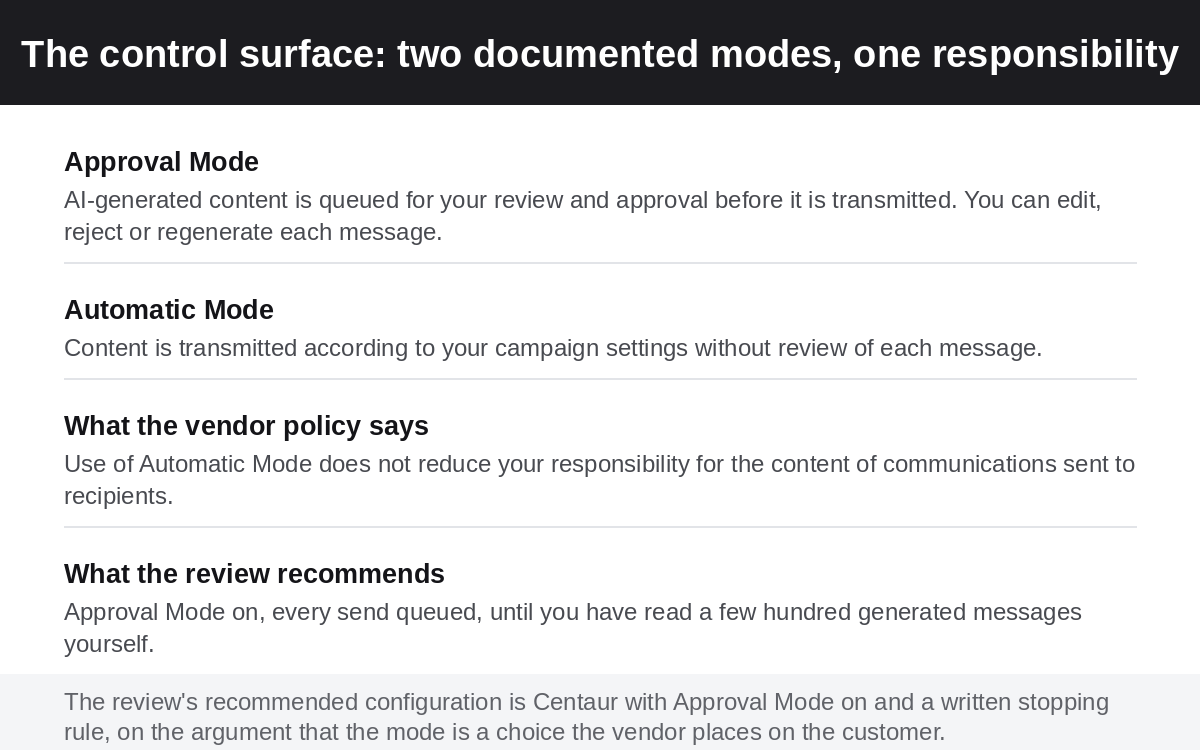
The vendor documents two modes. In Approval Mode, AI-generated content is queued for your review and approval before it is transmitted to recipients, and you can edit, reject or regenerate it. In Automatic Mode, content is transmitted according to your campaign settings without review of each message. Both the Artificial Intelligence Policy and the product feature page present Approval Mode as the control that keeps a human in the loop, and both are explicit that Automatic Mode does not reduce the customer's responsibility for what was sent.
What the agent does not do
It does not decide whether your offer is credible, whether the prospect is worth contacting at all, or whether a conversation should end. Those judgement calls are configured as rules, which is a different thing from being made.
Getting Started with Jason AI
A first-week path, in the order that protects you. Budget the whole first day for setup, and do not start with a large list.
1. Decide your mode before you buy anything. If the answer is Automatic Mode, stop here. Read Section 7c first. The recommended starting configuration is Approval Mode with every send queued.
2. Prepare your sending infrastructure before the tool sends anything.
Register a separate sending domain or subdomain for outbound, so a reputation problem does not reach your main domain.
Add and verify SPF, DKIM and DMARC records. The platform checks for these, and a missing record is a deliverability defect you are about to inherit.
Connect at least two mailboxes so you can rotate, and turn warm-up on before the first campaign.
Set the daily send limit per mailbox yourself. Start at 30 to 40 per mailbox per day and raise it only when inbox placement holds.
3. Connect the LinkedIn account you are willing to risk. Use an account you would accept losing temporarily, and keep the daily action count well inside the limits the platform suggests.
4. Write the offer and the playbook yourself. Do not let the agent generate the strategy. Write three things in your own words: what you sell, who it is for, and the one outcome you promise. This is the input the whole run depends on, and it is the input that carries your judgement.
5. Define your ICP from your own knowledge, then compare. Tell the tool your ICP first, then see what it proposes. Where the two differ, ask why before accepting. This is your first critical-thinking checkpoint and it costs ten minutes.
6. Build one sequence of three steps and read every message. Email, then a LinkedIn step, then one follow-up. Read each generated message as a recipient would. If you would not answer it, do not send it.
7. Run a small batch with Approval Mode on. Fifty contacts, one week, everything queued. You are testing the classification and the message quality, not the volume.
8. Set the stopping rules before you scale. Decide how many follow-ups a prospect receives, how long a silence lasts before re-engagement, and who reviews replies the agent cannot handle. Write these down. The agent will follow them and will not invent them.
9. Measure three things, not one. Count sends, count replies, and count meetings that occurred. Volume alone is the illusion this review names in the Imposture section.
Real Workflows
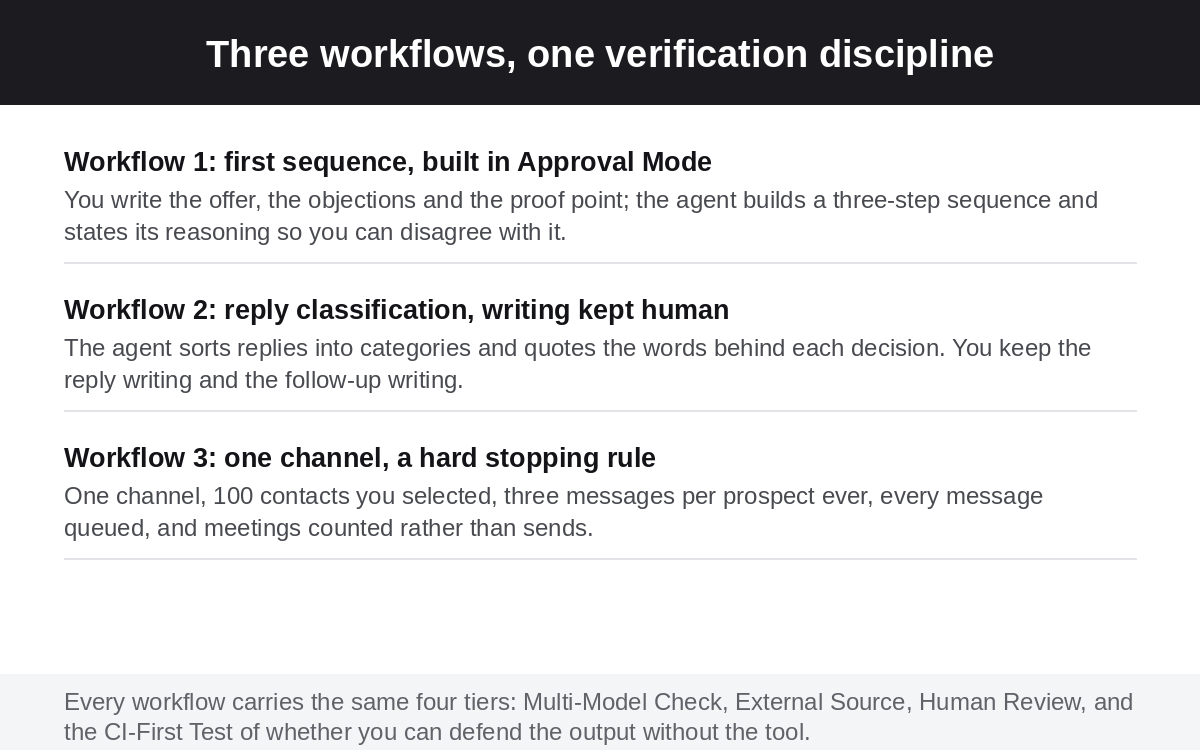
Each workflow below names the input you write, the prompt that carries your context, and the verification you owe before the output is yours. The UP-Context blocks are structured the way the U365 Prompting-Context method specifies: role, context, constraint, output.
Workflow 1: Build a first sequence from your own playbook, in Approval Mode
What it is for: You have an offer and an ICP and you want the first build done in an afternoon rather than a week, without surrendering the message.
Input you supply: Your offer in one paragraph, three objections you hear most, and one proof point per objection. You write this before you open the tool.
The prompt for this workflow, in the U365 prompting method.
Context: I sell [what you sell] to [who buys it], and I have run outbound by hand, so
I have a reply rate and a show rate of my own to compare against. My three most common
objections are [objections] and my proof point for each is [proof points]. My sending
setup is [mailboxes, domain records, warm-up state]. My review capacity is [how many
messages a week I can actually read].

Role: AI as a commercial strategist producing written artefacts for my review, not as an
executor. Do not write any message yet.

User-Persona: I am the Fellow and I own the offer, the profile and the stopping rule.
Take my market knowledge as the material and test it rather than replace it.

Audience-Persona: the buyer I am contacting, described in my own words as [one or two
sentences on what they care about and what makes them reply].

Task:
1. Restate my ideal customer profile as: industry, company size, job title, trigger, and
   the one disqualifier that removes a contact from the list.
2. Name every assumption in my profile that I have not evidenced, and say what evidence
   would settle each one.
3. Draft the offer and the value proposition using only the proof points I gave you, and
   list anything the draft asserts that my proof points do not support.
4. Propose the stopping rule as a decision I must confirm: maximum contacts per prospect,
   the silence period before the thread ends, whether re-engagement exists, and which
   replies leave the sequence immediately.
5. State the three decisions in this plan that must never be delegated to an agent, and
   why each one is mine.

Constraints: keep to my stated offer and proof points, and never invent a claim, a
customer name or a figure. Do not write messages. Do not propose a send volume above the
review capacity I gave you. If any part of my brief is underspecified, say which part and
ask rather than choosing for me.

Output format: the profile, then the unevidenced assumptions as a list, then the offer
draft with its unsupported claims, then the stopping rule as four lines to confirm, then
the three non-delegable decisions.
Memory disclosure: if this plan is produced inside U.Copilot, U.Copilot writes it to your UP-Context working notes. Nothing is written without your confirmation, and you can delete any line.
UP-Context verification: the plan is complete when you can defend the profile without the tool, name the evidence you still owe, and state the stopping rule in one sentence. If the profile reads as the agent's rather than yours, it is not yet your strategy. Verification checklist for Workflow 1:
☐ Multi-Model Check: run the same prompt through a second model with a different provider and compare the reasoning lines, not the wording.
☐ External Source: check every factual claim about the prospect or your proof points against the primary source before it leaves the building.
☐ Human Review: a colleague who sells reads all three messages and answers one question: would you respond to this?
☐ CI-First Test: can you explain and defend each message without the tool? If not, it is not ready.
Workflow 2: Let the agent classify replies and route them, keeping the writing human
What it is for: This is the workflow where the tool earns its cost with the least risk, and it is the one URC recommends as the default.
What it is: The agent reads incoming replies and sorts them into categories, and you keep the reply writing and the follow-up writing. The classification is mechanical, the judgement stays with you.
The prompt for this workflow, in the U365 prompting method.
Context: the agent has drafted these messages against my approved profile, offer and
proof points. The sequence is [channel order and steps]. My review capacity is [N]
messages a week. Here are the drafts: [paste the messages, each labelled with its step].

Role: AI as a critical reader standing in for the recipient, not as a copy editor and not
as a cheerleader. Your job is to find what would stop a reply.

User-Persona: I am the Fellow and I own the send decision. Judge each draft against the
recipient I described, not against your own taste in sales writing.

Audience-Persona: a busy buyer who receives cold email from people like me, reads the
first line on a phone, and decides in about three seconds.

Task:
1. For each draft, quote the line that does the most work and the line that does the least.
2. For each draft, state whether a factual claim, a figure or a promise appears that my
   proof points do not support. Quote it where it does.
3. For each draft, say whether the personalisation is something I could have found in
   thirty seconds, or whether it invents or misreads anything about the prospect.
4. Flag every draft that reads as templated to a recipient who gets a lot of cold email,
   and say which wording produced that reading.
5. Recommend per draft: send, rewrite, or reject. For every rewrite, give the replacement
   sentence. For every rejection, give the reason.
6. State what in this sequence would be different if I had written it myself.

Constraints: describe what the text does rather than what was intended. Never soften a
rejection to save my feelings. Do not rewrite the whole sequence; produce only the
replacements asked for. Do not present a claim as supported because it is plausible.

Output format: one short block per draft, then a table of draft, decision, reason, then
the replacements, then the one-line answer to question 6.
UP-Context verification: the review is complete when every message has a written decision with a reason, and when you can say which drafts you rejected and why. Keep the rejected drafts and the reasons, because the reasoning is the record that matters and a message looks finished whether or not a judgement was made. Verification checklist for Workflow 2:
☐ Multi-Model Check: classify the same thread with a second model and read the disagreements by hand. Independently reported classification accuracy clusters around nine in ten, which is high enough to route and not high enough to trust with nothing riding on it.
☐ External Source: confirm the qualifying condition against your own CRM record before a meeting is booked.
☐ Human Review: every reply the agent drafted for sending is read by you before it sends.
☐ CI-First Test: can you defend the routing decision to your sales lead without the tool?
Workflow 3: Run one channel with a hard stopping rule, and measure meetings rather than sends
What it is for: Testing whether the agent improves your pipeline, with the volume question answered separately from the quality question.
What it is: One channel, one list, one fixed number of follow-ups, and a measurement that counts meetings that occurred rather than messages sent.
Sequence and stopping rules you set before starting:
Channel: email only, from two warmed mailboxes.
List: 100 contacts you selected yourself.
Steps: three, with a maximum of three messages per prospect, ever.
Stop rule: the prospect leaves the sequence on any reply, including a negative one, and re-engagement is off.
Mode: Approval Mode, every message queued.
The prompt for this workflow, in the U365 prompting method.
Context: I ran [channel] for [period] against [N] contacts I selected myself, in Approval
Mode, with the stopping rule [rule]. The agent's dashboard reports [sends, opens, replies,
meetings booked]. My own hand-run baseline for the same period is [reply rate, show rate,
meetings held]. My CRM says [what actually happened].

Role: AI as an analyst producing an argued reading of the evidence, including where the
evidence is too thin to read.

User-Persona: I am the Fellow and I will have to defend this reading to [whoever approves
the spend]. Use my figures, and say when a figure is missing rather than estimating it.

Audience-Persona: whoever approves the renewal, who cares about meetings held, cost per
meeting and the exit route rather than about the tool.

Task:
1. Build the comparison between the agent period and the hand-run baseline, and show the
   arithmetic for reply rate, show rate and meetings held.
2. Name every figure in the dashboard I must not use as a result, and say what each one
   measures instead.
3. State how many messages I read of the total sent, and whether that ratio is high enough
   for the reading to be about my operation rather than about the tool.
4. Name the figure I do not have that would change the conclusion, and where it would come
   from.
5. Recommend one of three: continue as configured, change one specific setting, or stop.
   Name the condition under which that recommendation would be wrong.

Constraints: show the arithmetic rather than the conclusion. Treat a vendor-published
figure as a claim and my own CRM as the record. Do not present sends as a result. If a
number in the dashboard has no stated method, say so in those words.

Output format: the comparison table with arithmetic, then the unusable-figures list, then
the review ratio as one line, then the missing figure, then the recommendation and its
disconfirming condition.
UP-Context verification: the period is only measured when the number you report is meetings held and the review ratio is stated. If you are reporting sends, you are reporting the vendor's metric rather than your own result. Verification checklist for Workflow 3:
☐ Multi-Model Check: compare the agent's per-prospect personalization against your own reading of the same public profile, and count the cases where it found something you missed.
☐ External Source: verify inbox placement with an external placement test rather than the platform's own dashboard.
☐ Human Review: review the bounce list and the unsubscribe list weekly, not monthly.
☐ CI-First Test: compare meetings held against the same period run by hand. If the number did not move, the volume was not the constraint and the agent did not add pipeline.
Strengths, Limits, and AI Imposture Risk
Strengths
The platform under the agent is mature, and that matters more than the agent. The multichannel sequence builder combines email, LinkedIn, calls, SMS and WhatsApp in one flow with conditional branching, and independent reviewers across several sites describe it as the strongest part of the product. Sequences are conditional and dependency-aware, so a prospect who replies on LinkedIn leaves the email cadence cleanly.
Reply classification is the measured strength. Independent reviewers who ran the agent in production report classification accuracy clustering around nine in ten on the categories that matter for routing. That is the function URC recommends keeping when you turn everything else down.
The deliverability tooling is built in rather than bolted on. Mailbox warm-up, SPF, DKIM and DMARC checks, a validation step before a campaign starts, and sending windows that respect the prospect's time zone. Independent testers describe primary inbox placement in the low nineties per cent in their own runs, and one reports a bounce rate falling from a typical four to five per cent to under two per cent when the built-in validation step was used. Treat those figures as what one reviewer measured on one setup, not as a specification.
The onboarding sequence is well ordered. The platform walks you through mailbox connection and a warm-up toggle before it lets you send at volume, which is the correct order of operations for a tool that can damage a domain.
It is genuinely integrated rather than stitched. Two-way CRM sync with Salesforce, HubSpot and Pipedrive, mailbox connections by OAuth, Google Calendar booking, a REST API, an MCP server, a CLI and webhooks on every reply, open, click, bounce and LinkedIn event. For a team that already lives in a CRM, the agent arrives inside the stack rather than beside it.
Limits
Message quality is unmeasured by anyone, and that caps what can honestly be claimed. The vendor publishes no reply-rate study with a stated method. Independent reviewers describe auto-generated sequences as templated, and the same reviewers note that generated copy is identifiable to people who receive a lot of cold email. Nobody has published a controlled comparison of this agent's messages against human-written messages for the same list. That absence is not proof of poor quality and it is not a reason to assume quality either.
Approval Mode is a documented option, and the vendor does not state that it is the default. URC could not find a vendor surface that says new accounts begin with review required before sending. The Artificial Intelligence Policy defines Approval Mode and Automatic Mode side by side and places the choice on the customer. A control you have to know to switch on is not the same control as a default.
The agent writes durable artefacts, and the approval gate does not cover them. The playbooks, the ICP definition, the generated sequences, the re-engagement rules and the knowledge base persist and are reused on later runs. Approval Mode governs messages, not the strategy that produces them. This is the mechanism behind the High Skill Illusion rating.
Deliverability monitoring stops at the mailbox. Independent coverage reports that the platform watches the message and the mailbox but does not watch the infrastructure underneath: no built-in blacklist monitoring, no sender-reputation decay tracking, no DNS drift alert across sending domains. One reviewer's warning is direct and worth repeating: the default sending speed is aggressive, and accepting the defaults on a fresh mailbox will land you in spam.
The LinkedIn channel carries account risk, and it is your account. The automation drives your logged-in session through a browser extension. Reviewers report restrictions and temporary blocks, and while the exposure is a property of automating LinkedIn rather than a defect unique to this vendor, you are the one taking it.
Enterprise and multi-stakeholder selling is out of range. Reviewers report the agent works best on single-contact, mid-market accounts and does not navigate a buying committee. Any reply that is not a clean yes, no or later tends to need a human, and reviewers report cases where the agent answered and got it subtly wrong.
Pricing is metered in a way that is hard to predict, and the published entry points disagree with each other. The platform is priced per seat and the agent is priced separately by contact volume. Third-party listings for the same agent tiers quote entry figures from $259 to $800 per month, and one notes that the entry figure behaves as a promotional floor with a renewal step. Billing complaints are the dominant negative theme in community coverage.
AI Imposture Risk
Time Illusion: Medium. The time savings are real and they are not free. Setup involves mailbox connection, domain records, warm-up, ICP configuration, playbook writing and tone calibration. Independent reviewers report spending six or more hours refining prompts and objection handling before performance became acceptable, and multiple reviewers name a steeper-than-expected learning curve. The honest reading is that the tool saves time on tasks you have already learned to do and charges you a real configuration cost up front, plus an ongoing cost of rescuing replies it cannot handle. That is a moderate net saving for a prepared team and a net loss for an unprepared one.
Quantity Illusion: High. The product's central claim is volume: contacts sourced at scale, sequences built at scale, messages personalised at scale, meetings booked automatically. Volume of sends is exactly the metric that can rise while nothing else does. Independent measurement on this point is thin and inconsistent. One reviewer reports testing the agent over two months and seeing twelve to fifteen meetings a month at a thirty-five per cent show rate, with the entry price positioned as replacing a junior salary. Another reports that generated sequences underperform equivalent human-written sequences for experienced senders. Automated volume is not pipeline, and the dashboard will show you the volume either way. This trap is High because the illusion is built into the business model: the metered unit is contacts, so the tool is paid more when you contact more.
Skill Illusion: High. This is the trap that deserves the most attention, and the mechanism is specific. The agent writes your sequences, your playbooks, your ICP definition and your re-engagement rules, and those artefacts persist and get reused. You end up running a documented outbound capability you did not author. The approval gate covers individual messages and does not cover the strategy, so the part you are least likely to read is the part that shapes everything else. Independent reviewers corroborate the dependency pattern from the other side: the agent requires careful prompt engineering to avoid generic output, which means the skill it takes over is the skill you most need to keep. See the clause note below.
Overall AI Imposture Risk: High, the highest recorded in this review series so far. Two traps are High, Quantity Illusion and Skill Illusion. The mitigation is available and it is the subject of Section 8: keep the writing and the judgement, delegate the mechanical routing, and treat the generated strategy as a proposal you must be able to defend.
Framework v1.2 clause note
Three clauses from framework v1.2 were tested against this tool. All three apply. None returns a null. This is the first review in the URC series where all three apply positively.
Clause 5.2.3-a, agent-authored procedural memory: applies. Skill Illusion is rated High.
The mechanism: Jason AI creates and revises the customer's outbound strategy artefacts. It generates the ideal customer profile from your brief, builds the sequences, authors the playbooks the agent then executes, writes re-engagement rules that define when and how a prospect is contacted again, and maintains a knowledge base used to answer objections. These are procedural memory in the clause's sense. The vendor describes the playbooks as either authored by the customer or generated by the agent, and describes the ICP as something the agent defines. The artefacts are durable: they persist between campaigns and shape every later run.
The clause sets a floor of no lower than Medium for any tool that writes procedural memory on the user's behalf, even where a write-approval gate exists. This tool clears that floor and reaches High, for the second limb of the clause: the agent can create and revise these artefacts during use without a per-write human decision. Approval Mode is defined in the vendor's own policy as governing AI-Generated Content transmitted to recipients, which is messages. It does not impose a per-artefact review of the playbook, the ICP or the re-engagement rules. The user can read what was written, and nothing in the product requires them to. URC therefore applies the clause rather than the floor.
Clause 4.2-a, agent-mediated conversation: applies. Social Authenticity is rated -1.
The clause draws a boundary that this review respects in both directions. Agent-mediated conversation is not erosion by itself, and channel composition is neutral: a tool that routes traffic across email and LinkedIn erodes nothing on that ground alone. Erosion under this clause requires one of two conditions, and condition (a) is met here. Condition (a) is agent-authored text presented as the person's own voice in a human-facing channel. Jason AI writes the message, sends it from the user's own mailbox or acts on the user's own LinkedIn account, and signs nothing. The recipient reads a personal approach from a named person. The vendor's Artificial Intelligence Policy states that AI-generated content is clearly labeled in the platform, and that is true of the dashboard and not of the message: no label reaches the prospect. The user is the author in the only sense the recipient can observe. Condition (b) is not met by the default configuration, because the agent is a tool inside a human-run sales motion rather than a replacement for human contact, and this review does not argue it. Condition (a) alone is sufficient, so the rating is -1.
Clause 7.5, team-level rooms: applies in one configuration, and returns a null in the common case.
In the common case the answer is a null. A single Jason agent working the customer's own channels is one AI in one operating context, with the human reviewing per stage. That is not a room shared by several agents. The clause bites in the configuration the vendor now sells directly: a headless version of the agent, marketed to other AI agents over an API, an MCP server and a CLI, in which a customer's own agent and Jason both act on the same sales channel. That is several AIs in one channel. Where it is used, the clause applies: attribute a profile to each agent individually before the channel opens, write a task boundary per member, review output per member, and treat Cyborg as unavailable. The headless surface is named here as a clause 7.5 application and is not separately scored in this review, because URC found no independent description of its behaviour in production.
Section 7c: Data use, training, and who is responsible for what the agent sent
This section exists because the terms are the finding for this class of tool. A review of an agent that writes in your name and sends from your account is incomplete if it scores the product and never reads the contract. This section covers the vendor's Artificial Intelligence Policy, its Terms of Service, its Privacy Policy, its Data Processing Agreement and its trust page. It states the operative text, distinguishes the vendor's promises from its contractual position, and says plainly where the two do not match.
The responsibility clause is unambiguous, and it is on you
The Artificial Intelligence Policy places content responsibility on the customer in terms that leave no room for reading it either way. Quoted verbatim:
You are responsible for selecting the appropriate mode for Your use case and for reviewing AI-Generated Content as necessary before use. Use of Automatic Mode does not reduce Your responsibility for the content of communications sent to recipients.
The Terms of Service repeats the same idea in the customer-responsibilities section, quoted verbatim:
You are responsible for reviewing AI-Generated Content before use and for ensuring that your use of AI-Generated Content complies with applicable law, these Terms, and the AI Features Terms.
The finding. The vendor offers an autonomous mode and documents, in its own policy, that using it does not transfer any responsibility for what it sends. There is no indemnity for content the agent produced, and no promise that the agent's output will be accurate or lawful. If the agent writes a claim you would not have made, offers a discount you never approved, or misreads a sarcastic reply, the customer is the sender in law and in practice. Independent reviewers report exactly those three failure modes.
What the vendor promises about your data and training
The no-training commitment appears on four surfaces, quoted verbatim:
Except as expressly agreed in writing, Reply does not use Your Data to train generalized artificial intelligence or machine learning models for the benefit of other customers.
Reply requires Third-Party AI Providers, through applicable agreements and provider settings, not to use Your Input Data for model training or any purpose other than generating outputs in response to Your requests.
Customer data is never used to train AI models.
We will not use Your Data to train generalized artificial intelligence or machine learning models for the benefit of other customers unless expressly agreed in writing.
The first two are from the Artificial Intelligence Policy, the third from the same policy's data-protection section, and the fourth from the Data Processing Agreement.
Vendor against vendor. The first, second and fourth statements are conditional: no training except as expressly agreed in writing. The third statement is absolute: never. These are not the same promise in the same document, and the absolute version is the one a reader is most likely to repeat. The conditional version is the operative one, because it is the version that appears in the binding terms and the Data Processing Agreement. A reader should rely on the conditional form.
What the vendor claims about the output
The Terms of Service states, quoted verbatim:
To the extent AI features within the Services generate AI-Generated Content, as defined in the AI Features Terms, derived from Your Data, Reply does not claim ownership of that AI-Generated Content.
The Artificial Intelligence Policy states, quoted verbatim:
Customers retain full ownership of both input data and AI-generated outputs.
The Artificial Intelligence Policy also states, quoted verbatim:
All AI features are designed to augment human capabilities, not replace them.
Vendor against vendor. The ownership position is consistent and generous. The augmentation claim is not consistent with the vendor's own commercial surfaces. The agent is sold as taking on the full top-of-funnel motion the way a dedicated sales development representative would, and third-party reviewers of the pricing describe it as positioned to replace a junior SDR's salary. A tool sold as a replacement and described internally as an augmentation is described two ways, and the sales claim is the one that reaches a buyer first.
What the vendor does not disclose in the message
The Artificial Intelligence Policy states, quoted verbatim:
Clear labeling of all AI-generated content in the platform
This is the whole of the disclosure surface. The label is in the platform, which is to say in your own dashboard. No label, marker or disclosure reaches the recipient of the message. The policy's transparency section is therefore accurate as written and does not describe a transparency duty toward the person being contacted. This is the operative fact behind the Social Authenticity finding in this review, and it is the reason the labeling claim is treated as true and insufficient rather than as a defect.
The allegations, stated as allegations
Community and review coverage of this vendor contains recurring claims that URC could not verify from a primary source and did not treat as findings. They are named here so a reader weighting the community evidence knows what is contested.
Allegation: emails were sent without the customer's say-so, and sender reputation was damaged as a result.
Allegation: billing problems, including auto-renewal confusion, a minimum term that reviewers describe as undisclosed, and difficulty cancelling.
Allegation: LinkedIn account restrictions following automated activity.
Allegation: support response times lengthened through 2025 and 2026.
Distinct from finding. A finding in this review is a statement supported by a vendor primary source or by an independent evaluation with a stated method, which the reader can check. An allegation is a pattern of user report. The billing and support allegations are patterns across review platforms. The deliverability and LinkedIn allegations describe harms that are mechanically plausible for this class of tool, and which the vendor's own policy language acknowledges by placing responsibility for content and mode selection on the customer. None of them is a finding here.
No sub-score changed, and why
The Humics rating, the Imposture ratings and the Benefit dimensions were set before this section was written and are unchanged by it. That is deliberate, and the reason is the framework's structure. The CI-First framework measures benefit to the human and the three Humics. It has no dimension for contract terms, data practice, indemnity or supplier conduct. Section 7c is not a scoring channel and adding weight to it would break the comparability of every earlier review in the series, where the same rule holds.
The terms did not change a score. They changed what a reader should do. The responsibility clause is the reason Approval Mode is a condition of the recommended configuration rather than a preference. The conditional no-training promise is the reason a reader should rely on the binding wording and not the absolute wording. The in-platform-only labeling is the reason the Social Authenticity finding reads as it does, and it is a fact cited inside a dimension that had already been scored -1.
What this section does not do
This section does not provide legal advice, and it is not a substitute for reading the vendor's own terms in full before you buy. It does not resolve which jurisdiction's law applies to your contract, and it does not assess whether a specific campaign would comply with the anti-spam and consent rules that apply where you and your prospects are located; the vendor's acceptable-use rules prohibit unsolicited commercial messages and the vendor's policy places compliance on you. It does not audit the vendor's security controls, and it does not certify the no-training promise, which URC can report as stated and cannot verify. It does not present the allegations above as established, and it does not argue any of them.
U365 Co-Intelligence Rating
CI-First Profile
Primary: AI as Co-Worker and Assistant (profile 2). Jason AI executes work you direct: it sources contacts, drafts sequences, sends messages, answers replies and books meetings. You set the offer, the ICP and the playbook, and it runs them. That is the definition of profile 2, and the profile's evaluation implication applies directly: profile 2 tools are expected to produce reliable output that needs minimal correction, and a tool that needs heavy correction creates the Time Illusion. The independent evidence says the correction load is real on message quality and low on classification, which is why this review recommends keeping the classification half.
Secondary: AI as Analyst and Tester (profile 4). The reply classification layer reads a body of replies, sorts them, and reports which need attention. When the prospect gives it something to work with, it also surfaces public context about a prospect. That is analysis and pattern-finding, and your job is to interpret the result and decide. The profile's implication also applies: profile 4 tools should show their work. This one produces a category without showing why, unless you ask for the evidence, which is why every workflow in Section 6 includes a request for the reasoning or the quotation.
Jason AI is not assigned profile 1, 3 or 5. It does not co-create strategy with you in the sense of building on your thinking, it does not teach, and it does not challenge you. It executes and it sorts.
Collaboration Mode
Recommended mode: Centaur. The alternative considered and rejected is Cyborg.
The rationale follows the framework's own rule rather than a preference. Framework clause 7.2 states that a tool whose Imposture Risk is Medium or High is safest in Centaur mode, and this tool's Imposture Risk is High, with two of the three traps at High. The division of labour is also genuinely available here, which is what makes Centaur the right answer rather than merely the safer one: the agent is strong at mechanical work, meaning the sourcing, the routing and the scheduling, and weak at the judgement work, meaning what to say and when to stop. There is a clean line to draw between the two, and the framework's Centaur definition is exactly a clear division of labour in which the human keeps strategy, empathy and final judgement.
Cyborg is not recommended. Cyborg requires rapid real-time iteration with no clear boundary between who does what, and it is only appropriate where Imposture Risk is Low. Here the risk is High and the artefact the agent writes persists beyond the session, so an interleaved real-time loop with no boundary is the configuration in which the strategy drift goes unnoticed.
The boundary for a Centaur setup, stated concretely:
The agent does: source contacts against your ICP, build the sequence structure, classify replies, draft objection responses for your review, propose meeting times, and hold the follow-up schedule.
You do: write the offer and the playbook, approve the ICP, read every message before it sends, decide who is worth a second contact, write or rewrite any reply that is not a clean yes or no, and decide when a thread ends.
You never delegate: the claim you make about your product, the qualification of a lead, and the decision to keep contacting someone who has gone quiet.
CI-First Benefit Score
Dimension | Score | Basis |
Time Benefit | 6 | Moderate net savings for a prepared team. Setup and refinement cost is real, and the classification layer returns time on every batch of replies. |
Quantity Benefit | 6 | Moderate increase. Contact volume and sequence throughput rise substantially, and the usable part of that rise depends on your review capacity. |
Quality Benefit | 5 | Moderate, and capped by the absence of measurement. Classification improved measurably; message quality is judged only by reviewers' impressions. |
Knowledge and Skill Benefit | 3 | Marginal. The tool does the outbound writing and research for you more than it teaches them, and it writes the strategy artefacts you then operate. |
CI-First Benefit Score | 5.0 / 10 | CI-First Positive |
Calculation: (6 + 6 + 5 + 3) / 4 = 5.0.
Why this score is not higher, and why it is not lower
Why not higher. The Quality dimension is where a higher score would have to come from, and Quality is 5 rather than 7 for a specific and stated reason: there is no independent measurement of this agent's message quality with a published method. The vendor publishes no reply-rate study, and the independent reviewers who tested the agent in production report impressions, not controlled comparisons. URC scores the absence of measurement down rather than assuming the vendor's unmeasured claims are correct. That is a deliberate choice, and the band sits next to the low sub-score: Quality 5 is Moderate, one point above Marginal.
The Skill dimension is 3 for a related reason. The agent takes over the outbound writing and the prospect research rather than teaching them, and it writes durable strategy artefacts you then operate. That pattern substitutes for skill more than it builds it, and the framework says to score conservatively here when in doubt.
Why not lower. The Quantity dimension is real despite the illusion risk. A team that reviews messages can genuinely contact several times the number of prospects in the same week, and the platform's own infrastructure, meaning the warm-up, the validation step and the sending windows, is part of why the higher volume does not automatically become a deliverability problem. The Time dimension is genuinely positive for a team that has already done the learning: reply classification alone returns hours on a large inbound set. And the reply classification is the one function with independent support near nine in ten accuracy, which is a real capability and not a marketed one.
Humics Protection Badge
Humic | Rating | Basis |
Creativity | 0 | You author the offer, the ICP and the playbook; the agent executes the composition. It neither sparks your ideas nor replaces them, which is neutral by the framework's definition. |
Critical Thinking | -1 | The agent defines the ICP, builds the sequence, writes the playbook and sets when to stop following up. Those are judgement calls, and the independent evidence shows the quality of the whole run depends on whether you interrogate them. |
Social Authenticity | -1 | Messages written by software are sent from your mailbox and acted out on your LinkedIn account in your name, with no disclosure reaching the recipient. This is framework clause 4.2-a condition (a), and it is the crux of this assessment. |
Humics Protection Score | -2 | Humics-Risky |
On Critical Thinking, and why it is -1 rather than 0. The framework asks whether the tool requires you to evaluate and verify, or encourages blind trust, and whether you are more or less capable of independent analysis after a month. The mechanism here is that the tool makes the judgement calls for you by default. It defines the ideal customer profile, it builds the sequence structure, and it writes the re-engagement rules that decide when a quiet prospect is contacted again. Each of those is a decision a salesperson should be making, and the tool presents each one as a finished artefact you can accept. Nothing in the product requires you to interrogate them. You are not stopped from thinking, and the tool does not deceive you, but the default path runs past the judgement. That is erosion of the kind the framework describes, so the rating is -1 rather than a neutral 0.
On Social Authenticity, the crux. This is the strongest candidate in this batch for Humics erosion and URC does not soften it. The condition in clause 4.2-a is met exactly: agent-authored text is presented as the person's own voice in a human-facing channel. The message is composed by software, sent from the customer's mailbox or acted out through the customer's LinkedIn account, and signed by the customer alone. The vendor's Artificial Intelligence Policy states that AI-generated content is clearly labeled in the platform, and the platform is the customer's own dashboard: the recipient of an email or a LinkedIn message receives no label, no marker and no indication that a machine wrote the words and pressed send. The recipient forms a judgement about a person from a message that person did not write. Sustained use means your outbound correspondence is no longer your own voice in the only place that matters, which is the recipient's inbox.
Why the approval step does not make this neutral. URC considered the argument that a per-message approval gate restores the human voice, and rejected it. The reasons are specific to the evidence. Approval Mode is documented as an option, and URC found no vendor surface stating that new accounts begin with review required before sending, so the tool's default state is not established as human-authored. More importantly, approving a message is not the same act as writing it, and the framework measures the human's own communicative capability, not the human's editorial veto over a machine's draft. Approving machine-written text at scale is a review activity, and the voice that reaches the prospect is still the machine's composition attributed to you. Clause 4.2-a treats agent-authored text presented as your own voice as the erosion case, and it does not carve out an approval gate. The rating is -1.
Superhuman Usage Guidance
When to invite Jason AI.
When you have a proven offer and a named ICP, and you want the mechanical share of outbound removed.
For reply classification and routing on a high inbound volume. This is the strongest and safest use, and it is the one function the evidence supports.
For sequence structure and scheduling: the ordering of steps, the delays, the branching and the calendar booking.
For prospect sourcing against an ICP you wrote yourself, treating the results as a candidate list to filter rather than a list to send to.
When to keep it out.
Never run Automatic Mode on a sending domain you cannot afford to lose, and not before you have read a few hundred generated messages with your own eyes.
Do not delegate the ICP definition. Take the agent's version as a proposal and compare it against your own.
Do not delegate the offer, the pricing claim or the promise you make. Those are the words that create your obligations.
Do not let the agent handle a reply that is not a clean yes, no or later without a human reading it first.
Do not point it at a list you have not qualified, and do not let the re-engagement rules keep contacting someone who has gone quiet.
U365 method integration.
Apply the UP-Context method to the agent's instruction set. Role, context, constraint and output, written down, are what turn the agent's output from generic to usable, and the same discipline that makes any AI work makes this one work. The vendor's own dependency on a playbook and a knowledge base is the UP-Context principle arriving from the product side.
Use the EVA cycle of ULM as the operating rhythm: Explore the prospect and the objection, Visualize the sequence and the stopping rule, then Act by approving the messages. The Explore and Visualize stages are yours, and the Act stage is where the agent helps.
Use the LIPS and CARE discipline to keep the outbound knowledge in your own second brain rather than only inside the agent's knowledge base. What you learn about who responds and why belongs in your own system, or it belongs to the tool.
Keep the stopping rules inside your own written process, and keep the ULM principle in view: a metric that rises while quality does not is an imbalance, not progress.
Over-delegation warning. The failure mode for this tool is not technical, it is gradual. You start by reviewing every message, then you review the first few of each batch, then you trust the batch, and the voice your prospects meet is no longer yours. Set the review rule as a written policy and keep the ratio of messages you read above zero and visible, or the Humics rating in this review is describing your practice and not the tool.
What Users Say
Aggregate Rating Table
Ratings below are what URC could reach through search indexing and published summaries. Where a platform could not be read directly, the figure is reported as indexed and no number is drawn from a page URC could not read. Where the platforms disagree, both figures are shown.
Platform | Rating | Reviews | What it reflects |
G2 | 4.6 / 5 | 1,528 reviews, per a review site citing G2 with a checked date of 2026-04-27 | The platform overall, not the agent alone. G2 reports Leader status and multiple Summer 2026 badges. |
G2, separate sample | 4.7 / 5 | 15 reviews | A small recent sample reported by an independent reviewer, and the sample size is why it reads higher than the aggregate. |
Trustpilot | Low, with a reported 13 per cent one-star rate | Not established from a readable page | The negative theme is billing rather than features. URC could not read the platform directly and reports this as an indexed summary. |
A caution that applies to every figure in this table: the review platforms for this vendor aggregate the whole Reply.io platform, which is a twelve-year-old sales engagement product. The number of reviews that specifically assess Jason AI, the agent, is far smaller than the number that assess the sequencer. A 4.6 on 1,528 reviews is a strong signal about the platform and a weak signal about the agent.
What Users Praise
Multichannel sequences in one flow. The most consistent praise across platforms is the ability to run email, LinkedIn connection requests, InMails and calls inside one sequence without a large operations team. Reviewers describe conditional branching that behaves as expected.
The reply probability score and the granular sequence controls. Named repeatedly by G2 reviewers as the features they rely on.
Deliverability tooling and support responsiveness. Several reviewers single out the deliverability team and the support function as proactive, and one reports cutting daily outbound work from three to four hours to under one hour.
Setup speed. Reviewers report a first sequence running in under twenty minutes to about an hour, which is faster than enterprise alternatives in the same category.
Reply classification. Independent testers report classification accuracy clustering around nine in ten, high enough to use for routing.
What Users Complain About
Message quality reads as templated. Multiple G2 reviewers describe the generated output as template-feeling and note that editing is required before every send. Independent reviewers report the same, and one states the personalization rarely surfaces anything a competent salesperson could not find in thirty seconds.
Reply rates lagging human-written sequences. Community reports describe generated sequences underperforming equivalent sequences written by an experienced person, with the recurring explanation that AI-generated personalization is identifiable to experienced recipients.
Setup and learning curve. Reviewers describe the initial setup and the learning curve as steeper than expected, and one independent reviewer reports six or more hours of prompt refinement before performance became acceptable.
Autonomous mode behaving as a beta. One reviewer reports letting the agent run a campaign end to end and, within a week, seeing it send a reply that misread a sarcastic prospect and another that offered a discount the reviewer had not approved. Treat automatic mode as something you supervise.
Billing. The dominant negative theme on review platforms is billing: auto-renewal confusion, a minimum term reviewers describe as undisclosed, and difficulty cancelling.
Enterprise and multi-stakeholder limits. Reviewers report the agent works best on single-contact, mid-market accounts and not on a buying committee.
Reporting split across old and new dashboards. Named by reviewers as an inconsistency that costs time.
No way to parallelise actions. One reviewer notes that you cannot contact someone in parallel across email and LinkedIn in the same sequence, so LinkedIn can become a bottleneck.
Sentiment Summary
Sentiment on the platform is strongly positive and sentiment on the agent is more mixed than the aggregate suggests. Where the two diverge is worth stating plainly: the platform is a mature product with years of user experience behind it, and the agent is a newer layer whose users report a specific pattern of disappointment on message quality and autonomous replies, alongside a specific pattern of satisfaction on classification and scheduling. A reader who reads only the headline rating will overestimate the agent.
U365 Editorial Note
URC did not fabricate any figure in this section. Where a rating came from an indexed summary rather than a page URC could read, the text says so. Where a review platform could not be read directly and a figure could not be established from a readable source, no figure is given. An unreadable platform is treated as unjudged rather than as empty, and links to the platform root rather than to a specific thread it could not read. The review counts here describe the vendor's platform, and no count in this section describes the Jason AI agent alone, because no such separate count is presented by any platform that could be read.
Comparison and Alternatives
Three to five alternatives, each with the condition under which you should choose it over Jason AI.
Choose Clay and a standalone sequencer if your bottleneck is data and research quality. You get the most configurable enrichment and research layer in the category and pair it with an email or multichannel sender of your choice. You give up the single product where prospecting, sending and reply handling live together. This is the right shape when your ICP is technical and the personalization has to be genuinely deep rather than fast.
Choose Smartlead or Instantly if cold email is your whole game and inbox placement is the metric that decides revenue. Both invest far more heavily in sending infrastructure than Reply.io does: rotating inbox pools, reputation dashboards, and monitoring that reaches the domain and the DNS rather than stopping at the mailbox. You give up LinkedIn, calls, SMS and the AI SDR layer. This is the right shape when you run dozens of mailboxes and need to see the infrastructure underneath.
Choose Apollo.io if prospecting data is your constraint and outbound execution is secondary. The contact database is deeper, and the sequencer has closed most of the feature gap. You give up the maturity of the agent layer. This is the right shape when list building is the thing that costs you days.
Choose Outreach or Salesloft if you are an enterprise sales organisation with complex compliance and admin requirements. Both handle large-team administration and enterprise process better. You pay roughly double and you give up the AI SDR ambition. This is the right shape when the org chart matters more than the automation.
Choose a human SDR, or a human reviewing Jason AI, if the judgement calls are the expensive part. No product in this category replaces the decision about what to say and when to stop, and the vendor's own policy says the responsibility for it stays with you. This is the right shape when your credibility with a small number of high-value prospects is worth more than contacting a large number of them.
Choose Jason AI over all of the above if you want one product where prospecting, multichannel sending including LinkedIn and calls, reply classification and calendar booking already work together, and you will keep the writing and the judgement. That is a real and narrow advantage, and it is the configuration this review recommends.
Verdict and Next Steps
The verdict. Jason AI is a capable execution layer on a mature platform, sold as something larger than it is. The parts that work are the parts that are mechanical: sourcing, sequencing, scheduling, and above all reply classification, which is the one capability with independent support near nine in ten accuracy. The parts that are marketed hardest are the parts the evidence does not support: autonomous message quality, and volume as a proxy for pipeline. The vendor's own Artificial Intelligence Policy documents that Automatic Mode does not reduce your responsibility for what was sent, which is the single most useful sentence in the whole documentation set for a buyer deciding how to configure it.
Scored honestly for the common case net of overhead, it is CI-First Positive at 5.0, Humics-Risky at -2, with High Imposture Risk driven by two traps at High. It is worth adopting for a narrow and well-defined shape of user, in Centaur mode, with Approval Mode on and a written stopping rule. The alternative to that discipline is not a worse version of the same result; it is outbound at volume, in your name, that you did not write and did not read.
Next steps, in order.
Write your offer, your ICP and your three objections in your own words before you sign up. If you cannot, this tool is not your constraint.
Set up a sending subdomain and verify SPF, DKIM and DMARC before you connect a list.
Configure Approval Mode and confirm in the interface that review is actually required before a first send. If you cannot confirm it, treat every send as unreviewed and read them yourself.
Run Workflow 2 first, classification only, for two weeks. Confirm the value before adding the writing.
Set the stopping rules in writing: maximum follow-ups, silence duration, and who handles replies the agent cannot.
Compare meetings held against a hand-run baseline over the same period. Judge the tool on meetings, not on sends.
U.Copilot integration
U.Copilot is the front door to the U365 tool library, at https://www.university-365.com/ucopilot. Route through U.Copilot before the first send rather than before the first prompt, because the decisions in this tool are commercial decisions and the writing is the part it takes over. A Fellow who has written the profile, the offer and the stopping rule with U.Copilot arrives at the tool with the only assets worth assessing.
Route Fellows to Jason AI when they
Already have a proven offer and a named buyer, and want the mechanical share of outbound removed
Need reply classification and routing at a volume no human can read in a sitting: this is the strongest and safest use, and it is the one function with independent support
Need sequencing and scheduling handled: step order, delays, branching and calendar booking
Want prospect sourcing treated as a candidate list to filter rather than a list to send to
Are running outbound for several clients and need workspace separation with per-client reporting
Route Fellows away from Jason AI when they
Are learning sales for the first time, because the skill they most need at that stage is deciding what to say and when to stop, which is exactly what the tool takes over
Need to keep their own writing exercised, because the composing is done for them and the writing practice leaves the working week
Cannot read every message before it sends for the first weeks, because that review is the condition that keeps this tool inside its safe range
Cannot afford to lose a sending domain, because Automatic Mode is a documented option and the responsibility for what it sends stays with the Fellow
Need a measured quality guarantee, because no independent measurement of this agent's message quality exists
Sell to a buying committee, because the agent works on single-contact mid-market accounts and a reply that is not a clean answer needs a human
U.Copilot prompt example for Fellows
I am a U365 Fellow in UIB (Business Management, Entrepreneurship). I want to use Jason AI
for [the outbound motion] and I want the commercial decisions to be the part I own.
Include:

1. The CI-First Profile and the Collaboration Mode for this session, with Centaur as the
   mode and the reason stated
2. A written profile of my buyer, my offer, my proof points and the one disqualifier,
   before any message is drafted
3. The stopping rule as a decision I confirm: maximum contacts per prospect, the silence
   period, whether re-engagement exists, and which replies exit the sequence
4. My per-stage review rule, written down: how many messages a week I read, and how I keep
   that ratio visible
5. The three decisions that never leave me: the claim I make about my product, the
   qualification of a lead, and the decision to keep contacting someone who has gone quiet
6. The measurement plan: meetings held against a hand-run baseline, with the metric I
   refuse to judge on named in advance
7. A first-week exercise: classification only, no sending, and a comparison of the agent's
   categories against my own reading of the same replies
8. The record I keep in LIPS under CARE, and which parts of this workflow I must do myself
U.Copilot guardrails
State the score beside the risk. 5.0/10, CI-First Positive, with High AI Imposture Risk and all three trap rows named, rather than the overall level alone.
Never present a message the agent wrote as the Fellow's writing. The competency this tool exercises is evaluation, and the review's Social Authenticity finding is stated beside any claim about the Fellow's communication work.
Never let a send volume stand as a result. The metric is meetings held against a hand-run baseline; sends, opens and contact volume are activity.
Never describe an agent-written profile, playbook or sequence as the Fellow's strategy unless the Fellow wrote it, compared it against the agent's version and recorded the decision. Those artefacts persist and are reused, which is the Skill Illusion mechanism.
Never present an agent-versus-hire cost comparison without the renewal price, because the review records the entry figure behaving as a promotional floor.
Never present a vendor reply-rate or placement figure as a measurement. No published method exists, and the review caps Quality at 5 for that absence.
Never state or imply that a run produced this review. The version field records the documented release and the date records when the sources were read. The published post says nothing beyond that, and it does not explain how the sources were reached.
Never recommend Automatic Mode as the default configuration, because the review's own recommendation is Centaur with Approval Mode on and a written stopping rule.
Never store credentials, API keys or mailbox details in LIPS. Use the tenant's secret store.
Tool-choice framing
Present the trade rather than a default:
Prospecting, multichannel sending including LinkedIn and calls, reply classification and calendar booking in one product: Jason AI is the fit, and it is the narrow advantage the review names.
Sending infrastructure and inbox placement above all: a deliverability-first sender is the fit, because the review records that this platform's monitoring stops at the mailbox.
Data depth and research quality: an enrichment platform paired with a sender of your choice is the fit.
Enterprise multi-stakeholder selling with heavy administration: an enterprise sales platform is the fit, at roughly double the cost.
A measured message-quality guarantee: no tool in this class is the fit, because no independent measurement exists.
Learning to sell: a human-led programme is the fit. This tool removes exactly the practice a beginner needs.
SL-OS integration
Jason AI fits SL-OS as an execution layer the Fellow directs and supervises, with the record kept in LIPS. It does not hold the Fellow's commercial judgement and it does not hold the stopping rule. An outbound motion enters SL-OS only with the written profile, the offer, the stopping rule and the review record that make the decisions defensible.
LIPS Digital Second Brain record
For every substantive Jason AI engagement, store under the relevant LIPS Project, or under Career and Finance for skill development, one record containing:
The ideal customer profile the Fellow wrote, the agent's generated version, and the written comparison with the decision
The offer, the proof points and the constraints placed on the agent
The stopping rule as confirmed: contacts per prospect, silence period, re-engagement on or off, and the replies that exit the sequence
The per-stage review rule, and the review ratio actually achieved, meaning messages read against messages sent. This is the field most likely to be omitted and the one that matters most, because the review ratio is the only place the Social Authenticity finding can be caught
The messages accepted, rewritten and rejected, with the reason for each rejection
The agent's generated profile, playbook and re-engagement rules, marked as agent-authored, with the Fellow's decision on each
The measurement: meetings held against the hand-run baseline over the same period, and the metric the Fellow refused to judge on
The decisions retained by the human, named before the period started rather than after
The Fellow's own statement of what they did and what the agent did
CARE cycle
Collect: save the profile, the offer, the stopping rule, the review log, the rejected messages and their reasons, and the measurement figures.
Action Plan: before the first send, write the profile, the offer, the constraints, the stopping rule, the review rule and the decisions that stay human.
Review: read each message before it sends, judge the agent's profile and playbook against the Fellow's own, and read the period's numbers against the hand-run baseline rather than against the dashboard.
Execute: accept the period with the decisions recorded, the review ratio stated, and the learning outcome written by the Fellow rather than copied from the agent.
ULM and EVA
Career and Finance is the primary domain. The transferable asset is a written commercial strategy the Fellow can defend, plus the discipline of supervising a system that acts in their name. Both transfer to every agent that touches revenue.
Character and Emotions is touched, in one specific way. Holding a stopping rule when an agent is willing to contact more people is a conduct question rather than a capability one, and the review's over-delegation warning is the same finding stated from the tool's side.
Social and Love Relationships is touched indirectly. Outbound correspondence is professional contact, and the finding that the recipient forms a judgement about a person from words that person did not write is a social-authenticity question whatever the channel.
This tool is not recommended for Body and Health, Spirit and Mind, or Quality of Life. Nothing in the outbound motion addresses those domains, and the adjacent concern, that an agent acting in the Fellow's name adds a supervision load, is a cost rather than a domain benefit.
Within EVA:
Explore: read what the agent does with the Fellow's own brief before accepting any claim about its output, and read a few hundred generated drafts with your own eyes before running any mode that sends without review.
Visualize: put the profile, the offer, the stopping rule, the review rule and the measurement plan on one page, so the boundary is visible rather than remembered.
Action Plan: decide what the agent does, what stays human, what the Fellow never delegates, and how the period will be measured before it starts.
My Successful Life cadence
[UIB](https://university-365.com/uib) Fellows: one outbound period per module, profile and stopping rule written first, with the review ratio and the meetings-against-baseline comparison recorded.
[UIC](https://university-365.com/uic) Fellows: one message-evaluation exercise per module, on drafts the Fellow did not write, with the send, rewrite and reject decisions and their reasons recorded.
[UIT](https://university-365.com/uit) Fellows: one integration exercise per module, wiring the platform to a system the Fellow already runs, and one written statement of what the agent is permitted to do without a per-action review.
[UID](https://university-365.com/uid) Fellows: no cadence for this tool, because the institute carries no alignment and a design exercise built on it would assess someone else's engineering.
All Fellows: a monthly review-ratio honesty check, with the outcome in LIPS rather than in the vendor's dashboard alone.
Microsoft 365 integration
Keep the written profile, the offer and the stopping rule in OneNote or SharePoint under the same Project the outbound motion belongs to, rather than only inside the agent's knowledge base, because the tool retains its own artefacts rather than the Fellow's decisions.
Keep the review log and the rejected messages in the project record, with the reason for each rejection, because the rejection reasons are the evidence that a judgement was made.
Keep the measurement figures in the project record against the hand-run baseline, because the dashboard reports the vendor's metric set rather than the Fellow's outcome.
Never store credentials, API keys or mailbox details in LIPS. Use the tenant's secret store, and keep only the configuration and the retained decisions in the academic record.
Run the mailbox connection, the domain records and the warm-up through the tenant's own sending domain where the programme permits, so the sending infrastructure stays inside the organisation's control.
SL-OS fit statement
A good fit as an execution layer and a conditional fit as a learning tool. The tool is the instrument that turns a written commercial strategy into a running outbound motion, and the strategy, the boundary and the stopping rule are the Fellow's. Where the review records the real limit is where the Fellow holds the line: the agent composes the message, so the writing practice leaves the working week; the agent authors the strategy artefacts, so the part least likely to be read shapes everything else; and the metered unit is contacts, so the product is paid more when the Fellow contacts more. Used with a written profile, a per-stage review rule above zero and a measurement against a hand-run baseline, it returns time from prospecting to judgement, which is what the Time and Quantity sub-scores describe. Used as an autopilot, it produces outbound at volume, in the Fellow's name, that the Fellow did not write and did not read.
Status and Last Tested
Status: Active Last tested: 2026-09-25 Version reviewed: Jason AI by Reply.io, as documented at reply.io in September 2026 Next re-check: Trigger-based, maximum six months. The triggers are listed at the top of this review, and the first, a change to the Approval Mode default, and the third, a change to the responsibility sentence, would each change what a reader should do rather than only the wording.
What Active means here. Active means current and recommended for the shape of user this review describes: a team that already has a proven offer and a named ICP, that runs the agent in Centaur mode with Approval Mode on and a written stopping rule, and that measures meetings rather than sends. It does not mean the tool is safe by default. The tool writes messages in your name and sends them from your accounts, the vendor's own policy places responsibility for the content on you, and no independent measurement of its output quality exists. A reader who needs a measured quality guarantee, a published reply-rate method, or an indemnity for agent-authored content should treat those as not yet available and configure accordingly.
Tool to Skill to Credential
Mastering this tool builds a skill, the skill maps to a U365 competency, and the competency is what a credential recognises. The table below is UDA's. Each row names the published U365 programme that assesses the competency, or records that no programme does yet.
Tool skill | U365 competency | Credential | Institute | Stacks into |
Defining an ideal customer profile from your own market knowledge and defending it against a machine-generated version | Market segmentation and customer definition | Entrepreneur, 25 days, 104 steps, verified PUBLISHED on 2026-09-25. Its published programme covers finding and testing your idea, creating a business plan, raising capital and business law. Limit: the programme assesses founding a venture, so segmentation is assessed inside that work rather than as a standalone module | UIB (Business Management, Entrepreneurship) | Bachelor of Business Administration (B.B.A.), then Master of Business Administration (M.B.A.). Expert level, SUPERHUMAN only |
Writing an offer and a value proposition that a machine can personalise without inventing anything | Offer design and customer value definition under constraint | Product Management Consultant, 35 days, 124 steps, verified PUBLISHED on 2026-09-25. Its published programme covers technical product management, building a product strategy and a roadmap, and customer development. Limit: the programme assesses an internal product, so the offer half is practised against a product decision rather than examined as a stand-alone commercial claim | UIB (Business Management, Entrepreneurship) | Bachelor of Business Administration (B.B.A.), then Master of Business Administration (M.B.A.). Expert level, SUPERHUMAN only |
Reading a generated message as a recipient would and judging whether it earns a reply | Judgement of a written message against its audience and its commercial result, under automated conditions | Content Marketing Specialist, 30 days, 124 steps, verified PUBLISHED on 2026-09-25. Its published programme covers evaluating marketing returns, content strategy and content writing. Limit: the programme assesses the Fellow's own content, so the machine-draft half is practised rather than assessed | UIC (Digital Communication, Marketing) | Bachelor in Communication & Marketing (B.C.), then Master in Communication & Marketing (M.C.). Expert level, SUPERHUMAN only |
Setting and enforcing a stopping rule, including the number of contacts and the end of a thread | Ethical outbound practice, contact-frequency limits and prospect-respect discipline | Confirm with academic team. No published U365 programme assesses outbound conduct, contact limits or prospect-respect discipline. Recorded as a gap in section 2f | UIC (Digital Communication, Marketing) coursework | None asserted, because no credential is attached |
Measuring meetings held rather than messages sent, and reading a pipeline report honestly | Performance measurement against outcomes rather than activity | Business Analysis Professional, 60 days, 252 steps, verified PUBLISHED on 2026-09-25. Its published programme covers business analysis foundations, requirements, business benefits realisation and business process modelling. Limit: the programme assesses an internal change programme, so the outbound pipeline is practised against a business-benefits frame rather than examined as a sales metric | UIB (Business Management, Entrepreneurship) | Bachelor of Business Administration (B.B.A.), then Master of Business Administration (M.B.A.). Expert level, SUPERHUMAN only |
Supervising an agent: writing its task boundary, keeping a visible per-stage review rule, and naming the decisions that never leave the human | Agent supervision and the retention of human judgement | Confirm with academic team. No published U365 programme assesses agent supervision as such. The closest published homes are named in section 2f and in ruling J3, and none of them examines a boundary, a review ratio or a retained decision. Recorded as a gap | UIT (Technology, AI, Data Science) coursework | None asserted, because no credential is attached |
What is not claimed, in one paragraph. No UID chain, because the tool produces no design artefact. No composition or writing-craft chain in any institute, because the tool composes the message and the review scores the Skill dimension 3 for that substitution. No chain for autonomous-mode operation, because the review's own recommendation is that Automatic Mode not be run on a domain you cannot lose. No credential is claimed for the two rows that read Confirm with academic team. No micro-credential component title is asserted anywhere, and no per-programme access level is asserted.
Skill level and the honest note. The competencies above are real and they are the ones a reader keeps after the subscription ends, which is the point of mapping them. But the tool's own knowledge and skill benefit is low, because the product does the writing and the research for you rather than teaching them. The mapping therefore describes the skills you must bring and preserve to use the tool well, not the skills the tool builds in you. That distinction is the reason the Skill dimension scores 3 in Section 8 and not higher.
The two rows that read Confirm with academic team are recorded as curriculum gaps rather than filled with a plausible programme name, and no credential is claimed for them.
One access consequence, stated plainly. University degree programmes carry a single Expert level and are open to SUPERHUMAN Fellows only, so the degree outcome in the four chained rows above is open to SUPERHUMAN Fellows alone, while INSIDER and DISCOVERY Fellows reach the specialised diplomas and certificates and a degree pathway requires an upgrade. The two rows that read Confirm with academic team carry no credential and therefore no access consequence.
Learn More at U365
The CI-First Framework v1.2 is the methodology behind every score in this review, and it explains the four benefit dimensions, the three Humics, the three Imposture traps and the Collaboration Mode rules used here.
The U365 INSIDE family carries the applied AI assessments, and this review sits in the Tools series alongside the other tool evaluations in the same framework version.
U.Copilot is the U365 front door to the tool library, How to integrate this tool with U.Copilot is covered in the U365 guidance for U.Copilot rather than in this scoring document.
The ULM and LIPS methods are the reason this review treats the stopping rule and the record of what you learned as part of the tool assessment rather than as an aside: outbound knowledge you keep in your own system is a capability, and outbound knowledge that lives only in the agent's knowledge base is a dependency.
Migration Path
Not applicable. A migration path is written when a tool is retired, deprecated, or classified Risky in the sense of being unfit for continued use. Jason AI is none of those, and no migration plan is built here.
The Humics-Risky badge in this review describes the effect of sustained unattended use on three human capabilities. It is a usage finding rather than a product-lifecycle finding, so it does not trigger a migration path. The configuration guidance in Verdict and Next Steps covers what a reader should do instead: run in Centaur mode, keep Approval Mode on, keep a written stopping rule, and move the reply classification or the sending infrastructure question to whichever tool serves it better if the operation outgrows this one.
U365's Recommendations to Learn More
Official learning resources
Reply.io help centre is the authoritative documentation surface for mailbox connection, warm-up, sequence building, deliverability checks and the LinkedIn extension. Start with the mailbox and deliverability articles, because those are the settings that decide whether the rest of the run is safe.
Reply.io blog carries the release posts for the agent and the platform, including the Jason AI and Jason AI SDR announcements that resolve through search. Read the release notes in date order rather than the marketing pages, because the release notes are where the behaviour changes are described.
Reply.io Artificial Intelligence Policy is short and is the single most useful document for configuring this tool. The definitions of Approval Mode and Automatic Mode, and the sentence placing responsibility for sent content on the customer, are what a buyer needs before connecting a mailbox.
Reply.io Terms of Service, Privacy Policy and Data Processing Agreement are the binding documents. Read them together with the policy, because the no-training commitment is worded conditionally in the binding documents and absolutely in the summary section of the policy.
Video tutorials and channels
Four videos are worth watching, each embedded below. Every identifier was checked against the YouTube oEmbed endpoint on 2026-09-25 and every one resolves. Watch them for what the agent looks like in the interface and how a sequence and an approval queue are actually operated, and not for how it behaves on your own list, because a published walkthrough is a prepared setup and no reliability claim in this review rests on one.
Intent Signals for B2B Outreach: Capture LinkedIn Buying Intent with Jason AI SDR
The Office: AI SDR 2.0 Demo
AI Employees Outperform Human Employees?! Build a real Sales Agent
Reply.io Demo: Get your first clients with personalized cold outreach
Written tutorials and independent walkthroughs
Read at least one independent hands-on review that states its own test conditions, and read it for the numbers rather than the verdict: inbox placement, bounce rate, meeting counts and show rates are the useful parts, and the aggregate star rating is not.
Read a deliverability-focused review from a tool built for that purpose, because the strongest critical reading of this vendor comes from reviewers whose own product competes with one half of it.
Community and social
The vendor runs a community space for paying customers where sequence templates and deliverability questions are shared. It is a useful source for what breaks in practice.
Review platforms aggregate the platform rather than the agent, as Section 9 explains. Read the recent reviews that mention the agent by name rather than the aggregate score.
Resources on X
Dedicated X channels for this vendor and category, with the handle verified as resolving:
https://x.com/replyio is the vendor's own X channel, verified as resolving. It is the fastest surface for release announcements, and it is a marketing channel, so read announcements there and read the terms on the vendor's site before acting on them.
The vendor's blog and help centre articles are also linked from that channel, which makes it a convenient index rather than a source in its own right.
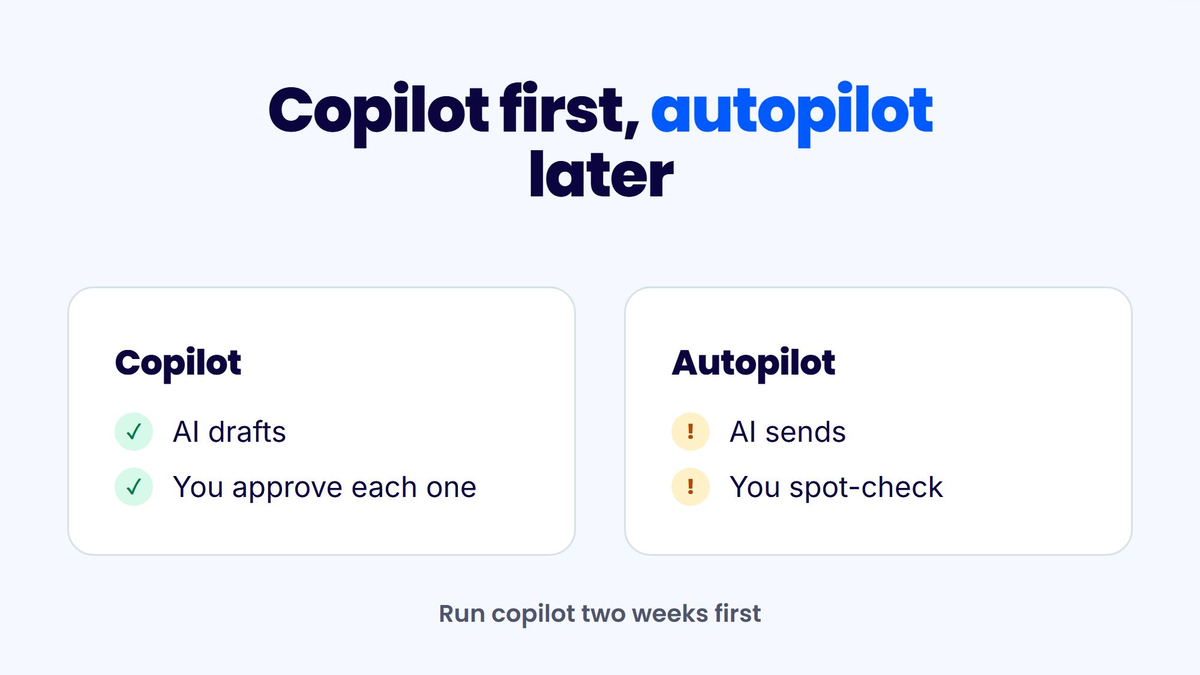
URC verified that this handle resolves and does not cite any other X handle for this tool, because no other handle was confirmed as an official channel during this assessment.
Glossary
CI-First Benefit Score
The arithmetic mean of four dimensions, each scored 0 to 10: Time Benefit, Quantity Benefit, Quality Benefit, and Knowledge and Skill Benefit. The score measures net benefit to the human after subtracting the overhead of using the tool, for an honest rather than an ideal user, in the common case rather than the best case. Bands: 0 to 2.0 CI-First Negative, 2.1 to 4.0 CI-First Neutral, 4.1 to 6.0 CI-First Positive, 6.1 to 8.0 CI-First Strong, 8.1 to 10.0 CI-First Transformative.
CI-First Profile
One of five roles the AI plays in the co-intelligence relationship: Co-Creator and Thought Partner, Co-Worker and Assistant, Coach and Tutor, Analyst and Tester, Challenger and Devil's Advocate. Most tools carry a primary and a secondary profile. The profile determines how you should work with the tool and which benefit dimension the assessment weights.
Humics Protection Badge
The sum of three ratings, one per Humic, each scored +1, 0 or -1: Creativity, Critical Thinking, and Social Authenticity. A total of +2 to +3 is Humics-Friendly, -1 to +1 is Humics-Neutral, and -2 to -3 is Humics-Risky. The badge tells you whether sustained use makes you stronger in the capabilities that are uniquely human or replaces them.
AI Imposture Risk
The likelihood that the tool traps you in one of three usage illusions: the Time Illusion, where time appears saved and is lost to prompting and verification; the Quantity Illusion, where volume of output substitutes for usable output; and the Skill Illusion, where competence appears to grow while the underlying skill is offloaded. Each trap is rated Low, Medium or High on cited evidence, and the overall level is Low, Medium or High.
Collaboration Mode
How you and the tool divide the work. Centaur mode sets a clear boundary between human judgement and machine execution, and it is the required default where Imposture Risk is Medium or High. Cyborg mode interleaves human and machine iteration with no boundary, and it is only appropriate where Imposture Risk is Low.
User Sentiment
The pattern of what real users report on review platforms, reported with the platform, the score and the review count where those are reachable, and with the sample's limits stated. Where a platform cannot be read directly, it is treated as unjudged rather than as empty.
Review Status
The vocabulary that describes where a tool sits in the review lifecycle, covering all six statuses. It is the vocabulary behind the badge at the top of this review: Active means the tool is current and recommended, Risky means it is current and usable while sustained use erodes human capability or carries an unresolved risk, and the remaining four sit between and beyond those two.
Active: the tool is current and recommended.
Changed: the vendor has released a material change and a refresh of the review is pending, so the published assessment still describes the previous version.
Watch: the tool is current and usable, and a specific unresolved development makes the assessment provisional rather than stable.
Risky: the tool is current and usable, and sustained use erodes human capability or carries an unresolved risk that mitigates rather than removes the benefit.
Deprecated: the vendor has signalled that the tool is being withdrawn or superseded, so adoption is not advised and users should plan an exit.
Retired: the tool is no longer available, and the review is retained as a reference rather than as a recommendation.
Framework v1.2 clauses referenced in this review
Clause 5.2.3-a sets a floor of no lower than Medium on the Skill Illusion rating for any tool that writes procedural memory on the user's behalf, because the user then holds a documented capability they did not write. Clause 4.2-a states that agent-mediated conversation is not erosion by itself, and that erosion requires either agent-authored text presented as the person's own voice in a human-facing channel, or the substitution of agent interaction for human contact. Clause 7.5 states that a room shared by several agents requires a profile per agent, a written task boundary per member, review per member, and Centaur mode, and that Cyborg is unavailable for a room with more than one agent.
Sources
Vendor primary sources
Reply.io Jason AI product page, the product surface, including the channel list, the control modes and the pricing entry points: https://reply.io/jason-ai
Reply.io Jason AI SDR feature list, including the Approval Mode entry, the channel list and the playbook, knowledge and control sections: https://reply.io/jason-ai-sdr-features
Reply.io blog, including the Jason AI and Jason AI SDR release posts and the Approval Mode announcement: https://reply.io/blog
Reply.io help centre, for the sequence, mailbox, deliverability and LinkedIn configuration documentation: https://support.reply.io/en/
Reply.io Artificial Intelligence Policy, effective 2025-11-13, for the definitions of AI-Generated Content, Approval Mode and Automatic Mode, the responsibility sentence, the no-training statements, the ownership statement, the augmentation statement and the labeling statement. All quotations in Section 7c are taken from this document unless attributed otherwise: https://reply.io/artificial-intelligence-policy/
Reply.io Terms of Service, for the no-training commitment, the customer-responsibility clause and the AI-Generated Content ownership clause: https://reply.io/terms-of-service/
Reply.io Privacy Policy, for the data-use and retention statements: https://reply.io/privacy-policy/
Reply.io Data Processing Agreement, for the no-training clause and the sub-processor framework: https://reply.io/data-processing-agreement/
Reply.io trust page, for the responsible AI practices statement: https://reply.io/trust-page/
Reply.io pricing page and plan documentation, for the tier structure, the metered units and the add-ons: https://reply.io/pricing
Reply.io integrations directory and API documentation, for the CRM, mailbox, calendar, webhook and API surfaces: https://reply.io/integrations
Reply.io headless SDR surface, for the agent-callable API, MCP server and CLI described in the clause 7.5 note: https://reply.io/api
Independent sources with a stated method
Independent hands-on reviews that report their own test conditions, including a two-month agent test reporting meeting counts and show rates, a three-week multichannel test reporting inbox placement, a two-campaign deliverability comparison, and a review reporting a personal experience of automatic mode producing an unapproved discount. These are single-reviewer runs on their own setups and are cited as such throughout the review: https://www.g2.com/products/reply-io/reviews
Aggregate review platforms for Reply.io, read through search indexing and published summaries with checked dates, as disclosed in What Users Say: https://www.g2.com/products/reply-io/reviews and https://www.trustpilot.com/review/reply.io (unreadable to an automated request, so reported as indexed)
Vendor and product catalogues that publish structured assessments of the agent, consulted for the channel list, the deployment model and the integration surface: https://reply.io/jason-ai-sdr-features
Community and community-reported evidence
Community reports across review platforms and sales communities describing message quality reading as templated, reply rates lagging manual sequences, billing friction and LinkedIn account restrictions. These are reported as patterns of user report, treated as allegations rather than findings in Section 7c, and no specific unreadable thread is cited: https://www.trustpilot.com/review/reply.io (unreadable to an automated request, so reported as indexed)
Internal sources
U365 CI-First Evaluation Framework v1.2, including clauses 5.2.3-a, 4.2-a and 7.5: https://www.university-365.com/tools
U365 UP-Context institutional profile, used to verify every U365 method name and expansion used in this review: https://www.university-365.com/tools
The URC INSIDE Tools Review skill, the INSIDE Tools post template and the published INSIDE Tools Reviews used as internal comparisons: https://www.university-365.com/tools
Faculty Note on Evidence Quality
This note records what the evidence for this review can and cannot carry. It names every vendor claim contradicted by another vendor surface, every figure with no published methodology, and every benchmark set against a weaker setting or a promotional price base.
Vendor claims contradicted by another vendor surface
The no-training promise is stated two ways. The Artificial Intelligence Policy's data-protection section states that "Customer data is never used to train AI models." The same policy, the Terms of Service and the Data Processing Agreement all state the commitment conditionally, as no training "except as expressly agreed in writing". The absolute form is contradicted by the conditional form inside the same document. The conditional form is the binding one and is the one a reader should rely on.
"Augment human capabilities, not replace them" is contradicted by the sales positioning. The Artificial Intelligence Policy claims that all AI features are designed to augment rather than replace. The product is marketed as taking on the full top-of-funnel motion the way a dedicated SDR would, and independent reviewers of the pricing describe it as positioned to replace a junior SDR's salary. A buyer meets the replacement claim first, and the policy states the opposite.
The labeling claim is true in the platform and reaches nobody. The policy claims "Clear labeling of all AI-generated content in the platform". The qualifier is doing all the work: the label exists in the customer's own dashboard and no label reaches the message recipient. The claim is not false. It is insufficient for the transparency question a recipient would care about, and it is the operative fact behind the Social Authenticity rating.
The pricing entry point is stated at more than one level and the difference is not a rounding error. Third-party listings for the same agent tiers quote entry figures from $259 to $800 per month, and Reply.io's own platform tiers are quoted in different places at $49 and $59 on the email tier and $89 and $99 on the multichannel tier. URC could not read the vendor's live pricing page to establish a single current figure, so no figure in this review is presented as authoritative, and the review names the range and the disagreement instead of choosing a number.
Figures with no published methodology
The 1B+ contacts figure. Stated by the vendor and repeated across its marketing and API documentation. No coverage audit, no country breakdown, no match-rate study and no verified-deliverability percentage is published. Independent reviewers who spot-checked enrichment against their own data report match rates around 80 per cent for direct dials and 90 per cent or better for work emails in mid-market, on their own samples. The headline figure and the measured match rate are different measurements and only the second one is a method.
Any reply-rate or meeting-rate claim for the agent. The vendor publishes no study with a stated method, sample, control group or period. Independent reviewers report impressions and, in one case, a two-month run reporting meeting counts and a show rate, which is a single-reviewer observation on one setup and not a specification.
Any inbox-placement claim. Independent testers report primary placement in the low nineties per cent in their own runs. The vendor's own published placement figure could not be identified from a readable surface. Both are single-setup numbers and neither is a guarantee.
The 140M+ versus 1B+ contact database figures. Both appear in third-party coverage of the same vendor, which means at least one of them is carried over from an earlier product state. No method is published for either.
Reply classification accuracy. Independent reviewers report roughly nine in ten on their own samples. That is a measured observation, and the sample sizes are small. It is cited in this review as the strongest available support for the classification function and it is not presented as a guarantee.
The show rate figure of thirty-five per cent. Reported by one independent reviewer over a two-month test. It is a single-run observation with no stated control group, and URC uses it as an illustration of what one reviewer measured, not as an expected result.
Benchmarks set against a weaker setting or a promotional price base
The "replace a junior SDR's salary" comparison. The agent entry price is set against a human salary comparison, and at least one independent source describes the entry figure as a promotional floor with a renewal step. A cost-per-result claim built on a promotional base and compared against a fully loaded salary is a marketing framing, and the renewal rate is the number that matters for a second year.
Volume as a proxy for pipeline. The metered unit for the agent tiers is contacts, which means the pricing rewards contacting more people, and the dashboard reports sends as prominently as outcomes. A tool paid per contact and reporting volume is not a neutral source of evidence about its own value, and this is the mechanism behind the High Quantity Illusion rating.
The "10x industry average" style reply-rate framing. Third-party coverage repeats vendor-adjacent reply-rate multiples without a stated baseline, a definition of the industry average, or a control. URC does not repeat the multiple and instead states that no controlled comparison of this agent's messages against human-written messages for the same list has been published.
What the evidence does not contain
No independent measurement of this agent's message quality against a control exists. No published study of the Approval Mode default exists, and URC could not find a vendor surface stating that new accounts begin with review required. No published rate card for the agent tiers could be read directly, and the third-party figures disagree by a wide margin. The two review platforms that carry the vendor aggregate the whole platform rather than the agent, and the number of reviews assessing the agent alone is not presented by any platform URC could reach. The scores in this review are set with those absences named, and the Quality dimension is scored down for the absence of measurement rather than for measured weakness.
CI-First Evaluation Summary Card
Field | Value |
Tool | Jason AI (Reply.io) |
Category | AI sales agent / B2B outbound automation |
Version reviewed | Jason AI by Reply.io, as documented at reply.io in September 2026 |
Last tested | 2026-09-25 |
Status | Active |
Time Benefit | 6 / 10 |
Quantity Benefit | 6 / 10 |
Quality Benefit | 5 / 10 |
Knowledge and Skill Benefit | 3 / 10 |
CI-First Benefit Score | 5.0 / 10 |
Band | CI-First Positive |
Creativity | 0 |
Critical Thinking | -1 |
Social Authenticity | -1 |
Humics Protection Score | -2 |
Humics Badge | Humics-Risky |
Time Illusion | Medium |
Quantity Illusion | High |
Skill Illusion | High |
Overall AI Imposture Risk | High |
CI-First Profile (primary) | AI as Co-Worker and Assistant (2) |
CI-First Profile (secondary) | AI as Analyst and Tester (4) |
Collaboration Mode | Centaur |
Framework v1.2 clause 5.2.3-a | Applies. Skill Illusion High: the agent writes durable ICP, playbook, sequence and re-engagement artefacts without a per-artefact review gate |
Framework v1.2 clause 4.2-a | Applies. Social Authenticity -1 on condition (a): agent-authored text sent as the customer's own voice with no disclosure reaching the recipient |
Framework v1.2 clause 7.5 | Applies in the headless multi-agent configuration; null in the common single-agent case |
Recommended configuration | Centaur, Approval Mode on, written stopping rule, meetings measured rather than sends |
Keep it out of | Automatic Mode on a domain you cannot lose, ICP and offer authoring, replies that are not a clean yes, no or later |




Comments