
Leonardo AI: the multi-model image and video platform for asset sets that have to hold one visual language

Updated: 13 hours ago

Status: Active | Last tested: 2026-09-25 (Leonardo.Ai, as documented at leonardo.ai in September 2026) | Re-check: trigger-based (max 6 months)
Active: the tool is current and recommended.
What Active means here. Active means current and recommended for the reader this review describes: a team producing a set of assets in one visual language on a deadline, with a trained element holding the look and a named human signing each asset off. It does not mean the licence position is simple, the plan vocabulary is settled or the output quality is measured. Ownership of a free-tier generation sits with the vendor, two plan vocabularies are live at once, and no current independent benchmark of the platform's output exists. A reader who needs a benchmark, a unique brand asset or a contractual guarantee should treat those as not currently available and act accordingly.
For detailed explanations of the CI-First evaluation terms used in this review, including the Humics Protection Badge and the AI Imposture Risk levels, see the Glossary at the end of this post.


In this Tool Review
Status and Re-check
Re-check triggers:
A change to the clause that decides who owns a free-tier image. The terms vest ownership of a free subscriber's output in the vendor on creation, while the vendor's pricing page grants the same user a royalty-free licence for commercial use and the vendor's own help centre states that a free user can download and use generations commercially. If the licence wording moves, or if the terms gain a commercial-use restriction for free accounts, the adoption advice in Section 7c changes. Read clause 8.7 against the pricing page before telling anyone the free tier is usable for client work.
A first independent measurement of image quality in a repeatable benchmark. The only third-party quantitative reading located is an Elo of 1030 at rank 212 for Phoenix 1.0 Ultra on one aggregator, and Lucid Origin's debut position of sixth on an image leaderboard as announced by the evaluator itself in August 2025. Neither is a current, versioned benchmark of the platform. Until one exists, the Quality sub-score rests on vendor figures, on community report and on the judgement of reviewers who publish their sample counts.
A change to the model list or to the unlimited-generation footnote. The pricing page carries two different versions of the same footnote in one page load: one lists seven first-party models as eligible for unlimited relaxed generation, the other lists ten. Which models are genuinely unlimited changes the economics of the Premium and Ultimate tiers, which is the main reason a professional would upgrade.
A change to the plan naming. The pricing page, the vendor's own comparison article and the vendor's help centre do not agree on what the paid tiers are called. Two naming schemes are live at once. A reader matching a third-party guide against the checkout page is matching two different vocabularies, and any figure quoted from a guide has to be re-verified against the checkout.
A published rate card for the API beyond the self-serve calculator. The API is priced pay-as-you-go in dollars and the self-serve entry point is documented, but custom concurrency and per-model discounts are quote-only. If a public rate card appears, the Time and Quantity reasoning should be re-run against it.
A change to the token rollover rules. Rollover is capped at three months of allowance per plan, and the cap is stated in tokens per seat on team plans and per account on solo plans. Any reduction in the rollover bank, or its removal, would change the advice for bursty academic and campaign work.
A named institutional customer willing to speak publicly about a measured result. The vendor publishes brand logos and a homepage headline about cutting production costs by half, with no sample size, no baseline and no named customer behind the number. A named, quantified, independently checkable result would move the Quality sub-score and the Section 3 confidence rating together.
The Leonardo naming and model family, stated before the review begins
A reader who searches for Leonardo meets a company, a product, a parent brand and several unrelated search results. The distinction belongs at the top, because the whole review depends on which entity is being scored.
Name | What it actually is | Relationship to this review |
Leonardo.Ai | The product reviewed here: a browser-based, multi-model generative image, video and design platform with its own model family and hosted third-party models | The subject of this review |
Leonardo Interactive Pty Ltd | The contracting entity, ACN 662 209 485, ABN 56 662 209 485, based in North Sydney, Australia. The terms name this entity; the privacy policy describes it as a Canva brand | The vendor |
Canva | The parent company that announced the acquisition in July 2024. Leonardo.Ai runs under its own brand, its own pricing page and its own roadmap | The owner of the vendor |
Leonardo AI and Leonardo.ai | Two spellings of the same product, both used by the vendor on its own surfaces | Same product, not a sibling |
Leonardo Creator Program and Leonardo Imagination Fund | Two vendor programmes for creators and for funded projects | Adjacent to the product, not products |
Adobe Leonardo, Leonardo Hotels, Leonardo da Vinci generators | Unrelated products and pages that appear in the same search results | Not related |
Two consequences follow. First, the platform is no longer one image model. It is a model host: its own Phoenix and Lucid families sit next to licensed third-party engines, and the choice of model is the main creative decision a user makes. Second, because the platform is multi-model, a review that scores "Leonardo AI" has to say which model family the score reflects. This review scores the platform as a working surface, and it names the model in every workflow.
The model family, as the vendor presents it
Family | Models | What the vendor positions each one for |
Phoenix | Phoenix 1.0, Phoenix 0.9 | The vendor's first foundational image models. Phoenix 1.0 offers fast, quality and ultra tiers through the API. Phoenix 0.9 is the earlier release and remains available |
Lucid | Lucid Origin, Lucid Realism | Lucid Origin is the aesthetic generalist and the default model. Lucid Realism is aimed at photographic and cinematic work and at pairing with video generation |
Motion | Motion 1.0, Motion 2.0, Motion 2.0 Fast | The vendor's own video models. Motion 2.0 adds camera motion control, style controls and video-to-video motion transfer |
Legacy fine-tunes | Kino XL, Anime XL, Lightning XL, Albedo Base | The SDXL-era fine-tunes that early users built workflows on and that remain selectable |
Hosted third-party | Veo 3 and Veo 3.1, Kling 2.1 Pro and 2.5 Turbo, Hailuo 2.3, Wan 2.6, Seedream 4.0 and 4.5, Nano Banana and Nano Banana Pro, FLUX Dev, FLUX Schnell, FLUX.1 Kontext, FLUX.2 Pro, GPT-Image-1, GPT-Image-1.5, GPT-Image-2, Ideogram 3.0, Recraft V4 and V4 Pro, Sora 2 and Sora 2 Pro, LTX 2.0 | Licensed engines from other vendors, inside the same interface and drawn from the same token balance. The vendor's own help centre says these cannot be used with unlimited relaxed generation and always consume tokens |
One practical point follows from that table and it is repeated in the vendor's own documentation: unlimited relaxed generation covers selected first-party models only. Every third-party model costs tokens on every plan, which means the "one subscription, all platforms" line on the pricing page buys access to the third-party engines, not unmetered use of them.

Tool Snapshot
Leonardo.Ai (Leonardo Interactive Pty Ltd, a Canva brand)
Tagline: "The Creator-First Generative AI Platform" on the homepage, with the 2026 rebrand line "Yours To Create" inside the application. (leonardo.ai and app.leonardo.ai, read 2026-09-25.)
Category: Video and Creative Tool. A cloud platform for generating and editing images, video and design assets, with its own model family, a hosted shelf of third-party models, a training surface for custom models, an editing canvas and a pay-as-you-go API.
Primary use cases:
Generate campaign and marketing visuals in a consistent style, and keep them consistent across a set of assets.
Train a custom model on 10 to 50 reference images to lock a character, a product or a brand style, then generate the hundredth asset in the same style as the first.
Turn a still image into a short video clip for social or storyboard use, with camera-motion and style controls.
Sketch a rough composition and have it rendered while you draw, using Realtime Canvas.
Edit a generated image with inpainting, outpainting and erase-and-replace rather than regenerating from scratch.
Produce game and 3D asset artefacts, including texture maps for a downstream engine pipeline.
Reach a large model shelf through one interface and one balance instead of subscribing to each engine separately.
Drive the same capability from code through a REST API with a pay-as-you-go dollar balance.
Video and Creative Tool variant fields:
Field | Leonardo.Ai |
Output formats | Images (PNG and JPEG at selectable resolutions, up to Full HD on the current first-party models), video clips from the Motion family and hosted video engines, 3D texture maps, upscaled and background-removed derivatives |
Rendering time | Vendor surfaces state no per-generation figures. Independent testing reports roughly 6 seconds for four Phoenix 1.0 variants at 1024 by 1024, about 45 seconds for a four-second Motion 2.0 Fast clip, and live canvas updates of about 2 seconds per stroke. These are one reviewer's measurements on one plan, not vendor figures |
Pipeline type | Text-to-image, image-to-image, text-to-video, image-to-video, real-time canvas, inpainting, outpainting, upscaling, background removal, LoRA training, 3D texture generation, batch execution through Blueprints |
Quality consistency | The vendor ships element training to address consistency directly, and consistency is the vendor's main claim against single-model competitors. Reported inconsistency is concentrated in prompt fidelity, text rendering and content-filter interruptions rather than in style drift on a trained model |
Creative control | High for a hosted platform. Model choice, style presets, style reference, character reference, multiple image references, camera and lighting controls on video, custom trained models, granular editing and upscaling |
Pricing summary: Four solo tiers and two published team tiers, all metered in tokens, plus a dollar-based pay-as-you-go API. The pricing page lists Free at $0 with 150 Fast Tokens per day, Essential at $12 per month with 8,500 Fast Tokens per month and a 25,500 Token Bank, and Ultimate at $60 per month with 60,000 Fast Tokens per month, a 180,000 Token Bank, 50 personal AI models and 6 simultaneous generations. A middle tier at $30 appears in the vendor's own surfaces under two different names. Team Starter is $72 per month for three seats at $24 per seat, and Team Growth is $144 per month for three seats at $48 per seat. Annual billing takes up to 20 percent off. The API is priced pay-as-you-go in US dollars with no monthly commitment, self-serve entry, automatic top-ups and no expiry on the balance. Prices read 2026-09-25 from leonardo.ai/pricing, from the vendor's help centre and from the vendor's API documentation.
Free tier: Yes. 150 Fast Tokens per day, public creations, basic quality settings, one personal collection, presets available, and no token carry-over. The vendor describes the tier as having no expiry date.
Platforms: Web application, iOS application, Android application, REST API, and a beta agent surface inside the application.
The Problem
The problem this tool is bought for is not "I want a picture of a dragon". It is the second and third and four-hundredth asset, in the same style, on a deadline, without a photograph that exists.
Four specific versions of the problem show up in the work of a university like U365.
The campaign asset that cannot be commissioned fast enough. A programme launch needs a banner, six social crops, a deck cover and a thumbnail, all in one visual language, and the launch date does not move. Commissioning that set takes weeks and a budget line. Producing it by hand in a design tool takes a designer a day or more per asset, and the crops never match perfectly.
The teaching and curriculum visual that does not exist. A lesson on a method, a process or a scenario needs an illustration of something that has never been photographed. The alternative is a stock image that is approximately wrong, which readers notice, or no visual at all.
The brand-consistency wall. Everything generated without a trained reference drifts. Asset one has a navy that is right and asset four has a navy that is not, and the character in the hero image has a different face from the character in the sidebar. Consistency, not quality, is what stops most institutional teams from adopting generative imagery.
The video ask. Stakeholders now want a moving version of the image. A four-second clip used to mean a videographer, a camera and a shoot day. The team needs that clip from a still image, on the same subscription, without learning a second tool.
Two further frictions are specific to how these platforms are sold, and both sit inside the vendor's own documentation. Tokens are not images: the same prompt on two models at two settings costs two different amounts, so a budget cannot be planned from a plan name alone. And commercial rights are tier-dependent, which means the licence status of an asset depends on which plan the account was on when the asset was created, not on what the asset looks like or where it ends up.
The Outcome
A team that uses Leonardo.Ai well gets four things.
Asset sets instead of single images. Generation produces variants in one action, editing is non-destructive, and a trained custom model holds a character or a product steady across a whole set. The work product changes shape: you stop thinking about "the image" and start thinking about "the set", which is how brand and campaign work actually happens.
A shorter loop between idea and artefact. Realtime Canvas renders from a rough sketch while you draw, and Flow State develops an idea in a chain of variations before committing to a final. The distance between "this is roughly what I mean" and "this is it" is minutes rather than a briefing cycle.
Video capability on the same balance. The Motion family turns a still image into a short clip with camera-motion and style controls, and the hosted engines give access to external video models that would otherwise be separate subscriptions and separate logins.
A choice of engine instead of a bet on one. Because the platform hosts first-party and third-party models side by side, the team is not locked into the vendor's aesthetic for every task. The vendor's own positioning, in its comparison article against Midjourney, is precisely this: multiple models for different needs rather than one default model.
What the outcome is not: it is not a finished design system, it is not a substitute for a designer's judgement about hierarchy and legibility, and it is not a guarantee that a generated asset is legally clean. The last point has its own section later in this review, because the answer is in the vendor's contract rather than in the vendor's marketing.
Who Should Use Leonardo AI
Use it if you are a U365 Fellow who has to produce a set of visuals on a deadline. Marketing, engagement, programme launch, social media, deck furniture and course banners are the core use case. The trained-model capability is what separates a set from a pile.
Use it if consistency across assets matters more than the beauty of one image. If the assignment is a hundred assets in one visual language, this platform is built for exactly that. If the assignment is one flawless editorial photograph with no setup, a single-model specialist will beat it.
Use it if you need video from a still image without a video workflow. The Motion family plus hosted engines covers short clips, product mockups and storyboard motion inside the same subscription.
Use it if you want a legally explicit ownership position for a paid account. The paid-tier ownership position in the vendor's terms is unusually clear, in the user's favour, and the private-public switch is a real control rather than a setting. Read Section 7c before you rely on it.
Use it if you are building something on top of generation and need an API. The REST API is documented, has a self-serve pay-as-you-go balance, and returns a cost object in generation responses so spend is visible per request.
Do not use it as a research or academic-writing tool. It generates media. It does not verify facts, cite sources or reason about a curriculum. Nothing in this review should be read as claiming otherwise.
Do not use the free tier for client-facing or published work without reading Section 7c first. The free tier allows commercial use and the vendor says so, but the ownership of the underlying rights sits with the vendor, and the creations are public.
Do not use it to produce regulated, contractual or legally operative documents. Generated imagery of a person, a place or an event can be wrong in ways that are visually convincing. The vendor's own terms require you to evaluate and verify every generated output before relying on it, and that obligation is real.
Fellowship fit
U365 Fellowship role | Fit | Why |
Engagement and communications | High | Campaign sets, social crops, brand-consistent imagery, thumbnail variants and short video clips on one subscription |
Programme and product marketing | High | Same as above plus storyboard and mockup generation from an existing product image |
Academic and curriculum teams | Medium | Useful for illustration and scenario imagery, weaker where accuracy of a depicted process, diagram or text label matters |
Research and innovation teams | Medium | Useful for visualising concepts and for prototyping an idea before commissioning, not for evidence or analysis |
Operations and campus teams | Low to medium | Occasional signage, floorplan styling and mockups, no recurring need |
Finance, legal and compliance | Low | Not a fit for the work, and generated depiction of figures or documents carries risk |
U365 Institutes Alignment
The institute ratings below apply the platform's core capability, visual asset production with consistent style, to each institute's subject matter. A rating records how directly the tool serves that institute's teaching or production need, not how entertaining it is.
Institute | UDA rating | Why, stated as the competency that remains | The limit that holds the row |
UIT (Technology, AI, Data Science) | High, confirmed | Integration engineering against a published specification, and appraisal of a metered API before spending on it. The Fellow designs an asynchronous generation job and chooses between the surface the vendor documents and a polling loop, handles the terminal states the vendor publishes, sizes a retry budget against a published concurrency and rate-limit table, compares the fast, quality and ultra tiers of one model on published unit cost, and takes a cost object before the job runs rather than after. The tool is the third-party system being integrated and the catalogue being appraised; both halves are what the Fellow can explain without it. | The tool teaches no programming and no machine-learning competency of its own. The first-party weights are not published, there is no training path a curriculum can assess and no reproducible evaluation surface, so nothing here is assessable as modelling. Element training is a product feature rather than a machine-learning exercise, and the token economics are applied arithmetic rather than finance. Coursework observation for the modelling half, and the credential anchors are adjacent rather than direct, as the Tool to Skill to Credential table below states. |
UIB (Business Management, Entrepreneurship) | Medium, confirmed | Two competencies, and both are costable and evidenced. Usage-based cost appraisal: the charge falls per attempt on a workflow whose normal condition is iteration, the same prompt on two models costs two different amounts, the rollover bank is capped at three months of allowance and drawn last, and the free tier's daily allowance is exhausted inside a normal working session, so the Fellow computes cost per finished asset from their own usage record and defends the tier choice against a measured burn. Supplier-contract literacy: one output sits under a clause set in which the ownership position turns on the plan tier at the moment of creation, the public-content licence is wider than the private-content licence, the service-bureau clause constrains what a venture may resell, and the liability cap is a number. The Fellow reads those terms before a venture is built on the output. | The tool teaches no management, finance or entrepreneurship content of its own. The appraisal is a costed exercise inside a diploma landscape that assesses financial statement analysis, modelling and forecasting, and the contract reading is legal literacy applied to a purchase rather than a business discipline. Neither competency has a published assessment home, so a High rating would rest on coursework with no credential outcome behind it. |
UIC (Digital Communication, Marketing) | Medium, corrected down from High | The publication rule for a generated asset. Deciding which channels a generated still or clip may carry, whether generated imagery may stand in for photography for this client and this audience, what the audience is owed by way of disclosure, what the record holds for each version, and who signs each asset off before it reaches a cohort. The review supplies the rule in three places of its own: workflow 3 closes by requiring the teaching visual to be captioned as an illustration rather than a photograph and to say so on the slide, Section 4 requires the licence position to be read before free-tier output goes anywhere client-facing, and Section 7 makes the private-public setting a control the Fellow chooses rather than a setting they inherit. Every part of that rule survives the removal of the tool. | The tool builds no communication craft. Content Marketing Specialist publishes content marketing return, content strategy, live-video production, search content writing and link building; Social Media Marketing Manager publishes social strategy, copywriting for social, content-creation strategy and short-form platform formats; Marketing Manager publishes marketing-communications strategy and marketing-plan writing. None of those competencies is exercised here, and the tool writes nothing in a person's voice. The reason in the draft credited campaign-asset production, which is the tool performing the task, so the row is corrected to Medium and no UIC credential chain is mapped. |
UID (Digital Design, UX/UI) | High (primary), confirmed | Directing one visual language across a whole asset set, and judging each asset against the brief and its destination at the size it will be used. The review's own workflows put the quality gate on the Fellow by name: read the best candidate against the brand guide before generating eleven more assets, decide whether the look should become a trained model rather than a style reference, review the set as a set for drifting detail in faces, hands and signage, check every asset against the brand guide for colour values, clear space and typography, and confirm the still that becomes a clip is one the team holds the rights to animate. The trained-model decision is the one surface where the tool extends the Fellow's own range rather than replacing it, because a model trained on a brand is a model the Fellow has to evaluate. | The tool teaches no design principles: no typography, no colour theory, no layout, and no critique of an output against a written brief. Text in image is the weakest part of the stack and the review tells the reader to keep the words in the layout tool. Output is raster, so vector, print-ready and typographically precise deliverables leave the platform. The High describes the direction and judgement competency and the surface it is exercised on, not design education, and the Skill sub-score of 4 records the same finding from the scoring side. |
No institute is rated as having no relevance for this tool, and the reason is worth stating. The tool sits on visual asset production, which is UID territory directly; it produces the campaign material a communications team runs on, which is UIC territory; it ships a documented REST API with published limits and a metered billing model, which is UIT territory; and its token economics together with one of the plainest licence clause sets in this series raise a supplier question a venture in UIB has to answer. The four ratings therefore spread across High, High, Medium and Medium rather than clustering at Low.
Relevance is not a credential, and the two diverge on this tool. No published U365 credential assesses the principal competency of any of the four rows. One of the six competencies in the credential table below has a direct assessment home and the other five have adjacent anchors only, and every row of that table states which it is.
A tool that performs a task cannot be chained to a competency in performing that task. It can be chained to the competency in judging, evaluating or directing it. The test is what remains when the tool is removed.
The test is what changed one rating, moved one marker and left the other ratings where they were. It also decides the two cross-review checks below, because a rating set in isolation is not a standard.
First cross-review check, on the corrected row. The correction is consistent with two published siblings in this series on the identical finding. The real-time generative canvas review and the in-image typography review each had their UIC row corrected down from High to Medium on the ground that the tool produces the asset type the institute works with while building none of the institute's competencies. This review's drafted UIC reason names brand consistency through trained models, campaign asset sets, social formats and short-form video, which is the same pattern stated in different words. Leaving the row at High would put this post out of step with two published pages answering the same question.
Second cross-review check, on the row that holds. UIT is kept at High here, and the contrast with the video-model review is deliberate: that review's UIT row was corrected down to Low to Medium because the developer surface was a coursework observation with no published specification behind it. This vendor publishes a documented REST API with published concurrency and rate-limit defaults, a per-request cost object, a training endpoint with a published allowance, and a dollar-based pay-as-you-go billing model. Integration against a published specification is a competency that survives the removal of the tool, so the row holds. The deliverable names the two things that hold it, in the row itself.
Why the primary marker moves. The primary institute is the one for which the tool is the main working material. An argument for UIT would rest on the vendor's API and training surfaces being inspectable, which describes the vendor's product rather than the institute's teaching need. For a visual asset production platform the main working material is the design institute, where the Fellow's own visual judgement is the thing being exercised. UIT keeps its High rating on the integration competency stated above.
Tool to Skill to Credential
No Tool to Skill to Credential table existed for this platform before this one. The words Tool to Skill, Skill to Credential, Credential, competency, diploma, programme and micro-credential appear nowhere in the material this review worked from as a mapping asset. The table below is therefore new material, built from the published U365 catalogue and verified programme by programme, rather than a correction of an earlier mapping.
No published U365 credential assesses five of the six competencies this tool exercises. That is the finding and it is not a catalogue defect. It is a statement about what this class of tool does: it removes a production requirement rather than teaching production, and U365 credentials assess what a Fellow can do rather than what a tool can do for them. The Skill sub-score of 4 records the same thing from the scoring side.
Every row therefore does two things. It names the nearest published programme a Fellow could enrol in, and it states what that programme does not publish. An adjacent anchor is useful to a Fellow who wants the neighbouring skill. An adjacent anchor is not a credential claim, and none is presented as an assessment home for the competency in its row.
Six rows. Each credential cell names the nearest published programme and states what it does not publish.
Tool skill | U365 competency | Credential | Institute | Published next step |
Directing one visual language across a whole asset set, and judging each asset against the brand guide and its destination at the size it will be used | Visual direction, composition and consistency at volume | Graphic Design Professional (30 days, 124 steps), verified PUBLISHED on 2026-09-25. Its published programme covers Ideas, Concepts, and Form; Layout and Composition; Typography; Think Design; Color for Design; and Creating Inclusive Content, which are the decisions this competency consists of. Limit: it assesses the design decision and it publishes no generative-production outcome, no model-training outcome and no upscaling outcome, so the production half of the tool skill has no assessment home. The nearest production anchors are Adobe Specialist (60 days, 252 steps), whose published modules are Photoshop, InDesign and Illustrator training, and Video Production Specialist (60 days, 252 steps), whose published modules include Premiere Pro and Final Cut Pro essential training and a dialogue-editing module | Bachelor in Design (B.D.), then Master in Design (M.D.) 1/2 and 2/2, as the published programme hierarchy. Expert level, SUPERHUMAN only | |
Reading a generated asset at publishing size and deciding whether it is usable, including whether the embedded text is spelled correctly and whether faces, hands and repeated patterns hold | Evaluation of a generated artefact against a stated criterion, which is the verification habit the framework depends on | AI Creator Professional (30 days, 124 steps), verified PUBLISHED on 2026-09-25. Its published programme covers Opportunities, Issues, and Ethics; DALL-E: the Art of Prompting; Adobe Firefly; Midjourney: Creating Images; Stable Diffusion; and Leveraging AI in Adobe. Limit: it publishes an ethics and prompting outcome, and it publishes no evaluation, critique or verification outcome for a generated asset. The review's own limits section records that text rendering, faces and hands remain unreliable, which is exactly the competency this row names, so the gap is the one this tool demands most and the catalogue answers least | Bachelor in Design (B.D.), then Master in Design (M.D.) 1/2 and 2/2, as the published programme hierarchy. Expert level, SUPERHUMAN only | |
Building an asynchronous generation integration against a published specification: the documented surface against a polling loop, the terminal states, a retry budget sized against the published concurrency and rate-limit defaults, and a cost estimate taken before the job runs | Integration engineering and evaluation against a published specification | AI Developer Specialist (18 days, 72 steps), verified PUBLISHED on 2026-09-25. Its published programme covers Deep Learning Foundations: NLP with TensorFlow; GPT-4: What you need to know; Transformers: Text Classification for NLP Using BERT; Building NLP Apps with Hugging Face Transformers; Introduction to Responsible AI Algorithm Design; and Generative AI: Working with Large Language Models. The nearest anchor for the infrastructure half is Cloud Computing Specialist (30 days, 124 steps), published, whose modules are core concepts, cloud security, cloud storage, cloud networking, AWS Certified Cloud Practitioner, and Azure and Google. Limit: neither publishes asynchronous job integration against a third-party rate-limit and concurrency specification, and Python Developer (30 days, 124 steps) publishes programming craft only | Bachelor of Science in IT (B.Sc.), then Master of Science in IT (M.Sc.) 1/2 and 2/2, as the published programme hierarchy. Expert level, SUPERHUMAN only | |
Costing a token-metered, per-attempt charge on a workflow whose normal condition is iteration, and reconciling the measured burn against the invoice | Usage-based cost appraisal on a metered service | Financial Analysis Specialist (30 days, 124 steps), verified PUBLISHED on 2026-09-25. Its published programme covers Corporate Financial Statement; Financial Modeling; Forecasting Financial Statements; and Data, and Economic Modeling with Stata. Business Analysis Professional (60 days, 252 steps) publishes Business Analysis Foundations, Agile Requirements, Business Benefits Realization, Project Manager Collaboration and Business Process Modeling. Limit: neither publishes a usage-based, per-attempt or metered-pricing outcome, so the appraisal is not asserted as credential-recognised | Bachelor of Business Administration (B.B.A.), then Master of Business Administration (M.B.A.) 1/2 and 2/2, as the published programme hierarchy. Expert level, SUPERHUMAN only | |
Reading the licence one output sits under, including the ownership position that turns on the plan tier at the moment of creation, the public-content licence, the service-bureau clause and the liability cap, and deciding what a venture may do with the output | Commercial and legal literacy applied to a technology purchase decision | Entrepreneur (25 days, 104 steps), verified PUBLISHED on 2026-09-25. Its published programme covers Foundations; Finding and Testing Your Idea; Creating a Business Plan; Business Law; Raising Capital; and Income Taxe, with the module name reproduced here as the catalogue publishes it. Limit: it publishes a business-law module and a business-planning outcome, and it publishes no technology-purchase contract-literacy, licence-reading or intellectual-property-ownership outcome, so reading the terms and the competing-use clause is not asserted as credential-recognised. The review's own Section 7c makes this competency load-bearing, so the gap is the one a curriculum review should look at first | Bachelor of Business Administration (B.B.A.), then Master of Business Administration (M.B.A.) 1/2 and 2/2, as the published programme hierarchy. Expert level, SUPERHUMAN only | |
Writing and enforcing the publication rule for a generated asset: which channels it may carry, whether generated imagery may stand in for photography for this client and this audience, the disclosure the audience is owed, and the named reviewer per asset | Editorial and publication rule applied to generated media: the disclosure the audience is owed and the named reviewer per asset | Content Marketing Specialist (30 days, 124 steps), verified PUBLISHED on 2026-09-25. Its published programme covers Content Marketing ROI; Content Strategy, spelled Content Stratégy in the catalogue; Producing and Promoting Live Video; SEO Content Writing; and Link Building. Social Media Marketing Manager (30 days, 124 steps) publishes Social Media: Strategy and Optimization; Copywriting for Social Media; Content Creation Strategy, spelled Startegy in the catalogue; and two short-form platform modules. Limit: neither publishes a disclosure, synthetic-media or named-reviewer outcome, so the rule is assessed in coursework rather than against a credential | None asserted. No published programme assesses this competency, so no degree chain attaches to the row |
University 365 has three academic access levels: DISCOVERY, INSIDER and SUPERHUMAN.
Specialised diplomas and certificates carry Basic, Foundation and Expert levels. DISCOVERY Fellows can enrol in Basic-level programmes only. INSIDER Fellows can enrol in Basic and Foundation programmes. SUPERHUMAN Fellows can enrol in all of them.
University degree programmes carry a single Expert level and are open to SUPERHUMAN Fellows only.
No credit transfer is asserted. Five of the six rows name the published degree family that follows their diploma anchor, because the catalogue publishes those degrees as separate programmes. No micro-credential component title is asserted anywhere in this document. The UIT reconciliation of 2026-09-22 established that four component titles carried by earlier alignment drafts were internal working names that never reached the catalogue, and none is used here.
No access level is asserted for any individual programme. The catalogue read does not expose a per-programme access level, so only the published rule is stated.
No micro-credential is named in this table. The catalogue publishes certificate-layer programmes carrying an academic-credit line, and none of them is an assessment home for any of the six competencies above, so none is cited.
Four competencies this tool exercises have no assessment home in the published catalogue. They are recorded here as gaps rather than filled with a plausible programme name. Each is stated with the search that proved it and with the nearest anchor and the modules that disqualify it.
Evaluation of a generated visual artefact. A word-boundary term search over the title, the published description and the slug of all 79 published programmes, accent-folded, returned 0 for critique, 0 for verification, 0 for visual literacy and 0 for asset production. The nearest anchor is AI Creator Professional, whose published modules are prompting and the ethics of generative AI, neither of which assesses an output against a stated criterion, so the evaluation competency has no published assessment home.
Licence and rights literacy for generated content. The same search returned 0 for licence and license, 0 for intellectual property, 0 for copyright, 0 for terms of service and 0 for indemnification. The nearest anchor is Entrepreneur, whose published Business Law module sits inside a business-planning programme and publishes no technology-purchase contract-literacy outcome. The review's own Section 7c turns on the difference between a licence and an ownership position, so this is the gap the review itself makes load-bearing.
Usage-based and metered production economics. The same search returned 0 for cost, 0 for pricing, 0 for price, 0 for usage-based and 0 for metered. The nearest anchor is Financial Analysis Specialist, whose published modules are financial statement analysis, modelling and forecasting, which is budgeted appraisal rather than appraisal of a per-attempt charge on a workflow whose normal condition is iteration.
Disclosure and named review for generated media. The same search returned 0 for disclosure, 0 for synthetic, 0 for consent, 0 for privacy and 0 for data protection. The nearest anchors are Content Marketing Specialist and Social Media Marketing Manager for the channel and copy half, and neither publishes a disclosure or governance outcome. The review's own workflow 3 requires the disclosure decision of every teaching visual, so the gap is real rather than an artefact of this catalogue read.
What is not claimed here. None of the four gaps is a current programme and none is presented as one. A term match is also not treated as an assessment home: evaluation matched one programme and the match is financial evaluation rather than evaluation of an artefact, and brand matched five programmes and every one of those matches is brand design or brand strategy rather than a rights position. The four gaps are named so that a curriculum conversation starts from the evidence rather than from a placeholder, and so that a reader is not told a credential exists where none does.
What the catalogue does cover, so the gaps are not overstated. composition, typography and layout each matched two published programmes, both of them design programmes, and color matched five. The design craft this platform substitutes for is genuinely assessed by U365. What is not assessed is the production route this tool supplies, the rights position it creates, its cost curve, and the publication rule its output requires. That distinction is the honest reading of the search.
How Leonardo AI Works
Leonardo.Ai is a hosted platform with four layers. Understanding which layer you are in explains most of what the product does and most of what it costs.
Layer one, generation. You choose a model, write a prompt, optionally add a style preset, a style reference, a character reference or up to several image references, set the size and the number of outputs, and generate. The model shelf spans first-party families, legacy fine-tunes and licensed third-party engines. Each model has its own token cost, and the cost is displayed on the action before you commit.
Layer two, training. Element training takes a small set of reference images, typically 10 to 50, and produces a personal model that reproduces the subject or style. Personal model allowances are per plan: 10 on the least expensive paid tier and 50 on the top solo tier. This is the mechanism behind brand and character consistency, and it is the single feature that most distinguishes the platform from a pure prompt-to-image tool.
Layer three, editing and motion. AI Canvas covers inpainting, outpainting and erase-and-replace. The upscaler and background remover are separate tools. The Motion family generates video from text or from a still image with camera-motion, lighting and colour controls. Hosted video engines extend the same surface with external models.
Layer four, programmatic access. The REST API exposes generation, upscaling, background removal, texture generation, model training and Blueprints, which are pre-built multi-step recipes you can execute as one call. Billing is pay-as-you-go in US dollars, deducted per request, with automatic top-ups available and balances that do not expire.
What you get out. Images at selectable resolutions, video clips, 3D texture maps, upscaled derivatives and background-free cutouts. Assets live in personal collections, and paid accounts choose whether each creation is private or public. Private content is accessible only to you and your authorised users; public content is available to all users on the platform, under the licence terms in Section 7c.
What the platform needs from you. A prompt that describes the composition rather than the mood, a chosen model, an explicit quality setting, and a decision about whether the output needs a trained reference to hold a style. The overhead is real and it is the main reason this review does not score Time as strongly as a first look at the tool suggests.
The cost model, in plain terms. Tokens are the internal currency. Each feature and each model has its own token cost, and the cost varies with reference images, settings, output size and the number of outputs. Fast Tokens are the monthly allowance. Unused Fast Tokens on paid plans roll into a Token Bank capped at three months of allowance, and rollover tokens are only drawn once Fast Tokens are exhausted. Top-up token packs can be bought at any time. Free-tier tokens reset daily and do not carry over.
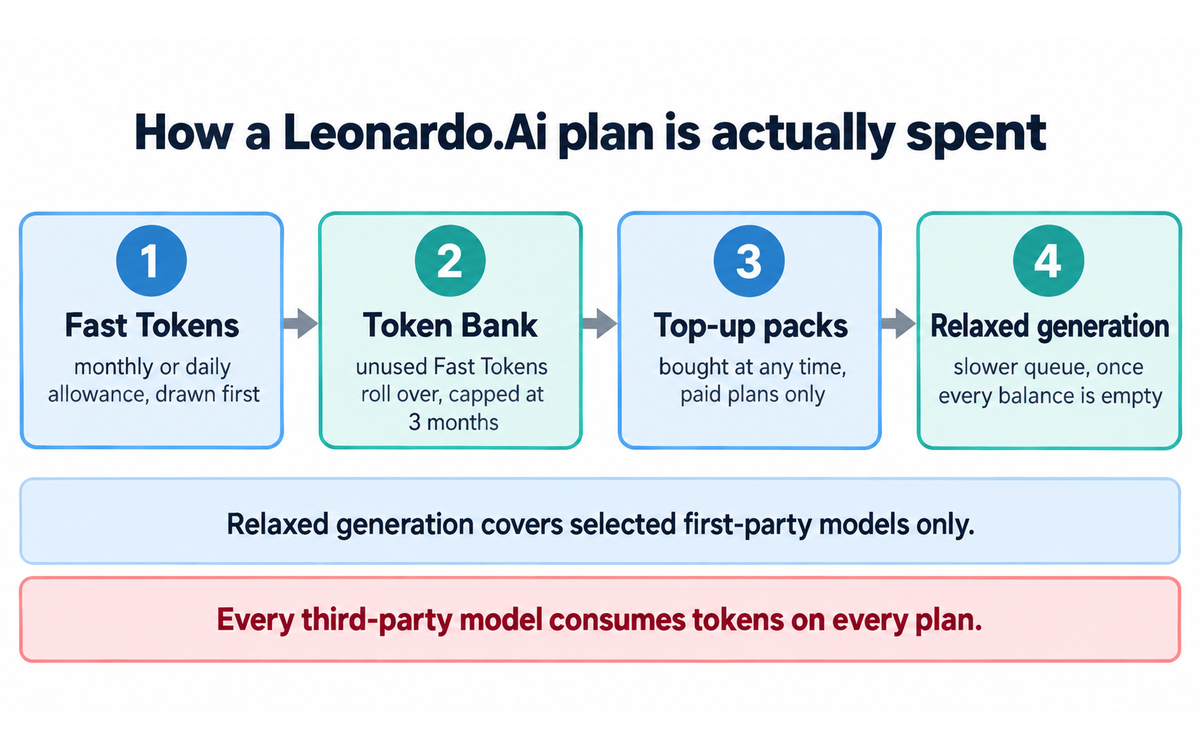
Three mechanics that decide what a plan actually buys:
Unlimited relaxed generation is model-specific. The pricing-page footnote limits it to selected first-party models. Third-party models always consume tokens.
Unlimited generation only activates after you have run out of everything else. It cannot be switched on manually, and it runs at a slower queue priority.
Video is priced in the same currency as images and is far more expensive per unit. An independent test counted one eight-second render at a token volume comparable to more than three hundred standard images.
Getting Started with Leonardo AI
A 30-minute first session that produces something usable rather than a folder of experiments.
Create the account and read the token counter before generating anything. Hover it. You will see Fast Tokens, the rollover bank, top-up tokens and, on eligible plans, unlimited generations. Knowing which pot is being drained prevents the most common first-week surprise.
Generate the same prompt on three models, one image each. Pick Phoenix 1.0, Lucid Origin and Lucid Realism, and use the same prompt, the same aspect ratio and the same quality setting. Write down the token cost of each. This single exercise teaches you the platform's economics better than any guide.
Generate one asset at a time until you know the cost. Turn off four-image batches until you can predict the token cost of an action. Batch generation multiplies both the value and the waste.
Set quality deliberately. Basic, enhanced and the higher quality settings are not cosmetic; they change both output and cost. Decide per task rather than leaving the default.
Train your first element with 15 to 20 clean reference images. Evenly lit, one subject, consistent framing, no watermarks. This is the step that turns the tool from a novelty into a production instrument, and it is the step most users skip.
Use a style reference before you use a trained model, if the job is a one-off. Style reference is cheaper than a training run and enough for a single campaign.
Choose your default model deliberately rather than accepting the platform default. The vendor's own model guide positions Lucid Origin as the aesthetic generalist, Lucid Realism for photographic and cinematic work, and Phoenix as the foundational family. Match the model to the task.
Turn on the private setting on a paid plan and verify it. Every generation on a free account is public. On a paid account, confirm the private selection before generating anything that will be client-facing.
Write down your own checklist before you ship an asset. Multi-model check on the same prompt, external check against the brand guide or the reference photograph, human review by the person who owns the brand, and one question: can you explain and defend this asset without the tool? If not, it is not ready.
Do not buy the top tier on day one. Start on the entry paid tier, measure your monthly burn in tokens for two months, and upgrade only when the rollover bank is consistently empty at the end of a cycle.
Free-tier checklist, in order:
150 tokens per day, resetting every 24 hours, no carry-over.
Creations are public.
Personal collections are limited to one.
No personal AI model training on the free tier.
Basic quality settings only.
Paid-tier checklist, in order:
Private generations from the entry paid tier upward.
Rollover bank capped at three months of allowance.
Top-up token packs available, except on team plans.
Personal AI model allowance rises with the tier.
Simultaneous generation slots rise with the tier.
Unlimited relaxed generation is limited to selected first-party models and applies to image generation from the middle tier, and to image and video generation on the top solo tier.
Real Workflows
Three workflows, each with the prompt pattern, the verification checklist the framework requires, and an honest statement of where it breaks.
Workflow 1: A brand-consistent campaign asset set
What it is for. One launch message, eight to twelve assets in one visual language: a hero image, three social crops, a deck cover, a thumbnail and three supporting graphics.
How to run it.
Write the brief as a composition sentence, not a mood. Name the subject, the framing, the background, the lighting and the palette in the order it matters.
Generate the hero on Lucid Origin at the highest quality setting you can afford, in a single batch, with a style reference attached if you have one.
Read the best candidate against the brand guide before generating anything else. If the palette is wrong, fix the prompt now rather than after eleven more assets.
Convert the winning look into a trained element if the set will be reused beyond this campaign. Fifteen to twenty clean reference images, one training run, then generate the set from the trained model.
Generate the crops by re-running with different aspect ratios and the same trained model, not by cropping the hero. Re-generating holds the framing intent better than cropping does at extreme ratios.
Build the deck cover and the thumbnail from the same trained model with the composition changed. Text in image is the weakest part of the stack: keep the words in the layout tool, not in the prompt, unless you are deliberately testing text rendering.
Export, then run the verification checklist.
Verification checklist for the campaign set:
☐ Multi-Model Check: regenerate the hero prompt on one different model family (Phoenix 1.0 against Lucid Origin) and compare composition fidelity. If the two disagree on structure, your prompt is under-specified.
☐ External Source: check every asset against the brand guide for colour values, logo clear space and typography. Generated imagery does not know your brand book.
☐ Human Review: a human who owns the brand reviews the full set as a set, not asset by asset, and specifically checks for the drifting-detail problem in faces, hands and signage.
☐ CI-First Test: can you explain and defend the choice of model, quality setting and prompt for each asset without opening the tool? If not, the set is not ready.
Where it breaks. Faces, hands, small text and repeated patterns. A trained element fixes style drift, not anatomy. Budget one re-generation in five for a defect that a human reviewer will catch.
Workflow 2: An image becomes a short video clip
What it is for. A four to eight second motion clip for social, a storyboard beat or a landing page, produced from an asset you already like.
How to run it.
Start from a still you generated or one you own the rights to. Uploading a third party's photograph introduces a rights question the platform will not resolve for you.
Generate on Motion 2.0 Fast first. It is the cheaper way to learn whether the composition supports motion at all. A flat, centred, symmetric image rarely does.
Set camera motion deliberately. Choosing a camera move is the difference between a moving image and a clip: a slow push or a lateral track reads as intentional, an arbitrary drift reads as an error.
Set the Vibe, lighting and colour controls for consistency with the still, not for novelty.
Render one clip, watch it twice at full length, then judge. Judging a motion clip from a still frame hides the failure modes.
Only after the composition works, re-render on the higher quality motion model. Video costs are multiples of image costs and re-rendering is the expensive part.
Verification checklist for the video clip:
☐ Multi-Model Check: render a second, shorter clip from the same still on a different hosted video engine and compare motion coherence. The gap between engines is large and it is not revealed by one render.
☐ External Source: confirm the still you animated is one you have the rights to use, and that any depicted person is not a real identifiable individual generated from a prompt. The vendor's terms prohibit generating content that impersonates a real person or falsely portrays an individual.
☐ Human Review: a human watches the clip at full length and at normal speed, not as a storyboard of frames, and checks for melting anatomy, wobbling text and impossible geometry.
☐ CI-First Test: can you describe the camera move and why you chose it? If the answer is that it looked good, you do not yet control the tool.
Where it breaks. Cost and re-render time. Video consumes tokens at a rate that makes experimentation expensive, and the cheap first pass is the discipline the workflow exists to enforce.
Workflow 3: A teaching visual for a concept that does not exist in stock
What it is for. A lecture or curriculum illustration of an abstract process, a scenario or an imagined environment, where stock photography is approximately wrong and a diagram will not carry the idea.
How to run it.
Decide first whether the visual must be literally accurate. If a labelled process, a real instrument or a real place is being depicted, generated imagery will invent details and a reader will take them as fact.
Write the prompt as a scene description with the constraints stated positively: what is present, in what arrangement, from which viewpoint.
Generate at the highest quality setting on a photographic-leaning model if the image shows a real-world scene, and on the aesthetic generalist if it shows a designed or stylised one.
Generate six to eight candidates on one model, then re-run the best two prompts on a second model. You are looking for the version that is most plausible to a non-expert, because that is the version that will mislead if it is wrong.
Add any labels in a layout tool. Never trust generated lettering in an educational visual.
Caption the image as an illustration rather than a photograph, and say so on the slide.
Verification checklist for the teaching visual:
☐ Multi-Model Check: run the same prompt through a second model and look specifically for details that differ between them. A detail that is inconsistent across models is invented, not depicted.
☐ External Source: check any real object, place, instrument or process shown against a factual source. The vendor's own terms require you to evaluate and verify output before relying on it for any purpose.
☐ Human Review: a subject-matter expert reviews the visual for plausible-but-wrong detail before it reaches students.
☐ CI-First Test: can you explain what is factually accurate and what is illustrative in the image? If not, the caption has to say more.
Where it breaks. Plausible detail. A generated laboratory, map or machine looks convincing and is wrong. In a teaching context that is a defect, not a style choice.
Strengths, Limits, and AI Imposture Risk
Strengths
The model shelf is the strongest thing about the product. First-party Phoenix and Lucid families, legacy fine-tunes and a long list of licensed engines, all inside one interface, all drawn from one balance, all reachable from one API. The vendor's own comparison against Midjourney names this as the differentiator and the claim holds: you are not betting the team's visual identity on one model's aesthetic.
Element training is the feature that turns a generator into a production tool. Training on 10 to 50 reference images, with a personal-model allowance on every paid tier, is what makes the hundredth asset match the first. This is the capability that a single-model competitor does not answer.
The ownership position for paid accounts is unusually clear. The terms assign intellectual property rights in private paid content to the user and restrict the vendor's use of private content to performing its obligations, with model training excluded without express written consent. Very few consumer AI platforms state that as plainly. The free tier is a different story, and it has its own section.
The token system, once understood, is more honest than a per-image price. Cost is shown on the action before you commit, and the API returns a cost object per request. A per-image headline price hides the difference between a fast model and an ultra render; a visible token cost does not.
Realtime Canvas and Flow State are genuinely differentiated. Rendering from a rough sketch while you draw, and developing an idea through a chain of variations before committing, are workflows that the Discord-and-prompt competitors do not offer.
The free tier is a real evaluation tier. 150 tokens per day, no expiry, with commercial use permitted according to the vendor's pricing page. A U365 Fellow can evaluate the platform for a week at no cost and no commitment.
Limits
The plan naming is inconsistent across the vendor's own surfaces, and this is not cosmetic. The pricing page lists Free, Essential and Ultimate with a middle tier at $30. The vendor's own comparison article names Apprentice at $12, Artisan Unlimited at $30 and Maestro Unlimited at $60. The vendor's help centre references Premium as a plan name with a 25,000 monthly token allowance and a 75,000 rollover bank. A third-party guide uses Apprentice, Artisan and Maestro throughout. Two naming schemes are live at once, and a reader cannot tell from a plan name alone what the checkout will say. Verify the tier at the point of purchase, not from a guide.
Two different versions of the same pricing footnote appear on one page load. The unlimited-relaxed-generation footnote lists seven eligible models in one instance (Lucid Origin, Lucid Realism, Phoenix 1.0, Phoenix 0.9, Motion 1.0, Motion 2.0, Motion 2.0 Fast) and ten in another (the same list plus Hailuo 2.3, Hailuo 2.3 Fast and Wan 2.6). Which models are genuinely unlimited decides whether the middle and top tiers are worth their price, and the vendor publishes two answers.
The published scale figures do not agree with each other. The vendor's comparison article states that users have generated over 4.5 billion images and over 27 million videos. An independent review of the Canva acquisition reports that roughly 1 billion images had been generated by about 19 million people by July 2024. A third-party guide states 30 million registered users and over 2 billion images by early 2026. These may each be true of a different date, and none carries a date on the surface that prints it. Do not quote any of them as current without the date attached.
The headline cost claim has no visible base. The homepage states that Leonardo's AI creative suite is "Cutting production costs by 50%". No sample, no baseline, no named customer and no methodology is published next to it. It is a marketing figure, not a measurement, and it should not be cited as evidence of anything.
There is no current independent quality benchmark. The image leaderboard debut for Lucid Origin, at sixth place and described by the evaluator as comparable to a competing model, was announced in August 2025. The only quantitative third-party reading located for the Phoenix line is an Elo of 1030 at position 212 on one aggregator, which is a ranking inside a large pool rather than a quality statement. Everything else in this review about quality comes from the vendor, from reviewers who publish their sample counts, or from community report.
Text rendering, faces and hands remain unreliable. The strongest independent tests in the field found legible text rendering to be a differentiator in some tests and a failure in others. Any asset that depends on lettering has to be finished in a layout tool.
Content-filter interruptions cost tokens. Multiple user reports and one structured review note that a generation blocked by content moderation still consumes the allowance. No platform-level remedy is documented, and budgeting a margin for it is the only practical response.
Third-party models cannot be used with unlimited generation. The vendor's help centre is explicit: relaxed and unlimited generations cannot be used for third-party models and their variants, and tokens are required. The "one subscription, all platforms" framing is about access, not about unmetered use.
Video is expensive in the same currency as images. No vendor per-unit figure is published for the video models. One independent test counted one eight-second render at a token volume comparable to more than three hundred standard images. Treat video as a budgeted line rather than an experiment.
Third-party guides contain a specific factual error worth naming. At least one pricing guide states that free-tier images are watermarked and carry no commercial licence. The vendor's own pricing page, read on the same day, states the opposite on the commercial licence and the vendor's application permits downloading free-tier generations. Where a third-party guide and the vendor's current pricing page disagree about rights, read the terms.
The API's custom tiers are quote-only. Self-serve pay-as-you-go is documented with a pricing calculator, but higher concurrency and per-model discounts require contacting the vendor. The published default limits are 10 concurrent image generation jobs, 10 concurrent Blueprint executions, 5 concurrent training jobs and 10 concurrent three-dimensional generation jobs, with a general limit of 2,000 requests per minute and 100 per minute on individual generation endpoints. An institution planning production volume cannot size the ceiling from the public pages alone.
AI Imposture Risk
Trap | Rating | Evidence |
Time Illusion | Medium | The platform is fast at producing candidates and slow at producing a final asset. Independent testing reports roughly 6 seconds for four Phoenix variants at 1024 by 1024, while the same reviewer reports that a four-second Motion 2.0 Fast clip took about 45 seconds to render and that a single eight-second video consumed a token volume comparable to over 300 images. The overhead is in model selection, quality-setting choices, token budgeting and the re-generation loop, all of which are invisible in a first look. Time saved on a batch of candidates is real; time spent getting one publishable asset out of that batch is the part users underestimate |
Quantity Illusion | Medium | Volume is genuinely high, and the platform makes shipping unverified output easy precisely because it looks finished. A generated image of a laboratory, a building or a process looks plausible at a glance and can be wrong in ways a non-expert cannot detect. This review's own workflow for teaching visuals exists because of this trap. The mitigations are real and available: a second model on the same prompt, an external check against a factual source, a subject-matter reviewer |
Skill Illusion | High | The platform produces output at a level a non-designer could not reach unaided, and it offers no mechanism that teaches the underlying craft. A user who never learns composition, typography, colour or hierarchy can still produce a campaign set, and the platform will not tell them what they have not learned. The trained-element surface compounds this: a user can hold a branded model they could not have made and cannot evaluate. There is a genuine skill return in prompt iteration, model selection and token economics, and it is a working skill rather than a craft skill. Rated High on the framework's criterion that the tool produces expert-looking output for users who lack the skill to evaluate it |
Overall AI Imposture Risk: Medium. One trap is High, three mitigations are concrete and cheap (a second model on the same prompt, an external check against the brand guide or a factual source, and a named human reviewer for anything that ships). Under the framework, one High with clear mitigations is Medium, not High.
Section 7c: Commercial use and ownership, stated plainly
This section exists because the vendor's own documents, read against each other, answer the commercial-use question in more than one voice, and because the answer turns on which tier the account was on when the asset was created. Nothing here changes any score. The framework measures benefit to the human user and the three Humics; a licensing position is a different question. No score changed, and the reason is that the score measures what the tool does for the person using it, not what the contract does with the file afterwards. The section states, attributes and names the decision. It does not give legal advice, it does not assert that any party acted improperly, and it does not tell you to avoid the platform.
What the contract says
Clause 8.7 of the terms of service, which governs a free account:
"If you are on one of our free Subscriptions (Free Subscriber), as between the Parties, ownership of all Intellectual Property Rights in any Output you, or your Authorised Users, create while using the Platform will vest in us upon creation, and to the extent that ownership of such Intellectual Property Rights does not automatically vest in us, you hereby assign your right, title and interest in the Output (if any) to us and agree to do all other things necessary to assure our title in such rights."
Clause 8.3, which governs a paid account:
"If you are on one of our paid Subscriptions (Paid Subscriber), as between the Parties, subject to your compliance with these Terms and to the extent permitted by law, ownership of all Intellectual Property Rights in any Content you, or your Authorised Users, create while using the Platform will vest in you upon creation. We hereby assign our right, title and interest in Content (if any) to you."
Clause 8.5, on private content on a paid account:
"We will not use, retain, analyse, or process your Private Content for any other purpose, including training AI models or developing new products without your express written consent."
Clause 8.6, on public content on any account:
"You grant us a non-exclusive, irrevocable, perpetual, royalty-free, worldwide and transferable right and licence to use, reproduce, modify, copy, process, adapt, publish, transmit, create derivative works of, publicly display and distribute any Public Content for providing, maintaining, promoting and improving the Services, including training AI models, developing new offerings, or for any commercial purpose."
Clause 8.9, which limits what your ownership means:
"Due to the nature of our technology, and artificial intelligence in general, outputs may not be unique, and other users may receive similar Outputs from the Services. Your ownership above does not extend to other users' Outputs."
Clause 8.8, on moral rights:
"If you (if you are an individual) or any of your personnel have any Moral Rights in any material provided, used or prepared in connection with these Terms, you agree to (and will procure that your personnel) consent to our use or infringement of those Moral Rights."
Clause 5.2(f) prohibits service bureau use, outsourcing, renting, reselling, sublicensing, concurrent use of a single user login and time-sharing. Clause 12.2(d) caps aggregate liability at the subscription fees paid, or at AU$1,000 where there is no subscription.
What the vendor's other surfaces say about the same question
The pricing page, read on 2026-09-25, carries this question and answer under "Will I own the images I make?":
"Paid subscribers: Yes, you retain full ownership, copyright, and other intellectual property rights of images that you generate. Leonardo.Ai may use your private images only to provide you with our services. Public images can be used by Leonardo.Ai and other users, only as enabled by a feature of the service."
"Free tier users: Leonardo.Ai holds rights to use, reproduce, modify, and distribute any images you create. However, you're granted a non-exclusive, royalty-free licence to access your creations for commercial use."
The vendor's help-centre article on commercial usage, dated 25 August 2026, states:
"Effectively, when generating privately using a paid subscription, users retain full ownership, copyright, and all other intellectual property rights to their images."
"In both examples, Jason and Jane can download their own generations for commercial usage."
The vendor's own article on the same question states that the information in it "is accurate as of November 2025" and directs the reader back to the terms for the current position. The vendor's third-party product pages, which reuse the same copy, carry the free-tier sentence in a slightly different form: the vendor retains the rights, and the user is granted a royalty-free licence for commercial use.
The finding
Three things are true at once, and they are not contradictory once separated.
First, a free-tier user may use a generation commercially. Both the pricing page and the help centre say so in plain language, and the help centre walks through a free-plan example that concludes the user can download the generation for commercial usage. The licence granted is non-exclusive and royalty-free.
Second, a free-tier user does not own the underlying rights. Clause 8.7 vests ownership in the vendor on creation and requires the user to assign anything that has not already vested and to do anything else needed to assure the vendor's title. Because free-tier creations are public, clause 8.6 also grants the vendor a perpetual, transferable licence to use the content commercially and to train models on it.
Third, the two facts sit together legitimately. A licence to use something commercially is not the same thing as owning it, and the vendor grants the first while keeping the second. The practical consequences for an institution are four, and each is a decision rather than a defect.
The licence is non-exclusive, so the vendor and other users may hold the same asset. A free-tier campaign image can be downloaded by someone else and used elsewhere. For an institutional brand asset, that is usually disqualifying regardless of the licence.
The asset's status is fixed by the tier at creation, not by the tier later. Upgrading after generating does not retroactively vest ownership in the user. Clause 8.3 applies to content created while on a paid subscription.
Public content carries a wider licence than private content even on a paid account. A paid user who leaves the private setting off grants the perpetual, transferable, model-training and commercial licence in clause 8.6. The private switch is the control that matters, and it is the reason this review places it in the getting-started checklist.
Ownership does not mean uniqueness. Clause 8.9 states that other users may receive similar outputs and that your ownership does not extend to theirs. A generated mark, pattern or character concept is a weak basis for a trademark position, and this clause is the reason.
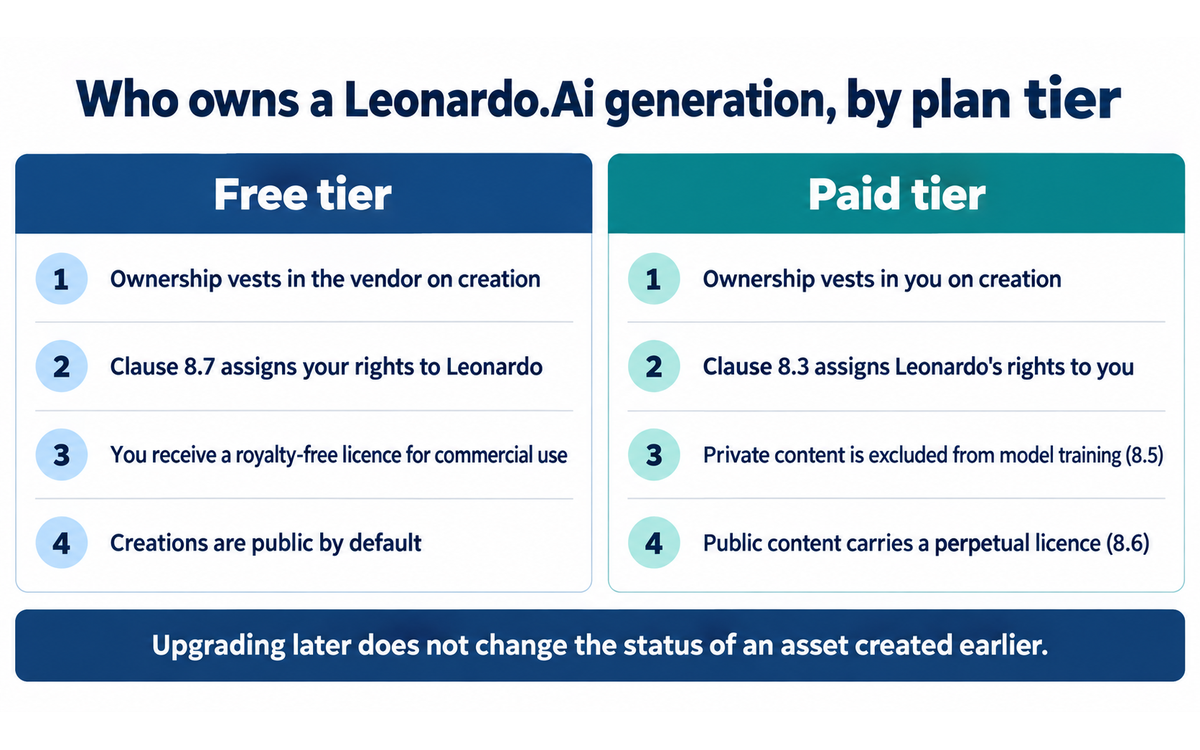
Two further items from the same contract belong in front of a reader who is deciding, and neither is a rights question. Clause 5.2(f) prohibits service bureau use and reselling, which restricts an agency model that resells generated output as a service wrapped around one account. Clause 12.2(d) caps the vendor's aggregate liability at the fees paid, or AU$1,000 without a subscription, which is the number to carry into any risk assessment about a large campaign built on generated assets. Clause 8.8 is also worth reading twice: it requires the user to consent to the vendor's "use or infringement" of moral rights, which is broad language in a clause a user accepts by signing up.
What this section does not do
It does not assert that the vendor has misled anyone. The pricing page, the help centre and the terms describe the same arrangement from three angles, and the difference between them is the difference between a licence and ownership, which a reader has to supply.
It does not give legal advice, and it does not resolve whether the arrangement is enforceable in any particular jurisdiction. The contracting entity is Leonardo Interactive Pty Ltd, the governing jurisdiction is not analysed here, and an institution with a real campaign at stake should have the terms read by someone qualified.
It does not change the adoption advice for a paid account, and it does not tell you to avoid the free tier. It says the free tier is an evaluation tier: usable commercially, not suitable for a brand asset that has to be unique to U365, and not a place to generate anything whose ownership matters.
U365 Co-Intelligence Rating
Dimension | Score | Reasoning |
Time Benefit | 6 / 10 | Moderate net savings across common use cases. Generation is fast and variants arrive in one action, but the net figure has to carry model selection, quality-setting choices, token budgeting, prompt iteration and verification. The framework requires scoring net of overhead, and the overhead here is real. A campaign set that took days of design time takes hours, which is a genuine 25 to 50 per cent band; a single asset that has to be exactly right can take longer with the tool than without it, because the loop has no defined end |
Quantity Benefit | 6 / 10 | Moderate increase, 1.8 to 3 times usable output in the same time. Batch generation and trained models multiply verified, usable assets rather than raw candidates. The score is not higher because the honest count is verified output after the re-generation rate for faces, hands and lettering, not the number of images produced |
Quality Benefit | 6 / 10 | Moderate improvement relative to the user's own baseline. For a non-designer producing campaign material, the gain over what they could make unaided is large. It is not higher because there is no current independent measurement of output quality, because text rendering and anatomy remain unreliable, because content-filter interruptions degrade real work, and because plausible-but-wrong detail in a teaching visual is a quality loss rather than a gain |
Knowledge and Skill Benefit | 4 / 10 | Marginal skill benefit. Prompt iteration, model selection, reference strategy and token economics are real working skills that improve with use, and the API and training surfaces teach something durable to a technical user. Conservative score, as the framework requires: for the common user, the platform substitutes for craft rather than building it, and nothing in the product requires the user to learn composition, typography or colour to get an expert-looking result |
CI-First Benefit Score = (6 + 6 + 6 + 4) / 4 = 5.5 / 10
Band: CI-First Positive (4.1 to 6.0).
CI-First Profile: Primary: Profile 1, AI as Co-Creator and Thought Partner. The platform's strongest mode is iterative: sketch, generate, refine, re-roll, build on the previous output. Realtime Canvas and Flow State are co-creation surfaces by design. Secondary: Profile 2, AI as Co-Worker and Assistant, for the production run of a defined asset set once the look is settled.
Collaboration Mode: Centaur. The framework's own rule decides this: Imposture Risk Medium or High means Centaur, because Centaur mode is safer. With Skill Illusion rated High and two other traps rated Medium, the boundary has to be explicit. Define what the AI produces and what the human decides before the session starts. The AI generates candidates, variants and the trained-model output; the human chooses the model, sets the quality level, owns the brand judgement, verifies against a factual or brand source, and decides what ships. Cyborg mode, the fast iterative loop, is defensible for a single designer exploring a look on their own account, and it is not the recommended mode for an institutional asset set.
Humics Protection Rating
Dimension | Score | Reasoning |
Creativity | +1 | The tool genuinely expands what a person can make and lets them explore directions they could not have produced unaided. Realtime Canvas rewards rough input instead of punishing it. The protection is positive but not maximal, because the aesthetic pull of a well-tuned default model pulls different users toward similar outputs |
Critical Thinking | -1 | The output arrives finished and plausible. A generated image of a process, a place or a product carries invented detail that reads as fact, and the tool offers no signal about which parts are imagined. A user who ships a generated visual as evidence has stopped testing their own claim |
Social Authenticity | -1 | Generated depictions of people, and trained models built on reference images of people, sit close to identity misrepresentation. The vendor's own terms prohibit generating content that impersonates a real person or falsely portrays an individual, and the same terms acknowledge that generated content may include deep fakes and misinformation. Free-tier creations are public by default. The tool can be used transparently and often is; the exposure is real enough to score negative |
Humics Protection Score = +1 -1 -1 = -1. Badge: Humics-Neutral.
Framework v1.2 clause note. All three v1.2 clauses return a null for this tool, and each null is stated with its reason.
Clause 5.2.3-a, agent-authored procedural memory: null. The Skill Illusion floor applies to a tool that writes the user's skills, memory stores or standing instructions on the user's behalf. Leonardo.Ai writes no such artefact. It saves prompts, presets, personal trained models and collections, and every one of those is authored by the user through an explicit action, with no agent revising them during use and nothing that functions as a standing instruction reused in later sessions. The boundary matters and it is drawn here: a saved prompt is a user-authored asset, not agent-authored procedural memory. The beta agent surface inside the application does not change the finding, because no agent-authored durable instruction surface is documented. Skill Illusion is nevertheless recorded as High on the general rubric, from the expert-output-for-a-non-expert criterion, and not from the clause.
Clause 4.2-a, agent-mediated conversation: null. The clause applies where agent-authored text is presented as the person's own voice, or where agent interaction substitutes for human contact. The platform's surfaces are media generation and editing, not a human-facing conversational channel, and nothing generated is presented as the user's own written voice. The beta agent surface is a disclosed product feature, which the clause excludes.
Clause 7.5, team-level rooms: null. The clause applies to a shared channel in which more than one agent acts, and it requires Centaur. Leonardo's team plan is a shared workspace with a pooled token balance, seat management and permission roles. No agent acts in a shared channel on the team's behalf, so the clause does not reach it.
What Users Say
Ratings read on 2026-09-25. Review counts move, and the same platform can report two different totals on two different pages on the same day, which is noted where found.
Platform | Rating | Reviews | Read on |
G2 | 4.5 out of 5 | 34 | 2026-09-25. 67 per cent five-star, 32 per cent four-star, no one, two or three-star reviews recorded |
Capterra | 4.6 out of 5 | 16 on the vendor's profile page, provider data verified 2026-09-18. Other regional Capterra pages for the same product report 15 reviews and a 4.6 rating | 2026-09-25 |
Trustpilot | 4.6 out of 5 | The profile page reported 1,176 reviews in one reading and 1,298 in another on the same day | 2026-09-25 |
Product Hunt | 5.0 out of 5 | 4 reviews, 172 followers | 2026-09-25 |
Apple App Store | 4.8 out of 5 | 10,000 ratings | 2026-09-25 |
Zoftware | 4.9 out of 5 | 20 reviews, last updated 2025-11-18 | 2026-09-25 |
SoftwareHope | 4.8 out of 5 | 286 verified reviews | 2026-09-25 |
Two figures that circulate widely do not reconcile with the platforms they are attributed to, and are recorded here as unverified rather than repeated as fact. One directory claims approximately 1,800 G2 reviews at 4.6 and approximately 1,400 Capterra reviews at 4.7, against the 34 and 16 that the platforms themselves report. One aggregator lists a 4.3 editorial score described as based on 78 per cent positive, without publishing the sample behind the percentage. Treat both as unattributed.
What the sentiment actually contains.
Trustpilot's own summary of its reviews reports the dominant theme as staff conduct rather than product quality: helpfulness, response speed and issue resolution are the most discussed topics, with a minority reporting frustration at generations that fail without clear feedback and at slow or absent replies on team settings and billing.
The recurring product criticism across independent reviews is the token economy, not the imagery. One structured review of a hundred Trustpilot reviews found support-led positivity alongside billing complaints; another notes cancellations that were not honoured as expected despite a confirmation email; a third records a billing and support failure reported by an enterprise customer as a major-negative flag.
The most concrete community signal located is the reported grey market in token resale at very large discounts, cited by a reviewer as evidence that official pricing is hard to sustain at high volume. That is a claim about pricing pressure rather than a defect, and it is recorded as reported, not tested.
Independent reviewers who publish their method converge on the same split: strong for consistent, repeatable, production asset work, weaker for single-image aesthetic quality against a specialist, and mixed on text rendering. One test in the field found the Phoenix family rendering legible text on a difficult prompt while a competing model failed; another found text rendering a continuing weakness. Both are single tests of single prompts, and the honest statement is that it is inconsistent.
A reviewer with a published sample of 210 generations, 18 canvas sessions and 6 video renders across three plans reports that 150 free-tier tokens were exhausted after 22 standard Phoenix generations, that a heavily promoted third-party model can exhaust a daily allowance in under ten images, and that a single quality image typically consumes a number of tokens that makes the free tier a genuine but modest evaluation allowance.
On the vendor's own community surfaces, the product receives sustained praise for the training and consistency features and for the application interface, which matches the platform's differentiation.
U365 editorial note. The ratings above are consistent and high, and they are high for a reason that is not the reason U365 would adopt the tool. The strongest sentiment driver is customer support, not capability. Capability evidence in review text is thin: very few reviewers publish a sample size, a measurement or a comparison method. Read the ratings as evidence that the platform is usable and well supported, and read the independent reviewers with published methods as the evidence about output quality. No numeric rating in this table came from a page that could not be read.
Comparison and Alternatives
Five alternatives, each with the case for choosing it. Krea and Recraft are both under review in this batch, so their entries here are written to be checked against those reviews rather than to pre-empt them.
Tool | What it is | Entry price | Choose it over Leonardo when |
Midjourney | Single-family aesthetic specialist, no free tier | $10 per month for Basic, rising to $120 for Mega, all paid | You want the best-looking single image with no setup, and you are working with artists rather than a production pipeline. There is no free tier, no official team plan and no official API, so the choice is a bet on one aesthetic |
Ideogram | Text-in-image specialist | Free tier with 10 slow credits per week, then paid tiers commonly listed at about $15 to $20 per month and about $42 to $60 for the top individual tier | Your assets are typographic: logos, posters, thumbnails, packaging, anything where the words must be legible and correctly spelled. It is the reference point for text rendering and its free tier is reported to include commercial rights, which Leonardo's does as a licence rather than as ownership |
Krea | Real-time canvas and aggregator with its own models plus many hosted engines | Advertised from about $8 to $10 per month on the basic tier, with a commercial licence reported on that tier already | You want a real-time, highly interactive generation surface as the primary workspace, and you value the aggregation model for its own sake. Compared with Leonardo, expect a different balance between live iteration and production asset management, and verify the licence terms on the tier you buy |
Recraft | Design-native generator with true vector output and brand style control | About $12 per month on the basic individual plan for 1,000 credits, with top-up credits that never expire | You need vectors, SVG, icon systems or a reusable brand style that survives into a design tool. Leonardo is not optimised for vector output, and this is the clearest capability gap in the comparison |
Runway | Video-first generation and editing suite | Paid tiers, no free tier of the same shape as Leonardo's | Video is the deliverable rather than a feature. If your primary need is motion, editing and a video pipeline, a video-first tool is the honest choice and Leonardo is the secondary tool |
Honest summary of the comparison. Leonardo's position is breadth plus consistency. It is not the best single-image aesthetic in the market, it is not the best text renderer, it is not a vector design tool and it is not a video-first studio. What it does that none of the four above does as well is hold a style across a large asset set through trained models, while giving access to everybody else's engines from the same balance and the same API. If that is your problem, this is the tool. If your problem is one of the four specialised ones, choose the specialist and keep Leonardo for the set work.
A sixth comparison is worth one line. Canva owns the vendor, and a team already working inside Canva's product range gets adjacency rather than integration: the platforms remain separate products with separate pricing pages, and nothing in the vendor's documentation promises that work moves between them.
Verdict and Next Steps
Verdict: adopt for asset-set production, with a paid account and a written rights decision.
Leonardo.Ai scores 5.5 out of 10, in the CI-First Positive band. That is a recommendation with conditions, and the conditions are specific rather than general.
Adopt it for the work it is genuinely better at than the alternatives: a set of assets that has to hold one visual language, produced on a deadline, with a trained model doing the consistency work. That use case is real, common at U365, and not answered as well by any of the four alternatives compared above. Do not adopt it as the answer to single-image aesthetic quality, vector output, typographic assets or video-first production. Those are four different tools.
The two decisions that have to be made before anyone generates a brand asset are both contractual rather than technical. First, generate on a paid account, on a private setting, or accept that the asset belongs to the vendor and may be reused by others. Second, decide before generating who owns the output and on which tier, because upgrading afterwards does not change the status of what was already created.
Next steps for a U365 team
Run a two-week evaluation on a paid entry tier, not on the free tier. The free tier is for learning the interface. The rights position on the free tier is wrong for anything client-facing, and the token allowance is too small to test a real workflow on.
Complete the model-selection exercise in Section 7 before any production work. Three models, one prompt, recorded token costs. That single exercise changes how the team budgets and how it chooses.
Train one element on the U365 visual identity and validate it against the brand guide. This is the capability the adoption rests on. If the trained model does not hold the brand, the case for the platform weakens considerably.
Write the rights decision into the team's own working document. State the tier, the private setting, the ownership position and the liability cap. Two paragraphs, checked against the terms, reviewed once.
Pilot one campaign asset set end to end and measure it. Record the token spend, the re-generation rate and the reviewer's corrections. The next purchase decision should rest on that record rather than on the homepage claim about cutting production costs in half.
Set a rule about teaching visuals. Anything that depicts a real process, instrument or place either gets a subject-matter review or a caption that says plainly what is illustrative.
Re-check the token-rollover behaviour at the end of the second billing cycle. If the rollover bank is empty every month, the tier is right. If it is never drawn, it is too high.
UP-Context prompt pack
Four reusable prompts, written in the UP-Context order and each closing with the verification line. The text inside each block is copied verbatim into the platform. Replace every bracketed placeholder with your own before you run it, and keep the approved version in the team's own working file rather than in the application.
Prompt pack 1: The brand boundary and the trained-element decision
Context: Our brand is [name]. The approved palette, type and imagery guidance is in the attached workspace context. The asset set is for [audience] and will appear in [channels]. What we must never show is [list]. The budget for this set is [tokens or currency].
Role: AI as a brand-governance assistant working to a written brand boundary.
Profile: Act as a Co-Creator and Thought Partner. I own the direction and the final judgement; you generate and vary.
Task: Restate my brand boundary back to me before generating anything: the look we are protecting, the subjects that are in scope, and the three things you will refuse to render. Then recommend whether this set justifies training a model on reference images or whether a style reference is enough for a one-off, and say what each costs in generations.
Constraints: Never invent logos, trademarks, partner marks or product features that do not exist. Never render lettering; the words go into the layout tool. Ask before adding any element I did not describe. Never propose a free-tier route for client-facing or cohort-facing material.
Output format: The restated boundary, the training-versus-reference recommendation with its reason, and a numbered generation plan with the model named for each step.
Memory: this platform saves prompts and trained models as user-authored assets and writes no standing instruction of its own. The approved version of this prompt belongs in the team's own working file, not in the application.
UP-Context verification: state what you checked, what you could not check, and what a human must decide before this is used.
Prompt pack 2: The batch run, the token budget and the re-generation rate
Context: I am producing [number] assets from one approved look. The plan is [tier], the model is [model], and the current allowance, rollover bank and top-up balance are [figures]. The last set cost [tokens] and needed [number] re-generations.
Role: AI as a production planner working to a published cost sheet.
Profile: Act as a Co-Worker and Assistant for the production run once the look is settled.
Task: Build the run order for this set: which asset to generate first, which to derive by re-running at a different aspect ratio rather than cropping, and where the human checkpoints sit before the remaining assets are generated. State the expected token cost of each step and the total, and name the point at which the run should stop rather than continue.
Constraints: Cost is per action and varies with model, quality setting, size, reference images and number of outputs, so no figure may be presented as fixed. Content-filter interruptions consume the allowance and no remedy is documented, so budget a margin and say what it is. Video costs are multiples of image costs in the same currency.
Output format: A numbered run order with the model, the quality setting and the token cost per step; a total; a stated margin; and the stopping condition.
Memory: this platform saves the run as prompts and collections authored by the user and writes no standing instruction of its own. The approved run order belongs in the team's own working file.
UP-Context verification: state what you checked, what you could not check, and what a human must decide before this is used.
Prompt pack 3: The teaching visual and the publication rule
Context: This visual illustrates [concept] for [cohort or channel]. It depicts [what is shown]. The parts that must be literally accurate are [list]; everything else is illustrative. Our policy on generated imagery is [policy or none].
Role: AI as a publication-rule adviser for an educational publisher.
Profile: Act as an Analyst and Tester, applying my stated rule to the asset rather than inventing one.
Task: State, for this asset, whether it can be published as it stands, what caption it requires, what the record must hold, and who has to review it. Then name the specific details in the image a reader could mistake for fact, and say which of them need a subject-matter check before publication.
Constraints: Never present a generated image as photography. Never assert that a depicted instrument, place or process is accurate. Where the image is illustrative, say so in the caption rather than in a footnote. Where the tool has invented a label or a number, name it.
Output format: The publication decision, the caption text, the record fields, the named reviewer role, and the list of details needing a check.
Memory: this platform writes no standing instruction of its own; the approved decision and caption belong in the team's own file and in the LIPS record for the engagement.
UP-Context verification: state what you checked, what you could not check, and what a human must decide before this is used.
Prompt pack 4: The rights check before an asset leaves the platform
Context: The asset is [describe]. It was created on the [tier] plan with the private setting [on or off], on [date]. It will be used for [purpose], published to [channels], and [may or may not] be resold or wrapped in a service we offer. The still the team intends to animate is [describe, with where it came from].
Role: AI as a rights and claims reviewer for a commercial asset.
Profile: Act as an Analyst and Tester. I supply the licence terms; you apply them and flag what is unresolved.
Task: For this asset, state which document governs it, whether the ownership position sits with us or with the vendor given the tier at the moment of creation, what the public-content licence permits if the creation was public, and whether the intended use is caught by the service-bureau restriction. Then list every question the answers do not settle.
Constraints: Do not give legal advice and do not assert that any party acted improperly. Distinguish a licence to use something from ownership of it, because they are different positions. Where the terms, the pricing page and the help centre describe the same arrangement from different angles, say which one governs.
Output format: A governing-document line, an ownership line, a licence line, a service-bureau line, an unresolved-questions list, and the human decision required.
Memory: this platform writes no standing instruction of its own; the approved rights decision belongs in the team's own working file and in the LIPS record.
UP-Context verification: state what you checked, what you could not check, and what a human must decide before this is used.
U.Copilot and SL-OS integration
U.Copilot. Leonardo.Ai is a plausible production surface for U.Copilot-assisted course material, on one condition the platform does not enforce itself. The pedagogical intent belongs to the Fellow, so the brief has to be written from the learning outcome rather than from the aesthetic: what the image has to make a reader understand, and what it must not appear to assert. Route a Fellow to Leonardo.Ai when the asset set is the deliverable, because a trained element holds a look across a whole set and that is the work no single-image tool answers. Route a Fellow away from it when the accuracy of a depicted process, instrument or place is the point, because a generated diagram carries invented detail and a reader will take it as fact. Two guardrails: never accept a free-tier generation into client-facing or cohort-facing material, because the ownership position on that tier is the vendor's and the creations are public; and never let a teaching visual reach students without a named subject-matter reviewer or a caption that says plainly what is illustrative.
SL-OS. Leonardo.Ai fits the Successful Life Operating System as a production step the Fellow supervises, not as a place where institutional material lives. Assets, prompts, trained models and approvals stay in governed storage, and the tool sits at one step of a process that starts with a brief and ends with a sign-off. The LIPS record for a substantive engagement belongs under the relevant Project, or under Career and Finance when the engagement is skill development. The fields to keep: the brief in the Fellow's own words with the point the asset makes and its audience; the model and quality setting chosen, with the token cost of the action; whether the look was a style reference or a trained model, and why; the asset's tier and private-public position at the moment of creation, because that is what fixes its licence status; the reviewer's corrections; and the sign-off. The field most likely to be omitted is the one carrying the academic value: the tier and the private setting at creation. Everything else describes what was made. Those two fields record what the institution is permitted to do with it, and the review's Section 7c is the reason they are not optional. The CARE cycle on this tool: collect the brief, the model choice, the cost, the rights position and the sign-off with the prompt attached to the asset rather than left in the application; arrange them in the LIPS record at the end of the engagement rather than during it; review at the cadence the Fellow already keeps, and specifically review whether the trained model still holds the brand; and evaluate against the question the review supplies, which is whether the asset can be explained and defended without opening the tool. ULM domains: Career and Finance is the primary one, because the transferable skills are visual specification and cost appraisal, both professional skills that transfer to any production route including a conventional one. The fit statement is a partial fit and an honest one: this is a production step inside a process the Fellow controls, it is not a system of record, it governs nothing, and any material placed in it is governed by the vendor's terms rather than by ours.
Honest statement of what would change this verdict
Two things would move the score up. A current, repeatable, independent measurement of output quality, which would let Quality move from 6 to 7. And a design surface that teaches the underlying craft rather than substituting for it, which would move Skill above 4. Neither existed at the time of writing.
Two things would move the score down. A narrowing of the paid-tier ownership position, or a commercial-use restriction added to the free tier, which would change the adoption advice rather than the score itself. And a sustained failure of the trained-model consistency promise, which is the capability the whole recommendation rests on.
Migration Path
Leonardo.Ai is an Active tool, so a migration path is not applicable. There is no retirement, deprecation or replacement plan to write, and no asset or workflow needs to be moved off the platform. This heading is present so the absence is explicit rather than an oversight. The re-check triggers in the Status and Re-check section above are the mechanism that would change the tool's status, and any of them would be published as a re-score rather than as a migration note.
U365's Recommendations to Learn More
Start with the vendor's own documentation rather than with a third-party guide, because the guides disagree with the vendor and with each other about plan names, token costs and free-tier rights. Read the pricing page and the terms in the same sitting, then the help centre on tokens, then the model guides.
The pricing page is the only surface that reflects what the checkout will charge. Read the footnote about unlimited relaxed generation in full, and read the ownership question and answer.
The help centre on tokens explains the four balances (Fast Tokens, rollover bank, top-up tokens and unlimited generations) that the pricing page only names.
The help centre on commercial usage is the plainest statement of the rights position the vendor publishes, and it is dated.
The model guides in the API documentation describe what each first-party model is for, which is more reliable than a blog post about which model is best.
The terms of service, clause 8 is the operative document for anything you generate. Read it once, all the way through, before an institutional asset set is built on generated content.
The API concurrency, queue and rate-limit page is the only published statement of the platform's production ceilings.
Resources on Leonardo AI and Resources on X
Dedicated Leonardo AI channels
The vendor's own tutorial and model pages are the fastest route in, and they are updated with the product:
Leonardo.Ai tutorial article: https://leonardo.ai/news/how-to-use-leonardo-ai/
Leonardo.Ai model shelf: https://leonardo.ai/models
Lucid Origin announcement and model page: https://leonardo.ai/news/lucid-origin-ai-image-model and https://leonardo.ai/lucid-origin
Phoenix model page: https://leonardo.ai/phoenix
The vendor's model-choice guide: https://leonardo.ai/news/ai-image-models
The vendor's own answer on commercial use: https://leonardo.ai/news/can-you-use-ai-generated-images-commercially
Two video walkthroughs, ordered newest first. The first is a build-along that goes from an idea to a cinematic clip inside Leonardo, which is the most useful single video for understanding the workflow this review describes in Section 8. The second is a complete beginner walkthrough of the platform.
Leonardo AI Tutorial: From Concept to Cinematic Video, a full build-along from prompt to rendered clip, including the model and motion settings: https://www.youtube.com/watch?v=yH9z7X48uzA
Leonardo AI Tutorial: From Concept to Cinematic Video
Leonardo AI - Tutorial for Beginners - How to Use [ FULL GUIDE 2026 ], a beginner walkthrough that covers the interface, the model shelf and the first generation: https://www.youtube.com/watch?v=oitdcBS2yOk
Leonardo AI - Tutorial for Beginners - How to Use [ FULL GUIDE 2026 ]
Where to follow the product
Leonardo.Ai changelog inside the application, which is the only place vendor releases are listed in date order.
The vendor's Discord community, linked from the application, where model changes are discussed first.
The vendor's blog, which carries the model announcements.
Dedicated X channels
The account to add first is the vendor's own at https://x.com/LeonardoAi, because a change to the pricing model, the licence over your content or the model line would be announced there before it reached a documentation page. For this category the accounts worth following alongside it are the practitioner and analyst accounts that publish comparative work, and the competitor accounts named in the comparison section, so that any capability claim in this review can be checked against a measurement rather than against a marketing page.
Glossary
AI Imposture Risk. The assessed likelihood that a tool traps a user in one of three illusions: the Time Illusion (apparent speed with no net saving), the Quantity Illusion (apparent volume of work that does not hold up under inspection) and the Skill Illusion (apparent competence without the underlying skill). Rated Low, Medium or High, with the overall level driven by the highest trap and the availability of mitigations.
Centaur mode. A collaboration mode in which the human and the AI have clearly separated roles. The human decides, judges and owns the outcome; the AI produces candidates and executes defined work. The safer of the two modes, and the default when Imposture Risk is Medium or High.
CI-First. The U365 principle that Co-Intelligence must out-perform Human Intelligence alone, measured net of the overhead of using the tool. A CI-First tool is one where the gain after prompting, verifying and correcting is real.
CI-First Benefit Score. The arithmetic mean of the four benefit dimensions (Time, Quantity, Quality, Knowledge and Skill), scored 0 to 10 and rounded to one decimal place. Bands: 0 to 2.0 CI-First Negative, 2.1 to 4.0 CI-First Neutral, 4.1 to 6.0 CI-First Positive, 6.1 to 8.0 CI-First Strong, 8.1 to 10 CI-First Transformative.
CI-First Profile. The role the AI plays in the collaboration, from a taxonomy of five: Co-Creator and Thought Partner, Co-Worker and Assistant, Coach and Tutor, Analyst and Tester, Challenger and Devil's Advocate.
Cyborg mode. A collaboration mode in which human and AI iterate rapidly with no clear boundary between their contributions. Faster, and riskier, because it removes the stopping criterion that Centaur mode supplies.
Element training. Leonardo's feature for training a personal model on a small set of reference images, typically 10 to 50, so that a subject or a style can be reproduced consistently across later generations.
Fast Tokens. The monthly or daily token allowance bundled with a plan, drawn first, before the rollover bank and before top-up tokens.
Imposture trap. One of the three failure modes measured by the AI Imposture Risk assessment.
Pay-as-you-go (API). The dollar-based billing model for Leonardo's API, with no monthly commitment, a balance that does not expire, manual or automatic top-ups, and a cost object returned in generation responses.
Relaxed generation. Slower, queue-priority generation available on eligible first-party models once a plan's other token balances are exhausted. It cannot be enabled manually and it does not cover third-party models.
Collaboration Mode. The working structure that is safest and most effective with a tool. Centaur mode keeps a clear division of labour: the human owns judgement and the final decision, the tool owns execution. Cyborg mode intertwines the two. Where Imposture Risk is Medium or High, the framework assigns Centaur, because Centaur is the safer structure. Leonardo.Ai is Centaur.
Humics Protection Badge. A three-dimension rating of whether a tool protects, leaves neutral, or erodes the three human capabilities: Creativity, Critical Thinking and Social Authenticity. Each is rated +1, 0 or -1, and the sum produces the badge: Humics-Friendly at +2 to +3, Humics-Neutral at -1 to +1, Humics-Risky at -2 to -3. Leonardo.Ai is Humics-Neutral at -1, with Creativity +1, Critical Thinking -1 and Social Authenticity -1.
User Sentiment. The record of what users say about a tool on review platforms, with the sample size and verification status of each platform stated, because a rating without its volume and its verification status cannot be read.
Review Status. The current assessment of a tool: Active, Changed, Risky, Deprecated or Retired. Recorded as a badge at the top of every U365 Tools Review, with the date it was last tested and the trigger that would cause a re-check.
Rollover Bank. The store for unused Fast Tokens on a paid plan, capped at three months of the plan's allowance and drawn only after the Fast Token balance is exhausted.
SL-OS. A U365 operating method.
Style reference. An input that carries the visual character of one image into a new generation without training a model.
Token. The internal currency Leonardo uses to charge for platform actions. Cost varies by model, settings, size, reference images and number of outputs, and is displayed on the action before it is executed.
U.Copilot. A U365 method for structured work with an AI assistant.
Sources
All URLs below were relied on for this review. Vendor sources read 2026-09-25.
Vendor product and pricing surfaces
https://leonardo.ai/ (homepage, tagline and the production-cost headline claim)
https://leonardo.ai/pricing (tier names, prices, token allowances, rollover, the unlimited-relaxed footnote in both versions, the ownership question and answer, the tax note)
https://www.leonardo.ai/pricing (search-indexed version of the same page, carrying the same tiers)
https://leonardo.ai/team-plans (team plans, seat management, IP protection claims)
https://leonardo.ai/api (API positioning, Blueprints, single-API framing)
https://leonardo.ai/faq (free tier, model fine-tuning, platform guidance)
https://leonardo.ai/models and https://leonardo.ai/phoenix (model shelf and Phoenix positioning)
https://leonardo.ai/news/midjourney-vs-leonardo-ai (the vendor's own comparison, plan names Apprentice, Artisan Unlimited, Maestro Unlimited, and the images-and-videos-generated figures)
https://leonardo.ai/news/lucid-origin-ai-image-model and https://leonardo.ai/lucid-origin (Lucid Origin positioning)
https://leonardo.ai/news/ai-image-models (the vendor's model-choice guide)
https://leonardo.ai/news/ai-video-models (video model decision matrix)
https://leonardo.ai/news/can-you-use-ai-generated-images-commercially (the vendor's commercial-use article, dated November 2025)
Vendor documentation
https://docs.leonardo.ai/docs/pricing-and-plans-faq (API pricing model, self-serve entry, top-ups, no-expiry balance, migration from subscription plans)
https://docs.leonardo.ai/v1.0/docs/payg-guide (pay-as-you-go mechanics, auto top-up, savings table)
https://docs.leonardo.ai/v1.0/reference/limits (concurrency, rate limits and queue limits, with defaults)
https://docs.leonardo.ai/docs/guide-to-concurrency-queue-and-rate-limit (concurrency, queue and rate-limit definitions and enterprise path)
https://docs.leonardo.ai/docs/motion-20 and https://docs.leonardo.ai/docs/generate-with-motion-2-motion-2-fast-using-text-prompts (Motion 2.0 API)
https://docs.leonardo.ai/v1.0/docs/phoenix and https://docs.leonardo.ai/docs/generate-images-using-leonardo-phoenix-model (Phoenix API, including the ultra parameter)
Vendor help centre
https://intercom.help/leonardo-ai/en/articles/9044700-tokens-frequently-asked-questions (token balances, rollover, unlimited generation activation, and the list of third-party models excluded from relaxed generation)
https://intercom.help/leonardo-ai/en/articles/9560707-token-rollover (rollover caps by plan and per seat)
https://intercom.help/leonardo-ai/en/articles/8044018-commercial-usage (the commercial-use position, dated 25 August 2026)
Vendor legal
https://leonardo.ai/terms-of-service/ (clauses 5.2, 5.3, 6, 7, 8.1 to 8.9, 9, 10, 12 and 14; the free-subscriber and paid-subscriber ownership clauses and the public-content licence)
https://leonardo.ai/privacy-policy/ (last updated 19 January 2026; the Canva brand identification, the machine-learning use of content, and the private-content exclusion on paid plans)
https://leonardo.ai/data-processing-addendum/ (referenced by both the terms and the privacy policy)
https://leonardo.ai/master-services-agreement (the enterprise agreement surface, referenced for the token-allocation framing)
Independent measurement and review
https://cloudprice.net/models/leonardo-ai-phoenix-1-ultra (Phoenix 1.0 Ultra specification, status, and the Elo figure)
https://replicate.com/leonardoai/phoenix-1.0/readme (per-image unit pricing for the Phoenix 1.0 fast, quality and ultra tiers on a third-party host)
https://www.g2.com/products/leonardo-ai/reviews (4.5 from 34 reviews)
https://www.capterra.com/p/10014773/Leonardo-AI/ and https://www.capterra.co.uk/software/1058902/leonardo-ai (4.6 ratings and review counts)
https://www.trustpilot.com/review/leonardo.ai (4.6 and the review total, with the topic summary)
https://www.producthunt.com/products/leonardo-ai (5.0 from 4 reviews)
https://apps.apple.com/us/app/leonardo-ai-image-generator/id1662773014 (4.8 from 10,000 ratings)
https://zoftwarehub.com/products/leonardo-ai/reviews (4.9 from 20 reviews)
https://knowara.com/ai-tools/image/leonardo-ai-review/ (a review with a published sample: 210 generations, 18 canvas sessions, 6 video renders, and the pricing and token observations cited above)
https://techsifted.com/guides/leonardo-ai-pricing-2026/ (the plan-by-plan guide whose free-tier watermark and licence statements differ from the vendor's pricing page)
https://vantaige.io/ai-tool/leonardo-ai (text rendering and content-filter observations)
https://rainaiservices.com/reviews/leonardo-ai (an analysis of 100 Trustpilot reviews, support-led positivity and billing complaints)
https://saasflags.com/products/leonardo-ai (documented complaints and the risk-score framing)
https://techreviewer.co/products/leonardo-ai (usability and the enterprise support flag)
https://smartremotegigs.com/software/leonardo-ai (community-reported token resale pressure)
https://aiwithkay.com/blog/leonardo-ai-review-2026 and https://ainvasion.com/leonardo-ai (Canva acquisition context, user and image totals with their dates)
https://www.eesel.ai/blog/leonardo-ai-pricing (third-party tier and token table used for cross-checking, including the Team Starter and Team Growth seat arithmetic)
Alternatives, for the comparison section
https://docs.midjourney.com/hc/en-us/articles/27870484040333-Comparing-Midjourney-Plans (Midjourney tiers and relax-mode conditions)
https://www.eesel.ai/blog/ideogram-pricing (Ideogram tiers, credits and concurrency)
https://dynalord.com/blog/krea-pricing and https://usagepricing.com/blueprint/krea-ai (Krea tiers and credit model)
https://www.recraft.ai/pricing and https://www.recraft.ai/docs/plans-and-billing/paid-plans (Recraft tiers, credits and the no-rollover rule on subscription credits)
Community and video
https://www.youtube.com/watch?v=oitdcBS2yOk (beginner tutorial, verified before embedding)
https://www.youtube.com/watch?v=yH9z7X48uzA (idea to cinematic video in Leonardo, verified before embedding)
CI-First Evaluation Summary Card
Field | Value |
Tool | Leonardo.Ai (Leonardo Interactive Pty Ltd, a Canva brand) |
Category | Video and Creative Tool: AI image, video and design generation |
Date scored | 2026-09-25 |
Status | Active |
CI-First Benefit Score | 5.5 / 10 |
Band | CI-First Positive |
Time Benefit | 6 / 10 |
Quantity Benefit | 6 / 10 |
Quality Benefit | 6 / 10 |
Knowledge and Skill Benefit | 4 / 10 |
CI-First Profile | Primary: Co-Creator and Thought Partner. Secondary: Co-Worker and Assistant |
Collaboration Mode | Centaur |
Humics Protection | Creativity +1, Critical Thinking -1, Social Authenticity -1 |
Humics Protection Score | -1 |
Humics Badge | Humics-Neutral |
AI Imposture Risk | Medium |
Time Illusion | Medium |
Quantity Illusion | Medium |
Skill Illusion | High |
Framework v1.2 clauses | 5.2.3-a null, 4.2-a null, 7.5 null |
Section 7c | Included: commercial use and ownership, stated plainly |
U365 institute alignment | |
Re-check trigger | Trigger-based, maximum 6 months |
Free tier | Yes, 150 Fast Tokens per day, public creations, no rollover |
Entry paid tier | $12 per month, excluding tax |
Top solo tier | $60 per month, excluding tax |
Team plans | Starter $72 per month for three seats at $24 per seat; Growth $144 per month for three seats at $48 per seat |
API | Pay-as-you-go in US dollars, self-serve, balance does not expire |
Primary use case | Brand-consistent asset sets, including video from a still image, produced on a deadline |
Verdict | Adopt for asset-set production on a paid, private account. Not a fit for vector, typographic, single-image-aesthetic or video-first work |
Faculty Note on Evidence Quality
This note records where the evidence in this review is strong, where it is thin, and what a reader should treat with care. It is about the evidence, not about the author.
The strongest evidence is contractual. The ownership, licence and liability positions in Section 7c come from the vendor's current terms of service read against the vendor's current pricing page and its dated help-centre article. Clause numbers are given so a reader can check each one. That section should be trusted more than any other section in this review, because it quotes documents rather than describing products.
The weakest evidence is output quality. No current independent benchmark of Leonardo.Ai's image or video output exists that this review could locate. The strongest single third-party data point is a leaderboard debut for Lucid Origin, announced by the evaluator in August 2025 at sixth place and described as comparable to a competing model. The only quantitative reading found for the Phoenix line is a single Elo figure at rank 212 on one aggregator. Everything else about quality is either vendor copy or the judgement of reviewers, some of whom publish their sample counts and most of whom do not. The Quality sub-score is capped at 6 for that reason: it is capped by the absence of measurement, not by measured weakness.
Four figures the vendor publishes do not agree with each other, and the spread is the finding. The tier at $30 appears as Artisan Unlimited in the vendor's comparison article, as Premium in the vendor's help-centre rollover table, and as a $30 middle tier without a name in one reading of the pricing page. The unlimited-relaxed footnote appears twice in one page load with seven models in one instance and ten in the other. The plan-name vocabulary differs between the checkout surface and the marketing surface. And the video-eligible model list differs between the pricing footnote and the help-centre article. None of these is a contradiction in the rights position, and all four force a reader to verify at the point of purchase rather than from a guide.
Three scale claims circulate without dates. Over 4.5 billion images and over 27 million videos; roughly 1 billion images from about 19 million users as of the acquisition; and 30 million registered users with over 2 billion images in early 2026. Each may be accurate for its own moment, and none carries the moment on the surface that prints it. Do not quote any of them as current.
One headline claim has no base at all. The homepage statement about cutting production costs by half carries no baseline, sample, customer or method. It is marketing copy and it is treated as such.
One third-party error is worth naming, because it changes what a reader would decide. At least one widely read pricing guide states that free-tier images carry a watermark and no commercial licence. The vendor's own pricing page, read the same day, grants a royalty-free commercial licence on the free tier, and the vendor's help centre walks through a free-plan commercial example. The guide is wrong on the licence and the vendor is the authority on its own licence. The underlying point the guide is reaching for is real, but the correct statement is that the free tier grants a licence to use the output while the vendor retains ownership of it, which is a different thing from a prohibition on commercial use.
Two review counts cannot be reconciled with the platforms they are attributed to. One directory claims roughly 1,800 G2 reviews and roughly 1,400 Capterra reviews; the platforms themselves report 34 and 16. One aggregator publishes a 4.3 editorial score described as based on 78 per cent positive. None of the three is repeated here as a fact.
The ratings that do appear are consistent and high, and their content is not what a technically minded reader would expect. The dominant driver of positive sentiment on the largest consumer review platform is staff conduct rather than product capability. Capability evidence in review text is thin, and very few reviewers publish a method. That asymmetry is stated in Section 11 rather than smoothed over.
Timing. Every vendor and platform source in this review was read on 2026-09-25. Product pricing, model lists and licence terms in this category change several times a year, and this vendor's own terms were last updated on 19 January 2026 while its commercial-use article still carries a November 2025 date and its rollover page describes plans that its checkout appears to have renamed. Read the pricing page and clause 8 before acting on anything here.




Comments