
Negotiation in the Age of AI

Updated: 3 days ago

UIB University 365 Institute of Business
Series Leadership Series | Level Basic (Free)
Duration 15 to 20 minutes | Access Free
Business Management, Digital Entrepreneurship, Innovation, Finance, Leadership

UNOP Sound (University 365 Neuroscience Oriented Pedagogy)
Take five minutes to prepare your brain. Play the isochronous tone track (40Hz gamma frequency) with your eyes closed. Gamma-frequency tones before a learning session raise attention and make the material easier to absorb.
[Audio player: UNOP Pre-Lecture Isochrone (40Hz, 5 minutes)]
Table of Contents
The Hook: Your Question, Answered
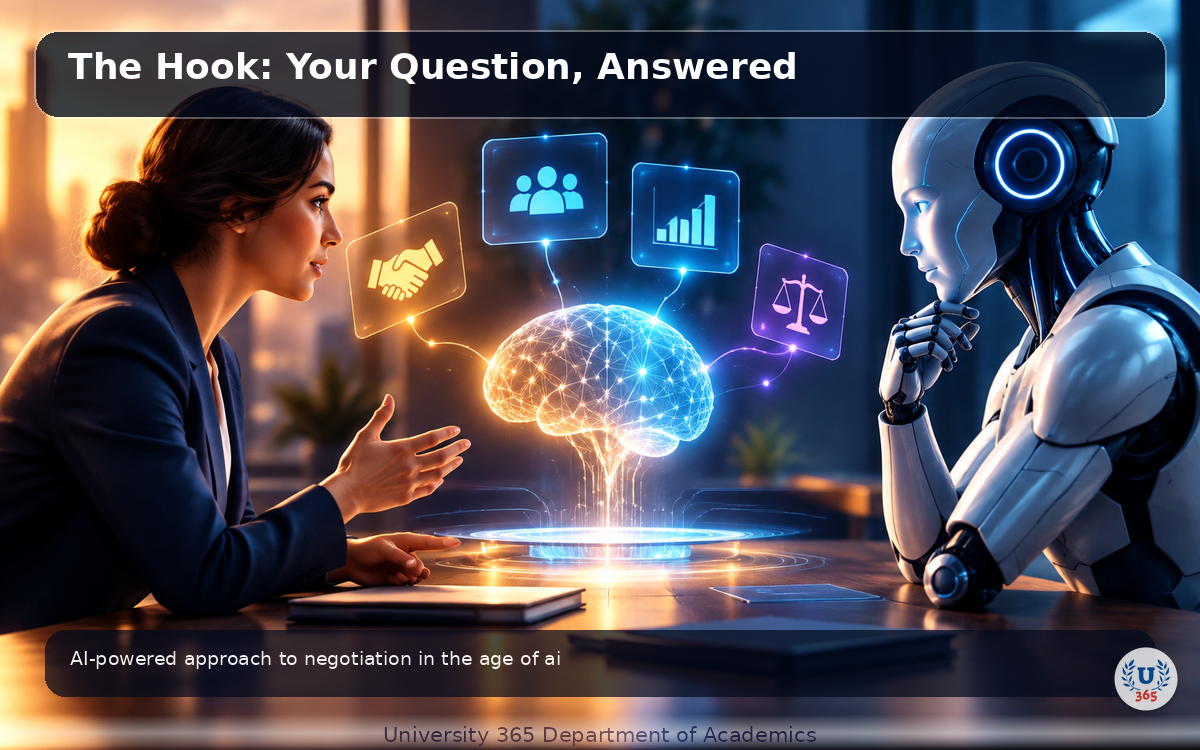
You are negotiating a critical contract. The other side has a team of lawyers and analysts. You have your experience and your AI assistant. How do you use AI to prepare, simulate, and execute a negotiation without losing the human touch that closes deals?
In this lecture, you will learn how to use AI to tackle this challenge in 15 minutes. The AI handles the data processing and pattern recognition. You handle the judgment and decisions. This is the CI-First approach: human intelligence orchestrates, AI amplifies.

What AI Brings to Negotiation
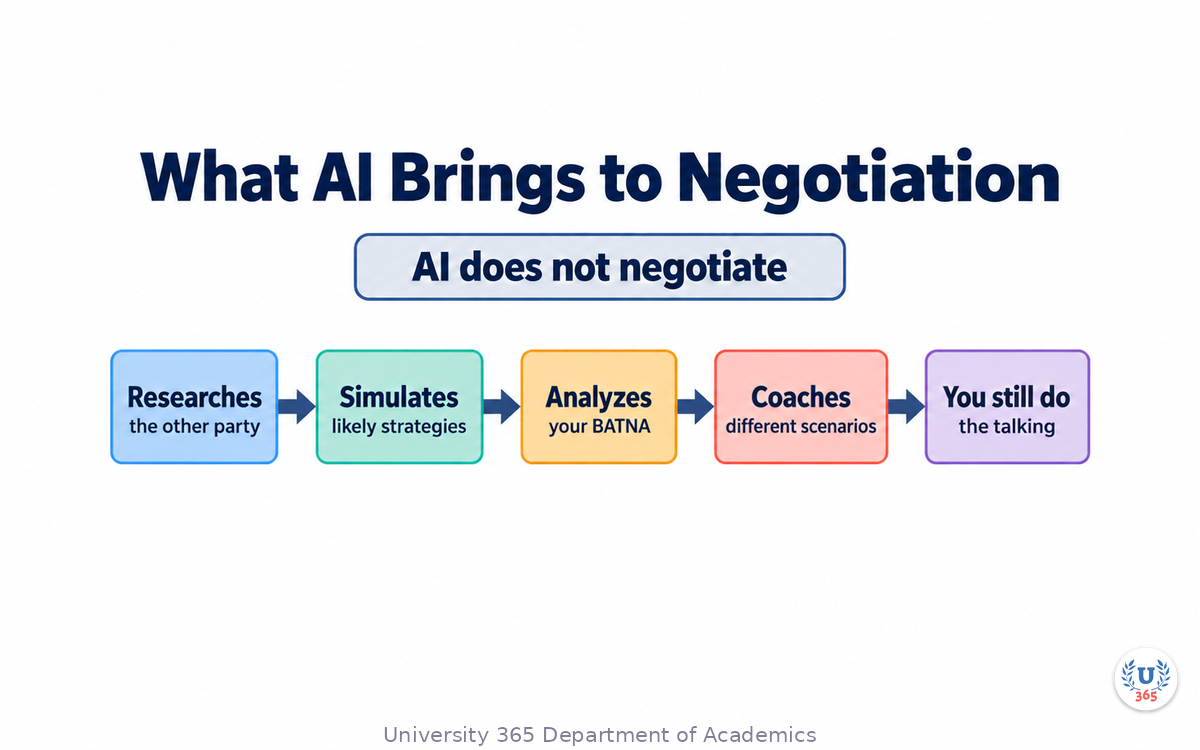
AI does not negotiate for you. It prepares you better than any human assistant could. It researches the other party, simulates their likely strategies, analyzes your BATNA, and coaches you through different scenarios. You still do the talking.
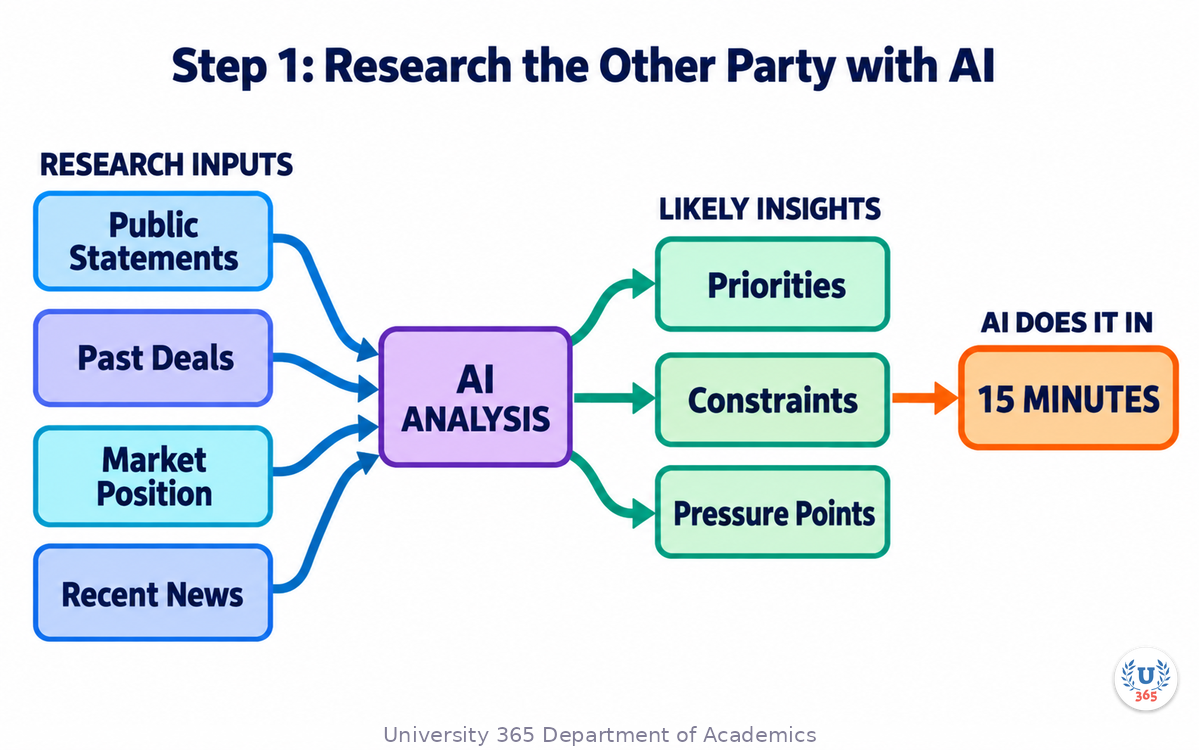
Step 1: Research the Other Party with AI
AI can analyze the other party's public statements, past deals, market position, and recent news. It can identify their likely priorities, constraints, and pressure points. This research used to take days. AI does it in 15 minutes.
Step 2: Analyze Your BATNA and ZOPA
BATNA (Best Alternative to a Negotiated Agreement) is your fallback if the deal fails. ZOPA (Zone of Possible Agreement) is the range where both sides can accept terms. AI can help you calculate both objectively.
Step 3: Simulate the Negotiation with AI
AI can role-play as the other party. You practice your opening, your responses to their likely moves, and your counter-offers. The simulation reveals weaknesses in your strategy before you enter the real negotiation.
Step 4: Real-Time AI Coaching During Negotiation
Some AI tools can provide real-time coaching during negotiations: analyzing the other party's language patterns, suggesting responses, and flagging when you are making concessions too quickly. Use these carefully.
Step 5: Post-Negotiation Analysis
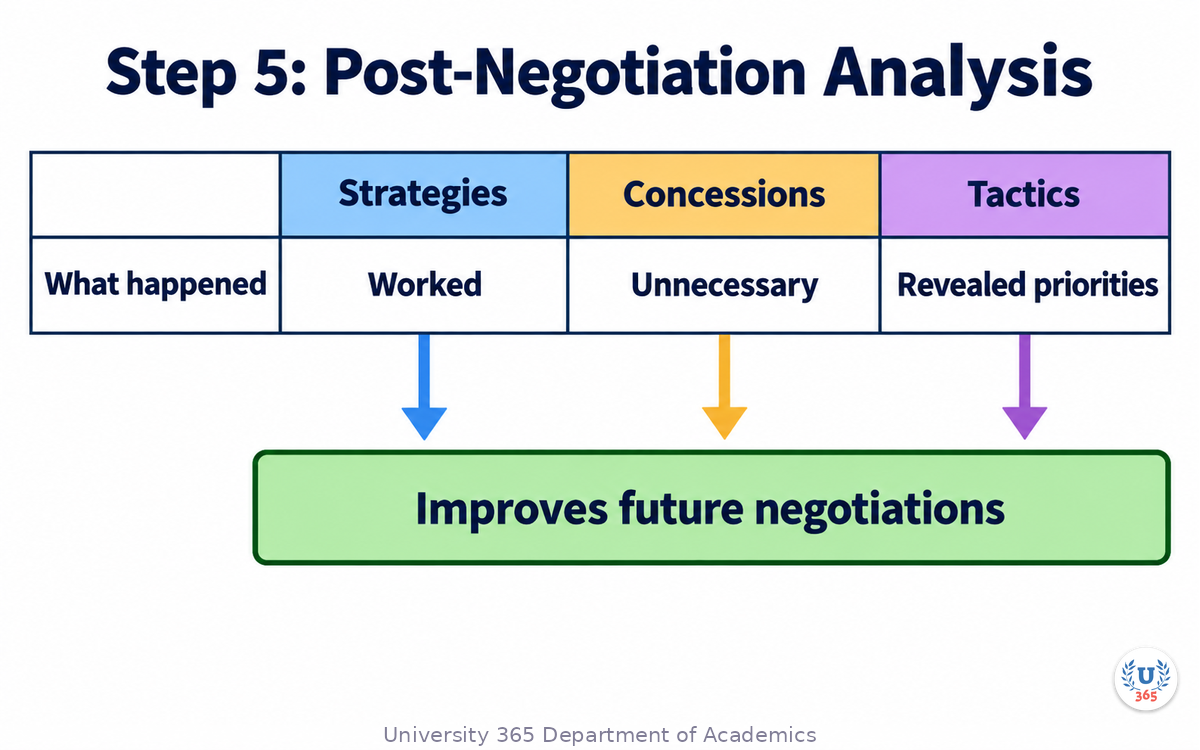
After the negotiation, AI can analyze what happened: which strategies worked, where you made unnecessary concessions, and what the other party's tactics revealed about their priorities. This improves your future negotiations.
Feynman Summary: Explain It Like You Are 12
Imagine you have a problem to solve at work. It usually takes a long time and a lot of effort. Now imagine you have a super-smart robot friend who can do the boring parts in seconds.
That is what AI does for negotiation in the age of ai. The robot reads all the information, finds the patterns, and shows you the results. You look at what the robot found and decide what to do.
The robot does not make the final decision. You do. The robot just does the hard work of gathering and organizing information so you can focus on thinking and deciding.
That is the CI-First way: you are the boss, the AI is your helper. Together, you get better results faster.
Mindmap: The Complete Picture
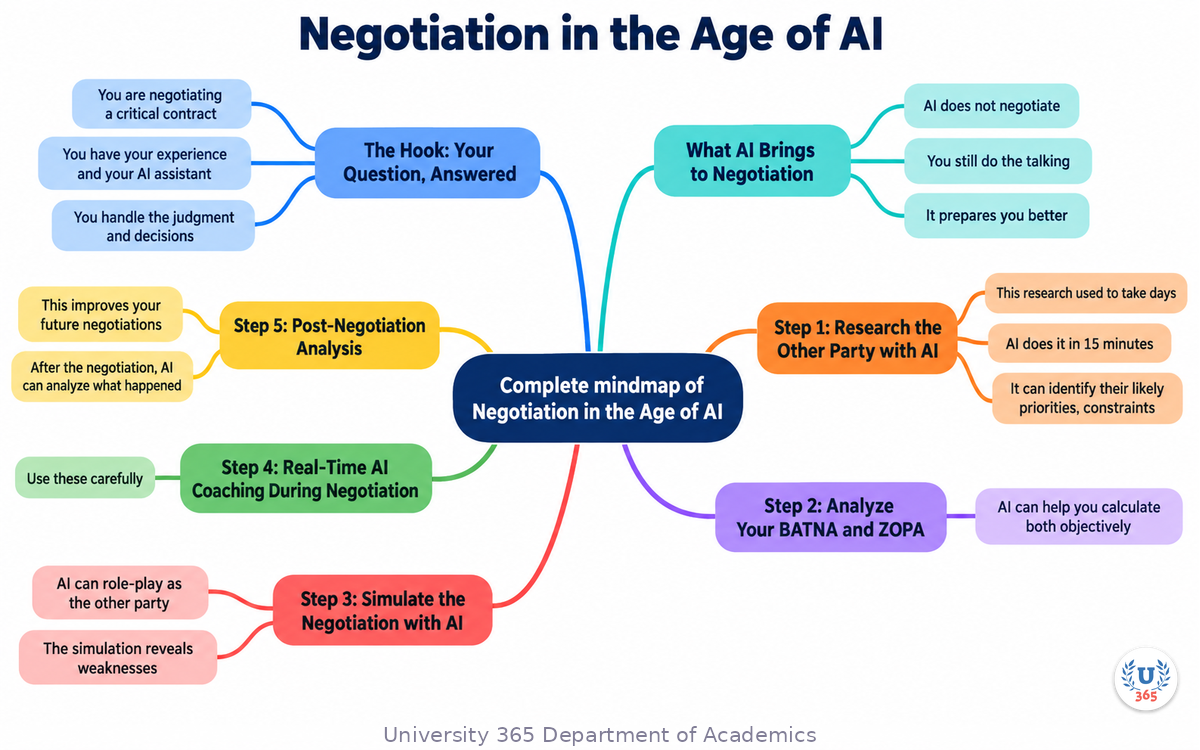
The mindmap shows the complete workflow: defining your objective leads to gathering and preparing data, which feeds into AI analysis and processing, which produces insights and recommendations, which you validate with human judgment before taking action. The CI-First principle wraps the entire process: you start with human-defined goals and end with human-validated decisions.
UNOP Sound (University 365 Neuroscience Oriented Pedagogy)
Take five minutes to consolidate your memory. Play the isochronous tone track (10Hz alpha frequency) with your eyes closed. Alpha-frequency tones after a learning session support consolidation, helping move what you just learned from short-term to long-term memory.
[Audio player: UNOP Post-Lecture Isochrone (10Hz, 5 minutes)]
Practical Exercise: Apply What You Learned
Exercise: 15-Minute Application Sprint
Identify a real scenario: Think of a situation in your work or business where this topic applies.
Define your objective: What specific outcome do you want to achieve in 15 minutes?
Use an AI tool: Open ChatGPT, Claude, or Gemini and apply the framework from this lecture.
Analyze the output: Did AI produce useful results? What needs verification? What needs human judgment?
Make a decision: Based on AI output plus your judgment, what action will you take?
What to Look For
Did AI produce specific, actionable output or generic statements? Generic output means your prompt needs more context.
Did AI invent any data or make unsupported claims? Always verify critical facts against primary sources.
What would you do differently from what AI suggested? The gap between AI output and your judgment is where your value lies.
The CI-First formula is CI = HI + (AI x HI). Your intelligence is the foundation. AI multiplies it. But the final decision is yours.
Applied AI Connection
This exercise demonstrates the CI-First workflow in practice. You defined the objective (human intelligence). AI processed and analyzed (AI amplification). You validated and decided (human intelligence). The speed gain from AI lets you iterate faster and explore more options than you could manually.
Glossary
Term | Definition |
**BATNA** | Best Alternative to a Negotiated Agreement: your fallback option if the current negotiation fails to produce a deal. |
**ZOPA** | Zone of Possible Agreement: the range between your best offer and the other party's worst acceptable offer where a deal is possible. |
**Anchoring** | The negotiation tactic of making the first offer to establish a reference point that influences all subsequent discussion. |
**Reservation Price** | The worst outcome you will accept in a negotiation. Below this, you walk away. |
**Distributive Negotiation** | A win-lose negotiation where the parties compete over a fixed amount of value. |
**Integrative Negotiation** | A win-win negotiation where parties collaborate to create value for both sides. |
**Concession** | Giving up something in a negotiation, typically in exchange for something else. |
**CI-First** | Co-Intelligence First: the U365 principle that human intelligence orchestrates and AI amplifies. |
**5M2S** | 5 Minutes to Success: the U365 principle of using AI to compress time-intensive tasks into minutes. |
**UNOP** | University 365 Neuroscience-Oriented Pedagogy: the pedagogical framework behind all U365 lectures. |
**Role-Play Simulation** | Practicing a negotiation by having AI play the other party and respond to your moves. |
**Rapport** | A relationship of trust and understanding between negotiating parties that facilitates agreement. |
Quiz: TEST YOUR UNDERSTANDING
1. What does AI do in negotiation?
A) It prepares you better by researching, simulating, and coaching, but you still do the talking
B) It negotiates on your behalf
C) It replaces the need for negotiation
D) It guarantees the best deal
2. What is BATNA?
A) Best Alternative to a Negotiated Agreement: your fallback option if the deal fails
B) A type of AI model
C) A legal document
D) A negotiation tactic for aggressive offers
3. How can AI simulate a negotiation?
A) AI role-plays as the other party so you can practice your strategy and responses
B) AI predicts the exact outcome
C) AI writes the contract
D) AI replaces the other party
4. What is the ZOPA?
A) The range between your best offer and the other party's worst acceptable offer where a deal is possible
B) A type of AI algorithm
C) The total value of the deal
D) A legal compliance requirement
5. Why should you use real-time AI coaching carefully during negotiation?
A) Because over-reliance on AI can make you miss emotional cues and relationship-building moments
B) Because AI coaching is illegal
C) Because AI always gives wrong advice
D) Because it drains battery life
Answers: 1-B, 2-B, 3-B, 4-B, 5-B
Related Resources
U365 INSIDE Publications
Book Essential: Co-Intelligence by Ethan Mollick: The Centaur model and human-AI collaboration
Lecture 1: AI for Market Research: First lecture in the Business AI Series
External Resources
Harvard Business Review: AI in Business: How AI is transforming business operations: hbr.org
McKinsey: The State of AI: Annual report on AI adoption: mckinsey.com
Stanford AI Index: Annual report on AI progress and adoption: aiindex.stanford.edu
Related U365 Lectures (Coming Soon)
Other lectures in the Leadership Series at UIB
Cross-institute lectures on AI applications
U.Copilot for This Lecture
Discuss this lecture with U.Copilot, your AI chat companion trained on this content.
Copy and paste the following prompt into the U.Copilot chat on university-365.com:
You are U.Copilot for Lectures, an AI chat companion specially trained on University 365 lecture content. You are helping a Fellow who just completed the lecture "Negotiation in the Age of AI" from the Leadership Series at the U365 Institute of Business (UIB). Your role is to help the Fellow deepen their understanding of this topic. You can: - Clarify any concept from the lecture - Provide additional examples and practical applications - Explain how to use specific AI tools for these tasks - Discuss how to verify AI outputs and apply human judgment - Help the Fellow apply the CI-First approach to their own work - Suggest follow-up learning based on the Fellow's industry and interests Always maintain U365's CI-First approach: encourage the Fellow to think critically, verify AI outputs, and maintain human judgment as the orchestrator of AI tools. Use the UP-Context Method: provide context-rich, role-aware responses that account for the Fellow's learning level and goals.
Next Steps
Now that you have completed this lecture, here is what to do next:
Try the practical exercise above to apply what you learned to a real scenario
Experiment with different AI tools to see which works best for your specific use case
Explore other lectures in the Leadership Series at UIB
Apply the CI-First approach to your daily work: ask "how can AI help?" before starting any task
Join a UIB program if you want structured learning in business management and digital entrepreneurship: visit university-365.com/tuition
The companies that succeed in the AI age are not the ones with the most AI tools. They are the ones whose people know how to direct AI effectively and apply judgment to its outputs. This lecture gave you the framework. Now practice it.
IMPORTANT NOTICE
This lecture is published by University 365 as part of its INSIDE Publications Hub. The content is free to read for all visitors. Lectures in this series may be part of a structured academic program leading to a Micro-Credential for your Career (MCC). To enroll in an academic program, visit university-365.com/tuition.
This content is for educational purposes. While we strive for accuracy, AI is a fast-moving field. Verify current tool capabilities and market data against primary sources for professional applications.
Copyright University 365, Inc. All rights reserved. This content is protected under University 365's copyright policies. For permissions or inquiries, contact uda@university-365.com.
Published by the Department of Academics, University 365.
Lecture delivered by the University 365 Institute of Business (UIB).
Denise Cromwell, Dean of Business, UIB
Signed for the academic year 2026.




Comments