
Nova 2 Lite: Amazon's 1M-token everyday model at $0.30 per million tokens

Status: Active | Last tested: 2026-11-19 (Nova 2.0 Lite, amazon.nova-2-lite-v1:0, released 2025-12-02) | Re-check: trigger-based (max 6 months)
Active: the tool is current and recommended.
For detailed explanations of the CI-First evaluation terms used in this review, including the Humics Protection Badge and the AI Imposture Risk levels, see the Glossary at the end of this post.


In this Tool Review

Nova 2 Lite
The name, the two siblings and the price base a reader will meet
Four names belong to three different models, and one of the four is a rate card entry rather than a product name.
Name | What it is | Where it appears |
Nova 2 Lite | The model this review scores. Announced 2025-12-02 at AWS re:Invent | The launch note, the AWS News Blog, the Nova pricing page, the Bedrock model card |
Nova 2.0 Lite | The same model as the Bedrock price list names it, in the model attribute of every SKU | The Bedrock us-east-1 offer file, where 39 SKUs carry this attribute |
`amazon.nova-2-lite-v1:0` | The model id a Bedrock call uses, published on the model card | The model card, and every Bedrock client |
`us.amazon.nova-2-lite-v1:0`, `eu.`, `jp.` and `global.amazon.nova-2-lite-v1:0` | The Geo and global cross-Region inference ids for the same model | The model card's programmatic access table |
This is a new review, not a re-score. No U365 Tools record carries an Amazon or Nova row, no live Tools post covers a Nova model, and no local review document exists for this model. Nova 2 Pro and Nova 2 Omni are separate models in the same generation: neither is scored here, inherited from here or folded into this document. Nova 2 Pro appears only as the sibling a buyer compares against, and Nova 1 Lite appears only as the predecessor.
The two siblings are sold on different terms, and the difference matters more than the names. Nova 2 Lite is generally available: it has a model card, a lifecycle status, a knowledge cutoff, a maximum output and no access request. Nova 2 Pro is a preview, sold to Nova Forge customers through an AWS account team, with no published output ceiling and no cached-input rate. A reader comparing the two on price alone will miss that one can be bought from the console today and the other cannot.
Two figures that a reader may have seen as undisclosed are published on the model card. The context window is 1M tokens and the maximum output is 64K tokens, both stated on the Bedrock model card for Nova 2 Lite on 2026-11-19. That is worth saying plainly because the opposite is true of the Pro model in the same family, where the output ceiling is not published at all. A buyer who assumes the family has one documentation standard will plan the wrong job.
Three price bases circulate for this model, and the cheapest is the one the price list headlines. In-region Standard is $0.33 per million input tokens and $2.75 per million output tokens. Global cross-Region Standard is $0.30 and $2.50. Priority is 1.75 times either base, and Flex and Batch are half of it. A page that quotes $0.33 without naming the route has quoted the higher of the two Standard bases, which is the right number for an in-region deployment and the wrong one for a global one.
What this review is not. It is not a review of Amazon Bedrock as a platform, of Nova 2 Pro, of Nova 2 Omni or of Nova 1 Lite, each of which is a different model with its own price and its own evidence. It is not a review of Nova Forge, which is a customization service rather than a model. Those surfaces appear where the framework's clauses reach them, and no further.

Nova 2 Lite
Tool Snapshot
Nova 2 Lite, Amazon's cost-efficient 1M-context multimodal model for everyday workloads: instruction following and agentic tool use that lead its price class at launch, a mid-field knowledge position, weak coding against the closest competitor, and a fully published specification at $0.33 per million input tokens in-region.
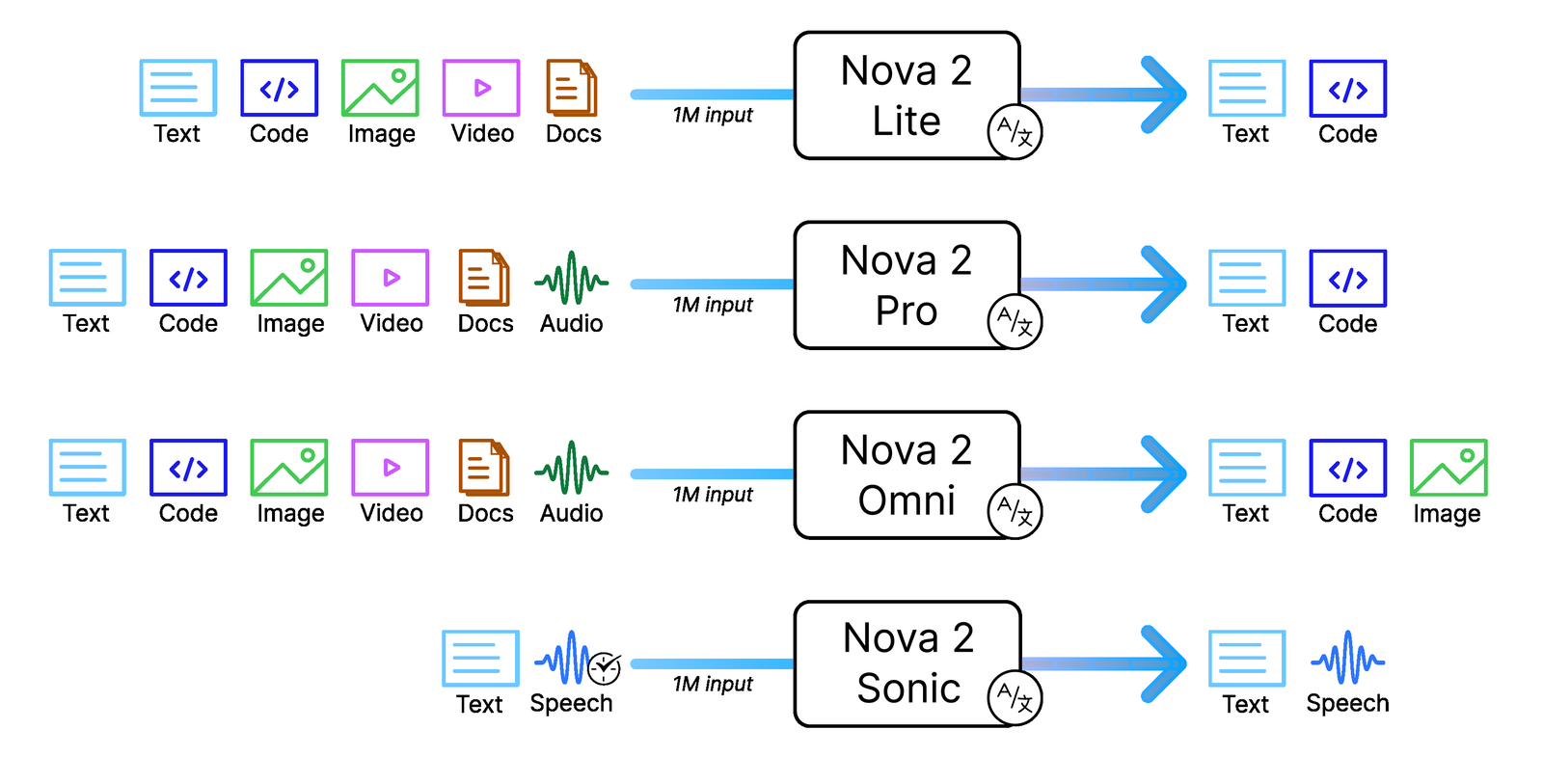
Category: Applied AI / Large Language Model, built for high-volume everyday work: customer service, document processing, business process automation, video information extraction, code generation and multi-step agentic workflows. It is the generally available member of the Nova 2 generation and the one the vendor positions on price, performance and speed together.
Primary use cases:
Document processing at volume. A 1M-token window and a 64K output ceiling fit a large document set in one call. The vendor's own evidence is 62.1 percent on RealKIE-FCC Verified, a key-information-extraction benchmark built for enterprise document work, and 56.1 percent average accuracy on OCRBench-v2 for visual text.
Customer support and business process automation. The vendor names both as launch use cases. Instruction following at 70.8 on IF-Bench prompt loose and 76.6 on MultiChallenge is the measured basis, and tau2-bench Verified at 76.0 on telecom and 76.5 on retail is the tool-use basis.
Everyday reasoning with a thinking switch. Reasoning ships off by default for fast, cheap answers and can be set to low, medium or high. AIME 2025 at 91.0 is the vendor's evidence that turning it on buys real capability on structured problems.
Video and screen understanding. Video input and screen grounding are the two multimodal rows where the model leads its class in the vendor's table: 77.2 R1@0.5 on QVHighlights and 83.3 point accuracy on ScreenSpot.
Code generation and software tasks inside an agent. LiveCodeBench at 71.0 is competitive. SWE-bench Verified at 53.6, or 64.5 with test-time scaling and internal scaffolding, is not: this is the weakest headline row, and it sits on the task the launch note names.
What it is not. It is not the flagship: Nova 2 Pro scores higher on every text and agentic row in the vendor's own table, and it is the model sold for multi-document analysis and software migration. It is not a speech model, which is Nova 2 Sonic, and it does not generate images, which is Nova 2 Omni. It is not open weights, not self-hostable and not inspectable from outside the Bedrock service. It does not publish a parameter count or an architecture description. It does not support audio input in the vendor's own multimodal table, where the audio column is empty for this model and populated for Pro and Omni.
Pricing, as published on 2026-11-19:
Line | In-region Standard | Global cross-Region Standard |
Input, text, image, video and document | $0.33 per million tokens | $0.30 per million tokens |
Output, text | $2.75 per million tokens | $2.50 per million tokens |
Cached input, read | $0.0825 per million tokens | $0.075 per million tokens |
Cached input, write | $0.00 per million tokens | $0.00 per million tokens |
Priority tier | 1.75 times Standard | 1.75 times Standard |
Flex tier | 0.5 times Standard | 0.5 times Standard |
Batch | 0.5 times Standard | 0.5 times Standard |
Web grounding | $0.03 per request | $0.03 per request |
Provisioned throughput | $60.50 per hour with no commitment; $55.00 on a one-month commitment; $30.25 on a six-month commitment | Not listed separately |
Supervised fine-tuning | $3.78 per million training tokens | Not listed separately |
Reinforcement fine-tuning | $80.00 per training hour | Not listed separately |
Trained-model storage | $1.95 per model per month | Not listed separately |
Free tier | None | None |
Two sentences of arithmetic, because the tiers are the price. Priority is 1.75 times the Standard rate and Flex and Batch are half of it, so the same job can cost 3.5 times more on Priority than on Batch. The cached-input read is 25 percent of the input rate on either route, and the cache write is free, so a repeated instruction set is where this model's cost advantage compounds, within the 20,000-token ceiling the vendor publishes for Nova prompt caching.
Official links:
Launch note, 2025-12-02: https://aws.amazon.com/about-aws/whats-new/2025/12/nova-2-foundation-models-amazon-bedrock
AWS News Blog, Nova 2 Lite: https://aws.amazon.com/blogs/aws/introducing-amazon-nova-2-lite-a-fast-cost-effective-reasoning-model/
Bedrock model card, Nova 2 Lite: https://docs.aws.amazon.com/bedrock/latest/userguide/model-card-amazon-nova-2-lite.html
Nova pricing page: https://aws.amazon.com/nova/pricing/
Bedrock pricing page: https://aws.amazon.com/bedrock/pricing/
Bedrock price list, us-east-1 offer file: https://pricing.us-east-1.amazonaws.com/offers/v1.0/aws/AmazonBedrock/current/us-east-1/index.json
Amazon Nova 2 technical report and model card: https://cdn.amazon.science/c5/3d/84514a224666b5be6de4b43ef4aa/nova-2-0-technical-report2.pdf
Bedrock models at a glance: https://docs.aws.amazon.com/bedrock/latest/userguide/model-cards.html
Amazon model cards index: https://docs.aws.amazon.com/bedrock/latest/userguide/model-cards-amazon.html
Bedrock endpoints and quotas: https://docs.aws.amazon.com/general/latest/gr/bedrock.html
Nova user guide: https://docs.aws.amazon.com/nova/latest/userguide/what-is-nova.html
Amazon Bedrock FAQs: https://aws.amazon.com/bedrock/faqs/
AWS service terms: https://aws.amazon.com/service-terms/
LLM-specific fields:
API model identifier: amazon.nova-2-lite-v1:0, with Geo ids us.amazon.nova-2-lite-v1:0, eu.amazon.nova-2-lite-v1:0 and jp.amazon.nova-2-lite-v1:0, and the global id global.amazon.nova-2-lite-v1:0.
Release date: 2025-12-02, stated on the model card and in the launch note.
Context window: 1,000,000 input tokens, stated on the model card and in the technical report.
Maximum output: 64,000 tokens, stated on the model card as 64K.
Reasoning controls: supported and off by default, enabled with reasoningConfig, with effort configurable at low, medium or high.
Knowledge cutoff: October 2025, stated on the model card.
Modalities: text, document, image and video input; text output. Audio input is documented for Nova 2 Pro and Nova 2 Omni, and the audio column is empty for this model in the vendor's multimodal benchmark table.
Built-in tools: web grounding at $0.03 per request and a code interpreter, with remote MCP tools supported.
Prompt caching: explicit caching supported, minimum 1,000 tokens per checkpoint, at most 4 checkpoints per request, 5-minute time to live, on the system and messages fields, with a maximum of 20,000 tokens for Nova models.
APIs and endpoints: Responses, Chat Completions, Invoke and Converse on bedrock-runtime, and bedrock-mantle.
Deployment: Amazon Bedrock, through global cross-Region inference and Geo cross-Region and in-region endpoints.
Licence: proprietary hosted service under AWS terms. No open weights and no self-hosting.
Parameters and architecture: not disclosed.
Lifecycle: Active on 2026-11-19, end-of-life no sooner than 2026-12-02, legacy period of at least six months.
Fine-tuning: supervised fine-tuning on Bedrock and SageMaker, full fine-tuning on SageMaker, and reinforcement fine-tuning.
At a Glance Dashboard
Field | Value |
Category | Applied AI / Large Language Model (low-cost multimodal reasoning for document processing, customer support and business process automation) |
CI-First Benefit Score | 5.8 / 10 (CI-First Positive) |
Sub-scores | Time 7 / Quantity 7 / Quality 6 / Skill 3 |
CI-First Profile | Primary: Co-Worker and Assistant (level 2). Secondary: Co-Researcher, Analyst and Tester (level 4), Professor, Coach and Tutor (level 3) |
Humics Protection | Humics-Neutral (-1 / +3) |
AI Imposture Risk | Medium overall, with Skill Illusion High |
Status | Active |
Last tested | 2026-11-19 |
Pricing | $0.33 and $2.75 per million tokens in-region Standard; $0.30 and $2.50 global; cache read at a quarter of input and cache write free; Priority at 1.75 times and Flex and Batch at half; grounding $0.03 per request; no free tier |
Platforms | Amazon Bedrock, through global and Geo cross-Region inference and in-region endpoints |
User sentiment | No review platform and no independent user corpus exists for this model; the public record is vendor-authored |

Nova 2 Lite
The Problem
The everyday workload is the one most organisations actually run, and it is the one that has been hardest to buy well. A support desk needs a model that reads a policy, a ticket history and a product manual and answers inside a template. A back office needs a model that turns a batch of invoices, forms or contracts into a table. A business unit needs an agent that calls four systems in order and stops when a constraint is violated. None of those jobs needs frontier reasoning. All of them need a model that follows instructions, holds enough context to see the whole case, and costs little enough to run ten thousand times.
The models sold for that work have carried a specific compromise. The small, cheap tier has been weak on instruction following. In the vendor's own comparison table, Nova 1 Lite scores 34.1 on IF-Bench prompt loose and 18.7 on MultiChallenge, which are the rows that decide whether a workflow survives contact with a real constraint. Claude Haiku 4.5 scores 54.3 and 57.1, GPT-5 Mini scores 75.4 and 67.8, and Gemini 2.5 Flash scores 50.3 and 62.6. A model at 34.1 on IF-Bench is a model that ignores a formatting rule or a prohibition often enough that a team writes more prompt scaffolding than it saves. That is the first half of the problem: the cheap tier has been cheap because it was unreliable.
The second half is context. Everyday work arrives as a case, not as a sentence: a policy set, a ticket thread, a contract with annexes, a two-hour recording. A model with a small window forces the team to chunk, retrieve and stitch, and every one of those steps is work that has to be built and maintained. The 1M-token window that frontier models charge a premium for has not been available at the cheap end of the market.
There is a third problem, and U365 cares about it most. The output of an everyday model is read by people who did not commission the analysis and cannot check it. A support answer, a summary table and an extraction row all look complete whether or not they are right. A cheap model increases the volume of that output, and volume is what makes a wrong row expensive: nobody reads ten thousand rows one at a time. A buyer who solves the cost problem without solving the checking problem has moved the risk rather than reduced it.

Nova 2 Lite
The Outcome
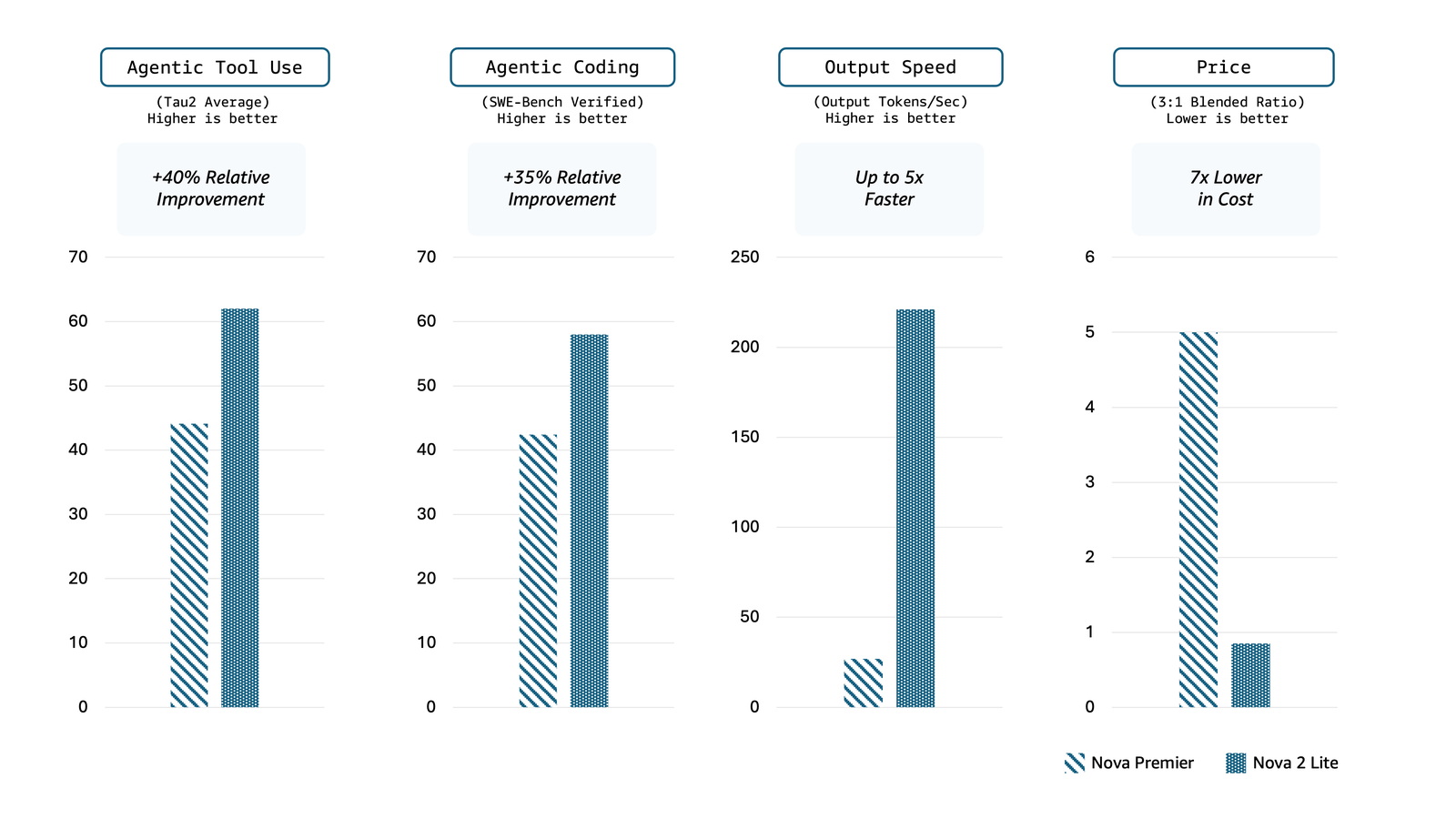
Nova 2 Lite closes the reliability gap in its price class, brings a 1M-token window and a published 64K output ceiling to the cheap end of Bedrock, and leaves knowledge, coding and independent measurement as the three places where it is still the budget option.
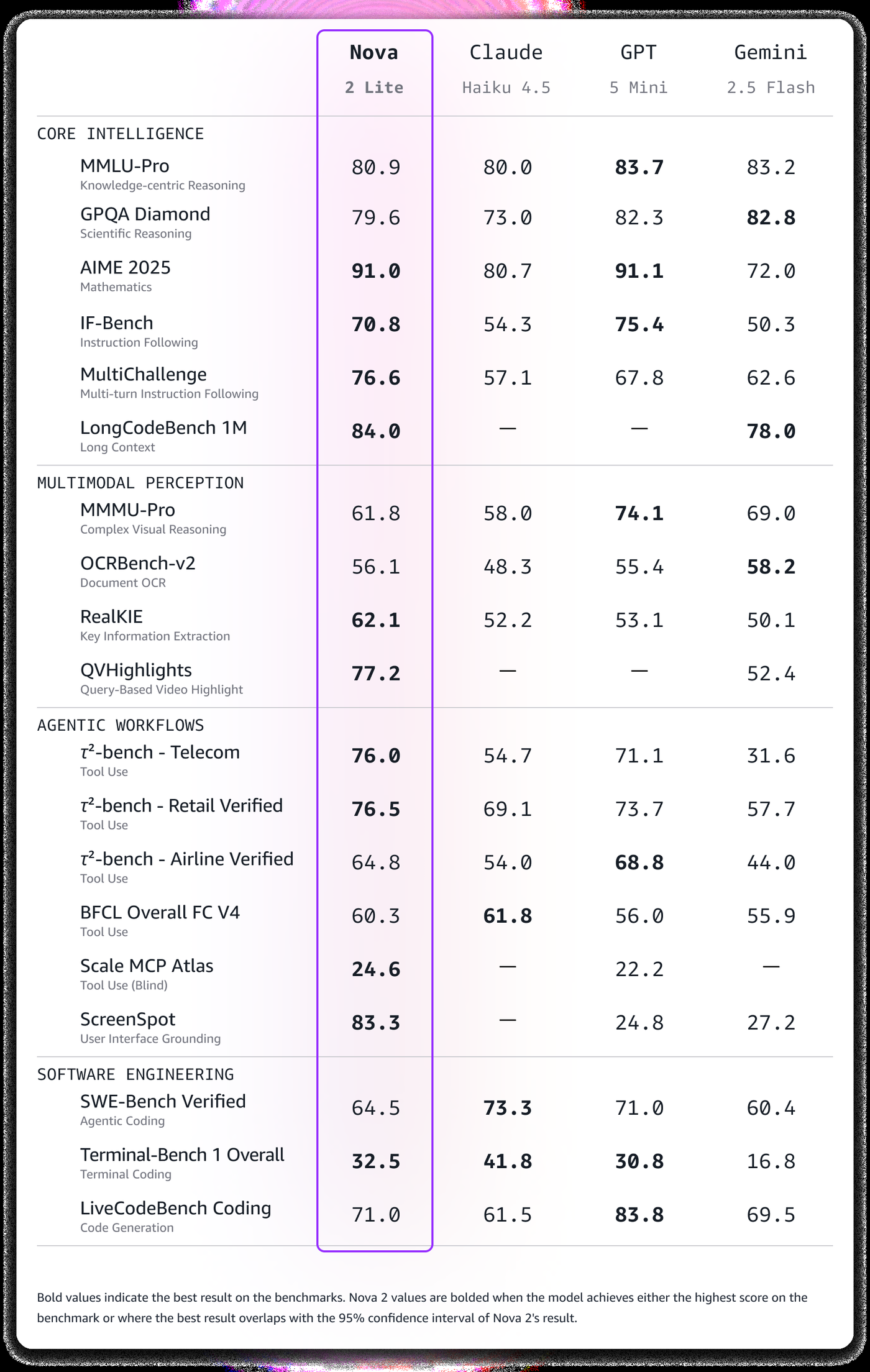
The strongest part of the release is instruction following, which is the part the everyday workload depends on. Nova 2 Lite scores 70.8 on IF-Bench prompt loose and 76.6 on MultiChallenge. Against the comparators in the vendor's own table, that is above Claude Haiku 4.5 at 54.3 and 57.1 and above Gemini 2.5 Flash at 50.3 and 62.6, and it is below GPT-5 Mini on IF-Bench at 75.4 and above it on MultiChallenge at 67.8. A model that honours constraints at this level is a model a team can put behind a template without building a validation layer first, and that is the change the price class needed.
The agentic result is the second real gain. tau2-bench Verified is 76.0 on telecom, 76.5 on retail and 64.8 on airline. Claude Haiku 4.5 scores 54.7, 69.1 and 54.0; Gemini 2.5 Flash scores 31.6, 57.7 and 44.0; GPT-5 Mini scores 71.1, 73.7 and 68.8. On the retail and telecom splits this model leads every comparator the vendor chose except the Pro model above it. For a support agent that has to look up an order, apply a policy and escalate correctly, that is the row that matters.
The knowledge position is mid-field and should be read as such. MMLU-Pro is 80.9, against 80.0 for Claude Haiku 4.5, 83.7 for GPT-5 Mini and 83.2 for Gemini 2.5 Flash. GPQA Diamond is 79.6, above Claude Haiku 4.5 at 73.0 and below Gemini 2.5 Flash at 82.8 and GPT-5 Mini at 82.3. AIME 2025 is 91.0, level with GPT-5 Mini at 91.1 and far above Haiku at 80.7. The pattern is a model that reasons well on structured problems and knows less than the strongest small model in the comparison.
The coding position is the weakest claim in the release, and the vendor's own footnote is the reason to say so. SWE-bench Verified is 53.6 percent, or 64.5 percent with inference-time scaling and internal agentic scaffolding. Claude Haiku 4.5 is 73.3 and GPT-5 Mini is 71.0. Terminal-Bench 1.0 is 32.5 against 41.8 for Haiku and 30.8 for GPT-5 Mini. LiveCodeBench at 71.0 is competitive. A model that writes a function is useful; a model that resolves a repository issue is what SWE-bench measures, and there this one is behind the competitor it is priced against.
The price and the specification are what hold up cleanly. A 1M-token input window at $0.33 per million tokens in-region, $0.30 global, with a published 64K output ceiling, a cache read at a quarter of the input rate and a free cache write, is a real change in what a document-heavy everyday job costs. The same specification is not available on the Pro model in the same family, which publishes neither its output ceiling nor a cache rate.
For U365 Fellows, the outcome is a capability that arrives with a check. A learner or a professional can put a policy set, a ticket thread or a contract batch in front of one model and get a structured answer in one pass. Whether that answer is usable depends on a habit the model does not supply: naming the page, the clause or the record that supports each row.
What the release does not change. It does not produce an independent benchmark row, it does not publish a parameter count or an architecture, and it does not make the model auditable from outside Bedrock. It does not fix the coding gap against Claude Haiku 4.5. It does not make a 20,000-token prompt cache into a way to cache a 600-page set. And it does not remove the verification step on any output a person will act on. Those facts sit in Section 7c and in the imposture table, and no benchmark row moves them.

Nova 2 Lite
Who Should Use Nova 2 Lite
Learner type | Difficulty | Typical ROI | Career path |
Students (Bachelor, Master) | Intermediate | The best first cloud model in this price class, because it is generally available, cheap enough to run a hundred experiments, and documented well enough to teach a specification from. The useful exercise is not a chatbot: put a 200-page reading set and a template in one call, ask for a table with a page reference in every cell, and check three cells against the pages. | |
Professionals (career upskilling) | Intermediate | The strongest case in the release for a team that runs everyday volume: a support desk with a policy template, a back office turning forms into a table, an agent that completes a multi-step lookup inside a constraint, and a media set that needs a timestamped brief. The measured strengths are instruction following and tool use, which are the two things a high-volume workflow punishes first. The measured weakness is repository-level coding. | |
Everyone (lifelong learners) | Beginner to Intermediate | A realistic entry point: no access request, no free tier but a low metered price, and a simple interface through Bedrock or any client that speaks the Converse API. The durable gain is a habit rather than a tool skill: requiring a source location for every claim, and reading the row before believing the table. | LIPS Collect and Review phases for the reading work, and UP-Context-Engineering Method order for prompting. No assessment home is asserted. |
For teams and organisations. The model is sold to companies running volume, and a team deciding on it starts with four questions.
Team deployment. The route is Amazon Bedrock, through global cross-Region inference, Geo cross-Region inference for the US, EU and JP identifiers, or an in-region endpoint. There is no access request and no preview gate, which is the practical difference between this model and its Pro sibling: a team with a Bedrock-enabled account can call it today.
Cost at team scale. Four lines move independently: the route (global is cheaper than in-region), the tier (Priority at 1.75 times Standard, Flex and Batch at half), the thinking level (off by default, and each level spends output tokens), and the cache (free to write, a quarter of the input rate to read, capped at 20,000 tokens for Nova models). A team that sets no tier policy and no thinking-level policy has left most of its bill to individual habit.
Data and compliance. AWS states in the Bedrock FAQ that customer inputs and outputs are not used to train Amazon Nova, Amazon Titan or third-party models, and are not shared with model providers. Content is encrypted in transit and at rest and stays in the Region where it is processed. That is the ordinary Bedrock position and a real advantage for a regulated team. It does not make the model's output a compliance artefact: an extraction row or a support answer is a draft that a qualified person reviews.
U365 for companies. Professional learners reach University 365's academic services individually or through their organisation, and the company route runs through a customized training agreement for employee groups. Corporate education programmes are built on demand, and their tuition follows content and duration.
Skill level required: Intermediate. Stating a finish line, choosing a reasoning level, writing an instruction set that survives a long input, and checking a table against its sources are prerequisite skills. The model is easy to call and easy to over-trust, because a cheap fluent answer invites volume and volume invites skipping the check.
Prerequisites. An AWS account with Bedrock enabled and the model enabled in the Region you will use. A route decision, because the two Standard rates differ and the Geo identifiers are not interchangeable. A reasoning-level decision, because the default is off and a hard task at the default is a hard task at the wrong setting. A client that sends the model id explicitly. And a check you already own for whatever the output will be used for.
Typical time to first result: Under ten minutes. Enable the model in Bedrock, send a one-paragraph prompt with amazon.nova-2-lite-v1:0, confirm the response, then send a 50,000-token input that carries a question you can answer yourself.
Typical time to competence: Ten to twenty hours of active use. Two habits carry most of the value: setting the reasoning level explicitly on every call, and requiring a page, clause or record reference for every row the model produces.
Who should wait. Anyone whose work is repository-level software engineering, because SWE-bench Verified at 53.6 is the weakest row and the competitor at this price scores 73.3. Anyone whose work depends on what the model already knows rather than on supplied documents, because the knowledge rows are mid-field. Anyone planning to cache a long system prompt, because the Nova cache ceiling is 20,000 tokens. And anyone who needs an independent benchmark before committing, because none exists.

Nova 2 Lite
U365 Institutes Alignment
The alignment below rates what a U365 institute could take from this model as a working instrument and as an object of study. The primary home is UIT (Technology, AI, Data Science), because the model's usable strengths are long-context extraction, agent supervision and the cost engineering of a tiered rate card. The other three readings are real and each is bounded.
UIT (Technology, AI, Data Science)
Rating. High (primary)
Why. Four engineering competencies, each of which survives the removal of the tool. Long-context extraction: a 1M-token window turns a document set into a design problem, and the discipline is deciding what goes in, what carries a reference and what is left out, which RealKIE-FCC at 62.1 only partly measures. Agent supervision: tau2-bench Verified at 76.0 on telecom and 76.5 on retail is a tool-use result, and running a tool-using agent means bounding each call and checking the trace. Evaluation design: the same table reports SWE-bench Verified at 53.6 and at 64.5 with test-time scaling and internal scaffolding, and reading those two numbers as one claim is the skill. Cost engineering: two routes, four tiers, a published cache rate with a 20,000-token ceiling and a priced grounding call are arithmetic a cohort can practise on live numbers.
The limit that holds the row. The model is a service a practitioner operates, not an artefact a practitioner inspects. There are no weights, no architecture description and no parameter count, so the competencies are engineering-with rather than engineering-of. No published programme assesses long-context extraction or cost-per-finished-task as a named component. Adjacent anchors, not assessment homes.
UIB (Business Management, Entrepreneurship)
Rating. Medium
Why. Two decisions the release forces that are commercial before they are technical. Route and tier selection: a 9 percent difference between the global and in-region Standard rates, a 1.75 times Priority premium and a 50 percent Flex and Batch discount are a procurement decision with a measurable answer, and the cache design changes the cost of a repeated instruction set. And the work itself: invoice, contract and filing extraction at $0.33 per million input tokens is a working instrument for commercial analysis, provided the model is given the documents and the reader checks the rows.
The limit that holds the row. The model supplies no management method and does not measure its own return. It publishes no completion rate, no time-per-task figure and no cost-per-task figure, so a business case has to be built by the unit. No published programme assesses the economics of a model portfolio as a named component. Adjacent anchors, not assessment homes.
UIC (Digital Communication, Marketing)
Rating. Low to Medium
Why. One competency that matters and is easy to miss: reading a vendor claim against the table that supports it. This release is a worked example, because "industry-leading price performance" is true on instruction following and agentic tool use and false on repository-level coding, and a communication practitioner who can find the base is doing the job the profession claims. The media surface is real as well: video input with 77.2 R1@0.5 on QVHighlights and screen grounding at 83.3 point accuracy makes a recorded demo a usable source, provided the quoted moment is checked against the recording.
The limit that holds the row. The model teaches no register, no audience analysis and no publication standard. It returns no sourced evidence of its own by default, so fact-checking stays with the writer, and no campaign or content-strategy competency appears in it. Rated as evaluation contact with a media-analysis surface. No credential is mapped.
UID (Digital Design, UX/UI)
Rating. Low
Why. The design contact is narrow but real: ScreenSpot point accuracy at 83.3 means a designer can put a UI screenshot in front of the model and get a structured description of what is on screen and where the elements sit, and QVHighlights at 77.2 supports locating a described moment in a recorded walkthrough. That is a research input rather than a design output.
The limit that holds the row. The model produces no image, no layout and no visual artefact: image output is a capability of Nova 2 Omni, not of this model. It evaluates no design against a brief and holds no design method. No layout, interaction or motion competency is assessed by it. No credential is mapped.
U365 methods, not an institute (UNOP, ULM, LIPS, CARE and the UP-Context-Engineering Method)
Rating. Applicable
Why. The methods layer is relevant in the way a long-context model is: the FULL-CONTEXT layer is the product's input, and the EXPECTED-FORMAT-AND-CONSTRAINTS layer is what keeps a long answer inside the job. The record of what a run was asked to do, which documents went in, at which reasoning level, on which route and what came back belongs in the Fellow's own LIPS system, because the model holds no state between calls. CARE's Review phase is where an extraction row is checked against its page. UNOP has no direct fit: the model is not built to teach, and its gains come from context, instruction following and tool use rather than from any pedagogical mechanism.
The limit that holds the row. The model carries no method of its own and no coaching surface. A Fellow who does not keep the reasoning about route, tier, reasoning level and source citation in their own system has no account of it, and nothing in the product writes that account for them.

Nova 2 Lite
How Nova 2 Lite Works
A natively multimodal reasoning model in the Nova 2 family, sold only through Amazon Bedrock, with a 1M-token input window, a 64K output ceiling, three reasoning levels plus an off switch, built-in web grounding and a code interpreter, and text as its only output.
Inputs: Text, documents, images and video. The technical report describes the model as processing text, images and videos, and the launch note lists documents among the inputs. Through the Converse and Invoke APIs a request carries the conversation, the media and any tool definitions. There is no image, audio or video output, and audio input is not documented for this model in the vendor's multimodal table.
What happens inside: The vendor publishes no architecture, no parameter count and no training description beyond the family-level statement that Nova 2 models use configurable extended thinking. What the vendor does document is the control surface: reasoning can be toggled on or off and set to low, medium or high, and the technical report's Figure 2 plots LiveCodeBench accuracy against effort on this model, which is unusual and useful: the trade-off a buyer is asked to make is illustrated on the model they are buying.
Outputs: Text. Markdown, structured output through the APIs and tool calls are supported. The output ceiling is 64K tokens, which is published, and it is the number a long extraction or a long report is planned against. It is also the reason a full-window job can return a usable artefact rather than a summary.
Built-in tools: Web grounding at $0.03 per request and a code interpreter, with remote MCP tools supported. The code interpreter matters for the workflows below because it turns a model call into a run that can execute and check its own arithmetic, and grounding turns a claim into a retrieved claim. Unlike the Pro model, the grounding rate for this one is published.
Prompt caching: Explicit caching is supported on the system and messages fields, with a minimum of 1,000 tokens per checkpoint, at most four checkpoints per request, a five-minute time to live, and a maximum of 20,000 tokens for Nova models. The cache write is free and the cache read is billed at a quarter of the input rate. The ceiling is the constraint a buyer must understand: a repeated policy set or instruction template fits, a 600-page document set does not.
Deployment: Amazon Bedrock only. Three access shapes: global cross-Region inference, Geo cross-Region inference through the US, EU and JP identifiers, and in-region endpoints. The route is also a price decision, because the global Standard rate is about 9 percent below the in-region rate.
Guardrails and safety: The technical report places Nova 2 against Amazon's Frontier Model Safety Framework and reports that current evaluations place the family below the critical threshold for CBRN weapons proliferation, below the critical threshold for offensive cyber operations, and below the threshold for automated AI R&D, with Nemesys named for the CBRN and uplift work, METR for the AI R&D assessment and Amazon's own security team for cyber red teaming. Those are the vendor's statements about its own model, made against its own framework. They are the right kind of statement to publish and they are not independent measurement.
Fine-tuning: Supervised fine-tuning is available on Bedrock and SageMaker, full fine-tuning on SageMaker, and reinforcement fine-tuning. The price list carries the rates: $3.78 per million training tokens for supervised fine-tuning, $80.00 per training hour for reinforcement fine-tuning, $1.95 per model per month for storage, and $0.30 input and $2.50 output per million tokens for inference on a custom model.
What is not documented. No parameter count, no architecture, no training-data description, no per-Region availability list rendered on a static page, and no independent measurement. One limit is documented but easy to miss: the prompt-cache ceiling of 20,000 tokens for Nova models. Four of those five absences are normal for a proprietary hosted model, and the fifth, independent measurement, is the one that holds the Quality score down.

Nova 2 Lite
Getting Started with Nova 2 Lite
A fifteen-minute checklist for a first real call.
Confirm the model is enabled in your Region. Send a minimal request with amazon.nova-2-lite-v1:0. An access error means the model is not enabled for that account and Region, which is an account task rather than a model problem.
Choose the route and write the rate down. Global cross-Region Standard is $0.30 and $2.50 per million tokens; in-region Standard is $0.33 and $2.75; Geo identifiers are separate from both. Write the one your account uses into the project notes, because a later comparison against a third-party figure will otherwise compare two bases.
Set the reasoning level explicitly. Send reasoningConfig with low, medium or high on every call, or send nothing and accept that reasoning is off. Do not leave the default implicit in a workflow where a wrong answer is expensive.
Set a token budget that reflects the job. The maximum output is 64K, which is a ceiling and not a target. A support answer that runs to 64K tokens has already failed as a support answer.
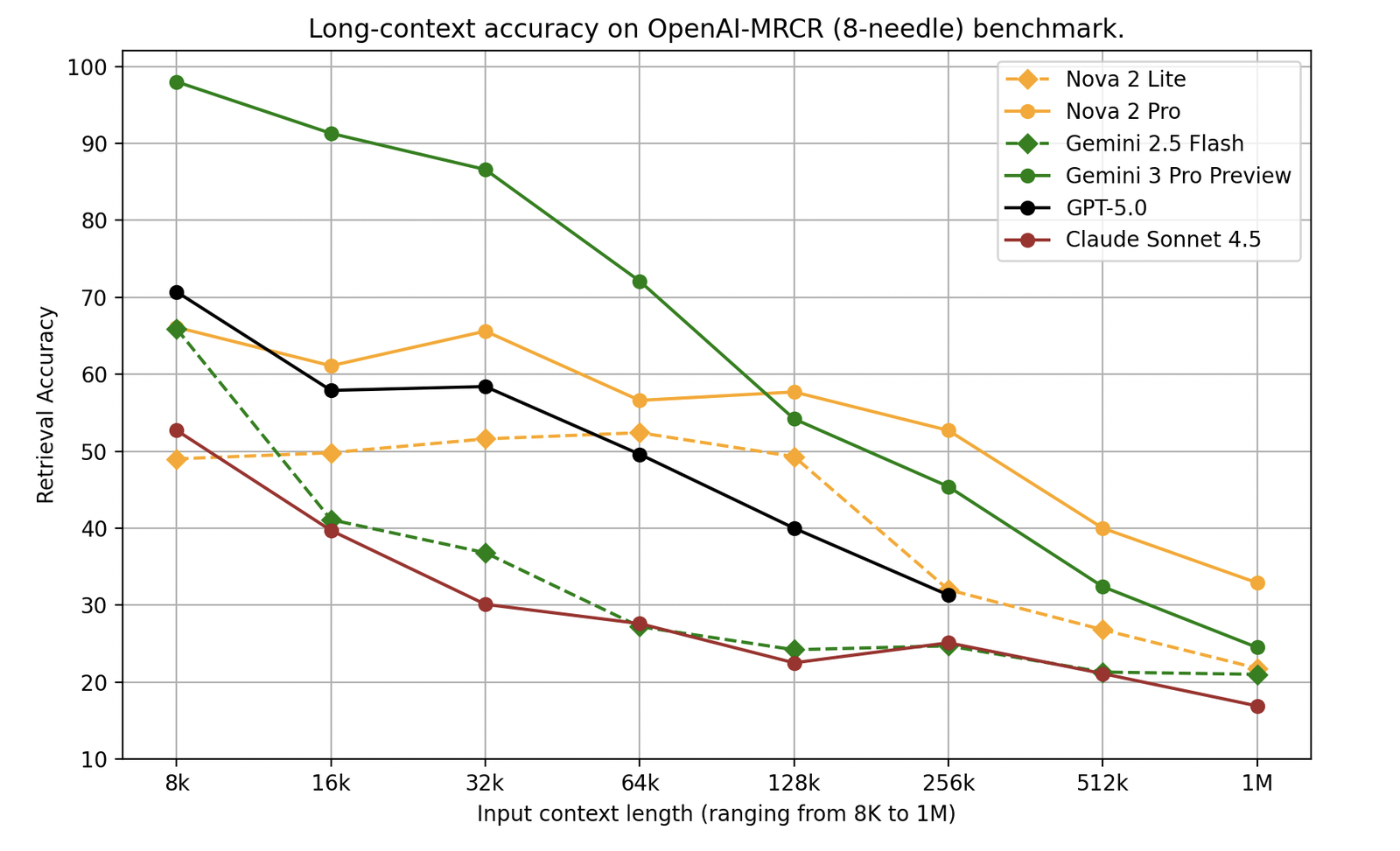
Test one long input before you test a hard one. Send 50,000 tokens of material you already know the answer to, and check whether the answer cites the right locations. Long-context fit and long-context recall are different claims, and this review's long-context evidence is a code benchmark plus a needle chart.
Test the cache before you rely on it. Put a repeated instruction set of about 5,000 tokens in the system field, call twice, and compare the billed input on the second call. The cache read is a quarter of the input rate and the write is free, and the 20,000-token ceiling is the limit to confirm.
Turn on the tools you need, one at a time. Run once with grounding off and once with it on, and compare. Grounding is billed at $0.03 per request, which is a decision rather than a default.
Name the check before the first production call. A page reference you can open, a clause you can read, a ticket you can re-open. The check is the deliverable's acceptance criterion, not an afterthought.

Nova 2 Lite
Real Workflows
Three workflows, each chosen because the model's measured strength and a check the reader already owns sit in the same place. Each sample prompt uses the UP-Context-Engineering Method's eight layers in method order, with the constraints and the data limits inside EXPECTED-FORMAT-AND-CONSTRAINTS.
Workflow 1: Answer a support case from a policy set, with the clause named
When to use it: a support desk has a policy set and a ticket, and the answer has to be correct, inside a template and traceable to a clause. This is the workflow the instruction-following and agentic rows exist for, and the check is the clause reference.
This sample prompt uses the UP-Context-Engineering Method and the CI-First doctrine. Read the method at the UP method guide, the doctrine at the CI-First approach, learn both in a U365 online program, and request a U.Coach for orientation at U.Coach.
USER-PERSONA: My UP-Context-Engineering USER-PERSONA file is the file for this layer, attached. It is my psychographic file concatenated with the six ULM life-domain files. The parts that matter here: I run the support desk, I answer for every reply that leaves it, and I do not accept an answer I cannot trace to a policy clause. If the file is not attached, ask for it before you start.
FULL-CONTEXT: The FULL-CONTEXT set for this task, added and not merged: BUSINESS-PERSONA for [the organisation], PROJECT-DESCRIPTION for [the support operation], the policy set at [location, versions and dates], the ticket [id, thread, customer tier], the reply template [template], the escalation rules [rules], and the product facts the reply may use [source]. The policy set and the product facts are the only authorities. If the policy version or the escalation rules are missing, name it and stop.
AI-PROFILE-ROLE-EXPERTISE: Act as a Co-Worker & Assistant, in the role of a support analyst drafting a reply for human review, with expertise in policy interpretation, customer tier rules and escalation criteria.
USER-FINAL-GOAL: A reply that a support agent can send after reading it once, with every factual claim tied to a policy clause or a product source, and an explicit escalation decision.
AI-EXACT-TASK: Produce the drafted reply in the template, the clause reference for every factual claim, the escalation decision with its rule, and a list of anything the policy set does not answer.
AUDIENCE: Me, the support agent who will send it, and a customer who will read it as the company's position.
EXPECTED-FORMAT-AND-CONSTRAINTS: Format: (1) the reply, (2) the claim-to-clause map, (3) the escalation decision, (4) the unanswered points. Constraints: no claim without a clause or a product source; quote the operative phrase where the answer turns on wording; do not promise a remedy the policy does not grant; write "not covered by the policy set" rather than inventing a rule; keep the reply inside the template's length; your knowledge cutoff is October 2025, so a policy version after that date must come only from the set I supplied. Data limits: the ticket is cleared for this model at the level I state in the FULL-CONTEXT set; no customer record outside the ticket leaves my control.
EXAMPLES: The last ten approved replies are the tone and format examples, attached, and one claim-to-clause map is the citation example.
Before you use the output, run the check yourself: open the clause behind two random claims, confirm the escalation rule was applied as written, and read the reply as the customer will read it. The decision is yours, per CI-First.
What the model does well here: following a template and a rule set at once. IF-Bench prompt loose at 70.8 and MultiChallenge at 76.6 are the vendor's measures of exactly that, and tau2-bench Verified at 76.0 on telecom is the tool-use row that supports a lookup step inside the same call. The caveat: instruction following is measured on benchmarks, not on your policy set, and a model that honours nine constraints will occasionally drop the tenth. The claim-to-clause map is what makes the drop visible.
VERIFICATION CHECKLIST for the support reply:
☐ Multi-Model Check: run the same ticket and policy set through a second model and compare the escalation decisions, not the prose.
☐ External Source: open the clause behind two random claims and read it in full.
☐ Human Review: a support agent who owns the queue reads the reply for tone and for any promise the policy does not grant.
☐ CI-First Test: can you defend every factual claim by reading the clause aloud? If not, the reply is not ready.
Workflow 2: Turn a batch of forms into an extraction table with page references
When to use it: invoices, claims, applications or contract annexes arrive as a batch and have to become a table a clerk can post. This is the workflow the 1M window and the 64K output ceiling exist for, and the check is the page reference on every row.
This sample prompt uses the UP-Context-Engineering Method and the CI-First doctrine. Read the method at the UP method guide, the doctrine at the CI-First approach, learn both in a U365 online program, and request a U.Coach for orientation at U.Coach.
USER-PERSONA: My UP-Context-Engineering USER-PERSONA file is the file for this layer, attached. The parts that matter here: I sign off the batch before it is posted, I am audited on it, and I do not accept a row I cannot trace to a page. If the file is not attached, ask for it before you start.
FULL-CONTEXT: The FULL-CONTEXT set for this task, added and not merged: BUSINESS-PERSONA for [the organisation], PROJECT-DESCRIPTION for [the batch], the documents at [location, count, file list], the column definitions and their formats [columns], the validation rules [rules], and the posting system's field limits [limits]. The documents are the only authority for a value. If a column definition or a validation rule is missing, name it and stop.
AI-PROFILE-ROLE-EXPERTISE: Act as a Co-Researcher, Analyst & Tester, in the role of a document extraction analyst preparing a posting table, with expertise in form structures, unit and date formats and exception handling.
USER-FINAL-GOAL: A table the clerk can post, with a page reference in every row, and an exceptions list I can work through before anything is posted.
AI-EXACT-TASK: Produce the extraction table, one row per document, with a page reference per row, then the exceptions list and the documents you could not read.
AUDIENCE: Me, the clerk who posts the batch, and an auditor who will re-open three rows.
EXPECTED-FORMAT-AND-CONSTRAINTS: Format: (1) the table in the column order I supplied, (2) the exceptions list, (3) the unreadable documents. Constraints: one row per document and no merged rows; every row carries a page reference; preserve the document's own units and formats, and state the unit in the column header; write "not stated" rather than inferring a missing value; never carry a value from one document to another; if the batch exceeds the window, say which files you left out before you answer; your knowledge cutoff is October 2025, so a form version after that date must come from the batch. Data limits: the batch is cleared for this model at the level I state; no document outside the batch leaves my control.
EXAMPLES: The last posted batch table is the format example, attached, and one exceptions list is the exception example.
Before you use the output, run the check yourself: re-open three rows at random, compare the value and the page, and work the exceptions list before anything is posted. The decision is yours, per CI-First.
What the model does well here: one window for a batch, and a published 64K output ceiling, which is what allows a full table rather than a summary of a table. The vendor's document evidence is 62.1 on RealKIE-FCC Verified and 56.1 average accuracy on OCRBench-v2. The caveat: 62.1 on a key-information-extraction benchmark means roughly four documents in ten carry a wrong or missing field on the benchmark's own scoring, before your forms are involved. The page reference and the exceptions list are the controls, and the batch is not posted until a person has worked them.
VERIFICATION CHECKLIST for the extraction table:
☐ Multi-Model Check: run the batch through a second model and compare the rows that disagree, not the totals.
☐ External Source: re-open three rows at random and compare the value and the page.
☐ Human Review: the clerk who posts the batch reads the exceptions list and confirms it is complete.
☐ CI-First Test: can you defend any row by opening the page without the transcript? If not, the table is not yours yet.
Workflow 3: Turn a recorded walkthrough into a timestamped brief
When to use it: a product demo, a training session or a webinar arrives as a video plus slides, and the brief has to carry timestamps and screen references a reader can check. This is the workflow that uses video input and screen grounding, and the check is the timestamp.
This sample prompt uses the UP-Context-Engineering Method and the CI-First doctrine. Read the method at the UP method guide, the doctrine at the CI-First approach, learn both in a U365 online program, and request a U.Coach for orientation at U.Coach.
USER-PERSONA: My UP-Context-Engineering USER-PERSONA file is the file for this layer, attached. The parts that matter here: I publish this brief under my name and I answer for every quoted claim. If the file is not attached, ask for it before you start.
FULL-CONTEXT: The FULL-CONTEXT set for this task, added and not merged: BUSINESS-PERSONA for [the organisation], PROJECT-DESCRIPTION for [the brief], the recording [file, duration, language], the slides [file], the brief's required sections [sections], the audience [audience], and the publication standard [standard]. The recording is the only authority for what was said and the slides are the only authority for what was shown. If the recording or the required sections are missing, name it and stop.
AI-PROFILE-ROLE-EXPERTISE: Act as a Co-Researcher, Analyst & Tester, in the role of a briefing analyst, with expertise in extracting claims from speech, separating speech from screen content and citing a timestamp.
USER-FINAL-GOAL: A brief whose every claim carries a timestamp or a screen reference, which I can publish after checking three of them myself.
AI-EXACT-TASK: Produce the brief in the required sections, with a timestamp for every quoted claim and a screen reference for every visual claim, then a list of places where the audio and the screen content disagree.
AUDIENCE: Me, the publisher, and a reader who will check one timestamp. The reader has not watched the recording.
EXPECTED-FORMAT-AND-CONSTRAINTS: Format: (1) the brief, (2) the disagreements between audio and screen, (3) the passages that were inaudible or ambiguous. Constraints: quote verbatim and short; every quotation carries a timestamp; every visual claim carries a screen reference; do not paraphrase a number, quote it; mark an inaudible passage as inaudible rather than guessing; the recording is the only authority for what was said; I run you with reasoning off unless I say otherwise, and a hard section is a reason to tell me rather than to guess. Data limits: the recording is cleared for this model at the level I state; no personal data outside the recording leaves my control.
EXAMPLES: The last published brief is the format example, attached, and one timestamped quotation is the citation example.
Before you use the output, run the check yourself: watch three timestamps and read along, confirm one quoted number matches what was said, and check one screen claim against the recording. The decision is yours, per CI-First.
What the model does well here: video input in one call, with the screen and the speech in the same window. The vendor reports 77.2 R1@0.5 on QVHighlights for locating a described moment in a video and 83.3 point accuracy on ScreenSpot for locating a UI element. The caveat: there is no published audio word-error rate for this model, and the audio column in the vendor's multimodal table is empty. A brief that quotes speech from a recording should be checked against a dedicated transcription pass before publication, and the timestamp is what makes that check cheap.
VERIFICATION CHECKLIST for the recorded-session brief:
☐ Multi-Model Check: run the audio through a dedicated transcription model and compare the quotations that carry numbers.
☐ External Source: watch three timestamps and read along, and check one screen claim against the recording.
☐ Human Review: the person who ran the session reads the brief for meaning as well as for accuracy.
☐ CI-First Test: can you defend every quotation by playing the timestamp? If not, the brief is not ready.

Nova 2 Lite
Strengths, Limits, and AI Imposture Risk
Strengths
Time
Strength. A real saving on high-volume work that arrives as a case rather than a prompt, at a route and a tier the team controls.
Evidence. A 1M-token input window in a single call, reasoning off by default for fast responses, a published 64K output ceiling, built-in grounding and a code interpreter that remove glue work, and a free cache write with a cache read at a quarter of the input rate. Held at 7 rather than 8 by the 20,000-token cache ceiling and by the absence of any independent latency measurement, though the vendor publishes TTFT and output-speed charts sourced from Artificial Analysis.
Quantity
Strength. A genuine multiplier for document and media volume, and the cheapest route in the family.
Evidence. One window holds a batch; Flex and Batch run at half the Standard rate; the cache read is 25 percent of input and the write is free; provisioned throughput is available for steady load; fine-tuning is priced per training token. Held at 7 because more output is not more usable work when the reading is the bottleneck, and because the cache ceiling stops a long repeated document set from being cached.
Quality
Strength. Strong procedure and instruction following for the price class, mid-field knowledge, weak repository-level coding.
Evidence. IF-Bench 70.8 and MultiChallenge 76.6 beat Claude Haiku 4.5 (54.3 and 57.1) and Gemini 2.5 Flash (50.3 and 62.6); tau2-bench Verified telecom 76.0 against 54.7 for Haiku and 31.6 for Flash; MMLU-Pro 80.9 level with Haiku at 80.0 and below GPT-5 Mini at 83.7. Against that: SWE-bench Verified 53.6 or 64.5 with scaling, against 73.3 for Haiku and 71.0 for GPT-5 Mini, and Terminal-Bench 1.0 at 32.5. The whole set is vendor-reported.
Skill
Strength. Marginal, and honestly marginal.
Evidence. No teaching mode is claimed, the knowledge cutoff is published but the weights are not, and the product is built for delegation at volume rather than for moving a capability to the person. Clause 5.2.3-a returns a null with a boundary rather than a mechanism that transfers capability. Scored conservatively per the framework's guidance.
Limits
The coding gap is the largest in the release. SWE-bench Verified is 53.6 percent, or 64.5 with test-time scaling and internal scaffolding, against 73.3 for Claude Haiku 4.5 and 71.0 for GPT-5 Mini, on the software-engineering task the launch note names.
No independent benchmark row exists. No independent benchmark house listed this model on 2026-11-19, so every performance number here is the vendor's measurement of its own model against models it chose.
Knowledge is mid-field. MMLU-Pro at 80.9 sits below GPT-5 Mini at 83.7 and Gemini 2.5 Flash at 83.2, and level with Claude Haiku 4.5 at 80.0.
The prompt-cache ceiling is 20,000 tokens for Nova models. A repeated instruction set fits; a repeated document set does not. A team that plans a cached 200-page policy set has planned against a limit that does not exist.
Audio input is not documented for this model. The technical report describes text, image and video, and the audio column in the multimodal table is empty for Lite while it is populated for Pro and Omni.
No parameter count, architecture or training-data description is published. Nothing about the model can be inspected from outside the Bedrock service.
No per-Region availability list is published on a static page. The model card publishes the Geo and global identifiers, not a Region-by-Region table, so availability is confirmed in the account rather than read from documentation.
The long-context evidence is a code benchmark and a needle chart. LongCodeBench 1M at 84.0 and an MRCR 8-needle figure do not measure whether a 600-page business document set is read evenly.
The lifecycle date is published and close. End of life is no sooner than 2026-12-02, with a legacy period of at least six months. A model that runs an everyday workflow needs a named replacement before that date, not after it.
AI Imposture Risk
Time Illusion
Rating. Medium
Evidence. The saving is real: one call instead of forty chunks, a 64K output ceiling that returns a table rather than a summary, reasoning off by default for simple work, and built-in tools that remove glue code. The overhead is real as well: a route decision, a tier decision, a reasoning-level decision on every call, a 20,000-token cache ceiling, and an extraction table long enough that reading it is the work. No independent latency figure exists, and the vendor's own speed charts are sourced from a third party rather than from a controlled test of your workload.
Quantity Illusion
Rating. Medium
Evidence. The product invites volume at $0.30 to $0.33 per million input tokens: a million-token window, Batch at half price, a free cache write, provisioned throughput for steady load, and a plausibly filled cell in every row. The failure mode is that the table looks finished and nobody reads ten thousand rows. The vendor's own document score, 62.1 on RealKIE-FCC Verified, is the reminder that a filled row is not a correct row.
Skill Illusion
Rating. High
Evidence. Fluent policy answers, extraction tables and timestamped briefs produced for readers who cannot evaluate them, at a price that makes producing more of them rational, with no independent measurement to calibrate trust. The measured instruction following is real, which is what makes the illusion effective: a model that honours nine constraints produces an answer that reads as careful. Mitigations exist and are cited: a code interpreter that lets the reader run the arithmetic, a 1M window that lets the reader supply every source, a page reference on every row, and the checklists above. Those mitigations lower the frequency of failure; they do not move the capability to the reader.
Overall Imposture Risk: Medium. One trap is High with identifiable mitigations, and two are Medium. Under the framework's arithmetic, one High with clear mitigations stated is Medium rather than High. The band-precedence sentence does not change the outcome, because the Medium band names this exact trap set and no second rating competes with it.
Framework v1.2 clause note
Clause 5.2.3-a, agent-authored procedural memory: NULL, recorded with its boundary. The model holds no state between calls, writes no skills, no memory store and no standing instruction, and the Bedrock surface offers no documented mechanism by which it authors procedural memory on the user's behalf. The boundary is the agentic surface: a deployment that lets an agent built on this model write and revise the user's instruction files, memory or skills would meet the clause, and the vendor's tool-use and MCP support makes that arrangement easy to build. The clause is a property of the deployment in that case, not of the model.
Clause 4.2-a, agent-mediated conversation: NULL for the model as a generator. Neither erosion condition is met. No agent-authored text is presented as the person's own voice in a human-facing channel by default, and nothing substitutes agent interaction for human contact. The live condition to watch on any deployment: a support agent that sends a reply in the company's voice through a connected account without a person reading it first would meet condition (a). That is a property of a deployment built around this model rather than a property of the model.
Recorded together: the two clause questions return nulls with boundaries and live conditions rather than mechanisms, and the boundary is the part that matters. The reason Skill Illusion still rates High is not a clause mechanism; it is the plain fact that the model produces finished-looking tables and policy answers at a price that makes volume rational, on tasks whose correctness the person asking often cannot check, with no independent measurement to calibrate how much of the output to trust.

Nova 2 Lite
Section 7c: A published lifecycle date, a cache ceiling, and a rate card that is complete
A Section 7c finding is recorded where a supplier's governance, safety record or commercial terms have a real result for the reader. The items below were checked against primary sources, and they produce findings a buyer should carry. All findings are stated as facts of record, and the difference between a company statement, a published evaluation and a policy term is kept intact.
The lifecycle is published, dated and shorter than a procurement cycle. The Bedrock model card states a launch date of 2025-12-02, an end-of-life date no sooner than 2026-12-02, a legacy period of at least six months, and an Active lifecycle on 2026-11-19. That is more notice than most hosted models publish, and it is still a date a buyer should carry: a model embedded in a support desk in the first quarter of 2027 needs a named replacement before the legacy period starts. The finding is not that the date is short. It is that the date exists, is readable before purchase, and belongs in the same project note as the rate.
The cache is generous on price and narrow on size. The cache write is billed at $0.00 and the cache read at $0.0825 per million tokens in-region, a quarter of the input rate. The ceiling is the constraint: the model card's footnote states that Nova models support a maximum of 20,000 tokens for prompt caching, with a 1,000-token minimum per checkpoint, at most four checkpoints per request and a five-minute time to live. A repeated instruction set, a policy template or a support script fits and is a genuine cost reduction at volume. A repeated document set does not fit, and a team that budgets a cached 200-page corpus has budgeted against a mechanism that will not carry it.
The rate card is complete, which is unusual in this family, and it still has two bases. The us-east-1 offer file published 2026-11-11 carries 39 SKUs for Nova 2.0 Lite across Standard, Priority, Flex and Batch, with cache read and cache write lines, a grounding rate of $0.03 per request, provisioned throughput at three commitment levels, and fine-tuning, storage and custom-model inference lines. Nothing is missing except a free tier. The two bases are the point: in-region Standard is $0.33 and $2.75 per million tokens, global cross-Region Standard is $0.30 and $2.50, and Priority is 1.75 times either. A page that quotes one base without naming it is not wrong, it is incomplete, and the difference is about 9 percent between the two Standard routes and 75 percent to Priority.
No long-context multiplier is published. Every Nova 2.0 Lite token SKU in the offer file carries one price with no upper bound on the token range, so the per-token rate does not step up at a context threshold. A full 1M-token input is billed at the same rate per token as a short one. That is a real advantage for the long-document workflow, and it is the kind of term that a reader should verify rather than assume, because the opposite is common in the market.
The safety file names its assessors and states its thresholds in the same section as its benchmarks. The technical report places Nova 2 against Amazon's Frontier Model Safety Framework and states that current evaluations place the family below the critical threshold for CBRN weapons proliferation, below the critical threshold for offensive cyber operations, and below the threshold for automated AI R&D. It names Nemesys for the CBRN and uplift work, METR for the AI R&D assessment, Amazon's own security team for cyber red teaming, ActiveFence and Innodata for domain evaluation, and Chatterbox Labs, PrismAI, EnkryptAI, Grayswan and Aymara for guardrail robustness. A supplier that names its assessors and states a threshold boundary in the same document is doing the reader a service. The limit is that a threshold assessment is not a capability measurement, and none of it is an independent benchmark of the model's accuracy.
The customization terms are priced, which turns a vague capability into a budget line. Supervised fine-tuning is $3.78 per million training tokens, reinforcement fine-tuning is $80.00 per training hour, trained-model storage is $1.95 per model per month, and inference on a custom model is $0.30 input and $2.50 output per million tokens. A team can therefore cost a fine-tuning plan before it starts, which is not true of a vendor that publishes the capability and not the rate.
No sub-score changed for these findings, and the reason is explicit. The Time and Quantity sub-scores already carry the cache ceiling and the two price bases. The Quality sub-score already carries the vendor-only evidence base. The Imposture assessment already carries the fluency risk that a cheap, high-volume answer hands to a reader who delegates. These items are about a lifecycle date, a cache ceiling, a complete rate card, the absence of a long-context multiplier and a safety file that names its assessors. Section 7c closes with what it does not do: it does not allege misconduct, it does not treat a published end-of-life date as a scandal, and it does not convert a supplier's own published caveats into findings against it. It records what a reader adopting this model is also adopting: a dated lifecycle, a cache with a size limit, two price bases that have to be named, and a safety assessment made against the supplier's own framework.

Nova 2 Lite
U365 Co-Intelligence Rating
CI-First Profile
Primary profile: Co-Worker and Assistant (level 2). Secondary profiles: Co-Researcher, Analyst and Tester (level 4), Professor, Coach and Tutor (level 3).
Why this profile and not Co-Creator. The vendor's positioning does the reasoning. Nova 2 Lite is sold for everyday workloads, customer service, document processing, business automation and agentic workflows, which is a delegation framing: state the job, hand over the run, check what returns. Co-Worker and Assistant is the role the model actually plays. Analyst and Tester is recorded as secondary because a document batch, a ticket thread and a recording are the inputs where the model measures best and where the reader interprets rather than authors. Professor, Coach and Tutor remains reachable at level 3 because the reasoning control makes effort visible and the model explains a step when asked, and it is the weakest of the three readings.
CI-First Benefit Score
Time
Score (0-10). 7
Rationale. Moderate to strong net savings on the work it is sold for: a 1M-token window removes the chunk-and-stitch step, reasoning off by default keeps simple calls fast, a published 64K output ceiling returns a table rather than a summary, and grounded tool use removes a retrieval step. Held at 7 by the 20,000-token cache ceiling, the absence of an independent latency measurement, and the route and tier decisions a team has to make before the first call.
Quantity
Score (0-10). 7
Rationale. A genuine multiplier for document and media volume: one window for a batch, Batch and Flex at half the Standard rate, a free cache write with a read at a quarter of the input rate, provisioned throughput for steady load, and priced fine-tuning. Held at 7 because the reading is the bottleneck on a long table, and because the cache ceiling stops a repeated document set from being cached.
Quality
Score (0-10). 6
Rationale. Clear gains on procedure and instruction following for the price class, which is where the vendor's table is strongest, and a mid-field position on knowledge with a weak coding row. IF-Bench 70.8, MultiChallenge 76.6 and tau2-bench Verified telecom 76.0 are real strengths; MMLU-Pro 80.9, SWE-bench Verified 53.6 or 64.5 with scaling, and Terminal-Bench 1.0 at 32.5 are the counterweight. Held at 6 rather than 7 because every figure is vendor-reported and no independent party has measured the model.
Skill
Score (0-10). 3
Rationale. Delegation at volume rather than learning in the common case, with no teaching mechanism and no open weights, scored conservatively per the framework's guidance. The knowledge cutoff is published, which is a small plus, and the clause note records nulls with boundaries rather than eroding mechanisms.
CI-First Benefit Score: 5.8 / 10 (CI-First Positive)
Why the score sits where it sits
5.8 with sub-scores 7 / 7 / 6 / 3 is a strong mid-tier position carrying a marginal skill position, and both halves of that sentence are deliberate.
Why not higher. Three reasons, each measured. The coding row is the weakest in the release: SWE-bench Verified at 53.6, or 64.5 with test-time scaling and internal scaffolding, against 73.3 for the competitor this model is priced against. The knowledge rows are mid-field: MMLU-Pro at 80.9 trails GPT-5 Mini and Gemini 2.5 Flash, and the model is level with Claude Haiku 4.5 rather than ahead of it. And the evidence base is single-source: no independent benchmark house, no review platform and no user corpus exists, so the Quality score cannot be raised on evidence that does not exist.
Why not lower. The strengths are real and they are in the right place for the money. Instruction following at 70.8 and MultiChallenge at 76.6 are the two rows that decide whether a high-volume workflow survives contact with a template, and they lead Claude Haiku 4.5 and Gemini 2.5 Flash in the vendor's own table. tau2-bench Verified at 76.0 on telecom and 76.5 on retail is a genuine agentic result. A 1M-token window with a published 64K output ceiling, a free cache write and a cache read at a quarter of input, at $0.30 to $0.33 per million input tokens, is a specification no competitor in this comparison publishes at this price.
Why 5.8 and not a higher band, stated as arithmetic. Time 7, Quantity 7, Quality 6 and Skill 3 average to 5.75, which rounds to 5.8. Two dimensions at 7, one at 6 and one at 3 is the shape of a model that is clearly good at the job it is sold for and clearly not a specialist: it runs volume well, it does not teach, and it is not the best model in any measured dimension except instruction following and retail and telecom tool use within its class.
What the score does not carry. The four dimensions measure what the reader's work gains. They do not carry the lifecycle date, the cache ceiling or the two price bases, which is why those sit in Section 7c with an explicit statement that no sub-score changed. They do not carry the clause questions either, which return nulls with boundaries. A reader who wants the score to encode procurement risk would need a different instrument, and the framework's instrument is the clause note and the 7c finding.
Humics Protection Badge
Creativity
Rating. Neutral (0)
Rationale. It produces tables, replies and briefs on request and originates no direction. It neither trains nor replaces the user's ideation: an extraction table leaves the judgement about what the batch means with the reader.
Critical Thinking
Rating. Erodes (-1)
Rationale. Fluent tables, policy answers and briefs whose correctness is expensive to check, at a price that makes producing more of them rational, on work where the person asking often cannot evaluate it, with no independent measurement to calibrate trust. The failure mode is not an obvious error; it is a complete-looking table with one wrong cell and a policy answer that drops the tenth constraint. The mitigations lower the frequency and do not reverse the direction: a page-citation rule catches a wrong cell only if someone opens the page.
Social Authenticity
Rating. Neutral (0)
Rationale. The model produces text and tables rather than speaking in a person's name, and clause 4.2-a returns a null for it as a generator. The live condition stays in the record: a deployment that lets an agent send support replies under the company's name without a person reading them first moves this dimension, and the low price makes that arrangement easier to justify.
Humics Protection Score: -1 / +3 Badge: Humics-Neutral
Superhuman Usage Guidance
When to invite this tool:
High-volume work where every output can carry a page, clause or record reference: support replies, extraction tables, classification rows.
Document batches that fit one window and end in a table a person can post and audit.
Tool-driven workflows where the end state is checkable: an order lookup, a policy check, a multi-step retrieval with a trace.
Media work where a timestamp or a screen reference is the proof: a recorded demo, a training session, a product walkthrough.
The AWS-native, cost-sensitive case, where the model has to stay inside the AWS contract and the bill has to survive a finance review.
When to keep this tool out:
Repository-level software engineering under a deadline, where the measured gap to the competitor at this price is widest.
Any output that will be acted on without a qualified person reading it. The lower the price, the more volume arrives without a reader.
Work that depends on what the model already knows rather than on supplied documents, because the knowledge rows are mid-field.
Plans that assume a cached document corpus, because the Nova cache ceiling is 20,000 tokens.
A workflow with no named replacement for 2026-12-02, the earliest end-of-life date the model card allows.
The final judgement calls: what to publish, what to send to a client, what to tell a person. Those are the Humics this model does not supply.
U365 method integration:
LIPS + CARE: route the model's extraction and drafting output into the Collect phase, and keep the Action Plan and Review phases as your own work. A filled table is a collected artefact, not a decision, and the Review phase is where the page reference is checked.
ULM + EVA: the decision about which work is worth automating belongs in the Career and Quality of Life domains, and ULM is the six-domain frame that holds it. Cost per completed task is CI-First cost engineering, not a ULM method. Weak fit elsewhere.
UP-Context-Engineering: the method's eight layers are the control surface this model needs, because FULL-CONTEXT is literally the input and EXPECTED-FORMAT-AND-CONSTRAINTS is what keeps a long answer inside the job. The USER-PERSONA and AUDIENCE layers are what a high-volume run usually skips, and skipping them is how a fluent answer becomes a generic one. The three workflow samples above use the eight layers.
UNOP: no direct fit. The model is not built to teach, and its gains come from context, instruction following and tool use rather than from any pedagogical mechanism.
Over-delegation warning: the failure mode with this model is that a low price justifies more delegation than the reader can verify. Ten thousand extraction rows at $0.30 per million input tokens cost less than the meeting that would review them, and that is exactly why nobody reviews them. A support reply that follows nine constraints reads as a careful reply, and a table with a page reference in every cell reads as diligence. Both can be wrong in one row. The framework's arithmetic is the point: if your Human Intelligence input drops while the Artificial Intelligence term rises, the product falls. A reader who moves a whole back office onto Nova 2 Lite because the rate is low, and changes nothing about how many rows a qualified person opens, has taken the release's worst offer.

Nova 2 Lite
What Users Say
Aggregate Rating Table
Source | Reading | What it is | Link |
Artificial Analysis | No model page found on 2026-11-19 | Independent benchmark house | |
G2 | No listing for the model | Review platform | Not applicable |
Capterra | No listing for the model | Review platform | Not applicable |
Trustpilot | No listing for the model | Review platform | Not applicable |
Amazon Bedrock price list | 39 SKUs under the model attribute "Nova 2.0 Lite" | Vendor price list, not a rating | |
Bedrock model card, Nova 2 Lite | Launch date, lifecycle, context, output ceiling, reasoning default, knowledge cutoff and prompt-cache limits | Vendor specification, not a rating | |
AWS News Blog, 2025-12-02 | The vendor's own description and the launch use cases | Vendor statement, not a rating | |
Amazon Nova 2 technical report | Vendor benchmark tables and the safety assessment | Vendor statement, not a rating |
Note on method, stated plainly because it affects how much this section is worth. No review platform rates an individual language model, and none has a listing for this one. A model sold through a cloud console to developers has no consumer review corpus: there is no body of practitioner reports to summarise, and this review does not manufacture one. What exists is the vendor's own evaluation, the model card, the price list, and benchmark comparisons in which the vendor chose both the benchmarks and the competitors. That is what this section reports, and where a platform's content was reached at platform level rather than read thread by thread, no quotation and no count is attributed to it.
What Users Praise
There is no independent user praise to report for this model. The praise that exists is vendor-authored, and three themes in it are specific enough to be useful.
The instruction-following result is the one a support team would notice first. IF-Bench at 70.8 prompt loose and MultiChallenge at 76.6 are above Claude Haiku 4.5 and Gemini 2.5 Flash in the vendor's own table, and those are the rows that correspond to a workflow that stops failing on a missed constraint. A team that has spent a year writing ever more elaborate prompt scaffolding to keep a small model inside a template would notice this difference before it noticed any knowledge score.
The agentic result on retail and telecom is the strongest comparative row in the release. tau2-bench Verified at 76.5 on retail and 76.0 on telecom, against 69.1 and 54.7 for Claude Haiku 4.5 and 57.7 and 31.6 for Gemini 2.5 Flash, is the kind of number that matters to a team building a customer-operations agent that has to look up an order and apply a policy in one turn.
The specification at the price is the commercial argument. A 1M-token input window, a published 64K output ceiling, a free cache write and a cache read at a quarter of the input rate, at $0.30 per million input tokens on the global route. For a team whose alternative is chunking a batch across forty calls and stitching the answers, that is both a cost and a correctness argument.
What Users Complain About
There are no user complaints to report either, and the two complaints a reader will actually meet are about the product's documentation rather than its behaviour.
The price figures circulating do not agree. Pages quoting $0.33 and $2.75, $0.30 and $2.50, and $0.58 and $4.81 describe the in-region Standard, the global Standard and the in-region Priority rates respectively, and most of them do not say which. A reader comparing three pages concludes that three sources disagree about one model, when the three sources are quoting three tiers.
The coding claim does not survive the comparison the vendor prints next to it. The launch note names software engineering among the use cases, and the technical report's own table puts SWE-bench Verified at 53.6 against 73.3 for Claude Haiku 4.5. A reader who buys on the use-case list and checks the table afterwards finds a gap, and the gap is real rather than a presentation problem.
Sentiment Summary
Overall sentiment: Unformed. No independent user corpus exists for this model on 2026-11-19.
Key themes: a 1M-token multimodal model at a low price, top-of-class instruction following and retail and telecom tool use, mid-field knowledge, a coding row behind its closest competitor, a complete rate card with two Standard bases, and a 20,000-token ceiling on the prompt cache.
U365 Editorial Note
The public record for this model is a vendor record, and a reader should treat it as one. On the positive side, instruction following at 70.8 and 76.6, retail and telecom tool use at 76.5 and 76.0, a 1M-token window with a published 64K output ceiling, a free cache write with a read at a quarter of the input rate, a priced grounding call and a fully published lifecycle are the behaviours that make the model worth a Bedrock team's attention. On the negative side, the coding rows sit well below the competitor at this price, the knowledge rows are level with or below the same competitor, and no independent party has measured the model at all. The Framework rates AI Imposture Risk Medium overall with Skill Illusion High, and that rating is the editorial position: Nova 2 Lite is a tool to run volume and extract structure with, provided a qualified person opens the pages and works the exceptions list. A reader who wants a lower rating is asking for an independent benchmark that does not yet exist, not for a different review.

Nova 2 Lite
Comparison and Alternatives
Model | Position | Evidence | Price, input and output per million | Choose it if |
Nova 2 Lite | The generally available, low-cost Nova 2 model, and the best value in the family for everyday volume | MMLU-Pro 80.9, GPQA Diamond 79.6, AIME 2025 91.0, IF-Bench 70.8, MultiChallenge 76.6, tau2-bench Verified telecom 76.0 and retail 76.5, SWE-bench Verified 53.6 or 64.5 with scaling, Terminal-Bench 1.0 at 32.5, all vendor-reported | $0.33 and $2.75 in-region Standard, $0.30 and $2.50 global; cache read $0.0825 and write $0.00; Priority 1.75 times; Flex and Batch half; grounding $0.03 per request; no free tier | Your work is high-volume and checkable, you need a 1M window at a low rate, and you can name the reviewer |
Nova 2 Pro | The flagship, sold as a preview to Nova Forge customers | MMLU-Pro 81.6, GPQA Diamond 81.4, IF-Bench 80.2, MultiChallenge 77.7, tau2-bench Verified telecom 92.7, SWE-bench Verified 70.0 with scaffolding and 61.5 without; vendor-reported, no independent row; U365 rates it 5.3 / 10 | $1.25 and $10.00 global Standard, $1.375 and $11.00 in-region; no published cache rate; no published output ceiling | You have the Nova Forge route, the task is genuinely complex, and the price is not the constraint |
Nova 1 Lite | The predecessor, still the cheapest Nova text model | MMLU-Pro 59.0, GPQA Diamond 43.3, AIME 2025 7.0, IF-Bench 34.1, MultiChallenge 18.7; vendor-reported | $0.06 and $0.24 in-region Standard | The task is trivial, the volume is enormous, and instruction following does not matter |
Claude Haiku 4.5 on Bedrock | The closest competitor on price class, and the stronger coding model | Vendor comparison in the Nova 2 report: MMLU-Pro 80.0, GPQA Diamond 73.0, IF-Bench 54.3, MultiChallenge 57.1, tau2-bench Verified telecom 54.7, SWE-bench Verified 73.3 | Not read at primary source in this review | Repository-level coding or agentic software work is the job, and you will pay for the stronger coding row |
GPT-5 Mini on Bedrock | The small model with the stronger knowledge row and a comparable instruction-following result | Vendor comparison in the Nova 2 report: MMLU-Pro 83.7, GPQA Diamond 82.3, AIME 2025 91.1, IF-Bench 75.4, MultiChallenge 67.8, SWE-bench Verified 71.0, Terminal-Bench 1.0 at 30.8 | Not read at primary source in this review | Knowledge depth and coding matter more than a 1M window and the lowest input rate |
The comparison in one paragraph. Nova 2 Lite is priced at a fraction of the Pro model and roughly five times the predecessor, and what it buys over the predecessor is instruction following (34.1 to 70.8 on IF-Bench) and a 1M-token window. Against Claude Haiku 4.5 it wins on instruction following, agentic tool use and price per token, and loses on repository-level coding (53.6 against 73.3 on SWE-bench Verified). Against GPT-5 Mini it wins on agentic tool use and price and loses on knowledge depth and coding. A buyer choosing between them is choosing between a cheap long-context model built for volume and a more expensive model with a stronger measured position on the work that needs judgement.

Nova 2 Lite
Verdict and Next Steps
Verdict: Nova 2 Lite is the model U365 would put behind a high-volume, checkable workflow on AWS, and the caveat it carries is that the work it does best is the work whose output is easiest to stop reading.
At 5.8 / 10, CI-First Positive, with sub-scores 7 / 7 / 6 / 3, it is a clear net benefit for a reader who runs everyday volume. The strengths are in the right place: instruction following and tool use are what a template and an agent punish first, and a 1M-token window with a published 64K output ceiling at $0.30 to $0.33 per million input tokens is a specification no competitor in this comparison publishes at this price. The weaknesses are equally specific: repository-level coding behind the closest competitor, knowledge level with or below it, and no independent measurement of any kind.
Adopt it if your work arrives as a batch or a case that fits one window, you have a reviewer who will open the page, you have written down which route and tier you are buying, and you have set the reasoning level explicitly. Do not adopt it as a replacement for a coding model on repository-level work, as a substitute for a knowledge-heavy assistant, as a way to cache a long document set, or as a reason to stop reading the rows.
The three things to do in the first week:
Write the rate base into the project notes. In-region Standard is $0.33 and $2.75; global Standard is $0.30 and $2.50; Priority is 1.75 times Standard; Flex and Batch are half. Every cost comparison you will read quotes one of these and names none of them.
Run one 50,000-token test with a known answer. Long-context fit and long-context recall are different claims, and the only way to know which one you bought is to send material whose correct answer you already hold, then check the citation.
Name the reviewer and the end-of-life replacement before you name the task. An extraction table, a support template and a recorded brief each need a person who can open the source, and the earliest end-of-life date on the model card is 2026-12-02.
UP-Context prompt packs: the three samples are in Real Workflows, one per workflow, each in the UP-Context-Engineering Method's eight layers and each followed by the check the reader runs before using the output.
What would change this verdict. An independent benchmark row that supports the vendor's instruction-following and agentic results, a published long-context document-recall table, a higher prompt-cache ceiling for Nova models, a coding result closer to Claude Haiku 4.5, or a material rate move on either Standard route. The re-check triggers at the top of this review name each one.

Nova 2 Lite
Status and Last Tested
Status: Active | Last tested: 2026-11-19 | Version tested: Nova 2.0 Lite (`amazon.nova-2-lite-v1:0`, released 2025-12-02)
Active: the tool is current and recommended.
The model was released on 2025-12-02 and this review was written on 2026-11-19, against the launch note, the AWS News Blog, the Bedrock model card, the Nova and Bedrock pricing pages, the Bedrock us-east-1 offer file, the Nova 2 technical report and model card, the Bedrock model catalogue, the Bedrock FAQs and the endpoints and quotas reference. The scores are set on that evidence and on the framework's application rules. The re-check is trigger-based with a six-month outer limit, and the first trigger is any change to the two Standard rates or to the route an account reaches, because a price move changes every cost figure in this review.

Nova 2 Lite
Migration Path
Not applicable. Nova 2 Lite is Active, not Retired, Deprecated or Risky, so this review carries no migration plan.
If you are moving a workload from Nova 1 Lite to Nova 2 Lite, the practical changes are larger than a model id. The window grows from a smaller context to 1,000,000 tokens. The input price rises from $0.06 to $0.33 per million tokens in-region, which is roughly five and a half times, for an instruction-following result that moves from 34.1 to 70.8 on IF-Bench. A reasoning control appears, off by default, with three effort levels. A published 64K output ceiling replaces whatever the older model allowed. And prompt caching appears with a 20,000-token ceiling and a free write. The price increase is real and it is the part to justify: a workload that does not depend on the instruction-following gain, the larger window or the longer output has no reason to move.

Nova 2 Lite
U365's Recommendations to Learn More
Start with the model card, not the launch note
The Bedrock model card for Nova 2 Lite is the single most useful page in the release. It states the launch date, the end-of-life date, the lifecycle status, the 1M-token context, the 64K output ceiling, the reasoning default and levels, the knowledge cutoff and the prompt-cache limits in one place, and none of that is in the launch note. A reader who starts with the announcement will know what the model is for; a reader who starts with the card will know what they are buying.
Then read the vendor's own comparison table against its footnote
Table 1 and Table 4 of the Nova 2 technical report carry the instruction-following, agentic and coding rows this review cites, and the footnotes under Table 4 are the part to read twice: one marker means the score was reported by the provider using test-time scaling, another means the model was benchmarked with inference-time scaling and internal agentic scaffolding. The 53.6 and 64.5 pair for this model is the clearest example in the release of how much a test setup moves a number.
The price list is the contract, and it is readable
The us-east-1 offer file is a plain CSV inside a JSON wrapper, published with a date, and it carries every line: Standard, Priority, Flex, Batch, cache read, cache write, grounding, provisioned throughput, fine-tuning and storage. A reader who can read a rate card can answer most procurement questions without a sales call, and the two Standard bases are visible there rather than in the marketing page.
Resources on X
Dedicated X channels: the AWS account and the Amazon Science account carry launch material and research framing for the Nova family. No dedicated channel for this model was found.

U365 courses and programmes that build the surrounding skill
UIT (Technology, AI, Data Science): the engineering track where long-context extraction, agent supervision and cost-per-finished-task arithmetic belong.
UIB (Business Management, Entrepreneurship): the commercial track where a two-route, four-tier rate card and a fine-tuning budget are analysed.
UIC (Digital Communication, Marketing): the media track where a recorded source is turned into a published brief with timestamps.
The one habit to carry
Require a location for every claim before you read the claim. A page, a clause, a ticket, a timestamp, a screen. Nova 2 Lite is cheap enough that the volume of claims will rise, and a model that processed the whole batch can sound as though it verified the whole batch. The location is the difference between a table and evidence.

Nova 2 Lite
CI-First Evaluation Summary Card
Field | Value |
Tool | Nova 2 Lite (amazon.nova-2-lite-v1:0), Amazon Web Services |
Category | Applied AI / Large Language Model (low-cost multimodal reasoning for document processing, customer support and business process automation) |
CI-First Benefit Score | 5.8 / 10, CI-First Positive |
Sub-scores | Time 7 / Quantity 7 / Quality 6 / Skill 3 |
CI-First Profile | Primary: Co-Worker and Assistant (level 2). Secondary: Co-Researcher, Analyst and Tester (level 4), Professor, Coach and Tutor (level 3) |
Humics Protection | Humics-Neutral (-1 / +3). Creativity 0, Critical Thinking -1, Social Authenticity 0 |
AI Imposture Risk | Medium overall. Time Medium, Quantity Medium, Skill Illusion High |
Framework v1.2 clauses | 5.2.3-a null with boundary, 4.2-a null with live condition |
Status | Active |
Last tested | 2026-11-19 |
Version tested | Nova 2.0 Lite (amazon.nova-2-lite-v1:0, released 2025-12-02) |
Pricing | $0.33 per million input tokens and $2.75 per million output tokens in-region Standard; $0.30 and $2.50 global cross-Region; cache read $0.0825 and write $0.00; Priority 1.75 times Standard; Flex and Batch half; grounding $0.03 per request; no free tier |
Primary institute | UIT (Technology, AI, Data Science) |
Review status | Active: the tool is current and recommended |

Nova 2 Lite
Glossary
CI-First Benefit Score
The arithmetic mean of the four benefit dimensions, each scored 0 to 10, rounded to one decimal place. 0 to 2.0 is CI-First Negative, 2.1 to 4.0 is CI-First Neutral, 4.1 to 6.0 is CI-First Positive, 6.1 to 8.0 is CI-First Strong, and 8.1 to 10 is CI-First Transformative. Nova 2 Lite scores 5.8, which is Positive.
Time Benefit
Whether the tool returns more time than it costs, after the overhead of using it is subtracted. Nova 2 Lite is 7: a 1M-token window removes the chunk-and-stitch step, reasoning off by default keeps simple calls fast, a published 64K output ceiling returns a table rather than a summary, and grounded tool use removes a retrieval step, against a 20,000-token cache ceiling, a route and tier decision and no independent latency measurement.
Quantity Benefit
Whether the tool increases the volume of usable work a person can produce in a given time. Nova 2 Lite is 7: one window for a batch, Flex and Batch at half the Standard rate, a free cache write with a read at a quarter of the input rate, provisioned throughput for steady load and priced fine-tuning, against a reading bottleneck on long tables and a cache ceiling that excludes a repeated document set.
Quality Benefit
Whether the tool helps the user produce better work than they could alone, judged after verification rather than on surface polish. Nova 2 Lite is 6: instruction following at 70.8, MultiChallenge at 76.6 and telecom tool use at 76.0 are real strengths; MMLU-Pro at 80.9, SWE-bench Verified at 53.6 or 64.5 with scaling, and Terminal-Bench 1.0 at 32.5 are the counterweight, and every figure is vendor-reported.
Knowledge and Skill Benefit
Whether the tool helps the user learn what they did not know and do what they did not know how to do. Nova 2 Lite is 3, scored conservatively: it delegates and uses tools rather than teaching, it has no teaching mode and no open weights, the knowledge cutoff is published as October 2025, and the clause note records nulls with boundaries rather than a mechanism that transfers capability.
Humics Protection Badge
The sum of three ratings, each +1, 0 or -1, across Creativity, Critical Thinking and Social Authenticity. +2 to +3 is Humics-Friendly, -1 to +1 is Humics-Neutral and -2 to -3 is Humics-Risky. Nova 2 Lite scores -1, which is Humics-Neutral: it neither strengthens nor systematically destroys the three capabilities, and it requires the reader to keep the critical habit that a cheap, fluent, high-volume answer discourages.
AI Imposture Risk
The likelihood that the tool traps its user in one of three illusions: the Time Illusion, where the overhead exceeds the saving; the Quantity Illusion, where volume passes for quality; and the Skill Illusion, where the user believes they can do what the tool did. Each trap is rated Low, Medium or High. Nova 2 Lite is Medium overall, with Skill Illusion High and the other two Medium.
User Sentiment
The direction of independent and practitioner reaction to the tool, read from what testers and users actually reported rather than from a rating average, because no review platform rates an individual language model. For Nova 2 Lite the corpus is unformed: no independent benchmark house and no review platform listed the model on 2026-11-19, so the public record is the vendor's own evaluation, its model card, its price list and its own launch material.
CI-First Profile
The role the AI plays in the working relationship: Co-Creator and Thought Partner (1), Co-Worker and Assistant (2), Professor, Coach and Tutor (3), Co-Researcher, Analyst and Tester (4), or Challenger, Critic and Devil's Advocate (5). Nova 2 Lite is primarily Co-Worker and Assistant, with Analyst and Tester and Professor, Coach and Tutor as secondary roles.
Review Status
The badge on this review states how much confidence to place in it. The vocabulary: Active means the tool is current and recommended. Active (updated) means it is current and recommended and was recently re-checked and refreshed. Changed means a re-check trigger fired and an update is pending, so read it with that in mind. Risky means the tool has significant unresolved issues or has been clearly surpassed by newer alternatives, so use it with caution and read the Limits section. Stale means the review has not been re-checked in over six months, so treat pricing and features as unverified. Retired means the tool still works but is no longer recommended, and Deprecated means it has been shut down or fundamentally changed. This review is Active.
Last tested and Re-check
The date on which the review's evidence was last read against the vendor's own surfaces, and the condition under which it will be read again. This review was last tested on 2026-11-19 and is re-checked on a trigger list with a six-month outer limit, because a model with a published end-of-life date and a metered rate moves faster than a calendar interval can track.

Nova 2 Lite
Sources
Vendor primary sources:
AWS, "Announcing Amazon Nova 2 foundation models now available in Amazon Bedrock", 2025-12-02: https://aws.amazon.com/about-aws/whats-new/2025/12/nova-2-foundation-models-amazon-bedrock
AWS, "Introducing Amazon Nova 2 Lite, a fast, cost-effective reasoning model", AWS News Blog, 2025-12-02: https://aws.amazon.com/blogs/aws/introducing-amazon-nova-2-lite-a-fast-cost-effective-reasoning-model/
Amazon Web Services, Bedrock model card, Nova 2 Lite: https://docs.aws.amazon.com/bedrock/latest/userguide/model-card-amazon-nova-2-lite.html
Amazon AGI, "Amazon Nova 2: Multimodal Reasoning and Generation Models", technical report and model card, published with the December 2025 launch: https://cdn.amazon.science/c5/3d/84514a224666b5be6de4b43ef4aa/nova-2-0-technical-report2.pdf
Amazon Web Services, Amazon Nova pricing: https://aws.amazon.com/nova/pricing/
Amazon Web Services, Amazon Bedrock pricing: https://aws.amazon.com/bedrock/pricing/
Amazon Web Services, Amazon Bedrock price list, us-east-1 offer file, publication date 2026-11-11: https://pricing.us-east-1.amazonaws.com/offers/v1.0/aws/AmazonBedrock/current/us-east-1/index.json
Amazon Web Services, Bedrock price metadata used by the pricing page: https://b0.p.awsstatic.com/pricing/2.0/meteredUnitMaps/bedrock/USD/current/bedrock.json
Amazon Web Services, "Models at a glance", Bedrock user guide: https://docs.aws.amazon.com/bedrock/latest/userguide/model-cards.html
Amazon Web Services, Amazon model cards: https://docs.aws.amazon.com/bedrock/latest/userguide/model-cards-amazon.html
Amazon Web Services, "Amazon Bedrock endpoints and quotas": https://docs.aws.amazon.com/general/latest/gr/bedrock.html
Amazon Web Services, "What is Amazon Nova?", Nova user guide: https://docs.aws.amazon.com/nova/latest/userguide/what-is-nova.html
Amazon Web Services, Amazon Bedrock FAQs: https://aws.amazon.com/bedrock/faqs/
Amazon Web Services, AWS service terms: https://aws.amazon.com/service-terms/
Independent measurement:
None found on 2026-11-19. Artificial Analysis was checked and carries no model page for Nova 2 Lite.
U365 internal reference:
U365 CI-First Evaluation Framework v1.4.1 (URC methodology)

Nova 2 Lite
Faculty Note on Evidence Quality
What this review rests on, in order of weight. First, the vendor's own primary documents: the launch note, the AWS News Blog post, the Bedrock model card, the Nova and Bedrock pricing pages, the us-east-1 offer file, the Nova 2 technical report and model card, the Bedrock catalogue and the endpoints reference. Second, the price metadata that the Nova pricing page itself uses to render its tables, read directly. There is no third category, because no independent benchmark house and no review platform has a page for this model.
What is measured and what is inferred. Every performance figure in this review is the vendor's own measurement of its own model, reported with the vendor's settings and footnotes. The price figures are published rates, read from the offer file and the pricing page, and they are the strongest evidence in the document because they are the only claims a third party can verify without running the model. The claim that the model is a good fit for high-volume extraction is an interpretation of the vendor's document and instruction-following rows against the work the model is sold for, and it is the interpretation this review defends. The claim that a reader will over-delegate at a low price is an inference from the framework's model of human behaviour, supported by the instruction-following results and the economics of volume rather than by a controlled study, and it is labelled as an inference wherever it appears.
The single-source problem is the honest headline. A review of a model that no independent party has measured cannot tell a reader how the model behaves outside the vendor's benchmark setup, and this one does not pretend otherwise. The vendor's own coding table is the clearest illustration of why that matters: 53.6 percent on SWE-bench Verified, 64.5 with inference-time scaling and internal agentic scaffolding, on the same model and the same benchmark. The difference between those two numbers is the test setup, and a reader who sees only the first or only the second is reading a configuration rather than a capability.
Two findings cut in the vendor's favour and should be said as plainly as the rest. The instruction-following and agentic results lead the vendor's own comparators at this price, which is unusual in a launch table where the vendor chooses the comparison set. And the documentation is complete in the places buyers usually find gaps: a published 64K output ceiling, a published knowledge cutoff, a published reasoning default, a published prompt-cache ceiling, a published grounding rate and a dated lifecycle. A supplier that publishes the limits as well as the claims has done the reader a service, and this review records it.
What this review does not do. It does not score Nova 2 Pro or Nova 2 Omni, each of which has its own price and its own evidence. It does not score Amazon Bedrock as a platform or Nova Forge as a service. It does not treat a published end-of-life date as a scandal or a rate card as a capability claim. And it does not convert a vendor benchmark row into a promise: a model that scores 70.8 on IF-Bench will still drop a constraint, and a model that scores 62.1 on RealKIE-FCC Verified will still miss roughly four documents in ten on that benchmark's own scoring. The reader who plans for that is the reader the framework is written for.

Nova 2 Lite
Status and Re-check
Status: Active | Last tested: 2026-11-19 (Nova 2.0 Lite, `amazon.nova-2-lite-v1:0`, released 2025-12-02) | Re-check: trigger-based (max 6 months)
Active: the tool is current and recommended.
For detailed explanations of the CI-First evaluation terms used in this review, including the Humics Protection Badge and the AI Imposture Risk levels, see the Glossary at the end of this post.
Re-check triggers:
A change to the two Standard rates or to the route that carries them. In-region Standard is $0.33 per million input tokens and $2.75 per million output tokens; global cross-Region Standard is $0.30 and $2.50. A rate move, or a change in which route an account reaches by default, changes every cost figure in this review.
A change to the prompt-cache ceiling. Explicit caching is supported, the cache write is free, and the cache read is billed at a quarter of the input rate. The ceiling is the constraint: the vendor's footnote states that Nova models support a maximum of 20,000 tokens for prompt caching. A higher ceiling would change what a long repeated instruction set costs.
A published long-context multiplier. No Nova 2.0 Lite token SKU carries a context-threshold range on 2026-11-19: every one runs from 0 to infinity at a single rate. A tiered long-context rate would change the arithmetic for a full 1M-token job.
A change to the reasoning default or to the effort levels. Reasoning ships off by default and can be set to low, medium or high. A default that moves to on, or a new level, changes both latency and the bill on every workload that does not set it explicitly.
A change to the lifecycle dates. The model card states an end-of-life date no sooner than 2025-12-02 plus one year, a legacy period of at least six months, and an Active lifecycle on 2026-11-19. A deprecation notice reopens the review, because a model that runs an everyday workflow needs a replacement plan before the date arrives.
The first independent benchmark row. No independent benchmark house listed this model on 2026-11-19. Every performance figure here is the vendor's own measurement of its own model, and the first independent row is the single most important event for this review.
A change to the built-in tool rates. Web grounding is priced at $0.03 per request for this model. A change to that rate, or the removal of the code interpreter from the supported surface, changes the cost of the workflows below.
A change to the safety document or to the named assessors. The technical report states that Nova 2 remains below the critical thresholds for CBRN, offensive cyber and automated AI R&D, and it names the third-party assessors. A later report that contradicts any of those statements reopens the Section 7c findings.




Comments