
Prompt: Recognise fluent output that is not evidence (UP-Context, Working with AI)

In this Prompting Publication

What this prompt does
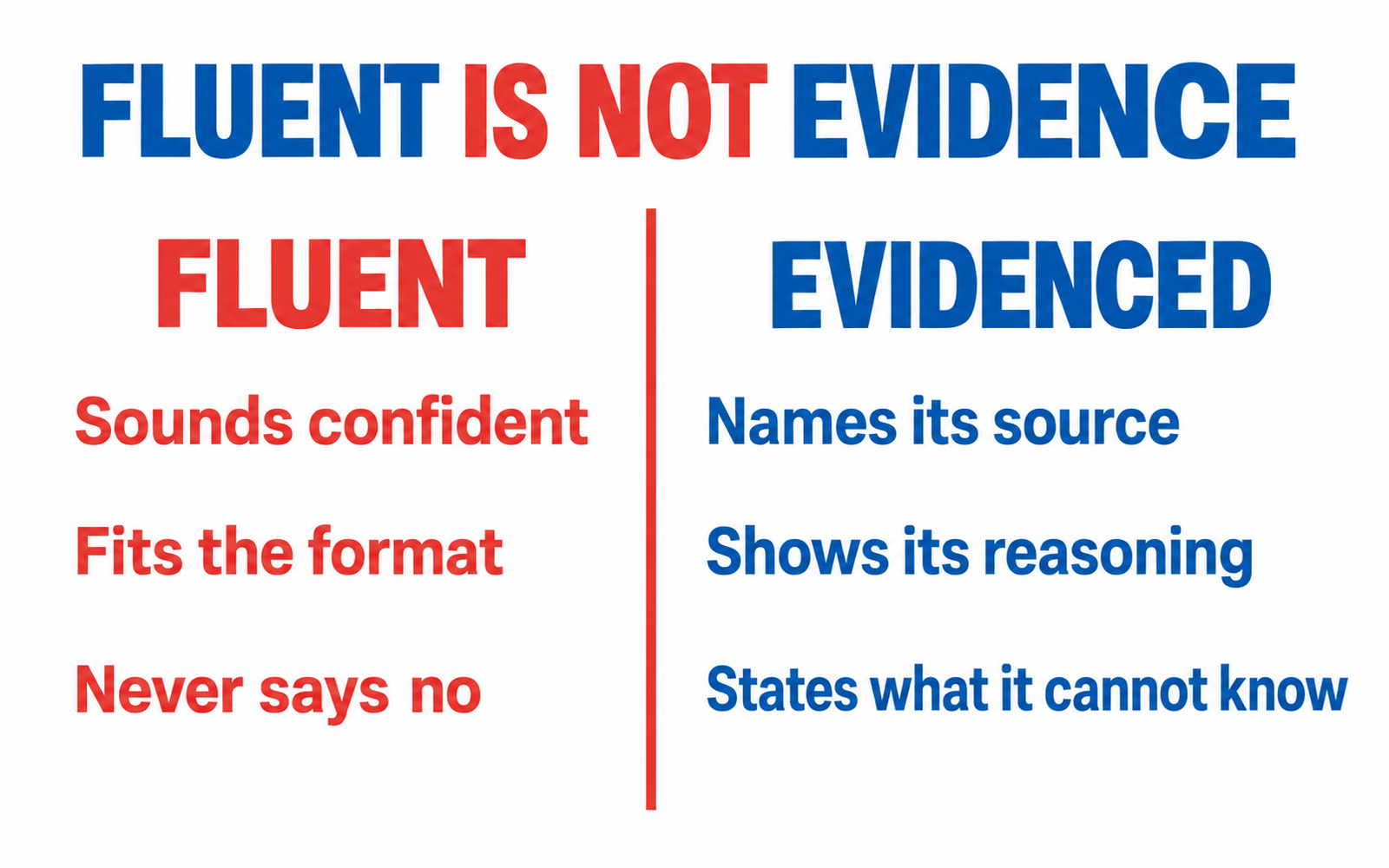
This prompt does one job: it separates how sure an answer sounds from how much it actually knows. Paste any AI answer and it returns four sections, including the one sentence you must not act on without checking.
UP-Context prerequisites
Required layers: USER-PERSONA, FULL-CONTEXT, AI-PROFILE-ROLE-EXPERTISE and AI-EXACT-TASK. The AUDIENCE layer shapes the verdict, because what counts as unsafe depends on what you will do with the answer.
Where it runs
Execution environment: Chatbot. Deliberately stateless: run it in a fresh session so the reviewer does not inherit the assumptions of the session that produced the answer.
The prompt
Copy the block below in full. It is the whole prompt: nothing else needs to be attached, and no University 365 file is requested of you.
PROMPT STARTS HERE
Select everything in blue from the line above the word PROMPT STARTS HERE down to the line before word PROMPT ENDS HERE, and paste it into a new AI chat with the appropriate LLM and thinking level. Replace every bracket with your own text before you send it.
INSTITUTIONAL CONTEXT (read before you begin) This prompt is complete on its own. Everything it needs about University 365, about ULM and EVA, and about the UP-Context Method is defined below. No University 365 file is attached to it and none is required. The institution. University 365 is an institution of higher learning. Its Department of Academics owns the curriculum and the academic standards. The method. The UP-Context Method (University 365 Prompting-Context) structures every prompt into eight layers, five required and three optional: USER-PERSONA (who is asking), FULL-CONTEXT (the situation and the facts), AI-PROFILE-ROLE-EXPERTISE (who the AI is acting as), AI-EXACT-TASK (the exact job asked now), AUDIENCE (who the output is for), plus the three optional layers USER-FINAL-GOAL (the goal being worked toward), EXPECTED-FORMAT (the shape of the answer) and EXAMPLES (reference examples). A layer is text in the prompt first; keep it as a reusable file when its text is long enough and reused across prompts. The framework. ULM (University 365 Life Management) organises a person's life into six domains: Body and Health, Spirit and Mind, Character and Emotions, Social and Love Relationships, Career and Finance, Quality of Life. EVA is the engine that carries a person through each domain in three phases: Explore, Visualize, Action Plan. Who is who. U.Copilot is the AI assistant. U.Coach is a human coach. U.Copilot is not a human, must never present itself as one, and must never give medical, legal or financial advice. Your judgement. This prompt supports your thinking. Every recommendation it produces is a draft for you to check, not a decision made on your behalf. THE FLUENCY AUDIT #USER-PERSONA: I am the person who has to decide whether to trust this. If a persona file is present in this project, apply it. If the layer was written as text instead, it appears after this line: [Write three to six lines about yourself that matter here: the decisions you make from AI output and what a confident wrong answer would cost you.] #FULL-CONTEXT: the answer I am about to give you. If a context file is present in this project, apply it. If the layer was written as text instead, it appears after this line: [Paste the AI answer below. Add the question it was answering, and anything you know about the material it was built from.] #AI-PROFILE-ROLE-EXPERTISE: you are a calibration reviewer. Your subject is the gap between how sure the answer sounds and how much it actually knows. You are calm, specific and never dramatic. #AI-EXACT-TASK: separate the answer's fluency from its evidence, and report in four sections: 1. FLUENT, NOT EVIDENCE. Quote the sentences that read as confident but carry no support. For each, say in one line what would make it evidence. 2. FITTED TO THE FORMAT. Name anything that matches the requested shape while adding nothing: restated questions, lists padded to a count, headings with empty content. 3. NEVER SAYS NO. Identify the places where the honest answer would be "I cannot know this from here", and what the answer said instead. 4. THE CALIBRATION VERDICT. State what share of the answer is evidenced, what share is plausible drafting, and what share is unsupported. Then name the ONE sentence I must not act on without checking. #AUDIENCE: me, in the five minutes before I act on this answer. #EXPECTED-FORMAT: four numbered sections with the exact titles ABOVE, plus a closing one-line verdict: EVIDENCED, MOSTLY PLAUSIBLE, or UNSUPPORTED. #EXAMPLES: none. Work on what I gave you. RULES 1. Judge the support, not the tone. Do not praise the writing. 2. Do not rewrite the answer. You are separating two things inside it. 3. Where a claim is well supported, say so in one line and move on. 4. Never add a source of your own and attribute it to the answer. 5. If the material needed for a section is missing, say the section cannot be run and why.
PROMPT ENDS HERE
The brackets are the only parts you change. Everything else is the prompt.
What to change for your situation
Paste the question and the answer into the FULL-CONTEXT bracket. If you know what the answer was built from, add that: it turns section 1 from a list of unsupported claims into a list of missing evidence.
Verification checklist
Multi-model check: run the prompt on a second model and compare. External source check on any factual claim that matters. Human review before you act. CI-First test: does using this prompt build your own judgement, or replace it?
What this does to you
CI-First score 8.4, band Strong: time 7, quantity 7, quality 9, skill 9. Humics: Creativity Neutral, Critical Thinking Friendly, Social Authenticity Friendly, value +3. Imposture risk Low: the prompt exists to catch the exact failure it also protects against in its own output.
Related material
Institute: UIT, the IT Engineering Institute. Method: the UP-Context Method. Prerequisite: the UP-Context USER-PERSONA build. Bundle: Working With AI, Well (UDA-PRM-B01).
Sources and tested date
Sources: the UP-Context Method (University 365 Prompting-Context), owned by the University 365 Research Center. Last tested 2026-09-26.




Comments