
Sovereign AI Race: Saudi Arabia (2026)

In this Report
The Co-Intelligence-First (CI-First) approach is a genuine and unique University 365 concept: a proposal for imagining a better future where AI and Human Intelligence coexist productively, each amplifying the other rather than replacing it.

The Context
The five layers, and why scale is only one of them
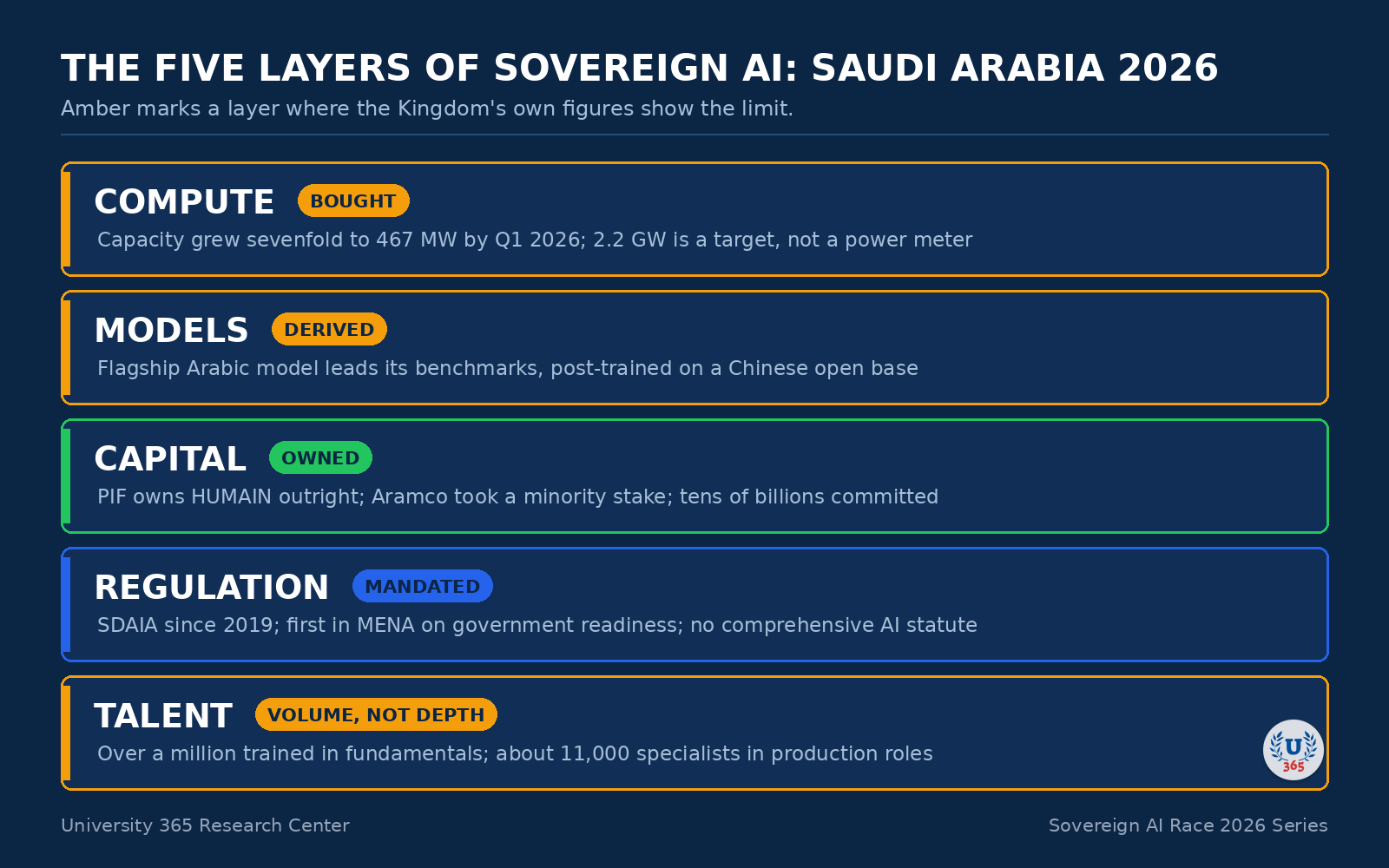
The five layers assessed. Amber marks a layer where the Kingdom's own figures show the limit. University 365 Research Center.
This is the second report in a twenty-part series assessing how states attempt to control the production of artificial intelligence inside their own jurisdiction. The framework is fixed and applied identically to every country. Sovereign AI capacity separates into five layers, and a state can hold any one of them without holding the others.
Compute sovereignty is the physical layer: where the chips and data centres sit, and who may switch them off. Model sovereignty is who builds the models a country depends on, and in whose languages and domains those models are competent. Capital sovereignty is who funds the build-out and on what terms. Regulatory sovereignty is who writes the rules and whether they can be enforced. Talent and education sovereignty is who builds and runs the systems, and how the next generation is prepared.
Saudi Arabia's bet is concentrated at the first and third layers, compute and capital, and it is the largest bet of its kind ever made by a sovereign wealth fund. Whether the other three layers follow is the question this report examines.
The vocabulary this report needs
Three terms recur and are defined once here.
The Public Investment Fund, or PIF, is the Kingdom's sovereign wealth fund and the instrument through which the strategy is financed. It owns HUMAIN outright, and the Kingdom's Crown Prince chairs both.
HUMAIN is the national artificial intelligence company, launched in May 2025 as a wholly owned PIF subsidiary with a mandate spanning the entire stack: data centres, cloud, models, and applications. Its stated ambition is to become the world's third-largest AI provider behind the United States and China. That ambition is a claim by the company, and it is labelled as one wherever it appears in this report.
Announced capacity and operating capacity are different things. This distinction carries more weight in Saudi Arabia than in any country in this series, because the gap between them is the largest. A figure described as a commitment, a pipeline, or a planned build is reported here as exactly that.
One more note on method. Where a government or company statement is the only source for a figure, the report names the party and labels it a claim. Where an independent index measured the same quantity, the index is cited. The report also tests the Kingdom's own 2025 landscape report from this institution against what followed, because a series that reports on other people's promises should hold its own record to the same standard.
The Question
Can a country buy its way into the frontier, and does the model layer prove it?
Saudi Arabia has committed more capital to artificial intelligence, faster, than any sovereign state in history. It built a national AI company and gave it a mandate covering the full stack. It commissioned eleven data centres with a multi-gigawatt target and hundreds of thousands of accelerators. It signed joint ventures worth billions, stood up a domestic cloud on the newest American silicon, and trained more than a million of its citizens in AI fundamentals.
Underneath all of it sits one fact that reframes the achievement. The Kingdom's flagship Arabic language model was not trained from scratch. It was built by taking an open model released by a Chinese laboratory and post-training it on more than a trillion Arabic tokens. The country that reshaped its technology alignment to secure American accelerators, and that divested Chinese technology to qualify for them, built its own national model on a Chinese base.
That is not a scandal. It may be the single most rational decision in the whole programme, and the report explains why. But it is the sharpest available test of what "sovereign AI" means, and it belongs at the centre of the analysis rather than in a footnote.
So the question is two-part. Can a state with almost no pre-existing technology industry buy its way to the front of the AI race using capital alone? And when its own flagship model reveals the answer at the model layer, what does that tell the other countries attempting the same manoeuvre with less money?
The Contradiction
The Kingdom allied with Washington for silicon and built its national model on a Chinese base
The contradiction is specific, documented, and more instructive than any general argument about dependency.
In 2024 Saudi Arabia's neighbour the United Arab Emirates removed Chinese technology from its infrastructure, divested its holdings in three Chinese firms, and accepted American compliance conditions in order to qualify for advanced accelerators. Saudi Arabia's own path has been less public but directionally the same: its national champion HUMAIN is anchored on NVIDIA systems and AMD accelerators, its regulators work with American counterparts, and its chip supply depends on United States export approvals that are granted case by case.
Then, in 2026, HUMAIN released its flagship Arabic model. Reporting on its construction is unambiguous: it was produced by post-training an open model from a Chinese laboratory, MiniMax, on more than a trillion Arabic tokens, with Saudi-specific alignment applied afterwards and the result hosted inside the Kingdom. By that route the model topped a set of Arabic-language benchmarks, ahead of the leading American frontier models on those specific tasks.
Read those two facts together. Saudi Arabia bought American silicon under conditions that required distancing itself from Chinese technology, and then used the one layer where no licence is required, open model weights, to build its national model on a Chinese foundation. The dependency it accepted at the hardware layer was partly escaped at the model layer, by a route that no export control regime currently governs.
This is not hypocrisy; it is arithmetic, and it is the same arithmetic that governs every state in this series. Training a frontier-scale model from scratch costs more compute than any country in the region can currently assemble, and it requires a research organisation that takes a decade to build. Post-training a capable open base on a country's own language, with a trillion tokens of domain data, produces a genuinely useful national asset for a fraction of the cost. The Kingdom chose the affordable path, and this report does not criticise it.
What the choice does is expose the terms of the trade the whole programme rests on. Saudi Arabia is industrialising AI at a pace no peer matches: eleven data centres, a multi-gigawatt target, a joint venture for a gigawatt of capacity with AMD and Cisco, a five-billion-dollar cloud venture with Amazon, hundreds of thousands of accelerators planned. Almost all of that capacity is being built to serve models it did not train, on silicon it did not design, using cooling and power systems that strain a desert grid, and staffed by a workforce that is being trained from a very low base. The capacity is real and it is arriving. The capability is thinner than the capacity, and the Kingdom's own numbers say so: more than a million people trained in fundamentals, against roughly eleven thousand AI specialists actually deployed in production roles, against a national target of twenty to fifty thousand by 2030.
The contradiction, stated plainly: a state can buy compute, and Saudi Arabia is proving it. A state can buy capital access, and it has. A state cannot buy the model layer or the talent layer at the same speed, and the Kingdom's flagship model is the receipt. The next section sets out what has actually been built, layer by layer, and separates the announced from the operating throughout.
The Current State
Compute: the largest announced build in the region, and how much of it runs

Riyadh, where the Kingdom's data centre programme is concentrated. Photograph free-licensed via Pexels.
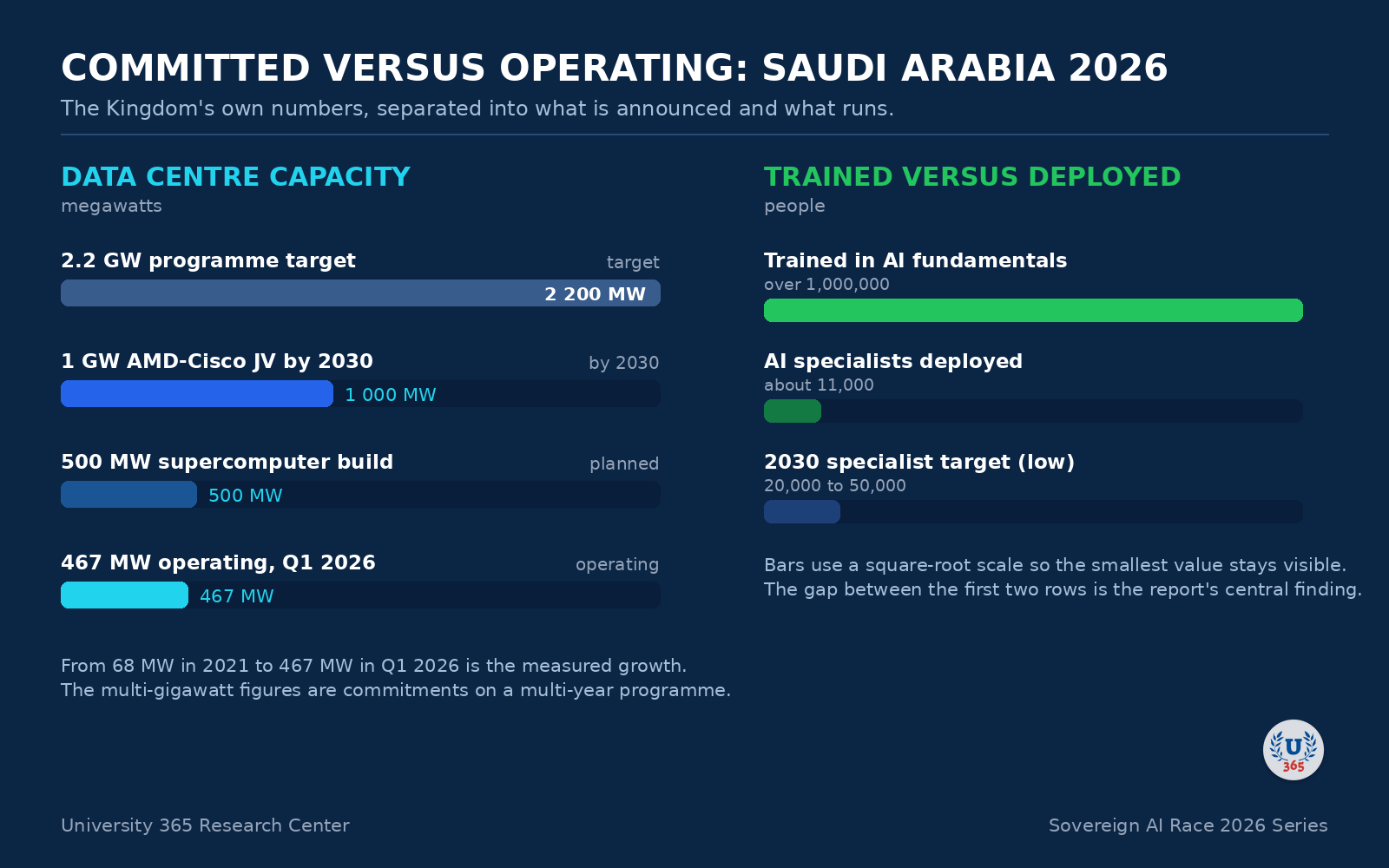
Committed versus operating, and trained versus deployed. University 365 Research Center.
The physical programme is the most visible part of the strategy and it is substantial. HUMAIN was launched in May 2025 with a mandate covering the full stack and a commitment reported at approximately one hundred billion dollars across eleven data centres with a combined target of 2.2 gigawatts and hundreds of thousands of NVIDIA accelerators over a multi-year build-out.
What is operational today is smaller than that figure and larger than nothing. Data centre capacity in the Kingdom grew from 68 megawatts in 2021 to 467 megawatts in the first quarter of 2026, an increase officials put at sevenfold, with total investment in data centres and digital infrastructure reported by the government as surpassing 56.2 billion riyals. That is the operating base. The 2.2 gigawatt figure is a target attached to a multi-year programme, and the difference between the two numbers is the difference between a plan and a power meter.
Two specific builds are worth separating from the aggregate. The first is a supercomputer for which HUMAIN ordered 18,000 NVIDIA GB300 chips, described as the cornerstone of a 500 megawatt build, with several hundred thousand more reported in the pipeline, and reported elsewhere as a 6.6 gigawatt pipeline across the programme. Those are commitments and pipeline figures, not commissioned capacity, and this report treats them accordingly.
The second is the announcement pattern at the Kingdom's own technology events. At LEAP 2026, which opened in Riyadh on 31 August 2026, the government reported more than fifteen billion dollars of launches, investments and partnerships on the opening day alone. The centrepiece was a joint venture between AMD, Cisco and HUMAIN that the companies describe as delivering up to one gigawatt of AI infrastructure by 2030, beginning with a 100 megawatt deployment, with a ten billion dollar commitment and capacity reported as arriving from 2027. HUMAIN also launched a domestic AI cloud on NVIDIA's Blackwell Ultra platform, and began operating its own accelerated computing infrastructure for government bodies and enterprises. That last item deserves emphasis because it is different in kind from the rest: an operator running its own infrastructure for its own state customers is a step beyond a vendor selling into a market.
Independent measurement of the model layer puts the Kingdom's position in context. Counterpoint Research's Sovereign AI LLM Index for the first half of 2026 placed the Middle East as the world's most mature sovereign model region, with the United Arab Emirates first and Saudi Arabia's ALLaM also on the leading edge of the spectrum. The same index found that across more than eighty countries, 92 per cent of the accelerators used to train sovereign models were NVIDIA's. Saudi Arabia's dependence on American silicon is therefore not unusual. It is the norm, and the Kingdom is simply buying more of it than most.
Capital: the strongest layer, and the one now under pressure
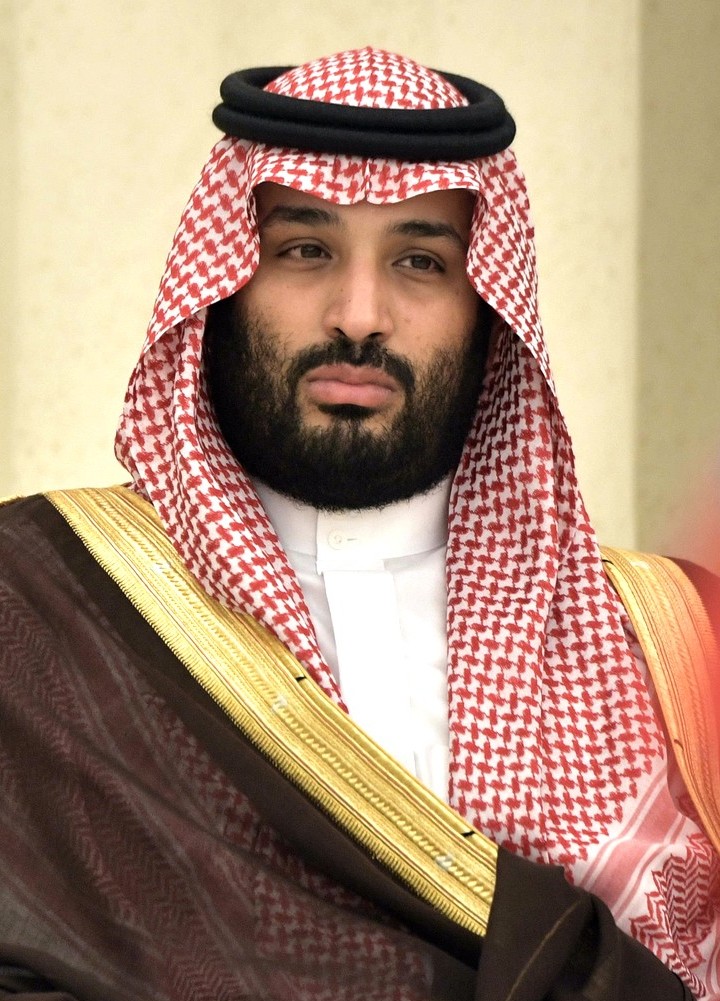
Mohammed bin Salman, Crown Prince and Prime Minister of Saudi Arabia, who chairs the Public Investment Fund and launched HUMAIN in May 2025. Photograph: Presidential Press and Information Office, CC BY 4.0, via Wikimedia Commons.
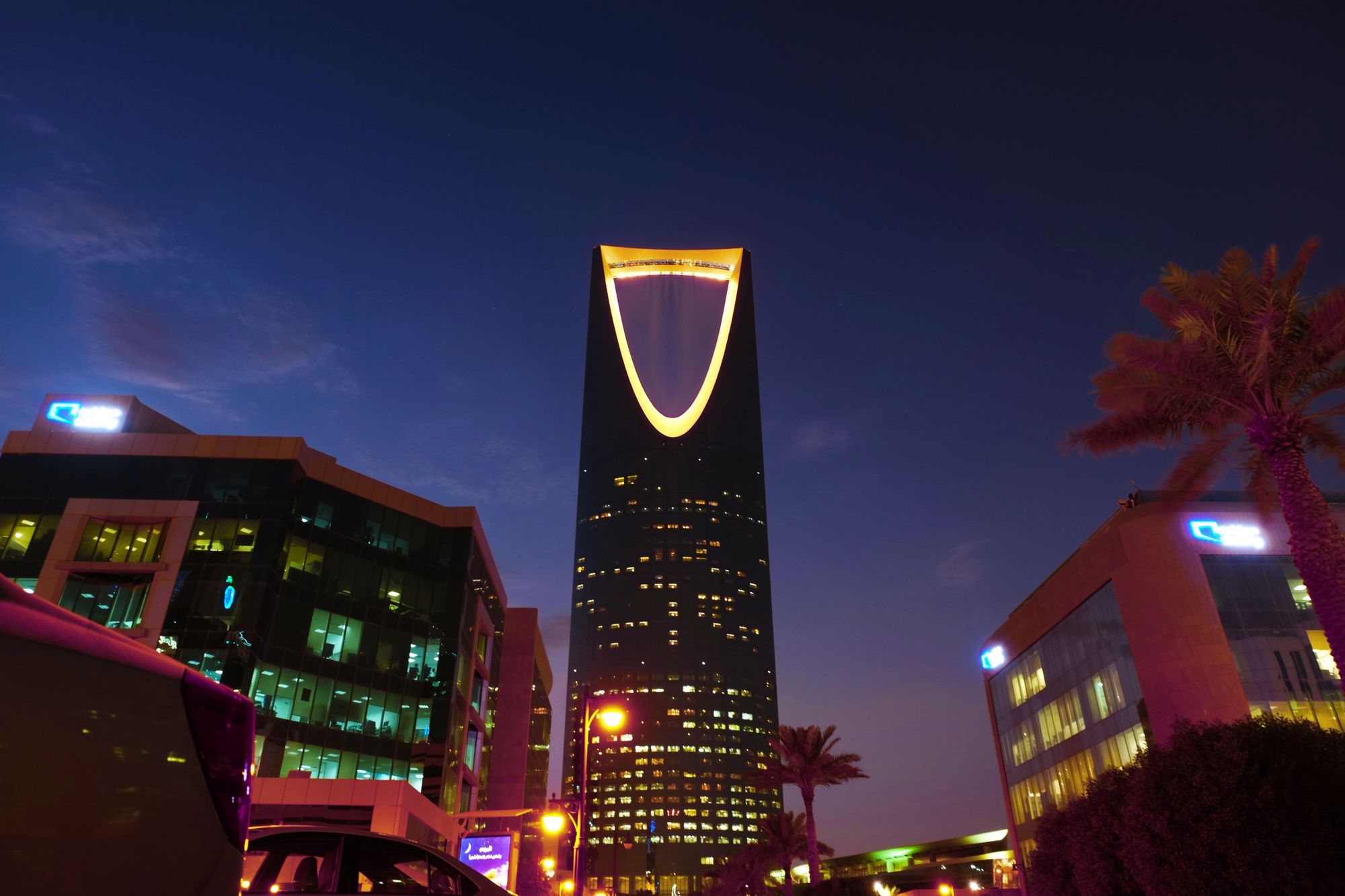
The Kingdom Centre, Riyadh. Photograph free-licensed via Pexels.
This is where Saudi Arabia is genuinely uncontested among middle powers. PIF owns HUMAIN outright. Aramco agreed in October 2025 to acquire a significant minority stake, with PIF retaining majority ownership, folding Aramco's own AI assets, capabilities and talent into the national champion. The programme has been described by analysts as a commitment of roughly one hundred billion dollars, with infrastructure commitments reported at 77 billion dollars, and a ten billion dollar venture fund announced alongside a 2.5 billion dollar fund for data centres.
The deployment has been global as well as domestic. HUMAIN placed three billion dollars into xAI's Series E financing in February 2026, a stake that converted into SpaceX equity when that company acquired xAI. The fund has also been reported as preparing an initial public offering for HUMAIN, which would be a notable step: a sovereign AI champion listing its equity is how a state converts a national programme into market capital.
The pressure is real and it is recent. In September 2026 Fortune reported that the Kingdom is reining in fiscal spending and that HUMAIN has turned to outside investment as a result. The company's chief executive stated a condition that is unusually candid for a sovereign fund: HUMAIN does not make passive investments, and will back only companies that commit to using Saudi data centres for part of their computing needs or to establishing a workforce in the country. Read that condition carefully. It is the response of a programme that has committed a very large sum to physical assets and now needs tenants to justify them. An investor that requires its counterparties to consume its infrastructure is telling you what it has built and what it still needs.
Models: a genuine national asset, built on a borrowed foundation
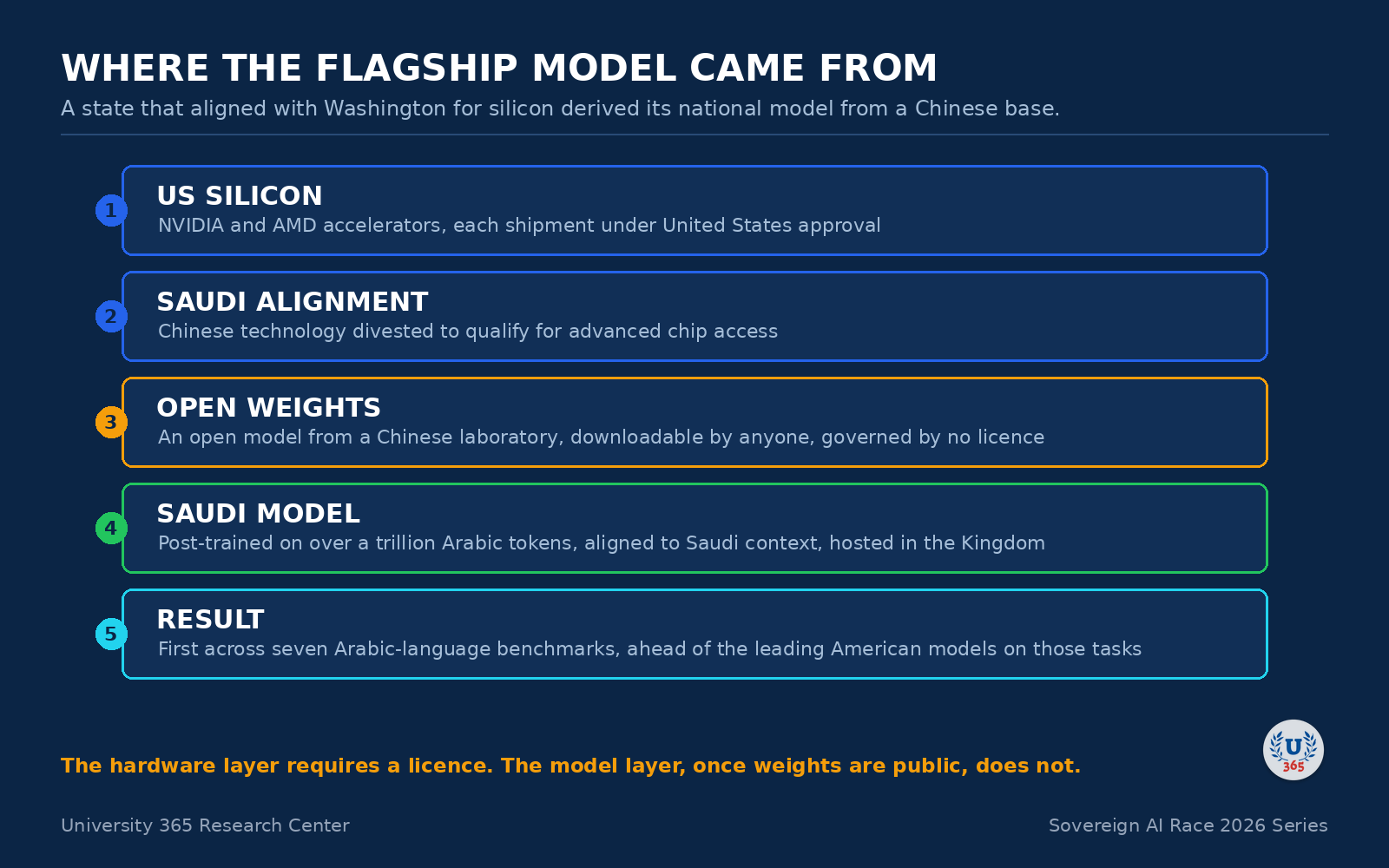
Where the flagship model came from. The hardware layer needs a licence; the model layer, once weights are public, does not. University 365 Research Center.
Two model families carry the Kingdom's claim. ALLaM, developed by the Saudi Data and AI Authority, began appearing as an open model from 2023 and placed first in its category on an Arabic benchmark in 2024, with the seven-billion-parameter version released on a public model hub for developers worldwide.
The second is HUMAIN's own flagship Arabic model, which the company states averaged first across seven Arabic-language benchmarks, ahead of the leading American frontier models on those specific tasks. Two qualifications belong beside that statement, and both are matters of public record rather than opinion. The first is that benchmark positions on Arabic-language tasks measure exactly what they say and should not be read as frontier-level capability in general. The second, developed in the previous section, is that the model was produced by post-training an open base from a Chinese laboratory rather than training from scratch. The Kingdom's flagship national model is best described as a derived model with substantial national investment in its alignment and its data. That is a real achievement and a narrower one than the word sovereign implies.
The Kingdom also built at the application layer, which is where a model becomes useful to a population. A domestic AI cloud, an Arabic speech interface handling regional dialects, an AI co-worker product aimed at finance, human resources and support workflows, and a consumer chat assistant restricted initially to the domestic market. Applications are how a country's citizens actually touch the technology, and on this measure Saudi Arabia is further along than its model-layer position would suggest.
Regulation: an authority with a mandate and a data law catching up
The Saudi Data and AI Authority, established in 2019 and known as SDAIA, carries the national mandate for data and artificial intelligence across regulation, development and application. Its president described HUMAIN's launch as aligning with the authority's own work to position the Kingdom as a global hub, which is the correct framing: SDAIA is the regulatory and coordination body, and HUMAIN is the operating company.
The Kingdom's general data protection law is in force and its enforcement has developed more slowly than the strategy around it, a pattern that will be familiar to any reader of the first report in this series. The difference from the Emirati case is structural rather than moral: the Emirates created a consolidated AI authority in 2026 on top of a data protection statute whose implementing regulations were never issued, whereas the Kingdom placed its authority first and has built the operating company beneath it. Neither country has a comprehensive AI statute of the kind the European Union is enforcing, and neither has an AI safety institute of the kind the United Kingdom established.
The Kingdom scores well on independent governance measures. Oxford Insights placed Saudi Arabia first in the Middle East and North Africa in its 2025 Government AI Readiness Index, seventh globally on the governance pillar and ninth worldwide for public-sector adoption. Those are measures of governmental capacity to adopt and manage AI, not measures of the technology industry underneath, and the distinction is worth holding onto.
Talent and education: the layer that decides the outcome
This is where the Saudi programme is most exposed and where its own figures are most revealing.
The Kingdom has trained at extraordinary volume. A national programme partnered with Oracle to equip 50,000 citizens in AI and digital technologies; a separate ministry programme aimed to certify 100,000 citizens in AI and data skills; Amazon committed to training 100,000 Saudi citizens in cloud and AI with a dedicated initiative for 10,000 women; and the national authority reports having trained more than a million people in AI fundamentals through its programmes and partners.
Against that, an independent Gulf labour analysis reported in 2026 that only roughly eleven thousand AI specialists are actually deployed in production roles across the Kingdom, against a national target of twenty to fifty thousand by 2030. The gap between a million people trained and eleven thousand specialists deployed is the most important number in this report. Trained-in-fundamentals and employed-as-a-specialist are different states, and the Kingdom has produced a very large volume of the first and a modest number of the second.
The university pipeline is being built and it is young. The previous University 365 report on the Kingdom, published in March 2025, recorded that 86 per cent of Saudi universities offered AI programmes, with 42 per cent focused specifically on AI disciplines. That is a strong foundation for a research base, and a base that does not produce practitioners at scale for several years.
What changed since our 2025 report on the Kingdom

Read the earlier report: Saudi Arabia's AI Revolution - Mapping the Kingdom's Journey from Vision to Reality in 2025 (https://www.university-365.com/post/saudi-arabia-s-ai-revolution-mapping-the-kingdom-s-journey-from-vision-to-reality-in-2025). University 365 INSIDE, 27 March 2025.
University 365 published "Saudi Arabia's AI Revolution: Mapping the Kingdom's Journey from Vision to Reality in 2025" on 27 March 2025. Several of its figures can now be tested, and the comparison shows a country that moved from planning to building, with the model and talent layers lagging the physical one.
The institutional centre of gravity changed. The 2025 report described SDAIA as the catalyst for the Kingdom's AI development and described government-led deployment across sectors. Sixteen months later a single operating company, HUMAIN, owns the computing, cloud, model and application stack, and SDAIA's role has settled into regulation and coordination. The 2025 picture was a state coordinating adoption. The 2026 picture is a state-owned company building the industry.
Corporate investment expectations were overtaken by state commitments. The 2025 report recorded Saudi businesses planning to invest approximately 76.5 million dollars in generative AI, a figure it noted exceeded the global average. That was the corporate-adoption measure. It has been dwarfed by the state programme: the current commitments are measured in tens of billions, and LEAP 2026 alone reported over fifteen billion dollars of announcements in a single opening day. The 2025 report was measuring the private sector's appetite. The 2026 reality is that the state has become the private sector's principal customer and supplier simultaneously.
The model layer advanced, and its foundation was revealed. The 2025 report noted the Allam application as the first Saudi beta application capable of conversing in Arabic, and described the Kingdom's ambition to expand Arabic natural language processing. That ambition has been met at the application layer and partly met at the model layer, with the important qualification that the flagship Arabic model is derived from a foreign open base. The 2025 report framed Arabic model development as a Saudi achievement in progress. The 2026 position is that the achievement is real and its foundation is imported.
The talent gap became measurable. The 2025 report was optimistic about the pipeline, citing the share of universities offering AI programmes. It did not carry an employment figure. The current data does: roughly eleven thousand specialists in production roles against a target several times that. The 2025 report could not have known this, because the number did not yet exist to be cited. It is now the single most important measure of whether the programme is working.
The geopolitical premise shifted. The 2025 report treated the Kingdom's trajectory as an established fact of the AI landscape. In the intervening period the Crown Prince visited Washington in November 2025, the United States authorised advanced chip exports to Gulf state companies after that visit, and the Kingdom's access to silicon became explicitly contingent on American approval in a way the 2025 report did not examine. The 2025 report described a country rising. The 2026 position is a country rising on a licence.
Key Findings
1. The Kingdom holds the capital layer more strongly than any middle power in the series. PIF owns the national champion outright, Aramco has taken a minority stake, and the programme's commitments are measured in tens of billions. On this layer Saudi Arabia is not dependent on anyone.
2. The compute layer is the largest announced build in the region and a much smaller operating reality. Data centre capacity grew sevenfold to 467 megawatts by the first quarter of 2026. The 2.2 gigawatt figure and the multi-gigawatt pipeline are targets attached to multi-year programmes, and this report separates them throughout.
3. The flagship national model is built on a Chinese open base. This is the report's central finding. A state that aligned with Washington for silicon and divested Chinese technology to qualify for it produced its national Arabic model by post-training a model from a Chinese laboratory, and by that route reached the top of Arabic-language benchmarks. The model layer is where export controls do not reach.
4. The talent layer contains the decisive number. More than a million people trained in AI fundamentals against roughly eleven thousand specialists deployed in production roles, against a national target of twenty to fifty thousand by 2030. Volume of training and supply of specialists are different measures, and the Kingdom has produced far more of the first.
5. The programme has entered a phase where it needs customers. HUMAIN's chief executive has stated that the company makes no passive investments and will back only firms that consume Saudi data centre capacity or establish a local workforce. A programme that conditions its investment on its counterparties buying its infrastructure is a programme with capacity to fill.
6. The Kingdom scores well on governance readiness and has no comprehensive AI statute. Oxford Insights ranked Saudi Arabia first in the region for government AI readiness. That measures the state's ability to adopt AI, not the strength of the industry beneath it, and no AI-specific law of European scope is in force.
7. The fiscal position is tightening while the commitments are still being made. Fortune reported in September 2026 that the Kingdom is reining in spending and that HUMAIN has turned to outside investment. The strategy has not been withdrawn; its funding model is being adjusted, which is a different and more telling signal.
8. The regional rivalry is real and it is being run on two different models. The United Arab Emirates bought into the frontier's ownership by taking equity in the leading American labs. Saudi Arabia built its own operating company and its own infrastructure. Both are large bets on the same dependency, and neither has resolved the chip supply question.
Deep Analysis
Why the model-layer choice was rational, and why it still matters
The temptation is to read the derived-model finding as a criticism. It is not, and the reasoning deserves to be stated.
Training a frontier-scale language model from scratch requires a cluster of tens of thousands of the newest accelerators, sustained for months, at a cost that runs into the billions before any result is guaranteed, staffed by a research organisation with a decade of accumulated method. No state in the Gulf has that organisation, and access to the accelerators is governed by a licensing regime that treats each shipment as a foreign policy decision. The Kingdom's alternative was to take a capable open model and spend its resources on the two things it could uniquely contribute: a trillion tokens of Arabic data, and an alignment layer reflecting Saudi context and guardrails. That produced a model that beats the leading American systems on Arabic-language tasks, which is precisely the measure that matters to a Saudi user.
The rational choice, then, was made. What matters for this series is what the choice reveals about the layers.
At the compute layer, a licence is required and the Kingdom depends on a foreign government's approval. At the model layer, when the model is derived from open weights, no licence is required and the dependency is invisible to any regulator. A country can therefore satisfy every export control condition it has been given and still build its national capability on a foreign foundation that no agreement covers. The open-weights route is, for now, a gap in the architecture of technology control, and states are walking through it in both directions.
That is why this series treats open weights as a sovereignty instrument rather than a technical detail. It is the one layer where a state can act without permission. It is also the layer where a state can be acted upon without noticing, because a base model's behaviour carries the assumptions of whoever trained it, and post-training on Arabic data does not remove them.
The training-versus-employment gap, and what it means pedagogically
The distance between a million people trained in fundamentals and eleven thousand specialists deployed is the most consequential number in the Kingdom's programme, and it is not a public relations problem. It is a measurement problem with a teaching cause.
Programmes that train a million people in AI fundamentals are, in practice, awareness and literacy programmes. They are valuable, they are cheap per head, and they produce people who can use tools. Programmes that produce specialists who can build, evaluate and verify systems are expensive per head, slow, and require assessment that cannot be run at scale by a course completion certificate. The Kingdom's numbers are what a system optimised for the first looks like when it reports on the second, and its own target of twenty to fifty thousand specialists by 2030 is an acknowledgement of the same gap.
The Emirati case in the first report of this series showed the same pattern from a different direction: the highest measured AI adoption in the world beside a hard shortage of builders. Two Gulf states, two different strategies, one shared outcome at the layer that decides whether the strategy survives. Adoption and literacy can be scaled with money. Capability cannot, and both countries are now discovering the boundary.
What the fiscal turn tells a reader
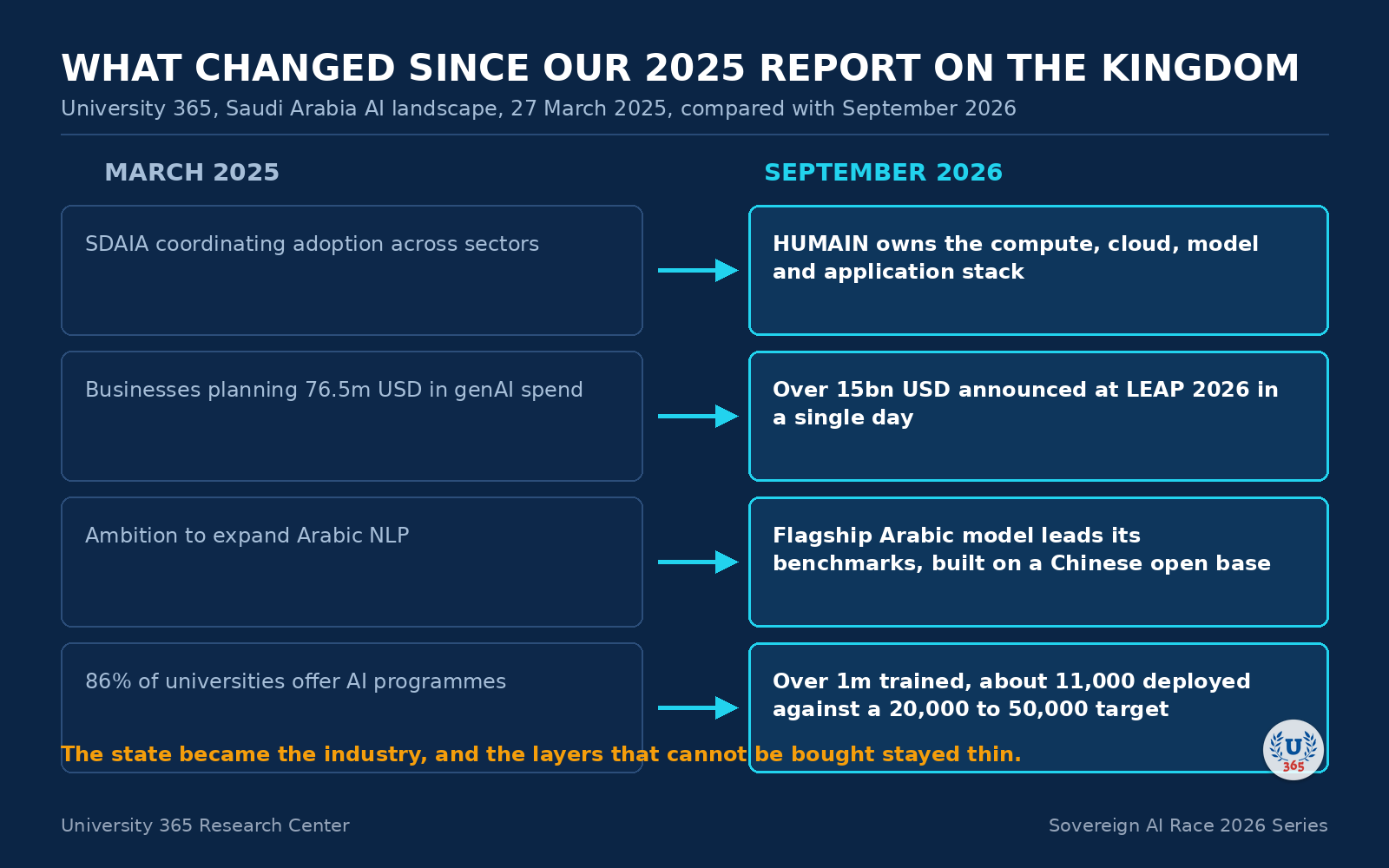
What changed since our March 2025 report on the Kingdom. University 365 Research Center.
Fortune's September 2026 report that the Kingdom is reining in spending, and that HUMAIN has turned to outside investment, is more informative than any announcement in the programme.
A state that has committed a hundred billion dollars to physical infrastructure and now seeks outside capital, and that conditions its investment on counterparties consuming its own capacity, is a state that has reached the point where the assets must earn. That is the ordinary passage from a construction phase to an operating phase, and it is the point at which a strategy stops being measured by what it has announced. It is also the point at which the model and talent layers stop being a long-term concern and start being the constraint, because assets that need tenants need a workforce able to run and improve them.
None of this predicts failure. It predicts that the Kingdom's next two years will be judged on utilisation and hiring rather than on commitments, and that the numbers to watch are published rather than announced.
Data and Evidence
Table 1: The five layers, assessed for Saudi Arabia in September 2026
Layer | What the Kingdom holds | What it does not hold | Assessment |
Compute | A national operator running its own accelerated infrastructure; capacity grown sevenfold to 467 MW by Q1 2026; an NVIDIA-powered domestic cloud live | Chip design and fabrication; licence-free access, which the Kingdom does not have and the UAE now does; the multi-gigawatt targets are commitments, not commissioned capacity | Bought, at scale, on licence |
Models | ALLaM by SDAIA, open and benchmark-leading in Arabic; a flagship HUMAIN model that tops Arabic benchmarks; application-layer products in production | A frontier-scale model trained from scratch; the flagship model is derived from a Chinese open base | Held, on a borrowed foundation |
Capital | PIF ownership outright; an Aramco minority stake; tens of billions committed; a global portfolio including a stake in xAI | Nothing material; this is the strongest layer in the series after the UAE's | Owned |
Regulation | SDAIA as the national authority since 2019; first in MENA on government AI readiness | A comprehensive AI statute; an AI safety institute; data protection enforcement at the pace the strategy implies | Mandated, not yet comprehensive |
Talent and education | Programmes that have trained over a million people in fundamentals; 86 per cent of universities offering AI programmes | Roughly 11,000 specialists in production roles against a 20,000 to 50,000 target for 2030 | Volume without depth |

Riyadh at dusk. Photograph free-licensed via Pexels.
Table 2: The controlled metrics, series bible format
Metric | Saudi position | Source and date |
Flagship compute commitment | Eleven data centres targeting 2.2 GW with hundreds of thousands of NVIDIA accelerators; a 500 MW supercomputer anchored on 18,000 GB300 chips; a 1 GW AMD-Cisco joint venture by 2030 | PIF and HUMAIN announcements, May 2025; Cisco newsroom, November 2025; LEAP 2026 reporting, August 2026 |
Capital committed | Approximately 100bn USD programme; 77bn USD infrastructure commitment; a 10bn USD venture fund and a 2.5bn USD data centre fund; a 3bn USD stake in xAI | PIF, May 2025; analyst compilations, 2026; Fortune, September 2026 |
Flagship national models | ALLaM (SDAIA, open, 7B released publicly); the HUMAIN flagship Arabic model, derived by post-training a Chinese open base on over a trillion Arabic tokens | SDAIA, March 2025; Latent East reporting on the HUMAIN model, 2026 |
Anchor entities | PIF, HUMAIN, SDAIA, Aramco, MCIT | Official announcements |
Chip dependency | NVIDIA and AMD systems throughout; access through United States export approvals granted case by case | CNBC, November 2025; company announcements |
Regulatory instrument | SDAIA mandate since 2019; no comprehensive AI statute; data protection law in force | SDAIA; legal analyses, 2026 |
Talent anchors | Oracle and ministry programmes targeting 50,000 and 100,000 citizens; an AWS commitment to train 100,000 including 10,000 women; 86 per cent of universities offering AI programmes | Oracle, 2023; Arab News, 2026; Amazon, 2026; University 365, March 2025 |
Independent index standing | Counterpoint Sovereign AI LLM Index H1 2026: ALLaM on the leading edge of the sovereignty spectrum. Oxford Insights Government AI Readiness 2025: first in MENA, seventh globally on governance | Counterpoint, July 2026; Oxford Insights, 2025 |
Adoption and economic target | PwC projects AI contributing 235.2bn USD by 2030, 12.4 per cent of GDP; a national adoption target of AI in 60 per cent of government services | PwC, January 2026; national strategy documents |
Distinguishing mechanism | State-owned operating company at national scale, financed by the sovereign fund | This report |
Core tension | Buys compute and capital faster than it can build models and people, and its flagship model proves the limit | This report |
Table 3: Timeline, 2019 to 2026
Date | Event | Source |
2019 | SDAIA established as the national data and AI authority | SDAIA |
2023 | ALLaM appears as an open Arabic and English model family | SDAIA and ICLR materials |
10 to 12 September 2024 | ALLaM places first in its category on an Arabic benchmark at the Global AI Summit in Riyadh | Saudi Press Agency, September 2024 |
12 to 13 May 2025 | HUMAIN launched by PIF as a wholly owned national AI company; 11 data centres and a multi-gigawatt target announced | PIF, May 2025 |
30 May 2025 | A 10bn USD AI fund announced alongside a multi-gigawatt roadmap | Trade reporting, May 2025 |
August 2025 | Analysts begin publicly questioning whether the data centre spending will pay off | CNBC, August 2025 |
October 2025 | Aramco agrees to take a significant minority stake in HUMAIN, with PIF retaining majority | Saudi Press Agency, October 2025 |
November 2025 | AMD, Cisco and HUMAIN announce a joint venture for up to 1 GW of AI infrastructure by 2030 | Cisco newsroom, November 2025 |
20 November 2025 | The United States authorises advanced chip exports to Gulf state companies after the Crown Prince's Washington visit | CNBC, November 2025 |
February 2026 | HUMAIN places 3bn USD into xAI's Series E, later converted into SpaceX equity | Analyst compilation, 2026 |
2026 | The HUMAIN flagship Arabic model is reported to lead seven Arabic benchmarks, built on a Chinese open base | Third-party analysis, 2026 |
31 August 2026 | LEAP 2026 opens in Riyadh with over 15bn USD of announcements on day one; a domestic AI cloud on Blackwell Ultra begins operating | SPA and trade reporting, August 2026 |
September 2026 | Fortune reports fiscal tightening and HUMAIN turning to outside investment | Fortune, September 2026 |
Implications
For states attempting the same manoeuvre with less money
Saudi Arabia has run the largest version of the strategy available to a state without a technology industry: buy the compute, buy the capital position, derive the models, and train the population. The results so far separate cleanly. Capital and compute respond to money at the speed the money arrives. Models respond to money only up to the point where a capable open base exists to build on, and that base is currently supplied by someone else. Talent responds to money slowly and not proportionally, which is why a million trained individuals produced eleven thousand specialists.
Any state planning this route should therefore budget for the layers it cannot accelerate. The Kingdom's own numbers make the case better than an outside critic could.
For the technology providers
The derived-model route is a structural feature of the market, not an incident. Every open-weight release is, for a state without frontier compute, an invitation to build a national capability on someone else's foundation. The laboratory that publishes open weights is contributing to research, and it is also supplying the base layer for other countries' sovereignty strategies, and it currently receives no visibility into, or control over, how those strategies develop.
For institutional and enterprise buyers
The Kingdom's data centre capacity is real, growing, and among the best in the region. Buyers evaluating it should apply the same test this series applies everywhere: separate the announced capacity from the commissioned capacity, and ask which legal regime governs the operator and which supply chain supplies the accelerators. HUMAIN's own investment condition, requiring counterparties to consume Saudi capacity, tells a buyer that the operator wants anchor tenants, which is also a negotiating position.
For the Global South
Saudi Arabia offers a second model for countries that want AI capability without a domestic industry: a state-owned operator, financed by a sovereign fund, building infrastructure and leasing access. It competes with the Emirati offer of brokered access and with the Chinese offer of open weights. A country choosing between them is choosing which dependency it prefers, and this report's contribution is to name that honestly rather than to rank the options.
Education and Skills Impact
What the Kingdom's numbers teach about building capability
This section matters because the Saudi figures are the clearest available measurement of a problem every country in this series shares, and because the lesson is pedagogical rather than financial.
The Kingdom trained more than a million people in AI fundamentals. That is a genuine public good and it was delivered efficiently. It produced roughly eleven thousand specialists in production roles. The distance between those two numbers is not a failure of the training; it is a definition of what training achieves. Awareness programmes produce users. Specialist capability is produced by sustained study with assessment that cannot be completed by attendance, and it takes years per person.
The Kingdom knows this, which is why its national strategy carries a specialist target three to five times its current deployed number, and why its university system is being expanded specifically in AI disciplines. The question for the next several years is whether the volume programmes and the depth programmes are properly distinguished in policy and in budget, because they produce different things and one of them cannot be scaled by adding participants.
The pedagogical point is the one this series will return to in every country. Adoption and literacy measure exposure to a technology. Capability measures the ability to produce, evaluate and correct it. The Gulf states have now demonstrated, in two different programmes, that the first can be bought and the second cannot. That is the empirical case for teaching the human capacity to judge and verify as the outcome, rather than teaching the use of a tool, and it is the case the Co-Intelligence First framework exists to make.
The CI-First Perspective
Where the appearance of capability outruns the capability itself
The Co-Intelligence First framework asks whether an arrangement amplifies human capability or substitutes for it, and where the risk of AI Imposture sits. Applied to Saudi Arabia, the question has a specific structure because the Kingdom has been unusually transparent at the layer where imposture would be easiest to conceal.
The programme has real substance underneath it. The data centre capacity is measurable and growing. The capital is genuinely the state's own and cannot be withdrawn by a foreign regulator. The Arabic model performs a task that a Saudi user actually needs and that the leading American systems do less well. The application-layer products are in production and being used by government and enterprise customers. This is not a country that announced a strategy and did nothing.
The imposture risk sits in three places, and each is measurable.
The first is the distance between committed and operating capacity. A 2.2 gigawatt target against 467 megawatts of operating data centre capacity is not a small gap, and it is reported by the government as a sevenfold increase, which is true of the operating figure and silent about the target. A national programme that reports the growth rate of the small number beside the ambition of the large one is producing an impression rather than a measurement. This report's method exists because of exactly that pattern.
The second is the model layer, and it is the most instructive case of imposture risk in the entire series so far, precisely because it is not deliberate. A model that leads Arabic benchmarks is genuinely the Kingdom's model in the sense that the Kingdom built the data, the alignment and the deployment. It is not the Kingdom's model in the sense that a reader of the word sovereign would assume. Both statements are true, and a reader who only receives the first has received the appearance of a layer rather than the layer.
The third is the employment gap. A million trained is a number a government can announce. Eleven thousand specialists is a number the labour market produces. The distance between them is the difference between a programme's output and its outcome, and the Kingdom's own 2030 target is the admission.
The honest verdict is that Saudi Arabia has built a real industrial base for artificial intelligence at a speed no middle power has matched, and has not yet built the model or human layer that would make the base sovereign rather than well-funded. The programme appears to know this, which is the strongest thing that can be said for it. The risk is not that the Kingdom believes its own announcements; it is that everyone else does.
What This Means for You and Us
For a reader in the Kingdom's partner markets
If you are considering Saudi compute capacity, the practical questions are the commissioned capacity rather than the announced capacity, the tenant conditions HUMAIN attaches to its investments, and the accelerator supply chain behind the operator. The Kingdom's infrastructure is good and its terms are its own.
For a reader watching the series
Two countries have now been examined, and a pattern has emerged that will be tested eighteen more times. Both Gulf states bought compute faster than they built models, and both trained users faster than they produced builders. Both hold capital sovereignty absolutely and compute sovereignty conditionally. Neither has the model layer that the word sovereign implies. The next report, on China, is the country that decided to build all five layers itself and accepted the cost of doing so.
For University 365
The Saudi finding completes an argument the series began with the Emirates. In one country, the world's highest measured AI adoption sits beside a shortage of builders. In the other, a million people trained in fundamentals sit beside eleven thousand specialists. Two states, two strategies, one shared boundary at the layer where capability is produced rather than consumed. That boundary is pedagogical, and it is where this institution's work sits.
The Road Ahead
Three observable things would change this assessment.
Utilisation of the announced capacity. Whether the multi-gigawatt programme reaches commissioned status and finds tenants determines whether the Kingdom industrialised AI or built a monument. Watch published capacity and announced customers rather than commitments.
The specialist number. If the eleven thousand deployed specialists moves decisively toward the national target, the programme is converting training into capability. If the gap persists while the trained-in-fundamentals number keeps growing, the programme is producing literacy, which is worthwhile and is not the same thing.
The provenance of the next national model. If the Kingdom's next flagship model is trained from scratch on its own cluster, the model layer changes category and the strategy becomes a full-stack claim. If successive models continue to derive from foreign open bases, the Kingdom has settled into a stable and honest position: a state that owns its data, its alignment and its applications, and rents its foundations.
Sources and Methodology
Methodology
This report was researched from public sources with a preference for primary documents. Where a government or company statement is the only source for a figure, it is attributed to that party and labelled a claim. Announced capacity and operating capacity are reported separately throughout, and the distinction carries more weight in this report than in any other in the series because the gap is larger. Where the Kingdom's own strategy documents or a company's announcements are the source of an aspiration, the aspiration is reported as such and never as a result.
The report also tests University 365's own prior coverage. The Kingdom's March 2025 landscape report from this institution is compared against the present position in The Current State, and the comparison records where that earlier report was accurate as well as where events overtook it.
Three limits should travel with this report. First, the two headline programme figures, approximately one hundred billion dollars across eleven data centres and a 77 billion dollar infrastructure commitment, come from company announcements and analyst compilations rather than an audited account, and are labelled accordingly. Second, the construction method of the flagship Arabic model is reported from third-party analysis rather than a primary technical publication, and is described as reported rather than as established. Third, the employment figure of roughly eleven thousand deployed specialists comes from a single independent labour analysis; no government figure at that granularity was published during research, and the number is presented as the best available estimate.
Principal sources
Government and official company announcements. Saudi Press Agency releases on HUMAIN's launch, the Aramco stake and the Global AI Summit; the Public Investment Fund's portfolio materials; the Saudi Data and AI Authority's own publications and model releases; Cisco's newsroom announcement of the AMD, Cisco and HUMAIN joint venture; NVIDIA and AMD corporate announcements; Oracle's training programme announcement; Amazon Web Services announcements on the Riyadh AI Zone.
Independent research indices and analysis. Counterpoint Research, Sovereign AI LLM Index, first half 2026; Oxford Insights, Government AI Readiness Index 2025; PwC's economic projection for the Kingdom; Stanford HAI, AI Index Report 2026; independent Gulf labour-market analysis on AI specialist deployment.
Reporting. Reuters; CNBC, including its August 2025 assessment of the data centre programme; Fortune's September 2026 report on fiscal tightening and outside investment; Arab News; Saudi Press Agency; trade and industry coverage of LEAP 2026 and of the flagship model's construction.
About This Report
Sovereign AI Race: Saudi Arabia (2026) is report two of twenty in the Sovereign AI Race series, followed by a comparative capstone. The series assesses how states attempt to control the production of artificial intelligence inside their jurisdiction, using one five-layer framework and one metric set applied identically to every country: compute, models, capital, regulation, and talent.
Each report in the series carries a "What Changed Since" treatment against the earlier University 365 report on the same country where one exists. The Kingdom has a 2025 landscape report from this institution, and this report is compared against it.
Author: Hubert Graef, Dean of Research, University 365 Research Center.
Series: Sovereign AI Race, report 2 of 20, followed by the comparative capstone.
*Published by University 365 Research Center. CI-First is University 365's Co-Intelligence First framework, a method constant of the institution.*
Revision 2, 28 September 2026, 20:25 UTC. Published 28 September 2026.




Comments