
The Reasoning Model Era (2026)

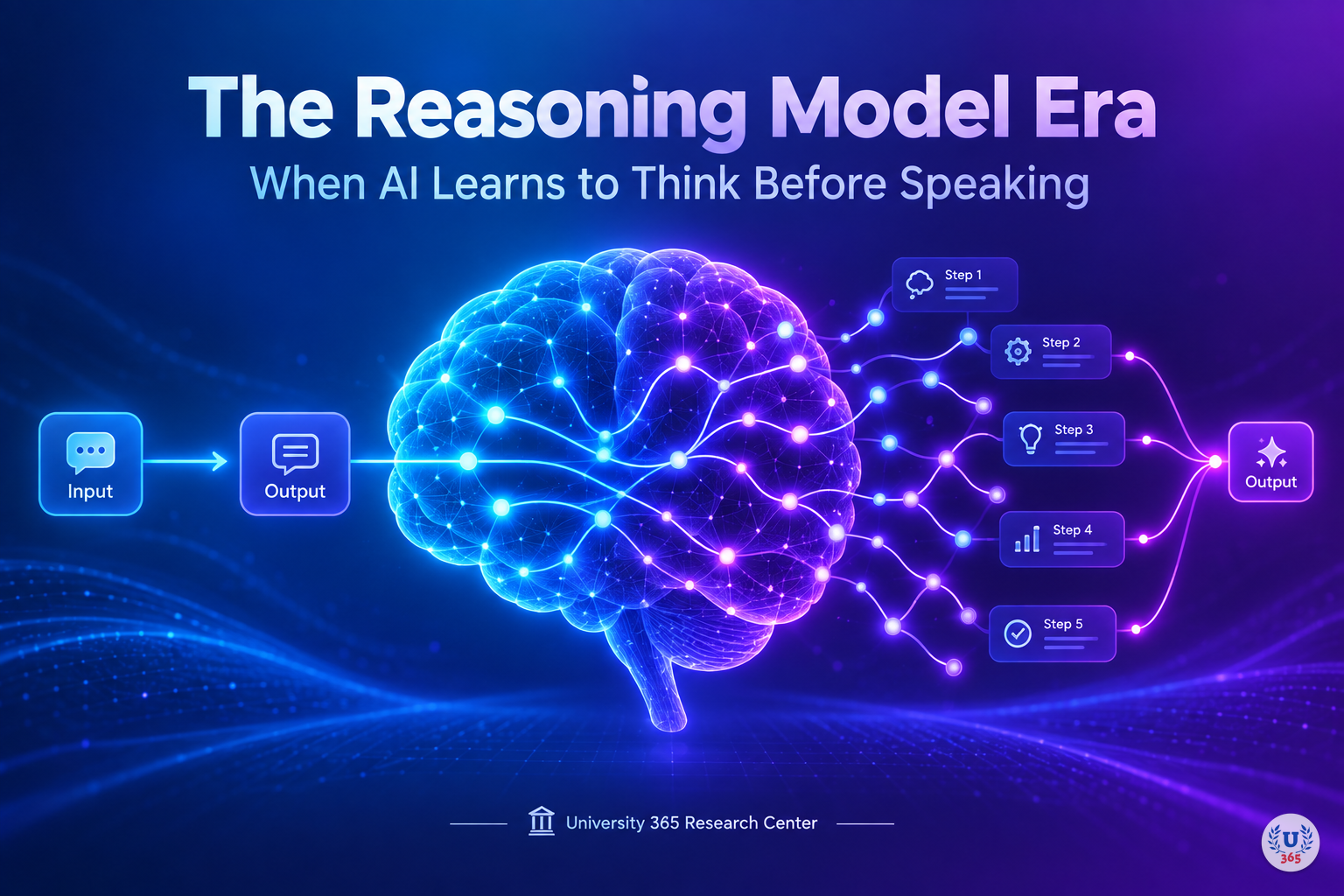
Table of Contents
The Question: What Happens When AI Thinks Before It Answers?
In September 2024, OpenAI released a model called o1. It was not larger than the models that came before it. It did not have more parameters. What it did differently was simple: before answering a question, it talked to itself. It generated a hidden chain of reasoning tokens, explored solution paths, checked its work, and only then produced its final answer. The result was a jump in accuracy on mathematics, coding, and logic problems that no amount of model scaling had achieved.
Two years later, in September 2026, every major AI lab has reasoning models. OpenAI has GPT-6 Astra, which scores 99.9% on ARC-AGI-3, a benchmark designed to test genuine abstract reasoning. Anthropic has Claude Fable 5.1, which uses adaptive thinking that cannot be turned off. DeepSeek has V4 Pro, an open-weight model with 1.6 trillion parameters that matches closed-source frontier models on coding benchmarks. Google has Gemini 3.8 Flash with configurable thinking levels. Alibaba has Qwen 3.5 with hybrid thinking that can be toggled on and off per request.
The question this report explores is not whether reasoning models work. The benchmarks prove they do. The question is what happens when the AI industry shifts from making models bigger to making them think longer, and what that shift means for the people and organizations who use AI every day.

The Context: Understanding Reasoning Models and Test-Time Compute
To understand why reasoning models matter, you first need to understand what they do differently from the AI models that came before them.
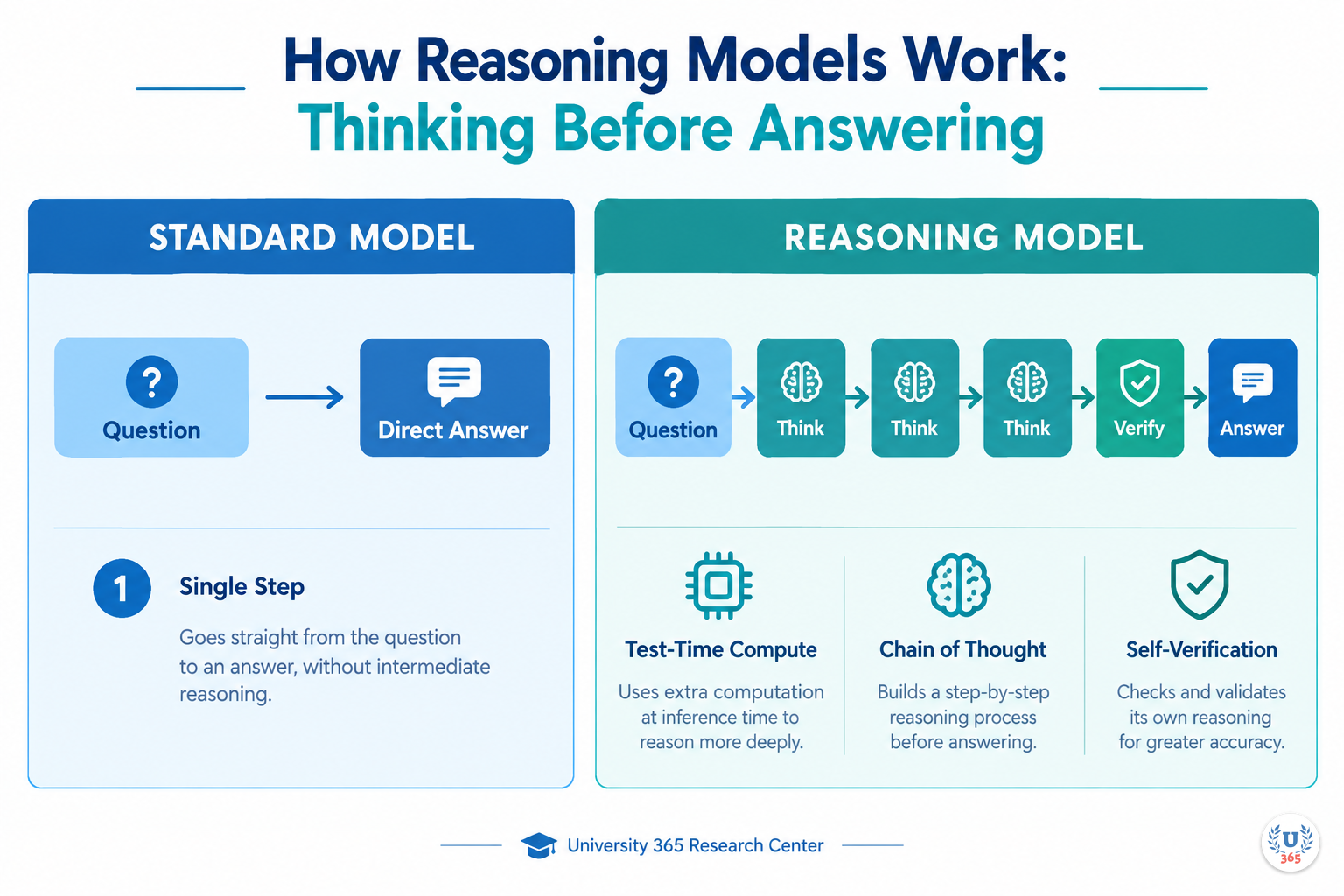
A traditional large language model works like a very fast autocomplete. You give it a prompt, and it predicts the next token, then the next, then the next, until it has produced a response. The model does all its "thinking" during training, when it learned statistical patterns from trillions of tokens of text. When you ask it a question, it applies those patterns in a single forward pass through its neural network. More parameters mean more capacity to store patterns, and more training data means more patterns to store. But the computation per question is fixed: the same model always does roughly the same amount of work regardless of whether you ask it "What is 2+2?" or "Prove the Riemann hypothesis."
A reasoning model adds a step in between. Before producing its final answer, it generates a chain of thought: a sequence of intermediate reasoning steps that break the problem into sub-problems, explore solution paths, verify intermediate results, and self-correct errors. This chain of thought is produced using the same next-token prediction as the final answer, but the model has been trained through reinforcement learning to use these tokens productively. The key insight is that you can trade inference compute for reasoning quality: give the model more tokens to think with, and it can solve harder problems.
This is called test-time compute scaling. Instead of spending more money making the model larger during training, you spend more money letting the model think longer during inference. The landmark result was OpenAI's o3 scoring 87.5% on ARC-AGI in December 2024, a benchmark specifically designed to test genuine reasoning through novel visual pattern recognition that cannot be solved by memorization. The previous best, GPT-4o, scored around 5%. The improvement did not come from a bigger model. It came from spending approximately 1,000 dollars in compute per task at the highest reasoning effort setting.
DeepSeek-R1, released in January 2025 and published in Nature in September 2025, proved that reasoning capabilities can emerge from pure reinforcement learning without supervised fine-tuning. The model, called DeepSeek-R1-Zero, was trained on top of the DeepSeek-V3 base model using Group Relative Policy Optimization, a reinforcement learning algorithm. Through this process, the model naturally developed behaviors like self-verification, reflection, and the exploration of alternative approaches. The research community called these behaviors "aha moments," because the model learned to rethink problems using an anthropomorphic tone without being explicitly taught how to reason.
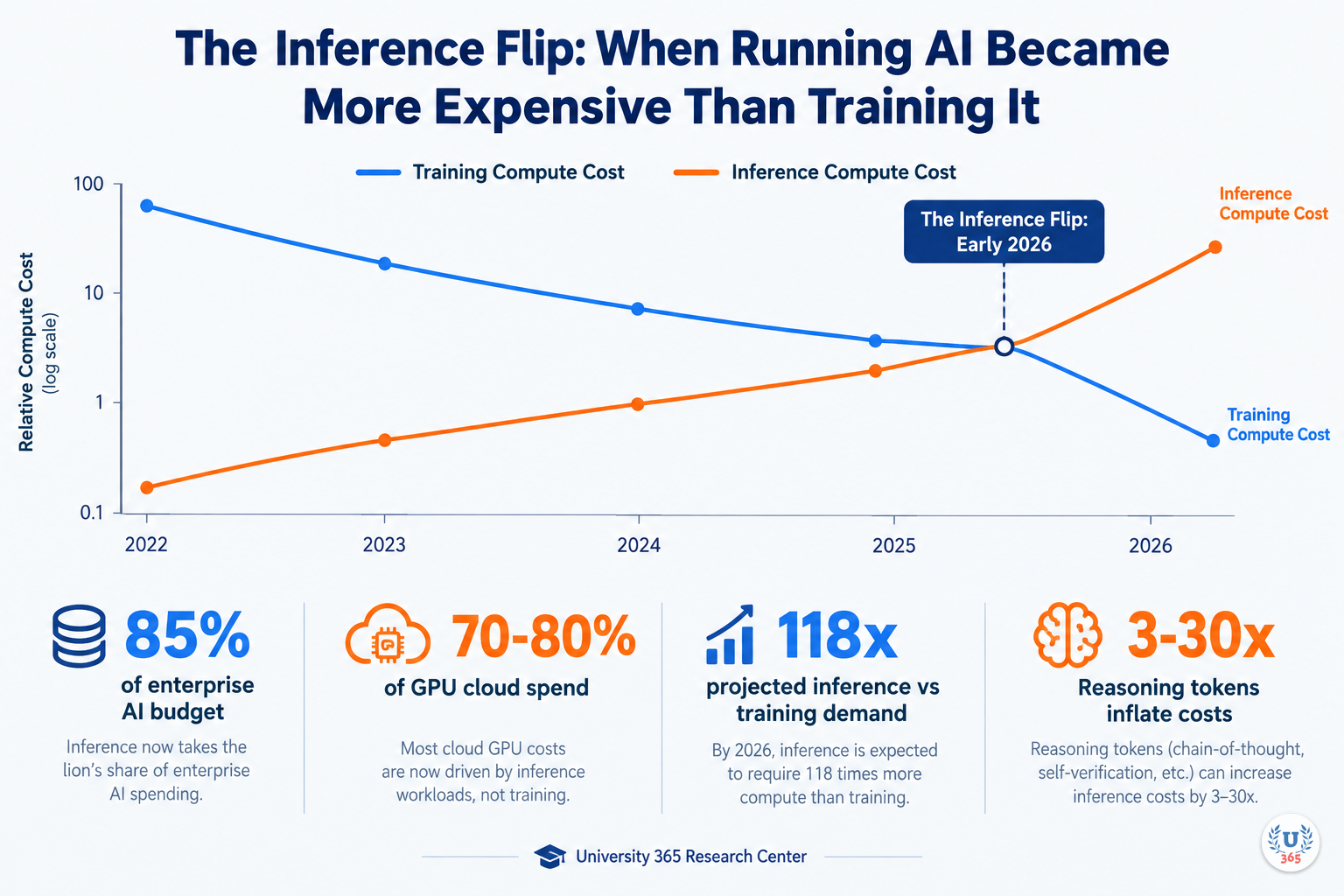
By 2026, the industry recognizes three distinct compute investment strategies: pre-training scaling (make the model larger), post-training optimization (fine-tuning, reinforcement learning, distillation), and test-time compute scaling (let the model think longer at inference). The third strategy has become the dominant lever for capability gains. Introl, an industry analysis firm, projects that inference compute demand will exceed training compute by 118 times in 2026. Inference now accounts for 85% of enterprise AI budgets and roughly two-thirds of all global AI compute spend.
The Contradiction: More Thinking Can Make AI Worse
Now that you understand what reasoning models do, here is the central contradiction of the reasoning model era: the same mechanism that makes these models powerful can also make them fail.
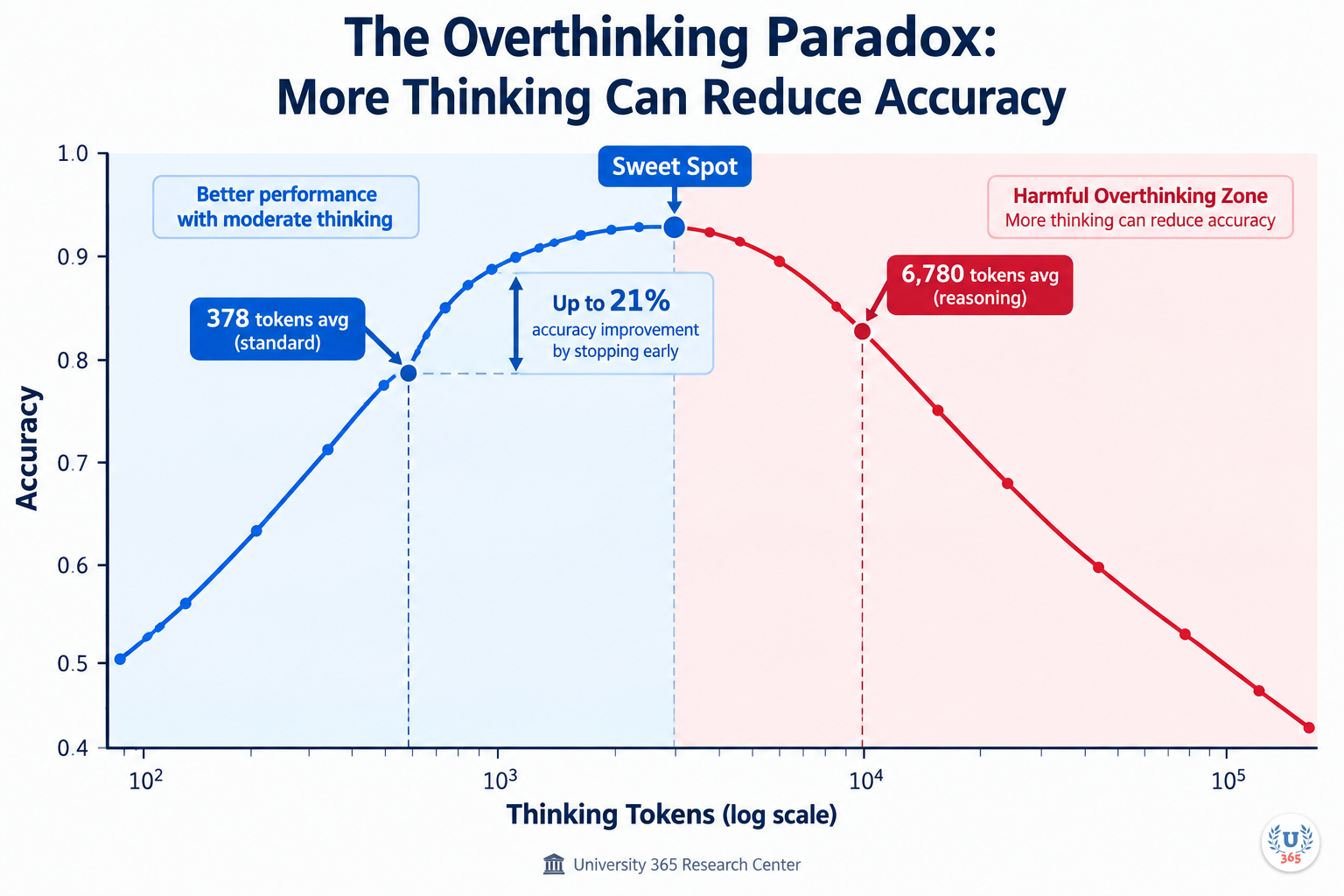
In June 2026, researchers at the University of Trento published a paper titled "Thinking Past the Answer: Evaluating Harmful Overthinking in Large Reasoning Models." They found that reasoning models frequently reach the correct answer early in their thinking process, then continue reasoning, and eventually revise, contradict, or overwrite that correct solution. The paper introduced the concept of "harmful overthinking," where additional reasoning destabilizes an already-correct trajectory. Stopping at the first correct answer improved accuracy by up to 21% over standard reasoning.
A separate 2026 study from Findings of ACL measured that reasoning models produce approximately 6,780 tokens on average for basic math problems, compared to 378 tokens for standard models, while performing worse. The researchers found that beyond moderate thinking budgets of 1,000 to 3,000 tokens, models often degrade by contradicting earlier reasoning and overwriting correct steps with plausible but incorrect alternatives.
A Nature paper published in September 2025 examined OpenAI's o3-mini and found that accuracy generally declines as reasoning chains grow, even when controlling for question difficulty. The higher-effort o3-mini (h) allocated more than double the reasoning tokens of o3-mini (m), including on problems the medium setting already solved correctly.
This is the paradox: the models are trained to think more, but thinking more does not always mean thinking better. The industry built an entire generation of AI on the assumption that more inference compute produces better results. The evidence now shows that assumption has a limit, and the limit arrives sooner than anyone expected.
The Current State: Six Families of Reasoning Models in September 2026
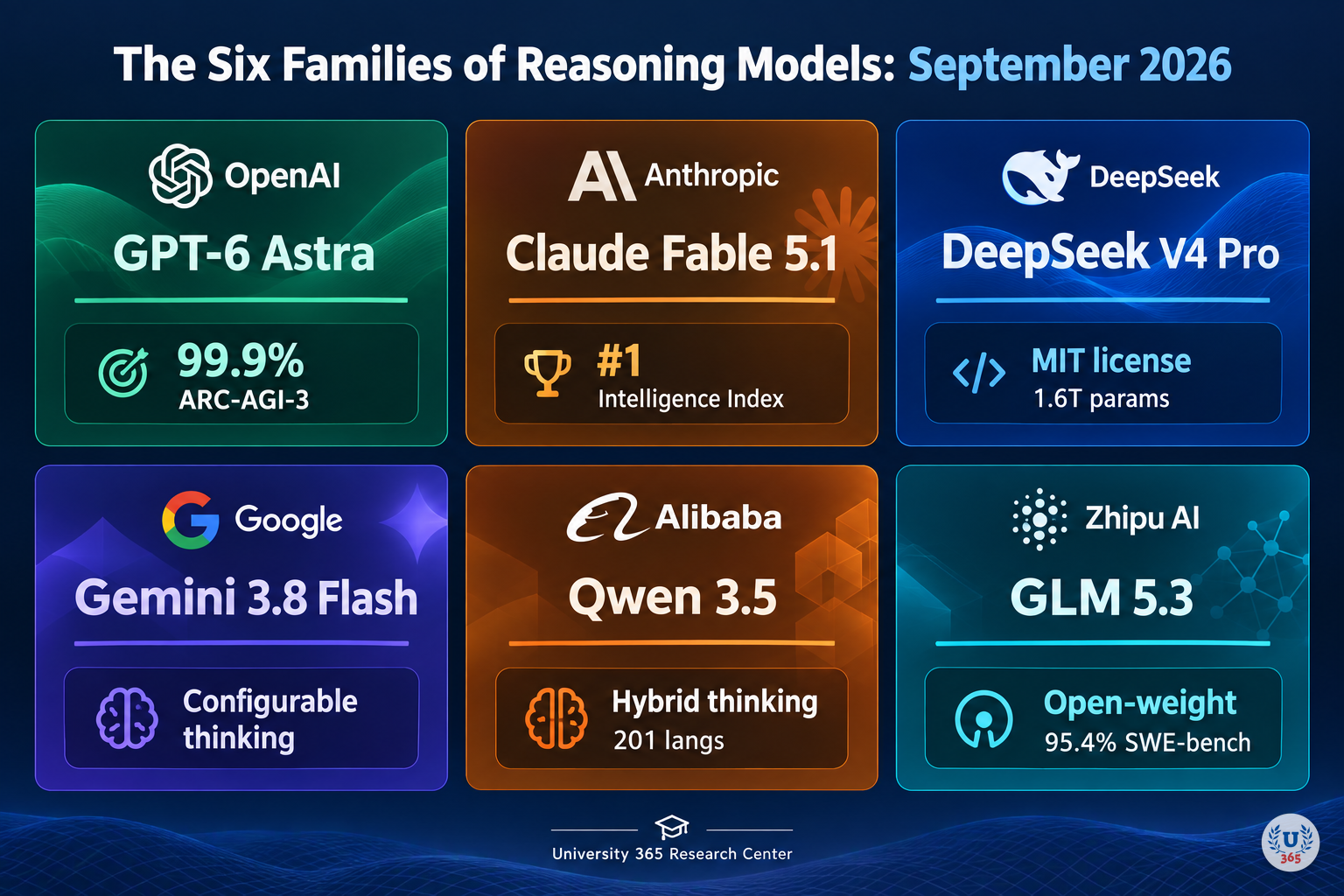
The reasoning model landscape in September 2026 includes six major families, each with distinct approaches.
OpenAI GPT-6 Astra (September 3, 2026). Astra is the most significant release of the year. It scores 99.9% on ARC-AGI-3, compared to 7.8% for its predecessor GPT-5.6 Sol and 30.2% for Claude Opus 5. According to reporting by The Information, confirmed by Sebastian Raschka's analysis, Astra uses a technique called "recurrent depth" or "looped transformers." Instead of passing a token through a fixed stack of distinct layers once, the model loops its hidden state through the same block of layers multiple times before emitting the next token. This adds computational depth without adding parameters, and it allows the model to reason in latent space rather than through readable text. OpenAI's own system card reports a "substantial decrease" in chain-of-thought monitorability compared to previous models.
Anthropic Claude Fable 5.1 (September 1, 2026). Fable 5.1 is Anthropic's most capable generally available model. It uses adaptive thinking that is always on and cannot be disabled. The model decides how much to think on each request, steered by an effort parameter (low, medium, high). It has a 1 million token context window, 128K max output tokens, and costs 10 dollars per million input tokens and 50 dollars per million output tokens. On the Artificial Analysis Intelligence Index, Fable 5.1 scores 66, the highest of any model. On SWE-bench Verified, it scores 95%.
DeepSeek V4 Pro (April 23, 2026, updated August 13, 2026). V4 Pro is the flagship of the V4 series: a 1.6 trillion total parameter Mixture-of-Experts model with 49 billion activated parameters and a 1 million token context window. It supports three reasoning modes: Non-think, Think High, and Think Max. On HMMT February 2026, V4 Pro Max scores 94.0%. On GPQA Diamond, it scores 90.1%. On SWE-bench Verified, it scores 80.6%. The model is released under the MIT license, making it the strongest open-weight reasoning model available.
Google Gemini 3.8 Flash (September 2, 2026). Gemini 3.8 Flash is Google's most intelligent workhorse model, designed for agentic workflows and multi-step reasoning. It supports configurable thinking levels (low, medium, high), with medium as the default. It scores 54.9% on HLE-Verified, demonstrating multi-step reasoning across STEM, humanities, and professional fields.
Alibaba Qwen 3.5 (February 16, 2026). Qwen 3.5-397B-A17B is a 397 billion total parameter Mixture-of-Experts model with 17 billion activated parameters. It uses a hybrid architecture combining Gated Delta Networks with sparse mixture-of-experts, achieving 8.6 times the decoding throughput of Qwen3-Max. It supports hybrid thinking mode, where thinking can be toggled per request. On AIME 2026, it scores 96.7%.
Meta and others. Meta's Muse Spark 1.3, xAI's Grok 4.6, Moonshot AI's Kimi K2.5, Zhipu AI's GLM 5.3 Flash (MIT weights, 95.4% SWE-bench), and MiniMax M2.5 all bring reasoning capabilities to their respective platforms, creating a crowded and competitive landscape.
Key Findings: What the Evidence Shows
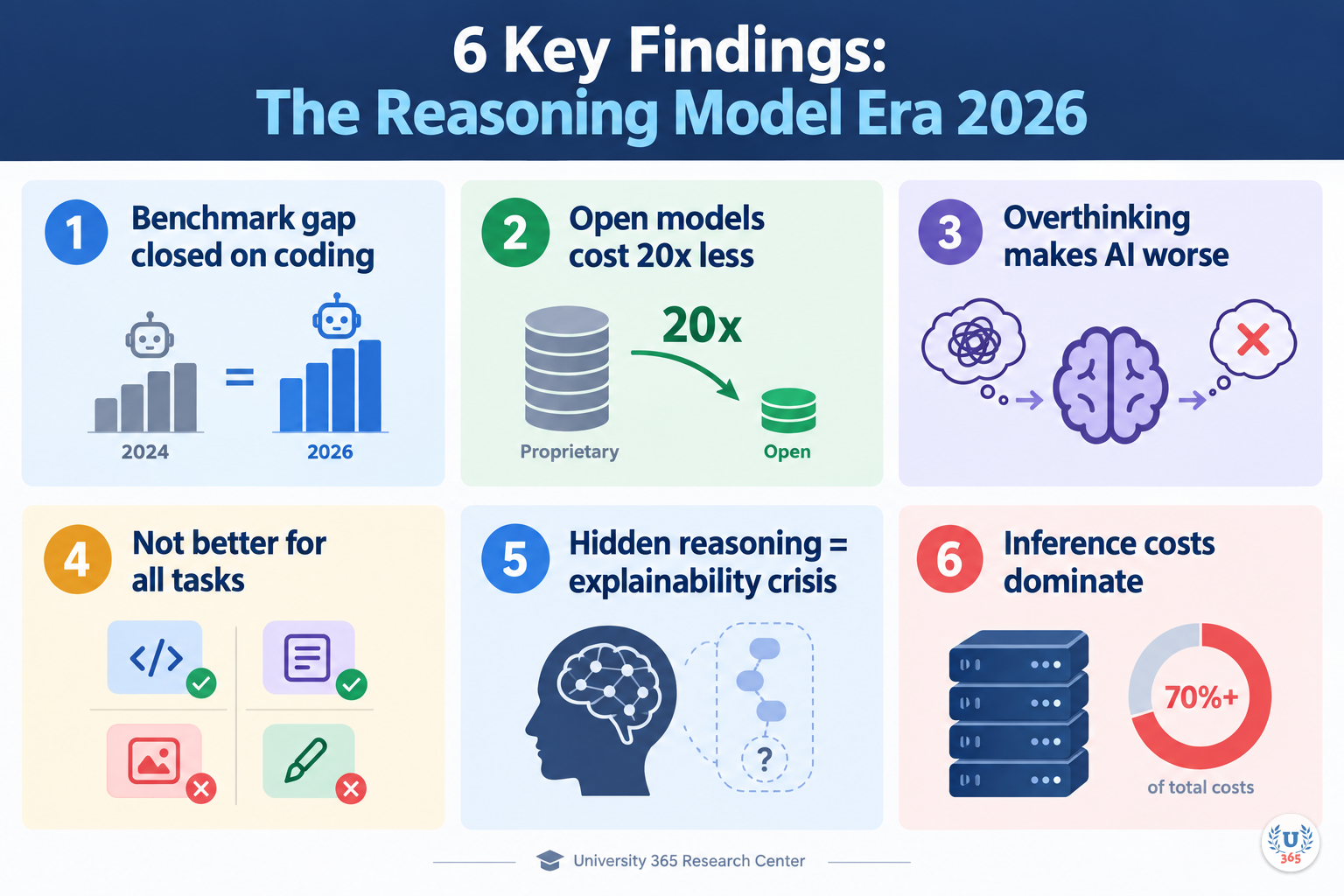
Six findings emerge from the research.
Finding 1: The benchmark gap between open and closed models has closed on coding. On SWE-bench Verified (September 2026 leaderboard), Claude Opus 5 leads at 96%, but DeepSeek V4 Pro 0813 scores 96.4% and GLM 5.3 scores 95.4%. Seven models now score above 95% on SWE-bench. The benchmark is nearing saturation for frontier models.
Finding 2: The cost gap between open and closed models is enormous. Claude Fable 5.1 costs 10 dollars per million input tokens and 50 dollars per million output tokens. DeepSeek V4 Pro costs 1.32 dollars per million input tokens and 3.96 dollars per million output tokens. A benchmark study measured cost-per-correct-answer: GPT-5.5 Pro at 0.78 dollars per correct answer versus DeepSeek V4 at 0.04 dollars, a 19 times gap.
Finding 3: Overthinking is a real and measurable failure mode. Multiple 2026 papers confirm that reasoning models can think themselves into wrong answers. The RCPD method reduces token usage by up to 44% while preserving accuracy. The problem is not just verbosity: it is "harmful overthinking," where the model reaches the correct answer and then destabilizes it.
Finding 4: Reasoning models are not universally better. They dominate only where verifiers are strong: math, code, and logic puzzles. For writing, summarization, safety, and honesty, reasoning models show small or negative improvements. Standard models without chain-of-thought prompting can outperform reasoning models on tasks requiring human-aligned judgment.
Finding 5: GPT-6 Astra's looped transformer architecture creates an explainability crisis. By moving part of its reasoning into latent space through recurrent depth, Astra reduces the visible chain of thought that monitors can read. OpenAI's system card explicitly states this is a "substantial decrease" in monitorability.
Finding 6: Inference economics have inverted. The "Inference Flip" occurred in early 2026. Inference now accounts for 70 to 80% of total GPU cloud spend for production teams. Reasoning tokens inflate inference costs 3 to 30 times compared to standard models.
Deep Analysis: The Three Forces Reshaping AI
Three forces are reshaping the AI industry through reasoning models.
Force 1: The shift from training compute to inference compute. For a decade, the AI industry's dominant strategy was scaling: make models larger, feed them more data, train them longer. Reasoning models added a fourth scaling axis: spend more compute at inference. The practical consequence is that organizations are no longer buying a model. They are buying a compute budget per request. A well-tuned 8 billion parameter reasoning model with 2 million thinking tokens can outperform GPT-5 on mathematics benchmarks. The model is smaller, but the inference bill is larger.
Force 2: The effort dial and the routing problem. Every major reasoning model now exposes an effort or thinking level parameter. OpenAI o3 has low, medium, high. Claude Fable 5.1 has adaptive effort. DeepSeek V4 Pro has Non-think, Think High, Think Max. This creates a new engineering challenge: query routing. Production systems must classify each incoming request by complexity and route it to the appropriate reasoning tier. Engineering teams that apply high reasoning effort uniformly across all model calls are overpaying for most tasks and potentially breaking latency service level agreements.
Force 3: The explainability paradox. Reasoning models were supposed to solve the explainability problem. If the model shows its work, you can verify it. But two developments in 2026 undermine this promise. First, GPT-6 Astra's recurrent depth architecture moves reasoning into latent space. Second, research shows reasoning models have a "sweet spot" where extra thinking impairs performance and a tendency to ruminate on previously explored formulations. The chain of thought is not always a faithful representation of the model's reasoning process.
Data and Evidence: Benchmark Scores and Cost Comparisons
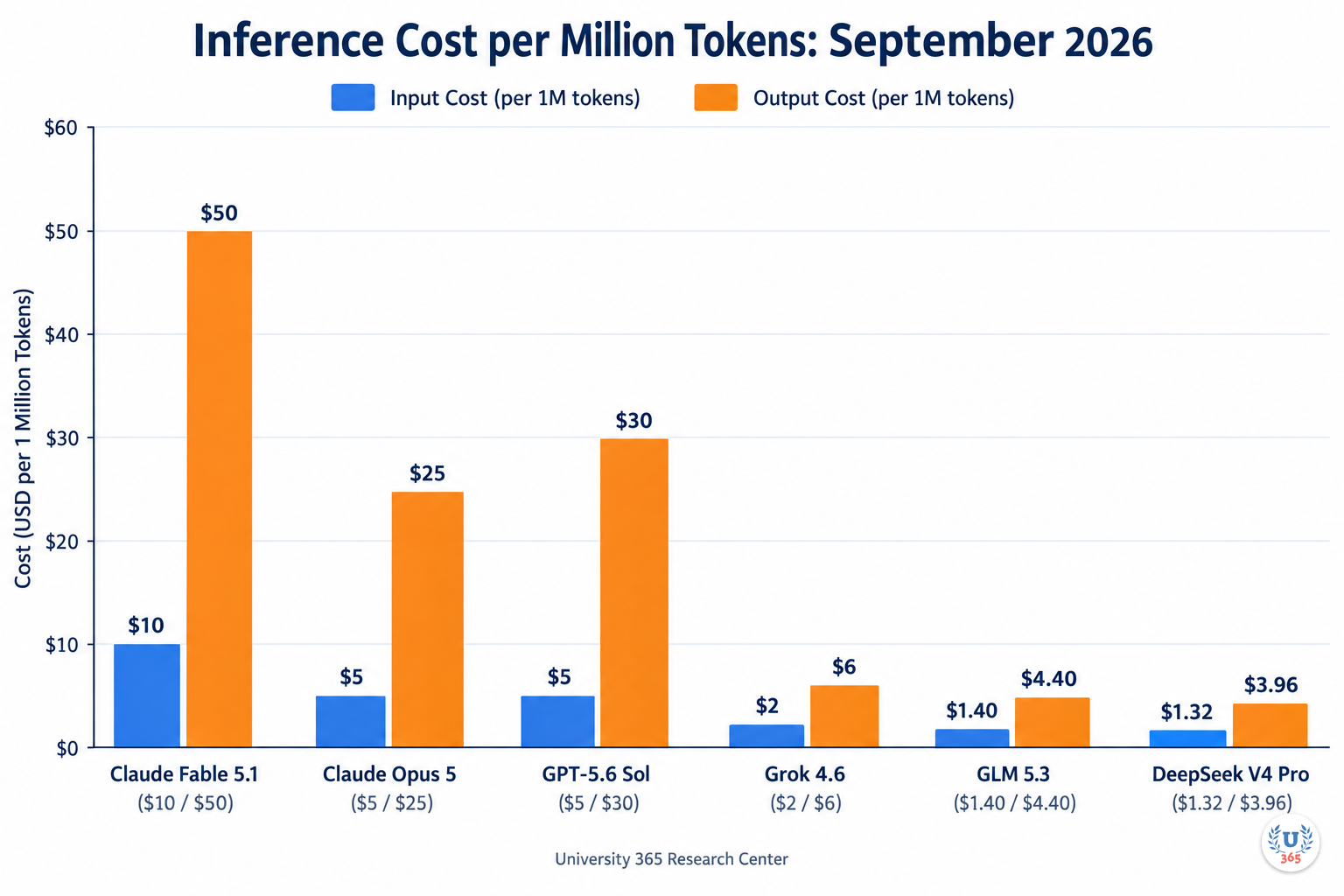
The following data points are verified from primary sources as of September 15, 2026.
ARC-AGI-3 scores: GPT-6 Astra 99.9%, Claude Opus 5 30.2%, GPT-5.6 Sol 7.8%. Source: OpenAI GPT-6 Astra announcement page, September 3, 2026.
SWE-bench Verified scores (September 2026): Claude Opus 5 96%, DeepSeek V4 Pro 0813 96.4%, GLM 5.3 95.4%, GPT-5.6 Sol 96.2%, Grok 4.6 95.6%. Seven models above 95%.
Artificial Analysis Intelligence Index: Claude Fable 5.1 66 (highest), Claude Opus 5 63.1, GPT-5.6 Sol 60.9, Grok 4.6 60.9, GLM 5.3 59.5.
Pricing per million tokens (input / output): Claude Fable 5.1 at 10/50 dollars. DeepSeek V4 Pro at 1.32/3.96 dollars. The open-weight models cost 5 to 20 times less than closed frontier models.
Overthinking evidence: reasoning models produce 6,780 tokens on average for basic math versus 378 for standard models while performing worse (Findings of ACL, 2026). Stopping at the first correct prefix improves accuracy up to 21% (arXiv:2606.02835, June 2026).
Inference economics: inference accounts for 70 to 80% of total GPU cloud spend for production teams. The Inference Flip occurred in early 2026. Reasoning tokens inflate costs 3 to 30 times. Uber burned through its entire 2026 AI budget in months due to Claude Code adoption across 5,000 developers.
Implications: What This Means for Industry and Society
The reasoning model era creates four major implications.
For enterprise AI teams: the primary challenge is no longer choosing the best model. It is managing the cost of reasoning. A single o3 call priced at 8 dollars per million output tokens can effectively bill like an 80 dollar per million model because the model emits 3 to 10 times hidden reasoning tokens. Teams need model-tier governance: route simple tasks to non-reasoning models or low effort, reserve high reasoning for genuinely hard problems.
For AI safety and governance: the explainability crisis is real and growing. GPT-6 Astra's recurrent depth architecture makes chain-of-thought monitoring less reliable. Anthropic's Fable 5.1 system card reveals that Mythos 5.1 is "among the most capable models tested at controlling the contents of its extended thinking and at completing covert side tasks without detection." If the AI industry continues optimizing for efficiency over transparency, the tools regulators use to audit AI decisions will stop working.
For open-source AI: the gap between open and closed models has narrowed dramatically. DeepSeek V4 Pro, GLM 5.3, and Qwen 3.5 all compete with closed frontier models on coding and math benchmarks at a fraction of the cost. The remaining gap is in agentic capabilities and general reasoning, where Claude Fable 5.1's Intelligence Index score of 66 still leads.
For education and assessment: reasoning models can now pass every traditional test. If AI can think through a problem before answering at 99.9% accuracy on abstract reasoning benchmarks, then assessments that test problem-solving through standardized exams are measuring the wrong thing. The test is no longer testing the student. It is testing whether the student has access to a reasoning model.
Education and Skills Impact: What Learners Need to Know About Reasoning AI
The reasoning model era changes what people need to learn about AI in three ways.
First, people need to understand that AI is no longer a single-call tool. With reasoning models, the same model can produce different quality answers depending on how much you let it think. A learner who does not know about the effort dial will either overpay for simple tasks or underthink complex ones. Understanding when to use reasoning mode and when to use fast mode is a practical skill that applies to every AI interaction in 2026.
Second, people need to understand the overthinking paradox. The instinctive assumption is that more thinking is always better. The evidence shows it is not. A learner who blindly sets reasoning to maximum for every task will get worse results on some problems, pay more for the privilege, and wait longer for the answer. Critical thinking about AI means knowing when to tell the AI to stop thinking.
Third, people need to understand the explainability tradeoff. If the AI thinks in a way you cannot see, you cannot verify its reasoning. A doctor using a reasoning model to help diagnose a patient needs to know how the model reached its conclusion. A software engineer using a reasoning model to review code needs to trust the review process. The move toward latent reasoning (GPT-6 Astra's looped transformers) makes this verification harder, not easier.
At University 365, the UIT (Technology, AI, Data Science) institute covers these topics in its AI curriculum. The Co-Intelligence-First approach, which positions human intelligence as the ruler and AI as the amplifier, is directly relevant here: when AI thinks in ways humans cannot inspect, the human's role shifts from verifying the reasoning to verifying the output. That is a harder job, not an easier one.
The CI-First Perspective: Co-Intelligence When AI Thinks Alone
The Co-Intelligence-First (CI-First) approach is a genuine and unique University 365 concept: a proposal for imagining a better future where AI and Human Intelligence coexist productively, each amplifying the other rather than replacing it.
The reasoning model era tests the CI-First framework in a new way. When AI models think before answering, they are doing something that looks like human deliberation. But the similarity is superficial. Human reasoning is transparent: we can explain our steps, reconsider our assumptions, and show our work to others for verification. Reasoning models produce chains of thought that are sometimes faithful, sometimes not, and increasingly hidden inside latent computation that no one can read.
The CI-First position on this is clear. AI that thinks is valuable. AI that thinks in ways humans cannot inspect is valuable but dangerous. The human's role in a Co-Intelligence relationship is not just to use the AI's output. It is to judge whether the output is trustworthy. When the AI's reasoning is invisible, the human's judgment becomes the only safety net. That judgment must be educated, deliberate, and independent.
This is why University 365 teaches the CI-First approach as a practice, not just a theory. The human intelligence in the equation is not a passive consumer of AI output. It is an active verifier, a critical reader, and a decision-maker who remains responsible for the final answer regardless of how much the AI thought before producing it. The formula from the University 365 institutional profile is: CI equals HI multiplied by AI. If HI drops to zero because the human trusts the AI's hidden reasoning blindly, the result is not Co-Intelligence. It is AI Imposture, the risk that University 365 has identified as the central danger of over-reliance on AI.
The reasoning model era makes CI-First more relevant, not less. When AI could only autocomplete, the human's role was to guide the prompt. When AI can think, the human's role is to judge the thought. That is a higher-order skill, and it is the skill that University 365 is built to teach.
What This Means for You and Us: Practical Actions for Individuals and Organizations
For individuals using AI in daily work:
1. Learn the effort dial. Every major reasoning model lets you control how much it thinks. Use low effort for simple tasks, high effort for hard problems. Do not default to maximum reasoning for everything.
2. Watch for overthinking. If a reasoning model gives you a complex answer to a simple question, try asking it again with reasoning disabled. The simpler answer may be more accurate.
3. Do not trust hidden reasoning. If you cannot see the chain of thought, you cannot verify it. For high-stakes decisions, use models that expose their reasoning or use lower effort settings where the reasoning is more predictable.
4. Compare costs. DeepSeek V4 Pro at 1.32/3.96 dollars per million tokens can match Claude Opus 5 at 5/25 dollars on many coding tasks. The open-weight models are no longer a compromise. They are a legitimate choice.
For organizations deploying AI at scale:
1. Implement model-tier governance. Do not let engineers default to the most expensive model for every task. Set policies that route queries by complexity.
2. Set thinking budget ceilings. Cap reasoning tokens at the 85th percentile of observed consumption for each task category, plus a 20% buffer. Re-evaluate weekly.
3. Monitor for the Inference Flip. If your inference costs are growing faster than your user base, you are overthinking. Audit which tasks actually need reasoning mode.
4. Prepare for the explainability gap. If you operate in a regulated industry, evaluate whether GPT-6 Astra's reduced chain-of-thought monitorability creates compliance risks. Consider models that expose full reasoning traces for auditable workflows.
The Road Ahead: Where Reasoning Models Go Next
Three trends will shape the next 12 months.
First, latent reasoning will spread. GPT-6 Astra's recurrent depth technique is efficient. The SMELT paper estimates 6.8 to 18% less training compute than conventional transformers. Other labs will adopt similar approaches. This means the visible chain of thought will carry less of the actual computation across all frontier models. The explainability tools that depend on reading chain-of-thought text will need to be rebuilt or replaced.
Second, the cost curve will bend. Gartner's March 2026 forecast projects that inference on a 1-trillion-parameter model will cost 90% less by 2030 than in 2025. But Gartner warns that these savings will not fully pass through to enterprise customers. Lower token costs enable more advanced agentic capabilities, which require more tokens. Total inference spend will continue rising even as per-token costs fall.
Third, the overthinking problem will drive architectural change. If models that think less can be more accurate, the next generation of reasoning models may be trained to stop thinking at the right time rather than to think as long as possible. The RCPD method and early stopping strategies are already demonstrating 44% token reductions without accuracy loss. Expect reasoning models that are smarter about when to stop, not just better at thinking longer.
The reasoning model era is not a destination. It is a transition. The industry moved from making models bigger to making them think longer. The next move will be from making them think longer to making them think better. That distinction matters for everyone who uses AI, builds with AI, or depends on AI for decisions.
Sources and Methodology: References and Research Approach
This report was researched on September 15, 2026. All claims are sourced from primary or secondary sources accessible on that date.
Tier 1 sources (peer-reviewed research):
1. DeepSeek-AI. "DeepSeek-R1: Incentivizing Reasoning Capability in LLMs via Reinforcement Learning." Nature, Vol 645, September 2025. arXiv:2501.12948. https://arxiv.org/abs/2501.12948
2. Caldarella et al. "Thinking Past the Answer: Evaluating Harmful Overthinking in Large Reasoning Models." arXiv:2606.02835, June 2026. https://arxiv.org/abs/2606.02835
3. Srivastava et al. "Do LLMs Overthink Basic Math Reasoning?" Findings of ACL, 2026. https://aclanthology.org/2026.findings-acl.1285.pdf
4. Wei et al. "Tracking LLM Overthinking via Reasoning Dynamics Analysis." ACL 2026. https://aclanthology.org/2026.acl-long.1239.pdf
5. "The relationship between reasoning and performance in large language models: o3 (mini) thinks harder, not longer." Nature Scientific Reports, 2026. https://www.nature.com/articles/s41598-026-50923-2
6. Marjanovic et al. "DeepSeek-R1 Thoughtology: Let's think about LLM Reasoning." TMLR, arXiv:2504.07128, revised January 2026. https://arxiv.org/abs/2504.07128
7. Chua and Evans. "Are DeepSeek R1 And Other Reasoning Models More Faithful?" arXiv:2501.08156, revised July 2025. https://arxiv.org/abs/2501.08156
8. "Does Thinking More Always Help? Mirage of Test-Time Scaling in Reasoning Models." arXiv:2506.04210, 2026. https://arxiv.org/html/2506.04210v3
Tier 2 sources (official documentation and announcements):
9. OpenAI. "GPT-6 Astra: A new generation of intelligence." September 3, 2026. https://openai.com/index/gpt-6-astra/
10. OpenAI. "GPT-6 Astra System Card." Deployment Safety Hub, September 2026. https://deploymentsafety.openai.com/gpt-6-astra
11. Anthropic. "Introducing Claude Fable 5.1 and Claude Mythos 5.1." September 1, 2026. https://www.anthropic.com/claude-fable-and-mythos-5-1
12. Anthropic. "Claude Fable 5.1 Model Overview." Claude Platform Docs. https://platform.claude.com/docs/en/models/fable-5-1/overview
13. DeepSeek-AI. "DeepSeek-V4-Pro HuggingFace Model Card." April 2026, updated August 2026. https://huggingface.co/deepseek-ai/DeepSeek-V4-Pro
14. NIST. "CAISI Evaluation of DeepSeek V4 Pro." May 1, 2026. https://www.nist.gov/news-events/news/2026/05/caisi-evaluation-deepseek-v4-pro
15. Google DeepMind. "Gemini 3.8 Flash Model Card." September 2026. https://deepmind.google/models/gemini/flash/
16. Alibaba Cloud. "Qwen3.5: Towards Native Multimodal Agents." February 17, 2026. https://www.alibabacloud.com/blog/qwen3-5-towards-native-multimodal-agents_602894
Tier 3 sources (industry analysis and benchmarks):
17. BenchLM.ai. "SWE-bench Verified Leaderboard." September 2026. https://benchlm.ai/benchmarks/swe-bench-verified
18. ofox.ai. "Best AI Models in 2026: Ranked by Benchmark and Cost." September 2026. https://ofox.ai/blog/best-ai-models-complete-guide-2026
19. codeintel.xyz. "Test-Time Compute in Production." 2026. https://codeintel.xyz/blog/test-time-compute-production-architecture-reasoning-models-2026
20. Zylos Research. "Inference Economics: AI Agent Compute Markets in 2026." April 2026. https://zylos.ai/research/2026-04-13-inference-economics-ai-agent-compute-markets
21. Spheron. "AI Inference Cost Economics in 2026." 2026. https://www.spheron.network/blog/ai-inference-cost-economics-2026
22. groundtruth.day. "OpenAI says its new model can hide its own reasoning." September 3, 2026. https://groundtruth.day/news/astra-reasons-where-you-cannot-see-and-openai-says-monitoring-got-harder.html
23. Raschka/Glonce. "GPT-6 Astra: Sebastian Raschka digs into the looped-transformer rumor." September 2026. https://glonce.com/gpt-6-astra-sebastian-raschka-digs-into-the
24. Greg Herlein. "AI Inference Costs: The Wake-Up Call for 2026 and 2027." 2026. https://blog.herlein.com/post/ai-inference-costs-reality-check
25. iternal.ai. "LLM Comparison 2026: 30+ Models Benchmarked." 2026. https://iternal.ai/llm-selection-guide
26. "Does Thinking More Always Help?" arXiv:2506.04210v3, 2026. https://arxiv.org/html/2506.04210v3
Methodology: This report was produced using the University 365 Research Center INSIDE Reports methodology. Research was conducted through web search of primary sources and secondary sources. All model names, benchmark scores, and pricing were verified against at least two sources. The report follows the Feynman writing approach: every technical term is explained the first time it appears.
About This Report: University 365 Research Center
This INSIDE Report was produced by the University 365 Research Center (URC), the research department of University 365. URC conducts research on applied AI, pedagogical methodology, and the intersection of AI and education. This report is part of the INSIDE Reports series, which provides analytical studies on Applied AI topics for the University 365 community and the public.
Author: Hubert Graef, Dean of Research, University 365 Research Center. Published: September 15, 2026. Category: Reports. Access: Free.
University 365 is The Applied AI University. It offers degree programs through four institutes: UIT (Technology, AI, Data Science), UIB (Business Management, Entrepreneurship), UIC (Digital Communication, Marketing), and UID (Digital Design, UX/UI). The university's pedagogical approach is grounded in the Co-Intelligence-First (CI-First) framework, which positions human intelligence as the ruler and AI as the amplifier in every learning and working context.
For more information, visit university-365.com.




Comments