
Sovereign AI Race: UAE (2026)

In this Report
The Co-Intelligence-First (CI-First) approach is a genuine and unique University 365 concept: a proposal for imagining a better future where AI and Human Intelligence coexist productively, each amplifying the other rather than replacing it.

The Context
What sovereign AI means, and why the word is doing too much work
Every country that uses artificial intelligence depends on someone else to produce it. The chips come from a handful of designers and one island of fabrication. The largest models come from a few companies in California and a few in China. The cloud capacity sits in data centres owned by five firms. A government that wants AI for its hospitals, its courts and its classrooms is therefore renting the most consequential technology of the century from foreign suppliers who set the price, the terms and the rules.
Sovereign AI is the name given to the attempt to escape that position. The term is used loosely, so this series fixes a definition and applies it to every country it examines. Sovereign AI capacity means control over the production of artificial intelligence inside a jurisdiction, and it separates into five layers.
Compute sovereignty is the physical layer: where the chips and data centres sit, and who may switch them off. Model sovereignty is the layer above it: who builds the models a country depends on, and in whose languages and domains those models are competent. Capital sovereignty is who funds the build-out, on what terms, and whether the funding can be sustained. Regulatory sovereignty is who writes the rules that govern AI use inside the jurisdiction, and whether those rules can be enforced. Talent and education sovereignty is who builds and runs the systems, and how the next generation is prepared to do so.
A country can hold any one of these layers without holding the others, and conflating them is the most common error in the public debate. A state can write its own AI law while importing every chip it runs. It can host a world-class data centre it does not own. It can publish open models trained on someone else's silicon. This report examines the United Arab Emirates layer by layer, and the exercise produces a clearer picture than any single sovereignty score would.
Why the UAE, and why now
The UAE is the right country to open this series because it has done more, faster, with more money, than any comparable state. In roughly two years it assembled a $49 billion AI investment fund, broke ground on a data centre campus planned at five gigawatts, licensed two production-grade Arabic language models, created a federal AI authority, put artificial intelligence into every school curriculum, and became the first country where more than seven in ten people use a generative AI tool.
It also did all of this on imported silicon, under a licensing regime written in Washington, and its two flagship data centre operators hold their licence-free access until a date in April 2027 unless they become American companies. That is not a metaphor. It is a sentence in the United States Federal Register.
The vocabulary this report uses
Three terms recur, and they are defined here once.
Advanced computing items is the regulatory phrase, not a marketing one. It covers the accelerators and servers controlled by the United States under export control classification numbers 3A090 and 4A090 and their associated paragraphs. In practice it means the chips that train and run frontier models. Whether a country may import them, and on what conditions, is decided by the Bureau of Industry and Security at the Department of Commerce.
Export control country groups are the tiers the United States uses to sort destinations. Being listed in Country Group D signals risk: D:3 covers chemical and biological weapons proliferation concerns, D:4 covers missile technology. Being listed in Country Group A signals trust and unlocks licence exceptions. A country's position on that chart determines what it can buy without asking permission. The UAE's position changed on 10 July 2026, and that change is central to this report.
Frontier model means a model at the current capability frontier. The UAE does not have one, and this report does not pretend otherwise. What it has is more interesting: a state that decided to buy into the frontier's ownership rather than trying to reproduce it, while publishing open models of its own at the scale it can afford.
A note on measurement. Where the UAE's own announcements, a company's press release, or a government statement is the only source, this report labels it as a claim and says who made it. Where an independent index measured the same thing, that index is cited. The difference matters in a domain where announced capacity and operating capacity are frequently confused.
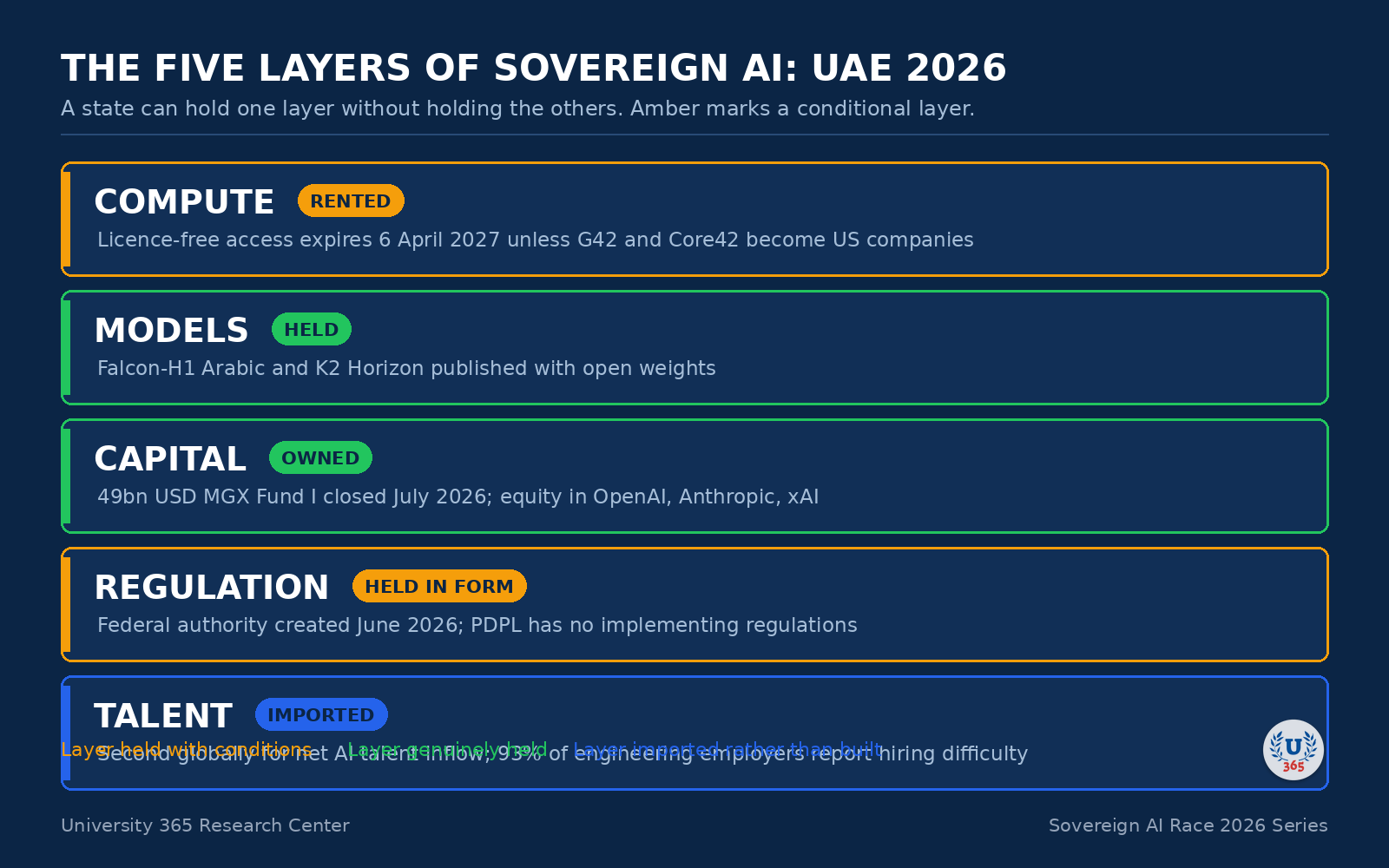
The five layers separated. Amber marks a layer held only on conditions. University 365 Research Center.
The Question
Can a country buy sovereignty over a technology it does not make?
The United Arab Emirates has spent the years since early 2024 assembling the most capitalised artificial intelligence programme outside the United States. It has a sovereign fund that closed a $49 billion AI vehicle in July 2026. It has a state-linked technology group building a one-gigawatt cluster for OpenAI and Oracle inside a campus planned at five gigawatts. It has two open Arabic language model families that lead their benchmarks, a federal authority that consolidates AI and data governance into one body, and a school curriculum that puts artificial intelligence in front of every pupil.
None of it runs on Emirati silicon. Every accelerator under every one of those models and data centres was designed in California and fabricated in Taiwan, and its export to the UAE required, until July 2026, a licence from the United States government. In July 2026 that licence requirement was lifted for a named list of approved entities. Two of the most important names on the list, the two UAE companies that operate the country's AI data centres, hold their authorisation for a fixed period. The rule states plainly that the authorisation expires on 6 April 2027 unless those companies become United States companies.
So the question is not whether the UAE has built something remarkable. It has. The question is whether a state can hold sovereignty over the data, the models, the capital, the rules and the talent, while holding none over the silicon. And a sharper question sits underneath it: when the condition of continued access to the technology is written as a change of corporate nationality, what exactly has been purchased?
The Contradiction
The stack is sovereign in the layers that are cheap to own and rented in the layer that is expensive
Here is the central tension of the Emirati strategy, stated as plainly as the evidence allows.
The United Arab Emirates holds genuine sovereignty in four of the five layers. Its data protection and AI rules are its own, though enforcement is another matter discussed below. Its national models are built and released from Abu Dhabi, and one of them ranked first in its class on an independent index. Its capital is its own, deployed through vehicles it controls. Its universities and schools are its own, and it has built the world's first university dedicated entirely to artificial intelligence.
In the fifth layer, compute, the position is different. The hardware is American. The operating partners are American. The networking is American. And the legal authority that decides whether the hardware may enter the country at all is American, exercised through a licensing regime that grants access to named entities and withdraws it on conditions.
The evidence for this is not commentary. It is the text of the rule. On 10 July 2026 the Bureau of Industry and Security moved the UAE from Country Group D, where it had sat alongside states with missile and chemical weapons proliferation designations, into Country Group A, the favourable tier. Press coverage described this as licence-free access to advanced AI chips, and for the entities on the approved list, that description is accurate. The text adds a condition that the coverage largely omitted. Group 42 Holding and Core42 Technology Projects are approved recipients of advanced computing items, and the rule states that absent further notice their authorisation "shall automatically expire on April 6, 2027." The preamble explains what that date means: if the two UAE-based AI companies fail to become United States companies on or before that date, they must apply to the Bureau to maintain their approved status.
Read that condition twice. The state that published the world's first national AI strategy, appointed the world's first minister for artificial intelligence, and built the region's most advanced computing campus holds its access to that computing under an authorisation that lapses in April 2027 unless its national champions are reincorporated as American.
This is the contradiction the report examines. It is not a scandal, and it is not a failure of Emirati planning. It is the structural position of every state that enters the frontier layer without a domestic semiconductor industry. The UAE made a clear-eyed trade: alignment with the American stack, including the divestment of its Chinese technology holdings in November 2023, in exchange for access to the only accelerators that train frontier models. That trade bought the country a seat at the table and a very large share of the table's capacity. What it did not buy is the right to decide. A licence granted after one political moment can be narrowed after another, and the Emirati strategy is best understood as an attempt to insure against that day: by owning equity in the labs rather than renting their products alone, by publishing open models whose weights cannot be revoked, and by building enough physical capacity that the country is a place the frontier needs, not just a place it sells to.
Whether that insurance is sufficient is the open question, and this report does not pretend to settle it. What it can do is lay out the layers, name the conditions, and show exactly where the Emirati position is strong, where it is conditional, and where it depends on decisions made in another country.
The Current State
Layer one: compute, where the capacity is real and the decisions are not
The physical build is the most visible part of the Emirati programme, and it is genuine. Stargate UAE is a one-gigawatt cluster under construction in Abu Dhabi, built by G42 and operated by OpenAI and Oracle, with NVIDIA supplying Grace Blackwell GB300 systems, Cisco supplying networking and SoftBank participating as an investor. It is the first Stargate site outside the United States. Its first phase, 200 megawatts, was due for completion in the third quarter of 2026, with more than five thousand workers and over one hundred thousand cubic metres of concrete in the ground.
The cluster sits inside a campus planned at five gigawatts across roughly ten square miles, announced in May 2025 under a bilateral framework the two governments call the United States and UAE AI Acceleration Partnership.
The operating capacity today is smaller than the announced capacity, and the gap matters. Khazna Data Centers, the G42 subsidiary building the campus, reported thirty live data centres and around three hundred megawatts of operating capacity in the UAE as of August 2026, with almost three hundred and seventy megawatts under construction and a target of nearly seven hundred megawatts live and contracted within another year. That is a substantial data centre business. It is also roughly one seventh of the five-gigawatt campus target, which is a campus ambition rather than contracted capacity, and anyone comparing the two numbers should say which one they mean.
Microsoft has committed $15.2 billion to the UAE across 2023 to 2029, including a $1.5 billion equity stake in G42 taken in April 2024 and a two-hundred-megawatt expansion delivered through Khazna. The company has committed to training one million people in the UAE by 2027.
Layer one, continued: the licence, and the date inside it
The regulatory position changed on 10 July 2026 and it is worth stating precisely, because the press coverage simplified it.
The Bureau of Industry and Security removed the UAE from Country Groups D:3 and D:4, which cover chemical and biological weapons proliferation and missile technology, and added it to Country Group A:5, the tier that unlocks licence exceptions. It approved the UAE Government and named commercial entities to receive advanced computing items without individual licences.
The rule did not make the UAE a licence-free destination in general. It maintains the licence requirement for advanced computing items destined to or within the UAE except when the ultimate consignee and all end users are approved entities listed in a new supplement to the regulations. That supplement lists UAE government agencies, eight United States-headquartered artificial intelligence companies and their UAE subsidiaries, and two UAE companies: Group 42 Holding and Core42 Technology Projects.
For those two, the supplement carries a term. The authorisation "shall automatically expire on April 6, 2027," and the rule's preamble states that if the two UAE-based companies fail to become United States companies on or before that date, they must apply for authorisation to maintain their approved status.
The rule adds that the Bureau intends to favourably review licence applications involving MGX, the Emirati investment vehicle, for the export of semiconductors and servers to the UAE.
Layer two: models, the strongest genuinely Emirati layer
The UAE builds models, and this is where its sovereignty claim is most defensible.
The Technology Innovation Institute, part of Abu Dhabi's Advanced Technology Research Council, publishes the Falcon family as open-weight models. Falcon-H1 Arabic, released in January 2026 in three sizes, uses a hybrid architecture that combines two approaches to sequence modelling rather than relying on the standard transformer alone. The institute describes it as the highest-performing system on the Open Arabic LLM Leaderboard, a claim that must be read with the disclosure that the institute itself originated that leaderboard. On that board, the 34-billion-parameter version reports a score of 75.36 per cent against 71.47 per cent for the 7-billion version and 61.87 per cent for the 3-billion version, placing the family ahead of larger models including Qwen 2.5 72B and Llama 3.3 70B on Arabic-specific tasks.
Inception, a G42 company, maintains the Jais family, released in successive sizes since 2023 and reaching Jais 2 in 2025. K2 Think, launched in September 2025 by the Institute of Foundation Models at Mohamed bin Zayed University of Artificial Intelligence together with G42, is a 32-billion-parameter reasoning system that the technical report says matches or exceeds much larger models.
On 3 September 2026 the same institute released K2 Horizon, a connected family of six models from 0.9 billion to 375 billion parameters, publishing weights, training data, code, methodologies and intermediate checkpoints. Reuters reported the release as a challenge to the industry trend toward secretive development. The institute claims state-of-the-art results at several model sizes; those are the institute's own benchmarks until an independent index confirms them.
Two qualifications belong here. The first is that K2 Think is built on the Qwen 2.5 base model, which is Chinese in origin, a direct tension with the Emirati position of having divested Chinese technology. The tension is not hypocrisy; it is the arithmetic of building a reasoning system on the best available open base without the compute to pretrain a frontier model from scratch. The second is that Compass, the platform Core42 describes as a generative AI product, is documented as providing access to third-party frontier models from the GPT family. Reselling access to another company's models is a legitimate business, and it is not model sovereignty. Three different things are called sovereign models inside one national programme: models built and released from Abu Dhabi, models fine-tuned from foreign open bases, and access to foreign models through an Emirati platform.
On the independent measure that matters most for this layer, Counterpoint Research's Sovereign AI LLM Index for the first half of 2026 placed the Middle East as the most mature sovereign AI region and the UAE's Falcon H1 first across every dimension the index measures, crediting the Technology Innovation Institute and, secondarily, the national AI university. The same index found that across more than eighty countries, 92 per cent of the chips used to train sovereign models were NVIDIA's, and that 56 per cent of sovereign models were adapted from an existing base rather than trained from scratch. Those two figures frame the Emirati position honestly: the UAE leads a global field in which almost everyone is running on the same silicon and most are fine-tuning someone else's base model.
Layer three: capital, the Emirati comparative advantage
No country of the UAE's size deploys capital at this scale. MGX, the Abu Dhabi investment vehicle founded in 2024 and chaired by Sheikh Tahnoon bin Zayed Al Nahyan, confirmed the final close of its first fund at $49 billion in July 2026, above its $45 billion target, having invested in fourteen companies. It holds positions in OpenAI, Anthropic and xAI, is a founding partner in the Stargate venture, and co-owns data centre capacity in the United States. Mubadala, the sovereign wealth fund behind it, manages a portfolio measured in hundreds of billions.
The clearest total figure available comes from the Minister of State for Artificial Intelligence, Omar Sultan Al Olama, who said in November 2025 that the UAE had invested $148 billion in artificial intelligence at home and abroad since the beginning of 2024, including 100 billion dirhams, roughly $27.2 billion, for the Stargate project and a further 180 billion dirhams in overseas investments. That is a ministerial statement rather than an audited figure, and it is the best available aggregate.
The structural feature of this layer is that a large share of the capital is deployed outside the UAE and into the ownership of the companies whose products the UAE also uses. Owning equity in OpenAI, Anthropic and xAI simultaneously is a portfolio position that pays out whichever lab wins. Capital, unlike a chip licence, cannot be revoked by a policy change.
Layer four: regulation, a consolidated authority over an unenforceable statute
On 14 June 2026 the UAE approved the establishment of the Federal Authority for Artificial Intelligence and Data, consolidating three bodies into one: the Office of Artificial Intelligence, Digital Economy and Remote Work Applications, the digital government sector of the Telecommunications and Digital Government Regulatory Authority, and the UAE Data Office. It reports to the Cabinet and is chaired by the Minister of State for Artificial Intelligence. Its mandate covers national AI strategy, data management, standards for AI and data governance, compliance across federal entities, and international coordination.
The announcement came with a statement from Sheikh Mohammed bin Rashid Al Maktoum, Vice President, Prime Minister and Ruler of Dubai, describing a government that "runs on data and agentic AI."
The contrast that matters is with the country's data protection statute. Federal Decree-Law No. 45 of 2021, the Personal Data Protection Law, has been in force since January 2022, and its implementing regulations had still not been issued as of mid-2026. Without them, the legal basis for processing, the rights of data subjects, the rules on cross-border transfer and the breach notification framework are not operative, and no supervisory authority had been unambiguously designated for private sector oversight. Practitioners describe a prolonged regulatory uncertainty. The two financial free zones, the Dubai International Financial Centre and the Abu Dhabi Global Market, run their own data protection regimes with active enforcement, and the Dubai centre's Regulation 10 on autonomous AI systems moved to full enforcement on 1 January 2026. Those apply inside the free zones, not across the country.
The United Arab Emirates therefore has a single national AI authority and no enforceable national data protection regime, while the AI systems its government is deploying process citizen data at scale. There is no comprehensive federal AI statute. Guidance issued so far aims at best practice, and the AI Charter published in 2024 is explicitly non-binding.
Layer five: talent and education, a magnet with a thin base
The UAE is the most effective importer of artificial intelligence talent in the world after Luxembourg. Stanford's 2026 AI Index recorded a net inflow of 4.4 AI professionals per ten thousand LinkedIn members, against 1.22 in the United States and 1.04 in the United Kingdom. Artificial intelligence roles accounted for nearly 3 per cent of all UAE job postings in 2025, and PwC's 2026 jobs barometer found the share of postings requiring AI skills more than tripled in four years, moving the country from twenty-first to thirteenth globally.
Adoption is the highest measured anywhere. Microsoft's diffusion measure, the share of people aged 15 to 64 who used a generative AI product or app during the period, rose from 59.4 per cent in the first half of 2025 to 64 per cent in the second half, and to 70.1 per cent in early 2026, against a global average of 17.8 per cent. The UAE became the first country above 70 per cent. The figure is Microsoft's own measure, and the commonly repeated version describing it as daily workforce use misstates it.
Underneath the headline the labour market points somewhere else. PwC found that UAE AI hiring is dominated by roles that use AI rather than roles that build it, with so-called AI User roles growing 28 per cent in a year. The Institution of Engineering and Technology reports 93 per cent of surveyed Emirati engineering and technology employers struggling to recruit and 54 per cent reporting a skills shortage. The country is importing the builders and training the users.
In education the ambition is explicit. Mohamed bin Zayed University of Artificial Intelligence, founded in 2019 as the world's first university dedicated to AI, admitted its first undergraduate cohort of 115 students from more than 25 countries, and placed 106th in Computer Science and 50th in Electrical and Electronic Engineering in global subject rankings while sitting around 497th overall. In September 2026 the government announced an AI curriculum for all schools, covering data, algorithms, applications, risks and ethics, with a plan to train 22,000 teachers. Children under thirteen are to receive teacher-led awareness rather than independent access to generative tools, with supervised use beginning around age thirteen, an unusually careful line for a country moving this fast.
What changed since our 2025 report on the UAE
University 365 published "UAE's AI Revolution: The 2025 Landscape of Innovation, Investment, and Implementation" on 12 May 2025. Sixteen months later, several of its figures can be tested against what followed, and the comparison is the sharpest way to show how fast this country moved and where the movement went differently from the announcement.

Read the earlier report: UAE's AI Revolution - The 2025 Landscape of Innovation, Investment, and Implementation. University 365 INSIDE, 12 May 2025.
The five-gigawatt campus was announced and has since been redesigned. The 2025 report described the mid-May 2025 unveiling of a five-gigawatt complex across ten square miles in Abu Dhabi, at that point the largest AI campus outside the United States. The scale figure still stands as the target. What changed is the shape: after regional strikes in 2026, Reuters reported the project would likely shift from a single campus to a distributed network, with air defences and underground construction considered. The 2025 report described a site. The 2026 position is a strategy.
The capital figure moved from an announcement to a closed fund. The 2025 report noted a $30 billion AI infrastructure partnership involving BlackRock, Microsoft and MGX. MGX has since closed its first fund at $49 billion, above a $45 billion target, with positions in OpenAI, Anthropic and xAI. A partnership memorandum in 2025 became a closed vehicle with a published portfolio in 2026.
The model layer advanced from a family to a leader. The 2025 report recorded Falcon's earlier generations outperforming larger competitors and described Falcon 3 as cementing the country's position. Falcon-H1 Arabic followed in January 2026 in three sizes, and Counterpoint Research placed Falcon H1 first across every dimension it measures in its sovereign AI language model index for the first half of 2026. The 2025 claim was a contender. The 2026 measurement is a leader in a specific field.
The regulatory position consolidated. The 2025 report described a Regulatory Intelligence Office announced in April 2025 to use AI in drafting legislation, and the Charter for the Development and Use of AI published in July 2024. In June 2026 three separate bodies were merged into a single Federal Authority for Artificial Intelligence and Data. What the 2025 report described as a set of initiatives is now one institution. The gap between that institution and an enforceable national data protection statute remains, exactly as it was.
The adoption figure roughly doubled, on a changed baseline. The 2025 report cited an AI market projected to reach $46.33 billion by 2030 from $3.47 billion in 2023-2024, and a projection that AI would contribute around $100 billion to the economy by 2030. Those remain projections. The measured figure that moved is usage: Microsoft's diffusion measure placed Emirati generative AI use at 59.4 per cent of people aged 15 to 64 in the first half of 2025, and at 70.1 per cent in early 2026, against a global average of 17.8 per cent, making the UAE the first country above 70 per cent.
One figure from 2025 could not be verified in 2026. The 2025 report carried a national initiative to train one million AI talents by 2027. This research pass did not find that figure in a government or tier-one source, and several articles repeating it are unreliable. What is verifiable is Microsoft's separate commitment to train one million people in the UAE by 2027, presented by the company as ahead of schedule. The two numbers should not be treated as the same commitment.
The school curriculum arrived. The 2025 report recorded the introduction of a mandatory AI curriculum from kindergarten to grade 12 beginning in the 2025-2026 academic year. That is now in delivery, with the September 2026 announcement of the curriculum's content and the plan to train 22,000 teachers. The 2025 statement was a policy. The 2026 position is a rollout, with an early-years approach that deliberately limits screen use.
Read together, the interval from May 2025 to September 2026 moved the UAE from announcing a strategy to operating parts of it, while the structural dependency underneath those announcements did not change at all. Every layer advanced except the one that decides whether the others can run.
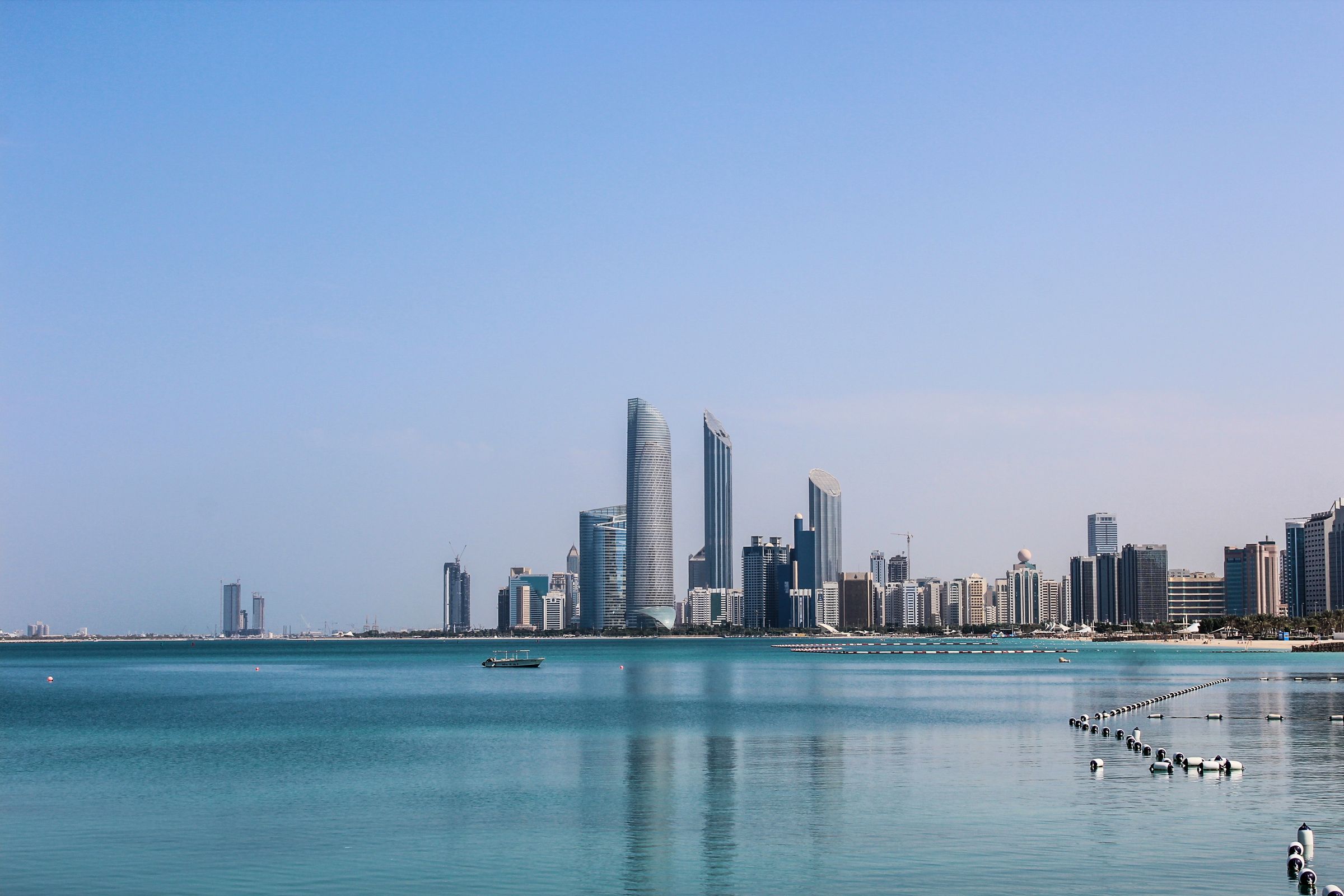
Abu Dhabi, where the 5 GW UAE-US AI Campus is under construction. Photograph free-licensed via Pexels.
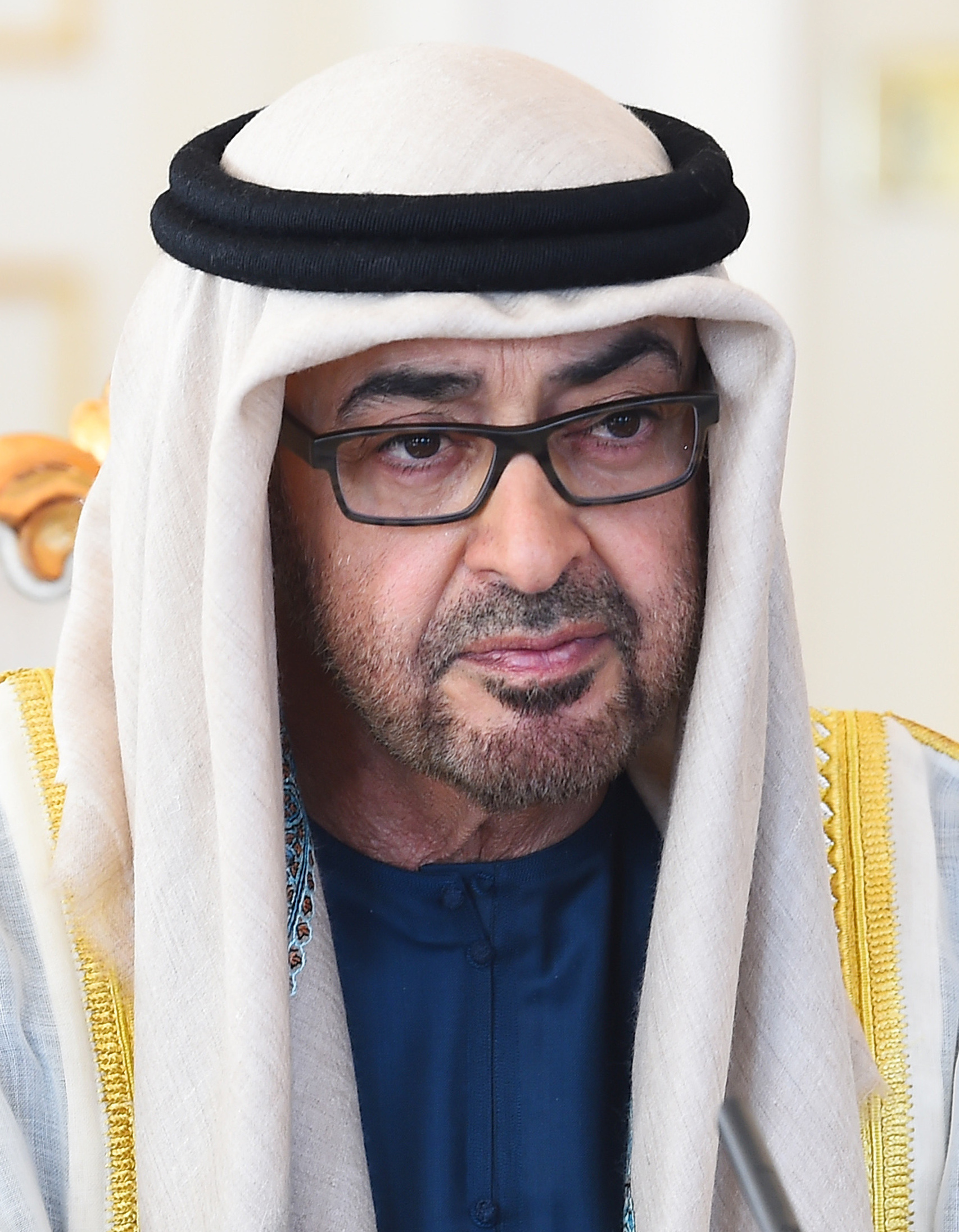
Sheikh Mohamed bin Zayed Al Nahyan, President of the United Arab Emirates, the office he holds at the date of this report. Photograph: Press Service of the President of the Republic of Azerbaijan, CC BY 4.0, via Wikimedia Commons.
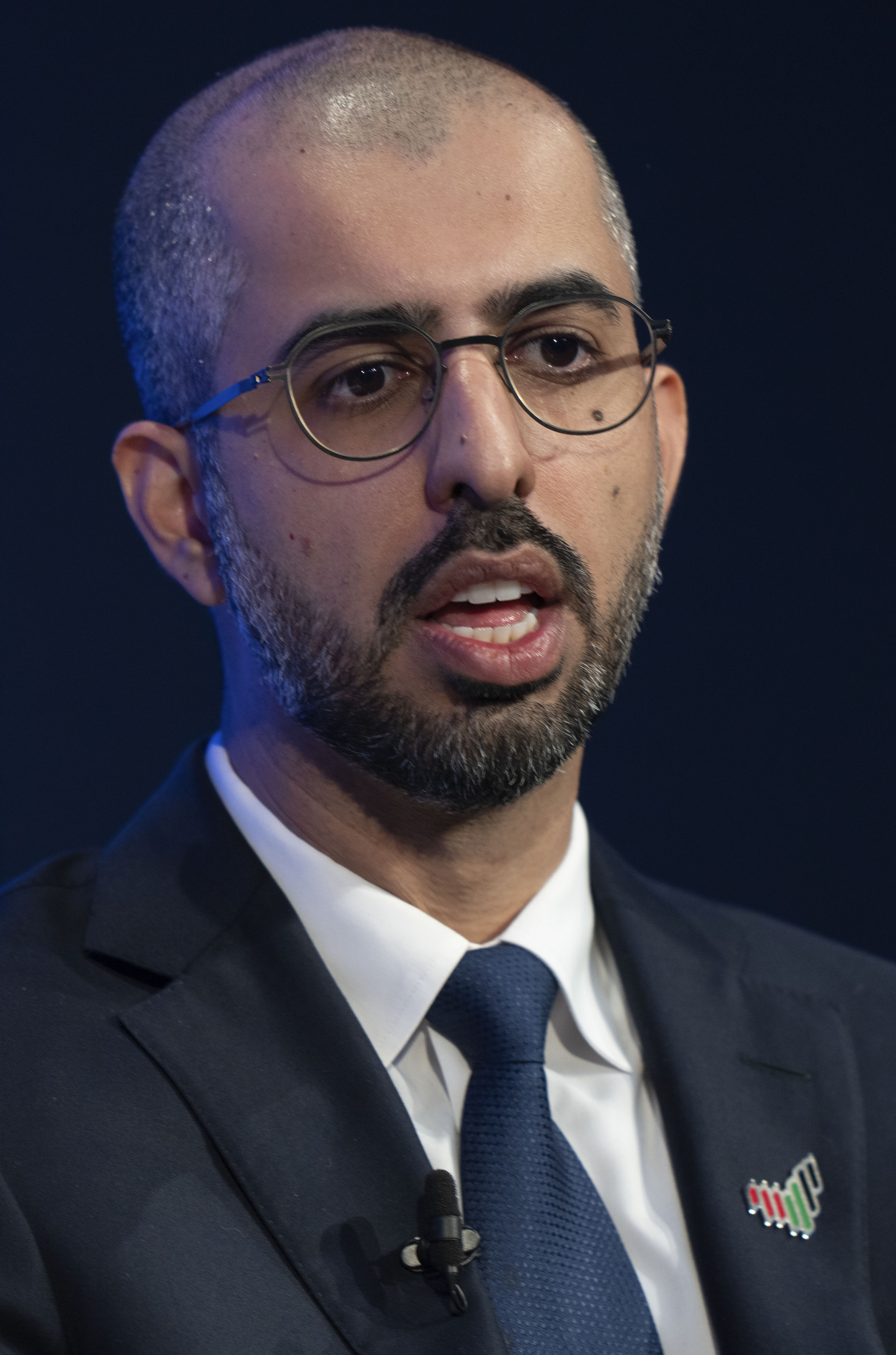
Omar Sultan Al Olama, Minister of State for Artificial Intelligence and chairman of the Federal Authority for Artificial Intelligence and Data. Photograph: World Economic Forum, CC BY 2.0, via Wikimedia Commons.
Key Findings
1. The UAE holds four of the five layers of sovereign AI capacity and does not hold the fifth. Regulation, models, capital and talent are genuinely Emirati in origin, even where their quality varies. Compute is not: the accelerators, the operating partners and the permission to import them all come from the United States.
2. The licence-free access granted in July 2026 carries a written expiry date tied to corporate nationality. The Federal Register states that the authorisation for Group 42 and Core42 expires on 6 April 2027 unless the two companies become United States companies. This condition is a fact of the regulatory text and appears in very little of the coverage of the change.
3. The model layer is the strongest Emirati claim, and it is stronger than the country's critics allow and narrower than its announcements suggest. Falcon H1 ranked first on an independent sovereign model index, and K2 Horizon published weights, data and methodology. At the same time the flagship reasoning system uses a Chinese open base, and the country's own AI platform resells access to American frontier models.
4. The capital strategy is a deliberate hedge against licence risk. Owning equity in OpenAI, Anthropic and xAI gives the UAE a claim on the frontier that no export control can revoke. This is the sharpest piece of strategic thinking in the whole programme.
5. The $148 billion figure is a ministerial statement, not an audited account, and announced capacity consistently outruns operating capacity. Khazna's roughly three hundred megawatts of live Emirati capacity against a five-gigawatt campus target is the clearest illustration, and any statement about UAE compute should say which of the two it means.
6. Regulation is consolidated and enforcement is not. The new federal authority has the mandate; the data protection statute underneath it has been in force since 2022 without implementing regulations, and no comprehensive AI statute exists.
7. The talent position is imported capability with a domestic base that is building but young. The country ranks second in the world for net AI talent inflow while 93 per cent of surveyed engineering employers report recruitment difficulty, and the labour market is growing fastest in roles that consume foreign AI rather than produce it.
8. Physical infrastructure in the Gulf is now a security question, not just a construction one. Regional strikes hit two Amazon Web Services facilities in the UAE in 2026, Iran's Revolutionary Guard threatened G42's planned data centre, and Reuters reported the five-gigawatt campus would likely shift from a single site to a distributed network with air defences and underground construction considered. G42 says the project is progressing as planned.

Four layers genuinely held. The fifth is rented and carries a date. University 365 Research Center.
Deep Analysis
The condition nobody reported
Most coverage of the July 2026 export control change described the UAE as receiving licence-free access to advanced American AI chips. The description is accurate for the entities named in the rule and inaccurate as a statement about the country. The rule maintains the licence requirement for advanced computing items destined to the UAE and exempts transactions where every party is on an approved list.
That structure has an intended consequence: the United States retains a chokepoint. Any new Emirati company that wants to buy advanced accelerators must apply for an advisory opinion and be assessed on its compliance capabilities, and the Secretary of Commerce decides, in consultation with the Secretary of State and the national security adviser, within thirty days.
The date is the more consequential detail. Group 42 Holding and Core42 Technology Projects, the two companies that operate the Emirati AI data centre base, hold their authorisation until 6 April 2027, and they keep it beyond that date only by becoming United States companies or by reapplying. There is no ambiguity in the text, and the Bureau has published this condition in the Federal Register where anyone can read it.
Two readings are possible and both should be held. The first is that this is a compliance mechanism: the United States wants the operators of advanced compute in a third country to sit inside its own jurisdictional reach, which is a coherent national security position. The second is that it is a sovereignty transfer: a country that wants to run its own AI infrastructure on American chips must consider making the companies that run it American companies. The rule does not require the reader to choose between those readings, and the Emirati government has not publicly commented on the nationality condition, at least in the material available for this report.
What can be said is what the condition does to the sovereignty question. If the Emirati position in the compute layer depends on the corporate nationality of its operators, then the compute layer is not sovereign in any sense that survives a change in American policy. The UAE has had this demonstrated once already. In November 2025 the two Gulf states approved for top-tier Blackwell chips were the UAE and Saudi Arabia, and they were the only countries in that position not classified as the top destination tier, so each shipment required its own review. Eight months later the UAE was moved to the favourable tier. The direction of travel favoured the UAE. The mechanism that produced the change is the same mechanism that could reverse it, and the country's own strategy treats that as a live risk rather than a settled question.
Why the equity position is the smartest thing in the strategy
If the compute layer is rented, the capital layer is owned, and the UAE appears to understand the difference better than any other state.
MGX's fund closed at $49 billion and holds stakes in OpenAI, Anthropic and xAI simultaneously. That is not a diversified portfolio in the ordinary sense. It is a claim on the entire frontier model layer, structured so that no single lab's victory or failure determines the outcome. Add the co-ownership of data centre capacity in the United States and Europe through the Aligned acquisition and the partnership with Bpifrance on a Paris campus, and the position becomes clearer still: the UAE owns parts of the physical and financial layer of the frontier in the countries that host it, while hosting the frontier's compute at home.
The reasoning behind this is sound. A chip licence can be narrowed, a data centre can be idled by a licensing pause, a model can be deprecated. A shareholding cannot be revoked by a policy change, and it pays out regardless of which lab wins. If American export policy turns restrictive, the Emirati capital deployed into American companies remains Emirati capital.
The limit of the hedge is worth stating too. An equity stake buys financial exposure and a seat at the table. It does not buy a vote on how the technology develops, over what it is trained, or who may use it. Minority stakes in frontier labs make the UAE a part-owner of the frontier and not a decider of it. That is a real improvement over pure dependence and a smaller thing than sovereignty.
The open weights strategy is the second hedge
The country's other structural bet is publication. Falcon and K2 Horizon are released with open weights, and K2 Horizon goes further by publishing training data, code and intermediate checkpoints.
Open weights cannot be revoked. Once a model is downloaded, no export control reaches it. For a state that cannot pretrain a frontier model and may not always be able to buy the accelerators to try, publishing capable models at the sizes it can afford is a rational way to accumulate influence that does not depend on anyone's permission. It also does work that money cannot buy directly: researchers study the model, developers build on it, and the institute that released it becomes a reference point.
The costs are real. Publishing weights gives away whatever commercial advantage the model had, which is why the strategy only makes sense for a state actor rather than a company. And a model published under an open licence can be used by anyone, including parties the publishing state would not choose.
Which raises the sharpest question about the whole programme. The UAE positions itself as the compute hub for the Global South, with OpenAI describing Stargate UAE as serving a large share of the world's population. If the models served from Emirati soil are American, and the chips underneath them are American, and the licence to run them can expire, then what the Global South receives from the UAE is access arranged by the United States through an Emirati intermediary. That may still be valuable. It is a different thing from what the word sovereign promises.
The security dimension arrived in 2026
A report written a year ago would have treated the Gulf's data centre build as a construction and energy story. It is now also a defence story.
In April 2026 Iran's Islamic Revolutionary Guard Corps threatened to attack G42's planned data centre, following strikes on Amazon and Oracle facilities in the region. In August, Amazon Web Services confirmed that two of its UAE facilities had been directly struck by drones, causing structural damage and disrupting power delivery. Khazna said its own facilities continued operating through the conflict and reported no delivery delays on the campus build.
The response has been architectural. Reuters reported in September 2026 that the UAE would likely revise the five-gigawatt project from a single ten-square-mile campus into a network of distributed data centres across the country, with authorities considering air defences and underground construction. G42 said work was progressing as planned and that project specifics are subject to continuous review.
Both statements should be reported and neither should be dismissed. A distributed design is a genuine resilience improvement against the threat that materialised, and it also reduces the concentration that made the single campus a statement of national ambition. The two readings are not in conflict: a project can be on schedule and be redesigned at the same time.
The wider implication for the series is that physical concentration of AI capacity in a contested region is now a measurable risk rather than a theoretical one, and the UAE is the first country to have to price it.
The energy layer underneath everything
The five-gigawatt campus will consume electricity at the scale of a small country's demand. The UAE has one genuine advantage here and one unresolved dependency.
The advantage is Barakah, the four-unit nuclear plant, whose final unit entered commercial operation in September 2024. Barakah generates around 40 terawatt-hours a year, up to a quarter of the country's electricity, and natural gas consumption for power generation in Abu Dhabi reached a thirteen-year low because of it. A nuclear baseload is the most valuable asset a data centre operator can have, and almost no country in the region has one.
The dependency is the gas turbine, and this is where the reporting needs care. No public source reviewed for this report quantifies the energy mix actually serving Emirati data centres, and the nuclear share of national generation should not be attributed to the campuses without a source that says so explicitly. What the available analysis indicates is that gas turbines provide the instantaneous backup that data centres require for the availability guarantees their customers demand, which extends the country's fossil dependency even as its renewable and nuclear capacity grows. The UAE is building solar at scale, with a 1.5-gigawatt project announced in 2025 and a framework to add more than thirty gigawatts of solar and over eight gigawatts of storage agreed in May 2026. Water is the second constraint: cooling at density, in the world's most water-stressed region, is a genuine engineering limit rather than a talking point, and the operators know it.
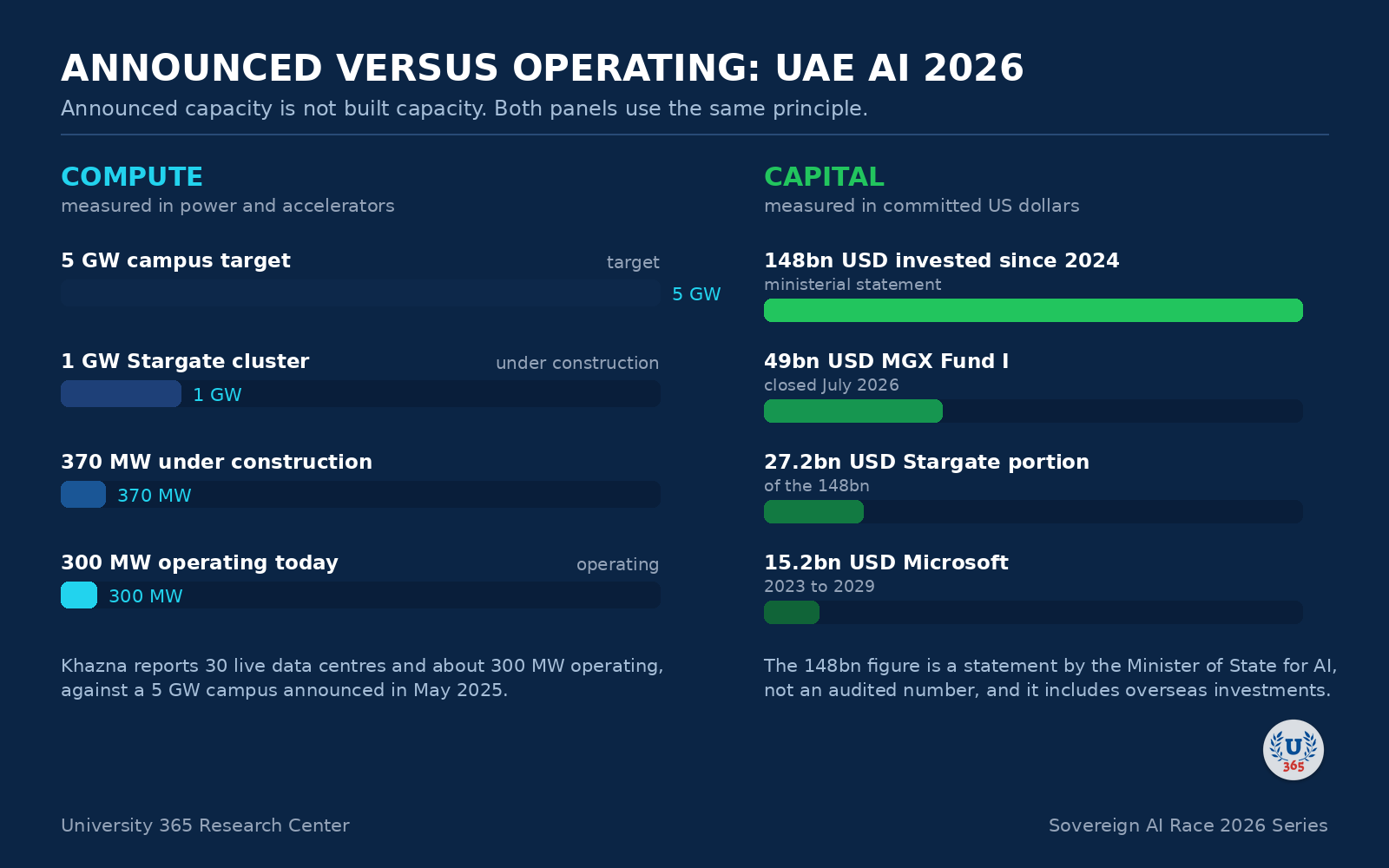
Announced capacity is not built capacity. University 365 Research Center.
Sheikh Zayed Grand Mosque, Abu Dhabi. Photograph free-licensed via Pexels.
Data and Evidence
Table 1: The five layers, scored for the UAE in September 2026
Layer | What the UAE holds | What it does not hold | Verdict |
Compute | Domestic facilities at gigawatt ambition; about 300 MW operating through Khazna; GB300 systems on site for the Stargate phase one | Chip design and fabrication; the licence to import accelerators; the corporate nationality condition on its two operators | Rented, conditionally |
Models | Falcon and Jais families built in Abu Dhabi; K2 Horizon published with weights, data and code; first place on the Counterpoint sovereign model index | A frontier-scale pretrained model; K2 Think runs on a Chinese open base; Compass resells American models | Held, at sub-frontier scale |
Capital | MGX Fund I at 49bn USD; 148bn USD invested since 2024 by ministerial statement; equity in OpenAI, Anthropic and xAI | Nothing material; this is the strongest layer | Owned |
Regulation | A consolidated federal AI and data authority since June 2026; free zone regimes with active enforcement | An enforceable national data protection regime; a comprehensive AI statute; an AI safety institute | Held in form, not in force |
Talent and education | Second in the world for net AI talent inflow; the world's first AI university; a national school AI curriculum with 22,000 teachers to train | A domestic base producing builders at scale; 93 per cent of surveyed engineering employers report recruitment difficulty | Imported, building |
Table 2: The controlled metrics, series bible format
Metric | UAE position | Source and date |
Flagship compute commitment | 1 GW Stargate cluster inside a 5 GW campus; 200 MW phase one due Q3 2026; about 300 MW operating through Khazna | G42, May 2025; The National, December 2025; Khaleej Times, August 2026 |
Capital committed | 49bn USD MGX Fund I closed; 148bn USD invested since 2024 (ministerial statement); 15.2bn USD Microsoft, 2023 to 2029 | MGX, July 2026; Semafor, November 2025; Microsoft, November 2025 |
Flagship national models | Falcon-H1 Arabic (3B, 7B, 34B, open weights); Jais 2; K2 Horizon (six models, 0.9B to 375B, fully open, Apache 2.0) | TII, January 2026; WAM, December 2025; IFM, September 2026 |
Anchor entities | G42, MGX, Mubadala, the Technology Innovation Institute, Mohamed bin Zayed University | Official announcements |
Chip dependency | NVIDIA systems throughout; licence-free access for named entities, expiring 6 April 2027 for the two UAE operators | Federal Register, July 2026 |
Regulatory instrument | Federal Authority for AI and Data, established 14 June 2026; PDPL in force since 2022 without implementing regulations; AI Charter non-binding | Dubai Media Office, June 2026; Morgan Lewis, June 2026 |
Talent anchors | MBZUAI; first undergraduate cohort of 115 students from more than 25 countries | MBZUAI, 2025; WAM, September 2025 |
Independent index standing | Counterpoint Sovereign AI LLM Index H1 2026: Falcon H1 first across all measured dimensions; Stanford AI Index 2026: second globally for net AI talent migration | Counterpoint, July 2026; Stanford HAI, April 2026 |
Adoption | 70.1 per cent generative AI use among people aged 15 to 64, early 2026, against a 17.8 per cent global average | Microsoft AI Economy Institute, via The National, September 2026 |
Distinguishing mechanism | State as equity investor and convenor | This report |
Core tension | Holds four sovereignty layers, rents the fifth, and the lease carries a date | This report |
Table 3: Timeline, 2023 to 2026
Date | Event | Source |
November 2023 | G42 divests its passive holdings in the Chinese technology firms ByteDance, xFusion and Honor | CSIS, January 2025 |
16 April 2024 | Microsoft invests 1.5bn USD in G42 | Microsoft, April 2024 |
13 May 2024 | TII releases the Falcon 2 series | TII, May 2024 |
5 September 2024 | Barakah unit 4 enters commercial operation, 40 TWh a year | ENEC, September 2024 |
17 December 2024 | TII releases Falcon 3 | ATRC, December 2024 |
15 May 2025 | The two presidents unveil phase one of the 5 GW UAE-US AI campus | WAM, May 2025 |
22 May 2025 | Stargate UAE announced: 1 GW, built by G42, operated by OpenAI and Oracle | G42, May 2025 |
9 September 2025 | MBZUAI and G42 announce K2 Think, a 32B open reasoning system | WAM, September 2025 |
5 November 2025 | Microsoft and G42 announce a 200 MW Khazna expansion | Microsoft, November 2025 |
7 November 2025 | The Minister of State for AI states 148bn USD invested since 2024 | Semafor, November 2025 |
20 November 2025 | The United States authorises up to 35,000 Blackwell-equivalent chips each for G42 and Saudi Arabia's HUMAIN | CNBC, November 2025 |
9 December 2025 | Inception, Cerebras and MBZUAI release Jais 2 | WAM, December 2025 |
January 2026 | TII launches Falcon-H1 Arabic in 3B, 7B and 34B sizes | TII, January 2026 |
7 April 2026 | Iran's Revolutionary Guard threatens G42's planned data centre | Data Center Dynamics, April 2026 |
18 May 2026 | GB300 systems arrive on site at the Stargate phase one build | Reported G42 statement, May 2026 |
14 June 2026 | The Federal Authority for AI and Data is established | Dubai Media Office, June 2026 |
1 July 2026 | MGX confirms the 49bn USD close of Fund I | MGX, July 2026 |
10 July 2026 | The UAE moves from Country Group D to A:5; G42 and Core42 receive authorisations expiring 6 April 2027 | Federal Register, July 2026 |
13 August 2026 | Khazna reports 30 live data centres and about 300 MW operating | Khaleej Times, August 2026 |
2 September 2026 | An AI curriculum is announced for all UAE schools | The National, September 2026 |
3 September 2026 | IFM releases K2 Horizon, six fully open models | IFM and Reuters, September 2026 |
11 September 2026 | Reuters reports the 5 GW campus will likely become a distributed network after the Iranian attacks | Reuters, September 2026 |
25 September 2026 | UAE generative AI adoption reaches 70.1 per cent, the first country above 70 | The National, September 2026 |
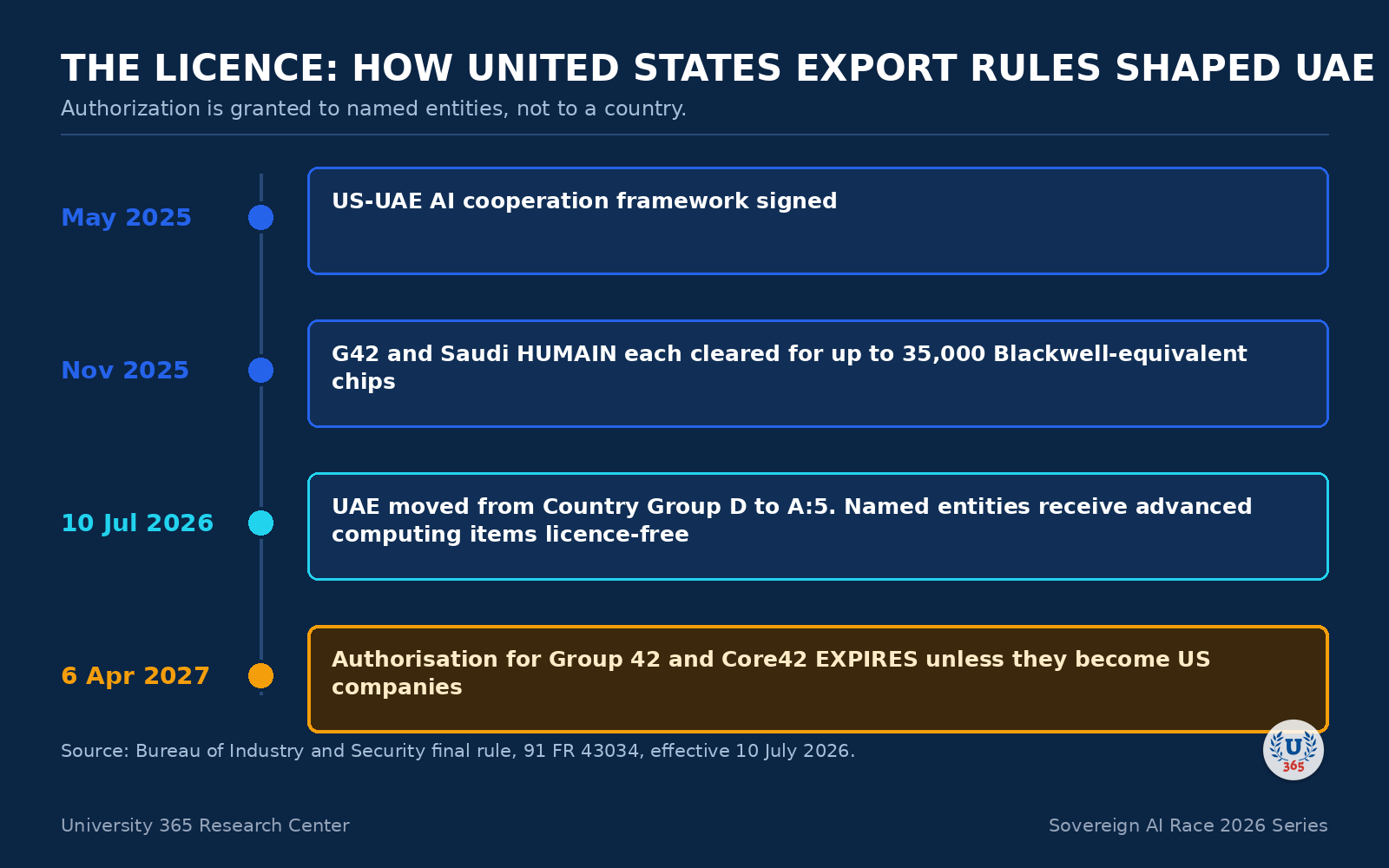
How the licence shaped the build, ending at the 6 April 2027 expiry. University 365 Research Center.
Implications
For states that want sovereign AI without a semiconductor industry
The Emirati case is the clearest available instruction manual, and reading it correctly matters to every other country in this series, most of which are in the same position.
The first lesson is that capital can buy participation but not control. The UAE's $49 billion fund, its equity in three frontier labs and its gigawatt-scale campus have made it a node the global industry must deal with. None of that changed who writes the export rules. A state in this position should plan for the licence to be the constraint it manages, not a problem it solves.
The second lesson is that layers can be held separately, and the ones that can be held cheaply are worth holding first. Publishing open models costs a fraction of building a frontier model and produces an asset no licence can revoke. Writing domestic rules costs almost nothing and keeps the jurisdiction's own choices out of foreign hands. Building a talent pipeline is slow but it compounds. Compute is the expensive, conditional layer, and treating it as the foundation rather than the roof is what produces the dependency the UAE now manages.
The third lesson is that the hedging instruments are financial and legal rather than technical. Equity in the labs whose products you depend on is the only instrument in the Emirati toolkit that a policy change in Washington cannot reach. Any state copying this strategy should copy that part of it deliberately.
For the technology providers
The Western labs and hyperscalers have built a business model in which compute is exported under licence and the licence is a foreign policy instrument. That works while the export is a gift the recipient values. It becomes fragile when the recipient is simultaneously asked to accept a corporate nationality condition, and the fragility is now visible. A state that must consider reincorporating its national champions as American companies to keep its data centres running has a strong incentive to fund an alternative, and the alternative is being offered by China at the open-weight layer.
For institutional and enterprise buyers
Any organisation using Emirati-hosted capacity should read the licensing position as part of its own supply chain. The Emirati data centres are among the most capable in the region and are being built to a genuine standard. They also sit on a licence that names specific companies and expires. Continuity planning that treats the location of the servers as the whole answer is incomplete: the question is which legal regime controls the operator, and that question has a date attached.
For the global south
The UAE is positioning itself as the compute hub that serves countries the American market does not prioritise. That offer is real, and it is worth understanding what is being offered: access arranged by an Emirati intermediary on infrastructure whose underlying permission comes from Washington. That is a meaningful improvement on no access at all, and it is not the same thing as local sovereignty, which is the thing most countries in this series say they want.

The Museum of the Future, Dubai. Photograph free-licensed via Pexels.
Education and Skills Impact
What the Emirati case teaches about preparing people for a conditional industry
This section matters more for the UAE than for most countries in the series, because the country is running an unusually large bet on a layer it does not control and an unusually small bet on the layer it does.
The country's education response has been fast and, in one respect, unusually thoughtful. The AI curriculum announced for all schools covers data, algorithms, applications, risks and ethics, and the plan to train 22,000 teachers is the part that determines whether it lands. The decision to restrict children under thirteen to teacher-led awareness, with supervised use beginning around thirteen, is a deliberate line drawn against a technology the same government is deploying at scale everywhere else. School leaders in the emirates describe the risk in their own words as cognitive debt: pupils weakening independent thinking by handing mental effort to a machine. That phrase appears in Emirati reporting, and it is the same risk the CI-First framework was built to name.
Mohamed bin Zayed University of Artificial Intelligence is the strongest institutional asset in the talent layer. A first undergraduate cohort of 115 students from more than 25 countries, subject rankings at 106th in computer science and 50th in electrical and electronic engineering while the institution sits around 497th overall, is the profile of a young, specialised, research-active university inside a country with almost no long-established research base. That is not a criticism. It is the accurate description of what has been built in five years.
The gap that matters is the one PwC measured. Emirati AI hiring is dominated by roles that use AI rather than roles that build it, with user roles growing 28 per cent in a year, while 93 per cent of surveyed engineering and technology employers report difficulty recruiting and 54 per cent report a skills shortage. The country is importing the builders and training the users. That is a rational short-term allocation and a weak long-term foundation, because a user of imported tools cannot substitute for a builder when the licence conditions change.
What University 365 would contribute here is not a new curriculum. It is the assessment discipline the country's own evidence shows it is missing. The Emirati position is the highest measured adoption in the world sitting beside a measured shortage of people who can build, and the two facts are one problem: a population given tools faster than judgement. The Co-Intelligence-First approach addresses that problem at its root, by treating the human's capacity to judge, verify and stay accountable for an answer as the outcome to be taught, rather than the tool's output. Applied to Emirati schooling, that means assessment designs that ask a pupil to defend a conclusion rather than to produce one, and teacher training that treats the AI as something to be interrogated in front of the class rather than quietly relied upon.
University 365 already has a vehicle for this. The Applied AI University is our own initiative for the Emirates, published in May 2025, and it was designed from the outset to complement rather than compete with the country's existing higher-education sector: applied-first programmes across technology, business, communication and design, with stackable microcredentials and lifelong-learning pathways alongside the degrees, and an explicit alignment to the National AI Strategy and Vision 2031. The project is currently delayed. Regional instability in the Gulf since late February 2026, and its effect on the stability of the Persian Gulf, is the reason we have stated publicly on the project page, and no resumption date is set. University 365 has not withdrawn the proposal, and this report does not treat the delay as a judgement on its merits: the educational argument that supported it in May 2025 is, if anything, stronger in September 2026, because the dependency this report documents is the same dependency that makes a country's own capability base urgent.
That is the honest reading of the Emirati education position. The country does not need another source of AI tools; it has more of those than any state in the world. It needs institutions that produce people who can build and evaluate them, and it has shown, with the fastest adoption on record and a hard shortage of builders underneath it, exactly why that distinction matters. A partner able to teach judgement alongside use would be addressing the one gap the country's own statistics identify.
For U365, the implication is direct and it is the argument the institution already makes. The Emirati position shows what happens when a country buys capability faster than it builds it: the capability arrives, the dependency arrives with it, and the price of the dependency is paid by the generation that has to work inside it. The alternative is not to refuse the tools. It is to make the people who use them capable of judging them, and to keep producing people who can build and verify at the layer where the country currently rents. The UAE has the capital to do both, and it is currently doing the first far more effectively than the second.

Capability on one side, the appearance of it on the other. University 365 Research Center.
The CI-First Perspective
Where does the appearance of capability outrun the capability?
The Co-Intelligence First framework asks whether an arrangement amplifies human capability or substitutes for it, and where the risk of AI Imposture sits. Applied to a state, the question becomes unusually sharp, because states operate on announcements and announcements are exactly where imposture lives.
The Emirati programme has real capability underneath it. This is not a country that bought a chatbot subscription and called it a strategy. It has built research institutions that publish models with weights, data and methodology, which is a stronger openness standard than most Western labs meet. It has run a national adoption programme that measurable evidence shows reached 70.1 per cent of the adult population, the highest figure recorded anywhere. It has built data centre capacity that can be toured and counted. Capital deployed into real assets is real.
The imposture risk sits in three specific places.
The first is the gap between announced and operating capacity. A five-gigawatt campus is announced; roughly three hundred megawatts operate; the difference is a plan, and plans are frequently restated in this country in a way that reads as progress. A national programme that reports announcements as though they were assets is producing the appearance of capability faster than the capability, and the emirates have done this enough that one local trade analysis documented a single milestone moving across four different dates without correction.
The second is the adoption figure. Seventy point one per cent of people using a generative AI tool is an extraordinary number and it measures exposure, not capability. Using a tool and being able to judge its output are different things, and the country's own concern about cognitive debt among schoolchildren is an admission that it knows the difference. High adoption with a thin builder base is the exact configuration in which AI Imposture is most likely: many people producing work with a tool they cannot evaluate.
The third, and the most structural, is the compute layer itself. A country that announces sovereign compute on hardware it licences, from a supplier that can attach conditions and a government that writes them, is producing the appearance of compute sovereignty. The Emirati state does not appear to be deceiving itself about this, which is why it bought equity in the labs and published open weights. But the public narrative of sovereign AI and the legal reality of a 270-day authorisation are different things, and the gap between them is where a reader should be careful.
The honest CI-First verdict on the United Arab Emirates is that it has built genuine capability in four layers and is managing a structural dependency in the fifth, knowingly and with the most sophisticated hedging instruments any state has assembled. That is not imposture. It is a strategy with a condition attached, and the condition has a date.
What This Means for You and Us
For a reader in the Gulf
If you are building anything on Emirati AI capacity, the practical question is not which data centre but which legal regime governs the operator, and whether your continuity plan survives a change in it. Read the Federal Register supplement rather than the press release, and note that the authorisation names specific companies.
For a reader anywhere else
The Emirati strategy is the most complete answer yet given to the question of what a state does when it cannot make the technology it needs. The answer is: buy the ownership, publish what you can, write your own rules, and build capacity that makes you useful enough to keep connected. Every country in this series is running some version of that play, and none of them has run it with this much money.
For University 365
Two things follow from this report.
The first is about how we teach. The Emirati adoption figure and the Emirati skills shortage are not in tension; they are the same finding. A population that uses AI at the highest rate in the world while its engineering employers cannot hire is a population that has been given tools faster than judgement. That is precisely the condition CI-First exists to address, and it is evidence for the framework from the least expected direction: the country that adopted fastest produced the clearest demonstration of why adoption is not the goal.
The second is about what we publish. This report opens a twenty-part series in which we assess twenty countries with one framework and one metric set. We will be reporting on countries whose governments are our partners, our hosts and, in at least one case, our own postponed project's intended location. The standard this series holds is the one this report has tried to hold: describe what is built, name what is conditional, credit the sources, and do not let a government's announcement become our finding.
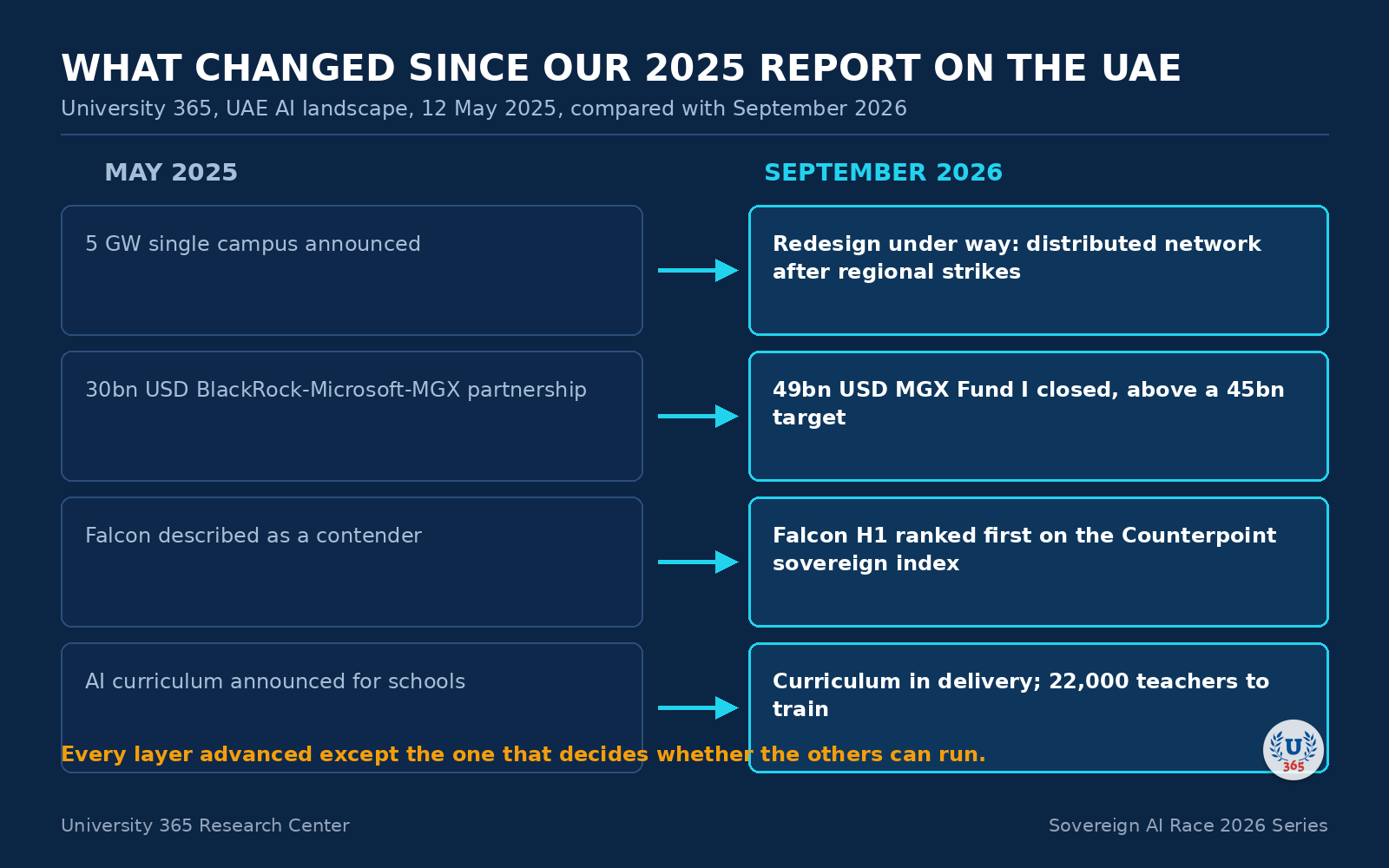
What changed since our May 2025 report on the UAE. University 365 Research Center.
The Road Ahead
Three things would change this assessment, and each is observable.
A change in the corporate nationality condition. If Group 42 and Core42 become United States companies before April 2027, the Emirati compute layer moves from conditional to securely held, and the sovereignty question changes shape entirely: the country would hold compute that is legally American and physically Emirati. If instead the authorisation lapses and is re-granted on new terms, the dependency is confirmed. Watch the Federal Register, not the press.
The twenty twenty-seven Stargate handover, and the redesign. Whether the first two hundred megawatts reach customer handover on schedule, and whether the five-gigawatt programme becomes one campus or a distributed network, tells a reader how much of the announced capacity is real and how the country is pricing physical risk after the 2026 strikes.
Whether the builder base grows. The single measure that would change the long-term picture is the share of Emirati AI employment in roles that build rather than use. PwC's barometer is the instrument to watch, and the direction over the next two reports will indicate whether the country is converting capital into capability or into consumption.
Sources and Methodology
Methodology
This report was researched through public sources only, with a preference for primary documents. Where a government or company statement is the only available source for a figure, it is attributed to that party and labelled a claim. Where an independent index measured the same quantity, the index is cited alongside. Announced capacity and operating capacity are reported separately throughout, because conflating them is the most common error in coverage of this subject.
The single most important source is the United States Federal Register final rule of 14 July 2026, read directly. The 6 April 2027 expiry date and the corporate nationality condition come from the text of that rule and its preamble, not from secondary reporting, and the report quotes the rule's own language. One source encountered during research, an article headlining a UAE AI research investment, was found to describe Singapore in its body and was excluded from use.
This report is the first in the Sovereign AI Race series and it creates the series bible: a fixed five-layer framework, a controlled ten-metric set, a terminology standard and a source hierarchy that every subsequent country report will use. It also carries the series' first "What Changed Since" treatment, comparing the findings below against University 365's own UAE landscape report of May 2025.
Principal sources
Primary regulatory and government documents. United States Bureau of Industry and Security, press release of 10 July 2026 and final rule 91 FR 43034 (FR Doc. 2026-14132), effective 10 July 2026; Government of Dubai Media Office, establishment of the Artificial Intelligence and Data Authority, 14 June 2026; UAE Cabinet, National Artificial Intelligence Strategy 2031; UAE legislation portal, Charter for the Development and Use of Artificial Intelligence; UAE Ministry of Foreign Affairs, position on AI policy; Abu Dhabi Executive Office and Emirates Nuclear Energy Corporation materials.
Official company and institutional announcements. G42, Stargate UAE launch; Microsoft, investment and data centre announcements of 16 April 2024 and 5 November 2025; MGX, final close of Fund I, 1 July 2026; Technology Innovation Institute, Falcon model releases; Institute of Foundation Models, K2 Horizon release, 3 September 2026; Core42 product documentation; Inception corporate announcements.
Independent research indices and analysis. Counterpoint Research, Sovereign AI LLM Index, first half 2026, and the NVIDIA concentration finding of 5 August 2026; Stanford HAI, AI Index Report 2026; PwC, Global AI Jobs Barometer UAE, June 2026; Microsoft AI Economy Institute diffusion measure, reported September 2026; Centre for Strategic and International Studies, assessment of the United Arab Emirates' AI ambitions, January 2025; International Energy Agency, Energy and AI.
Reporting. Reuters, including the plan revision report of 11 September 2026; Bloomberg; CNBC; The National; Khaleej Times; Semafor; Data Center Dynamics; Wired Middle East; Forbes; Gulf News. Wire and financial press are used for reported facts and are named in the text where a claim depends on them.
Confidence and limits
Three limits should travel with this report. No public source quantifies the energy mix actually serving Emirati data centres, so the report describes the nuclear and gas positions without attributing a ratio, and readers should treat any specific percentage they see elsewhere as unsourced. The figure of $148 billion invested since 2024 is a ministerial statement and is labelled as such throughout. And the Reuters report of an eleven September 2026 redesign could not be read in full from this environment; it is attributed to Reuters by headline and summary, and it is flagged for re-verification.
About This Report
Sovereign AI Race: UAE (2026) is report one of twenty in the Sovereign AI Race series, followed by a comparative capstone. The series assesses how states attempt to control the production of artificial intelligence inside their jurisdiction, using one five-layer framework and one metric set applied identically to every country: compute, models, capital, regulation, and talent.
Each report in the series carries a "What Changed Since" treatment against the earlier University 365 report on the same country where one exists. Fourteen of the twenty countries in this series have a 2025 landscape report, and this one is compared against "UAE's AI Revolution: The 2025 Landscape of Innovation, Investment, and Implementation," published on 12 May 2025.
Author: Hubert Graef, Dean of Research, University 365 Research Center.
Series: Sovereign AI Race, report 1 of 20, followed by the comparative capstone.
*Published by University 365 Research Center. CI-First is University 365's Co-Intelligence First framework, a method constant of the institution.*
Revision 6, 28 September 2026, 20:26 UTC. Published 28 September 2026.




Comments