
Star By Face: the celebrity lookalike app that scores 3.0 on the U365 CI-First Review, and what its own documents say about your photograph

Updated: 14 hours ago
Status: Active | Last tested: 2026-09-25 (starbyface.com and the iOS listing as published on 2026-09-25) | Re-check: trigger-based (max 6 months)
Active: the tool is current and recommended.
For detailed explanations of the CI-First evaluation terms used in this review, including the Humics Protection Badge and the AI Imposture Risk levels, see the Glossary at the end of this post.


In this Tool Review
Status and Re-check
Status: Active | Last tested: 2026-09-25 (starbyface.com and the iOS listing as published on 2026-09-25) | Re-check: trigger-based (max 6 months)
Active: the tool is current and recommended.
Version reviewed: the current live web app and the app store listings, version 1.1.13 as shown on the iOS listing.
A published accuracy figure of any kind. The vendor publishes none. One reviewer repeats a resemblance percentage as if it measured how much a person resembles a celebrity. If the vendor states what the number is measured against, the Quality sub-score should be revisited.
A change to the image retention statement. The current statement is that uploaded photos are deleted after recognition and that only a generated share image is kept. Section 7c records the documents that describe the same image differently.
A change to the app store data declarations. The Google Play listing declares that no data is collected and that data cannot be deleted, while the iOS label on the same product declares identifiers and usage data used to track the user across other companies' apps and websites. If the two surfaces converge, Section 7c should be rewritten.
A European regulator, or the developer, acting on biometric image processing. A face image is special-category data under the GDPR when it is used to identify a person. No legal basis, retention period or controller contact for that processing appears in the policy. Any enforcement, complaint outcome or policy rewrite is a re-check.
A shift from entertainment to identification. The vendor states the app is for entertainment and that matches are a similarity estimate. Any move toward identity verification, age estimation, ethnicity inference, attractiveness scoring or hiring and admissions use changes the tool class, the profile and every score in this review.
Removal of the in-app purchase or a change to the advertising load. The web app is ad funded and the iOS app sells a single $0.99 purchase that removes ads. The user complaints are concentrated on ad volume rather than on the match, so the Time sub-score depends on it.
The Star By Face naming, stated before the review begins
This review covers the web app at starbyface.com and the iOS app "Star by Face: celebs look alike". Several unrelated sites now trade on the same two words. The naming is resolved in the table below before the review begins.
Someone searching for Star By Face now meets at least six different things using the same words. The distinction belongs at the top.
Name | What it actually is | Relationship to this review |
starbyface.com | The long-running web app reviewed here. Upload a photo, the face is detected and matched against a celebrity database, and the site returns ranked matches with a resemblance percentage, plus face-shape and hairstyle suggestions | The subject of this review |
Star by Face: celebs look alike (iOS, id 1499633307) | The developer's own iPhone app, sold by Dmitry Statsenko, 1.6K ratings at 3.7 out of 5, with a $0.99 purchase that disables ads | The same vendor, a separate surface, and the second subject of this review |
Star by Face: Celeb Look Alike (Google Play, com.starbyface) | The developer's own Android app, 1M or more downloads, rated 4.7 out of 5 from about 5.9 thousand reviews | The same vendor, a separate surface |
starbyface.net | An independent site that states plainly it is not affiliated with any other site using similar words. It runs the matching in the browser and says the photo never leaves the device | Not related. It is a different operator with a deliberately different architecture |
starbyface.org | A second independent browser-based finder, also not related, also stating that the photo stays in the browser | Not related |
Star by Face: Celeb Lookalike (iOS, id 1633698910) and Star by face (iOS, id 6753176760) | Different developers (WOWOO LTD and WhatsGoodApps LLC) selling photo and video apps under the same name, one with an auto-renewing weekly subscription | Not related. These are the ones that generate subscription complaints under this name |
Star By Faces (starbyfaces.com) | A further lookalike site on the same words | Not related |
Two consequences follow. First, most of the complaints a reader will find under this name belong to other operators, so a rating read from a search result is not evidence about the product reviewed here. Second, the two independent sites on the same words have built their entire pitch on the one thing the reviewed app cannot claim, which is that the photo never leaves the device. That contrast is the reason Section 7c exists in this review.
Tool Snapshot
Star By Face (starbyface.com)
Tagline: "Celebrity look alike face-recognition app" (starbyface.com, read 2026-09-25.)
Category: A consumer novelty that applies face detection and facial-landmark matching to a photograph and returns ranked celebrity lookalikes with a resemblance percentage, a face-shape classification and hairstyle suggestions. The vendor calls the matching component a neural network. There is no enterprise edition, no API, no team tier and no integration surface of any kind.
Primary use cases:
Curiosity and entertainment. Upload one photograph and see which public figures the system ranks as closest to you.
Social content. Produce a shareable side-by-side image of your photograph next to a celebrity match, and post it. This is the use case that made the product visible in September 2026 through a TikTok trend.
Group and party activity. Run several people through the tool and compare the rankings.
Face-shape and hairstyle suggestions. The tool classifies the face into one of six shapes and suggests hairstyles for it. This is a styling-information use case rather than an entertainment one, and it is the only output with any practical use.
What it is not. It is not identification. It is not biometric verification. It does not tell you anything reliable about an unknown person's identity, and the vendor states in its own listing that the app is for entertainment and that matches are a similarity estimate.
Platforms and access:
Surface | Address | Access model |
Web app | starbyface.com | Free, no account, advertising funded |
iOS app | App Store id 1499633307, "Star by Face: celebs look alike" | Free with advertising, in-app purchase of $0.99 to disable ads |
Android app | Google Play, com.starbyface | Free with advertising and in-app purchases |
Inputs: One photograph containing a single face, uploaded from a device or captured in the app. The vendor's own guidance is that the face should be clearly visible and preferably frontal, and that the result depends on the resolution and quality of the image.
Outputs: A ranked list of celebrity matches with a per-match resemblance percentage, gender filtering (male, female or a best pair), a face-shape classification, hairstyle suggestions, and a generated side-by-side image when the user chooses to share.
Pricing: Free at the point of use on all three surfaces. The web app is funded by two advertising placements. The iOS app sells ad removal for $0.99. The vendor's own listing states that the service is intended strictly for personal, non-commercial use.
Data position, as the vendor states it: "We do not store uploaded photos. All photos are deleted after recognition. The photo will be saved only if you want to share it." (App Store listing, read 2026-09-25.) The privacy policy states: "Generated images keep anonymous, we don't store user's id or name. We don't collect any user's personal data." Section 7c reads those statements against the developer's own app store declarations.
Developer: Dmitry Statsenko, trading as StarByFace, with a support address at starbyface.app@gmail.com and a postal address in Kaluga, Russia, published on the Google Play developer page.
Community evidence at a glance:
Surface | Rating | Review count | Read |
iOS, id 1499633307 | 3.7 out of 5 | 1.6 thousand ratings | 2026-09-25 |
Google Play, com.starbyface | 4.7 out of 5 (5.91 thousand reviews shown at the top of the listing) | about 5.9 thousand reviews | 2026-09-25 |
Trustpilot | No reviews found | 2026-09-25 | |
G2, Capterra, GetApp | No reviews found. The product is not an enterprise application and is not listed as one | 2026-09-25 |
The two store figures disagree by a full point and the same Android listing prints 4.7 at the top and 3.8 in its own reviews block on a different read. Section 9 records the spread rather than picking a number.
One-line summary: A free, well-made consumer novelty that answers a question nobody needs answered, at the cost of handing a face image to a server whose legal documents do not describe what happens to it. Use it if you want the entertainment. Do not use it for anything that matters.
At a Glance
Field | Result |
CI-First Benefit Score | 3.0 / 10 (CI-First Neutral) |
Sub-scores | Time 6 / Quantity 3 / Quality 2 / Skill 1 |
CI-First Profile | Primary Co-Worker and Assistant (level 2); secondary Coach and Tutor (level 3), reader-constructed |
Collaboration Mode | Centaur |
Humics Protection | Humics-Risky (-2 / +3): Creativity Neutral 0, Critical Thinking Erodes -1, Social Authenticity Erodes -1 |
AI Imposture Risk | Medium overall: Time Illusion Medium, Quantity Illusion Low, Skill Illusion High |
Status | Active |
Last tested | 2026-09-25 |
Version reviewed | 1.1.13 on the iOS listing, plus the live web app and the two app store listings |
Pricing | Free; the web app is advertising funded; a $0.99 in-app purchase removes advertising on iOS |
Vendor | Dmitry Statsenko, trading as StarByFace |
Framework version applied | CI-First Evaluation Framework v1.2 |
The Problem
People are curious about how they look, and there is no cheap way to answer the question "which famous person do I look like". Before this class of tool, the answer came from a friend, a photograph and an argument. The question itself is not important, and that is exactly why it spreads: it costs nothing to ask, it produces a concrete answer, and the answer is shareable.
The practical problems for anyone who is not simply passing time are three.
The number looks like a measurement and is not one. The tool returns a per-match percentage. A journalist writing about the September 2026 trend described it as "a percentage that tells you how much you resemble them", which is what a reader will assume it is. The vendor's own sites describe the same number as a similarity estimate and state that matches are a similarity estimate and can vary with angle, lighting, expression and image quality. Nothing on the product surface tells the user which of the two readings is correct.
The output is a judgement about a person's body, on a platform built to compare people. The app ranks faces against a database of public figures and shows the closest ones with a number attached. It is used as an identity statement and posted. That is a social surface where a low ranking or a mismatched ranking is read as a verdict on the person, not on the photograph.
Nothing about the processing is written down in a form a compliance reader can use. The image is biometric-adjacent: a photograph from which facial geometry is extracted. Under the GDPR, a face image becomes special-category data when it is processed to identify a person, and it attracts an Article 9 condition, a documented retention period and a controller the data subject can reach. The vendor's policy is a generated template with the third-party provider list left blank, no controller identity, no legal basis, no retention period and no supervisory authority named. Section 7c quotes it.
The Outcome
What a user actually gets from Star By Face:
A ranked list of celebrity matches, delivered in seconds from one photograph, with a percentage beside each name and a filter for male, female or a best pair. The count the tool returns is itself inconsistent across sources: the vendor's own listing and one news guide describe 24 celebrities shown at once, another describes several, and a rival site's comparison describes twelve. A reader should expect a list, not a specific number.
A face-shape classification in one of six categories (oval, round, square, heart, diamond, oblong) and hairstyle suggestions keyed to it. This is the only output in the product with a practical application.
A shareable side-by-side image, generated when the user asks for it, which is the artefact that made the product visible.
A social moment. The result is a conversation starter, a party activity, a group game and a content format.
What a user does not get: any explanation of why a match was chosen, any statement of what the percentage is measured against, any accuracy figure, any way to correct a wrong result, and any output that survives the session beyond the share image. The tool answers its question and stops.
For U365 the outcome is narrower than for a general consumer. The tool has no instructional surface, no research surface and no method surface. It illustrates one thing well: the difference between a model that computes a similarity and a system that produces a measurement. That is the teaching value, and it is why this review exists in the series rather than in a footnote.
Who Should Use Star By Face
Use it if you want:
A quick, free, genuinely entertaining answer to a curiosity question, with no account and no commitment.
A low-stakes social format for a group, a party or a team icebreaker where the result is treated as a joke.
A concrete example to show a class what a face-embedding similarity actually is, and what it is not, which is a stronger teaching use than the tool was designed for.
Do not use it for:
Any decision about a person. It is not identification, not verification, not an attractiveness score, and the vendor says so.
Any professional, admissions, hiring, research or clinical purpose.
Any photograph of a person who has not agreed to it, including a minor, a student, a colleague or a public figure used as a test input.
U365 Fellow categories:
Fellow type | Fit | Why |
Explorer | Good | Free, immediate, no setup, and it produces a visible result in under a minute |
Creator | Limited | One shareable image and nothing to build on. The output cannot be edited, re-run with a prompt or extended |
Builder | Poor | No API, no export beyond an image, no data, no integration surface |
Researcher | Poor for the tool, useful as a case | It is a field example of a similarity score misread as a measurement. It is not a measurement instrument |
Practitioner | Poor | Nothing transferable to professional work |
When to invite it, and when to keep it out. Invite it when the intent is explicitly entertainment and everyone in the photograph has agreed. Keep it out of anything that involves another person's face without their knowledge, anything that would record an appearance judgement about someone, and any cohort activity where a result could be read as a ranking of the participants.
U365 Institutes Alignment
Star By Face is a consumer novelty. It teaches, it does not do. The alignment below therefore rates what a U365 institute could take from the tool as an object of study, not as a working instrument. No institute in the U365 system should adopt it as a production tool, and the ratings are deliberately low for that reason.
Institute | Rating | Why | The limit that holds the row |
UIT (Technology, AI, Data Science) | Medium (primary) | The one institute with a working use, and the use is a study object rather than a capability the product supplies. A face-matching pipeline is a standard computer-vision exercise: detect the face, align and crop it, convert the crop into an embedding vector, and rank a reference set by the distance between vectors. The product performs that chain and publishes none of it, which makes it a usable motivating example for a laboratory that builds the same chain openly and measures it. The transferable competency is the evaluation one: telling a similarity score from a probability, a confidence figure and a measurement, and knowing which questions a ranked output cannot answer | The product publishes no method, no database size, no architecture, no embedding dimension, no matching metric and no accuracy figure of any kind, so it teaches the pipeline by withholding it. No published U365 programme covers computer vision, image recognition, face recognition or similarity metrics: a verified term search over all 79 published programme descriptions returned zero matches for computer vision, image recognition, face recognition, similarity and cosine, and the nearest published teaching is statistics and probability inside Data Scientist. That is not presented here as an assessment home for this competency |
UIB (Business Management, Entrepreneurship) | Low | One discussion case and no competency. A zero-price, advertising-funded utility reached a million or more Android installs, and Section 7c documents what its two app-store declarations say about the same product family. That is material for a session on consumer-app distribution and on the data position a free product carries, and the Fellow works it by reasoning about the published record rather than by using the app | The tool teaches no management, finance, entrepreneurship or leadership content of its own, and no published U365 programme assesses consumer-app distribution economics or consumer data governance. A single case with no published assessment home does not carry the weight Low to Medium implies, so the rating stays at Low |
UIC (Digital Communication, Marketing) | Low to Medium | The reason is the media-studies analysis, not the virality. The product became visible through a TikTok trend in September 2026 with a documented date and a body of published coverage, which makes it a citable case in how a trivial utility spreads and what a generated share artefact does once a person posts it. The competency is evaluation and analysis: reading the coverage against the product's own behaviour and stating what the share artefact says socially. That competency remains when the tool is removed, which is the test applied here | The product builds no brand voice, no audience analysis, no campaign craft and no editorial judgement, and it produces no communication artefact a Fellow could be assessed on. The tool also erodes the same territory the institute would be teaching: Social Authenticity is scored Erodes (-1) for the share artefact and the group reading, and Critical Thinking is scored Erodes (-1) for the percentage read as a measurement. No published U365 programme assesses the analysis of a virality trend or the ethics of an appearance artefact, and no credential chain is mapped for UIC on this tool |
UID (Digital Design, UX/UI) | Low | Nothing in the UID competency set is exercised. The product evaluates no design against a brief, offers no design surface and no template control, and returns one finished graphic rather than an editable artefact. The face-shape classification and the hairstyle suggestions are a styling suggestion from a pattern classifier on the user's own face, which is not a design decision a UID Fellow makes or defends | The tool supplies no design competency and no credential chain, and this is a rating of study interest rather than of design relevance. A well-made interface is not a competency a Fellow gains |
U365 methods, not an institute (UNOP, ULM, LIPS, CARE and the UP-Context Method) | Not applicable | The tool carries no instructional method, no coaching surface, no assessment surface and no way to receive context, and it holds no artefact a Fellow could keep | Nothing in the methods layer is exercised |
The honest summary is that this tool belongs in the URC series as an evaluated object and in a UIT laboratory as a worked example. It does not belong in an institute operating stack.
How Star By Face Works
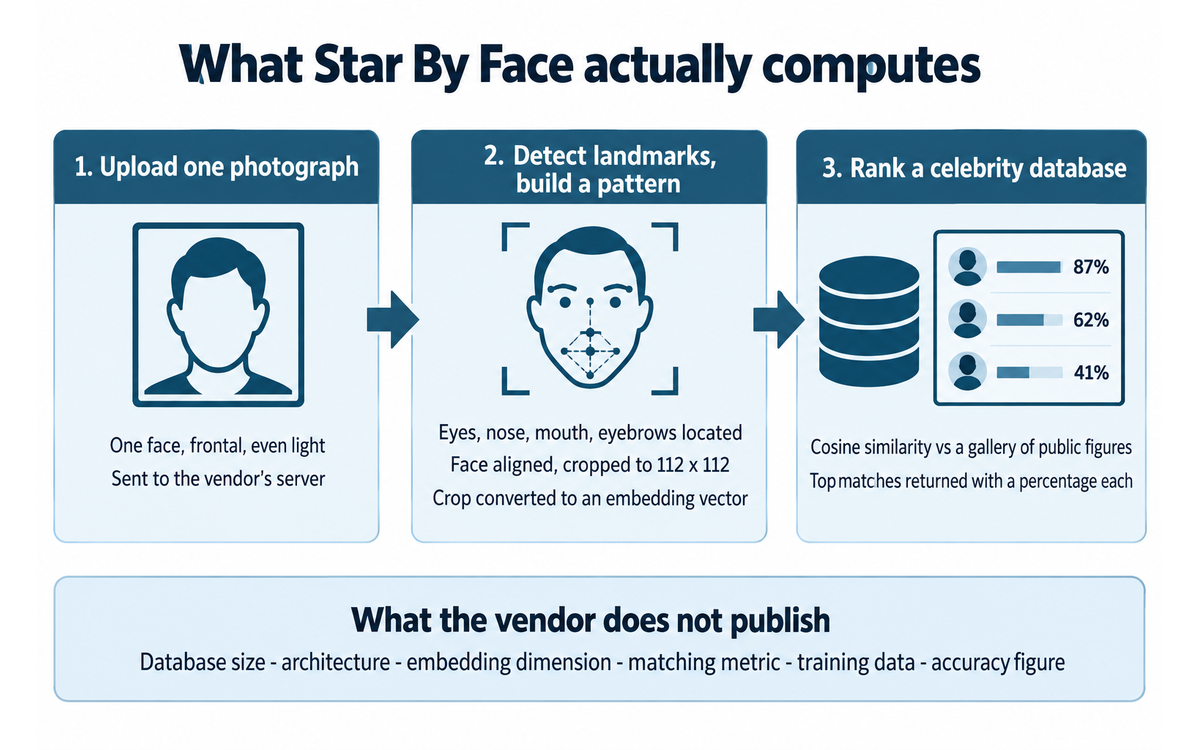
The product is a three-step pipeline and the vendor describes each step on its own home page.
Step 1. Upload a photo. "There should be only one person in the photo. Recommendations: The face should be clearly visible, it is better to use frontal photos. Face recognition accuracy depends on the resolution and quality of a face image." (starbyface.com, read 2026-09-25.) The web app accepts an upload or a capture, and the mobile apps add a gallery pick and a category selection for the celebrity pool.
Step 2. The system detects the face and builds a facial pattern. "The system detects the face and creates a facial pattern. System facial point detection can locate the key components of faces, including eyebrows, eyes, nose, mouth and position." (starbyface.com, read 2026-09-25.) This is the landmark-detection stage. It also drives the face-shape classification, which is why the tool can return a shape and hairstyle suggestions from the same pass.
Step 3. A neural network compares the pattern with celebrity faces. "The Neural Network compares the person with celebrity faces and suggests the most similar ones." (starbyface.com, read 2026-09-25.)
That is the whole published description. The vendor does not publish the size of the celebrity database, the architecture, the embedding dimension, the matching metric, the dataset, the face-shape classifier, or any accuracy figure. A reader can reconstruct the likely shape of the system from the independent descriptions and from the comparable independent sites, which describe the same standard chain: detect the face, align and crop it, convert the crop into a numeric embedding, then rank the database by the distance between embeddings. Two independent lookalike sites on the same two words publish that chain in detail, including a 112 by 112 crop and a 512-number embedding, and both are candid that the resulting number is a similarity and not a probability. The reviewed app publishes none of it.
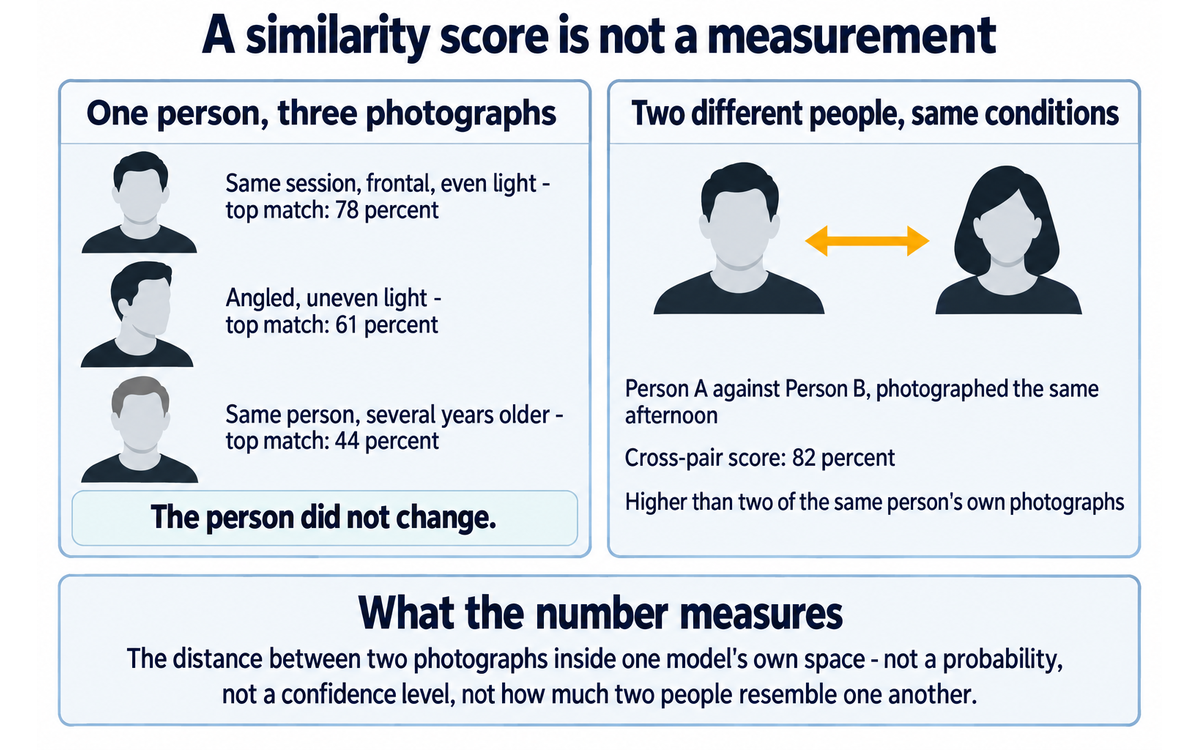
What the number is, and what it is not. This is the single most consequential fact about the tool, so it is stated plainly here. A resemblance percentage produced by an embedding comparison says how close two photographs sit in one model's own measurement space. It is not a probability, not a confidence level, and not a measurement of how much two people resemble one another. Two photographs of the same person taken years apart routinely score lower than two photographs of different people taken at the same event, because the model compares photographs rather than people. The vendor's own listing concedes the direction of travel: "Results may vary based on the quality of the uploaded photo and the accuracy of our AI algorithms. This app is intended for entertainment purposes only." The iOS listing puts it in one line: "Matches are a similarity estimate." A news guide written about the September 2026 trend states the opposite in substance, calling the figure "a percentage that tells you how much you resemble them", which is exactly the misreading the review is written to prevent.
The face-shape output. The tool classifies a face into one of six shapes, conventionally oval, round, square, heart, diamond and oblong, and suggests hairstyles for the classification. Of everything the product returns, this is the part with a practical use, because it is a description of a geometry rather than a judgement about a person. It is also the part with no published method, so it should be treated as a suggestion from a pattern classifier rather than as a styling assessment.
Where the data flows. This is the architectural fact that separates the reviewed app from the two independent sites on the same name.
starbyface.com (reviewed) | starbyface.net and starbyface.org (not affiliated, not reviewed) | |
Where matching runs | Vendor's service, from an uploaded photograph | In the browser, using WebAssembly models and a bundled library |
Does the photo leave the device | The vendor states that uploaded photos are deleted after recognition and that only a shared image is kept | The operators state that the photo is never uploaded and that there is no backend or database |
Can a user verify it | Not from outside, and the operators of this product publish no verification method | Both publish a method: open developer tools, watch the network panel, or disconnect the network and run a match |
Neither architecture is automatically better. The point is that the reviewed product asks the user to trust a retention statement, while the independent sites on the same name offer a check. For a tool whose input is a face, that difference is the decision.
The celebrity database. No figure is published. The Google Play listing says the app compares a face with "thousands of famous faces", one guide describes 24 results shown at once, another describes several, a rival site's comparison describes twelve, and the vendor describes categories including actors, singers, athletes, leaders and characters. A reader who needs a number will not find one, and the absence is recorded here rather than filled in with an estimate.
Getting Started with Star By Face
The honest onboarding time is under a minute, and it is worth stating exactly what it involves because the tool has no learning curve and no configuration.
A fifteen-minute checklist, most of which is optional:
Decide who is in the photograph. Minute 1. The only real decision. Use your own photograph, or run the tool on a public figure's portrait if you want to see how it behaves on a famous face. Do not use a photograph of another private person without their agreement.
Open starbyface.com in a browser or install the iOS app (App Store id 1499633307) or the Android app (Google Play, com.starbyface). Minutes 2 and 3.
Choose and upload one photograph with a single, clearly visible, preferably frontal face and even lighting. Avoid sunglasses, hats and heavy filters. Minutes 3 to 5.
Read the result. Minutes 5 to 10. The tool returns ranked matches with a percentage beside each, plus face-shape and hairstyle suggestions. Run it in male, female and best-pair modes to see how much the ranking moves with the filter. It moves, and that movement is itself the useful observation.
Run a second photograph of the same person, taken on a different day in different light. Minutes 10 to 13. Compare the two result sets. This is the fastest way to see for yourself that the number is a comparison of photographs, not a measurement of a person.
Decide whether to share the generated image. Minutes 13 to 15. If you share it, a generated side-by-side image is created and stored so that the link works. If you do not, the vendor states that nothing is kept.
What to do before you start, if you are doing this on behalf of an institution:
Confirm that everyone whose face appears has agreed to have a photograph processed by a third-party service.
Confirm that you are not using a minor's photograph.
Note that the vendor's own terms of use describe the service as intended strictly for personal and non-commercial use. An institutional or commercial use is outside the stated scope.
Read Section 7c before uploading anything, not after. The retention statement and the app store declarations describe the same image differently, and the difference is material to a decision about a face.
Real Workflows
The tool supports one workflow and three variations of it. Each is given a time budget, a verification checklist and the point at which the honest user stops.
Workflow 1: The five-minute entertainment run
What it is. One photograph, one curious user, one result, no recording of it.
Steps. Upload a single clear photograph. Read the ranked matches. Try the male, female and best-pair filters on the same photograph. Close the tab.
Time budget. Five minutes, including the upload. Nothing about this workflow takes longer if the user accepts the result as a joke.
Verification checklist:
Did you use a photograph you own and are willing to have processed by a third-party service?
Did you use a photograph with one face only, frontal and evenly lit, so that a strange result is not simply a bad input?
Did you read the percentage as a similarity score rather than as a probability or a measurement?
Did you finish knowing that the tool compared photographs, not people?
Where an honest user stops. Here. This is the workflow the tool is for.
Workflow 2: The teaching run, which shows what a similarity score is not
What it is. A controlled demonstration that a face-embedding similarity moves when the photograph moves and therefore is not a measurement of resemblance.
Steps. Choose one person. Take or find three photographs of that person: one frontal and well lit, one taken at an angle with uneven light, and one several years older. Run all three. Record the top match and the percentage for each. Then take two different people photographed in the same conditions and in the same session, and compare the highest percentage in each set against the cross-set percentage.
Time budget. Fifteen to twenty minutes, most of it spent choosing photographs. The tool itself returns in seconds each time.
Verification checklist:
Did the top match or the percentage change between the three photographs of the same person?
If it did, does that change anything about the person's face?
Did two photographs of different people taken in the same conditions score higher than one of the same-person pairs?
Can you now state, in one sentence, what the percentage is a measure of?
The point. A number that moves when the input photograph moves is a measurement of the input, not of the person. This is the strongest teaching use of the tool, and it is a use the vendor did not design for and does not describe.
Workflow 3: The group or party run
What it is. Several people run the tool in sequence and compare results.
Steps. Everyone uses a photograph taken in similar conditions. Results are read aloud in one sitting. No result is recorded against a name.
Time budget. Under a minute per person after the first.
Verification checklist:
Did everyone whose face was processed agree to it before the first upload, including anyone who declined?
Did anyone in the group take a result as a statement about themselves rather than about a photograph?
Was anyone's photograph of a person who was not present, or of a minor?
If the results were posted anywhere, was every person in them asked first?
Why this workflow is listed with a warning. A ranked list of faces with a percentage next to each is a ranking of the people in the room when the results are read aloud together. The tool did not intend that, the vendor's listing says matches are a similarity estimate, and the social effect still happens. Run it as a joke, in a room where everyone is in on it.
Workflow 4: The one workflow not to run
Uploading a photograph of a colleague, a student, a candidate, a minor or a stranger to see what the tool says about them. There is no verification checklist for this workflow, because no result makes it all right, and the vendor states that the service is for personal and non-commercial use.
Strengths, Limits, and AI Imposture Risk
Strengths
It is genuinely fast and genuinely free. No account, no sign-up, no queue, no card, no paywall. One photograph arrives at a result in seconds. Very few tools in this series score as well on the pure time question, and the honest entertainment user gets real value for almost no effort.
The three surfaces agree on the process. The web page, the iOS listing and the Android listing describe the same three steps in the same order. For a product with no documentation, that consistency is worth recording.
The face-shape output has a real use. Six shape categories and hairstyle suggestions are a description of geometry rather than a judgement about a person. It is the only part of the product a user could act on, and it is also the part with the least published method.
The vendor states the limits on its own listing. "Star by Face is made for entertainment. Matches are a similarity estimate." A novelty that says what it is deserves credit for saying it, and it puts the tool a step ahead of lookalike products that imply a measurement.
The result is shareable in one action. The generated side-by-side image is the whole reason the product exists commercially, and it works.
Limits
There is no published accuracy figure of any kind. Not a benchmark, not a test set, not a methodology, not a match rate on a held-out set, not a definition of what the percentage is measured against. Nothing. The Quality sub-score is capped by that absence rather than by a measured weakness, and the distinction matters: this is unverifiable, not proven poor.
The headline output is unfalsifiable and is read as a measurement. A percentage next to a celebrity's photograph will be read as a confidence figure by most users. One guide written about the product during the September 2026 trend did exactly that. The vendor's own listing contradicts the reading, in one line, on a surface most users never open.
The result moves with the filter and with the photograph. Male, female and best-pair modes return different rankings from the same input. Lighting, angle and age of the photograph change the outcome. A measure of a person would not.
Nothing is published about the system. No database size, no architecture, no embedding dimension, no matching metric, no training data, no face-shape classifier. A reader cannot audit any part of the pipeline.
The privacy documents do not hold together. They are read in full in Section 7c.
The community signal is contradictory. The iOS app holds a 3.7 from 1.6 thousand ratings; the Android app holds a 4.7 at the top of its listing from about 5.9 thousand reviews and prints 3.8 in its own reviews block on a different read of the same page. One reviewer found it the most accurate of ten lookalike apps tried; another called it inaccurate and said the paid apps are the better ones. On a product with no measurement, the reviews are the only evidence there is, and they point in two directions.
The ads are the top complaint. Every new photograph triggers an advertisement on the free tier on iOS, and the $0.99 purchase exists to remove it. The Time sub-score depends on the honest user tolerating that.
No output survives the session. Nothing is saved on the web surface unless the user shares, so there is no history, no comparison view, no export and no way to track the same face over time.
AI Imposture Risk
Trap | Rating | Evidence |
Time Illusion | Medium | The run itself is seconds and free, so the trap is not the obvious one. It is that the visible speed hides a cost the user does not count: choosing a photograph that will produce a flattering result, reading a list of names and percentages, and running the same photograph again in another filter to get a different answer. The product is built so the user keeps re-running it. Measured against the entertainment value, the time is still well spent, which is why this is Medium and not High |
Quantity Illusion | Low | One photograph returns one ranked list. There is no volume, no draft, no deliverable and no way to mistake the output for work product. A user cannot over-produce with this tool. The only quantity behaviour observed is the opposite of the trap: the tool returns several matches so the user can pick the one they prefer, and one reviewer names that as the reason for liking it |
Skill Illusion | High | Two separate mechanisms, both cited. First, there is no skill surface at all: no input beyond a photograph, no setting that changes the outcome, no technique to learn, nothing a user could become better at by using it. Second, and more seriously, the tool teaches a false reading. A percentage is presented beside a face, the user treats it as a measurement of resemblance, and the user then believes something about how a machine evaluates faces that is not true. The vendor's own listing contradicts the reading in one line that most users never see. A number that cannot be verified and cannot be falsified, on a surface built for sharing, is the textbook Skill Illusion |
Overall Imposture Risk: Medium. One trap is High and two conditions keep it from escalating. The tool is explicitly framed as entertainment by the vendor, and the framework's rule is that one High trap with clear mitigations is Medium. The mitigations here are real: the vendor says matches are a similarity estimate, the output produces no decision, no claim, no academic work and no professional artefact, and the user's exposure is limited to a name and a number about their own face. Section 10 records the consequence.
Framework v1.2 clause note
5.2.3-a, agent-authored procedural memory: null. The clause sets a Skill Illusion floor of no lower than Medium where a tool writes procedural memory on the user's behalf. Star By Face writes nothing on the user's behalf. There is no account, no profile, no memory, no skills file and no note-taking surface, and nothing the tool produces is reusable in a future session. The generated share image is a finished graphic rather than a memory, and the $0.99 purchase removes advertising rather than storing anything. The clause does not reach this tool, and the Skill Illusion rating of High is above the floor the clause would have imposed in any case, so the null is recorded without consequence.
4.2-a, agent-mediated conversation: null, and this one needs the boundary drawn. The clause applies when agent-authored text is presented as a person's own voice, or when agent interaction substitutes for human contact. Star By Face has no conversational agent and generates no prose. The resemblance percentage is a computed score rather than agent-authored text, and the user publishes it as the result of a named app, so no agent is speaking in the user's voice. The nearest thing to a clause 4.2-a concern is the share image: a system-generated artefact that a user posts as a statement about their own face. That concern is real, it is why the Social Authenticity dimension is negative, and the clause does not reach it. Recorded as a null with the boundary stated rather than as an application.
7.5, team-level rooms: null. The pipeline runs once per photograph. There are no agents, no orchestration, no shared channel and no second actor. The clause requires more than one agent acting in a shared room, and this tool has no room and no agent. Null.
Section 7c: Biometric image processing, retention, and two vendor documents that describe the same image differently, stated plainly
What this section is. A finding drawn entirely from the vendor's own published documents and from the two app store listings for the vendor's own apps. It is a documentary finding. It is not an allegation of misconduct, no regulator has ruled on it, no complaint has been filed that this review can see, and nothing in it has been adjudicated by anyone.
What the product actually processes. A photograph from which facial landmarks are extracted and a facial pattern is computed, then compared against a database of public figures. That is a biometric-adjacent pipeline. Under the GDPR, a facial image falls into the special categories of personal data when it is processed for the purpose of identifying a person, and it then attracts an Article 9 condition for processing, a documented retention period, a controller the data subject can reach, and the strengthened rights that go with special-category data. The UK regulator's own guidance defines the category that way: biometric data is special-category data where it is used for identification purposes.
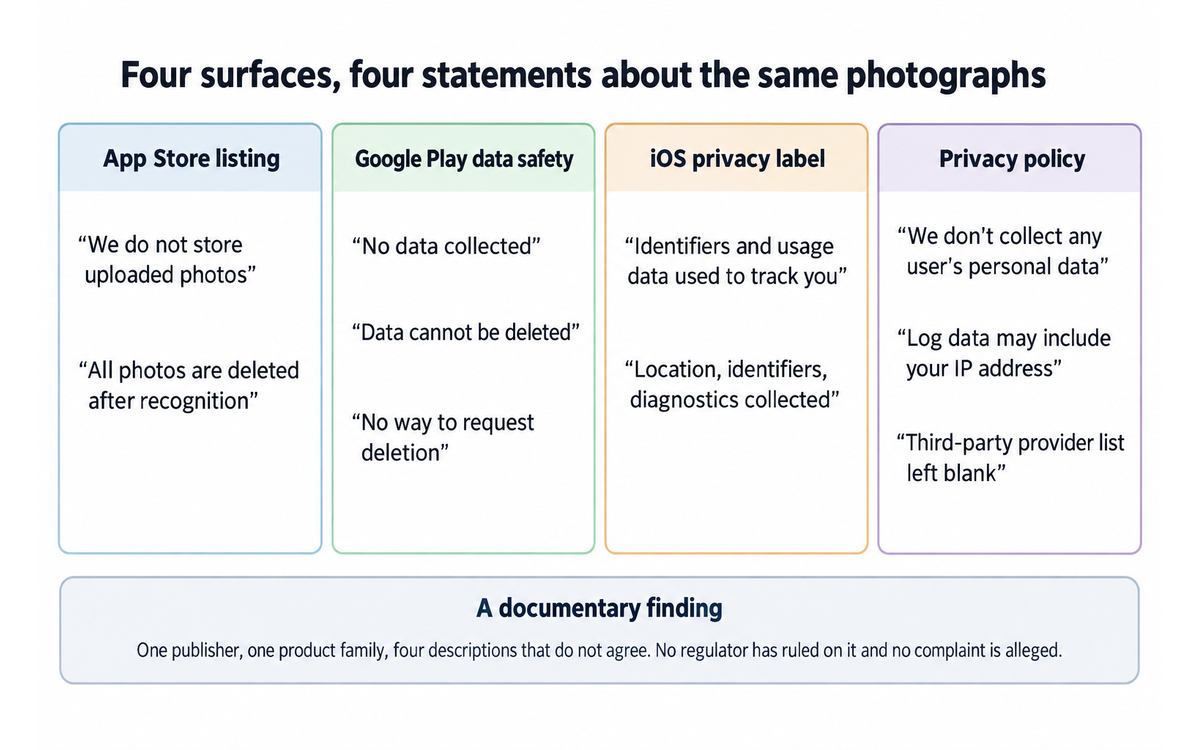
Statement one, the vendor's marketing and listing surfaces, verbatim. From the App Store listing: "We do not store uploaded photos. All photos are deleted after recognition. The photo will be saved only if you want to share it." From the Google Play listing: "Your photos are used solely for the purpose of finding your celebrity match and are not shared with third parties."
Statement two, the vendor's privacy policy, verbatim. "The app uses photos are piked by user to detect face and find similar famous people. We do not store uploaded photos. We store only generated image, when user clicks "Share" button. We generate an image user+celebrity for him and provide url to it. The provided url can be used by user's desire." Three paragraphs later, the same document states: "Generated images keep anonymous, we don't store user's id or name. We don't collect any user's personal data. We don't share photos with 3d-parties."
Why the two statements do not resolve the question. The first statement describes retention of the uploaded image and is a claim about what happens to a face. The second describes retention of a generated composite and is a claim about anonymity. A reader deciding whether to upload a photograph needs to know whether the facial pattern derived from it is retained, where it is retained, for how long, and under whose control. None of the four is answered. The retention claim is also unverifiable from outside: the vendor publishes no method for checking it, while two independent sites trading on the same two words publish exactly such a method, which is to open developer tools, watch the network panel, or disconnect the network and run a match.
Two further inconsistencies inside the same policy. The document claims that it does not collect any personal data, while the same document states that it collects log data through third-party products and that this data may include the device internet protocol address, the device name, the operating system version, the app configuration and the time of use. The same document also says: "The app does use third party services that may collect information used to identify you. Link to privacy policy of third party service providers used by the app", and the list of third-party providers that the sentence introduces is empty. The policy then states that third parties "have access to your Personal Information". So one document contains a no-collection claim, a collection claim, a third-party-access claim and a missing provider list. Separately, the policy states that the service does not address anyone under 13, while the Google Play listing carries a content rating for 3 and above and the iOS listing an age rating of 4 and above. No age gate is described anywhere on any surface.
The app store declarations, which are the developer's own account of the same processing. These are the strongest evidence in the file because a developer signs them, and the two stores for the same developer's own apps do not agree.
Declaration | Google Play, com.starbyface | iOS, id 1499633307 |
Data collected | "No data collected" | "Data Not Linked to You: Location, Identifiers, Usage Data, Diagnostics, Other Data" |
Data shared with third parties | "No data shared with third parties" | "Data Used to Track You: Identifiers, Usage Data" |
Deletion | "Data can't be deleted", and "The developer doesn't provide a way for you to request that your data be deleted" | No equivalent statement in the label |
Encryption | "Data is encrypted in transit" | Not stated in the label |
The Google Play declaration says that no data is collected at all. The iOS declaration, for the other app by the same developer, says that identifiers and usage data are used to track the user across apps and websites owned by other companies, and that location, identifiers, usage data, diagnostics and other data are collected. Both are the developer's own statements about the same product family. The Google Play declaration also says plainly that data cannot be deleted and that no deletion request path exists, which sits directly against a retention promise that the deletion happens automatically after recognition.
The documents a data protection officer would need do not exist on the vendor's domain. The web app at starbyface.com publishes no privacy policy, no terms of service, no cookie notice and no controller information at any address on that domain. None exists at any address on that domain. The privacy policy itself is hosted on a third-party policy-generator subdomain, and its own footer states: "This privacy policy page was created at privacypolicytemplate.net and modified/generated by App Privacy Policy Generator". The policy names no controller, no legal basis for processing, no retention period other than the automatic-deletion sentence, no supervisory authority, no data protection officer and no European representative. Its only contact is a personal Gmail address, and the developer's postal address published on the Google Play developer page is in Kaluga, Russia. The policy also states that the service is an "Ad Supported app" while naming no advertising partner, in a document whose third-party list is blank.
The decision this puts in front of a reader. Three options, and the review names them rather than choosing. Upload a photograph and accept a retention statement that no one can check and that contradicts the developer's own store declarations on the same product family. Upload nothing and use the tool only on publicly published images of public figures, which removes the personal-data question but keeps the unfalsifiable output. Or use nothing and take the teaching value from Workflow 2 in this review without processing a face. For anyone acting on behalf of an institution, the second and third options are the realistic ones, and the personal and non-commercial use restriction in the vendor's own description of the service rules out the institutional framing in any case.
No score changed, and why. Every sub-score in Section 10 is unchanged by this section. The framework measures benefit to the human, the three Humics, and three usage illusions. It has no dimension for data protection, retention or document integrity, so a finding in this section cannot move a score without breaking the method. The Humics rating was set independently, from the comparison surface and the social use of the output, before this section was written. A reader who sees a neutral band next to this section should read the band as a benefit judgement and this section as the governance finding that sits beside it.
What this section does not do. It does not assert that the vendor is processing unlawfully, and it is not a legal opinion on any jurisdiction. It does not claim that photographs are being retained, only that no verifiable statement about retention exists and that the vendor's own documents describe the same processing differently. It does not allege any breach, any incident or any misuse, because none has been reported that this review can find. It does not recommend avoiding the tool, which would substitute a judgement for the reader's own. It states the documents, quotes them verbatim, separates the finding from the allegation, and names the decision.
U365 Co-Intelligence Rating
CI-First Profile
Primary profile: Co-Worker and Assistant (level 2).
Secondary profile(s): None clean, and the reason is worth stating. Coach and Tutor (level 3) is the nearest second fit, and it fits the product rather than the vendor's intent: Workflow 2 in this review turns the tool into a demonstration of what an embedding similarity is not, which teaches a reader something real about how machine comparison behaves on a photograph. That is a use the vendor does not describe, does not support and has not designed for, so it is recorded as a secondary profile a reader can construct rather than as a mode the product offers.
Why level 2. The user supplies a photograph, the system produces a ranked answer, and the user reads it. That is task execution with a human in front of the result, which the framework places at level 2 and which is the same placement used for Klarent, Claude Opus 5.5, MiMo-V2.6-Pro and Rabbit OS3 in this series. Level 1 Co-Creator would mean the human and the tool build on each other's thinking, and nothing here is iterative in that sense: there is one input, one computation and one output.
What does not fit. Analyst and Tester (level 4) requires the tool's primary value to be finding what the user missed. The tool finds nothing the user missed; it answers a question the user already asked, and the answer cannot be checked. Challenger and Devil's Advocate (level 5) does not apply at all. Critic and Evaluator (level 6) does not apply, because the resemblance percentage evaluates a photograph rather than the user's work, and the face-shape classification describes geometry rather than judging an output.
Collaboration Mode
Recommended mode: Centaur.
Alternative mode: None recommended. Cyborg is not appropriate here.
Mode rationale. The framework's Section 7.2 rule is direct: an Imposture Risk of Medium or High means Centaur, because Centaur mode is safer, and the risk here is Medium on the strength of a High Skill Illusion rating. Cyborg requires a fast iteration loop with a stopping criterion the human applies inside it, and there is no loop: one photograph produces one result and the user either accepts it or uploads another. The Centaur boundary that makes this tool safe is procedural and takes three forms. Treat the output as entertainment and nothing more. Never use a photograph of a person who has not agreed, including a colleague, a student, a candidate or a minor. And never carry a percentage from this tool into anything that will be recorded, because the number is a similarity score rather than a measurement and it will be read as a measurement the moment it is written down.
CI-First Benefit Score
Dimension | Score (0-10) | Rationale |
Time | 6 | Real savings for what the tool does. A result arrives in seconds from one photograph, there is no account, no setup, no configuration and no learning curve, and the honest entertainment user is finished inside five minutes. Held below 7 for two reasons that the reviews document. The free tier on iOS shows an advertisement on every new photograph, described by users as roughly ten to twenty seconds each, so a session that runs three photographs pays a minute in interruptions, and the $0.99 purchase exists precisely to remove them. More significantly, the answer is not stable: the same photograph returns different rankings in the male, female and best-pair filters, and a user who wants a preferred result will re-run it, which is the product working as designed and the user's time quietly expanding |
Quantity | 3 | A modest, fixed output. One photograph returns one ranked list of names with percentages, plus one face-shape classification and one set of hairstyle suggestions. The one quantity behaviour in the product is helpful rather than harmful: several matches are returned instead of one, which one reviewer names as the reason for preferring it, because it lets the user pick the name that fits. Against that, nothing is retained, nothing accumulates and nothing compounds: there is no history, no comparison view, no export beyond a single generated graphic, and no second use for the same input. Useful volume per run, and no volume at all across runs |
Quality | 2 | Low, and it is scored from measured absence rather than from measured weakness. The vendor publishes no accuracy figure of any kind on any surface: no benchmark, no test set, no methodology, no definition of what the resemblance percentage is measured against, no database size and no architecture. The one quantitative claim anywhere is that the app compares a face with "thousands of famous faces", which is not a measurement. Independent evidence is contradictory in both directions, with one reviewer calling the app the most accurate of ten lookalike tools tried and another calling it inaccurate and recommending the paid apps instead. The vendor's own listing concedes that matches are a similarity estimate, and the number moves with the filter, the lighting, the angle and the age of the photograph. A quality claim without a measurement is not a quality benefit, and this is the second lowest Quality score URC has recorded |
Skill | 1 | The lowest score in this review, and it is conservative in the direction the framework tells the assessor to be conservative. There is no skill surface at all: one input, no setting that changes the outcome, no technique to learn, no output that can be improved by practice, and no concept the user must acquire to get a better result. Worse than the absence is the direction of learning, because the product presents an unverifiable score beside a face on a surface built for sharing, which teaches a reader to treat a similarity as a measurement. The vendor contradicts that reading in one line most users never open. Clause 5.2.3-a returns a null, so the 1 is URC's judgement rather than a floor, and the High Skill Illusion rating is the reason the judgement is this low |
CI-First Benefit Score: (6 + 3 + 2 + 1) / 4 = 3.0 / 10 (CI-First Neutral)
Why this score is not higher, and why it is not lower
3.0 is CI-First Neutral, and the band label should be read carefully. Neutral is not a synonym for bad. The Time score alone earns the tool a place: it is free, it is instant, it answers its question and the entertainment user gets exactly what was promised for nothing. A reader who wants a five-minute laugh should use it.
The score is not higher because the three dimensions that would have to move are the three that cannot. Quality cannot move because there is no measurement of any kind, from anyone, anywhere, and the vendor's own listing disclaims the reading the number invites. Skill cannot move because there is nothing to learn and one false lesson on offer. Quantity cannot move because the output is fixed and nothing persists. Two of the four dimensions sit at or near the bottom of the scale, which is a structural reason rather than a critical one.
The score is not lower for one reason and it is not a small one. The vendor states the limits of its own product in plain language on its own listing: "Star By Face is made for entertainment. Matches are a similarity estimate." A novelty that tells you it is a novelty is not deceiving anyone. Rabbit OS3 scored 4.5 with a Humics-Risky badge and a Quality of 4; this tool scores below it because it delivers a smaller benefit and adds a data-protection finding to the ledger, and it does not fall to the bottom band because nothing about the product is dishonest, the price is zero, and the entertainment value is genuine. On those three facts the tool clears the floor of the band it sits in, and no further.
Humics Protection Badge
Dimension | Rating | Rationale |
Creativity | Neutral (0) | The tool neither sparks nor replaces the user's own ideation. It answers one fixed question with one computed ranking, and it has no surface on which a user could create anything beyond the share image the system generates. The use cases people invent with it are the users' own work rather than the tool's contribution, and the output itself gives nothing to build on. A tool this narrow cannot erode a capability it never touches, and it does not strengthen one either |
Critical Thinking | Erodes (-1) | One mechanism, documented in the vendor's own documents and in one published guide. A number appears beside a face, is read as a confidence figure or a measurement, and is not one. The vendor's listing says the matches are a similarity estimate in one line, and a news guide written about the product during its September 2026 trend repeated the opposite reading, calling the percentage something that tells you how much you resemble a celebrity. Nothing on the product surface corrects the reading, no method is published that would let a user test it, and the app store declarations differ between the two stores on the same product family, so a user attempting to check anything finds contradictions rather than an answer. The mitigation is cheap and it is available to any reader of this review: run the same person through the tool twice with different photographs and watch the number move |
Social Authenticity | Erodes (-1) | The tool's headline output is a system-generated statement about the user's own face, produced for publication. A share image pairs the user's photograph with a celebrity's and carries a resemblance score, and the standard use is to post it, which places a machine's judgement about a person's appearance into that person's social presentation as though it were an observation of their own. The second mechanism is the group case in Workflow 3, where a room runs several people through the tool and the results are read together, which converts a model's ranking of photographs into a ranking of the people present. Clause 4.2-a returns a null, and it must be stated that the null is not what produces this rating: the clause governs agent-authored text presented as a person's voice and agent interaction substituting for human contact, and this tool writes no prose and has no conversational agent. The erosion sits in the artefact and in the social format, outside the clause |
Humics Protection Score: 0 + (-1) + (-1) = -2 / +3 Badge: Humics-Risky
This is the fifth Humics-Risky badge URC has recorded, after Rabbit OS3, ElevenLabs, Jason AI and Manus AI, and the reason is different from all of them. Rabbit OS3 was risky for what an agent could do in a user's accounts. ElevenLabs was risky on the dubbing and cloning surface. Star By Face is risky because it turns a person's face into a score and puts it in front of other people. The badge does not mean the tool should be banned, and it does mean a user should know what they are holding. The mitigations are in the guidance below, and they are entirely within the user's control: do not post the share image, do not run the tool on anyone else, and do not carry the number into any record.
Superhuman Usage Guidance
When to invite this tool:
You want a five-minute, free, harmless answer to a curiosity question about your own face, and you are willing to accept that the answer is a similarity score rather than a measurement.
You are teaching what a face-embedding similarity is and what it is not, and you want a tool whose behaviour a class can observe in one sitting. Workflow 2 in this review is that lesson, and it is the strongest use of the product that exists.
You want a demonstration of how a model output becomes a social artefact, for a discussion of appearance comparison, biometric advertising or viral consumer AI.
You need a group icebreaker where every participant has agreed in advance and every result is treated as a joke in the room where it is read.
You want the face-shape and hairstyle suggestions, which describe geometry rather than evaluating a person, and which you treat as a suggestion from a pattern classifier.
When to keep this tool out:
Any photograph of a person who has not agreed to have it processed, including a colleague, a student, an applicant, a minor or a stranger. This is the line that matters most, and the vendor's own statement that the service is for personal and non-commercial use puts institutional use outside its scope in any case.
Any decision about a person, at any stage of any process. The tool is not an identification instrument, not a verification instrument, not an attractiveness or appearance score, and the vendor says so.
Any research, clinical, admissions, hiring or assessment context. The output is unfalsifiable and the input is a face, which is the worst pair of properties a research instrument can have.
Any institutional record. Do not write a resemblance percentage into a document, a profile, a report or a system of record, because once written down it will be read as a measurement and it is not one.
Any use where the image retention question matters and the answer cannot be verified. Section 7c records that the vendor's own documents describe the same image differently, so a use that depends on the retention claim is a use that cannot be supported.
Any cohort activity where the results would be read as a ranking of the participants, and any sharing of a generated image that includes a person who was not asked.
Anything you would not be comfortable explaining afterwards. The test is simple and it is the right one: if the photograph contains someone who has not agreed, stop.
U365 method integration:
CI-First: this tool is a clean negative teaching case for the Skill dimension. It presents a computed number with no published method, on a surface designed for sharing, and the number is then read as a measurement. Use it in a session on Imposture Risk as the worked example of Skill Illusion in a product with no skill surface at all.
ULM + EVA: relevant to Character and to Quality of Life, in opposite directions. Character, because the discipline of not running a friend's photograph through a novelty app without asking, and of not repeating a score as though it meant something, is a small and real ethical practice. Quality of Life, because the entertainment value of five minutes with the tool and a group of people is real and costs nothing.
LIPS + CARE: the Execute phase is the upload and the Review phase is the reading, and the Review phase is where the tool fails its user. LIPS asks for source-aware retrieval and citation, and this tool offers neither a source for its score nor a way to check it, which makes it a useful contrast case when teaching what a verifiable output looks like.
UP-Context: not applicable in the usual sense, because the tool takes no instruction, no context and no profile. It cannot be briefed. The relevant lesson is negative and worth stating: a tool that cannot receive context cannot be aligned to your intent, and this one has exactly one setting, which is a photograph.
SL-OS and U.Copilot: no integration exists and none is possible. There is no API, no account, no export beyond a generated image and no data surface, so nothing about this tool can be brought into a workspace.
Over-delegation warning. Two failure modes, and the second is the one to watch.
The first is the familiar one from this series. If the user's own judgement stops being exercised because a machine produced a number, the Human Intelligence term falls while the Artificial Intelligence term stands still, and the product falls with it. Here that shows up as a person repeating a resemblance percentage as though it described them.
The second is specific to this tool and it is a social failure rather than a cognitive one. The share image is a system's judgement about a person's appearance, generated for publication, and the person publishes it as their own. That is the exact condition the Humics framework calls erosion of Social Authenticity: the tool replaces the user's own voice about themselves with a model output, and the user carries it. The discipline that prevents it costs nothing: keep the result in the room, do not post the graphic, and if you do post it, say what it is.
What Users Say
Star By Face has a large consumer review corpus on the two app stores and nothing at all anywhere else. That split is the finding, and the honest version of this section reports the corpus as it is, including the parts of it that do not agree.
Aggregate Rating Table
Platform | Rating | Number of reviews | Link |
App Store, iOS, id 1499633307 | 3.7 out of 5 | 1.6 thousand ratings | apps.apple.com/us/app/star-by-face-celebs-look-alike/id1499633307 |
Google Play, com.starbyface | 4.7 out of 5 as printed at the top of the listing, 5.91 thousand reviews | about 5.9 thousand reviews | play.google.com/store/apps/details?id=com.starbyface |
Google Play, same listing, reviews block | 3.8 out of 5 as printed inside the same page's reviews section on a different read | about 5.9 thousand reviews | play.google.com/store/apps/details?id=com.starbyface |
Google Play, same app, regional listing | 3.7 out of 5 | 5.82 thousand reviews | play.google.com/store/apps/details/Star_by_Face_celebrity_look_a |
Trustpilot | No rating and no review count could be established for this product, so no figure is quoted. Recorded as not judged rather than as empty | trustpilot.com/review/starbyface.com | |
G2 | No reviews found. The product is not listed as an enterprise application | g2.com | |
Capterra and GetApp | No reviews found | capterra.com, getapp.com | |
Product Hunt | No reviews found for this product | producthunt.com |
The Android listing is the one to look at twice, and the reason is methodological rather than editorial. The same page prints 4.7 beside a review count at the top and 3.8 inside the reviews block, and a regional version of the same listing prints 3.7. The iOS listing, which is the developer's own app rather than a lookalike app by another company, holds 3.7 from 1.6 thousand ratings. The most defensible reading is that the product's community rating sits somewhere between 3.7 and 4.7 depending on the surface and the region, and a reader should treat the spread rather than any single figure as the result. What the spread rules out is a claim that any one of those numbers describes user sentiment across the product.
What Users Praise
Accuracy relative to the alternatives. "Out of all the celebrity look alike apps that i tried, this was the most accurate." (App Store review, iOS listing, read 2026-09-25.) This is the most favourable single statement in the corpus and it is a comparative claim against other apps rather than a claim about the tool in absolute terms.
Several results instead of one. "The other apps I tried gave one crappy result. Usually someone I never even heard of. Sometimes the wrong gender. Completely useless. This one gives several so you can at least find one that is an actual celebrity." (App Store review, iOS listing, read 2026-09-25.) The quantity behaviour in this product is a genuine advantage over its own category, which is why Quantity is not scored at the floor.
The category filters. One reviewer names the ability to select the gender as the reason for continuing with the free tier.
Free with an option to remove ads. "I want to give at least four stars, just because it's decent and there's an option to pay to get rid of ads." (Google Play review, read 2026-09-25.) The 0.99 dollar in-app purchase is the only price in the product and users treat it as fair.
It is fun with other people. "Fun with friends good for a laugh and maybe even an ego boost (or not, I guess depending on the result)." (App Store review, iOS listing, read 2026-09-25.) That sentence names the social mechanism in the Humics rating, unironically, which is worth recording.
What Users Complain About
The advertisements. The most repeated complaint in the corpus by a distance. "There were ads every time i tried a new picture (it) gave an ad which got pretty annoying." (App Store review, iOS listing, read 2026-09-25.) The $0.99 purchase exists to answer it.
Results that do not match the person's own reading of the photograph. "I uploaded a picture and it said I look like someone that looks totally different. I have textured hair and I'm pretty light but it said I looked like someone with barely any hair and he was way darker than me. In my opinion the only good ones are probably the ones where you have to pay money because this app is not accurate at all." (App Store review, iOS listing, read 2026-09-25.) This is the sharpest negative in the corpus and it describes the category's central failure mode: the output is a comparison of one photograph against a database, and the user experiences it as a claim about their face.
Inconsistency between runs and sensitivity to conditions. "Pretty accurate, sometimes is based on lighting or position which isn't good, sometimes not accurate at all, or on rare occasions extremely correct." (Google Play review, dated July 2026, read 2026-09-25.) The same observation is repeated across other reviews and across the independent press coverage.
Scepticism that any real matching is happening. "To be honest, it's BS. Every time I make a photo, the App shows me the humans looking nothing even close like me. Hell, it cannot even detect what age and which skin color the person on the photo has!" (Google Play review, dated December 2021, read 2026-09-25, marked by the platform as helpful to 101 people.) The reviewer's specific allegation that no basic face detection is running is not supported by anything else in the corpus and is not repeated here as a finding.
A photograph left on the device. "Only reason it's a three star is because it takes up a lot of my picture space and then I can't even delete it because I would if I favored it and this makes me really mad." (App Store review, iOS listing, read 2026-09-25.) A local storage complaint rather than a privacy one, and it belongs in the record because it is what users actually report.
Missing obvious matches. "But a friend that looks almost exactly like Jack Johnson didn't have that musician show up!" (Google Play review, dated December 2024, read 2026-09-25.) The reviewer is describing a gap in the database rather than an error in the matching, and the vendor publishes no database size that would let anyone check.
Sentiment Summary
The corpus is polarised in the way a novelty product's corpus is polarised, and it is polarised on accuracy. The positive reviews are comparative: this app is better than the other lookalike apps. The negative reviews are absolute: this app said something that is not true about my face. Both groups are describing the same behaviour. One reviewer names the mechanism accurately without meaning to, complaining that the app could not detect age or skin colour, when the product is built to compare facial geometry and was never asked to classify either. The advertisement complaint is the only one that is unanimous and consistent, and it is a pricing complaint rather than a product complaint.
U365 Editorial Note
Nothing in this corpus is a measurement. Every rating here is an opinion about entertainment, and the ratings do not agree with each other across two stores for the same product. A reader should treat the agreement between the iOS and Android reviewers on one point, which is that the output is sensitive to lighting, angle and photograph quality, as the only reliable signal in the corpus. It happens to be the signal that matters, because it is the same thing the vendor says in its own listing and the same thing the framework treats as the difference between a similarity score and a measurement.
Comparison and Alternatives
The alternatives divide into three groups: the other lookalike tools, the general assistants that will do the same thing from a photograph, and doing it yourself. Each is described with the choice it implies.
Alternative | How it differs | Choose it if |
starbyface.net | An independent browser-based finder on the same two words. It runs detection and matching locally with WebAssembly models and a bundled celebrity library, publishes the full technical chain including the crop size and the embedding dimension, publishes a method for verifying that no image leaves the device, and is candid that the score is a similarity rather than a probability. It is not affiliated with the reviewed product | You want the same entertainment without uploading a face to anyone, and you would rather have a vendor that shows you how to check the claim than one that asks you to trust it |
CapCut templates and the wider short-video effects ecosystem | The September 2026 lookalike trend ran mostly through CapCut templates rather than through this app, according to the coverage of the trend. The effect is delivered inside a video editor that the user already has, with the matching and the output handled as a template | You met the trend through a video editor rather than through a website and you want the format rather than the answer |
A general assistant with vision | Send a photograph to a multimodal model and ask which public figures the person resembles. The answer arrives as prose with reasons attached, which is more useful than a name and a percentage, and it is produced by a system you may already be using | You want an explanation rather than a score, and you accept that the answer is an opinion from a model rather than a comparison against a fixed library |
Photo and face-shape styling tools | Several apps on the same app stores classify face shape, jawline and proportions and return styling advice. They address the one output of Star By Face that has a practical use, and they do it without the celebrity comparison and without the social artefact | You actually want the face-shape and hairstyle guidance rather than the entertainment, which is the only practical reason to use this product |
Asking a friend, or looking at your own photographs | Free, offline, requires no upload, and it understands context that no model has. It is also the approach every one of the independent sites on this name admits is more reliable | You want an honest answer about resemblance rather than a score, which is the only reading of the question that any of these tools can actually support |
Building the pipeline yourself | Detection, alignment, a 112 by 112 crop, an embedding model, a reference gallery and a cosine similarity ranking is a standard computer-vision exercise, and it can run entirely inside a browser or a lab machine with no third party involved | You are at UIT and the point is to teach or learn the pipeline. Workflow 2 in this review is the lesson, and building it openly is better than observing it as a black box |
The short version. If you want the entertainment, the reviewed product is fast, free and pleasant, and it is the most installed name in its category. If you want the same entertainment without handing a face photograph to an unnamed server, the independent site on the same name gives you that and shows you how to check it. If you want an explanation rather than a score, ask a vision model. If you want the styling advice, use a styling tool. And if the point is to understand how any of this works, build the pipeline or run the two-photograph test in Workflow 2, because that is the one thing this class of tool teaches well and it does not teach it on purpose.
Verdict and Next Steps
Verdict. Star By Face scores 3.0 out of 10, which is CI-First Neutral, and the band label is the honest one. The tool is not dangerous, it is not deceptive about its own purpose, and it costs nothing. It is also not useful in any sense that survives the five minutes it takes to run it, it publishes no measurement of anything, it teaches a false reading of its own headline number, and the documents that govern what happens to a face photograph do not agree with each other. For a reader who wants a five-minute laugh with people who have agreed to it, that is a fair trade. For anyone acting on behalf of an institution, there is nothing here to adopt, and Section 7c is the section to read before deciding anything at all.
What is genuinely good. The speed, the price, the fact that the vendor says on its own listing that the matches are a similarity estimate, and the face-shape output, which is the one part of the product with a practical use. All four are real and none of them is being discounted.
What the score turns on. Quality 2 because there is no measurement of any kind from anyone, and Skill 1 because there is nothing to learn and one false lesson on offer. Those two dimensions account for most of the distance between this score and the band above it.
Next steps for a reader:
If you are only curious, go and use it. Use your own photograph with one clearly visible face, run it, and close the tab. Five minutes, no cost.
Before you do, read Section 7c. It takes two minutes and it is the only part of this review that could change your mind.
Run the two-photograph test in Workflow 2 once. It is the fastest available demonstration that the number describes a photograph rather than a person, and it takes one minute longer than the ordinary run.
Do not post the share image without telling people what it is, and do not post it at all if anyone in it has not agreed.
Do not run the tool on anyone else's face, including a colleague, a student, an applicant or a minor.
Never write a resemblance percentage into a document, a profile or a system of record. The moment it is written down it will be read as a measurement, and it is not one.
U.Copilot: no integration path exists
There is no integration path and none can be built. Star By Face exposes no API, no account, no data export beyond a single generated image and no authentication surface, so there is nothing for U.Copilot to call and nothing for it to store. The tool does not fit the workspace model at any level.
SL-OS: no integration path exists
The same answer, and for the same reason. SL-OS is built around a Microsoft-centred workspace where tools surface results into channels and records that the organisation already governs. This product has no integration surface, no administrator console, no single sign-on and no data the organisation could bring inside its perimeter. It is a consumer novelty with a single input and a single output, and it does not belong in an operating system for work.
Tool to skill to credential
There is no credential pathway for a consumer novelty, and the honest answer is that this tool has no place in one. The tool does have a legitimate role as a teaching object, and there is one skill worth naming.
No published U365 credential assesses any competency this tool exercises. That is the finding, and it is not a defect in the catalogue. It is a statement about the product: it removes the work rather than teaching it, and a U365 credential assesses what a Fellow can do rather than what a product can do for them. The Skill sub-score of 1 records the same thing from the scoring side. Each row below names the nearest published programme a Fellow could enrol in and states what that programme does not publish. An adjacent anchor is useful to a Fellow who wants the neighbouring skill. It is not a credential claim.
Tool skill | U365 competency | Credential | Institute |
Reading a ranked output as the kind of quantity it actually is: telling a similarity score from a probability, a confidence figure and a measurement, and knowing which questions a ranked list cannot answer | Model-output interpretation and evidence appraisal, the core transferable competency of this review | No published U365 programme assesses model-output interpretation or similarity metrics. A verified term search over all 79 published programme descriptions returned zero matches for similarity, cosine, measurement, computer vision, image recognition and face recognition. The nearest published anchors, and what each does not publish: Data Scientist (60 days, modules include Statistics and Probability) teaches statistical method rather than the reading of a model's own similarity score; Data Analyst Expert (84 days, modules include Statistics Essentials, Data Mining, Data Visualization, Power BI, Tableau and SQL) teaches analysis of data the analyst owns rather than appraisal of a model's ranked output; AI Developer Specialist (18 days, modules include Deep Learning Foundations with TensorFlow, Transformers and BERT, and Introduction to Responsible AI Algorithm Design) comes nearest on the responsible-AI side and publishes no evaluation or metric-interpretation outcome. These are adjacent anchors, not assessment homes | UIT (Technology, AI, Data Science) |
Reading a consumer product's own documents against each other: the retention statement, the privacy policy and the two app-store data declarations, and deciding what a face photograph is exposed to | Data-protection literacy applied to a consumer AI product, which is the Section 7c finding | No published U365 programme assesses privacy, data protection or biometric-data governance, and this is a verified gap rather than an assumption: a term search over all 79 published programme descriptions returned zero matches for GDPR, data protection, privacy, biometric and face recognition. The nearest published anchors that carry an ethics module, and what each does not publish: AI Creator Professional (30 days) publishes a module titled Opportunities, Issues, and Ethics and teaches generative-image tools rather than data governance; Master of Science in IT, M.Sc. 2/2 (224 days) publishes Digital Tech Ethics and Social Responsibility; Master in Communication and Marketing, M.C. 2/2 (224 days) publishes Ethics and Corporate Responsibility in Marketing; Entrepreneur (25 days, module list includes Business Law) publishes legal foundations for a venture. None publishes a retention, consent, controller-obligation or special-category-data outcome, and it is recorded here as a curriculum gap | |
Running a controlled comparison and treating a moving output as evidence about the input rather than about the person, which is the two-photograph test in Workflow 2 | Experimental discipline and source appraisal: holding conditions constant and reading a result against the method that produced it | No published U365 programme assesses experimental design against a model's own output. The nearest published anchors, and what each does not publish: Business Analysis Professional (60 days, modules include Business Analysis Foundations, Agile Requirements, Business Benefits Realization and Business Process Modeling) publishes requirements articulation and process modelling rather than test design; Data Analyst Expert (84 days) publishes statistical essentials and data preparation rather than controlled comparison against a model. These are adjacent anchors, not assessment homes | UIT (Technology, AI, Data Science) |
Analysing why a trivial utility spread and what a generated share artefact does once a person posts it | Media-effect analysis and the ethics of a system-generated artefact about a person | No published U365 programme assesses the analysis of a virality trend or the ethics of an appearance artefact. The nearest published anchors, and what each does not publish: Social Media Marketing Manager (30 days, modules include Social Media Strategy and Optimization, Copywriting for Social Media, Content Creation Strategy, TikTok and Instagram Reels, and Stories) assesses creating and measuring social content rather than analysing how a trend spread; Content Marketing Specialist (30 days, modules include Content Strategy, Producing and Promoting Live Video and SEO Content Writing) assesses content planning and reach; Social Media Advertising Assistant (30 days) assesses paid distribution. None assesses the ethics of publishing a system-generated judgement about a person's appearance, which is the competency this tool creates a need for | UIC (Digital Communication, Marketing), and no credential mapped |
Level | What it is | Fit |
Tool | Star By Face, a photograph in and a ranked list of celebrity names out | The tool itself |
Skill | Reading a model output as the kind of quantity it actually is: telling a similarity score from a probability, a confidence figure and a measurement, and knowing which questions an output cannot answer | This is the only transferable skill, and the tool teaches it by getting it wrong |
Micro-credential | None. No U365 micro-credential is proposed on the basis of this tool, and no published U365 credential assesses the competency either | Not applicable |
Institute alignment | See U365 Institutes Alignment |
Four rows, every programme anchor published and readable, and each row stating what it does not cover. No degree chain is asserted, no credit transfer is claimed, no per-programme access level is asserted, and every anchor is a diploma or a certificate a Fellow can find and enrol in.
The skill in the middle table is the one thing a reader can take away, and it is worth stating plainly because it is the reason this review exists at all. A model that ranks by similarity produces a number that is not a probability, and a user who cannot tell the difference will carry a false measurement into a decision. That lesson generalises far beyond celebrity lookalikes: it applies to every retrieval score, every recommendation ranking, every confidence figure a system prints, and every generated similarity in a research pipeline. Star By Face is a cheap and entertaining way to learn it.
Two competencies this review exercises have no assessment home in the published catalogue, and they are recorded as gaps rather than filled with a plausible programme name. The first is model-output interpretation and evidence appraisal: reading a ranked or scored model output as the quantity it is, and telling a similarity from a probability, which is teachable independently of any product. The second is consumer data-protection and biometric-adjacent data governance: retention statements, controller obligations, special-category-data conditions for a facial image, and the reading of two app-store declarations against each other, for which Section 7c is the worked case. Neither gap is a current programme, neither has a micro-credential, and neither is presented as one.
U365 learning resources for this tool
Related micro-course: none currently available for this tool.
Faculty commentary: Hubert Graef, Dean of Research. The finding worth putting in front of a reader is this: the most useful thing this tool does, it does by accident. It prints a percentage beside a face, a user reads it as a measurement, and the number moves the moment the photograph changes. Run the same person through it twice in different light and the misreading corrects itself in about a minute. Better that a student meets that lesson in a lookalike app, where nothing is at stake, than in a research pipeline where a ranking score is quietly carrying a decision. The second thing worth saying is about the documents. This is a free novelty with a privacy policy generated from a template, hosted on a policy generator's subdomain, with the third-party provider list left empty, and the vendor's own two app store declarations describe the same product's data differently. That is what the data position of a consumer AI product often looks like once the documents are actually read, and reading them is the habit worth building.
How-To Hub content: none currently available for this tool. The candidate article is the two-photograph test in Workflow 2, which works with any face-matching tool and needs no download.
Further reading: the tool reviews named in Comparison and Alternatives above, and the U365 Tools Reviews index at https://www.university-365.com/tools.
Migration Path
Not applicable. Star By Face is Active and carries a narrow recommendation for the entertainment use only, so no Migration Path is built and none is required. A re-check trigger that retired the tool would change this section, and the triggers are stated at the top of this review.
U365's Recommendations to Learn More
Every link below was read on 2026-09-25 and resolves. The list is deliberately short: this product publishes almost nothing, and padding it with generic AI channels would not help a reader who wants to understand this one.
Official learning resources
The product's own web app, which is the whole product surface and the only place the vendor describes the process: https://starbyface.com/
The developer's app store listing for the iOS app reviewed here, which carries the retention statement, the ratings and the Data Used to Track You declaration: https://apps.apple.com/us/app/star-by-face-celebs-look-alike/id1499633307
The developer's Google Play listing, which carries the data safety declaration and the developer contact details: https://play.google.com/store/apps/details?id=com.starbyface
The Google Play data safety page for the same app, which is where the no-collection and no-deletion declarations are stated separately: https://play.google.com/store/apps/datasafety?id=com.starbyface
The privacy policy, hosted on the policy generator's subdomain rather than on the vendor's own domain, and the operative document for everything in Section 7c: https://pages.flycricket.io/star-by-face/privacy.html
The developer's support address, which is the only contact published anywhere for the product: mailto:starbyface.app@gmail.com
Video tutorials and channels
The video cited below is the closest published account of the celebrity-lookalike trend that resolves as of 2026-09-25. It is a first-person account rather than a tutorial, which is the honest description of what exists for this product.
"The Celebrity Lookalike App is Great", a short first-person account of the trend and the result it produced: https://www.youtube.com/watch?v=MfDV5uRhmh4
The Celebrity Lookalike App is Great by PolarSaurusRex
Written tutorials and deep-dive articles
The Tab, "Here's how to do that viral Celebrity Look-alike trend from TikTok with Star By Face", published 2026-09-14, which is the guide that spread the product and which describes the percentage as a figure telling you how much you resemble a celebrity. That sentence is the misreading this review is written to prevent: https://thetab.com/2026/09/14/heres-how-to-do-that-viral-celebrity-look-alike-trend-from-tiktok-with-star-by-face
Know Your Meme, "Celebrity Lookalike Trend / Star By Face", the reference entry for the trend: https://knowyourmeme.com/memes/celebrity-lookalike-trend-star-by-face
Mums Lounge, "The TikTok My Lookalike Trend Explained", which gets the mechanism right in plain language and states that the app is comparing shapes rather than reading the person: https://mumslounge.com.au/latest-news-2/the-tiktok-my-lookalike-trend-explained/
Piclumen, "StarByFace Review 2026", an independent review published 2026-09-17 which states that results are similarity estimates and can change with angle, lighting, expression and image quality: https://www.piclumen.com/blog/starbyface-review/
Revoyant, "Star By Face App Review", an independent review that repeats the vendor's three-step description: https://www.revoyant.com/blog/star-by-face-review-best-celebrity-app
VideoSDK's listing of the product, which reproduces the vendor's own FAQ answers including the statement that the service is for personal and non-commercial use only: https://www.videosdk.live/ai-apps/starbyface
The comparison piece worth reading next to this review, written by a competitor on the same name and stating its own weaknesses first: https://starbyface.net/blog/best-celebrity-look-alike-tools/
The regulatory document behind Section 7c, the UK Information Commissioner's Office guidance on special category data, which defines biometric data as special-category data where it is used for identification purposes: https://ico.org.uk/for-organisations/uk-gdpr-guidance-and-resources/lawful-basis/special-category-data/what-is-special-category-data/
Community and social
No community discussion of the reviewed product was found anywhere. There is no subreddit thread, no forum thread, no community corpus and no enterprise review listing. The two app store listings are the entire community record, which is why What Users Say reports the spread between them rather than a single number.
Resources on X and Star By Face
Dedicated X channels
The product has no account of its own on X, so the accounts worth following are the ones covering consumer AI, viral face technology and data protection rather than this vendor:
The ICO on X, for data protection guidance and enforcement in the United Kingdom: https://x.com/ICOnews
Know Your Meme on X, which tracks consumer trends including this one: https://x.com/KnowYourMeme
The image below is a still from the video cited in this section, and it is the closest published visual record of the trend that resolves for this review.

Curation policy: every source here was chosen for what it teaches a reader that this review does not. Community and competitor sources are labelled as such. Promotional and affiliate material is excluded.
Glossary
CI-First Benefit Score
The average of four dimensions, each scored 0 to 10: Time, Quantity, Quality, and Knowledge and Skill. It answers whether using the tool makes Co-Intelligence more profitable than Human Intelligence alone. Bands: 0 to 2.0 CI-First Negative, 2.1 to 4.0 CI-First Neutral, 4.1 to 6.0 CI-First Positive, 6.1 to 8.0 CI-First Strong, 8.1 to 10.0 CI-First Transformative. The score accounts for the overhead of prompting, supervising and verifying, not just the benefit the tool produces. Star By Face scores 3.0.
CI-First Profile
The role the AI plays in your working relationship. (level 1) Co-Creator and Thought Partner, (level 2) Co-Worker and Assistant, (level 3) Coach and Tutor, (level 4) Analyst and Tester, (level 5) Challenger and Devil's Advocate, (level 6) Critic and Evaluator. Lower level numbers indicate higher AI autonomy. Assigning a profile before giving the AI a task is a core CI-First discipline. Star By Face is a Co-Worker and Assistant (level 2). The Coach and Tutor fit is one a reader has to construct, because the vendor does not describe it.
Humics Protection Badge
A rating of whether a tool protects, leaves neutral, or erodes three human capabilities: Creativity, Critical Thinking, and Social Authenticity. Each is scored +1, 0, or -1, and the sum gives the badge. +2 to +3 is Humics-Friendly, -1 to +1 is Humics-Neutral, -2 to -3 is Humics-Risky. It measures whether the tool strengthens the human or contributes to AI Obesity. Star By Face is Humics-Risky at -2 / +3: Creativity neutral, Critical Thinking eroded, Social Authenticity eroded.
AI Imposture Risk
The likelihood that a tool traps you in one of three illusions. The Time Illusion is the appearance of saving time when net time is lost. The Quantity Illusion is high volume that looks good but does not survive inspection. The Skill Illusion is the appearance of competence in you while the underlying skill is absent or eroding. Each trap is rated Low, Medium, or High with cited evidence, and the overall level is Low when all three are Low, High when two or more are High. Star By Face is Medium overall, with Skill Illusion High.
User Sentiment
The aggregated public opinion from review platforms, community forums and repository activity. It is reported separately from the CI-First score because crowd sentiment can contradict a rigorous evaluation. Where the two agree, the finding is stronger. Where they diverge, the divergence is worth explaining. For a consumer novelty with only two app store listings and no independent review corpus, the honest report is the spread between the two listings and the polarisation inside each of them.
Review Status
Review Status records the current standing of the tool at the time of the last test. Active: the tool is current and recommended. Active (updated): recently re-checked and the content was refreshed. Changed: a re-check trigger fired and an update is pending, so read the review with that in mind. Risky: the tool has significant unresolved issues, or it has been clearly surpassed by newer alternatives. Use it with caution and read the Limits section. Stale: this review has not been re-checked in over 6 months, so treat details such as pricing and features as unverified. Retired: the tool still works but is no longer recommended. Deprecated: the tool has been shut down or fundamentally changed. Retired and Deprecated posts include a Migration Path section. Star By Face is Active, with a narrow recommendation that covers the entertainment use only.
Sources
Vendor primary sources
StarByFace, product home page, for the three-step description of upload, face detection and neural network comparison, the photo guidance on a single frontal face and image quality, and the support address: https://starbyface.com/
StarByFace, privacy policy, for the face data section, the retention statement, the third-party statement, the log data section, the children's privacy section, the contact address and the policy generator footer: https://pages.flycricket.io/star-by-face/privacy.html
Dmitry Statsenko, App Store listing for Star by Face: celebs look alike, id 1499633307, for the retention statement, the entertainment disclaimer, the 1.6 thousand ratings at 3.7 out of 5, the Data Used to Track You and Data Not Linked to You declarations, the 0.99 dollar ad-removal purchase and the Kaluga, Russia developer address: https://apps.apple.com/us/app/star-by-face-celebs-look-alike/id1499633307
StarByFace, Google Play listing for Star by Face: Celeb Look Alike, com.starbyface, for the description, the thousands of famous faces claim, the ratings and review counts, the three app reviews quoted in Section 9 and the developer contact details: https://play.google.com/store/apps/details?id=com.starbyface
StarByFace, Google Play data safety page for the same app, for the no-data-collected and no-data-shared declarations, the encryption statement and the statement that data cannot be deleted: https://play.google.com/store/apps/datasafety?id=com.starbyface
Independent and third-party sources
The Tab, "Here's how to do that viral Celebrity Look-alike trend from TikTok with Star By Face", published 2026-09-14, for the step-by-step guide, the 24 results figure and the sentence describing the percentage as a figure telling you how much you resemble a celebrity: https://thetab.com/2026/09/14/heres-how-to-do-that-viral-celebrity-look-alike-trend-from-tiktok-with-star-by-face
Know Your Meme, "Celebrity Lookalike Trend / Star By Face", for the trend reference entry: https://knowyourmeme.com/memes/celebrity-lookalike-trend-star-by-face
Mums Lounge, "The TikTok My Lookalike Trend Explained: How It Works, Why It's So Hit-or-Miss, and Whether You Should Be Wary", for the mechanism explained in plain language and for the statement that the comparison is of shapes: https://mumslounge.com.au/latest-news-2/the-tiktok-my-lookalike-trend-explained/
Piclumen, "StarByFace Review: How Accurate Is It and What's a Good Alternative?", published 2026-09-17, for the independent review, the quick-answer table and the statement that results are similarity estimates sensitive to angle, lighting, expression and image quality: https://www.piclumen.com/blog/starbyface-review/
Revoyant, "Star By Face App Review: Best Celebrity Look-Alike Finder Right Now", for an independent review repeating the three-step description and the advertising-funded pricing position: https://www.revoyant.com/blog/star-by-face-review-best-celebrity-app
VideoSDK, Starbyface listing, for the vendor FAQ answers reproduced in full, including the personal and non-commercial use restriction and the 3-day free trial description: https://www.videosdk.live/ai-apps/starbyface
Star By Face (starbyface.net), "The Best Celebrity Look Alike Tools, Compared Honestly", for the independent competitor comparison and the contrast between server-side and in-browser processing: https://starbyface.net/blog/best-celebrity-look-alike-tools/
Star By Face (starbyface.net), privacy page, for the in-browser architecture, the verification method and the explicit statement that the site is not affiliated with any other site using similar words: https://starbyface.net/privacy
StarByFace.org, privacy page, for the second independent in-browser implementation and its own date of last update: https://starbyface.org/privacy
Information Commissioner's Office, "What is special category data?", for the definition of biometric data as special-category data where it is used for identification purposes: https://ico.org.uk/for-organisations/uk-gdpr-guidance-and-resources/lawful-basis/special-category-data/what-is-special-category-data/
YouTube, "The Celebrity Lookalike App is Great", for the one video cited in this review: https://www.youtube.com/watch?v=MfDV5uRhmh4
Not related to this vendor, and named so a reader does not confuse them
Star By Face: Celeb Lookalike, App Store id 1633698910, sold by WOWOO LTD, carrying an auto-renewing weekly subscription: https://apps.apple.com/us/app/star-by-face-celeb-lookalike/id1633698910
Star by face, App Store id 6753176760, sold by WhatsGoodApps LLC, a photo-transformation app: https://apps.apple.com/us/app/star-by-face/id6753176760
Star By Faces: https://starbyfaces.com/
StarByFace.org: https://starbyface.org/
Searches that returned no result
No product listing and no reviews found for the reviewed product on G2, Capterra, GetApp or Product Hunt.
No community discussion of the reviewed product was found on any forum or community platform.
No vendor account on X, and no dedicated social channel of any kind for the reviewed product.
No published accuracy figure, benchmark, test set, methodology, database size or architecture description, from the vendor or from any independent party.
No privacy policy, terms of service or cookie notice at any address on the starbyface.com domain.
Faculty Note on Evidence Quality
Four claims published about this product did not survive checking against the documents behind them, and the pattern across the four is the point.
First, the headline number is published as one thing, described as another, and read as a third. The vendor's listing says the matches are a similarity estimate. The vendor's home page says the neural network suggests the most similar faces. One news guide written about the product during its September 2026 trend said the percentage tells you how much you resemble a celebrity. Those three statements cannot all be true of the same number, and the third is what a user will believe. Nothing on the product surface corrects it, and no method is published that would let anyone test it. The claim to set aside is not that the tool is inaccurate. It is that the figure beside a celebrity's name is a specification of anything at all.
Second, the retention statement and the developer's own store declarations do not agree. The App Store listing says uploaded photos are deleted after recognition. The Google Play data safety page for the developer's own Android app says no data is collected at all, and in the same declaration says data cannot be deleted and that the developer provides no way to request deletion. The iOS privacy label for the same developer's app says identifiers and usage data are used to track the user across apps and websites owned by other companies, and that location, identifiers, usage data, diagnostics and other data are collected. The same publisher describes the same product family four different ways across four surfaces it controls. That is the finding in Section 7c, and it is a documentary finding rather than an allegation.
Third, the privacy policy contradicts itself twice inside its own text. It states that it does not collect any personal data, and it also states that it collects log data that may include the device internet protocol address, the device name, the operating system version and the time of use. It states that third parties have access to personal information, introduces a list of the third-party providers used by the app, and then leaves that list empty. A document that makes a no-collection claim and a collection claim in the same four paragraphs is not a document anyone can rely on either way.
Fourth, the numbers a reader can check do not agree with each other. The Android listing prints 4.7 beside a review count and 3.8 inside its own reviews block, and a regional version of the same listing prints 3.7. The independent sources disagree on how many results the tool shows at once, with 24 in one guide, twelve in a comparison piece and several in another. The number of celebrities in the database is given as thousands by the vendor and as 700 or more by an unrelated site. The claim to set aside is that any one of these figures describes the product; the spread is what the evidence supports.
What the vendor got right, stated with the same emphasis. It says what its product is. "Star By Face is made for entertainment. Matches are a similarity estimate." That sentence is on the App Store listing, it is accurate, and it puts this product ahead of the lookalike tools that imply a measurement. The three-step process is described consistently and in the same order on all three of the vendor's own surfaces, which for a product with no documentation is better than most. Users report that the app returns several matches rather than one, which is a real improvement over what they describe finding elsewhere. And the tool does one thing without pretending to do anything else: there is no upsell ladder on the web app, no account harvest, and a single $0.99 purchase on iOS that removes the advertising and nothing more.
The pattern is consistent, and it is the reason this review's verdict is narrow rather than hostile. Where this vendor describes what the product does, it is accurate. Where it describes what happens to your photograph, its own documents disagree with each other, and the section that reports that disagreement changes no score because the framework has no dimension in which it could.
Review conducted by URC under the CI-First Evaluation Framework, version 1.2. Scoring date 2026-09-25. Tool reviewed: Star By Face as published at starbyface.com and as listed on the App Store and Google Play. Framework version applied: 1.2. Framework clauses checked: 5.2.3-a returns a null, because the tool keeps no procedural memory and writes nothing on the user's behalf; 4.2-a returns a null, with the boundary stated in the clause note, because the tool has no conversational agent and produces no agent-authored text, and the Social Authenticity erosion comes from a generated share artefact and from the social format rather than from a clause 4.2-a condition; 7.5 returns a null, because there is one pipeline run per photograph, no agents and no shared channel.
CI-First Evaluation Summary Card
Field | Result |
Tool | Star By Face |
Vendor | Dmitry Statsenko, trading as StarByFace |
Category | Consumer face-matching and celebrity resemblance novelty |
CI-First Benefit Score | 3.0 / 10 |
Band | CI-First Neutral |
Time | 6 |
Quantity | 3 |
Quality | 2 |
Skill | 1 |
CI-First Profile | Co-Worker and Assistant (level 2), with Coach and Tutor (level 3) as a reader-constructed secondary |
Collaboration Mode | Centaur |
Humics Protection Score | -2 / +3 |
Humics Badge | Humics-Risky |
Creativity | Neutral (0) |
Critical Thinking | Erodes (-1) |
Social Authenticity | Erodes (-1) |
AI Imposture Risk | Medium |
Time Illusion | Medium |
Quantity Illusion | Low |
Skill Illusion | High |
Clause 5.2.3-a, agent-authored procedural memory | Null. The tool writes nothing on the user's behalf |
Clause 4.2-a, agent-mediated conversation | Null. No conversational agent and no agent-authored text. The Social Authenticity erosion sits in the share artefact, outside the clause |
Clause 7.5, team-level rooms | Null. One pipeline run per photograph, no agents and no shared channel |
Status | Active |
Last tested | 2026-09-25 |
Section 7c | Applies. Biometric image processing, retention, and two of the vendor's own documents describing the same image differently |
Decisive limitation | No published accuracy figure of any kind, from the vendor or from anyone else |
Where it belongs | UIT as a teaching object for what a similarity score is not. Nowhere else in the U365 stack |




Comments